SINCE 1891
THE BROWN DAILY HERALD WEDNESDAY, APRIL 5, 2017
VOLUME CLII, ISSUE 43
WWW.BROWNDAILYHERALD.COM
Faculty defends academic freedom Preventing academic code violations, extra funding for research also discussed in faculty meeting COURTESY OF BROWN UNIVERSITY
The University released preliminary plans to renovate and rename Wilson Hall to Friedman Hall in recognition of its donors, the Richard A. and Susan P. Friedman Family Foundation. The building will be handicap accessible after previous concerns over its accesibility, The Herald previously reported.
Friedmans donate $24 million to renovate, rename Wilson Hall Renovated hall to include larger classrooms with tiered seating, new social spaces upon completion fall 2018 By BELLA ROBERTS SENIOR STAFF WRITER
A $24 million grant will fund the upcoming renovation of Wilson Hall, which will be renamed Friedman Hall in recognition of its donor, the Richard A. and Susan P. Friedman Family Foundation, according to an April 4 University press release. The University will begin renovations in June and expects to complete
the improvements by fall 2018. The construction project aims to create a fully accessible building while maintaining its historic 1891 exterior. Two new entryways will be available via the Main Green and the Ruth J. Simmons Quadrangle. The building has been notoriously inaccessible for years, The Herald previously reported. Upon completion, seven classrooms across three floors will replace the numerous classrooms and meeting rooms
that currently occupy Wilson. All classrooms will feature new technology and a mix of tiered and flat seating. Most of the classrooms will seat between 50 and 100 students, with the exception of a smaller seminar room that will seat 24. In the release, Dean of the College Maud Mandel said that the new classrooms will allow for larger lectures. “This will change the type of instruction that can take place in the building,” Mandel said in the release. “Classes of this size create some challenges for Brown right now — we have a variety of courses of this size but not enough
classroom space to accommodate them.” “This generous gift from the Friedman family will transform a venerable building into a modern, accessible teaching and learning space,” said President Christina Paxson P’19 in the release. Donor Richard Friedman ’79, a fellow of the Corporation, said in the press release that Wilson plays a crucial role on campus as it hosts vast numbers of students in its centrally located rooms. Nick Winton ’ 85, chief architect of Anmahian Winton Architects, will » See WILSON, page 2
By ANNA KRAMER SENIOR STAFF WRITER
Faculty members voiced their support for inviting controversial speakers to campus during a general discussion about academic freedom. As part of the monthly faculty meeting, the roundtable discussion centered on concerns that some students fail to respect opposing points of views. Recent violent student protests over controversial speakers at Middlebury College and the University of California at Berkeley sparked the discussion. “We are in an era where we see provocateurs and activists who very much want to play out an agenda on college campuses,” said President Christina » See FACULTY, page 3
Med students find success on Match Day Drake’s genre-hopping Over 90 percent of fourthyear Med School students dooms ‘More Life’ accepted into residency Genre-hopping LP fails to reestablish artist’s musical identity, guest tracks outshine his efforts By CONNOR SULLIVAN SENIOR STAFF WRITER
Drake may very well be the most difficult-to-pin-down personality in popular music — a far cry from his once glaring predictability. The musician first made waves with the emotive hip-hop of songs like “Take Care” and “Marvin’s Room,” effectively bridging the gap between romanticallyfrustrated emo and the showy, vulgar rap made famous by Young Money labelmate Lil Wayne. Drake’s distinctive style of confessional rap, poked fun at by thousands of internet memes, became a calling card for the artist. But by 2013, the rapper began expanding his career-defining dejection to broader territory on the LP
ARTS & CULTURE
INSIDE
“Nothing Was The Same,” fluctuating between the hardened persona featured in the aggressive cut “Worst Behavior” and the more straightforward pop of his infectious single “Hold On, We’re Going Home.” The erstwhile “sadboy” continued this experimentation on his critically-acclaimed 2015 mixtape “If You’re Reading This It’s Too Late,” cementing his newly assertive image with the mix’s bold, in-your-face trap instrumentation and soon-to-follow disses directed at fellow rapper Meek Mill. Highly anticipated “Views” dropped in 2016, further complicating his personal brand — this time, to profound disappointment. The blatant misogyny of tracks like “Child’s Play” evinced a less-than-endearing aspect of Drake’s aggression, while chart-toppers like “Hotline Bling” reflected a descent into treacly and nondescript pop. No longer interesting or revelatory, the Drake displayed on “Views” had many fans believing the rapper might have been better off in his formulaic forlornness. Drake’s latest stroke in artistic » See DRAKE, page 2
programs this year
By GALEN HALL SENIOR STAFF WRITER
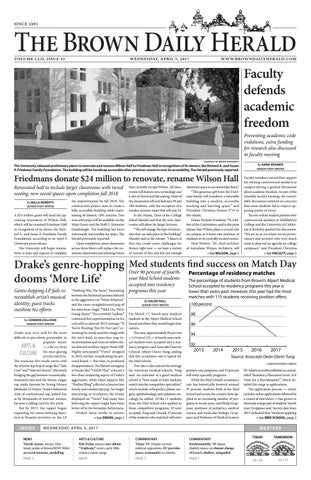
On March 17, fourth-year medical students at the Alpert Medical School found out where they would begin their careers. This year, approximately 94 percent —115 out of 122 — of fourth-year medical students were accepted into a residency program, said Associate Dean for Clinical Affairs Glenn Tung, adding that this acceptance rate is typical for the Med School. This rate is also around the average for American medical schools, Tung said. An indicator of a good medical school is “how many of their students match into the competitive specialties,” which include orthopedics, plastic surgery, ophthalmology and radiation-oncology, he added. Of the 11 students from the Med School who applied to these competitive programs, 10 were accepted, Tung said. Overall, 47 percent of the students who matched will enter
LAURA FELENSTEIN / HERALD
primary care programs, and 53 percent will enter specialty programs. While the Med School’s acceptance rate has historically hovered around 95 percent, students both at the Med School and across the country have applied to an increasing number of programs in recent years, said Philip Gruppuso, professor of pediatrics, medical science and molecular biology. Gruppuso and Professor of Medical Science
Eli Adashi recently published an article, titled “Residency Placement Fever: Is It Time for a Reevaluation?,” which detailed this surge in applications. The application process — which includes online applications followed by a round of interviews — has grown to dominate a large part of students’ fourth year, Gruppuso said. Survey data from 2013 indicated that “students applying » See MED SCHOOL, page 2
WEATHER
WEDNESDAY, APRIL 5, 2017
NEWS Yityish Aynaw, former Miss Israel, spoke at Brown/RISD Hillel on racial tensions, modelling
ARTS & CULTURE Bob Dylan releases new album “Triplicate,” covers early 20thcentury classic songs
COMMENTARY Vilsan ’19: Despite current political opposition, EU provides peace, community to citizens
COMMENTARY Krishnamurthy ’19: James Mattis’s stance on climate change ultimately shallow, misguided
PAGE 3
BACK
PAGE 7
PAGE 7
TODAY
TOMORROW
50 / 39
52 / 37
NEWS
PAGE 2 • WEDNESDAY, APRIL 5, 2017
THE BROWN DAILY HERALD
» WILSON, from page 1
» DRAKE, from page 1
design the renovations. University Architect Collette Creppell said the renovations will foster interactions within the building by creating new interior social spaces, such as a 900-square-foot room on the first floor. The new space will “encourage interactions between students and faculty or students and other students both during the day or after,” said Brian Clark, University director of news and editorial development. “We’re recapturing little eddies of social space throughout the building, some of them small-scale near classroom entrances and exits,” Creppell said in the release. “The first-floor social commons will serve as a very open, accessible area for students to gather.” The University will continue to honor the building’s previous benefactor, George Francis Wilson, through a named professorship and a plaque honoring Wilson and the building’s history, according to the release. The Friedmans’ gift will continue supporting the space by funding the maintenance of the building, according to the release. The University will also rename other locations on campus in honor of the Friedman Foundation. The Friedman Auditorium in the Metcalf Research Building will be renamed the Susan Pilch Friedman and Todd David Pilch Auditorium, paying tribute to Susan Friedman’s deceased brother Todd Pilch ’83. While renovations for Friedman Hall take place, the University will implement a new class schedule and utilize smaller seminar rooms in academic department buildings.
formlessness, 2017’s “More Life,” does not resolve the frustrating ambiguity of “Views.” Marketed as a pseudo-playlist of disparate songs rather than a traditional album, the release capitalizes on the rapper’s musical variability. On “More Life,” Drake flirts with everything from Caribbean dancehall to English grime, exploring a breadth of artistic styles. However, just like most dilettantes content to dabble in every discipline under the sun, Drake is successful in capturing a variety of musical influences but fails to succeed in defining his personal brand in the release’s half-baked attempts at genre-hopping. His project, for the most part, includes nothing particularly exceptional, as demonstrated by the awkward efforts of “Lose You” and “No Long Talk,” featuring Giggs. By attempting to communicate through such a wide array of genres, Drake ends up saying very little. The LP, pretentiously labeled as a “playlist,” has just as many guest features as it does musical styles. Luckily, however, the guests are sampled from the different genres Drake explores, adding actual credibility and authenticity to the tracks. These guest cuts often leave Drake out of the spotlight entirely, granting fresh artists culled from diverse genres the opportunity to truly flesh tracks out. The song “4422” displays the deft talents of electronic artist Sampha, while “Get It Together” with South African DJ Black Coffee and British singer Jorja makes for a cathartic piece of South African house music that would have been impossible for the Canadian rapper to create solo. Rather than advertising the work as
the sole product of Drake, the album’s (er, “playlist’s”) cover art attributes the
music to “October Firm” — a shadowy collaboration that implies a collective
effort. And justly so. Indeed, the playlist is often at its best when Drake is left at the wayside, with the guests in full control. On iTunes, Spotify and elsewhere, however, the work is still officially that of Drake, who falls short of the mark relative to most of his guests. To listeners’ dismay, the hip-hop artist is still left at the helm for most tracks. But lead single “Passionfruit,” one of the release’s solo efforts by Drake, stands apart as an irresistible and exceptionally well-crafted song. Drake combines his current world music influences with an infectious chorus that echoes the desperation Drake so exclusively (and exquisitely) sang of in the past. “Passionate from miles away / Passive with the things you say,” he sings. And just as it did on “Views,” the Drake of yesteryear does feel miles away on “More Life.” But for once, Drake actualizes artistic progression toward his newfound cosmopolitan soundscape without sacrificing his beloved and identifiable “sadboy” persona. Experimentation in music can be a healthy exercise in creativity. Fleetwood Mac, for example, started out as a mid-level blues band seemingly doomed to spend its lifetime mired in mediocrity. Thankfully, they eventually evolved into the “Landslide”-singing and record-shattering soft rock band that history came to know them as. Such trial and error can be necessary early on for an artist. But Drake, 11 years into his career, can no longer afford to vacillate between musical styles. “More Life” is still worth a listen, largely thanks to its guest features. Drake, the shape-shifter and genre-greenhorn, however, is seriously in need of saving and re-defining his personal brand.
» MED SCHOOL, from page 1
ended up interviewing for 27 programs, which was “too many,” he said. Travel spanned almost two and a half months, during which “there were two weeks (when) I had interviews every single day,” he said. Dorothy Liu MD’17 said she applied to 44 programs in general surgery. While those applications cost her $850, she knew that narrowing her focus and applying to fewer schools would be a “risky” endeavor, she said. Liu added that most students pay for the expenses incurred by the match process through additional loans. The number of applications Med School students are submitting is on par with national averages, according to the article published by Gruppuso and Adashi. They found that, in 2015, American medical students applied to
an average of 45.7 residency programs compared to 30.3 in 2005. For students interested in competitive specialities, this trend is magnified — those applying to orthopedic surgery programs submitted an average of 73 applications to a total of 163 available programs, according to the article. The Med School provides financial support for students throughout the match process, Tung said. Fourth-year students “have provisions in their financial aid package that account for the cost of travel and lodging,” and low-income students can request extra funds from the Med School on a case-by-case basis. The Med School also asks alums to house students while they travel. Additionally, the Med School provides important advisory help by conducting mock interviews and reviewing
students’ applications, Liu said. Most students also have a faculty member who helps guide them through the process, she added. Students have flexible schedules during the fourth year that allow them to travel to interviews, Sindhu said. There are fewer requirements during that year, and students have the option of pursuing an independent study for credit. There is a penalty for missing days of school, but “frankly, the fourth-year requirements are not very difficult, so it’s fine,” Sindhu added. Despite the support students receive, few people at the Med School — or anywhere — have addressed the continuous increase in application volume, Gruppuso said. Students may apply to so many programs because “the current generation of students feels significantly less
confident about their future prospects than (students) did 20 to30 years ago,” Gruppuso added. In reality, American medical students are just as likely to get into a residency program as they were two decades ago, but few students recognize this fact. In the article, Gruppuso and Adashi suggested streamlining the application process by organizing interviews across all residency programs to fall on a shorter timeline and capping the number of interviews a student is allowed to attend. They also proposed conducting preliminary interviews online before selecting finalist candidates to travel. But the authors do not anticipate such changes to the process will occur soon. Conversations about changing the matching process “is just getting started,” Gruppuso said.
to radiation-oncology programs, on average, went to 20 interviews,” and those numbers have likely increased since then, he said. The cost of the application process grows with the number of applications. Sending applications is easy — “you just have to check a box” — but students must pay for each program they apply to after the first 30, said Kunal Sindhu MD’17, who was accepted to a radiation-oncology program. In total, application fees and travel expenses can end up costing thousands of dollars, he added. Sindhu applied to 89 programs in radiation-oncology and an additional 22 in medicine, as he is required to complete residencies in both areas. He
LAURA FELENSTEIN / HERALD
NEWS
WEDNESDAY, APRIL 5, 2017 • PAGE 3
THE BROWN DAILY HERALD
First Ethiopian ‘Miss Israel’ discusses opening doors in modeling industry Yityish ‘Titi’ Aynaw details life story, experience as Ethiopian woman in Israel By BELLA ROBERTS SENIOR STAFF WRITER
Yityish “Titi” Aynaw, the first Ethiopian Miss Israel and a contestant for the title of Miss Universe in 2013, lectured on moving from Ethiopia to Israel, her experiences as a black model and her work advocating for the Ethiopian community of Israel at Brown/RISD Hillel on March 23. The event, hosted by Brown Students for Israel, was part of Aynaw’s national tour of college campuses in an effort to educate students about Israel, she said. “There’s been a lot of racial tension in the world recently and definitely in Israel with the Ethiopian community,” said Anna Horowitz ’19. “I think a lot of people are able to get a lot of insight about what it is like in Israel (from her speech).” Aynaw detailed her life story, beginning with her birth in the village of Chahawit in Ethiopia’s Gondar Province. “I was born in a very small village without shoes, electricity, cars, candles or restrooms. Our house was one room,” Aynaw said. Aynaw’s father died in war before she can remember, and her mother died from disease 10 years later, leaving Aynaw an orphan. Remembering her mother’s dream of moving to Israel, Aynaw and her brother emigrated there from Ethiopia in 2004. “It was a dream come true because (then) I (could) go to the place where my mother wanted to go,” Aynaw said. In Israel, she and her brother lived with their grandparents, who had moved in years prior to the town of Netanya. Never having consistently attended
» FACULTY, from page 1 Paxson P’19. Students need to learn “intellectual humility,” said Andre Willis, associate professor of history and religion. After four years at Brown, “you know you’ve had a successful liberal education if you can entertain the thought that ‘I might be wrong,’” said University Chaplain Janet Cooper Nelson. The University’s statement on academic freedom is missing “something that points to a need to respect speakers and let them be heard, even if you eventually oppose what they are saying,” said Iris Bahar, professor of engineering and computer science. It is a violation of the University’s code of conduct for a student to interrupt a speech, Paxson said. Hosting speakers with opposing views in a discussion could also prove incredibly productive, said Jim Head PhD’69 P’90, professor of geological sciences. The Office of Campus Life supports professors hosting potentially controversial events and speakers, said Dean of the College Maud Mandel. To prepare for the event, the office examines different approaches to hosting a speech and hands out the code of conduct to students at the event. Additionally, if faculty members are planning an event that is expected to be particularly controversial, the Office of Campus Life will direct them to a risk
BELLA ROBERTS / HERALD
Yityish “Titi” Aynaw was the first Ethiopian “Miss Israel.” As part of her national tour of college campuses, Aynaw spoke at Brown about her work advocating for Ethiopians in Israel and her experiences as a black model. school in Ethiopia, Aynaw quickly immersed herself in Israeli culture at her high school Kfar HaNoar HaDati. There, Aynaw quickly learned Hebrew as fellow students dedicated themselves to teaching her new words every day. “My teacher said to my class, ‘You have a new project. It’s called Project Titi. You have to take her every day and teach her new words,’” Aynaw said. After winning Miss Israel, Aynaw launched Titi’s mitigation group to discuss strategies for maintaining safety, including security and media coverage, Paxson said. Many faculty members would like “some kind of method for adjudication when questions of academic freedom come up,” said Rose McDermott, professor of international relations. She voiced her fears that parents, trustees and donors can apply financial pressure to force the University to take a political stance. The University could take a powerful stance by writing a statement that acknowledged all sides of the academic freedom debate, said Nancy Khalek, associate professor of religious studies. Professor of Biology Ken Miller ’70 P’02 said faculty members want an additional official statement that affirms their right to invite and listen to controversial speakers. Regardless of what actions come out of the faculty discussion, “talking to students about rights and responsibilities is really important,” Paxson said. After the roundtable discussion, Paxson announced that the University will create a $5 million “research backstop fund” to be authorized by Provost Richard Locke and administered by the Office of the Vice-President for Research. Should ongoing research be disrupted by federal decisions to cut funding, the backstop fund will ensure that research continues. The proposed federal budget includes cuts in funding for grants from the National Institutes of Health, the
Project through Foundation Netanya to give under-privileged children from the Neot-Shaked neighborhood afterschool activities and opportunities in the local community center such as math and computer classes, basketball and art projects. “I was always a nerd in high school,” Aynaw joked, referencing her title as student council president, her academic success and her love of running. In
school, she met her best friend, Noa, who always joked that she would enter Aynaw into the Miss Israel competition to win the prize car. “I’ll take the car and you can have the title,” Aynaw remembered Noa saying. After graduating from high school, Aynaw served as a lieutenant in the Military Police Corps of the Israel Defense Forces, where she had 300 soldiers under her command. After finishing
her service, she received a call that she had been entered into the Miss Israel competition. “We aren’t young anymore — we need a car,” Aynaw recalled Noa saying. In a T-shirt and flip flops, Aynaw arrived at the competition’s first round, feeling out of place among the women clad in lavish dresses and heavy makeup. Considering dropping out of the competition, Aynaw feared the stigmas associated with beauty pageant contestants and possible scrutiny from the soldiers under her command. But Noa convinced her to advance round after round until she won the title of Miss Israel 2013. Aynaw views her success as an opportunity: “It’s not about winning the competition, but it’s about opening doors and a chance on the stage to do something and be something,” Aynaw said, discussing her desire to utilize her title’s power to create social change. “When I won, I realized I had the power to help other people,” Aynaw said. “Titi was the one who really opened the gate for other black models,” said Ben Abrbanel, an Israeli photographer in attendance. Now, Aynaw is touring college campuses with the Jewish National Fund to speak about her life. “The tour is so people know about the reality in Israel. We are a really colorful country,” Aynaw said. Aside from modeling, Aynaw has since competed in Israel’s “Survivor” television series and even had dinner with former President Barack Obama. Aynaw’s brother collected newspaper and magazine clippings to convince her of her success. “It took months to realize what I did. When you see it in front of your eyes, you start to realize what is going on,” Aynaw said.
The faculty meeting addressed...
• Academic freedom and the need for an
official stance to embrace discussion of controversial viewpoints.
• Establishment of a research backstop fund in
case federal grants for research are cut.
• The high volume of academic code violations. • Proposed “day of solidarity.” LAURA FELENSTEIN / HERALD
National Endowment for the Arts, environmental research and reproductive health research, Locke said. The faculty meeting opened with questions about recent reports on the academic code, academic standing and the University Resources Committee, though The Herald was not granted access to the reports. The Standing Committee on the Academic Code has been very active over the last academic year because the rate of code violations remains high, said Tom Doeppner, a committee member and associate professor of
computer science. As a result, the academic code report requested to expand the size of the standing committee to address the volume of violations, he added. Computer science students are the leading source of offenders, Doeppner said. “We need to make it clear to students that they will get caught and punished for cheating,” he added. Discussing the academic code in class could help deter students from cheating, Mandel added. On May 1, the next Faculty Commons will discuss recommendations
faculty members would like to make about implementing the Diversity and Inclusion Action Plan and creating an infrastructure for that implementation, said Marc Tatar, professor of biology. The University is also discussing a proposed “day of action or solidarity” to take place in the fall, Locke said. Capitalizing off recent work by the Swearer Center for Public Service and the Watson Institute for International and Public Affairs, the nonpartisan event will aim to channel student and faculty energy toward political engagement.
ARTS & CULTURE PAGE 4 • WEDNESDAY, APRIL 5, 2017
THE BROWN DAILY HERALD
Middle East Studies hosts film series on displacement Ursula Biemann presents three of her films, touches on themes of migrant life in Sahara Desert By ETHEL RENIA SENIOR STAFF WRITER
Ursurla Biemann, a prominent Swiss video essayist, has been welcomed to Brown by the Middle East Studies Department as part of their year-long series of seminars, workshops and cultural activities surrounding the theme of “Displacement and the Making of the Modern World.” “Displacement is a global phenomenon, and the majority of people displaced over the last few years have been from Syria and Middle Eastern countries,” said Beshara Doumani, professor of modern Middle East history and director of Middle East studies. “It is reshaping the entire Middle East, and it is reshaping the relationship of the Middle East with the rest of the world.” Biemann was invited to the University to speak about three of her films. “Black Sea Files,” a work of art that deals with the Caspian oil geography, was screened in the Watson Institute for International and Public Affairs Monday, while her long-term video research project, “The Sahara Chronicles,” was presented Tuesday. As the series continues Wednesday, she will speak about “The Cosmopolitan Forest.”
ELI WHITE / HERALD
Swiss video essayist Ursurla Biemann presented her films as part of a year-long series of seminars, workshops and activities held by the Middle East Studies Department. Biemann’s work focuses on the daily life of migrants. Tuesday’s presentation, “The Sahara Chronicles,” is an anthology of short video essays that looks at the North African desert as a transit space. Migrants from southern Africa are forced to cross the desert in an effort to find work in Europe. The Sahara Desert thus
becomes fertile ground for movement as thousands of people make the trek north to Maghreb. Through film, Biemann aims to provide a more sensible and quiet outlook on the migrant’s journey. According to Biemann, Western media focuses on
Do you have the experience to get a full time job? Internships give you the skills you need to succeed. Bridge.jobs helps you connect with employers in Rhode Island and find the perfect internship for you. Create a free profile, attach your resume, read the blog and start searching for available opportunities in Rhode Island today.
Visit www.bridge.jobs to register. Or download bridge.jobs in your app store!
the people who do not get to their destination, painting a catastrophic picture of migrant life. “Images of refugee boats have become the symbol that encapsulates the entire drama, and it suggests urgency and emergency,” Biemann said. Biemann, on the other hand, is more interested in the less dramatic aspects of life as a migrant. She studies the slow, everyday life of the migrant’s journey to Europe. In her work, she focuses on the long journey migrants must make within Africa — and more specifically the Sahara — before even reaching the European continent. Each of her video essays focuses on a facet of migrant life in the Sahara. One of her videos studies a migrant hub in Agadez, Niger, exploring the innerworkings of the Sahara Ténéré Transportation Company, which offers migrants from anywhere in Africa safe transportation across the desert for a fee. “This video documents the time before the departure,” Biemann said. “This is a time of great hope and potentiality.” The pace of the video is slow and filled with the monotone chatter of every-day life, resulting in an “unexcited form of representation,” Biemann added. One video deals with the Tuareg community, a people native to the Sahara Desert that were split up in five different countries during the decolonization and partition of the African continent. This film showcased an interview with a former Tuareg rebel leader who was in charge of a Tuareg-operated migrant transportation network. “The Tuareg existence is by definition transnational,” Biemann said. It therefore only makes sense that
the Tuareg community be an important actor in the Saharan market of migrant desert transportation. A third video delves into the theme of hindered movement, examining a prison used to detain illegal transit migrants in Morocco to be repatriated to their countries of origin. The video exhibits the anger of those who worked and saved money for this trip to Europe only to be stopped before leaving the continent. Finally, Biemann interviewed a young woman in Senegal who traveled as the only woman on a fishing boat transporting 43 migrants to the Canary Islands of Spain. At the age of 16, she left Senegal alone in the hope of finding a better job to support her family. After 19 days at sea, she spent one day in Spain before her boat was found by the military and she was sent back to Senegal. Though her story seems dramatic, her tone and demeanor remain calm as she recounts her story. She smiles as she admits that her life was unchanged by the incident and that she is better off in Senegal anyway. These videos are slow and set to the rhythm of normal, every day life. They humanize and de-dramatize what has been described as a crisis of boatloads of bodies hurtling themselves onto European shores. Biemann studies migrant life and circumstances in a “beautiful, theoretically sophisticated way that is able to get us to think about the issue of these people — from the micro-experiences of individuals who are crossing the desert to the big geopolitical questions of the day,” Doumani said.
TODAY
WEDNESDAY, APRIL 5, 2017 • PAGE 5
THE BROWN DAILY HERALD
menu
naiza khan comes to brown
SATELLITE DINING ANDREWS COMMONS
Pizza: Mushroom’s Revenge, Spicy Sausage and Garlic, Miss Maple JOSIAH’S
BLUE ROOM
The Isabella Burger, The Muffaletta, Santa Fe Salad
Beef Chili with Beans, Hearty Country Vegetable Soup
DINING HALLS SHARPE REFECTORY LUNCH
DINNER
Chicken Tenders, Basmati Rice, Steamed Baby Carrots, Pork Lo Mein, Rice Krispie Treats
Roast Beef Au Jus, Roasted Fingerling Potatoes, Jambalaya, Oreo Chocolate Chip Fudge Bars
VERNEY-WOOLLEY LUNCH
DINNER
Italian Sausage and Peppers Sandwich, Spinach Pizza Rustica, Rice Krispie Treats
Rotini Pasta, Szechuan Pork Saute, Szechuan Spicy Tofu Stir Fry, Pound Cake
sudoku
ELI WHITE / HERALD
Naiza Khan, one of Pakistan’s most important multimedia artists and a professor of visual studies at the University of Karachi, delivered the Roger B. Henkle Memorial Lecture March 23.
Q U O T E O F T H E D AY
RELEASE DATE– Tuesday, March 12, 2013
Los Angeles Times Daily Crossword Puzzle crossword Edited by Rich Norris and Joyce Nichols Lewis
ACROSS 1 Zion National Park’s state 5 “Liquid diet” drinkers 9 Low-prestige position 14 Actress Rogers 15 Front of the boat 16 River in Lyons 17 Prime hours for television broadcasters 20 Snorkeling spot 21 Quaint “before” 22 Scissors sound 23 Down in the dumps 27 Scrape together, with “out” 28 Googler’s success 29 Skinny Olive 30 Transferred, as property 32 Small amount 34 GM navigation system 37 “Greetings, Paddy!” 42 List of corrections 43 Created, as a web 45 Jim of “Liar, Liar” 48 Dreamer’s acronym 51 Dedicated lines? 52 Conquistador’s treasure 53 Moonshine, or a soda named for it 57 Connecting point 59 Game with Skip and Reverse cards 60 Show one’s pearly whites 61 Conduct observed during international negotiations 66 Delta rival, as it used to be called 67 Southernmost Great Lake 68 Top draft status 69 Debussy’s “slow” 70 Studio payment 71 More-caloric egg part DOWN 1 “Steee-rike!” caller 2 Accessory with a Windsor knot
3 Liqueur sometimes used in amandine sauce 4 Backpackers’ outings 5 All gussied up 6 Forty-niner’s pay dirt 7 Beach bringalong 8 Marble cake pattern 9 Flavor-enhancing additive 10 Maine Coon and Manx 11 Signed up for 12 Ready for recording 13 Alerted, in a way 18 Legislative turndown 19 Must 23 Ill. metropolis 24 Laugh-a-minute type 25 Wahine’s greeting 26 In the vicinity 31 Coastal divers 33 Mimic 35 Hoops dangler 36 Shrewd 38 City near Provo 39 Beta-test
40 Little music player 41 Not decent, so to speak 44 Still in the package 45 Government official working overseas 46 Inspire, as curiosity 47 Former NBAer Dennis
49 Predatory hatchling 50 Surrealist Joan 54 Less than 55 Bête __ 56 “Star Trek” co-star of Shatner 58 Radiate 62 Anger 63 Tailor’s fastener 64 Toon collectible 65 Talk and talk
“It’s not about winning the competition … it’s about opening doors and a chance on the stage to do something and be something.
”
— Yityish “Titi” Aynaw, Miss Israel 2013
See miss israel on page 3.
ANSWER TO PREVIOUS PUZZLE:
CORRECTION Correction: A previous version of this article stated that Akaela Michels-Gualtieri ’20 said that Wesleyan College is one of the only other schools with a comparable RUE program. In fact, she said Wellesley College is one of the only other schools with a comparable RUE program. The Herald regrets the error. Correction: A previous version of the article “Watson Institute launches fifth-year Master of Public Affairs program” contained a misspelling of Associate Director of Public Policy Carrie Nordlund’s name. The Herald regrets the error.
xwordeditor@aol.com
calendar
03/12/13
TODAY MARCH APRIL
S
M
03/12/13
W
Th
F
S
1
2
3
14
25
36
47
58
69
10 7
11 8
12 9
10 13
11 14
12 15
13 16
14 17
15 18
16 19
17 20
18 21
19 22
20 23
21 24
22 25
23/30 26 24 27 By Bruce Venzke and Gail Grabowski (c)2013 Tribune Media Services, Inc.
T
25 28
26 29
27 30
28 31
29
Ethical Inquiry Lunch 12:00 P.M. Salomon Center, 203
Catholic Mass 12:05 P.M. Manning Chapel
Brown Sports Analytics Club Workshop 6:00 P.M. Barus and Holley, 163
Brown Amateur Radio Club Meeting 6:30 P.M. Sayles Hall, 305
TOMORROW Brown Bag Concert 12:00 P.M. Sayles Hall
Introductory LaTeX Workshop 12:00 P.M. Sciences Library, 3rd floor
Syrian Refugee Experiences in Providence 7:00 P.M. Wilson Hall, 305
Invasion! 8:00 P.M. Leeds Theatre, Lyman Hall
COMMENTARY PAGE 6 • WEDNESDAY, APRIL 5, 2017
THE BROWN DAILY HERALD
comic P-Branes and Bosons | Ricky Oliver
Find us online! facebook.com/browndailyherald
browndailyherald.com
@the_herald
Location: 195 Angell St., Providence, R.I. www.browndailyherald.com
@browndailyherald
youtube.com/browndailyherald
Editorial Leadership
Sections
Multimedia & Production
Business
Editor-in-Chief Lauren Aratani
Arts & Culture Editors Julie Center Madison Rivlin
Design Editors Christy Leung Ameer Malik Jessica Yu Assistant: Eduard Muñoz-Suñé
General Managers Henry Ritter Ben Wesner
Managing Editors Matt Brownsword Rebecca Ellis Kate Talerico POST- MAGAZINE Editor Monica Chin
News Editors Kyle Borowski Kasturi Pananjady Suvy Qin Elena Renken Alex Skidmore Hattie Xu
BLOGDAILYHERALD Editor Anica Green
Sports Editors Jackson Chaiken Ben Shumate COMMENTARY Opinions Editors Anuj Krishnamurthy Mili Mitra Clare Steinman
Photo Editors Head: Eli White Assistant: Sam Berube Anita Sheih Sara Runkel Copy Desk Chief Julia Stemmer Multimedia Editor Roland High Illustrations Editor Dorothy Windham Graphics Editor Laura Felenstein Directors of Web Development: Lucy Wei Ivy Wong
Directors Finance: Reena Zhan Sales: Antonia Alvarez Sales: Erin Lueck Strategy: William Nober Strategy: Gianna Jasinski Managers Sales: Elizabeth Doykan Sales: Gabriella Elanbeck Sales: Matilda Lynton Sales: Ariel Shusterman Collections: Ravi Betzig Operations: Gür Ağci
Editorial contact: 401-351-3372 herald@browndailyherald.com
Business contact: 401-351-3260 gm@browndailyherald.com
Submissions: The Brown Daily Herald publishes submissions in the form of op-eds and letters to the editor. Op-eds are typically between 750 and 1000 words, though we will consider submissions between 500 and 1200 words. Letters to the editor should be around 250 words. While letters to the editor respond to an article or column that has appeared in The Herald, op-eds usually prompt new discussions on campus or frame new arguments about current discourse. All submissions to The Herald cannot have been previously published elsewhere (in print or online — including personal blogs and social media), and they must be exclusive to The Herald. Submissions must include no more than two individual authors. If there are more than two original authors, The Herald can acknowledge the authors in a statement at the end of the letter or op-ed, but the byline can only include up to two names. The Herald will not publish submissions authored by groups. The Herald does not publish anonymous submissions. If you feel your circumstances prevent you from submitting an op-ed or letter with your name, please email herald@browndailyherald.com to explain your situation. You can submit op-eds to opinions@browndailyherald.com and letters to letters@browndailyherald.com. When you email your submission, please include (1) your full name, (2) an evening or mobile phone number in case your submission is chosen for publication and (3) any affiliation with Brown University or any institution or organization relevant to the content of your submission. Please send in submissions at least 24 hours in advance of your desired publication date. The Herald only publishes submissions while it is in print. The Herald reserves the right to edit all submissions. If your piece is considered for publication, an editor will contact you to discuss potential changes to your submission. Commentary: The editorial is the majority opinion of the editorial page board of The Brown Daily Herald. The editorial viewpoint does not necessarily reflect the views of The Brown Daily Herald, Inc. Columns, letters and comics reflect the opinions of their authors only. Corrections: The Brown Daily Herald is committed to providing the Brown University community with the most accurate information possible. Corrections may be submitted up to seven calendar days after publication. Advertising: The Brown Daily Herald, Inc. reserves the right to accept or decline any advertisement at its discretion. The Brown Daily Herald, Inc. is a financially independent, nonprofit media organization bringing you The Brown Daily Herald, BlogDailyHerald and Post- Magazine. The Brown Daily Herald has served the Brown University community daily since 1891. It is published Monday through Friday during the academic year, excluding vacations, once during Commencement and once during Orientation by The Brown Daily Herald, Inc. Single copy free for each member of the community. Subscription prices: $200 one year daily, $100 one semester daily. Copyright 2017 by The Brown Daily Herald, Inc. All rights reserved. Periodicals postage paid at Providence, R.I. Postmaster: Please send corrections to P.O. Box 2538, Providence, RI 02906.
COMMENTARY WEDNESDAY, APRIL 5, 2017 • PAGE 7
THE BROWN DAILY HERALD
Why we need the EU
FABIANA VILSAN staff columnist A recent article published by the Economist paints a bleak picture of the future of the European Union: Upcoming elections in the member states have the potential of reversing the freedoms EU citizens have enjoyed for six decades, and the economic climate in Europe isn’t much of a pick-me-up. Reading the article, I couldn’t help but feel anxious at the thought of the European community crumbling. Should I book a flight home for summer break before it’s too late? But no matter how many pessimistic articles I read or bleak political prognoses I watch, the European within me believes that the EU-supported harmony — made of different cultures, languages, people and experiences that constitute the continent I call home — will be enough to hold Europe together in times of economic and political uncertainty. Europe evokes a sense of community and inclusion I haven’t encountered anywhere else in the world. Yet, as governments across the continent adopt populist policies and begin to push against the European Union, the tranquil European community I grew up and fell in love with is in danger of extinction. But I’ve preserved my con-
fidence in the European spirit, despite what projections and polling may have you believe. The Europe I know and love will persist long into the future, regardless of today’s political trends, because the EU isn’t just a short-lived bureaucratic annoyance that barks orders at an unwilling audience — it is part of the fabric of European life. The dissolution of the EU will do more than create political instability — it will deprive future generations of European citizens of the peace and com-
we were denied. My whole life I have enjoyed the freedoms associated with the EU, never feeling like a complete foreigner in the other states regardless of language barriers or cultural differences. This openness is more than just a politcal or economic fact; it has made a real difference in my life, affording EU citizens the opportunity to study, travel and develop meaningful relationships with one another. The EU has deeply influenced European values and created work and travel
its member nations. (It is for this very reason that Brexit happened.) Especially in today’s economic climate, the perception of foreign forces influencing national politics is quick to cause anxiety and fear. In reality, the EU functions less like an overly involved parent and more like an organization designed to keep European nations from dissolving into nationalism and war. When it comes to preserving peace, the EU has fostered success. In 2012, the Nobel Committee awarded the EU
Despite the current social opposition to the EU, my experience with the freedoms and values promoted by the organization have me optimistic that, while nationalistic and populist waves are temporary, the European community is here to stay. As older generations are pushing back against the EU’s norms and regulations, it is the responsibility of our generation to make our voices heard in EU politics. munity that I had the privilege of experiencing. As a teenager, I took pride in the fact that my country, Romania, was a member nation and thus committed to upholding these shared values. I remember, when I was 10 years old, Romania underwent the process of joining the EU. My fellow Romanians celebrated our integration into an organization aimed at protecting the rights that, under decades of communist rule,
freedoms for member citizens. According to Ian Manners, professor of political science at the University of Copenhagen, the EU functions as a “normative power” in Europe. In order for nations to join the EU, they must accept and implement certain norms, as well as adopt free trade and travel agreements. The EU has often been criticized for acting like a state and therefore interfering with the autonomy of
the Nobel Peace Prize for “transforming most of Europe from a continent of war to a continent of peace.” The organization’s normative effect on policy has done more than add a cumbersome foreign presence in national governments. Today’s political climate is not the first that can be described as nationalistic and fearful of foreign influence and dangers. It was precisely these sen-
timents that were responsible for the two World Wars and, arguably, the majority of wars in history. The EU was created to rise above political trends and promote shared European values of democracy, law, social justice and freedom. It saddens me as a European abroad to witness this organization be challenged by the social and political forces it was created to fight. Despite the current social opposition to the EU, my experience with the freedoms and values promoted by the organization have me optimistic that, while nationalistic and populist waves are temporary, the European community is here to stay. As older generations are pushing back against the EU’s norms and regulations, it is the responsibility of our generation to make our voices heard in EU politics. In last year’s Brexit referendum, the younger generation was overwhelmingly in favor of remaining, but ultimately, it was the votes of the older generation that solidified the decision to leave. Young people — who tend to be more liberal and internationalist in outlook and who must live with the repercussions of the dissolution of the European Union — understand the value of the freedoms protected by the organization and must fight to preserve them.
Fabiana Vilsan ’19 can be reached at fabiana_vilsan@brown.edu.
At war with climate change ANUJ KRISHNAMURTHY opinions editor It isn’t often that environmentalists cheer the views of Trump administration officials on climate change. Yet, that’s exactly what happened when, earlier this month, Secretary of Defense James Mattis revealed that he does not share President Trump’s climate skepticism. As ProPublica reported, Mattis emphasized the dangers of global warming in written exchanges with several members of the Senate Armed Services Committee. “Climate change is a challenge that requires a broader, whole-of-government response,” Mattis wrote to Sen. Jeanne Shaheen D-NH after his Jan. 12 confirmation hearing. “If confirmed, I will ensure that the Department of Defense plays its appropriate role within such a response by addressing national security aspects.” Advocates of eco-friendly, evidence-based policymaking seemed relieved by Mattis’ testimony. Shana Udvardy, the Union of Concerned Scientists’ climate preparedness specialist, called Mattis “the lone climate change soldier within this administration’s cabinet.” The Sierra Club tweeted that Trump and his budget director “should listen to their own secretary of defense, who says climate change is a threat right now.” And National Geographic published this blaring headline in February: “Who’s Still Fighting Climate Change? The U.S. Military.” It is reassuring to know that Mattis and the armed forces, well-positioned to reign in the current administration’s worst excesses, can countervail Trump’s refusal to accept climate change as a threat to human civilization. But environmental activists shouldn’t get their hopes up. Far from being a potential ally in the crusade against climate change, the American military is more interested in accommodating an apocalyptic future — one in which a sweltering planet is convulsed in cli-
mate-induced conflict — than it is in addressing the root causes of global warming. A civilian might approach the mess of climate change more intuitively, with a heavier emphasis on domestic prevention instead of unreliable treaties or lastminute emergency measures. After all, environmental policy aimed at reducing greenhouse gas emissions and encouraging the adoption of renewable energy could presumably forestall any doomsday tumult in the first place. But from the military’s standpoint, the answer to climate change lies not at the intersection of social change and public policy, but within the framework of national security. In its 2014 Quadrennial Defense Review, the Department of Defense found that the “pressures caused by climate
This conceptualization of climate change — as a primarily national security concern, not a sociopolitical one — has indelibly shaped the military’s planned reaction to impending climatological chaos. Consider the Center for Naval Analyses’ report, “National Security and the Threat of Climate Change.” In the executive summary, the Center’s Military Advisory Board, consisting of retired generals and admirals, warns that climate change can “disrupt our way of life” and “force changes in the way we keep ourselves safe and secure.” More specifically, the report predicts that the United States will have to “accept large numbers of immigrant and refugee populations” and “may be drawn more frequently” into burgeoning conflict
Far from being a potential ally in the crusade against climate change, the American military is more interested in accommodating an apocalyptic future — one in which a sweltering planet is convulsed in climate-induced conflict — than it is in addressing the root causes of global warming. change” are “threat multipliers that will aggravate stressors abroad such as poverty, environmental degradation, political instability and social tensions — conditions that can enable terrorist activity and other forms of violence.” And, according to the Department of the Army, these pressures in totality presage “an era of persistent conflict, which for the foreseeable future will place us in a security environment much more ambiguous and unpredictable than that faced during the Cold War.” The military’s dystopian characterization of the geopolitical future is revealing. In the eyes of the military, climate change isn’t a problem because it will irreparably harm humanity and the environment. It’s a problem because these harms, culminating in overburdened governments and violent conflict, will eventually reach Americans.
zones as “weak and failing governments” struggle to maintain internal cohesion. It is worth observing here the Americentrism of the board’s prediction. The report bemoans the larger responsibility the United States must assume in maintaining international order, but other countries face burdens that are exponentially more extreme. For example, a 2003 Pentagon study forecasted that, while American agriculture will suffer marginally, rising sea levels and coastal erosion will render most of Bangladesh “nearly uninhabitable,” unleashing a “drinking water and humanitarian crisis.” By elevating American climate security concerns above those of other nations, then, the military sees developing countries and their vulnerability to climate change as a problem to be begrudgingly managed, not an urgent human concern. In doing so, the military
also implicitly prizes the preservation of a privileged few over others and demands a more interventionist foreign policy. And, as the report shows, the military hasn’t yet devised any ground-breaking or elegant strategies to counter global warming, apart from “assist(ing) nations at risk” and “setting targets for long-term reductions in greenhouse gas emissions.” This dearth of climate innovation is revealing. Green activists must understand that the military is more concerned with managing a planet ravaged by global warming and climate warfare — not preventing it, or encouraging any of the dramatic transformations needed to avoid imminent catastrophe. This is not to say that the Pentagon cannot contribute to the green movement by communicating strategic realities to skeptical congressmen, or by pioneering new fields of research in clean-energy technologies. In the long-term, though, the lens of “national security” cannot be the only answer to global warming. Not only does such a worldview assign special importance to developed countries at the expense of poorer ones, but it also does little to prevent the conflicts and cataclysms that will ultimately arise from climate change. As such, it is unlikely that Mattis, no matter how enlightened or well-intentioned his congressional testimony, will deviate from his own outlook as secretary of defense and more meaningfully service the environmentalist cause. Mattis’ recent comments about climate change should be taken with extreme caution. The military can’t solve all our problems, and as the brawl between sensible, science-based policy and personal whim rages on, we ought to defer to a fact we’ve long known: Only when our civilian leaders accept the reality of climate change — and not just the heads of our military — can we truly breathe a sigh of collective relief.
Anuj Krishnamurthy ’19 can be found hugging a tree or reached at anuj_krishnamurthy@brown.edu.
ARTS & CULTURE THE BROWN DAILY HERALD
WEDNESDAY, APRIL 5, 2017
Bob Dylan’s ‘Triplicate’ revels in nostalgia Dylan explores universal emotions with latest release, covers early 20thcentury classics By ELIZABETH TOLEDANO SENIOR STAFF WRITER
Listening to “Triplicate,” Bob Dylan’s latest album released Mar. 3, it’s hard to imagine the Dylan who played at Brown in 1964. Though most of the tunes are covers of popular sentimental songs from the early 20th century, Dylan disowned his most recent release’s purported nostalgia in an interview with Bill Flanagan. “It’s not taking a trip down memory lane or longing and yearning for the good old days or fond memories of what’s no more,” he told Flanagan. That’s a challenging claim to support. Dylan still defines the length of his albums by how much good quality sound can fit on a record, not a CD, dividing his album into three interrelated 32 minute albums — imagine 16-minute sides of a vinyl. The idea to make a three-part reflective series echoes an earlier Frank Sinatra album, “Trilogy: Past, Present, Future,” released in 1980. Furthermore, the songs on the album are an aggregate of songs made famous by twentieth century standbys such as Rodgers and Hammerstein, John Coltrane and Frank Sinatra. Perhaps the listener interprets the
album’s 30 songs as nostalgic because the feelings conveyed in the lyrics and melodies have been delved into for so many years — but that’s because they’re grounded. They’re the “essence of life,” according to Dylan. And maybe he knows — he’s been around for a while now. In fact, songs like “That Old Feeling” and “Sentimental Journey” outdate the veteran songwriter himself, emerging during and even before his very early childhood in Duluth, Minnesota when he still went by Robert Zimmerman. Actually, the album might have been a more obvious soundtrack for the Depression and World War II eras than for today, a time when, Dylan says, “songs are so institutionalized that you don’t realize it.” Admittedly, Dylan’s recent career is not flawless. There is undoubtedly something a little cringe-worthy in hearing the same spirited pioneer from the 1960s musical revolution sing fragmented Christmas songs in a tired voice like he does in his 2009 release “Christmas in the Heart.” But the album’s searing and somber rendition of “Silver Bells” acts as a prelude to what Dylan reveals in “Triplicate.” Sure, it’s no “Subterranean Homesick Blues,” but that type of track could not work today. Dylan’s perspective has adapted, the music world has evolved and the political atmosphere has changed. Maybe this is why listeners feel their own kind of post-1970
nostalgia listening to the new album. But it’s not the 1960s, Dylan’s out of Woodstock and there will never be another “Highway 61 Revisited.” Instead, the “Triplicate” listener encounters a new sober, sentimental Dylan with a certain well-deserved gravity. And it’s this heaviness, this entire lifetime, that, layered over “Nashville Skyline” and “Blonde on Blonde,” accomplishes something entirely new in its severe honesty. The songs on “Triplicate” aren’t pop songs — they’re worn-out, they aren’t flashy and they aren’t radioready. The tracks challenge the glossy, Nobel-Prize winning, chart-topping career of one of the most influential musicians in history. When Dylan covers these classics, he performs the equivalent act of what modern musicians have done over and over to his own songs. The songs Dylan plays on “Triplicate” are the “Make You Feel My Love” and the “Wagon Wheel” of World War II. As these early twentieth-century hits begin to lose their traction, an opportunity exists to revive music that drives at what it means to feel anything at all in the most unabashed, and, at times, painful way. It’s not nostalgic to reach for the feeling that ended in the era of jazz and Frank Sinatra — playing these songs is an opportunity to demonstrate universal experiences, which are still very much a part of life today. And who better to take on this challenge than Dylan, the man who wrote the next generation’s standbys?
THE 17TH ANNUAL CASEY SHEARER MEMORIAL LECTURE
A Conversation with Oscar Winner
EZRA EDELMAN
Director of Academy Award-Winning Documentary Series OJ: Made In America
April 13, 2017 @ 6:00 p.m. MacMillan Hall / Starr Auditorium / Room 117 167 Thayer Street / Providence / Rhode Island The lecture will be preceded by a presentation of the 17th Annual Casey Shearer Memorial Awards For Excellence in Creative Nonfiction
LAURA FELENSTEIN / HERALD