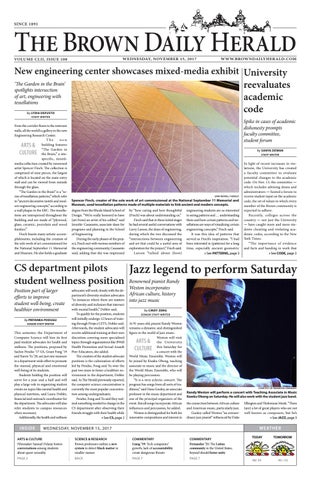
SINCE 1891
THE BROWN DAILY HERALD WEDNESDAY, NOVEMBER 15, 2017
VOLUME CLII, ISSUE 108
WWW.BROWNDAILYHERALD.COM
New engineering center showcases mixed-media exhibit University ‘The Garden in the Brain’ reevaluates spotlights intersection of art, engineering with academic tessellations code By LYDIA DEFUSTO STAFF WRITER
From the corridor floors to the restroom walls, all the world’s a gallery in the new Engineering Research Center. The new building features “The Garden in the Brain,” a sitespecific, mixedmedia collection created by renowned artist Spencer Finch. The collection is comprised of nine pieces, the largest of which is located on the main entry wall and can be viewed from outside through the glass. “The Garden in the Brain” is a “series of tessellation patterns,” which refer to “ancient decorative motifs and modern engineering concepts,” according to a wall plaque in the ERC. The tessellations are interspersed throughout the building and are made of “plywood, glass, ceramic, porcelain and wood finishes.” Finch boasts many artistic accomplishments, including the creation of the sole work of art commissioned for the National September 11 Memorial and Museum. He also holds a graduate
Spike in cases of academic dishonesty prompts faculty committee, student forum
ARTS & CULTURE
By SANYA DEWAN STAFF WRITER
SARA RUNKEL / HERALD
Spencer Finch, creator of the sole work of art commissioned at the National September 11 Memorial and Museum, used tessellation patterns made of multiple materials to link ancient and modern concepts. degree from the Rhode Island School of Design. “We’re really honored to have (art from) an artist of his caliber,” said Jennifer Casasanto, associate dean for programs and planning in the School of Engineering. During the early phases of the project, Finch met with various members of the engineering community, Casasanto said, adding that she was impressed
by “how caring and how thoughtful (Finch) was about understanding us.” Finch said that in these initial stages he had several useful conversations with Larry Larson, the dean of engineering, during which the two discussed the “intersections between engineering and art that could be a useful area of exploration for the project,” Finch said. Larson “talked about (how)
engineering students are so interested in seeing patterns and … understanding them and how certain patterns and tessellations are ways of visualizing certain engineering concepts,” Finch said. It was this idea of patterns that served as Finch’s inspiration. “I had been interested in (patterns) for a long time, especially ancient geometric » See PATTERNS, page 3
In light of recent increases in violations, the University has created a faculty committee to evaluate potential changes to the academic code. On Nov. 13, the committee — which includes advising deans and administrators — hosted a forum to receive student input on the academic code, the set of values to which every member of the Brown community is expected to adhere. Recently, colleges across the country — not just the University — have caught more and more students cheating and violating academic codes, according to the New York Times. “The importance of evidence and facts and handing in work that » See CODE, page 3
CS department pilots Jazz legend to perform Saturday pianist Randy student wellness position Renowned Weston incorporates Position part of larger efforts to improve student well-being, create healthier environment By PRIYANKA PODUGU SENIOR STAFF WRITER
This semester, the Department of Computer Science will hire its first paid student advocates for health and wellness. The positions, proposed by Sachin Pendse ’17 GS, Grant Fong ’19 and Karen Tu ’20, are just one measure in a department-wide effort to promote the mental, physical and emotional well-being of its students. Students holding the position will serve for a year and a half and will play a large role in organizing student events on topics like mental health and physical nutrition, said Laura Dobler, financial and outreach coordinator for the department. The advocates will also refer students to campus resources when necessary. Additionally, the health and wellness
INSIDE
advocates will work closely with the department’s diversity student advocates “in instances where there are matters of diversity and inclusion that intersect with mental health,” Dobler said. To qualify for the position, students will initially undergo 12 hours of training through Project LETS, Dobler said. Afterwards, the student advocates will receive additional training at their own discretion covering more specialized topics through organizations like BWell Health Promotion and Sexual Assault Peer Educators, she added. The creation of the student advocate positions is the culmination of efforts led by Pendse, Fong and Tu over the past two years to foster a healthier environment in the department, Dobler said. As The Herald previously reported, the computer science concentration is currently the most popular concentration among undergraduates. Pendse, Fong and Tu said they realized something needed to change in the CS department after observing their friends struggle with their health while » See CS, page 2
African culture, history into jazz music By CINDY ZENG SENIOR STAFF WRITER
At 91 years old, pianist Randy Weston remains a dynamic and distinguished figure in the world of jazz music. Weston will visit the University this Saturday for a concert with the World Music Ensemble. Weston will be joined by Kwaku Obeng, teaching associate in music and the director of the World Music Ensemble, who will be playing percussion. “It is a very eclectic concert. The program has songs from all sorts of traditions,” said Dana Gooley, an associate professor in the music department and one of the principal organizers of the event. But all songs incorporate African influences and percussion, he added. Weston is distinguished for both his innovative compositions and interest in
ARTS & CULTURE
COURTESY OF WIKIMEDIA COMMONS
Randy Weston will perform a concert with Teaching Associate in Music Kawku Obeng on Saturday. He will also work with the student jazz band. the connection between African culture and American music, particularly jazz. Gooley called Weston “an extraordinary jazz pianist” influenced by Duke
Ellington and Thelonious Monk. “There (are) a lot of great players who are not well known as composers, but he’s » See JAZZ, page 3
WEATHER
WEDNESDAY, NOVEMBER 15, 2017
ARTS & CULTURE Filmmaker Samuel Delany fosters conversations among students about queer sexuality
SCIENCE & RESEARCH Brown professors outline a new system to detect black matter in smaller masses
COMMENTARY Liang ’19: Tech companies’ growth, lack of accountability create dangerous threats
COMMENTARY Fernandez ’21: The Latinx community in the United States, beyond should foster unity
PAGE 2
BACK
PAGE 7
PAGE 7
TODAY
TOMORROW
48/ 34
49 / 33
NEWS
PAGE 2 • WEDNESDAY, NOVEMBER 15, 2017
THE BROWN DAILY HERALD
Sci-fi writer talks sexuality during week in residency Samuel R. Delany brings conversation about queer identity, literature through documentary By TANUSHRI SUNDAR STAFF WRITER
For Samuel R. Delany — award-winning science-fiction writer and essayist on sexuality, society and literature — our humanity does not come from talking about sexual activity. Somehow, he elaborates, our humanity is embodied by the silence that enshrouds sexuality. As part of a visit organized by the Department of Modern Culture and Media, Delany spoke candidly about his personal and sexual life in the documentary “The Polymath, or, The Life and Opinions of Samuel R. Delany, Gentleman,” which was screened in the Granoff Center for the Creative Arts’ Martinos Auditorium Nov. 9. The screening of the documentary, directed by Fred Barney Taylor, was followed by Delany’s own experimental film, “The Orchid.” Delany is a prolific and groundbreaking writer, his work spanning themes of science fiction, perception, language and even pornography, a label he supports.
ARTS & CULTURE
During his week in residency at the University, which included the film screening, Delany gave the annual Roger B. Henkle Memorial Lecture, exhibited his works and manuscripts in the John Hay Library and spoke with students and faculty. Hosting Delany at the University was a “joint effort on the part of a lot of different departments,” said Lynne Joyrich, chair and professor of modern culture and media. Originally only chosen for the Henkle Memorial Lecture, Delany’s invitation was extended so he could reach audiences in MCM and English departments as well as the Center for the Study of Race and Ethnicity in America, Africana studies, the LGBTQ Center and the Pembroke Center, Joyrich said. Taylor structured his documentary about Delany as a conversation with a friend. As a gay African-American man, Delany often faces the camera, openly discussing the intersection of his identity and his writing. He is an intriguing figure: 75 years old, adorning a long white beard and glasses and admirably frank about his unconventional sex life (which included having sex with nearly 13 or 14 partners each day while still having dinner ready for his wife). He is a storyteller, with a curious mind and a perceptive view of the world and humanity, yet he characterizes himself as anything but outstanding. He is, in his
own words, the “world’s most ordinary, dull, boring, black faggot.” As the film progresses, however, it becomes clear that Delany is anything but ordinary or dull. Delany’s life experience encompasses key historical turning points of the 20th century. He is the grandson of a slave, the nephew of civil rights pioneers and one of the first black students to integrate New York private schools. As a gay man living in the late 20th century, he became acutely aware of the devastation caused by the AIDS epidemic. In 1972, Delany wrote two issues of the comic “Wonder Woman,” which had a feminist story arc in which Wonder Woman became a secret agent. “The Polymath,” which tied for the Jury Prize for Best Documentary at the Philadelphia International Gay and Lesbian Film Festival in 2008, offers a fascinating perspective on not only being queer and black, but also dealing with family issues and mental illness. Delany demonstrates how his passion for writing manifests itself in each of his daily activities — how it translates into a passion for thinking, teaching, and creating. Delany’s “Orchid,” a short, experimental film, debuted in 1971 at a science-fiction convention. In the question and answer session, Delany recalled having to stand in the street and ask passersby if they wanted to be part of
COURTESY OF BROWN UNIVERSITY
Writer Samuel R. Delany interacted with members of the Modern Culture and Media, Africana studies and English departments. his zero-budget movie — and having to mention that the part would include full-frontal nudity. The film involved minimal dialogue, a man in a suit, and
ALEXANDRA HANESWORTH / HERALD
» CS, from page 1 taking CS courses. However, the catalyst to take action came during spring 2016 when students and faculty expressed their feelings of failure in a thread posted on the CS department’s Facebook group, Fong said. With the combination of their personal experiences and the knowledge of department-wide discontent, Pendse said they felt it was a “ripe time to work on departmental change.” Following the Facebook thread, the students organized a CS department health and wellness town hall in October 2016, which was attended by approximately 70 students in addition to representatives from Counseling and Psychological Services, BWell, Project LETS, Hack@Brown, Mosaic+ and Women in Computer Science. The intention was to “create a space where people can openly talk about their
health issues” and to “take … the suffering that (students) have gone through and turn it into something constructive for the department,” Pendse said. A recurring theme throughout the event was the “sense that people were feeling alone when they have these issues, even though a whole bunch of people shared these experiences,” said Fong, who co-hosted the event. Before the town hall, “there was no way to spread … or collect this information where everyone would recognize” the commonality of shared experiences, he added. Students also cited the lack of flexibility in department policies in allowing accommodations and the regularity of time-consuming assignments as challenges, Pendse said. Afterwards, in February 2017, Pendse, Fong and Tu published a list of resources to aid CS students that included the contact information of
academic deans and tips on sleeping well, eating healthy and coping with anxiety and stress. “We made it in a collaborative Google Drive, so a ton of people started contributing their own coping mechanisms to the sheet,” Pendse said. Eventually the department heard of the list and asked to make it an official resource on its website, Fong said. There are multiple theories explaining why students struggle to stay healthy while taking CS courses, Fong said. People tend to idealize “being busy and being unhealthy,” he said. “When that’s being (perpetuated) as the norm,” struggling can be seen “as a sign of weakness,” he added. Fong said his biggest hope is that “if we find a really good model that works in this department, it could be replicated in other departments.” Thomas Doeppner, vice chair of the CS department, said the sheer size of the
department may cause students to feel isolated. “As faculty members, it’s hard for us to interact with (every) student,” Doeppner said. Citing her experience in a class containing roughly 400 students, Tu voiced the same concern. “Structurally, it’s hard to talk about your personal struggles when there’s not a forum for it,” she said. Given the workload students are assigned, Pendse added, “If you want to utilize TA office hours or professor office hours as resources for mental health, (you feel like) you’re sacrificing time (when) you could be working.” Ultimately, through these conversations, Doeppner hopes “students who are having … issues will see that this is not something weird about them but something that occurs to everybody,” he said. “They shouldn’t be facing all of this alone,” he added.
a microphone — among other bizarre objects and rituals. “He’s fantastic, he’s mind-blowing, he’s a trip,” said attendee Erin Wright.
NEWS
WEDNESDAY, NOVEMBER 15, 2017 • PAGE 3
THE BROWN DAILY HERALD
» CODE, from page 1 is your own … These are such fundamental values for an (institution) that is based on research and education,” said Dean of the College Maud Mandel. Primary motivations for reviewing the academic code include its lack of revision in recent years as well as the spike in cases of academic dishonesty, particularly in the field of computer science, Mandel said. These numbers continue to rise despite efforts to detect cheating using specialized technology, including Turnitin and Measures of Software Similarity, which can detect similarities in assignments, said Christopher Dennis, deputy dean of the college. However, it is unclear whether the instances of cheating have increased or whether more students have been caught, Mandel added. At the forum, computer science courses — especially introductory ones — were the subject of much discussion due to their collaboration policies, which prohibit students from discussing their projects with one another. Some students who attended the forum expressed that these policies made these introductory courses less accessible due to their penalizing nature and could potentially cause many prospective to students drop out. “You start out, you have no idea what you’re doing, but you also have this environment where you are terrified to ask any questions,” said Anina Hitt ’20, a prospective computer science concentrator. Students also highlighted rampant homework copying across many STEM classes. Online resources such as Slader and Chegg facilitate this
» PATTERNS, from page 1 patterns in tiles and mosaics from the Romans and from the Arabs in Spain and North Africa,” Finch added. Casasanto said that many members of the engineering community have now become “really big fans” of Finch. “It’s amazing to see people walking through the building looking for his art and having conversations about art,” she said. Jo-Ann Conklin, director of the David Winton Bell Gallery, described Finch as a “fabulous colorist” and said that his art in the ERC is “totally unique because … it was done specifically for this building and because Spencer has never worked with tessellations before,” she said. Another aspect of this project was new: Finch said he had “never done a project where the form of the artwork is so connected to the … purpose of the building.” The art in the ERC was a Percentfor-Art project, an initiative where “1 percent of the construction budget for all new buildings or major renovations” at Brown must be used to commission public art, according to the Public Art at Brown website. The University’s first Percent-forArt project was Diane Samuels’ “Lines of Sight,” the pedestrian bridge in the Sidney E. Frank Hall for Life Sciences, which was completed in 2006, according to the website. The budget for Finch’s project, which is the tenth completed Percent-for-Art project at Brown, was greater than past budgets. “Because (of the) many labs in (the ERC, it) is an expensive building, so we had $700,000 for this,” Conklin said.
practice and create large discrepancies between grades for homework and exams. Students said that professors could avoid this by writing their own homework problems instead of using questions from the textbook. Mandel also asked the group to define academic integrity. Angie Kim ’20, a prospective computer science and public policy concentrator, said she feels academic integrity helps to “maintain the atmosphere of students being able to learn the material on their own (while also) being able to seek help from others when they need it, with an end goal of each student being able to gain as much out of a class as they can.” In conjunction with the faculty committee’s review, “there has been another working group that’s been talking about creating a culture of academic integrity with students involved in that,” Mandel said. The group is considering hosting an “academic integrity week” in the spring, involving events that stress the code’s importance to ensure that the University’s culture values academic integrity. Creating a “system that works for the Brown community with each student committed to the idea of academic integrity” is fundamental, Dennis said. Mar Weiss ’20, the Undergraduate Council of Students’ academic affairs chair, is the student representative for this project. “The academic code as it is currently … does its job and articulates well Brown’s expectations of its students,” Weiss said. But she hoped that Brown could act more preemptively to understand why students violate the code — sentiments that Dennis echoed as well. Another way Brown obtains public art is through the loan system. Urs Fischer’s “Untitled (Lamp/Bear)” and Giuseppe Penone’s “Idee di Pietra (Ideas of Stone)” are the current pieces on loan. “There are a lot of Brown alums who collect art, and some of them have really extraordinary collections, and so these were folks … (who) offered to lend these pieces to us,” Conklin said. Pieces of public art loaned to Brown in the past include Paola Pivi’s “Untitled
HUAYU OUYANG / HERALD
During the Nov. 13 forum, students voiced concerns that strict anti-collaboration policies in introductory computer science classes make the courses less accessible and could cause prospective students to drop out. (Donkey),” which covered three floors of the exterior of the Sciences Library and depicted a donkey standing in a boat, and Orly Genger’s ’01 “You,” which was displayed on the Quiet Green and was 230 feet long and made of recycled lobster rope. “We have compiled, over a short period of time, a really great selection of (public art) works by well-known artists and also others by young, up-andcoming people,” Conklin said.
SARA RUNKEL / HERALD
Finch’s art is a Percent-for-Art project, an initiative where 1 percent of a new building’s construction budget must be used to commission public art.
» JAZZ, from page 1 known as both.” Weston said he was deeply interested in traditional African music and how it has influenced music worldwide. “You can see where our culture comes from,” Weston added. “You call it jazz, you call it blues … all those titles. But it’s the African pulse that makes this music so unique and so rich. For me, it’s just a continuation of African civilization, that should have died after the slave trade, but was so beautiful and so powerful it influenced the entire world.” Having travelled to most African countries, Weston has had a long history of playing with and learning from traditional African musicians. “He was a real pioneer of jazz and African musicians coming together and playing and making a kind of collective musical product out of two traditions that are close but not identical,” Gooley added, noting the importance of Weston’s 1960 suite titled “Uhuru Afrika,” which translates to “Africa Freedom.” “That suite was a statement for the
freedom of the African continent during the period of decolonization,” Gooley said. “I look at myself as a member of planet Earth. All the music belongs to me, even if I don’t understand it, so I play music from China … from India and all the world. Because in all the world, music is our first language,” Weston said. “It’s like the music teaches you that we’re one planet and one people, despite all of this emphasis on divided human beings.” “In the West, everything is composed,” said Martin Obeng, who has performed and travelled with Weston in the past. “When we come to folk music, that’s totally different. When you listen to blues and many other cultures, it’s not about who composed what, it’s about how the people came together and made that music.” In addition to the concert on Saturday, Weston will work with the student jazz band. There will also be a lecture by Weston and a screening of a documentary about his life and music on Friday at 3:00 p.m. in the Martinos Auditorium in the Granoff Center.
ARTS & CULTURE PAGE 4 • WEDNESDAY, NOVEMBER 15, 2017
THE BROWN DAILY HERALD
List Art Center features artist Carrie Mae Weems ‘Kitchen Table Series’ exhibits photography, poetry to address themes of gender, race, class By TRISHA THACKER STAFF WRITER
Upon entering the List Art Center lobby, it is impossible to miss the panoramic series of powerful black and white framed photographs on the walls. Expressive poses and dramatic lighting capture different phases of a woman’s life, all centered around a kitchen table. The appropriately titled “Kitchen Table Series” by Carrie Mae Weems will be on display through Dec. 21. It accompanies Weems’ permanent pieces showcased in the gallery. Weems, an influential contemporary American artist, is a recipient of the 2015 Ford Fellowship as well as the 2013 MacArthur “Genius Grant.” Her art is shown in renowned museums across the world, including the Tate Museum in London and the Solomon R. Guggenheim Museum and Metropolitan Museum of Art also in New York. The exhibit, first shown in 1990, catalyzed the exploration of issues of identity, especially through photography. Jo-Ann Conklin, director of the David Winston Bell Gallery, commented on the innovative and progressive nature of Weems’ work. “It was done in 1990,
which is an early period when people were starting to stage photographs,” she said. “As a black woman photographer who was recognized fairly early, (Weems) is very influential on younger artists dealing with race and identity.” The series integrates themes on race, class, gender, motherhood and power, with each photograph accompanied by a poetic narrative that combines Weems’ perspective with references to popular songs such as “It’s only a Paper Moon,” written by Yip Harburg and Billy Rose. “You can build your own narrative, but she has also supplied a written narrative,” Conklin said, in reference to the accompanying text. Weems employs realism in both the photographs and the accompanying texts to create an intimate and universal story. The artist manipulated a single setting to portray everything from romantic relationships, compassionate friendships and maternal love to racism, hardships and individuality. She also challenged the traditional notions of gender roles, as the female protagonist is the breadwinner of the family, and believed motherhood was “a punishment for Eve’s sin,” according to the photograph’s description. The evocative images focus primarily on identity. “It shows you her roles as a lover, mother, scholar and a caretaker. That makes it relevant to all of us,” Conklin said. To Paola Vasquez ’21, the
THE STEPHEN A.
GUS REED / HERALD
Artist Carrie Mae Weems uses realism in her photography and captions to form holistic narratives in her exhibit, which is currently on display in the List Art Center lobby. photograph displaying the heroine with her hands on the table, gazing intently at the camera, was the most powerful.
“Throughout the story, she is coming to know who she is,” Vasquez said. “Her experience with a man, friends and
OGDEN
having a daughter, they all play a role in that. But who she is, is now solely described by herself.”
JR.’60
95th M e m o r i a l L e c t u r e o n I n t e r n a t i o n a l A f f a i r s
HIS EXCELLENCY
FERNANDO HENRIQUE CARDOSO
PRESIDENT OF BRAZIL (1995-2002)
Democracy and Corruption in Brazil and Latin America Today This event is free and open to the public Doors open at 3:30 p.m. Reception to follow For more information please visit www.brown.edu/ogden
To request special services, accommodations or assistance for this event, « i>Ãi V Ì>VÌ Ì i 1 ÛiÀà ÌÞ Ûi Ì E viÀi Vi -iÀÛ Vià "vwVi >Ì universityevents@brown.edu or 401-863-3100
T H U R SDAY, NOVEM BER 1 6 , 2 0 1 7 at 4 p.m. J O HN C ART E R BROWN L IBRARY
TODAY
WEDNESDAY, NOVEMBER 15, 2017 • PAGE 5
THE BROWN DAILY HERALD
menu
cinema candy
SATELLITE DINING ANDREWS COMMONS
Pizza: Miss Maple, Mushroom’s Revenge, Spicy Sausage and Garlic JOSIAH’S
BLUE ROOM
Chicken Pot Pie, Thanksgiving Turkey Burger, Quesadilla
Broccoli and Cheddar Soup, Beef Chili with Beans, Burrito Bowl
DINING HALLS SHARPE REFECTORY LUNCH
DINNER
Chicken and Vegetable Stir Fry, Spinach Casserole, Cream Cheese Brownies
Curry Chicken with Vegetables, Vegetable Egg Rolls, Cajun Apple Cake
VERNEY-WOOLLEY LUNCH
DINNER
Tortellini Italiano with Sausage, Spinach Strudel, Pumpkin Cupcake with Marshmallow
Cream of Broccoli Soup, Citrus Balsamic Glazed Corned Beef, Boston Cream Pie
sudoku
RELEASE DATE– Monday, March 5, 2012
Los Angeles Times Daily Crossword Puzzle Edited by Rich Norris and Joyce Nichols Lewis crossword ACROSS 2 Fairy tale Mother 40 Philosopher Jean- 54 “The San
1 Long-necked waders 7 Sgt. Friday’s employer 11 Blow away 14 __ pork: Chinese dish with pancakes 15 Fairy tale villain 16 Betty Crocker product 17 Click-and-drag tool 19 Impersonal pronoun 20 Barnyard brayer 21 Half an Orkan goodbye 22 Enjoyed, as a lollipop 24 Filming locations 26 More out of practice 28 Reunion attendee, briefly 30 Libyan or Liberian, e.g. 34 Tequila plant 37 Kimono sash 38 Hefty volume 39 Learner’s permit prerequisite, often 43 Guitarist Hendrix 44 Reveal, in verse 45 Thick, like fog 46 Step on the gas 48 Jack of late-night TV 50 Legislative period 52 Mex. ladies 56 Samples a bit of 59 Univ. military org. 61 Dada co-founder Jean 62 Actress Gardner 63 Memorable surprise attack site 66 Deafening noise 67 Sprinter’s path 68 “Seinfeld” woman 69 Fruit drink ending 70 Egg foo __ 71 Name associated with the start of 17-, 39- or 63Across
3 Shake awake 4 Superman’s monogram 5 Afterwards 6 Forester automaker 7 Legs-intertwined meditative position 8 Player’s rep. 9 Very productive 10 Naysayer 11 Helter-skelter 12 Rosé or Cabernet 13 Crossed (out) 18 U.S. motto word 23 Animals, casually 25 Most wellinformed 27 Dana’s “forbidden fragrance” 29 Grant wartime foe 31 Nickel or dime 32 “Famous” cookie guy 33 Hawaiian goose 34 Descriptive wds. 35 Golf club part 36 “Je t’__”: French “I love you” 37 Shelley work
Jacques 41 “House” actor Omar 42 Oral health org. 47 With intense feeling 48 Motel amenity 49 “O Canada,” e.g. 51 Discount rack abbr. 53 Former Israeli leader Yitzhak
Francisco Treat” suffix 55 Shopper’s indulgence 56 “I did it!” 57 Raring to go 58 Of sound mind 60 Colombian city 64 __ Arbor, Michigan 65 Took flight
ANSWER TO PREVIOUS PUZZLE:
JASMINE RUIZ / HERALD
Cable Car Cinema and Cafe is showing “Loving Vincent,” the world’s first fully oil-painted feature film. Students can see Vincent van Gogh’s work come to life for $9. Today’s showtimes are 5 p.m., 7 p.m. and 9 p.m.
Q U O T E O F T H E D AY
“I look at myself as a member of planet Earth. All the music belongs to me, even if I don’t understand it....” — Randy Weston, jazz pianist
See JAZZ on page 1.
xwordeditor@aol.com
calendar
03/05/12
TODAY NOVEMBER MARCH
S
5
M
6
T
7
W
Th
F
S
Faculty/Staff, Benefits/ Wellness Fair 8:00 A.M. Sayles Hall Auditorium
1
2
3
4
Cover Letter Wriing 8:00 P.M. CareerLAB, 1st Floor
8
9
10
11
Quaker Meeting for Worship 12:00 P.M. J. Walter Wilson, 409 Chamber Music Concert at ADPhi 8:00 P.M. Goddard House
TOMORROW
DOWN 1 Actresses Watson and Thompson By Ed Sessa
(c)2012 Tribune Media Services, Inc.
03/05/12
12
13
14
15
16
17
18
19
20
21
22
23
24
25
26
27
28
29
30
31
Back @ Brown Support Group 12:00 P.M. J. Walter Wilson, 512
MCAT Decoded 12:00 P.M. CareerLAB
Math Slam 4:00 P.M. 170 Hope Street, 108
PASS Class: Excel II 6:00 P.M. Graduate Center E
COMMENTARY PAGE 6 • WEDNESDAY, NOVEMBER 15, 2017
THE BROWN DAILY HERALD
A L E X W E ST FA L L
Find us online! facebook.com/browndailyherald
browndailyherald.com
@the_herald
Location: 195 Angell St., Providence, R.I. www.browndailyherald.com
@browndailyherald
youtube.com/browndailyherald
Editorial Leadership
Sections
Multimedia & Production
Business
Editor-in-Chief Lauren Aratani
Arts & Culture Editors Ethel Renia Madison Rivlin
Design Editors Christy Leung Ameer Malik Jessica Yu Assistant: Eduard Muñoz-Suñé
General Managers Henry Ritter Ben Wesner
Managing Editors Matt Brownsword Rebecca Ellis Kate Talerico POST- MAGAZINE Editor Saanya Jain BLOGDAILYHERALD Editor Angelica Cotto
Metro Editor Gwen Everett News Editors Isabel Gensler Alex Skidmore Hattie Xu Science & Research Editor Elena Renken Sports Editors Ben Shumate Nicholas Wey COMMENTARY Opinions Editors Connor Cardoso Anuj Krishnamurthy Mili Mitra
Photo Editors Head: Marianna McMurdock Assistant: Lilly Nguyen Gus Reed Sara Runkel Anita Sheih Copy Desk Chief Abby Borges Multimedia Editor Roland High
Directors Sales: Erin Lueck Sales: Matilda Lynton Finance: Reena Zhan Strategy: William Nober Strategy: Caroline Ziegler Managers Sales: Michael Borello Sales: Elizabeth Doykan Sales: Shreya Raghunandan Collections: Ravi Betzig
Editorial contact: 401-351-3372 herald@browndailyherald.com
Business contact: 401-351-3260 gm@browndailyherald.com
Submissions: The Brown Daily Herald publishes submissions in the form of op-eds and letters to the editor. Op-eds are typically between 750 and 1000 words, though we will consider submissions between 500 and 1200 words. Letters to the editor should be around 250 words. While letters to the editor respond to an article or column that has appeared in The Herald, op-eds usually prompt new discussions on campus or frame new arguments about current discourse. All submissions to The Herald cannot have been previously published elsewhere (in print or online — including personal blogs and social media), and they must be exclusive to The Herald. Submissions must include no more than two individual authors. If there are more than two original authors, The Herald can acknowledge the authors in a statement at the end of the letter or op-ed, but the byline can only include up to two names. The Herald will not publish submissions authored by groups. The Herald does not publish anonymous submissions. If you feel your circumstances prevent you from submitting an op-ed or letter with your name, please email herald@browndailyherald.com to explain your situation. You can submit op-eds to opinions@browndailyherald.com and letters to letters@browndailyherald.com. When you email your submission, please include (1) your full name, (2) an evening or mobile phone number in case your submission is chosen for publication and (3) any affiliation with Brown University or any institution or organization relevant to the content of your submission. Please send in submissions at least 24 hours in advance of your desired publication date. The Herald only publishes submissions while it is in print. The Herald reserves the right to edit all submissions. If your piece is considered for publication, an editor will contact you to discuss potential changes to your submission. Commentary: The editorial is the majority opinion of the editorial page board of The Brown Daily Herald. The editorial viewpoint does not necessarily reflect the views of The Brown Daily Herald, Inc. Columns, letters and comics reflect the opinions of their authors only. Corrections: The Brown Daily Herald is committed to providing the Brown University community with the most accurate information possible. Corrections may be submitted up to seven calendar days after publication.
Illustrations Editor Pia Mileaf-Patel
Advertising: The Brown Daily Herald, Inc. reserves the right to accept or decline any advertisement at its discretion.
Graphics Editor Laura Felenstein
The Brown Daily Herald, Inc. is a financially independent, nonprofit media organization bringing you The Brown Daily Herald, BlogDailyHerald and Post- Magazine. The Brown Daily Herald has served the Brown University community daily since 1891. It is published Monday through Friday during the academic year, excluding vacations, once during Commencement and once during Orientation by The Brown Daily Herald, Inc. Single copy free for each member of the community. Subscription prices: $200 one year daily, $100 one semester daily.
Directors of Web Development Eli White Ivy Wong
Copyright 2017 by The Brown Daily Herald, Inc. All rights reserved. Periodicals postage paid at Providence, R.I. Postmaster: Please send corrections to P.O. Box 2538, Providence, RI 02906.
COMMENTARY WEDNESDAY, NOVEMBER 15, 2017 • PAGE 7
THE BROWN DAILY HERALD
Too much tech MARK LIANG staff columnist
Apple, Amazon, Google, Facebook and Microsoft. These companies are everywhere — in our homes and computers, in our schools and on our screens. They’re in places I never imagined they’d be. (Whole Foods? Really? Is nothing sacred?) They make life so, so easy. And, as The Herald’s 127th editorial board recently explained in an editorial, they have begun to face collective criticism for their lack of oversight. The seeds of this conflict were planted as far back as May, when New York Times columnist Farhad Manjoo labeled the aforementioned companies “tech’s frightful five.” Manjoo warned that the thin veneer of technology’s presupposed social good would eventually conflict with the companies’ overarching power, and here we are! Large technology companies make me queasy, not because they aren’t good companies per se, but because their rapid growth and lack of accountability have the potential to cause great harm very quickly. For example, Snapchat has single-handedly gentrified and ruined Venice Beach with the construction of its new headquarters. Uber, which has always existed on the edge of ethical
corporate practices, has started to experiment with self-driving cars on the roads of Pittsburgh. And don’t even get me started on the embarrassment of cities that are shamelessly pimping themselves out as potential sites for Amazon’s second headquarters. These companies, by way of money, power and prestige, operate outside of much of the oversight faced by traditional institutions like banks or the government. Too often, the industry is considered too “cool” and revolutionary to interfere with … doubleplusgood indeed. But like any other trend of complacency (remember the housing
former Uber CEO Travis Kalanick, who was unceremoniously completely removed from power at Uber last month, but there are so many other leaders in tech who have gone unsupervised and remain remarkably uncaring of criticism. And the industry itself seems tone-deaf to the its critics: I’ve gone to a couple of tech recruiting sessions for the sheer fun of it and the free food, and the number of times I’ve heard the words “synergy,” “connect the world” and “social prerogative” make me groan. And I realize the irony of critiquing these companies in a column that
critique Mark Zuckerberg’s disastrous philanthropy attempts in New Jersey or his unchecked funding of misdirected science and education research. In fact, we should feel obligated to turn a critical eye toward these companies and their often questionable decisions. This realization is important for everyone on campus, but especially for those who are considering internships and jobs at these companies after a particularly savage recruiting season. Let’s get some things straight: You are not changing the world, no matter what it says on your company
Let’s get some things straight: You are not changing the world, no matter what it says on your company T-shirt. bubble?), we are finally coming to a reckoning: Tech companies like Facebook and Google have a lot to answer for with regard to their operations during the last election cycle, and I’m not happy with their responses so far. I’m perhaps even more worried about the nonchalance that tech leaders continue to project even as these problems continue to escalate. Snapchat CEO Evan Spiegel, for example, still acts as if his headquarters is the greatest thing that has ever happened to the Venice Beach community (cue eye roll). Sure, eventually we can catch up to people like
I have typed using Microsoft Word on a Macbook Air and with Google as my method of information-gathering. These corporations have done tremendous good — that much is true — but I refuse to use past successes (no matter how revolutionary) to justify ignoring the faults of these companies in the future. If we fall into this trap, we risk creating oligarchies, modern day equivalents of the phone and airline industries, which are universally hated by the public but nevertheless thrive on unchallenged. I will use Facebook all I want, but that does not deprive me of the ability to
T-shirt. Google is not just some hip, cool company operating out of a garage anymore, just as Harvard is not just some college in Cambridge. These companies have an army of public relations specialists and lawyers to make you feel special and important, to make you feel needed, so that they can scoop up your talent for their bottom line. But despite the massive demand for computer science professionals in the United States right now, what we really need is more ethical computer scientists. By ethical, I mean those who have the ability to discern for themselves the qual-
ity of their work and the consequence of their actions, rather than enter a mindless white-collar work culture. This morality is absolutely necessary, or else we end up with companies like Uber using advanced software to deceive and evade regulators. Tech is not necessarily a salvation, no matter how many people say it is. A recent graphic illustration in the New York Times depicts a phonewielding passenger at sea, stranded on rafts featuring the logos of these five companies. This image tells us all we need to know about the current state of the tech industry. Right now, the public views these companies positively, but their power and influence mean that any one of them has the capacity to hold us hostage, just like the phone companies and airline conglomerates before them. That’s not to say it’s too late to do anything. These companies are still led by smart, capable people, who should be able to read between the lines and change their policies while there is still time. They’re hiring from Brown, which means there have to be at least a few good apples in the ruthless recruiting pipeline. The only alternative to changing from within is government regulation, and that is a war I can’t even begin to fathom. Let’s not go there, shall we?
Mark Liang ’19 can be reached at mark_liang@brown.edu.
Responsibilities of the Latinx community in the US MARYSOL FERNANDEZ staff columnist Across the United States, the Latinx community — now the largest ethnic or racial minority in the country — has grown more prominent in cultural, social and political spheres. Part of this rapid growth can be attributed to strong cultural connections that arise from a shared history. However, as Latin America continues to wrestle with complicated problems of inequality and development, it is important to step back and discuss the implications of being a member of the growing U.S. Latinx community. Who makes up the Latinx community in the United States? Why are they connected more by cultural rather than political discourses? How do they represent the people who are still currently living in Latin America? These questions are tough to answer, and the Latinx community residing in the United States must actively support those who are still living and breathing age-old Latin American struggles, especially when it comes to the central problem of colonial and post-colonial exploitation. As a first-year at Brown from a Latino background, living in the continental United States for the first time, I have noticed and experienced a complicated relationship between Latinx communities inside and outside of Latin America. In recent years, the mass exodus of people from countries in South and Central America as well as in the Caribbean to the United States have brought mainstream attention to long-entrenched conflicts — started, in part, because of harmful U.S. policies. Unfortunately, I have found that a lack of empathy between
Latin American communities has enabled serious levels of resentment and made the resolution of complicated challenges difficult. Firstly, those who live in Latin American countries often resent those who have left. Historically, those with economic privilege get the opportunity to leave, as we have seen during periods of mass exodus such as the 1960s in Cuba, the 1980s in El Salvador and today in Puerto Rico, leaving behind the less privileged to deal with the turmoil. In effect, significant animosity
cant portion of these people made substantial sacrifices to come to the United States and did so to escape serious dangers, including political persecution or poverty. It is difficult to criticize someone for trying to find better opportunities for themselves and their family. Brown is a microcosm of these far-reaching sentiments — a reflection of both the growing Latinx community and the histories and politics that complicate the Latinx identity. On campus, a plethora of organizations — from
The Latinx community residing in the United States must actively support those who are still living and breathing ageold Latin American struggles, especially when it comes to the central problem of colonial and post-colonial exploitation.
exists toward those who claim the Latinx cultural identity without having stuck around to contribute to the rebuilding of Latin America during periods of hardship. That animosity is further inflamed by the fact that the majority of the emigrants from Latin America end up in the United States, the player chiefly responsible for the economic and political problems that force some Latin Americans to flee. On the other hand, Latinx-identifying people in the United States resent this criticism and the de-legitimization of their identity. A signifi-
the Latino Student Initiative that encompasses undergraduates, graduates and alumni, to the newly formed Puerto Rican Association — aim to create a real sense of identity on campus. Since my arrival, I have found my Facebook feed full of invitations to teach-ins, discussion groups and community meetings, all of which reflect the dedication of the Latinx community at Brown. And yet, I personally felt a sense of resentment toward those who I believeed misunderstand the realities in Latin America; at the same time, I am sure others have felt the
same toward me. I have found that all of these sentiments, while legitimate, have only divided the Latinx community and kept it from discussing the issues that really matter. In the end, I believe it is in the hands of those of us living in the United States, those of us at Brown, to work towards bridging this divide. Firstly, Latinx-identifying people in the United States need to understand and accept the privilege that we benefit from. This is especially true for those of us at Brown, who have found ourselves in a space perfectly designed for this kind of open discussion. Secondly, we need to use this privilege to exert political influence in favor of non-interventionist, anti-colonial policies. The Latinx community, especially in hubs such as Miami, New York and San Francisco, is becoming an increasingly large voting force in U.S. elections — and this influence can be used to support a better kind of American foreign and commercial policy in Latin America. Lastly, the Latinx community living outside of Latin America must learn to stay grounded in the realities of those who continue to live in the culture that we identify with and who continue to face the issues that we must now discuss. Particularly for those of us at Brown, it is easy to get wrapped up in intellectual conversations that disregard the real people affected by certain discourses. It is time to embrace the political potential of the Latinx community in the U.S. and direct our energy towards the elimination of political and economic exploitation. Our families, our friends and our home countries depend on it.
Marysol Fernandez ’21 can be reached at marysol_fernandez@brown.edu.
SCIENCE & RESEARCH THE BROWN DAILY HERALD
WEDNESDAY, NOVEMBER 15, 2017
U. researchers create new method for detecting dark matter Physics professors propose new detector with ability to reveal dark matter at smaller masses By DYLAN CLARK CONTRIBUTING WRITER
Dark matter — a form of elusive mass theorized to make up a majority of the matter in the universe — has thus far gone undetected. But University professors have proposed a new way to detect dark matter, bringing new insight that could change how dark matter is found. Scientists know dark matters exists because of its gravitational effects on galaxies and its bending of light, said Derek Stein, associate professor of physics and engineering and co-author of the study along with Humphrey Maris, professor emeritus of physics, and George Seidel, professor emeritus of physics. The dark matter detector, which would use superfluid liquid helium, has the ability to reveal the existence of dark matter through a “chain of events,” Stein said. A dark matter particle would bump into an atom of helium. This would then create enough energy to knock a few atoms of helium from a liquid to a gas state. This starts the series of events that ultimately produces an incremental change in temperature detected by the apparatus. The new method for detection became necessary because researchers were unable to detect dark matter at higher
COURTESY OF NASA
Professors of physics Humphrey Maris, George Seidel and Derek Stein authored a study proposing a new system to detect black matter. Researchers have long struggled to detect black matter at higher masses. The method could also be used for medical imaging in the future. masses. “Most of the large-scale dark matter searches so far have been looking for particles with a mass somewhere between 10 and 10,000 times the mass of a proton,” Stein said in a press release. Maris explained that, to find dark matter, researchers had to start looking for the mysterious substance in other mass ranges. “If you lose your keys, you don’t just check out the bathroom,” Maris said. “Perhaps the dark matter is made of particles with very light mass, and maybe they do collide with ordinary matter at
a reasonable rate. … The energy that they deposit when they do that is too small for anybody to detect so far. We’re detecting those very small energies,” Maris added. Daniel McKinsey, the Georgia Lee distinguished professor of physics at the University of California at Berkeley, said there are already different kinds of dark matter detectors in use. For example, the Large Underground Xenon experiment and the LUX-Zeplin detectors work to find dark matter particles using liquid xenon. “Superfluid helium is very promising for detecting so-called light dark
FIN
matter, with mass less than that of the (weakly interacting massive particle). … This is an important mass window that may be hiding the dark matter,” McKinsey wrote in an email to The Herald. “If it works then it would be a real gamechanger, and allow us to search for dark matter that is 1,000 times lower in mass than can be found using existing techniques,” he added. Unlike other dark matter detectors, the new test registers the collision between dark matter and helium differently than other detectors do, Stein said. One of the advantages of this new
method, Stein added, is the possible other ways that the technology can be used outside of the detection of dark matter, which range from medical imaging to observing the process of nuclear reactions to spotting other kinds of astronomical events. “Anything that causes these little helium atoms to bump and move will set the thing off. Think about tackling problems where sensitivity is at a premium,” he said. “Being able to detect dark matter would be an enormous step forward in physics. Probably one of the most important things one could do,” Maris said.
D R U O NI Y CH E
www.deshaw.com