SINCE 1891
THE BROWN DAILY HERALD TUESDAY, APRIL 3, 2018
VOLUME CLII, ISSUE 40
WWW.BROWNDAILYHERALD.COM
Fashion blogger redefines beauty standards Study links brain processes Leah Vernon discusses involved in learning being a black, hijabwearing, plus-size writer in Public Library Series
Reinforcement learning, working memory found to be dependent processes in study by U. researchers
By JACK BROOK SENIOR STAFF WRITER
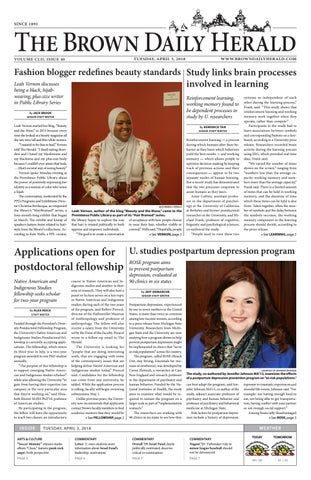
Leah Vernon started her blog, “Beauty and the Muse,” in 2013 because every time she looked at a beauty magazine all she saw were tall and thin white women. “I wanted to be that so bad,” Vernon told The Herald. “I (had) eating disorders and I hated my Muslimness and my blackness and my plus-size body because I couldn’t ever attain that look, … (that) societal way of seeing beauty.” Vernon spoke Monday evening at the Providence Public Library about the power of positively expressing her identity as a woman of color who wears a hijab. The conversation, moderated by the PPL’s Programs and Exhibitions Director Christina Bevilacqua, accompanied the library’s “HairBrained” series, a four-month-long exhibit that began in March. The exhibit and lineup of speakers feature items related to hairstyle from the library’s collections. According to Kate Wells, a PPL curator,
By KENDRICK TAN SENIOR STAFF WRITER
JACK BROOK / HERALD
Leah Vernon, author of the blog “Beauty and the Muse,” came to the Providence Public Library as part of its “Hair Brained” series. the library hopes to explore the way of acceptance with how people choose that hair is treated politically to both to wear their hair, whether visibly or oppress and empower individuals. covered,” Wells said. “Hopefully, people “The goal is to create a conversation » See VERNON, page 2
Reinforcement learning — a process during which humans alter their behavior as they learn which behaviors yield the best results — and working memory — which allows people to optimize decision-making by keeping track of previous actions and their consequences — appear to be two separate modes of human learning. But a recent study has demonstrated that the two processes cooperate to assist humans as they learn. Anne Collins, assistant professor in the department of psychology at the University of California at Berkeley and former postdoctoral researcher at the University, and Michael Frank, professor of cognitive, linguistic and psychological sciences, co-authored the study. “People used to view these two
systems as independent of each other during the learning process,” Frank said. “This study shows that reinforcement learning and working memory work together when they operate, rather than compete.” Participants in the study had to learn associations between symbols and corresponding buttons on a keyboard, according to a University press release. Researchers recorded brain activity during the learning process using EEG, which provided real-time data, Frank said. “We varied the number of items shown on the screen,” ranging from “numbers less than the average capacity working memory and numbers more than the average capacity,” Frank said. There is a limited amount of items that can be held in working memory, and the duration of time which these items can be held is also finite. Taken together, when the number of symbols and the delay between the symbols increase, the working memory component in the learning process should shrink, according to the press release. » See LEARNING, page 2
Applications open for U. studies postpartum depression program ROSE program aims postdoctoral fellowship to prevent postpartum Native American and Indigenous Studies fellowship seeks scholar for two-year program By ALEX REICE STAFF WRITER
Funded through the President’s Diversity Postdoctoral Fellowship Program, the University’s Native American and Indigenous Studies Postdoctoral Fellowship is currently accepting applications. The fellowship, which enters its third year in July, is a two-year program awarded to one PhD student annually. “The purpose of this fellowship is to support emerging Native American and Indigenous studies scholars” while also allowing the University “to gain from having their expertise (on campus) in the very particular area that they’re working on,” said Elizabeth Hoover MA’03 PhD’10, professor of American studies. By participating in the program, the fellow will have the opportunity to teach two classes: an introductory
INSIDE
course in Native American and Indigenous studies and another in their area of research. They will also host a panel or lecture series on a key topic in Native American and Indigenous studies during each of the two years of the program, said Robert Preucel, director of the Haffenreffer Museum of Anthropology and professor of anthropology. The fellow will also receive a salary from the University set by the Dean of the Faculty, Preucel wrote in a follow-up email to The Herald. The University is looking for “people that are doing interesting work, that are engaging with some of the contemporary issues that are helping define Native American and Indigenous studies today,” Preucel said. Candidates for the fellowship can come from any university, he added. While the application process is rolling, faculty will begin reviewing submissions May 1. Unlike previous years, the University now recommends that applicants contact Brown faculty members to find academic mentors that they would be » See FELLOWSHIP, page 2
depression, evaluated at 90 clinics in six states By JEFF DEMANCHE SENIOR STAFF WRITER
Postpartum depression, experienced by one in seven mothers in the United States, is more than twice as common among low-income women, according to a press release from Michigan State University. Researchers from Michigan State and the University are now studying how a program shown to help prevent postpartum depression might be implemented in clinics that “serve at-risk populations” across the country. The program, called ROSE (Reach Out, stay Strong, Essentials for motions of newborns), was developed by Caron Zlotnick, a researcher at Care New England and research professor in the department of psychiatry and human behavior. Funded by the National Institutes of Health, the study aims to examine what would be required to sustain the program on a larger scale as part of “implementation research.” The researchers are working with 90 clinics in six states to see how they
COURTESY OF JENNIFER JOHNSON
The study, co-authored by Jennifer Johnson MA’13, examines the effects of a postpartum depression prevention program on “at-risk populations.” can best adapt the program, said Jennifer Johnson MA’13, co-author of the study, adjunct associate professor of psychiatry and human behavior and professor of psychiatry and behavioral medicine at Michigan State. Risk factors for postpartum depression include a history of depression,
exposure to traumatic experiences and stressful life events, Johnson said. “For example: not having enough food to eat, not being able to get transportation, having conflict with your partner or not enough social support.” Among financially disadvantaged » See ROSE, page 3
WEATHER
TUESDAY, APRIL 3, 2018
ARTS & CULTURE “Soccer Mommy” releases studio album “Clean,” features punk rock angst, fresh perspective
COMMENTARY Letter: U. owes students more information about Israel Fund’s leadership, motivations
COMMENTARY Overall ’19: Israel Fund clearly politically motivated, deserves critical re-examination
COMMENTARY Nugent ’21: Tiebreaker rule in minor league baseball should not be denounced
PAGE 3
PAGE 6
PAGE 7
PAGE 7
TODAY
TOMORROW
44 / 38
61 / 33
NEWS
PAGE 2 • TUESDAY, APRIL 3, 2018
» FELLOWSHIP, from page 1 interested in working with during the fellowship, Preucel said. Because this faculty member would likely specialize in the fellow’s field of study, the fellow can then be housed in the same department after arriving at Brown. Mariaelena Huambachano — who was awarded the postdoctoral
» VERNON, from page 1 gain awareness for why people might cover (their hair) and allow them to express themselves in different ways.” In her talk, Vernon spoke about consciously attempting to subvert the superficial and false aura of perfection that many beauty bloggers project on social media. When she first began to blog in 2013, Vernon said she tried to mimic these more conventional bloggers, though she occasionally opened up about her life — her insecurities, frustrations and struggles with mental health. Every time she did, she said her inbox quickly filled with messages fromwomen across the world who shared their stories and told her how inspiring it was to see these sensitive topics discussed publicly. At first reluctant to publish details about her private life online, Vernon said she eventually decided to embrace openness wholeheartedly because she felt people needed to hear her voice and see her for who she is. She became, in her own words, “the rawest of the raw” on the internet.
THE BROWN DAILY HERALD
fellowship in 2016 — wrote in an email to The Herald that the program “enabled me to achieve my goals about extending academic relationships (and) be an educator of an Indigenous epistemic opening of (inquiry), as well as develop an international community-based research project.” The fellowship is also part of the
University’s Native American and Indigenous Studies initiative, which is an effort to create “an intellectual community of scholars who are contributing to Native American and Indigenous studies,” Preucel said. Though there is no department of Native American and Indigenous studies, the University initiative creates a working group of faculty and students
between departments to study issues in the field. But Preucel said he hopes the University will add an official department in the future. The University is currently seeking a director to oversee the NAIS initiative, Hoover said. Because candidates for the director position “have slightly different focuses to their research, to their own areas of
expertise, … they each would take the program in a slightly different direction,” she added. Ultimately, through the fellowship and initiative, the University can “support indigenous studies scholars who are just starting out (and bring) in people who are doing interesting research that can then educate our students and faculty,” Hoover said.
“I’m fat and I’m fabulous and I’m a sister and I’m educated and I want to put out that and not this perfect Instagram thing,” Vernon said. While Vernon has been writing constantly since the age of six, she worried that no one on the New York Times bestseller list looked like her. Though she feared there would never be space for her in the writing world, she continued writing and went on to complete an MFA program at Wilkes University. “Six years ago when we started working together she was definitely Leah, who she is, but was in a different place in her life,” said Taylor Polites, her former professor at Wilkes who now serves as a practitioner in residence at the Swearer Center. “Today, to think of all the building she’s done on her career and her platform, the audience that she has created for herself, it’s incredible for me to see her create that out of her own passion and determination.” Vernon’s unapologetic rawness and fashion sense have earned her tens of thousands of followers across social media and widespread visibility. Recently, Lululemon Athletica offered her
the chance to speak on a sponsored panel for International Women’s Day. Vernon told the library audience that she wavered at the thought of working with a company that seemed to cater to fit and light-skinned women. “Lululemon doesn’t make clothes that fit me,” Vernon said. “But I wanted people to see my face there. Hopefully my presence being there and collaborating with them would help them to start using models who are larger and browner.” Vernon closed out the evening answering questions from the audience about her tastes (she loves NPR) and the financial challenges she faces as a blogger, all the while continuing to emphasize her desire to transform beauty standards. “I want to show people that beauty comes in all forms and to inspire people to be the best version of themselves,” Vernon told The Herald. “You don’t have to be what society tells you you have to be to feel valued or important or beautiful — I want people to feel like their voice and their body are worthy.”
» LEARNING, from page 1
are not at that stage yet,” Frank said. “However, understanding the biology of the two different systems can allow us to better predict how learning processes are affected among people with mental disorders and illnesses that affect these parts of the brain.” “This is quite an important finding that advances our understanding of the learning and memory systems that drive adaptive behavior,” said Candace Raio, a postdoctoral fellow at the Center for Neural Science at New York University. “Knowing that these reinforcement learning and working memory systems work cooperatively constitutes a major step forward in understanding how we learn and adapt to environmental demands.”
The study revealed that brain signals associated with reinforcement learning were stronger when participants were given stimuli that overloaded working memory. But these signals were weaker when participants had to hold fewer items in working memory, Frank said. These findings suggest that the two systems are dependent on each other, because varying the inputs for working memory should not alter reinforcement learning signals if they were independent systems. “While this study examines learning at a more basic science level of how discrete learning systems work in the brain, there are probably learning applications in the long run, but we
NEWS
TUESDAY, APRIL 3, 2018 • PAGE 3
THE BROWN DAILY HERALD
‘Soccer Mommy’ charts sentimentality without cliche Debut album by Sophie Allison, “Clean,” rebels against rebel persona, progresses alt-rock genre By ANNABELLE WOODWARD SENIOR STAFF WRITER
Skeptics who have yet to listen to the music of indie-rock princess “Soccer Mommy,” the alias of 20-year-old New York University dropout Sophie Allison, might scoff when told the tracks of the facetiously named artist are landing on the “chill” playlists of culturally astute stoner teens everywhere. More jaded listeners might label Allison’s brand as the natural extension of the ironically detached, self-aggrandizing bent that has become synonymous with alt-rock since Pavement. But there’s no predictable, masturbatory aesthetic to Allison or her music. Her anthemic, comingof-age studio album “Clean” — released on March 2 — proves just that. “Clean” is Allison’s proper debut with Fat Possum Records, an independent label that previously released 2017’s “Collection,” Allison’s quiteliteral collection of demos and reworked songs from her self-produced E.P.s, posted to Bandcamp the summer before leaving for college. Jagged, vulnerable and self-aware, the tracks from “Clean” forcefully capture Allison’s longing for self-acceptance. “‘You gon’ be like that,’ is kind of the lesson of the album,” Allison told The Fader. On tracks like “Your Dog” and “Cool,” Allison channels ’90s punkrock angst with a fresh perspective
» ROSE, from page 1 women, strong social support has been found to limit negative stress reactions, Zlotnick wrote in an email to The Herald. “Empirical studies corroborate that greater social support is associated with lower depressed mood in perinatal financially disadvantaged women,” she wrote. Studies suggest that women with fewer financial resources have both more stress and less familial support, which are both risk factors for developing postpartum depression, wrote Amy Salisbury, associate professor of psychiatry and human behavior, in an
COURTESY OF WIKIMEDIA COMMONS
Indie-rock artist Sophie Allison, also known as “Soccer Mommy,” released her first proper album “Clean” March 2. Though the album exudes indie energy, Allison names artists Taylor Swift and Avril Lavigne among her greatest influences. even while singing about frustration, to an animal who picked her out of his provocative aesthetic to many a college than theirs. It nails Swift’s cathartic desire and detachment. Throughout teeth. The LP’s climax and crown jewel dorm room, attempts to commercial- reliability without relying on tropism the album, Allison futilely pines after is “Scorpio Rising” — an apical track in ize her persona do her an injustice. and lyrically outpaces the “Hey hey a fictive romantic ideal — embodied by which Allison reflects on nights spent In the months before the release of / you you” punk angst that Lavigne the character Mary on the track “Cool.” with a boy who she knows is going to “Clean,” The Fader profiled Allison trademarked in the mid-2000s. AlDefined by a want to be wanted, Al- leave her for someone else. “And I’m under the headline “Soccer Mommy lison’s gift for poetry distinguishes lison’s lyricism echoes the universal just a victim of changing planets / My is 2018’s chillest new rock star” — her from rebellious girl-next-doors anxiety of singer-songwriters, and situ- Scorpio rising and my parents,” she la- despite the fact that there is nothing of yore. Allison’s astuteness, vulnerates herself in an illustrious tradition ments as the final verse crescendos in a particularly “chill” about the existen- ability and fleshy candor resound beof fruitless longing expressed through sonic variegation that elevates the track tial tumult behind her lyrics. Though yond the treacly song-writing of her song. The album’s edgier songs are off- beyond mere sentimentality. Allison lists young Taylor Swift and influences while also transcending the set by the misty, allegorical “Still Clean,” While it’s inevitable that Allison’s Avril Lavigne among her biggest self-satisfying obscura and affect of where Allison compares her ex-lover signature pout will wind up lending a influences, her music is far smarter her alt-rock contemporaries.
email to The Herald. There is a general consensus that treatment of a mother’s depression is the best way to mitigate and prevent its negative effects on their child’s development, she added. ROSE “was developed because there were few interventions that demonstrated significant reduction in cases of postpartum depression and few, if any, studies (that) included women who were financially disadvantaged,” Zlotnick wrote. The ROSE program consists of four in-person sessions, followed by a phone call after the baby has been born, Johnson said. It is an educational program, rather than a mental health
treatment, that teaches women coping skills and helps them build a social support system. In five clinical trials, groups that underwent the ROSE program saw fewer individuals experience postpartum depression than the groups that did not, Johnson said. Prior to the research that is currently being conducted on the implementation of ROSE, the program had been studied in five clinical settings in Rhode Island, as well as in Mississippi and throughout prenatal clinics in Japan, Zlotnick wrote. By bringing the ROSE program to 90 new clinics, the researchers hope
to get a better understanding of what it will take to sustain the program on a larger scale. They plan to develop a sustainability plan and train clinics to implement the program and navigate operational logistics such as billing by July, Johnson said. “It doesn’t help to have effective interventions if they’re not used,” Johnson said, adding that it’s important to know what helps an intervention program like ROSE sustain long-term influence and continue to be implemented, especially in clinics which might not have many resources. Salisbury wrote that she is “pleased to hear that the intervention has been
successful in clinical trials and is being prepared for wide-range use in other locations. Prevention of depressive illness in pregnancy and postpartum should be the goal, to prevent any potential influences on development.” Women considering pregnancy or who are already pregnant and have a history of depression should explore the resources available to them or consult with a perinatal mental health specialist to know what their options are, Salisbury added. Johnson emphasized that postpartum depression is common, and support is available to those who experience it.
Wherever you go, bring your own mug, reusable bottle and/or thermos. Avoid plastic cutlery.
It’s time we take responsibility for our waste stream.
THE BROWN DAILY HERALD
Bringing America Together Featuring
Arthur C. Brooks
President, American Enterprise Institute
Tuesday, April 10, 2018 5:30 p.m. Pembroke Hall, Room 305 172 Meeting St. Providence, Rhode Island
REAFFIRMING UNIVERSITY VALUES: Campus Dialogue and Discourse Sponsored by the Office of the President, Office of the Provost and Taubman Center for American Politics and Policy To request special services, accommodations or assistance for this event, please contact the University Event and Conference Services Office at universityevents@brown.edu.
TODAY
TUESDAY, APRIL 3, 2018 • PAGE 5
THE BROWN DAILY HERALD
menu
dressed to impress
SATELLITE DINING ANDREWS COMMONS
Pizza: Spinach & Feta, Sausage & Jalapeno, Bacon Chicken Ranch Grinders JOSIAH’S
BLUE ROOM
French Toast Bar, Rodeo Burger, Make-Your-Own Grilled Cheese
Foccacia Bar, Avial Vegetable Curry, Chicken Kadhai
DINING HALLS SHARPE REFECTORY LUNCH
DINNER
White Fish Taco with Mango Salsa, Spanish Style Rice, Chicken Fajitas
Cheesy Zucchini Bake, Oven Browned Dinner Potatoes, Shaved Steak with Mushrooms
VERNEY-WOOLLEY LUNCH
DINNER
Chicken Noodle Soup, Vegetable Sub Sandwich, Chicken Cutlet Sandwich
Shredded Pepper Chicken, Batter Fried Zucchini, Falafel Burger, Cucumber Chickpea Salad
sudoku
ELI WHITE / HERALD
Blueno returned from spring break with a new scarf, ready to face Rhode Island’s version of “spring.” Students, on the other hand, were less prepared for Monday morning’s snow flurries after a week of school-free bliss.
Q U O T E O F T H E D AY
“I’m fat and I’m fabulous and I’m a sister and I’m educated and I want to put out that and not this perfect Instagram thing.
”
— Leah Vernon, fashion blogger
See VERNON on page 1.
crossword
calendar TODAY NOVEMBER MARCH APRIL
S
M
T
W
Th
F
S
Guide to Summer Internship Funding 12:00 P.M. CareerLAB
1
2
3
41
25
36
74
Lecture by Paul Patton 6:00 P.M. Rochambeau House
85
96
10 7
11 8
12 9
10 13
11 14
One Gun Gone Exhibit: Art to Advocacy 6:00 P.M. 121 South Main St. Telescope Observing Night 8:00 P.M. Ladd Observatory
TOMORROW
12 15
13 16
14 17
15 18
16 19
17 20
18 21
19 22
20 23
21 24
22 25
23 26
24 27
25 28
26 29
27 30
28
29
30
31
Meditation and Mental Health 9:00 A.M. J. Walter Wilson, 512
Wellness at Brown: DIY Green Cleaning 12:00 P.M. School of Professional Studies
Visiting Artist Lecture: Caroline Woolard 5:00 P.M. LIST Art Building, 110
Brown Religious Literacy Project 7:30 P.M. J. Walter Wilson, 411
COMMENTARY PAGE 6 • TUESDAY, APRIL 3, 2018
THE BROWN DAILY HERALD
LETTER TO THE EDITOR
U. needs to be more transparent about the Israel Fund To the Editor: The Wintersession course UNIV 1001: “The Israeli-Palestinian Conflict: Contested Narratives” was offered in January 2017 to 12 students. It was presented as being funded by the Global Experiential Learning and Teaching grant, though in reality it was financed by a University initiative called the Israel Fund. As students who participated in this course, we were shocked when we found out that the course was funded by the Israel Fund, as stated in a recent University press release. The Israel Fund is a donor-driven endowed fund established in late 2016 to allow University students and community members to “learn about Israel and from Israelis,” according to the press release. It is framed as a “regional studies” and has already raised $3.8 million of its $10 million goal to become an endowed fund. We are deeply concerned with the omission of financial information about the Wintersession course, the way the course is being used to support the Israel Fund and the University’s overall lack of transparency with the Fund. First, every student was explicitly told in writing at least three times that the Wintersession course was funded by GELT. The GELT grant is an initiative from the Dean of the College that finances
courses “that embed an international travel component prior to, during or at the end of the course and for destination courses during Brown’s Wintersession.” In reality, the Israel Fund sponsored this trip — while GELT administered it — without notifying the students before, during or after the trip. Second, a Feb. 25 Herald article — published with a picture of the group of students taking UNIV 1001 — portrays our course as the balanced centerpiece of the Israel Fund. This is deeply troubling for various reasons. The article effectively turns us, quite literally, into the faces of the Israel Fund despite the fact that we were never told that the Fund had anything to do with our course or that it existed at all. We participated in the course under the impression that we would study using a balanced approach — balanced of an approach as possible within a dynamic of oppressor and oppressed. However, it is important to note that presenting Israeli and Palestinian accounts as competing, symmetrical narratives despite the unequal histories and realities of the “conflict” is incredibly careless and fails to recognize this dynamic. Nevertheless, the fact that the course was funded by, and is now being used as an advertisement for, the Israel Fund shatters any claims of a balanced political approach altogether. Had we had this knowledge beforehand, we would have chosen not to participate. Furthermore, we are also
Find us online! facebook.com/browndailyherald
browndailyherald.com
@the_herald
Location: 195 Angell St., Providence, R.I. www.browndailyherald.com
@browndailyherald
youtube.com/browndailyherald
Editorial Leadership
Sections
Multimedia & Production
Editor-in-Chief Elena Renken
Arts & Culture Editors Connor Sullivan Mia Pattillo
Design Editors General Managers Kyle Cui Michael Borrello Eduard Muñoz-Suñé Matilda Lynton Assistants: Julie Wang, Kelvin Yang
Metro Editors Emily Davies Bella Roberts
Photo Editors Sam Berube Anita Sheih
News Editors Anna Kramer Eduard Muñoz-Suñé Priyanka Podugu Sarah Wang
Copy Desk Chief Abby Borges
Managing Editor Kasturi Pananjady Senior Editors Julianne Center Madison Rivlin Alex Skidmore Hattie Xu Features Editor Isabel Gensler Editorial Page Editor Anuj Krishnamurthy
Science & Research Editors Jonathan Douglas Jackson Wells
POST- MAGAZINE Editor Saanya Jain
Sports Editors Alexandra Russell Nicholas Wey COMMENTARY Opinions Editors Connor Cardoso Anuj Krishnamurthy Clare Steinman
Illustrations Editor Pia Mileaf-Patel Video Editors Roland High Celia Hack
Business
Office Manager Diane Silvia Directors Sales: Shreya Raghunandan Finance: Ravi Betzig Strategy: Caroline Ziegler
alarmed that The Herald article’s author consulted only one student representative from the class when, in reality, students who took the course hold a range of opinions about it. Third, we are deeply troubled by the lack of transparency surrounding the Israel Fund in general. Primarily, we do not know who is in charge of the Israel Fund. Moreover, prior to the establishment of the Fund, the creators did not consult or inform Brown students or professors, including the Middle East Studies department — which studies Israel-Palestine. There is a clear lack of publicly available information and public accountability, and this is worrisome. We, as students who participated in the course, strongly object to our class being used as an advert for the Israel Fund. We want to know: Why were we not informed of the source of funding when we participated in the course? Who is directing this fund? Who are the donors, and what are their political motives? Who are we to hold accountable? Since we have been unwittingly used to promote and advertise the Israel Fund, we demand full transparency and critical dialogue with regard to its origins, composition and motives. Rakan Aboneaaj ’19, Drashti Brahmbhatt ’19, Jessica Murphy ’19, Kudrat Wadhwa ’19
Editorial contact: 401-351-3372 herald@browndailyherald.com
Advertising contact: 401-351-3372 advertising@browndailyherald.com
Submissions: The Brown Daily Herald publishes submissions in the form of op-eds and letters to the editor. Op-eds are typically between 750 and 1000 words, though we will consider submissions between 500 and 1200 words. Letters to the editor should be around 250 words. While letters to the editor respond to an article or column that has appeared in The Herald, op-eds usually prompt new discussions on campus or frame new arguments about current discourse. All submissions to The Herald cannot have been previously published elsewhere (in print or online — including personal blogs and social media), and they must be exclusive to The Herald. Submissions must include no more than two individual authors. If there are more than two original authors, The Herald can acknowledge the authors in a statement at the end of the letter or op-ed, but the byline can only include up to two names. The Herald will not publish submissions authored by groups. The Herald does not publish anonymous submissions. If you feel your circumstances prevent you from submitting an op-ed or letter with your name, please email herald@browndailyherald.com to explain your situation. You can submit op-eds to opinions@browndailyherald.com and letters to letters@browndailyherald.com. When you email your submission, please include (1) your full name, (2) an evening or mobile phone number in case your submission is chosen for publication and (3) any affiliation with Brown University or any institution or organization relevant to the content of your submission. Please send in submissions at least 24 hours in advance of your desired publication date. The Herald only publishes submissions while it is in print. The Herald reserves the right to edit all submissions. If your piece is considered for publication, an editor will contact you to discuss potential changes to your submission. Commentary: The editorial is the majority opinion of the editorial page board of The Brown Daily Herald. The editorial viewpoint does not necessarily reflect the views of The Brown Daily Herald, Inc. Columns, letters and comics reflect the opinions of their authors only. Corrections: The Brown Daily Herald is committed to providing the Brown University community with the most accurate information possible. Corrections may be submitted up to seven calendar days after publication. Advertising: The Brown Daily Herald, Inc. reserves the right to accept or decline any advertisement at its discretion. The Brown Daily Herald, Inc. is a financially independent, nonprofit media organization bringing you The Brown Daily Herald, BlogDailyHerald and Post- Magazine. The Brown Daily Herald has served the Brown University community daily since 1891. It is published Monday through Friday during the academic year, excluding vacations, once during Commencement and once during Orientation by The Brown Daily Herald, Inc. Single copy free for each member of the community. Subscription prices: $200 one year daily, $100 one semester daily. Copyright 2018 by The Brown Daily Herald, Inc. All rights reserved. Periodicals postage paid at Providence, R.I. Postmaster: Please send corrections to P.O. Box 2538, Providence, RI 02906.
COMMENTARY TUESDAY, APRIL 3, 2018 • PAGE 7
THE BROWN DAILY HERALD
The Israel Fund is undeniably political SOPHIA OVERALL staff columnist In late 2016, the Israel Fund was established at Brown. An endowment created from alum donations, the Fund seeks to support new and existing programs and courses centered on Israel. As The Herald previously reported, the University has raised $3.8 million toward a $10 million goal for the Israel Fund’s endowment. Upon reaching the $10 million goal, the Fund will return $500,000 annually for a programming budget. In the face of accusations leveled against the Fund by Brown Students for Justice in Palestine that call out the inherent injustice of creating an academic fund for Israel-related programming, Interim Director of Judaic Studies David Jacobson told The Herald that the Fund’s intention is “purely academic, not political.” But because the Israel Fund was created without any involvement or critical input from the Middle East Studies department’s faculty, it is nearly impossible for the Israel Fund to be apolitical. If Brown was hoping to foster an academic conversation about Israel through the Israel Fund, it started a conversation encumbered by the bias associated with the Fund’s sponsorship. When money is given to fund the study of a specific nation or national context, nothing is apolitical, even if there are some moderate steps taken to create nuance in the conversation. The Israel Fund is an expressly political initiative that implies the University’s support for Israel, owing to its top-down origins and its close links to Israeli business. In an attempt to distance Brown’s Israel Fund from a politicized rhet-
oric, Jacobson’s statement that the Fund is “purely academic” unfortunately lacks substance, for two main reasons. The first way the Israel Fund departs from its purported academic aims is the nature of its inception. As Professor Beshara Doumani, director of the Middle East Studies program, told The Herald, “the Middle East Studies faculty have never been approached about this . . . It would be great if we had more information or were brought into the loop of what the thinking is and what the plans are.” The Middle East Studies faculty had not heard about the Israel Fund before the Jan. 30 press release that announced its establishment or the fact that the Fund had been in the works for over a year, he said. Since
roots level and work to transform their institutional objectives into reality. In the case of the Israel Fund, however, it seems that the wishes of wealthy alums have been uncritically mapped onto the University, without any apparent organic demand from students. The Israel Fund’s self-proclaimed “academic” origins are disingenuous, given that Brown is home to a broad range of grassroots, student-led and scholarly organizations and initiatives that are trying to get certain programs of study institutionalized. In fact, five years ago, Middle East Studies spearheaded the New Directions in Palestinian Studies Initiative. “New Directions” aims to shape scholarly works in the field of Palestinian studies
support academic programs that, in the words of the Fund’s supporters, aim to “introduce students to the Palestinian experience,” teach students “to see things through other peoples’ eyes,”and study — rather than reproduce — the “power imbalance” inherent in the narrative of the IsraelPalestine conflict, the secretive and exclusive origins of this Fund undermine its seemingly peaceful academic pursuits. The second way the Israel Fund assumes elements of a political project — as opposed to a purely academic one — is its inclusion of not only academic programs, but also entrepreneurial enterprises. Last summer, the University launched the Israel Entrepreneurship Internship program. Ac-
The Israel Fund is an expressly political initiative that implies the University’s support for Israel, owing to its top-down origins and its close links to Israeli business. Israel is, in fact, located in the Middle East, the exclusion of the Middle East Studies faculty raises a red flag about the so-called “academic” intent of the Fund. Further, in comparison to other academically oriented and regionally focused groups that exist on campus, the Israel Fund was created from the top-down with money from external donors. It seems ill-fitting for the Fund to flaunt academic roots and integrity when the ideas for the Fund were not generated within any scholarly framework of a department or program. Typically, if there is a genuine, grassroots demand for the creation of a scholarly program within the University, students and faculty will take the lead, organize on a grass-
through annual workshops at Brown and a book series that brings together emerging and established scholars. Brown Students for Justice in Palestine is another student-led group on campus that stands in solidarity with the Palestinian fight for equality and freedom, and supports the boycott, divestments and sanction movement. Additionally, consider the Southeast Asian Studies Initiative, an entirely student-led and student-driven project that seeks to enhance the visibility of Southeast Asia in the University’s academic offerings and faculty. Students involved in SEASI have had to advocate intently for the intellectual value of Southeast Asian studies, developing their own independent studies. Despite the Israel Fund’s efforts to
cording to Executive Director of the Nelson Center for Entrepreneurship Danny Warshay ’87 P’20, students “not only got to experience what it’s like to work at a startup, … (but) they also got a cross-cultural experience to see what it was like to live in another international culture.” While Jacobson defends the Israel Fund as having solely a “academic” purpose, the Fund’s blatant business component proves this rhetoric is misleading. By allocating a portion of the Fund’s capital to support Brown students immersed in tech startups, the Fund closely and undeniably aligns itself with Israeli politics. It is, after all, Israel’s technology and science sectors that have led to the development of drones, armed bulldozers,
border fences and surveillance equipment that are used to carry out violence against Palestinians. As a result, the internships funded by the Israel Fund will most likely reveal to students, through a “cross-cultural experience,” the single-story narrative of how developed, tech savvy and forward-looking Israeli society is. And, in the process, the University — which allowed for little community deliberation about the potential pitfalls of the Israel Fund — becomes complicit in the systems of racial and ethnic oppression synonymous with Israeli policies today. Even if the Israel Fund’s academic programs have any redeeming qualities, the Fund’s internship component directly places the Fund within a political framework. It is important to remember that while region-specific programs and scholarly initiatives are integral to pursuing a holistic and liberal education, the methods by which some programs are implemented can, in fact, undermine their academic intentions. In terms of the Israel Fund, its top-down creation and internship component transform the Fund into a political tool. As Brown students, it is our job to remain continuously engaged in and constructively critical of the University’s academic endeavors. The Israel Fund is the perfect opportunity to unite as a community and speak out against an alum-driven and potentially dangerous political project masquerading as an academic program.
Sophia Overall ’19 can be reached at sophia_overall@ brown.edu. Please send responses to this opinion to letters@browndailyherald.com and op-eds to opinions@browndailyherald.com.
Extra-inning baserunner rule does not hurt baseball PATRICK NUGENT op-ed contributor I read The Herald’s April 1 column “Schapiro ’19: Rob Manfred crosses the Rubicon”, and while I don’t love what Rob Manfred is doing to baseball, denouncing the implementation of an international tiebreaker in the minors is not the right battle to choose. There are plenty of problems to solve in baseball, and there are plenty of problems with the proposed solutions to those problems, but this is not the one to fight. First, the idea that the rule doesn’t address a problem is wrong — it just doesn’t address the problem you think it does. Starters are throwing fewer and fewer innings, and after seeing the success of teams with strong bullpens, like the 2016 Cleveland Indians and 2017 Colorado Rockies, relievers are more expensive than ever. Keeping extra innings down isn’t about quickening nail biters — it’s about protecting teams from multimillion-dollar injuries. I love seeing Chris Davis take the win over Darnell McDonald as much as any other fan. It’s exciting, but it also puts overtaxed bullpens and the position players who relieve them at risk unnecessarily. Second, if your argument is that old-school baseball is better than the changing modern
game, international tiebreakers should make you giddy. It may not have the excitement of a game-winning home run, but with four-baggers already at a record high and climbing, do we realistically need more? Instead, what we get with international rules is the resurgence of small ball baseball, a dying art. Rosters full of power bats nowadays are often devoid of players who can lay down a good bunt and force the defense to
Lastly, as much as I dislike a lot of what’s happening in baseball analytics, James Schapiro’s statement that “we’ve played this game the same way for well over a century” is laughable. Forty years ago, the five-man rotations we take for granted now were being questioned in the same way that today’s experimental six-man ones are. Defensive shifts were all but unheard of even 10 years ago, and now we see infielders
In an era where hitter tendencies can be analyzed down to the minutiae, let’s force teams to squeeze in runs, and let bullpens try to stop them. That’s just good baseball, and it’s disappearing.
make mistakes. That’s old-school baseball at its finest. The team that can execute the fundamentals of the game is the team that wins, and we should be rewarding that. In an era where hitter tendencies can be analyzed down to the minutiae, let’s force teams to squeeze in runs and let bullpens try to stop them. That’s just good baseball, and it’s disappearing.
move not only with every batter, but also with every pitch. Can you imagine today’s American League without the designated hitter? Baseball is steeped in tradition, but perhaps its most pervasive tradition is change. Fans never like it, but they always adapt. It is clear that Manfred intends to be the commissioner to save baseball from itself. Pace
of play has become a major priority in a way it never was in the past, and rules like visit limits demonstrate the ways our current commissioner is far removed from the actual action on the field. I don’t have Manfred’s playing information in front of me, but that rule tells me he has never spent time behind the dish. No catcher would green-light a restriction like that, and its implementation was detrimental to baseball. However, it has now become part of the multifaceted strategy that makes baseball great. This is the thinking man’s game, and the international tiebreaker is now simply another aspect of it. There’s no way to know now if we will see pre-placed runners in the Majors soon, or ever. The rule may become one of those minor league quirks like the pitch clock that is regularly discussed but has so far stayed out of Major League Baseball. Either way, the idea that it somehow takes away from baseball is one I can’t agree with. In an age where we see over 6,000 home runs and double-digit Tommy John surgeries a year, maybe a little more small ball is exactly what we need.
Patrick Nugent ’21 can be reached at patrick_nugent@brown.edu. Please send responses to this opinion to letters@ browndailyherald.com and op-eds to opinions@browndailyherald.com.
NEWS THE BROWN DAILY HERALD
TUESDAY, APRIL 3, 2018
18518-1_BAI_WeatherProof_BDH_AD_full_Page.indd 1
3/30/18 8:34 AM