SINCE 1891
THE BROWN DAILY HERALD TUESDAY, OCTOBER 3, 2017
VOLUME CLII, ISSUE 78
WWW.BROWNDAILYHERALD.COM
As tech industry grows, finance No immediate changes accelerates recruitment to secure talent to U.’s Title IX policy Some students apply to finance internships a year in advance in effort to secure full-time offers
Dept. of Ed. issues new interim Title IX guidelines under new Secretary of Education Betsy Devos
By BAYLOR KNOBLOCH
By ANNA KRAMER
SENIOR REPORTER
SENIOR STAFF WRITER
Many traditional big-name finance and consulting firms made an appearance at last week’s General, Technical and Professional School Career Fair, but an overwhelming number of students stood in line waiting to speak with representatives from prominent tech firms like Google and Microsoft. As more students demonstrate interest in tech companies, other industries like finance and consulting are moving up their recruitment timelines to compete in the search for talent, said University career counselor Ron Foreman. When Foreman started at the University in 2000, companies did not recruit for jobs and internships before winter break. But over the past five years, the recruitment process has shifted, moving from the spring to the
The U.S. Department of Education issued new interim Title IX guidelines and rescinded the 2011 “Dear Colleague” letter Sept. 22, allowing institutions more freedom in their policies. Despite this new flexibility from the federal government, the new guidelines will not prompt any immediate changes to the University’s policies, wrote Rene Davis, Title IX program officer, in an email to The Herald. The 2011 “Dear Colleague” letter — a document issued by the Department of Education under the administration of former President Barack Obama — designated a preponderance of evidence as the standard of proof for Title IX hearings and guaranteed the right to appeal for both parties. Preponderance of evidence means that
‘West Side Story’ comes to East Side at Sayles Hall
Complex musical score, stripped down set brought classic musical to life during ‘West Side Story’ By DIVYA MANIAR CONTRIBUTING WRITER
Musical collective Musical Forum brought critically-acclaimed Broadway hit “West Side Story” to Sayles Hall last weekend. “West Side Stor y” is a modern-day take on “Romeo and Juliet” that takes place in New York’s Upper West Side. The musical centers around the star-crossed romance between Tony, played by Connor O’Byrne ’18, and Maria, played by Abby Espiritu ’19, characters from opposing gangs. The Sharks are comprised of Puerto Rican immigrants and the Jets of white » See MUSICAL, page 3
ARTS & CULTURE
INSIDE
KATE TALERICO / HERALD
fall, he said. “We are all looking for the top talents,” said John Zhao, an engineer manager for Adobe who attended the fair. “When spring comes, it’s too late.” Not only do some applications now open in the summer — as early as July
1 at Goldman Sachs, for example — but often rising juniors apply for summer internships that they hope will result in full-time offers for after graduation. “Finance is almost exclusively moving to that model,” said Matt Donato, » See RECRUITING, page 2
“a hearing must find it more likely than not that the accused is at fault to determine guilt,” as The Herald previously reported. The withdrawal of the letter and other Obama-era documents, as well as the issuance of new temporary guidelines under Secretary of Education Betsy DeVos, will allow institutions to determine whether only the responding party or both parties have the right to appeal. Colleges and universities may also choose to change the standard of evidence in order to require a higher burden of proof. This will allow institutions to move from the previously mandated preponderance of evidence standard to a clear and convincing evidence standard, according to the new guidelines. The current guidelines are temporary, and the Department of Education will issue new Title IX rules after a period of public comment, according to a press release. Prior to the announcement of the temporary guidelines, DeVos had voiced concerns about due process for the accused, as The Herald previously reported. » See TITLE IX, page 3
‘Global Americana’ charts interhemispheric history Americas-centric John Carter Brown collection takes global turn, features multicontental themes By CONNOR SULLIVAN SENIOR STAFF WRITER
“Global Americana,” the latest exhibit at the John Carter Brown Library, comprises a range of perspectives through which to look at the early modern history of the Americas. Through its array of commentaries and historiographies, the comprehensive exhibit charts a global course for the library’s previously Americas-centered collection. “Global Americana,” which opened in early September, will provide visitors with the opportunity to pore over the curated portion of the library’s intimidatingly vast collection throughout the fall semester. Histories grounded in economic, medicinal and environmental subject matter, among others, compose the exhibit’s primary documents. Though all of the objects relate to the library’s focus on the history of the Western hemisphere, the exhibit makes a claim to its “global” name by including historical documents and illustrations centered on transatlantic discourse.
“Even though all the items deal with the Early Americas, they’re still connected to every part of the world in some way, be it in what a text relates to or the parts of the world it traveled,” said Tara Kingsley, the library’s coordinator of academic programming and public outreach. “The exhibition covers so many themes, some of which relate to specific initiatives the library has, such as native and indigenous studies.” Its annals include Spanish scientific drawings of New World armadillos and a historical record that draws comparisons between Central American chocolate and Arabian coffee. Composed in languages ranging from English to Portuguese to Quechua, the collection further emphasizes the global in its linguistic bending of boundaries, featuring objects that place multiple languages alongside one another. One of the most valuable items on display is a facsimile of a world map dated ca.1513 CE. “It’s one of the earliest maps in which the term ‘America’ appears as a toponym,” Kingsley said. Academics and scholars across the world were responsible for choosing objects from the library’s collection and writing explanations that contextualize pieces’ places — both in the
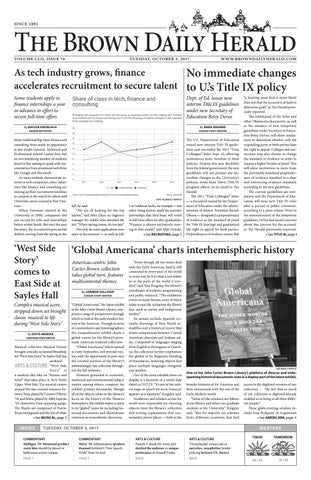
GUS REED / HERALD
One of the John Carter Brown Library’s plethora of diverse and widespanning historical documents rests in a display part of the latest exhibit, broader histories of the Americas and their interactions with the rest of the Early Modern world. “Some of (the scholars) are fellows at our library and others are graduate students at the University,” Kingsley said. “But the majority are scholars from different countries that had
access to the digitized versions of our collection. … The fact that so much of our collection is digitized already enabled us to bring in all these different people.” These globe-trotting scholars include Irna Podgomy of Argentina’s » See AMERICANA, page 4
WEATHER
TUESDAY, OC TOBER 3, 2017
COMMENTARY Mulligan ’19: Menstrual product waste bins should be placed in bathrooms across campus
COMMENTARY Mitra ’18: Inflammatory speakers doomed Berkeley’s “Free Speech Week” from its start
ARTS & CULTURE Pamela Z shook the room and dazzled the audience in unique performace at Granoff Friday
ARTS & CULTURE ‘Dreamlandia’ weaves tale of narcotics, xenophobia, border policing between US, Mexico
PAGE 7
PAGE 7
BACK
BACK
TODAY
TOMORROW
69 / 49
78 / 60
NEWS
PAGE 2 • TUESDAY, OCTOBER 3, 2017
» RECRUITING, from page 1 Brown CareerLAB director. “For tech, most people start applying around September or October,” said Edan Eingal ’18, a computer science concentrator. After completing a software development internship at Optiver this past summer, Engal will return to the firm after graduation as a full-time employee. “The landscape is just becoming more competitive for all of these industries, so they’re trying to find the candidates they want, interview them and lock them in as quickly as they can,” Donato said. “Tech is a more recent addition in the past five or six years,” he added. Competition amongst firms has moved the timeline even earlier, as both tech and finance firms seek students with strong quantitative abilities. “We look for candidates that are great problem solvers with strong analytic skills,” said Derek Shay ’16, a corporate strategy senior associate at Bank of America who represented the firm at last week’s career fair. But, because tech targets similar students, more traditional finance firms have moved up their deadlines to compete with the appeal of Silicon Valley. Edwin Farley ’19, concentrating in applied mathematics and computer science, said he is interested in both finance and tech fields for a summer internship. Given the earlier deadlines of the former, he applied to a handful of banks over the summer, completing many of his first round interviews in finance in August, before school even started. He plans to apply to tech firms in the coming weeks. While tech recruiting is just now ramping up, some finance applications have already closed. “A lot of applications are starting to hit their deadlines,” said Matt Sicat ’19, a computer science concentrator who attended the fair and has already applied to various tech internships. He lamented that he missed the Bank of America application two weeks ago. “The main thing that I’m interested in is really quantitative stuff,” Farley said. “The finance timeline is much earlier, with applications opening up in mid-July already for the next summer. … While I don’t necessarily want to be a banker, it would be hard to turn down an offer. It’s nice to get it early, and then you don’t have to worry about it for the rest of the year,” he said. Many students appreciate knowing whether or not they’ve been hired early on. “It works out better for the company and the student,” Sicat said. But looking for what could ultimately lead to full time employment after having completed just two years of college is “kind of scary,” he added. “Compared to when I first started, students are more stressed now,” Foreman said. “That’s obvious.”
THE BROWN DAILY HERALD
Presidential Faculty Award recipient talks literature, politics Alongside the opportunity to speak, award-winner receives $5,000 research stipend By DYLAN CLARK CONTRIBUTING WRITER
Bonnie Honig, professor of modern culture and media and political science, delivered a Presidential Faculty Award Lecture on the ways literature can teach people about politics at the John Carter Brown Library Oct. 2. The award, which was established by President Christina Paxson P’19 in spring 2013, is given to faculty who are “conducting especially notable and
» TITLE IX, from page 1 The new temporary guidelines build on those concerns, according to the press release. Davis does believe the due process concerns are legitimate for some schools, The Herald previously reported. But “Brown’s policies and procedures are free from the concerns that prompted the withdrawal of the ‘Dear Colleague’ letters,” Davis wrote.
innovative scholarship,” Paxson said. “Recipients of the award are invited to give the Presidential Faculty Lecture to provide an opportunity for faculty members to learn about the work of their colleagues from other disciplines,” according to the website of the Office of the President. In addition, recipients receive a research stipend of $5,000. Honig was informed that she was chosen to give the lecture in fall 2016 and was “totally surprised,” Honig said. In her lecture, Honig used MobyDick to critique Thomas Hobbes’ Leviathan, analyzing both works and the messages that can be extracted from them.
“Why does Hobbes’ animalize sovereignty in Leviathan, and second, how is Melville’s novel a response to that move?” Honig said. Honig discussed how Herman Melville uses Moby-Dick to respond to and critique Hobbes’ beliefs of absolutism and a centralized source of political power and how such beliefs can be dangerous for the common good. The topic for the lecture “grew out of a class that I taught on Melville and (Alexis de) Tocqueville,” Honig said. “Some of the things I had seen in Moby-Dick … and Leviathan references … really made me think that maybe something else was there. Melville wasn’t really talking about Tocqueville … but Melville was talking
about Hobbes, so I decided that it was worth some time and attention.” The interest in the topic ran across departments. One of the attendees was Elizabeth Brainerd, professor of biology, who heard about the lecture from Morning Mail. “I have read MobyDick many times, and I was curious about how it related to Leviathan,” she said, adding that she was also curious about the political aspect of the lecture. “How do we recover a civil society?” Brainerd asked. Isabella Catten ’20 was encouraged to attend the lecture by her professor. “I was really intrigued by the political reading of it,” she said. “Translating this into a political context made it … timelessly different.”
“We remain fundamentally committed to addressing sexual and gender-based violence,” wrote Brian Clark, director of news and editorial development, in an email to The Herald, adding that the University believes its Title IX policies are clear and equitable. Amber Lowery ’18, a member of the Title IX Council and president of SAFE House: Students Against Domestic Violence, voiced concern about the freedom that institutions now have to determine
who receives the right to appeal. The University “has a history of protecting wealthy students,” Lowery said. If “a decision is made and … a wealthy student can appeal, and then the survivor isn’t able to appeal after that — that’s really problematic.” “If, and it is a big ‘if,’ we are in a place to make change to our policy, we will include the advisory board … in addition to (the) broader Brown community … to evaluate proposed
revisions,” Davis wrote. “I don’t see Brown changing (the standard of proof) because of the culture on our campus and because of who is in charge of the Title IX office,” Lowery said. Lowery has not witnessed measurable student activism in reaction to the new policies. But “if Brown were to make problematic decisions, I do think that people would step up. I think that people care about it,” she said.
NEWS
THE BROWN DAILY HERALD
TUESDAY, OCTOBER 3, 2017 • PAGE 3
» MUSICAL, from page 1 Americans. The production was intended to be performed as a concert musical. “Essentially, the bare bones of a concert musical are that the songs are performed with minimal dialogue — to convey the plot, to convey emotions —without using a set,” said director Nicole Comella ’19. Musical director Julian Gau ’20 shared Comella’s goal of musical storytelling. “All these distinctive moods … are within ‘West Side Story.’ I hope we can bring all these ideas and (keep) all these emotions intact.” Chosen for its complex musical score, “West Side Story” gave a lot of material for the musicians to work with. “There’s a lot in the music. There are things that are really beautiful, there are things that are really groovy,” Gau said. The minimal use of set design and choreography allowed for a focus on the production’s musical elements. Even so, the production team maintained that clear storytelling was necessary to tie the musical elements together. Performances from actors, particularly leads O’Byrne and Espiritu, evoked strong emotion, with impressive vocals and passionate portrayals of character. “I was really happy with the way it turned out,” said stage manager Brianna Nuñez ’19. As with any musical, the actors’ performances worked in tandem with the music from the pit. Rehearsals for the show have run since early September, according to Nuñez. Though the story ends tragically, it conveys a message of love despite difference and warns of the dangers of polarizing issues alienating groups of people. “There is a core human connection of love and community that exists between all of us. It’s something that is hard to forget,” Comella said. In her director’s note, Comella references the intricacies of putting on a performance of “West Side Story” in this day and age. She cited “racism, police brutality, and a strained USPuerto Rico relationship” as some of the challenges the musical balances. The star-crossed tale is “cautionary,” she wrote, and challenges audiences to think about the complexities addressed in the musical. Because the show details the experience of Puerto-Rican immigrants, the production team behind “West Side Story” collected donations, all of which went toward United for Puerto Rico, an initiative brought forth by Beatriz Rossell, First Lady of Puerto Rico, to assist with the recent devastation caused by Hurricane Maria. Musical Forum’s rendition of “West Side Story” garnered a huge amount of attention. Pre-reserved tickets were snapped up within minutes of their release, and the funds collected for United for Puerto Rico amounted to $1,066.74. “I’m really excited that so many people want to see us,” Gau said, continuing that “we’re hoping that, since so many people are coming, we can use this to help in some way.”
MARIANNA MCMURDOCK / HERALD
Lead actors Connor O’Byrne ’18 and Abby Espiritu ’19 demonstrated impressive vocals and passionate portrayals during the Musical Forum’s rendition of the critically-acclaimed Broadway hit “West Side Story.” The musical features a love story across rival gangs in New York.
NEWS
PAGE 4 • TUESDAY, OCTOBER 3, 2017
THE BROWN DAILY HERALD
Activist Body Symposium moves U. community » AMERICANA, September Activist Body Symposium tackles body social politics, power structures By CINDY ZENG SENIOR STAFF WRITER
The Atlantic Ocean was draped in sparkling teal scales and bright blue slippers. “Introducing, the Atlantic!” was the only forewarning the audience received before the clown performer entered the room, squeaking and gasping to symbolize the ocean’s impending death. This was one of many performances featured at the Activist Body Symposium Sept. 29. During the event, students, faculty and members of the Providence community gathered to discuss the political power of bodies and the spaces they occupy. Dance scholars, graduate students and visiting researchers were invited to speak and perform about the impact of human bodies on social spaces. “We were asking, what would happen if we looked at … the body as a non-negotiable power source,” said
Sarah Wilbur, the organizer of the event and a Mellon Postdoctoral Fellow in Dance Studies. She was interested in “how people change the world through how they participate, … through the way they move,” she added. The symposium lasted all day and featured roundtables on research perspectives, workshops and performances. Leon Hilton, assistant professor of theatre arts and performance studies, discussed bodies within the context of disability activism. Hilton studies photojournalism from protests led by disability activist groups. In his talk, he showed a picture of two police officers carrying away an unnamed activist. “I’m thinking about these images as photographs that have been coproduced by the activists and by the repressive forces that are depicted in them,” he added. Police “appear to be roughly handling, detaining and, in many cases, arresting bodies that have been deemed vulnerable enough to elicit state and federal protections,” Hilton said. “It seems to me … that these protests have perhaps been staged precisely in order
to produce these photographs, to elicit the gaze of the mass public,” he added. “These activists submit to and embrace the process of spectacularizing the vulnerability of their own bodies,” Hilton said. These strategies have made their way into front pages and headlines, “such as one that recently appeared in The Nation, which said disability rights activists are the real heroes of the health care fight, and I find it hard to disagree with this statement,” he added. Stefanie Miller GS, a PhD candidate in the TAPS department, considered how activists’ bodies and the spaces they occupy relate to “stolen indigenous land.” “I do research on performances of protest within the context of southern colonial Canada,” Miller said. She studies movements like flash mob round dances and hopes to drive conversations on the notion of “performing on stolen indigenous land … and also to think a little about the possible solidarities between social movements in Canada,” she said. Orlando Hernández finished off the event with a tap dance performance
that interrogated ideas surrounding de-colonization. His performance took place at the Granoff Center for the Creative Arts where it moved up the stairs from the entrance of Martinos Auditorium into the Cohen Gallery. Hernández, dressed in a white cloth outfit, explored themes of colonialism and power by tap dancing to a 16thcentury text that Spaniards would read to native people upon conquering their land. “There’s two parts of it. There’s moving through the architecture. … Then there’s being among these other bodies who are sort of in the same situation as you. There’s definitely this kind of amorphous unity of trying to figure out where he’s going,” said Francesca Gallo ’19, an attendee of the event. “It was incredible.” The event aimed to transcend academic study of the body and space. “This isn’t just a scholarly issue,” Wilbur said. “I’m just interested in the idea of what functions bodies can perform outside of just moving to express something, or within the confines of dance and choreography,” Gallo said.
from page 1
Museo de la Plata, as well as Mark Thumer of the University of London. Their cosmopolitan commentary underscores the distinctly global context of the exhibit’s contents. Sherri Cummings GS, whose research centers on early 17th to 19thcentury African-American and African Atlantic history, helped curate the exhibition. Her main contribution was a letter from an anti-abolitionist New Englander objecting to the historic Sumerset v. Stewart case, which, citing English common law, declared chattel slavery illegal. Special programming during Family Weekend is set to help promote both the exhibit and the John Carter Brown Library’s collections as a whole, Kingsley said. “For Family Weekend, we’ll be hosting a Saturday program with a number of professors at Brown, including (Robert) Douglas Cope, Emily Owens and Felipe Rojas (Silva), that relates to their research in the collection and the objects in ‘Global Americana,’” Kingsley said. “The idea is to get more people aware of our library and how its contents relate to their (professors’) research.”
TODAY
TUESDAY, OCTOBER 3, 2017 • PAGE 5
THE BROWN DAILY HERALD
menu
raising a fist
SATELLITE DINING ANDREWS COMMONS
Pizza: Spinach and Feta, Bacon Chicken Ranch, Pepperoni Poke Bar JOSIAH’S
BLUE ROOM
Chicken Alfredo Bowl, Mushroom Swiss Burger
Turkey Sausage and Kale Soup, Focaccia Bar
DINING HALLS SHARPE REFECTORY LUNCH
DINNER
Split Pea Soup with Ham, Cajun Turkey Cutlet, Mashed Butternut Squash, Blondie Bars
Cheddar and Chive Biscuits, Garlicky Green Beans, Bean Tacos, Apple Squares
VERNEY-WOOLLEY LUNCH
DINNER
Chicken Gumbo Soup, Pork Carnitas, Guacamole, Banana Chocolate Cupcake
Liz’s Great Vegetable Soup, Boiled Rice, Baked Potatoes, Pumpkin Cream Cheese Roll
sudoku
MARIANNA MURDOCK / HERALD
A speaker at Providence’s iteration of the March For Racial Justice at India Point Park Oct. 1, which included speeches from activists and state representatives.
Q U O T E O F T H E D AY
R
AS
DA
A
W
O
community that exists between all of us. It’s something
C c r o s s w o rD d Edited by Rich Norris and Joyce Nichols Lewis
ACROSS 1 Tower site 6 “That last piece of cake is mine!” 10 Hemingway nickname 14 Once __ time ... 15 Shield border, in heraldry 16 Skunk’s defense 17 Roulette choices 18 Roulette, for one 19 Baltic native 20 Some boxing wins 23 Not bare 24 Large expanse 25 Cause a stir 31 Bath accessory 33 TV talk pioneer 34 March composer 35 Destructive Greek god 37 Like May through August, literally 40 Bar order 41 Use Comet on 43 Rejection from the top 45 RMN was his vice president 46 Sitcom security device that often defeated its own purpose 50 Bread, at times 51 Salad cheese 52 Where to find the starts of 20-, 25- and 46Across 59 Winter coat 60 Michigan city or college 61 __ Janeiro 62 Part of a plot 63 Pleased 64 Navel phenomenon 65 Tools for Wolfgang Puck 66 Italian noble family 67 Fancy moldings DOWN 1 Burger King supply 2 For each one
“There is a core human connection of love and
3 Recipe instruction 4 Supplement nutritionally 5 Race ender 6 Outcome of successful negotiations 7 Camaro __-Z 8 A bit down 9 Dojo instructor 10 Game divided into chukkers 11 Arabian Peninsula seaport 12 Tools for Wolfgang Puck 13 Gallery showing 21 Senegal’s capital 22 Swimmers Crocker and Thorpe 25 Rudder’s locale 26 Coin-tossing attraction 27 Gooey lump 28 Upholsterer’s choice 29 Previously owned 30 Cut the skin from
31 Like “padre,” e.g.: Abbr. 32 BP subsidiary 36 Drag to court 38 Like some millionaires 39 Expensive 42 Pear variety 44 Lake on the New York border 47 Silo filler
ANSW R
O
48 Hogwarts castings 49 Thoughtful 52 Cuzco native 53 Muffin grain 54 Flock females 55 Latin I verb 56 Single 57 “Garfield” canine 58 “Cheers” actor Roger 59 Maple yield
R
”
that is hard to forget.
—Nicole Comella ’19, director of “West Side Story”
See MUSICAL on page 1.
O S
calendar TODAY OCTOBER MARCH
By Pam Amick Klawitter (c)2013 Tribune Content Agency, LLC
S
M
T
W
Th
F
S
1
2
3
41
52
63
74
85
96
10 7
8 11
12 9
10 13
11 14
12 15
13 16
14 17
15 18
16 19
17 20
18 21
19 22
20 23
21 24
22 25
23 26
24 27
25 28
26 29
27 30
28 31
29
30
31
Two-Step Tuesdays 11:00 A.M. Main Green
Study Abroad 101 Info Session 12:00 P.M. J. Walter Wilson, 440
Effective Academic Reading 12:00 P.M. J. Walter Wilson, 203
A Conversation with Governor Gina Raimondo 4:30 P.M. Metcalf Research Building, 101
TOMORROW Curate Your Course 12:00 P.M. Sheridan Center for Teaching and Learning
Copyright in the Academy 12:00 P.M. Rockefeller Library, 160
Meet the Residential Council! 12:00 P.M. Main Green
Brown Meditation Community Sit 4:00 P.M. Manning Chapel
COMMENTARY PAGE 6 • TUESDAY, OCTOBER 3, 2017
THE BROWN DAILY HERALD
Best of BLOG BY ANGELICA COTTO
3, 4, 5? How many classes should you take? Four. The answer is almost always gonna be four. Buuut in case you need to be convinced (and in case you might be an exception to the ever-sacred Rule of Four), here’s a breakdown of the strengths and weaknesses of each choice: The basics: -You need to take (and pass) 30 classes to graduate, which means that you can’t take three classes every semester - Almost everyone takes four classes - You are a human being and require sleep - And you like going out on weekends Three classes: Upside: - Tempting - Honestly so tempting, especially if the semester before was hard for you. - If you’re on track to fulfill all of your concentration’s requirements, honestly why not? This can actually work to your advantage. Say you have three very demanding classes on your plate. And you know that a fourth would only leave you playing a never-ending game of catch-up with one class or the other as you struggle to balance your workload, your activities, your friends, and your inability to stop browsing memes (and/or Facebook) instead of doing the work you should be doing. No one’s gonna blame you for taking three! - More free time! Unshackle yourself from the demands of four classes! - If you’re a working student, especially if you’re working a lot, you might not have time to take a fourth class. And that’s totally OK. I found myself taking three classes for the first time this semester because, honestly, working 14 hours a week and taking upperclassmen-level courses was too much for me this semester.
STAY UP-TO-DATE. FOLLOW US ON FACEBOOK.
Downside: - There’s some stigma attached to taking three classes, but I feel like most of it comes from that ever-present anxiety that if you’re taking 3 you’re somehow “lazy” or “not doing enough” – and I get it. Odds are, if you go to this school you’re used to having to juggle a lot of work and you might berate yourself for not having the same number of classes as the majority of students. But all classes aren’t created equal, friend. And sometimes you just gotta take three — no shame in it.
FACEBOOK.COM/BROWNDAILYHERALD
— Read the rest on blogdailyherald.com
Find us online! facebook.com/browndailyherald
browndailyherald.com
@the_herald
Location: 195 Angell St., Providence, R.I. www.browndailyherald.com
@browndailyherald
youtube.com/browndailyherald
Editorial Leadership
Sections
Multimedia & Production
Business
Editor-in-Chief Lauren Aratani
Arts & Culture Editors Ethel Renia Madison Rivlin
Design Editors Christy Leung Ameer Malik Jessica Yu Assistant: Eduard Muñoz-Suñé
General Managers Henry Ritter Ben Wesner
Managing Editors Matt Brownsword Rebecca Ellis Kate Talerico POST- MAGAZINE Editor Saanya Jain BLOGDAILYHERALD Editor Angelica Cotto
Metro Editor Gwen Everett News Editors Isabel Gensler Alex Skidmore Hattie Xu Science & Research Editor Elena Renken Sports Editors Ben Shumate Nicholas Wey COMMENTARY Opinions Editors Connor Cardoso Anuj Krishnamurthy Mili Mitra
Photo Editors Head: Marianna McMurdock Assistant: Lilly Nguyen Gus Reed Sara Runkel Anita Sheih Copy Desk Chief Abby Borges Multimedia Editor Roland High
Directors Sales: Erin Lueck Sales: Matilda Lynton Finance: Reena Zhan Strategy: William Nober Strategy: Caroline Ziegler Managers Sales: Michael Borello Sales: Elizabeth Doykan Sales: Ariel Shusterman Collections: Ravi Betzig
Editorial contact: 401-351-3372 herald@browndailyherald.com
Business contact: 401-351-3260 gm@browndailyherald.com
Submissions: The Brown Daily Herald publishes submissions in the form of op-eds and letters to the editor. Op-eds are typically between 750 and 1000 words, though we will consider submissions between 500 and 1200 words. Letters to the editor should be around 250 words. While letters to the editor respond to an article or column that has appeared in The Herald, op-eds usually prompt new discussions on campus or frame new arguments about current discourse. All submissions to The Herald cannot have been previously published elsewhere (in print or online — including personal blogs and social media), and they must be exclusive to The Herald. Submissions must include no more than two individual authors. If there are more than two original authors, The Herald can acknowledge the authors in a statement at the end of the letter or op-ed, but the byline can only include up to two names. The Herald will not publish submissions authored by groups. The Herald does not publish anonymous submissions. If you feel your circumstances prevent you from submitting an op-ed or letter with your name, please email herald@browndailyherald.com to explain your situation. You can submit op-eds to opinions@browndailyherald.com and letters to letters@browndailyherald.com. When you email your submission, please include (1) your full name, (2) an evening or mobile phone number in case your submission is chosen for publication and (3) any affiliation with Brown University or any institution or organization relevant to the content of your submission. Please send in submissions at least 24 hours in advance of your desired publication date. The Herald only publishes submissions while it is in print. The Herald reserves the right to edit all submissions. If your piece is considered for publication, an editor will contact you to discuss potential changes to your submission. Commentary: The editorial is the majority opinion of the editorial page board of The Brown Daily Herald. The editorial viewpoint does not necessarily reflect the views of The Brown Daily Herald, Inc. Columns, letters and comics reflect the opinions of their authors only. Corrections: The Brown Daily Herald is committed to providing the Brown University community with the most accurate information possible. Corrections may be submitted up to seven calendar days after publication.
Illustrations Editor Pia Mileaf-Patel
Advertising: The Brown Daily Herald, Inc. reserves the right to accept or decline any advertisement at its discretion.
Graphics Editor Laura Felenstein
The Brown Daily Herald, Inc. is a financially independent, nonprofit media organization bringing you The Brown Daily Herald, BlogDailyHerald and Post- Magazine. The Brown Daily Herald has served the Brown University community daily since 1891. It is published Monday through Friday during the academic year, excluding vacations, once during Commencement and once during Orientation by The Brown Daily Herald, Inc. Single copy free for each member of the community. Subscription prices: $200 one year daily, $100 one semester daily.
Directors of Web Development Eli White Ivy Wong
Copyright 2017 by The Brown Daily Herald, Inc. All rights reserved. Periodicals postage paid at Providence, R.I. Postmaster: Please send corrections to P.O. Box 2538, Providence, RI 02906.
COMMENTARY TUESDAY, OCTOBER 3, 2017 • PAGE 7
THE BROWN DAILY HERALD
It’s bloody time for change CAROLINE MULLIGAN staff columnist As a senior in high school, I wrote an article for my school’s newspaper about how, despite undergoing a $100-million renovation, our restrooms had no receptacles for menstrual products. I assumed that this would be a problem left in the past, as I headed off to an institution with a multibillion dollar endowment that, while small for the Ivy League, still seemed like enough to cover basic necessities. The last time I flushed a pad down a toilet was in the upstairs bathroom of my dorm. My first period of the semester had just begun, and foolishly, I hadn’t scoped out the territory before sitting down to relieve myself. Although my floormates and I treat the bathroom as gender neutral, it is labeled as a women’s room. I naively thought that both stalls would be equipped with receptacles for hygiene products. I was wrong. My options were to toss a bloodied sanitary napkin into the open trashcan outside the stalls, revealing my fertility status to anyone standing at the sink, or to flush it. You already know what choice I made. The toilet didn’t clog, thankfully, and so I’m able to tell this sto-
ry in jest. But my experience could have gone much worse. If Brown wants to be a fully accessible campus, they should have receptacles for menstrual products in all bathroom stalls. Ensuring that all bathrooms are fully equipped with trash cans is a basic measure to preserve plumbing. Pads and tampons, which are
basic amenities. But there are also reasons why people shouldn’t have to hold onto their hygiene products until they’re finished doing their business. For one thing, I prefer to keep my cycle between me and my period tracking app. As this piece suggests, I don’t think periods are anything to be ashamed of, and I’ll openly ad-
ing in the scent and keeping out any bugs attracted to bodily fluids. But the consequences of having to openly dispose of a pad or a tampon can go beyond the unhygienic annoyance that such an experience represents for me, a cisgender woman. Brown made national headlines in 2016, when the Undergraduate Council of Students announced that
If Brown wants to be a fully accessible campus, they should have receptacles for menstrual products in all bathroom stalls.
designed for absorbency, can swell and cause serious blockages inside pipes. Brown’s maintenance crew has enough on its hands without having to deal with easily preventable problems. There is, of course, the option to walk out of the stall, holding a bloodied object wrapped in toilet paper and drop it into the trashcan. I have done this in the past, and I will continue to do it during moments when I am less frustrated over institutions’ inabilities to offer
mit that I have one. But that doesn’t mean that I want to announce it to my floormates by exiting a stall and casually tossing a used sanitary napkin into the bathroom trashcan while they try to brush their teeth in peace. To another point, blood smells. It especially smells when it’s in a hot room that regularly fills with steam when students shower. The receptacles in bathroom stalls are almost always either covered or installed with flaps that close automatically, keep-
sanitary products would be available in all non-residential bathrooms, including restrooms designated for men. The success of that initiative remains debatable: I have yet to see a single tampon in a nonresidential bathroom this semester, though it is possible that their absence just means that people are using them up quicker than they can be restocked. What isn’t debatable is that not everyone who menstruates at Brown will be using women’s bath-
rooms. Sometimes they’ll be more comfortable in bathrooms specifically designated as gender-neutral. Sometimes, as in my dorm, students will use whatever bathroom is closest to their room, regardless of how it is labelled. Sometimes people are transgender men and will use only men’s bathrooms, because, well, they’re men. For some, walking out of a stall with a used pad in hand isn’t just mildly embarrassing. It’s an experience that requires them to out themselves to anyone else in the bathroom. Besides the emotional distress that sometimes comes with revealing sex assigned at birth, this opens students to confrontations, even physical violence, from other bathroom-goers upset at the idea that transgender folks use the same restrooms as them. There’s no choice when your options are risking the plumbing or risking your safety. Putting receptacles for pads and tampons in all bathroom stalls across campus may seem like a small gesture, primarily benefiting the university’s sewage system. Still, it would positively impact many members of the Brown community, making our campus safer and more inclusive. And that would be a bloody good thing. Caroline Mulligan ’19 can be reached at caroline_mulligan@brown.edu.
Why ‘Free Speech Week’ was bound to fail MILI MITRA opinions editor Last week, the infamous Free Speech Week at the University of California at Berkeley was officially cancelled. This was not altogether surprising given that it had been poorly organized from the start. The coordinators repeatedly missed deadlines to register their events, failed to book rooms on time and apparently listed several public figures as speakers without their approval. What was surprising, however, was that anyone could believe this travesty of an event was about free speech in the first place. For those who have wisely steered clear of the news emerging from Berkeley recently, here’s a little context: after protests over right-wing speakers rocked the campus in the spring, a student group called Berkeley Patriot decided to organize a four-day right-wing extravaganza — publicized as the “Coachella of Conservatism” — ostensibly in support of free speech. They invited prominent provocateurs Milo Yiannopoulos, Pamela Geller, Ann Coulter and Steve Bannon to campus to share their controversial views. Needless to say, this did not go over well with the diverse and predominantly liberal Berkeley community — a community that had already experienced violence on their doorsteps after protests disrupted a scheduled Yiannopoulos talk in February. The campus had been gearing up for the week — and the inevitable demonstrations that would have followed — when news emerged that Berkeley Patriot had cancelled the event. This led to immediate backlash from
right-wing supporters who accused Berkeley of shutting down free speech. Yiannopoulos, who worked with the student organizers to host the event, boldly accused the university administration of doing “everything in its power to crush its own students’ aspirations.” Let’s set aside the fact that the event seems to have been cancelled because of the incompetence of its organizers. This criticism rests on the assumption that Free Speech Week was actually about, well, free speech. It wasn’t.
inable, the coordinators were deliberately trying to provoke Berkeley students — and, in light of the violent protests in February, members of local anti-fascist groups — into retaliating. Inciting a strong response would embellish the reductive narrative that liberal students are at war with free speech — a narrative that has proven remarkably effective with conservatives thus far. It is also no coincidence that the organizers chose to target Berkeley, one of the most di-
‘Free Speech Week’ was designed for no other purpose than to be a slap in the face. By inviting the most inflammatory speakers imaginable, the coordinators were deliberately trying to provoke Berkeley students — and, in light of the violent protests in February, members of local anti-fascist groups — into retaliating.
If the rally were indeed about promoting free and open discourse on college campuses, the organizers wouldn’t have only invited speakers from the far right. They wouldn’t have organized a campus-wide festival without significant student input or buy-in. They wouldn’t have been so secretive about their event planning and logistics. And they wouldn’t have chosen a figure as polarizing as Yiannopoulos to be the public face of the event. Free Speech Week was designed for no other purpose than to be a slap in the face. By inviting the most inflammatory speakers imag-
verse campuses in the country. Approximately 18 percent of its undergraduate students are from underrepresented groups and 29 percent are first-generation students. The university has a large number of undocumented students as well. On the other hand, many of the invited speakers have built their brands on racebaiting, xenophobia and anti-immigrant rhetoric. With this in mind, it is clear the speakers weren’t just seeking a platform to share their views — they were seeking one with the greatest potential to isolate and divide. In some ways, they were successful: many students, particularly students of color, reported feeling
unsafe and unwelcome on the campus in the lead-up to the event. Nor did the event’s substance seem worthy of its extravagant cost. Berkeley expected to spend as much as $1 million, including at least $300,000 to not only “protect the speakers but also to protect the value of free speech,” according to President of the University of California Janet Napolitano. These funds — an enormous outlay for an already debt-burdened campus — could have easily been used to bring in conservative speakers with more expertise and knowledge. And this doesn’t even account for the costs of campus disruption: Prominent academics like anthropologist Anna Tsing had to reschedule their visits to Berkeley in light of the event. So would Free Speech Week have fostered freedom of expression or undercut constructive dialogue in favor of provocation for provocation’s sake? I suspect the latter. Don’t get me wrong: I absolutely believe that free speech is worth promoting on college campuses. According to a new study from the Brookings Institution, over 40 percent of college students seem to misunderstand the First Amendment. This does not bode well for dialogue and diversity of opinion on campuses, and universities should work to address this. But stunts like Berkeley’s Free Speech Week only undermine that cause. Still, there might actually be one positive thing to come out of the event: Yiannopoulos and his crew of misfits just showed the country what not to do when standing up for freedom of expression. Here’s hoping they learn from it. Mili Mitra ’18 can be reached at mili_mitra@brown.edu.
ARTS & CULTURE THE BROWN DAILY HERALD
TUESDAY, OCTOBER 3, 2017
Pamela Z suspends crowd with cross-platform performance Artist incoporates blend of audio, film, spoken word, futuristic array of technology By ANNABELLE WOODWARD CONTRIBUTING WRITER
Pamela Z — and yes, that is her real last name —is known for her multilayered compositions that fuse eerie, futuristic audio with spoken word and film. The globally lauded composer and multimedia artist successfully simulated the clamor and quiet of human experience during her performance in Studio 1 of the Granoff Center for the Creative Arts on Friday. Before Z even graced the stage, the sheer quantity of high-tech equipment in the room augured an extraordinary experience for audience members. Microphones, motion sensors, surroundsound speakers and a projector screen were connected by a tangle of wires that all ultimately snaked back to Z’s MacBook Pro — where the magic really happened. Using a voice altering software program called MAX MSPE, Z toyed with her own vocals in real time throughout the whole of the performance — a complicated process that distinguishes her work from that of similar artists. Z greeted the audience in a neofuturistic, all-black ensemble — the kind of outfit someone might wear to an important cocktail event on the moon. When she faced the audience, her smile glowed bright with benevolence, and when she approached the microphone, the room quite literally began to tremble. Z’s performance was a powerfully visceral experience. A master of technology on the cutting edge of audio composition, she didn’t just mix sounds — she
MARIANNA MCMURDOCK / HERALD
Pamela Z donned an all-black, atypical outfit Friday as she dazzled the crowd with her multi-sensorial, high-tech performace at the Martinos Auditorium in the Granoff Center for the Creative Arts. summoned them. The audience sat transfixed as Z roused tinny staccatos from distant speakers with the flick of a wrist and manipulated motion sensors with the careful intention of a snake charmer. Each of her movements worked to create a more dynamic multimedia experience. In one composition, Z attached motion sensors to her hands and, standing in front of a projected “ocean,” enacted the feeling of drowning — effectively
capturing the fear of being lost in translation. In a later piece, she began by crinkling bubble wrap into the microphone, a sound that then framed a wide spectrum of whispers, echoes and pulsing, operatic scales. At the end of the piece, Z approached the microphone and sensuously whispered two words: “secret code” — a detail that probably should’ve made people laugh, but didn’t. In another instance, Z’s art took a deliberate turn for the humorous.
Blurry typewriter keys tumbled across the screen behind the stage as she whispered “Dear Pen Pal” over the sharp sound of clacking keys. In distinctive robotic fashion, she began to repeat, “I do hope I get my Mac back soon, un-til then, you prob-ab-ly won’t hear from me too of-ten.” Anyone else who attempted to similarly parody the digital age would likely be dismissed as trite. Yet there’s something about Z’s clear mastery of her
craft — coupled with her generous and periodically unserious disposition — that redeems her occasionally cringe-worthy content. When she finished performing her final piece, the entire audience rose to a sixty-second standing ovation — the kind that’s usually reserved for Beyoncé or magicians who escape tiny cages suspended from terrifying heights. Her craft was unique and otherworldly, and for that she deserves unending applause.
‘Dreamlandia’ brings bittersweet tale of war on drugs to life Sock and Buskin’s latest play grapples with racism, xenophobia, Mexican-American border tensions By BONNEE NIE CONTRIBUTING WRITER
“Dreamlandia” — a reference to the nostalgia for a home of dreams, sorrows and memories left behind by an undocumented girl living in Texas — is something of an autological title. The play, presented by Sock and Buskin and the Theatre Arts and Performance Studies department, tells the story of a group of people living near the Mexican-American border, with its central plot line punctuated by surreal dream sequences and omniscient perspectives of the places the characters travel between. Many central themes piece the production together — internalized racism, xenophobia and Mexico’s war
on narcotics. In telling this story, director Sarah dAngelo, Assistant Professor of the Theatre Arts and Performance Studies hopes that “audiences will gain a greater awareness of the untold issues of border politics, ... especially in relation to human rights,” she wrote in an email to The Herald. The play’s brief opening scene — marked by a woman’s screams amidst dramatic lighting — sets off a series of events that bring the characters to their initial circumstances. At the beginning of the play, a woman dies of childbirth because her husband refuses to take her to the hospital for fear that this might tip the authorities to his status as a criminal. Rather than admitting to his role in his cocaine-addicted wife’s passing,
drug lord Celestino Robles, played by Marlon Jiménez Oviedo ’22 MFA, accuses the midwife Dolores (Paola Jimenez ’20) of witchcraft. He then proceeds to have her and her family deported, separating them from Dolores’ white American lover and causing her irreparable trauma that leads to her early demise some years later. Ana Rosa Marx ’18.5 plays Blanca, a tenacious and resilient young Mexican woman, who decides to cross the border in search for her biological father, bringing along her “brain-damaged” brother, Pepín (Jorge Sanchez Garcia ’20), whose presence makes for comic relief but also reveals some of the most hypocritical aspects of proponents of border control. Her mother, though deceased, appears to nearly all of the characters in hallucinations, reminding them of their strengths and previous follies.
In Texas, Blanca meets Celestino’s grown-up son, a young man named Lazaro (Sebastián Otero Oliveras ’18), chained to an island due to his father’s fear of the witchy midwife’s “curse” on their family. Blanca eventually finds her father, Frank (Ben Hayslett ’18.5), who — ironically — is revealed to be the head of the border patrol guard and Celestino’s right-hand man. When she is caught by guards who work for her father, she finds work as a tutor for the newly released Lazaro. Blanca’s introduction to this world enables the audience to plunge into the life of Celestino and his business as a drug lord. Celestino and his partner Sonia (Yurema Perez-Hinojosa ’20) attempt to train Lazaro to take over his drug maquiladora empire. At the same time, Blanca struggles to contain her shock and confusion when she
discovers her father is white—“What am I? What race dries up when another grows?” Celestino’s hypocrisy shows when he later admits he crossed the border illegally as a child — yet has no sympathy for his undocumented workers who are murdered in droves and demands Blanca’s deportation. In a comedic subplot, Pepín ironically becomes a border patrol guard, only to be stripped of his role when his undocumented status is found out. The play’s bittersweet ending comes after devastation and loss befalls each of the main characters. But reconciliation and repentance bring closure and true freedom to Blanca, Lazaro and their fathers. Their fates are left ultimately uncertain, but the viewer leaves with a sense of optimism: as maintained by a business partner of Lazaro’s — “the real narcotic is hope.”