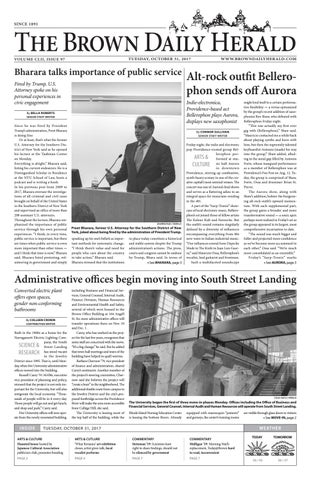
SINCE 1891
THE BROWN DAILY HERALD TUESDAY, OCTOBER 31, 2017
VOLUME CLII, ISSUE 97
Bharara talks importance of public service Fired by Trump, U.S. Attorney spoke on his personal experiences in civic engagement
Alt-rock outfit Bellerophon sends off Aurora Indie-electronica, Providence-based act Bellerophon plays Aurora, displays new saxophonist
By BELLA ROBERTS SENIOR STAFF WRITER
Since he was fired by President Trump’s administration, Preet Bharara is doing fine. Or at least, that’s what the former U.S. Attorney for the Southern District of New York said as he opened his lecture at the Taubman Center on Monday. Everything is alright,” Bharara said, listing his current endeavors: He is a Distinguished Scholar in Residence at the NYU School of Law, hosts a podcast and is writing a book. In his previous post from 2009 to 2017, Bharara oversaw the investigations of all criminal and civil cases brought on behalf of the United States in the Southern District of New York and supervised an office of more than 200 assistant U.S. attorneys. Throughout the lecture, Bharara emphasized the importance of public service through his own personal experiences. “I think, in every time, public service is important, but there are times when public service is even more important than other times — and I think that time is now,” Bharara said. Bharara listed protesting, volunteering in government and simply
WWW.BROWNDAILYHERALD.COM
By CONNOR SULLIVAN SENIOR STAFF WRITER
Friday night, the indie and electronic pop Providence-rooted group Bellerophon performed at music hall Aurora in downtown Providence, stirring up combustive, synth-heavy ecstasy in one of the creative capital’s most seminal venues. The concert was one of Aurora’s final shows and serves as a flattering adieu to an integral space for musicians residing in the 401. A part of the “Aarp-Tronix” showcase of local electronic music, Bellerophon’s set joined those of fellow artists The Kolour Kult and Favourite. But the outfit’s sound remains singularly defined by a diversity of influences encompassing everything from 80s new-wave to Italian industrial music. “Our influences extend from Depeche Mode to The Knife to Juan Luis Guerra,” said Mauricio Ossa, Bellerophon’s vocalist, lead guitarist and frontman. Such a multifaceted soundscape
ARTS & CULTURE
JASMINE RUIZ / HERALD
Preet Bharara, former U.S. Attorney for the Southern District of New York, joked about being fired by the administration of President Trump. speaking up for one’s beliefs as important methods for systematic change. “I think there’s value and need for people who care about the country to take action,” Bharara said. Bharara stressed that the institutions
in place today constitute a historical and stable system despite the Trump administration’s actions. The press, courts and congress cannot be undone by Trump, Bhara said. In terms of » See BHARARA, page 3
might lend itself to a certain performative flexibility — a virtue epitomized by the group’s recent addition of saxophonist Ben Shaw, who debuted with Bellerophon Friday night. “This was actually my first ever gig with (Bellerophon),” Shaw said. “Mauricio contacted me a while back about playing synths and horn with him, but then the supremely talented keyboardist Antonio (made) his way into the group,” Shaw added, alluding to the aural gap filled by Antonio Forte, whose inaugural performance as a member of Bellerophon was at Providence’s Foo Fest on Aug. 12. Today, the group is comprised of Shaw, Forte, Ossa and drummer Brian St. Pierre. The Aurora show, along with Shaw’s addition, bolster the burgeoning alt-rock outfit’s upward momentum. With each supplemental part, the group gains a broader and more transformative sound — a sonic apex perhaps most realized in Friday’s set as the group appeared in its largest, most comprehensive incarnation to date. “The sound was much bigger and fuller and projected more confidence as we’ve become more accustomed to each other,” Ossa said. “We’re much more consolidated as an ensemble.” Friday’s “Aarp-Tronix” marks » See AURORA, page 3
Administrative offices begin moving into South Street Landing Converted electric plant offers open spaces, gender non-conforming bathrooms By COLLEEN CRONIN CONTRIBUTING WRITER
Built in the 1900s as a home for the Narragansett Electric Lighting Company, the South Street Landing has stood vacant in the Jewelry District since 1995. That is, until Monday, when five University administrative offices moved into the building. Russell Carey ’91 MA’06, executive vice president of planning and policy, stressed that the project is not only important for the University, but will also invigorate the local economy. “Thousands of people will be in it every day. Those people will go out and get lunch, and shop and park,” Carey said. Five University offices will now operate from the newly renovated building,
SCIENCE & RESEARCH
INSIDE
including Business and Financial Services, General Counsel, Internal Audit, Finance Division, Human Resources and Environmental Health and Safety, several of which were housed in the Brown Office Building at 164 Angell St. Six more administrative offices will transfer operations there on Nov. 10 and Dec. 1. Carey, who has worked on the project for the last five years, recognizes that some staff are concerned with the move. “It’s a big change,” he said. But he added that town hall meetings and tours of the building have helped to quell worries. Barbara Chernow ’79, vice president of finance and administration, shared Carey’s sentiment. Another member of the project’s steering committee, Chernow said she believes the project will “create a buzz” in the neighborhood. The additional shuttle route from campus to the Jewelry District and the city’s proposed footbridge across the Providence River will make the area more accessible from College Hill, she said. The University is leasing most of the top half of the building, while the
CELIA HACK / HERALD
The University began the first of three move-in phases Monday. Offices including the Office of Business and Financial Services, General Counsel, Internal Audit and Human Resources will operate from South Street Landing. Rhode Island Nursing Education Center is leasing the bottom floors. Already
equipped with mannequin “patients” and gurneys, the center’s training rooms
are visible through glass doors to visitors » See MOVE-IN, page 2
WEATHER
TUESDAY, OC TOBER 31, 2017
ARTS & CULTURE Haunted house hosted by Japanese Cultural Association publicizes club, promotes bonding
ARTS & CUTLURE ‘What Remains’ art exhibition closes, artist gives talk, local vocalist performs
COMMENTARY Steinman ’19: Scientists have right to share findings, should not be silenced by government
COMMENTARY Mulligan ’19: Morning Mail’s replacement, Today@Brown hard to read, inconvenient
PAGE 2
PAGE 4
PAGE 7
PAGE 7
TODAY
TOMORROW
56 / 42
56 / 37
NEWS
PAGE 2 • TUESDAY, OCTOBER 31, 2017
» MOVE-IN, from page 1 who walk from lobby to lobby. A large, open atrium hosts a two-level common area, still equipped with cranes from the building’s former days as an electric plant. The space will feature a cafe, which building operators hope to contract out to a local company. Michael Ferrara, a construction superintendent for Gilbane Building Company — the project’s contractor — has been on the project for about a year. “It has been a pleasure for me,” he said. He added that the building retains a lot of its original features, pointing to an old steel beam emerging from the floor. “You can’t hide all the historical features.” On a tour given to The Herald, Joanna Saltonstall, program manager for Facilities Management, pointed out the innovative and environmentally friendly features of the project. In addition to recycling building materials and reusing the building itself, the developers installed only LED lights, used paint with low percentages of volatile organic compounds and placed composting and recycling bins on every floor. The builder hopes to meet LEED sustainability standards, Ferrara said. Each floor leased by the University includes a gender non-conforming bathroom as well as private lactation rooms. Kitchens and common spaces equipped with coffee makers and plentiful seating will make the space more comfortable and foster a sense of community, Saltonstall said. Modern conference rooms are enclosed by glass, and tablets can be used to reserve spaces while on site. “Huddle rooms” and “phonebooth rooms” accommodate smaller groups, said Director of News and Editorial Development Brian Clark. A large multipurpose room has been outfitted with partitions that can allow the room to change functions. To maintain a connection to campus, graphics of College Hill, including
images of the Van Wickle Gates, welcome visitors into each floor’s lobby. Cardinal red runs throughout the offices’ designs. TV monitors will be hung in common spaces, featuring campus news and events to keep staff up-to-date with campus life. As a member of the project’s operations committee and one of its “move champions,” Patricia Mulcahey, associate director of strategic sourcing for the University’s Insurance and Purchasing Services, is excited about the new space, citing the natural lighting as one of her favorite features. Compared to her former location in the Brown Office Building, “this is an extreme upgrade,” she said. Cindy Chadderton, strategic sourcing analyst for the Insurance and Purchasing Services, also lauded the new building, but was concerned about getting there. Chadderton usually takes the bus to work, and planning her commute was difficult at first, she said. “It’s either a longer walk or a shuttle ride.” The Transportation Office has tried to accommodate the change with shuttles that run from main campus to the South Street location, either on the express or connector routes. Despite fears of adjusting to a new space, multiple staff members said the building’s open concept already fosters a sense of community. “I had been at the (Brown Office Building) for 23 years,” said Raymond Steward, assistant director of Insurance and Purchasing Services, “and somebody asked me the other day what I was going to miss about (it). … Nothing in particular about the building itself … it’s the people. And coming in this morning as people trickled in, it was like community.” Judith Nabb, associate director of Learning and Development in Human Resources, shared a similar anecdote: “I saw two people at one of the kitchen areas this morning, that (had) worked at the same building, but I saw them shaking hands, introducing themselves.”
THE BROWN DAILY HERALD
CELIA HACK / HERALD
The new space replete in modern glass conference rooms encompasses an environmentally friendly design, including recycled business materials, organic paints and LED lights.
Weezer’s ‘Pacific Daydream’ album drop disappoints Band releases new LP, music underwhelms, lyrics lacks energy, maturity By JUSTIN FERENZI STAFF WRITER
For those who are desperately missing the early 2000s, Weezer’s latest album “Pacific Daydream” will more than deliver. Rivers Cuomo and company have delivered a bland and energetic romp that feels more like a half-hearted tribute to Bowling for Soup than the rough, wry material they came onto the scene with back in 1994. “Feels Like Summer,” the first single released from the LP, came out this past March. Though the song attempts to be a jovial ode to the freedom of summer and breaking the chains of banality, it mostly succeeds as a grating reminder that Cuomo cannot and should not sing in a falsetto. Cuomo does best when he stays within the boundaries of his signature throaty slacker vocals — not when he pretends to be Bruno Mars. “Happy Hour,” the next single, slated for radio release today, feels like another staid attempt to connect with a working-class audience. Complaining
about how his boss — portrayed as a nagging woman, an uninspired capitalization on a tired trope — is always on his back, Cuomo whines about how he just wants to hit his local dive bar after a long day at work. Sorry, when’s the last time any member of Weezer worked a nine-to-five? Granted, many successful artists before have feigned grass roots successfully, but this song falls flat. This lack of authenticity pervades the rest of the album as well. The quaintly-titled “La Mancha Screwjob” combines strange autotuned lyrics with a misplaced Latin beat. “We’re getting stronger, stronger, we’re getting faster, faster,” Cuomo sings. What? Current band membership includes four middleaged adult men ranging in age from 47 to 52. The only thing that should be getting stronger and faster for these guys are their golf swings. Weezer lacks self-awareness. They are still pretending to be the new, cool kids on the scene instead of accepting the fact that they are closer in age to Phil Collins than the Jonas Brothers. Some of the uninspired, faux-youthful energy in “Pacific Daydream” may be attributable to producer Butch Walker. Walker, who in recent years has worked with Taylor Swift and Carly Rae Jepsen, specializes in the easily catchy
COURTESY OF FLICKR USER TANKBOY
“Pacific Daydream,’’ Weezer’s eleventh studio album, embarrasingly belies the group’s age and fails to replicate their 90’s and early 2000’s peak in its poor imitation of modern pop. genericism of modern commercial pop. But Carly Rae Jepsen Weezer is not. It’s time for Weezer to lean into their 50s. They really are a good band, and they do have the ability to be better.
Although some may advocate for a return to form, Weezer should be primed to keep moving forward rather than planting their feet in the mud of mediocrity. Their failures in recent years
could be perhaps remedied by an honest album about the trials and tribulations of grappling with declining virility — not pretending to be 20-year-old beach bums who just want to have fun, man.
NEWS
TUESDAY, OCTOBER 31, 2017 • PAGE 3
THE BROWN DAILY HERALD
Annual haunted house promotes JCA Abandoned hospitalthemed event included jump scares, video montage of horror scenes By JACOB ALABAB-MOSER CONTRIBUTING WRITER
On Saturday night, a crowd of frightseeking students converged on the steps of Sayles Hall to experience the Brown Japanese Cultural Association’s abandoned hospital-themed haunted house, the club’s annual Halloween event. After descending the stairs to the basement of Sayles, participants hesitantly traveled through each room of the haunted house, flinching and screaming as actors dressed as ghoullike doctors and patients suddenly jumped into view. This year’s event was not suited for participants with any hemophobic tendencies, as fake blood covered the space in syringes carried by ghoul-like nurses and on the heavily stained hospital gowns of patients. “There were a lot of jump scares, but it wasn’t too bad,” said Sonya Bui ’21. The short video montage of horror-inducing clips screened before the live-action segment of the haunted house illuminated the theme’s inspiration: Japanese horror films set in hospitals. Themes from previous years have included other performance-related elements of Japanese aesthetic and pop culture tradition, including geishas and a doll factory.
The club continues to hold the annual event to fundraise and promote the club to the community, said Kiyomasa Kuwana ’19, co-president of JCA. Organizing and acting in the event also presents a bonding experience for the club’s members. “Everyone becomes closer,” added co-president Vicky Zhou ’18. “It’s a great opportunity to bond with each other and have fun.” Zhou added that the haunted house has been a JCA tradition for most of the club’s existence and is their largest and most popular event of the semester, followed in the spring by Matsuri, an annual festival with street food and games. She added that JCA also holds smaller events for its members like a curry night at the beginning of the year and a Japanese-themed Secret Santa activity during the holidays. Similar to past years, the fright night haunted house proved very popular. Over 500 people indicated they were “interested” on the Facebook event and several people were denied entry at the end of the night since the venue was at capacity. Zhou confirmed that the club has come to expect this turnout, as students from the University attend, as well as those from neighboring colleges like Rhode Island School of Design and Johnson and Wales University. “It’s just amazing to see so many people interested and coming to our event that we haven’t seen before,” Zhou said. “It really gets the word out about our club.”
» BHARARA, from page 1 press, Trump can “mock the press but can’t undo the first amendment and slander laws,” Bharara said. The courts remain stable as judges have life tenure and congress retains many powers the president lacks, he added. However, Bharara did express concern for the state of the current executive branch. “The place I’m most concerned — where some of the rhetoric, attitude and abilities of the president gives me concern — is within the executive branch itself. When there are structural protections for the branches … there is little the president can do. But there is a whole ‘nother regime that governs conduct in the government, and those are called norms. Norms by definition are soft,” Bharara said. The conversation shifted later, and Bahara asked his audience how to reform the American political system to prevent any further damage that Trump or similar figures could cause. Bharara listed making laws to prevent the hiring of a special council or requiring presidential candidates to disclose tax returns as possibilities. “We must think more broadly about public service — what are larger scale reforms that we should be advocating, so the next guy doesn’t try to do the same things,” Bharara said. Bharara touched on a wide range of topics during the question and answer portion of the evening including his disappointment in the electoral college, the tension between liberty and security and executive privilege. “I think public service should really be about ways we can make our American system better and live up to the ideals they are supposed to stand for,” Bharara said.
COURTESY OF MAURICIO OSSA
Antonio Forte, left, and Mauricio Ossa, right, are two members of Providence-based electronic and indie act Bellerophon, which played one of the final shows at Providence’s seminal Aurora venue Friday.
»AURORA, from page 1 Ossa’s final show at a venue that has done much to cultivate his creativity. “I played a handful of shows at Aurora in 2014 with an indie rock project called ‘Blacksow,’” Ossa said. “But as Bellerophon, I made my debut there in February 2015 and in subsequent shows went on to open for UK band ‘Until the Ribbons Break’ during the Free Mondays concert series.” In 2016, Ossa was awarded a Dorry — an arts and culture award bestowed by the
Law and Order Party, a Rhode Island newsletter — for electronic act of the year. “Honestly, some of my best musical moments happened (at Aurora). … I’m sad to see it go.” “Aurora has always been fantastic to us,” Shaw said. “I used to go to Wednesday’s jazz jams all the time when it was still called the Roots Cultural Center and then was fortunate enough to be the emcee of the next iteration of the jam when it switched to Aurora,” Shaw added. In a press release, Aurora officials
both lamented its closure and celebrated its history as “a vibrant venue for creative expression and community interactions.” And although its illustrious pedigree of performers includes such nationally-acclaimed musicians as Thee Oh Sees and Denzel Curry, the venue has chiefly served to spotlight and mature local artists like Bellerophon from its inception. “That place has just given me so many fantastic memories and opportunities to make music for and with good people,” Shaw said.
ARTS & CULTURE PAGE 4 • TUESDAY, OCTOBER 31, 2017
THE BROWN DAILY HERALD
MARIANNA MCMURDOCK / HERALD
Richard Fishman’s exhibition, “What Remains,” concluded Sunday, but not before a local vocalist gave a performance inspired by the artwork along with a talk by the artist. The exhibition was on display at the Bell Gallery in the List Art Center.
Fishman ‘What Remains’ exhibition concludes after two months Fishman’s ‘What Remains’ ends stay in List, accompanied by artist talk, vocal performance By CINDY ZENG SENIOR STAFF WRITER
From September through October, a large elm log, stripped of its bark and sliced into 56 pieces, rested in the middle of the lobby of the List Art Center as a part of Richard Fishman’s exhibition “What Remains.” The David Winton Bell Gallery itself contained the rest of Fishman’s pieces — gray and black protrusions that began as deconstructions of the elm tree fused with carbon composite and progressed toward pure carbon structures, devoid of any wood element. An artist talk and vocal performance on “What Remains” occurred Thursday, though the exhibition itself
closed Sunday. The elm tree, from which earlier pieces in the collection were derived, was originally a giant tree on Thayer street in front of the Watson Institute of International and Public Affairs. It was cut down in 2003 because it was sick, and Fishman, a professor of visual art at the University, repurposed the tree for his Elm Tree Project that used carbon fibers in combination with elm tree slabs, creating a link between the inorganic and the organic. He used carbon fibers to strengthen the slabs of elm as they were cut, so that there would be no breakage. “I used carbon fiber because I’d never used it before, … and it was super light and super strong. But then
I liked its blackness. And I liked the process,” Fishman said. “No Apparent Source of Light,” the sculpture part of the collection, appeared unimposing, resting on the furthest wall of the exhibition room. A dark, smooth piece, it evoked a soft luminosity that made the audience think of moonlight. “My pieces — I make them to touch. And to get to the point that it is so sensuous that it would drive you crazy,” Fishman said. “In the making of things, … there’s a great satisfaction I find. And using my hands … to translate all of the various emotions that come from touch,” Fishman said. “This is … a ton of time with really slow work. … It’s just a piece of wood that’s sanded. Like the process is totally hidden, we have no idea how he made this,” said Frans van Hoek ’18, who attended the event and said he
found “No Apparent Source of Light” to be the piece that he had the most visceral reaction to. “You can remove all traces of yourself but still communicate all of yourself,” he added. The works in the lobby “are the introduction to the show, the works created towards the end of when he was working with the elm,” said Jo-Ann Conklin, the director of the David Winton Bell Gallery. “The later ones are totally carbon fiber. … None of the elm tree exists under these new pieces. He’s moved on beyond the elm tree.” “I was interested in the transition away from working with the wood and what happened when the wood disappeared. And so ‘What Remains’ is sort of a multifaceted title. Part of it is what remains when the wood is not present anymore,” Conklin added. Fishman’s talk was preceded by an improvised vocal performance
by Laurie Amat, a local vocalist. The performance occurred in the space that held Fishman’s most recent, pure carbon fiber sculptures — four slabs of sleek and shiny carbon pieces that gleamed back the audience’s reflection. “If you look, you can see the whole world in there … The finish is beautiful,” Amat said, adding that she offered to do a performance after having an extremely visceral response when she saw the exhibition for the first time. “What I do is pretty visceral, so I kind of had a plan, but when I came in today … it got deep, really fast. … it’s hard for me to describe (the performance), but it happened. I mean, this is amazing, this work. It makes me want to play with carbon fiber.” “You think it’s just black, but it’s so alive,” she said.
TODAY
TUESDAY, OCTOBER 31, 2017 • PAGE 5
THE BROWN DAILY HERALD
menu
speckled embrace
SATELLITE DINING ANDREWS COMMONS
Pizza: Bacon Chicken Ranch, Spinach and Feta, Pepperoni Poke Bowl JOSIAH’S
BLUE ROOM
Chicken Pot Pie Bowl, Make Your Own Grilled Cheese
Organic Black Bean Soup, Turkey Sausage and Kale Soup
DINING HALLS SHARPE REFECTORY LUNCH
DINNER
California Salad Bar, Chicken Vegetable Soup, Beef Tacos, Chocolate and Vanilla Cupcakes
Lentil Soup, Roasted Parsnip, Black Bean and Corn Stew, Worms in Mud
VERNEY-WOOLLEY LUNCH
DINNER
Chicken Gumbo Soup, Spicy Pepper Pulled Chicken, Boiled Rice, Assorted Cupcakes
Liz’s Great Vegetable Soup, Beef Carnitas, Carrot Casserole, Polenta Bread
sudoku
ANITA SHEIH / HERALD
A monarch butterfly grazes a set of fancifully strewn flowers, basking in the warm weather of late October that will soon shift to chilling winds and much colder temperature.
Q U O T E O F T H E D AY
“If you look, you can see the whole world in there.” R
AS
DA
A
c r o s s w o rDd
— Director of the Bell Gallery Jo-Ann Conklin on a sculpture from Richard
C
Edited by Rich Norris and Joyce Nichols Lewis
ACROSS 1 Thumbs-way-up reviews 6 Knocks with one’s knuckles 10 Not feral 14 Low-budget, in company names 15 Happily __ after 16 October birthstone 17 Hexes 20 Dined 21 Twosome 22 Heart chambers 23 Positive thinker’s assertion 25 Cleopatra’s river 27 Surprised party, metaphorically 32 Beelzebub 35 Oboe or bassoon 36 Baled grass 37 “Jurassic Park” terror, for short 38 Meanspiritedness 40 Home plate, e.g. 41 Above, in verse 42 Apple computer 43 Showed on television 44 Destination not yet determined 48 Detest 49 Oscar-winning film about Mozart 53 End of __ 56 Yard sale warning 57 British mil. award 58 Beatles song, and a hint to the hidden word in 17-, 27- and 44Across 62 Opera solo 63 Like a steak with a red center 64 “That is to say ...” 65 Double O Seven 66 “P.U.!” inducer 67 Willy-__: sloppily
4 USNA grad 5 Slight trace 6 Symbol of financial losses 7 State firmly 8 For each 9 Málaga Mrs. 10 Best-seller list 11 Mimic 12 West African country 13 Jazzy Fitzgerald 18 Indian bread 19 “To your health,” to José 24 Big-screen format 25 Russian rejection 26 “That’s clear now” 28 Angels shortstop Aybar 29 Sear 30 Operate with a beam 31 Kept in view 32 Halt 33 Zone 34 Alaska, once: Abbr. 38 Obscene material 39 Glazier’s fitting
40 Tough spot 42 Newton or Stern 43 Inundated with 45 Needle’s partner 46 Sadat’s predecessor 47 Leave out 50 ’50s Ford flop 51 Typical 52 Hot-headed Corleone brother in “The Godfather”
ANSW R
O
Fishman’s “What Remains” exhibition
53 Moby Dick chaser 54 Fiddling emperor 55 “__ Brockovich” 56 Flying prefix 59 Gold, in Granada 60 Insane 61 Record label initials across the pond
R
See REMAINS on page 4.
O S
calendar TODAY OCTOBER MARCH
S
M
T
W
Th
F
S
1
2
3
41
52
63
74
85
96
10 7
11 8
12 9
13 10
14 11
Haunted Halloween 5:30 A.M. Nightingale-Brown House
Sci-Fi / Fantasy Book Club 7:30 P.M. Faunce, 225
Brown in the UK Information Session 4:00 P.M. J Walter Wilson, 411
Argentine Tango Class 6:00 P.M. Graduate Center Lounge
TOMORROW
DOWN 1 Satisfy, as a loan 2 Like most triangle angles 3 Chooses at the By Johanna Fenimore polls
(c)2012 Tribune Media Services, Inc.
15 12
16 13
17 14
18 15
19 16
20 17
21 18
22 19
23 20
24 21
25 22
26 23
27 24
28 25
29 26
30 27
31 28
29 1
30
31
Vinyasa Yoga 9:00 A.M. Hillel, Winnick Chapel
Intermediate LaTeX Workshop 11:55 A.M. Sciences Library, 3rd floor
Library FYI Workshop 4:00 P.M. Rockefeller Library, Hecker Room
Interracial Dating Panel 7:00 P.M. Stephen Robert ’62 Campus Center, Petteruti Lounge
COMMENTARY PAGE 6 • TUESDAY, OCTOBER 31, 2017
THE BROWN DAILY HERALD
comic Comic | Olivia Reavey
Find us online! facebook.com/browndailyherald
browndailyherald.com
@the_herald
Location: 195 Angell St., Providence, R.I. www.browndailyherald.com
@browndailyherald
youtube.com/browndailyherald
Editorial Leadership
Sections
Multimedia & Production
Business
Editor-in-Chief Lauren Aratani
Arts & Culture Editors Ethel Renia Madison Rivlin
Design Editors Christy Leung Ameer Malik Jessica Yu Assistant: Eduard Muñoz-Suñé
General Managers Henry Ritter Ben Wesner
Managing Editors Matt Brownsword Rebecca Ellis Kate Talerico POST- MAGAZINE Editor Saanya Jain BLOGDAILYHERALD Editor Angelica Cotto
Metro Editor Gwen Everett News Editors Isabel Gensler Alex Skidmore Hattie Xu Science & Research Editor Elena Renken Sports Editors Ben Shumate Nicholas Wey COMMENTARY Opinions Editors Connor Cardoso Anuj Krishnamurthy Mili Mitra
Photo Editors Head: Marianna McMurdock Assistant: Lilly Nguyen Gus Reed Sara Runkel Anita Sheih Copy Desk Chief Abby Borges Multimedia Editor Roland High
Directors Sales: Erin Lueck Sales: Matilda Lynton Finance: Reena Zhan Strategy: William Nober Strategy: Caroline Ziegler Managers Sales: Michael Borello Sales: Elizabeth Doykan Sales: Shreya Raghunandan Collections: Ravi Betzig
Editorial contact: 401-351-3372 herald@browndailyherald.com
Business contact: 401-351-3260 gm@browndailyherald.com
Submissions: The Brown Daily Herald publishes submissions in the form of op-eds and letters to the editor. Op-eds are typically between 750 and 1000 words, though we will consider submissions between 500 and 1200 words. Letters to the editor should be around 250 words. While letters to the editor respond to an article or column that has appeared in The Herald, op-eds usually prompt new discussions on campus or frame new arguments about current discourse. All submissions to The Herald cannot have been previously published elsewhere (in print or online — including personal blogs and social media), and they must be exclusive to The Herald. Submissions must include no more than two individual authors. If there are more than two original authors, The Herald can acknowledge the authors in a statement at the end of the letter or op-ed, but the byline can only include up to two names. The Herald will not publish submissions authored by groups. The Herald does not publish anonymous submissions. If you feel your circumstances prevent you from submitting an op-ed or letter with your name, please email herald@browndailyherald.com to explain your situation. You can submit op-eds to opinions@browndailyherald.com and letters to letters@browndailyherald.com. When you email your submission, please include (1) your full name, (2) an evening or mobile phone number in case your submission is chosen for publication and (3) any affiliation with Brown University or any institution or organization relevant to the content of your submission. Please send in submissions at least 24 hours in advance of your desired publication date. The Herald only publishes submissions while it is in print. The Herald reserves the right to edit all submissions. If your piece is considered for publication, an editor will contact you to discuss potential changes to your submission. Commentary: The editorial is the majority opinion of the editorial page board of The Brown Daily Herald. The editorial viewpoint does not necessarily reflect the views of The Brown Daily Herald, Inc. Columns, letters and comics reflect the opinions of their authors only. Corrections: The Brown Daily Herald is committed to providing the Brown University community with the most accurate information possible. Corrections may be submitted up to seven calendar days after publication.
Illustrations Editor Pia Mileaf-Patel
Advertising: The Brown Daily Herald, Inc. reserves the right to accept or decline any advertisement at its discretion.
Graphics Editor Laura Felenstein
The Brown Daily Herald, Inc. is a financially independent, nonprofit media organization bringing you The Brown Daily Herald, BlogDailyHerald and Post- Magazine. The Brown Daily Herald has served the Brown University community daily since 1891. It is published Monday through Friday during the academic year, excluding vacations, once during Commencement and once during Orientation by The Brown Daily Herald, Inc. Single copy free for each member of the community. Subscription prices: $200 one year daily, $100 one semester daily.
Directors of Web Development Eli White Ivy Wong
Copyright 2017 by The Brown Daily Herald, Inc. All rights reserved. Periodicals postage paid at Providence, R.I. Postmaster: Please send corrections to P.O. Box 2538, Providence, RI 02906.
COMMENTARY TUESDAY, OCTOBER 31, 2017 • PAGE 7
THE BROWN DAILY HERALD
The EPA’s gag reflex CLARE STEINMAN op-ed contributor A new report on the health of Rhode Island’s Narragansett Bay shows that it is getting cleaner as a result of decades of investments in wastewater treatment and restrictions on harmful chemicals. Though scientists are continuing to monitor the effect that this reduced pollution is having on the ecosystem and on the shellfish, fish and sea grasses that call the bay home, early indications suggest it is getting healthier. Yet urban areas in Rhode Island are expanding, resulting in a loss of forested area and an increase in runoff and pollution. At the same time, climate change is warming the water and threatening the infrastructure that keeps it — and us — safe. And as always, more research is needed to completely understand the health of the bay at the risk posed by climate change. These five findings, the distilled overview of a 500-page technical report, are the result of a three-year, peer-reviewed research project by the Narragansett Bay Estuary Program and a variety of universities, organizations and agencies in both Massachusetts and Rhode Island. Yet despite its robustness and relevance — Narragansett Bay borders
Providence and makes up the vast majority of the 33 percent of Rhode Island that is covered by water — the report’s authors were forbidden to present its findings at a conference in Providence last Monday by the EPA. You can read the report online. You should read the report online, or at least the 28-page summary or the one-page overview of the summary, mostly because anything Environmental Protection Agency Administrator Scott Pruitt thinks is
should have the right to access information like this to know if the ecosystem they live in will make them sick. When the Trump administration decides to hide this information from the public, to play down the importance of reports like these and to gag the authors who worked for years to bring them to light, they are actively endangering the people and land they were elected to protect. Neil Degrasse Tyson, the celebrated astrophysicist, has a famous
ident Trump, along with his supporters, seems to delight in telling the intellectuals of the world that they’re not as smart as they think they are. Whether staring at the eclipse or burying climate change research, Trump scores points with his base by deriding the data-driven analysts who think they have all the answers. As a result, science has become a lot less apolitical. I’m not a scientist, but I can see the danger in allowing science to be co-opted by one political party and
When the Trump administration decides to shield this information from the public, to play down the importance of reports like these and to gag the authors who worked for years to bring them to light, they are actively endangering the people and land they were elected to protect. worth suppressing is probably worth reading. But if you do read it, you will immediately realize that this is not the type of subversive threat to national security one would generally associate with government censorship or a cover-up. In reality, it’s a wonky series of facts evaluating the health of one of New England’s major bodies of water, and its only call to action is continued vigilance. All Rhode Islanders — and indeed, all Americans and all humans —
saying: “The good thing about science (is) it’s true whether or not you believe in it.” In the case of climate change, that’s not a particularly good thing, but it holds true regardless. Climate change will continue to rage no matter how many climate deniers hold influential government posts. Pruitt and the Trump administration can stop scientists from presenting their work, but they can’t render their findings inaccurate. That’s not for lack of trying. Pres-
made to seem biased. Any society in which a segment of the population thinks science is working against them is in danger. And, of course, there are risks related to the politicization of science. In fact, no one is warier of the dangers of politicizing science than scientists themselves. When last April’s March for Science brought over a million participants to the streets, protesting the administration’s war on facts, it also provoked a backlash from inside the sci-
entific world (as well as outside), insisting that scientists should remain in the lab, leaving the policymaking up to the politicians. The environmentalist and activist Bill McKibben has been criticized similarly in the past, for transferring his environmental science expertise into activism. But in an age of gaslighting and fake news, the reliable scientific voice is one of the few sources of unbiased honesty we have left. How can we afford to silence that? I’m not calling for all environmental scientists and ecologists to leave the lab and run for office, or for them to start drafting legislation. But they absolutely should be using their voices, as loudly as possible, to spread the word about their increasingly dire findings. For the rest of us, well, we need to be paying attention. We need to amplify and spread the message of our most knowledgeable voices and stand up where they are muzzled, as a group of Rhode Island residents, Brown students and professors did last week. We need to pick sides in the war on facts. The Narragansett Bay may be getting cleaner, but our political system, and our planet, are sick and getting sicker. We’re going to need science to nurse both back to health.
Clare Steinman ’19 can be reached at clare_steinman@brown.edu.
R.I.P. Morning Mail CAROLINE MULLIGAN staff columnist Morning Mail, the daily digest of Brown information that rocketed into inboxes at 1 a.m. every day, was my first friend from Brown. It arrived to my brand-new Brown email address long before I moved into my dorm. Listing the events and announcements of the upcoming weeks, it acclimated me to the goings-on of campus before I considered myself a member of the Brown community. On Oct. 18, communication officials announced that Morning Mail was being replaced by a new platform called Today@Brown. Though I confess that Morning Mail’s demise was comparable to that of losing a cherished childhood toy, I maintain that it is not just nostalgia fueling my displeasure with its replacement. Today@ Brown is harder to read and does not demonstrate an understanding of how students regularly interact with emails that keep them connected to Brown news and the community. Morning Mail had two parts. At the top was a table of contents, containing the titles of all the announcements and events within. Readers could click on the titles and be brought to short descriptions at the bottom of the email, or they could just scroll past the table of contents to view all of the descriptions directly. Links for additional information could be clicked if readers were particularly intrigued by a given description. Crucially, Morning Mail contained enough information to get students intrigued in the first place. To be clear, Morning Mail was not a perfect medium. It often contained dozens of announcements and events — a frankly over-
whelming amount of information. I would read it when I checked my email upon waking and my eyes would glaze over. I often found myself skimming. Today@Brown, according to an email sent to students from Cass Cliatt, vice president for communications, has three primary goals: reducing the number of emails received daily, making it easier to find “important, high-priority information” and providing “structure to the volume of information community members receive to make it easier to scan and digest.” These are worthy goals, and Today@Brown takes some steps toward achieving them. For
remains that Morning Mail was “easier to scan and digest” because the table of contents enabled readers to quickly determine if they wanted to engage with a bulletin or not. Today@ Brown lacks that capability. My main problem with Today@Brown, though, is that in order to access any event or announcement descriptions, you have to be redirected to an additional website. There is no single page where all descriptions can be viewed. Instead, each item has to be clicked on individually, opened one at a time to unearth the meaning of a tantalizing headline. This is inconvenient as a millennial whose attention span
Today@Brown is harder to read and does not demonstrate an understanding of how students regularly interact with emails that keep them connected to Brown news and the community.
example, it lists events by the dates they occur. Morning Mail, by contrast, reserved that information for the descriptions of events. Having the dates and times clearly laid out makes it easier to skim through and plan your day. However, Today@Brown lacks a table of contents. Whereas students could once easily pick out events that interested them and go to their descriptions, they must now scroll through the entire email. I realize how incredibly lazy it sounds to be complaining about scrolling through an email, as though that would somehow cause my thumbs to fall off. But the fact
has been destroyed by Twitter — I want my information as immediately as I want my avocado toast. I could just complain that this is annoying, because frankly, it is. But to even the least lazy among us, Today@Brown’s format makes it so that access to information is now entirely selfselected. One of Morning Mail’s charms was that it could be accessed in multiple ways: you could click the links in the table of contents and go directly to the descriptions at the bottom of the emails, or you could go on a leisurely scroll down the page, casually taking in the announce-
ments, pausing if any keywords caught your eye. These early-morning scrolls brought me in contact with events I would have otherwise missed, from dumpling sales in the Science Library to David Cameron’s lecture. But Today@Brown’s fractured format has greater ramifications than missing interesting events. Important campus information, including news from the Brown Corporation, was previously sent out in separate emails. Today@Brown now contains this type of news, denoted as “Priority” at the top of the email to get readers’ attention. However, unlike former email announcements, important information is no longer listed directly in the email body. And not all students read Morning Mail in the first place — some relied on those separate communications to read critical announcement. Despite encouragement from administrators to “read Today@Brown to avoid missing important communications,” old habits die hard. Students used to ignoring Morning Mail may not pay attention to Today@Brown, decreasing awareness about pertinent changes in campus policies. The extra bit of effort required may not seem like much, but to time-crunched college students, having immediate access to information, as opposed to having to wait for new pages to load for every single item makes a difference. Because Today@Brown is in its early stages, I hope that as improvements are made, information will be as immediately accessible as it was with Morning Mail so that speed-reading students can be more connected to the Brown community.
Caroline Mulligan ’19 can be reached at caroline_mulligan@brown.edu.
SCIENCE & RESEARCH THE BROWN DAILY HERALD
TUESDAY, OCTOBER 31, 2017
Faculty, students attend SACNAS national conference Participants network with conference attendees, gain perspectives on diversity in STEM By ANUVA GOEL CONTRIBUTING WRITER
With a focus on demographic disparities in STEM fields, several University faculty members and students spent Oct. 19 to 21 at the 2017 Society for Advancement of Chicanos/Hispanics and Native Americans in Science conference in Salt Lake City. They joined a community of around 3,000 scholars, tied together by a passion for science and empowering minorities, to listen to keynote speakers, conduct and attend workshops and discuss ongoing research projects. “Students are really able to get inspired since it not only provides the opportunity for students to be able to listen to their peers from institutions across America, but also gives them the opportunity to interact with experimenters in their field and, of
course, in other fields,” said Associate Dean of the College for Undergraduate Research and Inclusive Science Oludurotimi Adetunji. Johnny Guzman, associate professor of mathematics, has been attending SACNAS since he was a graduate student. This year, his workshop explored differential operators, a relatively new and popular field in mathematics, through an undergraduate lens. In addition, Associate Professor of Mathematics Tarik Aougab hosted a second Modern Math Workshop on hyperbolic geometry for around 35 undergraduate students. He will host a Research Experience for Undergraduates in this subject area at the Institute for Computational and Experimental Research in Mathematics and decided to present a mini-course on this topic to a broader audience at SACNAS this year.
Throughout these workshops and the rest of the conference, Guzman encouraged student attendees to look into Brown’s graduate program. Aougab highlighted how the conference was the ideal space for the math department to increase its accessibility to minority and underrepresented students. “One of the primary things I do is to build networks with people and serve as a mentor to students. I like to attend the poster session, where I can meet lots of students, see what research they have done, give them feedback and encourage them to look into our graduate programs,” Guzman said. “I also network with my peers — we offer ourselves support and community and help each other out.” With the ability for the organization to aid the recruitment and retention of underrepresented students, SACNAS’ Brown chapter was started in 2012 by Adetunji and Professor of Biology Mark Johnson, the club’s
current advisors. In 2013, this chapter was recognized by SACNAS as a “Role Model Chapter,” which attests to its efforts to host speakers and mock workshops where students practice presenting their projects among peers. “At Brown’s SACNAS chapter, we cultivate this environment that fosters a sense of community whereby students are able to have opportunities to be mentored or serve as mentors to other students,” Adetunji said. “If they are applying to a position, a person who has gone through the process before can help them.” The larger issue of diversity in STEM is brought alive through the vivid stories of struggles and challenges that were overcome, narrated by keynote speakers at the SACNAS conference. This year, keynote speaker Dr. Tyrone B. Hayes, discussed how his interest in frogs carried him through challenges and allowed him to persevere, leading him to become a renowned biologist.
“There is what is unfortunately a very normative mode of interaction that is taken for granted as being the way that mentorship or advising should be,” Aougab said. “Actually, it is — not coincidentally — a mode of interaction that certain types of students are more comfortable with than others, so thinking about how to subvert that is a very difficult problem.” Despite the advances the University has made through its Diversity and Inclusion Action Plan, Aougab feels that it will take time and deeper conversations about racism to improve diversity in the sciences. “I feel that many times, diversity is a buzz word that gets thrown around that signals you’re having the right conversation, but it can often be just surface deep,” Aougab said. “I don’t feel that you are really thinking about the full aspect of why diversity is important if you are not thinking about the ways in which your discipline affects your world outside of Brown.”
STAY UP-TO-DATE. FOLLOW US ON FACEBOOK. FACEBOOK.COM/BROWNDAILYHERALD