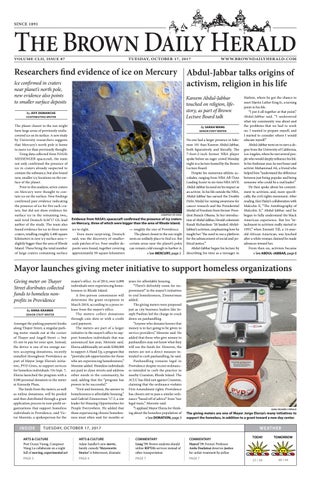
SINCE 1891
THE BROWN DAILY HERALD TUESDAY, OCTOBER 17, 2017
VOLUME CLII, ISSUE 87
Researchers find evidence of ice on Mercury Ice confirmed in craters near planet’s north pole, new evidence also points to smaller surface deposits
Abdul-Jabbar talks origins of activism, religion in his life Kareem Abdul-Jabbar touched on religion, lifestory, as part of Brown Lecture Board talk
By JEFF DEMANCHE CONTRIBUTING WRITER
The planet closest to the sun might have large areas of previously undiscovered ice on its surface. A new study by University researchers suggests that Mercury’s north pole is home to more ice than previously thought. Using data collected from NASA’s MESSENGER spacecraft, the team not only confirmed the presence of ice in craters already suspected to contain the substance, but also found new, smaller icy locations on the surface of the planet. Prior to this analysis, seven craters on Mercury were thought to contain ice on the surface. New findings confirmed past evidence indicating the presence of ice for five such craters, but did not show evidence for surface ice in the remaining two,, said Ariel Deutsch ScM’17 GS, lead author of the study. The team also found evidence for ice in three more craters, totalling roughly 3,400 square kilometers in new icy surface area — slightly bigger than the area of Rhode Island. These bring the total number of large craters containing surface
WWW.BROWNDAILYHERALD.COM
By SARAH WANG SENIOR STAFF WRITER
COURTESY OF NASA
Evidence from NASA’s spacecraft confirmed the presence of icy craters on Mercury, three of which were bigger than the area of Rhode Island. ice to eight. Even more surprising, Deutsch said, was the discovery of smallerscale patches of ice. Four smaller deposits were found, together covering approximately 50 square kilometers
— roughly the size of Providence. The planet closest to the sun might seem an unlikely place to find ice. But certain areas near the planet’s poles can remain cold enough to harbor it, » See MERCURY, page 2
No one had a larger presence in Salomon 101 than Kareem Abdul-Jabbar, both figuratively and literally. The 7-foot-2-inch former NBA player spoke before an eager crowd Monday night in a lecture hosted by the Brown Lecture Board. Despite his numerous athletic accolades, ranging from NBA All-Time Leading Scorer to six-time NBA MVP, Abdul-Jabbar focused on his impact as an activist. In his life outside the NBA, Abdul-Jabbar has earned the Double Helix Medal for raising awareness for cancer research and the Presidential Medal of Freedom from former President Barack Obama. In her introduction of Abdul-Jabbar, Herald columnist Randi Richardson ’20 lauded AbdulJabbar’s activism, emphasizing how he taught her “the need to use a platform for the advancement of social and political justice.” Abdul-Jabbar began his lecture by describing his time as a teenager in
Harlem, where he got the chance to meet Martin Luther King Jr., a turning point in his life. “I put it all together at that point,” Abdul-Jabbar said. “I understood what my community was about and the problems that we had to work on. I wanted to prepare myself, and I started to consider where I would educate myself.” Abdul-Jabbar went on to earn a degree from the University of California, Los Angeles, where he met several people who would deeply influence his life. In his freshman year, he met boxer and activist Muhammad Ali, a friend who helped him “understand the difference between just being popular and being someone who could be a real leader.” He then spoke about his commitment to activism, and, more specifically, the civil rights movement. After reading Alex Haley’s collaboration with Malcolm X, “The Autobiography of Malcolm X,” Abdul-Jabbar said he began to fully understand the black American experience. But his “attachment to activism really started in 1955,” when Emmett Till, a 14-yearold African American, was lynched after a white woman claimed he made advances toward her. From then on, activism became » See ABDUL-JABBAR, page 8
Mayor launches giving meter initiative to support homeless organizations Giving meter on Thayer Street disributes collected funds to homeless nonprofits in Providence By ANNA KRAMER SENIOR STAFF WRITER
Amongst the parking payment kiosks along Thayer Street, a singular parking meter stands out at the corner of Thayer and Angell Street — but it’s not to pay for your spot. Instead, the device is one of ten orange meters accepting donations, recently installed throughout Providence as part of Mayor Jorge Elorza’s initiative, PVD Gives, to support services for homeless individuals. On Sept. 7, Elorza launched the program with a $100 personal donation in the meter at Kennedy Plaza. The funds from the meters, as well as online donations, will be pooled and then distributed through a grant application process to non-profit organizations that support homeless individuals in Providence, said Victor Morente, a spokesperson for the
INSIDE
mayor’s office. As of 2014, over 4,000 individuals were experiencing homelessness in Rhode Island. A five-person commission will determine the grant recipients in March 2018, according to a press release from the mayor’s office. The meters collect donations through coin slots or with a credit card payment. The meters are part of a larger initiative in the mayor’s office to support homeless individuals that was announced last year, Morente said. Elorza additionally set aside $200,000 to support A Hand Up, a program that “provides job opportunities for those who are experiencing homelessness,” Morente added. Homeless individuals are paid to clean streets and address other needs in the community, he said, adding that the “program has proven to be successful.” “First and foremost, the answer to homelessness is affordable housing,” said Gabriel Zimmerman ’17.5, a site leader for Housing Opportunities for People Everywhere. He added that those experiencing chronic homelessness must often wait for months or
years for affordable housing. “There’s definitely room for improvement” in the mayor’s initiatives to end homelessness, Zimmerman added. The giving meters were proposed just as city business leaders like Joseph Paolino led the charge to crack down on panhandling. “Anyone who donates knows that money is in fact going to be given to service providers,” Morente said. He added that those who give money to panhandlers may not know what they will use the funds for. However, the meters are not a direct measure intended to curb panhandling, he said. Panhandling remains legal in Providence despite recent ordinances intended to curb the practice in nearby Cranston, Rhode Island. The ACLU has filed suit against Cranston, claiming that the ordinance violates First Amendment rights. Providence has chosen not to pass a similar ordinance “based off of advice” from “our legal team,” Morente said. “I applaud Mayor Elorza for thinking about the homeless population of » See DONATION, page 3
ANNA KRAMER / HERALD
The giving meters are one of Mayor Jorge Elorza’s many initiatives to support the homeless, in addition to a grant toward a new day center.
WEATHER
TUESDAY, OC TOBER 17, 2017
ARTS & CULTURE Poet Ocean Vuong, Composer Wang Lu collaborate on a night full of moving, experimental art
ARTS & CULTURE Adam Sandler’s new movie, family comedy ‘Meyerowitz Stories’ is bittersweet, dramatic
COMMENTARY Liang ’19: Brown students should utilize RIPTA’s services instead of other transportation
COMMENTARY Majeed ’19: Former Professor Anila Daulatzai deserves justice for unfair treatment by airline
PAGE 3
PAGE 4
PAGE 7
PAGE 7
TODAY
TOMORROW
57 / 39
69 / 44
ARTS & CULTURE PAGE 2 • TUESDAY, OCTOBER 17, 2017
THE BROWN DAILY HERALD
Pardlo’s poetry ties together multi-faceted identities
TIFFANY DING/ HERALD
Gregory Pardlo read poems from his Pulitzer Prize-winning book, “Digest,” and answered questions on his writing process, identity and the multi-faceted nature of his poetry.
Pulitzer Prize-winning poet reads from his book, discusses complexity, accessibility of his writing By DIVYA MANIAR STAFF WRITER
Pulitzer Prize-winning poet Gregory Pardlo performed a reading of his work at the McCormack Family Theater on Thursday as part of the literary arts department’s “Writers on Writing” series. Pardlo’s collection “Digest” won the 2015 Pulitzer Prize when he was a doctoral candidate at the City University of New York. “Totem,” his first collection, was selected in 2007 by Brenda Hillman for the American
» MERCURY, from page 1 according to Carolyn Ernst, planetary scientist at Johns Hopkins University Applied Physics Laboratory. These exist in so-called “permanently shadowed areas,” where, due to Mercury’s lack of tilt, the surface of the planet receives no direct sunlight. Evidence that water ice could exist in such permanently shadowed areas was first suggested by Earth-based radar long before MESSENGER was launched. With MESSENGER, more data was collected pointing to the conclusion that ice exists on the planet. Data recorded by the craft’s laser
Poetry Review/Honickman First Book Prize. He is also the recipient of several other honors, including fellowships from the Guggenheim Foundation, the National Endowment for the Arts and the New York Foundation for the Arts. Currently, he is the Poetry Editor of the Virginia Quarterly Review. Pardlo’s poetry ties in cultural references, discussing history and philosophy and weaving those themes into the intimate details of the everyday. As he began his reading, Pardlo challenged the audience to think
about the “growing layers” in the pieces he selected. Between readings, he brought up a famous quote from “Song of Myself ” by Walt Whitman. “I contain multitudes,” he said, referencing how the poem highlights the complexity of the seemingly benign. In his work, he argues that readers need not look far to access a rich variety of inspiration. “All the references I make are ones that are readily available in our culture,” he said. He tries “not to buy into the false distinctions” between types of discourse, he added. The idea resounded with members of the audience as well. “He manages to make us know
that there is not this break in different discourses; in fact, discourse is a continuum,” said Cole Swensen, professor and current chair of the literary arts department. Pardlo has an ability to bring together a vast range of ideas and thoughts in his poetry, she said. According to Swensen, the literary arts department chose to showcase Pardlo’s poetry for its impressive scope. “I knew that he would represent a wide range of voices, a wide range of possibilities in poetry, while also being accessible,” she said. By choosing this particular poet, the literary arts department aimed to reach a broad audience. Swensen emphasized that attendance to the
reading was not limited to the two undergraduate courses studying Pardlo’s poetry. “We love it when people come from other disciplines and other departments,” she said. “One of the things we (at the literary arts department) like to do is to blend communities,” she added. Karis Ryu ’21, a student in the “Writers on Writing” seminar, noted the personal significance of Pardlo’s poetry. Pardlo’s work resonated with her, as she identified “as somebody who has dealt with having multiple labels throughout (her) life,” she said. “To see somebody who can balance all of that, and is in academia, is really inspiring,” she said.
altimeter gave scientists information about Mercury’s surface, which they used to locate areas that were cold enough to sustain ice. In addition to giving researchers clues about cold areas about the topography of Mercury, the laser altimeter was also able to tell them what parts of the surface reflected in ways consistent with ice. The altimeter reported different values for terrains of different materials, Deutsch said. “Ice is very bright, and so, if you’re flying over that, it sticks out to you.” The team worked to interpret this reflectance data toward the north pole of the planet, finding new
icy areas in both large craters and smaller patches, said Gregory Neumann ScM’91 PhD’93 P’20, NASA research scientist who co-authored the study along with Deutsch and Professor of Geological Sciences Jim Head PhD’69. They found that their newly interpreted data suggested that ice-like reflectance patterns coincided with areas on the surface predicted to be cold enough to sustain ice. “This confirmed what we had modeled geophysically, … but which we didn’t have the actual direct evidence of,” Neumann said. The results of the study raise new questions about how Mercury’s ice
got there in the first place. “The fundamental question is: How did the ice get there, and when?” Neumann said, adding that scientists are leaning toward the theory that it was placed there by comets colliding with the planet. It is unclear why we don’t see such large areas of surface ice on our own moon, Neumann said. According to Ernst, the Moon contains permanently shadowed craters similar to Mercury’s and finding large areas of ice on the lunar surface could be of practical importance for future lunar missions. “It has implications for the Earth as well,” Ernst said, adding that studying ice
on other bodies in our solar system could potentially provide clues about how Earth got its oceans and came to sustain life. In the study, different pieces of evidence came together and led to the same conclusion, Ernst said. “That’s what you really want, is to look at something several different ways and come up with the same answer.” The researchers anticipate that the BepiColumbo spacecraft, set to launch for Mercury in October of next year, will provide an even better look at more of Mercury’s surface, answering still unresolved questions about the enigmatic planet.
NEWS
TUESDAY, OCTOBER 17, 2017 • PAGE 3
THE BROWN DAILY HERALD
Poetry, music night explores themes of immigration, queerness Composer Wang Lu, poet Ocean Vuong collaborate in powerful, multidisciplinary event By ELIZABETH TOLEDANO SENIOR STAFF WRITER
As Assistant Professor of Music Wang Lu’s composition trickles into the 200-seat Martinos auditorium, the space becomes intimate and personal. As if by magic, Wang fills the room with raw and emotive sounds that hypnotizes the audience. Sunday night in the Granoff Center for the Creative Arts, the Brown Arts Initiative presented “On Earth We’re Briefly Gorgeous,” a collaboration between poet Ocean Vuong and Wang. The show included live poetry readings by Vuong and four pieces composed by Wang and performed by guitarist Dan Lippel and saxophone player Ryan Muncy. Wang took part in a six-week residency with Vuong this past summer, where she first came into contact with his poetry. During the residency, she was able to get to know Vuong and his work. Wang carried Vuong’s poetry book as she spent the summer traveling around the West Coast and China. Vuong, an immigrant born into a family of rice farmers in Vietnam, used to sleep in New York’s Penn Station before he became an established poet. He encountered the challenges of owning his queer identity in a conservative culture. Aspects of his story resonated with
ARTS & CULTURE
Wang. She also found inspiration in his expressive use of language. “You can see the flash of this person,” she said. The name for the show, “On Earth We’re Briefly Gorgeous” comes from one of Vuong’s poems. “It’s a beautiful title,” Wang said. Her compositions, which remain unnamed, do not always respond to specific poems but rather to Vuong’s mastery of language, she added. The compositions included in the show are works in progress, she said. Wang had not determined every aspect of the pieces and hoped to leave space for Lippel and Muncy to play with her composition. “They are not just interpreters,” she said of the musicians. “They are composers.” Last year, she composed a dual piece called “Ryan and Dan” for the musicians to perform, and the pair premiered it at the University. This piece focuses on the relationship between the two people and nature, she said. It has to do with, “playing for the one who understands you,” Wang said, and fit well with the rest of the pieces in the event. “Ryan and Dan” was included in the middle of Sunday’s show, along with her more recent works that responded to Vuong’s poetry. “(Lippel and Muncy) are very busy, stellar, touring musicians” and finding the time for all four artists to work together provided a bit of a challenge, Wang said. Lippel and Vuong did not meet in person until the day of the show. “The poetry and the music are both very sensual and very…textural,” Lippel said. “Ryan and I are playing a lot of sounds that you can almost … feel on your skin,” he added. The evocative music mimicked Vuong’s poetry in these
ANITA SHEIH / HERALD
Saxophonist Ryan Muncy submerges a Granoff Center auditorium in sonorous melodies meant to compliment Ocean Vuong’s poetry. very tangible expressions, Lippel said. The compositions emphasized a sense of honesty accessible to all listeners instead of a more scholarly structure,
Wang said. The synthesis of the two art forms, defined by poignant expressions and authentic spontaneity, came together in a powerful Sunday evening.
» DONATION, from page 1 Providence. I think that the meters are a good … thought,” Zimmerman said. But he argued that the city should instead invest its funds and energy in ending homelessness through a housing-first model and “wraparound services,” he said. Each meter costs the city about $1,000, as reported by WPRI. “While I think HOPE appreciates the sentiment, we would have loved to see that money go to housing first programs,” Zimmerman said. Additionally, 2.85 percent of all credit card donations will be pulled from the transaction in service fees. The city is also charged a fee of .75 percent plus a 25-cent flat fee for all electronic payments, according to the PVD Gives website. The city does not know how much the campaign has raised to date. The meters began collecting donations in September, and the city plans to check the progress of the collection at the end of this month, Morente said. For some passersby on Thayer Street, the new meter has prompted confusion. The meters are marked with a small circle that reads “PVD Gives.” The phrase “sounds like it donates to a cause or something like that,” said Brendan Sweeney ’21. He had never noticed the meter before, despite regularly crossing the intersection. The phrase “PVD Gives” has no particular meaning, Sweeney said, adding that he “would be happy to donate” if he knew the purpose of the cause. “It should definitely say its purpose. There should be a big sign,” he said.
ARTS & CULTURE PAGE 4 • TUESDAY, OCTOBER 17, 2017
THE BROWN DAILY HERALD
‘Meyerowitz Stories’ makes for bittersweet family comedy Noah Baumbach explores parental disappointment with talented ensemble including Adam Sandler By ZACHARY BARNES STAFF WRITER
Parents raise us and then they haunt us. Sometimes it turns out alright — we live up to our parents’ expectations, or they learn to adjust them. But sometimes the tension between the adult a parent imagines and the adult the child becomes never goes away. In “The Meyerowitz Stories (New and Selected),” that tension is painfully present. Directed by Noah Baumbach, whose work often deals with the white American intelligentsia, the Netflix original film focuses on three adult siblings and their troubled relationship with their father, the sculptor and former college professor Harold Meyerowitz, portrayed by Dustin Hoffman. Like many of Baumbach’s films, “The Meyerowitz Stories” wears its cheeky erudition on its sleeve, and makes plain its literary aspirations. The film is divided into chapters, announced via title cards that bear Franzen-esque introductory sentences. The first chapter centers on the eldest son, Danny (Adam Sandler) a “house husband” and failed musician. Coming out of a divorce and with a daughter going off to college, Danny is living with his father and wonderfully tipsy step-mother, Maureen (Emma Thompson) in their Manhattan apartment. The fact that Sandler can act isn’t news, but it is easy to forget. In “The Meyerowitz Stories,” he issues a clarion reminder. That this is the film in which he does so, though, is surprising — there’s something strange, for instance, about seeing Sandler attend an opening at the Metropolitan Museum of Art. Nevertheless, he turns in a loose, funny performance as Danny, softening his normal man-child persona into something sadder and more real. To his father, Danny is a disappointment. But so are all of Harold’s children to varying degrees. Born to different women and leading different lives, none of them are close. His younger son,
COURTESY OF ATSUSHI NISHIJIMAI
Failed creative Danny Meyerowitz, portrayed by Adam Sandler, joins his daughter Eliza, played by Grace Van Patten, for a musical break from the dysfunctional family life explored in Netflix’s “The Meyerowitz Stories.” Matthew (Ben Stiller) is on edge as a wealthy business manager in Los Angeles, and his daughter, Jean (Elizabeth Marvel), perfectly dry, works at Xerox in Rochester. They have respectable lives, but to Harold’s dismay, none of them are artists. Spend one minute with Harold Meyerowitz and you’ll know he’s an artist — not because he scowls and smokes American Spirit cigarettes by the pack, but because he’ll tell you. In fact, that’s probably all he’ll talk about. Harold sounds as though he learned to speak by reading back issues of the Oxford Art Journal, and he often turns his scholarly assessments inward, offering astute observations of his own work to no one in particular. But his behavior masks the fragile ego of a man who never found the success and celebrity he wanted in life. Now in his 70s and staring down the barrel of obscurity, his
most exciting prospect is being featured in a group show at Bard College where he has taught for decades. As Harold, Hoffman offers a tragicomic tour de force of a performance. Hilariously passive-aggressive at first, Hoffman gradually reveals the man’s delusions and humiliations, shifting Harold back and forth between being the film’s most frustrating character and its most affecting. His children know this seesaw well. When Harold eventually lands in the hospital, they all travel to see him. Daniel and Matthew have an especially hard time managing their feelings — it’s hard to be angry at a bedridden old man, even if he wasn’t a great father. They ask their sister Jean why she always shows up for Harold. She replies, “because I’m a decent person.” It’s a simple but stinging rebuke, in line with the torturous moral
reasoning and introspection that Baumbach is a master of conveying. But one does get the sense that Baumbach is trying to have his cake and eat it too, using his female character to call out the two brothers on their egotism and masculine posturing even as he indulges that very behavior. The film cements this perception when, later on, a fight between Danny and Matthew turns into a wrestling match. Grown men tussling has to clear a high bar of dramatic motive to be worth putting on screen, and the bar knocks Baumbach squarely in the shins this time around. Baumbach also exhibits an occasional tendency to overwrite, aiming and largely failing to achieve a heightened, anxious poetry in his dialogue. Most of the time, though, the writing is as funny and touchingly human as his best work.
Housing for 2018 - 2019
2-, 3-, 4- and 5- bedroom apartments.
Combinations in same buildings for 6-, 7-, 8-, 9-, 10- and 13- bedrooms.
Close to campus. Laundry and parking. Call Peter at (401) 575-9981
Baumbach remains a smart cinematic craftsman. The character dynamics of a scene play out in the camera movement — he often tracks his characters as they walk away from and toward each other, letting one actor pull the frame along until the others catch up and assert their own dominance over the image. And as he proved in his 2015 feature “Mistress America,” Baumbach and editor Jennifer Lame have an irreverent visual style that yields hysterical and poignant results. Perhaps the great hope of the film, and the family, is the relationship between Danny and his daughter Eliza (Grace Van Patten). She is an intelligent, creative young woman, a freshman at Bard and an aspiring filmmaker; it seems Danny has managed to avoid the parenting mistakes of his father. Something tells us he’ll be a good ghost.
TODAY
TUESDAY, OCTOBER 17, 2017 • PAGE 5
THE BROWN DAILY HERALD
menu
bear bones
SATELLITE DINING ANDREWS COMMONS
Pizza: Pepperoni, Spinach & Feta, Bacon Chicken Ranch, Bo Ssam Pork Stir Fry, Poke Bowl JOSIAH’S
BLUE ROOM
Chicken Alfredo Bowl, Mushroom Swiss Burger, Tomato Soup
Turkey Chili, Juicy Pork Bao, Bread Bowl
DINING HALLS SHARPE REFECTORY LUNCH
DINNER
Smoked Pork Sandwiches, Braised Cabbage, Mint Chocolate Chip Cookies
Beef Tacos, Tex Mex Rice, Cheese Quesadilla, Yellow Cake with Coconut Frosting
VERNEY-WOOLLEY LUNCH
DINNER
Shredded Pepper Chicken, Corn Tortilla Chips, Golden Grahams S’mores Bar
Spicy Beet and Potato Hash, Macaroni Shell Pasta, Rice with Jalapenos, Oatmeal Bread
sudoku
MARIANNA MCMURDOCK / HERALD
Throngs of students convene before Faunce Arch, among them a skeleton being wheeled off into an
unknown future. With Halloween just two weeks away, the spooky sight was a treat for spectators.
Q U O T E O F T H E D AY
R
AS
DA
A
W
“Ryan (Muncy) and I are playing a lot of sounds that you can almost … feel on your skin.”
O
c r o s s w o rD d
C
Edited by Rich Norris and Joyce Nichols Lewis
ACROSS 1 Cried one’s eyes out 5 Facial expression 11 Hang down 14 Pre-migraine phenomenon, for some 15 Hot wings did him in 16 It may need a boost 17 *Shopper’s aid 19 Barracks bed 20 Scattering seed 21 Raid the fridge 22 Songwriter Bacharach 23 Small combo 25 Katana-wielding warrior 27 Barking sound 30 Responsibility 32 Choice in a booth 33 Evening for trivia buffs 36 Disney lioness 38 “That __ last year!” 39 In the future, or, when spoken with a long starting vowel, what the last word of the answers to starred clues can have 41 1492 vessel 43 Hoodlum 45 Run-down urban buildings 47 HST part, say: Abbr. 49 Ex-Yankee Martinez 50 “A mouse!” 51 Takes care of 54 Islands in the stream 56 Meringue needs 57 Alts. 59 Homemade pistol 63 Bygone space station 64 *Stop-action film technique 66 Rock gp. known for its symphonic sound 67 Maker of Light & Fit yogurt 68 Jungfrau’s range 69 Homer’s nice neighbor 70 Battery parts 71 Push to the limit
DOWN 1 Clowns 2 Mark replacement 3 Figurehead spot 4 Silently understood 5 Birth state of four of the first five American presidents 6 More than unfriendly 7 Word after fire or bake 8 Met program details 9 Austrian painter Klimt 10 Superlative suffix 11 *Phone that can’t be tapped 12 Ancient Greek market 13 Mob boss John 18 Subject of the 2003 TV film “The Crooked E” 22 Zippo filler 24 Should, with “to” 26 Work-wk. start 27 Pollution meas. 28 Tin Woodman’s trouble
29 *Angler’s equipment 31 Fitted bedding item 34 “Gadzooks!” 35 Patty Hearst, in the SLA 37 Kitty builder 40 Inhabitants 42 Pose 44 Miracle Mets manager Hodges 46 Recurring theme
48 Mideast capital 51 Hunks 52 Like gymnasts 53 Shorthand expert 55 Fat-shunning fellow 58 Email button 60 Storm wind 61 Calls the game 62 Brooding place 64 Govt. Rx watchdog 65 Actress Caldwell
ANSW R
R
O
— Dan Lippel, guitarist
See POETRY on page 3.
O S
calendar TODAY OCTOBER MARCH
By Gareth Bain (c)2013 Tribune Content Agency, LLC
S
M
T
W
Th
F
S
1
2
3
41
52
63
74
85
96
10 7
11 8
12 9
13 10
14 11
15 12
16 13
17 14
18 15
19 16
20 17
21 18
22 19
23 20
24 21
25 22
26 23
27 24
28 25
29 26
30 27
31 28
29
30
31
Two-Step Tuesdays 11:00 A.M. J. Walter Wilson, Lobby
Telescope Observing Night 7:00 P.M. Ladd Observatory
Jazz Combos Concert 8:00 P.M. Grant Recital Hall
Traveling Tea Time 8:00 P.M. CareerLAB, 1st Floor
TOMORROW Being Muslim at Brown and in Rhode Island 12:00 P.M. Chancellor’s Dining Room
Brown Meditation Community Sit 4:00 P.M. Manning Chapel
JCB Fellow’s Talk 4:00 P.M. John Carter Brown, Reading Room
Passport Day at the OIP 1:00 P.M. J. Walter Wilson, Room 440
COMMENTARY PAGE 6 • TUESDAY, OCTOBER 17, 2017
THE BROWN DAILY HERALD
How awesome are The Herald’s graphics?
Best of BLOG
Email herald@browndailyherald.com to join the graphics team. Excellent Awesome Outstanding
BY LUANA MATTOS
Amazing
Five Types of First Years
Fantastic
In life, there are usually two types of people (if you ask me). However, when it comes to freshmen, there are five types I’d like to highlight. You may not be one of these people, but you’ve definitely met one of them. Perpetual High School Senior “I don’t even know how I got into Brown. I only got 1590 on the SATs. I guess my last 72,192 summers doing philanthropic work in Burkina Faso counted for something. I really feel that Brown will give me the tools to explore my potential to the fullest. By the way, did I tell you I was class president and was also part of 37 other clubs, 36 of which I founded? I planned on taking six classes, but I guess not everyone is ready for that. So I’ll have to go with five. Excuse me, where are you going?” Sorry, fellow first year, thought it was a monologue. Your ego seemed to be taking up my space in the conversation. The Party “Animal” [Justifying not getting the paper for the omelet order at the Ratty] “Oh, guys. I’m still sooo drunk from yesterday.” You’re definitely not? I was there, and one shot of Fireball would not do this to you. [Overheard boasting at Jo’s] “Once I drank like an entire bottle of vodka” Well, I guess you’re speaking to us from beyond the grave then, because you would have died. [While being held up by her friends] “I’m not always like this, you know?” I know always is a hard commitment, but I saw her the following week in a very similar predicament. “Dude-Bros” “Hey bro, what’s up dude ready to get lit — I’ve been talking to this chick, man, and my roommate is about to be sexiled, you know, like, she’s very hot — no strings attached though — there’s this other chick too, so hot man” [End of transcript. Untranslatable sequence.] Try-Hards High school surely made an impression on these ones. There are no quotes for them, because they’re too busy studying to say very much. They’ve heard of the dogma “Work hard, play hard,” but got right on to studying and missed its second half. You will probably never see one of them in broad daylight. Assignments define them. Most commonly used words are paper, quiz, practice test and exam. Nice Obliviates These people also lack a transcription because as soon as you say goodbye to them (or while you’re talking to them), they simply evaporate from your memory, challenging even the less-forgetful to remember their name. They are usually nice people. They are polite and considerate, but they are also alarmingly good at camouflaging and vanishing from your mental database. Their names, faces and words are an indistinguishable blur. They’re really nice, though.
Find us online! facebook.com/browndailyherald
browndailyherald.com
@the_herald
Location: 195 Angell St., Providence, R.I. www.browndailyherald.com
@browndailyherald
youtube.com/browndailyherald
Editorial Leadership
Sections
Multimedia & Production
Business
Editor-in-Chief Lauren Aratani
Arts & Culture Editors Ethel Renia Madison Rivlin
Design Editors Christy Leung Ameer Malik Jessica Yu Assistant: Eduard Muñoz-Suñé
General Managers Henry Ritter Ben Wesner
Managing Editors Matt Brownsword Rebecca Ellis Kate Talerico POST- MAGAZINE Editor Saanya Jain BLOGDAILYHERALD Editor Angelica Cotto
Metro Editor Gwen Everett News Editors Isabel Gensler Alex Skidmore Hattie Xu Science & Research Editor Elena Renken Sports Editors Ben Shumate Nicholas Wey COMMENTARY Opinions Editors Connor Cardoso Anuj Krishnamurthy Mili Mitra
Photo Editors Head: Marianna McMurdock Assistant: Lilly Nguyen Gus Reed Sara Runkel Anita Sheih Copy Desk Chief Abby Borges Multimedia Editor Roland High
Directors Sales: Erin Lueck Sales: Matilda Lynton Finance: Reena Zhan Strategy: William Nober Strategy: Caroline Ziegler Managers Sales: Michael Borello Sales: Elizabeth Doykan Sales: Ariel Shusterman Collections: Ravi Betzig
Editorial contact: 401-351-3372 herald@browndailyherald.com
Business contact: 401-351-3260 gm@browndailyherald.com
Submissions: The Brown Daily Herald publishes submissions in the form of op-eds and letters to the editor. Op-eds are typically between 750 and 1000 words, though we will consider submissions between 500 and 1200 words. Letters to the editor should be around 250 words. While letters to the editor respond to an article or column that has appeared in The Herald, op-eds usually prompt new discussions on campus or frame new arguments about current discourse. All submissions to The Herald cannot have been previously published elsewhere (in print or online — including personal blogs and social media), and they must be exclusive to The Herald. Submissions must include no more than two individual authors. If there are more than two original authors, The Herald can acknowledge the authors in a statement at the end of the letter or op-ed, but the byline can only include up to two names. The Herald will not publish submissions authored by groups. The Herald does not publish anonymous submissions. If you feel your circumstances prevent you from submitting an op-ed or letter with your name, please email herald@browndailyherald.com to explain your situation. You can submit op-eds to opinions@browndailyherald.com and letters to letters@browndailyherald.com. When you email your submission, please include (1) your full name, (2) an evening or mobile phone number in case your submission is chosen for publication and (3) any affiliation with Brown University or any institution or organization relevant to the content of your submission. Please send in submissions at least 24 hours in advance of your desired publication date. The Herald only publishes submissions while it is in print. The Herald reserves the right to edit all submissions. If your piece is considered for publication, an editor will contact you to discuss potential changes to your submission. Commentary: The editorial is the majority opinion of the editorial page board of The Brown Daily Herald. The editorial viewpoint does not necessarily reflect the views of The Brown Daily Herald, Inc. Columns, letters and comics reflect the opinions of their authors only. Corrections: The Brown Daily Herald is committed to providing the Brown University community with the most accurate information possible. Corrections may be submitted up to seven calendar days after publication.
Illustrations Editor Pia Mileaf-Patel
Advertising: The Brown Daily Herald, Inc. reserves the right to accept or decline any advertisement at its discretion.
Graphics Editor Laura Felenstein
The Brown Daily Herald, Inc. is a financially independent, nonprofit media organization bringing you The Brown Daily Herald, BlogDailyHerald and Post- Magazine. The Brown Daily Herald has served the Brown University community daily since 1891. It is published Monday through Friday during the academic year, excluding vacations, once during Commencement and once during Orientation by The Brown Daily Herald, Inc. Single copy free for each member of the community. Subscription prices: $200 one year daily, $100 one semester daily.
Directors of Web Development Eli White Ivy Wong
Copyright 2017 by The Brown Daily Herald, Inc. All rights reserved. Periodicals postage paid at Providence, R.I. Postmaster: Please send corrections to P.O. Box 2538, Providence, RI 02906.
COMMENTARY TUESDAY, OCTOBER 17, 2017 • PAGE 7
THE BROWN DAILY HERALD
Why we shouldn’t take RIPTA for granted MARK LIANG staff columnist My hometown is not known for its public transportation. In Los Angeles, we care more about our car culture and our avocados than we do about the local Metro stations, though the city is currently trying to build infrastructure on the levels of New York, Boston and Washington, D.C. So when I came to Providence to attend Brown, it didn’t bother me that the city had no light rail or subways. But what the city and state lack in rail transport, they make up for in an army of buses. Almost everyone has heard the announcement, “CAUTION: BUS IS TURNING,” like clockwork from the Thayer Street tunnel that serves as our connection to the rest of Providence. Every day, I see Brown staff members and other local residents line up for the buses that crisscross the city. These vehicles, plastered with hospital advertisements and smiles, transport the lifeblood of the University on a daily basis. The one group I wish I saw more of on the buses, however, is Brown students. It’s not like cost is an issue here. For almost a decade, Brown has paid all bus fees for students who use their student IDs on the Rhode Island Pub-
lic Transportation Authority. This in itself gives Brown students an advantage: I can assure you that students at Columbia and New York University don’t get free rides on New York City public transportation. Not to mention, we also have access to the Brown onCall shuttle service, which only increases our options for safe, free transportation to and from campus. Yet today, many students who can afford to hail an Uber or Lyft would rather pay inordinate amounts in surge
certain places? For a start, we are more inclined to support public transportation when we don’t use it ourselves. As one Onion article hilariously spoofs, “98 Percent of U.S. Commuters Favor Public Transportation For Others.” CityLab reports that people who don’t travel on public transportation often believe it leads to indirect benefits for their communities, including creating less traffic overall. But these same respondents are not inclined to ever use it themselves, citing a range of differ-
I’ve seen this apathy with my own eyes. There are students who humblebrag about helping Rhode Island’s neediest for their volunteer positions, but would rather pay out of their own pocket for roundtrip Ubers than take the same transportation as those they claim to help. A fellow student once earnestly asked me at a bus station if I ever felt unsafe waiting to get on the R Line. I incredulously pointed at the 24-hour police station directly across from the bus stop, lit up like a Christ-
Every year, The Herald publishes some inevitable columns inviting students to “get off the hill” and experience the true Providence. But what is the point of popping the college bubble if we do it in black sedans and hailed rides? pricing than set foot into public transportation. I can understand relying on rideshares when traveling to underserviced areas, while under time constraints or during late night runs. But when I see sheer laziness or an aversion to public transportation (which is, again, free for students) among my peers? That amazes me in its stupidity. It also reveals a lot about us as a student body and how we interact with the greater Providence community — or, more specifically, how we fail to engage with it at any deep level. Why is there an ingrained prejudice against public transportation in
ent excuses. Others argue that when public transportation improves, it solely helps those at the top of the socioeconomic food chain. And as Brown students who attend one of the wealthiest institutions in the state, we are definitely at the top. It’s the reason why there is nearly nonstop bus service between Eastside Marketplace and campus, while late-night Taco Bell and Pizza Hut workers can wait up to an hour in Kennedy Plaza for the same service. These are people that could use our RIPTA privileges a lot more than we do.
mas tree. It does not escape my mind that perhaps this question had something to do with the fact that the R Line serves most of the state’s vibrant black and Latinx communities. Transportation should be equitable, but it is subject to the same stereotypes, socioeconomic divides and prejudices that affect nearly all aspects of American life — issues that we at Brown are not immune from. Every year, The Herald publishes some inevitable columns inviting students to “get off the hill” and experience the true Providence. But what is the point of popping the college
bubble if we do it in black sedans and hailed rides? Back in 2008, Brown would compensate the equivalent of 20,000 RIPTA rides in one month alone — but that was right before the advent of Lyft and Uber. Nowadays many people are willing to shell out extra cash for the convenience, privacy and free charging plugs. God forbid they have to wait — yes, wait — for a bus with adults they don’t know. These students are not popping the bubble — they are making it bigger. In high school, one of my L.A. friends did not have a car. He lived quite a while away, and traveled to and from school every day on a bus I didn’t even know existed. I had the privilege of a car (a terrible one, though still a car), but I don’t think I fully understood his predicament until I moved across the country. Now that I have experienced what it is like to view public transportation as a necessity rather than an option, I have come to realize that it doesn’t deserve the bad rep some students give it. The RIPTA service has helped me recover my wallet from Connecticut, plan activities with my friends and travel the state. But it has also made me aware of some of the privilege that affects our student body. I still take Ubers to get places, but rest assured that you will see me checking the bus schedule first.
Mark Liang ’19 can be reached at mark_liang@brown.edu.
Demanding justice for Anila Daulatzai AMARA MAJEED
op-ed contributor This past spring, I took ANTH 1151: “Towards a Critical Muslim Studies,” taught by former Professor of Anthropology and Gender Studies Anila Daulatzai. In the course, we learned about institutionalized racism and Islamophobia and the ways in which Muslims have been racialized and criminalized during — and prior to — the War on Terror. A few months later, I watched in horror as a video emerged of Daulatzai being violently removed from a Southwest Airlines flight in Baltimore. Seeing a pregnant Daulatzai being grabbed from her seat by her belt loop, so violently that her pants were completely ripped open, was heartbreaking and painfully emblematic of the systems of oppression that she teaches her pupils to critically understand. Arguably even more painful was Southwest’s shameful, disgusting cover-up. Shortly after the incident, the airline announced that she was removed because of a “life-threatening pet allergy” — but it was never about that. Daulatzai is often racialized as a person of Middle Eastern descent, and the airline’s treatment was clearly about profiling, racism and Islamophobia. For Southwest to flip the narrative so completely and paint her as a crazy, “combative” passenger who refused to be escorted off the plane — while portraying themselves as a kind-hearted company that simply wanted to save her from a life-threatening allergy — is disgusting, deceptive and reflective of the Orientalist tropes about Muslims that the airline espouses. The news has been saturated with stories of this particular incident. But to me, it takes on a particular resonance because of my relationship with Daulatzai. She isn’t just any professor. She is undoubtedly one of the most influential and remarkable individuals in my life.
Before I met her, I remember feeling extremely impressed when I first heard about Daulatzai’s qualifications: a master’s degrees in public health, anthropology and Islamic studies, along with a PhD in anthropology. Finally, she did five years of fieldwork in Afghanistan. With her accomplishments in mind, I remember feeling slightly intimidated as I walked into her office for the first time. I didn’t even have a specific question to ask her; I felt that I was likely taking away from the slew of other important appointments she needed to have, papers that she needed to grade and books that she needed to write. But Daulatzai spent three and a half hours with me that day. For three and a half hours, she helped me explore my Muslim identity and made
we wrote letters, saturated with our individual experiences with Daulatzai, to the administration. We scheduled meetings with University officials while we were all swamped with exams during the pinnacle of finals week to describe the crucial role Daulatzai played in our collegiate experience and to let them know how much pain it caused for us to see her go. And that’s the thing about Daulatzai: There’s just something exceptional about her. Something so exceptional that her students are more than willing to spend their time and energy fighting for her, because we know that ultimately, the bodies of knowledge and understandings that she has imparted on us are things that we could never repay her for. And we will not stop fighting for her — not
Southwest Airlines prides itself for its cheap national flights, which are especially appealing to students. But Southwest, here is what I want you to know: We are not interested in cheap flights if that entails that the bodies of people of color and Muslims are also so cheap. me feel that I had a safe space as a visible Muslim woman in President Trump’s America. This is just one anecdote. This is just one, singular narrative that is emblematic of the type of professor — and the type of person — Anila Daulatzai is. Her character and personal ethics are truly remarkable, and I can honestly say I have met very few people I admire as much. This might seem a little exaggeratory or superfluous, but I can only say that she is someone you need to know to believe. And I know that I am not the only student who feels this way. Many of Daulatzai’s students, myself included, have fought their universities to secure her a more permanent position. At Brown,
then, not now. During one of my last conversations with Daulatzai, I remember her telling me that we people of color should not get too comfortable in this country. That at the end of the day, we mean nothing to this nation, this government, this institutionalized system. How our blood is seen as too cheap, our bodies as too worthless — they will easily and without hesitation be discarded. How heartbreakingly ironic this conversation seems now, as I rewatch her body, which officials knew to be one carrying a baby, being violently grabbed, thrown and dragged around. Southwest Airlines prides itself for its cheap
national flights, which are especially appealing to students. But Southwest, here is what I want you to know: We are not interested in cheap flights if that means that the bodies of people of color and Muslims are also so cheap. If our bodies are able to be yanked out of our seats so violently, if even the mention of pregnancy is not enough to prevent undue violence from being used against us, if our narratives are erased and subject to whitewashed cover-ups, then we do not care for your cheap flights. We do not care for your so-called Southern hospitality (which is either fictitious or only applicable to a certain kind of people). We do not care for your service. We demand that Southwest Airlines issue an official apology, not some staged cover-up, to Daulatzai, acknowledging the racist and Islamophobic roots of this horrible incident. We demand that Southwest Airlines condemn police brutality. We demand that Southwest Airlines implement anti-racism, anti-Islamophobia and implicit biases trainings for all of its employees working on its aircrafts. We demand justice for Anila Daulatzai. We demand justice for passengers of color, Muslim passengers and passengers racialized as Muslims who are subject to this form of institutionalized Islamophobia and racism. Until these demands are met, we refuse to fly on an airline that treats people of color and Muslims in this way. We refuse to be profiled. We refuse to be complicit in and happy consumers of institutionalized Islamophobia and racism — systems of oppression that result in violence against black, people of color and Muslim bodies.
Amara Majeed ’19 is the creator of an online petition demanding justice for Anila Daulatzai and can be reached at amara_majeed@brown.edu.
NEWS THE BROWN DAILY HERALD
TUESDAY, OCTOBER 17, 2017
» ABDUL-JABBAR, from page 1 Abdul-Jabbar’s “guiding light.” “Until all of us are free, none of us are free,” Abdul-Jabbar said. Beyond basketball and activism, Abdul-Jabbar is also a devout Muslim. Born Ferdinand Lewis Alcindor Jr., Abdul-Jabbar did not publicly announce he was Muslim until after achieving some success in the NBA. “Being able to assert an identity that is in harmony with who I am and what my ancestry is all about and what my moral and political feelings are all about — that is the most important thing for me,” Abdul-Jabbar said. In today’s politically and socially charged climate, Abdul-Jabbar emphasized that “we still have work to do.” But despite violent occurrences such as the Unite the Right rally in Charlottesville, Abdul-Jabbar still finds hope through the nation’s response to such violence. “As bad as seeing that was, (there) was one aspect of it that really gave me some heart — and that was the response from across America,” Abdul-Jabbar said. “They all stood up and said, ‘That’s not us. That’s not America.’” Abdul-Jabbar only mentioned his career as a basketball player as supplement to his growth academically, religiously and emotionally, but audience members took their chance during the question-and-answer session to shower him with questions about the current state of the NBA and his favorite players. With so many experiences in his lifetime, it came as no surprise when an audience member eventually asked if he would ever consider a career in politics. Abdul-Jabbar kept his answer simple: “I’ve tried my best my whole life not to tell fibs. I don’t want to start now.”
COURTESY OF WIKIMEDIA
Record-shattering basketball player, best-selling author and cultural critic Kareem Abdul-Jabbar spoke in front of a full house Monday. Students heard Abdul-Jabbar speak on his activism, career in the NBA and his religious experience.
The C.D. Wright Lecture Silent Letters, Talking Pictures, and the Punchdrunk Gospel of the Bone a presentation by Man’s Dictionary Elizabeth Willis Elizabeth Willis’s most recent book, Alive: New and Selected Poems, was a finalist for the Pulitzer Prize. Her other books of poetry are Address, recipient of the PEN New England / L. L. Winship prize for poetry; Meteoric Flowers;The Human Abstract;Turneresque and Second Law. She is also the editor of Radical Vernacular: Lorine Niedecker and the Poetics of Place. In 2015 she joined the faculty of the Iowa Writers’ Workshop.
C.D. Wright received the National Book Critics Circle Award for Poetry in March 2011 for One With Others: [a little book of her days], which was also a finalist for the National Book Award and recipient of the Lenore Marshall Prize from the Academy of American Poets. Born and raised in the Ozark Mountains of Arkansas, she published over a dozen books, including Rising, Falling, Hovering, Like Something Flying Backwards: New and Selected Poems. With photographer Deborah Luster, Wright won the Dorothea Lange-Paul Taylor Prize for One Big Self from the Center for Documentary Studies at Duke University.
Wednesday, 18 October 2017 at 7 pm McCormack Family Theater 70 Brown Street, Providence [please use Fones Alley entrance] Sponsored by Literary Arts at Brown and made possible by contributions made to honor the life and art of C.D. Wright