SINCE 1891
THE BROWN DAILY HERALD TUESDAY, DECEMBER 5, 2017
VOLUME CLII, ISSUE 117
WWW.BROWNDAILYHERALD.COM
Yellen ’67 to step down from Fed Fed chair lauded for tenure at helm of board, Trump picks Jerome Powell as replacement By CATE RYAN STAFF WRITER
Federal Reserve Chair Janet Yellen ’67 announced her decision to resign from the Federal Reserve’s Board of Governors Nov. 20 in a letter to President Trump, following his Nov. 2 decision to nominate Jerome Powell, a current governor on the board, for the position of chair rather than grant her another term. Yellen’s term as chair ends Feb. 3, but she will hold the position until Powell is confirmed, the New York Times reported. Had she not chosen to resign, she could have stayed on the board until her term as governor ends in 2024. Though many Democrats pushed for her to maintain her seat, her decision was neither unexpected nor unprecedented; the last time a Federal Reserve chair stayed on the board following their time as chair was in 1948. Yellen was the first female head of the Federal Reserve. Her career with the Fed spanned “three eventful
decades,” as she wrote in her letter to Trump. Prior to holding the positions of vice chair and chair of the Federal Reserve, she was president of the Federal Reserve Bank of San Francisco from 2004 to 2010. Yellen completed her undergraduate degree at Pembroke College, before the campus merged with Brown’s in 1971. Assistant Professor of Economics Neil Mehrotra called Yellen’s position at the Fed “a great distinction for the University,” adding that she was “path-breaking in many ways.” “She has seen her role as trying to normalize monetary policy after a period in which (it) tried to be very active in fighting the after effects … of the financial crisis,” Mehrotra said. Yellen has worked to “keep monetary policy expansionary” and “avoid the perception that excessively low interest rates might lead to other imbalances in the financial system,” he added. In her resignation letter, Yellen wrote that the economy has “produced 17 million jobs, on net, over the past eight years and, by most metrics, is close to achieving the Federal Reserve’s statutory objectives of maximum employment and price stability.” The New York Times reported that October’s 4.1 percent unemployment rate meant the Fed was closer than ever to reaching its
goal of maximizing employment while maintaining a stable rate of inflation. According to Business Insider, the announcement of Yellen’s departure from the Fed was met with disappointment, specifically from lower, working class individuals whom she had defended via her discussions of topics like economic inequality. “Typically you wouldn’t think, … given her track record, that Janet Yellen would be replaced,” Mehrotra said. “But that’s what has been decided.” Former President Jimmy Carter’s decision to replace Federal Reserve Chair George William Miller in 1979 marks the last time a chair was not given a second term, Bloomberg reported. Yellen wrote that she is “confident,” that Powell is “deeply committed” to the mission of the Fed and that she would do her “utmost to ensure a smooth transition.” Powell lacks an academic background in economics, Mehrotra said, and, as a result, “he is less steeped in some of the academic debates,” so it is “harder to know what he would do if things go south or if something unexpected happens.” However, if existing conditions continue, Powell is “unlikely to rock the boat,” given that he tends to share Yellen’s perspectives on monetary policy, he added.
COURTESY OF WIKIMEDIA COMMONS
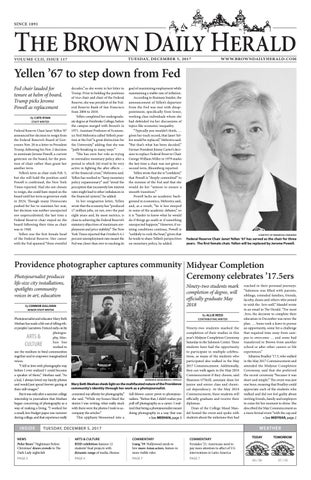
Federal Reserve Chair Janet Yellen ’67 has served as the chair for three years. The first female chair, Yellen will be replaced by Jerome Powell.
Providence photographer captures community Midyear Completion Photojournalist produces Ceremony celebrates ’17.5ers life-size city installations, spotlights community voices in art, education
Ninety-two students mark completion of degree, will officially graduate May 2018
By CONNOR SULLIVAN SENIOR STAFF WRITER
Photojournalist and educator Mary Beth Meehan has made a life out of telling other peoples’ narratives. Enticed early-on by photography, Meehan has worked to use the medium to bind communities together and to empower marginalized voices. “I fell in love with photographs way before I ever realized I could become a speaker of them,” Meehan said. “As a kid, I always loved my family photos and would just spend forever gazing at their still-images.” But it was only after a summer college internship in journalism that Meehan began conceiving of photography as a way of making a living. “I worked for a small, low-budget paper one summer during college, and that experience really
By ALLIE REED CONTRIBUTING WRITER
ARTS & CULTURE
INSIDE
MARIANNA MCMURDOCK / HERALD
Mary Beth Meehan sheds light on the multifaceted nature of the Providence community’s identity through her work as a photojournalist. cemented my affinity for photography,” she said. “While my bosses liked the stories I was writing, what really stuck with them were the photos I took to accompany the articles.” This epiphany blossomed into a
full-blown career pivot to photojournalism. “Before that, I didn’t realize you pull off photography as a career. I realized that being a photojournalist meant doing photography in a way that was » See MEEHAN, page 3
Ninety-two students marked the completion of their studies in this year’s Midyear Completion Ceremony Saturday in the Salomon Center. These students have had the opportunity to participate in multiple celebrations, as many of the students who participated also walked in the May 2017 Commencement. Additionally, they can walk again in the May 2018 Commencement if they choose, said Shannon O’Neill, assistant dean for junior and senior class and chemical dependency. At the May 2018 Commencement, these students will officially graduate and receive their diplomas. Dean of the College Maud Mandel hosted the event and spoke with students about the milestone they had
reached in their personal journeys. “Salomon was filled with parents, siblings, extended families, friends, faculty, deans and others who joined to wish the .5ers well,” Mandel wrote in an email to The Herald. “For most .5ers, the decision to complete their education in December was never the plan. … Some took a leave to pursue an opportunity, some hit a challenge that required time away from campus to overcome … and some had transferred to Brown from another school or after other careers or life experiences.” Julianna Bradley ’17.5, who walked in the May 2017 Commencement and attended the Midyear Completion Ceremony, said that she preferred the recent ceremony “because it was short and simple.” The event was just one hour, meaning that Bradley could appreciate each of the students who walked and did not feel guilty about inviting friends, family and employers to come for her moment to shine. She described the May Commencement as a more formal event “with the cap and » See MIDYEAR, page 2
WEATHER
TUESDAY, DECEMBER 5, 2017
NEWS Poler Bears’ ‘Nightmare Before Christmas’ draws crowds to The Dark Lady nightclub
ARTS & CULTURE RISD exhibition features 12 students’ final projects with dynamic range of media, themes
COMMENTARY Liang ’19: Hollywood needs to hire more Asian actors, feature in more visible roles
COMMENTARY Fernádez ’21: Americans need to pay more attention to affect of U.S. interventions in Latin America
PAGE 3
PAGE 4
PAGE 7
PAGE 7
TODAY
TOMORROW
56 / 36
57 / 35
NEWS
PAGE 2 • TUESDAY, DECEMBER 5, 2017
» MIDYEAR, from page 1 gown and pomp and circumstance,” and preferred that the dress code for the ceremony allowed individual styles to come through. Guitarist Ethan Wold ’20 bookended the event with a prelude as students entered and a recessional as they left. The Jabberwocks also sang the national anthem at the beginning of the ceremony and the University “Alma Mater” at the end. In addition to Mandel’s remarks, the audience heard from President Christina Paxson P’19, Chaplain of the University
Janet Cooper Nelson, Professor of History and Religion and Assistant Professor of Religious Studies André Willis and Maya Faulstich-Hon ’17.5, the student speaker chosen after a rigorous audition process. Willis, who was chosen by Mandel to give the faculty address, explored the theme of letting one’s light shine. “You strengthened the Brown community by giving us your gifts and your light,” he told .5ers. “Even when those gifts created dissent, generated tension and led to protest, they expanded our awareness. Brown was enlarged by the gift of your light, and
THE BROWN DAILY HERALD it was empowered by every challenge you brought.” In her speech, Faulstich-Hon spoke of the danger of normalizing constant work, injustice and the .5er narrative. “I was tired of the Midyear Completion Ceremony misrepresenting all .5er experiences as glowing and positive and amazing examples of Brown’s open curriculum,” wrote FaulstichHon in an email to The Herald. “People often speak of .5ers with an assumption of deviancy,” she said in her speech. “We strayed from the normalized path. We’re non-traditional. Something didn’t go as planned.
Something went wrong.” But “it doesn’t have to be wrong, or right or not normal. It just is, and here we are.” Faulstich-Hon told a parable in her speech that resonated with Bradley: “There’s a man walking across a field, and he encounters a tiger. He starts to run, but he comes to a huge cliff. He sees a vine hanging over the edge and he grabs hold of it, swings over and starts climbing down. But he sees that there’s also a tiger below him! Then, two mice, one black and one white, scurry out from a crack in the cliff and start to chew on the vine. Tiger above. Tiger below. And two mice chewing at
the vine. A wild strawberry, small and bright, is growing out from the rocky wall. The man plucks it and eats it.” She encouraged everyone in the audience to take a pause and eat their strawberries, whatever they might be. An hour before the ceremony, O’Neill wrote that there would be two student speakers at the event in an email to those participating in the ceremony. But Faulstich-Hon was the only student speaker at the ceremony. No speaker was prevented by the University from speaking at the event, Mandel wrote in an email to The Herald.
NEWS
TUESDAY, DECEMBER 5, 2017 • PAGE 3
THE BROWN DAILY HERALD
» MEEHAN, from page 1 actually rooted in the world,” Meehan said. “That led me to eventually complete a Master of Arts in photojournalism at the University of Missouri.” After completing her master’s, Meehan charted a course back to New England with the intention of expressing her community’s narratives and cultural diversity. Her on-going project “Seen/ Unseen” epitomizes this artistic mission, comprising a series of photographs and correspondent written narratives that encapsulate the lives of Providence citizens. Documented on her blog and banners across downtown Providence, the photographic installation works to “interrogate the process of trying to represent others,” according to Meehan’s website, aspiring to advance communitybinding dialogue and to illicit intimately profound insights for viewers into the lives of the subjects portrayed. These subjects encompass and span various identities, giving space to Marina, a woman from the East Side’s Elmside enclave of Orthodox Jews, Thuan, a Vietnamese immigrant tortured by Cambodian soldiers and others that make up the Providence community. “Seen/Unseen” has grown considerably since its 2015 inception. Meehan has come to be backed by grants funded sources that range from the municipal level — the Rhode Island Council for the Humanities — to the federal level — the National Endowment for the Arts. “The city of Providence’s Department of Art, Culture and Tourism actually got funding from the NEA for the project. The process of receiving funding was very organic since Providence has a really
evolved set of creative stakeholders,” Meehan said. “You don’t just get to hang big banners of your work in any city.” The project has extended past Providence’s borders to Newnan, Georgia, which has a public installation analogous to Providence’s planned for 2019 according to Meehan’s blog. “I employed the same framework I use in all of my work during my time in Newnan,” Meehan said. “Tons of conservations and observations that aim to get at the heart of whatever ecosystem I’m photographing” — a methodology of communal art that Meehan stressed throughout her recent artist-in-residency at Stanford University. “I taught a six-week master-class at Stanford for undergraduates in photography and fine arts. The goal was to get past the headlines of what Silicon Valley is about,” Meehan said. “What was immediately apparent to me in that ecosystem was how so many people live on the fringe of socioeconomic security there due to the exorbitant real estate — even those with high-paying salaries.” But the pedagogy Meehan most enjoys taking part in happens not in university lecture halls, but in third grade classrooms. Meehan has extended her fondness for narrative-telling to the bilingual third-graders of Pawtucket’s International Charter School. “I’ve taught at the ICS for almost ten years now, teaching children the same modes of photojournalism I taught students at Stanford and (the Massachusetts College of Art and Design),” Meehan said. “We host three exhibitions a year where the kids take part in exhibitions capturing their lives. Ultimately, their body of work feels (like) a part of my body of work.”
Poler Bears put on annual holiday performance ‘Nightmare Before Christmas’ draws large crowds, features student choreography By JACOB ALABAB-MOSER STAFF WRITER
On Friday night, the Poler Bears performed the “Nightmare Before Christmas,” their third annual holiday-themed show at The Dark Lady nightclub in downtown Providence. The show was highly successful, drawing large crowds to watch members of the Ivy League’s first pole dancing club perform numbers that they had choreographed themselves. Half an hour before doors opened, a line had already formed outside The Dark Lady. Showgoers stood eagerly in the frigid cold, excited to see the Poler Bears’ newest performance. Inside, the theme was apparent, with tinsel snowflakes hanging from the ceiling and wrapped presents on the base of the dancing poles. Over blaring music, audience members danced and chatted amongst themselves for almost an hour while some of the Poler Bears improvised choreography on poles before the actual show commenced. The show was comprised of solo performances by each of the club’s members, as well as a few duets. A
performer in drag clad in jolly holiday garb directed the festivities, reading each Poler Bear’s self-written introduction between numbers. The numbers spanned a variety of choreography styles, from those cabaret-inspired to others with acrobatic influences. The show culminated grandly in a sensational performance by Adam Moreno ’18 in tall platform black combat boots to Madonna’s “Like A Prayer” as a smoke machine blasted vapor across the stage. The crowd went wild. “The final act blew me away,” said Kate Callahan ’21. Moreno “just had so much stage presence.” The more casual nightclub setting marked a departure from the Poler Bears’ usual campus venues, like Alumnae Hall or Production Workshop’s Upspace, said Moreno, the club’s president. “The audience we’re allowed to have (in The Dark Lady) is much bigger, … so it’s been great to have more people come to our shows.” “All of our friends are here (tonight); it’s an incredibly supportive environment,” said Julia Tompkins ’18, the club’s social chair. “This is a really earnest team (with) people who are committed to honing their craft but also really like having fun together.” “We’ve really strengthened as a team, … in terms of prioritizing bonding and social activities because there’s such a steep learning curve,” Moreno
said. “This year, we haven’t had anyone drop, and I’ve noticed the team (to be) a lot closer.” The group prides itself in its diversity in both skill level and body type, Moreno said. “We take people of all backgrounds. We don’t use (pole dancing experience) as a requirement.” People choreograph their own material and can perform whatever they want to, he added. Axel Getz ’18, a member of the Poler Bears for four years, said, “I’m really excited about my parents coming. They haven’t seen (me perform) since I was a freshman. … They’re in for a fantastic show.” Since the club’s founding in 2006, its main goal has been to destigmatize pole dancing through an emphasis on the activity’s athleticism, artistry and the empowerment of performers themselves, Moreno said. “A lot of people … have some sort of stigma (associated with pole dancing), … but if anyone comes to one of our shows, that’s immediately erased,” he added. The Poler Bears’ performance also commemorated World AIDS day, and The Dark Lady invited AIDS Care Ocean State to provide free HIV testing at the event, Moreno said. The performance was an “out-ofbody experience,” said Bryan Olivo ’20. “That was incredible.”
STAY UP-TO-DATE. FOLLOW US ON FACEBOOK. FACEBOOK.COM/BROWNDAILYHERALD
ARTS & CULTURE PAGE 4 • TUESDAY, DECEMBER 5, 2017
THE BROWN DAILY HERALD
End-of-semester RISD exhibition showcases students’ multimedia artwork Exhibit features students’ final projects, themes portrayed include gender, sexuality, race By LIYAAN MASKATI STAFF WRITER
“Twelve: The 17th Annual Advanced Projects Juried Exhibition” will take place Dec. 7 at the Rhode Island School of Design’s Illustrations Studies Building Gallery. The exhibition, which is hosted by RISD’s illustration department, will feature an eclectic array of artwork created by 12 students enrolled in RISD’s “Advanced Projects” class. The course, taught by RISD illustration department Senior Critic Leonard Long, requires each student to create one project with a theme of their choosing, which is ultimately featured at the exhibition at the end of the semester. The class proved challenging for students, as Long demands an incredible quality and quantity of work from its participants, said Sohum Chokshi ’18,who is taking the class at RISD. “We were actually going to call the show ‘Miles Before We Sleep.’” Despite the taxing nature of the course, students are animated about the upcoming exhibition. “It’s going to be amazing,” said RISD student Paul Meuser, who is a part of the “Advanced Projects” class and is studying illustration. Unlike a traditional art exhibition “where you walk around in silence,” “Twelve” will have a dynamic, lively atmosphere, Meuser added. There will be “music, food (and) a ton of people,” and viewers will have the
opportunity to engage with the artists, he explained. “It’s just a more fun way to experience the art.” Due to the open-ended nature of the assignment, students have chosen to express themselves through many forms of media. The exhibition will feature artwork ranging from paintings and comics to animations and sculptures. In addition to the wide range of media, the artwork also explores a diverse array of themes. RISD student Liby Hays, a comic artist, described how her project, which centers on conversations between three hikers — an overachiever, a flippant individual and a mediator — explores the relationship between talent, ingenious and ambition. Meanwhile, a lot of the other comic works focus on issues of gender and sexuality, Hays said. Comics are “a great space for queer people to explore their narratives, without having to have a high budget,” she reflected. Other projects featured in the exhibition include a mixed-media animation on space and a series of paintings that explore albinism within the context of an African-American cultural identity, Meuser noted. The purpose of the exhibition is two-fold: It allowed students to showcase their work and build their resume while also teaching them how to put on a show and make it look as professional as possible, Chokshi said. Each student is assigned a role — such as curator, jury and organizer, among others — and together, the students run the entire gallery. “It gives us a taste of how the real world works,” Chokshi said.
LIYAAN MASKATI / HERALD
The exhibition, which includes works such as the one pictured above, teaches students how to run a dynamic show in a professional gallery by allowing them to assume roles, such as curator, jury and organizer.
TODAY
TUESDAY, DECEMBER 5, 2017 • PAGE 5
THE BROWN DAILY HERALD
o’ bagel tree
menu SATELLITE DINING ANDREWS COMMONS
Pizza: Spinach and Feta, Bacon Chicken Ranch, Pepperoni, Sausage and Jalepeno JOSIAH’S
BLUE ROOM
Grilled Portobello Mushroom Burger, Southwest Salad
Soup: Turkey Sausage and Kale, Organic Black Bean Soup
DINING HALLS SHARPE REFECTORY LUNCH
DINNER
Chicken Fajitas, Tex Mex Rice, Black Bean Chipotle Fritters, Roasted Root Vegetables
Caribbean Black Bean Soup, Potatoes Au Gratin, Three Bean Lasagna, Pumpkin Pie
VERNEY-WOOLLEY LUNCH
DINNER
Spinach and Mushroom Soup, Frijoles Negros, Grits Souffle, Beef Noodles Soup
Rotisserie Style Chicken, Spicy Pepper Pulled Chicken, Oatmeal Bread
sudoku
R
AS
DA
A
c r o s s w o rDd
C
Edited by Rich Norris and Joyce Nichols Lewis
ACROSS 1 Coal holders 5 “The Censor” of Rome 9 Hiked, as prices 14 Australian golfer __ Scott 15 Most fit for duty 16 Emma Roberts, to Julia 17 Pass catchers 19 Company that ironically had a crooked E in its logo 20 Golfer’s gadget used at the edge of water hazards 22 10-Down substance used in roofing 23 Salinger title girl 24 Sumac of Peru 27 Cries of pain 30 Little rascal 32 How animals boarded the ark 34 Early leader in a race 38 Cries of surprise 39 “__ Were the Days” 40 __ Intrepid 41 Curing solution 42 Watches a kid for cash 43 Pelvic contusion 45 Form 1040 data 47 Many moons: Abbr. 48 Erie summer hrs. 49 Bk. before Esther 50 “__ la Douce” 53 Extremely long time 55 “Joy to the World” group, and based on the ends of 20-, 34- and 43Across, what you’re having if you solve this puzzle after dark? 61 Way up 63 Deceived 64 Duplicate, briefly 65 Bath, in Bordeaux 66 Wyatt at the O.K. Corral 67 Look of disdain 68 Pisa’s river 69 Portly Jolly Roger pirate
DOWN 1 Wire fence point 2 It’s all in your head 3 Salt, to a chemist 4 Silvery food fish 5 Oater hero’s request when entering the fray 6 Work without __ 7 Land in Paris 8 Desert refuge 9 In need of leveling 10 Tree with needles 11 Daily Planet editor 12 Prefix with system 13 Room with a remote 18 Call from one who more than calls? 21 Arab commander 25 Gazed dreamily 26 Declare 27 Decides to join 28 Hula dancer, often 29 Present wrapper’s aid 31 Spitting sound 33 In tatters 35 Pump sign on the Alcan highway
36 Recipe meas. 37 Make out 41 Buffalo’s minor league baseball team 43 “Take this” 44 Pizza herb 46 “Snow White” fairness judge 51 Toast type 52 “Be __ ...”: start of a polite request
ANSW R
O
LAUREN ARATANI / HERALD
54 Evenings, in ads 56 Add to the work force 57 Viking war god 58 Protein unit 59 Fabled slacker 60 Make words using keys 61 Many retd. boomers 62 Farthest-right bowling pin
R
O S
Firs of faux-evergreen hang gracefully amongst the company of bagel ornaments, harkening a happy holiday season for the patrons of Bagel Gourmet on Brook Street.
Q U O T E O F T H E D AY
“I fell in love with photographs way before I ever realized I could become a speaker of them.” — Mary Beth Meehan, photojournalist and educator
See meehan on page 1.
calendar TODAY DECEMBER MARCH
S
35
M
46
T
57
W
Th
F
S
70th Annual Latin Carol Celebration 7:00 P.M. First Baptist Church
1
2
13
24
AMP Winds Recital 4:00 P.M. Fulton Rehearsal Hall
68
79
10 8
11 9
Bereavement Group 7:30 P.M. J. Walter Wilson, Room 401 Argentine Tango Class 6:30 P.M. Graduate Center Lounge
TOMORROW
By Don Gagliardo and C.C. Burnikel (c)2012 Tribune Media Services, Inc.
10 12
11 13
12 14
13 15
14 16
15 17
16 18
17 19
18 20
19 21
20 22
21 23
22 24
23 25
24 26
25 27
26 28
27 29
28 30
29 31
30
Sitar and Tabla Recital 7:00 P.M. Alumnae Hall
Buddhist Practice 4:30 P.M. J. Walter Wilson, Room 411
5th-Year Masters in Teaching Application Session 12:00 P.M. Barus Building
Study Abroad 101 Info Session 12:00 P.M. J. Walter Wilson, Room 420
COMMENTARY PAGE 6 • TUESDAY, DECEMBER 5, 2017
THE BROWN DAILY HERALD
LETTER TO THE EDITOR
Efforts to reduce bike thefts To the Editor: While I appreciate The Herald’s article on bike thefts on campus, (“Five bikes stolen on Nov. 15 alone,” Nov. 29), the article should have included the many active initiatives on campus to reduce bicycle thefts. Most glaringly, the article makes no mention of Campus Police Officer Kelly Mitchell’s tireless work on the issue, including frequent bike registration drives with free tune-ups and light giveaways, co-leading bike safety classes with Bikes at Brown and putting “U-Lock or You Lose” posters in every bike room and stickers on every bike rack. Additionally, the article failed to include any mention or information from the recently published Department of Public Safety report of bike thefts on campus, compiled by Kate Felder, or their recent hire of a student intern to study the issue. And lastly, the article makes no reference to the campus’ Bike Advisory Task Force that has spent many hours discussing the issue and planning interdepartmental initiatives, like removing and donating abandoned bikes from bike racks, to discourage on campus theft. These efforts were one of many recent initiatives that led Brown to recently be awarded a Bike Friendly University designation from the League of American Bicyclists.
PHOEBE AYRES / HERALD
Harry August ’19 Co-President, Bikes at Brown Sustainable Transportation Intern, Office of Energy and Environment
Find us online! facebook.com/browndailyherald
browndailyherald.com
@the_herald
Location: 195 Angell St., Providence, R.I. www.browndailyherald.com
@browndailyherald
youtube.com/browndailyherald
Editorial Leadership
Sections
Multimedia & Production
Business
Editor-in-Chief Lauren Aratani
Arts & Culture Editors Ethel Renia Madison Rivlin
Design Editors Christy Leung Ameer Malik Jessica Yu Assistant: Eduard Muñoz-Suñé
General Managers Henry Ritter Ben Wesner
Managing Editors Matt Brownsword Rebecca Ellis Kate Talerico POST- MAGAZINE Editor Saanya Jain BLOGDAILYHERALD Editor Angelica Cotto
Metro Editor Gwen Everett News Editors Isabel Gensler Alex Skidmore Hattie Xu Science & Research Editor Elena Renken Sports Editors Ben Shumate Nicholas Wey COMMENTARY Opinions Editors Connor Cardoso Anuj Krishnamurthy Mili Mitra
Photo Editors Head: Marianna McMurdock Assistant: Lilly Nguyen Gus Reed Sara Runkel Anita Sheih Copy Desk Chief Abby Borges Multimedia Editor Roland High
Directors Sales: Erin Lueck Sales: Matilda Lynton Finance: Reena Zhan Strategy: William Nober Strategy: Caroline Ziegler Managers Sales: Michael Borello Sales: Elizabeth Doykan Sales: Shreya Raghunandan Collections: Ravi Betzig
Editorial contact: 401-351-3372 herald@browndailyherald.com
Advertising contact: 401-351-3372 advertising@browndailyherald.com
Submissions: The Brown Daily Herald publishes submissions in the form of op-eds and letters to the editor. Op-eds are typically between 750 and 1000 words, though we will consider submissions between 500 and 1200 words. Letters to the editor should be around 250 words. While letters to the editor respond to an article or column that has appeared in The Herald, op-eds usually prompt new discussions on campus or frame new arguments about current discourse. All submissions to The Herald cannot have been previously published elsewhere (in print or online — including personal blogs and social media), and they must be exclusive to The Herald. Submissions must include no more than two individual authors. If there are more than two original authors, The Herald can acknowledge the authors in a statement at the end of the letter or op-ed, but the byline can only include up to two names. The Herald will not publish submissions authored by groups. The Herald does not publish anonymous submissions. If you feel your circumstances prevent you from submitting an op-ed or letter with your name, please email herald@browndailyherald.com to explain your situation. You can submit op-eds to opinions@browndailyherald.com and letters to letters@browndailyherald.com. When you email your submission, please include (1) your full name, (2) an evening or mobile phone number in case your submission is chosen for publication and (3) any affiliation with Brown University or any institution or organization relevant to the content of your submission. Please send in submissions at least 24 hours in advance of your desired publication date. The Herald only publishes submissions while it is in print. The Herald reserves the right to edit all submissions. If your piece is considered for publication, an editor will contact you to discuss potential changes to your submission. Commentary: The editorial is the majority opinion of the editorial page board of The Brown Daily Herald. The editorial viewpoint does not necessarily reflect the views of The Brown Daily Herald, Inc. Columns, letters and comics reflect the opinions of their authors only. Corrections: The Brown Daily Herald is committed to providing the Brown University community with the most accurate information possible. Corrections may be submitted up to seven calendar days after publication.
Illustrations Editor Pia Mileaf-Patel
Advertising: The Brown Daily Herald, Inc. reserves the right to accept or decline any advertisement at its discretion.
Graphics Editor Laura Felenstein
The Brown Daily Herald, Inc. is a financially independent, nonprofit media organization bringing you The Brown Daily Herald, BlogDailyHerald and Post- Magazine. The Brown Daily Herald has served the Brown University community daily since 1891. It is published Monday through Friday during the academic year, excluding vacations, once during Commencement and once during Orientation by The Brown Daily Herald, Inc. Single copy free for each member of the community. Subscription prices: $200 one year daily, $100 one semester daily.
Directors of Web Development Eli White Ivy Wong
Copyright 2017 by The Brown Daily Herald, Inc. All rights reserved. Periodicals postage paid at Providence, R.I. Postmaster: Please send corrections to P.O. Box 2538, Providence, RI 02906.
COMMENTARY TUESDAY, DECEMBER 5, 2017 • PAGE 7
THE BROWN DAILY HERALD
Where are the Asians in Hollywood? MARK LIANG staff columnist
When it was announced last week that Chinese actress Liu Yifei would play the titular role in Disney’s liveaction remake of “Mulan,” I almost cried with relief. “Mulan” is one of the very few American movies (and by far the only animated one) that I think represents my culture and history well. Keep in mind that the animated movie has a dragon voiced by Eddie Murphy and a matchmatcher by Harvey Feinstein — the bar is not set that high. Even with the casting of the live-action movie, I am still somewhat worried about rumors that the male love interest was going to be replaced by some generic white man, or that the Mandarin used in the film (if we were lucky enough to have any) would be clipped, accented and broken. Despite this caveat, we should take heart in the fact that Hollywood starting to care about accurate representation. But we still have a lot to wish for in terms of Asian American representation in film. Hollywood has never screamed “cultural representation” in its movies and works, especially for Asians and Asian Americans. I can name three examples from recent years off the top of my head of Asian
characters being whitewashed: Scarlett Johansson in “Ghost in the Shell,” Tilda Swinton in “Doctor Strange” and Nat Wolff in the Neflix movie “Death Note.” We are also a group that gets fetishized often and doesn’t really have the history of mobilization and representation within the industry to fight back. As the comedian Ali Wong told the New Yorker, “I think people think that Asian Americans are really good at hive-mentality stuff
they tend to be token ethnic characters added for entertainment rather than nuance. Take Mantis in “Guardians of the Galaxy.” Or the Vietnamese-American girl, Kelly Marie Tran, in the new “Star Wars” movie. There’s even a new token Asian woman in the “Fantastic Beasts” film in production (I think she’s an exotic werewolf or something equally objectifying). “Avengers: Age of Ultron,” “Sixteen Candles,” “Pitch Perfect.” The list goes
Asian actors can hold their own, but at the same time, Hollywood loves to pull elements out of East Asian culture for its own purposes. Filmmakers have taken inspiration from concepts from the mecha genre (“Pacific Rim”) to martial arts (“Kill Bill”). I hear the next Wes Anderson movie is set in dystopian Japan. It’s hard as members of the public to discern between real homage to these fields and cheap knockouts designed to make
Authenticity does sell movies, whether you believe it or not. Can you imagine? It’s almost like people actually want to see versions of themselves on screen that aren’t caricatures or exaggerations.
— you know, like, in entertainment maybe they’re good at ‘America’s Best Dance Crew’ dancing, or, like, tennis — but not at being truly innovative and having something to say that will create a cultural Zeitgeist. What hurts is when I feel like Asian people believe that about ourselves.” It’s not just creativity — I firmly believe that high-profile studios don’t find Asian men attractive enough to lead a movie or Asian women complex enough to be anything but sex objects. And even when studios cast actual Asian actors as Asian characters,
on and on. It’s not that I don’t think these actors deserve their breakthrough roles into Hollywood; my question is why many of these characters were given bit roles or only introduced into sequels or blockbusters after the movie series was proven successful. Why weren’t these actors members of the starting cast? Here’s a running joke I hear from family working in Hollywood: “Add enough representation so it sells in China, but make sure it doesn’t have too much representation for China.” There isn’t enough faith that
money. But authenticity does sell movies, whether you believe it or not. (Can you imagine? It’s almost like people actually want to see versions of themselves on screen that aren’t caricatures or exaggerations.) Just look at “Coco,” the new Pixar movie. Sure, it was directed by two white men, but they were smart enough to bring in a full Latinx voice cast, hire cultural consultants and fund enough research trips to Mexico to make me actually believe that they were wellintentioned. The result? The highest-
grossing film in Mexico. So how do we discern where the line is drawn? I think the first step is to think critically about casting and representation. If there is a movie that draws on cultural heritage, are many roles — acting or otherwise — filled with people who have lived through those experiences? Don’t give me that crap about a dearth of talent in certain groups. Contrary to popular belief, there are tons of talented Asian-American screenwriters, actors and entertainment workers who are capable of producing excellent work. They’ve had to rely on other options to promote their visibility, like Youtube, but they are more than capable. I just want to see more of myself on that silver screen. Movie executives are finally (finally!) betting on movies with central casts made up of people of color. Disney is bankrolling live-action projects of “Mulan” and the “Lion King,” and thankfully realizing that white actors might not be the best idea this time around. We’ve got exciting projects like “A Wrinkle in Time” and the “Black Panther” led by talented black artists. For the first time in a long time, I am excited about the artistic direction in Hollywood — I just hope the institution has the foresight to follow through.
Mark Liang ’19 can be reached at mark_liang@brown.edu.
America’s role in Honduras’ democratic crisis MARYSOL FERNÁNDEZ staff columnist The recent crisis in Honduras has found its way to the public sphere in the United States, but it has not gotten nearly as much attention as a situation of this magnitude deserves. Honduras was just in the midst of a presidential election between conservative incumbent Juan Orlando Hernández and left-leaning Salvador Nasralla. Initial results showed Nasralla leading the vote by what many considered to be an irreversible margin. However, the next day it was announced that Hernández had taken the lead as the Supreme Electoral Tribunal stopped publicizing tallies, closed the electoral process to the public eye and postponed any official recounts. The people of Honduras rallied in massive protests on the streets of the country as allegations of mass fraud began to surface. Hernández, who has been re-instated as president, has deployed several elite police forces that have violently confronted peaceful protesters on several occasions, prompting a humanitarian crisis on top of the political turmoil. Activists and observers alike have recently called out the United States, which has a history of involvement in Honduras, for their support of Hernández over the past several years. Additionally, they point to the United States’ role in training these military forces, calling into question their potential involvement in the recent situation. The current crisis in Honduras has served to highlight the devastating consequences of U.S interventionism in Latin America, which has threatened and continue to threaten the very institutions of democracy in countries that still struggle for the right to self-determination in a
supposedly post-colonial world. There is a long history of U.S. interventionism and involvement in Honduras. Honduras was the original “banana republic” in the late 19th and early 20th century, during which time its people were placed second to American corporate interest. More recently, Honduras has become one of the United States’ strongest allies in Central America, especially in the face of leftwing successes in neighboring countries like Guatemala and El Salvador. The United States gives millions of dollars in aid each year to the
to fraudulent, anti-democratic regimes in Latin American countries where the motions of democracy take place but have no real consequence. These actions reflect a disrespect for what are supposed to be some of the core values of American society on the part of many of the most powerful and influential figures in our government. It is important to talk about the implications of this crisis for the American people and the responsibilities of the educational sphere and the media in informing the public of the consequences of this kind of foreign policy.
Even higher learning institutions, such as Brown, need to adjust how they look at American interventionism to combat a deeply ingrained culture of support for these policies.
Honduran government and provides training to the elite police units previously mentioned. Hernández, currently at the center of the crisis, has several times been called an important ally of the United States by various conservative leaders in the U.S. government. All of these policies are created under the umbrella of the war on drugs and crime that has been used as a justification for American interventionism for decades. However, this rationalization has, in many cases, been a pretext for more deeply entrenched motives — namely, maintaining U.S. control over Latin America. The United States continues to contribute
While there has been some mainstream coverage of the situation in Honduras, comprehensive accounts have been scarce, and the ones that are available tend to be muted in their depictions of violence and injustice. This, of course, reflects the reluctance of the American media in portraying what many leftist leaders in Honduras and the United States have characterized as U.S.-funded violence and injustice. These issues point to a larger problem regarding the way information about the impacts of U.S policy on the rest of the world is shared to the American people. This problem can be traced back to gaps in the education system, where American inter-
ventionism in Latin America is barely touched on. When it is discussed, it is often talked about in a positive light. Students are even more rarely exposed to the continuing prevalence of these policies by recent U.S. presidential administrations. The crisis in Honduras, along with other crises of democracy in places such as Puerto Rico and Venezuela, has served to expose the fact that American involvement in Latin American society and government is long from over. The University shares in this responsibility as a top-level educational institution and a hub for progressive thinking. Brown has shown a commitment to addressing these issues. The University offers a wide variety of courses regarding Latin American cultural, social and political experiences. We have many organizations dedicated to fostering awareness. And crucially, we have a rich culture of action, teach-ins and discussion groups. However, as an elite institution in the United States, we continue to maintain a problematic, patronizing approach to confronting issues regarding people and places that are so far away from us. Even higher learning institutions need to adjust how they look at American interventionism to combat a deeply ingrained culture of support for these policies. In relation to the issues in Honduras, it is not the United States’ responsibility to step into this country to run elections, ensuring that they are safe and just for all Hondurans. Rather, it was our responsibility from the very beginning to allow for the democratic process to take place in what was supposed to be a sovereign state, untouched by the insidious arm of American interest.
Marysol Fernández ’21 can be reached at marysol_fernandez@brown.edu
NEWS THE BROWN DAILY HERALD
TUESDAY, DECEMBER 5, 2017
Cafe to connect students with sponsor companies
JASMINE RUIZ / HERALD
Shiru Cafe is slated to open its first location in the United States Feb. 20. The cafe offers free drinks to community members and allows students to learn about job opportunities.
Shiru Cafe, part of international chain that gives out free drinks, to open Feb. 20 on Angell Street By ALLIE REED CONTRIBUTING WRITER
Shiru Cafe, part of an international chain that offers free drinks, is under construction at 165 Angell St. The cafe — which is slated to open this Feb. 20 just a few steps from CareerLAB — will be the first Shiru to open in the United States. Shiru works with sponsor companies like Microsoft and Accenture to create a comfortable space for students, faculty and staff. Those who register using their smartphones will have access to free drinks, Wi-Fi, electrical outlets and study spaces, along with the opportunity to connect with sponsor companies through meetups at the café.
Shiru allows students to learn about job opportunities offered by these companies, said Aoi Fukihara, Shiru’s overseas department manager. Companies pay Shiru to advertise internships and other positions on promotional cups, customers’ smartphones and projected screens in the cafe. This method of advertising has proven successful for sponsor companies. For example, JP Morgan sponsors Shiru in Japan. Last year, 40 percent of JP Morgan’s new hires were Shiru Cafe patrons. Just 50 feet away from the construction, Matt Donato, director of CareerLAB, sees a potential opportunity for partnership with Shiru. Both CareerLAB and Shiru charge employers to interact
with Brown students. But Donato believes that unlike Shiru, CareerLAB has a lot of other services in addition to just bringing employers to campus. CareerLAB stresses their recruiting standards to make sure both students and employers are treated fairly, he said. “We really do think of it with the student first. … If the cafe is really driven by employer revenue and sponsorship and they’re really trying to push employers on students, … I’m not sure if they’re as student-focused and student-centric as CareerLAB would be,” Donato added. Shiru was developed by Yusuke Kakimoto, CEO of ENRISSION Inc., the managing company of Shiru. The first cafe was launched in Japan just four years ago. Since then, Kakimoto has opened almost 30 stores in Japan and India before its first venture in the United States.
Shiru targets high-achieving universities and will expand to peer institutions such as Harvard and Yale in the spring. “We offer free drinks, but we are particular about our quality of coffee,” said Alex Inoue, general manager of Shiru. The coffee is organic and fair trade. If patrons want to take their beverage to go, they’ll have to pay the price: $1. Shiru Providence plans to employ students as staff. Alexander Alverson ’20 has already been hired by the cafe, which he found out about through his Japanese teacher at Brown. “The business is employing students and fostering a greater sense of community between Providence, Brown, larger corporations and Japanese business,” Alverson said. “So for someone like me, who might work in Japan in the future, this is a positive relationship.” Alverson added that
he is excited to practice his Japanese with the other staff and experience work culture in a Japanese business. However, Alverson believes Shiru could alienate other Providence community members because it solely targets Brown community members. Fukihara doesn’t think Shiru Providence will compete with other nearby coffee shops, like Starbucks and Blue State Coffee. In fact, Blue State welcomes Shiru to the local community, wrote Manager Kris Valcorba in an email to The Herald. In the winter months to come, those near campus can look forward to free drinks for all. Shiru offers drip, decaf, espresso, cold brew and nitro coffee to the community. The cafe also offers four types of tea, six types of lattes and orange juice.