SINCE 1891
THE BROWN DAILY HERALD TUESDAY, APRIL 4, 2017
VOLUME CLII, ISSUE 42
WWW.BROWNDAILYHERALD.COM
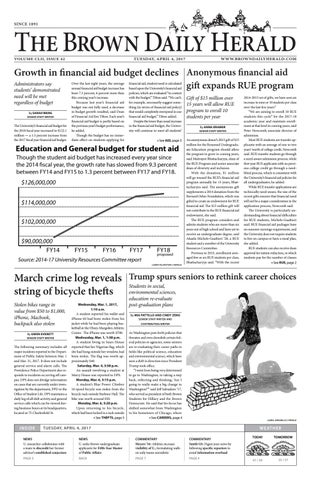
Growth in financial aid budget declines Anonymous financial aid Administrators say gift expands RUE program students’ demonstrated need will be met regardless of budget By SARAH WANG SENIOR STAFF WRITER
The University’s financial aid budget for the 2018 fiscal year increased to $122.1 million — a 1.3 percent increase from the 2017 fiscal year financial aid budget.
Over the last eight years, the average annual financial aid budget increase has been 7.3 percent, 6 percent more than this coming year’s increase. Because last year’s financial aid budget was not fully used, a decrease in budget growth resulted, said Dean of Financial Aid Jim Tilton. Each year’s financial aid budget is partly based on the previous year’s budget performance, he added. Though the budget has no immediate effect on students applying for
financial aid, student need is calculated based upon the University’s financial aid policies, which are evaluated “in context with the budget,” Tilton said. “We can’t, for example, necessarily suggest something (in terms of financial aid policy) that would completely overspend in our financial aid budget,” Tilton added. Despite the lower than usual increase in the financial aid budget, the University will continue to meet all students’ » See AID, page 3
LAURA FELENSTEIN / HERALD
Gift of $15 million over 15 years will allow RUE program to enroll 10 students per year By ANNA KRAMER SENIOR STAFF WRITER
An anonymous donor’s 2015 gift of $15 million for the Resumed Undergraduate Education program should allow the program to grow in coming years, said Maitrayee Bhattacharyya, dean of the RUE Program and senior associate dean of diversity and inclusion. With the donation, $1 million will go toward the RUE’s financial aid program annually for 15 years, Bhattacharyya said. The anonymous gift supplements a 2014 donation from the Bernard Osher Foundation, which was gifted to create an endowment for RUE financial aid. The $15 million gift will not contribute to the RUE financial aid endowment, she said. The RUE program considers and admits students who are more than six years out of high school and have yet to receive an undergraduate degree, said Akaela Michels-Gualtieri ’20, a RUE student and a member of the University Resources Committee. Previous to 2015, enrollment averaged five or six RUE students per class, Bhattacharyya said. “With the recent
2014-2015 set of gifts, we have seen an increase to nine or 10 students per class over the last few years.” “We are aiming to enroll 10 RUE students this cycle” for the 2017-18 academic year and maintain enrollment at that level in coming years, said Peter Newcomb, associate director of admission. Most RUE students are transfer applicants with an average of one to two years’ worth of college credit, Newcomb said. RUE transfer students go through a need-aware admission process, while first-year RUE applicants with no previous college credit go through a needblind process, which is consistent with the University’s financial aid policies for all undergraduates, he added. While RUE transfer applications are technically need-aware, the size of the recent gifts ensures that financial need will not be a major consideration in the application process, Newcomb said. The University is particularly understanding about financial difficulties for RUE students, Michels-Gualtieri said. RUE financial aid packages have no summer earnings requirement, and the University does not require students to live on campus or have a meal plan, she added. RUE students can also receive dean approval for tuition reduction, in which students pay for the number of classes » See RUE, page 2
March crime log reveals Trump spurs seniors to rethink career choices Students in social, string of bicycle thefts environmental sciences, Stolen bikes range in value from $50 to $1,000, iPhone, Macbook, backpack also stolen By GWEN EVERETT SENIOR STAFF WRITER
The following summary includes all major incidents reported to the Department of Public Safety between Mar. 1 and Mar. 31, 2017. It does not include general service and alarm calls. The Providence Police Department also responds to incidents occurring off campus. DPS does not divulge information on cases that are currently under investigation by the department, PPD or the Office of Student Life. DPS maintains a daily log of all shift activity and general service calls which can be viewed during business hours at its headquarters, located at 75 Charlesfield St.
INSIDE
Wednesday, Mar. 1, 2017, 1:10 a.m. A student reported his wallet and iPhone 6S had been stolen from his jacket while he had been playing basketball at the Olney-Margolies Athletic Center. The iPhone was worth $700. Wednesday, Mar. 1, 1:38 p.m. A student living in Sears House reported that her Nigerian flag, which she had hung outside her window, had been stolen. The flag was worth approximately $40. Saturday, Mar. 4, 3:58 p.m. An assault involving a student at Marcy House was reported to DPS. Monday, Mar. 6, 3:15 p.m. A student’s Blue Power Climber 10 speed bicycle was stolen from the bicycle rack outside Barbour Hall. The bike was worth around $50. Monday, Mar. 6, 5:20 p.m. Upon returning to his bicycle, which had been locked in a rack outside » See THEFTS, page 3
education re-evaluate post-graduation plans
By MIA PATTILLO AND CINDY ZENG SENIOR STAFF WRITER AND CONTRIBUTING WRITER
As Washington puts forth policies that threaten and even demolish certain federal policies or agencies, some seniors are re-evaluating their career paths in fields like political science, education and environmental science, which have seen a shift in direction since President Trump took office. “I went from being very determined to go to Washington, to taking a step back, reflecting and thinking, ‘Am I going to really make a big change in Washington?’” said Jeff Salvadore ’17, who served as president of both Brown Students for Hillary and the Brown Democrats. He said that his focus has shifted somewhat from Washington to his hometown of Chicago, where » See CAREERS, page 4
LAURA JARAMILLO / HERALD
WEATHER
TUESDAY, APRIL 4, 2017
NEWS U. researcher collaborates with a team to discredit her former advisor’s established conjecture
NEWS U. seeks Brown undergraduate applicants for Fifth-Year Master of Public Affairs
COMMENTARY Meyers ’16: Athletes increase visibility of U., formulating walkon only teams unrealistic
COMMENTARY Smith GS: Digest your news by following specific reporters to avoid information overload
PAGE 5
BACK
PAGE 7
PAGE #
TODAY
TOMORROW
47 / 39
55 / 37
NEWS
PAGE 2 • TUESDAY, APRIL 4, 2017
THE BROWN DAILY HERALD
» RUE, from page 1 taken rather than the standard tuition. For example, Michels-Gualtieri takes three classes this semester and pays tuition for those three, rather than the standard four-course tuition. Additionally, the Free Application for Federal Student Aid does not require a parental contribution for students over the age of 24, which lessens the financial burden placed students, she said. For veterans, the University also waives all application fees, said Michael Muir ’20, a veteran of the U.S. Marine Corps. Financial issues typically concern RUE students because they tend to come from diverse backgrounds in lowpaying fields, said Nick Danford ’11. Danford, a retired ballerina, worked as a waiter before coming to Brown. He applied to the RUE program knowing he could not afford the tuition, and the financial aid offer made it possible for him to attend, he said. Muir received full-ride financial aid packages from other institutions. After he was accepted to the RUE program, the University worked to meet his financial need and match the packages offered by the other universities, he said. Though veterans are entitled to funding for a college education through the G.I. Bill, the government funding does not cover the full cost, he added. The University “recognizes that it’s really hard for you to come back … and everyone’s rooting for you to succeed,” Michels-Gualtieri said. There are “trapeze artists and soccer players and ballet dancers and moms and dads” in the RUE program, and they make up an eclectic mix of “incredible people with crazy stories,” Danford said. Interacting with undergraduates has not been as difficult as he expected, said Jonathan Weiskoff ’18. “The social environment has been ideal,” he added. Teachers love having RUE students in the classroom because their life experiences enhance the discussion, Michels-Gualtieri said. Some students end up more engaged when RUE students are a part of the discussion. “When I’m in classes … and I start talking about my life experience prior to coming to Brown, … some students really start listening,” Muir said. The school benefits from veterans’ presence on campus, while veterans benefit from the University, he added. Eleven veterans are currently enrolled at the University, and “Brown is trying to get ahead of the curve,” Muir said. The University has been especially trying to revamp veteran enrollment by actively recruiting returned soldiers, The Herald previously reported. “It’s almost like a badge of honor to say I’m a RUE student,” he said. Yale, Tufts University, Wesleyan College and Bryn Mawr College are the only other schools with programs comparable to RUE, Michels-Gualtieri said.
COURTESY OF BROWN UNIVERSITY
RUE students are eligible for tuition reduction, in which they can pay for the classes they take as opposed to standard tuition, which requires students pay for four courses. For veterans, the University waives application fees and works to match aid offers from other institutions.
LAURA FELENSTEIN
www.browndailyherald.com
NEWS
THE BROWN DAILY HERALD
» AID, from page 1 demonstrated need, said Provost Richard Locke. “Because we’re need-blind, we don’t know what the needs are (before admitting students),” Locke said. “There will be years where we actually went way over our financial aid budget.” Locke said that the University will go over budget to ensure that all students receive the aid to meet what the University has determined as their demonstrated need. Regardless of the budget increases, Tilton does not “see any significant changes happening to the financial aid policies” in the coming years. But the University has made a long-term goal of attracting more middle-income students, Locke said, as Brown’s middle-income financial aid packages are not as strong as those of Brown’s peer institutions. The University asks “for more family contributions or loans” in a way that “some of our peers don’t,” Locke said. The decrease in the growth of the financial aid budget may work against the University in terms of creating more attractive policies for middle-income students, said Jamey Rorison, director of research and policy at the Institute
TUESDAY, APRIL 4, 2017 • PAGE 3 for Higher Education Policy. “I would imagine that if the institutional aid budget is cut … they’ll probably maintain their promise to fund the lowest income students, but I would imagine it would put additional strains … on the students who earn grants from Brown but wouldn’t earn the full grant,” Rorison said. “Where we are struggling is in that middle-income” bracket, Locke said. “We think that for the health of the University, the strategy is to try to make those offers in the middle more attractive.” In addition to decreasing the growth in the financial aid budget, the University Corporation approved an increase in total student charges by 4.4 percent to $67,439. For the first time in recent years, the tuition increase outpaces the financial aid budget increase. Ultimately, the University hopes to “align the growth in financial aid with the growth of tuition increase,” Locke said. But the University’s growth in recent years has made that harder, he added. Rorison said that universities should not aim to balance their budgets by “placing less priority on need-based grant aid.”
KYLE BOROWSKI / HERALD
» THEFTS, from page 1 75 Waterman St., a student discovered someone had removed both tires and rims from the bike. Altogether, the theft amounted to a loss of $260. Wednesday, Mar. 8, 8:37 p.m. A student’s red bicycle and neon green lock — which were collectively worth about $115 — were stolen from the bicycle rack outside Marston Hall. Thursday, Mar. 9, 1:20 p.m. After returning from the Sciences
Library, a student found his Giant Hybrid Bicycle missing from the bicycle rack located on the west side of the SciLi where he had secured it. The bike was worth about $1,000. Friday, Mar. 17, 5:25 p.m. While at the Urban Environmental Lab, a student found that someone had stolen their black 13 inch MacBook Air, which was worth about $1,200. Saturday, Mar. 18, 8:01 p.m. A student reported that someone had taken a set of musical equipment
— a Podium Pro Audio Model 1204 Mixer with two 24 inch speakers — from a room in Chapin House. Altogether, the theft comprised a loss of $475. Saturday, Mar. 25, 2017, 12:42 a.m. A student living off-campus on Preston Street had her apartment broken into. Her black backpack, MacBook and other personal items were stolen in the incident. The items were worth around $2,500.
The Role of Contagion in the Building and Sustainability of Communities Carlos Castillo-Chavez Regents Professor, a Joaquin Bustoz Jr. Professor of Mathematical Biology and a Distinguished Sustainability Scientist at Arizona State University
Contagion is sneaky! All seems well until the Tipping Point, after which terrible WKLQJV PD\ KDSSHQ æ IDVW 7KH VSUHDG RI IDGV VFLHQWLĆF LGHDV DQG WKH JURZWK DQG stability of communities can also be understood as contagions. Come hear Carlos explain contagion in all its glory, including the role of initial conditions in meritocracy.
TUESDAY, APRIL 11, 2017, 5:30 p.m. 85 WATERMAN STREET, ROOM 130 Online registration is now open at: brown.edu/thinking-out-loud
NEWS
PAGE 4 • TUESDAY, APRIL 4, 2017
THE BROWN DAILY HERALD
Faculty member disproves established math conjecture Caroline Klivans, senior lecturer, discredits longaccepted Partionability Conjecture theory By EMILY DAVIES STAFF WRITER
Caroline Klivans, senior lecturer in applied mathematics and computer science, achieved every student’s dream and proved her former advisor wrong. The Partitionability Conjecture was postulated by Richard Stanley, Klivans’ doctorate advisor at the Massachusetts Institute of Technology. Fewer than 50 years later, his advisee challenged the claim. Alongside colleagues from the University of Texas at El Paso and the University of Kansas, Klivans released a paper disproving the 35 year-old Partitionability Conjecture earlier this year. “(Stanley) is an outstanding mathematician who has made many conjectures that lead the field,” Klivans said. “He has many that are correct.” The Partitionability Conjecture demonstrates the relationship between classes of spaces and how they interact at different levels, Klivans said. This conjecture shows the relationships as beautiful and organized, which is a compelling belief for those invested in the subfield of algebraic combinatorics. “In some sense, we believed these were true because it gave order, it gave pattern, it gave structure to this area,” Klivans said. Klivans undermined this structure with a team consisting of University of Texas at El Paso Professor Art
» CAREERS, from page 1 he hopes to make a greater impact at a local level. Sydney Menzin ’17, an education concentrator who spent her summers in the White House under the Obama administration and at a youth service campaign, now interns at the Rhode Island Office of the Governor’s education team. Trump’s pick of Betsy DeVos as Secretary of Education has made her reflect on her own future in education. DeVos, an advocate for school choice, has raised concerns on both a local and national scale regarding her proposed cuts to public education. Through her experiences working on education policy at various levels of government, Menzin realized that “a lot of education (policy decisions) happen at the state and local levels,”
Duval and University of Kansas Professor Jeremy Martin, working with the assistance of University of Kansas graduate student Bennet Goeckner. Klivans, Duval and Martin have been partners in math for over nine years. After meeting at a conference in San Diego, the professors have created a tradition of weekly Skype calls. Their long-standing collaboration has produced a series of joint papers. “We’ve had these weekly meetings for longer than one would expect,” Klivans said. “Even our colleagues have been surprised by our consistency.” Through disproving the organized structure of the Partitionability Conjecture, Klivans and her team created all kinds of questions that lie at the intersection of various fields of mathematics and computer science. “I am reminded of the end of Pride and Prejudice,” said Duval. “At the end, Mr. Bennett says something like, ‘Hey, which other daughters can I marry off now?’ With the Paritionability Conjecture, it was like, ‘Which other conjectures can we ruin?’” Klivans and her colleagues are now tackling technicality questions that emerged from their recent disproof, Klivans and Duval both confirmed. But individually, Klivans is moving on. She is writing a book on sandpile models set to come out at the end of the year. Titled “The Mathematics of Chip Firing,” Klivans’ newest project will explain how a system with local rules, such as physical sand falling onto a surface, leads to more widespread effects. Klivans is drawing on her intersectional interest within mathematics and computer science to produce what she calls a “resource cannon for the area of study.” While she works on her research
she said. Menzin, too, will center her educational career around local issues while Trump is in office. “I’m still passionate and motivated to be around awesome people, doing great work,” said Menzin, who will start a teaching position after graduation. Others have found that the election has propelled them more toward careers that actively address current issues brought up by the Trump administration. Jane Jacoby ’17 said that while she had considered many careers, such as forestry or law, the political climate has steered her toward “hands-on work” allowing for immediate change. Rather than going straight into graduate school, Jacoby hopes to utilize these interests in a way that will allow her to play a more direct role in the community, such as social justice work,
COURTESY OF CAROLINE KLIVANS
The Partitionability Conjecture, which attempts to organize interface between spaces at different levels, is particularly relevant to the subfield of algebraic combinatorics. through Brown and the Institute for Computational and Experimental Research in Mathematics, Klivans’ acclaim as a lecturer caught the attention of the computer science department. She was recently promoted to senior lecturer, which provides a salary boost and public recognition
of good work, said Tom Doeppner, vice chair of the computer science department. “She has been doing an outstanding job as an instructor,” said Doeppner. “She teaches two very popular classes: An applied math class in the fall, and a computer science
class in the spring. Both courses are attracting huge numbers of students.” As for Klivans’ relationship with Stanley, the two remain great friends. Klivans was even an organizer for Stanley’s 70th birthday party, which was a conference to honor his groundbreaking work.
she added. In a way, the Trump administration has acted as “a catalyst, speeding up some of the decisions I would be making anyways,” she said. Jon Gewirtzman ’17, an environmental science concentrator, aimed to pursue research post-graduation rather than policy, but the election made him feel conflicted, he said. Though Gewirtzman considered directly working in environmental advocacy, he ultimately decided that he was better suited for his original plan of completing research; he recently accepted a research assistant position at the Toolik Lake Field Station in Alaska. He will still be involved in activism, he added. While applying for jobs, Gewirtzman “emphasized even more the importance of communication in science and making sure that my work
engages the community,” he said. The election has challenged his assumption that most people had accepted global warming as a valid issue. Beyond pursuing careers with impact, students also face cuts to certain fields they hoped to pursue. “There are going to be cuts to research funding (and thus) graduate fellowships, so it might make my plan harder,” Gewirtzman said. Students looking for work in Washington may find themselves bereft of the networks they hoped to find there, given Republican control in both the White House and Congress. Salvadore also noted that without these networks, there are “limited opportunities (in D.C.) for someone who has Hillary Clinton’s campaign at the top of their resume.” CareerLAB advising has remained
mostly unaffected, even in light of Trump’s proposed budget cuts to research and arts funding, as well as his constantly shifting stances on immigration. Director of CareerLAB Matthew Donato said CareerLAB has reached out to international students to offer resources, but domestic students have been “mostly unaffected” to his knowledge. He added that next year, they will likely see more significant changes in the career decisions of seniors, though it is too early to tell. For now, CareerLAB is focused on advising students on legal matters and hiring processes that may have been curtailed due to new rules. “If students are struggling because of the political environment, come talk to us,” Donato said.
TODAY
TUESDAY, APRIL 4, 2017 • PAGE 5
THE BROWN DAILY HERALD
menu
a n i m at e d a d v o c a c y
SATELLITE DINING ANDREWS COMMONS
Panini Station, Pho Bar, Grinders JOSIAH’S
BLUE ROOM
Quesadillas, Asian Salad, Mozzerella Sticks
Turkey, Sausage and Kale, Butternut Squash and Apple
DINING HALLS SHARPE REFECTORY LUNCH
DINNER
Chicken Enchiladas, Beef Tacos, Roasted Broccoli, Milk and White Chocolate Chip Cookies
Chicken Gee Ding, Steamed Snap Peas, Jasmine Rice, Beef Noodle Casserole, Magic Bars
VERNEY-WOOLLEY LUNCH
DINNER
Mexican Infused Rice, Asian Blend Vegetables, Lentil Soup, Caramel Popcorn Cupcake
Carribean Chicken and Mint Stir Fry, Couscous Croquettes, Zuder Cheese Bread
sudoku
crossword
JULIA ROSENBERG / HERALD
Dr. Benjamin Dix, founder of PositiveNegatives, a nonprofit organization, gave a talk at the Watson Institute Monday afternoon about using comics and animation to increase the accessibility of academic work and research.
Q U O T E O F T H E D AY
“With the Paritionability Conjecture, it was like, ‘Which other conjectures can we ruin?’” — Art Duval, professor at the University of Texas at El Paso
See conjecture on page 5.
calendar TODAY APRIL
S
M
T
W
Th
F
S 1
2
3
4
5
6
7
8
9
10
11
12
13
14
15
16
17
18
19
20
21
22
23/30 24
25
26
27
28
29
Education, Opportunity and Prosperity 12:00 P.M. Watson Institute
#NoDAPL and Settler Indigenization 12:00 P.M. Nightingale-Brown House
Afternoon Chats with Dr. Ron Aubert 3:00 P.M. Lippitt House
Telescope Observing Night 8:30 P.M. Ladd Observatory
TOMORROW Brown Bag Lunch Affinity Series: Staff of Color 12:00 P.M. BCSC, Formal Lounge 1
Afternoon Chats with Dr. John Johnson 2:00 P.M. Lippitt House, CSREA
Rhodes Getting Started Workshop 5:00 P.M. Petturuti Lounge
The Prison in Twelve Landscapes Screening 5:30 P.M. BERT, 130
COMMENTARY PAGE 6 • TUESDAY, APRIL 4, 2017
THE BROWN DAILY HERALD
P IA M I L E A F- PAT E L
Find us online! facebook.com/browndailyherald
browndailyherald.com
@the_herald
Location: 195 Angell St., Providence, R.I. www.browndailyherald.com
@browndailyherald
youtube.com/browndailyherald
Editorial Leadership
Sections
Multimedia & Production
Business
Editor-in-Chief Lauren Aratani
Arts & Culture Editors Julie Center Madison Rivlin
Design Editors Christy Leung Ameer Malik Jessica Yu Assistant: Eduard Muñoz-Suñé
General Managers Henry Ritter Ben Wesner
Managing Editors Matt Brownsword Rebecca Ellis Kate Talerico POST- MAGAZINE Editor Monica Chin
News Editors Kyle Borowski Kasturi Pananjady Suvy Qin Elena Renken Alex Skidmore Hattie Xu
BLOGDAILYHERALD Editor Anica Green
Sports Editors Jackson Chaiken Ben Shumate COMMENTARY Opinions Editors Anuj Krishnamurthy Mili Mitra Clare Steinman
Photo Editors Head: Eli White Assistant: Sam Berube Anita Sheih Sara Runkel Copy Desk Chief Julia Stemmer Multimedia Editor Roland High Illustrations Editor Dorothy Windham Graphics Editor Laura Felenstein Directors of Web Development: Lucy Wei Ivy Wong
Directors Finance: Reena Zhan Sales: Antonia Alvarez Sales: Erin Lueck Strategy: William Nober Strategy: Gianna Jasinski Managers Sales: Elizabeth Doykan Sales: Gabriella Elanbeck Sales: Matilda Lynton Sales: Ariel Shusterman Collections: Ravi Betzig Operations: Gür Ağci
Editorial contact: 401-351-3372 herald@browndailyherald.com
Business contact: 401-351-3260 gm@browndailyherald.com
Submissions: The Brown Daily Herald publishes submissions in the form of op-eds and letters to the editor. Op-eds are typically between 750 and 1000 words, though we will consider submissions between 500 and 1200 words. Letters to the editor should be around 250 words. While letters to the editor respond to an article or column that has appeared in The Herald, op-eds usually prompt new discussions on campus or frame new arguments about current discourse. All submissions to The Herald cannot have been previously published elsewhere (in print or online — including personal blogs and social media), and they must be exclusive to The Herald. Submissions must include no more than two individual authors. If there are more than two original authors, The Herald can acknowledge the authors in a statement at the end of the letter or op-ed, but the byline can only include up to two names. The Herald will not publish submissions authored by groups. The Herald does not publish anonymous submissions. If you feel your circumstances prevent you from submitting an op-ed or letter with your name, please email herald@browndailyherald.com to explain your situation. You can submit op-eds to opinions@browndailyherald.com and letters to letters@browndailyherald.com. When you email your submission, please include (1) your full name, (2) an evening or mobile phone number in case your submission is chosen for publication and (3) any affiliation with Brown University or any institution or organization relevant to the content of your submission. Please send in submissions at least 24 hours in advance of your desired publication date. The Herald only publishes submissions while it is in print. The Herald reserves the right to edit all submissions. If your piece is considered for publication, an editor will contact you to discuss potential changes to your submission. Commentary: The editorial is the majority opinion of the editorial page board of The Brown Daily Herald. The editorial viewpoint does not necessarily reflect the views of The Brown Daily Herald, Inc. Columns, letters and comics reflect the opinions of their authors only. Corrections: The Brown Daily Herald is committed to providing the Brown University community with the most accurate information possible. Corrections may be submitted up to seven calendar days after publication. Advertising: The Brown Daily Herald, Inc. reserves the right to accept or decline any advertisement at its discretion. The Brown Daily Herald, Inc. is a financially independent, nonprofit media organization bringing you The Brown Daily Herald, BlogDailyHerald and Post- Magazine. The Brown Daily Herald has served the Brown University community daily since 1891. It is published Monday through Friday during the academic year, excluding vacations, once during Commencement and once during Orientation by The Brown Daily Herald, Inc. Single copy free for each member of the community. Subscription prices: $200 one year daily, $100 one semester daily. Copyright 2017 by The Brown Daily Herald, Inc. All rights reserved. Periodicals postage paid at Providence, R.I. Postmaster: Please send corrections to P.O. Box 2538, Providence, RI 02906.
COMMENTARY TUESDAY, APRIL 4, 2017 • PAGE 7
THE BROWN DAILY HERALD
Stop misrepresenting Brown student-athletes CHRIS MEYERS
op-ed contributor It is always distressing to read an opinion piece (“Stop overvaluing Brown athletics,” Mar. 24) from a non-athlete who likely has little to no interaction with Brown’s athletic domain. It is especially upsetting to read such a response from a first-year who has even more limited exposure to the impact that athletics have not only on athletes themselves, but also the University as a whole and the community that the University represents. Therefore, I contest the claim that Brown athletics are overvalued; on the contrary, I contend that the impact of sports at the school is truly undervalued. Inevitably, there will be a chorus of readers who will dismiss this response because I was a four-year varsity athlete. As the argument will go, “He wore the brown, cardinal and white. Therefore, he is a shill for the Athletics Department.” In reality, this assumption could not be further from the truth. I have had more than my fair share of disagreements with the Athletic Department’s treatment of certain sports, especially my sport of swimming and diving. Regardless of my differences with the athletic department, I ask you to put yourself in the shoes of a studentathlete applying to Brown during their senior year. They spend many years preparing for this moment, when the culmination of academic success in high school combines with thousands of hours on the field, in the pool or on the court. This conscious decision to
apply to Brown or any other Ivy League institution means that the student voluntarily forgoes potential scholarship money that could and would have been provided by another school in order to represent their school as a student-athlete. Nearly every student-athlete with whom I interacted over my four years at Brown had offers from state schools, Patriot League universities or other institutions that were willing to reduce or eliminate tuition for the student in return for dedication to their sport. Brown athletes eschew these scholarships in pursuit of a more academically
“support for athletes and attendance at games … would likely be enhanced in a school where teams are composed of largely walk-on and non-recruited athletes.” If he can find hundreds of students at Brown who will commit to giving up over 30 hours a week (because let’s be honest, the 20-hour limit set by the NCAA does not include prehab, rehab, traveling to practices and training) to fill team rosters, I am willing to entertain his proposal. If Colby can weave through the maze of Graduate Center Bar on any given night (especially a Friday) and ask students to go home
dent-athletes are the only people being given some sort of “alteration” in the admission process by factoring in an applicant’s high school extracurriculars. There are over 30,000 applicants to Brown. Does every admitted student have a perfect 4.0 GPA and a 36 on their ACT, or does the University accept some students who do not reach these pinnacles of academic excellence? Is the award-winning high school trumpet player who had a 3.7 and 34 on his or her ACT not given a leg-up over the student who studied for those perfect marks to pad his Ivy League applicant
As a former student-athlete at Brown and proud graduate, I am slightly offended that the four years my teammates and I committed to Brown go unappreciated by non-athletes. rigorous four years while representing the university they love. While these student-athletes essentially compete “for free,” rather than costing Brown millions of dollars in athletic scholarships, Ivy League athletics provide a level of exposure to the University that is undervalued. If you tuned into ESPN last weekend as I did, you might have noticed that in the live coverage of the NCAA hockey tournament, the familiar Brown logo was visible on the boards as well as in the center of the ice at the Dunkin’ Donuts Center. Additionally, every camera zoom on the nets at the venue made a pitch for “Brown Hockey.” This exposure does not even account for the amount of revenue that the event brought to Brown, Providence and Rhode Island as a whole. Owen Colby ’20 also writes that
to prepare for a 5 a.m. practice the next morning rather than having another beer, I am supportive of his efforts. If he is willing to ask students to deprive themselves of both sleep and study time for practice while still being expected to perform at the same academic level as their peers, I can get behind the walkon model. In this vein, Colby argues that student-athletes do not deserve to attend Brown because of lower academic admission standards. But if this is the case, distribution for class grades should follow an oil and water relationship. Do non-athletes rise to the top in terms of academic performance with studentathletes consistently falling below their peers? The truth is that student-athletes compete on the same academic plane as their counterparts — and succeed. Additionally, I fail to see how stu-
resume? If Colby can put forth a perfectly merit-based system at Ivy League institutions in which students are selected strictly by higher education qualifications, regardless of extracurricular emphasis, I would suggest he propose that arrangement as his national standard for higher education. Do we not, as a university and a society, want to promote well-rounded graduates who are more than just bookworms? If our goal is to foster the development of unidimensional students and humans, I will concede every point made by Colby that athletics at Brown are a drain on the University. But an examination of the alumni base at Brown will demonstrate many success stories of students who were passionate about, and talented in, non-academic endeavors. Examples include John Krasinski ’01, Emma Watson ’14, John Heisman
and Chris Berman ’77 P ’08 P ’09— to name a few. There are even the stories of successful student-athletes at Brown who went on to achieve beyond the athletic realm, stepping into television, music and beyond (for example, Daveed Diggs ’04). If one wants to make the argument that athletic outlays should plateau and not increase in this age of the shrinking budget and evolving goals of the modern university, I can begrudgingly concede to that middle ground. But there is no world in which I can see Brown benefiting from decreased support for athletics. Do national championships in crew not count as athletic “success”? Does reaching the Final Four in lacrosse not meet the standard that an Ivy League institution should set for athletic prowess? As a former student-athlete at Brown and proud graduate, I am slightly offended that the four years my teammates and I committed to Brown go unappreciated by non-athletes. The countless hours we devoted to both our sports and academics — with many of us attending graduate school as University record holders, Ivy League finalists, and NCAA qualifiers — seem to be in vain, as we are not viewed in the eyes of some as even deserving our initial acceptance to Brown. I will continue to advocate for Brown athletics, and I would ask that non-student-athletes respect, or at least recognize, the sacrifice that student-athletes make every day to represent the brown, cardinal and white. We student-athletes are Ever True, are you?
Chris Meyers ’16 can be reached at christopher_meyers@ alumni.brown.edu.
Turning down the cacophony BENJAMIN SMITH staff columnist Up until a few years ago, I began each day by reading the newspaper over morning coffee. It was a ritual I looked forward to — a pleasurable, orienting experience that left me feeling comfortable and ready to embrace the day. But these days, I do not feel this way at all when I open my laptop in Blue State Coffee to read the news. Today’s media landscape looks nothing like the single reliable daily newspaper our parents and grandparents could count on for all their information. In the age of digital media, news comes at us from all sides, and new sources are available in just a few clicks. When I look through the news, it is a disquieting experience. There is simply too much information coming at me, and I don’t know who it’s coming from — amazingly, I’ve realized that I don’t know the names of any reporters. This generally holds true for most Americans: According to a Pew Research Center survey, only 38 percent of news readers can remember the sources every single time of articles they had read in a two-hour time span. In an age where information is increasingly politicized and contentious — and when the president can arbitrarily label a certain outlet as “fake news” — this is a terrifying statistic. We must be more discerning, active consumers of news by re-thinking our approach to engaging with media. One way to do that is by thinking about who is writing news and
how it is produced — the structures and practices that reporters and news organizations use to create content. This can help readers better wade through a divisive political climate that disorients us through the sheer amount of conflicting information. Readers can actively engage with the news in many ways. At the most basic level, we as
tion with news reporters. It is also a way to re-think the “echo chamber” problem. Rather than replacing a cacophony of liberal voices with a cacophony of liberal and conservative voices, I’m replacing the cacophony altogether. I’m turning the volume way, way down, and listening closely to a select group of individuals from both sides of
Rather than replacing a cacophony of liberal voices with a cacophony of liberal and conservative voices, I’m replacing the cacophony altogether. I’m turning the volume way, way down, and listening closely to a select group of individuals from both sides of the political spectrum.
readers need to narrow our focus and make pointed choices about where we consume content. We can select sources we trust, follow beats that interest us and pursue a widerange of news angles and styles — from financial perspectives in the Wall Street Journal to long-form pieces in the New Yorker. My approach has been to select individual reporters and columnists with interests that align with mine. Amid the growing national skepticism around news media, this strategy allows me to forge a more personal and trusting connec-
the political spectrum. But a consequence of seeking individual writers is a sense of familiarity. If you read the same person every week, you begin to develop a relationship (albeit a one-sided one), you understand their reporting practices, their regular sources, their repeating themes. Knowing the writer in these ways both promotes a sense of comfort when reading them and makes us more critical, participatory consumers of news. Some might argue that this approach to in-
formation limits the diversity of our perspectives. Aren’t more perspectives better than fewer? Shouldn’t we always be making an effort to get second, third and fourth opinions on a matter, so that we can understand it from as many angles as possible? To a certain degree, yes; but if we push that argument to its limit, we would still omit more perspectives than we embrace. Even if we read 20 articles written by 20 different people on the same topic, we’re neglecting to read hundreds of others — and probably confusing ourselves in the process. So should we really be striving to read more and more articles? And can we really pay attention and listen closely to each article we read with equal intensity? Now, more than ever, we need to sort through the myriad sources of news and think more carefully about the information we absorb. We need to move beyond an abstract, impersonal relationship with news and remember that news is written by individuals with unique perspectives, backgrounds and practices. It may not appeal to everyone — some people might get a rush from the overload of information and enjoy the process of swinging from source to source, headline to headline. For me, it’s too much. I need to be more selective and systematic. Thus far, my approach is working. I’m finally starting to feel good after reading the news in the morning.
Benjamin Smith GS can be reached at benjamin_smith@brown.edu.
NEWS THE BROWN DAILY HERALD
TUESDAY, APRIL 4, 2017
Watson Institute launches fifth-year Master of Public Affairs program One-year MPA program is only one in Ivy League, aims to attract Brown undergraduates By MALCOLM NASH STAFF WRITER
The Watson Institute for International and Public Affairs is in its first recruitment cycle for Brown undergraduates hoping to continue their Brown experience with a fifth-year Master in Public Affairs. Restructured and launched two years ago, the one-year MPA program includes graduate classes at Brown, a 12-week work experience at a policy organization and a two-week Global Policy Experience abroad. The new fifth-year MPA program allows for a smoother transition into the program for Brown undergraduates. Unlike regular applicants to the program, Brown undergraduate applicants have their GRE requirement and application fee waived and can count two approved undergraduate courses toward the three MPA electives. These two courses cost around $6,500 each, which is subtracted from the overall cost of the fifth-year MPA for Brown undergraduates and can be combined with merit-based financial aid, wrote Associate Director of Public Policy Carrie Nordland in a follow-up email to The Herald. All MPA students, including fifth-year MPA
students, receive some form of aid, which varies depending on a student’s financial situation, Nordland wrote. Brown is the only school in the Ivy League to offer a one-year MPA, which was condensed from a two-year to a oneyear program during Watson’s reorganization, said Eric Patashnik, director of the public policy program and professor of public policy and political science. “The one-year MPA is a tremendous opportunity to gain professional skill” in problem-solving, management and networking, which are “competencies that are in growing demand in the public policy sector,” Patashnik said. The Watson Institute’s program is unusual in its high student-to-faculty ratio. With 32 students enrolled this year, the program is expected to grow to nearly 50 students within the next few years, Patashnik said. The small class size helps foster a “close-knit community featuring many opportunities for students to work with faculty, pursue a specialization in an area of policy interest and obtain individualized career coaching,” Patashnik added. Nordland highlighted the program’s mandatory Global Policy Experience component, small class sizes and guest speakers as important parts of the program. The curriculum emphasizes professional writing such as memos and speech writing. “We’re not (only) training you in a specific topic but also in these transferable skills that employers are looking for,” Nordland said.
LAURA FELENSTEIN / HERALD
Common concentrations for undergraduate applicants include political science, public policy, international relations and economics, Nordland said. “As an undergrad, a lot of what I learned was theoretical. The MPA program was more about marketable skills that I could apply to something,” said
Pearson Potts ’16 GS, an MPA student. In public policy, “it can seem like the master’s is the new bachelor’s,” said Robyn Sundlee ’16 GS, also an MPA student. Students involved in the program typically are interested in applying public policy to address a variety of issues. “The students are coming to the program with
a full range of interests, from poverty to health to women’s rights to cybersecurity,” Patashnik said. For the Global Policy Experience component this year, students traveled to Cambodia, South Korea and Sweden, where they met with government officials and diplomats, Patashnik added.