SINCE 1891
THE BROWN DAILY HERALD TUESDAY, APRIL 24, 2018
VOLUME CLII, ISSUE 54
Aerialists perform spring show Aerial Arts Society individual, collaborative pieces featured trapeze, lyra, silks, acrobatics
Former Australian PM talks China under Xi Jinping Kevin Rudd examines Xi’s influence on internal political strategies, international relations
By ELISE RYAN SENIOR STAFF WRITER
In a display of strength, flexibility, precision and courage, Brown Aerial Arts Society members performed for a packed Alumnae Hall Friday and Saturday nights. The aerialists captivated their audience while suspended from silks, the trapeze, the lyra and each other in “Acromancy,” the Aerial Arts Society’s Spring Showcase. The performance opened with a group number to the title track of the recent movie musical “The Greatest Showman.” While three performers hung from the trapeze, lyra and silks, the rest of the group members performed acrobatics around them. The Showman’s hat continued as a prop woven into the choreography of many of the routines throughout the rest of the showcase. “Starting with a group number is not something that we always do,” said Anna Bjella ’18, technical director of this year’s Aerial Arts Society. “There were three of us involved in choreographing it, so it had dance bits, apparatus bits and … acro bits.” She added that she felt the opening was strong, “which helps build, if not a storyline, at least a feeling of continuity throughout the show.” Following the initial group introduction, the show was broken into two acts, composed of 15 partner and individual performances. At one point during the first act, Adam Moreno ’18 performed on a
WWW.BROWNDAILYHERALD.COM
By TRISHA THACKER STAFF WRITER
Former Australian Prime Minister Kevin Rudd joked about interacting with many Chinese youth who seemed to prioritize materialism over Marxist ideals — just one of many examples of China’s multidimensionality — while discussing China’s future prospects. In a talk titled “Understanding China under Xi Jinping,” Rudd delved into
the current political situation under China’s president yesterday afternoon as a part of the Watson Distinguished Speaker Series and the China Initiative. The event was mediated by Brian Atwood, senior fellow for international studies and public affairs. In an introduction, Atwood stressed Rudd’s role in helping Australia overcome the financial crisis and advocating for action against climate change by ratifying the Kyoto Protocol, a United Nations agreement aimed at reducing emissions. “I’m the definition of an area studies guy,” Rudd said in reference to his » See RUDD, page 2
Spring Weekend promises rich array of artists 2018 lineup designed to ‘Distort the Norm,’ ‘Disrupt Hierarchies,’ transcend genres COURTESY OF THE BROWN AERIAL ARTS SOCIETY
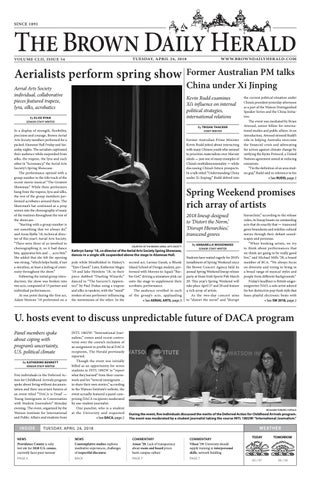
Kathryn Samp ’18, co-director of the Aerial Arts Society Spring Showcase, dances in a single silk suspended above the stage in Alumnae Hall. pole while blindfolded to Halsey’s “Eyes Closed.” Later, Katherine Magee ’18 and Jake Heinlein ’18, in their piece dubbed “Dueling Wizards,” danced to “The Sorcerer’s Apprentice” by Paul Dukas using a trapeze and silks in tandem, with the “wand” strokes of one performer influencing the movements of the other. In the
second act, Larissa Gusek, a Rhode Island School of Design student, performed with Moreno to Aqua’s “Barbie Girl,” driving a miniature pink car onto the stage to supplement their acrobatic performance. The audience revelled in each of the group’s acts, applauding » See AERIAL ARTS, page 3
By ANNABELLE WOODWARD SENIOR STAFF WRITER
Students have waited eagerly for 2018’s installment of Spring Weekend since the Brown Concert Agency held its annual Spring Weekend lineup release party at Stout Irish Sports Pub March 20. This year’s Spring Weekend will take place April 27 and 28 and feature a rich array of artists. As the two-day concert aims to “distort the norm” and “disrupt
hierarchies,” according to the release video, its lineup boasts six outstanding acts that do exactly that — transcend genre boundaries and redefine cultural norms through their defiant soundscapes and personas. “When booking artists, we try to think about performances that we think are going to be really good live,” said Michael Mills ’20, a board member of BCA. “We always focus on diversity and trying to bring in a broad range of musical styles and people from different backgrounds.” Friday’s headliner is British singersongwriter NAO, a solo artist adored for her distinctive pop-funk style that fuses playful electronic beats with » See SW 2018, page 2
U. hosts event to discuss unpredictable future of DACA program Panel members spoke about coping with program’s uncertainty, U.S. political climate By KATHERINE BENNETT SENIOR STAFF WRITER
Five individuals in the Deferred Action for Childhood Arrivals program spoke about living without documentation and their uncertain futures at an event titled “‘DACA is Dead’ — Young Immigrants in Conversation with Student Journalists” Monday evening. The event, organized by the Watson Institute for International and Public Affairs and students from
INSIDE
INTL 1802W: “International Journalism,” comes amid recent controversy over the course’s inclusion of an assignment to profile local DACA recipients, The Herald previously reported. Though the event was initially billed as an opportunity for seven students in INTL 1802W to “report what they learned” from their coursework and for “several immigrants … to share their own stories,” according to the Watson Institute’s website, the event actually featured a panel comprising DACA recipients moderated by one student journalist. One panelist, who is a student at the University and requested » See DACA, page 2
BENJAMIN TORUÑO / HERALD
During the event, five individuals discussed the merits of the Deferred Action for Childhood Arrivals program. The event was moderated by a student journalist taking the course INTL 1802W: “International Journalism.”
WEATHER
TUESDAY, APRIL 24, 2018
NEWS Providence County is only test site for 2020 U.S. census, currently faces poor turnout
NEWS Contemplative studies explores meditative experiences, challenges of respectful discourse
COMMENTARY Aman ’20: Lack of transparency about room and board prices hurts campus culture
COMMENTARY Vilsan ’19: University should supply training in interpersonal skills, network building
PAGE 4
BACK
PAGE 7
PAGE 7
TODAY
TOMORROW
65 / 47
56 / 50
NEWS
PAGE 2 • TUESDAY, APRIL 24, 2018
THE BROWN DAILY HERALD
» RUDD, from page 1 engagement with China “as a scholar, businessman, bureaucrat, diplomat, foreign minister and prime minister.” Rudd’s work with China includes his positions as president of the Asia Society Policy Institute and co-chair of the China Global Affairs Council of the World Economic Forum. Rudd is also fluent in Mandarin Chinese and has authored a policy report titled “Alternative Futures for U.S.-China Relations.” Rudd opened his talk by explaining how scholars can better understand the complex issues and identity of China, urging them to “understand the world as seen from Beijing” and not from an outside perspective. “The beginning of wisdom in understanding China’s view of the world is to understand China’s view of itself,” Rudd added. “Xi Jinping is at the apex of the Chinese political system. It’s important that we have a good understanding of how he sees his country, his party and China’s place in the world,” Rudd said. To enhance comprehension of Xi’s worldview, Rudd proposed a seven concentric circle model based on Maslow’s hierarchy of needs — a psychological theory reflecting human motivations. He stated that the first and foundational circle is
» SW 2018, from page 1 soulful R&B-style lyrics. Her debut album, “For All We Know,” released in 2016, saw her nominated for Best British Female Solo Artist. NAO will be preceded by Rico Nasty — also known as “Tacobella” — who is most famous for her eclectic, TV-inspired singles “iCarly” and “Hey Arnold,” both released in 2016. The Maryland rapper’s latest album, “Sugar Trap 2,” is jazzy and quite decidedly trap, characterized by synth lines, heavy back beats and autotuned raps. Also performing on Friday is Virginia-based rapper and producer DRAM (stands for Does Real Ass Music), who is best known for his playful hit single “Broccoli,” featuring Lil Yachty, which was just one of many gems on his debut LP, “Big Baby DRAM,” released in 2016. In a review for the breakthrough LP, Pitchfork drew comparisons between DRAM’s
» DACA, from page 1 anonymity, said he saw DACA as an opportunity to pursue higher education because it allowed him to enroll at a local community college before transferring to Brown. “When I was in high school and people were talking about plans for adult life and plans after high school, I never thought that I was gonna do very much after” graduating, he said. “I knew that there wasn’t any financial aid” for me given my immigration status, he added. But the implementation of DACA in 2012 made attending college a legitimate possibility for the first time, the student said. Nelson Morales-Nimaja, who came to the United States in 1991 as an infant, said the DACA program also allowed him to go to college. “Between the time that I was 18 to about 22 years old, … I didn’t really have any idea where I was going to go with life,” he said. “In 2012, (former
ELI WHITE / HERALD
Former Australian Prime Minister Kevin Rudd has previously served as the president of the Asia Society Policy Institute and co-chair of the China Global Affairs Council of the World Economic Forum. the Chinese Communist Party and its continuing clout, which is Xi’s primary concern. Rudd listed several other aspects, including economic
policy and living standards, until he reached the seventh circle — China’s place in the world at large. Xi’s rise to power is closely linked
music and a “big bubblebath,” while also underscoring his charismatic “camp counselor” qualities. The artist that has received the most buzz post-reveal is Saturday’s headliner, Anderson .Paak, a California-based singer, rapper and producer whose jazzy, sensual anthems — including “Lyk Dis” and “Heart Don’t Stand a Chance” — have been energizing the playlists of student parties since their release on his dual set of 2016 albums “Yes Lawd!” and “Malibu,” respectively. NAO and .Paak “were two people that we wanted to book this year from the start and we were really happy to book. They have this sound that’s really, really popular right now,” Mills said. “For people who like more than one genre, they are cross-genre performers.” .Paak’s performance will be preceded by a set by Japanese singersongwriter Rina Sawayama. Known
for her glittery, soul-infused digipop songs like “Cyber Stockholm Syndrome,” Sawayama has been acclaimed by The Guardian for her singular capacity for synthesizing her influences into something “bracing and modern.” Her recently released eponymous album, “Rina,” includes Spice Girls-reminscent tracks like “Ordinary Superstar” and “Take Me As I Am.” Following Sawayama’s set is Chicago-based indie-rock band Whitney — which will provide an exciting contrast to the concert’s primarily pop and hip-hop vibe. The project of songwriters Julien Ehrlich and Max Kakacek, Whitney’s music blends Bon Iver’s lyrical austerity and the vintage, twangy romance of The Alabama Shakes and The Walters. Providence’s beloved 18-member brass band and Spring Weekend staple What Cheer? Brigade will also perform a set on Saturday.
President Barack Obama) granted DACA. … From there, I was lucky enough … to begin my career.” While DACA has alleviated some of the burdens that accompany being an undocumented person in the United States, the program has not resolved all the issues that young immigrants face, such as the continued financial inaccessibility of higher education, said a panelist who identified herself as Yaruska. Though a 2011 ruling from the Rhode Island Board of Governors for Higher Education made undocumented students eligible for in-state tuition at public colleges in the state, Yaruska said she still struggled to pay for her education even with her enrollment in the DACA program. “I was able to get a small scholarship from the University of Rhode Island, (but) … I had to look for private scholarships, (and) … a lot of scholarships are only open to citizens.” Additionally, prior to enrolling in
the DACA program, panelist Otoniel Andres said he struggled to live and work without a driver’s license. “I couldn’t drive (legally) and see (my daughter or) get a decent job where I could afford to move in with her. … I used to drive to work and drive to see her … always in fear that I was gonna get stopped,” he said. The panelists also spoke about grappling with the potential permanent end of DACA. “By having DACA, it has relieved some pressure,” said Pedro Nimaja. “But at the same time, we know in the back of our heads that (DACA) is temporary. … The government hasn’t made any efforts to calm that fear.” The uncertainty surrounding DACA’s future has forced Nimaja to create a plan B for his life in the event that his DACA status is revoked. “There’s always that little fear in the back of your head, it’s always concerning, you never really sleep okay,” he said.
with the strengthening of China’s national identity, Rudd said. He emphasized the role of propaganda in combining China’s nationalism with
communist party imagery to create a “combined Chinese contemporary political consciousness.” During the discussion session following his talk, Rudd elaborated on China’s international relations. He explained that China’s relationship with North Korea results from China’s desire to have a neighboring ally, which is greater than its hope to have an ally without nuclear weaponry. While exploring U.S.-China relations, Rudd explained that China’s strategic policy looks at President Trump as a “strategic opportunity” as well as an “uncertainty.” The former results from the Trump administration’s role in abating the ideas of Western liberal democracy, while the latter stems from Trump’s strategic unpredictability, Rudd said. Karen Ka ’21, a Herald copy editor, said she was especially convinced by Rudd’s multidimensional analysis. “He really went into depth about all the different factors you have to consider in international relations. It was really interesting and eye-opening,” she said. “The reality of China today breaks out of any box,” Rudd said, describing the Chinese “international identity.” Besides Marxist ideology, Rudd emphasized the essentiality of culture and history in shaping China’s international worldview and politics.
COURTESY OF RAFFI ASDOURIAN
DRAM, pictured above, is a Virginia-based rapper and producer who will perform on campus Friday. DRAM is best known for his single “Broccoli.” Several panelists also said that the absence of a straightforward pathway to citizenship or permanent legal residence is the main issue of the DACA program. Nimaja also spoke about the ways in which the Trump administration’s insistence on ending the program has complicated the future plans of young immigrants. “All these people that are in high school … and were starting to make plans for college now can’t because they don’t know what’s going to happen,” he said. Hannah Subotnick ’16, who attended the event, said the panel
forced her to consider who bore the responsibility of educating the public on sensitive issues such as DACA. “These people are not only affected by the issue but (they also) have to take on the burden of explaining the (issues) to everybody else,” she said. Though DACA’s future as a program remains unpredictable, Nimaja said he feels hopeful for whatever lies ahead. “The climate in this country is perfect for grassroots efforts and (for) people like us to come out and tell our story and educate people who are able to vote, who are able to change policy,” he said.
NEWS
TUESDAY, APRIL 24, 2018 • PAGE 3
THE BROWN DAILY HERALD
Grad student journal to foster LGBTQ+ community Undone: A Legacy of Queer (Re)imaginings to explore “Queering Across Borders” in first issue By GRAYSON LEE STAFF WRITER
This September will see the release of the inaugural issue of Undone: A Legacy of Queer (Re)imaginings, a new journal created by graduate students that “encourage(s) community building and community development among queer and trans graduate students” at Brown, said Je-Shawna Wholley, the assistant director of the LGBTQ Center and the managing editor of the journal. The journal will be published annually online, said Majida Kargbo GS, one of Undone’s two editors-in-chief. “We’re excited that it’s a digital space because we want to be able to publish innovative work, things that aren’t just academic essays. So, we have visual arts, audio and short stories,” she said. “The (journal’s) theme this year is ‘Queering Across Borders,’ and it’s a call for us to think about queerness … beyond a Western framework,” Wholley said, and defined queerness as “non-heterosexual and nonheterocentric.” Undone shares the theme “Queering Across Borders” with the LGBTQ Center’s Legacy Series, she added. Undone’s editorial staff will accept submissions for the inaugural issue until May 4, said Hilary Rasch GS, an editor-in-chief at Undone. Rasch added that submissions are stripped of names before being reviewed by
» AERIAL ARTS, from page 1 constantly and cheering in surprise as each performer posed, climbed and danced. Many attended to support friends, while others said they came simply to see a performance unlike anything else on campus. Putting the show together was a challenge for the group, which faced problems when trying to secure practice and performance space — especially difficult for aerial arts, as it involves rigged equipment and safety precautions, Bjella said. “We hadn’t been in the apparatuses since early December,” she added. As technical director, she was in charge of deciding whether it was safe enough
Kargbo and herself. The approved selections are then distributed among content editors at the journal, she added. Currently, the editors plan to publish between seven and 10 selections in the inaugural issue, Kargbo said. While Undone prioritizes submissions from grad students at the University, it will also accept selections from grad students at other universities as well as local scholars, activists and community members not tied to academic institutions. After noticing the absence of a community among graduate students encouraging scholarship that explores self-expression and identity, Kargbo said she was inspired to create a publication to address this problem. The idea to create Undone “came from envisioning what I would have wanted out of a graduate community when I was in my earlier years at Brown, and that was a much stronger community around scholarship and support around thinking about these sorts of ideas,” Kargbo said. Kargbo added that she hoped the publication could also help remedy a lack of exclusive spaces for grad students at the University. “We don’t have graduate centered spaces at Brown and so one reason for this coming into being was to create one such space.” To foster a greater sense of community among grad students, Undone invites submissions from individuals across a wide variety of disciplines, Kargbo said. “I’m an interdisciplinary scholar. I really wanted to be able to think with other people in other disciplines and across mediums. I don’t really get to have contact with
to perform. It wasn’t until the day Bjella had decided to make the call that the pulleys used to support the apparatuses were put up, she said. Kathryn Samp ’18, co-director of the Aerial Arts Society, added that the group started preparing for the performance two months ago, but due to these logistical conflicts, they were only able to get on the apparatuses and begin choreographing routines three weeks ago. “I basically visualized my whole routine and then hoped that, when I was able to get on, … it would work out,” said Yael Braverman ’20, who performed on the trapeze at the beginning of the second act. She spent a lot of time watching “YouTube videos over
COURTESY OF MAJIDA KARGBO
Submissions to the journal will be open until May 4. The creators of Undone hope to foster a sense of community, and invite submissions from individuals in various fields of study. everyone all the time,” she added. Undone also works to facilitate professional development among grad students who might not be familiar with the process of submitting work or research to an academic journal, Wholley and Kargbo said. “We thought that this would be a great way to help them, like a low-stakes introduction into what it means to
submit to an academic journal. But we also wanted this journal to be a space that’s an intellectual community for people to talk about radical ideas and not be too caught up in the ‘academic standards,’” Wholley said. Undone’s staff uses the term “journal” to describe the publication “quite loosely” because there are “fine parameters in use in the academic
world about what a journal is and can be and we want this to be a hybrid space,” Kargbo said. “That is partly how we came to call it Undone. We want to sort of undo certain kinds of logics but also how we expect to learn these things. Sometimes you don’t need a 20-page essay to get at the heart of something,” she added.
spring break and then like two weeks of practicing,” she said. Braverman had previously done trapeze when she was much younger and hopes to learn other acts moving forward. Co-directors Samp and Jana Butman ’18 emphasized that this year’s performance, while faced with roadblocks, was also a success. “This year, we were able to strike a good balance between the spontaneity and individuality of our club, as well as organization and preparation to get our show together,” Samp said. The group does not have formal practices or coaches, she explained. “It’s very self-directed, very individually motivated. You train as much as you want to get the results you want,” she added.
“All of the routines this year were so phenomenal, we didn’t have to coach people’s acts,” Butman said, underscoring the group’s strength and independence. Butman performed on the lyra — an aerial hoop suspended at the center of the stage — in the thirdto-last act of the show, followed by Samp’s performance in the hammock, a single silk suspended in a loop. Butman and Samp portrayed contrasting characters in their performances: Butman’s evil sorceress countered Samp’s good witch. Samp, Butman, Bjella and 10 other senior members will graduate at the end of this semester, making this their final performance with the group. “A
lot of the community that I’ve found at Brown is through aerial,” Bjella said. While Samp and Butman agree that next year will be used to rebuild the organization, “with the amount of turnout this show has gotten, I’m confident that a lot of people are going to be very motivated to join next year,” Butman said. “We support people coming in who have absolutely no experience, no strength. … We think it will be pretty easy to build up our club again after all the students graduate,” Samp added. The show marked a moment of transition. “I started crying in the middle of the final trapeze act,” Butman said, reflecting after her final performance with the group.
STAY UP-TO-DATE. FOLLOW US ON FACEBOOK. FACEBOOK.COM/BROWNDAILYHERALD
NEWS
PAGE 4 • TUESDAY, APRIL 24, 2018
THE BROWN DAILY HERALD
Providence County 2020 Census test underway Fear of lacking response to 2020 Census tied to citizenship question, political leaders concerned By JACK BROOK SENIOR STAFF WRITER
Tony’s Meat Market in Central Falls prominently features a stack of “Nuevos Horizontes,” a local Spanish language newspaper. The paper’s April 9 issue on display devoted two frontpage stories to the potential impact of the 2020 census on the city’s community members. Providence County — which includes Rhode Island’s largest cities — is currently the only active test site in the United States for the 2020 census. Local leaders have warned that the test run is experiencing low turnout rates due to poor funding, little publicity and the addition of a citizenship question to the 2020 census. Test census and census stakes On March 16, residents of Providence County were notified by mail and directed to fill out an online form available through July 31, according to New York Regional Director of the Census Bureau Jeffrey Behler, who oversees the test run. The census test consists of 10 questions and takes about 10 minutes to complete. While three locations were originally selected as test sites for the census — Bluefield-Beckley-Oak Hill, West Virginia; Providence County, R.I.; and Pierce County, Washington — “due to budget issues,” the test run is only being conducted in Providence, Behler said. The demographically diverse county represents a “microcosm of the nation,” he added. Though the 2018 test run count is not official, it provides a way to ensure that the mechanisms necessary to carry out the 2020 census are working properly and will attain an accurate count, Behler said. Providence County includes about 263,000 housing units, all of which will need to complete the census test. The official census carries significant political weight — in the 2015 fiscal year, 132 programs referenced U.S. Census Bureau data to determine the allocation ofover $675 billion in federal funding. “We all need (federal) funding for public safety, health, education,
housing and the allocation,” Central Falls Mayor James Diossa told The Herald. “Knowing how many people are in a community is important for (when) we allocate a budget or put together programming, and (it) needs to be accurate.” Rhode Island is also in danger of losing one of its two congressional district seats. If the state is found to have 157 fewer residents than its last count, its representation will be cut in half, according to analyst Kimball Brace, working off data from 2017 population projections. Indeed, Rhode Island has the smallest average district size — 527,624 — of any state, according to the Providence Mayor’s Office. There has been no coordinated media or official publicity campaign in Rhode Island to inform the public of the census test, Behler confirmed. “The only time I have interacted with the Census Bureau is to help them direct people to apply (to work) for the Census Bureau,” Diossa said. “There’s really no information out there. There’s nothing. It’s almost as if it’s being set up to fail.” Providence Mayor Jorge Elorza has advertised the test run on social media and on monthly radio appearances to promote participation, according to Ben Smith, communications specialist for the Mayor’s Office. In addition, the City of Providence has developed a Complete Count Committee, which establishes partnerships among institutions and organizations such as the National Association for the Advancement of Colored People, the Dorcas International Institute of Rhode Island and Brown. “The members of the Complete Count Committee have been performing community outreach within the populations that they each serve,” Smith wrote in an email to The Herald. “The important thing in the lead up to 2020 will be whether R.I. political leaders and the nonprofit community step up to encourage participation,” said John Marion, executive director of Common Cause Rhode Island, a non-partisan political accountability organization. This places an additional burden on municipalities to pick up the responsibilities. Citizenship question and Central Falls turnout
But the U.S. Department of Commerce’s March 26 announcement of its plans to reinstate a citizenship question on the 2020 census has alarmed local leaders about census turnout. The test census does not currently include a question on citizenship; nevertheless, community members are confused about whether it does and whether the 2020 census will feature the question, according to Steven Brown, executive director of the R.I. chapter of the American Civil Liberties Union. “A question like this will suppress responses to the census,” Brown told The Herald. “I’m convinced this is not some negligent act on (the Trump Administration’s) part. I think they fully understand the ramifications of placing that question on the census.” The census has historically been racially biased in terms of the people it counts and those who go uncounted. For instance, while both the 2000 and the 2010 censuses saw the white population overcounted by around 1 percent, the Hispanic population was undercounted by well over 1 percent and the black population undercounted by over 2 percent, according to a review issued by the Census Bureau in 2012. On a Saturday morning in Central Falls, a dozen adult students finished up their work in a GED mathematics class run by Progreso Latino, an advocacy organization. “When I was at work, the first reaction people had (to the census) was, ‘I’m not doing it,’” said Yesenia Hawes, a student who works at a manufacturing plant. “People are afraid.” Students have been asking their teachers about whether they should participate in any aspect of the census process, said Ester Acevedo, adult education coordinator of English for Speakers of Other Languages for Progreso Latino. She added that some of her neighbors are refusing to complete the census. According to the 2016 American Community Survey, Latino individuals make up 63.8 percent of Central Fall’s population . The citizenship question puts Central Falls authorities in a difficult position, Diossa said. He wants to encourage people to participate so that Central Falls can receive the benefits of federal resources. At the same time, he understands the legitimate fears that immigrant or undocumented individuals might
have of not wanting to share their citizenship status with the federal government. “The confusion around the census and the fear around it, we’re afraid, is going to dissuade people from filling it out,” Elorza said in a statement. “The Department of Commerce is not able to determine definitively how inclusion of a citizenship question on the decennial census will impact responsiveness,” wrote Department of Commerce Secretary Wilbur Ross in a public letter that justified the inclusion of the citizenship question. “However, even if there is some impact on responses, the value of more complete and accurate data derived from surveying the entire population outweighs such concerns.” States, meanwhile, are pushing back. Rhode Island has joined California, New York and 14 other states in a lawsuit against the government on the grounds that the question is unconstitutional. “For the entire history of the republic, … it’s always been the total number of persons — not citizens, not those who are legally residing in the United States,” Marion said. “People who aren’t citizens still pay taxes, and the census helps determine how much those taxes come back to pay for the services that everyone consumes.” Article 1 of the Constitution states that all persons must be counted for the census, Marion added. Both Elorza and Diossa stressed that the question politicized what was intended to be an apolitical process. “The long-term of this inclusion (of the citizenship question) comes down to redistricting and gerrymandering,” Diossa said. “People want to be able to draw districts for elected offices, etc., and they know that there are states where they define the lines based on voter populations.” “A lot of people who are not U.S. citizens or lawful permanent residents, they might be afraid that by sharing this info with the government, they might be hurt in some way,” said Tatyana TsangarakisAlmeida, Citizenship and Immigration Services program director for the Dorcas International. “They have very basic concerns from when (President) Trump got elected.” Diossa said that the Census Bureau needs to work closely with local community organizations to address the concerns of certain populations
— such as undocumented people — that might be wary of participating. Looking ahead to 2020 Behler declined to comment or speculate on the citizenship question’s impact on the test run or the 2020 census. However, in response to concerns about publicity and community outreach, Behler noted that in 2020, the Census Bureau will have over 1,000 “partnership specialists” to help assist mayors and organizations administer the census. “While I certainly understand their concerns, 2020 is going to be completely different when it comes to the ability to provide resources and staff for messaging,” Behler said. “We’ll have a national media campaign, a local media campaign, we’ll have national partnerships. The goal of this test is to really test the system and the interface with the public, not the partnership program or the media program.” The 2019 fiscal year budget summary for the Census Bureau calls for additional funding in order for the test to be administered effectively. “The scope and design of the 2020 census can no longer be altered,” the report noted. “If the Census Bureau does not receive the funding requested for the entirety of this work, the quality of the 2020 census will suffer.” Behler remains optimistic both about the test run and the upcoming nationwide census. Census enumerators will follow up with households or individuals who have not responded with in-person visits from May 9 to July 24. Group quarters — places where individuals are housed together, like prisons, universities and assisted living centers — will be counted between July 18 and Aug. 24. College students who attend most of the state’s universities will not be living on campus during the enumeration period, Behler said. However, for the 2020 census, enumerators will likely visit college campuses around January and February, he added. Students living off-campus in Providence County are currently able to respond to the census survey online, Behler said. “Given that we don’t have a robust media campaign … seeing the response we’re getting so far is fantastic,” Behler said. “The system is working.”
TODAY
TUESDAY, APRIL 24, 2018 • PAGE 5
THE BROWN DAILY HERALD
menu
spring has sprung
SATELLITE DINING ANDREWS COMMONS
Pizza: Cheese, Spinach and Feta, Bacon Chicken Ranch, Pepperoni Grinder JOSIAH’S
BLUE ROOM
Grilled Portobello Mushroom Burger
Chicken Mushroom Xacuti, Vegetable Mango Curry
DINING HALLS SHARPE REFECTORY LUNCH
DINNER
Chicken Mole Chili, Polenta, Grilled Beet Reuben, Lobster Bisque, Squash Quesadillas
Hot Turkey Sandwich served with Gravy, Mashed Potatoes, Broccoli and Rice Casserole
VERNEY-WOOLLEY LUNCH
DINNER
Potato Vegetable Chowder with Ham, Fagioli Soup, Chinese Chicken Wings, Broccoli Quiche
Shaved Steak Sandwich, Zucchini Burger, Steak Fries, Fresh Corn on the Cob, Mexican Salad Bar
sudoku
TIFFANY DING / HERALD
Spring has arrived on campus, drawing many students out of their usual library or dorm room study spots to celebrate the weather and the end of the semester on the Main Green.
Q U O T E O F T H E D AY
“The beginning of wisdom in understanding China’s view of the world is to understand China’s view of itself.
”
— Kevin Rudd, Former Prime Minister of Australia
crossword
See CHINA on FRONT.
CORRECTIONS An earlier version of the article “Holocaust survivor discusses life story in Nazi Germany” stated that Kristallnacht took place on November 9, 1939. In fact, Kristallnacht took place November 9 to 10, 1938. The Herald regrets the error. An earlier version of the article “Wendy Davis talks abortion rights, value of empathy” referred to the Brown National Abortion and Reproductive Rights Action League Pro-Choice America. In fact, the organization is titled NARAL ProChoice Brown University. An earlier version of this article also stated that Wendy Davis is a state senator. In fact, she was a state senator. The Herald regrets the errors. An earlier version of the article “Physicists refine analysis of nano-objects” stated that electrons within an object give off signals during Nuclear Magnetic Resonance analysis. In fact, nuclei within an object give off signals during Nuclear Magnetic Resonance analysis. The Herald regrets the error.
calendar TODAY NOVEMBER MARCH APRIL
S
M
T
W
Th
F
S
1
2
3
41
25
36
74
85
96
10 7
11 8
12 9
10 13
11 14
Spring Into Action: Blood Drive 11:00 A.M. Hillel
Public Square Talks Series: Eric Williams 12:00 P.M. Nightingale-Brown House
Fashion @ Brown Design Panel 4:30 P.M. Smith-Buonanno, 106
Lecture Board Presents: Diane Guerrero 7:00 P.M. Salomon Auditorium
TOMORROW
12 15
13 16
14 17
15 18
16 19
17 20
18 21
19 22
20 23
24 21
25 22
23 26
24 27
25 28
26 29
27 30
28
29
30
31
Meditation and Mental Health 9:00 A.M. J. Walter Wilson, 512
Free Custon Airbrush Hats 12:00 P.M. Main Green
Stephen A. Ogden Jr. ’60 Lecture: Jeb Bush 5:00 P.M. Salomon 101
Brown Religious Literacy Project 7:30 P.M. J. Walter Wilson, 411
COMMENTARY PAGE 6 • TUESDAY, APRIL 24, 2018
THE BROWN DAILY HERALD
EDITORIAL
Spring break meal plans need reform For students who elect to stay on campus, spring break should be a time of rest, not confusion about the affordability of meal plans and fears of food insecurity. Sadly, the University’s spring break meal plan — which costs $288 for three meals a day over nine days — does little to assuage these concerns and accommodate students’ nutritional needs at an affordable rate. To spare students the undue stress of cobbling together meals over spring break, we urge the University to incorporate a greater degree of transparency with respect to its spring break dining policies and consider alternative spring break dining arrangements. The administration offered two justifications for the meal plan’s additional fee: First, the operating costs of the Sharpe Refectory, the only dining hall kept open, increase during spring break; and second, including the cost of these plans in all students’ meal plans might actually raise aggregate costs for the student body. Neither of these assertions, however, addresses the core issues at hand: Not only does the additional spring break meal plan fee go completely unmentioned on the University’s cost of attendance webpage, but it also grossly exceeds the typical cost of food for the average individual. According to the United States Department of Agriculture, Americans aged 19 to 50 living on “moderate” budgets could expect to spend as little as $68.80 on food per week in March 2018 — which works out to $88.46 for nine days. ($288 could almost feed a family of four, with school-aged children, for the duration of Brown’s spring break, as evidenced by the USDA data.) In effect, the University charges more than triple the amount that the government expects average people to spend on food, not including the cost associated with food preparation. The University, obviously, understands the importance of unimpeded access to food for the well-being and performance of students:
Athletes engaged in strenuous practice and trainings over spring break are given meals at no additional cost. And, to its credit, the University operates a Meal Gap program, which provides meals to students with the highest demonstrated financial need at no additional cost. Roughly 300 students of the 1,000 eligible — who were informed about the program through individual emails — exercised this option. Still, the absence of University support for the thousands of other students who receive financial aid, and may also work oncampus jobs to supplement that aid, leaves a substantial proportion of the student body without clear, accessible food options during spring break. Why low-income students and students on financial aid — not just those who, in the eyes of administrators, meet an unspecified threshold of demonstrated need — are not also protected by the University’s generosity is utterly baffling. Instead, to secure nutritional support over spring break, these students must reach out to the Dean of the College on their own and navigate a process about which there is virtually no publicly available guidance or information. Students, of course, could choose to decline the University’s meal plan and fend for themselves by purchasing groceries or meals independently. But for students without easy access to clean, well-stocked kitchens — kitchens in Brown residence halls are often unusable, either because they are missing key infrastructure, as some students have attested, or because they have been converted into rooms — grocery shopping is not a pragmatic option. And buying meals at eateries on College Hill is still a hugely expensive proposition — especially when students have already paid for a pricey meal plan from Brown University Dining Services — potentially forcing students to dip into their savings or scrounge the
funds needed to pay for restaurant meals. For more productive models of spring break dining plans, Brown might consider looking to other postsecondary institutions, many of which have have experimented quite successfully with alternative meal plans that better help students avoid episodic hunger. Connecticut College, for example, no longer charges students for on-campus meal plans during school-year breaks, while Columbia, George Washington University and Virginia Commonwealth University have opened food banks stocked with healthy options for students. Harvard even grants students with high demonstrated need a $225 stipend, which students can use at any restaurant in the vicinity of campus. Of course, emulating another university’s dining policies or enacting any single policy reform will not immediately make the experience of food insecurity — from which approximately half of American college students suffer — magically disappear from students’ lives. But the University cannot pretend like the problem is marginal enough that sustained, long-term change is somehow unnecessary or burdensome to the student body. Of all the obstacles to learning and personal development, hunger ranks among the highest, and the University should do whatever it takes to reform gaps in current dining policy and ensure that students have access to regular, affordable nutrition on campus.
Editorials are written by The Herald’s editorial page board: Anuj Krishnamurthy ’19, Mili Mitra ’18, Rhaime Kim ’20 and Grace Layer ’20. Please send responses to this opinion to letters@browndailyherald.com and opeds to opinions@browndailyherald.com.
LETTER TO THE EDITOR
U. more concerned about reputation than impact To the Editor: Last month, a letter signed by roughly 200 alums was delivered to Provost Richard Locke P’18 and President Christina Paxson P’19. We asked for clarity regarding their decision to suspend the University’s Elementary Master of Arts in Teaching program. Most significantly, the letter urged the University to be accountable for the impact this suspension will have on area children. In his response, Locke assured us that Brown remains committed to local schools. The University’s latest play? Some heavy-handed publicity. Last week, Brown’s Instagram account published two posts (there is also a prominently-placed story at news.brown.edu) featuring
undergrads who volunteer in Providence schools. The timing of this, in the wake of being called out about the Elementary MAT program’s suspension, is hilarious. The University’s intention — protecting its reputation — is not even remotely subtle. Finally, the content of this PR blitz is seriously, seriously reaching. The posts highlight volunteers who teach “chess, bingo, charades and arts and crafts.” That does not sound like significant pedagogical work, nor does it seem worthy of publicity. Brown chose to ignore the positive influence of the program when they decided to do away with it. How ironic that now, suddenly, Brown is desperately attempting to highlight their involvement in elementary schools. The University just axed a program that, for 18 years, ran a free summer program for area children.
Find us online! facebook.com/browndailyherald
browndailyherald.com
@the_herald
Location: 195 Angell St., Providence, R.I. www.browndailyherald.com
@browndailyherald
youtube.com/browndailyherald
Editorial Leadership
Sections
Multimedia & Production
Editor-in-Chief Elena Renken
Arts & Culture Editors Connor Sullivan Mia Pattillo
Design Editors General Managers Kyle Cui Michael Borrello Eduard Muñoz-Suñé Matilda Lynton Assistants: Julie Wang, Kelvin Yang
Metro Editors Emily Davies Bella Roberts
Photo Editors Sam Berube Anita Sheih
News Editors Anna Kramer Eduard Muñoz-Suñé Priyanka Podugu Sarah Wang
Copy Desk Chief Abby Borges
Managing Editor Kasturi Pananjady Senior Editors Julianne Center Madison Rivlin Alex Skidmore Hattie Xu Features Editor Isabel Gensler Editorial Page Editor Anuj Krishnamurthy
Science & Research Editors Jonathan Douglas Jackson Wells
POST- MAGAZINE Editor Saanya Jain
Sports Editors Alexandra Russell Nicholas Wey COMMENTARY Opinions Editors Connor Cardoso Anuj Krishnamurthy Clare Steinman
Illustrations Editor Pia Mileaf-Patel Video Editors Roland High Celia Hack
Business
Office Manager Diane Silvia Directors Sales: Shreya Raghunandan Finance: Ravi Betzig Strategy: Caroline Ziegler
SummerPrep, run entirely by the elementary track of the MAT program, served approximately 100 students each year. Students benefited from vocabulary enrichment, hands-on science experience, practice with mathematics content, and more. Each classroom was led by at least three adults, and they weren’t undergraduates interested in building their resumes. They were teachers. The first line of one of the Instagram posts boasts, “Brown celebrates a thriving set of partnerships with Providence schools.” Unfortunately, the most significant partnership Brown has with Providence schools will be erased when the current Elementary MAT cohort graduates next month. Shame on you, Brown. Margot Miller MAT’11
Editorial contact: 401-351-3372 herald@browndailyherald.com
Advertising contact: 401-351-3372 advertising@browndailyherald.com
Submissions: The Brown Daily Herald publishes submissions in the form of op-eds and letters to the editor. Op-eds are typically between 750 and 1000 words, though we will consider submissions between 500 and 1200 words. Letters to the editor should be around 250 words. While letters to the editor respond to an article or column that has appeared in The Herald, op-eds usually prompt new discussions on campus or frame new arguments about current discourse. All submissions to The Herald cannot have been previously published elsewhere (in print or online — including personal blogs and social media), and they must be exclusive to The Herald. Submissions must include no more than two individual authors. If there are more than two original authors, The Herald can acknowledge the authors in a statement at the end of the letter or op-ed, but the byline can only include up to two names. The Herald will not publish submissions authored by groups. The Herald does not publish anonymous submissions. If you feel your circumstances prevent you from submitting an op-ed or letter with your name, please email herald@browndailyherald.com to explain your situation. You can submit op-eds to opinions@browndailyherald.com and letters to letters@browndailyherald.com. When you email your submission, please include (1) your full name, (2) an evening or mobile phone number in case your submission is chosen for publication and (3) any affiliation with Brown University or any institution or organization relevant to the content of your submission. Please send in submissions at least 24 hours in advance of your desired publication date. The Herald only publishes submissions while it is in print. The Herald reserves the right to edit all submissions. If your piece is considered for publication, an editor will contact you to discuss potential changes to your submission. Commentary: The editorial is the majority opinion of the editorial page board of The Brown Daily Herald. The editorial viewpoint does not necessarily reflect the views of The Brown Daily Herald, Inc. Columns, letters and comics reflect the opinions of their authors only. Corrections: The Brown Daily Herald is committed to providing the Brown University community with the most accurate information possible. Corrections may be submitted up to seven calendar days after publication. Advertising: The Brown Daily Herald, Inc. reserves the right to accept or decline any advertisement at its discretion. The Brown Daily Herald, Inc. is a financially independent, nonprofit media organization bringing you The Brown Daily Herald, BlogDailyHerald and Post- Magazine. The Brown Daily Herald has served the Brown University community daily since 1891. It is published Monday through Friday during the academic year, excluding vacations, once during Commencement and once during Orientation by The Brown Daily Herald, Inc. Single copy free for each member of the community. Subscription prices: $200 one year daily, $100 one semester daily. Copyright 2018 by The Brown Daily Herald, Inc. All rights reserved. Periodicals postage paid at Providence, R.I. Postmaster: Please send corrections to P.O. Box 2538, Providence, RI 02906.
COMMENTARY TUESDAY, APRIL 24, 2018 • PAGE 7
THE BROWN DAILY HERALD
Why is Brown’s room and board so expensive? REBECCA AMAN staff columnist On Apr. 17, The Herald published spring poll results that found many students report stealing regularly from Brown eateries. When asked to explain their behavior, students expressed the belief that stealing helped them derive more of the value of their meal plans. For example, one student explained, “If I take one more meal for the week, I really don’t think that’s going over the value of my plan, considering how much I’m paying Brown.” This feeling is understandable, given that a meal credit can cost anywhere from $9 to $20, depending on the meal plan. Like the plans offered by Brown University Dining Services, on-campus housing — which costs roughly $1,140 per month — is also often considered a rip-off, because higher quality offcampus housing can be substantially less expensive. These frustrations are compounded by the fact that students are the very definition of a captive market, as we must purchase one year of meal plan and live in oncampus housing as underclassmen to attend Brown. (It is also notoriously difficult to get permission to obtain more affordable, off-campus housing.) These high costs and restrictive policies create a pervasive sense that
Brown is trying to squeeze every last penny out of us, which leads me to ask: If the University is a nonprofit, why do I always feel like I’m dealing with an airline? There might be very good reasons why housing and meal plans are so
hypothesized. Perhaps high meal plan and on-campus housing costs are used to subsidize financial aid. If the University has good reasons for charging us such exorbitant prices, where does the money go? To be clear, I’m not accusing Brown of
cludes a broad overview of the budget. In 2017, Brown spent 41 percent of its budget on salaries and wages, 12 percent on employee benefits, 8 percent on graduate student support, 8 percent on depreciation, 15 percent on supplies, 10 percent on pur-
If the University is a nonprofit, why do I always feel like I’m dealing with an airline?
expensive. Perhaps our dorm buildings are older, and therefore need more expensive upkeep than local apartments. Perhaps high meal plan costs are necessary to pay the wages of those who prepare our food, as a student in the earlier Herald article
taking advantage of us, and I’d like to believe that Brown is actually justified in charging the prices that it does. Rather, in the absence of transparency, it can feel like Brown is ripping us off. The University does publish an annual fiscal report that in-
chased services, 3 percent on utilities and 3 percent on interest. Yet these statistics don’t answer students’ primary questions: Why are room and board so expensive, and where is our money really going? This question is especially salient considering
that Brown charges $14,670 for room and board, while private, nonprofit, four-year universities charged on average $12,210 for room and board in the 2017-18 school year, according to the College Board. Sure, higher education in the United States is expensive across the board — but an annual premium of $2,460 is a sizeable sum. Brown doesn’t have an obligation to offer us an explanation of how they spend our room and board payments, and we, as students, will likely continue to purchase meal plans and oncampus housing in order to attend. Yet this lack of transparency encourages harmful behavior, allowing students to feel justified in stealing from Brown eateries. More importantly, it contributes to a sense that the administration does not have our best interests at heart, acting more like an exploiter than an accountable steward of the student body. Greater transparency and thoughtful communication will help build trust between the administration and students, and ultimately strengthen the basis of our community.
Rebecca Aman ’20 can be reached at rebecca_aman@ brown.edu. Please send responses to this opinion to letters@browndailyherald. com and op-eds to opinions@ browndailyherald.com.
Relationships 101 FABIANA VILSAN staff columnist Let’s talk about relationships. The word has romantic connotations, but in reality, relationships are central to every part of our lives, from the personal to the professional. So isn’t it surprising that there are no courses offered at Brown intended to help students develop critical soft skills — skills that one could argue are more important to our personal and professional growth than many of the technical skills we learn in our classes now? Over the last 30 years, academics across the country have created courses specifically designed to create a more holistic college experience — one that emphasizes interpersonal expertise as well as resume qualifications. Indeed, given the growing automation in today’s society, communication skills are becoming increasingly valuable in the workforce precisely because they cannot be quantified. Thus, it is about time that Brown offers soft skills training as part of its course selection. Of course, Brown students are developing important interpersonal skills every day through their course work, extracurricular engagements and team projects. One could even argue that soft skills are not teachable — that they must be absorbed through constant human interaction and experiential learning. However, a study conducted by Boston College, Harvard and the University of Michigan found that targeted soft skills training delivers a 250 percent return on investment based on higher productivity and employee retention. Therefore, we should do away with the myth that soft skills must be developed through real world experience and are thus impossible to teach in a tradi-
tional classroom setting. There is a reason why professional recruiting places so much emphasis on behavioral interviews — companies are looking for the perfect mix of technical and interpersonal expertise. And although our courses are a great foundation for the kind of communication and leadership skills required to excel within the professional world, Brown students would benefit from Relationships 101.
students professional etiquette. Meanwhile, at Brown, we often rely on peer advice when communicating with employers, as there is not always a slot open to speak with a counselor when we need guidance on email writing or informational phone calls. What’s more, once we have received our job offers, we often mistakenly believe that our work is done. There are no workshops available at the career center on building
It is about time that Brown offers soft skills training as part of its course selection.
The CareerLAB currently offers the closest thing to soft skills training on campus: a variety of workshops aimed at helping students prepare for and succeed at the interviewing process. These workshops are undoubtedly useful in teaching students how to best portray their skills and how to establish professional relationships with recruiters. But are they enough? Institutions such as Northeastern University have semester-long courses dedicated to teaching
networks within a company or developing the interpersonal skills that will be critical to getting promoted. Focusing on the interviewing process exclusively is a narrow-minded approach to career counseling, and it will leave many Brown students struggling to communicate and adapt within a professional setting. Finally, some institutions are going beyond basic interpersonal training and offering targeted courses intended to help students with ro-
mantic or personal relationships. Leslie Parrott, co-founder of the Center for Relationship Development at Seattle Pacific University, claims that research regularly shows “students are often more focused on relationship quality than their careers.” In her class, Parrott focuses on teaching students how to enter and maintain healthy romantic relationships. Other universities, such as Santa Clara University, offer courses on navigating the realities and intricacies of marriage — a lesson that is often learned after one has already walked down the aisle. Although some may believe that these courses go beyond the scope of education we should expect at Brown, it is likely that such unconventional instruction would be widely beneficial. Many students find it challenging to balance their personal and professional lives upon graduation. Curricular emphasis on relationship building could certainly improve these students’ overall quality of life. We know that soft skills are critical to our success both in our personal and professional lives, yet we often neglect interpersonal training in favor of technical skills that we can plaster on our resumes. It is Brown’s responsibility to help students reevaluate this delicate balance. Without a healthy education in soft skills, Brown students will likely find that a perfect GPA will fall short in the workplace. The good news is that these skills are teachable and learnable — and with a few tweaks to the Brown course selection, students can dramatically improve their overall college and post-graduation experiences.
Fabiana Vilsan ’19 can be reached at fabiana_vilsan@brown.edu. Please send responses to this opinion to letters@ browndailyherald.com and other op-eds to opinions@browndailyherald.com.
NEWS THE BROWN DAILY HERALD
TUESDAY, APRIL 24, 2018
Contemplative studies examines future growth, addresses past criticism
ALEX WESTFALL / HERALD
Mindfulness research at University studies effects of meditation on mental, physical well-being By TANUSHRI SUNDAR SENIOR STAFF WRITER
For 11 hours a day, Lan Anh Pham ’18 meditated under rigorous Vipassana tradition in rural Wisconsin as part of a 10-day meditation retreat during her sophomore year. Upon returning to Brown, she was confident that she wanted to study contemplative experiences. “I was blown away by how much I could change my perception of myself,” Pham said. At Brown, Pham has the unique opportunity to engage in practices and studies typically confined to an ashram, or a monastery. Originally a biology concentrator, she switched to contemplative studies, one of Brown’s newest concentrations and a pioneering field of research for the University. The Contemplative Studies Initiative — comprising University faculty dedicated to fostering academic discussion about contemplation — formed in 2004. The group established the first undergraduate concentration in contemplative studies at a major North American research university in 2014. The concentration involves studying a “particularly important subset of human experiences,” said Harold Roth, professor of religious studies and director of the initiative. These experiences of “being focused in the moment, undistracted, calm and tranquil” are normally attained in religious contexts such as yoga, meditation, mindfulness and prayer, he explained. At Brown, however, the concentration also looks at how these moments arise spontaneously in activities such as sports, music, art and science. Faculty involved with the concentration have backgrounds ranging from theatre and performing arts to political science. For example, “the whole art of acting — putting yourself in a role, setting aside normal elements of selfidentity and projecting yourself into the identity of a character — can be a very fulfilling contemplative experience,” Roth said. This interdisciplinary approach has established Brown’s program as a model for other universities, such as the
University of Virginia, the University of Miami and the University of Mary Washington, Roth said. “Brown is part of a national movement,” he added. “I really see this as a wave of the future.” Before the concentration became official at the University, faculty in the Contemplative Studies Initiative advised 16 independent contemplative studies-related concentrations. The initiative has steadily grown and hopes to have over 50 concentrators in contemplative studies by 2023, according to a 2017 internal presentation. Start of the program Over 20 years ago, Roth told his then-student Srinivas Reddy ’98, visiting professor of religious studies and contemplative studies, that he was “thinking of a doing a class where we read texts on meditation and have meditation labs,” Reddy said. At the time, having people meditate wasn’t a part of the curriculum and carried controversial religious connotations, so the “class” was “totally hidden and under the radar,” Reddy said. “We would meditate in his (office).” After Reddy graduated, he embarked on a multidisciplinary immersion in South Asian philosophy and music. While training as a professional concert sitarist, studying classical Indian texts and teaching abroad, he kept in touch with Roth, occasionally performing contemplative music recitals when in Providence. As contemplative studies at the University started to build momentum, Roth asked Reddy to teach a class in August 2017. Reddy currently teaches COST 0035: “Saints and Mystics of India” and COST 0100: “Introduction to Contemplative Studies.” Through his teaching, he hopes to inspire students to learn about the world and themselves, he said. Criticism and considerations A common criticism of studying Eastern religious practices in university settings is cultural appropriation, or the adoption of aspects of one culture by another, especially when there is an unequal power dynamic. In Pham’s opinion, “cultural borrowing has always been happening” in human history. As Buddhism traveled from India to other countries, newly exposed cultural groups understood and practiced Buddhism within their
cultural framework, she explained. “An interesting phenomenon of Buddhism and Buddhist practices traveling to the West is its integration in our rigorous scientific culture,” Pham said. Scientific research looking to identify how Buddhism changes our mind and body is an infusion of Buddhism into Western culture, she added. “For me, appropriation is when we are taking away pieces of tradition without respecting it.” Pham doesn’t believe appropriation is occurring. The concentration aims to deliver this respect through combining “thirdperson approaches and critical firstperson approaches” in its pedagogy, Roth said. This combination gives equal weight to historical cultural context as well as the effects those practices have on an individual, he explained. However, the contemplative studies program has come under criticism for cultural appropriation in the past. In 2016, a group of students protested a performance by Carrie Grossman ’00 titled “An Evening of Devotional Music.” The performance was “not an exclusive and official event of the contemplative studies concentration,” Roth wrote in a follow-up email to The Herald. It was organized by the student groups the Yoga and Mindfulness Group and the Contemplative Studies Departmental Undergraduate Group and funded by YAM, the Office of the Dean of the College and the contemplative studies program. Roth added that Grossman had previously performed classical Indian music at Brown in an official contemplative studies-sponsored event in summer 2015 with Reddy, a trained sitarist. A co-leader of the protest, Sohum Chokshi ’18, wanted to draw attention to “the fact that (Grossman) wasn’t trained in classical hymns and was mispronouncing words,” demonstrating a “very infantilizing notion of what Hindu meditation is,” Chokshi said. “If the contemplative studies department isn’t vigorously attacking standards of producing and sharing knowledge, then it’s not doing its job,” Chokshi added. Roth also wrote that the program has long been mindful not to culturally appropriate. “Since our beginning, we have made it a point of working hard to make our concentration and the events we organize very sensitive to questions of diversity and inclusion,” he wrote. These steps include organizing and
funding a year-long lecture series in 2016-17 titled “Mindfulness, Science and Society.” Courses in the concentration, such as COST 0100, COST 0410: “Engaged Buddhism” and COST 1950: “Senior Concentrators’ Seminar,” also include vigorous discussion about cultural appropriation, Roth wrote. Furthermore, though the concentration technically does not need a Diversity and Inclusion Action Plan, as it is a program and operates administratively under the Department of Religious Studies, it is currently working on one to be published by the end of the summer because “we think it’s important,” he added. Though critical, Chokshi acknowledges that the presence of contemplative studies in the University is significant. “It just has to be done in an accurate, historically represented way,” Chokshi said. The emergence of contemplative studies at the University also promises opportunities to “support scholarly work on Southeast Asia,” according to a message from the Southeast Asian Studies Initiative to The Herald. “One of our goals as the Southeast Asian Studies Initiative is to convince departments to hire faculty who study the region, and contemplative studies should have an interest in such faculty.” The Chinese Students Association, Asian/American Political Alliance and Hindu Students Association did not reply to a request for comment. A growing department at Brown Over the next decade, the Contemplative Studies Initiative hopes to sustain its growth and establish an Institute for Contemplative Studies, modeled after the Watson Institute for International and Public Affairs. A key goal of the initiative is to bring core elements of its teaching to several fields at Brown, creating opportunities for multidisciplinary research. For example, examining the medical potential of contemplative practices is a burgeoning sector of University research. In September 2017, the University launched a new Mindfulness Center, which brings together a diverse array of researchers who are investigating early findings that mindfulness could positively impact mental and physical health. The center is directed by Eric Loucks, associate professor of epidemiology, who studies the relationship between
mindfulness and cardiovascular health. He, alongside Willoughby Britton, assistant professor of psychiatry and human behavior, and Jared Lindahl, visiting assistant professor of religious studies, received a five-year, $4.7 million grant in 2015 from the National Institutes of Health to study the effects of mindfulness-based interventions on people’s abilities to follow medically recommended lifestyle changes. Other research areas related to mindfulness include neuroscience, cognitive science, clinical science and positive psychology. Including the NIH grant, the Contemplative Studies Initiative has raised over $7.5 million to fund projects related to studying the effects of mindfulness on ailments such as asthma, stress, fatigue, chronic pain and depression. Additionally, a large portion of the multidisciplinary nature arises from contemplative studies students’ work, Roth said. Pham, for example, wants to be a nutritionist and bring together the “triangle of mental, emotional and physical health to enhance people’s well-being.” In a different vein, Micah Thanhauser ’13 melds an artistic approach with his contemplative studies background. At Brown, he graduated with an independent concentration in “Contemplative Studies: Creativity and Consciousness,” combining his interests in religion and art. “I wanted to look at how art-making and appreciation of art can in itself be contemplative and meditative. … I really look at my time in the studio making pottery as a contemplative time,” he said. Beyond Brown, Thanhauser also worked for the Prison Mindfulness Institute, a nonprofit where he facilitated mindfulness courses in prisons and shelters. He currently works as a potter in Asheville, North Carolina, and teaches pottery and meditation. Knowing how to use a contemplative studies background in the workforce is not always clear, Thanhauser said. However, contemplative studies, like other liberal arts, teaches skills applicable to any field — “how to think, problem solve, learn quickly and interact with people.” “The most important part of meditation, or what I got from contemplative studies, is that you can actually cultivate and practice being more aware of life,” Thanhauser said.