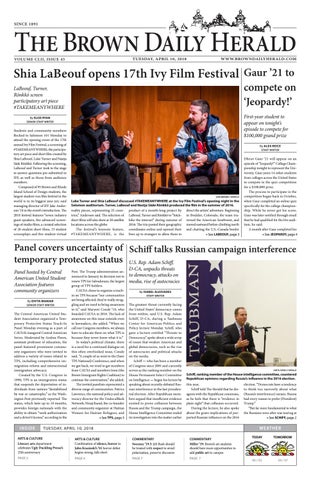
SINCE 1891
THE BROWN DAILY HERALD TUESDAY, APRIL 10, 2018
VOLUME CLII, ISSUE 45
WWW.BROWNDAILYHERALD.COM
Shia LaBeouf opens 17th Ivy Film Festival Gaur ’21 to
compete on ‘Jeopardy!’
LaBeouf, Turner, Rönkkö screen participatory art piece #TAKEMEANYWHERE
First-year student to appear on tonight’s episode to compete for $100,000 grand prize
By ELISE RYAN SENIOR STAFF WRITER
Students and community members flocked to Salomon 101 Monday to attend the opening event of the 17th annual Ivy Film Festival, a screening of #TAKEMEANYWHERE, the participatory art piece and short film created by Shia LaBeouf, Luke Turner and Nastja Säde Rönkkö. Following the screening, LaBeouf and Turner took to the stage to answer questions pre-submitted to IFF, as well as those from audience members. Composed of 95 Brown and Rhode Island School of Design students, the largest student-run film festival in the world is in its biggest year yet, said managing director of IFF Jake Anderson ’18 in the event’s introduction. The 2018 festival features “seven industry guest speakers, five advanced screenings of studio films, a curated selection of 26 student short films, 15 student screenplays and five student virtual
By ALEX REICE STAFF WRITER
SAM BERUBE / HERALD
Luke Turner and Shia LaBeouf discussed #TAKEMEANYWHERE at the Ivy Film Festival’s opening night in the Salomon auditorium. Turner, LaBeouf and Nastja Säde Rönkkö produced the film in the summer of 2016. reality pieces, representing 25 countries,” Anderson said. The selection of short films will also show at 20 satellite locations across the globe. The festival’s keynote feature, #TAKEMEANYWHERE, is the
product of a month-long project by LaBeouf, Turner and Rönkkö to “hitchhike the internet” during summer of 2016. The trio posted their geographic coordinates online and opened their lives up to strangers to allow them to
direct the artists’ adventure. Beginning in Boulder, Colorado, the team traversed the American Southwest, and moved eastward before climbing north and charting the U.S.-Canada border » See LABEOUF, page 3
Dhruv Gaur ’21 will appear on an episode of “Jeopardy!” College Championship tonight to represent the University. Gaur joins 14 other students from colleges across the United States to compete in the quiz competition for a $100,000 prize. The process to participate in the competition began back in October, when Gaur completed an online quiz specifically for the college championship. While he never got his score, Gaur was later notified through email that he had qualified for the live audition, he said. A month after Gaur completed his » See JEOPARDY, page 4
Panel covers uncertainty of Schiff talks Russian campaign interference temporary protected status U.S. Rep. Adam Schiff, Panel hosted by Central American United Student Association features community organizers By DIVYA MANIAR SENIOR STAFF WRITER
The Central American United Student Association organized a Temporary Protective Status Teach-In Panel Monday evening as a part of CAUSA’s inaugural Central American Series. Moderated by Andrea Flores, assistant professor of education, the panel featured prominent community organizers who were invited to address a variety of issues related to TPS, including comprehensive immigration reform and intersectional immigration advocacy. Created by the U.S. Congress in 1990, TPS is an immigration status that suspends the deportation of individuals from nations “destabilized by war or catastrophe,” as the Washington Post previously reported. The status, which lasts up to 18 months, provides foreign nationals with the ability to obtain “work authorization and a driver’s license,” according to the
INSIDE
Post. The Trump administration announced in January its decision not to renew TPS for Salvadorans, the largest group of TPS holders. CAUSA chose to organize a teachin on TPS because “our communities are being affected, they’re really struggling and we need to bring awareness to it,” said Maryori Conde ’18, who founded CAUSA in 2016. The lack of awareness on this issue extends even to lawmakers, she added. “When we call our Congress members, we always have to educate them on what TPS is because they never know what it is.” In today’s political climate, there is a need for a continued dialogue on this often overlooked issue, Conde said. “A couple of us went to the (Save TPS National) Conference, and when we got back, we tried to get members from CAUSA and members from (the Brown Immigrant Rights Coalition) to continue the conversation,” she added. The invited panelists represented a diverse range of communities: Patrice Lawrence, the national policy and advocacy director for the UndocuBlack Network; Ninaj Raoul, the co-founder and community organizer at Haitian Women for Haitian Refugees; and » See TPS, page 3
D-CA, unpacks threats to democracy, attacks on media, rise of autocracies By ISABEL ALEXIADES STAFF WRITER
The greatest threat currently facing the United States’ democracy comes from within, said U.S. Rep. Adam Schiff, D-CA, during a Taubman Center for American Politics and Policy lecture Monday. Schiff, who gave a lecture entitled “Threats to Democracy,” spoke about a wide array of issues that weaken American and global democracies, such as the rise of autocracies and political attacks on the media. Schiff — who has been a member of Congress since 2001 and currently serves as the ranking member on the House Permanent Select Committee on Intelligence — began his lecture by speaking about recently-debated Russian interference in the last presidential election. After Republican members argued that insufficient evidence existed to prove collusion between Russia and the Trump campaign, the House Intelligence Committee ended its investigation into the matter earlier
ANITA SHEIH / HERALD
Schiff, ranking member of the House intelligence committee, countered Republican opinions regarding Russia’s influence in the 2016 election. this year. Schiff told The Herald that he disagrees with the Republican consensus, as he feels that there is “evidence in plain sight” that collusion occurred. During the lecture, he also spoke about the grave implications of purported Russian influence on the 2016
election. “Democrats have a tendency to think too narrowly about what (Russia’s interference) means. Russia had every reason to prefer (President) Trump.” “But far more fundamental to what the Russians were after was tearing at » See SCHIFF, page 2
WEATHER
TUESDAY, APRIL 10, 2018
ARTS & CULTURE Literary arts department celebrates Ugly Duckling Presse’s 25th anniversary
ARTS & CULTURE Combination of silence, horror in John Krasinski’s ’01 horror debut begins strong, falls short
COMMENTARY Sweeney ’19.5: Jeb Bush should be treated with respect to avoid polarization, preserve discourse
COMMENTARY Miller ’19: Brown’s art students should have more opportunities to add public art to campus
PAGE 2
PAGE 4
PAGE 7
PAGE 7
TODAY
TOMORROW
45 / 33
54 / 37
NEWS
PAGE 2 • TUESDAY, APRIL 10, 2018
THE BROWN DAILY HERALD
Ugly Duckling Presse harbors unconventional texts Literary arts department celebrates Presse’s 25th anniversary with readings, performances By ANNABELLE WOODWARD SENIOR STAFF WRITER
This Saturday, the literary arts department celebrated the 25th anniversary of Ugly Duckling Presse, a Brooklynbased nonprofit editorial collective that prides itself on publishing experimental, non-commercial literature, according to head editor and founder Matvei Yankelevich. The all-day programming included a book display in the John Hay Library, a roundtable of distinguished small press editors and writing-inspired performances and readings by five Ugly Duckling-published writers, including University professors Cole Swensen and Monica de la Torre. Ugly Duckling Presse began as an experimental zine haphazardly assembled by Yankelevich and his friends while they were undergraduates at Wesleyan. By the early 2000s, it had transformed into a volunteerbased, nonprofit editorial collective, publishing chapbooks, books of poetry, experimental nonfiction,
performance texts and translations. Today, Ugly Duckling releases over 20 titles a year and was once lauded as the “preeminent nesting ground for swans of the avant-garde poetry scene,” by The New York Times. Ugly Duckling is defined by its longstanding commitment to experimentation. Unlike big-name publishing houses that are all-too-concerned with commercial viability and staying “on brand,” Ugly Duckling strives to “create an experience of artwork that circumvents the utilitarian mode of consumption,” Yankelevich said. “We’re publishing things because we love the work … because it has significance. We’re not really publishing things that will make money,” Yankelevich added. Ugly Duckling’s mission was concertedly praised by audiencemembers and authors throughout the event’s many programs. “I don’t think any other press would have been as adventuresome or open to what we wanted to do,” Swensen said, prefacing excerpts from “Greensward,” a book of poetry that she and graphic artist Shari DeGraw published with Ugly Duckling in 2010. The programming grounded itself in the Small Press Roundtable, where Ugly Duckling Presse editors Anna
Moschovakis and Yankelevich discussed the current challenges facing small presses alongside Patrick Riedy ’18 MFA, Damon Krukowski, Stephen Motika and Visiting Lecturer in Literary Arts Erica Mena — all of whom are also editors of distinguished small presses, including Pressboard Press, Exact Change, Nightboat Books and Anamolous Press, respectively. The featured editors spoke gaily about a range of critical issues — from editorial education to navigating digital distribution to the uncertain fate of the National Endowment for the Arts. “We don’t even know if the NEA will even exist next year. It’s a small but significant part of our budget when we get this grant, so it’s always frightening when our funding is in peril,”Yankelevich said. Following the roundtable were a number of artistic performances inspired by Ugly Duckling texts, including a dance by Allissa Cardone and Sara June informed by a translation of Tatsumi Hijikata that was recently published by the Presse. Hijikata was a legendary Japanese choreographer in the mid-20th century, and “Costume En Face: A Primer of Darkness for Young Boys and Girls,” is one of the first translations of his notebook notations ever published in English.
» SCHIFF, from page 1 the very fabric of our democracy,” he added. “They looked at the divisions within our society … and they sought to widen the gulf.” Schiff also referenced Russian involvement in recent European and Balkan elections, and argued that the interference tactics that Russia used in the United States were not new. “What was new was that they decided to do this to the strongest democracy on earth and to an unprecedented degree.” Given that “autocrats around the world are on the rise,” Russian interference in the U.S. election is even more significant, Schiff said, adding that “the very idea of liberal democracy is at risk.” Yet, Schiff still emphasized that the risks posed by external factors to American democracy were less serious than actions taken by the Trump administration. “Every day, we see our system of checks and balances, the heart and soul of our democracy, being whittled away” by the administration, he said, adding that the President’s attacks on the media and his encroachment on the Department of Justice also constitute threats to American democracy.
ANNABELLE WOODWARD / HERALD
Ugly Duckling Presse, which publishes non-commercial literature, celebrated its anniversary with a series of events Saturday. “(The text) is really dense, there’s such an incredibly rich array of spaces and characters. We both attacked the book and looked at the images,”
Cardone said. “I’m a postmodern choreographer … so I was really interested in how to generate movement from it.”
With regard to the firing of Andrew McCabe, the Federal Bureau of Investigation’s former deputy director, and the pardon of Joseph Arpaio, who was convicted of racial profiling as a law enforcement officer, Schiff said the White House has broken “down the wall of independence between the White House and the Justice Department.” Trump’s repeated attacks on the media also hurt the United States’ political system, Schiff said. Denigrating the press when an objective reality exists “can have serious, longlasting damage to our democracy,” he added. The President’s actions have caused Schiff to adjust the focus of the Congressional Caucus for Freedom of the Press — a bicameral, bipartisan caucus that Schiff founded in 2006 — to protecting the press inside the United States. The Freedom of the Press Caucus generally seeks “to advance press freedom around the world by creating a forum to combat and condemn media censorship and the persecution of journalists around the world,” according to a University press release for the event. Ultimately, congressional inaction to address Trump’s treatment of the media has compounded the problem, Schiff said. He described Republican
silence in the face of Trump’s actions as “political cowardice.” Throughout the lecture, moderators and audience members had the opportunity to ask Schiff questions. Nina Tannenwald, a senior lecturer in political science, asked Schiff for his opinion on the “charge that the U.S. has interfered with elections in other countries.” Schiff said that while “these accusations have far too much merit to ignore, … I hope that we would put that in the past.” “We really are indispensable in the way that no other country is positioned to be as great of a force for good,” he added. However, Schiff warned attendees that the continuation of the Trump administration’s practices could erode the American democratic ideal. “If this administration should go on beyond one term, then I think that the rest of the world has to conclude that America is not the country that it used to be,” he said. Looking to the future, Schiff told The Herald that he believes the Democrats will retake the House in the 2018 elections. “Democrats need to campaign on a return to decency. They need to generate a positive reason to vote for Democrats, rather than just incentive to turn out against Trump.”
NEWS
TUESDAY, APRIL 10, 2018 • PAGE 3
THE BROWN DAILY HERALD
U. startup awarded first place at SXSW competition Geopipe, which creates virtual models of real landscapes, impresses at national contest By ALICIA MIES STAFF WRITER
Thomas Dickerson GS led his startup, Geopipe, to take first place at the Student Startup Madness competition in the SXSW Interactive conference in Austin, Texas, March 12. Geopipe — which Dickerson cofounded with Christopher Mitchell, adjunct professor at New York University — creates virtual models of the real world, allowing urban designers and architects to visualize projects in the context of real urban landscapes. Geopipe can also be used in video game design and training simulations for first responders and the military, Mitchell said. “Geopipe had all the components for winning,” said judge Abe Minkara, director of business development at Mark Cuban Companies. “They’ve already demonstrated that they have a unique algorithm that can be applied in many different types of industries. They also proved that they have momentum and they validated their product by already
» TPS, from page 1 Veronica Giron, a TPS-holder, activist and labor union representative. “Only one of the panelists is Central American, one is Jamaican and one is Haitian. … They’re all part of the TPS alliance,” Conde said, adding that TPS is a “Central American narrative, but it’s not just a Central American issue.” During the event, the panelists stressed the importance of comprehensive immigration reform. Giron, who had Conde translate her words from Spanish into English, said that many TPS-holders seek security and certainty in the future of their immigration status. “It’s good to be grateful, but know that it’s temporary. That’s why they call it Temporary Protected Status,” Raoul said. People “get comfortable when they see that it’s extended over and over a few times,” she added. Raoul said the Trump administration’s recent decision to terminate TPS for Haitians made TPS holders realize
» LABEOUF, from page 1 to eventually land in Alaska. “Each night going to bed … your head would hit the pillow after a long day that was different than the previous day and you’d go to bed thinking anyone could turn up in the morning,” Turner said. “Anything could happen.” However, LaBeouf noted that the team did not intentionally put themselves in harm’s way along the trip, and could have refused rides they felt were dangerous. “We didn’t encounter any kind of negative energy at all,” LaBeouf added. Commissioned by the Boulder Museum of Contemporary Art and the Finnish Institute in London, the project originated in response to the theme of “corruption” that was highlighted by the Boulder Museum’s performance art festival, MediaLive, LaBeouf said. But the idea had been on their minds
COURTESY OF CHRISTOPHER MITCHELL
Thomas Dickerson’s GS startup Geopipe, which creates virtual models of the real world, was created in collaboration with Christopher Mitchell, an adjunct professor of computer science at New York University. having customers. There are opportunities for other companies like Google to invest or possibly acquire them.” Dickerson and Mitchell entered the competition last year but only made it to the round of 64 teams, Dickerson said. They were invited back by SXSW this year. Before winning first place, the company reached the “Entrepreneurial Eight,” during which they presented their pitch and answered questions in front of a panel of four judges. “We were told by colleagues that (the competition and SXSW) as a whole were “that it is important to start organizing for a more permanent solution.” After TPS ends for a specific country, the “entire community will lose their protection,” Lawrence said. Community members will be unable to enter government buildings, health facilities and any locations requiring government identification for entrance. The panelists also spoke about TPS from a humanitarian perspective, highlighting the uncertainty that families face from the program’s potential end. Because many families consist of members with different immigration statuses, the permanent termination of TPS would split them apart. “A lot of families are (of) mixed-status, and there are continuously attacks to that,” Lawrence said. The panel also discussed the importance of education and activism. Raoul said it is important that TPS holders are given the platform to speak on their circumstances. “In any movement, it has to be led by the people directly affected,” she said. already, with its roots in an earlier work by Rönkkö with the same title in which she rode a horse blindfolded. The artists even looked to Dr. Seuss’ “Oh, the Places You’ll Go!” for inspiration, LaBeouf added. “So, the internet was our horse,” Turner said. Known for his roles in blockbuster films such as “Transformers” and “Fury,” his time on Disney Channel as Steven on “Even Stevens,” and more recently his pieces of performance and participation art, such as the YouTube sensation, “Just Do It.”, LaBeouf reached out to Turner after discovering his work including his 2011 “The Metamodernism Manifesto,” and the duo met soon after in London. Turner connected LaBeouf with Finnish performance artist Rönkkö — whom he’d known since college — and the trio formed. “We hatched a plan and two weeks later Shia turns up on the red carpet in Berlin with a paper bag over his head
a great opportunity to raise visibility for the company and to connect with investors and, potentially, even partners and customers,” Mitchell said. “Because these are all among our immediate goals, entering the competition was an obvious choice for us.” Dickerson added that though the competition did not offer a monetary prize, they were able to network and pitch to an “investor-heavy audience,” as well as publicize Geopipe on the SXSW stage. Dickerson and Mitchell founded
Geopipe in June 2016 during the NYU Summer Launchpad Program, an accelerator program for students with startups. The pair has been working on projects together since they met 15 years ago on an online forum for students learning to program, Dickerson said. Before Geopipe’s inception, Mitchell was trying to map the landscape of New York City into Minecraft on a one-toone scale, while Dickerson was trying to create models of real buildings in virtual Legos, Mitchell said. Together,
they initially wanted to recreate the real world for video game designers to adopt and modify. “We pretty quickly realized that video game designers weren’t going to be the best early adopters for us,” Dickerson said. “Compared to architecture and urban design … video game designers just need a much higher level of realism and interactivity to be able to really make use of our product.” Dickerson and Mitchell intend to continue building out their technical road maps, bringing on more members to the technical team and attracting more investors. “We are excited about pursuing each of our current focuses for the company,” Mitchell said. “Accelerating product development makes it easier to get more beta customers on board, which makes attracting investment more tractable, which in turn helps us build the team to develop the company, sales and product.” In terms of the day-to-day operations, Dickerson has intentionally separated his academic research at the University from his work at Geopipe. However, he added that “Brown has been very useful for the social networking components, which come along with being part of a huge computer science program.”
BENJAMIN TORUÑO / HERALD
At the TPS Teach-In Panel Monday, panelists discussed the challenges that temporary protected status-holders face in the current political climate, as well as methods to engage in effective activism. These “human voices” are necessary to educate the public and raise awareness, Raoul added. The panelists encouraged attendees to look within their immediate communities for solidarity and strength. Effective activism means understanding the events unfolding locally and
starting from the bottom to work upwards, Giron said. “Just let people feel comfortable enough to know that they can come to you, and they can talk to you. It will be a slow process, and you won’t see the results right away. But it makes a world of difference,” Lawrence said.
The TPS Teach-In Panel is one of two events in CAUSA’s Central American Series, with another event titled “Social Activism through Social Media” on April 12. The series is both a celebration of Central American cultures and a display of resilience, Conde said.
saying “I’m not famous anymore” on it and it became huge,” Turner said. “We never looked back.” The film is as much a story of their journey — an image of the America they encountered — as it is a collection of the stories of the people they met along the way: One man showed off his collection of sneakers, a woman talks of her short-lived marriage after high school, a group drives from Florida to meet them in Alaska for a matter of minutes before turning back. Later, the film features a conversation between the artists and a man, who, while speeding down the highway, attempts to teach them how to load and shoot a gun. This interaction contrasts with that between the trio and the next group of participants along their journey — a large Mormon family who welcomes them into their home. The film was met with many bouts of laughter, as it depicted the realistic and relatable nature
of the journey while it maintained and portrayed the serious essence of the participants’ stories. “People open up really quickly and talk about the most personal things,” Turner said, and added that “it’s almost like people come to art to experience those things and express them.” This expression “became a kind of theme of the film,” he said. Participants in the project appear in the film in different ways — some only audibly, some only visually, while others still do not appear at all. “Some people will open up to you only when the camera’s gone, some people see a camera and immediately open up,” LaBeouf said. All of the participants have remained connected through a Facebook group constructed along the journey, LaBeouf and Turner explained. “Thankfully, this work — perhaps more than others — has this community that’s
built around it,” Turner said. “This is pre-Trump, this is … a different America. So, it was just different, it was just a different landscape. It wasn’t as fired up — as divisive,” LaBeouf said. In 2016, LaBeouf, Rönkkö and Turner responded to the election results by collaborating on the performance piece hewillnotdivide.us, which invited people to repeat the phrase “he will not divide us” in reference to President Trump. The project began the day of the inauguration at the Museum of the Moving Image in New York, with plans for it to be livestreamed 24 hours a day, seven days a week, for the duration of Trump’s presidency. “Nobody wants to be cool anymore, but everybody wants to be relevant, and so … there’s nothing more relevant than being here,” Labeouf said. “It’s the biggest student-run film festival and that just feels very, very relevant.”
NEWS
PAGE 4 • TUESDAY, APRIL 10, 2018
THE BROWN DAILY HERALD
John Krasinski’s ’01 ‘A Quiet Place’ makes little noise Krasinski’s horror debut trades sound for substance, punctuates mundane with monsters By ZACHARY BARNES STAFF WRITER
In the first scene of “A Quiet Place,” the new film from actor and director John Krasinski ’01, a family tiptoes around an abandoned general store to gather a few necessities. We hear the soft taps of their bare feet on the linoleum and the slight rattle of pills in a bottle as the mother carefully picks them up. No one speaks, and nothing goes boom. And yet the longer the quiet lingers, the more uneasy we become. It’s an effective opener, putting the audience on edge as they wait for a pin to drop. But it also puts into stark relief what is maybe an obvious realization: Most movies are awfully loud, aren’t they? The decibel count eventually goes up in “A Quiet Place,” and the movie becomes significantly less interesting when it does. But for a few brief stretches, the film uses silence in a way that sets it apart from most movies of its ilk. The quieter something is, the closer we listen, and “A Quiet Place” occasionally takes this lesson to heart, using it to craft some delicious scares and to deploy tension with admirable finesse. Had Krasinski been more ruthless in sticking to his premise, the film might have been a real nerve-jangling knockout. But as it stands, “A Quiet Place” is decent, scary fun. The story unfolds in a world
» JEOPARDY, from page 1 live audition in Boston in November, he received a phone call congratulating him for making it onto the show. Producers sent him to Los Angeles in March to film the competition. Gaur already knows the results of the competition, but he cannot disclose them before the competition airs. While in Los Angeles, the contestants spent two weeks filming the quarterfinals, semi-finals and the final round. “It goes really, really quickly,” Gaur said. “So you don’t really have time to really be super stressed — you’re just kind of going and then it’s over and you take a while to process it.” “Jeopardy!” has been a fixture in Gaur’s life since he was a kid. “It was always on in our house and I would answer questions along” with the show’s contestants, Gaur said. “One day, my dad was like, ‘You know, you’re pretty good at this, so you should give it a shot.’” While Gaur initially dismissed his dad’s comment, he later decided to try out, “and it turned out great,” Gaur added. According to Gaur, the college championship is more academic than standard “Jeopardy!” programming.
ravaged by nonhuman predatory creatures. Gifted with extremely sensitive hearing, they hunt and kill anything within earshot with quick, violent efficiency. The stakes are viscerally established at the beginning of the film when a child, Beau, is snatched up mere seconds after his electric rocketship toy makes noise. Beau’s death will haunt his parents, Lee (Krasinski) and Evelyn (Emily Blunt), and their other two children, Regan (Millicent Simmonds) and Marcus (Noah Jupe), for the rest of the film. The four of them live in a country farmhouse surrounded by rows of corn, where they’ve created a viable but always precarious lifestyle amongst the world’s new order of violence. Sand muffles the sound of footsteps on the paths around the property, paint circles mark the floorboards that creak the least, and leaves replace plates to prevent dinnertime clanking. And, of course, the family almost never speaks aloud to each other, instead communicating through American Sign Language. But they persist. Perhaps the most obvious sign of their optimism is the fact that Evelyn is pregnant, although this comes across as a little more delusional than Krasinski may have intended. Babies are great, but not exactly silent, and the solution the film proposes to this is patently absurd. So is most of the stuff in this movie, as a matter of fact, but nobody likes a pragmatic scold, and I don’t intend to be one. Nothing particularly scary happens for much of the film — we watch the family merely live their lives and act
There are fewer “random ‘70s pop culture questions, and it’s a lot of history, geography and science,” Gaur said. In preparation for the competition, Gaur watched hundreds of old “Jeopardy!” episodes while also playing the game online against other people. Gaur’s friend Cameron Trupp ’21 supported him throughout the training process. Because a lot of Gaur’s preparation took place online, Trupp said he just offered “emotional support most of the time.” “When we would study, he would take study breaks” alternating between schoolwork and “Jeopardy!” questions, Trupp said. “Sometimes I would have to encourage him to go back to schoolwork because he was getting a bit sucked into the “Jeopardy!” questions,” he added. Gaur is not the only Brown student to have a talent in trivia. Noah Cowan ’19 also competed on the “Jeopardy!” College Championship when he was a freshman. He and Gaur met to discuss the competition before Gaur left for filming. While Cowan didn’t win the $100,000 grand prize, “it was definitely a lot of fun and just like a funny thing to
out some dull smudges of emotional drama. The cast, at least, is good, including Blunt — married to Krasinski in real life — and Simmonds, a deaf actress who, between this and last year’s “Wonderstruck,” is shaping up to be one of the most talented young actors in Hollywood. And everything is nicely accented by the fluid cinematography of Charlotte Bruus Christensen. But at least one scene amidst the film’s more sedate first half really sticks with you: As Lee and Marcus walk back to the farm from a fishing expedition, they come across an old man standing by his wife’s bloody corpse. His face is troubled, his lips curled inward. Just as they start to run, the old man lets loose a mournful scream. In seconds, he is killed. In this world, to scream is to die; to express pain is to be ended by it. The motif of the scream returns twice more throughout the film, and both moments are among the film’s best. But too much in between lacks urgency or invention. An expert set piece turns into a bloated latter half of a film, story beats are repeated and cheap jump scares crop up like cornstalks in the springtime. Meanwhile, excess noise starts to seep into the film’s meticulous soundscape, from Marco Beltrami’s score to the smorgasbord of overused sound effects. Krasinski spends a lot of his time shushing people in this movie; it’s a shame the same impulse didn’t make it into his direction. As it nears its end, “A Quiet Place” grasps around for a conclusion for a while without ever really finding one,
©2017 PARAMOUNT PICTURES. ALL RIGHT RESERVED.
John Krasinski’s ’01 horror debut features wife Emily Blunt as they learn to survive in a horrific landscape without making a sound. eventually coming to a defiant halt that only works if you don’t think about it for too long. And maybe you shouldn’t. All I know is when the last shot cut
to black, the audience clapped and I took my hand away from eyes and said “what’d you think?” to the person next to me, it felt good to speak again.
COURTESY OF BROWN UNIVERSITY
Dhruv Gaur ’21 poses with Alex Trebek on the Los Angeles set of “Jeopardy!” during the filming of the competition in March. Gaur said he has enjoyed trivia and the show since he was a child. do freshman year, because I’m still known by some people as the ‘Jeopardy!’ kid,” Cowan said. If Gaur does win the grand prize,
he plans to take his friends out for dinner and “save most of it,” using some to pay for tuition. “I don’t really have any concrete plans right now,”
Gaur said. “I feel like I can probably do better things with the money later on when I actually know what I’m doing with my life.”
TODAY
TUESDAY, APRIL 10, 2018 • PAGE 5
THE BROWN DAILY HERALD
menu
baby brunos on the prowl
SATELLITE DINING ANDREWS COMMONS
Pizza: Bacon Chicken Ranch, Pepperoni, Spinach and Feta Grinders JOSIAH’S
BLUE ROOM
Taco Tuesday, BBQ Pulled Pork Burger
Foccacia Bar, Chicken Mushroom Zacuti
DINING HALLS SHARPE REFECTORY LUNCH
DINNER
Carne Asada, Spanish Style Rice, Black Bean Tacos, Pasta Fagioli, Italian Sausage Soup
Courico with Potatoes and Onions, Moussaka, Mushroom Leek Alfredo Pizza
VERNEY-WOOLLEY LUNCH
DINNER
Spicy Pepper Pulled Chicken, Pork Adobo, Jalapeno and Carrot En Escaeche, Buffalo Wings
Italian Meatballs, Spanish Lentils, Rotini Pasta, Alabama Butter Biscuits
sudoku
ANITA SHEIH / HERALD
A tour guide speaks to a group of prospective students and their families on Wriston Quadrangle. With A Day on College Hill rapidly approaching, current students prepare to welcome the class of 2022.
Q U O T E O F T H E D AY
“We’re publishing things because we love the work. crossword
… We’re not really publishing things that will make
”
money.
— Matvei Yankelevich, founder of Ugly Duckling Presse
See ugly duckling on page 2.
calendar TODAY NOVEMBER MARCH APRIL
S
M
T
W
Th
F
S
1
2
3
14
25
36
47
85
96
7 10
8 11
9 12
10 13
11 14
15 12
16 13
17 14
18 15
16 19
17 20
18 21
22 19
23 20
24 21
25 22
26 23
27 24
28 25
29 26
30 27
28
29
30
31
Maximizing Your Internship 12:00 P.M. CareerLAB
BRIGHT Pathway Global Health Lecture 12:00 P.M. Rhode Island Hospital
MLK and Black Power 5:30 P.M. Watson Institute, Kim Koo Library
Interracial Dating Forum 7:00 P.M. Petteruti Lounge
TOMORROW Exploring the Hidden Planets with Robots 12:00 P.M. CIT, Room 477
Pattern Theory Seminar: Anuj Srivastava 12:00 P.M. 170 Hope St., Room 108
2018 Biology Poster Day 1:00 P.M. Alumnae Hall Auditorium
Efficient Algorithms Talk: Mingfu Shao 4:00 P.M. CIT, Room 214
COMMENTARY PAGE 6 • TUESDAY, APRIL 10, 2018
THE BROWN DAILY HERALD
LETTER TO THE EDITOR
Consider Jeb Bush’s revised views on climate change To the Editor:
and raise consumer costs.” This policy position is reiterated in a 2016 The Hill article and a 2015 Bloomberg BNA article. Froid explicitly wrote in his op-ed that this exact policy position “is a legitimate, if controversial, policy opinion.” I agree it is troubling that Bush once denied man-made climate change, and I also recognize that at times during his campaign he continued to waffle on how much of climate change is man-made, but it is irresponsible of Froid to base a large part of his argument against Bush’s invite on a single policy position from seven years ago that Bush has since revised.
I am writing in response to the April 6 op-ed “Inviting Jeb Bush to speak is irresponsible” by Michael Froid ’21, who committed a significant portion of his piece to Bush’s climate change policies. He based his argument that Bush does not hold a legitimate policy opinion about climate change on Bush’s 2011 statement that he does not accept man-made climate change. However, during Bush’s 2016 presidential campaign, the Center for Foreign Relations stated, “Bush acknowledges that human activity has contributed to climate change, but cautions against federal regulatory efforts that he says could stunt growth
Julius Reiner ’19
STAY UP-TO-DATE. FOLLOW US ON FACEBOOK. FACEBOOK.COM/BROWNDAILYHERALD
Find us online! facebook.com/browndailyherald
browndailyherald.com
@the_herald
Location: 195 Angell St., Providence, R.I. www.browndailyherald.com
@browndailyherald
youtube.com/browndailyherald
Editorial Leadership
Sections
Multimedia & Production
Editor-in-Chief Elena Renken
Arts & Culture Editors Connor Sullivan Mia Pattillo
Design Editors General Managers Kyle Cui Michael Borrello Eduard Muñoz-Suñé Matilda Lynton Assistants: Julie Wang, Kelvin Yang
Metro Editors Emily Davies Bella Roberts
Photo Editors Sam Berube Anita Sheih
News Editors Anna Kramer Eduard Muñoz-Suñé Priyanka Podugu Sarah Wang
Copy Desk Chief Abby Borges
Managing Editor Kasturi Pananjady Senior Editors Julianne Center Madison Rivlin Alex Skidmore Hattie Xu Features Editor Isabel Gensler Editorial Page Editor Anuj Krishnamurthy
Science & Research Editors Jonathan Douglas Jackson Wells
POST- MAGAZINE Editor Saanya Jain
Sports Editors Alexandra Russell Nicholas Wey COMMENTARY Opinions Editors Connor Cardoso Anuj Krishnamurthy Clare Steinman
Illustrations Editor Pia Mileaf-Patel Video Editors Roland High Celia Hack
Business
Office Manager Diane Silvia Directors Sales: Shreya Raghunandan Finance: Ravi Betzig Strategy: Caroline Ziegler
Editorial contact: 401-351-3372 herald@browndailyherald.com
Advertising contact: 401-351-3372 advertising@browndailyherald.com
Submissions: The Brown Daily Herald publishes submissions in the form of op-eds and letters to the editor. Op-eds are typically between 750 and 1000 words, though we will consider submissions between 500 and 1200 words. Letters to the editor should be around 250 words. While letters to the editor respond to an article or column that has appeared in The Herald, op-eds usually prompt new discussions on campus or frame new arguments about current discourse. All submissions to The Herald cannot have been previously published elsewhere (in print or online — including personal blogs and social media), and they must be exclusive to The Herald. Submissions must include no more than two individual authors. If there are more than two original authors, The Herald can acknowledge the authors in a statement at the end of the letter or op-ed, but the byline can only include up to two names. The Herald will not publish submissions authored by groups. The Herald does not publish anonymous submissions. If you feel your circumstances prevent you from submitting an op-ed or letter with your name, please email herald@browndailyherald.com to explain your situation. You can submit op-eds to opinions@browndailyherald.com and letters to letters@browndailyherald.com. When you email your submission, please include (1) your full name, (2) an evening or mobile phone number in case your submission is chosen for publication and (3) any affiliation with Brown University or any institution or organization relevant to the content of your submission. Please send in submissions at least 24 hours in advance of your desired publication date. The Herald only publishes submissions while it is in print. The Herald reserves the right to edit all submissions. If your piece is considered for publication, an editor will contact you to discuss potential changes to your submission. Commentary: The editorial is the majority opinion of the editorial page board of The Brown Daily Herald. The editorial viewpoint does not necessarily reflect the views of The Brown Daily Herald, Inc. Columns, letters and comics reflect the opinions of their authors only. Corrections: The Brown Daily Herald is committed to providing the Brown University community with the most accurate information possible. Corrections may be submitted up to seven calendar days after publication. Advertising: The Brown Daily Herald, Inc. reserves the right to accept or decline any advertisement at its discretion. The Brown Daily Herald, Inc. is a financially independent, nonprofit media organization bringing you The Brown Daily Herald, BlogDailyHerald and Post- Magazine. The Brown Daily Herald has served the Brown University community daily since 1891. It is published Monday through Friday during the academic year, excluding vacations, once during Commencement and once during Orientation by The Brown Daily Herald, Inc. Single copy free for each member of the community. Subscription prices: $200 one year daily, $100 one semester daily. Copyright 2018 by The Brown Daily Herald, Inc. All rights reserved. Periodicals postage paid at Providence, R.I. Postmaster: Please send corrections to P.O. Box 2538, Providence, RI 02906.
COMMENTARY TUESDAY, APRIL 10, 2018 • PAGE 7
THE BROWN DAILY HERALD
Let students leave their mark on campus art EMILY MILLER staff columnist Early on in my Brown career, I ascended the five-story staircase in the List Art Center, and level by level, discovered an ever-changing, floorto-ceiling mural showcasing Brown’s most creative artists. When I introduce prospective students to Brown, I bring them to that staircase to view a unique side of our campus, an embodiment of the creative energy of our student body. I often wonder why Brown does not have more spaces like this. Brown currently has a “Percentfor-Art” program, which ensures that “one percent of the construction budget of all new buildings and major renovations is devoted to the commission of artwork for the building or grounds.” While this project has contributed some of Brown’s most beautiful and memorable spots on campus, often featuring gracious gifts from alums, wouldn’t some of these spaces be further enriched by incorporating students’ art? Brown has a large and valuable untapped resource: visual arts concentrators and Brown-RISD dual degree students. Even more striking, in 2017, about 60 percent of students cited an art-related subject as their primary ex-
tracurricular interest. Just as students in other disciplines seek publication as validation of their experience in literary and laboratory endeavors, our art students should have more opportunities to contribute to their campus and gain artistic experience and credentials. There is a trove of students whose artistic contributions would enhance Brown’s spaces. In 2017, Brown launched the
works of artists from outside of the Brown community. While we continue to enjoy the work of these artists, the Initiative should look to further integrate Brown art students into the process and allow them to leave a tangible impact on their campus. Public art has positive benefits beyond just providing student artists with opportunities to showcase their work. For instance, it can have
buildings show photographic scenes of the impact of climate change in the Arctic. The posters are part of a larger initiative, “WeatherProof: Arts, Humanities and Sciences Explore the Environment,” spearheaded by five programs at Brown to “weave across barriers to examine environmental issues with a multidisciplinary lens,” The Herald previously reported. Their focus is not only about visual plea-
Our art students should have more opportunities to contribute to their campus and gain artistic experience and credentials.
Brown Arts Initiative to “fully integrate the arts into a complete liberal arts education.” This project included increased access to the arts across departments and “new opportunities for teaching, research, artmaking, performance and experimentation.” It is intended to cement Brown’s commitment to the arts by creating more opportunities for students to engage through increased access to the arts and artists. However, the Initiative often focuses on bringing to Brown
a positive mental impact on its viewers. Studies have shown public art can reduce levels of stress, foster an increased feeling of community and promote positive health behaviors. Increasing public art will not only help the student artists behind the projects but also benefit other students and the community. One need not look further than the BioMedical Center and List to see the value of public art. The huge posters adorning the facades of these
sure, but seeks a more profound impact, leading students to see and contemplate vital issues facing the community. It also shows that art is often multidisciplinary and can have a significant impact in the sciences, environmental justice campaigns and much more. With students contributing to public art through multidisciplinary projects centered on the issues most important to them, they can create art that is impactful and pertinent to the Brown community.
Art does not need to be the next “Mona Lisa” to encourage discussion or act as a rallying point for students, either. At the least, “Blueno,” the 23-foot blue teddy bear plopped onto Ruth Simmons Quad, has been a point of commonality among all Brown students. Even strangers on campus can safely ask “How do you feel about Blueno?” and expect an opinion and discussion. The same goes for “Ideas of Stone,” the ersatz tree next to the real ones on the Main Green. Even unpopular art serves a purpose on campus. Not all public art needs to be by a renowned author. Our students are talented and well-trained and we should view their work with the confidence that it will contribute positively not only to our campus, but also to a wider community. If art is meant not only to adorn, but to foster creative thought and conversation, should we not look to encourage the greatest contribution from our own students? Is this not the essence of a Brown college experience?
Emily Miller ’19 can be found working on her stick figures in her spare time, and can be reached at emily_miller@brown. edu. Please send responses to this opinion to letters@browndailyherald.com and other opeds to opinions@browndailyherald.com.
Why we must respect Jeb Bush’s right to speak BRENDAN SWEENEY op-ed contributor Jeb Bush should be allowed to speak at Brown. In his Apr. 9 op-ed in The Herald, Mark Liang ’19 offered many good points for why this should be the case. But his arguments about why Bush should be allowed to speak endanger liberal democracy by encouraging tribalism and exacerbating political polarization. Further, his proposed solution of personally shaming Bush with protest signs that say “PLEASE CLAP” is atrocious. We can and must aim instead for mutual respect in our political discourse. Firstly, the main issue with Liang’s perspective is that it condescends to the political right in a tribalist manner, and in doing so violates the concept of mutual respect that is required of a multiparty liberal democracy. He says, “we have to recognize that (Republicans) are there and learn how to beat them.” This is objectionable in that he views political debate as a struggle between two factions where winning is of the utmost importance. His column suggests that liberals should always win. The better argument is that the discourse between liberals and conservatives, and everyone in between, should help to shine light on the truth and on our shared morality as human beings. Political debate should not be about winning, but about truth and justice, and absolutely requires the humility to accept that your ideas could be wrong. Liang shows no willingness to concede that he, in fact, could be wrong in his viewpoints and in his deeply held moral convictions, nor does he consider that humility and mutual respect are the reasons why Bush should be allowed to present his views
at Brown. We cannot move on from political polarization until we, the next generation of American leaders, put justice before party and show respect for the ideas of others. What’s more, it is widely accepted that Bush is, especially by today’s standards, a moderate Republican. He does not spew radical nonsense and conspiracy theories — instead he is
he is a human being and therefore deserves respect, that it is morally abhorrent to propose, as Liang does, that students should protest Bush with signs saying “PLEASE CLAP” — a reference to a vulnerable moment in which Bush asked the audience to clap during a stump speech for his presidential bid in 2016. To even suggest that it is morally tolerable to protest
Liberal democracy is premised on mutual respect, which is undermined when we reduce our discourse to mere tribalism.
informed, articulate and justifies his viewpoints with intellectual principles. Because Bush has shown respect for all those he engages with in political debate (even when President Trump attacked him in the Republican primaries in 2016), he deserves to be treated respectfully. It is for these reasons, as well as the simple fact that
someone by invoking one of their most personally vulnerable moments — one which itself has minimal relation to politics — is unfathomable. To berate Bush with this type of ad hominem attack is to become a bully in the same manner that Trump has been, by using schoolyard taunts in place of reasoned and respectful debate. It is
precisely this kind of backhanded comment, a personal attack in place of a political one, that threatens to increase political polarization. Liberal democracy is premised on mutual respect, which is undermined when we reduce our discourse to mere tribalism. Although one should have respect for those willing to engage in genuine debate on political issues, there is some speech that is unequivocally beyond the pale. When hate speech is invoked in political debate, for instance, we should not legitimate it by inviting its advocates to campus. Yet at the same time, we should also not respond with personal attacks and taunts. To be clear, Bush does not meet the bar for hate speech and should be permitted to come to campus and respected when he arrives. But the health of our liberal democracy depends on the quality of our discourse, and even when we come across people with hateful views, it is important that we are able to marginalize those views through civil discussion rather than resorting to toxic discourse ourselves. Some people would surely say that Bush’s viewpoints are immoral and therefore the type of protest advocated for by Liang is justified. To them I say, we must always treat others with respect in our political discourse: It does not depend on what others say or do. Personally shaming Bush is a morally bankrupt idea and ought not to be tolerated by Brown students or by the Brown administration.
Brendan Sweeney ’19.5 can be reached at brendan_sweeney@brown.edu. Please send responses to this opinion to letters@browndailyherald.com and other op-eds to opinions@browndailyherald. com.
NEWS THE BROWN DAILY HERALD
TUESDAY, APRIL 10, 2018