
New agreements would increase Brown’s voluntary payments in lieu of taxes to Providence
Brown will pay average of $8.7 million annually in individual, joint agreements
BY SAM LEVINE AND RHEA RASQUINHA UNIVERSITY NEWS EDITOR & METRO EDITOR
The University would pay an average of $8.7 million annually to the city of Providence under two proposed voluntary payment agreements announced at City Hall Tuesday afternoon. The agreements, which now await
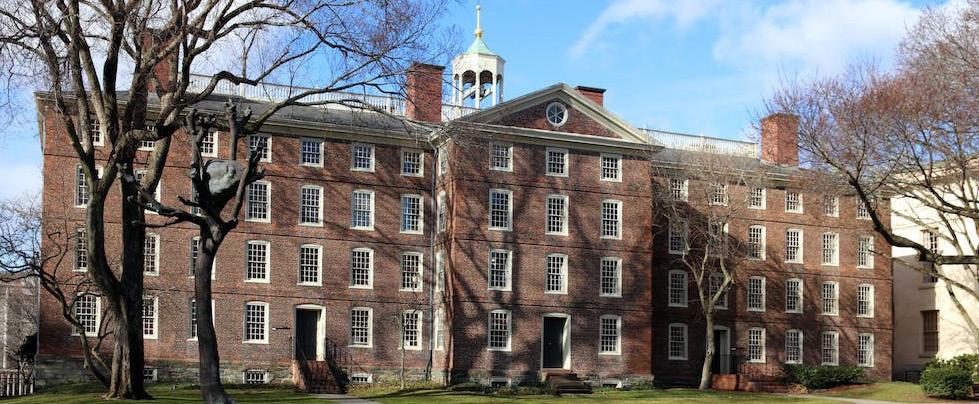
UNIVERSITY HALL
approval from Providence’s City Council, were the product of months of negotiation between the city and the four private higher-education institutions that have signed on to the agreements.
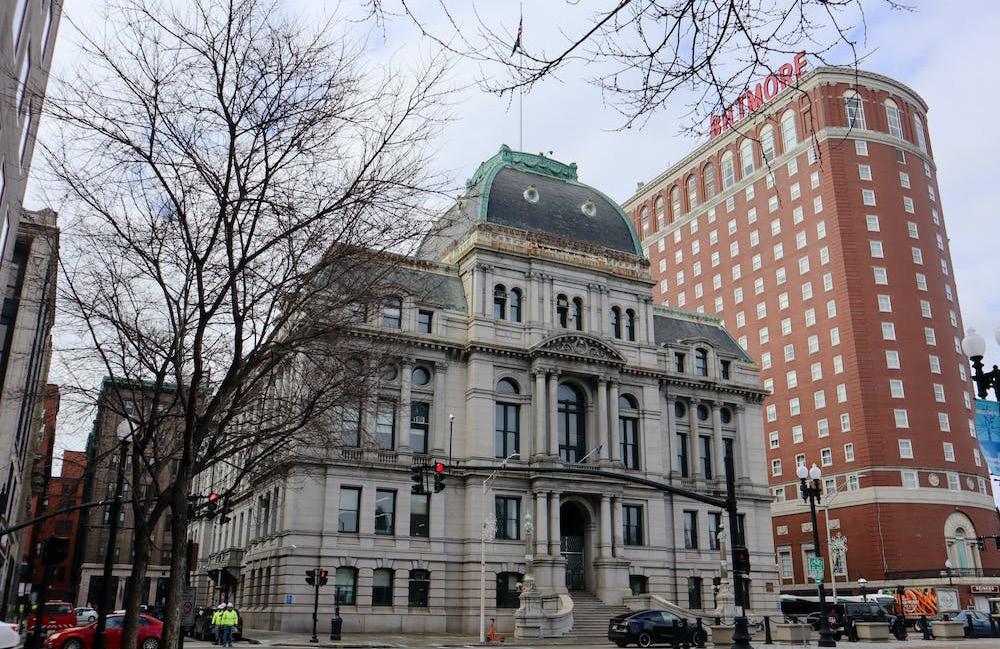
The first agreement, a memorandum of understanding signed by Brown, the Rhode Island School of Design, Providence College and Johnson and Wales University, would direct more than $177 million to the city’s coffers over 20 years, $128.7 million of which would come from Brown. The second, a separate memorandum of agreement solely between Brown and Providence, accounts for an
Paxson earned $1.77 million last year
AAUP members describe stagnating salaries, undervaluing of faculty
BY CHARLIE CLYNES & NEIL MEHTA UNIVERSITY NEWS EDITORS

President Christina Paxson P’19 P’MD’20 was paid $1,765,827 in the calendar year 2022, University Spokesperson Brian Clark wrote in an email to The Herald.
Paxson’s compensation will be reported in the University’s tax filings in May 2024, Clark wrote. It will be second only to Paxson’s compensation of just over $2,000,000 in 2021.
A Herald analysis of compensation data — from IRS form 990 tax filings since 2013 and the Office of Institutional Research — identified a growing gap between compensation for Paxson
and faculty members. And professors from Brown’s chapter of the American Association of University Professors voiced concerns with existing faculty compensation schemes.
Paxson’s total 2022 compensation drops 14% from record-high $2 million in 2021
Paxson’s $1.7 million dollar compensation in 2022 is down 14% from an all-time high of just over $2 million in 2021.
The record compensation in 2021 was driven by a deferred compensation payout of $782,945. The payout came from six-figure installments that accumulated every year since 2017.
Clark wrote to The Herald that among executives at Brown, compensation is decided by the Committee on Senior Administration of the Corpora-
additional $46 million over the next 10 years.
If approved by the City Council, the proposed agreements would result in more than $174 million in voluntary payments from Brown to Providence between 2024 and 2043. Direct monetary payments from Brown to the city, though, can be decreased through University activities that are deemed to provide direct tax revenue to the city — such as development projects and collaborations or the sale of tax-exempt institutional properties, returning parcels to the commercial tax rolls.
The University confirmed that negotiations were underway this winter, and in the
STAFF & STUDENT LABOR
time since, several student demonstrations demanded that Brown increase its annual contributions to the city in lieu of taxes.
As a non-profit institution, Brown is exempt from paying property taxes on its educational buildings but does pay taxes on its commercial holdings. A 2022 report from the Providence Finance Department estimated that the University would pay nearly $50 million annually if it were eligible to be taxed on all of its property, The Herald previously reported. For fiscal year 2023, Brown
New TALO contract adopted
Interim contract secures pay increases, outlines job responsibilities
BY ASHLEY CAI SENIOR STAFF WRTERThe Teaching Assistant Labor Organization — which represents undergraduate computer science teaching assistants and other computer science employees — ratified an interim contract for the 2023-2024 academic year in August, The Herald previously reported.
Over a 72-hour voting period ending Aug. 25, 168 of 377 eligible voters cast their ballot, with over 99% of votes cast in favor of the contract according to ballot results reviewed by The Herald.
The interim contract only lasts for the 2023-2024 academic year and is expected to be replaced by a full contract that TALO and the University will negotiate in the coming months, according to Joe Maffa ’25, a TALO organizer.
“Negotiating a contract could take over a year, and we wanted to protect our workers
as soon as possible,” Maffa told The Herald.
Within weeks of successfully unionizing in March, TALO formed a bargaining committee and began negotiations with the University. The parties held eight bargaining sessions over the spring and summer before agreeing on an interim contract in late August.
Maffa and Deputy Provost and Associate Professor of Engineering Janet Blume, who served as the University’s lead negotiator, described negotiations between the two parties as generally productive and cooperative.
“TALO leaders were very receptive, and I felt that we worked together well,” Blume wrote in an email to The Herald. TALO was “thoughtful and well-organized, and we shared their goals of ensuring that the computer science student employee experience and learning environment be strong, inclusive, healthy and well-supported.”
The University was “pretty receptive to our needs, and willing to compromise on a lot of things that we talked about,” Maffa said.
Other CS TAs told The Herald that TALO

BROWNDAILYHERALD.COM SINCE 1891 THURSDAY, SEPTEMBER 7, 2023 VOLUME CLVIII, ISSUE 38 WHAT’S INSIDE Get to know the class of 2027 with the first year poll UNIVERSITY NEWS Absurd high school comedy hits funny bone ARTS & CULTURE New committee to examine admission policies UNIVERSITY NEWS SEE POLL PAGE 14 SEE BOTTOMS PAGE 12 SEE ADMISSIONS PAGE 4
HERALD
SEE PRIDE PAGE 10 PRIDE 2023 SPECIAL ISSUE SEE AAPI PAGE 6 AAPI HERITAGE MONTH SPECIAL ISSUE
PILOT PAGE 13 SEE TALO PAGE 13 SEE PAXSON PAGE 3
SEE
1
2
West Virginia University faces sweeping cuts to academic programs
Under former Brown President Gordon Gee, WVU is facing cuts due to a $45 million budget shortfall. This week, WVU completed a review process of the elimination of dozens of majors — including the University’s entire foreign language program and creative writing program.
‘We’ll just admit fewer students’: Yale welcomes oversized class of 2027 3

According to the Yale Daily News, 72% of admitted students accepted offers of admission to Yale, resulting in an incoming class of 1,647 students. To accommodate, the Yale administration renovated previously vacant dorms and held summer webinars to encourage admitted students to take a gap year.
Stanford, UC Berkeley and SMU leave PAC-12 for Atlantic Coast Conference
Following the departure of eight schools from the acclaimed PAC-12, Stanford, UC Berkeley and SMU will enter the ACC in the 2024-25 season, the Stanford Daily reported Friday. Although the ACC previously voted against expanding the conference, they have now extended invitations to the three schools under the condition that they receive decreased revenue shares for the first few years.
Editors’
Note: We’re back with a new look

Yesterday marked the beginning of a new school year, and today marks our first print issue of the semester. The 133rd Editorial Board is honored to present the first printed edition of the Brown Daily Herald for the fall 2023 semester.
Fall is always a time of new beginnings on campus: new courses, a new home and a new class to walk through the gates. The Herald is changing as well: We’re back with a new look and a longer paper.
We also made the decision to shift The Herald to printing once a week rather than three times weekly. Don’t worry — we’re still the Brown Daily Herald online Monday-Friday — but our printed paper will now come out Thursdays and include all the biggest stories from throughout the week. This change will help us meet our readers where they are. In an increasingly digital era, we want to focus our reporters’ time and resources on cultivating our digital presence just as much as our printed paper.
A longer issue means more news — and there’s plenty this week: a new payment agreement between the University and Providence, a committee considering admissions practices and an introduction to the class of 2027. We hope you enjoy our first weekly issue and keep up with us on our website and through our newsletters all year long.
Editors’ notes are written by The Herald’s 133rd Editorial Board: Will Kubzansky ’24, Katy Pickens ’24, Alex Nadirashvili ’24, Augustus Bayard ’24, Caleb Lazar ’24, Peter Swope ’24 and Kaitlyn Torres ’24.
PAGE 2 TODAY THURSDAY, SEPTEMBER 7, 2023 TODAY Celebratory Unveiling of the Simmons Center 2:00 p.m. Ruth J. Simmons Center Fall 2023 Activities Fair 5:00 - 8:00 pm Main Green Up Home: One Girl’s Journey - A conversation with Ruth J. Simmons 5:00 pm Pizzitola Memorial Sports Center Study Abroad 101 Information Session 12:00 pm Page-Robinson Hall Room 411 TOMORROW The Arava Institute for Environmental Studies Info Session 11:30 am Page-Robinson Niloufer Siddiqui & Aqil ShahPolitical Crisis in Pakistan 2:00 pm Watson Institute Women in Physics Feature Video Viewing Party 3:30 pm Barus & Holley Department Picnic 4:30 pm Meiklejohn House
WEEK IN HIGHER ED
TIFFANY DING / HERALD
tion — the University’s highest governing body and fiduciary. For executives, compensation “is generally targeted to the 25th to 75th percentile of the market on an overall basis.”
He added that Paxson’s “total cash compensation falls below the median when compared to peers at other highly selective private universities,” which he attributed to a “salary report produced by an independent analyst.”
Clark declined to provide the schools listed in the report because it “is not Brown’s report to distribute publicly.” He did not provide the name of the independent analyst.
A 2023 analysis of private college compensation by the Chronicle of Higher Education found that in 2020, Paxson ranked 34th among 307 chief executives for base pay. She ranked 73rd for total pay, which includes bonuses, benefits and other compensation.
Among Ivy League colleges, Paxson ranked fourth for total compensation and sixth for base compensation in 2021, according to form 990 filings for all eight schools.
A 2014 study of college president pay conducted by University of Alabama accounting professor Linda Parsons found that among private schools, higher-paid university presidents tend to improve measures of academic quality, like student SAT scores. But private schools didn’t tend to compensate presidents more for improving academic environments, such as by shrinking class sizes.
Parsons told The Herald that college presidents are often highly compensated if they are effective at raising money for their institutions.
The University crossed its BrownTogether fundraising target of $3 billion in fall 2021, though Clark told The Herald that specific fundraising and endowment targets are not factored into Paxson’s compensation.
Parsons added that because many
SINCE 1891
individuals already aspire to become university presidents, the salary isn’t usually there to make the job more desirable.
“There’s not really a shortage of available individuals. … a number of people aspire to make their way up through the administrative ranks,” she said. “A lot of people look in the mirror in the morning and say, ‘That’s a future university president.’”
Compensation gap between Paxson and faculty
Paxson’s high compensation comes amid faculty and administrative discussions surrounding educator salaries. According to data from the University’s Employees Factbook, educators saw their salaries — not including bonuses — grow anywhere from 16.77% to 26.94% between 2014 and 2022. The median salary of lecturers rose by 23.40% over the time period, while senior lecturers saw a 16.77% increase. Assistant professors’ salaries grew by 23.99%, while associate professors saw 26.94% growth and professors saw 21.88% growth.
Distinguished senior lecturers, saw a 25.48% increase in their median salaries from 2017 to 2022 .
In contrast, Paxson’s total compensation in 2021 was 113% higher than it was in 2014, though Clark noted that her 2022 compensation is a decrease of about 14% from her 2021 figure.
Paxson’s base compensation, which does not include deferred compensation, was $1,068,875 in 2021, 57% higher than her 2014 base compensation. Clark did not provide a number for 2022 base compensation at press time.
Multiple faculty have publicly expressed dissatisfaction surrounding their compensation packages. Last April, Brown’s chapter of the American Association of University Professors hosted an independent analyst who claimed that the University could afford significant increases to faculty pay and benefits, despite alleged administrator communications claiming otherwise.
Professor and Chair of German Stud-
ies Kristina Mendicino, who serves as president of Brown’s AAUP chapter, said many of her colleagues worry that increases to their compensation — determined by factors like academic output — will not “be keeping up with inflation, and keeping up with the cost of living as it rises in the city of Providence and elsewhere.”
The process of distributing yearly salary increases also tends to shortchange some high-performing faculty, Mendicino said. While the University announced a 4% salary increase pool in February — representing the second-largest increase in 12 years, Clark noted — individual faculty do not automatically receive a 4% raise. Instead, funds are allocated to departments, which then conduct performance reviews to determine the salary increases that individual faculty will receive.
“If everybody in the department published a book, the pool is not going to be bigger” automatically, Mendicino said. “Chairs can argue to have more funds allocated to appropriately compensate their faculty, but you have to argue for it, and the resources are still limited.”
“At the end of the day, if everybody does a lot of research, does really well and still is teaching, then everybody financially does worse” since the total funds available do not change, she added.
“In the last few years alone, billions … have been added to the Brown endowment, so Brown is as wealthy as it has ever been in its history,” added Professor of German Studies and Comparative Literature Gerhard Richter, who is vice president of Brown’s AAUP. “But that’s not reflected in its values and in its commitment to the welfare of faculty.”
Last spring, 218 faculty signed a petition requesting automatic costof-living adjustments for all faculty, Mendicino said. If adopted, all faculty would receive a yearly base compensation increase to account for inflation
THE BROWN DAILY HERALD
133RD EDITORIAL BOARD
Editor-in-Chief
Will Kubzansky
Managing Editors
Katy Pickens Alex Nadirashvili
Senior Editors
Augustus Bayard
Caleb Lazar
Peter Swope
Kaitlyn Torres
POST- MAGAZINE
Editor-in-Chief Kimberly Liu
NEWS Metro Editors Emma Gardner
Rhea Rasquinha
Jacob Smollen
Julia Vaz
Jack Tajmajer
Science & Research Editors
Haley Sandlow
Gabriella Vulakh
Arts & Culture Editors
Finn Kirkpatrick
Rya Vallabhaneni
Sports Editor Linus Lawrence
University News Editors
Sofia Barnett
Charlie Clynes
Emily Faulhaber
Sam Levine
Neil Mehta
Haley Sandlow
Kathy Wang
Aniyah Nelson
Katie Jain
DIGITAL NEWS Director of Technology
Swetabh Changkakoti
COMMENTARY
Editorial Page Editors
Kate Waisel
Devan Paul
Head Opinions Editor
Alissa Simon
Opinions Editors
Juliet Fang
Yael Wellisch
Anika Bahl
MULTIMEDIA

Photo Chiefs
Elsa Choi-Hausman
Claire Diepenbrock
Photo Editors
Mathieu Greco
Lilly Nguyen
Kaiolena Tacazon
Social Media Chief
Sahil Balani
Podcast Editors
Finn Kirkpatrick
Jacob Smollen
PRODUCTION
Copy Desk Chief Brendan McMahon
and other broader economic pressures.
A copy of the petition obtained by The Herald also calls on the University to pay faculty retirement contributions that were withheld during the pandemic.
“The time has come for the senior administration to send a strong signal that faculty contributions to our institution are valued,” the petition reads. “Repaying withheld contributions to faculty retirement accounts and implementing a cost-of-living adjustment for faculty salaries will reaffirm the commitment of the administration to the mission of our university.”
Paxson subsequently formed a task force to investigate faculty compensation. The task force, which comprises 10 faculty and administrators, has not released their findings publicly.
Senior administrator compensation and faculty salaries are determined separately.
“Compensation for senior administrators is generally market-and performance-driven and based on industry standards to provide a competitive combination of salary and benefits that recognize an individual’s portfolio of responsibilities, sustained performance and, to some extent, length of employment,” Clark wrote in an email to The Herald.
Mendicino does not necessarily oppose high administrator salaries.
“I have no aspiration to earn something comparable to an administrator,” she said. Instead, she cited the lack of cost-of-living guarantees — as well as the shortcomings of the faculty compensation structure in rewarding high-performing faculty in similarly high-performing departments — as concerns distinct from the subject of administrator compensation.
Richter added that there is “widespread dissatisfaction among faculty with the job that the administration is doing when it comes to valuing faculty.”
“This really needs to be addressed,” he said.
Medical
draws from U.S. News &
Design Chief
Neil Mehta
Design Editors
Ashley Guo
Gray Martens
Designers
Joyce Gao
Menasha Leport
Tom Li
Nathaniel Scott
Tiffany Tran
Jane Zhou
BUSINESS
General Managers
Joe Belfield
Andrew Willwerth
Sales Director
Alexander Zhou
and 900 words and advance a clear argument related to a topic of campus discourse. You can submit op-eds to opinions@browndailyherald.com.
Letters to the editor should be around 250 words and respond to an article or column that has appeared in The Herald, or critique or commend The Herald’s editorial decisions. You can submit letters to the editor to letters@browndailyherald.com.
Submissions undergo multiple rounds of editing. These rounds of editing generally take place over the course of one evening, and you may have to respond to edits late in the evening. If you know you will be unable to do so, please mention that in your email, and we will do our best to work with you.
Submissions can build on reporting from The Herald, reporting elsewhere, official statements from the University or other groups and other reputable sources, but they cannot break news or contain information that The Herald cannot verify. Because we cannot publish unsubstantiated information, failure to provide appropriate sources may mean we have to modify or remove unverified claims.
The Herald will not publish anonymous submissions or submissions authored by organizations. Leaders of student organizations can be identified as such but cannot write under the byline of their organization. The Herald cannot publish all submissions it receives and reserves the right to edit all submissions.
All submissions to The Herald cannot have been previously published elsewhere (in print or online — including personal blogs and social media) and must be exclusive to The Herald. Once your submission is published in The Herald, The Brown Daily Herald, Inc. owns the copyright to the materials.
Commentary: The editorial is the majority opinion of the editorial page board of The Brown Daily Herald. The editorial viewpoint does not necessarily reflect the views of The Brown Daily Herald, Inc. Columns, letters and comics reflect the opinions of their authors only.
Corrections: The Brown Daily Herald is committed to providing the Brown University community with the most accurate information possible. Corrections may be submitted up to seven calendar days after publication. Periodicals postage paid at Providence, R.I. Postmaster: Please send corrections to P.O. Box 2538, Providence, RI 02906.
@the_herald
facebook.com/browndailyherald

@browndailyherald @browndailyherald
Advertising: The Brown Daily Herald, Inc. reserves the right to accept or decline any advertisement at its discretion. 88 Benevolent, Providence, RI (401) 351-3372 www.browndailyherald.com Editorial: herald@browndailyherald.com Advertising: advertising@browndailyherald.com
PAGE 3 UNIVERSITY NEWS THE BROWN DAILY HERALD The Brown Daily Herald, Inc. is a financially independent, nonprofit media organization bringing you The Brown Daily Herald and Post- Magazine. The Brown Daily Herald has served the Brown University community daily since 1891. It is published Monday through Friday during the academic year, excluding vacations, once during Commencement and once during Orientation by The Brown Daily Herald, Inc. Single copy free for each member of the community. Subscription prices: $200 one year daily, $100 one semester daily. Copyright 2023 by The Brown Daily Herald, Inc. All rights reserved.
Op-eds
typically
Submissions: The Brown Daily Herald publishes submissions in the form of op-eds and letters to the
are
between 600
School with-
World rankings
READ IT ONLINE WEB EXCLUSIVE
Finance Director Eli Pullaro PAXSON FROM PAGE 1
BROWNDAILYHERALD.COM
U. welcomes incoming class in 260th Convocation CareerLAB launched as Center for Career Exploration
U. committee to reconsider legacy, early decision, test-optional policies
New committee comprised of Corporation members, alumni, faculty
BY HALEY SANDLOW AND OWEN DAHLKAMP UNIVERSITY NEWS EDITOR & SENIOR STAFF WRITEROn the heels of the Supreme Court’s landmark decision to restrict race-conscious college admissions and a nationwide upheaval of admissions policies, Brown is appointing an ad hoc committee to reexamine the University’s admission practices.
According to a Wednesday letter from President Christina Paxson P’19 MD’20 to University community members, the committee will examine admissions practices and data related to legacy preferences for students with “family connections” to Brown, standardized testing and early decision.
The committee, co-chaired by Provost Francis J. Doyle III and Trustee Preetha Basaviah ’91 MD’95, will make recommendations to Paxson and the Corporation, the University’s highest governing body, before the start of next semester, according to the announcement. Any changes to application consideration would be implemented during the 2024-25 admissions cycle.
“This is an important moment for Brown to assess its admissions policies to ensure the University is fully realizing its educational mission and upholding its commitments to academic excellence, equity, access and diversity,” Paxson wrote in her letter.
The committee is composed of five Corporation members, four faculty members and Doyle. It includes prominent voices on admissions practices, including John Friedman, professor of economics, who has researched the subject of legacy admissions and their relationship to economic mobility.
The committee does not include
& STUDENT LABORrepresentatives from the Enrollment Division, comprising the Office of College Admission and the Office of Financial Aid. It will, however, consult individuals in the division to produce an informed recommendation based on analysis of admissions data, according to Doyle.
“My plan would be, together with my co-chair, to pull together the appropriate experts across the University ecosystem,” he said. Current undergraduate students are also not present on the committee.
“This examination may involve highly confidential and sometimes very highly specific data about our students,” Doyle said. “We did not want to place our students in a conflicted situation.”
One of the committee’s tasks is to recommend whether to continue the University’s interim test-optional policy or to reinstate its standardized testing requirement. The current ap -
plication cycle is the fourth consecutive year that score submission has remained optional.
As for eventual decisions regarding legacy admissions and early decision, Doyle said the committee has “no preconceived notions of what exactly we will do going forward.”
“I don’t have a preview of exactly what the issue is on any of those three axes ahead of our dive into the data,” Doyle said.
Legacy preferences in admission have faced intensifying public scrutiny following the Court’s decision. In July, the Department of Education opened an inquiry into Harvard University’s use of the practice of legacy admissions following allegations that it violates Title VI of the Civil Rights Act of 1964. Several universities have recently eliminated the advantage, including Wesleyan University and Virginia Tech.
The University currently considers legacy status in admission practices,
giving special consideration for applicants who are children of one or more alumni of Brown’s undergraduate program.
Of the newly matriculated class of 2027, 8% fit this criteria, according to Doyle — identical to the proportion that Associate Provost for Enrollment Logan Powell shared for the entire student body in late 2021, The Herald previously reported.
Earlier this year, Powell previously suggested harnessing legacy preference to increase the diversity of future classes.
Committee member Noliwe Rooks, professor of Africana Studies and chair of the department, has publicly supported the use of legacy admissions. Citing the increasing diversity of alumni classes, she said that eliminating consideration of familial ties would disadvantage legacy applicants of color: “It is pulling up the ladder behind them to not allow their kids to be legacy
admits,” she told the New York Times.
In a metadata analysis of Ivy-plus institutions published by Opportunity Insights, a paper co-authored by committee member Friedman found that ending legacy preferences would slightly decrease the percentage of the student body from households in the top 1% of income earners.
The committee has “no intent” to focus on the consideration of applicants whose parents have donated large sums to the University, Doyle said.
Early decision admissions, another practice the committee is charged with examining, have proven less controversial — but colleges such as Virginia Tech have halted the separate process, citing pressures surrounding financial uncertainty when committing to a school.
“I see us looking at our current practices and understanding what’s working, what’s fair and appropriate with those mechanisms,” Doyle said, when asked about early decision and early action admissions. “We’re looking at some of our peers’ practices as well to understand better whether or not there’s something that is better suited to our mission, to the goals that we have and using them to inform the recommendations going forward.”
Both Doyle and Paxson pointed to the national dialogue on admission practices as reasoning for the committee’s formation. But Doyle also emphasized the independent nature of the committee’s work.
“We will use our numbers, our data, our information to inform our own outcomes,” Doyle said. He added that the committee will share its findings at the “earliest possible juncture.”
“Brown remains incredibly and firmly committed to building and sustaining a diverse and inclusive campus community,” Doyle said. “That’s essential to our academic mission.”
University raises campus-wide undergraduate TA minimum wage
 BY ASHLEY CAI
SENIOR STAFF WRITER
BY ASHLEY CAI
SENIOR STAFF WRITER
The University has raised the minimum wage for undergraduate teaching assistants and similar positions to $18 per hour, Provost Francis J. Doyle III and Deputy Provost for Strategic Initiatives Janet Blume announced in an Aug. 28 Today@Brown announcement detailing the interim contract signed with the Teaching Assistant Labor Organization.
The change in compensation, which took effect at the beginning of this semester, originated in the “productive discussions” between the University and TALO, which represents undergraduate computer science student employees, wrote University spokesperson Brian Clark in an email to The Herald.
Though it is likely that the University would have increased the minimum wage “in the near future,” Blume wrote
in an email to The Herald, “the fact that we took that proactive step at this moment originated from our work with TALO and our goal of being equitable with student workers in similar positions.”
“The steps we have taken to raise the UTA pay rate across campus reflect our dedication to providing students with exceptional educational and professional experiences, and our commitment to supporting the financial needs of our students,” Doyle and Blume wrote in the letter.
The University’s minimum wage for hourly student workers previously matched Rhode Island’s statewide minimum wage, which increased from $12.25 to $13 per hour at of the beginning of 2023. According to Blume’s email to The Herald, “many” TAs were already earning more than the minimum rate.
In the interim contract finalized with TALO last month, the University established a base hourly rate of $20 per hour for undergraduate TAs in the computer science department.
In addition to the minimum wage increase, Blume wrote that University Human Resources, which is conducting a “multi-year Student Employment Enhancement Initiative,” will work this semester to conduct a pay equity study of all hourly student workers and conduct focus groups with student workers.
The initiative aims to “further equity for students seeking employment with a preliminary focus on pay eq-
uity, and to collaborate with staff in (the Center for Career Exploration) to connect campus student work opportunities with student career goals,” she wrote.
Organizers with TALO celebrated the raise as a win for all student workers.
“We’re thrilled that TALO is already delivering wins for all undergraduate TAs on campus,” wrote Colton Rusch
’23, a graduated member of TALO’s organizing committee.
“This (raise) is a concrete step toward our stated goal of improving working conditions for all TAs and student workers on campus,” wrote Joe Maffa ’25, another member of TALO’s organizing committee, in an email to The Herald. “We hope that this (raise) will serve as proof that unions work and that they work for everyone.”
PAGE 4 UNIVERSITY NEWS THURSDAY, SEPTEMBER 7, 2023
ADMISSIONS
DANA RICHIE / HERALD
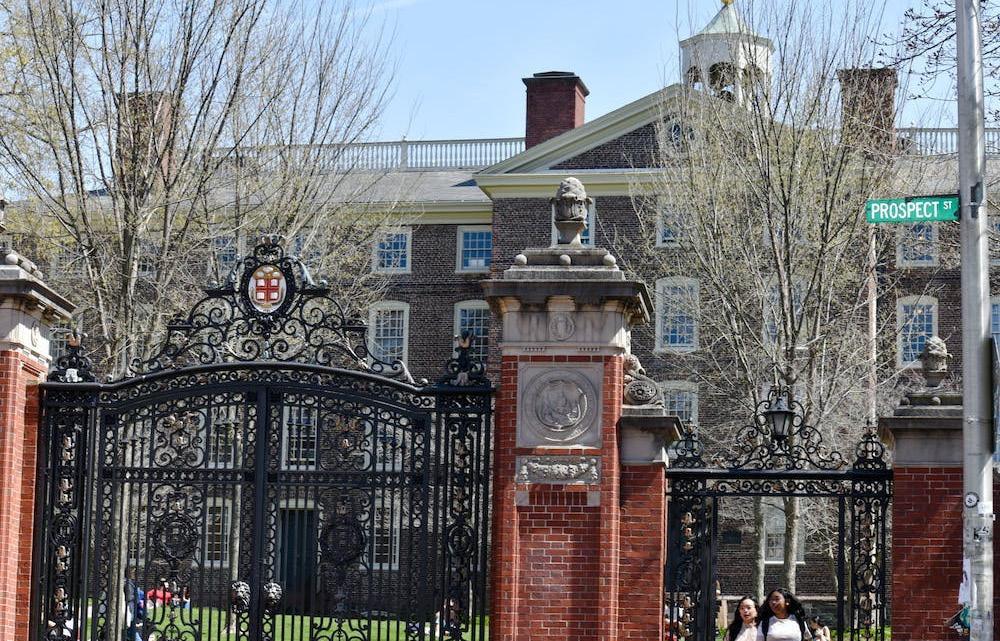
The University currently considers legacy status in admission practices, giving special consideration for applicants who are children of one or more alumni of Brown’s undergraduate program.
STAFF
Wage increase decision stems from bargaining sessions with TALO this summer
DANA RICHIE / HERALD
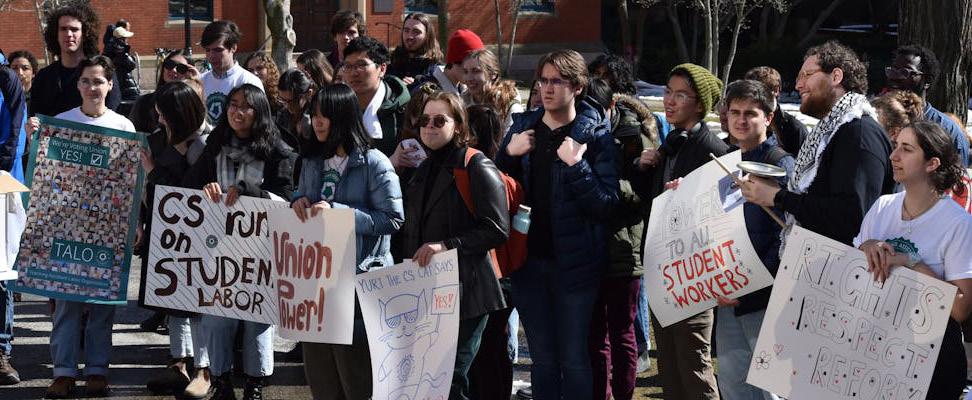
The University’s minimum wage was previously tied to the Rhode Island statewide minimum wage, which increased from $12 to $13 per hour in January.
ADMISSIONS
Brown community condemns end of affirmative action
Student organizations call for student input in formulating new admissions practices
BY OWEN DAHLKAMP SENIOR STAFF WRITERFollowing the June 29 Supreme Court ruling outlawing race-conscious college admissions, student organizations at Brown were swift to denounce the decision — and called for the University’s Office of College Admission to solicit student input during this process.
In one response, the University’s Black Student Union issued a statement in conjunction with their seven Ivy League counterparts that “jointly condemn(ed) the Supreme Court’s gutting of race-conscious affirmative action.”
The eight organizations also called on their respective universities to “act,” “be transparent” and include “student input” as they seek to maintain a diverse student body.
Jada Wooten ’24, co-president of BSU, was approached by the Black Student Alliance at Yale with the idea of drafting a joint statement in response
ADMISSIONS
to the decision, she wrote in an email to The Herald.
“We thought our voice would be stronger as a collective,” Wooten wrote. “Plus we know this collaboration will be the start of a stronger coalition amongst Black student organizations.”
Other groups have also released statements criticizing the decision and calling for University action.
The Brown College Democrats rebuked the Court, writing in a statement that “overturning affirmative
action will prevent millions from achieving economic and social mobility and threatens the future of our campus.” The organization linked the decision to other recent decisions, such as the 2022 decision that overturned the right to abortion and the June decision that allowed businesses to reject commissions from LGBTQ+ people and others on religious and moral grounds.
“The Brown College Democrats will continue to hold the Brown University Admissions Office account-
able,” the statement continued.
La Alianza, an undergraduate Latinx pre-law association, cited its members’ personal stake in affirmative action in a statement. “In a political system that relies on the exploitation of people of color — many within the Latinx community — affirmative action has provided a beacon of hope for the fulfillment of equal opportunity in education” the statement reads.
Many of the group’s members, the statement says, have found a “renewed sense of determination” to enter the legal field to build “a more equitable future within the legal system.”
The South Asian Students’ Association expressed its disappointment that “Asian Americans have been used as a scapegoat to uphold institutional discrimination.”
The organization further rejected the notion that the ruling widely benefits all Asian applicants, noting “the importance of uplifting Black, Latinx and Indigenous voices.”
Students for Educational Equity, an advocacy organization that has been a prominent critic of the University’s test-conscious and legacy admissions practices, issued a response via Ins-
tagram pairing this decision with its past activism.
The group promised to “educate prospective students on how to self-identify throughout the college admissions process” and reaffirmed its commitment to making test-optional admissions permanent and ending legacy consideration in admissions decisions.
In a letter sent to the Brown community on the day of the decision, President Christina Paxson P’19 P’MD’20 provided a general overview of the path ahead, including an institutional review of the decision to determine how to admit diverse classes of incoming students while adhering to the ruling.
In an email to The Herald, Powell affirmed that meetings among University leaders have been ongoing since the decision.
In an email to high school college counselors in the Office of Admission’s database, Powell shared Paxson’s statement and noted that the University remains “unwavering and steadfast in our belief that a student body representing deep intellectual ability and broad diversity of background is essential to achieving our educational mission.”
Wealthy applicants are more likely to attend Brown. Researchers measured their advantage.
BY NEIL MEHTA UNIVERSITY NEWS EDITORAn applicant to Brown with parents in the top 0.1% of earners are over 2.7 times more likely to attend Brown than one from the bottom 20%, according to data from a July study by economists from Brown and Harvard.
The researchers from Opportunity Insights — including Professor of Economics and International and Public Affairs John Friedman and Harvard economists Raj Chetty and David Deming — estimated the advantage that students from wealthy families receive in the admission process. They found that among all “Ivy-plus” schools — the eight Ivy League schools, along with Stanford University, the Massachusetts Institute of Technology, Duke University and the University of Chicago — students from the top 0.1% are over twice as likely as the average applicant to be admitted, after adjusting for test scores.
The study relies on data from tax records and federal records of college students from 1999 to 2015, as well as standardized testing data from 2001 to 2015. At least three Ivy-plus schools, which remained anonymous in the study, additionally shared complete access to their admissions assessments.
Though the researchers didn’t estimate admissions rates for specific schools by income, they calculated how likely a student was to attend a school if they applied. Students who were admitted to a given institution but didn’t attend were not counted. They calculated that measure
— adjusted for test scores — for students from different income brackets.
At Brown, differences by income are vast.
According to the data, applicants to Brown from the top 0.1% are far more likely to attend than applicants from any other income bracket. Controlling for test scores, applicants between the 20th and
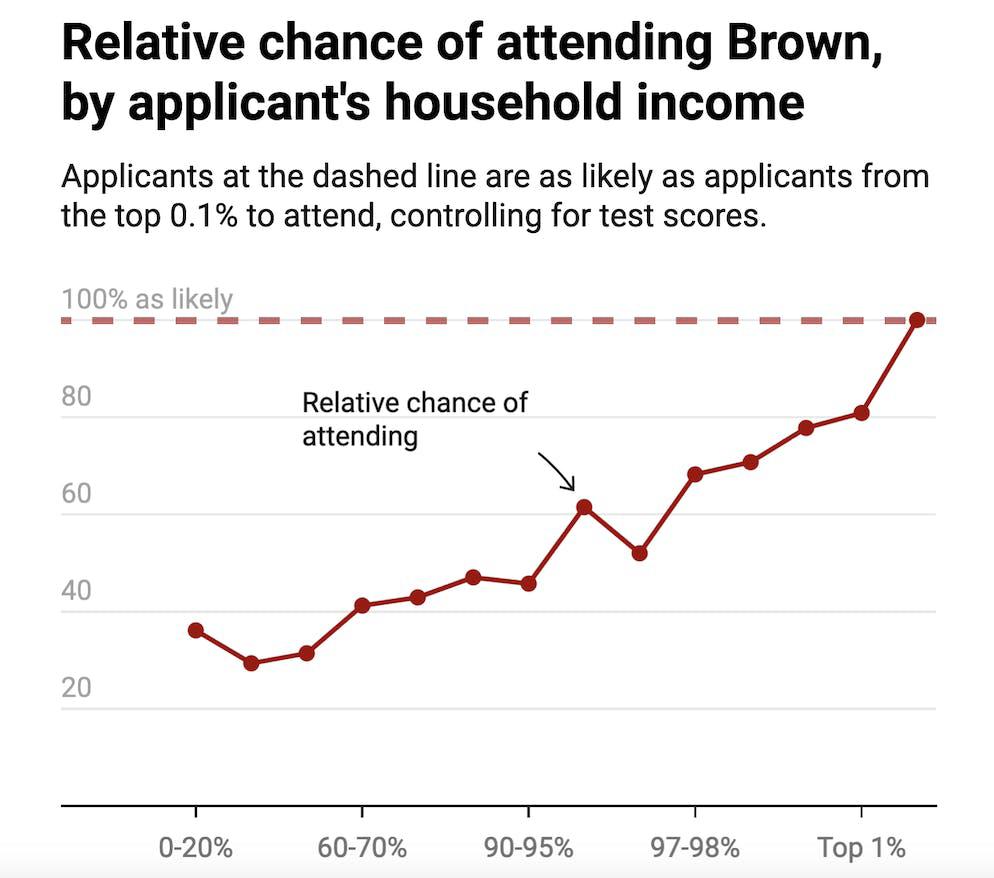
40th percentile for income are 29% times as likely as those from the top 0.1% to attend.
The research has two key takeaways, Friedman wrote in an email to The Herald.
First, the decisions that colleges make in shaping the admissions process — preferential treatment for legacy students, athletic recruitment and other, non-ac-
ademic considerations — are the “largest factor driving the overrepresentation of high income students,” he wrote.
Second, because Ivy-plus graduates disproportionately occupy leadership positions in the country, colleges’ admission decisions impact the composition of America’s leaders.
Friedman and his Harvard colleagues
built on research published in 2020 that found students from low-income families have “excellent long-term outcomes after attending selective schools, but that there are very few low-income students at these schools.”
Niyanta Nepal ’25, co-president of Students for Educational Equity, wrote in an email to The Herald the group was “in no way surprised by these findings,” adding that concerns about socioeconomic inequality in education “have been backing our campaigns from the beginning.”
Responding to the research, Nepal called for an end to legacy admissions — which allows college admission officers to consider whether an applicant’s family members attended the University. SEE has criticized legacy admissions and test-optional practices, arguing that the policies adversely affect campus diversity, The Herald previously reported.
For the University to continue practicing legacy admissions “would be a clear indicator that they have no intention to remaining equitable, but rather the financial gain is their driving factor,” she wrote.
Associate Provost for Enrollment Logan Powell wrote in an email to The Herald that the University has “made transformative commitments to financial aid in recent years, including the Brown Promise, need-blind admission for student veterans as well as needblind consideration for all international applicants starting with the Class of 2029.”
The University’s admission office “does not have access to applicant family income data at any point during the selection process,” he added.
PAGE 5 UNIVERSITY NEWS THE BROWN DAILY HERALD
TRACY PAN / HERALD
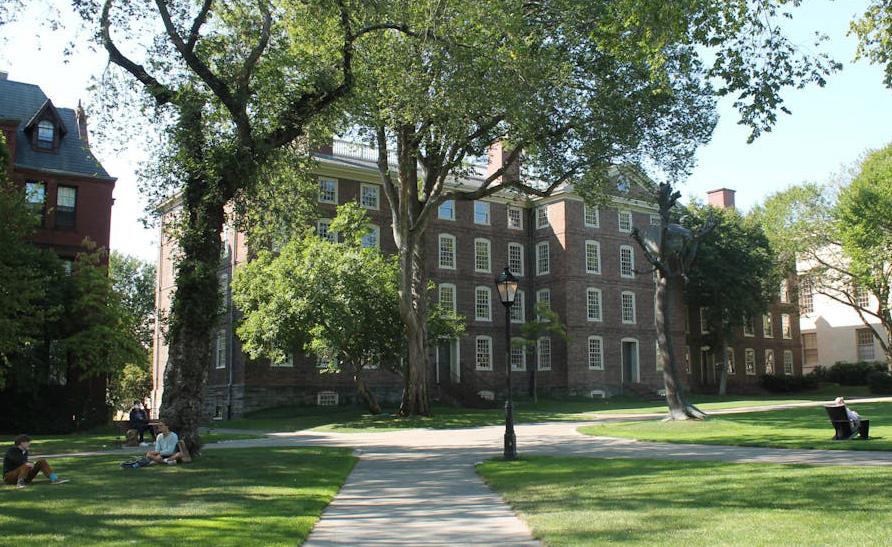
The Black Student Union issued a statement in conjunction with their seven Ivy League counterparts that “condemn(ed)” the Supreme Court ruling.
New study investigates effect of college admissions decisions on economic mobility
NEIL MEHTA / HERALD
This chart displays attendance data, not admission data. Students admitted to Brown may choose to not attend.
Exploring community, how enrollment has changed over time in Asian language courses at Brown
Students find friendship, meaning, connection to identity in language courses
RYAN DOHERTY SENIOR STAFF WRITERManav Musunuru ’26 remembers wanting to learn Hindi and Urdu since he was a child, inspired by visits to family in India. But after enrolling in HNDI 0200: “Beginning Hindi or Urdu” this year, he has gained more than just navigation and conversation skills: a new group of friends.
“There aren’t a lot of classes in which the entire class is friends with each other,” he said. “But in Hindi, it has been like that.”
This culture has been beneficial to his success in the course, he explained: It makes him “feel more open to being wrong or learning things.”
To better understand the University’s classes teaching languages natively spoken in Asian countries, The Herald analyzed enrollment data retrieved from Courses@Brown and spoke with current students and faculty.
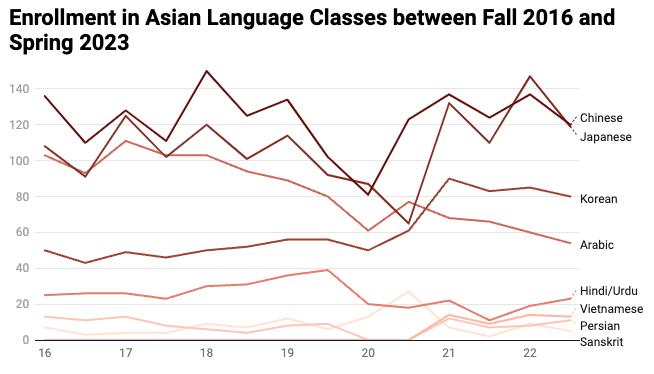
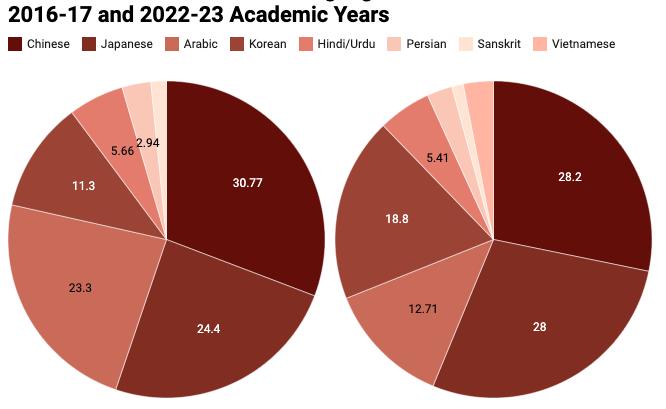
The University currently offers eight courses for languages commonly spoken and read in Asian countries: Chinese, Japanese, Korean, Arabic, Vietnamese, Persian, Sanskrit and Hindi and Urdu, the latter two of which which are taught together. These are offered through various departments, including the Department of East Asian Studies, the Department of Classics and the Center for Language Studies.
The CLS looks to “support the teaching and learning of all languages on campus,” wrote Jane Sokolosky, director of the CLS, in an email to The Herald. The CLS houses Persian, Arabic and Hindi-Urdu among other languages.
Language classes are often structured differently than other courses at the University, Sokolosky wrote. “Our language classes at Brown are immersion classes,” she wrote. “Being in class for 4-5 times a week and doing daily homework exposes students to a lot of the language and students learn quickly” — preparing students to spend time in another country for an internship or to study abroad.
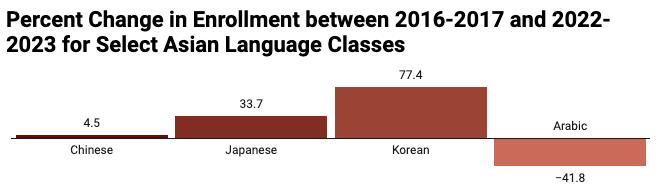
Since 2016, enrollment in these courses has fluctuated. Between the 2016-17 and 2022-23 academic years, enrollment in Japanese and Korean language courses has increased by 33.7% and 77.4% respectively, according to Courses@Brown enrollment data. On the other hand, enrollment in Arabic language courses has dropped by 41.8%. Chinese language courses saw a 4.5% increase in enrollment.
Increasing interest and external factors
This rise in interest in the Korean and Japanese languages comes as South Korea and Japan have increasingly played a predominant role in global popular culture. The rise in Korean language enrollment has been partially fueled by non-heritage learners, The Herald previously reported.
Heeyeong Jung, lecturer in East Asian studies who co-taught KREA
0200: “Korean” this semester, has noticed this increasing interest in the Korean language. She offered various reasons behind the increase in enrollment, including “the widespread appeal of K-pop and K-dramas” and the “allure of economic prospects and educational exchange opportunities in Korea.”
Jung noted that the University’s Korean Language Program has found that primary motivations for enrollment are interest in the Korean language and study abroad opportunities. Students also have cited interest in “contemporary popular Korean culture,” she added.
“Many students start learning Japanese out of their own interest in anime and other types of Japanese popular culture,” wrote Atsuko Suga Borgmann, senior lecturer in East Asian Studies who co-taught JAPN 0200: “Basic Japanese” this semester, in an email to The Herald. However, over the course of the semester, they become more interested in other aspects of Japanese culture, literature and history, he noted.
Virtual learning during COVID-19 and the trimester system employed by the University during the 2020-21 academic year also influenced enrollment in language courses, as a number of departments offered both courses in their introductory sequences that spring.
Language classes are often “filled with students having conversations in the language they are learning,” Sokolosky explained. The shift to online platforms “limited this spontaneous interaction” despite the success some professors had using various technologies.
Mixed motivations and the open curriculum
Students often have varying motivations for enrolling in language courses.
For some, including Jinho Lee ’26, language classes have been an oppor-
tunity to reconnect with their heritage.
“I was born in Korea, and Korean was my first language,” he wrote in a message to The Herald. But after moving to America at a young age, he “lost the ability to completely speak it.”
“Taking the intro classes here has really helped me in stepping back into the language as a whole without fear of judgment,” he added.
Others highlighted the accessibility and rigor of the courses offered. Benjamín Córdova Herrera ’26 — who takes Japanese and is looking to pursue an independent concentration in translation and interpretation studies — believes that the small class structure and daily meetings support his learning.
“Having class every day has been hard to keep up with but it allows you to learn so much more content than
you normally would otherwise,” he wrote, adding that this structure helps “maintain fluency.”
“My favorite part of learning languages at Brown has been that everyone in the class is there out of genuine intellectual curiosity,” wrote Zoey Katzive ’24 in a message to The Herald, who has taken Hindi/Urdu. As students interested in the subject gravitate towards the class, there is “a community of students who want to learn and help one another learn, which has been gratifying both academically and socially.”
She added that it has “been nice to join a community of other South Asian students through taking Hindi/Urdu.”
During the Spring 2023 semester, 23 students were enrolled in all Hindi/ Urdu courses at Brown.
The lack of a language requirement with the Open Curriculum often supports class engagement, Borgmann wrote. “Students at Brown choose to be in language classes out of sheer interest rather than trying to fulfill mandatory degree requirements,” wrote Borgmann. “They are present because they are genuinely interested in learning a language.”
“In the context of the Open Curriculum, I think everyone should take languages,” said Musunuru. “It is a way to explore different cultures (and) fields of study.”
“Learning a new language opens up one’s perspective of the world,” wrote Borgmann. “If learning Japanese can make even a small difference in (students’) futures, that would make me extremely happy.”
PAGE 6 THURSDAY, SEPTEMBER 7, 2023
AAPI HERITAGE MONTH
CHART: RYAN DOHERTY, SOURCE: COURSES @ BROWN
Eight movies that explore different facets of Asian American, Pacific Islander identity, experience

Films include character-driven stories, action movies, comedies
INDIGO MUDBHARY SENIOR STAFF WRITERThough Asian Americans are the fastest-growing racial or ethnic group in the U.S., pop culture representation has often been slow to catch up. But this is changing in the world of popular media: Movies, while not able to capture the full diversity and breadth of experience of Asian Americans, offer an increasing range of perspectives.
‘Columbus’
If you’re looking for a film that favors vibes and aesthetics over plot, this may be the one for you. The film follows Jin Lee (John Cho), a literary translator who arrives in Columbus, Indiana from South Korea after his father unexpectedly falls into a coma. In Columbus, he meets Casey (Haley Lu Richardson), a library worker who has given up her dreams of pursuing architecture in order to take care of her mother, who is recovering from a drug addiction. The two strike up an unexpected friendship, sharing their innermost secrets with each other despite having just met.
The film’s strength is its visual composition, filled with stunning shots of the modernist architecture of Columbus. Cho and Richardson’s performances are also remarkable, as they take on the challenging task of portraying intimacy between two people who just met. It’s a film that subverts our expectations, as it’s not a romance but instead two strangers who simply like to talk and look at buildings.
Available on Kanopy and Showtime.
‘The Namesake’
Based on Jhumpa Lahiri’s 2003 novel of the same name, “The Namesake” explores migration, family and the ABCD — American-Born Confused Desi — experience. The movie focuses on Ashoke (Irrfan Khan) and Ashima (Tabu) and their American-born children Gogol (Kal Penn) and Sonia (Sahira Nair). Over the course of decades, the family navigates cultural differences and the process of creating a community away from home.
The movie, which primarily focuses on Gogol, offers a nuanced look at the first-generation experience and the difficult task of juggling two cultures at once. It can be profoundly relatable for Desis — Gogol’s struggle to explain his culture to his partner is a common struggle for many of us. With incredible performances from the entire cast, it’s a tear-jerking story of the beauty of everyday life.
Available on Starz.
‘Bitter Melon’
Set in San Francisco, “Bitter Melon” tells the story of a dysfunctional Filipino American family’s Christmas reunion. The movie focuses on Declan (Jon Norman Schneider), a closeted gay man, returning to his family for the first time in many years. During his visit, Declan learns that his brother, Troy (Patrick Epino), who lives at home with
their parents, is abusive towards his wife and his mother. When Declan sees this behavior, he wonders: “Why don’t we kill Troy?” So begins the story of his collaboration with his other brother Moe (Brian Rivera) to figure out how to put an end to the abuse.
The film is shot in San Francisco’s Excelsior District, a neighborhood that isn’t often in the spotlight in films about San Francisco. The movie captures the beauty of the often-overlooked areas of the city and the communities there. Though it carefully explores themes of generational trauma and ending cycles of violence, it still retains a sense of dark humor, making its audience laugh even at the most uncomfortable moments. Full of unexpected twists and turns, it’s also sensitive and well-written.
Available on Prime Video, Tubi and Crackle
‘Finding ‘Ohana’
Decidedly one of the more comedic films on this list, “Finding ‘Ohana” is a
Filled with one-liners and all sorts of wacky hijinks, the movie is a feelgood film about the importance of family and appreciating your roots. Available on Netflix.
‘Minari’
Perhaps one of the more famous films on this list due to its Academy Award nominations, “Minari” tells the story of a Korean American family that moves to a farm in Arkansas. The movie explores familial tensions, as the father’s (Steven Yeun) entrepreneurial ambitions clash with other family members’ desire for community and financial security. Filled with unexpected friendships and unforgettable moments, it’s touching, funny and a visual masterpiece that captures the natural beauty of rural America.
Every actor in this movie delivers a standout performance — from the eccentric, swearing grandmother (YuhJung Youn) to the two children trying to fit in at their new school (Kate Cho and Alan Kim). Though
From exploring how the Asian American vote could impact battleground states to rethinking ways to reach groups that are less motivated to vote, the film provides a meaningful commentary on democracy through the individual stories of four voters.
The film thrives because of its commitment to exposing a breadth of perspectives —a Trump supporter in Ohio gets just as much screen time as a progressive University of North Carolina professor. Through this diversity of viewpoints, the film is able to capture the variety of the Asian American experience and provides insight into Asian American political engagement.
Available on PBS.
‘The Donut King’
Another documentary, “The Donut King” is a suspenseful tale about what was, for a period of time, one of the most successful donut chains in the country. Founded by Cambodian refugee Ted Ngoy, Christy’s Doughnuts was a rapidly expanding empire, so much
ement of suspense throughout its telling. As you learn about the rapid success of Christy’s Doughnuts, you wonder how things could have gone south — and have to keep watching to find out.
Available on Amazon Prime, Apple TV and Hulu.
‘Mississippi Masala’
This movie begins by providing a glimpse into a lesser-known history: the expulsion of Ugandan Indians from Uganda. The film follows a Ugandan Indian family — Jay (Roshan Seth), his wife Kinnu (Sharmila Tagore) and their daughter Mina (Sarita Choudhury) — as they are forced to relocate and end up settling in Greenwood, Mississippi. Mina eventually falls in love with Demetrius Williams (Denzel Washington), a carpet cleaner from Greenwood. Mina’s family refuses to accept Demetrius because he is Black, forcing the couple to make difficult decisions. Though very much a love story, this film defies genre classification. In additween Mina and Demetrius, it provides insight into how Asian Americans can struggle to fit into the racial binary in the U.S., as well as the classism and anti-Blackness that can manifest in Desi communities. While a story about the power of love, the film is painful and realistic in its depiction of what it’s like to love someone when your
Available on Amazon
PAGE 7 THE BROWN DAILY HERALD
SPECIAL ISSUE
COURTESY OF NETFLIX / TUDUM
Decidedly one of the more comedic films on this list, “Finding ‘Ohana” is a film about two siblings, Pili (Kea Peahu) and E (Alex Aiono), and their summer in rural
Oahu with their grandfather.
Malherbe ’26: You actually don’t need to defend Harry Styles from the queer community
The meteoric rise of Harry Styles has been impossible to ignore. Once just another face in the long line of boy-band heartthrobs, Styles has since grown into an artist whose very name is associated with the subversion of male gender stereotypes. He has been lauded as a fashion icon and even a queer icon. And this is where things get a little messy. See, Styles has made it consistently clear that he will not publicly label his sexuality on the grounds that it should bear no relevance to the public’s consumption of his music. But many in the queer community take issue with this ambiguity, and such critiques have more value than many give them credit for.
The term queerbaiting refers to a media trope in which two characters are hinted at being in a queer relationship, only for the relationship to never be confirmed. The main purpose of this trope is to attract a large queer (or queer-supporting) audience invested in a possible gay relationship without simultaneously alienating homophobic audiences (or studio execs) by including explicitly queer characters. In effect, it’s a way to exploitatively cash in on the queer community without actually representing or supporting it in any way.
So how does this relate to Harry Styles? Well, Styles’s usage of queer aesthetics in his public appearances — magazine covers, concerts and red carpets — has been accused of being motivated by the same exploitative intent. Though Styles has seemingly only ever dated women, and normally sings about his love life with women, the combination of his gender-fluid costuming and refusal to identify his sexuality allows fans to conclude that he’s secretly queer. However, his lack of support for the community beyond wearing a skirt or waving a Pride flag means that all but his most homophobic fans can still find him at least tolerable. The result is that Styles re -
mains more popular and palatable than any publicly queer musician can be. With this popularity, Styles has opportunities that could’ve been offered to queer people, like playing a gay man in a film or being the first man in a dress to make Vogue’s cover. The ability of Styles’ persona to both not explicitly inflame homophobes while drawing queer fans and inspiring endless gay fanfiction has done wonders for him. Meanwhile, he does little for the queer community. As a Business Insider article showed, his LGBTQ+ activism has mainly
at not Styles, but his queer critics. They argue that these critics are actually being homophobic toward Styles. This argument has been fueled by recent stories like that of actor Kit Connor of “Heartstopper” fame, who publicly came out as bi in a way he described as “forced” due to pressure from fans who questioned whether he was yet another straight actor playing a gay character. This example has been used by Styles’ defenders to dismiss any criticism of him as pressuring him to come out. But while being pressured to come out is awful,
in the community’s experience; it will be achieved by platforming queer issues like the current political threats to trans life in this country, which does not happen when NBC News’ go-to celeb when discussing “gender-fluid fashion” is the apolitical Harry Styles.
No matter his sexuality, Styles owes much of his success to his proximity to straightness. If he really is straight, then his vagueness about his sexuality feels particularly exploitative. If he is queer, it does not change the fact that he has, in many ways, left the community behind. No doors have been opened for our community. No queer singers, actors or artists have been able to rise up in the industry thanks to his impact. In fact, he has more so laid the groundwork for straight celebrities to follow his lead in exploiting the queer community to gain fans and attention. But, perhaps most importantly, even if Styles is actually queer and should be considered a true trailblazer and ally, it still does not make the queer people that feel and argue otherwise wrong for doing so.
consisted of him confirming he isn’t explicitly homophobic and one charity sale in 2018. And yet, he is a … queer icon? You can see how it might be frustrating to the actual queer community to watch a man who could very well be straight getting so much of the credit for breaking boundaries and representing the community when actual queer people in media are sidelined. No wonder there’s backlash from queer people against this presumably straight man who has feather-boa-ed his way into iconhood.
And yet, there are many who are mad
that scenario shouldn’t be used to invalidate nuanced critiques from queer people about the appropriation of their aesthetics.
Take the author of “Simon vs. the Homo Sapiens Agenda,” Becky Albertalli, for example. She also got press attention for being “forced” to come out in 2020 after facing backlash for the queer love story she wrote perpetuating homophobic stereotypes and pandering to straight audiences. Well, those critiques were valid, and they still are even if she came out as queer! Queer liberation is not going to be achieved by validating every person
So no, you actually don’t need to defend Harry Styles against the queer community. And no, his lack of meaningful action as an ally while appropriating queer aesthetics would not be made better or okay if he suddenly told us all he’s bi. And, yes, maybe, just maybe, queer people are allowed to critique other people’s actions for being harmful to the community, even if they end up being queer too.
Paulie Malherbe ’26 can be reached at paulie_malherbe@brown.edu. Please send responses to this opinion to letters@ browndailyherald.com and other op-eds to opinions@browndailyherald.com.
Aizenberg ’26: We should all donate at least 10% of our income to charity
The philosopher Peter Singer outlined a moral thought experiment in 1972: If you saw a child drowning in a pond, you would jump in to save them. No second thoughts, no concern for ruining your fancy clothes (or, nowadays, your phone). This scenario may seem unlikely to occur in real life, but as Singer argues, we actually encounter it daily. Implicitly, we constantly choose between spending money on material, often unnecessary things (like fancy clothing) or donating it to save people — especially children — from dying of preventable causes. They may not be drowning right in front of us, but the result is the exact same, and we have a duty to pull them out of the water. To face that moral obligation, we all should give at least 10% of our income to life-saving charities instead of spending nearly all of it on ourselves.
While Americans, who earn more than residents of nearly any other country, are somewhat charitable, we can afford to give much more. The average American only donates 2-3% of their income when a median middle class household income in the U.S. ($90,131 annually in 2020) is greater than what nearly 96% of four-person households and over 99% of people on Earth earn. Furthermore, many Brown graduates have an additional safety net in the form of a financially secure family background. Plus, an American house -
hold’s surplus money is rarely used for true necessities — the average household spends significant portions of its income on entertainment and travel. Given this financial cushion, Brown graduates — especially those who opt for high-paying careers — have the full capability to give.
dren from dying of Vitamin A deficiency, which leaves children vulnerable to infections. If you kept this up over the course of a 40-year career — during which your salary would surely increase — consistent donations could save more than 80 lives. To put this into perspective, the av -
nation is certainly a more passive activity than many kinds of volunteerism, but the fact is that even people who take on corporate roles can easily and meaningfully better the world.
Donating a sizable portion of one’s income is an ancient idea, but recently it has been popularized in part by philosopher Toby Ord, who has been donating 10% of his income to charity for the last 11 years. His writing and foundation have inspired thousands to pledge to donate at least 10% of their income as well. As Ord’s example shows, our own donations, especially when given publicly, can galvanize others to give, creating a domino effect of donations and saving even more lives.
The rationale behind donating consistently only becomes more compelling when we observe the good that money can do when donated consistently over time. Say you’re a Brown graduate starting out as a consultant at McKinsey & Company with a minimum base pay of around $90,000. A donation of 10% of your annual income is enough money to save two chil -
erage doctor in the United Kingdom will — using a generous approximation — save roughly a cumulative 90 lives in their entire career. Even if your chosen career is not specifically oriented towards service or helping others, you can still do a significant amount of public good — maybe even an amount comparable to a more traditionally altruistic career. Making a do -
Curing cancer or laboring long hours to feed the hungry are not the only ways to make a tangible difference in this world. In fact, simply by working a decent-paying job, you have more than enough at your disposal to help others on a surprisingly large scale. It’s a no-brainer: By donating a relatively small proportion of income, you can save many lives while also bettering your own.
Benjamin Aizenberg ’26 can be reached at benjamin_aizenberg@brown.edu. Please send responses to this opinion to letters@browndailyherald.com and other op-eds to opinions@browndailyherald. com.
PAGE 8 COMMENTARY THURSDAY, SEPTEMBER 7, 2023
“
Queer people are allowed to critique other people’s actions for being harmful to the community, even if they end up being queer too.
Curing cancer or laboring long hours to feed the hungry are not the only ways to make a tangible difference in this world.
“
Up Home: One Girl’s Journey

a conversation with
Ruth J. Simmons President Emerita, Brown University
With a welcome by President Christina H. Paxson
Thursday, September 7, 2023
5 p.m.
Pizzitola Sports Center
Tickets are required.
PAGE 9 THE BROWN DAILY HERALD
Celebrating queer voices, stories and triumphs
In 1973, The Herald published an article titled “Gay Liberation Comes of Age,” announcing the Brown University Gay Liberation club’s plans to organize and expand over the coming year, despite the challenges of existing on what was then an institutionally intolerant campus.
At its first meeting of the semester, BUGL drew 25 students — what one group leader estimated was just a fraction of the queer population on campus.
Fifty years later, Brown’s queer community has continued to thrive.
The LGBTQ Center — Stonewall House — recently moved to a newly renovated building on Benevolent Street. In the fall and spring, students
came together to host queer pickup soccer games. And even Spring Weekend had a distinctively rainbow flair this year, with artists such as Alice Longyu Gao, Doechii, Ethel Cain, 070 Shake and Remi Wolf bringing much-appreciated queer representation to the Main Green stage.
With this Pride 2023 Special Issue, The Herald aims to highlight queer experiences on Brown’s campus. You can read about how student artists are finding self-understanding through the production of queer art, or discover how LGBTQ+ self-identification has evolved among Brown students since 2010.

This special issue also looks beyond College Hill as laws targeting
UNDERGRADUATE STUDENT LIFE
transgender communities proliferate across the country and states and school districts place bans on books featuring queer people and stories — while simultaneously highlighting media that focuses on joyous and authentic queer narratives.
We hope this special issue leaves readers with a deeper understanding of the role LGBTQ+ folks play in making Brown the vibrant campus we all call home. And as The Herald continues efforts to diversify its coverage to more consistently and holistically represent our school’s community, this special issue tells stories that are not just important during one month, but ones we aim to center year-round.
Staff who made this issue possible:
Editorial Board
Alex Nadirashvili, Managing Editor
Will Kubzansky, Editor-in-Chief
Katy Pickens, Managing Editor
Caleb Lazar, Senior Editor
Augustus Bayard, Senior Editor
Multimedia Staff
Ty Pham-Swann, Web Design

Rhea Rasquinha, Illustrations
Kaiolena Tacazon, Illustrations
Stella Tsogtjargal, Cover Illustration
Liana Haigis, Photography
Editors
Sofia Barnett, University News
Neil Mehta, University News
Kathy Wang, University News
Rhea Rasquinha, Metro
Senior Staff Writers
Ryan Doherty, University News
Indigo Mudbhary, University News
Sahil Balani, Arts & Culture
Columnists
Paulie Malherbe ’26
Editors’ notes are written by The Herald’s 133rd Editorial Board: Will Kubzansky ’24, Katy Pickens ’24, Alex Nadirashvili ’24, Augustus Bayard ’24, Caleb Lazar ’24, Peter Swope ’24 and Kaitlyn Torres ’24.
LGBTQ+ student self-identification has doubled at Brown since 2010
that they were not straight. That number has more than doubled since.
Jacob Gelman ’25 noticed “a rise in openly identifying queer individuals.”
BY SOFIA BARNETT & RYAN DOHERTY UNIVERSITY NEWS EDITOR & SENIOR STAFF WRITERThe Herald’s Spring 2023 poll found that 38% of students do not identify as straight — over five times the national rate. Over the past decade, LGBTQ+ identification has increased across the nation, with especially sharp growth at Brown.
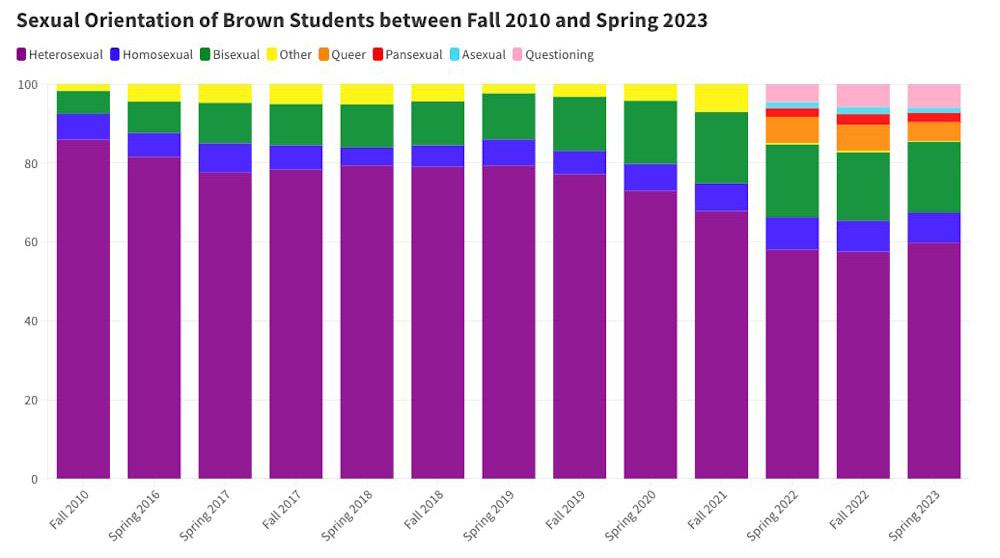
This Pride Month, The Herald reviewed data from its semesterly polls and spoke with current students to investigate how the LGBTQ+ community on campus has evolved over time.
The Herald first surveyed sexual orientation in its Fall 2010 poll, in which around 14% of respondents answered
Brown’s queer community is much greater than the national average among adults. Gallup polls from 2022 found that only 7.2% of adults — and 19.7% of those aged 18 to 25 — identified as LGBTQ+.
For Josephine Kovecses ’25, the difference between national LGBTQ+ demographics and Brown LGBTQ+ demographics is not a challenging puzzle to solve.
“Queer people haven’t been able to be open in their identifications for that long,” Kovecses said. “So it’s exciting that the numbers are growing and that queer people are able to be open in particular at Brown.”
Since Fall 2010, Brown’s LGBTQ+ population has expanded considerably.
The gay or lesbian population has in-
creased by 26% and the percentage of students identifying as bisexual has increased by 232%. Students identifying as other sexual orientations within the LGBTQ+ community have increased by 793%.
Since 2010, the range of LGBTQ+ identifications students are able to self-report on the Herald’s semesterly poll has expanded. In Spring 2022, The Herald expanded its options for describing sexual orientation to better represent the Brown community, including “Queer,” “Pansexual,” “Asexual” and “Questioning/Unsure” as options.
Notably, of those who self-identified as LGBTQ+, only 22.9% of students described themselves as gay or lesbian in the Herald Spring 2023 poll, down from 46% in Fall 2010. Bisexual was the most common answer among LGBTQ+ respondents with 53.7% of LGBTQ+ responses.
Students were also more likely to identify with a more diverse range of sexual orientations besides homosexual and bisexual in recent years.
The Herald did not poll about gender identity in detail until Spring 2022, offering little information about the proportion of non-cisgender students
on campus. Nonetheless, in Spring 2023, 3.1% of poll respondents identified as non-binary with an additional 1.8% identifying as genderqueer. A 2021 Williams Institute study found that in the United States about 1.2 million adults — or 0.46% — identified as non-binary.
Read the rest of the Brown Daily Herald’s
PAGE 10 PRIDE 2023 THURSDAY, SEPTEMBER 7, 2023
STELLA TSOGTJARGAL / HERALD
Pride Month Special
Issue online!
Current number of LGBTQ+ students stands at five times national rate
SOFIA BARNETT & RYAN DOHERTY / HERALD
EDITORS’
NOTE
& CULTURE
BY KATHY WANG UNIVERSITY NEWS EDITOR
Through the queer rights movement of the 20th and 21st century — and well before — art has played a pivotal role in self-expression, activism and community-building for queer people.
To celebrate Pride Month, The Herald spoke with three student artists about how queerness impacts their art and how, inversely, art allows them to understand their identities more clearly.
Karen Hu: Seeing feelings and possibilities through art
Karen Hu ’24, a computer science and visual art concentrator, has experimented with several artistic mediums in college: painting, sculpture, math and screen printing.
When they first arrived at Brown, Hu was dealing with a lot of “personal” emotions towards her “internalized anti-queerness,” and painting became a form of release and honesty. “I was really drawing inspiration from my own life and mostly my feelings,” they said.
Later on, Hu’s art also took inspiration from mathematical concepts both requiring “very rigid definitions” and representing “an infinity of different options.” They noted that even though a two-dimensional plane needs a formulaic grid system to represent shapes, “in that plane of stuff, you can make any line, any shape.”
“There’s an infinity of options to be made within that grid that we’ve imposed,” Hu said, noting that a similar dynamic exists even in binary programming of computers — an infinite number of choices to make differently.
“To me, that felt very queering of math,” Hu added.
Those ideas, in turn, influenced her sculpture: One work they created is a net made of mask strings dyed pink. “In some ways, the net is very rigid,” like a grid, they said. “But because it was made out of mask strings, you could stretch it any which way,
and it really is a malleable thing.”
Recently, Hu has tried to bring feelings and experiences of “queer joy” in their life into screen prints. “I really like the medium of screen print,” she said. “How you can create multiple and spread information or aesthetics, or just spread that feeling further than just one physical object.”

Art began as Hu’s “therapist” in high school, when it was their outlet for “teenage angst.” During Hu’s first art-making phase in college, art was still the release of “feelings and pain.”
“But when I started to think about all the possibilities … and what I wanted to say and spread in the world … now my (art) is really about joy and envisioning the world that we want to have,” Hu said.
She added that art allows them to “say things and understand things about myself that sometimes I don’t really understand until after looking at the piece.”
Going through feelings of a painful end to a long-term friendship where there existed “homoromantic tendencies,” Hu didn’t realize that they were “actually mourning the end of (that) friendship” until many prints they made were about “letting things go … (and) end.”
Much of Hu’s artwork is directly inspired by their queer friends, she said.
Hu recalled a queer comics class when they mentioned to Meta Covington ’25 that whenever asked about gender, they feel that “a ball on legs” is a more accurate answer than a specific gender. Covington later texted Hu a self-created emoji of a soccer ball on little legs on iMessage.
“And I was like, like this is kind of an amazing motif. And I really (ran) with it a little bit,” Hu said.
Hu noted that they wanted to incorporate “more of a community aspect” to their artwork.
“Part of my mission as a queer artist is to spread the gay agenda, and I say that seriously,” Hu said. “I think there is a lot of good that comes from seeing oneself represented in artwork, or being able to connect your life’s experiences to an artwork.”
Alaina Cherry: Painting as a
self-reflection of internal conflict
When cognitive neuroscience and visual art concentrator Alaina Cherry ’24 first started oil painting in the summer of 2020, she felt like she “finally found a medium that works for me and what I wanted to do.” That summer, she began to consider painting as something more than a hobby.
According to Cherry, a big part of her practice is color — “finding ways to use different colors to create a sense of realism.”
She added that her works focus on “intersections of identity,” striving to combat Eurocentric beauty standards and more broadly the ways in which racism and patriarchy impact Black and queer womanhood.
One example in her work is the use of magazine clippings in the background of her paintings to signal the looming influence of dominant culture.

“Usually, when I address Black queer womanhood in my art, it’s more self-reflective (and) introspective than a statement about black queer womanhood in general,” Cherry said. “It looks different for everyone.”
Cherry’s own experience and how she fits or doesn’t fit into a “white, heteronormative, patriarchal society” inspires her art. “I have always been really obsessed with portraits and faces,” she added.
“Learning about and reflecting on my identity as a woman and learning about ideologies of misogyny … have really opened my eyes to my identity as a queer person,” Cherry said. “I had to kind of jump over that hurdle (of internalized misogyny) before I even realize I could accept and give love and affection to someone the same gender as me.”
She noted that growing up “conditioned to be super boy-crazy,” she is constantly self-reflecting on “internal conflict” between her identity as a woman and a queer person, which are “so tied together.”
“In my paintings, it really is like a mix between” these two identities, Cherry said.
Completed right after a breakup with a boy, a piece where Cherry painted herself grabbing a fruit explores her queer identity, because she could “finally think about it.”
“I’m doing more and more things to express my queerness in my art, but I have to sell the things internally as I’m doing it.”
For Cherry, self-portraits force the artist to be “vulnerable” with themselves. As a person who is “reluctant to do journaling,” she would write to piece together her thoughts before doing a self-portrait, Cherry said. “I’ll be like, okay, how can I put these words into like a visual image?”
Cherry encourages everyone who is interested in making art to not be scared. She noted how much she loves the painting studio space: “It’s just so magical there,” she said. “I get so much inspiration and motivation to paint when I walk around and see all of my classmates’ and other students’ art pieces.”
Jo Ouyang: Art as a magical and transcendental experience
Growing up in Georgia, Jo Ouyang ’26 finds it unique to be from the American South, where there exists “a specific heritage and history for white Americans.”
“But, for me, as an Asian American living there, I’m contending a lot with what it means to be American,” they said. “And what it means to be in this land that has been settled and colonized, and to be an immigrant there.”
A dual-degree student concentrating in ethnic studies at Brown and painting at the Rhode Island School of Design, themes of Ouyang’s oil paintings focus on nature, their “relationship to land” and futuristic world-building for a “more radical, more equitable” planet.
They spend a lot of time in nature — trips with friends to beaches in Rhode Island, sitting on the creek in their backyard in Georgia — and draw “a lot of inspiration from the things that are already happening around” them, said Ouyang.
A passionate photographer who “takes photos all the time” in their “daily life,” Ouyang captures things that interest them to later recreate them in oil paintings or cyanotype.
“After painting them, I was like, what is the connection between all these things? And why am I interested in it?” Ouyang said.
Ouyang began oil painting in 8th grade, they said, adding that they paused working in the medium for a while before restarting in the past year. “I really enjoy using that medium (now),” said Ouyang.
Although Ouyang used to be drawn to figurative artists who explicitly convey queerness or Asian American identity in artworks, they are “straying away from that subject” now, they said, adding that artworks that expose the queer body may sometimes feel invasive.

“Now I’m kind of tackling queerness in a very different way where it is not explicit, but is definitely there in all of my paintings,” Ouyang said. “I’m so queer all the time that I think it’s definitely imbued into everything I do.”
Ouyang mentioned that coming into college, they took a step back from painting people, and specifically themselves, as they were “contending with (their) body and (their) gender and sexuality.”
But recently, they are returning to painting themselves — just never the head. “I didn’t feel like there ever was a need to paint my face,” Ouyang said.
For Ouyang, art is “magical and transcendental in that it’s like … expressing yourself and not even knowing you’re doing it.” They would start painting with a vision in their head — only knowing the reasons behind it until they push through “the ugly phases” of working and process its meaning.
“Art has really been helping me explore my own queerness and my own identity,” Ouyang said. “The people who have supported me the most in my art processes have been these chosen families I found in college.”
Ouyang added that moving forward, they hope to paint more in their own art style and deconstruct what they were taught in high school, on top of working through more photography and “archival photo processes” like cyanotypes.
“I’m interested in … contending (with) what it means to be from Georgia as a queer Asian American and what kind of queer and Asian communities that already exist here that I want to be more engaged with,” they said.
PAGE 11 SPECIAL ISSUE THE BROWN DAILY HERALD
‘Connect your life’s experiences to an artwork’: Student artists discuss art-making as exploration of queer identity
ARTSKaren Hu ’24, Alaina Cherry ’24, Jo Ouyang ’26 talk art, self-expression
ARTS & CULTURE
‘Bottoms’ makes its way to top
BY FINN KIRKPATRICK ARTS & CULTURE EDITORAs long as comedy exists, there will always be one perpetual setting: high school. With the perfect locale to tap into audiences’ collective highs and lows, traumas and embarrassments, the high school comedy will always have a place in people’s hearts. With her new film “Bottoms,” writer-director Emma Seligman has crafted a new addition to this time-honored canon of movies and makes it the best of its kind in recent years.
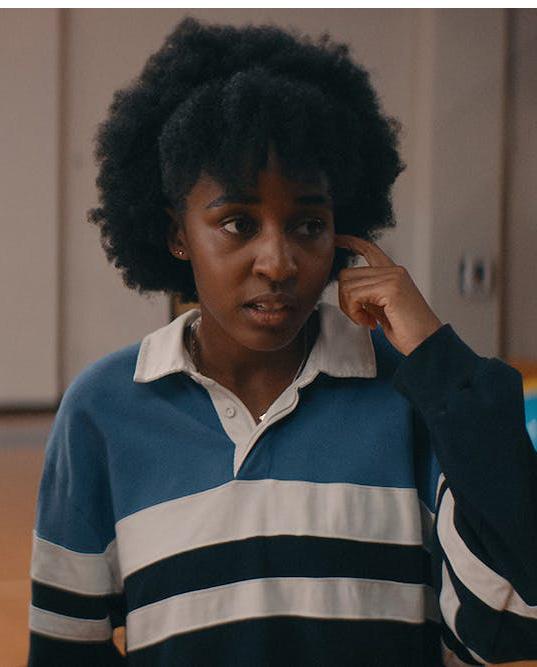
The high school setting of “Bottoms” is more akin to a feudal caste system than an actual institution of secondary education. The football team’s quarterback Jeff (Nicholas Galitzine) is the insecure, dimwitted but dashingly handsome king of the castle who has the whole school — teachers and all — heeding his every need. On the flip side are our lowly peasants, Josie (Ayo

Sennott), whose only recogni tion from the rest of the class is the homophobic slurs rou tinely painted on their lockers. To their dismay, they are both virgins, and they want nothing more than to change that. But they are both hyper-fixated on women well out of their reach. Josie likes Isabel (Havana Rose Liu), Jeff’s on-again, offagain girlfriend, and PJ likes Brittany (Kaia Gerber), Isabel’s best friend. Neither has any idea how they will woo their queens in the high towers of the keep.
The world of “Bottoms” is almost as if the school from “Euphoria” knew just how absurd it really was and chose to make fun of itself. The football players, no matter where they are, are never seen in anything other than their uniforms. History class, led by the seemingly apathetic teacher Mr. G (Marshawn Lynch), is a space for very little learning, a whole lot of pop culture-based humor and the fleshing out of the film’s heightened social dynamics. It’s an uncanny valley of a high school, and it’s in this so-close-yet-so-far from reality setting in which the film gets its humorously idiosyncratic tone. This is most true when the crux of the whole narrative comes into play. In order to gain attention from their crushes, Josie and PJ get their billion-dollar idea — to start a fight club. The all-female club, supervised by Mr. G, begins to form something of a frequent member base, even becoming popular enough for Isabel and Brittany to join. Josie and PJ find themselves creeping up toward the top of the food chain, threatening to tear down the social order the football players strive to maintain. Jeff’s right-hand man Tim
(Miles Fowler) begins
REVIEWS

Ichiko Aoba’s ‘meringue doll’
BY ISABEL HAHN SENIOR STAFF WRITER
A N T H 0 1 0 0 | M L E N N O N
I n t r o d u c t i o n t o C u l t u r a l A n t h r o p o l o g y
A R C H 2 6 3 5 | T F R A N C O N I A n E m p i r e w i t h o u t B o u n d s : T h e R o m a n E m p i r e i n I t s ‘ G l o b a l ’ C o n t e x t
C O S T / R E L S / S A S T 0 1 4 0 | F M O O R E - G E R E T Y F o o d , R e l i g i o n a n d P o l i t i c s i n S o u t h A s i a
C O S T / R E L S / S A S T 0 1 4 5 | F M O O R E - G E R E T Y
K a r m a , R e b i r t h a n d L i b e r a t i o n : L i f e a n d D e a t h i n S o u t h A s i a n R e l i g i o n s
C O S T / R E L S 0 5 6 0 | S R E D D Y
C o n t e m p l a t i o n a n d S o c i a l A c t i o n
R E L S 0 6 1 5 | S . B A S H I R
R u m i a n d F r i e n d s : T h e W o r l d o f S u f i P o e t r y
E C O N 2 5 1 0 | E M A C C H I
E c o n o m i c D e v e l o p m e n t I
H I A A 0 0 6 3 | H S H A F F E R F o o d a n d A r t i n t h e E a r l y M o d e r n W o r l d
H I S T 1 6 2 0 | V . Z A M I N D A R R e s i s t i n g E m p i r e : G a n d h i a n d t h e M a k i n g o f M o d e r n S o u t h A s i a
H I S T 1 9 5 4 K | Z A M I N D A R / A Z O U L A Y A n t i - c o l o n i a l T e m p o r a l i t i e s , G e o g r a p h i e s a n d A r t i s a n a l F o r m a t i o n s
snooping find dirt to
bring
This fun, silly narrative is backed up with irreverent humor that remains on point. With laughs stemming from off-handed comments about the works of bell hooks to a bloody massacre which — to hammer home the medieval metaphors — includes an actual broadsword, “Bottoms” finds its humor from wherever it can and somehow makes it all work. It’s edgy and provocative without being tasteless and derogatory.
“Bottoms” reaches an equilibrium in its presentation that is often unreached by other attempts at Gen-Z comedy. Its frequent absurdity is reigned in so that it does not detract from its narrative potential. The characters feel just real enough that they don’t become obnoxious caricatures of overused tropes. The humor is fresh and exciting while still feeling like a continuation of the great high school comedy tradition, with “Bottoms” holding its own against titans of the genre like “Clueless,” “Mean Girls,” “Superbad” and “21 Jump Street.” It marks that Edebiri and Sennott are comedic talents that are here to stay, and that Seligman is a creative force who will assuredly find new heights to reach.
For Ichiko Aoba, music remains a powerful way to breathe life into the ethereal. Whether she sings about the tiny petals of a flower or the edges of the infinite universe, Aoba’s ability to convey the abstract through whispering portraits of the natural world is perhaps her signature talent. The Japanese folk singer and songwriter continues to sew together similar sprawling scenes of warmth with the release of her newest single “meringue doll” Aug. 26.
In an Instagram post announcing the song’s release, Aoba stated that “meringue doll” was “recorded in one take, with support from the amazing members of Phonolite Strings,” a small string ensemble.
Aoba also credited artist Hiroaki Mizutani for the arrangement of the song. Translated English lyrics were provided on her YouTube channel.
Momentarily departing from the serene solo guitar instrumentals that she is traditionally known for, “meringue doll” employs melodies from the string ensemble to transport listeners into a new world dreamed up by Aoba. Beginning with a prominent descending string melody and transitioning to gentle pizzicatos cushioning Aoba’s singing, the strings mirror and seamlessly play off of the cadences of her voice through the song.
Though her choice to bring in more instrumentalists detracts from the vulnerable intimacy that saturates her acoustic works, the additional layers of “meringue doll” allow listeners to ride a stronger emotional wave, pulled back and forth by the swells of the strings’ overlapping crescendos.
Despite a notable shift in her musical backdrop, Aoba continues to lay a blanket of peace over her listeners with delicate and breathy vocals. Even with the added instruments accompanying her, Aoba makes an effort to push her own vocals to the forefront of the song, her voice becoming an enchanting entity floating above the lush bed of notes. This push also allows for the meaning behind her words to be more deeply felt.
Aoba touches upon her trademark themes of otherworldly beauty in the material world through her lyrics, using vivid descriptions of natural scenery to convey her strong feelings for a special someone in mind.
“In the depths of my memory / there is a blossoming airship / As the seasons sprout / I travel, swaying in the wind,” Aoba sings slowly in the song’s first verse. The lyrics both evoke an image of hope for a new emotional journey and perpetual loneliness, as she envisions what it would be like to travel the boundless skies alone.
“meringue doll” reveals a raw portrayal of Aoba’s yearning at the start of its chorus: “Surely one day / I’ll find my way home / So, just wait for me.” These lyrics are not only a confession but a promise, as Aoba vows to one day find a companion whom she can call home — the culmination of all her voyages. The chorus extends itself near the song’s end with the added final lines, visceral in their depiction of an affection whose beauty can be overwhelming and even all-consuming: “The wanting for you / envelops me like a meringue / and for it, a flower.”
With “meringue doll,” it seems as if Aoba is painting a closer portrait of longing and the contradictory nature of human connection, offering a bittersweet image embedded within a hazy dream brought to life. Curled up in her own wistful meringue shell, Aoba reminds us that love and the experiences of being human are just as awe-inspiring as the physical world that surrounds them.
SOUTH ASIAN STUDIES FALL

I
COURSES
H N D I 0 1 0 0 / 0 3 0 0 / 1 0 8 0 | A K O U L
B e g i n n i n g , i n t e r m e d i a t e & a d v a n c e d H i n d i o r U r d u
A P A 2 0 0 0 A | P H E L L E R T h e o r y a n d R e s e a r c h i n D e v e l o p m e n t
I A P A 0 2 0 0 | N C H O R E V F o u n d a t i o n s o f D e v e l o p m e n t
P O L S 2 3 3 0 | A V A R S H N E Y P o l i t i c s i n I n d i a
P O L S 1 8 2 4 S | G D I P O P P A
P o l i t i c s o f M i g r a t i o n
R E L S 0 1 0 0 | J P R O T A S S
B u d d h i s t T h o u g h t , P r a c t i c e , a n d S o c i e t y
S A N S 1 6 2 0 | D B U C H T A
I n W h i c h J a y a d e
PAGE 12
THURSDAY, SEPTEMBER 7, 2023
v a S i n g s o f K r i s h n a : T h e G ī t a g o v i n d a i t s r e c e p t i o n a n d i n f l u e n c e T A P S 1 2 3 0 | I . R A M O S G l o b a l T h e a t r e a n d P e r f o r m a n c e : P a l e o l i t h i c t o t h e T h r e s h o l d o f M o d e r n i t y S A N S 0 1 0 0 | D . B U C H T A E l e m e n t a r y S a n s k r i t I S A N S 0 3 0 0 | D . B U C H T A S a n s k r i t E p i c N a r r a t i v e
PRE-APPROVED
2023
‘meringue doll’ conveys feelings through sentimental metaphors
‘Virgo’ tackles themes of romance, trans identity
BROWNDAILYHERALD.COM READ IT ONLINE WEB EXCLUSIVE
‘Visitation’ explores messiness, discomfort of grief
REVIEWS
High school comedy finds success in absurdity, irreverence
University is expected to pay $4.5 million in voluntary payments to the city, the Boston Globe previously reported.
At a protest last April, the Brown Activist Coalition called upon Brown to pay $15 million annually to the city — a “meager amount compared to what they owe,” Niyanta Nepal ’25, co-president of Students for Educational Equity and rally organizer, told the crowd at the demonstration.
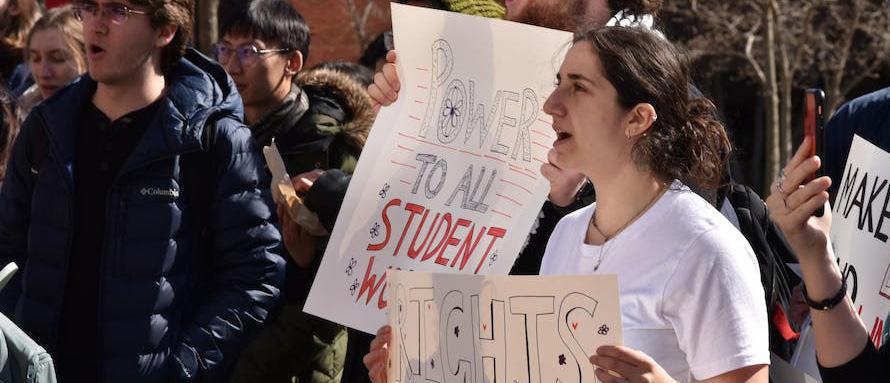
Though the University would pay an average of $8.7 million to the city annually under both agreements, the exact amount will change year by year. Without accounting for potential payment reduction credits for investments in public projects or new tax revenue originating from Brown validated by a third-party accounting firm, the first upcoming payment in 2024 would climb above $11 million and then peak in 2025, while the payment in 2034 will hover just above $6 million as the Brown-specific agreement expires. In 2043, the final year of the memorandum of understanding, Brown will pay more than $8 million.
“We’ve come to an agreement that sets our city now as a national example for how to better define the relationship between institutions of higher education who happen to be property tax-exempt, but are so vital to the success of our city,” said Providence Mayor Brett Smiley in remarks at a press conference Tuesday afternoon.
“From the beginning, we negotiated around shared priorities — fairness, equity and ensuring that Providence has the financial security to sustainably grow,” he added.
The University and the city previously made voluntary payments under two agreements — a memorandum of understanding, signed in 2003 with the city’s other private colleges, and a memorandum of agreement signed in 2012 between only Brown and the city. The two memorandums expired in 2023 and 2022, respectively.
All or a substantial majority of the voluntary payments would be “especially” targeted to five priority areas: pre-K-12 education; equity, diversity and inclusion; community safety and well-being; promotion of the Providence as “a safe, vibrant and inviting place to live, work and learn” and adaptation infrastructure and policy for climate change and climate resiliency.
Under the MOU, the four schools would also match the dollar amount of their direct voluntary payments through community contributions, which can include tax revenue from commercial properties; services provided in public spaces and to city employees; scholarships and financial aid for Providence residents and voluntary contributions to K-12 education.
The city will publicly report these community contributions so that “residents, taxpayers, visitors and members of the university communities know and can see the many ways in which these institutions contribute to the vitality of our city,” Smiley said.
The MOU would also create a “Quality of Life” working group that would create a formalized structure for addressing neighborhood issues and ensuring that the institutions and their neighbors “can work and thrive together,” Smiley said. The group will include officials from city operational departments and representatives from each institution and will meet every other month.
Per the MOU, Providence also committed to maintaining the current Institutional Master Plan process and current zoning ordinance standards for institutional districts, along with increasing enforcement of municipal code violations.
Brown’s payments subject to possible reductions
combined and deep commitment to the well-being of Providence, the vibrancy of Providence and the people who live here.”
annual voluntary payments in the MOA.
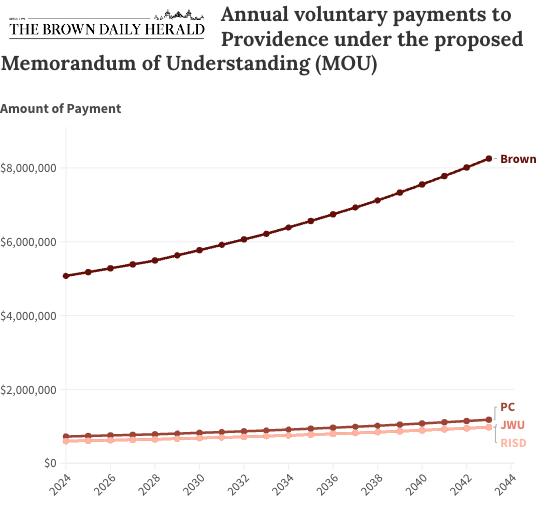
Development projects assisted or funded by Brown or the sale of institutional property — essentially returning tax-exempt parcels to the tax roll — would qualify Brown for a reduction in its annual MOA payment. That reduction would be valued at 50% of the tax revenue returned to the city as a result of either case.
previously,” said Isaac Slevin ’25, an organizer with Sunrise Brown and the Brown Activist Coalition, of the new agreements. But Slevin was hesitant to immediately endorse the agreement, noting that it includes several “carve-outs” for the University to reduce its total payment obligations.
Providence’s tax-exempt institutions commit to voluntary payments
The University’s $46 million, ten-year memorandum of agreement was the only individual agreement between a school and the city. Under this agreement, the University would contribute $6 million annually for the first two years, $5 million annually for the following two years and $4 million annually for the remaining six years.
As a part of the agreement, the City would commit to supporting the University’s property and parking-related priorities — including the acquisition of four blocks in the Jewelry District and one block on Cushing Street adjacent to Pembroke Field, as well as the extension of a parking agreement outlined in the 2012 MOA that allows leasing of street parking spaces in College Hill for use by Brown employees.
The University can also reduce its annual voluntary payment by the full amount of direct investments in development projects specifically in collaboration with Providence or a private and public sector partner, such as workforce housing, childcare and public parks.
“This isn’t the end,” Slevin said. “There is a lot more work that has to be done to make Brown a responsible community partner (and) there’s a lot to be wary about in this agreement as well.”
Under the four-school memorandum of understanding, payments to the city would increase annually, growing by 2% each year for the first five years, then by 2.5%, 2.75% and 3% for the three following five-year periods.
“We’ve reached this agreement after a series of very constructive, positive negotiations with the city,” said President Christina Paxson P’19 MD’20 in her remarks at the press conference. The proposals “reflect our
The City, through “legislative and administrative actions,” would also support the University’s new Integrated Life Sciences Building construction project in the Jewelry District, according to the Memorandum of Agreement.
Additionally, a “Credits Against Payments Condition” stipulation creates the possibility for the University to reduce its
The credit provision “recognizes (Brown’s) activities that create a positive economic impact on the city through incremental tax revenue,” Paxson wrote in an email to the Brown community.
“It is a big step up from where we were
On Thursday, the City Council will formally receive the MOU and MOA and refer them to the council’s finance committee for review, Providence City Council President Rachel Miller said at the press conference. Committee members will then vote on whether to send them back to the full council for a ratification vote, which is expected to take place in October, she added. organizers ensured accessibility throughout the bargaining process and kept its members informed.
Despite not following negotiations closely, Tômas Dougan ’25, a TA for CSCI 1230: “Introduction to Computer Graphics,” said that he still had “a decent idea of what was going on because of how transparent (TALO organizers) are.”
Under the new agreement, CS student employees will receive a raise, have more clearly delineated responsibilities and have a defined grievance procedure through the department.
Undergraduate teaching assistants, who make up the majority of students employed by the department, will earn a base rate of $20 per hour, while head teaching assistants for classes will make $22 per hour and meta teaching assistants — who coordinate the CS TA program — will make $27.50 per hour.
TALO had previously proposed a pay increase of $12 per hour during earlier negotiation sessions, according to a July Instagram post, which would have brought the base rate for TAs from $15.50 to $27.50 per hour.
The interim contract outlines responsibilities for each CS student employee role, expectations of course development, limits on work hours and requirements on faculty for making timely accommodations for student
employees they work with.
“The responsibilities changes are going to be a really, really big thing for UTAs and HTAs,” Maffa said. “It will be good to have protection, the ability to space yourself out from the work you’re doing and not feel the need to take on the burden of your course.”
The contract also lays out a legal process for addressing instances in which administrators or faculty violate its terms.
The aggrieved party must first have a discussion with the supervisor responsible for the grievance and a union representative.
If the discussion fails to resolve the issue, it will progress to the department’s director of
undergraduate studies, then to the department chair, and then to an outside mediator provided through the American Arbitration Association.
TALO organizers and CS TAs emphasized the importance of the grievance clause but also voiced concerns about student employees feeling comfortable using it.
“I think starting that discussion is gonna take a lot of courage from our workers,” Maffa said.
“I’m suspicious of how effective that will be,” Dougan said. “It all depends on how much time Brown is willing to invest in changing things.”
But the administration is confident the interim contract will be successful. The department “looks forward to working productively with the undergraduate TAs,” Blume wrote, adding that she will “have regular check-in meetings with department leaders on the status of the undergraduate TA program to ensure that all contractual provisions are effectively implemented, including grievance procedures.”
TALO organizers and the University intend to reconvene later in the fall to begin negotiations on a longer-term contract, according to Blume.
In the full contract, TALO hopes to push
for “greater professor accountability with regards to course development and oversight of student employee work,” as well as “more mature protections in our DEI article” and “expanded protections for student advocates and affinity groups,” Maffa wrote in an email to The Herald.
According to Blume, the University plans to prioritize defining pay rates for future years.
TALO organizers and student employees are hopeful that the ratification of the contract will lead to more organizing across the University in the future.
“I hope that this sparks or adds fuel to the fire of more student employees organizing and inspiring them to have a say in their workplace,” Maffa said. “This is something that was made with the work of a year and a half, which is a really attainable timeline.”
The power of the contract is “not necessarily just one specific issue of pay raises or anything,” said Brendan Ho ’24, a TA for CSCI 0111: “Computing Foundations: Data.”
“The really important thing about it is that students now feel like they have the power to speak up when they feel like there is an issue and the University will listen. This contract shows that they will listen,” he said.
“This is the crux of the union — when there are problems, you have somewhere to go to fix them,” Ho added.“Even if you’re just like one small little fish in the sea, you’re now part of a bigger school.”
PAGE 13 UNIVERSITY NEWS THE BROWN DAILY HERALD
PILOT FROM PAGE 1
TALO FROM PAGE 1
DANA RICHIE / HERALD
After successfully unionizing in March, TALO formed a bargaining committee and held negotiations with the University that lasted through late August.
Get to know the class of 2027 through The Herald’s first-year poll
BY OWEN DAHLKAMP & SAM LEVINE SENIOR STAFF WRITER & UNIVERSITY NEWS EDITORThe Herald conducted its first-ever poll of the incoming first-year class between July 26 and August 7. The poll’s questions spanned topics including intended concentrations, relationship status, substance use and political views.
The Herald distributed its survey via email and received 710 responses out of 1,699 incoming students, representing approximately 40% of the incoming first-year class. All questions, except for those asking about demographics, were optional, and all responses have been de-identified. Only accounts with Brown email domains were able to submit the form, but no email addresses were recorded.
With 53,730 data points analyzed, the poll represents the most comprehensive look at any first-year class the University has ever seen. While some of the most notable findings can be found below, our interactive site offers further data exploration.
Note: With smaller sample sizes, the likelihood of misrepresenting certain groups in a cross-tabulation increases. The Herald’s goal is to minimize the risk of representing any group inaccurately, so we omitted/combined certain populations from which we did not collect enough responses. The survey’s sample, while representative in many ways of the student body as a whole, was not random nor entirely representative.
Demographics
Hailing from 48 states and Washington, D.C., the class of 2027 traveled far and wide as to make the move to the Ocean State. The most common states of residence among first-year students are New York, California, Massachusetts, New Jersey and Texas. Wyoming and Nevada are the only states not represented in the first-year class, Associate Provost for Enrollment Logan Powell wrote in an email to The Herald. Seventeen percent of the incoming first-year class are international students, residing in 78 different countries, Powell wrote. The most common countries of origin as indicated by the University are China, Canada, the United Kingdom, South Korea and Hong Kong.
About 63% of incoming first-year students identify as straight — roughly the same percentage as the current student body, according to findings from The Herald’s spring 2023 poll. Thirty-seven percent do not identify as straight, compared to the 20.8% of similarly aged Americans.
The most common identity among those in the LGBTQ+ community is bisexual, at nearly 15% of total respondents, followed closely by unsure or questioning at 6%. Current Brunonians have identified as questioning at similar rates in recent years, according to an analysis of previous Herald polling data.
The gender gap between respondents is stark, with nearly 20% more
women than men identifying as not straight. While just over 5% of male students identify as bisexual, more than 22% of female students do, representing almost a quarter of female first-year students. Male first-year students are twice as likely to identify as gay than bisexual.
Lifestyle
Roughly one-fifth of incoming first-year students are in a committed long-term relationship, with an additional 8% reporting they are in a casual relationship. A similar percentage of current Brown students reported being in a casual relationship in The Herald’s fall 2022 poll, though slightly more — 25% — were in a long-term relationship.
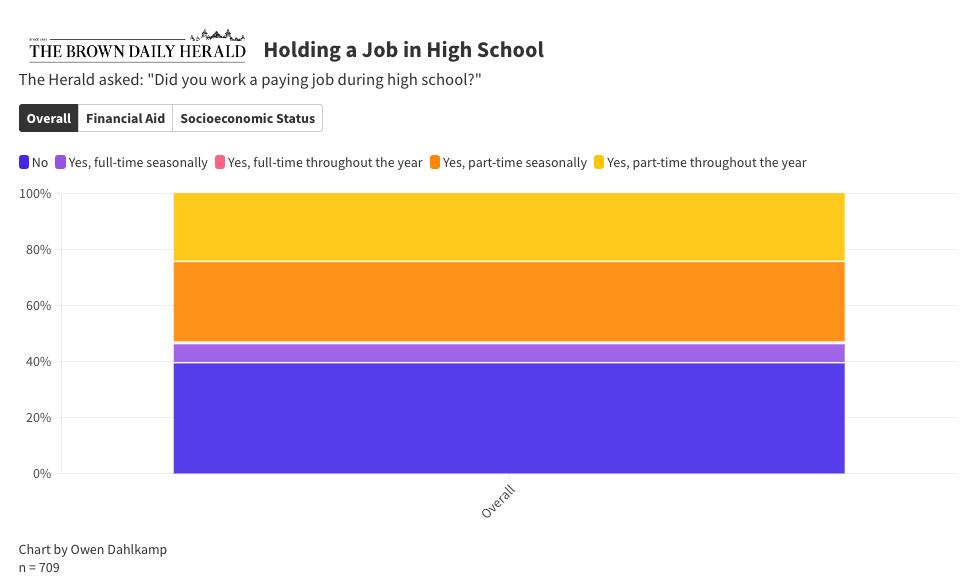
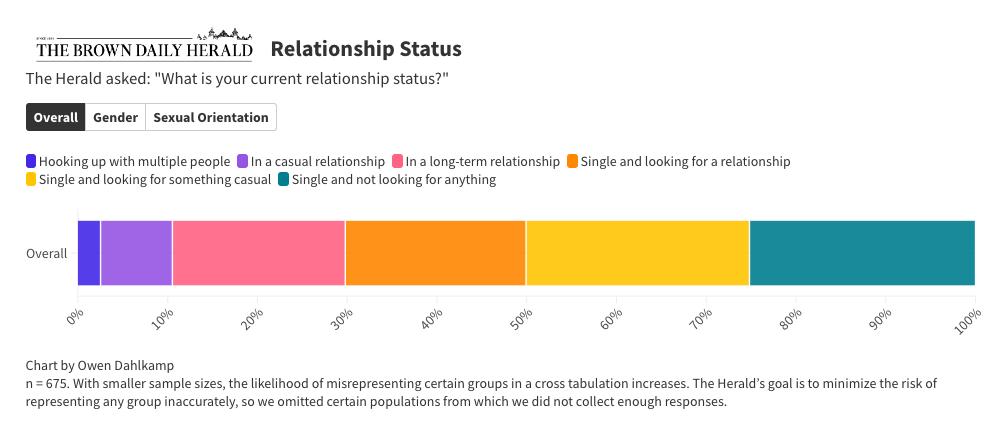
A larger share of single male respondents said that they are looking for something casual than the share of single female respondents who said the same, while more single female respondents reported not looking for anything.
A little over one-third of first-year respondents reported having had sex (the poll did not provide a definition), a share that remains consistent for both straight and non-straight students. But recruited athletes, who are underrepresented in the poll broadly, are much more likely to have had sex at 63% — nearly twice the share of students who were not reqruited athletes who reported having had sex.
Two-thirds of first-years who responded to the poll reported trying alcohol, making it the most common substance that respondents had tried from listed options. Next was marijuana, tried by one-third of respondents, followed by nicotine at 20%.
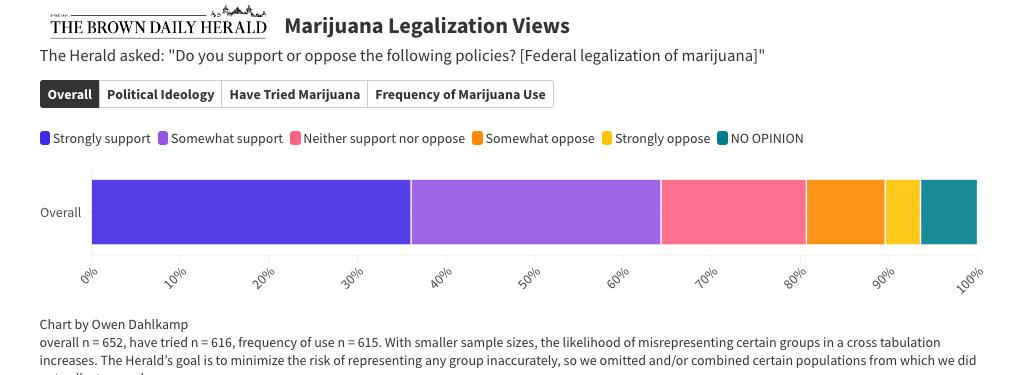
The vast majority of first-year students reported that they do not have a fake ID, with roughly 14% of respondents saying that they possess one. The likelihood of having a fake ID rose with the frequency of alcohol use, with nearly 40% of those who consume alcohol at least once per week reporting having one.
About 60% of first-year students held a paying job in high school, with the largest shares holding a part-time job seasonally or throughout the year. Employment varied slightly when accounting for financial aid status. Almost 70% of first-year students receiving grants covering some costs reported holding a paying job, compared to 54% of those receiving no financial aid and 58% of those receiving grants covering all costs.
Political Views
An overwhelming share of first-year respondents reported holding liberal political views, with 30% and 42% describing their political ideology as very or somewhat liberal, respectively. Just under 17% identified as moderate, with just over 6% identifying as somewhat or very conservative. The first-year class self-identifies as significantly more liberal than the American public, as a 2021 Gallup survey found only 34% of Americans aged 18 to 29 identified as liberal. Still, members of Gen Z hold views that are more progressive than older generations, according to a Pew Research poll.
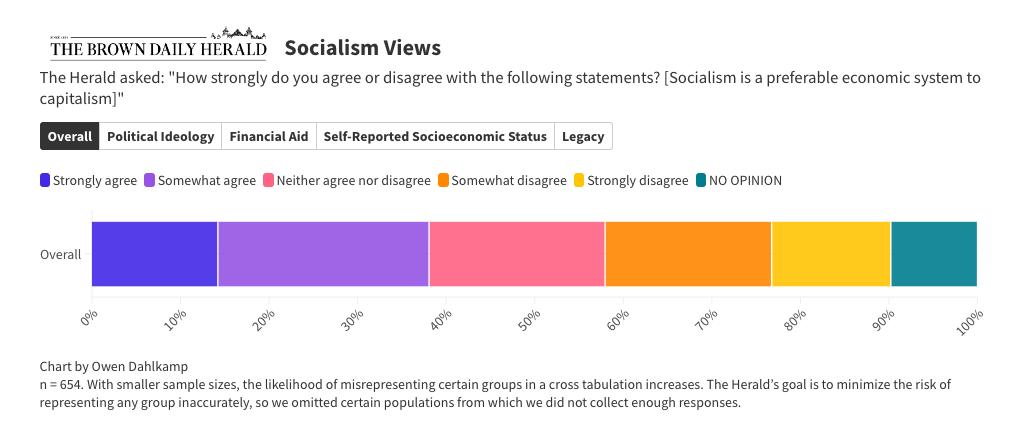
Female respondents were more likely to be liberal, with 79% identifying as very or somewhat liberal compared to
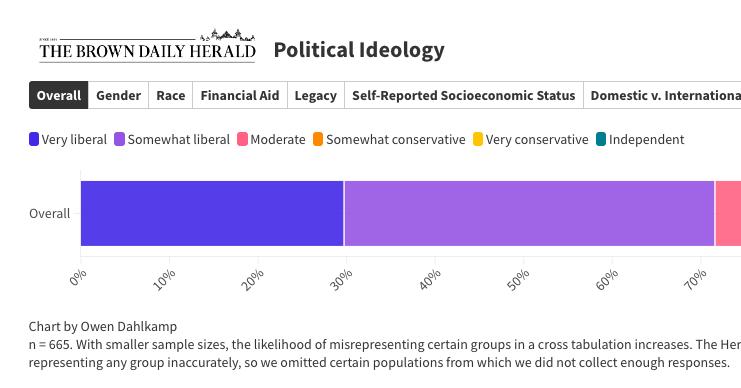
PAGE 14 FIRST-YEAR POLL THURSDAY, SEPTEMBER 7, 2023
DATA
Explore data from The Herald’s first-ever poll of incoming first-year students
62% of men.
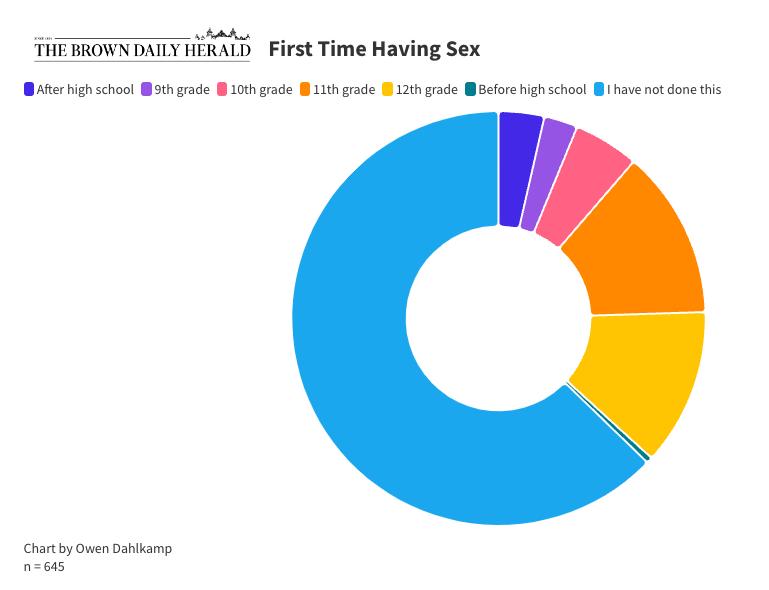
Political ideology also varied by legacy and self-reported socioeconomic status. First-year students whose parents attended Brown identified as liberal at much higher rates, with 93% holding very liberal or somewhat liberal political views.
Self-identified upper-class respondents were the least likely to report being very liberal and most likely to be somewhat or very conservative, while middle-class respondents tended to be the most moderate.
MEET THE CLASS OF 2027
International students were less likely to identify as very liberal, being over three times more likely to be independent than domestic students.
When asked whether they believe socialism is a preferable economic system to capitalism, first-year students were largely split in their responses.
The 38% of respondents who said they strongly or somewhat agree with the statement is less than the 44% of Americans aged 18 to 29 who reported having a very or somewhat positive impression of socialism in a 2022 Pew Research
Center survey.
Support for socialism was higher among those receiving financial aid and was lower among those who are not receiving grants or loans.
Nearly two-thirds of respondents support the federal legalization of marijuana, with greater support among those who reported holding very or somewhat liberal views. Support for legalization was higher among respondents who had tried marijuana and increased as frequency of marijuana use increased.
Academics at Brown
Of the nearly 80 concentrations offered at Brown, Computer Science, Economics, International and Public Affairs, English, Biology, Political Science and Engineering were the most popular primary concentrations for first-year students — though a plurality reported being undecided. Just over half of respondents reported being somewhat or very sure of their intended concentrations.
Nearly 88% of respondents intend to pursue a diploma beyond a bachelor’s degree. A Master’s degree was the most popular post-graduate degree at slightly under 37%, followed by a PhD at slightly under 27% and an MD at slightly under 16%.
Four in ten first-year students plan to double concentrate at Brown — twice the 20% of students who graduate with more than one concentration, according to the University — whereas 5% plan to pursue one of the University’s five certificate programs. Nearly half of all respondents are unsure whether they will pursue a double concentration or certificate.
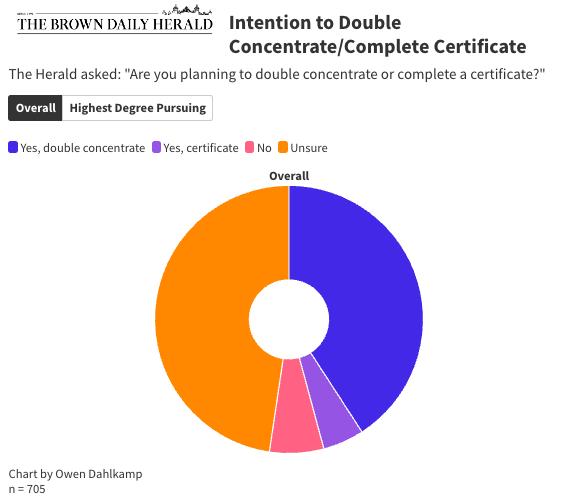
Admissions
Just under half of the 1,700 students in the incoming class were admitted via early decision and Questbridge, leaving the remainder of the spots to be filled by applicants from regular decision and the University’s Resumed Undergraduate Education program.
Nearly three-quarters of incoming students indicated that Brown was their top choice during the admissions process.
Among students who applied under regular decision, almost 40% reported that Brown was their top choice. Questbridge applicants, who rank colleges based on personal preferences and are subsequently matched with an institution, were evenly split on whether Brown was their top choice.
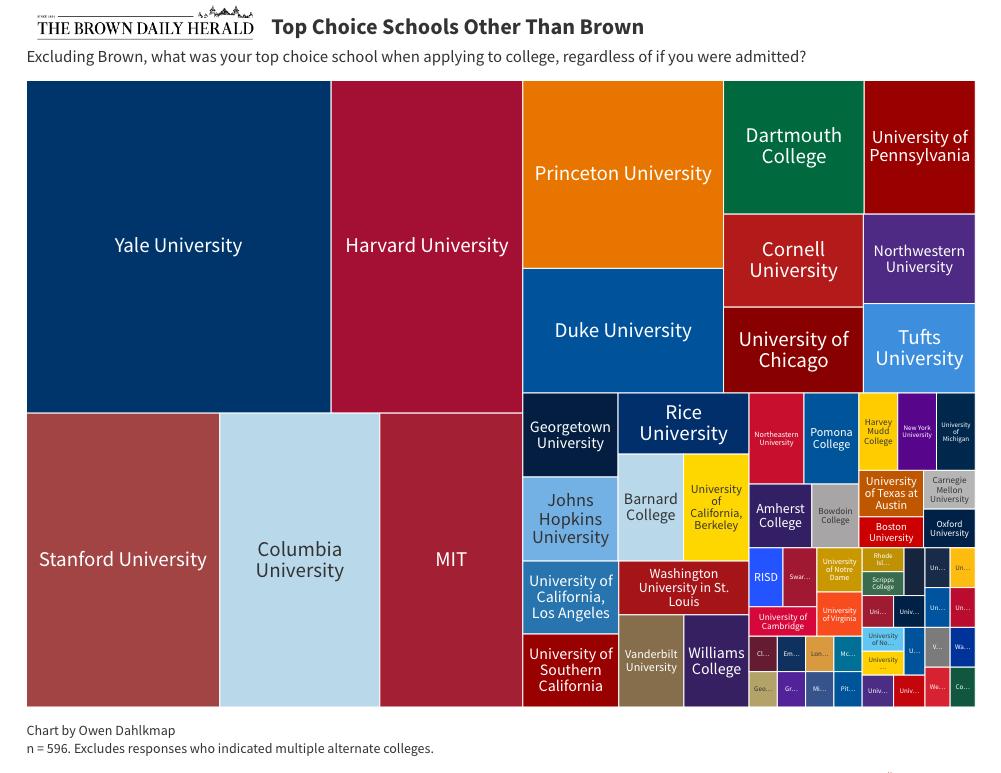
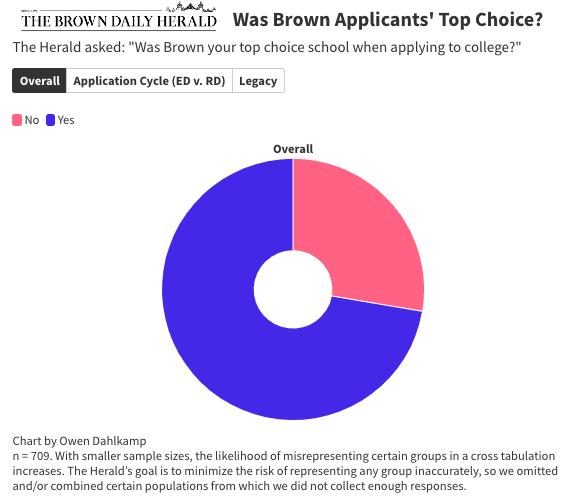
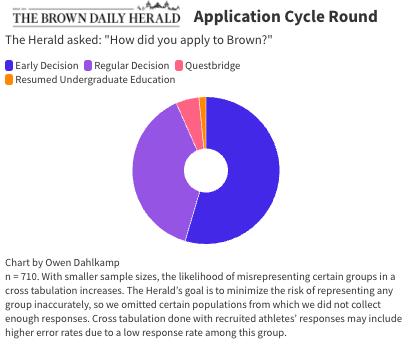
Among students who did and did not think of Brown as their top choice, other Ivy League colleges were among the top choice institutions for many, with Yale, Harvard and Stanford University leading the pack. Columbia and the Massachusetts Institute of Technology also rank highly among students shooting for these elite colleges. In the 607 responses received, only 67 unique alternative colleges were indicated as dream schools.
But after those applying regular decision received their decisions, backup colleges differed dramatically, with most of the previous dream institutions falling much lower on the list.
Instead, University of California, Berkeley, University of California, Los Angeles and Northwestern University topped the list, with Cornell, Duke University and Georgetown University trailing closely behind. As students decided which of the 86 substitute colleges they would ultimately enroll in, these other highly-ranked colleges ultimately fell second to Brown.
PAGE 15
THE BROWN DAILY HERALD
Gabe Amo wins 1st District special Democratic primary
Moderate Democrat
Amo edges out crowded field to become favorite
BY JACOB SMOLLEN METRO EDITORGabe Amo, a former White House aide during the Obama and Biden administrations, defeated a crowded Democratic field in a special primary election for Rhode Island’s 1st U.S. Congressional District Tuesday night.
With 90% of precincts reporting Tuesday night, Amo led at 32.5% of the vote, former state Rep. Aaron Regunberg ’12 trailed in second with 24.9% of the vote. State Sen. Sandra Cano (D - Pawtucket) was in a distant third at 13.9%.
Almost 40,000 people — nearly 12% of registered voters — voted in the district, which covers the eastern part of the state from Woonsocket to Newport, excluding much of western Providence.
“I don’t have a lot of words,” Amo said in a speech after the race was called. “It is not lost on me that I stand on the shoulders of giants, of so many who paved the road before me.”
“I ran for Congress because I believe Rhode Islanders deserve someone who can be effective from day one to address some of the critical needs of this country,” he added
THAYER STREETThe Congressional seat opened up after longtime Rep. David Cicilline ’83 announced in February he would vacate his congressional seat in order to lead the Rhode Island Foundation as president and CEO. Cicilline departed Congress in June.
Amo, raised in Pawtucket and the child of Ghanaian and Liberian immigrants, will now face former U.S. Marine Corps officer Gerry Leonard Jr., a Republican, in the general special election Nov. 7. The 1st District’s demographics make Amo a heavy favorite in that race — registered Democrats in the district outnumber registered Republicans more than three to one.
If Amo wins again in November, he would be the first person of color to represent Rhode Island in Congress. Tuesday’s primary had the most diverse field of candidates in the state’s history, according to The Boston Globe.
The result of the primary is also a win for the moderate wing of the Democratic party. Amo fended off the more progressive Regunberg, who was endorsed by U.S. Senator Bernie Sanders (D-Vermont) and U.S. Rep. Alexandria Ocasio-Cortez (D-New York). Amo’s endorsements included former U.S. Rep. Patrick Kennedy, who represented the 1st District from 1995 to 2011, and Ron Klain, President Joe Biden’s previous White House chief of staff.
The race suffered from a lack of independent polling, making it difficult to discern potential front-runners. An internal poll from Amo’s campaign released late August put Regunberg in the lead at 27.9% of the vote with Amo in second at 19.1%, but some questioned its methodology.
Amo emphasized his national political experience throughout the campaign. During the Obama administration, Amo worked in the White House Office of Intergovernmental Affairs. He was also appointed by then-Rhode Island Gov. Gina Raimondo to serve as director of public
engagement and community affairs. Under Biden, Amo returned to the White House as deputy director of the White House Office of Intergovernmental Affairs and Special Assistant to the President.
James Fennessy, part of a late afternoon post-work trickle of voters at the Fox Point Boys and Girls Club, said he voted for Amo because of his “secure” background. He said he worried that more progressive candidates wouldn’t be effective in office.
“I didn’t have any one priority. I just want somebody who’s gonna get something done,” Fennessy said. “You have to be in the middle somewhere.”
Mala Noodles, In The Pink spice up Thayer Street
Owners discuss community reception, staffing, diversity of flavors
 BY AVANI GHOSH SENIOR STAFF WRITER

Mala Noodles and health food shop In
The Pink arrived on Thayer Street this summer, filling in the former Ganko Ittetsu Ramen and Pokeworks storefronts, respectively. Further up the street, signs in the former Blue State Coffee storefront read that Sydney, an Australian-inspired cafe, will be the space’s next occupant.
The former storefronts of Ayame Hibachi Express, Beatnic, Tropical Smoothie Cafe and Rev’d Indoor Cycling remain vacant. Over the past two years, businesses on Thayer have experienced great turnover and reported challenges with inflation and staffing.
With Mala Noodles and In The Pink opening in mid-June and mid-July, respectively, their owners have adapted their offerings to cater to the Thayer customer base.
In The Pink co-owner Chris Cancel said that the establishment is a “health-focused restaurant serving acai bowls … smoothies; cold, fresh juice (and) protein shakes.” Cancel picked the shop’s name because it means “in very good health and spirits.”
“Going up and down (Thayer) street, all you really see is … latenight heavy food,” Cancel said. In The Pink is committed to using fresh fruits and vegetables to leave customers energized, he explained.
TK Quan, owner of Mala Noodles, explained that the restaurant is unique
in the noodle experience that it offers. “Our big concept is (that) you choose your own ingredients,” he said.
He also discussed how mala seasoning has a spicy, numbing effect that makes their noodles “way different than any other noodles.”
While Quan understands that many College Hill customers may be unfamiliar with mala, he wants Mala Noodles to provide a homey dining experience at a reasonable price.
Quan said that Mala Noodles has received a positive response from the community thus far. The restaurant’s soft opening is still ongoing, and Quan hopes that its grand opening will encourage more people to sample the food.
According to Cancel, In The Pink
has also seen a warm welcome, especially with a growing social media following. There were “kids from all over the world here … and it was really nice getting to know everybody,” Cancel said. “When customers come in, (I) know them on a first-name basis.”
Adapting to Thayer customers and a changing workforce
For Cancel, Thayer is “one of the best (locations) in the city.” With a takeout business model, he believes that the shop’s location helps him reach college students — a demographic he said is accustomed to rapid service and the comforts of delivery.
Quan, who previously owned a Korean barbeque restaurant in Federal Hill, discussed how the target demographic varies, with Federal Hill
clientele being older than Thayer customers. When Quan was planning his new restaurant, he shifted the business model to a “fast-casual” establishment.
Ayia Tatari, Manager of Abu Yarub Al-Shami, noted that regular influxes of new students mean people who are willing to try new things — and order from new establishments.
Although Abu Yarub Al-Shami has been on Thayer for two years, Tatari said her father, owner Amir Tatari, has seen Thayer change over the past 30 years. With many new openings, “it’s definitely cool seeing new cultures come and bring their kind of food to the street,” she said.
“Something that we really appreciate about being (on Thayer) is that you don’t have to be a long-standing business to be able to get customers
because new students are coming in every year,” Tatari said. “It’s like you’re starting fresh every year … we have an equal chance of being tried out (as) other places.”
Tatari also described issues with staffing for businesses on Thayer. For the past two years, Tatari and her father have been the only two staff members. “It’s been really difficult to find someone who is passionate about food,” Tatari said. “We don’t want to just bring anyone. We want someone who’s experienced (cooking) Middle Eastern food.”
Quan mentioned that some employees from his Federal Hill establishment have come back to work at Mala Noodles, but the restaurant still faces staffing shortages.
In contrast to the staffing challenges faced by many Thayer businesses, In The Pink has received many employee applications, Cancel said. Overall, he agreed that staffing is generally a concern in the current economy, but he is hopeful about expanding the In The Pink franchise.
Quan said he hopes that Mala Noodles is a memorable experience that “radiates good energy.” Despite the challenges, Quan is optimistic about the future of Mala Noodles. “We are improving right now,” he said. “Today is at least better by one point than yesterday.”
Tatari discussed her excitement about changes on Thayer and meeting new customers. “I really appreciate how the students here are open to trying new things,” she said. “I think that’s what contributes to people being passionate and enthusiastic about opening a business from their culture” on Thayer.
PAGE 16 METRO THURSDAY, SEPTEMBER 7, 2023
CITY & STATE POLITICS
EXECUTIVE OFFICE OF THE PRESIDENT OF THE UNITED STATES / WIKIMEDIA COMMONS
LILLY NGUYEN/ HERALD
Little Compton addresses lack of affordable housing BROWNDAILYHERALD.COM READ IT ONLINE WEB EXCLUSIVE R.I. launches first Youth Point in Time Count
Mala Noodles and In The Pink opened in mid-June and mid-July, respectively. TK Quan, owner of Mala Noodles, said he envisioned his restuarant on Thayer Street embracing a “fast-casual” vibe, catering to college students and young people.