SINCE 1891
THE BROWN DAILY HERALD THURSDAY, MARCH 1, 2018
VOLUME CLIII, ISSUE 25
WWW.BROWNDAILYHERALD.COM
Public Humanities Lab to feature student-curated exhibits New series to Month-long initiative help support will showcase work by grad students Brown, RISD, Providence community members of color By ANNABELLE WOODWARD
Topics for discussions will include imposter syndrome, building community, finances
SENIOR STAFF WRITER
The John Nicholas Brown Center for Public Humanities and Cultural Heritage will host its first annual Public Humanities Lab from Feb. 20 to March 20. The new iniative will transform the Carriage House Gallery of the Nightengale-Brown House into a venue for student-curated exhibitions, installations and pop-up experiences. The Public Humanities Lab was devised by an eight-member graduate student committee headed by Marisa Brown, the assistant director of programs at the center. The student curators are all graduate students completing a degree in Public Humanities. The Lab aims to give Public Humanities students an opportunity to develop hands-on curatorial experience, Brown said. “A lot of our students go on to work in museums and galleries and places where they do exhibition
ART & CULTURE
By ERIC CHOI SENIOR STAFF WRITER
TIFFANY DING / HERALD
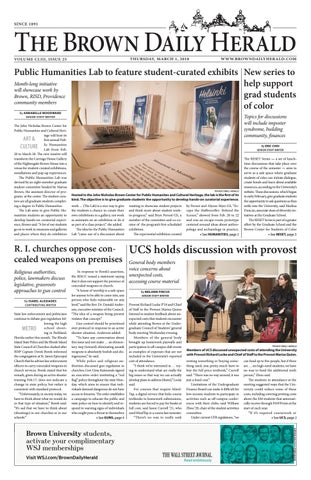
Hosted in the John Nicholas Brown Center for Public Humanites and Cultural Heritage, the lab is the first of its kind. The objective is to give graduate students the opportunity to develop hands-on curatorial experience. work. ... (The Lab) is a nice way to give the students a chance to curate their own exhibitions in a gallery, not work as assistants on an exhibition or do it as part of a class project,” she added. The idea for the Public Humanities Lab “came out of a discussion about
wanting to showcase student projects and think more about student workin-progress,” said Bryn Pernot GS, a member of the committee and co-curator of the program’s first scheduled exhibition. The experiential exhibition curated
by Pernot and Alyson Myer GS, “Escape the Haffenreffer: Behind the Scenes,” showed from Feb. 20 to 22 and was an escape-room prototype centered around ideas about anthropology and archaeology in practice. » See HUMANITIES, page 2
The RESET Series — a set of lunchtime discussions that take place over the course of the semester — aims to serve as a safe space where graduate students of color can initiate dialogue, create bonds and learn about available resources, according to the University’s website. These discussions, which began in early February, give graduate students the opportunity to ask questions as they settle into the University, said Marlina Duncan, associate dean of diversity initiatives at the Graduate School. The RESET Series is part of a greater effort by the Graduate School and the Brown Center for Students of Color » See RESET, page 3
R. I. churches oppose con- UCS holds discussion with provost cealed weapons on premises General body members Religious authorities, police, lawmakers discuss legislative, grassroots approaches to gun control By ISABEL ALEXIADES CONTRIBUTING WRITER
State law enforcement and politicians continue to debate gun regulation following the high school shooting in Parkland, Florida earlier this month. The Rhode Island State Police and the Rhode Island State Council of Churches clashed after RISP Captain Derek Borek informed the congregation at St. James Episcopal Church that he advises law enforcement officers to carry concealed weapons in church services. Borek stated that his remark, given during an active shooter training Feb.17, does not indicate a change in state policy, but rather is consistent with standard protocol. “Unfortunately, in society today, we have to think about what we would do in that type of situation,” Borek said. “It’s sad that we have to think about (shootings) in our churches or in our schools.”
METRO
In response to Borek’s assertion, the RISCC issued a statement saying that it does not support the presence of concealed weapons in church. “A house of worship is a safe space for anyone to be able to come into, any person who feels vulnerable on any level,” said the Rev. Dr. Donald Anderson, executive minister of the Council. “The idea of a weapon being present violates that concept.” Gun control should be prioritized over protocol in response to an active shooter situation, Anderson added. “To have any conversation about this issue and not make … an elementary step (toward) eliminating assault weapons is absolutely foolish and disingenuous,” he said. While police and religious authorities discussed gun regulation in churches, Gov. Gina Raimondo signed an executive order instituting a “red flag” policy throughout the state Monday, which aims to ensure that individuals deemed dangerous do not have access to firearms. The order establishes a campaign to educate the public and state police on how to identify and respond to warning signs of individuals who might pose a threat to themselves » See GUNS, page 4
Brown University students, activate your complimentary WSJ memberships Visit WSJ.com/BrownDailyHerald
By MELANIE PINCUS SENIOR STAFF WRITER
P rovost Richard Locke P’18 and Chief of Staff to the Provost Marisa Quinn listened to student feedback about unexpected costs that students encounter while attending Brown at the Undergraduate Council of Students’ general body meeting Wednesday evening. Members of the general body brought up homework paywalls and participation in off-campus club events as examples of expenses that are not included in the University’s reported cost of attendance. “I think we’re interested in … trying to understand what are really the big issues so that way we can actually develop plans to address (them),” Locke said. For courses that require MindTap, a digital service that links course textbooks to homework submissions, students are forced to pay for books at full cost, said Jason Carroll ’21, who used MindTap in a course last semester. “There’s no way to really seek
TIFFANY DING / HERALD
Members of UCS discussed unexpected costs of attending the University with Provost Richard Locke and Chief of Staff to the Provost Marisa Quinn. renting something or buying something used, you pretty much have to buy the full price textbook,” Carroll said. “There was no way around, it was just a fixed cost.” Limitations of the Undergraduate Finance Board can make it difficult for low-income students to participate in activities such as off-campus conferences with their clubs, said William Zhou ’20, chair of the student activities committee. Under current UFB regulations, “we
can fund up to five people, but if there are … six high-need students, we have no way to fund the additional sixth person,” Zhou said. The students in attendance at the meeting suggested ways that the University could reduce some of these costs, including covering printing costs above the $30 students that automatically receive through PAWPrints at the start of each year. “If it’s required coursework or » See UCS, page 2
WEATHER
© 2018 Dow Jones & Co., Inc. All rights reserved.
INSIDE
voice concerns about unexpected costs, accessing course material
ART & CULTURE PAGE 2 • THURSDAY, MARCH 1, 2018
THE BROWN DAILY HERALD
Stages of Freedom sells books, saves lives
lessons for children of color at YMCAs around the state, Rickman said. Rickman prides himself on keeping his word. Five years ago, when Rickman worked as a Rhode Island State Representative, a woman whose son had just drowned at Lincoln Woods State Park in Lincoln, R.I. asked him if he could help persuade the coroner to release her son’s body. With Rickman’s help, the coroners eventually did so. “(The coroners) said it was superfluous and useless to do an autopsy,” Rickman said. “The mother was already in unbelievable pain” and to add to her pain would be unethical, Rickman said. “In the parking lot, I told the mother that I’d do something about this problem of black children drowning, and I’m very happy in myself in that I keep my word.” Stages of Freedom’s mission is to confront a difficult stereotype and reality for many African-Americans — a stereotype stemming from slavery. “During slavery, 50 percent of all plantations were on a river or lake, so (there was) no swimming for black people at all (because they would) swim away to freedom,” he said. “After that,
80 percent of black people lived in the segregated, racist South in which there are no swimming pools, no Y(MCA), no nothing.” Now black children drown five-anda-half times more than white children, Rickman said. Furthermore, a large percentage of black and Latinx people lack the income to pay for a membership and swimming lessons at the YMCA, Rickman added. “(Swimming) is just not their first priority,” Rickman said. “First priority is rent and food and transportation — and swimming would have to be number 10 on your list, if you were even interested.” Last summer, Stages of Freedom paid for swimming lessons for 400 youth of color. However, Rickman and Dimmick’s goal is to eventually put 2,000 children into lessons. “(Children of color drowning) is a health disparity in which the government takes no interest, in which the (Alpert) Medical School takes no interest,” Rickman said. “No one has ever done this. I doubt anyone has even put 10 kids into pools. So we’re successful. We’re just in a hurry.” Stages of Freedom also organizes
events, exhibits and lectures about topics ranging from the history of runaway slave ads to black churches. Their next event is a free and open reading of Maya Angelou’s “And Still I Rise” March 25 at 2pm at 75 North Main St., the First Baptist Church in America. Rickman and Dimmick participate in advocacy as well. In November, the pair proposed that the city change the name of Magee Street, named after a slave ship captain, to Bannister Street to commemorate 19th century local black activists Edward and Christiana Bannister. “As the South was taking down statues of Confederate soldiers, we seized on the moment and dedicated the street to an extraordinary African American couple,” Dimmick said. Rickman and Dimmick expected to see droves of students flock the bookstore, but after nine months of being open, they have yet to see such numbers. “All we need is Brown students to show up and spend 10 bucks three or four times a year. Do you know how much money that would be?” Rickman said. “The world can change, and it can change for the better.”
The Lab offered Pernot and Myers an “opportunity to test out the narrative elements of the game” before its finished product comes to the Haffenreffer Museum this spring. In designing the exhibition, “the fun part (was) thinking about how to gamify education while also being aware of the ethics and particular questions that are facing anthropology museums,” Pernot added. This week’s exhibition, entitled “Monument-Worthy: Personal Memory Markers,” challenges commonly held ideas about monuments, memory and meaning. The installation was curated by Hannah Mooney GS and Molly Pailet GS, two first-years in the Public Humanities program who are interested in pursuing careers in public history and museum education. “There are all these monuments and memorials everywhere that people just walk by, or interact with, and are these places all meaningful? Maybe not,” Mooney said. “So what are actual meaningful things for people?” This question drove the curation of the exhibit’s content. The artwork was supplied by Brown undergraduates, graduate students, Rhode Island School of Design students, some community members — including an artist-inresidence at AS220 — and friends of the curators from as far away as Denver. Each “monument” has a distinct character and voice. “Some are broad to the human experience, others are important to (the artists) and their personal experiences,” Pailet said. One work, called “A Monument to Capitalism,” features United Airlines’ MileagePlus air awards card and an iPhone in adjacent bejeweled temples. “The glow from our iPhone’s apps illuminates our lives in the way that churches’ stained glass once did” begins the monuments’ accompanying statement. Another work, a “Monument to Wellness,” features a bouquet of flowers inside of a biohazard waste container, functioning as a monument to “the spiritual death” that the artist experienced on the day of her diagnosis with Crohn’s disease. Furthermore, two works addressed the Charlottesville incident. “It’s a great thing the gallery is open to the public — not just the Brown community — and a lot of the things that the students are working on are really timely, interesting and provocative,” Brown said. “We didn’t know quite what we were going to get, or what the programs would look like, but I was just really excited when we put it all together. The gallery features “such a diversity of points of view and kinds of projects,” he said.
To accommodate students who arrive in residence halls before classes commence, some students suggested that the University should have at least one eating option available on campus whenever dorms are open. Currently, residence halls open days before dining facilities do, as they did at the start of the spring 2018 semester. “Dining halls don’t open until the night before (classes start), and I know some students who just didn’t eat for the entire day until dinner because they would have to go off-campus to get food,” said Mar Weiss ’20, chair of academic affairs.
In response to suggestions about how to provide additional funding to support incoming students as they transition to college, Locke said that the University would seek to address this issue. “We’re trying to figure out what we can do so that the transition is smoother than it is sometimes for many people,” he mentioned. It can also be difficult for lowincome students to have access to all employment opportunities on campus, students at the meeting said, such as undergraduate teaching assistant positions. Some professors expect their TAs
to work more than the maximum number of hours for which they can be paid, Carroll said. “I feel like that really creates a barrier for low- and even middle-income students because you’re essentially signing up to work and not get paid … and it’s not really accessible for people who can’t afford to work for free.” Locke expressed disapproval of this practice, and referenced the work of the task force led by Dean of Financial Aid Jim Tilton as potentially useful for resolving similar issues. The task force recommended changes to student employment practices at last month’s Brown University Community
Council meeting, The Herald previously reported . “You want to make sure that whatever you’re doing is … actually giving you some skills, and you can get those skills in the cafeteria sometimes, in terms of customer relations (or) project management, and you can get them in the classroom or the lab,” Locke said. “We just want to make sure everyone has access to those (opportunities).” The general body did not vote on proposed amendments to the Campus of Consent Bill, which they have discussed at two meetings earlier this semester. The group did not set a date for the vote.
ALICIA MIES / HERALD
Ray Rickman and Robb Dimmick of Stages of Freedom bookstore encourage Brown students to purchase the donated books that they sell. Last summer the bookstore funded swimming lessons for 400 children of color. Their goal is to fund lessons for 2,000 children.
Bookshop’s revenue funds swimming lessons for youth of color, combats systemic disparity By ALICIA MIES CONTRIBUTING WRITER
It’s near silent in Stages of Freedom, a quaint bookstore on 10 Westminster St. The only sound that fills the store is the soft and rich timbre of the voice of Ray Rickman, Stages of Freedom’s executive director. For Rickman, Stages of Freedom is a sacred place where no arguing is allowed. It is a space for people of all walks of life to purchase cheap books, learn about African-American history and confront the fact that black children are more likely to lose their lives to drowning than white children. Rickman and Robb Dimmick, Stages of Freedom’s program director, started the nonprofit four years ago and moved to Downcity June 1, 2017. All of the books in the store are donated and all profits help finance swimming
ART & CULTURE
» UCS, from page 1 readings, maybe the cost could somehow be covered … or the professor (could) take charge of giving copies to students,” Zhou said, adding that the quantity of required printing for certain courses “can bite at your printing money really quickly.” Locke mentioned food security as another financial issue he wants to address. “I think it’s really, really important that everyone on campus have security in food, … so that’s something that we’re looking at — how do we make it affordable,” he said.
» HUMANITIES, from page 1
NEWS
THURSDAY, MARCH 1, 2018 • PAGE 3
THE BROWN DAILY HERALD
ELI WHITE / HERALD
The RESET Series aims to create a safe space for graduate students of color to engage in coversations. It is supported by the Brown Center for Students of Color and the Graduate School. an email to The Herald. continue throughout the year, so we or- focused on “specific events that motivate » RESET, from page 1 The most popular topics from the ganized the RESET Series,” Park wrote. students of color, including trans and to increase the retention of graduate survey included imposter syndrome, This will be the second RESET Series queer students of color,” Restar added students of color, Duncan said. Students finding community and finances, Dun- — the first series took place last semester in a follow-up email. had previously spoken up about the need can said. Combined with feedback from and covered topics such as imposter synAlthough graduate student socials for more inclusive events to increase the Diversity Advisory Board at the Of- drome and men of color, Duncan said. are held at the beginning of each separticipation from students of color, fice of Institutional Equity and Diversity, The “lack of events that are centered mester, the task of supporting students Duncan added. To address their con- the survey results helped the graduate around students of color” leads to lower of color is handed to individual departcerns, a survey was sent out last summer school plan new events such as its first participation, said Arjee Restar GS, a ments, Duncan said. “Some students of to new graduate students to pick topics student-of-color orientation and the member of the Diversity Advisory color are the only ones in their depart“they were specifically worried about for RESET Series, Duncan said. Board. “We were trying to address that ments,” so the RESET series aims to prograduate school,” wrote Tina Park GS, “We knew that a lot of conversations by creating specific events that celebrate vide more central support throughout graduate coordinator at the BCSC, in we began at the orientation needed to individuals of color.” The board also the academic year, she added.
J.J. Lomax GS, who attended the RESET Series event titled “Cultivating Healthy Mentoring Relationships,” explained that the lunch was a space where “people could ask whatever they wanted to ask.” For Farah Sherine GS, the RESET Series event on healthy mentorship served as a supplement to what she had learned from her group advisor at the School of Public Health about how to approach a potential advisor for a thesis. Shekinah Fashaw GS appreciated the launch of the new series. “Because the School of Public Health is down by the river, I don’t get to see folks from main campus often,” Fashaw said. “It was good to hear from the older graduate students as well as the faculty and staff there.” She also found the event more helpful than support from her own department. A class held by the School of Public Health discussing how to build a relationship with an advisor “wasn’t really as organized or directed as the RESET Series version,” she said. Lomax also attended the mentorship discussion because he wanted to ask people in his lab about their experiences with mentorship. In his own experience, Lomax noted that there was a “weird power dynamic (with an advisor) where you’re not sure if you’re overstepping any lines.” Attending the discussion gave him helpful advice on how to improve his relationships with his advisor and mentors. Past attendees plan to attend future events as well. Britt Threatt GS, who attended the mentorship event, plans to attend the “First Year Graduate Experience” event, which is the next RESET series discussion March 9.
The Presidential Faculty Award Lecture
March 1, 2018 4:30 p.m. JCB Library, Reading Room Asa Messer Professor of Humanities and Critical Theory; Director, Center for the Study of Slavery and Justice; Professor, Africana Studies
Anthony Bogues
will deliver the Presidential Faculty Award Lecture Black Critique: Toward an Alternative Genealogy of Critical Thought
METRO
PAGE 4 • THURSDAY, MARCH 1, 2018
THE BROWN DAILY HERALD
Giovanni Feroce joins Rhode Island gubernatorial race candidates Feroce joins fellow Republicans Morgan, Fung, independent Trillo to challenge Raimondo By SOPHIE CULPEPPER SENIOR STAFF WRITER
Last Friday, Giovanni Feroce filed papers with the Rhode Island Board of Elections to run as a Republican in the state gubernatorial race, joining candidates R.I. House Minority leader Patricia Morgan, Cranston Mayor Allan Fung, former representative Joe Trillo and Democratic incumbent Gina Raimondo. Morgan was the first Republican to announce her candidacy in October. Fung announced his candidacy one day later, and former Republican Joe Trillo announced in December he would run as an independent, WPRI reported. “I have a vision that requires hubris, frankly,” Feroce said. Feroce would prioritize education, jobs and retirement planning, he said. “My vision for Rhode Island is one that plugs into the state of Massachusetts and primarily focuses on Boston as the center of gravity,” he said. He compared Providence’s relationship to Boston to Stamford, Connecticut, feeding into New York; younger people in particular should see the distance between Providence and Boston as being “a 45-minute commute or a 50-minute commute,” he added. In addition, Feroce imagines residents of Connecticut and Massachusetts moving to R.I. for
METRO
the quality of life. “It’s a better living environment, it’s a better community to ultimately raise a family or plug into additional educational institutions,” Feroce said. Feroce feels qualified as a candidate by his experience participating in “strategic planning … in the military, in business, in politics,” he said. Feroce served as a military officer, was a state senator for Rhode Island for two years and served as the CEO of the jewelry company Alex and Ani between 2010 and 2014, the Providence Journal previously reported. Since then, Feroce has headed multiple enterprises, most notably Benrus, a military watch company. In September 2017, Feroce was banned from running Benrus when he could not pay the trademark owner the agreed amount, after being sued by creditors including the Internal Revenue Service, according to the Providence Journal. “Statistically, you’re always going to (have) some things that don’t go your way — you’re going to have some things (go) perfectly and some things that you’ve got to take a little bit more time to see mature into a success story,” he said. “So I certainly don’t look at anything I’ve done in a negative way in any way,” he added. As of the last fiscal quarter of the 2017 fiscal year, Raimondo has raised $3,349,632, around 14 times Fung’s balance of $240,572.83. Trillo’s balance stands at $126,858.58, while Morgan has raised $117,330.97. Feroce began fundraising in the first fiscal quarter of the 2018 fiscal year; his balance is not currently publically available because the funds raised in the ongoing fiscal year are
not public for any candidates. All the Republican guberanorial candidates have political experience. And while Feroce stressed that his business experience sets him apart as a candidate, Morgan cited her credentials in politics as a defining asset to her campaign. Morgan is running because her eight years of experience in the R.I. House of Representatives and five years on the finance committee have informed her understanding of “what needs to happen” to improve the economy and citizens’ lives as governor, she said. Morgan values prioritizing the issues of corruption, education and jobs. She sees “soft corruption” in the existence and advantages of “insiders, people with access” and described the Pawtucket Red Sox stadium project as a job controlled by business insiders. “They had access to state leaders and decided they wanted some of our tax dollars,” she said. “I don’t think it’s fair to … ask folks to be the wallet,” she added. In terms of education, Morgan, a former teacher, wants to “set teachers free” by giving them flexibility to better cater to individual students’ needs and also providing them with more resources, including textbooks and teacher manuals. In his 16 years in government, Trillo noted every day “what a disaster our state was turning into,” he said. He is running as an independent because of internal divisions within both parties, and feels confident in his ability to collaborate with Democrats and Republicans, he said. He hopes to make jobs a priority and to bring Rhode Island up from the “bottom of the ratings” for business, he added.
COURTESY OF GIOVAANI FEROCE
Giovanni Feroce says he aims to bring young professionals to Rhode Island, citing the quality of life and proximity to Boston as benefits of the area. Trillo plans on funding the majority of his campaign himself, he said. He will not be seeking funding from “political action groups, special interests, NRA, nothing that corrupts government” because “the more money they give you, the more (concessions) they expect,” he added. In a television ad announcing his bid for governor, Fung said he hoped to focus on job creation and improving infrastructure, the Providence Journal reported. Last week, Morgan criticized Allan Fung for not initially commenting on gun control and for consistently failing to clarify his policy views since his 2014 run for governor, according to the Providence Journal. “In four years he has been absent when there has been a need for any opinion on his part; school shooting is just the latest, but it’s not the
first,” she said. Ethan Shire ’19, president of Brown Republicans, said the the group hasn’t “made a formal endorsement yet.” However, the Republicans “have a longstanding relationship with Mayor Fung.” Brown Republicans supported Fung’s 2014 campaign for governor, added Shire, who is also a Herald columnist. Looking beyond the primary to the general election, statewide elections in Rhode Island “see a lot of arguing between the 40-yard lines, where you kind of have a really more liberal-leaning Republican and a more conservative Democrat, … and I think that’s kind of what we’re going to see probably in this gubernatorial election,” Shire added. Mayor Fung did not respond to request for comment.
DISCOVER A GENEROUS SCHOLARSHIP PROGRAM.
The U.S. Army’s Health Professions Scholarship Program (HPSP) offers qualified medical, dental and veterinary students full tuition for a graduatelevel degree at the school of your choice. You’ll receive a monthly stipend and payment for books, equipment and academic fees, as well as the potential to grow as a leader.
To learn more, visit healthcare.goarmy.com/bts
©2014. Paid for by the United States Army. y y. All rights reserved.
PIA MILEAF-PATEL / HERALD
» GUNS, from page 1 or to others. It also institutes a gun safety working group, but does not expand the capacity of law enforcement to take firearms away from individuals. “The Parkland shooting highlighted the urgency of action,” said Josh Block, press secretary to the governor. “The Governor stepped up and took decsive, executive action to make Rhode Island safer,” Block added. She also declared her support for a ban on assault
weapons and high-capacity magazines during a press conference Tuesday, as The Herald previously reported. Raimondo’s executive order lays the groundwork for the Rhode Island General Assembly to pass a proposed red flag law, which would permanently establish the conditions set out by the executive order and expand law enforcement’s authority to confiscate firearms, Raimondo said during the press conference. R.I. lawmakers have proposed other
bills to address gun reglation. State Senator Gayle Goldin (D-3) introduced a bill banning high-capacity magazines earlier this month, which she is hopeful will pass, she said. In addition to political and policybased action, Borek and other members of the police force are continuing active shooter trainings throughout the state. “You should have a plan in place, you should visualize what you would do in that plan and then have situation awareness,” he said.
TODAY
THURSDAY, MARCH 1, 2018 • PAGE 5
THE BROWN DAILY HERALD
menu
cot ton candy skies
SATELLITE DINING ANDREWS COMMONS
Pizza: Cheese, BBQ Bam Bam, Meatball, Provolone and Rosemary Harvest Fest Special JOSIAH’S
BLUE ROOM
Chicken Wings Bar, Rodeo Burger, Quesadilla Station
Chicken Tikka Masala, Madras Vegetable Curry
DINING HALLS SHARPE REFECTORY LUNCH
DINNER
Italian Sausage and Peppers, Potatoes Italianne, Broccoli Alfredo Pasta
Bourbon Barbecue Chicken, Potatoes Au Gratin, Fresh Collard Greens
VERNEY-WOOLLEY LUNCH
DINNER
Meatball Tomato Alfredo Pasta, Falafel, Corn O’brien, Krinkle Cut French Fries
Roast Turkey With Gravy, Roasted Veggie Olio, Bread Stuffing
sudoku
crossword
SAM BERUBE / HERALD
After a beautiful February day, Wriston Quad offered a colorful view of a Rhode Island sunset. The scene marked a poetic end to the month and the pre-midterm tranquility.
Q U O T E O F T H E D AY
“All we need is Brown students to show up and spend
10 bucks three or four times a year. Do you know how much money that would be? The world can change, and it can change for the better.
”
— Ray Rickman, executive director of Stages of Freedom
See stages of freedom on page 2. calendar TODAY MARCH
S
45
M
56
T
67
W
Th
F
S
1
12
23
34
87
89
10 9
10 11
Special Seminar - Marco Capogrosso, PhD 10:00 A.M. Petteruti Lounge
Data Science Colloquium 12:00 P.M. Foxboro Auditorium
Education Dept. Lecture: Elizabeth Mann 12:00 P.M. Barus Building
Reimagining the Museum’s Community 12:00 P.M. Nightingale-Brown House
TOMORROW
11 12
12 13
13 14
14 15
15 16
16 17
17 18
18 19
19 20
20 21
21 22
22 23
23 24
24 25
25 26
26 27
27 28
28 29
29 30
30 31
31
VISA NYC Bus Trip 7:00 A.M. List Art Building, 2nd Floor
EEB Brown Bag Series 12:00 P.M. Biomed Center, 291
Italian Studies Colloquium 12:00 P.M. Italian Studies Building
Mesa de Conversacion 12:00 P.M. Sharpe Refectory
COMMENTARY PAGE 6 • THURSDAY, MARCH 1, 2018
THE BROWN DAILY HERALD
LETTER TO THE EDITOR
EDITORIAL
Why does review require suspension?
U.’s response to racist flyers came too late
To the Editor: In a letter to the editor published by The Herald yesterday, Provost Richard Locke P ’18 states that “the University decided to suspend acceptances of new applicants to the elementary education track for the current cycle. This pause will enable us to fully evaluate our current program based on evolving classroom and community needs and in light of expanding scholarly expertise in the newly refocused Annenberg Institute
for School Reform.” It is perplexing that the same review could not be conducted while the program was ongoing as usual. Shutting down the inflow for a year — leaving a huge gap and restarting problems if acceptances are later resumed — seems like assuming that the results of the evaluation will be to shut the program down. That appears to be the foregone conclusion. Jeffrey Liss ’65 Former Herald editor-in-chief
On Feb. 3, a series of appalling racist and anti-black pamphlets were found around the University and surrounding neighborhoods. These flyers — which were allegedly distributed by the white supremacist group Vanguard America, a primary organizer of the “Unite the Right” rally in Charlottesville, Virginia in August, according to a statement published by bluestockings magazine — contained harmful language and hateful stereotypes that are unacceptable in all contexts, and have no place in this campus, community and country. In response, student leaders and local activists mobilized in support of affected community members, organizing two press conferences to condemn the disgusting flyers. Mayor Jorge Elorza and other local leaders also attended the gatherings and spoke in solidarity. The combined efforts of students, local residents, city leaders and organizations like the Brown and Providence chapters of the National Association for the Advancement of Colored People were a much-needed show of unity in an otherwise dark moment. Yet, in the midst of this grassroots resistance, the University stood silent. On Feb. 14, a group of concerned black students published a statement in bluestockings magazine
Find us online! facebook.com/browndailyherald
browndailyherald.com
@the_herald
Location: 195 Angell St., Providence, R.I. www.browndailyherald.com
@browndailyherald
youtube.com/browndailyherald
Editorial Leadership
Sections
Multimedia & Production
Editor-in-Chief Elena Renken
Arts & Culture Editors Connor Sullivan Elizabeth Toledano
Design Editors General Managers Kyle Cui Michael Borrello Eduard Muñoz-Suñé Matilda Lynton Assistants: Julie Wang, Kelvin Yang
Metro Editors Emily Davies Bella Roberts
Photo Editors Sam Berube Anita Sheih
News Editors Anna Kramer Eduard Muñoz-Suñé Priyanka Podugu Sarah Wang
Copy Desk Chief Abby Borges
Managing Editor Kasturi Pananjady Senior Editors Julianne Center Madison Rivlin Alex Skidmore Hattie Xu Features Editor Isabel Gensler Editorial Page Editor Anuj Krishnamurthy
Science & Research Editors Jonathan Douglas Jackson Wells
POST- MAGAZINE Editor Saanya Jain
Sports Editors Alexandra Russell Nicholas Wey COMMENTARY Opinions Editors Connor Cardoso Anuj Krishnamurthy Clare Steinman
denouncing the pamphlets — and the University’s inaction. A week later, the University sent out a message on Today@Brown Feb. 21 condemning the pamphlets and reiterating its support for students. President Christina Paxson P’19 wrote, “Not only are such acts deeply harmful to the individuals and communities they target, they conflict with the very values that define our community at Brown. No person — whether a Brown student going to the library, a student from Hope High School walking to school or a Providence resident on the way to work — should be subject to flyers that have the intent to dehumanize and intimidate.” We wholeheartedly agree with these sentiments — but cannot help but question why on earth it took so long for the University to make such a statement. It is not enough that the flyers “generated a great deal of discussion among administrative leaders across the University.” Such rampant bigotry demands an immediate, unequivocal and public denunciation, which Paxson conceded in her message, writing “denouncing the flyer would have been an opportunity to reaffirm to members of our community who identify as black that Brown is committed to their wellbeing.” After all, in a political moment
Illustrations Editor Pia Mileaf-Patel
Business
Office Manager Diane Silvia Directors Sales: Shreya Raghunandan Finance: Ravi Betzig Strategy: Caroline Ziegler
when hate and intolerance are on the rise, it is pivotal that powerful institutions like Brown stand in support of community members of marginalized backgrounds. The University cannot hope to make strides in diversity and inclusion unless it can convince underrepresented individuals that they are safe and valued on campus. And this month, when the administration had the opportunity to do just that, it fell short. In her letter, Paxson wrote that, “the best way for us to combat the ugly racism of the flyers spread across Providence is to redouble our efforts to do what we as a university community do best: educate ourselves and others about past and continued inequities, take principled stands against racism and bigotry and continue to move forward on our plans to build a more diverse and inclusive community.” It is unfortunate that the University took nearly three weeks — and a sharp rebuke from black student leaders — to take even the most basic of “principled stands.” Editorials are written by The Herald’s editorial page board: Anuj Krishnamurthy ’19, Mili Mitra ’18, Rhaime Kim ’ 20 and Grace Layer ’20. Please send responses to this opinion to letters@ browndailyherald.com and op-eds to opinions@browndailyherald.com.
Editorial contact: 401-351-3372 herald@browndailyherald.com
Advertising contact: 401-351-3372 advertising@browndailyherald.com
Submissions: The Brown Daily Herald publishes submissions in the form of op-eds and letters to the editor. Op-eds are typically between 750 and 1000 words, though we will consider submissions between 500 and 1200 words. Letters to the editor should be around 250 words. While letters to the editor respond to an article or column that has appeared in The Herald, op-eds usually prompt new discussions on campus or frame new arguments about current discourse. All submissions to The Herald cannot have been previously published elsewhere (in print or online — including personal blogs and social media), and they must be exclusive to The Herald. Submissions must include no more than two individual authors. If there are more than two original authors, The Herald can acknowledge the authors in a statement at the end of the letter or op-ed, but the byline can only include up to two names. The Herald will not publish submissions authored by groups. The Herald does not publish anonymous submissions. If you feel your circumstances prevent you from submitting an op-ed or letter with your name, please email herald@browndailyherald.com to explain your situation. You can submit op-eds to opinions@browndailyherald.com and letters to letters@browndailyherald.com. When you email your submission, please include (1) your full name, (2) an evening or mobile phone number in case your submission is chosen for publication and (3) any affiliation with Brown University or any institution or organization relevant to the content of your submission. Please send in submissions at least 24 hours in advance of your desired publication date. The Herald only publishes submissions while it is in print. The Herald reserves the right to edit all submissions. If your piece is considered for publication, an editor will contact you to discuss potential changes to your submission. Commentary: The editorial is the majority opinion of the editorial page board of The Brown Daily Herald. The editorial viewpoint does not necessarily reflect the views of The Brown Daily Herald, Inc. Columns, letters and comics reflect the opinions of their authors only.
Directors of Web Development Eli White
Corrections: The Brown Daily Herald is committed to providing the Brown University community with the most accurate information possible. Corrections may be submitted up to seven calendar days after publication.
Video Editors Celia Hack Roland High
Advertising: The Brown Daily Herald, Inc. reserves the right to accept or decline any advertisement at its discretion. The Brown Daily Herald, Inc. is a financially independent, nonprofit media organization bringing you The Brown Daily Herald, BlogDailyHerald and Post- Magazine. The Brown Daily Herald has served the Brown University community daily since 1891. It is published Monday through Friday during the academic year, excluding vacations, once during Commencement and once during Orientation by The Brown Daily Herald, Inc. Single copy free for each member of the community. Subscription prices: $200 one year daily, $100 one semester daily. Copyright 2018 by The Brown Daily Herald, Inc. All rights reserved. Periodicals postage paid at Providence, R.I. Postmaster: Please send corrections to P.O. Box 2538, Providence, RI 02906.
COMMENTARY THURSDAY, MARCH 1, 2018 • PAGE 7
THE BROWN DAILY HERALD
What would John Stuart Mill say? JAMES FLYNN staff columnist When speaking on Feb. 13 at Brown, conservative journalist and author Guy Benson faced pushback from students who expressed disappointment with the decision to invite him to speak on campus. In a public statement, a collective of students opposed the event, arguing that Benson’s message was not merely misguided but actually dangerous to the community. This concern — that certain ideas and beliefs are so pernicious that they could cause real and irreparable harm to communities — prevails on campuses throughout the country and seems to be on everyone’s mind. But it is important to remember that concerns about specific varieties of speech, though pressing, are not at all new, and that the approaches writers have taken in the past can help us address them. In the 19th century, British utilitarian philosopher John Stuart Mill responded to arguments made by the religious establishment and proponents of censorship. It goes without saying that modern debates over free speech on campuses differ in nearly every way from those of Mill’s time. But Mill — one of the foremost political philosophers of Western history — makes unique contributions
to modern debates over free speech, providing rigorous, intellectual justifications for the concept of free speech and its role in maintaining social welfare. Mill’s defense of the freedom of expression consists of two hypotheses as to why free speech is beneficial not just to the speaker but to society as a whole — including those who disagree with the speaker. He argues against censorship because first, “we can never be sure that the opinion we are endeavouring to stifle is … false” and second, “if we were sure,
ing invitation to the whole world to prove them unfounded.” Mill assumes that one’s “errors are corrigible,” but that the only way of correcting them is discussion. Ideas, moreover, are rarely black-and-white, and two seemingly dichotomous views often each contain a portion of the truth. Far from being a mere abstraction, this concept is more than evident in the case of Benson. The day after his talk, Caroline Mulligan ’19 published a column in which she expressed agreement with Benson’s argument that a personal identity does
true with absolute certainty. That is, one does not fully understand one’s own position if one does not fully understand the arguments against it. The right response, therefore, to those who challenge a received opinion is to say, as Mill puts it, “let us thank them for it, open our minds to listen to them, and rejoice that there is some one to do for us what we otherwise ought, if we have any regard for either the certainty or the vitality of our convictions.” In this view, conservative speakers such as Benson are doing us a favor by chal-
It is important to remember that concerns about specific varieties of speech, though pressing, are not at all new, and that the approaches writers have taken in the past can help us address them.
stifling it would be an evil still.” A central point of Mill’s philosophy is that everyone is fallible, and therefore all opinions, even those held by the majority or the authorities, are suspect. Throughout history, people have held ideas with absolute certainty only to be scorned by later generations that come to reject them. Given our fallibility, the only way to be sure that we are right is the constant re-evaluation of our ideas. As Mill writes, “the beliefs which we have most warrant for have no safeguard to rest on, but a stand-
not have to determine political views. With the disclaimer that she “does not, for the record, agree with Benson about anything else at all,” she illustrated that one can learn from people with whom one disagrees, and that a nuanced understanding of an adversary’s views can enhance one’s own understanding of complicated issues. The next useful part of Mill’s free speech argument is that “received opinion” — a unanimous opinion that goes unchallenged — runs the risk of degrading into dogma, even if it were
lenging the received opinions of our campus. They strengthen our values by helping us define ours against theirs. Benson’s event featured a questionand-answer section, in which even students who had signed the statement participated, according to a Wall Street Journal editorial. Those students criticized him, arguing that he did not take into account historical power dynamics and systems of oppression. Such discussions compel students to articulate and think critically about their views, thereby strengthening them.
The primary problem with Mill is that he does not recognize the exceptions to free speech. He does forbid speech that serves as a “positive instigation to some mischievous act,” but by this he means nothing more than inciting an unruly mob to immediate violence. The U.S. legal system, of course, recognizes more exceptions, such as hate speech and certain types of false statements of fact. But the statement opposing Benson accuses him of espousing “hateful rhetoric which actively makes others less safe,” and asserts the “inextricable connection between Benson’s ideologies — fiscal conservatism and free market ideology — and real, tangible, state violence against marginalized communities.” It is of utmost importance to be cognizant of the ways in which a speaker’s words can have a real, adverse impact on members of the community. That being said, Benson’s talk does not seem to have had any such impact. To the contrary, it provided the very students who objected to it an opportunity to engage with an opposing viewpoint in a way that Mill would have considered productive.
James Flynn ’20 can be reached at james_flynn@brown.edu. Please send responses to this opinion to letters@browndailyherald.com and op-eds to opinions@browndailyherald.com.
The case for a men’s revolution QUENTIN THOMAS staff columnist The idea of masculinity has been on my mind for some time now. I was first introduced to the concept in an English class my junior year of high school. Fast forward a few years: I now find myself serving as a student co-coordinator of the Masculinity Peer Education program here at Brown. Our program introduces various organizations on campus to discussions about masculinity and helps to create a healthier environment in group spaces. My work with masculinity and peer education has profoundly informed how I’ve understood the recent mass shooting in Parkland, Florida, in which a 19-year-old man killed 17 people. Following the shooting, there have been various articles — printed in publications from the New York Times to Harper’s Bazaar — that link the shooting to the broken state of the American man. These pieces examine how harmful the unrealistic expectations of conventional masculinity can be to men and the world at large, and how these expectations can lead some men down dangerous, violent paths. In light of the Parkland shooting and broader conversations about assault and equality, it is now the time to recognize the crisis of masculinity afflicting our country and the need for a comprehensive redefinition of manhood: a men’s revolution. Such a revolution would prove beneficial to everyone, not just men. Upon hearing the phrase “toxic masculinity,” one might first think about how it impacts other people. What can often be overlooked, though, is that men suffer
greatly from toxic masculinity, too. Thanks to toxic masculinity, men are encouraged to constantly meet a range of unrealistic expectations: to exaggerate dominant traits, embody stoicism through extreme emotional suppression and never show any signs of weakness. For example, men are much less likely to seek help for mental health issues and much more likely to suffer in silence than their female counterparts. Redefining what it means to be a man is a possible remedy to both these external and internal problems. A man not seeking to fulfill a harmful expectation is less likely to perpetrate harm
might look like isn’t helpful. But a men’s revolution may be easier to catalyze than we might think. With respect to young people, we might look at how youth sports teach boys harmful ways to act and interact. Coaches should emphasize the difference between competition or athleticism and hypermasculinity. One need not be toxically masculine — overaggressive and dismissive of other people’s feelings — in order to be a great athlete. Further, the school system ought to support counseling in schools and encourage male students to seek help. Letting boys know from a young age that asking for help is a
In light of the Parkland shooting and broader conversations about assault and equality, it is now the time to recognize the crisis of masculinity afflicting our country and the need for a comprehensive redefinition of manhood: a men’s revolution.
against another individual and himself. Additionally, the redefinition of manhood will help men figure out our role in the 21st century. How can we productively participate in our communities if we’re still holding on to archaic, harmful notions of what it means to be a man? The narrow boxes in which men have to fit right now do a disservice to everyone. A large-scale change of the expectations applied to men is necessary if we ever wish to see the liberation of all people — regardless of gender. Obviously, to champion the need for a men’s revolution and not provide any idea of what it
normal, human thing — rather than something outside of the “masculine” norm — would aid in this effort. On college campuses, the revolution might see more schools creating programs similar to the Masculinity Peer Education program I’m involved with now. Such programs would continue the education around masculinity that will have already started at a young age. This reinforcement of a more flexible approach to masculinity will pay dividends for men and society as a whole. We can use sexual assault as an example. According to the Rape, Abuse and Incest Na-
tional Network, 23.1 percent of female college students and 5.4 percent of male college students “experience rape or sexual assault through physical force, violence or incapacitation.” By openly exploring masculinity and the ways in which we are socialized to adhere to toxic expectations, men will be able to understand the role they play in sexual assault on college campuses and work to change that role, while also working to embolden male survivors of sexual assault to share their experiences. Once they graduate, young men will be able to apply the knowledge they’ve internalized and make full use of it in their everyday lives. In the workplace, workshops specifically centered on masculinity that clearly lay out appropriate boundaries of behavior and human resources policies might also prove beneficial. My vision for such a revolution is certainly not comprehensive, and will require lots of time and the active participation of people of all genders and backgrounds. And it’s possible such a revolution has already begun: Adam Rippon, one of the first openly gay athletes to compete for Team USA at the Olympics, just won a bronze medal while actively rejecting the narrow, predefined stereotype of a “real man” as a large, lumbering and aggressive athlete. In the age of the #MeToo movement and Women’s Marches, it’s time for men to have a parallel revolution — one that will liberate not only men, but all of society, from the constraints of toxic masculinity.
Quentin Thomas ’21 can be reached at quentin_thomas@brown.edu. Please send responses to this opinion to letters@browndailyherald.com and op-eds to opinions@browndailyherald.com.
Opportunity in America: Improving Intergenerational Mobility with Big Data Featuring
John N. Friedman
Associate Professor of Economics and International and Public Affairs
Wednesday, March 7, 2018 5 p.m. Watson Institute for International and Public Affairs Joukowsky Forum 111 Thayer Street Providence, Rhode Island
REAFFIRMING UNIVERSITY VALUES:
Campus Dialogue and Discourse Sponsored by the Office of the President and Office of the Provost To request special services, accommodations or assistance for this event, please contact the University Event and Conference Services Office at universityevents@brown.edu.