SINCE 1891
THE BROWN DAILY HERALD THURSDAY, APRIL 5, 2018
VOLUME CLII, ISSUE 42
WWW.BROWNDAILYHERALD.COM
Joukowsky Forum addresses U.S. Senate partisanship SUGSE Political consultant Ira progresses Shapiro talks new book, unionization criticizes Senate’s inability to curb executive power election By DYLAN MAJSIAK
Boston College, UChicago, Yale, Penn grad students strategically withdraw petitions to unionize
SENIOR STAFF WRITER
Ira Shapiro, president of Ira Shapiro Global Strategies LLC, discussed the state of the U.S. Senate at the Joukowsky Forum in the Watson Institute for International and Public Affairs Wednesday. The panel, which featured Shapiro, University faculty and a guest from the American Enterprise Institute, considered themes from Shapiro’s new book, “Broken: Can the Senate Save Itself and the Country?” “The Senate is ground zero for the failure of our democracy,” Shapiro said. “The Senate is supposed to be the place where the diverse interests of our society get reconciled … if you take that out of the equation, the Senate fails but then the whole political system seizes up. And that’s what we’ve seen happening over a long period of time.” Growing up in the 1960s and 1970s, Shapiro viewed the Senate as a “beacon of hope” and an institution that supports “progressive policies and ideas,”
By ERIC CHOI SENIOR STAFF WRITER
GUS REED / HERALD
Ira Shapiro, along with Brown faculty such as Norman Ornstein, Wendy Schiller and Richard Arenberg, discussed the “long, gradual decline” of the U.S. Senate under the leadership of Mitch McConnell. he said. By the 1990s, Shapiro saw senators become increasingly more engaged in “politics of political destruction” and “permanent campaigning” to stay in office — the beginning of a “long, gradual decline.” In the last decade, the Senate took a “deep dive” under the leadership of Senator Mitch McConnell, Shapiro said, citing McConnell’s fight against an Obama-era economic stimulus bill desperately needed by the American people.
“When it was possible to bring people together, when the country needed bipartisanship, (McConnell) … failed to do it,” Shapiro said.“He has turned the Senate into a partisan instrument.” Around the time of the 2016 election, Shapiro began writing about the Senate’s need for reform in order for presidential candidate Hillary Clinton to be successful upon election. But once President Trump took office, the book
acquired a “new sense of urgency,” Shapiro said. He believes the Senate is ineffective in curbing the “real prospect of an overreaching authoritarian president,” he added. Resident Scholar at the American Enterprise Institute Norman Ornstein, who sat on the panel, pointed to the increasing polarization in recent years as reason for the Senate’s inefficacy. While the rule of » See SENATE, page 3
Various graduate student union groups have withdrawn their petitions to unionize amid personnel changes at the National Labor Relations Board. But at the University, Stand Up for Graduate Student Employees and the University continue to negotiate a pre-election agreement for graduate student unionization. “Unions (at other universities) have made a strategic decision to withdraw their petitions, … so that they avoid the risk of a decision by the (NLRB) that would overturn their right to organize,” said Provost Richard Locke P’18. » See SUGSE, page 2
Funding for Off-Campus Work-Study program falls short Office of Financial Aid, Swearer Center to propose increase in funding due to rise in student interest By JACOB LOCKWOOD SENIOR STAFF WRITER
Ever since the Swearer Center for Public Service streamlined the application process for Off-Campus Federal Work-Study last semester, the OCFWS program has attracted more students than its limited funding can support. The program allows students who qualify for Federal Work-Study to get paid for their off-campus community service through the Swearer Center. “Instead of having 35 students in (OCFWS) during the school year as was the case in the past, we had over a hundred students who wanted to participate,” said Betsy Shimberg, assistant dean of the college and director of student development at the Swearer Center. As a result, some applicants have been turned away from the OCFWS program, with about 25 students currently on a waitlist. Students and faculty alike have concluded that the OCFWS program needs more funding to meet growing student demand for off-campus positions, Shimberg said. Many
INSIDE
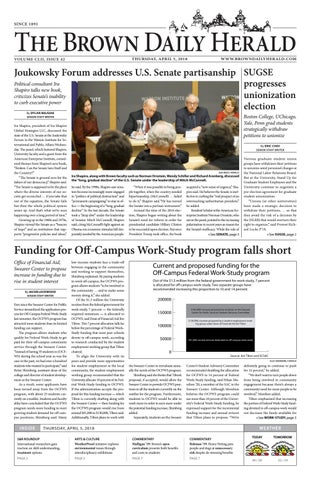
low-income students face a trade-off between engaging in the community and working to support themselves, Shimberg explained. By paying students to work off-campus, the OCFWS program allows students “to be involved in the community … and to make some money doing it,” she added. Of the $1.3 million the University receives from the federal government for work-study, 7 percent — the federally required minimum — is allocated to OCFWS, said Dean of Financial Aid Jim Tilton. This 7 percent allocation falls far below the percentage of Federal WorkStudy funding that most peer schools devote to off-campus work, according to research conducted by the student employment working group that Tilton chaired. To align the University with its peers and provide more opportunities for student employment in the local community, the student employment working group recommended that the University allocate 10 percent of its Federal Work-Study funding to OCFWS. If the administration accepts the proposal for this funding increase — which Tilton is currently drafting along with the Swearer Center — then funding for the OCFWS program would rise from around $91,000 to $130,000, Tilton said. Additionally, Tilton plans to work with
ALEX SKIDMORE / HERALD
the Swearer Center to reevaluate annually the needs of the OCFWS program. Shimberg said she thinks that Tilton’s proposal, if accepted, would allow the Swearer Center to provide OCFWS positions to all the students currently on the waitlist for the program. Furthermore, students in OCFWS would be able to work more in order to earn more under the potential funding increase, Shimberg added. Separately, students on the Swearer
Center’s Student Advisory Committee recommended doubling the allocation for OCFWS to 14 percent of Federal Work-Study funding, said Ethan Morelion ’20, a member of the SAC in the Swearer Center. Although Morelion believes the OCFWS program could use more than 10 percent of the University’s Federal Work-Study funding, he expressed support for the incremental funding increase and annual reviews that Tilton plans to propose. “We’re
definitely going to continue to push for 14 percent,” he added. “We don’t want to turn people down from being involved in community engagement because there’s always a community need for more people to be involved,” Morelion added. Tilton emphasized that increasing the portion of Federal Work-Study funding devoted to off-campus work would not decrease the funds available for » See WORK-STUDY, page 3
WEATHER
THURSDAY, APRIL 5, 2018
S&R ROUNDUP International researchers gain traction on ALS understanding, treatment options
ARTS & CULTURE WeatherProof initiative explores environmental issues through interdisciplinary exhibitions
COMMENTARY Mulligan ’19: Brown’s open curriculum presents both benefits and costs to students
COMMENTARY Bohman ’19: Heavy Petting puts people and dogs at unnecessary risk despite de-stressing benefits
PAGE 2
PAGE 3
PAGE 7
PAGE 7
TODAY
TOMORROW
46 / 28
52 / 34
NEWS
PAGE 2 • THURSDAY, APRIL 5, 2018
Science & Research Roundup BY PRIYANKA PODUGU, NEWS EDITOR
Study sheds light on ALS development, potential treatment options An international team of researchers, including Thomas Serre, associate professor of CLPS, Justin Fallon, professor of medical science, Amanda Duffy GS, PhD candidate in the neuroscience department, and Youssef Barhomi, research assistant for the Cognitive, Linguistic and Psychological Sciences department, studied and conducted tests on mice that were genetically modified to carry TDP-43, a protein that causes a hereditary form of amyotrophic lateral sclerosis in humans, according to a University press release published last month. Through their examinations of the ALS developing in the mice, the scientists discovered that “behavioral, cognitive and structural dysfunctions … were evident long before the neuronal degeneration that occurs late” in the disease. Researchers also found that unlike other degenerative diseases that result in early losses of excitatory neurons, the early development of ALS yielded a loss of inhibitory neurons, according to the release. In addition to functioning as the basis of future research into ALS and providing opportunities to possibly create therapies treating ALS in its early stages, the study underscores progress in the creation of animal models that mimic ALS symptoms in research. Additionally, the Automated Continuous Behavioral Monitoring system, an artificial intelligence technology developed at Brown, played a critical role in allowing researchers to study the mice closely and accurately for extensive periods of time.
Study links visual cues to vowel perception A study conducted by researchers at the University and at McGill University found that when people perceive speech, they rely heavily on visual cues, closely watching the movement and form of the lips, according to a University press release. To reach this conclusion, researchers tested individuals’ “directional asymmetry” when visually perceiving vowels. Directionally asymmetry allows people to better distinguish “between two versions of the ‘oo’ sound,” according to the release. During the study, researchers had volunteers listen to a “bilingual Canadian woman” make “oo” sounds in English and French, so they could determine what visual information and cues were pertinent to directional asymmetry. Directional asymmetry can be seen in Canadians who speak French and English because in French, the “oo” is more pronounced than in English.
Researchers led by U. professor discover new antibiotics to combat superbugs Last month, a team of researchers led by Eleftherios Mylonakis, a professor of infectious diseases at the Alpert Medical School, discovered a new class of antibiotics that could potentially combat superbugs, bacteria that have developed a resistance to conventional antibiotics, according to a University press release. Specifically, researchers identified two synthetic retinoids that exhibited an ability to kill MRSA, a “staph bacteria that is resistant to several antibiotics.” These retinoids impair bacterial membranes and destroy MRSA “persister” cells “that are drug-resistant dormant cells,” according to the release. Additionally, the team created new ways to screen over 80,000 synthetic compounds to find potential antibiotics that are not toxic to humans. To carry out the study Mylonakis worked with specialists from Massachusetts Eye and Ear Infirmary, Massachusetts General Hospital, Emory University and Northwestern University.
THE BROWN DAILY HERALD
» SUGSE, from page 1 On the University’s campus, SUGSE — which already has the minimum support necessary to prompt an election, according to its card campaign — plans to file for an election with the NLRB once the pre-election agreement is finalized, said Lubabah Chowdhury GS, a member of SUGSE. The composition of the NLRB has affected the ruling on whether graduate students are employees — which would allow them to unionize — said William Herbert, executive director of the National Center for the Study of Collective Bargaining in Higher Education and the Professions. Currently, two Democrats appointed by former President Barack Obama and two Republicans appointed by President Trump sit on the NLRB, while one more board member — nominated by Trump — is waiting for Senate confirmation, Herbert added. This Trump-era board has already reversed labor-friendly rulings made by the Obama-era board, according to a Huffington Post article. The political affiliations of the board members have led to repeated changes in the NLRB’s rulings, Herbert said. In a 2016 case, for example, the board “ruled in Columbia University that graduate student employees are employees (under federal law)” entitled to collective bargaining rights, “overturning a prior decision in Brown University” that ruled in 2004 that graduate students are not employees under federal law, Herbert said. Even with the flux at the NLRB, SUGSE and the University are still working on an agreement that will lead to SUGSE filing for an election on whether to unionize, Chowdhury said. Though Locke said the University will respect whatever NLRB ruling is in effect, Chowdhury expressed concern with this stance. The University “puts us in a very precarious position because if the ruling is overturned, does that mean you won’t respect our voices?” Chowdhury said. “It would
be great if we could get language in this (pre-election) agreement that would guarantee (administrative) compliance with the democratic will of the graduate student body.” It is unclear if a change in the NLRB’s ruling would affect whether the University respects the outcome of an election. “If it’s a fair and free election and the graduate students vote for it, we have said that we would recognize that decision and … see if we can work on a collective bargaining agreement,” Locke said. The University has met with SUGSE to draft the pre-election agreement since the start of the fall semester, Locke said. Two drafts of the agreement have been reviewed both this semester and last semester, but the two parties have yet to reach an agreement. “We could have had a pre-election agreement last semester,” Chowdhury said. “They’ve taken a long time to get back to us.” A pre-election agreement is not part of the NLRB procedure for unionization, but SUGSE sees the agreement as necessary to ensure the University respects the results of the election, she added. Lawyers at the American Federation of Teachers — the union that graduate students voted to affiliate with — and the University’s external counsel, Proskauer Rose LLP, wrote the most recent draft of the agreement, Locke said. But “most of the things we had talked about for a couple of months suddenly weren’t in (the agreement),” Locke said. “We were almost going back to square one,” he added. Given that the Republican-controlled Senate will likely confirm someone less friendly to unionization, which would give the Trump appointees a majority on the NLRB, many graduate student groups have decided to withdraw their unionization petitions. “We didn’t want to put (the decision) in the hands of a group that at this point we know leans away from labor,” said Bryn Spielvogel, a graduate
student at Boston College and member of the Boston College Graduate Employees Union that decided to withdraw its petition. Although the administration at Boston College opposes unionization, the Graduate Employees Union will seek voluntary recognition of the union from its administration, Spielvogel said. Other groups at universities such as the University of Chicago, Penn and Yale have made similar decisions to withdraw their petitions in the last few months. In a statement on its website, Graduate Students United at the University of Chicago wrote in February that the withdrawal was made “to prevent the University of Chicago from using the Trump administration to overturn the Columbia precedent.” New York University is the only private university to have recognized a graduate student union, though the unions already exist at public universities such as the University of California at Berkeley and the University of Wisconsin at Madison, since the law is different for the public sector, Herbert said. Most recently, Georgetown University, whose administration had opposed unionization, decided to let graduate students hold an election on unionization overseen by a third party, not the NLRB, according to the Washington Post. “I don’t see people being swayed by what other grad worker unions are deciding to do,” Chowdhury said of graduate students at the University. “SUGSE’s goal is to ratify an agreement that will allow for a free and fair election … outside of Trump’s influence and outside of administrative influence as well.” “Brown has been different from the other universities,” Locke said. “We have not only not engaged in an anti-union campaign, but we have also said we would respect the August 2016 (Columbia) decision as long as it remains the rule.” This is a “crucial moment because the law is in our favor,” Chowdhury said.
Wherever you go, bring your own mug, reusable bottle and/or thermos. Avoid plastic cutlery.
It’s time we take responsibility for our waste stream.
STAY UP-TO-DATE. FOLLOW US ON FACEBOOK. FACEBOOK.COM/BROWNDAILYHERALD
NEWS
THURSDAY, APRIL 5, 2018 • PAGE 3
THE BROWN DAILY HERALD
“WeatherProof ” explores climate change through multidisciplinary lens Programs host scientists, artists, researchers to collaborate, promote environmental issues By ELISE RYAN SENIOR STAFF WRITER
Throughout the first half of April, five programs at Brown are partnering to discuss, teach and learn about the environment through a range of perspectives with a focus on collaboration. Through the initiative “WeatherProof: Arts, Humanities and Sciences Explore the Environment,” these distinct programs will weave across barriers to examine environmental issues with a multidisciplinary lens. Each of the events is free and open to the public.
ART & CULTURE
The Bell Gallery The latest exhibition at the David Winton Bell Gallery, “33˚,” focuses on the melting polar ice that is a result of climate change. The keystone of the exhibition is Jacob Kirkegaard’s sound environment, “Isfald (Icefall),” an immersive sound experience housed within a curtainedoff section of the Bell Gallery. Produced through the use of tools such as contact microphones and hydrophones, the piece captures the sounds of melting ice caps, ranging from the soft drops of water to loud, booming cracks. “He’s literally trying to help your ears physically engage with the sound of cleaving ice in the Arctic,” said Ian Russell, curator of the Bell Gallery. Russell added that he hopes “that Jacob’s work touches people, and that maybe it makes people feel like the problem isn’t quite so far away.” Works by contemporary photographers Olaf Otto Becker and Camille Seaman are on view throughout the List Art Building to accompany the “Isfald.” “We prefer to show groupings of work or series,” as the artists are better able to “communicate the extent to how they are viewing or engaging an area or region,” Russell said. But the exhibition extends beyond the walls of the gallery. Five large prints hang off of various campus buildings’ exteriors as public art murals, featuring images by Becker and Seaman as well as photographs by Iain Brownlie
» SENATE, from page 1 the filibuster has been in place for four decades and traditionally was invoked by the minority only in moments of considerable national importance, it has become a modern “weapon of mass obstruction” under McConnell’s guidance, Ornstein said. The tendency of senators to engage in “tribalism,” or to vilify opposing party members and refuse to work across the aisle has also contributed to gridlock in the Senate, he said. Ornstein warned that these “headaches” will only multiply as time progresses, in part because Senate seats are not allocated based on population. He estimated that by 2040, 70 percent of Americans will live in 15 states — at that point, 30 percent of Americans will be responsible for electing 70 senators. “As our country becomes more urban, more diverse and younger, the Senate is going to become increasingly unrepresentative of the country,” Ornstein said.
Roy, Jean de Pomereu and James Balog. The print located on the List Art Building depicts people standing and posing for photographs on waves of bright white ice. The exhibition, curated by Director of the Bell Gallery Jo-Ann Conklin, was developed alongside the Brown Arts Initiative’s three-year theme of Arts and Environment, a coordination that Anne Bergeron, managing director of the BAI, said “was very purposeful.” Kirkegaard will be speaking at the opening reception of the exhibition April 6, and will present his sound concert “Labryinthitis” April 7. The exhibition will show through May 27. The Brown Arts Initiative The Brown Arts Initiative symposium, “Polar Opposites: Creative Interventions in the Arctic and Antarctica,” will gather artists, scientists, scholars and musicians, among other experts, to the Granoff Center for the Creative Arts. “We are bringing together artists and scientists and researchers who are working in a kind of cross-platform way to address something of a great deal of significance to contemporary society,” Bergeron said of the focus on polar regions. The keynote speaker, filmmaker David Buckland, is the founder and director of Cape Farewell, a multidisciplinary, international effort to culturally respond to climate change. Bergeron said that the program was founded after Buckland came to the realization that the combination of efforts by artists and scientists would allow for a better understanding and approach to the issues of climate change — a mindset similar to the core values of the the BAI and the WeatherProof programs. “This is … one of the things that Brown does really well — it has porous borders in terms of disciplines and it … regularly reaches out beyond. One of the things that we are trying to do through the construct of WeatherProof is to make that visible,” Bergeron said. The Polar Opposites keynote address and panels, “Knowing Ice” and “Art, Polarities and Politics,” will take place April 5 and 6 at the Granoff Center.
ELI WHITE / HERALD
As part of the initiative “WeatherProof: Arts, Humanities and Sciences explore the Environment,” photographs depicting the effects of climate change adorn campus buildings, such as the List Art Building pictured above. exchange notes, Montero said, while also offering them the opportunity to relay this information to a wider audience. Earth(ly) Matters will take place April 6 and 7 at the Cogut Institute in Pembroke Hall.
The Cogut Institute “Earth(ly) Matters: New Directions in Environmental Humanities,” hosted by the Cogut Institute for the Humanities, will assemble over a dozen speakers
in an effort to coalesce multiple fields, ranging from new media arts to the social sciences. The theme of this year’s season at the Cogut Institute is environmental humanism, a theme that has been studied before at the Institute, and that represents a “conjunction of energies” among Institute scholars, said Damien Mahiet, associate director of the Cogut Institute. “The environmental humanities is really a conglomerate of researchers trying to tackle questions that have to do with how to better live on this planet” from fields beyond those that directly affect life on Earth, said Iris Montero, a postdoctoral fellow at the Cogut Institute. “We’re basically trying to think from our different standpoints about all the ways that we have engaged with nature in the past, how those ways have been communicated through different means in literature, in the different arts, and what those representations … can tell us for future directions,” she added. While the Cogut Insitute considers today’s issues, its focus extends to the “longer history and broader history of the environment … and the relationship between humans and non-humans,” Mahiet said. The conference serves as an opportunity for scholars to come together and
Professor of Political Science and International and Public Affairs and Chair of the Political Science Department Wendy Schiller said that the Senate currently serves as a means for politicians to make their name by obstructing legislation. But this is not a new practice, Schiller said. Rather, what is novel is the increasing number of senators taking advantage of the institution. Schiller wrote a review of Shapiro’s book in the Washington Monthly in which she critiqued his romanticization of the past. “The problem with looking backward when things are difficult in the current age is that we tend to put a silk screen across everything we see, making it softer and prettier than it really was,” Schiller said. “The Senate of yesteryear was not representative either demographically or economically” of the American constituency due to its paucity of female, African American and Latino elected officials,
she added. She also affirmed that the Senate today is a far more diverse place demographically than it has been in the past. The Senate is comprised of 22 female senators, a cohort that includes one black woman, one Pacific Islander woman and one Latina woman. Visiting Lecturer in Political Science Richard Arenberg cited the “necessary evil of money” and the “24-hour media cycle” that rewards “sound bites over substance” as contributors to the Senate’s decline. Looking forward, Shapiro said that a small, bipartisan group has the potential to change the dynamic of the Senate body. But Schiller believes that voters will ultimately be the ones to change the Senate most. “Elect people who have demonstrated some capacity to govern, who care about government and are willing to cross the aisle on some things,” Schiller said.
» WORK-STUDY, from page 1
IBES and the John Carter Brown Library “Water’s Edge” is this year’s rendition of the interdisciplinary program “Earth, Itself,” sponsored by the Institute at Brown for Environment and Society. The theme of water marks the final element in the fourth year of the series, following the inaugural themes of earth, air and fire. “The advantage of the classic elements is that it’s accessible in terms of how you think about issues and how ideas have moved forward,” said Lenore Manderson, the director of “Earth, Itself” and visiting professor of anthropology. “I really used a particular element as a theme around which to build questions about the environment, environmental change (and) climate change,” she added. Following a tradition of connecting scientific discussion with related specific art forms, this year’s program focuses on text through two days of poetry readings, as well as discussions around water as an inspiration for writing, Manderson said.
on-campus work. “We spend much more on student employment than we receive (from the federal government) in work-study (funding),” Tilton said, noting that the University’s student employment budget exceeds $5 million. “Through the operations budget, we fund student employment. It isn’t that we’re taking away (from) one to give to another.” Mikaela Karlsson ’18, a SAC member who is currently involved in OCFWS, has worked both on campus at the Nelson Fitness Center and off campus at a community organization called DownCity Design. She said her off-campus work has been far more valuable to her than her on-campus work. “There’s just so much more opportunity for skill-building when you’re working with a community partner,” Karlsson said. “If you’re working for BUDS or working at the front desk at the
A film by Wendy Woodson, “Sourcing the Stream,” was also shown at the opening program April 3 hosted by the John Carter Brown Library, and is now showing in the lobby of the IBES building. The interdisciplinary approach of the “Earth, Itself ” program gears its message toward the general public, Menderson said, while also giving scientists, artists and writers the chance to reflect on each other’s work. She added that this was exemplifed at the opening film screening and its corresponding panel event. “What has been so exciting has been the capacity for people to collaborate or to share a space and to recognize that each reflects on what the other is talking about,” she said, adding that the interdisciplinary approach “gives a legitimacy to the insights that artists provide.” Water’s Edge will host events through April 13, including a film night, flash lecture competition, poster competition and various panels. The next seminar, “Writing on Water,” will take place in two sessions over April 12 and 13. The John Carter Brown Library exhibition, “Fluidity: Knowing Water in the Americas,” will show from May 1 to June 30, following the opening symposium that took place April 3.
Nelson, there’s not as much opportunity for growth.” Carmen Ferran ’20.5 is paid to participate in the Brown Elementary AfterSchool Mentoring program through off-campus work-study. If it weren’t for OCFWS, Ferran said she wouldn’t be able to participate in BEAM. Ferran added that she is grateful that OCFWS allows her to explore nonprofit work while earning “enough spending money to get by.” Ferran and Karlsson both hope that the OCFWS program will receive increased funding to expand off-campus employment opportunities. “More kids should have the opportunity to work in the city and contribute to public good … and also not be broke during the school year,” Ferran said. “Community engagement should not be limited to those who can afford to take unpaid or low-paying internships,” Karlsson agreed.
PAGE 4 • THURSDAY, APRIL 5, 2018
THE BROWN DAILY HERALD
%(51$5', )$,1/(&785(
'LVWULEXWHG/HGJHU7HFKQRORJ\DQG%ORFNFKDLQ
5HGH˴QLQJWKH)RXQGDWLRQVRI)LQDQFH $35,/ 7+ 30
6$/2021
%(1-$0,1
1$'$5(6., 5 &20
Harnessing Tech to Power Social Impact Lisa Gelobter CS ’91 CEO, tEQuitable )RUPHUO\ &KLHI 'LJLWDO 6HUYLFH 2IĆFHU 2EDPD :KLWH +RXVH %(7 1HWZRUNV +XOX 6KRFNZDYH From healthcare.gov, to veterans, students and immigrants, if we can send a Tesla 5RDGVWHU LQWR RXWHU VSDFH ZH FDQ VXUHO\ Ć[ WKH FULWLFDO LVVXHV DIIHFWLQJ KXJH FKXQNV RI our population right here on our home planet. In the age of #metoo, the impacts of bias, GLVFULPLQDWLRQ DQG KDUDVVPHQW LQ WKH ZRUNSODFH DUH UHFRJQL]HG WR EH LPPHGLDWHO\ KDUPIXO but also have a long-ranging effect on the economic prosperity of entire disenfranchised SRSXODWLRQV /LVD ZLOO XVH D 8VHU &HQWHUHG 'HVLJQ IUDPHZRUN WR GHPRQVWUDWH KRZ WKH VDPH practices of invention and innovation apply when 1u;-ࢼm] |;1_moѲo] =ou ]oo7.
Monday, April 9, 2018, 5:30 p.m. 85 WATERMAN, ROOM 130 Online registration is now open at: brown.edu/thinking-out-loud Sponsored by: 2IĆFH RI WKH 3UHVLGHQW 6FKRRO RI (QJLQHHULQJ 6FKRRO RI 3XEOLF +HDOWK &RPSXWHU 6FLHQFH 'DWD 6FLHQFH ,QLWLDWLYH 16%( 0RVDLF 6+3( 6:(
TODAY
THURSDAY, APRIL 5, 2018 • PAGE 5
THE BROWN DAILY HERALD
menu
i v y d ay a f t e r m at h
SATELLITE DINING ANDREWS COMMONS
Pizza: Cheese’ Pepperoni; Meatball, Provolone, Rosemary; Make Your Own Pasta; Mac and Cheese Bar JOSIAH’S
BLUE ROOM
French Toast Bar, Rodeo Burger, Quesadilla Station
Turkey Chili, Minestrone Soup, Mango and Mint Chicken Curry
DINING HALLS SHARPE REFECTORY LUNCH
DINNER
Tex Mex Chili, Rice with Jalapenos, Steamed Brown Rice with Vegetables
Hot Corned Beef On Rye, Home Fried Red Potatoes With Onion, Portuguese Paella
VERNEY-WOOLLEY LUNCH
DINNER
Italian Sausage and Peppers Sandwich, Pizza Rustica with Spinach
Meatloaf with Mushroom Sauce, Cheese Ravioli, Fresh Broccoli, Stewed Tomatoes
sudoku
KAITLYN LEW / HERALD
Large crowds of prospective students and large clumps of snow could be found on the Main Green after Ivy League admission decision day and an impromptu flurry. Brown’s admitted 7.2 percent of applicants this year.
Q U O T E O F T H E D AY
“Elect people who have demonstrated some capacity to govern, who care about government and are willing to cross the aisle on some things.
”
— Wendy Schiller, chair of the political science department
See senate on page 1. crossword
calendar TODAY NOVEMBER MARCH APRIL
S
M
T
W
Th
F
S
1
2
3
14
25
36
47
58
69
10 7
11 8
12 9
10 13
11 14
Brown/CASA in Cuba Info Session 11:00 A.M. J Walter Wilson, 411
Pathobiology Seminar: Minsoo Kim, Ph.D. 12:00 P.M. Sidney E. Frank Hall, 220
Data Science Colloquium 12:00 P.M. 151 Thayer, Foxboro Auditorium
Virtual Reality in the YURT 12:00 P.M. 180 George Street, The CAVE
TOMORROW
12 15
13 16
14 17
15 18
16 19
17 20
18 21
19 22
20 23
21 24
22 25
23 26
24 27
25 28
26 29
27 30
28
29
30
31
Scientific Computing Seminar 11:00 A.M. 170 Hope Street, 108
Fado through the Filmmaker’s Lens 12:15 P.M. 159 George Street, 102
19th Century U.S. History Workshop 1:00 P.M. Peter Green House
Beyond Deep Learning 4:00 P.M. 190 Thayer Street, Metcalf Auditorium
COMMENTARY PAGE 6 • THURSDAY, APRIL 5, 2018
THE BROWN DAILY HERALD
A L E X W E ST FA L L
Find us online! facebook.com/browndailyherald
browndailyherald.com
@the_herald
Location: 195 Angell St., Providence, R.I. www.browndailyherald.com
@browndailyherald
youtube.com/browndailyherald
Editorial Leadership
Sections
Multimedia & Production
Editor-in-Chief Elena Renken
Arts & Culture Editors Connor Sullivan Mia Pattillo
Design Editors General Managers Kyle Cui Michael Borrello Eduard Muñoz-Suñé Matilda Lynton Assistants: Julie Wang, Kelvin Yang
Metro Editors Emily Davies Bella Roberts
Photo Editors Sam Berube Anita Sheih
News Editors Anna Kramer Eduard Muñoz-Suñé Priyanka Podugu Sarah Wang
Copy Desk Chief Abby Borges
Managing Editor Kasturi Pananjady Senior Editors Julianne Center Madison Rivlin Alex Skidmore Hattie Xu Features Editor Isabel Gensler Editorial Page Editor Anuj Krishnamurthy
Science & Research Editors Jonathan Douglas Jackson Wells
POST- MAGAZINE Editor Saanya Jain
Sports Editors Alexandra Russell Nicholas Wey COMMENTARY Opinions Editors Connor Cardoso Anuj Krishnamurthy Clare Steinman
Illustrations Editor Pia Mileaf-Patel Video Editors Roland High Celia Hack
Business
Office Manager Diane Silvia Directors Sales: Shreya Raghunandan Finance: Ravi Betzig Strategy: Caroline Ziegler
Editorial contact: 401-351-3372 herald@browndailyherald.com
Advertising contact: 401-351-3372 advertising@browndailyherald.com
Submissions: The Brown Daily Herald publishes submissions in the form of op-eds and letters to the editor. Op-eds are typically between 750 and 1000 words, though we will consider submissions between 500 and 1200 words. Letters to the editor should be around 250 words. While letters to the editor respond to an article or column that has appeared in The Herald, op-eds usually prompt new discussions on campus or frame new arguments about current discourse. All submissions to The Herald cannot have been previously published elsewhere (in print or online — including personal blogs and social media), and they must be exclusive to The Herald. Submissions must include no more than two individual authors. If there are more than two original authors, The Herald can acknowledge the authors in a statement at the end of the letter or op-ed, but the byline can only include up to two names. The Herald will not publish submissions authored by groups. The Herald does not publish anonymous submissions. If you feel your circumstances prevent you from submitting an op-ed or letter with your name, please email herald@browndailyherald.com to explain your situation. You can submit op-eds to opinions@browndailyherald.com and letters to letters@browndailyherald.com. When you email your submission, please include (1) your full name, (2) an evening or mobile phone number in case your submission is chosen for publication and (3) any affiliation with Brown University or any institution or organization relevant to the content of your submission. Please send in submissions at least 24 hours in advance of your desired publication date. The Herald only publishes submissions while it is in print. The Herald reserves the right to edit all submissions. If your piece is considered for publication, an editor will contact you to discuss potential changes to your submission. Commentary: The editorial is the majority opinion of the editorial page board of The Brown Daily Herald. The editorial viewpoint does not necessarily reflect the views of The Brown Daily Herald, Inc. Columns, letters and comics reflect the opinions of their authors only. Corrections: The Brown Daily Herald is committed to providing the Brown University community with the most accurate information possible. Corrections may be submitted up to seven calendar days after publication. Advertising: The Brown Daily Herald, Inc. reserves the right to accept or decline any advertisement at its discretion. The Brown Daily Herald, Inc. is a financially independent, nonprofit media organization bringing you The Brown Daily Herald, BlogDailyHerald and Post- Magazine. The Brown Daily Herald has served the Brown University community daily since 1891. It is published Monday through Friday during the academic year, excluding vacations, once during Commencement and once during Orientation by The Brown Daily Herald, Inc. Single copy free for each member of the community. Subscription prices: $200 one year daily, $100 one semester daily. Copyright 2018 by The Brown Daily Herald, Inc. All rights reserved. Periodicals postage paid at Providence, R.I. Postmaster: Please send corrections to P.O. Box 2538, Providence, RI 02906.
COMMENTARY THURSDAY, APRIL 5, 2018 • PAGE 7
THE BROWN DAILY HERALD
Class of 2022: Is the open curriculum for you? CAROLINE MULLIGAN staff columnist As potential members of the class of 2022 ponder whether or not to accept Brown’s offer of admission, many of them will no doubt be swayed by the open curriculum. Whenever I hear conversations among my peers about why we chose Brown, the opportunity to forge our own academic path inevitably emerges as a top reason. Yet as semesters pass, I find myself evaluating the open curriculum with a more balanced eye, and from conversations I’ve overheard among classmates, I know I’m not alone. The open curriculum is a key component of the Brown experience but evaluating it without rose-colored glasses would help us see what we really want from our education. Reflection would allow potential students to develop a better perspective on whether Brown is the place for them. A quick review: According to a University webpage, the open curriculum, which was instated almost fifty years ago, is designed to allow students “maximum flexibility” in their education. While students must complete a concentration and demonstrate competency in written communication, they are otherwise free to choose how they spend their academic time. Unlike most colleges, Brown students are not required to take a foreign language, a science class with a laboratory component or any other general educational requirement. There are many benefits to this freedom. Because students do not have to spend course hours attain-
ing mandatory credits, it is easier to have multiple concentrations. The ease of double concentrating, as compared to schools where a second major must be completed on top of core requirements, means that students can add an additional concentration if they discover a new area of academic interest later in their time at Brown. It is also easier for students to combine seemingly disparate areas of study. I know people who concentrate in visual art while on a pre-med path, or who double concentrate in computer science and
at the same time, it makes it entirely possible to stay confined within your comfort zone. There is something to be said for being able to dive deeply into one subject as an undergraduate. As a first-year, I was already taking courses in my concentrations while my friends at other schools spent their first few semesters solely fulfilling distribution requirements. The open curriculum makes it possible to focus intensely on one area of academia, taking more courses in one department than a student at a
curriculum to avoid subjects that sound unappealing. Though I have explored many departments, I have only taken one STEM class. My education has helped me learn to think in a variety of ways, but I’m not sure I have “Experience(d) Scientific Inquiry,” one of Brown’s Liberal Learning Goals. As an upperclassman, I’ve occasionally found myself wishing that when I first came to Brown, I was forced to take courses outside of my known academic interests. It’s hard enough adjusting to college in the
The problem here isn’t the open curriculum itself, but that it allows us to run from our fear of failure.
classics. While these paths would be possible at other universities, there’s no doubt that they would be harder to follow if general educational requirements got in the way. But while some students rise to the challenge offered by the open curriculum, others use it as a safety net. Double concentrating in two humanities, I can’t count the number of times I’ve heard my classmates joke about having not taken a math or science course since high school. The open curriculum makes it possible to explore courses in departments that you would not have had time for if burdened with general educational requirements, but
different school would have the opportunity to. The problem with comfort zones isn’t that they limit your studies to an area you love — it’s that they keep you from discovering new interests. I have always enjoyed studying history and English, but I realized recently that I would have benefited from a stronger foundation in sociology and anthropology. Like many students, I was not exposed to these subjects in high school, and so I went several years without fully understanding how they would supplement my education. And I fully admit that I am one of those concentrators in the humanities who has used the open
first place, and amid the chaos of living in an entirely new environment, I expect it’s normal to focus on classes that instantly pique your interest. Yet I wonder if I would have discovered some latent interest if I had been required to explore other curricular areas early in my time at Brown. It’s a bit too late to completely upend my academic plans, though I have been trying to take courses in new departments. I’m reminded of something a classmate, also a junior and also double concentrating in two nonSTEM subjects, said recently: If she could redo her time at Brown, she would be majoring in two hard sci-
ences, subjects to which she had only recently been introduced. As a first-year, she was too intimidated to enroll in courses she worried she would not do well in. Perhaps, then, the problem here isn’t the open curriculum itself, but that it allows us to run from our fear of failure. The students who come here are generally used to succeeding, and even measures like taking any course S/NC or not having a GPA don’t reduce the emotional difficulty of dealing with a poor grade. That’s a problem that won’t go away without a major culture shift, and although the open curriculum may exacerbate it by letting students avoid potential failures, its existence is not the open curriculum’s fault. As admitted students choose whether or not to attend Brown, the open curriculum will likely factor into their decision, one way or another. I encourage them to think about what it offers and what its limitations are. Do you want to explore academically? And if so, do you feel able to do that yourself, or would you benefit from outside assistance? The open curriculum is an excellent opportunity but it isn’t inherently better than a traditional curriculum, and acknowledging that can help determine if Brown offers the opportunities to grow that a student seeks.
Caroline Mulligan ’19 can be reached at caroline_mulligan@brown.edu. Please send responses to this opinion to letters@browndailyherald.com and op-eds to opinions@browndailyherald.com.
Heavy petting should consider dogs’ needs too LENA BOHMAN op-ed contributor I have hesitated a long time to write this column. I know this issue could make me a pariah on campus, but, as a senior, I guess it’s time to go out with a bang. I have a confession to make: I hate Heavy Petting. I think it’s dangerous. Here’s why. I am a dog trainer and dog sport competitor, and Heavy Petting runs counter to everything I know about dogs. My dog is a certified therapy dog, and as the handler, I was always taught to put his needs first. If he’s not having fun or enjoying the experience, we leave. I left Heavy Petting and never went back because it was too overwhelming for him because there were dogs running off leash and large dogs and small dogs all crammed together. This is not an environment many dogs feel comfortable or able to concentrate in. It’s true that some dogs enjoy going to the dog park, but they generally don’t go there to be patted by college students. Even when my dog and I compete in dog sport competitions, where there are 35 dogs in a small space, competitors are required to keep our dogs crated and bring them out only for
their run. Heavy Petting also presents a safety issue. A dog surrounded by a million canines and people is probably a stressed-out dog. Based on my previous experiences attending Heavy Petting and talking to University administrators, I was led to believe that BWell Health
there is a dog fight or someone gets hurt. I want to acknowledge that I do run the other dog therapy club, Brown Animal Assisted Therapy, on campus, which was founded with the idea of providing a different type service from Heavy Petting through individual appointments. However, we would be happy
Given the way Heavy Petting is run, I believe it is just a matter of time before there is a dog fight or someone gets hurt.
Promotion, which runs Heavy Petting, has not, in the past, tested dogs for temperament or suitability before the event. Until recently, BWell didn’t even require that the dogs be on a leash or provide supervision for the event. I am frankly unsure of how Heavy Petting has continued under the aegis of the University’s lawyers, who may have reason to be skeptical of dog events. Given the way Heavy Petting is run, I believe it is just a matter of time before
to see a thriving Heavy Petting program on campus — trust me, there’s enough demand. And there are ways that BWell could run Heavy Petting more safely. There are groups of registered therapy dogs in Rhode Island who only do events like this — I have been contacted by several. If they wanted to stick with faculty members’ dogs, they could have a dog trainer evaluate the dogs for suitability: Every dog could get a certificate before coming
to Heavy Petting. They could have separate areas for large and small dogs. They could implement crowd control measures for participants. They could invest in moveable fences so that each dog could have its own space. But many of these measures would require a significant expenditure of effort by the University, which is why I believe they have not happened yet. Ultimately, I would like to add that I did not make this public statement without first privately speaking to many members of both the administration and BWell. I am open to hearing that changes are being made that I perhaps have not been informed of, but from my perspective, nothing has changed in the three years I have been here. As Brown students, we should demand better — not only for dogs, but for ourselves. Heavy petting is a fun event, but it can be fun and safe at the same time.
Lena Bohman ’18 is the founder of the Animal Assisted Therapy program at Brown and can be reached at lena_ bohman@brown.edu. Please send responses to this opinion to letters@browndailyherald.com and opeds to opinions@browndailyherald.com.
97th
97 th
FEAT U R I N G
Jeb Bush Governor of Florida (1999-2007)
Leadership in a Changing World Wednesday, April 25, 2018 | 5 p.m. Salomon Center for Teaching De Ciccio Family Auditorium 79 Waterman Street
Tickets Required brown.edu/ogden
Doors open at 4:30 p.m. This event is free and open to the public. Brown or government-issued ID required. Backpacks and large bags are not allowed.
To request special services, accommodations or assistance for this event, please contact the University Event & Conference Services Office at universityevents@brown.edu or 401-863-3100.