SINCE 1891
THE BROWN DAILY HERALD THURSDAY, APRIL 26, 2018
VOLUME CLII, ISSUE 56
WWW.BROWNDAILYHERALD.COM
Jeb Bush discusses U.S. political climate Dorcas International offers
aid, support to R.I. immigrants Nonprofit helps DACA recipients file renewal applications free-ofcharge amid political flux By CORAL MURPHY SENIOR REPORTER
SAM BERUBE / HERALD
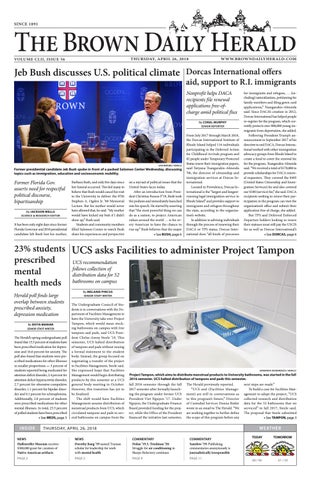
Former presidential candidate Jeb Bush spoke in front of a packed Salomon Center Wednesday, discussing topics such as immigration, education and socioeconomic mobility.
Former Florida Gov. asserts need for respectful political discourse, bipartisanship By JACKSON WELLS SCIENCE & RESEARCH EDITOR
It has been only eight days since former Florida Governor and 2016 presidential candidate Jeb Bush lost his mother,
Barbara Bush, and only five days since her funeral occurred. This led many to believe that Bush would cancel his visit to the University to deliver the 97th Stephen A. Ogden Jr. ’60 Memorial Lecture. But his mother would never have allowed that, he said. “My mother would have kicked my butt if I didn’t show up,” Bush said. Students and community members filled Salomon Center to watch Bush share his experiences and perspective
on a myriad of political issues that the United States faces today. After an introduction from President Christina Paxson P’19, Bush took the podium and immediately launched into his speech. He started by asserting that “the most powerful thing we can do as a nation, to project American values around the world … is for every American to have the chance to rise up.” Bush believes that the major » See BUSH, page 6
From July 2017 through March 2018, the Dorcas International Institute of Rhode Island helped 116 individuals participating in the Deferred Action for Childhood Arrivals program and 82 people under Temporary Protected Status renew their immigration papers, said Tatyana Tsangarakis-Almeida ’06, the director of citizenship and immigration services at Dorcas International. Located in Providence, Dorcas International is the “largest and longestrunning legal immigration service in Rhode Island” and provides support to immigrants and refugees throughout the state, according to the organization’s website. In addition to advising individuals through the process of renewing their DACA or TPS status, Dorcas International does “all kinds of processes
for immigrants and refugees, … (including) naturalization, petitioning for family members and filing green card applications,” Tsangarakis-Almeida said. Since DACA’s creation in 2012, Dorcas International has helped people re-register for the program, which currently protects over 800,000 young immigrants from deportation, she added. Following President Trump’s announcement in September 2017 of his directive to end DACA, Dorcas International worked with other immigration advocacy groups from Rhode Island to create a fund to cover the renewal fee for the program, Tsangarakis-Almeida said. “We received a total of $170,000 to provide scholarships for DACA renewal requesters. They covered the $495 (United States Citizenship and Immigration Services) fee and also covered our $100 (service) fee,” she said. DACA recipients seeking to renew their participation in the program can visit the organization’s office and submit their application free of charge, she added. But TPS and Deferred Enforced Departure holders looking to renew their statuses must still pay the USCIS fee as well as Dorcas International’s » See DORCAS, page 6
23% students UCS asks Facilities to administer Project Tampon prescribed UCS recommendation follows collection of mental distribution data for 52 health meds bathrooms on campus Herald poll finds large overlap between students prescribed anxiety, depression medication By DIVYA MANIAR SENIOR STAFF WRITER
The Herald’s spring undergraduate poll found that 13.3 percent of students have been prescribed medication for depression and 16.6 percent for anxiety. The poll also found that students were prescribed medications for other illnesses in smaller proportions — 3 percent of students reported being medicated for attention deficit disorder, 2.4 percent for attention deficit hyperactivity disorder, 2.7 percent for obsessive-compulsive disorder, 1.1 percent for bipolar disorder and 0.1 percent for schizophrenia. Additionally, 2.8 percent of students were prescribed medications for other mental illnesses. In total, 23.3 percent of polled students have been prescribed » See MEDS, page 3
INSIDE
By MELANIE PINCUS SENIOR STAFF WRITER
The Undergraduate Council of Students is in conversations with the Department of Facilities Management to have the University take over Project Tampon, which would mean stocking bathrooms on campus with free tampons and pads, said UCS President Chelse-Amoy Steele ’18. This semester, UCS halted distribution of tampons and pads without issuing a formal statement to the student body. Instead, the group focused on negotiating a transfer of the project to Facilities Management, Steele said. She expressed hope that Facilities Management would begin distributing products by this semester at a UCS general body meeting in October. However, this transition has yet to be finalized. The shift would have Facilities Management assume distribution of menstrual products from UCS, which circulated tampons and pads to several bathrooms on campus from the
MARIANNA MCMURDOCK / HERALD
Project Tampon, which aims to distribute menstrual products to University bathrooms, was started in the fall 2016 semester. UCS halted distribution of tampons and pads this semester. fall 2016 semester through the fall 2017 semester after formally launching the program under former UCS President Viet Nguyen ’17. Under Nguyen, the Undergraduate Finance Board provided funding for the project, while the Office of the President financed the initiative last semester,
The Herald previously reported. “UCS and (Facilities Management) are still in conversations as to this program’s future,” Director of Custodial Services Donna Butler wrote in an email to The Herald. “We are working together to further define the scope of this program before any
next steps are made.” To build a case for Facilities Management to adopt the project, “UCS collected research and distribution data for the 52 bathrooms that we serviced” in fall 2017, Steele said. The proposal that Steele submitted » See TAMPON, page 3
WEATHER
THURSDAY, APRIL 26, 2018
NEWS Haffenreffer Museum receives $500,000 grant for curation of Native American artifacts
NEWS Dorothy Jiang ’19 named Truman scholar for leadership for work with mental health
COMMENTARY Dolan ’19.5, Triedman ’20: Struggle for air conditioning in Sharpe Refectory continues
COMMENTARY Samilow ’19: Publishing commentaries anonymously is journalistically irresponsible
PAGE 2
PAGE 3
PAGE 9
PAGE 11
TODAY
TOMORROW
68 / 46
61 / 50
NEWS
PAGE 2 • THURSDAY, APRIL 26, 2018
THE BROWN DAILY HERALD
Haffenreffer Museum receives $500,000 Mellon Grant New online tool to increase access to new grant-funded collection acquisitions By EMILY MILLER STAFF WRITER
The Andrew W. Mellon Foundation recently granted the Haffenreffer Museum of Anthropology $500,000 to “rehouse, conserve and photograph our Native American and Indigenous collections,” according to Robert Preucel, director of the Haffenreffer Museum and professor of anthropology. The grant is a “reflection of the significant turn the foundation took years ago to promote diversity throughout all its programs,” said Joseph Meisel, deputy provost and adjunct associate professor of history, who previously worked at the Mellon Foundation. It demonstrates the Foundation’s large effort “to support Native American collections throughout the country . . . from the Field Museum in New York to more local institutions,” Meisel said.
Rudolf Haffenreffer, “a collector of Native American artifacts,” and his family donated the core collection that is the “basis for the museum” and the land for the museum in 1955, Preucel said. This collection is “large in (the) context of Native America,” Preucel said. Meisel added the collection is “very strong in Native American artifact and material culture.” However, many faculty members and students are unaware of the extent of the collection. “Nobody knows what we have,” Preucel noted. In order to combat this issue, the museum has launched its online catalogue to allow the public to easily search for different objects in the collection. Emily Jackson, operations and communications coordinator for the Haffenreffer Museum, explained that the “permanent collection numbers over 150,000 ethnographic and archaeological objects from all over the world … from modern African paintings to ancient European neolithic tools.” While the entire collection is not yet on the online catalogue, there are “about 2,000 objects on the catalogue
and (we) are updating very often with new objects and images,” Jackson noted. “Our mission has always been to connect with Brown students, Brown community and also the local community in Rhode Island and globally,” Jackson said. Jackson explained that this database builds on the already established CultureLab, in which the museum offers objects from the collection that professors can use in classes and students can access through “one-on-one, hands-on presentation of material culture.” The new database was launched with the hope that it “breaks down barriers” and broadens students’ ability to use the collections, Jackson said. However, Jackson said there are “definitely places where we can grow.” The museum is interested in fostering “interdepartmental connections” and “not just working with the archaeology or anthropology students, typically the most obvious fit.” While the recent Mellon grant didn’t pay for this database, it will help “populate this database,” Preucel noted. Overall the grant will “help to make this database even more useful.”
COURTESY OFTHE HAFFENREFFER MUSEUM
This elk skin Sioux dress is just one of the more than 150,000 objects that make up the Haffenreffer Museum’s permanent collection.
University’s chief legal officer retires after 40 years Beverly Ledbetter reflects on career of service, future plans, greatest accomplishments By LYDIA DEFUSTO SENIOR STAFF WRITER
“I am able to weather storms without letting them weather me,” Vice President and General Counsel Beverly Ledbetter said when she described qualities that have helped her to navigate her time as the University’s chief legal officer. After 40 years of weathering storms at the University, Ledbetter is retiring in summer 2018, according to a University press release. When she first arrived at Brown in 1978, Ledbetter did not plan on staying for so long. “I thought I’d be here seven (or) eight years,” she said. But the people at the University inspired her to stay. “I’ve always enjoyed the individuals I’ve worked with,” she said. Ledbetter has “many, many years of experience and (has a) deep knowledge base around issues of academic law, processes (and) regulations,” said Terrie Fox Wetle, professor of health services, policy and practice. “She’s a nationally-recognized expert on these kinds of issues.” Although Ledbetter was instrumental in the 1993 anti-trust case United States v. Brown University in addition to spearheading heavily publicized legal efforts such as the retrieval of a Civil War-era sword that was stolen from the University and the current endeavor to recover the stolen student records of John F. Kennedy Jr. ’83, she does not cite these as her greatest accomplishments during her time at the University. “My biggest successes are the ones
that you can’t see,” she said. “They’re the ones where I’ve helped the University or the staff or administrators or even students to navigate an issue and avoid conflict.” Ledbetter has witnessed much of the University’s transformation over the last four decades, she said, citing the increase in the number of academic disciplines offered and growth in the size of the University’s campus area as examples. “An institution is a dynamic place. You shouldn’t expect it to be the same in 2018 … (as) it was in 1978. And it’s not,” she said. Even after her retirement, Ledbetter expects to remain involved in the University. “I will continue to do some of the legal work that’s already in play,” she said. She also plans to “take on some special projects.” The last time Ledbetter had two consecutive weeks off from work was in 2008, so she said that in her retirement she is looking forward to traveling to places — such as the Galapagos Islands, Mount Rushmore and the Grand Canyon, for example — where her work trips have not taken her. Though the search for her successor has just begun, Ledbetter said she expects there to be great interest in the role. “It’s a wonderful position, it’s a wonderful institution and I can’t imagine why one thousand people don’t apply for the job,” she said. Open-mindedness and flexibility are essential characteristics for her successor, she added. She advises the next general counsel to “be prepared for anything … and everything.” Besides her “great sense of humor,” Ledbetter has “been a wonderful asset to the University” and has “internalized the essence of Brown,” said Sheila Blumstein, professor of cognitive, linguistic and psychological sciences. “She’ll be very sorely missed.”
COURTESY OF BROWN UNIVERSITY
Though Beverly Ledbetter has played an intergral role in several high profile legal cases involving the University, she considers her greatest successes to be the ones in which issues are resolved and conflicts are avoided.
NEWS
THURSDAY, APRIL 26, 2018 • PAGE 3
THE BROWN DAILY HERALD
Dorothy Jiang ’19 selected as Truman Scholar Scholarship recognizes student achievement, commitment to public service, leadership By ANUVA GOEL STAFF WRITER
Dorothy Jiang ’19 recently became the first Brown student to earn the Truman scholarship in three years. The Harry S. Truman Scholarship — which was granted to 59 undergraduate juniors from a pool of 756 applicants in 2018 — is awarded based on leadership, commitment to a career in public service and likelihood of academic achievement, according to Tara Yglesias, deputy executive secretary of the Truman Foundation. The scholarship is a “beacon of public service recognizing young people who have the potential to make a real and profound impact on some issues that they care about, either through nonprofit work or through the government,” Yglesias said. Scholars receive a $30,000 scholarship along with access to programming that will help them become “the best public servants possible,” according to the foundation’s website. “It was such an honor … to have the opportunity to reflect on my own goals and receive that kind of validation from both Brown as an institution and the Truman Foundation as an institution,” Jiang said. Earning the scholarship was a “humbling” experience, she added. The foundation looks for students who will be “change agents,” Yglesias added. Jiang came across as “passionate” on her selected issue of mental health, and has made some “real impacts” while also recognizing the “realities of her issue and some of the challenges that she’s going to face,” Yglesias said. Jiang, who has created an independent concentration at Brown called “Intersectional Mental Health,” developed her passion for the topic of mental health in her high school years, when she worked for suicide hotlines, she said. Working for hotlines “was a very
» MEDS, from page 1 psychiatric medication. “Those numbers are fairly consistent with prescribing practices for colleges nationally,” said Will Meek, psychologist and the director of Counseling and Psychological Services. “The academic challenge at Brown is really high. There are a lot of students here who really care about their academics, their careers, their performance,” he said. “When there’s a high level of pressure and a high level of challenge, it can create a lot of stress, which can lead to psychiatric symptoms,” he added. According to the Anxiety and Depression Association of America, “anxiety is the most common mental illness” in the United States, affecting 18.1 percent of the adult population. The ADAA also reported that in a given year, 6.7 percent of all American adults were affected by major depressive disorder. The Herald’s spring undergraduate
COURTESY OF DOROTHY JIANG
Dorothy Jiang ’19 first developed a passion for issues surrounding mental health during her work for suicide hotlines in high school. She was one of four students nominated by the University for the Truman scholarship. transformative experience in terms of allowing me to change my interests and passions around mental health and support and empathy,” Jiang said. During her time at Brown, Jiang has been involved with the Swearer Center for Public Service, where she piloted the Social Good Mentoring Program, which pairs students with alums working to enact social change. She also serves as an independent concentration coordinator as well as a member of the Meiklejohn Leadership Committee. After learning about the Truman scholarship through Linda Dunleavy, associate dean for fellowships, Jiang completed the application and essays, which consisted of “self-reflection” on “meaningful” public service activities as well as future plans in that sector.
The final component of the application was a policy proposal addressed to a legislator along with a summary of obstacles that the proposal might face. Dunleavy oversaw the process in which a faculty panel narrowed down over 30 applications to eight students. After a round of interviews, the University nominated four students for the scholarship, the maximum number of students each school is allowed to nominate. Dunleavy described Jiang as “poised” and “confident” during the interview, and felt that her application reflected “humility” and a “real spirit of service.” Jiang stood out, she said, because “her interest was really in serving others and not necessarily in credentializing herself.” Following her nomination, Jiang was selected as a finalist along with one
poll also found a large overlap between students with prescriptions for medications treating anxiety and students with prescriptions treating depression; 58.1 percent of students who reported receiving a prescription for anxiety medication also said they had a prescription for anti-depressants. “There are common neurotransmitters involved in depression and anxiety,” wrote Lisa Frappier, a psychiatrist at CAPS, in an email to The Herald, listing serotonin and norepinephrine. “This may account for similarities in clinical symptoms like disruption in sleep, appetite, energy and concentration,” she added. To help students navigate experiences with mental illness, CAPS offers students counseling services and can prescribe students psychiatric medication. “CAPS has psychiatry services available for students also in counseling treatment,” Meek said. This year, the University’s Health Services also started prescribing
students medication to treat mild to moderate depression and anxiety, The Herald previously reported. “The fact is that depression and anxiety are the top two reasons for which people seek help,” Meek said, adding that this prevalence is the major reason why more support exists for students affected by these illnesses than others. While illnesses such as depression and anxiety have been normalized on college campuses, there is still a tendency to stigmatize other conditions, said Elyse Sauber ’20, a peer mental health advocate from Project LETS, a nonprofit organization that offers support to students with mental illnesses. “It’s great that there is a lot of attention on anxiety and depression, because that wasn’t always the case. However, there are lots of other (conditions) that are prevalent on campus,” Sauber said. Meek said he believes “there is lot of work to be done to raise awareness about the conditions that are less common.”
other University student, Brian Elizalde ’19. Each candidate participated in a regional, in-person interview with a panel of several past Truman Scholars. In the near future, Jiang is looking into dual-degree programs in a master’s in public policy or public affairs and a master’s in social work. She hopes to use a “racial justice and intersectional lens” as she studies and interacts with the “personal, community-oriented side” and the “broader, policy and advocacy side” of mental health. “The scholarship is an investment in my future as a public servant,” Jiang said. “I will take it upon myself to take these resources and distribute them in whatever ways I can through my future work or through whatever support I can give other people to make sure the resources don’t end here.”
» TAMPON, from page 1 to Facilities Management “included a summary of that data,” highlighting which bathrooms saw the most use, she added. When Project Tampon started in September 2016, the UCS Student Wellness Committee handled distribution under the leadership of Britt Edelen ’19, the committee’s chair at the time. “As the leader of the committee, I was responsible for all the ordering of all the products and making sure everything was stocked,” Edelen said, adding that the approximately fivemember committee restocked around 40 bathrooms twice a week. The main goal of the initiative last year was to prove that distributing free tampons and pads was a worthwhile initiative, Edelen said. Though there were not “official conversations” with Facilities Management at the time, Edelen said, UCS hoped effective implementation of the project would enable them to “ask in our second year of doing the program” for the University to increase its involvement. Last fall, UCS members and student volunteers distributed menstrual products to the selected bathrooms, said Claudia Liu ’21, who served as the fall distribution manager for Project Tampon. “Every Wednesday night and Sunday night … we would meet, and based on the turnout for the meeting I would assign (distribution) locations,” Liu added. When Nguyen introduced Project Tampon, he expressed hope that the University would eventually take over implementation of the initiative. Institutional support for this type of project is not unprecedented — the University of Minnesota and Emory University, for instance, supported similar programs. But these initiatives are not always successful. In September 2016, for example, Columbia ended a pilot program through which it distributed free products in its health office because of a lack of interest. Steele noted that “Project Tampon was never meant to remain a student-led initiative.” If Facilities Management takes over, “it would make Brown University one of the first universities in the country to make menstrual products accessible and free for all students,” she added.
NEWS
PAGE 4 • THURSDAY, APRIL 26, 2018
THE BROWN DAILY HERALD
State grapples with lack of resources for English language learners Letter from Mayor Jorge Elorza requests doubling ELL funding from $2.5 million to $5 million By SOPHIE CULPEPPER SENIOR STAFF WRITER
Patricia Santos has been a substitute elementary school teacher in East Providence for two years. Born in Portugal, Santos is fluent in both English and Portuguese and also speaks some Spanish — a multilingual skillset that comes in handy in the classroom. “If they know at least one foreign language, … (teachers) will be able to serve better,” she added. But teachers like Santos are in short supply. As a result, Santos has often been called upon by colleagues to help translate in the classroom. She has also observed that teachers turn to teaching assistants with relevant langauge fluency for help. To date, English Language Learners constitute almost one third of students in Providence, according to a letter Mayor Jorge Elorza addressed to R.I. House Finance Committee Chairman Marvin Abney April 5. The letter stressed that Providence Public Schools are not adequately funded to support their ELL students. “While our state made an historic investment in workforce development for ELL students in the FY 2018 budget,” the letter read, “Providence alone spends $18 million educating these students.” The letter asked for “an increase in English Language Learners Funding from $2.5 (million) to $5 (million) in the Governor’s FY 2019 Budget for the Department of Elementary and Secondary Education.” Elorza’s letter further emphasized that ELL students represent the largest growing population within the Rhode Island education system, and this growth rate is highest in Providence. “Between fiscal years 2012 and 2016, our ELL student population grew by 39 percent and more than one quarter of our student body in 2016 was comprised of ELL students,” Elorza wrote. Who are English Language Learners? This funding disparity affects some demographics of Rhode Islanders more directly than others. ELL students in Rhode Island predominantly identify as Latino, according to Providence Public School District Superintendent Christopher Maher. While “Latino does not mean English Language Learner, … most of our English Language Learners are Latinos,” Maher said. “In Providence, it’s mostly families from the Dominican Republic, Guatemala and other places — significant Colombian and Puerto Rican population as well; in Providence, we have 54 different languages spoken,” Maher said. But ELL students are not necessarily immigrants, as “40 percent of the English Language Learners in Providence were born in the United States,” he added. Some eligible students decide not to use ELL programming because they are often mistaken for immigrants if they do, Maher said. “Why? First of all, it’s a stigma, in many cases. Second of all, there’s fear, because (families) in an ELL classroom (are) concerned about disproportionately being targeted for deportation.” “There’s a huge fear in many of our
SOPHIE CULPEPPER / HERALD
Leviton Dual Language School has the oldest dual language program among Providence public schools. English Language Learners at the school make up approximately 50 percent of the students. families and in our community about that possibility,” he added. On the other hand, misconceptions also exist about the specific identified needs of ELL students. While efforts to aid ELL students center on providing additional resources — such as “adding more teachers that have language certification or specific material supplies” — what they might really need is structural changes in the educational system, said Jason Becker, formerly a Brown lecturer in education and fellow at the Annenberg Institute for School Reform. ELL students might benefit from “lowering the ratio of students to guidance counselors” or decreasing class sizes. Teacher shortage One resource shortage stands out: Not nearly enough teachers are ELLcertified in the state.“The population has changed, and we haven’t shifted to meet the needs of that population,” Maher said. The lack of ELL-certified teachers may be due to the inaccessibility of certification, which is expensive and timeconsuming, Maher said. Previously, teachers could earn an ELL certification after taking some courses, said Providence Teachers Union President Maribeth Calabro. But the Rhode Island Department of Education discontinued this system, which “decreased the pool of teachers that could be tapped to teach those students,” she added. “My average teacher is a 20-year veteran in Providence, they’re 47 years old, (and) when you’re at that point in your life, you’ve probably got a family that you’re raising in most cases, and a house and a mortgage. … And we’re saying, ‘Hey, go back and get this degree, get this certificate, which is expensive and time-consuming,’ … to the point that I think that a lot of people think, ‘I just can’t do it,’” Maher said. However, this training and certification are imperative for effectively educating ELL students. The lack of adequate funds for ELLteacher certification is one consequence of an overall issue of insufficient resources dedicated to ELL students. This has
been a problem for nearly a decade preceding the mayor’s letter this year, since the creation of the Rhode Island school funding formula in 2010. Rhode Island’s school funding formula The formula allocates differing levels of state funding to school districts within Rhode Island. It is weighted for poverty, so that more money is allocated to districts determined to have more students “eligible for the free and reduced-price school lunch program,” according to a Center for American Progress report written by Kenneth Wong, chair of education for Brown. ELL students were never included directly in this formula, even though there is “a lot of evidence that students in poverty, students with disabilities and English Language Learners” require more money to be educated “at an adequate level,” Maher said. The report cites another reason for not including ELL students in the formula as “avoid(ing) the perverse incentive of overidentification and (creating) the positive incentive for local schools to integrate these students in their mainstream instructional system.” Maher called the idea that school districts would overcount for financial gain “preposterous.” Becker was part of the governor’s committee in 2010 for creating the formula. Becker explained that another reason ELL students were not included was that the four districts with significant proportions of English Language Learners — Pawtucket, Woonsocket, Central Falls and Providence — also had high numbers of students requiring free or reduced lunch. The committee decided not to weight ELL students in the formula since it estimated that funds allocated to address poverty could also address the needs of ELL students. In addition, the committee was limited in the funds it could disperse. If it were to weight ELL students and fund them at the highest rate possible, districts would receive all the allocated funds only after a period of seven years. The committee did not want to include any unnecessary additional weighted factors in the formula since
they wanted to keep it “as simple as possible” when building it from scratch, Becker said. However, Becker imagined that eventually, the General Assembly would amend the formula to include ELL students once the state could fund districts at a rate that would positively impact the learning of ELL students. So far, this has not happened. Instead, Gov. Gina Raimondo made a separate lump sum of “categorical funding” into a permanent source of funding for ELL students last year. Categorical funding is “state aid intended to provide financial support for specific educational programs, operational functions or financial activities,” according to a report from the Editorial Projects in Education. When ELL categorical funding was first introduced, it had to be renewed annually, Becker said. However, “Raimondo took an important step — with the support of the General Assembly — by making the (ELL) categorical funding permanent last year,” wrote Communications Officer Meg Geoghegan in an email to The Herald. “The governor and the legislature recognized that we must be equipped to serve and support these students.” However, categorical funding has certain disadvantages compared to funding through the formula, as it comes with stringent limitations on how it can be spent. For instance, it might be harder to use categorical funding for broader changes such as decreasing class sizes because these reforms do not specifically target ELL students, Becker said. “I think of it as a really crappy way to fund ELL students; it should have been in the formula,” Becker added. Despite the fact that the ELL categorical fund is now a permanent fund, the amount of money allocated to ELL programming each year is variable and is decided by the General Assembly. Having to redetermine the amount of money provided by the categorical fund creates and exacerbates political divisions between districts, Becker added. In addition, urban and suburban districts often have different funding priorities, said State Rep. Gregg Amore, D-Providence. This often means that there hasn’t been a unified push for
adequate funding for ELL students. A suburban district would be far more concerned with having transportation costs weighted in the formula than the inclusion of ELL students, Amore added. On the other hand, urban districts see ELL students as a higher funding priority. A representative of an urban district and a former teacher, Amore agreed with Becker. “I would much prefer to see ELL begin to be baked into the overall funding formula,” he said. But Wong, another former member of the funding formula committee, pointed out one advantage of categorical funding: the greater constraints on what is funded facilitate tracing money directly to impact and identify which methods and practices actually help ELL students. “The district needs to prove that they are using the resources effectively to support learning,” which acts as an accountability measure, Wong said. But “There’s a feeling among many of my colleagues that the funding formula needs to be opened up next year,” including for discussion of ELL funding, Amore said. “As goes Providence, so goes the state; if we can’t right the ship in Providence public education, we’re going to have a problem going forward for decades to come,” he added. State efforts Two bills, H7436 in the House and S2506 in the Senate, were introduced in February and March, respectively, this year. They stipulate the establishment of an annual fund for a statewide dual language program of $200,000 per year. The bills recognize an overwhelming demand for dual language education, which is especially pronounced in Providence. Dual language refers to “a method of instruction that promotes a student’s full proficiency in all aspects of English and another language,” according to the bills. “Several of the (school) districts already have dual language in their area, but there’s no coordination of effort,” added State Sen. Frank Ciccone III, DProvidence, the Senate bill’s co-sponsor. “We’ve tripled the number of dual language programs in Providence in the last three years, and we still have huge waitlists,” Maher said. These bills are not exclusively focused on aiding ELL students, but a number of ELL students attend dual language schools. At Leviton Dual Language School, for instance, ELL students account for approximately 50 percent of the students, said Principal Javier Montanez. The bills “would prioritize funding for districts’ dual language programs that serve a large number of English learners, because we know from many years of research that dual language programs are really the only programs for English learners that will close the achievement gap,” Erin Papa, former president of the R.I. Foreign Language Association, told The Herald. The bills note that “the expansion of funding for (dual language) programs that advance outcomes for English learners is critical to achieving the state’s goal for grade-level reading by the third grade.” “It is an educational game changer,” said State Rep. Grace Diaz, D-Providence, the House bill co-sponsor, at a press conference for the bills yesterday.
NEWS
THURSDAY, APRIL 26, 2018 • PAGE 5
THE BROWN DAILY HERALD
Incoming UCS leadership discusses goals President-elect, VP-elect to further current projects, general body approves UFB website funding By MELANIE PINCUS SENIOR STAFF WRITER
Shanzé Tahir ’19, president-elect of the Undergraduate Council of Students, and Camila Pelsinger ’20, vice president-elect of the council, outlined some of their goals for the next academic year at UCS’ general body meeting Wednesday evening. The general body also unanimously approved a proposal from Julian De Georgia ’20, vice chair-elect of the Undergraduate Finance Board, to fund a UFB website independent of the UCS site. Tahir, who was elected in March with 82 percent of the vote, expressed her “full support” to reform the University’s system for bias-related reporting and to implement the Campus of Consent Bill — two initiatives UCS has adressed
this semester. On the implementation of the Campus of Consent Bill, Pelsinger said UCS is working to partner with “student peer education groups” such as the Peer Mental Health Advocates, Masculinity Peer Educators, Social Justice Peer Educators and Sexual Assault Peer Education. “All of those groups bring a different lens into issues of interpersonal harm,” Pelsinger said. “If we’re going to mandate that student groups go through trainings, it’s only fitting that we provide them options so that they can have the agency to decide what kinds of trainings best fit the needs of their student group.” Current UCS President Chelse-Amoy Steele ’18 said that she has been able to secure funding for the Campus of Consent bill from the UCS budget. “I think that that will make it a lot easier for a lot of the partnering organizations to be on board … and it will be able to come from our budget,” she said. Pelsinger, elected with 57 percent of the vote, also discussed creating “informal
processes for … solving conflicts” related to interpersonal harm, an issue she emphasized during her campaign. “We also want to provide meaningful support to the Full Disclosure campaign, as well as the disability identity and cultural center,” Tahir added. Steele also discussed the reformed bias-related reporting form, emphasizing that its development has been the result of collaboration between UCS and the Office of Institutional Equity and Diversity. “If it wasn’t a collaboration, this probably wouldn’t be happening,” she said, adding that “both (UCS and OIED) are really pushing towards this pretty aggressive timeline of being able to have a working service by the fall.” Another priority for the upcoming year will be addressing “concerns on the cultural competency of health services,” Tahir said. She will work over the summer “to really be prepared to dive in when the fall semester starts.” In a presentation at the start of the meeting, De Georgia requested $353.60
to fund an independent website for the Undergraduate Finance Board — a $216 annual fee for a Squarespace hosting plan, the same that UCS uses, and $137.60 to reserve the domain brownufb.org for 10 years. Information about UFB and its policies became available through the UCS website earlier this semester, but having an independent website will decrease clutter and streamline student access to information, De Georgia said. “We’re really making a push to make sure that this is as transparent as possible,” he added. De Georgia and UFB chair-elect Lisa Schold ’19 plan to use the website to issue reports on fund allocation, announce and explain policy changes and provide answers to frequently asked questions, among other purposes, De Georgia said. After discussing the proposal for about 20 minutes, the general body voted unanimously to approve funding. Next week, the general body will meet to summarize their work this semester, Steele said.
NEWS
PAGE 6 • THURSDAY, APRIL 26, 2018
THE BROWN DAILY HERALD
» BUSH, from page 1
COURTESY OF GOOGLE
Dorcas International works to advise the R.I. immigrant community in the face of the Trump Adminstration’s attempts to end DACA, TPS and DED.
» DORCAS, from page 1 service fee unless they qualify for a fee waiver, she added. For individuals attempting to re-register for TPS and obtain work authorization, the cost of renewal can range from $410 to $495, according to the USCIS website. The Trump administration has ended TPS for individuals from El Salvador, Nicaragua and Haiti. Trump has also ended the DED designation for Liberians. For the moment, Dorcas International’s biggest challenge is a lack of funding, which prevents the organization from expanding its services and forces it to “only take a handful of deportation cases a year,” TsangarakisAlmeida said. Despite these constraints, Christena Carollo, marketing and communications assistant at Dorcas International, said she still finds immense value in the organization’s work. “This is an incredible opportunity
to help support the population and help spread the word, and also help anybody who’s here with legal services and education,” she said. For instance, the organization performs regular outreach to undocumented immigrants living in Rhode Island to inform them of their legal rights, Tsangarakis-Almeida said. “If we didn’t exist, people would have to rely on the Internet — if they have Internet access — or maybe going to a private attorney and paying an arm and a leg” to receive support, she said. “Having this low-cost, reliable option is really important in the community.” As a child of immigrant parents, Tsangarakis-Almeida said she personally empathizes with individuals who rely on Dorcas International’s services. “I want to be in this nonprofit setting to be able to help people who can’t afford to be paying more money. It’s just something I feel I need to be doing.”
economic issue in the United States is not inequality, but rather lack of socioeconomic mobility. Quoting Former President James Garfield, he argued classes in America should not be immobile and stratified like rock, but instead free to move around like water in the ocean. However, “we’re becoming more like the rocks rather than the ocean” as elements of U.S. society that once promoted this vision are eroding, Bush said. The former governor then transitioned to a discussion of two issues he said need reform — immigration and education. To start, Bush asserted the need for the United States “to protect its border — plain and simple.” But building a wall and forcing Mexico to pay “ain’t gonna cut it” as a means of border security implementation, he added. Documented immigrants are an important part of the Unites States’ population, he said. Though documented immigrants comprise 13 percent of the U.S. population, they hold one-third of the country’s patents. The United States should expand the number of immigrants who can offer immediate or long-term economic contributions, he said. Bush does not believe that the United States could or should deport all undocumented immigrants. “There is no possible way that we’re going to deport 11 million people,” he said, adding that the cost of doing so as well as the concurrent disruption of family life are “un-American.” The former governor then discussed what the United States should do to reform its educational system. As it exists now, the system is antiquated and ineffectual, with many students not meeting standards across the nation, he said. To combat this, there needs to be a focus on improving early childhood literacy and promoting fully-intact family structures, he said. All children should be able to read
by the fourth grade to prepare them to continue onto more complicated subjects. At the same time, there need to be policies in place that incentivize parents to prioritize a strong family structure, he said. The United States needs to implement a bottom-up, “dynamic” approach that accommodates all students and allows them to realize their “Godgiven potential,” Bush said. Florida saw a drastic increase in school quality when it started “grading” the schools and financially rewarding improvement. “I think that (Bush) made a lot of solid points about education and immigration,” said Oscar Newman ’21, who attended the lecture. Turning to national politics, Bush asserted that there is a “toxic political environment that exists in our country,” and citizens must change that. “Politics is a mirror image of us” and is deeply embedded in American culture, he said. Voters need to penalize, rather than support, vulgar behaviors that lead to toxic discourse — a sentiment that was met with vehement audience applause. “You’re not the big dog if you disparage the disabled or call someone a Nazi. Throwing this language out only divides us,” he said. “We need to stand up for decency and honor.” People need to “resist fake news” and try to consume not only agreeable opinions, Bush said. For example, while he reads the Wall Street Journal Editorial page, which falls more in line with his own views, he also “forces himself ” to read the New York Times. “I hope you rise up and stand on principles that decency and honor (are) not a sign of weakness. (They’re) a sign of American strength,” he said, finishing his speech and moving into a question and answer section with Paxson. One of Paxson’s questions concerned Bush’s opinions on DACA. “This is like Groundhog’s Day,” he said. He supports allowing the Dreamers to
stay, as most politicians do, he said. The legislation has not passed because President Donald Trump’s proposal has not fixed the problem, and politicians have caveats that prevent them from passing any bills, Bush added. He noted that he may not be the best person to speak to about that, since he lives in Miami — a majority immigrant city — and that his wife is an immigrant. “I sleep with one,” he said. “I’m probably not the right guy to ask.” Bush was also asked about his views on gay marriage. As a Catholic, he said he believes that traditional marriage is important, but that there is not a contradiction with allowing same-sex marriages. Common ground between the two viewpoints can be found, he said. The lecture then moved into an audience question and answer section. One student asked whether or not Bush believed Trump was qualified to be president. Bush said that he believes Trump won “fair and square,” but that he does not approve of some of Trump’s behavior. Another student asked if Bush believed there is a danger of same-sex marriage infringing on religion, but Bush said that he does not believe this is a problem, and that there should be equal protection for both sides. When asked about his views on gun control in the wake of the Parkland shooting, Bush said he supports some measures of gun control. He added that the adults around the shooter knew of his behavioral trouble, and that the system should have intervened but ultimately failed the people involved. More connection inside communities can help prevent events like these in the future, he added. Reflecting on the event, Henry Drewes ’21 praised the inclusion of conservative voices on campus. “Generally, we aren’t hearing from conservative voices. … It’s kind of humanizing to the conservative viewpoints to hear it from them and their perspective.”
TODAY
THURSDAY, APRIL 26, 2018 • PAGE 7
THE BROWN DAILY HERALD
menu
wet and wild
SATELLITE DINING ANDREWS COMMONS
Pizza: Spicy 5 Cheese and Garlic, Barbecue Bam Bam Make Your Own Pasta JOSIAH’S
BLUE ROOM
French Toast Bar, BBQ Pulled Pork Burger
Turkey Chili, Minestrone Soup, Chicken Tikka Masala
DINING HALLS SHARPE REFECTORY LUNCH
DINNER
Roasted Corn Chowder, Beef Lo Mein, Peas, Lyonnaise Potatoes
Chicken Parmesan, Home Style Mac and Cheese, Raspberry Crumble Bar
VERNEY-WOOLLEY LUNCH
DINNER
Shrimp and Clam Gumbo, Pork Carnitas, Cilantro Tomatillo Rice
Cheesy Polenta, Mexican Salad Bar, Habanero Salsa
sudoku
TIFFANY DING / HERALD
Students were concerned that rainy weather would push Spring Weekend indoors, but the Brown Concert Agency announced yesterday that festivities will be outdoors.
Q U O T E O F T H E D AY
crossword
“My mother would have kicked my butt if I didn’t show up.” — Jeb Bush, former Florida Governor
See bush on FRONT PAGE.
CORRECTION An earlier version of the story “Diane Guerrero talks immigration, identity” misspelled Daniella Balarezo’s name. An earlier version of the story also stated that Diane Guerrero played Selena in Jane the Virgin. In fact, Guerrero played Lina in Jane the Virgin. The Herald regrets the errors.
calendar TODAY APRIL NOVEMBER MARCH
S
M
T
W
Th
F
S
1
2
3
14
25
36
47
85
96
10 7
11 8
12 9
10 13
11 14
Build Your Own Grain Bowl: Luncheon 11:00 A.M. Faculty Club
Finance Bootcamp 12:00 P.M. 167 Angell St., 1st floor
Brown Formula Racing Car Reveal 2:00 P.M. Engineering Research Center
Paint the Stairwell 7:00 P.M. List Art Building
TOMORROW
15 12
16 13
17 14
18 15
19 16
20 17
21 18
22 19
23 20
24 21
25 22
26 23
27 24
28 25
29 26
30 27
28
29
30
31
Brown in the UK Information Session 12:00 P.M. J. Walter Wilson, 440
Women in Math Lecture: Fariba Fahroo 12:15 P.M. 170 Hope St., 108
Philosophers on Diversity Lecture: Charles Mills, CUNY 4:00 P.M. Brown Bookstore
Spring Concert with Benjamin Nacar ’12 7:00 P.M. Pemroke Hall, 305
COMMENTARY PAGE 8 • THURSDAY, APRIL 26, 2018
THE BROWN DAILY HERALD
LETTER TO THE EDITOR
U. committed to Providence student welfare To the Editor: I write to correct inaccuracies in Margot Miller’s April 24 letter to the editor. Brown has a long and strong tradition of collaborating with Providence public schools. Our teacher preparation programs are one important component of this work, which also includes volunteer engagement through the Swearer Center for Public Service, enrollment in Brown Summer High School, STEM mentoring and college scholarship support for Providence high school graduates. The decision to suspend the elementary track of the Master of Arts in Teaching program is intended to ensure that we are able to continue to
prepare educators with the knowledge and skills to make a difference in our schools, right here in Providence and across the globe. Brown is also supporting SummerPrep in the year ahead. We have met with the program’s leadership to discuss options for ensuring that the program can continue this summer so Providence students will continue to benefit from the valuable learning opportunity. The University will fund the educators needed for this year and will continue to engage with SummerPrep as our MAT program review and planning evolves. Richard Locke P’18 Provost
A L E X A N D R A W E ST FA L L
Find us online! facebook.com/browndailyherald
browndailyherald.com
@the_herald
Location: 195 Angell St., Providence, R.I. www.browndailyherald.com
@browndailyherald
youtube.com/browndailyherald
Editorial Leadership
Sections
Multimedia & Production
Editor-in-Chief Elena Renken
Arts & Culture Editors Connor Sullivan Mia Pattillo
Design Editors General Managers Kyle Cui Michael Borrello Eduard Muñoz-Suñé Matilda Lynton Assistants: Julie Wang, Kelvin Yang
Metro Editors Emily Davies Bella Roberts
Photo Editors Sam Berube Anita Sheih
News Editors Anna Kramer Eduard Muñoz-Suñé Priyanka Podugu Sarah Wang
Copy Desk Chief Abby Borges
Managing Editor Kasturi Pananjady Senior Editors Julianne Center Madison Rivlin Alex Skidmore Hattie Xu Features Editor Isabel Gensler Editorial Page Editor Anuj Krishnamurthy
Science & Research Editors Jonathan Douglas Jackson Wells
POST- MAGAZINE Editor Saanya Jain
Sports Editors Alexandra Russell Nicholas Wey COMMENTARY Opinions Editors Connor Cardoso Anuj Krishnamurthy Clare Steinman
Illustrations Editor Pia Mileaf-Patel Video Editors Roland High Celia Hack
Business
Office Manager Diane Silvia Directors Sales: Shreya Raghunandan Finance: Ravi Betzig Strategy: Caroline Ziegler
Editorial contact: 401-351-3372 herald@browndailyherald.com
Advertising contact: 401-351-3372 advertising@browndailyherald.com
Submissions: The Brown Daily Herald publishes submissions in the form of op-eds and letters to the editor. Op-eds are typically between 750 and 1000 words, though we will consider submissions between 500 and 1200 words. Letters to the editor should be around 250 words. While letters to the editor respond to an article or column that has appeared in The Herald, op-eds usually prompt new discussions on campus or frame new arguments about current discourse. All submissions to The Herald cannot have been previously published elsewhere (in print or online — including personal blogs and social media), and they must be exclusive to The Herald. Submissions must include no more than two individual authors. If there are more than two original authors, The Herald can acknowledge the authors in a statement at the end of the letter or op-ed, but the byline can only include up to two names. The Herald will not publish submissions authored by groups. The Herald does not publish anonymous submissions. If you feel your circumstances prevent you from submitting an op-ed or letter with your name, please email herald@browndailyherald.com to explain your situation. You can submit op-eds to opinions@browndailyherald.com and letters to letters@browndailyherald.com. When you email your submission, please include (1) your full name, (2) an evening or mobile phone number in case your submission is chosen for publication and (3) any affiliation with Brown University or any institution or organization relevant to the content of your submission. Please send in submissions at least 24 hours in advance of your desired publication date. The Herald only publishes submissions while it is in print. The Herald reserves the right to edit all submissions. If your piece is considered for publication, an editor will contact you to discuss potential changes to your submission. Commentary: The editorial is the majority opinion of the editorial page board of The Brown Daily Herald. The editorial viewpoint does not necessarily reflect the views of The Brown Daily Herald, Inc. Columns, letters and comics reflect the opinions of their authors only. Corrections: The Brown Daily Herald is committed to providing the Brown University community with the most accurate information possible. Corrections may be submitted up to seven calendar days after publication. Advertising: The Brown Daily Herald, Inc. reserves the right to accept or decline any advertisement at its discretion. The Brown Daily Herald, Inc. is a financially independent, nonprofit media organization bringing you The Brown Daily Herald, BlogDailyHerald and Post- Magazine. The Brown Daily Herald has served the Brown University community daily since 1891. It is published Monday through Friday during the academic year, excluding vacations, once during Commencement and once during Orientation by The Brown Daily Herald, Inc. Single copy free for each member of the community. Subscription prices: $200 one year daily, $100 one semester daily. Copyright 2018 by The Brown Daily Herald, Inc. All rights reserved. Periodicals postage paid at Providence, R.I. Postmaster: Please send corrections to P.O. Box 2538, Providence, RI 02906.
COMMENTARY THURSDAY, APRIL 26, 2018 • PAGE 9
THE BROWN DAILY HERALD
Watch out for the Pelicans GEORGE KLEIN sports columnist
The NBA playoffs have featured a number of surprises thus far — the Washington Wizards have played the Toronto Raptors in a close contest, the Utah Jazz have thoroughly outmatched the Oklahoma City Thunder and the Cleveland Cavaliers have struggled to overcome the Indiana Pacers. However, the biggest shock of the past week was the way in which the New Orleans Pelicans dominated and demolished the Portland Trail Blazers. After DeMarcus Cousins went down with a season-ending injury, many wrote off the Pelicans as a likely first-round exit. Instead, New Orleans swept Damian Lillard and company in four games, sending the Portland team into freefall. While Trail Blazers coach Terry Stotts hopes to retain his job (as of Tuesday night), the Pelicans are moving on to face the Golden State Warriors in the second round. And though the Warriors should be heavy championship favorites, New Orleans could play them tougher than anyone expects. First of all, the Pelicans have Anthony Davis. The 25-year-old is a top-five player in the league and just completed his best season yet. He averaged 28.1 points, 11.1 rebounds
and 2.6 blocks per game — good for a 28.98 PER. Davis will be a special problem for the Warriors by virtue of his size. Golden State cannot stick Draymond Green on Davis all the time like they would have done against other star players because Davis can outmuscle and outleap him to a horrifying extent. Kevin Durant could match up against the big man, but Durant doesn’t like to be hit and jostled down low in the post. Fatigue from all that contact will be an is-
risen with each New Orleans victory, and Game 4 against the Trail Blazers — when he scored 41 points and added eight assists — was his finest performance yet. Holiday is a dynamic scorer who can create his own shot. He spent the early part of his career running point for the Philadelphia 76ers and now can help run the offense from the shooting guard position. Between him and Rajon Rondo, the Pelicans have two lethal ball handlers. And Holiday’s defense might
ries, recognized the exact play Portland was about to run and positioned his teammates accordingly to halt the Trail Blazer offense. If the point guard continues to hit on his three-pointers, New Orleans has a complete, highlevel playoff starter. So, if New Orleans continues to play well, Davis can match Durant’s production, while Holiday can match Thompson’s and Rondo can match Green’s. The role player advantage belongs to New Orleans as well, with
Though the Warriors should be heavy championship favorites, New Orleans could play them tougher than anyone expects.
sue because of his skinny frame. That leaves the likes of JaVale McGee, Zaza Pachulia and Kevon Looney to contend with Davis for a solid part of each game. He should be all over the offensive glass and punish the Warriors from there. Davis is averaging 33 points and 11.8 rebounds per playoff game — expect similar production from him going forward. Jrue Holiday, meanwhile, has turned into a dangerous two-way threat that could neutralize Klay Thompson. Holiday’s star stock has
be the best part of his game. He overwhelmed Lillard and C.J. McCollum, forcing them to turn the ball over and take difficult shots. Rondo has turned into full-blown “Playoff Rondo,” and the results speak for themselves. He averaged 11.3 points, 13.3 assists and 7.5 rebounds per game in the Portland series, with complete effort on both ends of the floor. His passing ability remains one of the best in the league and his basketball IQ is incredible. Rondo, on several different occasions last se-
Nikola Mirotic, E’Twaun Moore and Solomon Hill making up the supporting cast. But one name, of course, is missing from that equation: Stephen Curry. If the point guard returns from his knee injury at 100 percent effectiveness, then this series will be over quickly. Curry changes the game for the Warriors. The threat of his threepoint shooting spaces the floor, his quick cuts promote ball movement and throw the defense further off balance and his ability to make a shot
from anywhere can spark runs at any time. Without Curry, Golden State relies on iso ball with Durant, making life tougher for their shooters. The Warriors are still a great team without Curry, but beatable. No one knows for sure when Curry will return. Different rumors have set a Curry return for the beginning, middle and end of the second round. It’s the key question of the playoffs because it could mean the difference between a sweep and a competitive six- or seven-game series. Furthermore, we can’t assume Curry will return at complete effectiveness. After all, in 2016, he returned from a more minor meniscus injury with noticeable problems. The Warriors struggled to overcome the Oklahoma City Thunder in the Western Conference Finals and lost to the Cleveland Cavaliers in the Finals after a 73-9 regular season. Of course, the Warriors do have Durant now. But the Pelicans still pose a definite challenge for Golden State. With tough matchups, great ball movement and momentum, New Orleans can play the Warriors close.
George Klein ’20 can be reached at george_klein@brown.edu. Please send responses to this opinion to letters@browndailyherald.com and op-eds to opinions@browndailyherald.com.
Ratty air conditioning plans need more accountability MARA DOLAN AND HAL TRIEDMAN op-ed contributors On April 23, in an editorial entitled “Ratty renovations a heartening sign,” the Editorial Page Board of The Herald praised the University administration’s recent commitments to address overheating in the Sharpe Refectory. Although the Student Labor Alliance is also cautiously optimistic about the prospect of change in the Ratty, our emphasis falls more on the side of caution than optimism. Our skepticism hinges on two critically important points that have so far been ignored in the response to the Ratty renovations: First, the action taken by the University so far has been misconstrued, leading to a lack of public scrutiny and accountability; and second, without this public accountability and oversight, we cannot be sure that Brown’s promises and material commitments will lead to substantive improvements to working conditions in the Ratty kitchens. Though they are steps in the right direction, the actions taken so far by the University have been overly celebrated and praised, leading to misunderstandings about progress made in the campaign and ultimately leaving the University unaccountable. For example, one sentence in the opening paragraph of The Herald’s editorial reads, “We applaud the University for taking and making public concrete action to enhance working conditions in the Ratty.” Let us not overstate which actions the University has actually agreed to. The SLA has received written confirmation from the administration that Brown has committed to spending $4 million on revamping the Ratty’s electrical system, expand-
ing temporary cooling systems and short-term fixes for overheating in coming summers and conducting a feasibility study for other “permanent cooling solutions.” The money currently allocated to electrical improvements and the feasibility study does not fund any installation of air conditioning. To be extremely clear, the University has financially and verbally committed to studying the possibility of air conditioning implementation — not to actually installing air conditioning. Further, the administration
thus far released no statement of its own. Despite the SLA’s urging of the administration to release such a statement — which would allow students to hold the administration accountable to the statement should it stray from it — it has refused to do so. By using The Herald article as a public statement, the administration has shielded itself from public pressure, and placed the author of the article in the unfair position of messenger. Until there has been an official statement from the University that outlines their concrete
Though they are steps in the right direction, the actions taken so far by the University have been overly celebrated and praised, leading to misunderstandings about progress made in the campaign and ultimately leaving the University unaccountable.
has only agreed to install air conditioning pending the results of the feasibility study. As part of the announcement that has won them so much praise, administrators have given themselves a legitimate-sounding excuse to use should the cost of respecting workers’ rights to a safe workplace prove to be higher than expected. The SLA is also skeptical of the University’s dedication to the renovation plan. While The Herald reported that the University has “announced” its plan in the April 13 news article “Sharpe Refectory to gain cooling abilities in 2019,” in reality, the administration has
action steps and the timeline by which they will be implemented, workers and students cannot hold the administration accountable. In the aftermath of this supposed commitment from the University, the SLA is demanding four things of the administration. First, the administration should make an official statement on behalf of the University — do not use students in The Herald as your shield against accountability. Second, this statement must include a timeline and detailed outline of the action steps taken in both parts of the renovation plan. Third, there must be interim mea-
sures taken during the two summers that will pass before potential air conditioning installation. These measures must be taken per the demands of Ratty workers. Fourth, there must be an establishment of an accountability working group composed of administrative members, dining service workers and students. This working group should meet regularly throughout the next several summers and school years to ensure that the University is conducting the feasibility study and both phases in a transparent fashion and following through on its promises. The Herald’s editorial concludes with the comment, “we hope the University executes the goals outlined in its recent announcement, develops a permanent fix for working conditions in the Ratty and continues to address, in a timely fashion, the concerns of all its employees.” After years of repeatedly asking for air conditioning, it is clear that the concerns of Ratty employees were not addressed in a “timely fashion.” While we are glad that the University has finally acknowledged the need to address overheating in the Ratty, we are concerned about the lack of accountability for these changes. The SLA will continue to pressure the administration until it offers a concrete timeline, presents adequate accountability mechanisms and takes the interim measures that workers need over the next two summers.
Mara Dolan ’19.5 and Hal Triedman ’20 are members of the Student Labor Alliance and can be reached at mara_dolan@brown.edu and harold_triedman@brown.edu, respectively. Please send responses to this opinion to letters@browndailyherald.com and op-eds to opinions@browndailyherald.com.
THE BROWN DAILY HERALD
COMMENTARY THURSDAY, APRIL 26, 2018 • PAGE 10
Stop separating immigrant families CHRISTIAN ESQUIVEL op-ed contributor The experience of growing up undocumented instilled in me a hyper-awareness of the fragility of my family’s place in U.S. society. It exposed me to the injustices of our current immigration system from an early age and has shaped a large part of who I am. My dad has always encouraged us to lead as normal of a life as possible, claiming we couldn’t let our legal status wedge itself between us and our happiness and aspirations. Millions of mixed-legalstatus families develop their own defense mechanisms against the crippling fear of being separated. My dad battled internalizing the idea of being an outsider, or an “alien,” as immigrants are referred to by our legal system, in a country that has been his home for over 20 years by maintaining a jovial optimism and unwavering faith that things would “work themselves out.” Recently, however, our administration’s divisive, criminilizating and anti-immigrant rhetoric, along with sobering statistics such as 2017’s 40-percent rise in immigration arrests carried out by the unscrupulous Immigration and Customs Enforcement agency, have made it increasingly difficult to be so optimistic. A message is being sent loud and clear: Immigrant families are under attack and no one is safe. It became increasingly clear to me that any moment the four of us spent together could be our last. As a student, that is why, this past spring break, I forewent travel with friends and educational opportunities, opting to spend the entire week with my family. It is the reason why I prioritized being home for my upcoming summer plans rather than seeking internships in a major metropolis. Throughout the semester, I constantly face the guilt of being hundreds of miles from home and have to remind myself of the privilege of having access to a Brown education and the ways in which it can ameliorate my family’s situation, especially as a first-gen student from a low-income background. When I do have the opportunity to be home with my family, I cherish every second of it: the group labor of making a meal together, my
parents’ recounting of their lives, laughing hysterically at my dad’s jokes and observing the wrinkles that have formed around my parents’ eyes when they smile. The uncertainty of our future makes me wish these moments would last forever. I experienced our time spent together with a heightened sense of awareness, wanting to slow it down and freeze it so I could soak it all in and never forget any of it. I once read a book in which the characters defined their love by how deeply they missed each other when they were together. They felt the loss before it happened, and their love was defined by that loss, a type of melancholy love, and fierce nostalgia for the present. It’s the closest description I have to the feeling of being home.
Dad was arrested. Take a moment but be strong. Mom needs you.” I was initially in a state of shock and at a complete loss for what to do. My dad’s over-optimistic attitude had always gotten in the way of us creating a contingency plan for this moment, as if refusing to acknowledge the issue was some sort of protection from our reality. I went to class that morning and slipped a note to my professor, asking her to excuse me in case I had to leave to take a call. It wasn’t until that afternoon, after lying in my bed for a few hours feeling numb, that I decided to reach out to a dean from the Office of Student Support Services to ask about support for an extension on a paper. My conversation with him helped me snap out of my trance. He made it clear I wasn’t
gration and Naturalization Act creates major complications in his defense. Although my dad lawfully entered the United States in the 1990s, he returned to Mexico in the mid2000s to handle a family matter. When he tried to re-enter the United States shortly after with a valid visa, he was turned away because of records of over-staying his previous visa. Knowing he couldn’t uproot his family from the life we had created here, he took on the dangers of crossing the U.S.-Mexico border on foot. The INA deems this “unlawful” re-entry across this manmade border — even though he did it for the purpose of reuniting with his family — a critical part of this case. Since he falls under the categories of “entry without inspection” and has accrued more than a year of
Nothing could have prepared me for that moment. My dad had been arrested by ICE officials near our home on his way to work.
The morning of April 13, when my mom called, she didn’t even have to say the words. Her tone, when cautiously asking me if I was in class, said it all. Our fears had materialized, and although I had known for so long that this could happen, nothing could have prepared me for that moment. My dad had been arrested by ICE officials near our home on his way to work. Although they had no right to do this without a warrant, they used intimidation tactics to startle him into believing that his cooperation with them was in his best interest. He went along with their questioning and, a few moments later, he was in handcuffs. That morning, I stayed on the phone with my mom, who was desperately trying to keep it together. She told me to inform my sister because she couldn’t gather the strength to do so at that moment. I made the call. “It happened.
alone, walked me through the next steps and helped me get home the following day. I spent a week and half learning about the intricate details of my dad’s case, navigating the difficult process of acquiring proper legal representation and brainstorming ways to raise the funds for the astronomical costs of the process ahead of us. It has been a life-altering experience to see my dad tear up, wearing an orange jumpsuit, sitting behind a glass. Our country has, without a doubt, a broken and outdated immigration system. It is uncertain how many months my dad will remain detained in a correctional facility in Battle Creek, Michigan, attempting to avoid deportation, while we work on his case. From what I have gathered from studying my dad’s case, the Illegal Immigration Reform and Immigrant Responsibility Act of 1996 that amended the 1965 Immi-
“unlawful presence,” if he leaves the United States, even under voluntary proceedings after his detention, he is likely to be barred from coming back home for up to 10 years. Technically, this ban can be suspended, but only for individuals who can demonstrate to the U.S. Citizenship and Immigration Services agency that their deportation would result in “exceptional and extremely unusual hardship” to a U.S. citizen or lawful permanent resident spouse or parent. USCIS does not consider hardship to the immigrant themselves or their children, even if the children are U.S. citizens. Fortunately, my mom is a lawful permanent resident spouse. Unfortunately, the ambiguous terminology and nearly impossible burden of proof in meeting this standard — along with the system’s indifference to the effects of separating a family — are a couple of the reasons why the
odds are stacked against us. The separation of families takes place in communities all over the country. Recent cases, such as the expedited deportation of DACAprotected 23-year old Manuel Montes and new ICE policies targeting activists and immigrants without criminal convictions — not to mention the removal of exemptions for the detainment of pregnant women — display the increased callousness of this federal law enforcement agency and its disregard for human rights in the name of “national security.” The largest workplace raid in a decade took place in Tennessee earlier this month. It demonstrates the impact of this issue on education and our youth; more than 500 students missed school the next day in the area affected. There are 11 million undocumented immigrants in this country. The message being sent is that they are undeserving of basic rights and protections from the wrath of our immigration system, simply because they were born outside of our border. My dad’s story is one of many. There is a Spanish saying: “la lucha sigue.” The fight continues. We must find ways to come together, resist and bring awareness to this issue. Personally, I’m back on campus, and as I prepare for final exams I remain the main point of contact for lawyers and will continue to advise my family from my dorm room. It is a reminder of my immigrant reality. The only difference is that, unlike many others who go through this in silence and with limited support, I have been able to count on the love and support of my community back home and my community at Brown. We must continue to stay aware on these daily issues that are devastating the lives of our immigrant friends and neighbors. If you wish to support my family as we fight my dad’s case, you can continue to share our story, contact me at christian_esquivel@brown. edu, or donate to our GoFundMe. Thank you.
Christian Esquivel ‘21 can be reached at christian_esquivel@brown.edu. Please send responses to this opinion to letters@browndailyherald.com and op-eds to opinions@browndailyherald.com.
COMMENTARY THURSDAY, APRIL 26, 2018 • PAGE 11
THE BROWN DAILY HERALD
The case against anonymous commentary JARED SAMILOW staff columnist President Trump has many betes noires — his enemies, some of his friends, germs and sharks, to name a few — but none is more despised than the “FAKE NEWS media.” And nothing the FAKE NEWS media does winds him up more than when it quotes “phony unnamed sources” on dysfunction in his White House. Yet much in the way that children’s books often deal with adult themes, his tweets can pose serious questions, in this case about anonymity in journalism: when its recipients should be trusted; when its power dynamics are unfair; when editors are responsible for errors committed under its cover; when it is more prejudicial than protective. A recent experience I had with the College Hill Independent, another publication at Brown, shows that these dilemmas, and their attendant ethical and editorial failures, extend to college papers as well. Six weeks ago in these pages, I panned an event — put on by Brown’s Middle East Studies program — that promoted a boycott of Israeli universities. I argued that academic boycotts, no matter how righteous they might seem, should be rejected because they establish “one standard of pedagogy for teaching Israel, and another standard of pedagogy for teaching all other countries.” This imbalance in scholarship, I said, is “a form of political ac-
tivism that invariably corrupts education.” I also noted that MES’s series of talks, known as “Critical Conversations,” has featured panelists who almost exclusively hail from the postcolonial far-left. “Not one has included an individual who defends Israel with half the intensity of the median panelist who criticizes it,” I wrote. I knew I was touching a third rail but didn’t expect it to take so long for the electric shock to be delivered. A few days went by. Then a week. Then a month. A response finally appeared
Professor Ariella Azoulay, was Israeli herself. So apparently I was “openly discrediting Azoulay’s voice as unworthy of representing an Israeli perspective.” This obviously makes no sense: Being Israeli doesn’t mean you represent a mainstream or supportive position on Israel. Indeed, Azoulay is an expat who publicly supports the boycott, divestment and sanctions movement as a way to free Israeli Jews from becoming “perpetrators” of “crimes against humanity.” She’s free to think
go on record as being critical of Israel. I don’t doubt D.A.M.A.J.’s sincerity, but editors have to independently balance a writer’s concerns against the asymmetry of an anonymous reply. And in this case, the balance tips sharply against incognito mode. I wrote using my name. I took, and am taking, the risks that come with that: public disapproval, the embarrassment of making a mistake, creating a permanent record of my views on this topic. It’s quite common for a named reporter to quote unnamed
I wrote using my name. I took, and am taking, the risks that come with that: public disapproval, the embarrassment of making a mistake, creating a permanent record of my views.
last Friday, in the Indy. It was printed anonymously, under the byline D.A.M.A.J. The 1,500-word think piece didn’t talk about only me, but when it did, D.A.M.A.J. accused me of “exemplify(ing) (a) dangerous, anti-democratic ideology that seeks to diminish dissenting voices within the Israeli nation.” What did I do to earn the dubious honor of “exemplifying” an anti-democratic ideology? I had complained that the MES event “lacked ideological diversity” (D.A.M.A.J.’s words) but I failed to mention that one of the panelists,
and say whatever she wants, but she can’t exactly be offended if I don’t see her as sympathetic to Israel. I was clearly talking about the views of the panelists, not their nationalities. But maybe this is just quibbling. I’m far more dismayed that the Indy allowed this commentary to be published anonymously, and I said so to the managing editors. The three agreed to meet me immediately, but insisted that it was proper to let D.A.M.A.J. hide in the shadows because the author is afraid of personal or professional repercussions if they
sources, but it’s virtually unheard of for newspapers to publish political analysis with no byline. Student newspapers should take seriously their role in fairly mediating debate between students, and their responsibility to make sure that their contributors are held accountable for their views. People in invisible houses shouldn’t throw stones — especially when they have no aim. D.A.M.A.J. too “exemplifies” something: how anonymity compromises a writer’s caution. D.A.M.A.J. says CAMERA, a
pro-Israel media watchdog group, is “known to blacklist students and professors” who are “remotely critical” of Israel, lumping it in with the likes of organizations like Canary Mission. No citation is offered for this remarkable accusation against CAMERA, and that’s because there’s no evidence CAMERA blacklists students for their views on Israel. It criticizes news articles and public statements it thinks are incorrect, biased or anti-Semitic. D.A.M.A.J. may think that CAMERA is too trigger-happy with alleging anti-Semitism or is deliberately unfair; that’s an opinion they’re entitled to. But they can’t produce any articles suggesting it blacklists students or professors. Writers tend to be careful to characterize their opposition generously so as to avoid inadvertent slander. But I guess when you’re writing anonymously, why bother? You might wonder: Why not reply in the Indy, since it’s their judgment I’m questioning? Indeed I asked to. After all, their website boasts, “Though our editing process provides an internal structure for accountability, we always welcome letters to the editor.” They said sure: next fall.
Jared Samilow ’19 is a member of Brown Students for Israel and a fellow at the organization CAMERA. He can be reached at jared_samilow@brown.edu. Please send responses to this opinion to letters@browndailyherald.com and op-eds to opinions@browndailyherald.com.
LETTER TO THE EDITOR
Brown’s room and board charges transparent and low To the Editor: We write regarding Rebecca Aman’s April 24 column, “Why is Brown room and board so expensive?” In it, the author argues that the process for setting room and board charges at Brown lacks transparency, and that these charges are high relative to those of other universities. The fact is that Brown follows an unusually transparent process in setting room and board fees. The
University Resources Committee, comprised of faculty, staff and students, is charged with making recommendations to the President on revenues and expenses. The URC report is posted on the Provost’s website for all to see. The URC carefully considers how Brown’s charges for room and board compare to charges at other institutions similar to Brown. The data table on page 31 of the FY19 report indicates that, in 2017-18, Brown’s
room and board charges were at the very low end, ranking 19th out of 20 among our peers. The University is committed to providing a high quality residential university experience to its students to ensure that they thrive during their undergraduate years. In addition to investments in exceptional faculty and research and classroom facilities, this means having students living in safe, secure, comfortable and technologically equipped residence halls,
and having access to high quality, nutritional meals. We take pride in our use of locally-sourced ingredients, and in our talented and dedicated dining staff. We recognize that paying for housing, room and board can be challenging for many students and their families, and we’re taking steps to ensure that our financial aid budget keeps pace with necessary increases. For example, in the year ahead, the University is enhancing support for
students with this highest financial need to meet the costs of tuition, fees, room and board with scholarship funds. We want to be sure that on our campus, students are able to learn, live, work and thrive. Richard Locke P’18 Provost Barbara Chernow Executive Vice President for Finance and Administration
SCIENCE & RESEARCH THE BROWN DAILY HERALD
Scientists advocate for forensic science reform Former members of national commission renounce DOJ’s standard of historical precedence By GLORIA NASHED STAFF WRITER
Contrary to popular belief, many of the forensic science tools used in today’s courtrooms are not actually subject to empirical validation, but rather are accepted on the basis of historical precedent: If the practice was allowed in the past, it is allowed now. Six independent scientists who served on the National Commission on Forensic Science — including world-renowned scientist and University Professor of Physics Sylvester Gates, better known as Jim Gates — are advocating to change the standard in the justice system from historical precedent to empirical validation. In their coauthored piece published in the Proceedings of the National Academy of Sciences, they encourage the scientific community at large to advocate for “urgently needed research, testing and financial support” to accomplish this reform. “There’s a whole category of forensic procedures that are controversial, known as the feature comparison methods,” said Thomas Albright, a neuroscientist and one of the six coauthors at the Vision Center Laboratory at the Salk Institute for Biological Studies, who studies the failures of eyewitness accounts. Examples of these methods include matching fingerprints, tire marks and blood patterns to recorded examples, he said. The problem with such techniques is that most of them evolved largely from law enforcement. “They didn’t emerge out of science … and the consequence of that is they’ve never been adequately tested for validity in the laboratory,” he added. Additionally, many forensic methods are unreliable because of their inherent cognitive biases. “Cognitive bias seems to be permitted in many
current practices in the forensic science domain,” Gates said in a University press release. “Over centuries, most of science has developed in such a way to avoid this natural tendency. This is the main reason that science has been able to provide the most accurate measurements and predictions possible about nature.” DNA analysis, widely considered a more trustworthy forensic tool, played a huge role in revealing the unreliability of methods that are not scientifically grounded. After many convictions were overturned because of DNA testing, the U.S. Department of Justice established the NCFS to examine the problems with other forensic methods. “The purpose of the National Commission of Forensic Science was to bring together many different stakeholders to improve and enhance the reliability of forensic science,” said Sunita Sah, assistant professor of management and organizations at Cornell and one of the coauthors of the piece. This issue of forensic validity has garnered interest following the DOJ’s 2017 decision to close down the NCFS. Despite the shutdown of the NCFS, academic scientists are still advocating for changes in the way forensic tools are applied in the justice system. “I’d like to see that the evidence that is brought into the courtroom has been validated, and the only way to do that is for the methods to be reviewed, tested and reaching a certain standard in order to be allowed in the courtroom,” Sah said. “All the standards of mainstream science should be applied to forensic science.” Review of forensic evidence before it enters the courtroom could significantly lengthen courtroom processes, Sah said, “but that doesn’t mean we shouldn’t do it.” With our current system emphasizing historical precedent instead of reliable scientific methods like DNA analysis, “innocent people are going to jail,” Albright said. “This is a real problem, and in order for us to live in a civil and just society, we need to fix this.”
THURSDAY, APRIL 26, 2018