SINCE 1891
THE BROWN DAILY HERALD THURSDAY, APRIL 12, 2018
VOLUME CLII, ISSUE 47
U. faces criticism for journalism syllabus
WWW.BROWNDAILYHERALD.COM
Fellowship tackles racism in medicine Brown Advocates for Social Change and Equity includes projects, workshops, mentoring By GRAYSON LEE CONTRIBUTING WRITER
ROLAND HIGH / HERALD
BIRC publishes statement after assignments require students to profile DACA recipients in community UNIVERSITY NEWS EDITOR
1802W: “International Journalism” asked students to find and profile DACA recipients living in Providence. The incident has raised questions about ethical practices in journalism, the sensitivity training offered to faculty and the University’s process for approving course syllabi.
Community members have criticized and expressed disappointment in the University after it publicly emerged last week that the course, INTL
INTL 1802W: “International Journalism” Taught by Stephen Kinzer, a senior fellow in international and public
By PRIYANKA PODUGU
affairs, the seminar aims to give students “direct experience with the job of writing journalistically about world affairs … through a combination of writing exercises and classroom discussions,” according to an online copy of the course’s syllabus. Because students could not travel abroad, the course sought to fulfill its goal by asking students to cover local stories related to global issues and produce stories “based on close » See DACA, page 3
The Brown Advocates for Social Change and Equity fellowship, a program led and supported by the Office of Diversity and Multicultural Affairs at the Alpert Medical School, is in its inaugural year. The fellowship provides a framework for “med(ical) students, residents and faculty members who are interested in gaining leadership skills around issues of diversity and inclusion, but also more broadly structural racism and how that manifests in the medical system,” said Ry Garcia-Sampson MD’19, the diversity fellow at the ODMA. The fellowship program, which was proposed last summer by Bryan Leyva MD’18, consists of three components: projects, workshops and mentoring. Eight fellows — two medical students, three faculty members
and three residents — were accepted in September, Garcia-Sampson said. The fellows come from the programs in pediatrics, medicine and pediatrics and obstetrics and gynecology, Garcia-Sampson said. As part of the program, each fellow has worked to create a year-long project around topics of diversity in medicine. For example, Sravanthi Puranam MD’19, BASCE fellow, decided to expand on workshops she constructed with other students surrounding health disparities in AsianAmerican communities, Asian-American identity and allyship. “I really applied to this fellowship so I could get some education — formal education — around how to engage and facilitate conversations about race and diversity and racial justice and why that matters,” Puranam said. Since October, Garcia-Sampson has curated monthly two-hour sessions covering a variety of topics, including structural racism, race in research, race and medical education, change and action and health disparities, some of which brought in » See FELLOWSHIP, page 3
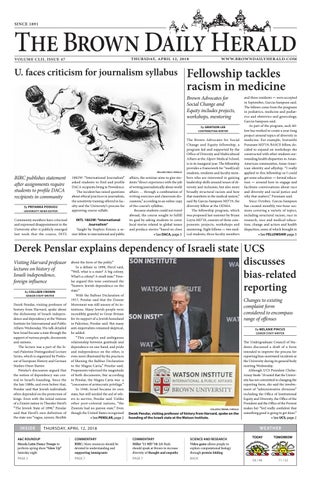
Derek Penslar explains dependency of Israeli state UCS Visiting Harvard professor discusses lectures on history of Israeli independence, bias-related foreign influence reporting By COLLEEN CRONIN SENIOR STAFF WRITER
Derek Penslar, visiting professor of history from Harvard, spoke about the dichotomy of Israeli independence and dependency at the Watson Institute for International and Public Affairs Wednesday. His talk detailed how Israel became a state through the support of various people, documents and nations. The lecture was a part of the Israel-Palestine Distinguished Lecture Series, which is organized by Professor of European History and German Studies Omer Bartov. Penslar’s discussion argued that the notion of dependency was central to Israel’s founding. Since the the late 1800s, and even before that, Penslar said that Jewish individuals often depended on the protection of kings. Even with the initial notions of a Zionist nation in Theodor Herzl’s “The Jewish State of 1896,” Penslar said that Herzl’s own definition of the state was “vague, unsure, flexible
INSIDE
about the form of the polity.” In a debate in 1898, Herzl said, “Well, what is a state? A big colony. What’s a colony? A small state.” Penslar argued this tone continued the “historic Jewish dependence on the state.” With the Balfour Declaration of 1917, Penslar said that the Zionist Movement was still unsure of its intentions. Many Jewish people were incredibly grateful to Great Britain for its support of a Jewish homeland in Palestine, Penslar said. But many anti-imperialists remained skeptical, he added. “This complex and ambiguous relationship between gratitude and dependence on one hand, and pride and independence on the other, is even more illustrated by the practices of likening the Balfour Declaration to the Magna Carta,” Penslar said. Proponents valorized the magnitude of both documents, but according to Penslar, the Magna Carta was a “concession of aristocratic privilege.” In 1948, Israel became its own state, but still needed the aid of others to survive, Penslar said. Unlike other post-colonial nations, “the Zionists had no patron state.” Even though the United States recognized » See PENSLAR, page 2
Changes to existing complaint form considered to encompass range of offenses By MELANIE PINCUS SENIOR STAFF WRITER
COLLEEN CRONIN / HERALD
Derek Penslar, visiting professor of history from Harvard, spoke on the founding of the Israeli state at the Watson Institute.
The Undergraduate Council of Students discussed a draft of a form intended to improve the process for reporting bias-motivated incidents at the University during its general body meeting Wednesday. Although UCS President ChelseAmoy Steele ’18 noted that the University has not committed to changing the reporting form, she said the involvement of “administrative divisions” including the Office of Institutional Equity and Diversity, the Office of the President and the Office of the Provost makes her “feel really confident that something good is going to get done.” » See UCS, page 2
WEATHER
THURSDAY, APRIL 12, 2018
A&C ROUNDUP Mezcla Latin Dance Troupe to perform spring show “Glow Up” Saturday night
COMMENTARY BIRC: More resources should be devoted to understanding and supporting immigrants
COMMENTARY Miller ’11 MD ’18: Jeb Bush should speak at Brown to increase diversity of thought and empathy
SCIENCE AND RESEARCH Video game allows people to explore computational biology through protein folding
PAGE 2
PAGE 7
PAGE 7
BACK
TODAY
TOMORROW
58 / 48
71 / 52
NEWS
PAGE 2 • THURSDAY, APRIL 12, 2018
THE BROWN DAILY HERALD
Arts & Culture Roundup BY MIA PATTILLO & CONNOR SULLIVAN
Reading: Poet Sarah Galvin Join critically acclaimed Seattle-based poet, essayist and performer Sarah Galvin at the McCormack Family Theater Thursday at 5:30 p.m. as she reads from her work as part of the Writers On Writing Reading Series. Galvin is the winner of a 2015 Lottery Grant in the category of performance and the author of “Ugly Time,” “The Three Einsteins” and the book of essays “The Best Party of Our Lives: Stories of Gay Weddings and True Love to Inspire Us All.”
Meredith Monk and Anne Waldman: In Performance Composer, singer, choreographer and director Meredith Monk will stage a multidisciplinary music, dance and poetry performance with poet and activist Anne Waldman Friday in the Granoff Center for the Creative Arts. Monk is a MacArthur Fellowship recepient, with work that extends from compositions on the “Big Lebowski” soundtrack to the arrangement of operas such as “Atlas.” A 2017-18 Brown Arts Initiative professor and a co-founder with Allen Ginsberg of the Jack Kerouac School of Disembodied Poetics at Naropa University, Waldman has authored such poetry collections as “Marriage: A Sentence” and “Kill or Cure.” The event is free and will start at 7 p.m.
B-Side Spring Coffeehaus B-Side Magazine will host its annual spring Coffeehaus show in the Underground of Stephen Robert ’62 Campus Center Saturday. The student-curated line-up will include Drew Wendel, Sofia Frohna & Friends, Cat Carignan, Alidade, Julia Hava, The Schapiro 17 and Tourist Tortoise. The performances will run from 1 p.m. to 4:30 p.m. The event is open to the public.
Mezcla Presents: Glow Up This Saturday at 7 p.m., Mezcla Latin Dance Troupe will put on its spring show, dubbed “Glow Up,” in Salomon 101. The student troupe endeavors to share the beauty and richness of Latinx culture with the Brown community through various types of dance, including salsa, samba, bachata, merengue and everything in between. Doors open at 6:30 p.m.; go early to get spots for the troupe’s only performance of the show.
MELANIE PINCUS / HERALD
A newly drafted student complaint form emphasizes the inclusion of specific and objective language in reporting bias-based and less-targeted offenses, which UCS members hope to implement by the end of the semester.
» UCS, from page 1 “This is something that we’re hoping will be (in use) by the end of the semester,” Steele said. Steele introduced the possibility of revising the current reporting form to make it more “robust” at a general body meeting in November, The Herald previously reported. Once finalized, this document would replace the current complaint form for such incidents, Steele said. The draft of the revised form, which Steele emailed to general body members earlier this week, includes more space for elaboration and some questions that are more specific than those included in the discrimination and harassment complaint form available on the OIED’s website.
» PENSLAR, from page 1 Israel in 1948, it did not arm Israel the way China armed the Viet Minh, he added. Instead, the Israelis were armed by Zionists in other countries. The Declaration of the Establishment of the State of Israel itself was unique to other post-colonial declarations of independence, Penslar said. Unlike the U.S. Declaration of Independence, which specifically cuts ties with Great Britain, the Israeli document is “about the historic and collective rights of the Jewish people.” “It is an assertion of self-constitution, not separation,” Penslar said. Over time, Israel has gained the
Instead of asking for a “summary of allegations,” for instance, the revised form asks the complainant to “provide a detailed description of the incident using specific, concise, objective language.” Because the revised form also allows complainants to report occurrences that are not bias-related, UCS Parliamentarian Austin Lessin ’19 and Jonathan Jaramillo ’18 suggested that the name of the form reflect the full range of reportable incidents. For instance, Jaramillo noted that hazing could be reported through this form, but is not always bias-related. “What if it’s hazing not as a result of bias at all?” Jaramillo asked. “What if it’s straight white men hazing other straight white men?” In smaller group discussions,
Jaramillo and Lessin discussed calling the form a “bias, harm and violence reporting system” to include all types of incidents students could report. Steele asked the general body how they felt the student body could best be “prepared to be able to engage with (the form)” while also feeling “supported along the process of reporting.” To this end, members of the general body stressed the importance of providing clarity about the complainant’s anonymity and information about the timeline and potential outcomes of any events following the submission of a report. Steele said she will update the general body following a meeting with Shontay Delalue, vice president for institutional equity and diversity.
appearance of independence, but is still strongly tied to the United States and other countries, Penslar said. For example, the nation became a Major non-NATO ally. Sarah Campbell Tucker ’19 was most interested in the description of Israel as both independent and dependent because she said Israel is thought “to have a lot of power in the world.” As a student in Bartov’s HIST 1969B: “Israel-Palestine: Lands and Peoples II” class this semester, Tucker said Penslar’s analysis of Israel’s Declaration of Establishment was an “interesting marker” of how Israel presents itself in the world. Even in a difficult and polarizing
political climate, Penslar said he feels that the people who take his classes and listen to his talks, as well as his colleagues, tend to be respectful and want to learn. “I think there have been a lot of issues lately about people being upset when we bring … people from the extreme sides of issues, but I think that it’s still important to hear those voices. This I think is even more important because, especially with Israel-Palestine, a lot of the community is very polarized about it, and this (talk) brings to light that there is a middle ground,” said Johanna Garfinkel ’19.
NEWS
THURSDAY, APRIL 12, 2018 • PAGE 3
THE BROWN DAILY HERALD
» FELLOWSHIP, from page 1
SAM BERUBE / HERALD
The Office of Diversity and Multicultural Affairs at the Alpert Medical School leads and supports the Brown Advocates for Social Change and Equity fellowship. The program was proposed last summer by Bryan Leyva MD’18 and is hosting eight fellows in its inaugural year.
» DACA, from page 1 reporting of affected people.” Specifically, Kinzer asked students to concentrate their coverage on the “fate of the so-called Dreamers,” according to the syllabus. The course includes five mandatory assignments. While the first requires students to “immerse themselves in an immigrant environment in the Providence area,” the following four explore different aspects of the Deferred Action for Childhood Arrivals program and culminate in a final comprehensive profile piece of a DACA recipient that examines their “day-to-day life.” The course syllabus does not suggest that these pieces are meant for publication. Students in the course were eventually given the option to interview recent immigrants more generally if they could not find a DACA recipient to interview. Criticism and journalistic ethics Last week, the Brown Immigrant Rights Coalition published an open letter on Facebook that condemned the assignments as “exploitative journalism” and criticized the seminar’s particular focus on Dreamers. BIRC received feedback from concerned Providence community members who had been asked to comment by Kinzer’s students, according to the open letter. “The work produced in this (course) is not directly aimed at the uplifting and liberation of the affected people,” John Lopez ’18.5, Maria Camila Arbelaez Solano ’19, Alexis Roman ’21, Angel Mendez ’20, Kathleen Wu ’20 and Javier Juarez GS wrote. “In previous times that I’ve spoken to media, it’s something that I’ve
chosen to do for a particular purpose,” said Krissia Rivera Perla ’15 MD’21, a DACA recipient who was contacted to participate in the profile. Rivera Perla says she always assesses the likeliness that sharing her experience could inspire change before agreeing to an interview. But in an email to The Herald, Kinzer wrote that the continued presence of anti-immigrant sentiment in the United States paints “young immigrants as a hostile horde that has come to our country to steal what belongs to us. The only way to counter this stereotype is to humanize these young people.” “Journalism is the way to do that. People who want to support and defend immigrants should be banging on the doors of media outlets demanding more coverage of their situation,” he added. In addition to learning more about journalism, Amy Kerner ’06 GS, a current student in the class, said she took the course to better understand the “complex immigration debate” in the United States. “I was really excited to take a course where I could go off-campus and learn more about the greater Providence community,” she said, adding that she also wanted to “learn how to transmit important political topics through the eyes of ordinary people.” “I agree with Professor Kinzer that there is a need to have better coverage and discourse around the topic of immigration,” Lopez — the chair of BIRC — said. “What me and BIRC disagree with is the lack of care, preparation and thoughtfulness … that he has opened in structuring this course.” Specifically, BIRC members were
concerned that the narrow focus on DACA risks misrepresenting the issue of immigration, particularly in the United States. In addition, students voiced larger questions about the media’s sense of entitlement when covering the stories of people belonging to marginalized communities. For the Brown community to truly understand the complexities of global migration, academic scholarship “needs to be expanded beyond a limited focus on DACA to a greater one that considers it alongside (Temporary Protected Status), (Deferred Enforced Departure), refugee status, forced displacement and the undocumented state itself,” according to BIRC. Rivera Perla added that DACA recipients have already been humanized while others experiencing undocumentation, such as TPS and DED holders, have been deprived of attention and support. A majority of Americans feel that Dreamers should stay in the United States, as Politico previously reported. Rivera Perla also contested Kinzer’s idea that journalism necessarily helps its sources. The idea of “young people knocking on doors is like asking the media to tell our story as if they can tell it better than we can,” she said. “It should rather be that young people should rise and share their stories and the media should facilitate that,” she added. But seeking out stories of DACA recipients with the aim of bettering their situation presumes that the media has ownership of these stories, she said. Amelie Vavrovsky ’18, who attended two sessions before dropping the course, said she felt that “to go
into a community that we have no connection to and extract information seemed unethical to me.” “The best allies are the ones who ask the people who are undergoing certain strife what they need and not so much determining what they need,” Rivera Perla said. While she felt that the students in class had good intentions, Rivera Perla said asking individuals for their immigration status “lacked sensibility” and “placed everyone in a vulnerable position we did not choose.” “These are not just stories. They are lived and traumatic experiences and we will not stand for people taking advantage of them and causing further harm,” BIRC wrote. In a follow up email to The Herald, Lopez wrote that students in the class should receive a form of comprehensive training because they were being asked to “dig for and to hold extremely sensitive information about Providence community members.” During course meetings, Kerner said the class discussed ethical dilemmas in journalism on multiple occasions. “If someone agreed to speak with us, we should always present in detail clearly what we were doing and what the assignment was.” “It was important that people agreed to speak with us,” she added. University response In its open letter, BIRC called for better training for faculty and staff working with immigrant populations. Maud Mandel, dean of the college, said that the University debated making training related to diversity and inclusion mandatory for faculty and staff while creating the Diversity and Inclusion Action Plan. However,
speakers from other universities and hospitals. The sessions featured aspects of presentation, discussion and workshopping the fellows’ individual projects, with the focus on addressing “racism on three levels: individual, institutional and systemic,” GarciaSampson said. Eric Chow, the pediatric chief resident at Hasbro Children’s Hospital and a BASCE fellow, used the fellowship to expand a project he had previously developed called “MED Talks: Medical Education through Diversity.” The project hosts a group “meant to represent patients from a community, and they talk about what it’s like to be a patient in the hospital,” Chow said. For example, members and leaders of a Jehovah’s Witness community came to the hospital to share their outlook on health care, including the fact that their church doctrine does not allow blood tranfusions, he added. Chow is looking to expand his project by conducting focus groups after each session “to sit down and come up with ideas and actionable items” to improve the experiences and understandings between diverse groups and hospitals. The fellowship will continue next year, with current fellows helping to provide mentorship to make the program sustainable, Garcia-Sampson said. The projects and work of the fellows will be showcased in August, and applications for next year’s cohort will open in August as well.
the University decided against the practice. “Compliance-required training: Not only does it not work, but it actually has the opposite impact,” she said, citing scholarship on the subject. Student criticism of Kinzer’s syllabus also called into question the University’s process for approving course syllabi. Mandel explained that course syllabi — when proposed for the first time by visiting faculty — go through a two-fold process of review by their departments and the College Curriculum Council. When courses come up for review in subsequent years, the CCC does not necessarily review their syllabi, she said. “There is an expectation at the department level that chairs are looking into syllabi. … They’re the ones with expertise.” In this instance, Kinzer’s course did not include assignments on DACA recipients when first reviewed in 2015, Mandel added. Last semester, the International Relations program — headed by Nina Tannenwald, senior lecturer in political science — approved Kinzer’s most recent syllabus. “The associate director of the IR program and I reviewed the syllabus for Stephen Kinzer’s course in 2015 (when it also had to go the CCC because it was a new course) and again last fall before he taught it this spring. We had no objections to anything on the syllabus,” Tannenwald wrote in an email to The Herald. “I’m open to hearing from students. … I’m not trying to defend the practice, I’m just trying to explain how we got to where we got,” Mandel said.
NEWS
PAGE 4 • THURSDAY, APRIL 12, 2018
THE BROWN DAILY HERALD
L ECTURE
WITH
L UIGI Z INGALES
Luigi Zingales, Robert C. McCormack Distinguished Service Professor of Entrepreneurship and Finance, The University of Chicago Booth School of Business will give a lecture on his research. His recent book is A Capitalism for the People. April 13, 2018 4:30-6:30pm Barus and Holley, Room 166 Brown University Join us! RSVP to ptp@brown.edu
TODAY
THURSDAY, APRIL 12, 2018 • PAGE 5
THE BROWN DAILY HERALD
menu
f lo w e r p o w e r
SATELLITE DINING ANDREWS COMMONS
Pizza: Meatball Provolone Rosemary, Pepperoni, BBQ Bam Bam Make Your Own Pasta JOSIAH’S
BLUE ROOM
French Toast Bar, BBQ Pulled Pork Burger, Quesadilla Station
Turkey Chili, Minestrone Soup, Chicken Tikki Masala
DINING HALLS SHARPE REFECTORY LUNCH
DINNER
Italian Sausage and Pepper Sub, Potatoes Italianne, Grilled Italian Chicken
Bourbon BBQ Chicken, Smoked Pulled Pork Sandwiches, Italian Antipasto Salad Bar
VERNEY-WOOLLEY LUNCH
DINNER
Country Wedding Soup, Asian Sesame Chicken Salad, Bruschetta Mozzarella
Grilled Chicken Cilantro, Cheesy Polenta, Tortellini Pasta Sauté Special
sudoku
ANITA SHEIH / HERALD
As daffodils and cherry blossom trees begin blooming all over campus, students are reminded that April showers will eventually bring spring flowers — though the flowers are starting to doubt this themselves.
Q U O T E O F T H E D AY
“The best allies are the ones who ask the people who are undergoing certain strife what they need and not so
”
much determining what they need. crossword
— Krissia Rivera Perla ’15 MD
See daca on page 1. CORRECTION An earlier version of the graphic accompanying the Arpil 10 article “University wait list size draws mixed responses” stated that around 60 percent of students offered a spot on the University’s wait list decline the offer. In fact, around 40 percent of the students offered a spot on the University’s wait list decline the offer. The Herald regrets the error. An earlier version of the April 10 op-ed “Disrupting the path to sexual assault perpetration” stated that Kevin Swartout seemingly confirmed long-held doubts about the demographics of perpetrators of sexual assault when he published his article, “The company they keep: How men’s social networks influence their sexually aggressive attitudes and behaviors.” In fact, Swartout seemingly confirmed long-held doubts about the demographics of perpetrators of sexual assault when he published his article, “Trajectory Analysis of the Campus Serial Rapist Assumption.” An earlier version of this op-ed also stated that further research failed to reproduce the results of David Lisak’s 2002 study — “Repeat Rape and Multiple Offending Among Undetected Rapists.” In fact, further issue on the same issue has identified different results. The Herald regrets the errors.
calendar TODAY NOVEMBER MARCH APRIL
S
M
T
W
Th
F
S
Strategies for Communication 8:00 A.M. 222 Richmond Street, 270
1
2
3
14
25
36
47
Math Slam 4:00 P.M. 170 Hope Street, 108
85
96
7 10
8 11
9 12
10 13
11 14
15 12
16 13
17 14
18 15
16 19
17 20
18 21
22 19
23 20
24 21
25 22
26 23
27 24
28 25
29 26
30 27
28
29
30
31
Probability Seminar: Susan Friedlander 10:00 A.M. 182 George Street, 110 International Festival: Matsuri 5:00 P.M. Main Green
TOMORROW Scientific Computing Seminar: Javier Sayas 11:00 A.M. 170 Hope Street, 108
Founder Friday: Grant Gurtin ’12 12:00 P.M. Petteruti Lounge
Depression Support Group 3:00 P.M. J. Walter Wilson, 512
Contemplative Studies Departmental Open House 4:00 P.M. Smith Buonanno, 201
COMMENTARY PAGE 6 • THURSDAY, APRIL 12, 2018
THE BROWN DAILY HERALD
LETTER TO THE EDITOR
Support student art To the Editor: I really enjoyed reading Emily Miller’s ’19 April 10 commentary on visual art on campus, “Let students leave their mark on campus art.” Student art is distributed across campus, and it’s so fantastic you may not realize it’s student art! Places where student work is permanently displayed include the Blue Room, the halls of J. Walter Wilson, the waiting rooms at Health Services and the Watson Institute for International and Public Affairs. Check out galleries on campus that regularly show student art. In addition to the three student galleries in the List Art Center, there is student art shown
throughout the Granoff Center for the Creative Arts, in the Lower Lobby Art Gallery in the Stephen Robert ’62 Campus Center, in the Sarah Doyle Women’s Center Gallery and in the Brown-Rhode Island School of Design literary magazines “VISIONS” and “Clerestory Journal of the Arts.” The Brown Visual Art Department hosts an Open Studio night in List every year, where we invite the entire campus in to see what students are making. Our Open Studio this year is 5 to 6 p.m. on Thursday, April 26, so come and enjoy an art-filled evening! Leslie Bostrom Chair of Visual Art
A L E X W E ST FA L L
EDITORIAL
Reforming the First Readings program Since 2007, the University has requested all its incoming first-year students to read a single book (or, in one case, watch a movie) and then discuss it in small seminars during first-year orientation. The First Readings program, as it is called, was designed to create a “shared intellectual endeavor for all beginning Brown students” and to introduce them to the “pleasures and rigors of undergraduate academic life,” according to the First Readings program’s webpage. Past selections have included the film “Oil and Water,” “The New Jim Crow: Mass Incarceration in the Age of Colorblindness” by Michelle Alexander and “My Beloved World” by Supreme Court Justice Sonia Sotomayor. Last month, the University announced in a Today@Brown message that the First Readings text for the incoming class of 2022 is “Evicted: Poverty and Profit in the American City,” by Matthew Desmond. In
“Evicted,” the winner of the 2017 Pulitzer Prize in General Nonfiction, Desmond tells the story of eight families who were evicted from their homes in Milwaukee. In doing so, he offers insights into the realities of inequality, race and poverty in urban America. Selected after a lengthy deliberation process, “Evicted” — like the selections before it — has the potential to give first-years a solid opportunity to dive deeply into weighty subjects even before they get to campus and generate timely conversations about pressing issues that can unite the student body in shared reflection. However, the current structure of the First Readings program does not live up to this potential. As part of the assignment, first-years are tasked with going through the reading and writing short response papers before participating in informal seminars. But without guidance,
these papers are generally perfunctory assignments that do not let students exercise their creativity or engage with the readings in innovative ways. Moreover, it is unrealistic to expect a single seminar discussion during orientation week to facilitate long-term reflections or acclimate students to academic life at Brown. After the seminar, the text is largely forgotten in the frenzy of the new semester; in fact, some of us may not even remember our First Readings assignments. Ultimately, the entire exercise feels like a compliance obligation rather than a source of meaningful dialogue. Going forward, the University should consider reforming the First Readings program to make it a more engaging and sustained experience for first-years. To this end, it can learn from the programs operated by other institutions. Approximately 40 percent of American college orientations involve a shared reading,
Find us online! facebook.com/browndailyherald
browndailyherald.com
@the_herald
Location: 195 Angell St., Providence, R.I. www.browndailyherald.com
@browndailyherald
youtube.com/browndailyherald
Editorial Leadership
Sections
Multimedia & Production
Editor-in-Chief Elena Renken
Arts & Culture Editors Connor Sullivan Mia Pattillo
Design Editors General Managers Kyle Cui Michael Borrello Eduard Muñoz-Suñé Matilda Lynton Assistants: Julie Wang, Kelvin Yang
Metro Editors Emily Davies Bella Roberts
Photo Editors Sam Berube Anita Sheih
News Editors Anna Kramer Eduard Muñoz-Suñé Priyanka Podugu Sarah Wang
Copy Desk Chief Abby Borges
Managing Editor Kasturi Pananjady Senior Editors Julianne Center Madison Rivlin Alex Skidmore Hattie Xu Features Editor Isabel Gensler Editorial Page Editor Anuj Krishnamurthy
Science & Research Editors Jonathan Douglas Jackson Wells
POST- MAGAZINE Editor Saanya Jain
Sports Editors Alexandra Russell Nicholas Wey COMMENTARY Opinions Editors Connor Cardoso Anuj Krishnamurthy Clare Steinman
Illustrations Editor Pia Mileaf-Patel Video Editors Roland High Celia Hack
but several universities take the program further: Stanford, for example, assigned three hefty books, and then invited each of the authors to campus during orientation to share their views directly with students. Other schools host lecture series or events that offer different perspectives on the readings at hand. These are changes that Brown could well undertake. After all, when the University invited Justice Sotomayor to discuss “My Beloved World” in February, the talk added a new level of engagement to the First Readings initiative. Brown should continue in this vein to ensure that First Readings becomes more than just a one-off summer reading assignment. We firmly believe that the First Readings program is a valuable staple of the orientation experience, and that a revitalized version can more effectively introduce students to the intellectual mission and culture of the University. First-year
Business
Office Manager Diane Silvia Directors Sales: Shreya Raghunandan Finance: Ravi Betzig Strategy: Caroline Ziegler
students stand to benefit from getting an early taste of college-level discussions and analysis. The program can also set the tone for the upcoming year, help forge bonds between students new to campus and generate productive conversations both in and out of the classroom. Unfortunately, as it currently stands, the First Readings program feels like a box that incoming students must mindlessly check off during orientation week. We hope that this changes in the years to come. Editorials are written by The Herald’s editorial page board: Anuj Krishnamurthy ’19, Mili Mitra ’18, Rhaime Kim ’20 and Grace Layer ’20. Please send responses to this opinion to letters@browndailyherald. com and op-eds to opinions@browndailyherald.com.
Editorial contact: 401-351-3372 herald@browndailyherald.com
Advertising contact: 401-351-3372 advertising@browndailyherald.com
Submissions: The Brown Daily Herald publishes submissions in the form of op-eds and letters to the editor. Op-eds are typically between 750 and 1000 words, though we will consider submissions between 500 and 1200 words. Letters to the editor should be around 250 words. While letters to the editor respond to an article or column that has appeared in The Herald, op-eds usually prompt new discussions on campus or frame new arguments about current discourse. All submissions to The Herald cannot have been previously published elsewhere (in print or online — including personal blogs and social media), and they must be exclusive to The Herald. Submissions must include no more than two individual authors. If there are more than two original authors, The Herald can acknowledge the authors in a statement at the end of the letter or op-ed, but the byline can only include up to two names. The Herald will not publish submissions authored by groups. The Herald does not publish anonymous submissions. If you feel your circumstances prevent you from submitting an op-ed or letter with your name, please email herald@browndailyherald.com to explain your situation. You can submit op-eds to opinions@browndailyherald.com and letters to letters@browndailyherald.com. When you email your submission, please include (1) your full name, (2) an evening or mobile phone number in case your submission is chosen for publication and (3) any affiliation with Brown University or any institution or organization relevant to the content of your submission. Please send in submissions at least 24 hours in advance of your desired publication date. The Herald only publishes submissions while it is in print. The Herald reserves the right to edit all submissions. If your piece is considered for publication, an editor will contact you to discuss potential changes to your submission. Commentary: The editorial is the majority opinion of the editorial page board of The Brown Daily Herald. The editorial viewpoint does not necessarily reflect the views of The Brown Daily Herald, Inc. Columns, letters and comics reflect the opinions of their authors only. Corrections: The Brown Daily Herald is committed to providing the Brown University community with the most accurate information possible. Corrections may be submitted up to seven calendar days after publication. Advertising: The Brown Daily Herald, Inc. reserves the right to accept or decline any advertisement at its discretion. The Brown Daily Herald, Inc. is a financially independent, nonprofit media organization bringing you The Brown Daily Herald, BlogDailyHerald and Post- Magazine. The Brown Daily Herald has served the Brown University community daily since 1891. It is published Monday through Friday during the academic year, excluding vacations, once during Commencement and once during Orientation by The Brown Daily Herald, Inc. Single copy free for each member of the community. Subscription prices: $200 one year daily, $100 one semester daily. Copyright 2018 by The Brown Daily Herald, Inc. All rights reserved. Periodicals postage paid at Providence, R.I. Postmaster: Please send corrections to P.O. Box 2538, Providence, RI 02906.
COMMENTARY THURSDAY, APRIL 12, 2018 • PAGE 7
THE BROWN DAILY HERALD
Don’t create a mold for Brown students SAMUEL MILLER
op-ed contributor
As a member of the Brown community for the past 11 years, I have come to treasure and expect the diversity of backgrounds and perspectives that we find on our campus. It’s one of the reasons why I came back after taking time off as an undergraduate and why I again came back to Brown as a medical student. One of the most valuable lessons I have learned here is to not assume that I truly, or even partially, understand someone else’s point of view. As the son of two parents who I would describe as liberal in every sense of the word (politically, socially, religiously, etc.) and the product of a community with similar leanings, I didn’t knowingly engage with a selfidentified conservative or Republican until the latter half of my time in college. Contrary to my expectations, I found that we shared a great deal of common ground. We loved
our families and considered them in almost every personal decision that we made. We saw the chance to pursue higher education as one of the most valuable opportunities in a young person’s life and wanted to find ways to extend this privilege to as many others as possible. And perhaps most importantly, we both
students.” I do not believe that there are politics, positions or perspectives that define our entire student body, nor should there be. In fact, I think that diversity in these areas is what makes our campus, and ultimately our country, unique. Much of my growth at Brown as a college student, a soon-to-be phy-
bigotry. Each of these moments was different and uncomfortable in its own way. I have found that these encounters often arise when you least expect them, which makes them that much more difficult and sometimes even painful when they seem to target us directly. At the same time, I am grateful that I’ve got-
I do not believe that there are politics, positions or perspectives that define our entire student body, nor should there be.
wanted to find happiness in our lives and to help others to do the same. While I may share many of the political views described by Michael Froid ’21 in his piece, “Inviting Jeb Bush to speak is irresponsible,” I have a hard time with his reference to “policies that do not, and should not, represent the values of Brown
sician and a human being has come from having conversations with and being pushed by other students and people who see the world differently from than I do. I have learned to listen to activists explain why they think abortion is unjust and immoral, and I have learned to care for patients even when they express
ten to cross paths with these people and that they weren’t denied a place at Brown, in Rhode Island or in the United States because of how they voted or what they thought. I am grateful that each of these people pushed me to consider different perspectives, even when I disagreed with them.
I speak solely for myself here — I think that as students, we need to be pushed and to be challenged. Some of our most valuable learning comes from times when we are made to feel uncomfortable. I think that finding respect for and common ground with someone who might seem to be our complete opposite is a skill that we all could and should practice. I am grateful that we at Brown have no prerequisites for political leanings or for the values that we hold dear. The freedoms to respectfully share and speak your thoughts are parts of this community that I will always value. I believe that if we try to create a mold into which all Brown students must fit, we will risk losing them.
Samuel Miller ’11 MD’18 can be reached at samuel_miller@brown.edu. Please send responses to this opinion to letters@browndailyherald.com and other op-eds to opinions@browndailyherald. com.
U. should do more to support immigrant communities JOHN LOPEZ ’18.5 MARIA CAMILA ARBELAEZ SOLANO ’19, ALEXIS ROMAN ’21, ANGEL MENDEZ ’20, KATHLEEN WU ’20, & JAVIER JUAREZ GS op-ed contributors On April 5, 2018, the Brown Immigrant Rights Coalition launched a campaign to gather support from students, faculty and community members to encourage the University to critically reflect on the impact of its scholarship and to commit to increasing its support of the immigrant communities within and outside our campus. The decision to launch this campaign was prompted by grievances from Providence community members over a central component in Senior Fellow in International and Public Affairs Stephen Kinzer’s class INTL 1802W: “International Journalism”, in which students were tasked with finding a person who qualifies as a “Dreamer” and with holding them as their object of study for the duration of the semester. We believe that mistakes in the design of this course could have been avoided through a more careful and informed preparation of the course. We agree with Professor Kinzer that there needs to be more scrutiny of the immigration system of our country today and the way in which it impacts our society, and we agree that one way to go about this is through journalism. We believe responsible journalism and scholarship should be performed with a high degree of integrity and sensitivity — especially when it directly affects the most vulnerable members of our community. We are working privately with Professor Kinzer and the students in the course to ensure that this is a productive learning experience for all. We would like to work with the broader Brown community, however, to be better informed and proactive on this issue at a truly critical point in our national history.
Our call to action speaks to a larger need for reform. At a time when anti-immigrant sentiment is steeply on the rise and when immigrant communities are often pointed to as scapegoats for the problems of the world today, it is more important now than ever for us to get informed and involved. We have composed a list of demands that we believe will promote and deepen the necessary dialogue on immigration that we need to be having on this campus, dialogue which will work to raise our humane and intellectual comprehension of the world. In working to meet these goals, Brown would be upholding its own
nizant of the challenges undocumented people face, so future academic work and community building on campus are sensitive to this issue and do not work to perpetuate harm against these communities. 2. An expansion of “Pathways to Diversity and Inclusion: An Action Plan for Brown University” to explicitly consider working with undocumented students and undocumented people While Brown has been making strides in progressing toward its established goal of becoming a more diverse and inclusive campus, we urge the
At a time when anti-immigrant sentiment is steeply on the rise and when immigrant communities are often pointed to as scapegoats for the problems of the world today, it is more important now than ever for us to get informed and involved. values on progressing toward diversity and inclusion, and would be helping to lead the way in our nation’s understanding and discourse. Our demands are as follows: 1. Comprehensive training for faculty and student leaders on working with undocumented people In order for Brown to be a campus that engages in responsible and ethical research regarding migration, and, as such, to be a campus that is hospitable to undocumented students and students from mixed-status backgrounds, we believe that it is paramount for our professors and student leaders to be well-informed about our country’s immigration laws and the increasingly multitudinous legal and social threats and obstacles that undocumented people face in the United States. Understanding that there are multiple undocumented students on campus and many more who come from mixed-status families, we believe campus awareness can and must grow to be cog-
institution not to leave undocumented communities behind. The current DIAP states undocumented students, among other groups, are a focus in recruiting and supporting on this campus. But we believe that for Brown to be earnest in this effort, the plans which each academic and administrative department have to create must take into consideration how to best work with and support undocumented people. 3. The hiring of more faculty with true expertise on the topic of migration and immigration If Brown is to be a leader in understanding migration, its research and scholarship produced on this topic must be impassioned and cuttingedge, and must not be parochial. Recruiting more faculty with expertise will allow for our campus understanding to develop and grow. 4. A strong recommitment to actively recruiting and admitting undocumented students and students with Temporary Protected Status, Deferred Enforced
Departure or Deferred Action for Childhood Arrivals College access has long been and continues to be littered with systemic obstacles and barriers for undocumented students. Recognizing this, Brown has committed to making its admissions open and equitable to these students. We ask that Brown hold itself accountable to bringing in top undocumented students from around the country for the betterment of our campus community and campus awareness. 5. Expanding Brown’s Tam Tran memorial by creating the Tam Tran Undocumented Series and providing funds to support the Tam Tran Scholarship Tam Tran was an undocumented doctoral student at Brown who was killed in a motor accident in 2010. She was passionate about advocating for immigrant rights and immigration reform, and used filmmaking as a medium to uplift the narratives of undocumented students. In honoring her life work, BIRC helped start the Tam Tran Scholarship to provide financial assistance for undocumented students in Rhode Island seeking to attend college. Recipients of this award have asked us why Brown students keep pestering them for interviews. We do not believe this is doing right by the legacy of Tam Tran. We ask Brown to stop this practice and to focus instead on resources and attention toward programming and scholarship that honors the enduring vision of Tam Tran.
John Lopez ’18.5, Maria Camila Arbelaez Solano ’19, Alexis Roman ’21, Angel Mendez ’20, Kathleen Wu ’20 and Javier Juarez GS are members of the Brown Immigrant Rights Coalition and can be reached at john_lopez-aldas@brown. edu, maria_arbelaez@brown.edu, alexis_roman@brown.edu, angel_mendezflores@brown.edu, kathleen_wu@brown. edu and javier_juarez@brown.edu, respectively. This list of demands previously appeared in an April 5 post on the Brown Immigrant Rights Coalition Facebook page and has been republished here with permission from the authors.
SCIENCE & RESEARCH THE BROWN DAILY HERALD
THURSDAY, APRIL 12, 2018
Educational program unites video games, protein folding Firas Khatib, lead scientist of Foldit, discusses computational biology advancements at ICERM By TANUSHRI SUNDAR SENIOR STAFF WRITER
Imagine playing a video game that also makes scientific contributions to the field of computational biology. Firas Khatib, assistant professor in the Computer and Information Science Department at the University of Massachusetts-Dartmouth, discussed just that in his talk, “Crowd Computing: Scientific discoveries by protein-folding game players” at the Institute for Computational and Experimental Research in Mathematics. Khatib’s program, Foldit, is a unique platform that integrates video games with protein folding to allow people all over the world to compete to devise an optimal protein fold for a given protein. Khatib, the lead scientist of Foldit, emphasized that the program aims to build more accurate models of diseaserelated proteins. “I think what’s exciting about Foldit is that it really demonstrates the power of citizen science and crowdsourcing,” he said, and added that there is currently an abundance of supercomputing strength, but Foldit focuses on harnessing human intelligence on a mass scale. “When it comes to visual tasks … computers are really bad at that,” Khatib said. Identifying optimal protein folds,
a visual task, is a skill that humans can sometimes provide more easily than computers. Furthermore, Foldit allows people with different perspectives to contribute to difficult problems. People who have no background in a field are more likely to implement unusual solutions, which sometimes turn out to be helpful, Khatib said. Because Foldit relies on human brain power, an important part of the project is introducing it to large audiences. Foldit is a “great tool for education,” Khatib said. “Everybody loves video games — especially kids.” Foldit has been used in award-winning projects by people all over the country, Khatib added. For example, a team of students at University of California-Davis used Foldit to build a biosensor that “detects rancid olive oil,” winning the grand prize at the 2014 iGEM international competition, Khatib said. “I’m really impressed by the way (Foldit is) implementing this evolving model,” Woden Kusner, attendee and assistant professor of mathematics at Vanderbilt University, said after the event. “They’ve got a nice feedback loop going on with players and are able to get feedback from the scientific community.” “There’s such a big Foldit community out there,” said Jan Rolfes, a postgraduate researcher from the University of Cologne. “If you present science in such a nice way, you can attract a lot of people and really make an idea quite popular.” — Additional reporting by Cate Ryan
TIFFANY DING / HERALD
Firas Khatib, assistant professor in computer and information science at UMass Dartmouth, created a video game that helps solve protein-folding problems and harnesses “human intelligence on a mass scale.”
S I H G E N I H T W H O T L I FOL EPS W IND T S W T O FO ue A uniq
show
of
and music
poetry
:
( A’l
dies o l e M New sed by Infu ition Trad ) ruah a B tav I’kvo
8 ion , 201 e rc u s s 3 p 1 & l e i voic , Apr – 8:00 pm y poser, a m o d c i , i Fr 6:30 n Street n Ofr d, violin, voice , saz, voice a n e a 0 b K u aterm Bert 13icians Esti en Erez o ud, Afghan raba W 5 8 us rd aisel o on ative mle Eastern Ya e r c y d v M iv percussi guest er : d by v d to old Mid l traditions Yani e m r o a Yan awi special Pe r f d e d i c a t e v music e e Z Tel nd film actor, oples m a n d Pe a r a , Lands k a : e r n e A ti s r, op tor nd — el-Pale a
Theate or and crea i-year project Isra direct par t of the mult This e
vent is