SINCE 1891
THE BROWN DAILY HERALD THURSDAY, SEPTEMBER 7, 2017
VOLUME CLII, ISSUE 60
WWW.BROWNDAILYHERALD.COM
U. awarded grant to address truth and racial healing The $30,000 award to be put toward discussion dinner groups for black students, Muslim women By MIA PATTILLO SENIOR STAFF WRITER
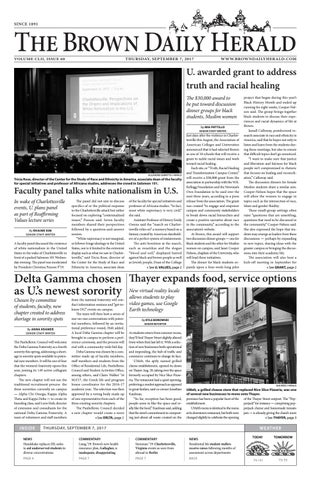
ALEJANDRO SUBIOTTO / HERALD
Tricia Rose, director of the Center for the Study of Race and Ethnicity in America, associate dean of the faculty for special initiatives and professor of Africana studies, addresses the crowd in Salomon 101.
Faculty panel talks white nationalism in U.S. In wake of Charlottesville events, U. plans panel as part of Reaffirming Values lecture series By RHAIME KIM SENIOR STAFF WRITER
A faculty panel discussed the existence of white nationalism in the United States in the wake of Charlottesville in front of a packed Salomon 101 Wednesday evening. The panel was moderated by President Christina Paxson P’19.
The panel did not aim to discuss specifics of or the political response to the Charlottesville attack but rather focused on exploring “contextualized issues,” Paxson said. Seven faculty members shared their perspectives followed by a question-and-answer session. “White supremacy is not marginal, or leftover fringe ideology in the United States, nor is it limited to the extremist display such as what we saw in Charlottesville,” said Tricia Rose, director of the Center for the Study of Race and Ethnicity in America, associate dean
of the faculty for special initiatives and professor of Africana studies. “In fact, most white supremacy is very civil,” she said. Assistant Professor of History Emily Owens said the “march on Charlottesville relies on” a memory based on a fantasy created by American slaveholders of a perfect system of enslavement. The anti-Semitism at the march, such as swastikas and the slogan “blood and soil,” displayed hatred against black and brown people as well as Jewish people, Dean of the College » See U. VALUES, page 2
Just days after the violence in Charlottesville this August, the Association of American Colleges and Universities announced that it had selected Brown as one of 10 schools that will receive a grant to tackle racial issues and work toward racial healing. Each site, or “Truth, Racial Healing and Transformation Campus Center,” will receive a $30,000 grant from the association in partnership with the W.K. Kellogg Foundation and the Newman’s Own Foundation to be used over the next three years, according to a press release from the association. The grant was created “to engage and empower campus and community stakeholders to break down racial hierarchies and create a positive narrative about race in the community,” according to the association’s website. At Brown, this award will support two discussion dinner groups — one for black students and the other for Muslim women on campus, said Janet Cooper Nelson, chaplain of the University, who will lead these initiatives. The dinner for black students expands upon a four-week-long pilot
project that began during this year’s Black History Month and ended up running for eight weeks, Cooper-Nelson said. The group brings together black students to discuss their experiences and racial dynamics of life at Brown. Jamall Calloway, postdoctoral research associate in race and ethnicity in America, said that he hopes not only to listen and learn from the students during these meetings, but also to ensure that difficult topics don’t go unnoticed. “I want to make sure that justice and liberation and fairness for black people isn’t compromised in rhetoric that focuses on healing and reconciliation,” Calloway said. The discussion dinners for female Muslim students share a similar aim. Cooper-Nelson hopes that the space will allow the women to engage in topics such as the intersection of race, Islam and gender fluidity. These small-group settings often raise “questions that are unsettling, questions that need to be discussed in the community,” Cooper-Nelson said. She also expressed the hope that students may emerge as leaders from these discussions — perhaps by expanding to new topics, sharing ideas with the greater campus or bringing the discussions into their academic life. The association will also host a kick-off meeting in September for » See GRANT, page 2
Delta Gamma chosen Thayer expands food, service options virtual reality locale as U.’s newest sorority New allows students to play Chosen by committee of students, faculty, new chapter created to address shortage in sorority spots By ANNA KRAMER SENIOR STAFF WRITER
The Panhellenic Council will welcome the Delta Gamma Fraternity as a fourth sorority this spring, addressing a shortage in sorority spots available to potential new members. It will be one of four that the women’s fraternity opens this year, joining its 149 active collegiate chapters. The new chapter will not use the traditional recruitment process the three sororities currently on campus — Alpha Chi Omega, Kappa Alpha Theta and Kappa Delta — to create its founding class, said Lorie Holt, director of extension and consultants for the national Delta Gamma Fraternity. A team of volunteers and staff members
INSIDE
from the national fraternity will conduct information sessions and “get-toknow DG” events on campus. The team will then host a series of one-on-one conversations with potential members, followed by an invitational preference round, Holt added. A local Delta Gamma chapter will be brought to campus to perform a preference ceremony, and the process will end with a community-wide bid day. Delta Gamma was chosen by a committee made up of faculty members, staff members and students from the Office of Residential Life, Panhellenic Council and Student Activities Office, among others, said Claire Walker ’16 MA’17, the Greek life and program house coordinator for the 2016-17 academic year. The selection was then approved by a voting body made up of one representative from each of the three existing sorority chapters. The Panhellenic Council decided a new chapter would create a more » See DELTA, page 2
video games, use Google Earth technology By KYLE BOROWSKI SENIOR REPORTER
As students return from summer recess, they’ll find Thayer Street slightly altered from when they last left it. With a selection of new businesses both operational and impending, the hub of traffic and commerce continues to change its face. UMelt, the aptly named grilled cheese establishment, opened its doors on Thayer Aug. 28, taking over the space formerly occupied by Nice Slice Pizzeria. The restaurant had a quiet opening, preferring a modest approach as opposed to great fanfare, said co-owner Jonathan Kaufman. “So far, reception has been good, people seem to like the space and really like the food,” Kaufman said, adding that the store’s commitment to composting just about all waste created on the
GUS REED / HERALD
UMelt, a grilled cheese store that replaced Nice Slice Pizzeria, was one of several new businesses to move onto Thayer. premises has been a popular facet of the of the Thayer Street outpost. The “Pepestablishment. perjack” for instance — comprising pepUMelt’s menu is identical to the menu perjack cheese and homemade tomato at its downtown restaurant, but both were jam — is already giving the chain’s most changed slightly to celebrate the opening » See THAYER, page 3
WEATHER
THURSDAY, SEPTEMBER 7, 2017
NEWS Handshake replaces JIB, seeks to aid underserved students in diverse concentrations
COMMENTARY Liang ’19: Brown’s new health insurance plan, Gallagher, is inadequate, disappointing
COMMENTARY Steinman ’19: Charlottesville, Virginia events as seen from abroad in Berlin
NEWS Residential life student staffers receive raises following months of assessment across departments
PAGE 4
PAGE 7
PAGE 7
BACK
TODAY
TOMORROW
74 / 61
73/ 55
NEWS
PAGE 2 • THURSDAY, SEPTEMBER 7, 2017
THE BROWN DAILY HERALD
KATE TALERICO / HERALD MARIANNA MCMURDOCK / HERALD
Chaplain of the University Janet Cooper Nelson will lead the discussion dinner groups, which aim to tackle unsettling questions surrounding political issues that black students and Muslim women face in their lives. representatives will discuss the “Truth, higher education plays in addressing » GRANT, from page 1 Racial Healing and Transformation the history and legacies of racism. representatives from all ten schools, Institute” framework and discuss the The University will also lead studies as well as an inaugural Truth, Racial specific challenges that campuses face, to gauge the projects’ impact, CooperHealing and Transformation Institute in Pasquerella added. Nelson says. January in Washington D.C., according “We will be … embarking on an “If you’re telling me that a threat in to the Association of American Colleges endeavor toward issues that are more this world is impending at all on your President Lynn Pasquerella PhD ’85. critical than ever,” Pasquerella said. She education, then we need to do someDuring the kick-off meeting, school emphasized the important role that thing about that,” Cooper-Nelson said.
» DELTA, from page 1 inclusive rush process, as the number of women rushing sororities has far exceeded the number of spots available to new members in recent years, Walker said. As a result, it has been difficult for sororities to find meeting space without exceeding room capacities and has created potential housing shortages. During Walker’s time as an undergraduate, the number of women rushing sororities increased from 95 in 2013 to 293 in 2016, The Herald previously reported. The rush process was “very stressful for a lot of young women” because many potential members did not receive bids from any of the three sororities. “As the number of people who go through the recruiting process increases, it triggers … (an) automatic discussion of whether another sorority should be added,” said Katherine Jenks ’19, the Alpha Chi Omega representative on the confirmational voting body. Following the Panhellenic Council’s decision to open a new chapter, Walker assisted in preparing a bulletin that detailed the University’s Greek system and its reasons for expansion. That bulletin was distributed to all 26 member organizations of the National Panhellenic Conference, and interested sororities
» U. VALUES, from page 1 Maud Mandel said. Recently, scholars have been more commonly exploring the similarities of the “racial hierarchical formulation” of anti-Semitism, colonialism and Islamophobia, she said. In light of President Donald Trump’s recent decision to end the Deferred Action for Childhood Arrivals program, Assistant Professor of American Studies Monica Muñoz Martinez addressed the historical marginalization of Mexicans and the need to consider not only how groups are being treated within the United States, but also at its border. Rose said that Charlottesville was a shock to many Americans despite the realities of systematic and pervasive white supremacy. “It seems to me that we need to focus here on campus in challenging our own curriculum to do a better job teaching us about this” because “education as a whole ultimately marginalizes this kind of conversation.” In response to a question by Lily
began communication with Walker. Nine or 10 sororities applied for consideration by the Extension Committee, and the committee chose to invite Sigma Delta Tau and Phi Mu along with Delta Gamma to visit the University’s campus. Delta Gamma was eventually chosen because of its enthusiasm for the University’s community values and extensive but optional leadership opportunities, among other reasons, Walker said. While the Extension Committee invited Delta Gamma to campus, opening a new chapter was a mutually selective process. “We are kind of a selective establishment. We don’t just go everywhere. We really look for campuses that uphold our values as an organization,” Holt said. “We get a lot of opportunities to extend, but we don’t take all of them.” Delta Gamma was drawn to the University’s community values, which include “the empowerment of women, dedication to academic success, investment in leadership development and striving for the promotion of greater good through service and advocacy,” Holt added. “I think that Greek life is really thriving, and it’s really exciting to see people find a community … at Brown,” Jenks said. Gordon ’21 about the University’s role and approach to negotiations with the Pokanoket Nation regarding the contentious Bristol land, Paxson said that “we are trying to work very sincerely” to devise a plan that works for not only the encamped group but also for other tribes for whom the Bristol property is sacred. Disagreements on whether other tribes have claims to this land has been a roadblock in negotiating efforts. Other panelists included Bonnie Honig, interim director of the Pembroke Center and professor of modern culture and multimedia and political science, John Tomasi, director of the Political Theory Project and professor of political science and natural theology and Michael Vorenberg, associate professor of history. The talk is part of the lecture series “Reaffirming University Values,” sponsored by the Offices of the President and Provost, which began last year.
NEWS
THURSDAY, SEPTEMBER 7, 2017 • PAGE 3
THE BROWN DAILY HERALD
ELI WHITE / HERALD ELI WHITE / HERALD
B.good, which opened over the summer, replaces Johnny Rocket’s at the corner of Thayer and Meeting Street and offers healthier food options.
» THAYER, from page 1 popular offering, the “White Trash” sandwich, a run for its money. Next door to UMelt is now b.good, a Northeast chain that prides itself on offering food with “roots.” Operating out of the space once held by Thayer staple Johnny Rockets, the business offers a menu that changes seasonally based on the availability of certain produce. The Elizel Burger — seared asparagus, grilled red onion, red pepper aioli, sharp cheddar and toasted breadcrumbs — for instance, has given way this fall to the Sal Bacado, a seasonal offering which includes local corn salsa, bacon and avocado. There is also work underway on some district additions that have yet to come to fruition. Heng, a Thai cuisine restaurant, has obtained a license to open in the English Cellar Alehouse space on Angell Street. While signage for the restaurant can be seen outside its slated location, its exact opening date remains unclear. In a business plan submitted to the Providence Board of Licenses, the business owners laid out a plan to offer Thai food — and liquor — to residents of the East Side. The menu submitted to the board includes Thai staples like chicken satay, pad Thai and a variety of curries, as well as wok and other noodle offerings. Heng will have to carve out a niche of its own on a street populated with unique Asian cuisine — such as Soban, Den Den Korean Fried Chicken and Shanghai — but the addition of a Thai
establishment is something of a novelty for the area. Work is also moving forward to open Vivi Bubble Tea in the small space located underneath Ben & Jerry’s. The fledgling business will have to compete with Kung Fu Tea and other Thayer Street restaurants already offering the Taiwanese treat. Not all developments on Thayer are culinary in nature. An eyebrow threader has set up shop above the former Nice Slice location, offering a new service for Thayer. In addition, a virtual reality lounge has also gone into business on Thayer. Base Station VR Lounge operates five VR stations at its location above Kartabar, each offering a number of games and experiences for users, said owner Nidal Battikha. From Google Earth to games like Solus and Fruit Ninja, patrons can reserve a spot or walk in for an experience that defies reality. While Thayer has seen turnover in some of its storefronts in recent years, the benefits of the location continue to draw businesses there year after year, Thayer business owners said. “We’re close to the colleges and residents of the East Side,” Battikha said, adding that “the people in the Thayer Street district seem to be good at building a community among merchants as well as connecting to the broader community.” “I walk my dog on Thayer almost every night,” Kaufman said, “Seeing all the businesses on the street, being a business owner myself and having it be a part of my backyard; it’s been a dream of mine to open up a store here.”
UMelt’s menu is a stark contrast from its pizzeria predecessor, offering items such as the “Pepperjack,” which contains pepperjack cheese and homemade tomato jam. UMelt’s most popular item is the “White Trash” sandwich.
ELI WHITE / HERALD
B.good’s menu changes seasonally based on each produce’s availability. For example, the Elizel Burger has been replaced by the Sal Bacado, a seasonal item that contains local corn salsa, bacon and avocado.
NEW COURSE offered by the Department of Cognitive, Linguistic & Psychological Sciences CLPS 0010 - Mind, Brain and Behavior: An Interdisciplinary Approach MWF 1-1:50, Metcalf Auditorium FIRST-YEARS WELCOME FULFILLS PSYCHOLOGY PRE-MED REQUIREMENT This course will provide an interdisciplinary approach to the science of the mind through the lens of psychology, cognitive science, cognitive neuroscience, behavioral neuroscience, computational modeling and linguistics, as uniquely represented by our department. It will focus on questions that drive the field, current state-of-the-art, and successful techniques and approaches. Questions addressed will include: What is the nature of the human mind? How do we get input from the world? How do we communicate? How do we change as infants and adults through experience? How do we make decisions and judgments? How do minds meet other minds in a social world?
NEWS
PAGE 4 • THURSDAY, SEPTEMBER 7, 2017
THE BROWN DAILY HERALD
Handshake replaces JIB, streamlines CareerLAB services New platform offers friendly interface, wider range of employers, opportunities By SHAYNA TOH STAFF WRITER
Over the summer, CareerLAB released Handshake — a replacement to the Brown Student Job and Internship Board, known as JIB — that aims to be a more integrated platform than its predecessor. Launched on June 15, Handshake acts as students’ entry point for most CareerLAB activities, such as making appointments with career counselors and registering for programs and workshops, said Matthew Donato, director of CareerLAB. Students can also create profiles and apply for jobs or internships on Handshake. Their profiles can be seen by over 200,000 employers. Handshake provides students with job recommendations based on their concentration, interests, search history and profile, Donato said. CareerLAB decided to make the switch to Handshake because it provided a more user-friendly and intuitive interface. This made it easier for students to schedule counseling appointments and manage their profile, Donato said. Abby Draper ’18, a peer career adviser, said that from a student’s perspective, the switch to Handshake
would be helpful as there are more job opportunities available and the platform is easier to use. JIB was discontinued July 1. “This change has been a long time coming,” Donato said, adding that CareerLAB had known for some time that JIB was neither popular nor user-friendly, as it often failed to engage students. Donato also said he hopes that Handshake’s central database will grant students and alums access to a more diverse group of employers, which will allow students to find more internship and job opportunities. Another peer career adviser, Josiah Jordan ’18, said that “one very supportive feature is that Handshake allows students to apply for any internship and job regardless of (their) qualifications. On JIB, students had to fulfill requirements like GPA or come from a specific concentration, but Handshake encourages students to explore more opportunities.” Though many recruiting platforms often have more job listings for highly sought-after sectors like finance, consulting or banking, Donato said that CareerLAB wants to feature employers from less popular areas, such as public service or even museum work. He also stressed that students who are in less popular concentrations will not be at a disadvantage, as CareerLAB can help guide them toward niche jobs. CareerLAB had considered launching Handshake in the 2016–17
academic year but decided to postpone the launch, because they were concerned that Handshake would not be able to smoothly integrate with existing CareerLAB programming, Donato said. But in the past year, Handshake has updated its technology to
meet the needs of schools, and the University became more confident in the system. This new platform complements BrownConnect, which provides Brown students the ability to look for internships and make alumni
KATE TALERICO / HERALD
connections. Information on Handshake that relates to internships will be cross-posted on BrownConnect. While students can find internships on BrownConnect, they will have to apply through Handshake, according to CareerLAB’s website.
Major: Minor: Education Philosophy No-brainer:
STUDENT VALUE ING CHECKING No Monthly Fee. Get a $25 BONUS when you open and use a Student Value Checking account. 1
2
START HERE TO MAKE IT HAPPEN
SANTANDERBANK.COM/STUDENT
Other fees may apply, including a Paper Statement fee if you elect to receive paper statements. Refer to your fee schedule for details. WHO QUALIFIES: Student Value Checking is available to students 16 through 25 years of age. Once you reach 26, we will convert your Student Value Checking to another checking product. Students who currently have a personal checking account or who have had a personal checking account with Santander Bank in the last year are not eligible for this offer. Offer is only available to residents of NH, MA, RI, CT, DE, NY, NJ, or PA. Offer subject to change at any time. Santander team members are not eligible. HOW TO RECEIVE THE BONUS: Get $25 when you open a new Student Value Checking account between July 1, 2017 and September 30, 2017, with minimum opening deposit of $10. Make 8 debit card transactions that post to your account within 60 days of account opening. TIMING AND OTHER CONDITIONS OF THE BONUS: Your Student Value Checking account must be open and in good standing to be bonus eligible. Bonus payments will be made to your account within 120 days of account opening. Cannot be combined with other offers. One bonus per customer. The bonus is considered interest and will be reported to the IRS on Form 1099-INT. If multiple accounts are opened with the same signer, only one account will be eligible for the bonus. Santander Bank, N.A. is a Member FDIC. ©2017 Santander Bank, N.A. All rights reserved. Santander, Santander Bank, the Flame Logo, Santander Select, Bravo and Simply Right are trademarks of Banco Santander, S.A. or its subsidiaries in the United States or other countries. Mastercard is a registered trademark of Mastercard International, Inc. All other trademarks are the property of their respective owners. 24508 7/3/17 1
2
24508_17 Q3 Checking Student Newspaper_Brown_9.88x7.75_r3_FINAL.indd 1
6/27/17 3:03 PM
TODAY
THURSDAY, SEPTEMBER 7, 2017 • PAGE 5
THE BROWN DAILY HERALD
menu
in the pit
SATELLITE DINING ANDREWS COMMONS
Pizza: BBQ Bam Bam, Meatball and Provolone, Spicy Five Cheese Mac and Cheese Bar JOSIAH’S
BLUE ROOM
Lasagna Bowls, Quesadilla Station
Organic Coconut Lentil Soup, Turkey Chili, Aloo Saag
DINING HALLS SHARPE REFECTORY LUNCH
DINNER
Cuban Sandwiches, Roasted Baby Carrots, Steamed Zucchini, Herb Rice, Snickerdoodle Cookies
Braised Beef Kabobs, Jerk Chicken and Rice, Cumin Spiced Cabbage, Raspberry Squares
VERNEY-WOOLLEY LUNCH
DINNER
Pork Carnitas, Italian Sausage Soup, Vegetable Bean Stew, Yellow and Assorted Cupcakes
Roast Turkey with Sauce, Mashed Potatoes, Butternut Squash, Cajun Apple Cake, Yogurt Bread
sudoku
ANITA SHEIH / HERALD
Students rehearse for the upcoming production of “West Side Story,” which will be showing from Sept. 22 to 24. The rendition of the critically-acclaimed musical will feature a love story between rival gangs.
Q U O T E O F T H E D AY
“If you’re telling me that a threat in this world is impending at all on your education, then we need to do crossword
something about that.
”
— Janet Cooper Nelson, University Chaplain
See grant on page 1.
calendar TODAY SEPTEMBER MARCH
S
M
T
W
Th
F
S
1
2
13
24
35
46
57
86
79
10 8
11 9
10 12
11 13
12 14
13 15
14 16
15 17
16 18
17 19
18 20
19 21
20 22
21 23
22 24
23 25
24 26
25 27
26 28
27 29
28 30
29 31
30
How to Make the Most of Shopping Period 12:00 P.M. J. Walter Wilson, 203
Classics First Year Student Open House 3:30 P.M. Macfarlane House
Ebb and Flow Reception 5:30 P.M. Granoff Center for the Creative Arts
Audition for Macbeth 6:30 P.M. 101 Thayer Street
TOMORROW Office of International Programs Open House 12:00 P.M. J. Walter Wilson, 440
Engineering Welcome (Back) Mixer 5:30 P.M. Barus and Holley Lobby
RU-Freebies 6:00 P.M. 114 George Street
Shabbat Services and Dinner 6:00 P.M. Hillel
COMMENTARY PAGE 6 • THURSDAY, SEPTEMBER 7, 2017
THE BROWN DAILY HERALD
MEAL PLAN
changes
REMINDER:
T DAY THE LASEA L PLAN
TO MAKE M EDNESDAY, CHANGES IS W
STEP ONE:
Choose a Meal Plan.
SEPT. 27!
VIEW OPTIONS AT BROWN.EDU/FOOD
• You can ADD a new Meal Plan at any time during the year • You can make one CHANGE per semester. Fall deadline is 9/27 • Meal Plan CANCELLATIONS for the whole year are due by 9/27
STEP TWO:
Let us assist you!
EMAIL DINING_SERVICES@BROWN.EDU OR CALL 863-3343 WITH QUESTIONS
• Changes can only be made in person weekdays from 9:00AM to 4:00PM at the Brown Dining office located at 144 Thayer Street (Sharpe Refectory).
brown.edu/food
P IA M I L E A F- PAT E L
RELS 0030: Sound, Song & Salvation in South Asia MWF 11-11:50 Prof. Srinivas Reddy
LITERARY ARTS COURSES, FALL 2017 For First Year Seminars: LITR 0100 workshops (Introduction to Fiction, Introduction to Poetry) and LITR 0510 and 0710 seminars: spaces were filled by the Dean of the Collegeʼs office. No wait lists are created before the first class meeting; attend the first class to see if space has become available. These courses are open to First Year undergraduate students. For LITR 0110 workshops (Fiction I, Poetry I, Digital Language Art I, Screenwriting I): spaces were filled during the registration period. No wait lists are created before the first class meeting; attend the first class to see if space has become available. For LITR 0210 (Fiction II, Poetry II), LITR 1010 (Advanced Fiction, Advanced Poetry, Writing 3D, Advanced Screenwriting) & LITR 0310 & 1110 (Special Topics) workshops: writing samples are due in the front hallway of the Literary Arts Building, 68.5 Brown Street, between 10 am and 4 pm on Wednesday, 6 September. Most sections may accept samples through early afternoon, Friday, 8 September.
Religious Studies 401-863-3104 Religious_Studies@brown.edu
RELS 0415: Ancient Christian Culture MWF 10-10:50 Prof. Dora Ivanisevic
For LITR 1150/1151 workshop/seminars: attend the first class session; bring a writing sample with you. For LITR 1200, 1230/1231 & 2110 literature courses: register through Banner during the registration period; and/or attend the first class.
For details, see our web site: https://www.brown.edu/cw
Find us online! facebook.com/browndailyherald
browndailyherald.com
@the_herald
Location: 195 Angell St., Providence, R.I. www.browndailyherald.com
@browndailyherald
youtube.com/browndailyherald
Editorial contact: 401-351-3372 herald@browndailyherald.com
Business contact: 401-351-3260 gm@browndailyherald.com
Submissions: The Brown Daily Herald publishes submissions in the form of op-eds and letters to the editor. Op-eds are typically between 750 and 1000 words, though we will consider submissions between 500 and 1200 words. Letters to the editor should be around 250 words. While letters to the editor respond to an article or column that has appeared in The Herald, op-eds usually prompt new discussions on campus or frame new arguments about current discourse. All submissions to The Herald cannot have been previously published elsewhere (in print or online — including personal blogs and social media), and they must be exclusive to The Herald. Submissions must include no more than two individual authors. If there are more than two original authors, The Herald can acknowledge the authors in a statement at the end of the letter or op-ed, but the byline can only include up to two names. The Herald will not publish submissions authored by groups. The Herald does not publish anonymous submissions. If you feel your circumstances prevent you from submitting an op-ed or letter with your name, please email herald@browndailyherald.com to explain your situation.
Editorial Leadership
Sections
Multimedia & Production
Business
Editor-in-Chief Lauren Aratani
Arts & Culture Editors Ethel Renia Madison Rivlin
Design Editors Christy Leung Ameer Malik Jessica Yu Assistant: Eduard Muñoz-Suñé
General Managers Henry Ritter Ben Wesner
You can submit op-eds to opinions@browndailyherald.com and letters to letters@browndailyherald.com. When you email your submission, please include (1) your full name, (2) an evening or mobile phone number in case your submission is chosen for publication and (3) any affiliation with Brown University or any institution or organization relevant to the content of your submission.
Directors Finance: Reena Zhan Sales: Erin Lueck Strategy: William Nober
Please send in submissions at least 24 hours in advance of your desired publication date. The Herald only publishes submissions while it is in print. The Herald reserves the right to edit all submissions. If your piece is considered for publication, an editor will contact you to discuss potential changes to your submission.
Managing Editors Matt Brownsword Rebecca Ellis Kate Talerico POST- MAGAZINE Editor Saanya Jain BLOGDAILYHERALD Editor Angelica Cotto
Metro Editor Gwen Everett News Editors Isabel Gensler Alex Skidmore Hattie Xu Science & Research Editor Elena Renken Sports Editors Ben Shumate Nicholas Wey COMMENTARY Opinions Editors Connor Cardoso Anuj Krishnamurthy Mili Mitra
Photo Editors Head: Marianna McMurdock Assistant: Lilly Nguyen Gus Reed Sara Runkel Anita Sheih Copy Desk Chief Abby Borges Multimedia Editor Roland High
Managers Sales: Elizabeth Doykan Sales: Matilda Lynton Sales: Ariel Shusterman Collections: Ravi Betzig
Commentary: The editorial is the majority opinion of the editorial page board of The Brown Daily Herald. The editorial viewpoint does not necessarily reflect the views of The Brown Daily Herald, Inc. Columns, letters and comics reflect the opinions of their authors only. Corrections: The Brown Daily Herald is committed to providing the Brown University community with the most accurate information possible. Corrections may be submitted up to seven calendar days after publication.
Illustrations Editor Pia Mileaf-Patel
Advertising: The Brown Daily Herald, Inc. reserves the right to accept or decline any advertisement at its discretion.
Graphics Editor Laura Felenstein
The Brown Daily Herald, Inc. is a financially independent, nonprofit media organization bringing you The Brown Daily Herald, BlogDailyHerald and Post- Magazine. The Brown Daily Herald has served the Brown University community daily since 1891. It is published Monday through Friday during the academic year, excluding vacations, once during Commencement and once during Orientation by The Brown Daily Herald, Inc. Single copy free for each member of the community. Subscription prices: $200 one year daily, $100 one semester daily.
Directors of Web Development Eli White Ivy Wong
Copyright 2017 by The Brown Daily Herald, Inc. All rights reserved. Periodicals postage paid at Providence, R.I. Postmaster: Please send corrections to P.O. Box 2538, Providence, RI 02906.
COMMENTARY THURSDAY, SEPTEMBER 7, 2017 • PAGE 7
THE BROWN DAILY HERALD
Harriet Tubman deserves top billing MILI MITRA opinions editor
On the one hand, we have Harriet Tubman, a humanitarian and abolitionist who dedicated her life to fighting for the freedom of enslaved people. She risked her life as a spy for the Union Army, spent years guiding others to liberty and eventually became the most famous “conductor” on the Underground Railroad. Over a century after her death, Tubman is still synonymous with the best this country has to offer. On the other hand, we have Andrew Jackson, one of the most reviled presidents in American history. He was a slave owner and a fierce defender of slavery and “states’ rights.” He signed the infamous Indian Removal Act, which led to the brutal displacement of the Cherokee Nation during the Trail of Tears. His memory will forever be linked to his cruelty toward people of color. The decision about which of these figures deserves to grace the $20 bill — one of the most common notes in circulation — should be a no-brainer. The Obama administration seemed inclined to think so, announcing a plan to move Jackson to the back of the $20 bill and give Tubman top billing (pun intend-
ed). But the Trump administration has now indicated that it may move in a different direction. In August, Treasury Secretary Steven Mnuchin announced that he is still “consider(ing)” the decision to swap out Jackson for Tubman on the bills. While raising doubts on the future of the plan, Mnuchin told CNBC, “We’ve got a lot more important issues to focus on.” And in
wish to honor. But there is one major distinction: U.S. dollar bills are not historical artifacts created in another era. They infiltrate almost every aspect of our lives and are still printed today. They are therefore a living testament to the principles the government has chosen to commemorate; they do not only reflect the past, but also make a statement about the present.
Yet President Trump has been an outspoken admirer of Jackson in the past, even hanging a portrait of the seventh president in the Oval Office. By contrast, he said that it would be “more appropriate” to cast Tubman on the $2 bill — the note that circulates in the smallest volume. That statement in itself says much about his worldview. But it’s not just about Jackson
By declining to commit to a swap of Tubman for Jackson, the Trump administration has shown once again that it does not take the concerns of people of color and marginalized communities seriously.
many ways, that is true. Compared to the far-reaching economic and social ills plaguing this country, the images on paper currency are largely symbolic. Yet this symbolism sends a powerful message about the values the Trump administration has decided to stand for — and those it has ignorantly cast to the side. Like the debate over monuments, the argument over the $20 bill is about the kind of history we
By declining to commit to a swap of Tubman for Jackson, the Trump administration has shown once again that it does not take the concerns of people of color and marginalized communities seriously. It is not hard to imagine why these groups might object to keeping Jackson on the $20 bill. Americans whose ancestors have suffered from his ruthless treatment should not have to stare at his face every day.
and Tubman. It is long past time to make our paper currency more inclusive and egalitarian. Given the range of American heroes from diverse backgrounds — from Susan B. Anthony and Sojourner Truth to Martin Luther King Jr. and Rosa Parks — it is ridiculous that the only figures honored on our bills are white men. Correcting this oversight is not a question of erasing history. It’s about acknowledg-
ing that marginalized communities had a role in shaping this country. It’s about sending a message to all Americans that their historical role models can be as diverse as the communities around them. And it’s about truly learning to celebrate the melting pot this country is. Former “West Wing” actor Josh Malina has suggested that people write “Harriet Tubman” across the front of $20 bills in an act of resistance. That is certainly a creative thought, though it is probably easier to take that stand when you’re a wealthy actor rather than, say, a college student on a tight budget. Low- and middle-income Americans cannot and should not be expected to throw away their money for ideological reasons. Still, Malina is onto something: Americans everywhere need to continue pushing the Trump administration — and indeed, future administrations — to rethink its approach to the imagery on U.S. currency. The same groundswell of advocacy that convinced the Obama administration to propose the change in the first place could well be effective once again. In the meantime, we should just be thankful that Trump has not decided to put his own face on the $20 bill. Given his track record so far, it might only be a matter of time.
Mili Mitra ’18 can be reached at mili_mitra@brown.edu.
Brown’s new health insurance disappoints MARK LIANG staff columnist This summer, students received word that Brown is switching the management of its student health insurance plan to Gallagher Student Health, an insurance company that provides plans for a multitude of universities nationwide. While this might seem like a technicality, the change creates another difficult hurdle for students who are trying to figure out their own affordable coverage options for the school year. For those who haven’t been following the minutiae of Brown’s health insurance process, here’s a quick recap: Each year, the University automatically enrolls every undergraduate in its health insurance plan, which this year costs $3,615 for coverage. Students with existing insurance (myself included) can apply to opt out of this plan, an action that is termed a “hard waiver.” These students have to fill out paperwork that proves that they have existing coverage months before the start of the actual academic year. But when it took charge of the new health insurance plan, Gallagher made a promise that “all submitted waiver request forms will be subject to a new and more robust waiver verification.” In practice, this resulted in confusion for people who had waived their insurance in previous years. For me, this meant being rejected because, according to a formulaic email from Gallagher, “the location of your school is outside of your insurance company service area.” For a school that touts its geographic diversity and the inclusion of a variety of lived
experiences, this is a pretty low blow, Brown. The University is right to automatically enroll and try to maintain students in its plan; like the Obamacare mandate, the goal is to stabilize premiums while maintaining high-quality care for all students. But I question the University’s opaque methods, as well as its outsourcing to a new third-party company. What some students may not know is that this insurance comes additional to the annual $950 Health Services Fee that all students are charged for regardless of insurance status. The fee funds most, if not all, of the services that students use for routine issues during college. This means that many of the benefits that Gal-
insurance plan? If something is not life-threatening or a day-to-day issue, I can wait to go home and see my own provider for options. If I have to deal with an immediate health issue on campus, I am already covered in Rhode Island hospitals because of my parents’ health insurance plan and in Health Services because of the Health Services Fee. Anything else is money straight into the insurer’s pockets. Moreover, for students who do not even have insurance, the lack of knowledge and transparency is a major obstacle. Some students are unaware, for example, that there is a separate application for financial aid assistance for health insurance that is not covered
Gallagher is an insurance company that operates on profit margins. The entire waiving process, from the early deadlines to the confusing third party-sites, seems to be designed to make it difficult for students to opt out of their plan. lagher touts — including primary physician visits, EMS ambulance services, mental health counseling, certain lab tests and preventative services — are already covered for all students, as long as they are done on campus. Gallagher and Brown argue that their coverage goes beyond the health services fee, and this is probably necessary for people without any insurance. But I am also under my parents’ extensive Kaiser Permanente plan, which covers pharmacy, urgent care, immediate surgery and emergency room visits nationwide. Which brings up the question: Exactly what are students like me paying for with this new health
in the normal aid package (out-of-state Medicaid is also not an accepted plan). And the early deadline of the waiver process, combined with the language of a “more robust waiver verification,” left families unsure all summer if their insurance — in other words, if Medicaid, Blue Shield, Kaiser and other such packages, especially those out of state — would be accepted. In my case, my waiver was accepted for the last two years despite the fact that the policy explicitly stated that Kaiser was not comparable. But with the last-minute change in management and my unexpected waiver rejection, I am stuck in limbo this year, carry-
ing two nearly identical plans and having to budget over $4,000 into an already exorbitant tuition cost. At the end of the day, Gallagher is an insurance company that operates on profit margins. The entire waiving process, from the early deadlines to the confusing third-party sites, seems to be designed to make it difficult for students to opt out of their plan. A Gallagher-sponsored study titled, “Student Health: The Hidden Mission of Colleges and Universities,” even discusses the positives of making insurance mandatory or using hard waivers. But Brown should think twice before following this advice: Gallagher is not on our side. In fact, it heavily markets itself to colleges because students are one of its consistent sources of income. If Brown continues to choose this misguided path, it should at least work harder to clarify language and offer alternative options without lowering the level of coverage offered. Everyone should have comprehensive insurance — that goes without saying. The important question is how to best ensure this. On a nationwide level, that means debating the Obamacare mandate and insurance marketplaces, policy changes and coverage providers. At a university level, it means starting a dialogue on the value of having one plan forced upon — and then suddenly changed on — undergraduate students. Brown is placing at least some of the responsibility of student health on a new company without student input or transparency. It can and should do better than that.
Mark Liang ’19 can be reached at mark_liang@brown.edu.
NEWS THE BROWN DAILY HERALD
THURSDAY, SEPTEMBER 7, 2017
Residential Life student staffers receive pay raise Student staffers’ stipends increase up to 40.7 percent after administrative evaluation By SARAH WANG SENIOR STAFF WRITER
After months of assessment, the University increased Residential Peer Leaders’ stipends for the 2017-18 school year. For the past year, the Office of Residential Life, Brown Center for Students of Color and Sarah Doyle Women’s Center have been discussing “if the compensation that we are providing was a reflection of the effort (RPLs) were putting in and the job responsibilities that they had,” said Associate Vice President for Campus Life and Dean of Students Mary Grace Almandrez. The Community Advisor’s stipend increased 14.3 percent from $3,451 to $3,945, the Minority Peer Counselor’s stipend increased 31.1 percent from $4,000 to $5,245, the Residential Peer Counselor’s stipend increased 20.3% from $3,500 to $4,210 and the Women Peer Counselor’s stipend increased 40.7% from $3,500 to $4,925. Stipends increase every year, but a clear evaluation of the responsibilities of each RPL position “hadn’t been done extensively until this year,” Almandrez said. Upon evaluation, administrators saw that the responsibilities of some
positions had changed. For example, women peer counselors now receive more formal support from the Sarah Doyle Women’s Center, according to Almandrez. The University also offered pay raises to the Summer@Brown staff this past summer after weeks of protest, The Herald previously reported. The pay raises came from the School of Professional Studies, which oversees Summer@ Brown. The two sets of pay raises were evaluated independently through different processes, Almandrez said. “The titles seem similar between the summer and the academic year, but the responsibilities are significantly different,” which leads to the different compensation levels, said Vice President for Campus Life and Student Services Eric Estes. RPLs have been asking for a pay raise “for a while because other RAs at other schools get free housing, and the amount (RPLs) get paid does not cover housing at Brown,” said Montana Fowler ’19. “I think the pay raise was the starting point in recognizing (and) legitimizing the high level of commitment that MPCs have,” said Nicole Comella ’19. “It’s really good progress.” Despite the raise, Fowler thinks her stipend is “still underpaying compared to what most RAs get on average around the country.” Harvard, Princeton, Columbia, Penn and Cornell all provide free housing for their residential advisors along with
KATE TALERICO / HERALD
other forms of compensation, according to the universities’ respectives websites. Yale provides a full room credit for some of its advisors and a partial room credit amounting to $6,132 for others, according to Yale’s website. Room fees are $8,784 at Brown, over $3,000 more expensive than the highest level of residential life compensation.
In addition to these pay raises, all ResLife staff members will now report to Almandrez instead of various University departments. This change is a result of an “organizational restructure within the division,” Almandrez said. “Residential Life, SEAS, Student Conduct and Community Standards as well as Student Support Services now report
DATA SCIENCE INITIATIVE LAUNCH EVENT
Empowering Collaboration / Expanding Networks September 19, 2017 Lunch & roundtable discussions: 12– 3 p.m., Sayles Hall, Room 108 Keynote presentation: 4 p.m., Granoff Center, Martinos Auditorium
Welcome: Jeffrey Brock, director, DSI Opening remarks: President Christina Paxson “Data Science at Brown”: Provost Richard M. Locke Keynote: Andrew W. Moore Professor and dean, School of Computer Science, Carnegie Mellon University “Four Fronts of the Data War: The Battles for Talent, Compute, Privacy and Science” Reception to follow
Registration required: dsilaunch.eventbrite.com
to the Dean of Students.” Residential Life was previously grouped with other departments, but this new “configuration made sense given the responsibility of those different departments,” Almandrez said. “We are currently searching for an assistant vice president to oversee the students center as well as student activities.”