SINCE 1891
THE BROWN DAILY HERALD THURSDAY, SEPTEMBER 28, 2017
VOLUME CLII, ISSUE 75
WWW.BROWNDAILYHERALD.COM
Annenberg hires new director School of Engineering takes
measures to hire diverse staff Department looks to student-faculty collaboration to recruit diverse candidates By EMILY DAVIES SENIOR STAFF WRITER
MARIANNA MCMURDOCK / HERALD
Stanford’s Susanna Loeb will soon be the new director of the Annenberg Institute for School Reform. The institution’s focus will be expanded to include areas such as school reform and educational inequality.
New director from Stanford aims to foster research that informs educational policy By SOPHIE CULPEPPER CONTRIBUTING WRITER
Susanna Loeb will assume the position of director of the Annenberg Institute for School Reform July 1, 2018, wrote Provost Richard Locke in a communitywide email August. Loeb is currently a professor of education and the direc-
tor of the Center for Education Policy Analysis at Stanford University. Loeb will lead Annenberg as the institute expands its focus to not just be “focused on school reform, but to think about educational inequality,” Locke said, adding that the University envisions the institute will be “one of the country’s leading institutes for applied social science related to education policy and issues of inequality.” This shift occurred after a team of faculty conducted a program review of Annenberg last year and recommended a broadening and subtle reshaping of
the institute’s focus. President Christina Paxson P’19 “has put a high priority on research that’s translatable … into policy. And the Annenberg will help us, along with some other centers that we’ve been working on for the last five years or so, to magnify that effort,” said Dean of the Faculty Kevin McLaughlin P’12, who served on the search committee for the new director. The search committee sought to find a new director who could execute this pivot, Locke said, who chaired the » See ANNENBERG, page 3
Over a year after the Diversity and Inclusion Action Plan mandated the University diversify its faculty — and with no new faculty from historically underrepresented groups to show since the release of the DIAP — the School of Engineering is ramping up its efforts to hire women and underrepresented minorities in a new faculty search. Student-faculty collaboration is at an all-time high for the school in its faculty recruitment process, leaving the inhabitants of Barus and Holly with new initiatives and high hopes. Engineering Town Halls, an initiative started at the end of the spring semester by the School of Engineering’s Student Advisory Board composed of both students and administrators, serves as the only forum where undergraduate and graduate students come together to discuss the direction of the school. These collaborative conversations produced a new procedure to address the success of faculty search processes. Historically, final candidates had to deliver a lecture to engineering graduate students as part of their application process. Graduate students would then give
feedback to faculty and administrators, which helped inform final hiring decisions, said Dean of Engineering Lawrence Larson. The new student-created initiative will institute a candidate-led talk that targets undergraduate students. Undergraduates will then be able to give feedback through an online survey, said Student Advisory Board member Ayisha Jackson ’18. Engineering undergraduates expressed excitement about their new role in choosing faculty, and said they hope to see more candidates from historically underrepresented groups hired this year, Jackson said. Having diverse faculty members has had a positive impact on undergraduates in the department. “I’m taking (ENGN 0810: ‘Fluid Mechanics’) right now, which is being taught by one of the very few women engineering professors, Jen Franck, and so many girl engineers have been talking about how awesome and great it’s been,” Jackson said, adding that Franck is good at explaining concepts and not assuming students have “background knowledge.” Faculty also look forward to increased undergraduate participation in the faculty hiring process. “We are so pleased to have administrative leadership partnered with student leadership,” said Associate Dean for Programs and Planning in the School of Engineering Jennifer Casasanto. “I think that it’s making a big difference » See ENGINEERING, page 2
R.I. universities to collaborate on climate change research University of Rhode Island will lead effort to study effects of climate change in Narragansett By KENDRICK TAN CONTRIBUTING WRITER
Thanks to a $19 million grant from the National Science Foundation, the University of Rhode Island will head a consortium of eight major universities in the Ocean State to study the impacts of climate change on ecosystems, develop improved technologies to detect any changes and seek to predict future activity around the Narragansett Bay through computer models. The initiative, formally titled the Rhode Island Consortium for Coastal Ecology, Assessment, Innovation and Modeling, consists of a five-year plan that seeks to dig into the already-observed impacts of climate change on
SCIENCE & RESEARCH
INSIDE
Narragansett Bay. “We know that there has been some sea level rise, and we know that the waters outside the state have been warming,” said Baylor Fox-Kemper, associate professor of earth, environmental and planetary sciences. “There have also been predictions that the Northeast will continue getting wetter and warmer with climate change, which has impacts on the biological, physical and human aspects of the bay’s ecosystem. What we’d like to know is what kind of impacts these changes will present so we can better predict and prepare for them in the future.” Studying Narragansett Bay will benefit the state economically as well as scientifically. “The Narragansett Bay is a critical component of the state’s economy,” said Lew Rothstein, professor of oceanography at URI. “Understanding it and nurturing it in the face of climate change is interesting not only from a scientific standpoint, but also for the economy » See CLIMATE, page 4
COURTESY OF WIKIMEDIA COMMONS
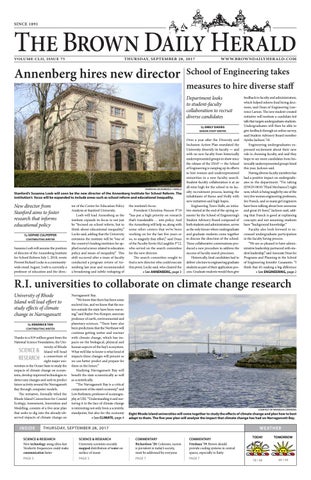
Eight Rhode Island universities will come together to study the effects of climate change and plan how to best adapt to them. The five year plan will analyze the impact that climate change has had on Narragansett Bay.
WEATHER
THURSDAY, SEPTEMBER 28, 2017
SCIENCE & RESEARCH New technology using ultra-fast Terahertz frequencies could make communication faster
SCIENCE & RESEARCH University scientists recently mapped distribution of water on surface of moon
COMMENTARY Richardson ’20: Colorism, racism is prevalent in today’s society, must be addressed by everyone
COMMENTARY Friedman ’19: Brown should provide cooling systems in central spaces, especially in Ratty
PAGE 3
PAGE 3
PAGE 7
PAGE 7
TODAY
TOMORROW
78 / 48
69 / 49
NEWS
PAGE 2 • THURSDAY, SEPTEMBER 28, 2017
» ENGINEERING, from page 1 right now in engineering.” Additionally, engineering students and administrators are looking to the University’s Target of Opportunity program to aid the search. The program is tasked with ensuring the pool of candidates is as diverse and inclusive as possible, Larson said. “We are focusing on candidates that are enhancing our diversity,” he said. These new initiatives come in response to an unsuccessful first attempt to recruit HUG faculty. Last year, the School of Engineering launched its first round of faculty searches since the May 2016 implementation of the DIAP, which calls for building a faculty “that represents the diversity of our society, and is a model of inclusiveness.” The school conducted four traditional searches and one search through the Target of Opportunity program. The five total searches produced one hire who is not a member of a historically underrepresented group. Two candidates remain in negotiation with the school, and the other two recruits elected to join other institutions, Larson said. Larson explained the candidates’ decisions to turn down the University’s offers, citing size and location. “Sometimes people want to be at a bigger university because there are more people that you can collaborate with in your field,” Larson said. “Very often we struggle with that issue. Another issue is sometimes there is a spouse or significant other that would benefit from a major urban location — Boston, New York, (Los Angeles), San Francisco.” But Christopher Rose, associate dean of the faculty for special initiatives and professor of engineering, said that the University’s size can serve as a competitive advantage against other elite universities. The interdisciplinary nature of smaller institutions is wellsuited for attracting HUG candidates,
he added. “It’s harder to find a particular niche and stick in it when you’re a (member of a) HUG,” said Rose, who is the only black professor in the engineering department. “The most successful folks that I know that are HUGs have either invented a new area, or sit on the (intersections) of areas and thereby invent something brand new. As a group, women and minorities are a ready-made set of minds for bridging across disciplines.” Both Larson and Rose said they are optimistic about future success in hiring HUG faculty, and credited their confidence to the University’s administration. “Although we have a long way to go, I think Brown’s magic power is … this willingness to do for the world as opposed to greedily for one’s self,” Rose said. The School of Engineering is now looking for a new professor of electrical engineering. The search committee, which includes up to eight faculty members, will convene to review the applications by the end of the calendar year. Larson said he is looking for a strong academic background and promising trajectory in candidates. “I would like to call it a holistic review. In other words, it’s not just by the numbers,” Larson said. “We also look at the background of the person, what their trajectory is. There is no simple numeric algorithm you could come up with and say this is the best person.” Rose, on the other hand, would like to see a more data-driven review process, which he believes plays to the advantage of HUG applicants. “In my experience, HUG candidates in the sciences tend to have to be a lot better just to be where they are,” Rose said. Larson expects interviews to take place in February and early March and to make an offer to the top candidate by the end of March.
THE BROWN DAILY HERALD
COURTESY OF BROWN OFFICE OF INSTITUTIONAL RESEARCH
COURTESY OF BROWN OFFICE OF INSTITUTIONAL RESEARCH
COURTESY OF BROWN OFFICE OF INSTITUTIONAL RESEARCH
COURTESY OF BROWN OFFICE OF INSTITUTIONAL RESEARCH
STAY UP-TO-DATE. FOLLOW US ON FACEBOOK. FACEBOOK.COM/BROWNDAILYHERALD
SCIENCE & RESEARCH THURSDAY, SEPTEMBER 28, 2017 • PAGE 3
THE BROWN DAILY HERALD
U. researchers to begin first tests of ultra-fast wireless communication Terahertz frequencies could increase data speeds, sync connected home technologies By JONATHAN DOUGLAS SENIOR STAFF WRITER
Your memes may be capable of downloading even faster — although you might have to wait a generation or two for the technology. The Federal Communications Commission has approved the University as the first testing site for wireless communication using ultra-fast terahertz frequencies, which could bring in a new era of rapid communication. Consumers currently only use Terahertz waves, sometimes called T-rays, very rarely in technological applications. Neither a high-frequency wave like visible light nor a low-frequency wave like microwaves, T-rays don’t have many obvious applications. Though they cannot be detected by the human eye, they are not a small enough wavelength to easily pass data through large objects. Today, data on a 4G device is
COURTESY OF DANIEL MITTLEMAN
The University has recently been approved to be the testing location for new communication technology, which uses Terahertz waves or “T-rays” instead of the more commonly-used gigahertz waves. transmitted using gigahertz waves, which have a smaller frequency than Terahertz waves and cannot transmit as much data. Data speeds are currently limited to a maximum of around 400 megabytes per second. As more everyday objects are connected to the web and take up bandwidth, a new way to transmit data is needed, said Professor Michael Shur
of Rensselaer Polytechnic Institute, a researcher in the field. Terahertz technology could be used to facilitate communications between your computer, fridge, phone, thermostat and any other household appliances. Daniel Mittleman, professor of engineering and the principal investigator for Brown’s research lab on Terahertz, imagines that in the future,
someone might be able to approach a kiosk equipped with terahertz technology where a user could download an 8K movie in a second, he said. Mittleman is “one of the internationally recognized leaders in terahertz research,” Shur said. In an experiment using a terahertz multiplexer, which sends multiple signals along a single channel,
researchers in Mittleman’s lab were able to transmit data at around 50 gigabytes per second, roughly 120 times faster than current speeds. At first, Mittleman was not sure his request to test the waves on campus would be successful. “We wanted to push the FCC to think about it. People in Japan, Europe and China are already testing these frequencies, and we wanted the FCC to respond,” Mittleman said. Mittleman’s group will begin outdoor tests this fall, sending data wirelessly in various locations around campus. While the experiments will begin in good weather, the group hopes to test different weather conditions and situations to see how the terahertz waves are affected, Mittleman said. While some in the field have said that terahertz communication is impossible in the rain due to the way it interacts with the waves, Mittleman thinks otherwise. “We are going to prove them wrong,” he said. Mittleman’s research group continues to publish work around terahertz waves, focusing on areas such as terahertz radiation and spectroscopy to study nano-materials.
Scientists map water distribution on lunar surface Data reveals moon to have more water than previously thought, identifies multiple sources By JACKSON WELLS SENIOR STAFF WRITER
Many people are unaware that water exists on the moon, but University scientists have gone far beyond corroborating this fact: They created a quantitative map of it. In a recent study, researchers used technology called the Moon Mineralogy Mapper to analyze not only the location of water on the moon, but also the sources, amount and reason it’s there in the first place. According to Ralph Milliken, associate professor of earth, environmental and planetary sciences and one of the authors of the study, the research conducted for this project builds on two previous papers: one published in 2008 that analyzed samples from the moon and found water within “glass beads” that formed during volcanic eruptions while the moon itself was taking shape, and one from 2009 that found evidence of water on the moon’s surface. The next step was to map the moon. The team analyzed strips of data collected by the Moon Mineralogy Mapper, which orbited the moon from 2008 to 2009, according to Shuai Li, a postdoctoral researcher at the University of Hawaii and one of the
» ANNENBERG, from page 1 search committee. Both Locke and McLaughlin expressed enthusiasm and respect for Loeb. “She’s incredibly energetic, she’s smart, she’s personable, she builds bridges, she deeply cares about the issues,” Locke said. McLaughlin also emphasized that Loeb is “coming from directing one of
authors of the study. The researchers specifically looked at the signatures of reflected sunlight in the data. Different sorts of molecules reflect sunlight in different ways, which means that water can be distinguished from the rest of the lunar surface, Milliken said. The researchers analyzed the signatures at three microns; anything that was visible from that perspective had to be water, Li added. Afterward, they were able to combine all of the points to create their map. Milliken and Li both differentiated between the two sources of water they analyzed on the moon. One type of water comes from within the moon and exists inside “glass beads.” But solar wind bombardment is the primary source of water on the lunar surface, said Alice Stephant, a postdoctoral research associate at the Open University. Water forms when solar winds cause protons — which are essentially hydrogen atoms — to bombard the surface of the moon, creating hydroxyl atoms, Milliken said. Data from current technology cannot differentiate between hydroxyl and water, so the samples on the moon could be just hydroxyl or a combination of water and hydroxyl, he added. The paper also focused on the volcanic deposits on the moon, indicating that some of the water must have come from inside the moon’s interior, said John Mustard, professor of earth, environmental and planetary sciences and the most important education policy research centers in the country” at Stanford. Stanford is currently ranked as the best education policy program in the United States by the U.S. News and World Report. McLaughlin commended Loeb for the capability “not only to do great work of her own but also to encourage great work by other people and to coordinate them.” Loeb’s interests in education reflect
COURTESY OF SHUAI LI
The data gathered by the team using Moon Mineralogy Mapper shows that water on the lunar surface is relatively sparse at the equator but increases moving toward the polar regions. one of the authors of the 2009 study. Li and Milliken’s map contained a number of key discoveries. Many researchers had assumed water only exists at the poles, but the map showed that it exists across the lunar surface and increases from the equator to the poles, Li said. It was previously thought that there is more water in the brighter regions of the moon than in the darker regions, but the study revealed that the distribution may be more or less the same. Regions around the glass deposits were also found to be very dry, while the deposits themselves are comparatively wet, Milliken said. Still, the moon is very dry. To collect around a liter and a half of water, one would have to process about 100
to 300 cubic feet of lunar soil, he said. Yet the study shows that the moon is much wetter than scientists had previously thought, according to Mustard. Milliken said that he would like to see more data, namely lunar samples, from future studies concerning water on the moon. These could answer some questions that are still unanswered, such as whether water exists on the moon along with hydroxyl. Some spacecraft that were not intended to examine the moon but looked anyway have suggested that there is indeed water on the moon. But from a physics perspective, water should be too unstable on the surface of the moon, which can heat up to over 100
degrees celsius. Further data could substantiate or invalidate claims that there is water along with hydroxyl on the moon, and answer questions of how it could exist there, Milliken added. Analyzing more samples could also provide insight into the distribution of water on the lunar surface, Mustard said. It is not fully known where water on the earth originated, and the collection of further samples could help answer this question, he added. The extent of water on the lunar surface is not completely known, said Bonnie Buratti, a planetary astronomer at the Jet Propulsion Laboratory in Pasadena, California. But it is a “hint of greater things.”
the very interdisciplinary approach Annenberg seeks to implement. “While there are lots of institutions that work on issues of education, equality, educational opportunity and education policy, there aren’t very many that spend time considering how universities — and great universities like Brown — can help improve educational opportunity for students,” Loeb said. She was drawn to the position because of “the focus
of Annenberg, just kind of the idea of starting over and the resources already at Brown.” “I think we were very fortunate to find somebody who’s already at the top of her field, but was ready to come and do something new,” McLaughlin said. As director, Loeb wants to make Annenberg a premier research center and use “the Annenberg influence” to inform decisions about education
policy made by government officials, she said. “If five years from now, we see …a lot of flow between the Annenberg Institute and the social science departments at Brown, that’ll be success,” McLaughlin said, adding that he hopes to see Annenberg be “completely hardwired into the Brown research ecosystem.”
NEWS
PAGE 4 • THURSDAY, SEPTEMBER 28, 2017
THE BROWN DAILY HERALD
UCS fills five positions in second meeting of year General body members vote to fill leadership positions after short speeches by candidates By EDUARD MUÑOZ-SUÑÉ SENIOR STAFF WRITER
The Undergraduate Council of Students held internal elections for five management and executive board positions in its general body meeting Wednesday night. Jonathan Powell ’18 was elected chair of academic affairs, Alex Song ’20 was elected treasurer, Chiaka Ibe ’21 was elected chair of alumni relations, Lisa Schold ’19 was re-elected as the UCS liaison for the Undergraduate Finance Board and Elizabeth Wang ’21 was elected secretary. “I applied for the treasurer role because I feel like I have some slightly unique experience,” Song said, citing his involvement in the finances of a nonprofit organization that provides prescription sports goggles to specialneeds athletes. Song also mentioned that he served last year on the UCS student activities committee. Running for the chair of alumni relations, Ibe brought up her experience as a student mediator for the alumni board at her high school as well as her involvement in “High Schoolers Without Boundaries,” a club in which she
» CLIMATE, from page 1 of the state.” Fox-Kemper cited the historical significance of the bay as one of the key reasons why researchers are continuing to invest in the area. “We have historical data from all around the bay to draw from. Through the research that had been done on the bay in the past, we will be able to take this to the next step and build on the knowledge we have with this enhancement.” URI will lead this project, which involves scientists from Brown, Bryant University, Rhode Island School of Design, Providence College, Rhode Island College, Roger Williams University and
“contacted recent graduates who work in health fields and connected them with students who had similar career path interests,” Ibe said. As a senior, Powell mentioned his extensive experience at Brown dealing with faculty, his work as a teaching assistant and his involvement in the founding of Mosaic+, a studentgroup that seeks to promote “diversity in computer science,” according to the group’s website. “For academic affairs, I am definitely prepared to see what that means for students on a larger scale outside the computer science department,” Powell said. Four candidates ran for chair of academic affairs — one of four primary chair positions — which was left empty last year. Similarly, four candidates contended for the positions of treasurer and chair of alumni relations. Two candidates ran for the post of UCS-UFB liaison and one candidate ran for the position of secretary. Any UCS general body member, including first-year members, were encouraged to run. Candidates were given a minute and a half to deliver brief speeches about their qualifications and goals for the positions. Since Wednesday’s meeting was only the second UCS meeting this year, many first-year candidates also used their speeches to introduce themselves. Competing candidates were asked to wait outside the room during Salve Regina University. As part of this five-year initiative, the Rhode Island C-AIM plans to build an observatory to study the bay. Through the data collected, researchers hope to construct complex models of these observations while implementing visualization and imaging techniques. Parts of the grant will also be dedicated to funding research and development of innovative equipment and technology, with hopes of achieving greater accuracy and resolution. “Any politician in Rhode Island should understand the importance of the bay, and the importance of managing the bay,” said Jeffrey Morgan, professor of medicine and engineering.
TIFFANY DING / HERALD
A student speaks to the members of the Undergraduate Council of Students Wednesday evening. Five management and executive board positions were filled during the general body meeting. the speeches and the questions that followed from UCS voting members. Candidates were then led outside while the UCS general body members briefly deliberated. While candidates were outside the room, general body members were asked to speak up if they felt particularly strongly — either positively or negatively — about the
candidate. All UCS general body members were allowed to vote, including the 25 new members that joined at the start of the term. To become a general body member of UCS, a student must collect 100 signatures before the start of the first UCS meeting of the year. Elections are not part of the process.
General body members who did not run for or were not elected to positions will soon choose to serve on one of four UCS committees: student activities, student wellness, campus life or academic affairs. At next week’s general body meeting, UCS will continue to fill leadership positions with internal elections.
“Our hope is that the better models we create with this project will lead to better management practices for the bay, and will allow the constituents of Rhode Island to realize the importance of the bay.” Members of the initiative were optimistic about the research’s scientific approach to predicting the impacts of climate variability, as well as its goal to increase awareness about the importance of such changes. “Data centers will be developed throughout the five years,” Fox-Kemper said. “All of this data that is collected from the observatory and modeled is going to be made available online for anyone to see. The hope is that we,
(in) conjunction with the visualization techniques, will make the data easy for anyone to understand.” The goal of the data centers “is to bring together some of the historical data and the data that we will collect with the new equipment and become a go-to place for information about the bay,” Morgan said. The state will also contribute an extra $3.8 million on top of the grant toward the initiative. A large part of these funds will be used to support workforce development programs, involving undergraduate students, graduate students, post-doctorates and young faculty in the process. The funds will also support the
Summer Undergraduate Research Fellowship program, which is dedicated to giving undergraduate students an opportunity to participate in large-scale scientific projects while incorporating visualization techniques that highlight the potential benefits of artistic concepts in scientific research. “One of the aims of SURF is to highlight the resources across the eight schools in the consortium that are available (for) visualization and imaging,” said Neal Overstrom, RISD’s Nature Lab director. “Programs like these are geared towards showing people what they can do, with hopes of them coming to use it for their own projects.”
TODAY
THURSDAY, SEPTEMBER 28, 2017 • PAGE 5
THE BROWN DAILY HERALD
menu
wa l k i n g t o wa r d t h e l i g h t
SATELLITE DINING ANDREWS COMMONS
Pizza: Barbecue Bam Bam, Meatball Provolone and Rosemary, Spicy 5 Cheese and Garlic JOSIAH’S
BLUE ROOM
Chicken Wings Bar, Bacon Burger, Quesadilla Station
Chicken Artichoke Florentine, Organic Coconut Lentil Soup
DINING HALLS SHARPE REFECTORY LUNCH
DINNER
Chicken Marsala, Curried Eggplant and Chickpeas, Basmati Rice Pilaf, Cupcake Special
Caribbean Jerk Chicken, Pot Pie with Biscuits, Carrot Con Vichy, Brownies
VERNEY-WOOLLEY LUNCH
DINNER
Beef Carnitas, Pork Adobo, Dal Cali, Chicken Caesar Salad Wrap, Cupcake Special
Sweet Potato Hash with Spinach, Tequila Lime Chicken, Spaghetti Pasta, Yogurt Bread
sudoku
ANITA SHEIH / HERALD
Many students pass through Wayland Arch every day to go to class, clubs and back to their dorms. The arch is even used to host concerts from a variety of a capella groups and the large audiences they attract.
Q U O T E O F T H E D AY
crossword
“Although we have a long way to go, I think Brown’s magic power is... this willingness to do for the world as
”
opposed to greedily for one’s self.
— Christopher Rose, associate dean of the faculty for initiatives
See DIVERSITY on page 1. CORRECTION Correction: A previous version of the article “R.I. school facilities fail state evaluation” stated that the Providence Public School system owns its own buildings, therefore any renovations to Providence schools will have to be a collaborative solution between the state and the district. In fact, the city of Providence owns the Providence Public School buildings, thus any renovation must be a collaboration between the city and the district. The Herald regrets the error. A previous version of the article “WBRU alums contest sale of FM signal” misspelled the name of Patti Galluzzi ’83. It is Galluzzi, not Galuzzi. The Herald regrets the error.
calendar TODAY SEPTEMBER MARCH
S
M
T
W
Th
F
S
1
2
13
24
35
46
57
86
79
10 8
11 9
10 12
11 13
12 14
13 15
14 16
15 17
16 18
17 19
18 20
19 21
20 22
21 23
22 24
23 25
24 26
25 27
26 28
27 29
28 30
29 31
30
Info Session on Department of State Careers 12:00 P.M. Watson Institute
English DUG Open House 2:30 P.M. Department of English, Lounge
Tapas y Bocadillos Event 4:30 P.M. Rochambeau House
“After Identity Liberalism” with Prof. Mark Lilla 5:00 P.M. Smith Buonanio Hall 106
TOMORROW Piano Workshop 4:00 P.M. Grant Recital Hall
Addressing Sexism on Campus 5:00 P.M. Barus &Holly, Room 751
Shabbat Services 6:00 P.M. Hillel
Dreamlandia 8:00 P.M. Leeds Theatre, Lymann Hall
COMMENTARY PAGE 6 • THURSDAY, SEPTEMBER 28, 2017
THE BROWN DAILY HERALD
P IA M I L E A F- PAT E L
comic A Horse by Any Other Name | Zach Silberberg
Got something to say? Leave a comment online! Visit www.browndailyherald.com to comment on opinion and editorial content.
Find us online! facebook.com/browndailyherald
browndailyherald.com
@the_herald
Location: 195 Angell St., Providence, R.I. www.browndailyherald.com
@browndailyherald
youtube.com/browndailyherald
Editorial Leadership
Sections
Multimedia & Production
Business
Editor-in-Chief Lauren Aratani
Arts & Culture Editors Ethel Renia Madison Rivlin
Design Editors Christy Leung Ameer Malik Jessica Yu Assistant: Eduard Muñoz-Suñé
General Managers Henry Ritter Ben Wesner
Managing Editors Matt Brownsword Rebecca Ellis Kate Talerico POST- MAGAZINE Editor Saanya Jain BLOGDAILYHERALD Editor Angelica Cotto
Metro Editor Gwen Everett News Editors Isabel Gensler Alex Skidmore Hattie Xu Science & Research Editor Elena Renken Sports Editors Ben Shumate Nicholas Wey COMMENTARY Opinions Editors Connor Cardoso Anuj Krishnamurthy Mili Mitra
Photo Editors Head: Marianna McMurdock Assistant: Lilly Nguyen Gus Reed Sara Runkel Anita Sheih Copy Desk Chief Abby Borges Multimedia Editor Roland High Illustrations Editor Pia Mileaf-Patel Graphics Editor Laura Felenstein Directors of Web Development Eli White Ivy Wong
Directors Sales: Erin Lueck Sales: Matilda Lynton Finance: Reena Zhan Strategy: William Nober Strategy: Caroline Ziegler Managers Sales: Michael Borello Sales: Elizabeth Doykan Sales: Ariel Shusterman Finance: Austin Lessin Collections: Ravi Betzig
Editorial contact: 401-351-3372 herald@browndailyherald.com
Business contact: 401-351-3260 gm@browndailyherald.com
Submissions: The Brown Daily Herald publishes submissions in the form of op-eds and letters to the editor. Op-eds are typically between 750 and 1000 words, though we will consider submissions between 500 and 1200 words. Letters to the editor should be around 250 words. While letters to the editor respond to an article or column that has appeared in The Herald, op-eds usually prompt new discussions on campus or frame new arguments about current discourse. All submissions to The Herald cannot have been previously published elsewhere (in print or online — including personal blogs and social media), and they must be exclusive to The Herald. Submissions must include no more than two individual authors. If there are more than two original authors, The Herald can acknowledge the authors in a statement at the end of the letter or op-ed, but the byline can only include up to two names. The Herald will not publish submissions authored by groups. The Herald does not publish anonymous submissions. If you feel your circumstances prevent you from submitting an op-ed or letter with your name, please email herald@browndailyherald.com to explain your situation. You can submit op-eds to opinions@browndailyherald.com and letters to letters@browndailyherald.com. When you email your submission, please include (1) your full name, (2) an evening or mobile phone number in case your submission is chosen for publication and (3) any affiliation with Brown University or any institution or organization relevant to the content of your submission. Please send in submissions at least 24 hours in advance of your desired publication date. The Herald only publishes submissions while it is in print. The Herald reserves the right to edit all submissions. If your piece is considered for publication, an editor will contact you to discuss potential changes to your submission. Commentary: The editorial is the majority opinion of the editorial page board of The Brown Daily Herald. The editorial viewpoint does not necessarily reflect the views of The Brown Daily Herald, Inc. Columns, letters and comics reflect the opinions of their authors only. Corrections: The Brown Daily Herald is committed to providing the Brown University community with the most accurate information possible. Corrections may be submitted up to seven calendar days after publication. Advertising: The Brown Daily Herald, Inc. reserves the right to accept or decline any advertisement at its discretion. The Brown Daily Herald, Inc. is a financially independent, nonprofit media organization bringing you The Brown Daily Herald, BlogDailyHerald and Post- Magazine. The Brown Daily Herald has served the Brown University community daily since 1891. It is published Monday through Friday during the academic year, excluding vacations, once during Commencement and once during Orientation by The Brown Daily Herald, Inc. Single copy free for each member of the community. Subscription prices: $200 one year daily, $100 one semester daily. Copyright 2017 by The Brown Daily Herald, Inc. All rights reserved. Periodicals postage paid at Providence, R.I. Postmaster: Please send corrections to P.O. Box 2538, Providence, RI 02906.
COMMENTARY THURSDAY, SEPTEMBER 28, 2017 • PAGE 7
THE BROWN DAILY HERALD
Picture perfect RANDI RICHARDSON staff columnist I lean in for a picture with a group of friends. I am in the front row and sitting beside two girls, one white and the other black. As we pose, the white girl in between us turns to the crowd behind and says, “Oh my God! I’m going to look so pale in this picture! Look who I’m sitting next to!” My group of friends erupts in laughter as I blink my eyes in disbelief, and the other black girl jokingly says, “I know, right!” Even now, a few days later, this entire exchange takes me aback because this presumably well-intentioned joke so obliviously mirrored the colorist language that still exists on this campus and across the country. For a start, it isolates black students and students of color by making them feel self-conscious and separate from the group, and it serves as a reminder that students of color face unique barriers as they move through campus. From where I sit as a black woman, it is significantly more difficult for black students to navigate the social circles on campus. Take the party scene, for example: I often walk into crowded rooms only to find a few other people of color in a sea of a hundred. In this context, “jokes”
about skin color only highlight the differences in perceived social capital attached to darker-skinned folks. Which leads to the second issue with this incident: It perpetuates unofficial popularity contests and historically-exclusive beauty standards. My friend’s humorous outrage over her appearance next to us caters to the idea that attractiveness is some-
that undervalue beautiful, kissedby-God, melanated skin. And when laughter arises after a colorist joke, and one of only two dark-skinned students in the group says, “I know, right,” it leaves the second student searching for camaraderie in the face of colorism and anti-blackness. On top of that, the joke erases the fraught history of colorism and how
years, and this same sentiment is echoed on a campus that was established with wealth accumulated from the slave trade. This is part of the reason why black students can have an especially complicated relationship with the colorist language expressed on campus and in the United States. This language attests to the contradiction that students of color are sent
Whether we admit it or not, colorism and racism are still alive and well. They continue to live through jokes that are told and the speech that is tolerated.
how linked to skin tone — that there is a color palette to how we perceive beauty. Comments like “I’m going to look so pale” feed into the idea that there is a “perfect” golden tone; “too pale” is frowned upon for some unknown reason, and apparently “too dark” is laughed at because it magnifies paleness. They propagate the wrongful internalization of ideals
reductive statements like this have a great impact on the lived experiences of people of color. Comparing skin tones has its roots in some of the darkest moments of American history, when enslaved people were separated by skin tone: Those with lighter skin generally received better living arrangements, assignments and food. Flash forward 300
acceptance letters to Brown, but are still not accepted into the culture and atmosphere on campus. Colorism, even when unintentional, is isolating. Most jokes don’t carry this much weight and are easily seen for what they are: jokes. But there are still light-skinned–dark-skinned rivalries within communities of color around the country. Add in the reality that
minorities in positions of power are frequently light-skinned or whitepassing professionals, and one will realize the racist attitudes of the Jim Crow era may still live on in other forms. It is 2017. It is long past time to eradicate the unjust treatment of black and brown bodies. Yet it is evident that we have failed to move past these race-based misperceptions and disparities. Take, for example, the riots in Charlottesville. Or the 2016 Presidential campaign and election. Or Maria Sharapova getting more endorsements than Serena Williams when Williams was the top-ranked tennis player in the world. Or Colin Kaepernick being unofficially ousted from the NFL after performing a peaceful protest. Whether we admit it or not, colorism and racism are still alive and well. They continue to live through jokes that are told and the speech that is tolerated. Laughing away issues and statements that have historical prominence silently encourage their continuation. It’s unrealistic to think that things will become picture perfect overnight, but a collective effort towards its eradication would certainly speed up the process.
Randi Richardson ’20 can be reached at randi_richardson@brown.edu.
Giving Brown heat about AC ANDREW FRIEDMAN staff columnist Returning to Brown in September is always a bittersweet process for me. Not for the reasons you think: Of course, I hate leaving home and the lack of responsibility that summer affords me. But I also hate returning to Brown because, on campus, I cannot walk anywhere more than two minutes away, especially in September, without drenching myself in sweat. And when I get there, I only sweat more because it’s usually 90 degrees outside and the majority of University buildings do not have air conditioning or adequate ventilation. Sometimes I eat lunch at the Ratty, but I always make sure to take double the napkins I need so that I can wipe my face down with them when I start panting and perspiring uncontrollably. It’s inevitable, even more so when I sit at a table close to a pizza oven, which raises the temperature in the immediate area 10 or 15 degrees, making the air feel like a furnace. Let’s not forget that dining services employees must work in this heat all summer, often confined to the back kitchens where ventilation is even worse. Occasionally I have to retire myself to the Ratty restroom mid-lunch so I can pat my entire body down with paper towels. It’s unpleasant. This process continues throughout the day unless I happen to be lucky enough to have a lecture in an air-conditioned building like MacMillan or 85 Waterman St. As someone who was born and raised in Dallas, Texas, I am no stranger to hot weather. The real unfamiliarity is coping with hot
weather without any sort of air circulation or ventilation. I realize that this issue is nothing new; in fact it may be one of the University’s oldest problems, and perhaps that is why it has not been addressed for so long. Yet I suspect few students, professors or staff members can honestly say that they have never complained about the lack of air conditioning or cooling in our buildings before. It may seem like a trivial issue compared to many of the other structur-
in the United States. Air conditioning was invented in 1902 in New York by Willis Carrier, but 63 years later, it was only adopted by 10 percent of U.S. households. Air condition enabled rapid population growth in the Sunbelt cities during the latter half of the 20th century. Millions of air conditioners were sold every year in the 1960s, and this trend only continued in the successive decades. As of 2011, 87 percent of American households own an air
Sometimes I eat lunch at the Ratty, but I always make sure to take double the napkins I need so that I can wipe my face down with them when I start panting and perspiring uncontrollably. Let’s not forget that dining services employees must work in this heat all summer, often confined to the back kitchens where ventilation is even worse.
al issues the University is battling, but given all of the funding going toward construction and renovation, can’t a small percentage of that be spent on some form of cooling system or proper ventilation, at least for central spaces? Blaming Brown entirely would be a little unfair, as our campus’ lack of central cooling is also a historical problem that stems from air conditioning’s unique and geographic basis
conditioner or central air system, according to the Energy Information Administration’s Residential Energy Consumption Survey. But just as these Sun Belt cities have depended on air conditioning for the majority of their history, the United States’ older, eastern cities have always gone without it. The unfortunate consequence of this history is that a lack of air conditioning in many
of New England’s older buildings today is the status quo. It may very well be that much of Brown lacks air conditioning because it’s just plain old. Though approximately 86 percent of new single-family homes in the Northeast are now built with air conditioning, most of Brown’s campus is far from the label “new” and “single-family” (I would actually classify most Brown buildings as “prehistoric” and “multi-family”). And central air conditioning is, as you might have expected, extremely expensive — an AC unit can cost up to $3,400, without factoring in the cost of duct work and the extra energy costs. The cost of implementing this across Brown’s dorms and the Ratty would easily reach into the tens of thousands of dollars, a steep ask from a tight 2017 budget that has only allocated 10.21 percent of its funds to auxiliary operations, down 5 percent from last year’s budget. There are also valid environmental arguments against implementing central cooling across Brown’s dorms — namely that air-conditioning contributes to intensive energy demand that drives climate change, making the world hotter. Perhaps we don’t need to outfit the entire campus with air conditioning immediately. But I suggest that Brown at least make an attempt to retrofit the Ratty with central air conditioning. Although this is expensive upfront, the change will bring comfort to students, faculty and especially staff members working through the heat. Just because New England has typically lagged behind in installing AC doesn’t mean that we need to take the heat any longer.
Andrew Friedman ’19 can be reached at andrew_friedman@brown.edu.
NEWS THE BROWN DAILY HERALD
THURSDAY, SEPTEMBER 28, 2017
After Identity Liberalism Featuring
Mark Lilla
Professor of Humanities, Columbia University Essayist for The New York Review of Books
Discussants
Charles Larmore
W. Duncan MacMillan Family Professor of the Humanities and Professor of Philosophy Brown University
Prerna Singh Mahatma Gandhi Assistant Professor of Political Science and International and Public Affairs Brown University
Thursday, September 28, 2017 5 p.m. Smith-Buonanno Hall, Room 106
REAFFIRMING UNIVERSITY VALUES: Campus Dialogue and Discourse Sponsored by the Office of the President, Office of the Provost and the Department of Philosophy To request special services, accommodations or assistance for this event, please contact the University Event and Conference Services Office at universityevents@brown.edu.