SINCE 1891
THE BROWN DAILY HERALD THURSDAY, OCTOBER 19, 2017
VOLUME CLII, ISSUE 89
UCS changes supplier for ‘Project Tampon’
WWW.BROWNDAILYHERALD.COM
Providence police to wear body cameras Cameras to be turned off in instances involving victims of sex crimes, child abuse By DYLAN MAJSIAK CONTRIBUTING WRITER
TIFFANY DING / HERALD
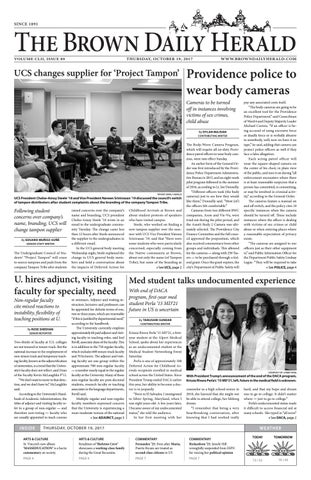
UCS President Chelse-Amoy Steele ’18 and Vice President Naveen Srinivasan ’19 discussed the council’s switch of tampon distributors after student complaints about the branding of the company Tampon Tribe.
Following student concerns over company’s name, branding, UCS will change tampon supplier By EDUARD MUÑOZ-SUÑÉ SENIOR STAFF WRITER
The Undergraduate Council of Students’ “Project Tampon” will cease to source tampons and pads from the company Tampon Tribe after students
raised concerns over the company’s name and branding, UCS president Chelse-Amoy Steele ’18 wrote in an email to the undergraduate community Tuesday. The change came less than 12 hours after Steele announced the supplier to the undergraduates in a different email. In the UCS general body meeting Wednesday night, Steele explained the change to UCS general body members and held a conversation about the impacts of Deferred Action for
U. hires adjunct, visiting faculty for specialty, need Non-regular faculty cite mixed reactions to instability, flexibility of teaching positions at U. By ROSE SHEEHAN SENIOR REPORTER
Two-thirds of faculty at U.S. colleges are not tenured or tenure-track. But the national increase in the employment of non-tenure track and temporary teaching faculty, known as the adjunctification of universities, is a trend that the University’s faculty does not reflect ,said Dean of the Faculty Kevin McLaughlin P’12. “We don’t want to move in that direction, and we don’t have to,” McLaughlin said. According to the University’s Handbook of Academic Administration, the titles of adjunct and visiting faculty refer to a group of non-regular — and therefore non-voting — faculty who are usually appointed to teach courses
INSIDE
or seminars. Adjunct and visiting instructors, lecturers and professors can be appointed for definite terms of one, two or three years, which are renewable “if this is justified by departmental need,” according to the handbook. The University currently employs approximately 60 paid adjunct and visiting faculty in teaching roles, said Joel Revill, associate dean of the faculty. This is in addition to the 758 regular faculty, which includes 688 tenure-track faculty and 70 lecturers. The adjunct and visiting faculty are one group within the approximate 700 non-regular faculty — a number nearly equal to the regular faculty at the University. Many of these non-regular faculty are post-doctoral students, research faculty or teaching associates in the language departments, Revill said. Multiple regular and non-regular faculty members expressed concern that the University is experiencing a more moderate version of the national » See ADJUNCT, page 3
Childhood Arrivals at Brown and about student protests of speakers who have visited campus. Steele, who worked on finding a new tampon supplier over the summer with UCS Vice President Naveen Srinivasan ’19, said that “there were some students who were particularly concerned, especially coming from the Native community at Brown, about not only the name (of Tampon Tribe), but some of the branding as » See UCS, page 2
The Body-Worn Camera Program, which will require all on-duty Providence patrol officers to wear body cameras, went into effect Sunday. An earlier form of the General Order was first introduced by the Providence Police Department Administrative Bureau in 2015, and an eight-week pilot program followed in the summer of 2016, according to Lt. Joe Donnelly. “Different officers took (the body cameras) just to see how they would like them,” Donnelly said. “Most (of) the officers felt comfortable.” Cameras from two different BWC companies, Axon and Vie-Vu, were tried out during the pilot period, and the Axon’s Body 2 Camera was ultimately selected. The Providence City Finance Committee and the full council approved the proposition, which also received commentary from other groups and individuals. This allowed for the cameras — along with 250 Tasers — to be purchased through a federal grant. Once the grant expires, the city’s Department of Public Safety will
pay any associated costs itself. “The body cameras are going to be an excellent tool for the Providence Police Department,” said Councilman of Ward 6 and Deputy Majority Leader Michael Correia. “If an officer is being accused of using excessive force or deadly force or is verbally abusive to somebody, well, now we have it on tape,” he said, adding that camera can protect police officers as well if they face a false allegation. Each acting patrol officer will wear the square-shaped camera on the center of his chest, in plain view of the public, and turn it on during “all enforcement encounters where there is at least reasonable suspicion that a person has committed, is committing, or may be involved in criminal activity,” according to the General Order. The cameras feature a manual on and off switch, and the policy cites 10 specific instances when the camera should be turned off. These include instances where the officer is dealing with victims of sex crimes or child abuse or when entering places where a reasonable expectation of privacy exists. “The cameras are assigned to our officers just as their other equipment is,” said Public Information Officer for the Department Public Safety Lindsay Lague. “They will be required to take » See POLICE, page 4
Med student talks undocumented experience With end of DACA program, first-year med student Perla ’15 MD’21 future in US is uncertain By TANUSHRI SUNDAR CONTRIBUTING WRITER
Krissia Rivera Perla ’15 MD’21, a firstyear student at the Alpert Medical School, spoke about her experiences as an undocumented student at the Medical Student Networking Event Saturday. Perla is one of approximately 100 Deferred Action for Childhood Arrivals recipients enrolled in medical school across the United States. Since President Trump ended DACA earlier this year, her ability to become a doctor is in jeopardy. “Born in El Salvador, I immigrated to Silver Spring, Maryland, when I was eight years old. A few years later, I became aware of my undocumented status,” she told the audience. In her first meeting with her
COURTESY OF LANBO YANG
With President Trump’s announcement of the end of the DACA program, Krissia Rivera Perla’s ’15 MD’21, left, future in the medical field is unknown. counselor as a high school senior in 2010, she learned that she might not be able to attend college, her lifelong dream. “I remember that being a very heartbreaking conversation, after knowing that I had worked really
hard, and that my hope and dream was to go to college: It didn’t matter where — just to go to college.” Perla’s undocumented status made it difficult to access financial aid at many schools. She typed in “all zeros” » See DACA, page 2
WEATHER
THURSDAY, OC TOBER 19, 2017
ARTS & CULTURE St. Vincent’s new album ‘MASSEDUCATION’ is a hectic commentary on society.
ARTS & CULTURE Rendition of ‘Skeleton Crew’ showcases a working-class family during the Great Recession.
COMMENTARY Fernandez ’21: Even after María, Puerto Ricans are treated as second-class citizens in US
COMMENTARY Richardson ’21: Jemele Hill wrongfully suspended from ESPN for voicing her political opinion
PAGE 4
PAGE 4
PAGE 7
PAGE 7
TODAY
TOMORROW
72 / 52
70 / 45
SCIENCE & RESEARCH PAGE 2 • THURSDAY, OCTOBER 19, 2017
THE BROWN DAILY HERALD
Purple marsh crabs, rising sea levels destroy New England marshlands Rising sea levels exacerbate regression of New England marshlands By JACKSON WELLS SENIOR STAFF WRITER
The salt marshes of New England are disappearing. There is not one singular cause to which blame can be directed, however. As a recent paper has shown, it is the synergistic relationship between two factors — the dearth of purple marsh crab predators and the rising sea level resulting from climate change — that is responsible for this loss of salt marsh. The crabs in question are sesarma reticulatum, or the purple marsh crab, which is an invasive species of crab that has lived in the salt marshes of New England for decades. Mark Bertness, co-lead author of the paper and professor of biology, describes them as “hippie crabs” due to the communal system of tunnels in which they live and breed. They feast upon the vegetation in the salt marshes — the various roots, rhizomes and so forth — but are usually kept in balance by the predators, namely the different types of fish that live in that area. But as the number of these predators declines due to human interaction, these crabs have been able to expand their numbers exponentially. According to the paper, the combination of the crabs’ ability to
» DACA, from page 1 for her social security number, which received questions from some schools. In the end, she only received financial aid from four or five schools out of the twelve that accepted her. She ultimately decided to come to Brown. At Brown, Perla didn’t think medical school would be a possibility. The bulk of financial aid for medical school comes from federal loans, and she was not eligible for any federal aid because she was undocumented. “I know people who got into medical school but couldn’t go because of that,” she said in an interview with The Herald. However, the University supported her transition into medicine, despite the uncertainty of the situation. After working closely with the administration at Health Careers, Perla applied and was accepted to the Med School. Growing up, Perla saw the way undocumented people often lacked access to adequate healthcare, which inspired her to go into medicine. She remembers a friend her age who had
» UCS, from page 1 well.” Steele said that a few students from the community reached out with issues, and the intensity of their concerns pushed Steele and Srinivasan to act. “Individual students who told us they were indigenous and Native Americans (said) that this was something that affected them really deeply, and so we knew this was something we had to respond to immediately,” she told The Herald. “The name itself really led them to have a lot of concerns about us working with a company that could be appropriating cultures.”
proliferate due to the low predatation and rising sea levels combine to affect the salt marshes more than if either factor acted alone. To test this, the researchers went to the marshes of Colt State Park in Bristol, Bertness said. They dug up parts of the marsh and completely submerged them to mimic drowning. They did this in the winter so that the plants were not affected. Returning after winter, the researchers set the samples of marsh at different heights to simulate the effects of climate change-induced sea level rise. They also dug up hard peat from the same area for comparison. Marsh at the high water level, through which the crabs did not traditionally tunnel due to the normally hard peat, all of the vegetation was eaten by the crabs, Bertness said, showing the effects of climate change combined with the effects of the salt marsh crabs spreading. When salt marsh peat is softened, crabs are likely to extend further and have a greater impact, said Sinéad Crotty ’15, another co-lead author of the paper and a graduate student at the University of Florida. Taking into account only climate change, eight percent of salt marshes will be lost; but considering this synergistic interaction of the two stressors, 86 percent will be lost, Bertness said. Experiments in the last decade spurred the researchers to investigate the crabs’ effects. To see how the crabs fare in areas of low predation, they attached the crabs to fishing lines and left
them in areas that have and have not experienced large human impact. In the areas of low human impact, they found that almost all the crabs were eaten in one night; but this was not the case in areas of high human impact, Bertness said. After three months, these crabs were still thriving. Another past experiment involved total predator removal, where Bertness and other researchers cut off predators’ access to the crabs. While he had initially assumed that the experiment would have taken a couple of summers, after only one, there was a 50 percent reduction in the amount of biomass in the marshes. In the latest experiment, Crotty was surprised by how quickly the proliferation of the crabs occurred. In the area studied, the crabs were grazing at the furthest points that they were known to graze within the first month. This suggests that the crabs are actively venturing from their burrows and looking for new areas to inhabit, and that as soon as these new areas were ready, they would, Crotty said. Christine Angelini, another co-lead author of the paper and an assistant professor at the University of Florida, found the extent of the crabs’ impact to be surprising. Whereas she had initially assumed the area to which the crabs would tunnel would be more concentrated, she found in the study that the crabs could travel long distances to seek out new habitats. While the marshes had initially been slowly softened and
eroded from the outside, they were now being eroded in softened patches throughout the marsh, leading them to have what Angelini described as a “swiss cheese” appearance. She had not expected the crabs to migrate in such an aggressive manner. More synergistic studies such as this one are needed to study different parts of ecology, including the connection between predation and crab spread, said Jon Witman, professor of biology. He suggested more studies monitoring the rates of fish predation on the crabs in order to pinpoint which species in particular is responsible. Efforts to figure out means to control the spread of the crabs other than the top predators is important in
helping to mitigate the damage done by these crabs, Witman said. Moves to increase the local predator populations in these areas and reduction of fishing pressures are important in this regard, Angelini said. People do not adequately appreciate what these marshes do in terms of ecosystem services, Bertness said. These include cleaning the water column and buffering the shoreline from storms. “If you monetize what shorelines do for us, mangroves and salt marshes are, in terms of ecosystem services, the most valuable systems on the planet on a hectare-by-hectare basis,” Bertness said. According to his calculations, there will be a $161 million a year loss in ecosystem services by 2050.
fainting spells but never went to the hospital because he was terrified of being deported. “Health should not be a commodity,” Perla told The Herald. “It should be a human right.” With the arrival of DACA in 2012, Perla said she not only felt overwhelming relief but also was able to perform clinical research at Johns Hopkins University for two years, an experience that sparked her interest in neurology and neurosurgery. With the repeal of DACA, opportunities like this are no longer available to undocumented students. Perla is unable to continue onto residency, as undocumented people are not legally allowed to work. “I will graduate from medical school after four years of hard work and caring for patients, have an MD, but I cannot work in the United States,” she said. There are approximately six DACA students currently in residency in the United States. “We keep breaking glass ceilings only to find more,” Perla said. Associate Dean for Medical Education Allan Tunkel said the transition from medical school to residency is
the biggest challenge with undocumented medical students in the United States. This inability to access residency programs halts the progression of a doctor’s medical career: “When students graduate from medical school, they are medical doctors, … but they are not able to practice independently. They have to do a residency in a specific discipline in order to be able to practice.” Despite this roadblock, the Medical School will continue to accept applications from DACA students, Tunkel said. “We would love to continue to take wonderful DACA students into the medical school who we feel will be outstanding doctors,” Tunkel said. For undocumented MDs to move into residency, there needs to be policy change at the federal level, he added. For Perla, the uncertainty of this situation is difficult. “No matter how well I do, it’s all in the hands of one piece of paper that needs to be signed,” she said. But, she said, she compartmentalizes her stress in order to keep going forward, focusing on hope and
possibility. “That’s what keeps me going. There’s this hope that I could be a doctor in the United States. And that’s always been the case. If there is hope, I will continue to work hard.” Part of Perla’s hope is for Washington to pass a DREAM act that “provides equal opportunity for everyone to contribute to this country” and doesn’t benefit some undocumented individuals over others. She urges people to see the situation from a “humanistic perspective, not a political perspective” and contact their legislators to push to pass the DREAM act. At Brown, there has been an outpouring of support for Perla and her endeavors. After attending the Defend DACA Rally at the Rhode Island State House with Perla, a group of medical students reached out and asked how they could continue to help her. The students coordinated with Joseph Diaz, associate dean for diversity and multicultural affairs, to give Perla a platform to share her story. The students also created special pins in support of undocumented people that they distributed at their white
coat ceremony later that afternoon. “For medical students, getting your white coat is pretty symbolic, and you wear a lot of pins that show patients, colleagues and healthcare professionals that you worked for something. It’s definitely a way to show your support for different patient populations,” said Vivian Chan GS, a first year medical student. For Perla, there is no question about moving forward, despite the circumstances. “As I wear my white coat, I will acknowledge the privilege it imparts, and the great honor it is to be inducted into the medical community,” she said in her speech. “However, simultaneously, I will wear my white coat knowing that my future as a physician is uncertain.” The conversation around the challenges undocumented people face in the U.S. will continue at the medical school in coming weeks. The Med School’s Office of Diversity and Multicultural Affairs will sponsor an upcoming panel on “immigration law to educate and equip healthcare and social service providers” Oct. 23.
Instead, the council will source the sanitary products from Boxed, an online retail company and the company used last year for Project Tampon, Steele told The Herald. Steele told UCS members that she and Srinivasan had concerns about Tampon Tribe’s name over the summer when they first considered the company. Their initial concerns about the group’s name prompted them to reach out to the company’s representative, who assured them that there were leaders in the company that held Afro-diasporic and indigenous identities, Steele said. Steele said in the UCS general
body meeting that “we were able to reclaim funding from Tampon Tribe, but negotiations are still going through on that.” But Steele made sure to affirm her commitment to the initiative.“Either way it’s going to go through,” Steele told The Herald. “We will find a way to source the funding.” Distribution of the products, which was slated to begin Wednesday, will continue as planned, using products left over from last year’s supply until Sunday. After Sunday, new shipments of tampons and pads should arrive that will be used moving forward, Steele said.
“I really wish we were able to dive in more to the branding of the company and to the PR they’ve been doing on social media,” Steele told The Herald. “Had we done that earlier, we would have made different decisions.” The group then had a conversation about the effects of President Trump’s move to end DACA on students. General body members expressed concern at the effects on students, but members also sought more clarification as to what the University is doing to address the issue. The council then discussed student protests on campus directed at visiting speakers, including the canceled 2013
speech by Raymond Kelly, former New York Police Department Commissioner who had “staunch support for the contentious stop-and-frisk policy,” The Herald previously reported. Srinivasan, for example, asked the group to consider the defined difference between peaceful and violent protests. “Where is the distinction between what is a peaceful protest or not?” he said. “Who is responsible for informing students of these policies?” Alex Song ’20, UCS treasurer, raised questions about the limits to hate speech by visiting speakers. “If (speakers) don’t directly attack someone, where is the line drawn?”
ROLAND HIGH / HERALD
NEWS
THURSDAY, OCTOBER 19, 2017 • PAGE 3
THE BROWN DAILY HERALD
» ADJUNCT, from page 1 trend. “In the 27 years that I’ve been on the faculty, we have gradually raised the amount done by adjuncts, visitors and lecturers,” said David Weil, chair of the economics department. While the seven adjunct and visiting faculty members interviewed for this story said they relish the experience of teaching at Brown, some expressed dissatisfaction with uncertainty and instability of their positions . Filling the gaps Adjuncts and visitors are employed to cover “some margin that might not exist for more than a year” or because they have specific experience or expertise that makes them particularly qualified to teach certain courses, McLaughlin said. Because the international relations concentration consists of courses in multiple departments, three adjuncts are required to teach classes specific to the concentration that are not provided by any department at Brown, said Nina Tannenwald, director of the international relations program. For example, one of these three adjuncts has a law degree, which brings a unique perspective to the classroom, she added. Four of the adjunct and visiting faculty interviewed attributed their positions to unique knowledge or skills. Richard Arenberg, adjunct lecturer in international and public affairs, said that his 34-year career in the Senate primed him to impart an “enthusiasm for public service” to students. Frank Sciuto, adjunct lecturer in economics, has been teaching financial accounting for almost 30 years while simultaneously working full-time as a certified public accountant. “That is something that none of the tenure-track faculty in the department could teach. … It’s not something that PhD economists really have sufficient expertise in,” Weil said. Two of the adjunct and visiting faculty members interviewed said that they were hired because regular faculty members left the University or went on sabbatical. “There was a need,” said Charles Morton, adjunct lecturer in chemistry, who was hired in summer 2016 to teach organic chemistry and is currently leading a lecture section. The physics department also turns to adjunct faculty when the department has “too many professors on sabbatical leaves and … may not have enough professors to cover every course,” said Gang Xiao, chair of the physics department. A part of the department? Due to the temporary and often
MATTHEW BROWNSWORD / HERALD
part-time nature of adjunct and visiting positions, several of the faculty interviewed said that they struggled to feel involved and included in their respective departments. “Because you’re only here part-time … you don’t have the contact with the other faculty,” said David Wyss, adjunct professor in English, adding that this lack of contact would matter most to faculty members just beginning their careers. “If you’re an adjunct faculty member who’s using that as sort of a CVbuilder to apply for tenure-track positions, then I can see how you might feel left out,” Morton said. Adjuncts are often not present on campus and therefore miss meetings and events, he added. John Jannotti, adjunct assistant professor in computer science, was on a tenure-track position at Brown before withdrawing from the tenure process to run his company. Upon returning to the University as an adjunct, he said he felt that he was “participating less in the direction of Brown or (his) department.” A visiting faculty member in the humanities who wished to remain anonymous for fear of professional repercussions said that they were “not welcome at department meetings and at decision-making meetings,” adding that this barrier limits how invested nonregular faculty feel in their department. “I do feel a little bit separated. … I would have loved to have been more plugged into the community,” Sciuto said. However, the economics department always includes him in events, he added. “It’s not like ‘Mean Girls’ in
high school,” he said. Arenberg and Morton also said that they feel accepted and appreciated by the regular faculty in their respective departments. “I found really a lot of respect for the experience and expertise that I brought to the job,” Arenberg added. Benefits and pay Since adjuncts and visiting faculty are often employed to fill gaps in curricula, the University views them solely as teachers rather than as researchers, said the visiting faculty member who wished to remain anonymous. Unlike regular faculty, adjuncts and visiting faculty are not offered the option of a sabbatical during which to conduct research. Being an adjunct acts as a barrier to involvement in the research that takes place in the chemistry department, Morton said. However, for Morton, a teaching-centric appointment is ideal as the lack of pressure to conduct research allows him to focus on raising his children. “It’s an incredible kind of freedom as long as your family’s finances allow it,” he said. Unlike his colleagues at other universities, who “have to make a decision every semester, every year” whether or not to continue as adjuncts because of the poor pay, Morton is satisfied with the compensation he receives, he said. Brown pays its adjunct and visiting faculty per course out of a “temporary teaching budget,” McLaughlin said. Faculty receive around $10,000 per class, as opposed to the national average of $3,000 per class, Revill
said. Thirty-four of the University’s 60 adjunct and visiting faculty members make less than $50,000 per year, which is a “normal, low-end, full-time teaching salary,” he added. Though adjunct and visiting faculty do not automatically receive the benefits package offered to regular faculty members, “we always try to provide benefits to people who don’t have it available to them otherwise, especially if they’re teaching more than one course,” McLaughlin said. For example, the English Department recently worked with the University to begin offering some partial benefits to its adjuncts, said Philip Gould, chair of the English department. Job insecurity Though adjunct and visiting faculty can be appointed for terms of up to three years, most of the non-regular faculty interviewed were on one-year contracts with the University. The yearby-year nature of adjunct and visiting positions and the fact that many of these faculty are hired specifically to fill temporary roles results in a dearth of job security, said the anonymous visiting faculty member. Because adjuncts and visiting faculty are rehired based on need, there’s a chance that they could end up teaching fewer courses than anticipated. The anonymous visiting faculty member said that last year they expected to teach four classes but were only needed for three. “That’s like a quarter of my income that’s just gone, … there’s no real recourse,” they said, adding that, because their department is in the process
of hiring a new tenure-track faculty member, “I think my time is probably about to end here.” Renewal of an adjunct or visiting faculty member’s contract depends on the amount of money allocated to the department by the University, Weil said. However, adjunct and visiting faculty members have the possibility of becoming lecturers — a regular faculty position that comes with a three-year renewable contract, he added. “Since my first year here, we have looked for opportunities to regularize part-time faculty or full-time faculty on year-to-year contracts,” McLaughlin said. “Once it’s been demonstrated that that’s an ongoing need, we’ve looked for opportunities to move them into what we call regular faculty positions.” In the English department’s nonfiction writing program, which employs five adjunct faculty members, “we try to create as much certainty and continuity as we can,” Gould said. He added that three of the program’s adjuncts have been at Brown for over a decade. In the last 10 years, the department has also focused on converting its adjunct positions into lecturer positions, he said. “The bottom line is you want people who come to work each day and do good work to feel part of something,” Gould said, adding that “it’s easier to feel that way” if you have job security. Avoiding adjunctification Promoting adjunct and visiting faculty to regular faculty positions also combats adjunctification. The “Brown model” values tenuretrack faculty because their role as researchers gives them a unique approach to teaching, said Patrick Heller, chair of the sociology department. Because of this, Heller doesn’t think Brown is a part of adjunctification, he added. Because the University is “wealthier than the state systems,” it does not have to resort to adjunctification, McLaughlin said, adding that the number of nontenure track faculty has not increased during his time at Brown. Although when Weil began working at Brown the teaching in the economics department was “overwhelmingly done by tenure-track faculty,” the department now employs four adjuncts, he said. This shift can be attributed both to an increase in student enrollment in economic courses and a decrease in the teaching loads of tenured-track faculty so as to remain competitive to peer institutions, Weil added. “The effort that we’re focused on is trying to, as much as possible — except where it’s appropriate or desirable — have regular faculty teaching in the classes,” McLaughlin said.
STAY UP-TO-DATE. FOLLOW US ON FACEBOOK. FACEBOOK.COM/BROWNDAILYHERALD
ARTS & CULTURE PAGE 4 • THURSDAY, OCTOBER 19, 2017
THE BROWN DAILY HERALD
St. Vincent’s fifth album combines anxiety, chaos In her new album, ‘MASSEDUCTION,’ St. Vincent explores number of society critiques By JUSTIN FERENZI STAFF WRITER
Annie Clark is making a statement. If it was not clear from the eye-catching album art or all-caps titling of “MASSEDUCTION,” Annie Clark’s anxiety-wrought fifth album as St. Vincent says everything it wants to say in a taut 41 minutes. The album’s first track, “Hang on Me,” forces the listener to do exactly that. “I know you’re probably sleeping,” St. Vincent sings in hushed tones in the opening line. The implication, of course, is that the listener is now awake — or, at least, is about to be. From there on out, the album gradually gains a chaotic momentum. “Pills,” the second track, possesses a caustic sing-song quality. Underneath the bubblegum pop, St. Vincent croons a tirade against the gain of pleasure through artifice. She is no less subtle in the titular “Masseduction.” “Don’t turn off what turns me on,” she sings, though there is a
wryness in the song that conveys an urgency to do just that. In between the high-energy, highimpact critiques of modernity, hedonism and superficiality are small moments for deep breaths. Both “Happy Birthday, Johnny” and “New York” show a fragile side that St. Vincent has not shared before, and create the sense that it’s more Clark than St. Vincent shining through. But the tenuous anxiety of the rest of the album persists in these ballads; something is bound to crack, and St. Vincent knows better than to humpty-dumpty the affair. After a brief return to ricocheting melodies, the penultimate track, “Slow Disco,” provides one last chance for the listener to breathe before sliding into the utterly breathless “Smoking Section.” Quite unlike any other song that Clark has put out as St. Vincent, “Smoking Section” sends out one final plea to “MASSEDUCTION” listeners. “It’s not the end,” she insists as the album fades out, and it’s hard not to believe her. With “MASSEDUCTION,” Clark is demonstrating the most varied and vocally diverse work of her career. There’s a sense of world wariness and maturity that provides a gravitas to the album, and its raison d’être is the
COURTESY OF WIKIMEDIA COMMONS
In her fifth album, Annie Clark, better known by her stage name St. Vincent, takes the listeners for a 41-minute journey that critiques many societal paradigms, such as superficiality, modernity and hedonism through artifice. strongest of any St. Vincent album to date. It is topical without being on the nose, fierce, fun and gorgeous.
“MASSEDUCTION” was released Oct. 13 and is available on most streaming platforms. For those
who want to see the seduction live, St. Vincent will be playing a show at the House of Blues in Boston Nov. 30.
‘Skeleton Crew’ shows struggles of American family Morisseau’s play portrays lives of working class family in their journey to find American Dream By ANNABELLE WOODWARD CONTRIBUTING WRITER
This past Saturday, Trinity Repertory Company’s production of the offBroadway comedy-drama “Skeleton Crew” captivated audiences with a profound, clever and freshly contemporary take on the ever-elusive “American Dream.” Written by Dominique Morisseau, a playwright lauded for her intimate renderings of the lives of the American working class, “Skeleton Crew” follows the rough-and-tumble workdays of a makeshift family of Detroit auto workers during the Great
Recession. The performance begins with a dark stage. Strobe lights flash, intense industrial techno beats start to pound and actors, wearing reflective construction vests, run out from behind the double doors and begin dancing to the sounds of scraping metal; the seriousness and specificity of their movements signify the rigorous technicality of their work. The music fades and the stage lights flick on. In struts Shanita (Shenyse Harris ’18), fiercely pretty and pregnant. After setting down her purse, she checks the mini-fridge and, disappointed, snaps, “Who’s been touching my salad dressing again?” Co-producer of Showtime’s popular working class comedy-drama “Shameless,” Morisseau is a pro at clever character-establishing banter, which reappears in “Skeleton Crew.”
In response to Shanita’s caustic accusation, Faye, played by Lizan Mitchell, the dignified, cynical matriarch of the plant family, snaps back with a sharp remark that incriminates Dez, played by Will Adams ’19, the macho, sexually frustrated scapegoat of everyone’s jokes. Reggie, portrayed by Jude Sandy ’05 MA’09, the tie-wearing plant supervisor, calmly reprimands Faye for smoking indoors for the thousandth time. As he is a close family friend of Faye’s, Reggie’s disciplinary efforts are largely in vain. The action takes place in a workers’ break room: the set features a cheap couch, a mini-fridge, a microwave, a half-empty pot of coffee and a bulletin board with a sign that reads “Unit Meeting Thursday.” From the cardboard Bankers Boxes to the tacky, middle-school gymnasium-esque wall
MATTHEW BROWNSWORD / HERALD
tiling, no detail is spared. Within the first 30 minutes, the plot takes the expected dramatic turn. The plant is going to be shut down within the year. Reggie confides this in Faye, swearing her to secrecy, and Faye spends the first act torn between her loyalty to Reggie, her sort-of-godson and supervisor, and her sense of duty to Shanita and Dez, whose dreams are hanging in the balance. Morisseau manages to again create characters who remain complex and avoid becoming carictatures — despite certain shortcomings and tropes apparent in Adams’ portrayal of Dez — while still clearly working to represent broader social issues. Each character is struggling with their own “bag of shit.” Having lost her house to the bank, Faye is secretly sleeping on the rec room couch. Dez
wants to start a repair shop but can’t come up with the cash. Shanita is grappling with the prospect of raising a child on her own. Hoping to provide a better life for his wife and kids, Reggie struggles with his desire to maintain his blue-collar roots while working in a managerial position. Morisseau’s script thus gives the viewer an immediate sense of the intimacy and tension that makes these co-workers a family. To bridge critical parts of the play, actors — keepers of America’s “skeleton” — engage in symbolic dances representative of the demanding technicality of their labor as auto-plant workers — a clever way to represent industrial work within the confines of the stage. They provide a welcome change of pace from the play’s otherwise measured, dialogue-weighted cadence.
» POLICE, from page 1
but maintains that the body cameras are “definitely a step forward,” Betancur said. But some groups questioned the effectiveness of body cameras in curbing issues institutionalized in policing. “We saw Rodney King get beaten up in ’92 on camera and the perpetrator still got away. … We’ve seen black people being shot and murdered on camera and nothing’s really been done, even though you can definitely see the killers,” said Vanessa Flores-Maldonado, organizer of the Providence Community Safety Act. “We’re not really counting on this to be something that helps solve police brutality and harassment. … We don’t believe body cameras will do much to curve racial profiling. And if it does, great, perfect, we’d love to be proven wrong.” Officers will be trained to operate the cameras and understand its policy in a 3-day training session, according to Donnelly. The department is expected to be fully equipped within eight to 12 weeks.
the camera home, as they do their radio, and place it in the docking station and video will automatically be uploaded.” The footage is uploaded to a cloudstorage system, Evidence.com. Public record requests by members of the public wishing to view the footage are reviewed within the parameters of the Rhode Island Access to Public Records Act. But some groups, such as the Rhode Island American Civil Liberties Union, are concerned with this procedure. “The problem with the APRA is that it … lists 10 or 15 things that are exceptions for anything that the state police has,” said Policy Associate of the R.I. ACLU Marcela Betancur. “That makes it a little harder for the public … to have access to some of this information.” The R.I. ACLU is expected to send its formal edits to the Providence Police Department by the end of the week
TODAY
THURSDAY, OCTOBER 19, 2017 • PAGE 5
THE BROWN DAILY HERALD
menu
food in the wild
SATELLITE DINING ANDREWS COMMONS
Pizza: Spicy Five Cheese and Garlic, Barbecue Bam Bam, Mary Jane Mac and Cheese Bar JOSIAH’S
BLUE ROOM
Chicken Alfredo Bowl, Mushroom Swiss Burger, Quesadilla Station
Soup: Chicken Artichoke Florentine, Turkey Chili
DINING HALLS SHARPE REFECTORY LUNCH
DINNER
Spiced Chicken Wings, Spelt Pilaf, Grilled Italian Chicken, Date Bars
Baked Sesame Chicken, Steamed Carrots, Jamaican Beef Patties, Sugar Cookies
VERNEY-WOOLLEY LUNCH
DINNER
Shredded Pepper Chicken, Chana Masala, Spinach Strudel, Assorted Frosted Cupcakes
Colorado Pork Chili, Cilantro Tomatillo Rice, Nachos, Breast Cancer Awareness Cookies
sudoku
COURTESY OF MIKAELA CARRILLO
Every Wednesday, students can go to the farmer’s market to purchase different goods from the various tents set up by the vendors. But with the cold weather comes the end of fresh fruit season in New England.
crossword
Q U O T E O F T H E D AY
“No matter how well I do, it’s all in the hands of one piece of paper that needs to be signed.” — Krissia Rivera Perla ’15 MD’21
See DACA on page 1. CORRECTION Due to an editing error, a previous version of “Conductor relieved of orchestra duties” stated that Brandon Keith Brown was hired in May 2018. In fact, he was hired in May 2017. The Herald regrets the error.
calendar TODAY OCTOBER MARCH
S
M
T
W
Th
F
S
There’s Blood on the Cassette 12:00 P.M. Rhode Island Hall, 108
1
2
3
41
52
63
74
Saugata Ghose 12:00 P.M. Barus & Holley, 190
85
96
10 7
11 8
12 9
13 10
14 11
15 12
16 13
17 14
18 15
19 16
20 17
21 18
22 19
23 20
24 21
25 22
26 23
27 24
28 25
29 26
30 27
31 28
29
30
31
Ethical Inquiry lunch 12:00 P.M. Salomon Center, 203 Thursday Night Interfaith Supper 5:30 P.M. Chaplain’s Home
TOMORROW Urban Studies Bus Tour 3:00 P.M. Maxcy Hall
Brown Meditation Community Sit 4:00 P.M. Manning Chapel
Oktoberfest 7:00 P.M. Alumnae Hall
Brown University Orchestra Concert 8:00 P.M. Sayles Hall Auditorium
COMMENTARY PAGE 6 • THURSDAY, OCTOBER 19, 2017
THE BROWN DAILY HERALD
A L E X A N D R A W E ST FA L L
comic A Horse of Any Other Name | Zach Silberberg
Letters, please! letters@browndailyherald.com
Find us online! facebook.com/browndailyherald
browndailyherald.com
@the_herald
Location: 195 Angell St., Providence, R.I. www.browndailyherald.com
@browndailyherald
youtube.com/browndailyherald
Editorial Leadership
Sections
Multimedia & Production
Business
Editor-in-Chief Lauren Aratani
Arts & Culture Editors Ethel Renia Madison Rivlin
Design Editors Christy Leung Ameer Malik Jessica Yu Assistant: Eduard Muñoz-Suñé
General Managers Henry Ritter Ben Wesner
Managing Editors Matt Brownsword Rebecca Ellis Kate Talerico POST- MAGAZINE Editor Saanya Jain BLOGDAILYHERALD Editor Angelica Cotto
Metro Editor Gwen Everett News Editors Isabel Gensler Alex Skidmore Hattie Xu Science & Research Editor Elena Renken Sports Editors Ben Shumate Nicholas Wey COMMENTARY Opinions Editors Connor Cardoso Anuj Krishnamurthy Mili Mitra
Photo Editors Head: Marianna McMurdock Assistant: Lilly Nguyen Gus Reed Sara Runkel Anita Sheih Copy Desk Chief Abby Borges Multimedia Editor Roland High
Directors Sales: Erin Lueck Sales: Matilda Lynton Finance: Reena Zhan Strategy: William Nober Strategy: Caroline Ziegler Managers Sales: Michael Borello Sales: Elizabeth Doykan Sales: Ariel Shusterman Collections: Ravi Betzig
Editorial contact: 401-351-3372 herald@browndailyherald.com
Business contact: 401-351-3260 gm@browndailyherald.com
Submissions: The Brown Daily Herald publishes submissions in the form of op-eds and letters to the editor. Op-eds are typically between 750 and 1000 words, though we will consider submissions between 500 and 1200 words. Letters to the editor should be around 250 words. While letters to the editor respond to an article or column that has appeared in The Herald, op-eds usually prompt new discussions on campus or frame new arguments about current discourse. All submissions to The Herald cannot have been previously published elsewhere (in print or online — including personal blogs and social media), and they must be exclusive to The Herald. Submissions must include no more than two individual authors. If there are more than two original authors, The Herald can acknowledge the authors in a statement at the end of the letter or op-ed, but the byline can only include up to two names. The Herald will not publish submissions authored by groups. The Herald does not publish anonymous submissions. If you feel your circumstances prevent you from submitting an op-ed or letter with your name, please email herald@browndailyherald.com to explain your situation. You can submit op-eds to opinions@browndailyherald.com and letters to letters@browndailyherald.com. When you email your submission, please include (1) your full name, (2) an evening or mobile phone number in case your submission is chosen for publication and (3) any affiliation with Brown University or any institution or organization relevant to the content of your submission. Please send in submissions at least 24 hours in advance of your desired publication date. The Herald only publishes submissions while it is in print. The Herald reserves the right to edit all submissions. If your piece is considered for publication, an editor will contact you to discuss potential changes to your submission. Commentary: The editorial is the majority opinion of the editorial page board of The Brown Daily Herald. The editorial viewpoint does not necessarily reflect the views of The Brown Daily Herald, Inc. Columns, letters and comics reflect the opinions of their authors only. Corrections: The Brown Daily Herald is committed to providing the Brown University community with the most accurate information possible. Corrections may be submitted up to seven calendar days after publication.
Illustrations Editor Pia Mileaf-Patel
Advertising: The Brown Daily Herald, Inc. reserves the right to accept or decline any advertisement at its discretion.
Graphics Editor Laura Felenstein
The Brown Daily Herald, Inc. is a financially independent, nonprofit media organization bringing you The Brown Daily Herald, BlogDailyHerald and Post- Magazine. The Brown Daily Herald has served the Brown University community daily since 1891. It is published Monday through Friday during the academic year, excluding vacations, once during Commencement and once during Orientation by The Brown Daily Herald, Inc. Single copy free for each member of the community. Subscription prices: $200 one year daily, $100 one semester daily.
Directors of Web Development Eli White Ivy Wong
Copyright 2017 by The Brown Daily Herald, Inc. All rights reserved. Periodicals postage paid at Providence, R.I. Postmaster: Please send corrections to P.O. Box 2538, Providence, RI 02906.
COMMENTARY THURSDAY, OCTOBER 19, 2017 • PAGE 7
THE BROWN DAILY HERALD
A colony in crisis MARYSOL FERNANDEZ op-ed contributor On Sept. 20 Puerto Rico was hit by category four hurricane María and has been struggling to survive ever since. Residents of the island face hours of long lines for food and fuel, and only 45 percent of the population has access to potable water in their residencies. The hurricane, along with the consequent flooding, destroyed homes and decimated infrastructure, in addition to wiping out over 80 percent of the island’s crop value, exacerbating the prospect of food shortages. The majority of Puerto Rico is still without power, and its hospitals are struggling to provide care without access to electricity. Cell phone service is still scarce and communication is limited, providing an additional obstacle to the already complicated rescue and relief efforts. The death toll has officially risen to 45, but this is a number that is expected to rise substantially as officials have not had the resources to account for many of the victims and much of the population is still living under highly precarious circumstances. Despite the fact that the situation has been documented as a disaster threatening the health, safety and well-being of 3.4 million people, it has consistently been ignored by
those with the power to make a real impact. The situation in Puerto Rico post-Hurricane María is a humanitarian crisis that has served to further highlight the injustices and the unsustainability of Puerto Rico’s current economic and political status. The devastated island is being held responsible for the burden of recovery, yet has historically been denied the right to the very mechanisms of selfsustainability and self-determination that would make it possible to achieve such a trying task in the first place. In-
at least to some extent, by a complicated economic relationship with the United States. Economic limitations placed on the island have made the cost of living greater in Puerto Rico than in many regions in the United States, and yet the average income in Puerto Rico is almost half that of Mississippi, the poorest state. To this we must now add the expenses related to reconstruction. The island of Puerto Rico has been subjected to colonial exploitation for all of its history. Furthermore, it is truly unaccept-
were much less likely to agree with the premise that the U.S. government should provide aid to the island. Now more than ever, the public needs to recognize that Puerto Ricans are American citizens, that this status was imposed on them and that U.S. policymakers must assume the responsibility that this imposition entails by providing aid during the island’s time of need. It is understandable that these issues can seem incredibly distant and that grasping such levels of destruc-
The situation in Puerto Rico post-Hurricane María is a humanitarian crisis that has served to further highlight the injustices and the unsustainability of Puerto Rico’s current economic and political status. deed, Puerto Rico’s crisis did not begin when María hit the coast. As members of an unincorporated territory of the United States, Puerto Ricans are essentially treated like second-class citizens, a fact that has been made increasingly clear by the reactions of Americans to the island’s current circumstances. Puerto Ricans have no representation in Congress and have no electoral votes, despite the fact that their policies are completely subject to American approval. The island is currently $72 billion in debt that has been accumulated,
able that even in the midst of such a devastating catastrophe, this fact has yet to come to light in the public and in the political sphere. The issue of Puerto Rico’s colonial status has been hidden behind political jargon such as “unincorporated territory” and “commonwealth,” contributing to an uninformed public that is highly unsympathetic with the dilemma. This is highlighted by recent research that has shown that only roughly 60 percent of Americans know that Puerto Ricans are U.S citizens. Furthermore, those who were unaware of this fact
tion is extremely difficult for all of us. However, it is important to remember that these matters hit very close to home for so many in the Brown community with connections to Puerto Rico and all of the other areas in the region that have also suffered greatly. As members of the Brown community, each and every one of us has certain responsibilities in regard to how we respond to such situations, the first of which is to support those who have been affected. We should also participate in the efforts that are already taking place to send aid to Puerto Rico
throughout campus and the Providence area. Most importantly, however, we must acknowledge that the way the Trump administration has reacted to the disaster has been completely unacceptable and is disrespectful on a fundamental level to Puerto Ricans, not only as American citizens, but also as human beings. We must understand that efforts cannot cease when the power is restored or when homes are rebuilt. There are so many other layers of crisis that need to be unmasked and addressed if Puerto Rico is ever to get back on its feet. The injustices perpetrated by the American political structure have serious implications for anyone living in the United States, regardless of their affiliation with Puerto Rico. These implications should resonate with anyone who no longer wants to exist within a structure that so blatantly continues to reap the benefits of colonialism and should push all of us to stand up for those who don’t have a voice or a vote; they should push us to reject the tempting pitfalls of indifference. The goal should not be solely to rebuild what has been lost, but to create something new that will allow Puerto Rico to regain national, economic and political dignity.
Marysol Fernandez ’21 can be reached at marysol_fernandez@brown.edu
Silenced and suspended RANDI RICHARDSON staff columnist Last week, ESPN suspended host Jemele Hill for vocally criticizing President Trump and Dallas Cowboys owner Jerry Jones on Twitter. She first came into the national spotlight on Sept. 11 with a string of tweets stating, “Trump is the most ignorant, offensive president of my lifetime. His rise is a direct result of white supremacy. He is unqualified and unfit to be president. He is not a leader. And if he were not white, he never would have been elected.” Her charged, passionate appeal reflected the feeling of many Americans, but also received considerable backlash from those who felt that Hill, as a sports journalist, had no place using her platform for politics. Sarah Huckabee Sanders, White House press secretary, even called for Hill to be fired. Hill ultimately issued an apology, tweeting, “My comments on Twitter expressed my personal beliefs. My regret is that my comments and the public way I made them painted ESPN in an unfair light. My respect for the company and my colleagues remains unconditional.” While she did not apologize for the words themselves, she was pressured into contrition for doing something we all take for granted — publicly voicing her opinion on her personal social media platform. But Hill did not remain silent for long. On Oct. 9, after Trump and Jones called for the benching of players who kneeled during the national anthem, she urged her followers to boycott NFL advertisers. Shortly after this post, ESPN gave Hill a two-week suspension for “violat(ing)” the channel’s “social media guidelines,” tacitly confirming the misplaced belief
that sports are not the place for political views. For a start, Hill’s suspension is perplexing because, in voicing her opinions on current politics, she was not acting as an agent of her company, but rather an American citizen with a personal Twitter handle. Yet the White House itself called for Hill’s termination, which sent a chilling signal across the country and encroached on
tation and revenue streams, and to placate the White House, ESPN committed an act of censorship that was inarguably a moral injustice. If ESPN had acted as a principled and supportive employer, they would have stood by Hill regardless of her decision to speak politically — especially because nothing Hill said was particularly new or outlandish. Many other public figures
By acting to protect their corporate reputation and revenue streams, and to placate the White House, ESPN committed an act of censorship that was inarguably a moral injustice.
her right to freedom of speech without government censorship or retaliation. While her comments were unfiltered and vehemently stated, this does not diminish the fact that she has the right to express herself. Moreover, in Connecticut, where is ESPN is based, state law protects free and uncensored speech even in the private sector. By acting to protect their corporate repu-
have come out just as passionately against the president. And because Hill, as a sports journalist, does not directly cover the White House, her political opinion does not undercut the objectivity of her reporting. But it’s deeper than a simple ruffling of ESPN’s feathers. Silencing Hill, a black woman, by policing her social media accounts and admin-
istering her subsequent suspension feeds into the perception that women of color’s voices are not important — or perhaps too powerful and threatening — and therefore need to be suppressed. As a black woman in Trump’s America, Hill cannot avoid being affected by the president’s decisions (or Tweets, for that matter). To say that she cannot address that on her personal public platform does a disservice to both her and the greater community to which she belongs. By stifling Hill, ESPN and the Trump administration paint the picture that “free speech” only applies to sweetened words that are sure to avoid controversy for all involved parties. This is what I would term hopscotch dialogue — cherry-picking the types of views they want to promote, jumping around the direct implication of problematic behavior and avoiding the boxes of politics in order to save face. This roundabout way of communicating is ineffective because no real issue can be solved from it. The country needs people who are willing to confront difficult issues head on, and Hill’s punishment for speaking out may influence others to keep their political thoughts private. This will lead to echo chambers where different groups discuss valuable topics only within their own circles of safety. The point is, Hill brought an idea forward to counter an opposing force in this country and was silenced. This is unfortunate because, instead of being met with a thoughtful, responsive discourse that addressed her concerns, Hill was suspended for trying to start a conversation that most Americans need to hear.
Randi Richardson ’20 can be reached at randi_richardson@brown.edu.
NEWS THE BROWN DAILY HERALD
THURSDAY, OCTOBER 19, 2017
D’Amico speaks about different nations’ incarceration rate Visiting professor’s speech ‘Why Nation’s Jail’ part of larger series of events called ‘Fireside Chat’ By BELLA ROBERTS SENIOR STAFF WRITER
Daniel D’Amico, visiting professor of political science, discussed his research on the incarceration rates among nations in a talk titled “Why Nation’s Jail” Wednesday night. The talk was hosted by the Intercollegiate Finance Journal and was part of a larger event series, “Fireside Chat,” which aims to bring conversations occurring within IFJ to the larger community. In the talk, D’Amico touched on why some nations have higher incarceration rates than others, through the lens of public choice theory, the use of economics to examine global social and political problems. D’Amico began his talk by laying down background information on the legal origins of how various countries around the globe incarcerate. D’Amico explained the organization and intention of political systems by pointing to a chart with columns of “policy implementing” and “conflict solving” with rows of “hierarchical authority” and “coordinate authority.” He referenced the British legal system as common law, characterized by a decentralized
structure. Meanwhile, the French legal system has civil law, characterized by its codification. D’Amico then explained that the French system has lower numbers of incarceration than the British system, though there is a larger sector of governmental involvement in incarceration within common law countries like Britain. “Legal systems are big bundles of rules, incentive processes and differences of how they do the law. The outcome they are interested in is economic performance.” Though D’Amico said “mass incarceration transcends the U.S. experience,” he also stressed that much can be done to alleviate the social problems that come with mass incarnation. Historically, institutional structures matter more when it comes to determining incarceration rates than the organization of criminal justice authorities. Though D’Amico touched on economic theories that widely implicate the United States’ incarceration rates, he was able to set a conversational tone, as he explained difficult topics and joked about an email from his coauthor who said his data was “robust af.” Vanessa Zhang ’19, the executive secretary of IFJ, planned the event. “We’ve done this event in the past with students. We’re trying to become a more involving community and involve people outside of IFJ at these events.”
BELLA ROBERTS / HERALD
Visiting Professor of Political Science Daniel D’Amico discussed the different policies — in countries like France and the United Kingdom — that result in varying incarceration rates around the world.
Tymoczko discusses connection between math, music
Princeton music professor focuses on complex mathematical structures, Western music pieces By JONATHAN DOUGLAS SENIOR STAFF WRITER
Dmitri Tymoczko, professor of music at Princeton, analyzed the connection between math and music Tuesday in a lecture titled “Musical Geometry, Games and Multimedia Art” as part of the Institute for Computational and Experimental Research in Mathematics’ public lecture series. Tymoczko is a musician by training, but his work involves many high-level mathematical concepts, drawing parallels between complex mathematical structures and Western music pieces. Tymoczko’s work is only the latest development in a long history of exploration at the intersection of math and music. In Ancient Greece, Pythagoras drew connections between certain ratios and harmonies, and, in renaissance Italy, Vincenzo Galilei — the father of Galileo — found relationships between math and music
as well, Tymoczko said in an interview with The Herald. Brendan Hassett, director of ICERM, introduced Tymoczko and praised his work, pointing out that he is the only musician published in the research publication Science. In his lecture, Tymoczko analyzed various classical pieces of music using higher dimensional objects, such as Frederic Chopin’s “Prelude in E-Minor” and several pieces from Dmitri Shostakovich. He found that several classical pieces are very closely related to tesseracts, a type of four-dimensional object. Tymoczko has recently expanded his work to encompass rock music as well, observing that many rock songs abide by a mathematical model, albeit a different one than classical music follows. Tymoczko said that his findings refute the idea that modern rock musicians are not properly trained, a notion often put forth by classical musicians. Though a non-mathematician may have a difficult time understanding Tymoczko’s work, he has created a number of visual animations and programs to illustrate his ideas, including a program that rethinks the way notes
are arranged and an animation of a song’s chords highlighted on a mathematical object. One of his pieces is currently on display at the Museum of Mathematics in New York, helping everyday viewers draw parallels between math and music. While music is obviously closely connected to mathematics, there is a limit to which theories can be applied, Tymoczko told The Herald. Not all branches of math are connected to music, and Tymoczko thinks it is unlikely that new areas of math will reveal a connection either. “Math done at universities today is much more complicated than anything you will ever need in music,” Tymoczko said. Tymoczko originally separated his music from his research, hesitating to make pieces based off a mathematical concept. “A lot of composers got lost in theoretical ideas that weren’t that helpful. I wanted my music to be beautiful,” Tymoczko said. But, in recent years, he has composed a piece titled “The Thousand Faces of Form,” which implements various complex geometrical theories, seeking to strike a balance between math and music. The piece is accompanied by a visual
component created by Nathan Selikoff, which depicts the geometry in action. Tymoczko’s lecture was interesting to both the mathematicians and non-mathematicians in the audience alike. Many mathematically-oriented attendees questioned and praised the mathematical side of Tymoczko’s work during the question-and-answer session, while non-mathematicians
inquired about the general applicability of his work beyond mathematics. Maddy Adams ’21 said she greatly enjoyed the lecture, particularly Tymoczko’s visualizations of chord progressions. Math and music are seemingly different on the surface, but Tymoczko’s lecture showed the deep intersection between the two, she said.
COURTESY OF DMITRI TYMOCZKO ALEXANDRA HANESWORTH / HERALD
Tymoczko’s lecture was part of a lecture series hosted by the Institution for Computational and Experimental Research in Mathematics.