SINCE 1891
THE BROWN DAILY HERALD THURSDAY, NOVEMBER 2, 2017
VOLUME CLII, ISSUE 99
WWW.BROWNDAILYHERALD.COM
UCS approves student activities fee increase PVD Healthworks
UCS general body members express concerns about fee allocation, effect on low-income students
initiative introduced
PVD Healthworks to connect healthcare employers to training programs, curricula
By EDUARD MUÑOZ-SUÑÉ SENIOR STAFF WRITER
After tabling the vote last week, the Undergraduate Council of Students approved a proposal from the Undergraduate Finance Board to recommend that the University Resources Committee increase the Student Activities Fee by $21, bringing the fee to $295 per student for the 2018-19 academic year. After further conversations with groups who could be affected most, UCS reached the required two-thirds majority. UFB’s budget comes from the Student Activities Fee — paid by all students in addition to their tuition. According to its constitution, UFB can recommend a change in the Student Activities Fee to UCS, but only UCS can officially propose an increase to the URC — a group comprised of administrators, faculty and students — that recommends the annual budget to the president. UFB Chair Yuzuka Akasaka ’18 and Vice Chair Drew To ’19, who drafted the proposal, told UCS members in their presentation last Wednesday that UFB currently operates at a $130,000
By KENDRICK TAN STAFF WRITER
ALEX SKIDMORE / HERALD
deficit in its allocation of funds to student groups. The $21 increase would grow UFB’s budget by $138,000 and cover the current shortages. The deficit ballooned after UFB had to start funding a stream of clubs previously supported by academic departments and because of natural increases in prices due to inflation, Akasaka and To said. In the 2016 Spring budgeting process, Category III student groups requested approximately $1.44 million in budgeting, but UFB was only able to allocate $1.298 million for the 2017-18 academic year, according to the resolution. UCS members expressed concerns
in its meeting last week about a lack of information regarding the need for an increase. At last week’s UCS meeting in which it tabled the vote, Lisa Schold ’19 said that “without having received more time to discuss this with more students on campus, it seems like a hard decision just to make with this small student body.” Schold is the UCS liaison to UFB, but even she had not previously seen the resolution, she said. UCS members met with Vice President for Campus Life and Student Services Eric Estes, as well members of QuestBridge and FirstGens@Brown » See UCS, page 3
A new initiative, called PVD Healthworks, will supply and strengthen the health care and social assistance workforce in Providence and Cranston. The initiative was introduced Oct. 20 at a press conference by Mayor Jorge Elorza alongside Rhode Island Department of Labor and Training Director Scott Jensen, Providence Economic Opportunity Director Brian Hull, representatives from Workforce Solutions of Providence and Cranston and various health care providers. PVD Healthworks will be funded by a $300,000 grant from RIDLT and will join the department’s Real Jobs Rhode Island program. PVD Healthworks is led by Jensen and Mielette McFarlane, grant adviser of Real Jobs RI. The initiative will connect employers in the health care industry with educational programs such as Rhode Island College, working together to create curriculums
and conduct training based on the needs of the employers. The city of Providence will act as an intermediary, and this triad of partnership will supply the health care labor demand for the greater Rhode Island community. PVD Healthworks will work with the Genesis Center to train people to be direct support professionals, who work with people with physical disabilities, assisting them as they become integrated into the community and working environment. This training will be done through the Genesis Center. Rhode Island’s most recent labor force statistics show that the health care and social assistance sector made up 80,900 of the 495,100 total jobs in the state, which means that over 16 percent of all Rhode Island jobs are related to health care and social assistance, the biggest sector in the labor force, according to an RIDLT press release. Though health care made up such a large portion of workers in the state, there is a significant labor shortage in the health care and social assistance industry, Jensen said. The health care sector is the state’s biggest employer, Jensen added. In addition to this labor shortage, there has been an observed mismatch » See HEALTHWORKS, page 3
Swearer Center receives multi-year grant to enhance engaged learning
Three-year grant allows Swearer Center to expand existing programs, create new opportunities By NATHAN KAKALEC CONTRIBUTING WRITER
The Swearer Center plans to enhance the existing Engaged Scholars Program and create new opportunities for faculty and students to promote engaged learning after receiving a three-year $225,000 grant from the Davis Educational Foundation, said Assistant Dean of the College and Director of Engaged Scholarship Allen Hance. This upgrade will include adding concentrations to the 12 concentrations that are a part of the ESP and strengthening initiatives at the Swearer Center that promote engaged learning, such as the Royce Fellowship program, Hance added. The grant also includes the creation of a new Engaged Scholarship Faculty Fellows Program that will allow five faculty members to expand their work through engaged scholarship and facilitate faculty learning communities. The faculty fellows will come together to “have conversations on
INSIDE
specific topics relevant to community engagement,” Hance said. The center anticipates the fellows will “meet, communicate and collaborate to expand their knowledge and work around engaged scholarship” in addition to working with other colleges and universities to expand opportunities for engaged scholarship outside of Brown, according to a Swearer Center press release. Assistant Professor of American Studies Kevin Escudero is one of the professors piloting the program before its official rollout in 2018. “Engaged scholarship is really helpful in allowing for people who are doing research or creating scholarship to see the impact it has outside the University,” Escudero said. In his course ETHN 1750A: “Immigrant Social Movements: Bridging Theory and Practice,” students have the “opportunities to work with a couple of local community-based organizations,” he added. Escudero is also a faculty fellow for the Royce Fellowship, a Swearer Center program which Hance said will be bolstered by the grant. The fellowship promotes engaged undergraduate research projects across a variety of academic disciplines.
JASMINE RUIZ / HERALD
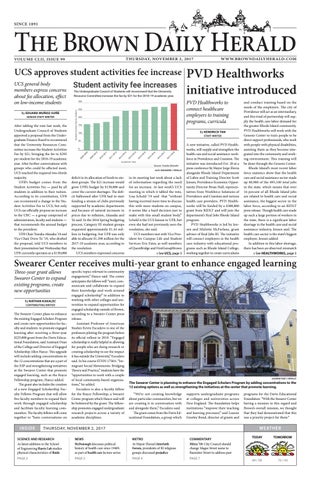
The Swearer Center is planning to enhance the Engaged Scholars Program by adding concentrations to the 12 existing options as well as strengthening the initiatives at the center that promote learning. “We’re not creating knowledge about particular communities, but we are creating it in conversation with and alongside them,” Escudero said. The grant comes from the Davis Educational Foundation, a group which
supports undergraduate programs at colleges and universities across New England. The foundation helps institutions “improve their teaching and learning processes,” said Leanne Greeley Bond, director of grants and
programs for the Davis Educational Foundation. “With the Swearer Center having a mission in this regard and Brown’s overall mission, we thought that they had demonstrated that this was a priority project for them.”
WEATHER
THURSDAY, NOVEMBER 2, 2017
SCIENCE AND RESEARCH As latest addition to the School of Engineering Harris Lab studies physical characteristics of fluids
NEWS McDonough discusses political history of health care since 1940’s as part of health care lecture series
METRO At Mayor Elorza’s Interfaith Forum, presidents of RI religious groups discussed prejudice
COMMENTARY Mitra ’18: City Council should change Magee Street name to Bannister Street to address past
PAGE 2
PAGE 3
PAGE 4
PAGE 7
TODAY
TOMORROW
69 / 58
72 / 43
NEWS
PAGE 2 • THURSDAY, NOVEMBER 2, 2017
THE BROWN DAILY HERALD
New engineering lab studies physical characteristics of fluids Harris Lab explores fluids at small scale, facilitating scientific understanding through art By ARJUN GANGA CONTRIBUTING WRITER
Set to move into its new space in the Engineering Research Center building next spring, the Harris Lab is the latest addition to the School of Engineering. Heading the Harris Lab is its namesake, Assistant Professor of Engineering Dan Harris, who earned his PhD in applied mathematics from the Massachusetts Institute of Technology in 2015 and joined the University faculty this fall. In his lab, Harris will explore the physics of micro-fluids an applications in building practical devices. The team is also interested in visualizing scientific phenomena as a means for aesthetic beauty and public engagement; Harris’ award-winning photography has been recognized by the National Science Foundation and Popular Science. Harris, who traces his interest in visual art to his artistic-minded family, said that art is a means to start the conversation. “If I came in and described the technical details of the application,
it’s easy to lose people quickly,” he said. “But when leading with something like an image, … I feel like all of us can appreciate art at some level. I think that really opens the conservation and gets (people) interested in the applications of science.” Instead of performing computer simulations of the equations governing the behavior of fluids, the Harris Lab creates models through actual experiments. Using high-speed cameras, the team records near-instantaneous phenomena — like two water droplets fusing or particles bouncing off surfaces — and uses software to extract data from the footage. Harris is a “real master of using these enhanced visualization techniques to help teach science around fluid mechanics,” said Lawrence Larson, dean of engineering and professor of engineering. The lab currently consists of a postdoctorate student and three undergraduates, including Annika MacEwan ’18 and Isabelle Bauman ’19, who work together to study the trajectories of particles bouncing off of water surfaces. Harris likes to build laboratory equipment himself using the 3-D printer in the lab, he said. His research “has been focused on not only
COURTESY OF DANIEL HARRIS
High-speed cameras record a water droplet landing on a fluid surface — an example of the types of experiments in the Harris Lab that promote greater scientific understanding through visualization. the science itself, but also designing the appropriate equipment to answer these questions,” he added. MacEwan and Bauman are also building all of their testing equipment from scratch using computer design programs and 3-D printers. Professor of Engineering Kenneth Breuer ’82, who was appointed by the dean of the School of Engineering to
chair the hiring committee for Dr. Harris, said that Harris’ research “is something that we thought would work well at Brown, so we were very excited when we were able to bring him to Brown.” The University “is definitely making a statement by hiring Dan Harris, who is known and has been recognized by his presentation of science,” Bauman
said. “Visualization really impacts the way in which we see and think about data, and this is definitely something that engages people in science.” To further Harris’ engineering research and artistic vision, he plans “to collaborate with all of the wonderful resources and the artistic community at Brown, and see how I can learn from them to improve what I do,” he said.
Roboticists of differing faiths discuss future of artificial intelligence Panel hosted by the Veritas Forum discusses the implications of the future of AI technology By JACKSON WELLS SENIOR STAFF WRITER
As the sophistication of artificial intelligence continues to increase and AI moves further from the realm of science fiction, a philosophical question arises: When does the line between humans and robots fade away entirely? Questions along this line of thought were addressed in the Veritas Forum’s panel “Can Robots Become Humans?” that took place Wednesday, Nov. 1. The panel was moderated by Thomas Doeppner, vice chair of the computer science department, who posed a number of questions to Rosalind Picard, founder and director of the Affective Computing Research Group and a Christian, and to Michael Littman, co-director of the Humanity Centered Robotics Initiative and an atheist. The sometimes differing perspectives that came from two people of different belief systems offered a multidimensional view on the intersection of humanity and artificial intelligence. The forum began with a question of what differentiates humans from artificial intelligence. Computer scientists work on the “body and brain” of a computer in the sense that they build the hardware and software, Littman said. One can make a “body” that resembles a human, but if the “brain” cannot make judgements, then it is easy to differentiate between humans and robots. But the line begins to blur as the software becomes more human-like. Because humans are sensitive to this sort of recognition, it would be difficult to make a robot that a human would not be able to differentiate from another human. Significant integration already occurs between humans and robots, Picard
COURTESY OF U.S. AIR FORCE
Robots are becoming more like humans, raising many ethical, scientific and philosophical questions. The panelists discussed whether the line between humans and robots could ever disappear. said. Many people would willingly forgo their own body parts for those of robots, such as an augmented leg. This raises questions of immortality, which is already an obsession among humans, Picard said. A video of a robot on the Tonight Show Starring Jimmy Fallon showed “Sophia” speaking with Jimmy. The robot played rock-paper-scissors against the host and even told a joke — “Maybe I should host the show,” Sophia suggested. When she first saw the video, Picard was “shocked.” Despite these advancements, there is still room for robots to
improve, she said. The robot’s ability to play rock-paper-scissors arises from technology that reads human motion, sometimes before humans can themselves, she explained. Picard is not worried about robots taking over the world, something that Sophia recommended in the video. Littman was likewise skeptical of the demonstration, suggesting that there was perhaps a puppeteer behind the curtains. The ethics of robotics raises more questions. In the past, unethical experimentation by computer scientists was accepted; however, the situation is
different now, as this sort of testing has a real human impact, Littman said. He used the example of Facebook, which was designed to make people spend as much time on the site as possible. As the algorithms saw that people most often logged on when they were outraged, Facebook adapted to put forth more outrageous content. This unintended consequence illustrates these detrimental effects, Littman said. Fear-mongering is also present in that people believe that artificial intelligence will gain control of the world. But Littman does not believe this will happen, as most humans do not want to
take over the world to suppress humans, so robots designed to be like humans will be similar. Picard pointed out that people who do learn continuously are not taking over the world, so robots doing the same thing would not try either. Programmers could always introduce a program to prevent such a takeover, she added. On the topic of “stickiness,” or attachment to technology, Picard said that this relationship has reached the point of destroying lives. Emotions drive most of our actions, and if technology can manipulate our emotions, it can manipulate our actions as well. Robot creators should ensure that their work does not have this sort of impact in a negative way, Picard said. Litmann pointed out that if people know they are being emotionally manipulated, they will be able to prevent it in the future. The discussion turned to the limits of technology and the possibilities of godliness and consciousness in robots. Robots are now able to win against people in games such as Go and Chess, so it is being suggested that they handle other, more important tasks as well, Littman said. More credibility is often lent to robots as they are more objective, but they can be objective in the wrong ways, Picard pointed out. In response to a student question, Littman said that technology is not yet able to recreate the brain’s consciousness. Consciousness is not understood, so it cannot be built, Picard said, adding that the only way she knows to create consciousness is through procreation. Another audience member asked if Christians would ever believe that robots could have a soul. Souls are thought by Christians to be given only by God and can move to new bodies, and thus, cannot be scientifically explained, Picard said. When pressed further as to whether software that can move to a new system could be a soul, she responded that she had not yet seen software comparable to a soul.
NEWS
THURSDAY, NOVEMBER 2, 2017 • PAGE 3
THE BROWN DAILY HERALD
McDonough maps history of American health care » UCS, Health care advisor during Obama administration presents potential policy solutions
systems through ballot initiatives, McDonough said. All three have failed, along with a legislative effort in Vermont. Even if Democrats gain control of the House, Senate and presidency by 2021, a single-payer initiative could still fail, he added. “The nightmare for me is that (in 2021) Democrats put their money on single-payer, and … they run into a catastrophic wall of opposition, and by 2023 they’ve lost control of the House and the Senate,” McDonough said. “On the other hand, maybe they go for it and maybe they get it.” Despite barriers such as the insurance and pharmaceutical industries’ vested interests in the current system, the health care system could eventually evolve into something dramatically different from what is outlined by current policy, McDonough said. In
a comparative portion of the lecture, McDonough cited Germany’s health care structure as his personal favorite. “There (are) some really good models out there that make sense if we have a different environment, and we will,” McDonough said. “It’s only a question of how long it will take.” The series, which aims to improve attendees’ understanding of the U.S. health care system, is funded by the Office of Medical Education. Eli Y. Adashi, professor of medical science and former dean of the Med School and four medical students organized the annual series. Student coordinator Caroline Burke MD’20 said they typically host between eight and 12 lecturers in the series each year. “For us, the goal was to be able to touch upon a range of different topics
that make up the landscape of health care in America as it currently stands,” Burke said. Sophia Demuynck MD ’21 said she has attended all seven lectures in the series so far. “It exposes us to people who are close to policy decisions in health care but also extremely knowledgeable about the history of health reform,” Demuynck said. The lecture series helps students understand the state of health care policy, and pre-clinical students are able to treat the series as a non-credit bearing elective course, Burke said. “As medical students who are going to be practicing in an evolving landscape, it’s really important to be able to understand how different pieces of the puzzle fit together, especially as those pieces are changing over time,” Burke added.
about the fee raise Friday, according to an email that UCS President ChelseAmoy Steele ’18 sent to the general body. UCS members voted in an online survey that was open from 11:44 p.m. Monday night to 5 p.m. Tuesday. Wednesday, Steele wrote to the UCS general body that over two-thirds of the group had voted to approve the increase. Steele and To did not respond to requests for comments by press time. In internal UCS notes shared with The Herald about the “emergency voting meeting”, UCS members provided more clarity about their concerns. For example, members were worried the fee increase would impact students from low-income backgrounds more than those from high-income backgrounds. According to the notes, Steele had conversations with Estes and other administrators in which they told her that the “raise would affect middle-income students/highest paying students at Brown,” and would have “no effect on low-income students,” as “students on higher financial aid would not feel effects as much.” Students also expressed concerns that significant amounts of UFB’s budget goes to University administrative services. UFB allocated approximately $377,600 to the “Department of Public Safety, the Fire Marshall, Computing Information Services Web Services, et cetera,” according to the resolution. This cost rose $78,000 from the previous year. According to the notes about Friday’s meeting, members hope that “some costs could be shouldered by (the) University,” since “sometimes (the Student Activities) fee doesn’t feel like it goes back towards students,” and rather “seems like it goes to extraneous things.”
partnership will help us continue to provide economic opportunities for residents throughout our city,” Elorza said at the press conference. As a demand-driven workforce development program, Real Jobs RI brings together employers and other key stakeholders in an attempt to address workforce demands in various industries, simultaneously providing workers in the state with the adequate skills to address these demands, according to Michael Healey, chief public affairs officer and RIDLT.
“In 33 sector partnerships, 16 industries and more than 15 distinct skills-training programs across the state, (Real Jobs RI is) knitting together the demand side of the labor market … and investing in the competitiveness of both,” Healey said . Since Gov. Gina Raimondo created Real Jobs RI in 2015, over 200 companies have hired more than 900 workers trained by the program, and another 600 incumbent workers have been trained for future advancement, Healey said.
“Before Real Jobs RI, the state’s workforce development efforts were spread thin across many programs, funding streams and agencies,” Healey said. “This led to mismatches: People who completed the training programs didn’t have the skills employers really wanted. Consequently, … government had a credibility problem with Rhode Island employers.” By giving companies the chance to collaborate with partners such as colleges, technical education programs and community-based organizations,
Real Jobs RI directly matches people equipped with necessary skills with employers in need of these skills, according to a press release from Elorza’s office. “The real framework for a successful Real Jobs RI partnership is that it is demand-driven, meaning that they (Real Jobs RI) are getting information (on) what the jobs are that are necessary to focus on, and they go and survey, having conversations with companies themselves,” McFarlane said.
By MELANIE PINCUS STAFF WRITER
“Health care is probably, more than anything, the exemplar of a dysfunctional market,” said John McDonough, professor of public health practice at Harvard’s T.H. Chan School of Public Health. As a speaker at the annual Healthcare in America Lecture Series, McDonough discussed the political history of health care since the 1940s and presented policy solutions at the Alpert Medical School Wednesday night. More than seven years after the Affordable Care Act was passed, health care policy remains a contentious issue, with several failed Republican attempts to repeal the ACA and some Democrats advocating for socialized medicine in a single-payer system. McDonough helped develop the ACA as a senior advisor on national health reform to the U.S. Senate Committee on Health, Education, Labor and Pensions from 2008 to 2010. “We spent a lot of time before the process got underway learning the lessons from all of these prior health reform efforts,” particularly “the Clinton plan fiasco,” McDonough said. The Clinton health care plan of 1993 would have entitled every American citizen to preventative services and medical treatments, regardless of pre-existing conditions. But this plan did not offer a guarantee that people happy with their insurance plan could keep it, McDonough added. Since 1994, three states have considered switching to single-payer
» HEALTHWORKS, from page 1 between the skills the workforce is equipped with and the skills the health care sector requires as it evolves to accommodate changing demographics and service delivery, according to Elorza’s press release. The PVD Healthworks partnership addresses this need for labor in the health care sector, MacFarlane said. “This initiative will strengthen our workforce by providing pathways to good jobs for residents. This
from page 1
BENJAMIN TORUNO / HERALD
John McDonough, who helped develop the Affordable Care Act during his tenure as a senior advisor on national health reform between 2008-2010, presented the history of health care since the 1940s in his talk.
METRO
PAGE 4 • THURSDAY, NOVEMBER 2, 2017
THE BROWN DAILY HERALD
Mayor Elorza hosts interfaith forum to discuss prejudice Presidents of various Rhode Island religious groups speak about building bridges By BELLA ROBERTS SENIOR STAFF WRITER
On Wednesday, Mayor Jorge Elorza hosted an Interfaith Forum at the Providence Career and Technical Academy to discuss prejudice, community safety and policy changes. “Right now, the forces that are dividing us and separating us are stronger than they have been in any of our lifetimes. It’s important to constantly come together,” Elorza said to open the night. “The forces of unity take effort and energy.” The event, which was free and open the public, featured speakers such as Councilwoman Mary Kay Harris, members of the mayor’s Muslim American Advisory Board, interfaith representatives, public safety officials and representatives from various community organizations. Elorza spoke in support of the various marginalized communities in Providence, including immigrants and the LGBTQ community. He mentioned the city’s efforts to protect minority citizens by making Providence a sanctuary city, providing municipal forms of identification and creating a new hate-crime hotline.
“Our city is already great, not in spite of our diversity and differences, but because of them,” Elorza said. The forum was organized by Jordan van Leesten, who works in community relations for the mayor’s office. “Providence is a very diverse city,” Leesten said. “I wanted to find a way to celebrate that and showcase it in a way that’s intellectual.” Leesten pushed for the event after seeing how various Rhode Island religious groups came together in support of a local mosque that was sent hate mail. The event also came out of meetings with the mayor’s Muslim American Advisory Board, he added. During the discussion portion of the night, community members and religious leaders discussed their faith and filled out worksheets that asked participants to think about the various communities in Providence and the challenges they face. “Let’s make sure we send the message that Providence is a welcoming place for all of its residents,” Elorza said. Councilwoman Mary Kay Harris of Ward 11 stressed the importance of building bridges within the community. “We all need to be able to elevate our faith more than ever. As we watch the news and hear of the violence that’s happening daily, I look to my own faith to guide me through these troubling times,” Harris said. President of the Rhode Island Council for Muslim Advancement Imam
Farid Ansari contextualized yesterday’s terrorist attack in New York in the larger trend of anti-Muslim rhetoric. “They never emphasize when Muslims do good things — what’s up with that? I am a Muslim and I am an American and I will defend that,” Ansari said. “We at the Rhode Island Council of Churches intend to make sure we are using our voices properly and assertively and that we together will stand together against injustices,” said the Rev. Chontell Washington, president of the Rhode Island State Council of Churches. “Gathering with faith communities like today — that gives me strength to step forward in these dark days,” said Rabbi Sarah Mack, president of the Board of Rabbis of Greater Rhode Island. Missy Ottun, a student of Blackstone Academy, spoke on her experiences as a black Muslim in Rhode Island, emphasizing the continued importance of “challenging what’s in the media and asking questions.” Lieutenant Henry Remolina, commanding officer of Districts 2 and 3, spoke on his efforts to prevent crimes that target immigrants. “Let’s first start building a relationship together,” Remolina said. And this won’t be the last event of its kind, Leesten said. “I want to continue to celebrate the religious diversity in this city and showcase it in a productive way.”
COURTESY OF WIKIMEDIA COMMONS
Mayor Jorge Elorza spoke in support of many marginalized communities in the city, including immigrants and the LGBTQ community.
Flying
Words Saturday, 4 November 2017 at 7:30 pm Martinos Auditorium Granoff Center, 154 Angell St. Flying Words is at once imaginative, experimental, and intense. Deaf American Sign Language poet Peter Cook presents three dimensional imagery while Kenny Lerner’s spoken words allow the hearing in the audience to literally see the ASL image and become lost in the movement. Sponsored by Literary Arts with support from the Brown Arts Initiative.
STAY UP-TO-DATE. FOLLOW US ON FACEBOOK. FACEBOOK.COM/BROWNDAILYHERALD
TODAY
THURSDAY, NOVEMBER 2, 2017 • PAGE 5
THE BROWN DAILY HERALD
three-hole pumpkin
menu SATELLITE DINING ANDREWS COMMONS
Pizza: Cheese, BBQ Bam Bam, Mary Jane, Spicy 5 Cheese, Pepperoni JOSIAH’S
BLUE ROOM
Chicken Pot Pie, Thanksgiving Turkey Burger
Chicken Artichoke Florentine, Focaccio Sandwich
DINING HALLS SHARPE REFECTORY LUNCH
DINNER
Herbed Turnips, Chicken Kiev, Stir Fried Carrots with Fresh Herbs
Homestyle Mac and Cheese, Roasted Brussels Sprouts and Cauliflower
VERNEY-WOOLLEY LUNCH
DINNER
Beef Carnitas, Boiled Rice, Cauliflower au Gratin, Vegetable Bean Stew
Green Peas, Roast Turkey with Sauce, Bread Stuffing, Mashed Potatoes
sudoku
MIKAELA CARILLO / HERALD
Lit-up pumpkins decorated porches, tables and streetfronts yesterday as community members and students participated in the annual festivities of Halloween.
Q U O T E O F T H E D AY
crossword
“Our city is already great, not in spite of our diversity and differences, but because of them.” —Mayor Jorge Elorza
See forum on page 4.
calendar TODAY NOVEMBER MARCH
S
5
M
6
T
7
W
Th
F
S
1
2
3
4
8
9
10
11
Brown in Cuba Info Session 12:00 P.M. J. Walter Wilson, 440
Ethical Inquiry Lunch 12:00 P.M. Salomon Center, 203
Climate, Health, and Resilience 5:00 P.M. IBES, 130
Reading: Poet Adrienne Raphel 5:30 P.M. McCormack Family Theater
TOMORROW
12
13
14
15
16
17
18
19
20
21
22
23
24
25
26
27
28
29
30
31
The Weepies: Song Writing Workshop 2:00 P.M. Granoff Center, Martinos Aud
PDE Seminar: Alex Ionescu 3:00 P.M. 182 George Street, 110
Math DUG Tea 4:00 P.M. Kassar House, 105
Swing Club presents: And All That Jazz 8:00 P.M. Sayles Hall
COMMENTARY PAGE 6 • THURSDAY, NOVEMBER 2, 2017
THE BROWN DAILY HERALD
EDITORIAL
Selling out to tech Finance and consulting interns have long been the subject of jokes about selling out. The eager, inspired first-years who often walk in through the Van Wickle Gates praising democratic action sometimes cringe to find themselves after graduation joining institutions that fundamentally undermine it. Wall Street spent $2 billion trying to influence the 2016 election, often slanting toward GOP candidates. Money rolling in from billionaires and hedge fund managers undoubtedly influences our democracy. For a while, those who seek employment at tech companies have remained absent from the sellout mockery. Companies like Facebook and Google have imbued their employees with the idea that they are going to make the world a better place, all while making upwards of $100,000
in starting salary, too. And while eating free lunches every day and coding a small part of a giant product, it’s easy for recent graduates to feel like they’re doing good while they’re doing well for themselves. As Franklin Foer writes in his recent book “World Without Mind: The Existential Threat of Big Tech”, “Big tech considers the concentration of power in its companies — in the networks they control — an urgent social good.” The world-changing language is even reflected in Facebook’s mission statement: “To give people the power to build community and bring the world closer together.” Google democratizes knowledge. Twitter democratizes how people communicate. But as more and more information comes out about how Russia used Facebook, Twitter and YouTube to intervene in
the 2016 elections, students pursuing employment in tech must realize that they are complicit in undermining our democracy, too. Posts disseminated by Russian agents reached 126 million users on Facebook, the New York Times reported Monday. Additionally, these agents sent out more than 131,000 Tweets and uploaded over 1,000 videos to YouTube. Facebook CEO Sheryl Sandberg has admitted how tech faulted. “Things happened on our platform in this election that should not have happened,” she said in an onstage interview last week with journalist Mike Allen. Yet Facebook, which like so many other tech companies has remained unscathed and unaccountable for its actions, offered up no real specifics about the platform’s missteps that led to the interference.
Companies like Facebook, YouTube and Twitter have claimed “neutrality” in an effort to protect free speech. But these policies are dangerous: Google News populates its feed with stories from the Russian government-backed outlet RT, normalizing a source that federal intelligence officials have called “the Kremlin’s principal international propaganda outlet.” In profit-seeking, Facebook and Twitter sold ads to operatives connected to the Russian government. And beyond that, Mark Zuckerberg has denied that the spread of fake news on Facebook at all influenced the election. There’s no doubt that by joining tech, graduates will make an impact, but let’s not be naive about what that influence entails. Certainly, one could argue that the benefits tech companies have brought to our democracy
outweigh the sacrifices they may have made in doing so. But so long as these tech companies claim neutrality, University graduates cannot take their job offers without understanding that they are a part of a platform that has refused to be accountable when our democracy is at stake. It’s not just Wall Street anymore: When lured to Silicon Valley with multi-thousand dollar signing bonuses, new graduates should weigh whether or not the company they may be choosing to join is one whose work they are comfortable being complicit in.
Editorials are written by The Herald’s 127th editorial board: Kate Talerico ’18, Lauren Aratani ’18, Matthew Brownsword ’18 and Rebecca Ellis ’18.
comic
Want to learn to code, but don’t want to take a CS class?
A Horse of Any Other Name | Zach Silberberg
Join The Herald’s data journalism team!
thebdh.org/join Got something to say? Leave a comment online! Visit www.browndailyherald.com to comment on opinion and editorial content.
Find us online! facebook.com/browndailyherald
browndailyherald.com
@the_herald
Location: 195 Angell St., Providence, R.I. www.browndailyherald.com
@browndailyherald
youtube.com/browndailyherald
Editorial Leadership
Sections
Multimedia & Production
Business
Editor-in-Chief Lauren Aratani
Arts & Culture Editors Ethel Renia Madison Rivlin
Design Editors Christy Leung Ameer Malik Jessica Yu Assistant: Eduard Muñoz-Suñé
General Managers Henry Ritter Ben Wesner
Managing Editors Matt Brownsword Rebecca Ellis Kate Talerico POST- MAGAZINE Editor Saanya Jain BLOGDAILYHERALD Editor Angelica Cotto
Metro Editor Gwen Everett News Editors Isabel Gensler Alex Skidmore Hattie Xu Science & Research Editor Elena Renken Sports Editors Ben Shumate Nicholas Wey COMMENTARY Opinions Editors Connor Cardoso Anuj Krishnamurthy Mili Mitra
Photo Editors Head: Marianna McMurdock Assistant: Lilly Nguyen Gus Reed Sara Runkel Anita Sheih Copy Desk Chief Abby Borges Multimedia Editor Roland High
Directors Sales: Erin Lueck Sales: Matilda Lynton Finance: Reena Zhan Strategy: William Nober Strategy: Caroline Ziegler Managers Sales: Michael Borello Sales: Elizabeth Doykan Sales: Shreya Raghunandan Collections: Ravi Betzig
Editorial contact: 401-351-3372 herald@browndailyherald.com
Business contact: 401-351-3260 gm@browndailyherald.com
Submissions: The Brown Daily Herald publishes submissions in the form of op-eds and letters to the editor. Op-eds are typically between 750 and 1000 words, though we will consider submissions between 500 and 1200 words. Letters to the editor should be around 250 words. While letters to the editor respond to an article or column that has appeared in The Herald, op-eds usually prompt new discussions on campus or frame new arguments about current discourse. All submissions to The Herald cannot have been previously published elsewhere (in print or online — including personal blogs and social media), and they must be exclusive to The Herald. Submissions must include no more than two individual authors. If there are more than two original authors, The Herald can acknowledge the authors in a statement at the end of the letter or op-ed, but the byline can only include up to two names. The Herald will not publish submissions authored by groups. The Herald does not publish anonymous submissions. If you feel your circumstances prevent you from submitting an op-ed or letter with your name, please email herald@browndailyherald.com to explain your situation. You can submit op-eds to opinions@browndailyherald.com and letters to letters@browndailyherald.com. When you email your submission, please include (1) your full name, (2) an evening or mobile phone number in case your submission is chosen for publication and (3) any affiliation with Brown University or any institution or organization relevant to the content of your submission. Please send in submissions at least 24 hours in advance of your desired publication date. The Herald only publishes submissions while it is in print. The Herald reserves the right to edit all submissions. If your piece is considered for publication, an editor will contact you to discuss potential changes to your submission. Commentary: The editorial is the majority opinion of the editorial page board of The Brown Daily Herald. The editorial viewpoint does not necessarily reflect the views of The Brown Daily Herald, Inc. Columns, letters and comics reflect the opinions of their authors only. Corrections: The Brown Daily Herald is committed to providing the Brown University community with the most accurate information possible. Corrections may be submitted up to seven calendar days after publication.
Illustrations Editor Pia Mileaf-Patel
Advertising: The Brown Daily Herald, Inc. reserves the right to accept or decline any advertisement at its discretion.
Graphics Editor Laura Felenstein
The Brown Daily Herald, Inc. is a financially independent, nonprofit media organization bringing you The Brown Daily Herald, BlogDailyHerald and Post- Magazine. The Brown Daily Herald has served the Brown University community daily since 1891. It is published Monday through Friday during the academic year, excluding vacations, once during Commencement and once during Orientation by The Brown Daily Herald, Inc. Single copy free for each member of the community. Subscription prices: $200 one year daily, $100 one semester daily.
Directors of Web Development Eli White Ivy Wong
Copyright 2017 by The Brown Daily Herald, Inc. All rights reserved. Periodicals postage paid at Providence, R.I. Postmaster: Please send corrections to P.O. Box 2538, Providence, RI 02906.
THE BROWN DAILY HERALD
COMMENTARY THURSDAY, NOVEMBER 2, 2017 • PAGE 7
In support of Bannister Street MILI MITRA opinions editor In September, the Providence City Council passed a resolution calling for the removal of Confederate flags and monuments from public property. The measure was a good-faith effort to show solidarity with marginalized communities after the horrifying events in Charlottesville this summer — but it didn’t exactly catalyze groundbreaking change. Providence, a northern city staunchly in Union territory, isn’t particularly awash with Confederate symbols. Yet Providence and Rhode Island still retain symbols that glorify another aspect of America’s troubled past: the slave trade. Unfortunately, many of these monuments and signs have lived on unchallenged — until recently. On Monday, the Providence City Council’s Urban Redevelopment Committee unanimously passed a resolution to recast Magee Street — named after the slave trader William F. Megee — as Bannister Street, in honor of the 19th-century African-
American activists Edward and Christina Bannister. Though the move still has to be officially approved by the council, it has been largely met with support from the community, and with good reason: The Bannisters were truly inspirational people who championed minority rights in Rhode Island and worked to improve the entire community. Edward Bannister was a renowned painter who was once honored as the “Best Artist in Ameri-
the state was a focal point of the industry for years. Brown, named after a family that was heavily involved with the slave trade, is a prime example of this; University Hall was even partially built by enslaved people in 1770 . To its credit, the University is actively working to address its past through initiatives such as the Center for the Study of Slavery and Justice and the Slavery Memorial on the Quiet Green. But other mementos on the state’s public
and institutions have actively tried to move away from. A similar question engulfed Cornell’s gardens — originally termed the Cornell Plantations — in 2016, with the university eventually deciding to change the name in response to student concerns. Though there have been several attempts to officially change Rhode Island’s name — most recently in 2010 — state residents have generally opposed the rebranding.
I applaud the Urban Redevelopment Committee for taking action to rename Magee Street and hope the entire council takes up this charge when the resolution comes to vote on Nov. 16. But Providence’s attempts to address its historical ties to slavery should not just end with this one vote on this one street. ca,” while Christiana was a prominent businesswoman and civic leader at a time when women of color were often silenced and forgotten. It could not be more fitting that their names are replacing Megee’s on the street signs that line the roads they once traversed. However, many other remnants of the state’s unsavory past still surround us. While Rhode Island’s prominence in the slave trade has often been brushed under the rug, in reality
land, including a statue of Christopher Columbus at the corner of Elmwood and Reservoir avenues, remain uncontextualized — testaments to Rhode Island’s links to a darker past. And if we need more evidence, we need only look at our state’s full name: “The State of Rhode Island and Providence Plantations.” The term “plantations” indisputably conjures up images of slavery and the Confederacy — images that many other states
In light of this history, I applaud the Urban Redevelopment Committee for taking action to rename Magee Street and hope the entire council takes up this charge when the resolution comes to vote Nov. 16. But Providence’s attempts to address its historical ties to slavery should not just end with this one vote on this one street: The city should continue to find ways to contextualize its past and recognize the diverse communities that have
long called it home. Let me be clear: I am not saying that Providence should tear down or recast every monument constructed during the 18th-century, when the state’s role in the slave trade was at its peak. But there are many ways for the city and state to acknowledge their histories. On this, they can take cues from other cities that have faced similar questions and started to institute change. While New Orleans and Charlottesville, for instance, have announced that they are removing all monuments relating to the Confederacy, Richmond has decided to add plaques explaining their historical context and additional monuments commemorating those who were enslaved. Though some have argued that this is not enough, it is clearly a step forward from leaving these troubling monuments and symbols untouched. There is much more Rhode Island and Providence can do to take a clear stand in support of their marginalized communities. But in the meantime, renaming Magee Street to Bannister Street is a well-intentioned start.
Mili Mitra ’18 can be reached at mili_mitra@brown.edu.
8pm Thursday, Nov. 2 in MacMillan 117
This event is sponsored by Athletes In Action. www.AIA-Brown.org/Kim
THE STEPHEN A.
OGDEN
JR.’60
95th M e m o r i a l L e c t u re o n I n t e r n a t i o n a l A f f a i r s
HIS EXCELLENCY
FERNANDO HENRIQUE CARDOSO
PRESIDENT OF BRAZIL (1995-2002)
Democracy and Corruption in Brazil and Latin America Today THURSDAY, NOVEMBER 16, 2017 4 p.m. JOHN CARTER BROWN LIBRARY
This event is free and open to the public Doors open at 3:30 p.m. Reception to follow
For more information please visit www.brown.edu/ogden To request special services, accommodations or assistance for this event, « i>Ãi V Ì>VÌ Ì i 1 ÛiÀà ÌÞ Ûi Ì E viÀi Vi -iÀÛ Vià "vwVi >Ì universityevents@brown.edu or 401-863-3100