SINCE 1891
THE BROWN DAILY HERALD THURSDAY, MARCH 2, 2017
VOLUME CLII, ISSUE 25
WWW.BROWNDAILYHERALD.COM
Diversity initiatives make strides in comedy scene Efforts underway to include racially diverse, non-binary students in campus comedy By PRIYANKA PODUGU SENIOR STAFF WRITER
JASMINE RUIZ / HERALD
The Undergraduate Council of Students debated the implementation of a mobile application that streamlines the reporting process of and empowers those afflicted by incidents of sexual assault.
UCS proposes app to report sexual assault Proposed mobile app aims to ease survivors’ reporting experience, gather data on sexual assault By BELLA ROBERTS SENIOR STAFF WRITER
The Undergraduate Council of Students discussed new initiatives to
combat sexual assault at their meeting Wednesday. Members proposed that the University start using an application called Callisto, which would allow students to report sexual assault through their phones. Community members also asked UCS to support a campaign to reduce assault at Spring Weekend. “UCS has always seen (sexual assault) as one of the most pressing
issues on college campuses today, and we really want to do what we can in the position that we have to push for initiatives that will tackle this issue,” said UCS President Viet Nguyen ’17. Members proposed Callisto, which was created by a survivor of sexual assault, as an online way for survivors to report their sexual assault. According to Callisto’s website, » See UCS, page 2
Noelle Austin ’18 made her Brown stand-up debut Tuesday night, but finding a space where she felt comfortable performing was not easy. Her set, part of a showcase hosted by Production Workshop, drew on “experiences that are not often conveyed in popular venues at Brown,” she said. “As a black female (comedian at Brown), there’s been a lot of me having to feel like I deserve space as much as everybody else to be funny,” Austin said. In the midst of University-wide focus on diversity and inclusion, the comedy community at Brown has made a concerted effort to increase outreach to students of color, women and gender nonconforming individuals, with varying degrees of success. Comedy at Brown does not boast “a lot of diversity, and not even just ethnic diversity, (but also) diversity in experience,” Austin said. As someone
“from a poor, minority community in the South,” Austin often finds herself in the minority when it comes to socioeconomic status and geographic origin as well. The child of a military family, Alyssa McGillvery ’19, a “multi-ethnic” member of Brown’s first all-female sketch comedy group Skorts, moved around the country several times growing up, allowing her to see that what may seem “natural and everyday life to one group of people might not apply (or be funny) to another group of people,” she said. Having lived in Georgia during her childhood years, Austin used to speak in a Southern accent. But upon her arrival in New England, she realized that “people do not take you seriously with a slightly Southern accent, so I crushed that out … I also use a lot of colloquialism(s) at home that I don’t use here (at Brown).” Successful comedy centers around “knowing your audience and making jokes that your audience (will think are) funny,” Austin said. She has yet to perform for an audience predominantly comprised of people of color and anticipated that she would have to “code switch” for her set at Brown. A spring 2016 Herald poll found » See COMEDY, page 3
RISD students gather to oppose recent vandalism Anti-Semitic graffiti in bathroom, other defacements have plagued campus in recent months By GWEN EVERETT SENIOR STAFF WRITER
Rhode Island School of Design students and resident advisors gathered Wednesday night in front of Nickerson Hall to demonstrate their opposition to hateful acts that occurred on campus in the past week and a half. The first occurred the weekend of Feb. 18 and attracted national attention: A swastika was drawn in human feces on the wall of a bathroom in Nickerson, a first-year dorm on campus. A few days later, in the same first-year quad, wall art that originally spelled out “vape” in decorative tape was changed to read “rape.” The perpetrator(s) of both acts remain unknown. “We don’t know why someone would treat the student body like that,” said Felicita Devlin, a first-year at RISD who lives in Nickerson. The
INSIDE
fact that a perpetrator may be one of her peers — and likely someone who lives in the same quad as her — is “scary” and “feels creepy,” she said. This was the 12th time an inappropriate incident involving human excrement has occurred in the firstyear bathrooms since she came to campus, Devlin said. While at first students thought someone had been sick, it became clear that the acts were intentional when feces were put in air vents and on walls, she said. She added that it was upsetting to think of the custodial staff having to clean up each time an act like this occurs. “I feel like professors should address this in class,” said Alla Alsahli, who is a first-year at RISD, adding that the perpetrators of these acts may be students in professors’ classes at RISD. Neither Alsahli nor Devlin’s professors had brought up the incidents in their classes. “That bothers me … (that) the professors never address any of these issues,” Devlin said, adding that professors have an obligation to » See RISD, page 2
MARLIS FLINN / HERALD
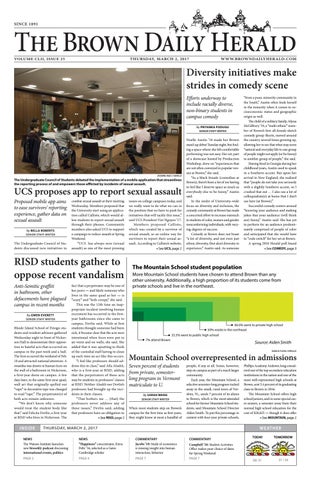
Mountain School overrepresented in admissions Seven percent of students from private, semesterlong program in Vermont matriculate to U. By SARAH WANG SENIOR STAFF WRITER
When most students step on Brown’s campus for the first time as first years, they might know at most a handful of
people, if any at all. Some, however, step on campus as part of a much larger community. Each year, the Mountain School, a selective semester-long program tucked away in the small, rural town of Vershire, Vt., sends 7 percent of its alums to Brown, which is the most-attended school for former Mountain School students, said Mountain School Director Alden Smith. To put this percentage in context with four-year private schools,
Phillips Academy Andover, long considered one of the top secondary education institutions in the nation and one of the most well-represented high schools at Brown, sent 3.4 percent of its graduating class to Brown in 2016. The Mountain School offers high school juniors, and in some special cases seniors, a semester away from their normal high school education for the cost of $28,825 — though it does offer » See MOUNTAIN, page 2
WEATHER
THURSDAY, MARCH 2, 2017
NEWS The Watson Institute launches new biweekly podcast discussing international events, politics
NEWS “Happiness” concentrator, Kiera Peltz ’16, selected as a Gates Cambridge scholar
COMMENTARY Jacobs ’18: Study of economics is missing insight into human interaction, behavior
Campbell ’18: Student Activities Office makes poor choice of dates for Spring Weekend
PAGE 2
PAGE 4
PAGE 7
PAGE 7
COMMENTARY
TODAY
TOMORROW
58/ 31
37 / 26
NEWS
PAGE 2 • THURSDAY, MARCH 2, 2017
» MOUNTAIN, from page 1 some financial aid. Each semester, the Mountain School admits 45 students, mostly from the northeast and private schools, Smith said. The school sets itself apart from other institutions through its focus on agriculture and location-based learning. Dean of Admission Logan Powell said the Mountain School and the University do not have any special relationship, despite the fact that Brown admits a high percentage of Mountain School alumni. But Powell did note the similarities between the schools’ students. “People who are willing to step outside of their academic comfort zone a little bit and do a program like the Mountain School … (demonstrate) a willingness to take academic risks,” Powell said. Mountain School alum Benjamin Hayslett-Ubell ’18.5 also emphasized the similarity in academic style and added that students from both schools tend to have similar mindsets. “The people (who) apply to the Mountain School are, for the most part, very academically motivated and very impressive in environmental sustainability, agriculture and learning about a certain set of — to be frank — liberal politics,” similar to those who apply to Brown, Hayslett-Ubell said. “The element of (the Mountain School) that really feels connected is the sense of independence and
student-driven action that really governs everything at Brown,” said Mountain School alum Jane Jacoby ’17. “That sense of self-determination … is something that I loved about the Mountain School that I didn’t even expect going into it.” These correlations help many students from the Mountain School narrow down the colleges and universities where they will apply, and in many cases, Brown is on that list. “I don’t know if I would’ve applied if I hadn’t been around an environment where so many people were thinking about schools like Brown,” HayslettUbell said. “The things at Mountain School that I really loved — the collaborative environment, the commitment to challenging thoughts — those are all things I was looking for in a school, and that’s part of why I felt like Brown was the best fit.” The correlation and attraction to Brown, however, doesn’t completely explain why the University admits so many students from the Mountain School. Smith believes Mountain School alums stand out from other students on college applications — but not necessarily because they attended the Mountain School. “Our students are high-achieving before they even get here,” Smith said. “It’s not sufficient to say that the Mountain School has turned normal people into the perfect college candidate. We have students who are already destined for some success in their life.”
THE BROWN DAILY HERALD
COURTESY OF ALDEN SMITH
The Mountain School is a private school in Vermont that offers a semester-long program to high school students. The school places an emphasis on agriculture and sends 7 percent of its alums to the University. Moreover, Mountain School students partake in a unique experience, which may attract colleges, Smith said. Jacoby echoed Smith’s sentiments, but also added that affluence plays a factor in the students’ academic success — tuition for a semester at the Mountain School is not cheap. “The Mountain School … has been a fairly affluent group of people,” Jacoby said. “The reality is that Mountain Schoolers are already coming from good schools, whether they’re private or
ELI WHITE / HERALD
The Rhode Island School of Design has been victim to several defacements involving human feces during the past few months. Students and Residential Life have gathered together in response to these incidents.
» RISD, from page 1 discuss incidents that seriously affect students. But despite her frustration with professors, Devlin was “really proud of ” the administrative response to the events, explaining that the office of Residence Life and student RAs have supported students wishing to talk after the events. RAs at the demonstration declined to comment for the story. “My first thought was, ‘What are the students feeling?’” said Kyle Stuber, who works in the Residence Life Program at RISD as the area coordinator for first-years. Stuber held
a community meeting immediately after the events and asked his residents what support they needed. Students told him RISD needs to give back on an institutional level. There needs to be “an institutional response to an institutional problem,” Stuber said, adding that though “this may have happened in the first-year area,” it “affects the community” as a whole. But some felt the greater administrative response to the incidents was insufficient: “I was frustrated with (the administration’s) use of euphemistic language and hedging,” said Jacob Poindexter, a junior at RISD, in reference to a community-wide email
sent out in response to the incidents. “I feel that the administration, in a systemic way, fails to holistically address issues of bigotry … (and) disenfranchisement within the school,” Poindexter said. He added that he feels that pushes for change come almost exclusively from students. The administration does “the bare minimum in response” after intense demands from students, he said, adding that even then “there seems to be a lot of hoops to go through to reach structural change throughout the school.” Poindexter said bigotry and activism against it have been a part of RISD for as long as he has been at
public, and have already achieved some amount of academic success at their school to be accepted to the Mountain School.” Mountain School alum Kerrick Edwards ’18 regards the Mountain School as a privileged community. “It’s a very self-selecting community,” Edwards said. “It’s very much a community that’s coming from the New England elite private school world.” “It certainly was a privilege to go to Mountain School — I’m sure it looked
good on a college application,” Edwards said. “It’s a privilege to go to Brown — I’m sure that looks good on job applications.” Hayslett-Ubell stressed that despite the connection between the Mountain School and Brown, the schools still maintain their differences. “Not everyone that goes to Mountain School would like it at Brown, and not everyone at Brown would like Mountain School,” Hayslett-Ubell said.
the school. The gathering moved from the green in front of Nickerson to the dorm’s lounge, located down the hall from where the Swastika was found. Inside of Nickerson, resident advisors had hung a large poster that read “This Community Values Love.” Beneath these words, students could write their own comments on what values they felt the RISD community should reflect. Next to this poster were statements of “community values,” and down the hall ResLife had set up snacks and music for students. The group of attendees grew in the Nickerson lounge, with students sitting in small groups and chatting among themselves. “Please tell us what would make you feel safe in the community,” Stuber said to attendees, encouraging them to write down their complaints on papers and leave them in a yellow envelope that would “go to the right person.” An email circulated by an RA said that student concerns would be compiled into a list of demands to be presented to the college’s administration. “We have been proactively focused on fostering an environment where differences flourish, where disagreements are productive and framed by trust and where all community members are encouraged to embrace the unknown and expand their worldview,” wrote RISD Public Relations Director Jaime Marland in an email to The Herald. “Issues of concern are taken seriously and addressed swiftly,” she added. In a statement published on Facebook, Brown/RISD Hillel similarly decried the incident. “We were saddened and angered to learn of the anti-Semitic graffiti found in a RISD dorm bathroom,” the statement read. “There is no place for hateful symbols on a college campus or anywhere.”
» UCS, from page 1 the mobile application is designed to empower survivors of sexual assault and create a smoother reporting process. The app, which saves time-stamped records of an assault, can match people with others who have reported the same perpetrator and reports incidents electronically to authorities and Title IX offices. The app would “reimagine the reporting process from a position of compassion, empathy (and) support for survivors, ultimately empowering them to have greater control over their experience,” said Student Activities Chair Naveen Srinivasan ’19. “Survivors don’t have to go through the process alone,” Nguyen said. “When survivors match with others, or even a group of people, it shows them a support system.” The costs of Callisto, if adopted by Brown’s campus, would vary widely, Nguyen said. When Callisto was implemented at Pomona College, the school paid an initiation fee of $10,000 and a $25,000 annual fee, Srinivasan said. “One app isn’t going to fix this problem, but a combination of the programs will (make) a good dent in the work we have to do,” Ngyuen said. After the discussion of Callisto, Alex Volpicello ’18 and Molly Sandstrom ’17 introduced a campaign to reduce sexual assault at Spring Weekend and asked USC for support engaging students. The initiative consists of a visual campaign of stickers, temporary tattoos and condoms to remind students of consent and will include recruitment of student volunteers to encourage consensual behavior at Spring Weekend. “There is a capitalistic type of entitlement during Spring Weekend,” Volpicello said. “When you spend all the time getting ready you expect an outcome, and often people expect sexual outcomes.”
NEWS
THURSDAY, MARCH 2, 2017 • PAGE 3
THE BROWN DAILY HERALD
Watson hosts event contextualizing global populism Wendy Schiller, Ashutosh Varshney discuss origins, consequences of populist movements By VAFA BEHNAM STAFF WRITER
The University cannot stop talking about President Trump. On Wednesday, Chair of Political Science Wendy Schiller and Professor of Political Science and International and Public Affairs Ashutosh Varshney dissected the rise of Trump within the context of national and global populist movements in their talk, “The Rise of Populism.” Varshney began the event, hosted by The Watson Institute for International and Public Affairs, by attempting to define the ambiguous term central to the talk: populism. Rather than provide a concrete definition, Varshney isolated key elements usually found in populist movements. First, Varshney noted that populism is more a set of ideas, discourses and temperament than a cohesive ideology. Varshney observed that, in the developing world, populist movement leaders usually lean left while, in richer countries, populism aligns more with rightwing politics. Varshney noted that populism elevates radical majoritarian politics as an opposing force to liberalism and pluralism. At the same time, populist governments can paint dissenting groups as immoral, malevolent or dangerous to national security. Populists
» COMEDY, from page 1 of the students who indicated they attend artistic events, including comedy shows, 71 percent were white. Twice the number of nonwhite students had never attended an artistic event compared to nonwhite students. “I have a different way of speaking … (but) there are a lot of terms I have to explain” when performing, which can ruin a punchline or a story, she added. “A lot of my comedy is about being (a member of) the black community and … a lot of black community humor is satirical … (but) I wasn’t sure if that would fly at Brown,” Austin added. National pushback against political correctness makes diversity in comedy even more important, said Ryan Cruise ’17, president of Brown/RISD Stand Up Comics. “There is a perception that Brown is too (politically correct), but in comedy, that’s not something I think is bad,” she said. “People hold you accountable which is good, … (and) I’m challenged to make sure I’m being intentional and saying things that aren’t hurtful.” Morayo Akande ’16 GS, a member of Starla, also discussed the challenges she faces as a comedian. “It’s hard because comedy in general … draws on being able to make fun of oneself but a lot (of it) … is about making fun of race … or gendering things.” “I was initially turned off by comedy sets at Brown. … I wasn’t sure of what I could joke about and what I couldn’t joke about,” Austin said. “(During) my first year, I went to a comedy set, and I was uncomfortable because a lot of it was mocking religion, … ( and it seemed like) you could mock religion
often give off the impression that they represent the will of the “true people” against some form of nebulous force, Varshney said. Varshney also touched on the consequences of the recent rise of populist movements around the world, discussing populism’s potential ramifications on the liberal economic order, which is based on an ideal of free movement of capital, labor and goods, he added. While populism is commonly thought to be caused by the working classes left behind by globalization, Varshney argued that this idea is incomplete. “Why were countries that are generally agreed to have benefitted from globalization turning to populism, such as India and Turkey?” he asked. “Why did the African American and Hispanic working classes not end up supporting Trump?” He said he believes economic causes were pivotal, but that ethnic factors also played a large role in the recent rise of populism. Schiller shifted the discussion toward populism in the United States, recounting the “Farmer’s Alliance,” a populist movement of the late 19th century that combined economic aggrievement with social and ethnic concerns, much like today. Those factors were perhaps the root cause of the Chinese Exclusion Act of 1882 as well as much of the anti-Catholic and anti-Jewish sentiment in the country, Schiller said. This demonization of the “other” is a staple in American populism, she added. The discussion inevitably shifted but you couldn’t really mock other things.” “In general, Brown does a really good job of not relying on those topics to propel what is funny … but I still don’t necessarily feel like a part of the comedy community,” Akande said. “I don’t know if (that feeling) has to do with race or exclusivity, in that it’s hard to get into these groups and it’s easier to (join other comedy groups) if you’re already in one,” she added. Generally speaking, the world of comedy is also skewed in favor of men, Cruise said. But in her experience, comedy at Brown bucks this trend. “I found the comedy community (at Brown) to be so inclusive,” she said. “All of these groups are at least 50 percent women, and some of them are more women than men.” Cruise is also a part of the improvisational comedy group Starla and Sons, which counts six members, three of whom identify as women. Similarly, Out of Bounds has 11 members, of whom six identify as women. Of the 14 members at Brown/RISD Stand Up Comics, seven identify as women. “I never felt pigeon-holed into playing off stereotypes of women,” said Katherine Dunham ’19, a member of Starla. “But maybe that’s just me being lucky (or) a testament to how the comedy community is inclusive.” In an effort to attract new talent to the comedy scene at Brown, Starla held a series of workshops Feb. 14 and Feb. 15 to introduce students of color, women and gender nonconforming individuals to improv and provide guidance in navigating Starla’s auditioning process. Cruise led the workshop for women and gender nonconforming
HUAYU OUYANG / HERALD
Professor Ashutosh Varshney and Professor Wendy Schiller discussed the historical contexts of populism in the United States, noting the way populist movements often demonize immigrants and glorify a nationalistic leader. toward Trump. When asked what they would suggest students do to combat feelings of anxiety provoked by populism, Varshney suggested two ways to act. First, students should appeal to ideas of civic, rather than ethnic,
nationalism and the idea that U.S. citizens are united by common ideas about liberty, justice and equality. Second, Varshney suggested waiting to let the populists make mistakes as the movements often ebb and flow.
Schiller suggested students focus their attention on particular policy issues, rather than Trump’s persona. Students should protest these issues vigorously, but also not shut out Trump supporters, she added.
individuals. The workshops aim to address the fact that “white men (have been) the most represented demographic at auditions,” Cruise said. Students did “exercises that (Starla uses) for the auditions, … and the purpose (of this workshop was) to make the auditioning process for these groups less intimidating,” she added. Akande, who helped lead the workshop for students of color, said the workshop was instrumental in convincing her to audition for Starla last year. “I used to go to a lot of comedy events, and I wouldn’t see a lot of people of color,” which made her hesitant to audition, she said. “There’s not a lot of people of color in comedy at Brown … (we were) just trying to open up the door and see if we could get more people involved,” Akande said. The Brown Noser faces similar challenges when it comes to recruiting a diverse group of writers, said Dunham, who is also the editor-in-chief of the Brown Noser. “(Fewer) women apply (to join the Noser) than men … which I think is a shame and definitely something we need to work harder on,” she said. “Roughly one-third of the staffers are women … those women still write half to over half of the articles,” Dunham said. The Rib, an online publication that is written by and caters to women, has attempted to diversify its staff is by reaching out to women of color on campus and inviting them to apply as writers. “I applied to the Rib because they specifically said they want women of color. I don’t think I would have applied if I hadn’t seen those exact words,” said Daniella Balarezo ’18, an editor
at the Rib. Balarezo stressed that outreach is critical in convincing underrepresented groups to join publications like the Rib. The Rib was also instrumental in the creation of Skorts in 2015, said Nicole Martinez ’18, co-founder of Skorts and writer for the Rib. Inspired by Penn’s female sketch comedy group, Bloomers, Rib members wanted to start something similar at Brown, Martinez said. “We wanted a place where all non-male identifying people could feel included … as progressive as Brown is, comedy was (very) white and male,” Martinez said. Though members of both the Rib and Skorts are “predominantly white women,” that is something “we are actively trying to change,” she said. Comedy groups that successfully recruit a diverse range of performers sometimes struggle to retain them over the years. In her time working with the improv comedy community at Brown, Akande said she noticed that almost
all of the students of color eventually chose to leave their performing groups. It would be helpful to have an “open discussion about why people of color or gender nonconforming individuals feel uncomfortable in the (comedy) space,” Akande said. “Every time I go to a comedy show, it’s hard for me not to think about race or diversity … do the performers somehow make a rainbow of people?” McGillvery said. She acknowledged that Skorts has room for improvement in both its writing and performance teams, adding, “(our style of comedy) would only get better if we include people from (varied) backgrounds.” Despite many discussions on diversity and inclusivity in comedy, “it was hard to pin down a definition” of what those two words meant in shaping a college community, McGillvery said. Achieving real diversity would mean that “whoever is watching or looking into these shows sees some of themselves represented on stage,” she added.
NEWS
PAGE 4 • THURSDAY, MARCH 2, 2017
THE BROWN DAILY HERALD
‘Happiness’ concentrator selected as Gates Cambridge scholar Kiera Peltz ’16 will work toward a master’s of philosophy in political science, economics By LIORA MORHAYIM CONTRIBUTING WRITER
Kiera Peltz ’16, a political science concentrator who also elected to independently concentrate in happiness, is among the 36 students selected to be part of the 2017 class of Gates Cambridge Scholars. The fellowship allows Peltz to study at Cambridge University for a year, covering her tuition, living expenses and round trip airfare to Cambridge and back. At Cambridge, she will pursue a masters in philosophy and in political and economic sociology, studying how political and economic institutions impact societal well-being. Peltz said she is most excited about being surrounded by equally passionate scholars. Peltz’s interest in happiness studies can be traced back to her high school experience in California. The time she spent working at a local congressman’s office inspired her to spend her career at Brown trying to improve the lives of the American people. She sought to answer the question of what it meant to live a good life, a question which could not be answered purely by political science. In order to study how political, social and economic institutions impact our well-being, she created an independent concentration in happiness. When developing her senior thesis, Peltz was interested in why American policy does not make people happier. She wrote a senior thesis on ways to
COURTESY OF SAMANEE MUHBUB
Kiera Peltz ’16 is one of 36 to have been selected to be a Gates Cambridge Scholar. Out of 800 candidates who applied from the United States in 2017, 100 were offered an interview and 40 were offered a scholarship. use happiness research to influence the policy making process, focusing on three different policy areas: obesity, loneliness and unemployment. Professor of Philosophy Bernard Reginster, Peltz’s independent concentration and thesis advisor, said he was especially impressed by the work Peltz has done concerning Thomas Jefferson’s belief in citizen’s fundamental right to pursue happiness. Focusing on this notion, she laid out the reason for policy makers to consider happiness as a criterion to evaluate the effectiveness of their policies, he said. “It was a very impressive and ambitious thesis,”
Reginster said. “Everyone has joked to me about studying happiness, like ‘good luck, you are never going to be employed,’ but, to be honest, I know (studying happiness is) what got me ranked so highly by my department and got me the interview” with Gates Cambridge, Peltz said. Peltz said she likely landed the scholarship due to “bizarre” things she had done in her life. The summer after her first year at Brown, she created the Coding School, an after-school program that teaches students how to code. “We essentially recognized that coding is the universal language of the 21st century.
The funny thing is I don’t know how to code — that’s why I founded it,” Peltz said. She said she has also taken part in many political internships, like working at the White House and on former Secretary of State Hillary Clinton’s presidential campaign. According to the Gates Cambridge website, approximately 800 candidates from the United States applied for the scholarship in 2017. Two hundred of these applicants made it to the second round in the process and were nominated by their prospective departments in Cambridge. One hundred were interviewed and 40 were offered the
scholarship. Fellowship Advisor Dean Linda Dunleavy said the Gates Cambridge application process is different from other scholarships in that students apply directly to Cambridge University and are then considered for the Gates Scholarship. For other scholarships, students usually have to be nominated by the University as candidates. “I don’t know other students who applied, but I knew Kiera and it is well deserved,” Dunleavy said. Extracurricular activities, academics, leadership qualities and public service experience are important criteria for getting the scholarship, Dunleavy said, adding that Peltz’s initiative, academic strengths, optimism and unique independent concentration made her stand out. In addition, her commitment to public service and work with the government made an impression, she said. Peltz said after this masters program she wants to pursue a joint J.D./PhD degree. “Obviously now, more than ever, (considering) how divisive American politics is, happiness is needed,” Peltz said, explaining her desire to go into politics after getting a PhD. Peltz is currently in the Netherlands, working in the Erasmus Happiness Economics Research Organization as a research intern. She decided to spend the past year away from her books and papers, exploring happiness in real life. “It is so important to do what you love and not follow the status quo … At the end of the day, that’s what is going to set you apart, so don’t be afraid to try something new, think differently. Studying happiness is the single greatest thing I have ever done.”
Watson Institute launches new political podcast Faculty, students discuss research, current events in policy-focused podcast “Trending Globally” By AILEEN SEO STAFF WRITER
The voices of Brown’s most renowned scholars have broken out of the classroom and into the airwaves. As part of a larger effort to make research from scholars of different disciplines more accessible to the community, the Watson Institute for International and Public Affairs launched its podcast “Trending Globally” November. The new biweekly podcast is part of a larger effort to make Watson accessible through a variety of channels, said Kathryn Dunkelman, director of communications and outreach at Watson. The podcast will provide analysis of global current events through discussions held by scholars, practitioners and students who are studying politics and policy, said Director of the Watson Institute Edward Steinfeld. It will hopefully provide a space for “intimate conversation,” he added. “I hope the listener feels that he or she is sitting around a table and having a conversation that wouldn’t happen in an audience of 50 or 100” people, Steinfeld said. Michelle Jurkovich, a postdoctoral
fellow in international and public affairs, said she feels the podcast embraces this casualness, Steinfeld said. Jurkovich described her experience on the podcast as a “conversation over coffee” with podcast host Sarah Baldwin, a writer for the Watson Institute, as she discussed hunger and food security domestically and internationally. In deciding which topics to discuss on the podcasts, coordinators “look at the news of the day and how visitors or faculty can provide a unique angle and provide in-depth information,” Steinfeld said. The podcast creators also look for faculty members or scholars outside of the community who are engaging with global issues. The podcasts are intended to bring together “interesting combinations” of scholars and thus develop “new frameworks for understanding” issues, Steinfeld added. One episode of “Trending Globally” brought together Adam Levine, assistant professor of emergency medicine and director of the Brown Global Emergency Medicine Fellowship at the Alpert Medical School, and Anthony Bogues, director of the Center for the Study of Slavery and Justice, to discuss humanitarian aid in Haiti. Both scholars have worked on issues in Haiti, but each brought their own approach — Levine has engaged in humanitarian emergency medicine in Haiti, Bogues studies Haitian society and art.
DOROTHY WINDHAM / HERALD
Looking forward, “Trending Globally” hopes to increasingly bring
people outside of the University community, including policy-makers, to
participate in the podcasts, Dunkleman said.
TODAY
THURSDAY, MARCH 2, 2017 • PAGE 5
THE BROWN DAILY HERALD
menu
winter fog shrouds city
SATELLITE DINING ANDREWS COMMONS
Pizza: Spicy 5 Cheese & Garlic, BBQ Bam Bam, Cheeseburger Make Your Own Pizza JOSIAH’S
BLUE ROOM
Pizzadilla Quesadilla
Chicken Tikka Masala, Vegetable Mango Curry
DINING HALLS SHARPE REFECTORY LUNCH
DINNER
Mashed Potatoes, Lemon Chicken with Artichoke Hearts, Neapolitan Cupcakes
Spice Rubbed Pork Chops, Ginger Chicken and Pasta, Washington Apple Cake
VERNEY-WOOLLEY LUNCH
DINNER
Mashed Potato Bar, Falafel, Corn O’brien, Gourmet Coconut Cookies
Spicy Cuban Vegetable Stir Fry, Butternut Squash with Shallots, Swedish Rye Bread
sudoku
RELEASE DATE– Saturday, February 16, 2013
Los Angeles Times Puzzle c r o sDaily s w oCrossword rd Edited by Rich Norris and Joyce Nichols Lewis
ACROSS 1 Duke’s Mike Krzyzewski familiarly – he holds the NCAA Division I men’s basketball record for most wins 7 Gets stuffed 13 Mawkish 14 Many Civil War mess kits 15 Gallery event 16 Arab League member since 1962 17 Pulled off 18 Lady Violet in “Downton Abbey,” e.g. 20 GI assignments 21 Nash’s “ill wind that no one blows good” 23 Run together 24 Hershey’s candy 25 Karate takedown maneuver 28 Bagel order, maybe 29 Familiar title of Beethoven’s “Bagatelle No. 25” 30 2003-’04 OutKast chart-topper 31 Monopoly deed word 32 Vitamin starter? 33 Got the lead out? 35 WWII Pacific Theater battle site 39 Without any aptitude for 40 Emotional oneeighty 41 Turgenev’s birthplace 42 Bingo call 43 Fitch who partnered with Abercrombie 44 Broadway legend Hagen 45 Command to Fido 48 Anteater’s slurp in the comic “B.C.” 49 The “G” in G.K. Chesterton 51 Ethel Waters title line following “Now he’s gone, and we’re through” 53 Latte option
54 Lucky groups? 55 Schemer 56 Sew up
26 Nasty fall 27 Empty talk 28 “Fin d’Arabesque” painter 30 Wrangler’s charge 32 Sci-fi destination 33 __ arts 34 “If everything works out ...” 35 Either “A Serious Man” director 36 Over-90 day, say
37 Getting there 38 Striped marbles 39 Large branches 40 Appt. book sequence 42 Cleansing agent 45 Geometric art style 46 Augur’s reading 47 Litter sounds 50 Texter’s soul mate 52 HVAC measure
DOWN 1 Arctic game 2 Unprotected, in a way 3 Much spam 4 Decent, so to speak 5 American port below the 20th parallel 6 Emulated a ’50s ANSWER TO PREVIOUS PUZZLE: TV father? 7 One doing cabinet work? 8 IBM hire, maybe 9 Floor 10 Chirac’s successor 11 Like the least risky bonds 12 __ pass 13 Bernie __, subject of the 2011 book “The Wizard of Lies” 14 Run after a fly? 19 Not being buffeted as much 22 Enduring 24 Majestic euphemism 02/16/13 xwordeditor@aol.com
ELI WHITE / HERALD
A mild winter remains responsible for the haze that blankets the I-95, casting three smoke stacks in a crestfallen sight. Hints of spring flirt around the corner as March dawns upon New England.
Q U O T E O F T H E D AY
“It is so important to do what you love and not follow the status quo. ... At the end of the day, that’s what is going to set you apart.
”
— Kiera Peltz ’16
See HAPPINESS on page 4.
calendar TODAY MARCH
S
02/16/13
T
W
Th
F
S
1
2
3
4
Rosalie Blum 4:30 P.M. Cable Car Cinema
5
6
7
8
9
10
11
12
13
14
15
16
17
18
19
20
21
22
23
24
25
26 By Brad Wilber and Doug Peterson (c)2013 Tribune Media Services, Inc.
M
The Art of Negotiation with Dr. Peter Weiss 12:00 P.M. Stephen Roberts ’62 Center
27
28
29
30
31
Women, Politics and Turkey 12:00 P.M. Pembroke Hall Girl Trouble: A Group Exhibition 6:00 P.M. Sarah Doyle Women’s Center
TOMORROW NYC Bus Trip 7:00 A.M. List Art Building
March Clothing Swap 11:00 A.M. J. Walter Wilson, Lobby
Brown Bag Concert 12:00 P.M. Sayles Hall
Brown Unplugged Kickoff 5:30 P.M. J. Walter Wilson, Lobby
COMMENTARY PAGE 6 • THURSDAY, MARCH 2, 2017
THE BROWN DAILY HERALD
LETTER TO THE EDITOR
John Savage — A true educator To the Editor: I particularly enjoyed your profile of Professor of Computer Science John Savage in the Feb. 28 issue. Of the 30 or so professors I was lucky to have at Brown, he stands apart for his dedication to students. John embodies the best of Brown’s undergraduate focus. When he first offered what would become known as CSCI 1800: “Cybersecurity and International Relations,” he expected seven or eight students. Roughly 30 of us showed up and crammed into a fifth floor conference room in the Center for Information Technology. Unworried by the throng of students, he delivered a great course that inspired what was then my summer Undergraduate Teching and Research Award and is now my career in security. Three cheers for Professor Savage! His retirement is well earned, but I have no doubt Brown, and the world, will keep being made better by his wide-ranging mind. Timothy Peacock ’12
K I M B E R LY S A LT Z
comic A Horse of Any Other Name | Zachary Silberberg
Find us online! facebook.com/browndailyherald
browndailyherald.com
@the_herald
Location: 195 Angell St., Providence, R.I. www.browndailyherald.com
@browndailyherald
youtube.com/browndailyherald
Editorial Leadership
Sections
Multimedia & Production
Business
Editor-in-Chief Lauren Aratani
Arts & Culture Editors Julie Center Madison Rivlin
Design Editors Christy Leung Ameer Malik Jessica Yu Assistant: Eduard Muñoz-Suñé
General Managers Henry Ritter Ben Wesner
Managing Editors Matt Brownsword Rebecca Ellis Kate Talerico POST- MAGAZINE Editor Monica Chin
News Editors Kyle Borowski Kasturi Pananjady Suvy Qin Elena Renken Alex Skidmore Hattie Xu
BLOGDAILYHERALD Editor Anica Green
Sports Editors Jackson Chaiken Ben Shumate COMMENTARY Opinions Editors Margaret Hu Anuj Krishnamurthy Mili Mitra
Photo Editors Head: Eli White Assistant: Sam Berube Anita Sheih Sara Runkel Copy Desk Chief Julia Stemmer Multimedia Editor Roland High Illustrations Editor Dorothy Windham Graphics Editor Laura Felenstein Directors of Web Development: Lucy Wei Ivy Wong
Directors Finance: Reena Zhan Sales: Antonia Alvarez Sales: Erin Lueck Strategy: William Nober Strategy: Gianna Jasinski Managers Sales: Elizabeth Doykan Sales: Gabriella Elanbeck Sales: Matilda Lynton Sales: Ariel Shusterman Collections: Ravi Betzig Operations: Gür Ağci
Editorial contact: 401-351-3372 herald@browndailyherald.com
Business contact: 401-351-3260 gm@browndailyherald.com
Submissions: The Brown Daily Herald publishes submissions in the form of op-eds and letters to the editor. Op-eds are typically between 750 and 1000 words, though we will consider submissions between 500 and 1200 words. Letters to the editor should be around 250 words. While letters to the editor respond to an article or column that has appeared in The Herald, op-eds usually prompt new discussions on campus or frame new arguments about current discourse. All submissions to The Herald cannot have been previously published elsewhere (in print or online — including personal blogs and social media), and they must be exclusive to The Herald. Submissions must include no more than two individual authors. If there are more than two original authors, The Herald can acknowledge the authors in a statement at the end of the letter or op-ed, but the byline can only include up to two names. The Herald will not publish submissions authored by groups. The Herald does not publish anonymous submissions. If you feel your circumstances prevent you from submitting an op-ed or letter with your name, please email herald@browndailyherald.com to explain your situation. You can submit op-eds to opinions@browndailyherald.com and letters to letters@browndailyherald.com. When you email your submission, please include (1) your full name, (2) an evening or mobile phone number in case your submission is chosen for publication and (3) any affiliation with Brown University or any institution or organization relevant to the content of your submission. Please send in submissions at least 24 hours in advance of your desired publication date. The Herald only publishes submissions while it is in print. The Herald reserves the right to edit all submissions. If your piece is considered for publication, an editor will contact you to discuss potential changes to your submission. Commentary: The editorial is the majority opinion of the editorial page board of The Brown Daily Herald. The editorial viewpoint does not necessarily reflect the views of The Brown Daily Herald, Inc. Columns, letters and comics reflect the opinions of their authors only. Corrections: The Brown Daily Herald is committed to providing the Brown University community with the most accurate information possible. Corrections may be submitted up to seven calendar days after publication. Advertising: The Brown Daily Herald, Inc. reserves the right to accept or decline any advertisement at its discretion. The Brown Daily Herald, Inc. is a financially independent, nonprofit media organization bringing you The Brown Daily Herald, BlogDailyHerald and Post- Magazine. The Brown Daily Herald has served the Brown University community daily since 1891. It is published Monday through Friday during the academic year, excluding vacations, once during Commencement and once during Orientation by The Brown Daily Herald, Inc. Single copy free for each member of the community. Subscription prices: $200 one year daily, $100 one semester daily. Copyright 2017 by The Brown Daily Herald, Inc. All rights reserved. Periodicals postage paid at Providence, R.I. Postmaster: Please send corrections to P.O. Box 2538, Providence, RI 02906.
COMMENTARY THURSDAY, MARCH 2, 2017 • PAGE 7
THE BROWN DAILY HERALD
The case against pure economics JULIAN JACOBS staff columnist
Rates of return, growth patterns, mathematical variables and curves. This is the image of modern economics. At first glance, it might be tempting to think that economics has discovered the elusive secret of using the scientific method to study the way humans interact — emerging victorious in the battle of social sciences. And, indeed, students and employers are increasingly viewing economics as the most practical concentration in the social sciences. At Brown, economics is one of the most popular concentrations, and the number of students studying it has risen by nearly 40 percent between 2008 and 2012. There are also signs that this number will continue to grow. And yet, despite the many benefits of studying economics, we should be wary about its increasing dominance as a lens to make sense of socio-political life. Though economics offers a quantitative approach to social science that other fields might not offer, the endless graphs, econometric statistics and micro- and macro-economic analyses cannot project a complete image of public life on their own.
What’s missing in this is the humanity of economics — the “social” in social sciences. Let’s take the example of the minimum wage. When a minimum wage is imposed on the economy — distorting the market and potentially producing greater unemployment — economists are trained to point out this apparent inefficiency. What is often obscured in subsequent discussions is an analysis of the political and ethical reasons for imposing such a wage control. In many cases, the minimum wage is preferable to more economi-
ent than in the debate over long-run and short-run economic gain. For example, economics classes teach us the benefits of free trade in terms of its impact on long-run economic growth, increases in productivity and collective wealth. But what do these long-run proclamations actually mean to the manufacturing workers who have seen their jobs shipped overseas and demand for their labor relinquished? What kind of consolation could pronouncements about long-run growth possibly be? And though long-run econom-
ficiency. When engaging with such topics, students are asked to mechanically find a correct answer as they would on a mathematics exam. But a comprehensive understanding of social sciences requires much more. In our economics classes, we attempt to reduce the impact of boom-bust cycles, but we don’t ask why they happen. We don’t ask whether unemployment is necessarily a bad thing. We don’t ask whether quality of life always increases in congruence with economic growth. And we don’t consider the histori-
What’s missing in this is the humanity of economics — the “social” in social sciences.
cally acceptable alternatives because it can be easier to maintain politically — it’s difficult to reduce a minimum wage once it’s been imposed. Moreover, there’s no consideration of the idea that governments have an ethical responsibility to ensure their citizens earn a living wage. Economics curricula generally do not teach us to think about the impacts of economic policies on human well-being, quality of life, fulfillment or happiness. Nowhere is this idea more appar-
ic growth and productivity are undoubtedly important, they are elements that alone cannot determine how best to live our lives and increase societal happiness and fulfillment. Beyond this, economics is often marked by tacit ethical and behavioral assumptions: For example, a high unemployment rate is to be avoided, low interest rates can be good because they stimulate investment or price controls produce market inef-
cal and cultural reasons why people behave the way they do — rather we rely on a flawed understanding of humans as inherently self-interested, rational actors. These are assumptions that would be, at best, deeply questionable to those exposed to other disciplines. Above all, they indicate the insufficiency of using pure economics to develop one’s world view. In saying this, I am not criticizing economics in a broad sense or
belittling its importance — to do so would be absurd. The virtues of economics are undeniable; it is an essential tool for developing a nuanced understanding of politics, world affairs and history. Anyone who purports to take politics and public engagement seriously would be doing themselves a disservice if they failed to develop a rudimentary understanding of economics and market functions. But the reverse is also true: Anyone passionate about economics should look to other disciplines to add nuance to their course of study. More economic students should look outside their own concentration. In particular, they should look toward subjects like history, sociology, political science, psychology and philosophy to enhance their perspective on how economics fits into the web of other social sciences. By doing so, students will have more nuanced opinions about world events. More importantly, economics departments should reframe their curricula to encourage more interdisciplinary learning — something our economics department has not convincingly done. We should remember that economics is best understood as a component, but the sum, of the social sciences.
Julian Jacobs ’18 can be reached at julian_jacobs@brown.edu.
Clouds of stress descend on Spring Weekend VAUGHN CAMPBELL staff columnist Apart from a flubbed announcement on the part of a certain Atlanta rapper, there isn’t a lot we know about this year’s Spring Weekend. There remains much to announce, with potential artists, rain calls and more up in the air. But we do know about one major detail — the date. For those who don’t already know, Spring Weekend is scheduled for Apr. 28 through Apr. 30, otherwise known as the first three days of reading period. This odd and inexplicable decision by the Student Activities Office undermines the entire purpose of Spring Weekend. Spring Weekend is ostensibly a chance for Brown students to blow off some steam by having fun in the (fingers crossed) sun with their peers before spring semester finals. On the face of it, the beginning of reading period seems like an ideal time for this: It might cut into studying a bit, but as long as students recover quickly, it shouldn’t affect them much. But in reality, this
timing is far from perfect. SAO may have been motivated by the timing of Coachella; scheduling Spring Weekend for the week after might have made it easier to book artists, yet past lineups show how little of a problem this has been. Next to the stress and commitments associated with finals, Coachella’s effect on Spring Weekend simply does not compare. Spring Week-
in the week immediately following. That’s hardly a scenario that would allow for three days of carefree revelry. I’m hardly alone in this. For example, POLS 0110: “Introduction to Political Thought,” a class with nearly 100 enrolled students, has a paper due the Monday following Spring Weekend. And Spring Weekend falls smack in the middle of the last project for CSCI 0160: “Introduction to
in comparison. SAO should understand this, given that they state in their Reading and Finals Period Event Approval Policy that “large scale concerts, parties and events with alcohol are not permitted during reading period.” If that description does not evoke images of Spring Weekend, I would challenge you to find me any sentence that does. Of course, one solution would
Spring Weekend has now been placed smack in the middle of the virtual avalanche of assignments that is the final week of the semester and reading period. end has now been placed smack in the middle of the virtual avalanche of assignments that is the final week of the semester and reading period. The percentage of classes with major assignments due during reading period is difficult to quantify, but I can attest that I have two finals in the week immediately preceding Spring Weekend and three
Algorithms and Data Structures” — a course with 232 students. Ultimately, SAO’s decision demonstrates a fundamental misunderstanding of how reading period works. Far from a peaceful respite for studying before finals begin, reading period consists of a blur of papers and tests that make the actual finals period look almost tame
be for professors to grant reading period more respect. After all, it is intended to be a period of study for upcoming assignments, not a blitz of essays and tests in its own right. But this is a much larger issue. This proposal is difficult to achieve because of the nature of large research papers and projects in many courses — assignments that could not be
thoroughly completed during finals period alone and necessarily drift into reading period. Reading period has been around for a long time, and presumably professors have figured out the best way to use it. Besides, for all the importance put on Spring Weekend, it obviously comes second to students’ more pressing academic concerns. The point of Spring Weekend is to allow students three days to de-stress, yet by placing it within reading period, SAO has sabotaged both students’ study plans and capacity to fully relax. If you aren’t familiar with Brown’s schedule, it might not be immediately apparent just how unfortunate and ill-advised this scheduling is. But SAO members must understand how reading period works, especially given that their office has published an entire policy on the subject. This erroneous choice represents an enormous lapse of judgment. No date would please everyone, but we could have at least avoided a date that pleases no one.
Vaughn Campbell ’18 can be reached at vaughn_campbell@brown.edu.
Got something to say? Leave a comment online! Visit www.browndailyherald.com to comment on opinion and editorial content.
ARTS & CULTURE THE BROWN DAILY HERALD
THURSDAY, MARCH 2, 2017
Polarized political binary should not extend to popular culture Despite ‘Moonlight’ win, Academy Awards still reflects inherent inequalities By DANIEL WAYLAND ARTS & CULTURE CRITIC
The debacle of Sunday’s Academy Awards best picture award was a fitting conclusion to a category so fraught with tension this Oscars season. Over the past few months, the two-horse race between “La La Land” and “Moonlight” has become so overlaid with political consciousness that a victory for either film would have felt like a validation of one worldview over another rather than a celebration of artistry. It was only natural that the Academy Awards presenters did not even announce the correct best picture winner. The producers of “Moonlight” suffered the indecency of stepping on stage after the producers of “La La Land” accepted an award that rightfully belonged to “Moonlight”. The film’s victory should have represented a tonic — but in place of catharsis, there was only exhaustion. President Trump was elected Nov. 8, but the trauma experienced by those he marginalized during his campaign lingers. For many, Trump’s election mirrored regression in civil society, an attack on the liberal values that former President Barack Obama had imbued with a sense of permanence during his eight years in office. As a result, those experiencing the antiTrump sentiment permeating much of our country have begun to interpret random post-election events through the binary prism of political and social progression or regression. This bifurcation reflects a response to political trauma, expressing our desperate urge to understand events across the entire spectrum of civil society as politicized responses. These responses can either represent a corrective to the retrograde
DOROTHY WINDHAM / HERALD
nature of Trump’s vision or the mainstream legitimation of his worldview. Pop culture events have provided a stage on which to reproduce electoral trauma as a therapeutic exercise. In the buildup to the Super Bowl, fans and the media painted the New England Patriots and Atlanta Falcons along a binary. The Patriots, with their extensive personal connections to Trump, played the regressive antagonist, while the Falcons, representing an underdog city with a large black population, were
lauded as the tolerant champion of liberals. The actual game played out similarly to the election: Despite nursing a 25-point lead (at which point they had a 99.7 percent win probability), Atlanta lost in overtime to the Patriots. The best album award at the Grammys experienced similar framing. Beyoncé’s “Lemonade” served as the magnum opus from an artist who has consistently empowered women, especially women of color, throughout her career. Critics celebrated her
DESIGN YOUR SUMMER AT RISD
album’s exploration of grief, rage and reconciliation as a vastly superior creative accomplishment to Adele’s “25,” which was widely accepted as a strong though unexceptional pop album. Adele’s victory released an explosive and painful response on the internet. Again, Trump’s particular brand of white nationalism had supposedly triumphed. The culmination of these cultural events and the post-electoral traumas they induced only added further
2017 SUMMER PROGRAMS
COLLEGE LEVEL AND BEYOND
SUMMER STUDIES ART + DESIGN COURSES TEXTILES SUMMER INSTITUTE SUMMER INSTITUTE FOR GRAPHIC DESIGN STUDIES summer.risd.edu
CONTINUING EDUCATION
COURSES FOR ADULTS, TEENS AND CHILDREN ce.risd.edu
RHODE ISLAND SCHOOL OF DESIGN Division of Continuing Education
weight to the Academy Awards’ best picture race. While “Moonlight” topped most year-end critical charts, “La La Land” enjoyed its status as the massive favorite to win best picture. And while “Moonlight” explored the life of a young, gay black man, “La La Land” reveled in Hollywood pastiche. Undergirding the awards process was a fear that the Oscars’ primarily white voting body — much like that of the Grammys — might not reflect popular opinion, in a manner akin to that of the electoral college. Popular interest fueled the politically polarized weight of the best picture race, yet neither film showed any interest in making the collective stage a battleground. Indeed, films, albums and even teams that occupy shared cultural spaces rarely reflect the severe dichotomy inherent in the electoral process. Assigning political values to art reflects a response to trauma rather than any legitimate labeling act. Furthermore, particularly in the case of “Moonlight” and “La La Land,” foisting this type of extreme baggage upon two competitors undermines rational discourse that addresses the subtler forms of marginalization that occurred in the awards process. Perhaps a more productive exercise in moral evaluation can be found not in a political binary but in assessing the casually “benign” forms of racism at play during Sunday’s Academy Awards. There was Justin Timberlake, a white singer performing a hit by Bill Withers, shouting out mid-song to Denzel Washington, “I know you know this, Denzel!” Then, there was Jimmy Kimmel making fun of the name of “Moonlight” star and best supporting actor winner Mahershala Ali. Sunday’s Academy Awards were like the kind of person who recognizes the atrocities of slavery but is blind to the white privilege born out of that history. “Moonlight,” with its black cast and challenge to the toxic historical hypersexualization and dehumanization of black masculinity, has to navigate a cultural sphere that at times proves ignorant to the history of inequity that informs the film’s existence and meaning. After winning best supporting actress, Viola Davis gave an impassioned call for telling the stories of marginalized voices, saying: “You know, there’s one place that all the people with the greatest potential are gathered. One place, and that’s the graveyard. People ask me all the time, ‘What kind of stories do you want to tell, Viola?’ And I say, exhume those bodies. Exhume those stories.” Moonlight dared to exhume the bodies of buried voices. The privilege of “La La Land” is that it didn’t have to resurrect those buried voices. Award ceremonies and other popular culture events don’t have to split along the extremes of the recent electoral binary to be political.