SINCE 1891
THE BROWN DAILY HERALD THURSDAY, MARCH 16, 2017
VOLUME CLII, ISSUE 34
WWW.BROWNDAILYHERALD.COM
East Side bookstore to leave Wayland Square Used-book store Paper Nautilus to close after lease non-renewal, ending 21-year operation By TESS DEMEYER CONTRIBUTING WRITER
ELI WHITE / HERALD
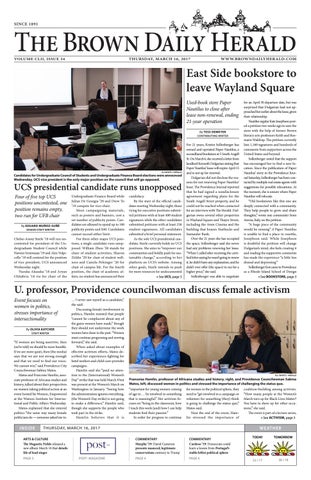
Candidates for Undergraduate Council of Students and Undergraduate Finance Board elections were announced Wednesday. UCS vice president is the only major position on the council that will go opposed.
UCS presidential candidate runs unopposed Four of five top UCS positions uncontested, one position remains empty, two run for UFB chair By EDUARD MUÑOZ-SUÑÉ SENIOR STAFF WRITER
Chelse-Amoy Steele ’18 will run uncontested for president of the Undergraduate Student Council while Naveen Srinivasan ’19 and Alex Volpicello ’18 will contend for the position of vice president, UCS announced Wednesday night. Yuzuka Akasaka ’18 and Aryan Chhabria ’18 vie for chair of the
Undergraduate Finance Board while Julian De Georgia ’20 and Drew To ’19 compete for vice-chair. Most campaigning materials, such as posters and banners, cost a set number of publicity points. Candidates are allowed to spend up to 100 publicity points and $40. Candidates cannot exceed either limit. For three other major UCS positions, a single candidate runs unopposed. William Zhou ’20 stands for chair of student activities, Sharon Zeldin ’20 for chair of student wellness and Camila Pelsinger ’20 for chair of campus life. For the fourth position, the chair of academic affairs, no student has announced their
candidacy. By the start of the official candidates meeting Wednesday night, those vying for executive positions submitted petitions with at least 400 student signatures while the other candidates submitted petitions with at least 250 student signatures. All candidates submitted a brief personal statement. As the sole UCS presidential candidate, Steele currently holds no UCS positions. She aims to “empower our communities and boldly push for sustainable change,” according to her platform on UCS’s website. Among other goals, Steele intends to push for more resources for undocumented » See UCS, page 3
For 21 years, Kristin Sollenberger has owned and operated Paper Nautilus, a secondhand bookstore at 5 South Angell St. On March 6, she received a letter from landlord Kenneth Dulgarian stating that Paper Nautilus’ lease will expire April 15 and is not up for renewal. Dulgarian did not disclose the reasons for not renewing Paper Nautilus’ lease. The Providence Journal reported that he had signed a nondisclosure agreement regarding plans for the South Angell Street property, and he could not be reached when contacted for an interview with The Herald. Dulgarian owns several other properties in Wayland Square and Thayer Street, including the Avon Cinema and the building that houses Starbucks and Santander Bank. Over the 21 years she has occupied the space, Sollenberger said she never had any problems renewing her lease. “When I called after receiving the certified letter saying he wasn’t going to renew it, he didn’t have any explanation, and he didn’t ever offer (the space) to me for a higher price,” she said. Sollenberger was able to negotiate
for an April 30 departure date, but was surprised that Dulgarian had not approached her earlier about the lease, given their relationship. Nautilus regular Kate Josephson posted a petition two weeks ago to save the store with the help of former Brown literary arts professors Keith and Rosmarie Waldrop. The petition currently lists 1,160 signatures and hundreds of comments from supporters across the United States and beyond. Sollenberger noted that the support has encouraged her to find a new location. Since the publication of Paper Nautilus’ story in the Providence Journal Saturday, Sollenberger has been contacted by multiple real estate agents with suggestions for possible relocations. At the moment, she is unsure where Paper Nautilus will relocate. “Old bookstores like this one are deeply connected with a community. They help people to grow and share thoughts,” wrote one commenter from Aversa, Italy, on the petition. “A huge piece of the community would be missing” if Paper Nautilus is unable to find a place to resettle, Josephson said. While Josephson is doubtful the petition will change Dulgarian’s mind, she feels creating it and reading the supportive comments has made the experience “a little less dismal and depressing.” Sollenberger first came to Providence as a Rhode Island School of Design » See BOOKSTORE, page 3
U. professor, Providence councilwoman discuss female activism Event focuses on women in politics, stresses importance of intersectionality By OLIVIA KATCHER STAFF WRITER
“If women are being assertive, then (we’re told) we should be more humble. If we are more quiet, then (the media) says that we are not strong enough and that we need to find our voice. We cannot win,” said Providence City Councilwoman Sabina Matos. Matos and Francoise Hamlin, associate professor of Africana studies and history, talked about their perspectives on women taking political action at an event hosted by Women, Empowered at the Watson Institute for International and Public Affairs Wednesday. Matos explained that she entered politics “the same way many female politicians do — someone asked me to.
INSIDE
… I never saw myself as a candidate,” she said. Discussing female involvement in politics, Hamlin insisted that people “cannot be complacent about any of the gains women have made,” though they should not undermine the work women have done in the past. “Women must continue progressing and moving forward,” she said. When asked about examples of effective activism efforts, Matos described her experiences fighting for hotel workers and child-care-provider campaigns. Hamlin said she “paid no attention to the (International) Women’s Day” strike that was held March 8 but was present at the Women’s March on Washington in January. “Seeing how the administration ignores everything, (the Women’s Day strike) is not going to make a difference,” Hamlin said, though she supports the people who took part in the strike. Hamlin believes that it is
“important for young women coming of age to … be involved in something that is meaningful.” Her activism focuses on “being in the classroom, how I teach this work (and) how I can help students find their passion.” In order for progress to continue
for women in the political sphere, they need to “get involved in a campaign or volunteer for something (they) think is going to challenge the status quo,” Matos said. Near the end of the event, Hamlin stressed the importance of
POST- MAGAZINE
coalition-building among activists. “How many people at the Women’s March turn up for Black Lives Matter? You have to show up for other occasions,” she said. The event is part of a lecture series, » See ACTIVISM, page 3
WEATHER
THURSDAY, MARCH 16, 2017
ARTS & CULTURE The Magnetic Fields released a new album March 10 that details life of lead singer PAGE 3
ELI WHITE / HERALD
Francoise Hamlin, professor of Africana studies and history, right, and Providence Councilwoman Sabina Matos, left, discussed women in politics and stressed the importance of challenging the status quo.
COMMENTARY Murphy ’19: David Cameron presents nuanced, legitimate conservatism contrary to Trump
COMMENTARY Cardoso ’19: Democrats could learn a lesson from Portugal’s stable leftist political sphere
PAGE 4
PAGE 4
TODAY
TOMORROW
32 / 17
38 / 18
PAGE 2 • THURSDAY, MARCH 16, 2017
THE BROWN DAILY HERALD
BROWN UNIVERSIT Y
ON CAMPUS and ONLINE
JUNE 26 - AUGUST 12 PRE-REGISTRATION OPENS
MARCH 31
brown.edu/go/summersession2017 'LYHUVLW\ DQG ,QFOXVLRQ 6XPPLW 0DUFK DQG :HOFRPH .H\QRWH $GGUHVV E\ 'U (DUO /HZLV 3UHVLGHQW 0HOORQ )RXQGDWLRQ )RU PRUH LQIRUPDWLRQ YLVLW WKH 2IILFH RI ,QVWLWXWLRQDO 'LYHUVLW\ DQG ,QFOXVLRQ ZHEVLWH &RQWDFW ,QIR ,QVWLWXWLRQDOB'LYHUVLW\#EURZQ HGX
NEWS
THURSDAY, MARCH 16, 2017 • PAGE 3
THE BROWN DAILY HERALD
The Magnetic Fields releases new 50-song album detailing musician’s life
By ELIZABETH TOLEDANO SENIOR STAFF WRITER
Boston-based alternative act The Magnetic Fields, known for its quirky, self-effacing and conversational lyrics, released “Selections from 50 Song Memoir” to Spotify March 10. The album stays true to the band’s synthetic pop-influenced sound with an emphasis on lead singer Stephin Merritt’s storytelling. The “50 Song Memoir” project debuted last year on Spotify with a preview EP featuring only five selections from the full set of songs. Last week, Merritt unveiled 16 new songs on the music-streaming platform, though all 50 songs are currently available on iTunes. The album traces Merrit’s life from his birth until present day. The honest lyrics formulate excerpts of an autobiography, organized by years, according
» UCS, from page 1 students, improve advising for freshmen and expand the diversity of faculty in academic departments. Srinivasan currently sits as the UCS chair of student activities. Among other goals for his vice presidency, he aims to further the implementation of current UCS measures, such as the No Apologies initiative and the Campus Consent Bill. In contrast to Srinivasan, Volpicello holds no UCS position but is involved with several groups that deal with mental health and wellness. Volpicello is a member of the executive board for both HeForShe
to NPR . The “Selections” version released on Spotify includes a sampling of experiences ranging from 1968 to 2013. The pieces are distinct but remain consistent with the insecure, romantic character developed in many of The Magnetic Fields’ past songs. Much like The Magnetic Fields’ earlier “69 Love Songs,” the album’s eccentric organization reflects the band’s character as dutifully as the songs themselves. The events and culture of each year inform the lyrics of the chronological anthology. In “’69 Judy Garland,” Merritt describes in his straight-forward, nonchalant style: “We tried to drive to Woodstock but/ Our little blue bug couldn’t cut/ Through that last hundred miles of traffic.” In “’70 They’re Killing Children Over There” he recalls the wartime political commentary of Grace Slick and band Jefferson Airplane, also undercutting contemporary culture, adding “Now that everyone is fat and complacent/ I haven’t heard a protest in years.” In “’84: Danceteria!” Merritt describes “Seeing the Shirelles or ESG,” at a popular New York City night club, juxtaposing a boppy girl group
from his early childhood and a more popular ‘80s post-punk group. The references to pop culture rely, to an extent, on cliches such as the title of “’79 Rock’n’Roll Will Ruin Your Life.” But these shameless affirmations of pop culture enable Merritt to effectively capture the changing decades through the lens of his own experience. What makes the album especially appealing is Merritt’s self-characterization. He recalls in “’73 It Could Have Been Paradise” that, in his youth, “Huckleberry Finn was (his) only friend.” In “’86 How I Failed Ethics,” Merritt remembers his own college experience as an angsty, intellectual outsider, singing that he “spent the whole course positing (his) own ethical system/ While other college students emptied kegs.” In “’02 Be True to Your Bar” the listener encounters a middleaged, isolated Merritt in a musical rut “drinking Irish breakfast all day long.” These eccentric details resonate with the nonconformist demographic that subscribes to The Magnetic Fields. Through his honest and offbeat autobiography, Merritt offers his listeners an opportunity to relate not only to his
and Students Against Domestic Violence and a mental health advocate for Project LETS, according to his personal description on UCS’ website. Competing for UFB chair, Akasaka and Chhabria are both veterans of UFB. In her platform, Akasaka stresses visibility, transparency and accountability as her main goals. Chhabria also focuses on transparency but additionally highlights cost effectiveness as a major goal in his platform. Candidates for executive positions will debate March 19. Voting will start March 21 and close March 23, and the election results will be announced that day at 10 p.m.
» ACTIVISM, from page 1
JASMINE RUIZ / HERALD
Paper Nautilus, a local Wayland Square used-book store will close down in April after 21 years of serving the community.
» BOOKSTORE, from page 1 student in the late ‘80s. She graduated with a painting degree in 1990 and worked at the largest used-book store in Rhode Island, Cellar Stories, before going on to manage the Providence Bookstore Cafe for five years. When the cafe closed in 1996, Sollenberger bought its inventory and opened Paper Nautilus. The concept of a used-book store intrigued Sollenberger, who was excited to learn that she “could buy a whole pile
of books for $20 instead of one book.” “I had also been able to indulge my creative side with the store in doing my artwork on the side,” Sollenberger added. Sollenberger created Paper Nautilus from the ground up. Friends and family helped her paint walls and build bookcases, and she displays the work of local artists around the shop, she said. “There’s a way in which Paper Nautilus feels in itself like a work of art,” Josephson said.
hosted by the Women, Empowered initiative, which highlights the initiative’s goal “to create a space for women who are interested in politics and taking part in political action,” said Lucrezia Sanes ’17, co-founder of Women, Empowered.
LITERARY ARTS PRIZES 2017
Boston-based band’s musical autobiography traces yearly experiences in ‘50 Song Memoir’
LAURA FELENSTEIN / HERALD
lyrics but to the cliche of a character he ultimately develops. The consistently playful synthetic music serves almost as a background for the self-portrait Merritt paints with anecdotal excerpts of life as a musician. “50 Song Memoir” gives the album a unique role — Merritt
makes a multi-part memoir of a record that suits his straightforward sound and offbeat poeticisms. The result is two hours, 30 minutes and 15 seconds of nontraditional and informal self-exploration, accessible through “Selections,” or in the full articulation of 50 years.
After the election, the group “immediately saw people mobilizing politically against the new administration and (its) policies in a way we had not seen in our recent memory as young people,” and wanted to prompt discourse on campus, said Shavon Bell ’17, co-founder of Women, Empowered.
“(We) wanted to take a step back to critically discuss female political action,” Bell said. She added that the event specifically wanted to address “the simultaneous unity and disunity of the women’s coalition and its tendency to ignore more marginalized voices within the larger female demographic.”
The Literary Arts Department is sponsoring the following prizes for the Brown community:
Academy of American Poets Prize: For the best poem (up to 10 pages). Open to all Brown students. Kim Ann Arstark Memorial Awards: For the best poem or poems (up to 20 pages) written in celebration of life. Open to all Brown students. Feldman Prizes in Fiction: For the best story or stories (up to 50 pages). Open to all Brown students. Beth Lisa Feldman Prize in Children’s Literature: For the best story or stories for children four to eight years old (up to 50 pages). Open to all Brown students (and may be a collaboration). Frances Mason Harris ’26 Prizes: For a book-length manuscript of poetry or prose fiction by a currently enrolled undergraduate or graduate woman. John Hawkes Prize in Fiction: This contest honors the memory of John Hawkes, the internationally-recognized author and dedicated professor of creative writing at Brown University. The contest is open to all students currently enrolled in the Graduate Program in Literary Arts. The submission must be a work of fiction (up to 50 pages). Edwin Honig Memorial Prizes in Poetry: Honoring the memory of Edwin Honig — poet, translator and founder of the Literary Arts Department at Brown University (up to 10 pages). Open to all Brown students. Keith and Rosmarie Prizes for Innovative Writing: For literary work, any genre, that best exemplifies the spirit of innovation found in the writings and translations of Keith and Rosmarie Waldrop. Up to 15 pages. Open to all Brown students. DEADLINE: 11 PM ON 16 MARCH. ALL APPLICATIONS ARE COMPLETED ONLINE. TO APPLY,VISIT: HTTPS://WWW.BROWN.EDU/ACADEMICS/LITERARY-ARTS/LITERARY-ARTS-PRIZES-2017-LISTING
John Keene John Keene is the author of six volumes of fiction and poetry, including the short fiction collection Counternarratives, winner of a 2016 American Book Award and 2016 Lannan Literary Award; a novel, Annotations; the poetry collection Seismosis and poetry chapbook Playland; and an art book, GRIND, in collaboration with photographer Nicholas Muellner. He is also a translator whose works include translations of Brazilian author Hilda Hilst’s The Obscene Madame D and Letters from a Seducer.
Thursday, 16 March 2017 at 7 pm McCormack Family Theater 70 Brown St., Providence [use Fones Alley entrance]
John Keene’s reading is sponsored by Literary Arts, with support from the Brown Arts Initiative and the Geri Braman Hill ’41 Endowed Lectureship Fund.
COMMENTARY THURSDAY, MARCH 16, 2017 • PAGE 4
THE BROWN DAILY HERALD
Englishman in Providence ANNA MURPHY staff columnist
As a dual British-American citizen, I’ve never really understood the phrase “crossing the pond,” which is often used to refer to the journey across the Atlantic Ocean from the United Kingdom to the United States. I’ve also never understood the American public’s fascination with British royalty, particularly the lives of Prince William and Kate Middleton. And I definitely don’t understand the discourse in the United States surrounding the Brexit referendum — particularly its constant comparison to the election of President Trump. Now, we all know the result of the referendum: Brexit has become the buzzword and model for all potential secessionist movements — whether they are other countries’ departures from the European Union or the somewhat comedic explorations of recent secessionist efforts from the United States. In the last few weeks, Brexit has reemerged as one of the foremost political conversation starters on campus. Former Prime Minister David Cameron, the scapegoat for Brexit and almost all of Britain’s impending crises, has decided to spend some of his now-abundant free time journeying across “the pond” to Brown’s snow-covered campus to deliver the 94th installment of the Stephen A. Ogden Jr. ’60 Memorial Lecture on International Affairs. Since I was an adamant supporter
of the Remain campaign, Brexit represented both a political and personal crisis for me. Firstly, the vote reflected an uninformed, xenophobic and impractical decision to leave a mutually-beneficial partnership based on the empty promises of the country’s most conservative politicians. Secondly, Brexit — a product of a referendum and thus a supposed reflection of popular will — transformed the United Kingdom, my home, into a country I did not recognize. Witnessing both Brexit and the election of Trump
failures as prime minister — a position he held for almost six years — provide a crucial insight into the role of conservatism in the United Kingdom and throughout Europe. As the two countries struggle to deal with their changing leadership and positions in the international community, Britain represents a political comparison that is somewhat removed, yet relatable enough to American politics to prompt a deeper look at the United States itself. The likening between Brexit and
to unpack this distinction and add some essential nuance to the conversation. Brexit was a push against the perceived lack of economic opportunities, diminishment of international influence and disproportionate obligations of British society to a seemingly foreign organization. Yet it should not be considered synonymous with conservatism. To equate the two is to make two crucial mistakes — mistakes that now dominate discourse surrounding American
Amidst a liberal student body that actively discusses global political trends, the nuances of recent British politics that Cameron can offer represent a much-needed window into what should, and should not, be considered legitimate conservatism.
in November, I had a front-row seat as both events unfolded and became staple examples of the dangers of conservatism gone rogue. Yet, because of the obvious connection between Brexit and the election of Trump, the nuances of Britain’s current political climate are often hidden by such an exaggerated comparison. Amid this flurry of thoughts, Cameron’s visit represents an important opportunity for Brown students. His presence, his moderate-conservative policies and his successes and
Trump is overly simplistic. It is inaccurate and unfair to compare leaving a complex and little-understood economic partnership to electing a man with the policies and personality of Trump. The British public’s decision to leave the EU largely reflected ignorance and the failures of the Remain campaign to accurately and convincingly inform the public. But too often, we conflate the Brexit decision with the views of Cameron and the Conservative Party. His imminent visit offers an opportunity
politics, particularly among young liberals. Firstly, the demonization of conservatism ignores the accomplishments of the Conservative Party and the right of the public to vote conservative. The Tories have been around and represented much of the British populace for almost 200 years; to define the party by a single referendum is a serious insult to the role the party has played in British history. The Conservative Party should not be unquestionably lauded, but it also should not be diminished to a single event.
Secondly, because the Conservative Party was split on Brexit, equating Brexit with conservatism gives the xenophobia behind the referendum political legitimacy. If this rhetoric continues to gain legitimacy as Britain negotiates the terms of its exit, the country runs the risk of basing its upcoming policy decisions — from immigration to human rights law — on racism and ignorance. While Brexit and Trump remain quite different, these two mistakes could easily be repeated as the United States attempts to find its footing under the Trump administration. Amid a liberal student body that actively discusses global political trends, the nuances of recent British politics that Cameron can offer represent a muchneeded window into what should, and should not, be considered legitimate conservatism. College students are particularly prone to using narratives like Brexit to propagate flawed notions of conservatism. As ignorance and hate hide behind traditional political labels and often prompt inaccurate depictions of what it means to be conservative, Cameron represents an intelligent, successful and nuanced political conservative. If there were ever a time for the Brown student body, and the young liberal population of the United States, to engage and seriously consider how to combat xenophobia and hatred, perhaps a lecture by one of the world’s most famous conservatives is in order.
Anna Murphy ’19 can be reached at anna_murphy@brown.edu.
What Democrats can learn from the Portuguese CONNOR CARDOSO staff columnist Approximately three weeks ago, the Democratic National Committee concluded its selection process for its new national chairperson by electing Tom Perez ’83 P’18, former President Barack Obama’s former secretary of labor and the so-called “establishment favorite.” In an admirable gesture of unity, Perez suspended the rules and chose his opponent, U.S. Rep. Keith Ellison, D-MN, who represented the progressive wing of the party galvanized by U.S. Sen. Bernie Sanders, D-VT, to serve as his deputy chairman. The display of solidarity, touching though it was, belied the ferocious proxy war over control of the party that their respective campaigns represented. Indeed, since Sanders’ loss to Hillary Clinton in the Democratic primary, the Democrats’ intraparty divisions have intensified. Prior to Perez’s victory, ideologues from both factions assumed an almost existential dread at the thought of losing an election for what is largely a ceremonial chairperson position. Alan Dershowitz, United States consitutional lawyer, for example, threatened to leave the Democratic Party if Ellison was elected, warning that his success over Perez would lead the party down the path of Jeremy Corbyn’s Labour Party (read: it would be unelectable). On the other hand, many progressives have claimed that Perez’s election simply confirms that a moribund Democratic
Party is choosing to ignore “the people” in order to perpetuate the same centrism and closeness with the financial industry for which they so despised the Clintons. By embracing this intraparty polarization, however, Democrats are dooming themselves to electoral failure. Squabbling over ideological purity on the left will simply create an opening for right-wing parties, perpetuating a trend that has been crystallizing in Western liberal democra-
guese governing coalition cobbled together all of the country’s left-wing parties, from the center-left Socialist Party to the far-left Portuguese Communist Party. What makes the geringonça both so remarkable and so unlikely is that its constituent members had to sacrifice fundamental ideological positions, like a commitment to revolution against the capitalist order and withdrawing from NATO, to form a governing coalition.
The fundamental principle underlying the Portuguese experiment is readily available for export — if the Democrats learn to place a greater premium on winning elections than maintaining the ideological purity of the party, they might yet save themselves from electoral oblivion.
cies over the past several years. Enter Portugal. Despite the virtual collapse of the European left over the past several years, Portugal remains the only Western European nation with a stable center-left government. Referred to pejoratively as a geringonça — which in English roughly translates as “the contraption” on account of its ostensibly unstable and improbable composition — the current Portu-
Indeed, the European left has looked to Portugal as a model for reemerging as a potent political force. In recent months, Lisbon has been somewhat of a pilgrimage site for center-left candidates throughout Europe. Benoît Hamon, the French presidential candidate for the Socialist Party, recently stopped by the São Bento Palace for a photo-op with Portuguese Prime Minister Antonio Costa, remarking that “what’s hap-
pening in Portugal inspires me so much.” And so it should — if Hamon’s left-wing competitor dropped out, it is possible his Socialist Party could at least make a competitive showing. Similarly, Martin Schulz of the German Social Democratic Party visited Lisbon last June to meet with the Portuguese premier. Theoretically, though more improbably, if Schulz was able to broker a similar deal with the German left-wing parties, he would be able to oust the German Chancellor Angela Merkel in the upcoming election. The relevance of the Portuguese contraption to the U.S. Democratic Party cannot be overstated. The Portuguese left was able to shelve what most fairly assumed were insuperable differences in ideology to form a unified government. By comparison, the race between Perez and Ellison — the two are, by all accounts, ideologically identical — had all the tragicomic trappings of a race between the Judean People’s Front and the People’s Front of Judea in Monty Python. Ultimately, the electoral systems of Portugal and the United States are too different from one another for the Democrats to wholly replicate the Portuguese experiment, but the fundamental principle underlying the contraption is exportable. If the Democrats learn to place a greater premium on winning elections than maintaining the ideological purity of the party, they might yet save themselves from electoral oblivion.
Connor Cardoso ‘19 can be reached at connor_cardoso@brown.edu.
TODAY
THURSDAY, MARCH 16, 2017 • PAGE 5
THE BROWN DAILY HERALD
menu
ta k i n g s ta g e w i t h p o l i t i c a l a r t
SATELLITE DINING ANDREWS COMMONS
Pizza: Spicy 5 Cheese and Garlic, Pepperoni, BBQ Bam Bam Bibimbap JOSIAH’S
BLUE ROOM
Pizzadilla
Vegetable Mango Curry, Chicken Tikka Masala
DINING HALLS SHARPE REFECTORY LUNCH
DINNER
Polynesian Chicken Wings, Muffuletta, Braised Cauliflower, Cream Cheese Cookies
Baked Garden Style Tilapia, Buffalo Chicken, Stir Fried Carrots and Herbs, Magic Bars
VERNEY-WOOLLEY LUNCH
DINNER
Navy Bean Green Pepper Casserole, Chicken Andouille Shrimp Jambalaya, Brownies
Ziti Pasta, Blackened Flounder, Cavatelli Primavera, Rosemary Focaccia with Asiago
sudoku
ANITA SHEIH / HERALD
Tania Bruguera is a Cuban installation and performance artist whose work directly captures the social effects of political and economic power. Bruguera spoke Wednesday at the List Art Center.
RELEASE DATE– Monday, September 1, 2014
Los Angeles Times Daily Crossword Puzzle c rNorris o s sandwJoyce o rNichols d Lewis Edited by Rich ACROSS 1 Junk email 5 “A Streetcar __ Desire” 10 Talks and talks and talks 14 Strauss of denim 15 Double-reed instruments 16 Author __ Stanley Gardner 17 Fateful date for Caesar 18 Unlucky thing to draw 20 Poverty-stricken 22 Share and share __ 23 Banned apple spray 24 Solved, as a cryptogram 26 Tabletop game requiring steady hands 30 Witch trials town 31 Like a prof. emeritus 32 Narrate 36 Supermarket chain initials 37 McCain’s title 41 Pizzeria order 42 Male offspring 44 Univ. proctors, often 45 Seat of New York’s Oneida County 47 Go on strike, in slang 51 Vehement speeches 54 Have in mind 55 “I’ll do whatever you need” 56 “Language” that gave us “amscray” 60 Menace who destroyed houses made of the ends of 18-, 26- and 47Across 63 Common quitting time 64 List-shortening abbr. 65 “... had a farm, __” 66 Bullpen stats 67 Really annoy 68 Rose essence 69 Hankerings
DOWN 1 Got one’s uniform dirty, as a base runner 2 Feet pampering, briefly 3 State confidently 4 Error 5 “Never gonna happen” 6 Finds repugnant 7 Tie up in the harbor 8 At any time, to Frost 9 Summer hrs. 10 “Amscray!” 11 Extra Dry deodorant 12 Eubie of jazz 13 Embroidered, e.g. 19 Potato bag 21 Future prunes, perhaps 24 Weight loss plan 25 Opposite of endo26 Trident-shaped Greek letters 27 “Othello” villain 28 Scottish family 29 Garbage 33 Larger-than-life 34 Kiss from a dog 35 Grazing grounds
38 Suffix with major or Smurf 39 D.C. baseball team 40 Beyond the burbs 43 Shuffling gait 46 “30 Rock” creator 48 Brainstorm 49 Wife of 27-Down 50 Request earnestly, as mercy
51 Potato or yam 52 “Lord, __?”: Matthew 53 Fit for a king 56 Couplet creator 57 Michelin product 58 Tennis great Lendl 59 Mythical monster’s loch 61 Org. with narcs 62 Oscar Wilde’s forte
Q U O T E O F T H E D AY
“How many people at the Women’s March turn up for Black Lives Matter? You have to show up for other
”
occasions.
— Francoise Hamlin
ANSWER TO PREVIOUS PUZZLE:
See activism on page 1. CORRECTION A previous version of the article “‘The Tsar of Love and Techno’ chosen as First Readings text” referenced Aliosha Bielenberg ’20 as a staff columnist for The Herald. In fact, he was an op-ed contributor. The Herald regrets the error.
xwordeditor@aol.com
calendar
09/01/14
TODAY MARCH
S
By Amy Johnson (c)2014 Tribune Content Agency, LLC
T
W
Th
F
S
1
2
3
4
Tertulia Con Tapas 4:00 P.M. Rochambeau House
5
6
7
8
9
10
11
12
13
14
15
16
17
18
19
20
21
22
23
24
25
26 09/01/14
M
Artist Talk with Sarah Paulsen 12:00 P.M. Nightingale-Brown House
27
28
29
30
31
Women, Politics, and Turkey 12:00 P.M. Pembroke Cards Anyone? 4:30 P.M. Brown Faculty Club
TOMORROW St. Patrick’s Day Dinner Buffet 5:00 P.M. Brown Faculty Club
Conversation with Gabriel Martinez 5:30 P.M. List Art Building
Persian New Year Celebration 7:00 P.M. Sayles Hall
BOP: The Who’s Tommy 7:30 P.M. Alumnae Hall Auditorium
COMMENTARY PAGE 6 • THURSDAY, MARCH 16, 2017
THE BROWN DAILY HERALD
comic A Horse of Any Other Name | Zachary Silberberg
Find us online! facebook.com/browndailyherald
browndailyherald.com
@the_herald
Location: 195 Angell St., Providence, R.I. www.browndailyherald.com
@browndailyherald
youtube.com/browndailyherald
Editorial Leadership
Sections
Multimedia & Production
Business
Editor-in-Chief Lauren Aratani
Arts & Culture Editors Julie Center Madison Rivlin
Design Editors Christy Leung Ameer Malik Jessica Yu Assistant: Eduard Muñoz-Suñé
General Managers Henry Ritter Ben Wesner
Managing Editors Matt Brownsword Rebecca Ellis Kate Talerico POST- MAGAZINE Editor Monica Chin
News Editors Kyle Borowski Kasturi Pananjady Suvy Qin Elena Renken Alex Skidmore Hattie Xu
BLOGDAILYHERALD Editor Anica Green
Sports Editors Jackson Chaiken Ben Shumate COMMENTARY Opinions Editors Anuj Krishnamurthy Mili Mitra Clare Steinman
Photo Editors Head: Eli White Assistant: Sam Berube Anita Sheih Sara Runkel Copy Desk Chief Julia Stemmer Multimedia Editor Roland High Illustrations Editor Dorothy Windham Graphics Editor Laura Felenstein Directors of Web Development: Lucy Wei Ivy Wong
Directors Finance: Reena Zhan Sales: Antonia Alvarez Sales: Erin Lueck Strategy: William Nober Strategy: Gianna Jasinski Managers Sales: Elizabeth Doykan Sales: Gabriella Elanbeck Sales: Matilda Lynton Sales: Ariel Shusterman Collections: Ravi Betzig Operations: Gür Ağci
Editorial contact: 401-351-3372 herald@browndailyherald.com
Business contact: 401-351-3260 gm@browndailyherald.com
Submissions: The Brown Daily Herald publishes submissions in the form of op-eds and letters to the editor. Op-eds are typically between 750 and 1000 words, though we will consider submissions between 500 and 1200 words. Letters to the editor should be around 250 words. While letters to the editor respond to an article or column that has appeared in The Herald, op-eds usually prompt new discussions on campus or frame new arguments about current discourse. All submissions to The Herald cannot have been previously published elsewhere (in print or online — including personal blogs and social media), and they must be exclusive to The Herald. Submissions must include no more than two individual authors. If there are more than two original authors, The Herald can acknowledge the authors in a statement at the end of the letter or op-ed, but the byline can only include up to two names. The Herald will not publish submissions authored by groups. The Herald does not publish anonymous submissions. If you feel your circumstances prevent you from submitting an op-ed or letter with your name, please email herald@browndailyherald.com to explain your situation. You can submit op-eds to opinions@browndailyherald.com and letters to letters@browndailyherald.com. When you email your submission, please include (1) your full name, (2) an evening or mobile phone number in case your submission is chosen for publication and (3) any affiliation with Brown University or any institution or organization relevant to the content of your submission. Please send in submissions at least 24 hours in advance of your desired publication date. The Herald only publishes submissions while it is in print. The Herald reserves the right to edit all submissions. If your piece is considered for publication, an editor will contact you to discuss potential changes to your submission. Commentary: The editorial is the majority opinion of the editorial page board of The Brown Daily Herald. The editorial viewpoint does not necessarily reflect the views of The Brown Daily Herald, Inc. Columns, letters and comics reflect the opinions of their authors only. Corrections: The Brown Daily Herald is committed to providing the Brown University community with the most accurate information possible. Corrections may be submitted up to seven calendar days after publication. Advertising: The Brown Daily Herald, Inc. reserves the right to accept or decline any advertisement at its discretion. The Brown Daily Herald, Inc. is a financially independent, nonprofit media organization bringing you The Brown Daily Herald, BlogDailyHerald and Post- Magazine. The Brown Daily Herald has served the Brown University community daily since 1891. It is published Monday through Friday during the academic year, excluding vacations, once during Commencement and once during Orientation by The Brown Daily Herald, Inc. Single copy free for each member of the community. Subscription prices: $200 one year daily, $100 one semester daily. Copyright 2017 by The Brown Daily Herald, Inc. All rights reserved. Periodicals postage paid at Providence, R.I. Postmaster: Please send corrections to P.O. Box 2538, Providence, RI 02906.
PAGE 7 • THURSDAY, MARCH 16, 2017
THE BROWN DAILY HERALD
THE RIGHT HONOURABLE
DAVID CAMERON
FORMER PRIME MINISTER OF THE UNITED KINGDOM (2010-2016)
Contemporar y Global Challenges: Where Do We Go From Here? MONDAY, MARCH 20, 2017 4:00pm
Tickets Required
www.brown.edu/ogden This event is free and open to the public Exact location provided with registration Doors open at 2:30 pm and close at 3:45 pm Brown or government issued photo ID required Backpacks, large bags, and laptops are not allowed To request special services, accommodations or assistance for this iÛi Ì] « i>Ãi V Ì>VÌ Ì i 1 ÛiÀà ÌÞ Ûi Ì E viÀi Vi -iÀÛ Vià "vwVi at universityevents@brown.edu or 401-863-3100.
THE BROWN DAILY HERALD
The Military and the University Changing Dynamics and Civic Benefits Thursday, March 16 5:00 p.m. Institute at Brown for Environment and Society Room 130 85 Waterman St. Reception to follow
Alienation between the U.S. military and society has grown in recent decades. Such alienation is unhealthy, as it threatens both sufficient civilian control of the military and the long-standing ideal of the “citizen soldier.” Donald Downs, co-author of Arms and the University, will speak about his research on the changing relationship between the military and institutions of higher education, and how military presence on civilian campuses, including Ivy League Universities, enhances diversity of thought for both the military and the academy.