SINCE 1891
THE BROWN DAILY HERALD THURSDAY, FEBRUARY 23, 2017
VOLUME CLII, ISSUE 20
WWW.BROWNDAILYHERALD.COM
U. student groups circulate petition against DAPL Statement hopes to increase media attention surrounding Dakota Access Pipeline protests By BELLA ROBERTS SENIOR STAFF WRITER
ANITA SHEIH / HERALD
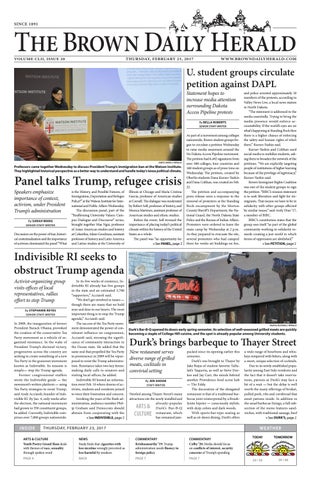
Professors came together Wednesday to discuss President Trump’s immigration ban at the Watson Institute. They highlighted historical perspective as a better way to understand and handle today’s tense political climate.
Panel talks Trump, refugee crisis
Speakers emphasize importance of context, activism, under President Trump’s administration By SARAH WANG SENIOR STAFF WRITER
Discussion on the power of fear, historical contextualization and the importance of activism dominated the panel “What
is the History, and Possible Futures, of Immigration, Deportation and Refugee Policy?” at the Watson Institute for International and Public Affairs Wednesday. The discussion panel, part of the “Reaffirming University Values: Campus Dialogue and Discourse” series, brought together Mae Ngai, professor of Asian American studies and history at Columbia, Adam Goodman, assistant professor of history and Latin America and Latino studies at the University of
Illinois at Chicago and María Cristina García, professor of American studies at Cornell. The dialogue was moderated by Robert Self, professor of history, and Monica Martinez, assistant professor of American studies and ethnic studies. Before the event, Self stressed the importance of placing today’s political climate within the history of the United States as a whole. The panel was “an opportunity for » See PANEL, page 2
As part of a movement among colleges nationwide, Brown student groups began to circulate a petition Wednesday to raise media awareness around the No Dakota Access Pipeline movement. The petition had 6,482 signatures from over 300 colleges, four countries and 160 student groups as of press time on Wednesday. The petition, created by Oberlin students Dana Kurzer-Yashin and Dana Colihan, was created on Feb. 22. The petition and accompanying press release were a response to the removal of protesters at the Standing Rock encampment by the Morton County Sheriff ’s Department, the National Guard, the North Dakota State Police and the Bureau of Indian Affairs. Protesters were ordered to leave the main camp by Wednesday at 2 p.m. As they prepared to evacuate the site, several protesters who had camped there for weeks set buildings on fire,
and police arrested approximately 10 members of the protests, according to Valley News Live, a local news station in North Dakota. “The statement is addressed to the media essentially. Trying to bring the media presence would enforce accountability. If the world’s eyes are on what’s happening at Standing Rock then there is a higher chance of enforcing the safety and human rights of who’s there,” Kurzer-Yashin said. Kurzer-Yashin and Colihan used social media to mobilize students, asking them to broaden the network of the petitions. “We are explicitly targeting people of institutions of higher learning because of the privilege of legitimacy,” Kurzer-Yashin said. Brown Immigrant Rights Coalition was one of the student groups to sign the petition. “BIRC’s mission statement is to seek liberation and fight for immigrants. That means we have to be in solidarity with other groups affected by similar issues,” said Arely Diaz ’17, a member of BIRC. BIRC’s constitution states that the group sees itself “as part of the global community working in solidarity towards creating a just world in which forms of oppression are abolished.” » See PETITION, page 2
Indivisible RI seeks to obstruct Trump agenda Activist-organizing group visits offices of local representatives, rallies effort to stop Trump By STEPHANIE REYES SENIOR STAFF WRITER
In 2009, the inauguration of former President Barack Obama provoked the creation of the conservative Tea Party movement as a vehicle of organized resistance. In the wake of President Trump’s electoral victory, progressives across the country are seeking to create something of a new Tea Party in the grassroot movement known as Indivisible. Its mission is simple— stop the Trump agenda. Former congressional staffers wrote the Indivisible guide — the movement’s written platform — using Tea Party strategies to resist Trump, said Andy Acciaioli, founder of Indivisible RI. By Jan. 4, only weeks after the election, the national movement had grown to 350 constituent groups, he added. Currently, Indivisible comprises over 7,000 groups nationwide.
INSIDE
In its five weeks of existence, Indivisible RI already has five groups in the state and an estimated 3,700 “supporters,” Acciaioli said. “We don’t get involved in issues — though there are many that we hold near and dear to our hearts. The most important thing is to stop the Trump agenda,” Acciaioli said. The success of the Tea Party movement demonstrated the power of constituent influence on congressmen, Acciaioli said, stressing the significance of community interaction in the Ocean state. He added that the same zeal that propelled the Tea Party to prominence in 2009 will be repurposed to resist the Trump administration. Resistance takes two key forms: making daily calls to senators and visiting local offices, he added. Indivisible RI hosted an information event Feb. 16 where dozens of activists, students and residents joined to voice their frustration and concern. Invoking the years of the Bush administration, audience member Philip Graham said Democrats should abstain from cooperating with the » See INDIVISIBLE, page 2
HUAYU OUYANG / HERALD
Durk’s Bar-B-Q opened its doors early spring semester. Its selection of well-seasoned grilled meats are quickly becoming a staple of College Hill cuisine, and the spot is already popular among University students.
Durk’s brings barbeque to Thayer Street New restaurant serves diverse range of grilled meats, cocktails in convivial setting By JEN SHOOK STAFF WRITER
Nestled among Thayer Street’s many attractions sits the newly installed and already-popular Durk’s Bar-B-Q restaurant, which has remained jam-
ARTS & CULTURE
packed since its opening earlier this semester. Durk’s was brought to Thayer by Jake Rojas of student favorite Tallulah’s Taqueria, as well as Steve Durkee and Jay Carr, the minds behind another Providence food scene hub — The Eddy. The decoration of the elongated restaurant is that of a traditional barbecue joint reinterpreted by a Brooklynite hipster — consciously stylish, with deep colors and dark woods. With sports-bar-type seating as well as sit-down dining, Durk’s offers
a wide range of bourbons and whiskeys tempered with bitters, along with a sweet, unique selection of cocktails. Due to its newly established popularity among East Side residents and the fact that it doesn’t take reservations, patrons at Durk’s may face a bit of a wait — but the delay is well worth the many offerings of brisket, pulled pork, ribs and cornbread that await patrons inside. In addition to the usual barbecue fixings, a full subsection of the menu features sandwiches, with traditional sausage, beef » See DURK’S, page 2
WEATHER
THURSDAY, FEBRUARY 23, 2017
ARTS & CULTURE Youth Poetry Grand Slam deals with themes of race, sexuality through spoken word
NEWS Study finds that cigarettes with less nicotine wrongly perceived as less harmful by smokers
COMMENTARY Krishnamurthy ’19: Trump administration needs fluency in foreign policy
COMMENTARY Colby ’20: Media should focus on conflicts of interest, security concerns of Trump’s spending
PAGE 4
BACK
PAGE 7
PAGE 7
TODAY
TOMORROW
59 / 39
59 / 46
NEWS
PAGE 2 • THURSDAY, FEBRUARY 23, 2017
THE BROWN DAILY HERALD
KATE TALERICO / HERALD
» PETITION, from page 1 Diaz said this was the sentiment behind BIRC’s decision to sign the petition. “That means we show solidarity with several forms of oppression (that) people in Standing Rock are facing, like
» PANEL, from page 1 us to come together as a community and contextualize this particular moment,” Self told The Herald. “Immigration and deportation and questions of refugees (are) so vital in a much longer and broader American history.” During the panel, Ngai discussed the changing justifications for immigration exclusion over the years, which have transitioned from economic explanations to national security reasons. Following this shift, President Donald Trump is now using his authority to “ban anyone (he) wants.” “He probably is within his authority to say he’s going to ban people from these countries,” Ngai said. Critics of Trump’s executive order on immigration are protesting “in terms of due process (and) religious discrimination, … but they’re not slam-dunk arguments.” Ngai also stressed the division of opinions over the immigration ban, which is why court battles over the order are extremely relevant. “I believe the legal challenges in the courts are really important,” Ngai said. “The court is supposed to protect the minority from the tyranny of the majority.” Goodman spoke next, noting that
police brutality. We show support for their struggle to protect their land,” Diaz said. Colihan and several other students who helped created the petition went to Standing Rock this fall following the election. “It’s not just about the
… people of Standing Rock fighting for their water rights. It’s about indigenous people all over America having the right to exist in general and having the right to the land,” Colihan said. University officials could not be reached for comment by press time.
the conversation surrounding Trump’s orders has mainly been about their constitutionality, seriousness and implementation. “Many people might be overlooking, however, what the real intention and what the real point is,” Goodman said. “That is creating fear in immigrant communities.” Regardless of whether the orders are implemented fully, this fear will cause self-deportation, where immigrants leave the United States on their own accord, Goodman said. “The Trump administration’s actions can only be described as an all-out attack on immigrants and immigrant communities,” Goodman said. “It’s a form of psychological warfare.” Self-deportation is not a new strategy in the United States, as scare tactics and publicity campaigns have been used on immigrants in the past, Goodman said. In recent decades, self-deportation has actually increased, he added. “Levels of fear are high,” Goodman said. “All people of conscience will need to wake up and step up. … In doing so, we will not only reaffirm our personal convictions (and) University values, but, perhaps, our unfilled aspiration to be a nation that welcomes and embraces
immigrants.” García finished off the lecture by discussing what it means to be a refugee from a historical perspective. Though the definition of and restrictions on refugees have changed over the years, the United States’ current view on refugees has been shaped by the Cold War, García said. “Since the end of the Cold War, the war on terror has become the new lens through which we interpret who is worthy of admission to the United States as a refugee,” García said. “As Trump’s executive order shows, there is a great fear of accepting refugees from certain parts of the world.” Though each panelist focused on a different aspect of immigration, deportation and refugees, all stressed the importance of activism, advocacy and protest in this moment in history. “We are looking at, I think, a very difficult period ahead,” Ngai said in reference to the control that members of the Republican party have in making decisions on immigration. “If we do our work, we can get these people out in 2018.” The University’s Reaffirming Values series’ next discussion will be on Islamophobia April 17.
STEPHANIE REYES / HERALD
Indivisible RI is an organization that aims to be the progressive version of the Tea Party, promoting liberal values during the Trump presidency. Tucker said, they do not compare to the impact of an office visit. “For » INDIVISIBLE, from page 1 every call, there are 10 people not Trump agenda. “My worry is that we calling. My showing up counts for 100 make sure there are no Democratic people,” said one audience member. votes, no fingerprints on any of the “In a state like ours, our actions terrible stuff that’s coming.” are to embolden our members of Organizers encouraged members Congress, to (make them) the adto make phone calls, visit congress- vocates we want them to be,” Tucker men’s offices and press elected of- said. “We want them to get out on the ficials at town hall meetings. At one senate floor whenever they can. We point in the meeting, they incorporat- want them loud, we want them angry.” ed role-playing and practiced phone Tucker noted Indivisible RI’s incalls to prepare audience members. fluence on the congressmen given Jane Tucker, an organizer of In- Sen. Whitehouse’s distinct change in divisible RI, said the organization behavior and actions over the last few should focus on holding Democratic months. After. Sen. Elizabeth Warren leaders accountable, even in a major- D-Ma was barred from speaking on ity blue state like Rhode Island. the senate floor during the vote for “Some people say to me, ‘But our attorney general nominee Sen. Jeff members of congress are Democrats, Sessions R-Al, Sen. Whitehouse atthey’re on our side,’” Tucker said. But tempted to enter Coretta Scott King’s he noted that recent votes in cabi- letter into the congressional record. net confirmation hearings prove the Though he failed, some Indivisible RI opposite. Sen. Jack Reed D-R.I. and members felt encouraged by WhiteSen. Sheldon Whitehouse D-R.I. both house’s act. voted to confirm Trump’s Director of “I see people come in with their Central Intelligence Agency nominee, heads down, they feel there is no Mike Pompeo, for example. hope,” Acciaioli said. “By the end of Congressmen are more likely to the meeting, they see the simplicity notice acts that take up constituents’ of the system and suddenly, that gives time, Tucker said. Though small-scale them hope.” actions such as petitions are effective,
» DURK’S, from page 1 and pulled pork options as well as mixed-meat combination specialties like the “Ridurkulous,” a combination of chopped beef and sausage, and the “Dirty Durk,” made with sausage and pulled pork. Curious culinary offerings at first glance, both dishes present patrons with a unique, delicious twist complimented by potato bread buns. The “Dirty Durk” was the most succulent and delectable of the mixed-meat bunch due to the authentic, hometown taste of its savory sauce. But the menu offers many hearty fan favorites, from the sausage to the pork ribs to the brisket. Durk’s dishes are well-seasoned, tender and perfectly flavored with the restaurant’s signature barbecue sauce, while pricey side dishes like moist, buttery cornbread, crunchy pork rinds, smoked sweet potatoes,
crispy brussels sprouts and zesty pimento cheese bring a diverse range to an otherwise meat-heavy menu. Gooey mac’n’cheese, though offered as a side, had main-dish potential. While the food trended toward traditional Southern barbecue, the portion sizes did not. To the chagrin of the customer’s dollar, dishes often skimped on the nicely seasoned meats, and sandwiches in particular were more bread than meat. Additionally, the logistics of ordering proved awkward and cumbersome, as a representative from each dining group must scribble down orders on a form to hand to kitchen staff. Overall, despite its shortcomings, Durk’s monopoly as the only restaurant on Thayer that offers an array of succulent, juicy slow-cooked barbecue meats is more than enough to keep its patrons coming back again and again.
ARTS & CULTURE THURSDAY, FEBRUARY 23, 2017 • PAGE 3
THE BROWN DAILY HERALD
Wayland ’18: ‘Best Animated Short’ warrants your attention Animated short ‘Piper’ emerges as favorite with imaginative storytelling, realistic animation By DANIEL WAYLAND ARTS & CULTURE CRITIC
Sandwiched between a commercial break and a lifetime achievement prize, the “Best Animated Short” award merits little attention from the ABC executives responsible for planning the Academy Awards. The lack of exposure primarily reflects the category’s inability to drum up interest amongst Oscar viewers as compared
to the awards for acting, directing and “best picture.” Nonetheless, the hierarchy of award positioning also speaks to which forms of cinema film-goers privilege as artistically consequential. In this regard, the animated short genre suffers on two fronts. Often condescendingly deemed a “children’s genre” unworthy of serious attention, animated films lack the critical prestige granted to “best picture” nominees. Likewise, short films are disparaged for their length, seen as incapable of producing the kind of rich world-building and expository detailing of long-form cinema. Both characterizations reflect narrow-mindedness. Rather than
LAURA FELENSTEIN & MARLIS FLINN / HERALD
limiting potential, animation frees creative minds to plumb uncharted domains of their imagination. For example, “Spirited Away” and “Up,” which both previously won “Best Animated Feature,” not only offer two of the most impressive cinematic experiences of the 21st century but also are unparalleled in their originality. Additionally, full-length features don’t require the constant attention to detail demanded of short films. “La La Land” can be forgiven for a scene that falls flat, while any significant misstep in an eight-minute short spells death. Thus, celebrating animated shorts provides more than just an entertaining reprieve from more “serious” film analysis — it shines a light on an under-appreciated medium. Of this year’s crop of Oscar-nominated animated shorts, Pixar’s “Piper” stands out as a clear favorite, and is therefore most worthy of attention. Written and directed by Alan Barillaro, the film follows a formative moment in the life of a baby sandpiper as it learns to hunt mussels buried in the sand. Using photorealistic animation techniques, Barillaro paints his beach setting in such stunning and vivid detail that viewers could be forgiven for mistakenly believing the short was filmed rather than constructed on a computer screen. The other four nominated shorts explore more complex plots, but none approach their subjects with the care and emotional attention that “Piper” does. Barillaro understands that animation expands the theater of the imagination, and “Piper” not only captures the minutiae of the natural world but also the poetry of its rhythms. The film is in many ways a ballet — the sweeping musicality of the sandpipers’ forward-and-back dance with the incoming tide is exceptional in its charm and artistry. “Piper” also meticulously embraces the scope of its protagonist’s world — an innocuous wave inspires unadulterated terror, and a clump of seaweed offers suitable refuge from the water’s
DOROTHY WINDHAM / HERALD
danger. In perhaps the film’s strongest moment, the baby sandpiper finds itself beneath the surface of a small tide washing ashore. The tide wouldn’t reach the height of a human’s ankles, but “Piper” understands it as a portal of imaginative discovery, a window into a vibrant world teeming with life. Certainly, “Piper’s” message of self-sufficiency and courage lacks the poignancy of other Oscar nominees, such as “Moonlight,” which presents a radical commitment to celebrating black humanity. But in its ability to perfectly execute the pulsating and musical energy of a diminutive environment, “Piper” stands as a work of artistry worthy of attention and praise. “Piper” is not alone in meriting critical acclaim as an animated short. “Pearl” delivers a similarly simple plot, following a father-daughter relationship
as they travel the country in a hatchback. While lacking “Piper’s” realism, “Pearl” uses Google’s 360 Spotlight Storytelling to push the boundaries of cinema and fully immerse viewers in the visual experience. Similarly, “Blind Vaysha,” “Borrowed Time” and “Pear Cider and Cigarettes,” despite their faults, rise to the quality of imaginative storytelling present in most best picture nominations. In one of the Oscars’ rare quiet moments, a pair of Hollywood elites will come on stage to condescendingly introduce stories about cute little birds, family roadtrips and three other narratives unworthy of critical acclaim. If you’ve muted your television by then, turn the volume up for just a moment when the eventual winners come on stage to give their speeches. These films deserve your attention, too.
‘Paterson’ follows life, love of New Jersey bus driver
Currently screening at Avon, indie film chronicles dayto-day life, discovers beauty in small details By AMY WANG SENIOR STAFF WRITER
“Paterson” begins in the morning with the start of its titular character’s day. Paterson, played by Adam Driver, rolls over in bed and checks the time on his analog watch. White text spelling out “Monday” fades in slowly as Paterson gives his wife a kiss, eats Cheerios out of a glass cup, toys briefly with a small box of Ohio Blue Tip Matches and heads off to work. These actions may sound mundane, but director Jim Jarmusch imbues “Paterson” with such honesty and tenderness that even the most inconsequential events are compelling. The 14th feature film by the longtime indie director, “Paterson” was released in the United States Dec. 28, 2016 and is currently screening at Avon Cinema. The story takes place in Paterson, New Jersey and centers on the life of a full-time bus driver and part-time poet also named Paterson. Paterson lives with his wife Laura, an eccentric artist and aspiring musician played by
Golshifteh Farahani, in a small house in the city. The film follows Paterson through one week of his life, chronicling the ups and downs of his job, relationships and financial struggles, as well as his ongoing pursuit of poetry. Over the course of the film, the audience gains a sense of Paterson’s daily routine, from his regular drives down Route 23 to his nighttime walks to the nearby bar. Throughout the day, he makes time to jot down poems in his journal, or “Secret Notebook,” and Laura encourages him to publish them. Each day is a variation on the same pattern, and yet the movie never veers into monotony. Instead it highlights the beauty in day-to-day life via little details — a mailbox that never stands up straight, a red neon bar sign, sunlight falling in bright bands across a pillow. Throughout the course of the film, as the audience adopts Paterson’s vantage point, these little details become more and more familiar. Objectively, the film progresses quite slowly, but the passage of time isn’t boring; rather, it feels as though the viewer is living life
alongside Paterson, partaking sincerely in his personal joys and sorrows. Many know Driver as Kylo Ren, the angst-filled antagonist of “Star Wars: The Force Awakens.” Driver’s character in “Paterson” is much less flashy. Nonetheless, Driver demonstrates his range and pulls off the switch fantastically, depicting the young bus driver and poet with combined realism and sensitivity. Driver’s laugh is infectious and his portrayal of Paterson’s quiet emotional restraint is admirable. When tragedy strikes near the end of the film, Paterson’s unspoken sadness renders it all the more heartbreaking. The rest of the cast, for the most part, mirrors Driver’s expertise. Barry Shabaka Henley portrays Doc, a chessloving bartender with just the right amount of worldliness and compassion, while Masatoshi Nagase makes the most out of a brief appearance as a poet who offers Paterson some helpful literary advice. Farahani’s performance as Laura, meanwhile, is occasionally stiff but mostly charming; she delivers her lines with an innocent and lively goodwill that makes up in sweetness all it lacks in depth. Admittedly — and through no fault of Farahani’s — Laura’s
character is somewhat two-dimensional, giving the actress little to work with; she mostly exists to serve as Paterson’s muse. The film’s cinematography is charmingly simple. There are neither glamorous panoramas nor melodramatic close-ups, and camera movement barely occurs. The soundtrack consists mostly of background noise, filling each scene with an unobtrusive, believable atmosphere that emphasizes the many long
pauses throughout the film. Contrary to its intimate promotional poster, which features Driver and Farahani lying together in bed, “Paterson” isn’t a romance movie. But it is about love — a deeply founded love for people, poetry and the city of Paterson itself. This love is present in each scene and, moreover, it’s present in the details: from each affectionate interaction between Paterson and Laura to each line that Paterson composes in his “Secret Notebook.”
ARTS & CULTURE PAGE 4 • THURSDAY, FEBRUARY 23, 2017
THE BROWN DAILY HERALD
Youth Poetry Grand Slam addresses race, sexuality through spoken word Contestants perform spoken word poems to compete for spot on Brave New Voices team By JULIE CENTER ARTS & CULTURE EDITOR
Poetry is best when it speaks loudly. That’s what happened Thursday night at the 2017 Youth Poetry Grand Slam at AS220 where poetry echoed off the walls and checkered stage, splashed against the red curtains and landed with impact into the ears of listeners cramped closely on folding metal chairs. The slam included eight contestants under the age of 19, all of whom performed original spoken-word poems to compete for five spots on the Providence Brave New Voices team. The New Voices team will be trained by poet-coaches this summer and compete in the annual Brave New Voices International Youth Poetry Festival in Oakland, Calif. This slam was more than just a competition — it was a stand-alone exposition of race, religion, sexuality, politics, identity and personal experience told through the diverse voices of Providence youth. First to perform was Charlotte Abotsi, co-director of Providence Poetry Slam and the night’s emcee, who introduced the organization and set the tone for the night. She opened with a poem beginning with “My pediatrician taught me to hate my body,” which explored coming to terms with her body and the appropriation of black women’s physical features. Black identity was the focal point of poems by several other “sacrificial poets” — past Brave New Voices team members who performed in order to prepare the “five random as fuck judges we plucked from the audience” for scoring the upcoming student performances, Abotsi said. Sin Seven, one the sacrificial poets, twisted Edgar Allen Poe’s famous poem “The Raven” to dissect America’s prisonindustrial complex. “Maybe we’ve been saved from shackles, but we’re still in cuffs,” he said. Seth, a past poet-coach, explored the racist undertones of football and the important political lessons that young “black and brown boys” can learn from the sport. “They never wanted those black boys to win — and that’s an analogy for life,” Seth said, referring to the Panther’s loss in the Superbowl. The student competitors continued the tone. “Citizens, the White House is in need of renovation,” said Gemini, the first contestant, who rapped rhythmically, nonchalantly tossing written notes to the floor as he walked onstage. Other performers also expressed political unease, including “B,” who asked, “America, how can I be proud of you?” after beginning one a poem with a skeptical rendition of the pledge of allegiance. “Funny how anonymity is a synonym for black struggle,” said Blessed Sheriff ’19 in a powerful poem about Anarcha, the victim of hundreds of medical experiments and operations by the “Father of Gynecology” Marion Sims. Sims’ legacy is remembered in statues and history books, but the story of Anarcha, the slave whose body led to his discoveries, is not. The Providence Poetry Slam itself is charged with politics — it is funded by the National Endowment for the Arts,
REBECCA HARLESS / HERALD
which the Trump administration has threatened to defund, Abotsi noted. Other poems were less political and more personal, focusing on struggles with sexuality and the ramifications of identity in an unaccepting society. Alyssa performed poems on her identity — unapologetically black and gender-fluid. Keely presented a list of “ten things I’d like to ask my boyfriend’s parents,” which began powerfully with “when your son told you he wasn’t a girl...” and went on to discuss the depression incurred by having an identity that is ostracized by parents.
Depression was a topic that received multiple platforms that night — shattering the silence around an issue often kept in the dark. “Life’s about sadness sometimes,” said Jazlyn, who performed a poem about feeling trapped in the city of Providence, where the skyline can feel like unconquerable walls. Cleo too showed the strength in vulnerability, admitting “I’ve been dead for a while now” in a poem about reluctance to share poetry. Religion — specifically its relation to sexuality — was also a central theme of the night, sometimes acting as a societal
villain and sometimes as a source of hope. While Gemini rapped, “Does God forgive? It ain’t hard to ask,” “B” commented that “your hungry God was eating me alive” in a poem about reluctantly attending church as a child. At the end of the night, scores were added and the newest members of the Brave New Voices slam team were announced: Alyssa, “B,” Jazlyn, Cleo and Blessed, who won the coveted title of Grand Slam Champion. It is the first Brave New Voices team composed of entirely “black and brown girls,” noted Chrysanthemum Tran ’16, who will
DESIGN YOUR SUMMER AT RISD
coach the team. Rather than giving each artist a rating, the night should be remembered for the art produced, Abotsi noted. “This is a very vulnerable place to be in,” she said. “Applaud the poet, not the score.” In addition to youth slams, Providence Poetry Slam organizes events on the first and third Thursday of every month at AS220. Events include open mics, feature performances by visiting artists, youth workshops and competitive poetry slams for all ages.
2017 SUMMER PROGRAMS
COLLEGE LEVEL AND BEYOND
SUMMER STUDIES ART + DESIGN COURSES TEXTILES SUMMER INSTITUTE SUMMER INSTITUTE FOR GRAPHIC DESIGN STUDIES summer.risd.edu
CONTINUING EDUCATION
COURSES FOR ADULTS, TEENS AND CHILDREN ce.risd.edu
RHODE ISLAND SCHOOL OF DESIGN Division of Continuing Education
TODAY
THURSDAY, FEBRUARY 23, 2017 • PAGE 5
THE BROWN DAILY HERALD
menu
arts and environment intert wine
SATELLITE DINING ANDREWS COMMONS
Pizza: Spicy 5 Cheese & Garlic, Cheeseburger, BBQ Bam Bam Make Your Own Pasta JOSIAH’S
BLUE ROOM
Cobb Salad Quesadilla
Vegetable Mango Curry Chicken Kadhai
DINING HALLS SHARPE REFECTORY LUNCH
DINNER
Carrot Ginger Soup with Agave, Mashed Potatoes, Chocolate Chip Cookies
Southern Fried Chicken, Macaroni and Cheese, Sweet Potato Pie
VERNEY-WOOLLEY LUNCH
DINNER
Italian Chicken Parmesan, Stuffed Shells with Sauce, Golden Grahams S’mores Bar
Pastel of Tuna Fish, Cod Gomes, Mango Chicken, Pudim de Leite (Flan)
sudoku
ANITA SHEIH / HERALD
Campus is peppered with hints of the Brown Arts Initiative’s upcoming symposium, which will combine eight different creative institutions around campus for a weekend focused on environmental protection and the arts.
Q U O T E O F T H E D AY
RELEASE DATE– Thursday, February 21, 2013
Los Angeles Times Daily Crossword Puzzle Edited by Rich c rNorris o s sandwJoyce o rNichols d Lewis
ACROSS 1 It’s taken in court 6 City founded by King Harald III 10 Silences, gangstyle 14 Skateboarder’s leap 15 Pringle, e.g. 16 Brother of Fidel 17 *Squeaker 19 Fanboy’s mag 20 __ of Reason 21 Exhort 22 Make a fake of 23 *Fall in with the wrong crowd, say 27 Nurse 28 KOA parkers 29 Hopeful opening 31 Up on, with “of” 34 Trim 36 Word with median or minimum 39 *Kobe, notably 42 Related 43 Redding who sang “These Arms of Mine” 44 Agenda bullets 45 Old saw 47 “Mad Men” channel 48 Tach meas. 50 *“Voilà!” 56 Daughter of King Triton 58 Composed 59 Yokohama yes 60 Kooky 61 “Cantique de Noël,” in the States 64 Cause of a sniff 65 Three-piece piece 66 Big name in paper 67 Like many collectibles 68 War god 69 A/V component DOWN 1 __ point 2 “Ooh, send me!” 3 Northern sheets 4 McCourt memoir 5 Texter’s giggle
6 Yellowish shade 7 Chases flies 8 Energetic types 9 Unlock’d 10 Small pasta used in soups 11 Equal chance 12 Mold, mildew, etc. 13 “No __ Till Brooklyn”: Beastie Boys song 18 Enjoys the beach 22 “I feel I should tell you,” briefly 24 Trip to the dry cleaners, e.g. 25 Pizza place 26 Commands reverence from 30 Certain sample 31 Arroz __ Cubana: Spanish dish 32 Restaurant pan 33 Area conquered by Alexander the Great 34 Sch. whistle blower 35 1996 Olympic torch lighter 37 Ruby or topaz
38 Hesitant utterances 40 Energetic 41 Wedge in a mojito 46 100% 47 With great skill 48 Tool used to give the starts of the starred answers a 17-Across? 49 Big name in small bags
“By the end of the meeting, they see the simplicity of the system and suddenly, that gives them hope.” — Andy Acciaioli, founder of Indivisible RI
51 Western loop 52 Nimrods 53 “That sounds bad!” 54 “Chicago Hope” Emmy winner 55 “Me, too” 57 Rochester’s love 61 Eggs in a lab 62 Cloak-anddagger org. 63 Post-ER area
See INDIVISIBLE on page 1.
ANSWER TO PREVIOUS PUZZLE:
xwordeditor@aol.com
calendar
02/21/13
TODAY FEBRUARY
S
By Ian Livengood and Jeff Chen (c)2013 Tribune Media Services, Inc.
02/21/13
M
T
W
Th
F
S
1
2
3
4
5
6
7
8
9
10
11
12
13
14
15
16
17
18
19
20
21
22
23
24
25
26
27
28
Poetry Reading 5:30 P.M. McCormack Family Theater
Dinner and a Murder 7:00 P.M. King House
RI Medieval Circle 5:30 P.M. John Carter Brown Library
Raunch Aesthetics 7:00 P.M. Granoff Center
TOMORROW Animal Studies 2:30 P.M. Watson Institute
Piano Workshop 4:00 P.M. Grant Recital Hall
Ivy Mental Health Conference 4:00 P.M. Metcalf Research Bulding
Fusion Dance Show 8:00 P.M. Alumnae Hall
COMMENTARY PAGE 6 • THURSDAY, FEBRUARY 23, 2017
THE BROWN DAILY HERALD
comic A Horse of Any Other Name | Zachary Silberberg
Find us online! facebook.com/browndailyherald
browndailyherald.com
@the_herald
Location: 195 Angell St., Providence, R.I. www.browndailyherald.com
@browndailyherald
youtube.com/browndailyherald
Editorial Leadership
Sections
Multimedia & Production
Business
Editor-in-Chief Lauren Aratani
Arts & Culture Editors Julie Center Madison Rivlin
Design Editors Christy Leung Ameer Malik Jessica Yu Assistant: Eduard Muñoz-Suñé
General Managers Henry Ritter Ben Wesner
Managing Editors Matt Brownsword Rebecca Ellis Kate Talerico POST- MAGAZINE Editor Monica Chin
News Editors Kyle Borowski Kasturi Pananjady Suvy Qin Elena Renken Alex Skidmore Hattie Xu
BLOGDAILYHERALD Editor Anica Green
Sports Editor Jackson Chaiken Ben Shumate COMMENTARY Opinions Editors Margaret Hu Anuj Krishnamurthy Mili Mitra
Photo Editors Head: Eli White Assistant: Sam Berube Marianna McMurdock Lilly Nguyen Copy Desk Chief Julia Stemmer Multimedia Editor Roland High Illustrations Editor Dorothy Windham Graphics Editor Laura Felenstein Directors of Web Development: Lucy Wei Ivy Wong
Directors Finance: Reena Zhan Sales: Antonia Alvarez Sales: Erin Lueck Strategy: William Nober Strategy: Gianna Jasinski Managers Sales: Elizabeth Doykan Sales: Gabriella Elanbeck Sales: Matilda Lynton Sales: Ariel Shusterman Collections: Ravi Betzig Operations: Gür Ağci
Editorial contact: 401-351-3372 herald@browndailyherald.com
Business contact: 401-351-3260 gm@browndailyherald.com
Submissions: The Brown Daily Herald publishes submissions in the form of op-eds and letters to the editor. Op-eds are typically between 750 and 1000 words, though we will consider submissions between 500 and 1200 words. Letters to the editor should be around 250 words. While letters to the editor respond to an article or column that has appeared in The Herald, op-eds usually prompt new discussions on campus or frame new arguments about current discourse. All submissions to The Herald cannot have been previously published elsewhere (in print or online — including personal blogs and social media), and they must be exclusive to The Herald. Submissions must include no more than two individual authors. If there are more than two original authors, The Herald can acknowledge the authors in a statement at the end of the letter or op-ed, but the byline can only include up to two names. The Herald will not publish submissions authored by groups. The Herald does not publish anonymous submissions. If you feel your circumstances prevent you from submitting an op-ed or letter with your name, please email herald@browndailyherald.com to explain your situation. You can submit op-eds to opinions@browndailyherald.com and letters to letters@browndailyherald.com. When you email your submission, please include (1) your full name, (2) an evening or mobile phone number in case your submission is chosen for publication and (3) any affiliation with Brown University or any institution or organization relevant to the content of your submission. Please send in submissions at least 24 hours in advance of your desired publication date. The Herald only publishes submissions while it is in print. The Herald reserves the right to edit all submissions. If your piece is considered for publication, an editor will contact you to discuss potential changes to your submission. Commentary: The editorial is the majority opinion of the editorial page board of The Brown Daily Herald. The editorial viewpoint does not necessarily reflect the views of The Brown Daily Herald, Inc. Columns, letters and comics reflect the opinions of their authors only. Corrections: The Brown Daily Herald is committed to providing the Brown University community with the most accurate information possible. Corrections may be submitted up to seven calendar days after publication. Advertising: The Brown Daily Herald, Inc. reserves the right to accept or decline any advertisement at its discretion. The Brown Daily Herald, Inc. is a financially independent, nonprofit media organization bringing you The Brown Daily Herald, BlogDailyHerald and Post- Magazine. The Brown Daily Herald has served the Brown University community daily since 1891. It is published Monday through Friday during the academic year, excluding vacations, once during Commencement and once during Orientation by The Brown Daily Herald, Inc. Single copy free for each member of the community. Subscription prices: $200 one year daily, $100 one semester daily. Copyright 2017 by The Brown Daily Herald, Inc. All rights reserved. Periodicals postage paid at Providence, R.I. Postmaster: Please send corrections to P.O. Box 2538, Providence, RI 02906.
COMMENTARY THURSDAY, FEBRUARY 23, 2017 • PAGE 7
THE BROWN DAILY HERALD
Reading between the dollar signs OWEN COLBY staff columnist Every president, without fail, faces criticism for wasteful use of taxpayer money on extravagant vacations and excursions. President Trump is no exception. His weekend routine of traveling to his Mar-a-Lago estate — which he has coined the “Winter White House” — has many opponents petulantly complaining about Trump’s frivolous spending. Just a month into the Trump presidency, multiple publications have sensationally covered the sheer cost of Trump’s travel. Headlines like “Trump’s 3 Trips to Mar-a-Lago Cost $10 Million and Your Taxes Are Paying For It” and “President Trump’s trips to Mar-a-Lago have cost taxpayers an estimated $10 million” show the cost-oriented focus of the media. But the Mar-a-Lago hotel has not been the only excessive cost that has consumed media outlets and politicians. The New York Times published a story in December titled, “New York Asks U.S. to Pay Trump Security Costs; Puts First Bill at $35 Million,” in regards to the security Trump’s family requires at Trump Tower. These headlines divert attention away from more important issues with Trump’s spending and instead emphasize the cost
to taxpayers, which is nothing new. It is important to note this issue is not isolated to Trump; criticism of extravagant spending has been a tool of political opponents to attack previous administrations. Many outlets were outraged when it was revealed that $3.6 million was spent when former President Barack Obama went on a weekend golfing getaway with Tiger Woods. In response, Senate Majority Leader Mitch McConnell “accused the president of being out of touch.” Even Trump criticized Obama, tweeting “Why is @Barack-
personal travel, proving this spending is not exclusive to a single party. Even if other presidents weren’t as wasteful as Trump, these sums are inconsequential compared to the president’s larger travel budget. On personal vacations, presidents are responsible for their own food and lodging while taxpayers foot the bill for all costs related to security and staff travel. These auxiliary expenses are not incurred solely during vacations, but also during diplomatic and domestic travel. The president’s use of Air Force One costs taxpayers
cost of presidents’ personal travel. Criticisms about relatively insignificant spending steal headlines while far more abhorrent actions by the Trump administration go underexamined. It is time to stop focusing on Trump’s monetary waste and instead focus on the conflicts of interest and security concerns that go along with Trump’s travel. When North Korea conducted a missile test Feb. 12, Trump responded in the presence of members of the Mar-a-Lago resort who had no security clearance. Members of the
While it is politically opportunistic to dwell on Trump’s travel expenses, the bipartisan hypocrisy involved and the relatively minor size of the issue are why journalists should be less concerned about the cost of presidents’ personal travel.
Obama always campaigning or on vacation?” During his eight years in office, Obama’s travel expenses totaled about $97 million; this is no small fee, but it is still similar to former President George W. Bush’s travel costs. Throughout his time as president, Bush took 879 days of vacation to his ranch in Texas, and his cabinet members and Secret Service personnel’s salaries were arguably going toward a president who was not working. Both former presidents spent a sizable amount of money on
about $200,000 an hour regardless of whether the plane is being used for vacations or official travel. In the grand scheme of typical White House expenses — for example, taxpayers had to pay $1.4 billion per year to run Obama’s White House — vacation costs seem truly insignificant. While it is politically opportunistic to dwell on Trump’s travel expenses, the bipartisan hypocrisy involved in and the relatively minor size of the issue are why journalists should be less concerned about the
resort also took photos with the soldier who accompanies the president with the computer that controls nuclear missiles. These photos ended up on Facebook and other social media platforms, displaying Mara-Lago members’ unfettered access to the president and the Japanese prime minister during their visit. What’s more worrisome is the fact that Trump seems to be getting rich off of his new title at the expense of taxpayer dollars. Since becoming president, Trump has
doubled his membership fee for Mar-a-Lago, and this was undoubtedly tied to the access to the president one gains as a member. To incentivize membership, Trump has showed up at members’ weddings during his visits to the resort. There have also been talks about the Secret Service leasing an entire floor in Trump Tower, which would mean $1.5 million of taxpayer money being directly transferred into Trump’s corporate bank account. Most recently, it cost taxpayers $100,000 to provide security for Eric Trump on a “Trump Organization promotional trip” to Uruguay. The idea that the government is paying to help the president make larger profits is deeply disturbing. Yes, Trump’s spending is absurd. But it is not how much he is spending but what he is doing with the money that is truly concerning. In the past few weeks, flashy, less substantive topics that steal headlines have received lots of attention, while more concerning news has gone overlooked. With this recent overabundance of outrageous news, it is increasingly clear that the burden lies on readers to sift through and acknowledge what is truly corrupt.
Owen Colby ’20 can be reached at owen_colby@brown.edu.
America needs another Richard Holbrooke ’62 ANUJ KRISHNAMURTHY opinions editor As far as American politics go, the events of the past few weeks have felt more like the deranged musings of a candy man writing an avant-garde space opera than reality. In a press conference with Prime Minister of Israel Benjamin Netanyahu, President Trump claimed that he could “live with” a one-state solution, dismissing the need to strike a good-faith compromise with the Palestinians. Days earlier, Michael Flynn, Trump’s national security adviser, resigned after it was revealed that he misled the administration about a telephone conversation he had in December with the Russian ambassador to the United States. Soon after, Secretary of Defense Jim Mattis essentially threatened to cut American funding for NATO, which protects most of the Western world, if other member states fail to boost their own military spending. Of all the things the Trump administration desperately needs to be fluent in, foreign policy may be the most important. Not since the Cold War has the United States encountered so many concurrent perils. In this climate of global commotion, the administration’s reversal of well-established American foreign policy — belief in a fair peace between Israel and Palestine, suspicion of autocrats like Russian President Vladimir Putin and unflinching support for close partners — is dangerously discombobulating. And with Flynn’s departure and Trump’s promotion of white-supremacist-in-residence Steve Bannon — who has no official experience in security affairs — to the National Security Council, American foreign policy is on the verge of strategic bankruptcy. Under more typical circumstances, Congress would be aggressively pursuing corrective action. Unfortunately for the party of former President
Theodore Roosevelt, the GOP may speak loudly about putting “America first,” but carries a stick much too diminutive to enforce ethical behavior and act in the nation’s interest. Rep. Jason Chaffetz, R-UT, who chairs the House Committee on Oversight and Reform and is responsible for investigating official impropriety, appeared unfazed by Flynn’s departure. He told reporters that the situation “is taking care of itself at this point.” Rep. Chris Collins, R-NY, echoed the importance of moving on from the Flynn scandal, telling CNN’s Chris Cuomo, “Guess what? (Flynn’s) resigned. Now what? We have a lot of issues to deal with. That’s how I live my life. I don’t
Richard Holbrooke ’62, former Herald editor, the youngest assistant secretary of state for East Asian and Pacific affairs and legendary American diplomat, is a prime example. Holbrooke served in every Democratic administration since John F. Kennedy’s, negotiated in 1995 an end to the conflict in Bosnia, which saw the deaths of over 100,000 people, and was nominated for a Nobel Peace Prize by Elie Wiesel. I cannot completely list all of Holbrooke’s achievements, and, like all policymakers, he had his fair share of flaws. But it doesn’t take an advanced degree in political science to see what a masterful diplomat he truly was. Endowed with
In a government that lacks the moral machinery to restrain immoral behavior, it will take individual resistance — perhaps even insubordination — to ensure that the Trump administration does not condemn the country to global irrelevance.
dwell in the past.” In a government that lacks the moral machinery to restrain immoral behavior, it will take individual resistance — perhaps even insubordination — to ensure that the Trump administration does not condemn the country to global irrelevance. Indeed, in diplomacy, one should never underestimate the power of one well-positioned bureaucrat with the will to achieve. Throughout the twentieth century, it has often been individual personalities of the highest moral character and ambition, in the highest echelons of the federal government, who have resolved ancient antipathies, restored relations and enabled peace.
the ability to seduce, cajole and intimidate all in a single meeting, Holbrooke had an eye for the sprawling narratives that undergird the endless machinations of the world. And, most importantly, he never let political calculations overwhelm his commitment to his fellow man. As one Dutch ambassador noted, he was “willing to use the word ‘evil’ when it’s appropriate.” For all his courage and diplomatic dexterity, though, Holbrooke couldn’t quite fulfill his most profound ambition: to become the secretary of state. He was on the shortlists of several presidents and presidential hopefuls, including Bill Clinton, Al Gore and John Kerry. Thankfully the plateau
of his career did not stop him from indulging his ravenous intellect with new crusades and causes. He spent his last days in 2010 as a special representative in the State Department, flying monthly to Afghanistan and Pakistan, frenetically trying to sustain the prospect of stability and peace in the embattled region. Holbrooke is the kind of leader America needs today — a public servant with an unflagging moral compass, a knack for finding sense and meaning in the chaos and, above all, loyalty to his ultimate employer: the American people. While this republic will never have another Holbrooke, Trump’s recently-appointed national security adviser, Lieutenant General H. R. McMaster, can be a muchneeded reincarnation of Holbrooke’s experience and integrity. A hardened soldier and a consummate scholar, McMaster is known for his battlefield heroics during the Gulf War and for his 1997 book “Dereliction of Duty,” in which he called American military commanders’ inability to resist intervention in Vietnam “a uniquely human failure.” Hopefully, McMaster will stay true to his brilliant record and contain the Trump White House’s ever-brimming cauldron of strategic lunacy. In the meantime, as we all wait for the next episode of Trump’s America, we can find some solace in Holbrooke’s enduring optimism about the future of America. In 2009, a little over a year before his death, Holbrooke told the New Yorker, “I still believe in the possibility of the United States, with all its will and all its strength, and I don’t just mean military, persevering against any challenge. I still believe in that.” Holbrooke’s legacies are innumerable, but hope — for a smarter America and safer world — may be his most essential.
Anuj Krishnamurthy ’19 can be reached at anuj_krishnamurthy@brown.edu.
NEWS THE BROWN DAILY HERALD
THURSDAY, FEBRUARY 23, 2017
Researchers study smokers’ perceptions of reduced-nicotine cigarettes Smokers perceived fewer risks, decreased satisfaction with lowerednicotine-content cigarettes By GLORIA NASHED STAFF WRITER
In the past several years, researchers have tried to understand smokers’ perceptions of what they are putting into their bodies. A group of researchers led by Rachel Denlinger-Apte PhD’21 investigated how smokers expected low-nicotine cigarettes to affect their health. Participants rated the low-nicotine cigarettes as less satisfying but also less dangerous than averagenicotine cigarettes, according to the researchers’ article, published in Nicotine and Tobacco Research January 2017. In previous studies that have explored smokers’ perception of reduced-nicotine cigarettes, subjects were not aware of the nicotine content. As a result, little is known about how smokers experience reduced-nicotine cigarettes when they are actually aware of the reduced content and how this knowledge may impact their use of these cigarettes. The researchers hypothesized that the low-nicotine cigarettes would be perceived by smokers as “less risky” and would be rated as less desirable than normal-nicotine-content cigarettes. But “the (low-nicotine cigarette) itself is not less dangerous” because smokers still inhale toxic chemicals, Denlinger-Apte said.
To test their theory, the researchers recruited smokers in the Pittsburgh community aged 18 years or older who have smoked at least 10 cigarettes per day for the past year. Each participant was given two cigarettes in unmarked envelopes and was instructed to smoke them one at a time. “Both were very low-nicotine cigarettes, but for one cigarette, we said that it was low-nicotine. … For the other, we said that it was average nicotine,” Denlinger-Apte said. Independent of the actual nicotine content but dependent on how the product was framed, participants “thought the (low-nicotine) product was less harmful” and less pleasurable to smoke than the cigarettes they regularly smoked. “Given that (very low-nicotine-content cigarettes) might become useful as a step toward quitting smoking, the Denlinger-Apte study addressed the question of how acceptable (the cigarettes) might be to smokers,” said Damaris Rohsenow, associate director of the Center for Alcohol and Addiction Studies, who was unaffiliated with the study. “While participants rated the (very low-nicotine cigarettes) as less rewarding than their usual cigarettes, they also believed (they) would be less harmful to their health. (But they) are actually likely to be just as harmful to health since people are still exposed to carbon monoxide, tar and particles in the smoke.” From these results, the researchers ultimately learned that “people confound or confuse nicotine with harm,” said Eric
LAURA FELENSTEIN / HERALD
Donny, professor of psychology at the University of Pittsburgh and co-author of the study. “If you tell them (the cigarette) has less nicotine, they think that the cigarette is likely to be less harmful to them … and obviously that would be concerning if people kept smoking because of this.” The findings of this study have
significant implications when it comes to the Food and Drug Administration’s future policies. Jennifer Tidey, professor of psychiatry and human behavior, who was unaffiliated with the study, said the way the FDA frames the cigarette product will be important. “If the FDA proceeds with a reduced-nicotine standard for cigarettes sold in the United States, it
will be extremely important that they use educational campaigns to inform smokers that they need to significantly reduce their smoking or quit completely in order to reduce the health risks associated with smoking,” she said. “Smoking very low-nicotine-content cigarettes does not by itself reduce the risks of smoking.”