SINCE 1891
THE BROWN DAILY HERALD THURSDAY, APRIL 6, 2017
VOLUME CLII, ISSUE 44
WWW.BROWNDAILYHERALD.COM
U. grapples with suspension of expedited H-1B visa processing Aravind
Elangovan ’17 missing since Mar. 31
University faculty, alums face possible eight-month waiting period to get employment visa By RHAIME KIM SENIOR STAFF WRITER
On Apr. 3, the Trump administration suspended the expedited approval process for H-1B visas, the employment visas given to highly skilled and educated people, including Brown’s international students, alums and faculty members. The U.S. Citizenship and Immigration Services suspended the premium processing option for H-1B visas, which shortens the wait for the visa to 15 days, for up to six months. The University uses the H-1B visa to hire faculty, visiting researchers and staff members, said Elke Breker, director of the Office of International Students and Scholar Services. Applicants may now have to wait six to eight months for a decision on their application through regular processing, she added. The suspension not only impacts the University’s hiring but also makes the job search more difficult for international students, said President Christina Paxson P’19 in an interview with CNBC in Hong Kong. The cancellation of premium processing for H-1B visas “may have more of an impact than the (immigration ban),” which only impacts about 20 to 30 students at Brown, Paxson said to CNBC.
Computer science student disappears from home in Colorado while on leave of absence from U. By GALEN HALL AND RHAIME KIM SENIOR STAFF WRITERS
DAPHNE ZHAO / HERALD
After the USCIS announced the temporary cancellation of premium processing in March, Brown’s OISSS rushed to file H-1B extensions and new petitions before the suspension was enacted, Breker said. The University prioritized applicants with more urgent
needs, such as employees currently outside the United States who need a visa to re-enter the country, scholars on J-1 visas who required a status change to H-1B, or students on F-1 visas hired by Brown as part of their optional practical training provision, Breker said.
Health, wellness director to depart in June Director Unab Khan will take on a position at the Aga Khan University in Pakistan, her alma mater By ANNA KRAMER
INSIDE
UCS meets with CAPS director, new UCS leaders Director of CAPS Will Meek talks goals for faster complete care, future UCS leaders discuss priorities
SENIOR STAFF WRITER
The University’s executive director of health and wellness, Unab Khan, will leave the University at the end of June, the University announced in an email to the community. Khan will return home to Pakistan, where she will serve as an associate professor and chair of the department of family medicine at Aga Khan University — her alma mater — the release stated. She will remain a consultant to the University during the search for her replacement. The search process for a new director will seek out the most qualified person for the job, not necessarily the doctor most immediately available for hire, said Vice President for Communications Cass Cliatt. Health Services will work to fill any gaps in care provided to students,
University “faculty who are hired now may not be able to get an H-1B visa in time to start work in July,” said immigration attorney Dan Berger. OISSS will continue to submit H-1B petitions through regular processing, » See VISA, page 2
By EDUARD MUÑOZ-SUÑÉ SENIOR STAFF WRITER
COURTESY OF BROWN UNIVERSITY
Unab Khan, executive director of health and wellness, will serve as a consultant during the search for her replacement. Cliatt said. In the coming weeks, the University will assemble a search committee to find the next executive director, wrote
Eric Estes, vice president for campus life and student services, in an email to The Herald. » See KHAN, page 3
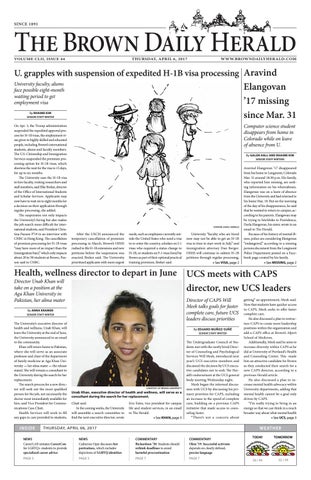
Aravind Elangovan ’17 disappeared from his home in Longmont, Colorado Mar. 31 around 10:30 p.m. His family, who reported him missing, are seeking information on his whereabouts. Elangovan was on a leave of absence from the University and had returned to his home Mar. 10. But on the morning of the day of his disappearance, he said that he wanted to return to campus, according to his parents. Elangovan may be trying to hitchhike to Providence, Darla Elangovan, his sister, wrote in an email to The Herald. Because of his history of mental illness, police are considering Elongovan “endangered,” according to a missing persons document from the Longmont Police Department posted on a Facebook page created by his family. » See MISSING, page 2
The Undergraduate Council of Students met with the newly hired Director of Counseling and Psychological Services Will Meek, introduced next year’s UCS executive members and discussed the decision by UCS executive candidates not to seek The Herald’s endorsement at the UCS general body meeting Wednesday night. Meek began the informal discussion with UCS by discussing his primary priorities for CAPS, including an increase in the speed of complete care, building on a previous CAPS initiative that made access to counseling faster. “There’s not a concern about
getting” an appointment, Meek said. Now that students have quicker access to CAPS, Meek seeks to offer faster complete care. He also discussed a plan to restructure CAPS to create more leadership positions within the organization and add a CAPS office at Brown’s Alpert School of Medicine. Additionally, Meek said he aims to increase diversity within CAPS as he did at University of Portland’s Health and Counseling Center. This made him an attractive candidate for Brown as they conducted their search for a new CAPS director, according to a previous Herald article. He also discussed a plan to increase mental health advocacy within University departments, adding that mental health cannot be a goal only driven by CAPS. “I’m really trying to bring in an energy so that we can think in a much broader way about what mental health » See UCS, page 3
WEATHER
THURSDAY, APRIL 06, 2017
NEWS CareerLAB initiates CareerCon for LGBTQ+ students to provide specialized career advice
NEWS Catherine Opie discusses her portraiture, which includes depictions of LGBTQ identities
COMMENTARY Richardson ’20: Students should rethink deadlines to avoid harmful procrastination
COMMENTARY Okin ’19: Successful activism depends on clearly defined, precise language
PAGE 3
PAGE 3
PAGE 7
PAGE 7
TODAY
TOMORROW
50 / 44
52 / 39
NEWS
PAGE 2 • THURSDAY, APRIL 6, 2017
» VISA, from page 1 Breker added. The stated intent of the suspension is to process the long backlog of regular applicants that resulted from the “high volume of incoming petitions and the significant surge in premium processing requests over the past few years,” according to the March USCIS announcement. The suspension “may also need to be looked (at) from the context of … the hiring freeze that (USCIS) is experiencing,” Breker said. “It’s difficult to add new officers at this point, so they are working with existing staff as well.” “Of course our hope is that the temporary suspension will” not last for the entire six months, she said. For current international students hoping to settle in the United States post-graduation, getting an H-1B visa is not easy — even with the premium processing option. Even if a student finds an employer who is willing to submit a petition, there is no guarantee they will receive an H-1B visa. Once the number of applications exceeds the maximum number of H-1B visas to be distributed in that year, visas are distributed by random lottery. Last year, the cap of 85,000 H-1B visas were randomly distributed amongst 236,000 petitions. This year, the cap remains the same: 65,000 visas for regular applicants and 20,000 reserved for applicants with a U.S. master’s degree or higher. This cap does not affect University hires, since there is no cap on the number of H-1B visas given to individuals who are sponsored by universities, non-profits and government research organizations, according to a USCIS press release.
THE BROWN DAILY HERALD
The suspension also poses a problem for those who will need to extend their H-1B visas, Berger said. After the first three years on the H-1B visa, candidates can petition for an extension of three years. While waiting for a petition, candidates can continue working for up to 240 days, Breker said. In several states, applicants and their dependents may not be able to extend their driver’s li-
employer’s law firm that his documents needed to be submitted “faster than they normally would” — before the suspension was enacted in April — in order to undergo premium processing. After graduation, all international students on an F-1 visa can work for one year in the United States through optional practical training. On top of that, STEM graduates can potentially
international students,” such as “software engineering, consulting, and investment banking,” Ma said. “But it happens in other industries as well, … so we just want to be sure that students have realistic expectations,” Donato said. International students might alternatively consider international employment first, and then return to the United States “when
Percent of international students in each concentration area The majority of international students polled fall 2016 are concentrating in physical and social sciences. Humanities/arts 31.8% of international students polled Life sciences 12.1% Physical sciences 37.1% Social sciences 37.1% *out of 132 international students
Source: Fall 2016 Herald undergraduate student poll LAURA FELENSTEIN / HERALD
censes during the filing process, leading to major inconveniences. In addition, those filing for extensions cannot leave the country. “It’s a really big problem for healthcare because doctors who work in medically underserved areas need H-1B visas quickly” for training residencies and fellowships, Berger added. Etienne Ma ’13, who is filing for an extension this year, was told by his
secure up to an additional 24 months of post-completion optional practical training, wrote Breker in an email to The Herald. Students in STEM fields, especially in technology, “have a higher likelihood of finding an employer who would sponsor an H-1B visa,” CareerLAB Director Mathew Donato said. “There are certain industries that are far more willing to sponsor
there might be an opportunity to get sponsored again” on an H-1B visa, Donato said. Sara Al-Salem ’17 worries about returning to her home country of Saudi Arabia, where she enjoys fewer freedoms as a woman — but she may not have a choice. As an international relations concentrator who is not looking for employment in STEM or finance, Al-Salem feels like she is at a
disadvantage. Recently, an interviewer told Al-Salem that though she was his favorite candidate, she would be at a significant disadvantage because of her visa status. CareerLAB will try to offer more global internship offerings, Donato said. CareerLAB has spoken with Dean of the College Maud Mandel and the Office of Global Engagement, as well as Provost Richard Locke, who has expressed interest in this initiative, he added. CareerLAB plans to launch new international internship programs for students over the next three to five years. Toward that effort, CareerLAB aims to partner more with OISSS and the Office of Global Engagement. Next year, CareerLAB plans to host a CareerCon for international students. “We definitely want to increase our commitment and support of the international students, and we’re hoping that the new programs will do that,” Donato said. “We see this, and all of the executive actions that impact immigration … as really counter to our values,” said Assistant Provost for Global Engagement and Strategic Iniatives Shankar Prasad. “(Trump’s) policies are sending out a message to the world that international students may not be welcome in the U.S., and I think it’s very important for presidents like me to get out there and say, ‘At Brown University, we want international students,’” Paxson said to CNBC. CareerLAB plans to host an event about summer internships and experiential learning options for international students, especially for students who might not be able to go home as previously planned because of President Trump’s executive order, Donato said.
» MISSING, from page 1 Shortly before he disappeared, Elangovan said he was going out for a jog, but when his parents followed him out the door, he quickly ran away from them, his parents told the Longmont Times-Call. The 19-year old Elangovan is 6’01” and 195 pounds with black hair and brown eyes and was last seen wearing a long black wool coat, a blue long sleeve t-shirt, boxer shorts and no shoes. He does not have his cell phone, wallet or any identification and does not drive a vehicle, according to a missing persons document filed by the Longmont police. “There’s no way he could’ve gone very far without shoes or pants,” Sharmila Elangovan told the TimesCall. “He had two large friend groups” at the University, said Catherine Liu ’17, a friend of Elangovan. “I do think, generally, that he seemed to enjoy Brown.” Liu said that Elangovan has behaved differently this year, but not to the extent of not wearing shoes, Liu said. Elangovan had acted “a little down” since returning home, but his parents did not expect him to run away, they told the Times-Call. On Monday night, officials found a body inside a burning building in Longmont, but the person who died
COURTESY OF THE ELANGOVAN FAMILY
Aravind Elangovan ’17 went missing while on a leave of absence from the University after going out for a jog March 31 at around 10:30 p.m. was not Elangovan, police told Fox31 Denver. Elangovan graduated from Niwor High School at age 15 and studies computer science at Brown. He was a cocaptain of the E-sports club, competing in League of Legends, according to Liu. He often frequents parks in
northwest Longmont and the Mountain Sanitas trail west of Boulder, the Longmont Police told the Times-Call. University communication officials could not be reached by press time. Anyone with information on Elangovan is asked to call Longmont Police at 303-651-8501.
STAY UP-TO-DATE. FOLLOW US ON FACEBOOK. FACEBOOK.COM/BROWNDAILYHERALD
NEWS
THURSDAY, APRIL 6, 2017 • PAGE 3
THE BROWN DAILY HERALD
CareerLAB launches LGBTQ+ career conference CareerLAB aims to reach out to different identity groups on campus through CareerCons By LIORA MORHAYIM CONTRIBUTING WRITER
In an effort to combat underrepresentation in the workplace, CareerLAB is making a concerted effort to reach out to students and alums identifying as people of color, first-generation and LGBTQ. CareerLAB hosted its first LGBTQ CareerCon in partnership with the LGBTQ Center Apr. 3 at the Faculty Club. Preceded by two CareerCons for first-generation students, the LGBTQ+ CareerCon was the third of a series of CareerCons aimed to help underrepresented students. Though the CareerCon model has been around for a few years, the center only started to organize group-specific CareerCons in the past year, said CareerLAB Director Matthew Donato. CareerLAB aims to address specific student populations and communities that need unique advice in career planning, the job search and networking, Donato said. Students not only seek career advice regarding specific fields but also the specific identities or communities to which they belong, he added. The LGBTQ+ CareerCon included a moderated panel that featured alums who spoke about their experiences navigating the work environment as queer
» KHAN, from page 1 The committee will “include undergraduate, graduate and medical school student representation,” he wrote. Students who have worked with and advocated for the health community will make up the majority of the committee. Some faculty and staff members will also serve on the committee. The University has hired Keeling and Associates to help in the search process, Estes added. Keeling and Associates previously assisted the University in hiring Will Meek as director of Counseling and Psychological Services.
»UCS, from page 1 looks like on campus,” Meek said. In response to a number of questions from UCS members, Meek mentioned a desire to increase transparency and communication with students. For example, CAPS may create a social media presence, he said. After the discussion with Meek, UCS President Viet Nguyen ’16 introduced the new executive members of UCS and the Undergraduate Finance Board. As previously reported by The Herald , Chelse-Amoy Steele ’18 and Naveen Srinivasan ’19 both ran unopposed and will be next year’s UCS president and vice president, respectively. Yuzuka Akasaka ’18 and Drew To ’19 will head UFB as chair and vice chair, respectively. Each was asked to talk about what they most look forward to in their upcoming term. Steele mentioned an excitement for self-growth and development. Camila Pelsinger ’20, next year’s chair of campus life, expressed a need for more student involvement in UCS.
COURTESY OF RICHARD FLORES
CareerLAB launched its LGBTQ+ CareerCon on Apr. 3. A panel of alums discussed their experiences as queer and trans persons in the workforce, and they later talked with students in one-on-one discussions.
experience “can really empower students who might feel discouraged,” Donato said. Besides the group-specific CareerCon, CareerLAB has set three goals — engaging in data-based programming to reach more people of color, mentorship and diversifying staff — as part of its diversity and inclusion action plan, released Mar. 9 . CareerCon stands out as one way to facilitate connections between students and alums, but it only occurs once a year, Donato said. However, if prior commitments prevent students from coming to CareerCon, they should still have an opportunity to connect with alums, he added. Donato said that he hopes to employ technology to support a mentoring program between students and alums. Currently, CareerLAB is working to collect alums’ information for student use on sites like BrownConnect. CareerLAB is also considering the diversity of its staff, Donato said. As stated in its DIAP, CareerLAB is committed to making diversity a key aspect of its hiring process. Though they have a diverse staff of peer career advisors, he said that most full-time employees are white. “We want our staff to reflect the diversity of the student body,” he said. Donato said that they are on track to implement all three goals this year, and they will continue to organize the group-specific CareerCons focusing on different identities.
and trans persons. After the panel, students had a chance to ask questions and engage in one-on-one discussions. During the panel, speakers touched on various topics, such as the challenges of being out in the workplace or finding welcoming workplace environments. Angela Zhuo ’19, who attended the CareerCon event, said the speakers’ stories about navigating their fields taught her about being vocal about identity. “Sometimes it is a mechanism you have, you are not sure if this is a safe space to talk about your identity,” Zhuo said.
The first group-specific CareerCon was a CareerCon for first-generation students in 2016, Donato said. Trevor Lyford ’18 who attended this year’s First-Gen CareerCon Mar. 4 said that the event was more helpful than he had anticipated. As a first-generation and low-income student, Lyford found career planning overwhelming, but said that he finds value in connecting with people who understand the same issues he faces. Lyford, who aspires to become a doctor, said that he used the event to
speak with first-generation alums at the Alpert School of Medicine for advice about how his experiences can be an advantage. He said that after the event he kept in touch with the first-gen Med School students — one has even become his mentor. “She offered to help me through the process of applying to medical school after I graduate from Brown,” Lyford said. CareerLAB plans to continue group-specific CareerCons, focusing on international students and students of color. Conversations around shared
Khan arrived in 2014 as medical director and began to oversee CAPS in addition to her other duties within a year, which earned her the title of executive director of health and wellness. The joining of Health Services and CAPS allowed “us to think about our students’ physical and mental wellbeing under one umbrella,” she said. Khan made a number of changes and improvements to health services, Estes wrote. The majority of her initiatives were intended to improve CAPS, and included the removal of the seven-session counseling limit and increased
accessibility, Khan said. Khan’s achievements also included the addition of mental health screening to routine health services appointments and increased support for Brown Emergency Medical Services, Estes wrote. Khan described the shift from the traditional-practice model toward a model that studies how the learning and living environment affects student health as the largest and most important change during her tenure. “We build trust and connectedness … and empower our students with more information about their health,” she added.
None of the changes could have been possible without students, she said. “They advocated … and we were able to respond in meaningful ways to their concerns.” Khan values the opportunities to build systems that create high quality and respectful support provided by her job, she said. “Her work has been transformative at an important time for the community,” Estes wrote. Looking forward, health Services could explore even more holistic student care, Estes wrote. In the future, his office will focus on increasing staff
diversity and professional development opportunities, both of which allow for better student support. Khan voiced her hope that Health Services will develop a multi-disciplinary model of care that seamlessly meets students’ needs. Hopefully, the next executive director will “build off of the groundwork that we’ve been doing,” she said. “At this point, my family really needs me, and I would hate to live with the regret of not being present for them … I would have loved to be part of this community for a longer period,” Khan said.
“I am excited to get more of the student body to be active in UCS,” Pelsinger said. “A lot of people just don’t really know what UCS does. I think … a big part of what I want to do as chair of campus life is engage the campus and see what changes they want to make.” As the meeting was about to close, a UCS member asked for clarification on the decision by Steele, Srinivasan and Akasaka not to seek an endorsement from The Herald. Steele reiterated that she felt The Herald should be held accountable for the pieces it publishes, referencing two racist columns The Herald published in fall 2015. She also mentioned that as a candidate who had pledged to support students from marginalized backgrounds at Brown, she could not accept an endorsement from The Herald. Nguyen, who accepted The Herald’s endorsement when he ran for UCS president in 2016, mentioned that a change in public perception takes time, and the “changes that (The Herald) made this year, or even last year, might not change the
perception,” he said. UCS also passed a resolution that reconfirmed a number of organizations as Category 1 student groups,
which are not eligible for any funding from UCS or the Undergraduate Finance Board, the financial arm of UCS. Members announced that the
positions of chair of academic affairs, which went unfilled during the UCS election, and treasurer will be filled by internal appointments.
NAOMY PEDROZA / HERALD
The Undergraduate Council of Students met with its newly-elected members, discussing personal and group goals for the upcoming year. UCS members also introduced Will Meek, director of CAPS.
ARTS & CULTURE PAGE 4 • THURSDAY, APRIL 6, 2017
THE BROWN DAILY HERALD
In “Kedi,” cats charm viewers, locals alike DANIEL WAYLAND arts and culture critic “Kedi” is not your standard fare of catnip. Known to American audiences as “Nine Lives: Cats in Istanbul,” Director Ceyda Torun’s documentary follows the thousands of felines who roam Istanbul’s busy streets. Playing at Avon Cinema until Thursday, “Kedi” quietly charms in its meditation on a city and the species at its spiritual center. Vagrant cats dominate Istanbul’s urban landscape, saturating the city’s negative spaces with life. And yet, to call the cats “strays” would dishonor the intricate bonds formed between these creatures and their human neighbors. Indeed, Torun’s documentary succeeds in large part because it never neglects the human elements of its story, granting as much attention to the voices and narratives of people as to the cats that flit in and out of their lives. The cats are ephemeral in presence only — they leave enduring impressions upon the souls of those they touch. Told in series of modest vignettes, “Kedi” lets local residents breathe life into the adventures of their feline friends, lending a folksy authenticity that feels neither forced nor pre-
tentious. The documentary draws primarily from inhabitants of the city’s less-urbanized quarters, cataloguing the interplay between fishermen and shopkeepers and the cats they feed, shelter and love. In their narration, the locals exhibit a desperate need to ascribe human qualities to their animal counterparts, making claims about shared dialogues and communal frequencies. “Kedi” indulges these perspectives, and cynics are gifted plenty of fodder with which to disparage the documentary’s philosophical stretches. While one resident extolled the virtues of the local feline population for restoring the city’s “joy for life” and “fading sense of humor,” one could almost hear skeptics pooh-poohing such classic European pseudo-intellectual extravagances. And yet, such is the purity of “Kedi” that it’s impossible not to indulge in the local’s belief. The film captures the cats in moments that perfectly reinforce the narration of their human friends — at times mischievous, timid, ambitious and carefree, the cats reflect the full tableau of the human condition. Torun’s camera moves with felineinspired grace, gliding at floor-level through the city’s tight corridors. “Kedi” penetrates the private spaces to which the cats retreat — cupboard shelves and dock-side ice boxes teem
with newborn kittens, providing little glimpses of life that feel both stolen and sacred. Wider shots frame single cats against the massive backdrop of the city, beautiful landscapes rendered both absurd and sublime by the presence of a feline Easter egg. In Torun’s camera, the cats are, at once, central actors and bit players in the urban theater. What ultimately emerges from “Kedi” is a pervading sense that the cats provide meaning to the lives of the residents. The documentary casually exposes the interactions between humans and cats as sites of therapeutic rhythm. One man describes having a prolonged mental breakdown years ago, before finding healing in the daily repetition of feeding hundreds of street cats. While his case proves more extreme than most in “Kedi,” nearly every local describes the existence of a restorative connective tissue between human and feline. As one resident says, “a cat meowing at your feet looking up at you, those are the moments we are lucky. They remind us that we are alive.” At its heart, “Kedi” reminds us to look for the beauty in the life around us — even the life at our feet.
Daniel Wayland ’18.5 can be reached at daniel_wayland@brown.edu
Catherine Opie discusses power of photography, art Photographer captures LGBTQ narratives, landscapes, American political history By AMY WANG SENIOR STAFF WRITER
Nearly all the seats in the List Art Center Auditorium were filled Wednesday evening as individuals from both inside and outside the University community gathered to listen to professional photographer Catherine Opie speak. Opie, currently a professor of photography at the University of California at Los Angeles, visited Brown as part of the Visiting Artist series sponsored by the visual art department. She stood in front of a slideshow projection of selected pieces from her impressive body of work, which dates back to the early 1990s. The photographs all differed in medium, including polaroids, platinum prints and, more recently, digital photography. Much of Opie’s work centers around LGBTQ culture and community, documenting the lives and identities of LGBTQ individuals across the United States. Opie, who identifies as a lesbian woman, emphasized wanting to “humanize” LGBTQ individuals beyond their typical depictions in modern media. “So much (queer artwork) was being
done but was always in (relation) to erotica,” she said. “I really wanted that idea of humanity, and to begin to create a representation of my own community (in my work).” Several of the artist’s series, including “Domestic,” a collection of photos of queer women in domestic relationships from all over the country, exemplify this effort at humanized representation. Other pieces are, in contrast, much more graphic. For example, two of Opie’s self-portraits, “Self-Portrait/Cutting” and “Self Portrait/Pervert,” feature the use of cutting, in which designs were carved into the artist’s skin, leaving bloody contours that were then photographed in high resolution. “Blood is something that’s inside of you. It’s something that you’re taught to be afraid of,” Opie said. “I’m interested in (the idea that) it’s this substance that I don’t really need to fear.” Opie’s work is not limited by genre or subject matter, with photos ranging from snowy landscapes verging on the surreal to intense and personal portraits of close friends. “I traverse a lot of territories and relationships in my medium. … I’m versatile as an image-maker,” Opie said, adding that she did not want to be reduced to “a singular identity” by the content she creates. Naturally, when the art world began to typecast her portraiture, she transitioned to photographing landscapes, commencing her work on “Freeways,” a series of small platinum prints of
Southern California’s highway system. “After the original showing of ‘Pervert,’ there was definitely a huge … buzz around my work in terms of being this young, queer, didactic artist. So I switched it up on everybody by making these little freeways,” Opie said. Sometimes Opie’s work is political: She has captured images of former President Barack Obama’s inauguration, as well as Tea Party rallies and the most recent Women’s March — work she describes as “bearing witness at a specific time within American history.” Sometimes it is conceptual: Nowadays, she primarily focuses on allegory and abstraction, a set of what Opie referred to as “post-menopausal works.” To Opie, photography is more than just an art. “(It) holds much more meaning outside of your one self.” Each of her photographs carries a deep personal meaning. For example, much of her portraiture of LGBTQ individuals also serves as a reflection on the devastating impact of the AIDS crisis — “an homage and a mourning of friends that I had to say goodbye to,” Opie said. Ultimately, “art should be about creating dialogue,” Opie said, adding that artists both wield great power and carry great responsibility. For her part, Opie tries to wield that power responsibly, always ensuring that her subjects are comfortable with the images she releases, she said. “I’ve only been sued one time,” she remarked humorously.
ANITA SHEIH / HERALD
Catherine Opie, known for photography of individuals who identify as LGBTQ, spoke in the List Art Center Auditorium for the Visiting Artist lecture series.
TODAY
THURSDAY, APRIL 6, 2017 • PAGE 5
THE BROWN DAILY HERALD
menu
pitch perfec t
SATELLITE DINING ANDREWS COMMONS
Pizza: Cheeseburger, Spicy 5 Cheese & Garlic, BBQ Bam Bam JOSIAH’S
BLUE ROOM
Jambalaya, Pizzadilla
Turkey Chili, Fire Roasted Vegetable Soup
DINING HALLS SHARPE REFECTORY LUNCH
DINNER
Cuban Sandwich, Gnocchi with Bolognese Sauce, Frosted Brownies
Slow Roasted Pork Loin with Fresh Herbs, Artichoke and Red Pepper Frittata, Coconut Cookies
VERNEY-WOOLLEY LUNCH
DINNER
Baseball Burrito Bar, Gourmet Roast Turkey Sandwich, White Chocolate Chip Cookies
Chicken Kung Pao Rice Bowl, Siena Roasted Couscous, Caribbean Rum Cake
sudoku ELI WHITE / HERALD
Gina Chieffalo ’17 fires a pitch against Providence in a midweek game. The Bears are 1-3 to start the Ivy League season, but traditional powerhouses Harvard and Dartmouth also lost three of four games on opening weekend.
Q U O T E O F T H E D AY
“I’ve only been sued one time.” — Catherine Opie
See opie on page 4. RELEASE DATE– Tuesday, February 12, 2013
Los Angeles Times Puzzle c r o sDaily s w oCrossword rd Edited by Rich Norris and Joyce Nichols Lewis
ACROSS 1 Employment agency listings 5 Fried Cajun veggie 9 WWII conference site 14 Billion extension 15 Steady guy 16 He hunted with a club in the “Odyssey” 17 Club used as a weapon, say 20 Nonagenarian actress White 21 Yeats or Keats 22 Color, as Easter eggs 23 Summer quencher 24 Dorm VIPs 27 Where Lux. is 29 Kid-friendly comfort food 36 Soothing additive 38 River through Sudan 39 Country rocker Steve 40 Sable maker, briefly 41 Turn __ ear 43 Pub projectile 44 Former Portuguese territory in China 46 Prefix with -pus 47 Abates 48 Tests during which checking notes is allowed 51 Gymnast’s goal 52 Deli bread 53 Art on skin, slangily 56 Draw upon 59 Not as much 62 Calf-roping gear 64 Candid sort 68 Street toughs 69 Diamond Head’s island 70 Aromatic drinks 71 Go on tiptoe 72 Small songbird 73 Wine area near Turin DOWN 1 “Star Wars” gangster 2 No longer squeaky
3 Xbox battle game 4 Told to go 5 Asian tie 6 Barbie’s guy 7 Grating voice 8 One might get stuck in a jam 9 Video-sharing website 10 Radius’s limb 11 Committed perjury 12 Randall who played Felix Unger 13 Chip in a chip 18 Supermodel Banks 19 Marsh stalk 25 Tolstoy’s Karenina 26 Snowmobile brand 28 “__ and weep!”: poker winner’s cry 30 Take back 31 Smart guy? 32 More like Felix Unger 33 African countries on the Mediterranean, e.g. 34 Mediation agcy.
35 Congeals 36 Target practice supply 37 “... one giant __ for mankind” 42 Cunning 45 Washington Monument, for one 49 Universal blood type, for short 50 Related to flying 54 Had lunch in
55 Foot bones 56 Letter carrier’s org. 57 Leave speechless 58 Marine eagle 60 Vegas event 61 Kindergartner’s reward 63 Tiny bit 65 Wanted-poster letters 66 Sailor’s pronoun 67 Attila, notably
ANSWER TO PREVIOUS PUZZLE:
xwordeditor@aol.com
calendar
02/12/13
TODAY
MARCH APRIL
S
By Melanie Miller (c)2013 Tribune Media Services, Inc.
02/12/13
M
T
W
Th
F
S
1
2
3
14
25
36
47
85
69
10 7
11 8
12 9
10 13
11 14
12 15
13 16
14 17
15 18
16 19
17 20
18 21
19 22
20 23
21 24
22 25
23/30 26 24 27
25 28
26 29
27 30
28 31
29
Brown Bag Concert 12:00 P.M. Sayles Hall
BEO Lecture: Brewing Up Business 1:00 P.M. Hillel, Meeting Room
Black Girl Genius: A Genealogy of Levitation 5:30 P.M. Salomon, 101
Brown/RISD Standup Comics 9:00 P.M. MacMillan Hall, 117
TOMORROW PTP Workshop: Persecution & Toleration 12:00 P.M. 8 Fones Alley
Piano Workshop 4:00 P.M. Grant Recital Hall
Opening Reception: Casting Deep Shade 5:30 P.M. Granoff Center, Martinos Auditorium
Folk Fest Battle of the Bands 8:30 P.M. Pembroke Field House
COMMENTARY PAGE 6 • THURSDAY, APRIL 6, 2017
THE BROWN DAILY HERALD
comic A Horse of Any Other Name | Zach Silberberg
Find us online! facebook.com/browndailyherald
browndailyherald.com
@the_herald
Location: 195 Angell St., Providence, R.I. www.browndailyherald.com
@browndailyherald
youtube.com/browndailyherald
Editorial Leadership
Sections
Multimedia & Production
Business
Editor-in-Chief Lauren Aratani
Arts & Culture Editors Julie Center Madison Rivlin
Design Editors Christy Leung Ameer Malik Jessica Yu Assistant: Eduard Muñoz-Suñé
General Managers Henry Ritter Ben Wesner
Managing Editors Matt Brownsword Rebecca Ellis Kate Talerico POST- MAGAZINE Editor Monica Chin
News Editors Kyle Borowski Kasturi Pananjady Suvy Qin Elena Renken Alex Skidmore Hattie Xu
BLOGDAILYHERALD Editor Anica Green
Sports Editors Jackson Chaiken Ben Shumate COMMENTARY Opinions Editors Anuj Krishnamurthy Mili Mitra Clare Steinman
Photo Editors Head: Eli White Assistant: Sam Berube Anita Sheih Sara Runkel Copy Desk Chief Julia Stemmer Multimedia Editor Roland High Illustrations Editor Dorothy Windham Graphics Editor Laura Felenstein Directors of Web Development: Lucy Wei Ivy Wong
Directors Finance: Reena Zhan Sales: Antonia Alvarez Sales: Erin Lueck Strategy: William Nober Strategy: Gianna Jasinski Managers Sales: Elizabeth Doykan Sales: Gabriella Elanbeck Sales: Matilda Lynton Sales: Ariel Shusterman Collections: Ravi Betzig Operations: Gür Ağci
Editorial contact: 401-351-3372 herald@browndailyherald.com
Business contact: 401-351-3260 gm@browndailyherald.com
Submissions: The Brown Daily Herald publishes submissions in the form of op-eds and letters to the editor. Op-eds are typically between 750 and 1000 words, though we will consider submissions between 500 and 1200 words. Letters to the editor should be around 250 words. While letters to the editor respond to an article or column that has appeared in The Herald, op-eds usually prompt new discussions on campus or frame new arguments about current discourse. All submissions to The Herald cannot have been previously published elsewhere (in print or online — including personal blogs and social media), and they must be exclusive to The Herald. Submissions must include no more than two individual authors. If there are more than two original authors, The Herald can acknowledge the authors in a statement at the end of the letter or op-ed, but the byline can only include up to two names. The Herald will not publish submissions authored by groups. The Herald does not publish anonymous submissions. If you feel your circumstances prevent you from submitting an op-ed or letter with your name, please email herald@browndailyherald.com to explain your situation. You can submit op-eds to opinions@browndailyherald.com and letters to letters@browndailyherald.com. When you email your submission, please include (1) your full name, (2) an evening or mobile phone number in case your submission is chosen for publication and (3) any affiliation with Brown University or any institution or organization relevant to the content of your submission. Please send in submissions at least 24 hours in advance of your desired publication date. The Herald only publishes submissions while it is in print. The Herald reserves the right to edit all submissions. If your piece is considered for publication, an editor will contact you to discuss potential changes to your submission. Commentary: The editorial is the majority opinion of the editorial page board of The Brown Daily Herald. The editorial viewpoint does not necessarily reflect the views of The Brown Daily Herald, Inc. Columns, letters and comics reflect the opinions of their authors only. Corrections: The Brown Daily Herald is committed to providing the Brown University community with the most accurate information possible. Corrections may be submitted up to seven calendar days after publication. Advertising: The Brown Daily Herald, Inc. reserves the right to accept or decline any advertisement at its discretion. The Brown Daily Herald, Inc. is a financially independent, nonprofit media organization bringing you The Brown Daily Herald, BlogDailyHerald and Post- Magazine. The Brown Daily Herald has served the Brown University community daily since 1891. It is published Monday through Friday during the academic year, excluding vacations, once during Commencement and once during Orientation by The Brown Daily Herald, Inc. Single copy free for each member of the community. Subscription prices: $200 one year daily, $100 one semester daily. Copyright 2017 by The Brown Daily Herald, Inc. All rights reserved. Periodicals postage paid at Providence, R.I. Postmaster: Please send corrections to P.O. Box 2538, Providence, RI 02906.
COMMENTARY THURSDAY, APRIL 6, 2017 • PAGE 7
THE BROWN DAILY HERALD
Pinpointing procrastination RANDI RICHARDSON staff columnist According to my friends, I was nowhere to be found first semester and practically non-existent up until this point in second semester. No group work. No kickbacks. No parties. No drama. Apparently, when we returned from spring break, they were downright shocked to see me. I was the epitome of the student who took as long as possible on assignments, even if that meant cancelling on my friends a few too many times. Though they often wondered how I spent my time, I felt best when I invested in being a college student: a life which consists of a lot of long days and long nights. A conversation with my friends stands out in my memory. Three of us were at a men’s soccer game talking about classes and the homework we had to complete before the coming week. One of my friends said, “I have four assignments due this Wednesday. All of them were assigned last Wednesday, and I haven’t started any of them.” While my group of friends started laughing, I stared at
him blankly. An older man sitting behind us commented, “You need to do your work,” and walked off, disgruntled. A few nights later, around 7:30 p.m., I was talking to another friend who mentioned having a six-page paper due at midnight which he had not started. Why are stories like these so com-
doing things that set us up for failure. Echoes of this explanation sound in my mind as I think of Brown students. I find that we have a tendency to over-achieve in everything we do. The stress created when striving to attain “good” grades leads us to procrastination. Perhaps Brown students purposely wait, even subconsciously,
turning in nothing eventually surpasses their fears of turning in something terrible.” When we suppress our fear of failure by procrastinating and thus make excuses for work we recognize as insufficient, we act contrary to what it means to be a Brown student. Where is the confidence and pride in our work we demonstrated on our
Perhaps Brown students purposely wait, even subconsciously, until the last minute so that they can provide excuses for an undesirable grade, in an attempt to mitigate the constant pressure to get a 4.0.
mon at Brown? I tend to interpret this phenomenon as a kind of destructive competitive impulse, where people strive to do better than others while doing less. Studies have shown that procrastination stems from being forced into a challenge that we feel unprepared for, which results in “self-handicapping,” or deliberately
until the last minute so that they can provide excuses for an undesirable grade, in an attempt to mitigate the constant pressure to get a 4.0. In a piece in the Atlantic about the psychological reasons for procrastination, Megan McArdle argues that a procrastinator’s tendencies are overcome only when their “fears of
Brown applications? Of course, getting it all done can be much harder than we ever imagined. But we were each accepted here for a reason — we have the ability to produce work that we can feel proud of, if we put in the time to do so. At a college that provides us with so many unique academic opportunities, it is important
to maximize every minute of our time here at Brown. This is not to say that we should be robots who solely focus on the completion of academic responsibilities — a balance that many here struggle to strike, myself included. Rather, engaging in truly gratifying activities without worrying about returning home to complete an assignment that is due at midnight is far more fulfilling than anything procrastination has to offer. Time management is not easy to master, but it is a critical tool that will be used daily, especially once we graduate from Brown. With the close of this semester approaching, I encourage you all to set aside your fear of failure and procrastinate your tendency to procrastinate: Postpone procrastination so much that all of your work is completed during the time that you usually spend putting off the actual assignments. Instead of waiting all day to start something, start it so you have all day. Reframing your perspective on deadlines is the first step in emerging from the abyss of procrastination.
Randi Richardson ’20 can be reached at randi_richardson@brown.edu.
Words matter REBECCA OKIN staff columnist I have always considered myself a champion of the importance of language. That stringing letters into a meaningful order can empower movements and fuel real-world change does nothing short of mystify me. I can typically be found declaring the power of the written word to any unlucky friend, relative or tall object that vaguely resembles a human being. But in the midst of my love for metaphors and lyrical imagery, I was neglecting something simple yet fundamental: the importance of precisely understanding a word’s definition. There have been more instances than I’d like to admit where a conversation in the Ratty enters lexical territory I am unfamiliar with. What I’m more embarrassed to confess is the amount of times I do not seek a word’s true definitions — whether it in the moment or afterwards — and instead assume that a contextual guess is adequate. At best this technique is insufficient; at worst, it can threaten the very core of the movements driven by these words. Whereas we can indefinitely debate over an author’s meaning via a metaphor, the intention behind the language of social movements is essential to its function. The most prominent example that comes to mind is the common misconstruing of “feminism.” Although the term is constantly associated in the media with a collection of strange descriptions (male-hating
and no-shaving are two favorites), one who adheres to this “ism” simply concurs with the notion that all sexes are equal. And while a quick Google search will reveal that “feminism” can take many forms — from eco- to post-structuralist to socialist feminisms — the original equality-for-all sentiment of the term has provided the basis for these related movements. Thus, when we assume that surmising the meaning of
ing the same words but obliviously talking about different things. Words do change over time — as the world shifts and new people and things appear, inevitably our lexicon alters. But certain terms rely on their roots to ground and strengthen their meaning. To preserve these origins, we have to stop the chain of alterations before it begins. Whether the tool of choice is Google or an in-
Progress depends on the language we use on our protest signs, in our leaders’ speeches and throughout our social media spaces. But without truly understanding the meaning of this language, our activist endeavors are slated to stumble from the start.
words central to a movement will do, adding the newly defined word to our own repertoire, we play a detrimental game of Telephone. Suddenly, we unintentionally commit two sins: The first is stripping a word of its history and disrupting its future legacy; the second is that, over time, people engage in meaningless conversations, us-
terruption in the conversation, find out the true meaning of the language you use. Furthermore, if you find yourself in the position where your own lingo provokes more silence than responses from others, consider whether everyone in the room actually knows what you’re talking about. A discussion over the
definition of a term could make a topic accessible to someone for the first time ever, encouraging participation in a dialogue that was once distant. Moreover, the act itself of discussing these meanings prompts us to internalize the importance of these words and their histories. As we begin to formulate the arguments and slogans in support of our various causes, we inevitably jumpstart the process of demanding change. Thus, if we only have a half-hearted understanding of the words we use, we can only half-heartedly partake in our work. New Yorker writer Nora Caplan-Bricker aptly describes how dictionaries often associate negative adjectives with women — feminism is “rabid” and women’s voices are “shrill.” The debate over whether dictionaries should be descriptive or prescriptive — whether they should solely reflect existing attitudes or actually guide the way we use language — is as fundamental as it is unresolved. Yet, I want to suggest that while we can argue about this tension in the context of dictionaries, there should be nothing ambiguous about its implication in our lives. As we work to combat injustice, our prescriptions for social ills hinge on our understanding of the descriptive power of our language. Progress depends on the language we use on our protest signs, in our leaders’ speeches and throughout our social media spaces. But without truly understanding the meaning of this language, our activist endeavors are slated to stumble from the start.
Rebecca Okin ’19 can be reached at rebecca_okin@brown.edu.
Got something to say? Leave a comment online! Visit www.browndailyherald.com to comment on opinion and editorial content.
HBO Documentary Premiere Wednesday, April 12th 5:00 - 7:00 pm Sayles Hall
CENTER FOR
Physician Assistant Studies
OPEN HOUSE WEDNESDAY, APRIL 26, 2017 Registration: 4:45 p.m. / Presentation begins promptly at 5 p.m. RSVP: 401-598-4558. Space is limited.
The ARC-PA has granted Accreditation-Provisional status to the Physician Assistant Studies Program sponsored by Johnson & Wales University. Accreditation-Provisional is an accreditation status granted when the plans and resource allocation, if fully implemented as planned, of a proposed program that has not yet enrolled students appear to demonstrate the program’s ability to meet the ARC-PA Standards or when a program holding Accreditation-Provisional status appears to demonstrate continued progress in complying with the Standards as it prepares for the graduation of the first class (cohort) of students. Accreditation-Provisional does not ensure any subsequent accreditation status. It is limited to no more than five years from matriculation of the first class.
GPS address: 157 Clifford Street, Providence
16-01-285 10/16
Location: 35 Claverick Street, Providence, R.I.