SINCE 1891
THE BROWN DAILY HERALD THURSDAY, APRIL 13, 2017
VOLUME CLII, ISSUE 48
WWW.BROWNDAILYHERALD.COM
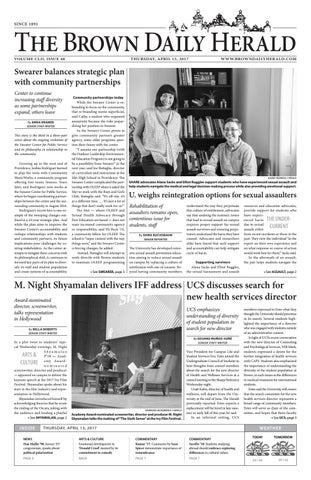
Swearer balances strategic plan with community partnerships Center to continue increasing staff diversity as some partnerships expand, others leave By ANNA KRAMER SENIOR STAFF WRITER
This story is the third in a three-part series about the ongoing evolution of the Swearer Center for Public Service and its philosophy in relationship to the community. Growing up in the west end of Providence, Joshua Rodriguez learned to play the viola with Community MusicWorks, a community program offering free music lessons. Years later, and Rodriguez now works at the Swearer Center for Public Service, where he began coordinating partnerships between the center and the surrounding community in August 2016. Rodriguez’s recent hire is one example of the sweeping changes outlined in a 10-year strategic plan. And while the plan aims to improve the Swearer Center’s accountability and reshape relationships with students and community partners, its future implications pose challenges for existing stakeholders. As the center attempts to mitigate these concerns with its philosophical shift, it continues to forward key parts of its plan to diversify its staff and student population and create systems of accountability.
Community partnerships today While the Swearer Center is rebranding to focus on the community, that re-branding seems superficial, said Cathy, a student who requested anonymity because she risks jeopardizing her position in Swearer. As the Swearer Center pivots to give community partners greater agency, some older programs question their future with the center. “I assume our partnership (with the Outdoor Leadership Environmental Education Program) is not going to be a possibility from Swearer” in the next year, said Joe Battaglia, director of curriculum and instruction at the Met High School in Providence. The Swearer Center complicated the partnership with OLEEP when it asked the Met to work with the Boys and Girls Club, Battaglia said. “It’s off-site, it’s at a different time. … It’s just a lot of things that don’t really work for us.” The Met — where OLEEP and Sexual Health Advocacy through Peer Education are based — does not want increased community agency or responsibility, said Eli Beck ’18, a community fellow for OLEEP. The school is “super content with the way things were,” and the Swearer Center is forcing changes, he added. Instead, Battaglia will attempt to work directly with Brown students to maintain OLEEP programming » See SWEARER, page 3
NAOMY PEDROZA / HERALD
SHARE advocates Alana Sacks and Elliot Ruggles support students who have experienced sexual assault and help students navigate the medical and legal decision-making process while also providing emotional support.
U. weighs reintegration options for sexual assaulters Rehabilitation of assaulters remains open, contentious issue for students, staff By SHIRA BUCHSBAUM SENIOR REPORTER
The University has developed extensive sexual assault prevention education aiming to reduce sexual assault on campus by replacing a culture of entitlement with one of consent. Beyond having community members
understand the way they perpetuate this culture of entitlement, advocates say that undoing the systemic issues that lead to sexual assault on campus requires proper support for sexual assault survivors and ensuring perpetrators understand the harm they have caused. Advocates and researchers alike have found that such support and accountability can help mitigate cycle of harm. Supporting survivors Alana Sacks and Elliot Ruggles, the sexual harassment and assault
resources and education advocates, provide support for students who have experienced harm due to sexual assault either from recent incidents or those in the past. They view the individual “as the expert on their own experience and on what response or course of action would work best for them,” Sacks said. In the aftermath of an assault, the pair helps students navigate the
THE UNDERCURRENT
» See ASSAULT, page 2
M. Night Shyamalan delivers IFF address UCS discusses search for new health services director Award-nominated director, screenwriter, talks representation in Hollywood
UCS emphasizes understanding of diversity of student population in search for new director
By BELLA ROBERTS SENIOR STAFF WRITER
In a plot twist to students’ typical Wednesday evenings, M. Night Shyamalan P’18 — Academy Awardnominated screenwriter, director and producer — appeared on campus to deliver the keynote speech at the 2017 Ivy Film Festival. Shyamalan spoke about his start in the film industry and representation in Hollywood. Shyamalan introduced himself by acknowledging theories that he wrote the ending of the Oscars, joking with the audience and lending a playful » See SHYAMALAN, page 2
By EDUARD MUÑOZ-SUÑÉ SENIOR STAFF WRITER
ARTS & CULTURE
INSIDE
MARIANNA MCMURDOCK / HERALD
Academy Award-nominated screenwriter, director and producer M. Night Shyamalan talks the making of “The Sixth Sense” at the Ivy Film Festival.
Vice President for Campus Life and Student Services Eric Estes joined the Undergraduate Council of Students to hear thoughts from council members about the search for the new director of Health and Wellness Services at a council meeting in the Sharpe Refectory Wednesday night. Unab Kahn, director of health and wellness, will depart from the University at the end of June, The Herald previously reported. Estes expects a replacement will be hired in late summer or early fall of this year, he said. In an informal setting, UCS
members expressed to Estes what they thought the University should prioritize in its search. Several students highlighted the importance of a director who was engaged with students outside of an administrative context. In light of UCS’s recent conversation with the new director of Counseling and Psychological Services, Will Meek, students expressed a desire for the further integration of health services with CAPS. Students also emphasized the importance of understanding the diversity of the student population at Brown, in such issues as the differences in medical treatment for international students. Estes said the University will ensure that the search committee for the new health services director represents a broad range of community members. Estes will serve as chair of the committee, and hopes that three faculty » See UCS, page 3
WEATHER
THURSDAY, APRIL 13, 2017
NEWS Dan Maffei ’90, former NY congressman, speaks about political polarization
ARTS & CULTURE Emotional development in ‘Donald Cried’ stunted by its commitment to comedy
COMMENTARY Kumar ’17: Comments by Sean Spicer demonstrate importance of remembrance
COMMENTARY Savello ’18: Students studying abroad should embrace exploring differences in cultural values
PAGE 4
BACK
PAGE 7
PAGE 7
TODAY
TOMORROW
59 / 44
59 / 42
NEWS
PAGE 2 • THURSDAY, APRIL 13, 2017
» SHYAMALAN, from page 1 tone to the evening. When asked about his inspirations, Shyamalan spoke of the many renowned directors in his generation, such as Steven Spielberg, and the critically-acclaimed movies of his childhood. “I definitely don’t think of (inspiration) as a fancy dance-move or anything like that,” Shyamalan told The Herald. “Plot comes out of character. You can have amazing things that come out of what the character wants.” Shyamalan began creating movies at home in Pennsylvania and continued on to New York University’s Tisch School of the Arts, where he created his first film “Praying with Anger.” The film, the culmination of his first three years at college, debuted at the
» ASSAULT, from page 1 medical and legal decision-making process while also providing emotional support. They take a traumainformed approach, which “takes into account the wide prevalence of abuse, assault and other traumatic experiences … and is tailored to an understanding of common reactions to trauma,” Sacks wrote in a follow-up email to The Herald. SHARE advocates can help students understand options regarding insurance, external therapists, time-sensitive evidence collection and working with law enforcement, Sacks said. “Brown offers several programs to help a student that has been sexually assaulted or raped, but … I was only aware of them after I became a victim,” wrote a current student, who was granted anonymity for confidentiality reasons, in an email to The Herald. She turned to a Counseling and Psychological Services psychiatrist for resources: “I only had to see her once, and she didn’t ask me to talk through the story of what happened,” the student wrote. The psychiatrist gave her medications to take for post-traumatic stress disorder. “It was up to me to take them or not. That choice was really important to me, as well as the privacy she provided for me,” she wrote. Support services are also available to secondary survivors — people who are supporting survivors and who may experience “vicarious traumatization” or are part of a community with the survivor and question their own safety, Sacks said. Sacks and Ruggles also provide case management for survivors, such as advocating for academic or housing accommodations for survivors and supporting students through the Title IX process should they opt to proceed with an investigation, Sacks said. But “the healing process happens in parallel or completely separate from that accountability process,” Ruggles said. Kirsten Wolfe, assistant dean of student life and interim Title IX undergraduate coordinator, said that, anecdotally, both survivors who go through the Title IX processes and those who opt out “don’t feel very healed. Even people who have a
THE BROWN DAILY HERALD
Toronto International Film Festival. “It was a complete failure. That’s the first thing you need to know,” Shyamalan joked. However, the conference gave Shyamalan the opportunity to meet directors he admired, like Quentin Tarantino. “I remember feeling so out of place on stage and feeling like a complete fake. I felt like such a nerd.” “An old lady pointed at me and said, ‘That young man is a good director because he has no sex, no drugs and no alcohol,’ and I could see Quentin Tarantino looking at me,” Shyamalan said. It was at this festival that a young agent from Miramax films signed him. But Shyamalan felt a lack of agency working for Miramax and quickly realized he wanted to leave. “It had to happen exactly that way — where nothing was working
for me — to think about who I am,” Shyamalan said. Because Miramax owned the rights to his directing, Shyamalan felt like he had to write. “I had one chess move — to write something. So, I looked at posters on my wall and wrote ‘The Sixth Sense,’” Shyamalan said. The film received six Academy Award nominations. In 1999, Shyamalan co-wrote the “Stuart Little” screenplay. Receiving his first check for the project was moving, Shyamalan said. “It was my first time thinking I could make a living. I remember holding the check and feeling relieved, thinking it will all be okay,” Shyamalan said. Shyamalan also produced, wrote and directed “The Visit.” He retold the emotional journey he went through when he thought no one would buy the film from him. After
a disappointing first screening of the movie, Shyamalan continued pushing for his film. “I went back to the editing room and finished telling the fricken story,” Shyamalan said. “The Visit” went on to begin a trend of combination horror and comedy movies. “When I stop trying to be someone else, good things happen,” Shyamalan said. “You should only want to be accepted for who you are — and when that happens it’s beautiful,” he added. But that hasn’t come to Shyamalan without its own difficulties. “I am very affected by what people say. I am hypersensitive. Just to show how hypersensitive I am, I had the idea for “The Sixth Sense” a year before, but I had heard they were making ‘Casper’ and I was just like
‘Ugh!’” Shyamalan said. “When I’m writing, all my insecurities are on the table,” Shyamalan said. “I am writing a new script now and it’s exactly how it was when I was your age. It’s exactly the same fear.” Shyamalan also spoke about his experience as a minority in the film industry and the issues with misrepresentation. “The feeling of being marginalized informed my characters,” Shyamalan said. “When I tell stories, I try to have a global approach. I feel like there is a bigger audience internationally. My family is from all around the world, so I picture them when I tell stories,” Shyamalan told the Herald. When asked after the event about his current projects, Shyamalan told the Herald that information will be released in the next two weeks.
favorable (hearing) outcome don’t feel healed by the process.” “I think privacy is easily the most important thing that Brown can offer a victim: After feeling so violated in the most unimaginably awful way, the best thing the University can do is to make the student feel safe and protected,” the anonymous student wrote. “As soon as the University found out what had happened to me, they were quick to give me phone numbers, websites and plenty of other resources which I could seek out depending on my comfort level, but almost all of them were off-campus,” she wrote. “At the time, I didn’t feel safe leaving campus, so I didn’t really explore the resources they recommended, but at least I knew they were there.”
report the incidents because they did not want the perpetrators to get in trouble, according to the 2015 campus climate survey. “Justice systems as they are set up now are largely punitive,” Ruggles said. SHARE advocates specifically provide assistance to survivors, and many of the office’s newer initiatives come from student activists who felt survivors lacked support, Sacks said. “I don’t think we have to get away from all the supports we have for survivors to also provide support for offenders,” Wolfe said. “There’s room to support (offenders) in learning from the incident and learning from the experience of having caused harm, which leaves them less likely to do so in the future,” she said. “It’s also a way of supporting survivors.”
— which does not include sexual misconduct, harassment or assault — under Wolfe’s leadership. Wolfe arrived at Brown in 2013 and began informally implementing restorative practices in an attempt to give students who were harmed by others’ actions “a voice in the process.” When the Title IX Office was formalized in 2015, it relieved the Office of Student Conduct of sexual misconduct cases, and Wolfe began to create a restorative justice alternative to the traditional hearing process, which she aims to release this summer. But Wolfe emphasized that her current efforts with Student Conduct do not extend to Title IX-related issues. The current political climate and the lack of student advocacy for restorative justice in sexual misconduct cases is reflected in University priorities. In the 2011 Dear Colleague Letter, the U.S. Office for Civil Rights bars universities from using mediation to address issues of sexual misconduct. But Karp emphasized the distinction between mediation and restorative justice. “We shouldn’t assume that the goal is to bring them together,” as in mediation. Rather, restorative justice aims “to address the harm,” and ensure the offender understands how they have impacted the survivor, Karp said. Both the survivor and offender must want to work toward healing through non-adversarial methods. “Using restorative practices for sexual misconduct has been pretty controversial” despite Karp’s advocacy, Wolfe said. She added that the University does not envision using restorative justice practices regarding sexual misconduct. But Wolfe also recognized that survivors may want an option besides an official hearing. The Title IX Office’s official process notes that students can seek an informal resolution process, in which they are not subject to an official hearing. Because the U.S. Office for Civil Rights guidance restricts universities from using mediation for sexual assault or interpersonal violence, this informal process is limited in its reach. Karp emphasized that restorative practices are especially applicable
when the survivor and offender have overlapping social circles. In those cases, the survivor often “really wants to communicate about the harm they’ve experienced,” he said.
Offenders and the campus community In the context of national and campus-wide discourse that affirms survivors, universities must balance survivor support with accountability for perpetrators. The University currently does not have an equivalent advisor to help those accused or found responsible of sexual assault navigate the Title IX process and guide rehabilitation. Nor does Brown formally reintegrate students sanctioned under Title IX upon their return to campus. “We have not known what to do … as a community” in regards to rehabilitating sanctioned students, said University Chaplain Janet Cooper Nelson. “There’s a lot of stigma around asking this question,” said Maahika Srinivasan ’15, former Undergraduate Council of Students president. “I think you’ll see that particularly manifested if you look at older policy conversations.” Srinivasan worked on the Task Force on Sexual Assault in 2014 and 2015, which evaluated the campus climate around sexual assault and issued policy and practice recommendations. Task Force members felt that survivors might be less likely to report their assaulter if sanctions were too extreme, as survivors often know their assaulters. Twenty-three percent of female Brown students surveyed who had experienced nonconsensual penetration by force said they did not
Approaching the aftermath of assault Some researchers believe that restorative justice can be a potential alternative to the traditional hearing process. Unlike punitively assigning sanctions, restorative justice focuses on acknowledging and repairing harm, said David Karp, a professor of sociology at Skidmore College and director of Campus PRISM — a project that promotes restorative justice practices for sexual misconduct through a three-tiered process of prevention, responding to individual incidents and providing support for offenders re-entering campus. When sanctions are assigned through an adversarial model, the accused may deny their actions. “There is nothing worse for a survivor than to listen to the accused student deny, minimize and lie because the consequences (of being found responsible) are so great,” he added. Karp advocates a restorative model in which facilitators meet individually with the survivor and offender to gather information, listen to their experiences and understand what the survivor wants to express to the offender. The entire process is contingent on the offender claiming responsibility for their misconduct. Brown’s Office of Student Conduct and Community Standards has begun formalizing a restorative justice process for behavioral misconduct
Re-entry and reintegration Brown implements sanctions, such as suspensions, to hold accountable students who have been found responsible for sexual misconduct. But when these students return to campus, the University does not have a formal rehabilitation process to reintegrate them. Vice President for Campus Life and Student Services Eric Estes noted that working with respondents who return to campus should not “be seen as somehow mutually exclusive” with supporting the entire campus community. Effective re-entry practices and methods to ensure students do not commit assault again “is an underresearched and implemented aspect of this procedure,” Cooper Nelson said. In his Campus PRISM approach, Karp advocates a Circle of Support and Accountability that directly seeks to support offenders upon their re-entry and aims to reduce recidivism. In the few case studies available, friends, advisors and volunteers offer guidance to offenders as they return to their communities. The volunteers who participate are sometimes activists who want to directly hold offenders accountable, Karp said. But he also noted that he is “not aware of any CoSA programs currently implemented in higher education at this time.” With regards to the Office of Student Conduct’s jurisdiction, the office could more easily implement a program that connects offenders with a circle of support rather than implement restorative justice, as the former requires no training. Unlike survivors, offenders require more educational support than emotional. “If we don’t have the supports in place for students to learn from that, it feels like an adversarial process,” Wolfe said. “Then there’s an (emotional) disconnection with no support to come back (to campus).” — Additional reporting by Gwen Everett
NEWS
THURSDAY, APRIL 13, 2017 • PAGE 3
THE BROWN DAILY HERALD
» SWEARER, from page 1 “by bypassing Swearer.” OLEEP and SHAPE have existed for more than 10 years as part of the high school programming at the Met, he said, adding that the changes make it difficult to see the value in a partnership anymore. “I understand philosophically the changes they’re trying to put in place. … It’s the implementation of that philosophy that I’m still confused about,” Battaglia said. “No one knows what they’re talking about. … It’s very mission-driven.” Swearer Center director Mathew Johnson agreed the center’s partnership with the Met may change. “We will and already have lost some partnerships,” he said. Going forward, the Swearer Center will communicate consistently with community partners about their needs, added Dean of the College Maud Mandel. Additionally, the center has requested project proposals from community partners. With these, the Swearer Center aims to create programs that best address community needs. Bonner Fellow model While Johnson is proud of how the Swearer Center has addressed community partners’ needs with the new Bonner Fellows Program, its implementation has incited student concern. Community partners have expressed a need for long-term student commitment, Johnson said. To address that concern, Bonner fellows
work with the same community organization all of their four years at Brown. Though this benefits partners, many fellows wish they could switch programs more easily, said Bonner fellow Angie Kim ’20. In another effort to meet community and University needs, the Bonner program will add 40 new fellows from the incoming freshman class each year, Johnson said. But some fellows worry that there will not be enough work for the incoming freshmen. “If the OLEEP program gets more Bonner fellows, … I have no idea what tasks they will do,” Beck said. Creating new programs could address this issue, Beck said, but that takes time. “It’s asking a lot” to assign first-years to work with new and potentially unstable partnerships, he added. But Johnson said this is not a concern, as the center will continue to expand its staff. Addressing student concern A number of students within the center today remain silent about ongoing shift. Some felt that the Swearer Center did not consider their concerns as it created the strategic plan in spring 2016, said Naomi, a student working at the center who requested anonymity for fear of repercussions from her coworkers. Student happiness with the strategic plan “depends on which (Swearer) program a student (is) involved in” and whether the plan will increase
or decrease funding for that program, said Lauren Maunus ’19, a former member of the Swearer Center’s Student Advisory Committee — a group of students from across the Swearer Center who meet to voice concerns to Johnson. Upon conversations with upperclassmen community fellows, the newer Bonner fellows were shocked to hear about the center’s tumultuous period of change — information Swearer Center administrators had failed to relay, said Bonner fellow Fariha Kohistani ’20. “We don’t know what’s going on in our own backyard.” “Clearly, we have to do more” to address student concerns about transparency, Johnson said. In addition to the SAC, new leadership positions in the Bonner fellows program create lines of communication, he added. But the Swearer Center cannot address student concerns if they are not voiced, said Betsy Shimberg, Swearer Center’s director of student development. Despite student backlash, the Swearer Center must move forward, she said. “It is not fair for students to ask us to stay static … because then we stay static, warts and all.” A more diverse Swearer aims to reflect diverse community The Swearer Center continues to push forward key aspects of the plan. Aligned with the center’s diversity initiatives, the Bonner fellows program attracts low-income and first-generation students, Johnson said. Students in leadership positions — called community fellows — previously received
ANITA SHEIH / HERALD
Representatives in the Undergraduate Council of Students talked about the search for a new director of Health Services with Eric Estes, who hopes to fill the position by the start of the fall term.
» UCS, from page 1 members, three staff members and five students — two undergraduates, two graduate students and one medical student — will comprise the committee. UCS, the Graduate Student Council
and the Medical School Senate will help to narrow down a list of potential student members, Estes said. The committee will also work with Keeling Associates, a consulting firm that frequently partners with colleges and universities to fill administrative
positions. The firm will “help (the committee) find candidates that would not either themselves find us or that we would not find on our own,” Estes said. “We want to really build as diverse and deep and dynamic a pool as possible.”
Letters, please! letters@browndailyherald.com
stipends after years of unpaid work, but the Bonner program offers $1,000 stipends for students on financial aid from the beginning. This allows the center to attract students who traditionally could not afford to give up paid employment for unpaid service, Johnson said. The changes in the Swearer Center’s budget also reflect efforts to improve diversity, Johnson said. The budget for staffing has increased by 12 percent, and the budget for student funding has increased by 10 percent. To offset the increases, food and programming costs have decreased by 10 percent. The Swearer Center has also taken steps to recruit a diverse staff that reflects the community it serves, Johnson said. When he arrived, two out of 13 staff members identified as people of color — today 50 percent do. Shimberg keeps the Swearer Center’s diversity and inclusion action plan pasted to a wall in her office, where she highlights and circles achievements. “I’m really proud of the DIAP,” she said. It mandates that staff searches can only proceed if at least 50 percent of finalist candidates are people of color. And the growing staff has bolstered the Swearer Center’s capacity to respond to its Providence partners, Johnson said. Joshua Rodriguez is a member of a new team that engages daily with the community. “I have my ears to the ground. … I connect community partners with University resources and vice versa,” he said.
The University has also received tentative approval for an AmeriCorps VISTA grant, which will fund 10 fulltime volunteers, seven of whom will be placed in community partner organizations, Johnson said. Holding Swearer accountable University and Swearer leadership have yet to seriously assess the strategic plan’s implementation, but Johnson is working to create a system that can hold the center accountable. A new assistant director for research and assessment collaborates with the University’s office of institutional research to evaluate the strategic plan, Johnson said. The center is creating open lines of communication within the community and “actively soliciting feedback,” Rodriguez said, adding this was not the case before the strategic plan. Additionally, the center aims to establish three new advisory committees by the end of the semester, including an academic advisory committee, a community advising committee and a national advisory committee. At the national level, the Carnegie Classification for Community Engagement will measure the impact of Swearer Center programs in 2020. But “the ultimate arbiter of our progress is the dean of the College,” Johnson said. “I’m in very active collaboration with Dean Johnson to assess its programs,” Mandel said. “I will be reviewing assessment tools and working with the director to address issues as they arise.”
NEWS
PAGE 4 • THURSDAY, APRIL 13, 2017
THE BROWN DAILY HERALD
ELI WHITE / HERALD
Former Representative Dan Maffei ’90, D-NY, said that the greatest challenge that the United States government currently faces is dissatisfaction with the government itself.
Congressman discusses political polarization Brown alum served in Congress during Obama years, talks political problems United States faces today By GWEN EVERETT SENIOR STAFF WRITER
“What is the most important political problem facing the world today?” asked Dan Maffei ’90, former representative from New York’s 24th congressional district, as he opened his talk at the Watson Institute for International and Public Affairs Wednesday afternoon. Maffei proceeded to poll the audience, suggesting economic policy, terrorism and climate change before proposing that the biggest problem in the United States government might be dissatisfaction with the government itself — one audience member suggested, more specifically, dissatisfaction with Donald Trump. Maffei rebuffed this point: “Trump is the effect, not the cause”
of pervasive frustration with the U.S. political system, he said. High rates of dissatisfaction with the government predated his presidency by years, according to Gallup polls that Maffei cited. Trump “rode the wave” of antigovernment sentiment into the White House, he added. Maffei then encouraged audience members to re-evaluate the stale political narratives Americans have come to accept as facts. For example, though political scientists love to cite the contradiction that everyone hates Congress but loves their representative, this has actually become false in recent years, according to Maffei. Now, most Americans think their representatives are corrupt as well, he said. The culture of distrust in politics
partly comes from poor communication by the media. In its quest to cover two sides of a story, the media often gives voice to polarized positions while failing to get sources from the middle, which perpetuates political polarization, he said. Politicians’ own inability to communicate their work clearly and understandably to the public is part of the issue as well, he said. Maffei explained that the mission of a congressman is not only to represent his constituents through good policymaking but also to communicate to his district the significance of these new policies. Maffei cited the American Clean Energy and Security Act of 2009 as an example of constituents acting against their own interests. The bulk of his district was opposed to the bill for fear it would raise gas taxes despite the fact that the bill would leave gas taxes unaffected and actually
objectively benefit his district, Maffei said. He also claimed the Democractic party often finds itself in this predicament. “We say we want the best for the people, even if the people don’t understand it,” he said, adding that this is why the party has garnered a reputation for elitism. One student asked him about elitism after the talk: “Have you noticed that congresspeople who pander to waves of anti-intellectualism … (do so) just for show?” Maffei answered that he thought most policymakers do not really believe the anti-intellectual messages they put out. He also encouraged audience members to consider anti-intellectualism as more than a purely Republican phenomenon — Republicans may pander to climate change skeptics, but Democrats pander to voters who oppose genetically modified foods, despite
the lack of scientific evidence that GMOs are harmful to one’s health, he said. The biggest issue the Democratic party faces right now is its inability to hold onto power and clearly communicate its policy goals, he said. Meanwhile, the Republican party is much better at holding onto political power, he said. He then questioned Republican policies surrounding free trade, Russia and budget deficits, which have flip-flopped throughout the years. “This is not your grandfather’s Republican party. It’s not even Eisenhower’s. I’m not sure it’s even Reagan’s.” In response to perceived political dysfunction, Maffei said the political parties need to become better organized to allow for more internal variation in ideology without causing overall disunity.
Got something to say? Leave a comment online! Visit www.browndailyherald.com to comment on opinion and editorial content.
TODAY
THURSDAY, APRIL 13, 2017 • PAGE 5
THE BROWN DAILY HERALD
menu
freeman and iran
SATELLITE DINING ANDREWS COMMONS
Pizza: Specialty Pizzas Highlighting Local Ingredients JOSIAH’S
BLUE ROOM
Mac and Cheese
Turkey Chili, Fire Roasted Vegetable Soup
DINING HALLS SHARPE REFECTORY LUNCH
DINNER
Beef and Andouille Burgers, Roasted Red Potatoes with Herbs, Cream Cheese Brownies
Chicken Tikka Masala, Curried Rice, Stir Fried Carrots with Fresh Herbs, Cherry Pie
VERNEY-WOOLLEY LUNCH
DINNER
Asian Sesame Chicken Salad, Bruschetta Mozzarella, Oatmeal Raisin Cookie
Baked Chicken, Tofu Parmesan, Baked Potato with Toppings Bar, Marble Cake with Frosting
sudoku
ELI WHITE / HERALD
Ambassador Chas Freeman, a senior fellow at the Watson Institute and a veteran diplomat, spoke as part of a two-person panel about current American interests and conflicts in Iran.
Q U O T E O F T H E D AY
RELEASE DATE– Tuesday, September 30, 2014
Los Angeles Times Daily Crossword Puzzle c rNorris o s sandwJoyce o rNichols d Lewis Edited by Rich ACROSS 1 Cross in some hieroglyphics 5 Guinness of “Star Wars” 9 Most of its panhandle is in the Pacific Time Zone 14 “Star Wars” princess 15 “Hawaii Five-O” nickname 16 At lunch, say 17 Reminder to be polite 20 Pond growth 21 Churn up 22 “__-haw!” 23 Assets-andliabilities statement 27 Judge at a base 30 Flower pot filler 31 Something to brag about 32 Perform perfectly 36 Dance movements 39 Rower’s blade 40 “Congratulations!” 42 Be a contender 43 Word with whisper or fright 45 It’s a gas in Canada 46 Copper-plated coin 47 Without ice 49 Millionaire’s accumulation 51 1993 film about a novice Olympic bobsled team 56 Incoming flight info: Abbr. 57 Any minute now 58 Hop out of bed 62 What risktakers have ... and what the starts of 17-, 23-, 40- and 51Across can be? 66 Nursery rhyme tart taker 67 Large cross 68 Blessing ender 69 Repaired, as a shoe 70 Approximate figs. 71 Ties the knot DOWN 1 __ mater 2 Astronaut Armstrong
3 Checkmate victim 4 Tasted, with “of” 5 “And now, without further __ ...” 6 2000s first lady Bush 7 2001 bankruptcy filer 8 Stand-up individual? 9 Road trip stopover 10 Crime family boss 11 Right in front of one’s face 12 New recruit 13 Beginning 18 Magazine subscription period 19 Many microbrews 24 “Stormy Weather” singer Horne 25 “Nothing special” 26 Bit of Google success 27 Sci-fi transports 28 Veggie platter’s lack 29 Like “The XFiles” cases
33 Thumbs-up vote 34 For what __ worth 35 Part of LAPD 37 Ice cream buy 38 “Family Guy” creator MacFarlane 40 Wash-and-__ 41 Prom attire 44 Hair goo 46 Source of legal precedents 48 Rear end
50 “Thick & Fluffy” breakfast brand 51 Big barrels 52 Maine campus town 53 Bete __ 54 Verboten things 55 Weighty gold bar 59 Weighty work 60 Pre-owned 61 Rollerballs, e.g. 63 First lady? 64 Actor Danson 65 QB’s scores
ANSWER TO PREVIOUS PUZZLE:
xwordeditor@aol.com
“We say we want what’s best for the people, even if the people don’t understand it.” — Daniel Maffei ’90
See congressman on page 5.
CORRECTION Correction: A previous version of the article “Swearer Center strategic plan incites conflict “ stated that BRYTE’s six community fellows each worked with 24 tutor-student pairs. In fact, they worked with 21 to 23 tutor-student pairs. A previous version of this article also stated that the tutor-student pairs meet weekly. In fact, they meet three hours a week. A previous version of this article also stated that the proposed after-school program with the Dorcas International Institute of Rhode Island would be in-classroom. In fact, a general after-school program was proposed without a specified location. A previous version of this article misstated that the human development professor helping BRYTE was a University professor. In fact, they are a former University professor. The Herald regrets the errors.
calendar
09/30/14
TODAY MARCH APRIL
S
M
09/30/14
W
Th
F
S
1
2
3
14
25
36
47
85
69
10 7
11 8
12 9
10 13
11 14
12 15
13 16
14 17
15 18
16 19
17 20
18 21
19 22
20 23
21 24
22 25
23/30 26 24 27 By Steve Blais ©2014 Tribune Content Agency, LLC
T
25 28
26 29
27 30
28 31
29
Public Health Research Day 1:30 P.M. Sayles Hall
Reading: Dodie Bellamy 5:30 P.M. McCormack Family Theater
Financial Literacy: Life After Brown 6:00 P.M. Sciences Library, 520
New Pathways to Social Action 7:00 P.M. Biomed Center, B13
TOMORROW AIChE Annual Liquid Nitrogen Ice Cream 12:00 P.M. Barus and Holley, Lobby
A Conversation with Staceyann Chin 4:00 P.M. Churchill House
Dance Performance: Check All That Apply 6:00 P.M. Kassar House, Foxboro Auditorium
Skorts Sketch: Skorts Breaks a Leg 7:00 P.M. List Art Center, 120
COMMENTARY PAGE 6 • THURSDAY, APRIL 13, 2017
THE BROWN DAILY HERALD
comic A Horse of Any Other Name | Zach Silberberg
Find us online! facebook.com/browndailyherald
browndailyherald.com
@the_herald
Location: 195 Angell St., Providence, R.I. www.browndailyherald.com
@browndailyherald
youtube.com/browndailyherald
Editorial Leadership
Sections
Multimedia & Production
Business
Editor-in-Chief Lauren Aratani
Arts & Culture Editors Julie Center Madison Rivlin
Design Editors Christy Leung Ameer Malik Jessica Yu Assistant: Eduard Muñoz-Suñé
General Managers Henry Ritter Ben Wesner
Managing Editors Matt Brownsword Rebecca Ellis Kate Talerico POST- MAGAZINE Editor Monica Chin
News Editors Kyle Borowski Kasturi Pananjady Suvy Qin Elena Renken Alex Skidmore Hattie Xu
BLOGDAILYHERALD Editor Anica Green
Sports Editors Jackson Chaiken Ben Shumate COMMENTARY Opinions Editors Anuj Krishnamurthy Mili Mitra Clare Steinman
Photo Editors Head: Eli White Assistant: Sam Berube Anita Sheih Sara Runkel Copy Desk Chief Julia Stemmer Multimedia Editor Roland High Illustrations Editor Dorothy Windham Graphics Editor Laura Felenstein Directors of Web Development Lucy Wei Ivy Wong
Directors Finance: Reena Zhan Sales: Antonia Alvarez Sales: Erin Lueck Strategy: William Nober Strategy: Gianna Jasinski Managers Sales: Elizabeth Doykan Sales: Gabriella Elanbeck Sales: Matilda Lynton Sales: Ariel Shusterman Collections: Ravi Betzig Operations: Gür Ağci
Editorial contact: 401-351-3372 herald@browndailyherald.com
Business contact: 401-351-3260 gm@browndailyherald.com
Submissions: The Brown Daily Herald publishes submissions in the form of op-eds and letters to the editor. Op-eds are typically between 750 and 1000 words, though we will consider submissions between 500 and 1200 words. Letters to the editor should be around 250 words. While letters to the editor respond to an article or column that has appeared in The Herald, op-eds usually prompt new discussions on campus or frame new arguments about current discourse. All submissions to The Herald cannot have been previously published elsewhere (in print or online — including personal blogs and social media), and they must be exclusive to The Herald. Submissions must include no more than two individual authors. If there are more than two original authors, The Herald can acknowledge the authors in a statement at the end of the letter or op-ed, but the byline can only include up to two names. The Herald will not publish submissions authored by groups. The Herald does not publish anonymous submissions. If you feel your circumstances prevent you from submitting an op-ed or letter with your name, please email herald@browndailyherald.com to explain your situation. You can submit op-eds to opinions@browndailyherald.com and letters to letters@browndailyherald.com. When you email your submission, please include (1) your full name, (2) an evening or mobile phone number in case your submission is chosen for publication and (3) any affiliation with Brown University or any institution or organization relevant to the content of your submission. Please send in submissions at least 24 hours in advance of your desired publication date. The Herald only publishes submissions while it is in print. The Herald reserves the right to edit all submissions. If your piece is considered for publication, an editor will contact you to discuss potential changes to your submission. Commentary: The editorial is the majority opinion of the editorial page board of The Brown Daily Herald. The editorial viewpoint does not necessarily reflect the views of The Brown Daily Herald, Inc. Columns, letters and comics reflect the opinions of their authors only. Corrections: The Brown Daily Herald is committed to providing the Brown University community with the most accurate information possible. Corrections may be submitted up to seven calendar days after publication. Advertising: The Brown Daily Herald, Inc. reserves the right to accept or decline any advertisement at its discretion. The Brown Daily Herald, Inc. is a financially independent, nonprofit media organization bringing you The Brown Daily Herald, BlogDailyHerald and Post- Magazine. The Brown Daily Herald has served the Brown University community daily since 1891. It is published Monday through Friday during the academic year, excluding vacations, once during Commencement and once during Orientation by The Brown Daily Herald, Inc. Single copy free for each member of the community. Subscription prices: $200 one year daily, $100 one semester daily. Copyright 2017 by The Brown Daily Herald, Inc. All rights reserved. Periodicals postage paid at Providence, R.I. Postmaster: Please send corrections to P.O. Box 2538, Providence, RI 02906.
COMMENTARY THURSDAY, APRIL 13, 2017 • PAGE 7
THE BROWN DAILY HERALD
In remembrance NIKHIL KUMAR staff columnist
White House Press Secretary Sean Spicer shocked the country Tuesday by downplaying Hitler’s use of chemical weapons during the Holocaust and referring to Nazi concentration camps as “Holocaust centers.” Though he later attempted to backtrack on his comments, it is disconcerting to hear the official mouthpiece of the Trump administration engage in Holocaust denial. In light of reports that 100 gay men have been sent to prison camps in Chechnya, Russia — remember, homosexuals were persecuted alongside Jews and other minorities during the Holocaust — there is reason to fear that history is repeating itself in the worst possible way. These alarming developments highlight the challenges associated with, but also the urgency of, maintaining a robust collective memory. I’ve been thinking a lot about memory lately, in particular the differences between individual and collective memory. My grandmother passed away over spring break. Overnight, she was transformed from a person I could call and chat with into someone whom I could only access through my memories. This change had a strange effect: In my mind, my grandmother was now defined by everything I had ever experienced with her or known about her. Rather than
interacting with a single version of her in the present, I pictured in my mind each of her past versions, all rolled into one. Reflecting upon everything she had accomplished over the course of her life, I came to admire her and miss her more than I could have imagined based on any one moment while she was still alive. By remembering my grandmother, I have kept her as a vivid and important part of my life. Since I’ll be graduating in just
and now widens (I haven’t been in Paris since January 2016), I feel a growing anxiety about the validity of my memory. All of the details that I treasure from that period of my life — the streets I walked, the food I ate, the people I met — grow increasingly blurry. Occasionally, I find myself wondering if I really spent five months in Paris. The only evidence that I did are a few documents and photographs, my memories and the memories of those who
ber 2015 terrorist attacks in Paris, which affected me only in that I was in the city at the time. I can only imagine what it means to remember living through the torturous experience of the concentration camps and losing family members to the genocide carried out by Hitler and his cruelest of regimes. Without the testimony of these survivors to inform today’s society of what happened in the past, how can we hold ourselves — and our lead-
Just as we have seen lies presented as “alternative facts,” revisionist history represents a clear and present danger to the prevention of future injustices.
over a month, I am confronted with a rush of memories from my time as an undergraduate. Many come from my two study abroad experiences, which I look back on as some of the highlights of my time in college. As an undergraduate study abroad peer advisor in the Office of International Programs, I often recount stories of my junior fall semester in Paris to students interested in applying for the program. But as time passes and the distance between then
were around me. If my individual memory can grow fainter after just a few months, then it is no wonder that the collective memory of society is so weak. More than 70 years after the end of World War II, the number of Holocaust survivors dwindles with each passing day. Certainly, their individual memories of that terrifying time remain strong even despite their old age. I still remember sharply the night of the Novem-
ers — accountable to keep the Holocaust and other historical wrongdoings in clear view? On Sunday, two days before Spicer’s comments, far-right French presidential candidate Marine Le Pen denied France’s responsibility for the arrest of nearly 13,000 Jews in the Vel d’Hiv roundup of 1942. This denial contradicts both historical evidence and official French government policy, but none of that mattered to her supporters. Just as we have seen lies presented as
“alternative facts,” revisionist history represents a clear and present danger to the prevention of future injustices. We must remain vigilant in setting the record straight over and over again: Millions of Jews and other minorities during World War II were taken to death camps, not “Holocaust centers,” and the French government did indeed play a central role in collaborating with the Nazis’ murderous campaign. To ensure that the Holocaust is never repeated, we must strive to make collective memory as powerful as individual memory. The challenge is to incorporate the history of society into each person’s conception of their own past — even if that history happened decades before we were born. By educating ourselves about the Holocaust through history classes, Anne Frank’s “The Diary of a Young Girl,” films and museums, the women and men who perished at the hands of Hitler can be transformed into members of our own family. In turn, their lives and deaths can become almost as valuable to us as those of our own grandmothers and grandfathers. Such an undertaking requires a huge amount of energy and empathy. But at a time when we find ourselves teetering on the precipice between remembering and forgetting, we must push ourselves to hold onto the past as if our lives depend on it.
Nikhil Kumar ’17 can be reached at nikhil_kumar@brown.edu.
Remembering values while abroad SAMANTHA SAVELLO op-ed contributor Before I left to study abroad in Granada, Spain, the Office of International Programs stressed the social and cultural differences that exist overseas. At the time, I figured the most significant differences I would observe would be regional holidays and specific dialects, which I could quickly learn and pick up. But when I arrived, I learned there were some distinct attitudes and practices that were not as easy to adapt to. As a Brown student, I came to study abroad in Spain with a certain set of values surrounding the importance of diversity, respect for cultural differences and tolerance for all types of individual identities. But after spending a few months out of the College Hill bubble, I’ve learned that while such values exist in universities abroad, they are not always expressed in the same way as they are at Brown — especially because there is less racial and class diversity in some study abroad institutions, including my own. This seems to be most apparent in terms of colloquial phrasing. In my anthropology class, when learning about Chinese medicine, my professor’s PowerPoint included a slide that described a Chinese emperor using terminology that I found completely offensive. Shocked and disgusted, I looked around the room to see how the other students were reacting. To my surprise, no one reacted to this phrasing,
and the class continued as if nothing had happened. This put me in a difficult situation, because if I pointed out the charged implications of the term, I risked overstepping the authority of the professor and asserting my own values over hers. At the same time, if I said nothing, I would miss out on bringing awareness to how the term could be seen as disrespectful.
Brown students, is it our responsibility to prevent the perpetuation of stereotypes abroad? And if it is, how can we go about doing so while being mindful of the local context and without straying into ethnocentrism? It seems ironic to be discussing diversity and tolerance abroad while the world’s eyes are on the Trump administration as the United States grapples with what those values mean at our
As Brown students, is it our responsibility to prevent the perpetuation of stereotypes abroad? And if it is, how can we go about doing so while being mindful of the local context and without straying into ethnocentrism?
I ended up talking to the professor after class, and she told me the phrase in question was meant to be interpreted differently in Spanish, providing me with a somewhat unconvincing explanation. This incident made me consider the ethical quandaries faced by Brown students studying in countries where perceived attitudes, in and out of host institutions, do not necessarily align with the values inculcated at Brown. As
own doorstep. Throughout my time in Spain, U.S. politics have drifted into many of my interactions with others. I can think of several cases where locals I have interacted with aggressively asserted their political views about President Trump and American politics. Here, I found it particularly difficult to navigate the situation because on the one hand, I wanted to be open to perspectives and hear the other party out, but
on the other hand, they were not being open or receptive to my ideas about my own country. Again, I struggled to strike a balance between my own views, developed over a lifetime of American citizenship and three years at Brown, and the views of my hosts, whose experiences require open-mindedness to understand. Ultimately, my goal is not to generalize these personal experiences to Spain, Europe or study abroad programs as a whole. Students can and should make an effort to learn from the values and attitudes prevalent in other countries — that is, after all, why we decide to study abroad. But away from the Brown bubble, students abroad can face unique ethical tensions regarding the place of our values and how they are expressed on a global scale. When studying abroad, we need to bear in mind our position of privilege as Brown students and our relative ignorance of values in local contexts. That said, we also can’t abandon or set aside the values and critical analyses we spend years developing at Brown. We shouldn’t shy away from engaging in two-sided conversations about our concerns and beliefs, because learning from each other is the only way to correct many persistent misconceptions, even our own. There could be tension in balancing these principles — as in my case — but that is simply part and parcel of living and learning abroad.
Samantha Savello ’18 can be reached at samantha_savello@brown.edu.
ARTS & CULTURE THE BROWN DAILY HERALD
THURSDAY, APRIL 13, 2017
“Donald Cried” fails to deliver more than laughs DANIEL WAYLAND arts & culture critic
absurd for laughs, but they also offer a window into a mind that is far more refined than the average Ferrell farce. Moreover, there’s a certain thrill to not knowing where Donald’s speeches will
Avedisian’s approach to comedy finds humor not only in Donald’s absurd non sequiturs but also in Peter’s incredulity and the suffocating silences that follow. The camera has a knack for
to frame two men who see the world through such diametrically-opposed lenses isn’t just a device to extend the humor — it’s an ingenious approach that helps the audience better delve
“Donald Cried” may fail to rise to its inconsistent flashes of brilliance but nonetheless delivers a story rife with comedic flair. Playing at Avon Cinema on Thayer Street until Thursday, the film follows a New York financier who returns to his aggressively working-class Rhode Island hometown to handle the affairs of his recently-deceased grandmother. In the opening scene, Peter, played by Jesse Wakeman, leaves his wallet on he bus and thus must rely on the help of his childhood best friend, Donald, for the duration of the movie. In his directorial feature debut, Kris Avedisian stars as Donald, a character who remains faithful to quirky traditions of the man-child archetype, a trope made famous by jesters like Will Ferrell and Adam Sandler. But as Mike D’Angelo of “A.V Club” points out, “unlike (those characters) he superficially resembles … this emotionally stunted loser is meant to inspire a certain degree of pathos, as the film’s title suggests.” Indeed, while Donald exists to provide the film’s comedic backbone, he also adds nuance and depth to a story otherwise built upon the foundation of Wakeman’s solid, if unmemorable, straight man. Donald’s random and rambling sermons are impressive attempts to plumb the realm of the
lead — in one scene, a casual conversation reminiscing about high school veers into a story about a twisted lineage worthy of the Jerry Springer Show.
reinforcing the humor inherent in the pair’s dynamic, placing Peter in nearly every shot in which Donald delivers a humorous line. Using one camera
into the souls of the characters. Death proves a particularly strong site for humor in “Donald Cried.” In one scene, Peter and Donald attempt
to spread the ashes of Peter’s grandmother along a riverbank, and hilarity ensues. Donald provides an intensely funny and inappropriate eulogy before asking “Can I do one?” — a wonderful and ridiculous way to phrase a request to toss ashes. While set exclusively in Warwick, Rhode Island, “Donald Cried” at times feels like a roadie flick. The men drive to various childhood haunts while finding themselves in increasingly ludicrous situations, a la the forgettable 2010 film, “Due Date.” Of course, “Donald Cried” exists on an entirely superior plane to “Due Date” in both its comedic approach and the strength of its human drama. But therein lies the ultimate problem with the film — it struggles to incorporate Donald’s natural cringe comedy into the complex and troubling relationship between the two protagonists. The quality of Avedisian’s direction and writing is such that the movie shouldn’t have to choose between comedy and drama. Indeed, the movie soars in the moments when its humor informs the pathos. In one scene, Peter discovers that Donald has spent the past six years tricking Peter’s dementiaaddled grandmother into believing that he, Donald, is in fact Peter. The scene proves a comedic goldmine but also more subtly reveals the dynamics of Peter and Donald’s relationship, one riddled with dark undercurrents of idolization and abuse. The movie suffers when Avedisian forgets that the relationship between childhood best friends provides the movie’s ultimate pulse rather than the comedy.
STAY UP-TO-DATE. FOLLOW US ON FACEBOOK. FACEBOOK.COM/BROWNDAILYHERALD