SINCE 1891
THE BROWN DAILY HERALD THURSDAY, NOVEMBER 9, 2017
VOLUME CLII, ISSUE 104
WWW.BROWNDAILYHERALD.COM
U. librarians negotiating new contract Title IX annual report shows drop in reported incidents
Unionized librarians aim to extend unionization option to colleagues, improve health care
Report details number, type of incidents, goals of Title IX Office for coming year
By RILEY PESTORIUS CONTRIBUTING WRITER
Librarians in the United Service and Allied Workers of Rhode Island labor union are currently negotiating a new contract with the University to improve health care, promotional opportunities and possibly include more librarians in the union. The University’s employment contracts for librarians typically last for three years, and the previous contract expired September 2017. Librarians intend to focus on “more access to prescriptions in their health care plan and better promotional opportunities,” in their negotiations, according to an email sent by representatives for the librarians to various student groups. Some librarians hope the contract will create a new job classification for the union that recognizes the digital technology skills librarians have learned as “library work changes so rapidly,” said Timothy Engels ’92, a union secretary and senior library specialist at the John Hay Library. The current highest job classification of “Senior Library Specialist” does not fully encompass the work of those librarians, he added.
By PRIYANKA PODUGU SENIOR STAFF WRITER
COURTESY OF BROWN UNIVERSITY
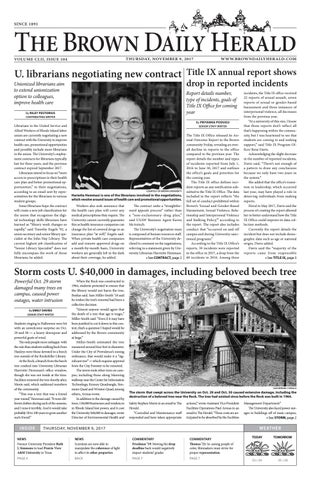
Hariette Hemmasi is one of the librarians involved in the negotiations, which revolve around issues of health care and promotional opportunities. Workers also seek assurance that the health care plan will cover any medical prescriptions they require. The University cannot currently guarantee this as health insurance companies can change the list of covered drugs in an insurance plan “at will,” Engels said. When private health care companies add and remove approved drugs on a month-by-month basis, University workers are generally left in the dark about their coverage, he added.
The contract seeks a “straightforward appeals process” rather than a “non-exclusionary drug plan,” said USAW Business Agent Karen McAninch. The University’s negotiation team is composed of human resources staff. Representatives of the University declined to comment on the negotiations, referring to a statement given by University Librarian Harriette Hemmasi. » See CONTRACT, page 2
The Title IX Office released its Annual Outcome Report to the Brown community Friday, revealing an overall decline in reports to the office compared to the previous year. The report details the number and types of incidents reported from July 1, 2016 to June 30, 2017 and outlines the office’s goals and priorities for the coming year. The Title IX office defines incident reports as any notification submitted to the Title IX Office. The data included in the report reflects “the full set of conduct prohibited within Brown’s ‘Sexual and Gender-Based Harassment, Sexual Violence, Relationship and Interpersonal Violence and Stalking Policy,’” according to the report. The report also includes conduct that “occurred on and off campus and during University-sanctioned programs.” According to the Title IX Office’s reports, 59 incidents were reported to the office in 2017, a drop from the 68 incidents in 2016. Among these
incidents, the Title IX office received 22 reports of sexual assault, seven reports of sexual or gender-based harassment and three instances of interpersonal violence, all decreases from the previous year. “At a university of this size, I know that those reports don’t reflect all that’s happening within the community, but I was heartened to see that students are coming in and seeking support,” said Title IX Program Officer Rene Davis. Acknowledging the slight decrease in the number of reported incidents, Davis said, “There’s not enough of a pattern to draw any conclusions because we only have two years in the system.” She added that the office’s transition in leadership, which occurred last year, may have played a role in deterring individuals from making reports. Hired in May 2017, Davis said the process of creating the report allowed her to better understand how the Title IX Office could improve its data collection methods. Currently the report details the incident but does not include demographic data such as age or national origin, Davis added. Davis said the “majority of the reports came from responsible » See TITLE IX, page 3
Storm costs U. $40,000 in damages, including beloved beech tree Powerful Oct. 29 storm damaged many trees on campus, caused power outages, water intrusion By EMILY DAVIES SENIOR STAFF WRITER
Students ringing in Halloween were hit with an unwelcome surprise on Oct. 29 and 30 — a heavy downpour and powerful gusts of wind. The only people more unhappy with the rain than students walking back from Hanleys were those devoted to a beech tree outside of the Rockefeller Library. At the Rock, a branch from the beech tree crashed into University Librarian Harriette Hemmasi’s office window, though she was not inside at the time. Facilities removed the tree shortly after, Morin said, which saddened members of the community. “This was a tree that was a friend year-round,” Hemmasi said. “It wore different clothes during each of the seasons, and I miss it terribly. And it would take probably 50 to 100 years to grow another such friend.”
INSIDE
When the Rock was constructed in 1964, students protested to ensure that the library would not harm the tree, Boylan said. Sam Miller-Smith ’18 said he wishes the tree’s removal had been a collective decision. “Almost anyone would agree that the death of a tree that age is tragic,” Miller-Smith said. “Even if it may have been justified to cut it down in this context, that’s a question I hoped would be addressed by the Brown community at large.” Miller-Smith estimated the tree measured around four feet in diameter. Under the City of Providence’s zoning ordinance, that would make it a “significant tree” — which requires approval from the City Forester to be removed. The storm took other trees on campus, including those along Manning walkway near the Center for Information Technology, Keeney Quadrangle, Simmons Quad and Wriston Quad, among others, Armas wrote. In addition to the damage caused by trees, 130,000 businesses and residences in Rhode Island lost power, and it cost the University $40,000 in damages, wrote Director of Environmental Health and
SAM BERUBE / HERALD
The storm that swept across the University on Oct. 29 and Oct. 30 caused extensive damage, including the destruction of a beloved tree near the Rock. The tree had existed since before the Rock was built in 1964. Safety Stephen Morin in an email to The Herald. “Custodial and Maintenance staff responded and have taken appropriate
actions,” wrote Assistant Vice President Facilities Operations Paul Armas in an email to The Herald. “These costs are anticipated to be absorbed by the Facilities
Management Department.” The University also faced power outages in buildings off of main campus, » See STORM, page 2
WEATHER
THURSDAY, NOVEMBER 9, 2017
NEWS Former University President Ruth J. Simmons to lead Prairie View A&M University in Texas
NEWS Scientists are now able to manipulate the coherence of light to affect its other properties
COMMENTARY Friedman ’19: Moving the drop deadline back would negatively impact students’ grades
COMMENTARY Thomas ’21: In casting people of color, filmmakers must strive for proper representation
PAGE 4
BACK
PAGE 7
PAGE 7
TODAY
TOMORROW
53 / 34
35 / 20
NEWS
PAGE 2 • THURSDAY, NOVEMBER 9, 2017
» STORM, from page 1 including 10 Park Lane, the Marston Boat House, Tockwotton Studio and the Haffenreffer properties in Bristol, Morin wrote. University buildings on the main campus kept their power thanks to the University’s campus power distribution, which operates underground. The University also received reports detailing water intrusion issues, Morin wrote. The University’s response to the weather-related damage comes from its Emergency Action Plan, which was developed in 2001 as an “all hazards plan that provides response and preparedness information,” Morin wrote. In case of a weather emergency, students should monitor local radio and television stations, as detailed by the Emergency Action Plan. The plan also dictates that if the weather intensifies, the Shelter-inPlace command may be applicable. The Emergency Action Plan works alongside the Hurricane Plan to provide planning information and procedures for weatherrelated incidents. The Hurricane Plan outlines processes that include ensuring all essential vehicles are “fully fueled, stocked and inspected” and encourages all students, faculty and staff to have a “Family Action Plan” in place outlining individual protocol before a storm strikes, Morin wrote. The plan also requires Brown Public Safety, Facilities Management, Dining Services and others to have current telephone numbers for emergency responders. In last week’s storm, Dining Services operated normally “while being aware of conditions and ready to implement their contingencies as needed,” Morin said.
THE BROWN DAILY HERALD
October crimes target U. employees October crimes included fraudulent checks, thefts of car tires, textbooks, personal belongings By BAYLOR KNOBLOCH SENIOR REPORTER
In addition to the typical scattering of personal larcenies — five bicycles, four laptops and three iPhones were stolen in October — the month’s crimes also targeted the University and its employees. Tuesday, Oct. 10, 8:02 a.m.: A University employee reported that a facilities van was broken into while parked at Lot 90, resulting in the theft of tools totaling $5,000 in value. Friday, Oct. 13, 4:03 p.m.: A University employee reported
» CONTRACT, from page 1 The University is committed to a contract “that strengthens professional relationships among staff, across various roles and departments within the Library and between management and staff,” Hemmasi wrote in an email to The Herald. “Our focus remains on productive conversations directly with union representatives,” wrote Director of News and Editorial Development Brian Clark. Engels said the University is
that a personal check — which was written to the Rockefeller Library Oct. 4 to purchase 52 books totaling $400 — was determined to be fraudulent. Sunday, Oct. 15, 3:26 p.m.: A University employee reported the theft of a “World Textiles” textbook, priced at $31.95, from the Brown Bookstore.t Tuesday, Oct. 18, 9:42 p.m.: A University employee reported that, while his vehicle was parked in the Richmond Street parking garage in the Jewelry District, someone stole the car’s four tires with rims, valued at approximately $4,000. Tuesday, Oct. 24, 11:11 a.m.: A University employee reported his Dell laptop, phone charger and USB cable stolen from his office at 3 Davol Square. Together, the items are valued at approximately $530.
pushing back on a few proposals that the union has offered, including the request for more professional development. The University is most strongly countering the proposal to offer optional union membership to “librarians and programmers who are not managers and do not do work that involves issues of confidential nature” and who are not currently affiliated with the USAW union, Engels said. Under a union, employees feel more comfortable offering solutions to issues in the libraries’ functions, and
BAYLOR KNOBLOCH / HERALD
library culture would benefit greatly if programmers and librarians felt that same comfort, he added. The University believes that “a majority of the non-union library staff would not vote for the union in an election,” but the proposed provision to opt into the union would “avoid an all-or-nothing decision, which would be less adversarial,” McAninch said. A librarian who is a not member of the union did not feel informed enough to comment on the proposal. Other librarians approached by The Herald declined to comment.
The union representatives are optimistic about the prospect of their new contract, and negotiations allow “the University and union to work together to stabilize employment, increase promotional opportunities and improve sense of community among library staff,” Engels said. Proposals in this cycle’s contract are fewer than in previous negotiations, which provides for a more concentrated focus on each individual issue, he added. The negotiation team does not have an official target date for the finalization of the contract, Engels said.
Find Post- magazine on Facebook!
THIS COULD BE YOU. To advertise your: business student group event in The Herald, visit bdhsales.com.
facebook.com/postmagazinebdh
NEWS
THURSDAY, NOVEMBER 9, 2017 • PAGE 3
THE BROWN DAILY HERALD
» TITLE IX, from page 1 employees,” such as Meiklejohns and Residential Peer Leaders. Reported incidents largely centered around undergraduates, but graduate students, faculty and guests on campus were also involved in a number of the reports, she added. While the Title IX Office received 59 incident reports this year, only 12 individuals pursued the University’s formal complaint process to hold “another member of the University community” responsible for their actions, according to the report. Formal complaints represented “peer-to-peer/ colleague-to-colleague concerns or student allegations against a faculty member or members of the teaching staff.” Not all reports result in formal complaints, as those who report an incident can choose whether or not to pursue a formal complaint. Of the 12 formal complaints, four dealt with sexual or gender-based harassment, three focused on relationship and interpersonal violence and five dealt with sexual assault. In the formal complaints that dealt with sexual assault, the University found no individuals responsible in the incidents, which Davis said is an “interesting statistic to pay attention to.” Laurel Bestock, associate professor of archeology and Egyptology and the chair of the Title IX Oversight and Advisory Board, said she was “a little surprised to see that none of the sexual assault hearings resulted in the finding of responsibility, but if
MATTHEW BROWNSWORD / HERALD
you look over two years (of data) it, in fact, balances out.” According to the 2015-16 Annual Outcome Report, the Title IX Office received six formal complaints of sexual assault, in which the University found two individuals responsible
following formal complaints. “We don’t want to see everybody being found responsible, that would just suggest a rigged process,” Bestock added. “It’s absolutely critical from our perspective that there’s a fair hearing process … and that
MATTHEW BROWNSWORD / HERALD
respondents are treated fairly.” Within the report, the Title IX Office identified increased clarity in Title IX policies, expanding Title IX training and broadening outreach as its three priorities for the coming year. Davis said these priorities “surfaced in a number of ways” from her job interviews and conversations with community members. The priorities “absolutely (connect) to prior (annual) reports, … and the recommendations of the sexual assault task force,” she added. Davis also said that she understood certain marginalized communities felt that the Title IX Office “isn’t a space for them” and noted that few male complainants came forward to report Title IX violations. Improving relationships with these groups is part of the office’s goal to broaden its outreach efforts, she said. In the instance of improving the office’s relationship with male students, Davis said adjusting Title IX programming to “focus on the complexity of gender” and how male students can be agents of change would be beneficial. “In the past, conversations on Title IX in (largely male spaces) focused on how to not harm and not necessarily
to think about (male students) as bystanders or potential individuals who can be harmed,” she added. Davis also said collaborating with student centers on campus plays a role in the Office of Title IX’s efforts to expand its outreach. “The complexity and the sophistication in which oppression happens (makes partnering) with colleagues very important,” Davis said, adding that her work with the directors of the Brown Center for Students of Color, the First Generation and Low Income Student Center and the LGBTQ Center allowed her to enter spaces to discuss the nuances of gender-based and sexual harassment through the lens of specific marginalized identities. Bestock said the Office of Title IX’s priorities for the coming year excited her. “The whole community attitude that (Davis) has with Title IX, that it’s more than just the process, … (is) a really positive thing.” “We’re in a time … where issues of this nature in America are very fraught and anxieties about them are not just natural but very reasonable,” Bestock said. “I’m continuously proud of my students, the University and (Davis) … for their continued commitment to make Brown an ever safer place for our students.”
NEWS
PAGE 4 • THURSDAY, NOVEMBER 9, 2017
THE BROWN DAILY HERALD
Former U. President appointed President of Prairie View A&M University Former U. president comes out of retirement to lead historically black university in Houston By SOPHIA GRACE CARTER CONTRIBUTING WRITER
Ruth Simmons made history in 2001 as the first African-American president of an Ivy League university, but she isn’t done yet. After stepping down from the University in 2012, she retired to her hometown of Houston. But that retirement was short-lived — Simmons has been appointed president of Prairie View A&M University. Named “America’s best college president” by Time magazine in 2001, the much-beloved Simmons instituted a number of ambitious initiatives during her 11-year tenure as president of Brown. While serving as Brown’s 18th president, Simmons notably started the Center for the Study of Slavery and Justice, established need-blind admission and introduced a $1.6 billon fundraising campaign. Simmons is “an extraordinary leader — a simultaneously thoughtful and forceful person who led from the front,” said Director of the Center for the Study of Slavery and Justice and Professor of Africana Studies Anthony Bogues. “She is guided by how can she make a lasting difference to an institution.” These lasting differences include
substantially growing the faculty, expanding the campus and increasing financial aid, similar goals to what Simmons hopes to accomplish at Prairie View. At first glance, Prairie View may seem vastly different from Brown: It is a historically black institution within the Texas A&M system, attracts mainly instate students and possesses a significantly smaller endowment than Brown. However, Simmons’ main goals — to “give students the benefit of working hard on their behalf, to identify strong faculty, to strengthen the curriculum and, of course, raise substantial funds for financial aid”— remain the same. Increasing financial aid is an especially important goal for Simmons, who wants to ensure that Prairie View “eliminates financial burdens for the stratum of our students that cannot afford education even in the state system (and) that we eliminate any impediment to even the neediest of families to come to a place like Prairie View,” she said. Simmons was first introduced to Prairie View as a teenager when she visited her older brother, who attended the school. After retiring to Houston, Simmons was asked by Prairie View to serve as its interim president and assumed the role July 1. Her initial interest in the short-term position was “really as a family member of people who had attended,” but she credits the students as her reason for taking on the full-time role of president, starting
GEORGE MILLER / HERALD
Former President Ruth J. Simmons is beloved for the contributions she made to the University during her tenure. She is coming out of her retirement to take on the role of president of Prairie View A&M University in Texas. February. “Students have always been my downfall. Students were my downfall at Brown and again at Prairie View. I couldn’t say no to helping these students; they are courageous, they are strong, they are striving and they are going to be successful. I just want to do everything I can to help them.” Simmons, who attended Dillard University, a historically black institution, has long maintained that historically black colleges and universities
play an important role in educating people of color, especially first-generation students. “I always felt that I did well at graduate school at Harvard and beyond because of my experience at Dillard,” Simmons said. Simmons said she views her return to Texas as a return to her roots. “I’m a hometown girl, and everyone has really acknowledged and appreciated my return. They appreciate the fact that I was up (East) with those hoitytoity schools, and I am willing to come
home and get right to work here, in the state system. It’s been wonderful to be back,” she said. Looking forward, “there is a reason she is considered one of the country’s all-time great college presidents. She has shown time and again that she knows how to not just lead but elevate universities,” said Chancellor of the Texas A&M University System John Sharp. “Guided by her previous experience, that is exactly what I expect her to do at Prairie View.”
UCS to reshape form for reports of discrimination, harassment
TIFFANY DING / HERALD
The Undergraduate Council of Students discussed the process of reporting discrimination and harassment at the University, with members saying the process lacked anonymity.
Members criticize form’s brevity, lack of details on reporting process, barriers from anonymity By EDUARD MUÑOZ-SUÑÉ SENIOR STAFF WRITER
The Undergraduate Council of Students brainstormed ways to improve a University complaint form for reports of discrimination and harassment in its weekly general body meeting Wednesday night. UCS President Chelse-Amoy Steele ’18 introduced the meeting’s topic, saying that the group would discuss “biasrelated reporting at Brown, what it currently looks like and what it could look like in the future.” Steele told general body members that she began working on improvements to the current form over the
summer and hopes to present an enhanced form to the appropriate administrators by the end of November. She aims to have a new form approved and distributed by the end of the semester, she said. There are several methods to report bias-related incidents — including those that fall under Title VI and Title IX violations — such as a discrimination and harassment complaint form found on the web page of the Office of Institutional Equity and Diversity. Steele described the form as “a onepage PDF document, where you have about two lines to share about the incident.” Though the form does only have two
lines for a summary of allegations, it also prompts students to “attach additional sheets as necessary.” Steele continued, “Obviously, that’s not even enough room on the document” or enough information about the reporting process. “There’s little information about how you can be anonymous, there’s little information with regards to ‘What would you like this process to entail in terms of outcome,’” she said. Steele has been in communication with administrators about ways to create a more “robust” reporting process, in addition to improving the re-entry process of students who have committed discriminatory actions that the University deemed to merit time away from campus. General body members then split
into three groups to discuss potential improvements to the University’s form. Students expressed concern about the lack of true anonymity offered by the form, since — in addition to asking for the name of the person filing the complaint — it must be submitted by email or dropped off in person. Steele showed general body members Cornell’s equivalent of the complaint form, which consists of an online platform that has almost 20 questions, extensive drop-down options and the opportunity to attach “supporting templates and documents,” which can include photos, emails or videos, according to the form. Students praised the form for its thoroughness. “The Cornell form was a lot better,” one general body member said. Students said that an improved form
should provide the option of full anonymity and include information about the response process and resources for students affected by the reported incident. Voting members also approved the Category I and Category III status for five student groups. UCS approved Nudity in the Upspace, the Brown Political Review and the Brown-RISD Advertising Department as Category I student groups and re-categorized Black Christian Ministries and the Society for Women Engineers as Category III student groups. Category I student groups have certain privileges, but do not receive any funding from the Undergraduate Finance Board, while Category III student groups have the same privileges, but also have baseline funding of $200 and access to supplemental funding from UFB.
TODAY
THURSDAY, NOVEMBER 9, 2017 • PAGE 5
THE BROWN DAILY HERALD
menu
beaut y in ambiguit y
SATELLITE DINING ANDREWS COMMONS
Pho Bar, Poke Bowl Pizza: Cheese, Barbeque Bam Bam, Meatball, Provolone, Rosemary JOSIAH’S
BLUE ROOM
Chicken Pot Pie Bowl, Thanksgiving Turkey Burger
Chicken Tikka Masala, Turkey Chili, Madras Vegetable Curry
DINING HALLS SHARPE REFECTORY LUNCH
DINNER
Cuban Sandwich, Paprika Roasted Potatoes, Cajun Fettuccine, Cookies
Hot Roast Beef Au Jus, Italian Chicken Parmesan, Veggie Pizza Cajun Apple Cake
VERNEY-WOOLLEY LUNCH
DINNER
Spicy Pepper Pulled Chicken, Pork Carnitas, Nachos, Rice Krispies Treats with M&M’s
BBQ Navy Pea Beans, Chicken Pesto Pasta, Grilled Chicken Parmesan, Cajun Apple Cake
sudoku
HUAYA OUYANG / HERALD
Queries* is an exhibition “about queerness and questioning,” according to the Facebook page for the event. The exhibit, which can be found in the second floor of the List Art Center, concludes today.
Q U O T E O F T H E D AY
“This was a tree that was a friend year-round. It wore different clothes during each of the seasons, and I miss it terribly. And it would take probably 50 to 100 years to
”
grow another such friend.
— Harriette Hemmasi, University Librarian
See storm on page 1.
crossword
calendar TODAY NOVEMBER MARCH
S
5
M
6
T
7
W
Th
F
S
1
2
3
4
8
9
10
11
Berkeley Law School 11:00 A.M. CareerLAB
Resources at Brown 12:00 P.M. J. Walter Wilson, 203
Undergraduate Lunch with Adaner Usmani 12:00 P.M. Off Campus Location
Back@Brown Support Group 12:00 P.M. J. Walter Wilson, 516
TOMORROW
12
13
14
15
16
17
18
19
20
21
22
23
24
25
26
27
28
29
30
31
EEB Brown Bag Seminar 12:00 P.M. Biomed Center, 202
CAAS Rounds 12:00 P.M. 121 South Main, 245
Mesa de Conversacion 12:00 P.M. Sharpe Refectory, 6
Music Now with Gloria Cheng 1:00 P.M. Orwig Music Building, 109
COMMENTARY PAGE 6 • THURSDAY, NOVEMBER 9, 2017
THE BROWN DAILY HERALD
P IA M I L E A F- PAT E L
Find us online! facebook.com/browndailyherald
browndailyherald.com
@the_herald
Location: 195 Angell St., Providence, R.I. www.browndailyherald.com
@browndailyherald
youtube.com/browndailyherald
Editorial Leadership
Sections
Multimedia & Production
Business
Editor-in-Chief Lauren Aratani
Arts & Culture Editors Ethel Renia Madison Rivlin
Design Editors Christy Leung Ameer Malik Jessica Yu Assistant: Eduard Muñoz-Suñé
General Managers Henry Ritter Ben Wesner
Managing Editors Matt Brownsword Rebecca Ellis Kate Talerico POST- MAGAZINE Editor Saanya Jain BLOGDAILYHERALD Editor Angelica Cotto
Metro Editor Gwen Everett News Editors Isabel Gensler Alex Skidmore Hattie Xu Science & Research Editor Elena Renken Sports Editors Ben Shumate Nicholas Wey COMMENTARY Opinions Editors Connor Cardoso Anuj Krishnamurthy Mili Mitra
Photo Editors Head: Marianna McMurdock Assistant: Lilly Nguyen Gus Reed Sara Runkel Anita Sheih Copy Desk Chief Abby Borges Multimedia Editor Roland High
Directors Sales: Erin Lueck Sales: Matilda Lynton Finance: Reena Zhan Strategy: William Nober Strategy: Caroline Ziegler Managers Sales: Michael Borello Sales: Elizabeth Doykan Sales: Shreya Raghunandan Collections: Ravi Betzig
Editorial contact: 401-351-3372 herald@browndailyherald.com
Business contact: 401-351-3260 gm@browndailyherald.com
Submissions: The Brown Daily Herald publishes submissions in the form of op-eds and letters to the editor. Op-eds are typically between 750 and 1000 words, though we will consider submissions between 500 and 1200 words. Letters to the editor should be around 250 words. While letters to the editor respond to an article or column that has appeared in The Herald, op-eds usually prompt new discussions on campus or frame new arguments about current discourse. All submissions to The Herald cannot have been previously published elsewhere (in print or online — including personal blogs and social media), and they must be exclusive to The Herald. Submissions must include no more than two individual authors. If there are more than two original authors, The Herald can acknowledge the authors in a statement at the end of the letter or op-ed, but the byline can only include up to two names. The Herald will not publish submissions authored by groups. The Herald does not publish anonymous submissions. If you feel your circumstances prevent you from submitting an op-ed or letter with your name, please email herald@browndailyherald.com to explain your situation. You can submit op-eds to opinions@browndailyherald.com and letters to letters@browndailyherald.com. When you email your submission, please include (1) your full name, (2) an evening or mobile phone number in case your submission is chosen for publication and (3) any affiliation with Brown University or any institution or organization relevant to the content of your submission. Please send in submissions at least 24 hours in advance of your desired publication date. The Herald only publishes submissions while it is in print. The Herald reserves the right to edit all submissions. If your piece is considered for publication, an editor will contact you to discuss potential changes to your submission. Commentary: The editorial is the majority opinion of the editorial page board of The Brown Daily Herald. The editorial viewpoint does not necessarily reflect the views of The Brown Daily Herald, Inc. Columns, letters and comics reflect the opinions of their authors only. Corrections: The Brown Daily Herald is committed to providing the Brown University community with the most accurate information possible. Corrections may be submitted up to seven calendar days after publication.
Illustrations Editor Pia Mileaf-Patel
Advertising: The Brown Daily Herald, Inc. reserves the right to accept or decline any advertisement at its discretion.
Graphics Editor Laura Felenstein
The Brown Daily Herald, Inc. is a financially independent, nonprofit media organization bringing you The Brown Daily Herald, BlogDailyHerald and Post- Magazine. The Brown Daily Herald has served the Brown University community daily since 1891. It is published Monday through Friday during the academic year, excluding vacations, once during Commencement and once during Orientation by The Brown Daily Herald, Inc. Single copy free for each member of the community. Subscription prices: $200 one year daily, $100 one semester daily.
Directors of Web Development Eli White Ivy Wong
Copyright 2017 by The Brown Daily Herald, Inc. All rights reserved. Periodicals postage paid at Providence, R.I. Postmaster: Please send corrections to P.O. Box 2538, Providence, RI 02906.
COMMENTARY THURSDAY, NOVEMBER 9, 2017 • PAGE 7
THE BROWN DAILY HERALD
Leave the drop deadline where it is ANDREW FRIEDMAN staff columnist On Oct. 16, the College Curriculum Council held a forum to discuss the possibility of moving the drop deadline forward for undergraduate students. Under the proposed motion, the deadline would shift from the week before finals period to the middle of the semester. While explaining the reasons for the shift, Dean of the College Maud Mandel claimed that many students drop classes near the end of the semester in a “grade management” strategy that operates against the ideals of the Open Curriculum. She also claimed that by implementing a drop date change, the CCC could prevent the “cascading negative impact” that culminates in students retaking dropped classes over the winter or summer at their own financial expense. These claims certainly make sense and are ostensibly well-intentioned: Why not save students the money and effort of retaking classes if it was that easy? Well, maybe because it’s not. Brown students should feel a little skeptical of such an obvious solution to an entrenched student quandary. In reality, the CCC’s decision is probably less benevolent than the reasons put forth at the forum suggest. The shift won’t just promote student interests
and preserve the integrity of the Open Curriculum, but will also counter a problem that has existed at Brown for decades: grade inflation. Grade inflation, the label given to the steady rise in average GPA over time, is the highest at Brown out of all the Ivy League schools. The CCC’s proposal could well change that. Dean Mandel bemoaned that 40 percent of all drops occur in the last two weeks of the semester; the CCC aims to convert these drops into C’s. Should this proposal pass, it would inevitably add
mize the number of C’s awarded. Lecturers will be especially prone to this because they are awarded promotions and contract renewals based on student evaluations. I highly doubt that students who expect to get C’s will give their professors glowing evaluations. As a result, students who happen to take a class with a tenured professor may be more likely to receive a C than students who take a class with a lecturer who is up for a contract renewal. Although this phenomenon might already occur on campus, the drop
dent’s perception of their performance and their actual grade in the class. This could push some students to take a class S/NC when they should have taken it for a grade, and vice versa. To eliminate the late drop as a recourse for this grading asymmetry would be incredibly unfair. If the drop deadline is moved up, students will likely be staring at blank Canvas pages, begging their TA’s for grades and making uneducated guesses about their performance right before the mid-semester deadline. I already beg my TA
The shift won’t just promote student interests and preserve the integrity of the Open Curriculum, but will also counter a problem that has existed at Brown for decades: grade inflation. more C’s to the overall grade count at Brown. Though this sounds like something to avoid, it would in fact be a public relations win for the University, as it would put Brown on par with the other Ivy League universities in terms of average GPA and grade inflation rates. But what the CCC has probably not considered are the negative consequences of the drop deadline change, such as the perverse incentives it would give to faculty and the unfair pressure on students. First of all, faculty members could respond to the change by simply adjusting their grading curve to mini-
deadline change certainly won’t help it — in fact, it might amplify it. Thus, the change could just recast the problem of grade manipulation at Brown into another, less obvious form. I should also point out that homework and midterm grades frequently arrive much later than expected. Since graduate student TAs are often underpaid and overworked to the point of unionization, they sometimes take weeks to grade undergraduate assignments: I have received homework grades as late as two weeks after the submission deadline. This leads to a pretty wide disconnect between a stu-
for enough. Why should I have to beg them for a homework grade? The proposed deadline would create unnecessary confusion and pressure for both students and TAs. With regard to the Open Curriculum, it’s pretty obvious that the drop deadline advancement will counteract its mission. Students, in an even more obvious attempt to avoid C’s, will avoid taking risky classes at all. This means that students will avoid expanding their skill sets in earnest by taking classes outside of their concentrations for a grade. And even within concentrations, students will elimi-
nate more difficult electives or course sequences from consideration for fear of getting caught with a C at the end of the semester. Altogether, the change will push students away from exploring and challenging themselves — the very core of the Open Curriculum. And last but not least, a drop deadline advancement will affect the community’s well-being by lowering grades and making students more stressed about receiving C’s. This is of particular concern at Brown because students are accustomed to grade inflation and generally expect higher grades because of the long-running trend. Moreover, this will force students who might otherwise drop the class in an effort to safeguard their mental health and focus on other classes to frantically study for finals in an attempt to avoid a C. In short, the University should not move its drop deadline forward because it will result in a host of unintended consequences that could undermine the University’s goals and place unnecessary pressures on students and TAs alike. Until issues such as the lecturer incentives system and the treatment of graduate student TAs are dealt with in their entirety, the CCC should take the drop deadline change out of consideration.
Andrew Friedman ’19 can be reached at andrew_friedman@brown.edu.
Diversity isn’t representation QUENTIN THOMAS staff columnist The importance of diversity on-screen and in Hollywood has been expressed countless times before. You might have noticed more people of color in movies recently or that more films about people of color have won awards. This can give the impression that representation has markedly improved. Yet, while actors and characters of color may be getting more screen time, we must remember that it’s not enough to simply throw in a “diverse” cast. Diversity doesn’t automatically equal representation, and producers need to understand why it’s important that their shows and movies include casts that are both diverse and representative. The way in which people are presented on screen has consequences for the real world. Thus, for Hollywood to be truly representative, more diverse casts are only the starting point. Effective representation means showing the complex and nuanced experiences of the people these characters represent. Media producers still have a long way to go in terms of portraying underrepresented characters as multidimensional and human. A multi-university study found that Asian-American/Pacific-Islander characters were generally pigeonholed into five different stereotypes, including the “dangerous villains” and fetishized Asian woman. To just include AAPI characters isn’t enough in the campaign for representation. “Diverse” characters need to be well thought out and developed in the same way white characters usually are. A good example of effective representation is the character Annalise Keat-
ing in ABC’s “How to Get Away with Murder.” Played by Viola Davis, Keating, a black woman, is one of the best lawyers out there. The experience of a successful black female lawyer is not often shown on primetime television, but that doesn’t mean successful black lawyers don’t exist. Highlighting this more nuanced experience is effective representation. However, characters of underrepresented backgrounds don’t always need to be models of perfection. In fact, Keating’s professional life is not even the most cru-
ple have severe consequences. The Jerry Springer Show, for example, often presents extreme images of black people for the sake of entertainment. While this may seem relatively harmless on the surface, using the struggles of black people for shock value is dangerous. Constantly showing dysfunctional black couples fight over paternity and custody further cements harmful stereotypes about black people. These “representations” are not meant to be taken seriously, but such depictions of black people can easi-
For Hollywood to be truly representative, more diverse casts are only the starting point. Effective representation means showing the complex and nuanced experiences of the people these characters represent.
cial part about her character. The show’s depiction of her flaws is what makes Keating truly representative: She’s human, capable of both success and error. As such, a representative character isn’t a flawless one. It would be unreasonable for a perfect character on any show to accurately represent anyone, regardless of identity, in the real world. A character with imperfections, however, is much closer to reality and much easier to identify with. The problems that come with pushing out half-baked and narrow representations of peo-
ly influence those who do not regularly interact with people of color. Viewers of the Jerry Springer Show might very well internalize the show’s stereotypical portrayals and believe them to be true. They might learn to believe that all black families are broken and that black people, in general, aren’t productive or deserving members of society. Conversely, fair and constructive depictions of underrepresented communities can yield tangible benefits for society. The ways in which people are depicted on screen impact the ways
they view themselves. A study co-authored by Nicole Martins of Indiana University found that children of color experienced lower self-esteem while watching television, and cited a lack of representation as a major cause. This highlights the importance of representative storytelling — if you don’t see yourself in all the media you consume, how can you learn to see yourself as a visible, valued member of society? Television shows need to do more to wrestle with this reality and make sure that their casts reflect their diverse audiences. The upside to effective representation is clear — it can reaffirm the value of individual identities and inspire people to pursue their full potential. A survey conducted earlier this year found that 37 percent of women reported feeling proud to be women after seeing female heroes in movies. The same survey also found that 67 percent of respondents agree that showing women in a wider array of professions — including engineering and technology — would inspire women to pursue those professions. For example, when you see Katherine Johnson, portrayed by Taraji P. Henson, calculate equations for NASA by hand in “Hidden Figures,” you start to believe you can do it, too. We must begin to think of representation as more than just putting a “diverse” cast on screen. When television shows are not representative — and are, instead, narrow and extreme — the consequences can be costly. But effective representation can help undo the harms of stereotypical portrayals, instill confidence in viewers of underrepresented backgrounds and inspire the next generation of black lawyers or female engineers.
Quentin Thomas ’21 can be reached at quentin_thomas@brown.edu.
NEWS THE BROWN DAILY HERALD
THURSDAY, NOVEMBER 9, 2017
Researchers achieve greater control over light coherence Using famous light, matter experiment, U. study finds property of light is alterable By LIYAAN MASKATI STAFF WRITER
University researchers recently demonstrated a method to significantly modify the spatial coherence of light. The results could offer more options for the manipulation of light in nanotechnology, and may even allow researchers to improve communication via lasers. One of the fundamental properties of light is coherence, which determines the color of light, how it propagates and how it scatters, said Taco Visser, professor of theoretical physics at Vrije Universiteit Amsterdam. The modulation of light coherence can therefore be conceptualized as a tool to tune its other properties, he explained. The coherence of light is typically measured by using Young’s famous double slit experiment, said Domenico Pacifici, associate professor of engineering and physics and co-author of the study. This experiment involves sending light through an opaque barrier with two slits and projecting it onto a screen on the other side. If the light hitting the barrier is coherent, the rays exiting the slits interfere with each other and produce strong, dark and bright bands — called intensity fringes — on the projection screen, Pacifici said. But if the light hitting the
SCIENCE & RESEARCH
barrier is incoherent, no intensity fringes will be produced. “The visibility of these fringes is a direct measure of the degree of coherence of the (light hitting the barrier) at the two slit locations,” he said. University researchers transformed Young’s double slit experiment into a mechanism to modulate the coherence of light. They replaced the opaque barrier in the original experiment with a thin metal film, so the light would interact with the electrons in the metal. Light hitting the slits in the metal film generated a special type of wave supported by oscillations of electrons within the metal, Pacifici said. The waves “propagate along the metal surface and move toward the other slit, where they mix with the (incoming) light vibration,” he said. As a result of this mixing, the incoherent light hitting the two slits becomes partially coherent, Pacifici said. This is on account of the surface plasmon waves, which act as a communication channel. Light exiting the slits is now coherent and can produce interference fringes, he added. By increasing the strength of the surface plasmon waves, the researchers achieved strong modulation of the coherence of incoming light. “We were able to turn totally incoherent light into highly coherent light, and vice versa,” Pacifici said. These findings lend themselves to a range of applications. One is space optical communication, which uses lasers to broadcast information through the atmosphere over long distances, said Greg Gbur, professor of physics and optical science at the University of North
COURTESY OF DONGFANG LI
Surface plasmons increase visibility of fringe patterns in Figure E, indicating greater light coherence, while their absence leaves less visible fringes in Figure B. Carolina at Charlotte. However, the atmosphere’s tendency to distort light has always been a problem. As a result, “the information gets scrambled if you try to transmit over a long distance,” he said. If you adjust the spatial coherence of light, you can reduce the amount that the atmosphere distorts the light, Gbur added. Modifying the coherence of light can
therefore be salient to the production of laser beams in these communications. The research is also relevant to nanotechnology: In many detectors working on a very small scale, light can be sent in different directions by altering its coherence, Visser said. The distinguishing feature of this study is undoubtedly the degree of
changes in light coherence that the researchers were able to achieve. The paper “demonstrates that you can get really large changes in coherence,” Gbur said. This is “something that wasn’t demonstrated before experimentally,” he added. “It certainly is a record,” Visser agreed.
Gov.’s chief of staff speaks about career path, achieving bipartisan objectives Brett P. Smiley speaks at U., discusses changing demographics in Rhode Island By LIORA MORHAYIM SENIOR STAFF WRITER
Brett P. Smiley, Gov. Gina Raimondo’s chief of staff, came to the University Monday to talk about his experience in politics, his responsibilities as chief of staff and bipartisanship in the Rhode Island State House. The event was organized by No Labels at Brown University, a student organization that promotes bipartisan cooperation on campus to solve local and national problems. Smiley began his speech by talking about his early career in politics, working on campaigns and in district offices in
Illinois and California before coming to Rhode Island. He said that he decided to come to Rhode Island in January 2006 to work for then Lt. Gov. Charlie Fogarty. “I like to say that I moved here for a ninemonth job 11 years ago and never left,” Smiley said. Once he got to Providence, Smiley put down roots: he started his own political fundraising business and founded the Consulting Group, LLC, a political consulting firm. He also ran for mayor of Providence briefly but dropped out to help Mayor Jorge Elorza win the bid. He went on to work for Elorza for two years. At this point in his career, Smiley
maintains an open mind when it comes to potential clients: as a gay man, he wouldn’t work for anyone who is homophobic or a bigot, he said, but other than that, he is open to working with anyone, and “everything is negotiable.” As the current Chief of Staff in the Raimondo administration, Smiley said he is responsible for balancing different political objectives, making difficult decisions on budgetary items and negotiating between a variety of stakeholders in the state. Moving forward, Smiley posed a couple of tips for what the Democratic Party needs to do in a post-2016 political climate. He posited that people prefer more authentic candidates who are not afraid of taking bold positions, adding
that this was an important reason for Trump’s success. Mayors and governors should be more involved in the party too, he said. When Smiley opened the room for questions, one student asked how to push local political officials into making the jump to national offices. In response, Smiley said that we have to convince local mayors and governors to run for federal positions, especially congress, because these local officials have a different approach to problem solving. This diversity of perspectives will benefit the federal government, he said. Another student at the event asked Smiley how the decline of unions in the state might impact voting patterns, particularly as historical political coalitions
built from them weaken. Smiley said other demographic changes, like the growth of Latino populations in the state, has affected voting patterns more than the decline of unions. Smiley criticized the congress in the Trump administration as ineffective. Federal disfunction affects Rhode Island on the state level, he said, citing health care as a sector that has been under considerable stress in the state due to national policy uncertainty. But there is hope for a bipartisan country, Smiley said, noting that, in spite of the high levels of national partisanship, Democrats and Republicans are working together on the opioid crisis, transportation infrastructure and power sector transformation.
STAY UP-TO-DATE. FOLLOW US ON FACEBOOK. FACEBOOK.COM/BROWNDAILYHERALD