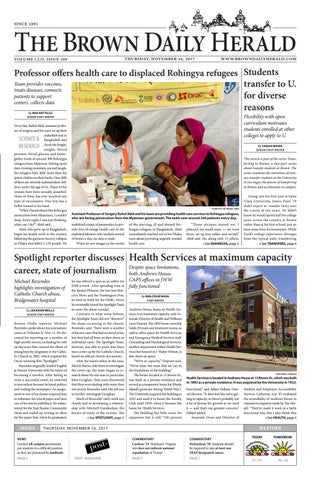
SINCE 1891
THE BROWN DAILY HERALD THURSDAY, NOVEMBER 16, 2017
VOLUME CLII, ISSUE 109
WWW.BROWNDAILYHERALD.COM
Professor offers health care to displaced Rohingya refugees Students Team provides vaccines, transfer to U. treats diseases, connects patients to support for diverse centers, collects data reasons By MIA PATTILLO
Flexibility with open curriculum motivates students enrolled at other colleges to apply to U.
SENIOR STAFF WRITER
Every day, Ruhul Abid, assistant professor of surgery, and his team set up their makeshift tent in Bangladesh and check the height, weight, blood pressure, blood glucose and hemoglobin levels of around 300 Rohingya refugees from Myanmar. Having spent days crossing mountain, sea and jungle, the refugees have little more than the sparse clothes on their backs. One-fifth of them are severely malnourished children under the age of six. Many of the women have been sexually assaulted. None of them has ever received any type of vaccination. One boy has a bullet wound in his head. “When I heard about (the Rohingya persecution from Myanmar), I couldn’t sleep. Every night, I was just thinking, what can I do?” Abid said. Abid, who grew up in Bangladesh, began his health work in the country following the garment-factory collapse in Dhaka that killed 1,129 people. He
SCIENCE & RESEARCH
By SARAH WANG SENIOR STAFF WRITER
This article is part of the series Transferring to Brown, a two-part series about transfer students at Brown. The series examines the narratives of various transfer students at the University in two stages: the process of transferring to Brown and acclimation to campus.
COURTESY OF RUHUL ABID
Assistant Professor of Surgery Ruhul Abid and his team are providing health care services to Rohingya refugees, who are facing persecution from the Myanmar government. The team sees around 300 patients every day. mobilized a team of paramedics to provide free-of-charge health care to the exploited laborers who worked around 10 hours a day, six days a week. When he saw images in the media
of the starving, ill and abused Rohingya refugees in Bangladesh, Abid immediately reached out to his Dhaka team about providing urgently needed health care.
“Those pictures moved me. I planned my small team — we went there, set up four tables and served,” Abid said. He, along with 15 others, » See ROHINGYA, page 3
Going into his first year at Santa Clara University, James Ford ’18 didn’t expect to transfer twice over the course of two years. He didn’t know he would spend half his college years across the country at Brown rather than at his first school, just an hour away from his hometown. While Ford’s college experience diverges from the typical path, transferring » See TRANSFERS, page 4
Spotlight reporter discusses Health Services at maximum capacity space limitations, career, state of journalism Despite both Andrews House, Michael Rezendes highlights investigation of Catholic Church abuse, Bridgewater hospital By JACKSON WELLS SENIOR STAFF WRITER
Boston Globe reporter Michael Rezendes spoke about his journalistic career at 70 Brown St. Nov. 15. He discussed his reporting on a number of high-profile stories, including his role on the team that covered the abuse of young boys by clergymen in the Catholic Church in 2002, which inspired the Oscar-winning film “Spotlight.” Rezendes originally studied English at Boston University with the intent of becoming a novelist. After failing to write a successful novel, he switched to journalism because he loved politics and reading the newspaper. An assignment in one of his classes required him to volunteer for a local paper and have one of his stories published. He volunteered for the East Boston Community News and ended up writing so often for the paper that, when he graduated,
INSIDE
he was offered a spot as an editor for $100 a week. After spending time at the Boston Phoenix, the San Jose Mercury News and the Washington Post, he went to work for the Globe, where he eventually joined the Spotlight Team to cover the abuse scandal. Contrary to what some believe, the Spotlight Team did not “discover” the abuse occurring in the church, Rezendes said. There were a number of known cases that had occurred prior, but they had all been written about as individual cases. The Spotlight Team, however, was able to prove that there was a cover-up by the Catholic Church, based on official church documents. After the team’s editor at the time, Martin Baron, told them to investigate the cover-up, the team began to research abuse by one man in particular, John Geoghan. They soon discovered that they were dealing with more than one priest, Rezendes said. His job was to further investigate Geoghan. Much of Rezendes’ early work was closely tied to developing a relationship with Mitchell Garabedian, the lawyer of many of the victims. The » See SPOTLIGHT, page 3
By MALCOLM NASH STAFF WRITER
Andrews House, home to Health Services, is at maximum capacity, said Associate Director of Health and Wellness Lynn Dupont. The 1892 home currently holds 20 exam and treatment rooms, as well as office space for Health Services and Emergency Medical Services staff. Counseling and Psychological Services, another department within Health Services but housed in J. Walter Wilson, is also short on space. “We’re at capacity,” Dupont said. “We’ve done the most that we can to the limitations of the building.” The house, located at 13 Brown St., was built as a private residence and served as a temporary home for Rhode Island’s governor during World War I. The University acquired the building in 1922 and used it to house the Faculty Club until 1939, when it became the home for Health Services. The building has little room for expansion but is still “100 percent
GUS REED / HERALD
Health Services is located in Andrews House at 13 Brown St., which was built in 1892 as a private residence. It was acquired by the University in 1922. functional,” said Adam Pallant, clinical director. “It does feel like we’re getting to capacity, so there’s probably not a lot of leeway for growth as we need it — and that’s my greatest concern,” Pallant added. Associate Dean and Director of
POST- MAGAZINE
Student and Employee Accessibility Services Catherine Axe ’87 evaluated the accessibility of Andrews House in response to inquiries made by The Herald. “They’ve made it work in a fairly functional way, but I also think that » See HEALTH, page 4
WEATHER
THURSDAY, NOVEMBER 16, 2017
NEWS Limited off-campus permissions put students in a difficult position as they are pressured by landlords PAGE 4
CAPS offices in JWW fully functional
COMMENTARY Cardoso ’19: Northam’s Virginia win does not indicate national repudiation of Trump
COMMENTARY Richardson ’20: Students should be required to take at least one DIAP-designated course
PAGE 7
PAGE 7
TODAY
TOMORROW
51 / 35
46 / 28
NEWS
PAGE 2 • THURSDAY, NOVEMBER 16, 2017
THE BROWN DAILY HERALD
Dried-up opportunities: Bartending students see varied success finding work Lack of registered parties on campus means fewer jobs for students certified by two-day BSA class By KATHERINE BENNETT STAFF WRITER
Brown students could be serving drinks before they can be served themselves: Within just two days, students can learn bartending through a Brown Student Agencies course offered five times per semester. While some students have found success in applying their new expertise, others have struggled to find bartending work. Students earn their Training for Intervention ProcedureS certification after completing the course, allowing them to work as a bartender for events on campus registered with the Student Activities Office as well as at private establishments. “It’s a hands-on training,” said Bob Hart, the class instructor and an advanced wine- and spirit-certified bartender. “In the class, we learn how to mix some popular drinks,” he said, adding that they use colored water in the course to practice mixing the cocktails. Michael Kearney ’20, who took the course last April, used his certification to work for Brown Catering Services during the 2017
ALEX WESTFALL / HERALD
commencement week and now works for a private catering service in Rhode Island. “It’s my primary source of income,” Kearney said. But other students have not seen as much success in finding employment. There were more on-campus work opportunities when the
program first began, said Kelsey Brown ’18, executive director of the BSA. Since then, there have been fewer registered parties on campus, with about 10 occurring last year, she added. “It’s hard to have bartenders if there are no events,” Brown said. “We do tell people that the TIPS
certificate is able to be used off campus, and that’s what we would encourage people to do” she said. “I do wish there was some way we could increase the number of opportunities, but until people feel more comfortable registering parties, there’s not a whole lot we can do to get people employed,” she added.
“We try our best to find on-campus jobs for students,” said Yutong Liu ’20, a campus services manager for the BSA. When jobs become available, they invite registered students, hiring on a first-come firstserve basis. “I unfortunately wasn’t able to get anything over the summer,” said Daniel Traver ’20, who also took the course in spring 2017. He bartended at a family event over the summer, but no on-campus opportunities have come his way. “I filled out the form last year to work at Brown at the bartending events, but I haven’t heard anything about it,” he added. Michael Gold ’20, who took the course in fall 2016, said that BSA has not been effective at connecting students with opportunities. BSA advertises the course “as an opportunity to work as a bartender for Brown,” but “since being on the listserv, I think I’ve seen about five e-mails with opportunities for students to work,” he said. Hart emphasized that the class is introductory and intended to expose students to bartending, giving them the skills to pursue work in a variety of venues. “It’s a really easily applicable certification,” Brown said. “This is a great opportunity for students to get certified — and to get certified at a price that’s much more reasonable than a lot of other organizations.”
The Brown Budget: Get Informed! Get Involved! The University Resources Committee (URC) needs your input. Plan to attend the open forum to learn about the process and share your ideas and insights.
Thursday, November 17 at 4pm Thursday, November 16 at 3pm Stephen Robert ’62 Campus Center University Hall, Room 318 nd Petteruti Lounge, 2
Floor
Provost Richard M. Locke will discuss the process for developing the University’s budget, sharing primary sources of revenue and spending, and outlining key decisions that need to be made to advance the University mission. Community input is essential to the process. For more information about the URC see the following link: http://www.brown.edu/about/administration/provost/universityresources-committee-urc
SCIENCE & RESEARCH THURSDAY, NOVEMBER 16, 2017 • PAGE 3
THE BROWN DAILY HERALD
Nanotwin structures reduce effects of stress on metals Study examines boundaries between mirrored crystals that make up metals By ARJUN GANGA STAFF WRITER
A recent University study published in Nature explored ways to prevent one of the most pertinent issues in engineering: material fatigue. In studies of specialized structures called nanotwins within metals, University researchers — led by Huajian Gao, professor of engineering — saw reduced strain effects of repeated stress on metals. Metal fatigue is a central topic of study in materials science, with applications ranging from building longer lasting airplanes and bridges to designing moving parts in smartphones and pacemakers. But studying the effects of stress on metal is very complex, said Haofei Zhou, a postdoctoral researcher working with Gao. “It is quite an important field, but very complicated because the stress and strain are always changing, so we can never predict the fatigue life of a metal.” The researchers delved into the complicated realm of materials science by observing experimental results from collaborators at the Chinese Academy of Sciences, who tested the effects of stress on copper samples with nanotwin boundaries. Metals are made out of small crystals that compose the “grains” of the material. Each of these crystals has a distinct orientation, and the areas between the crystals are called grain boundaries.
» ROHINGYA, from page 1 moved 8,000 miles across the world on Oct. 9 and set up two eight-member centers. Although their four tables were initially set up to check for simple problems, they often exposed larger health issues. “Once I looked down at this boy with a terrycloth tied around his head holding his medical card to get his height and weight checked. … I went ahead and took off the cloth and he had an infected bullet wound that went from the side of his eye to the back of his ear,” said Jane Carter, a doctor on Abid’s team. “I’ve seen babies 10 days old, whose mothers were giving birth while crossing the border,” Abid said. Because the Myanmar government stripped the Rohingya of their citizenship in 1992, none of the refugees has had any sort of polio, measles, HIV or tuberculosis vaccines. In fact, there is practically no record of the Rohingya existing at all. “We are finding records of all of these diseases. We are finding sexual assault victims who do not talk about their experiences until our female workers ask them in confidentiality. They are malnourished. The hygiene is horrible. Vaccine centers are overflowing. But we are trying to do everything we can to help,” Abid said. Abid’s team not only exposes these diseases and connects patients to treatments and support centers, but they have also created an electronic system that tracks every refugee they have seen
COURTESY OF HAOFEI ZHOU
Metals are composed of crystals with distinct orientations, and the spaces between the crystals are called grain boundaries. Those boundaries can be manipulated to make it more difficult to deform a metal and to prevent the movement of dislocations, said Huajian Gao, professor of engineering. “A nanotwin boundary means the crystals have mirror symmetry across the grain,” Gao said. Nanotwin boundaries are incrediblly dense — “on the nanometer scale, so you can think of twin boundaries as one of the perfect grain boundaries.” Boundaries are notable because they can prevent the movement of dislocations: areas that are sites of deformation. The movement of a dislocation is similar to a wrinkle moving through a carpet, Gao said. “When the wrinkle is moving, it propagates from one side to another and the carpet gets shifted a little bit,” which is “how metals deform,” Gao said. “Normally, the strength is low because it’s easy to propagate a wrinkle. But imagine you put a boundary that will make
the wrinkle harder to dislocate and move — this increases the strength of the material.” By creating nanotwins, Gao’s group aimed to stop the propagation of dislocations and increase the strength of the metal samples. “Copper’s strength is very low, but nanotwinning can make it more than ten times stronger,” Gao said. Zhou added that “after 10,000 stress cycles, we barely saw damage accumulation inside of the grain.” As with most scientific studies, however, conclusions and applications are limited in scope. David Nowell, professor of engineering science at the University of Oxford and editor of the Journal of Strain Analysis, commended the University’s study for its identification of unique “necklace”
dislocations and results, but said there was a gap between the conclusions and practical applications. “One doesn’t tend to use copper in any application where you want structural strength,” Nowell said. “But one needs studies like this to put the basic science in place for what might be 10 or 20 years down the track.” Atieh Moridi, a post-doctoral mechanical engineering research associate at the Massachusetts Institute of Technology, said the study holds promise and approaches an old problem in a new way. “There’s still a lot of room for further development to be able to upscale such a process and make it less dependent on the twinning orientation,” she said. Gao also mentioned the financial
and technical constraints associated with inducing metals with the nanotwin boundaries. But existing twinned materials such as Twinning-Induced Plasticity steel and certain alloys show “extraordinary properties” and have garnered interest from car manufacturers and the defense industry, he said. The failure of materials has been studied for over a century and is vital to increasing the longevity of items integral to modern life, but the progress of the complex field is very slow, Gao said. “Generally, we haven’t found an effective way of controlling fatigue,” he said. “I think that’s part of the reason why our work has been accepted by the journal Nature — it is a new idea in a very difficult, challenging field.”
so that they can follow up. “Every month, we’re seeing around 7,500 patients, and we have electronic medical records for all of them,” Abid said. His team is the first to create such a system, which relies on solar energy to generate electricity in the remote area. Each refugee patient receives a laminated barcode that can be scanned to follow up on previously received diagnoses or treatments. The collected health data is then sent to the United Nations Population Fund and the Ministry of Health in Bangladesh to provide the Bangladesh government with patient profiles and data on the health care received. Abid, who has briefly returned to America to improve the project’s systems, will go back to Bangladesh in two weeks to continue his work with the Rohingya until at least Dec. 31. The continuation of his work, however, depends on funds and donations. Currently, most of the funds that support him were found through the help of Brown’s Global Health Initiative, which “funds students for multidisciplinary global work and helps faculty members find the connections and funding they need to do their work,” said Susan CuUvin, director of the initiative. With over half a million refugees within an area less than one-fourth the size of Rhode Island, the makeshift camps are overflowing, Abid said. “These people are not going to go back to their homes anytime soon,” Abid said. “This is an international problem. It’s such a huge disaster. And we need to provide health care.”
» SPOTLIGHT, from page 1
focus of 10,000 pages of records. These papers allowed the team to write their stories, Rezendes said. These articles had an impact in a number of ways, including policy implementations to mandate reporting of suspected abuse to civil authorities. The most important part for Rezendes, however, was that his reporting allowed victims, who had been silenced for so long, to finally feel emboldened enough to come forward. Rezendes expected backlash to his story in Boston, a heavily Catholic city. Instead, the team saw widespread support from both Catholics and nonCatholics. Many called personally to congratulate the team. Rezendes also spoke about another story of his that had a significant impact. The team investigated the questionable conditions surrounding the death of Joshua Messier, a schizophrenic patient in Bridgewater State Hospital. It led to the revelation of
inhumane conditions at the hospital and the wide-scale cover-up that had taken place. After the story broke, the hospital was completely renovated. Previous prison guards were replaced by trained ones, and Bridgewater itself was rebuilt to more closely resemble a hospital rather than a prison, he said. Rezendes’ work “was a good example of the kind of impactful journalism that we’re at the risk of losing with resources being cut at papers,” Ellen Ling ’20 told The Herald. At the end of the talk, Rezendes expressed concerns about the current state of journalism. The proliferation of fake news compromises the integrity of democracy, he said. Credible news sources are suffering, leading to the inability of reporters to cover certain events. “I found Rezendes incredibly engaging and I thought he had a lot of helpful advice for aspiring journalists,” Isabelle Scott ’21 told The Herald.
Church had tried to have Garabedian disbarred three times for his work, which made him paranoid; as a result, it was not easy to build a relationship with him. Rezendes said the interviews with the families of the victims were like therapy sessions since they were extremely emotional, but his efforts made Garabedian see him as sincere and committed. Rezendes also had to develop relationships with the victims themselves. Often, he would begin by trying to establish common ground, such as talking about Boston. This made the victims comfortable enough to discuss the difficult topics. It was through Garabedian that the team got the court to refile the records on the church that had been cleaned out. Here, they found direct evidence of the church covering up the abuse, especially by Geoghan, who was the
STAY UP-TO-DATE. FOLLOW US ON FACEBOOK. FACEBOOK.COM/BROWNDAILYHERALD
NEWS
PAGE 4 • THURSDAY, NOVEMBER 16, 2017
THE BROWN DAILY HERALD
Students navigate off-campus housing policy
Students frustrated with lack of off-campus permission, often feel pressure to sign leases By CORAL MURPHY SENIOR STAFF WRITER
Two weeks ago, the Office of Residential Life closed its application period for students who wish to live off-campus for the 2018-19 academic year. Normally, off-campus permission is granted to seniors and some juniors, who receive permission through a lottery system, according to the Residential Life website. But according to some students living off campus, the application process was a hassle. The process of trying to coordinate a large housing group and find potential leases before the October application deadline “is stress-inducing,” said Julia Kiely ’20. “Frankly, it’s
» TRANSFERS, from page 1 is more common than people might expect. More than one third of undergraduate students transfer schools at least once, according to Inside Higher Ed. Brown typically welcomes 100-200 transfer students each school year, though that number varies. This year saw 151 students accepted, compared to 286 students for the 2015-16 academic year, according to Dean of Admission Logan Powell. The number of transfer students admitted each year depends on retention of current students and the number of students studying abroad, he said. Why transfer? Some students gradually come to the decision to transfer during their first years at college, whereas others know before even starting classes at an institution that they won’t be there for long. Zoe Zacharopoulos ’19 knew going into her first year at Arizona State University that she was going to transfer. The university of over 70,000 students felt like “an extension of high school,” and “it wasn’t a great fit,” she said. On the other hand, Brendan Sweeney ’21 had no intention to transfer when he arrived at Northeastern University. But after watching students leave for jobs through the university’s Cooperative Education Program, Sweeney realized that Northeastern lacked “a sense of community
»HEALTH, from page 1 they feel the limitations all the time,” Axe said. SEAS made several suggestions to improve accessibility, including making the self-registration structure more approachable for someone in a wheelchair. Regular renovations have kept Andrews House operational, including the addition of a larger, more accessible elevator last year. Before the installation, a renovated dumbwaiter shaft was used to move people between floors. Despite the limited space available, there are no immediate plans to relocate
inconvenient.” Many students looking to live off-campus face pressure from their landlords to sign leases before offcampus permissions are granted. As a result, some sign their leases before receiving notice from ResLife. Justin Champeau ’19, who currently lives off-campus, said he signed a lease for an off-campus residence without previously receiving permission to do so. Though he eventually received the confirmation, he said that he “jumped into this decision without even thinking of the potential administrative issues” because he felt that the mental health benefits of living off campus outweighed potential problems. “I do not think it’s fair that the University can set quotas on how many people live on campus and how many people live off campus,” he added. The application process is “logistically, very annoying,” said Ilan
Bigio ’20. The lottery system “feels like Brown is trying to dissuade you from applying to live off campus,” he added. Kate Tompkins, associate director of programs for ResLife, said that signing a lease before the date of confirmation to live off-campus does not guarantee a student permission. Some students may receive confirmation after a second wave of permissions or through an appeals process, but ResLife cannot make individual exceptions to that policy, she added. “There have been years where students legally lock themselves into a lease and are also responsible for living on campus,” Tompkins said. When deciding which students to grant off-campus permission to, Tompkins said the system to selectively allow students to live offcampus is a University policy. “That’s a much larger conversation that is much further outside of this office,” Tompkins said.
on campus.” This, coupled with the school’s “pre-professional focus,” spurred him to leave, he said. Over the course of her first year at the University of California at Los Angeles, Rachel Risoleo ’19 began to sense that the school might not be right for her. Risoleo found UCLA better suited for students who know what they’re passionate about, she said. “The way that students approached learning was difficult for me,” she added. “At the time, I had no idea what I wanted to do.” It wasn’t until the spring quarter of her first year that Risoleo decided to make the jump to transfer. “It was when I was trying to enroll for classes and I couldn’t get into anything and was completely unable to experiment at all” that she decided to transfer, she said. While Risoleo was frustrated with the class registration process, Will Friend ’20 took issue with not being able to pursue his desired concentration at the Washington University in St. Louis. Friend has an interest in conflict and conflict resolution, a concentration not offered by his previous university, and he “felt like it wasn’t encouraged to do an independent concentration.” “I was doing a compromise by doing international relations and a major in the business school,” Friend said. “At the end of the day, I didn’t want to compromise.”
“takes a lot of really good approaches to education,” Sweeney said. “The open curriculum, S/NC, having no pluses and minus in the grade … it encourages you to try things that you otherwise wouldn’t have tried.” And for some, transferring involves more than one transition. Ford originally attended Santa Clara University before transferring to a local community college, Cañada College. After being accepted to various universities, Ford ended up submitting his deposit to Pomona College with the intention of attending. But when he visited Brown, he felt something click. “I loved the feeling of campus,” Ford said. “It’s kind of a cliche, but when you know something’s right, you just know it’s right. That’s how I felt when I came to Brown.” The chance “to try something new” by attending a school outside of California was also a huge factor in his decision to choose Brown, Ford added.
Why Brown? Beyond the decision to transfer,
students face yet another choice: where to transfer. Brown’s open curriculum was an attractive trait for prospective transfers, according to multiple sources. Friend decided he would only transfer if he was accepted by Brown because at the University, “I could do exactly what I wanted to do” academically, he said. Risoleo also only considered Brown when choosing where to apply. For her, the University provided the opportunity to “take ownership of her education.” “The open curriculum and the approach that students here have to multiple disciplines and interdisciplinary learning was something that was so important to me,” Risoleo said. Brown’s transfer website “was super welcoming to transfers” and also had “a much more promising mentality.” However, when Risoleo was accepted, the decision to leave UCLA and attend Brown was still hard. Things had started to improve for her at her previous institution, but after talking with her friends and realizing she was “more excited about the prospect of starting something different at Brown than about returning to UCLA,” Risoleo knew transferring was the best choice for her. Other students apply to a large pool of schools. For Sweeney, the hard part of the process was not choosing whether or not to leave Northeastern, but rather which institution he should attend after transferring. Sweeney eventually chose Brown because it
Health Services, Dupont said. Health Services has made the most of the space available, said Staff Physician Marsha Miller, who has worked at Health Services for 20 years. “We’re just running out of space to house all the staff that work out of our building,” she added. Andrews “is a beautiful mansion that’s been retrofitted into a medical facility. There are things that have worked very well and things that have been very challenging,” Miller said. Facing a lack of space, members of the clinical staff are sometimes forced to share desks and office space. “We flex things around, so
a nurse practitioner might be in one space one day, but then they move to another space because that’s the only office left,” she said. But it can be “very hard on people not to have their own place, to have their reference books, to have their stuff. They have to move around the building,” Miller added. Despite Andrews House’s constraints, Pallant appreciates the charm of the building. Andrews House is “unique, and perhaps peculiar,” Pallant said. The space for CAPS in JWW is also at capacity. “We are at a point of being maxed out of space,” said Director of CAPS Will Meek. “Right now, we are
about one whole office short of what we need, so that is definitely an issue. Meek is working to “put Band-Aids on” the issue by being creative with space, though he does not view this as a longterm solution. Though CAPS is not currently limited by space constraints in the number of patients it can see or the staff it can hire, Meek believes that “in the near future, that could pose a significant problem.” Meek does not necessarily see the separate location of CAPS as a disadvantage. “We’re two very distinct services. These offices come out of different historical traditions, emerged on campus at
COURTESY OF JUSTIN CHAMPEAU
Many students face pressure from landlords to sign leases before the University grants off-campus permission.
Applying again Though the transfer application procedure is similar to first-year applications in many aspects — applicants submit a common application, transcripts and letters of recommendation — the process can be less stressful than completing first-year applications. When reading applications, admission officers still look for strong academic performance, community involvement and personal qualities,
but also hope to see what students have learned from their previous institution and their reasons for wanting to transfer, Powell said. The Office of Admission looks closely at “why, in particular, they want to come to Brown,” trying to determine “whether or not their reason for transferring makes sense with what we offer,” Powell said, The office also evaluates whether applicants will be able to study what they want in a timely manner. “We have to make sure when we admit them that they’re on track to graduate in four years,” Powell said. Risoleo saw a big difference in her approach to the application the second time around. She “didn’t spend a lot of time stressing” about the application process, she said. In addition, the first time she applied to colleges, she “wasn’t targeted at all in what (she) wanted to do,” Risoleo said. The application is less about getting to know students and more about seeing if Brown is the best place for them, she added. “The transfer application is really much more pragmatic. It’s much more straightforward,” she said. Julia Christensen ’18, who transferred from Macalester College in the spring of her sophomore year, also found the application process easier the second time around. “Once you’ve already done college, you can more concretely say in an application — ‘here’s what I experienced and now I know that I want this,’” Christensen said.
different times and have been separate offices for as long as they have existed at the University.” However, locating the two offices in the same building could be beneficial, Meek said. “When we think about treating the whole person, mental health and primary care and physical health care are part of the same umbrella in that collocating offices … makes sense.” Space constraints in University buildings are not limited to Health Services, Axe said. This is “one of those things that has increased campus-wide as we’ve increased our enrollment,” she added.
TODAY
THURSDAY, NOVEMBER 16, 2017 • PAGE 5
THE BROWN DAILY HERALD
menu
f r o z e n d e s s e r t s f o r f r o z e n w e at h e r
SATELLITE DINING ANDREWS COMMONS
Pizza: BBQ Bam Bam, Mary Jane, Spicy Five Cheese and Garlic JOSIAH’S
BLUE ROOM
Chicken Pot Pie Bowl, Quesadilla Station
Mango and Chicken Mint Curry, Aloo Saag
DINING HALLS SHARPE REFECTORY LUNCH
DINNER
Eggplant Parmesan Sub, Vegetarian Sandwich Bar, Cinnamon Toast Crunch Bars
Coconut Chicken Curry, Steamed Edamame, Yellow Cake with Coconut Frosting
VERNEY-WOOLLEY LUNCH
DINNER
BBQ Chicken Sandwich, Swiss Broccoli Pasta, Cinnamon Toast Crunch Bars
Pot Roast Jardiniere, Butternut Squash with Shallots, Pumpkin Pie
sudoku
MIKEALE CARRILLO / HERALD
Students often stop at food trucks on Waterman Street in between classes. Yesterday, the bright purple Like No Udder dairy-free ice cream truck offered free soft-serve cones, and students flocked to the unexpected dessert.
Q U O T E O F T H E D AY
“When I heard about (the Rohingya persecution RELEASE DATE– Thursday, March 8, 2012
from Myanmar), I couldn’t sleep. Every night I was just
Los Angeles Times Puzzle c r o sDaily s w oCrossword rd
thinking, what can I do?
Edited by Rich Norris and Joyce Nichols Lewis
ACROSS 1 Condiment often mixed with soy sauce 7 Cowboys-andIndians toys 14 Help, metaphorically 15 Scrape together 16 Bobby __: ’40s’50s adolescent girls 17 Teen dieter’s target, perhaps 18 “Stop right there!” 19 Classic pop 21 Start of a personal trainer’s motto 22 ASCAP competitor 24 Phrase from one who sees 27 __-wop music 28 Song of thanksgiving 30 Workaholic’s personality pattern 31 Talk on the street? 32 Zoom 33 Santa’s laughs 36 And the following, in a bibliog. 37 James Bond’s outfit 38 Given to gloom 40 Spot for a snooze 41 Asian soup noodle 43 Trump’s “The __ the Deal” 44 Vex supremely 46 Guggenheim Museum Bilbao architect 47 OPEC measure 50 Campfire treat 51 Dogfish Head product 52 Sought-after group 54 Courtroom cry 56 “That’s the spot!” 59 Watchman 62 Much-anticipated time 64 Like Little League World Series qualifying games 65 Dealer’s demand 66 One who decks the halls, say
67 Tachometer part
DOWN 1 Household chore 2 Healthy smoothie ingredient 3 2000 Ben Kingsley crime drama 4 __-appropriate 5 “Who shot J.R.?” e.g. 6 __ dixit: unfounded claim 7 Hosp. area for heart patients 8 Alsatian dadaist 9 People, for one 10 Male people 11 Needing nourishment 12 Marsh of mysteries 13 Squabble 15 Piquant sushi choice 20 Google success 23 Hair very apparent? 25 Zenith 26 Field for a fold 28 Infinitesimal division of a min. 29 Middle harmony part
33 Easily angered, or what the answers to 3-, 5-, 9- and 15-Down appear to be? 34 Stink 35 “Ghost Hunters” network 37 Dog in Kansas 39 Sports analyst Hershiser 42 River project 45 Mystery writer Josephine
”
47 Iraqi seaport 48 Go through the page 49 Techspeak, e.g. 53 Cup-a-Soup direction 55 Abba of Israel 57 Lug 58 Publicist’s job 60 L.A.-to-Helena dir. 61 Kernel holder 63 Merged comm. giant
— Ruhul Abid, assistant professor of surgery
See ROHINGYA on page 1.
ANSWER TO PREVIOUS PUZZLE:
xwordeditor@aol.com
calendar
03/08/12
TODAY NOVEMBER MARCH
S
5
M
6
T
7
W
Th
F
S
1
2
3
4
8
9
10
11
Perception and Action Seminar Series 12:00 P.M. Metcalf Research Building, 305
Ethical Inquiry Lunch 12:00 P.M. Salomon Center, 203
Brown Meditation Community Sit 4:00 P.M. Manning Chapel
Math Slam 4:00 P.M. 170 Hope Street, 408
TOMORROW
12
13
14
15
16
17
18
19
20
21
22
23
24
25
26 By Julian Lim (c)2012 Tribune Media Services, Inc.
03/08/12
27
28
29
30
31
Spring Student Gallery Lottery 12:00 P.M. LIST Art Building
Mesa de Conversacion 12:00 PM Sharpe Refectory, Dining Room 6
Music DUG Meeting 1:30 P.M. Orwig Music Building, 112
Piano Workshop 4:00 P.M. Grant Recital Hall
COMMENTARY PAGE 6 • THURSDAY, NOVEMBER 16, 2017
THE BROWN DAILY HERALD
P IA M I L E A F- PAT E L
comic Comic | Zachary Silberberg
Letters, please! letters@browndailyherald.com
Find us online! facebook.com/browndailyherald
browndailyherald.com
@the_herald
Location: 195 Angell St., Providence, R.I. www.browndailyherald.com
@browndailyherald
youtube.com/browndailyherald
Editorial Leadership
Sections
Multimedia & Production
Business
Editor-in-Chief Lauren Aratani
Arts & Culture Editors Ethel Renia Madison Rivlin
Design Editors Christy Leung Ameer Malik Jessica Yu Assistant: Eduard Muñoz-Suñé
General Managers Henry Ritter Ben Wesner
Managing Editors Matt Brownsword Rebecca Ellis Kate Talerico POST- MAGAZINE Editor Saanya Jain BLOGDAILYHERALD Editor Angelica Cotto
Metro Editor Gwen Everett News Editors Isabel Gensler Alex Skidmore Hattie Xu Science & Research Editor Elena Renken Sports Editors Ben Shumate Nicholas Wey COMMENTARY Opinions Editors Connor Cardoso Anuj Krishnamurthy Mili Mitra
Photo Editors Head: Marianna McMurdock Assistant: Lilly Nguyen Gus Reed Sara Runkel Anita Sheih Copy Desk Chief Abby Borges Multimedia Editor Roland High
Directors Sales: Erin Lueck Sales: Matilda Lynton Finance: Reena Zhan Strategy: William Nober Strategy: Caroline Ziegler Managers Sales: Michael Borello Sales: Elizabeth Doykan Sales: Shreya Raghunandan Collections: Ravi Betzig
Editorial contact: 401-351-3372 herald@browndailyherald.com
Business contact: 401-351-3260 gm@browndailyherald.com
Submissions: The Brown Daily Herald publishes submissions in the form of op-eds and letters to the editor. Op-eds are typically between 750 and 1000 words, though we will consider submissions between 500 and 1200 words. Letters to the editor should be around 250 words. While letters to the editor respond to an article or column that has appeared in The Herald, op-eds usually prompt new discussions on campus or frame new arguments about current discourse. All submissions to The Herald cannot have been previously published elsewhere (in print or online — including personal blogs and social media), and they must be exclusive to The Herald. Submissions must include no more than two individual authors. If there are more than two original authors, The Herald can acknowledge the authors in a statement at the end of the letter or op-ed, but the byline can only include up to two names. The Herald will not publish submissions authored by groups. The Herald does not publish anonymous submissions. If you feel your circumstances prevent you from submitting an op-ed or letter with your name, please email herald@browndailyherald.com to explain your situation. You can submit op-eds to opinions@browndailyherald.com and letters to letters@browndailyherald.com. When you email your submission, please include (1) your full name, (2) an evening or mobile phone number in case your submission is chosen for publication and (3) any affiliation with Brown University or any institution or organization relevant to the content of your submission. Please send in submissions at least 24 hours in advance of your desired publication date. The Herald only publishes submissions while it is in print. The Herald reserves the right to edit all submissions. If your piece is considered for publication, an editor will contact you to discuss potential changes to your submission. Commentary: The editorial is the majority opinion of the editorial page board of The Brown Daily Herald. The editorial viewpoint does not necessarily reflect the views of The Brown Daily Herald, Inc. Columns, letters and comics reflect the opinions of their authors only. Corrections: The Brown Daily Herald is committed to providing the Brown University community with the most accurate information possible. Corrections may be submitted up to seven calendar days after publication.
Illustrations Editor Pia Mileaf-Patel
Advertising: The Brown Daily Herald, Inc. reserves the right to accept or decline any advertisement at its discretion.
Graphics Editor Laura Felenstein
The Brown Daily Herald, Inc. is a financially independent, nonprofit media organization bringing you The Brown Daily Herald, BlogDailyHerald and Post- Magazine. The Brown Daily Herald has served the Brown University community daily since 1891. It is published Monday through Friday during the academic year, excluding vacations, once during Commencement and once during Orientation by The Brown Daily Herald, Inc. Single copy free for each member of the community. Subscription prices: $200 one year daily, $100 one semester daily.
Directors of Web Development Eli White Ivy Wong
Copyright 2017 by The Brown Daily Herald, Inc. All rights reserved. Periodicals postage paid at Providence, R.I. Postmaster: Please send corrections to P.O. Box 2538, Providence, RI 02906.
COMMENTARY THURSDAY, NOVEMBER 16, 2017 • PAGE 7
THE BROWN DAILY HERALD
Why Brown should require DIAP courses RANDI RICHARDSON staff columnist A year and a half ago, President Christina Paxson P’19 released the University’s landmark Diversity and Inclusion Action Plan. The plan has six designated categories: people, academic excellence, curriculum, community, knowledge and accountability. The University has demonstrated commitment to several of these areas. It has actively tried to recruit a diverse group of faculty and graduate students, supported a range of campus life centers including the Brown Center for Students of Color and the First Generation College and Low-Income Student Center and published regular progress reports to hold itself accountable. But less attention has been paid to two categories that are especially relevant to the student learning experience — academic excellence and curriculum. These two categories specifically aim to introduce inclusive, socially aware and diverse ideas into our academic discourse. By extension, it seems only fitting for the DIAP to also require all undergraduate students to take at least one race, gender and sexuality, inequality or social justice-related course during their four years at Brown. This requirement would build on the potential of the DIAP by not only reaffirming the importance of diversity in the community, but also
prioritizing diverse perspectives in academia. Currently, Brown has Diverse Perspectives in Liberal Learning courses that aim to “expose and critique the diverse historical and cultural forces that shape the construction of knowledge in all disciplines.” These courses are searchable via Courses@Brown under the acronym “DPLL.” However, by next fall, this will be replaced with a new searchable acronym: “DIAP.” Even though these courses are labeled and easy to find online, the designation itself doesn’t ensure that stu-
time and long thereafter, and does not place undue importance on grades or other markers of achievement. DIAP courses fit into this model because they provide us with knowledge that is not only useful to our academic growth, but also to our ongoing engagement with the world around us. Thus, a requirement for all students to take at least one DIAP-designated course would allow Brown to promote diverse thinking among all of its future graduates, instead of only the select few who opt in to these courses voluntarily.
fused to unequivocally denounce the neo-Nazi groups that wreaked havoc on Charlottesville in August, it is imperative that all students emerge from Brown as informed, ethical citizens and voters. Ensuring that they engage, at least once, with the type of material covered in DIAP courses is one way to further this end. One obvious concern with any curricular requirement at Brown is that it infringes on the Open Curriculum. Yes, this openness is important because it allows students the flexibility to take a broad range of
I applaud the University for undertaking an ambitious plan toward diversity and inclusion — but a simple curricular change would make it more effective and possibly serve as a template for other universities to follow. dents who arguably need to take the courses most — students who have not had access to these conversations and modes of thought before coming to Brown — actually do so. This is precisely where a DIAP-mandated course requirement could help. Brown has been historically considered a liberal institution that allows students to craft our degrees in ways that suit us best — something we don’t see in many other universities. It strives to place more value on the process of learning during class
Plus, it’s more important than ever that students understand how to maneuver the complex maze that is the current political climate. Educating students on the reality around us — say, the gender pay gap or the racial disparities in arrests and sentencing — will position them to be more informed and better able to conduct themselves in a rapidly changing and liberalizing world. In our polarized political moment, when a sitting president has been caught on tape bragging about sexual assault and has re-
courses within and outside of their disciplines while remaining on track to graduate. But the DIAP graduation requirement would work in a similar way to the already existing writing requirement, which does not undercut the integrity of the Open Curriculum. The writing requirement was mandated because the ability to write was seen as a basic life skill — but so is understanding the social context around us. If anything, undervaluing this critical life skill would be a disservice to students, who will need this
knowledge moving forward. And, unlike the writing requirement, a DIAP requirement could be just one course over eight semesters, which isn’t asking very much. And considering that diversity and inclusion are of the utmost importance across all disciplines, it will be easy for the computer scientist, art historian and physicist alike to find DIAP courses that intersect with their academic interests. I applaud the University for undertaking an ambitious plan toward diversity and inclusion — but a simple curricular change would make it more effective and possibly serve as a template for other universities to follow. Simply allowing DIAP courses to be searchable via Courses@Brown is not enough; if students are not obligated to look for them, labeling courses as “DIAP” adds virtually nothing to the inclusion and awareness that the University seeks to promote with the designation. With all due respect to what is, in essence, a strong and thoughtful plan for the University to engage with diversity, the longevity and productivity of the current DIAP pale in comparison to what they could be. The five-year plan is a great start, but its mission of diversity and inclusion can live on for decades more if each future graduate is required to take a DIAP course to graduate.
Randi Richardson ’20 can be reached at randi_richardson@brown.edu.
Democrats, don’t let Virginia get your hopes up CONNOR CARDOSO opinions editor Last Tuesday, the Democratic gubernatorial candidate in Virginia, Ralph Northam, raced to victory by a healthy margin. This result was not particularly surprising: Though his opponent, Ed Gillespie, mounted an unexpected comeback in the final weeks of the campaign, Virginians have increasingly voted for Democratic candidates in statewide elections. Virginia currently has a Democratic governor and two Democratic senators, and in 2016, Hillary Clinton took the state by a solid margin of five percentage points. But you wouldn’t be able to tell just how predictable this outcome was based on the immediate reactions to Northam’s victory. “The American suburbs appear to be in revolt against President Trump,” New York Times reporters Alexander Burns and Jonathan Martin proclaimed. “The GOP should be scared by Virginia,” wrote New York Times columnist Frank Bruni. In the days following the election, there was no paucity of observers predicting that Trumpism was in full retreat. Yet this claim was based on nothing more than several Democratic wins — including the elections of Danica Roem and Chris Hurst — in this already Democratic-leaning state. In fact, the results are not necessarily the national repudiation of Trump that liberals hope to see. It is entirely possible the election results in Virginia merely reflect the shifting demographics and urbanization of the state. While Northam won the cities and their suburbs by remarkable margins, he was decimated outside of the me-
tropolises by margins larger than those of his predecessor, Democrat Gov. Terry McAuliffe, in 2013. It is also important to note that Gillespie gained significant ground in polls after he embraced the rhetoric of the Trump administration — not exactly a unequivocal rejection of the president’s views on the part of Virginian voters. The fact that these points were largely missing from the discourse surrounding the race is indicative of a larger problem in many liberal circles. The issue, particularly for Democrats, is that our discourse on national politics has be-
article entitled “The Georgia Special Election Is Make-Or-Break For Democrats.” This article, and others like it, implied that a loss for Democratic candidate Jon Ossoff would be a sign that Trump’s policies were resonating with voters nationwide. This race solicited the most donations of any House race in history; clearly, party leaders and voters in other states felt that victory in one small, non-competitive district in Georgia was essential to their success in future elections. But it wasn’t. In fact, Ossoff did lose — and this is no real predictor of the Democratic Party’s elec-
It is important that our political dialogue be more than just narrow, wishful thinking that could misinform voters and warp electoral outcomes.
come increasingly reductive, as each election is treated as a definitive referendum on Trump and his appeal. This phenomenon is not limited to just Virginia. Take, for instance, the national attention given to the Georgia special election for former Secretary of Health and Human Services Tom Price’s old seat in the House of Representatives in June. Democratic party leaders, media outlets and voters alike treated the race as a measure of public attitudes toward Trump. For example, before the election, the Huffington Post ran an
toral prospects in 2018. Ossoff was a weak candidate running for a seat that Democrats had not won in decades. A rational and measured analysis of the race would conclude that Ossoff was a long shot, not that his defeat reflects national acceptance of Trump. This knee-jerk reaction — treating each election as a stand-alone litmus test for Trump’s popularity without paying any attention to context or other factors — has come to dominate our political discourse. It is important that our political dialogue be more than just narrow, wishful thinking that
could misinform voters and warp electoral outcomes. Such an approach to political analysis turns almost any Republican defeat into a shock and almost any Democratic victory into a decisive disavowal of the other side. This is dangerous for Democratic hopes in 2018 because it may lure voters into complacency and consequently depress voter turnout — especially if voters take recent Democratic wins as a signal that Democrats are sure to succeed in 2018, and they decide not to engage in the electoral process. In reality, this belies some very serious structural disadvantages that Democrats face. Rampant gerrymandering has made certain seats in the House practically unattainable for liberal candidates. Democrats are not winning among educated suburban voters by the margins necessary to reclaim the competitive seats they would need to retake the House. And Democrats are defending 25 of 33 seats in the Senate, 10 of which are in states won by Trump. Yet if the dominant narrative continues to suggest that Trumpism is dead and that Democrats are on the path to glorious triumph, then voters may be less inclined to turn out. This mentality is exactly the opposite of what Democrats need from citizens to succeed in 2018. Of course, some complex and informative dialogue still exists. But at a time when the basic precepts of politics are in question and the forces that motivated Trump voters in 2016 remain unclear, our political dialogue needs careful and nuanced analyses, not facile prophesying.
Connor Cardoso ’19 can be reached at connor_cardoso@brown.edu.
THE STEPHEN A.
OGDEN
JR.’60
95th M e m o r i a l L e c t u re o n I n t e r n a t i o n a l A f f a i r s
HIS EXCELLENCY
FERNANDO HENRIQUE CARDOSO
PRESIDENT OF BRAZIL (1995-2002)
Democracy and Corruption in Brazil and Latin America Today THURSDAY, NOVEMBER 16, 2017 4 p.m. JOHN CARTER BROWN LIBRARY
This event is free and open to the public Doors open at 3:30 p.m. Reception to follow
For more information please visit www.brown.edu/ogden To request special services, accommodations or assistance for this event, « i>Ãi V Ì>VÌ Ì i 1 ÛiÀà ÌÞ Ûi Ì E viÀi Vi -iÀÛ Vià "vwVi >Ì universityevents@brown.edu or 401-863-3100