
THE BROWN DAILY HER ALD
Brown vs. Harvard over the years
14 years.
BY CIARA MEYER, IAN RITTER & CALEB ELLENBERG WITH LYDELL DYER
On Saturday, the Brown football team will travel to Harvard Stadium, seeking their first road win against Harvard this century. As Brunonians head north on the commuter rail or I-95 to follow the Bears to Boston, they might wonder how Brown has historically per formed in this storied matchup. The an swer? Poorly.
Bears stunned the Crimson, stealing a game-win ning touch down in the final 30 seconds of the game to clinch their first victory against Harvard in
This Saturday, they’ll attempt to secure their first back-to-back win in 26 years, and after last weekend’s massacre against Georgetown, there’s reason for hope. During the Bears’ season-opening 46-0 shutout against the Hoyas, Brown flexed an electric offense and suffocating defense. It was the Bears’ largest margin of victory since 1949, and the 18th-largest margin of victory in the history of Bruno football.
was not Harvard, but Dartmouth, according to Brown Athletics Archivist Peter Mackie ’59. “Brown and Dartmouth were not big enough or powerful enough to compete with Harvard and Yale, so they created their own rivalry which was really, really intense,” Mackie said.

So after a historically strong first game of the season, the Bears will try to turn the page to a new age of competitive football this Saturday at 6 p.m. But with decades of dominance in their back pocket, the Crimson have other plans. Will Brown keep the momentum going, or was last year’s win just a fluke? It all relies on Head Coach James Perry ’00 and his seemingly revamped football
The storied Brown-Harvard rivalry is, admittedly, one-sided. As Perry told The Herald, Harvard’s “rival is Yale.”
But this unilateral dynamic opens up an opportunity for Brown to “play this game on our terms,” Perry said. “We love it. And if they don’t view it the exact same way, that’s fine.”


Below is an in-depth breakdown of the entire history of the Brown–Harvard rivalry, from 1893 to the present. 1893: In their first-ever game against Harvard, the Brown football team lost by a historic margin of 58 points while failing to put up any points of their own.
The Bears’ first rival
But at the same time, the games between Harvard and Brown continued in 1894 with two face-offs that year — the only time the two teams have faced off twice in one regular season. The first game that year saw Bruno’s first touchdown against the Crimson after a 60yard run by quarterback William Hopkins, class of 1897. But Brown still lost the game 4-18. At the time, touchdowns had different point allowances.
The second game of the year was highly anticipated by students. “All the team are anxious to meet Harvard again and will undoubtedly play a game which will not in any way lower Brown’s reputation on the football field,” The Herald wrote prior to the game.
Despite high hopes, Brown lost to the Crimson yet again. A Herald contributor complained of the referee’s decisions, writing that “his most conspicuous unfair decisions were made when Harvard was most in need of them” and “even the most enthusiastic Harvard supporters exchanged knowing looks.”
From 1893 to 1913, Bruno suffered 21 consecutive losses to the Crimson. No game was played between the two schools in 1904, when Harvard’s manager said Brown’s team was too strong to “play late in the season,” The Herald reported. Bruno had suffered a harrowing 0-29 loss to the Crimson the year before.
In 1914, Bruno finally broke their losing streak — albeit with a tie. But the

feet time and again, and it may be said with truth that without Pollard the final score would have been decidedly different.”
According to Mackie, Harvard used to claim that they played their second string against Brown in the early 1900s games.
“That was an issue that really rankled Brown because it had signaled they really didn’t respect us,” Mackie said.
In 1917, World War I began to impact Brown football, Mackie said. No
A 30-acre athletic complex was constructed in addition to the stadium, Mackie noted. These improved facilities “put Brown on the athletic map.”
In 1926, Brown had its only undefeated season — led by the “Brown Iron Men,” a group that earned its name by playing consecutive games against Yale and Dartmouth without any substitu-
Individual detained by masked federal agents on College Hill
The incident occurred Tuesday morning on Benefit Street
BY ANNIKA SINGH METRO EDITOR
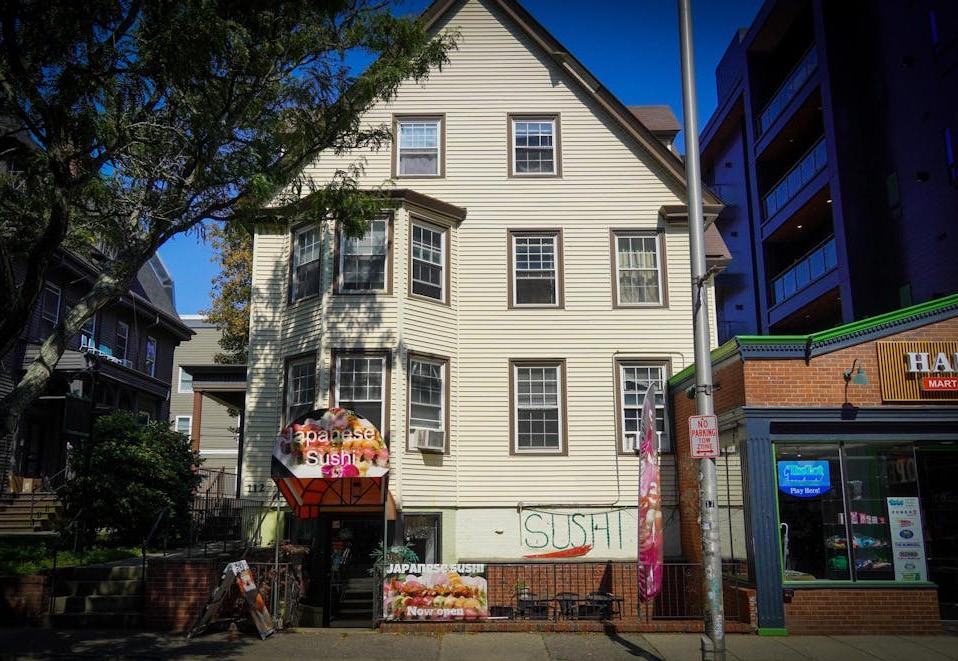
On Tuesday morning, masked federal agents detained an individual outside the Rhode Island Superior Court on Benefit Street, according to a video of the incident reviewed by The Herald.
The seizure comes after several months of increased federal immigration enforcement in the state, which began at the start of President Trump’s second term in January.
The detained individual is a Rhode Island man, but not a student at Brown nor the Rhode Island School of Design,
claimed Etta Robb ’26, an organizer with the Defense Line Against Deportation and Police Brutality. Defense Line is coordinated by the Alliance to Mobilize Our Resistance, or AMOR — an organization that provides legal support to families of detained individuals.
Robb claimed that the man was detained by U.S. Immigration and Customs Enforcement agents while he was with his son. Defense Line declined to share further information about the detained man. The detainment came one day after Mayor Brett Smiley signed an executive order affirming that the Providence Police Department would not proactively collaborate with ICE or other federal immigration agencies. The order, titled “A

UNIVERSITY NEWS
University to lay off 48 employees, eliminate 55 unfilled positions
Plan aims to meet University’s goal of filling a $15 million budget reduction
BY HADLEY CARR UNIVERSITY NEWS EDITOR
Starting this week, the University will notify 48 employees that they will be laid off, University officials wrote in a Monday morning Today@Brown announcement.
The move is part of the University’s efforts to reach $15 million in reductions, which will also include the elimination of 55 previously budgeted, unfilled positions, a more aggressive reduction in operating costs and an end to the University-wide hiring freeze.
It remains unclear which departments will be hit by the layoffs. “The imple-
mentation of these measures will take place across a range of academic and administrative departments and offices on campus,” University Spokesperson Brian Clark wrote in an email to The Herald.
The University plans to provide support to impacted employees, including severance packages and outplacement services, wrote President Christina Paxson P’19 P’MD’20, Provost Francis Doyle and Executive Vice President for Finance and Administration Sarah Latham in the announcement.
Brown plans to eliminate five administrative positions across 16 of the smallest academic departments, The Herald previously reported. The financial measures came in response to a multi-million dollar
LILA QUINN / HERALD
FACULTY
Brown welcomes 38 new faculty members to College Hill
Fields of study span from Southeast Asian history to chemical engineering
BY ANA NEILL CONTRIBUTING WRITER
From an expert on Southeast Asian food to an engineer researching sustainable fuel, Brown welcomed 38 new faculty members across a variety of fields this fall. These professors will teach courses in a wide variety of subject areas, ranging from anthropology to mathematics, with several jointly appointed in multiple academic departments.
After nearly one month into the semester, The Herald spoke to five new professors about their work and how they have settled down on College Hill.
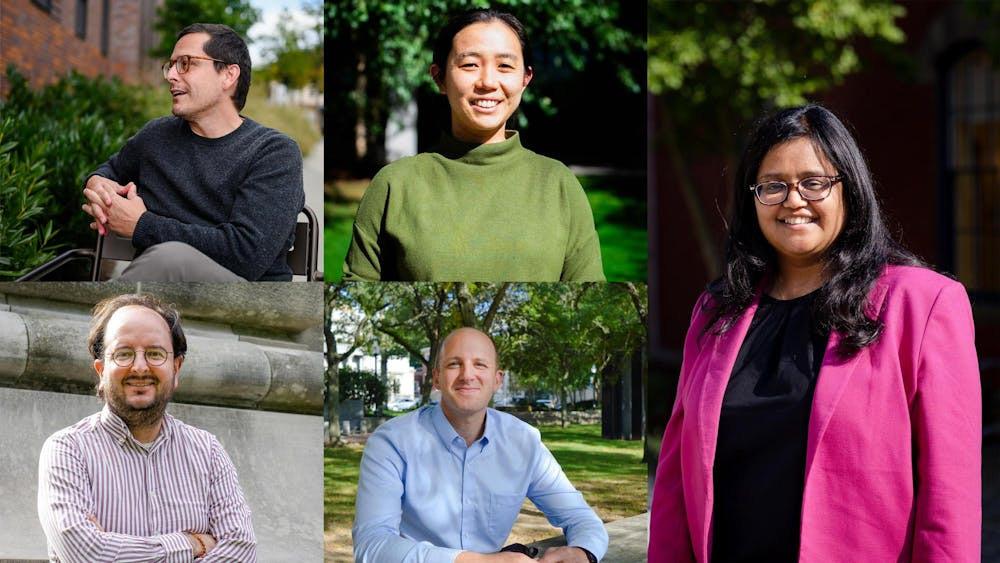
Anthony Medrano, assistant professor of history
After teaching at the National University of Singapore and Yale-NUS College, Assistant Professor of History Anthony Medrano is bringing his love of cuisine to Brown.
Medrano’s research interests focus on Southeast Asian history, with an emphasis on human-environment interactions and the circulation of local knowledge. His interest in Southeast Asia stemmed from his childhood in the Bay Area, where he was exposed to a variety of different cuisines and cultures. This semester, he is teaching HIST 1962G: “Southeast Asian Food History.”
Food, Medrano said, was a way to “introduce students to a region that’s very diverse and very dynamic.” He pointed to some of the “iconic dishes” of the region, saying that studying food was a “good gateway … to connect with students.”
Medrano also said recipes can “carry all kinds of emotion and history across generations,” particularly in the context of migration. He said he was especially interested in “the human story” behind recipes.
Various aspects of society — from the environment to the economy — can be connected back to food, Medrano added. Throughout the semester, his class will embark on a number of field trips, including an excursion to Brown’s greenhouse to learn about Southeast Asian plants.
Medrano’s time at Brown has been “fabulous,” he told The Herald. In addition to his appointment in the history department, Medrano is also an affiliated faculty member in Brown’s Science, Technology and Society program.
LAYOFFS FROM PAGE 1
budget deficit and the ever-persistent threat of federal funding cuts.
It is unclear whether these five employees' positions are among the 48 affected positions announced in the Monday Today@Brown announcement.
In an August announcement, Paxson wrote that Brown is anticipating layoffs and further cost cutting measures to address the projected $30 million financial loss. To address the loss, the University proposed splitting reduction measures between “central University actions” and departmental actions, with the goal of decreasing the budgetary needs by $15 million.
Paxson outlined a variety of central University actions to address the remaining $15 million loss. These plans
He said Brown is both intellectually and culturally rewarding. “There’s so many different kinds of scholars here that work on lots of different parts of the world, and I just find that all so inspiring,” Medrano said.
Felipe Valencia ’06 MA’11, assistant professor of economics and political economy
After receiving his undergraduate degree from Brown nearly two decades ago, Felipe Valencia ’06 MA ’11 returned to College Hill this fall as an assistant professor of economics and political economy.
As an undergraduate, Valencia studied mathematics-economics and international relations. Now, his research focuses on “studies of persistence” in economic history, which he explained as how “events in the past still affect us today.” His scholarship has spanned continents, focusing on the legacies of conflicts in Paraguay, Laos and Ukraine.
This semester, Valencia is teaching ECON 1690: “Latin American Economic History,” which focuses on the effects of colonialism and independence on the region’s economies.
Although much of the course will be structured based on a textbook that Valencia edited, he also plans to supplement these teachings with guest lectures by researchers who contributed to the book.
Returning to College Hill after pursuing graduate school and other professorships in Europe and Canada feels somewhat like a “homecoming,” Valencia said.
“Brown’s an institution that shaped me and that I admire a lot, beyond the economics department,” he said. “So I
include monetizing real estate assets, consolidating health plans, temporarily pausing spending on plans to move
think it’s also time to, in a way, give back and come back home.”
In his new faculty member orientation, he was “impressed” by Brown’s “steadfast commitment to diversity,” he said.
“I hope we can continue researching the topics that we need or want (to) without any interference,” he added. “And I think that that’s something that Brown respects.”
Joy Zeng, assistant professor of engineering Assistant Professor of Engineering Joy Zeng came to Brown to develop new electrocatalysts — materials that speed up electrical reactions — to synthesize sustainable fuels and other necessary chemicals used in products like clothes and medicine.
This interest in sustainability led her to become a chemical engineer. She pointed out similarities between the two fields, saying that chemical engineers think about issues both on the molecular level and the global level. Zeng added that sustainability felt similar, requiring new knowledge as well as large-scale solutions for worldwide issues.
She previously worked as a postdoctoral fellow in the Department of Chemistry and Chemical Biology at Harvard.
This semester, Zeng is teaching ENGN 1130: “Chemical and Statistical Thermodynamics.”
She found that the students she has interacted with so far have been curious and eager to learn. “I don’t think it was surprising, like I think I was kind of hoping that would be the case, but I really like that,” she said.
Zeng has already connected with many
toward net-zero emissions, temporary pauses on facilities renewals and prioritizing fundraising for gifts that have “an
Advancements include the state’s efforts to coordinate substance use treatment with other social services and its use of mobile vehicles to deliver care.
Saloner is not teaching a class this semester, but he is excited to get to know students and the city.
“Brown is a special place, and it’s special because it’s a small, intellectually driven community,” Saloner said. He added that Brown’s size makes it “both an excellent research university, but also … it feels manageable to get to know students at all levels.”
“My wife is a Brown grad, and she’s been telling me all about the amazing things here in Providence,” he said, explaining he is particularly excited about exploring new restaurants in the city: “I need to experience them for myself.”
junior faculty members in the School of Engineering and feels that the chemistry group within the school is “pretty small and pretty close-knit.” She is also a part of a large WhatsApp group of new faculty, formed after their orientation, and said she was looking forward to engaging further with the campus environment.
“I used to do taekwondo and so I’m considering getting back into that,” she said, noting that the first time she came to Brown was for a taekwondo tournament.
Brendan Saloner, professor of alcohol and addiction studies
Brendan Saloner is a professor of alcohol and addiction studies, and associate director of policy of the Center for Alcohol and Addiction Studies at the School of Public Health. His work concerns individuals with mental and substance use disorders, with a focus on those in the criminal justice system.
Coming from the Johns Hopkins Bloomberg School of Public Health, Saloner hopes that he can learn from criminal justice and substance abuse policy in Rhode Island.
“One of the reasons why I came to Brown is that there’s incredible things happening right here in Rhode Island,” he said, explaining that the Rhode Island Department of Corrections is “way ahead” of the rest of the country in providing opioid addiction treatment.
“I’m really excited to just start plugging into some of those innovations here, and trying to basically cast a spotlight on what is going well here in Rhode Island that could be emulated in other states,” he added.
immediate positive budgetary impact.”
On the departmental side, each academic and administrative unit head was tasked with achieving an overall 2.5% reduction in their budgets, according to the announcement. But Clark wrote that “areas that are core to Brown’s academic mission — including undergraduate education — were assigned smaller budget reductions than others.”
A committee composed of administrators from University Human Resources, the Office of Diversity and Inclusion, the Office of General Counsel and the Office of Equity Compliance and Reporting reviewed the elimination of each unfilled position.
While the committee ultimately made the final decision, department leaders developed proposals for which positions to eliminate. Clark said they “considered
Saloni Gupta, assistant professor of education and entrepreneurship Saloni Gupta, assistant professor of education and entrepreneurship, has held many different roles before coming to Brown. From working in a juvenile home to advising state governments in India, she is interested in education and technological development in the labor force.
Before Gupta stepped into her new role, she was most recently a postdoctoral scholar at the Stanford King Center on Global Development, where she studied the development of advanced cognitive skills in underserved communities.
While working at various education startups, Gupta realized that policy is the “biggest lever” for education and health. This led her to pursuing a doctorate at Columbia and her interest in education research at Stanford.
“I have moved up the ladder by becoming a Ph.D. and professor, now, so this is just like an upward mobility that is kind of visible to me,” Gupta said, noting the value in high-quality education, which helps inspire her research.
This fall, she is teaching EDUC 0880: “Edvolution: The Economics of Education and Innovation,” which focuses on emerging education trends and the economics of funding innovation.
Although finding an assistant professor job is difficult, Gupta said, “it’s a very good feeling to be a new professor.”
“Once you get to a place like Brown, the excitement just quadruples,” she added.
Additional reporting by Cate Latimer
This article originally appeared online at browndailyherald.com on Sept. 21, 2025.
the impact of decisions as they developed potential scenarios for achieving budget reductions.”
“We want to acknowledge the gravity of these measures for those directly affected by layoffs and for their colleagues,” Paxson, Doyle and Latham wrote.
Several departments have also developed plans for a reduced staff, they wrote, emphasizing that unit members should continue to aim to operate on a lean budget.
Expecting federal actions to continue impacting universities nationwide, the officials wrote, “It’s important to acknowledge that financial uncertainty remains.”
BOMI OKIMOTO AND MIRANDA MASON AND SCOUT CHEN AND HORATIO HAMILTON AND VANSON VU / HERALD
The Herald sat down with Anthony Medrano, Felipe Valencia, Joy Zeng, Brendan Saloner and Saloni Gupta to discuss their backgrounds and their first month at Brown.
ADMINISTRATION
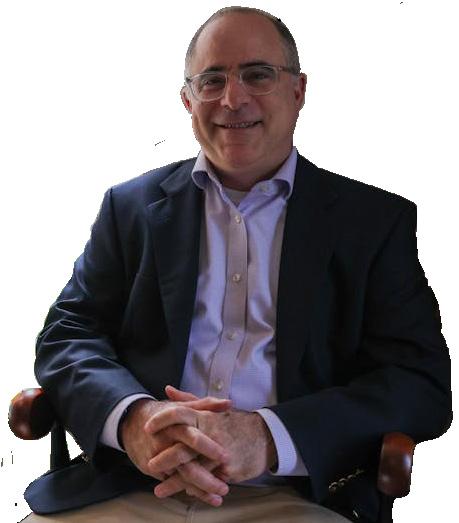
Meet Ethan Pollock, the new dean of the College
Pollock will bring worldly and professional experience to role
BY HADLEY CARR UNIVERSITY NEWS EDITOR
On July 1, Ethan Pollock began his tenure as dean of the College. Now at the helm of Brown’s undergraduate program, Pollock hopes to prioritize students’ needs and recenter intellectual curiosity.
With the foundations laid by his two predecessors — Professor of Engineering and Physics Rashid Zia ’01 and Maud Mandel — Pollock is hoping to focus “less on an agenda for change, and more on an agenda for sustained excellence,” he said in an interview with The Herald.
As a self-described humanist, Pollock has a “firm belief and respect not only for disciplines as they exist, but also for the opportunities that come with interdisciplinary learning,” he said.
An essential part of the college experience, he said, “is exploring what it means to be human.”
From Russia to the West Coast, Pollock’s career has been anchored by intellectual exploration.
Pollock first arrived at Brown nearly 20 years ago. By that time, he had written his first book, worked in Moscow, studied at the University of California, Berkeley and George Washington University and taught at Syracuse University.
As a junior at Tufts University, Pollock studied abroad in Moscow in the spring of 1990 — a time when “everything seemed to be in motion,” he said. Known as the Moscow Spring, that time marked the period of Mikhail Gorbachev’s democratizing reforms.
“For me, it was mostly just an adventure,” Pollock said.
Pollock then traveled back to the U.S. to complete his Bachelor of Arts in history
at Tufts.
With his degree in tow, Pollock returned to Moscow in 1991 to teach English at the Mendeleev University of Chemical Technology. At the university, Pollock led a program called Space Bridge, which allowed students in the U.S. and Moscow to communicate via satellite hookup.
But as Pollock began teaching English, he soon realized it was history that truly captured his heart. While teaching at Mendeleev, he launched American history programs at the Moscow Aviation Institute and Moscow International University.
It was these experiences in Russia, Pollock said, that made him realize he enjoyed teaching.
“I was really struck by how much I was learning by being in front of all these” students, Pollock said. If you’re teaching right, “you’re learning as much as you’re teaching,” Pollock said.
In 1993, Pollock returned stateside, settling at UC Berkeley to work towards a Ph.D. He was still unsure of what he wanted to study, but the school’s historians convinced him to pursue a doctorate in Russian and Soviet history.
“They sort of sold me on the idea that I could spend half my time in the cafes in Berkeley sipping coffee and talking about life, and half the time in Moscow sipping vodka and talking about life,” he said.
After living in a variety of bustling metro centers — from Moscow to the Bay Area to New York — Pollock moved to the smaller yet vibrant city of Syracuse. There, Pollock worked as an assistant professor of history for three years before starting his nearly 20-year career on College Hill.
At Brown, every student in his classes is there because they want to learn, he said. “That, to me, has always been what makes Brown an amazing place.”
Pollock arrived at Brown within a few years of Professor of American History Seth Rockman, who is now the director of undergraduate studies in the History
Department.
Since then, the two have been able to share in the trials and tribulations of the academic world, Rockman said.
“Over the intervening years, we’ve shared all the various struggles of an academic life, of how to write a book and how to continue to conduct research, how to teach with integrity and how to navigate the complications of life,” Rockman said.
Rockman added that throughout these experiences, Pollock has been one of his most “conscientious” and “congenial” colleagues.
When Jennifer Johnson ’04, associate professor of history and director of graduate studies, joined the History Department in 2015, Pollock served as her mentor, she told The Herald.
When Pollock became chair of the de partment in 2020, the two worked closely on different committees to develop the History Department’s strategic plan and new curricular structures for honors stu dents, among other initiatives.
As chair, Pollock fostered an environ ment that allowed everyone to thrive, Rockman said. Pollock “was always looking for ways (to) say, ‘What do you need?’ and ‘What can I get for you to make you the best professor you can be?’” Rockman added.
In his 20 years at Brown, Pollock has advised five students’ senior theses.
Among them was Fiona McBride ’13, who approached Pollock about a poten tial thesis in the winter of her junior year, McBride recalled. Since Pollock didn’t advise many theses, he wanted to know that McBride would be committed to the project, she said.
That quality “really struck me about him,” McBride said. “He’s someone that is extremely committed to all of the things that he does.”
For the next several months, Mc Bride and Pollock would exchange ideas and arguments to build out her
thesis, which ultimately won the Christian Yegen Thesis Prize.
Because Pollock was committed to the work of his students, McBride said, compliments were few and far between. But when McBride received positive feedback from her mentor, “it meant the world,” she said.
Noam Bizan ’22, who wrote her thesis on American depictions of Soviet ballet exchanges, first met Pollock in one of his Russian history classes and became hooked.
When Pollock was teaching, “you could feel the excitement from him,” Bizan said.
She began conducting research with him in the spring of her junior year, and helped him create a class focused on Americans in the Soviet Union.
ed by the news, Rockman said.
“We all know that he’s a tremendously adept manager. He’s tremendously invested in undergraduate education,” Rockman said.
With elite higher education institutions facing intense scrutiny from conservative officials in the federal government, having a dean “who can argue that Brown’s core mission is to educate young people in thinking broadly and constructively … is something we need more than ever,” Rockman added.
This article originally appeared online at browndailyherald.com on Sept. 23, 2025.
THE BROWN DAILY HERALD
Design
Submissions can build on reporting from The Herald, reporting elsewhere, official statements from the University or other groups and other reputable sources, but they cannot break news or contain information that The Herald cannot verify. Because we cannot publish unsubstantiated information, failure to provide appropriate sources may mean we have to modify or remove unverified claims.
The Herald will not publish anonymous submissions or submissions authored by organizations. Leaders of student organizations can be identified as such but cannot write under the byline of their organization. The Herald cannot publish all submissions it receives and reserves the right


Annika Singh PRODUCTION
Copy Desk Chief
Daphne Cao
Assistant Copy Desk
Chelsea Long
cit
MAX ROBINSON / HERALD
EDUCATION
DOJ lawsuit alleges PPSD discriminates via student loan forgiveness program
Lawsuit stemmed from a DOJ investigation that opened in March
BY AVA STRYKER-ROBBINS SENIOR STAFF WRITER
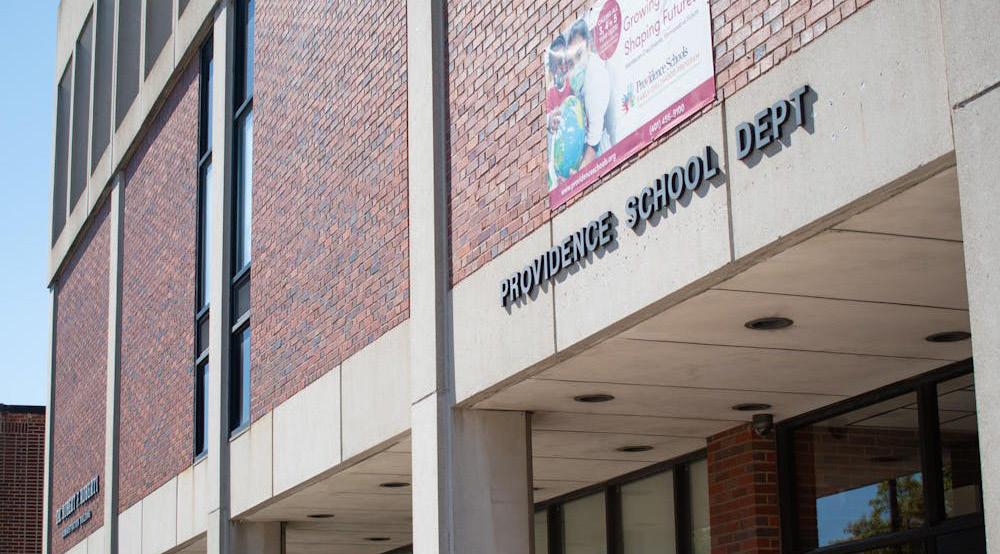
The Department of Justice filed a lawsuit Tuesday against the Rhode Island Department of Education and Providence Public School District, alleging that the PPSD’s Educators of Color Loan Forgiveness Program racially discriminated against white teachers.
The program, which offers eligible teachers of color up to $25,000 to repay student loans over three years, was created in 2021 by the PPSD and RIDE in collaboration with the Rhode Island Foundation to increase the racial diversity of PPSD teachers.
To qualify, teachers must be new hires, have at least $5,000 in student loan debt and identify as racially diverse — which includes Black, Latino, Asian, Indigenous, biracial or multiracial teachers.
The lawsuit follows a 2022 civil rights complaint filed by the Legal Insurrection Foundation, a conservative Rhode Island-based legal and media organization.
“We are thrilled that the DOJ has filed a lawsuit since PPSD has continued to operate the program despite being on notice from our legal complaints that the program was illegal,” William Jacobson, president, director and founder of the LIF, wrote in an email to The Herald.
The U.S. Department of Education
MENTAL HEALTH
referred the complaint to the Equal Employment Opportunity Commission — a federal agency that enforces workplace racial discrimination laws — and that referral led to the opening of a DOJ investigation in March.
“Over the last few months, PPSD and RIDE worked in good faith with the U.S. Department of Justice to reach a resolution on this matter,” Suzanne
Ouellette, a PPSD spokesperson told The Herald.
“There are so many benefits to having teachers of color for all students, not just students of color,” Kate Donohue MA’18, director of R.I. Research Partnerships and Analytics at Brown’s Annenberg Institute, told The Herald. “There is such a mismatch in Providence between students and teachers.”
“It’s more likely for teachers of color to hold more student loans than white teachers,” she added. To Donohue, the program was a way to address that gap.
“While assisting new teachers in paying off their student loans may be a worthy cause, such a benefit of employment simply cannot be granted or withheld on the basis of the teachers’ race,” Assistant Attorney General Har-
meet Dhillon said in a press release.
“The answer to past discrimination is not more discrimination,” Jacobson added. “Racism cannot solve racism. You may think you are helping, but you are making things worse.”
This article originally appeared online at browndailyherald.com on Sept. 21, 2025.
RI suicide hotline sees 212% increase in calls since 2022
BY MICHELLE BI SENIOR STAFF WRITER
The 988 Suicide and Crisis Lifeline has experienced a 212% increase in calls since opening in Rhode Island in 2022, state officials announced Sept. 8.
When the call center opened in July 2022, it received just 490 calls that month. Three years later, in July 2025, that number jumped to 1,530. In total, the center has picked up over 64,000 calls since its opening.
The volume of calls has consistently increased “pretty much every month since the launch,” said Emily Goodspeed MPH’21, a data analyst at the Rhode Island Department of Behavioral Healthcare, Developmental Disabilities and Hospitals. Based on existing data, Goodspeed expects the number of calls to continue rising.
Previously, callers had to dial a 10-digit number to access the National Suicide Prevention Lifeline. But in 2020, Sen. Jack Reed (RI-D) co-sponsored legislation to adopt the three-digit 988 Lifeline in an effort to make mental health services more accessible. In R.I., this hotline is operated by counselors at BH Link, a behavioral health facility located in East Providence.
Shortening the number makes it “so much easier to keep it in the front of your brain,” Joe Ash, the director of BH

The center has answered more than 64,000 calls in the past three years MAX ROBINSON / HERALD
When the call center opened in July 2022, it received just 490 calls that month. In July 2025, that number jumped to 1,530.
Link and the 988 call center, told The Herald. In addition to the call center, BH Link offers a walk-in triage center for adults in distress.
Goodspeed cited “media campaigns and increased need from Rhode Islanders,” as well as the accessibility of the three-digit number, as reasons for the increase in 988 calls.
To bring attention to the hotline, BH -
DHH has turned to bus ads, billboards and digital and social media content, Christine Ure, the 988 project director at BHDDH, told The Herald. Ure hopes the ads “encourage people to share the number with loved ones or friends that might need that help.”
In recent years, suicide has been increasingly discussed and researched as “a public health issue,” said Keely Taylor, the
board chair of the American Foundation for Suicide Prevention’s Rhode Island Chapter, in an interview with The Herald. Taylor pointed towards the 2024 Public Perception of Mental Health and Suicide Prevention Poll, which she said found a “positive change in the public’s perception and knowledge about suicide mental health.”
Over the summer, federal authorities
eliminated the “press three” option from 988, which connected callers to counselors trained in responding to the needs of LGBTQ+ youth. Prior to its removal, about 70 Rhode Islanders used the “press three” option every month, according to Goodspeed.
For Ash, the elimination of these LGBTQ+ resources is “tragic and disturbing.” He worries that without them, people in need may not “feel supported or understood” and “might not even make an attempt to access support.”
The BDH is “still assessing the impact of federal spending decisions” regarding mental health resources, wrote Randal Edgar, department spokesperson, in an email to The Herald.
“From day one, we’ve been operating within an under-resourced behavioral healthcare system,” said Ash, who noted that mental health resources — which go beyond call centers and include bed and provider availability, among others — often don’t receive enough funding.
To protect the 988 line from “any disruption of federal dollars,” Ash believes officials should codify local funding through the governor’s budget.
“We are tasked with supporting the community when it comes to (the) behavioral health crisis,” he added. “We’re going to do everything that we can with the resources that we have.
The White House did not respond to a request for comment.
ELEANOR LOEPER-VITI / HERALD
The Educator of Color Loan Forgiveness Program launched in 2021 and offers up to $25,000 over the course of three years to repay educators’ student loans.
Rep. David Morales MPA’19 centers affordability in Providence mayoral bid
Morales may lean on door-knocking and volunteer efforts
BY LEV KOTLER-BERKOWITZ SENIOR STAFF WRITER
Rhode Island State Rep. David Morales
MPA’19 (D-Mount Pleasant, Valley, Elmhurst) announced his candidacy for mayor of Providence in next year’s election cycle. Morales, who became the youngest Latino ever elected to a U.S. state legislature in 2020, highlighted Providence’s affordability and allocation of city resources in his campaign announcement.
The Democratic primary election will be held next September, with the general election to follow on Nov. 3. Morales will likely face Mayor Brett Smiley, who took office in 2023.
A California native, Morales moved to R.I. to pursue a master’s degree in public affairs at Brown. In 2019, he became the youngest graduate in the history of the program at age 20.
On his fundraising website, Morales called Providence “the least affordable city in America for renters” and promised to “deliver housing we can afford.”
Providence was rated the least affordable city among 44 of the most populous U.S. cities earlier this year, The Herald previously reported.
Morales also highlighted rising property taxes, underfunded schools and a lack of improvement in city services as key issues.
City Press Secretary Anthony Vega wrote in an email to The Herald that the
HOUSING

Smiley administration’s Housing Trust Fund has invested over $55 million “to support the creation and preservation of more than 1,600 affordable units.”
Morales’s announcement also took aim at Brown. As an image of the University’s Quiet Green flashed across the scene, Morales stated that he would “demand that the wealthiest property owners in Providence finally pay their fair share.”
Federal law prohibits Providence from taxing tax-exempt institutions, according to Vega. In 2023, the Smiley administration signed a payment-in-lieu-of-taxes agreement with Brown and other Providence colleges, where the University agreed to pay $175 million to Providence over two decades.
This agreement “more than doubled
the financial contributions the City will receive over the next 20 years,” Vega wrote.
Morales also targeted “bad city contracts” — such as contracts where private vendors earn “millions” from installing speed-monitoring cameras — under the Smiley administration. In response, Vega wrote that the cameras “increase safety measures for both pedestrians and drivers.”
Smiley holds a significant financial advantage over Morales. Finance filings from the end of June show that Smiley held over $1 million in total cash balance in his campaign account, while Morales had $68,180.
Assistant Professor of Political Science Paul Testa cautioned against reading into early campaign finance information. “Morales just announced his campaign,
so comparisons of cash on hand … from June are perhaps less informative than next quarter’s fundraising numbers,” he wrote in an email to The Herald.
Though this quarter’s filings — which cover July through Sept. — aren’t due until Oct. 31, Morales’s campaign manager Henry Perretta wrote in an email to The Herald that the campaign has raised over $35,000 in that span.
Still, “we know that we will be outspent in this race by at least four to one,” Perretta wrote.
Outside of state government, Morales serves as the Director of Community Action at the Woonasquatucket River Watershed Council. He moonlights as the commissioner of the Renegade Wrestling Alliance, where he also wrestles.
Testa wrote that an “extensive doorto-door get-out-the-vote effort” would help Morales build “the kind of grassroots campaign necessary to defeat a well-financed incumbent.”
Morales’s campaign has registered over 400 volunteers so far, according to Perretta.
Professor of Political Science Katherine Tate wrote in an email to The Herald that Morales “might be able to generate name recognition by being a persistent critic.”
Morales’s critiques of the Providence public school system have resonated with some local residents.
“Brett Smiley is standing in the way of good public education in Providence,” wrote Gabriel Long, the father of a first grader at Asa Messer Elementary School, in an email to The Herald. “He seems disinterested in public education as a meaningful part of the functioning of the city.”
While Testa doubts that Morales will catch up to or exceed Smiley’s fundraising totals, having “a large number of small donors could help signal the viability of and enthusiasm for his campaign,” he wrote.
In a city like Providence, 10 to 15 thousand votes may make the difference in a primary election, Testa noted. It has been over two decades since Providence was governed by a non-Democratic mayor, making a Democratic victory in the general mayoral election all but certain. In 2022, Smiley defeated two challengers in the Democratic primary, and faced no opposition in the general election.
Smiley’s campaign did not respond to a request for comment.
Students report theft at Waterman St. apartment, prompting investigation
The apartment’s keys were allegedly left with property management
BY MAYA NELSON & ANNIKA SINGH METRO EDITORS
When Takis Dimitrakopoulos ’26 returned from summer break to his off-campus apartment on Waterman Street, he found it ransacked and emptied of nearly all his belongings.
Dimitrakopoulos told The Herald that he leased the apartment for the 2025–26 academic year through Walter Bronhard Realty. When he moved his belongings in before leaving for the summer, he left his key with a company employee at the
Safe Providence for All,” followed a July incident where PPD officers assisted ICE agents, violating an existing ordinance and PPD policy that prohibited PPD officers from helping ICE efforts.
As of Tuesday afternoon, the PPD was not aware of any ICE presence in Providence at the time of the detainment, according to City Spokesperson Josh Estrella.
Celia Peña ’28, a student leader for Brown Dream Team, called the incident “heartbreaking” and recent detainments in the state “demoralizing.” Dream Team is a student group that supports undocumented students, students with undocumented relatives, Deferred Action for Childhood
property management group’s instruction, he said. But when he returned on Aug. 30, virtually all of his items were gone.
Dimitrakopoulos and his roommate reported the theft to the Providence Police Department and to Brown University Department of Public Safety. According to a Providence police incident report obtained by The Herald, the officer at the scene found no signs of a forced entry.
The incident report also noted that the location has been placed on the state’s Bureau of Criminal Identification and Investigation’s list “for further investigation,” and that the student tenants “may have to get the homeowner and the property management involved.”
“It was a ransacked apartment and all my things had disappeared,” Dimitrakopoulos said.
Arrivals recipients and others.
The Rhode Island Deportation Defense Coalition — a group comprised of AMOR, the Olneyville Neighborhood Association and the Party for Socialism and Liberation R.I. — has reached out to the individual’s lawyer to notify them of the detainment, according to Caroline Cordts ’28, who began working with Defense Line this summer.
Detainments outside courthouses have taken place across the country, Robb noted. “Court hearings are public record, so (ICE) can see where and when certain people are going to be,” Robb explained.
Cordts added that Defense Line has noticed a similar trend in local communities.
Before the detainment occurred on Tuesday, Defense Line had alerted com-
Among the items stolen were a desktop computer and several suitcases of clothes, according to Dimitrakopoulos and the police report.
“They left my couch and that was it,” Dimitrakopoulos said.
Walter Bronhard Realty did not respond to a request for comment.
Dimitrakopoulos described the experience as “kind of shocking” — not only because of the financial burden, but also because of where it happened: “This is at the heart of campus, literally across from the SciLi.”
For now, Dimitrakopoulos is living with a friend for the start of the semester.
This article originally appeared online at browndailyherald.com on Sept. 23, 2025.
munity members about ICE vehicles on Benefit Street, opposite the Providence Athenaeum and just down the hill from the John D. Rockefeller Library. The group, Cordts said, maintains several “neighborhood alert channels” to notify community members when ICE is spotted in the area. The aim is to “put a ton of eyes on the situation,” she said.
But “there’s only so much that students or other folks in our community can do to patrol the courthouse,” Robb said, adding that Defense Line receives “so many calls that are half an hour late.”
She added that while Defense Line has been able to place pressure on immigration enforcement agents, she worries that these efforts may not be sustainable.
Peña said she was “a little surprised”
to hear of the detainment on College Hill.
While she had been aware of ICE activity in local neighborhoods with high immigrant populations, she hadn’t heard of any incidents so close to campus until Tuesday.
For Cordts, ICE presence on College Hill was also “unexpected.” Members of Defense Line were returning to campus from a patrolling shift downtown when one of their members “just happened to catch the ICE vehicles,” she said.
Robb explained that in the last month or so, there have been at least 12 instances in which the network has successfully pushed immigration enforcement out of local neighborhoods by showing up to sites of reported detainments and making their presence known to ICE agents.
We “make them know that they’re
being watched, and they leave,” Robb said. “We have a proven capacity to be able to stop things like this.”
But Robb said that the detainment “potentially could have been stopped if our networks were strong enough.”
According to Cordts, the group has been “having conversations” since the Tuesday incident about reorienting their efforts. Defense Line’s College Hill neighborhood group is also hosting a meeting this Sunday to provide students with more details about the group’s organizing. Brown Dream Team, PSL R.I. and AMOR are also helping coordinate the event, Peña said.
“It’s an issue that’s in our backyard,” Cordts said. “How can we involve Brown students more in this?”
KAIA YALAMANCHILI / HERALD
The site of the break-in on Sept. 14. According to a Providence Police incident report obtained by The Herald, the officer at the scene found no signs of a forced entry.
COURTESY OF DAVID MORALES FOR MAYOR
David Morales MPA’19, who trails Mayor Brett Smiley significantly in fundraising, has made housing prices and city services key issues of his campaign.
FIELD
HOCKEY
Field hockey falls to No. 18 Yale, cruises past Stonehill
The team swept
following a 3-1 loss to Yale
BY MILES MONROE SENIOR STAFF WRITER
On Saturday afternoon, the field hockey team (2-3, 0-1 Ivy) dropped their first Ivy League matchup of the season 3-1 to No. 18 Yale (5-0, 1-0) in front of a robust home crowd. Just one day later, the team rebounded with a dominant 8-0 throttling of Stonehill College (1-6, 1-0 Northeast Conference).
Entering the weekend with a losing record of 1-2, Brown looked to make a statement against the nationally ranked Bulldogs.
“More than ever in my time at Brown, we’ve been focused on our results in addition to our development and performance,” Head Coach Britt Broady wrote in an email to The Herald. “This shift (in) focus speaks to our progress in the past four seasons and I am very proud of our program’s ability to grow so quickly.”
With both teams eager to set the tone in their first conference matchup of the season, the intensity and energy of play was high from the opening whistle. Just over one minute into the match, Lizzie Loftus ’27 almost found the back of the net when she ripped a shot from the top of the arc that narrowly missed.
But after the close call, Yale’s defense tightened for the rest of the first quarter, preventing Brown from getting any more shots off. On the other side of the
ADMISSIONS
field, Ellie Parker ’29 kept the net clean, delivering two pivotal saves to keep the Bulldogs scoreless.
After a quiet first period, both teams attacked the second quarter with a renewed sense of purpose. Just 57 seconds in, it was Brown that came out on top.
Standing at the top of the arc after a penalty corner, Lexi Pellegrino ’26 launched a missile toward the Bulldogs’ cage. The ball blurred through the air, rendered almost invisible as it zipped past the Bulldog defense and goalie. Even if you didn’t see the ball hit the net, you could hear Brown erupt into cheers, celebrating their first Ivy goal of the season.
The score marked Pellegrino’s 27th career goal and 59th career point, moving her to fifth in goals scored by a Brown field hockey player in program history and ninth in points.
Only up by one, Bruno kept up the pressure. Despite unleashing five total shots in the second quarter, the Bears couldn’t find the back of the net again. Fortunately for Brown, Yale didn’t fare any better: By the time the halftime whistle blew, Bruno was still ahead.
“Our first half performance against Yale was some of the best hockey I’ve seen from this team,” Broady wrote.
Unfortunately for the Bears, the second half was all Bulldogs. Not even a minute into the second half, Yale drew even, and once the fourth quarter hit, the Bulldogs blew the lead wide open. Yale ultimately outshot Brown 17-6 en route to a decisive 3-1 victory.
As disappointing as the second-half

fallout was, Brown had no time to dwell on the loss. Less than 24 hours after the end of their match-up against Yale, the Bears were back on the field. And thankfully for Brown, Sunday only brought celebration as the Bears routed Stonehill from start to finish.
Bruno opened the scoring just six minutes in, as Alexandra Madrid ’28 crossed the ball from the right alley to Sadie Schultz ’28 in front of the net. Schultz smoothly tapped the ball in for her first career goal, which also marked the first of Madrid’s two assists that day.
The goal unleashed the fury of Brown’s offense, which continued to roll over the helpless Skyhawks. Seven minutes after Schultz’s goal, Pellegrino netted her first of the game, and Brown headed into the second quarter with a comfortable 2-0 lead after outshooting Stonehill 7-0.
With more left in the tank, Pellegrino scored twice more in the half for her 28th and 29th career goals. In program history, she ranks fourth in goals scored and eighth in points. Thanks in part to Pellegrino, Brown entered halftime up 4-0.
Through the second half, the Bruno scoring machine continued to mercilessly crush the opposition, scoring almost at will. Stonehill was left scrambling to prevent an overflow of Brown goals, but in finishing the game down 8-0, the Skyhawks were far from successful.
This article originally appeared online at browndailyherald.com on Sept. 25, 2025.
“I was proud of the team’s response to the tough loss as they played to our standards and identity on Sunday against Stonehill,” Broady wrote.
Club athletes detail the informal recruiting process that brought them to Brown
Club coaches have found ways to attract talented players
BY TEDDY FISHER & CIARA MEYER SENIOR STAFF WRITER & UNIVERSITY NEWS EDITOR
Rowe Stodolnic ’27 has played rugby for most of his life, taking to the sport at age nine. But when he decided to pursue rugby at Brown, he knew his journey to campus would not look the same as that of a varsity athlete.
Unlike at some other schools, men’s rugby is a club, not varsity, sport at Brown. While the University’s club teams do not receive the formally reserved recruiting spots allotted to varsity sports, coaches have still developed informal recruiting strategies to help prospective players with the admissions process.
David Laflamme, the men’s rugby head coach, has been at Brown for 28 years. Although Laflamme used to host a camp for prospective players at Brown, he finds it easier to recruit by traveling — even going as far as the United Kingdom to scout players from target schools. Laflamme doesn’t aim to recruit a set number of players each year. “I have 234 kids that have reached out to me” thus far for the class of 2030, which is set to arrive on campus next fall, he told The Herald. Laflamme will then request materials from prospective students — including transcripts and a school profile — to determine whether they are academically qualified. “I’m probably one of the only coaches that talks guys out of applying,”

he said. “I’m trying to set them up for success.”
Of the students that reach out to him, Laflamme only talks to the Admissions Office about those who are at the very top of his list, he said. These students are already academically qualified, but he puts their names forward to emphasize the impact they would have on his team as a player.
When Arthur Gaskin, the head coach of the men’s and women’s club squash teams, came to Brown in 2021, Laflamme helped him learn the ropes of recruiting, Gaskin recalled.
Like Laflamme, Gaskin only requests that the Admissions Office conduct academic pre-reads — during which the office assesses whether a student is academically qualified for Brown — for a “handful” of athletes every year, he said.
For Gaskin, outreach is a key com -
ponent of the recruitment process. “I’ll travel to a few events or run a few workshops (in) different parts of the Eastern Seaboard,” he said. He wants prospective athletes to “know that Brown squash is still a thing” since the team was demoted from varsity status in 2020.
When working with prospective players, Gaskin’s “basic philosophy through this whole process is to under-promise and over-deliver,” he said. “I can’t guarantee anything.”
University Spokesperson Brian Clark reaffirmed the coaches’ comments in a statement to The Herald. “The Office of College Admission works with campus partners — including varsity and club coaches in athletics, and faculty and staff across a range of departments — as it reviews and admits talented applicants,” he wrote.
All applicants are expected to have
strong academic credentials and demonstrate ways they will positively contribute to the campus community, Clark added.
Bella Bin ’28 was informally recruited for the women’s club squash team after she reached out to Gaskin during her junior year of high school.
When Bin emailed Gaskin, the squash team was in the midst of their first season as a club sport. But Bin was initially set on playing for a NCAA Division I or Division III team. After connecting with several coaches and participating in a few official visits, the other schools she was considering ended up not having enough recruiting spots. At one other school, Bin was told she could join as a walk-on if she was admitted, and the coach offered to write her a letter of recommendation.
Brown appealed to Bin because its club team has several features usually associated with varsity teams, she said. Brown’s club squash plays against varsity schools, lifts in the varsity gym, travels frequently and has intense training. “I basically get all the aspects of a varsity team, and the only difference is just the name,” she said.
Gaskin told Bin she passed her academic pre-read and said he’d support her whether she applied during the early or regular decision round, Bin recalled. Gaskin also wrote her a letter of recommendation.
A few days before admissions decisions come out, Gaskin is notified which of his players were admitted, he said.
Diya Bhattacharjee was also admitted to Brown after being recruited for club squash, but she ultimately decided to attend Stanford instead.
When Bhattacharjee reached out to
Gaskin, she didn’t “expect there to be any club recruiting process,” she recalled. She provided Gaskin with information for an academic pre-read, sent videos of her playing and shared her squash rankings. Then, Gaskin wrote her a letter of support for her application, she said.
Gaskin didn’t characterize himself as “having that much pull in the admissions process,” Bhattacharjee said.
Gaskin was understanding when Bhattacharjee chose not to attend Brown, she recalled. “He’s very respectful of his players’ interests outside of squash,” she said. When she chose another school, “he was very respectful about it and very encouraging.”
Despite the fact that coaches can’t guarantee spots in the first-year class for recruits, being recruited allows players to form connections with the Brown community early on in their college search process, Stodolnic said.
As a recruiting chair for the men’s rugby team, Stodolnic often meets with prospective players, gives them tours of campus on the weekends and takes them to social events with the team so they can get a taste of Brown rugby.
Although anyone can sign up for rugby at Brown, those who are recruited are invited to preseason, where they practice two to three times every day for two weeks, Stodolnic said.
By the time classes started during his first year, Stodolnic felt as if he had leg up because of the time he spent meeting his teammates and setting his routine.
ISABELA GUILLEN / HERALD
Stonehill 8-0
JESSE BENITEZ / HERALD
Yale at Brown. Entering Saturday with a losing record of 1-2, Brown looked to make a statement on Goldberger Family Field in the team’s opening Ivy League matchup against the nationally ranked Yale Bulldogs.
SOCCER
Men’s soccer demolishes UMass Lowell 4-1, beats URI 1-0 to end losing streak
Bears hope to continue the win streak against rival Providence College
BY ABIGAIL DONOVAN SENIOR STAFF WRITER
On Saturday night, the men’s soccer team (4-2, 0-0 Ivy) earned a decisive 4-1 victory over the University of Massachusetts at Lowell (4-3-1, 0-0 America East Conference). The Bears came out of the game swinging with three of the goals scored in a fiery second half.
This follows a 1-0 win against the University of Rhode Island (1-5-2, 0-1-1 Atlantic 10) on Tuesday, when Mateo Pereyra ’29 scored his first career goal with the Bears to secure the victory, assisted by Mads Stistrup Petersen ’26.5. The lone goal came in the 81st minute of the game, besting the Rams’ defense, which recorded six saves over the course of the matchup.
Tuesday’s victory over the University of Rhode Island broke a two-game losing streak for the team, who suffered consecutive 1-3 losses to Boston University (4-2, 1-1 Patriot League) and the University of Connecticut (6-0-3, 1-0 Big East).
Saturday’s win over UMass Lowell demonstrated the offensive power of the Bears, who had an electric second half.
In just the sixth minute of the game, Lorenzo Amaral ’27 wound past the River Hawks’ defense, and while Lowell’s goalkeeper lunged to the right, Amaral launched a missile high into the net. The strike secured an early lead for the Bears
SOCCER
and recorded Amaral’s first goal of the season.
Amaral has “been pushing hard” to get his first goal of the season, he wrote in an email to The Herald. “It felt great to put one in yesterday and give some momentum for the team early on,” he continued.
Just about five minutes later, the River Hawks responded to the challenge. Following a long pass by Ethan Agyare-Danso into the box, midfielder Alex Champagne bested Bruno’s defense to draw even.
The Bears were unable to edge ahead before the end of the half, despite leading the River Hawks in shots 8-3.
In an email to The Herald, Head
Coach Chase Wileman wrote that he encouraged the team at halftime to “play unselfish and make good decisions in attack” — a focus that paid off in the second half of the game.
After a tense 27 minutes of back-andforth play to start the second half, the Bears unleashed a three-goal scoring spree in the last 18 minutes of the game.
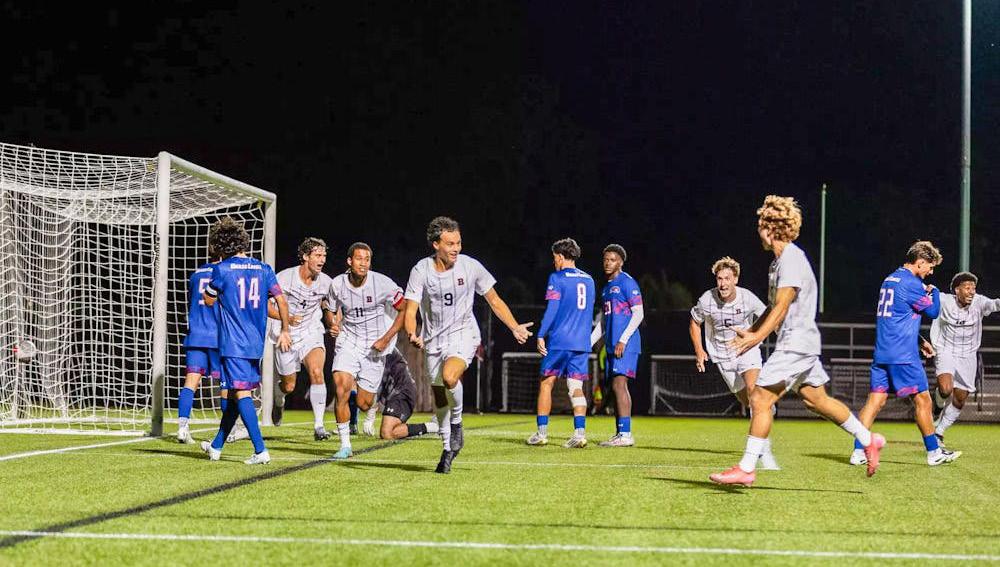
In the 73rd minute, Stistrup Petersen sent a free kick into the box, where two headers deflected the ball to the feet of Amaral. With a Lowell defender breathing down his neck, Amaral passed the ball off his heel, leading Stistrup Petersen into the box.
The techy footwork continued down
the pitch, and weaving through the crowd, Stistrup Petersen nutmegged a defender before crossing the ball in front of the goal where a waiting Carlo Brown ’27 did the rest. Slotting the ball beneath the arms of the Lowell keeper, Carlo Brown fired into the bottom left, securing an incredible go-ahead goal for the Bears.
Before the River Hawks could catch their breath, Bruno secured another goal just 39 seconds later. Amaral intercepted the ball just past midfield and raced down the right flank. At the corner of the box, he off-loaded to captain Jamin Gogo Peters ’26, who launched the ball across the face of the opposing keeper into the bottom left to advance the Bears’ lead to 3-1.
Women’s soccer rolls past Yale in Ivy opener
BY GUS BAILEY STAFF WRITER
In their Ivy League opener on Sunday, the women’s soccer team (7-1-2, 1-0 Ivy) put on a dominant all-around performance in a 5-2 road victory over Yale (2-6-0, 0-1). Midfielder Joy Okonye ’27 led the way with two goals, while defender Naya Cardoza ’26 scored for a fourth straight game.
“Getting that first win in Ivy play is huge and really sets the tone for the rest of the conference season,” Head Coach Kia McNeill wrote in an email to The Herald. “We always talk about wanting to control our own destiny, and that starts with taking care of business week by week.”
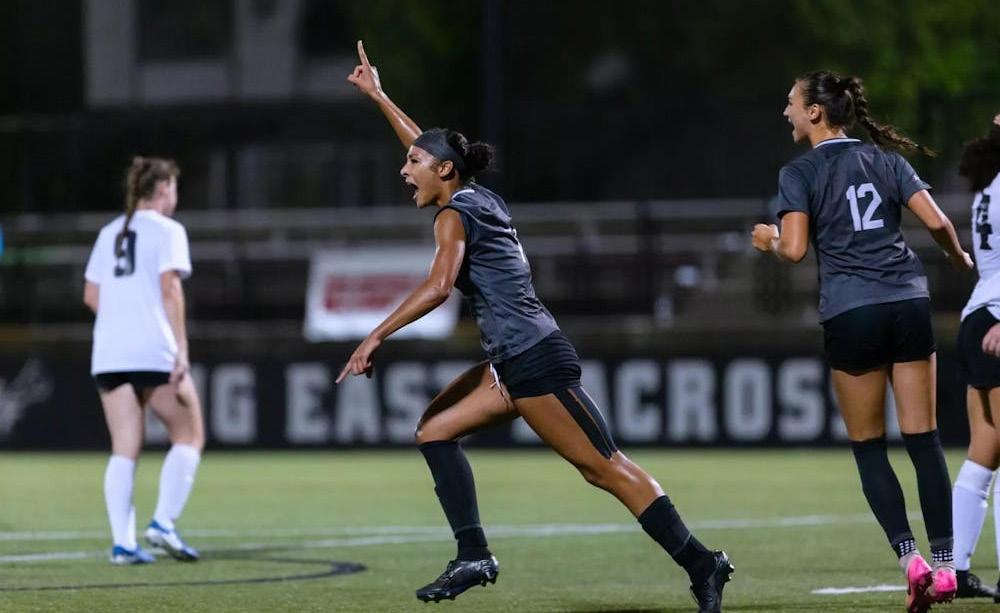
In the 17th minute, Okonye lit up the scoreboard with a stellar goal, dribbling through multiple defenders to create space before launching an unstoppable shot into the top right corner. “I didn't know I struck it that well until it was at the back of the net,” she wrote, adding that “it’s always a great feeling to score.”
Cardoza kept things going, scoring less than 10 minutes later off an assist from Rylee Keeley ’28. The goal was her sixth of the season, a mark that leads the Ivy League.
Okonye then followed up her first goal with another screamer, striking from well outside the 18-yard box to put the Bears up 3-0. Though Yale was able to get one back in
the 31st minute, Brown held a commanding 3-1 lead heading into halftime.
“Joy and Naya have been playing on another level this season and they’ve both become key figures for us,” McNeill wrote. “Every time they step on the field, they’re looking to make an impact, and they’re absolutely making their minutes count.”
Aside from their exceptional play, McNeill emphasized that Cardoza and Okonye’s mindset has given the team a boost during this season’s opening stretch. “What stands out even more is that their energy, intensity and focus have
been contagious,” she wrote. “They’ve not only thrived individually, but have helped raise the level of the players around them, which speaks volumes about their leadership and presence on the field.”
Bruno’s dominance continued after the break, as forward Corine Gregory’s ’27 shot was deflected, but still found the back of the net. The Bulldogs again cut the lead to two in the 71st minute, but Brown quickly regained the momentum. Giving Brown another highlight-reel goal, Ayla Sahin ’28 nutmegged a Yale defender before calmly tucking away Bruno’s fifth goal of
“After the first one we came out hungry, and bagged another one,” Amaral wrote.
He attributes this offensive intensity to recent practices. “During training and preparation this week we really put emphasis on creating chemistry in the attack and being ruthless in front of (the) goal,” Amaral wrote.
Despite the comfortable lead, the Bears kept up the attack. In the 87th minute, Diego Elizalde ’27 found himself pitted one-on-one against a Lowell defender. Faking left, he set the ball to the right before launching a beautiful shot from outside the box. Soaring over the goalkeeper’s head, he found the top left corner of the goal to cement Bruno’s dominant 4-1 victory.
Reflecting on the team’s performance in the second half, Wileman praised the group’s persistence. “We just needed to stick with what we were doing because we were really close to breaking through their back line multiple times in the first half,” he wrote. “I am happy the team got rewarded for the hard work they put in.”
The Bears will next face off against neighboring rivals Providence College at 7 p.m. on Tuesday at home on Stevenson-Pincince Field before facing off against Dartmouth on Saturday in their first Ivy matchup of the season.
“We look to carry this momentum forward to a big rivalry game against Providence College,” Amaral wrote.
This article originally appeared online at browndailyherald.com on Sept. 22, 2025.
the game, sealing the win for the Bears.
Four different Bears scored against Yale, underscoring the team’s attacking versatility that McNeill characterized as a key to their early-season success
“We’ve always prided ourselves on being a multi-dimensional program in how we attack, and this is probably the most complete we’ve been in terms of our ability,” she wrote. “It’s been fun to see our attacking creativity and confidence come alive over the past few games. We’re becoming harder to defend, and that’s exactly where we want to be.”
Four days earlier, on Wednesday, Bruno certainly seemed “hard to defend” as they took down Providence College at home 4-0. Okonye and Cardoza starred again, each scoring once with Okonye tacking on an assist.
Their excellent play against Providence and Yale did not go unnoticed. Okonye was recognized as Ivy League Offensive Player of the Week, and Cardoza was named Defensive Player of the Week. This marks the second time this season that Brown has swept the Ivy League Weekly Awards.
Okonye remained humble, pointing out that her personal recognition is also the team’s achievement. “It’s always and will always be team first,” she wrote. “As long as we keep going like this in the right direction, accomplishments like this feel more special because it’s a collective effort.”
McNeill stressed the importance of starting strong in Ivy League play. “We don’t want to be in a position later in the season where we’re relying on other results to fall our way,” McNeill wrote. “The more we can handle now, the more pressure we take off ourselves later. Staying focused, hungry and consistent is the key to keeping this momentum going.”
The Bears will look to do just that as they travel to New York City to take on Columbia on Saturday. The game will be available to stream on ESPN+.
This article originally appeared online at browndailyherald.com on Sept. 23, 2025.
COURTESY OF JAMIE FIEDOREK VIA BROWN ATHLETICS
Players celebrate Carlo Brown’s ’27 goal in the 72nd minute, giving Brown the go-ahead goal at 2-1.
Goals by Joy Okonye ’27 and Naya Cardoza ’26 fueled an early lead
COURTESY OF JAMIE FIEDOREK VIA BROWN ATHLETICS
Hot off Sunday’s win against Yale, Naya Cardoza ’26 was named Ivy League Defensive Player of the Week.


Dear Readers,
Settling into this fall semester—which just so happens to be my last at Brown—has me feeling both eager to barrel forward, and longing to stop and look back. It’s among the busiest times I’ve experienced here, not only in sheer schoolwork, but in my ongoing and all-consuming attempts to prepare for what happens after I go into the dreaded Real World. But between my grinding sessions at the Rock, and my panic sessions about how I’m not grinding enough, I sometimes feel a different kind of pressure. It feels more important now than ever to commit to memory where I am and who I’ve been here. Call me overly sentimental, but taking a break to just walk around campus, look at the vast collection of pictures I’ve taken with friends here, or visit my favorite Providence haunts is as big a part of my life this fall as completing my readings and researching graduate schools. This also means giving myself time to just be in this place where I’ve spent the past few years. I’m trying to appreciate the things I love doing here, down to the trivial hobbies and predilections, so I can be the fullest version of myself wherever I go next.
In this issue of post-, many of our writers also ponder ways to remember and remain themselves even while contending with external pressures. In this week’s Feature piece, Michelle grapples with the limited time we have, and how vital it is to be present with the people and things we love amidst a culture of bustling workaholism. In Narrative, Ana reflects on “filling your cup” in the face of productivity pressure, and Coco stops to look back (through her father’s eyes) on an unforgettable night in New York City. In Arts
and Culture, Alyssa also remembers—in this case, growing up listening to Lorde’s coming-of-age album Pure Heroine and Eleanor engages in careful self-reflection, inspired by Robert Lester Folsom’s “Situations.” Indigo urges research and respect for your study abroad country of choice in this week’s Lifestyle section, while Maria tells us how daily planner methods should organize and give, instead of drain, the time you spend in the present. Ina gives us both a comic that appreciates the sunlight in post-pourri, and a crossword that honors our furry/furries friends.
I’m struck by the mindfulness that the pieces in this week’s issue illustrate, whether it’s finding time to check in with yourself, or your surroundings, or your memories, or all of the above. As this semester continues to ramp up, I’m going to keep looking for moments to take my foot off the gas and look around. I hope this week’s issue of post- inspires you, dear reader, to do the same!

learning to plan or planning to learn?
Maria Kim 15
Ina Ma 16 new beginnings

“I urge you guys to look up big balls. Your worldview will completely change.”
“I’d rather have no queer representation than that.”

Hear me outs
Zane (LEGO Ninjago) 8. Young Joe Biden 9. The number 7
The hotter Wild Kratts brother

“As always, I was late for my 10 a.m., but as always, I took a few minutes to fill in my eyebags, color them black—black like the void, black like dread, black like a scream into a pillow, but also black like the ocean at night, black like two crows spinning in aimless circles against a clear blue sky, black like the darkness of your eyelids as you drift off to sleep.”
— Indigo Mudbhary, “why do you wear so much eyeliner?”


“My pillow cover is a violent red, supposedly a symbol of luck in Chinese tradition. It is a constant reminder of all the superstitious beliefs my mother has instilled in me. While some measures I can’t help but feel burdened by, her act of changing my bedsheets (oblivious to her intentions) to brown ones the night before opening my acceptance letter to Brown, has softened my heart for her little gestures.”
— Gabi Yuan, “red cover” 09.28.23

by ina ma
1. Brown University's furry club
5. Word ending that means "characteristic of," such as for fish?
6. Brooder, like your dog after a scolding
8. Brown's fursona
9. Do not do this at the zoo
1. Disney baby deer
2. Use: Lat.
3. Lacerate, as a bad cat might
4. Fandom location
7. What a deceased animal might do
OPINIONS
Gupta ’25 MD’29: Open curriculum, open relationships?
When I first started this column as an undergrad, I was writing about hookup culture between seminar readings. Now, I’m back as a med student and trading in dorm gossip for cadaver lab. But honestly, they’re not so different — both involve plenty of anatomy and a few highly questionable decisions. I’ve always been nosy about how people navigate sex and relationships, and this column gives me an excuse to explore the uncomfortable topics. I want to write about your curiosities, so please send me your anonymous questions!
If you’ve spent any time on College Hill, you know Brown prides itself on being open. Open curriculum, open conversations, open minds — it’s our whole brand. For many of us, that ethos is what drew us here and what makes Brown feel different from anywhere else. But after four years of watching relationships unfold across campus, I started noticing a pattern: Everyone talks about openness when it comes to academics and ideas, but what happens when we apply the same philosophy to our love lives?
The temporal aspect of college life can often lead to the difficult conversation of having an open relationship. The most common open relationship model I hear about at Brown is the seasonal one: open during summers and winter breaks, closed during the semester. On paper, this seems logical. You’re apart, you might meet other people — why not explore?
From there, the questions get more serious. Does it make sense to toggle between open and

closed? How do you balance being with someone you love while also learning about yourself through new experiences during such a formative time in your life?
These questions crystallized after having a 30-minute conversation with a stranger in a coffee shop. He described his own open relationship and wondered how non-monogamy played out in college settings. This exchange stuck with me because it articulated something I had been subconsciously noticing: While many Brown students love to theorize about open relationships, very few actually seem to make them work.
The irony is surprising. At a place that celebrates intellectual and social openness, the “anything goes” mentality that we wear as a badge of honor might
The "anything goes" mentality... might actually be working against us when it comes to successful non-monogamy. “ “
SUMMER SHI / HERALD
actually be working against us when it comes to successful non-monogamy.
Brown’s social culture values being cool, collected and, above all, chill. Nobody wants to be the person who “can’t handle it” if their partner hooks up with someone else. Nobody wants to admit they’re struggling with jealousy or insecurity. This creates a perfect storm where open relationships are less about genuine desire and more about proving you’re sophisticated and emotionally evolved enough to handle them.
But successful open relationships require the exact opposite of this. They demand radical honesty about uncomfortable feelings, constant conversations about boundaries and a willingness to have awkward conversations. When campus culture suggests that expressing strong emotions makes you uptight or possessive, it becomes nearly impossible to do the emotional work that non-monogamy actually requires.
Successful non-monogamy isn’t about temporary, seasonal permission slips when it’s convenient. Switching relationship styles every few months means you're constantly renegotiating the fundamental terms of your partnership. Instead of building the deep trust and communication skills that make open relationships work, you’re creating a cycle of uncertainty and mixed signals. Moreover,
the implication that you only want to see other people when your partner isn’t around frames non-monogamy as a consolation prize rather than a genuine relationship preference. This undermines the foundation of trust and enthusiasm that healthy open relationships require.
Brown’s casual hookup scene operates on a very different set of principles than ethical non-monogamy. Campus hookup culture often thrives on ambiguity, minimal communication and the ability to avoid complicated feelings. When students import those norms into open relationships, they end up with something that looks like non-monogamy but lacks the communication, emotional processing and partner consideration that make it functional.
None of this is to say that open relationships can’t work at Brown, or that students shouldn’t explore non-monogamy. Rather, it’s a call for the kind of genuine openness that our campus culture claims to celebrate. Real relationship openness isn’t about proving how cool and evolved you are. It’s about being honest about your needs, boundaries and limitations. It’s about having difficult conversations and sitting with uncomfortable emotions. It’s about recognizing that what works for other people might not work for you, and that’s perfectly okay.
If Brown students want to explore open relationships successfully, we need to move beyond “performative chill” and toward genuine emotional intelligence. This means being willing to look uncool while you figure things out. It means owning up to struggle instead of suffering in silence. And it means recognizing that true openness in relationships, like true openness in all aspects of life, requires more courage and vulnerability than we usually want to admit.
If you have questions about sex or relationships that could be discussed in a future column, please submit questions to an anonymous form at https://tinyurl.com/BDHsexcolumn. Anusha Gupta ’25 MD’29 can be reached at anusha_gupta@brown.edu. Please send responses to this opinion to letters@browndailyherald.com and other opeds to opinions@browndailyherald.com.
Manhardt ’26: From hippie university to finance feeder — Brown is officially evolving, and it’s about time
Brown has always been known as the quirky, fun, Happy Ivy with its Open Curriculum, ability to pass/fail any class and independent concentrations. Students can be seen frolicking on the green and embracing the University’s carefree and relaxed vibe, discussing their class on anything from tai chi to metaphysics. However, don’t be fooled: Beneath this guise, a strong preprofessional culture responsible for producing some of Wall Street’s finest has ascended — and it’s rapidly growing.
Believe it or not, Brown has performed well when it comes to sending graduates to Wall Street. A 2025 LinkedIn analysis found Brown to be in the top 25 undergraduate schools for finance when adjusting for student population. While it certainly is not a hallmark of the University, there is no doubt that Brown is widely considered to be a target school for investment banking across various finance forums.
While ranking in the top 25 may not seem phenomenal given Brown’s academic reputation, it becomes quite impressive when considering our competition. Compared to its peers, Brown has reached essentially equivalent recruiting status with historically fewer resources. Undergraduate business school programs such as Penn’s Wharton and the University of Michigan’s Ross have powerful alumni networks, but even schools without undergraduate business programs have clear advantages: Duke has a literal investment banking class, and Harvard offers mock technical interviews with alumni. Neither of these are provided by the Center for Career Exploration — and yet, when it comes to finance recruiting, we rank consistently among these peers.
Brown’s finance preprofessionalism is a recent development: The University's rise to finance feeder was achieved largely without the aid of the career center’s current resources. It was only last year, in 2024, that the
University hired an assistant dean of the College for careers in finance and consulting. With this initiative came other resources, such as a curated spreadsheet of opportunities to help students track the deadlines of competitive finance internships.
In this time, the University has also seen a surge in student-run preprofessional organizations — most oriented towards finance. Notably, Brown Investment Group — which received a record-breaking 243 appli-
“
letters, hosting structured workshops and organizing info sessions with potential employers in the past few semesters.
Given that the University achieved its current success largely without these resources, the recent explosion of finance opportunities — from student groups and the University — is sure to put Brown on track to become a force to be reckoned with in the finance recruiting scene. Not only am I okay with this newfound
The Open Curriculum will allow for Brown's next generation of Wall Street to bring in talent beyond Excel modeling.
“
demic tech boom — continue to create an unsteady job sector.
cations this fall — has begun to partner with the career center to host workshops and student panels. Additionally, several new clubs geared towards recruitment preparation have been rapidly growing. The Brown Finance Club was formed in 2017 to offer resources and general information about finance. In 2021, the Bruno Finance Society was established in hopes of reconciling “the mismatch between the number of high-achieving students at Brown with the opportunities available to them.” And just one year later, the Brown Private Equity Club was created. Each of these finance clubs have collectively transformed their role on campus from merely serving as a finance hub to sending out news-
focus on finance recruiting preparation, I actually think that it’s necessary for the future of our institution.
Brown’s decision to invest in supporting the student finance recruitment process couldn’t come at a better time. The other two most popular career paths — tech and consulting — have been shrinking as a whole since the pandemic. With leading consulting firms such as McKinsey firing 10% of their workforce and others pushing back full-time start dates, AI has taken a big toll on the work incoming analysts are able to contribute to the firm. A similar series of events has happened in the tech industry as well. Layoffs and decreasing workforces — a stark contrast to the post-pan-
At the same time, private equity firms have started hiring straight out of undergrad. Starting in around 2020, major private equity shops such as KKR began launching pipeline internship programs through which they recruited summer interns with the hope of them becoming full time analysts. The result? An increase in opportunities with more lucrative starting salaries. Given the rise in demand for younger talent across the finance sector, the University’s decision to support its students will pay dividends in the future as each recruitment cycle becomes even more strenuous. While preprofessional schools will continue to expand investment banking factories, the Open Curriculum will allow for Brown’s next generation of Wall Street to bring in talent beyond Excel modeling. Brown students will continue to broaden their intellectual horizons by studying disciplines unrelated to finance, while receiving the support they need from the career center and preprofessional clubs. As mundane tasks start to be automated, employers will shift their focus towards applicants who have sharp critical thinking and communication skills — two areas which Brown students excel in. Brown’s interdisciplinary emphasis and collaborative culture will continue to keep the intense, cutthroat nature of the finance industry from creating a toxic campus culture. The future of finance at Brown is certainly bright, but not brighter than the culture that makes a Brown education unique.
Batisse Manhardt ’26 can be reached at batisse_manhardt@brown.edu. Please send responses to this column to letters@browndailyherald.com and other columns to opinions@browndailyherald.com.
Editorial: Brown students need quiet too
From the New York Times to local news stations to The Herald, much discussion in the last few years has centered around noise in Providence. Hearing motorcyclists revving their engines and lifted vehicles blasting music has become a hallmark of the Brown experience. But should it be?
The University has a responsibility to protect its students — even from noise. In response to the city’s new plan to install noise cameras throughout Providence, Brown must advocate for cameras on its loudest street: Thayer.
Providence Mayor Brett Smiley has pushed for the installation of noise cameras to fine vehicles in violation of the city’s rarely enforced noise ordinance, which prohibits excessive sound at night. This approach has already been tried in New York City, among other U.S. cities. Smiley suggests that these cameras could arrive by the end of the calendar year.
In 2022, a Brown research lab found that noise levels in Providence were similar to those of New York City despite only being a fraction of the size. This research was conducted in partnership with grassroots organizations such as the Providence Noise Project, which was founded in response to this issue. Their slogan, “Noise is the New Smoking,” highlights the negative health effects of excessive noise pollution. In the project’s “Noise Survey,” they report that over 90% of respondents face repeated exposure to vehicle noise, and almost half of them report recurring sleep
disruptions — something students living near Thayer can attest to.
In 2021, the American Public Health Association released a report named “Noise as a Public Health Hazard,” in which they state that chronic noise can lead to the “exacerbation of psychological disorders
abide by the city’s noise ordinance, we too should be able to expect quiet on the main street that runs through Brown’s campus. Many undergraduate students live in dorms on Thayer, such as New Pembroke 4, Caswell Hall and Gregorian Quad B. They deserve to be able to sleep peacefully. In advocating
The University has a responsibility to protect its students — even from noise. In response to the city’s new plan to install noise cameras throughout Providence, Brown must advocate for cameras on its loudest street: Thayer.
and premature mortality.” Despite Brown’s campus resting in one of the city’s quietest neighborhoods, second only to Blackstone, Thayer Street remains an “earsore.”
Noise is a two-way street — just as Brown students are expected to respect their neighbors and
for noise cameras, our intention is not to push residents out of College Hill, but rather to ensure mutual respect for everyone who shares this city. Reducing noise makes Thayer more family-friendly and ensures that locals feel comfortable exploring all Thayer has to offer, even after dark.
Some community members, and even Brown Corporation member Xochitl Gonzalez ’99, argue that the “sound of gentrification is silence” and that measures to address noise unfairly penalize residents of color. While this concern deserves serious weight, the opposite is also true: People of color disproportionately suffer the consequences of unchecked noise pollution, which worsens health disparities. Ensuring that enforcement is equitably distributed — including on Thayer — is part of solving the problem, not avoiding it.
As the single largest landowner not only on College Hill, but in Providence, Brown has both the power and the responsibility to advocate for noise cameras on Thayer. The University already works with the city on policing, transportation and redevelopment. It should use this same influence to protect students from relentless noise.
Students should not have to choose between an education and a good night’s sleep. A quieter Providence means a healthier, more livable campus.
Editorials are written by The Herald’s editorial page board, and its views are separate from those of The Herald’s newsroom and the 135th Editorial Board, which leads the paper. A majority of the editorial page board voted in favor of this piece. Please send responses to this column to letters@browndailyherald.com and other opinions to opinions@browndailyherald.com.
Dissent: Thayer isn’t ours to silence
On any given weekend night, Thayer Street transforms into a gathering space for Rhode Islanders. Motorcycles roar past tricked-out cars, and music spills out onto the sidewalk outside a new food spot. Families line up for late-night falafel from East Side Pockets, kids chase each other between tables at Chinatown and high schoolers crowd around pizza boxes at Antonio’s. Local celebrities like Tropicana Danny often make an appearance, turning a simple night into an exciting scene. It’s noisy, yes — but it’s also joyful, communal and uniquely Rhode Island.
In their piece, the editorial page board advocates for a Brown-led installation of noise cameras to address student frustration toward the rowdy gatherings on Thayer. While casual annoyance with motorcycle revving is valid, surveillance technology threatens a culture that has developed outside of our campus — one that Brown students don’t have the right to dissipate. If Brown pushes for noise enforcement on Thayer, we will be spearheading a rash and oversimplified measure that fails to address the complex dynamic between College Hill and the city of Providence.
Thayer is a cornerstone of College Hill; it’s a social hub that supports small businesses and hosts Rhode Islanders from around the state. For many, it
is not just the street next to campus, it is a destination and a source of community. Despite our proximity, Thayer does not belong to Brown. Participating
“
sleep. But the natural evolution of neighborhood culture is not ours to police, and imposing harsh noise control measures relegates Providence residents by
If Brown pushes for noise enforcement on Thayer, we will be spearheading a rash and oversimplified measure that fails to address the complex dynamic between College Hill and the city of Providence.
“
in urban life means being excited about sharing our home, and dealing with noise disturbances is part of that.
Yes, the noise can be disruptive, and students who live in nearby dorms are entitled to good-quality
treating them as disruptors of our campus. In many ways, Providence residents have to tolerate annoyances that Brown students bring, but we do not expect, and should not accept, retaliation against the student population.
These communities gather on Thayer for the same reasons we do: to eat, to connect and to enjoy themselves. Informal meeting spots are vital to any city’s social fabric, and many of Providence’s have been destroyed by University expansion. If we push away those who bring life to Thayer, we widen the gap between Brown and its host city while threatening the local businesses that rely on their patronage.
The student experience should involve engaging with the city that we live in. One of Brown’s most valuable attributes is its integration into the spaces around it, and students should relish our access to a dynamic neighborhood and city, not try to homogenize it based on our personal preferences. Providence’s diverse landscape remains accessible to us, and we owe Thayer’s patrons the same courtesy.
Dissenting Opinions: When The Herald’s editorial page board disagrees on a staff editorial, members have the opportunity to publish a dissent to explain why they did not sign on. Editorials — and dissents, if any — are written by members of The Herald’s editorial page board, which is separate from those of The Herald’s newsroom and the 135th Editorial Board, which leads the paper.
LILA QUINN / HERALD
ARTS & CULTURE
EVENT
‘Brokeback Mountain’ returns to Avon Cinema for film’s 20th anniversary
Film was executive produced by Michael Costigan ’90
BY REBECCA GOODMAN STAFF WRITER
Ang Lee’s “Brokeback Mountain” tells the story of two young cowboys — Jack Twist (Jake Gyllenhaal) and Ennis Del Mar (Heath Ledger) — herding sheep on the titular mountain in 1960s Wyoming. Over the course of the summer, the two fall in love, and the film follows their epic love story across the next two decades.
In celebration of its 20th anniversary, the film returned to the big screen this year at select theaters, including Providence’s Avon Cinema. The Herald spoke to theatergoers, as well as the film’s executive producer Michael Costigan ’90, about the enduring impact of “Brokeback Mountain” two decades later.
Costigan said the movie had a long journey to becoming the cultural classic it is today.
“The list of directors who read it and passed on it and considered it is epic,” he added. “People were afraid of it.”
It was finally tackled by Lee, who — fresh off of “Hulk” — “really wanted to go back to a story that he really could connect with and wanted to tell in a very organic, naturalistic way,” Costigan explained.
When “Brokeback Mountain” was first released, the film was met with controversy from some religious groups due to its positive portrayal of LGBTQ+ characters.
REVIEW

Costigan still has a box of clippings from 2005, including a headline reading “Will ‘Brokeback Mountain’ ruin Heath Ledger’s career?” Costigan recalled the press asserting that neither Ledger nor Gyllenhaal could ever “be a leading man in a Hollywood film again.”
Nevertheless, the film was met with critical success, winning Best Adapted Screenplay at the 2006 Academy Awards, as well as Best Director and Best Original Score. In addition, both Gyllenhaal and
Ledger were nominated for Best Supporting Actor and Best Actor, respectively.
This month at the Avon, the film was met with praise from theatergoers, both new and old.
“We are getting a lot of people thanking us for bringing older films back, but this film in particular,” said James Nocera, the general manager at the Avon. “I think that people now are able to vocalize more how it resonated with them.”
The film “was such a big step forward
at the time, and (now) we’re sliding backwards,” said Kat Lopez ’27, who watched “Brokeback Mountain” at the Avon. “We need more big steps forward just like this.”
Gay marriage was legalized in 2015, 10 years after the film’s initial release. But now, in 2025, gay marriage may be at risk with the Supreme Court considering to take a case that challenges its ruling from a decade before.
They added that as a queer person, they feel lucky to “get to live and be queer,” free
from the kind of “regret” and “fear” represented in “Brokeback Mountain.”
“It also empowered me to be queerer,” Lopez said. “I asked a girl on a date right after.”
Katie Dupper ’28, Oliver Drachman ’28, Nolan McCloskey ’28 and Brandon Richard ’28 all saw the movie for the first time. Heading into the showing, they knew just two things about the film: “It was sad and gay.”
McCloskey “was really mad at the characters for not talking more,” he said. “Like, where was the communication in this movie?”
“Their aggression and affection is very intertwined,” Drachman said of the film’s main couple.
Costigan said the film’s crew was not aware at the time that “Brokeback Mountain” would have such an enduring impact on popular culture.
“It was one of those magical shoots (during which) everybody knew we were making something special,” he said. “It felt intimate and like it was gonna be a beautiful film, but no one had any idea that it would reach a larger audience the way it did.”
The makers of “Brokeback Mountain” didn’t approach the film as a particularly politically or socially “important” story to tell, Costigan said. Rather, the filmmakers approached it as a love story. And the best love stories, according to Costigan, ask “Why can two people not be together?”
This article originally appeared online at browndailyherald.com on Sept. 25, 2025.
‘Harry Potter and the Cursed Child’ stuns with magic, stage effects
The production will be showing at PPAC from Sept. 19 to Oct. 4
BY ALICE XIE SENIOR STAFF WRITER
Until Oct. 4, audiences can get a taste of the wizarding world through the Providence Performing Arts Center’s production of six-time Tony Award-winning “Harry Potter and the Cursed Child.” Based on an original play by J.K. Rowling, Jack Thorne and John Tiffany, “Harry Potter and the Cursed Child” brings the movie magic of the Harry Potter universe to life on stage.
Set around two decades after the Battle of Hogwarts, the play follows the children of the original series’s main characters — Hermione Granger (Rachel Leslie), Ron Weasley (Matt Harrington), Harry Potter (Nick Dillenburg) and Draco Malfoy (Ryan Hallahan) — as they attempt to go back in time to save the life of Cedric Diggory (Josh Bates).
The production opens with a musical sequence, full of bustling students and suitcases that float around as if suspended by magic. Viewers follow Albus Potter (Adam Grant Morrison) as he runs through Platform 9¾ to catch his first Hogwarts Express. When he hits the wall, the entire stage lights up in red, and his ordinary clothing whirls into school robes. This transformation is just the first of many stage effects that immerse the audience in what feels like real magic.
Albus quickly befriends Draco’s son Scorpius Malfoy (David Fine) on the train,

and the two boys’ first year at Hogwarts passes in a blur of flying lessons — during which students’ brooms literally ascend into their hands. Their second and third years rush by in a montage of classes, and Albus struggles with both his magic and making friends.
The opening of the production sets a high bar for the advanced stage effects that bring the books to life. While the actors themselves perform their roles to a tee, it is the smoke coming from the ground,
the flares shooting out of wands and the dramatic swishing of cloaks that make the magic feel real. The production appeals to those nostalgic for the Harry Potter universe by incorporating many familiar sets, including the Quidditch pitch, the library and the potions classroom — all of which transport the audience directly into the wizarding world.
The remainder of the show follows Albus, Scorpius and Cedric’s cousin Delphi Diggory (Julia Nightingale) as they try to
save Cedric. The actors especially excel in a scene where the characters use Polyjuice Potion, which transforms the drinker’s appearance into someone else’s likeness.
After physically transforming on stage, they convince audiences that they really are Scorpius pretending to be Harry and Albus pretending to be Ron.
During their first attempt to time travel, Scorpius and Albus find themselves in a new world created by the ripple effects of their travel. Harry, a hardened version
of himself, forces Albus away from Scorpius, leading to a confrontation with Draco, Harry’s old enemy. Spells bounce off of furniture on the set, throwing chairs through the air and spinning the actors around — another display of advanced stagecraft that immerses audiences in the magic.
After a second attempt to save Cedric, Scorpius finds himself alone in a world where Harry dies in the Battle of Hogwarts and Albus is never born. In this timeline, Scorpius encounters Hermione Granger, now a wanted woman, and Severus Snape, a double agent. Scenes of Scorpius and Snape discussing the alternative world from which Scorpius hails are emotional and touching, a break from the slew of action-packed sequences.
These emotional scenes are scattered throughout the production. In one moment of reflection, Harry and Ginny Potter (Trish Lindstrom) discuss how best to show Albus their love — dialogue that hits home for parents and teens alike. While the production is centered on magic, it also argues that love and friendship are crucial to any relationship.
While the production itself faithfully translates the page to the stage, it is the stage effects and set design that truly bring the magic of Harry Potter to life. Ghoulish Dementors made of flowing silk float down from the ceiling, and glowing Time-Turners cast the entire crew in golden light. Improbable and impossible things take place before the audience’s eyes, contributing to a sense of fantastical adventure. PPAC’s production of “Harry Potter and the Cursed Child” creates pure magic out of the ordinary.
KAIA YALAMANCHILI / HERALD
In celebration of its 20th anniversary, “Brokeback Mountain” returned to the big screen this year at select theaters, including Providence’s Avon Cinema.
COURTESY OF MATTHEW MURPHY VIA PROVIDENCE PERFORMING ARTS CENTER
While the actors themselves perform their roles to a tee, it is the smoke coming from the ground, the flares shooting out of wands and the dramatic swishing of cloaks that make the magic feel real.
New BAI festival set to showcase films that put ‘the CULT in culture’
The Trash Camp Film Festival will open Oct. 1 with “Cats” showing
EVENT BY SUMMER SHI SENIOR STAFF WRITER
On Oct. 1, the Brown Arts Institute will kick off its latest film festival with the 2019 movie, “Cats.”
Although “Cats” drew widespread ridicule on its release, BAI director Sydney Skybetter believes the film belongs in the same group as critically acclaimed motion pictures like “Black Swan,” “Ex Machina” and “Arrival.” Along with four other movies, these films will be showcased at BAI’s Trash Camp Super Queer What Even Are Human Bodies Vaguely Dancerly Sci-Fi Film Festival, set to take place from Oct. 1 until Nov. 12.
The Trash Camp festival marks the first iteration of Rigorously Curated, a film festival created by Skybetter and fellow choreographer Raja Feather Kelly. The films showcased in this year’s festival are all “films that put the CULT in culture,” Kelly told The Herald.
Skybetter said that while the mix of films may be surprising to some, the choices are intentional.
“Art doesn’t have to be good to be great,” he said. To Skybetter, these films are “things that are dumb but beautiful, smart and despicable. These eight films form a constellation that speaks to what it means to be an artist right now.”
Skybetter’s background in choreography and surveillance studies shaped the
EXHIBIT
way he approached the movie lineup. “We live in a moment defined by surveillance, emerging tech and a discomfort with the bodies of others, even when those bodies are our own digital doppelgängers,” he said.
For Skybetter, the films all center around the same question — what it means to see and be seen.
Kelly, who has worked with Skybetter for years, said that the festival explores the concept of the body. “Choreography trains you to read bodies — not just as performers, but as storytellers,” he said.
“When curating, I look for moments where the body becomes a site of transformation or tension,” Kelly added. “Whether it’s the duality in ‘Black Swan,’ the constructed identities in ‘Ex Machina’ or the gender fluidity in ‘Hedwig and the Angry Inch,’ these films use the body to explore complex themes,” Kelly said.
For Kelly, the guiding question of the festival is simple: “Do we make culture or does culture make us?”
But the films cannot be neatly categorized and don’t always appear in a typical film festival lineup. “I don’t love all of these movies — though many I do — and I am excited to engage with them equally and excavate culture,” Kelly said.
He also hopes the screenings invite self-reflection for audiences. “How do we engage with films that are both critically acclaimed and widely ridiculed?” Kelly asked.
Kelly said his curatorial partnership with Skybetter came naturally. “We have many of the same interests and also really disparate interests,” he said. “And yet we come back, always, to the site of the body

and what it can do and communicate.”
For Skybetter, the festival is a way to show what the BAI can offer students. “We’re taking these movies maybe a little more seriously than they deserve while having fun along the way,” he said.
For the “Cats” screening, the BAI’s Creative Arts and Technology Spaces will host a workshop where students can design digital cat faces of themselves, according to Skybetter. Other screenings will feature collaborations with the LGBTQIA+ Thinking Initiative and a residency with John Cameron Mitchell, the creator of “Hedwig and the Angry Inch.”
Peter Chenot, the BAI’s director of marketing and communications, said this fall’s festival is “just the beginning.” The rest of the semester will see multiple interdisciplinary events that aim to engage the entire student body, he added.
Skybetter hopes audiences leave with a new way of looking at these films — and at culture itself. “What happens when we take ‘Cats’ as seriously as we take Chekhov?” he asked. “These aren’t just guilty pleasures. They reveal truths about contemporary anxieties around bodies, technology and authenticity.”
By the end of the festival he hopes
viewers may identify links between the films, including how the vampires in “Twilight” connect to the obsession with transformation in “Black Swan” or how AI in “Ex Machina” relates to the exploration of performance in “Hedwig and the Angry Inch.”
“The boundaries between high and low culture are more porous and more political than we often acknowledge,” Skybetter said.
This article originally appeared online at browndailyherald.com on Sept. 25, 2025.
New Bell Gallery exhibition ‘ojo|-|ólǪ’ honors Diné mythology, culture
The exhibition, created by artist Eric-Paul Riege, is on display until Dec. 7
BY ANN GRAY GOLPIRA SENIOR STAFF WRITER
Through fiber sculpture and performance art, artist Eric-Paul Riege is highlighting the stories and culture of the Navajo, or Diné, people in “ojo|-|ólǫ,” a new David Winton Bell Gallery exhibition housed in the List Art Building. The free exhibit has been on display since the start of September and will be available for viewing through Dec. 7.
In an interview with The Herald, Riege, a Diné artist, said he encountered fiber arts early in life, whether by playing with and disassembling dolls or learning how to sew. He described himself as descended from “a history of makers.”
The exhibition was curated by Nina Bozicnik, senior curator at the Henry Art Gallery at the University of Washington in Seattle, and Thea Quiray Tagle, associate curator of the Bell Gallery and Brown Arts Institute. The two first encountered Riege’s work at a New Orleans show, where Bozicnik was fascinated by Riege’s examination of “the way Diné objects have circulated through various colonial institutions,”
Bozicnik said.
The partnership allowed Riege to work with the Diné collections at Brown’s Haffenreffer Museum of Anthropology and at the University of Washington’s Burke Museum of Natural History and Culture.
When Riege first dove into the archives for this project two years ago with Quiray Tagle, he felt like the pieces in Brown’s collection were “buried alive,” he said. “They’re meant to be activated by a person.”
Initially, Quiray Tagle was unsure whether the exhibit would borrow works from the Haffenreffer or just use them as
inspiration for Riege’s work. But after Riege saw the museum’s collection, it piqued “his interest and desire to do right by these archives,” he said. The exhibit ultimately borrowed a number of pieces from the Haffenreffer.
The exhibit’s pieces embody the creation stories and holy figures within Navajo mythology, often seen through memories of his “childlike imagination,” Riege said.
Hoping to “reference the archive but then flip it on its head,” Riege encourages guests to touch his work, welcoming “viewership and access,” he said.
On Oct. 9 and 10, the Bell will also

host “Sound/Performance/Curation as Care (Artists’ Convening),” an event in which a variety of artists and speakers will come and “activate the space,” according to Riege.
During the exhibition’s opening celebration this past Thursday, Riege wove through the gallery as part of a dance performance, which Quiray Tagle described as a conversation “between him and the sculptures and the objects he’s made.”
Throughout the performance, Riege made different objects jingle, brushed a weaving comb through particular pieces and carried Hólǫ́ — a humanlike figure and collaborator, according to Riege — through the gallery.
At one point, Riege brought Hólǫ́ “face to face with a photograph of (his) great grandmother.”
“It was a really beautiful way of thinking about history and family lineage and how we pass on knowledge to one another,” Quiray Tagle said.
After its time at the Bell, the exhibition will be put on display at the Burke Museum in the spring. But in order to be relocated, some of the pieces will have to be disassembled and restrung in different ways, according to Riege.
“I see objects as limitless, so I’m always disassembling and reassembling and adorning and decorating the pieces,” Riege said. “I never see them as completely finished or static. There are just periods of time where they’re at rest.”
This article originally appeared online at browndailyherald.com on Sept. 24, 2025.
COURTESY OF SYDNEY SKYBETTER
The Trash Camp festival marks the first iteration of Rigorously Curated, a film festival created by BAI Director Sydney Skybetter, pictured above, and fellow choreographer Raja Feather Kelly.
MAYA MURAVLEV / HERALD
The new Bell Gallery exhibit’s opening performance on Thursday. Through the partnership, Eric-Paul Riege was able to work with the Diné collections of both Brown’s Haffenreffer Museum of Anthropology as well as the University of Washington’s Burke Museum of Natural History and Culture.
SCIENCE & RESEARCH
Researchers face challenges resuming studies despite restoration of federal grants
Forced layoffs and suspended data collection disrupt research
BY JONATHAN KIM SENIOR STAFF WRITER
On July 30, Brown reached an agreement with the federal government that ended the large-scale federal funding freeze levied on the University.
The agreement, which required the restoration of NIH grants within 30 days of the deal’s signing, did not restore terminated grants from other federal sources, wrote Vice President for Research Greg Hirth ScM’87 PhD’91 in an August email to The Herald. But the University has appealed all terminations of grants from other agencies, Hirth added, and Brown has been involved in several recent lawsuits over grant freezes.
The deal followed a June 16 district court decision, when a Massachusetts federal judge ruled in favor of several researchers and the American Public Health Association regarding the funding cuts. The judge argued that the termination of NIH grants was not only illegal, but also discriminatory on the basis of race, gender identity and sexual orientation.
Faculty began to receive notice of restored federal grants and research funds in the weeks following the June district court ruling and the University’s July agreement with the federal government. Yet despite the reinstated funds, several researchers have faced challenges with continuing research that has been paused for months on end.
Philip Chan, an associate professor of medicine at Warren Alpert and a professor of behavioral and social sciences at Brown’s School of Public Health, researches HIV prevention and LGBTQ+ health. In the spring, three of Chan’s NIH-funded grants were terminated.
HUMANITIES
and forcing study leaders to make substantial adaptations.
In one study, Chan has been researching the effects of pre-exposure prophylaxis, or PrEP — a medication used to prevent HIV transmission. The study is largely focused on Black and Hispanic men who have sex with other men. These demographics have a nearly 50% and 20% chance of contracting HIV in their lifetimes, respectively, said co-principal investigator Amy Nunn in an April interview with The Herald. Nunn is a professor of medicine at Warren Alpert and a professor of behavioral and social sciences at the SPH.
Chan and Nunn independently joined the April lawsuit filed by the APHA against the NIH funding cuts — the complaint that led to the June ruling. All of Chan’s grants were reinstated following the ruling in the APHA case, he said.
The U.S. Supreme Court later ruled on the APHA case in August, allowing the NIH to terminate the grants awarded to research projects focused on diversity, equity and inclusion, the LGBTQ+ community and COVID-19. But in the mixed ruling, the
Professor’s book
BY IVY HUANG SENIOR STAFF WRITER
Earlier this month, Professor of History and Africana Studies Keisha Blain published her new book, “Without Fear: Black Women and the Making of Human Rights.”
In the book, Blain explores how Black women activists “made human rights their own,” she said.
Typical dialogue surrounding human rights tends to overlook “ grassroots activism” — which Blain believes “is actually an important part of the story.”
The idea for “Without Fear” arose while Blain was working on a previous book, “Until I Am Free: Fannie Lou Hamer’s Enduring Message to America,” which was nominated for the 2022 NAACP Image Awards.
While conducting research on activist Fannie Lou Hamer, Blain came across speeches where Hamer connected civil rights struggles in the U.S. to human rights globally.
“Activists were recognizing that their fight was so much bigger than a national
Supreme Court stated that federal district courts could hear plaintiffs’ challenges under the Administrative Procedure Act, leaving the door open for further legal complaints to restore grant funding.
But restarting research has not been without its obstacles. Chan and Nunn are conducting a multi-site study with clinical trials in Rhode Island, Mississippi and Washington D.C. But due to layoffs at multiple sites, data collection has been sparse so far.
“One clinic actually had to close their program,” Chan wrote in an email to The Herald. “It’s been a challenge to restart.”
Due to the uncertainties surrounding research funding throughout the spring and summer, some faculty like Nunn sought more research grants from other sources. Nunn said she applied for 19 grants between March and September, six of which have been approved.
“I was worried that I might lose my whole portfolio, so I’ve been in a grant-writing frenzy,” Nunn said.
For other Brown researchers, the grant
pauses have wreaked havoc on project plans, creating irreversible damage and forcing study leaders to make substantial adaptations.
On Feb. 28, Ethan Moitra, an associate professor in psychiatry and human behavior at the Warren Alpert Medical School, received a termination letter for a $2.3 million grant he received from the NIH three years earlier, The Herald previously reported. The study aimed to determine the effects of counseling treatments on the mental health of LGBTQ+ individuals following the COVID-19 pandemic.
Moitra said he received notice of his study’s reinstatement from the NIH on July 9, separate from the University’s July 30 agreement with the Trump administration.
But despite the reinstatement of his grant, Moitra said the transition to resume his previously terminated study has been challenging, as the data collection process was halted during the freeze. Moitra’s research relied on patients attending check-ins every three months, but with the monthslong pause, approximately 30
of the 240 patients missed their scheduled check-ins and thus “timed out” of the study, he explained.
“It’s definitely decreasing the amount of data that we should have, and we’ve done our part in terms of recruitment,” Moitra added.
On Sept. 23, Moitra and his team received a notice of approval for a one-year no-cost grant extension from the National Institutes of Mental Health — a subsidiary of the NIH. The extension will allow the researchers to continue collecting data on approximately 20 more patients and finish the project as planned, he said.
“We collected a little bit of data in July and August, but we still have people who are coming due in September and even to early October,” Moitra added.
Chan has been approved for new NIH-funded grants in the past month, but noted challenges that arise when pursuing studies that focus on specific populations or refer to federally flagged words like “gender” or “equity.”
“Grants cannot focus on specific populations like African American/Black or Hispanic/Latino communities,” Chan wrote. “The NIH is asking for grants to include ‘all people.’”
Amid these difficulties, all three researchers expressed the importance of continuing to spotlight marginalized communities in their research.
“We have to remember and uphold our commitment to serving the most vulnerable members of our society, including the LGBTQ community, and I’m really committed to continuing to do that,” Nunn said.
“All of us — faculty, staff, students and the broader academic community — need to come together to advocate and fight for these issues,” Chan added.
This article originally appeared online at browndailyherald.com on Sept. 25, 2025.
highlights how Black women changed human rights history
context, that it truly was part of a global struggle,” Blain said. “I wanted to be able to write a book that would explain that history in more depth and go beyond just (Hamer) and think about Black women’s activism broadly.”
While Blain’s research planted the seed for her book, it was the 2020 Black Lives Matter movement following George Floyd’s murder that “compelled (her) to actually sit down and start writing,” she said.
The events of 2020 were “very much reflective of a longer history and a longer tradition of Black women’s political advocacy and human rights advocacy,” she added.
The book’s title comes from a 1944 speech by educator and civil rights activist Mary McLeod Bethune. In it, she encourages a group of Black women to come together and create change “without fear.”
When she feels “disheartened” by current events, Blain holds onto Bethune’s words of encouragement — to “maintain hope” and “make a difference,” she said.
“Without Fear” is “an amazing book that really expands the field and offers us a fuller picture of Black women’s contributions,” said Kim Gallon, an associate professor of Africana studies. “She gives us the voices of people that we may not be
necessarily aware of and whose stories ... broaden and complicate our understanding of human rights.”
Because Blain wrote about figures with limited written records, she had to be creative in her research by piecing together sources like census records, newspapers and oral histories.
During her research, she came across Pearl Sherrod, a 1930s working-class advocate for Black and Asian solidarity, in an archival collection about a 1937 pan-Pacific women’s conference.
“Who is this person?” Blain recalled asking herself. “Who is this random Black woman who shows up at a pan-Pacific conference and tells these women — white and Asian women — they need to pay attention to what’s happening to Black people?”
“It was a lot of piecing together,” she said, adding that Sherrod’s story took her “about 10 years” to research.
Blain intends to incorporate her research into a history course she will teach next semester titled HIST 1571: “The Intellectual History of Black Women.” The course will explore “intellectual productions and theoretical traditions of African American women,” according to Courses@Brown.
Reflecting on her career, Blain said she is especially proud of her 2024 anthology,
“Wake Up America: Black Women on the Future of Democracy.” And she’s already begun her next work: a book about how Black thinkers across the globe “fundamentally shape the world with their ideas,” she said.
“One of the things that I admire about Dr. Blain is her insistence on writing ro-
bust, rigorous scholarship, but not wanting to just write it for academic audiences,” Gallon said, adding that Blain is “really clear that her work should be accessible.”
“She is a thoughtful mentor,” said Mickell Carter GS, an Africana studies Ph.D. candidate. “She cares about the holistic being, not only my research.”
SOPHIA LENG / HERALD
For some Brown researchers, the grant pauses have wreaked havoc on project plans, creating irreversible damage
Professor Keisha Blain’s book was released earlier this month
MAX ROBINSON / HERALD
The book’s title, “Without Fear,” comes from a 1944 speech by educator and civil rights activist Mary McLeod Bethune. In it, she encourages a group of Black women to come together and create change “without fear.”
Delaney O’Dea ’28 fulfills lifelong dream with upcoming ‘Jeopardy!’ appearance
After months of preparation, O’Dea’s appearance will air Oct. 15
BY ZARINA HAMILTON SENIOR STAFF WRITER
Eleven years ago, Delaney O’Dea ’28 attended a live studio taping of “Jeopardy!” and asked then-host Alex Trebek what the minimum age was to compete. She would have to wait another seven years for her chance on the stage, Trebek said.
At 18 years old, O’Dea will finally be making her debut on the game show’s 42nd season, with her episode airing on Oct. 15.
“I grew up on ‘Jeopardy!’” O’Dea said. Competing on the show “was always in the back of my head from a very, very young age.”
As a child, O’Dea would watch every episode of “Jeopardy!” with her grandmother, shouting out each answer she knew. Her love of trivia only grew as she got older, and O’Dea went on to lead her high school’s nationally competitive quiz bowl team.
This January, O’Dea completed a 15-minute online test on the “Jeopardy!” website — the first step in the show’s two-part audition process, which includes online testing and a two-round audition. For some, the entire auditioning process
DINING
takes years, O’Dea explained. But just a month later, she was invited back for the first round of virtual auditions.
In May, she was called back for the final audition — a mock game of “Jeopardy!” conducted over Zoom — and received the official call for her placement on the show in early August.
“I was shocked,” O’Dea said. “This was the dream forever.”
O’Dea said she began studying for the show a month before her mid-September taping, adding that she hadn’t prepared for any of the previous tests.
“I’m famous for my procrastination,” she said.
After practicing questions with her mom and binge-watching episodes while at home, O’Dea continued her studying on College Hill by hosting “Jeopardy!” parties in her dorm. Her friends took turns playing the show’s host, with O’Dea practicing her reaction time with a makeshift buzzer.
Aditi Dey ’28, O’Dea’s roommate, said the preparation process felt more like a “gathering with friends” than a stressful study session.
“It would be really cool if she wins, but it’s cool already that she’s doing the show,” Dey said.
O’Dea adopted a similar mindset, noting that competing on “Jeopardy!”, “was
just something to cross off (her) bucket list.”
As one of the youngest contestants on the show, O’Dea said her age offers an advantage in active recall speed. Completing crossword puzzles over the years helped her train for questions containing wordplay clues, she added.
“I feel pretty confident,” Dey said. “Her range of knowledge is kind of insane.”
O’Dea said her two best subject areas are medieval studies and metal music, but others say that O’Dea’s one of her biggest strengths is her curiosity.
“The thing that I think is really evident and admirable about Del is that she’s
How much Brown’s meal swipes actually cost
Some students expressed frustration with dining pricing options
BY DONNA ZHANG & TIFFANY XIAO SENIOR STAFF WRITERS
Many Brown students spend the first few weeks of the semester debating over possible meal plan options — whether that be a standard 20 swipes per week or 460 swipes per year. The price per meal is top of mind when making these decisions, leading some students to opt out of meal plans entirely, saying it is cheaper to eat off campus.
The Herald crunched the numbers to learn how much a meal at Brown’s dining halls actually costs and how it’s impacting student decisions.
Brown currently offers five meal plan options — Flex 70, Flex 330, Flex 460, 14 Weekly and 20 Weekly. All meal plans offer a combination of traditional meal credits,
tween two main price points: a lower level at $3,815 per semester and a higher level at $4,052. Within each tier, weekly and flex meal plans are offered at the same price, but due to nuances in its structure, the value of a meal swipe varies even across tiers.
For juniors and seniors — many of whom live off-campus or in suites with kitchens — Flex 70 is offered as a reduced plan at $1,293.
Student dining fees are approved by the Corporation, following a recommendation by the University Resources Committee — a team of administrators, faculty, staff and students who formally propose Brown’s annual operating and capital budget, according to Vice President of Dining Programs George Barboza.
To determine the average cost per meal on each plan, The Herald calculated the total price of meal credits by subtracting the total flex points — which are valued at $1 — from the semester cost. Then, this price was divided by the meal credits available per semester, assuming that each
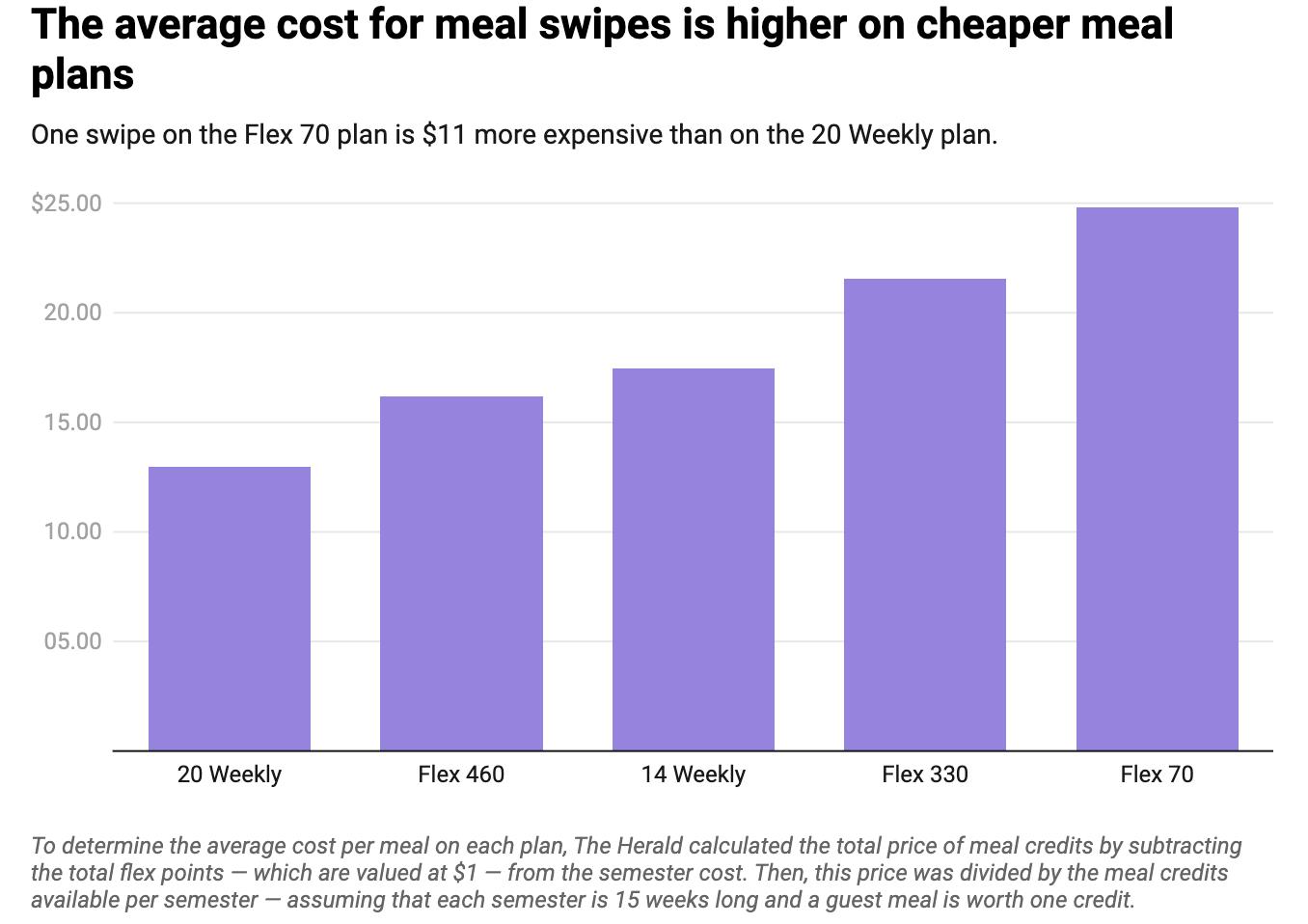
flex points and guest meals, but multi-tier packages and the division of weekly and flex plans help accommodate diverse student lifestyles, according to the Brown Dining website.
Currently, students can choose be-
semester is 15 weeks long and a guest meal is worth one credit.
Given these calculations, The Herald found that the average cost per swipe is $11 more for the least expensive meal plan, when compared to the most expensive plan.
One meal on the Flex 70 plan costs around $25 — a higher price point than the most expensive menu items at several popular restaurants on Thayer Street, including East Side Pockets, Chinatown on Thayer and Baja’s Taqueria. In comparison, the cost of one meal on the most expensive meal plan — 20 Weekly — is only around $13.
Students and community members can alternatively pay per meal to dine in any on-campus eatery. When dining without a meal plan, one meal at the Ivy Room, Andrews Commons or Josiah’s costs $13.15. In the two all-you-care-to-eat dining halls, one meal costs $15.95, $20.75 and $24.25 for breakfast, lunch and dinner, respectively.
Meal swipe prices have risen significantly since 2010.
In an email to The Herald, Barboza wrote that growing expenses from equipment and suppliers, “upgrades to Brown dining facilities and costs related to investing in the Brown Dining Staff” have resulted in price hikes for meal plans.
According to a 2010 Herald editorial, the cost for one meal at the Sharpe Refectory or the Verney-Woolley Dining Hall was between $6 and $8, but $13 on the less expensive plans.
In 2015, The Herald reported that “a meal on the Flex 460 plan costs $9.19, compared to $7.55 for the 20-meals-per-week plan, which has the same total price. Meals on the Flex 330 and Flex 240 plans cost $12.42 and $15.78, respectively.”
The Flex Meal Plan was first instituted in 2006 to improve flexibility for students and encourage on-campus dining. Prior to the change, meal credits were only replenished on a weekly basis. By offering a Flex Plan, Dining Services hoped to alleviate student concerns of losing meals at the end of the week while also offering more points for a la carte items, according to previous Herald reporting.
But despite this flexibility, several students told The Herald that they believe that
somebody who knows things because she’s deeply interested in them,” said Assistant Professor of English Mariah Min said. O’Dea is currently enrolled in Min’s course on medieval drama.
“Her knowledge is just a consequence of her really liking something,” Min said.
Before filming her episode, O’Dea connected with three-time “Jeopardy!” contestant Justin Bolsen ’26, who competed in the show’s “Tournament of Champions” in 2024 and won the competition’s High School Reunion Tournament the previous year. Bolsen advised her on buzzer strategies and keeping track of money throughout the game.
“She’s a rockstar,” Bolsen said. “I think she’s going to do really well on the show.”
Bolsen said he was excited to pass the torch to O’Dea, who will continue the recent streak of Brown students competing on “Jeopardy!”
“I’m really excited to be on the other side of things and be the watcher instead of the watched,” he added.
Min said that “it’s tremendously exciting to have a young person in our community on the national stage.”
“Del is a great representative,” she added. “She’s someone who engages in deep study not for external rewards, but because she finds it fascinating.”
off-campus dining is still more cost-effective than any meal plan offered.
Chloe Daniel ’27 chose to drop the meal plan as a third-year student, calculating that she could purchase 100 Chipotle bowls for the price of 70 meals on campus. “That’s such a better deal,” she said, adding that purchasing food directly from dining halls would be cheaper than participating in a
changes for limiting student choice and imposing burdens on those with dietary restrictions.”
A 2019 editorial published by The Herald also argued that ensuring that every student has consistent access to food is “not as simple as requiring students to purchase a meal plan” and that the University should offer a campus pantry and
meal plan.
“Dining plans pretty much only make sense if you plan to have dinner at the Ratty or V-Dub multiple times a day, everyday,” Alex Anaya ’27 wrote in an email to The Herald.
This frustration isn’t new. A 2019 Herald op-ed published by Andrew Reed ’21 argues that “every mid-sized meal plan is so outrageously priced that alternating between on- and off-campus eating is far more expensive than purchasing a full meal plan, or only eating off campus.”
Currently, all first- and second-year students are required to purchase a full-coverage meal plan. This often leads students to pay extra money to eat off campus to satisfy cravings and dietary restrictions.
In 2019, when the second-year requirement was announced, some undergraduate students opposed the requirement through a “widely-circulated letter, criticizing the
end-of-semester donation drives.
Charlotte Peterson ’28, a second-year student with celiac disease, echoed concerns shared by students in 2019, saying that it’s “difficult to be on the meal plan and have a dietary restriction that is so encompassing.” In terms of pricing, Peterson said that buying groceries is “much cheaper” than staying on a meal plan.
Financial aid packages offered by the University may cover full meal plans for undergraduates. When these packages were announced in 2018, University officials said the decision was meant to address food insecurity and support high-need students so they can fully engage in their education without having to make decisions based on cost.
This article originally appeared online at browndailyherald.com on Sept. 23,
LILA QUINN / HERALD
“Upgrades to Brown dining facilities and costs related to investing in the Brown Dining Staff” have placed further pressures on meal plans in recent years, according to Vice President of Dining Programs George Barboza.
TIFFANY XIAO / HERALD
CALEB LEE-KONG / HERALD
In May, Delaney O’Dea ’28 was called back for the final audition, and received the official call for her placement on the show in early August.
BROWN VS. HARVARD
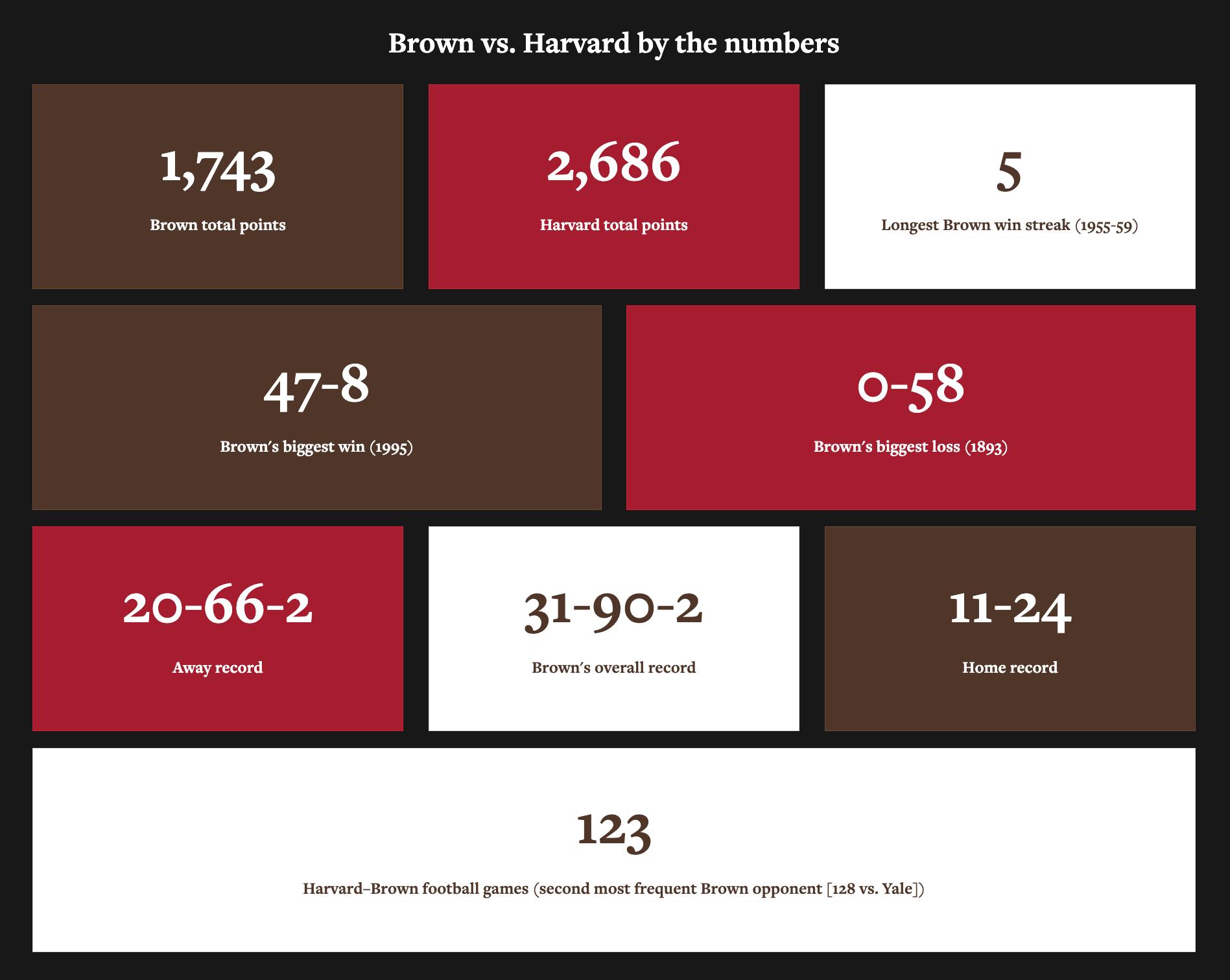
tions, Mackie said. The group was subbed out in the last few minutes of the next game against Harvard, he added.
Games against Harvard continued through 1942, with an exception in 1939. After not playing in 1943 and 1944 due to World War II, the rivalry was renewed in 1945 with another Brown loss.
1952: Brown pulled off a surprise victory in 1952. A last-minute tie against the Crimson in the 1954 game marked the start of Brown’s most successful decade of the rivalry. Bruno went on a five-game win streak from 1955 to 1959, finishing the decade 6-3-1.
A student at the time, Mackie remembers that era well — Brown bested Harvard in all four games played during his time as an undergraduate. The team saw a lot of support: “Everybody went to the games on Saturdays,” he recalled.
But soon after, the Bears encountered “a lot of problems,” he added.
In the 1960s, Brown football was at a low point. “It was so embarrassing for me as a recent” alum, Mackie said. At that
time, Brown had no real rival. Any victory would’ve been a good victory, Mackie explained.
In an email to The Herald, Dewey Moser ’64 P’90 wrote that Brown’s only victory over Harvard during his football career was at a separate first-year-only game in the fall of 1960.
Moser recalled teammate Anthony Matteo’s ’64 mother attending the game.
“After showering and changing we got on the bus and Matteo’s mom showed up with boxes of Italian sandwiches and goodies. That made the ride back to Providence even more satisfying.”
1976: After a loss at home in 1975, Brown triumphed over Harvard the next year. Brown went on to win their first Ivy League championship in 1976.
At that 1976 Harvard-Brown game,
ESPN sportscaster Chris Berman ’77 — a former Herald writer and then-radio announcer for Brown’s team — got into a blow-up argument in the press box at Harvard Stadium, Mackie said.
“I remember how psyched I was after we won. Then I overheard their radio guys saying how ‘lucky’ Brown was,”

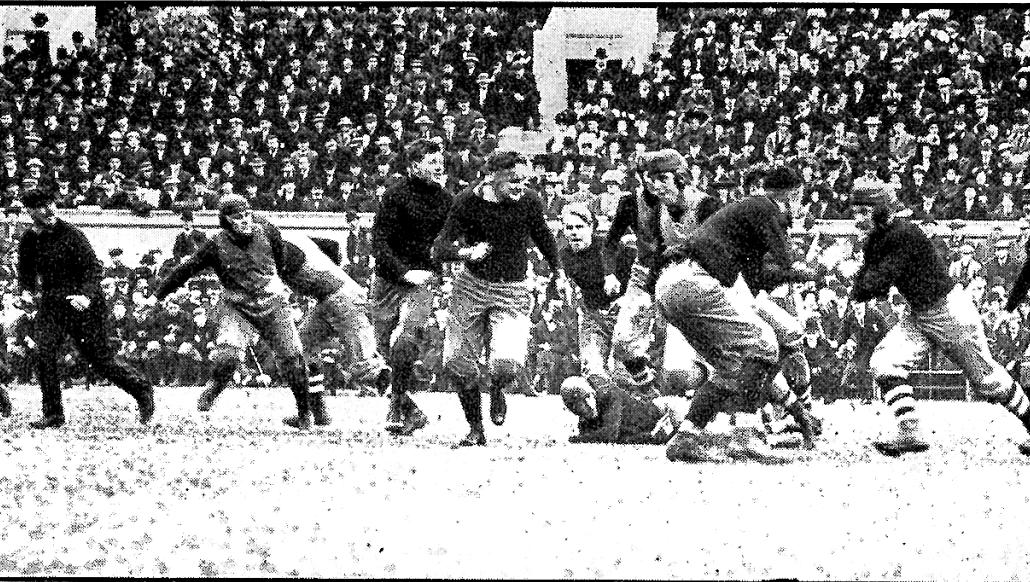
fondly on the 1988 game. Bruno’s kicker was injured, so Harrison went to his coach and asked to sub in. “That was the first game I kicked in college,” he said. “I was two-for-two on my extra points.”
1998: Quarterback James Perry ’00 — now Brown’s head coach — led Brown to victory at Harvard Stadium in 1998. It remains the last time Brown won on the road.
To Mackie, this is when the Harvard-Brown rivalry finally felt mutual.
“They really respected and feared us,” Mackie said. “Fear is an important ingredient in football.”
1999: Brown won again in 1999, capping off a six-win decade. This was the last time Brown won back-to-back matchups — though the Bears have another shot to do so on Saturday evening.
In 2000, scheduling changes made the Harvard-Brown game both teams’ Ivy League opener. Before that, Brown had been sandwiched between other Ivies on Harvard’s schedule, Mackie said.
“The place in the schedule has a big impact on that tradition,” Mackie said.
Perry agrees. In addition to kicking off the season, the game tends to occur before the bone-deep cold of fall sinks in.
“So, I reached my
point and pinned the two of them up against the wall and made them admit that we weren’t lucky. They did, and that was that.”
In the 1980s, Steve Harrison ’90 came to Brown from West Virginia to play varsity football. The rivalry against Harvard was fierce during Harrison’s time at Brown, especially with Bruno’s head coach John Rosenberg being a Harvard alum.
“When I was there, that was probably the game we most wanted to win,” he said. The crowd at Harvard-Brown games tended to be bigger, according to Harrison, likely because of the two schools’ proximity.
While Brown did not take home a victory against the Crimson during Harrison’s time on the team, he looks back



Perry as head coach. It remained to be seen if he could recapture the magic of the late ’90s and end the losing streak. But Brown lost again in 2019. In 2020, the game was cancelled due to the COVID-19 pandemic.
2023: In Brown’s most recent trip to Boston the Bears came excruciatingly close to a win, but a fourth-quarter comeback came up short.
2024: But a year later, the comeback dream came true. Brown recovered Harvard’s fumbled field goal snap and scored the winning touchdown in the final seconds, to the delight of over 10,000 viewers.
Perry said the stadium was “the most energetic and loudest I’ve ever seen.”
Ahead of Saturday’s game, “there is no motivation speech necessary,” Perry said. In fact, the biggest challenge is not becoming too emotional before heading out onto the field, Perry added. “Tap into the emotions in a positive way and don’t get carried away.”
“That game will be a war,” Mackie said. On the heels of Brown’s 2024 victory, he added, the Crimson “will respect us anew.”
“There’s kind of a hoopla around it being good weather,” Perry said.
And, at the end of the day, Harvard is just a “fun place to hate,” Mackie added.
“There’s that aura around Harvard that draws people.”
2008: Brown’s first 21st-century win came in 2008, followed by a second in 2010. That 2010 win was the last before the infamous 12-year losing streak that Brown snapped last year.
2018: In December 2018, Brown hired



Berman said in an interview with GoLocalProv.
boiling