SINCE 1891
THE BROWN DAILY HERALD VOLUME CLII, ISSUE 5
TUESDAY, JANUARY 31, 2017
Financial aid relieves Wintersession costs
U. fundraising continues ahead of schedule
Funds provided to participating students used for travel, course development fees By MIA PATTILLO SENIOR STAFF WRITER
The University’s pilot Wintersession program costs $6,278 per class for students, though around 75 percent of students received some sort of financial aid, said Dean of the College Maud Mandel. “The cost for one student’s Wintersession course is the cost of what they would be paying in their tuition for one Brown course,” Mandel said. The University offered full financial aid for students participating in Wintersession, and this support was viewed as one of the top priorities by the committee of undergraduate students, graduate students and faculty determining all aspects of Wintersession, Mandel added. For destination courses, Global Experiential Learning and Teaching grants covered essential travel costs, including flights, meals and health insurance, Mandel said. Each faculty member with an international course received a “block sum of $35,000, which they use to cover their own and the
students’ travel expenses,” Mandel added. Students enrolled in on-campus courses that travelled to cities such as New York City and Boston were also covered on these short trips, Mandel said. Faculty received course development funds to cover travel components and meals, reducing additional fees to nearly nothing, she added. For on-campus courses, the course development funds were put to use beyond day trips. Associate Professor of History Neil Safier, who taught the on-campus course HIST 1974K: “Maps and Empires: A Journey through the Cartographic Collection of the John Carter Brown Library,” said that the support of a teaching assistant — paid for through these funds — was “a real boon for the students, some of whom are not as familiar working with these materials.” These funds also brought visitors who were “amongst the leading specialists in the history of maps and empires in the world,” Safier added. But depending on the course, unforeseen costs could also arise. Marisa Kouroubacalis ’19.5, who took ENGN 0110: “Lean LaunchPad,” said that she and her team often travelled into the community for their class and were expected to cover the cost of » See AID, page 2
WWW.BROWNDAILYHERALD.COM
LAURA FELENSTEIN / HERALD
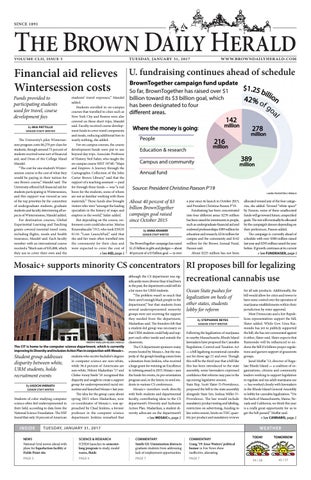
About 40 percent of $3 billion BrownTogether campaign goal raised since October 2015 By ANNA KRAMER SENIOR STAFF WRITER
The BrownTogether campaign has raised $1.25 billion in gifts and pledges — about 40 percent of a $3 billion goal — in over
a year since its launch in October 2015, said President Christina Paxson P’19. Fundraising has been concentrated into four different areas: $278 million has been raised for investments in people, such as undergraduate financial aid and endowed professorships; $389 million for education and research; $216 million for campus and the community and $142 million for the Brown Annual Fund, Paxson said. About $225 million has not been
allocated toward any of the four categories, she added. Termed “white space” by Paxson, some of these unallocated funds will go toward future, unspecified goals. The rest will eventually be allocated by the campaign’s donors depending on their preferences, Paxson added. The campaign is currently ahead of schedule with over $300 million raised last year and $293 million raised the year before. If growth continues at its current » See FUNDRAISER, page 2
Mosaic+ supports minority CS concentrators RI proposes bill for legalizing recreational cannabis use
TIMOTHY MUELLER HELDER / HERALD
The CIT is home to the computer science department, which is currently improving its Diversity and Inclusion Action Plan in conjunction with Mosaic+.
Student group addresses disparity between white, URM students, holds recruitment events By UGOCHI IHENATU SENIOR STAFF WRITER
Students of color studying computer science often feel underrepresented in their field, according to data from the National Science Foundation. The NSF found that only 18 percent of American
INSIDE
students who receive bachelor’s degrees in computer science are non-white, while 36.4 percent of Americans are non-white. Nifemi Madarikan ’17 and Chelse-Amoy Steele ’18 recognized this disparity and sought to create a support group for underrepresented racial minorities and launched Mosaic+ last year. The idea for the group came about spring 2015 when Madarikan, now co-coordinator of Mosaic+, was approached by Chad Jenkins, a former professor in the computer science department. Jenkins remarked that
although the CS department was significantly more diverse than it had been in the past, the department could still do a lot more for URM students. “The problem wasn’t so much that there aren’t enough black people in the department,” but that students from several underrepresented minority groups were not receiving the support they needed from the department, Madarikan said. The founders felt that a student-led group was necessary so that URM students could help and support each other inside and outside the classroom. The CS department sponsors many events hosted by Mosaic+, but the majority of the group’s funding comes from a donation from Jenkins, who received a large grant for winning an Excellence in Advising award in 2015. Mosaic+ uses the funds for events, its pre-orientation program and, in the future, to send students to various CS conferences. Mosaic+ members work directly with both students and departmental faculty, contributing ideas to the CS department’s Diversity and Inclusion Action Plan. Madarikan, a student diversity advocate on the department’s » See MOSAIC+, page 2
Ocean State pushes for legalization on heels of other states, students lobby for reform By STEPHANIE REYES SENIOR STAFF WRITER
Following the legalization of marijuana in nearby Massachusetts, Rhode Island lawmakers have proposed the Cannabis Regulation, Control and Taxation Act — a bill legalizing recreational cannabis use for those age 21 and over. Though this will be the third year that a bill like this has been introduced to the state assembly, some lawmakers expressed confidence that reforms may pass in the upcoming legislative session. State Rep. Scott Slater D-Providence, proposed the bill to the state assembly alongside State Sen. Joshua Miller DProvidence. The law would include mandatory product testing and labeling, restriction on advertising, funding to law enforcement, limits on THC quantity per product and mandatory reviews
for all sale products. Additionally, the bill would allow for cities and towns to have some control over the operation of marijuana establishments within their jurisdiction by voter approval. Most Democrats and a few Republican representatives support the bill, Slater added. While Gov. Gina Raimondo has yet to publicly supported the bill, she has not commented against it either, Slater said. Slater expects that Raimondo will be influenced to endorse the bill if it follows proper regulations and garners support of grassroots groups. Jared Moffat ’13, director of Regulate Rhode Island — a coalition of organizations, citizens and community leaders working to support legislation to regulate and tax adult marijuana use — has worked closely with lawmakers in the Rhode Island General Assembly to lobby for cannabis legalization. “On the heels of Massachusetts, Maine, Nevada and California, we think this year is a really great opportunity for us to get the bill passed,” Moffat said. » See CANNABIS, page 2
WEATHER
TUESDAY, JANUARY 31, 2017
NEWS National Grid moves ahead with plans for liquefaction facility at Fields Point site.
SCIENCE & RESEARCH ICERM launches its semesterlong program to study, model waves, fluids
COMMENTARY Smith GS: Unionization distracts graduate students from addressing lack of employment opportunities
COMMENTARY Liang ’19: Jesse Watters’ political humor in Fox News show ineffective, alienating
PAGE 3
PAGE 4
PAGE 7
PAGE 7
TODAY
TOMORROW
34 / 28
43 / 27
NEWS
PAGE 2 • TUESDAY, JANUARY 31, 2017
» FUNDRAISER, from page 1 rate, Paxson suggested the campaign could either finish ahead of schedule or grow beyond its goal of $3 billion. Though the campaign has raised $1.25 billion in gifts and pledges, the University has received an additional $790 million in cash that it can spend immediately, Paxson said. There are safeguards in place to ensure that the University does not spend money it has not yet received, Provost Richard Locke said. Usually when donors make a pledge, they fulfill that pledge within five years, Locke added. Though the campaign has no scheduled end date, Paxson hopes to grow the University’s fundraising capacity from about $250 million to about $300 million raised each year, Paxson said. “I had originally hoped … that we could average about $300 million a year over seven years,” Paxson said. Some goals have already seen marked success, Paxson said, highlighting funds raised for the athletics department, the Nelson Center for Entrepreneurship and the nearly completed School of Engineering building. For the “people” fundraising bucket, Paxson said the campaign has raised about $79 million for endowed undergraduate financial aid and funds for 37 endowed faculty positions. She hopes the campaign will produce 117 new endowed chairs, which require about $400 million. Funds for brain science and public health have both made progress in the “education and research” category, Paxson said. Over $30 million has been raised for Dean of the College educational initiatives, which include programs such as BrownConnect and various opportunities in the Swearer Center for Public Service, she said. About $25 million has also been raised for research and education at the Alpert Medical School, Paxson added. We are “making sure we are doing cutting edge research,” said Paula McNamara ’84, an Annual Fund fundraising co-chair. Cambridge, Massachusetts “is the mecca, and we want to be more competitive” compared to the peer institutions located there, she said. The fund will help to attract the best people to do research, which is incredibly important
» MOSAIC+, from page 1 DIAP committee, acted as a liaison between the committee and Mosaic+. The work that Mosaic+ pursues with students takes place along two branches: its mentoring and its transition programs. The mentoring program pairs an upperclassman CS student with two or three first-year students interested in CS. This year 36 mentees and 12 mentors joined the program. Mentors help mentees find courses and internships, prepare for grad school and compile resumes, among other tasks that prepare first-year CS students for the road ahead. “The mentorship component allows people to feel a little bit more secure in both their decisions and their interests,” said Steele, co-coordinator of Mosaic+. “I probably wouldn’t have known (about) other opportunities outside of class,” said Stephanie Alvarado ’20 , a current mentee. “It’s definitely a huge help.” Before the school year starts, the group hosts a pre-orientation program for incoming URM freshmen to cultivate an interest in computer science. Last year, the
for remaining a competitive institution, she added. The engineering building, currently under construction, and funds for the athletics facilities have been the primary targets of the “campus and community” bucket, Paxson said. “Completing fundraising for a performing arts center will be an area of focus for the next year,” she added. “I cannot overstate the importance of the Annual Fund,” Paxson said. The Annual Fund currently brings about $36 million a year, Paxson said, adding that she hopes to raise that number to $50 million annually. Incorporating the goals of the Diversity Action and Inclusion Plan, which is funded by the BrownTogether campaign, has not been difficult because many of the goals outlined in the DIAP were already included in the Building on Distinction plan, Paxson said. The BrownTogether campaign already included goals for increasing diversity and graduate education and expanding the Center for the Study of Race and Ethnicity in America and the Center for Study of Slavery and Justice, she added. The new fundraising priorities created by the DIAP include the First-Generation and Low-Income Student Center and the Native and Indigenous Studies Initiative at Brown, which the “white space” provided funding for, she added. “The campaign is going much better than I had initially anticipated,” Locke said. Locke is the chair of the Strategic Coordinating Committee, which meets every three weeks to evaluate gifts and assess whether they meet the operational goals for the campaign, as outlined by the Building on Distinction plan. Many of the people involved in strategic planning are also involved in budget forecasting to ensure that the budget accounts for new endowments and donations, Locke said. The messaging for the campaign centers around the branding of BrownTogether, said Jerome Vascellaro ’74 P’07, former vice chancellor of the University’s corporation and a campaign co-chair. “I think (the campaign) resonates with today’s world because problems are not monolithic — they’re integrated” and global, Vascellaro said. “Supporting Brown is supporting that ethos and culture.” program was attended by 13 students in addition to some students participating in Catalyst, Brown’s official pre-orientation program for minority students interested in STEM. Most students in the program went on to take a course in CS. Mosaic+ finds participants for the pre-orientation program through the Catalyst application. The students visited museums and the Google office in Boston and participated in bonding activities during the program in addition to completing computer science projects. Mosaic+ also hosts workshops and recruitment events in coordination with tech companies, such as walk-in hours with a representative from Twitter and a networking function with recruiters from Airbnb. Mosaic+ is working to build a network of URM alums in the future, but the group is still young. Madarikan and other seniors in the group hope to stay in touch with Mosaic+ after graduating, so that they might be a resource for future URM CS students. “I definitely want to be involved in Mosaic+ in the future … because it (has) helped me a lot, and I want to help someone else out,” Alvarado said.
THE BROWN DAILY HERALD
LAURA FELENSTEIN / HERALD
» CANNABIS, from page 1 “It’s certainly not a guarantee, but we do have more momentum than we’ve ever had before,” Moffat said. Public approval of marijuana is at an all-time high, according to a 2016 public opinion survey conducted by the Taubman Center for American Politics and Policy. The poll showed that a strong majority of Rhode Island voters — 67 percent — favor the state’s current law which allows cannabis use for medicinal purposes. The same study found that 55 percent of voters support legislation to regulate and tax recreational cannabis use. “With Massachusetts right across the border, it makes sense for Rhode
Island to get its system running at the same time,” Moffat added. Moffat, former president of Brown’s chapter of Students for Sensible Drug Policy, described student activism as a key element in the process of legislative reform. Moffat said he worked as a student to pass Rhode Island’s marijuana decriminalization bill in 2012, removing criminal penalties for possession of an ounce or less of marijuana. Additionally, he continues to work with current SSDP President Kathryn Duckworth ’19 and other members of the group to campaign for legislation, run events and spread awareness of healthy cannabis use. Nadir Pearson ’19, a member of SSDP, is going one step further by
creating a new club on campus — the Student Marijuana Alliance for Research and Transparency. SMART addresses public distrust of marijuana and in doing so, aims to change policies through community outreach, workshops and hands-on work with people in the industry, Pearson said. “There’s this big cloud of fear we are trying to dismantle,” Pearson said. Cannabis legalization could uniquely benefit Ivy League schools like Brown, Pearson said, who advocates for interdisciplinary research and instruction on cannabis at the university level. “Every subject can involve cannabis, from biology to engineering,” Pearson said. “Brown can be a place where we can open up the dialogue.”
LAURA FELENSTEIN / HERALD
» AID, from page 1 transportation themselves. Constance Gamache ’18, who also took the course ENGN 0110: “Lean LaunchPad,” noted that receiving financial aid played a major role in her decision to take a Wintersession course. Since the short list of classes offered were largely niche subjects, students who were not on financial aid “might have to really consider whether the class is worthwhile” for the full cost, Gamache added. “The full tuition of Wintersession costs so much,” said Jonathan Weisskoff ’20, who took the online course
ENGL 0930: “Introduction to Creative Nonfiction.” “If someone is receiving financial aid to cover a portion of that, it makes it a whole lot more appealing,” Weisskoff said. Though the University offered financial aid to students for its Wintersession, students at peer institutions tend to have more academic opportunities at no additional cost during break. For example, at the Massachusetts Institute of Technology, Middlebury College and Harvard, most winter classes require no additional charge, regardless of the student’s financial situation, according to the websites of these schools. “MIT’s winter recess doesn’t really
have additional charges and is all-inclusive, so you might as well take advantage of it,” said Ingrid Zhang, an MIT student who took a class on Java through her school’s version of Wintersession. MIT students can also get paid to conduct research over winter break, Zhang said. She added that on-campus housing is also provided without any additional charge added to their normal housing fee. This past Wintersession’s financial model, including costs and grants, was “a success” that will be continued for the rest of the three-year pilot, Mandel said.
NEWS
TUESDAY, JANUARY 31, 2017 • PAGE 3
THE BROWN DAILY HERALD
Despite concern, liquefaction facility plans move forward Environmental costs, risk of incident among cited reasons for political, community pushback By GWEN EVERETT SENIOR STAFF WRITER
National Grid received its Federal Energy Regulatory Commission certificate this January, giving the company permission to proceed with plans to install a natural gas liquefaction facility at its Fields Point site. Construction is slated to begin in March, but the project has already drawn controversy and criticism from Rhode Island environmental justice groups that advocate against liquefied natural gas. Environmental groups believe that the facility’s usage of natural gas will harm the environment and threaten the health of residents in neighboring Washington Park, said John Berard, Rhode Island state director of Clean Water Action, a national environmental advocacy group. “Clean Water Action does not support the construction of any new fossil fuel
infrastructure,” Berard said, adding that the construction of this new facility is counterproductive to Rhode Island’s efforts to move to a more sustainable energy economy. Residents of R.I. and New England depend on National Grid to supply fuel to their homes particularly at the coldest points in the winter, said David Graves, R.I. director of strategic communications for National Grid. Installing an on-site liquefaction facility would allow National Grid to produce its own LNG, which is made by cooling natural gas to a liquid form, he added. Currently, National Grid imports LNG from sources abroad, but this system can become treacherous if National Grid imports from tumultuous regions, Graves said. Recent terrorist attacks near a liquefaction site in Yemen threatened to jeopardize National Grid’s domestic LNG supply, Graves said. He added that the Fields Point liquefaction facility would bring National Grid a reliable source of LNG and safeguard against shortages. “If built, this project offers the potential to diversify sources of gas
supply (in the state),” wrote Brenna McCabe, public information officer for Gov. Gina Raimondo in an email to The Herald. She added that an onsite liquefaction facility would “create an economic hedge against more price volatile (and foreign-sourced) LNG supplies.” But Mayor Jorge Elorza believes that funds would be better spent investing in energy conservation and renewable sources, wrote Victor Morente, press secretary for Mayor Elorza, in an e-mail to the Herald. Elorza spoke out against the liquefaction facility in an Aug. 25 press release, arguing that it would derail state efforts to combat the effects of climate change. Berard and Morente both expressed concern about the safety risks the facility could pose in the short-term as well. The site where the liquefaction tank will be installed lies adjacent to Washington Park, which already suffers from high environmental risk and public health problems due to its proximity to existing facilities, Berard said. The Fields Point site already has a high risk of storm surges, Berard said.
COURTESY OF NATIONAL GRID
National Grid will begin construction on the Fields Point liquefaction facility despite the location’s high risk of storm surges, among other factors. “If climate change were to worsen, the probability of something that would trigger some sort of explosion becomes higher and higher.” He added that if this were to happen, Washington Park is within blast radius. But Graves said that the plant is not likely to explode as the process involves cooling, not heating, natural
gas until it reaches its liquid form. Graves said that much of the opposition to the liquefaction facility is “ill-informed (and) ill-advised.” Berard added that the National Grid facility will be situated near another site that handles volatile chemicals, so the possibility for an accident still exists.
RI education leaders speak out against DeVos nomination Past support of privatized education sparks uneasiness among public education advocates By ISABEL GENSLER SENIOR STAFF WRITER
President Donald Trump’s nominee for Education Secretary Betsy DeVos could seriously impact education in Rhode Island by privatizing public education or cutting federal grants used to help students pay for higher education, some advocates of federally-funded public eduation fear. DeVos “is interested in privatizing public education, and we believe that public education is the underpinning of our democracy,” said Sarah Friedman, co-director and co-founder of the nonprofit Learning Community Charter School. She added that their school takes a stance against profiteering charter schools of the kind that DeVos may plan to expand. Over her career, DeVos has supported taxpayer-funded and privatelyrun education, a departure from the current system of government-run and -regulated schools. According to National Public Radio, nearly 80 percent of charter schools in DeVos’s home state of Michigan — where she has worked to introduce charter schools — are run by for-profit companies. When asked in her Jan. 17 confirmation hearing, DeVos would not take a stance against cutting current public education funding or privatizing public education. But Friedman argued that public education cannot be called public if it is “influenced by profit-making corporations or religiously-affiliated organizations … and that is very much (DeVos’s) agenda.” The Learning Community said it is committed to the original intent of charter legislation, “which is to be incubators that support innovation within the larger public education system,” Friedman said.
“Any move to privatize our public education system will fiscally … undermine the districts that we are supposed to be supporting,” Friedman said, adding that privatization will also make the charter sector “less publicly accountable.” For The College Crusade of Rhode Island — a college access and success program for about 4,500 students every year — the biggest concern regarding DeVos is whether or not she would support Speaker of the U.S. House of Representatives Paul Ryan’s 2016 budget plan, calling for a 10-year freeze on spending increases to the Pell Grant program. “Every Rhode Island student deserves the chance to learn and gain the skills they need to get ahead. The mission of the U.S. Department of Education is to give them that chance,” wrote U.S. Sen. Sheldon Whitehouse D-RI a member of the Health, Education, Labor and Pensions Committee, in a press release last Thursday. Whitehouse added that promoting quality education requires understanding the importance of Pell Grants, which can make higher education affordable for students hoping to pursue college. “There are eight million students in this country from low- and modest-income families that rely on Pell Grants to pay for college,” said Andrew Bramson, president and CEO of The College Crusade of RI. “Tuition and room and board costs will continue to increase,” he said, arguing that DeVos should reject any cuts to the program. Bramson added that Pell Grants are the largest source of aid most of his students receive. The grant is currently valued at a maximum $5,815 a year for those that receive a full award, which is granted to nearly all of The College Crusade’s students who enroll in higher education. Bramson explained that the purchasing power of the grant for attending a four-year institution has decreased from 70 to 30 percent since 1980. Losing the Pell Grant would leave students “out on a limb in terms of how they’re going to cover tuition,
living expenses, books and materials.” College Crusade receives a majority of its funds through the U.S. Department of Education’s grant program GEAR UP — Gaining Early Awareness and Readiness for Undergraduate Programs. Congress is slated to reauthorize the Higher Education Act — the law concerning federally-funded student aid programs — in the next year, which makes it “critical” for groups like College Crusade that Devos continues to support GEAR UP by including it in the act’s reauthorization if she is confirmed, Bramson said. In terms of supporting student voices, the Providence Student Union, a youth-led organizing group, feels that DeVos is “kind of a question mark,” said Executive Director Zack Mezera. But the union recognizes DeVos’s “track record of undermining traditional education structures,” he added. Mezera said the union is concerned not only for the direct changes DeVos could bring about — such as the Department of Education’s policy with vouchers — but also indirect changes that could upset individual states’ departments of education, which have been working on their own plans to implement the Higher Education Act, Mezera said. The Rhode Island Department of Education has already put together its own compliance plan, and Mezera said he worries DeVos’s changes could disrupt that work. Under DeVos’s regulation powers, “she could take the plans that RIDE submits and put a big red “X” on it,” Mezera said, adding that months have already been spent on community forums and input sessions related to R.I.’s compliance. For states that haven’t shown a strong regard for federal laws regarding education, DeVos could approve their plans “without reading into how they make interventions regarding student equity or racial disparities,” Mezera said. He added that Rhode Island can address these issues on a state level, but “some states need federal intervention.”
LAURA FELENSTEIN / HERALD
NEWS
PAGE 4 • TUESDAY, JANUARY 31, 2017
THE BROWN DAILY HERALD
New seminar explores first-generation experience Gregory Elliott continues first-generation awareness efforts by teaching course for sophomores By RHAIME KIM SENIOR STAFF WRITER
This spring, Professor of Sociology Gregory Elliott is unveiling a new sophomore seminar, SOC 1872G: “First-Generation College Students: A Sociological Perspective.” The seminar examines the structural forces that impact first-generation students and their ability to succeed in college. The seminar builds on a Group Independent Study Project that Elliott supervised called “First-Generation Students in the Ivy League,” which led to the 2014 founding of 1vyG, an annual conference that connects first-generation students across the Ivy League. “The kinds of socioeconomic disadvantages that first-gens face are really based on class problems, not race or gender,” Elliott said. “You can be really smart, but there are socialization patterns that will prevent you from capitalizing (on) intelligence.” As a result, first-generation students do not always develop the critical thinking skills that other students acquire, setting them at a disadvantage in college, he said. In part, Elliott speaks from personal experience — he was a
first-generation student himself at Boston College. “When I got (to college), I had no idea what I was doing. I probably could have made much more out of my college experience if I had had the social and cultural capital from the beginning,” he said. Elliott correctly anticipated that many of the prospective students shopping his class would be firstgeneration students as well. He said the course would be most helpful to sophomores as they try to find their place at Brown. Freshman year is too early, whereas for juniors and seniors, it would be like “turning the light on, after you’ve already scoured the room,” he said. Elliott hopes that the course will inform campus dialogue of the firstgeneration experience beyond the classroom. At the end of the course, students will work on group projects that they present to the public at the First-Generation College and LowIncome Student Center. “(It) will be good for the community to gain new insights into the challenges faced by first-gens at college,” Elliott wrote in a follow-up email to The Herald. As a first-generation student himself, Provost Richard Locke identifies strongly with the struggles that firstgeneration students at Brown face today, he said. Locke did not have the same roadmap as his peers whose parents attended college, he said. For example, Locke did not have anyone to advise him on course selection
COURTESY OF BROWN UNIVERSITY
Professor of Sociology Gregory Elliott was a first-generation student himself at Boston College 53 years ago. and thus decided to take organic chemistry — a notoriously difficult subject — as a freshman at Wesleyan, he added. Despite these challenges, Locke did not seek advice for a long time. “I felt ashamed that I didn’t know. I thought it was my problem. I thought I was somehow deficient and that I must have snuck in,” he said. “I got here 34 years ago, and I was banging on the door of this administration saying, ‘It’s not just racial diversity you need, you need class diversity,’” Elliott said. “They didn’t want to hear it.” It has only been in the last 10 years or so that Brown has cared about socioeconomic diversity, he added.
Locke said Brown has made huge investments in socioeconomic diversity since 2007, when the University adopted need-blind admissions and started to meet full demonstrated financial need for all admitted students. “I think (it’s) a very important statement of values of the University,” he said. Locke has aimed to address the needs of the first-generation community at Brown since 2015, when he assumed the position of provost. After soliciting community feedback from first-generation and low-income students, Locke collaborated with the Dean of the College and Office of Student Life to examine the cost of attendance and healthcare for those on financial aid. Several steps have since been taken to support first-generation students. In 2016, the University hired Vernicia Elie as assistant dean of the college for financial advising to help students manage their finances. In addition, the FLIC encourages first-generation and low-income students “to first of all embrace that identity” and provides them with resources such as peer-topeer mentoring programs, Locke said. Mike Munckong ’19, a first-generation student, found support and advice from a peer mentor through First-Gens@Brown, a student group founded after the launch of 1vyG. First-generation faculty members can also play an important role in supporting students by serving as role models, Elliott said. “One of the
things that especially first-gen faculty can do is to say, ‘I know what you’re going through.’” Even before the creation of a center dedicated to first-generation and low-income students in 2016, first-generation administrators took their roles as mentors very seriously. Yolanda Rome, associate dean of the college for first-year and sophomore studies, started informally mentoring first-generation students through her initial appointment at Brown as director of academic outreach. “It just came about that students would come to workshops, and I would share my story … so (a lot of) first-gens would come up to me.” Rome now serves as the acting co-director of the FLIC, while the University continues its search for a full-time director. Despite opening only five months ago, the FLIC already boasts a strong community support network with frequent gatherings and dinners for center affiliates. Munckong attended one such dinner last year, where he was persuaded by Elliott and the students who worked on the GISP to take the seminar. Getting first-generation students to Brown “is the easy part. Helping them feel like they belong here, that’s the hard part,” Elliott said. “That, presumably, is what the (FLIC) and the 1vyG are about — where you go not just to learn the academic tricks of the trade, but also to learn the social (conventions) of a college.”
Scholars collaborate on fluid modeling problems ICERM’s semester-long program facilitates progress on application of Navier-Stokes equation By JONATHAN DOUGLAS SENIOR STAFF WRITER
The Institute for Computational and Experimental Research in Mathematics will focus its upcoming semester program on “Singularities and Waves in Incompressible Fluids,” gathering together researchers from across the country to tackle unsolved modeling problems involving phenomena like waves, bubbles and jets. The program, which includes workshops as well as semester-long collaborations between scholars, is meant to create a space for mathematicians to come together and delve into these topics. The program strives to facilitate progress on the mathematical modeling of waves. The equation that governs the movement of waves — known as the “Navier-Stokes Equation” — was established over a hundred years ago, but its applications remain elusive today. This problem is well-known among mathematicians and has been a source of much scholarly focus, said Govind Menon, professor of applied mathematics and one of the organizers of the semester program. The Clay Mathematics Institute introduced the equation as one of seven Millennium Prize Problems, offering one million dollars for the solution to any of these
problems that have stumped mathematicians. The problem is well-known worldwide, and mathematicians pursuing the solution to the NavierStokes equation often work at different locations. By bringing people together in the same space, the program aims to improve communication. “No one in my department works on waves, so I’m very happy to be here. I’m expecting to get a lot of work done and … get new ideas,” said Diane Henderson, professor of mathematics at Pennsylvania State University and one of the organizers of the program.
Currently, there are three ways by which researchers attempt to solve the problem of modeling waves: analytically, using mathematical techniques; computationally, using computer simulations and experimentally, using
PIA MILEAF-PATEL / HERALD
wave pools and other equipment, said Baylor Fox-Kemper, associate professor of earth, environmental and planetary sciences. The semester program aims to bring together people using each method so that the mathematicians can draw on each other, Henderson said. “It’s really wonderful to have people using all three methods come together. It makes all the difference in the world,” she added. Researchers can also suggest papers and techniques for other mathematicians, Menon said. While waves attract interest from many mathematicians, many scientists are intrigued by the topic as well. Fox-Kemper is interested in the semester program because he hopes it will enable him to create more accurate models of waves. He uses wave models to predict carbon flow into and out of the earth’s atmosphere and then applies this data to help model climate change. Additionally, the semester program will focus on other unsolved problems relating to incompressible fluids, such as bubbles and jets, which are difficult to model mathematically, said Walter Strauss, professor of mathematics and the main organizer of the program. Overall, 120 people will participate in the semester program, according to the program’s website. Strauss has high hopes for what the group might achieve: “Something really might come out of (the program) by communication from the different viewpoints,” he said.
TODAY
TUESDAY, JANUARY 31, 2017 • PAGE 5
THE BROWN DAILY HERALD
menu
a f lo w e r g r o w s i n l i s t
SATELLITE DINING ANDREWS COMMONS
Pizza: Bacon Chicken Ranch, Spinach and Feta, Pepperoni and Meatball JOSIAH’S
BLUE ROOM
BBQ Chicken Burrito Bowl
Soup: Three Bean Chili, Turkey Sausage and Kale
DINING HALLS SHARPE REFECTORY LUNCH
DINNER
Chicken Chimichangas, Jalapeno Rice, Refried Beans, Turkey Tacos
Cajun Blackened Chicken, Roasted Red Potatoes with Shallots, Cavatini
VERNEY-WOOLLEY LUNCH
DINNER
Black Bean and Corn Stew, Potato Skins Bar, Buffalo Wings, Chicken Rice Soup
Macaroni Shell Pasta, Thai Basil Stir Fry, Chicken Pot Pie, Root Vegetable Medley
sudoku
crossword
GUS REED / HERALD
In her exhibit “And men turned their faces from there” in the David Winton Bell Gallery, visual artist Fatma Bucak explores the confluence of conflict and beauty on the Turkish-Syrian border.
Q U O T E O F T H E D AY
“Every subject can involve cannabis, from biology to engineering.” — Nadir Pearson ’19
See cannabis on page 1.
calendar TODAY JANUARY
S
M
T
W
Th
F
S
1
2
3
4
5
6
7
8
9
10
11
12
13
14
15
16
17
18
19
20
21
22
23
24
25
26
27
28
29
30
31
1
Effective Body Language for Presentations 9:00 A.M. Brown Office Building
Telescope Observing Night 7:00 P.M. Ladd Observatory
Managing Your Online Identity, Part One 11:00 A.M. Rockefeller Library
Spring 2017 General Career Fair 11:00 A.M. Sayles Hall
TOMORROW LingLangLunch 1:00 P.M. Metcalf Research Building, 305
5th Year Master’s Fair 3:00 P.M. Sayles Hall
Macroeconomics Seminar — Thomas Phillipon — NYU Stern 4:00 P.M. Mencoff Hall Seminar Room
Hack@Brown Intro to Chrome Extensions 5:00 P.M. Science Center, 3rd Floor
COMMENTARY PAGE 6 • TUESDAY, JANUARY 31, 2017
THE BROWN DAILY HERALD
EDITORIAL
U. should support community members affected by immigration ban On Friday, President Donald Trump banned citizens from seven predominantly Muslim countries from entering the United States. The executive order — made just a week after Trump was officially sworn in as president — has affected the lives of thousands, including many members of our community. Trump’s order was executed with little thought paid to the legal system that was built to protect the very immigrants it now bans. The purpose of the order is to protect the United States “from foreign terrorist entry into the United States,” though experts, who Trump diligently ignores, have pointed out that the order will be ineffective at doing so. Thoughtlessness created this situation. Now, careful action is needed to get us out of it. As a news organization, we have and will continue to cover the effects the ban and the policies of the Trump administration have on our community with truth and care, noting that our community is one of many that has been touched by the executive order. We encourage the University to use its power as an institution to protect those who are affected by the immigration ban. A number of universities, such as the University of Michigan, New York University and Cornell have publicly voiced the ways that they will be helping their students. Michigan released a statement asserting it would refuse to release the immigration information of any of its students unless required to do so by law. NYU similarly refused to allow the federal government to collect any information on immigrant students sans subpoena. As lawyers flocked to airports across America to work pro bono for those being prepared for deportation, Cornell said it was exploring opening up its law school, offering free legal consultations to students affected by the executive order. We applaud the University for its op-ed in The Herald on Monday that reaffirmed our community’s values during this difficult time, but we call on them to take more concrete steps. While we acknowledge that there may be specific circumstances that prevent Brown from taking the measures established by other colleges, the University should prioritize using its time and energy to keep our community safe. If you know any students or faculty members affected by this bans, we encourage you to reach out to the Office of International Student and Scholar Services team at 401-863-2427. For non-visa related concerns, contact the Office of Global Engagement at 401-863-1300. Other members of the community should reach out to their local American Civil Liberties Union office for legal assistance. Editorials are written by The Herald’s editorial board: Lauren Aratani ’18, Kate Talerico ’18, Matthew Brownsword ’18 and Rebecca Ellis ’18. Send comments to editorials@browndailyherald.com.
P IA M I L E A F- PAT E L
Find us online! facebook.com/browndailyherald
browndailyherald.com
@the_herald
Location: 195 Angell St., Providence, R.I. www.browndailyherald.com
@browndailyherald
youtube.com/browndailyherald
Editorial Leadership
Sections
Multimedia & Production
Business
Editor-in-Chief Lauren Aratani
Arts & Culture Editors Julie Center Madison Rivlin
Design Editors Christy Leung Ameer Malik Jessica Yu Assistant: Eduard Muñoz-Suñé
General Managers Henry Ritter Ben Wesner
Managing Editors Matt Brownsword Rebecca Ellis Kate Talerico POST- MAGAZINE Editor Monica Chin
News Editors Kyle Borowski Kasturi Pananjady Suvy Qin Elena Renken Alex Skidmore Hattie Xu
BLOGDAILYHERALD Editor Anica Green
Sports Editor Jackson Chaiken Ben Shumate COMMENTARY Opinions Editors Margaret Hu Anuj Krishnamurthy Mili Mitra
Photo Editors Head: Eli White Assistant: Sam Berube Marianna McMurdock Lilly Nguyen Copy Desk Chief Julia Stemmer Multimedia Editor Roland High Illustrations Editor Dorothy Windham Graphics Editor Laura Felenstein Directors of Web Development: Lucy Wei Ivy Wong
Directors Finance: Reena Zhan Sales: Antonia Alvarez Sales: Erin Lueck Strategy: William Nober Strategy: Gianna Jasinski Managers Sales: Elizabeth Doykan Sales: Gabriella Elanbeck Sales: Matilda Lynton Sales: Ariel Shusterman Collections: Ravi Betzig Operations: Gür Ağci
Editorial contact: 401-351-3372 herald@browndailyherald.com
Business contact: 401-351-3260 gm@browndailyherald.com
Submissions: The Brown Daily Herald publishes submissions in the form of op-eds and letters to the editor. Op-eds are typically between 750 and 1000 words, though we will consider submissions between 500 and 1200 words. Letters to the editor should be around 250 words. While letters to the editor respond to an article or column that has appeared in The Herald, op-eds usually prompt new discussions on campus or frame new arguments about current discourse. All submissions to The Herald cannot have been previously published elsewhere (in print or online — including personal blogs and social media), and they must be exclusive to The Herald. Submissions must include no more than two individual authors. If there are more than two original authors, The Herald can acknowledge the authors in a statement at the end of the letter or op-ed, but the byline can only include up to two names. The Herald will not publish submissions authored by groups. The Herald does not publish anonymous submissions. If you feel your circumstances prevent you from submitting an op-ed or letter with your name, please email herald@browndailyherald.com to explain your situation. You can submit op-eds to opinions@browndailyherald.com and letters to letters@browndailyherald.com. When you email your submission, please include (1) your full name, (2) an evening or mobile phone number in case your submission is chosen for publication and (3) any affiliation with Brown University or any institution or organization relevant to the content of your submission. Please send in submissions at least 24 hours in advance of your desired publication date. The Herald only publishes submissions while it is in print. The Herald reserves the right to edit all submissions. If your piece is considered for publication, an editor will contact you to discuss potential changes to your submission. Commentary: The editorial is the majority opinion of the editorial page board of The Brown Daily Herald. The editorial viewpoint does not necessarily reflect the views of The Brown Daily Herald, Inc. Columns, letters and comics reflect the opinions of their authors only. Corrections: The Brown Daily Herald is committed to providing the Brown University community with the most accurate information possible. Corrections may be submitted up to seven calendar days after publication. Advertising: The Brown Daily Herald, Inc. reserves the right to accept or decline any advertisement at its discretion. The Brown Daily Herald, Inc. is a financially independent, nonprofit media organization bringing you The Brown Daily Herald, BlogDailyHerald and Post- Magazine. The Brown Daily Herald has served the Brown University community daily since 1891. It is published Monday through Friday during the academic year, excluding vacations, once during Commencement and once during Orientation by The Brown Daily Herald, Inc. Single copy free for each member of the community. Subscription prices: $200 one year daily, $100 one semester daily. Copyright 2017 by The Brown Daily Herald, Inc. All rights reserved. Periodicals postage paid at Providence, R.I. Postmaster: Please send corrections to P.O. Box 2538, Providence, RI 02906.
COMMENTARY TUESDAY, JANUARY 31, 2017 • PAGE 7
THE BROWN DAILY HERALD
Graduate student unionization worthwhile? BENJAMIN SMITH staff columnist
Last summer, the National Labor Relations Board ruled that graduate students at private colleges and universities in the United States have the right to unionize. The decision marked a historic turning point for graduate students, granting them collective bargaining rights and legal status as employees. Graduate students at Brown responded to the ruling by forming a group called Stand Up for Graduate Student Employment. SUGSE’s primary goal is to convince a majority of graduate students at Brown to vote in favor of unionization. They argue that unionization will empower graduate students by giving them leverage to negotiate the terms of their working relationship with the university. Forming a union has the potential to help graduate students make important gains. Paid leave, child-care compensation, defined time commitments for teaching assistantships and formal channels for filing grievances would significantly benefit graduate students, and a union would be an effective means for achieving these ends. But the risk of the unionization debate is that it distracts graduate stu-
dents from the more ominous, systemic problem confronting them: the lack of employment opportunities in academia. Doctoral students in the humanities are most dramatically affected by this problem; STEM doctoral students and master’s students have a broader range of employment opportunities outside of academia and do not feel the suffocating lack of academic employment as much as hu-
doctoral students. Graduate students should be wary of devoting time and energy to unionizing, given the more pressing problem of post-graduate employment looming on the horizon. It isn’t worth re-upholstering the living room furniture if there’s a gas leak in the basement. Brown’s graduate students should engage the University and advocate for themselves. But they should select
University about post-graduate employment prospects directly; it should not skirt around the issue by fighting for small-scale gains. The issue of post-graduate employment is too daunting for most humanities doctoral students to want to address. Nobody talks about it. Everyone, on the other hand, talks about unionization. Unionization is tenable. There are definitive steps to take to
Graduate students should be wary of devoting time and energy to unionizing, given the more pressing problem of post-graduate employment looming on the horizon. It isn’t worth re-upholstering the living room furniture if there’s a gas leak in the basement.
manities doctoral students. The Modern Language Association estimates that only one-third of humanities students who earned their PhD between 1996 and 2011 are currently tenured academic faculty. The issue of post-graduate employment is conspicuously absent from the unionization discussion. Full-time, salaried employment after graduation is what graduate students need most, especially humanities
the issues that are important to them carefully. If the unionization vote passes and graduate students bargain only for incremental improvements to their compensation packages, they will be selling themselves short and letting the University off the hook. Brown can afford slightly higher stipends and dental insurance for graduate students. It cannot afford to hire them as full professors. A graduate student union should confront the
achieve it. It instills a feeling of power, of control over one’s destiny, of voice. Employment prospects instill a sense of fear. It often feels like the unionization conversation is a convenient substitute for the more pressing employment conversation that isn’t happening. Unionization may be a good starting point, a platform from which graduate students can launch and — over time — advocate for deliberate
steps to increase their chances of securing post-graduate employment. Allocating resources for job placement officers, seminars on navigating the job market and individualized career guidance could be issues that a union eventually addresses. These issues should be at the forefront of the current unionization conversation. But discussing these issues would also force SUGSE to discuss the limits of unionizing. What could a union offer to a newly-minted PhD who has just finished their program at Brown, is no longer affiliated with the University and is entering the job market for the first time? This is perhaps the most vulnerable moment for doctoral students and also the one at which the union would be unable to provide assistance. Graduate students, especially humanities doctoral students, should be wary of feeling that unionization would significantly improve their status. As long as they continue to teach for comparatively minimal wages, the University comes out way ahead. And even with the protection of a union, the University has no financial incentive to help graduate students find post-graduate employment. As long as that is the case, graduate students are more or less on their own.
Benjamin Smith GS can be reached at benjamin_smith@brown.edu.
Dear Jesse Watters MARK LIANG staff columnist Dear Jesse Watters, Last week you visited your favorite campus to interview students about toxic masculinity and the Women’s March. Many students found your visit polarizing, to say the least. You broke one of my Facebook group chats, that’s for sure. Several of my friends got to talk to you and were asked questions that eventually became a piece that many, including myself, found humorous. After all, there are clips of you skating down College Hill. Who skates past the age of 30? You tweeted back in October that you are a “political humorist,” and that your segments are “intended to be a light piece.” But that’s the thing about humor. Humor works because it either alienates or validates an audience; we either laugh with someone or laugh at someone. I am reminded of your last piece that went viral, “Watters’ World: Chinatown Edition,” as an example of the latter. When you play “Kung Fu Fighting” or fake bow to someone in Chinatown who doesn’t speak English that’s definitely not laughing with them. You said on Twitter that offense taken from the segment fills you with regret. I don’t want regret. I want an apology. You remember when you came to Sex Power God, right? It’s that segment where you, a thirty-
something at the time, filmed a bunch of college students making out and then broadcast it on national television without their approval. The clip was offensive to a lot of people. So, while we no longer hold Sex Power God at Brown, you will forever be intrinsically linked to it in my mind. In fact, up until this week, you were ButtNaked Guy in my head. As you might be able to tell, I am trying to be funny about a topic many people took seri-
and policy. Hold us to a higher standard. What I can’t support is using footage to mock us special snowflakes, laughingly point out our supposed ignorance for strangers nationwide or paint a picture that isn’t true. Like an alternative fact, I suppose. Comedy is a fickle tool when dealing with the hot-button issues of today. It’s hard to find an audience to laugh about sensitive topics and even harder to find someone to tell the joke. For
And so, Jesse Watters, despite a track record I can’t possibly condone, I won’t judge you by your worst. But I do ask you to consider what purpose your humor, which is televised in thousands of homes, serves.
ously in the hope that it will change your mind about how you handled that situation. See? Useful humor. Of course, as The Herald has reported, you were within the legal boundaries to film and publish interviews with students. Sometimes I even welcome your televised segments. Call us out on our lack of knowledge of political topics
topics like toxic masculinity, you can try to use humor to bridge a gap between those who smirk at safe spaces and those who may actually need them. Parts of your segment were funny to me, but I was left dissatisfied. Humor at its best minimizes harms while attempting to create change, and I didn’t find your comedy particularly effective at either.
I’m not going to lie: The left has a problem with alienating humor, too, possibly because the Republican Party gives them so much material to work with (so, so much). Late-night hosts mock and shame the right, most of the entire entertainment industry does the same and the modern conservative is left out in the cold. Aziz Ansari put it best in his recent Saturday Night Live monologue: “Some people are like, ‘Everyone that voted for Trump is a dumb racist, misogynist, (and) homophobe.’ Hold on. We’re talking about 63 million people. You know? Don’t judge them by their worst.” And so, Jesse Watters, despite a track record I can’t possibly condone, I won’t judge you by your worst. But I do ask you to consider what purpose your humor, which is televised in thousands of homes, serves. Your colleague Bill O’Reilly said, “We do this … because we want to.” Hold yourself to a better standard than that. I wonder how many people felt like they were laughing with you on Saturday’s segment. I wonder if anyone learned to empathize with different opinions. I wonder how many people felt alienated, or worse, vindicated to continue their own harmful agendas after watching you on that television. Huh. Maybe I should go out on the streets and ask.
Mark Liang ’19 can be reached at mark_liang@brown.edu.
Got something to say? Leave a comment online! Visit www.browndailyherald.com to comment on opinion and editorial content.
THE BROWN DAILY HERALD