SINCE 1891
THE BROWN DAILY HERALD MONDAY, SEPTEMBER 17, 2018
VOLUME CLII, ISSUE 63
WWW.BROWNDAILYHERALD.COM
Hack Health tackles emergency care Bears dominate
Rams in 5-0 victory
Third annual hackathon awards grand prize to automated drug dispensing system
Bruno has five different goal-scorers in blowout, outpaces URI 19-4 in shots, 9-3 in corner kicks
By JACOB LOCKWOOD SENIOR STAFF WRITER
After a morning spent passionately discussing critical problems in health care, undergraduate and graduate students teamed up to devise innovative solutions to the issues they found most compelling. Thus began the third annual Brown Hack Health — a weekendlong hackathon devoted to exploring and developing new ideas to fill the cracks in health care delivery systems around the world. This year’s Hack Health brought around 75 participants spanning a variety of disciplines and education levels together into 12 teams that tackled different problems, said Hack Health Co-Presidents Elizabeth Carlson ’19 and Emily Yamron ’20. Many teams chose issues related to this year’s theme of emergency care, though they could work on any health care problem that interested them. One team — consisting of Alexander Homer ’21, Viknesh Kasthuri ’21
By ALEX SMOLAR SENIOR STAFF WRITER
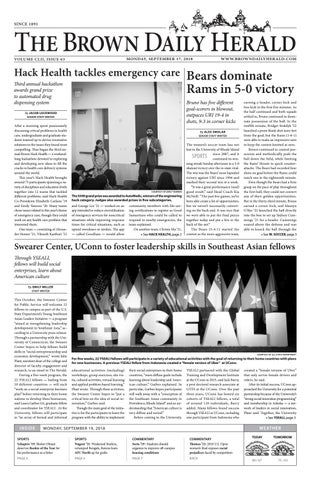
The women’s soccer team has not lost to the University of Rhode Island since 2007, and it continued its winning streak Sunday afternoon in a 5-0 shutout victory over the in-state rival. The win was the Bears’ most lopsided victory against URI since 1994 and marked their second win in a week. “It was a great performance (and) good result,” said Head Coach Kia McNeill. “The past few games, we’ve been able create a lot of opportunities, but we weren’t necessarily converting on the back end. It was nice that we were able to put the final pieces together today and put a few in the back of the net.” The Bears (3-4-1) started the contest as the more aggressive team,
SPORTS
COURTESY OF EMILY YAMRON
The $500 grand prize was awarded to AutoMedic, winners of the engineering hack category. Judges also awarded prizes in five subcategories. and George Lee ’21 — worked on an app intended to reduce overutilization of emergency services for noncritical situations while improving response times for critical situations, such as opioid overdoses or strokes. The app — called GoodSam — would allow
community members with life-saving certifications to register as Good Samaritans who could be called to respond to nearby emergencies, the team explained. On another team, Christy Mo ’21, » See HACK HEALTH, page 2
earning a header, corner kick and free kick in the first five minutes. As the half continued and both squads settled in, Bruno continued to dominate possession of the ball. In the twelfth minute, Bridget Stokdyk ’22 launched a point-blank shot mere feet from the goal, but the Rams (1-8-1) were able to make an impressive save to keep the contest knotted at zero. Brown continued to control possession and methodically push the ball down the field, while limiting the Rams’ threats to quick counterattacks. The Bears had recorded four shots on goal before the Rams could notch one in the eighteenth minute. Even though the Bears had a firm grasp on the pace of play throughout the first half, they could not convert any of their golden opportunities. But in the thirty-third minute, Bruno earned a corner kick, and Maesyn G’Bye ’22 launched the ball directly into the box to set up Sydney Cummings ’21 for a header. Cummings soared above the defense and was able to knock the ball through the » See W. SOCCER, page 3
Swearer Center, UConn to foster leadership skills in Southeast Asian fellows Through YSEALI, fellows will build social enterprises, learn about American culture By EMILY MILLER STAFF WRITER
This October, the Swearer Center for Public Service will welcome 22 fellows to campus as part of the U.S. State Department’s Young Southeast Asian Leaders Initiative — a program “aimed at strengthening leadership development in Southeast Asia,” according to a University press release. Through a partnership with the University of Connecticut, the Swearer Center hopes to help fellows build skills in “social entrepreneurship and economic development,” wrote Julie Plaut, assistant dean of the college and director of faculty engagement and research, in an email to The Herald. During a five-week program, the 22 YSEALI fellows — hailing from 10 different countries — will each “work on a social enterprise business plan” before returning to their home nations to develop these businesses, said Laura Garbes GS, graduate fellow and coordinator for YSEALI. At the University, fellows will participate in “an array of formal and informal
INSIDE
COURTESY OF U.S. STATE DEPARTMENT
For five weeks, 22 YSEALI fellows will participate in a variety of educational activities with the goal of returning to their home countries with plans for new businesses. A previous YSEALI fellow from Indonesia created a “female version of Uber” at UConn. educational activities (including) workshops, group exercises, site visits, cultural activities, virtual learning and applied problem-based learning,” Plaut wrote. Through these activities, the Swearer Center hopes to “put a critical lens on the idea of social innovation,” Garbes said. Though the main goal of the initiative is for the participants to leave the program with the ability to implement
their social enterprises in their home countries, “more diffuse goals include learning about leadership and American culture,” Garbes explained. In particular, Garbes hopes participants will walk away with a “conception of the Southeast Asian community in Providence, Rhode Island” and an understanding that “American culture is very diffuse and varied.” Before coming to the University,
YSEALI partnered with the Global Training and Development Institute at the UConn in 2015, said Jack Barry, a post doctoral research associate at GTDI at the UConn. Over the past three years, UConn has hosted six cohorts of YSEALI fellows, a total of around 120 individuals, Barry added. Many fellows found success through YSEALI at UConn, including one participant from Indonesia who
created a “female version of Uber” that only serves female drivers and riders, he said. After its initial success, UConn approached the University for a potential partnership because of the University’s “strong social innovation programming” and membership in Ashoka — a network of leaders in social innovation, Plaut said. Together, the University » See YSEALI, page 3
WEATHER
MONDAY, SEPTEMBER 19, 2018
SPORTS Schapiro ’19: Shohei Ohtani deserves Rookie of the Year for his performance as a hitter
SPORTS Nugent ’21: Weakened Steelers, revamped Bengals, Ravens leave AFC North up for grabs
COMMENTARY Soria ’19 : Students should organize to improve off-campus housing conditions
COMMENTARY Thomas ’21: 2018 U.S. Open women’s final exposes racial prejudices faced by competitors
PAGE 4
PAGE 4
PAGE 7
BACK
TODAY
TOMORROW
80 / 67
75 / 63
NEWS
PAGE 2 • MONDAY, SEPTEMBER 17, 2018
» HACK HEALTH, from page 1 Siddhi Nadkarni ’21 and Meaghan O’Brien — a visiting student from the University of Massachusetts Amherst — aimed to address the problem of poor access to routine medication during natural disasters. “Something that we’ve really been inspired by and also really disturbed by is that one third of the deaths in Hurricane Maria in Puerto Rico were attributed to a lack of continuation of medical care,” Nadkarni said. Their solution, a program called Mediship, proposed creating a database that emergency shelters could use to compile the medical needs of occupants and coordinate shipments of necessary medications from health organizations. After the teams worked through the weekend to refine their solutions, spending hours brainstorming, collaborating and receiving feedback from mentors, they presented their work to a panel of judges that awarded a grand prize as well as prizes in five subcategories, Yamron said. This judging structure marked a shift from previous Hack Health events, which awarded prizes for first, second and third place teams, Yamron added. The five prizes given out
in different categories — awarded for solutions related to emergency care, sustainability, social activism, technology and engineering — aimed to highlight the intersection of health care, entrepreneurship, technology and other fields. “One of our missions in running (Brown Hack Health) is to get people to consider how these fields could be bettered together,” Yamron said. “Not just how they can work together, but how they can work synergistically to improve each discipline.” Accordingly, Hack Health attracted participants from diverse fields of study ranging beyond medicine. “There’s a lot of people who are interested in health within what they study,” Carlson said. Over 50 distinct combinations of concentrations were represented among the pool of registered participants, she added. The Mediship team, for example, consisted of a public health and economics concentrator, an environmental studies concentrator and a chemical engineering major. Each team member’s unique perspective brought important insights and skills to the target problem, Nadkarni said. The panel of five judges also represented a diversity of disciplines,
THE BROWN DAILY HERALD ranging from medicine to engineering. “We tried to assemble a panel of judges that reflects the industries that we’re trying to bring together,” Yamron said. The panel included Pooja Aysola, clinical instructor in medical science; Barrett Hazeltine, professor of engineering; Celinda Kofron, associate director of the Center for Biomedical Engineering; Jen Nazareno, assistant professor of behavioral and social sciences; and Neil Sarkar, director of the Center for Biomedical Informatics. GoodSam won the award in the category of technology, and Mediship won in the category of social activism. Both teams took home $100 in prize money. The $500 grand prize went to the winners of the engineering hack category, who developed an idea called AutoMedic. “A lot of medications are thrown away every day,” explained Colette Bare ’19, a member of the AutoMedic team. “They’re mostly produced in singlesize doses that are single-use vials that you have to toss afterwards based on hospital regulations for safety and sanitary reasons.” AutoMedic would be an automated system capable of dispensing drugs for medical use in correct dosages to cut down on drug waste, improve safety and prevent theft
of controlled substances, Bare said. Presented with a variety of impressive submissions, choosing winners was no easy choice for the judges, Aysola, Nazareno and Kofron agreed. “We had to truly have a conversation amongst everybody to gather all those perspectives to see what was the best solution all around, rather than what was the best solution for a clinician, the best solution for an engineer, the best solution for public health,” Kofron said. In the end, the judges concluded that AutoMedic had the broadest appeal and applicability. “They addressed everything that we were concerned about,” Nazareno said. “It was an innovative idea that we found would be appealing to a lot of different markets,” Aysola added. The hackathon kicked off Friday night with a keynote presentation from Geoff Capraro, a pediatric emergency physician and assistant professor of emergency medicine. Since 2016, Capraro has worked to implement an idea called the NaloxBox — a publiclyaccessible cabinet containing naloxone, a life-saving drug that can treat opioid overdoses — which arose from the first Brown Hack Health. “Naloxone is a resurrection drug,”
Capraro said in his talk. “There are only a few silver bullets in emergency medicine, and we love when we get to use them. They restore life, preserve function and make recovery possible.” Capraro devoted much of his presentation to explaining how NaloxBox went from a hackathon idea to a life-saving health care device while maintaining a focus on the tragic impacts of the opioid epidemic that NaloxBox aims to mitigate. Capraro’s talk was well-received by Hack Health participants. “This simple thing that (Capraro) pitched at a hackathon has gone on to save so many lives,” Nadkarni said. “It was really cool to see how something that came out of a hackathon actually can go on and impact so many people.” But developing solutions to health care problems is not Hack Health’s only goal. “It’s important to create solutions, but I think it’s more important to get students thinking in a way they’ve probably never thought before — having a very specific problem that they’re trying to solve over the course of a weekend,” Carlson said. “You’re doing it with people that you may not know, and you learn that you can work off one another and work off each other’s skills.”
NEWS
MONDAY, SEPTEMBER 17, 2018 • PAGE 3
THE BROWN DAILY HERALD
» W. SOCCER, from page 1 pipes for the opening score. “It’s really important to put the first one away early and just build that momentum,” Cummings said. “We’ve been struggling to score, so I was happy that I could start the run of five goals.” Just seven minutes later, G’Bye pushed toward the net and flicked the ball high up into the air. Charlotte Devaughn ’22 was able to locate the high pass and head the ball over the reach of the Rams’ netminder and into the left corner of the net to put the Bears up 2-0. Bruno’s dominance in the first half was evident in its stats: At halftime, the Bears led in shots 11-1 and corner kicks 5-0. In the second period, the Bears picked up right where they left off, earning several opportunities off of aggressive plays in the opening moments of the half. In the forty-seventh minute, Star White ’21 controlled the ball in the center of the field and edged away from her marker. White rocketed a spectacular shot from the top of the goal box that curved over the defense and through the top left corner of the net. Just four minutes later, Abby Carchio ’20 added to the scoring with a goal of her own to extend the Bears’ lead to four. Zoe Maxwell ’22 pushed
» YSEALI, from page 1 and UConn received a grant from the U.S. State Department to support the initiative. To help the University with its first institute this fall, UConn has “shared substantial information about academic content and administrative arrangements,” Plaut explained. “This initiative fits our strategic plan
COURTESY OF BROWN ATHLETICS
Last Thursday, the Bears hosted the University of Vermont in a matchup that ended in an overtime draw. Bruno will match up against UMass Lowell Tuesday before beginning Ivy League play on the road against Dartmouth Saturday. the ball into the Rams’ zone in the fifty-eighth minute and was able to earn an opportunity and score on a powerful shot to put the Bears ahead 5-0, the final score of the match. “We had a lot of different goalscorers today, which I think shows
some of the threats that we have in the attacking third,” McNeill said. “So it’s definitely a good confidence builder to start heading into the Ivy play in the next two games.” When the final whistle sounded, the Bears led the Rams in shots 19-4
in multiple ways, including globalizing our partnerships and approach to community engagement, contributing to the development of the field of social innovation and creating opportunities for Brown graduate and undergraduate students to learn and connect with other young leaders in social innovation,” Plaut wrote. The University has “guaranteed
funding for one year” to support two cohorts of fellows, one this fall and one in the spring, Plaut wrote. The University anticipates “two more years of renewed partnership funding through the grant, dependent on the availability of continued funding from the U.S. State Department,” she added. The names of the fellows will be released at a later date, Garbes said.
and corner kicks 9-3. The team seeks to ride this powerful momentum into the start of Ivy League play against Dartmouth this Saturday. “This was a really important win to build our confidence,” Cummings said. “Saturday is the real test.
Dartmouth is always a hard competitor, so it this game is really important to keep the momentum going.” The Bears will return to Stevenson-Pincince Field to play the University of Massachusetts Lowell Tuesday at 7 p.m.
Want daily headlines or weekly Brown Bites in your inbox? thebdh.org/subscribe
SPORTS
PAGE 4 • MONDAY, SEPTEMBER 17, 2018
THE BROWN DAILY HERALD
Shohei Ohtani for Rookie of the Year JAMES SCHAPIRO sports editor Back in March, I called Shohei Ohtani “the most exciting baseball story of the year, or even the decade.” In the early days of baseball season, Ohtani certainly lived up to my characterization: He was hitting home runs like a slugger, and at one point, he took a perfect game into the seventh inning of a start against the Athletics. But then Ohtani felt something in his arm, and fulfilling critics’ prophesies that he would injure himself, tests showed that he had a torn Ulnar Collateral Ligament and needed Tommy John surgery. But wait — he didn’t! No, Ohtani just played on because of what makes him the most exciting player anyone’s seen in a long time: He’s not just a pitcher. He has also become the Angels’ primary designated hitter. And while he’s waiting until the end of the season to make a decision on Tommy John surgery, it seems only fair to reward him with a Rookie of the Year award for what has been by far the best — and most intriguing — season among American League rookies. Just look at the numbers. At the plate so far, Ohtani has put together a .293/.371/.593 slash line, good for an .964 OPS (on-base plus slugging), along with 20 home runs and nine steals. At least in terms of raw statistics, that puts him far above the two other contenders for the award, the Yankees’ Gleyber Torres and Miguel Andújar. Andújar is batting .299/.333/.522; his .855 OPS is more than 100 points below Ohtani’s. Torres, meanwhile, is batting .280/.349/.497, for an OPS of .846. I am a well-known Yankee hater,
so I want to make it clear that both these players have had extremely impressive rookie seasons: Both, it seems, will contribute to the Yankees continuing to make the playoffs every season for years to come. But we’re looking at very clear contrasts among offensive seasons: .964, .855 and .846
pared to his two competitors for the award. Ohtani has played 91 games as a batter; Torres has played 110, and Andújar 136. But Ohtani hasn’t missed games for bad reasons: For months of the season, before his arm injury took him off the mound, Ohtani missed two to three games a week when the Angels held him out of
Shohei Ohtani did something that, for decades, was something you just couldn’t do.
OPS marks. Although he doesn’t have enough plate appearances to qualify for the season-long leaderboards, Ohtani’s OPS would place fifth in the American League. Torres and Andújar do not even crack the top 10. And for good measure, Andújar has two stolen bases and Torres has five; Ohtani has nine. Those against naming Ohtani MVP point to the relatively few appearances he’s made, com-
the lineup before and after starts in an ultimately unsuccessful attempt to keep his arm fresh. But while he was on the mound, Ohtani was just as impressive as he was at the plate: In ten starts, Ohtani went 4-2 with a 3.31 Earned Run Average. In 51.2 innings pitched, he struck out 63 batters, which comes out to 11 strikeouts per nine. Ohtani’s potential on the mound was evident to anyone who saw him pitch: His breaking
pitches were close to unhittable, and at times, his fastball approached 100 miles per hour. Obviously, whether he opts to undergo Tommy John surgery or not, Ohtani will not pitch for at least a year, but that doesn’t mean the starts he made this year didn’t count: This season, Ohtani was both a pitcher and a hitter, and he did both impressively. Torres and Andújar both had good — almost great — seasons. But Ohtani was better. He was a better hitter than either competitor, and as if that wasn’t enough, he was also an elite starting pitcher. His arm troubles mean that he’s unlikely to repeat at least the pitching portion of his performance in the near future, but this year, it already happened. Shohei Ohtani may not have had the best rookie numbers of all time, but I don’t think I remember any other rookie season measuring up to his in terms of raw impressiveness. For me, that’s the deciding factor. The two Yankees rookies vying for the award both had good seasons. But neither was a ridiculous, mind-blowing phenomenon whose very existence was thought to be almost impossible. Shohei Ohtani did something that, for decades, was something you just couldn’t do. For him to end the season without so much as an award for doing what no one has done since the early days of the 20th century? Unthinkable. Shohei Ohtani needs to be the American League Rookie of the Year.
James Schapiro ‘19 can be reached at james_schapiro@brown.edu. Please send responses to this opinion to letters@ browndailyherald.com and op-eds to opinions@browndailyherald.com.
The AFC North is finally interesting PATRICK NUGENT sports columnist These days, seeing that your team’s NFL schedule features Baltimore, Cincinnati, Cleveland and Pittsburgh doesn’t inspire the fear it used to. The AFC North is not the powerhouse division it was just a few seasons ago, and gone are the days of 2011 and 2014 when the division filled both wild card spots and half of the AFC playoff picture. That said, this year’s AFC North is, finally, going to be fun to watch. There probably won’t be a wild card team coming out of it, which leaves three teams to fight for the division assuming that the Browns don’t have a chance. But for the first time in nearly five years, it looks like a fair fight. The problem in the division in the last few years has been that the second and third place teams were good, but not good enough to crack the AFC playoffs. What makes this year interesting is not that the Ravens and Bengals have gotten substantially better — their improvement has been incremental at best. Rather, the Steelers are showing signs of vulnerability and the Browns finally, mercifully, didn’t lose. The regression towards the mean is real in this division.
Last year, the Steelers’ march to the division crown saw only three regular season losses. Meanwhile, the Browns’ march to the first overall draft pick didn’t see a single win.
because of a loss in the final minute of the season to the 7-9 Bengals. In Thursday’s 34-23 Bengals’ win, those two teams showed that they’re both still ready for a fight.
them to lose in Cincinnati four days later. But regardless of sample size, this is a competitive division. Pittsburgh is probably still the team expected to not only outplay
This year, if you get tired of watching the Patriots beat up on the three mediocre teams they share the East with, keep an eye on the North for entertaining football.
In Week 1, those two teams played to a tie. Then both teams lost in Week 2. Finally, some parity. In the middle of the division, the 9-7 Ravens missed the playoffs in a weak AFC field last year only
Granted, two weeks is a small sample size, and we could still see Pittsburgh resume dominance and the Browns fail to win. Going only off the Ravens 47-3 drubbing of the Bills, you wouldn’t have expected
their early performance but to waltz to a division title. However, the longer Le’Veon Bell sits out, the more easily wins will come for Steelers’ opposition. James Conner is not going to put
up 135 rushing yards for the Steelers every week. NFL defenses are just too smart for that. Compounding the problem, Ben Roethlisberger’s age — 36 — is finally starting to show, as three interceptions against the Browns suggest. Pittsburgh’s reign at the top of the North may finally be coming to an end. And don’t count on the Browns to continue the ineptitude they’ve shown the last two years. A scrappy fourth quarter comeback against Pittsburgh showed they aren’t going as quietly this year. If Baker Mayfield can translate his college success and take over for stopgap Tyrod Taylor, the division might be moving toward four competitive teams for the first time in a long time. But whether the Browns find real success or not, this division is finally intriguing again. So this year, if you get tired of watching the Patriots beat up on the three mediocre teams they share the East with, keep an eye on the North for entertaining football. It’s anyone’s division at this point, and it may stay that way for a long time.
Patrick Nugent ’21 can be reached at patrick_nugent@ brown.edu. Please send responses to this opinion to letters@browndailyherald.com and op-eds to opinions@browndailyherald. com.
TODAY
MONDAY, SEPTEMBER 17, 2018 • PAGE 5
THE BROWN DAILY HERALD
menu
b a by b lu e n o
SATELLITE DINING ANDREWS COMMONS
Pizza: Sammy Special, Barbecue Chicken Ranch, Caprese Noodle Night, Make Your Own Salad JOSIAH’S
BLUE ROOM
Dumpling Bar Grilled Cheese
Kabob and Curry Grain Bowls
DINING HALLS SHARPE REFECTORY LUNCH
DINNER
Grilled Spicy Citrus Chicken, Baked Cavatini Pasta, Steamed Green Beans
Cantonese Beef Stir Fry, Steamed Snow Peas, Lo Mein With Garlic and Hoisin Sauce
VERNEY-WOOLLEY LUNCH
DINNER
Hot Roast Beef Slices Au Jus, Golden Curry Chickpeas, Broccoli Cuts
Gnocchi Alla Sorrentina, Coconut Mashed Sweet Potatoes, Honey Batter Bread
sudoku
ANITA SHEIH / HERALD
Shopping period may be drawing to a close, but some constants remain: Art still imitates art in a window located just beyond the shadow of the decidedly more overbearing original, Blueno.
crossword Q U O T E O F T H E D AY
“There are only a few silver bullets in emergency medicine, and we love when we get to use them.” — Geoff Capraro, assistant professor of emergency medicine
See HACK HEALTH on page 1.
calendar TODAY SEPTEMBER NOVEMBER MARCH
S
2
5 9
M
3
6
10
T
4
7
11
W
Th
F
S
1
2
3
4
9
10
11
5
8
12
6
13
7
14
1
8
15
12
13
14
15
16
17
18
19
20
21
22
23
24
25
16 23
26
30
17 24
27
18 25
28
19 26
29
20 27
30
21
28
31
22
29
Crypto Seminar: Ran Cohen 12:00 P.M. CIT, 506
Music With Courtney Bryan 12:00 P.M. Orwig Music Building, 109
AQR Information Session 6:00 P.M. CareerLAB
Students Organize for Syria Meeting 7:00 P.M. J. Walter Wilson, 202
TOMORROW Probability Seminar: Sanjay Shakkottai 11:00 A.M. 182 George St., 110
Wellness At Brown! Positive Psychology 12:00 P.M. Petteruti Lounge
Welcome Back Craft Beer Social 4:30 P.M. The Underground
Telescope Observing Night 8:00 P.M. Ladd Observatory
COMMENTARY PAGE 6 • MONDAY, SEPTEMBER 17, 2018
THE BROWN DAILY HERALD
EDITORIAL
LETTER TO THE EDITOR
ResLife needs to reevaluate its structure This past summer, the Office of Residential Life faced a series of crippling personnel departures. Currently, ResLife has on staff only two community directors, who are responsible for managing essentially one-third of campus dormitory facilities each and training the entire 2018 cohort of Residential Peer Leaders. Four community director positions are vacant, and there is no associate director to supervise the community directors. ResLife’s hemorrhaging of manpower has sweeping implications for various dimensions of campus life. The office’s remaining staff members have been forced to take on nearly double their typical workloads, an unsustainable arrangement that cannot possibly bode well for workplace quality and morale. And Residential Peer Leaders — enforcers of University policy and first points of contact for students in need of support — have expressed serious concern that the instruction and resources available to them will be dramatically curtailed this semester. Indeed, it has become abundantly clear that there are long-standing, systemic problems within ResLife — which, in aggregate, jeopardize the residential experience of firstyear students living in University dormitories and the wellbeing of overworked administrative staff. As the new school year starts, the University must organize and publicize a comprehensive response to the struggles plaguing ResLife, one that robustly diagnoses the office’s shortcomings and the risks they pose to student life. To start with, persistent vacancies and this summer’s flurry of departures
suggest that ResLife’s working conditions and organizational structure do not effectively prioritize the welfare and retention of its employees. For the past two years, ResLife has been chronically understaffed, and many employees have reportedly been assigned sets of responsibilities that should, ideally, be shared by a larger number of staff members. This excessive allocation of work is not healthy, exposing ResLife employees to the risk of demoralization and burnout. This distribution of labor also accelerates a vicious cycle of personnel problems: Understaffing begets more understaffing. Relatedly, the current structure of the CD position makes it difficult to retain CDs and avoid regular staff shortages over the long term. As an entry-level position, the CD is intended to only serve in the position for three to five years, according to Mary Grace Almandrez, the dean of students. (The four CDs who left ResLife this year had had an average tenure of only 2.25 years, The Herald previously reported.) In other words, transience is embedded into the job, making it challenging to preserve institutional memory and ensure that every single available position is staffed to capacity at all times. The University should undertake a thorough reassessment of ResLife’s workplace conditions and the structural incentives of the CD position. Chronic understaffing within ResLife also profoundly undermines the office’s mission — to realize a safe and enjoyable residential experience for students living on campus. In particular, RPLs, who must be on the front lines of conflict and crises with residents, have been trained under fundamentally unideal conditions.
This training is critical for RPLs to be able to properly respond to a myriad of potential issues in our residential halls, such as incidents of racial bias or violence and critical physical and mental health emergencies. To ensure that students in on-campus residences have access to the best support system possible, RPLs must have reliable, unencumbered access to their own system of support. Finally, the University’s response to ResLife’s staffing troubles, an external review, is disappointing. The exact details of this review — its timeframe, findings and administrative follow-up — should be shared with the public. Only then can members of the community begin to meaningfully hold ResLife to account and ensure that such sustained disruptions to residential life at Brown — such threats to the welfare of employees, RPLs and students — never occur again.
Editorials are written by The Herald’s editorial page board: Anuj Krishnamurthy ’19, Rhaime Kim ’20, Grace Layer ’20, Mark Liang ’19 and Krista Stapleford ’21. Please send responses to this opinion to letters@browndailyherald. com and op-eds to opinions@ browndailyherald.com. The views, thoughts and opinions expressed in this editorial by Stapleford, an RPL, belong solely to the author and do not express the views, thoughts and opinions of her employer, the Office of Residential Life.
Find us online! facebook.com/browndailyherald
browndailyherald.com
@the_herald
@browndailyherald
Editorial Leadership
Sections
Multimedia & Production
Business
Editors-in-Chief Elena Renken Kasturi Pananjady
Arts & Culture Editors Connor Sullivan Ethel Renia
General Managers Michael Borrello Matilda Lynton
Managing Editor Alex Skidmore
Metro Editors Emily Davies Isabel Gensler
Design Editors Kyle Cui Eduard Muñoz-Suñé Assistants: Julie Wang, Kelvin Yang
Senior Editors Julianne Center Madison Rivlin Hattie Xu Editorial Page Editor Anuj Krishnamurthy POST- MAGAZINE Editor Jennifer Osborne
News Editors Eduard Muñoz-Suñé Priyanka Podugu Sarah Wang Science & Research Editors Jonathan Douglas Jackson Wells Sports Editors Alexandra Russell James Schapiro COMMENTARY Opinions Editors Connor Cardoso Anuj Krishnamurthy Clare Steinman Emily Miller
Copy Desk Chief Kelley Tackett Illustrations Editor Daphne Zhao Video Editor Celia Hack Graphics Editors Marlis Flinn Sarah Martinez
what it’s cracked up to be To the Editor: Rebecca Aman’s Sept. 13 column commended the Watson Institute for International and Public Affairs for inviting Michael Steele to serve as a faculty fellow and lead student discussion groups this school year. I take issue with two assertions made in this piece. First, the piece suggests that by inviting both Steele, former chair of the Republican National Committee, and Tom Perez ’83 P’18, current chair of the Democratic National Committee, to lead study groups and discussions at Watson, we are promoting a “diverse array of opinions and perspectives” on campus. Even though Steele and Perez sit on opposite sides of the aisle in Congress, their ideologies actually sit quite close to one another on a leftright political spectrum. The terms “neoconservative” and “neoliberal” are frequently used to label the two, respectively, suggesting their shared support for free market distribution of goods like health insurance, support for free trade with other countries and a strict adherence to a tax code and regulatory apparatus that enables corporations to leverage immense political and economic power over the majority of Americans. Seventy percent of Americans and a majority of Republicans support the policy of Medicare for all, according to a poll conducted by Reuters this summer. Neither Perez nor Steele supports Medicare for all. Further, recent primary elections across the country have shown an appetite for Democratic socialism among voters. Bernie Sanders, who is affiliated with neither the DNC nor the RNC, won the 2016 Democratic primary
Location: 195 Angell St., Providence, R.I. www.browndailyherald.com
youtube.com/browndailyherald
Photo Editors Sam Berube Anita Sheih
Steele’s appointment is not
Office Manager Diane Silvia Directors Sales: Shreya Raghunandan Finance: Ravi Betzig Strategy: Edwin Farley, Caroline Ziegler
in Rhode Island by almost 12 points. If the goal of paying (former) politicians to interact with students is to introduce us to perspectives that we will “encounter after graduation,” as Aman states, shouldn’t the Watson bring politicians whose perspectives overlap with those of the majority of Rhode Islanders and Americans? The second point that I take issue with in this column is the assertion that “if Steele’s appointment is successful, his fellowship could be a model — on this campus and on others that have had more chaotic experiences with right-wing speakers — for inviting conservative figures to campus in a way that will be productive rather than simply divisive.” This piece fails to acknowledge that “right-wing speakers” and “conservative figures” are frequently divisive due their agendas that are an affront to university values, including white supremacy, support for police brutality against minorities, support for imperial wars carried out by the United States and climate change denial. (There are also many people within the DNC who support these agendas, which is a great reason to invite speakers outside of the political “establishment.”) Michael Steele publicly denied the existence of human-caused global warming when he was chair of the RNC. I would challenge students at Brown to ask why we have become so concerned about inviting more conservative speakers to campus and why we accept members of the RNC and DNC as representatives of a diverse array of opinions. What do we achieve by bringing them to Brown?
Editorial contact: 401-351-3372 herald@browndailyherald.com
Julia Rock ’19
Advertising contact: 401-351-3372 advertising@browndailyherald.com
Submissions: The Brown Daily Herald publishes submissions in the form of op-eds and letters to the editor. Op-eds are typically between 750 and 1000 words, though we will consider submissions between 500 and 1200 words. Letters to the editor should be around 250 words. While letters to the editor respond to an article or column that has appeared in The Herald, op-eds usually prompt new discussions on campus or frame new arguments about current discourse. All submissions to The Herald cannot have been previously published elsewhere (in print or online — including personal blogs and social media), and they must be exclusive to The Herald. Submissions must include no more than two individual authors. If there are more than two original authors, The Herald can acknowledge the authors in a statement at the end of the letter or op-ed, but the byline can only include up to two names. The Herald will not publish submissions authored by groups. The Herald does not publish anonymous submissions. If you feel your circumstances prevent you from submitting an op-ed or letter with your name, please email herald@browndailyherald.com to explain your situation. You can submit op-eds to opinions@browndailyherald.com and letters to letters@browndailyherald.com. When you email your submission, please include (1) your full name, (2) an evening or mobile phone number in case your submission is chosen for publication and (3) any affiliation with Brown University or any institution or organization relevant to the content of your submission. Please send in submissions at least 24 hours in advance of your desired publication date. The Herald only publishes submissions while it is in print. The Herald reserves the right to edit all submissions. If your piece is considered for publication, an editor will contact you to discuss potential changes to your submission. Commentary: The editorial is the majority opinion of the editorial page board of The Brown Daily Herald. The editorial viewpoint does not necessarily reflect the views of The Brown Daily Herald, Inc. Columns, letters and comics reflect the opinions of their authors only. Corrections: The Brown Daily Herald is committed to providing the Brown University community with the most accurate information possible. Corrections may be submitted up to seven calendar days after publication. Advertising: The Brown Daily Herald, Inc. reserves the right to accept or decline any advertisement at its discretion. The Brown Daily Herald, Inc. is a financially independent, nonprofit media organization bringing you The Brown Daily Herald, BlogDailyHerald and Post- Magazine. The Brown Daily Herald has served the Brown University community daily since 1891. It is published Monday through Friday during the academic year, excluding vacations, once during Commencement and once during Orientation by The Brown Daily Herald, Inc. Single copy free for each member of the community. Subscription prices: $200 one year daily, $100 one semester daily. Copyright 2018 by The Brown Daily Herald, Inc. All rights reserved. Periodicals postage paid at Providence, R.I. Postmaster: Please send corrections to P.O. Box 2538, Providence, RI 02906.
THE BROWN DAILY HERALD
COMMENTARY MONDAY, SEPTEMBER 17, 2018 • PAGE 7
The need for a student coalition for fair and ethical housing JOSÉ SORIA
op-ed contributor While dorm space is available for students of all years, more and more juniors and seniors opt to live offcampus, as do a small number of sophomores. The reasons behind this decision may vary depending on the student. Many believe that Brown on-campus housing is quite expensive as it is — prohibitively so for students facing other financial difficulties. Others still prefer personal space and do not feel as comfortable sharing a dorm. Like many other seniors who automatically receive approval from the Office of Residential Life for offcampus housing, I decided to move into an apartment this year. In doing so, I have had to deal with landlords. It is no secret that housing both on- and off-campus is overpriced. On the one hand, there is the University, which has disproportionate share of the housing market on campus or closest to campus. On the other hand, we have a handful of landlords who often have inherited several houses, and collectively own most of the real estate that is offered for rent in the area. The conditions for greedy landlords to thrive are ripe. Because of the inflated prices that the University offers, many landlords in the area take advantage
YILIAN GAO / HERALD
of such conditions to raise rent. Even though off-campus housing is still relatively cheaper than on-campus housing, students who opt for the former still find themselves paying more than they have to. For example, Zillow, an online real estate database, indicates that my off-campus house’s rental price per room should cost as little as $200 per month. If this is any indication of what rental prices in the area should be, these figures are much cheaper than the rates that students actually pay, which can range from $600 to well over $900. Due to this, students are not only overcharged, but they can receive poor services and condition. I need to clarify that not all landlords are exploitative. However, based on my own experience and what I have heard from my friends and acquaintances at Brown, it seems that many landlords take advantage of the fact that most students are renting an apartment for the first time, do not know the real estate prices in the area and are generally unfamiliar with the Rhode Island laws that are meant to protect tenants. Because of this, more and more students are charged overpriced rents and fees for apartments with conditions well below what we should expect, even if University oncampus housing cuts them a rawer deal. Thus, I urge the Brown student community, Brown Student Agen-
cies, ResLife and the University as a whole, to push for the creation of an undergraduate and graduate student coalition that can help protect the rights of students as tenants with their respective landlords. The creation of such an initiative would allow students to fight for fairer prices and better living conditions, and it would also provide students with a network where they can ask past tenants about landlords, prices and houses, among other things. As Brown decides to accept more students than it can house and while ResLife deals with staffing problems, housing issues will become more and more pressing for the community. These challenges directly affect student finances, mental health and overall well-being. I do not believe that any Facebook group created to offer a short-term solution will be able to solve this current and evergrowing problem. This is why the creation of a student-led coalition for fair and honest housing could help those undergraduate and graduate students who have struggled with their own housing or are in urgent need of housing.
José Soria ’19 can be reached jose_soria@brown.edu. Please send responses to this opinion to letters@browndailyherald. com and op-eds to opinions@ browndailyherald.com.
COMMENTARY THE BROWN DAILY HERALD
MONDAY, SEPTEMBER 17, 2018
The wake-up call of the 2018 U.S. Open QUENTIN THOMAS op-ed contributor There were a lot of storylines that could have been written following the the 2018 U.S. Open Women’s Singles final. Serena Williams, arguably the greatest tennis player to ever hold a racquet, was looking to win a staggering 24th Grand Slam title and match the all-time Grand Slam record currently held by Margaret Court. This win also would have been Williams’ first Grand Slam after giving birth to her daughter, Olympia, last year. On the other side of the net, rising tennis star Naomi Osaka, enjoying a breakout season, sought to win the first Grand Slam title of her career at only 20 years of age. With a win, Osaka would become the first Haitian-Japanese player to win a Grand Slam. Notably, the final represented a true matchup of student versus teacher — Osaka openly cites Williams as one of her idols. The match promised to be exciting and tremendously significant, no matter the winner. Instead, the aftermath of the controversial final has failed to reflect any of the excitement going into the match. In different ways, it’s as if Williams and Osaka both managed to lose. Indeed, the final of the 2018 U.S. Open and its third set drama demonstrated the experiences of erasure of Williams and Osaka — and brought to mainstream attention the racial prejudice that women competitors of color face throughout their careers, beneath the meritocratic facade of professional sports. For Williams, the final could not have gone much worse. She received multiple code violations during the match which, ultimately, cost her a game. Williams expressed her frustration not only with her own level of play, but with match umpire Carlos Ramos as well. When speaking with Ramos, Williams said two notable things: “This is not fair,” regarding her penalties, and “You owe me an apology.” In the context of the match, these statements are immediately understandable and reflect Williams’ feelings at the time. But, they also unmistakably speak to her experience at the top of tennis for nearly 20 years. When she and her sister, Venus Williams, first emerged on the tennis scene, they were coached by their outspoken father, Richard Williams. He would openly state that his daughters would go on to become Grand Slam champions,
which they did. But at the time he was not taken seriously, and was thought to be insane, when other parents’ belief and confidence in their children might be seen as nothing more than supportive. It was as if the Williams sisters weren’t allowed to believe they could succeed at the highest level in a predominantly white sport. Granted, to say that two girls from Compton were going to take over the sport of tennis was a bold statement, but we all saw what happened with that. As Williams’ career matured and she began to assert her dominance on the professional tennis circuit, she has faced an unfair share of criticism surrounding her body and the intensity she brings to every match. A recent comic in Australia’s The Herald Sun
against her and her family, and she is owed an apology for the way she has been treated since she first hit the scene. For Osaka, the final should have been a dream come true. And it was: Osaka became the first Haitian-Japanese player to win a Grand Slam, though the moment certainly wasn’t what she had dreamt up in her head. And while she’s won the first of what may very well be many more Grand Slams to come, the media has inordinately emphasized only half of her identity. In countless news reports, her Haitian identity is often given just a sentence. The same comic that painted Serena Williams in an overly exaggerated manner also painted Osaka in a much more tame, unassuming manner. In the comic, Osaka has straight,
In different ways, it’s as if Serena Williams and Naomi Osaka both managed to lose.
— which depicts her as exaggeratedly large, muscular and whiny — illustrates the ways in which Williams is demonized for these two exact things. And while her accomplishments and accolades certainly speak to her greatness, they are often marked with an asterisk and compared to the accomplishments of her male counterparts to bring her down a notch. Thus, throughout her 20 years at the top of tennis, Serena Williams has had to deal with questions about her ability, attacks against her physique and efforts to discredit her accomplishments. In the 2018 U.S. Open Final, it all seemed to come to a head. Her outbursts were a microcosmic eruption of a career’s worth of frustration. To use Williams’ own words, it’s not fair that she’s had to endure attacks
blonde hair, and her skin is very light. Essentially, any semblance of Osaka’s blackness is erased. The effort to remove traces of black heritage from Osaka’s triumph reflects the larger societal prevalence of anti-blackness. (As far as the comic is concerned, the shades of Williams’ and Osaka’s skin were likely made to contrast so as to reinforce Williams’ role as the aggressor and Osaka as an unfortunate victim.) Osaka should be celebrated for her amazing victory, and the entirety of its significance, including all parts of her identity. It isn’t as if Osaka herself downplays her Haitian roots. In a press conference held a few weeks ago, a reporter asked Osaka how her Japanese identity and American identity made her who she is today. Osaka respond-
ed by first pointing out, “My dad’s Haitian…” Separately, when an interviewer asked Osaka following a match about her Japanese identity, Osaka replied, “I’m honored to represent Japan but my dad’s side is Haitian — so represent.” Even after acquiring one of tennis’ most sought-after prizes, Osaka is subject to harmful social patterns that effectively erase half of who she is. Williams and Osaka have reached the pinnacle of their sport and been on top of the world. Despite — or perhaps because of — their immense success, these incredible female athletes are still subjected to racism, which might seem as if it would fold against such powerful women. But this has not been the case. Sports give us an opportunity to see how things we think about in the abstract, like racism, have real impacts on individual lives, even those of people we might deem heroic. Williams has been in the game for over 20 years and has faced racism at every stage in her career. And now, as the end of her career nears, a new star is on the rise in Osaka, and she’s experiencing a similar phenomenon. There are things that professional tennis associations, like the Women’s Tennis Association, can do to attract more players from more backgrounds to the sport. The Washington Tennis and Education Foundation is a nonprofit offering programs in the Washington, D.C. area for children from underresourced neighborhoods to gain access to academic support and tennis training. The WTEF is an example of a way tennis can demonstrate a commitment to diversity — to including more people of different backgrounds in the game. And, like most professional jobs, umpires should receive substantial diversity training, so that they do not allow ingrained racial biases to impinge upon their professional and athletic judgement. Advancing basic ideas like these could alleviate some of the turmoil great champions like Osaka and Williams have had to endure up to this point.
Quentin Thomas ’21 can be reached at quentin_thomas@brown.edu. Please send responses to this opinion to letters@browndailyherald.com and opeds to opinions@browndailyherald. com.
Have opinions?
Tell us about them! See guidelines at browndailyherald.com/submissions