U.accepts 5% of class of 2027 applicants
BY OWEN DAHLKAMP SENIOR STAFF WRITER
The University extended offers of admission to 1,730 regular decision applicants Thursday evening, bringing the total acceptance rate for the class of 2027 to 5.08%, Associate provost for Enrollment and Dean of Admission Logan powell wrote in an email to The Herald.
With 51,302 applications in total, the University saw its largest undergraduate applicant pool ever, over 650 more than last year’s 50,649. And with an overall acceptance rate of 5.08% and a 3.8% acceptance rate for regular decision applicants, this year marked the second-most selective application cycle in the University’s history.
Only the class of 2026 had a more competitive process, with an acceptance rate of 5.03% and a regular decision acceptance rate of 3.6%.
“The admitted class of 2027 is remarkable in their level of achievement
UNIVERSITY NEWS
and the breadth of their backgrounds,” powell wrote, describing the cohort as “creative, talented, community-oriented and incredibly energized about improving their communities and the world.”
The Herald received a breakdown of this year’s admitted students by gender, geography, high school background and more. You can explore the admissions data for the class of 2027 and compare it with data from past years using our interactive site.
Dual-degree programs
Dual-degree programs saw record-low acceptance rates, which have declined since the 2020-21 cycle. Less
Brown renames CSSJ in honor of Ruth Simmons
Center reached $10 million fundraising goal for endowment earlier this year
BY NATALIE VILLACRES SENIOR STAFF WRITER
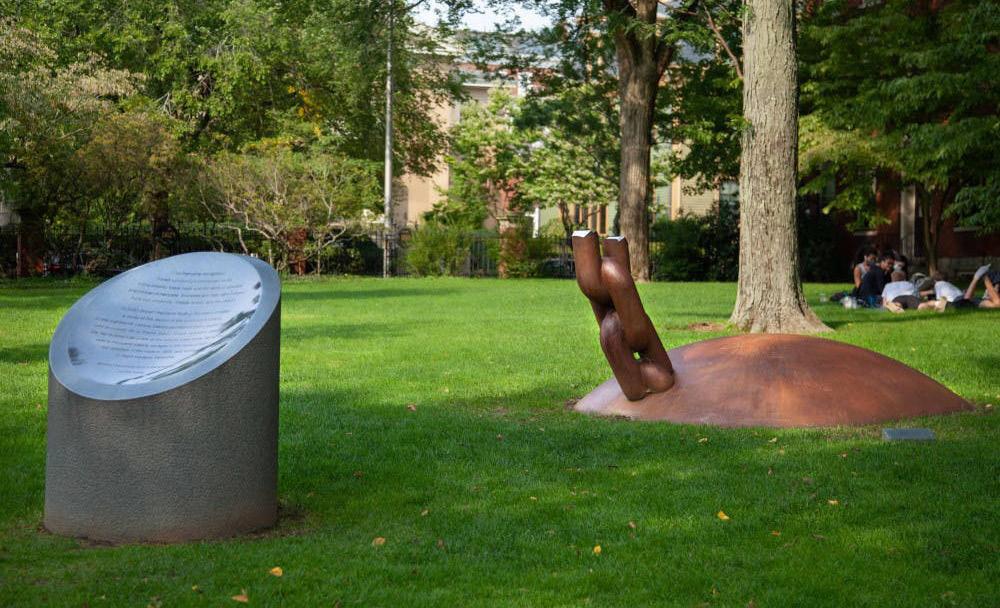
The University will rename the Center for the Study of Slavery and Justice in honor of former University president Ruth Simmons, according to a Thursday press release. The news was announced at an event celebrating the center’s 10th anniversary at the Smithsonian Museum of African American History and Culture in Washington, D.C.
Earlier this year, the center also reached a $10 million fundraising goal to create a dedicated endowmen, president Christina paxson p’19 p’MD’20 said in the release.
In 2003, president Simmons directed the University Steering Committee on Slavery and Justice — comprised of students, faculty and staff — to investigate how Brown has historically engaged with slavery and the transatlantic slave trade historically.
Those efforts eventually led to
the creation of the CSSJ: In 2006, the committee released their findings in a report detailing “the complicity of many of the University’s founders and benefactors in slavery and the slave trade” as well as recommending steps the University could take to address its past actions.
According to the press release, Simmons’s initiative led the University to make commitments that confronted the “full truth” of its history, including new academic and community engagement initiatives that aimed to promote “greater diversity, equity and inclusion on College Hill and beyond.”
One such commitment was the establishment of the CSSJ in the 201213 academic year.
“The thing that is most striking to me about Ruth is that she … is completely unafraid to dig into and answer hard questions,” paxson told The Herald. “It’s a combination of being really values-driven but also intellectually bold.”
Since its founding, the CSSJ — now the Ruth J. Simmons Center for the Study of Slavery and Justice — has
SEE SIMMONS PAGE 8
than two percent of applicants — 74 out of 4,192 — were admitted to the program in Liberal Medical Education. The Brown-RISD dual degree program accepted a cohort of 20 after reviewing 916 applications, an acceptance rate of just over 2%.
Gender
The number of men and women admitted to the class of 2027 was nearly identical, with 1,305 accepted applicants identifying as female and 1,304 as male. powell declined to provide the number of applicants by gender, but
UNIVERSITY NEWS
Activists criticize Brown China Summit speaker
UNIVERSITY NEWS Critics oppose former Hong Kong chief executive’s response to Umbrella Movement
BY NEIL MEHTA UNIVERSITY NEWS EDITOR
On March 18, former Hong Kong Chief Executive Leung Chun-ying delivered the keynote address at the Brown China Summit.
Multiple activists and protestors on and off campus criticized the decision to invite Leung to the summit, citing his controversial tenure in Hong Kong.
Leung led Hong Kong’s government during the 2014 Umbrella Movement, during which protestors occupied areas in the city’s central business district for 79 days.
The protest leaders — some of whom were sentenced to prison terms in 2019 — protested Hong Kong ‘s proposed election reforms, made by officials in Beijing, that would have
restricted the selection of candidates for the city’s chief executive election. police used tear gas and pepper spray on the first day of the protests, leading to the protests’ expansion and the use of umbrellas. police eventually cleared the protests after 11 weeks.
Leung also faced criticism for allegedly encouraging the council of the University of Hong Kong to prevent an anti-reform law professor from being appointed pro-vice chancellor, a claim which Leung’s office denied.
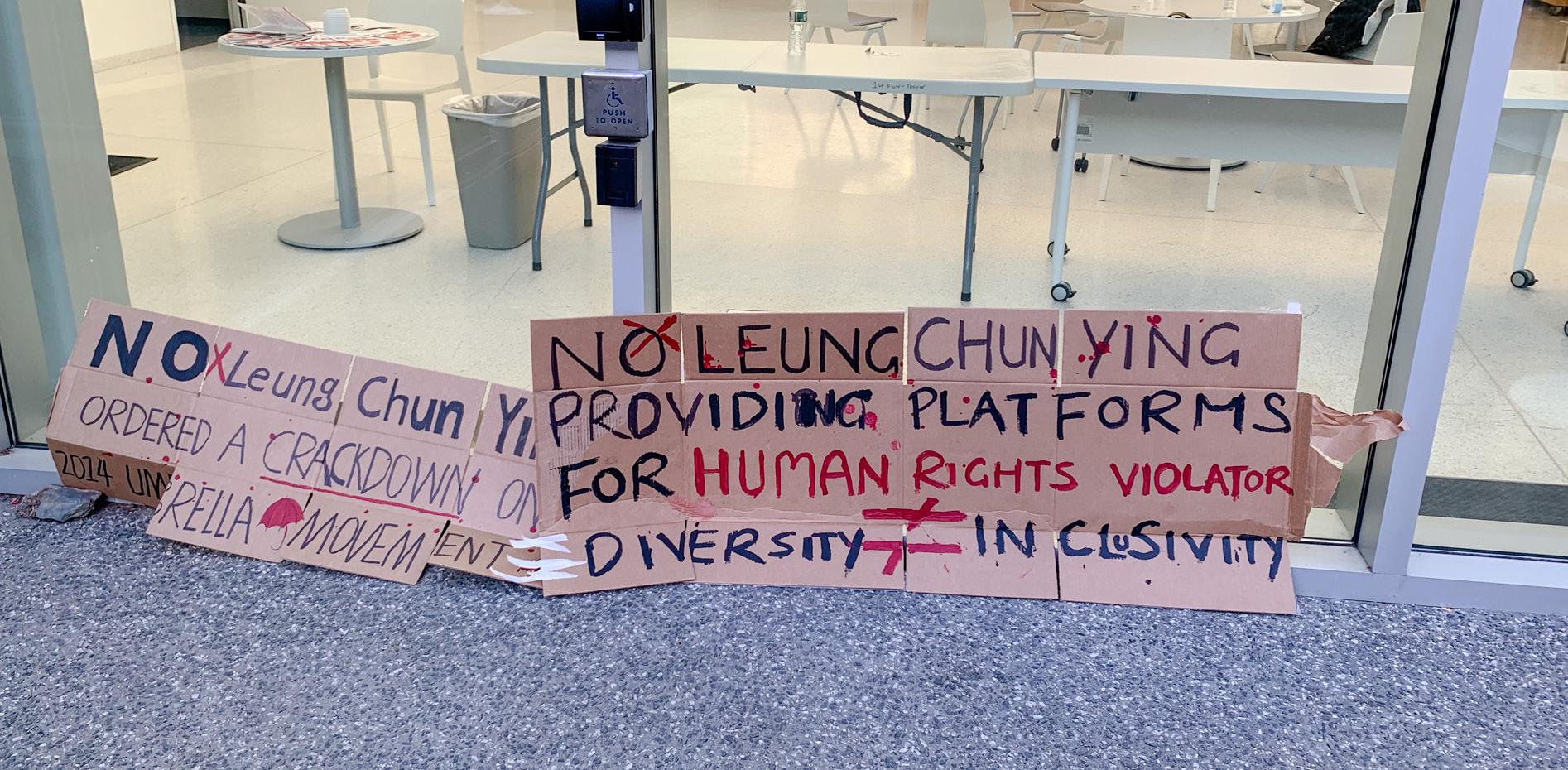
On the morning of Leung’s virtual speech at the Brown China Summit, a graduate student brought cardboard signs into Stephen Robert ’62 Hall reading “No Leung Chun-ying,” “providing platform for human rights violator” and “Ordered a crackdown on the 2014 Umbrella Movement,” according to photos reviewed by The Herald.
The Herald spoke to Brown China Summit leadership and pro-Hong Kong activists on and off campus about the keynote invitation. The Herald spoke to the graduate student
A history of climate activism on College Hill
BY RYAN DOHERTY SENIOR STAFF WRITER
“The heat is on,” reads the front page of the Nov. 3, 1989 Herald, paraphrasing a speech on campus about climate change. “And it’s getting hotter.”
College Hill is no stranger to climate activism. Since the 1970s, Brown has been a hub for discourse on environmental issues. Most recently, students have advocated for a complete dissociation from the fossil fuel industry, called for a new sustainability certificate and founded environmentally-focused student groups.
The Herald reviewed its archives and spoke with current activists, faculty and staff to trace the history of climate activism on Brown’s campus.

1970s: A ‘fundamental issue facing the world’
Environmental issues garnered national attention in the 1970s, a decade marked by the first Earth Day celebration, the passage of the Clean Air Act
and the founding of the Environmental protection Agency. Between 1969 and 1971, public opinion polls indicated a 2500% increase in support for environmental protection, according to the EpA.
But for students on College Hill, domestic environmental activism seemed performative, particularly as people turned away from the anti-Vietnam War movement in favor of publicly accepted reform efforts.
“The air (in providence) is dirty, the water is even filthier; but thousands die

each week in Vietnam while we wreak ecological disaster on that country,” reads an April 20, 1970 Herald editorial titled “As Thousands Die.”

For the editorial’s authors, the solution to environmental challenges was “vigorous lobbying and election pressures, … not a symbolic Earth Day.”
But not all University students shared the view that foreign policy and the anti-war movement was more important than domestic environmen-
SEE ACTIVISM PAGE 7
THE BROWN DAILY HERALD BROWNDAILYHERALD.COM SINCE 1891 M ONDAY, Ap RIL 3, 2023 Graduate students
personal stories on School of public Health podcast Page 3 Baseball
to open Ivy play 1-5 Page 6 Holocaust
recounts childhood, journey to U.S. Page 5 S & R Sports U.News 25 / 52 44 / 64 TODAY TOMORROW preservation Society says climate change is a threat to city’s infrastructure Page 8 Metro DESIGNED BY MAX ROBINSON ’26 DESIGNER JOYCE GAO ’24 DESIGNER MADDY CHERR DESIGN EDITOR VOLUME CLVIII, ISSUE 26
share
loses three games against Yale
survivor
UNIVERSITY NEWS
3.8% of regular decision applicants accepted, secondlowest rate ever
Activists, faculty, Herald archives illuminate previous on-campus climate movements
NEIL MEHTA / HERALD In 2019, the University pledged to reduce its campus greenhouse gas emissions 75% by 2025 and to net-zero by 2040.
SEE ADMISSIONS PAGE 2 SEE SUMMIT PAGE 7
HERALD FILE PHOTO
The top intended concentrations were computer science, economics, political science, engineering and International and Public Affairs.
SCIENCE & RESEARCH
2023 OVPR Seed Awards grant $1.4 million across 21 faculty projects
Awards boost earlystage research projects in search for outside funding
BY KATHLEEN MEININGER SCIENCE AND RESEARCH EDITOR
Twenty-one projects received Seed awards from the Office of the Vice president for Research in early March and will receive a total of $1.4 million in funding. The winners span a wide variety of disciplines such as the social sciences, physical sciences, life and medical sciences and public health.
The annual awards aim to support strong research projects that need funding to get off the ground, wrote Vice p resident for Research Jill p ipher in an email to The Herald. The program’s funding supports early-stage work by making researchers “more competitive in applying for external funds” and allowing them “to start new collaborations across disciplines,” she wrote.
This year’s awards included three categories, according to the OV p R website. Category 1 awards offer up to $50,000 for projects led by a single principal investigator, while category 2 awards offer up to $100,000 for projects with two or more p Is from different disciplines and category 3 awards offer up to $50,000 for one or more p Is who host a workshop at Brown.
The OV p R begins accepting proposals each fall, which are then reviewed by a group of experienced faculty and deans, p ipher wrote. p rojects are judged based on their potential impact, likelihood to receive further external funding and their overall feasibility, according to the 2023 OVpR Seed Guidelines. Category 2 and 3 projects are also evaluated based on their potential to establish an interdisciplinary “ongoing, longterm connection that is expected to lead to substantial external research funding through multi-investigator or center types of grants,” according to the guidelines.
“The Seed (award) is nice because it awards high-risk ideas and creativity,” said Lucas Caretta, assistant professor of engineering.
Caretta and Gang Xiao, professor of physics and engineering, received
a Seed award for their project to improve the function of spintronic devices — electronic devices that utilize the magnetic spin of electrons.
Specifically, Caretta and Gang are looking to improve a spintronic device called a magnetic tunnel junction — a “well-known” device, Caretta said. But their performance has stagnated over the past decades, as they continue to have high power consumption, poor signal-to-noise ratios and difficulty scaling, he explained.
“By replacing the materials inside this device, we think we can enhance the performance of the device by several orders of time,” Caretta said. His team plans to use an altar magnet — a special type of magnet — to revamp the device architecture, leading to better speed, expanded bandwidth and decreased latency. These advancements would ultimately improve the memory, computing power and energy efficiency of everyday devices.
“It’s an interdisciplinary project that combines device physics and materials engineering,” Caretta explained.
Ellen McCreedy, assistant pro -
fessor of health services, policy and practice, received a Seed award for her project testing the effectiveness of wearable sleep devices in monitoring sleep quality of dementia patients.
The project involves a new partnership between the Center for LongTerm Care, Quality and Innovation at the School of p ublic Health and the Human-Computer Interaction Lab in Brown’s Department of Computer Science.
McCreedy is co-leading the project alongside Jeff Huang, associate professor of computer science; Terrie T Wetle, professor of health services, policy and practice; and Rosa Baier M p H’04, professor of the practice of health services, policy and practice.
“Often, people living with dementia have neuropsychiatric symptoms. These might include agitated behaviors, sleep disturbances and mood changes,” McCreedy said. Monitoring sleep, then, is important for monitoring patient progression — but current sleep-measuring devices vary in accuracy, she added.
For this project, researchers are testing the effectiveness of two wear-
able sleep-measuring devices in collaboration with the Lived Experience panel, a group of individuals who have either been diagnosed with dementia or have served as the caregiver for a patient with dementia.
Members of the panel will use these devices, and the researchers will note participants’ critiques and compare self-reported quality of sleep to device measurements to determine their accuracy.
“Getting this preliminary feasibility and acceptability data is really, really helpful at this stage,” McCreedy said. If the sleep-monitoring devices are shown to be accurate, they can be used in larger studies testing the effectiveness of sleep interventions.
Erica Walker, assistant professor of epidemiology, received a Seed award for her project monitoring water quality in Jackson, Mississippi, where a water crisis began last summer. For this project, she is working with Katherine Manz, assistant professor of engineering, and Joseph Braun, associate professor of epidemiology.
previously, Walker’s lab partnered with faculty and students at The piney
Woods School, a historically Black boarding high school in the greater Jackson area to carry out water testing in the area, according to the project description. After collecting 49 samples and bringing them back to Brown to be analyzed, the team found elevated levels of per- and polyfluoroalkyl substances, or pFAS. These chemicals have been linked to adverse health conditions including lowered birth weights, higher risks of some cancers and increased cholesterol levels.
With the seed funding, the group will return to Jackson to test household water quality. Additionally, they will take biological measurements and ask families about the health of their children in order to “understand from a health perspective” the relationship between poor water quality and health outcomes — especially among children — in Jackson, Walker said.
“Ultimately, I hope that the Seed award can be leveraged to create change,” Walker said. “I would like for the community, my hometown (and) my home state to understand what’s going on in the water … and use data to hold elected officials accountable.
noted that a recently published article in The Herald gives “a sense of the landscape at Brown.”
For the class of 2026, nearly twothirds of applicants were women, while 50.2% of admitted students were women.
“This is a topic we continue to carefully consider in the context of national trends,” powell added.
Intended concentrations
The top indicated concentrations for the class of 2027 were computer science, economics, political science, engineering and International and public Affairs. Neuroscience has fallen off this list for the first time in over a decade.
Geographic backgrounds
11% of the admitted class — ap -
proximately 287 students — consists of international students, defined by their citizenship status. powell was unable to provide past data, citing “massive disruptions due to COVID travel restrictions” and “increases to financial aid for international students last year and this year.”
Outside of the United States, countries with the most representation at the University include China, Canada, the United Kingdom, India, South Korea, p akistan and Singapore.
Domestically, admitted students hail from all 50 states, as well as Washington D.C., Guam, p uerto Rico and the Virgin Islands. The most represented states are California, New York, Massachusetts, New Jersey and Texas, roughly consistent with previous years. powell also noted growth in applications from students in p rovidence.
Eight percent of this year’s admit-
ted class reside in rural areas, a 3% increase from last year’s admitted pool.
High schools
In past years, more than half of admitted students attended public schools. The University maintained this trend with 60% of prospective students in the class of 2027 attending public high schools. The remaining 30% attended private high schools and 10% completed their secondary education at parochial schools. This does not include students who were homeschooled or did not provide their school type in their application.
18% of admitted students identified as first-generation college students, a 1% increase from the class of 2026.
Financial aid
Sixty-eight percent of admitted students indicated that they intend -
ed to apply for financial aid. powell did not provide the size or number of financial aid packages provided due to the changing nature of financial aid awards.
Looking ahead
Data relating to the diversity of applicants and accepted students has not been provided by the Office of College Admission since 2021, though the enrolled class’s demographics will continue to be published in the University’s Common Data Set, according to powell.
In recent years, princeton, Cornell, penn, Columbia and Stanford have declined to release admissions data on the day decisions are released.
Brown does not currently plan to follow suit, according to po well: “The Brown community and prospective applicants benefit from learning more about the admission process
and its outcomes,” he said, noting he hoped it would “demystify some elements of this pivotal experience.”
According to p owell, the University also expects approximately 1,000 students to accept a place on the waitlist. In recent years, the University has accepted between two and 300 students from the waitlist, The Herald previously reported.
The University plans to host A Day on College Hill, its on-campus event for admitted students to visit Brown as part of their enrollment decision, on April 14 and 21. Virtual programming will continue through the Office’s online platform, the “Bruniverse.”
Accepted students must inform the University of their enrollment decision by May 1. With nearly 67% of admitted students accepting their place at Brown last year, the University aims to enroll 1,700 students to join Brown University’s class of 2027.
2 M ONDAY, Ap RIL 3, 2023 THE BROWN DAILY HERALD | NEWS
HERALD FILE PHOTO
“The Seed (Award) is nice because it awards high risk ideas and creativity,” said Lucas Caretta, professor of engineering.
ADMISSIONS FROM PAGE 1
School of Public Health podcast explores ‘depth and breadth’ of field
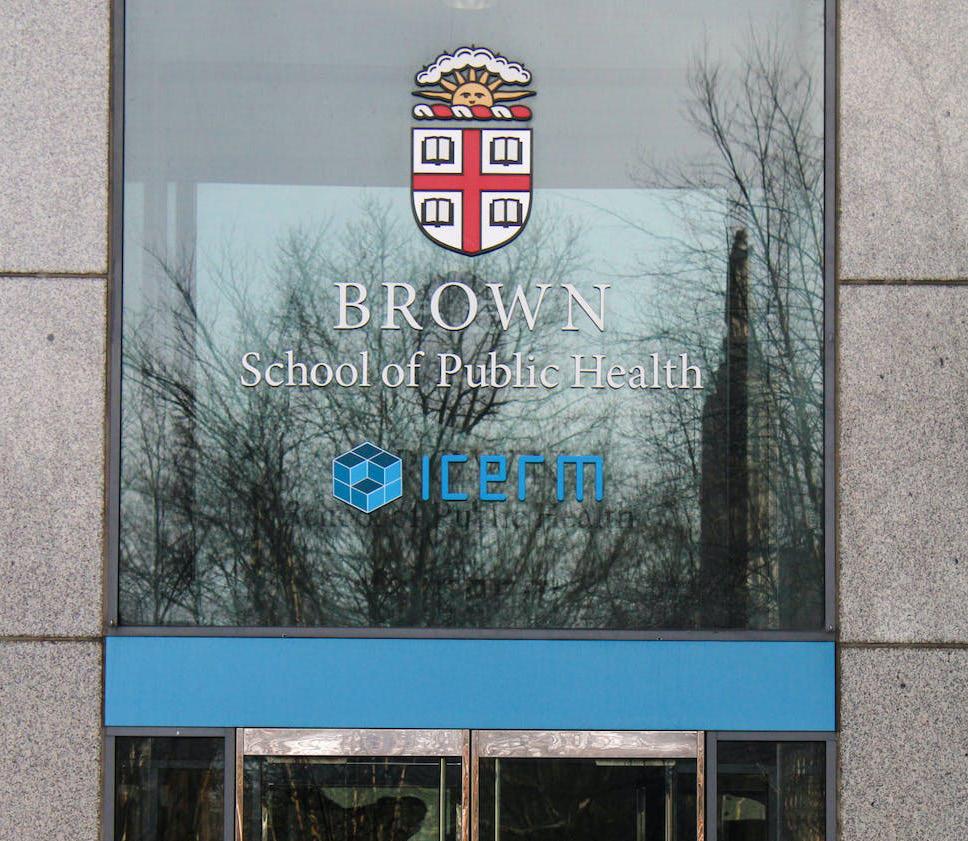
Faculty, students share experiences on ‘Humans in public Health’ podcast
BY RYAN DOHERTY SENIOR STAFF WRITER
For Megan Hall ’04.5 MpH’15, public health is about more than just “preventing the spread of COVID.”
To explore the “depth and breadth” of the field, Hall and the School of Public Health launched the “Humans in public Health” podcast in 2021, when the field was receiving national attention due to the COVID-19 pandemic.
The podcast, which invites professionals to talk about their experiences working in the field, aims to “showcase (public health) work and bring the community together in a virtual way,” Hall said.
Hall said that the mission of her podcast is to humanize the public health field. She aims to highlight the many different lived experiences in the field through conversations with public health faculty and students. Episode topics have ranged from responses to the 2014 Ebola outbreak to disinformation in public health.
The podcast’s inception coincided with National public Health Week 2021, an annual event celebrating “the contributions of public health and highlight(ing) issues important to
improving our nation’s health,” Interim Dean of SpH Ronald Aubert wrote in an email to The Herald.
NpHW is also an opportunity for “public health practitioners to connect and share their research with a wider audience,” he added.
In 2021 and 2022, the podcast released episodes exclusively during N p HW. But last month, the podcast shifted to monthly releases due to its popularity “with our students, faculty and external audiences,” Aubert wrote.

April’s episode will celebrate NpHW 2023 by inviting current MpH candidates at the University— including Shaw Hubbard GS, Darlene Tat GS, Youri Benadjaoud GS and Sophia petrillo GS — to discuss their current work and path to public health. public outlets like the podcast are important “both to communicate the human side of public health work and hopefully inspire others to join us,” Hubbard wrote in an email to The Herald.
Tat, a licensed pharmacist, wrote in an email to The Herald that humanizing public health and gaining the support of local partners is necessary for the field’s success. “We need to do our part, as experts, to ensure that the message gets across in a way that meets people where they are.”
Benadjaoud, who works as a medical reporter for ABC News, said that “the human side of public health is
necessary to highlight as we exit the COVID-19 pandemic.”
“We often forget the tremendous work the field achieved during the
MATHIEU GRECO / HERALD
vaccines,” Benadjaoud wrote. “Integrating the human perspective allows the public to hear the voices behind all of this work.”
M ONDAY, Ap RIL 3, 2023 3 THE BROWN DAILY HERALD | NEWS
most intense health crisis we’ve seen in a century — ramping up of disease monitoring, dissemination of public health news, millions saved with novel SCIENCE & RESEARCH
The launch of the podcast coincided with National Public Health Week 2021, which honored the contributions of the field and highlighted important national health issues.
Editorial: Brown must expand its recreational facilities
If you have ever entered the Nelson Fitness Center’s loft, the following scene might sound familiar: You walk into the gym only to find every weight machine in use as students loiter to wait their turn. The free weight area is crammed with more people than there are workout mats to accommodate and racks are stripped entirely of low and medium-weight dumbbells. The overcrowding and inaccessibility of basic equipment at the Nelson drew complaints from students early this semester that faded into the background as the weeks have gone by. But while the discourse fades, the problems at the Nelson have never really abated. As the undergraduate population at Brown “gradually expands,” the truth of the matter becomes unavoidable: We simply do not have enough gym space on campus. Beyond performatively voicing its commitment to student health, Brown needs to expand its recreational spaces and make fitness more accessible for its student population.
For a university of its size, Brown offers surprisingly few spaces on campus where students can consistently get a workout in: The 10,000-square-foot fitness loft in the Nelson Fitness Center, a gym in Graduate Center E that holds a handful of treadmills and ellipticals and a former gym space in Keeney Quadrangle, which now holds yoga classes. While Brown boasts a number of other facilities for athletics, many of these spaces are not available or intended for the general student population — or they’re sport-specific complexes that don’t contain basic equipment like treadmills and weights for day-to-day workouts.
The inadequacy of Brown’s fitness options for its 7,125 undergraduates and 2,689 graduate students becomes particularly evident when compared to the recreational facilities offered by other institutions. Take Colby College, a liberal arts college that offers three floors of weight training and cardio equipment in its
Boulos Family Fitness Center for an undergraduate population of just over 2,200 — well under half of Brown’s. Likewise, Dartmouth’s 16,000-square-foot Zimmerman Fitness Center offers over 100 machines and three different dumbbell areas. And penn’s facilities supplement an 8,000-square-foot weight room with a 40-foot climbing wall and two more floors
hopes of eventually keeping the gym open until midnight. But while promising, these solutions show the incomplete scope of UCS’s power to improve overcrowding, an administrative-level issue that has more to do with space than time. Students shouldn’t have to micromanage their schedules and check an app in order to work out. Nor should they have to wait until 10:30
there are multiple places — such as the multipurpose room in Sternlicht Commons — where classes could be held on a more regular basis. On the other hand, the Keeney Quad gym is one of the few locations where heavier equipment could be stored and used permanently.
of weights and cardio equipment. Brown isn’t up to the standard of its peers on an issue that goes beyond working out alone: Regular exercise helps college students manage sleep, stress and overall mental health. Brown’s goal of “fostering the health and well-being of every student” cannot be met in full until it offers recreational facilities that match the needs of its campus population.
Some initiatives to address the overcrowding at the Nelson are already underway. In response to student complaints at the beginning of the spring semester, the Undergraduate Council of Students worked with administrators to introduce an occupancy tracker.

A March 24 UCS email also announced a pilot program to extend Fitness Loft hours through 11 p.m. from Mondays to Thursdays, with the
p.m. to hope for a chance at using a squat rack. Exercise should be about relieving stress instead of causing it through complicated planning. Brown’s fitness and wellness manager has noted that Brown Recreation is “exploring existing spaces within the Nelson Fitness Center to create additional opportunities for training.” But there are no concrete public plans to initiate a large-scale expansion or to introduce new fitness options in other areas around campus.
Reopening the Keeney Quad gym as a yoga studio is also a well-intentioned but misinformed step to make fitness more accessible on campus. Although having a dedicated location for yoga is admirable, it should not come at the expense of a broader, multi-use facility in an area of campus that currently lacks one. Yoga requires space but little equipment, meaning
The changes at the Nelson might shift surface-level conditions, but not the underlying issues concerning the amount of space and equipment available. Brown is dancing around the solution that will produce lasting improvements: opening new fitness spaces on a campus that sorely needs them. This might entail converting existing properties or building an entirely new facility altogether, neither of which would be an easy task. Brown would have to embrace the costly, difficult and time-intensive project of renovating or acquiring new space. But the expenditure is certainly worth it. After purdue University spent $98 million on expanding and renovating its recreation center, use of the facilities increased and many students saw improved academic performance. If Brown made a similar investment, it could see a similar increase in the number of students who choose to use its gyms and make fitness a regular part of their routine. A major investment in recreational space and resources would represent a major investment in the health and well-being of Brown students — one that is long overdue.
Editorials are written by The Herald’s editorial page board and aim to contribute informed opinions to campus debates while remaining mindful of the group’s past stances. The editorial page board and its views are separate from The Herald’s newsroom and the 133rd Editorial Board, which leads the paper. This editorial was written by the editorial page board’s editor Kate Waisel ’24 and members Irene Chou ’23, Yasmeen Gaber ’23, Tom Li ’26, Jackson McGough ’23, Alissa Simon ’25 and Yael Wellisch ’26.
CALENDAR
TODAY’S EVENTS
TOMORROW’S EVENTS
4 M ONDAY, Ap RIL 3, 2023 THE BROWN DAILY HERALD | COMMENTARY
Virtual
5:00
6:30
5:30
7.30
Geetanjali Shree, “Beliefs, Borders, and Bridges” 9:00 a.m. - 10:00 a.m.
Arts Faculty Showcase
p.m. -
p.m. Granoff Center for the Creative Arts Istanbul of the 19th Century
p.m. Rhode Island Hall Dept. of physics DIAp Committee presents a Raga Music Event
p.m. Engineering Research Center
3:30
4:00 p.m. 339
6:00
APRIL S F Th W Tu M S 8 7 6 9 3 5 15 14 13 16 12 10 22 21 20 23 19 17 26 24 1 2 27 28 29 30 11 18 25 4
public Health Research Day 2023 1:00 p.m. - 3:30 p.m. Alumnae Hall Brown University Baseball vs Holy Cross
p.m. - 6:30 p.m. Attanasio Field at Murray Stadium Rethinking Race and Education Lecture: Mark Warren
Eddy Street Spring 2023 Independent Studies Dinner
p.m. - 7:00 p.m. Stephen Robert ’62 Campus Center
“Brown’s goal of ‘fostering the health and well-being of every student’ cannot be met in full until it offers recreational facilities that match the needs of its campus population.”
Holocaust survivor Ruth Oppenheim speaks at Global Day of Inclusion
Author recounts childhood in Germany, journey to U.S. in event presented by OIED
BY ANIYAH NELSON SENIOR STAFF WRITER

Content warning: This article includes descriptions of antisemitic violence during the Holocaust.
Holocaust survivor and author Ruth Oppenheim narrated her experiences growing up in Nazi Germany to hundreds of attendees Tuesday morning at the Salomon Center DECI.

Oppenheim, who described her experiences in a memoir entitled “Beyond Survival: The Story of My Life,” previously worked at Brown for 21 years, including 15 years as office manager of the Department of English and six years as manager of the dean of the College’s office. Her keynote address kicked off the University’s annual Global Day of Inclusion, which promotes ideals of inclusion through “educational programs and engagement,” according to Sylvia Carey-Butler, vice president of institutional equity and diversity.
The day’s events, presented by the Office of Institutional Equity and Diversity, also included workshops on topics such as inclusive leadership, language related to Indigenous people, precise terminology concerning sexual and gender identity and disability in higher education, according to the OIED website.
Oppenheim, 95, began her keynote by describing her early childhood in Germany, when she often felt alienated because of her Jewish identity.
Beginning in elementary school, she recalled feeling like an outsider among her classmates. During high school, major changes began taking place in Germany, including the replacement of teachers by uniformed SS personnel, the security force of the
Third Reich. Oppenheim said these changes left her “terror-stricken.”
Oppenheim recounted how the Third Reich introduced various restrictions against Jewish people, including laws preventing them from attending movies and concerts and from going to public locations such as swimming pools and skating rinks.
As the number of restrictions on Jewish people in Germany grew, so did the divisions between Jewish and non-Jewish students.
“I remember sitting in the back of the classroom, and no one was allowed to speak to me,” Oppenheim said. “During recess, I watched my classmates play while I stood alone wishing for invisibility. That remains a vivid, sad memory.”
Oppenheim noted that all of these changes took place before Kristallnacht — the Night of Broken Glass — on Nov. 9, 1938. She recalled waking up that night to the sound of loud pounding on the front door of her family’s home and a mob shouting “out with the Jews.”
Oppenheim recalled hearing her father “pleading, ‘I will come with you. Just spare my family.’” As she stood by her upstairs window, she watched him getting dragged down the street.
“Sobbing, we huddled together. A neighbor we called heard us repeat, over and over again, our pleas to God to bring our father back alive,” she said.
Later that night, while Oppenheim and her family were hiding in their home, she recalled her father returning — “streaked with blood and hunched over, holding the Torah from our synagogue,” she said.
Afraid that Nazi soldiers would return, Oppenheim and her family temporarily fled from their home that night. When they returned, they found a scene of destruction.
“Lamps were smashed, crystal lay scattered everywhere (and) books had been thrown out of the window, together with photo albums and treasured keepsakes,” Oppenheim said.
Fearing further violence and persecution, Oppenheim and her family attempted to emigrate to America. But doing so required her family to visit the American consulate in order to obtain an affidavit that would allow them to move, she said.
Oppenheim recalled feeling anxious about her immediate family’s chances of approval, remembering that her uncle was previously rejected for his stiff knee.
“Seemingly, in a wonderful land of beautiful movie stars, only flawless human beings were acceptable,” she said, describing American immigration policies at the time. “Would we be perfect enough when our time came?”
Oppenheim, her parents and her siblings arrived in New York in 1939, she said. Her father arrived in August, and the rest of her family arrived that
winter.
Reflecting on her life since, Oppenheim expressed pride in her two children, four grandchildren and four great-grandchildren, all of whom were born in America.
She also fondly recalled the time she spent working at Brown. “I just enjoyed going to work and walking around campus,” she said. “It was a wonderful time.”
During the Q&A session of the event, Oppenheim noted her concern about a recent nationwide rise in antisemitism, emphasizing the broader impacts of discrimination.
“I hope that what you hear from me will make it clear that discrimination hurts all of us, and that it isn’t what our democracy should be like,” she said. “I have a mission to tell my story as long as I have some energy left to do it.”
p resident Christina p axson p ’19 p’MD’20, who introduced Oppenheim, cited the role that educational spaces play in honoring individuals with diverse experiences and bringing them together — “especially people who have been historically marginalized for a variety of reasons.”
Gabriel Navarro, a fund officer at RISD and one of the event’s attendees, identified the importance of empathy and understanding as two of the biggest takeaways from Oppenheim’s story.
“If you don’t talk about history, it leads to the possibility of repeating it,” Navarro said. “I think it’s really important to hear from people who have experienced hardships. There’s lessons to learn on perseverance and most importantly, inclusion and equity, particularly at a place like Brown.”
M ONDAY, Ap RIL 3, 2023 5 THE BROWN DAILY HERALD | NEWS
UNIVERSITY NEWS
COURTESY OF DAVID DELPOIO / BROWN UNIVERSITY
This year’s programming at the Global Day of Inclusion featured a variety of workshops about inclusive leadership and language, according to the Office of Institutional Equity and Diversity’s website.
Pitching falls short as Yale sweeps baseball in three-game weekend series
DJ Dillehay ’26 clubs two homers as Bears fall to 1-5 in Ivy League play
BY LINUS LAWRENCE SPORTS EDITOR
The Brown baseball team (4-17, 1-5 Ivy) failed to post a win in a threegame home series against Yale (9-12, 4-2 Ivy) last weekend. The Bulldogs defeated the Bears by scores of 16-2 Friday afternoon, 8-7 Sunday morning and 15-8 Sunday afternoon.

“They obviously beat us (in) three games … but I think we beat ourselves more innings than not,” Head Coach Grant Achilles said.
The Bulldogs pounced on the Bears’ starting pitching early in the contests, scoring a total of 19 earned runs against Tobey McDonough ’23, Santhosh Gottam ’25 and Bobby Olsen ’23. Gottam was the only starter of the group to pitch past the second inning.
Brown’s pitchers also struggled to find the strike zone, issuing 30 free passes over the three games.
“Our pitching staff was subpar this weekend,” said catcher Jacob Burley ’23, who currently holds a 16-game on-base streak. Burley batted 7-13 in the series, including going 3-3 to open the series on Friday and recording the only RBI in that day’s blowout loss.
In Sunday’s doubleheader, the Bears’ bats came alive, scoring 15 runs on 21 hits across the two games.
In the first game, the offense put up four runs in the first frame, with RBIs from Mika petersen ’26, Nathan Brasher ’25 and Jared Johnson ’25. But the Bulldogs stormed back to take a 7-4 lead by the fourth inning.
With two outs and a man on first in the top of the fifth, right-hander Paxton Meyers ’24 was called in to make his season debut, striking out the first
batter he faced to end the inning. Meyers tossed 4 1/3 innings of scoreless, one-hit ball and struck out six to keep the Bears in the game.
“It felt amazing … to be back contributing on the field,” Meyers said.
“He’s a competitor,” Achilles said of Meyers. “Any time he gets on the mound, he feels like he’s gonna win.”
“This game is super mental,” Meyers added. “Just going out there and having confidence, throwing your pitches with conviction … that’s what I felt like helped me out today.”
Still down by three going into the bottom of the eighth, the Bears mounted a comeback, with clean-up hitter Ryan Marra ’23 plating petersen on a sac-fly and Burley singling home Reece Rappoli ’24 to pull within one.
Leading off the bottom of the ninth, freshman shortstop DJ Dillehay ’26 crushed a 1-2 offering over the left-center field fence, hitting a career-first home run and tying the game 7-7. Dillehay sprinted around the bases, reaching home plate about 18 seconds after the ball hit his bat.
“I’m glad to get my first college home run under my belt,” Dillehay said.
“I felt like it brought a lot of energy to the team.”
The game proceeded to extra innings. In the top of the tenth, reliever Jack Seppings ’25 surrendered a run to Yale without allowing a hit, walking three and hitting one batter. The Bears got the leadoff runner on in the bottom of the inning after a hit batter of their own, but couldn’t bring him around to score, losing the hard-fought battle 8-7.
Down 4-0 in the first inning of the third game, Dillehay connected once again for his second homer of the day, scoring Derian Morphew ’23. The Bears added one more in the frame on an RBI groundout from Johnson. Yale and Brown each tacked on one in the second, making the score 5-4, which it would stay for three innings.
Things unraveled for the Bears in the seventh inning, with the Bulldogs plating seven runs on five hits, an error and a passed ball. One of Yale’s crucial early hits, which loaded the bases with no men out, came on a botched bunt attempt. Yale catcher Robert Ciulla sent the ball straight up into the air to the right side of the infield, but since the first baseman broke in towards the plate when the batter showed bunt, the ball ended up in no-man’s land.
Yale “put together some good atbats,” Dillehay said. “They didn’t just smoke the ball all over the place, but they had a bunch of good hits, timely hits too.”
The Bears responded in the bottom of the inning with a three-run shot
from Logan Meusy ’26, making him the second Brown player to record the first long ball of his collegiate career Sunday.
“It’s challenging (as) a freshman to adjust to the college game, so to be able to see those guys come in and have some consistently good at-bats, that’s all you’re looking for,” Achilles said.
Despite adding another run in the eighth on an RBI double from Burley, the deficit built in the top of the seventh inning was too much to overcome as the Bears fell 15-8.
Following a long day of baseball, the team gathered around Achilles near the left field foul line. “We need to act like champions, and that’s what’s gonna get us in the championship,”
SINCE 1891
THE BROWN DAILY HERALD
133rd Editorial Board
Editor-in-Chief
Will Kubzansky
Managing Editors Katy Pickens
Alex Nadirashvili
Senior Editors Augustus Bayard
Caleb Lazar
Peter Swope
Kaitlyn Torres
Post- Magazine
Editor-in-Chief
Kimberly Liu
News Metro Editors Emma Gardner
Rhea Rasquinha
Jacob Smollen
Julia Vaz
Science & Research Editor

Haley Sandlow
Senior Science & Research Editor
Gabriella Vulakh
Arts & Culture Editors
Aalia Jagwani
Finn Kirkpatrick
Rya Vallabhaneni
Sports Editor Linus Lawrence
University News Editors
Sofia Barnett
Charlie Clynes
Emily Faulhaber
Grace Holleb
Sam Levine
Neil Mehta
Haley Sandlow
Kathy Wang
Digital News Director of Technology
Swetabh Changkakoti
Opinions
Head Opinions Editor
Alissa Simon
Opinions Editors
Anika Bahl
Bliss Han
Melissa Liu
Jackson McGough
Multimedia
Illustration Chief
Ashley Choi
Photo Chiefs Elsa Choi-Hausman
Dana Richie
Photo Editors
Mathieu Greco
Claire Diepenbrock
Lilly Nguyen
Kaiolena Tacazon
Social Media Chief
Sahil Balani
Social Media Editors
Emily Faulhaber
Coco Huang
Alyssa Sherry
Kaiolena Tacazon
Production
Copy Desk Chief
Brendan McMahon
Design Chief
Neil Mehta
Design Editors
Sirine Benali
Maddy Cherr
Ashley Guo
Gray Martens
Business
General Managers
Joe Belfield
Andrew Willwerth
Sales Director
Alexander Zhou
Finance Director
Dillehay said of the post-game conversation.
Achilles said his message to the team was that “there’s a lot of (the) season left. … We’ve got five weekends of the regular season left to really start playing the way we’re capable of.”
“He knows that this team is better than 1-5 in Ivy play, and he’s trying to motivate us to play six more weekends instead of just five,” Burley said, referencing the possibility of the team making it to the Ivy playoffs.
The Bears will take on Holy Cross at home Tuesday before traveling to Ithaca over the weekend to face Cornell. “We’re coming back,” Dillehay said. “We’re gonna rally hard. We’re gonna whoop ‘em.”
Submissions: The Brown Daily Herald publishes submissions in the form of op-eds and letters to the Op-eds are typically between 600 and 900 words and advance a clear argument related to a topic of campus discourse. You can submit op-eds to opinions@browndailyherald.com.
Letters to the editor should be around 250 words and respond to an article or column that has appeared in The Herald, or critique or commend The Herald’s editorial decisions. You can submit letters to the editor to letters@browndailyherald.com.
Submissions undergo multiple rounds of editing. These rounds of editing generally take place over the course of one evening, and you may have to respond to edits late in the evening. If you know you will be unable to do so, please mention that in your email, and we will do our best to work with you.
Submissions can build on reporting from The Herald, reporting elsewhere, official statements from the University or other groups and other reputable sources, but they cannot break news or contain information that The Herald cannot verify. Because we cannot publish unsubstantiated information, failure to provide appropriate sources may mean we have to modify or remove unverified claims.
The Herald will not publish anonymous submissions or submissions authored by organizations. Leaders of student organizations can be identified as such but cannot write under the byline of their organization.
The Herald cannot publish all submissions it receives and reserves the right to edit all submissions. All submissions to The Herald cannot have been previously published elsewhere (in print or online — including personal blogs and social media) and must be exclusive to The Herald. Once your submission is published in The Herald, The Brown Daily Herald, Inc. owns the copyright to the materials.
Commentary: The editorial is the majority opinion of the editorial page board of The Brown Daily Herald. The editorial viewpoint does not necessarily reflect the views of The Brown Daily Herald, Inc. Columns, letters and comics reflect the opinions of their authors only.
Corrections: The Brown Daily Herald is committed to providing the Brown University community with the most accurate information possible. Corrections may be submitted up to seven calendar days after publication. Periodicals postage paid at Providence, R.I. Postmaster: Please send corrections to P.O. Box 2538, Providence, RI 02906.
Eli Pullaro
Editorial Page Editor
Kate Waisel
Julian Beaudry
Nadia Bitar
@the_herald facebook.com/browndailyherald
@browndailyherald
Advertising: The Brown Daily Herald, Inc. reserves the right to accept or decline any advertisement at its discretion. 88 Benevolent, Providence, RI (401) 351-3372 www.browndailyherald.com
The Brown Daily Herald, Inc. is a financially independent, nonprofit media organization bringing you The Brown Daily Herald and Post- Magazine. The Brown Daily Herald has served the Brown University community daily since 1891. It is published Monday through Friday during the academic year, excluding vacations, once during Commencement and once during Orientation by The Brown Daily Herald, Inc. Single copy free for each member of the community. Subscription prices: $200 one year daily, $100 one semester daily.
Editorial: herald@browndailyherald.com Advertising: advertising@browndailyherald.com
Copyright 2023 by The Brown Daily Herald, Inc. All rights reserved.
6 M ONDAY, Ap RIL 3, 2023 THE BROWN DAILY HERALD | NEWS
@browndailyherald
SPORTS
COURTESY OF BROWN ATHLETICS
Rookies DJ Dillehay ’26 and Logan Meusy ’26 each hit their first collegiate home runs in Sunday’s doubleheader, but the Bears still fell short in both games.
tal efforts.
Calling the editorial’s argument “incredibly myopic,” Carolyn Smith ’71 and Alan Birnbaum ’71 published a dissenting opinion on the same day. “There is no more fundamental issue facing the world today than the environmental one.”
On April 21, 1970, Roger Rittmaster ’72 wrote in a letter to the editor that “Earth Day, though a symbolic gesture, … achieved dramatic results” for conservationists across the country.
1980s: A ‘pantheon of
awareness’
The 1980s brought greater national recognition of global warming, further fueling climate activism on campus.
In 1985, students taking an environmental studies class requested a space to practice sustainable living habits. West House, a former boarding house for female commuter students, was then converted into an environmental program house, The Herald previously reported.
In 1989, three student groups — the Brown Nuclear Education p roject, Global Outlook and the Brown Environmental Network — launched Global Warming Information Week, a “pantheon of awareness” for climate change, according to a Nov. 2, 1989 Herald article.
The week promised “a number of informative lectures and discussions on a topic which has far-reaching implications literally for the future of
the world,” according to a letter to the editor from the same day.
The week opened with a lecture from George Woodwell, then-director of the Woodwell Climate Research Center, who called for an immediate halt to greenhouse gas emissions. “Nobody knows for sure how rapidly the earth will warm,” he said.
2000s: ‘A policy of climate neutrality’
The 2000s ushered in a new push for climate advocacy on campus, this time dedicated to altering the University’s institutional policies.
In 2006, the Brown Environmental Action Network launched its Empower campaign, calling on the University to “adopt, in its next budget cycle and no later than 2008, a policy of climate neutrality: net-zero global warming emissions.”
The following semester, the University’s Energy and Environmental Advisory Committee recommended that Brown reduce its greenhouse gas emissions to reach carbon neutrality, The Herald previously reported. In alignment with the EEAC report, the Department of Facilities Management was allocated $5 million to improve energy efficiency and purchase carbon offsets.
In a Jan. 24, 2008 press release, the University pledged to reduce greenhouse gas emissions to “42% below 2007 levels by 2020” and limit “energy consumption for all newly constructed facilities to between 25% and 50% below the standard required by state code.”
fronted by event security staff and told to leave the building.
2010s: ‘Consigning our generation to life on an inhospitable planet’
In the 2010s, environmental activists on campus mobilized around a new demand: divesting the University endowment from fossil fuel-related companies.
“We know that Americans must stand up to the fossil fuel industry before it’s too late,” wrote Brown Divest Coal — a student group founded in 2012 — in an Oct. 3, 2012 Herald oped. “We can start right here at Brown by divesting our endowment from the 15 coal companies with the worst environmental and social records.”
Divest Coal held multiple rallies in 2012 and 2013 and hosted a speech by environmentalist Bill McKibben p ’16 to mobilize the student body. “If you’re going to green the campus, there is no logical reason you would not green the portfolio,” he said.
In an April 15, 2013 op-ed to The Herald, p resident Christina p axson p ’19 p ’MD’20 wrote: “I hope that our community will approach the matter of divestiture from coal and other fossil fuels with the high degree of openness, respect and intellectual integrity that characterizes” Brown.
In October 2013, the Corporation — the University’s highest governing body — decided not to divest the endowment, leading to a Divest Coal silent sit-in at University Hall.
“We regret your continued and deliberate willingness to invest in an industry quickly consigning our generation to life on an inhospitable planet,” the organization later wrote in a Herald op-ed.
In 2019, the University announced a goal to “cut its campus greenhouse gas emissions by 75% by 2025, and to achieve net-zero no later than 2040” through a four-phase plan that includes renewable energy agreements and a thermal efficiency project, as well as fuel and infrastructure updates to the University’s central heating.
Today: ‘Essential partners in helping us to fulfill our mission’
In a March 2020 letter to the Brown community, the University pledged a full divestment from fossil fuels in its endowment — nearly seven years after initially declining to do so.
“To date, 90% of investments in companies that extract fossil fuels have been sold, and the remainder is being liquidated as it becomes possible to do so,” paxson wrote in the letter.
“The enormity of this threat has become increasingly clear over time,” she added. “Without a rapid transition away from fossil fuels on a global scale, it will become impossible to avert disastrous consequences for humans and the natural environment worldwide.”
In 2021, the University unveiled a Sustainability Strategic p lan that includes deadlines for reducing emissions, pollution and water use.
With 17 years remaining until the University’s 2040 deadline to achieve net-zero emissions, the fight against climate change on College Hill continues.
On Feb. 27, Sunrise Brown launched its DIRE campaign, calling for the University to dissociate from
the fossil fuel industry and reinvest in Rhode Island communities.
In its accompanying “Dissociate Now” report, published last month, Sunrise made three key demands: prohibit fossil fuel-associated companies from donating and funding research at Brown, ban fossil fuel-related recruiting on campus and offer fossil-free investment options in retirement plans for University employees.
Caitlyn Carpenter ’26, co-author of the report, explained that written documents like the DIRE report can be passed down to future student activists and serve as a “legacy of different movements” on campus.
Sunrise is one of many student groups — including SCRA p, Students Learning Urban Gardening and West House — promoting sustainability on campus. Recently, the Brown Renewable Energy and Sustainability Society proposed a new certificate in sustainability.
Student input has always informed sustainability efforts on campus, wrote Jessica Berry, assistant vice president of the Office of Sustainability and Resiliency, in an email to The Herald.
Kim Cobb, director of the Institute at Brown for Environment and Society, said that students helped develop the institute’s new strategic plan, which sets goals regarding environmental education, research, impact and capacity-building.
“Each year I am amazed at the drive by the Brown community to take steps toward progressive environmental change,” Berry wrote.
who entered the building, as well as another graduate student, on the condition of anonymity due to concerns of retaliation. Both graduate students are Chinese citizens.
Autumn Qiu ’25, co-president of the summit, did not respond to requests for comment about the summit’s motivation to invite Leung, the club’s stance on Leung’s treatment of the 2014 protests or activists’ concerns about offering a platform for the former chief executive, noting that the club could not collectively formulate an answer due to travel.
The graduate student who protested expressed “deep concern” about Leung’s invitation in an email to summit leadership on March 15. The email thread, reviewed by The Herald, was verified by Qiu.
“As a concerned student who is themself a Chinese citizen, I urge the summit to reconsider its decision and withdraw the invitation to Leung,” the student wrote. “It is important for academic institutions to uphold the principles of human rights and academic freedom and not provide a platform to those who have violated them.”
The summit leadership team defended the decision in a reply reviewed by The Herald.
In the statement, group leaders characterized the summit as “simply a platform where students and scholars can exchange their ideas politely and thoughtfully,” and acknowledged the student’s concerns, adding that they believed “inviting speakers with diverse views and perspectives is essential to promoting a constructive exchange of ideas and fostering a greater understanding of China’s complex political, economic and social landscape.”
The first graduate student, who brought the signs, said he was con-
Eventually, event security staff instructed the student to remove the signs, according to Seth McKenzie ’25, a panel director for the summit. McKenzie added that another board member intervened and “calm(ed) things down.”
Both McKenzie and the protestor said that event security wanted to prevent protests from taking place in a building. According to the University’s Student Conduct and Community Standards website, “halting a lecture, debate or any public forum is an unacceptable form of protest. ‘Halting’ means directly or indirectly preventing a speaker from speaking — even for a brief period of time — or seizing control of a public forum for one’s own purposes.”
“No members of Brown China Summit participated in any actions violating community members’ freedom of speech,” Qiu wrote in an email to The Herald. The protestor opted to display the signs outside the building, which Qiu wrote allowed the event’s audience to “consider diverse opinions before heading into the event.”
The protestor noted that Leung’s invitation sent a “terrible message” about academic freedom and human rights. “If you need people from Hong Kong to talk about its relationship with mainland China, or need someone with this important perspective, why this person?”
The second graduate student told The Herald they were “worried that (Brown China Summit) is giving platforms to people we shouldn’t,” adding that they knew friends in Hong Kong who faced repercussions for protests.
“Inviting (Leung) is personally affecting me,” they said.
“Our speakers’ viewpoints don’t represent the viewpoints of Brown
China Summit or Brown University, nor do they represent the viewpoint of any member within Brown China Summit,” Qiu wrote.
“None of us can condone what went on in Hong Kong,” McKenzie said. “None of us condone any violation of human rights.”
In response to protesters’ concerns about providing Leung a platform, McKenzie said that the summit wasn’t providing “a grand platform” — noting that 40 students attended the summit in comparison to Leung’s platform he already has as a prominent politician.
McKenzie explained that the summit was “living up to the values of academic freedom” by inviting people who “may not see eye-to-eye with us on freedom.” platforming speakers with differing views on freedom could have allowed students to “push them” on their views, he added.
“A lot of people were reaching out saying, ‘Why are you having a human rights abuser?’” McKenzie said. “There was no one asking, ‘Can I talk to him? Can I ask him questions?’”
Off-campus pro-Hong Kong activists criticized the summit’s invitation, citing Leung’s handling of 2014 protests and his perceived stance on academic freedom.
Inviting Leung meant giving a stage to “the largest authoritarian dictatorship in the world,” wrote Anna Kwok, executive director of policy advocacy non-profit Hong Kong Democracy Council, in an email to The Herald.
“Leung’s speech was the icing on the cake of a broader global propaganda campaign by the (Hong Kong) government,” Kwok wrote. “As one of the most prestigious academic institutions in the world, Brown University should know better. It’s essential to foster genuine policy debates without compromising basic human rights and universal values.”
Kwok added that the University’s “tolerance for CY Leung, the man behind disproportionate police violence during the 2014 Umbrella Movement, challenges the ethical standards academic institutions should adhere to.” University Spokesperson Brian
Clark wrote in an email to The Herald that the University’s administration “does not review or approve speaker invitations — the right to invite and host speakers of their choice is one equally extended to Brown student groups, faculty members and other members of our community. This is affirmed in Brown’s statement on academic freedom, which has been in place since 1966.”
“In addition, inviting a speaker implies no endorsement by the particular student group, academic unit or faculty or staff host of that speaker’s views or activities,” Clark added. “We are a University that routinely hosts debates and discussions where speakers with varying and opposing perspectives confront many of the most difficult issues facing society today.”
Alex Chan, an organizer with activist coalition Students for Hong Kong, said that inviting Leung “did raise many alarms by those of us in the coalition and organizing space.”
“To see him celebrated as a keynote speaker is concerning (and) insulting,”
M ONDAY, Ap RIL 3, 2023 7
THE BROWN DAILY HERALD | NEWS
ACTIVISM FROM PAGE 1
FROM PAGE 1
SUMMIT
SAM LEVINE / HERALD
On the morning of the Brown China Summit, a graduate student brought cardboard signs to Stephen Robert ’62 Hall in protest of former Hong Kong Chief Executive Leung Chun-ying’s invitation to the summit.
METRO
Climate change, lack of maintenance threaten Providence infrastructure

Advocates, professors, policymakers discuss potential risks, future solutions
BY LILIANA GREYF SENIOR STAFF WRITER
The p rovidence p reservation Society listed all of providence’s infrastructure on its 2023 Most Endangered p roperties List released January, a decision made due to the city’s vulnerability to climate change, according to pp S Advocacy Manager Adriana Hazelton. providence is really suffering from a disinvestment crisis,” Hazelton said. Failing infrastructure is plaguing many American cities today. The American Society of Civil Engineers gave the United States’ infrastructure — which includes roads, schools, transit and drinking water — a C- in its latest report from 2021.
The Herald spoke with local advocates, professors and policymakers about the state of pr ovidence’s infrastructure. City stakeholders detailed problems with p rovidence’s buildings, transportation and water supply systems, as well as steps the city can take to guard against the impacts of climate change.
‘Things are crumbling’: Roads, sewers, water systems in disrepair providence infrastructure is aging out, according to Senior Lecturer in Environment and Society Kurt Teichert.
“No matter where you go there’s flooding, things are crumbling (and) there’s safety issues with buildings,” Hazelton said. But according to Hazelton, the city’s infrastructure aging is not the sole reason for its failure, but also “whether (structural) maintenance is happening.”
“Mayor Smiley believes that infrastructure has an important role in improving the quality of life of the residents and businesses,” Director of Communications p atricia Socarras wrote in an email to The Herald.
Major infrastructure projects across p rovidence have been paused since February as Smiley’s administration conducts a review of the projects
“to ensure they are accurately meeting (the city’s) needs,” Socarras added.
Smiley’s administration plans to continue the projects laid out in former mayor Jorge Elorza’s Capital Improvement p lan, which addresses infrastructure goals for the city until 2024. The CI p is part of a more longterm “ p r ovidence Tomorrow: The Comprehensive plan,” which outlines general policies relating to “land use and the built environment, housing, economic development, sustainability and the environment, historic preservation, community services, recreation and transportation,” according to the CI p
According to Teichert, sidewalks and roads across the city that need repavement have long gone untouched. p rovidence’s p avement Management
p rogram “has identified 157 miles of unrepaired roads at an estimated cost of $110 million and 214 miles of roadway in need of maintenance with an estimated cost of $25 million,” according to the CI p
Repavement was part of Mayor Brett Smiley’s plan for the city when
he was campaigning for election. “We cannot continue to pave our streets and rebuild our sidewalks, just to have them ripped up weeks later,” Smiley’s campaign website reads.
The estimated cost to repair and maintain the city’s 625 miles of sidewalks is between $142-183 million, the CI p continues. Currently, the city plans to allocate $15-17 million annually to achieve a “trip-free” standard.
But the city’s water systems, which are in similar disrepair, pose a disruption to repavement plans. Because water pipes are often located underground, it is necessary to dig up streets before they are replaced, so comprehensive repavement is not feasible until all water systems are updated, according to Teichert.
Several water pipes around p rovidence — particularly those that supply private residential properties — contain unsafe levels of lead. The p rovidence Water Supply Board has been changing the city’s major supply lines, but their work does not include the connections between streets and houses, which increases the risk of
lead exposure, Teichert said.
“Every place they have to dig into the street to get the infrastructure, they just patch it,” he added. When “those various levels are completed, they’ll come in and do an evaluation and repave.”
The city’s sewer system, which includes storm, sanitary and combined sewers and is overseen by the Department of p u blic Works, is also in need of an estimated $50 million in infrastructure investment, according to the CI p The money is being allocated over the next decade.
‘A longer term view’: Planning with climate change in mind
Beyond addressing the city’s immediate needs, p rovidence policymakers must investigate the effects of climate change on the city and consider building materials that are more sustainable and durable, Hazelton said.
“These opportunities to address failing infrastructure also give us the opportunity to fix them … with a longer term view,” Teichert said. “How are
we fixing it for tomorrow — that puts us in a much better position to take on the challenges and threats we’ll be facing in 2050 and beyond.”
Storm surges, sea level rises, power outages and droughts must be considered when thinking about infrastructure solutions, Hazelton added. “How do we reckon with the fact that we are a town right on the bay, in a state that is called the Ocean State?”
The decision to put all of p rovidence’s infrastructure on the 2023 ME p list was partially a result of the dangerous floods that occurred on Labor Day, according to Hazelton.
Major city systems, such as the Fox point Hurricane Barrier, are vulnerable to modern-day storm surges, Teichert said. According to USA Today, sea levels around p rovidence have risen about five inches since the construction of the barrier.
“The 1960s hurricane barrier serves a 1960s-level hurricane,” Hazelton said. “It’s not necessarily going to serve us for all of the additional flooding and crazy weather that we’re getting today.”
The City p lan Commission, which is updating providence’s comprehensive plan, is currently “conducting community engagement and seeking feedback,” wrote C p C Acting Director of p lanning & Development Bob Azar in an email to The Herald. “All infrastructure updates will be considered, with special attention paid to climate resiliency and the safety of public rights of way.”
For Teichert, funding is one of the major roadblocks to addressing the city’s failing infrastructure. “Like any enterprise, running a city requires funding.”
In 2021, president Joe Biden signed into law the Infrastructure Investment and Jobs Act, which allocates money for replacing lead pipes, repairing transportation infrastructure and shifting away from old sources of fossil fuel.
But the process of administering funds and making them usable can take time, Teichert said. “There’s help on the way, but there’s a whole process that we have to go through to take advantage of that funding and actually implement it.”
studied slavery from an interdisciplinary lens in addition to leading public programs dedicated to education about slavery, among other initiatives, according to its website.
Simmons said she was “immensely proud” of the work the center has accomplished, and the release noted that she was “surprised and humbled” by the renaming.
“The wide array of research, scholarship and public discourse the center has generated has made it a resource for hundreds of individuals, institutions and nations,” Simmons said in the release. “I hope that it will continue to interrogate the many forms of slavery and exploitation, serving as a continuing resource to those seeking to address historic wrongs.”
Simmons told The Herald that the center aims to interrogate how the status of dominant groups has led to the suppression of other groups, and to demonstrate how institutions can avoid “sinking into that quagmire over time.”
Since the 2006 report and center’s founding, “hundreds of institutions and countries have followed Brown’s example, because it was done in a way that did not strike fear into people,” Simmons noted. Instead, “it has inspired a lot of scholarly work. It has inspired a lot of civic work. It has inspired a lot of discussion of values, and so on,” she added. “What can be more impactful than that?”
professor Anthony Bogues, director of the CSSJ, said he was excited to pay tribute to Simmons through the renaming, recognizing her foundational role in the center’s work.
“She is a remarkable educator and university administrator,” Bogues said.
“She is also a person with very clear ideas — a visionary, in many ways.”
paxson noted in the press release that the renaming is a testament to Simmons’ “high-impact leadership” throughout the years.
In her interview with The Herald, paxson expressed her appreciation for the center, noting how it has both broadened its research and made it
more accessible.
“It’s grounded in really serious, rigorous, historical research,” paxson told The Herald. “But they’ve been able to
take that grounding and then move it into the present.”
As opposed to only orienting the center’s work towards academia, paxson
said aiming toward a wider audience is “a way to take the work of the center and make it publicly visible and accessible.”
8 M ONDAY, Ap RIL 3, 2023 THE BROWN DAILY HERALD | NEWS
LILY NGUYEN / HERALD
Stakeholders detailed problems with Providence’s buildings, transportation systems and water supply systems, as well as steps the city can take to guard against the impacts of climate change.
SIMMONS FROM PAGE 1
HERALD FILE PHOTO
In 2003, President Ruth Simmons directed the University Steering Committee on Slavery and Justice to investigate how Brown had engaged with slavery and the transatlantic slave trade historically.
