SINCE 1891
THE BROWN DAILY HERALD MONDAY, OCTOBER 16, 2017
VOLUME CLII, ISSUE 86
WWW.BROWNDAILYHERALD.COM
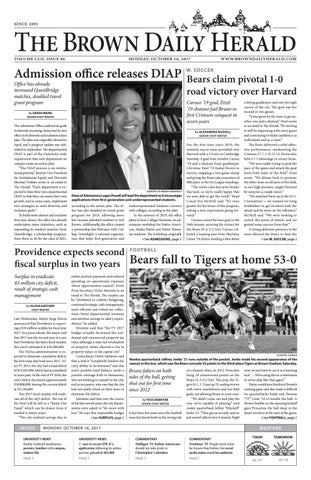
Admission office releases DIAP Bears claim pivotal 1-0 W. SOCCER
Office has already increased QuestBridge matches, doubled travel grant program
road victory over Harvard Caruso ’19 goal, Etzel ’19 shutout fuel Bruno to first Crimson conquest in seven years
By SARAH WANG SENIOR STAFF WRITER
The Admission Office outlined its goals to diversify incoming classes and its own office in its diversity and inclusion action plan. The plan was originally released in April, and a progress update was submitted in September. The departmental DIAP is part of the University-wide requirement that each department on campus create an action plan. “The DIAP process is an institutional priority,” Interim Vice President for Institutional Equity and Diversity Shontay Delalue wrote in an email to The Herald. “Each department is expected to have their own departmental DIAP so that they can assess their own growth, and in some cases, implement new strategies to meet diversity and inclusion goals.” To build more diverse and inclusive first-year classes, the office has already undertaken some initiatives, such as expanding its student matches from QuestBridge, a scholarship program, from three to 20 for the class of 2021,
By ALEXANDRA RUSSELL SENIOR STAFF WRITER
COURTESY OF BROWN UNIVERSITY
Dean of Admissions Logan Powell will lead the department as it encourages applications from first-generation and underrepresented students. according to the action plan. The office has also doubled its travel grant program for 2018, allowing more low-income admitted students to visit Brown. Additionally, the office created a partnership last February with College Greenlight, a national organization that helps first-generation and
underrepresented students connect with colleges, according to the plan. In the summer of 2019, the office plans to host College Horizons, an admissions workshop for Native American, Alaska Native and Native Hawaiian students. The workshop, originally » See ADMISSIONS, page 3
For the first time since 2010, the women’s soccer team prevailed over Harvard with a 1-0 win in Cambridge Saturday. A goal from Jennifer Caruso ’19 and a shutout from goalkeeper Christine Etzel ’19 fueled Brown to victory, snapping a two-game slump and giving the Bears sole possession of fifth place in the Ivy League standings. “The senior class has never beaten Harvard, so we’re really happy that we were able to get the result,” Head Coach Kia McNeill said. “It’s even greater for the future of this program, setting a new expectation going forward.” Caruso scored the lone goal in the 54th minute, securing the victory for the Bears (9-4, 2-2 Ivy). Caruso collected a looping pass from Maclaine Lehan ’18, before sending a shot above
a diving goalkeeper and into the right corner of the net. The goal was her second in two games. “It was great for the team to get another win and a shutout,” Etzel wrote in an email to The Herald. “It’s exciting to still be improving with every game and continuing to build confidence as individuals and as a team.” The Bears delivered a solid offensive performance, outshooting the Crimson (7-7, 1-3) 15-12. Bruno also held a 7-5 advantage in corner kicks. “We were really trying to push the pace of the game and attack the goal from both sides of the field,” Etzel wrote. “We always look to pressure the other team on all parts of the field, so our high pressure caught Harvard by surprise a couple times.” “We matched them up in the (3-52 formation) — we wanted our wing midfielders to get involved with the attack and be more on the offensive,” McNeill said. “We were looking to switch the point of attack, and we gained some success from that.” A strong defensive presence in the zone allowed the Bears to shut the » See W. SOCCER, page 2
Providence expects second FOOTBALL fiscal surplus in two years Bears fall to Tigers at home 53-0 Surplus to eradicate $3 million city deficit, result of strategic cash management By OLIVIA KATCHER STAFF WRITER
Last Wednesday, Mayor Jorge Elorza announced that Providence is expecting a $10 million surplus for fiscal year 2017. In a press release, the mayor said that 2017 was the second year in a row that Providence has had a fiscal surplus, this year’s estimated at $10,206,604. The Elorza administration is expected to eliminate cumulative deficit, the first rainy day fund since 2011. After FY 2015, the city had a total deficit of $13,445,000, which had accumulated in years past. At the end of FY 2016, the city’s deficit decreased approximately $10,000,000, leaving the current deficit at $3,158,000. This 2017 fiscal surplus will eradicate all of the city’s deficit. The rest of the fund will be left to a “Rainy Day Fund,” which can be drawn from if needed in future years. “The city realized savings due to
INSIDE
earlier pension payments and reduced spending on operational expenses where opportunities existed,” wrote Press Secretary Victor Morente in an email to The Herald. The surplus can be “attributed to realistic budgeting, continued strategic cash management, more efficient and robust tax collections, better departmental revenues and attrition savings in salary expenditures,” he added. Morente said that “the FY 2017 budget actually decreased the residential and commercial property tax rates, although a state-led revaluation of property values showed a rise in property values in the capital city.” Councilman David Salvatore said that a deficit “completely hinders the city’s ability to do business,” and this year’s positive fund balance sends a positive message both to businesses, who are looking to expand in the city, and to tax payers, who saw that the city had not solely relied on their taxes to eliminate the deficit. Salvatore said that over the course of the last several years, the city departments were asked to “do more with less.” He says this responsible budget » See SURPLUS, page 2
ELI WHITE / HERALD
Rookie quarterback Jeffrey Jonke ’21 runs outside of the pocket. Jonke made his second appearance of the season in the loss, which saw the Bears concede 53 points to the third-place Tigers at Brown Stadium Saturday.
Bruno falters on both sides of the ball, getting shut out for first time since 2012 By TESS DEMEYER SENIOR STAFF WRITER
It has been five years since the football team last found itself on the wrong side
of a shutout when, in 2012, Princeton hung 19 unanswered points on the Bears (2-3, 0-2 Ivy). This year, the Tigers (4-1, 1-1) put up 53, sealing victory with seven touchdowns and two field goals, not allowing Bruno to score once. “We didn’t come out and play the way we’re capable of playing,” said rookie quarterback Jeffrey “Mitchell” Jonke ’21. “They got on us early, and we just weren’t able to turn it around. Right
now, we just have to use it as a learning tool. … We’re using this as a motivation to never play like that again.” Rainy conditions hindered Brown’s running game and also made it difficult for quarterbacks Jonke and Thomas “TJ” Linta ’18 to handle the ball. A Brown fumble on the opening kickoff gave Princeton the ball deep in the Bears’ territory at the start of the game, » See FOOTBALL, page 2
WEATHER
MONDAY, OC TOBER 16, 2017
UNIVERSITY NEWS Family weekend familiarizes parents, families with campus, student life
UNIVERSITY NEWS U. sues to secure JFK Jr’.s application following its online auction, priced at $85,000
COMMENTARY Mulligan ’19: Italian-Americans should not take pride in Christopher Columbus
COMMENTARY Friedman ’19: People travel more for leisure than before, but social media makes travel less authentic
PAGE 3
PAGE 3
PAGE 7
PAGE 7
TODAY
TOMORROW
66 / 47
58 / 39
NEWS
PAGE 2 • MONDAY, OCTOBER 16, 2017
THE BROWN DAILY HERALD
» FOOTBALL, from page 1 and from there, the Tigers took over. They dominated every aspect of the game, forcing eight punts and racking up 538 total yards on offense, the most Brown’s defense has allowed all season. The Bears had no response for the Tigers’ stifling defense, amassing only 12 first downs and 170 yards of offense. The Tigers found success on the ground and through the air, splitting their yardage equally between rush and pass plays. Princeton quarterback Chad Kanoff completed 21 passes for two touchdowns, and running back Charlie Volker tallied 163 rushing yards on four scoring runs, including a 96-yard foray into the end zone in the second quarter. After notching 16 points in the first quarter and adding 20 more in the second, the Tigers went into the locker room with a comfortable 36-0 lead. Starting quarterback Linta connected on seven of 12 passes for 55 yards before Jonke took over in the second half. Jonke made his second appearance of the season after seeing some time in the pocket during last week’s game against Stetson University. The first-year led Brown’s offense with 29 rushing yards and 60 passing yards on eight completions Saturday. Despite the change of QB, the Bears still struggled to generate on offense. Princeton continued to score, posting 10 more points in the third quarter and one final touchdown early in the fourth to bring up the final 53-0. Head Coach Phil Estes P’18 was not available after the game for questions and could not be reached by press time. “This is the time that we need to come together as a team because if we don’t, it’s really going to hurt our season,” Jonke said. Brown will continue conference play in Ithaca, New York against Cornell Saturday. Kickoff is set for 3 p.m.
After years of operating surpluses had to be funneled directly into the city’s running cumulative deficit, a $10.2 million operating surplus this fiscal year helped bring the city out of debt.
GWEN EVERETT / HERALD
» SURPLUS, from page 1 spending contributed to the surplus
alongside the city’s increase in revenue. The money from the Rainy Day Fund will be reinvested into the city’s
public safety, infrastructure and education that is conducive to 21st-century learning, said Salvatore. In a follow up
email, he added that affordable housing should be “an area the city should also invest taxpayer money in.”
Housing for 2018 - 2019
2-, 3-, 4- and 5- bedroom apartments.
Combinations in same buildings for 6-, 7-, 8-, 9-, 10- and 13- bedrooms.
Close to campus. Laundry and parking. Call Peter at (401) 575-9981
COURTESY OF BROWN ATHLETICS
Veteran goalkeeper Christine Etzel ’19 posted her third shutout of the season against Harvard Saturday. The 1-0 victory gives Bruno sole possession of fifth place in the Ivy League standings with three games remaining.
» W. SOCCER, from page 1 Crimson down. “This week, we did a very good job … denying services and denying shots,” McNeill said. “I’m really proud of the way the defense played — they’ve deserved a shutout for a couple of games now, so I’m glad we got one against a very good team.” Etzel recorded her third shutout of the season, making four saves. For
the first time ever, she faced off against her twin sister Danielle, who played in net for the Crimson in the first half. Facing her sister down the field was a strange experience, Etzel wrote. “It was weird, to be honest,” Etzel wrote. “We’ve never actually played against each other on the same field, but we both went out and played like we normally would in any other Ivy League game.” As the Bears prepare for their final
trio of conference games, they seek to maintain their work ethic on and off the field. “We’ve just got to focus on what we can do as a team and keep working hard,” Etzel wrote. “We want to finish out this season in the best way possible. Anything can happen in the Ivy League as every game is so important.” The Bears visit Cornell Saturday, before returning home to host Penn at Stevenson-Pincince Field Oct. 28.
NEWS
MONDAY, OCTOBER 16, 2017 • PAGE 3
THE BROWN DAILY HERALD
Families flock to campus for family weekend U. offers speeches, performances, exhibits to showcase daily life on campus during weekend By KATHERINE BENNETT STAFF WRITER
After dropping their students off six weeks ago for the start of school, many families returned to campus this weekend to take part in the annual Family Weekend celebrations. Marked by a series of events ranging from speeches to exhibits to concerts, Family Weekend served as a window into the lives of Brown students for their families. “The goal is to give families a taste of the best of Brown,” said Mikele StGermain, assistant director of University Event and Conference Services. “We want to give them a similar experience to what their student has on campus. … We want families to walk away feeling that their student is in a good place.” To provide this experience, the University coordinated its own offerings and scheduled locations for student group performances. Some of these events included an exhibit about the Voyager spacecraft, performances of “Macbeth” by student group Shakespeare on the Green and the football game between Brown and Princeton. One of the University’s largest events was the President’s Address, which
COURTESY OF NICK DENTAMARO
Families checked in at the Leung Family Gallery Friday and Saturday and were told about the wide range of activities available for the weekend. Families could choose from activities ranging from a performance of “Macbeth” to the football game between Brown and Princeton. featured a keynote speech by author and philanthropist James Patterson P’20. In her speech, Paxson described student life at Brown. She cited a student’s feeling of ownership in the University, learning through the open curriculum, developing a balance between an academic and social life and finding passions at and after Brown. Patterson’s address focused on the power of stories to do good and create change in our lives and in the world. He
discussed the idea that we use stories to form opinions of ourselves and others and the importance of college in forming the stories that make up our own core values. Patterson also spoke to the power of collaboration that stems from the Brown education model, promoting the idea that “partnership is more successful” than government, business or philanthropy alone. Families came to Providence from across the globe to take part in the
festivities. Rongjie Chen, sister of Rachel Wang ’21, flew from Washington, D.C. to visit campus. Chen said she and her sister were “really excited about the musical offerings.” Sofia Mason’s ’21 family also looked forward to the musical events offered and planned to watch “an acapella concert or two,” said Hal Mason P’21, Sofia’s father. For the family of Jessica Raviv ’21 and Micaela Raviv ’20, driving up from
Manhattan to be on campus was the perfect opportunity for some family time. “We have two daughters here,” said their father, Adi Raviv P’20 P’21. “We wanted to spend the day with them and have some time together.” St-Germain hopes that Family Weekend was a fun and enjoyable experience for everyone. “Family Weekend is a great event to plan. It’s always wonderful to meet families and interact with them,” she said.
U. sues to prevent sale of stolen JFK Jr. ’83 documents Seller refuses to return stolen items, remove applications from personal website By ISABEL GENSLER UNIVERSITY NEWS EDITOR
In response to the online sale of John F. Kennedy Jr.’s ’83 student file, the University filed a complaint in the U.S. District Court for the Central District of California on Friday, seeking court orders to block the sale of the documents and to mandate their return. The complaint names the defendant as Gary Zimet, who currently has the documents listed for sale on his website for $85,000. Applications for enrollment submitted to the University, as well as communications from families regarding their students’ performance, are owned by the University, and “no one is authorized to transfer, remove or otherwise alienate any record” from student files, the complaint states. Kennedy’s student file was kept in a secure area of Sayles Hall, and access to the file was limited. “The only way documents from (Kennedy’s file) could be removed
» ADMISSIONS, from page 1 planned for the summer of 2018, was pushed back due to construction issues, said Dean of Admission Logan Powell. To promote diversity and inclusion within the admission office, staff members participate in a variety of conferences such as the College Board National Forum and Ivy Plus admission
COURTESY OF WIKIMEDIA COMMONS
John F. Kennedy Jr.’s ’83 application was written in part by his mother, Jacqueline Onassis Kennedy, while he was in Africa. The document is believed to have left University custody via a former admissions officer and now resides with Gary Zimet, the defendant in the Univeristy’s lawsuit. from Brown’s control is if they had been stolen,” the University alleges in the complaint. Because the documents
were stolen, the University is seeking court orders to prevent Zimet from selling or duplicating the documents,
and to force their return, the complaint states. “Zimet has refused to return the
stolen items owned by Brown or to remove the enrollment application” from his website, the complaint alleges.
conferences to learn new “practices in diversity recruitment and enrollment,” according to the plan. Other initiatives include having a member of the admission office’s Diversity Outreach Team participate in the hiring process of new staff members whenever possible, according to the plan. The presence of the Diversity Outreach Team helps provide another
perspective, Powell said. According to the September progress update, the admission office has “office-wide meetings to discuss issues of diversity” and staff members have “regularly scheduled meetings” to “address issues of implicit and explicit bias.” For the 2017-18 academic year, Powell hopes to incorporate more input from people outside the admission
office in crafting diversity and inclusion initiatives. “I certainly hope that we can have other voices from around the campus come in and speak with us,” Powell said. “I have met with some of those individuals, but it’s important for them to come in and talk to the office as a whole.” In the future, DIAP updates and summary reports for all departments
will be due each year June 15, Delalue wrote. The original DIAPs written by each department are living documents and can be updated at any time, she added. “The DIAP for us is really just the beginning,” Powell said. “This is really a statement of our values and a statement to the commitment we have to helping build a diverse and inclusive Brown.”
NEWS
PAGE 4 • MONDAY, OCTOBER 16, 2017
THE BROWN DAILY HERALD
U. researchers gauge effectiveness of 3-D, 2-D mammograms Many women, doctors turn to three-dimensional imaging over conventional option By MIA PATILLO SENIOR STAFF WRITER
With the emergence of new technologies such as three-dimensional mammographies, many women and doctors are inclined to turn away from conventional two-dimensional mammographies and instead lean toward these more recently developed options. But a new study conducted by University researchers seeks to determine which type of breast cancer screening is actually more effective. This study is a multi-center joint collaboration involving the ECOG-ACRIN Cancer Research Group, the National Cancer Institute and Brown University’s Center for Statistical Sciences, said Constantine Gatsonis, professor of biostatistics and director of the Center for Statistical Sciences, who is leading the trial. The University’s center handles all of the statistical work, which includes design and data analysis throughout the trial. “This study, as big and expensive as it is, will really help guide patient care,” said Ilana Gareen, associate professor of epidemiology at the Center for Statistical Sciences. “It’s a head-tohead comparison of two competing interventions.” This trial could be crucial if it determines which of the two screenings is better, because the newer 3-D technology has currently not been completely accepted by all hospitals and insurances, Gareen said. The downsides of the new technology include a heavier price tag and more radiation. At the end of the day, researchers say it all comes down to which technology has better diagnostic rates. “It’s really important to do these head-to-head studies so that we get answers to questions of medical practice,” Gareen said. “Someone may develop a
PIA MILEAF-PATEL
machine and truly believe it’s the best thing, but if you haven’t compared, then how do you know?” One of the main aims of the study is to simply find the quickest and most efficient pathway toward diagnosis, Gareen said. Doctors often do not have all of the information available to them to help make that important decision, she added. All breast imaging centers participating in the trial have both 3-D
breast cancer screenings, known as tomosynthesis, and 2-D screenings, known as conventional, said Jean Cormack, biostatistician at the center. These sites throughout the United States will screen the women involved in the trial through a standard mammogram process, and the data analysis will then occur at Brown. As the data comes in, the statisticians look at “quality, completeness and mistakes — some of which databases
are able to capture but others that we need to look at more closely,” Gatsonis said. In addition to the images that are collected and archived, University researchers will also analyze clinical data, biospecimen data and molecular data from biopsies and specimens given with consent. Much of this bulk analysis will occur three years into the trial, with researchers looking for specifics such as correlations with the imaging features or mutations in the genes.
But finding out whether or not tomosynthesis leads to reduced advanced cancers is only one of the study’s main goals. “We’re also going to look at how much healthcare is needed in order to receive the diagnosis of either 2-D or 3-D,” Gareen said. “Once you find an abnormality, you become a patient, and it could change the ability to get health insurance because it becomes a pre-existing condition.”
TODAY
MONDAY, OCTOBER 16, 2017 • PAGE 5
THE BROWN DAILY HERALD
menu
hockey across borders
SATELLITE DINING ANDREWS COMMONS
Pizza: Caprese, Chicken Ranch, Sammy Special Curry Bar, Poke Bowl JOSIAH’S
BLUE ROOM
Chicken Alfredo Bowl, Mushroom Burger, Tomato Soup
Turkey Chili, Spinach & Feta Soup, Bread Bowl
DINING HALLS SHARPE REFECTORY LUNCH
DINNER
Mushroom Barley Soup, Honey Mustard Chicken Tenders, Frosted Brownies
Chicken Vegetable Soup with Egg Noodles, Vegetable Couscous, Double Chocolate Cookies
VERNEY-WOOLLEY LUNCH
DINNER
Ham and Bean Soup, Shredded Pepper Chicken, Breast Cancer Awareness Sugar Cookies
Tomato and Rice Soup, Colorado Pork Chili, Carrot Cake with Cream Cheese Frosting
sudoku
ELI WHITE / HERALD
Alley Rempe ’20 handles the puck. The women’s hockey team hosted the Kunlun Red Star, a professional Chinese team and members of the Canadian Women’s Hockey League, at Meehan Auditorium Friday.
Q U O T E O F T H E D AY
crossword
“It’s even greater for the future of this program, setting a new expectation going forward.” — Kia McNeill, Brown Women’s Soccer Head Coach
See w. soccer on page 1.
CORRECTION Correction: A previous version of “Brown professor to track cancer cells with grant from Pew Charitable Trusts” said that the biomedical scholars program is administered by The Pew Research Center. In fact, it is administered by the Pew Charitable Trusts. The Herald regrets the error.
calendar TODAY OCTOBER MARCH
S
M
T
W
Th
F
S
1
2
3
41
52
63
74
85
96
10 7
11 8
12 9
13 10
14 11
15 12
16 13
17 14
18 15
19 16
20 17
21 18
22 19
23 20
24 21
25 22
26 23
27 24
28 25
29 26
30 27
31 28
29
30
31
Register Your Personal Property Today! 11:00 A.M. Barus & Holley Lobby
Social Cognitive Science Seminar Series 12:00 P.M. Metcalf Research Building, 305
ELL Workshop: Writing for the Job Market 3:30 P.M. Career Lab, 1st Floor
Cover Letter Writing 7:30 P.M. CareerLab, 1st Floor
TOMORROW 5th-Year Master of Public Affairs Info Session 12:00 P.M. Watson Institute
Data Visualization in Microsoft Excel 1:00 P.M. Rockefeller Library
Brown Meditation Community Sit 4:00 P.M. Manning Chapel
Jazz Combos Concert 8:00 P.M. Grant Recital Hall
COMMENTARY PAGE 6 • MONDAY, OCTOBER 16, 2017
THE BROWN DAILY HERALD
LETTER TO THE EDITOR
comic Comic | Ceyhun Firat
U. should go test-optional To the Editor: Thanks to Owen Colby for making such a compelling case for Brown to adopt test-optional admissions (“Colby ’20: It’s time for Brown to go testoptional,” Oct. 10). It is abundantly clear that Brown’s goal of increasing diversity and access would be strengthened by de-emphasizing SAT and ACT scores and moving to test-optional admissions. More than a third of all accredited, bachelors degree granting colleges and universities in the United States now make admissions decisions about all or many applicants without regard to their ACT or SAT scores. The long-term experience of early adopters like Bates College and others shows both the student body and the university as a whole benefit powerfully from the change. Test-optional colleges report more diversity of all kinds, including by race, first-generation college-going, geography, academic interest and learning difference. They also gain an academically stronger applicant pool, as measured by high school GPA and class rank. A report on test-optional admissions called “Defining Promise” looked at the records of more than 123,000 students at 33 institutions and found “no significant differences in undergraduate success rate between test-score submitters and non-submitters.” Even the Harvard Graduate School of Education, in its “Turning the Tide” report, advocated for “redefining achievement in ways that both level the playing field for economically diverse students and reduce excessive achievement pressure.” Other highly selective schools, including Wesleyan University, Smith College and Mount Holyoke College, have adopted testoptional policies in recent years. FairTest’s website has a guide to adopting test-optional policies as well as popular lists of test-optional schools. As a Brown alum and a longtime advocate for test-optional and other standardized testing reforms, I would be extremely proud to see my alma mater take this step. If not now, when? Lisa Guisbond ’81 Note: The author is an analyst for FairTest, the National Center for Fair and Open Testing in Boston.
www.browndailyherald.com
Find us online! facebook.com/browndailyherald
browndailyherald.com
@the_herald
Location: 195 Angell St., Providence, R.I. www.browndailyherald.com
@browndailyherald
youtube.com/browndailyherald
Editorial Leadership
Sections
Multimedia & Production
Business
Editor-in-Chief Lauren Aratani
Arts & Culture Editors Ethel Renia Madison Rivlin
Design Editors Christy Leung Ameer Malik Jessica Yu Assistant: Eduard Muñoz-Suñé
General Managers Henry Ritter Ben Wesner
Managing Editors Matt Brownsword Rebecca Ellis Kate Talerico POST- MAGAZINE Editor Saanya Jain BLOGDAILYHERALD Editor Angelica Cotto
Metro Editor Gwen Everett News Editors Isabel Gensler Alex Skidmore Hattie Xu Science & Research Editor Elena Renken Sports Editors Ben Shumate Nicholas Wey COMMENTARY Opinions Editors Connor Cardoso Anuj Krishnamurthy Mili Mitra
Photo Editors Head: Marianna McMurdock Assistant: Lilly Nguyen Gus Reed Sara Runkel Anita Sheih Copy Desk Chief Abby Borges Multimedia Editor Roland High
Directors Sales: Erin Lueck Sales: Matilda Lynton Finance: Reena Zhan Strategy: William Nober Strategy: Caroline Ziegler Managers Sales: Michael Borello Sales: Elizabeth Doykan Sales: Ariel Shusterman Collections: Ravi Betzig
Editorial contact: 401-351-3372 herald@browndailyherald.com
Business contact: 401-351-3260 gm@browndailyherald.com
Submissions: The Brown Daily Herald publishes submissions in the form of op-eds and letters to the editor. Op-eds are typically between 750 and 1000 words, though we will consider submissions between 500 and 1200 words. Letters to the editor should be around 250 words. While letters to the editor respond to an article or column that has appeared in The Herald, op-eds usually prompt new discussions on campus or frame new arguments about current discourse. All submissions to The Herald cannot have been previously published elsewhere (in print or online — including personal blogs and social media), and they must be exclusive to The Herald. Submissions must include no more than two individual authors. If there are more than two original authors, The Herald can acknowledge the authors in a statement at the end of the letter or op-ed, but the byline can only include up to two names. The Herald will not publish submissions authored by groups. The Herald does not publish anonymous submissions. If you feel your circumstances prevent you from submitting an op-ed or letter with your name, please email herald@browndailyherald.com to explain your situation. You can submit op-eds to opinions@browndailyherald.com and letters to letters@browndailyherald.com. When you email your submission, please include (1) your full name, (2) an evening or mobile phone number in case your submission is chosen for publication and (3) any affiliation with Brown University or any institution or organization relevant to the content of your submission. Please send in submissions at least 24 hours in advance of your desired publication date. The Herald only publishes submissions while it is in print. The Herald reserves the right to edit all submissions. If your piece is considered for publication, an editor will contact you to discuss potential changes to your submission. Commentary: The editorial is the majority opinion of the editorial page board of The Brown Daily Herald. The editorial viewpoint does not necessarily reflect the views of The Brown Daily Herald, Inc. Columns, letters and comics reflect the opinions of their authors only. Corrections: The Brown Daily Herald is committed to providing the Brown University community with the most accurate information possible. Corrections may be submitted up to seven calendar days after publication.
Illustrations Editor Pia Mileaf-Patel
Advertising: The Brown Daily Herald, Inc. reserves the right to accept or decline any advertisement at its discretion.
Graphics Editor Laura Felenstein
The Brown Daily Herald, Inc. is a financially independent, nonprofit media organization bringing you The Brown Daily Herald, BlogDailyHerald and Post- Magazine. The Brown Daily Herald has served the Brown University community daily since 1891. It is published Monday through Friday during the academic year, excluding vacations, once during Commencement and once during Orientation by The Brown Daily Herald, Inc. Single copy free for each member of the community. Subscription prices: $200 one year daily, $100 one semester daily.
Directors of Web Development Eli White Ivy Wong
Copyright 2017 by The Brown Daily Herald, Inc. All rights reserved. Periodicals postage paid at Providence, R.I. Postmaster: Please send corrections to P.O. Box 2538, Providence, RI 02906.
COMMENTARY MONDAY, OCTOBER 16, 2017 • PAGE 7
THE BROWN DAILY HERALD
Italian-Americans shouldn’t celebrate Columbus CAROLINE MULLIGAN staff columnist From New York to Kenosha, people came together on Columbus Day to honor their Italian-American heritage. In a Facebook group dedicated to the Italian-American roots of Massachusetts’ Merrimack Valley, where I am from, people discussed going to their local Sons of Italy lodges to celebrate. Despite my misleadingly Irish surname, three sets of my great-grandparents immigrated to the United States from Italy (specifically Naples and Sicily, to establish my regional ties). I grew up eating cannoli, crispelli and crusty Italian bread. On Labor Day weekends, I would often go to a local feast for three Italian saints. I feel connected to my ancestors’ homeland. And as an Italian-American, I am troubled that Columbus Day is being interpreted as a celebration of our culture. Christopher Columbus is not a figure around whom Italian-Americans should rally, and Columbus Day should not be used to celebrate our heritage. We should not be heroizing a man responsible for the enslavement and murder of countless indigenous peoples. There are many arguments already written about how Columbus Day celebrates colonialism and the
oppression of the peoples who first settled the Americas. I have nothing novel to contribute to the general discussion of why Indigenous Peoples’ Day would be a more appropriate celebration. Instead, I am focused on why Italian-Americans should disentangle ourselves from Columbus Day. The major argument in favor of Columbus Day being a day for cel-
bus held such importance to early Italian-Americans: Though Columbus never set foot in North America, nor did he have any conception of an Italian-American identity, he was the best-known person of Italian heritage to have made a significant contribution to American history. For recent immigrants, his image tied together two disparate cultures. Recalling that history of anti-
was stolen from its original inhabitants. That we share an ethnicity with the first thief is not something to be proud of. The reasons behind Columbus’ importance as a figurehead are logical. But understanding why our ancestors acted in certain ways does not mean that we have to value the same things that they did. Columbus has increasingly been recognized for
Christopher Columbus is not a figure around whom Italian-Americans should rally, and Columbus Day should not be used to celebrate our heritage.
ebrating Italian-American heritage comes from its roots as a holiday. It was first celebrated in 1892, in the midst of the largest period of Italian immigration to the United States. As recent immigrants, Italians in the late nineteenth and early twentieth centuries faced xenophobia, as exemplified in the high-profile Sacco and Vanzetti executions. Thus, Columbus became a figure around which newly-arrived Italians could rally to celebrate their connection with their new country and counter the discrimination they faced as immigrants. It is understandable why Colum-
Italian bias in America allows us to recognize the discrimination that has long been leveled against immigrants. Yet, recognition of the troubles that Italian-Americans faced in the past should be tempered with the acknowledgment that those troubles are no longer with us today. White Italian-Americans receive the same benefits from their race as do Americans of Anglo-Saxon descent. And, critically, Italian-Americans benefit as much as anyone else from the colonization that Columbus ushered in. We all — and to be explicitly clear, I am including myself in this statement — live on land that
his violence toward indigenous peoples, a fact that has historically been omitted in the conversations that Italian-Americans have held about him. We can do better than our progenitors. We can find sources of pride that do not come with brutal violence attached to them. And indeed, Italian-Americans have plenty of cultural points of pride that have nothing to do with Columbus. I referenced going to an Italian feast when I was younger. The Feast of the Three Saints honors three martyred Sicilian brothers. Though the feast is inarguably a religious festival, it functions more
broadly as a celebration of the Italian immigrant heritage of the city in which it is held. The crafts, the food and even coming together to cheer on the procession of the saints offers as much to religious Italian-Americans as it does to the more secular among us, including myself. Other feasts take place in other historically Italian neighborhoods, such as the Fisherman’s Feast, held yearly in Boston’s North End. And there are now innumerable important ItalianAmericans, ranging from authors to scientists to politicians, for us to celebrate. Why waste time defending a murderer when we could be uplifting lesser-known figures? At this year’s Columbus Day Parade in New York, Mayor Bill de Blasio said, “You can debate the historical figure of Christopher Columbus, but you can’t debate the contribution of Italian-Americans to this country. That is beyond question.” What de Blasio fails to recognize is that Columbus does not have to represent those contributions. As long as he does, our heritage will be tied to the suffering that indigenous peoples endured, and continue to experience, at the hands of European settlers. I cannot speak for de Blasio, but I personally find nothing to be proud of there.
Caroline Mulligan ’19 can be reached at caroline_mulligan@brown.edu.
Rethinking the millenial travel bug ANDREW FRIEDMAN staff columnist It seems as if everyone is into traveling these days. Let me rephrase that: Millennials are into traveling. In 2016, 80 percent of millennials surveyed by the American Society of Travel Agents reported taking a leisure vacation that year. And it’s not just the statistics — my Instagram tells me the same thing. I can pretty much count on seeing photos of a friend’s travel experience every time I open the phone app. This happens so often that I can even tell you which experiences are in vogue at the moment — trips to Block Island, on-a-whim vacations to Yosemite National Park and, if you’re lucky and can afford it, elephantback excursions in Thailand, among others. But as traveling increases in popularity, our reasons for traveling are becoming increasingly insincere. There are obvious reasons for the current travel boom — notably technology, which has made traveling significantly cheaper and easier in recent years. With the advent of Airbnb, the scope of accommodations has expanded to include not only hotels and hostels, but also local apartments. Meanwhile, airfares fell by about 50 percent between 1979 and 2011. More abstractly, the Great Recession has evaporated any trust that millennials previously maintained in the value of job loyalty and the idea of saving for retirement. Many of us see travel largely as a way to take a break from an unpredictable job market (or internship market, in the case of Brown students) in the hope of finding inspiration in un-
familiar settings, should we be so lucky to afford travel in the first place. But there are also more self-serving reasons for travel — namely our desire to publicize it. This is another manifestation of a desperate ratrace to appear cultured and attractive; it seems that everyone on Tinder advertises their love of traveling. If you traveled somewhere but didn’t take photos, did you even go? For most intents and purposes, the answer is no. It seems that in travel, bragging rights are the only thing that matters. Usually I can’t tell whether my friends
tagram influencers — “social media trendsetters with large followings” — in 2015 and experienced a 14 percent increase in tourism within a year. I have a hard time believing that these newfound visitors really cared about visiting Wanaka, New Zealand in the first place; they simply wanted to appear trendy. It seems that if a destination shows up on your “Explore” feed on Instagram, it will automatically show up in your Expedia itinerary. Though these superficial reasons for travel seem benign, they matter. Our motives are what
It seems that as interest in travel becomes more widespread, it becomes less authentic largely due to the ubiquitous social media popularity contest. travel because they want to or because they feel that they are supposed to. As with food, I would argue that travel is a medium through which young people enjoy bougie displays of one-upmanship via photography. But when I’m looking at my Instagram feed, I feel as if I am being compelled by the trying-too-hard filters and captions to see these photos as some sort of genuine self-expression. I have a hard time buying this. It seems that as interest in travel becomes more widespread, it becomes less authentic largely due to the ubiquitous social media popularity contest. And I’m not just saying this: The Instagram trend is already having tangible effects on tourism economies across the world. For example, a town in New Zealand invited and hired Ins-
ultimately separate meaningful travel from potentially exploitative tourism — and yes, there is a difference between the two. Just look at Puerto Rico, rendered economically incapable of dealing with the aftermath of two hurricanes. Yet I know many Brown students who traveled there last spring because airfares were cheap and the drinking age is 18. And then there is the extreme example of Cabo San Lucas, Mexico right now: Drug-related killings, administered by the Jalisco cartel, occur blocks away from beach-fronting, all-expenses-paid resorts and their upperclass denizens. The two worlds are separate and unequal, physically and financially. Both Puerto Rico and Cabo are examples of indifferent traveling to destinations with long-standing problems and no long-term solutions. Boycotting these lo-
cations isn’t necessarily an option — it could do more harm than good to local economies, and arguably both issues stem from governmentmismanagement more so than from exploitative tourism — but it is worth keeping the consequences of our travel in mind. Although travel has become an intractable part of my generation’s thinking — I would even go so far as to say that it represents the new American dream — what’s missing from this equation is any meaningful concern on the part of American visitors for their destination’s longterm well-being. This not only applies to international destinations, but also domestic ones, as Trump orders the Department of the Interior to “review all designations of national monuments greater than 100,000 acres created since 1996,” perhaps to make room for more energy-related endeavors. While the lack of current discussion about this review might be another example of the Trump administration’s ability to sweep policy changes under the rug, the public’s inattention to this particular issue also makes a statement about American attitudes toward the destinations we frequent. I know that we can’t change the fact that millennial wanderlust is here to stay. But as we purchase Spring Break tickets and plan trips during the summer, we can change the way we view travel from a blithe consumption of the destination’s aesthetics (for Instagram) to a genuine engagement with its history, people and the current state of its political affairs. The travel trend is here to stay, but that doesn’t mean that we have to continue traveling indifferently and ignorantly.
Andrew Friedman ’19 can be reached at andrew_friedman@brown.edu.
SPORTS THE BROWN DAILY HERALD
MONDAY, OCTOBER 16, 2017
VOLLEYBALL
Bruno falls to Harvard, Dartmouth in away matches Halfway through Ivy League competition, two road losses drop Bruno to last place By MARI HERREMA STAFF WRITER
The volleyball team took two losses on the road this weekend, dropping a match 3-1 against Harvard Friday and 3-0 against Dartmouth Saturday. These defeats drop Brown (6-12, 1-6 Ivy) to last place in the Ivy League standings halfway through conference play. Though Bruno came out strong against the Crimson (10-6, 5-2), claiming the opening set 23-25, Harvard rallied in the second set with a resounding 25-14 win and never looked back. Riding the momentum of a couple long point streaks, the Crimson took the third and fourth sets 25-20 and 25-21, respectively. Bruno captain and libero Melissa Cairo ’18 earned a personal best 19 digs in the loss. Both Brown and Dartmouth (7-9, 3-4) entered Saturday’s match looking to bounce back from tough losses, but the Big Green ultimately took the victory in straight sets. Cairo again led the Bears in digs with 11 and recent Herald Athlete of the Week Courtney Palm ’19 executed a team-high 8 kills.
In the first set, after leading 2-1, Bruno struggled to stand its ground against the Big Green. Two five-point streaks pushed Dartmouth out of the Bears’ reach and between offensive violations, defensive miscommunications and dominant Dartmouth blocking, Brown was unable to score more than two points in a row. “It’s really tough to play catch-up,” said Head Coach Diane Short. “It’s really hard because the other team can come at you more aggressively, where I think we came at them more afraid to make mistakes.” Though Bruno entered the second set with more vigor, utilizing feinted attacks to scramble the Big Green’s defense, unforced errors and defensive disorganization continued to thwart the Bears. After an early five-point streak by Dartmouth, service between the teams changed regularly. But for every Brown point, Dartmouth scored two or three. The set finished 25-14. Strong Bruno defense in the third set kept Dartmouth from taking an early lead and coordination between Brown setters and outside hitters helped the Bears penetrate Dartmouth’s blocking. Middle blocker Jacqueline Jacobs ’20 delivered several crucial blocks and kills to keep Brown going point-for-point with Dartmouth. Sabrina Stillwell ’19, Bruno’s stalwart
COURTESY OF BROWN ATHLETICS
Makena Ehlert ’20 spikes a ball over the net in one of the team’s matches. This weekend, the Bears lost to the Crimson 3-1 and the Big Green 3-0, despite winning the first set against Harvard. right side hitter and outside hitter, also bolstered the Bears with her steady performance and six kills in the match. When leading 20-19, Dartmouth caught a lucky break. Brown lost momentum after two unforced errors and the Big Green took full advantage, winning the set 25-19 and taking the match.
Looking forward to the second half of the Ivy League season, the team is hoping to bounce back. “We have the players, we’ve got some depth, we’ve just got to get it together,” Short said. “We’re looking forward to playing everyone again. Because we played them before, we know what we need to get better in those situations.”
This challenging weekend is, if anything, an opportunity to take away some lessons. “A good thing is that this team is pretty resilient,” Short said. “Even though we had a bad weekend, we’re going to start fresh this week and do some things to improve.” Bruno’s will host Yale in its next match Friday at 7 p.m.
CROSS COUNTRY
Bears finish 21st at pre-national invitational, win home meet
Mike Wyman ’18 runs personal best of 24 minutes, 19 seconds on eight-kilometer course By CORMAC CUMMISKEY STAFF WRITER
The men’s cross country team squared off against several of the nation’s top squads in the Division I Pre-National XC Invitational Saturday, held at E.P. “Tom” Sawyer State Park in Louisville, Kentucky. Competing without their number one runner, recently-injured captain Matt Mahoney ’18, the Bears found themselves in the middle of the pack. Bruno amassed 566 points to finish 21st in a field of 41 teams, including eight nationally ranked programs. Led by individual winner Rory Linkletter, No. 2 Brigham Young University dominated the competition, racking up a scant 41 points to claim the team title. BYU was beyond Bruno’s reach, but Brown handily beat Ivy League opponent Dartmouth; the Big Green sank to 38th-place overall beneath the weight of their 910-point total. The Bears also bested Yale by default, as the Bulldogs failed to finish a full squad of five scoring athletes. In Mahoney’s absence, Mike Wyman ’18 served as standard-bearer, covering the grassy eight-kilometer course in 24 minutes, 19 seconds. This clocking, a new personal best, was good for 79th place out of 282 finishers and marked the first time that Wyman — a middle-distance specialist on the track — has spearheaded the Bears in a cross country race.
COURTESY OF BROWN ATHLETICS
Zac Lanigan ’20 races against a student from Dartmouth. The Bears placed 21st at the Division I Pre-National XC Invitational in Louisville, Kentucky — ahead of Ivy rivals such as the Big Green and the Elis. Brown also placed first at its home meet for the first time since 2013. Gabe Altopp ’20, the team’s fifth finisher at last month’s Coast-to-Coast Battle in Beantown, was Brown’s second man across the line. Altopp squeaked into the meet’s top 100 by the skin of his teeth, running a personal-best 24:28 to score 97 points for the Bears. Oft-injured Dan McDonald Meteer ’18 — healthy after years of debilitating setbacks — continued to capitalize on his final season by finishing third for Brown. He ran 24:40, his fastest race yet, adding 118 points to Bruno’s total. Brown’s fourth and fifth men competed strongly but were not able to break their personal records. Penultimate scorer Cam Daly ’20 ran 24:44 — his second-fastest 8K — to net 126
points. Captain Martin Martinez ’18 shut the door by running 24:54, his third-fastest 8K, for 148 points. Entering the meet, Brown was ranked fourth in the USTFCCCA New England Coaches’ Poll. But regional rival Boston University, rated 14th in the same poll, upset the Bears by finishing 18th at the invitational. This does not bode well for Bruno’s position in the forthcoming edition of the rankings, which will be released Monday. The Bears experienced greater success closer to Providence, albeit on a somewhat smaller stage. Brown’s Bsquad triumphed over an array of local teams in the Rothenberg Invitational, held at Goddard State Park in Warwick
Friday. Bruno tallied 33 points to beat second-place University of Vermont by a margin of three — an accomplishment sweetened by the fact that all of Brown’s scorers set new personal bests. It was the first time the Bears had won on their home course since 2013. As was the case in Louisville, a middle-distance man led the charge for Brown in Warwick. 800-meter specialist Zach Lanigan ’20 from Australia bounded home third in 25:08, outpaced only by two Vermont harriers. Tom Hale ’19 followed close on the heels of his teammate, clocking 25:12 to claim fifth. “Lanigan’s always a force to be
reckoned with,” Hale said. “Coming down the last straight we were neckand-neck, but then he just blew by me. It was a good match.” Three first-year athletes made up the balance of Bruno’s scoring five: David Scherrer ’21 finished sixth in 25:12, Jared Yabu ’21 took eighth in 25:18 and Ben McCoy ’21 was 11th in 25:28. “They exceeded all expectations in a really positive way,” Hale said. “You can look at the results and see that they’ve really got what it takes.” The Bears will return to competition at the Ivy League Heptagonal Championship, to be hosted Oct. 28 in the Bronx’s historic Van Cortlandt Park.