SINCE 1891
THE BROWN DAILY HERALD MONDAY, MARCH 20, 2017
VOLUME CLII, ISSUE 36
WWW.BROWNDAILYHERALD.COM
UCS, UFB candidates debate campus issues Bruno takes M. LACROSSE
Candidates discuss UCS, UFB relationship, increased transparency, value of student support
commanding win over Harvard
By EDUARD MUÑOZ-SUÑÉ SENIOR STAFF WRITER
Candidates running for executive positions for the Undergraduate Student Council and the Undergraduate Finance Board discussed a range of issues, including a possible raise in the student activities fee, staffing at the Title IX office and increased recruitment for both bodies, at a debate Sunday night. Chelse-Amoy Steele ’18 runs unopposed for UCS president and Naveen Srinivasan ’19 and Alex Volpicello ’18 contend for UCS vice president. Yuzuka Akasaka ’18 and Aryan Chhabria ’18 vie for UFB chair and Julian DeGeorgia ’20 and Drew To ’19 compete for UFB vice chair. Steele laid out her platform, which would prioritize supporting the Title IX Office and the Office of Institutional Diversity and Inclusion, whose recent understaffing has caused gaps in student support, she said. Recent changes around the Title IX office provided much for discussion among the candidates. Volpicello repeatedly referenced his work with a variety of student groups that work with sexual assault prevention and awareness. Volpicello said that
Key offensive weapons shine as Bruno rolls over Crimson, secures first Ivy League win of season By NICHOLAS WEY SENIOR STAFF WRITER
JASMINE RUIZ / HERALD
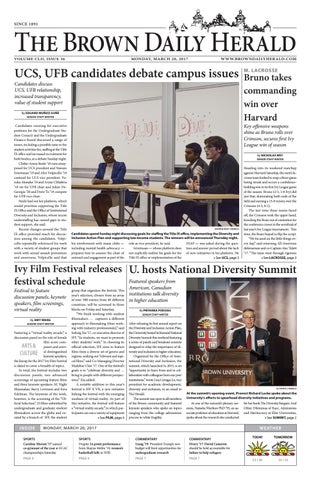
Candidates spend Sunday night discussing goals for staffing the Title IX office, implementing the Diversity and Inclusion Action Plan and supporting low-income students. The winners will be announced Thursday night. his involvement with many clubs — including mental health advocacy — prepares him to assume the chair of outreach and engagement as part of the
role as vice president, he said. Srinivasan — whose platform does not explicitly outline his goals for the Title IX office or implementation of the
DIAP — was asked during the question and answer period about the lack of new initiatives in his platform. He » See UCS, page 3
Heading into its weekend matchup against Harvard Saturday, the men’s lacrosse team looked to snap a three-game losing streak and secure a confidencebuilding win in its first Ivy League game of the season. Bruno (2-3, 1-0 Ivy) did just that, dominating both ends of the field and earning a 13-8 victory over the Crimson (4-2, 0-1). The last time these teams faced off, the Crimson took the upper hand, knocking the Bears out of contention for the conference crown in the semifinal of last year’s Ivy League tournament. This time, the Bears hoped to flip the script. “We focused on the little things every day,” said returning All-American defenseman and co-Captain Alec Tulett ’17. “The team went through rigorous » See LACROSSE, page 3
Ivy Film Festival releases U. hosts National Diversity Summit Featured speakers from festival schedule American, Canadian Festival to feature discussion panels, keynote speakers, film screenings, virtual reality By AMY WANG SENIOR STAFF WRITER
Featuring a “virtual reality arcade,” a discussion panel on the role of female film score composers and several distinguished keynote speakers, the lineup for the 2017 Ivy Film Festival is slated to cover a breadth of topics. In total, the festival includes two discussion panels, two advanced screenings of upcoming feature films and three keynote speakers: M. Night Shyamalan, Barry Levinson and Ezra Edelman. The keystone of the week, however, is the screening of the “Official Selection,” 25 films submitted by undergraduate and graduate student filmmakers across the globe and curated by a branch of IFF, the student
ARTS & CULTURE
INSIDE
group that organizes the festival. This year’s selection, chosen from an array of over 300 entries from 40 different countries, will be screened in three blocks on Friday and Saturday. “We think working with student filmmakers … captures a different approach to filmmaking (than working with industry professionals),” said Solveig Xia ’17, co-executive director of IFF. “As students, we want to promote other students’ work.” In choosing its official selection, IFF aims to feature films from a diverse set of genres and regions, seeking out “relevant and topical films,” said Co-Managing Director Madeline Chin ’17. One of the festival’s goals is to “celebrate diversity and … bring in people with different perspectives,” Xia added. A notable addition to this year’s festival is IFF X VR, a new initiative linking the festival with the emerging medium of virtual reality. As part of this initiative, the festival will feature a “virtual reality arcade,” in which participants can use a variety of equipment » See FILM, page 4
institutions talk diversity in higher education By PRIYANKA PODUGU SENIOR STAFF WRITER
After releasing its first annual report on the Diversity and Inclusion Action Plan, the University hosted its biennial National Diversity Summit this weekend featuring a series of panels and breakout sessions designed to relay the importance of diversity and inclusion in higher education. Organized by the Office of Institutional Diversity and Inclusion, the summit, which launched in 2015, is an “opportunity to learn from and in collaboration with colleagues from our peer institutions,” wrote Liza Cariaga-Lo, vice president for academic development, diversity and inclusion, in an email to The Herald. The summit was open to all members of the Brown community and featured keynote speakers who spoke on topics ranging from the college admissions process to white fragility.
ELI WHITE / HERALD
At the summit’s opening event, Provost Richard Locke spoke about the University’s efforts to spearhead diversity initiatives and programs. At one of the summit’s plenary sessions, Natasha Warikoo PhD ’95, an associate professor of education at Harvard, spoke about the research she conducted
for her book The Diversity Bargain: And Other Dilemmas of Race, Admissions and Meritocracy at Elite Universities, » See SUMMIT, page 2
WEATHER
MONDAY, MARCH 20, 2017
SPORTS Caroline Morant ’17 named co-gymnast of the year at ECAC championships Saturday
SPORTS Despite 24-point performance from Shayna Mehta ’19, women’s basketball falls in WBI
COMMENTARY Liang ’19: President Trump’s new budget will limit opportunities for undergraduate research
COMMENTARY Drury ’17: David Cameron should be held accountable for failure to help refugees
PAGE 4
PAGE 4
PAGE 7
PAGE 7
TODAY
TOMORROW
52 / 36
55 / 32
NEWS
PAGE 2 • MONDAY, MARCH 20, 2017
» SUMMIT, from page 1 which examines how Ivy League and Oxford students perceive meritocracy and race. “We see inequality in the outcomes of admissions, and, yet, there are … signals that students get that this is a meritocratic system, ” Warikoo said. Warikoo said that the Ivy League students she interviewed for her research viewed efforts to increase diversity, through programs like affirmative action, as a mechanism to increase the collective merit of their class cohort. A white student Warikoo spoke with believed that diversity added as much to the class as a student who was a world class piano player. This perception was a “problematic commodification of race and ethnicity for black and Latino students in the minds of their peers,” she said. Ultimately, Warikoo said that the diversity bargain was that “white students support affirmative action because it leads to personal benefits.” Citing other student interviews, Warikoo said that there were several implications attached to the bargain. White students expressed a fear of “reverse discrimination” and a fear that “affirmative action shouldn’t go too far.” The program “shouldn’t call into question … white privilege and should be about benefitting (the University) rather than restorative justice,” she added.
While Warikoo acknowledged that “we’re never going to have a … completely level playing field,” she said that universities ought to have a broader support system for underrepresented students. Alexandra Ocampo Carr ’06, vice president of the Brown University Latino Alumni Council, said that Warikoo’s lecture highlighted the fact that diversity in admissions is meant “to move the country along in terms of justice.” “We use blanket statements like meritocracy,” but the word is used with an underlying assumption of “all things being equal — but all things aren’t equal,” she added. In addition to the keynote addresses, the summit allowed visitors the opportunity to attend a series of breakout sessions covering topics ranging from Muslim identity to the role of technology in developing inclusive communities. Summit topics “were selected given feedback we received from departments and constituent groups across Brown who were asking for research and evidence-based practices and policies related to their departmental DIAPs,” CariagaLo wrote. Archana Sridhar, the associate provost of the University of Toronto, spoke at the session titled “Cultivating Talent in the Professoriate: Faculty Development
THE BROWN DAILY HERALD and Mentoring.” Sridhar told The Herald that she had spoken with Cariaga-Lo, who had “helped (us) think about (implementing our own) diversity initiatives” at the University of Toronto. Cariaga-Lo had invited Sridhar to participate at the summit a few weeks earlier, she added. “It was really exciting to hear all the innovations and diversity work going on at other places and (have the opportunity to) bring those ideas back to our institutions,” Sridhar said. Anthony Jack, an assistant professor at Harvard, led a session titled after his book, “(No) Harm in Asking: Class, Acquired Cultural Capital and Academic Engagement at an Elite University,” which assessed how students from different socioeconomic backgrounds engaged with their professors. To determine the extent to which students felt comfortable asking their professors for help, Jack separated students from low-income backgrounds into two groups: the privileged poor and doubly disadvantaged. The privileged poor consisted of low-income students who attended reputable schools prior to college, while the doubly disadvantaged group consisted of low-income students who did not attend a reputable school to prepare them for higher education. From his research, Jack compared levels of professorial engagement among
low-income black, Latino and white students. Students who came from the privileged poor had “no qualms about asking for help” or attending their professor’s office hours, he said. Comparatively, those who fell in the doubly disadvantaged category struggled with self-advocacy, which negatively affected their ability to succeed. “Middle class (students) see college officials as partners along their academic journey, but the doubly disadvantaged, I argue, see college officials as authority figures and treat them as such,” Jack said. This not only leads these students to “draw boundaries” but also keep distance between themselves and their professors, he added. In contrast, the privileged poor viewed officials as “facilitators” who can offer them support. Jack also found that students from low-income backgrounds perceived attending office hours as a “rich person” thing to do. Jack stressed that professors needed to be more explicit about what office hours entail to encourage students from all backgrounds to attend. “Impress upon students that it’s more than normal to ask for help, and it is smart, expected and rewarding. Inspire them to build intergenerational networks. … Find ways to educate all families that there are new rules and their children must adapt to
www.browndailyherald.com
them,” he said. Carr said that Jack’s session “resonated (with me) because I am one of the (doubly disadvantaged).” Thinking back to when she was a student, she “didn’t realize that use of (the University’s resources) was not a signifier of my incompetence or lack of intelligence but, in fact, use of them would have been a ladder to my success.” The summit allowed attendees to reflect on Brown’s history of diversity and inclusion. Jennifer Davis-Allison ’73, who came to the conference to reunite with her freshman-year roommate, Aneesah Ali ’ 73, said that the work of student activists plays a huge role in allowing the University to advance with regard to diversity and inclusion. The students in 1968 provided the “impetus” for the University to admit more students of color. “The culture here (has always been) of activism,” she said. “The thing that stood out for me and really solidified the value of the Brown experience was under Ruth Simmons with the Slavery and Justice project, which included alumni,” Ali added. “That was the lead and the centerpiece in the chronicle of higher education … (because) now, 15 years later, the other institutions are doing their own reconciliation work.”
NEWS
MONDAY, MARCH 20, 2017 • PAGE 3
THE BROWN DAILY HERALD
U. associate chaplain leads workshop to educate community on Islam Workshop part of monthly series created in collaboration between Chaplaincy, RICMA By LIORA MORHAYIM CONTRIBUTING WRITER
In an attempt to educate the community — both on and off campus — about Islam and Islamophobia in the United States, the Rhode Island Council for Muslim Advancement and Brown Chaplaincy are working together to conduct a series of monthly interactive workshops. Adnan Adrian Wood-Smith, the University’s associate chaplain for the Muslim community and president of RICMA, led the second of these workshops at Wilson Hall Saturday. The interactive workshop aimed to provide attendees with a basic understanding of Islam from a practitioner’s standpoint and discuss the roots of Islamophobia, said Wood-Smith. Wood-Smith began his presentation by giving an overview of orthodox Islam, discussing the three dimensions in human experience — body, mind
» UCS, from page 1 responded that he had indeed been in discussion about several Title IX initiatives in recent months, such as the UCS proposed implementation of the Callisto mobile application. He also said that, as a member of teams working on UCS initiatives like No Apologies, he is in a good position to ensure their future success. Candidates also highlighted the importance of support for low-income students. Steele reiterated her platform position concerning eliminating the summer earnings expectations for students — a fee she said places an undue burden on low-income students. Candidate’s various experiences were brought up by the UCS debate’s moderators — Eric Estes, vice president for campus life and student services, UCS President Viet Nguyen ’17, Arely
»LACROSSE, from page 1 training by a U.S. Marine. This was a useful team bonding and motivational exercise to set the tone for Harvard week.” The week of preparation paid off, with the Bears taking control of the matchup from the opening faceoff. In the first quarter alone, Bruno scored six goals, each coming from a different player. Midfielder Matt Graham ’17 put the Bears on the scoreboard first to tie the game at one. Larken Kemp ’17, Michael Panepinto ’19, Stephen Hudak ’18, Jack Collins ’18 and Dylan Molloy ’17 followed with goals in quick succession to put Brown up 6-2 going into the second quarter. The Bears’ defense was equally impactful in the opening minutes. “Our defense came up with some big stops that halted any early Harvard momentum,” Tulett said. “In particular JJ Ntshaykolo ’18 played outstanding, along with Max Gustafson ’18.” Tulett added that first-year goalie Phil Goss ’20 — who made four saves in the first quarter alone — also played especially well. Brown found continued success in the second quarter, adding four goals. Over this period, Hudak scored twice
and spirit — and different approaches to Islam. Authorities on Islam tend to belong to “chains of knowledge” that go back to the Prophet Muhammad, he said, adding that “what we are facing now in the world … (are) Muslims who aren’t traditionally trained trying to speak authoritatively about Islam.” Sara Ludin, a RICMA volunteer and a visiting research fellow in history, continued the presentation by addressing the question of, “What is contributing to Islam and Muslims being seen as objects of fear and hatred?” She pointed to a framing problem in the news, displaying a screen grab of a CNN report that asked “Does Islam promote violence?” She also discussed the dehumanization of Muslims and its connection with racial fear. The historical link between Muslims and black people “is very deep, and white supremacy continues this policy of dehumanization,” Ludin said. Islam can be used to promote political agendas, Wood-Smith said. “When politicians are able to use fear, when they convince people that they should be scared, studies show that then people are more willing to accept state authority, surveillance (and) limitations of
their privacy,” he said. Aisha Manzoor, secretary of RICMA, said that though Rhode Island is generally a welcoming state for Muslims, the state has seen Islamophobic incidents leading up to and after the election. She said that mosques in Providence and Kingston and the Islamic school in Warwick were targeted and vandalized. Ruban Hussain ’18, board member of Brown Muslim Students’ Association, said that after President Trump’s election, female students who usually wear a hijab or headscarf were targeted on the street with comments like, “Get out of our country.” Political leaders in Rhode Island are often responsive to such Islamophobic incidents and are present at rallies and events, Wood-Smith said. He added that political leaders have reached out to key leaders in the Rhode Island Muslim community and asked them to be on certain advisory committees. Mayor Jorge Elorza created a Muslim advisory board right after the election. When asked about how to be a good ally to the Muslim community at this time, Manzoor said that the best way is to educate yourself on the basics of
Diaz-Loza ’17, a member of the Brown Immigrant Rights Coalition and Alli Gordon ’19, a managing editor of the Blognonian. Steele conceded the value of contested elections for executive UCS positions and recognizes the limitations an uncontested election places on her, she said. But she stated that despite an uncontested election, she remains determined to listen actively and work hard for Brown. “This isn’t something I take lightly,” she said. “I am prepared and continue to be prepared … to make sure I am constantly looking for new ways to support this community.” At one point Srinivasan referenced the relationship between Nguyen and Timothy Ittner ’18, UCS vice president. Because the process of working with the administration as an executive member of UCS can be confusing and difficult to navigate, Nguyen — having
no prior UCS experience before his presidency — benefited from Ittner’s extensive experience with UCS, Srinivasan said. He said that Steele, who also has no prior experience with UCS, would benefit from his own UCS experience if he wins the vice presidential election. When asked about the low numbers of candidates in this year’s UCS election, Steele responded that “a little more work in recruiting” might be necessary. The UFB debate — scheduled ahead of the UCS debate — was moderated by Jordan Ferguson ’17, chair of UFB, Benjamin Miller-Gootnick ’17.5, a board member on the University Resources Committee and Kasturi Pananjady ’19, a Herald news editor. UFB candidates debated the student activities fee — the total amount of which is granted to the UFB to finance
to complete a hat trick, while Molloy notched his 13th goal of the season. The Bears entered halftime leading 10-4. “We knew what Harvard was capable of and knew we couldn’t take a minute off,” Hudak said. The team maintained an “intense focus” to do “all of the little things right,” despite having a cushion so early on, Hudak added. Although the Bears struggled offensively and were unable to find the back of the Crimson net during the third period, Brown’s defense stepped up, holding the Crimson to one goal. In the third, Ntshaykolo forced two turnovers and picked up two ground balls to stifle Harvard’s offense. Bruno found its offensive game in the fourth quarter, adding three goals in the period. Tulett — who plays on defense — scored his first goal of the season in his first game returning from injury since a loss to Stony Brook Feb. 25. “Getting to play is always a great privilege and an incredible feeling,” Tulett said. “My teammates were very supportive the last couple weeks and were all excited in welcoming me back, which made a huge difference.” Overall, Goss contributed to the effort with 11 saves, while Ntshaykolo
ELI WHITE / HERALD
Adnan Wood-Smith, associate chaplain for the Muslim community at Brown, spoke about the dangers of Islamophobia in the United States. Islam — go to a mosque, attend a sermon or befriend a Muslim instead of listening to what the media says. “An
enemy is someone whose story you don’t know,” Manzoor said. “It is harder to hate someone you know.”
student clubs and organizations — and whether it should increase in the 201718 academic year, though it did not increase this academic year. For the current academic year, the activities fee was $137 per semester per student. DeGeorgia and To said that with the probable increase in student groups, the UFB would most likely recommend an increase in the fee if the group wants to maintain the current level of funding for each student group. DeGeorgia added that he thought that students would most likely be comfortable with the increase given the reasoning behind it. As UCS and UFB veterans, Akasaka and Chhabria both gave more concrete answers regarding implementation. Akasaka said she would have UFB recommend an increased fee, citing a natural increase in inflation and noting that a few departmental undergraduate groups will require UFB funding.
Chhabria agreed and fleshed out the latter reason, adding that DUGS will all have their funding shifted from their corresponding departments to UFB because of a decrease in federal funding to the departments. The four UFB candidates agreed on many issues: they all stressed the importance of UCS and UFB cooperation as well as the need for more transparency and publicity of UFB activities. When asked about initiatives like UCS’s goal to distribute free tampons throughout bathrooms on campus, the candidates stated the need for UFB to hold UCS accountable, but also reiterated the value of open cooperation between the two groups. Polls for UCS and UFB positions will open March 21 and close on March 23. The winners of the election will be announced Thursday night on Faunce steps.
ELI WHITE / HERALD
First-Team All-American and co-captain Dylan Molloy ’17 carries the ball in Brown’s first conference matchup Saturday against Harvard. Molloy contributed three goals and an assist in the Bears’ 13-8 victory. finished with three forced turnovers and five ground balls; Brown’s defense caused 26 turnovers in total. Molloy improved his career goals tally to 170, good for 20th place in the NCAA record book. “This weekend was a good reminder of our potential as a team, and definitely a moral victory coming off of a
three-game losing streak,” Tulett said. “There are always areas we can continue to improve upon all over the field. I believe all the pieces are in place for us to succeed as long as we continue to trust our process and systems and put in work everyday.” Hudak agreed, adding that the team
“took a great step in the right direction.” Brown will take on another nonconference opponent Tuesday in Holy Cross and will then travel to Princeton Saturday. Brown handled both opponents last year, earning a 20-7 win over the Crusaders and besting Princeton, 19-8.
SPORTS
PAGE 4 • MONDAY, MARCH 20, 2017
THE BROWN DAILY HERALD
GYMNASTICS
Morant ’17 earns co-gymnast of the year honor at ECAC championships Brown finishes third in team standings, six Bears earn 11 All-ECAC awards at Pizzitola By TESS DEMEYER STAFF WRITER
Under the lights of the Pizzitola Center, the gymnastics team battled five visiting teams for the ECAC Championship crown Saturday. A season-high team score of 194.125 put the Bears in third behind conference rivals Yale and Cornell, while the College of William and Mary, Temple University and Penn finished behind Brown in the remaining three spots. Caroline Morant ’17 was named co-ECAC Gymnast of the Year, winning an individual title on the floor exercise and finishing third on vault and uneven bars. Morant earned first team all-ECAC honors in all three events. Jorden Mitchell ’17 finished fourth in the all-around with a 38.000, collecting second team all-ECAC
honors in the all-around, bars and beam. Coming off a first-rotation bye, Bruno began on floor. Maggie McAvoy ’18 set the stage with a career-high 9.725. Anya Olson ’18 captured third place and was awarded first team accolades by tying her personal best score of 9.800. A 9.875 from Morant helped the Bears achieve a seasonhigh 48.725 in the event. “It was super exciting to start off the meet on such a high note,” Morant said. “That energy just kept building.” On vault, Julia Green ’19 tied her personal best with a 9.725 and received second team recognition. Morant posted a 9.750, bringing the Bears into second place behind Yale as they returned to the locker room for another bye. The team title seemed well within grasp as Bruno returned to the competition floor, scoring a season-high 48.925 on bars. Mitchell and Claire Ryan ’18 set personal bests with a pair of 9.800s. Olson matched the score, and all three garnered second team
distinction. Morant finished her final event by scoring 9.850 to tie her season-high. “We were all just floating after bars,” Head Coach Sara Carver-Milne said. “It was an incredible effort. (The team’s total score on bars) was very close to our school record. It was the fuel we needed to see that not only were we competing well, but we could win it.” Remaining in second place, Brown was within striking distance of first place Yale going into the final rotation. With five hit routines on beam, the Bears could have sealed the victory. But two falls halted Brown’s run for first place, though two gymnasts were awarded second team honors. Cassidy Jung ’19 notched a career-high 9.825, and Mitchell closed the competition with a 9.775. “They came out and fought all the way through the competition,” Carver-Milne said. “They weren’t going to let anything get in their way of finishing strong this season and qualifying (for) nationals.”
ELI WHITE / HERALD
Jorden Mitchell ’17 competes on beam in the Pizzitola Center Saturday. The Bears tallied a season high 194.125 team score. Brown will learn this week wheth- The team could also qualify for the er individual gymnasts qualified for USA Gymnastics Collegiate National the NCAA Regional Championships. Championships.
W. BASKETBALL
» FILM, from page 1
Shayna Mehta ’19 brings the ball upcourt. Mehta recorded a team-high 24 points and six assists in the Bears’ 87-84 loss to the University of North Carolina at Greensboro in the second round of the Women’s Basketball Invitational Sunday. Erika Steeves ’19 added 14 points and nine rebounds.
to view films in virtual reality, created by both student and professional artists. “There’s so much exciting potential for virtual reality (to be used) in the arts and the sciences,” Chin said. With the inclusion of this novel technological aspect of the festival, IFF hopes to “reach a wider audience on campus,” she added. As a separate event, IFF X VR will also be screening Planned Parenthood’s “Across the Line,” an immersive virtual reality experience following a woman’s travel to a Planned Parenthood clinic for an abortion. The festival brought the experience to campus to highlight “a really important issue, but also to really show how (virtual reality) can be used as a medium to understand the experiences of others,” Xia said. “It creates a lens to promote empathy and mutual understanding.” Apart from the addition of virtual reality, IFF has expanded significantly since its founding in other ways. For example, the IFF Satellite Festival was established two years ago, extending the festival’s screenings to 16 other universities — two of which are international. “The core of our mission is to give a platform to student filmmakers,” Chin said. “Expanding that beyond Brown University was a really big goal of ours.” The IFF team, headed by Xia, Chin, Co-Managing Director Sienna Giraldi ’18.5 and Co-Executive Director Oakley Friedberg ’17, has been working since last summer to put together this year’s film festival. “You start out with a small idea,” said Xia. “And seeing it grow, and seeing things actually happening — every little step of the way feels like a celebration.” IFF is Brown’s annual student-run film festival, taking place this year from April 10 to April 16. Founded in 2001 by Justin Slosky ’03 and David Peck ’03, the week-long festival serves as platform to highlight and celebrate student film. Events will take place primarily in the Granoff Center for the Creative Arts, with a few individual events in Salomon Hall and the Avon Theatre. All the festival’s events are free and open to the public, though a few will require tickets.
ELI WHITE / HERALD
Comeback knocks Bears out of WBI, ends season Despite 14-point advantage over UNCGreensboro, Bears fall 8784 in season’s final contest By CAL BARASH-DAVID SENIOR STAFF WRITER
The quarterfinals of the Women’s Basketball Invitational sent Bruno down south to face The University of North Carolina at Greensboro Sunday. After an impressive 14-point comeback by the Spartans (19-14, 7-7 Southern Conference), the Bears (17-13, 7-7 Ivy) fell 87-84, ending their 2017 season. Shayna Mehta ’19 opened the scoring by backing down her defender across the key and kissing an underhand layup off the glass. UNCG took an 8-4 lead, but Brown responded with a 10-0 run behind
Mehta’s shooting. Still, the Spartans came back and narrowed the first quarter lead to 19-17. Mehta had a hot start with 10 points on 4-6 shooting in the opening stanza. UNCG instituted a full court press, but Bruno cut through it with quick passing. “They pressed us all game, so we were able to get many layups in the back,” Mehta said. “(Justine Gaziano ’20) was playing (shooting guard), so she stayed near their basket. So once we broke the press, she was wide open,” she added. Mehta capped a strong first half by hitting a three and drawing a foul in the Bears’ last possession of the half. She made the free throw to push Bruno’s lead to 49-38 going into the locker room. The Bears scored a season-high 30 points in the second quarter as Bruno shot 56 percent from the floor in the
half. While the Bears stretched the lead to 14 midway through the third quarter, the Spartans came back in the final five minutes, cutting the lead to 63-57 going into the final period. UNCG held the momentum and would not let go. The Spartans tied the game at 67 on a three from Bailey Williams, who scored a game-high 27 points — including 15 of the Spartans’ 30 points in the final quarter. Mehta said that the Spartans’ comeback was due in part to the fact that a few Bears were in foul trouble and the players therefore were cautious about fouling out. UNCG took advantage of Bruno’s tentativeness by driving hard to the hoop. The contest was tied again at 75 with just over three minutes to play. But Williams scored seven points in the final three minutes, and the Spartans converted most of their attempts from
the free-throw line. Two three-pointers from Gaziano and Mehta in the final eight seconds brought the Bears within two, but it was not enough — the Bears fell 87-84. Mehta ended the game with a teamhigh 24 points and six assists. Gaziano, Erika Steeves ’19 and Janie White ’18, added 16, 15 and 14, respectively. “We probably should have won this game,” Mehta said. “We were up the whole game, and then just at the end we weren’t able to finish it off.” “A lot of it’s because everyone is just so tired. We’ve been gone for so long,” she added. The loss marks the end of a recordlong 30-game season. The Bears scored a school record 2,169 points on the year. With every member returning next year, the Bears have reason to be optimistic about their future. For now, the team has a well-deserved break from the action.
TODAY
MONDAY, MARCH 20, 2017 • PAGE 5
THE BROWN DAILY HERALD
menu
egg and spoon
SATELLITE DINING ANDREWS COMMONS
Pizza: Caprese, Chicken Ranch Bahn Mi JOSIAH’S
BLUE ROOM
BBQ Chicken Burrito Bowl
Soup: Turkey Chili, Spinach and Feta, Bread Bowl
DINING HALLS SHARPE REFECTORY LUNCH
DINNER
Orange Chicken Pad Thai, Sauteed Green Beans with Roasted Peppers, Magic Bars
Bourbon BBQ Chicken, Roasted Broccoli Rabe, Chocolate Marshmallow Cake Rolls
VERNEY-WOOLLEY LUNCH
DINNER
Chicken Parmesan Sandwich, Swiss Broccoli Pasta, Mint Chocolate Chip Cookies
Rotini Pasta, Sweet Sesame Beef and Ham Stir Fry, Saigon Sauteed Vegetables, Pretzel Bread
sudoku
ELI WHITE / HERALD
Hafsa Moinuddin ’19 carries the ball Saturday against Yale. The Bears fell to the Bulldogs 12-10 after scoring only one goal in the second half. The team will be traveling to San Diego to take on Berkeley and San Diego State.
Q U O T E O F T H E D AY
“An enemy is someone whose story you don’t know. ” — Aisha Manzoor, secretary of Rhode Island Council for Muslim Advancement
See chaplain on page 3. crossword
calendar TODAY MARCH
S
M
T
W
Th
F
S
1
2
3
4
5
6
7
8
9
10
11
12
13
14
15
16
17
18
19
20
21
22
23
24
25
26
27
28
29
30
31
Grant Finding 12:00 P.M. Rockefeller Library, Hecker Room
Out for Lunch with Professor Elena Shih 12:00 P.M. LGBT Resource Center
Contemporary Global Challenges 4:00 P.M. Pizzitola Sports Center
GLISP Workshop 5:00 P.M. J. Walter Wilson, 440
TOMORROW Czech Coffee Hour 10:00 A.M. Marston Hall
Brown in Cuba Info Session 12:00 P.M. J. Walter Wilson, 440
Morgan Stanley GCM Information Session 6:00 P.M. Faculty Club
Jazz Combos Concert 8:00 P.M. Grant Recital Hall
COMMENTARY PAGE 6 • MONDAY, MARCH 20, 2017
THE BROWN DAILY HERALD
comic Highly Efficient | Patrick Huang
STAY UP-TO-DATE. FOLLOW US ON FACEBOOK. FACEBOOK.COM/BROWNDAILYHERALD
Find us online! facebook.com/browndailyherald
browndailyherald.com
@the_herald
Location: 195 Angell St., Providence, R.I. www.browndailyherald.com
@browndailyherald
youtube.com/browndailyherald
Editorial Leadership
Sections
Multimedia & Production
Business
Editor-in-Chief Lauren Aratani
Arts & Culture Editors Julie Center Madison Rivlin
Design Editors Christy Leung Ameer Malik Jessica Yu Assistant: Eduard Muñoz-Suñé
General Managers Henry Ritter Ben Wesner
Managing Editors Matt Brownsword Rebecca Ellis Kate Talerico POST- MAGAZINE Editor Monica Chin
News Editors Kyle Borowski Kasturi Pananjady Suvy Qin Elena Renken Alex Skidmore Hattie Xu
BLOGDAILYHERALD Editor Anica Green
Sports Editors Jackson Chaiken Ben Shumate COMMENTARY Opinions Editors Anuj Krishnamurthy Mili Mitra Clare Steinman
Photo Editors Head: Eli White Assistant: Sam Berube Anita Sheih Sara Runkel Copy Desk Chief Julia Stemmer Multimedia Editor Roland High Illustrations Editor Dorothy Windham Graphics Editor Laura Felenstein Directors of Web Development: Lucy Wei Ivy Wong
Directors Finance: Reena Zhan Sales: Antonia Alvarez Sales: Erin Lueck Strategy: William Nober Strategy: Gianna Jasinski Managers Sales: Elizabeth Doykan Sales: Gabriella Elanbeck Sales: Matilda Lynton Sales: Ariel Shusterman Collections: Ravi Betzig Operations: Gür Ağci
Editorial contact: 401-351-3372 herald@browndailyherald.com
Business contact: 401-351-3260 gm@browndailyherald.com
Submissions: The Brown Daily Herald publishes submissions in the form of op-eds and letters to the editor. Op-eds are typically between 750 and 1000 words, though we will consider submissions between 500 and 1200 words. Letters to the editor should be around 250 words. While letters to the editor respond to an article or column that has appeared in The Herald, op-eds usually prompt new discussions on campus or frame new arguments about current discourse. All submissions to The Herald cannot have been previously published elsewhere (in print or online — including personal blogs and social media), and they must be exclusive to The Herald. Submissions must include no more than two individual authors. If there are more than two original authors, The Herald can acknowledge the authors in a statement at the end of the letter or op-ed, but the byline can only include up to two names. The Herald will not publish submissions authored by groups. The Herald does not publish anonymous submissions. If you feel your circumstances prevent you from submitting an op-ed or letter with your name, please email herald@browndailyherald.com to explain your situation. You can submit op-eds to opinions@browndailyherald.com and letters to letters@browndailyherald.com. When you email your submission, please include (1) your full name, (2) an evening or mobile phone number in case your submission is chosen for publication and (3) any affiliation with Brown University or any institution or organization relevant to the content of your submission. Please send in submissions at least 24 hours in advance of your desired publication date. The Herald only publishes submissions while it is in print. The Herald reserves the right to edit all submissions. If your piece is considered for publication, an editor will contact you to discuss potential changes to your submission. Commentary: The editorial is the majority opinion of the editorial page board of The Brown Daily Herald. The editorial viewpoint does not necessarily reflect the views of The Brown Daily Herald, Inc. Columns, letters and comics reflect the opinions of their authors only. Corrections: The Brown Daily Herald is committed to providing the Brown University community with the most accurate information possible. Corrections may be submitted up to seven calendar days after publication. Advertising: The Brown Daily Herald, Inc. reserves the right to accept or decline any advertisement at its discretion. The Brown Daily Herald, Inc. is a financially independent, nonprofit media organization bringing you The Brown Daily Herald, BlogDailyHerald and Post- Magazine. The Brown Daily Herald has served the Brown University community daily since 1891. It is published Monday through Friday during the academic year, excluding vacations, once during Commencement and once during Orientation by The Brown Daily Herald, Inc. Single copy free for each member of the community. Subscription prices: $200 one year daily, $100 one semester daily. Copyright 2017 by The Brown Daily Herald, Inc. All rights reserved. Periodicals postage paid at Providence, R.I. Postmaster: Please send corrections to P.O. Box 2538, Providence, RI 02906.
COMMENTARY MONDAY, MARCH 20, 2017 • PAGE 7
THE BROWN DAILY HERALD
Trump’s NIH cuts will harm undergraduate research MARK LIANG staff columnist Do you do research on campus? Would you like to do research on campus? Congratulations — it just got a bit harder. I have a lot of complaints about President Trump’s new budget. For the sake of perspective, let’s skip the cuts to Sesame Street, NASA’s Office of Education, the Environmental Protection Agency, Health and Human Services and the National Endowment for the Arts, among many others. This column would be too long with cries of dismay, and I’m sure there’s no point in hammering the same ideas to the many liberals on campus. For now, let’s talk about the National Institutes of Health. The NIH provides grants to thousands of institutions nationwide to support biomedical research, and it also runs the largest basic science research center in the world from its headquarters in Bethesda, Maryland. The current budget plan cuts nearly 20 percent of the NIH’s $30 billion annual budget, specifically slashing all funding for the Fogarty International Center, which is designed to build
relationships between health research facilities in the United States and abroad. Apparently “America First” doesn’t consider the fact that we could learn something from other countries. Even scarier are the nonspecific uses of “reform” and “major reorganization” used when discussing the new budget. Trump’s policies have been volatile and unpredictable in the past — and now a major established (and
funds. But basic science (we’re talking pipettes, cell plates and centrifuging) funded by the NIH has traditionally received bipartisan support for developing health innovation since its founding in 1870 to fight epidemics of cholera and yellow fever. Now we’ve seen the respect the Oval Office has for scientific research, or the lack thereof. Trump’s “America First” policy
NIH-funded researchers, but this science took decades of sustained funding. Imagine how four years of interrupted, decreased support will affect research in the long run. This country’s higher education is built on the concept of the collegiate research university; Trump’s cuts to the NIH will trickle down at every level. Journalists are already predicting a “lost generation in American re-
Our current administration is expecting the impossible: American exceptionalism without support for any non-military program that could shape it. overall successful) research institution is at risk. It’s important to consider the conservative response to these kinds of cuts; many believe that the state should have no role in fields that could become politicized, science and education included. It’s a reasonable defense — no one wants television turned into propaganda or controversial science abused. And new technologies like genetic modification or stem cells merit new bioethical discussions regarding the use of public
may look good on paper for some who are concerned about ballooning government spending, but the effects of these cuts to science and health innovation will reverberate for a very long time, regardless of the political party in control. The United States risks losing ground both in scientific talent and infrastructure; coupled with tighter immigration and overall defunding, the nature of research universities and other institutions is already changing for the worse. Over 80 Nobel prizes have been awarded to
search” if these cuts are enacted. Our current college population will be that generation. The NIH funds grants that support students who don’t get Undergraduate Teaching and Research Award funding for their summer research in Providence. During the last fiscal year alone, Brown was awarded 187 NIH grants totaling $74,222,324, including funding for the lab I work in. Losing the proposed 20 percent of those funds would have dramatic effects here at Brown; now think of all the smaller recipients who can’t re-
place that deficit with private funding. We’re the (relatively) lucky ones. These issues are indicative of a larger problem that seems to be gripping many people distrusting of the “deep state,” and of government in general. Our current administration is expecting the impossible: American exceptionalism without support for any nonmilitary program that could shape it. With a wall to keep out the next generation of scientists who immigrate here and research programs without funding, does this country really believe it can continue its cultural and scientific dominance? Private funding may allow biomedical research in this country to continue to progress. But we shouldn’t have to rely on the generosity of the Zuckerbergs or the Gates family to ensure continued, sustained health research in the United States, especially for smaller institutions that are overlooked by large, private financiers. We shouldn’t have to argue for every dollar that, in the long run, will prevent outbreaks and support economic, social and technological prosperity. We shouldn’t have to deal with this nonsense.
If public funding allows, Mark Liang ’19 can be reached at mark_liang@brown.edu.
Cameron, Calais and unaccompanied kids IZZA DRURY
op-ed contributor It’s estimated that 90,000 unaccompanied child refugees live in Europe. Last year, an amendment was passed by the British Parliament establishing a scheme to transfer 3,000 child refugees to the United Kingdom, though so far only 200 cases have been processed. David Cameron, who is speaking later today at Brown, was prime minister when this law was passed; two weeks ago the law was scrapped. David Cameron’s legacy is Brexit, and Brexit found much of its final momentum in anti-migration politics and fear. What does Cameron think about these children and the failure of the British government to follow through with its resettlement promise last March? There is a chance that this issue won’t even be addressed at today’s lecture or in the question and answer session. Calais, France is the closest place in Europe to the soon-to-be independent United Kingdom. For years, migrants and refugees from all over the world have been temporarily staying in this port town as they try and sneak onto lorries — trailer trucks — heading to England via the Chunnel. In October 2016 it was estimated that over 10,000 refugees settled in a camp near Calais called the “Jungle.” This figure included an estimated 1,200 unaccompanied minors. The French government evicted the camp at the end of October, sending adult residents to accommodation centers around the country to wait while their asylum claims were processed. The French and British governments could not reach an agreement about who was responsible for the unaccompanied children. As a result, the children were held in a collection of converted shipping containers during and after the eviction. I spent four months working at a community
kitchen in the Jungle, through the eviction and the week of uncertainty during which the children were held in the containers. Our daily presence in camp meant that we took part in an unofficial child protection network. We administered first aid, took children to the doctor, brought them toothbrushes and were always a phone call away should they be arrested or detained by the police. One boy came to the kitchen with an infected toe, and after days of changing his bandage (he had no socks), he showed me his arm, covered in scars. Pointing at one, he said, “Taliban.”
in Europe. In May 2016, the Guardian reported Cameron’s promise that the British government was going “to do more” for child refugees. Cameron in many ways opened the Pandora’s box of Brexit with his 2013 effort to unite the Conservative Party behind an in/out referendum and his campaign promise in 2014 to review the UK’s relationship to Brussels and the European Union. British nationalism and frustration with EU bureaucracy certainly fueled the Leave campaign, but as the vote drew closer, anti-immigration sentiments became overtly part of the dis-
I appreciate that Cameron is coming to speak at Brown, but I don’t want a sanitized discussion that hides the darker, still very relevant parts of his legacy. I want to know why he didn’t support the Dubs Amendment last spring as Prime Minister and only begrudgingly let it pass after pressure from Members of Parliament and the British public. Pointing at another, he said, “dog.” Pointing at a third, he said, “fire.” At 12 he had already lost his childhood yet still possessed much hope that he would find safety in the UK. He was eligible for resettlement via the Dubs Amendment. The upper chamber of the British Parliament, the House of Lords, passed the Dubs Amendment on March 21, 2016. It provided a legal framework for 3,000 unaccompanied minors to be resettled in the UK. Cameron was Prime Minister at the time. Although never a vocal supporter of the Dubs Amendment, Cameron eventually stepped out of the way to let it pass, authorizing the processing of up to 3,000 resettlement cases of unaccompanied minors in Europe. It seems important to again remember the context; there are an estimated 90,000 unaccompanied child refugees
cussion. Since the closure of the Jungle in October, only 200 resettlement cases have been processed under the Dubs Amendment. Two weeks ago, on March 7, the British Parliament voted to cancel the scheme, allowing at most 150 more cases to be processed before ending all action under Dubs this month. This leaves at least 650 children, promised in November to have their cases processed in weeks, with no opportunity for resettlement and no explanation why. In the Jungle, these children were vulnerable to sexual and physical assault, human traffickers, manipulation and exploitation. With contact from the British Home Office decreasing and ultimately stopping, these children have been streaming back to Calais from their accommodation centers. The closure of the Dubs scheme
seals the intended safe and legal path for these children to get to the UK. Their only option now is back in Calais — illegally sneaking into the UK on the back of lorries. From my perspective, it is unimaginable that the British government would refuse to accept these children, many of whom will be welcomed by family already in the UK. I looked forward to the opportunity to hear what Cameron might say on the subject — his experience and knowledge gained from six years as British Prime Minister would certainly provide a different perspective on this issue. But I found out that at his lecture today, he will not host an open question and answer session. Rather, President Christina Paxson P’19 will lead the Q&A between herself and Cameron; she has solicited questions from members of the Watson Institute for International and Public Affairs, and interested parties may submit questions to her for review. But why this filtering? I appreciate that Cameron is coming to speak at Brown, but I don’t want a sanitized discussion that hides the darker, still very relevant parts of his legacy. I want to know why he didn’t support the Dubs Amendment last spring as Prime Minister and only begrudgingly let it pass after pressure from members of Parliament and the British public. I want to know what he thinks will happen to these children who were told by the Home Office that their cases would be processed, only to be left without explanation or resolution. I want Cameron to engage with this painful and complicated issue and bring the highest possible level of discourse to this campus. I will probably disagree with him, but as James Baldwin once wrote, “Not everything that is faced can be changed, but nothing can be changed until it is faced.” Let’s face the issue of immigration, child refugees and the closure of the Dubs Amendment later this afternoon.
Izza Drury ’17 can be reached at eliza_drury@brown.edu.
THE RIGHT HONOURABLE
DAVID CAMERON
FORMER PRIME MINISTER OF THE UNITED KINGDOM (2010-2016)
Contemporar y Global Challenges: Where Do We Go From Here? MONDAY, MARCH 20, 2017 4:00pm
Tickets Required
www.brown.edu/ogden This event is free and open to the public Exact location provided with registration Doors open at 2:30 pm and close at 3:45 pm Brown or government issued photo ID required Backpacks, large bags, and laptops are not allowed To request special services, accommodations or assistance for this iÛi Ì] « i>Ãi V Ì>VÌ Ì i 1 ÛiÀà ÌÞ Ûi Ì E viÀi Vi -iÀÛ Vià "vwVi at universityevents@brown.edu or 401-863-3100.