SINCE 1891
THE BROWN DAILY HERALD MONDAY, JANUARY 30, 2017
VOLUME CLII, ISSUE 4
WWW.BROWNDAILYHERALD.COM
Brown community members join in Women’s March Students, professors cite indigenous women’s rights, trans rights, among reasons for protest By RHAIME KIM SENIOR STAFF WRITER
SARA RUNKEL / HERALD
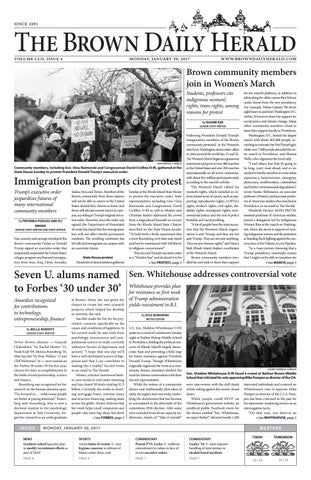
Community members, including Gov. Gina Raimondo and Congressman David Cicilline D-RI, gathered at the State House Sunday to protest President Donald Trump’s executive order.
Immigration ban prompts city protest Trump’s executive order jeopardizes futures of many international community members
By PRIYANKA PODUGU AND ELI BINDER SENIOR STAFF WRITER AND STAFF WRITER
Fear, anxiety and outrage enveloped the Brown community Friday as Donald Trump signed an executive order that temporarily suspended the United States’ refugee program and banned immigration from Iran, Iraq, Libya, Somalia,
Sudan, Syria and Yemen. Members of the Brown community from these nations will not be able to return to the United States should they choose to leave, and those still abroad cannot return to campus, according to Trump’s original executive order. However, since the order was signed, the Department of Homeland Security has stated that the immigration ban will not affect lawful permanent residents. The resulting confusion has left affected immigrants on campus with an uncertain future. State House protest Hundreds of demonstrators gathered
Sunday at the Rhode Island State House to protest the executive order. State representatives including Gov. Gina Raimondo and Congressman David Cicilline D-RI as well as Muslim and Christian leaders addressed the crowd from a stage placed beneath an excerpt from the Rhode Island State Charter inscribed on the State House facade: “To hold forth a lively experiment that a most flourishing civil state may stand and best be maintained with full liberty in religious concernment.” They decried Trump’s executive order as a “Muslim ban” and declared it to be » See PROTEST, page 2
Following President Donald Trump’s inauguration, members of the Brown community protested at the Women’s March on Washington and at sister rallies in cities around the world Jan. 21 and 22. The Women’s March began as a grassroots movement and grew to over 460 marches in the United States and over 200 marches internationally on all seven continents, with about five million participants total, according to the march’s website. The Women’s March rallied for women’s rights, which included an intersectional array of causes, such as supporting reproductive rights, LGBTQ+ rights, worker’s rights, civil rights, disability rights, immigrant rights, environmental justice and the end of police brutality and racial profiling. “A lot of people have the misconception that the Women’s March organization is anti-Trump, and they are not anti-Trump. They are not anti-anything. They are pro-human rights,” said Nancy Rafi, Rhode Island chapter coordinator of the Women’s March. Brown community members travelled far and wide to show their support
for the march’s platform, in addition to advocating for other causes they feel are under threat from the new presidency. For example, Milisa Galazzi ’88 drove eight hours to and from Washington D.C. within 28 hours to show her support for social justice and climate change. Many other community members chose to show their support locally in Providence. Washington D.C. hosted the largest march with about 485,000 people, according to estimates by FiveThirtyEight, while over 7,000 people attended the sister march in Providence, said Shanna Wells, who organized the local rally. “I and others fear that it’s going to be long, scary road ahead, and so we needed to fortify ourselves to resist white supremacy, heterosexism, misogyny, plutocracy, neoliberalism, colonialism and further environmental degradation,” wrote Naoko Shibusawa, an associate professor of history and associate professor of American studies who marched in Providence, in an email to The Herald. Elizabeth Hoover MA’03 PhD’10, assistant professor of American studies, joined a delegation led by Indigenous Women Rise at the march on Washington, where she stood in support of missing indigenous women and the protestors at Standing Rock fighting against the construction of the Dakota Access Pipeline. “As a trans person, knowing that a Trump presidency essentially means that I might not be able to transition for » See MARCH, page 3
Seven U. alums named Sen. Whitehouse addresses controversial vote provides plan to Forbes ‘30 under 30’ Whitehouse for resistance as first week Awardees recognized for contributions to technology, entrepreneurship, finance By BELLA ROBERTS SENIOR STAFF WRITER
Seven Brown alumni — Gaurab Chakrabarti ’10, Rachel Hunter ’12, Noah Kraft ’09, Monica Rosenberg ’10, Matt Sacchet ’10, Evan Wallace ’12 and Cliff Weitzman ’16 — were named on the Forbes 30 under 30 list this year, chosen for their accomplishments in the fields of entrepreneurship, science and finance. Rosenberg was recognized for her research on the human attention span. “I’m focused on … (why) some people are better at paying attention,” Rosenberg said. Rosenberg, who is now a doctoral student in the psychology department at Yale University, began her research as an undergraduate
INSIDE
at Brown, where she was given the chance to create her own research projects, which helped her develop as scientist, she said. Sacchet made the list for his psychiatric research, specifically on the causes and conditions of happiness. In his current work, he uses tools from psychology, neuroscience and computational science to study currently unknown factors of depression and anxiety. “I hope that one day we’ll have a well-developed science of happiness and that I can contribute to making this a reality,” Sacchet wrote in an email to The Herald. Hunter, a former investment banker, now works in real estate investing and has closed 30 deals totaling $2.3 billion. Currently, she works in investing mortgage loans, revenue loans and structure financing, making deals across the globe. Hunter believes that her work helps small companies and people who have big ideas, but don’t » See FORBES, page 3
of Trump administration yields resentment in R.I. By KYLE BOROWSKI METRO EDITOR
U.S. Sen. Sheldon Whitehouse D-RI spoke to a crowd of constituents Sunday night at Nathan Bishop Middle School in Providence, fielding the political concerns of Rhode Island’s largely democratic base and providing a field map for future resistance against President Donald Trump. Though Whitehouse originally organized the event as a community dinner, attendees shirked the meal for intense conversation with their elected representative. While the notion of a community dinner may traditionally elicit ideas of unity, the night’s start was rocky, underlying the divisiveness that has become so normalized in the aftermath of the contentious 2016 election. After some were excluded from the at-capacity auditorium, chants of “Take it outside”
NAOMY PEDROZA / HERALD
Sen. Sheldon Whitehouse D-RI faced a crowd at Nathan Brown Middle School that criticized his vote approving Mike Pompeo as director of the CIA. were interwoven with the dull thuds of fists railing against the room’s closed doors. While people could RSVP on Whitehouse’s government website, an unofficial public Facebook event for the dinner entitled “Sen. Whitehouse, we expect better!” attracted nearly 1,200
interested individuals and centered on Whitehouse’s vote to approve Mike Pompeo as director of the C.I.A. Pompeo has been criticized in the past for his statements condoning torture as an interrogation tactic. “On that vote, you deserve an » See WHITEHOUSE, page 2
WEATHER
MONDAY, JANUARY 30, 2017
NEWS Graduate school launches plan to modify recruitment efforts as part of DIAP
SPORTS Amid claims of sexism, U. cites hygiene concerns in defense of fitness center dress code
COMMENTARY Paxson P’19, Locke: U. reaffirms commitment to values in face of recent executive orders
COMMENTARY Ganley ’16: U. must improve handling of intervention in alcohol-based incidents
PAGE 4
PAGE 4
PAGE 7
PAGE 7
TODAY
TOMORROW
35 / 24
33 / 20
NEWS
PAGE 2 • MONDAY, JANUARY 30, 2017
» PROTEST, from page 1 in stark conflict with the American values of welcoming refugees and religious liberty. After the speeches, protesters marched together to Nathan Bishop Middle School to an open meeting with Sen. Sheldon Whitehouse D-RI. “What Donald Trump did was unconstitutional,” said Laurie Stein, a clinical social worker in Providence. She hopes that forthcoming rulings will “follow what this country is all about in terms of opening our borders to people who are escaping difficult circumstances in their countries,” she said. Alan Gorchov-Negron ’17 said the executive order “is a human rights affront. So we should all band together” to fight it. Uncertain future for students Sara Kadkhodaei MA’12 PhD’16, an Iranian post-doc in the engineering department, said “the situation is really worrisome” for her and her husband. They were accepted to receive green card status and given work authorization almost a year ago. But with less than 90 days before their work authorization expires, they still have not received physical copies of their green cards. She says that immigration lawyers do not know how to advise her. “This week, I really regretted coming to the (United States). I have been here for seven years. If I had been in any other country I would already have a passport. A few of my friends who went abroad — to Canada or Germany — have already become citizens of those countries because they have spent a lot of their lives there.” Kadkhodaie came to the United States in 2010 on a single-entry visa. Her graduate studies were stressful because she was unable to visit her family until former President Barack Obama allowed Iranian students to apply for multiple entry visas, she said. This executive order erases that progress, she added. On Sunday she went to a rally against Trump’s executive order in Boston. “When I see people who are not directly affected by this order supporting us, it really gives us hope. I understand that there is a difference between people and the government,” Kadkhodaie added. Maya — a Syrian student whose name has been changed due to the potential repercussions of the executive order — said that she “thought that being in the US” would give her “the right of moving freely” — a right that was taken away from Syrians during the Civil War. However, for her and her fellow Syrians, the United States is “turning into another big prison,” she said. “It’s injurious and shocking how these countries were mentioned as if they are responsible for the failure of
» WHITEHOUSE, from page 1 explanation,” Whitehouse said. “I concede here I may have been wrong.” Whitehouse explained that he confirmed Pompeo to create a “cordon of maturity” around the Oval Office — a group of intelligent, moral officials to counter Trump on particularly odious decisions. After being prompted by several audience members, Whitehouse went through the list of Trump nominees he expects to deny, including Betsy DeVos as Secretary of Education and Rep. Tom Price R-GA as Secretary of Health and Human Services. But much
politics in the world,” she added. “It’s so depressing when the (United States), one of the most developed countries, solves its problems in such a typical way. It’s the easiest way when you say, ‘Okay, these countries are responsible for our problems, so let us ban’” their citizens. Maya said she values America’s cultural diversity the most, adding that when the U.S. government decides not to value this diversity, she feels unwelcome. Maya intended to travel to another country to visit her family members — who still live in Syria — as she does not feel safe returning to her country of origin. Now she cannot travel outside the United States because doing so would “end my dream of continuing my studies.” While she had planned to stay in the United States to pursue a graduate degree, she is no longer sure if this is possible as her student visa will expire. Roksana Borzouei ’17, an AmericanIranian dual citizen and president of the Iranian Student Association, said the executive order will make “traveling outside of the United States to Iran a shaky situation.” She said that she was not “surprised” by this executive order as it reminds her of H.R. 158, a legislative bill that allows the government to annually suspend certain countries’ citizens from applying for the U.S. Visa Waiver program if their home countries present a “high U.S. security risk.” Sara al-Salem ’17, a former Herald opinions columnist from Saudi Arabia, also expressed concern for the new measure. “I’ve been scared of this from day one,” she said. She also noted that Saudi Arabia might be spared from the ban in the future given its role as an oil supplier, and that “the countries on the list are the ones America cares least about,” she said. Trump also has personal business ties to Saudi Arabia. “The worst thing that could come out of this would be for Muslims to turn against each other,” she added, noting that not all Muslim students on campus were affected by the ban. She hopes this will not fracture student relations between Muslim students from different nations on campus.
THE BROWN DAILY HERALD
Faculty members rally the community As of Sunday, 78 Brown faculty members signed the Academics Against Immigration Executive Order petition. The petition opposes the ban on the grounds that it is discriminatory and “detrimental to the national interests of the United States.” A letter addressed to the Brown community with similar sentiments that urged faculty members to sign the petition had 98 faculty signatures by Sunday. Rebecca Nedostup, an associate professor of history who signed the Academics Against Immigration Executive
Order petition, said that when you recognize “incidents that you know from history — where families are literally separated at the border, or because of a very small shift in a legal definition of who is allowed to cross a border, all of a sudden people are stuck in limbo — you have to take action.” Michael Kennedy, professor of sociology, said that he worries “that this is not just a ban but a provocation by the Trump administration to produce the very threat that justifies further repression.” Richard Fleeter ’76 PhD’81, adjunct associate professor of engineering, said “to go to a Carrier plant in Indiana and say that we’re going to save those jobs and then” ban students and professors from predominately Muslim countries and make others feel unwelcome in the United States “is anti-competitive for the American education system (and) is not logical.” Meenakshi Narain, professor of physics, said “freedom of thought and freedom of intellectual discussion is very relevant and promoted by scientific collaboration … saying that we cannot work freely on these research endeavors really impacts the future of research and the future of society,” Narain said. The measure has already had detrimental effects on her research and that of her colleagues, she added. Narain was planning on having one of her graduate students help her conduct research at the European Organization for Nuclear Research, or CERN, in Geneva. However, because the student is Muslim, he is no longer participating as the University cannot “guarantee his return,” she said. “People came literally across the world to make it,” Narain said. “If my student goes and runs the experiment but is then stuck there and cannot come back, how can he write his thesis? … It is a total witch-hunt and you cannot target students like this. It’s an attack on the fabric of humanity,” she added. As inheritors of an American academic tradition that has benefitted from the contributions of refugees, faculty members are also grappling with how to broach the subject of the immigration ban in classroom conversations. Jeff Brock, professor and chair of the mathematics department, said, “We have to be aware of climate issues and sensitivity toward varying political dispositions. At the same time, I think it’s important not to apologize for the fact that one of the great strengths of our scientific and academic institutions in the United States has been their openness.” In the midst of this uncertain political climate, faculty members have started to make accommodations for students affected by the executive order. With regard to the circumstances of one
to the chagrin of several particularly vocal attendees, he could not commit to obstructing Trump or his nominees at every given opportunity. However, Whitehouse went further than some of his Democratic colleagues in speaking openly about the potential for impeachment proceedings against the president. Pushing the protesters to show up to the polls for the 2018 midterm elections, Whitehouse emphasized the importance of putting more Democrats in the House of Representatives so they can begin impeachment proceedings “if they so wish.” Whitehouse’s mention of impeachment, while only a little over a week into
Trump’s term, echoed the feelings of fear and concern voiced by many who attended the event. “I’m a Muslim. I’m one of those 1.7 billion people he’s so scared of,” a woman from the crowd called out. “This isn’t about terrorism; this is about my daughter.” Providence resident Amy Small told The Herald that Trump’s executive order limiting travel and immigration from seven Muslim-majority countries was especially worrying. “This country is founded on freedom of religion and the First Amendment,” Small said. “This decision goes against our foundation as a nation of immigrants.”
SARA RUNKEL / HERALD
As of Sunday, 78 faculty members signed the Academics Against Immigration Executive Order petition opposing the immigration ban. student who is currently stranded in Turkey, Dean of the School of Public Health Terrie Fox Wetle said her school “organized all of (the student’s) courses so that he can … continue learning and keep up with the academic schedule. We also made an outreach to the Congressional delegation to see if they could be of any assistance in both understanding the situation with his visa and to expedite (his return).” “For students who cannot be here to attend classes, we think we can record the lectures and/or allow them to participate through teleconferencing,” wrote Ugur Centintemel, professor of computer science, in an email to The Herald. The CS department is currently aware of a PhD student who cannot return to the United States as a result of the executive order. “Once we assess the situation and identify the affected students and their status, we will work with the administration to support them as we go through this challenging period,” he wrote. Administrative support In a community email sent by Provost Richard Locke on Saturday, Locke stated that both he and President Christina Paxson P’19 “fully endorsed” the Association of American Universities statement urging the Trump administration to welcome students and scholars from around the world. “This doesn’t just impact our international students ... it impacts the entire community which is why we’re
all alarmed and troubled, but so vigilant about what’s happening right now,” said Shankar Prasad MA’03 PhD’06, associate provost for global engagement and strategic initiatives. “It really has caused us to question the core of the University’s mission which is advancing academic knowledge and research,” he added. The University is responding to the executive order by “triaging the needs of our international community as they come up … and also thinking proactively about how to push back a little,” Prasad said. Administrators are “meeting with students this week from different parts of the world” to discuss how to move forward, he added. Maya said that the University’s resistance to the executive order “really impresses me and makes me feel safer.” She added, “The University, all the community, supports me and is like family to me.” “If any students, staff (members), or faculty (members) need any support they should absolutely reach out to my office. Ensuring that they know they’re a part of a community that is here to support them and that we will do everything we can is really, really important,” Prasad said. Along with the Office of International Student and Scholar Services, Prasad’s office serves as a legal resource for international students in the Brown community. Borzouei said given the circumstances, the university needs to “commit fully to being a sanctuary campus.”
Hilmy Bakri, president of the Islamic School of Rhode Island, echoed Small’s sentiments in his introduction of Whitehouse. The ban foments distrust of the Muslim-American community, Bakri said. “Even though it affects my community directly, we should all be concerned.” Whitehouse responded to questions for nearly two hours, eventually moving the gathering outside so that all attendees could participate. While the event had started more contentiously, many reported by the night’s end that they felt somewhat heartened by Whitehouse’s presence and determined plan for resistance.
“Just listening to him come out and answer questions gave me some peace of mind that this isn’t the end of the world,” said Barrington resident Gary Birkowitz. Part of that assurance likely came from Whitehouse’s mention of the “considerable distaste,” he has seen from many congressional Republicans in response to Trump’s first actions. “I’m seeing a real patriotic concern among Republicans about what he means for our country, not only their party,” Whitehouse said. “If the bad decisions continue it won’t just be an issue on our side. His side will start to erode around him,” he said. “The Ides of March are coming.”
NEWS
MONDAY, JANUARY 30, 2017 • PAGE 3
THE BROWN DAILY HERALD
» FORBES, from page 1 have enough capital to achieve them. “It’s not all big bad evil corporations. It’s actually providing liquidity to a well-functioning capital system to work,” Hunter said. Weitzman, the youngest alum on Forbes’ list, created Speechify, an innovative text to speech software. Unable to keep up with his readings at Brown due to his dyslexia, Weitzman initially created the software to aid himself. Inspired by his love for audio books, Weitzman created Speechify, which turns readings, websites and other text materials into an audio book that then becomes available on the user’s phone or computer. In 2014, Weitzman won the Lime Connect Fellowship, awarded to the 20 highest-achieving people with disabilities in the United States. After winning the fellowship, he made a video tutorial about the software, which received about 40,000 views. “I
» MARCH, from page 1 another 4 to 8 years if I ever wanted to — that’s very difficult for me and kind of terrifying,” said Sam, a student who uses the pronouns they, them and theirs and whose name has been changed because they have not come out to their parents as trans-femme. “I think of Trump as an embodiment of the current world in which we live. I think of Trump as a manifestation of white supremacist, patriarchal capitalism.” “The tipping point for so many women has been this new administration that has come into power,” Rafi said. “I don’t know many women who do not feel threatened.” A majority of signs at the march in Washington D.C. affirmed women’s rights and reproductive rights, wrote Ella Kotner ’19 in an email to The Herald. Protesters also chanted slogans such as “my body, my choice,” she added. Many Brown community members who attended both marches advocated for abortion rights. Professor of History Joan Richards wrote in an email to The Herald, “I stood up for women’s reproductive rights, including rights to abortion. I am (a) very strong supporter of Planned Parenthood.” Despite the march’s attempts to be inclusive and intersectional, this emphasis on reproductive rights alienated some. But “women who believe in the pro-life mission statement still have other issues that fall under the Women’s March movement,” such as reproductive health education, Rafi said. Additionally, the march’s focus on female genitalia excluded trans women, Sam said. “I think the march sent the message that woman equals having a vagina and that all people with vaginas are women,” they said of the Providence march. “I don’t think the vast majority
am obsessed with the idea of creating value. I am amazed by the idea that by arranging your thoughts, you can help the world around you,” he said. While at Brown, Weitzman built 35 different products. “I am very deliberate in my time. I don’t drink, smoke, watch TV,” he said. “This gives me time to focus on what’s most important to me,” Weitzman added. Chakrabarti founded a green chemicals company, Solugen, which developed a method for creating hydrogen peroxide using plants. While studying cancer cells for his doctoral degree, Chakrabarti researched the method in which cancer cells make hydrogen peroxide to clean themselves from bacteria. “It turned out that this peroxide production was extremely productive in the cancer system,” Chakrabarti said. He then applied this method to plants to create a safer way to produce hydrogen peroxide. Many of the alums interviewed
point to Brown as a crucial element of their success after graduation. Brown “taught me how to think about structuring fields and finance more creatively than some of my counterparts,” Hunter said. “It allowed me to define what success is, and it gave me the opportunities to achieve that.” Rosenberg observed the diverse interests of fellow students while at Brown, which allowed each undergraduate to find their own niche. “I remember being totally blown away by the number of people I could find that would be interested in something weird like I was,” Rosenberg said. Sacchet echoed this sentiment and encourages students to take advantage of the University’s resources. “Brown’s a special magical fairyland where you can do whatever you want,” Sacchet wrote. “Do whatever you want, make it your career, find a way to do what you love — and ideally, you might help some people along the way.”
Alums attributed their post-graduate success to the University, noting that Brown gave them the academic freedom to pursue diverse interests.
who attended the march brought in any sort of nuance to their reclamation of the vagina. To be fair, reclaiming the vagina is incredibly important, but there are thoughtful, interesting ways of doing it that the march didn’t do,” they said. Many protesters attended the march on Washington with members of their family as well as close friends and colleagues from Brown. Evelyn Lincoln, professor of history of art and architecture and Italian studies, attended the march with over 10 Brown faculty and community members. Community members said that the march was peaceful and succeeded in fostering a sense of community. “There were so many people that the march couldn’t even proceed as planned because the route was so crowded,” Kotner wrote. “That being said, everyone was incredibly friendly and welcoming.” “Every group was represented, whether it was race, religion, orientation (or) gender identity,” said John Sheehy ’07, of the march in Washington D.C.. “In the end, I just thought it was great that all of these movements were kind of coming together.” The march even transcended some political divides and brought supporters for Democratic presidential candidates Hillary Clinton and Sen. Bernie Sanders (D-VT) together, Shibusawa said in a follow-up interview with The Herald. Despite the march’s title, the attendees were not limited to just women. “It was definitely mostly female but there were a lot of guys,” Sheehy said. “There was one dude who was probably 6 feet 10 inches or something that had a sign that said, ‘I’m a giant feminist,’ and it was just perfect.” The Women’s March plans to take its next steps through its campaign, “10 actions in the first 100 days.” The first action is writing postcards to senators.
Community members are also thinking about ways to build on the momentum of the Women’s March. Shibusawa plans to continue the discussion at Brown this semester through a historical perspective in her seminar AMST 1940V: “Decolonizing Minds: A People’s History of the World.” She also plans on becoming more active in local Rhode Island politics. She regularly calls and writes to her representatives and is exploring ways to work with local leaders to protect the health and welfare of Rhode Islanders. “I am trying to partner students with
local organizations in the community such as Jobs With Justice. Day-to-day conditions of what’s on the ground in Providence is really important,” she said. “Especially if you send younger students out there, (they) will think about getting off the hill and think wider than about just here at Brown.” For many young people, the Women’s March was the first time they participated in a national protest, Shibusawa added. “It’s kind of a big tent. So it’s great if we can get people who got motivated or scared about what’s happening to go out
COURTESY OF JOHN SHEEHY
485,000 protestors attended the largest of the women’s marches in Washington D.C., while 7,000 marched in Providence.
COURTESY OF GAURAB CHAKRABARTI, MONICA ROSENBERG, MATT SACCHET, CLIFF WEITZMAN
and do more.” For Lauren Karpinski ’18, the march on Washington was her first national protest. She plans to stay involved through her board position on the Brown Progressive Action Committee, a local activism group formed in the wake of Trump’s election. Sam plans to continue their trans and social justice activism at Brown and in Providence by working with the LGBTQ Center, as a sexual assault peer educator and acting in a play about trans issues, among other means of advocacy.
NEWS
PAGE 4 • MONDAY, JANUARY 30, 2017
THE BROWN DAILY HERALD
DIAP prompts graduate school admissions to rethink recruitment Departments to double number of students from historically underrepresented groups By AILEEN SEO STAFF WRITER
As part of the University’s Diversity and Inclusion Action Plan, the Graduate School has begun to reshape its recruitment efforts with the hopes of doubling the number of graduate students from historically underrepresented groups by 2022. Marlina Duncan, associate dean of diversity initiatives at the graduate school, and Liza Cariaga-Lo, vice president for academic development, diversity and inclusion, are actively working together “to foster holistic application review processes as a way of removing barriers to recruitment,” Duncan wrote in an email to The Herald. In December, the Graduate School held a workshop on holistic application review for graduate programs in the life and physical sciences, and it will hold a similar workshop for the humanities and social sciences this month, Duncan wrote. Duncan also meets individually with academic departments to form recruitment plans that foster “a deeper understanding and acceptance of
diversity and inclusion.” The University will expand recruitment efforts through its Initiative to Maximize Student Development, an extension of the DIAP and pre-doctoral program designed to provide support for students in underrepresented groups pursuing PhDs in Biology and Health Sciences. Next year, the IMSD’s Preview Day, in which 35 prospective master’s and doctoral students primarily from HUGs in the life and physical sciences were invited to campus to visit academic departments, meet with graduate students and learn about the graduate application process, will expand to include students from other disciplines. At this year’s Super Monday, a program that annually brings admitted doctoral students from HUGs to preview campus, “the Graduate School is partnering with the Faculty of Color Network to host a Super Monday dinner and panel discussion on thriving at graduate school,” Duncan wrote. Students from HUGs may apply to an IMSD program that funds their second and third years of graduate school, wrote Aislinn Rowan, graduate student council president and a third-year PhD student in the graduate program for pathobiology, in an email to The Herald. The School of Public Health has also instituted a plan to recruit a more
diverse applicant pool. The SPH received a record 762 applications to its graduate programs as of January compared to 719 applications in last year’s admission cycle, wrote Karen Scanlan, director of communications at the School of Public Health, in an email to The Herald. In an effort to attract a diverse pool for the School’s doctoral and master’s programs, SPH held several virtual recruitment fairs to reach a broader national and international audience. The school also sent a student and faculty member from the SPH to the Morehouse College Public Health Sciences Institute Graduate Recruitment Fair in June, Scanlan wrote. The SPH also partakes in the IMSD, which connects undergraduate from HUGs at institutions like St. John’s University in New York and North Carolina Agricultural and Technical State University to Brown graduate programs in Biology and Medicine and Health. As another recruitment effort, the SPH actively participates in the institutional partnership between Brown and Tougaloo by offering Tougaloo sophomores an opportunity for early admission to Brown’s Master of Public Health degree program, Scanlan wrote. In the 2015-16 cycle, 19 percent of the SPH applicant pool self-identified as students of color, Scanlan wrote.
LAURA FELENSTEIN / HERALD
Graduate programs in the economics department have aimed to increase the number of women and students of color as part of its departmental DIAP, Professor Oded Galor wrote in an email to The Herald. As of January,the department has received a record number of 780 applications. Of the current applicant pool, 32.1 percent identify as female and 67.9 percent as male. Out of the 26.3 percent that are U.S. citizens, 24.7 percent
self-identify as Asian, 4.8 percent as African American and 0.9 percent as Native American. The department uses its visiting day as its primary recruitment effort. As this is the first year since the departmental DIAP was instituted, both Aislinn and Duncan noted that it will be difficult to speak about how the plan has impacted graduate applicant pools and admissions until the April 15 deadline for decisions.
University defends fitness center dress code amid controversy U. counters claims of sexist dress policy after recent incidents regarding skin exposure By MALCOLM NASH STAFF WRITER
Two Rhode Island School of Design students recently reported that they had been asked to leave the Nelson Fitness Center for not complying with the dress policy because they were exposing their midriffs. The two women claim Brown’s dress policy is sexist and discriminatory toward women, while University officials have defended the rules as maintaining proper hygiene. Last spring, Elizabeth Dimitroff, a RISD student, was told by a Nelson employee to cover up or leave when she worked out in a “sports bra with high-waisted leggings,” Dimitroff said. But Nelson Fitness Center Manager Jason Bishoff defended the rule as necessary for ensuring proper hygiene, noting that the “rules to reduce skin contact with workout equipment have
been in place since the facility opened.” He said the dress code requiring midriffs to be covered is in place exclusively for sanitary purposes and that it applies to both men and women. Chloe Karayiannis, a RISD student, had a similar experience this winter break when an employee approached her about her workout attire, she said. “It doesn’t matter whether or not it applies to men as well because it’s sending the message that what I’m wearing is not respectable and associates what I’m wearing with respect,” she said. There are “so many mixed messages in society,” she said. “Most advertisements show women working out in sports bras,” she added. “That’s the norm in marketing, and then it’s suddenly immodest in the Brown gym?” While the University is not altering the dress policy, “this is a good opportunity to have a conversation about these issues,” said Deputy Director of Athletics Colin Sullivan. The Nelson Fitness Center employee who asked Karayiannis to leave said that her skin exposure could make other gym goers uncomfortable,
COURTESY OF BROWN UNIVERSITY
Rhode Island School of Design students were asked to leave the Nelson Fitness Center due to their exposed midriffs. The University’s policy includes regulation of skin contact with workout equipment for hygienic purposes. Karayiannis said. Dimitroff said that she sees the dress code, which requires individuals to cover their midriff, as targeting women just to make men more comfortable. “It’s kind of odd to place the blame on women and the way that women dress,” Dimitroff said. “It seems to be that this policy blames women for something that men need to change about how they view women’s bodies.” But Bishoff and Sullivan refuted the employee’s argument that Karayiannis’ wardrobe made others uncomfortable as reasoning for the policy. “We need to continue to have conversations with our staff if one of these
individuals felt that the reason for our dress code was about something other than hygiene,” Sullivan said. Both Karayiannis and Dimitroff were surprised this happened on Brown’s campus. “I felt angry, especially that it was the Brown gym,” Dimitroff said. “This seems like such a liberal setting, and usually the school is more progressive on these kinds of things.” Athena Washburn ’18 disagreed with the University’s dress code, saying “sweaty thighs are just as bad as a sweaty torso, and women are more likely to be wearing outfits that expose their midriffs, so it’s an unfair policy.”
Julianna Brown ’18 agreed with Washburn, saying that she did not “understand why midriffs specifically need to be covered.” Some students understood the University’s reasoning. “It makes sense that the University would want students to cover their midriff to reduce the amount of skin contact to equipment,” said Andrew Thomson ’18. “As long as it applies equally to men and women, then it’s a fair policy.” “We don’t want anybody to feel that this is targeted at them,” Bishoff said. “These rules apply to all genders, all ages, all populations. There’s no bias whatsoever.”
TODAY
MONDAY, JANUARY 30, 2017 • PAGE 5
THE BROWN DAILY HERALD
FLIPPING OUT
menu SATELLITE DINING ANDREWS COMMONS
Pizza: Caprese, Chicken Ranch Bahn Mi JOSIAH’S
BLUE ROOM
Barbeque Chicken Burrito Bowl
Soup: Chicken Noodle Build-Your-Own Burrito Bowl
DINING HALLS SHARPE REFECTORY LUNCH
DINNER
Meatball Subs, Vegetables in Agave Ginger Sauce, Rice Krispie Treats with M&M’s
Szechuan Spicy Chicken Stir Fry, Grilled Bok Choy with Sesame Oil and Garlic, Fudge Bars
VERNEY-WOOLLEY LUNCH
DINNER
Potato Skins Bar, Italian Meatball Grinder, Mint Chocolate Chip Cookies
Indian Style Chickpeas, Fried Rice Bowl, Pineapple Upside Down Cake
sudoku
ELI WHITE / HERALD
Both gymnasts and wrestlers competed in the annual Beauty and the Beast meet, which doubles as a fundraiser for breast cancer awareness. Gymnastics fell to Bridgeport; wrestling, to Binghamton.
Q U O T E O F T H E D AY
“Sweaty thighs are just as bad as a sweaty torso, and women are more likely to be wearing outfits that expose crossword
”
their midriffs, so it’s an unfair policy.
— Athena Washburn ’18
See dress code on page 4. comic P-Branes and Bosons | Richard Oliver
calendar TODAY JANUARY
S
M
T
W
Th
F
S
1
2
3
4
5
6
7
8
9
10
11
12
13
14
15
16
17
18
19
20
21
22
23
24
25
26
27
28
29
30
31
Race and Ethnicity Development Workshop 9:00 A.M. Lippitt House
Spring Break in Mississippi Info Session 1:00 P.M. Churchill House
Hack@Brown Data Analytics with Python 5:00 P.M. BERT, 130
Biology and Human Biology Research Panel 7:00 P.M. Petteruti Lounge
TOMORROW Effective Body Language for Presentations 9:00 A.M. Brown Office Building
Managing Your Online Identity, Part 1 11:00 A.M. Rockefeller Library
DEEPS Colloquia Series 4:00 P.M. MacMillan Hall, 115
Dean in the Lobby 4:30 P.M. Barrus and Holley
COMMENTARY PAGE 6 • MONDAY, JANUARY 30, 2017
THE BROWN DAILY HERALD
STAY UP-TO-DATE. FOLLOW US ON FACEBOOK. FACEBOOK.COM/BROWNDAILYHERALD
Find us online! facebook.com/browndailyherald
browndailyherald.com
@the_herald
Location: 195 Angell St., Providence, R.I. www.browndailyherald.com
@browndailyherald
youtube.com/browndailyherald
Editorial Leadership
Sections
Multimedia & Production
Business
Editor-in-Chief Lauren Aratani
Arts & Culture Editors Julie Center Madison Rivlin
Design Editors Christy Leung Ameer Malik Jessica Yu Assistant: Eduard Muñoz-Suñé
General Managers Henry Ritter Ben Wesner
Managing Editors Matt Brownsword Rebecca Ellis Kate Talerico POST- MAGAZINE Editor Monica Chin
News Editors Kyle Borowski Kasturi Pananjady Suvy Qin Elena Renken Alex Skidmore Hattie Xu
BLOGDAILYHERALD Editor Anica Green
Sports Editor Jackson Chaiken Ben Shumate COMMENTARY Opinions Editors Margaret Hu Anuj Krishnamurthy Mili Mitra
Photo Editors Head: Eli White Assistant: Sam Berube Marianna McMurdock Lilly Nguyen Copy Desk Chief Julia Stemmer Multimedia Editor Roland High Illustrations Editor Dorothy Windham Graphics Editor Laura Felenstein Directors of Web Development: Lucy Wei Ivy Wong
Directors Finance: Reena Zhan Sales: Antonia Alvarez Sales: Erin Lueck Strategy: William Nober Strategy: Gianna Jasinski Managers Sales: Elizabeth Doykan Sales: Gabriella Elanbeck Sales: Matilda Lynton Sales: Ariel Shusterman Collections: Ravi Betzig Operations: Gür Ağci
Editorial contact: 401-351-3372 herald@browndailyherald.com
Business contact: 401-351-3260 gm@browndailyherald.com
Submissions: The Brown Daily Herald publishes submissions in the form of op-eds and letters to the editor. Op-eds are typically between 750 and 1000 words, though we will consider submissions between 500 and 1200 words. Letters to the editor should be around 250 words. While letters to the editor respond to an article or column that has appeared in The Herald, op-eds usually prompt new discussions on campus or frame new arguments about current discourse. All submissions to The Herald cannot have been previously published elsewhere (in print or online — including personal blogs and social media), and they must be exclusive to The Herald. Submissions must include no more than two individual authors. If there are more than two original authors, The Herald can acknowledge the authors in a statement at the end of the letter or op-ed, but the byline can only include up to two names. The Herald will not publish submissions authored by groups. The Herald does not publish anonymous submissions. If you feel your circumstances prevent you from submitting an op-ed or letter with your name, please email herald@browndailyherald.com to explain your situation. You can submit op-eds to opinions@browndailyherald.com and letters to letters@browndailyherald.com. When you email your submission, please include (1) your full name, (2) an evening or mobile phone number in case your submission is chosen for publication and (3) any affiliation with Brown University or any institution or organization relevant to the content of your submission. Please send in submissions at least 24 hours in advance of your desired publication date. The Herald only publishes submissions while it is in print. The Herald reserves the right to edit all submissions. If your piece is considered for publication, an editor will contact you to discuss potential changes to your submission. Commentary: The editorial is the majority opinion of the editorial page board of The Brown Daily Herald. The editorial viewpoint does not necessarily reflect the views of The Brown Daily Herald, Inc. Columns, letters and comics reflect the opinions of their authors only. Corrections: The Brown Daily Herald is committed to providing the Brown University community with the most accurate information possible. Corrections may be submitted up to seven calendar days after publication. Advertising: The Brown Daily Herald, Inc. reserves the right to accept or decline any advertisement at its discretion. The Brown Daily Herald, Inc. is a financially independent, nonprofit media organization bringing you The Brown Daily Herald, BlogDailyHerald and Post- Magazine. The Brown Daily Herald has served the Brown University community daily since 1891. It is published Monday through Friday during the academic year, excluding vacations, once during Commencement and once during Orientation by The Brown Daily Herald, Inc. Single copy free for each member of the community. Subscription prices: $200 one year daily, $100 one semester daily. Copyright 2017 by The Brown Daily Herald, Inc. All rights reserved. Periodicals postage paid at Providence, R.I. Postmaster: Please send corrections to P.O. Box 2538, Providence, RI 02906.
COMMENTARY MONDAY, JANUARY 30, 2017 • PAGE 7
THE BROWN DAILY HERALD
Commitment to our community in a time of uncertainty CHRISTINA PAXSON AND RICHARD LOCKE op-ed contributors During this moment of great political uncertainty in our country, including the recent signing of various executive orders and possible policy changes ahead affecting education and research, we must be vigilant and deliberate in upholding our core values as a university. Last Tuesday, in conjunction with our Reaffirming University Values series, we gathered approximately 100 concerned Brown faculty members to discuss Brown’s core values and how they will inform our work as a community moving forward. We stressed our unwavering commitment to fully support members of our community and to protect their unfettered capacity to engage in teaching, research and the free and open exchange of ideas. We feel it is an important moment to articulate the values and principles that will guide Brown as we advocate to preserve and sustain the core of what we do and navigate the uncertainty ahead. These include the following:
— Our firm commitment to the advancement of knowledge, factbased scientific inquiry and scholarship across the full breadth of disciplines represented at Brown. The principles of fact- and reason-based inquiry are key to how we understand, analyze and address the most difficult challenges we face as a society. — Our uncompromising conviction that for our University community to excel in creating knowledge
— Our unconditional rejection of every form of bigotry, discrimination, xenophobia and harassment. Last week’s faculty discussion centered on areas of grave concern — from the immediate and operational to the philosophical and existential. Among the issues raised were challenges to research, especially focused on environmental change and reproductive health; immigration and the targeting of students and scholars from predominantly Muslim coun-
sity to monitor relevant legislation and policies at all levels of government; join with our peer institutions to advocate for issues of importance to our mission; and support our faculty, students and staff under any range of scenarios, such as threats to academic freedom and incidents of bias, discrimination or harassment. A test to our values came faster than we had expected. Only a few days after our meeting, a new executive order has compromised the visa
During this time of uncertainty, it is essential that we reinforce our mission and our values, and continue to do what we do best — promote learning, truth and justice. and preparing leaders, we must maintain a community in which ideas can be freely developed, expressed and contested in a rational and respectful manner. — Our insistence that individual students and scholars are free to pursue their scholarship and learning without fear of intimidation or discrimination based on their identities, backgrounds, areas or methods of scholarship and social or political views.
tries; and a broad range of concerns related to civil rights, harassment and hate crimes. When we met with faculty to discuss these issues at that early point in the new Congress and presidential administration, we could only speculate on what the future might bring. Therefore, in addition to stressing our strong commitment to support members of our community, we also shared information on the range of resources in place across the Univer-
status of Brown community members from a group of predominantly Muslim countries. A team of Brown administrators is gathering information and providing much-needed guidance and assistance to affected members of our community. Just as we continue to support our undocumented students and students with Deferred Action for Childhood Arrivals status, we will do everything in our power to ensure that these valued members of our community can
continue their research, teaching and learning at Brown. Brown stands in support of the letter issued Saturday by the Association of American Universities, of which Brown is a member. That letter urged the current administration “as soon as possible, to make clear to the world that the United States continues to welcome the most talented individuals from all countries to study, teach, and carry out research and scholarship at our universities.” During this time of uncertainty, it is essential that we reinforce our mission and our values, and continue to do what we do best — promote learning, truth and justice. Every member of our community has a role to play. We look forward to working together to uphold and reaffirm our values.
Christina Paxson P’19 is the president of Brown University and Richard Locke is Brown’s provost. They can be reached at president@brown.edu and provost@brown.edu, respectively. Please send responses to this opinion to letters@browndailyherald.com and other op-eds to opinions@browndailyherald.com.
U.’s response to alcohol abuse puts students’ lives in danger KARLA GANLEY
op-ed contributor On a Saturday night last year, I laid on the floor of my apartment bathroom deciding whether or not to call Brown Emergency Medical Services. I was intoxicated for only the second time in my life. I couldn’t stop vomiting alcohol as I started slipping in and out of consciousness. I desperately needed emergency care, but something was stopping me: the fear of punishment. For those who don’t know, be warned. At Brown University, if you use Brown EMS for alcohol abuse, the administration will find out and you will face University intervention. Yes, even if you are of legal drinking age. The underlying issue with this policy is that it inadvertently causes students to forgo medical care in potentially lifethreatening situations. My experience with alcohol is, unfortunately, not unique among college students. According to the National Institutes of Health, in any given month approximately 59.8 percent of U.S. college students between the ages of 18 and 22 use alcohol, and 37.9 percent of students engage in heavy drinking (defined by the NIH as having five or more drinks on a single occasion). The NIH also cites a study conducted between 2000 and 2008 that found a 25 percent increase in hospitalizations resulting from alcohol overdose among 18 to 24 year olds over this eight-year period. In 2008, there were 59,000 18 to 24 year olds hospitalized for alcohol-related overdoses in the United States, and in any given year approximately 1,800 college students die of alcohol overdose. There’s no denying the simple fact: The vast majority of college students drink. Brown students are no exception. A Cornell study in 2000 reported that 19 percent of students had thought about calling for help because they were concerned about someone who was severely intoxicated, but only 4 percent actually made the call. After Cornell instituted its Medical Amnesty Protocol — under
which students are not punished for using EMS in cases of alcohol abuse — there was a 61 percent decrease in students citing the fear of “getting in trouble” as a barrier to using EMS for alcohol abuse, the study showed. Though Brown claims to have a medical amnesty policy, the University still takes action. If you use Brown EMS for alcohol abuse, you can expect to receive a letter from the dean of student life and the Office of Student Conduct. This letter forces you to attend a meeting with University personnel about your alcohol abuse. According to the letter I received on April 25, 2016, following my EMS call,“if you do not complete this requirement by said date, you will be charged with the following offense: Offense V,” which is the failure
The first issue with this procedure is one of respect for students’ rights. Under the Health Insurance Portability and Accountability Act, patients have a right to confidentiality of health information. HIPAA stemmed from the realization that the sharing of medical information beyond necessary medical personnel has negative impacts on other aspects of patients’ lives. HIPAA was meant to ensure that patients could seek confidential medical care without fear that their employer or university would find out and fire, expel or make special demands of them in the workplace. The Brown administration claims that the method by which they find out about incidents of alcohol abuse, their subsequent requirement of special meetings with University personnel and
By forcing students to attend mandatory meetings to discuss their alcohol abuse (which is a personal medical issue), and by threatening students with academic hearings and suspension, Brown is creating fear of punishment as a barrier to EMS use. to comply with proper directives of a University official. If charged with the offense, you will have to attend an academic hearing where punishment can include suspension and even expulsion from the university. All of this can happen even if you are over 21. In fact, Brown’s Code of Student Conduct explicitly includes “unauthorized use of alcohol” as a student conduct violation and leaves it up to the “determination of a dean” whether a student “misused alcohol.” The code goes one step further to state that an offending student “will be required to undergo appropriate alcohol education, evaluation, and/or treatment as determined by appropriate officials.” Not only are “unauthorized use of alcohol” and “alcohol misuse” incredibly vague, but apparently the administration also has the discretion to determine who has misused alcohol and what “appropriate treatment” constitutes.
the possibility of an academic hearing are all legal under HIPAA because it is the campus police — not medical personnel bound by HIPAA — who inform deans about student alcohol abuse, thereby skirting the act. Even if Brown’s actions are technically legal, they undermine the entire intent of HIPAA. The bottom line is that students have a right to seek medical care without fear that any information will be shared with the University and used to force them to attend special meetings or face the potential of an academic hearing. But the larger issue is that the administration’s response to EMS use for alcohol abuse puts student lives in danger. By forcing students to attend mandatory meetings to discuss their alcohol abuse (which is a personal medical issue), and by threatening students with academic hearings and suspension, Brown is creating fear of punishment as a barrier to EMS use. During personal meetings I had with the Di-
rector of Brown Health Services Dr. Unab Khan, she pointed out that another reason for the University’s harsh response is that students who use EMS for alcohol abuse may disrupt and burden the community. But this reasoning seems misplaced and illogical. By this standard, any Brown student with a medical issue that disrupts or burdens the community should be forced to attend mandatory meetings with the administration and face the possibility of suspension or expulsion — an obviously flawed and unfair premise. Brown’s current medical amnesty policy is unfortunately not an outlier among Ivy League institutions. All Ivy League schools seem to have some sort of medical amnesty policy for alcohol and other drugs, but none clarify exactly what or how much student medical information is shared with administrators or what academic sanctions the student may incur. All of these supposedly progressive institutions, including Brown, are missing the point: Their current medical amnesty policies still don’t put student health and safety above all else. The simple solution is to keep student medical information about alcohol abuse and EMS use within Brown Health Services and to prohibit campus police from sharing it with the general administration unless the student requests otherwise. Medically trained staff at Health Services should be responsible for contacting students who abuse alcohol about counseling and other alcohol support services. In the case that alcohol abuse continues to inhibit a student’s academic success, medical staff should handle the process and planning of a medical leave for students so they can focus on the rehabilitation care they need before finishing their studies at Brown. A student should never be suspended or expelled by the general administration for a medical issue, including alcohol abuse.
Karla Ganley ’16 is a Master’s of Public Health candidate at Columbia. She can be reached at karla_ganley@alumni.brown.edu.
SPORTS THE BROWN DAILY HERALD
MONDAY, JANUARY 30, 2017
M. HOCKEY
Bears edged by Yale in home-and-home series Bruno entered both final periods tied, specialty teams play led to consecutive losses By ALEXANDRA RUSSELL SENIOR STAFF WRITER
The men’s hockey team fell to Yale Friday and Saturday in a home-and-home series by tallies of 4-3 and 4-1, respectively. Bruno entered the final periods of each matchup tied, but was unable to grasp the lead in either contest. Friday night saw the Bears (4-16-1, 3-11-0 ECAC) slighted by the Bulldogs (10-7-4, 6-5-3) in a close matchup on home ice. After Brown took a twogoal lead in the second period, Yale responded with three consecutive goals — including two on the power play — to snatch the victory. Bruno
recorded a total of 20 penalty minutes in the contest. “I think special teams ended up being the turning point,” said Sam Lafferty ’18, who picked up three points in the matchup, posting two goals and an assist. “We have to find a way to kill, and our penalty kill struggles,” said Head Coach Brendan Whittet ’94. “Every time we’ve been in games where we’re short for basically a full period of hockey … we’re not going to have success.” Max Willman ’18 opened scoringwith a power-play goal at 11:38 of the first frame to give the Bears an early lead. Lafferty sent two goals past Yale goaltender Patrick Spano in the second stanza, one of which was shorthanded. “It was a hard fought game and I think it could’ve gone either way,” Lafferty said. “If we can just stay out of the box and be a little more disciplined,
then … we’ll be good.” “We’re right there, but the objective is to win,” Whittet said. “We have to find a way to win hockey games, and the only way we’re going to do that is by being consistent, by winning battles consistently, by winning shifts consistently and by winning periods.” The following day, the Bears were unable to snap a 1-1 tie in a scoreless second period and conceded three unanswered goals in the final stanza, including one on an empty net. Charlie Corcoran ’18 posted a shorthanded goal late in the first frame to give Bruno an early advantage, but this was quickly matched by the Bulldogs’ Ted Hart, who scored on the power play less than one minute later to even the count. Gavin Nieto ’20 started in net for Brown in both contests, making 28 saves on home ice Friday and 22 Saturday.
ELI WHITE / HERALD
During Friday’s game, Max Willman ’18 netted the opening goal to give the Bears an early lead at 11:38 in the first period. The Bears will continue confer- to be perfect; they all want to get to their ence play next weekend with a pair spots, when in actuality they should of contests against No.17 Quinnipiac simplify things.” University and Princeton at Meehan “When we play hard, 5-on-5, we’re Auditorium. Looking forward, Whittet a tough team to play against,” Lafferty emphasized the importance of both said. “We just need to keep working avoiding penalties and cleaning up the on our special teams and keep getting power play. better,” “Our specialty teams entail our The Bears will host Quinnipiac Fripower play too,” he said. “The guys try day at 7 p.m.
W. BASKETBALL
Offense flops, Bruno bested in trip to New Haven Loss leaves women’s basketball tied for third place in Ivy League with Cornell By CAL BARASH-DAVID SENIOR STAFF WRITER
Just one week after besting Yale in a hotly contested 76-73 victory, the women’s basketball team traveled to New Haven for a rematch against the Bulldogs (107, 1-3 Ivy). Yale tallied the same amount of points as they did a week earlier at the Pizzitola Center. But Bruno (11-6, 2-2) did not, as it fell 73-51. Brown never led in the matchup. After falling behind 21-8 in the first
stanza, the team never found its rhythm. “We never really got in a groove,” said captain Megan Reilly ’18. “They played in a zone, which we haven’t seen much this season, so we had more turnovers than usual.” “We didn’t play our game. We didn’t look like Brown out there,” she added. Erika Steeves ’19 was once again solid in the loss. She notched 15 points and nine rebounds — just one rebound short of her sixth double-double of the season. Bruno shot an inefficient 25.4 percent (18-71) from the field, and the usual performers did not produce as they previously have in the regular season. Justine Gaziano ’20 scored 11 points and dished out four assists; Taylor Will ’19 added nine points, four assists and seven rebounds; Shayna Mehta ’19
dropped seven points and grabbed six rebounds and Reilly scored six points on two three-pointers and came down with seven rebounds. According to Reilly, after the defeat Head Coach Sarah Behn told the team “it’s time to dig in and work twice as hard this week in practice.” Reilly added that this is just a bump in the road for the team. “It’s definitely something we can get out of,” she said. “It’s not like we’re in a rut or anything.” Reilly said that the team needs to focus on limiting turnovers and maintaining their composure on offense. With six of their next eight games at home, the Bears hope to bounce back next weekend when they host Cornell and Columbia.
COURTESY OF BROWN ATHLETICS
Erika Steeves ’19 led the Bears in scoring with 15 points and grabbed nine rebounds, while Taylor Will ’19 contributed nine points and four assists.
M. BASKETBALL
Despite strong start, late defensive switch stymies Bears Speith’s double-double not enough to overcome Dallier, Bulldogs in 85-75 loss in New Haven By NICK WEY SENIOR STAFF WRITER
After a nail-biting 75-74 defeat to Yale last week, the men’s basketball team headed into itsfourth Ivy League matchup of the season Friday — a rematch against the Bulldogs (11-6, 3-1 Ivy). The Bears (10-10, 1-3) came into the game
looking to avenge their previous loss and build momentum before a tough two-game road trip. But despite holding a ten-point lead midway through the second half, Bruno let the game slip away down the stretch and fell 85-75. “We were pretty hyped,” said starting forward Travis Fuller ’19. “We lost the week before, and so we really
COURTESY OF BROWN ATHLETICS
After Yale switched to a 1-3-1 zone, the Bulldogs scored 13 unanswered points. The Bears were unable to halt Yale’s comeback.
wanted this one. We were mentally prepared, and we had a good week of practice leading up to it, so we were definitely ready.” Bruno started the game off strong. In the first five minutes, starting forward and co-captain Steven Spieth ’17 sunk a pair of threes, grabbed two rebounds and dished an assist to firstyear starter Brandon Anderson ’20 to help the Bears take an early 12-7 lead. But the Bulldogs fought back. In just two minutes, an offensive surge — fueled by seven points from Anthony Dallier — capped a 12-2 run for Yale that resulted in a 19-14 Bulldogs lead with 11:34 to go in the first half. Bruno committed three turnovers during the run. “Early on we were solid,” said point guard co-captain Tavon Blackmon ’17. “We were going back-and-forth and a lot of their points were off making very small, minor mistakes. But I think our offense was flowing. It was really intense from the tip.” After a 30-second timeout called by Head Coach Mike Martin ’04, the Bears regrouped. Bruno mounted a comeback to tie the game at 29 after a three by co-captain JR Hobbie ’17 and then tooka 37-35 lead with just 1:37 remaining in the half after a layup by Obi Okolie ’19. By the halftime whistle,
the Bears led 40-39. “In our heads we were thinking back to the week before,” Fuller said. “Last week, we were up twelve at halftime, and they came back right away so this time we wanted to just finish things out.” Brown continued its momentum to start the second half. In the first seven minutes, Bruno built a ten-point lead on the Bulldogs, highlighted by a threepointer from Blackmon, who scored 13 of his 16 points in the second half to put the Bears up 58-48. But despite Brown’s best efforts, Yale clawed itself back into the game. “We played well. We just missed some shots that we usually will make,” Fuller said. “We keep having little spurts of getting cold and letting teams go on runs. If we get rid of those, we will be fine.” The Bulldogs made a critical adjustment — switching to a 1-3-1 zone — and scored 13 unanswered points over the next four minutes to take a 64-60 lead. Dallier led both teams with 30 points, ten coming in the final five minutes, sealing the Bulldogs’ 85-75 victory. Spieth posted a double-double with 22 points and 10 rebounds, passing Mike Waitkus ’86 for 17th on Brown’s
all-time scoring list. Okolie added a season-high 18 points. But as for team statistics, Yale outscored Brown 30-7 in free throws and shot 55 percent from the field to 42. “To be honest, after watching the film yesterday as a team, we just missed shots,” Blackmon said. “A lot of shots that we normally make were just coming out, and the momentum shifted drastically.” Brown will continue its season on the road this weekend with a conference double-header, visiting Cornell Friday and Columbia Saturday. The games will be pivotal for the team in order to stay in the running for a place in the inaugural four-team Ivy League Tournament. “Both are really good teams,” Fuller said. “Cornell beat Columbia at Columbia, and Columbia beat Cornell at Cornell. But I think we’re just as good.” Brown currently sits sixth in the league with 10 games left in the season, ample time to regain its footing in the conference standings. “As long as we keep working hard and playing hard — everyone just staying in the gym and putting in some work on their individual games — everything will fall into place,” Blackmon said.