SINCE 1891
THE BROWN DAILY HERALD MONDAY, FEBRUARY 6, 2017
VOLUME CLII, ISSUE 9
WWW.BROWNDAILYHERALD.COM
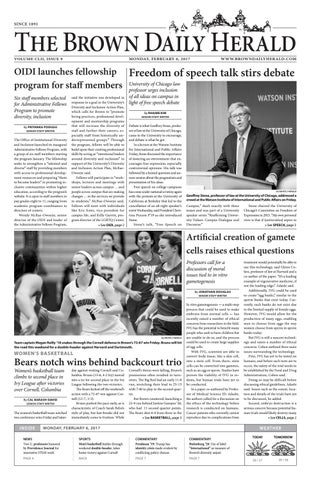
OIDI launches fellowship Freedom of speech talk stirs debate of Chicago law program for staff members University professor urges inclusion Six staff members selected for Administrative Fellows Program to promote diversity, inclusion By PRIYANKA PODUGU SENIOR STAFF WRITER
The Office of Institutional Diversity and Inclusion launched its inaugural Administrative Fellows Program, with a group of six staff members starting the program January. The fellowship seeks to strengthen a “talented and diverse” staff by providing members with access to professional development resources and preparing “them to become leaders” in promoting inclusive communities within higher education, according to the program’s website. It is open to staff members in pay grades eight to 11, ranging from academic program coordinators to directors of centers. Wendy McRae-Owoeye, senior director of the OIDI and leader of the Administrative Fellows Program,
said the initiative was developed in response to a goal in the University’s Diversity and Inclusion Action Plan, which calls for Brown to “promote hiring practices, professional development and mentorship programs that will increase the diversity of staff and further their careers, especially staff from historically underrepresented groups.” Through the program, fellows will be able to build upon their existing professional skills by acting as “intentional leaders around diversity and inclusion” in support of the University’s Diversity and Inclusion Action Plan, McRaeOwoeye said. Fellows will participate in “workshops, lectures and meetings with senior leaders across campus … and people across campus that are making changes … to the services we provide to students,” McRae-Owoeye said. Fellows will meet with individuals like Eric Estes, vice president for campus life, and Kelly Garrett, program director of the LGBTQ Center, » See OIDI, page 2
of all ideas on campus in light of free speech debate By RHAIME KIM SENIOR STAFF WRITER
Debate is what Geoffrey Stone, professor of law at the University of Chicago, came to the University to encourage, and debate is what he got. In a lecture at the Watson Institute for International and Public Affairs Friday, Stone discussed the importance of fostering an environment that encourages free expression, especially controversial opinions. His talk was followed by a heated question and answer session about the pragmatism and presentation of his ideas. Free speech on college campuses has come under national scrutiny again with the protests at the University of California at Berkeley that led to the cancellation of an alt-right speaker’s event Wednesday, said President Christina Paxson P’19 as she introduced Stone. Stone’s talk, “Free Speech on
ELI WHITE / HERALD
Geoffrey Stone, professor of law at the University of Chicago, addressed a crowd at the Watson Institute of International and Public Affairs on Friday. Campus,” dealt exactly with these issues and was part of a University speaker series “Reaffirming University Values: Campus Dialogue and Discourse.”
Stone chaired the University of Chicago’s Committee on Freedom of Expression in 2015. “My own personal view is that if (universities) aspire to » See SPEECH, page 3
Artificial creation of gamete cells raises ethical questions Professors call for a discussion of moral issues tied to in vitro gametogenesis By JONATHAN DOUGLAS SENIOR STAFF WRITER
ELI WHITE / HERALD
Team captain Megan Reilly ’18 snakes through the Cornell defense in Brown’s 72-67 win Friday. Bruno will hit the road this weekend for a double-header against Harvard and Dartmouth.
WOMEN’S BASKETBALL
Bears notch wins behind backcourt trio Women’s basketball team climbs to second place in Ivy League after victories over Cornell, Columbia By CAL BARASH-DAVID SENIOR STAFF WRITER
The women’s basketball team notched two conference wins Friday and Satur-
INSIDE
day against visiting Cornell and Columbia. Bruno (13-6, 4-2 Ivy) moved into a tie for second place in the Ivy League following the two victories. The Bears kicked off the weekend’s action with a 72-67 win against Cornell (12-7, 3-3). Bruno pushed the pace early, as is characteristic of Coach Sarah Behn’s style of play, but fast-breaks did not immediately come to fruition. While
Cornell’s threes were falling, Bruno’s possessions often resulted in turnovers. The Big Red had an early 11-0 run, stretching their lead to 25-13 with 7:40 to play in the second quarter. But Brown countered, launching a 22-9 run behind Justine Gaziano ’20, who had 11 second quarter points. The Bears shot 6-8 from three in the » See BASKETBALL, page 3
In vitro gametogenesis — a multi-step process that could be used to make embryos from normal cells — has recently raised a number of ethical concerns from researchers in the field. IVG has the potential to benefit many people who seek to have children but are unable to do so, and the process could be used to create large supplies of egg cells. With IVG, scientists are able to convert body tissue, like a skin cell, into a stem cell. From there, stem cells can be converted into gametes, such as an egg or sperm. Studies have proven the viability of IVG in rodents, but human trials have yet to be conducted. In a paper co-authored by Professor of Medical Science Eli Adashi, the authors called for a discussion on the ethics of the technology before research is conducted on humans. Cancer patients who currently cannot reproduce due to complications from
treatment would potentially be able to use this technology, said Glenn Cohen, professor of law at Harvard and a co-author of the paper. “It’s a leading example of regenerative medicine, if not the leading edge,” Adashi said. Additionally, IVG could be used to create “egg banks,” similar to the sperm banks that exist today. Currently, such banks do not exist due to the limited supply of female eggs. However, IVG would allow for the production of many eggs, enabling men to choose from eggs the way women choose from sperm in sperm banks today. But IVG is still a nascent technology and raises a number of ethical concerns. Cohen outlined three main issues surrounding the technology. First, IVG has yet to be tested on humans, and before such tests are to occur, the safety of the trial needs to be established by the Food and Drug Administration, Cohen said. Doing so may be difficult before discussing ethical guidelines, Adashi said. Issues such as the extent, location and details of the trials have yet to be discussed, he added. Second, embryo destruction is a serious concern because potential human trials would likely destroy many » See CELLS, page 2
WEATHER
MONDAY, FEBRUARY 6, 2017
NEWS Two U. professors honored by Providence Journal for innovative STEM work
SPORTS Men’s basketball battles through weekend double-header, takes home victory against Cornell
COMMENTARY Freidman ’19: Trump has identity crisis made evident by conflicting policy choices
COMMENTARY Bielenberg ’20: Use of label “International” as measure of Brown’s diversity unjust
PAGE 4
BACK
PAGE 7
PAGE 7
TODAY
TOMORROW
36 / 27
39 / 36
NEWS
PAGE 2 • MONDAY, FEBRUARY 6, 2017
» CELLS, from page 1 embryos, Cohen said. Many groups oppose the idea of embryo destruction, and it is also against federal law to use “federal funding for research wherein embryos created for research purposes are destroyed,” he added. Third, IVG raises the possibility of human enhancement. Scientists currently use the CRISPR-Cas9 enzyme to directly edit DNA, but they cannot directly promote certain traits yet, Adashi said. Traits are often the BREAKING DOWN
IN VITRO GAMETOGENESIS What is in vitro gametogenesis? IVG is a scientific process that might be able to create an embryo from normal cells by inducing them to become stem cells, which can then become reproductive gametes like sperm and eggs. Can it be used for humans? So far IVG has only been tested on mice, but scientists predict that human trials aren’t far. What might it be used for? Those who are infertile — for example, some cancer patients — would be able to have a baby biologically related to them. There might also be a way to create “egg banks” — the equivalent of currently existing sperm banks. It may also help women who want to delay having children conceive more easily when they do become pregnant. What are scientists concerned about? Because of the amount of gametes that this process can be cheaply produced, some worry about the rise in popularity of “designer babies,” in which parents choose the traits and genes they seek in their baby. Additionally, it’s unclear whether the technique is safe for human use.
» OIDI, from page 1 according to the fellowship’s schedule. From June through August, fellows will also have the opportunity to pursue research, McRae-Owoeye said. The program also works to encourage dialogue between staff members participating in the fellowship and their supervisors in their day-today work, McRae-Owoeye said. “The expectations of the supervisor is to take the time to be supportive and open and to learn from their fellow,”
THE BROWN DAILY HERALD
expression of multiple genes, and not all of those genes are known, he added. B u t I VG “m a k e s t h e substrate of life more available,” making it easier for scientists to create “designer babies” that have a certain set of traits in the future, Adashi said. This could create inequities between those who have access to the technology and those that do not. Though the question of designer babies is a concern, current technology limits the ability to create or enhance embryos, he added. “Even if we chose to do it, we couldn’t.” In order to address the various ethical concerns surrounding IVG, the authors of the paper called for ethical guidelines to be discussed before human trials occur. “It doesn’t make sense to sit idly by and then begin a conversation. That does not strike us as thoughtful,” Adashi said. It is unclear who would be included in the ethical conversation, Adashi said. He would like to see regulatory officials, ethicists, geneticists, biologists, the National Institute of Health and, most importantly, the public, included in the discussion, he added. “The public needs to be informed at some point and acceptance should be gauged. It is not something that should imposed … by scientists.”
Hank Greely, professor of genetics at Stanford University and author of “The End of Sex and the Future of Human Reproduction,” highlighted the importance of the FDA in the process. In an email to The Herald, he wrote that “IVG research in living humans — clinical trials of the technology to see if it can successfully be used to make babies — could be done appropriately under current guidance if the FDA does a firm job of insisting on adequate proof before allowing clinical trials.” Though guidelines surrounding IVG will likely be put in place in the United States and other countries
d e ve l oping the technology, there is no guarantee that such guidelines will be universal, Adashi said. “Cultures differ between nations. The outlook on such issues is highly variable between countries,” he added. Katsuhiko Hayashi, professor of stem cell biology at Kyushu University in Japan, felt similarly, pointing out in an email to The Herald that “people would go abroad to get the treatment … if the guidelines are not the same” in their home countries. IVG has the potential to revolutionize fertility treatment, especially
she said. “Often we have diversity and inclusion conversations but we tend to only have them with people that we know.” The Administrative Fellows Program selected six fellows for this cycle: Laura Dobler, Tiffiney George, Khamden Soch, Melissa Nicholaus, Ramon Stern and Ana Wildman. Ana Wildman, assistant director at the Population Studies and Training Center and current fellow said, “What’s really amazing about this program is that it is the first time
since I have been at Brown that I have seen a program geared towards staff that involves development, mentoring and aligned resources … it is an opportunity to retain talent at Brown.” Wildman also said she hopes the program can give her more insight on opportunities to build bridges between the greater Providence community and campus. “I have a great number of immigrant friends who work in the periphery of the campus whose children will be attending college one day and
Brown still feels really … unattainable,” Wildman said. “How do we welcome them into the campus, and how do we extend an arm out into the community so that Brown is not just this ivory tower?” Khamden Soch, a grant and academic program coordinator and a fellow, said the program is an “instrumental” opportunity for staff members that are “under the radar” but excel in their work with their respective departments. “Building these connections and networks is
DOROTHY WINDHAM / HERALD
when combined with technology like CRISPR-Cas9. Cohen compared the technology to painting: “It’s like the difference between Michelangelo painting the Sistine Chapel and someone trying to create a similar piece of art on their computer with Photoshop,” he said. The modern day Michelangelo can generate many copies of the art — try 1000 variations — and then see which one he thinks looks best. That’s the future possibility raised by the combination of IVF plus CRISPR.”
invaluable,” he added. McRae-Owoeye said the fellowship is slated to become an annual program with current fellows expected to become mentors in the next cycle. She is confident in the program’s ability to have a lasting effect on campus conversation around diversity and inclusion. “As long as the University continues to intentionally dedicate resources, not only financial but also people resources — that’s when we will see change,” she said.
NEWS
MONDAY, FEBRUARY 6, 2017 • PAGE 3
THE BROWN DAILY HERALD
» SPEECH, from page 1 be serious academic institutions, they have to have a profound commitment to debate, discussion and disagreement because that’s how we create knowledge,” Stone told The Herald. “If institutions cut off that debate (and) disagreement, they are, in my view, undermining the central purpose of their being,” he said. Increasingly, faculty members and students are less comfortable taking controversial positions, Stone told The Herald. One reason is that some students have been raised by “helicopter parents” who have “shielded or protected” them from “discomfort, risk and failure in ways that their predecessors have not,” Stone said. Additionally, those who share controversial views on social media may risk offending potential employers. “I think it’s an unhealthy thing that social media has produced that environment, but it’s a healthy thing that students” and marginalized groups
» BASKETBALL, from page 1 second stanza to make it a one-point game at the half. The Bears were “penetrating but then kicking it out and making an extra pass,” said Behn. “That was great basketball.” The third quarter saw the lead change hands between the two opponents but a 10-point surge from Taylor Will ’19 gave the Bears the 58-52 lead at the end of the frame. The final stanza was a close affair. Cornell continued to threaten Brown and brought the game within two points several times. Despite the pressure, Brown held on for the 7267 win. Gaziano had 27 points in the win and was 5-5 from three. She is second
such as racial and religious “minorities, women (and) gays” have become more vocal about their experiences and intolerance for certain views,” Stone told The Herald. Contrary to the position espoused by the University of Chicago’s Dean of Students John Ellison’s letter to incoming freshman of the class of 2020, Stone said trigger warnings and safe spaces are not violations of free speech in his view. “The letter written by the dean of students in the college did not reflect the reality or the policies of the University of Chicago. I regard that aspect of that letter as unfortunate,” Stone told The Herald. The decision to use trigger warnings should be left to professors rather than dictated at an institutional level, Stone told The Herald, emphasizing that faculty members should feel free to use trigger warnings if they think that it would improve the quality of education that students receive. The University of Chicago “is filled with safe spaces,” Stone said.“There
are endless organizations that are designed to bring together students (with) particular experiences, interests (and) background(s).” But while student groups can serve as safe spaces, universities as a whole must be open to even the “most loathsome, odious, offensive, disloyal arguments,” Stone said in a speech at the American Law Institute’s meeting in May 2016. Universities must ultimately uphold free speech even in the case of hate speech, he said. “I don’t believe that the idea of hate speech is one that universities should get involved in addressing — any more than it should get involved in communist speech or pro-abortion speech,” Stone told The Herald. “Hate speech is simply speech that says bad things about certain people, and my view is that … the right response to it is to address it and explain why one thinks it’s hateful and wrong” instead of seeking institutional censorship, he added. In addition, universities should not take political positions to protect
freedom of speech on campuses. But exceptions can be made if political actions have “a direct and real effect upon the operation of universities,” such as President Donald Trump’s recent executive order banning immigrants from seven predominantly Muslim countries, Stone said. Responding to a question from a professor at the event about a university’s responsibility to address institutional oppression, Stone said, “In university communities like ours, we’re not the ones afraid to speak out.” Rather, those afraid to speak out on college campuses are the “Trump supporters” or evangelical Christians, he said. “Across the University, you should not have certain types of perspectives unrepresented (or) not reasonably represented because of some bias about those views,” Stone said. But in his view, a liberal bias has already taken root at most universities across the country. A persistent point of tension in Stone’s speech was the conflict between
freedom of speech and the need to be civil in an academic setting. Stone said that professors have a right to intervene when racial epithets are directed at students in a classroom. He proceeded to directly name certain racial epithets as examples of unacceptable language. Naomi Chasek-Macfoy ’18 requested that Stone discontinue the use of racial slurs in his speech, to which Stone replied that racial epithets should be allowed in the classroom if they are relevant to the discussion or mentioned in course materials. “Someone who goes around yelling and screaming racial epithets even outside the classroom, I would say, is being a jackass. Is that okay — can I say that?” he joked. Many attendees told The Herald that they were uncomfortable with Stone’s response to Chasek-Macfoy’s question. While some students might have even agreed with Stone, “the fact that he was mocking (Chasek-Macfoy) — from then on, I lost my respect for him,” Areeb Mahamadi ’17 said. “I thought he was rude.”
in the Ivy League in points per game, averaging 18.2 per contest. The significance of Gaziano’s play as a freshman is not lost on her coach. “She’s a really special player,” Behn said. Will had 14 points in the win. She was the only other Bear in double figures. Saturday’s game against Columbia (12-7, 2-4) followed a similar trajectory as the matchup with Cornell. The Bears once again started out sluggish and the Lions lead 19-11 after the first quarter. But Shayna Mehta ’19 took over in the second. Mehta ran the offense with precision, pushing the tempo, finding slashing teammates and draining from three. She scored 14 of Brown’s 30 first half points but Bruno trailed 36-30 at half.
Mehta said that the team knows they have the ability to mount a comeback. “We have great offensive threats,” she said. “We can never feel down because we know we can score.” Having trailed the entire game, the third quarter was Brown’s time to take the lead. Mehta drove to the low post, jump stopped, looked over her shoulder and hit a cutting Erika Steeves ’19 with a bounce pass through a tight window. Steeves laid it in with ease to knot the game at 38 a piece with just under six minutes to play in the third quarter. It was a physical affair, but Brown stayed tough and fought to a 69-60 win, notching their second victory of the weekend. Mehta said that the team loves
playing in fast and physical games. She ended the game with 18 points and six steals and Will added 18 points of her own. With Gaziano, Mehta and Will, Brown boasts three of the top five scorers in the Ivy League. Bruno has won six of its last eight and is peaking at the right time as Ivy
League play continues. “We haven’t had a real sweep in the middle of the season in about two years,” said Mehta. “It’s a big step ahead for us.” Next weekend, the Bears go on the road to take on Harvard (16-3, 4-2) and Dartmouth (6-13, 1-5).
SCIENCE & RESEARCH PAGE 4 • MONDAY, FEBRUARY 6, 2017
THE BROWN DAILY HERALD
Providence Journal names U. professors ‘trailblazers’ Brandon Marshall, Sherief Reda recognized for work in epidemiology, circuit engineering By GALEN HALL SENIOR STAFF WRITER
The Providence Journal named Brandon Marshall, assistant professor of epidemiology at the School of Public Health, and Sherief Reda, associate professor of engineering and computer science, to its list of “Trailblazers to follow in 2017” for their cutting-edge research in their respective fields. Marshall, who came to Brown in 2012, uses statistical models to predict the spread of epidemics, including overdose and infectious diseases such as Hepatitis C, he said. “We do some mathematical modeling and … surveillance using existing data to understand where overdoses are occurring.” “(Marshall) is addressing very important questions about the interface between injection drug use and infectious diseases,” said Stephen Buka, professor of epidemiology who chaired the department when Marshall was hired. Lynn Taylor, a physician at Miriam Hospital working under the “Rhode Island Defeats Hep C” program reached out to Marshall for help understanding the spread of the disease in the state. The project aims to provide policy makers with a more accurate picture of the epidemic, including data on how many people need treatment so the state can more effectively fight the disease, Marshall said. He estimated that 12,000 to 16,000 people in Rhode Island have Hepatitis C. “(Hepatitis C) is very tricky — it’s called a silent killer because people get
COURTESY OF THE PROVIDENCE JOURNAL
Brandon Marshall, assistant professor of epidemiology, was honored by the Providence Journal for using statistical models to predict the spread of diseases. He also works with the Rhode Island Department of Health to monitor the ongoing statewide opioid epidemic. infected and they don’t know that they have it for decades,” Marshall said. Marshall also directs Rhode Island’s overdose surveillance program, which monitors the state’s opioid epidemic, he said. “We have the fifth highest rate of overdose in the nation,” he added. In 2015, 290 Rhode Islanders died of overdose — a figure higher than the combined mortalities from car accidents, gun violence and suicide. Marshall collaborates with the Rhode Island Department of Health, which provides data on the number of overdose
deaths, emergency visits and addiction treatment programs available in the state and uses this data to model the epidemic. “The goal is to reduce the number of deaths by a third by 2018, so we need to work really quickly and effectively in order to make that happen,” he said. While many public health researchers hope to influence public policy decisions and clinical actions, “few are accomplishing it with the speed and impact that (Marshall) is,” Buka said. In the computer science department, Reda has been researching ways
to configure computer circuits to make them more adaptive and efficient, he said. By using programmable circuits called field-programmable gate arrays, Reda can adapt computers to run certain algorithms faster than a standard computer could. The Journal reached out to Reda after he received the Rhode Island Commerce Corporation’s Innovation Voucher, a $50,000 grant, he said. Reda won the grant with Luis Camacho ScM’07, one of his former students, who reached out for help developing iris recognition cameras.
COURTESY OF THE PROVIDENCE JOURNAL
Sherief Reda, associate professor of engineering and computer science, was recognized for his work in circuit engineering. He was also awarded the Rhode Island Commerce Corporation’s Innovation Voucher, a $50,000 grant, for helping to develop iris recognition cameras.
These cameras have several potential security applications, such as identity confirmation. But those cameras would need computers to process and recognize images of different irises, and “we want to embed those computers in the camera,” Reda said. Doing so would require a small computer capable of high-level processing. “Our goal is to develop custom silicon processors that would deliver that high performance,” he said. Working with companies, Reda said he is forced to consider real-world constraints that he would not usually confront in academia. Outside of his work with iris recognition cameras, Reda and his students have earned a variety of other external grants, including one from the Defense Advanced Research Projects Agency for the development of chips in drones and unmanned aerial vehicles. Reda’s research plays into the larger emerging field of deep neural networks, which are systems that allow computers to recognize complex inputs such as speech or images. “If you look at most of the advancements that happened in the last … five years” in speech recognition products such as Apple’s Siri and Amazon’s Alexa, “these have come from deep neural networks,” Reda said. These deep neural networks will eventually be constrained, as in the case of iris recognition, by the physical size of the circuits. When those circuits can no longer get any smaller, Reda’s work will allow them to continue improving through reconfiguration instead of resizing. “Professor Reda is one of our most innovative young faculty (members),” said Lawrence Larson, dean of the School of Engineering. “(The award) is great confirmation of all the great work that our faculty do.”
STAY UP-TO-DATE. FOLLOW US ON FACEBOOK. FACEBOOK.COM/BROWNDAILYHERALD
TODAY
MONDAY, FEBRUARY 6, 2017 • PAGE 5
THE BROWN DAILY HERALD
menu
s q u i s h s q ua s h
SATELLITE DINING ANDREWS COMMONS
Pizza: Caprese, Chicken Ranch Grinders JOSIAH’S
BLUE ROOM
BBQ Chicken Burrito Bowls
Burrito Bowls Soup: Turkey Chili
DINING HALLS SHARPE REFECTORY LUNCH
DINNER
BBQ Beef Sandwiches, Au Gratin Potatoes with Fresh Herbs, Magic Bars
Baked Ham with Orange Glaze, Carrots with Tequila, Tequila Lime Chicken, Custard Pie
VERNEY-WOOLLEY LUNCH
DINNER
Harvest Corn Chowder, Pepperoni French Bread Pizza, Green Beans, Fudge Cookies
Spicy Cuban Beef Stir Fry, Vegetable Frittata, Ziti Pasta, Custard Pie
sudoku
ELI WHITE / HERALD
Members of the women’s squash team cheer on fellow teammates as Bruno faced off against Princeton Sunday, its fifth Ivy League opponent of the season. The Bears will host Harvard this Friday at 6 p.m.
Q U O T E O F T H E D AY
“How do we welcome them into the campus, and how do we extend our arm into the community so that Brown crossword
is not just this ivory tower?
”
— Ana Wildman, assistant director of the PSTC
See OIDI on page 1. comic Comic | Patrick Huang
calendar TODAY FEBRUARY
S
M
T
W
Th
F
S
1
2
3
4
5
6
7
8
9
10
11
12
13
14
15
16
17
18
19
20
21
22
23
24
25
26
27
28
Introduction to BLAST Searching 5:00 P.M. Rockefeller Library
How to Find a Job 12:20 P.M. CareerLAB
Physics Colloquium: Brad Marston 4:00 P.M. Barus and Holley, 168
Basketball with DPS 7:00 P.M. OMAC
TOMORROW Efficient Academic Reading 12:00 P.M. Salomon Center, 003
Information Session: UK Study Abroad Programs 12:00 P.M. J. Walter Wilson, 440
Dean in the Lobby 4:30 P.M. Barus and Holley
Telescope Observing Night 7:00 P.M. Ladd Observatory
COMMENTARY PAGE 6 • MONDAY, FEBRUARY 6, 2017
THE BROWN DAILY HERALD
Find us online! facebook.com/browndailyherald
browndailyherald.com
@the_herald
Location: 195 Angell St., Providence, R.I. www.browndailyherald.com
@browndailyherald
youtube.com/browndailyherald
Editorial Leadership
Sections
Multimedia & Production
Business
Editor-in-Chief Lauren Aratani
Arts & Culture Editors Julie Center Madison Rivlin
Design Editors Christy Leung Ameer Malik Jessica Yu Assistant: Eduard Muñoz-Suñé
General Managers Henry Ritter Ben Wesner
Managing Editors Matt Brownsword Rebecca Ellis Kate Talerico POST- MAGAZINE Editor Monica Chin
News Editors Kyle Borowski Kasturi Pananjady Suvy Qin Elena Renken Alex Skidmore Hattie Xu
BLOGDAILYHERALD Editor Anica Green
Sports Editor Jackson Chaiken Ben Shumate COMMENTARY Opinions Editors Margaret Hu Anuj Krishnamurthy Mili Mitra
Photo Editors Head: Eli White Assistant: Sam Berube Marianna McMurdock Lilly Nguyen Copy Desk Chief Julia Stemmer Multimedia Editor Roland High Illustrations Editor Dorothy Windham Graphics Editor Laura Felenstein Directors of Web Development: Lucy Wei Ivy Wong
Directors Finance: Reena Zhan Sales: Antonia Alvarez Sales: Erin Lueck Strategy: William Nober Strategy: Gianna Jasinski Managers Sales: Elizabeth Doykan Sales: Gabriella Elanbeck Sales: Matilda Lynton Sales: Ariel Shusterman Collections: Ravi Betzig Operations: Gür Ağci
Editorial contact: 401-351-3372 herald@browndailyherald.com
Business contact: 401-351-3260 gm@browndailyherald.com
Submissions: The Brown Daily Herald publishes submissions in the form of op-eds and letters to the editor. Op-eds are typically between 750 and 1000 words, though we will consider submissions between 500 and 1200 words. Letters to the editor should be around 250 words. While letters to the editor respond to an article or column that has appeared in The Herald, op-eds usually prompt new discussions on campus or frame new arguments about current discourse. All submissions to The Herald cannot have been previously published elsewhere (in print or online — including personal blogs and social media), and they must be exclusive to The Herald. Submissions must include no more than two individual authors. If there are more than two original authors, The Herald can acknowledge the authors in a statement at the end of the letter or op-ed, but the byline can only include up to two names. The Herald will not publish submissions authored by groups. The Herald does not publish anonymous submissions. If you feel your circumstances prevent you from submitting an op-ed or letter with your name, please email herald@browndailyherald.com to explain your situation. You can submit op-eds to opinions@browndailyherald.com and letters to letters@browndailyherald.com. When you email your submission, please include (1) your full name, (2) an evening or mobile phone number in case your submission is chosen for publication and (3) any affiliation with Brown University or any institution or organization relevant to the content of your submission. Please send in submissions at least 24 hours in advance of your desired publication date. The Herald only publishes submissions while it is in print. The Herald reserves the right to edit all submissions. If your piece is considered for publication, an editor will contact you to discuss potential changes to your submission. Commentary: The editorial is the majority opinion of the editorial page board of The Brown Daily Herald. The editorial viewpoint does not necessarily reflect the views of The Brown Daily Herald, Inc. Columns, letters and comics reflect the opinions of their authors only. Corrections: The Brown Daily Herald is committed to providing the Brown University community with the most accurate information possible. Corrections may be submitted up to seven calendar days after publication. Advertising: The Brown Daily Herald, Inc. reserves the right to accept or decline any advertisement at its discretion. The Brown Daily Herald, Inc. is a financially independent, nonprofit media organization bringing you The Brown Daily Herald, BlogDailyHerald and Post- Magazine. The Brown Daily Herald has served the Brown University community daily since 1891. It is published Monday through Friday during the academic year, excluding vacations, once during Commencement and once during Orientation by The Brown Daily Herald, Inc. Single copy free for each member of the community. Subscription prices: $200 one year daily, $100 one semester daily. Copyright 2017 by The Brown Daily Herald, Inc. All rights reserved. Periodicals postage paid at Providence, R.I. Postmaster: Please send corrections to P.O. Box 2538, Providence, RI 02906.
COMMENTARY MONDAY, FEBRUARY 6, 2017 • PAGE 7
THE BROWN DAILY HERALD
We are who we are
ANDREW FRIEDMAN staff columnist
In the fifth grade, I applied to become a news anchor for my elementary school’s morning news show, “Good Morning Centennial Elementary.” The show’s anchors discussed the lunch menu and weather on a daily broadcast to every classroom in the school. The selection process was actually quite extensive, and the application required a level of introspection that, at the time, my ten-year-old mind was not capable of. The final question of the application required me to write the name of my role model. I thought about writing down “my dad,” but after giving it further thought, I filled in “Warren Buffett,” celebrated investor and CEO of Berkshire Hathaway. To my surprise, I actually didn’t get the anchor job; I became the cameraman instead. Though I think my teachers were floored by the fact I knew who Warren Buffett was at age 10, I also suspect that they viewed my responses as overly materialistic and status-seeking. Nine years later, as I sit down to declare my applied math-economics concentration, I fear that my academic intentions are still in flux. In an effort to cultivate meaningful hobbies that would provide me with role models outside of finance, I took up folding
origami sculptures, playing piano, and running on the cross-country team in middle and high school. But it is probably not a coincidence that these activities looked great on the Common Application. While I cast myself as a service-minded urban studies concentrator in my supplement essays to Brown, I am now adding a concentration in the more materialistic discipline of applied-math economics. I sought, between fifth grade and now, to redefine the person I wanted to be-
subject to the same sort of transformations, though perhaps for the worse. As a presidential candidate, President Donald Trump made certain promises to energize the conservative base. Then, as soon as he secured his title as president, he was granted the freedom to indulge impulses he had been forced to suppress during the campaign trail. Just as it’s likely that Brown wasn’t looking for another future employee of the financial services industry, Trump’s voters didn’t want another
Paul Ryan publicly stated that Trump’s Muslim ban “is not conservatism.” Trump’s border wall is perhaps the opposite of conservative, as it may cost American consumers a 20 percent tariff on imports. And, at the same time, Trump toes the Republican line by supporting the repeal of Obamacare and nominating ultra-conservative judge Neil Gorsuch. It seems that the only common thread between Trump’s policy actions is that they are isolationist, xenophobic and empty.
Trump has chosen to follow through on certain campaign promises and completely renege on others, and this lack of transparency and predictability is causing Americans — and the world — an unprecedented level of distress. Either American voters elected a version of Donald Trump he no longer represents or elected him based on falsehoods. come, but I’m afraid that my infatuation with the idea of “Warren Buffett” and conventional success has only become more entrenched. Perhaps, as an applicant, I presented a version of myself with whom I no longer identify. Or maybe I never fully understood my goals in the first place. The immersive nature of my college experience has fundamentally altered the goals and aspirations I held for myself before I moved away from home. But this same sort of transformation happens to lots of other college students. Goals change based on context. As it turns out, even presidents are
member of the establishment in the White House. After reading the news since Jan. 20, I can’t help but see an identity crisis reflected in the recent actions of President Trump. The president has, for better or for worse, followed through on specific promises he made on the campaign trail — the repeal of the Affordable Care Act, the revocation of the Trans-Pacific Partnership, building the wall between Mexico and the United States and nominating a conservative Supreme Court justice — but his recent policy actions are neither conservative nor liberal. Two years ago,
Trump’s promise to “drain the swamp” of Washington, D.C. has proven entirely false, following his nomination of Rex Tillerson, Exxon-Mobil CEO, and Steve Mnuchin, a former Goldman Sachs executive, to his cabinet. Yet Trump delivered a populist manifesto for his inaugural address on Jan. 20, declaring that he is “transferring power from Washington, D.C.” and “giving it back” to the people. How he can make such a claim after nominating wealthy CEO’s with almost no government experience to his cabinet is beyond me. Trump, despite his claims to rid Washington of elitism,
cannot deny his obvious roots in the world of business and political aristocrats. In the end, we are who we are. But even to his own voters, Trump remains an enigma. Trump voters, paradoxically dismayed when the president follows through on specific campaign trail promises, have taken to Twitter to express their concerns. A new Twitter account, Trump Regrets, which catalogs these unlikely sentiments, has already collected 187,000 followers. Trump has chosen to follow through on certain campaign promises and completely renege on others, and this lack of transparency and predictability is causing Americans — and the world — an unprecedented level of distress. Either American voters elected a version of Donald Trump he no longer represents or elected him based on falsehoods. I admit that my personal attempt to redefine myself, under pressure from the college environment, revealed itself to be more reversible than I once thought. But I can forgive myself with the knowledge that I am a college student whose peers are most likely undergoing similar changes of heart. On the other hand, many Americans won’t be able to forgive Trump for his lack of a clear political ideology or the fact that he has already betrayed promises that once gave so many hope.
Andrew Friedman ’19 can be reached at andrew_friedman@brown.edu.
‘International’ is not a race ALIOSHA BIELENBERG op-ed contributor “International” is not a race. So why is data collated for such a heterogeneous group? Brown’s Office of Institutional Research classifies students according to racial categories such as white, black, Asian, American Indian or Alaska Native and International. The equation of these disparate categories is particularly striking when presented visually. Last semester, I was reading an article in The Herald when I noticed a pie chart representing “diversity at Brown.” In illustrations like this one, “International” has the same shape and form — and, by implication, the same significance — as “Asian,” “white” or “black.” The OIR’s explanation of these categories online is quite terse: “The race and ethnicity of U.S. citizens or permanent residents are reported; citizens of other countries are reported as ‘international.’” Why is the consideration of non-American students’ race and ethnicity so perfunctory? The fact that the Office of Institutional Research uses the same categories as the United States Census Bureau lends a patina of governmental authority to the data. But no type of authority can or should eliminate our duty to critically examine the categories we use. Even if we are accustomed to using certain labels, we must examine just how appropriate the labels really are. In this case, it is clear that the categories we use are insufficient to accurately describe the diversity of the Brown community.
Using these labels without careful consideration leads to glaring omissions and oversimplification. It is preposterous to differentiate between an American of Pakistani, Haitian and Navajo descent while subsuming every South African, Canadian and Brazilian student into one racial category. Having U.S. citizenship does not magically change the barriers a person of color will face in a society dominated by white privilege. Moreover, part of the reason we collect racial and ethnic data is to reflect our diverse experiences as we navigate society. By including people with vastly different experiences — many of them precisely due to race and ethnicity — in a single category, the label “In-
complex dynamics of race entrenched in our daily experiences, but we often assume that participants in this discourse share a background and vocabulary. For example, ubiquitous terms like “Asian American,” “African American” and “Native American” only make sense when those concerned share an American background. The paradigm shift can be bewildering to international students; an incoming freshman is suddenly inundated by a deluge of unfamiliar and deeply nuanced terminology. However, including these fresh perspectives greatly enriches campus dialogue. After all, discussion of any system of power — including colonialism, white privilege and pa-
Use of the label “International” is emblematic of our broader lack of engagement with the relationship between international experiences and American racial paradigms. ternational” falls short of this goal. This use of the label “International” is emblematic of our broader lack of engagement with the relationship between international experiences and American racial paradigms. I have noticed this from personal experience: I am an American citizen who graduated from high school outside the United States. The types of racial discourse I am most familiar with are different from those most common in the United States — though they are often just as charged and significant. The Brown community frequently considers the
triarchy — is inadequate and restricted if limited to one national perspective. Yet many elite universities have avoided or ignored these discussions by using “International” as a race in their official data. In doing so, these institutions — including our own — gloss over significant distinctions. This decision also reveals a view of the international community that is too monolithic. There is no single international experience at university, just as there is no categorically American experience at college. Rather, every student who comes to an institution like Brown carries with
them a unique background and situation within the hegemonies of power that undergird our social life. These identities — malleable, contextual and often indeterminate — contribute to that great concept called diversity. Our university, from students through faculty to the highest levels of administration, has repeatedly emphasized the value of this ideal. We must actively evaluate how this is reflected both in our daily conversations and administrative discourse. Imprudent and unreflective use of “International” hinders our ability to achieve this goal by obscuring the diversity — racial, ethnic and otherwise — of this community. I do not argue that “International” is a label that has no use. After all, many international students have needs specifically tied to their international status — for example, difficulties adjusting to an American academic environment and visa issues. But I believe that the category “International” has no place in racial discourse, whether that is manifested in student dialogue or in administrative decisions in situations such as undergraduate admissions. This use of “International” belittles the valuable diversity of the international student body and brushes aside the experiences of people of color of non-American nationalities. Leaving our assumptions about race and the international experience unexamined defies our common commitment to holding significant discussions about the systems of power that affect us all.
Aliosha Bielenberg ’20 can be reached at aliosha_bielenberg@brown.edu.
Got something to say? Leave a comment online! Visit www.browndailyherald.com to comment on opinion and editorial content.
SPORTS THE BROWN DAILY HERALD
MONDAY, FEBRUARY 6, 2017
MEN’S HOCKEY
Men’s hockey teases conference victories in split weekend Bruno falls to Quinnipiac, ties with Princeton in home series, holds last spot in ECAC table By ALEXANDRA RUSSELL SENIOR STAFF WRITER
The men’s hockey team had mixed results this weekend, falling to No. 19 Quinnipiac Friday and drawing with Princeton Saturday by tallies of 1-0 and 3-3, respectively. Friday saw the Bears (4-17-2, 3-121 ECAC) slighted by Quinnipiac (1611-12, 10-6-1) on home ice. Bo Pieper grabbed an early lead for the Bobcats seven minutes into the opening frame, putting a shot past Brown netminder Gavin Nieto ’20 stick side for the only goal of the evening. After being outshot 23-6 in the first two stanzas, the Bears generated more offensive pressure in the third, taking 15 shots compared to the Bobcats’ nine. Bruno pulled Nieto for the extra skater with 1:47 remaining, but was denied by Bobcats goaltender Andrew Shortridge, who made 21 saves in total for the shutout. “We got off to a slow start, but we picked it up as the game went on,” said
Nieto, who made 31 saves in the loss. “We have to come out ready to go.” “There’s a little bit of urgency that we need to play with from the drop of the puck,” said Head Coach Brendan Whittet ’94. “You have to be ready to go for the full 60 minutes.” The following day, the Bears were unable to maintain an early lead against Princeton (9-11-3, 4-9-3) in a close matchup at Meehan Auditorium. Bruno scored three times in the first period, but the Tigers responded with three unanswered goals to even up the tally by the end of the second. A scoreless third frame sent the teams into a fiveminute overtime, which concluded in a 3-3 draw. Tyler Bird ’18 posted a shorthanded goal four minutes into the first period, slotting the puck past Tigers netminder Colton Phinney for the first score of the evening. Three minutes later, Charlie Corcoran ’18 netted a backhand shot — his team-high 14th goal of the season — off a pass from Brent Beaudoin ’20. Max Willman ’18 then notched a goal in front 10:37 into the stanza, giving the Bears a 3-0 advantage. Sam Lafferty ’18 and Nolan Aibel ’20 recorded assists on the play. “We got out to a pretty strong start,”
ELI WHITE / HERALD
Veteran forward Tyler Bird ’18 handles the puck in the opposing third. After a 3-3 tie against Princeton Saturday, Bruno has just six games remaining in the regular season and will face Colgate Friday at 7 p.m. Bird said. “The key tonight was to just keep playing the way we were to get us those three goals.” “We played a great first,” Whittet said. “It’s a 60 minute game — you’ve just got to find a way to sustain that process from shift-to-shift and periodto-period.”
Whittet cited injuries as a challenge for the team. “We’ve got a lot of injuries up front, so guys were stepping into roles that they haven’t been in,” he said. “It just shuffles things around.” The Bears are in the final stretch of their season, with six games remaining before the ECAC playoffs.
“We have to learn from what we did well,” Nieto said. “If we can just take the positives … and put them towards the rest of the conference play heading into playoffs, I think we’ll start to win some games and surprise some teams.” The Bears return to action with visits to Colgate Friday and Cornell Saturday.
MEN’S BASKETBALL
Promising start, disappointing end classify road double-header Bruno follows convincing win versus Cornell with slow start in Columbia loss over the weekend By NICHOLAS WEY SENIOR STAFF WRITER
After a week’s worth of preparation following a tough defeat at Yale, the men’s basketball team looked to bounce back in pivotal conference matchups at Cornell Friday and Columbia Saturday. Against the Big Red (6-15, 2-4 Ivy), the Bears (11-11, 2-4) gained the early lead and never looked back, taking home a crucial 81-70 win. But Brown had a hard time rallying for their second matchup of the weekend, playing catch-up after falling behind 47-28 at the half against Columbia (10-9, 4-2). The game ended in a 83-78 loss. Heading into the weekend, the Bears understood the importance of building momentum as increasingly demanding conference games stand between Brown and the inaugural four-team Ivy League Tournament. “Energy going into Cornell was very high,” said starting forward Travis Fuller ’19. “We knew going in that these games were going to be a battle.” Brown started strong from the tip-off, quickly asserting its offense during the first half. Bruno took a 19-16 lead with 7:44 remaining and only built on this margin as the half progressed. When the buzzer sounded for halftime, the Bears were on top 35-26. Starting guard and cocaptain Tavon Blackmon ’17 contributed
eight points — with back-to-back threes at 5:51 and 5:09. “I was just being aggressive, picking my spots and just making shots,” Blackmon said. “The guys found me early and got my confidence going, and I just kept shooting.” But Cornell would not lay down without a fight. The Big Red rallied hard to start the second half, scoring eight points in the first 1:15 to cut Brown’s lead to four. But a three-pointer from co-captain Steven Spieth ’17 and a pair of free throws from first-year Brandon Anderson ’20 put the Bears back on track. Bruno built a comfortable eight-point lead with 14:57 remaining after a layup by Blackmon that put the Bears up 45-37. Brown held the lead for the remainder of the game, riding a constant stream of buckets from Blackmon, who finished with 17 points, his highest output in league play this season. “Our team played with great energy throughout the game,” Fuller said. “We played really unselfish basketball, which led to open looks for our guys.” But the job was not over for Bruno. That night, the Bears made a four-hour trip to New York to face Columbia the next day. Against the Lions, the script flipped. Just over five minutes in, the Bears found themselves down 14-8, and trailed 47-28 by the end of the first half. “I don’t think the travel affected us,” Fuller said. “We had a good day of prep and had a solid warm-up. We just had a tough first half.” Much of this difficulty lay in defending Columbia’s surging, hyper-productive offense. The Lions shot 63 percent on
ELI WHITE / HERALD
Team co-captain Tavon Blackmon ’17 dribbles the ball toward the opposing basket. Against Cornell Friday, Blackmon led all scorers with 17 points to carry Bruno above the Big Red in the Bears’ 81-70 win. three-pointers, compared to just 21 percent from Brown. “We just weren’t playing good offense against their zone,” Blackmon said. “It was the first time we had faced a zone in a long time this season, so I think that was an adjustment. Coach just told us to stick to the script, run our offense and defend, and we would get back in the game.” Bruno did just that, clawing their way back to cut Columbia’s 21-point lead down to nine after a three by Corey Daugherty ’19 brought the score to 53-62 with 11:39 remaining. The Bears’ comeback continued down the stretch. After Spieth sunk a pair of free throws with two minutes remaining,
Columbia only held a four-point margin with a 77-73 lead. With Brown down five, Spieth missed a last-chance three with eight seconds remaining, ending Bruno’s comeback bid. Despite the tough loss, Fuller remained positive. “The way we responded really showed a lot about our team,” he said. “We all are so competitive and want to win so badly that we weren’t just going to roll over. We fought back until the very end.” Coming away with a weekend split, Bruno maintains its fifth place position in the Ivy League standings ahead of Dartmouth and Penn and tied with Cornell. But Brown still has eight games
Follow Sports! twitter.com/bdh_sports
remaining in the regular season, with six of them coming at home. Capitalizing on this home court advantage will be pivotal if the Bears want to claim a spot in the post-season in pursuit of the team’s first conference crown since the 1985-86 season. “We really have to buckle down on defense and have a good week of practice,” Blackmon said. “There (were) still a lot of things that we could have cleaned up, and that we will improve upon the next time we play.” The Bears will host Harvard Friday at 7 p.m. and Dartmouth Saturday. “Harvard has a good team, but we’ll be ready,” Fuller said.