SINCE 1891
THE BROWN DAILY HERALD VOLUME CLII, ISSUE 116
MONDAY, DECEMBER 4, 2017
WWW.BROWNDAILYHERALD.COM
U. groups spread sexual Community members protest gas plant Invenergy facility expected health awareness to cost $100 million, Student groups focus on destigmatization through free resources, education for community members By MIA PATTILLO SENIOR STAFF WRITER
As rates of sexually transmitted diseases in Rhode Island hit a 10-year high, Brown student groups are working toward spreading sexual health awareness. University groups that work with Brown students, Providence high school students and Providence middle school students aim to not only educate students on sexual health, but also provide these communities with free resources and advising. At Brown, the peer education program Sexual Health Awareness Group helps educate University students by providing safe sex supplies, a confidential Q-and-A texting service and hosting workshops, along with other outreach projects. “People often feel uncomfortable talking about sexual health, and that’s why it’s important to have these conversations and resources like the texting service,” said Conor Millard
’19, current member of SHAG and incoming coordinator. Recently, SHAG has been focusing on the destigmatization of STDs in an effort to help people “approach STDs as a health concern and handle them in a practical way,” said Naomi Ninneman, staff advisor for SHAG. The stigma around the illness can lead to health issues as people don’t seek out testing because they’re ashamed or embarrassed, Millard said. “One thing that our educators get a lot from students is just the relief that they’re not being judged in any way, they’re being encouraged and helped and given resources,” Ninneman said. While SHAG focuses on providing resources and education to the Brown community, Sexual Health Advocacy through Peer Education is expanding University attention to sexual health beyond College Hill. SHAPE focuses on educating high school students by creating and teaching classes on sexual health at high schools in Providence once per week. “It’s an important time to have those conversations,” said student coordinator Karishma Swarup ’19. “You’re getting closer and closer to adulthood and closer and closer to » See SEX HEALTH, page 3
opposed by Mayor Jorge Elorza By CORAL MURPHY SENIOR STAFF WRITER
Members of the Providence community gathered at a Rhode Island Coastal Resources Management Council meeting Tuesday in protest of National Grid’s proposal to build a liquefied natural gas production plant at Fields Point. CRMC is the state entity that will ultimately decide whether the $100 million project is installed or not. During the hearing, protesters expressed their concerns regarding the environmental and social hazards this facility could cause. “We don’t want them spending a hundred million dollars to build this toxic facility that is using fossil fuels to destroy the planet and to keep destroying our neighborhood,” said Monica Huertas, campaign coordinator for the No LNG in PVD movement. Invenergy, the company that provides the funds for the construction of the facility, announced last week that the facility’s opening, originally planned for 2020, is now postponed
COURTESY OF NATIONAL GRID
The proposed plant, which would be located in South Providence, was meant to be finished in 2020 but is now slated for completion in 2021. to 2021. Ted Kresse, a spokesperson from National Grid, told The Herald that though National Grid was set to deliver the facility by 2020, the Clear River Energy Center “has not provided the required security nor authorized National Grid to proceed,” causing the project to be delayed.
During Tuesday’s hearing, National Grid representatives declined to comment. But National Grid’s website says the LNG facility will help supply New England National Grid customers with up to 40 percent of the gas they would need during the coldest » See GAS PLANT, page 3
M. HOCKEY
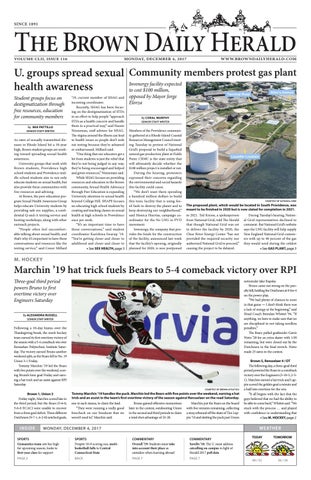
Marchin ’19 hat trick fuels Bears to 5-4 comeback victory over RPI Three-goal third period powers Bruno to first overtime victory over Engineers Saturday
netminder Jake Kupsky. Bruno came out strong on the penalty kill, holding the Dutchmen at 0-for-4 on the power play. “We had plenty of chances to score in that game — I don’t think there was a lack of energy at the beginning,” said Head Coach Brendan Whittet ’94. “If anything, we have to make sure that we are disciplined in not taking needless penalties.” The Bears pulled goaltender Gavin Nieto ’20 for an extra skater with 1:50 remaining, but were closed out by the Dutchmen in the final stretch. Nieto made 25 saves in the contest.
By ALEXANDRA RUSSELL SENIOR STAFF WRITER
Following a 10-day hiatus over the Thanksgiving break, the men’s hockey team earned its first overtime victory of the season with a 5-4 comeback win over Rensselaer Polytechnic Institute Saturday. The victory earned Bruno another weekend split, as the Bears fell to No. 19 Union 3-1 Friday. Tommy Marchin ’19 led the Bears with five points over the weekend, scoring Bruno’s lone goal Friday and earning a hat trick and an assist against RPI Saturday. COURTESY OF BROWN ATHLETICS
Brown 1, Union 3 Friday night, Marchin scored late in the third period, but the Bears (5-6-0, 3-6-0 ECAC) were unable to recover from a three goal deficit. Three different Dutchmen (9-7-1, 6-2-0) notched goals,
INSIDE
Tommy Marchin ’19 handles the puck. Marchin led the Bears with five points over the weekend, earning a hat trick and an assist in the team’s first overtime victory of the season against Rensselaer on the road Saturday. one in each stanza, to claim the lead. “They were running a really good forecheck on our breakout that we weren’t used to,” Marchin said.
Bruno gained offensive momentum later in the contest, outshooting Union in the second and third periods to claim a total shot advantage of 32-28.
Marchin put the Bears on the board with five minutes remaining, collecting a stray rebound off the skate of Tim Lappin ’18 and slotting the puck past Union
Brown 5, Rensselaer 4 / OT The following day, a three-goal third period powered the Bears to a comeback victory over the Engineers (3-10-3, 2-51). Marchin earned a hat trick and Lappin scored the golden goal a minute and a half into overtime for the win. “It all begins with the fact that the guys believed that we had the ability to be able to come back,” Whittet said. “We stuck with the process … and played with confidence in understanding that » See M. HOCKEY, page 2
WEATHER
MONDAY, DECEMBER 4, 2017
SPORTS Gymanstics team sets bar high for upcoming season, looks to first-year class for support
SPORTS Despite 10-0 scoring run, men’s basketball falls to Central Connecticut State
COMMENTARY Overall ’19: Students must take into account their place as outsiders when learning abroad
COMMENTARY Savello ’18: The U. must address catcalling on campus in light of Herald 2017 poll data
PAGE 2
BACK
PAGE 7
PAGE 7
TODAY
TOMORROW
48 / 32
56 / 36
NEWS
PAGE 2 • MONDAY, DECEMBER 4, 2017
THE BROWN DAILY HERALD
GYMNASTICS
Bears enter 2018 season with high expectations, talented freshmen class Gymnastics team sets sights on conference titles, qualifying to national championships By TESS DEMEYER SENIOR STAFF WRITER
Forty days out from its first competition of the 2018 season, the gymnastics team is more prepared than ever. Led by co-captains Maggie McAvoy ’18 and Claire Ryan ’18, the Bears put up solid performances in a mock meet Saturday. The preseason competition marked the first time the gymnasts faced judges since competing at USA Gymanstics Collegiate Nationals in April, where Brown fell short of qualifying for the finals after finishing fifth in preliminaries. An uncharacteristic fourth-place finish at the Ivy League Championship and a third-place ranking at the Eastern College Athletic Conference Championship last season left the team feeling like there was room for improvement. “I don’t think we really finished where we wanted to finish,” McAvoy said. “We didn’t even make it to the second night of competition at Nationals, and we’d done that the year before and broken a ton of records. To come in last year and kind of flop was really disappointing because we had set a lot of high goals for ourselves.” But things appear to be looking up this season as McAvoy and Ryan work to maintain a positive vibe during workouts. “This year, it’s already a 180,” she said. “It’s such a different environment and it’s such a great environment to come into every day.” Though the atmosphere in the gym has changed, the team’s goals remain the same — winning Ivy and ECAC crowns, qualifying individual
» M. HOCKEY, from page 1 the game is not over until the final horn goes off. It was really a character-building win.” Bruno burst out to an early lead at the 20 second mark as Marchin scored on the first shot of the game, launching the puck past RPI goaltender Linden Marshall from the left circle. Rensselaer answered with a trio of goals in the second period, including one on the power play, to reclaim the
COURTESY OF BROWN ATHLETICS
In preparation for its season opener against Rhode Island College and the College of Brockport in January, the gymnastics team competed in a mock meet at the Pizzitola Sports Center Saturday. The addition of five new first-year gymnasts is a source of optimism for the team. athletes to NCAA Regionals and earning a berth to USAG Nationals for the sixth consecutive year. But head coach Sara Carver-Milne’s primary focus is ensuring the gymnasts stay composed on the competitive stage. “Overall, our main goal is consistency,” she said. “We have the talent. We have the work ethic. We just need to work on being consistent and handling the pressure well in every single competition this year.” Twelve members of the team have experience under pressure in college, but five first-years will be tested for the first time in Bruno’s opening meet against Rhode Island College and the College of Brockport, State University
of New York. Carver-Milne is confident in the rookies’ ability to make an impact early. “They’ve really bonded well with our team and our system,” she said. “There’s no doubt that they’ll contribute immediately on all events, and we’re excited to see what they can do.” The absence of standout all-arounders Caroline Morant ’17 and Jorden Mitchell ’17 leaves gaps in the Bears’ lineups, but Alyssa Gardner ’21 and Kate Nelson ’21 have the ability to post big scores for Bruno on all four events while Emma Hansen ’21 and Caroline Warren ’21 can make contributions on uneven bars and balance beam. As a “natural beam worker” according
to Carver-Milne, Rose Domonoske ’21 will also help the Bears out on the event that evoked nervous mistakes last season. Veteran competitors like Julia Green ’19, Anne Christman ’20 and Anya Olson ’18 will also play large roles in the team’s success. Green earned Second Team USAG All-American honors on vault in 2017 and boasts creative skills on beam and floor, where she is expected to receive high marks. Christman has been rock solid “since day one,” according to McAvoy, and will contribute on multiple events this season. After placing second on bars at Nationals and capturing USAG AllAmerican honors in the event, Olson
will cap off her season by anchoring her strongest event and adding solid performances on vault and floor. The Bears will have a chance to show off their skills in front of home crowds multiple times this season as they host their annual Beauty and the Beast meet with the wrestling team Feb. 4 and another regular-season meet March 4. But the competition Bruno is most looking forward to is the Ivy Classic Feb. 25, which Brown hosts for the first time in four years. “We’re extremely excited,” CarverMilne said. “The last time we hosted, we won. It would be an incredible opportunity for our team to keep that trophy at Brown again.”
advantage. The Engineers widened the lead to three with a shorthanded goal 10 seconds into the third. But Bruno began to mount a rally midway through the final stanza when Marchin scored twice in a four minute span, capitalizing on a power play in the 16th minute to trim the deficit to one. Chris Berger ’21 equalized the game a minute later, redirecting a rebound past Marshall for his first career goal. “Once we got one, the bench came alive,” Marchin said. “We knew that we
had the potential to actually come back and had plenty of time to do so, so we were pretty confident in ourselves.” Lappin fired a shot from the right circle off the crossbar and into the back of the net to claim the victory in overtime. Rensselaer slighted Brown 31-30 in shots on goal. Nieto made 27 saves in the win. Looking ahead, the Bears seek to maximize offensive output on the power play, which has converted seven times so far this season.
“Our penalty kill has probably been a little bit ahead of our power play, although last night, our power play came through in a big way,” Whittet said. “I look at that and say that the power play performed in that situation — it was a pressure situation and it was good to see.” “I’m really confident that we have good guys on units (on the power play) that know how to score goals and work together really well,” Marchin said. “We’re just going to stick to the process and the pucks will start coming our way.”
With two non-conference games remaining before the winter break, Bruno also looks to maintain the greater depth and cohesiveness that has helped the team to five wins early in the season. “We’re getting contributions throughout — people stepping in that may not have been playing and coming in and contributing,” Whittet said. “It’s a team in every aspect.” The Bears host Bentley Wednesday in a non-conference matchup at Meehan Auditorium. Face-off is at 7 p.m.
Passport & Visa Specialist Legal Passport is a national, 24-hour Passport Expediting Service that gets People out of the Country in a Hurry! * Training in a relaxed but fast-paced office * Requires abilities & skills of a capitalist minded entrepreneur * Great command of spoken and written English * Learn Passport regulations and procedures
Pay is $12 - $14 per hour + DOE
Hours average 10-20 hours per week; Afternoon and evening hours prime
EMAIL paul@legalpassport.com to inquire 119 5th Street, Providence RI 02906 **** 1-800-238-6662
STAY UP-TO-DATE. FOLLOW US ON FACEBOOK. FACEBOOK.COM/BROWNDAILYHERALD
NEWS
MONDAY, DECEMBER 4, 2017 • PAGE 3
THE BROWN DAILY HERALD
» SEX HEALTH, from page 1 independence.” SHAPE, like SHAG, is underscoring the importance of destigmatizing STDs in light of the 10-year high rate in Providence, Swarup said. “We want to make the curriculum more inclusive by not making it just about scaring them (about STDs),” she said. “We need to keep doing what we are doing and try to expand our efforts.” In addition to reevaluating the curriculum, SHAPE is undergoing structural changes. The group is in its first year of a partnership with Planned Parenthood, which allows for them to distribute educational handouts and free safe sex supplies as well as have monthly meetings with a representative from Planned Parenthood. “Our partnership with Planned Parenthood has made our work a lot better,” Swarup said. “We have access to resources and actual professionals in the field who can help us with sex ed.” But Brown’s sex education groups work with younger students as well. Brown University Sexual Health Educators provides middle school students in downtown Providence with an after-school, optional, comprehensive sex education. The lessons, which run twice a week, cover sexual health, puberty, gender and identity and more. The group wanted to work with middle school students because high school can sometimes be too late, said Spenser Anderson ’18, coleader of BRUSHE. In addition to middle school students who may be engaging in sexual activity, it’s also
» GAS PLANT, from page 1 part of the year. It also says “the facility would be a reliable, safe, costeffective way to ensure that (their) customers have the natural gas they need to heat their homes and businesses, particularly when the demand is greatest.” But Ward 3 City Council Member for, Nirva LaFortune, told The Herald: “This is environmental discrimination and I think it’s unfair and unethical. These kids are breathing toxins on a daily basis, and they’re from immigrant families and people of color. We need to be more ethical, and we need to think about the type of facilities that we’re bringing into these communities because we’re destroying it.” The Environmental Justice League of Rhode Island published a paper claiming that South Providence, where the installment of the power
important to talk about puberty because “middle school is when you’re starting to search for your identity and go through bodily changes,” Anderson said. “It’s tough, and by having facilitators in college rather than teachers, students can relate more and be comfortable asking questions.” The fact that the facilitators are younger than teachers has made students surprisingly receptive, Anderson said. Many of the middle school students have asked questions that are personal or very specific, he added. The increase in Rhode Island STD rates may not have completely negative connotations — it might actually be an indicator that this education is paying off. Although people may be participating in more activities that put them at risk or using less protection, the rising rates may also be a sign that more people are seeking out testing, said Philip Chan, director of Miriam Hospital’s STD clinic. One of the biggest spikes this past year is in gonorrhea and chlamydia among teenagers between ages 15 and 19, he added. “We need more education and awareness given that these STDs tend to affect younger adolescents,” Chan said, lauding Brown’s efforts to spread sexual health education to various communities, but emphasizing the need for Rhode Island as a state to improve. He also stressed the importance of open discussion among politicians and those in the clinical field in moving forward with sexual health. Improving access to care and resources is also crucial, Chan said. At Brown, all students can order safe sex supplies online for free to their Brown mailbox through “Ship n SHAG.” plant is expected, has concentrated poverty and communities of color. It also has little to no waterfront access in an area zoned for heavy industrial use with multiple polluting and hazardous facilities. Mayor Jorge Elorza has publicly stated that he opposes the development of the facility as “it presents danger to the neighborhood, especially in the face of a changing climate.” Elorza signed an executive order last year committing Providence to becoming a carbon neutral city by 2050. Furthermore, State Rep. Aaron Regunberg ’12, D-Providence, told The Herald that he has been against the project since it was originally proposed. “We need to be making a rapid transition to clean energy. If we want to lower costs, we need to have our own independent clean energy sector right here in Rhode Island,” said Regunberg.
ALEX WESTFALL / HERALD
Besides getting tested at Health Services, students can also get tested at Planned Parenthood of Southern New
England, the Miriam Hospital STD clinic, AIDS Care Ocean State and AIDS Project Rhode Island, as listed
on the BWell website. — Additional reporting by Emily Davies.
NEWS
PAGE 4 • MONDAY, DECEMBER 4, 2017
THE BROWN DAILY HERALD
Neurodatathon premiers in four-day event Participants combined knowledge of programming, neuroscience for event By KENDRICK TAN STAFF WRITER
Students worked with state-of-the-art tools to uncover patterns in a never-before analyzed neural data set at Brown’s first-ever Neurodatathon Nov. 28 to Dec. 2. Hosted by Brown Data Science and sponsored by the Brown Institute for Brain Science and the Brown Initiative for Computation in Brain and Mind, the Neurodatathon challenged students to analyze a neural data set with a variety of machine learning and deep learning methods. “What we were hoping, by introducing this brand new data set, was that students would have an opportunity to figure out interesting characteristics about the data and also (discover) optimal ways of filtering it, so that optimal results can be obtained when doing scientific analysis,” said Drew Linsley, postdoctoral research associate in cognitive, linguistic and psychological sciences. “We had 140 students sign up, who had concentrations ranging from physics and computer science to neuroscience and psychology,” Linsley said. With students coming from such wide-ranging fields, the event featured two tracks of competition, each demanding a different set of skills and interests. Participants either formed teams or worked independently, competing in one of the two tracks. The “Optimize” track tended to be the choice for programmers and deep learning and machine learning enthusiasts. In this track, the goal was to build a model that most accurately interpreted neural behavior, as given by the data set. The two groups whose models generated the most accurate results won the competition. The “Create” track involved scientific analysis and was chosen more often by students with stronger neuroscience backgrounds. Because the provided data set had never been analyzed before,
ELLA ROSENBERG / HERALD
participants were given lots of freedom and an opportunity to come up with scientifically significant analysis. Three neuroscience and data science experts judged the analysis submitted by the participants, and the two winners were chosen for the impact and creativity of their submissions. “In a perfect world, you would be an expert in both (computing and neuroscience), but of course it’s very difficult to get this kind of training, especially at the undergraduate level,” Linsley said. “Our special two-track competition catered to the two different types of students interested — the programmers who had more technical skill and the neuroscientists who had more knowledge about the brain.” Because many of the participants had limited or no experience with machine learning algorithms, neural data sets and even data science in general, the organizers of the event hosted workshops. In addition, office hours were held every day during the event, giving participants opportunities to talk to deep learning and neuroscience experts. A hacking space was offered for
participants at night, giving students a place to work on projects and providing them access to experts. The workshops prior to the Neurodatathon “made the event much less daunting,” said Dylan Sam ’21. “It was a little bit of an introduction and walkthrough, which was really great. The experts did a really good job explaining the concepts to (participants).” Mariel Rosic ’20 agreed that the workshop was a helpful aspect of the event. “The postdocs and grad students were so helpful,” she said. “I learned so much by talking to them, and it almost felt like a series of one-on-one machine learning sessions that helped me with my analysis.” Participants and event hosts agreed that the event set a positive precedent for future Neurodatathons. “We ended up finding some really interesting analysis, discovering interesting relationships between brain and behavior that we didn’t expect we would find,” Linsley said. The Brown Data Science Initiative will continue hosting events next semester, with plans of coordinating another Neurodatathon in the near future, he added.
TODAY
MONDAY, DECEMBER 4, 2017 • PAGE 5
THE BROWN DAILY HERALD
menu
s ta i r way t o l i s t
SATELLITE DINING ANDREWS COMMONS
Pizza: Caprese, Chicken Ranch, Sammy Special Grinder, Pho Bar, Curry Bar, Poke Bowl, JOSIAH’S
BLUE ROOM
Chicken Dinner Bowl, Rodeo Burger, Grilled Cheese
Turkey Chili, Bread Bowl, Grain Bowl, Tom’s Bao Bao
DINING HALLS SHARPE REFECTORY LUNCH
DINNER
Mushroom Barley Soup, Savory Chicken Stew, Cinnamon Toast Crunch Bars
Braised Beef Kebab, Parslied Rice, Sauteed Mushrooms, Pannotone Bread Pudding
VERNEY-WOOLLEY LUNCH
DINNER
Cream of Broccoli Soup, Spicy Pepper Pulled Chicken, White Chocolate Chip Cookies
Chicken Rice Soup, Pork Carnitas, Frijoles Negros, Sweet Portuguese Bread
sudoku
crossword
TIFFANY DING / HERALD
The stairwell in the List Art Center has been a site for student art for several years and features several poignant commentaries on student life, politics and the broader world. Paint covers nearly every wall in the stairwell.
Q U O T E O F T H E D AY
“It’s an important time to have those conversations. You’re getting closer and closer to adulthood and closer and closer to independence.
”
— Karishma Shwarup ’19, Sexual Health Awareness Group student coordinator
See sex heatlh on page 1. calendar TODAY DECEMBER MARCH
S
35
M
46
T
57
W
Th
F
S
1
2
13
24
86
79
10 8
11 9
Massage Monday with BURP 12:00 P.M. Faunce House, 229
Holiday Pop-Up Shop 12:00 P.M. J. Walter Wilson Lobby
Mid-Day Concert with Benjamin Nacar 12:30 P.M. Pembroke Hall, 305
AMP Winds Recital 4:00 P.M. Fulton Rehearsal Hall
TOMORROW
10 12
11 13
12 14
13 15
14 16
15 17
16 18
17 19
18 20
19 21
20 22
21 23
22 24
23 25
24 26
25 27
26 28
27 29
28 30
29 31
30
Study Abroad 101 Info Session 12:00 P.M. J. Walter Wilson, 440
Preparing for Finals 12:00 P.M. J. Walter Wilson, 203
AMP Jazz Recital 4:00 P.M. Fulton Rehearsal Hall
Buddhist Practice 101 4:30 P.M. J. Walter Wilson, 411
COMMENTARY PAGE 6 • MONDAY, DECEMBER 4, 2017
THE BROWN DAILY HERALD
EDITORS’ NOTE
Editors’ Note: The Herald names 128th Editorial Board The Herald announced the members of the 128th Editorial Board Friday at its annual banquet at CAV Restaurant Dec. 1. The 128th Editorial Board will be led by Editor-in-Chief and President Elena Renken ’19, a science and society concentrator from St. Paul, Minnesota. Kasturi Pananjady ’19, a comparative literature concentrator from Bangalore, India, will serve as managing editor and vice president. Joining them on the editorial board are senior editor Madison Rivlin ’19, a public policy and Hispanic studies concentrator from Montclair, New Jersey, Alex Skidmore ’19, a history concentrator from Cincinnati, Ohio, Julianne Center ’19, an English non-fiction and environmental studies concentrator from Lake Arrowhead, California and Hattie Xu ’19, a cognitive neuroscience concentrator from San Gabriel, California. The 127th Editorial Board is excited to see The Herald and its content develop next year under the leadership of the incoming board. We are so proud of you all. The Herald also announced a new slate of section editors, business leaders and department heads: Section Editors Arts & Culture: Connor Sullivan ’20, Elizabeth Toledano ’20 Liason to Senior Reporters: Isabel Gensler ’19 Metro: Emily Davies ’19.5, Bella Roberts ’20 Science & Research: Jonathan Douglas ’20, Jackson Wells ’20 Sports: Alexandra Russell ’20, Nicholas Wey ’19 University News: Anna Kramer ’20, Eduard Muñoz-Suñé ’20, Priyanka Podugu ’20, Sarah Wang ’20 Business General managers: Michael Borello ’19, Matilda Lynton ’19 Finance director: Ravi Betzig ’20 Sales director: Shreya Raghunandan ’19 Strategy directors: Caroline Ziegler ’19 PostEditor-in-chief: Saanya Jain ’19
LAUREN ARATANI / HERALD
Senior Editors Alex Skidmore ’19, Madison Rivlin ’19 and Hattie Xu ’19 and Editor-in-Chief and President Elena Renken ’19. Not pictured: Managing Editor and Vice President Kasturi Pananjady ’19 and Senior Editor Julie Center ’19.
Editors’ notes are written by The Herald’s 127th editorial board: Lauren Aratani ’18, Matthew Brownsword ’18, Rebecca Ellis ’18 and Katharine Talerico ’18.
P HO E B E AY R E S
Find us online! facebook.com/browndailyherald
browndailyherald.com
@the_herald
Location: 195 Angell St., Providence, R.I. www.browndailyherald.com
@browndailyherald
youtube.com/browndailyherald
Editorial Leadership
Sections
Multimedia & Production
Business
Editor-in-Chief Lauren Aratani
Arts & Culture Editors Ethel Renia Madison Rivlin
Design Editors Christy Leung Ameer Malik Jessica Yu Assistant: Eduard Muñoz-Suñé
General Managers Henry Ritter Ben Wesner
Managing Editors Matt Brownsword Rebecca Ellis Kate Talerico POST- MAGAZINE Editor Saanya Jain BLOGDAILYHERALD Editor Angelica Cotto
Metro Editor Gwen Everett News Editors Isabel Gensler Alex Skidmore Hattie Xu Science & Research Editor Elena Renken Sports Editors Ben Shumate Nicholas Wey COMMENTARY Opinions Editors Connor Cardoso Anuj Krishnamurthy Mili Mitra
Photo Editors Head: Marianna McMurdock Assistant: Lilly Nguyen Gus Reed Sara Runkel Anita Sheih Copy Desk Chief Abby Borges Multimedia Editor Roland High
Directors Sales: Erin Lueck Sales: Matilda Lynton Finance: Reena Zhan Strategy: William Nober Strategy: Caroline Ziegler Managers Sales: Michael Borello Sales: Elizabeth Doykan Sales: Shreya Raghunandan Collections: Ravi Betzig
Editorial contact: 401-351-3372 herald@browndailyherald.com
Business contact: 401-351-3260 gm@browndailyherald.com
Submissions: The Brown Daily Herald publishes submissions in the form of op-eds and letters to the editor. Op-eds are typically between 750 and 1000 words, though we will consider submissions between 500 and 1200 words. Letters to the editor should be around 250 words. While letters to the editor respond to an article or column that has appeared in The Herald, op-eds usually prompt new discussions on campus or frame new arguments about current discourse. All submissions to The Herald cannot have been previously published elsewhere (in print or online — including personal blogs and social media), and they must be exclusive to The Herald. Submissions must include no more than two individual authors. If there are more than two original authors, The Herald can acknowledge the authors in a statement at the end of the letter or op-ed, but the byline can only include up to two names. The Herald will not publish submissions authored by groups. The Herald does not publish anonymous submissions. If you feel your circumstances prevent you from submitting an op-ed or letter with your name, please email herald@browndailyherald.com to explain your situation. You can submit op-eds to opinions@browndailyherald.com and letters to letters@browndailyherald.com. When you email your submission, please include (1) your full name, (2) an evening or mobile phone number in case your submission is chosen for publication and (3) any affiliation with Brown University or any institution or organization relevant to the content of your submission. Please send in submissions at least 24 hours in advance of your desired publication date. The Herald only publishes submissions while it is in print. The Herald reserves the right to edit all submissions. If your piece is considered for publication, an editor will contact you to discuss potential changes to your submission. Commentary: The editorial is the majority opinion of the editorial page board of The Brown Daily Herald. The editorial viewpoint does not necessarily reflect the views of The Brown Daily Herald, Inc. Columns, letters and comics reflect the opinions of their authors only. Corrections: The Brown Daily Herald is committed to providing the Brown University community with the most accurate information possible. Corrections may be submitted up to seven calendar days after publication.
Illustrations Editor Pia Mileaf-Patel
Advertising: The Brown Daily Herald, Inc. reserves the right to accept or decline any advertisement at its discretion.
Graphics Editor Laura Felenstein
The Brown Daily Herald, Inc. is a financially independent, nonprofit media organization bringing you The Brown Daily Herald, BlogDailyHerald and Post- Magazine. The Brown Daily Herald has served the Brown University community daily since 1891. It is published Monday through Friday during the academic year, excluding vacations, once during Commencement and once during Orientation by The Brown Daily Herald, Inc. Single copy free for each member of the community. Subscription prices: $200 one year daily, $100 one semester daily.
Directors of Web Development Eli White Ivy Wong
Copyright 2017 by The Brown Daily Herald, Inc. All rights reserved. Periodicals postage paid at Providence, R.I. Postmaster: Please send corrections to P.O. Box 2538, Providence, RI 02906.
COMMENTARY MONDAY, DECEMBER 4, 2017 • PAGE 7
THE BROWN DAILY HERALD
Embracing discomfort abroad SOPHIA OVERALL op-ed contributor In my study abroad program this semester in Amman, Jordan, each student is placed with a local host family. Both of my host parents, Issa and Mary, are Palestinian and grew up in Palestine prior to moving to Jordan. This is not uncommon, as it is estimated that at least half of Jordan’s population has Palestinian ancestry. However, five minutes into our first conversation, I realized how unprepared and uninformed I was to talk about my host parents’ background with them. I immediately felt like an outsider. Before studying abroad, I had taken one class at Brown about the Palestine and Israel conflict, but all that resurfaced when I anxiously raked my brain during our first family dinner were inapplicable generalities about the Palestine Liberation Organization and Israeli Defense Force. As I continued to converse with Mary and Issa over the next few weeks, I increasingly became aware of how little I knew about Palestinian culture, heritage and the unwavering pride among the Palestinian people — and how much knowledge they had to offer. Mary and Issa did not leave Palestine of their own volition: They left their
hometown of Ramallah together in 1967 after the Six Day War as two out of the roughly 300,000 Palestinians in exodus following the Israeli occupation of the West Bank. By hearing about their experience leaving Palestine, I learned more about the issue than in any survey course I had taken. As Mary, Issa and I spent more time together, I could feel our dynamic shift; the space between the three of us now allowed for the exchange of more emotional and personal stories. Mary and Issa explained to me that
and Issa was my newfound understanding of my role as an outsider. Amidst every conversation about their lives, I had to actively think about how I was receiving the stories and information they told me and how I crafted my response. I embraced both the physical and emotional distance I have from the uncritical coverage in the United States surrounding the Palestine and Israel conflict. I have had to divorce myself from what I previously thought I knew, however uninformed it was, in
ization. As I discussed in a previous op-ed for The Herald (“Confronting the exclusivity of study abroad,” Nov. 12), study abroad is a largely exclusive experience that often caters to superficial engagement with host countries. Yet true and meaningful learning can only take place when we, as students from American institutions studying abroad, choose to step out of our comfort zones and acknowledge our place in the conversation as outsiders. To truly experience a foreign country and culture, embracing discomfort
True and meaningful learning can only take place when we, as students from American institutions studying abroad, choose to step out of our comfort zones and acknowledge our place in the conversation as outsiders. neither of them can return to their homes today because neither of them were allowed a Palestinian passport. I learned about one of the greatest points of controversy within my new temporary family when Sawsan, Mary and Issa’s eldest daughter, wanted to attend a university in Israel in order to pursue her master’s degree against the wishes of her family. These reallife stories revealed aspects of the conflict that I had never been exposed to in a classroom. But perhaps the most important takeaway from my time with Mary
order to fully understand what Mary and Issa have gone through to provide their family with safety and security. Crucially, Mary and Issa’s stories have forced me to try and reconcile how to embrace my identity as a white American traveling in the Middle East for the first time and as a new member of a family whose lived experience is one I can barely wrap my mind around. It has taken me three months to come to terms with the fact that feeling like an outsider should be embraced, not rejected. But not everyone benefits from this real-
is the most respectful and important thing a student can do. My friend Gwen recently told me about a moment of vulnerability that she experienced. While conducting an interview for her research project on the urbanization and collective memory within Weibdeh, a part of Amman, she asked her interviewee about Black September, an armed conflict that was fought in 1970 between the Jordanian army and the PLO. “That is a part of Jordanian history that no one wants to bring up here,” he responded, taking offense to the question.
Gwen had no idea that this question and historical event would evoke such a strong reaction. But unity between and within the Palestinians in Jordan is extremely important, and openly talking about when there was disunity crosses one of those invisible boundaries. As Gwen came away from that interview, her feelings of discomfort and vulnerability were less significant than her new understanding of how imperative rhetoric was in building national unity in Jordan. There is an intense beauty in being uncomfortable. It is in this space that you can openly embrace your agency over your discomfort while simultaneously learning the most about yourself and your surroundings. Since I am a white, American woman, recognizing the difference between my lived experience and Mary and Issa’s has helped me let go of my preconceived notions and made me more open to what they have to teach me. I have come to understand that the first step to embracing all foreign environments and social boundaries is a willingness to be uncomfortable. Traveling can have an extremely profound and transformative power but, as with any relationship rooted in power, humility and respect must be put forth first.
Sophia Overall ’19 can be reached at sophia_overall@brown.edu.
Calling out catcalling SAMANTHA SAVELLO opinions columnist About a year ago, while I was walking down Thayer Street one afternoon, a man told me he liked my dress. Pleased with the compliment, I thanked him as I continued down my path, only to hear him shouting after me: “It would look better off!” Infuriated and embarrassed, I turned around to say something, but he had already diffused into a crowd of people. I never suspected that someone would catcall me so blatantly on College Hill — and I was even more surprised that none of the people around us confronted him or offered me support. As I kept walking down the street, I began to question whether I was in some way responsible for eliciting this inappropriate attention — whether my outfit or appearance was somehow provocative — even though I knew that I wasn’t to blame. The incident and other similar ones soon after also made me question how safe I really was on College Hill. I am not alone in this experience. In fact, a recent Herald undergraduate poll shows that 48.2 percent of female-identifying students surveyed are catcalled at least once a month while at Brown. Many of us tend to dismiss catcalling as a form of harassment that is annoying but not particularly harmful; some even seem to think that these remarks are complimentary. But in reality, catcalls can have serious implications for an individual’s confidence and self-esteem. Deeply rooted in implicit sexism, these comments are objectifying and perpetuate the stereotype that those targeted — who are overwhelmingly women — are only valued for their
physical appearances. Catcalls can be particularly harmful if recipients begin to feel unsafe in their daily environments or internalize the comments, blaming themselves for the unsolicited attention — like I did. We are all aware of the pervasiveness of catcalling in general: A controversial video titled,
how we can best address this. Unfortunately, catcalling is a difficult problem to combat because it happens so quickly and catcallers are not always as explicit as they appear to be in commercials or movies. And even if catcallers are confronted, there’s no guarantee that they will apologize for their actions
Now that we finally have survey data showing that many students experience this as frequently as once a month, it is time to begin conversations about verbal harassment on College Hill and how we can best address this harassment.
“10 Hours of Walking in NYC as a Woman” shows a woman being catcalled over 100 times in just 10 hours for simply walking down the street. But much less is said about how commonplace catcalling is around campus. Now that we finally have survey data showing that many students experience this as frequently as once a month, it is time to begin conversations about verbal harassment on College Hill and
or learn the error of their ways — an issue that is perhaps more frustrating than the comments themselves. Moreover, since Thayer Street is a hub for Providence as well as Brown, catcallers often throw out slurs from the windows of moving cars. For example, I remember quite distinctly an occasion in which a young man shouted a sexual comment at me from the window of his car as I walked past the SciLi, comparing the
way I was drinking a smoothie to how I could provide him with sexual favors. This type of drive-by catcalling makes it virtually impossible for people to challenge the offenders. Still, there are things we can do to address catcalling in our community. Bystanders who observe this type of behavior should offer their support to those who need it and report it to public safety staffers if the situation escalates. Preventing catcalling also begins with making perpetrators aware of the dangerous implications of their words. Though it is not necessarily our responsibility, it can be helpful to explicitly state that such behavior is offensive and wrong. Standing in support of those targeted can also help them feel safer and less embarrassed: I, for one, would have felt much more comfortable if bystanders had reacted in my defense. Another way to help combat this issue, on a more general level, is to start discussions about it on campus. For one thing, this can help identify the areas on campus in which this occurs the most and the people who are repeat offenders. These conversations can also help educate people about the insidious effects of catcalling — and letting catcalling go unchallenged. Finally, these conversations can help those targeted of all genders understand that they have nothing to be ashamed of, and counteract the internalization of harmful comments. I understand that there will always be people in the world who make offensive remarks, both on campus and off. But by opening up a discussion and brainstorming strategies to combat this issue, we can help make our community — and the world — a safer and more inclusive place.
Samantha Savello ’18 can be reached at samantha_savello@brown.edu.
SPORTS THE BROWN DAILY HERALD
MONDAY, DECEMBER 4, 2017
M. BASKETBALL
Brown fades late in loss to Central Connecticut State Bears surrender 12-point second-half lead in furious Blue Devil comeback to lose 68-62 By ALEX SMOLAR STAFF WRITER
The men’s basketball team had not played in three days after a brutal stretch of three games in four days last week, but its much-needed rest looked more like rust in a 68-62 loss against Central Connecticut State University at home Saturday. The Bears led by 12 at one point in the second half, but turnovers and cold shooting down the stretch doomed Brown to its second consecutive loss. “We have got to be able to learn from all of our experiences, positive and negative,” said Head Coach Mike Martin ’04. “I’m sure there were some good things that happened out there, but we didn’t do enough to win a game.” Desmond Cambridge ’21, who was named last week’s Ivy League Rookie of the Week, came out early and put the scoring load on his shoulders. Cambridge made three three-point shots in the first seven minutes of the contest, accounting for nine out of Brown’s (4-4) 13 early points. “Desmond has a lot of talent, and he’s going to be a good player,” Martin said. “But we win as a team and lose as a team.” The Blue Devils (5-3) rode early shooting consistency and a clear rebounding advantage to stay competitive, eventually taking a 23-19 lead with just over four minutes left in the half. After Brandon Anderson ’20, Zach Hunsaker ’20 and Cambridge reentered the game, Bruno caught fire and was able to create open shots, create mistakes with strong defense and retake the lead with a
ELI WHITE / HERALD
Zach Hunsaker ’20 pushes up the court against a Blue Devils defender. Though Bruno held a 31-27 lead at half, the team failed to keep the momentum going, falling 68-62 after a strong showing from the Blue Devils. 10-0 scoring run. At the half, the Bears were ahead 31-27. Cambridge and Anderson led in scoring with 11 and nine points, respectively. Hunsaker helped with two rebounds and two assists, and Tamenang Choh ’21 added three boards. Mustafa Jones led CCSU in scoring in the first 20 minutes with seven points. Bruno and the Blue Devils matched each other in terms of first-half shooting, with both squads notching an identical 12-27 mark from the field. CCSU commanded
in rebounds, grabbing eight more boards than the Bears and fighting for seven second-chance points. The Blue Devils came out after halftime and made an early threepoint shot to cut the lead to one, but the Bears settled in and appeared to take control of the game. Cambridge ignited the Pizzitola Center with two three-point shots, extending the Brown lead to twelve 2:49 into the half. But a CCSU scoring run, powered by suffocating defense, made the 12-point deficit vanish with just
7:14 remaining in the contest, when the Blue Devils tied the game at 54. With four minutes left in the game, CCSU took their first lead of the half on a jump shot from Austin Nehls. The game continued as a backand-forth affair, but with 2:18 left in the game, Nehls made a three-pointer that extended the Blue Devils’ lead to four. With 48 seconds left, Eric Bowles made two free throws to put the game out of reach for the Bears. Bruno shot 37 percent from the field and 32 percent from beyond the arc. Cambridge led all Brown scorers
with 17 points along with 15 from Anderson and 14 from Hunsaker. The Blue Devils dominated in rebounds 44-23 and points in the paint 32-16. “We have a young team, and we have to learn from all of our experiences,” Martin said. “Unfortunately, our team was not as good as we needed to be today.” The Bears will return to the court to face cross-town rival Providence College Wednesday at the Dunkin’ Donuts Center before returning home to play the University of Massachusetts-Lowell Saturday.