SINCE 1891
THE BROWN DAILY HERALD MONDAY, NOVEMBER 13, 2017
VOLUME CLII, ISSUE 106
WWW.BROWNDAILYHERALD.COM
U. increases support, resources for student veterans M. HOCKEY Veterans part of RUE program grapple with finding community on campus
By EMILY DAVIES AND JACOB LOCKWOOD SENIOR STAFF WRITER AND STAFF WRITER
Every time Tristan Hood ’18 or Joel Fudge ’21 go out to eat, they make sure to find seats facing the door. “It’s an awareness thing,” Hood said. Hood and Fudge are two of the 18 undergraduate student veterans at Brown, and they move through campus more attentively than most. Fudge also said he has also had to adjust to the University’s timeliness — or lack thereof. “One of the harder things for me is that nothing is on time,” Fudge said. “In the military, you are not late. You are 15 minutes early, and you are five minutes early to your 15 minutes early.” Fudge served in the marine corps for four years. Based in Okinawa, his
jobs included cleaning up after the Fukushima disaster in Japan. After, fresh out of the military and 22, Fudge worked as a timber faller while his then-girlfriend, Aimée Fudge ’20, finished her time in the marines. At 26, Joel Fudge enrolled at the University through the RUE program. “There is almost a stigma around Brown — that’s the cream of the crop there,” Fudge said. “How could we ever compete with that? But then, we’ve done a lot of hard things; we can do it.” Last year, the University nearly doubled its student veteran presence, bringing eight more veterans to College Hill, said Program Director of the Office of Student Veterans and Commissioning Programs Karen McNeil. Under her direction, the University is working to further increase the presence of veterans on campus. Since she joined Brown in 2014, the University has increased the volume of programs and services offered to veterans to include orientation and pre-orientation programs, monthly veterans lunches and a dedicated space for student veterans, which launched in September. Of the veterans enrolled in
Bears claim 3-1 victory over St. Lawrence
Strong command of power play, dominant possession fuel Bruno to Saturday win against Saints By ALEXANDRA RUSSELL SENIOR STAFF WRITER
MATT BROWNSWORD / HERALD
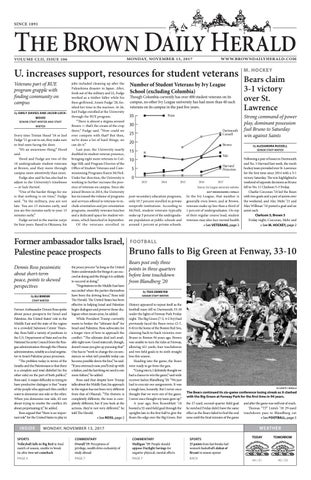
post-secondary education programs, only 10.7 percent enrolled in private nonprofit institutions. According to McNeil, student veterans typically make up 3 percent of the undergraduate population at public schools and around 1 percent at private schools.
In the Ivy League, that number is generally even lower, and at Brown, veterans make up less than a third of 1 percent of undergraduates. On top of their regular course load, student veterans may also face mental health » See VETERANS, page 3
Following a pair of losses to Dartmouth and No. 3 Harvard last week, the men’s hockey team prevailed over St. Lawrence for the first time since 2014 with a 3-1 victory Saturday. The win highlighted a weekend of opposite decisions as Bruno fell to No. 11 Clarkson 5-3 Friday. Charlie Corcoran ’18 led the Bears with two goals and a pair of assists over the weekend, and Alec Mehr ’21 and Max Willman ’18 posted a goal and an assist each. Clarkson 5, Brown 3 Friday night, Corcoran, Mehr and » See M. HOCKEY, page 2
Former ambassador talks Israel, FOOTBALL Bruno falls to Big Green at Fenway, 33-10 Palestine peace prospects Dennis Ross pessimistic about short-term peace, points to skewed perspectives By ELI BINDER STAFF WRITER
Former Ambassador Dennis Ross spoke about peace prospects for Israel and Palestine, the United States’ role in the Middle East and the state of the region to a crowded Salomon Center Thursday. Ross held a variety of positions in the U.S. Department of State and on the National Security Council from the Reagan administration through the Obama administration, notably as a lead negotiator in Israel-Palestine peace processes. “The problem today in terms of the Israelis and the Palestinians is that there is a complete and total disbelief (in the other side) on the part of both publics,” Ross said. A major difficulty in trying to have productive dialogue is that “many of the people who approach this conflict want to demonize one side or the other. When you demonize one side, it’s not about trying to resolve the conflict, it’s about perpetuating it,” he added. Ross argued that “there is an important role” for the United States to play in
INSIDE
the peace process “as long as the United States understands the things it can succeed at doing and the things it is unlikely to succeed at doing.” “Negotiations in the Middle East have succeeded when the parties themselves have been the driving force,” Ross told The Herald. The United States has been effective in helping Israel and Palestine begin dialogues and preserve those dialogues when issues arise, he added. While President Trump currently wants to broker the “ultimate deal” for Israel and Palestine, Ross advocates for a longer view of how to approach the conflict. “The ultimate deal isn’t available right now. Good statecraft, though, doesn’t mean you give up pursuing that.” One has to “work to change the circumstances so what isn’t possible today can become possible down the line,” he said. “If you overreach now, you’ll end up with a failure, and the last thing we need is one more failure,” he added. Ross said that despite how Trump talks about the Middle East, his approach to the region has not been very different from that of Obama’s. “The rhetoric is completely different, the tone is completely different, but if you look at the actions, they’re not very different,” he told The Herald. » See ROSS, page 2
Bears post only three points in three quarters before lone touchdown from Blandberg ’20 By TESS DEMEYER SENIOR STAFF WRITER
History appeared to repeat itself as the football team fell to Dartmouth 33-10 under the lights of Fenway Park Friday night. The Big Green (7-2, 4-2 Ivy) had previously faced the Bears twice (2-7, 0-6) in the home of the Boston Red Sox, claiming back-to-back victories over Bruno in Boston 94 years ago. Brown was unable to turn the tides at Fenway, allowing 421 yards, four touchdowns and two field goals in its sixth straight loss this season. Heading into the game, the Bears were ready to go from the gun. “Going into it, I definitely thought we had a chance to win the game,” said wide receiver Jaelon Blandburg ’20. “We just had to execute our assignments. It was a tough loss, honestly. But I never once thought that we were out of the game. I never once thought my team gave up.” A year ago, Ben Rosenblatt ’18 booted a 52-yard field goal through the uprights late in the first half to give the Bears the edge over the Big Green. But
ELI WHITE / HERALD
The Bears continued its six-game conference losing streak as it clashed with the Big Green at Fenway Park for the first time in 94 years. the 27-yard, second-quarter field goal he notched Friday didn’t have the same effect as the Bears failed to find the end zone until the final minutes of the game
and after the game was well out of reach. Thomas “TJ” Linta’s ’18 29-yard touchdown pass to Blandburg cut » See FOOTBALL, page 3
WEATHER
MONDAY, NOVEMBER 13, 2017
SPORTS Volleyball falls to Big Red in final match of season, unable to break tie after two-set comeback
COMMENTARY Overall ’19: Perceptions of privilege, wealth drive exclusivity of study abroad
COMMENTARY Mulligan ’19: People should oppose Daylight Savings for negative physical, mental effects
SPORTS 25 points from fast breaks fuel women’s basketball’s defeat of Bryant in season opener
PAGE 4
PAGE 7
PAGE 7
BACK
TODAY
TOMORROW
44 / 31
45 / 33
NEWS
PAGE 2 • MONDAY, NOVEMBER 13, 2017
» ROSS, from page 1 Ross also noted that Israel’s relations with many of its Sunni Arab neighbors have changed in recent years. “There is a collaboration in practical terms that has never existed before between Israel and all the Sunni Arab leaderships,” Ross said. This emerged because Israel and these Arab states find a common enemy in Iran. Obama administration policies, such as the rapprochement with Iran that resulted in the recent nuclear deal with the country, the “pivot to Asia” and a clear reluctance to get further involved in the Middle East have shaken the perception of the United States as a guarantor of security in the region. Because of this, Israel and Sunni Arab states have come to see their partnerships as more vital for ensuring security. Ross faced multiple questions from students who suggested that he was
» M. HOCKEY, from page 1 Zach Giuttari ’20 scored to bring the Bears (2-4, 2-4 ECAC) within one goal of the Golden Knights (8-3-1, 4-0), but Clarkson closed Bruno out in the final stretch. A trio of first-period goals — including two on the power play — gave the Golden Knights an early lead. Corcoran put the Bears on the board in the 10th minute, capitalizing on a 6-on-4 advantage after goaltender Gavin Nieto ’20 was pulled for an extra skater. Tony Stillwell ’21 delivered a feed to Corcoran, who deflected the puck past Clarkson goaltender Jake Kielly. Mehr answered another Clarkson power play goal late in the second stanza, firing a shot top shelf from the circle. Bruno’s power play struck again when Giuttari trimmed the deficit to one in the final period. At the six minute mark, Giuttari collected a pass from Brent Beaudoin ’20 and launched a shot off the crossbar into the back of the net. The Bears kept the pressure up, but Josh Dickinson added an empty netter in the final 30 seconds to secure the victory for Clarkson. Bruno gained offensive momentum later in the contest, outshooting the Golden Knights in the second and
THE BROWN DAILY HERALD
biased in favor of Israel. In response to a student who questioned Ross’s neutrality, Ross said that the United States never claimed to be a neutral mediator, and he argued that it should not be, as Israel is a close U.S. ally. Neutrality is “not the measure of a mediator,” he said. “The measure of a mediator is: are you effective? And the only way you’re going to be effective is if you address the needs of both sides.” Another student asked Ross if the Israeli mistrust of Palestinians stems from “deep down knowing that the majority of them are living on stolen land.” Ross responded that “it’s fair to say that Israelis don’t think they’re living on stolen land,” adding that Israelis mistrust Palestinians because of their experience of Palestinian violence, such as during the intifadas or from the bombings that persist today. “The Palestinians have a set of
grievances that are not imagined,” he said. “But the Israelis also have a set of uncertainties and grievances that are not imagined.” Ross also noted that he is perplexed by how the deep passions that Palestine evokes on college campuses are not matched with a similar interest in the many other victims of Middle Eastern conflicts, who suffer a higher degree of immediate violence than Palestinians. When “I go on college campuses there is a deep concern for the Palestinians — which I think is fair,” he said. But, “I’m always sort of struck: We have half a million dead in Syria, 11.5 million displaced, a generation of kids that are now suffering from post-traumatic stress (disorder) … and that doesn’t seem to resonate” with students, he added. Ross also addressed the Boycott, Divestment and Sanctions movement. “One of the things I object to about B.D.S. in
third periods for a total shot advantage of 35-28. “We just came out a lot faster in the second and third,” Corcoran said. “To start the game it was pretty tough — we didn’t come out with enough urgency.” In net, Nieto made 23 saves. Brown 3, St. Lawrence 1 The following day, Bruno converted twice on the power play to extend an early first-period advantage over the Saints (1-10-1, 0-3-1). A trio of seniors — Willman, Corcoran and Tyler Bird ’18 — recorded goals to clinch the victory for the Bears. Willman opened scoring in the tenth minute, capitalizing on a 3-on-1 break. Corcoran sent a feed to Willman, who launched a one-timer from the center past Saints goaltender Daniel Mannella. “The start was important — we played with a lot of jump,” said Head Coach Brendan Whittet ’94. “We wanted to make sure we were putting them on their heels, finishing checks and playing in the zone a lot, making them have to chase us.” Corcoran took advantage of a St. Lawrence five-minute major penalty in the second stanza by adding a power play goal to widen the lead. Sam Lafferty ’18 and Stillwell each recorded assists. The Bears’ power play struck again
midway through the period when Bird answered a Saints goal, redirecting a pass from Corcoran into the left corner of the net. “We did a pretty good job playing with the lead,” Bird said. “A thing that’s killed us in the past is that we get up a goal or two and then we’ll kind of sit back and stop doing what made us successful. So that was a good thing to just continue to play hard and continue to play with confidence.” Rookie goaltender Luke Kania ’21 stopped 24 shots for his first career win. The Bears dominated in terms of possession, outshooting the Saints 46-25. “When you have the puck a lot, you’re going to have a lot of offensive opportunities,” Whittet said. Bruno demonstrated command of its special teams play, going 2-for-4 on the power play and 6-for-6 on the penalty kill against the Saints. The power play’s production has increased significantly since the beginning of the season, Whittet said. “Our power play has been much better — we’re shooting pucks finally instead of trying to pass (around the perimeter),” Whittet said. “We focused a lot in practice on just moving pucks quicker, keeping our heads up and shooting more,” Corcoran
TIFFANY DING / HERALD
Former Ambassador Dennis Ross put the Israeli-Palestinian conflict in a regional perspective during a talk moderated by diplomat Richard Boucher. general is that it in so many ways tries to import a conflict from the region here,” he said. “As someone who’s tried to solve
the conflict for the past 30 years, I don’t find that particularly productive. I would rather find ways to build bridges and promote that than (promote) boycotts.”
ELI WHITE / HERALD
Following Saturday’s victory over St. Lawrence, the Bears will continue conference play with visits to No. 16 Quinnipiac and Princeton. said. Whittet also saw the team’s play in the defensive zone as a positive. “We’re able to win some more battles, we’re not giving real easy looks at the net and we’re really defending with five players below the dots,” Whittet said. “We’re not allowing a lot of cycle play or possession play — we’re able to snuff that out.”
The victory over St. Lawrence serves as a source of optimism as the Bears delve deeper into its season. “It was an important game for us,” Whittet said. “We had been playing some pretty good hockey and just hadn’t been rewarded for it.” The Bears continue conference play with visits to No. 16 Quinnipiac Friday and Princeton Saturday.
M. BASKETBALL
Brown dominates in season-opening win against Johnson and Wales Anderson ’20 leads offensive barrage with 21 points in 106-78 victory Saturday By ALEX SMOLAR STAFF WRITER
The men’s basketball team opened its season at home against the Division III Johnson and Wales Wildcats Saturday, riding its high-powered offense and the near perfect free throw shooting of Brandon Anderson ’20 to a 106-78 blowout victory. “I’m happy with how we shared the ball and we were good going on the offensive glass,” said Head Coach Mike Martin ’04. “We were able to get the ball in the paint and get to the foul line.” The Bears started off aggressively, jumping out to an early eight-point lead behind an opening possession alley-oop dunk from guard Desmond Cambridge ’21 and seven points off the
bench from forward Travis Fuller ’19. “We bring athleticism to the team, so coach added a couple of alley-oop plays in there for us,” Cambridge said. “It worked, and it worked nicely.” The Wildcats’ hot three-point shooting and untimely turnovers by the Bears gave Johnson and Wales a one-point lead after 11 minutes of play. The Wildcats had an early 56 percent three-point shooting percentage compared to 22 percent by Bruno. “We got good looks in the first half,” Martin said. “They didn’t go down, and we didn’t shoot the ball well.” As the half continued, Brown responded to early challenges with precise free throw shooting and clutch three-pointers to go on a 15-0 run and amass a 14-point lead with 5:44 left in the first half. Anderson steadied the Brown offensive attack with physical play, earning important trips to the free-throw line. He took advantage of his opportunities, shooting 11-for11 from the charity stripe in the first period to build on Brown’s lead.
“I’m just trying to put pressure on the defense and make the defenders commit to me so I can get my teammates open shots,” Anderson said. “We score a lot more when we get the ball to the paint first.” At halftime, Brown led 58-39, shooting 38 percent from the field and an impressive 96 percent from the free-throw line. Fuller led the way with 14 points while Anderson added 13 and two assists. The Bears’ bench showcased the team’s depth, accounting for 23 points in a half that featured Brown’s strong scoring attack. Brown’s momentum carried into the second half. Bruno came out of the locker room fast, going on a 12-4 run to stretch their lead to 27 after five minutes of second-half play. The Wildcats recovered from a slow start and managed to trim the lead down to 22 points, but the Bears, boosted by nine second-half points from Cambridge, ultimately proved too much and denied the Wildcats any possible comeback opportunity.
ELI WHITE / HERALD
The Bears beat the Wildcats in a decisive win, despite a streak of threepointers and turnovers accrued by Johnson and Wales. At the final buzzer, the scoreboard 13 team assists. showed a dominant 28-point victory “We have a ton to work on,” Martin for the Bears. Anderson finished with said. “But we have some talent and a game-high 21 points, while Cam- have some things to be excited about.” bridge, Fuller, Zach Hunsaker ’20 and The Bears will embark on a threeJoshua Howard ’20 also finished in game road stretchthat begins against double-digit scoring. The team shot Quinnipiac University Monday and St. 41 percent from the field and recorded Francis College at Brooklyn Sunday.
NEWS
MONDAY, NOVEMBER 13, 2017 • PAGE 3
THE BROWN DAILY HERALD
»VETERANS, from page 1 challenges and a lack of representation on campus. To ease the application process for veterans, the University waives the application fee and guarantees admissions interviews for veterans interested in applying. Fudge said he and his wife felt more confident applying given the free application. McNeil serves as a guide for veterans looking to apply to the University. Her welcoming presence was the deciding point for Hood, who was choosing between Dartmouth, Penn and Cornell. He was impressed that she cleared her schedule to accommodate Hood’s last-minute visit. “I have never seen such a supportive network,” Hood said. Student veterans can bring diversity of experience to the student body. “I think the military is one of the best representations of the diversity and inclusiveness that (President Christina Paxson P’19) always talks about,” Hood said. The military is “the original melting pot,” Fudge added. Student veterans can help to bridge the disconnect between civilians and the military, said Manuel Villagrán ’19. “Most people don’t have a relative or anyone who has served, so they might get their information about the military through textbooks or the news,” he said. “If students have
» FOOTBALL, from page 1 Dartmouth’s lead to 23, but the damage was already done. Big Green quarterback Jack Heneghan racked up 223 of his 263 passing yards in the first half, and the Bears were outgained 141 to 28 on the ground for the game. Blandburg led the team in rushing with one 14-yard carry while starting running back Darius Daies ’21 only managed nine yards on nine rushes. “(Dartmouth) gave us everything we expected,” Blandburg said. “They didn’t do anything different from what they showed on film. We went into it knowing they were going to run the zone, and they stayed to that the whole game.” Linta’s 44 passing attempts were his second-highest of the year, and it was only the third time he eclipsed 200 yards in a game. Dartmouth took control early, scoring once in the opening quarter and adding 17 more points before halftime. A second-quarter interception by cornerback Jorquel Condomina ’19 looked to give Brown a chance at a comeback right after it got on the board. But the Bears failed to take advantage of the turnover after being stopped short on an attempted fourth-down conversion. The momentum stayed with the Big Green for the remainder of the game as Dartmouth returned an interception for another touchdown on Bruno’s opening drive of the second half and added a fourth-quarter field goal, bringing the final score to 33-10. “It’s all about us going 11 for 11. All 11 people doing their job all in the same
any questions about the struggles that veterans go through … it’s good to have a veteran around to answer these questions and clarify things.” John McCrillis ’17.5 echoed Villagrán, saying that he hoped student veterans could share their experiences with other undergraduates. “Students here are very intelligent, and they’re future leaders of this country,” he said. “It’s good to have veterans in the classroom to try to put a face to decisions that will be made in the future.” Beyond academic contribution, student veterans have also integrated into University social life. Villagrán said he feels strongly supported by the student veteran community at the University. “I spend more time with (veterans) than with any other group on campus,” he said. He feels best understood among student veterans with similar experiences. Jonathan Hagedorn ’19, who has developed an interest in acting at his time at Brown, said there are too few veterans on campus he can talk with. “There’s no other (student) veteran who’s into acting. I’m the only one that all my friends know,” he said. Though Fudge, at age 26, is older than the average University student and lives in Warwick with his wife, he has found a community at the University. He began his freshman year attending the Brown Outdoor Leadership Training trip, where he play,” Blandburg said. “I think that’s what we struggle with the most — everybody executing on the same play. I feel like we’re definitely good enough to be winning the game, but it’s small mistakes here and there that cost us.” Prior to kickoff, Brown honored its 25 seniors for their commitment and contributions to the program. The veterans gave up their final game in Brown Stadium to play as the home team at the historic ballpark, marking the first season since 1925 that Bruno did not host a game in November. Award-winning sports journalist Chris Berman ’77 served as an honorary captain for the Bears, joining team co-captains Isaiah Thompkins ’19 and Richard “Dewey” Jarvis ’17.5 during the coin toss. “It was awesome,” Blandburg said. “I don’t even know how to explain it. It was just crazy. Being in a stadium that has so much history … it wasn’t like a normal football game. It was a crazy experience.” The Bears will cap off their season against Columbia at Lawrence A. Wien Stadium Saturday. With a win, Bruno can knock the Lions out of second place and claim its first conference victory of the season. The last team to go winless in Ivy League play was the 2014 Lions and Bruno will be trying to avoid a similar fate next week. “The main focus for the Columbia game is just to win and come out on top,” Blandburg said. “This is our Ivy League championship. Every game is like an Ivy League championship. We’re just trying to win.”
met close friends regardless of the nearly 10-year age gap, he said. “As a marine, all we did is hide in the jungle,” he said. “So it was a very comfortable experience for me, but then you get to meet a whole new group of people.” But students have not always made student veterans feel welcome on campus. Just last year, students tore up American flags set up for the annual Veterans Day ceremony, The Herald previously reported. “Everyone was just really angry last year, and so everything was a target,” Hood said. “The American flag is an easy target, and it affects us because we kind of all wore it. Some of the dudes have it tattooed on their bodies.” The University response, however, restored faith for student veterans, Hood said. In a statement last year, Paxson denounced the vandalism and praised students who “came together to replant and guard the flags and summon the Department of Public Safety.” “If something hadn’t been done, we would have gone out and told people not to come here again,” Hood said. Since then, the University has made its appreciation for student veterans clear. Hagedorn said he finds the University supportive and accommodating, especially when it comes to his mental health. Hagedorn came to the University
through the standard applicant pool, instead of the RUE program that most veterans use. He was attracted by Brown’s high happiness rating. “Why did it have to be so shitty all the time? … I just want to be able to get a good education and actually enjoy my life,” Hagedorn said. Though Hagedorn finds support from his friends, he continues to struggle with the mental effects of his time in the marines. After boot camp, Hagedorn worked to find improvised explosive devices in Afghanistan. “Sometimes you’d find them,” he said. “Sometimes they’d find you, and they blow up one of your trucks.” During his first semester, Hagedorn never once took off a bracelet, which he wears in memory of Corporal Matthew Rodriguez, a member of his company who was killed in action in December 2013. Now, he only wears it on days when he struggles most. “I wear it to remind myself that I’m still here, I can still live my life, I have this huge opportunity and I need to take advantage of it,” Hagedorn said. Since coming to College Hill, Hagedorn has worked with Counseling and Psychological Services to find support. The University has been accommodating in his recovery, allowing for reduced course loads and ample counseling, he said. Fudge has also found that the University has taken steps to care for his
mental health. “This is the most support I’ve ever had in my life,” he said. “I’ve got a Meiklejohn, a peer advisor, a first year advisor, deans that I’ve talked to personally.” The University hopes to grow the number of student veterans and expand programs for those currently on campus. “My biggest hope is that the number of (veteran) students on campus is more proportional, that it’s closer to that one percent or above it, putting us on par with the average private university,” said McNeil. “We need that critical mass to have a community.” McNeil is currently working with alumni to create an affinity organization called the Brown University Veteran Alumni Council to provide mentorship and additional support to student veterans. She also hopes to develop a plan to recruit applicants on military bases. John McCrillis ’17.5 is grateful to Brown for giving him a chance at a successful civilian life for himself and his family after a gun wound in Afghanistan ended his military career, he said. “A lot of veterans get stuck in this mold of being a veteran, and that’s all they’ll ever be,” he said. “I didn’t want to have a war story be my definition of my character or who I am. I think Brown offered me a chance … for people to look at me and say that I graduated from an Ivy League school.”
Ties That Bind: Unraveling Disease Through Biomechanics Gilda Barabino, Ph.D. Dean of Engineering and Daniel and Frances Berg Professor at the City College of New York; President, American Institute for Medical and Biological Engineering
The link between cell biomechanics and disease is a complex phenomenon that holds great promise for new approaches in disease diagnostics, prognostics and therapies, yet the underlying mechanisms have not been fully elucidated. Join Gilda Barabino as she explores the mechanical basis of disease and how it provides insights for improved health and well-being.
November 14, 2017, 5:30 p.m. 85 WATERMAN STREET, ROOM 130 Online registration is now open at: brown.edu/thinking-out-loud
NEWS
PAGE 4 • MONDAY, NOVEMBER 13, 2017
THE BROWN DAILY HERALD
Generating a buzz, Underground Coffee Company continues to grow Shop continues to rely on student volunteers, expands menu offerings beyond hot drinks By DYLAN MAJSIAK STAFF WRITER
The Underground Coffee Company — the student-run, not-for-profit coffee shop located in the basement of Stephen Robert ’62 Campus Center — initially grew out of a conversation between three members of the BrownRISD Coffee Society in 2014. The shop now sells around 600 cups of coffee each week, wrote Kenta Nakagawa ’18, a member of the Underground Management Team, in an email to The Herald. Two of the members, Katie Murphy ’16 and Yousef Hilmy ’16, enjoyed the student-run café at their prior institutions and were “surprised” when they transferred to Brown that the University did not have a similar space, Nakagawa said. “We wanted to open up this place for students who love coffee and visiting cafes … a student-run, community space where you can have coffee, you can hang out, you can study, you can just stay there,” he added. The three shut down the BrownRISD Coffee Society in full pursuit of setting up the coffee-shop. The Underground Coffee Company officially opened April 2015. Since Murphy and Hilmy’s graduation, a four person team has managed the shop. “They’re an incredibly passionate group of students who really care about all the (day-to-day) operations of the
LILLY NGUYEN / HERALD
The Underground Coffee Company, located in the basement of Faunce, recently expanded its menu offerings to include Knead doughnuts. At night, the space is home to a variety of late night entertainment offerings. Underground,” said Project Director of Brown Student Agencies Andrew Kutscher ’18. “They handle all of that pretty much independently. We come in, and we help them like a typical investor would to try to push them to do the best they can.” In its early stages, The Underground was open at irregular hours and was limited to drip coffee and tea. Now open from 9 a.m. to 5 p.m. on weekdays, its current menu also offers iced coffee, espresso drinks and Knead doughnuts. The shop’s October performance demonstrated a 75 percent increase in sales, Kutscher said. “It’s a whole different space, and, in
that way, it’s almost not comparable,” said Ruby Miller-Gootnick ’18, a member of the management team. The not-for-profit shop relies entirely on its staff of 25 volunteers. Students are trained by the baristas at BOLT coffee and are required to work at least two hours during the week, but most students exceed that and even spend their free-time in the Underground, Miller-Gootnick said. “People who we talk to and interview say that they’re really looking to (build) the kind of community that the Underground wants,” said Eli Makovetsky ’19, another member of the management team. Last spring, the
team sorted through nearly 50 applications for nine available spots. “They’re dedicated to seeing the space become something.” The Underground management team stresses the importance of affordability and quality. Since the shop reserves its space through the University, it does not pay for “rent, water or electricity,” according to Nakagawa. The main costs of the shop are the cups and the high-quality coffee beans sourced from George Howell Coffee in Boston. According to Miller-Gootnick, this allows for “the best coffee on campus” to be purchased for less than $2. The Underground also looks for
opportunities to showcase student talent and interests, like the stand-up show it hosted Saturday. “We were looking for a focal point where we could incorporate student art and host events in a place that actually felt like we were engaging with the students as much as providing a service,” Makovetsky said. The management team hopes to add more furniture and introduce seasonal special drinks in the future. “This is really the first semester where I feel like so many things are happening in rapid succession that we tell something to the staff and everybody just lights up,” Makovetsky said.
VOLLEYBALL
Bears push Big Red to five sets, fall short of comeback Bruno unable to overcome two-set deficit, closes season with defeat at Cornell By MARI HERREMA STAFF WRITER
The volleyball team overcame a twoset deficit to force a tiebreak fifth set Saturday against Cornell but fell short of a comeback. Outside hitter Sabrina Stillwell ’19 tallied 13 kills and libero captain Melissa Cairo ’18 registered 28 digs in the season-concluding match. Though a defeat, the result left the team in high spirits. “I was happy with the way they performed today,” said Head Coach Diane Short. “(It) was good to see them improve week to week. … Next year, we’ve got a good core returning, … and I feel very optimistic that we’ll do much better next year.” Both teams had a slow start in the first set, but Cornell (12-11, 8-6 Ivy) gradually built up a lead that put the team past the 20-point plateau at 20-15. Yet the Bears (7-18, 2-12) did not let the Big Red relax, and responded with a six-point streak powered by serves from outside hitter Casey Tierney ’18. The ensuing point-for-point battle turned into a win-by-two situation when a kill from outside hitter Stillwell tied the set at 24 apiece. But a Bruno service error and a sharp kill by Cornell gave the first
set to the Big Red, 26-24. The second set was less evenly matched, with Cornell taking the lead at 2-1 and never looking back. The Bears stayed on the heels of the Big Red, but, with lackluster defense and mistake-prone offense, Brown could not overcome Cornell’s hard-swinging outside hitters and highly reactive defense. The Bears dropped the set 25-22. The third frame started on a more optimistic note. Brown gained its first lead at 6-5 after two instrumental block assists by Jacqueline Jacobs ’20 and Gabrielle Moriconi ’21 and two Cornell attack errors forced by Elisa Merten ’19. The Big Red did not back down, and the lead changed four more times in the set, but two back-to-back attacks by outside hitter Shirin Tooloee ’18 clinched the set for the Bears, 25-23. “We started playing a little more free,” Tooloee said of the change in momentum. “We started swinging and taking big hits at the net. … Cornell is really good at digging a lot of balls, and so just not getting frustrated when they got balls up and really just going after it was what changed the momentum at the end of the second set.” This momentum carried into the fourth set, with Bruno opening on a 5-1 run against a caught off-guard Cornell. The Big Red fought back to tie the set at seven-all, but the Bears maintained their lead by capitalizing on Cornell’s mistakes to go on several point-streaks. It wasn’t until the Big
COURTESY OF BROWN ATHLETICS
Libero captain Melissa Cairo ’18 recorded 28 digs in Saturday’s five-set duel against the Big Red. Following a loss to Columbia Friday, the contest brought the 2017 season to a close. Red hit the 20-point plateau that Bruno got into trouble, with Cornell surging ahead for the set point at 24-22. But with poise and grace, Emma Chow ’21 set up Stillwell for two consecutive kills that tied the set 24-24 and once again brought the stanza to a win-by-two situation. A kill from Tooloee and two Cornell errors gave the set to the Bears, 27-25 and tied the match score at two-all. “The fourth set was awesome, especially the last few points,” Tooloee said. “Those were the best points we played all season … it just really showed
that this team is so close, and we all wanted to play for each other, and we all wanted to lay it all on the court and leave nothing behind.” But the elation was short-lived. After tying at one-all in the fifth set, the Bears quickly fell behind as they experienced difficulty coordinating attacks and breaking through Cornell’s tight defense. “We just got stuck in a rotation we couldn’t get out of,” Short said. “But we fought hard.” At a 14-2 set point, Bruno squeezed three more out of the Big Red before Cornell took the set 15-5 and the match
3-2. Despite its losing record, the team has found this season rewarding in other ways. “This is such a very close team,” Coach Short said. “They come in working hard every day, one of the closest teams I’ve ever coached.” Tooloee reflected on the close of her senior season. “It’s a little surreal right now. It definitely hit me … at the end of the match,” she said. “I got a little emotional just because the team is so close. … It was sad realizing it was my last game I was going to be with them, but it was satisfying to go to five (sets).”
TODAY
MONDAY, NOVEMBER 13, 2017 • PAGE 5
THE BROWN DAILY HERALD
menu
against the big green monster
SATELLITE DINING ANDREWS COMMONS
Pizza: Caprese, Chicken Ranch, Sammy Special Grinder, Pho Bar, Poke Bowl JOSIAH’S
BLUE ROOM
Grilled Cheese, Chicken Pot Pie, Thanksgiving Turkey Burger
Turkey Chili Soup, Spinach & Feta Soup, Grain Bowl
DINING HALLS SHARPE REFECTORY LUNCH
DINNER
Pasta Faglioli Soup, Italian Meatball Subs, Pumpkin White Chocolate Chip Cookies
Chickpea Soup, Roast Turkey with Gravy, Mashed Fennel Potatoes, Lemon Loaf Cake
VERNEY-WOOLLEY LUNCH
DINNER
Chicken Rice Soup, Shredded Pepper Chicken, Oatmeal Chocolate Chip Cookies
Spinach and Mushroom Soup, Carne Asada, Tortellini Angelica, Chocolate Sundae Cake
sudoku
crossword ELI WHITE / HERALD
The Bears lost to the Big Green 33-10 in a football game Friday at Fenway as part of the Gridiron series. Local alums and loyal students turned out on both sides despite the below-freezing temperatures.
Q U O T E O F T H E D AY
“This is what you think of when you think of cross country. Muddy and cold and grinding it out with the
”
guys.
— Andrew Foerder ’18, men’s cross country runner
See cross country on page 2. calendar TODAY NOVEMBER MARCH
S
5
M
6
T
7
W
Th
F
S
1
2
3
4
8
9
10
11
Cogut Fellowship Info Session 12:00 P.M. Pembroke Hall
Reading: Novelist Alexandra Kleeman 5:00 P.M. 70 Brown Street
Teach-In: The Disaster is Colonialism 5:00 P.M. Rites and Reason Theater
Lawrence Weschler Lecture 5:30 P.M. Hillel Meeting Room
TOMORROW
12
13
14
15
16
17
18
19
20
21
22
23
24
25
26
27
28
29
30
31
Summer Study Abroad Info Session 12:00 P.M. J. Walter Wilson, 440
UMSAM Roundtable Discussion 12:00 P.M. De Ciccio Family Auditorium
Brown Meditation Community Sit 4:00 P.M. Manning Chapel
Buddhist Practice 101 4:30 P.M. J. Walter Wilson, 411
COMMENTARY PAGE 6 • MONDAY, NOVEMBER 13, 2017
THE BROWN DAILY HERALD
STAY UP-TO-DATE. FOLLOW US ON FACEBOOK. FACEBOOK.COM/BROWNDAILYHERALD P HO E B E AY R E S
Find us online! facebook.com/browndailyherald
browndailyherald.com
@the_herald
Location: 195 Angell St., Providence, R.I. www.browndailyherald.com
@browndailyherald
youtube.com/browndailyherald
Editorial Leadership
Sections
Multimedia & Production
Business
Editor-in-Chief Lauren Aratani
Arts & Culture Editors Ethel Renia Madison Rivlin
Design Editors Christy Leung Ameer Malik Jessica Yu Assistant: Eduard Muñoz-Suñé
General Managers Henry Ritter Ben Wesner
Managing Editors Matt Brownsword Rebecca Ellis Kate Talerico POST- MAGAZINE Editor Saanya Jain BLOGDAILYHERALD Editor Angelica Cotto
Metro Editor Gwen Everett News Editors Isabel Gensler Alex Skidmore Hattie Xu Science & Research Editor Elena Renken Sports Editors Ben Shumate Nicholas Wey COMMENTARY Opinions Editors Connor Cardoso Anuj Krishnamurthy Mili Mitra
Photo Editors Head: Marianna McMurdock Assistant: Lilly Nguyen Gus Reed Sara Runkel Anita Sheih Copy Desk Chief Abby Borges Multimedia Editor Roland High
Directors Sales: Erin Lueck Sales: Matilda Lynton Finance: Reena Zhan Strategy: William Nober Strategy: Caroline Ziegler Managers Sales: Michael Borello Sales: Elizabeth Doykan Sales: Shreya Raghunandan Collections: Ravi Betzig
Editorial contact: 401-351-3372 herald@browndailyherald.com
Business contact: 401-351-3260 gm@browndailyherald.com
Submissions: The Brown Daily Herald publishes submissions in the form of op-eds and letters to the editor. Op-eds are typically between 750 and 1000 words, though we will consider submissions between 500 and 1200 words. Letters to the editor should be around 250 words. While letters to the editor respond to an article or column that has appeared in The Herald, op-eds usually prompt new discussions on campus or frame new arguments about current discourse. All submissions to The Herald cannot have been previously published elsewhere (in print or online — including personal blogs and social media), and they must be exclusive to The Herald. Submissions must include no more than two individual authors. If there are more than two original authors, The Herald can acknowledge the authors in a statement at the end of the letter or op-ed, but the byline can only include up to two names. The Herald will not publish submissions authored by groups. The Herald does not publish anonymous submissions. If you feel your circumstances prevent you from submitting an op-ed or letter with your name, please email herald@browndailyherald.com to explain your situation. You can submit op-eds to opinions@browndailyherald.com and letters to letters@browndailyherald.com. When you email your submission, please include (1) your full name, (2) an evening or mobile phone number in case your submission is chosen for publication and (3) any affiliation with Brown University or any institution or organization relevant to the content of your submission. Please send in submissions at least 24 hours in advance of your desired publication date. The Herald only publishes submissions while it is in print. The Herald reserves the right to edit all submissions. If your piece is considered for publication, an editor will contact you to discuss potential changes to your submission. Commentary: The editorial is the majority opinion of the editorial page board of The Brown Daily Herald. The editorial viewpoint does not necessarily reflect the views of The Brown Daily Herald, Inc. Columns, letters and comics reflect the opinions of their authors only. Corrections: The Brown Daily Herald is committed to providing the Brown University community with the most accurate information possible. Corrections may be submitted up to seven calendar days after publication.
Illustrations Editor Pia Mileaf-Patel
Advertising: The Brown Daily Herald, Inc. reserves the right to accept or decline any advertisement at its discretion.
Graphics Editor Laura Felenstein
The Brown Daily Herald, Inc. is a financially independent, nonprofit media organization bringing you The Brown Daily Herald, BlogDailyHerald and Post- Magazine. The Brown Daily Herald has served the Brown University community daily since 1891. It is published Monday through Friday during the academic year, excluding vacations, once during Commencement and once during Orientation by The Brown Daily Herald, Inc. Single copy free for each member of the community. Subscription prices: $200 one year daily, $100 one semester daily.
Directors of Web Development Eli White Ivy Wong
Copyright 2017 by The Brown Daily Herald, Inc. All rights reserved. Periodicals postage paid at Providence, R.I. Postmaster: Please send corrections to P.O. Box 2538, Providence, RI 02906.
COMMENTARY MONDAY, NOVEMBER 13, 2017 • PAGE 7
THE BROWN DAILY HERALD
The cost of daylight saving CAROLINE MULLIGAN staff columnist Every year in November, I hear people complain about the end of Daylight Saving Time, and I understand why. In New England especially, the sudden earliness of sunsets can be a shock. To paraphrase a classmate of mine, the dark has a way of making you feel as though you should put on your pajamas and get into bed — an unproductive action when it is only 6 p.m. and you still have piles of homework to attack. While the changing of the clocks can be little more than an annoyance for some, for others it affects health detrimentally. Businesses are the primary benefactors of DST. Opposing DST should be part of the larger social justice movement that aims to put people’s physical and mental wellbeing over corporate profitability. DST began as a temporary measure to conserve energy during World War I, and was reintroduced for the same reasons during World War II. Following the end of the war, while no longer observed nationally, cities and counties continued to set their own policies regarding the time change. The Uniform Time Act of 1966 reserved the power to opt
in or out of DST for states alone. It also ensured that all states who took part moved their clocks at the same time. The most recent update to the act came with the Energy Policy Act of 2005, which led to the majority of the United States observing DST for
savings, and one study even pointed to energy use increasing during DST by up to 1 percent. Given that DST has a negligible effect on energy conservation, it is clear that it is most advantageous for people who benefit financially
bied in support of DST. In 2010, the then-chairman of the Association for Convenience and Fuel Retailing estimated that convenience stores pocketed an additional $1 billion a year since DST was lengthened in 1986.
Opposing DST should be part of the larger social justice movement that aims to put people’s physical and mental wellbeing over corporate profitability.
eight months of the year. Though DST was created to conserve energy, recent research suggests that it doesn’t. The Department of Energy found in 2008 that DST lowered yearly energy consumption by one-third of a percent. But multiple other studies found no energy
from it. Turns out, more hours of sunlight very clearly encourages consumption. People are more inclined to go out and spend during the daytime. Convenience stores, golf courses and retailers of outdoor activities equipment have all lob-
But any monetary benefit comes at a cost to our wellbeing. While 2007 research associated DST with a reduced number of traffic accidents, a more recent study from the University of Colorado found the opposite, linking DST to a higher rate of fatal accidents. The first days after
DST goes into effect each year show increased rates of strokes and heart attacks. And having time springing forward and falling back impacts circadian rhythms, upsetting sleep cycles. Its toll on mental health is also just as serious. A study published in Epidemiology in May 2017 found an 11 percent increase in diagnoses of unipolar depression in the first two months after DST ends. Although more work is needed to determine the reasons for that association, the researchers proposed that it is linked to the “psychological distress” of the sun suddenly setting an hour earlier. Their work was praised by Norman Rosenthal, the first researcher to diagnose and treat seasonal affective disorder, a condition in which people experience depression at a particular point in the year, often coinciding with the shortening winter days. DST is exactly the sort of cause that should attract people’s attention; it is emblematic of a society where lobbyists encourage the government to put profits ahead of health. It’s time to focus on what research says about DST’s negative impacts to human physiology, rather than on corporate interests.
Caroline Mulligan ’19 can be reached at caroline_mulligan@brown.edu.
Confronting the exclusivity of study abroad SOPHIA OVERALL op-ed contributor In the final days of my sophomore winter break, I decided I wanted to study abroad. After researching different programs and weighing the options, my academic interests led me to an international relations program based in Amman, Jordan. One event then led seamlessly to the other: applying, petitioning for approval and accepting. The process felt rhythmic and almost automatic. However, when I told friends and family members that I would be studying in Jordan for a few months, their reactions were those of shock, with a poignant undertone of, “Why?”: “Why are you going to the Middle East? Is it, like, safe over there? Why not just go to Europe?” For me, the answer to these questions was clear: Since my academic interests prioritize studying Middle Eastern geopolitics, the idea of learning this topic somewhere in Europe felt like a cop-out. Yet my friends’ recurring questions were representative of broader misconceptions about the study abroad experience that plague many hyper-liberal and academic bubbles, including those at Brown. Historically, study abroad gained national momentum across universities at the end of World War I, with American colleges hoping to “explore creative ways to inspire students to learn more about the world outside of U.S. borders,” as one study abroad program summarizes. From its conception, study abroad was created from a wealthy, Western perspective and based on a concept of education that prioritized enjoyment over critical learning. Today, “study
abroad” is still marketed to students as a way to “broaden horizons.” This marketing technique commodifies the process of studying overseas, reserving it for those who can access and afford it. The purpose of this op-ed is not to diminish, reduce or cast aside any study abroad experience. Packing up and moving across the world, in any context, is a remarkable feat and every student’s experience is valued and important. However, the patterns and rituals that are emerging from study abroad experiences appear
expensive places in Europe, contributing to the notion that studying abroad is more for an exclusive travel experience, rather than an education. And in terms of who was physically traveling, NAFSA reports in the same study that 72.9 percent of students abroad in 2015 were white, 8.8 percent were Hispanic or Latino American and 5.6 percent were black. There are a few clear reasons for these trends. Although many universities, including Brown, offer financial assistance for low-income students to travel abroad, the cost of living in the
Today, “study abroad” is still marketed to students as a way to “broaden horizons.” This marketing technique commodifies the process of studying overseas, reserving it for those who can access and afford it.
to shift the focus of going abroad from learning to collecting bragging rights, and these trends have disturbing implications for the exclusivity of the program. For a start, students generally elect to travel to an ally of the United States — often in Europe. In 2015, a NAFSA: Association of International Educators study found that 54.5 percent of study abroad from U.S. institutions takes place in Europe, “ . . . with almost 40 percent of students studying in just four countries: the United Kingdom, Italy, Spain and France.” These countries are also frequently ranked among the most
most popular study abroad destination is a heavy financial reality. Students are also asked to fully step away from the many roles they assume at school, often sacrificing paying jobs held during the year and foregoing a certain number of mandatory on-campus credits, depending on the flexibility of one’s concentration. The freedom to take an absence from work and strict academic requirements without any difficulties is, again, a privilege. And there is another trend driving the exclusivity of study abroad, one that is becoming a cornerstone of the study abroad experience:
the necessity of maintaining an unwavering social media presence. Every day, when I check any social media platform, my feed is cluttered with constant reminders from friends that are abroad. I find myself in a network of activity surrounding travel that I too want to be a part of. A boomerang of a wine tasting in Italy, an Instagram post from Oktoberfest, a group mirror selfie from a museum in Copenhagen. “Here we are,” these posts seem to shout. “We’re experiencing different countries! Are we cultured yet?” I am the first to confess to being an active member in this hip and all-consuming broadcast network; this speaks to the sensationalized social media culture that millennial travelers cultivate. Put bluntly, this is an attitude that prioritizes traveling to curate the “cultured” profile. But this trend perpetuates the exclusivity of study abroad as these acts “boast” experiences that are not open to everyone. This in turn emphasizes the perception that study abroad is rooted in experiences that emphasize wealth and privilege, solidifying the line of separation between those who can participate versus those who cannot. As we confront these realities of study abroad, the question remains: How do we, as students, reconcile the value of education through travel with its exclusivity? Perhaps the solution is twofold: challenging the expectation that studying abroad is simply a travel tournament and creating policies that make going abroad more accessible, such as an increase in financial aid and a more diverse range of programs. Either way, change will only begin if we acknowledge how study abroad has been commodified into an exclusive, rather than an educational, experience.
Sophia Overall ’19 can be reached at sophia_overall@brown.edu.
SPORTS THE BROWN DAILY HERALD
MONDAY, NOVEMBER 13, 2017
W. BASKETBALL
Bears utilize fast break offense in 85-62 win over Bryant Free throw shooting from Gaziano ’20 fuels Bruno to Sunday victory over Bryant University By RILEY PESTORIUS CONTRIBUTING WRITER
The women’s basketball team wasted no time getting off to a winning start to its 2017-18 season with a decisive home victory Sunday over Bryant University. The Bears (1-0, 0-0 Ivy) led the Bulldogs (0-1) by six points at the half, and offensive surges in the fourth quarter saw the lead swell as the game ended 85-62. The contest was fast-paced, as defensive pressure by the Bears often led to fast breaks that left the Bulldogs scrambling to get back on defense. Twenty-five of Bruno’s points came from converting on these opportunities. “The kids are just responding well to what we’re asking of them,” said Head Coach Sarah Behn of her team’s effective fast break strategy. Behn also praised her coaching staff ’s scouting report for preparing the team well to defend the Bulldogs. Free throw shooting significantly impacted Bruno’s playing. Brown was successful at not only attacking the basket and drawing fouls but also making free throws. The Bears were 18 of 22
from the line, while the Bulldogs shot poorly on their free throws, converting on just 8 of 15. “I think our free throw percentage this year is going to shoot way up,” said forward Janie White ’18. “Last year we struggled with that a little bit here and there, but we’re getting way more consistent in practice and we’re shooting them way more often. We definitely try to get to the basket a lot especially if our three pointers aren’t falling and our shots weren’t falling as much in the first half today.” Taking a majority of the free throws for the Bears was guard Justine Gaziano ’20. Gaziano was quick off the dribble and cut to the basket productively, often drawing shooting fouls that forced her to the line. Gaziano was an impressive 10 of 11 from the charity stripe, finishing the game with 23 points. The Bears’ first three-pointer, which fell in the early minutes of the second quarter, came from starting forward Erika Steeves ’19. Though both teams shot poorly early on, the Bears were able to maintain an edge with offensive rebounding. “I’m pleased we did well on the offensive glass, because that covered up some of our poorer shooting earlier in the game,” Behn said. White was the game’s leading rebounder, collecting 11 boards. The team’s early shooting woes were reconciled with an electric fourth
ELI WHITE / HERALD
Guard Justine Gaziano ’20 posted a team-high 23 points in Sunday’s season-opening victory over the Bulldogs. Taylor Will ’19 added 17 of her own while grabbing seven rebounds in the win. quarter, highlighted by guard Shayna Mehta’s ’19 performance from beyond the arc. Mehta was 4 for 8 on three point shooting, hitting three in a row in the fourth quarter. Mehta finished with 16 points and 5 rebounds. “We have several kids that can stroke it, so eventually we started to find our rhythm a little bit more,” Behn said. Guard Taylor Will ’19 also had an impressive stat line, scoring 17 points on an efficient 6 of 9 shooting,
including one three-pointer. Will also tacked on a notable 7 rebounds. Moving forward, White hopes the team can improve upon its defense. “We have to talk more and just be more aware in general of the whole floor. That’s something we’ve been working on and emphasizing,” White said. She later added that the team’s offensive threat is stong but hopes that it can round out both ends of the floor with improvements on defense.
Behn also hopes to improve on turnovers. “Their pressure bothered us more than it should have,” Behn said. The team had just 15 turnovers compared to the Bulldogs’ 26, but “it felt like more,” Behn said. “We will work on our composure and our decision making and squeezing the ball and not making careless mistakes.” The team will continue with its 2017-18 campaign Nov. 16, facing off against Central Connecticut State.
CROSS COUNTRY
Bears best four out of five Ivy League rivals Team finishes seventh at Northeast Region Championship ahead of conference foes By CORMAC CUMMISKEY STAFF WRITER
The men’s cross country team squared off against a slew of familiar foes Friday at the NCAA Northeast Region Championships, hosted by SUNY at Buffalo. Temperatures hovered in the 20s and the earth was thick with mud, but the Bears nevertheless finished above their forecasted finish. Though ranked only 14th by the USTFCCCA entering the meet, Bruno ultimately claimed seventh place in the team standings with 245 points. Led by individual victor Justyn Knight, Syracuse University won the meet with a score of 28, outperforming runner-up Iona College by 20 points. Brown’s result represented a marked improvement over its performance at the Ivy League Heptagonal Championship two weeks prior. There, the team had expected to finish in the top half of the Ancient Eight for the first time since 2012, but struggled to a secondto-last place finish — ahead of only Harvard. The Northeast Region Championship afforded Bruno a second opportunity to race against Ivy League opponents — besides Penn and Princeton. The Bears made the most of this rematch, finishing hot on the heels of Ivy runner-up Columbia and handily
defeating Cornell, Harvard, Dartmouth and Yale. The Lions were fifth with 223 points, but the Big Red, Crimson, Big Green and Bulldogs ranked ninth, 11th, 13th and 17th, respectively. “We really wanted to bounce back coming off (the Ivy League Championship),” said captain Martin Martinez ’18. “We weren’t thinking of a specific place at the Regional, but we wanted to beat those Ivy teams and a lot of other teams that just had no business competing with us. We were able to do that, and we almost beat Columbia.” At the conference championship, Bruno lacked firepower towards the front of the pack. This was not the case in Buffalo, where two Brown harriers — Gabe Altopp ’20 and Martinez — finished in the top 25, earning AllNortheast Region honors for their efforts. Altopp blazed a trail for the Bears over the swampy 10-kilometer course. After getting off the line in about 40th place, the sophomore patiently worked his way up through the field. “I would see a guy and make that my goal — to catch up to him,” Altopp said. “I just kept doing that until about 500 (meters) to go. Then it was time for the kick.” In the latter stages of the race, Altopp overtook 11 competitors to take 14th place, recording a time of 32 minutes, 17 seconds. Though he only finished 35th at the Ivy League Championship, Altopp was the second Ivy finisher in the Northeast Region, behind Cornell’s Dominic DeLuca. “It was awesome to see him have
COURTESY OF BROWN ATHLETICS
Gabe Altopp ’20 turned in a standout performance at the NCAA Northeast Regional Saturday, earning All-Region honors with his top 25 finish. Altopp missed qualifying for the National Championship meet by one second. that race,” Martinez said. “We’ve been waiting for him to have a breakout.” Martinez himself enjoyed a strong showing in the final cross country competition of his collegiate career. Throughout the race, the captain maintained a consistent position, never falling below 24th place in the individual standings before going on to finish 22nd overall in a time of 32:36. Fortyfour seconds after Martinez crossed the line, Brown’s third man, Andrew Foerder ’18, concluded his cross-country career by finishing in 52nd place. Foerder thought the race was a fine
send-off for the team’s seniors. “This is what you think of when you think of cross country. Muddy and cold and grinding it out with the guys.” Cam Daly ’20, who has raced despite illness this season, was fourth across the line for the Bears, nabbing 73rd place in 33:46. Rookie David Scherrer ’21 completed the scoring for Bruno in 84th place, clocking 33:51 for his first-ever 10K race. Martinez expects that the team’s current underclassmen will perform well in the future. “We’ve got a lot of good young talent coming back,” he
said. “Now we’re looking for those guys … to translate the success they’ve had in cross country to the track.” Friday marked the end of the cross country season for Brown, as only the top two teams from the Northeast Region qualified to compete at the NCAA National Championship. Altopp nearly made Nationals as an individual athlete but ultimately missed out on the last qualifying spot by a single second. “I can’t be too bummed that I didn’t make it,” Altopp said. “Now I have a goal for next year: to qualify — because it’s apparent that I can make it.”