SINCE 1891
THE BROWN DAILY HERALD VOLUME CLXI, ISSUE 16
BROWNDAILYHERALD.COM
FRIDAY, OCTOBER 9, 2026
Trump administration to investigate Brown on suspicion of visa fraud, exploiting foreign workers Brown is one of nine that is being investigated for visa fraud BY ROMA SHAH UNIVERSITY NEWS EDITOR On Thursday, the Trump administration announced it has opened investigations into Brown and eight other universities on suspicion of visa fraud and unlawfully benefiting from hiring foreign nationals. According to Vice President JD Vance, the University has received a subpoena from federal investigators and is under examination for allegedly exploiting the J-1 visa program by bringing foreign researchers to the country at lower wages than American workers earn. “Something weird is going on at these universities,” Vance said at a Thursday news conference. “They’re using these visas way too much. They’re using them
METRO
to undercut the wages of American grad students and American researchers, and it simply has to stop.” University spokesperson Brian Clark confirmed that Brown has “received a subpoena from the government for various records pertaining to foreign labor programs administered by the U.S. government,” he wrote in an email to The Herald, adding that the University will respond directly to the government. “Brown’s international scholars, students and employees make essential contributions on our campus, including to teaching and research that advances American innovation, competitiveness and economic vitality,” Clark wrote. The Department of Labor and the White House did not immediately respond to requests for comment.
SPORTS
SEE SOCCER PAGE 6
BY AMBER MARCUS-BLANK AND NATE BARKOW METRO EDITOR AND SENIOR STAFF WRITER On Tuesday, the Providence School Board received a letter from 16 anonymous administrators in the Providence Public School District requesting the Providence School Committee investigate the culture
COMMENTARY
and appropriate responses to inhumane violations.” To respond to “society’s collective indifference” toward sexual violence, Chavinson called upon the crowd to “rage, rage, rage, and do not stop.” “We break the mold when we rage, and the mold needs to be broken,” she said. In his speech, Matisse Doucet ’27, an executive board member of BOX, said that what happened at Cornell is “not an isolated incident.” He referenced the recently published screenshot of the Cornell Chi Phi fraternity group chat, where more than 50 members allegedly received violent messages promoting sexual assault. “This shows us that violence is not only committed by individuals,” Doucet said. “It’s enabled by people who look away, by institutions that fail to intervene and by a
of “fear, retaliation, intimidation and a hostile work environment” in the PPSD. “Providence Public Schools takes any concerns raised by employees and members of the community seriously,” PPSD spokesperson Alex Torres-Perez wrote in an email to The Herald. “At the same time, allegations are not facts. We will not comment on confidential personnel matters or give credibility to unsubstantiated claims by speculating about them publicly.” Torres-Perez added that the district “will continue to address legitimate concerns through the appropriate channels.” The anonymous administrators named Superintendent Javier Montañez and Deputy Superintendent Paula Dillon. Dillon was already set to leave the district this month. Providence School Board President Ty’Relle Stephens and Board Chair of Health and Wellness Night Jean Muhingabo each issued statements calling for an investigation into the allegations. In his statement, Muhingabo called for Montañez to step down immediately. “I have lost confidence in his leadership,” Muhingabo wrote in his statement. In an email sent to The Herald, Stephens wrote that a complaint with “several similar concerns” was submitted by the Chief Talent Officer, who did not respond to The Herald’s request for comment. Four other members of the school board also have spoken out against Stephens and Muhingabo’s decision to publicly share the allegations before discussing them with the board. “At a time when our district needs stability and strong leadership, individual board members going to the media, calling for district leaders to resign and lending legitimacy to an anonymous complaint that the full board has not even had an opportunity to discuss is antithetical to what we should be focused on, especially now,” wrote board members Anjel Newmann, Heidi Silverio, Corey Jones and Miche’le Fontes in a joint statement. “We are trying to move away from this chapter and focus on delivering for families and students and minimize as much litigation and back and forth as possible,” Jones said. “Right now the focus is recentering students and families.” The misconduct allegations follow a series of questions about leadership that
SEE ACTIVISM PAGE 16
SEE SCHOOLS PAGE 5
SCIENCE & RESEARCH
Edelson ’29: Brown Fact check: Does an apple a day keep the should rethink its rivalry with Harvard doctor away? SEE OPINIONS PAGE 10
SEE FACT CHECK PAGE 14
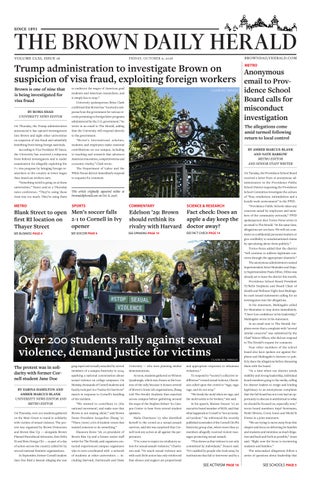
Over 200 students rally against sexual violence, demand justice for victims
CLAIRE KE / HERALD
The protest was in solidarity with former Cornell student Jane Doe BY ZARINA HAMILTON AND AMBER MARCUS-BLANK UNIVERSITY NEWS EDITOR AND METRO EDITOR On Thursday, over 200 students gathered on the Main Green to stand in solidarity with victims of sexual violence. The protest was organized by Brown Democrats and Brown Rise Up — alongside Brown Planned Parenthood Advocates, Zeta Delta Xi and Beta Omega Chi — as part of a day of action across the country called for by several national feminist organizations. In September, former Cornell student Jane Doe filed a lawsuit alleging she was
gang raped and sexually assaulted by several members of a campus fraternity in 2024, sparking a national conversation about sexual violence on college campuses. On Monday, thousands of Cornell students and faculty took part in a “Justice for Survivors” march in response to Cornell’s handling of the incident. “We wanted to contribute to (the national movement) and make sure that Brown is not staying silent,” said Brown Dems President Jacqueline Zhang ’27. “There (were) a lot of student voices that wanted someone to do something.” Eleanora Rowe ’28, co-president of Brown Rise Up and a former senior staff writer for The Herald, said organizers contacted experienced campus organizers who in turn coordinated with a network of students at other universities — including Harvard, Dartmouth and Duke
Anonymous email to Providence School Board calls for misconduct investigation The allegations come amid turmoil following return to local control
This article originally appeared online at browndailyherald.com on Oct. 8, 2026.
Blank Street to open Men’s soccer falls 2-1 to Cornell in Ivy first RI location on opener Thayer Street SEE BUSINESS PAGE 4
CLAIRE KE / HERALD
METRO
University — who were planning similar demonstrations. At noon, students gathered on Wriston Quadrangle, which was chosen as the location of the rally because it houses several of Brown’s Greek Life organizations, Zhang told The Herald. Students then marched across campus before gathering around the steps of the Stephen Robert ’62 Campus Center to hear from several student speakers. Malia Chavinson ’27, who identified herself to the crowd as a sexual assault survivor, said she was surprised that Cornell took any action at all against the perpetrators. “I’ve come to expect no retaliatory action for sexual assault violators,” Chavinson said. “So much sexual violence met with such little action has only reinforced that silence and neglect are proportional
PAGE 2
Friday, October 9, 2026
UNIVERSITY NEWS STUDENT GOVERNMENT
Undergrads will be able to propose, vote on campus life improvement projects $25,000 has been dedicated to the pilot participatory budget program
program that is not ensured in future years. Shifrin said he hopes student participation will “prove to whoever the next president might be that this is a worthwhile initiative and it really helps students make an impact on campus.” “This is really our chance to leave a mark on campus,” Cserneczky said. If over 50% of undergraduate students engage with the program, the Office of Community Engagement has also pledged to donate
BY TYLER TIMMERS SENIOR STAFF WRITER With $25,000 secured from the Office of the President, a new Undergraduate Council of Students program will allow students to propose projects they feel will improve campus life. UCS President Ariel Shifrin ’27 said that the UCS has been workshopping ideas to expand student power over shared spaces with President Christina Paxson P’19 P’MD’20 since this spring. In September, Paxson informed UCS that it would receive $25,000 to start the pilot participatory budget program, he explained. Announced on Monday, students will be able to submit proposals online through a Google form or in person at various locations on campus where Student Engagement and Campus Life UCS committees will be tabling, Shifrin said. Proposals can take a range of forms, according to Shifrin. “People can let us know their ideas at different levels of commitment,” he said. This can range from a one-sentence improvement suggestion to a detailed proposal. UCS Chair of Campus Life Balázs Cserneczky ’28 said possible project examples include more furniture on the Main Green, water fountains in dorms or pool tables in dorm lounges. After projects are reviewed by the UCS, a small committee will conduct feasibility
DANA RICHIE / HERALD If over 50% of undergrads engage with the program, the Office of Community Engagement will pledge to donate $5,000 to student-chosen local causes.
assessments and a cost assessment of the submitted proposals, Shifrin said. The UCS plans to submit a number of their own proposals for review, he added. Students will be able to vote on selected project proposals in late November, according to Cserneczky.
The UCS receives funding through the University’s student activities fee, but the Student Activities Office requires that this money be used in specific ways — not including campus improvements, Shifrin added. “The way that the student activities fee had been defined and laid out would not
give us the kind of flexibility that we needed,” Shifrin said. Improvements to shared spaces like dorm lounges and dining halls “were not captured in that scope,” he added. Recognizing that Paxson will be stepping down at the end of the 2026-27 academic year, Shifrin emphasized that this is a pilot
$5,000 to student-chosen local causes, according to an announcement from the UCS. UCS Vice President Meruka Vyas ’28 added that this is important because Brown students “don’t live in an isolated nexus.” “We live within the broader Providence community,” she added. “This is one of the most important things that UCS has done in the past years,” Cserneczky said. “As students, we often feel like we don’t have power, but this is a real chance for us to have power and for us to turn our ideas into a possible reality,” Vyas said. “President Paxson deeply appreciates the role student leaders play in representing the interests and concerns of the student body and has continued to consider proposals from the leaders of UCS over time,” Chief of Staff to President Paxson Dacia Read wrote in a message to The Herald. “President Paxson is hopeful that the pilot will generate broad student engagement, and that students will directly enjoy the benefits of new investments.”
This article originally appeared online at browndailyherald.com on Oct. 5, 2026.
POLITICS
Rep. Al Green shares new Trump impeachment effort, talks money in politics at BIP event The 79-year-old progressive will depart from his position in January BY JAMES LIBRESCO SENIOR STAFF WRITER Rep. Al Green (D-Texas 9) announced plans to file another set of articles of impeachment against President Trump and called on elected officials to stick to their beliefs, even when unpopular, during a Friday talk hosted by the Brown Initiative for Policy. Green will leave his position in January after losing his primary election earlier this year. The 79-year-old staunch progressive and civil rights advocate has served in Congress since 2005. The congressman attracted national attention when he was removed from Trump’s speech to a joint session of Congress in 2025 after interrupting Trump’s speech, waving his walking cane and declaring the president did not have a mandate to cut Medicaid, before he was escorted out of the House Chamber. Green was also removed from Trump’s 2026 State of the Union address after he unfurled a handwritten sign reading “BLACK PEOPLE AREN’T APES!” in protest of a social media post by Trump depicting former President Barack Obama and former first lady Michelle Obama as apes. “Something just came over me,” Green recalled of the 2025 incident to the crowd of about 60 attendees at Friday’s event, jokingly swinging his cane in the air. “I knew that there would be consequences. But I also know that there are just some things worth standing for. You just have to take a stand,” Green said.
HORATIO HAMILTON / HERALD
Rep. Al Green attracted national attention when he was removed from President Trump’s speech to a joint session of Congress in 2025. Green is also known for repeatedly filing articles of impeachment against Trump during both of the president’s terms, a maneuver he has undertaken as recently as August. During Friday’s event, Green announced that he plans to file another set of impeachment articles before he leaves Congress. In an interview after the event, Green declined to reveal what he planned to charge the president with, but alluded to his August filing in which he accused Trump of using federal immigration agents as “ unaccountable paramilitary police forces.” “The atrocities associated with (U.S. Immigration and Customs Enforcement) and (U.S. Customs and Border Protection)
are still continuing, and as a result, these atrocities will have to be addressed again,” Green told The Herald. If the Trump administration sees more members of Congress support impeachment, “it may save some lives,” he added. “My hope is that this can become a deterrent.” Earlier this year, an ICE agent shot and killed a man in Houston, just outside of Green’s Congressional district. The man, who did not have legal status, “was the kind of guy that we would want in this country — working, taking care of his family,” Green said at the event. “We are simply enforcing the laws passed by Congress,” a spokesperson for
the Department of Homeland Security — which houses ICE and CBP — wrote in a statement to The Herald. “Demonizing federal law enforcement for doing their jobs is reckless, dishonest and beneath the office he holds.” The White House did not respond to a request for comment. At the event, Green said that members of Congress should hold to their belief systems regardless of outside pressure. “The seat is important, but the job that we do to protect the American people is more important,” Green said. “I’m going to do that job, and it cost me my seat.” Green lost his primary race to incum-
bent freshman Rep. Christian Menefee (D-TX 18) after Texas redrew its legislative districts in what was widely considered an attempt to increase the number of Republican seats. Menefee’s campaign was heavily funded by pro-cryptocurrency groups that have taken credit for his victory. Green — a member of the House Committee on Financial Services — has called for stronger regulations on the cryptocurrency industry. Green told The Herald that the “billionaire class” had inserted itself into politics. “As a result, they are influencing elections,” he said. “They want their people to be in key positions.” Green said he supports the Congressional seniority system, which elevates the longest-serving members of Congress to committee leadership roles. The system has been criticized by other progressives who claim that it hands greater power to older members of Congress. But Green said that the system is beneficial for those without large financial backings. “When seniority loses, then money will rule,” he told The Herald. “I’m very much afraid that we’re moving quickly in the direction of ‘money rules.’” Jay Chavan ’30, who attended Friday’s event, said he viewed Green as “very defiant in his viewpoints.” “That is something very uncommon in a lot of the representatives we have today,” Chavan added. “And it is something that I look up to him for.” “On some issues, dear brothers and sisters,” Green said, “it is better to stand alone than not stand at all.”
This article originally appeared online at browndailyherald.com on Oct. 4, 2026.
THE BROWN DAILY HERALD
PAGE 3
UNIVERSITY NEWS ARTIFICIAL INTELLIGENCE
New AI literacy seminar helps faculty create, redesign courses with AI in mind Courses remodeled in the program range in subjects BY ISAAC HESSMAN CONTRIBUTING WRITER On Friday, the Sheridan Center for Teaching and Learning, in collaboration with the University Library, began private discussions between student and faculty teams in its new Seminar on AI Literacy. Throughout the seminar, 10 three-person teams will create or alter an undergraduate or graduate level class to facilitate student development of AI literacy in different disciplines, according to Eric Kaldor, the program’s coordinator and director of assessment and transformational programs at the Sheridan Center. The seminar’s teams each include a faculty member and a student from the course’s intended audience. Courses being remodeled in the program range in subjects from chemistry to East Asian studies, said Associate Provost for Artificial Intelligence Michael Littman.
Applicants to the program were asked to “express a commitment” to offer the class discussed in the seminar by the end of the 2027-28 academic year. According to Kaldor, the seminars are intended to empower faculty to feel like they can “make a difference” in the University’s approach to AI. Kaldor said that many of the faculty members who joined the seminars wanted to “rethink assessments.” Some faculty members told Kaldor that they want students to learn how to do research, but now, with growing use of AI, assigning research papers “doesn’t make any sense,” he said. Kaldor said that initial conversations around AI literacy focused on tool-use fluency. “Now, it’s much clearer that (AI literacy involves) critical thinking, ethical reasoning, centering human values, doing metacognitive reflection and tying in your expertise in a specific domain.” Littman stressed the importance of a department-specific approach. In departments like English, there is a “real concern” that improper AI usage will cause students to “lose (their) ability to think,” he said. During the first month of the semi-
nar, the student and faculty groups will experiment with AI tools in their specific domains. The latter portion of the seminar will focus on course design. One team in the seminar is investigating how students learn to write in foreign languages through tools like Grammarly. “There’s a lot of ways that that could undermine student learning,” Kaldor said. For example, AI grammar editors can damage an individual’s development of their own voice, he said. “We want you to be able to still be in control of your writing.” The seminar comes as concerns about AI and education have proliferated in the past year, especially after an incident of widespread cheating on an economics takehome midterm last spring. The Herald spoke to students on how they feel the University should implement AI — if at all. They had mixed opinions. Jonathan Viene ’29, an international and public affairs concentrator said, “It’s probably a good idea to at least try it out, but I’d like to see the University steer clear of AI as much as they can.” Viene added that he does not use AI for his own work. “It seems like Brown and (its) educa-
KAIA YALAMANCHILI / HERALD
Kaldor said that many of the faculty members who joined the seminars wanted to “rethink assessments.” tors are trying their best,” Aditi Borra ’28 said. She added that it can be difficult to “draw the line between academic honesty or dishonesty” while also “matching the way the (AI) industry is moving.” Borra added that she thinks AI usage should vary by department, with STEM classes requiring different policies than humanities classes, where “you want students to be able to write using their own brains.” Jon Corbin ’28 said he believes AI “should stay out of the humanities entirely.” He said AI stifles the “creative works you’re meant to create” in these courses.
Through the seminar, Kaldor hopes that addressing common concerns will bring the University together. “One of the things we’re trying to overcome is sometimes there’s a portion of Brown’s community that feels like people are forcing them to use AI.” Kaldor added that AI literacy is not about forcing people to adopt new technology but rather “about trying to maintain your choices.”
This article originally appeared online at browndailyherald.com on Oct. 8, 2026.
SECURITY
Brown to relocate DPSEM, split across three buildings New economics building will be built on the site of the current building BY ROMA SHAH UNIVERSITY NEWS EDITOR
Following in the footsteps of cultural leaders such as actor Tim Blake Nelson ’86 and designer Sasha Costanza-Chock, Chico MacMurtrie joins a long line of artistic icons who have spoken at the Brown Art Institute’s “Ruckus Sessions.” The newest addition to the recurring series — which BAI advertises as “debate club meets house party” — showcased a candid conversation
on MacMurtrie’s life, work and influences. The original plans for the new economics building would not have impacted DPSEM, but would have included tearing down four residential structures. In the current proposal, two residential buildings are still at risk of demolition. In the Friday press release, the University shared that there were “long-standing space constraints” in the DPSEM’s current location. The DPSEM will also have a 24/7 walkin station located on 205 Meeting St. This building will house services such as “walkin report filings, witness interviews, fingerprinting, lost-and-found management and safe transaction spaces,” according to the
announcement. The location is currently occupied by Bagel Gourmet, “whose owner previously approached Brown to note that he planned to wind down operations,” the announcement reads. The third new site will be a desk located in the Campus Center, so public safety officers can be accessible from a central location on campus. According to the announcement, the new set of locations will improve the DPSEM’s campus public safety operations in line with the University’s recently released Safety and Security Action Plan. “Most officers are positioned at locations and on patrols across campus — out
on foot, bicycle and vehicle patrols across the entire campus 24 hours a day, seven days a week — rather than in public safety buildings,” the announcement reads. “With new, dedicated hubs in high-traffic student areas and a base for administrative operations in the Jewelry District, the department will be able to maintain strong connections with the community.” The Meeting Street and Campus Center locations are anticipated to open in late spring 2027, and the Jewelry District location will open in June 2027. VICTORIA YIN / HERALD
This article originally appeared online at browndailyherald.com on Oct. 4, 2026.
According to a University statement, there were “long-standing space constraints” in the DPSEM’s current location.
Submissions: The Brown Daily Herald publishes submissions in the form of op-eds and letters to the editor.
SINCE 1891
THE BROWN DAILY HERALD 136TH EDITORIAL BOARD Editor-in-Chief Cate Latimer
Rebecca Goodman
Managing Editors Ciara Meyer Elise Haulund Claire Song
University News Editors Emily Feil Rebecca Goodman Samah Hamid Zarina Hamilton Ivy Huang Ian Ritter Alejandro Ruiz Roma Shah
Senior Editors Hadley Carr Paul Hudes Max Robinson POST- MAGAZINE Editor-in-Chief Elaina Bayard
Sports Editor Sajiv Mehta
COMMENTARY Head of Editorial Page Board Ethan Canfield
NEWS Metro Editors Michelle Bi Pavani Durbhakula Talia Egnal Emily Feil Amber Marcus-Blank Science & Research Editors Ivy Huang Ian Ritter Alice Xie
Opinions Editors Talia Berkwitz Ethan Canfield Christian Davis Isabella Gardiner Lucas Guan Avery Kaak CJ Lair Clara Murray Arya Vishwakarma
Arts & Culture Editors Ann Gray Golpira
PRODUCTION Copy Desk Chief
Chelsea Long Assistant Copy Chief Sofia Segarra Design Chiefs Emily Bao Maggie Ruan Design Editors Chloe Johnson Kailey Marti MULTIMEDIA Photo Chiefs Annamaria Luecht Kaia Yalamanchili Illustration Chiefs Kendra Eastep Isabela Guillen Video Chiefs Cienna Cheng Cody Cheng Social Media Chiefs Nate Barkow Annika Melwani Technology Chief Yassir Aouf Data Desk Chief Caleb Ellenberg
Games Chief Paul Hudes Podcast Chief Talia LeVine Multimedia Editors Marat Basaria Harry Guo Horatio Hamilton Selina Kao Diya Khetan Ella Le Kenna Lee JJ Li Jake Parker BUSINESS General Managers Arjun Deshpande Anum Azhar Sales Directors Arjun Ray Hannah Han
Op-eds are typically between 600 and 900 words and advance a clear argument related to a topic of campus discourse. You can submit op-eds to opinions@browndailyherald.com. Letters to the editor should be around 250 words and respond to an article or column that has appeared in The Herald, or critique or commend The Herald’s editorial decisions. You can submit letters to the editor to letters@browndailyherald.com. Submissions undergo multiple rounds of editing. These rounds of editing generally take place over the course of one evening, and you may have to respond to edits late in the evening. If you know you will be unable to do so, please mention that in your email, and we will do our best to work with you. Submissions can build on reporting from The Herald, reporting elsewhere, official statements from the University or other groups and other reputable sources, but they cannot break news or contain information that The Herald cannot verify. Because we cannot publish unsubstantiated information, failure to provide appropriate sources may mean we have to modify or remove unverified claims. The Herald will not publish anonymous submissions or submissions authored by organizations. Leaders of student organizations can be identified as such but cannot write under the byline of their organization. The Herald cannot publish all submissions it receives and reserves the right to edit all submissions. All submissions to The Herald cannot have been previously published elsewhere (in print or online — including personal blogs and social media) and must be exclusive to The Herald. Once your submission is published in The Herald, The Brown Daily Herald, Inc. owns the copyright to the materials. Commentary: The editorial is the majority opinion of the editorial page board of The Brown Daily Herald. The editorial viewpoint does not necessarily reflect the views of The Brown Daily Herald, Inc. Columns, letters and comics reflect the opinions of their authors only.
Finance Director Sydney Wright
Corrections: The Brown Daily Herald is committed to providing the Brown University community with the most accurate information possible. Corrections may be submitted up to seven calendar days after publication. Periodicals postage paid at Providence, R.I. Postmaster: Please send corrections to P.O. Box 2538, Providence, RI 02906.
Office Manager Cary Warner
Advertising: The Brown Daily Herald, Inc. reserves the right to accept or decline any advertisement at its discretion.
@the_herald
facebook.com/browndailyherald
@browndailyherald
@browndailyherald
88 Benevolent, Providence, RI (401) 351-3372 www.browndailyherald.com Editorial: herald@browndailyherald.com Advertising: advertising@browndailyherald.com
The Brown Daily Herald, Inc. is a financially independent, nonprofit media organization bringing you The Brown Daily Herald and Post- Magazine. The Brown Daily Herald has served the Brown University community daily since 1891. It is published Monday through Friday during the academic year, excluding vacations, once during Commencement and once during Orientation by The Brown Daily Herald, Inc. Single copy free for each member of the community. Subscription prices: $200 one year daily, $100 one semester daily. Copyright 2023 by The Brown Daily Herald, Inc. All rights reserved.
PAGE 4
Friday, October 9, 2026
METRO BUSINESS
Blank Street to open first R.I. location on Thayer The acclaimed coffee and matcha shop will fill the vacancy left by Starbucks BY NATE BARKOW AND TYLER TIMMERS SENIOR STAFF WRITERS In a few months, Blank Street will touch down in Rhode Island for the first time, just steps away from Brown’s campus. The new location will open at 218 Thayer St., filling the vacancy that Starbucks left after an abrupt closure last year. “We had a few dozen places that were interested, and we decided Blank Street was the best fit for that location,” said Harrison Dulgarian, the senior vice president for Dulgarian Properties, the company that leases the space. Dulgarian said they chose the cafe chain to fill the vacancy because “they obviously have a strong standing financially,” and he also thought Blank Street would “go well with the community.” Blank Street was founded in Brooklyn, New York in 2020 by Vinay Menda and Issam Freiha. The chain started as a small coffee cart in a Williamsburg garden, and has since grown to include over 100 shops across the United States and United Kingdom. “I think they have been looking for the right space in Providence for quite some time,” Dulgarian said.
The new location will open at 218 Thayer Street. A representative for Blank Street said the company declined to comment “for now.” While the timeline of the location’s opening is not yet established, “they’re starting on construction very soon,” Dulgarian said. “If I was going to guess from experience, I would say (it will take) two to three months to open.”
“They’re definitely going to do an extensive build-out,” Dulgarian said. “Everything’s going to be brand new in this space,” including electricity, heating, plumbing and barista machinery. Thayer Street has experienced a lot of turnover recently, with the closure of stores like Spectrum India and Berk’s Shoes and Clothing, in addition to restau-
SELINA KAO / HERALD
rants and cafes like Bagel Gourmet Ole, Aroma Joe’s, Kung Fu Tea and Tiger Sugar. Many businesses on Thayer Street have told The Herald that they’ve struggled with increasing rents and inconsistent foot traffic since the COVID-19 pandemic. Indy Singh ’29 said that he believes the opening of Blank Street on Thayer street
demonstrates that the city is up-and-coming. “New York has Blank Street, Boston has Blank Street and now Providence has Blank Street,” he said. “I think we are on the same level.” For Ai Okura ’28, her excitement is just about having more choices. “I’m excited (to have) more cafes on Thayer, more places to go for coffee and hang out,” she said. Riyana Srihari ’27 said she currently buys a lot of her matchas from Ceremony. Now that Blank Street is opening, she said she “might switch it up and hit Blank Street” when she is craving a matcha. But Anna Wong ’28 has concerns that Blank Street’s opening could hurt other local businesses. “I think that depending on the pricing, I maybe would try it once,” she said. “But I have my favorites like Coffee Exchange, (and other) local businesses. I definitely want to support them.” Dulgarian owns several properties on the street in addition to 218 Thayer Street. He told The Herald that a restaurant that sells Italian food is set to move into the old Spectrum India space, and that he’s received “over a dozen letters of intent” for the space that used to be occupied by Andrea’s.
This article originally appeared online at browndailyherald.com on Oct. 5, 2025.
CRIME
Panel rules Providence police sergeant charged with beating man can return to duty Sgt. Hanley was captured on camera repeatedly hitting Rishod Gore in 2020 BY TALIA KATZ SENIOR STAFF WRITER In August, a second disciplinary panel made up of two current and one former police officer decided that Joseph Hanley — a Providence Police Department sergeant who was captured on camera repeatedly hitting Rishod Gore, a then-28-year-old Black man — should be reinstated after his 2020 suspension for use of excessive force. In a 2-1 vote, the panel ruled that Hanley should receive a 45-day suspension — which he already served — rather than termination. On April 19, 2020, police body cameras and a bystander recorded Hanley repeatedly kicking and punching Gore while he was handcuffed and lying on the ground. Hanley could be heard calling Gore an “animal” and a “savage.” Hanley was found guilty of simple assault and battery in criminal court in 2021. He appealed the verdict and, after a deadlocked jury resulted in a mistrial, accepted a plea deal in 2024. Per the R.I. Law Enforcement Officers’ Bill of Rights, also called LEOBOR, non-probationary police officers have the right to a disciplinary hearing by three current or former officers to determine their punishment for misconduct. Because of the R.I. LEOBOR, the City could not fire Hanley without approval from this panel. A LEOBOR panel met for the first time in 2025 once Hanley’s criminal case had concluded. They found Hanley guilty of three out of 10 violations but ruled that he should be suspended for 45 days rather than being fired. The City appealed the decision and a second panel met this summer, which
MARAT BASARIA / HERALD
A close-up photo of a Providence Police Department police car driving down the road on a sunny day. found Hanley guilty of four violations but maintained the same 45-day suspension punishment. The City of Providence plans to appeal the August reinstatement. “Mayor (Brett) Smiley continues to believe that Sergeant Hanley’s termination is necessary to uphold the standards expected of Providence police officers,” City of Providence spokesperson Josh Estrella wrote in an email to The Herald. “Hanley’s conduct does not reflect the professionalism and integrity that the department is meant to uphold,” he added.
Hanley is currently suspended with pay pending the City’s appeal. Michael Colucci, Hanley’s lawyer, wrote in an email to The Herald that Hanley wants to “return to the job that he loves and spent most of (his) adult life doing — protecting and serving.” “The tide has turned and I see a lot of reaction that suggests this officer should be returned to his job,” Colucci wrote. In an email to The Herald, Steven Brown, executive director of the American Civil Liberties Union of Rhode Island, described the trajectory of the case as
“disappointing, but not totally surprising.” “The case exemplifies all that was wrong with LEOBOR and the onerous obligations it imposed on police departments” disciplining officers’ misconduct, he added. In 1976, Rhode Island became the third state nationwide to enact LEOBOR protections. Some consider the state to have some of the strongest police protections in the nation. In 2024, against a backdrop of advocacy against officers’ insulation from punishment, Gov. Dan McKee signed reforms to LEOBOR into law. These reforms adjusted
the panel’s composition, punishment scale and level of public transparency. For example, the panel makeup was altered from three officers — one selected by each side and one by a neutral party — to include three randomly-selected officers, a judge and an attorney. Notably, the panel is still majority-police. But according to Steven Brown, “the revised version of LEOBOR has numerous flaws of its own,” because the reforms are “largely cosmetic.” “Ultimately, any statute providing police officers” and not other government employees “with unique and strong protections against the imposition of discipline is simply unwarranted,” Steven Brown wrote. A spokesperson for McKee did not immediately respond to a request for comment. Since Hanley was charged before the reform bill was signed into law, his panel is governed by the older LEOBOR guidelines. Colucci wrote that the previous LEOBOR panel makeup has “worked very well” while “the new process is proving to be more costly and less efficient for both sides.” Meanwhile, some have criticized the costs that the city has racked up in prosecuting Hanley. According to NBC 10, the City has spent almost $400,000 in legal fees on this case. “While pursuing the matter through the legal process has costs, accountability and ensuring officers meet department standards remain essential,” Estrella wrote to The Herald. To Steven Brown, this financial burden is “the regrettable consequence of having a statute like LEOBOR in the first place.” “At this point, there is no ideal outcome,” he wrote. The case “should have resulted in final disciplinary action a long time ago.”
This article originally appeared online at browndailyherald.com on Oct. 7, 2025.
THE BROWN DAILY HERALD
PAGE 5
METRO SCHOOLS FROM PAGE 1
ELEANOR LOEPER-VITI / HERALD
Providence School Board President Ty’Relle Stephens and Board Chair of Health and Wellness Night Jean Muhingabo each issued statements calling for an investigation into the allegations. have followed the PPSD’s return to local control. Effective July 1, the control of the PPSD was returned from the state to the Providence School Board. The board has since held final decision-making power on prominent district policies. Although the school board oversees
the superintendent’s contract, Montañez maintains sole authority over the appointment of administrators in the district, as stated in a state regulator order issued when statewide control ended. On Sept. 23, the Providence School Board hosted an around four-hour meeting which was dominated by debate over
the board’s conduct and Stephens’ job performance. Prior to that meeting, at least six board members had filed a motion to remove Stephens from his role as president. The school board has also been accused of violating the Open Meetings Act by privately discussing the removal of the board president
in advance of the Sept. 23 meeting, according to an email reviewed by The Herald. “It’s unfortunate that we mainly spoke about school board politics at (the Sept. 23) School Board meeting instead of issues impacting our students, faculty and staff,” Torres-Perez wrote in a statement to The Herald. “I will say my job has become more
challenging because of how the board is being run and the impact it is having on my leadership team.” “My focus remains on our students, and my hope is that following this meeting the board is able to resolve their issues and work with my team to move the District forward,” Torres-Perez added.
ENVIRONMENT
Over half of tested Tiverton wells contain ‘forever chemicals’ well above state limit $1 million in USDA funding will bring water to hardest-hit homes
this year through a targeted, EPA-fundedprogram that samples private wells near
BY DHRUV JAIN STAFF WRITER More than half of the private wells tested in Tiverton contain PFAS — also known as “forever chemicals” — at levels above the state’s drinking water standard, according to the Rhode Island Department of Environmental Management. PFAS are linked to serious health effects, including reproductive issues and developmental delays in children. Of the 184 wells with available test results, 101 exceeded the state limit of 20 parts per trillion, according to Evan LaCross, a RIDEM spokesperson. As of Sept. 16, seven homes tested above 1,600 ppt, and one well reached roughly 4,000 ppt — the highest level ever recorded in a private well in Rhode Island and nearly 20,000% the legal limit. RIDEM wrote in a statement to The Herald that the source of the contamination has not been confirmed. In 2023, The Herald reported on a draft RIDEM report that listed fire stations and fire training areas among the major sources of PFAS contamination in Rhode Island. David Paull, vice president of the Tiverton Town Council, noted that a fire station sits near the contaminated wells, and that the area includes former farmland and old landfills as well. The town is working to test a 400-foot-deep capped well at the fire station for PFAS. “We literally do not know what the cause is,” Paull said. PFAS have been used since the 1940s
RAINIER PEDERSON / HERALD
to make products resistant to water, grease and stains, and some take centuries to break down in the environment, Rhode Island Department of Health spokesperson Joseph Wendelken wrote in an email to The Herald. “While we are still learning more about how these chemicals impact health, we do know that exposure to PFAS has been linked with a variety of health effects, including higher cholesterol levels, lower infant birth weights, weakened immune response and increased risk of some cancers, including kidney cancer,” Wendelken wrote. RIDOH is advising people not to drink well water with PFAS levels at 70 ppt or more, he added. RIDEM is installing filtration systems in homes whose wells test between 20 and 1,600 ppt. So far, ten systems have been installed and ten more have been scheduled. Wells above 1,600 ppt cannot be treated with standard filtration systems, so the town is working to extend a public water
line to those homes, according to LaCross. “Once you hit a certain threshold, you can’t even filter the water,” Paull said. Paull has been working closely with one resident in the hardest-hit area, who sends neighbors Paull’s way when they need water. Last Friday, Paull met a resident who had just gotten her well test results back and was in tears. He gave her eight cases of water. Another woman called him to say that she had been bottle-feeding her baby with her well water and had known nothing about the contamination, he said. Until a permanent solution is in place, the town is providing bottled water to affected residents. According to Paull, Shaw’s supermarkets donated a tractor-trailer with 24 pallets of water, which is now stored at the town’s public works facility. Paull said he often meets residents there or delivers the water to residents himself. According to Paull, the longer-term solution is a public water line. Last week,
the town received $1 million from the U.S. Department of Agriculture’s Emergency Community Water Assistance grant to help the North Tiverton Fire District — which provides water service in the area — extend its pipeline down Crandall Road. The line will first reach homes with the most contaminated water and then expand to every residence in the area, Paull said. The pipeline extension wasn’t expected to happen until next year, but the town now hopes to move much faster. “Our goal is to get water to those most affected residents before the first snowfall,” Paull added. “We’re working at lightning speed.” Paull said U.S. Department of Agriculture officials told the council that pressure from the offices of U.S. Sen. Jack Reed, D-R.I., and U.S. Rep. Gabe Amo, D-(R.I.-1), helped the grant move so quickly. “They expedited things at a pace that we probably haven’t seen in government,” he said. RIDEM began testing wells in the area
potential PFAS sources such as old landfills, gas stations and fire stations. “We started getting … emails from residents saying, ‘What is going on here? My well just came back contaminated with PFAS,’” Paull said. “We got blindsided. (RI) DEM didn’t even tell our administrator that they were doing this.” “Due to the sensitive nature of private well testing and trying to balance homeowner privacy and the town’s right to know, initially, (RI)DEM contacted homeowners prior to notifying town administrators,” RIDEM Chief of Public Affairs Kim Keough wrote in a statement to The Herald. The agency has since changed its approach so that homeowners and the town are notified “simultaneously,” she added. Paull also said many residents threw away RIDEM’s initial letter because it carried a University of Rhode Island logo and did not appear official. Keough wrote that the official letter has only the RIDEM logo, but the document came with a PFAS tip sheet that the RIDOH created with URI. When residents credit him for delivering water late at night or in the pouring rain, Paull said he tells them it has been a team effort. “As a team, we’re getting this done,” he said. “There's been a lot going on in the background that the public just doesn't see,” Paull said. “There’s really nothing more important than having fresh clean water and having it as soon as possible.”
This article originally appeared online at browndailyherald.com on Oct. 6, 2026.
PAGE 6
Friday, October 9, 2026
SPORTS SOCCER
Men’s soccer hosts annual Youth Day, celebrates 100 years since team’s founding Youth players came from R.I. Surf Soccer, The Gordon School BY MIRANDA BRADNER-YOUNG CONTRIBUTING WRITER On Saturday, as the men’s soccer team’s (4-3-1, 0-1 Ivy) walked out for their match against Cornell (6-2, 2-0 Ivy), they were joined by the next generation of Brunonian soccer fans. Players from the Rhode Island Surf Soccer Club and students from The Gordon School joined hands with the Bears as they walked out onto Stevenson-Pincince Field for the team’s annual Youth Day. For eight-year-old Alexa Anderson, a R.I. Surf player, this was the highlight of the match. While Anderson’s current favorite part of the sport is that “you get to move around a lot,” she has bigger ambitions for the future. Anderson said she wants to go to Brown and play soccer for the Bears. She got a taste of playing on Brown’s home field during the Youth Day halftime scrimmage. The match day was filled with celebrations and commemorated the 100-year anniversary of the program’s founding. Brown Athletics aims to have each varsity sport host an annual Youth Day with local teams, explained Aidan Dwyer, marketing coordinator of Brown Athletics. Head Coach Chase Wileman shared after the game that the team talks “a lot about having humility and being good guys before good soccer players.” With
KARINA SHAH / HERALD
Brown Athletics aims to have each varsity sport host an annual Youth Day with local teams. Tuesday’s rescheduled matchup against Columbia (3-2-2, 0-1 Ivy) ahead, Wileman added that hosting Youth Day keeps the players grounded and builds perspective. The men’s soccer team suffered a 1-2 defeat to Cornell. The Bears took a 1-0 lead into halftime, following senior midfielder Mathias Hille’s ’27 converted penalty kick. Hille said it was “special” to have the students there to watch. “It is an honor to have people look up to you,” he added. The crowd’s youthful energy helped
maintain lively spirits as the Bears defense held off the Big Red until a goal in the 58th minute. After that, Brown kept the game tied at 1-1 for much of the second half. But with fourteen minutes left, the Big Red’s Adam Schaban broke through and scored. Nine-year-old R.I. Surf player Ahrel Messon encouraged his teammates on R.I. Surf to cheer on the Bears throughout the game, adding that he thought the best part of the game was Hille’s penalty kick. Soccer is “just entertaining,” he said, “(It was) very, very fun to watch.” Even when he’s on the field, Messon
keeps that enthusiasm alive — he said his favorite aspect of playing soccer is “yelling.” Eight-year-old Jagger Atamian, a defender for R.I. Surf, also said his favorite part of the game was Hille’s goal. Watching the older players was “pretty cool,” he added. Even after the loss, the young supporters were eager to celebrate the Brown players, who signed autographs and took photos after the game. Wileman added that the joyful presence of the young fans helps remind the
players of when they were that age and “playing the game for the love of it.” Defender Shayne Thompson ’27 also appreciated seeing the community come together over soccer and the opportunity to give younger players a glimpse into collegiate athletics. “I’m more than happy to always look out for the younger generation,” Thompson said.
This article originally appeared online at browndailyherald.com on Oct. 4, 2026.
SOCCER
Men’s soccer falls 2-1 to Cornell in Ivy opener Bruno took an early lead before conceding two goals in the second half BY HARRY GUO SENIOR STAFF WRITER After more than a week-long break, the men’s soccer team (4-3-1, 0-1 Ivy) returned to action on Saturday afternoon for their Ivy League opener against Cornell (6-2, 2-0 Ivy). Following a hard-fought 90 minutes, the Bears were eclipsed by the Big Red, losing 2-1. Brown was originally scheduled to begin conference play on Sept. 26 at Columbia (3-2-2, 0-1 Ivy League), but that match was postponed due to the Nor’easter. So on a sunny Saturday afternoon at Stevenson-Pincince Field, Bruno had their first Ivy matchup of the season. Bruno wasted little time creating its first opportunity. In the third minute, forward Lorenzo Amaral ’27 received a long pass from inside Brown’s own penalty area and quickly dished the ball to forward Carlo Brown ’27, who created a one-two attack by immediately passing back to Amaral. Amaral quickly sent a through ball ahead to midfielder James Snaith ’28, who carried the ball into the penalty area and attempted to dribble around Cornell goalkeeper Filip Versterre, but tumbled over the goalie’s outstretched hands. After a lengthy VAR review of the contact, Versterre received a yellow card, and Brown received a penalty kick. Midfielder and defender Mathias Hille ’27 stepped up to the spot. Versterre attempted to distract him before the kick,
The Bears played the Ivy League opener after more than a week-long break. jawing at the Brown midfielder, but the Cornell goalkeeper’s antics proved unsuccessful. Hille performed a slight stutter step on his run-up before calmly slotting the ball into the bottom-right corner as Versterre dove toward the opposite corner. “I was excited to get the opportunity to take my team to a lead and score a goal,” Hille wrote in an email to The Herald. “I took the opportunity with full confidence.” The goal, Hille’s first of the season, gave Bruno a 1-0 advantage in the fourth minute. But after the penalty, offensive opportunities were scarce for both teams throughout a gritty first half. One of Brown’s most promising chances to extend its lead came 38 minutes in. On the Bears’s first corner of the afternoon,
Hille sent the ball curling toward the net, forcing Versterre off his line. But the Cornell goalie met the challenge and punched the ball out of danger. After halftime, Cornell turned up the pressure. Four minutes in, the Big Red nearly found an equalizer off a corner kick. A powerful Cornell attempt appeared headed for the back of the net, but Snaith cleared the ball off the goal line. Cornell continued their offensive streak with another corner, but Brown turned the set piece into a counterattack. Amaral raced down the sideline with two defenders trailing him before firing toward Cornell’s goal, but Versterre dove to his left to make the save.
KARINA SHAH / HERALD
The Bears threatened again in the 58th minute. Forward Donovan Mark ’30 won the ball from a Cornell defender with a strong shoulder-to-shoulder challenge before finding Carlo Brown, whose attempt was denied by Versterre’s outstretched leg. To counter the counter, Cornell turned the defensive stand into an offensive chance — and finally broke through. The Big Red carried the ball down the sideline before sending a cross into the middle of the penalty area, where Cornell’s Ashton Wray directed a low bullet of a shot into the net and leveled the contest at 1-1. Brown called for a VAR review for a potential offside, but the goal stood. “Looking at chances it was a very even game,” Hille wrote, but the team lost mo-
mentum in the second half and struggled to keep possession in the final third. Both sides continued searching for a go-ahead goal. Ultimately, Cornell outstripped Bruno in the 76th minute. From the corner, the Big Red drilled a cross into traffic in front of the net. Cornell forward Adam Schaban connected with the delivery and sent the ball into the bottom right corner, giving Cornell a 2-1 advantage. “Cornell capitalized on their chances while we didn’t, and that’s what made the difference,” Hille wrote. Suddenly trailing after leading for much of the afternoon, Bruno pushed forward with urgency in search of an equalizer. With less than two minutes to go, Snaith kicked a long cross toward the Big Red penalty area that looked to be on its way into the net, but Versterre reacted rapidly to make his fourth and final save of the afternoon. Only ten seconds later, Brown got one final opportunity to score. But with nearly the entire Cornell team packed behind the ball, the Bears were unable to convert, and the Big Red held on to hand Bruno a 2-1 defeat. “We can take positives from the first half performance and learn from what happened in the second half,” Head Coach Chase Wileman wrote in an email to The Herald. “As long as we stick together and stick to our process, results will come.” The Bears will look to create a favorable result in their rescheduled match against Columbia this Tuesday at 6:30 p.m. in New York.
This article originally appeared online at browndailyherald.com on Oct. 5, 2026.
THE BROWN DAILY HERALD
PAGE 7
SPORTS SOCCER
Women’s soccer draws 2-2 against Penn Despite trailing 1-2, the Bears rallied with a goal in the 87th minute BY RAHUL SAMEER STAFF WRITER On Saturday evening in Philadelphia, the women’s soccer team (7-2-2, 1-0-1 Ivy) took on Penn (5-4-2, 0-1-1) for its second Ivy League match of the season. After Brown secured a decisive 4-0 win against Columbia on Sept. 26, Saturday’s draw against Penn put Bruno to the No. 2 spot in the Ivy League. Despite both sides’ inability to convert any opportunities in the first half, both teams scored two goals in the second. The game’s result marks the first draw of the Ivy League season. “This was a gutsy performance from our team,” Head Coach Kia McNeill wrote in an email to The Herald. “We knew Penn was going to throw everything at us and give us their best performance, and they certainly did.” From the opening whistle, the Bears went on the offensive, keeping play largely within Penn’s half of the pitch. Five minutes in, defender Kyra Treanor ’28 launched the first shot of the game. The
ball careened through the air in the direction of the net, but the Quakers’ goalkeeper Josephine Hensley made an acrobatic leap
About five minutes after Birtwistle’s goal, Penn’s forward Lily White charged forward and intercepted the ball from Bru-
lowing 11 minutes despite earning three corner kicks and four shots. With just four minutes remaining, Cap-
to the side and deftly caught the ball, keeping the game scoreless. Penn fought back against Brown’s aggressiveness. Dashing upfield, Penn forward Abbey Cook dribbled toward Brown goalkeeper Addison Etter ’29. Though Etter dove in an effort to intercept the ball, Cook managed to maneuver past her and shoot on goal. But her shot sailed wide right. Cook’s attempt would prove to be the only Quaker shot on goal of the first half, while the Bears shot on goal five times. Twenty-four minutes into the game, the lights at Penn’s Rhodes Field went out, momentarily plunging the pitch into darkness and halting play. In the 38th minute, Hensley saved the Bears’ final shot on goal of the half. The game went into halftime with the score deadlocked at 0-0. Just over 10 minutes into the second half, midfielder Joy Okonye ’27 found herself with a corner kick. Her shot arced toward the front of the goal, heading directly for her teammate, midfielder Brooke Birtwistle ’28. Despite two Quakers leaping to intercept the ball, Birtwistle firmly headed it into the goal, giving Brown a 1-0 lead.
no. She quickly passed to her teammate midfielder Magalí Capdevila, who launched the ball ahead of where Cook was sprinting. Cook easily caught up with the pass and rapidly approached Brown’s goal. As Etter hustled forward, Cook kicked the ball to her right, and her shot found the back of the net, levelling the score to 1-1. As the game approached the final 15 minutes, it seemed like a 1-1 draw was inevitable. Penn’s forward Camarin Choi streaked up the pitch, outpacing all Brown defenders, but Etter knocked Choi’s shot wide in an incredible save. In the next minute, disaster struck for Brown. A corner kick from Penn sent the ball sailing into a cluster of Bears and Quakers just in front of the goal, from where the ball emerged and bounced toward the net. In an attempt to score, Cook stumbled but still managed to head the ball into the net. Brown challenged the goal, asserting that it was a handball, but a replay of the moment proved that it was Cook’s head, not hand, that made contact with the ball, confirming Penn’s 2-1 lead. The Bears could not score in the fol-
devila received the first and only yellow card of the game. As a result, Birtwistle was awarded a free kick from near midfield. Birtwistle’s shot soared high over the throng of players clustered just outside the penalty box, and over Penn goalkeeper Henley’s outstretched hands, finding the back of the net. Having tied the score at 2-2 with a stunning second goal, Birtwistle fell to her knees. “I was honestly overcome with emotion,” Birtwistle said in an interview with ESPN. “I looked at the scoreboard. I was like, what, we have 3 minutes left? There’s no way we drove all this way to lose points.” “I feel like we played very well, but we didn’t play up to our standards, so if I have to score two goals for my team, I might have to do that,” she added. Following the final whistle, the score rested at 2-2. McNeill was “really pleased with (the) team’s ability to stay calm and composed in that moment,” she wrote. “Obviously we would have loved to come away with the win, but at this point in the season, every point matters,” McNeill wrote. “Finding a way to get a result keeps us right in the hunt for the Ivy Tournament
COURTESY OF BROWN ATHLETICS
From the opening whistle, the Bears went on the offensive, keeping play largely within Penn’s half of the pitch. Photo from Sept. 10 game against URI. and the Ivy League championship.” The Bears will face Yale (5-6, 0-2) this Saturday at 3:30 p.m. at home. The Bulldogs currently sit at the bottom of the Ivy League.
This article originally appeared online at browndailyherald.com on Oct. 7, 2026.
FOOTBALL
Football relinquishes Governor’s Cup to URI in last-second defeat The game was Bruno's second consecutive loss at Centreville Bank BY SAJIV MEHTA SPORTS EDITOR For a few precious moments, it looked as if history would smile on Brown football on Saturday. The Bears (1-2, 0-1 Ivy League), propelled by a dominant defensive effort, had created a 10-3 lead over the University of Rhode Island (3-3, 1-2 Coastal Athletic Association) in the early fourth quarter of the 44th Governor’s Cup. Playing beneath the warmth of a blue sky at Centreville Bank Stadium, Bruno seemed poised to replicate the glory of last year’s triumph and erase the sting of their cold, wet loss to Harvard in the same arena a week ago. But 13 minutes and one URI touchdown later, URI kicker Ty Groff nailed a 43-yard field goal to nudge the Rams ahead of Brown at 13-10. For the second consecutive week, the Bears trudged into the tunnel one possession away from victory, and for the eighth time in the last decade, URI lifted the Governor’s Cup at midfield. The low-scoring contest featured a 0-0 stalemate until the closing moments of the first half, when Groff split the uprights with his first field goal of the game — foreshadowing his game-winning field goal at the end of the game. Punts defined the first half: In total, the Bears and the Rams punted 10 times before halftime. Mirroring their loss to Harvard, Saturday’s game was a tale of two units for Bruno. Just as the Bears held the Crimson to their lowest offensive total this year, the Brown defense held URI to the fewest points the Rams have scored over their six games in 2026. But for the second week in a row, the Bears’ offense could only cobble together 10 points. Within the Football Championship Subdivision, Bruno is ranked No. 23 nationally in total defense — and No. 91
For the second consecutive week, the Bears trudged into the tunnel one possession away from victory, and for the eighth time in the last decade, URI lifted the Governor’s Cup at midfield. in total offense. “We’ve had some really good offenses over the years, and I think we got some really good players who can do some good things,” Head Coach James Perry ’00 said in a post-game press conference. “We’ll look at the film, see if we can put (the offense) in a better position ... we won’t overreact.” From the opening kickoff, the Rams and the Bears were mired in offensive woes. Though Rhode Island’s first drive moved 32 yards, they turned the ball over on downs after a short pass attempt was broken up by Max Malo ’27 on a fourth-and-4 at Brown’s 35-yard line. The Bears’ offense could not turn the moment into momentum. After going 3-and-out on three consecutive Matt Childs ’28 rush attempts, Bruno punted the ball back to the Rams. On URI’s next drive, the Rams earned only one first down before punting. The punt pinned the Bears at their own 9-yard line. From there, quarterback James Murphy ’27 sent a high-arcing ball over the middle of the field to Jadon Garza-Pender ’28. The tight end corralled the ball for a whopping 42-yard gain and catapulted Bruno into URI territory.
But the first down would be the only one gained by Brown on this drive. The URI defensive line put heavy pressure on Murphy, and the Bears backed up 2 yards before being forced to punt again. The Bears’ defense cut URI’s following drive short by different means. On a third down from the Rams’ 37-yard line, URI quarterback Tyler Budge launched a long ball down the left sideline to a receiver on a fade. But Brown defensive back Camryn Williams-Dalton ’27 was sprinting in stride with the URI receiver and tracked the ball the entire way, where he leapt into the air and snagged it. “I saw the ball go up, and when the ball was in the air, it’s ours,” Williams-Dalton told The Herald in a post-game interview. “You gotta take it away. So I made the play.” But Brown’s ensuing possession was a disappointing 3-and-out, marking the beginning of 7 successive punts by the Bears and the Rams. Whenever each team began to string together plays, the opponent’s defense would step up, prove their mettle and force a punt. “10 points is not our goal. So I think overall, as an offense, we have to be better,” Murphy told The Herald in a post-game interview. “Every position has to be better.
So my performance is directly correlated to that, so I would say I’m not happy with it.” Receiving the ball with just over 2 minutes and 30 seconds remaining in the half, URI began moving with some urgency. Within two plays — an 18-yard rush and a 23-yard pass — the Rams were at Brown’s 37-yard line. Though they breached the red zone a few plays later, the Bruno defense found its rhythm again and forced a fourthand-12 from Brown’s 26-yard line. There, Groff’s first 43-yarder put the Rams ahead 3-0 heading into halftime. Brown emerged from the locker room and got the ball first. The Bears quickly moved to their own 45-yard line, but after being stuffed on third-and-1, Bruno punted the ball away. For the second straight drive, URI’s offense began stringing plays together and reached the red zone. But moments later, Budge scrambled right and wound up on the receiving end of a hard tackle by Brock Owen ’27. The ball flew into the air, and the Bears jumped on it to take away a sure chance of at least three points away from the Rams. This time, Murphy refused to allow his offense to go 3-and-out. On third-and-10, the senior quarterback broke a tackle and, seeing open space, sprinted for the first down. By moving the chains, Murphy seemed to inject life into the Bruno attack. The first down jump-started a 14-play, 78-yard drive during which Brown used a precise passing performance by Murphy and impressive catches by Elijah Jones ’29 and Childs to reach URI’s red zone for the first time all afternoon. Though the Bears’ drive stalled in the short field, kicker Drew Crabtree ’29 put through a 33-yard field goal to draw Brown even with the Rams at 3-3. After a URI punt, Brown began moving the ball again. But on a 50-50 long ball to Childs, Murphy threw his only interception of the game. “I thought (Childs) was getting grabbed a lot,” Murphy said. “Would have loved
the (pass interference) call there, but hey, that’s life ... I was happy how we bounced back to that.” The Bears’ defense played a major role in that bounce-back, as on the Rams’ next drive, they pounced on a fumble by Budge to earn the Bears offensive possession at URI’s 13-yard line. Childs put his stamp on the game on the following drive. From the wildcat on fourth-and-1 at URI’s 4-yard line, he fought through contact and dove forward, ending up mere inches from the goal line. On the next play, Qwentin Brown ’26.5 took the snap out of the wildcat and followed the offensive line into the end zone for the game’s first touchdown. The point-after made the score 10-3, Brown. URI tied the game back up almost instantly. On the second play of the drive, receiver Marquis Buchanan caught the ball in open space over the middle and sped up to a blistering rate before finally being caught at the Brown 12-yard line with a 68-yard gain. URI quarterback Alex McClelland kept the ball on the next play and practically waltzed into the end zone, and Groff made the score 10-10. Three punts later, the Rams found themselves with the ball at Brown’s 46yard line with 32 seconds left. An extremely costly roughing-the-passer penalty on Tommy Dunn ’27 moved the Rams to Bruno’s 23-yard line — into field goal range, directly leading to Groff ’s game-winner moments later. Dunn is “a very disciplined kid,” Perry said. “I’d be shocked if there isn’t some sort of ‘he got jostled’ moment.” Bruno will be back in action next Saturday, when they look to end their streak of heartbreaking losses in a matchup with Bryant (4-1, 2-0 America East). The game will be the Bears’ first at Brown Stadium this year.
This article originally appeared online at browndailyherald.com on Oct. 5, 2026.
EDITOR-IN-CHIEF Elaina Bayard
the stranger at my door
Section Editor Christina Li
Section Editors Helen Hen Anika Kotapally
HEAD ILLUSTRATORS Lesa Jae Junyue Ma
ARTS & CULTURE Managing Editor Sasha Gordon
COPY CHIEF Jessica Lee
NARRATIVE Managing Editor Gabi Yuan
Andrews/Metcalf/Miller: At the top of the world, these dorms tower over all who draw near. The smell of fresh laundry slips
LAYOUT CHIEFS James Farrington Alexa Gay Amber Zhao
Section Editors Lucie Huang Chelsea Long
out of the vents as you walk by, and you laugh from your lounges when fools try to open the dining hall’s exterior doors to no avail. But as the months draw
Layout Designers Hannah Gapp Lily Rantanen Joshua Rezneck Emma Vachal
LIFESTYLE Managing Editor Hallel Abrams Gerber
on and the seasons change, boredom starts to seep in. The exit signs start to disappear, and even the dry noodle bowl loses its taste. Every Saturday night, your roommate drags
SOCIAL MEDIA Yana Giannoutsos Hung Lam Eva Mahajan Rebecca Sanchez
Section Editors Alayna Chen Tatiana von Bothmer
you down to Jo’s, pretending that they’ll actually use up their swipes. You have no idea why they’re
ISSUU.COM/POSTMAGAZINEBDH
Copy Editors Eve Kobell Kate Schuyler Michelle Wassef Su Yang
Section Editors Gabriella Miranda Rebecca Sanchez
by Alayna Chen
See Full Issue:
FEATURE Managing Editor Chloe Costa Baker
ISSUE 4
excerpt from
Friday, October 9, 2026
POST-POURRI Managing Editor Tarini Malhotra
VOL 38
PAGE 8
on the 20 Weekly, but the microfridge they made you split the cost of is stuffed with so many to-go 19
end of the semester even if they were on Flex 460. Chipotle containers pile up until you swear you
41
can see the smell of beans and cheese. When you leave, you slather on perfume like it’s sunscreen. Pest control has been called multiple times, and you flinch every time something seems to move in
2
3
7
32
1. Inspect 2. of Style 3. Rhodium 4. The ones you’re exposed to when you forget your umbrella 5. -ary, my dear Watson 6. “-ary, My Dear” (Schoolhouse Rock!) 7. LMNO 8. Wade Ripple 9. Of surprise 10. Earth, Wind & Fire
the corner of your eye.
1
102
El E Me N Ts
would be left with at least a hundred swipes at the
OCT 9
boxes and Trader Joe’s freezer meals that they
4
5
6
the case-book of sherlock holmes by Alayna Chen illustrated by Yoonseo Lee
Across
1. Sir Arthur _____ Doyle
7
6. Sherlock's sister, in reverse 7. Metal fastener 8. The middle of the end, as a fairytale 9. What goes between two crèmes
8
Down 1. Was concerned (for) 2. Yellowish green
9
3. "A Study in Scarlet," for one 4. "The End of _____" (Taylor Swift docuseries) 5. Total
8
Cover by Candace Park
Want to be involved? Email: elaina_bayard@brown.edu!
“Any tips on flirting with my lesbian film professor?” “It is a 400-page literature review; it is thrilling.”
THE BROWN DAILY HERALD
PAGE 9
table of contents 1 little
11 roblox's animal hospital
Coco Kanders
Ann Gray Golpira
3 the game of love
13 reflection on a ldr twinship
Christina Li
Semi Jung
7 rejection
15 the stranger at my door
Krisha Pakala
Alayna Chen
9 radio to heaven Alyssia Ouhocine
“Then again, there are privileges to growing up, to standing on the cusp of real adulthood. I’m seeing my passions burgeoning before my eyes and taking classes in cool things, and when I talk to my friends, I get the sense that I am becoming someone real. Plus, what I didn’t mention was that next to my baguette, I had a bottle of wine in my tote bag too.” — Daniella Coyle, “get off my lawn!” 10.11.24
“An aspiring writer says the sky is dark as spilled ink, while a teenage artist says it’s the black of permanent marker.” — Chelsea Long, “it’s like this” 10.03.25
letter from the editor
definitely didn’t need to wear, and reminiscing about the past and present, and meandering along “nontraditional” paths towards your hopes and dreams. This week’s writers take us through their nonlinear journeys. In Feature, Coco muses on her rock-climbing experiences and the shame of quitting. In Narrative, Christina spins us through a “court”-ly love for tennis, while Krisha reflects on rejection and redirection in conversation with a fortune teller. In A&C, the radio star twinkles through time in Alyssia’s piece, and
Dear Readers,
Ann looks at Roblox journeys as both high-stakes and aimless analogies for
The stars spill into the dappled horizon, blending into the sea as the
healthcare and anthropology. In Lifestyle, twins navigate space, time, and
sailors search for their North. If they’re anything like me, they’ll get lost even
shared identity in Semi’s lovely ponderings. Finally, Alayna’s double feature
if maps take them step-by-step from point A to point B. If they’re anything like
in post-pourri and Crossword traipses through Sherlock Holmes’ case-book
me, they’ll find wonder and sublimity in forsaking their nautical guides and
and the twisting corridors and surprises of residential life.
wandering in time and space.
Come flit through post-’s issue this week and join us in our ambling,
Lately, I’ve been grappling with questions of linearity and motion: the
rambling, heartfelt introspections. And maybe next time you go explore,
inexplicable societal push that urges us onward to goals, consequences, futures.
you let go of Google Maps and sail, sans North Star, to the distant lands of
There’s a beauty in the disproportion of a train ride longer than the actual stay;
your daydreams.
in choosing the convoluted route through Fox Point as you listen to long voice messages from your long-distance friend, disoriented in the dizzying vortex of life and love. Surely, there’s just a little extra joy in tripping in heeled boots you
Yours nomadically,
Tarini Malhotra post-pourri Managing Editor
october 9, 2026
9
PAGE 10
Friday, October 9, 2026
COMMENTARY Editorial: Title IX data is not enough — Brown needs an OPINIONS anonymous sexual assault survey Content warning: The content of this article includes descriptions of sexual assault, rape and drugging. The recent reopening of a sexual assault investigation at Cornell has brought sexual violence on college campuses back into the national conversation. The alleged drugging and gang rape of Jane Doe at Cornell’s chapter of the Chi Phi fraternity and the university’s inadequate response has led students at our peer institutions to reassess the safety of their own campuses. Last week, this editorial page board sought to do the same. We found, however, that no surveys about sexual assaults at Brown have been administered since 2019. In a 2014 nationalpush to address sexual violence on college campuses, the Department of Education released a list of 55 universities under investigation for improper processing of sexual assault under Title IX. Brown was added to this list after the University’s alleged mishandling of the assault of former student Lena Sclove ’15.5. In response to this investigation and student demands, the Brown University Task Force on Sexual Assault was assembled. In 2015, the task force released a report making several commendable recommendations. Today, it is clear that one of them has been forgotten: collecting data on sexual violence and making that data available to students. It’s time Brown establishes a regular anonymous survey of sexual assaults on campus. There are two ways that the public might access statistics on sexual assault: through annually released data from universities’ Title IX offices, which include formal complaints of sexual mis-
conduct, and via surveys that allow students to anonymously report their experiences on campus. According to a national survey conducted in 2024, only 37.5% of students believed that allegations of sexual assault would be taken seriously by campus officials. Alarmingly, only 7.1% of students who were victims of sexual assault reported that they had contacted local police. Further, a 2000 study from the Department of Justice found that up to 95% of rapes of college women went unreported. It is abundantly clear that we can not solely rely on data collected from reported assaults. Anonymous surveys would capture a more accurate — albeit still incomplete — picture, as they do not require the multistep, potentially further traumatizing process of filing official incidents to Title IX offices. In 2015 and 2019, Brown chose to participate in the Association of American Universities’ Climate Survey on Sexual Assault and Sexual Misconduct. These external surveys reported sexual assault statistics by directly asking students for their experiences on campus rather than pulling from incidents officially reported to the Brown Title IX office. A comparison of Brown’s 2019 AAU survey data and the Title IX Office’s reported incidents highlights the failure of Title IX reports to represent the extent of sexual assaults on campus. In the 2018-19 academic year, there were 104 total incidents reported to Title IX. Based on the 14.9% of students who reported experiencing nonconsensual sexual contact on the AAU survey, approximately 1,049 students suffered nonconsensual contact that year. That’s
a tenfold discrepancy. In 2022, the AAU announced that it would discontinue its survey after Congress passed a law directing federal agencies to collect such data. Since then, there has been one cross-institutional survey from research agency Westat of 10 universities, including Harvard, Yale and Penn. Brown did not participate. In addition to the many colleges that are mandated by their states to administer surveys, several universities conduct these surveys of their own volition. Princeton has a history of conducting its own survey on sexual misconduct and is currently in discussions regarding a “sexual climate, culture and conduct” subcommittee in the wake of recent events at Cornell. The University of Denver also repeatedly publishes its own sexual assault surveys — most recently in 2022. And the University of Virginia has a similar track record. While the Office of Diversity and Inclusion’s 2025 Campus Climate Survey report states that 69.6% of undergraduates believe that Brown takes sexual harassment seriously and responds appropriately, the University fails to provide any information regarding sexual assault. When Brown presents incomplete information related to sexual violence on campus, survivors are much less likely to process that they have suffered sexual violence. In turn, survivors are less likely to report the crime to relevant authorities. A lack of transparency can also increase the shame and confusion that a student may feel after they have been assaulted, as a former Brown student and Cornell’s Jane Doe experienced.
In the Today@Brown newsletter sent to the Brown community on Oct. 6, the University administration claims to be “resolute” in its efforts to fight sexual violence. If this is truly their goal, the first step is for Brown to prioritize improving available data. While we applaud the acknowledgment of community concerns, the message offers no real changes to Brown’s rape policies nor any suggested changes to how sexual violence will be reported. Our campus needs both proactive solutions to address sexual assault and full transparency surrounding the reality of sexual violence on our campus. Empty promises to “stand ready” when something goes wrong are not enough. Twelve years ago, Brown expressed its desire to be a “national leader” in sexual violence prevention. The Department of Education’s report from a decade ago still has a simple, powerful message: Acknowledging sexual violence on college campuses makes trauma less isolating, and acts as the first step towards combating it. The Brown University Sexual Assault Response Line is 401-863-6000.
Editorials are written by The Herald’s editorial page board, and its views are separate from those of The Herald’s newsroom and the 136th Editorial Board, which leads the paper. A majority of the editorial page board voted in favor of this piece. Please send responses to this column to letters@browndailyherald.com and other opinions to opinions@browndailyherald. com.
Edelson ’29: Brown should rethink its rivalry with Harvard — Dartmouth is the obvious place to start On Sept. 25, Bruno fans packed the stands of Centreville Bank Stadium, and through the wind and cold, rallied behind Brown football, despite the too-little-too-late comeback. It felt like everyone I follow on Instagram was at the game, decked out in brown and white underneath their ponchos and rain jackets. The Herald has conducted data projects highlighting the long-standing tradition of this rivalry over its now 125-matchup history. Rivalries mean a lot in sports. Students are more invested in and more likely to attend rivalry matches — statistics from recent years of Brown football consistently show high attendance when the Bears play the Crimson. Players might feel like they have more at stake, and overall, rivalry games create long-standing traditions, a backbone of sports enthusiasm. While I believe every football game should be as highly anticipated as Brown vs. Harvard, Brown should rethink its primary Ivy League nemesis. Harvard may have the history, but Dartmouth may be a better rival. Currently, Brown vs. Harvard doesn’t function as a traditional rivalry. There are legitimate reasons for the tradition, including the geographic proximity between the two schools. But Harvard treats our rivalry as more like a stepping stone for their marquee matchup against Yale, which serves as their premier rivalry game. Therefore, Brown vs. Harvard lacks the two-way emotional importance and investment necessary for an arch-rivalry. Furthermore, Brown football’s all-time record against the Crimson is dismal: with only 31 wins, 92 losses and 2 ties, it is our worst record against any Ivy League opponent. Losing more often than not doesn’t invalidate a rivalry, but a compelling rivalry needs meaningful competition and, most importantly, investment from both fan bases. Brown already knows what real rivalries look like. Ocean State games against the University of Rhode Island, Bryant University and Providence College make great examples. In particular, the Governor’s Cup attracts major media attention and builds tradition, with the winner taking home the signature trophy. The Crosstown Cup, another tro-
phy fought for by Brown and PC’s women’s soccer teams, is a coveted award in Providence sports. Athletes, fans and alums perceive these games as meaningful and worth fighting for, giving both sides an incentive to claim and keep bragging rights. Brown’s Ivy rivalry should give students on both sides of the stands games to circle on their calendars, create traditions around and maintain school spirit for — producing a matchup that feels meaningful and worthwhile. Most importantly, both schools’ athletes and fans should be fully invested. Brown doesn’t need to reinvent a rivalry, as the Ancient Eight have been competing athletically since the 19th century. It simply needs to cultivate and emphasize one with the right ingredients. A quick glance over the Ivy League shows that Dartmouth would make for the most natural choice. Firstly and most fiercely, especially in football, Harvard and Yale make each other a clear choice by calling their matchup “The Game.” In New York, Cornell and Columbia have an existing rivalry known as the “Empire State Bowl,” making good use of their geographic proximity. South of New York, Penn and Princeton have not only proximity but also the letter “P” to battle over in the mid-Atlantic, in a game I nickname the “Pee Bowl.” This leaves Brown and Dartmouth both without obvious existing rivalries, perhaps because the two schools have forgotten one that already existed. According to Brown Athletics Archivist and Hall of Fame member Peter Mackie ’59, “Brown and Dartmouth were not big enough or powerful enough to compete with Harvard and Yale, so they created their own rivalry which was really, really intense.” At one time, the Brown-Dartmouth rivalry was the second most important in the Ivy League, just behind Harvard and Yale, according to the University library archives. Upon closer inspection, this matchup makes a lot of sense. Brown and Dartmouth are similar in many ways, such as their small student bodies, undergraduate focus and similarly sized endowments. Endowments and class sizes have impacts on both the quality of academic and athletic facilities and recruitment efforts, which naturally translate to
VANSON VU / HERALD
the quality of players both schools can attract. This past year, Harvard spent over $2 million on athletics recruitment, whereas Brown and Dartmouth both spent closer to $1.3 million. Lastly, Brown and Dartmouth are the only Ivies fighting for the earth-toned colors. Our woodsy mascots could even inspire a fun name for this rivalry. Brown and Dartmouth also have a long, fierce history of competition, especially on the football field. Brown football has a better record against the Big Green than against the Crimson, and in 2025, the Bears stunned Dartmouth, the 2024 Ivy League football champions. Dartmouth provides a matchup where Brown can plausibly build competitive stakes in the rivalry. Brown has put up a great fight against the Big Green across sports, most notably in our 15-1 record against the Big Green in men’s lacrosse, 24-12 record in men’s basketball and a 4724 record in women’s volleyball, which just handed Dartmouth another loss on Oct. 2 in five sets. Dartmouth and Brown also currently play each other in the final regular-season football game of the season, which is traditionally when college football rivalry games are played; this timing gives both sides the whole season to prepare and practice. Brown Athletics should invest in making this
rivalry bigger and more meaningful through its marketing, partnerships with student organizations and alumni events. I would also suggest this matchup be given a name and a specific physical prize or trophy that can be traded between the two teams — although hopefully only for short vacations in New Hampshire. Beyond football, as the game will be played in Hanover this year, this rivalry should be pushed in other sports such as soccer, basketball, hockey and lacrosse, so that students can interact with the rivalry multiple times throughout the year. Brown doesn’t need to manufacture animosity toward Dartmouth or abandon its investment in Harvard. It needs to recognize what actually makes a rivalry meaningful: competition, tradition and, most of all, mutual investment. Harvard already has Yale. Brown should find a proper arch-rival. If Brown students love their rivalry “heated,” then Dartmouth should be the obvious choice.
Clay Edelson ’29 can be reached at clayton_edelson@ brown.edu. Please send responses to this column to letters@browndailyherald.com and other opinions to opinions@browndailyherald.com.
THE BROWN DAILY HERALD
PAGE 11
COMMENTARY
Gold ’29: UCS needs to foster spaces for conservative discourse on campus Last month, The Foundation for Individual Rights and Expression released their 2027 College Free Speech Rankings. Brown placed 98 out of 261 — receiving a grade of D on free speech. FIRE states that Brown was “penalized after the student government denied recognition to a student group,” referring to the Undergraduate Council of Students’ rejection of an application to form a chapter of Turning Point USA on campus. TPUSA’s stated goal is to increase high school and college student engagement with conservative thought and politics. Despite TPUSA’s popularity on campuses across the country, the UCS claimed it failed to meet their strict criteria that new clubs must fill “distinct niches” or unaddressed needs on campus. I stand adamantly opposed to TPUSA’s views on almost every major issue. But I also believe that creating space for political opposition is imperative to safeguarding democratic institutions. In fact, the presence of conservative ideas is essential for the strength and education of liberal political beliefs on campus. With very few overtly conservative student clubs on campus — and a plethora of left-leaning organizations — I find myself skeptical of the council’s published reasoning. It doesn’t need to be TPUSA, but for the sake of the student body and the strength of democracy as a whole, the UCS must be willing to foster spaces for conservative thought and debate on campus. Brown’s ideological bubble is no secret — only 6% of the student population reports holding conservative views. This is a real risk for Brunonians across the political spectrum. Like it or not, conservatives represent a higher percentage (33%) of the U.S. population than liberals (26%), and 2025 polling reveals that equal shares of Americans are registered as Democrats and as Republicans, both making up 27% of voters — independent voters represent the largest group. Furthermore, while the majority of young adults still lean left, young voters, particularly men, have shifted notably right in
recent years. Facing this reality, Brown’s predominantly liberal student population is in for a rude awakening after graduation. Even New York City, the most common post-grad destination for Brunonians, is more conservative than our campus. We need to practice healthy debate and discussion now; otherwise, students may face greater difficulties finding compromise beyond College Hill. While there
report feeling uncomfortable sharing their views on campus — and conservative students are far more likely than their liberal counterparts to report discomfort, according to The Herald’s Fall 2025 Poll. Clearly, there is an unmet need for spaces where conservatives feel safe to express and hone their political beliefs. But if our student government institutions are unwilling to allow conservative groups on campus, it seems to send a clear message that their views
RAINIER PEDERSON / HERALD
is disagreement over the productivity of debate in our increasingly polarized world, even imperfect discourse likely offers the best way to sharpen our views. Open debate improves our ability to think on our feet, and it forces us to re-evaluate our own views and give the opposing argument fair consideration. Honest and respectful arguments allow us to see the opposition as more relatable, increasing our ability to disagree without looking down on those with whom we can’t agree. If the UCS does not even provide spaces for conservative views on campus, conservative students will not have the same opportunity as their liberal peers to test out their arguments and find the confidence to share them. Nearly 50% of Brown students
are not welcome at Brown. While the majority of our students may disagree with conservative beliefs, we owe it to them, and to ourselves, to meet them on even ground. And until conservative students are given spaces to discuss and hone their views, a fair discourse seems nearly impossible. In a 2025 column, Opinions Editor Christian Davis ’27 argued that Brown University’s uniquely open culture provides the opportunity to raise up a new, less hateful conservative discourse. Much of the push back against groups such as TPUSA stems from a number of controversies in which members and chapters of TPUSA engaged in racist, homophobic and transphobic rhetoric. While these instances are undoubtedly alarming, they were not cited as
the reason for the chapter’s rejection. It is true that spaces within the modern right have become breeding grounds for hateful and deeply upsetting rhetoric. But it has also been shown that political extremism thrives in silence. By failing to create spaces for conservative brunonians to engage on campus, we force students to harbor ideas within a lone echo-chamber, or to seek out community online — a practice shown to foster further extremism. As it stands, we aren’t preventing bigotry; we are ignoring it. Instead, by creating spaces for on-campus dialogue, the UCS could give conservative students an opportunity to participate in a more communal dialogue, broadening the overall campus political discourse. Engagement between the two sides not only helps to combat the polarization of American politics, but it also better prepares Brown’s mostly liberal student body for the far more conservative world they will enter after leaving College Hill. As a proud alumni of the YMCA Youth and Government program, I was raised on the idea that “democracy must be learned by each generation.” This education can only be obtained through healthy and open discourse. Brunonians from across the political spectrum will inherit the responsibility of preserving our Union. With the current vacuum of conservative ideals on campus, I fear for our ability to pursue progress and compromise in the world beyond our bubble. That is why, despite my strong aversion to Turning Point USA and its ideals, I will still argue for the belonging of conservative groups like them here on College Hill. With New Student Group applications set to re-open this month, I hope that the UCS can also begin to see the value of creating space for political opposition.
Reid Gold ’29 can be reached at reid_gold@brown. edu. Please send responses to this column to letters@ browndailyherald.com and other opinions to opinions@ browndailyherald.com.
Mooney ’29: Brown’s income cutoff for $0 parental contribution is 18 years out of date Brown has made affordability into one of the main points in its pitch to prospective students. On its website, Brown states that its financial aid policies ensure “that no student who belongs at Brown will encounter cost as a barrier.” In Brown’s announcement welcoming the class of 2030, the University claimed “robust financial aid will make Brown more accessible than ever for many of those who enroll.” In recent years, the University has backed up many of its statements with actual financial aid policies: an income threshold for zero parental contribution in 2008, need blind admissions for all students and the Brown Promise in 2018, which replaced all student loans with grants. But while it might seem like Brown has been a leader with its financial aid policies, the University has failed to update a key component: the threshold for zero parental contribution. The zero parental contribution threshold is the maximum household income where parents are not expected to contribute anything to their child’s cost of attendance, which includes books, room and board, and tuition. In 2008, Brown decided that most families earning under $60,000 should contribute nothing to their child’s education. 18 years later, Brown costs twice as much and inflation has diluted these families’ purchasing power, yet Brown’s $60,000 threshold has remained. As the middle class gets squeezed out of elite American institutions of higher education, this threshold directly affects these students’ ability to attend Brown. Amidst a nationwide reckoning with the value of higher education — and as Brown’s cost of attendance approaches the $100,000 mark — the University must reconsider this policy.
Nationally, whether a college education is worth the ever-rising prices is being called into question — a record-low 31% of Americans consider a college education to be very important. In 2013, that number was 70%. There is a growing perception across the country that elite universities like Brown are institutions that only serve to benefit already advantaged students. A report commissioned by Yale found that one of the main causes for souring public opinion of academia is soaring tuition costs. While Yale has since taken steps to address these rising costs — last year they announced that all students from families making under $200,000 per year would attend school with no tuition cost — Brown has made no such similar moves. Since 2008, Brown’s cost of attendance has risen from $47,470 to $97,116. In addition to the income threshold for zero parental contribution staying the same, the income threshold for full tuition coverage — where parents are not expected to pay any of Brown’s $74,568 tuition, not including additional costs related to attendance — has also not changed since 2008, sitting at a $125,000 maximum. This low threshold matters because students who fall just above this range — students from middle-class backgrounds, a group that is underrepresented at elite American institutions of higher education — may struggle to pay for school, deterring them from applying. The economic background of Brown students supports the conclusion that the majority of Ivy League students come from wealthy backgrounds. The Herald’s Spring 2026 poll found that nearly half of Brown students attend with zero financial aid. Only 10% of students receive grants covering
full tuition. A lack of middle-class representation at Brown has historical precedent. A 2017 New York Times report found that 70% of students at Brown came from the top 20% income bracket while only four percent of students came from the bottom 20%. That leaves only 26% of students from the middle class at Brown. Among private universities throughout the country more broadly in 2019, 42% of students were from the middle class. The lack of economic diversity in Brown’s student body stems, in part, from its financial aid policies that hurt middle-class representation. Brown consistently places in the bottom when compared to peer institutions in terms of percentage of students on financial aid and the income threshold for tuition coverage. It is not completely fair to compare Brown’s financial aid policies to schools like Harvard or Yale, whose endowments dwarf Brown’s each by a factor greater than five. However, there are many schools with similar endowment-per-student figures — and even some with lower endowment-per-student than Brown — that have income thresholds for zero parental contribution that far exceed Brown’s. College Raptor estimates Brown’s endowment per student at around $563,000. For example, Johns Hopkins offers free cost of attendance to families that make less than $100,000 per year, yet their endowment per student is $100,000 less than Brown’s, by College Raptor’s estimate. Similarly, Cornell’s endowment per student is around $385,000, slightly more than half of what Brown’s is, and their threshold for zero parental contribution is $75,000. Clearly, Brown has allocated its
budget differently than these schools, to the detriment of financial aid awardment. Enriching economic diversity is to the interest of all students at Brown. It becomes much more difficult to broaden one’s worldview and form connections with people unlike ourselves when the majority of students at Brown come from the same income bracket. But because admission to and attendance at schools like Brown can drastically change students’ economic trajectories, the choices Brown makes surrounding who receives financial aid has consequences far beyond campus. Just as universities can serve as vessels for economic advancement, their admission practices can preserve existing economic inequalities that limit social mobility. The University should establish a committee to consider the proposal from Students for Educational Equity that recommends raising the income threshold for zero parent contribution. This practical step would enable the University to assess the cost of such a policy and how it would affect the amount of financial aid given to students across socioeconomic backgrounds. Brown’s mission statement is to “serve the community, the nation and the world.” This cannot be fulfilled unless Brown increases its minimum threshold for zero parent contribution, enabling more middle-class students to enroll. Max Mooney ’29 can be reached at max_mooney@ brown.edu. Please send responses to this column to letters@browndailyherald.com and other opinions to opinions@browndailyherald.com.
PAGE 12
Friday, October 9, 2026
ARTS & CULTURE EVENT
HIAA class curates interactive ‘Building Books with Dayanita Singh’ event with BAI The show is a collaboration with the New Delhi-based photographer BY KENDRA EASTEP SENIOR STAFF WRITER Upon entering the Brown Arts Institute’s latest exhibition in the Granoff Center for Performing Arts, visitors are met with an interactive pamphlet that deviates from the typical flyer: a foldable zine that acts as the gallery’s catalogue. On Oct. 1, the Department of History of Art and Architecture came together with the BAI to co-host the opening reception for “Building Books with Dayanita Singh,” which was curated by students in the fall 2025 course HIAA 2930: “Museum of Possibilities.” Centered around the New Delhi-based artist Dayanita Singh, the practicum allowed students to collaborate with Associate Professor of History of Art and Architecture Holly Shaffer on the longterm curation project. The exhibition, which features pre-existing works from Singh, was organized by the course’s students throughout the semester. In addition to arranging the space, they also added a variety of interactive elements. Before teaching the course, Shaffer and Singh met in New York and connected through their shared interest in South Asian architecture. The two developed the syllabus for HIAA 2930 together, Shaffer said. “(Singh is) a brilliant photographer, portable photo museum maker and a bookmaker,” Shaffer said. “I’ve always admired her
KAI LA FORTE / HERALD
The project is based on Singh’s 2022 manifesto “Book Building,” which reimagines publication as a vehicle for transforming a space. practice, but also her pedagogy.” The project is based on Singh’s 2022 manifesto “Book Building,” which reimagines publication as a vehicle for transforming a space. The display stars an array of Singh’s pre-existing collections, including “Blue Book” (2009), “File Room” (2013),
“Museum of Chance” (2014) and “Sent a Letter” (2008). Benet Ge GS — a second-year Ph.D. student studying the history of art and architecture — praised “Blue Book” for its innovative display of scattered and torn postcards. He admires how Singh plays with
modularity in the piece, creating “perforations” in a book with “no real set order” to how they are viewed, Ge said. While the exhibition forefronts Singh’s work, it also contains multiple interactive stations created by the students in dialogue with the artist’s oeuvre. Virtual meetings
with Singh throughout the course motivated students to place an emphasis on the literal space, light and architecture of the exhibition. While planning the layout of the exhibition, “we thought about what it would mean to honor (Singh’s) vision,” said monaye johnson GS, a third-year Ph.D. student studying Africana studies. She added that Singh is “big on interacting with her work,” and that the class “wanted something interactive as well.” One of the student’s additions to the space is a camera lucida — a device that invites visitors to pick up a pencil, peer through a pinhole camera and sketch the contours of reflecting light through the window. To further call attention to the physical space, the class added black strips of tape to the floor that run parallel to the overhead beams and lines in the ceiling. Tristan Whalen GS — a second-year Ph.D. student studying the history of art and architecture — designed a bench featured at the front of the exhibition. Inspired by the minimalist work of Donald Judd, Whalen said he hoped the bench would “be in a tectonic conversation” with its accompanying table, inviting visitors to “engage with the work” and offering a “familiar idiom (from) a traditional gallery.” “These kinds of collaborative processes are always a little bit of an experiment,” Whalen said. “It was truly a labor of 100 different impulses.”
This article originally appeared online at browndailyherald.com on Oct. 6, 2026.
EVENT
Chico MacMurtrie speaks about the body, art, expression at BAI ‘Ruckus Session’ MacMurtrie described his journey into the field of robotic sculpture BY AMELIA BARTER SENIOR STAFF WRITER Following in the footsteps of cultural leaders such as actor Tim Blake Nelson ’86 and designer Sasha Costanza-Chock, Chico MacMurtrie joins a long line of artistic icons who have spoken at the Brown Art Institute’s “Ruckus Sessions.” The newest addition to the recurring series — which BAI advertises as “debate club meets house party” — showcased a candid conversation on MacMurtrie’s life, work and influences. MacMurtrie described the process of how he came to the unique field of robotic sculpture. He recalled when he walked into his still-wet artwork, covering himself in paint. While peeling off the dry paint from his body, he “thought that the skin was much better than the painting” and he “started thinking about how it would be to perform in that skin.” Today, human bodily movements, functions and performance serve as inspiration in MacMurtrie’s robotic artworks. “I stepped away from the physical body and started mechanizing those skins,” he said. “I was interested in the awkwardness of being human and how it’s more beautiful than choreographed humans.” MacMurtrie’s artistic process involves a lot of collaboration. His main workshopping and performance installation space, The Robotic Church in New York City, features many of MacMurtrie’s machines and can house up to 120 audience members.
COURTESY OF THE BROWN ART INSTITUTE
Human bodily movements, functions and performance serve as inspiration in MacMurtrie’s robotic artworks. Later in the semester, students in ARTS 1550: “Robots (re)Imagined: Art, Engineering and Speculative Futures” will be taking a field trip to The Robotic Church. According to Nora Ayanian, a professor of the course and an associate professor of computer science and engineering, the
goal of the class is to bring students from different academic backgrounds together. Paula Gaetano-Adi — a RISD professor of experimental and foundation studies and computation, technology and culture — co-teaches the class with Ayanian. “Whether you’re doing art robots
or engineering robots, you need to… start bringing to the table different perspectives,” Gaetano-Adi said in an interview with The Herald. Both professors have taught classes involving robotics and art before, but this is the first class to be entirely collaborative
between Brown and RISD. Gaetano-Adi said she hopes this kind of collaboration with “two faculties coming from very individual, different worlds” will continue into the future. Ayanian shared a similar sentiment, noting that she hopes arts-students in the audience would be inspired by MacMurtrie’s collaboration with engineers. In his talk, MacMurtrie brought up his collaborators, saying, “I work them really hard and put them through a lot, and they come out of it being really skilled.” Gaetano-Adi said she hopes MacMurtrie’s “Ruckus Session” will show students how people can explore the intersection of art and engineering “in the real world.” During the event, MacMurtrie talked about how he finds inspiration in the world around him. For example, one of his machines mimics the action of a woman throwing a rock, a scene he saw while traveling. “You work on the machine, it comes to life,” MacMurtrie said. The session later turned to a discussion on artificial intelligence, where MacMurtrie emphasized the “super special” role of the artist. “Stay true to yourself and don’t pull from the giant library of knowledge and stolen art,” he said. MacMurtrie asked the audience: “Why do we need (artificial) intelligence? … Don’t we want to keep using our brains?” By asking these questions, he emphasized that young people can bring hope for the future of art.
This article originally appeared online at browndailyherald.com on Oct. 7, 2026.
THE BROWN DAILY HERALD
PAGE 13
ARTS & CULTURE REVIEW
‘Unabomber’ searches too hard for an explanation behind a killer The film delivers strong performances but oversimplifies Kaczynski
sponsible for his violence than Kaczynski himself. In reality, Kaczynski’s path from Har-
BY TIMOTHY RO SENIOR STAFF WRITER Netflix’s new release “Unabomber” opens with Thomas Mosser unwrapping a mysterious package in his 1994 suburban living room. The scene immediately devolves into drama as the package explodes. Mosser was one of the three individuals killed by Ted Kaczynski, who was responsible for the injury of 23 more. Director Janus Metz attempts to explain Kaczynski’s evolution in hopes of answering what turns a person into the Unabomber. But for all its ambition, the film falls short, providing an answer that felt too simple and concrete for the grave reality of its subject matter. The film has a promising setup: “Unabomber” is structured along two distinct timelines. The first follows a young prodigious Kaczynski (Jacob Tremblay) after he started at Harvard on a full scholarship at 16 years old. Although he is remarkably intelligent, Kaczynski struggles to adjust to the new environment, leading to his quiet isolation. He becomes involved in a series of psychological experiments conducted by Harvard professor Henry Murray (Russell Crowe), where he becomes subject to a world of psychological distress. Crowe’s performance as Murray is especially unsettling because the professor
COURTESY OF NETFLIX
The film finds further strength in Tremblay’s portrayal of a young Kaczynski. does not appear inherently cruel. Instead, the oversimplified explanations that the his actions seem to emerge from a desper- film later offers. ation for his research to be seen as importThe second timeline takes place years ant. This makes the relationship between later, as FBI investigator Joanne Miller Murray and Kaczynski one of the more (Shailene Woodley) attempts to uncovinteresting parts of the film, particularly er the Unabomber’s identity. With only as Kaczynski becomes increasingly affected scraps of evidence about the man behind by the experiments. the attacks, Miller and her team search The film finds further strength in Trem- for patterns across decades of explosives, blay’s portrayal of a young Kaczynski. His victims and writings. stiff conversations and anxiety around Although the film presents a unique other students make Kaczynski’s lonelistructure — moving between Miller’s purness feel genuine, offering a more complex suit of Kaczynski and the younger man he portrait of his descent into madness than once was — it poorly attempts to recon-
cile the person behind the attacks with the experiences that preceded his crimes. Kaczynski’s animosity toward the world is portrayed as originating from his experience at Harvard alone and what began as a complicated portrayal of an isolated teenager becomes a much cleaner story of an experiment that went too far. The film spends considerably less time confronting the choices Kaczynski made following his college graduation. By not examining his life beyond Harvard, the film makes it seem as if the circumstances surrounding Kaczynski were more re-
vard student to Unabomber was far less direct. After entering Harvard, he earned a doctorate in mathematics at the University of Michigan. Kaczynski went on to become an assistant professor at the University of California, Berkeley at age 25. He abandoned academia in 1969 and moved to a small, secluded cabin near Lincoln, Montana. His first bomb appeared in 1978, many years after his time at Harvard. Over the course of his 17-year-long bombing campaign, every targeted individual was connected to modern technology — a detail that is woefully underrepresented. “Unabomber” is meant to be inspired by true events. If the film was entirely fictional, many of the additions and exaggerations of the real story could make for a fun watch. But a true crime film does not have the same freedom as fiction, especially when these changes try to provide explanations for why a real person committed real acts of violence. The film is disinterested in explaining how authorities actually discovered Kaczynski. After spending much of the film emphasizing the difficulty of the investigation, his identity is uncovered relatively quickly. In the end, his capture reflects the rest of the film — unsophisticated and criminally oversimplified.
This article originally appeared online at browndailyherald.com on Oct. 6, 2026.
REVIEW
‘Heart of the Beast’ struggles to make its landing The film follows a veteran and his dog on their journey for survival BY TIMOTHY SULLIVAN STAFF WRITER If there is anything most Americans can agree on, it’s our nation’s natural landscape and, of course, dogs. Starring Brad Pitt, Paramount Pictures’s wilderness epic “Heart of the Beast” gives audiences a big taste of both, but without outstanding results. David Ayer, known for writing “Training Day” and directing the 2016 “Suicide Squad,” had an estimated $82 million budget for the film. After hitting theaters on Sept. 25, the movie grossed $51 million in domestic and international box offices on its opening weekend. “Heart of the Beast” follows ex-commando James Belmont (Brad Pitt) and his German shepherd, Odin, who is traumatized by his experiences in war, particularly in Iraq and Afghanistan. The movie tracks the charming duo’s harrowing journey through unrelenting dangers after a plane crash into the Alaskan wilderness. Featuring only three human actors, the film is remarkably sparse in its dialogue and instead speaks through its silence and visual portrait of a stunning Alaskan landscape. But despite visual ambitions, “Heart of the Beast” lacks the action or narrative flow necessary to justify the duo’s 101-minute journey. In the film’s pre-release marketing and in its opening sequence, “Heart of the Beast” is eager to make one fact very clear to audiences: The dog does not die. Whether this assurance for audience members averse to on-screen dog deaths
CAROLYN NAKAWUNGU / HERALD
was the original intention of screenwriter Cameron Alexander, Odin’s cemented fate removes any serious stakes from the narrative. Although Odin is sucked out of a crashing plane and attacked by wolves, the drama is dampened by the assurance of the dog’s survival. This suspense-killer is only one part of the movie’s narrative struggle. Early in the film, Belmont lounges in his tent and reads passages from “The Road,” author Cormac McCarthy’s sparse and unsettling account of a father-son trek through postapocalyptic America. As the film attempts to embody “The Road” with silent emphasis
on the importance of relationships in times of adversity, it stumbles over itself with predictable beats and poor pacing. Pitt’s portrayal of the rugged and thoughtful James Belmont demonstrates acting abilities well within his performance wheelhouse of the stoic renaissance man. While James’s steadfast commitment to his canine companion is well represented by Pitt, the slimness of the dialogue prevents a notable acting performance from emerging. The array of clichés combined with J.K. Simmons’s brief but unconvincing portrayal of a rural goldminer stereotype leaves the movie’s emotional core hollow
and unengaging. Not only is there a lack of depth, but the uncomfortably long and silent sequences of changing clothes, pitching tents and other simple activities are rather boring. Although Alaska’s vast natural beauty lends itself to on-camera glory, the film’s repetitive landscape montages fail to take full advantage of the visual space, with uninspired framing and scope. This leaves the film more accurately resembling a nature documentary rather than a movie interested in telling a story through its visual aesthetic. After all, with only one dialogue interaction in the whole movie, audiences
should get to experience a visual style more unique than a video game cutscene or an Alaska tourism advertisement. As an action-packed journey through an untamed northern wilderness, “Heart of the Beast” is enjoyable. But because of a predictable, uninteresting narrative and a photographic direction that does not take full advantage of the landscape, the creators fail to make audiences connect with James and Odin.
This article originally appeared online at browndailyherald.com on Oct. 6, 2026.
PAGE 14
Friday, October 9, 2026
SCIENCE & RESEARCH PUBLIC HEALTH
Study reveals cultural disparities in pediatric refugee emergency department visits in R.I. Mental health visit rates had the largest differences based on culture BY ALICE XIE SCIENCE AND RESEARCH EDITOR A new study by Brown researchers looking at emergency department encounters involving refugee children in Rhode Island found that differences in language and cultural backgrounds led to disparities in how these patients seek healthcare. According to Suraiya Hamidzada, a research assistant at the School of Public Health and an author on the study, the idea stemmed from doctors sharing “anecdotal evidence” that many burn injuries coming into the R.I. pediatric emergency department system were from refugee populations. “They wanted to see if there was actual actual data backing that up,” she said. Giovanna Deluca, assistant professor of emergency medicine and the study’s first author, explained that researchers examined 483 encounters with pediatric refugee patients over an eight-year period. According to Deluca, pediatric refugees in Rhode Island go through Hasbro Children’s Hospital. Upon arrival, the patients undergo a medical health screening exam, which is labeled with an International Classification of Disease code. One of these codes — which classify diseases, causes of death and health conditions — signals that a refugee health exam was performed. By using this code, researchers could identify and analyze the pediatric refugee patients who had visited the emergency department between 2015 and 2023. According to Hamidzada, because the researchers could not categorize the data by the patients’ country of origin, the data was broken down into language groups logged under the visitors’ translator services. From there, researchers found a myriad of differences and disparities be-
SOPHIA LENG / HERALD
The study also found a disproportionately high number of trauma-related visits were concentrated in one zip code. tween those groups. volved and peoples’ influences on why or based on their housing situation, based “What I thought was most interesting they visit and why they seek emergency on their driving situation, their roads, their is that even though Arabic speakers made care,” Deluca said. Next, Deluca said she sidewalks, et cetera.” up the majority of the pediatric refugee ER thinks researchers should interview famiAccording to Stephanie Chow Garbern, visits, none of those visits were for mental lies and their providers to start answering associate professor of emergency medicine health reasons,” Hamidzada said. this question. who was not involved with the study, “it is Spanish and Swahili speakers, which According to Deluca, the study also difficult to make any broad interpretations represent minorities in the overall data, found that a “really high amount of trau- of why mental health and trauma visits made up the majority of mental health-re- ma” visits came from a single zip code in differ by primary language” because the lated visits, she added. “That kind of begs Rhode Island. study is retrospective. the question: Why isn’t this Arabic-speak“That's kind of something to be looked “However, the findings suggest that ing population coming for mental health at,” she said. “Why are patients having further research is needed into how sociovisits to the ER?” more trauma from that zip code? Is it just cultural and micro-geographic differences To reduce these disparities, “the big- by chance that that happened, or are there result in different care-seeking behaviors gest takeaway is that we need to really really more things that could be more sus- and the types of acute medical issues that understand what cultural aspects are in- ceptible to injury or trauma in that area, bring children to the ED,” she wrote in an
email to The Herald. Garbern added that using geographic information systems could help map patterns of trauma and allow researchers to understand geographical differences in emergency department visits. Deluca hopes that future research can address the question: “Is it that certain cultures or populations are less likely to seek care for mental health issues, and if so, why is that the case, and how do we help support them best?”
This article originally appeared online at browndailyherald.com on Oct. 4, 2026.
FACT CHECK
Fact check: Does an apple a day keep the doctor away? Brown experts give advice for staying healthy this flu season
BY ELIZABETH ROSENBAUM SENIOR STAFF WRITER As flu season settles in on College Hill, sniffles can be heard in every lecture hall. In students’ curiosity as to how they can stay healthy, they may turn to an age-old adage: an apple a day keeps the doctor away. The Herald asked experts in health and nutrition at Brown whether an apple a day could actually prevent students from getting sick. “I’m going to call this (saying) partially true,” said Francesca Beaudoin PhD ’17, dean of the School of Public Health and professor of epidemiology and of emergency medicine. Beaudoin pointed to a 2015 study published in the Journal of American Medical Association where researchers analyzed survey data of over 8,000 adults to determine whether or not apple consumption was associated with decreased physician visits. “Part of the reason they did this is because sometimes these phrases that we say actually have good health advice, and sometimes they don’t,” Beaudoin said. The study found that apples are not
associated with fewer physician visits, according to Beaudoin. But still apples have real benefits, she said, citing another study where some adults ate two apples a day for eight weeks and others drank a sugar-and-calorie-matched apple beverage. The participants who ate apples had lower total cholesterol and LDL — also known as “bad cholesterol” — than those who drank the apple beverage, according to Beaudoin. But she noted that decreased cholesterol does not necessarily translate to fewer doctor visits. “I think what (the study) did demonstrate is that apples are a healthy food,” Beaudoin said. She added that eating foods rich in nutrients and fiber that are “beneficial” to metrics such as blood pressure and cholesterol “ultimately will impact whether or not you visit the doctor.” Other Brown experts agree the saying has some merit, but that no single food is a cure-all. As a fruit, apples are “incredibly nutrient dense,” but this does not mean they are “the golden vessel to immunity,” said Assistant Professor of Behavioral and Social Sciences Gabby Headrick. “If you just eat an apple a day and that’s all you’re eating, no way are you going to keep the flu away.” Instead, students should be eating a
EMILY WANG / HERALD
range of nutrient-dense foods in “all colors of the rainbow” to help build antioxidant and immune defenses, Headrick said. Students should aim for five servings of fruits and vegetables per day, Headrick added. “Healthy eating really isn’t that complex,” Headrick said. “It’s just a lot of people really struggle to do it.”
Professor of Behavioral and Social Sciences Meredith Niles also explained that a healthy diet with various fruits and vegetables is “associated with better health outcomes in the long term.” “There’s not a single best diet for all people, so this is part of a much broader health strategy to try to keep the doctor away,” Niles said.
Besides healthy eating, there are other habits that can keep students from visiting doctors. Although Headrick does not claim to be an immunization expert, she said that flu shots protect both yourself and “your shared community.” Niles shares this sentiment, saying the flu shot “is your best option for keeping the flu away.” Additionally, the experts stressed the importance of getting enough sleep and staying physically active. “Our body needs sleep to recover,” Headrick said. She also recommended finding methods of managing stress, whether that is through meditation or spending time with friends and family. Beaudoin also recommends that students should “not just (be) sitting at (their) computer cranking out papers and doing analyses,” and that they instead spend time outside and exercising. “If you’re eating an apple a day but not sleeping, or otherwise eating potato chips all day long, it’s not on its own probably going to entirely keep the doctor away,” Niles said.
This article originally appeared online at browndailyherald.com on Oct. 8, 2026.
THE BROWN DAILY HERALD
PAGE 15
UNIVERSITY NEWS PROFILE
With novel ‘Villa Coco,’ Andrew Sean Greer ’92 strives to write ‘delightful’ literature Greer won the Pulitzer Prize for fiction in 2018 for his novel “Less” BY REBECCA GOODMAN UNIVERSITY NEWS AND ARTS & CULTURE EDITOR When Andrew Sean Greer ’92 took creative writing classes at Brown, people “were not afraid to hurt each other’s feelings,” he said. They were also allowed to smoke cigarettes in the classroom. “Isn’t that just like something from a bygone era?” Greer knew he wanted to be a writer long before he arrived at Brown — since he was 10 years old. This June, he released his eighth book, “Villa Coco,” following his Pulitzer Prize-winning 2017 novel “Less” and its 2022 sequel “Less Is Lost.” During his time at Brown, Greer was a member of the Jabberwocks a cappella group and wrote two shows for the theatre group Brownbrokers. Being in the Jabberwocks “was the first time I had been in anything that was slightly fraternal in that way,” Greer said, adding that he is still friends with some of his former groupmates. After his graduation from Brown — at which he delivered a commencement address — Greer moved to the West Village in New York City, where his share of the rent for a shared apartment with friends was $500 per month. He worked as a temporary secretary,
COURTESY OF ANDREW SEAN GREER
Greer knew he wanted to be a writer long before he arrived at Brown — since he was 10 years old. but he still couldn’t afford to join his three blocks away from Courtney Love. friends when they went out for drinks. “I It was time for Greer to write. “I had just couldn’t hack it in New York,” Greer the rest of my student loan left over, and said. “I didn’t have whatever it took.” So, I just thought ‘I’m gonna see,’” he said. “I he applied to graduate school and ended knew that the hardest thing was to go from up in the master’s of fine arts program at graduate school to becoming a writer.” the University of Montana. He wrote a “terrible” draft of a novel When he wasn’t writing, Greer was and several short stories. “The fire was camping, backpacking or cross-country under me because the money was running skiing. out,” he said. He got a job teaching at a “He was like a gay cowboy for a while,” community college but knew at that point said Angela Robinson ’92, Greer’s friend that he could never go back to a nine-tofrom Brown. The two became friends five job. “I remember I applied for one and during a Brownbrokers production when came home and just broke down in tears they were undergraduates. because I thought, ‘It can’t be over,’” he When he graduated from Montana in said. “I want to be a writer. I don’t care 1996, Greer moved to Seattle. It was “the what else happens.” right place at the right time,” he said; Kurt He collected his short stories into a Cobain had just died, and Greer was living book called “How It Was for Me,” which
was published in 2000. When he got the call from his agent that it had sold, he felt “not joy, but just relief.”
of those rare times in life when something great happens and there are no “repercussions, and you just got to celebrate.”
“I thought … ‘I’m on my way. I can do this now. Whatever it takes. At least I’m not just free falling,’” Greer said. He tried to sell another novel right after, which he described as a “mess.” Instead of trying to revise that manuscript, Greer chose to move on to something new. He had a realization that he “could just write a beautiful book.” “Maybe it doesn’t need a plot,” he recalled thinking. “It just needs a structure and beauty.” In 2001, “The Path of Minor Planets” was published. Since he had been drafting novels at the age of 16, Greer “knew that it was not about all-night bursts of novel writing,” he said. “It was about slow and steady, thoughtful, moving along, discovering things and then revising” — a process he still uses now. In 2013, Greer published his fifth book, “The Impossible Lives of Greta Wells,” which “nobody paid even a little bit of attention to,” he said. He was depressed, and thought, “Screw it! I’ll just write whatever I feel like, and it doesn’t matter. No one will ever read it.’” “It turns out that is a great way to write,” he said. “That’s the right state of mind.” The product of this mindset, “Less,” a comic literary novel, was awarded the Pulitzer Prize nine months after its publication. Greer said winning the Pulitzer was one
“I’ve been proud to watch Andy stay the incredibly kind, generous and affirming person he’s always been, even with all his successes,” Greer’s friend from Brown, Joanna Schwartz ’94, wrote in an email to The Herald. With “Villa Coco,” Greer wanted to “write the silliest book (he) could possibly write.” Greer’s challenge to himself was to “write something that was just delightful.” The novel follows a young man who travels to Italy to catalog the archive of a whimsical and elusive baroness. Schwartz “gobbled up ‘Villa Coco’ in two days,” she wrote. Greer, who lives between Italy and San Francisco, has been on a book tour for “Villa Coco” for the past several months. Before the book came out, Greer was afraid that he “still hadn’t made a good enough argument, even after winning a Pulitzer Prize for a comic novel, that comedy should be seen as as worthy of serious contemplation as serious literature.” The truth about comedy, Greer said, “is that it’s about serious things.” “It wouldn’t be funny if it weren’t awfully close to something that terrifies or upsets you,” he added.
This article originally appeared online at browndailyherald.com on Oct. 7, 2026.
EVENT
Inaugural PROV/DOC festival platforms local filmmakers’ documentaries The Brown Political Review festival took place this past weekend BY TYLER TIMMERS SENIOR STAFF WRITER This past weekend, “CLIMATE-CULTURE-COMMUNITY” was the central theme behind the Brown Political Review’s inaugural documentary film festival PROV/ DOC. The two-day festival showcased documentaries from student, faculty and local filmmakers that spotlighted underreported issues, according to Julianna Muzyczyszyn ’27, BPR’s co-editor-in-chief. Clara Baisinger-Rosen ’27, BPR’s head of multimedia production, said the organizers wanted to “create many opportunities on campus for filmmakers to present their work.” “We are in a social moment where long-form filmmaking and documentary journalism are being threatened by a massive encroachment of misinformation and short-form content, much of it increasingly” generated by artificial intelligence, Baisinger-Rosen said. The festival was headlined and closed out by “Listening to Shadows,” a five-part audio series by Jennifer Galvin ’95 — filmmaker in residence at the School of Public Health —and Wilmot James — professor of the practice of health services, policy and practice and director of the Africa Initiative at the Watson School of International and Public Affairs. James explained that the audio documentary follows his life through apartheid in South Africa, Nelson Mandela’s leadership and South Africa’s response to the HIV/AIDS epidemic, among other topics.
CLAIRE KE / HERALD
“I think about young people today who grew up in democracies, (and how) they’ve taken it for granted,” James said. By understanding the struggle that South Africa endured to become a democracy, he hopes that people will not take separation of powers, freedom under the law and constitutionalized protection for granted, he added. PROV/DOC attendee Ben Underwood ’27 thought that “Listening to Shadows” brought a “really unique perspective” by showing “one person’s path through” the monumental historical moment of creating a democracy in South Africa. “I think it makes it feel much more intimate and less abstract and academic.” Galvin wants “Listening to Shadows” to give people hope. “My hope always with creating stories is that they spark conversation and that they bring people together,” she added. Many of the festival’s other features
were short films, and the first day featured projects that covered a wide range of topics, from the Budongo Forest to rural life in Vermont. While studying abroad in France, Ellie Wu ’28 learned that many workers in the yachting industry are South African migrants who are working illegally on tourist visas so that they can make a life for themselves. Other workers are attracted to the industry due to its reputation of having a large party culture, she said. “Yachties: Inside the Industry,” aimed to highlight the negative impact the industry has on its workers, especially women, and the environment. In her documentary “Rural Living,” Sadie Bell ’28 tells the story of three individuals who spent the majority of their lives in Putney, Vermont. Bell wrote in an email to The Herald that she wondered why some people choose to stay in one
place for several decades. Bell noticed that in many higher education environments, such as Brown, students are “constantly looking for what is to be and what we need to be doing to move toward, not seeing the current now and what is in front of us as enough,” she wrote in an email to The Herald. To Bell, people who live in the present, such as the three individuals in Vermont, “all seem pretty damn happy,” she wrote. Elodie Freymann ’18, a postdoctoral fellow at Brown, released the documentary “Waiting for Alstonia” in March 2026. The film explores the role of Alstonia, a plant species vital to both Budongo Forest’s wild chimpanzees and the people living along the forest’s edge. “I think this story helps demonstrate how complex environmental issues are. There’s never one easy solution,” she wrote.
The film’s second day also saw a variety of documentaries, from films featuring Moroccan artisans to the South African apartheid. “A Bomb Story” by Andrew Hsieh ’28, a video staffer at The Herald, told a story about the past, present and future of nuclear weapons. “It’s also a story about living through tragedy and finding community amidst a broken world,” he wrote in an email to The Herald. Maya Tkachenko ’29, a Herald opinions columnist, spent this past summer in Fez, Morocco where she studied artisanal governance and the evolving role of craft in Moroccan communities. “A New Weave” reflects the everyday lives of Moroccan artisans, as well as how they regained autonomy in the craft market, which is predominantly governed by middlemen, she explained. “I think it’s really important that people, as consumers, consider the effects (of their actions) when (they’re) buying something,” she said. “Think about who it benefits… and what it might mean to the person who made it.” Reflecting on PROV/DOC, attendee Ayla Kattler ’27 said that she believes “there needs to be more of a space for visual and audio storytelling at Brown,” adding that “PROV/DOC is an amazing outlet for that kind of creativity.” “We got so many submissions, which means we’re gonna have to do it all over again next year,” said Gui Sequeira ’28, BPR’s chief of staff. “That’s the really exciting part.”
This article originally appeared online at browndailyherald.com on Oct. 6, 2026.
PAGE 16
Friday, October 9, 2026
UNIVERSITY NEWS ACTIVISM FROM PAGE 1 CLAIRE KE / HERALD
society that teaches us whose safety matters and whose suffering can be ignored.” Doucet said that as a Black anti-hazing fraternity, BOX has a “responsibility to challenge toxic masculinity and to create spaces where people can feel safe.” But he added that while individual responsibility is important, it is “not a substitute for institutional accountability.”
“We need institutions that actually protect survivors,” Doucet said. Amrutha Ramaswamy GS, a second-year Ph.D. student studying health services research at the School of Public Health and a member of the bargaining committee for the Graduate Labor Organization, gave a speech emphasizing undergraduate and graduate student solidarity
when it comes to sexual violence. “I think that it’s really important that we stand in allyship as graduate students with undergrads and undergraduate demands for what the University will do regarding Title IX and protecting students on campus,” Ramaswamy said in an interview with The Herald. “It is our responsibility as students
to advocate with the University to do a better job,” she said. “It’s the University’s responsibility to make sure that every single student can have an education free from violence and fear and discrimination.” Rowe said that Brown Dems aims to collaborate with the Undergraduate Council of Students to host a community forum where anyone can contribute ideas to how
the University can change its handling of Title IX cases. “There are more folks who should have a say in the conversation of demands from Brown than just those who already exist in the activist space,” Rowe said. She added that Cornell’s list of demands can serve as a strong blueprint for these discussions. CLAIRE KE / HERALD
Anwen Paul ’30, a member of Brown Rise Up who attended Thursday’s rally, said in an interview with The Herald that she would appreciate the opportunity to hear other students’ stories and experiences at a community event, especially as a first-year who hasn’t spent much time on campus. “I’m so, so glad that that’s being organized because I feel as though sometimes on-campus conversations are very
decentralized,” Paul said. “It is very hard to communicate anything that gets across to the whole student body.” On Tuesday, the University released an official statement identifying sexual violence resources and Title IX updates. Despite the Sept. 28 Department of Education announcement that reinstated the 2020 Title IX regulation, the University affirmed it does not need to make chang-
es to its Title IX, Sexual Misconduct or Nondiscrimination and Anti-Harassment policies. “The accounts that people across the country have chosen to share make clear the reality that sexual violence remains a critical concern, both on university campuses and nationally,” the statement added. Mindy Wirges, director of investiga-
tions and Title IX coordinator, added in a statement sent to The Herald that the University has made addressing sexual and gender-based violence an institutional priority. Ashe Shirazi ’28, a member of Zeta Delta Xi, said that on behalf of the fraternity, she found “the University’s handling of Title IX cases not just unsatisfactory, but actively damaging to survivors and to
anyone who wants to report their story.” She added that change needs to be made at the systemic level. “We need all fraternities, we need all organizations on campus to really come together and demand that the University take Title IX cases seriously,” she said. The University did not immediately respond to The Herald’s request for comment. SELINA KAO / HERALD