
THE BROWN DAILY HER ALD
Trump
admin asks
Brown to freeze tuition, cap international enrollment for funding advantage, Wall Street Journal reports
Requirements include banning use of race, sex in admissions, hiring
BY CATE LATIMER UNIVERSITY NEWS EDITOR
Brown is among nine universities invited to sign a 10-point memo called the “Compact for Academic Excellence in Higher Education” by the Trump administration on Wednesday, according to the Wall Street Journal.
If signed, the White House said that the agreement will provide the universities
with benefits that include “substantial and meaningful federal grants” and access to “White House events and discussions with officials,” the Journal reported.
The memo lays out a number of demands, including freezing tuition for five years, limiting grade inflation and capping international undergraduate enrollment rates at 15%.
Other requirements include banning the use of race and sex in admissions and hiring practices, as well as requiring university applicants to take the SAT or a similar test.
The universities were chosen because
it is believed they may be “good actors,” May Mailman, the White House’s senior adviser for special projects, told the Journal. “They have a president who is a reformer or a board that has really indicated they are committed to a higher quality education,” she added in her statement.
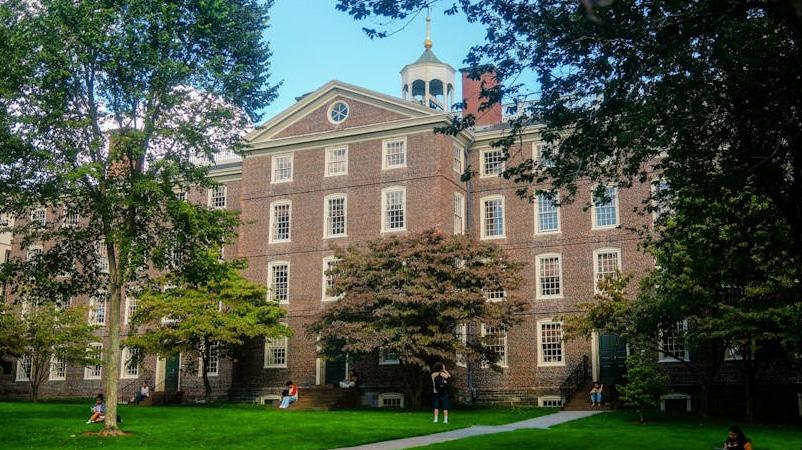
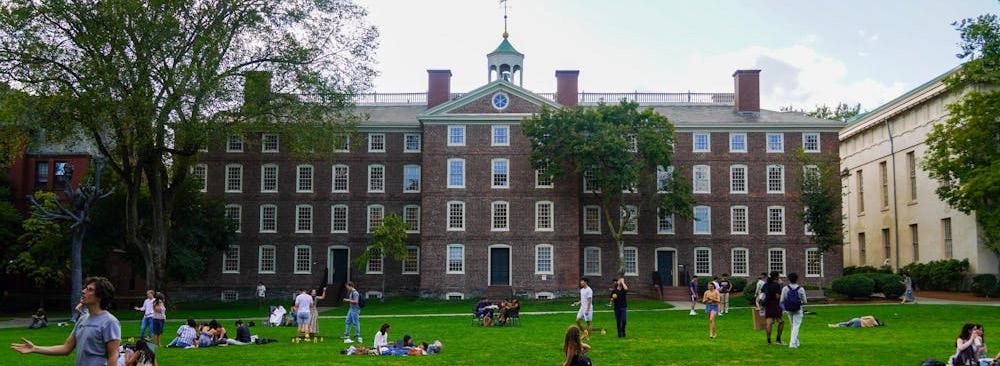
Penn and Dartmouth are the only other Ivy League schools to receive the letter.
The University and the White House did not immediately offer additional comment.
This article originally appeared online at browndailyherald.com on Oct. 1, 2025.
Revolution Wind allowed to resume construction, judge rules
Editorial: A man was detained outside of the Rock — what you can do SEE
PAGE 10
Complaint did not sufficiently prove that Brown raised cost of attendance
BY KATE BUTTS UNIVERSITY NEWS EDITOR
On Sept. 24, U.S. District Judge Sara Ellis dismissed a class action lawsuit accusing Brown, the College Board, and 39 other colleges and universities of increasing
the cost of tuition for students with divorced or separated parents when determining financial aid awards.
Ellis found the plaintiffs’ claims to be “lacking in plausibility,” she wrote in the ruling. The lawsuit was filed in October of last year, The Herald previously reported. The lawsuit is among a series of recent claims accusing the University of antitrust violations in its admissions practices.
The original lawsuit centered on the
Doja Cat’s ‘Vie’ is a stranger to her previous style
Researchers criticize proposed link between Tylenol, autism ARTS & CULTURE
SEE REVIEW PAGE 12
A tribute to late student Federico ‘Fede’ Barrera
Judge dismisses suit accusing Brown, other schools of price-fixing for students with divorced parents UNIVERSITY
College Scholarship Service Profile, a College Board financial aid form that requires applicants to provide both parents’ financial information, regardless of whether they both plan to financially support the student’s college education.
The suit argues that defendant schools used the CSS Profile as an “information-sharing program … (and) exchanged highly sensitive information with the other members of the conspiracy.”
Brown Police Sergeants Union issues unanimous vote of no confidence in police chief, deputy
Vote comes after allegations of toxic workplace, claims that dept. failed to protect safety
BY MAYA NELSON AND SOPHIA WOTMAN UNIVERSITY NEWS EDITORS
In a unanimous decision, the Brown University Police Sergeants Union issued a vote of no confidence in Brown University Police Chief Rodney Chatman and Deputy Chief John Vinson, the union announced in a Monday morning news release.
This limited competition between schools who would have otherwise “competed in offering financial aid in order to enroll their top candidates.”
Ellis found that “nothing in (the) plaintiffs’ complaint suggests that the university defendants exchanged their own internal financial aid decision-making processes or guidelines or otherwise shared with the other university defendants the amount of financial aid they planned to offer a particular student.”
She also noted that the plaintiffs did not allege that the schools shared the same formula for calculating financial aid packages.
While the University requires all prospective first-year students to complete the CSS Profile, “Brown makes all financial aid decisions, including those involving noncustodial parents, independently and in alignment with our own method-
University committee to develop new diversity, inclusion recommendations by May 2026
Committee will also propose an action plan for implementation
BY SOPHIA WOTMAN UNIVERSITY NEWS EDITOR
The press release cites numerous issues under Chatman, who is also the University’s Vice President for Public Safety and Emergency Management.
According to the union, the University has also repeatedly dismissed concerns over an uncomfortable workplace environment, “which has led to zero resolutions for the individuals who keep Brown University’s campus safe,” they wrote in the news release.
The vote, taken on Aug. 27, “reflects serious concerns over the failed leadership, contract violations, and policies that jeopardize pubwas not taken lightly,” union representative John Rossi wrote in an email to The Herald. He said the group has filed multiple grievances and “unfair labor practice charges due to the actions of Chief Chatman and Deputy Chief Vinson.”

President Christina Paxson P’19 P’MD’20 expressed concern about the influence of President Trump’s second term on higher education at Tuesday’s faculty meeting, including threats against Brown’s academic mission and an increased endowment tax.
Paxson emphasized that public confidence in elite higher education has been in decline since well before the election. She argued that the distrust stems from a number of factors, including the cost of university tuition, debates about the value of the liberal arts and public condemnation of “wokeness.”
“These are things that we face all the time, but when we’re in a transition like we are right now, I think some of these are going to come to the fore, especially with concerns about the federal budget next year,” she said.
Provost Frank Doyle, she added, has convened a small working group charged with keeping track of issues emerging out of Trump’s second presidency, “with an eye to how they would affect on-campus constituents.”
Paxson then moved to discuss the recent increased politicization and Congressional scrutiny of higher education.
“One thing I’ve prioritized this year is defending Brown from ongoing public and Congressional threats to higher education,” she said. “This has been a concern for some time.”
In the past year, the House Committee on

Penn and Dartmouth are the only other Ivy League schools to receive the letter.
BEN KANG / HERALD
What Brown students want for the future of the Democratic Party
Herald spoke to students about how leaders should push back against Trump
BY ZARINA HAMILTON AND SOPHIA WOTMAN SENIOR STAFF WRITER AND UNIVERSITY NEWS EDITOR
Since suffering a resounding defeat in the 2024 election, the Democratic Party has been unable to come to a consensus about why they were bested.
Without a clear narrative about what went wrong and how to fix it, the party is navigating murky waters, attempting to find the path forward to retake the U.S. House of Representatives in the 2026 midterms and win back the White House in 2028.
The Herald spoke to several students about their thoughts and vision for the future of the Democratic Party.
For Moz Marchini ’26, the party feels
LAWSUIT FROM PAGE 1
ologies for determining financial need,” University Spokesperson Brian Clark wrote in an email to The Herald.
Brown is “pleased with the court’s decision,” Clark added.
The suit also claims that the use of information from the CSS Profile in determining aid awards leads to some students’ financial situation being inaccurately reflected in their financial aid packages.
The plaintiffs argued that the average cost of attendance for students with
“all over the place and doesn’t really understand what it’s pushing for.”
Marchini and several other students expressed a desire for the party to better represent and respond to its constituents — especially those who identify as part of the working class.
“We are in a time where the rights of working people around the country and around the world are at risk,” Marchini said. “I think the Democratic Party is a very well-situated one to fit those needs.”
She hopes a new set of candidates will aid the party in centering their policies around the working class, adding that a “reduced, clear slate” of party leaders will “help coalesce the party.”
Semyon Sakhabutdinov ’29 noted that the party currently centers much of its rhetoric around the middle class and tends to overlook the needs of the lower and lower-middle class.
He wants the party to create more programs for and provide more assistance to working-class neighborhoods to improve
“quality of life,” he said, adding that he felt the party “should give back” to the people.
Sylvie Watts ’26, the president of Brown Democrats, believes the party should “be more progressive, representative and responsive to the demands of constituents,” she wrote in an email to The Herald.
“Currently, national politics and politicians are detached from the problems people face and want addressed,” Watts wrote, pointing to the cost of living as one example.
In terms of platform, Marchini hopes the party will start “pushing for more genuine, left-leaning policy” rather than trying to appeal to centrists and conservatives.
“Republicans already have people to vote for,” they said. “They’re called Republicans.”
Timothy Ryer ’29 wants the party to focus more on environmental and transportation issues. But in order to take action on critical legislation, Democratic leaders must work to resolve disputes
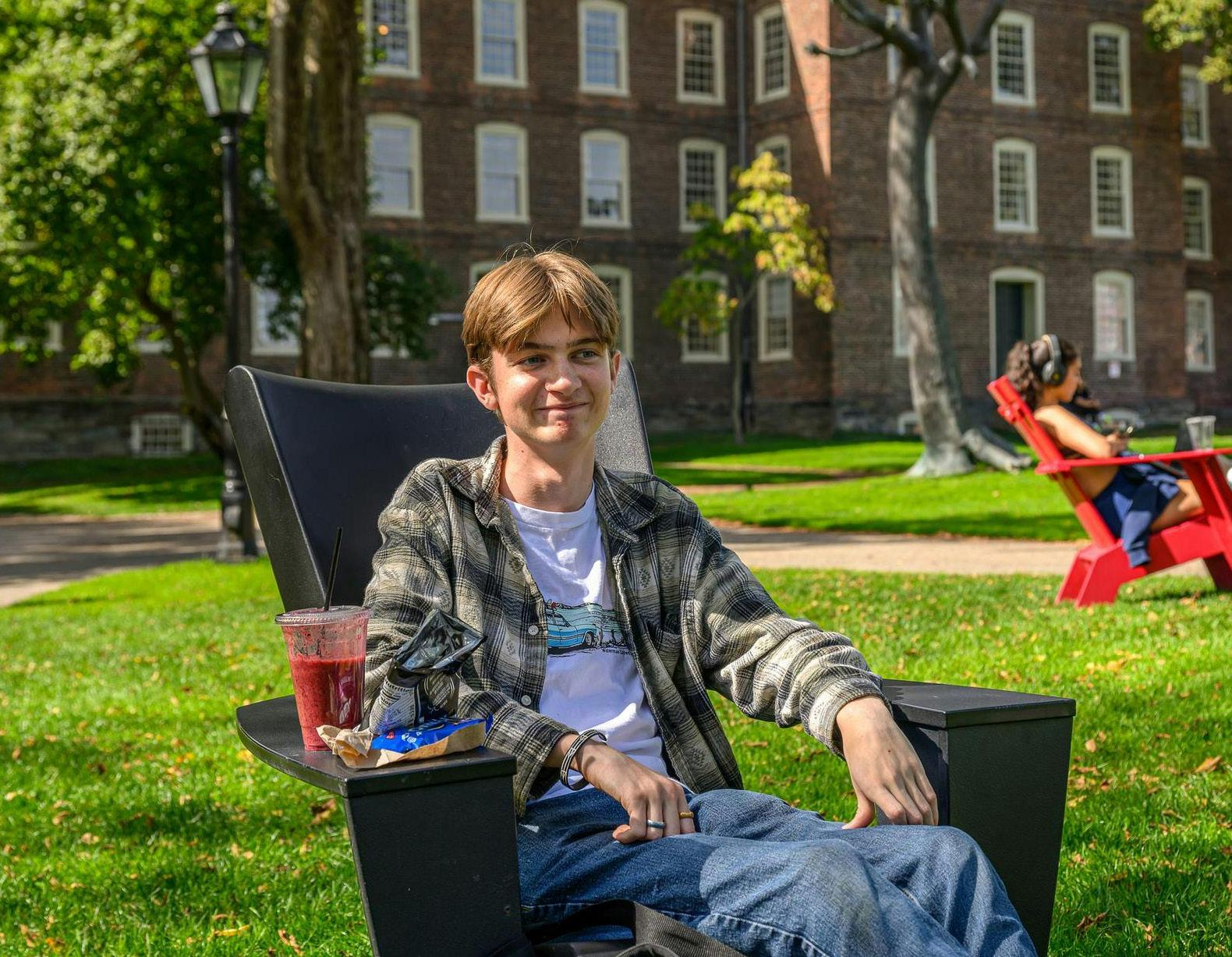
divorced parents was $6,200 more at the defendant schools than at schools where divorced students’ aid is calculated through a different system employed by other top colleges. The lawsuit was filed on behalf of two students allegedly impacted by the price increases. While only the custodial parent must fill out the Free Application for Federal Student Aid, or FAFSA, Brown requires students to provide information on their noncustodial parent’s “ability, not willingness, to contribute,” according to the Undergraduate Financial Aid website. If a parent decides to
“discontinue their financial support for reasons other than ability to pay, Brown will not assume the parental responsibility for financial support of the student.”
But if students are not able to gain financial support from a noncustodial parent, despite “reasonable effort,” they can request an exception, the website states. Clark added that the University gives “full consideration” to these requests and “works directly with students to explore solutions, recognizing that each family’s situation is distinct."
within the party, Ryer added.
“We need to find a middle ground, because with the party being more divided, we’re not going to get anywhere,” Ryer said. “That’s been evident in the last few years.”
Nava Litt ’29 believes these intraparty divisions are largely rooted in generational differences. She pointed to New York City mayoral candidate Zohran Mamdani’s use of social media to articulate his policy goals, arguing that he is “writing a new playbook” for how other politicians should approach communicating their platforms to constituents.
For Ross Williams ’27, younger politicians like Mamdani and Rep. Alexandria Ocasio-Cortez (D-N.Y. 14) should be the future of the party.
Older, more established Democrats like Rep. Nancy Pelosi (D-C.A. 11) and Sen. Chuck Schumer (D-N.Y.), Williams argued, have become “entrenched” in the politics that got them into office and “don’t really consider a new perspective.”
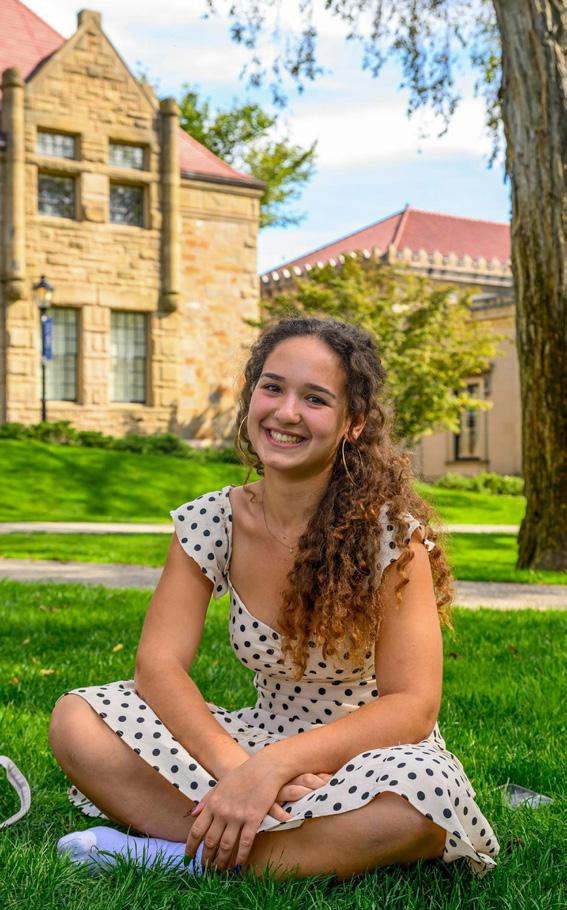
“Having conversations across the generational gap would help,” he said.
Watts also echoed these sentiments, noting that the ideal Democratic candidate would be “younger and willing to listen and adapt.”
Other students, like Sage Edwards ’27, told The Herald that party leaders should be more confrontational.
“What really matters is human life and being empathetic for other people,” Edwards said. “And the way that we can save the most lives is if we fight for it.”
Edwards said that over the last year, she has felt “frustrated” and “enraged” with how the party has handled the Israel-Hamas war. “I feel like many people feel this kind of hopelessness,” she said. “I would want to see leaders that cause change.”
Many students were also frustrated with the party’s lack of response to Trump administration policies and hope the party will take a more confrontational approach in the next few years.
Party leaders are “just batting an eye the other way,” said Sakhabutdinov, adding that the party has done very little to protect immigrant communities from Trump administration policies. Williams echoed this sentiment, adding that the party could do “a little more actual pushback against what’s going on.”
“We could do with a little more actual pushback against what’s going on,” Williams added.
“Democrats should be forceful in defending democracy and protecting people’s rights,” Watts wrote. “This confrontation should come through legislative strategy and mobilizing grassroots energy.”
This article originally appeared online at browndailyherald.com on Sept. 30, 2025.
LIZE DENG / HERALD
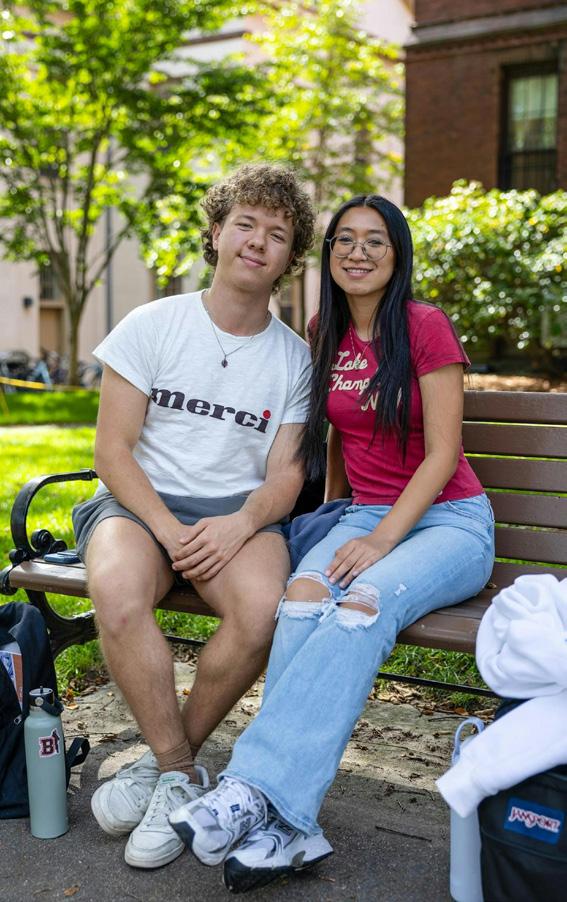
Semyon Sakhabutdinov '29
HORATIO HAMILTON / HERALD
Timothy Ryer '29
HORATIO HAMILTON / HERALD
Nava Litt '29
JAKE PARKER / HERALD
The class action lawsuit follows a series of claims accusing the University of antitrust violations.
KAIA YALAMANCHILI / HERALD
Several students expressed a desire for the party to better represent and respond to its constituents — especially those who identify as part of the working class.
The union claims to have made numerous attempts to work with Chatman and Vinson to remedy these issues, with no success. University Spokesperson Brian Clark said that the union had not been in touch with the University about the vote, mentioning that the union represents 10 sergeants out of DPS’s team of more than 90 staff members.
“We have robust and open lines of communication with union leaders at Brown and routinely work to address issues, priorities and concerns,” Clark wrote in an email to The Herald. “While it’s unfortunate when advocacy around personnel matters happens publicly rather than through direct dialogue, we respect that employees may have concerns at times, and we are committed to working directly with union leaders to discuss those, constructively and professionally.”
Rossi noted that the union had communicated its grievances to President
FROM PAGE 1
Education and the Workforce has held multiple Congressional hearings for university presidents, which have preceded the resignations of three Ivy League presidents at Harvard, Penn and Columbia.
Paxson assured faculty that the University has been “working very collaboratively” with peer institutions and other members of the Association of American Universities to address various institutional priorities.
“We are in Washington a lot,” Paxson said, “talking to legislators and their staff, helping them understand our priorities and understanding their concerns so we can have good conversations.”
She also expressed worry about how an early Trump administration executive order may threaten Brown’s academic mission, including the University’s diversity, equity and inclusion initiatives.
Paxson also echoed concern for international students with visas after a Monday email from the University ad-

Christina Paxson P’19 P’MD’20 as well as Executive Vice President Sarah Latham.
In emails reviewed by The Herald, the University agreed to conduct an internal investigation after initial concerns about Chatman and Vinson were raised. But the
vised international students, faculty, staff members and scholars to return to Providence before Trump’s inauguration on Jan. 20. Trump has previously vowed to reinstate his 2017 travel ban, which primarily targeted Muslim countries.
“Our spring semester starts right before inauguration, so dorms are open and if students feel like they need to stay here over break, we will support them,” Paxson said.
Other universities, including Yale and the Massachusetts Institute of Technology, have issued similar advisories, but no travel bans have officially been announced.
She added that undocumented students, especially those with Deferred Action for Childhood Arrivals status, may be under threat. The DACA program delays the deportation of undocumented immigrants who came to the United States as children and allows them to apply for work authorization. Trump rescinded DACA in 2017, but the Supreme Court overturned Trump’s decision in 2020.
University outsourced this investigation to a CriticalArc, whose management appears to have previous connections to Chatman, which the union believed posed a conflict of interest.
“In any event that we engage an ex-
Following a district court opinion in 2021, no new DACA requests were allowed.
Paxson released a statement following the 2016 presidential election in which she vowed to support undocumented students and detailed Brown’s legal and financial resources for students. In August 2017, Paxson sent a letter to Trump urging him to preserve DACA and establish a path towards permanent citizenship for those with DACA status.
Trump has also said he would increase taxes on large universities in his second term. In 2017, he signed into law a 1.4% tax on endowment investment income for many universities with a per-student endowment exceeding $500,000. At the time, Brown didn’t qualify for the tax, but the endowment is now large enough that it meets the tax threshold, Paxson said.
Additionally, Vice President-elect J.D. Vance introduced a Senate bill to further raise the tax in 2023, which did not pass. Paxson also expressed worry about
UNIVERSITY NEWS
ternal partner to conduct a review or investigation, we take all necessary steps to ensure the independence and integrity necessary to ensure that findings are objective,” Clark wrote.
CriticalArc did not respond to a request for comment.
The union also stated that the effects of mismanagement within the department has led to the degradation of the relationship between the DPS and the Providence Police Department — a relationship they claim is vital to campus safety. Other cited concerns centered around staffing shortages, decreases in morale, violations of state law and retaliation by department management.
Rossi wrote that staff members often face retaliation for filing grievances, leading to “a culture of fear” that “pervades DPS.” As an example, Rossi pointed to the resignation of Captain Chris Dupont, a veteran officer with what he says was an unblemished record.
“After careful consideration, I felt
research funding in addition to Medicare and Medicaid.
“We are working really, really closely with experts in the field and our partners across the spectrum of higher education
compelled to step away due to a highly challenging and unsupportive workplace culture under the current leadership,” Dupont wrote in an email to The Herald. Over the last year, officers at the DPS have alleged instances of harassment based on their gender and sexual orientation, The Herald previously reported. Officers have also raised safety concerns, about themselves and the Brown community, alleging that DPS employees responded with inadequate safety protocols to bomb and shooting threats.
By issuing a vote of no confidence in Vinson and Chatman, the union hopes Brown leadership will press for a more collaborative relationship with DPS employees, rather than what they describe as the current “dictatorial management style.” Chatman and Vinson did not immediately respond to a request for comment.
This article originally appeared online at browndailyherald.com on Sept. 29, 2025.
… to address these issues with the relevant policy makers and educate them and lobby and argue that what we do is important and that we’re here to serve society,” she said.
THE BROWN DAILY HERALD
Design
Design
email, and we will do our best to work with you.
Submissions can build on reporting from The Herald, reporting elsewhere, official statements from the University or other groups and other reputable sources, but they cannot break news or contain information that The Herald cannot verify. Because we cannot publish unsubstantiated information, failure to provide appropriate sources may mean we have to modify or remove unverified claims.
The Herald will not publish anonymous submissions or submissions authored by organizations. Leaders of student organizations can be identified as such but cannot write under the byline of their organization. The Herald cannot publish all submissions it receives and reserves the right


Illustration Chiefs
Tacazon Director of Technology
Annika Singh
PRODUCTION
Copy Desk Chief
Daphne Cao
Assistant Copy Desk Chief
Chelsea Long
Finance
AARON SETO / HERALD
Over the last year, officers at the DPS have alleged instances of harassment based on their gender and sexual orientation, The Herald previously reported.
POLICE
DIVERSITY
TSEYANG AROW / HERALD The University’s Ad Hoc Committee on Diversity and Inclusion will develop a framework to “sustain the diverse and inclusive community that is key to academic excellence,” President Christina Paxson wrote in the announcement.
‘Taylor Swift Tax’ targets owners of RI summer homes, alters vacation real-estate
Pop star could face an additional $136,000 in property taxes next year
BY SANAI RASHID METRO EDITOR
Though Rhode Island’s summer crowds may have left their vacation homes for the season, many will return next year to find a significantly higher property tax waiting for them.
A new surcharge on second homes valued at or exceeding $1 million will take effect July 1, 2026. The Non-Owner Occupied Property Tax will apply to all residences occupied by their owner or long-term renter for less than 183 days per year, and will issue an additional charge of $2.50 for every $500 in property value above the first $1 million.
For example, for a property valued at $1.5 million, the annual tax would now be $2,500, while for a property assessed at $3 million, the annual tax rate would be $10,000.
The bill has been nicknamed the “Taylor Swift Tax” on social media. While Swift has no relation to the tax, the pop star owns a $17.75 million mansion in Westerly and would have to pay an additional $136,000 in taxes starting next year.
According to a report from RIHousing, in 2022, approximately 70% of homes in Westerly were used for “seasonal, recreational or occasional use” — over double the state’s average that year.
In 2024, nearly one in four residential transactions involved buyers from other states, according to the Real Estate Institute
FEDERAL POLITICS

of Rhode Island. For luxury homes valued at $1 million and more, that share jumped to nearly two in five people. Many buyers come from Boston, New York or Connecticut, according to the report.
“Out-of-state buyers often arrive with broader search areas and higher purchasing power,” according to the organization. With so many buyers competing for a limited amount of properties, this “raises the frequency of multiple offers and pushes median and top-tier prices upward,” the report reads.
In Westerly, the median home price is $525,000, according to Redfin, a real estate brokerage company. This is on the lower scale for popular second home destinations in Rhode Island.
In Newport, a coastal town known for
its Gilded Age mansions, the median home price is about $854,000. While in Jamestown, homes sell for a median price of nearly $1.6 million.
Chris Whitten, the president of Rhode Island Association of Realtors, has been a realtor in the state for nearly two decades.
In an interview with The Herald, he said that the “Taylor Swift Tax” is going to be “detrimental” to those who own homes in Rhode Island and potential new buyers.
Whitten has heard stories of other realtors’ clients removing Rhode Island from their lists of potential vacation home locations after hearing about the tax, he said.
“We’re seeing (this) quite drastically across the board,” said Whitten. “Why would you want to invest in a second home here in
Rhode Island when you know you’re going to be paying a lot more taxes?”
Gordon King, who has been a real estate agent in Newport for decades, also shared similar concerns about what the new tax means for Rhode Island’s second home market.
Talking about the tax is now part of each conversation King has with a new client, he said. At the same time, he predicts the tax — though likely to have short-term impacts — is unlikely to generate long-term effects on the real estate landscape in areas like Newport.
“If you want to be here, you’re going to have to pay an extraordinary house price for the house anyway,” he said, adding that the tax “is just another cost” associated with purchasing a vacation home.
This isn’t the first time the “Taylor Swift Tax” has been proposed. In 2015, then-Rhode Island Gov. Gina Raimondo proposed a version of this bill that faced heavy opposition and ultimately did not pass.
King suggested that the tax has gained more traction this time around because of a stronger market and higher demand, explaining that the charge was seen as “regressive” back when it was proposed in 2015.
“Today, inventory is low, demand is high,” he said. “The state has all sorts of revenue and budget problems, and it’s easy for politicians to tax the people that don’t actually vote here.”
The tax has potential impacts for owners who open their second homes in Rhode Island for short-term rentals on sites like Airbnb, which collected approximately $8.2 million in sales across Rhode Island last year.
“We believe in fair and balanced laws that meet the needs of local communities while also protecting the ability of Rhode Islanders to share their homes,” wrote an Airbnb spokesperson in an email to The Herald.
Short-term rental hosts on sites like Airbnb have the freedom to adjust their pricing in response to a variety of factors, including new regulations, tourism demand and increased taxes or costs.
On social media several people were in support of the “Taylor Swift Tax,” with sentiments of “tax the rich” and “every state should do this” floating around in comment sections.
“Working (Rhode Islanders) can’t afford a place to live, and I will stand on the side of regular people until I’m six feet underground,” State Senator Meghan Kallman PhD’16 (D-Pawtucket, Providence) wrote on Facebook, in favor of the tax.
“Tourism is working,” Whitten said. Vacation home buyers “are coming to Rhode Island. They’re falling in love with it, and want to buy a second home here to vacation with their family.”
But Whitten added that with these new taxes, tourism dollars may be driven out of the state.
“Let’s not find ways to prevent them from choosing us,” he added.
Clarification: This article has been updated to more accurately reflect the Airbnb's spokesperson's statements.
This article originally appeared online at browndailyherald.com on Sept. 28, 2025.
How RI congressional delegation is looking to leverage a government shutdown
Federal employees, services may be impacted by the shutdown
BY LEV KOTLER-BERKOWITZ SENIOR STAFF WRITER
With the odds of a federal government shutdown increasing with each passing hour, Rhode Island’s all-Democratic congressional delegation is among others in their party looking to use public outrage from a shutdown as a bargaining chip to prevent health care premiums from increasing.
To pass a short-term stopgap funding bill and keep the government open before the funds run dry at midnight on Wednesday, Republicans are on the hunt for at least seven Democratic senators to join the Republican majority in voting for the funding, reaching the critical 60vote threshold required to overcome a Democratic filibuster.
But Democrats aren’t looking to give away their votes for nothing. In exchange for their support, Senate Minority Leader Chuck Schumer (D-N.Y.) and other Democrats are looking to extend some Affordable Care Act subsidies that are set to expire at the end of this year. President Trump and congressional Republicans have rebuffed this demand — a politically risky move that Democrats believe they can use to heap responsibility for a shutdown onto their opposition.
Rhode Island’s four-person congressional delegation is taking this bet.
“The health care system in Rhode Island and across America is in a crisis with costs to patients spiking because of
massive cuts that Republicans have made across the system,” wrote Noah Boucher, director of communications for Rep. Seth Magaziner ’06 (D-R.I. 2), in an email to The Herald.
He emphasized the vital role the health care credits play in helping “millions of Americans afford their health insurance.”
“If congressional Republicans and Donald Trump fail to extend health insurance tax credits, millions of Americans will face impossible choices, forcing many to forgo needed care,” said U.S. Rep. Gabe Amo (D-R.I. 1) in a press release.
U.S. Sen. Jack Reed (D-R.I.) said that 25 million U.S. citizens dependent on ACA insurance would see an increase of around 75% in insurance premiums.
“Millions more with employer-sponsored coverage could face equal or even higher price increases,” Reed said in a press release.
In a post on X, U.S. Sen. Sheldon Whitehouse (D-R.I.) said that it is “hard to blame Democrats for the shutdown when sources close to Trump say out loud that the president ‘welcomes the prospect of a shutdown.’”
In a statement sent to The Herald, R.I. Senate Minority Leader Jessica de la Cruz (R-North Smithfield, Burrillville, Glocester) sounded the alarm on a shutdown, saying that it would negatively harm the state’s residents, urging them to contact Reed and Whitehouse and “insist they put Rhode Island citizens over party politics.”
She blamed Senate Democrats, calling the attempt to include health care subsidies “a reckless use of political leverage to pass partisan reforms.”
A looming U.S. government shutdown may also affect federal employees and

The shutdown would affect services and agencies funded by 12 discretionary spending bills currently under consideration in Congress. If none are passed, a total shutdown will commence.
the availability of federal services across Rhode Island, though Providence city services and operations will remain unaffected, according to city and state officials. The shutdown would affect services and agencies funded by 12 discretionary spending bills currently under consideration in Congress, including many federal employees’ salaries. Providence residents who are full-time federal government employees “may be directly impacted,” Providence City Council Communications Director Marc Boyd wrote in an email to The Herald.
Roughly 8,600 Rhode Islanders are full-time, non-postal federal employees.
The White House is also preparing mass layoff plans for some federal workers in the event of a shutdown, POLITICO reported. It is unclear whether these plans will be carried out or will directly impact Rhode Island federal workers.
City operations will remain unaffected. The Providence “budget process … is unrelated to the federal budget process,” Boyd wrote.
Federal buildings, such as the courthouse on the east end of Kennedy Plaza
and the Roger Williams National Memorial, may be closed to the public during the shutdown. It may also impact federal services — including financial lending and food inspections — and furlough thousands of workers.
But national benefit programs such as Social Security and Medicare will continue to receive funding, as will federal law enforcement and border patrol agencies.
This article originally appeared online at browndailyherald.com on Sept. 29, 2025.
MAX ROBINSON / HERALD
Taylor Swift's Watch Hill mansion on Sept. 12. Under the new tax, the portion of a property’s value above $1 million will be taxed at a rate of $2.50 per $500.
COURTESY OF DIEGO DELSO VIA WIKIMEDIA COMMONS
ENERGY
Revolution Wind allowed to resume construction, judge rules
Last month, the Trump administration issued a stop-work order
BY TALIA EGNAL SENIOR STAFF WRITER
After the Trump administration attempted to halt construction of Revolution Wind — a $4 billion offshore wind farm off the coast of Rhode Island — a federal judge ruled that the work is allowed to continue.
A federal judge issued an order last Monday, blocking the White House’s stop-work order while the case works its way through the courts.
Construction on the wind farm, which was 80% complete at the time of the stop-work order, resumed a day after the ruling.
Under its 20-year contract with Rhode Island and Connecticut utility companies, Revolution Wind claims it will provide 704 megawatts of electricity at a significantly cheaper rate than fossil fuel sources currently offer.
The farm could end up generating a quarter of Rhode Island’s electricity, The Herald previously reported.
The month-long pause cost the company over $2 million a day, said David Langlais, business manager of Iron Workers Local 37 — one of the unions
HOUSING

representing Revolution Wind workers.
The wind farm paid full wages and benefits during the construction pause, according to Langlais.
The Rhode Island congressional delegation — U.S. Sens. Jack Reed (D-R.I.), Sheldon Whitehouse (D-R.I.), Reps. Gabe Amo (D-R.I. 1) and Seth Magaziner ’06 (D-R.I. 2) — welcomed the injunction as “the right outcome,” in a statement to The Herald.
The project is “set to deliver afford-
able clean energy to the grid at a lower cost to consumers than the current market rate,” Magaziner said in a separate statement to The Herald.
But Revolution Wind is not in the clear yet. The injunction is subject to appeal, and circumstances could change, depending on the final ruling.
Despite this recent court win, Attorneys General Peter Neronha P’19 P’22 and William Tong ’95 — representing Rhode Island and Connecticut, respec -
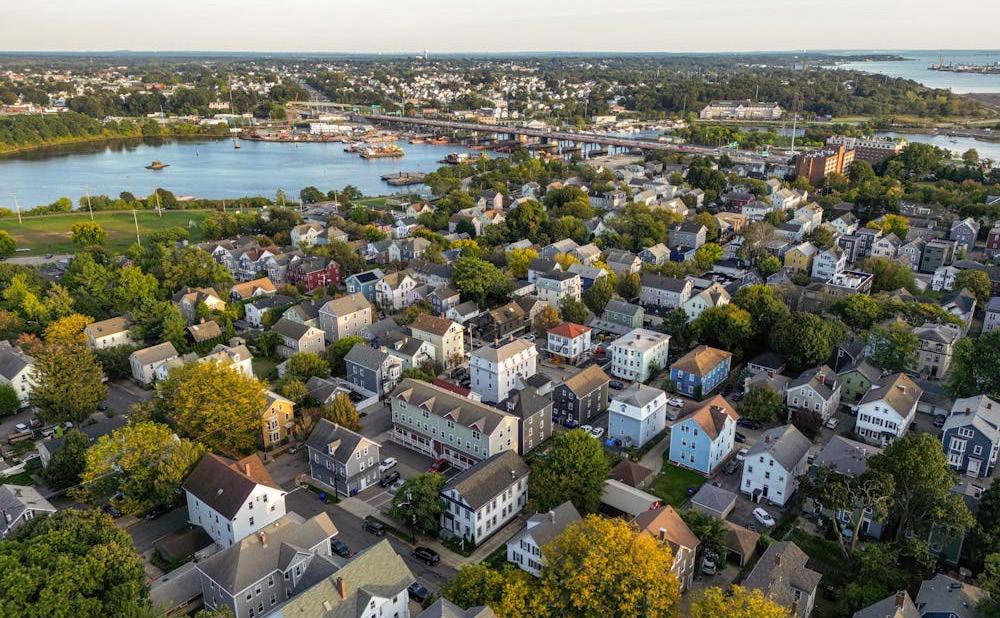
A glimpse into off-campus living
By the end of September, most students have signed leases
BY PAVANI DURBHAKULA SENIOR STAFF WRITER
As October arrives, many Brown students hoping to live off campus next year have already signed leases around College Hill.
Many of these units are owned by the same individuals, commonly nicknamed by students as the “College Hill Landlords.”
The Herald spoke to three of these landlords to learn more about the off-campus housing landscape.
The leasing process often begins more than a year in advance of the leases’ start dates, landlords say. According to David Baskin, a landlord on College Hill, students looking for off-campus housing for the 2026-27 school year started signing leases as early as this May.
Baskin owns three buildings near Brown’s campus: 21 Euclid Ave., 165 Lloyd St. and 159 Lloyd St. Across these three properties, he rents to more than a hundred Brown students.
Bethany Hughes ’10 has 40 students living in her five properties, located at 42 John St., 171 Williams St., 173 Williams St., 175 Williams St. and 208 Williams St. Students began reaching out months in advance to inquire about her available properties, she wrote. She still gets about 10 emails each week from students looking for off-campus housing for next year.
But it’s now too late — all of her properties are full, she wrote.
Edward Kazarian, known by his residents as “Ed,” has been a landlord for about a dozen College Hill properties over the last 40 years. 95% of his tenants are Brown students, he said in an interview with The Herald.
Kazarian, Hughes and Baskin all told The Herald that Brown students are drawn to off-campus housing for many reasons, including flexible layouts, independence and living costs.
In Baskin’s experience, students have largely focused on bedroom and bathroom layouts when choosing a property, he said.
When touring off-campus units last year, Vanessa Vu ’26 and her roommates often came across “odd bedroom configurations, like unequal size of rooms.” The group “toured many places that we didn’t end up liking very much.”
Vu eventually leased a five-bed, onebath unit on John St that her and her roommates currently live in.
Many students also move off campus in hopes of having their own facilities.
“I wanted to live off campus because I wanted a living space of my own, a proper kitchen with modern appliances and an apartment I could modify to my liking,” wrote Alp Güreş ’27, who currently lives in a three-bed, two-bath unit in one of Baskin’s properties. He signed his current lease last September and has already re-signed it for next fall.
He added that he “really wanted a bidet” — something that would not be possible in a dorm setting.
Students “want to have their own autonomy,” Baskin said.
Kazarian also shared a similar sentiment, adding that students may not want to live “under institutional constraints” as they get older. The surrounding neighborhoods become “an extension of campus,” since so many friends groups end up living near each other, he said.
“I already knew I wanted to go off campus for senior year for the feeling of independence,” Vu wrote, “and I felt like none of the existing on-campus options had everything I wanted.” Location factors were also important for Vu, who wanted to live
on South Campus in closer proximity to Wickenden Street and Trader Joe’s.
“The reason why students like my properties is because (they’re) literally on campus,” Baskin wrote, adding that his buildings are in a “very safe location” with on-site management.
“It’s almost like a white-glove service,” he added.
When deciding whether to live on or off campus, a vast majority of students consider the cost of both housing and food.
For the 2025-26 school year, on-campus housing and a 20 Weekly Meal Plan cost a total of $18,514 per year, or just over $2,000 per month. In comparison, most Brown students living in private off-campus housing pay $800 to $1,400 per month, not including the cost of food, according to Hughes.
“It might make economic sense” for students to live off campus, Kazarian said. “Up until this past year, the rents have been pretty steady.”
This year, landlords faced a city-wide property tax increase, but Kazarian said he “tried to keep that impact very, very minimal” for students.
In addition to taxes imposed on landlords, the costs of gas, electricity, water and sewage have more than doubled over the past five years, according to Baskin, who noted that he also needs to pay his employees on top of these expenses.
“We have kept our rent really low,” said Hughes. She charges renters a relatively low monthly rate of $650 to $750 per bedroom “since (she) bought in a long time ago,” starting in her junior year at Brown.
These rates, she said, have “kept demand high.”
Baskin worries that government policies will force landlords to continue raising their rents, he said. He mentioned a proposal put forth before the City Council of Providence which, if passed, would estab-
project’s permits. In an interview with The Herald, Barbara Chapman P’18 P’20, a Green Oceans trustee and member of their legal executive committee, claimed offshore wind turbines disrupt important marine habitats and fishing grounds.
In May, Green Oceans released a 66page report claiming the government could legally cancel offshore wind leases.
The Trump administration remains committed to reviewing Revolution Wind’s permits and their larger fight against offshore wind, White House Spokesperson Taylor Rogers wrote in an email to The Herald.
tively — are pressing on with a separate suit filed attempting to block the federal government’s stop-work order, according to a Sept. 29 filing.
“Though the stop work order is not currently in effect … that situation is tenuous at best,” the filing reads.
The Rhode Island-based environmental nonprofit Green Oceans has also joined Revolution Wind’s suit as an intervenor. They also filed their own lawsuit in January 2024 in an attempt to block the
“President Trump began cutting red tape on day one to lower energy costs and improve grid reliability,” Rogers wrote. She alleged that “offshore wind projects were given unfair, preferential treatment” during the Biden administration and that “the rest of the energy industry was hindered by burdensome regulations,” resulting in high prices.
The Bureau of Ocean and Energy Management intends to continue “its investigation into possible impacts by (Revolution Wind) to national security” as the wind farm resumes construction, Spokesperson Victoria Peabody wrote in an email to The Herald.
This article originally appeared online at browndailyherald.com on Sept. 30, 2025.
lish a $300 “Student Impact Fee” for students living off campus. Landlords would have to collect this fee from students, and Baskin said landlords “don’t want another tax on the students.”
“We hope the students come together with us and (speak out) against this particular ordinance proposal,” he added.
In addition to rising taxes, the landlords of College Hill must contend with a frequent turnover rate among renters. “Students don’t stay more than a year or two at most,” Kazarian said.
“Usually about 10% of my students renew” because they’re juniors, but the rest are seniors who move out after a year, Baskin said.
Güreş is among this 10%. “I will have different roommates, but I’m so happy to say that I won’t be moving out until May 2027,” he wrote.
Though many students only stay for one year, the landlords have little to no issues finding new renters.
For “most of my apartments, the tenants that we get are from referrals from existing tenants,” Kazarian said, adding that “a lot of it’s word of mouth” as students visit their friends’ apartments and express interest in having the spot next year. He sometimes refers groups of students to a
different
unit that will work for them.
Güreş wrote that his apartment building is “so in-demand that you kind of need to have an ‘in’ to be able to secure the unit you want.” His roommate, who is now a senior, lived in the unit last year, so Güreş and his roommates were “prioritized” when signing their current lease.
According to these landlords, the outlook of off-campus housing is bright. Demand is “definitely not declining,” Kazarian said. “I’ve had multiple groups interested in the same quarters,” he added, explaining there is often competition for some units.
Demand has “increased over the past 18 years that I have been investing,” Hughes said, and she foresees that this will continue. “You cannot beat the college experience of living in an off-campus house with several of your friends.”
“I am super happy with my decision to live off campus and the place we have,” Vu said.
For her, nothing is better than “cooking together with (her) roommates and having people over in a homey-feeling space.”
LOKI OLIN / HERALD
landlord if he doesn’t have a
MAX ROBINSON / HERALD
FOOTBALL
Pick season: Football embarrassed by Harvard in 41-7 blowout
The Bears threw three interceptions and allowed 479 yards of total offense
BY LYDELL DYER SPORTS EDITOR
One week ago, the Brown football team (1-1, 0-1 Ivy) garnered national recognition after defeating Georgetown (2-3, 0-1 Patriot League) 46-0 in one of the most exciting season openers in program history. With last year’s heroic victory over the Crimson fresh in their minds, hundreds of Brown students packed the stands of Harvard Stadium on Saturday night to see whether the Bears could take a miracle and make it routine.
But when the lights turned on in Cambridge, Brown all but crumbled. Producing three turnovers and allowing Harvard’s offense to stampede for 479 total yards, the Bears were embarrassed on national television and lost 41-7.
“Credit to Harvard,” Head Coach James Perry ’00 said in a post-game interview. “We knew they were a terrifically talented team. They were very well prepared, and they played very hard.”
From the opening whistle, the game could not have gone worse for the Bears.
On the first play of the game, quarterback James Murphy ’27 dropped back for a play-action pass. Harvard’s Alex DeGrieck hit Murphy’s throwing arm, sending the ball tumbling errantly into the arms of Crimson linebacker Dorsey Benefield, who returned the ball for a 30-yard pick-six.
“I regret that play call tremendously,” Perry said. “We got a little greedy there and ended up catching a bad bounce.” But the problem wasn’t just one play. It was that afterward, “our response to it wasn’t great” either, he said.
On their second offensive drive, the Bears fared slightly better. Harvard’s defensive line dominated Bruno’s front, pummeling past the linemen and crushing the pocket around Murphy. On first down, he was swallowed by the Crimson for an eightyard sack. Facing a faltering passing game, the Bears switched to the ground game, but even sophomore standout Matt Childs ’28 couldn’t break past Harvard’s defensive

front, and after back-to-back unsuccessful plays, Brown was forced to punt.
Despite Brown’s offensive struggles, when the defense took the field for the first time, they looked intimidating. Taking on a Harvard offense that had scored 59 points in their first game of the season, the defense forced them to punt on their opening drive. The stop was punctuated by a vicious hit stick from Nevaeh Gattis ’26, who flattened a Crimson receiver on third down to end the drive at midfield.
But almost as soon as the ball touched the offense’s hand again, things took a turn for the worse. Only three plays into their next drive, Murphy looked for Solomon Miller ’26 on a hitch along the left numbers, but he sailed the ball high. Reaching into the air, Miller tried to corral it one-handed, but instead, he tipped it behind him and into the waiting arms of a Harvard defender. Barely five minutes into the game, Brown had already produced two interceptions.
Starting a new drive at the 20-yard line, it didn’t take long for Harvard to cash in.
On third down, Phil Steele Preseason AllIvy League First Team quarterback Jaden Craig looked for his receiver, Dean Boyd, along the sideline. Cornerback Elias Archie ’26 matched him stride-for-stride, but sometimes, good offense simply beats good defense. Boyd, despite being draped by Archie, reeled in a perfectly placed ball from Craig in the corner of the endzone to push the lead to 14-0.
Backed into a corner, Brown’s offense
finally found its stride on their next possession. On first down, Childs bent an inside zone up the right side of the field for a 10-yard gain — Bruno’s first good run of the day. Once the ground game took off, Murphy could finally take to the air.
At Harvard’s 39-yard line, he looked deep for Michael Nesbit ’27. After beating his receiver down the left sideline, Nesbit leapt into the air, boxing his defender out to corral the ball at the nine-yard line. Finally in range of the goal line, the Bears would not be denied.
Slotted out to the right, Tyler Pezza ’26 loped toward the endzone. At the goal line, he faked inside before peeling right, breaking free from his defender and reeling in a fouryard touchdown pass from Murphy. Despite all odds, with five minutes left in the first quarter, the Bears were only down by seven.
Murphy told The Herald that the offense was simply “playing the game we know how to play. We were playing fast, executing, throwing the ball accurately and protecting up front. Clearly, there wasn’t enough of that today, but it’s something to build on for next week.”
After the Bears’ first and final glimpse at offensive success, the rest of the game was all Harvard. With momentum on their side, the Crimson attack was lethal.
On first down, Craig threw a strike up the right hash, connecting with Seamus Gilmartin for a 22-yard chunk play. From there, it was the running game that led Harvard to glory. Rushing 43 yards, Harvard
pummeled the Bruno defense, crossing the length of the field before scoring their third touchdown of the day on a one-yard gimme to DJ Gordon to close out the first quarter.
When the second quarter began, Brown still didn’t have any answers. Down 21-7, it was make-or-break time for the offense — but after a series of sloppy passes, Brown was forced to punt. And once Harvard got the ball, it was lights out.
The Crimson went on a demonstrative seven-minute, 90-yard drive, crossing the field in 13 plays. In the end, Harvard clinched their fourth touchdown of the day with another connection between Craig and Gilmartin. From the 16-yard line, Craig uncorked a ball over the middle of the field to Gilmartin, who beat his defender inside on a post route, catching the ball in the endzone to push the Crimson’s lead to 28-7.
Up by three scores, Harvard’s offense did not relent. On their next possession, the Crimson proved why they were voted the top Ivy League football team during preseason rankings. Rolling to the right, Craig turned, looked left, and launched a missile to the goal line. Slotted out to the right, the Crimson’s fastest receiver — 10.82 second 100-meter runner Cam Henry — flew across the field, crossing to the left and tracking the ball for 40 yards before reeling it in for the score.
“Jaden has played an unbelievable amount of football,” Perry said. He’s “as good a quarterback as I’ve seen in a very long time.”
By halftime, Harvard led the game 34-7.
After 15 minutes to brush off the first half, talk to coaches and come out with better intensity, the scene was set for a second-half Bruno surge. And when the defense came out, it looked like the energy had shifted. Stuffing the middle and forcing an incomplete pass on third down, the Bears made quick work of Harvard’s first drive, sending them three-and-out.
But on the offensive side, there had been no such improvement. On the first play of the drive, Murphy threw another interception. Looking for Childs over the middle, he forced a pass between two defenders who hit Childs from opposite sides, jarring the ball loose to come away with the turnover.
With a short field to cross, Craig and the Crimson marched down the field. At the goal line, Craig faked a hand-off, passing instead to his tight-end Ryan Osborne, who from a blocking look, had peeled from the line and walked uncontested into the endzone, advancing Harvard’s lead to 41-7.
Throughout the game, the Crimson tallied 317 passing yards, compared to Bruno’s 99. Craig threw four passing touchdowns, completing 24 of his 33 attempts, while Murphy went 14 for 26, including one touchdown and three interceptions.
Early in the fourth quarter, Brown’s offense reached the Crimson red zone, but in the end, it wasn’t enough for a score, and when the final whistle blew, Harvard still led 41-7.
Still, Perry remained optimistic. “We’re a good team,” he said. “Our guys are hungry to get better. They’ll use (Sunday) to get back on track and get back to playing our best football.”
Murphy echoed that point. “It’s a short week,” he said. We have “a good opportunity to flush this one and get on the field (on Sunday) and prepare for a great URI team.”
The Bears will face the University of Rhode Island at 7 p.m. on Friday at Rhode Island FC’s Centreville Bank Stadium. Friday’s annual governor’s cup match-up will be the 109th contest between Brown and URI.
This article originally appeared online at browndailyherald.com on Sept. 28, 2025.
Women’s soccer falls 2-1 to Columbia in late-game heartbreaker
College, Northeastern and the University of Rhode Island.
BY MILES MONROE SENIOR STAFF WRITER
Last Saturday night in New York City, women’s soccer (7-2-2, 1-1 Ivy) lost 2-1 to Ivy foe Columbia (4-4-2, 2-0) after conceding a heartbreaking game-winner in the final five minutes of regulation play.
With five Ivy League matchups left in the regular season, the Bears are tied with Cornell and Harvard for third place in Ivy standings, all with a 1-1 conference record.
The Bears, who were Ivy League Champions four seasons in a row from 2019 to 2023, have been keen to return to Ivy glory after falling in the Ivy League Championship last year. So far this season, the team has been on fire, posting a 7-2-1 record heading into Saturday night with notable out-of-conference wins against Providence
Following a dominant 5-2 victory against Yale in last week’s Ivy opener, Bruno entered the Columbia matchup intent on keeping the ball rolling. But Columbia looked to avenge their loss against Bruno in last year’s Ivy League Semifinal.
From the opening whistle, both teams played with the intensity characteristic of an Ivy League powerhouse matchup.
But for much of the first half, it was the defenders — anchored on both sides by strong backlines and experienced goalkeepers — who headlined the show.
In the early stretches of the game, Brown held the upper hand, applying pressure via a number of free kicks and beautifully schemed passing patterns.
Even though the Bears dominated time of possession, the Lions thwarted Bruno’s attempts on goal, holding Brown to only two shots in the first half.
“We didn’t show up in the first half,” Head Coach Kia McNeill told Brown Ath-
letics. “When you only play 45 minutes of a 90-minute game, it’s tough to get a result, especially against good teams.”
Both teams fought relentlessly, and the physicality of the game was palpable: In the first half alone, Brown committed six fouls to Columbia’s four.
Toward the end of the first half, Columbia found their footing, stealing possessions from Brown and launching their first serious attack. In the 40th minute, the Lions finally scored when a sweeping counterattack left Brown’s defense scrambling. Standing wide open on the right side of the box, Columbia captain Maia Tabion fired a ball that brushed off the outstretched hand of Bruno goalkeeper Bella Schopp ’26 into the back of the net.
“We didn’t execute the things we know are our strengths, and that’s on us,” McNeill said. “At this level, you can’t afford to ease into games.”
After taking only two shots apiece in the first half, both teams turned it on in the second. Both came out swinging,
with Brown clawing back and Columbia attempting to extend their lead. Fortunately for the Bears, their efforts were soon rewarded. In the 57th minute, a Columbia foul gave Brown a free kick far out from the box on the left side. Despite the distance to the net, Brooke Birtwhistle ’28 stepped up to deliver a gorgeous ball over Columbia’s helpless defensive line and perfectly onto the head of Kyra Treanor ’28, who smoothly finished the ball in the bottom left to tie the game 1-1. With a renewed sense of energy, Brown laid down the hammer from there on out.
Bruno dominated possession and outshot the Lions 7-3 in the second half, not allowing a single Lions shot on net for the next 15 minutes. But the Lions pushed back, aided by Columbia netminder Samantha Mahoney’s three clutch saves in the second half.
Bruno had a chance to take the lead with just over 12 minutes left when a free kick was awarded at the top of the box.
Star Brown midfielder Joy Okonye ’27 laid it off to Birtwhistle, who sent a rocket of
a shot that narrowly missed the bottom left corner.
A tie seeming imminent, Columbia took the final lead in the last five minutes. Launching an attack along the left flank, the Lions exploited an opening on the right. They crossed to an open attacker, who then tapped it in to clinch a 2-1 Columbia lead.
The Lions “caught us on two counter-attacks and took care of minimal chances they had in the game,” McNeill said.
Despite having four shots on goal to Columbia’s two, Brown could not respond in the final minutes, and Columbia emerged victorious. With this win under their belt, the Lions now lead the Ivy League.
“It’s been a demanding stretch with a lot of competitive matches,” McNeill said. “We’ll use it to reset, get our legs back and make sure we’re ready to go from the first whistle next time.”
This article originally appeared online at browndailyherald.com on Oct. 2, 2025.
MAX ROBINSON / HERALD
Throughout the game, the Crimson tallied 317 passing yards, compared to Bruno’s 99.
Brown is tied with Cornell for third place in the Ivy League
SOCCER
Men’s soccer edges out Dartmouth 2-1 in Ivy opener
Bears currently rank third in the Ivy League, will face Princeton
BY SAJIV MEHTA CONTRIBUTING WRITER
The men’s soccer team (5-2-1, 1-0 Ivy) kicked off the season’s conference play on Saturday night, holding on for a 2-1 victory over Dartmouth (1-3-3, 0-1) at home. Playing from ahead for almost the entire match, the Bears relied on a steady possession advantage to secure the close win.
The victory keeps Brown at third place in Ivy League rankings, trailing behind only Princeton and Cornell. The Bears haven’t lost a game since Sept. 10 in their campaign to improve on last season’s 8-8-1 record.
“It’s great to start Ivy League play strong,” wrote Head Coach Chase Wileman in an email to The Herald. “We are looking to keep the momentum going.”
Wileman also expressed pride in his team’s conviction: “After dropping two games in a row in September, they have really shown their resiliency and character
... our performances keep getting better.”
The Bears came into Saturday’s contest following a 1-1 draw against crosstown rival Providence College (3-5-1, 1-1 Big East) on Sept. 23. After leading for most of the game, they conceded a frustrating game-tying goal to the Friars in the final minute of the match.
After converting eight shots into just one goal against the Friars, Bruno seemed intent on changing their fortunes early against Dartmouth. The Bears scored against the Big Green on their very first shot of the warm Saturday evening.
In the seventh minute of the game, Mads Stistrup Petersen ’26.5 nimbly passed through the Dartmouth defense to a waiting Mateo Pereyra ’29, who delivered a swift strike with his left foot. The ball curled from the top of the box to the bottom-right of the net for Pereyra’s second career goal.
But despite the early success, Brown struggled to put the ball in the net for the remainder of the half. Six more shots before
the 45-minute mark yielded no scores, and as the whistle blew for halftime, the Bears had outshot Dartmouth by 7-2 but only led by one goal.
The second half began similarly to the first — with a goal for the Bears. After a Dartmouth foul in the 46th minute led to a Brown free kick just across midfield, forward Lorenzo Amaral ’27 lobbed the ball into the center of the box. Amid the brown-and-green chaos, a Dartmouth player headed the ball into his own goal to push Brown’s advantage to two.
“I was thinking in my mind, ‘Why not just put this ball in the box and see what happens?’” wrote Amaral, who was named First-Team All-Ivy last season, in an email to The Herald. “It was early, and I felt we needed to put some pressure on Dartmouth ... (I) made good contact.”
Amaral added that the own goal was “unlucky for the Dartmouth defender ... but at the end of the day, a goal is a goal.”
As the second half continued, it further resembled the half before: Although the Bears scored early, they struggled to build upon the goal and did not score again.
In the 70th minute, Brown’s lead was cut in half when Bruno’s defense — which had been an iron wall for much of the contest, allowing only four shots on goal all game — finally con-
ceded a score to the Big Green.
Reflecting on the Bears’ goal-scoring difficulties, Wileman wrote that the team “didn’t finish them off in the second half, which then makes it a bit cagey late in the game.”
Although that feeling was no doubt accompanied by fears of repeating the disappointing draw against Providence, Bruno resolutely shut down any further Dartmouth offensive aspirations, taking their slim lead through the final whistle.
“The win allows (the team) to set the tone and build momentum,” defender Iyke Dafe ’27 wrote. “What excites me most about this team is the resilience and chemistry we’ve demonstrated early in the season ... we can rely on each other no matter the circumstances.”
Up next, the Bears will travel to New Jersey on Saturday for a clash with Princeton (7-1-0, 1-0), who is first in the Ivy League.
This article originally appeared online at browndailyherald.com on Oct. 1, 2025.

With first elite-level recruit, Brown women’s club wrestling looks to expand
Head coach has received messages from around 250 potential recruits
BY CATE LATIMER UNIVERSITY NEWS EDITOR
When No. 3 U.S. women’s wrestling recruit Calli Gilchrist ’29 was looking to commit to a college, she had plenty of varsity options to choose from.
But after talking to Head Coach Nick Lattanze ’21, her heart was set on something different: Brown’s women’s club wrestling team.
The women’s wrestling program was formally established in 2023, and, as a club sport, does not have a formal recruiting process. In fact, Gilchrist was the first recruit in the program’s two-year history, having applied to Brown through early decision and announcing her commitment on Instagram shortly after receiving her acceptance.
Despite the program’s short history, Lattanze and the team’s wrestlers all hope the sport can grow into something much more.
For Gilchrist, taking the chance on a newly established team has already paid off.
“It was kind of crazy that I had as much faith in the program as I did,” Gilchrist said. But at Brown, “I really am getting the opportunity to not only get the education I’ve always wanted, but (also) chase world and Olympic dreams,” she added.
With their first recruit under their belt, the team’s now looking to expand.
“Our vision is to elevate the club to varsity status and, in doing so, establish the first women’s wrestling varsity program in the Ivy League,” according to Cadence Lee ’18 ScM’22, the team’s executive director.
But dreams of high-level competition in women’s collegiate wrestling hadn’t always been achievable at Brown.
Lee began wrestling against boys in
eighth grade. As the years passed, she progressed to the national and world stages, later competing for Team USA.
“When it came time to choose a college, I faced a difficult decision: pursue one of the few schools offering women’s wrestling at the time or attend Brown, a dream school for academics,” she wrote in an email to The Herald. “I chose Brown.”
Although continuing her training while at Brown may have been possible through the men’s varsity team or remote training centers, Lee explained that it would’ve been a challenge to balance with coursework.
“Ultimately, I stepped away from competition and poured my energy into coaching,” Lee noted. Throughout her time as an undergraduate and graduate student, Lee worked with students at local high schools. Before leaving Providence, she began “laying the groundwork” for the Brown women’s wrestling team, drafting a budget proposal and constitution, she added.
When Lee left for medical school in 2022, she wasn’t sure what would become of the team.
That same year, Annie Ye ’26 arrived on College Hill. Noticing the lack of a women’s wrestling team, she and a fellow student spearheaded a new initiative to start one —
unknowing of Lee’s previous efforts. The duo talked to people who started women’s club wrestling at other schools, such as Princeton and Columbia.
Ye and her co-lead worked with the Division of Athletics and Recreation to contact people who may be willing to coach the team. They were ultimately connected with Lattanze, who had wrestled with the Brown men’s team.
“Coach Nick picked up the torch and helped the team lift off,” Lee wrote.
As an alum, Lattanze knew how special Brown was, he said. After graduating, he began wrestling for Team Canada and started coaching at his former high school.
But for Lattanze, coaching women’s wrestling feels different, he said.
“Everybody really wanted to put everything into it,” he said. “There’s more of this social movement for women’s wrestling — it’s typically a male-dominated sport — and these women on the team were just incredibly motivated and hungry to do something great.”
When he applied for the head coach position at Brown, Lattanze was temporarily living in San Diego while traveling across the country to train in different locations.
Last fall, he stepped into his position at Brown, which he finds is the “perfect place
for women’s wrestling.”
He cites the Open Curriculum and Brown’s leadership in women’s sports as two of the primary reasons. Problems typical at other schools — such as the men’s and women’s teams fighting for resources — don’t happen at Brown, he said.
In fact, Lattanze said that, after practice one day, an athlete on the men’s wrestling team stayed two hours to help Gilchrist improve. The men’s coaching staff also frequently provides advice to Lattanze.
The athletes and coaches on the men’s wrestling team have “been incredible humans in all aspects,” he said.
While some team members on women’s wrestling are training at elite levels, not all have years of experience under their belt. Others are newer to the sport or only started wrestling in high school.
Lattanze “absolutely loves walk-ons,” he said, noting that people are always welcome to join the team. Since the team’s athletes have a wide variety of skill levels, he typically sits down with each athlete and asks what their goals are so he can give them a personalized training plan.
Regardless of the athletes’ experience levels, Lattanze said his job is to make sure people leave the team feeling like they had an “awesome experience” that changed their lives.
Ye called the community “super welcoming.”
“It’s not high pressure (or) high stakes, which is something that I wanted to emphasize in the culture,” she said.
Over this past year, almost 250 high school students interested in being recruited have reached out to Lattanze. Around 50 of those students told him that they plan to apply to Brown this fall, he added.
“We have a team that is willing to support anybody who gets in,” Lattanze said. “Whether you want to compete every single month and make a world team, compete at
the national tournament or compete with other Ivies at the club tournaments, whatever it is, we’re going to make sure you get it.”
Recruiting as a club sport at an Ivy League school has its difficulties, he said, explaining that top potential recruits don’t always have the grades to get accepted to Brown through standard admissions processes, which differ from the system used to admit recruited varsity athletes. So, he’s reached out to coaches at prep schools and schools that see many students accepted to Brown each year to see if they might have any wrestlers who can meet Brown’s standard admissions standards.
Lattanze contacted Gilchrist after hearing that she was interested in attending an Ivy League school. Since Gilchrist attended Choate Rosemary Hall — a prestigious prep school in Connecticut — and was ranked high in national women’s wrestling recruiting, Lattanze suspected she might have a chance of getting into Brown.
“I wanted to go to a really good academic school, and I also wanted to continue to chase my goals with wrestling,” Gilchrist said.
The wrestling room, she said, can mold someone into a “great person and athlete.”
“I’m just really excited to be able to provide that as an opportunity to more girls at Brown and also to be a part of opening up new academic opportunities for girls in high school right now,” Gilchrist added.
As for the team’s future, Lee hopes to “create a program where female wrestlers never have to choose between elite athletic training and a world-class education.”
As head coach, Lattanze’s main goal is for students to look back fondly on their time as a member of the team.
“We want to become a really competitive team, and we can do it right,” Lattanze said. “My goal is to make sure that any person on this team leaves Brown looking back incredibly fondly over what they experienced at Brown — especially with the women’s wrestling team.”
COURTESY OF AMELIA BASHY VIA BROWN ATHLETICS
VANSON VU / HERALD
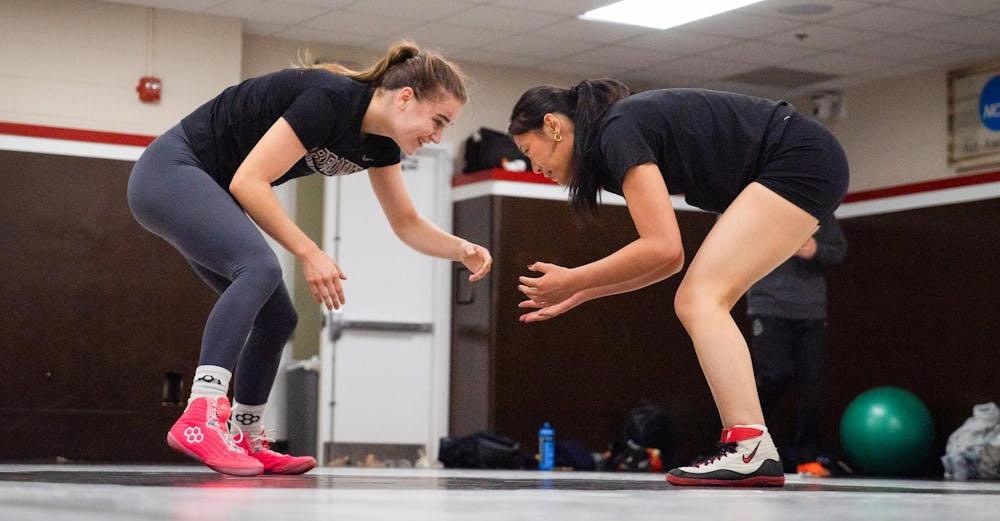
Calli Gilchrist ’29 (left) and Annie Ye ’26 (right) at wrestling practice on Wednesday. The women’s wrestling program was formally established in 2023 and does not have a formal recruiting process.

Dear Readers,


One of my favorite Disney characters is Merlin from The Sword in the Stone (1963), based on T.H. White’s book of the same name. In this version of Arthurian legend, Merlin experiences time backwards, and thus frequently confuses future events with what has already passed, living as a sort of expatriate in time. I’ve always really loved this, the touch of magic and tragedy. It’s my last fall semester as an undergraduate at Brown, and it’s easy to feel a little unmoored in time. I blinked and they turned Simmons into a giant pit, a third of the Thayer shops I swore just opened have been supplanted, and I’m no longer a bright-eyed first-year but already over a month into my senior year.
Still, when I’ve felt a tad overwhelmed by the passage of time, it’s been helpful to take a step back and breathe, draw out the little moments that comprise a season. When I chart how my fall has been spent so far, it’s: picking apples with loved ones (making apple fritters soon), interviews and unfortunately more interviews, boiling strawberries into syrup to make homemade strawberry matcha (we have Ceremony at home!), watching old Chinese comedies while nestled into our lived-in couch. Last night I played volleyball in the dark, guessing broadly where to set the ball as the light slipped away. In these moments, time feels longer, more lasting. It’s a bit easier to connect with what and who matters.
This week in post-, our writers are exploring their relationships with connection—over time, place, language—as we move carefully through a busy and bright new semester. In Feature, AnnaLise reflects on
transportation systems in different cities and relationships with the people within them. Also in Feature, Violet interviews ex-Congressman Anthony Weiner in an exploration of why we— the public—publicly shame. In Narrative, Katya navigates the risks and vulnerabilities inherent in language, urging us to use language intentionally to be seen fully. Meanwhile, Nina meditates on her experience of time in childhood and in the present.
In A&C, Madison analyzes Normal People through the lenses of class and gender, and Sara celebrates the subliminality of pools in coming-of-age movies.
Our Lifestyle writer, Liv, advises on staying healthy through the hustle and bustle of the fall semester.
In post-pourri, April features a detailed anatomy of the specimen collegium discipulo sacco dorsali (common name “college backpack”). Finally, don’t miss a wonderful crossword by Lily!
I was walking home a few nights ago with a friend, and she commented that it feels like we’re currently living a very transitional period of our lives. I’m inclined to agree, and be a little sad about needing to leave a place in order to arrive at another one. But the time allotted to us is all the time we can have, and there’s so many places I still have to get to.
So I’ll venture out bravely, with my first cozy sweater of the season and my tube of chapstick, and see what other little moments there are to love.

“Objectively, that’s a hot dragon!”
“That might be a rat…it definitely doesn’t move like a bunny.”

Bodiesof Water
1. Gatsby’s Pool 2. Lake Inferior
3. Lake Superior
4. Puddle on the George St. end of the Main Green
5. Flooded Keeney basement
6. Guy whose body is literally made out of water
7. Wishing well
8. Red Sea, specifically when it was parted by Moses 9. Fountain of Youth
10. The river Ophelia drowned in
by lily coffman
“It was only my mother who could communicate with me during those first two muted years… We improvised with signals—the rubbing of the chest, the patting of the head—our homemade vernacular. Sometimes, I still feel like she is the only person who understands me.”
— Ellyse Givens, “loveaches”


“Perhaps it is that intimacy flourishes in the gentlest of spaces, in the most ordinary of moments, when a single heartbeat can expand and deepen, as if to extend a hand and ask to dance.”
— Sarah Kim, “nothing much is happening” 10.5.23

1. Jobs for a detective
6. Pitted martini garnish
7. Small candy bars or crosswords
8. Pitted summer fruit
9. Tizzy
5. Chill vibe hang 5 9
1. Makes free, as a meal
2. Not of this world
3. Biblical mount
4. Kick out
Gerber
Nahye Lee
POST-POURRI
Section
HEAD ILLUSTRATORS
LAYOUT
Layout Designers
SOCIAL
Editorial: A man was detained by federal agents outside of the Rock — here’s what you can do
Last Tuesday morning, a member of this editorial page board was studying in the quiet of the John D. Rockefeller Library’s basement. Through the west-facing glass wall, what should have been an ordinary morning gave way to an extraordinary sight: masked federal agents detaining a man with his son and escorting him into a U.S. Immigration and Customs Enforcement vehicle. To witness such a scene — and from the stacks of Brown’s primary humanities library — was a reminder of the vulnerability faced by many of our undocumented peers here at Brown.
More than an isolated incident, this detainment symbolizes the hostile environment that undocumented members of our community must navigate every day. The sight alone carries a chilling effect — a silent message that Trump’s rash immigration policy may intrude at any moment, leaving many to wonder whether they are safe even going to school.
This should trouble us all. Brown is meant to be a place where students feel able to throw themselves fully into intellectual life — to ask questions, take risks, dissent and debate without fear. But when undocumented and international students must constantly calculate the risks of visibility, their participation in that vital intellectual exchange is compromised. An ICE vehicle parked outside the Rock is not simply a spectacle — it is an obstacle to unfettered academic freedom.
Brown maintains an official webpage on its approach to government requests regarding im-
migration, which explicitly states that Brown will share immigration status information only under subpoena, and that the Department of Public Safety will not “inquire about or act on” a student’s immigration status. Meanwhile, in the Undocumented, First-Generation College and Low-Income Student Center’s support materials for Deferred Action for Childhood Arrivals recipients and undocumented students, Brown commits that the DPS does not partner with federal or state agencies. The University also offers enhanced counseling resources for undocumented and DACA students, as well as emergency financial and educational support should students’ circumstances change.
These institutional actions are necessary and meaningful. They lend some structural protection and set moral boundaries. But they cannot erase the pervasive fear created by the visible presence of federal agents in our neighborhood. Institutions can assert policies, but they cannot shield students entirely from a federal government that seeks not only to intimidate but also to deport as many immigrants as possible.
Here lies the uncomfortable truth: Brown, as an institution, has done much of what it can under the law. Universities cannot rewrite immigration statutes, nor can they block ICE from operating in public spaces, including campus greens. Federal enforcement jurisdiction is independent of campus consent. The responsibility, then, lies with
Brown and Providence community members who can together ensure that those most vulnerable are not left to navigate that fear alone.
This responsibility begins with solidarity. On campus and in Providence, student groups such as Brown Dream Team — which supports students who are undocumented, DACA recipients or from mixed-status families — have long mobilized communal advocacy for these marginalized groups. This year, The Herald has reported how Dream Team organizers have voiced concern that shifting federal policy has made the school no longer a safe space for undocumented students. At the same time, local networks such as Movimiento Cosecha and community defense organizations are mobilizing in response to the recent ICE action. These are the organizations where energy, strategy and care are already concentrated. Students who wish to act should begin there — attend meetings, lend logistical or financial support, offer visibility and amplify their voices in public forums.
Solidarity is more than symbolic. Across the country, community presence at ICE detainments has prevented escalation. Students can alert, accompany, monitor and document — when safe — so that federal agents know their actions are witnessed. In classrooms, social spaces and student groups, we must speak openly — refusing to let fear become the default. Offering companionship, sharing legal resources and keeping each other in-
formed are small acts that will accumulate into a network of resilience.
This is not strictly a question of goodwill. It is also about defending the conditions that make academic engagement at Brown possible. A campus where some must remain silent out of fear is a campus diminished — not only in its humanity, but in its capacity to generate knowledge. Brown’s touted commitment to free inquiry rings hollow if it applies only to those who feel secure enough to exercise it.
We cannot ignore the danger that has arrived on our doorstep. The image of masked federal agents conducting an arrest just several yards away from the Rock will remain etched in the minds of the students who saw it.
The freedoms that many of us assume are sustained by structures that simultaneously exclude and endanger others. The integrity of scholarship at Brown depends on more than institutional slogans. It requires that every member of our community feel secure enough to take part in it.
Editorials are written by The Herald’s editorial page board, and its views are separate from those of The Herald’s newsroom and the 135th Editorial Board, which leads the paper. A majority of the editorial page board voted in favor of this piece. Please send responses to this column to letters@browndailyherald.com and other opinions to opinions@browndailyherald.com.
Noxon ’27: Brown is failing its transfer students from the minute they arrive
Last summer, in a meeting with a transfer advisor at Brown, I asked how long he thought it would take me to socially integrate at the school. I had just finished my freshman year at Columbia, and I was anxious at the prospect of starting over completely. “Oh, never,” he said. “When you’re a transfer, it’s a permanent part of your experience, of your identity. You should never lose that.”
By default, Brown is uniquely suited to accept and accommodate transfers. The Open Curriculum means transfer students are unburdened by distributional credits or core classes, enabling them to pick up where they left off at their former school and integrate into the general population in classes and degree progress. The 70 or so transfer students that come to Brown each year arrive having already completed at least one full year of college and, by extension, having already adjusted to the realities of college life. The ultimate goal of transferring, then, is to both academically and socially integrate into your new peer group as quickly as possible. After all, transfers leave to join the whole school, not just those who decided to jump their respective ships at the same time. Brown’s Open Curriculum helps make this easier. Its transfer infrastructure makes it near impossible.
My transfer advisor’s sentiment — that being
a transfer is a personality trait and not an interim label — pervades nearly every other aspect of the process. From housing to orientation to social exposure, Brown’s philosophy attempts to create a strong, insular community of transfers, who in the first weeks of school have reliable, relatable groups with which they can bond. But in practice, the approach creates a series of programs that stick transfers with a hard-to-shake “other” label, pushing an already socially disadvantaged group further to the fringes of social life at the school.
The most glaring example of this comes in transfer dorm assignments. As it stands, the vast majority of transfers are, depending on the year, housed in one of the New Pembroke dorms. Situated in a freshman quad at the northern tip of campus, these dorms are as far from most sophomore and junior housing as possible. For the four days of orientation, this arrangement gives transfers the opportunity to share close quarters and make easy connections with fellow newcomers. Once the school year proper starts, however, the housing serves to alienate transfers, who quickly find they have virtually no physical proximity to peers in their grade level.
All orientation programming, for that matter, is formed along the same logical lines. Fall semester transfers are carefully ushered around campus to different informational sessions and
But
where incoming first-years form groups out of thousands, able to shuffle their friends and lives until something fits, transfers are left in an isolated world of double digits.
mixers, always kept separate from incoming firstyears — even more so from traditional students of the same year who may be on campus already. The orientation programming is nearly identical to a freshman orientation. But where incoming first-years form groups out of thousands, able to shuffle their friends and lives until something fits, transfers are left in an isolated world of double digits.
When I first decided to transfer to Brown, a recent alum told me that there were usually only a handful of transfers who “make it out of the bubble.” I’ve found my people at Brown. I love this school, and I’m so grateful for the life it’s allowed me to build. So many of my fellow transfers, it’s important to note, do manage to make the jump toward total social integration. But our good fortune is much more the result of outrageous luck — generous friends from home, club acceptances and chance run-ins — than intelligent planning on behalf of the Brown administration.
Creating a transfer community is not in and of itself a bad thing. But creating an iron-clad one means that, after a couple months, the insularity can feel insurmountable. It’s like meeting a group of friends at A Day On College Hill and being told that they are the only ones you’ll be grouped with for the entire year.
Transferring is supposed to be hard. Transfers are, as the Brown website so graciously declares, “willing to take the path less traveled to arrive at a better place.” But must that path be so poorly maintained? Even one simple fix — changing transfer housing policies — would do so much to improve the starting social position of transfers.
Think of the ways you might’ve met your friends in your first year at Brown: in dorms, at orientation and in classes. The connecting fiber of college life is casual friendships — it’s friends who will invite you to a party or ask to get lunch every few weeks or forget your name at said party. This aspect of college life is built in late-night bathroom conversations with the folks you meet on your floor and awkward orientation ice break-
ers. Under the current system, it’s an aspect of college life that transfer students don’t get the chance to build.
Rather than placing transfers in their own designated dorm, transfers should instead be scattered throughout dorms of students in their same year. A few doubles on each floor of predominantly sophomore and junior dorms should be removed from the housing lottery and be randomly assigned to transfer students upon admission. Shared hallways and bathrooms are, at the very least, the right starting point to establish a much-needed infrastructure for transfers to build the strong-ish bonds that hold college life together.
This change isn’t a fix-all — it’s one small step. But the fundamental approach Brown takes towards transfers must change. The University owes it to its transfers, us few students who pack up our lives on a whim based on the promise of a better life, to make our worlds as big as possible. The label of “transfer student” should be a temporary tag, not an identifying feature.
Oscar Noxon ’27 can be reached at oscar_noxon@brown. edu. Please send responses to this column to letters@ browndailyherald.com and other opinions to opinions@ browndailyherald.com.
ELLIS ROUGEOU / HERALD
Berkwits ’29: The comfort of affinity groups risks insularity
An hour after moving onto campus this August, I attended a brunch for incoming Jewish first-year students. As I ate, I met like-minded and equally nervous peers while simultaneously being sold on the copious programming taking place over the rest of orientation. This in-group feeling was wildly comfortable — and not at all novel.
For elementary and middle school, I attended a nondenominational Jewish school, at which all of my peers shared that one overarching religious identity. The more I built affinity with those around me, the more sacred the collective sentiment felt, and the less I was able to connect with those who did not share that common thread. This phenomenon has continued to follow me onto Brown’s campus. Now that a month has passed since the aforementioned brunch, I have realized that along with the comfort and belonging that affinity groups provide comes intrinsic insularity.
Whether it be one of the 10 residential program
houses, six student identity centers, 10 religious and spiritual communities or over 100 identity-based registered student organizations, Brown is brimming with affinity groups. With such an abundance of opportunity, anyone at Brown can belong. And this sorting starts before students even get on campus. Brown has four in-person pre-orientation programs, two of which are centered around a shared academic interest and two of which are identity centered. Before a student even has to search for their community, it is spoon-fed to them.
These affinity groups are critical for a student body to feel included and safe, especially for underrepresented students, providing relevant resources, interpersonal connections and organized advocacy. They are communities that students are emotionally invested in, providing an entry point into the advancement of the larger university. These groups significantly benefit students’ wellbeing and the ways in which they can interact with the larger world after

graduation. Their advantages should not, and cannot, go unnoticed nor overlooked.
However, at Brown, true diversity of ideas and people is incredibly difficult to obtain, because the very environment surrounding us has been so carefully curated. Not only are organized affinity groups
“
I was given the opportunity to both exist with those who were significantly different from me and search for similarity without it being automatically provided. And even when religious identity, or any widespread collective belief for that matter, was not the central unifier, similarity could be found, and I could inter-
There is value in having spaces of similarity, but it cannot constitute the entirety of our social engagement.
rampant, but subconscious, self-made categorization is constant. Self-segregation, whether based on gender, socioeconomic status, race or religion, is immensely present, and social circles become stagnant with similarity.
When one joins such an organized social group there is a definitive act of identification. The identity of the group becomes one’s self-identity, whether they fully align with it or not. With minimal flow between groups, those who are unwilling or unable to align with the group’s consensus are distinctly divided. The barriers of affinity groups rise and in the attempt for inclusivity, we exclude. In other words, when we seek organized pluralism, it becomes inherently insular.
After eight years of Jewish day school, I decided to switch to a secular public high school that pulled students from all across Chicago. Despite it being harder to find community at first, my high school experience gave me the opportunity to exist without the crutch of commonality, nor a curated experience of comfort. Without the common denominator of shared affinity,
“
act with those around me outside of the confines of my affinity.
As students, we must balance these spaces of sacred similarity with spaces that are centered around, simply, nothing. There is significant value that comes from being around people with whom there is no distinct common thread. When no religion, interest, ethnicity or ideology holds the group together, the barriers of entry begin to crumble, opening the door to those who would otherwise be excluded. There is value in having spaces of similarity, but it cannot constitute the entirety of our social engagement. When we venture beyond what we know, we can exist in the diversity that affinity groups strive to foster.
Talia Berkwits ’29 can be reached at talia_berkwits@ brown.edu. Please send responses to this column to letters@ browndailyherald.com and other opinions to opinions@ browndailyherald.com.
Leggat-Barr ’28: Democrats need to disagree more
Having worked as a field organizer for U.S. Rep. Jared Golden (D-M.E. 2), one of the most conservative Democrats in the U.S. House of Representatives, I often receive texts that criticize his recent votes and statements, asking how he could possibly be legislating in this manner. While many of his votes I don’t agree with, and some I find completely repugnant, I understand why he needs to make these decisions to survive in a district that voted for President Trump by nearly 10 points. After all, politics is not about creating the most morally righteous coalitions that hemorrhage voters and dwindle in significance. It’s about building and maintaining majorities that can lead to systemic and impactful change.
Recently, the Democratic Party has been looking for an answer to recover its recent losses among key demographics. Democrats on the left argue that embracing progressive policies like Medicare for All and paid family and medical leave will solve all of our electoral problems across the country. On the other hand, centrist Democrats argue that shifting focus away from trans issues and moving to the right on immigration is the way to “win the middle” and end all of our electoral woes.
In the end, both of these takes have kernels of truth, but neither on its own should be the prescription. For the Democratic Party to broaden its appeal, it must not be a monolith, but rather a big tent where differing ideologies are given space and respected. Members should coalesce under a spirit of ruthless pragmatism in order to achieve our most closely held common goals, like building a fairer economy and providing healthcare to our most vulnerable.
For many liberals, it is common to reflexively condemn Democratic members of Congress who cast votes and make statements that are contrary to certain policies on our agenda. While this may be a comfortable reaction, this behavior does not
further the ideals that we hold so dear, nor does it help bolster the party’s brand. Achieving governing majorities to solve our most pressing issues requires big tents, not purity tests.
In recent years, Democratic politicians breaking with the party orthodoxy have dwindled at an alarming rate. This decrease in ideological diversity has led to the decline of Democratic seats in the House of Representatives and vote share in precincts across the country.
Such a culture, where the liberal base expects Democratic politicians to go in lockstep on every
ocrats.
Rigid orthodoxy has grown even more shockingly on the right — Republicans who buck the party line or go against Trump are staring down the barrel at a litany of scathing tweets and likely a primary challenge. Rising with the cult of Trump, the Republican Party has lost its backbone and direction — it has simply become the power arm of one man’s policy agenda.
As Republicans follow Trump blindly into worse and worse policy decisions, it is clear that rampant consolidation of power and squashing of

decision, has created a party that is fundamentally weaker and less competitive in many regions across the country. To build durable Democratic majorities we must cultivate and allow space for disagreement across the party and withhold our immediate castigation when members may break with the mainstream. Especially at a time when the Democratic Party’s approval rating is at a record low, we must make space for insurgent candidates to help bolster electoral outcomes in areas across the country currently disaffected by Dem -
GINA BAE / HERALD
dissent has led to a party able to accomplish substantial policy goals. But while these most recent achievements have been sweeping, they could have dire consequences for the party in upcoming elections, due to the impact the policies will have on voter’s lives. The Democratic Party must not mimic these tendencies because it leads to poor policy decisions and sidelines long-term electoral success.
No single ideology will pull the Democratic Party back from the brink. Democratic politicians
like U.S. Rep. Marie Glusencamp Perez (D-W.A. 3), Golden and former senator Joe Manchin argue that the path forward is moderating to regain the trust of rural white working-class voters. On the other hand, U.S. Rep. Alexandria Ocasio-Cortez (D-N.Y. 14) and Sen. Bernie Sanders (I-V.T.) contend that a relentless focus on working class issues will deliver Democratic wins across the country. Both of these approaches are true and effective but neither captures the entire picture.
All of these politicians do a fantastic job at representing their constituents even though their policies, methods and beliefs vary significantly. This is exactly what will bring the Democratic Party back: politicians that unabashedly represent their constituents regardless of how this interacts with larger party ideologies. Our country is vastly diverse, and Democrats must empower a multitude of voices to champion the party’s vision in ways that reflect the needs of their own constituents. When leaders from every corner of the nation bring that representation to Washington, our party can deliver on its promises and set forth a new vision.
We sit at a turning point where the 2026 midterms provide Democrats an opportunity to secure massive wins across the country in the face of an increasingly unpopular Republican agenda. To capitalize on this opportunity, we must set forth a new paradigm for how liberals engage with politics. Leading with understanding and grace and setting our most visceral instincts aside, we must embrace diverse viewpoints and provide space for them in our coalition. We can turn 2026 into not just a wave election, but the start of a new era.
Tommy Leggat-Barr ’28 can be reached at thomas_leggat-barr@brown.edu. Please send responses to this column to letters@browndailyherald.com and other opinions to opinions@browndailyherald.com.
ASHLEY GUO / HERALD
ARTS & CULTURE
REVIEW
Doja Cat’s ‘Vie’ is a stranger to her previous style
The artist’s fifth studio album is poised to be her most successful
BY MANAV MUSUNURU ARTS & CULTURE EDITOR
Following in the footsteps of The Weeknd, Taylor Swift and Lady Gaga, Doja Cat is the most recent artist hopping on the ’80s-inspired music trend.
On Friday, the artist released her fifth studio album, “Vie” — the French word for “life.” The project mainly focuses on Doja Cat’s romantic life, with the artist discussing beauty, love and relationship troubles over saxophone-laden instrumentals produced by industry superstar Jack Antonoff and longtime collaborator Y2K, among others.
The album ventures back into the pop-inspired sounds of Doja Cat’s earlier works in “Hot Pink” and “Planet Her” — projects she called “cash grabs” before releasing her previous studio album, “Scarlet.” Although “Vie” sonically shifts away from the trap beats that characterized “Scarlet,” Doja Cat keeps much of the same empowerment and unbothered energy throughout her new project.
The album opener, “Cards,” begins with a saxophone solo that builds to an anti-climactic beat, with Doja Cat repeating “Play your cards, right” during the post-chorus. The track’s first verse is one of the album’s best, featuring the artist cautioning her lover to treat her well. But the song falters during its rapped second verse, devoid of the usual adlibs and layering that make Doja Cat’s songs so aurally intriguing.
The album then transitions into its lead single, “Jealous Type.” Reminiscent of a classic ’80s pop song, the track failed to garner the success of Doja Cat’s previous radio singles — “Paint the Town Red” and
REVIEW
“Kiss Me More.”
The track was first teased in April for the Marc Jacobs Summer 2025 campaign, but eager fans awaiting a late spring release were disappointed when months passed without a release date. When the song finally dropped in August, it felt as if much of fans’ interest had fizzled out — the potential success of a summer hit wasted by a botched rollout.
The album’s “Scarlet”-esque third track — “AAAHH MEN!” — features the artist rapping about a subpar partner over the main theme from “Knight Rider,” an ’80s crime-fighting drama starring David Hasselhoff. “And I have too much tolerance / You ugly and fine as shit / And if I had more common sense / Then I would grab my ride and dip,” she repeats in the chorus.
“Gorgeous” — released as the album’s second single — keeps up much of this nonchalant tone. On the track, the artist discusses the harms of unrealistic beauty standards in modern society. Encouraging her listeners to value their natural beauty, she raps, “I mean I only got myself to appeal to / They got they nose up judging me, but ain’t all of ’em real.”
Directed by Bardia Zeinali, the single’s accompanying music video is one of Doja Cat’s best. The video, featuring supermodels Alex Consani and Anok Yai, among others, is redolent of a beauty commercial straight out of the ’80s, complete with its own fictitious makeup line advertised by Doja Cat herself.
On “Stranger,” the artist pivots to protecting her significant other from the societal norms of beauty and relationships, reassuring him of her love despite his appearances, sexuality or unconventional personality. “With each crowd, we proud we don’t fit / And ain’t nobody here gets our schtick / So if we split, it’ll be like two halves / Ain’t nobody in the world got what you have,” she raps on the song’s second verse.
The track also features the artist switching her standard song structure, starting with a verse instead of the chorus. In fact, many tracks on “Vie” are unique in that sense, deviating from the norm in Doja Cat’s music. The artist also begins with verses on “Couples Therapy” and “One More Time,” the latter of which is the only song to feature no expletives or rapping. Meanwhile, on “All Mine,” Doja Cat experiments with her voice, singing in gorgeous falsetto as she commits to a relationship with her lover.
The album’s sole feature appears at its halfway point with “Take Me Dancing” featuring SZA. The appearance — which marks the duo’s third collaboration after “Kiss Me More” and “Kill Bill (Remix)” — was announced just hours before the album’s release on Friday. Although the addition of SZA’s vocals lengthened the song by around one minute, her verse feels rushed, leaving listeners wishing the song was extended just a little more.
In the latter half of the album, Doja Cat leans more heavily into the French origin of the album’s title. On “Lipstain,” the artist starts the first verse with “Tu es ma vie et mon tout / Et tout le monde le sait.” A few songs later, the artist repeats “Brise mon cœur, encore, ce soir” on “Happy.” But these French lines — which add flair to the album’s lyrics and sound — are surprisingly rare for a project with a French title.
“Silly! Fun!” is exactly what it says it is — silly and fun. The track’s chorus features the artist singing “Wouldn’t it be fun if we went to a party? / Wouldn’t it be fun to fall deep for somebody? / I know it could be a blast to just pop out a baby / And we’re so very silly getting married in Vegas” over an upbeat instrumental and rapped verses reminiscent of “Won’t Bite,” one of her more playful-sounding tracks.
“Acts of Service” — one of the first songs teased by the artist on Instagram
Live in March — is a mellower song with little sonic interest but an enjoyable listen nonetheless. The production of the subsequent track, “Make it Up,” harkens back to Doja Cat’s early career when she released music on SoundCloud.
The album refines the ’80s sound with “Come Back” — a finale evocative of the background music during end credits scenes. The track ties the whole album together, leaving no sonic loose ends or cliffhangers for listeners — but that could also be one of the album’s drawbacks.
The relative acoustic cohesion of “Vie” compared to Doja Cat’s previous albums leaves little to entice audiences to relisten. That could explain why the album amassed fewer streams than “Scarlet,” de spite having a guest appearance from SZA and no simultaneous controversies.
isn’t the goal for Doja Cat. After all, she did say “Fame ain’t somethin’ that I need no more.”
theless, the artist’s schedule is jam-packed with promotional appearances and events this week — co-hosting “The Tonight Show Starring Jimmy Fallon,” appearing as the musical guest on Saturday Night Live and a collaboration with Fortnite. All of this comes as she was named the new global brand ambassador for MAC Cosmetics.
Will this be enough for the album to overcome its initial shortcomings — or will it risk becoming another forgotten ’80s call-back record?
This article originally appeared online at browndailyherald.com on Sept. 28, 2025.

‘The Thursday Murder Club’ offers new perspective on aging
BY TALIA LEVINE ARTS & CULTURE EDITOR
Released last month, Netflix’s star-studded crime comedy “The Thursday Murder Club” is well worth the watch. The film is based on the first installment of Richard Osman’s best-selling murder-mystery series, and even though the film maintains many of the book’s original plot points, some key changes in the movie have been met with disappointment from many readers.
The film is set at Coopers Chase, a luxury retirement community on a grand English estate. With lush grounds and a majestic castle, Coopers Chase’s Tudor-esque ambiance is one of the movie’s highlights and makes retirement seem truly idyllic.
that’s a given in a movie where a group of elders investigates murders from long ago. Regardless, the film’s director, Chris Columbus, created a piece of media that seemingly has cracked the code for modern-day streaming popularity.
Some have described the film as the retirement-home version of the Harry Potter movies, which makes sense given the fact that Columbus directed the first two Harry Potter films. Filmmakers “wanted Coopers Chase to be a sort of wish fulfillment retirement community, somewhere that audiences who saw the movie would say, ‘I’d love to spend the last 15 to 20 years of my life in a place like this,’” Columbus said in a press briefing. Given the set’s beautifully luxurious, plant-filled and wallpapered rooms, Columbus certainly achieved his goal. With archery lessons and 24/7 on-site emotional support llamas, Coopers Chase seems like the perfect place to live.
Aside from the stunning scenery, the legendary cast makes the film worthwhile. As the name suggests, the film revolves around a group of Coopers Chase residents who meet every Thursday to solve murder cases. In the movie, former MI6 chief Elizabeth Best (Helen Mirren), extrade unionist Ron (Pierce Brosnan) and retired psychiatrist Ibrahim Arif (Ben Kingsley) are joined by retired trauma nurse Joyce (Celia Imrie) as they are swept up in a real-life murder case.
This article originally appeared online at browndailyherald.com on Sept. 29, 2025. The book-turned-Netflix adaptation is worth the watch
the movie isn’t just lighthearted mystery-solving. It also is a heartwrenching tale of dementia, inspired by Osman’s
personal experience with his grandfather, who had dementia. Still, the film holds an air of optimism and hope for the future: Viewers watch as the retirees search for — and find — meaning in their existence and write new chapters in their lives.
As with many murder mysteries, viewers ascertain clues as the characters discover them, allowing for an entertaining two hours of detective work. Admittedly, the mystery itself isn’t as suspenseful or eventful as it could’ve been — but maybe
Its entertaining plot and stunning setting make “The Thursday Murder Club” a hilarious commentary on aging and the power of agency — and a solid substitute for a royal getaway to the British countryside.
COURTESY OF GREG SWALES VIA SONY MUSIC CANADA
Although “Vie” sonically shifts away from the trap beats that characterized “Scarlet,” Doja Cat keeps much of the same empowerment and unbothered energy throughout her new project.
COURTESY OF NETFLIX
Given the set’s beautifully luxurious, plant-filled and wallpapered rooms, Director Chris Columbus certainly achieved his goal.
Alex Arteaga details history of 120-year-old ice cream truck in new book
RI business owner discussed the book at the Brown Bookstore
BY NORA ROWE SENIOR STAFF WRITER
Alex Arteaga, owner of local ice cream truck Palagis Ice Cream Company, delivered a book talk on Monday at the Brown Bookstore. In conversation with Valley Breeze editor Luz Jennifer Martinez, Arteaga detailed his motivation for writing “Searching for Peter Palagi: America’s First Ice Cream Man and Father of the Ice Cream Truck.”
Arteaga has owned Palagis Ice Cream Company — a 129-year-old ice cream truck company based in Pawtucket — since 1998, developing a deep appreciation for the business. “When you say ‘ice cream,’ people’s eyes light up,” Arteaga said during the talk.
Palagis Ice Cream, which claims to be the oldest ice cream truck company in America, consists of a 21-truck fleet that drives across Rhode Island and Southeastern Massachusetts each summer. They sell ice cream, frozen lemonade and “novelties” like popsicles, with the mission of “delivering thousands of smiles a day,”
REVIEW
‘The
History
Two musicians’ bittersweet folktale doubles as an homage to music
BY ROSE FARMAN-FARMA STAFF WRITER
Directed by Oliver Hermanus, “The History of Sound” is an intimate love story that uses the magic of sound to capture and translate the feelings, stories and memories that words fail to express. Released on Sept. 12, Mubi’s new film follows the lives of two folk musicians in the 1910s — Lionel (Paul Mescal) and David (Josh O’Connor) — and their mission to “collect songs.”
Building on his 2024 short story collection of the same name, screenwriter Ben Shattuck crafts a beautiful parallel between the invisible impression songs can leave on a person and the hidden, yet world-changing impact David’s fleeting love leaves on Lionel.
Once the shocking sound of Irish actor Mescal’s Southern accent wears off, the audience is thrust into a heart-wrenching tale about a love that can never be realized. At first, the film risks being overly sentimental, but as soon as Lionel and David meet, the depth of their dialogue and the genuineness of their chemistry quickly drown out any skepticism.
The protagonists first cross paths while studying at the New England Conservatory in Boston. On a night out at a local pub, David convinces Lionel to sing a folk song in front of the crowd. As the shy vocalist begins, David accompanies him on the piano, instinctively finding the right chords to match Lionel’s melody. At this point, the pair’s instant musical understanding is an excellent signifier of their grander emotional one.
O’Connor masters his role as David — Lionel’s older, more worldly and sometimes callous counterpart. Flippant, sardonic and witty, David’s words are mostly
according to their website. Under Arteaga’s ownership, Palagis has also expanded to a Pawtucket ice cream shack that offers live music during the summer.
Arteaga was inspired to research the history of Palagis after experiencing a part of the company’s history himself. After weathering a pandemic, opening
a seasonal ice cream shack and expanding the Palagis fleet over more than 25 years of ownership, “I started feeling a little different” about Palagis’s history,
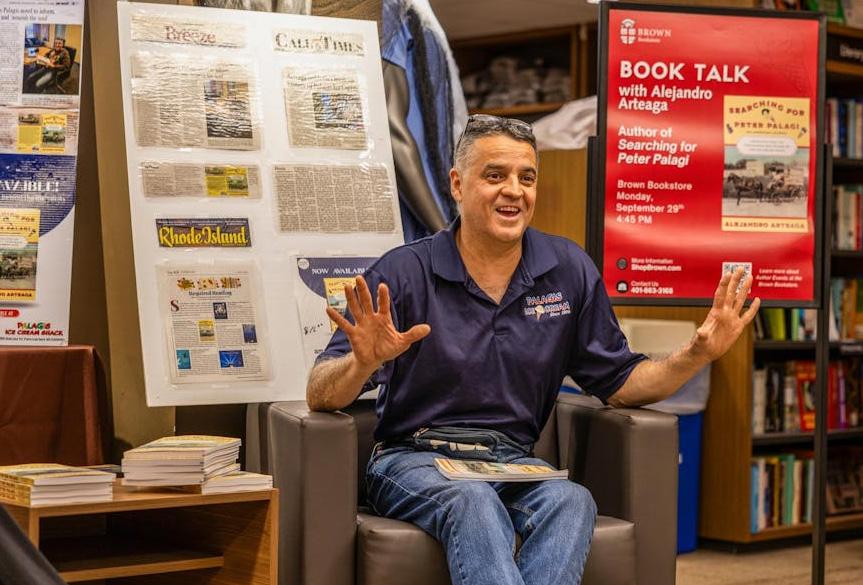
of Sound’ is a love song to folk music
Arteaga said. “A lot has happened that I made happen.”
Arteaga resonated deeply with Peter Palagi Sr. — the man who founded Palagi’s Ice Cream Company in 1896 — and his immigrant background. Like Palagi, who emigrated to the United States from Italy, Arteaga is also an immigrant: He moved from Colombia to Providence with his parents and seven siblings in 1976.
Arteaga started pouring his life into the Palagis business. Selling ice cream began as “just a job,” but it ultimately transformed into his passion. Driven by the belief that “everything has a story,” he felt inspired to tell the tale of the much-beloved Palagis company from the inside.
His book aims to emphasize that the Palagis business isn’t just about spreading happiness but about grit and hard work, Arteaga explained during his talk. He felt that he shared an “entrepreneurial spirit” with Peter Palagi and had “concentrated 100%” of his effort into the business over his many years of ownership.
“Everything has a purpose,” Arteaga said. “Ice cream has a purpose.”
This article originally appeared online at browndailyherald.com on Sept. 30, 2025.

deflections or lies, while Lionel, a wideeyed farm boy from Kentucky, is disarmingly earnest. Lionel’s trusting and sweet outlook on life is as pure as his voice.
“The History of Sound” is a touching film that pushes you to think seriously about what it means to love someone silently. Because of the time they live in, both Lionel and David know they can never actually have a public or permanent relationship — and so they never address it. In fact, throughout the entire film, the two men hardly discuss any of their true
emotions. When David is drafted to fight in World War I in 1917, all Lionel says is: “Write, or send chocolate. Don’t die.”
But so much of the film’s beauty lies in the unspeakable — where music, or sound, comes in.
Hermanus’s gorgeous score brutally externalizes the pair’s inner feelings. At one point, while explaining a music recording device to a group of children, Lionel says: “Sound is invisible, right? But it can be physical. It can touch something. It can make an impression.”
This explanation encapsulates the monumental impact of their ephemeral love. In recording Lionel’s voice, David gets to keep him, in a way. It becomes clear that their song-collecting mission embodies a much larger pursuit of trying to record and hold onto human emotions — and this, the film suggests, is the larger history of sound.
After numerous plot twists occurring across continents and decades before finally landing in the ’80s, Lionel — now an esteemed professor — lectures on his
new book, dedicated to an unnamed friend who influenced him in ways nobody could know. At the end, he finds the sound tubes he used to record songs with David, and as he listens to David’s voice, he almost falls over with feeling. The audience is left overwhelmingly aware of music’s power to stir emotions, to communicate them and — most touchingly — to preserve them. This article originally appeared online at browndailyherald.com on Oct. 1, 2025.
LIZE DENG / HERALD Alex Arteaga has owned Palagis Ice Cream Company — a 129-year-old ice cream truck company based in Pawtucket — since 1998.
COURTESY OF MUBI
The film details the silent love affair between folk musicians Lionel (Paul Mescal) and David (Josh O’Connor) over seven decades.
SCIENCE & RESEARCH

HEALTH
Researchers criticize Trump admin’s proposed link between Tylenol, autism
Tylenol is a brand name for acetaminophen, a fever-reducing medication
BY CLAIRE SONG SCIENCE & RESEARCH EDITOR
On Sept. 22, the Trump administration announced that acetaminophen — commonly known by the brand name Tylenol — can increase the risk of neurological conditions, such as autism spectrum disorder and attention-deficit/hyperactivity disorder.
Three public health researchers at Brown criticized the announcement in interviews with The Herald, saying that little scientific evidence shows acetaminophen causes autism.
“The best evidence suggests that there’s no connection between Tylenol and autism, and that what happened here was really an act of politics,” Ashish Jha, the dean of the School of Public Health, said in an interview with The Herald.
Studies have found the prevalence of autism has increased by over 175% from 2011 to 2022 in the United States. In April, U.S. Secretary of Health and Human Services Robert F. Kennedy Jr. declared that
ENVIRONMENT
he would find the cause of autism by September.
“He needed to deliver a political win, and so he picked Tylenol, because there’s some very, very shaky poor quality evidence behind it,” Jha said.
Kenvue, Tylenol’s
parent company, released a statement stating that “sound science clearly shows that taking acetaminophen does not cause autism.”
“We strongly disagree with allegations
that it does and are deeply concerned about the health risks and confusion this poses for expecting mothers and parents,” the statement continued.
HHS could not be reached for com-
ment.
Joseph Braun, a professor of epidemiology who researches risk factors during pregnancy, wrote in an email to The Herald that it is unclear “why acetaminophen was singled out when there are other potential causes or protective factors for autism that have a strong evidence base.”
“Numerous well-conducted studies show that prenatal air pollution exposure
can increase the risk of ASD and others show that folic acid supplementation during pregnancy could reduce the risk,” he wrote.
Jha added that the announcement is also bound “to do enormous harm” to pregnant women themselves. Currently, acetaminophen is the only over-the-counter drug that is approved by the U.S. Food and Drug Administration to mitigate high fevers during pregnancy.
Jha, Braun and Alyssa Bilinski — an assistant professor of health policy, health services, policy and practice and biostatistics — all warned against the dangers associated with a high fever during pregnancy.
“Acetaminophen currently is really the first line go-to medication during pregnancy for fever and pain relief,” Bilinski explained. The drug can also be useful to determine whether a headache or fever is responsive to medication. It could also serve as a precursor to a more dangerous disease such as preeclampsia, which “could be potentially life threatening” without treatment, she added.
Jha noted that “there are real, well-documented risks of not treating a high fever
during pregnancy” and there are “no other choices” for medications that reduce fevers for pregnant women.
“It’s going to put a lot of women in very difficult circumstances,” he added.
Bilinski explained that in the past couple of years, evidence disputing the link between acetaminophen and autism has gotten stronger, especially using sibling controls.
One popular research technique in pregnancy studies “is to look at outcomes comparing siblings who were and were not exposed to medication,” she said. “This allows researchers to control for other specific factors, things like a genetic predisposition to autism.”
Bilinski mentioned one 2024 study that used sibling cohorts and found no link between acetaminophen and some neurological disorders, including autism.
Both Bilinski and Braun added that studies that do suggest a link often do not account for confounding factors, complicating the conclusions.
“One of the major threats to many individual studies, and thus the overall conclusion, is that the reason for taking acetaminophen during pregnancy may be the cause of autism,” Braun wrote.
“When you’re better able to account for the sort of factors that co-occur with acetaminophen use,” Bilinski added, “we see that association gets much, much weaker.”
Brown professor’s recent book explores the gloomy side of solar panels
BY NISHITA MALHAN STAFF WRITER
Solar power is often lauded by policymakers as an equitable solution to the climate crisis. But a recent book by Myles Lennon ’06, an assistant professor of environment and society and anthropology, argues that its implementation can still exploit marginalized communities.
The book, titled “Subjects of the Sun: Solar Energy in the Shadows of Racial Capitalism,” argues “not that renewable energy is bad, but that it’s more complicated than utopic visions might suggest it is,” Lennon said in an interview with The Herald.
Lennon warns against treating solar power like a “panacea” for the climate crisis. The fact that so much of the work to transform fossil fuel-based infrastructure to renewable energy systems happens behind the scenes, Lennon said, tends to “obscure the complex geopolitical and material dynamics” of those systems.
While the energy from solar panels may be clean, the process of constructing the infrastructure is not. For example, Lennon noted that the panels themselves are made from “toxic materials mined from the earth,” and fossil fuel energy is often used to manufacture and transport them.
In addition, improperly disposed panels could create “serious e-waste problems for Global South communities throughout the world,” Lennon said, adding that the workers who install them are also often paid low wages.
“And yet, all of these material dimensions are obscured when your whole relationship to solar energy” is defined by “the energy savings that you’ll get from
KAIA YALAMANCHILI / HERALD
Assistant Professor of Environment and Society and Anthropology Myles Lennon ’06 on Wednesday. In Lennon’s “Subjects of the Sun: Solar Energy in the Shadows of Racial Capitalism,” he warns against treating solar power like a “panacea” for the climate crisis.
solar,” he said.
Before turning his attention to solar power, Lennon worked for many years on energy efficiency policy to reduce carbon footprints of existing buildings, specifically for communities disproportionately affected by climate change. He recalled being struck by the dichotomy between his engagement in “environmental stewardship” and the unnoticed material impacts his day-to-day work had on the environment.
“That kind of paradox animated the lines of inquiry that then led to this book,” he said.
The growing solar economy in New York City, where Lennon grew up, drew him to investigating the impacts of solar power. To gain insight for “Subjects of the Sun,” Lennon conducted ethnographic research in the city through participant observation and semi-structured interviews at both clean tech corporations and environmental justice organizations.
“Subjects of the Sun” also explores how solar panel marketing employs natural imagery. Lennon described encountering often-reproduced visuals of an “empty pastoral field with no signs of human life other than solar panels” and wondering
why such visuals were so common in an urban place like New York City.
“Part of what I began to notice is how these visuals aestheticize the shiny surface of solar panels, and how the shine of these panels are evocative of the sun,” he said.
Lennon highlighted how modern energy presents itself as an “abstract phenomenon” that one can access “simply by flipping a light switch.”
Depending on “energy sources that we have no physical relationship with” creates a fundamental distance that generates political decisions that are “untethered from the environmental limits and realities of
the world,” Lennon said.
In the book, Lennon raises solutions for adopting solar energy in a cleaner and more equitable way. He points to BK Rot, a composting organization in Brooklyn run by young people of color that use solar-powered bikes to transport compost. He also suggests pooling demand for solar power across larger communities to pressure energy corporations into sourcing their solar energy more ethically.
Professor of International Studies
Daniel Jordan Smith appreciated how the book brings attention to efforts to deliver solar energy to urban African American communities, “a population not typically associated with or served by solar energy initiatives,” he wrote in an email to The Herald.
“Lennon’s findings are a reminder that technology alone — including solar power — cannot solve our environmental problems because the problems and the solutions are primarily political and social,” Smith wrote.
In an email to The Herald, Associate Professor of History and Environment and Society Bathsheba Demuth ’06 MA’07 called Lennon’s book “really critical … in how it reminds readers that no technology is an apolitical ‘solution.’”
“I think it’s hard to write about how people are full of contradictions in a way that isn’t judgmental but is very clear about the outcomes,” Demuth wrote. “(Professor) Lennon does this really well.”
When it comes to improving the implementation of solar energy, Lennon emphasized the importance of using short-term improvements to work towards “a grand vision for how we want things to be.”
Lennon urged people to “continue to hold ourselves accountable to that greater vision, while also trying to make change in the here and now.”
ISABELA GUILLEN / HERALD
The book by Assistant Professor Myles Lennon ’06 came out in June
Sculpting a community: Brown’s pottery club sees explosive student demand
Club fosters creativity, connection despite limited space and resources
BY DONNA ZHANG SENIOR STAFF WRITER
When Pottery@Brown President Rachel Harrison ’27, a former copy editor for The Herald, first arrived on campus, she struggled to find a space where she could hone her ceramics skills.
“I didn’t have a place to do pottery consistently on campus,” she said. “Getting into a ceramics studio on your own is difficult and pretty costly.”
Establishing a formal pottery club and studio on College Hill has been in conversation for decades, Harrison told The Herald. With difficulty accessing the Rhode Island School of Design’s studios, students have faced disappointment when seeking a space to work with clay.
“It can be a big ask to take up space on campus,” Harrison said.
But in fall 2024, former President Jasper Lincoln ’25, current Vice President Zay Hampden ’27, Harrison and other ceramics lovers officially launched Pottery@ Brown and made their first appearance at the club fair.
Since then, the organization has surged in membership, amassing approximately 1,800 names on its mailing list, according to Harrison. At this year’s club fair alone, they received nearly 400 new sign-ups.
“The interest has been truly staggering,” Harrison said. “It’s part of what has helped us get momentum.”
Demand is so high that the club recently shifted from a lottery system to a firstcome, first-serve model with Eventbrite. Out of the hundreds of students hoping to engage with the club, only about 65

can secure a spot in each five-week cycle, with two cycles offered per semester. The club accommodates additional members through special events, such as a recent session for students living off campus, giving more students the chance to participate.
Brown’s pottery club now operates in a small shared studio space in the Brown Design Workshop in Barus & Holley.
The system change helps prioritize students who are the most invested, Harrison explained.
“We wanted to put more power in the hands of the people,” Hampden added.
Talia Yett ’26 recalled entering the lottery system last year but wasn’t accepted to any of the sessions. This fall, they set a calendar reminder for the Eventbrite release, and the strategy worked.
“It’s like you’re buying tickets for a show,” they said.
The club, which used to bring members to Mudstone Studios in Pawtucket, Rhode Island, now operates in a small shared studio space in the Brown Design Workshop. With three wheels in their possession, they hope to expand the space and acquire an on-campus kiln. Currently, the club has
drivers who routinely bring their dried pieces to be fired by a local artist in East Providence.
“If we have (a kiln) here, we can have a quicker turnaround,” said Juben Rabbani GS, a board advisor and studio aide for the club. This would allow more members to
process begins with shaping raw clay on the wheel and letting it dry, Rabbani explained. From there, pieces are trimmed, left to dry fully and prepared for their first round in the kiln, which transforms clay into ceramic.
“Pottery has two firings,” Rabbani said. For the second round, color is applied to the piece before firing it again. “That’s where you have your final piece,” he said.
For many students, pottery provides a meditative break from academic pressures.
“Coming into the studio, the only thing that matters is making sure that clay doesn’t fly off the wheel,” said Fabiola Penafiel ’28. As a studio tech, Penafiel provides ceramics guidance at sessions, offering her time to teach others.
Penafiel began working with clay as a sophomore in high school.
“I came in thinking Brown didn’t have a pottery space and maybe not many people who cared about it,” she said. “But I quickly realized there are so many of us.”

fire their work, he explained, which helps the club “serve more of those who are interested.”
But before firing, the slow, multi-step
To expand access, the club has hosted events such as a recent outdoor sculpture workshop led by a visiting artist.
“Just being like, ‘Oh my God, I made that’ — that’s really cool,” they said. As a busy senior, having an interest that is lower-commitment allows Yett to achieve balance.
Hampden described working with clay as a relationship, a back-and-forth that requires communication: “You have to listen to the clay.”
He added that his favorite part of leading the club is meeting new people and watching pottery bring community members from “all walks of life together.”
The club’s leaders emphasized the collective effort behind their steady growth. Alongside Harrison, Hampden and Rabbani, a diverse group of students and community members have helped the organization reach new faces. To expand access, the club has hosted events such as a recent outdoor sculpture workshop led by a visiting artist.
But space remains the club’s most pressing concern.
“Right now, we do share the classroom with a variety of engineering clubs and classes,” Penafiel said. “So it makes it harder for people to come in whenever they want.”
“We are turning down way more people than we would like,” Harrison said.
For Hampden, a big challenge is showing University administrators and faculty that students can “figure out a proper system in which pottery could be cleanly and safely done in a sustainable and accessible way.” In the future, leaders and members hope for a dedicated studio that is open 24/7 for anyone to come into.
“Our goal for the pottery club is that anybody could do it, regardless of cost,” Hampden said.

Under the Native American Graves Protection and Repatriation Act, any museum that possesses Native American funerary objects must work with associated tribes to determine the items’
affiliations.
Haffenreffer Museum to repatriate cultural items associated with Wabanaki Nations
Return of funerary items is required by 1990 statute
BY IVY HUANG SENIOR STAFF WRITER
The Haffenreffer Museum of Anthropology
intends to return several cultural items — including four sets of pigments, pottery, stones and stone objects — to the Wabanaki Nations, roughly a century after the objects were removed from at least nine burial sites in Maine, according to a Monday notice filed by the National Park Service.
The items were identified to have been connected to the Wabanaki Nations, which are four federally recognized Native American tribes in Maine that include the Houlton Band of Maliseet Indians, Mi’kmaq Nation, Passamaquoddy Tribe and the Penobscot Nation.
The repatriation of these funerary objects — which include blades, gouges, hammerstones, hoes and knives — is required by the 1990 Native American Graves Protection and Repatriation Act, which aims to ensure the protection and return of “human remains, funerary objects, sacred objects and objects of cultural patrimony.”
Under NAGPRA, any museums that
possess Native American funerary objects must inventory and try to determine cultural affiliations of the items by consulting with associated tribes. The museum is also legally required to publicize a notice before repatriating the objects.
According to the notice, the Haffenreffer Museum has determined that these items have been placed “intentionally with or near human remains, and are connected, either at the time of death or later as part of the death rite.”
“The (Haffenreffer Museum) is committed to complying with the law and its new regulations, ” wrote Robert Preucel, director of the Haffenreffer Museum and
a professor of anthropology, in an email to The Herald. “We see it not only as a legal requirement, but also as an ethical responsibility and a way to build new relationships with tribes.”
Preucel stated that the Haffenreffer Museum has been consulting the Wabanaki Intertribal Repatriation Committee, who represent the four tribes within the Wabanaki Nations.
Members of the Wabanaki Nations and of the four tribes did not respond to multiple requests for comment.
In 2023, Narragansett Indian Tribe officials alleged that the Haffenreffer Museum failed to adequately consult the tribe about
the repatriation of 10 human remains and 24 funerary objects, The Herald previously reported. The museum apologized to the tribe and committed to the repatriation process.
The funerary objects detailed in Monday’s notice may be returned on or after Oct. 29.
“Once the notice is posted, there is a period of 30 days during which other tribes may make a competing claim,” Preucel wrote. “After that time, repatriation can proceed.”
This article originally appeared online at browndailyherald.com on Oct. 2, 2025.
JAKE PARKER / HERALD
cultural
Yett said that “it’s fun to be able to create something artistic,” since they don’t normally carve out time for creative endeavors.
DOLMA AROW / HERALD
To expand access, the club has hosted events such as a recent outdoor sculpture workshop led by a visiting artist.
UNIVERSITY NEWS
‘Unconditional kindness’: A tribute to late student Federico ‘Fede’ Barrera
The first-year student is remembered for his kindness and curiosity
BY MAYA NELSON UNIVERSITY NEWS & METRO EDITOR
Federico “Fede” Barrera, a first-year student at Brown known for his incredible kindness and knowledge, passed away on March 7. At Brown, he was studying math and engineering and possessed an academic passion that was deeply admired by friends and professors.
Barrera will be remembered as a devoted brother, friend and student who left a lasting impression on the Brown community, even despite his short time on campus. He passed away in the hospital with his family by his side.
Though his family is from Argentina, Barrera spent his early childhood in Omaha, Nebraska, alongside his younger brother, Santiago Barrera ’28. Some of Santiago Barrera’s favorite memories with his older brother are from this time, when they would bike around their neighborhood and explore the surrounding nature.
“We were super close,” Santiago Barrera said. “Waking up together, going to bed together, playing together.”
Despite Barrera being only a year and a half older, he was “very protective” of Santiago Barrera. “He was the best big brother you could ask for,” Santiago Barrera told The Herald.
After their family moved to Madison, Connecticut in 2016, the two brothers drifted apart, attending different schools. But Barrera continued to support his younger brother Santiago Barrera, helping him with assignments, projects and, later, the college application process.
“I owe him a lot of my academic success,” Santiago Barrera said.
In high school, the older Barrera took classes at Wesleyan University in addition to his regular coursework and had a special talent for math. He also received a number of awards for his proficiency in writing
and language, including the state’s Seal of Biliteracy in both Spanish and French.
Outside of the classroom, he loved to play music, including guitar, piano, cello and quena — a traditional flute from the Andes region. Argentinian folk and classic rock were his favorite genres, and he especially enjoyed music from bands Pink Floyd and Dire Straits.
He also liked singing — or at least, “trying to,” Santiago Barrera said with a laugh. “He wasn’t that great.”
Santiago Barrera said he remembered his older brother being admitted to a number of top schools, but trying to keep it a secret from his friends.
“He pushed down a lot of his accomplishments in a way,” Santiago Barrera said. “I wish he didn’t. I wish he was more happy about what he had done.”
This humility was echoed by all of Barrera’s friends who shared memories of him with The Herald.
At Brown, Barrera was constantly searching for ways to challenge himself.
“He took all these crazy math classes his freshman fall that sounded impossible and terrible,” said Jim Kaplan ’28, Barrera’s roommate in Andrews Hall. “He never complained about work.”
But his can-do attitude was not limited to his schoolwork. Barrera seemed to never complain about anything, his friends said. He was described as approaching life with constant curiosity and a smile on his face.
At Brown, Barrera discovered an interest in philosophy and theology, often eager to share his thoughts and observations in conversations with friends.
“It was so magical to talk with him,” said Mario Joyo ’28, a close friend of Barrera. “We would begin with a lightweight conversation, then go into something more profound, something more reflective. But you also felt like it wasn’t forced. It would just flow naturally.”
In class, Barrera was described by three of his professors as quiet but passionate. He “asked good questions in class,” shared Yue Qi, a professor of engineering.
Benjamin Dees, an assistant professor of mathematics, wrote in an email to The
Herald that Barrera was “an enthusiastic and dedicated student, whose interest in mathematics extended beyond our course.”
“Sometimes in office hours, he’d have a question about the higher-dimensional versions of Stokes’s theorem, or about other courses in the department, which is always wonderful,” Dees wrote. “It’s that spirit of inquiry that really helps people get deeply invested in the subjects of their choice, and I had the sense that Federico had a lot of that investment and passion.”
Joyo also noted that Barrera was an extremely dedicated student. When stuck on a problem, he would try “over and over again with different methods,” despite Joyo having long given up.
Kaplan added that Barrera “was always doing work with a smile.”
Eric Vartany ’28 and Kalen Browne ’28, who lived on the same floor as Barrera and shared classes with him, both admired his dedication to learning and academic discipline. Browne said that even when working on problem sets with his classmates at 2 a.m., Barrera was “still smiling through the process, always eager to learn and help all of his friends.”
“He was one of the smartest people I’ve ever met,” Kaplan said.
Beyond the classroom, Barrera cast a wide net: He was a part of the chess, debate, math and fencing teams. Joyo added that Barrera was particularly interested in conducting research on the intersection between economics and religion.
According to Vartany, one of Barrera’s routines was always waking up early to swim for an hour, regardless of what his schedule looked like.
“No matter what he was doing, no matter how busy he was, he would always dedicate the time to doing things that he enjoyed and brought him happiness,” Vartany said.
But before mentioning his intelligence, the first word all of his friends — and brother — used to describe Barrera was “kind.”
“When I think of him, I think of unconditional kindness towards everyone,” Santiago Barrera said.
“I remember just thinking I could tell
he was going to be a good roommate,” Kaplan said when reflecting on when they first met. “He just was very respectful, very comfortable to talk to and that stayed true throughout the whole year.”
The two of them would frequently study at the John D. Rockefeller Jr. Library together, when Barrera would often brew tea from scratch.
“He had an electric kettle, and he made me coffee from scratch one morning, which was crazy and totally an unnecessary kind gesture,” Kaplan added. “It was so sweet and distinct.”
Santiago Barrera also shared how many of his memories with his older brother revolved around tea. On weekend mornings, they would sit on the Main Green together and talk, always with a cup of mate.
Barrera enjoyed connecting with his Argentinian roots. His fluency in Spanish was what first captivated Joyo when the two of them met “by accident” one night at Josiah’s. “I was really amazed about how well-versed he was,” Joyo said.
Joyo said that the two became very close, very fast. Over winter break, Joyo spent a few days at the Barreras’ house in Madison, where Barrera showed him around his hometown. They snuck into a nearby dam, and Barrera taught him how to skip stones.
“He told me what were the good stones, how you should do it, how you have to rotate it with your finger,” Joyo recalled.
When the two of them drove back to Brown, Barrera told Joyo he needed to stop by the supermarket to pick up a few groceries. When Barrera returned to the car, he handed Joyo a Nesquik box.
“It was because he overheard me saying that this was my favorite childhood drink,” Joyo said.
Joyo was constantly impressed by Barrera’s attentiveness. “He was able to really listen and pay attention to those small details of people and hold on to them,” he said. “He liked … to try to show you that he was listening to you, and that was something that I really admired.”
Vartany and Browne, who were roommates last year, shared a story about how
Barrera had repeatedly called one of their friends by the wrong name. Having seen the name “Mark” on their door, Barrera repeatedly referred to this friend as Mark, assuming he was Vartany and Browne’s third roommate. When Vartany finally broke the news that the friend was not named Mark, he said Barrera “was so devastated” and angry at himself.
“He was someone who would give so much and then expect nothing in return,” Kaplan said.
After his passing, the University held a gathering for members of the Brown community on March 12. “A lot of people came,” Joyo said. “He was loved by so many people.”
News of Barrera’s passing came as a shock to his friends at Brown. “I remember it just feeling not real,” Kaplan said. “My parents came. It was all very strange, and it took a very long time to sink in.”
Many of his friends continued to meet after the gathering to share memories of Barrera. To this day, his absence is felt on campus. For Kaplan, who took time off in the spring after Barrera’s passing, coming back to Brown has been “harder in a different way, like a slower way.”
Browne described how it was “hard to go into the lounge, because that’s where I knew I’d always see him. Every time you walk through that door, you’re kind of expecting to see him again.”
Now, Browne is a Community Coordinator in Andrews and still avoids going into the lounge.
Barrera was “a light,” Browne said, bringing positive energy to “any room he was in.” He cared deeply for others, and wanted them to feel that care.
“He was just memorable,” Joyo said.
When Santiago Barrera thinks of his older brother now, he pictures the duo “just sitting” and chatting.
“Sometimes at home, sometimes by the river. But with mate, and again, conversing.”
COURTESY OF SANTIAGO BARRERA ’28
The first word all of his friends — and brother — used to describe Fede Barrera was “kind.”