Andrews chef launches Youtube channel


and experiences of COVID-19 were the impetus for the creation of the Center.

 BY SAM LEVINE SENIOR STAFF WRITER
If you’ve ever eaten a meal at Andrews Commons, then chances are you’ve encountered Chef Younes Haimoura. Charismatic and upbeat, Haimoura al ways chats with students as they make their way through the meal stations. But beyond his work as a culinary suw pervisor at Andrews, Haimoura is also the creator behind a nascent YouTube cooking channel.
Haimoura’s YouTube channel fea tures a compilation of YouTube Shorts and long-format videos showcasing the dishes that Haimoura cooks in his free time, from Moroccan tagine to chocolate brownies. Haimoura nar rates each step of his cooking process, sharing the ingredients he uses and tips for producing the best dish. View ers watch in real time as he prepares and cooks each ingredient before fi
nally plating the meal and signing off by saying, “Until next time.”
Haimoura is originally from Mo rocco, and he first discovered his pas sion for cooking while studying at a three-year culinary program in his hometown of Fez. “I found myself in love with cuisine and cooking in the kitchen,” Haimoura said. “I started cooking for my friends and family … and they were like, ‘Oh, this is awe some. This is good. You’re doing good. We love it.’ And that’s how it started.”
After completing the culinary pro gram, Haimoura worked in Morocco’s
chive’s curators.
capital Rabat at the country’s first TGI Friday’s, climbing the ranks to become an assistant kitchen manager. Hai moura came to the United States while participating in Walt Disney World’s cultural representative program at Epcot, an “amazing experience” where he learned customer service skills and improved his English, he recalled.
Haimoura eventually left Flori da to pursue an associate’s degree at Quincy College in Massachusetts. Afterwards, he stayed in the area and

The School of Public Health celebrated the launch of its Pandemic Center in a ceremony Oct. 12. Speeches from Jen nifer Nuzzo, Pandemic Center director and professor of epidemiology, as well as Beth Cameron, Pandemic Center senior advisor and professor of the practice of health services, rang in the Center’s official opening.
The Center — with offices both in Washington, D.C. and on campus in Providence — will conduct research as well as engage with policymakers, non-governmental organizations and the private sector. It will also offer opportunities for faculty and student engagement and learning, Nuzzo said in an interview with The Herald.
According to Nuzzo, the challenges
“This is not my first pandemic, but seeing how challenging COVID-19 was gave me deep worries about how we were going to handle the many events that we’re likely to experience in the future,” Nuzzo said.
“I think a lot of people assume that once COVID is over for good … that we’re fine for 100 years, and that’s very much not the case,” she explained. “We don’t have the kind of plans and readi ness that we need to deal with the fact that we’re going to have more of these events in our lives.”
Nuzzo became interested in form ing partnerships and collaborations to help address pandemic preparedness in public health and beyond. For example, Nuzzo noted that she had conversa tions with Ashish Jha — who is cur rently on leave as dean of the School of Public Health — last year. Jha, who is now serving as the White House’s COVID-19 response coordinator, said that he wanted to address her concerns
After over two years of efforts and a few surprising phone calls, the work of a man The New York Times once described as the “most visible” pris oner on death row is now at the John Hay Library.
This past August, the Universi ty acquired the personal papers and items of Mumia Abu-Jamal, an incar cerated political activist and journal ist, marking a broader move by the Hay and the Pembroke Center to bring the voices of those impacted by mass incarceration into their collections, University archivists explained.
The archive, which includes Abu-Jamal’s papers, prison records, original sheet music, artwork and even a pair of his glasses, has the potential to catalyze groundbreaking research, according to professors and the ar
“It’s the only archive of its kind in the country,” said Johanna Fernán dez ’93, a history professor at Baruch College whose papers were recently purchased by the University as well. Fernández is a close friend of Abu-Ja mal’s and played an instrumental role in the acquisition.
Abu-Jamal, born Wesley Cook, was a journalist, political activist and founding member of the Philadelphia chapter of the Black Panther Party.
In 1982, Abu-Jamal was convicted of shooting and killing Daniel Faulkner, a Philadelphia police officer. At the time, Abu-Jamal was sentenced to death, but in 2011 a federal appeals court ordered a new sentencing hear ing, eventually leading prosecutors to drop their pursuit of the death penalty.
Over the past 40 years, Abu-Ja mal’s imprisonment has proven to be controversial. A 2000 report from Amnesty International concluded that Abu-Jamal had not been given a fair trial based on international standards, and advocates the claim that he was framed by the police.
BY FINN KIRKPATRICK SENIOR STAFF WRITEROn May 15, 1978, an exhibition titled “Private Parts” was set to debut at 128 Main St., organized by a group of students at the Rhode Island School of Design. But the night before the opening, a Providence Police officer came to inspect the gallery. Though the officer didn’t personally take offense with the content of the exhibition, he informed the exhibitors that the police would raid the gallery on its opening day to enforce Rhode Island’s anti-obscenity laws.

Leading up to the release, adver tisements appeared in the RISD Press, a weekly student newspaper, to pro mote the event. One such advertise ment read, “ANY SIZE ANY MEDIUM ANY THING ANYONE ANY PRIVATE ANY PART.” The collective that pro duced this exhibition was not granted any gallery space on the RISD campus, so it had to seek other options for the show to go on.
The exhibition itself was intended to satirize pornography, but Provi dence Police took it as something more serious.
Unbeknownst to the artists and the exhibitors, The Providence Journal ran a piece that talked about the potential illegality of the show. Come opening day, the gallery was packed with peo ple coming from all walks of life to see what all the fuss was about — before officers stormed in, peeling art off of the walls, explained Laurie McDonald, a member of the Electron Movers. The Electron Movers was the video arts collective composed of former RISD
students that owned the gallery where the exhibition took place.
The medium of the exhibition was predominantly photography but also included paintings and drawings as well as a polaroid photo booth for vis itors to operate. Much of the artwork — 40 pieces in total — was confiscated by the police and allegedly destroyed, so most of the works only remain in the memory of those in attendance.
One piece that stood out to Mc Donald was an image of “a rabbit humping a chicken,” which the

Looking into history, legal troubles of RISD students’ ‘Private Parts’ exhibition
Center to include office in Washington, D.C, will offer student opportunities
One-of-a-kind archive opens new possibilities for interdisciplinary research
Chef Younes Haimoura discusses videos,
journey, work at AndrewsSAM LEVINE / HERALD After doing a culinary program in Fez and working at a TGI Friday’s in Rabat, Younes Haimoura began attending Quincy College in Florida.
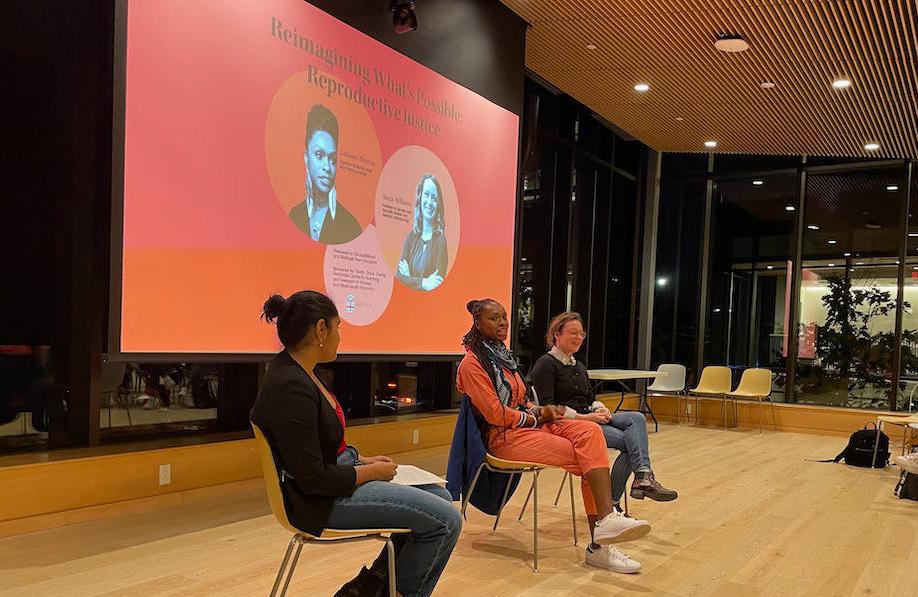
chooses not to work autonomously be yond campus, Hariharan said. Instead, the group collaborates closely with national maternal education groups such as SISTA Fire and Mama Glow to connect with and learn from Rhode Island doulas.
 BY MAISIE NEWBURY SENIOR STAFF WRITER

After Leona Hariharan ’23 received dou la training from Mama Glow, a maternal health education organization, in Sep tember 2021, she began to consider how she could create similar opportunities for students interested in learning about reproductive justice on Brown’s campus.
Last November, Hariharan offi cially established Doulas@Brown, a “BIPOC-centered reproductive justice organization,” she said. Since then, Har iharan has been working to educate students about reproductive justice and birth work and has aided in the devel opment of a University course for next semester that will offer doula training for students.
According to Hariharan, Doulas@ Brown trains students to become practicing doulas in the Providence community and helps bring reproduc tive justice initiatives to campus. The organization recently completed its educational campaign titled “What’s a Doula?” and is hosting a screening of “Belly of the Beast,” a reproductive justice documentary, next Tuesday.
But “we are first and foremost a community-based organization,” said Elisa Kim ’24, co-president of Doulas@ Brown. “We support the already estab lished doulas in (Providence) and really look to them to (inform) us about what the community needs.”
Bintou Diarra ’23, communications director of Doulas@Brown, said im proving the University’s relationship with the broader Providence community is a major priority for the group.
“Because people at Brown tend to be coming from a more privileged position and positions of power,” Kim added, “we have a sort of responsibility to protect and nurture birthing people as the most important people in our society.”
In order to approach community work with sensitivity, Doulas@Brown
Mama Glow in particular has been instrumental in the club’s development, according to Hariharan. While the orga nization is based in Brooklyn, it is asso ciated with doulas all over the country, including in Providence, she added.
Latham Thomas, founder of Mama Glow, was not available to comment by press time.
Mama Glow has facilitated connec tions between Doulas@Brown and the larger network of Rhode Island birth workers, trained many of the club’s members through their six-week course and sponsored the group’s federal workstudy program, Hariharan said.
Through the Swearer Center for Public Service’s Community-Based Learning and Research Fellowship, Har iharan has collaborated with Thomas and Sarah Williams, visiting assistant professor of anthropology and gender studies, to develop a new course for next spring that will provide 20 stu dents with doula training and repro ductive justice education.
“In classes on reproductive health, rights and justice … students get so pas sionate,” Williams said, “and there’s not always something to pour (that energy) into.” The course will have a reproduc tive justice seminar component taught by Williams, and students will be able to apply what they learn to their doula training in the class’s lab component, which will be led by Thomas.
Training student doulas will also help to meet demand for holistic birth work in the community and nationwide, Williams added. Many Brown students do not stay in the area after graduation, so students who complete this course will be able to bring their skills and knowledge wherever they go, she said.
“Our goal is to first of all (let stu dents know) that doula work is some thing that you can do after you grad uate,” Hariharan said. “You go to an Ivy League and people are like, ‘Oh, you’re going to become a doctor right?’
But there are midwives, nurses (and) doulas.”
Doula training also emphasizes self-care, which is often lacking in ac ademia and medical education, Diarra said. “The fact that (doula training) makes you question, ‘What am I doing for myself to make sure I can show up for these people?’ is just so different from how the medical establishment trains its physicians.”
“It’s also just very healing” to do doula work, Hariharan added. “It can help you heal your relationship with medical systems, your body and so on.”
By spreading information about doula work, Diarra hopes that Dou las@Brown can take some first steps toward decreasing rates of traumatic birthing experiences and maternal mortality.
Compared to other developed countries, the United States has dis proportionately high rates of mater nal mortality. These disparities tend to hit historically underrepresented and underserved populations the hardest, Kim said.
“It should not be this hard to have kids and raise kids in our society,” Wil liams said.
In the U.S. birthing model, “a natural process is pathologized and it’s (viewed as) something that has to be fixed, or dered (and) structured,” Diarra said.
“I think we’ve gotten to a point where we think it’s enough to just sur vive birth,” Diarra said. She expressed hope that one day the U.S. will reach a point in birth care where the process will focus on empowerment. In order to do this, Diarra said, students entering the field of obstetrics and gynecology after graduation must be holistically informed on birth practices and be able to push back against high-intervention methods.
Given the recent changes in repro ductive rights throughout the U.S. fol lowing the Dobbs v. Jackson Women’s Health Organization decision that over turned Roe v. Wade, Doulas@Brown also plans to continue its support of birthing people and their full range of reproductive rights.
Tackling issues surrounding repro ductive rights can feel “paralyzing,” Diarra said, but Doulas@Brown aims to provide guidance about how people can actively contribute.
“I think that there’s this idea that you have to be credentialed or go
through years of intensive training to contribute positively to someone’s health,” Diarra said. “But you don’t have to be a physician or undergo years of intensive training to take care of your community.”
In partnership with BWell Health Promotion, Doulas@Brown is in the process of launching an abortion sup port program, which will train club members on how to help students who need abortion support both emotion ally and logistically. Hariharan hopes to eventually expand the program to other universities around Rhode Island.
“The doula framework isn’t just about birth and postpartum,” Hariharan said. “There are bereavement doulas, and there are also abortion doulas.”
Kim said she hopes that the future of Doulas@Brown lies in working with different reproductive justice organi zations in Providence and on campus. This way, the group can reallocate the University’s available resources in order to better serve people in need.
“We all really want to change the system and obviously we need help, awareness, collective power and com munity to do that,” Kim said. “Hopefully in this lifetime we can see it change.”
Group plans new course on reproductive justice, doula training for next springSARAH ONDERDONK / HERALD At a conversation last week, Doulas@Brown hosted Latham Thomas, founder of maternity lifestyle brand Mama Glow, and Sarah Williams, assistant professor of anthropology and gender studies.
‘And then there was a mic drop…’
The “odyssey” to acquire Abu-Ja mal’s papers, as described by Pem broke Center Archivist Mary Murphy, began with the Pembroke Center Ar chives, which collects the papers of notable women, transgender and non binary people who’ve attended Brown, in addition to historically important women in Rhode Island, feminists and queer theorists.
One of these women was Fernán dez, who was one of the leaders in the Students for Aid and Minority Admission movement on campus in the 90s. During those protests, stu dents took over University Hall in support of need-blind admissions.
In 2017, Murphy conducted an initial oral history interview with Fernández speaking about that history, and the two began talking.
“I loved this story,” said Murphy. “I thought she would be perfect for us to collect her papers.”
Murphy eventually broached the subject with Fernández, who agreed to archive her papers at the Univer sity. But, five or six conversations in, Fernández said she realized she forgot something important.
“The papers you really want are those sitting in my closet that belong to Mumia Abu-Jamal,” Fernández re called telling Murphy.
“And then there was a mic drop,” Fernández said.
That call set in motion the even tual acquisition of the archive. Upon hearing the news from Murphy, Aman da Strauss, associate university librar ian for special collections and director of the John Hay Library, said she was falling out of her attic chair.
But despite the initial interest, the archive faced obstacles. As Abu-Jamal was being transferred from death row to the general prison population, he faced pressure to get rid of his papers, he told The Herald.
“Four or five guards came to the
cell one day and said ‘you gotta get rid of all the shit,’” Abu-Jamal said over the phone from the State Correctional Institution at Mahanoy, Pa. “What am I going to say? ‘No?’”
Abu-Jamal said that he “really wanted to throw a lot of stuff away,” but Fernández insisted he keep his papers.
“She said it’s history. I said, ‘C’mon, it’s old mail,’” Abu-Jamal said.
“I literally begged him to not throw them away,” Fernández said.
Over the course of a week and a half, and with some debate, Fernández was ultimately successful.
“I don’t think he understood the significance of his papers. I mean nobody does. Who thinks that their papers are significant?” she said.
When asked about the impact he wants his archive to have, Abu-Jamal said he hopes it has an effect on the incarcerated as well as those not in prison.
“By its very existence, it has an impact outside because it is literally outside of the carceral space,” Abu-Ja mal said. Incarcerated people are “real human(s), thinking (and) feeling hu man beings. They have something to say and something to share outside of the cells, outside of the brick and stone and steel and mortar.”
In the era of mass incarceration, those involved in the acquisition also highlighted the particular significance of the archive, as well as its unique po sition within the research space. There are already a few special collections and archives of incarcerated people, most of them small, Strauss said.
“It is really telling us this modern history of mass incarceration in Amer ica,” said Nicole Gonzalez Van Cleve, an associate professor of sociology who studies mass incarceration, rac ism and punishment in America. Gon zalez Van Cleve noted that Abu-Ja mal’s imprisonment coincided with an “acceleration of incarceration.”
“Our society is defined by incar ceration,” Fernández said. “We live
in a country that hyper-incarcerates Black people, and Black Americans in particular, and Latinos.”
‘Please find a morsel in there and tell the story’
Abu-Jamal’s archive, Fernández’s papers and an additional mass-in carceration-focused archive, includ ing oral histories, created by one of Gonzalez Van Cleve’s classes will be part of the Voices of Mass Incarcer ation in the United States collection at the Hay.
The three archives are the “anchor collections for this new collecting di rection,” Strauss said. The project is part of a broader emphasis on finding “the stories of individuals, their fam ilies and their communities” within the study of American incarceration, she said.
Curators and professors said that Abu-Jamal’s archive offers the op portunity for new, exciting research. For example, Murphy highlighted the fact that Abu-Jamal’s documents com bined with Fernández’s papers offer a rare perspective on relationships be tween prisoners and their advocates.
“You’re opening all the boxes, it’s like Christmas morning,” Murphy said.
“This is an archive that I think can engage a lot of students across dis ciplines, everything from the arts, to poetry, … Black studies, sociology and probably so much more,” Gonzalez Van Cleve said.
Fernández expressed similar sen timents, explaining that the archive could lead to research in a variety of subject areas, including the Black radical tradition, philosophy and lit erature.
Gonzalez Van Cleve also highlight ed the opportunity for students to conduct original research.
“I can honestly say to a classroom, there is a treasure trove of data and primary sources that have never been sorted through,” she said. “Please find a morsel in there and tell the story.”
Gonzalez Van Cleve recently took a group of PhD students from one of her classes to visit the archive and help sort through some of the many letters Abu-Jamal has received during his time in prison. Yet, a different type of item caught the eye of a musicol ogy student in her class: sheet music written by Abu-Jamal himself.
“His face lit up,” said Gonzalez Van Cleve. “I could just see the spark in this musicology student in a way that I hadn’t imagined as a sociolo gist. To me that is the gold standard: When I can take a PhD student from an arts PhD, and I can bring him to this archive, and he will see things that I can’t possibly imagine.”
Gonzalez Van Cleve said that she quickly began brainstorming with the student, wondering if the song could be played at Brown, how they would get the musicians to do so and more. From behind bars, Abu-Jamal had a simple response to the student upon hearing the anecdote.
“Maybe we could work together some day. I still have melodies in my head, I just need to get it down,” he said.
The archive also provides a rare perspective on Black political thought, given that many of Abu-Jamal’s con temporaries were killed rather than imprisoned, Gonzalez Van Cleve said.
“We think of the likes of Fred
Hampton and others who didn’t have the longevity of life to produce work and essays and books and letters and thought pieces on American life, rac ism and politics,” she said.
Abu-Jamal’s archive will open by Fall 2023 after archivists sort through the material and generally bring “or der to chaos,” Murphy said. At the opening, the Hay hopes to have a multi-sited exhibition, including at the Pembroke Center, and possibly even a portion in Abu-Jamal’s home town of Philadelphia, but that remains to be determined, Strauss said.
At some point in the future, the hope is to digitize the collection as well, she added.
The Hay is working with the Pem broke Center and the Center for the Study of Slavery and Justice to have a symposium after the opening, Strauss said.
“We’re figuring out what that looks like to really mark the opening of the collections and to invite scholars to think on these topics,” she said.
Gonzalez Van Cleve said that centering Abu-Jamal’s papers in “places of the highest intellectual importance” like Brown “gives the appropriate amount of reverence to people who have been impacted” by incarceration.
“That, to me, is an act of racial justice,” Gonzalez Van Cleve said.
“It’s the only archive of its kind in the country,” said Johanna Fernández ’93, a history professor at Baruch College.
personally removed
the walls

was un able to reference any works from the show that were overtly
because she believes that that type
content wasn’t really pres ent at the show.
was present during the raid and captured the siege on camera as it occurred. The original intention of the Electron Movers was not to make any sort of polit ical statement by exhibiting this show, but to just allow artists to display what they produced, she said.
“We were interested in the idea of not really being (a) curator so much but just letting people have access to a space where they could show their work,” McDonald said.
“It’s hard for me to remember specific references to hardcore por nography, other than things like certain kinds of clothing or our poses,” McDonald said. “But that was the intent — to be a parody.”
She acknowledged that “Private Parts” could potentially cause dis comfort to attendees. “We were aware that it wasn’t mainstream and it would upset people,” she said. “But we were into pushing bound aries. That’s what Electron Movers was about back then.”
In an oral history project titled, “Underground Rhode Island,” Les Wisner, the student who curated and led the exhibition, discussed some of the provocative images used in the show. For example, one image was of a middle aged cou ple in a trailer featuring a woman watching TV with a blank expres sion on her face while grasping the penis of her naked husband. Wis ner described the image as “really pretty stupid and really comical.” There were also sculptures of hu man forms and abstractions.
The show was accused of break ing a ’70s era obscenity law in Rhode Island, but McDonald said none of the organizers had heard of the law.
It was codified May 10, 1978, just 5 days prior to the opening.
“At the time, people at the Rhode Island School of Design were not particularly political, McDonald said. “I don’t think there was a lot of politically mo tivated art going on. It was more personal expression.”
In the aftermath of the raid, the Electron Movers all fled to New York City for a week, fearing the legal repercussions of the raid, a fear that McDonald said was com mon among most people involved in the exhibition. “People were pretty frightened about the con sequences, because they realized that their work could be misinter preted, that it could be taken away and destroyed,” she said.
The “Private Parts” raid was em blematic of broader debates about art during that time. “Artists contin ually were imagining and anticipat ing certain kinds of societal norms and looking to intervene in them. So it also means the bar was moving by the 70s,” said Lindsay Caplan, assistant professor of history of art and architecture.
One contentious question was what actually constitutes pornog raphy, a debate that Caplan said is everchanging. In the early 20th cen tury, “Duchamp’s fountain, where he submitted a toilet to the society of independent artists, was seen as pornographic,” Caplan said. “So the terms are constantly shifting, and that was understood mostly as shocking because it was seen as obscene.”
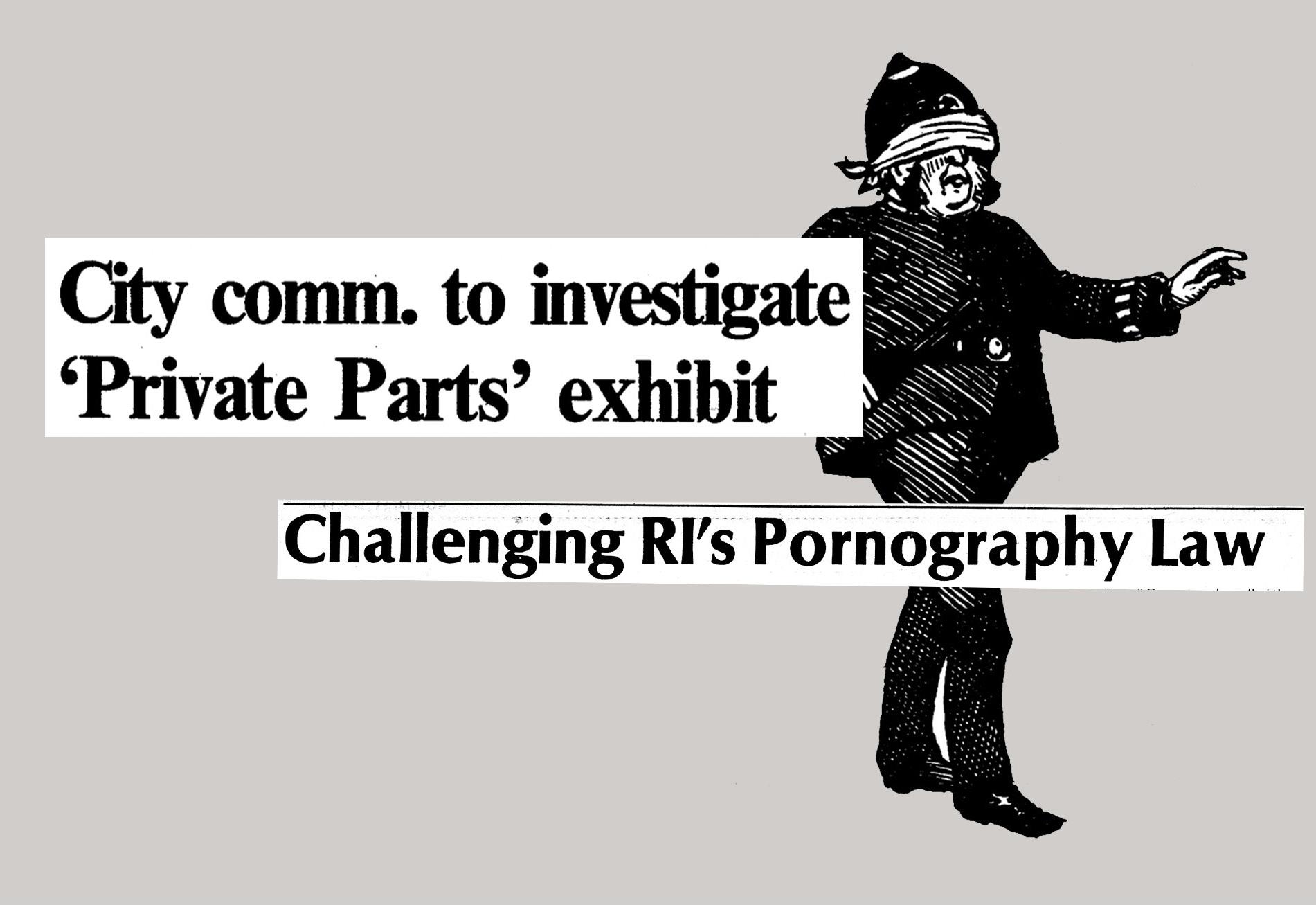
The conflation of personal ex pression and pornography contin ued through the sexual revolution in the ’60s and ’70s. “In 1968, the performer Charlotte Moormon per formed a piece that she made in collaboration with the artist Nam June Paik, called ‘TV Bra,’ and she was topless,” Caplain said. “She was arrested for nudity, (but) she was not convicted because she was seen as a kind of unknowing performer. That is a case in which there were laws about what you could or (could
not) do in public.”
Amidst this broader cultur al debate, Kathie Florsheim, who received an MFA in photography from RISD in 1974, penned a letter to then RISD president Lee Hall. “Until last week, I had never been ashamed to admit I attended RISD,” she wrote. “I now shudder at the thought, simply because you, as president of the school, have re fused to take a stand against what the Providence Police did to the show at Electron Movers Studio.”
The letter ended with Florsheim writing, “I think you have betrayed RISD, the community of artists that looks to RISD for leadership and yourself, as an artist, in order to take a stand on this issue.”
Hall responded, stating that the exhibition was not a RISD spon sored event and did not take place on the school’s campus, and thus he had no say in the matter. But Florsheim still took issue with this rebuttal stating, “Whether or not RISD sponsored or was directly or indirectly involved in this show is irrelevant. The First Amendment rights that are at stake here involve
the school regardless of its relation ship to this show.”
In the ensuing legal debate over the police seizure, students involved in the show called upon the American Civil Liberties Union to help with their court defense. The ACLU recommended the services of attorneys John Roney and Lynette Labinger.
“The legal issues were First Amendment issues and testing the Rhode Island obscenity stat ute, which like many statutes in the country had continually been revised, the Supreme Court was ob sessed with obscenity,” Rooney said in an oral history for “Underground Rhode Island.”
“The key to all of this was the sexual aspect of it, the pornograph ic aspect of it, which made it big news,” Roney said. Reporting on the “Private Parts” raid went be yond the scope of local news and made its way into places from Time Magazine to even the Bangkok Post via the Associated Press. Labinger chimed into this anecdote saying, “sex sells.”
The judge presiding over the
case quickly dismissed it and or dered the return of the confiscated works. Wisner followed up this case with a class action lawsuit against the city to cover monetary damages for the lost or destroyed artworks. The city didn’t settle until 1985, with most of the artists involved receiving $100.
When asked if the Electron Movers would have still put on the show if they had known about the potential consequences, McDonald responded, “We were pretty bold and it’s hard to know what we would have done. But I think the answer to that would have been yes.”
McDonald emphasized that art can only flourish if it pushes against the boundaries of established insti tutions, and sometimes, that means being a little provocative.
“The art establishment can be a very conservative institution, and very self-serving, too,” McDonald said. “So that was part of the moti vation too is to kind of think outside of the box that has become so in stitutionalized, and so predictable. And those things are all important to us.”
Submissions: The Brown Daily Herald publishes submissions in the form of op-eds and letters to the editor. Op-eds are typically between 750 and 1000 words, though we will consider submissions between 500 and 1200 words. Letters to the editor should be around 250 words. While letters to the editor respond to an article or column that has appeared in The Herald, op-eds usually prompt new discussions on campus or frame new arguments about current discourse.
All submissions to The Herald cannot have been previously published elsewhere (in print or online — including personal blogs and social media), and they must be exclusive to The Herald.
Submissions must include no more than two individual authors. If there are more than two original authors, The Herald can acknowledge the authors in a statement at the end of the letter or oped, but the byline can only include up to two names. The Herald will not publish submissions authored by groups. The Herald does not publish anonymous submissions. If you feel your circumstances prevent you from submitting an op-ed or letter with your name, please email herald@ browndailyherald.com to explain your situation.
You can submit op-eds to opinions@browndailyherald.com and letters to letters@browndailyherald. com. When you email your submission, please include (1) your full name, (2) an evening or mobile phone number in case your submission is chosen for publication and (3) any affiliation with Brown University or any institution or organization relevant to the content of your submission.
Please send in submissions at least 24 hours in advance of your desired publication date. The Herald only publishes submissions while it is in print. The Herald reserves the right to edit all submissions. If your piece is considered for publication, an editor will contact you to discuss potential changes to your submission.
Commentary: The editorial is the majority opinion of the editorial page board of The Brown Daily Herald. The editorial viewpoint does not necessarily reflect the views of The Brown Daily Herald, Inc. Columns, letters and comics reflect the opinions of their authors only.
Corrections: The Brown Daily Herald is committed to providing the Brown University community with the most accurate information possible.
Advertising:
The Brown Daily Herald, Inc. is a financially independent, nonprofit media organization bringing you The Brown Daily Herald and Post- Magazine. The Brown Daily Herald has served the Brown University community daily since 1891. It is published Monday through Friday during the academic year, excluding vacations, once during Commencement and once during Orientation by The Brown Daily Herald, Inc. Single copy free for each member of the community. Subscription prices: $200 one year daily, $100 one semester daily.
Brown Daily Herald, Inc. All rights reserved.
Copyright 2022
terview with an alum until it was too late to create a video introduction.
The applicant pool for the 2021-22 cycle increased by 38%, expanding the gap between the number of applicants and the number of alumni able to con duct interviews, Powell said.
But Powell clarified that students can make the video introduction on their cell phone, a tool that the ma jority of applicants have.
BY JACK TAJMAJER SENIOR STAFF WRITERAlumni interviews for prospective students will not resume following their suspension at the outset of the COVID-19 pandemic, according to an email from the Office of College Admission sent to alumni on Oct. 11. Applicants will retain the option to submit a two-minute video intro duction, the email said.
The email additionally stated that the University would establish new approaches to alumni-student engagement and offer a variety of opportunities for alumni connection at different stages of the admissions process, primarily through its new Alumni Ambassadors Program.
Previously, alumni interviews al lowed applicants to meet with an alum to learn more about Brown and share additional information about them selves to contextualize their applica tion, The Herald previously reported.

But Dean of Admission Logan Powell noted that when interviews were last offered during the 2019-20 application cycle, more than 8,000 applicants who requested an interview did not receive one. Many of those students, he explained, also were not made aware that they could not in
“If there’s an opportunity avail able, it should be available to every one,” he added.
Powell also cited alums’ concern over the increasing number of inter views and frustration over their in terviewees not receiving acceptance to the University as factors in the decision to eliminate the program.
The applicant pool for the 2019-20 application cycle, when interviews were last offered, was approximate ly 37,000 applicants. Powell noted a subsequent spike to 46,568 applicants in the 2020-21 cycle. The following year, the pool increased again to over 50,000 applicants.
While Powell was hesitant to draw a direct correlation between changes in admission policies and growth in the pool, he said the jump in appli cants could illustrate increases in accessibility for students that the University would like to continue.
Cassandra Coleman ’26, who sub mitted a video introduction in her application, said she appreciated that the process leaves “a lot more room to make it your own.” Still, she said she would have supported keeping the alumni interview as an option because students might not “have the resourc es to make a video, but they want to present themselves a certain way.”
Mandy Tachiki ’95, the former Alum ni Interviewing Program global chair, said she “wasn’t too surprised” when the change was announced. “The admissions office really did do some surveying and talking to a lot of people just to think about the equity of the process.”
Tachiki noted that the Alumni In terviewing Program frequently got complaints from interviewers about prospective students opting for inter views and then refusing to schedule them or engage meaningfully with the interviewer.
“There was some discontent about spending the time trying to do this student connection when some people weren’t interested,” she said.
While Tachiki felt that the changes were “a little sad” due to her extensive interviewing experience, she agreed with the decision because “the appli cant pool is so huge” and “technology has improved a lot.”
The University’s email explained that the new Alumni Ambassadors Pro gram will “experiment with several new mechanisms for prospective students to engage meaningfully with alumni.”
Powell noted that the University would also host alumni panels for admitted students, first-generation students and other groups in the near future to keep alumni and students engaged, though he did not provide a specific timeline.
“Our alumni are incredible,” he
said. “The stories of success and the strength of the community and the diversity of perspective in the commu nity is something we want to showcase … and we want all students to be able to hear those incredible stories.”
Previous alum panels have focused on discussions around academic and professional opportunities in the health and humanities fields, diversity on campus, and entrepreneurship and finance opportunities, Powell said.
Tachiki noted that, without the time constraint posed by the Alumni Interviewing Program, many alums have found new opportunities to en gage with students in recent years.
“Alumni want to be involved with Brown students,” she said. “That’s where we get excited … (the Alum ni Ambassadors Program) will give
GINA BAE / HERALDalumni the opportunity to work with current Brown students where there is a current need to network.”
Tachiki also said that Zack Lang way ’09, vice president of alumni re lations, met with “literally hundreds of alums” to receive input on vari ous forms of alumni involvement. He used that process to form the basis of the University’s upcoming alumni engagement programming, she said.
Tachiki added that certain affini ty groups may reach out to admitted students separately from the Univer sity with opportunities for alumni engagement.
The University will release more information regarding opportunities for alumni engagement after the early decision deadline has passed, Powell noted.
Art as Channel for Sexual & Re productive Rights: Rebecca Lane 11:30 a.m. to 1 p.m. 280 Brook Street
Brown University Women’s Tennis vs. Boston College 2 p.m. to 5 p.m. Brown Outdoor Tennis Courts
Halloween Agar Agar Plastic Workshop 1 p.m. Ewing Multicultural Center
SoBear Halloween Party! 6 p.m.
Stephen Robert ’62 Campus Center
DigDUG Halloween Spooktacular 12:00 p.m. to 2:30 p.m. Rhode Island Hall
Intramural Sports Pumpkin Painting Contest 3 p.m. Ittleson Quad
Brown University Wind Symphony Concert 8 p.m. Grant Recital Hall
Brown University Women’s Volleyball vs. Cornell 5 p.m. to 7 p.m. Pizzitola Sports Center
Administration cites lack of equity, growing student pool as reasons for change
applied for jobs, including a cook’s helper position at the University, which he described as a “dream place to work.”
Arriving on campus in 2014, Haimoura has worked at the Uni versity ever since. “I love every day” working at Brown, he said. “Every minute of it, actually. This is my home. This is my family here.”
But his YouTube career only be gan this summer, when Haimoura got in touch with old friends from Morocco who were eager to hear about his new career. Haimoura recalled them saying, “‘You need to show us something. When you cook something, do a video and show us what you are doing.’”
Haimoura then began filming cooking videos with a simple set
up of shoeboxes and a coat hang er, he said. He sent the videos to his friends, who loved them and encouraged him to post them on YouTube.
Haimoura said his friends love the channel, and he enjoys filming the videos for them. He films the videos on his days off, buying gro ceries in the morning and spending nearly the entire day cooking three different dishes so he can post the videos throughout the week.
“I’m so happy in my heart that I have three videos that I will post to my friends and (the) people who follow me,” Haimoura said. “Some times you work long, long days and then you work another long day on your day off. It’s challenging. But if I love it, it will make me happy. And that’s exactly what’s happening. So I’m happy.”
Haimoura’s friends are not the only fans of his YouTube channel. Many students have approached Haimoura in Andrews asking about the filming and preparation of different dishes, he said. Some students have even mentioned plans to use his recipes, Haimou ra added.
Haimoura’s family and cowork ers also subscribe to the channel. Bryan Chavez, a cook at Andrews, said he watches Haimoura’s vid eos and recently tried making the recipe for a ribeye steak. Haimoura also mentioned that his sister, who lives in France, made his fettuccine alfredo chicken pasta and told him it came out very well.
Commenters on Haimoura’s channel are similarly enthusiastic, offering their praises in English, French and Arabic.
“Looks great; keep up the amaz ing work, chef!” one commenter wrote.
“So delicious, I’m proud of you,” another wrote.
“I tried the recipe; it’s really, really great — thank you very much, brother,” wrote a third.
Haimoura also brings his pas sion for cooking to his work at An drews. His fellow chefs often come up with new specials to serve, and all staff members are encouraged to propose ideas for new dishes, he said.
Chavez, for example, said he and another cook came up with the Cinco de Mayo celebration that An drews put on last May. When they thought of the idea, they brought it to their supervisors, who are al ways “very open about trying new things,” Chavez explained.
Haimoura himself has intro duced many specials inspired by traditional Moroccan dishes, from chicken and couscous to kefta and lamb tagine pizza. The challenge, Haimoura said, is figuring out how to scale the dishes to serve thou sands of students.
Currently, Haimoura is focused on recording videos that feature fall dishes and desserts so people can use his recipes for the holiday season, he said.
Haimoura emphasized that his YouTube channel is all about sharing his love for cooking and helping others create delicious food. “That’s the happiest mo ment ever for me, when somebody tries my food and they enjoy it,” he said. “I feel like my mission is accomplished at that time. I feel so happy.”
FROM PAGE 1
at Brown, leading to the creation of the Center.
Cameron, who will be based in the Washington, D.C. office of the Center, first learned about the center through Nuzzo.
“When she told me that she was going to be inaugural center director, I was really excited about the oppor tunity to work with Jen,” Cameron said. “Jen wanted to tackle some of the hardest issues,” including vac cine uptake, community education and pandemic inequity.
The Center is exactly “where I wanted to be — looking at the hardest issues that came out of the pandem ic response to COVID-19 so we can prepare better for the next emerging biological threat,” Cameron added.
According to Nuzzo, one goal of the Center is to reach across the en tirety of the University, pulling en gagement and research from numer ous disciplines and fields.
“We want the field of public health to recognize that when (pandemics) happen, they touch all of health. They also touch all of society,” Nuzzo said. “I don’t think we fully understand the
broader economic and social conse quences of (pandemics), and it’s really important that we do.”
“One of the unique features of the Pandemic Center is that it will be multidisciplinary,” Cameron added. “We’re not going to find tools that will actually help communities be able to contain, respond and ultimately prevent pandemics unless we work across all of these fields.”
The Center also aims to engage in translational work by gathering evidence, synthesizing research and taking their findings to decision-mak ers in Washington, D.C. The hope, Nuzzo said, is that the Washington, D.C. office will be an important space for informing policy and engaging with policymakers domestically and abroad.
Aside from policy, the Center will also provide educational resources to the Brown community and the larger public, Nuzzo added.
“Brown, being a new school of pub lic health, is in the perfect position to help redefine what public health education for the future ought to look like,” Nuzzo said. “The idea behind the … Washington hub for the Pan demic Center at Brown is (that) it will
provide students with an opportunity to learn about public policy issues.”

The Center wants to focus on train ing the next generation of pandemic decision-makers and responders as part of a project loosely termed “pan demic game changers,” Nuzzo said.
The goal is to train people “not only in public health and biomedical science, but also in national security and foreign policy decision-making during a health emergency,” Cam eron said.
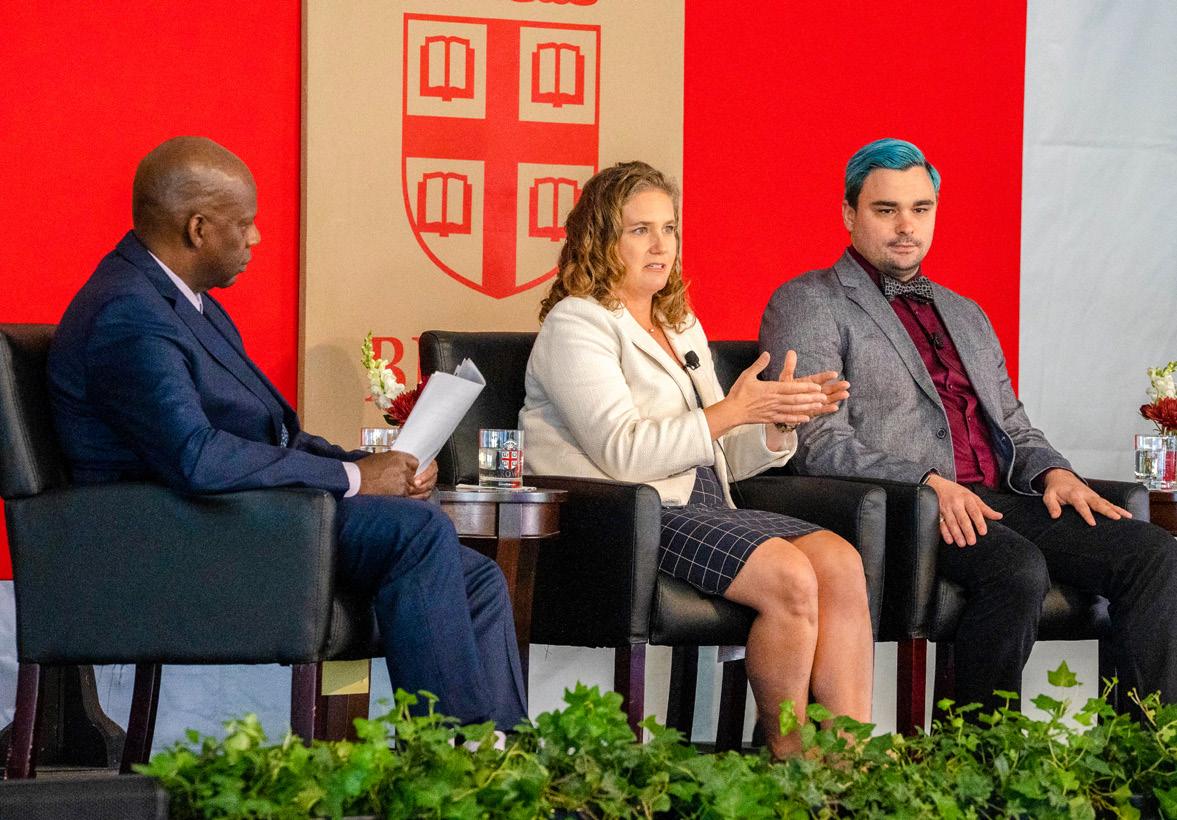
According to Cameron, the Center is currently working on a course for students that “will start diving into some (pandemic) issues and will in clude opportunities for students to come to Washington and interface with Washington decision makers.” The Center intends to offer the course in 2023, Cameron said.
While the Center was recently launched and is still establishing its early initiatives and recruiting facul ty, Nuzzo envisions the Center as “a cohort of research faculty … whose primary identity is that they’re a part of this Center,” along with affiliated faculty who will collaborate with the Center on particular projects.

One core faculty member, Scott
Rivkees, professor of the practice of health services, policy and practice, hopes to bring his expertise as Flor ida’s former State Surgeon General and Secretary of Health to the center.
“There’s a distinction between public health and health policy,” Rivkees said. While public health re fers to what measures are in place or can be put in place to keep pop ulations safe, health policy refers to the laws, rules and regulations that need to be enacted to do that, Rivkees
added.
“With my past experience, I hope to be able to bridge the gap between public health and health policy,” Rivkees said.
“One of the things that became really apparent during the pandemic is that there needs to be close ties between academic centers and public health” as well as “public health and health policy,” Rivkees said. “I think the Pandemic Center is going to play a really important role in bridging

In 1965, Brown was thrust into the national spotlight for doing something which was then unthinkable: prescrib ing unmarried female students birth control pills.
In the second episode of the Bruno Brief’s series on sexual politics, we ex amine the landscape of reproductive rights on College Hill, past and present. We speak with Katy Pickens, Metro edi tor and Bruno Brief producer, about her recent reporting on the topic, diving into the early days of contraceptives and secret abortions all the way to the current discourse happening after the overturning of Roe V. Wade.
Subscribe to the podcast on Spotify or Apple Podcasts or listen via the RSS feed. Send tips and feedback for the next episode to herald@browndailyher ald.com. The Bruno Brief is produced in partnership with WBRU. Subscribe to the podcast on Spotify or Apple Pod casts or listen via the RSS feed. Send tips and feedback for the next episode to herald@browndailyherald.com. The Bruno Brief is produced in partnership with WBRU.
To think that a couple, a few little pipsqueaks, 20-year-old pipsqueaks, could do this and help contribute to changing our society in such a radical way is something I’m very proud of.
Because they end up like abusing these women so much and really tor turing them with statements like, you know, “You know how many women commit suicide after they do this” or “You’re never going to sleep the same way after this.”
Well, there was an ongoing feud with Rosemary Pierrel, who was dean of Pembroke. And this was one way to, as I look at it, now and then, of putting her on the spot. Yeah. She was damned if she did and damned if she didn’t.
The child’s life is very important. And I think the bottom line is, in my opinion that … this can’t be legal be cause it’s the murder of a separate human life.
As we explored on last week’s ep isode, Brown has a storied history of nudity and sex on campus. Nowadays, students at Brown are pretty open about sex, but this wasn’t always the case. Talking about sex, contraception or abortion was extremely taboo — and in some cases, this taboo has never gone away.
This episode, we hear from ac ademics, historians and students to understand reproductive justice, birth control and abortion at Brown. I’m Lil iana Greyf, and you’re listening to The Bruno Brief.
Katy, when did discussion about re productive healthcare and rights start on campus?
The chaplain at Brown, the Epis copal chaplain, was John Crocker, who was an old friend of mine. And he calls me one day, and he says, “Oh, I’ve got a problem. I’ve got a graduate student who is over 21 and is going to be mar ried after she gets her degree in June to another graduate student here at Brown. And they would like to get mar ried now, but her parents will not have any thought of it at all until she gets her degree.”
That’s Roswell Johnson, who began as the director of Health Services in 1963.
He said, “They’re sleeping togeth er quite frequently, and I’m worried and they’re worried that they’re going to have an unplanned pregnancy, and is there anything we can do about it through the health service?” And I said, “Well, I don’t know, John. Why don’t you come over and talk about it?” So John came over, and we talked about it a bit, and finally we decided, yes, this was a perfectly reasonable couple for whom we would prescribe birth control pills, which were not all that common in ’63.
Roswell Johnson was prescribing very few — I think about one or two — prescriptions to unmarried Pembrokers. The news was broken by The Brown Daily Herald Sept. 28, 1965.
What’s interesting, though, is that the BDH didn’t have much of a problem with women being on the pill. In an edi torial called “A Bitter Pill,” they pointed out that prescribing birth control was pretty antithetical to the parietal rules in place at the time which gave women strict curfews, dress codes and more. The Herald’s editors slammed Rosemary Pierrel, dean of Pembroke College.
Pierrel actually attended Pembroke herself, and when she was a student, conversations about sex and repro ductive healthcare were extremely minimal.
There was at one time a part-time faculty member who taught physiology to women, but I think it was called hy giene, maybe. And probably, not unlike when I was a freshman, we had a course called hygiene, too. And you weren’t supposed to sit on men’s laps, things like that. I think that was supposed to be sex education. But, actually, there wasn’t anything of that sort in existence when I came. And as far as I know, with the exception of physical education and this course, which was a long time ago, I think early 1900s, I think, maybe even earlier, which was taught by a lady faculty member.
Education and discussion about sexual health on campus was, clearly, almost nonexistent during Pierrel’s time. In a fascinating clip from the Pembroke Center Oral Histories, she recounts learning about a rule that forbade married students from living
in the dormitories.
She asked if she could live in the dorm. I said, “Oh, sure, if there’s room. I mean, what’s the problem?” But I guess the theory was that married women knew things that virgins shouldn’t know, and since all the girls were vir gins, we’d better not have them con taminate.
It wasn’t until Johnson began pre scribing the pill that real conversation about sex on campus began.
I don’t think that the students ever had any perception of the personal and professional risk to which I was sub jecting myself by doing this. I wasn’t doing it to be a hero. I didn’t mean that at all. I was doing it to try to prevent pregnancies that were unwanted, were tragic, destructive to both the man and the woman and something that I want ed to do something about.
Nationally, Brown came under fire because of these prescriptions. But in the years to come, students on campus only continued to push the envelope and advocate for different reproduc tive rights.
A band of women came together in 1970 to create what would become an institution for feminist organizing on campus — Women of Brown United. Here’s Mimi Pichey, a leader of the club.
The most important, in my opinion, that took place during that period was we pulled together women to discuss abortion and decided out of that first meeting to found something called the Rhode Island Coalition to Repeal Abor tion Laws. The first meeting I attend ed along with, there about ten people there, was an extraordinary meeting. I will always remember it. We went around the room and talked about our experience with abortion. And there were about ten of us, and out of that ten, three had had an abortion. And each one told her story, and for many of these women, it was the first time they had ever told anybody else, outside of perhaps their partner, the story of what had happened.
Abortion was an extremely taboo subject and was inaccessible to many students. It was something that would happen, but people didn’t really talk about it.
It’s true, abortion has always been available to people who have money. In the old days, people … women used to fly to Sweden.
Mimi and members of women of Brown United founded the Rhode Island Coalition to Repeal Abortion Laws in February 1971, which brought together organizations across the state in filing a class action lawsuit against the state of Rhode Island and its strict abortion laws. Mind you, this is about two years before the Supreme Court ruled on Roe v. Wade, which overturned restrictive abortion laws nationally in January 1973. On Feb. 9, 1973, the Rhode Is
land Supreme Court ruled on the case brought forth by the coalition Mimi and her fellow Brown students started and found that the state’s abortion laws were unconstitutional.
That was Felicia Salinas-Moniz, cur rent director of the Sarah Doyle Center.
WBU’s organizing around abortion rights was pretty crucial. Rhode Island has a strong Catholic history, and the state legislature had put in place strict abortion laws. Ultimately they were struck down, in part because of activ ism driven by WBU and the broader community.
I am happy to say, proud to say that I helped file the suit in Rhode Island, and I helped file the suit in California when I was with Women’s National Abortion Action Coalition in early 1972.
In 1985, the group also established the women’s escort service, who volun teered as clinic escorts for people seek ing abortions at the Women’s Medical Center of Rhode Island. Here’s Sarah Fast, one of the escorts, from a 1988 interview in the Pembroke Center Oral History Project.
And at one point I was just really, you know, I had escorted a lot before, but never alone, and I just was really freaking out, and I didn’t think I could take it anymore. And I went inside, and I was speaking to one of the nurses there and saying, ‘Hey, you know, I just need a couple words of encouragement be cause I’m having a hard time dealing today alone.’ And she told me that they have, like, therapy with these women after they have the abortion, and they talk about the experience, and she told me that, without exception, the women say how relieved and happy they were to have someone bring them in, to have the escorters there and how it was a comfort to them.
Activism at Brown and around the country helped protect reproductive rights during the 20th century. Activ ists pushed to protect the right to have abortions and expand contraception. This past June, nearly 50 years after Roe v. Wade was decided in 1973, it was overturned. How did that happen?
So, I talked a bit with Dr. Sarah Will liams, visiting assistant professor of anthropology and gender studies, about that very topic.
Within just a few years of the Roe v. Wade decision in 1977, the Hyde Amendment was passed, which blocked federal funding for abortion care, which meant that almost immediately abor tion became a privilege of class, the ability to pay for an abortion. So it’s not a right, and it was never elucidated as a right by the government. It was what some scholars have called a neg ative right — you don’t have the right to have an abortion, you have the right for the government not to intervene in that decision. And that’s a really crucial and dangerous difference here. Because
rather than a positive right, rather than a law that says, every person who’s ca pable of getting pregnant has an in alienable right to abort that pregnancy, we rather have this sort of hands off, we have no obligation to protect the access to an abortion, we have no obligation to make it free or financially accessible, we just won’t directly interfere.
So with the shaky foundation for Roe, activists and academics were not surprised when the Supreme Court overturned the decision last summer.
How have people on campus re sponded to the overturning of Roe?
We’re definitely thrilled about the decision. But I think it’s probably ac tually got a little bit the opposite way for most of Brown students.
That was Kyle Nunes, the vice presi dent of the Students for Life club which advocates against abortion. Nunes says that the club plans to be more present on campus this year.
One thing we have tried is to put up fliers around campus, just like gener al interest forms, and they mostly get taken down within 24 hours. So that can be tough. But I think that, in my mind, the next step is, “Okay, we have to actually be present on campus and be okay with the fact that some people aren’t gonna like that.”

He also emphasized that they hope to focus more on supporting mothers in their activism, in addition to advocating against the practice of abortion.
I also talked with Hannah Fernan dez, a member of the executive board for Planned Parenthood Advocates at Brown. Needless to say, she had a dif ferent reaction to the Dobbs decision.
Even I had to be like, “I can’t do this right now.” And I set social media timer limits on my phone for minimal amounts per day so that I wasn’t tempt ed to go on it because I knew I wouldn’t be able to handle that much content about the Dobbs decision.
She also emphasized that because of Dobbs, there is a lot of movement locally to codify different reproductive rights. The club works to connect people with clinic volunteering opportunities and advocates broadly for legislation which supports access to reproductive rights, including abortion.
 by Hari Dandapani illustrated by Ella Buchanan @nanahcube
My oldest sister, Nikila, brought Radish home as a party favor when I was in the third grade. He was a purple betta fish, our family’s first pet, and the first animal I would ever form a bond with. I would crawl into my sister’s room every day after school to catch a glimpse of Radish swimming in circles in his fishbowl and, on occasion, attacking his reflection on the glass. For nine-year-old me, peering into his bowl and watching him wiggle around brought me boundless joy; I would stare at him and imagine myself in his position, gliding through the water.
As my sister nurtured Radish, I learned from the sidelines what it takes to keep someone alive: You have to feed them, entertain them, and make sure that they have a clean environment. One day, as my sister and I were washing Radish’s bowl, he leapt into the sink full of soap. Though she put him back into the bowl as soon as she could, later that day, he sank to the bottom of his bowl, and I heard my sister sobbing. The soap had poisoned him. I wanted to cry but couldn't find the tears. It was my first experience with death.
My family wouldn’t have fish again for another two years, until my middle sister, Abi, brought home two goldfish from the county fair as a prize for throwing darts at balloons. Though my sister
affectionately named them Rupert and Gregory, my mom immediately Indianized their names to Rishi and Ganga. Excited by the prospect of having more fish, I quickly moved them from their plastic bags into Radish’s old bowl and watched them grow.
When I came home from school each day, I waddled up to their bowl and peered inside to see what was going on. They looked back at me sometimes, but they mostly just floated disinterestedly in the water. Their bowl was barren. It was just two fish and the filth that they produced. They seemed bored, so I begged my mom to buy new accessories for their bowl. I asked her if she would want to live in our fish bowl— in a barren wasteland of water and feces. After much discussion, we finally agreed to get some blue rocks to decorate the bottom of the bowl and a rock arch to add some topological diversity.
Rishi and Ganga seemed happier. Now, when I came home, they would swim through the arch and bite at the rocks. From then on, I began to ask my mom for more and more accessories for them. We upgraded their bowl to a 10 gallon tank, added more colorful rocks and playthings, and even lined the tank with wallpaper to make them feel like they were in the ocean. I hadn’t yet formally investigated the literature demonstrating that environmental changes [...]
by Danielle EmersonI first felt certainty at my masaní’s (grand mother’s) farm. I felt safe in her hogan, curled up with blankets, the stove fire hot on my cheeks, side-by-side with my younger siblings. I’d listen to their breathing, a steady rhythm accompanied by soft crackles from the burning wood. Through her living room window, I’d watch as the wild cats slept in the old pine tree. I was so sure they’d come around one day, and accept my love for their scraggly, matted selves.
I felt certainty again later that morning, around my masaní’s peeling green dining table, eating home made flour tortillas with Spam and potatoes for breakfast. I could see the sun rising through her rick ety metal screen door. I could feel its warmth on my nose, just like at the fireplace last night.
Take another look before it goes Days are only footprints in the snow How far away can I walk Till I'm way too far from home
I wish I knew, I wish I knew I want something more than More than restless mornings
Getting by's so boring
- “Fever Dream,” Mxmtoon [...]
Mother believes that a young girl’s upbringing is not complete without witnessing a butterfly’s life cycle. To be raised as a girl in our home is an act of shedding skin, growing a pair, and embracing change. If your wings get stuck, you wiggle about. If the chrysalis is tough, you punch its walls. Survival is a matter of how willing you are.

I am but a freckle on a leaf, burdened to evergreen beneath the flaming sun. Freckle in the face of life, power in the face of oblivion. I don’t know why I am or, rather, why I keep trying to be. I know nothing of birth but of rebirth. I’ve been here before. I know how this ends.
I munch out of my first home and swallow.
Is it greedy to want to exist unexplained? To let my stripes create roller coasters for ants, bouncing up, down across milkweeds. Munch. Is it greedy to want? To be? To ask?
—Rob Capron, “Screen Memory” 11.1.2019
My thoughts are disrupted by shaking, rumbling, coming from somewhere. I munch mindlessly until I believe myself to grow taller. Has my transition occurred early? Is this burden the pair of wings [.destined to model? [...]
NARRATIVE uncertain certainties the feeling of not knowing but wanting to
“Whether the impetus be a monster, a psycho killer, or a demonic spirit in search of a new host, I always find that there is something so cozy about this Hollywoodproduced fear.”
—Ellie Jurmann, “Horror Movies for Bedtime Stories” 10.29.2021
“What threshold of time and space must be crossed before we can fully understand how a film works and the limitations of the magic it offers?”
It was February of freshman year and the novelty of New England winter was starting to wear off. My fantasies of a winter wonderland were met with bare trees and blotches of yellow snow, bleak reminders of my tendency to over-romanticize. The snowflakes that once gently graced my face now fell repeatedly like drops from a leaky faucet you can’t bring yourself to fix. The cable knit sweaters and turtlenecks and cardigans and scarves and fuzzy socks that I bought with great enthusiasm—despite there being no bank statement to support these purchases—were itchy, each layer more suffocating than the last. Perhaps the most disheartening transition lay in the walks around campus. My oncepurposeful strides turned into frostbitten scurries from one classroom’s refuge to another; that is, if I could muster up the willpower to leave my dorm in the first place.
On one instance where I did manage to leave the comfort of the riot-proof New Pem halls I’d grown to love, I found myself wandering aimlessly southward. It must’ve been less than 30 degrees that day, for the usual bustle of passersby down Thayer was replaced by a few brave souls trudging through the snow and slush. I had, by no means, accomplished anything on my to-do list, but I decided I was done for the day. Done with classes, myself, all of it. Surely a change of scenery would result in a more positive train of thought.
Despite my uncharacteristic burst of spontaneity, this adventure started with my usual, soul-crushing routine: Put on a thermal layer. Then jeans. Those don’t fit you like they used to. Now a sweater. Not baggy enough. Oh look, I’m crying again. Here goes sweater #2 followed by my wornout black puffer jacket and boots. I hope I don’t see anyone I know. Lastly, the headphones. Will these keep me distracted for long? I hope so. Like clockwork, I layered my insecurities between my winter clothes, subduing the insulation with the iciness of my internal monologue.
Somehow I wound up at The Underground. It was long past the usual lunchtime rush hour, [...]
sure you pee after sex, otherwise you’ll get a UTRA.”
can’t talk and pee? I thought that was a hallmark of masculinity.”
Haunted
Gingerbread
Harry's
of Dragons
a music genre characterized by a repetitive four-on-the-floor beat
a typical tempo of 120 beats per minute”

Wife
Not a home
Sarah Doyle
Britannica
 by Leanna Bai
Please hand-write a one page essay about yourself. Due tomorrow.
Lying on my belly in my closet, I lazily scribbled several ideas onto the paper. Hi, my name is Leanna. I’m thirteen years old. I definitely know more capitals of the world than you. Also I have a cat. I am ChineseAmerican? Here you go, teacher, I have no idea what it means to be or exist or gather memories into the shape of a human.
In fact, do not make me say one fun fact about myself or two truths and a lie. I literally don’t know.
It is with my very elementary notions of identity that I stumbled upon a particular novel over the summer—The Memory Police, written in Japanese by Yōko Ogawa in 1994 and later translated into English. I consumed this book in the way my aforementioned cat demolishes a bag of Costco tortillas: secretly, in the corner of my home.
The Memory Police imagines a mysterious island, in which ordinary objects like ribbon, music boxes, and
perfume vanish from people’s minds. Accompanying this phenomenon is the titular Memory Police, who enforces these disappearances by capturing select individuals who quietly remember these items. The main character is a struggling novelist, and when her editor is endangered, she decides to hide him under the floorboards of her house. As the disappearances become more severe, the duo grapple with the grief of societal and individual amnesia. The Memory Police is simultaneously a commentary on personal loss and a political depiction of a population that forgets its own history with grave consequences
Yōko Ogawa beckons readers to contemplate what they themselves have forgotten, and I think I know my answer.
I’m sure other Chinese Americans also underwent some degree of cultural alienation in the US. It’s a point that has been reiterated countless times in Asian American literature—the tendency towards assimilation that occurs when someone [...]
If you’re like me, Halloween is the time for last-minute panic and candy indulgence, a time for throwing together the shittiest costume the world’s ever seen and going, “No, you just don’t get the reference,” to people who see right through your Spooky Season laziness. But, as the old adage goes, those who can’t do, teach! Today I’ll be giving you some Halloween costume ideas to try and save you from the inevitable early exits at parties.
This is the perfect costume for those of you seeking to hit that perfect ‘70s balance between grooviness and sleaze. This movie’s range of outfits spans from “Gross Milsurp Guy” to “Gross Big Hat Guy” and will draw plenty of looks no matter what Halloween function you’re attending. After Halloween, you can capitalize on the multiple stylish pieces this costume requires by slipping them into your fall wardrobe. Field jackets and oversized coats will always look good when paired with more casual items like jeans and flannels, including tailored clothing like sport coats and trousers. Aim for more casual fittings to pair with the style of ‘70s fashion. This is also the perfect time to grow out your porno stache/beard combo that everyone in your life has been telling you not to. [...]
I grew up in a house directly adjacent to a noisy street. Honking cars, revving engines and shrieking sirens droned in the background con stantly. Similarly, here in Providence, modified cars and motorbikes racing through downtown and on Thayer Street is a common weekend occurrence. Sometimes, my roommate and I cannot hear each other over the sounds of the street.
Noise pollution, or unwanted and disturbing sounds in an environment most often caused by vehicles and machinery, is not just a nuisance. Exposure to noise for prolonged time periods can cause high blood pressure, sleep distur bance and stress, especially in urban areas such as Providence with a greater density of noise. Despite being studied less than other forms of pollution such as air or water, urban noise pol lution is a significant public health and envi ronmental justice issue that must be addressed beyond state and municipal governments just setting decibel codes.
Research has demonstrated that exposure to loud noises can raise a person’s heart rate and cause headaches. Although these symp toms can seem temporary, the irritability and blood pressure effects they can cause can con tribute to more long-term consequences such as cardiovascular disease and insomnia. Bruit parif, a French nonprofit organization that monitors noise levels in metropolitan Paris, found that some Parisians lose “more than three healthy life-years” connected to expo sure to the sounds of cars, trucks, airplanes and trains.
Young children are particularly affected by noise pollution. During critical periods of devel opment, frequent exposure to loud noises can affect a child’s speech acquisition and cognitive function, impairing a child’s ability to learn. In schools and homes located near train tracks or airports, noise pollution can become such a problem that teachers must stop teaching and
regain students’ attention each time a noise disturbance occurs. Persistent distractions lead to wasted time and less material learned in class.
The impacts of noise pollution also intersect with other socioeconomic inequities. According
sation. In downtown Providence, the sound limit during the day is 75 decibels, about as loud as a busy restaurant. Not only are these decibel ranges overly optimistic, but they are also difficult to enforce. For example, imag ine a car or motorcycle that is booming down
to a study from the Harvard T.H. Chan School of Public Health and the University of Califor nia, Berkeley, communities with larger propor tions of minority residents and socioeconomic inequities experienced higher levels of noise pollution than residents of wealthier cities.
Those who live near the nation’s arterial roads are almost always lower income. When viewed alongside literature that has found low income communities face other environmental injus tices such as increased air pollution, it can be surmised that noise pollution has the potential to have a significant negative effect on an indi vidual’s ability to maintain their physical, men tal and emotional health.
Decibel codes are not enough to contend with the challenges of noise pollution. In Providence, it is currently unlawful to create noises that exceed the sound limit allotted for the city’s various zoning districts. At night time in residential areas, the sound limit is 55 decibels, about as loud as a typical conver
Thayer with its mufflers removed. A police man would need to be present at the mo ment of infraction, determine which vehicle is responsible and maneuver through narrow streets full of cars and pedestrians — all while potentially ignoring more immediate crimes elsewhere.
Thus, municipal and state governments must invest in longer-term preventative solu tions to help regulate noise levels in cities. Da vid Owen, author of Volume Control: Hearing in a Deafening World, suggests building subway cars that roll on rubber tires, directional sirens for emergency vehicles and restricting the ex tent to which people can modify their vehicles. Owen’s suggestions for medium-sized cities such as Providence include utilizing roadside noise barriers, strategizing the placement of high-rise buildings to act as noise shielding and making roads more friendly for bikers and pe destrians.
Local research and community advocacy in
Providence are also necessary to meaningfully reduce noise pollution. Community Noise Lab, for example, is working to study the effects of noise pollution on child health and is active ly working with the Providence community to monitor noise levels. One of the Communi ty Noise Lab’s projects is the NoiseScore app, which allows users to “objectively measure and subjectively describe a noise event” and add their responses to a live heat map. These heat maps allow researchers to identify areas with excessive noise and work toward location-spe cific policy solutions that can reduce noise in those areas. Similarly, the Providence Noise Project, a community advocacy group, is taking strides to address and raise awareness about the consequences of noise pollution in Providence. Volunteers work with researchers and the local government to monitor sound levels and cut down on noise pollution. Together, these two groups are exposing the negative health effects of noise pollution and changing how sound is managed in Providence.
It can be easy to ignore the impact noise pollution has on our lives, but its invisibility doesn’t make it any less important. Effectively regulating unnecessary noise must be a city pri ority for the sake of children, the elderly, nightshift workers and individuals that live near main streets. Noise affects us all, and failure to address its consequences can only lead to great er public health consequences and environmen tal injustices in the long term.
Juliet Fang ’26 can be reached at juliet_ fang@brown.edu. Please send responses to this opinion to letters@browndailyherald. com and other op-eds to opinions@brown dailyherald.com.
“Effectively

The interior of the grocery store will include murals of locations throughout Providence, including India Point Park, Federal Hill and different universities, according to the press release.
The store will be hiring over 80 crew members to fully staff the franchise.
BY KATY PICKENS METRO EDITORAfter years of waiting and speculation, the Fox Point Trader Joe’s will have its grand opening next Thursday, Nov. 3.
“Moments before doors open at 8 a.m., there will be a brief ceremonial ribbon cutting,” according to a press release from the grocery store chain.
“Store Captain Linda Iannitti and Trad er Joe’s crew members will be on hand to welcome customers to their new neighborhood store.”
Students have expressed excitement about the opening of the long-awaited location, partly because of the market’s inexpensive and eclectic food options.
College Hill and Downtown especial ly has lacked walkable and accessible grocery options, The Herald previously reported.
“I am personally quite excited about the opening of a Trader Joe’s finally since it’s been like a long time coming,” said Yuna Shprecher ’24.
Shprecher emphasized that the opening will increase food options for students, particularly upperclassmen and those who are off the University meal plan.
“I think it will definitely help a lot for students where there’s just a lot of difficulty finding grocery stores easily, especially when you’re not completely on the meal plan and trying to find fresh produce,” she explained.
Shprecher added that especially as a vegan student, the options from the franchise will help her to consistently have plant-based snacks and meals.
“Having the Trader Joe’s that’s in a place that’s really commonly accessed in general is exciting,” she said.
In the context of activism on either side of the aisle, I also think it’s import ant to remember that although it may not be openly discussed on campus very often, students at Brown have, and will be, directly impacted by this decision.
Here’s Stella Olken-Hunt, a Univer sity News editor for The Herald. Last semester, she did reporting on the ex periences of students who have had abortions.

I interviewed students and alumni who had gone through an abortion when they were on campus. This was in the wake of the documents that were leaked that indicated that the Supreme Court could be overturning Roe v. Wade.
All their experiences were really dif ferent, but they all generally reported just the difficulties mentally, emotion ally, physically with going through
abortion, even if there aren’t barriers in Rhode Island to receiving an abortion because Rhode Island is one of the states where it is easier to do it than others.
At least one I know of specifically reported difficulties with schoolwork and maintaining that going through the experience and getting understanding from the deans and professors. That was sometimes a little bit difficult, especially if you are not feeling comfortable to dis close exactly what’s happening, which is really understandable.
Someone in the article mentioned that people don’t really think of it as something that happens on campus. It’s kind of detached in a way, you are like, “Oh yeah people get abortions, but not here.”
What do people expect for the fu ture? What do they want?
Professor Williams explained that
the reproductive justice movement takes a broad, social justice-focused and intersectional approach to these issues.
The right to an abortion is only one reproductive right. And in order to have all of our reproductive rights, we need to fight for all of them, so that they stand together. So the reproductive jus tice movement is a really great model of what coalitions look like that center the needs of women of color, in particular, as well as queer, trans, non-binary folks.
Jocelyn Foye, co-founder and exec utive director of The Womxn Project, has been working to lobby the Rhode Island legislature to extend equitable access to abortions.
One thing for people to understand is that, abortion in a lot of cases to us represents so much more. It’s not just
about a medical procedure, it’s about bodily safety and dignity and people being able to choose when they’re ready to have a family and why.
While Rhode Island codified the right to abortion in 2019, groups like The Womxn Project, Planned Parent hood Advocates and more are really pushing for the Equality in Abortion Coverage Act to be passed. This law would promote the financial accessi bility of abortion throughout the state.
People always try to say that public health is not political and medicine is separate from politics. But at this point in the way that things have devolved, everything is politics. Public health is politics.
So people keep on working and have embraced a wider view of the issue.
We can’t give up on people. We can’t give up on women, we can’t give up on people with wombs. It used to seem im possible to get Roe passed, at one point in time. All of the rights that we have, at one point in time are considered to be impossible.
This has been The Bruno Brief. Tune in next week to hear about controversy on College Hill after a rogue, avant-gar de photo exhibition by RISD students that some authorities — including Prov idence Police — deemed indecent.
This episode was produced by Elysee Barakett, Caitlin Carpenter, Finn Kirk patrick, Katy Pickens, Jacob Smollen and me, Liliana Greyf. If you enjoyed this episode, be sure to subscribe to The Bruno Brief wherever you get your podcasts and leave a review. Thanks for listening, and we’ll be back next week.
Grocery store to have ribbon cutting, open doors for business on Nov. 3JACK WALKER / HERALD Trader Joe’s long-anticipated location on College Hill is slated to have a staff of 80 new crew members and will include murals depicting Providence parks, universities and neighborhoods throughout the walls inside.
of a
for
doubting
multistage
more difficult
actually
Incredible
of guys
make a good
reactions
brother's
word
fresca
utterance
on a
among
when
taking a test without studying for it
Martin of Hitchcock's "Marnie"
neighbor of 10
over
system that's free for all Brown students!
following "main"
the
"quiet"
it's
that sounds like