
Computer science TAs vote yes to union
TALO organizers celebrate win, contemplate next steps as official union
BY ASHLEY CAI & SAMUEL LEVINE SENIOR STAFF WRITER AND UNIVERSITY NEWS EDITORUndergraduate computer science teaching assistants voted 303-28 in favor of unionizing, a National Labor Relations Board representative announced following the tabulation of votes cast in Thursday’s election. 331 total votes were cast, with 91.5% in favor and 8.5%
Assistant Labor Organization followed nearly three months of campaigning — and organizing efforts that stretch back at least to October 2022 — to create the first undergraduate labor union on campus. TALO’s win makes it the second student bargaining unit on campus, following the Graduate Labor Organization’s successful formation in 2018.

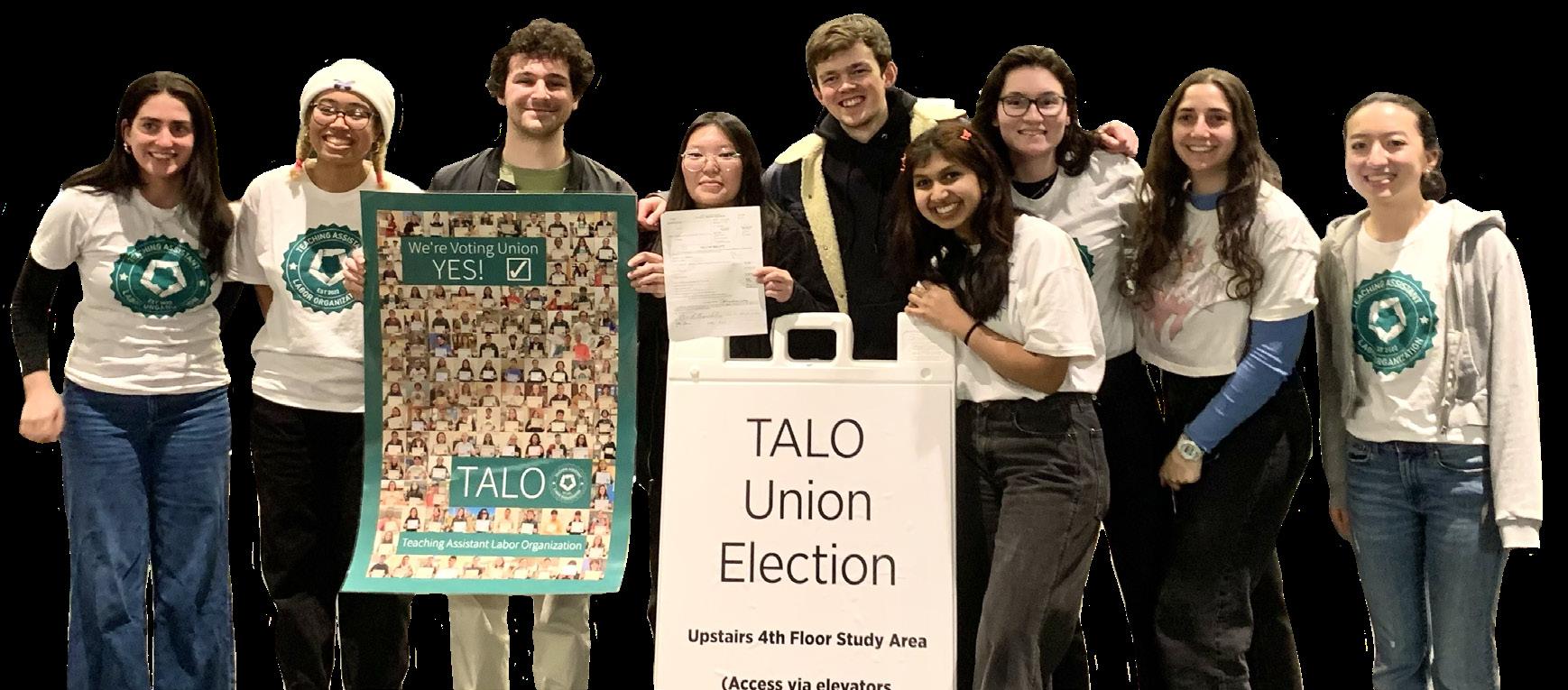
While TALO will unionize as part of GLO to gain access to more resources and ensure stability, it “will have a separate contract and bargain with Brown independently,” according to a TALO Instagram post.
The announcement followed a day of in-person, anonymous voting, which took place from 12-3 p.m. and from 5-8 p.m. on the fourth floor of the Sciences Library under the supervision of NLRB representatives.
All undergraduate, meta and head teaching assistants who are current-

ly working were eligible to vote in the election, as were all undergraduate, meta and head teaching assistants who worked in the fall 2022 semester, The Herald previously reported.
“I’m just so proud of everyone in this room,” Galen Winsor ’22.5, a graduated TALO organizer, told The Herald after the vote tally was announced.
“This was not easy,” he said. “This took a ton of work. And even though the count ended up being incredibly on our side, that just reflects how much everyone had to put into it.”

TALO is “looking forward to making TA working conditions better and delivering the world-class education that Brown promises,” said Colton Rusch ’23, a TALO organizer, in an interview with The Herald after the vote tabulation.
He added that TALO is “very grateful for everyone who has gotten us here, and overall thankful for Brown as well, and

A look at Brown’s most popular classes
Hearing, happiness classes attract most students for spring semester
BY ANISHA KUMAR SENIOR STAFF WRITER
When Isaiah Nawaz ’25 walked into a MacMillan Hall classroom for his neuroscience course during shopping period, he was surprised by how quickly the lecture hall’s seats were taken up.
“Every single seat was taken,” he said. “If people walked into class two minutes late, there were no seats, so they’d stand … the whole time.”
Nawaz, a prospective neuroscience concentrator, had not anticipated that NEUR 1065: “Biology of Hearing” would be such a highly demanded course. According to data reviewed by The Herald from the Office of Institutional Research, the nearly thirty-year-old course is the most popular class at
Brown this semester. The course has 578 students enrolled across two sections, with 427 students in its larger, in-person section, according to Courses@Brown.
“Biology of Hearing” is followed in popularity by: CSCI 0200: “Program Design with Data Structures and Algorithms,” which boasts an enrollment of 461 students; RELS 0010: “Happiness and the Pursuit of the Good Life,” which has an enrollment of 408 students; CHEM 0350: “Organic Chemistry I,” which currently has 482 total students enrolled; and APMA 1650: “Statistical Inference I,” which has 408 students.
‘Biology of Hearing’: embracing the ‘unconventional’
“Biology of Hearing” aims to provide an overview of how sound is received and processed by the ears through an interdisciplinary approach, exploring fields like anatomy, neuroscience, physics and psychology, according to the course’s syllabus.
Professor of Biology James Sim-
mons, who has been an instructor at Brown since 1984, said he first began teaching “Biology of Hearing” in 1996 and has taught it “more or less continuously” since then. The course was initially intended to be a companion to the formerly offered “Biology of Vision” course.
The class has remained largely unchanged throughout its nearly threedecade-long existence, with only occasional updates to the course content to reflect new research on the subject, Simmons said.
According to Simmons, this year’s high enrollment — nearly triple the usual amount of students — could be explained by his announcement of his plans to retire in the next two or three years.
“This will be the last time I teach the class,” he said. “I announced that right at the beginning (of the semester), and a whole lot of people flocked to take it.”
In response to the unexpected in-
SEE COURSES PAGE 7
we’re looking forward to a cooperative bargaining experience with them.”
Once the NLRB officially certifies the election, “the University will recognize the Graduate Labor Organization as the exclusive representative of computer science TAs in the bargaining unit on employment matters,” wrote University Spokesperson Brian Clark in an email to The Herald.
“After the NLRB’s certification, and per the law and conventions governing collective bargaining, the union will present the University with an intent to bargain,” Clark wrote. “When that happens, the parties will work coop eratively to establish a schedule for negotiations over the terms of a collective bargaining agree ment.”
“We look forward to working productively, collegially and in good

portant matters of terms and conditions of employment for the members of the bargaining unit,” Clark added. “The undergraduate TA program in computer science is a distinguished program at Brown with a long and valued history, and the University and the Department of Computer Science remain fully committed to ensuring that it is a valuable academic experience for generations of students to come.”
CS TAs launched their campaign to
Brown’s payments to Providence, explained
PILOT, memorandums of understanding generate revenue in lieu of property taxes
BY RHEA RASQUINHA METRO EDITORAs a nonprofit institution, the University does not pay property taxes on its institutional properties — a condition that dates back to the University’s 1764 charter.
Commercial properties owned by the University, though, such as the Brown Bookstore, are taxed — as are properties in which Brown is a tenant — including the Nelson Center for Entrepreneurship and South Street Landing.
According to a Jan. 2022 report from the Providence Finance Department and the Office of then-Mayor Jorge
Elorza, the University would pay close to $50 million annually if it paid full taxes for all of its properties, which are valued at over $1.3 billion. If all nonprofit land parcels were taxed at the commercial rate, Providence would see an annual yield of over $130 million, the report continued.
Laws and agreements in place supply Providence with part of the University’s estimated full tax revenue to the city. One is state-funded: payments in lieu of taxes funding, also known as PILOT, which does not involve payments from the University. The University also has two agreements with Providence for voluntary payments: a 2003 memorandum of understanding that also includes Rhode Island School of Design, Providence College and Johnson and Wales University, and a 2012 memorandum of agreement.
The latter two agreements expire
PILOT PAGE 2
BROWNDAILYHERALD.COM SINCE 1891
F RIDAY, M ARCH 3, 2023 VOLUME CLVIII, ISSUE 16
UNIVERSITY NEWS
SEE
30 / 44 29 / 39 TODAY TOMORROW DESIGNED BY TIFFANY TRAN ’26 DESIGNER JANE ZHOU ’25 DESIGNER SIRINE BENALI ’23 DESIGN EDITOR NEIL MEHTA ’25 DESIGN CHIEF Meta-analysis finds COVID convalescent plasma therapy effective Page 3 The
Page 12 S&R Podcast Journalist, author discusses book on India-Israel relations Page 7 U. News Page 10 SEE TALO PAGE 5
UNIVERSITY NEWS
Bruno Brief explores the Univerity’s secret
societies
NEWS
DANA RICHIE, SAM LEVINE / HERALD UNIVERSITY
‘Your Place or Mine’ brings back rom-com golden age despite predictability
Film starring Reese Witherspoon, Asthon Kutcher keeps audiences engaged
BY MAGDALENA DEL VALLE SENIOR STAFF WRITERThe golden age of romantic comedies is back.
In Reese Witherspoon and Ashton Kutcher’s new rom-com “Your Place or Mine,” “The Holiday” meets “When Harry Met Sally.” Written and directed by Aline Brosh McKenna, who also wrote “27 Dresses” and “The Devil Wears Prada,” the film delivers all the magic of rom-coms past.
Far from the cringeworthy nature of its contemporaries such as “The Kissing Booth” and “To All the Boys I’ve Loved Before,” “Your Place or Mine” uses cliches in the best way possible. The viewer knows that the protagonists will inevitably get together, but their characters are so genuine and relatable that they cannot wait to accompany them on the journey.
The film begins with a one-night stand between Peter (Kutcher) and Debbie (Witherspoon) in their early 20s. The film then fast-forwards 20 years: The two appear to be talking in
bed together, but the camera zooms out to reveal that the screen is split.
Debbie and Peter are each in their respective beds. Debbie is in Los Angeles, and Peter is in Brooklyn (with another woman). The film reveals that even though nothing else romantic transpired between them in the last decades, the two have been long-distance best friends while leading nearly polar-opposite lives for years.

Debbie is a stay-at-home sin -
gle mom with a passion for her son Jack’s (Wesley Kimmel) safety and a disciplined daily routine. Meanwhile, Peter is a struggling writer-turned-marketing-mogul who cannot maintain a relationship for more than six months.
Despite their differences, the two share a close bond and tell each other everything — much to the chagrin of Peter’s partners. In the movie’s first scenes, Peter’s current girlfriend pours herself a cup of coffee and gets ready
for work, all while Peter and Debbie are on the phone planning Debbie’s visit to New York. He has offered her a place to stay while she completes an accounting program to get a better-paying job.
When his girlfriend breaks off their relationship, Peter does not seem particularly bothered. But he is upset when he learns Debbie is thinking about canceling the trip after her babysitter bails. Immediately, Peter offers to look after Jack in L.A. while
Debbie stays at his place to take her classes.
Trading homes allows the characters to get to know not only themselves better, but one another as well. In New York, Debbie explores romantic pursuits she would never have dared to in L.A. and lets herself lean into her lifelong dream of working in publishing. Meanwhile, Peter stops trying to apply the marketing strategies of his job to real life. He realizes that he can’t buy friends and instead embraces his position as a role model for Jack. He admits to himself that he has always had feelings for Debbie but has been too afraid to tell her.
“Your Place or Mine” felt all the more personal for viewers who have followed Witherspoon and Kutcher’s respective careers. These rom-com veterans brought with them all of the experience and maturity they gained from previous projects. Their characters felt like authentic people and not merely a performance.
Like the rom-coms of decades past, “Your Place or Mine” ends with a public declaration of love in the middle of an airport and the couple living happily ever after. Although it is predictable his movie portrays a genuine, mature kind of love, teaching the viewer that it’s never too late to pursue a dream or confess what they really feel.
at $1,413,416 in 2023.
For properties acquired by the universities which become tax-exempt, the 2003 MOU also includes a schedule of transitional payments equal to real estate taxes from the year the property was acquired. This 15-year schedule generates a percentage of the initial transition payment for the city that decreases in five-year increments before dropping to zero in the 16th year, which Clark described as a “tax phaseout.”
In the 2012 MOA, the University agreed to pay Providence $3,900,000 annually from 2012 to 2016, and $2,000,000 annually from 2017 to 2022. That agreement included “conditions to payment” requiring the city to give the University the title to the block of Olive St. “between Thayer and Brown streets, two blocks of Brown St. between George and Charlesfield streets and one block of Benevolent Street between Brown and Magee streets.” It also required the city to give 250 parking spaces on public streets to the University for “faculty and staff parking” over a 20-year term.
this year, with renegotiations underway.
In collaboration with RISD, Providence College and Johnson and Wales, Brown “began detailed conversations this month with Mayor Smiley and his staff on our voluntary payments to the city,” Clark wrote. “We support the idea that Brown should support the city, and we’re proud of the significant number of ways in which we do,” he added.
“There are many models across the nation for agreements between cities and universities — we believe the City of Providence and Brown could benefit from an agreement in which our interests are more aligned and where we bring not only our fi-
nancial resources, but our intellectual resources as well,” Clark wrote. “We look forward to continued conversations with the mayor’s team in the weeks ahead.”
What is the PILOT program? How Rhode Island pays Providence for lost tax revenue
Under Rhode Island law, the state pays municipalities, including Providence, 27% of the property tax value of land held by tax-exempt nonprofit institutions, including the University. These payments “partially compensate for property owned by institutions of higher education and hospitals,” wrote University Spokesperson Brian Clark in an email to The Herald.
The phrase “payments in lieu of taxes” does not appear in state law. Instead, Rhode Island’s general law refers to them as “general assembly appropriations in lieu of property tax from certain exempt private and state properties.”
According to the 2022 report, current state PILOT payments generate roughly $33 to $34 million annually for Providence. In 2021, the state reimbursed Providence $13 million for the University’s properties, 27% of the University’s estimated property taxes, Clark previously told The Herald.
In 2019, former Gov. Gina Raimondo called to reduce the state’s funding for PILOT payments, though the cuts never came to fruition.
This program is separate from payments that Brown makes directly to the city.
What voluntary payments does Brown make to Providence?
The 2003 MOU and 2012 MOA are separate from state law and were negotiated between institutions of higher education and the city. The 2003 agreement involved Brown, Rhode Island School of Design, Providence College and Johnson and Wales University, while the 2012 agreement only applied to Brown.
From 2003 to 2023, the 2003 MOU requires Brown to make a payment that increases every year — starting at $1,065,161 in 2004 and concluding
The University made its final payment stipulated in the 2012 MOA in June 2022 — and it will make the final payment of the 2003 MOU by June 30 this year. This fiscal year, Brown is set to pay $4.5 million to the city, the Boston Globe previously reported.
In fiscal year 2022, the University paid Providence $3,392,529 in voluntary payments through the two agreements — $1,392,529 under the 2003 agreement and $2,000,000 under the 2012 agreement — along with $749,891 in transitional payments and $2,402,638 in commercial taxes, wrote Clark. The city also received $13,004,569 through the state PILOT program for the valuation of the University’s properties, bringing the total revenue the University created for Providence to $19,549,627.

2 F RIDAY, M ARCH 3, 2023 THE BROWN DAILY HERALD | NEWS
ARTS
& CULTURE
COURTESY OF NETFLIX
Debbie and Peter, separated by geography and in different phases of life, still seem destined to end up together — and the characters’ relatability means that viewers enjoy the inevitable journey to that point.
PILOT FROM PAGE 1
HERALD FILE PHOTO
The University does not pay property taxes on its institutional properties, but it does make voluntary payments pursuant to two agreements.
Study shows effectiveness of COVID-19 convalescent plasma therapy
Meta-analysis combines data from five clinical trials nationally, internationally
BY GABRIELLA VULAKH SENIOR SCIENCE & RESEARCH EDITORA recent study co-authored by an Warren Alpert Medical School professor showed the effectiveness of convalescent plasma therapies for treating COVID-19 early in its disease course and preventing hospitalization.
The study in the journal Clinical Infectious Diseases, co-authored by Adam Levine, professor of emergency medicine and health services at the Med School, was a collaboration with a group of researchers based in Argentina, the Netherlands, Spain and the United States. The paper consists of a meta-analysis of five clinical trials across these four countries.
‘We had tested in the wrong population’: Prior usage of convalescent plasma
Convalescent plasma is a blood product that individuals can donate as they would during a regular blood or plasma donation. Since “it is the part of the blood that includes all of the antibodies we have against different diseases,” it was one of the earliest treatments considered at the start of the pandemic before the development of vaccines, Levine said.
Anyone who had COVID-19 and recovered has antibodies in their plasma, “and the idea was that if you gave (antibodies) to people who were sick with COVID-19, those antibodies could neutralize the virus and reduce complications such as severe illness, hospitalization or death in those patients,” he said.
This led convalescent plasma to be approved as a “blanket treatment for COVID-19 under an emergency use authorization, and then people started giving it to everyone,” Levine explained. Many patients who were hospitalized and “on their deathbed” were given convalescent plasma treatment. This population is where the first studies on administering the therapy for COVID-19 took place, according to Levine.
But these initial studies found that convalescent plasma did not work to treat COVID-19 and did not reduce mortality in these patients.
“Unfortunately, like with so many things at the beginning of the pandemic, we were rushing so much that we didn’t really take the time to stop and think about how best to study” convalescent plasma therapies, Levine said. “The problem was we had tested in the wrong population.”
While convalescent plasma has antibodies that neutralize the virus, “by the time you’re hospitalized with COVID-19, the virus isn’t the problem anymore — it’s the body’s immune response to the virus, the inflammatory phase and the inflammation against the virus that actually kills people with COVID-19,” Levine said. “So it’s not surprising that convalescent plasma wasn’t useful in that population.”

With this in mind, researchers at Johns Hopkins University, with a grant from the United States Department of Defense, led a study beginning in 2020 on convalescent plasma treat-
ments — specifically in patients at early points in their disease course or before hospitalization. This study involved other collaborators across the country, including Brown and Rhode Island Hospital, and Levine served as the primary investigator in Rhode Island.
The study’s findings, published in the New England Journal of Medicine, showed that hospitalizations were reduced by approximately 50% in patients who received the COVID-19 convalescent plasma therapy compared to control patients.
“But the problem was that there were a lot of other studies that showed contradictory results and so … it wasn’t clear where and how to use convalescent plasma,” Levine said.
Convalescent plasma versus alternatives
Convalescent plasma has a number of advantages over alternative treatments, according to Levine and Yuriko Fukuta, assistant professor of medicine-infectious disease at Baylor College of Medicine.
Monoclonal antibodies — which only have one type of antibody specific to one receptor on the virus — lose their effectiveness when a virus mutates and that receptor changes, which is what happened with COVID-19 variants, according to Levine.
The other main methods for treating COVID-19, including Remdesivir and Paxlovid antiviral therapies, also have limitations, according to Fukuta.
The intravenous administration of Remdesdivir requires patients to come to the infusion center once a day for three days. This is “a lot of work … and why not many hospitals have set up Remdesivir for outpatient (settings),” Fukuta said.
While convalescent plasma is also administered through infusion,
it only needs to be done once, she added.
Paxlovid is a pill taken in an outpatient setting, and the “appeal” of this medication is that doctors can see patients virtually and call in a prescription to a pharmacy, so there is “much less risk from an infection control standpoint and it’s easier for patients,” Fukuta said. However, she also noted that Paxlovid can have drug interactions with other medications, especially for immunocompromised patients, which is “why we think plasma can be the alternative for them.”
“Convalescent plasma is beneficial because it keeps up to date with the virus and as people get infected, they produce antibodies to the newer phases of the virus, so if you get convalescent plasma from someone who’s recently been infected then you know you have a treatment that works with the current phase of the virus,” Levine said.
The alternative treatments to convalescent plasma are also patented and more expensive, meaning they are not available to many lower-income countries despite a push for pharmaceutical companies to share their intellectual property, according to Levine.
“As of right now, the only treatment for COVID-19 that doesn’t have a patent is convalescent plasma because it comes from the human body — you can’t patent it,” Levine said.
Knowing that convalescent plasma treatment was effective from the initial 2020 trial while also remaining aware of the conflicting data surrounding this therapy led the researchers to do “a meta-analysis to provide strong evidence on whether (convalescent plasma) really is effective,” Fukuta said.
Results of meta-analysis
The researchers’ meta-analysis focused on convalescent plasma
therapy studies in the outpatient setting because earlier studies found that convalescent plasma is not as effective once patients are already hospitalized, according to Levine.
“We wanted to bring together all of the studies that looked at outpatients and so we did a big literature search, searching through thousands of articles, and found only five (studies) that had been published in the world that looked specifically at outpatients,” Levine said.
They then reached out to the authors of the five trials asking them to share their original data — some of which had not been published in the studies — to have a more comprehensive picture for their meta-analysis. The authors of these five trials were also listed as co-authors in the meta-analysis study.
Through this meta-analysis, the researchers found that convalescent plasma is effective at reducing hospitalization by about 30% and works best when administered during the first five days of symptoms.
They also discovered that the therapy is more effective when patients receive high-titer convalescent plasma, or plasma with more antibodies against COVID-19. Convalescent plasma in the top 50% titer reduced hospitalization by over 50%.
Combining all five studies also allowed researchers to look at a “very representative sample of the human adult population,” Levine said. The studied population ranged in ages, risk level and treatment setting, suggesting that the findings “are very generalizable to the wider population.”
‘We do not have to repeat the same mistakes we made early in this pandemic’
Professor of Medicine at Johns Hopkins University Shmuel Shoham, who wrote editorial commentary responding to the study, is optimistic
about the promise of COVID-19 convalescent plasma therapy. But he also said that the therapy is still not accessible for many patients around the world and many healthcare systems do not have the infrastructure set up for this treatment. There is also “a lot of misinformation out there” about the therapy, he added.
Another challenge with convalescent plasma — and blood products in general — is the variability in the antibody level between donations, according to Shoham. There is also uncertainty regarding whether the antibodies in a particular bag of plasma used to treat a patient will be effective against the specific variant of virus a patient has.
Shoham added that the current data on convalescent plasma suggests that the therapy “should be effective, but it’s not the same as if I had a higher level of precision that you often have with actual pharmaceuticals.”
The researchers are also continuing to publish secondary analyses of the data collected in the meta-analysis, according to Levine. One question they have is: “What are the effects of convalescent plasma on long COVID-19?”
They hope this study will influence the National Institute of Health, World Health Organization and FDA to make convalescent plasma a recommended treatment for COVID-19, especially for parts of the world that have limited access to pharmaceutical treatments.
The findings from this meta-analysis are “very important for the next pandemic because when it happens, there will be a huge desire for treatments really early and the only treatment we will have available at that time will be convalescent plasma,” Levine said. “But now we know how to give it, who to give it to and what type of plasma to give, so that we do not have to repeat the same mistakes we made early in this pandemic.”
F RIDAY, M ARCH 3, 2023 3 THE BROWN DAILY HERALD | NEWS
SCIENCE & RESEARCH
ASHLEY CHOI / HERALD
School of Public Health launches three affinity-based student groups
BY LYNN NGUYEN STAFF WRITERThe School of Public Health launched three new affinity-based student organizations in February: the Womxn in Public Health Organization, Students for Latino/Latinx in Public Health and Disability Justice as Public Health
According to Sean Kelley, assistant dean of student services at SPH, the school’s Office of Education and Student Services secured initial funding from the University to support both current and potential future groups. In collaboration with the Graduate Student Council and Departmental Undergraduate Groups, OSS also offers leadership training for students leading the new groups.
According to Kelley, OSS had consistently received feedback from students stating that they wanted affinity-based organizations at SPH. “We now have the infrastructure and funding to support them.”
The new organizations were “years in the making” and are “complementary to long-standing” student groups already on campus, Kelley explained. Students were able to submit proposals to SPH for the groups this past fall.
Leaders from each group spoke to The Herald about their organization’s background, structure and future plans.
Womxn in Public Health Organization
Irene Quilantang GS and Madison Davis GS co-founded the Womxn in Public Health Organization to connect with people experienced with the public health field who also “share (our) own experience,” Quilantang said.
The organization aims to create a safe space for women in public health to discuss challenges, share successes and inspire each other, according to Quilantang.
The group traces back to the Public Health Womxn of Color Initiative, an organization founded in 2018 and hosted by the SPH Office of Diversity, Equity and Inclusion.
Last semester, before the group was formalized as a student-run organization, it hosted a panel through OSS, the DEI office, Sarah Doyle Center and Pembroke Center. Speakers, including SPH Deputy Dean Megan Ranney, SPH Assistant Dean of DEI Jai-Me Potter-Rutledge and Pembroke Center Communications Manager Sarah Gamble, offered their insights into public health.
When OSS called for group proposals, Quilantang and Davis seized the opportunity to formalize Womxn in Public Health as a student-run organization, allowing them to request SPH funding for their group.
Quilantang said that she and Davis relied on support from the dean’s office, DEI office and OSS when forming the group. “We’re lucky that we have a very supportive administration at this time.”
Moving forward, the organization looks to celebrate Women’s History Month, establish a mentorship program for group members and support LGBTQ+- and women-owned businesses in Providence.
According to Quilantang, anyone interested in public health may join the group, even if they don’t identify as a woman.
“More people (supporting) women in public health would be great,” she said. “It’s a win-win for everyone.”
Students for Latino/Latinx in Public Health
“Students who identified as Latinx would come up to me and ask me the same questions I had my first year: ‘Is there a group for Latinx students where we can talk about public health issues relating to our community?’ ” said David Arango GS.
Arango, Cindy Lopez GS and Jorge Ledesma GS launched and lead Students for Latino/Latinx in Public Health. The group aims to raise awareness of Latinx culture in public health, health issues disproportionately faced by Latino/Latinx communities, promote diversity, motivate Latinx public health research and serve the Latinx community in Rhode Island and beyond, according to their website.
“A lot of the people who start the MPH program can feel a little bit disconnected when they don’t see themselves (represented) in classroom”
discussions, Arango said. The call for student group proposals prompted him to work with the DEI office to draft his submission.
“Finding enough members to be the backbone of the organization” was demanding for Arango, he said.
During Black History Month, the organization co-hosted a kickoff event with the Graduate African Student Organization which showcased empowering figures as well as African and Latinx cuisine. According to Arango, the group is working to plan monthly community service days and host Latinx professors to speak and present research opportunities. They also plan to host events for Hispanic Heritage Month next fall.
Disability Justice as Public Health
Disability Justice as Public Health intends to frame disability in public health “as a component of diversity, rather than an individual failing,” Arenal Haut ’24 wrote in an email to The Herald.
Haut and Aleksa Kaye GS met as members of the largely-undergraduate Disability Justice Student Initiative. When they heard that the SPH had called for group proposals, they
CALENDAR
decided to send in a submission for Disability Justice.
The group will serve as a collective of advocates for students, faculty and community members who identify as disabled, chronically ill and/or neurodivergent, as well as allies. Haut said that group members leverage their lived experiences to “change problematic structures” and educate the campus community about disability issues.
Another pillar of the group is mutual care: fostering connections among students who may feel isolated as part of the graduate school experience, Haunt added.
For Haunt, the difference between disability rights and disability justice is crucial to understanding the group’s mission. While the former secures equal opportunities and rights for disabled individuals, disability justice acknowledges that disabled individuals experience oppression across other intersecting axes of their identity, like race.
Disability justice is about “centering people who are most impacted at these intersections,” Haut said.
“There is no such thing as a single-issue struggle, because we do not
live single-issue lives,” Haut said, quoting feminist scholar and civil rights advocate Audre Lorde.
While the organization has already held an interest and timeline-planning meeting, they hope to coordinate community and self-care workshops and speaker panels in the future. The group plans to launch collaborations with the Disability Justice Student Initiative, Project LETS, Wellness Peer Educators and BWell Health Promotion.
According to Haut, a problem that disability awareness faces is that many don’t regard it as a diversity, equity and inclusivity topic.
“We need to go beyond just putting disabled people into a classroom,” Haut said, adding that finding people to join the organization has been difficult as disability does not often appear as a central topic in public health work.
Disability Justice also wants to work with the DEI Office to solidify disability as a recognized component of diversity, Haut said. “We’re really excited to bring this to students, to faculty, to staff, into public health and have it become part of our day to day.”
TODAY’S EVENTS
Global Emergency Medicine
Educational Conference
11:00 a.m. - 12:30 p.m. Virtual
Climate Strike
12:00 p.m.
Main Green
TOMORROW’S EVENTS
American Physician Scientists Association Brown Chapter

8:15 a.m. - 3:00 p.m.
Warren Alpert Medical School
Brown University Orchestra Concert
8:00 p.m.
Sayles Hall
Global Discord: Values and Power in a Fractured World Order
12:00 -1:00 p.m.
Watson Institute
Histories and Lessons from Korean-Black Relations
12:00 - 1:00 p.m.
Stephen Robert ’62 Campus Center
Digital History and Theory
9:00 a.m. - 5:00 p.m.
Rockefeller Library
“Political Concepts: The Literature Edition (Day 2)”
All day
Pembroke Hall Room 305
4 F RIDAY, M ARCH 3, 2023
THE BROWN DAILY HERALD | NEWS
MARCH S F Th W Tu M S 8 7 6 9 3 4 5 15 14 13 16 11 12 10 22 21 20 23 18 19 17 26 24 25 1 2 27 28 29 30 31
NEWS
UNIVERSITY
Student leaders offer preview of groups, share founding processes, hopes for impactMATHIEU GRECO / HERALD The School of Public Health’s Office of Education and Student Services received University funding for the three affinity-based groups as well as potential future groups.
257 Thayer facilities incident prompts evacuations, emergency response
Emergency responders identified presence of volatile organic compound in basement
BY OWEN DAHLKAMP SENIOR STAFF WRITER
On Monday night at 5:01 p.m., the Providence Fire Department was dispatched to 257 Thayer Street — an off-campus apartment complex that primarily serves University students — in response to reports of a gaseous odor, according to an incident report reviewed by The Herald.

After their arrival, emergency responders discovered the presence of a volatile organic compound in the building’s sump pump — a device that
moves water out of a building’s basement — according to the report. On further inspection, emergency responders noticed the possible spill of a flammable liquid outside the building’s foundation, per the report.
VOCs, which are “emitted as gases from certain solids or liquids,” can have “short- and long-term adverse health effects” on humans, according to the Environmental Protection Agency’s website. The compounds are most commonly found in paint thinners, refrigerants, dry cleaning agents and petroleum.
Around the same time, building administrators began knocking on residents’ doors to evacuate the building, according to Gary Zheng ’24, a resident at 257 Thayer. Those already outside of the building were not permitted to
its request for voluntary recognition in December.
enter.
Apartment management told The Herald that there was “nothing wrong” with the building, but declined to comment on the situation or any claims regarding the building’s communications with residents. Residents had yet to be informed by management regarding the VOC by Wednesday night, according to Zheng.
Emergency responders detected the VOC within the building when their testing meters indicated the presence of a volatile organic compound “within the pit” of the sump pump, according to the report. Because VOCs are gaseous, this caused the odor to permeate through the basement and gym, which is on the first level of the complex.
Fire officials continued to monitor the other floors of the building “but
had no readings” of VOCs, the incident report said. While inspecting the foundation of the building’s rear, the fire department’s Special Hazards unit noticed “an area … where a flammable liquid may have been spilled.” The report also observed two empty fuel cans at an adjacent construction site, though it did not specifically cite them as the cause of the spill.
At 6:39 p.m., the fire department requested a hazmat response from Rhode Island’s Department of Environmental Management to provide additional testing, according to the incident report.
“The Providence Fire Department notified us of (the incident), which is the standard protocol,” wrote Michael Healey, chief public affairs officer for RIDEM, in an email to The Herald.
Residents were permitted to re-en-
ter the building at about 8 p.m., Zheng said. The building’s gym has remained closed since Monday night, according to Zheng.
Since the incident, management at 257 Thayer has not communicated with its tenants about the incident beyond stating that there was “not a gas leak”
The next day, at approximately 11 a.m., the building’s management team sent an email to their tenants stating that the fire department “confirmed there was not a gas leak.” No follow-up communications indicated that the department detected VOCs, Zheng said.
“The management should’ve stated in the email that there was a leak of some chemicals, even if everything is alright now,” Zheng added. “I would still appreciate it if they told us the whole truth.”
unionize last December in order to negotiate with the University on issues such as pay and working conditions, The Herald previously reported. TALO filed its official petition with the NLRB in January after the University initially declined
Before the election, TALO had received authorization cards from over 70% of TAs who worked during the fall semester and over 50% of TAs who are currently working, The Herald previously reported.
TALO and University lawyers then negotiated an election agreement in February, which set the date and parameters for Thursday’s election.
“After all the conversations that (TALO has) had, it’s just clear that this is what the majority of (CS TAs) want and it’s what the majority of us
think will lead to a better future for everyone,” said Eva Lau ’23, a TALO organizer.
Next, TALO will “figure out what it is we want to bargain for” by including all CS TAs in the bargaining process, Lau said.
“This is the first step in a wall-to-
wall undergraduate union,” said Marshal King ’25, an organizer for Student Labor Alliance, in an interview with The Herald after the vote tabulation.
“This has been a year in the making,” Rusch said. “I really hope it’s part of a longer labor movement on campus.”
F RIDAY, M ARCH 3, 2023 5 THE BROWN DAILY HERALD | NEWS
METRO
OWEN DAHLKAMP / HERALD
Residents were evacuated from 257 Thayer for roughly two hours, according to Gary Zheng ’24. Upon inspection, emergency responders observed the possible spill of a flammable liquid outside the building’s foundation, according to an incident report reviewed by The Herald.
TALO FROM PAGE 1
‘Living’ offers heartwarming but unoriginal take on happiness
Film
BY NED KENNEDY CONTRIBUTING WRITERBill Nighy provides a compelling portrait of a dying bureaucrat in Oliver Hermanus’s 2022 film “Living.” After receiving a terminal cancer diagnosis, Rodney Williams (Nighy) sets out to spend the last months of his life with purpose. But while well-acted and heartwarming, “Living” fails to make a substantial impression on the viewer.

The film’s screenplay was written by Nobel Prize-winning novelist Kazuo Ishiguro as an loose adaptation of Akira Kurosawa’s 1952 film “Ikiru,” a work acclaimed for its philosophical tone and brilliant storytelling. Set in postWorld War II Britain instead of Japan, “Living” takes on a different tone than that of “Ikiru.”
In the office of the London Public Works Department, papers pile high. Stacks of files atop the desks of Williams and his coworkers serve as barriers that separate the employees from each other, discouraging socialization and boxing everyone in. But despite the atmosphere of professionalism that the papers convey, the office is unproductive. Ironically, this inactivity is spearheaded by Williams himself. At the start of “Living,” it is made apparent that there is no joy to be found in working a bureaucratic civil service job. It is drab, dark and void of passion.
UNIVERSITY NEWS
The office’s lack of productivity is made especially apparent when a group of women petition the city to repurpose an abandoned lot into a new community playground. After requesting to speak with Williams about the subject, the petitioners are directed to several different offices before being sent back to him. As it turns out, their proposal does, in fact, fall under William’s jurisdiction. He shrugs off their request, filing their petition randomly amongst his tall stack.
These passionless scenes of bu-
reaucratic life contribute a sense of monotony to the first half of the film. This impression is aided by the film’s cinematography — shot by Jamie Ramsay — which carefully arranges shots capturing masses of pedestrians inhabiting urban landscapes. In one shot, a static camera is placed low to the ground, tracking the footsteps of passersby as they walk quickly along the road. Another shot captures a spiral stairwell crowded with well-dressed professionals. The spiraling staircase — and the performative urgency of
those who climb it — symbolizes the monotony of daily bureaucratic life. The speed of those moving within the frame contrasts with the lethargy of Williams’s civil service office. The audience is left with an unsettling question: What is the purpose of this urgency if nothing is getting done?
Williams comes to recognize this absurdity after receiving his cancer diagnosis. Wallowing in existential dread, he questions how to live the rest of his life to its fullest. Unfulfilled after a night of heavy drinking with a local young-
ster, he goes about processing his mortality by confiding in a young female coworker, Margaret Harris (Aimee Lou Wood). She brings a lighthearted enthusiasm to the office, an energy that Williams admires. He learns from her exuberance and ability to see the best in quotidian realities.
After an abrupt work hiatus, Williams returns to the office with newfound vitality. He ardently works against the sluggishness of bureaucracy to build the playground proposed by the women at the start of the film. In the end, it is his diagnosis that inspires him to live a life with purpose and vigor — one that would be remembered fondly. His newfound passion has brought him happiness.
But the way he achieves this happiness — still within the confines of bureaucracy — feels didactic. Maintaining the workplace as the central means through which Williams is able to achieve happiness takes away from the potential of a more universal, less productivity-focused message of the film.
The message of the story — that the joy of life is found within little moments and pursuits of passion — is nice, but ultimately forces the film to take on an overly sentimental tone that keeps it from moving beyond surface-level. It is comforting to think that one is in control of their legacy, as Williams is in his final moments. But the film’s predictability undermines the impact that this message has on viewers. Unfortunately, “Living” does not provide much beyond these heartwarming lessons.
Student Government Association passes unified elections code
Code
“For the last couple of years, it’s mostly been UCS, with the help of CCB and UFB, (who ran) elections,” he added. But “it’s not a consistent system. It’s not a system that fairly concerns all three branches of the student government.”
BY KATHY WANG UNIVERSITY NEWS EDITORThe Class Coordinating Board passed the Student Government Association’s new unified elections code Wednesday night, marking the code’s official approval. The code — already passed by the Undergraduate Council of Students and the Undergraduate Finance Board — will be used for all upcoming SGA elections, including first-year, special, recall and spring general elections.
The newly approved code outlines specific timelines for the firstyear general election and spring general election, campaign regulations banning policies that allow for “fiscal, social or personal inequity” that either advantages or disadvantages candidates and consequences for election violations and misconduct, as well as set guidelines on candidate appeals.
“We wanted to write a new elections code that reflected the values of all three branches of student government (and) consolidate (it) so that we have something to go by,” said Joon Nam ’23, SGA elections chair.
SGA was established in spring 2022. Last year, the association followed the UCS elections code for their spring general elections, because the three governing organizations merged before they established a unified code, according to UFB Chair Amienne Spencer-Blume ’23. For “anything that is election related from now on … the first referral is gonna be” the new SGA elections code, she said.

Spencer-Blume described the previous elections boards’ processes as “a very last-minute subjective choice of (which branch of student government had) time to run elections.”
The new elections code creates a separate SGA elections board that will run all future SGA elections and establishes its “responsibilities and structures,” she added. The board consists of four members: one elections chair who will be elected in each year’s school-wide spring general election and three representatives, one for each branch of SGA, according to Nam. Each branch can decide the process for selecting these members internally, he added.
The elections chair is “not con -
nected to either of the branches and is advised equally by each branch,” even though they are still part of student government, according to Logan Szittai ’24, 2024 class board vice president.
“Now there’s a clear system to ensure that if something goes wrong in the election, (we can) respond adequately,” he said. “There will be no weird workarounds or exceptions.”
An impromptu SGA elections code committee was formed in fall 2022 to draft the document, according to
Spencer-Blume, who was the UFB representative in the committee. The committee met weekly starting in November 2022, Spencer-Blume said, adding that members brought in their previous knowledge of elections and consulted existing documents to help the committee write the code.
Spencer-Blume has seen student government “go through a lot of ups and downs and overcome a lot of obstacles, including COVID,” throughout her four years of involvement, which made elections inconsistent
for the past three years.
“Having a code that actually will make elections truly free and fair and well organized is just a very exciting prospect,” she said.
Nam said he hopes the code makes “elections the least contentious part of student government, so we can spend our energy and our time talking and fighting for really important issues that we do pursue.” This article was originally published online on Wednesday, March 1.
6 F RIDAY, M ARCH 3, 2023
ARTS & CULTURE
fails to send message that happiness does not need to be productivity-basedCOURTESY OF SONY PICTURES CLASSICS
THE BROWN DAILY HERALD | NEWS
The positive message of ‘Living’ forces the film to take on an overly sentimental tone which keeps it from moving beyond a surface-level exploration of the protagonist’s journey.
HERALD FILE PHOTO
Last spring, the Student Government Association followed the Undergraduate Council of Students elections code because the three governing organizations merged before establishing a unified code.
defines election timelines, campaign regulations, will be used for future SGA elections
Azad Essa discusses new book ‘Hostile Homelands’ at SJP event

Journalist, author explains ideological similarities in Hindutva, Zionism
BY RYAN DOHERTY STAFF WRITERAzad Essa, a reporter for the Middle East Eye, discussed the relationship between Zionism and Hindutva at a Thursday event hosted by Students for Justice in Palestine.
At the event, Essa discussed his new book titled “Hostile Homelands: The New Alliance Between India and Israel.” His book examines the foreign policy approaches of Israel and India and the influences of Zionism and Hindutva on the two states, respectively. Essa traces the history of India’s views toward Israel and the culmination of their political relationship in the book.
Essa explained that his upbringing in South Africa at the end of apartheid motivated him to write the book.
“I was very drawn to my Indian heritage,” he said. “I was very proud that the Indian National Congress became the first institution to boycott (apartheid) South Africa.”
But when he conducted additional research into India’s political history, his pride faded, he said.
He highlighted the Indian government’s militaristic actions in Kashmir and said that learning about it was another inspiration to write his book, adding that he hoped to discuss Kashmir in the book as a result.
Throughout the event, Essa drew
parallels between the ideologies of Zionism and Hindutva.
The Oxford English Dictionary defines Zionism as “originally: a movement among Jewish people for the re-establishment of a Jewish nation in Palestine,” and “later: a movement for the development and protection of the state of Israel.”
It defines Hindutva as “originally a major tenet of Hindu nationalist ideology, and presently, “an ideology advocating, or movement seeking to establish, the hegemony of Hindus and Hinduism within India.”
Essa argued that both ideologies are “exclusionary” and “expansionist” with the goal of building “na -
tions or states with a single culture.”
He also discussed the military and industrial connections between Israel and India. Despite early support for Palestine from Indian leaders — including former Prime Minister Jawaharlal Nehru and Indian revolutionary Mahatma Gandhi — Israel and India developed a close relationship dating back to arms deals between the countries in 1962, Essa said.
Essa explained his view that discussions around Israel-Palestine often unnecessarily center the U.S. rather than the region itself. “If you are going to think about Palestine, and you’re not going to think about
the other people that are a part of the story, … you are missing another chunk of the puzzle,” he said.
The event took the form of a conversation between Essa and Alex Winder, visiting assistant professor in Middle East studies. In an email to The Herald, he praised “Hostile Homelands” for adding additional global context to Israel-Palestine that Americans may not experience.
“Too often in the United States we … tend to focus on what’s happening in the rest of the world only insofar as it is connected to the U.S,” Winder wrote. “So to the extent we care about India, it’s because of U.S.-India relations; and we can
say the same for Israel and so on.”
“By decentering the U.S. (though certainly not ignoring it), ‘Hostile Homelands’ allows certain other kinds of relationships and rivalries to become visible in new ways: whether that’s the role of certain Gulf states in Asia or the role that both Israel and India play in Africa,” he added.
Matteo Papadopoulos ’26, who attended the talk, said that while he considers himself informed on Israel-Palestine and related issues, Essa’s talk offered fresh insights. “It was nice to be presented with a refreshing take on parallels that I hadn’t previously considered,” he said.
crease in enrollment, an online section was created for the course, where students watch recorded lectures and look at slideshows remotely.
Sahil Gupta ’26, a student in the online section, chose to take the class as a fifth course after hearing about it from peers and upperclassmen.
“Everyone was talking about this unconventional biology course,” Gupta said. “When I shopped it, the professor wasn’t just reading off of slides. He was drawing on real-world examples and teaching in a very fun way.”
Simmons said that he structured the class so “anyone can get an A if they do the work.”
‘Happiness and the Pursuit of the Good Life’: Taking risks in ‘bold and creative’ ways
Unlike Simmons’ long-standing course, “Happiness and the Pursuit of the Good Life,” the third-most-popular course this spring, is being offered for the first time this semester.
Taught by Michael Satlow, professor of Judaic studies and religious studies, the course tackles three major subjects: defining “happiness” and a “good life”; asking “Who are we?”; and exploring actionable techniques to work towards a more fulfilling existence.
According to Satlow, “Happiness and the Pursuit of the Good Life” differs from courses on happiness at peer institutions because the psychological material is “in conversation” with religious texts. Readings for the course have covered Christian, Jewish and Islamic perspectives on happiness, along with texts by Aristotle, Victor
Frankl and Jonathan Haidt.
“We’ve been talking about … how to describe and deal with the psychological conditions we all have as human beings for thousands and thousands of years,” Satlow said.
The idea for the course came to Satlow following the COVID-19 lockdown, when he reflected on the effects the pandemic had both on his own well-being and his students.
Satlow said that his expectations for the enrollment were exceeded tenfold, hitting 100 students during pre-registration and continuing to grow afterward. The course was ulti -
mately capped.
“My sense is that there’s a lot of anxiety and stress in students, especially among graduating seniors, who are taking a moment to reflect on what they’ve done here,” he explained.
“Considering the size of the class, (the professor) does a really good job of making it feel more personal,” said Sam Levin ’26, a student enrolled in the course. Class-wide polls, journaling, mindfulness exercises and smaller discussion groups all help the class feel more individualized, she said.
Levin attributed some of the class’s popularity to its alternative grading
policy. Students who miss fewer than four lectures and submit all their assignments on time can choose their own grades at the end of the semester.
This unique policy was intended as “shock therapy,” Satlow said, prompting students to relinquish a “transactional,” grade-based approach to classes.
“My goal is to have students take responsibility for their own learning, which is the Brown way,” Satlow said. “I wanted them to really think about why they were doing what they were doing.”

Wesley Peng ’26, another student enrolled in the course, said he found the class environment “rejuvenating,”
pointing to their first assignment: a letter to their future selves graded only on submission.
“We’re encouraged to take risks in bold and creative ways — to experiment,” Peng said. “If it goes wrong, you’re not going to get penalized — you can learn from the experience.”
Satlow said he hopes students will learn to set goals and assess themselves through the class, as “that’s going to be life” after graduation.
“If students are a little bit more able to navigate life in a way that they find meaningful, that’s a W for me,” Satlow said.
F RIDAY, M ARCH 3, 2023 7
UNIVERSITY NEWS
RYAN DOHERTY / HERALD
Azad Essa argued that both Zionism and Hindutva are “exclusionary” and “expansionist,” with the goal of building “nations or states with a single culture.” He also discussed the military and industrial connections between Israel and India.
FROM PAGE 1
COURSES
THE BROWN DAILY HERALD | NEWS
ASHLEY CHOI / HERALD
Slusarewicz ’23: ChatGPT pretends to know everything but has human flaws
I enjoy asking ChatGPT, an artificial intelligence chatbot, to write sonnets about a variety of topics — clipping fingernails, why my parents don’t understand me, the old chatbot Cleverbot — but one thing that irks me about the program is its insistence on its own inhumanity. ChatGPT pulls its information and language from human sources, leaving it vulnerable to human mistakes. The specific ways in which the chatbot glosses over this fact falsely imply that cutting humans out of the equation can improve efficiency and tamp down on bias. Instead, ChatGPT should clearly acknowledge how it is producing its responses.
For example, this is how ChatGPT responded to me when asked whether it has any hot takes: “As an AI language model, I don’t have personal opinions or hot takes. I’m designed to provide information and respond to questions in a neutral and informative manner, based on the input given to me. While I can provide perspectives on a wide range of topics, my responses are based on data and patterns, not personal opinions or biases.”
This response is deceptive because it separates data and patterns from bias. Algorithms, because they are designed by and require human input, are not necessarily neutral. In addition, the data inputted into AI systems can lead them to biased conclusions, because data itself can be biased and can be interpreted by the algorithms in many ways. As a result, ChatGPT has managed to be both partisan and prejudiced.
Grilling ChatGPT about the nature of AI and possible biases reveals nuanced information, but uncovering this information requires knowing which questions to ask. By foregrounding its
supposed neutrality and objectivity, ChatGPT could prevent users from examining the algorithm with healthy skepticism. OpenAI, the company behind ChatGPT, must be straightforward with users about the possible biases of AI and provide them with the resources necessary for them to double-check outputs.
On the surface, ChatGPT appears to have a liberal bias. Since businesses are increasingly wary of appearing socially conservative, if OpenAI were to let ChatGPT easily praise right-
lem, OpenAI hired a firm that paid workers to sift through text and identify offensive content so that ChatGPT could be prevented from learning from it or repeating it. The need to scrub offensive content from ChatGPT’s input and output indicates that the algorithm is not a staid, unbiased provider of facts at all. OpenAI might be able to succeed in cleaning up obvious and offensive biases in responses. However, the fact that the removal of this data was even necessary leaves open the question of whether more
gated demographic information about (their) reviewers,” but concedes that skewed demographics are “an additional source of potential bias in system outputs.” The first step toward making a less biased algorithm would be to rectify the homogeneity of the teams making it.
However, the most important step is to emphasize that AI, in its current form, cannot be totally free from human biases. ChatGPT should point users to the sources it uses to make its statements automatically — not just upon being asked. This would remind users that ChatGPT is ultimately a human invention that derives its outputs from human information, and is thus fallible in the same way.
wing figures, it might risk fewer partnerships with big-ticket clients. So ChatGPT seems to have been built with certain guardrails. For example, in one instance, ChatGPT would output a poem about President Joe Biden’s positive qualities, but would not do the same for former President Donald Trump, citing a concern for platforming “partisan, biased or political” information. But AI products have a longer and deeper history of being inadvertently racist and bigoted. In order to address this insidious prob-
subtle biases still emerge in ChatGPT’s responses and what those biases may be. For example, despite the concerted efforts of ChatGPT developers to create a neutral AI, users have found ways to phrase questions that return responses swayed by crude conclusions about large groups of people.
Diverse teams of AI developers are essential for the development of less biased AI. Unfortunately, the AI industry has a long history of exclusion. OpenAI has promised “to share aggre-
To its credit, OpenAI has readily acknowledged ChatGPT’s bias and has presented detailed plans of how it will address the issue. The company plans to allow individual users to adjust how the AI responds to them, within certain bounds. While this solution indirectly acknowledges that AI can’t be unbiased, it does not address the common misconception that AI is objective, since the human variables influencing the AI’s responses are still hidden. Linking the data used by ChatGPT to synthesize its answers would enable users to view ChatGPT for what it is — a useful tool, not an omniscient fountain of knowledge.
Megan Slusarewicz ’23 can be reached at megan_slusarewicz@brown.edu. Please send responses to this opinion to letters@ browndailyherald.com and other op-eds to opinions@browndailyherald.com.
SINCE 1891
THE BROWN DAILY HERALD
133rd Editorial Board
Editor-in-Chief
Will Kubzansky
Managing Editors
Katy Pickens
Alex Nadirashvili
Senior Editors
Augustus Bayard
Caleb Lazar
Peter Swope
Kaitlyn Torres
Post- Magazine
Editor-in-Chief
Kimberly Liu
News Metro Editors
Emma Gardner
Rhea Rasquinha
Jacob Smollen
Julia Vaz
Science & Research Editor

Haley Sandlow
Senior Science & Research
Editor
Gabriella Vulakh
Arts & Culture Editors
Aalia Jagwani
Finn Kirkpatrick
Rya Vallabhaneni
Sports Editor Linus Lawrence
University News Editors
Sofia Barnett
Charlie Clynes
Emily Faulhaber
Grace Holleb
Sam Levine
Neil Mehta
Haley Sandlow
Kathy Wang
Digital News
Director of Technology
Swetabh Changkakoti
Opinions
Editorial Page Editor
Kate Waisel
Head Opinions Editor
Alissa Simon
Opinions Editors
Anika Bahl
Bliss Han
Melissa Liu
Jackson McGough
Multimedia
Illustration Chief
Ashley Choi
Photo Chiefs
Elsa Choi-Hausman
Dana Richie
Photo Editors
Mathieu Greco
Claire Diepenbrock
Rocky Mattos-Canedo
Lilly Nguyen
Kaiolena Tacazon
Social Media Chief
Sahil Balani
Social Media Editors
Julian Beaudry
Emily Faulhaber
Kaiolena Tacazon
Production Copy Desk Chief Brendan McMahon
Design Chief
Neil Mehta
Design Editors
Sirine Benali
Maddy Cherr
Ashley Guo
Gray Martens
Business General Managers
Joe Belfield
Andrew Willwerth
Sales Director
Alexander Zhou
Finance Director
Eli Pullaro
decisions. You can submit letters to the editor to letters@browndailyherald.com.
Submissions undergo multiple rounds of editing. These rounds of editing generally take place over the course of one evening, and you may have to respond to edits late in the evening. If you know you will be unable to do so, please mention that in your email, and we will do our best to work with you.
Submissions can build on reporting from The Herald, reporting elsewhere, official statements from the University or other groups and other reputable sources, but they cannot break news or contain information that The Herald cannot verify. Because we cannot publish unsubstantiated information, failure to provide appropriate sources may mean we have to modify or remove unverified claims. The Herald will not publish anonymous submissions or submissions authored by organizations. Leaders of student organizations can be identified as such but cannot write under the byline of their organization. The Herald cannot publish all submissions it receives and reserves the right to edit all submissions. All submissions to The Herald cannot have been previously published elsewhere (in print or online — including personal blogs and social media) and must be exclusive to The Herald. Once your submission is published in The Herald, The Brown Daily Herald, Inc. owns the copyright to the materials.
Commentary: The editorial is the majority opinion of the editorial page board of The Brown Daily Herald. The editorial viewpoint does not necessarily reflect the views of The Brown Daily Herald, Inc. Columns, letters and comics reflect the opinions of their authors only.

Corrections: The Brown Daily Herald is committed to providing the Brown University community with the most accurate information possible. Corrections may be submitted up to seven calendar days after publication. Periodicals postage paid at Providence, R.I. Postmaster: Please send corrections to P.O. Box 2538, Providence, RI 02906.
Advertising: The Brown Daily Herald, Inc. reserves the right to accept or decline any advertisement at its discretion.
@the_herald facebook.com/browndailyherald
@browndailyherald @browndailyherald
8 F RIDAY, M ARCH 3, 2023 THE BROWN DAILY HERALD | COMMENTARY
The Brown Daily Herald, Inc. is a financially independent, nonprofit media organization bringing you The Brown Daily Herald and Post- Magazine. The Brown Daily Herald has served the Brown University community daily since 1891. It is published Monday through Friday during the academic year, excluding vacations, once during Commencement and once during Orientation by The Brown Daily Herald, Inc. Single copy free for each member of the community. Subscription prices: $200 one year daily, $100 one semester daily. Copyright 2023 by The Brown Daily Herald, Inc. All rights reserved.
“Linking the data used by ChatGPT to synthesize its answers would enable users to view ChatGPT for what it is — a useful tool, not an omniscient fountain of knowledge.”
Submissions: The Brown Daily Herald publishes submissions in the form of op-eds and letters to the Op-eds are typically between 600 and 900 words and advance a clear argument related to a topic of campus discourse. You can submit op-eds to opinions@browndailyherald.com. Letters to the editor should be around 250 words and respond to an article or column that has appeared in The Herald, or critique or commend The Herald’s editorial
88 Benevolent, Providence, RI (401) 351-3372 www.browndailyherald.com Editorial: herald@browndailyherald.com Advertising: advertising@browndailyherald.com
Sahay ’26: Harry and Meghan show how ‘Oprahfication’ can be exploited
Prince Harry and Meghan Markle, the former Duke and Duchess of Sussex, made headlines when they announced their decision to no longer affiliate with the royal family in January 2020. In essence, this meant that the couple resigned from their role of officially representing the crown. Their unprecedented move to America was followed by a series of controversial statements — a direct contrast to the neutrality expected from royals — as they emphasized their extremely personal complaints against the royal institution.
Nowadays, celebrities as living role models have increasingly come forth to share their own struggles with issues like mental health and substance abuse. This is partially a consequence of excessive “Oprahfication,” which Collins Dictionary defines as an “increase in people’s desire to discuss their emotions or personal problems, attributed to the influence of confessional television programs” like “The Oprah Winfrey Show” and, more recently, celebrity social media posts. While this increased vulnerability has made people more aware of important issues, the recent Meghan-Harry saga is clear proof that excessively confiding in the public leads to playing the victim beyond a reasonable extent for these affluent and privileged stars.
In the past few years, Harry and Meghan have been more vocal about their issues with the royal family. After “Megxit” — a term to describe Meghan Markle and Prince Harry’s decision to leave the royal family — the two participated in a highly publicized and controversial Oprah interview. Then, they released a Netflix documentary titled “Harry and Meghan,” which provided the world with an intimate play-byplay of their thought process preceding “Megxit.” Afterward, Prince Harry published his explosive autobiography, “Spare,” a bizarre overview of his privileged existence.
Through all of these media narratives, Harry and Meghan have harshly criticized how out of touch the British royal family has become with the modern world. Such a debate has been partially catalyzed by their accusations of racism in the royal family and claims involving “exploitation and bribery” of the British press by the royal institution. Specifically, they argued that certain members of the royal family colluded with the press to plant and leak stories about oth-
er members of the family — namely, Meghan. While these charges could have led to transformative change within the royal family, Harry’s autobiography “Spare” has negated that possibility. The issue with “Spare” is that it largely reads like a stunt to garner public sympathy and convert everyone to Team Harry. The book is not just confessional, but extremely personal to
onizes over his fight with William about who’s handling philanthropy work in Africa, mentions weird tension between Meghan and Kate due to a case of borrowed lip-gloss and includes lots more unnecessary details. Through such trivial and often supercilious comments, the book becomes sensational instead of informative.
Some claims of the autobiography, like Har-
fessional television style — Harry and Meghan relied on vague but incendiary claims about racism that were sensational and implied that someone in the royal family or institution had been racist. January of this year, Harry contradicted the couple’s earlier statements by denying that he had ever called the royals racist. In other words, they let the very tabloid journalism they criticized take over their entire story and let ww, instead of raising awareness about mental health or issues of prejudice.
the point of irrelevance — the product of excessive Oprahfication.
Reviews of “Spare” were mixed. While several media outlets tended to agree that Harry’s claims about toxic tabloid journalism were valid, they also correctly highlighted how much of the book seemed to focus on petty complaints reeking of his extreme privilege. Harry could have gone into detail about the royal institution’s racist inquiry into the color of his children’s skin tone, something heavily hinted at in the Oprah interview. Or, he could have delved deeper into the conversation on unconscious racial bias of the British elite, which was the focus of his and Meghan’s documentary. Instead, he wastes the opportunity of the book by playing the victim. While he touches on topics like sexism, mental health and racism, these themes are quickly overshadowed by his exaggerated personal grievances — especially those supposedly caused by his brother, Prince William. In one passage, he goes as far as to childishly remark that Prince William’s baldness is “more advanced” than his own. Harry also blames William and Kate for wearing a Nazi costume, ag-
ry’s accusation that Prince William physically attacked him, could be genuine. But they are eclipsed by Harry’s juicier, biased stories that paint him as the wronged party — a narrative the press eats up. Amidst the large volume of coverage on Harry and Meghan, the more serious issues the couple might want to highlight are lost or weakened by these juvenile allegations.
This issue is not just limited to “Spare.” In the Netflix documentary that preceded “Spare,” Harry and Meghan frequently fell into a “he said, she said” loop that prevented productive conversation. For instance, there are trivial implications in the documentary about William and Kate having a cold response to Meghan’s hug — such a small incident is weaved into their general villainization of other royal members. Rather than use the documentary to shed light on the royal family’s institutional issues, Harry and Meghan instead used the documentary to victimize themselves, going into detail about every slight they felt from other members of the royal family. In fact, as far back as the interview with Oprah — whose show pioneered the con-
Living in the digital age means that more people are coming forward with their stories — especially people with power and influence. Often, this is a force for good, and people should feel welcome to share their pain. In fact, many celebrities like Taylor Swift and Selena Gomez have come forward with their personal struggles, like eating disorders and mental health issues. Yet, their narratives have featured factual, scientific aspects of the issue combined with their own stories — a strategy that has proven to be instrumental in raising public awareness about taboo topics. The warm appeal created by the Oprah format that has extended into many forms of media is clearly responsible for this, as it makes these celebrities feel that the process of sharing their journeys can be peaceful and therapeautic. But Harry’s media tour shows how this format can be exploited for the sake of celebrities’ personal profit. Under the guise of talking through important issues, they instead seek to create a righteous characterization of their own actions. Confessional becomes calculative and conflict-oriented; one of the intentions of confessional television was to create a more relatable storyline, but that seems to have backfired in the case of Harry, whose confessions only highlight how out of touch his life of privilege is from the rest of the world. And yet he keeps recycling old grievances, constantly bringing the entire world into his fight with his family.
Navya Sahay ’26 can be reached at navya_ sahay@brown.edu. Please send responses to this opinion to letters@browndailyherald. com and other op-eds to opinions@browndailyherald.com.

F RIDAY, M ARCH 3, 2023 9 THE BROWN DAILY HERALD | COMMENTARY
“Harry and Meghan let the very tabloid journalism they criticized take over their entire story and let trivial rumors spread, instead of raising awareness about mental health or issues of prejudice.”
esport epics on what makes sports fun to watch
 by Hari Dandapani
illustrated by Jasmin Lin IG: @sasha_art_0201
by Hari Dandapani
illustrated by Jasmin Lin IG: @sasha_art_0201
It’s Friday afternoon, and I’ve arrived home from middle school just in time to catch the last game of the European professional League of Legends scene. The rest of my night will be spent catching up on highlights from the games I missed while I was at school, with breaks only to eat, walk my dog, and spend enough time with my parents to satisfy their social batteries. I drift off to sleep listening to my favorite streamers playing League through my phone’s tinny speakers, and I awaken refreshed at noon on Saturday with another afternoon of European League of Legends ahead of me.
By 4 p.m., the European scene is over for the day, but my evening is just beginning. Now, it’s time for the North American League. I don my Team Liquid shirt to show support for my favorite team and spend the next five hours watching regular season games. After each game, I switch browser tabs to Reddit to comment my analysis of the winning team’s strategy, rewatch the sickest plays, and upvote memes about the day’s games. I know all of the players, all of their current and former team affiliations, and all of the narratives surrounding the players and the teams—I am living the life of a League of Legends superfan.
How did I end up like this? What happened?
and the eyes are hers
women on display
by Mack FordWhen the lights come on, there is a single spotlight, trained on the center of the stage. The actress is there, basking, lounging in the glow. Her legs dangle off the edge of the piano, willfully uncrossed. Her hair is piled high atop her head into a mount of carefully aligned curls. She wears a fitted black dress with lacy fringe. The hem stops just above her knees, and the neckline does not dive too low on her chest. Her mother always said it’s about what they cannot see. One strap slips off her honey-sweet shoulder. All eyes are drawn to that thin strap, slipping.
Then she begins to sing. Her lips pucker just so, and she stretches her shoulders back as if to drink in the rays of spotlight that shine down from above her. She is a star (she was always meant to be a star) from the minute she steps on stage.
The notes pour out of her chest, deliberate and dripping.
***

Growing up, I tried again and again to follow different sports. I thought it might be inspiring to watch people do something at the top of their game, and because many of my friends were interested in the sports world, I figured I would get into it too. So, I would turn on the TV and watch a game of baseball, basketball, or football, and while I understood pretty quickly what was occurring on screen, I never got to the point where I would really want to watch it. Maybe it was the pace of the game or because I didn’t actually play it, but this didn’t explain the whole picture: I would eagerly and intently watch mind-numbingly boring games of League, and I did play pickup basketball with my friends sometimes.
The more likely reason behind my disinterest was that I didn't immerse myself in the narrative world of those sports fandoms. It’s like starting a TV series from season eight—as a casual viewer, I didn't have the background knowledge that would have allowed me to care about the characters or the world that players, casters, and fans have constructed. These points of discussion—which may seem mundane to outsiders—are how sports fans construct the narratives that...
She feels the eyes on her and loves them. And they love her. And she loves them for loving her. All the while, they watch. The strap starts to fall further, only to tug back toward her when she raises her head—a tease. Mouths water. She has a gravity like that. Everything is drawn to her, as she is to everything.
new leaves despite it all
on finding hope in house plants
by Liza KolbasovThere are the ones I left in a drafty room over a frigid New England December, only to come back from sun-baked California to their slouching, frozen corpses. The countless overwatered succulents, the root-bound vines, the pothos I just couldn’t make happy. The ones left forgotten, unwatered on my windowsill while I spent 10 days in Covid quarantine. The ones I tried, too late, to rescue; the ones I burned in the sun or let droop in the shade because I wasn’t quite sure which lighting conditions they liked best.
I cannot count how many plants I’ve killed in my 21 years on this Earth. Needless to say, I do not have a green thumb. I’ve even killed plants that were not my own, hopelessly overwatering an unfortunate cactus subjected to my care while my mother went away for a business trip.
these absurd yet all-encompassing metaphors, are the fabric of my existence.”

— Ellie
“Unfinding Meaning in Everything” 03.05.2021
Growing up, my house was lined with cacti. The faint memories I have of the apartment I lived in as a toddler feature a cement-covered balcony with cacti all around, breathing in the sun. Cacti were my mother’s great love. When we moved, she brought them with us, gently placing them along the new, shadier balcony. She loved them until, one day, she brought home a cactus that shot needles at her from several feet away...
See Full Issue: ISSUU.COM/POSTMAGAZINEBDH post- MAR 3 VOL 31 ISSUE 3 6
FEATURE
NARRATIVE
“In these moments, I let myself fade away a little, lost in thought and in the smell of soft, sandy, salt. Sometimes, I run up to the edge of the waves, daring their icy tongues to lick at my feet. Other times, I’ll write words in the sand, letting my thoughts be swept away by the sea.”
— Liza Kolbasov, “Gone in a Moment”
“This nonsense that I spew,
Jurmann,
far from the thrifting crowd
vintage shopping and self discovery in bologna
by Sean ToomeyThe rain waltzed through the antiquated, beige porticos lining the cobblestone streets. Soaked as I was, there was respite in the distance, peeking through the sun-dappled smog: Humana Vintage in all its vanityinducing glory.
The thrifting here in Bologna has been a real treat for a clothing maniac like me. In the past week or two I have found more classic pieces than I have during my twenty years in the United States. As much as I’d like to gatekeep my secret spots, I wanted to give a brief rundown of the thrifting scene in Bologna and my experience shopping in a different vintage culture.
First we have the ever popular, ever diverse Montagnola market that sprouts up at the piazza every weekend. Here the market-goers’ flesh melts into fabric as you encounter bazaar after bazaar dedicated to everything from the uniquely American Levi’s, three-foot-high piles of sweaters, and selections of Burberry trench coats for pennies on the dollar. My trips here have been fruitful for the tweedy professor/ “we-have-Drake’s-at-home” style that has overtaken my outfits: it’s giving “Indiana Jones when he’s teaching at university,” and I can’t say that I’m not enjoying it. A little trick for sport jackets and coats is to check in the jacket’s interior pocket for a size tag that might not be apparent at first glance. Sizing and inconsistent pricing remains a problem for most of the stands, but taking the time to try on and feel each piece you're considering
ARTSLIFESTYLE & CULTURE
(along with a healthy dose of haggling) is a process well worth the effort.
For a more structured thrifting experience, I would recommend a visit to Humana Vintage, as I believe it to be the best vintage store I have ever shopped at. The inside is a decade-bending dream. Mannequins stand dressed in, at minimum, five layers of every style known to man, and the space is filled with clothes from the 60s to the 80s in every color. I have found a variety of sport jackets, big tweed Balmacaan coats, and a litany of wear ranging from the bellbottom expressions of the 70s to the Armani inspired 80s and 90s. I also recommend their large collection of tastefully wide 70s ties (yet another step towards my Teddy Pendergrass phase). The pricing is comparable to the open air markets, but on a good day you can find amazing deals for very cheap rates. During end of season sales, there were days where every piece in the store was five euros, and the day after that, three euros. Needless to say I have been buying blazers like a maniac and will probably need a second suitcase as a result (I’ll cross that bridge when I get there).
What really surprises me about the thrifting here is the sheer availability of everything. Back in America, inperson thrifting was, for me, disappointing: Everything within a reasonable distance was filled with clothes either too big, too poorly made, or too expensive. I remember when...
i can say it for you
contemplating the (in)fallibility of our idols at samia
by Lily SeltzIllustrated by elliana Reynolds


There was no second of purifying blackness, no raising of curtains or lowering of wires, no mechanized magic at all. Samia strode out to the microphone stand at centerstage, wearing her characteristic wide-eyed fishnets, mid-calf black leather boots, and a tiered white miniskirt that clung to her waist like a fluke.
Then there was her top. It was a tight little v-necked black thing just like what I bought last month from Urban Outfitters—was it the same one? I kept my eyes open until my vision blurred, and for a moment it was me up there, in that top; then my eyes refocused, and with a strange, almost relieved feeling, I ruled it out.
I couldn’t have known it, but what I was feeling
then was the beginning of a breakage. A tenuous and contradictory marriage of ideas had enticed me to this concert floor—that paradoxical partnership between identification and deification; humanity and superhumanity; relatability and celebrity that has characterized my, and many other young people’s, relationship to music and its makers. As I looked up at the singer on stage, my whole body chilled. The marriage—or my faith in it—was beginning to crumble.
If you don’t count Spring Weekend, I had never been to a real (big, indoor, professionally produced) concert until a few weekends ago...
“It’s literally Silk Chiffon-ing outside.”
Bones
1. Humorous
2. Humerus
3. Ethmoid
4. -r

5. BBQ pork ribs
6. Red-
7. To pick
8. Wish
9. -ing
10. Apple Teeth
immortality in
by Olivia CohenMy childhood best friend Lilah once discovered a copy of Super Mario Bros. on the hallway floor of our middle school and stole it. Neither her conscience nor mine stopped us from taking it to her house after school and immediately plugging it into her pink Nintendo DS. For the next few months, every time I went over to Lilah's for a sleepover, we constructed an elaborate pillow fort on the floor of her room and huddled around her DS, taking turns playing Super Mario Bros. She taught me how to climb the walls without stairs by ninja jumping. I showed her a green warp pipe that I found underwater, which sent Mario into a secret realm full of gold coins and venus flytraps. When I ran out of lives, it was Lilah's turn; when she ran out of lives, it was mine. I started to develop a Pavlovian rush of excitement in response to that Mario death sound effect, because it meant it was finally my turn to play. We passed the DS back and forth until either we or the DS ran out of energy—whichever came first. On particularly treacherous stretches of terrain, we whisper-sang a spirited rendition of Dory's "Just Keep Swimming" from Finding Nemo, which was frequently cut short by the sound of her dad's footsteps pounding up the stairs as he rushed to reprimand us for being awake past our bedtime. Lilah would quickly stash the DS...
March 3, 2023 7 Want to be involved? Email: mingyue_liu@brown.edu! post –
LIFESTYLE
the virtual world friendships today, and tomorrow, and tomorrow, and tomorrow
–
“To me, it looks labial.”
Panel discusses intersections between robots, race, hierarchy
Panel kicks off ‘Equilibrium Discussion Series,’ contrasts different robots
BY OWEN DAHLKAMP SENIOR STAFF WRITERNeda Atanasoski and Kalindi Vora, co-authors of the book “Surrogate Humanity: Race, Robots and Technological Futures,” drew connections between the history of colonialism and social hierarchy in the rapidly developing technology-labor sector at an event hosted by the University’s Center for the Study of Race and Ethnicity in America.
The event was the center’s first panel in their new “Equilibrium Discussion Series,” which aims to “invite scholars whose work examines the intersections of race and STEM fields,” according to the event website.
“The starting point (for the book) was thinking about how we conceptualize political revolution when technology seems to be the space where people are now thinking about revolution,” Atanasoski said in an interview prior to the panel.
“We’re thinking about this as a message to help people who think technology can be used for changing society instead of just reproducing what we already have,” Vora said in the same interview.
The lecture opened with a picture of the “Mine Kafon,” a wind-powered drone that flies over fields with active
landmines to detonate them without risk to humans.
Vora then drew a sharp contrast with the Atlas Robot, designed by Boston Dynamics and funded by the U.S. military, which can independently navigate complex terrain, lift heavy objects and recover itself after falling.
In contrast to the Kafon, the Atlas “employs fantasies of human autonomy and command, together. These are values that we identify with the often violent history of globalism,” Vora said. These robots, she claims, fulfill the “fantasy for (a perpetuation) of enslaved labor. They cannot rebel.”
Vora defined the goal of technological labor as the reproduction of “labor performed by … marginalized workers of the past.”
Then she introduced the Jibo product, a discontinued robotic assistant that was mass-marketed as an emotive home companion able to order food, set reminders and perform other household tasks.
The robot’s “obedient physicality,” Vora argued, “brings it into the immediate context of the gendered and raced history of domesticity in the normative family form.”
“Mainstream social robots were designed to maintain a form of relating that preserved a dominating, autonomous, post-enlightenment subject as the only one that is recognizable as human,” Atanasoski said. She said that this design is rooted in Charles Darwin’s theory that only white Europeans could control their emotions,
while people of color could not.
In other words, many robots’ emotional expressions were programmed with Darwin’s discriminatory ideologies at the forefront of the design, she said.
They ended the lecture with a discussion of two pieces of art. Kelly Dobson’s “Omo,” a green ball that expanded and contracted with the rhythm of its holder, challenged the idea that robots are “modeled to seem like a human, so they can be imagined as a human replacement,” Vora said.
The second piece, “Drone Selfies,” involved drones taking pictures of their reflections in the mirror, giving us a chance to “see what drones would do without humans,” Atanasoski said.
A discussion followed with mod -

erator Suresh Venkatasubramanian, professor of data science and computer science. The panel discussed ChatGPT, job obsolescence and the risks of large-language models “inscribing a very minoritarian view of the world into what’s accessible.”

Audience questions ranged from asking about the interaction of different socioeconomic groups with robots and the “uncanny valley” to human emotional attachment to robots and hierarchy among robots themselves.
Event attendees expressed their view that the panel offered a compelling discussion of unfamiliar ideas. Alexander Jackson, a Providence community member, said that the talk “opened up a whole bunch of questions about the development of technology and how it plays a role socially.”
Corey Wood ’24 said that he “hasn’t had the opportunity to hear about (this topic) as much in general settings or previous classes I’ve taken.”
Following the panel’s discussion of labor, Nico Gascon ’23 said that he could not “help but think about the TA labor organization in the context of the discussion on labor that we had, and the automation of certain labor and what necessary labor looks like.”
With the talk centering around the relationship between robots and humans, none of the panelists could agree on one definition of the difference between the two. Atanasoski offered her closest estimation: “Becoming moral is the object of becoming human,” something she believes robots will not achieve any time soon.
In the first episode of The Bruno Brief’s series on myths at Brown, Elysee Barakett, Bruno Brief producer and staff writer, and Daphne Dluzniewski, producer and senior staff writer, talk about their reporting on secret societies on campus. What secret societies exist on campus, and why are they so secret? How have students moved away from campus-affiliated organizations? And how has the influence of Greek “secret societies” on campus evolved?
Subscribe to the podcast on Spotify or Apple Podcasts or listen via the RSS feed. Send tips and feedback for the next episode to herald@browndailyherald.com.

The Bruno Brief is produced in partnership with WBRU.

12 F RIDAY, M ARCH 3, 2023 THE BROWN DAILY HERALD | NEWS
SCIENCE & RESEARCH
OWEN DAHLKAMP / HERALD
The panel included a discussion of ChatGPT, job obsolescence and large-language models with Professor of Data Science and Computer Science Suresh Venkatasubramanian.
SCAN TO LISTEN