
THE BROWN DAILY HER ALD
Interim DPS police chief details officer vacancies, campus safety in first interview since arriving at Brown
There were 15 vacant positions in DPS when Hugh Clements took on his role
BY EMILY FEIL METRO & UNIVERSITY NEWS EDITOR
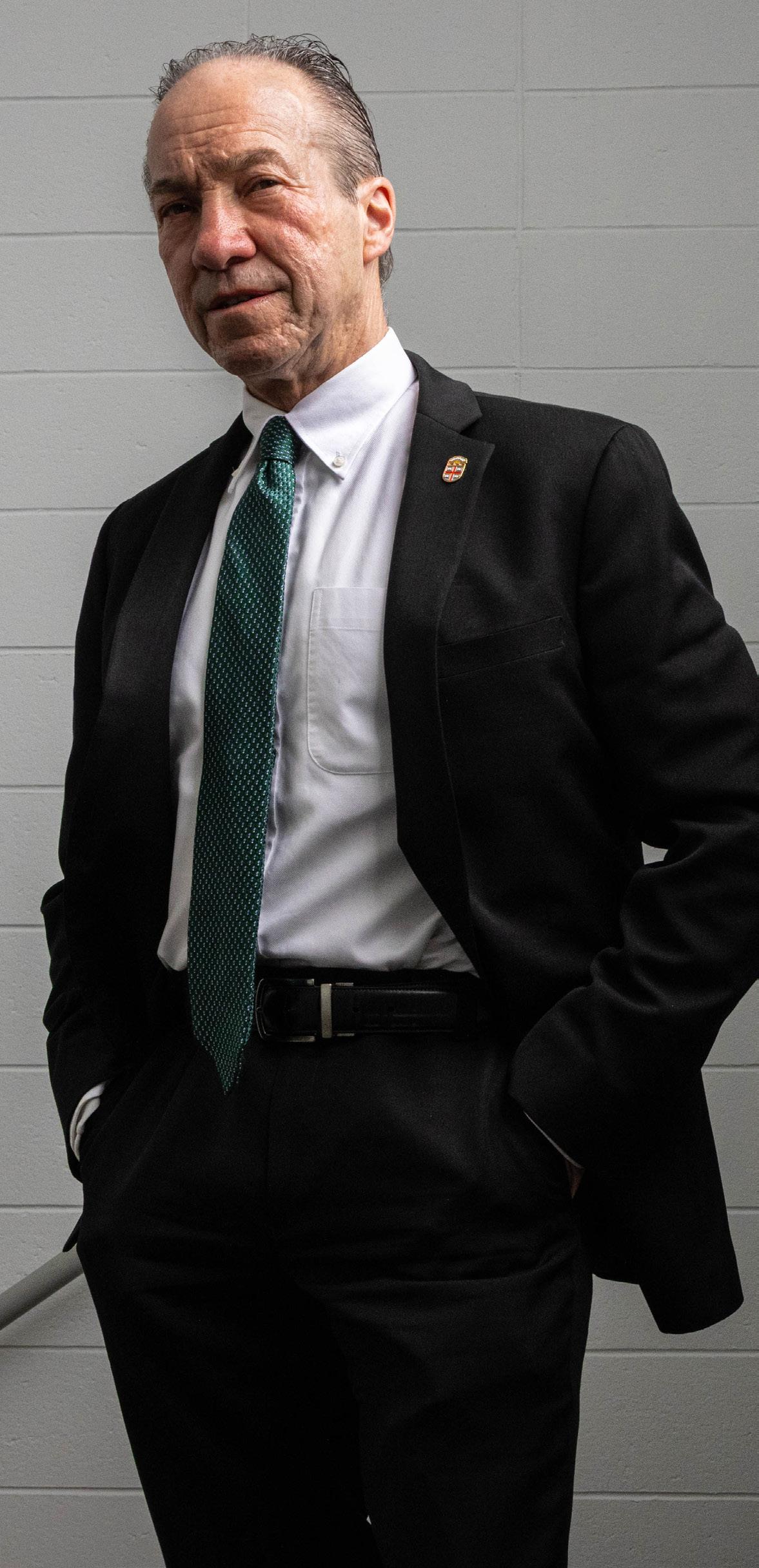
On Dec. 22 — just nine days after the Dec. 13 shooting — President Christina Paxson P’19 P’MD’20 announced that Hugh Clements would step into the role of interim vice president for public safety and chief of police.
That day, the University also announced that Vice President for Public Safety and Emergency Management Rodney Chatman would be on immediate administrative leave.
In the fall of 2025, the Brown Police Sergeants Union and Brown University Security Patrolperson’s Association issued votes of no confidence in the leadership of Chatman and Deputy Chief John Vinson, who is also on administrative leave, according to Clements.
On March 19, The Herald sat down with Clements for his first interview since taking over as DPS Police Chief.
According to Clements, there were vacant positions in DPS upon his arrival at Brown, which the department is working to fill. Hiring “a police officer is a lengthy — by design and rightfully so — process,” he said.
According to University spokesperson
Brian Clark, there were 15 vacant officer positions in December 2025. As of March, there are 12 vacant positions. Clements said that the department is in the “latter” part of the hiring process for filling those positions.
DPS currently employs 70 officers, Clark wrote in an email to The Herald.
A 2025 Herald investigation revealed that officers had left the department due to allegations of sexual harassment and a toxic work environment. Another investigation that year found that officers believed leadership mishandled responses to bomb and shooting threats.
Clark said that both Chatman and Vinson remain employed by Brown, but Clark declined to comment on whether they will be returning to their positions when Clements concludes his time in the interim role.
Clements served in the Providence Police Department for a total of 38 years, acting as police chief for 12 of those years.
In 2023 — when Clements retired from the PPD — he was named director of the Department of Justice’s Office of Community Oriented Policing Services, where he “oversaw grants, training and technical assistance of 18,000 police departments,” he said.
Clements comes into his role at a time when Brown’s safety and security are being assessed following the Dec. 13 shooting.
Students express concerns with accessing University psychological support following shooting
Clinical care options include same-day urgent care and the 24/7 CAPS line
BY ZARINA HAMILTON UNIVERSITY NEWS EDITOR
Over three months after the Dec. 13 shooting, Ava Rodriguez ’29 still does not feel like the University has provided suitable resources for students like herself. Rodriguez was in Barus and Holley 166 when the shooting took place.
According to a Student Support Services email sent specifically to students in close proximity to the shooting, CAPS offers “brief and intermittent individual psychological treatment,” which was not the long-term help that Rodriguez said she was looking for. Instead, she has been meeting with an outside therapist offering free services since winter break.
The day after the shooting, the student body was also sent an email offering 24/7 crisis support from CAPS, among other resources.
Since returning to campus, River Gilbert ’29 has met with CAPS once following their triage and intake appointment,
they told The Herald. Students must first partake in a 30-minute triage appointment where they briefly discuss their circumstances with a CAPS counselor.
The counselor will then provide recommendations, which can include “care at CAPS, referral to on-campus supports or a referral to an off-campus mental health professional.”
Gilbert noted that they have experienced more difficulty finding a CAPS appointment that works with their schedule this semester, which they believe may be due to a higher demand for appointments.
“They’re very clearly more booked than they were last semester,” they said.
“I’m disappointed in CAPS because they promise you’ll be able to access resources for mental health whenever you need them,” Gilbert added.
This semester, Gilbert said it has been “really scary sometimes” due to the insufficient availability of psychological support resources. If “you or your friends need help … there’s literally nowhere to go, unless you want to wait a week and a half to get into CAPS,” they said.
Director of CAPS Bryant Ford wrote in an email to The Herald that the team
has been putting effort into meeting the “heightened needs of our community” this semester.
Ford wrote that CAPS has “moved beyond individual, one-on-one psychotherapy as the primary model of care” and has instead “embraced a diversified approach, providing a range of clinical and non-clinical options.”
Clinical care options this semester include same-day urgent care, the 24/7 CAPS on-demand line and daily drop-in sessions, which require no wait times, according to Ford. CAPS is also offering support groups and other events “to foster spaces for healing and community-building,” Ford wrote.
The University has also expanded access to their partnership with Timely Care, which offers students up to 20 sessions of free virtual therapy, he added.
“It goes without saying that this has been a tremendously challenging moment for our campus, and one that has demanded an approach that offers a range of resources,” Ford wrote.
Over winter break, Gilbert said they tried meeting with a TimelyCare counselor and “hung up within five minutes”
because the counselor had “clearly not read anything about (their) file or even (their) profile information.”
“We are sorry to hear a student felt dismissed or unheard,” TimelyCare’s Executive Director of Mental Health Services Jerry Walker wrote in an email to The Herald regarding this experience. “That is not the experience we want any student to have.”
According to Walker, 536 students have completed counseling appointments with TimelyCare since Dec. 13 and, as a collective, they have rated session quality a 4.97 out of five and counselors a 4.98. If a student rates a session or provider a three or lower, “we immediately investigate,” he wrote.
“While not every counseling experience will be perfect for every student, the evidence supports that most Brown students are receiving high-quality care,” Walker added.
Walker explained that the introductory, “get-to-know-you” phases of typical counseling sessions are “a core part of good clinical practice, so the counselor
On Jan. 29, the University announced that it would be working with global consulting firm Teneo to conduct two external security assessments following the shooting. According to Clements, DPS is waiting for those reports to be finalized before enacting changes to the structure or practices of the department.
But he noted that DPS may not follow all recommendations provided by the reports. The department will “pick and choose what is right for Brown,” he said. “They make recommendations. They’re not mandates,” Clements said. “We will
The U.S. Department of Education announced an investigation into Brown’s security and emergency notification systems on the same day Clements was named interim police chief.

JAKE PARKER / HERALD
UNIVERSITY NEWS
take a look to ensure that we maintain that Brown stays Brown.” He added that the department aims “to build a sophisticated, smarter safety and security system” at Brown.
Clements said that when he arrived on campus, he and University leadership knew it would be important to help the Brown community feel both a “perception” and a “reality of safety.” He noted that security provided by DPS has been supplemented by the PPD, as well as two contracted private security companies: USENTRA Security Services and Allied Universal.
He said that the two companies pro-
PRESIDENT
vide security officers who monitor fixed locations and do not have the power to arrest or carry weapons, unlike DPS officers, who are armed.
“We felt from the beginning that it would be important to have that added presence,” he said, adding that conversations about security levels would be ongoing.
He noted that there have been some complaints that contracted security has been inattentive, including instances where staff have been on their phones while working or not watching building entrances. DPS addresses these concerns during daily meetings with supervisors
from both agencies.
“We need someone who’s doing their job and paying attention and trying to keep that building safe, or that community safe,” Clements said.
Clements said that DPS is waiting for results from the comprehensive security review to determine if the department should expand its staffing or if the “hybrid approach” of having outside agencies supplement security is sustainable.
Clements also addressed recent security threats on campus, including a March 13 burglary in Vartan Gregorian A, during which laptops and iPads were stolen.
DPS issued a timely warning three hours after the incident.
According to Clark, “there are federal standards and guidance” for issuing a timely warning, which require that the event in question poses a serious and ongoing threat, but not an immediate one. Timely warnings differ from crime alerts, which are issued when there is an active threat to people on campus, Clark said.
Clements explained that DPS decided to issue a timely warning on March 13 because, based on the information available at the time, “we felt that for that night, the threat had been mitigated,” because the subjects had left campus.
“You have to certainly have your facts in place before you put out information,” he added.
According to Clements, DPS has heard “mainly positive” feedback from the Brown community — including parents and alumni — about added security resources. He said the department routinely tweaks its security response when given suggestions from community members.
“No one has as great of a lens as the students. They’re here 24/7. They have a very wide lens of everyday life,” Clements said. “So those conversations are important, and a big part of our conversations is listening.”
Paxson discusses tuition, grade inflation at American Enterprise Institute event
The event came amid the Trump administration’s threats to higher ed
BY JEREMIAH FARR SENIOR STAFF WRITER
President Christina Paxson P’19 P’MD’20 discussed topics including grade inflation, rising public mistrust of higher education, increasing tuition and Brown’s relationship with the federal government at a Washington D.C. event hosted by the American Enterprise Institute, a center-right public policy think tank.
The event was moderated by Fredrick Hess, director of education and policy studies at the AEI. The talk centered on the future of higher education amid threats from the Trump administration, including executive orders on gender, antisemitism and diversity, equity and inclusion on college campuses, as well as challenges to financial aid.
Brown plays a unique role in the future of higher education, Hess explained in an email to The Herald. “Brown is a prominent institution with a long history,” Hess wrote. “It’s one of two or three dozen research universities that has an outsized impact on how the nation thinks about higher education.”
Hess opened the conversation with the recent erosion of public trust in higher education, and asked if this increased skepticism is due to university actions or results from external circumstances. skepticism is due to university actions or results from external circumstances.
Paxson attributed mistrust to two main sources: the increasing price of college and concerns about “the so-called indoctrination of students,” a concern she believes is more prevalent among people with rightwing beliefs.
Paxson said the cost to attend Brown has not increased in the past decade when adjusted for inflation. “The sticker price is exactly what it was a decade ago,” she said at the event.
In a Wednesday morning email to The Herald, University spokesperson Brian Clark wrote that Paxson misspoke and intended to refer to Brown's net price rather than sticker price.
In the 2016-17 school year, the direct cost to attend Brown sat at $64,556. According to the U.S. Bureau of Labor Statistics consumer price index inflation calculator, that amount from September 2016 now has the buying power of $87,379.81 in February 2026. Direct fees exceeded $90,000 starting in the 2025-26 school year.
Hess specifically asked Paxson about grade inflation, referring to previous Herald coverage from 2014 in which Paxson was quoted saying that Brown’s “fraction of the As is getting pretty high — too high for comfort.”
“I would say something very different now,” Paxson said. “One of the great things about Brown is we bring in students, and we encourage them to be intellectually curious, to dive into their studies, to compete with themselves to do better, but not to have sharp elbow competition with each other.”
Paxson said that she isn’t concerned about grade inflation, adding that Brown’s current culture around grades centers a focus on learning and creates a positive and collective academic community.
She added that Brown students are still “getting into the best professional programs. They’re getting into great graduate programs. They’re getting great jobs. I am not hearing from anybody, ‘Oh, I thought this was a good student because they had all As, but it turns out they don’t know anything.’”
Hess also asked Paxson about indirect costs for research, which have been a topic of contention between Brown and the federal government.
Paxson added that for “the vast majority of American families,” Brown’s financial aid would lower the cost below the sticker price.
According to The Herald’s Fall 2025 poll, about half of Brown students receive financial aid. Paxson noted that it is a challenge to communicate to families that universities like Brown can become more affordable with these financial aid offerings.
She added that for many families, “it is less expensive to go (to an elite school like Brown) than it is to go to one of their often very fine state institutions.”
In response to claims of alleged indoctrination and free speech concerns on college campuses, Paxson referred to a Gallup-Lumina poll on higher education in which only 2% of students reported feeling unwelcome on their college campuses due to their political beliefs.
These are “important issues,” Paxson acknowledged. “But I think the headlines overstate the problem,” she said.
She also mentioned that in the University’s 2025-26 Campus Climate Survey about 90% of students reported that they didn’t feel they had to suppress their
In February, the Brown Corporation approved an additional 4.25% increase in undergraduate tuition and fees, raising the direct costs of attendance for the upcoming academic year to $97,016. According to the Federal Bureau of Labor Statistics, the CPI grew 2.7% from December 2024 to December 2025.
identities to fulfill the requirements of their coursework. Paxson added that she wishes that the number was higher, but emphasized the University is working on improving it.
“I’m pretty happy with 90% as a starting point, so we’re in a good place there,” she said.
The Campus Climate Survey also found that 67% of undergraduates and 60% of medical students reported feeling they could “freely express their political or social views on campus.” The Herald’s Fall 2025 Poll found that over 45% of undergraduate respondents felt uncomfortable expressing their political beliefs at Brown, with the trend being more pronounced among conservative students.
Hess then emphasized the importance of having faculty members with diverse viewpoints, asking Paxson if she is concerned that “in some disciplines, there’s just not the kind of breadth that you’d like to see.”
“People sometimes imagine classrooms as places where professors are coming in and saying, ‘This is my view, and you better share it,’” Paxson said. “Whether you’re conservative or liberal, that’s bad teaching.” She said that the “vast majority” of Brown faculty attempt to cultivate a classroom in
which diverse perspectives are welcome and that students are comfortable sharing them.
The pair then discussed the University’s July agreement with the federal government, which came after Brown’s funding from the National Institutes of Health was frozen in April. The freeze meant that new research grants couldn’t be obtained and “bills weren’t being paid on active grants,” Paxson explained. “This put a lot of stress on our scientific enterprise, clearly, to the point that I was worried that faculty would leave.”
Paxson emphasized that the settlement with the Trump administration did not impact the University’s governance and was in-line with Brown’s values and “commitment to open discourse, to academic freedom,” she said.
Paxson contrasted July’s agreement with additional provisions in October’s “Compact for Academic Excellence in Higher Education,” which Brown declined to join. Paxson said that the Trump administration’s compact included provisions she “did not feel comfortable signing onto.”
Demands in the compact included freezing tuition for five years, limiting grade inflation and capping international undergraduate enrollment to 15%.
Paxson explained that while grants provide funding for the salaries and equipment required to conduct research projects, they don’t include the cost of general necessities such as utilities, rent and shared equipment. Indirect costs cover the additional expenses required to complete the research, and are typically reimbursed to universities at an agreed-upon rate by the federal government.
“It’s fair that taxpayers help pay for (indirect costs) if they’re getting the work done, but we’re concerned these overhead costs are also covering bureaucratic bloat,” Hess said. But Paxson noted that indirect costs are often essential for research, noting “They’re not extras. They’re real costs.”
In June, Brown joined a lawsuit against the Department of Defense to block a 15% cap on indirect costs for all current and future projects. The University has filed lawsuits against the National Institutes of Health, the Department of Energy and National Science Federation over similar indirect funding cuts.
Paxson said she wishes that the process for securing federal funding was more transparent for taxpayers to know where their money is going, as it currently feels “like a black box and that there’s not as much accountability as there could be.”
This article originally appeared online at browndailyherald.com on March 18, 2026.
KAIA YALAMANCHILI / HERALD
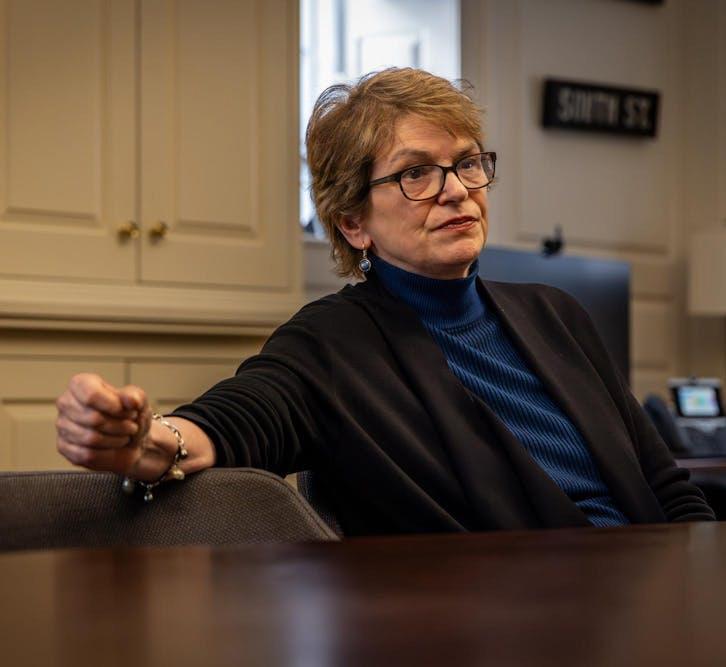
Paxson in February. Paxson attributed mistrust in higher education to the increasing price of college and concerns about “the so-called indoctrination of students."
UNIVERSITY NEWS
and student can build a shared understanding and determine the best path forward together.”
Rodriguez told The Herald that she had hoped students in close proximity to the incident would receive specialized support from the University. But she said this has not been the case for herself and others she knows. On Feb. 6, Rodriguez reached out to SSS to request the formation of a support group for the students in Barus and Holley 166 during the shooting. “I am not alone in saying that students who were in the room that day have been disappointed by the lack of targeted support we’ve received,” she wrote in the email.
After not receiving a response, Rodri-
guez went to meet with SSS in-person on Feb. 18 and they “basically told (her) the email … got lost,” she said. After a meeting was scheduled and later canceled because of the snowstorm, she was able to briefly meet with a dean almost a month after her initial email request.
Rodriguez noted that during the meeting, the dean was “very dismissive of (her) issues.” She added that if she were to go to the Ever True Support Group, “no one else is going to feel comfortable sharing their feelings because they’ll be comparing their experiences” to hers, which is a reason why she wanted an additional support group.
SSS did not directly respond to The Herald’s request for comment regarding
this interaction.
“We’re struggling, and Brown is not doing anything,” Rodriguez said.
In an email to The Herald, Senior Associate Dean and Director of SSS Lisa Loar wrote that the University initiated a support group “open to any student impacted by the events of Dec. 13” within CAPS as part of the Brown Ever True initiative. In a separate email to The Herald, she also wrote that the University reached out to all the students who were in the room during the shooting “to the best of (their) knowledge.”
“We take seriously the feedback we receive across all of our departments in Campus Life, and we are always considering how to make resources most helpful
to students,” Loar wrote.
SSS recently added four new student support deans who are working in shortterm roles to allow for “individualized monitoring for students seeking support,” according to Loar. The interim deans will begin this outreach this week, she added.
“Any student wishing to connect will have access to a same or next business-day appointment with a student support dean to help them navigate and get directly connected to the support and resources available at Brown,” Loar wrote.
Chris Barney ’29 said he believes the issue is that “there’s not enough CAPS faculty to take on the amount of students that need (support) right now.” But he
THE BROWN DAILY HERALD
PRODUCTION
Copy Desk Chief
Chelsea Long
Design Chief Emily Bao
Design Editors
Chloe Johnson Kailey Marti
Maggie Ruan
MULTIMEDIA
Photo Chiefs
Annamaria Luecht
Kaia Yalamanchili
Illustration Chiefs
Kendra Eastep
Isabela Guillen
Editorial Page Board
Ethan Canfield
Opinions Editors
Benjamin Aizenberg
Ethan Canfield
Isabella Gardiner
Lucas Guan
CJ Lair
Batisse Manhardt
Tas Rahman Camila Valdes


Video Chiefs
Cienna Cheng
Cody Cheng
Social Media Chiefs
Nate Barkow
Annika Melwani
Technology Chief
Annika Singh
Data Desk Chief Caleb Ellenberg
Games Chief
Paul Hudes
Podcast Chief
Talia LeVine
Multimedia Editors
Sophia Basaldua
Marat Basaria
Harry Guo
Horatio Hamilton
Selina Kao
Ella Le
Kenna Lee
JJ Li
Jake Parker
Jascha Silberstein
Rassul Toleugazy
BUSINESS
General Managers
Arjun Deshpande
Anum Azhar
Sales Directors
Arjun Ray
Hannah Han
Finance Director
Sydney Wright
Office Manager
Cary Warner
added that he doesn’t “necessarily think that’s Brown’s fault.”
“No one expected any of that to happen,” he said. “It’s not something that you plan ahead for.”
While Barney noted that the University may be hesitant to host large, campus-wide events, he said that it would be nice to have more opportunities for community healing.
“The most important resource is just going to be us, as a community, bonding together and coming together and continuing to lift each other up,” he added.
This article originally appeared online at browndailyherald.com on March 16, 2026.
Submissions: The Brown Daily Herald publishes submissions in the form of op-eds and letters to the Op-eds are typically between 600 and 900 words and advance a clear argument related to a topic of campus discourse. You can submit op-eds to opinions@browndailyherald.com.
Letters to the editor should be around 250 words and respond to an article or column that has appeared in The Herald, or critique or commend The Herald’s editorial decisions. You can submit letters to the editor to letters@browndailyherald.com.
Submissions undergo multiple rounds of editing. These rounds of editing generally take place over the course of one evening, and you may have to respond to edits late in the evening. If you know you will be unable to do so, please mention that in your email, and we will do our best to work with you.
Submissions can build on reporting from The Herald, reporting elsewhere, official statements from the University or other groups and other reputable sources, but they cannot break news or contain information that The Herald cannot verify. Because we cannot publish unsubstantiated information, failure to provide appropriate sources may mean we have to modify or remove unverified claims.
The Herald will not publish anonymous submissions or submissions authored by organizations. Leaders of student organizations can be identified as such but cannot write under the byline of their organization. The Herald cannot publish all submissions it receives and reserves the right
Commentary:
CAPS
DANIELLE EMERSON / HERALD
Clinical care options this semester include same-day urgent care, the 24/7 on-demand line, daily drop-in sessions and expanded access to Timely Care.
ROADS
After harsh winter, drivers face increased potholes on roads
The state DOT has received 414 pothole reports this year
BY AVA RAHMAN SENIOR STAFF WRITER
Rhode Island is on the cusp of spring. Though the snow is almost melted, the end of winter leaves behind a renewed stumbling block for drivers: potholes.
The Rhode Island Department of Transportation has seen 414 potholes reported on state roads so far this year — in the same period last year, the agency saw just 212, according to RIDOT spokesperson Charles St. Martin.
Providence has also received 426 pothole reports this year, which City spokesperson Josh Estrella attributed to “historic snowfalls.”
The City has five crews focused on fixing potholes, Estrella wrote. As of March 19, Providence has filled 700 potholes since the February blizzard — including new reports and existing damage.
Data gathered from Federal Highway Administration Reports found that 32% of Rhode Island’s state roads are classified as being “in poor condition” according to the International Roughness Index. Many of these damaged streets are high-capacity, high-speed “urban principal arterials.”
These streets are harder to fix than other road types, according to Teaching Professor of Environment and Society Kurt Teichert.
“Much of the highway and bridge maintenance work is done overnight when traffic flows are reduced and lanes are shut down for long periods,” he wrote in an email to The Herald. “It is much more difficult to take an arterial offline for a significant

amount of time.”
More potholes have formed this year due to a “combination of the plowing from the blizzard and warm temperatures of late,” St. Martin wrote. “Last winter was far milder.”
New England is particularly prone to “freeze/thaw cycles,” in which “water seeps into the pavement, freezes and expands,” St. Martin wrote. When “traffic drives over these areas,” potholes are created.
The January snowstorm — which brought roughly a foot of snow to Rhode Island — “is likely responsible for many of the potholes opening up,” Teichert wrote.
“Then the fast melt of the blizzard snow expanded the issue.”
Each day, RIDOT dispatches crews to patrol state roads and patch existing potholes. When Rhode Islanders report potholes, they are “immediately entered into our work order system” for repair, St. Martin wrote.
He added that their work is assisted
by the “pothole killer,” a vehicle with an attached mechanical arm that sprays air to clear debris from the crater. The pothole is then sealed with a “liquid asphalt emulsion” to produce “a very durable, long-last patch.”
According to St. Martin, the crews’ work is impeded by snowy and rainy weather. Asphalt is sensitive to cold temperatures, and asphalt plants are typically not open in cold weather, he wrote, which “limits the amount of durable patching material” available. RIDOT works to schedule pothole operations if asphalt plants do open temporarily in winter.
As a result, crews often resort to a “cold patch,” wrote St. Martin. According to RIDOT’s website, cold fills are a less durable and temporary remedy. This year, the agency is “making greater use of a product called Perma-Patch,” an asphalt-repair mixture, “which is more durable than standard cold patch,” St. Martin added.
Last year, the city of Providence ac-
Gas prices soar amid Iran war
Prices have increased 27% since the war started Feb. 28
BY AMELIA BONTERRE CONTRIBUTING WRITER
Gas prices in Rhode Island averaged $3.644 per gallon on Thursday, more than a 27% increase from a month ago. The price increases came amid the United States and Israeli government’s airstrikes in Iran, which first began on Feb. 28.
The rise in gas prices can, in part, be attributed to Iranian strikes on ships traveling through the Strait of Hormuz, a major channel for international trade. Prior to the war, roughly 20% of the world’s oil passed through the strait.
But Iran has threatened U.S. oil shipments traveling through the passage, meaning that trade might be paused for an indefinite amount of time, said Reid Pauly, a dean’s assistant professor of nuclear security and policy and assistant professor of political science.
The increase in gas prices is not going unnoticed among Ocean State residents and Brown students.
“The extra dollar per gallon at the pump is certainly a motivator to cut out unnecessary driving,” Alexander Korchev ’28 said in an interview with The Herald.
“If prices continue to rise and stay high, I will have to tweak my budget to account
quired new equipment that has sped up the pothole repair process, Estrella wrote. Providence crews use special trucks to keep asphalt hot so that potholes can be filled without crews needing to constantly refill their trucks.
Piles of snow left by the blizzard have made driving through potholes especially difficult for some Rhode Islanders. With Providence streets significantly narrowed, Alyson Panzloff ’27 said she was forced to drive through potholes to avoid hitting a car in the oncoming lane.
Her large SUV cushions her from the impact of most bumps and jolts, but crossing through potholes feels “like my tire is gonna get stuck in the road and explode,” Panzloff wrote in an email to the Herald. “There’s no way to swerve and avoid (potholes) most of the time,” she added.
Kaelyn Haselhorst ’28 noted that even before the blizzard, potholes in Providence were worse than towns in other states she had driven through.
In August, “I drove my car up from Austin, Texas to Rhode Island, and I drove through so many states,” she said. “Providence is, for sure, the roughest one so far, even more than Boston.”
WPRI recently released a Target 12 report that found Rhode Island has ranked last in state road conditions for at least 10 years, according to data gathered from the Federal Highway Administration.
In 2016, the state launched “Rhode Works,” its 10-year plan to revamp the infrastructure such as roads and bridges. Since then, RIDOT has “improved 2,000 lane miles of road with brand new paving,” St. Martin said.
“For decades prior to RhodeWorks, roads were not well maintained,” he added. “Because of that, oftentimes we cannot just repave a road. We need to dig down to the subpavement, address drainage and other stormwater abatement issues, and make sure the new road is (Americans with Disabilities Act) compliant.”
Through RIDOT’s ongoing $500 million five-year pavement investment, the state hopes to have “better riding surfaces and fewer potholes” in future years, wrote St. Martin. Additionally, Gov. Dan McKee’s RhodeRestore program has invested $140 million in efforts to pave local city and town roads.
For now, drivers will have to brace themselves for the impact. “When you’re driving up, and you see that one is suddenly actually way deeper than you realize, your car’s life flashes before your eyes,” said Haselhort. “You just have to keep staying alert.”
This article originally appeared online at browndailyherald.com on March 19, 2026.

The increase in gas prices is already having an effect on Ocean State residents.
for the additional transportation costs,” he added.
U.S. Rep. Seth Magaziner ’06 (D-R.I. 2) called the war “completely unnecessary.”
“Unfortunately, it’s the American people who are paying the price,” he told The Herald, noting that prices are not only harming consumers at the pump but also small businesses that have to pay for shipping costs and heating bills.
The White House did not respond to a request for comment.
Without immediate intervention, economists warn that the war will have significant impacts on the local and global economy.
“The consequences are going to be inflation, for sure. That’s 100%,” Şebnem Kalemli-Özcan, professor of economics, told The Herald.
Without action, Kalemli-Özcan said that consumers can expect to see high levels of stagflation — when inflation is high and the economy contracts — which could lead to increasing levels of long-term unemployment.
The conflict will have an international impact because “countries are connected through the supply chain,” Kalemli-Özcan said. Because the conflict is “in the center
of that global system,” it will “be economically costly for everyone.”
The strikes have also increased the cost of oil, with the price of a barrel averaging over $100, according to Business Insider. A month ago, a barrel cost about $70.
“It was very obvious to all international economists … that this war is going to create a lot of economic pain for the United States and other countries,” Kalemli-Özcan said.
The war is “unpopular,” Pauly said. It’s strange “for a president to be engaged in force abroad when a majority at the very beginning already is against it.”
The most immediate solution to reducing high gas costs is to end the war, Kalemli-Özcan said. “The longer it continues, the more sectors are going to be affected,” Kalemli-Özcan added.
Pauly said that the unpopularity of the war may hasten the end of the conflict. “We might see Congress get up and actually act to try and prevent the use of boots on the ground,” Pauly said.
Magaziner said that House Democrats are trying to “force a vote on a bill to end this war,” which he believes would save lives and allow commerce to resume.
He added that the high gas prices should be a sign for Rhode Island to prioritize energy independence and investing in green energy.
“We need to recommit to building out affordable, clean energy that is not impacted by geopolitical disruption,” Magaziner said.
IVY ZHOU / HERALD
Providence has also received 426 pothole reports this year.
IVY ZHOU / HERALD
WORLD CUP
R.I. announces Ocean State 2026 to maximize economic impact of nearby World Cup
The Ghanaian men’s soccer team will train at Bryant this summer
BY LAILA POSNER SENIOR STAFF WRITER
This summer, the World Cup is coming to the Northeast. Just a 20-minute drive from Brown’s campus, the Ghanaian men’s soccer team will be at Bryant University rigorously preparing for their FIFA World Cup matches. At Gillette Stadium in Foxborough, Massachusetts — a 45-minute drive from Rhode Island — seven world cup matches will take place.
To maximize the economic impact of the cup, Gov. Dan McKee announced the creation of Ocean State 2026, a nonprofit organization that aims to “facilitate business sponsorships of 39 days of events across Rhode Island” during the World Cup.
With various games occurring so close to the Ocean State, the World Cup presents a unique opportunity for Rhode Island, McKee said in the press release. The event “showcases Rhode Island on the global stage — and we’re ready to seize it,” McKee said.
The objective of Ocean State 2026 is to “help market Rhode Island as a premier destination for visitors who are traveling to the region to attend World Cup matches,” Elizabeth Tanner, the organization’s executive director, wrote in an email to The Herald.
Tanner noted that Rhode Island anticipates up to 1 million visitors, which the
BLOOD SHORTAGE

organization hopes will garner an estimated $330 million in business revenue.
Robert Piechota, district director of the U.S. Small Business Administration’s Rhode Island office, added that the market of customers “is going to potentially double in size for Rhode Island businesses.”
Ocean State 2026 is capitalizing on this chance. “This presents an incredible opportunity for our tourism, hospitality and small business communities,” Tanner wrote.
Piechota added that while Rhode Island is used to large influxes of visitors, the World Cup offers an opportunity for people to stop and patronize businesses in the state rather than just passing through. Rhode Island is “planning accordingly,” he said.
The City of Providence has specifically applied for a FIFA Fan Zone license, “which would create a central gathering space for fans to watch matches and celebrate the tournament,” Tanner wrote.
One of the organization’s main initiatives is the R.I. Summer of Soccer, which will connect visitors with all the local events and cultural experiences that Rhode Island has to offer, Tanner wrote.
The organization is also working on country-specific experiences meant to highlight the “culture, food and traditions” of the countries playing in Gillette, all “while bringing fans together,” she added.
The Ghanaian team’s decision to come to Rhode Island came after an “extensive
R.I. Blood Center’s blood emergency enters its second week
The blizzard caused the RIBC to lose nearly 1,500 blood products
BY KELLY DING SENIOR STAFF WRITER
The Rhode Island Blood Center declared a blood emergency on March 5. Nearly two weeks later, this emergency status is still in effect, according to the RIBC’s website.
The blood emergency means that the RIBC has enough blood inventory for “under two days,” according to Hunter Shaffer, the vice president of operations at RIBC. The center typically aims to have a seven-day supply.
In the wake of the blizzard that swept across New England in late February — which paused all on-site operations for three days and mobile operations for a week — the RIBC experienced “a loss of over 1,500 blood products,” Shaffer explained.
As of March 10, the center had a high need for O positive, O negative and B negative blood, Shaffer said. As O negative blood, known as the universal blood type, can be donated to patients with a wide variety of blood types, the center is “always” looking for it, he added.
In a joint statement, Brown University Health spokespeople wrote in an email to The Herald that the hospital system especially needs platelets — cells that are essential for blood clotting — “as well as O positive and negative red cells.”
The RIBC delivers over 90,000 donations annually to over 50 hospitals, healthcare partners and emergency medical services, Shaffer wrote in an email to The Herald, noting that the center “needs more

than 1,750 donations each week.”
BUH noted that blood donations can be used for patients undergoing cancer treatments that cause low levels of platelets and red blood cells, sickle cell disease and trauma. These donations are also used during surgery.
Shaffer noted that the current supply may not be enough in the face of an emergency, disaster or mass casualty event.
A donation takes an hour and “can save up to three lives,” Shaffer wrote. Healthy individuals who weigh at least 110 pounds can donate if they are 17 or older, among other requirements. If an individual is 16, they must be at least 130 pounds and have consent from a guardian.
Donations from donors under the age of 30 are particularly needed, as donations from this age category have fallen by 30%
search” spanning the northeast and midwest, Ghana Football Association spokesperson Henry Asante Twum wrote in an email to The Herald.
The team chose Bryant as their training hub due to its “excellent sports infrastructure, focused training environment away from major city distractions and warm reception from the local stakeholders,” Asante Twum explained.
He wrote that Bryant’s “top-tier” strength and conditioning facilities, recovery areas and pitches are necessary for what “an elite team needs for a high-stakes preparation like the World Cup.”
Ocean State 2026 is coordinating with Rhode Island’s Ghanaian community to plan events that celebrate the national team as well as Ghanaian culture more generally, Tanner wrote.
Engaging with the local community is “very important” to the team, Asante Twum added. While the team’s practices are typically closed to the public, they intend “to host open training sessions and community outreach events, giving local fans and especially aspiring young footballers a chance to connect with the team.”
The team also intends to support local businesses by sourcing services and supplies from within the state, according to Asante Twum.
“Our presence is not just about training,” he wrote. “It’s about building bridges and leaving a positive impact.”
This article originally appeared online at browndailyherald.com on March 19, 2026.
in recent years, Shaffer wrote. In 2024, the American Red Cross reported that while 62% of the U.S. population is able to donate blood, only about 3% donate.
The RIBC has called blood emergencies before, with a previous one occurring during the summer of 2025. The current emergency “requires us to be vigilant about our supplies,” according to the BUH statement.
Shaffer explained that since donors are giving a voluntary and “altruistic” donation, the U.S. blood supply fluctuates based on schedules — donations are typically stable when school is in session because blood centers can partner with schools to set up blood drives.
But Shaffer said that donations are necessary year-round, and called them “the industrial lubricant that keeps the great gears of medicine turning.”
Shaffer noted that more women donate blood than men, but women are also more likely to be ineligible to give blood due to restrictions based on hemoglobin levels, height and weight. “We really do need young men … because they’re able to donate at a larger frequency,” he said.
Nava Litt ’29 first donated blood with the encouragement of a friend and thought that “it was just really easy to do.” She continues to do so because “donating blood is just such a clearly and unequivocally effective way to do good.”
Litt said she donates essentially as often as allowed. She participated in the blood drive at Brown-RISD Hillel which was hosted from March 10-11 in partnership with the RIBC.
For those looking to donate, Litt said her advice is drink “two or three cups of water in advance” and eat beforehand. Though the needle can be imposing, she distracts herself with Instagram reels.
“If everyone donates blood in Rhode Island once a year … we wouldn’t have to call these disasters ever,” said Shaffer.
This article originally appeared online at browndailyherald.com on March 18, 2026.
CIARA MEYER / HERALD
SOFIA CICCOTTO / HERALD
RAMADAN
‘Give yourself grace’: How student athletes observing Ramadan balance faith, athletics
The students manage fasting on top of demanding sports schedules
BY LUCIA SANTIAGO SENIOR STAFF WRITER
During the holy month of Ramadan, Muslim communities around the world fast from sunrise to sunset, a physically taxing but spiritually important practice. On College Hill, student athletes who observe Ramadan and whose schedules often involve physically intense practices have had to adapt to fulfill the demands of their schedules.
Lana Khalidi ’28, a member of the equestrian team, starts her day at 4:30 a.m. to have Suhoor, the meal before the daily fast, which typically consists of water and dates, she wrote in a message to The Herald.
“Depending on the day, I either stay up from Suhoor and continue to my bi-weekly team lift, or I lift on my own,” she wrote.
On Monday, for example, after Suhoor and lifting at the Nelson, Khalidi has backto-back classes until 2 p.m. She then goes to team practice, which runs from 2:15 p.m. to 5:15 p.m. Finally, she heads “straight to have Iftar,” or the fast-breaking meal, before she showers and completes homework.
N’famara Dabo ’27, a player on the men’s basketball team, starts his day at 4 a.m. in a similar manner. During the basket-
BASKETBALL
ball season, which overlaps with Ramadan, Dabo’s days are jam-packed.
On Mondays and Fridays, Hill completes speed training and lifts, and on Tuesdays and Thursdays, he has afternoon lift sessions. Meanwhile, Wednesday practices are spent on the field, where Hill participates in conditioning, “football drills and (going) over the plays.”
After waking up around 4:30 a.m, Hill quickly eats something before starting his fast. Hill breaks fast after Maghrib, a prayer that is performed just after sundown.
All of these athletes told The Herald that they battle fatigue throughout the day. For Khalidi, the exhaustion isn’t just physical.
“I am often lethargic and hold a lot less strength and patience,” she wrote. “Especially as an equestrian, patience is necessary when around horses.”
But she finds her resilience to perform all these tasks in spite of her physical state “encouraging,” and her “ability to push through increases mental strength,” she wrote.
Though they face similar physical struggles through their busy days, each athlete described different challenges as their greatest obstacles.
For Dabo, it’s finding a balance between sleep, schoolwork, fasting and basketball.
“Going to sleep, waking up in the middle of the night, then going back to sleep and waking up again a couple of hours lat-
er is difficult,” Dabo wrote. “I do not get enough sleep.”
Khalidi wrote that because many dining halls close before she is able to break her fast, she sometimes has trouble finding nutritious food options.
The conditioning regime during Hill’s practices on Wednesdays present the biggest challenge for him.
“The rest of the day is just like, no water and no food, so it’s hard to recover,” Hill said. “But I always get through the day and get work done,” he noted.
For all the athletes, supportive coaches, teammates and training staff help them
through the exhausting days. Khalidi said her team and coach are “always happy to accommodate” her needs, and Dabo also said his teammates consistently check up on him.
“My trainer also makes sure I have the supplements I need since I spend more than 12 hours without food or water,” Dabo wrote.
Hill also finds support from his teammates, saying that “it goes a long way.”
“I can always be myself or talk to players about it,” he said. “They’re supportive or ask questions and help out where they can.”
For Dabo, Brown Athletics does a good job of supporting student athletes. He noted that one thing they can continue to do is ensure “athletes have access to food after sunset and flexibility when needed during intense practices,” he wrote.
Beyond fasting, the athletes also take time to observe Ramadan by connecting to their faith and aiding their communities.
“Ramadan means being mindful of my interactions with people,” Khalidi wrote. “Being gracious to others, being considerate of how I present myself and ensuring that I am going through my day as similarly as possible to how I would normally.”
For other student athletes celebrating the holiday, Khalidi recommended they “take it day by day, and give (themselves) grace.”
Dabo wrote that the month of Ramadan provides time to “get closer to God, to be appreciative of all the small things that we often take for granted and to reflect on your behavior.” He added that he also hopes to “build good habits, be kind to others and give to those who are less fortunate.”
“Ramadan can be challenging, but it is also a very meaningful time,” Dabo wrote. “I think giving yourself grace and staying focused on why you are doing it helps a lot.”
This article originally appeared online at browndailyherald.com on March 16, 2026.
Women’s basketball ends season, falls 65-51 to No. 23 Princeton in Ivy Madness
BY HARRY GUO SENIOR STAFF WRITER
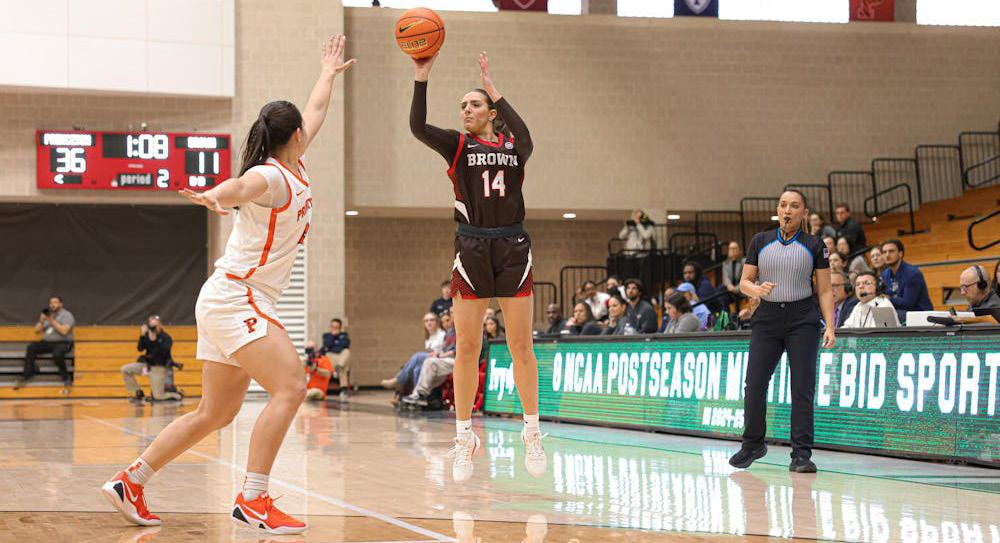
In the team’s first appearance in the Ivy League Women’s Basketball Tournament since 2017, the women’s basketball team (16-11, 8-6 Ivy) saw its season come to a close on Friday. Despite a comeback effort in the second half that briefly swung momentum in Brown’s favor, the team fell 65-51 to No. 23 Princeton (26-3, 12-2 Ivy) in the semifinal in Ithaca.
After narrowly clinching the last seed in Ivy Madness, Bruno took the trip to Ithaca for a tough matchup against the nationally-ranked and first-seed Princeton.
“We certainly understand that it’s going to be a battle, a game of runs,” Head Coach Monique LeBlanc said in a pre-game press conference. “We certainly want to come out swinging.”
Despite the sentiment, it was the Tigers who landed the first blows early on.
Brown won the opening tip, but Princeton capitalized on a sloppy turnover with crisp perimeter passing that freed up space beyond the arc for a three.
The Bears struggled to find rhythm on offense in the opening minutes. Missed opportunities piled up, including a layup attempt in the paint and a missed three. While Brown created moments of defensive energy — including a quick steal by guard Olivia Young ’27 and a strong defensive block by forward Ada Anamekwe ’26 — the Bears were unable to convert effectively on the offensive end.
Following a three-pointer by Young, Princeton steadily extended its lead with strong ball movement and multiple screens. This allowed the Tigers to knock down
another three and convert an offensive rebound into a short jump shot.
For 14 Tiger points, Bruno was unable to break through Princeton’s defensive wall in the paint, and the Tigers continued to build separation in dominant fashion.
A transition steal led to an easy bucket, and another Princeton three forced the Bears to call a timeout as Princeton led by a whopping 21-3 late in the first quarter.
Brown finally broke a lengthy scoring drought when forward Beth Nelson ’26 drained a three-pointer to end Princeton’s 16-0 run. But immediately after, the Tigers responded with a mid-range jumper, closing the quarter ahead 23-6.
Princeton carried that momentum into the second quarter, scoring back-to-back threes that shut down any Bruno hope coming out of the locker rooms. By that point, Princeton had connected on five of their first seven attempts from beyond the arc.
Despite the deficit, Bruno continued
to battle and scoring on both sides of the court slowed. Guard Grace Arnolie ’26 created space off of the dribble for a smooth layup followed by a four-minute scoring drought. The Tigers restarted scoring, which was matched by Anamekwe’s full court attack ending in a foul and conversion of both free throws.
But the Bears struggled to capitalize on Princeton’s mistakes, unable to generate points even during a stretch of sloppy possessions from the Tigers midway through the quarter.
Just when all seemed grim, Brown found a small spark late in the half. Guard Charlotte Adams-Lopez ’29 had a steal with just 31 seconds remaining, and Arnolie knocked down a three-pointer to close the half. Even so, Princeton entered the break with a 36-14 lead.
Facing an uphill battle, Bruno refused to give up.
“We kind of just went at it with the
sentiment of, we have nothing to lose right now,” Arnolie said in a post-game press conference.
Princeton opened the third quarter with a turnover, and Arnolie quickly took advantage by drilling a three-pointer. Although the Tigers briefly halted Brown’s push with an and-one that propelled an 8-0 run, the Bears soon caught fire from deep.
Nelson knocked down a three before Princeton answered with one of its own. Arnolie responded with another, and moments later, Nelson intercepted a pass to assist Arnolie for yet another three. Catching the Tigers on their heels, the momentum continued to swing towards Bruno. Young added two threes, both assisted by Adams-Lopez.
This scoring frenzy — which trimmed the Bears’ deficit to 47-32 — electrified the Brown bench as Princeton called a timeout.
The Bruno defense continued to apply
pressure, forcing errant passes and rushed possessions. At one point, Princeton even had to launch a desperate half-court heave as the shot clock expired.
The Bears’ run eventually stretched to 14 unanswered points before Princeton finally broke through with a jump shot. Nonetheless, Brown finished the third quarter strong, outscoring Princeton 2217 in the period.
Brown’s momentum carried briefly into the fourth quarter, with Nelson scoring her third three-pointer of the game off of an assist from Arnolie.
After both teams threw a series of missed baskets, Bruno sank two baskets with two free throws by Young to keep Brown within striking distance. Princeton answered immediately with a driving layup before extending the lead again from the free-throw line late in the game.
But Brown still refused to give up. Arnolie knocked down another three after a quick inbound play, and Young finished an and-one opportunity, though the free throw rimmed out.
Despite Brown’s best efforts, the final seconds were all orange and black, and Princeton sealed the game at the line as Bruno’s late three-point attempts fell short.
Isabella Wesley ’29 provided one final highlight with a buzzer-beater layup to end the game 61-51.
Princeton claimed the Ivy League title on Saturday after defeating third-seeded Harvard (18-11, 10-4 Ivy) 63-53.
“I believe the future of our program is really bright,” LeBlanc said in a post-game press conference. “I’m looking forward to continuing to compete to bring this team back to Ivy Madness.”
KAIA YALAMANCHILI / HERALD
Many of the student athletes start their days before dawn to get a morning meal and exercise in.
The Bears fell short in their first appearance in the tournament since 2017
COURTESY OF JIMMY PICERELLI VIA BROWN ATHLETICS
Mady Calhoun ’26. After narrowly clinching the last seed in Ivy Madness, Bruno took the trip to Ithaca for a heavyweight matchup against the nationally ranked and first-seed Tigers.
LACROSSE
Lacrosse sails past UMass Lowell for 13-6 win
The team jumped out with an impressive first half to secure the win
BY ABIGAIL DONOVAN SENIOR STAFF WRITER
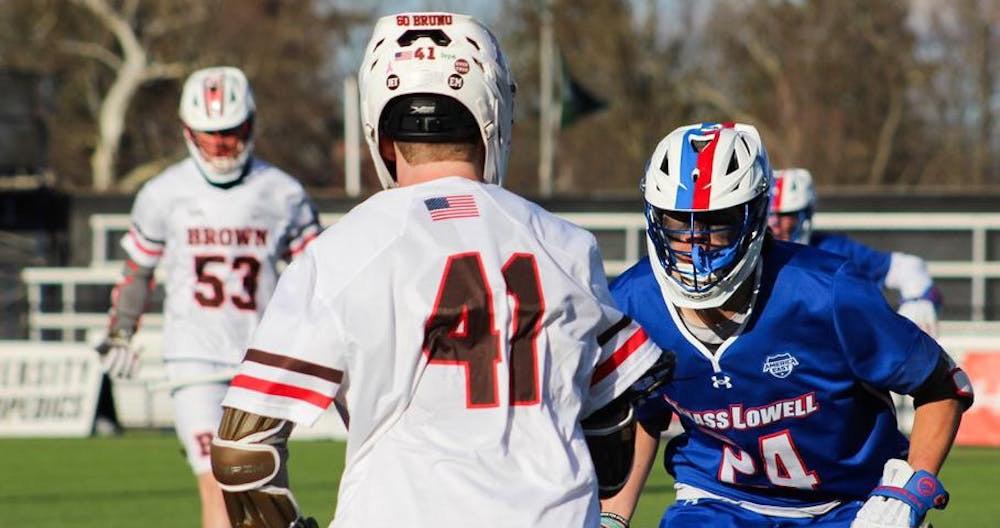
The men’s lacrosse team (4-3, 0-1 Ivy) demolished University of Massachusetts at Lowell (2-5, 0-1 America East) 13-6 in a Tuesday afternoon home game. Buoyed by an impressive first half, the Bears broke their two-game losing streak against the University of North Carolina at Chapel Hill and Cornell.
Midfielder Marcus Wertheim ’26 contributed an impressive four goals, and attacker Jeremy Hopsicker ’26 notched a hat trick, bringing him to a season total of 19 goals.
“We were able to make a lot of adjustments in a short amount of time and it was great to see both personnel and scheme adjustments executed on,” Head Coach Jon Torpey wrote in an email to The Herald.
The Bears dominated from the beginning, securing an impressive five goals in the first quarter. The River Hawks trailed behind with only one point.
Wertheim struck first, launching a long, low goal just over a minute and a half into the game. Midfielder Henry Brayer ’27 won the faceoff coming off the goal, giving Bruno an opportunity to strike. Less than a minute later, attacker Ennis Udo ’28 danced around defenders to charge the goal and bring the score to 2-0 with a quick shot.
FOOTBALL
Staying on the ground, the Bears came up with another chance to strike a few minutes later. A quick pass from attacker Jameson Steele ’29 to Hopsicker caught the River Hawks off guard, and Hopsicker extended Bruno’s lead to 3-0 just under five minutes into the game.
After fighting back and forth for possession, UMass Lowell finally got on the board with just under four minutes left in the first quarter. But the Bears refused to give up momentum as a goal by Steele and a second by Hopsicker sent Bruno into the second quarter with a 5-1 lead.
“After the loss to Cornell, we really focused on coming out with a fast start,” Hopsicker wrote in an email to the Herald. “A big emphasis for us was winning the ground ball battle and controlling possessions, which we felt would set the tone early and allow us to play our game.”
In the second quarter, the River Hawks attacker Danny Burke wove around Brown’s defense to find the back of the net first. But three consecutive goals for Brown by Wertheim, midfielder PJ Behan ’26 and attacker Brady O’Kane ’28 over the next six minutes extended the lead to six points.
Each team managed a goal in the final four minutes. UMass Lowell’s Johnny Soi snuck a shot under the stick of goalkeeper Connor Foley ’27, and Brown midfielder Ben Scandone ’26 launched a diving goal from the left side to secure the Bears’ fourth of the quarter.
The River Hawks outshot the Bears 8-5 in the third quarter, but the two teams
managed to eke out just one goal apiece. Almost five minutes in, Wertheim surged from the left behind the goal, sneaking a quick shot past UMass Lowell’s defense to tally his third goal of the night.
Hungry to get another point on the board, the River Hawks’ Griffin Sumwalt struck less than three minutes later, bringing the score 10-4 in Bruno’s favor. For the remaining seven minutes of the quarter, the teams traded attempts, and Foley recorded two impressive saves.
The Bears held a comfortable sixpoint lead going into the final quarter. Searching for a comeback, UMass Lowell’s Ryan Proctor posted a goal just over a minute in. But to the River Hawks’ misfortune, the Bears were not
done yet. Over the next five minutes, Hopsicker completed his hat trick, and Wertheim notched his fourth goal of the night, bringing the score to 12-6.
With six minutes left and hungry for more, the Bears passed around the River Hawk’s net, searching for one more opportunity. Scandone sent a strong pass to Steele, who ripped the ball straight down the middle through defenders and secured a dramatic last goal of the afternoon. With UMass Lowell unable to bring another point to the board, the game ended 13-6 in Bruno’s favor.
“I think we did a really good job at the faceoff,” Torpey wrote, “I also think we did a really good job of executing our
offense and making some changes defensively.”
Looking ahead to the rest of the season, the team will face more Ivy League opponents in the coming weeks.
“We want to continue capitalizing on our strengths while improving on our weaknesses, with the goal of becoming a more well-rounded team that plays 60 minutes of complementary lacrosse.” Hopsicker wrote.
The team will hope for the same success on Saturday at 1 p.m. against St. John’s University in Queens, New York.
This article originally appeared online at browndailyherald.com on March 19, 2026.
Student-athletes showcase talents for NFL scouts at first-ever on-campus pro day
The three athletes performed in front of Patriots and Titans scouts
BY SAJIV MEHTA SPORTS EDITOR
Breathing heavily, his shoulders heaving, Elias Archie ’26 leapt out of his kneeling position across the start line and into a blistering sprint. Archie — who recently broke Brown’s program record in the 60-meter dash — flew over the finish in front of scouts from the National Foot-
Crossing that finish line, the two-sport cornerback and sprinter had just finished the 40-yard dash portion of Tuesday’s first-ever on-campus football pro day.
At the event — hosted in the brand-new gleaming Penner Field House — three graduating players showcased their skills for their chance to continue their football journeys at the professional level. Archie was joined by wide receivers Solomon Miller ’26 and Ty Pezza ’26. “I love being able to support (the players’) goal of playing professionally,” Head Coach James Perry ’00 said. He said the players had a “good performance today,”
we’re doing as a program.”
Perry explained that access to Penner Field House was “powerful” for hosting the exhibition. He hopes to make the Pro Day an annual occurrence. At pro days, which occur at schools across the country, collegiate football players are given an opportunity to showcase their athletic prowess to NFL teams.
At Penner House, the scouts ran the show — giving instructions to the players in addition to measuring and timing the exercises. Following pro day, NFL teams may offer players the opportunity to spend more time with the team, whether that be through training camp or one-off workouts.




formed many of the same tests, the three athletes see different football journeys for themselves.
In an interview with The Herald, Pezza said his ultimate goal is to sign a professional contract. Brown’s 2025 receiving leader said he will continue pursuing professional football “for as long as it goes.”
Pezza said that he has plans to attend another pro day at Bryant University next week, adding that the trial will give him a “chance to get in front of the most amount of scouts that I can see.”
Archie also plans to fully pursue an athletic career.
“You only get a certain amount of time in your life to play professionally,” the star defensive back told The Herald in an interview. “You can work any day in your life.” Miller, meanwhile, was “on
the fence about even” coming to the pro day. He plans to move to Charlotte, North Carolina and work in internal consulting after graduating this May.
But he hopes he’s not done with the sport entirely — the receiver may explore playing flag football in the 2028 Summer Olympics.
Tuesday’s exhibition began in the weight room. Miller and Pezza cranked out 15 and 20 repetitions of 225 pounds on the bench press, respectively. Archie joined the receivers for the vertical jump, and all three showed off their lower-body strength while exploding more than 30 inches into the air.
The Bears dominated from the beginning, securing an impressive five goals in the first quarter.
NORA EDOUARZIN / HERALD
COURTESY OF JIMMY PICERELLI VIA BROWN ATHLETICS Football Head Coach James Perry ’00 explained that having access to Penner Field House was “powerful” in hosting the exhibition.
excerpt from
still bi nonpracticing
by Ivy Rockmore
Trad-wives, looksmaxxing men: A lot has changed since I wrote my article on bi non-practicing people at Brown exactly a year ago.
Conservative culture encourages one to be more conventional within the gender binary, and the pendulum has surely swung. Gender-affirming care is being banned across the country, even in liberal states like New York. Meanwhile, men like Clavicular scream of hormone science, low cortisol, and low testosterone in men, holding onto the so-called saving powers of normative beauty. Some of his followers are bashing the bones on their faces and drinking unpasteurized milk. On the Red Scare podcast, the hosts have shifted from their “dirtbag left” roots to align more with the new right, reactionary, and contrarian viewpoints: being “anti-woke.” What was once fringe is now, in my eyes, cringe.
Meanwhile, the “CBK [Carolyn Bessette Kennedy] aesthetic” of proper femininity is in—at the school where her late husband once journeyed, many girls strut through the Main Green in modest clothing, their carefully-constructed blowouts bouncing in the spring wind (not that I don’t love a good blowout).
I began last year curious about the “little black dress” of sexualities. In my previous article, a bi non-practicing person is defined as someone “who publicly identifies as bisexual but only engages in relationships with people of the opposite gender.”
I come back to it asking: What does being subversive in an increasingly authoritarian country look like? But after many interviews, I found myself unable to resolve this political thesis. I have become fascinated by the negotiations my peers are making in this climate, regardless of what political ends they serve...
EDITOR-IN-CHIEF
Elaina Bayard
FEATURE
Managing Editor
Chloe Costa Baker
Section Editors
Anika Kotapally
Gabriella Miranda
ARTS & CULTURE
Managing Editor
AJ Wu
Section Editors
Lizzy Bazldjoo
Sasha Gordon
NARRATIVE
Managing Editor
Gabi Yuan
Section Editors
Chelsea Long
Lucie Huang
LIFESTYLE
Managing Editor
Hallel Abrams
Gerber
Section Editors
Alayna Chen
Tatiana von Bothmer
POST-POURRI
Managing Editor
Tarini Malhotra
Section Editor
Christina Li
HEAD ILLUSTRATORS
Junyue Ma
Lesa Jae
COPY CHIEF
Jessica Lee
Copy Editors
Eve Kobell
Indigo Mudbhary
Kate Schuyler
Rebecca Sanchez
LAYOUT CHIEFS
Alexa Gay
Amber Zhao
Layout Designers
Emma Vachal
James Farrington
Joshua Rezneck
SOCIAL MEDIA
Rebecca Sanchez
Yana Giannoutsos
Yeonjai Song


1. The Rite of 2. and All (by William Carlos Williams)
3. Weekend
4. The first movement of Vivaldi’s “The Four Seasons” 5. Hot
Into action
Silent 8. Cleaning 9. Bruce [ ]steen
Rum[ ]a




1. Catch red-handed 4. It's rarely found among thieves 6. Skip over 7. E.g., baptisms, mitzvahs, rumspringa
8. Wild creature, e.g., the Arthurian Questing _____ 1. "That's the truth!" 2. Soul singer Baker 3. _____ well (is a good sign) 4. Potion staple 5. Take five

“2030—that’s a year? That’s a real year?”
“You look like a character in a Jane Austen novel—not the main character, but one of the ones who gets sold into marriage.”
Cover by Candace Park


still bi non-practicing
Ivy Rockmore
dialects & drifts
Michelle Bi in a language i can’t call home
Samaira Mohunta
this song always makes me think of you
Alyssa Sherry
mindfully mindless: my misadven tures with browser games
Ann Gray Golpira
Sofia
“Words, once familiar friends but now complete strangers, taunted me as they swam in a whirlpool of lines and characters, confusing sound for sound until they all lost meaning. My native language, the first words I ever spoke—omma—my mother tongue, now a foreign entity, an unwelcome invader.”
— Jeanine Kim, “making words out of nothing”


“I notice some other folks basking in the snow, passing around a cigarette. Their attire: either little-shirt-big-pants or big-shirt-little-pants— slightly androgynous vibes but not enough to bring their gender identity into question. I begin to converse with them.”
— Ivy Rockmore, “on ‘bi non-practicing’”
letter from the editor
Dear Readers,
When I was eight years old, one of my father’s coworkers showed me pictures of her alma mater, Cornell University. While I was already convinced by this age that I was destined to attend one of the Ivies, I was so starstruck by the clock tower and idea of living in New York that I decided then and there that this was my dream school. As a very wise friend and copy editor recently joked, “The eight-year-olds yearn for the gorges.”
Last week, I got to fulfill what felt like a lifelong dream when I traveled to the exciting city of Ithaca to support our women’s basketball team at Ivy Madness. I had an absolute blast cheering on our awesome team and felt very nostalgic reliving my tour bus days, but I gotta say: We really take Providence and Brown for granted sometimes. No hate to Ithaca or Cornell—I do wish I could’ve spent more time getting to explore—but the gloomy weather there certainly made me yearn for Providence skies. After almost two decades of waiting and imagining, I don’t think the campus quite lived up to what I had always dreamed of. That being said, there was nothing sad about this revelation, as it just reinforced my belief that I am exactly where I am meant to be.
This week, our writers share in my sentiments of nostalgia and joy. In Feature, Ivy gives us an encore to one of her pieces from last year, interviewing people on the term “bi non-practicing.” In both Feature and Narrative, we have beautiful musings on language from Michelle and Samaira, respectively. In A&C, Alyssa writes on connecting with loved ones through media and Ann Gray recounts her memories of playing mindless browser games. In Lifestyle, Ina writes about her passion for Chobani yogurts and the ways they’re intertwined into her life, and Sofia writes on her special connection to magnolias. As a special treat in post-pourri, your lovely team of managing editors are sharing some of the things that make us smile. Finally, before you go, don’t forget to complete AJ’s crossword!
As we count down the days until spring break, finishing those lastminute assignments and cramming a week’s worth of clothes into a tiny carryon bag, it can be easy to feel like you’re drowning in the stress of midterms or the winter doom and gloom. When you can, take a quick moment to pop back up for air. Whether it’s out on the Main Green or in the depths of the SciLi, there are pockets of joy to be found all over campus, and I, for one, am always grateful for the little moments and corners of the school that show me how this was the place I was dreaming of all along.
Jessica Lee
Editorial: Faculty representatives are to blame for faculty meeting grievances — not Paxson
Nearly two weeks ago, faculty members narrowly passed a motion to replace President Christina Paxson P’19 P’MD’20 as the presiding officer of the University’s monthly faculty meeting. The role will now be assumed by the chair of the Faculty Executive Committee, Brown’s central steering body for faculty governance.
The Herald reported that some faculty members cited a desire to increase faculty participation as the motivation behind the motion. Professors expressed concerns about “lengthy reports from members of the senior administration” and meetings that felt like a “briefing to the faculty by the administration,” at the expense of addressing faculty issues. This frustration is highlighted by a clause in the motion that specifies “the FEC should ensure that … agenda items pertain to matters of shared faculty concern.” Although this issue deserves serious attention, the faculty’s adopted change will do little to address it. In ousting Paxson as presiding officer, the faculty has scapegoated the president for the failures of faculty representatives.
Replacing Paxson as the presiding officer with the chair of the FEC will not stop her from influencing the meeting agenda. It was not her position as presiding officer that granted her influence over the agenda and order of business, but
her role as the University’s president. As stated in the Faculty Rules and Regulations, the agenda is set by the FEC “in consultation with the President,” and the order of business is set by the agenda committee, which includes the president. As such, taking away Paxson’s position as presiding officer will do nothing to affect her influence on the agenda and the order of business as the University’s president.
If meetings are being clogged up by administrative matters, it is the FEC’s role to advocate for faculty priorities. While the FEC must consult the president, they have the final say when setting the agenda. Likewise, the agenda committee, which sets the order of business, consists of four elected faculty officers, including the FEC chair and vice chair, and three administrators, including Paxson. As such, the faculty representatives have a majority on the agenda committee. If the faculty feel as though meetings are prioritizing administrative presentations, then this is due to faculty representatives not sufficiently representing faculty interests when drafting the agenda or the faculty members on the agenda committee not leveraging their majority when setting the order of business.
Since removing Paxson as the presiding officer will do nothing to change these processes, there is
little reason to believe that the FEC and the faculty members on the agenda committee will start exerting their power over the administration. If Paxson was truly what stood between the faculty and their interests, then she would need to be ousted as president of the University to resolve these concerns about the meeting agenda — a move that we hope faculty members do not support.
Some might argue that, in addition to the administration’s influence over the meeting agenda, faculty members have been “afraid to speak freely at meetings” with Paxson as the presiding officer. While it is discouraging to hear reports of faculty members being reluctant to speak at faculty meetings, the motion will do little to alter this status quo — Paxson, as an ex officio member of the faculty, will still attend the monthly meeting. Additionally, when faculty members are awarded tenure — which is given at the departmental level — they can voice their opinions without retaliation. In 2022, The Herald reported that around 60% of full-time instructional faculty at Brown held tenure — the third-highest percentage in the Ivy League. It is clear that faculty members’ failure to speak is not out of a credible fear of consequence, but a lack of conviction. The very fact that the faculty
was able to oust Paxson is proof of the freedom the faculty enjoys.
Paxson’s statement that the effort will be “perceived as adversarial” is undoubtedly correct. From the outside, it seems Brown has a faculty that does not trust its president or feels threatened by her leadership. The faculty’s vote is performative, needlessly hostile and blames Paxson for the faculty’s inadequate representation by FEC leadership and the rest of the agenda committee. Ultimately, this decision widens a rift between faculty and administrators that will last long after Paxson’s term as president, making it more difficult for the faculty to effect change at the administrative and Corporation levels. We urge the faculty to reinstate Paxson as the presiding officer and to push the FEC and faculty members of the agenda committee to more actively advocate on their behalf.
Editorials are written by The Herald’s editorial page board, and its views are separate from those of The Herald’s newsroom and the 136th Editorial Board, which leads the paper. A majority of the editorial page board voted in favor of this piece. Please send responses to this column to letters@browndailyherald.com and other opinions to opinions@browndailyherald.com.
Murray ’29: Brown must re-commit to teaching students about its history with slavery
Last spring, after nearly two decades, the University quietly retired its first-year reading program. The program required that first-year students come to campus having read an assigned text that they would discuss as part of New Student Orientation. In the five years leading up to the end of the First Readings program, the text of choice was the Report of the Brown University Steering Committee on Slavery and Justice.
The Slavery and Justice report, which detailed the history of Brown’s involvement with slavery, is not something that can be swept under the rug — it is an essential piece of history that all Brunonians should know about. The 2006 report, which was one of the first of its kind, led the way for dozens of other schools to consider their own histories. Although the University cited “mixed levels of engagement” as one of the motivators behind retiring the program, failing to replace this required reading and discussion for firstyears with anything else is a betrayal of the historical reckoning Brown sought to undertake. Brown cannot educate students to “serve the community, the nation and the world” if it forgets its dark past. The University must find other ways to reintegrate the Slavery and Justice report back into the first-year curriculum.
Even though I am part of the first cohort of students since 2019 to enter Brown without being required to read the Slavery and Justice report, I have already felt the effects of its absence. In HIST 1970F: “Early American and Atlantic Money,” I learned about the relationship between colonial finance and the transatlantic slave trade. As part of the course, I visited the John Carter Brown Library, which holds a vast collection of colonial American manuscripts, many
originally donated by the Brown family itself. When inspecting a 250-year-old personal finance table from another prominent Rhode Island family, one name kept recurring: Sally.
People said the name casually, as though it should be universally known what “Sally” meant. But even when I learned that the name was referring to a slave ship, I did not understand how it was connected to Brown’s history. The answer I got was startling — Sally was a slave ship the Brown brothers chartered to the West African coast in 1764, the same year the University was founded. I would have already known this had I read the Slavery and Justice report.
Former University President Ruth J. Simmons commissioned the Slavery and Justice report in 2003. She organized a committee of faculty, administrators and students to survey how the University has profited from the slave trade and share these findings with the Brown community. In the committee’s final report, they uncovered the story of one of the enslaved men who built University Hall, the illicit slave trading of long-time University Treasurer John Brown and the Brown brothers’ chartering of the Sally. The findings were extensive, and the committee’s success in pushing the University to reckon with its history was a tipping point for Brown and the higher education landscape at large. After the report was released, many other schools followed suit, releasing their own reports detailing their involvement with the slave trade. And in 2012, the Ruth J. Simmons Center for the Study of Slavery and Justice was established at the recommendation of the committee.
The entirety of this history is now condensed into just one tab in one of the three modules of the 1stYear@
Without a robust system in place for students to learn about Brown’s history with slavery, the University is abandoning Simmons’s mission ‘to teach us about ourselves.’
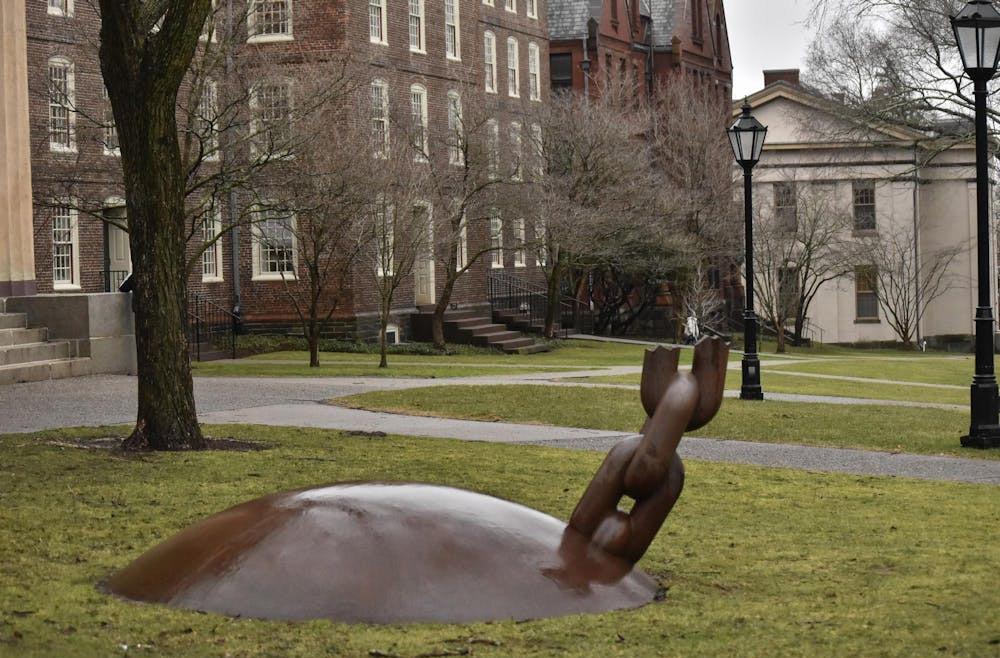
Brown virtual onboarding workshop. Brown’s history with slavery is outlined at the bottom of a subtab titled “Brown’s Timeline: A history of sustained excellence.”
Not even a full section within the module is dedicated to studying this history — faculty member and alumni reflections on the report are now sandwiched between University fun facts and an overview of the Open Curriculum. Even if a student took the time to delve into this history by reading the report linked in the module, firstyear students are deprived of the opportunity to discuss the report’s findings and its significance. Through the first-year reading program, students had this chance. In the committee’s mission statement, a primary goal of the report is to foster continued discussion about racial injustice. In retiring the program, Brown has turned its back on this mission.
Burying the Slavery and Justice report must be understood within the broader national political context. The change occurred amid a federal crackdown on diversity initiatives in higher education, the reinstallation of confederate monuments and Trump administration attempts to undercut the work of the National Museum of African American History and Culture by forcibly controlling the institution’s exhibitions. If terminating the program was a way to appease the Trump administration, then the issue is even more concerning, as it relinquishes academic freedom in the face of government pressure. In taking the Slavery
and Justice report off the first-year curriculum, Brown has set a sad precedent. Just as the University’s report led dozens of schools to confront racist histories, its retirement might push other schools and institutions to abandon discussions about critical histories and methods of modern-day acknowledgement of the past, such as the ever-tumultuous debate surrounding reparations. Without a robust system in place for students to learn about Brown’s history with slavery, the University is abandoning Simmons’s mission “to teach us about ourselves.” If administrators argue that the old system of discussion during first-year orientation didn’t work, Brown should find ways to reintegrate the Slavery and Justice report back into the first-year curriculum. The University could reinstate the mandatory reading program, offer lectures and mini discussions on the topic or work with student filmmakers to make a documentary about its findings.
Current students are Brown’s history and future. To create Brunonians who can make positive change in the world today, Brown must re-commit to remembering its past.
Clara Murray ’29 can be reached at clara_murray@ brown.edu. Please send responses to this op-ed to letters@ browndailyherald.com and other opinions to opinions@ browndailyherald.com.
ELLA LE / HERALD
Dissent: Let faculty run their own meetings
I once had a class where we read and discussed a book written by the professor. On the day of the discussion, he chose to leave the room because he knew that even though we all had good intentions, we wouldn’t feel comfortable criticizing his work to his face, largely because he was in a position of authority. The faculty’s recent vote to replace President Christina Paxson P’19 P’MD’20 as the presiding officer of faculty meetings is the right move for the same reason. When the president of the university presides over faculty meetings, faculty are less free to criticize the president’s decisions.
The editorial page board argues that replacing the president as presiding officer is merely a symbolic gesture and that the Faculty Executive Committee should be using its procedural power to place faculty interests on the agenda. But this misses the point of the replacement: The faculty believed that the president had been using her position as presiding officer to shut down productive conversation on agenda items related to faculty concerns, specifically compensation. Chastising the FEC for not “sufficiently representing faculty interests” is blaming the victim.
The editorial page board’s argument heavily depends on the Faculty Rules and Regulations, which outline the structure of the monthly faculty meeting, but fails to consider the unwritten social dynamics that shape the meeting’s outcome. The presiding officer matters because what is on the
agenda is less important than the discussion that follows. In any setting, a meeting facilitator has immense power to control the conversation. This is especially true when they are also the university president. Even if the FEC placed their full wish list on the agenda, the individual who presides over the meeting controls the length of time spent discussing each agenda item, the light these items are portrayed in, whose hand gets called on and, most importantly, when to shut down uncomfortable conversations. These aspects of serving as presiding officer can be used to deflect objections to the administration’s decisions and control the meeting’s narrative.
According to Herald reporting, such stifling of dissent occurred at the November 2024 faculty meeting. Brown’s faculty have been raising concerns about their compensation for years, so when University administrators rejected a one time 5% increase, several faculty members were understandably upset and wanted to press administrators on their decision. At the meeting, Professor and Chair of German Studies Kristina Mendicino, who served as FEC chair at the time, disagreed with Paxson’s assertions that the University couldn’t afford the increase in compensation. But Paxson did not want to discuss the matter at the meeting, saying that she hadn’t received the relevant motion in time. “This is a faculty meeting, and this is about our compensation, so at some point, I
think it would behoove you to listen to the faculty and listen to our concerns,” said Gerhard Richter, professor of German studies and Comparative literature. Does this sound like a lack of conviction, as my colleagues suggest?
Paxson makes my argument for me. She said that since faculty often consider motions proposed by the FEC chair, it could create a “perceived conflict of interest” if the chair of the FEC leads the meeting. If the position of presiding officer is largely powerless, as the editorial page board suggests, why would there be a conflict of interest? Paxson voices her concern that the FEC chair will gain the exact power she previously held: the ability to steer the conversation in her favor. The difference is that the FEC chair, unlike the president, must be elected by their colleagues.
If faculty tell us that they feel afraid to speak in meetings, we should take their word for it. Even if your job was secure, wouldn’t you feel nervous criticizing your boss to her face in front of hundreds of your colleagues? The editorial board argues that the motion doesn’t change anything because the president will still attend the meetings, but it likely wasn’t so much her presence that was the problem, but her dominance over the conversation.
This decision must be placed in context: Faculty have very little formal power over the governance of the University, especially financial decisions. The committees they sit on are merely ad-
Tkachenko ’29: Brunonians, take the plunge
There’s a very specific moment somewhere between your first step in the ocean and the total loss of feeling below your ankles when you realize two things: first, this was entirely your choice, and second, this is crazy. Perhaps you start to regret everything as a chilly breeze sweeps across the bay, but you keep going. Easing into it isn’t really an option, so the next moment you’re up to your shoulders, forced into a state of pure sensation. Someone behind you is yelling. Someone has already sprinted back to shore. And then it hits you: the shock, the laughter, the possibility that maybe you are crazy and the thought that maybe that’s okay. You’re freezing, fully alive and forever bonded with those who share an appreciation for the practice.
Cold-water plunging should become a Brunonian ritual. It’s a simple, wonderfully chaotic way for students to decompress, foster community and embody the spirit of the Ocean State beyond the bounds of College Hill.
The practice of cold plunging dates back to 3500 B.C.E., when it was used for therapeutic purposes in Ancient Egypt. More than five millennia later, it has become an online fad, seen as a low-effort and energy-inducing form of self-care. The practice has been found to provide various health benefits, such as boosting energy and focus while soothing muscle soreness.
Cold water immersion is not new to schools on the East Coast. Jumping into Hanover’s Occom
Pond is a storied part of Winter Carnival at Dartmouth. Yalies have participated in a February polar plunge in the Long Island Sound every year since 2010. URI students have turned the practice into an annual fundraiser, sending proceeds to a Providence-based nonprofit. Brunonians should hop on the trend.
I grew up in Massachusetts, so I spent many chilly spring breaks on Cape Cod, braving the frigid waters of the Atlantic for fun. Each icy plunge rewired my whole body, and I left the ocean with a triumphant smile and chattering teeth each time.
Now, as students of the Ocean State, integrating nautical culture into our outdoor activities should be an important part of becoming a campus native.

visory to administrators. Historically, faculty used to have more influence over the University’s governance, but never any formal administrative power. The proposal to have the FEC chair lead faculty meetings was submitted back in December as a means to reclaim faculty governance power and refocus the meetings on issues of faculty concern, including compensation.
The change is a step in the right direction for Brown. Reclaiming control over faculty meetings need not be adversarial or harm relationships. It’s asserting a basic professional boundary that provides our faculty with a more open forum for discourse and hopefully helps them gain more governing power. After all, Brown would be nothing without its professors. Shouldn’t they have some say in running it?
Evan Tao ’27 can be reached at evan_tao@ brown.edu. Please send responses to this column to letters@browndailyherald.com and other opinions to opinions@browndailyherald.com.
Dissenting Opinions: When The Herald’s editorial page board disagrees, members have the opportunity to publish a dissent to explain why they voted against the editorial. Editorials — and dissents, if any — are written by members of The Herald’s editorial page board, which is separate from those of The Herald’s newsroom and the 136th Editorial Board, which leads the paper.
You may be wondering: Maya, must we throw ourselves into the ocean in order to foster community? Why not just go hang out on the Main Green?
To this I say the Main Green is all fine and good, but let’s be honest — real bonds are forged in pain. While I enjoyed the warm weather that lured Brunionians outside last week, I began to question the extent to which Main Green mingling can bring us together. If we want a ritual that reliably sparks a similar, perhaps even stronger, communal energy — something a little wilder and unmistakably Rhode Island — we need to take our gatherings somewhere colder. By overcoming the challenge of jumping into the freezing waves together, Brunonians will be able to forge deeper bonds with each other than they would sticking to the comfort of the Main Green. Doing hard things together not only makes them easier, but nurtures communal solidarity, reliance and trust. It’s time to take our socializing to the next step.
Finished midterms? Plunge! Need to destress before an exam? Plunge! First date? Newly single and needing some spontaneity? Looking for the perfect team bonding activity? The reasons to take a dip in frigid water are endless. Use it as a way to ground yourself in the moment. Josh Hecht of Wesleyan University sees cold plunging as a way to deal with stress. “A lot of the time, I’m caught up thinking about the past or thinking about the future, but this forces you to be like, ‘I am fucking cold right now.’ That’s all I can think about. So it’s really nice to be forced back into my body,” he said. March is the perfect time to start plunging. The Rhode Island water is still cold enough to give you a kick, and it’s only going to get warmer — so go while the going is good. When you feel the time is right, I recommend the nearby RISD or Crescent Beaches. Swipe your Brown ID, hop on the RIPTA and head straight there — just mind the sand and don’t get the seats too wet on the way home. Come with a towel, a change of dry clothes and a speaker, digital camera or your favorite yard game for a good vibe. Most important: a group of friends who won’t overthink it!
Maya Tkachenko ’29 can be reached at maya_tkachenko@brown.edu. Please send responses to this column to letters@browndailyherald.com and other opinions to opinions@browndailyherald.com.
ARTS & CULTURE
LECTURE
‘Breaking Bad’ actor reveals how he channels chaos in Brown Lecture Board talk
Giancarlo Esposito has played the villain in various hit films
BY MARAT BASARIA SENIOR STAFF WRITER
On Tuesday, actor Giancarlo Esposito arrived at the Salomon Center’s De Ciccio Family Auditorium for the Brown Lecture Board’s annual spring lecture. In a conversation with moderator Robayet Hossain ’26, Esposito outlined his five-decade acting journey, as well as how he approaches his roles as a villain.
Esposito is best known for his role as Gus Fring in director Vince Gilligan’s 2011 show “Breaking Bad.” Esposito held his then-largest role in his modern film career.
“‘Breaking Bad’ changed the game for me,” Esposito said at the lecture.
Esposito said he learned how to use silence as an intimidation tactic in his role as the villain. “I realize (as) human beings, we’re not accustomed to silence, to being shut down,” Esposito said. “It makes people nervous.”
Currently, Esposito holds a role in the TV series “The Boys,” acting as Stan Edgar, the series’ main antagonist, among other projects. Throughout Esposito’s acting career, he had various hit performances, such as the movie “Do the Right Thing” and the TV series “The Mandalorian.”
Prior to his role in “Breaking Bad,” Esposito largely played supporting roles.
FESTIVAL

But following the show, he was asked to play characters who were in a “position of power.” In “Better Call Saul” — Gilligan’s 2015 prequel to “Breaking Bad” — Esposito also assumed a large role. Esposito’s career first began in 1968 when he made his Broadway debut at only eight years old. “I fell in love with it,” he said.
In the Broadway musical “Maggie Flynn,” Esposito started by “playing street kids who carried guns and knives.” Morton DaCosta’s 1968 Broadway musical follows an Irish woman who runs
an orphanage for children who were previously enslaved. Esposito played the role of one of the orphans, Andrew.
After doing that for a period of time, Esposito found that his acting could affect how his audiences “would then look at other young Black kids.”
For the rest of his acting career, Esposito strived to “break out of being looked at in a certain light.”
He added that there are “things that I build in the characters I play because I want them to be human. I don’t want them to be stereotyped or harder cop -
ies.”
Growing up, Esposito found that he was his own “worst enemy,” adding that he didn’t know how to address challenging circumstances with compassion.
But he said he learned how to “control the chaos” after making space to find his equanimity. “I take my own temperature.”
Steven Ma ’29, who was in the audience, said Esposito has a “stillness” that contributes to his “iconic” roles in his productions. As a result, he said he was excited to see Esposito live.
Casey Kittredge ’29 also said that this unique style made Esposito a “great” actor. “He’s playing these anti-hero characters who are very multi-faceted, very calm and collected,” Kittredge said. “That kind of goes for all of his work, and that makes all of his performances so captivating.”
But Amelia Allen ’27 noted Esposito’s animated character during the lecture contrasted with his generally “reserved” role in his productions. “It was just really great to see how much enthusiasm he had for what he did,” she added.
“To maintain courage to be able to speak out is really extremely important,” Esposito said.
“Do we have cause to be afraid for our world right now? Yes we do,” he added. “But fearing for that is also partially a weakness.”
It is “fear that stops you from being you, but that also stops you from being human,” Esposito said.
Esposito encouraged the audience to “play to your strengths, do what you’re good at, so that you fall in love (with) what you do and you never work a day in your life.”
“Dream big,” Esposito said. “Don’t wait to be great, because you’re great already, just as you are right here, right now, in this moment.”
This article originally appeared online at browndailyherald.com on March 18, 2026.
Providence French and Francophone Film Festival returns to Avon Cinema
Screening old and new films, the festival’s focus this year is The New Wave
BY ROSE FARMAN-FARMA STAFF WRITER
On March 12, the Avon Cinema looked a little different. Instead of its usual crowd, the theater bustled with students and Francophiles attending the opening night of this year’s Providence French and Francophone Film Festival. PFFFF will run until Thursday, showcasing a lineup of classic and contemporary Francophone films that span continents and decades.
Celebrating its 31st anniversary this year, the festival spotlighted the historic French New Wave — which is translated to “Nouvelle Vague” in French — the legendary aesthetic revolution of 60s French cinema.
Francisco Valente, the festival’s artistic director, explained that this year’s theme was chosen partly due to the recent success of Richard Linklater’s newest film, “Nouvelle Vague,” which was screened on Saturday night. The Golden Globe nominated-film pays tribute to Jean-Luc Godard and the filmmakers of the Cahiers du Cinema circle.
“So the film really pays tribute to that whole movement, that period, the aesthetic revolution of the Nouvelle Vague,” Valente said. The curators felt this year’s theme “would be the perfect opportunity to not only show (Linklater’s) film, but also some of the films that inspired it,” including the 1960 film “Breathless.”
The New Wave was also chosen as a theme in part due the movement’s endur-
ing importance to cinema.
“Any time is a good time (to look at) the New Wave,” said Professor of French and Francophone Studies David Wills, who teaches FREN1150G: “New Wave Cinema from Paris to Hollywood,” a class on the movement.
“It’s one of the major examples in film history — of the last 125 years — where something very different happened and it took off,” Wills said. “It’s a moment when, 50 years into its history, cinema decided to renew itself.”
Valente added that the movement is about “youth, about creating something new, about building new images of the world,” Valente said. “That always res onates with new generations and older generations too.”
In addition to the classics, the festival also featured an array of contemporary cutting-edge films, including Hafsia Herzi’s “La Petite Dernière” — which won both the Queer Palm and best actress awards at the Cannes Film Festival — and the North American premiere of Abdellatif Kechiche’s “Mektoub, My Love: Canto Uno.”
Over the years, PFFFF has curated a diverse lineup of art-house independent films, documentaries, children’s films and high-budget blockbusters. “It has a very rich history with impeccable taste,” said Valente, who is a filmmaker himself and a film curatorial associate at the Museum of Modern Art in New York City.

“The French-speaking community in Providence is fully engaged as well,” Krause said. The festival also partners with the French American School of Rhode Island, the Alliance Française of Providence and the French Consulate in Boston.
The festival has humble origins. According to Krause, it grew out of a College Hill ciné-club, where Brown and Rhode Island School of Design faculty and graduate students gathered weekly on Sunday morning screenings to watch French films.
The event has come a long way since
Attendees hailed from across New England. Krause said she also often gets messages from interested Rhode Island residents in the Alliance Française in Connecticut or the Alliance Française of Newport, among other organizations.
PFFFF for all three of her years at Brown.
“I absolutely love the fact that such a large group of different people gather together for a shared appreciation and interest in French cinema.” Moses said after attending a screening of “La Venue de l’Avenir” on Sunday night. “I think that it’s very valuable to be perpetuating French culture here and also giving cultural access to the community.”
Krause also pointed to the broader cultural importance of celebrating foreign cinema and facilitating cross-cultural ex-
periences. “It seems even more precious as we go forward, especially now in our current political climate, with this sort of nationalist mentality,” Krause said. But the event also aims to offer “something that is artistic and joyful” that “brings us out of the woodwork,” she said. “We want to bring something to the community that brings us together.”
This article originally appeared online at browndailyherald.com on March 18, 2026.
ANNAMARIA LUECHT / HERALD
Giancarlo Esposito is best known for his role as Gus Fring in “Breaking Bad.”
MUSICAL
Ensemble’s ‘Fun Home’ is exactly what college theater should be
The show was the first Broadway musical to feature a lesbian protagonist
BY TALIA LEVINE ARTS & CULTURE EDITOR
This past weekend, Ensemble Theatre at Brown transformed the Fishman Studio in the Granoff Center for the Creative Arts into a funeral home, a historic Pennsylvania house, an art studio and an Oberlin College dorm for their heartwrenching production of the Tony Award-winning musical “Fun Home.” The show was exactly what college theater should be.
The 2015 musical was adapted from Alison Bechdel’s 2006 graphic memoir, “Fun Home: A Family Tragicomic.” The show was performed off Broadway for multiple years before opening on Broadway in 2015 and becoming the first Broadway production to feature a lesbian protagonist.
“Fun Home” breaks the paradigm of queer women being depicted as side characters or stereotypes — such as in “Rent” and “Falsettos” — by “offering a sincere yet fanciful, profound yet entertaining” lesbian coming-of-age story, Director Maria Diniz ’26 wrote in her director’s note.
Ensemble’s production perfectly captured the essence of college theater. While every actor had the perfect voice for their role, the casting success was particularly evident in the three actors who played each iteration — a young child, a college student and a woman in her 40s — of the protagonist. Actors were not chosen to appear as though they were related by blood, nor were they chosen with the confines of appearing age-accurate. Instead, it was evident that each actor was chosen for their sheer talent, vocal range and fit for the character.
Small Alison was played by Nina Sethanandha ’29, whose performance was so genuine that it often didn’t even feel like she
was acting.
Dylan George ’29, who played Medium Alison, delivered a spectacular performance, beautifully depicting the nuances of Bechdel’s young-adult journey of self discovery through interactions with her love interest, Joan, played by Zoe Napurano, a Rhode Island School of Design senior. Their scenes were imbued with an air of cautious flirtiness that will likely resonate with any young queer person who has ever questioned their identity
But Jocelyne Lioe ’29 truly brought the show over the top with her portrayal of present-day Alison. The story follows Alison as she works on her memoir, and

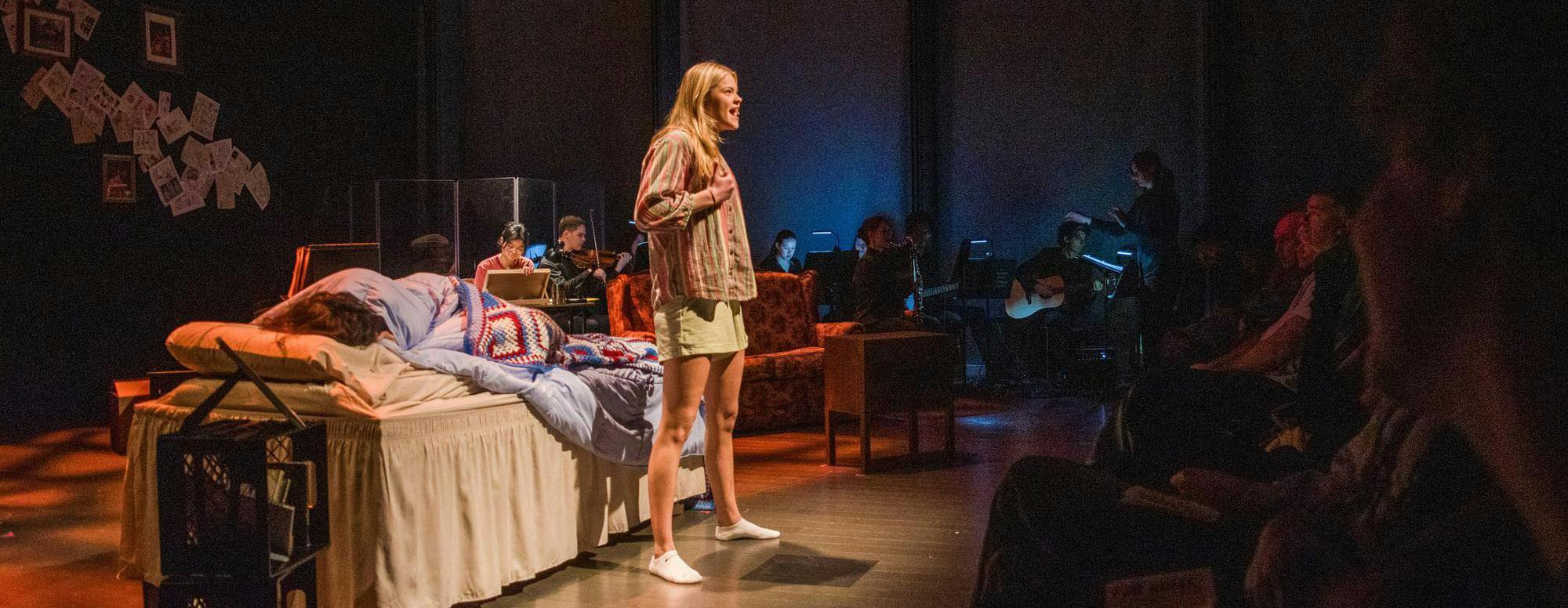

REVIEW
the cast acted out her thoughts as if they were characters in her mind. At times, she would leave her desk and move through the scene, floating across the stage almost like a ghost, watching past versions of herself with a bittersweet nostalgia.
The rest of the Bechdel family was also spectacularly cast. Seth Peiris ’26, who played Alison’s father, Bruce Bechdel, presented a very nuanced version of the character, showcasing the character’s flaws and the pain behind them. An important component of the story is that alongside Alison’s journey of self actualization, she must also reckon with the complex past of her dead father, whom she discovers was
beabadoobee’s ‘All I Did Was Dream of You’ takes
beabadoobee’s latest single is an avalanche of pent-up emotion
BY KENDRA EASTEP SENIOR STAFF WRITER
While the snow and ice has mostly melted from sidewalks across campus, beabadoobee has brought one more winter anthem to this season’s charts with her first original song since 2024. Released last Thursday, the British-Filipina singer’s new single, “All I Did Was Dream of You (feat. The Marías),” and its accompanying music video transport listeners to a tundra of longing and loneliness.
In a haze of fur coats, obsidian smoke, white light and snow, the music video masterfully paints a dreamscape for the single’s somber cries. Its lucid visuals and vulnerable lyrics construct a mirage of intimacy, bringing a surrealist aesthetic to the crushing reality of heartbreak.
Filmed in Vilnius, Lithuania, the video begins with beabadoobee trudging through a desolate field of snow. With vocals frosted in melancholy, she sings, “While I’m yours and you are mine / Going steady till we lie, high at sunrise,” to the steady beat of a drum and throbbing electric guitar.
closeted and had sexual relations with minors. Peiris’s scenes with the teenage Roy, who was played by Peter Brueggemann ’29, were intense and convincing.
A photo of Seth Peiris ’26, playing Bruce Bechdel on the left and Peter Brueggemann ’29 on the right looking intently at each other.
Brueggemann also played the other young men — and sometimes underage boys — with whom Bruce had mostly problematic relations. While it was often impossible to tell which of them he was playing, Brueggemann managed to depict all of the characters with ease. If the goal was to depict these young men as disposable
sexual accessories, he hit the mark.
One of the most poignant moments was when Alison’s mother, Helen Bechdel, played by Jada Boadu ’29, sings “Days and Days” while recounting the hardships of her marriage to a closeted, abusive man, just days before he dies by stepping into oncoming traffic.
Throughout the song, Boadu descends further and further into despair, still somehow managing to never miss a note. The emotion in the song resonated throughout the studio, leaving the audience with goosebumps.
The show also handled sensuality in a way that did the coming-of-age story justice. In one scene, Medium Alison declares that she is “changing her major to sex with Joan with a minor in kissing Joan.”
A photo of Dylan George ‘29, playing Medium Alison, singing into the crowd with a bed behind her.
This moment, which follows Alison’s lesbian awakening, truly captured the heart of the show. “Fun Home” manages to be both vulnerable and funny, conveying complex stories of queerness with elegance and humor.
This article originally appeared online at browndailyherald.com on March 15, 2026.
listeners to a tundra of longing

As the music floats from verse to pre-chorus, beabadoobee graces listeners’ ears with an eerie, indie-rock sound. Steeped in desperate loneliness, the song finds an echo in the music video’s eerie visuals. beabadoobee stands at a bar, reclines on a bare white mattress and lies in the display case of a butcher shop. Walking through the night, beabadoobee draws the paces alone.
But while this softer, sentimental aesthetic characterizes the single’s first half, the instrumental takes the song’s icy chill to a boiling point in the latter half. Effortlessly pulsing between quiet pining and aggressive desire, beabadoobee and The Marías masterfully capture the agonies of yearning.
As María Zardoya, the lead singer of
The Marías, sings “Nightmares always feel like this,” the camera shifts to a shot of beabadoobee under a harsh spotlight. A fiery red light flickers in the distance. A car is overturned and engulfed in flames.
Juxtaposing rich blues with orange lights, the video’s deliberate, poignant imagery enhances the track’s melodrama.
The final chorus is pressurized with
intensity. beabadoobee cries “Stay, stay or just leave / Stay or just leave me be” as the instrumental roars. This final cry for affection, laden with thunderous drums and hot with aching passion, is the song and video at its best.
At the end of the video, beabadoobee returns to sit on the mattress, now less barren, closes her eyes as a blend of distant vocals fades off into a whisper. A flurry of snowflakes blur the lens and fill the room. Zardoya’s haunting voice rounds out the song as she pleads, “Don’t go / Don’t go.”
The music itself is an enticing display of shoegaze and grunge, a stark difference from beabadoobee’s earlier discography that typically featured softer, pop sounds. With the atmospheric vocals of The Marías, beabadoobee seems to be leaning into the alt-rock sound she brought to “Cologne” — this time, with darker visuals.
Alongside its intriguing, cinematic video, ‘All I Did Was Dream of You’ is a promising sign for the singer, especially following more than a year without releasing original music. The moving power ballad is the epitome of what fans love about the beabadoobee — ardent yearning, alternative melodies and honest lyricism.
KENDRA EASTEP / HERALD
OWEN BALLARD-O'NEILL / HERALD Jocelyne Lioe ’29, Nina Sethanandha ’29 and Dylan George ’29 (left to right). The musical was adapted from Alison Bechdel’s autobiographical graphic novel.
OWEN BALLARD-O'NEILL / HERALD
OWEN BALLARD-O'NEILL / HERALD
SCIENCE & RESEARCH
WHITE HOUSE
Researchers find changes in acetaminophen, leucovorin uptake after White House briefing
The briefing claimed Tylenol use during pregnancy was linked to autism
BY JAANU RAMESH STAFF WRITER
In a September 2025 White House briefing, U.S. Secretary of Health and Human Services Robert F. Kennedy Jr. P’07 P’20 claimed that the use of Tylenol by pregnant women was linked to autism. In the same briefing, Food and Drug Administration Commissioner Martin Makary promoted leucovorin — a prescription drug used for cancer-related conditions — as a potential therapeutic for autism.
Earlier this month, a Brown-affiliated study published found that acetaminophen orders for pregnant women during emergency room visits declined and outpatient prescriptions for leucovorin skyrocketed following the September briefing — suggesting the changes in the clinical decision making may be related to the federal statement.
The researchers found that from September to December 2025, acetaminophen orders decreased by 10% among pregnant emergency department patients, while leucovorin prescriptions for children from five to 17 years of age increased by 71%.
LEGISLATION
“I hope (the study) raises awareness,” said Professor of Health Services, Policy and Practice and co-author Michael Barnett. “People really do listen to federal health officials when they make clear messages, regardless of whether that message is based on evidence or some other motivation.”
In the September briefing, Makary said “a growing body of evidence suggests that some children suffering from autism are folate deficient within the brain — a problem that can be treated with leucovorin,” encouraging physicians to make leucovorin available to “candidate children.”
But leucovorin has not been official-
ly approved for use treating autism. On March 10, the FDA expanded the use of leucovorin for cerebral folate deficiency, a rare genetic condition.
“There is no evidence that cerebral folate deficiency is a common biological presentation” of autism, Associate Professor of Molecular Biology, Cell Biology and Biochemistry Sofia Lizarraga, who studies autism and was not involved with the study, wrote in an email to The Herald.
Autism is a spectrum, according to Lizarraga. She added that autism’s core features include “difficulties in social interactions and communication, repetitive behaviors (and) increased sensory sensitivities.”
Cerebral folate deficiency presents symptoms that are “somewhat overlapping with autism,” said Jeremy Faust, one of the paper’s authors and an assistant professor of emergency medicine at Harvard Medical School. “But it is just a completely different medical condition.”
Barnett believes that many clinicians may be prescribing leucovorin simply because they are being asked to.
“I think honestly it is a bit of a failure of the medical system that it’s so easy for (clinicians) to just prescribe something because it’s just part of the zeitgeist that week,” Barnett said, adding that “more
rigorous standards” for incorporating medical information into prescribing habits are needed.
No drugs are currently known to “treat” the “core features” of autism, according to Lizarraga. Claims that leucovorin may be a treatment for autism and that paracetamol use during pregnancy can cause autism lack sufficient evidence, she added.
Faust noted that “acetaminophen is the safest fever-reducing medication during pregnancy,” adding that the drug is “very important in the emergency department.” Acetaminophen is the only over-the-counter medication that has been approved to treat fever in pregnant women.
According to Barnett, there is “suggestive evidence that undertreated fever during pregnancy can be harmful for a fetus.”
“Uncertainty and fear can lead to hesitation around something as familiar and common as Tylenol,” Barnett said.
“The words of our health care leaders in government are powerful,” Faust said. “When we say things prematurely, it ultimately is a huge gamble, and that gamble is with the trust of the public,” he added.
The White House and the FDA did not respond to The Herald’s requests for comment.
Brown researchers launch database breaking down world of AI legislation
The online portal seeks to make legislation more accessible
BY LUCINDA EMPSON-SPEIDEN CONTRIBUTING WRITER
As legislation on artificial intelligence increases across the United States, the Center for Technological Responsibility, Reimagination and Redesign launched a portal that offers a centralized resource for tracking, evaluating and comparing bills related to AI.
Released on March 2, the CNTR AISLE portal is a “one-stop shop” mapping out AI legislation, according to CNTR Director Suresh Venkatasubramanian. He added the portal was created to help understand legislative responses to the development of AI.
“At some point, there were over 1,000 bills being proposed” in the United States, he told The Herald. “We felt it was important to start trying to make some sense of this landscape.”
The idea for the portal initially emerged in 2024. Venkatasubramanian and his team began developing “crude, internal versions” of the portal and started policy analysis, he said. Starting last fall, the team focused on developing a “structured form” for the data.
The portal houses a “bill library” listing all proposed state and federal legislation regulating AI.
Each bill is reviewed by evaluators to create a profile of the bill with a spider graph that scores the legislation on its relevance to several policy areas. The evaluators do not grade bills, but characterize them based on “questions that help us tease out what a bill has in it,” Venkatasubramanian said.
“This is not advocacy. We are not trying to push for a point of view,” he added. “Our goal is to provide a broad understanding of what bills are talking about.”
According to Tomo Lazovich, AISLE’s policy director and assistant professor of

the practice in AI governance and policy, the team aims to find common trends between bills and gaps in the legislation.
“We don’t want to just be following the trends and tracking what’s there,” they said. “We also want to be thinking a little bit critically about what should be in some of these bills and then trying to figure out, in a data-driven way, if they’re actually there or not.”
With the increased accessibility of these bills through the portal, Lazovich said that they hoped the database could give states the tool to “coalesce around particular” parts of the policies that they like.
AISLE is divided into multiple teams, according to Lazovich. The policy team
develops questionnaire models that guide evaluators and analyzes the data that come out of the surveys. Meanwhile, the product team oversees software development and project management, and the data team manages bill intake. AISLE also has a communications team that focuses on outreach efforts.
The project consists of many undergraduates who work across AISLE’s teams. Venkatasubramanian described the level of student involvement as “very high,” adding that “students have been heavily involved in this process from day one.”
Emily Hong ’26.5 and Dre Boyd-Weatherly ’26, who are both policy analysts at the CNTR AISLE legislation lab, help manage
the lab’s daily logistics. The two also “think about the larger questions we want to answer, about what we want to extract from these bills,” Hong said.
“Now that we have our first round of data (and) the platform that’s launched, the policy team” is looking toward expanding their legislation analysis, she added. Hong and Boyd-Weatherly are also working on drafting papers for conferences and to make information available to academics.
CNTR Program Manager Meredith Mendola said the audience of the database includes regular citizens, who may want to gain a sense of the different facets of the AI legislation.
“It’s a transparency aspect that you don’t normally get anywhere else,” they said.
As the database continues to develop, the team aims to incorporate AI-powered rapid insights and comparative analysis across states, according to Mendola. According to Venkatasubramanian, these tools could make the database more accessible to researchers, policymakers, the media and members of the public. Looking forward, the project could potentially extend to an international lens, he added.
HELEN BESCH / HERALD
SOPHIA LENG / HERALD
The researchers found that from September to December 2025, acetaminophen orders decreased by 10% among pregnant emergency department patients.
MEMORIAL
University herbarium preserves flowers left at Dec. 13 memorials
The flowers were frozen solid when they were selected for preservation
BY ANGEL LOPEZ SENIOR STAFF WRITER
Early in the morning on Dec. 26, Rebecca Kartzinel, director of the Brown University Herbarium, and Matthew Guterl, vice president for diversity and inclusion, walked across campus in below-freezing temperatures with a unique mission.
Parsing through frozen peonies and roses, the pair aimed to collect and preserve flowers left outside of Barus and Holley and in front of the Van Wickle Gates in honor of Ella Cook ’28, Mukhammad Aziz Umurzokov ’29 and the nine additional students injured in the Dec. 13 shooting.
The preservation project is a part of “Brown Ever True,” the University’s campus-wide healing initiative that aims, in part, to provide space for “reflection, memorialization (and) conversation” surrounding Dec. 13, according to Guterl, who leads the Brown Ever True operational team.
Shortly after Dec. 13, a member of the Office of University Communications asked Kartzinel if she could preserve the flowers placed at the memorials. She said the idea was inspired by flowers preserved at Michigan State University after the school experienced a mass shooting in 2023 that left three students dead and five others injured.
“These memorials mean a lot to everybody, and I think we’re all taking care of them in some sense,” Guterl said. “It’s
FDA
about making sure that we do right by those we’ve lost, and that we do right by each other and that we hold on to this stuff and to these memories for future generations.”
When Kartzinel and Guterl met to select flowers to be preserved, “the flowers looked beautiful because they had been laid recently, but they were also frozen solid,” limiting the flowers that could be picked, Kartzinel said.
Kartzinel emphasized that she was very intentional in her selections, picking flowers from different bouquets to encompass a wide variety of flora while ensuring plants were durable enough for the preservation process.
“I was picking things that I thought wouldn’t have been damaged too much by having been frozen so that the final product would still be reflective of how lovely those flowers were in life,” Kartzinel added.
She then took the flowers back to the herbarium, where she began the preservation process.
Kartzinel began by trimming the flowers so that they could fit on 11-by-7 inch sheets of paper backed by corrugated cardboard. She then layered blotter paper on top to absorb moisture and cinched the stack with straps before pressing it in a wooden press, where the flowers were left to dry.
Because the flowers were recovered when they were frozen, more water leaked out of the press than was typical, she explained. As a result, she had to replace the blotter paper and repress the plants several times.

Kartzinel completed the project independently, starting on the same day that she selected the flowers with Guterl. The flowers were left to dry for several weeks and now remain in the herbarium.
The University is still deciding how to best memorialize the specimens, Kartzinel said.
“If we have a role in whatever happens with them next, we’ll have to think really carefully about who does that work and who wants to do that work,” Kartzinel added.
Although the next steps aren’t finalized, one thing remains clear to Kartzinel: “The place we found ourselves in the one to two weeks after Dec. 13, it’s important to record that,” she said. “There’s a lot of sort of fleeting memories and fleeting things.”
“The memorials are something that were a really important part to that time period, and they still are,” she added. “This is a way to preserve a piece of that.”
This article originally appeared online at browndailyherald.com on March 19, 2026.
Fmr. FDA commissioner advocates for agency’s independence at BPU event
BY NISHITA MALHAN SENIOR STAFF WRITER
Former Commissioner of the Food and Drug Administration Andrew von Eschenbach opened his Monday night Brown Political Union lecture with a common phrase: “May you live in interesting times.”
Von Eschenbach argued that the rapid development of technological and scientific breakthroughs has made the present the most interesting era in human history. At the event, titled “Policy, Politics and Public Service in Medicine,” the 2006-2009 FDA commissioner discussed his career trajectory, ideas for FDA reform and the future of the agency.
“I have long advocated that the (FDA) should become an independent agency,” von Eschenbach said in an interview with The Herald. The FDA is currently under the purview of the U.S. Department of Health and Human Services.
He believes that the FDA should “always be above and outside of any political influence, but it does have to take into account policy issues and policy influences,” a sentiment he echoed in his lecture.
At the event, von Eschenbach added that the FDA must lie in a place where it can “inform policymakers and other agencies,” rather than make policy decisions based on politics.
“Keep the FDA sequestered around scientific decisions about the performance
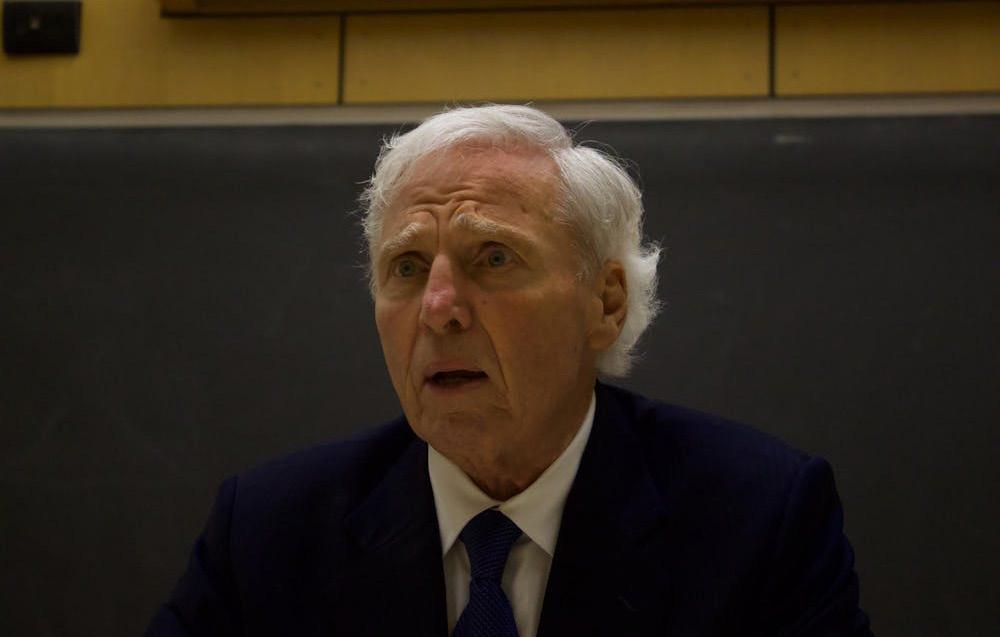
of the products it’s regulating,” von Eschenbach said.
Additionally, von Eschenbach said that FDA regulatory decisions should be delegated within the agency — not made unilaterally by the HHS secretary. Previously, the decisions were made by the FDA commissioner, who would rely on scientific experts and directors within the organization, he said.
“The secretary is using the authority he’s always had but probably shouldn’t,” von Eschenbach said. “My advice to him would be, ‘you’re not the scientist who
knows the content. Let that decision-making occur where that scientific expertise exists.’”
Von Eschenbach called for greater transparency at the FDA, which he said is currently a “black box.”
Public mistrust in institutions is a “complicated disease” that can be battled by putting patients first, von Eschenbach added. He called for the pharmaceutical industry to stop advertising drugs directly to consumers since it treats patients as a means to an economic end.
In his conversation with The Herald,
von Eschenbach described the elimination of roughly 3,500 FDA positions last year as “too much, too soon.” Though some of these cuts have been undone, he added, experienced leadership at the top and entry employees with emerging skill sets at the bottom are the “most critical people that you need” in the agency.
The HHS did not immediately respond to The Herald’s request for comment.
A Navy Medical Corps veteran, former director of the National Cancer Institute and former chair of the department of urologic oncology at the University of
Texas MD Anderson Cancer Center, von Eschenbach said he was motivated by the desire to “make a difference.”
Von Eschenbach said that each of his roles widened his perspective of the field of medicine. He described his time at MD Anderson as being on the “front lines,” his role at the NCI as like being in a surveillance plane and his time at the FDA as being like “spy satellite.”
Though he no longer leads the FDA, von Eschenbach currently sits on the board of the Reagen-Udall Foundation, a congressionally sanctioned nonprofit that helps “create the interface between the (FDA) and all the stakeholders in the private sector, both industry as well as patients,” he told The Herald.
Looking to the future, von Eschenbach said artificial intelligence’s emerging role is “unlocking the vault” of information that the FDA harbours.
This “vault” — including every drug, biologic and device that the FDA has ever approved or disapproved — used to be a physical archive, but now resides digitally in the cloud, von Eschenbach told The Herald.
“If we unlock that vault, we can accelerate our ability to bring safer, more effective drugs quicker to patients in need,” he added.
“I am from the world of the caterpillar,” von Eschenbach said to the event’s audience. “You are part of the metamorphosis.”
KAIA YALAMANCHILI / HERALD
The idea was inspired by flowers preserved at Michigan State University after the school experienced a mass shooting in 2023.
Andrew von Eschenbach discussed his career and the future of the agency
MARAT BASARIA / HERALD
The FDA is currently under the purview of the Department of Health and Human Services.
UNIVERSITY NEWS



Professors trade classroom for dance floor with Brown Ballroom Dance Team
held its annual “Dancing with the Professors” show on Sunday
BY LIZE DENG
CONTRIBUTING WRITER
Framed by a spotlight on the ballroom floor of Alumnae Hall, Ian Chow ’28 and Associate Professor of Engineering Kareen Coulombe opened their performance of the paso doble, a Latin ballroom dance that mimics the theatrics of a bullfight, in total silence. As judge Emilie Lum ’24 MD’30 later remarked, “you could hear a pin drop.” Then, the music came in.
Their dance, set to “España Cañi” by Pascual Marquina Narro, required pow erful movements synced to the music’s marching rhythm — a skill far outside Coulombe’s academic expertise. But with just over a semester’s worth of rehearsal under their belts, the pair’s strong tech nique and storytelling earned them the “Audience’s Choice” award at the Brown Ballroom Dance Team’s annual “Dancing with the Professors” show, held on Sunday in Alumnae Hall.
Modeled after ABC’s “Dancing with the Stars,” Dancing with the Professors has been organized by the Brown Ballroom Dance Team since 2008. While the event experienced a prolonged break due to the COVID-19 pandemic, Chow and his fellow organizers have worked to reestablish it as an annual tradition since its revival last year.
This year, the judging panel consisted of Professor of Chemistry Amit Basu, who was a previous contestant, as well as Eddie Kay and Lum, both of whom have competed in ballroom dance and are affiliated with the BBDT. While the judges decided on an overall winner, the audience voted to determine the winner of the “Audience’s Choice”and “Most Creative” awards.
Patrick Bai ’27 and Assistant Professor of Mathematics Benjamin Kwon Younghan Dees took home the Judge’s Choice Award for their graceful Viennese waltz, a tech nically challenging style due to its speed.
“There was such a beautiful (lyricism) to that dance,” Basu said as part of his feedback. “If mathematics is the poetry of numbers, this was really poetry in motion.”
Basu gave similarly glowing feedback to Marshall O’Callaghan ’28 and Assistant Professor of Biostatistics Stavroula Chrysanthopoulou, who went on to win the “Most Creative” award with their cha-cha and mambo. “My head was spinning,” Basu
fast,” she said. Coulombe, who had previously dabbled in various styles of dance, said that she particularly enjoyed “bringing dance back” into her life.
For Professor of Behavioral and Social
kind of wanted to do it as a way to feel like part of the Brown community.”
Merrill has always loved dance, having learned tap, jazz and ballet as a teenager — but learning ballroom dancing for DWTP
surprised at, but it’s become painfully obvious,” he told The Herald.
“The most fun part has been getting to know Professor Egan,” Nguyen said onstage after their performance. “We always have so much fun during our rehearsals. I always lose my breath laughing before I lose my breath dancing.”

much, and it went by so

After a brief intermission, Laura Colella, an assistant professor of the practice in literary arts, performed a rumba and swing with Korbin Johnson, a community member who is in the BBDT. Basu noted the contrast in their performance between the “gentle intimacy” of the first segment and the “explosion of joy and exuberance” of the second.
Mascha van ’t Wout-Frank, associate research professor of psychiatry and human behavior, performed an elegant waltz with John Loncke ’27, set to a cover of “Never Enough” by Loren Allred. The emotional performance was praised by the judges for the “sculpted” quality of the dancers’ movements and their connection with the music.
“There were times when I didn’t feel like I was watching the dance. I was watching music personified,” Basu said.
In an email to The Herald, van ’t WoutFrank — who has some basic experience in jazz ballet and ballroom dancing — wrote that she had attended a previous DWTP event to support a colleague and was excited to give it a try herself.
Loncke, on the other hand, had no previous dance experience prior to joining the BBDT in his first year, and as someone who “had always been naturally uncoordinated,” ballroom dancing proved to be a challenge. He wrote in an email to The Herald that he wanted to participate in DWTP because he liked the idea of teaching someone who is in the “same position” as he once was.
Kathi Fisler, a research professor of computer science, performed a cha-cha with Leela Young ’28. Fisler wanted to participate in DWTP because it’s “vital for professors to periodically experience what it is like to be a novice at something and to let students see us in that process,” she wrote in an email to The Herald.
“Learning requires vulnerability, and I’ve always believed in showing students that I, too, am vulnerable when learning something new,” she added.
This article originally appeared online at browndailyherald.com on March 17, 2026.
which maybe I shouldn’t have been
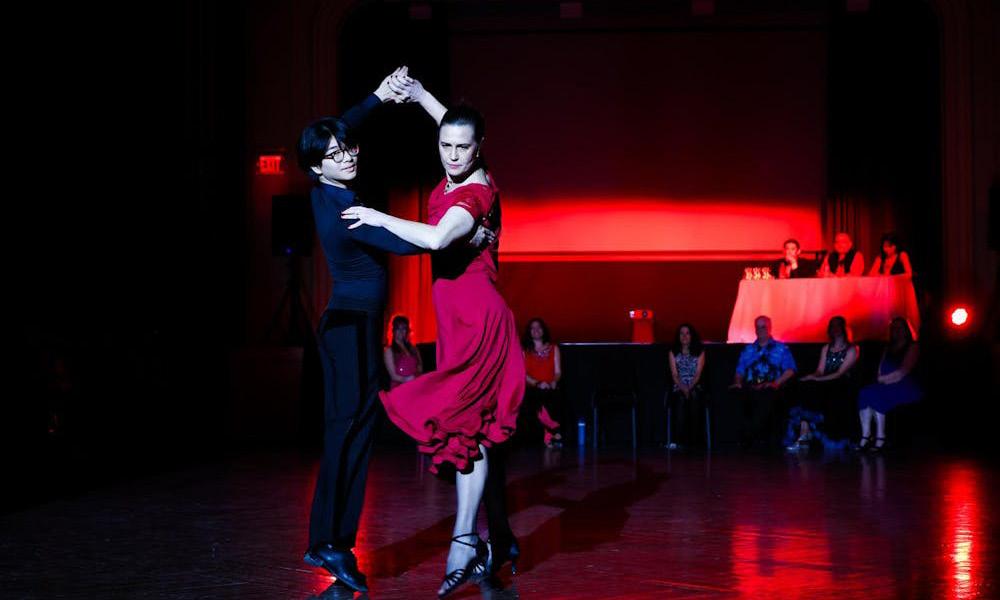

The team
Patrick Bai ’27 and Assistant Professor of Mathematics Benjamin Kwon Younghan Dees
Marshall O’Callaghan ’28 and Assistant Professor of Biostatistics Stavroula Chrysanthopoulou
Associate Professor of Engineering Kareen Coulombe
Ian Chow ’28 and Associate Professor of Engineering Kareen Coulombe performed the Paso Doble, a Latin ballroom dance that mimics the theatrics of a bullfight.
Jim Egan, a professor of English, and Anh Nguyen ’28
Mascha van ’t Wout-Frank, associate research professor of psychiatry and human behavior, and John Loncke ’27
Professor of Behavioral and Social Sciences Jennifer Merrill and Ben Reyes '27
BALLROOM
CHRISTINE CHANG / HERALD