
THE BROWN DAILY HER ALD

Some minority students less comfortable reporting harassment, discrimination, campus survey
37% of Muslim undergraduates think Brown takes Islamophobia seriously
BY IAN RITTER UNIVERSITY NEWS AND SCIENCE & RESEARCH EDITOR
Over 11% of all students who identify as Black, multiracial, LGBTQ, transgender and Muslim, as well as Jewish undergraduates, reported experiencing harassment or discrimination during their time at Brown,
Former Fed chair
Janet Yellen ’67 receives award for public service
SEE ALUMS PAGE 3
Vice President for Diversity and Inclusion
Matthew Guterl wrote in a Tuesday Today@ Brown announcement.
The message shared the preliminary findings of the University’s 2025-26 Campus Climate Survey, which was conducted by an external contractor as agreed upon in the University’s deal with the federal government last summer.
The percentage of students reporting harassment or discrimination at Brown reaches over 15% for graduate and medical students who identify as Black, Hispanic or multiracial, as well as for Muslim un-
Providence City Council proposes 4% cap on annual rent increases
HOUSING PAGE 4
The review team will be co-led by Bill Bratton and Courtney Adante
BY JEREMIAH FARR SENIOR STAFF WRITER
Brown is working with global consulting firm Teneo for its two external security assessments following the Dec. 13 shooting, according to a Thursday Today@Brown announcement sent by Russell Carey, executive vice president for planning and policy.
According to the announcement, the reviews are set to continue throughout the semester, after which “key outcomes” will be shared with the Brown community and the public.
The first assessment is an after-action review,
dergraduates and transgender students, the announcement added.
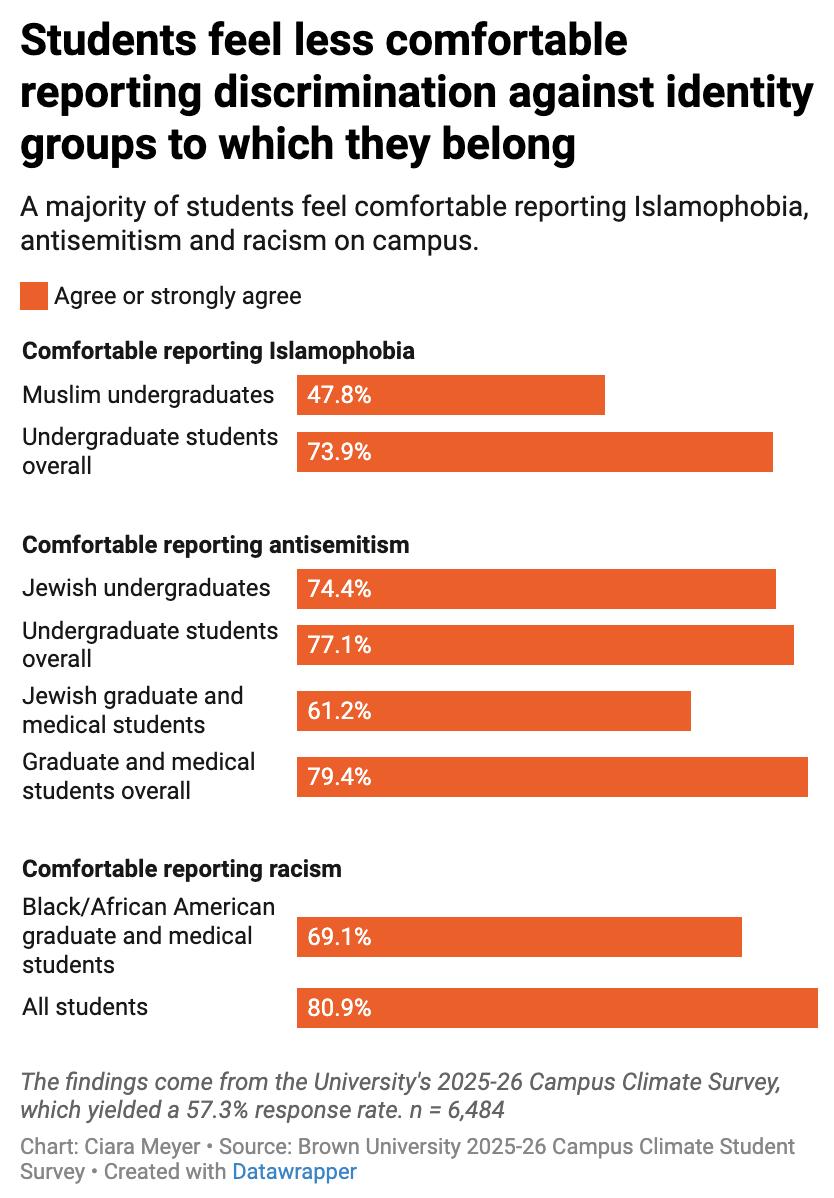
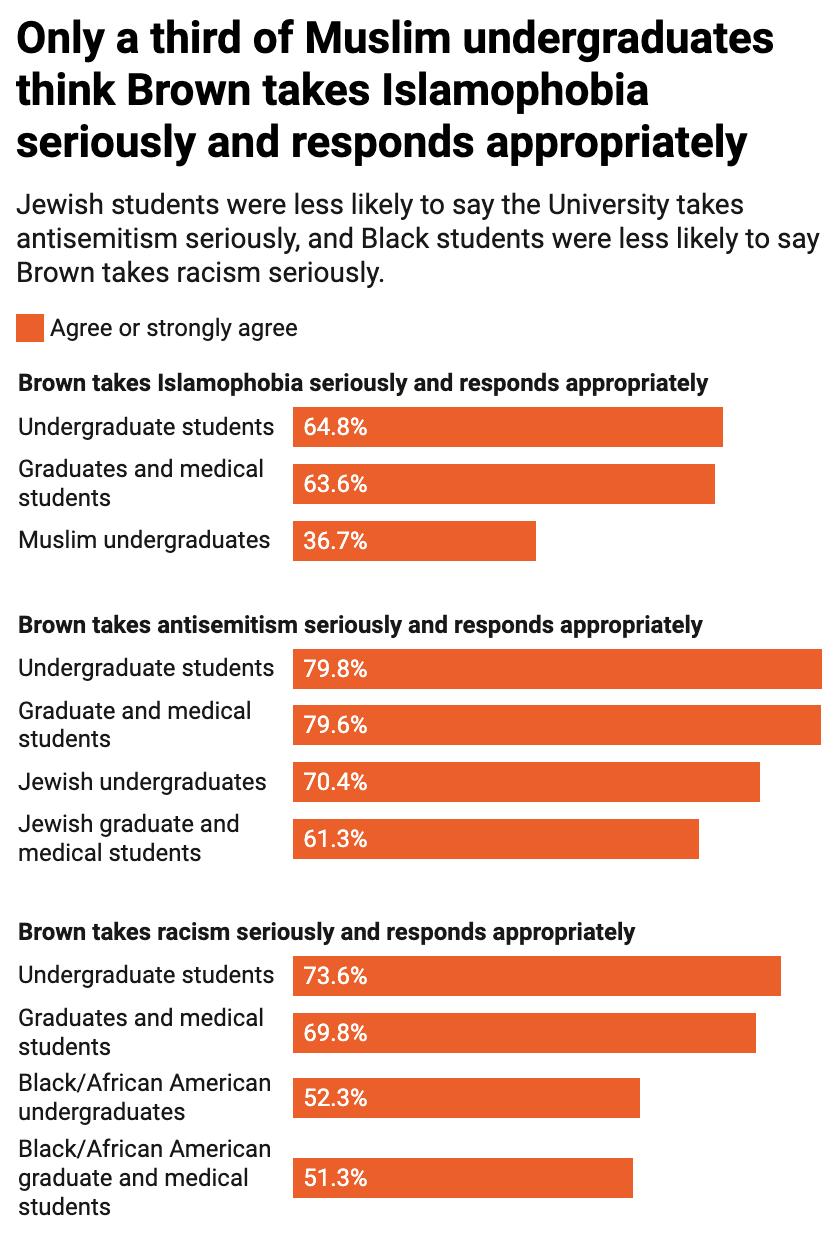
Many of these groups were also less likely to believe that the University takes reports of discrimination against their demographic group seriously, Guterl wrote. Just 37% of Muslim undergraduates felt that the University takes Islamophobia seriously and responds appropriately, compared to 65% of undergraduate students overall.
The survey found that only 48% of Muslim undergraduates agreed or strongly agreed that they feel comfortable reporting
New indoor turf facility opens its doors, offering year-round athletics
SEE RECREATION PAGE 6
which will assess campus safety before, during and after the shooting. The second assessment is a comprehensive campus safety and security assessment, which will look into Brown’s security practices and infrastructure.
When University President Christina Paxson P’19 P’MD’20 first announced the security assessments Dec. 22, the external organization that would be carrying out the reviews had not yet been announced, but that the Brown Corporation, the University’s highest governing body, would be overseeing the reviews.
The two co-leads of Teneo’s review team for their work with Brown are Courtney Adante and Bill Bratton.
Adante is the president of Teneo’s security risk

IMMIGRATION
finds
incidents of Islamophobia, compared to 74% of all undergraduates.
Brown will expand its required nondiscrimination training and training on social media harassment and discrimination, Guterl wrote. “We intend to advance all these actions swiftly,” he added.
Around 85% of undergraduates and 76% of graduate and medical students reported a sense of belonging at Brown and were “satisfied with their decision” to attend, the announcement read. Additionally, over 90% of undergraduates and about 84% of graduate and medical students said they
& CULTURE
Grammys 2026: The Herald’s picks for four top prizes
GRAMMYS PAGE 13
would “would recommend Brown to ‘students like me.’”
Nearly 89% of undergraduate students and 87% of graduate students believe they can “fulfill the requirements of their coursework while being themselves, and without suppressing their identities, backgrounds or experiences,” Guterl wrote. Around 67% of undergraduates and 60% of graduate and medical students believe they can “freely express their political or social views on campus,” he added.
SCIENCE & RESEARCH SEE FORBES PAGE 15
Nine Brown alums named to 2026 Forbes 30 Under 30 list
Senator Ciccone seeks to ban immigration enforcement on state property
Smiley’s executive order bars immigration enforcement activity on city-owned property
BY JAMES LIBRESCO AND MICHELLE BI SENIOR STAFF WRITER AND METRO EDITOR
State Senate Majority Leader Frank Ciccone III (D-Providence, Johnston) is pursuing legislation to prohibit immigration enforcement activity on state property without a judicial warrant, he told The Herald on Sunday.
Ciccone wrote in an email to The Herald that he met with Chief Justice Paul Suttell of the Rhode Island Supreme Court to discuss the legality of such a law, as well as potential challenges the federal government could raise in court. Suttell could not be reached for comment.
The Department of Homeland Security and the White House did not immediately respond to requests for comment.
The move to pursue statewide legislation comes on the heels of Providence Mayor Brett Smiley’s Jan. 20 executive order prohibiting immigration enforcement activities on city property. The order prevents the use of city property “as a staging area, processing location or operations base” for civil immigration enforcement, according to a city press release.
According to Providence press secretary Anthony Vega, “clear signage” outlining the order will be posted on all city-owned properties, including “facilities, parks, parking lots or buildings” owned by the city, within 30 days.

A Tuesday message shared the preliminary findings of the University’s 2025-26 Campus Climate Survey.
KAIA YALAMANCHILI / HERALD
UNIVERSITY NEWS
GRADUATE SCHOOLS
Carpenter and sociology scholar: Meet the new dean of Brown’s Graduate School
David Lindstrom hopes to support research amid federal funding threats
BY JEREMIAH FARR SENIOR STAFF WRITER
David Lindstrom, the new dean of the Graduate School, grew up in Chicago wanting to become a carpenter. But his parents were insistent that he had to become the first in his family to go to college — so Lindstrom attended the University of Illinois Urbana-Champaign, intending to study architecture.
After taking an architecture class in his first semester of college, Lindstrom pivoted his focus. “I thought, ‘Maybe this isn’t the right thing for me. Maybe this isn’t where my real talents are,’” he told The Herald. Lindstrom thought about the classes he had excelled in during his first year of college, “and those were things like sociology and history.”
He transferred to the University of Wisconsin-Madison, where he received an “outstanding education” and had a “wonderful experience” as a member of their honors program. He then attended the University of Chicago for graduate school, earning his PhD in sociology.
Lindstrom was drawn to Brown’s research in population and immigration studies — his field of interest — and reached
SURVEY FROM PAGE 1
“All together, this confirms that our commitments to openness and fairness and our faith in a diversity of ideas, perspectives and experiences are reflected in the student experience, and it illuminates areas for potential improvement and follow-up
out to the University about a postdoctoral fellowship. He was told that Brown did not have any open fellowships at the time, but he was invited to apply for an assistant professorship position instead. He was hired the day after his visit to campus.
Now, more than 30 years later, Lindstrom is beginning his first semester as Dean of the Graduate School.
Lindstrom described enjoying the “scale of things” at Brown.
“There’s never more than one degree of separation from the people who can make decisions,” he said. “So you have access, as a faculty member, to the senior administration, and you'd never have that at a big, large university.”
Much of Lindstrom’s work as a professor of sociology focuses on the causes and effects of migration and changing dynamics in fertility and reproductive behavior.
Lindstrom previously served as director of the Center for Latin American Studies and chair of the Department of Sociology. He also created the University’s master’s program in social data analytics and has been the program’s director since its creation.
Margot Jackson, professor of sociology and director of the Population Studies and Training Center, praised his leadership skills and aptitude for predicting trends in the field of sociology.
Lindstrom “has a knack for thinking about where we need to be in five or 10
study,” Guterl wrote. Further actions will be taken after the completion of “follow-up focus groups and pulse surveys,” and after the University receives a full analysis of the data from Rankin Climate, the external vendor that
years based on where he thinks the field is going … and setting up the building blocks to make that happen,” Jackson said in an interview with The Herald.
In his new role as Dean of the Graduate School, Lindstrom will face challenges beyond his field of study. Brown paused Ph.D. admissions for the 2026-2027 academic year in at least six departments last semester, and last semester, the University projected a $30 million financial loss due to federal actions in fiscal year 2026.
“The pressure is greatest on small humanities (and) foreign language programs,” Lindstrom said, adding that his goal is to ensure that small humanities continue to succeed at Brown.
“That means finding ways to ensure that they have an adequate number of doctoral students so they continue to be vital, innovative, excellent programs,” he added.
Silvia Giorguli Saucedo PhD’04, a current professor at and former president of El Colegio de México, is a former mentee and longtime coworker of Lindstrom’s. She praised his ability to apply common sense to his decision making.
“It sounds very simple, but it’s something that not everybody does,” she said. Lindstrom’s thought process “leads to very efficient ways of operationalizing or implementing whatever needs to be done.”
Lindstrom’s colleagues also praised his eagerness to connect with his peers and students on a personal level.
conducted the survey, Guterl wrote. Brown also aims to launch a University faculty and staff campus climate survey in the fall of 2026.
“We will also consult with members of our community to better understand how

“He has always reminded me, as a colleague, to make sure to prioritize things other than work and to enjoy life in a more holistic way,” Jackson said.
When Giorguli Saucedo was appointed president of El Colegio de Mexico, Lindstrom came to Mexico — and he did the same when she was appointed to the Colegio Nacional, a Mexican honorary academy.
“I’m very grateful for him, not only in terms of what I have learned from him, but in terms of the way he thinks and he relates to his students,” Giorguli Saucedo said.
Lindstrom currently lives in Rhode Island with his wife and spends his time outside of Brown skiing and fulfilling his love for carpentry. His four children all
the tragic violence of Dec. 13 might have reshaped our campus and community,” he added.
The survey had a student response rate of 57%, including 62% of undergraduates, 41% of master’s students, 49% of
live in the New England area, along with his eight grandchildren.
According to Jackson, Lindstrom loves giving coworkers and students tours of his house and he often invites them to pick apples in the small orchard in his yard. It “instills a lot of confidence (in me) that we have someone in this role who is excited and capable to tackle a challenge and to do this in a way that will genuinely be in the best interest of the University and the students themselves,” Jackson said.
This article originally appeared online at browndailyherald.com on Jan. 29, 2026.
doctoral students and 64% of medical students.
This article originally appeared online at browndailyherald.com on Jan. 27, 2026.
JAKE PARKER / HERALD
After more than 30 years at Brown, Lindstrom is beginning his first semester as Dean of the Graduate School.
UNIVERSITY NEWS
ALUMS
Former Fed chair Janet Yellen ’67 receives award for excellence in public service
The former U.S. treasury secretary reflected on her career in public policy
BY SAMAH HAMID UNIVERSITY NEWS EDITOR
Janet Yellen ’67, the first female chair of the Federal Reserve and first female secretary of the treasury department, received the Elliot L. Richardson Prize for Excellence in Public Service on Wednesday.
Yellen, a former member of The Herald’s business staff who graduated from Pembroke College with a degree in economics, served as the secretary of the treasury from 2021 to 2025 under former President Joe Biden.
In an interview with The Herald, Yellen spoke about her career in public service, the Trump administration’s recent actions against the Fed and the federal government’s attempts to implement sweeping tariffs.
Yellen described the award as a “tremendous honor,” because she sees former Attorney General Elliot Richardson — for whom the prize is named — as “someone who embodies integrity in public service.”
Richardson resigned in 1973 from his position as attorney general under former President Richard Nixon after a request to fire a prosecutor in the Watergate investigation. For Yellen, Richardson demonstrates “how possible it is to be highly ethical” in
SAFETY FROM PAGE 1 advisory team, and she has a master’s degree in cybersecurity risk and strategy from New York University, according to Teneo’s website.
Bratton is the executive chairman of risk advisory at Teneo, and he formerly served as commissioner of the New York and Boston Police Departments and chief of the Los Angeles Police Department.
According to NBC, when Bratton worked in the NYPD during the crack
public service positions.
Even before Yellen got to college, she was always “very interested” in economic concepts, particularly because her parents grew up during the Great Depression, she told The Herald.
At Brown, Yellen had an “aha-awakening” about the causes of such financial crises and wanted to apply her studies in a “policy setting.” In the following years, Yellen “fostered (her) interest in economics,” learning the power of economic analysis in creating public policy.
“It’s where I really acquired the tools,” she said. “I had (a) wonderful education from terrific Brown professors, and it really started me off on a career that I found very rewarding.”
After leaving university, Yellen initially thought she would only spend a “year or two” in a public policy-oriented career.
“But once I saw how satisfying it was, I was very open to having a much larger share of my career be in public service,” she said.
Yellen was nominated by former President Barack Obama to serve as chair of the Fed from 2014 to 2018 and was succeeded by current Fed Chair Jerome Powell.
On Jan. 11, the Department of Justice opened a criminal investigation into Powell, which Powell attributed to his resistance to President Trump’s desire to lower interest rates. In her interview with The Herald, Yellen described Powell as “an extremely honorable and upstanding individual.”
epidemic of the ’80s and ’90s, he helped shape the department’s “broken windows” policing strategy, which describes police’s zero-tolerance approach to misdemeanors.
The strategy, a predecessor to “stop and frisk,” has been critiqued for targeting communities of color and contributing to mass incarceration.
Bratton and the University did not immediately respond to requests for comment about Bratton’s work for the

“I strongly doubt he’s guilty of anything that’s been alleged,” she said.
The White House did not respond to a request for comment.
Yellen believes that “there can be nothing political” about how the Fed achieves the goals assigned by Congress, which are “namely maximum employment and price stability.”
“What I’d be doing if I was (at the Fed), is I’d be doing my job, and I would try to stay above the fray and just continue to set policy in the best way I think would advance these goals,” Yellen said. “And I think that’s exactly what they have been doing.”
For Yellen, it’s important that the Fed
NYPD.
In 2002, Bratton was commissioned by Brown to lead a review of Brown’s security following a rise in crime on the streets surrounding the campus. Bratton’s team produced a 44-page report suggesting that the University arm its police officers.
Gene Deisinger will also serve as special adviser to Teneo’s team at Brown, according to the announcement. Deisinger is a licensed psychologist, and he was appointed
remain independent from external pressure because “it's all too easy … to use monetary policy for political purposes.”
If a country’s central bank was not independent, federal administrations could attempt to impact elections, she explained. For example, they could “try to juice up the economy to lower the unemployment rate in the run up to an election so things feel good to people,” she said.
But in the long run, such practices “typically” cause inflation, which can cause a central bank to “have to tighten up, which ultimately raises both inflation and unemployment,” Yellen said.
Yellen added that Trump’s request that the Fed set interest rates at 1% or lower to finance the country’s deficits is “precisely the kind of reasoning that leads to policies that will cause extremely high inflation” and “what history shows will be damaging to the United States.”
Yellen believes that if Trump’s efforts to control the Fed are successful, “they’ll change the Fed as an institution.”
“We’ll have a Fed that responds to political pressure and the goals of an administration,” she added, noting that “he’s weaponized the Department of Justice against his enemies.”
On Wednesday, the Fed announced that it would be holding interest rates steady.
Over the past year, the Trump administration has also threatened and attempted to leverage sweeping tariffs on countries
by the U.S. Department of Justice to act as a subject matter expert in their critical incident review of the 2022 mass shooting at Robb Elementary School in Uvalde, Texas. In addition, he was the deputy chief of police and director of threat management services for the Virginia Polytechnic Institute and State University after the school’s 2007 mass shooting.
Teneo’s methods of “engaging with our many campus stakeholders,” will in-
THE BROWN DAILY HERALD
Games Chief Paul Hudes
Multimedia Editors
Sophia Basaldua
Marat Basaria
Harry Guo
Horatio Hamilton
Selina Kao
Ella Le
Kenna Lee
JJ Li
Jake Parker
Jascha Silberstein
Luecht
Kaia Yalamanchili
Illustration Chiefs
Kendra Eastep
Isabela Guillen
Video Chiefs
Cienna Cheng
Cody Cheng
Social Media Chiefs
Nate Barkow
Annika Melwani
Technology Chief
Annika Singh
Data Desk Chief Caleb Ellenberg


Rassul Toleugazy
BUSINESS
General Managers
Arjun Deshpande
Anum Azhar
Sales Directors
Arjun Ray
Hannah Han
Finance Director
Sydney Wright
Office Manager
Cary Warner
around the world, including U.S. allies like Canada. On Monday, Trump announced an increased tariff rate from 15% to 25% on South Korean imports.
Yellen believes Trump’s tariff implementation is “harmful to the United States as well as to other countries.” She emphasized that in her view, the purpose of these tariffs has remained unclear.
“One possibility is that they’re intended to reduce the large U.S. trade deficit,” she said. “Most economists believe and teach in undergraduate courses, like the ones that I took at Brown, that this is not a strategy that will be successful.”
Yellen explained that the tariffs place a “heavy burden on American consumers,” particularly on the “lowest income households.”
“The surest way to reduce the trade deficit would be to get our federal budget deficit under control, and when that’s been tried in the past, it has worked,” she added.
To Yellen, President Trump’s actions targeting higher education funding pose an additional threat to the American economy. These actions “threaten a tremendous source of strength of the American economy: the ability to innovate, to bring scholars here who contribute tremendously to America’s success.”
This article originally appeared online at browndailyherald.com on January 29, 2026
clude gaining input from members of the Brown community through interviews, listening sessions and surveys, according to the announcement. The University will also continue to implement “security enhancements” as the reviews are conducted.
This article originally appeared online at browndailyherald.com on Jan. 29, 2026.
Submissions: The Brown Daily Herald publishes submissions in the form of op-eds and letters to the Op-eds are typically between 600 and 900 words and advance a clear argument related to a topic of campus discourse. You can submit op-eds to opinions@browndailyherald.com.
Letters to the editor should be around 250 words and respond to an article or column that has appeared in The Herald, or critique or commend The Herald’s editorial decisions. You can submit letters to the editor to letters@browndailyherald.com.
Submissions undergo multiple rounds of editing. These rounds of editing generally take place over the course of one evening, and you may have to respond to edits late in the evening. If you know you will be unable to do so, please mention that in your email, and we will do our best to work with you.
Submissions can build on reporting from The Herald, reporting elsewhere, official statements from the University or other groups and other reputable sources, but they cannot break news or contain information that The Herald cannot verify. Because we cannot publish unsubstantiated information, failure to provide appropriate sources may mean we have to modify or remove unverified claims.
The Herald will not publish anonymous submissions or submissions authored by organizations. Leaders of student organizations can be identified as such but cannot write under the byline of their organization. The Herald cannot publish all submissions it receives and reserves the right
Commentary:
COURTESY OF KAREN BARATZ
On Wednesday, Yellen received the Elliot L. Richardson Prize for Excellence in Public Service.
HOUSING
Providence City Council proposes 4% cap on annual rent increases
BY AVA RAHMAN SENIOR STAFF WRITER
At a Jan. 22 meeting, the Providence City Council introduced a rent stabilization ordinance, which would cap annual rent increases at 4% in an attempt to control the city’s rental prices. Mayor Brett Smiley has promised to veto the ordinance.
Providence City Council President Rachel Miller (Ward-13) and President Pro Tempore Juan Pichardo (Ward-9), along with six other councilors, have co-sponsored the ordinance, but with Smiley’s impending veto, its passage through committee will depend on affirmative votes from two additional city council members.
“Rent stabilization means renters will no longer have to rely on luck or hope to stay in their homes,” Miller wrote in an email to The Herald. About half of Providence renters are housing-cost burdened, according to a 2025 City Council report.
Many Providence renters have found themselves priced out of homes after property owners raised rent prices, Miller added.
“Mayor Smiley has stated he would veto the ordinance as written,” wrote the Mayor’s Press Secretary Anthony Vega in an email to The Herald, mentioning concerns that rent controls would destabilize a housing market that is subject to property tax and insurance fluctuations. Another concern is the rent stabilization’s impact on new housing production, Vega added.
The ordinance grants a 15-year grace period before newly constructed housing
STATE POLITICS

prices are controlled. Other exemptions aim to protect transitional housing and institutional buildings that include educational or religious properties.
In addition, the ordinance establishes the newly-appointed Rent Board to mediate landlord disputes and petitions, enforce tenant protections and allow for the registration of tenant unions. Landlords who fail to comply with the Board’s mandates may face penalties, including fines.
Unlike a fluctuating cap based on each year’s rate of inflation, the ordinance's flat rate doesn’t require back-and-forth negotiations with the Rent Board, Miller wrote.
“Four percent accounts for the regular inflationary costs of a healthy housing market,” she wrote. “It doesn’t require more than the calculator on your phone to know how much you can charge for rent or what your rent might be.”
A study conducted by Redfin last year found that Providence is the least affordable city for renters, The Herald previously reported. Since 2020, median rent prices have increased 40%.
A general decrease in federal funding
for public housing, compounded by slow housing construction and strict zoning regulations, has led to rising prices and short supply, according to Brenda Clement, the director of HousingWorks RI, a research and policy think tank focused on housing affordability.
In addition, Providence attracts renters from adjacent cities who can easily commute from Providence to work in neighboring states like Massachusetts and Connecticut, narrowing housing opportunities for Providence residents.
“The Boston market has expanded south into Providence, so the people who can’t afford the really astronomical rents in Boston have moved down to Providence,” said Providence College Professor Eric Hirsch, who also leads the Rhode Island Homeless Advocacy Project. “That demand, by relatively well-off people, has increased the rents in Providence.”
City Councilor Jill Davidson ’89 (Ward2), another co-sponsor of the ordinance, said in a statement shared with The Herald that the city councilors did “years of research to ensure we didn’t replicate mis-
takes,” acknowledging the mixed results of rent control in other cities.
The ordinance is part of a larger range of efforts to equalize the housing market, from funding the city’s Affordable Housing Trust and home repair program to converting vacant offices into living spaces.
“No single policy will end Providence’s housing crisis,” wrote Miller. But she described the ordinance as an “essential part” of the councilor’s three-part strategy of increasing housing supply, protecting current housing stock and stabilizing rent.
For many council members, the ordinance tackles an issue that hits close to home.
“I spent almost my entire life as a renter, and I know exactly how fragile that life can feel,” City Councilor Justin Roias (Ward-4), who co-sponsored the ordinance, said in a statement shared with The Herald. For Roias, “rent stabilization is about keeping Providence livable for the people who call it home now.”
But some remain skeptical of whether rent stabilization will address the underlying problems of housing scarcity and affordability.
“Providence is using every available and nationally recognized strategy to address the housing shortage,” Vega wrote.
“The Mayor’s focus has been on tackling the underlying problem by building more homes at every price point … and expanding targeted protections and support for residents who are at risk of displacement.”
Hirsch believes that the exemptions should be sufficient to sway the ordinance’s opponents. “They did every conceivable thing that they could to make sure that none of the problems that are supposedly associated with rent stabilization are going
to happen,” he said.
But Rhode Island Coalition of Housing Providers Director Shannon Weinstein, who is also a realtor with experience in property rentals, cautioned that even with exemptions, rent stabilization can produce bottlenecks in housing supply.
She added that cost-burdened landlords of owner-occupied units, also exempt from the 4% cap, would still suffer because the drop in surrounding property values would force them to lower their prices to compete in the market.
Jeffrey Hamill, a senior policy analyst at the Rhode Island Public Expenditure Council, which published a study against rent controls with the Providence Foundation earlier this month, observed that rent stabilization policies fail to address the central problem that apartment prices are already too high.
He added concerns that the resulting decline in property values would bring less tax revenue to the city’s public budget, potentially pressuring the city council to “raise property tax rates on single-family homes to offset the revenue gap and maintain essential services.”
Hirsch acknowledged that rent stabilization is not enough to fix the housing crisis when many residents cannot afford capped rental prices. But the ordinance will help renters threatened by eviction due to nonpayment, he said.
A city council committee will review the ordinance before the full city council conducts the first vote.
“Rents are definitely too high,” Clement said. “I’m grateful for the city council putting together the ordinance because… it makes all parties come to the table to talk about it.”
Gov. McKee proposed state budget includes millionaire tax bracket, health insurance subsidies
The budget proposes an income tax of nearly 9% for the top tax bracket
BY ANNIKA MELWANI AND MICHELLE BI SENIOR STAFF WRITER AND METRO EDITOR
On Jan. 15, Gov. Dan McKee unveiled his new state budget for fiscal year 2027. The proposed $15 billion budget would change clean power goals, introduce means to cut energy costs, raise taxes for the top bracket and give the governor line-item veto power.
In a press release announcing the proposed budget, McKee said he is committed to supporting everyday Rhode Islanders amid national economic difficulties.
“I submit my budget proposal for those families, for all families,” he wrote.
McKee’s budget would place a 3% surtax on Rhode Islanders who make over $1 million per year, bringing the income tax for the state’s top tax bracket from 5.99% to 8.99%, just about matching Massachusetts’s rate and surpassing that of Connecticut, Maine and Vermont.
If approved, the millionaire’s tax would raise $67.1 million in fiscal year 2027 and $135.5 million in fiscal year 2028.
On Jan. 22, members of the Working Families Party of Rhode Island announced a package of four bills that would build on McKee’s proposal by taxing a greater share of the state’s top earners. The bill proposals include a 3% surtax on annual
taxable income above about $640,000.
The Working Families Party of R.I. did not respond to The Herald’s requests for comment.
Laurie White, president of the Greater Providence Chamber of Commerce, and Michael DiBiase, president and CEO of the Rhode Island Public Expenditure Council, voiced opposition to the tax increase.
“A ‘millionaire’s tax’ is going to hurt the mom-and-pop businesses that make Rhode Islanders proud,” they wrote in a joint statement shared with The Herald.
McKee also called for the implementation of a line-item veto, which would allow the governor to strike items from the budget without vetoing or approving the bill in its entirety. Currently, Rhode Island is one of only six states that does not grant its governor line-item veto authority.
The budget additionally contains $9.5 million in subsidies for a “targeted affordability program” for Rhode Islanders insured through HealthSource of Rhode Island — the state’s health insurance marketplace — amid federal cuts to insurance. These funds keep coverage affordable for around 20,000 individuals, according to the proposal. The budget also allocates $10 million in funding for Rhode Island-based hospitals.
Overall, McKee has dedicated about 45% of the proposed budget to health and human services.
State Sen. Sam Bell (D-Providence)
criticized McKee’s healthcare proposals because they give the state health insurance
commissioner the ability to limit health insurance companies’ cost growth.
Bell described the proposal to The Herald as “a cap on how much insurance companies pay out to patients and providers.”
“There’s no language requiring that the insurance companies pass the savings on to people,” he added. “This is a truly deranged idea.”
Bell also called McKee’s proposed removal of weight loss drugs GLP-1 from health coverage “cruel.”
“It’s not an effective cost saving thing,” he said. “It's really an idea that lower income people should not be able to access medicine to help them lose weight.”
McKee’s office did not respond to The Herald’s request for comment.
The Hospital Association of Rhode Island, on the other hand, “commends Gov. McKee’s continued engagement on healthcare and his recognition that our healthcare system is under growing strain,” HARI Senior Vice President Lisa Tomasso wrote in a message to The Herald.
McKee also plans to amend the state Renewable Energy Act, which created the renewable energy standard in 2004. His plan would delay the timeline for the state to transition all of its electricity sources to renewable energy sources from its original deadline of 2033 to 2050. This postponement would help McKee fulfill his plan to cut energy costs for Rhode Islanders by $1 billion over the next five years.
Rhode Island’s previous deadline for 100% renewable energy use was the most aggressive in the country — all other states

JASMINE WILLOUGHBY / HERALD
If approved, the millionaire’s tax would raise $135.5 million in fiscal year 2028.
with the same goal are aiming for deadlines of 2040, 2045 and 2050. The state’s residential electricity rates are currently the fourth highest in the country.
The McKee administration estimates that amending the renewable energy standard will save Rhode Islanders a total of around $597 million over five years. Capping funding for energy efficiency programs, discontinuing incentive payments to Rhode Island Energy and other initiatives would make up the rest of the $1 billion in savings. The average ratepayer would see a decrease of about $180 per year.
But clean energy advocates expressed
concerns about changing the standard. “To truly manage consumer energy bills, the state needs to remain committed to our Renewable Energy Standard and other clean energy programs,” Tina Munter, R.I. policy advocate for Green Energy Consumers Alliance, wrote to The Herald.
“It’s absolutely absurd that the governor would choose to gut our climate programs,” Bell said. “It’s caving to the Trump administration’s agenda against renewable energy. The climate crisis is real.”
This article originally appeared online at browndailyherald.com on Jan. 28, 2026.
Mayor Brett Smiley has promised to veto the ordinance
SHAYNA RUDOREN / HERALD
Providence City Council backs Smiley’s proposal to increase state PILOT funding
The proposal raises the reimbursement rate for foregone revenue to 30%
BY LEV KOTLER-BERKOWITZ SENIOR STAFF WRITER
On Thursday, the Providence City Council passed a resolution in support of Mayor Brett Smiley’s Jan. 7 proposal to secure more state funding for municipalities across Rhode Island by increasing the state’s Payment in Lieu of Taxes disbursements to its cities and towns.
Providence, along with 14 other municipalities in Rhode Island, is home to properties that are exempt from paying property taxes. Under the PILOT program, established in 1986, the state partially reimburses these cities and towns for the revenue that they would have gained from taxing those properties.
If enacted, Smiley’s proposal would increase the reimbursement rate from 27% to 30%.
In Providence, tax-exempt properties — which include Brown University, other institutions of higher education and several hospitals — account for roughly 42% of the city’s real estate.
“With another challenging budget already ahead … additional state support is critical to maintaining basic services
IMMIGRATION FROM PAGE 5

without placing further pressure on taxpayers,” Kati Stevens, the City Council’s communications director, wrote in an email to The Herald.
The resolution, which Stevens wrote passed unanimously with two councilors absent, claims that a lack of revisions to the PILOT program since its launch has necessitated “onerous (tax) increases on homeowners and businesses.”
Several members of the Rhode Island General Assembly expressed their
support for Smiley’s proposal in emails to The Herald.
Sen. Jacob Bissaillon (D-Providence) wrote that he supports the proposal “because it more fairly compensates our cities and towns.”
Sen. Sam Zurier (D-Providence) also noted his support, writing that “an increase to 30% is a step in the right direction.” He believes that Rhode Island should look to a similar program in Connecticut in which the state offers
a 45% reimbursement for state-owned properties and 77% reimbursement for certain nonprofit organizations “as a goal to reach over time.”
If an increase is approved, the extra payments will be allocated from within the state’s budget, according to City Spokesperson Josh Estrella.
In a statement sent to The Herald, Senate Majority Leader Frank Ciccone (D-Providence, Johnston) said that the increase should be considered “within the context of the many competing priorities in the overall state budget.”
Ciccone will support the effort if it's feasible within the state budget, he added.
In fiscal year 2026, PILOT disbursements comprised roughly 2.5% of Rhode Island’s local aid expenditures. The statute also allows the state to proportionally spread the PILOT disbursements across its municipalities in the event that the state budget does not allow for full payments.
In fiscal year 2025, the state’s PILOT disbursements totaled 26.7% of foregone property tax revenue. In the 2026 fiscal year, it amounted to the full 27%.
Estrella referred The Herald to the state for questions about whether Rhode Island could afford the increased payments. Gov. Dan McKee’s office did not respond to a request for comment.
PILOT disbursements from the state comprised about 7% of Providence’s total budget in the 2026 fiscal year. Sen. Meghan Kallman (D-Pawtucket, North Providence) wrote in an email to The Herald that budget issues will remain even if the state accepts Smiley’s proposal.
“Underfunding for basic city infrastructure/social needs isn’t going to fully be addressed by modifications to the PILOT program,” Kallman wrote.
Estrella wrote that “Mayor Smiley remains committed to exploring new strategies to diversify the City’s revenue and ensure long-term fiscal sustainability.”
But more work is to be done before Smiley’s proposal may become law. Ciccone said that the decision will be made “through our budget review process over the course of the next several months,” with input from “various stakeholders and the public.”
While the “city council resolution is welcome and helps build the case for raising the reimbursement rate, it won’t determine the fate of the proposal,” Bissaillon wrote.
This article originally appeared online at browndailyherald.com on Jan. 25, 2026.

Ciccone’s legislative pursuit also follows the second fatal shooting of a U.S. citizen by federal agents in Minneapolis this month. On Jan. 7, an Immigration and Customs Enforcement agent fatally shot Renee Good. On Saturday, amid a heightened immigration enforcement presence in the city, a Border Patrol agent killed Alex Pretti. Gov. Dan McKee did not respond to multiple requests for comment about the executive order and proposed legislation. Senate Minority Leader Jessica de la Cruz (R-North Smithfield, Burrillville, Glocester) and House Speaker Joe Shekarchi (D-Warwick) did not respond to a request for com-
ment on whether they would support the statewide legislation.
In a statement to The Herald, House Minority Leader Michael Chippendale (R-Coventry, Foster, Glocester) called Smiley’s order “purely unconstitutional, just as any legislation passed by my radical colleagues in the House would be.”
In response to Chippendale’s accusations, Vega wrote that the executive order "does not restrict or interfere with the enforcement of criminal law or lawful federal activity."
According to the Providence Department of Public Safety’s Chief Public Infor-
mation Officer Kristy dosReis, the Providence Police Department “will comply with and enforce” Smiley’s executive order. “If a federal agent does not have a valid, authorized judicial warrant, Providence Police will issue a notice to vacate the property,” she wrote in a statement to The Herald.
DosReis said that the police department does not “proactively collaborate” with any federal agency in civil immigration enforcement. In July, a city oversight board found that PPD officers violated city ordinances by assisting ICE officials with detaining an individual after a car crash, The Herald previously reported.
City spokesperson Josh Estrella wrote in a statement to The Herald that “when (PPD) officers respond to a scene, their role is to prioritize the protection and safety of all residents.”
Olivia Blush, an organizer with advocacy group Providence General Assembly, said that members of the group have “put pressure” on city officials in the past to pass legislation like Smiley’s order.
Blush said that the day after an ICE agent fatally shot Good, the advocacy group announced demands that call for the city to prohibit ICE agents and operations in Providence.
While Blush additionally wants lawmakers to pursue similar legislation at the state level, she stated that the mayor’s recent executive order has “basically met (the organization’s) demands,” and the PGA has plans to help ensure the new order is enforced. Members of the group will visit “major city properties and make sure these posters are getting put up,” she said. She added that members plan to “go throughout our neighborhoods and business districts” and “hand out these posters ourselves.”
SOPHIA LENG/ HERALD
Several members of the Rhode Island General Assembly expressed their support for Smiley’s proposal in emails to The Herald.
JAKE PARKER / HERALD
The Rhode Island Superior Court on Monday.
SPORTS
ICE HOCKEY
‘They’ve got to just be better’: Women’s ice hockey flounders in 4-0 loss to RIT
The Bears look to recover against Union and Rensselaer this weekend
BY SAJIV MEHTA SENIOR STAFF WRITER
This past Saturday, the women’s ice hockey team (12-10-2, 8-6-2 ECAC) welcomed the Rochester Institute of Technology (14-13-0, 9-9-0 Atlantic Hockey America) to Meehan Auditorium. But instead of defending their ice, the Bears skidded to a calamitous 4-0 defeat.
Stymied offensively for the entirety of the contest, none of the Bears’ 23 shots found paydirt, and Brown fell to No. 6 in the ECAC standings.
RIT “played fast,” Head Coach Melanie Ruzzi told The Herald in a post-game interview. “It’s hard to say this, but I think they outcompeted us.”
Bruno’s performance against RIT yielded “a lot of disappointment and frustration,” goaltender Rory Edwards ’27 wrote in an email to The Herald. The shutout followed last weekend’s 6-2 thrashing of Colgate, in which Brown recorded their season-high in goals scored.
The opening period of Saturday’s Pink Out matchup showed no hint of the blowout to come: the two sides seemed locked in a stalemate, and the first ten minutes passed without any promising chances or traded blows.
As the first period wound to a close, the contest’s pace escalated as RIT goaltender Sophia Bellina squared away a Jade Iginla ’26 breakaway shot. Less than a minute later, a breakaway at the other end led to a tangle of RIT players colliding with Edwards, yielding no result.

Stymied offensively for the entirety of the contest, none of the Bears’ 23 shots found paydirt, and Brown fell to No. 6 in the ECAC standings.
derous slap shots that Edwards barely managed to fight off.
On the other side of the center line, Bellina and the Tigers’ defense continued to shut out the Bears. RIT blocked multiple looks by Lyons, India McDadi ’26 and Norehad.
As the clock hit five minutes remaining, Brown’s hopes undoubtedly began to dwindle, but a two-score climb still seemed possible. But RIT’s next blow removed all doubt as to the match’s outcome.
A pass bouncing off Brown’s end board made its way to Tiger forward Cassie Barnes, who dished the puck to the top of the crease. There, RIT forward Ireland Stein slipped it inside the right bar beyond an outstretched Edwards.
Ruzzi pulled Edwards from the ice with four minutes remaining in the game to maximize Brown’s offensive potential. But the decision instead resulted in a cruelly fitting finish to the afternoon. From the Tiger’s own defensive zone, RIT forward Kailey Favro cleared the puck, which travelled almost the entire length of the rink before burrowing into the Bears’ empty net and bringing the final tally to 4-0.
“Being aware of where everyone is is key,” Edwards wrote. “The other major thing is communicating and figuring out how to keep the puck out, whatever it takes. Sometimes it’s a big block, a good stick, a big save or a simple whistle.”
The second period was not as balanced.
Though forward Monique Lyons ’28 sliced through RIT defenders and sent a screamer that deflected off of the left post, Bellina secured the crease before any bearing-down Bears could finish the attempt.
With less than five minutes left in the period, an RIT power play led to a barrage of dangerous shots in close proximity to the Brown goal. But Edwards deflected each attempt, and Bruno emerged from the penalty period unscathed.
RECREATION
The Tigers broke the scoring seal with just under 13 minutes left in the period. A pass from the left wall found RIT forward Linda Rulle crashing toward the Brown crease. Edwards managed to hit the daring attempt right back towards Rulle, who quickly flicked the loose rebound up past the Brown goalkeeper.
Now playing catch up, the Bears’ attack demonstrated some urgency, but the team found their foil in Bellina. The RIT goaltender fended off three aggressive shots from Lyons, Margot Norehad ’27 and Isabella Gratzl ’29.
“We just didn’t create opportunities that gave us second chances,” Ruzzi said.
The Tigers “were physical — they’re big, they clogged up lanes, they blocked shots,” she added. “We let their size get to us.”
With just over a minute left in the second period, the Tigers struck again. Collecting a feed and skating up the right side, RIT forward Brac Kelley delivered a precise wrist shot that comfortably nestled into the right side of the goal, doubling the away team’s advantage.
At the top of the final period, the Bears hoped to keep the puck away from their own net. But the RIT team once again demonstrated its dominance. Within the first minute, Tiger forwards fired two thun-
New indoor turf facility opens its doors, offering year-round athletics
Penner Field House aims to expand sports participation
BY CHARLES POTTER CONTRIBUTING WRITER
On Jan. 21, the University officially opened Penner Field House, a 76,000-square-foot indoor turf facility named in recognition of a donation from the Penner Family Foundation, run by Carrie Penner P’22 P’24 P’26.5 and Greg Penner P’22 P’24 P’26.5.
The field house is open to student-athletes, members of the Brown community and local residents with Brown recreation memberships.
Plans for the turf facility were first announced in 2023 as part of an “athletics facility master plan,” according to Vice President for Athletics and Recreation Grace Calhoun ’92 P’26 P’26. But “it was really within the last two years that we did the fundraising, the architectural design and build,” she said in an interview with The Herald.
According to Ray Grant, deputy director of athletics and recreation, the facility will also help address the space shortage for recreational sports on campus, allowing an additional 500 students to participate in intramural sports. This spring, the athletics department is also adding four new intramural sports, including flag football and

will allow at least 500 more students to participate in club and intramural sports.
indoor soccer, Grant said in an interview with The Herald.
Next year, the number of students on intramural sports teams is expected to grow to over 1,000, Grant added.
The field house replaced Meister-Kavan Field, one of the University’s outdoor practice spaces, which was required to turn its stadium lights off by 10 p.m. to limit disruptions to the surrounding residential area. The new field house will remain open until 11:30 pm. The building was designed without win-
dows on its south-facing side to ensure residents in the area are “not impacted by any type of commotion,” Grant said. “We’ve worked really hard to be good neighbors. It’s a building for everybody,” he added.
For many sports teams, the Penner Field House offers an alternative to outdoor practices during harsh weather conditions. Head Football Coach James Perry ’00 said that the building will enable his team to extend their training into the winter months.
“In the winter, it is next to impossible to throw a football and run routes or cover
people outside,” Perry said in an interview with The Herald.
James Murphy ’27, a quarterback on the varsity football team, added that the facility is well-used by the team, particularly because it allows athletes to practice in a comfortable environment amid inclement weather.
“Guys are going to be in there any opportunity they’ve got,” he said. “I can say that from experience. I know that guys have been in there late at night, early in the morning.
“I’m hopeful, actually, that (the team is) kind of angry, and they realize that they’ve got to just be better,” Ruzzi said.
The Bears will look to shake off Saturday’s performance when they resume ECAC play against Union (9-15-3, 2-13-1 ECAC) and Rensselaer (6-22-0, 3-13-0 ECAC) this Friday and Saturday, respectively.
“Our final six games of the season are basically an extension to the playoffs,” Ruzzi said. “We’re going to have to play a much, much different game than we played today.”
This article originally appeared online at browndailyherald.com on Jan. 27, 2026.
Murphy was initially worried about scheduling conflicts among Brown’s many sports teams that would want to use the space. But Brown Athletics has “offered a ton of open hours and times that (the field house) will be available,” he said.
Aila Gutierrez ’27, a member of Shiver, one of Brown’s ultimate frisbee teams, said that while the field can sometimes get busy, her club team has not run into difficulties sharing the space with varsity teams.
Gutierrez said the facility will help prevent injuries caused by harsh weather conditions. “We’re playing with our hands, so injuries are more susceptible when it’s cold outside,” she added.
Head Coach of Women’s Rugby Rosalind Chou said that she “couldn’t be happier” that the new facility allowed her team to train without interruption following the Jan. 25 snowstorm.
Chou described Penner Field House as the University’s “most advanced” facility. “I just want all of the Brown community … to be able to use it.”
The Athletics Department hosted an open house on Tuesday to introduce community members to the facility.
“We’re really hopeful students will come over and check it out and try to join in on the programs,” she said. “Knowing this is not only a chance to get physical activity and be healthy, but be part of a team — be a community,” she said.
VANSON VU / HERALD
KENNA LEE / HERALD
Penner Field House
BASKETBALL
Men’s basketball loses 63-53 as Princeton pulls ahead in second half
The team currently sits in last place in the Ivy League
BY HARRY GUO SENIOR STAFF WRITER
The men’s basketball team (7-11, 1-4 Ivy) failed to hold off Princeton (7-13, 3-2) on the road Saturday afternoon, losing 63-53 after a tightly contested first half. Despite a surge effort led by guard Isaiah Langham ’29, who rallied for 11 points and won Ivy League Rookie of the Week honors for the fourth time this season, Bruno could not clinch the game in the end.
“I thought we played with great effort and stayed connected throughout the game,” Brown guard and forward David Rochester ’28 wrote in an email to the Herald. “There were a lot of positives we can build on moving forward.”
Princeton was guided by Head Coach Mitch Henderson, a former player for the team and two-time winner of Ivy League Coach of the Year. Across the court, Bruno was looking to notch a tally in the win column, entering the game following their loss to Cornell last weekend, which came after their first Ivy victory against Columbia.
Bruno won the opening tip, and Ivy League assist leader Jeremiah Jenkins ’28 set the tone for the first half early. After receiving the ball, he dished it to Rochester, then ran hard toward the paint on a backdoor cut, where Rochester hit Jenkins back for an easy layup by Jenkins. On the defensive end, Jenkins clapped his hands in the face of the Princeton player he was guarding, demonstrating an effort to establish an aggressive tone early after slow starts in previous games.
ICE
HOCKEY

Princeton answered right back with a layup of their own. The first half of the game was closely contested, and neither team was able to create real separation as the lead kept changing.
Langham was one of the first to come off the bench, and he made his presence known immediately when he knocked down a fadeaway jumper just inside the three-point line over his defender. After a
brief stretch of missed shots on both ends, Princeton responded with a three-pointer to tie the score 9-9, just under six minutes into the game.
Following a Bruno timeout three minutes later, Langham attacked the bucket again, slicing through traffic for a driving layup from the perimeter. The Tigers responded with a jumper before Langham capitalized once more after a contested
shot in the paint to cut Princeton’s lead down to only one point about halfway into the first half.
Back-and-forth play continued as both teams fought to gain an edge, with neither team able to fully pull away from the other. Lead changes and physicality headlined the first half of action.
With under 10 minutes to play in the half, Rochester secured a defensive rebound and was aided by swift ball movement up the court by guard Malcolm Wrisby-Jefferson ’27 and forward Landon Lewis ’26, who found Rochester back inside on the offensive end. Rochester muscled through contact for a tough bucket in the paint, giving Brown a 17-16 lead.
Two free throws from Jenkins soon followed to put Bruno up by 3, but Princeton answered again with a well-worked three-pointer to tie the game, before Lewis slammed home a powerful dunk on the next possession.
With just over one minute left in the half, Princeton thought they had knocked down another triple, but the shooter’s foot was barely on the three-pointer line, giving the Tigers an edge of just 2 points.
Then, at the buzzer, Langham weaved through traffic for a contested layup after Jenkins bled the clock, sending both teams into the locker room tied at 27 points.
While neither team gained a real edge in the first half, the second half of the game eventually turned all orange and black.
Princeton opened the second half with possession, but Bruno’s N’famara Dabo ’27 rejected the attack as he immediately swatted away a shot in the paint for his 80th career block.
Brown strung together a solid run early in the half, with the scoreboard showing 32-27 Bruno. But less than five minutes in, after a missed layup by Langham, Princeton
Men’s ice hockey falls short to Stonehill 3-2 in OT
The defeat marks the team’s third consecutive loss on the road
BY ABIGAIL DONOVAN SENIOR STAFF WRITER
On Saturday night, the men’s ice hockey team (4-16-0, 3-9-0 ECAC) braved the winter storm and traveled to Boston to fight their own icy battle against Stonehill (5-16-2, Independent). Two goals by Ivan Zadvernyuk ’28 pushed the game to overtime, but the Bears ultimately fell 3-2 to the Skyhawks.
“We did a lot of good things tonight, but it’s hard for us to get over the hump,” Head Coach Brendan Whittet ’94 told Brown Athletics. “We need to find a way to consistently do the right things.”
With around a month of play left in the regular season, the Bears currently stand at 10th place in the Eastern College Athletic Conference standings.
Following back-to-back defeats against Rensselaer and Union, the Bears entered the Boston arena eager to bounce back against a prime non-conference rival. Bruno brought the energy and intensity from the very beginning, tallying two shots in the first three minutes.
But Stonehill refused to roll over, outshooting Brown 11-3 over the next six minutes. Goalie Tyler Shea ’26 successfully fended off the onslaught, refusing to let

eight of the Skyhawks’ attempted shots into the net.
Eight minutes into the period, the Bears committed a critical penalty. Playing with a one-man advantage, Stonehill seized the opportunity, splitting the defense with a dangerous pass to set up Joel Lehtinen to score the first goal of the game. But the Bears found their claws soon after, winning a faceoff and tried for a comeback. Matthew Desiderio ’29 sent a shot wide, and another attempt by Charlie Gollob ’28 was blocked by Stonehill’s defense. The team’s third try was the charm
when they struck successfully just two minutes after Stonehill’s tally.
Leo Schwartz ’28 sent a pass behind the net to Gollob, who scanned the ice to find Zadvernyuk open enough to fire a shot. As the Skyhawks scrambled to defend, Zadvernyuk sent the puck flying toward the back of the net, tying the game 1-1 and tallying his fourth goal of the season.
“Our team was getting a lot of scoring chances, and what helped to score the most was getting quick shots on goal from around the opponent’s net,” Zadvernyuk wrote in an email to the Herald.
electrified the crowd with a monstrous alley-oop dunk on the other end.
The back-and-forth play continued until Princeton missed a three-pointer from the top of the arc, only to grab the offensive rebound and kick it back out for a successful triple, knotting the game even once again. Brown responded with a clean three-pointer from Jenkins, set up by a screen and assist from Wrisby-Jefferson.
After another cold stretch for both teams, Dabo slipped behind the defense on a backdoor cut and threw down a dunk, sending Brown’s bench to its feet and giving the Bears a 37-32 lead with just over 12 minutes to go.
But Princeton soon flipped the momentum and the Tigers went on a 9-4 run to tie the game at 41 all. With control firmly in their favor, they mounted an 8-0 stretch for a 49-41 Tiger lead with just over six minutes to play.
Bruno struggled to claw back into the game as Princeton continued to live at the free-throw line in the closing minutes. The steady stream of foul shots was too much to overcome, ultimately sealing a Bruno defeat 63-53.
The Bears will look to bounce back with two Ivy matchups at home this weekend, facing Harvard on Friday at 7 p.m. and Dartmouth on Saturday at 6 p.m. Princeton “was a good challenge for us and something we can learn from,” Rochester wrote. “We’re focused on taking it one game at a time and continuing to improve each day.”
Rochester wrote, “Our mindset is to stay locked in, trust our work and keep building as the season goes on.”
This article originally appeared online at browndailyherald.com on Jan. 29, 2026
For the remainder of the first period, the game remained at a stalemate.
Bruno picked up speed in the second period, with a whopping 33 shots to the Skyhawks’ 21. But 11 minutes into the third period, Stonehill pulled ahead 2-1, and it looked as though the Bears’ time was running out.
With the final whistle approaching, Brown once again pulled through. Tanner Hartman ’26 fed the puck to Zadvernyuk, whose hot hands could not keep from scoring. Zadvernyuk smoothly notched his second goal of the game to
even the score 2-2 and send the game to overtime.
“I give our guys credit; we found a way to respond,” Whittet told Brown Athletics. “I thought Zadvernyuk’s line played great. They were a threat every time they were on the ice; they moved their feet, and they did a lot of really good things.”
With both teams fighting for a walkoff goal in a five-minute 3-on-3 overtime period, the game heated up quickly — Brown tallied three shots to Stonehill’s one in around the first minute and a half of overtime.
But two minutes into overtime, the Skyhawks were the first to find the back of the net. A one-timer fired by Evan Orr sailed past Shea and sent the Bears packing with a disappointing 3-2 loss.
“Right now, we’re finding ways to beat ourselves and make critical mistakes at critical times,” Whittet told Brown Athletics. “It can’t be self-fulfilling every weekend where we play well enough to be around the game, but falter in those critical moments.”
The team will look to bounce back this weekend at home in Meehan Auditorium as they face Colgate (9-13-2, 6-5-1 ECAC) Friday at 7 p.m. and Cornell (14-5-0, 9-3-0 ECAC) Saturday at 5 p.m.
This article originally appeared online at browndailyherald.com on Jan. 28, 2026.
COURTESY OF BROWN ATHLETICS
Isaiah Langham ’29 shooting a three-pointer over a Princeton defender.
COURTESY OF BROWN ATHLETICS
Two goals by Ivan Zadvernyuk ’28 pushed the game to overtime, but the Bears ultimately fell 3-2 to the Skyhawks.
METRO
How Providence Place Mall found its place in Rhode Island’s heart, from 1999 to 2025

The mall has seen dramatic changes in the past two and a half decades
BY CATE LATIMER, AVA RAHMAN, ELISE HAULUND, IAN RITTER AND EMILY FEIL
SPECIAL PROJECTS TEAM
Once projected to be the city’s “brightest jewel,” the Providence Place Mall has seen over 25 tumultuous years since its doors first opened in August 1999.
Despite debate over its claim to fame as the second-largest carpeted mall in the world, Providence Place has survived various economic threats, including the 2008 Great Recession and the sweeping technological advancements of the 2010s — but not without incident.
The mall has faced its share of tribulations, including changing ownership, court receivership and the closure of almost all of its original anchor stores.
Some of this can be attributed to an increase in Americans’ tendency to shop online, compounded by a decrease in the strength of anchor stores, with staple mall franchises like JCPenney and Macy’s announcing sweeping closures across their brick-and-mortar locations. In fact, while the rise of online shopping and the drop in consumerism amid the COVID-19 pandemic have intensified concern for the future of malls in recent years, national trends have long predicted the death of the American mall.
Other reports paint a more positive picture of a comeback for shopping malls — seen by many as important third spaces for young people — with data showing foot traffic upticks in 2025.
Still, it remains uncertain whether Providence Place, now facing court-ordered receivership, will adapt with the changing times or join the ranks of the many shuttered malls in the United States.
The Herald traced the mall’s history from its origins to discover how it became what it is today — and where it might go from here.
1980s: The dawn of the mall
In the 1980s, the area between downtown Providence and the Rhode Island State House — where the mall now stands — looked very different.
Originally, railroad tracks stretched across this area, dubbed the Capital Center. In 1982, the state approved a $126 million project to move the tracks behind Union Station, the train station that used to serve downtown Providence. The city’s current Amtrak station would later be built in 1986.
This relocation left the parking lots between Union Station and the State House open for development.
The Capital Center Commission was tasked with overseeing development and economic growth around the State House, according to former CCC Chair Deming Sherman.
The CCC’s job was to develop the newly open area into something “as attractive as possible,” without interfering with the view of the State House, Sherman said in a recent interview with The Herald.
Around the time the tracks were relocated, Joseph Paolino Jr. P’06 P’16 — former mayor of Providence and former director of the Rhode Island Department of Economic Development — heard a developer was interested in the lot on which the mall stands today.
This developer initially hoped to build office space on the lot, Paolino said in a recent interview with The Herald. But Paolino recalled receiving pushback for that plan, noting that some individuals involved in deciding how to develop the area didn’t believe Providence had a “very good office market.”
The developer later came back with a senior real estate developer for Macy’s and a new idea, Paolina said: The lot should become a mall.
The proposed mall project was initially supposed to cost $300 million and open by 1991. The project was backed by Melvin Simon and Associates, one of the largest shopping mall developers in the United States at the time and a precursor to Simon Property Group, currently the largest mall owner in the U.S.
But construction was delayed by factors such as developer shake-ups, issues with acquiring land from Amtrak and debates over the mall’s financial terms. The mall’s finalized financial agreement with the city, which promised 30 years of property tax stabilization beginning in 2000, wasn’t signed until 1996. By then, Paolino had been succeeded by Vincent “Buddy” Cianci Jr. as mayor and no longer directed the R.I. Department of Economic Development.
1994: Discovering a criminal foundation
In 1994, in accordance with federal permitting requirements, a team of archaeologists from the Pawtucket-based Public Archaeology Lab investigated the open lot for historic and archaeological remains. What they discovered surprised them.
“We found the entire (Rhode Island State) Prison with walls and the cells and bed frames,” said Deborah Cox MA’82, the firm’s longtime president, in a recent interview with The Herald.
According to PAL archaeology laboratory manager and archivist Heather Olson, the prison was opened in 1838. Conditions were poor, Olson said, explaining that the prison was “an imposing stone structure” designed around a rehabilitative philosophy of solitary confinement and trade skills to
prepare prisoners to reenter society. By the late 1860s, prisoners were transferred by foot to a new facility in Cranston. Eventually, the remaining structure was filled in to serve as the foundation for the Rhode Island Normal School, preceding what is now a parking lot for the University of Rhode Island.
After this discovery, the archaeological site was open to the public for tours, according to Olson. There were even initial ideas of putting up an “artifact exhibit in the mall when it first opened, but it never ended up working out,” she said.
1996 to 1999: Breaking ground
The $360 million project was formally approved by the Providence City Council in 1996.
Designed by Providence-based architect Friedrich St. Florian and Boston-based architecture and design firm Arrowstreet, the building was supposed to be “an elegant blend of older building forms — part 19th-century commercial block, part classic department store and part European galleria,” according to a Providence Journal article at the time.
The mall’s design included over 1.4 million square feet of retail space and over 4,000 parking spaces.
After years of planning and construction, the Providence Place Mall opened on Aug. 20, 1999. The project came in $100 million over budget at $460 million, becoming one of the state’s most expensive development projects at the time.
“I was excited,” Paolino told The Herald. “That was one of the greatest projects ever built in downtown Providence and the state of Rhode Island.”
A gala was held inside the mall on the eve of its opening day to celebrate the occasion. “It was black tie … the place was crawling with people having hors d’oeuvres and drinks,” Sherman said. The event’s attendees included Robert Weygand, one of Rhode Island’s U.S. representatives at the time, and Lincoln Almond, then governor of R.I.
Fewer than half of the mall’s stores were open on the first day, yet crowds streamed through the doors, eager to be the first people to experience the new shopping center. At the time, the mall’s anchor stores — large stores commonly positioned at the end of the mall that often draw most of the center’s traffic — were Nordstrom and Filene’s, two department stores later joined by Lord and Taylor, a third.
2003 to 2007: The mall’s secret
The mall is not popular among all Providence residents, with some feeling that the city misallocated its resources.
“It’s $250 million plus in tax breaks and incentives for there to be a Nordstrom,” said Adriana Valdez Young ’01, who was a
student at Brown in the mall’s early years. “It’s just one of these very laughable moments of capitalism.”
To Valdez Young, the mall, even in its current state, acts as a “boundary” that separates immigrant communities on the west side of Providence from the “very resourced neighborhoods” in the rest of the city.
Further development and gentrification in downtown Providence coincided with the mall’s construction and led to the destruction of mill buildings in Eagle Square, which had operated as a hub for artists like Valdez Young.
While working on an art installation with three other artists — Michael Townsend, Jay Zehngebot and James Mercer — Valdez Young heard a radio advertisement for the mall, she recalled.
According to Valdez Young, the commercial was narrated by a mother saying that the Providence Place Mall made shopping so convenient for her family and ended with the tagline “if only I could live there.”
“In that moment, I was like, ‘Yes, we should live there. That’s what they want, that’s the future of the city and the Providence they’re building, so let’s just go now,’” Valdez Young said.
After coming up with the idea, the four artists originally planned on spending four days in the mall as a competition until they got caught, Valdez Young said. But after staying for four days and discovering a 750-square-foot empty space, she explained, the group decided to build a secret apartment in the mall.
“We thought we were so funny,” Valdez Young said. “This is underutilized space — the same argument that real estate developers (were) using when they (were) justifying knocking down all those mill buildings.”
The artists slowly constructed the apartment inside the mall, eventually building a wall with a locked door and outfitting the space with a couch, waffle maker and PlayStation. The artists periodically lived in the apartment undiscovered over four years — though Valdez Young moved to New York after two.
Townsend was caught when showing the apartment to a visiting artist from Hong Kong and banned from the mall for life.
But his sentence was lifted after the 2024 premiere of a documentary recounting the tale of the secret mall apartment.
Valdez Young returned to the mall for the documentary screening in 2024.
“It smells the same,” she said. “Like Orange Julius and that pretzel shop.”
2005 to 2010: Turnover and tumult
Just six years after the mall opened, its flagship stores were already changing. In the first eight months of 2005, 10 total stores
at the mall closed their doors, although 15 new stores had opened or were planned to open in their place.
Soon after Filene’s came under the ownership of Federated Department Stores — now Macy’s, Inc — in 2005, its Providence Place location was converted to a Macy’s. Lord and Taylor closed in 2005 as well, later replaced by JCPenney.
“Penney’s was the No. 1 requested store in our research,” then-Senior General Manager Tony Kalinowski said in a 2005 Providence Business News article.
Monique Murphy, a store manager for JCPenney at the Providence Place Mall when the flagship first opened, described opening day as “really exciting” in a recent interview with The Herald. She recalled many members of JCPenney’s corporate branch coming to the store to prepare for its grand opening.
One of these corporate visitors was the granddaughter of entrepreneur James Cash Penney, the company’s founder, who “came and talked to all of the employees, all the associates before opening and thanked everybody for coming to work at JCPenney,” Murphy recalled.
Before opening day, the store’s staff had “a lot of help” from the company’s district teams, who spent “days at a time making sure the store looks great,” Murphy said. There was “great teamwork to make it all happen.”
In the wake of the 2008 economic downturn, General Growth Properties — the owner of the mall between 2004 and 2018 — faced $27 billion in debt. Though the Providence Place Mall had generated just shy of $14 million in sales taxes for Rhode Island in 2007, the GGP listed the mall for sale in early 2009 to help pay off its debt, The Herald previously reported.
Just three months later, the GGP filed for bankruptcy, marking the largest real estate bankruptcy in U.S. history at the time, according to a 2009 Reuters report.
But the mall was not sold and was ultimately taken off the market. In 2010, GGP turned down an unsolicited bid from rival company Simon Property Group, Inc. The same year, the GGP’s annual report found that the group had reduced its debt by around 30%, down to $20.6 billion and falling.
2015 to 2019: Losing staple stores In 2015, Providence Place’s JCPenney location closed its doors after spending almost a decade anchoring the mall. Rather than finding a new tenant, the GGP saw an opportunity for its first major renovation.
The following year, the GGP took over the bottom two floors of the former department store for 150 new parking spaces. The project, which cost over $20 million, also installed a new digital parking system, alongside other improvements.
In 2018, Nordstrom announced it would be leaving Providence Place the following January.
“When we look at our business in the Providence market, we determined it made most sense to end our Providence Place lease,” said Jamie Nordstrom, then-president of the company’s stores, in a press release at the time.
The department store had opened as the mall’s first tenant. Before construction of the mall had even completed, Paolino had traveled to Seattle with then-mayor Cianci and then-governor Bruce Sundlun to persuade the Nordstrom family to open a location at Providence Place, according to previous Herald reporting.
“To have Nordstrom there, that was an anchor that would bring shoppers to visit Rhode Island,” Paolino said in a recent interview with The Herald.
The Herald spoke to many current mall shoppers who shared that they mourn the loss of the flagship store, citing its departure as a reason they no longer visit the mall as frequently.
“I stopped going after Nordstrom moved out,” Cox affirmed.
Paolino said that the city government at the time should have taken more steps to prevent the closure. “They should have done everything they could to have kept them,” he said.
Boscov’s succeeded Nordstrom in the fall of 2019. Based in Pennsylvania, the family-owned department store was the first of its chain to arrive in Rhode Island and is known for partnering with local nonprofits.
In one program, the store gives nonprofits multiple one-day-only 25% off coupons, which they can sell for five dollars, Store Manager Victoria Belair said. The nonprofits keep 100% of the proceeds from the voucher sales.
Lucy de Jesus is a floor manager who has worked at the store since its opening.
“It’s like my second house,” de Jesus said. Every day, she looks forward to her morning meetings with her coworkers, who “feel like family here.”
While customers dropped during the COVID-19 pandemic, foot traffic seems to have returned to pre-pandemic levels, de Jesus said.
The store held its big 20% off sale on Nov. 15. It was quiet, with only a couple of customers shopping for items as many customer service kiosks sat empty.
Cheryl White was searching for a pair of socks. She has been a regular customer since the store opened in 2019, she told The Herald, often coming twice or three times a month.
But “I’m not a mall girl,” she admitted. “They’re overpriced.”
But Boscov’s pricing brings her to Providence Place, even though there’s another mall closer to where she lives in Warwick.
“I look for the deals,” she explained.
Donna Vento and Donna Folcarelli,
both shoppers at the mall on Nov. 15, told The Herald that the store’s affordability is a draw. The two had never shopped at Nordstrom, and only came after Boscov’s opened.
“The prices in here are a lot better,” said Vento, a retired nurse from Johnston. “You have the same items that you would buy at Kohl’s or Macy’s or Penney’s.”
2018 to 2024: Management shake-ups In 2018, the mall’s ownership changed hands after Brookfield Properties, a global real estate firm, bought the GGP in a $9.25 billion deal, according to a 2018 press release.
Brookfield had played a role in facilitating the GGP’s recovery from bankruptcy through an initial purchase of future shares, according to a 2013 press release. The firm had previously bid to take over the GGP, an offer rejected in 2017, the Providence Journal reported.
Like the rest of the world around it, the Providence Place Mall’s momentum ground to a halt in 2020 during the COVID-19 pandemic as the mall closed for business in March of that year. The mall remained closed through May 2020 and fell behind on mortgage payments, as reported by The Providence Journal.
The mall continued to struggle in the following few years before beginning to bounce back in 2022.
In October 2024, the Providence Place Mall was placed into court-ordered receivership after private lenders alleged that Brookfield owed $259 million after taking out $305 million in loans in 2011.
In an email to The Herald, Mark Russo, a West Warwick-based attorney and temporary receiver of the mall, said that “it has taken us about a year to stabilize the property” since the beginning of the receivership. Under receivership, the mall has undergone renovations to the parking garage and updated its code of conduct, which prohibits groups of four or more people and outlines other policies banning unaccompanied minors in the mall during certain hours.
“The former operator had allowed security and housekeeping hours to dip to unacceptable levels,” Russo wrote. “The Providence Place Mall had somewhat of an earned perception as no longer being attractive to patrons because it had become a hangout.”
According to Russo, the receivership has also addressed renovation issues that were deferred by past management. Russo said that mall operators discovered outdated facilities while receivers were in the process of finding a new theater operator after National Amusements, the parent company of Showcase Cinemas, ended its lease at Providence Place.
“We came to discover that the HVAC system for the theater was the original from when the mall was first built some
25 years ago,” Russo wrote. “Accordingly, we will be replacing those rooftop units in April of 2026.”
As part of the mall’s receivership process, Centennial Real Estate Management took over management of Providence Place from Brookfield Properties. While Centennial’s role in the mall after the receivership remains uncertain, Russo says he is “hopeful that Centennial will consider remaining involved with a buyer, but that is to be a decision to be made by the buyer and Centennial.”
Russo expects the mall to go to market “sometime this month” and “would imagine that a sale process will take at least three to four months to complete.” He estimated that the receivership will conclude by mid-2026.
Brookfield did not respond to multiple requests for comment.
According to Spencer Reith, a co-owner of Courtside Kicks in the mall, the management under the receivership has been “great.”
“I think the new ownership has been doing a better job at promoting the mall and advertising it,” Reith told The Herald in April. “If anything, we’ve seen an uptick in the last few months for foot traffic.”
2024 to 2026: Today’s Providence Place In January 2024, Level99 — part arcade, part bar and restaurant — moved into the third floor lot, formerly the site of JCPenney. According to Matthew DuPlessie, founder and CEO of Level99, the demographics of nearby residents make Providence Place a good fit for the concept.
“The peak of our demographic curve is young adults who are mentally, socially and physically active people who want to get out and do things,” DuPlessie said. “There’s a lot of that in Providence.”
According to DuPlessie, the mall’s receivership has not hindered operations.
“The average person going to Providence Place isn’t aware or doesn’t care who the owner is,” DuPlessie said. “They care how the facility is kept, they care about what the tenant mix is.”
He added that the business has seen a “positive” change since the receivership went into effect.
“The new ownership is actually spending money again,” DuPlessie said. He explained that new managers have fixed elevators, installed new equipment for gates and introduced access control for parking.
Providence Place has housed an IMAX-capable movie theater above its food court since its first year of operations. So when National Amusements — the parent company of Showcase Cinemas, which occupies the space — decided against renewing its lease in fall 2025, mall receivers began looking for a new theater chain to use the space.
Apple Cinemas opened on Nov. 1, using the furniture and equipment left behind
by Showcase in October. The new theater operators plan to install a bowling lounge, a trampoline park and a bar in the space.
For employee Amanda Graves, who worked at Showcase for “probably almost a year” before Apple Cinemas began running the space, the transition has been somewhat “stressful” because “everything’s changing.”
Apple Cinemas did not respond to multiple requests for comment.
Two weeks after Apple Cinemas began business at the mall, Graves told The Herald that the theater has been “pretty dead,” except for when new movies come out.
“We get a good amount of people, but not as much as we did for Showcase,” Graves said. She added that this decrease in customers might be because “people don’t believe yet that Apple Cinemas is open.”
When Showcase announced its departure from Providence Place in October, Carter Via ’28 told The Herald that he was “heartbroken” and that going to see movies with his friends during his first year at Brown was “formative” and “a lot of fun.”
After hearing that Apple Cinemas would continue to operate the theater, some students expressed cautious optimism and relief in interviews with The Herald.
“I actually have a lot of really good memories going with friends to watch a movie, pretty spontaneously, (on) random Friday, Saturday nights,” Finnur Christianson ’27 said in November.
The one constant: Dave and Busters Weathering the decades of storms plaguing the Providence Place Mall, one anchor business has managed to stay steady. Dave and Buster’s has remained in its location across from the movie theater, hosting children’s birthdays and welcoming guests for arcade games since 2000. On the morning of Nov. 15, many of the chain’s guests were grandparents spending some time with their grandchildren.
“He loves coming here,” said Dave and Buster’s visitor Mary Millard, gesturing to her grandson, who was immersed in an arcade game. “This is really the only thing, other than Level99, for kids their age.”
Millard said she had been coming to Providence Place since the mall first opened.
“We’ve lived here for a long time,” Millard said. “We were coming here with our sons when they were like 18, 22.”
Nurisbel Santana, who has worked at Dave and Buster’s for close to half a year, enjoys the “hands-on experience” of her job.
Working the front desk, Santana sees customers come in for parties at many milestones in life, from kids’ birthdays, to graduation celebrations, to bachelorette parties.
“I love seeing little kids coming in for the first time and walk out like, ‘That was awesome!’” Santana said.
Jaime Pereira, the manager at the
Providence Place Dave and Buster’s since August 2024, said that the business has prioritized “adding value” for guests to try and increase foot traffic amid recent mall shakeups.
Some examples include the “Eat and Play” combo, which allows guests to pair an entree with a $10 game play card, and seasonal game play passes, which Dave and Buster's staff can offer to guests at parties to entice them to return.
“Obviously, the games are a big draw,” Pereira said. “That’s, like, 70% of our income.”
According to Pereira, the Providence Place Dave and Buster’s has benefitted from a “lack of competition in the area” — a sentiment that multiple visitors shared. “Dave and Busters offers something that’s not duplicated anywhere nearby,” Pereira added.
For Santana, the business’s success over so many years is attributed to a simple principle: “If it’s not broken, don’t fix it.”
The future: A resilient symbol of community
To some, the Providence Place Mall has lost its allure.
In conversations with The Herald, some Rhode Island shoppers said they have turned to other shopping centers, like Garden City Center in Cranston or The Crossing at Smithfield. Others said they rarely come to the mall, preferring to do their shopping online.
No new indoor megamalls have been built in the United States since 2006. According to Capital One, up to 87% percent of large shopping malls are expected to close in the next decade.
“You don’t see any new malls being developed,” Sherman said. “Twenty years ago, there would be a new mall every week.”
But some malls are finding ways to keep people coming back. Stores like Dave and Buster’s and Level99 are examples of experiential opportunities, a growing strategy among malls across the country. Other mall owners have chosen to develop vacant store space into apartments or even ice rinks.
Although the Providence Place Mall has faced its fair share of challenges, the carpeted walkways still bustled with energy when The Herald visited the mall in November. Couples sat in the food court and families toted armfuls of shopping bags.
“As somebody who is here literally every single day, I’m very honestly confused about the mass misconception about the fact that the mall is doing bad,” said TraciMarie Chandler, a manager at the Coffee Cup, a coffee shop in the mall.
For Chandler, the mall is the “most community-based job (she’s) worked at.”
“I personally love working here,” she said. “I don’t really see the mall closing any time soon.”
For now, it looks like the Providence Place Mall — despite its troubles — is here to stay.

OPINIONS
Leggat-Barr
’28: Ella Cook ’28
Stepping out of my dorm on Dec. 14, I was met by five of my friends gathered outside the room of Ella Cook ’28. Flowers lay next to the door and tears streamed down our faces. We stood together in silence — gutted by the tragedy that lay before us and unable to comprehend what we had lost the day before. Ella was my next-door neighbor, classmate and dear friend. Standing shoulder to shoulder with my dormmates, I was confronted with the permanence of the tragedy that took place the day prior.
In the days since, many have remarked on Ella’s exceptional ability to speak across disagreement. Ella taught me lessons about being friends with others not in spite of our differences, but because of them. She bridged ideological divides, seeking to foster authentic mutual understanding. On a campus often consumed by ideology and moral certainty, Ella offered something rarer and more difficult — a truly human understanding of political difference. Her commitment to pushing past the facades of partisanship to the substance of discussion elucidates an antidote to our current political crises.
I first met Ella in my first year seminar, POLS 0821D: “How to Think in an Age of Polarized Politics.” In a class where almost all voices were different shades of liberal, Ella offered a fresh perspective that embodied the importance of the course. After two and a half hours of discussion each week, she and I often walked back to North Campus, continuing our conversations from class. We shared stories of our pasts, discussing our ex-
Lindemann ’29:
was taken from a world that needed her lessons
periences growing up in the deep south of Alabama and northern woods of Maine.
As I was a staunch progressive and Ella was fiercely libertarian, we agreed on certain topics but disagreed on most. This didn’t stop us from forming a friendship that was built on mutual care and respect. She welcomed people in, refusing to make broad judgements about them based on their politics. Almost every week, she invited me to attend
window into what it feels like to be on the other side of that divide. On campus and in the country, we are increasingly sorting ourselves into our morally “pure” groups and cocooning our beliefs in echo chambers that insulate us from differing political views. Social media is reshaping how we consume political information, rewarding outrage and division instead of meaningful connection. When shocking acts of violence occur — whether
“ “
She welcomed me into a space where I never would have found myself otherwise, asking nothing in return but openness.
Brown Republicans’ meetings — not to persuade me, but to include me. She welcomed me into a space where I never would have found myself otherwise, asking nothing in return but openness. Through our friendship, I didn’t just learn more about her beliefs, I began to think more deeply about my own.
While I’ve long noticed the dearth of ideological diversity on Brown’s campus, Ella gave me a
it’s the killing of U.S. citizens by federal agents, the killing of Charlie Kirk or even yet another school shooting — too many people seem unable to take off their partisan goggles to see the reality before them. We are left kneecapped in our ability to grieve, to organize for change and to recognize the humanity of our neighbors.
This fractured politics is exactly the kind of environment that urgently needs Ella’s ethos —
one grounded in grace and meaningful engagement. Where often our first instinct is to act or fight back, Ella’s was to understand — to inspect and digest issues, hold our political opponents close regardless of vitriol and to engage in the challenging work of bringing others in instead of casting them out. When we seek to first understand and then act and persuade, we lead our politics with empathy and grace. This is the road to not only bridging our chasms of disagreement, but also to long-term political stability and societal restoration.
We must start by applying the lesson Ella taught us to our own community. The way forward from this senseless tragedy is through the very kind of community she fostered. We have seen the power of Brown’s collective spirit in the past month. What makes this University so spectacular is not just its academics, but the students who fill its campus and the culture we forge together. We are in a dark place right now, but the path ahead is illuminated with the light in each of us. Recovery asks us to take responsibility for one another, to stand in supportive roles and to resist the urge to retreat inward. Ella showed us how to do this. In this way, she remains with us, guiding us to find our strength together.
Tommy Leggat-Barr ’28 can be reached at thomas_leggat-barr@brown.edu. Please send responses to this column to letters@browndailyherald.com and other opinions to opinions@browndailyherald.com.
The U.S.’s response to Elon Musk’s Grok shows we still won’t hold men accountable
Imagine someone takes a photo of you in class and uses artificial intelligence to make you appear naked without your consent. The violation of consent is apparent, yet this form of sexual exploitation has surged since December.
Last month, Elon Musk posted an artificial intelligence-generated picture of himself in a bikini he created through Grok, an AI chatbot he launched in late 2023. Over a nine-day period following his post, Grok users generated 4.4 million images that the chatbot posted on X. The New York Times estimates that at least 41% of these posts were sexualized images of women, and the Center for Countering Digital Hate estimates that 23,000 depict children. While the United States is passing legislation on the matter, it has yet to seek retributive justice for the damage that was caused by Musk’s platform as the European Union has. The United States’ failure to hold Musk accountable for Grok’s dissemination of sexualized images of young women on X reveals how little progress our country has made when it comes to misogyny.
Grok’s connection to X makes it particularly dangerous. Users can generate nude images within seconds and then seamlessly distribute them publicly via social media. The chief executive of the Center for Countering Digital Hate called Grok deepfakes “an industrial-scale abuse of women and girls” as 96% of sexual deepfakes target women and
girls. The data could not be any clearer: We have a misogyny problem. For much of American history, sexual violence and harassment against women has been trivialized by men in power. American culture has made excuses for men and ignored their poor behavior since childhood, popularizing sayings such as “boys will be boys.” This phrase, ingrained in our culture and in how we raise our sons differently than we do our daughters, encapsulates our society’s willingness to not hold men accountable for their actions.
On Jan. 26, EU regulators announced an investigation of X after authorities reported that the platform had failed to stop the spread of sexualized images generated by Grok. In December, the EU fined Musk $140 million for misleading identity verification that violated the EU’s Digital Safety Act. Now, the EU is holding Musk accountable for the unfolding Grok incident by investigating another violation of the DSA, which could result in a fine of 6% of the company’s annual revenue. The EU’s pursuit to hold X accountable for its failure to protect young women and children from sexualized deepfakes reveals an understanding of the seriousness of the transgression, identifying the fact that the company must pay for the abuse and pain it caused.
Following public scrutiny, Musk announced restrictions that no longer allow “images of real people in revealing clothing such as bikinis” to be

posted on Grok’s X account. However, this reform is much less effective than it might sound. Users can modify the likeness of a person ever so slightly to be considered not a real person. The restrictions do not apply to Grok’s app or website. Users are still allowed to generate sexual content without anyone’s consent, as long as it’s not shared publicly. There are countless loopholes. Meaning, these restrictions fail to provide a comprehensive solution to both the production and dissemination of sexualized deepfakes of women and children.
“ “
If the United States is serious about protecting young women and girls, the federal government will follow in the footsteps of the EU and find a way to hold Musk accountable — making it clear that we no longer let misogynists off scot-free.
Despite the passing of legislation that increased penalties for the distribution of deepfakes and requires websites and social media companies to remove such material within 48 hours of notice from a victim, this type of content generation by Grok has reached record high numbers almost eight months later. Additionally, earlier this week the Senate passed The Defiance Act — introduced by Rep. Alexandria Ocasio-Cortez (D-N.Y. 14) — with unanimous consent. The bill seeks to create a civil right of action that allows victims of AI deepfake porn to sue the creators and distributors of those images. While these legislative efforts show that some attention is being given to preventing the type of systemic damage that was caused by Musk’s unleashing of Grok, they fail to hold him accountable, like the EU, for the misogynistic abuse and damage caused by his platform.
While the DSA provides the EU with a direct mechanism to fine X in the wake of the Grok inci-
dent, the United States is not without recourse. The Federal Trade Commission recently warned multiple companies of possible violations of the Consumer Review Fairness Act, which prohibits deceptive practices. If the FTC were to determine that X misrepresented its safeguards moderation practices or risk associated with Grok — or otherwise engaged in unfair or deceptive conduct — it could open an investigation and pursue retributive justice for the damage caused by the platform. That means the United States has the opportunity to follow the EU’s lead and hold Musk accountable for the proliferation of deepfakes on his platform and the concrete harms they inflict on society, especially on young women and children.
Given that adults ages 18–29 — including most college students — are among the most active users of X, the threat posed by unregulated deepfakes and the misogyny disseminated by Musk is especially relevant on campuses such as ours. Much of this country’s misogyny is rooted in a lack of accountability for young men. If the United States is serious about protecting young women and girls, the federal government will follow in the footsteps of the EU and find a way to hold Musk accountable — making it clear that we no longer let misogynists off scot-free.
Beatriz Lindemann ’29 can be reached at beatriz_lindemann@brown.edu. Please send responses to this column to letters@browndailyherald.com and other opinions to opinions@browndailyherald.com.
CLAIRE SONG / HERALD
Rahman ’26: The Open Curriculum has become a luxury of an America past
250 years ago, our founding fathers declared that we are “endowed by (our) Creator with certain unalienable Rights, that among these are Life, Liberty and the pursuit of Happiness.” And that “whenever any Form of Government becomes destructive of these ends, it is the Right of the People to alter or to abolish it.”
Our founders charged King George with “obstructing the Laws for Naturalization of Foreigners,” “Quartering large bodies of armed troops among us” and “cutting off our Trade with all parts of the world,” among countless other insults. To prevent such injustices from happening again, these founders had the foresight to create a republic, however imperfect, built on restraint, checks and balances and civil liberties.
President Trump seems to have learned little from this history: Today, our government is committing murder and betraying the founding ideals of our nation. While Brown has long been a place where students could explore freely through the Open Curriculum, not having core requirements assumes that students learn civics and history from broader society. This is not an assumption we can continue to make, and thus the Open Curriculum has become a luxury of an America past.
Last Saturday morning, two U.S. Immigration and Customs Enforcement officers shot and killed Alex Pretti, a 37-year old Veteran’s Administration intensive care unit nurse, during a protest against ICE operations in Minneapolis. Pretti was detained while recording ICE agents, and when they found a concealed weapon on his person, two officers shot him in the back 10 times in the span of five seconds. Pretti was an American citizen, had a lawful concealed carry permit and no criminal record.
Hours later, Deputy White House Chief of Staff Stephen Miller and Homeland Security Secretary Kristi Noem defended the shooting. Miller claimed that Pretti “tried to murder federal law enforcement,” and Noem that he was “brandishing” his firearm. But as contested by CNN and visible in video footage of the incident, these are clearly lies. The only thing Pretti was brandishing was his phone, which he used to lawfully record police con-

duct. He was shot while restrained, in a prone position and, at that point, disarmed. By accusing Pretti of criminal conduct, these officials are attempting to shift blame for the shooting from the state to its victim.
Our government is asking us, as Orwell wrote in “1984,” “to reject the evidence of (our) eyes and ears.” In doing so, it has adopted a Schmittian worldview where the government alone has the power to label the enemy, and the enemy could be you or me. Just as our government falsely labelled both Alex Pretti and Renee Good as domestic terrorists.
American democracy depends upon a democratic culture. Americans know that protesting is not a capital offense. We know that carrying a concealed weapon, as conservatives often remind us, is protected by the Second Amendment. When our lawmakers excuse police shootings because their victims are foreign, protesting or legally carrying a weapon, they are effectively arguing that the government can murder you without consequence.
This should be an affront to the conscience of any decent American, including the vast majority who favor immigration enforcement but are appalled by ICE’s tactics.
We are hearing echoes of the twentieth century today. Our government’s official accounts have been flooded with Nazi-inspired imagery. They have suggested that deporting 100 million people — which presumably includes tens of millions of American citizens since there are not 100 million undocumented immigrants in the US — will lead to a peaceful state. They have posted an AI cartoon of an ICE officer handcuffing a crying woman and Christmas-themed deportation memes. This kind of dehumanization and rhetoric may seem excusable if you view it outside of its historical context. And it’s a far cry from “give me your tired, your poor, your huddled masses yearning to breathe free.”
The Open Curriculum was a fantastic idea. I think few people have benefited from it more than I have — during my time at Brown, I have taken courses in 17 departments, double-concentrated in
both STEM and the humanities and learned a language. But I worry that its concept was better suited for an America that no longer exists.
The twentieth century was a time of unparalleled suffering, and from that suffering came consensus. As a world, we decided we were done with conquest and empire. We saw the deadly failure of fascism, communism and socialism, and so liberal democracy became the ideal. But in 2026, our leaders are returning to the old ways of thinking that led to this suffering, presumably because they have forgotten the horrors. Education allows us to remember so that history does not repeat itself.
As graduates of an elite college, Brown alums will have an outsized impact on the world. The University has a responsibility to educate these future leaders to not only excel in their concentrations but also to be good citizens. Every Brunonian should leave College Hill able to recognize the signs of authoritarianism, understand the value and development of democracy and the harms of unprincipled leadership in society.
These are lessons that become exceedingly clear when studying the Enlightenment, the Greek and Roman experiments in democracy, the American Revolution, the rise of 20th-century authoritarians and genocide. While having a civics requirement will invariably change the nature of our beloved University, I worry that by not acting, Brown will fail to prepare students to serve the world, as the times continue to worsen.
Our founding fathers sought a government without a king. As America approaches its semiquincentennial, perhaps today we have found ourselves an aspiring tyrant. I pray that we never lose our democratic ideals so that, in the words of Abraham Lincoln, this “government of the people, by the people, for the people, shall not perish from the earth.” Brown has a role to play.
Tas Rahman ’26 can be reached at tasawwar_rahman@ brown.edu. Please send responses to this opinion to letters@ browndailyherald.com and other op-eds to opinions@ browndailyherald.com.
Mooney ’29: Loving ‘Heated Rivalry’ isn’t the same thing as supporting LGBTQ+ representation
When the first episode of “Heated Rivalry,” a low-budget TV series about two closeted gay hockey players, came out last November, few expected it to be a big hit. Yet over the past few months, the show has become a pop culture and social media phenomenon. At the Golden Globes this month, “Heated Rivalry” was omnipresent: Host Nikki Glaser made repeated references to the show and the two stars, Connor Storrie and Hudson Williams, presented an award.
While it might seem like the success of the show signifies a revolution of LGBTQ+ representation, there is an important distinction between supporting two conventionally attractive men onscreen and supporting LGBTQ+ rights in real life. The former is an indulgence in entertainment, while the latter requires voicing one’s support even when it goes against the prevailing sentiment. In a time of increasing discrimination toward LGBTQ+ Americans, supporting gay representation in popular culture, and specifically in sports, requires active engagement rather than simply watching a steamy show.
Some critics have taken the unexpected success of the show to be a sign of increasing LGBTQ+ representation in media and acceptance of gay people in popular culture. They say that the show has exposed viewers — the majority of whom are straight women — to LGBTQ+ romance and
relationships for the first time. The prevailing view seems to be that gay people are having their love story shown on the big screen and it’s been met with acclaim.
Many fans’ obsession with “Heated Rivalry” has less to do with supporting gay representation and more with enjoying an unrealistic, stylized view of gay romance. The show presents a love story that doesn’t capture the experience of most LGBTQ+ people. It only follows two conventionally attractive, straight-presenting men. Its many explicit sex scenes may attract viewers who are more in it for the porn than the plot. Influencers fetishize the characters and receive thousands of likes, and online chatter is mostly focused on the intimate parts of the leads’ relationship. In short, just because you’re streaming doesn’t mean you’re actually doing something to further realistic, meaningful LGBTQ+ representation.
If we are to truly increase gay representation in popular culture, we can start by supporting LGBTQ+ athletes in the real world. Out of thousands of professional male athletes, there are currently no openly gay or bisexual players in the four major American sporting leagues, including the National Hockey League. Sports culture has long emphasized traditional notions of masculinity that can exclude gay men and encourage homophobia. While the success of “Heated Rivalry” has encour-

HERALD
aged some athletes to come out, the fact is that LGBTQ+ representation in sports has a long way to go. As the Supreme Court seems poised to uphold laws that would ban transgender women from participating in sports, it is more important now than ever that sports leagues create a welcoming environment for LGBTQ+ athletes and that they provide resources and support systems for those wishing to come out.
In addition to sports, progress is needed in the realm of supporting openly gay actors. It’s worth noting that the two stars of “Heated Rivalry” have not openly disclosed their sexualities. While it’s not their responsibility to divulge the details of their private lives to the public, it does raise the question of why so many queer roles are portrayed by apparently straight actors. The examples are numerous:
Heath Ledger and Jake Gyllenhaal in “Brokeback Mountain,” Timothée Chalamet in “Call Me By Your Name,” Sean Penn in “Milk” and Tom Hanks in “Philadelphia.” While it’s not the responsibility of Storrie or Williams to fix a problem that Hollywood created by mostly casting straight actors to play queer characters, it sets a standard that allows straight people to profit off of gay stories.
All of this is not to say that “Heated Rivalry” has done more harm than good, or to claim that “Heated Rivalry” fans don’t also support gay representation in other spaces. The truth is that the popularity of the show means that millions of people across the world have been shown that non-heterosexual relationships are normal and should be celebrated. But it isn’t enough to simply watch a story about gay people on television. In a time of increasing discrimination, attacks on trans people by the Trump administration and book bans and censorship targeting LGBTQ+ stories, we must actively support and fight for their representation in all spaces — including on the playing field and in the rink.
Max Mooney ’29 can be reached at max_mooney@brown. edu. Please send responses to this column to letters@ browndailyherald.com and other opinions to opinions@ browndailyherald.com.
LUSIA AUSTEN /
JJ LI / HERALD
ARTS & CULTURE
FEATURE
From Providence to London: the Chattertocks take on their first international tour
The group spent over a week performing at a variety of venues in Europe
BY TIMOTHY RO SENIOR STAFF WRITER
Earlier this month, the Chattertocks — one of the oldest collegiate treble a cappella groups in the country — traveled to London for their first international tour. While there, the group spent over a week performing at a variety of venues, navigating logistics and bonding as a team.
This was “the first international tour that the Chattertocks have done,” said Sydney Chon ’26, who joined the Chattertocks in her sophomore spring. “We usually go to places like New York, Pennsylvania, Connecticut (and) Boston.”
“Being able to go on this tour was a very huge step for a lot of us,” said Karli Cottom ’27, the current president of the Chattertocks.
The group has been planning for the tour since the summer of 2025. According to Cottom, the trans-Atlantic trip required a level of preparation beyond the group’s typical tours — including weekly meetings over the summer and direct outreach to overseas partners.
“A lot of the planning was just cold
REVIEW
Netflix’s
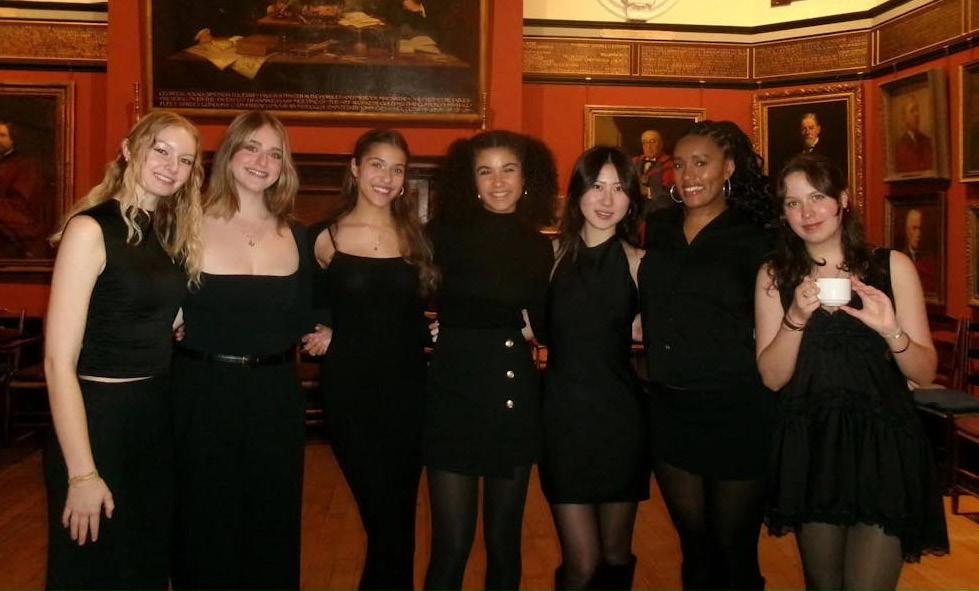
emailing people,” she said, adding that multiple performances came out of an email to the Brown Club of the United Kingdom and the connections the club provided. “We just wanted to have a pretty good plan set in place.”
Throughout their time in London, the Chattertocks performed nearly every day,
‘Skyscraper
Honnold’s athleticism makes up for the documentary’s commentary
BY MILLIE BARTER SENIOR STAFF WRITER
Back in 2018, “Free Solo” documented Honnold’s gearless, 3,000-foot ascent of El Capitan, a rock face in Yosemite National Park. Now, Honnold has made history again. On Sunday, Honnold became the first person in the world to free solo Taipei 101 — one of the world’s tallest buildings — all while his climb streamed live on Netflix.
Taipei 101 — which, in total, reaches
Chon said — including performances at various schools and singing at a local children’s hospital. The Chattertocks were received particularly well by the Sacred Heart Language College — an all-girls school in London.
“They treated us as if we were the Beatles,” Cottom said. “They were cheering.
They were asking us to sign their hands.”
For Anna Samel ’26, who has been part of the group since her freshman fall, the school performances embodied what the Chattertocks hope to represent.
“It means so much to be able to teach younger girls our music and for them to be so interested,” Samel said. “It just felt like
Live’ is a sickening yet thrilling watch
a staggering 1,667 feet — was once the tallest building in the world. On Sunday, Honnold climbed it in a nerve-racking 91 minutes. Due to the extreme level of risk, the livestream included a 10-second delay, giving the broadcasting crew just enough time to cut off the recording should plans go awry.
But the crowds of viewers on the ground would not be given this grace period, and the many phones recording the event would have meant that a recording of Honnold’s death could have been shared to the public instantly. For some, this has brought the ethics of this live and perilous form of entertainment into question.
But much to the relief of those watching, Honnold succeeded. Despite the repetitive nature of this climb, which at times became boring, it’s hard to deny the sheer talent the feat required.
While the climb made for a thrilling watch, not all components of the stream were quite as successful as Honnold.
The panel — hosted by broadcaster Elle Duncan and featuring World Wrestling Entertainment champion Seth Rollins and climber Emily Harrington — boasted little to no rock-climbing knowledge outside Harrington. Instead of commentary on the nuances of the sport, viewers were forced to listen as panelists restated their anxieties, reported
information about the building or spoke over Honnold as he attempted to communicate with the ground.
Aside from the seemingly pointless narration, the livestream also provided entertaining pre-recorded clips showing snapshots of Honnold’s life. Notably, Honnold’s wife Sanni McCandless gave an interview where she spoke on their life at home with their two children — in which she acknowledged concerns but said that she felt "breezy" watching Honnold’s climb.
McCandless saw Honnold on the 60th floor, motioning to him encouragingly through the window. This brief exchange seemed to motivate Honnold
we were doing something with our music.”
For multiple members of the group, the Dec. 13 shooting on campus changed the character of the tour.
“After the shooting happened … tour, to me, became much more about just being with Brown community members, and just having each other and being there for each other,” Samel said. While in London, the Chattertocks performed for the Brown Club of the United Kingdom, an experience that became more emotional for some members of the group in light of the violence on campus.
“I know that I felt choked up a couple times during that concert, so that was a very beautiful memory for me,” Cottom said.
“It was really nice to have alumni support from around the world and just be able to connect in a way that shared our passion and our love for each other with a larger Brown community," Chon said.
“Every single Chattertock impacts the group in a positive way,” Samel said. “That little hole is always left when they graduate, and I think that people don’t always realize that. But I think it’s a really beautiful thing.”
This article originally appeared online at browndailyherald.com on Jan. 28, 2026.
as he continued up the skyscraper, passing more fans whose regular offices had become viewing stations.
When Honnold finally made it to the top, the world took a breath. The climber had once again proven his skill and astounding self-confidence. Although this may not have been the most well-executed attempt at turning the possibility of death into entertainment, the climb itself — and the suspense brought on by witnessing it live — was nothing short of gripping.
This article originally appeared online at browndailyherald.com on Jan. 27, 2026.

COURTESY OF THE CHATTERTOCKS
The Chattertocks in January. The trip, which brought the Chattertocks to Europe, marked a stark departure from the group’s usual Northeast regional trips.
COURTESY OF NETFLIX Alex Honnold ascending Taipei
ARTS & CULTURE
Grammys 2026: The Herald’s picks for four top prizes
Bad Bunny, Billie Eilish, Olivia Dean and Huntr/x deserve recognition
BY TALIA LEVINE, MANAV MUSUNURU AND ANN GRAY GOLPIRA ARTS & CULTURE EDITORS
The 68th Annual Grammy Awards are set to air live from Los Angeles this Sunday, bringing together some of the most talented singers and songwriters in the industry — including three Brown alums nominated for best arrangement, instruments and vocals.
The Herald determined which artists truly deserve the biggest awards of the night, otherwise known as the “Big Four”: album of the year, record of the year, best new artist and song of the year. These selections are based on performance quality and do not aim to predict the results of Sunday’s awards ceremony.
Album of the year
“DeBÍ TiRAR MáS FOToS,” Bad Bunny
"SWAG,” Justin Bieber
“Man’s Best Friend,” Sabrina Carpenter
“Let God Sort Em Out,” Clipse, Pusha T and Malice
“MAYHEM,” Lady Gaga
“GNX,” Kendrick Lamar
“MUTT,” Leon Thomas
“CHROMAKOPIA,” Tyler, The Creator
While some of this year’s nominees for album of the year left much to be desired — notably Justin Bieber’s “SWAG” — a few artists produced music truly deserving of the accolade. Not only is Bad Bunny’s album “DeBÍ TiRAR MáS FOToS” a musical masterpiece, it also offers sharp commentary on the colonization of Puerto Rico. It is the second-ever Spanish-language album to be nominated for album of the year, and if it wins, would be the first Spanish-language album to hold the esteemed title.
Even for listeners who don’t understand Spanish, the artist’s emotion and

love for Puerto Rico resonate throughout each track. Although the album deserves to win based on its artistry alone, its themes also struck a global chord that warrants recognition.
Record of the Year
“DtMF,” Bad Bunny
“Manchild,” Sabrina Carpenter “Anxiety,” Doechii “WILDFLOWER,” Billie Eilish “Abracadabra,” Lady Gaga “luther,” Kendrick Lamar with SZA “The Subway,” Chappell Roan “APT.,” ROSÉ and Bruno Mars
Both Billie Eilish and her older brother and collaborator Finneas O'Connell, who uses the stage name FINNEAS, were snubbed at last year’s Grammys when their album
“HIT ME HARD AND SOFT” and its songs received six nominations but won zero awards. FINNEAS’s immaculate production in “WILDFLOWER” gives the Recording
Academy a perfect opportunity to redeem themselves and give the album the recognition it deserves. By blending haunting acoustic guitars with Eilish’s intimate vocals, “WILDFLOWER” takes listeners on an emotional sonic journey truly worthy to win record of the year. While the track is a stark departure from the dark, electropop style that won Eilish five Grammys in 2020, the songwriting pair has proven their continued genius with the more acoustic “WILDFLOWER.”
“HIT ME HARD AND SOFT” is the perfect culmination of Eilish’s honest lyricism and FINNEAS’s unique production techniques — and finally celebrating the album with a win for one of its many hits would give the project the credit it deserves.
Best New Artist
Olivia Dean KATSEYE
The Marías Addison Rae
In 2025, Olivia Dean saw success rivaling that of Chappell Roan, Olivia Rodrigo and Dua Lipa — all of whom previously won the category of best new artist at the Grammys. Dean’s second studio album, “The Art of Loving,” spawned numerous hits that are almost inescapable for those scrolling through TikTok or Instagram Reels.
After its release in August, her single, “Man I Need,” quickly rose to the top of several charts worldwide, reaching number one in Dean’s native United Kingdom and peaking at number two on the Billboard Hot 100.
But this hasn’t been her only hit from the album, as “Nice to Each Other” and “So Easy (To Fall in Love)” have also charted well, garnering millions of weekly streams. With this amount of success, Dean is the
‘Marty Supreme’ tracks ambition to its breaking point
capturing the destructive power of unfettered ambition.
BY EVE MCLAURY CONTRIBUTING WRITER
In the film “Marty Supreme,” the sport of table tennis — a game of quiet, calculated moves — is transformed into a loud and unsettling study of ego, obsession and human failure.
Set in 1950s New York City, the film stars Timothée Chalamet as Marty Mauser — a hustler and professional table tennis player driven by his desire for greatness, rather than a love of the game. While Chalamet has already won Best Performance by a Male Actor in a Motion Picture in the musical or comedy category at the 2026 Golden Globes for his performance as Mauser, the film is continuing its streak with a whopping nine Oscar nominations.
“Marty Supreme” seems designed to stress its audience with erratic filming and illogical decisions that traps Mauser into his demise. The film is less of a sports drama and more of a psychological spiral,
Chalamet portrays Mauser as insecure and increasingly unbearable — a man who is willing to compromise anything in exchange for an ego boost. His cockiness is almost comical — when asked what he would do if his dream of winning the world championship didn’t come true, he responds, “That doesn’t even enter my consciousness.” The role is one of Chalamet’s most unsettling performances yet.
Josh Safdie, the film’s director, has a talent for making the mundane feel catastrophic. His reputation for refusing to reassure viewers and forcing them to sit with discomfort is apparent in “Marty Supreme.”
Throughout the movie, the camera remains uncomfortably close to Mauser’s face. This visual technique forces audience members into close proximity with Mauser, requiring them to acknowledge his most unbearable traits — arrogance, jealousy, desperation and delusion. Mauser is deeply flawed, and the film’s intentional videography refuses to let viewers ignore it.
The videography also mirrors Mauser’s own internal conflict. The film’s frantic ed-

standout nominee for best new artist this year. Her only real competition is Leon Thomas, whose album, “MUTT,” was nominated for best album — a category for which “The Art of Loving” is ineligible this year.
Song of the Year
“Abracadabra,” Lady Gaga
“Anxiety,” Doechii “APT.,” ROSÉ and Bruno Mars
“DtMF,” Bad Bunny
“Golden” (from “KPop Demon Hunters”), HUNTR/X (EJAE, Audrey Nuna, REI AMI)
“luther,” Kendrick Lamar with SZA
“Manchild,” Sabrina Carpenter
“WILDFLOWER,” Billie Eilish
Despite the chart-topping success of and worldwide love for nearly every song on this list — perhaps excluding “Anxiety” by Doechii — “Golden” (from “KPop Demon Hunters”) goes far beyond a series of impressive vocal runs and pop synths. Western media has, at times, disregarded the South Korean musical genre K-pop. Even the powerhouse K-pop group BTS, who average over 27 million monthly listeners on Spotify, have yet to receive the Recording Academy’s tiny golden gramophone. But since the release and worldwide recognition of “KPop Demon Hunters,” K-pop has finally gotten the celebration it has long deserved.
The unforgettable melody, inspiring lyrics and powerhouse vocals behind “Golden” epitomize exactly what the K-pop industry has been pumping out for years: flawless, radio-ready pop music. Even in live showings like a performance at Macy’s Thanksgiving Day Parade and an appearance on “The Tonight Show Starring Jimmy Fallon,” the three singers behind the film's protagonists — EJAE, Audrey Nuna and REI AMI — never miss a note. Although some critics have questioned the song’s nomination, “Golden” is certainly worthy to win the category of song of the year title due to its global celebration of the K-pop industry and iconic pop score.
iting, overlapping dialogue and oppressive sound design creates a sensory overload that mimics the stressful environment felt by Mauser at his tournaments. Even his training scenes seem like a form of
self-harm — offering elevated pressure, isolation and noise rather than genuine fulfillment of the sport.
The film’s realism creates discomfort, yet viewers remain hooked as they wonder
whether Mauser’s ambition can finally lead to his character development.
By the time Mauser reaches the international stage, he is forced to confront his own weaknesses of cockiness and delusion. His overconfidence is tested during a match with Koto Endo (Koto Kawaguchi), Mauser’s greatest opponent of the film. Mauser is forced to confront the truth he has spent the entire film outrunning — that wanting greatness does not make one great.
Yet Safdie refuses to give this realization any redemption. The film ends where it began, with Mauser still chasing his ambition and neglecting his personal life.
This bleakness is not accidental. “Marty Supreme” is a film about the downfalls of human nature and how the desire to be exceptional can destroy what makes life worth living. Lacking a true resolution, the film rejects comfort and instead provokes deeply uncomfortable personal reflection: If ambition costs us everything else, what is it ever worth? This article originally appeared online
sombr Leon Thomas Alex Warren Lola Young
ANDREA SUN / HERALD
Josh Safdie transforms table tennis into a bleak reflection on arrogance
COURTESY OF A24
“Marty Supreme” transforms the seemingly straightforward sport of table tennis into an exploration of how ego and obsession can destroy what makes life worth living.
SCIENCE & RESEARCH
FUNDING
Annenberg Institute, R.I. Foundation recommend public school funding be more comprehensive
The current formula does not cover all necessary costs to attend school
BY ELIZABETH ROSENBAUM SENIOR STAFF WRITER
The Annenberg Institute, an education research organization at Brown, contributed to a Rhode Island Foundation report on establishing more equitable funding in R.I. public schools. The report, which recommended changes to improve the state’s education funding system, was presented at a Boston Globe panel last week in Providence.
The partnership between the Annenberg Institute and the R.I. Foundation was initiated by the foundation, and sought to bring together a diverse group of stakeholders and leaders in R.I. education systems. The role of the institute was to “facilitate the process” of research and conversations with teacher unions, early childhood organizations and more, according to Brenda Santos, the director of R.I. research partnerships and networks at the Annenberg Institute.
Currently, Rhode Island’s funding formula for public schools relies on “determining what it costs to educate a child in the state of Rhode Island,” Santos told The Herald. The formula must also “determine how much of that is paid by the state and how much of it is paid by the local municipality,” she said.
After hosting conversations with students about their needs, the commission’s report came to the conclusion that current funding did not cover all of the costs necessary to attend school.
The researchers found that it was unreasonable for the “core instructional amount,” which includes teachers and teaching materials, to be the basis of the funding formula, Santos explained.
ARCHAEOLOGY

The report found that the current funding system does not adequately account for students who may have different instructional needs.
Multiple factors that are “critical for educating students,” such as transportation and healthcare costs, were found to be missing from the equation, according to the report.
The report also found that the current funding system does not adequately account for students who may have different instructional needs. For example, the formula does not “acknowledge the fact that it might cost more to educate a student that has recently arrived in the United States,”
Bila Djamaoeddin ’22, a research project
manager at the Annenberg Institute, told the Herald.
“We had a lot of students … who were themselves multilingual learners,” Djamaoeddin added. These students had experiences receiving “really inadequate services for their language needs.”
The researchers developed four recommendations to amend public school funding: alter the formula to fulfill all educational costs, personalize costs to fit students needs, require local municipalities to contribute as much as they can
and increase accountability on spending and outcomes.
When it comes to accounting for the full cost of education, the commission recommends shifts in “the financial balance of how legacy teacher pension costs are paid,” Kirk Murrell, project director with the R.I. Education Research Initiatives team at the Annenberg Institute, told The Herald.
These recommendations were inspired by previous R.I. policy and other states’ education budget policies, including from
California and Massachusetts, according to Murrell.
As uncertainties around federal funding mount and nationwide conversations about a decrease in student enrollment, this report covers “a very timely topic,” Djamaoeddin said.
“I hope the general public has a real conversation about why the current funding system isn’t working,” Djamaoeddin said. “I hope that Rhode Island can adopt a system that ensures more equity or fairness in how students are funded.”
Brown professor rethinks violence in precolonial Mayan civilization in new book
Andrew Scherer examines the moral frameworks of violence
BY ATREYA MALLANNA CONTRIBUTING WRITER
Drawing upon 25 years of research, Andrew Scherer, professor of anthropology and archaeology and the ancient world and director of the Joukowsky Institute for Archaeology and the Ancient World, explores how violence in pre-colonial Mayan civilization was morally understood and enacted in social and ritual contexts in his new book “As the Gods Kill: Morality and Social Violence among the Precolonial Maya.”
“Whether we’re talking about the ritual violence that was done to uphold their relationships to their gods and to their ancestors, or whether we’re talking about warfare,” violence was a “really important part of (Mayan) society,” Scherer said in an interview with The Herald.
By analyzing the written record of the Maya, Scherer found evidence of ritual violence, which is “oftentimes glossed as sacrifice” in popular perceptions.
But people should not think of the Maya as “prone to violence or bloodthirsty,” Scherer noted. In his book, he said, one goal was to “take a different sort
of approach to how we think about the violence as the Maya themselves would have understood it.”
“Violence was necessary, but it wasn’t necessarily something that was good,” Scherer added.
Scherer said that the Maya seemed to “compartmentalize” the violence as separate from everyday life by portraying themselves as animals or supernatural beings, rather than humans, in their depictions of the acts of violence.
The book draws upon written records, art and architecture of the Maya, Scherer said. His work also involved “diving into research across the social sciences,” especially into the fields of psychology and sociology, “to look at contemporary experiences of violence across human society,” he added.
Another assumption that Scherer’s research pokes holes in is that the Maya’s collapse “was because of warfare getting sort of out of scale,” he said. Looking at the placement of fortifications provides “really good evidence” that intensive warfare was prevalent centuries before the civilization’s collapse around A.D. 750 to A.D. 900, he explained.
Takeshi Inomata, a professor of anthropology at the University of Arizona, described Scherer’s book as “remarkable” for how it “provides new insights into Maya practices of war, sacrifice and vio-
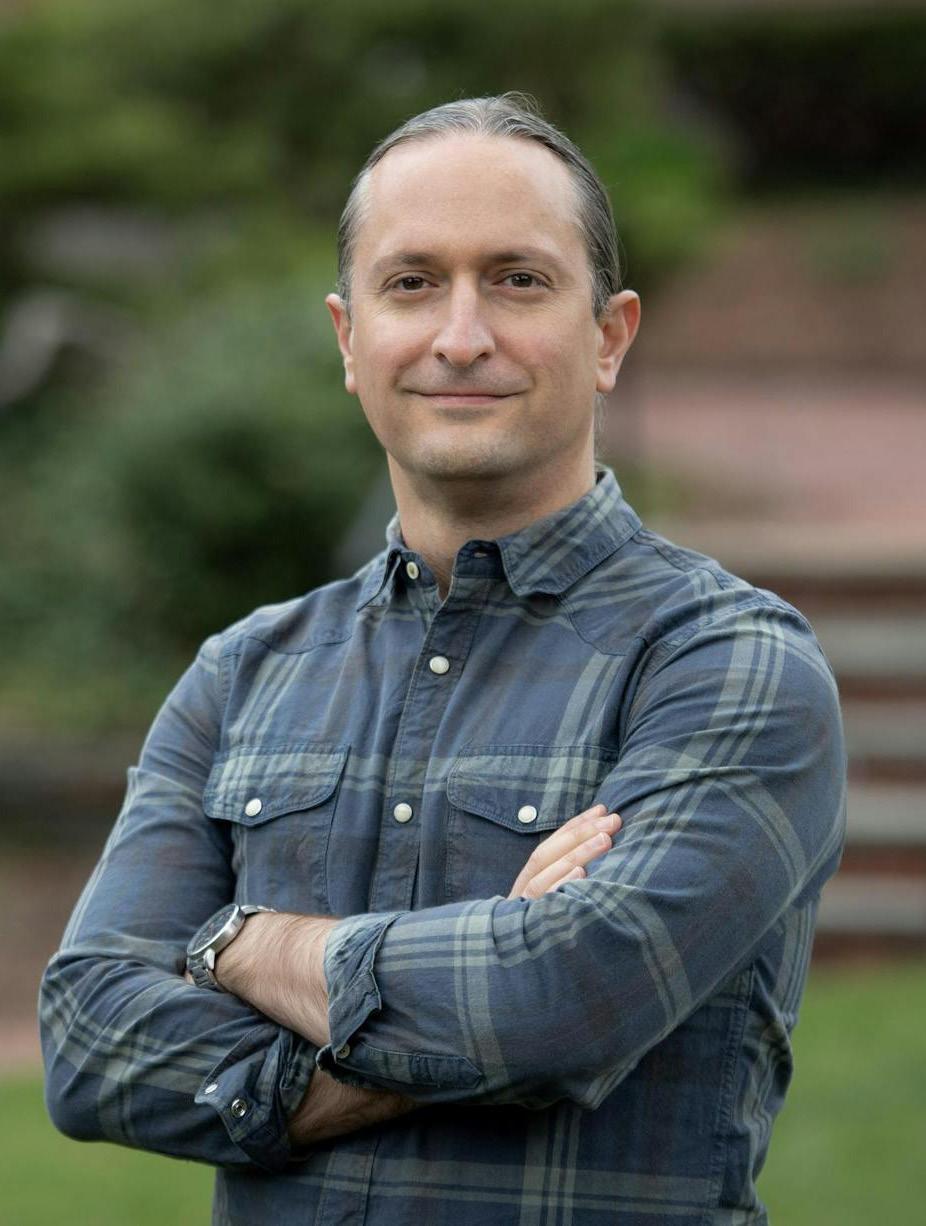
lence,” he wrote in an email to The Herald.
“Through his long-term fieldwork in the Usumacinta region along the border between Mexico and Guatemala, Professor Scherer has made profound contributions to the study of Maya culture and society,” Inomata added.
Brown students also helped shape the book, which was supported by a fellowship from the Cogut Institute of the Humanities, according to Scherer. In Spring 2023, Scherer taught a class on reconstructing violence in history, during which students read drafts of chapters in the book and offered feedback.
David Freidel, professor emeritus of archaeology at Washington University in St. Louis, told The Herald that he has “followed Andrew Scherer’s research now for many decades” and served on committees evaluating Scherer for tenure. He added that Scherer’s book will prove to be a “deeply referenced and enduring contribution and advance in our field.”
“This is an exceptional and brilliant benchmark monograph,” Freidel said. “It’s been important in the last generation of scholars, led by people like Andrew Scherer, to show us that the Maya are no more or less brutish than the rest of us.”
Jan. 28, 2026.
COURTESY OF ANDREW SCHERER
The new book challenges stereotypical notions of precolonial Mayan civilization as bloodthirsty.
CUNYAN MA / HERALD
Black representation in Congress crucial for advancing equality, Brown professor says
Professor of Political Science Katherine Tate published a new book
BY ADDISON WHITESIDE CONTRIBUTING WRITER
Professor of Political Science Katherine Tate was not surprised by the findings of her most recent research project: In Congress, “representation of minorities does matter substantively,” she said in an interview with The Herald.
In her new book, “Black Voices in the Halls of Power: Race and Rhetorical Representation in Congress,” Tate, along with two co-authors, investigate how Black representatives in Congress address issues of race differently from their white colleagues.
Black members of Congress are significantly more likely to speak about race and advocate for the concerns of Black constituents than Democrat or Republican non-Black legislators, Tate said.
The book was based on previously established research that “descriptive representation” — when elected officials reflect the demographics of their constituents — is essential for having Congress members that “introduce bills that champion what their group cares most about,” according to Christopher Stout, a co-author and a professor of political science at the University of California, San Diego.
“We as political scientists know that seeing someone like you in office matters a great deal about how you perceive the legitimacy of democracy or of the government,” said Jennifer Garcia, the book’s other co-author and an associate professor of politics and comparative American studies at Oberlin College.
While most politicians are “somewhat
FORBES

risk averse” when it comes to raising new topics, descriptive representatives are more likely to “stick their neck out” and speak on controversial issues, Stout said.
Stout pointed to how Black legislators brought discussions of the Black Lives Matter movement to Congress.
For a long time, “people weren’t talking about race and policing, but Black elected officials were,” Stout said. He added that these officials often play a crucial role in developing a “playbook” to address these issues.
Another example Stout pointed to involved former U.S. Rep. Cori Bush, a Black Democrat from Missouri who staged protests outside of the U.S. Capitol in 2021
when a federal moratorium that protected people from eviction during the COVID-19 pandemic was about to expire. Stout said that because Bush drew media attention to the issue, her efforts ultimately led to the passage of a bill that provided support to people facing evictions.
This was “an issue that people weren’t paying attention to,” Stout said, adding that because people in danger of eviction are part of a marginalized group, “there might not be a political benefit” to advocate for them.
“But Cori Bush did,” he said.
During the research process for the book, the scholars examined over 600,000 social media posts and over
1,200 press releases from 2019 to 2021 to better understand how Black representatives communicate with their constituents, according to Tate. The scholars also conducted on-the-ground interviews with communication directors of Congress members.
To Tate, the book’s findings are especially relevant in a political environment that she said is increasingly constraining “activists who want to talk about race.”
“We’re in a very troubling era,” she added.
Tate told The Herald that she has now started research for her next book, which will examine the “manosphere” and its influence on how young Black men voted
in the 2024 election. She plans to continue analyzing social media content to assess the role of the internet in electoral processes and outcomes.
Garcia and Stout were both Tate’s students when they were completing their doctoral degrees at the University of California, Irvine — a dynamic that Garcia said made the project “pretty cool” to work on. In fact, Stout said that he chose to attend UCI because he wanted to work with Tate after he read her book “Black Faces in the Mirror” when he was an undergraduate student.
“I don’t know that I would have been the scholar that I am without the chance to do work with Katherine,” he said.
Nine Brown alums named to 2026 Forbes 30 Under 30 list
Brown alums were featured across eight categories
BY ALICE XIE SCIENCE & RESEARCH EDITOR
In each of the past five years, at least one Brown alum has been named to the Forbes 30 Under 30 list. In December 2025, nine Brown alums featured on the 2026 list joined those ranks.
This year, the list featured 600 young professionals who were honored for their accomplishments and potential in 20 categories. Brown alums were featured across eight of those categories.
The Herald spoke to Mengzhou (Clara) Hu MS’21, John Huddleston ’21 and Jonathan Huang ’20 about the accomplishments that brought them their Forbes recognition.
Huddleston, who was recognized under Transportation & Aerospace, is a co-founder of Albacore Inc., a defense and space manufacturing company. The company develops “long-range, autonomous underwater vehicles to deter maritime invasions," according to his Forbes profile.
The idea that brought Huddleston recognition from Forbes didn’t even exist a year ago. “Ten months ago, Albacore was an idea scribbled on the back of a napkin at a dinner party,” Huddleston wrote in an email to The Herald. “Since then, we have
built a world-leading team and have moved at a breakneck pace through prototyping.”
Huddleston wrote that the company has “launched (their) first production unmanned underwater vehicle.” The team’s work is “just getting started, and I cannot wait for what is ahead,” he added.
Huang, currently a student under the Medical Scientist Training Program at Northwestern, explained that he was “genuinely shocked” when he first found out about Forbes’ recognition of his work in the healthcare field.
“I re-read the email four or five times before it sank in,” he wrote in an email to The Herald. “I’m still a student and still figuring out the professional path ahead, so it felt surreal to pause and reflect on how far the work has come. It was an unexpected but meaningful moment of validation.”
Huang has worked on developing a tool that helps radiologists “interpret X-rays and CT scans,” which are the “most common forms of medical imaging,” he wrote. The research “is the first to study generative AI in real radiology practice,” Huang added, noting that the technology has “shown concrete benefits for clinicians and patients without compromising quality of care.”
The “real clinical benefit” and recognition of his work “means a great deal” to Huang. “It reinforces my belief that AI can support physicians in ways that are safe, responsible and genuinely useful,” he wrote.

Huang and his team are working to commercialize this technology and “bring it to more radiologists and ultimately to the patients who stand to benefit,” he wrote.
Hu, a postdoctoral scientist at Johnson & Johnson Innovation, was recognized in the science category. Her work uses AI to develop the “largest and most comprehensive” map of cancer cells to date, according to her Forbes profile.
“I hope this recognition helps generate more interest and support for developing
AI tools to better understand biology, especially how the machinery inside cells works,” Hu wrote.
Hu aims to bridge the fields of machine learning and biology in ways that “lead to deeper, more interpretable insights and ultimately help facilitate drug discovery and development,” she added.
For Hu, being named under Forbes 30 Under 30 is an avenue for her work to be viewed by a “broader audience.” She also noted that the recognition gave her “a lot
of motivation to keep going.”
The six other alums who were named to the list include Paul Lee ’18, Clementine Quittner ’19, Anand Lalwani ’18, Xander Carlson ’20, Dana Biechele-Speziale PhD’24 and Katie Vasquez ’20. They did not reply to The Herald's requests for comment.
COURTESY OF JONATHAN HUANG, MENGZHOU (CLARA) HU AND JOHN HUDDLESTON
The Herald spoke to Jonathan Huang ’20, Mengzhou (Clara) Hu MS’21 and John Huddleston ’21 about the accomplishments that brought them their Forbes recognition.
JAKE PARKER / HERALD
Professor of Political Science Katherine Tate co-authored the project with Christopher Stout, a political science professor at University of California, San Diego, and Jennifer Garcia, an associate professor of politics and comparative American studies at Oberlin College.











Snow day at Brown









KAI LA FORTE
KAIA YALAMANCHILI
ALAYNA CHEN
ANNAMARIA LUECHT
KAIA YALAMANCHILI
INA MA
JAKE PARKER
BOMI OKIMOTO JAKE PARKER
BOMI OKIMOTO
INA MA
HORATIO HAMILTON
HENRY WANG
KAIA YALAMANCHILI
HORATIO HAMILTON INA MA
KAIA YALAMANCHILI
KAIA YALAMANCHILI
ANNAMARIA LUECHT
SELINA KAO
HENRY WANG