
THE BROWN DAILY
CAMPUS MOURNS LOSS
OF TWO STUDENTS
‘It was so easy to be his friend’: Remembering Mukhammad Aziz Umurzokov
Umurzokov’s many friends attested to his curiosity and kindness
BY MAYA NELSON UNIVERSITY NEWS & METRO EDITOR
Mukhammad Aziz Umurzokov ’29 was a rare gem of a person. He was incredibly smart, yet he never bragged about his achievements. He would strike up a conversation with anyone, even if he had never met them before. He was constantly seeking out new experiences, books and friends.
On Dec. 13, Umurzokov was one of the two students killed in a mass shooting that occurred in Barus and Holley Room 166 during a review session for ECON 0110: “Principles of Economics.” Umurzokov, who was not enrolled in the course, had only attended the review session to join a few friends in the class, according to Joseph McGonagle ’29.
“He just tagged along to be nice,” said McGonagle, who had brunch with Umurzokov right before
Residents express discontent with alert systems after shooting
PAGE 5
he left for the review session.
During that brunch, Umurzokov told McGonagle how excited he was to go home for break and see his sisters. “His parents were going to Mecca, so he would have had the house to himself,” McGonagle explained.
McGonagle described how deeply Umurzokov cared about his family. “In particular, he had a niece, and he would always show me photos,” McGonagle said. “He’d be like, ‘Isn’t she so cute?’”
Umurzokov is remembered by many of his friends for his sense of humor. “In any kind of situation, he would be able to make you laugh,” said Miriam Davison ’29, a senior staff writer at The Herald and friend of Mukhammad’s. “It was probably one of the most distinct parts about him.”
But most of all, he was “super caring,” McGonagle said. He treated every aspect of his life with care — his schoolwork, hobbies and friendships. Umurzokov was studying biochemistry and molecular biology with the aspiration to become a neurosurgeon. But his intellectual interests were diverse,
Women’s ice hockey suffers loss to Cornell, trounces Colgate SEE ICE HOCKEY PAGE 6 SPORTS
‘Everyone valued what she said’: In memory of Ella Cook
Cook cared deeply about meaningful conversation and her Christian faith
BY ANNIKA SINGH CONTRIBUTING METRO EDITOR
Ella Cook ’28 was joyful and warm, uplifting the spirits of those around her. Friends say she possessed a strength and wisdom beyond her age, rooted in her deeply-held Christian faith. She was a hardworking student, a friend to all and an insightful conversationalist.
On Dec. 13, Cook was one of two students killed in a mass shooting on campus during a review session for ECON0110: “Principles of Economics.”
An obituary organized by Cook’s family recounts how she was “intentionally concerned for the best interests of others.” Cook’s younger sister, Mary Hamner Cook, quoted in the obituary, said that Cook was “the best big sister ever,” describing her older sister as “protective, responsible and selfless.”
A Dec. 16 email to the community from President
ARTS & CUTURE
Brown alums nominated for 2026 Grammy awards
SEE FEATURE PAGE 13
Christina Paxson P’19 P’MD’20 described Cook, who was raised in Alabama, as “passionate and intellectually curious,” noting that she was an accomplished pianist who was interested in pursuing French and Francophone studies at Brown.
“When I met Ella on our first day of orientation,” Elina Coutlakis-Hixson ’28 wrote in an email to The Herald, “I realized I had never met anyone like her.” The pair grew very close during their time at Brown, she wrote. “She came with me to my church, I followed her into her classes and we were essentially inseparable.” Cook was always nonjudgmental and happy to help those around her learn. “When she took me to a Brown football game, I had to admit that I knew nothing about the sport,” Coutlakis-Hixson recalled. To rectify this, Cook spent the whole game “teaching me about touchdowns and turnovers,” she wrote.
She went out of her way to care for her friends, Coutlakis-Hixson wrote. “When Ella loved you, you could feel it down to your bones.”
Over the summer, Cook had planned to visit
SEE ELLA COOK PAGE 2
LLM reasoning has striking similarities with human cognition
SCIENCE & RESEARCH SEE LLM PAGE 15
Students reflect on returning to campus following mass shooting UNIVERSITY NEWS
RETURN PAGE 16

ANNAMARIA LUECHT / HERALD
UNIVERSITY NEWS
MUKHAMMAD AZIZ UMURZOKOV FROM PAGE 1
and several friends mentioned his passion for philosophy.
Jack DiPrimio GS, a post- Magazine contributor, met Umurzokov at a legal philosophy lecture, during which both DiPrimio and Umurzokov had asked the professor a question.
“He really liked Mukhammad’s question,” DiPrimio said. “(The professor) did not like my question, and so in the reception after, Mukhammad came up to me and introduced himself. (Mukhammad) was like, ‘Hey, man, he really put you through the ringer.’”
The two exchanged Instagram profiles, and a friendship blossomed from there.
With his broad yet deep curiosity, Umurzokov was a “quintessential Brown University student,” DiPrimio said. Since Umurzokov was “very humble” and “never bragged,” DiPrimio only found out about many of Umurzokov’s accomplishments while reading the news after Dec. 13, he said.
Umurzokov’s intellectualism was a core part of many of his friendships. Davison recalled one chilly night on Wriston Quadrangle when she, Umurzokov and a few of their friends stayed up chatting about “big things and small things,” from trips to India Point Park to George Orwell’s “Animal Farm.”
Davison also described how Umurzokov “was always eager to try out new things, to talk to people, to call random numbers, to learn in classes that he wasn’t a part of.”
From the beginning of his time on College Hill, Umurzokov was committed to fully appreciating the college experience. Percy Unger ’26, his Bruno Leader, wrote in a message to The Herald that Umurzokov participated “wholeheartedly” in group
COOK FROM PAGE 1
Coutlakis-Hixson in Washington D.C., but Cook’s flight was grounded in another city. Cook “found an old friend at the airport and hitched a ride in a thunderstorm to see me,” Coutlakis-Hixson added.
Theo Coben ’28 recalled how during their first year, Cook “picked up that (he) really liked oranges,” and often brought one from the dining hall when she’d visit his dorm.
“It took me 18 years to meet a true friend like Ella,” Coutlakis-Hixson wrote.
“We would stay up until one in the morning debating our philosophies,” she wrote, recalling her friend’s “stamina for these endless conversations.” Still, she added, “every debate we ever had ended in a similar way — ‘so I’ll see you for lunch tomorrow?’”
Tommy Leggat-Barr ’28, an opinions columnist for The Herald, met Cook in a first-year seminar during the spring 2025 semester and lived on the same dorm floor as her during their sophomore year. In a course they took together, POLS 0821D: “How to Think in an Age of Polarized Politics,” Cook was a “refreshing voice,” Leggat-Barr said.
Though Leggat-Barr held different opinions than Cook, he said, “our friendship was formed not in spite of our differences but really because of them.”
“I think that kind of the mutual respect that we both had was so meaningful,” Leggat-Barr said, adding that their friendship “was really unlike almost any that I had had in my entire life.” When Cook was involved, conversations would always become “deeper and more meaningful,” he said. “Everyone valued what she said.”
During one of the seminars, Cook re-
activities while also “not taking himself too seriously.” Umurzokov’s welcoming nature “allowed everyone to open up.”
From then on, Unger would stop to chat with Umurzokov when the two ran into each other, and those conversations often ended up lasting “for the better part of an hour.” Umurzokov was “endlessly delighted to be (at Brown) and to be learning and forging friendships,” Unger added.
“He reminded me to be grateful for every moment of these four years,” Unger wrote. “I am heartbroken that he will not get to cherish every moment of his own experience.”
According to McGonagle, there was nothing Umurzokov loved more than spending time with his friends — hanging out with people was “his number one hobby.” Friends described late night chats in Keeney Quadrangle’s Arnold Lounge and brief dining hall encounters that turned into much longer conversations as some of their most meaningful memories with him.
Davison first met Umurzokov at the Sharpe Refectory early in the semester, and their conversation “immediately” went beyond surface-level introductions.
“You know, you don’t especially intend to spend that much time in the Ratty with a stranger,” she said. “But he was very easy to talk to.”
Umurzokov was “very extroverted,” McGonagle said, in addition to being “really funny” and “very clever.”
“He had so many friends on campus,” McGonagle said, “it was unreal.” Even if Umurzokov did not know someone, McGonagle recalled, he would go up and talk to them anyway. When he wasn’t studying, he was messaging people to see if they wanted to grab a meal or just hang out.
Talia Sherman ’26 first met Umurzokov
after he walked up to her and a group of friends on the main green and started talking. Afterwards, Umurzokov referred to Sherman’s group as his “senior friends,” she wrote.
“I’ve never met someone so fearless and driven in their confidence,” Sherman told The Herald. “I wouldn’t have known him if it weren’t for how much he was willing to put himself out there and meet everyone.”
Astrid Albujar Hervias ’29, who met Umurzokov through a mutual friend and lived on his floor in the Archibald-Bronson dorm, told The Herald that “you did not need to have known (him) for years” for Umurzokov “to trust you with his life stories, his feelings, his dreams.”
“It was so easy to be his friend,” she added.
Another friend, Conor Sims ’29 recounted his “late-night chats” with Umurzokov, “talking and laughing until 3 a.m.”
Umurzokov once accidentally interrupted a date Sims was on, but he left tactfully as soon as Sims covertly showed him

sponded to other students making disparaging comments about the American South, and about Alabama in particular, Leggat-Barr said. She “really tried to explain the beauty that existed in her hometown, in her home state, in the region more broadly,” he remembered. “She cared a lot about opening up people’s perspectives.”
“There is no better way to describe Ella than peaceful,” Ben Marcus ’26 wrote in a message to The Herald. He added that she was “quiet but extremely observant” and brought “brilliant and insightful comments to conversations.”
As a member of Brown Political Union, Cook brought a “quiet yet powerful gravity” to interactions, BPU leadership said in a statement to members of the organization.
“Ella reminds us that engaging with others’ perspectives is best done with respect and humility — something our world can use a lot more of,” the email read.
Leggat-Barr first learned that Cook was one of the victims of the shooting while sheltering in place at the Olney-Margo-
lies Athletic Center the night of Dec. 13. The news had spread via word of mouth throughout the sophomore class, he said.
Seeing Cook’s room across the hall after being evacuated from the OMAC “didn’t feel real,” Leggat-Barr said. He added that he will continue to feel Cook’s impact “for the rest of (his) life.”
Minutes before the Dec. 13 shooting, Cook had texted Coutlakis-Hixson, asking to meet at a dining hall after the review session ended. “The heartbreak of losing her so soon, in such a devastating way, has created a deep hole in my life,” she wrote.
“It’s difficult to put into words how much Ella affected me, how much she touched my life in a very real and long-lasting way,” Coutlakis-Hixson added.
Father Justin Bolger, associate chaplain of the University for the Catholic Community and chaplain of the Brown-RISD Catholic Community, wrote in an email to The Herald that Cook was “sweet in her loving countenance and joyful spirit and strong in her belief in Jesus Christ.”
a message that just said “I’m on a date.”
“If I knew this would happen I would’ve blown off my date and hung with him,” Sims wrote in a message to The Herald.
The memory of the last time Albujar Hervias saw Umurzokov is “vivid.” While walking back to her dorm, she saw Umurzokov standing outside of the Stephen Robert ’62 Campus Center in the cold, waiting for a friend. She wrote that this memory encapsulates him as a person: “always there for a friend, even in the cold, even late at night.”
McGonagle remembered sitting in his New Pembroke dorm, being upset about a grade, when Umurzokov walked from his south campus dorm in Keeney Quad up to McGonagle’s north campus dorm.
“He knocked on my door, and was like, ‘Let’s go to Jo’s,’” McGonagle said. So, the two walked all the way back down to south campus, picked up food from Josiah's and ate together in the Arnold Lounge, talking until around 3 a.m. when McGonagle decided to go back to his dorm.
He wrote that she regularly attended BRCC Catholic Mass on Sundays and participated in their annual fall retreat. Cook was also a member of the Alpha Chi Omega sorority and Brown Political Union. In addition, she served as vice president of the Brown College Republicans.
At her Dec. 22 funeral service, held at the Cathedral Church of the Advent in Birmingham, Alabama, the Rev. Paul Zahl said that “Ella herself would say that the most important thing about her was her love for God.”
“I don’t think I’ll ever forget the sound wave that the organ made (at her funeral), and it pulsed through my entire body,” Coben said of attending Cook’s funeral service. “That’s probably the most spiritual experience I’ve ever had.” Being in that church and spending time in her hometown with her childhood friends made Coben feel closer to Cook, he said. “She has taught me a lot in the last month, just like she did in the previous 16 months that I knew her.”
Sarah Frank ’25 remembered Cook’s deep commitment to her religious community on campus in an email to The Herald, adding that she was “incredibly supportive of other religious groups on campus — indicative of the open mind she always carried with her.”
When Cook visited campus for “A Day on College Hill,” an event during which admitted students can visit Brown before committing to attend, Frank advised her on adjusting to Rhode Island after having grown up in a southern state.
On the day that Cook had decided to attend Brown, she messaged Frank, and the two celebrated together. After learning that Cook had been shot, Frank re-read those messages. It “broke my heart,” she wrote.
An email sent by the French and Fran-
The day before Umurzokov’s death, DiPrimio said he received a text from Umurzokov about his weekend plans. “He was really excited to see his friends,” Diprimio said. “He loved people.”
DiPrimio regrets not having responded to that text. “The last text I sent him was ‘Where are you?’ and he was already dead,” he said. DiPrimio is “still in shock.”
Many of Umurzokov’s friends said they wish they had spent more time with him.
“The entire world needs to know that he impacted so many people in our community in a positive way,” Albujar Hervias wrote. “He deserved to walk through the Van Wickle gates twice. He deserved to see the first snowfall” of his time at Brown.
“I have been moved by his current and former classmates’ descriptions of him as someone who generously shared his intelligence, humor and kindness with all those who knew him,” President Christina Paxson P’19 P’MD’20 wrote in an email to the Brown community.
“He was a big dreamer,” Davison said. “He was a big doer.”
In a text message from Umurzokov that McGonagle shared with The Herald, Umurzokov wrote: “I’d like to think I’m a net positive on the world, but yeah.”
McGonagle replied: “You definitely are.”
“He was like, ‘Oh, I’ll walk you,’ and so we started walking,” McGonagle said. About halfway to New Pembroke, Umurzokov “was like, ‘Yeah, it’s really cold, I think I’m gonna turn around’” to go back to Keeney Quad. But then, “less than a minute later, he goes, ‘Wait ... I’m just gonna walk with you instead,’” McGonagle recalled. Umurzokov ended up walking McGonagle all the way to his New Pembroke dorm before walking back to Keeney Quad himself, despite the freezing temperatures.
cophone Studies Departmental Undergraduate Group said Cook was a prospective French and francophone studies concentrator. Anna Ershova ’26, a FFS DUG leader, wrote in the email that “Ella’s instructors within our department have shared that she was a wonderful student and a deeply kind and thoughtful human being.”
In a message to The Herald, Ershova wrote that the FFS DUG received “a lot of really heartfelt messages from Ella’s friends and community members” following her passing.
Professor of French and Francophone Studies Lewis Seifert, who taught Cook during her first semester at Brown, wrote in an email to The Herald that she “had a true passion for her studies that was visible every day in class.”
“Ella was particularly engaged with the course material” of his class, Seifert added. She “always had insightful questions and comments to share.” He noted that she was “a model student” and that he had hoped to have the opportunity to teach her again during her time at Brown.
Coutlakis-Hixson remembered Cook’s humility, academic and otherwise: “She was just too humble to brag about her talents,” she wrote. “We both spoke French fluently, and whenever someone asked which of us was better at the language, she would insist that I was.”
Cook improved the mood of every room she was in, Marcus recalled, which he attributed to her “southern charm and her infectious smile.”
That smile struck professors and classmates alike. It “lit up our classroom,” Seifert wrote.
“Over these past few days, I’ve tried to focus on that smile,” Seifert added. “It will stay with me for the rest of my life.”
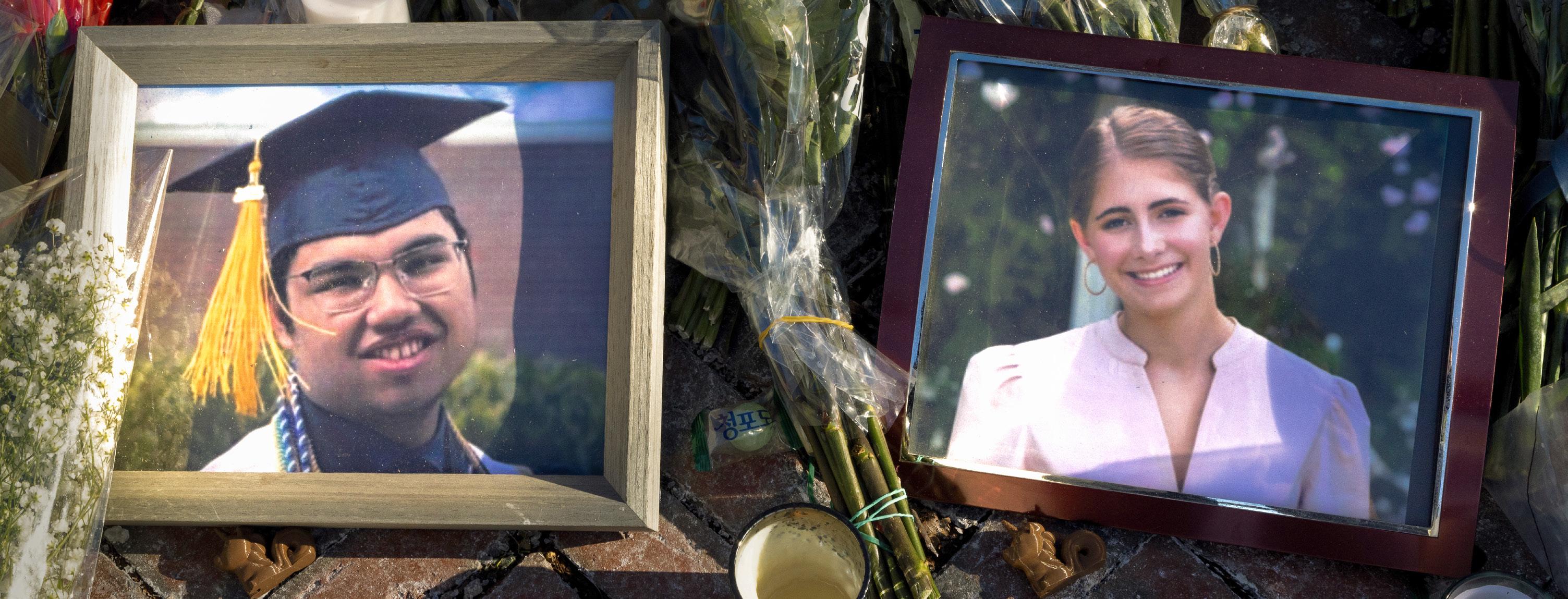
ANNAMARIA LUECHT / HERALD Cook was an accomplished pianist who was interested in pursuing French and Francophone studies at Brown.
ELLA
ANNAMARIA LUECHT / HERALD
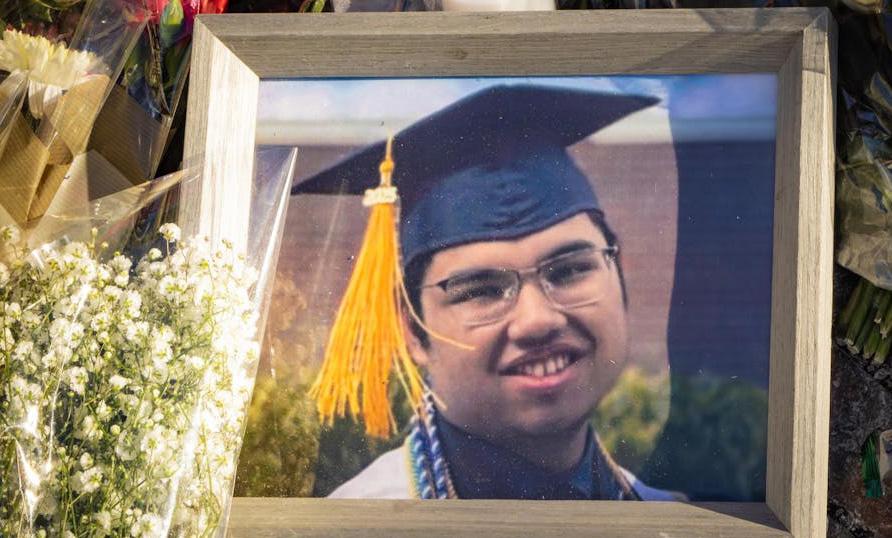
Umurzokov was studying biochemistry and molecular biology with the aspiration to become a neurosurgeon.
UNIVERSITY NEWS
ADMISSIONS
Admitted early decision applicants inspired by strength of Brown community in face of campus tragedy
BY ALI SCHAPIRO SENIOR STAFF WRITER
Brown admitted its early decision applicants to the class of 2030 just four days after the Dec. 13 shooting that resulted in the deaths of two Brown students and the hospitalization of nine others. Decisions were initially set to be released on Dec. 15, but applicants were notified that their decisions would be delayed for up to 48 hours in the wake of the shooting.
The Herald spoke to five incoming students about their application process and how they reacted to their acceptances following the campus tragedy.
Mimi Goldberg, an admitted high school senior from Naples, Florida, was drawn to Brown because of the Open Curriculum’s ability to support her interdisciplinary interests. She told The Herald that she plans to double concentrate in applied mathematics and behavioral sciences.
Goldberg opened her decision letter alone, taking some time to allow the excitement to set in before she told her family.
“I kept rereading the decision because I thought ... maybe I misread it the first time or something,” she said in an interview with The Herald.
Goldberg added that she did feel “a little more hesitant to be happy about getting in,” after the shooting. But her view of Brown was unchanged, and she even felt grateful to see the strength of the community, she told The Herald.
“It hasn’t made me feel differently about attending the school at all,” Goldberg said. “That could happen anywhere,” she said, adding that it is “the reality of gun violence in America, unfortunately.”
Brady Casady, an incoming first-year student from Westerly, feels that after Dec. 13, he saw “the strong resilience of the
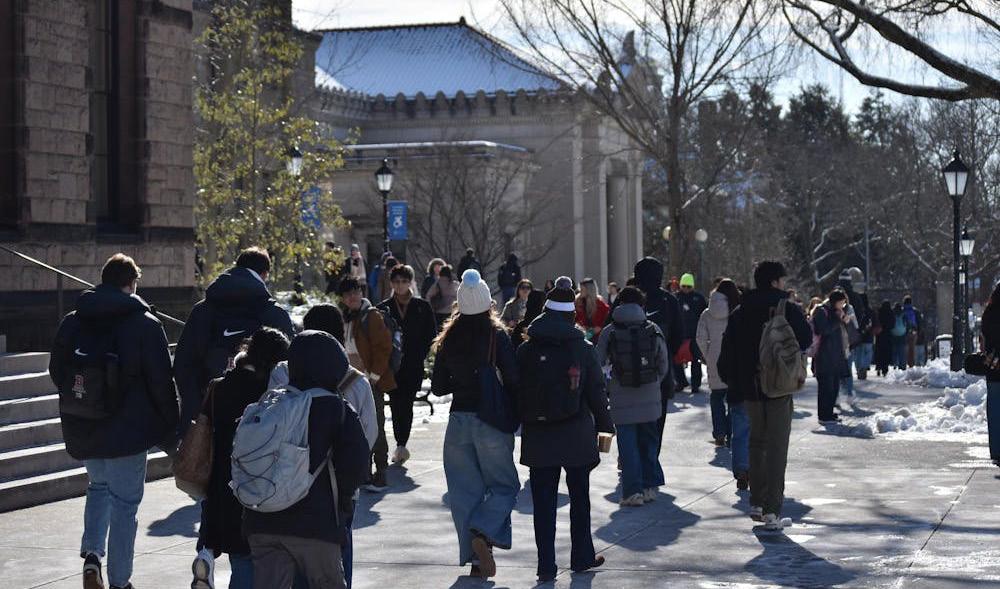
Brown community,” he wrote in a message to The Herald.
Casady, a prospective public health and environmental science concentrator, was in a meeting when decisions were released. When he finally got out of the meeting, his “months of anticipation quickly transformed into fear” as the time came to open the letter, he wrote.
Surrounded by his family, Casady opened the decision. When he saw the acceptance, he “ran around (his) kitchen in excitement, hugged (his) family” and then ran next door to his grandparents, who had a celebratory cake waiting for him.
Jaycee Song, an early decision admit from Hong Kong, hopes to pursue visual arts and biology when she gets to Brown.
Song enjoyed working on the video
introduction portion of her application to Brown, as it allowed her to convey her identity using her “own voice” and “vivid images,” she wrote in a message to The Herald.
The morning of Brown’s early decision release, Song went out to her balcony — a location she picked for the reading of her decision because “ChatGPT’s Chinese astrological reading” told her she would receive good fortune there.
“Brown has been my dream school for a long time,” Song wrote. She is excited to come to campus in the fall and believes that the recent shooting will “result in a reinforced security system and that student safety will be valued even more.”
Nathaniel Kebede, a high school senior from Sacramento, California, intends
to concentrate in neuroscience or public health on the pre-medical track upon arriving at Brown.
Opening his acceptance letter was a “surreal” moment for Kebede, he said.
While the recent tragedy did not make him question his own decision to attend, his family did take a “second to think” about sending their son so far from home. Kebede added that his parents were shocked to hear about a “shooting at an Ivy League” school.
Loraine Ramirez-Santana, another incoming Brunonian, opened her decision letter with her best friend by her side.
“I saw the ‘Congratulations,’ and I just freaked out,” she said in an interview with The Herald.
Ramirez-Santana was drawn to Brown because of its unique application style that
Submissions:
THE BROWN DAILY HERALD
Multimedia
Marat Basaria
Harry Guo
Horatio Hamilton
Selina Kao
Ella Le
Kenna Lee
JJ Li
Jake Parker
Jascha Silberstein
Luecht
Kaia Yalamanchili
Illustration Chiefs Kendra Eastep Isabela Guillen
Video Chiefs Cienna Cheng Cody Cheng
Social Media
Nate Barkow
Annika Melwani
Technology Chief
Data
Ellenberg


Rassul Toleugazy
BUSINESS
General Managers
Arjun Deshpande
Anum Azhar
Sales Directors
Arjun Ray
Hannah Han
Finance Director
Sydney Wright
Office
she felt allowed her to showcase her personality beyond her accomplishments in the classroom. Specifically, she enjoyed working on the prompt about “What brings you joy?” she said.
Like other admitted students, Ramirez-Santana did not feel deterred by the events of Dec. 13. Ramirez-Santana was more concerned about the safety of students on campus than her application decision, and voiced support for the safety actions taken by the University since.
This spring, Brown will finalize the remainder of the class of 2030 with the regular decision round.
This article originally appeared online at browndailyherald.com on Jan. 22, 2026.
email, and we will do our best to work with you.
Submissions can build on reporting from The Herald, reporting elsewhere, official statements from the University or other groups and other reputable sources, but they cannot break news or contain information that The Herald cannot verify. Because we cannot publish unsubstantiated information, failure to provide appropriate sources may mean we have to modify or remove unverified claims.
The Herald will not publish anonymous submissions or submissions authored by organizations. Leaders of student organizations can be identified as such but cannot write under the byline of their organization. The Herald cannot publish all submissions it receives and reserves the right
The Herald spoke with five students admitted early decision
SELINA KAO / HERALD
Early decision notifications were initially set to be released on Dec. 15, but were delayed in the wake of the shooting.
IMMIGRATION
Hundreds protest in Providence against nationwide ICE activity
Demonstrators marched to the Rhode Island Superior Court
BY JAMES LIBRESCO AND MICHELLE BI SENIOR STAFF WRITER AND METRO EDITOR
Hundreds of demonstrators took to the streets of Providence Tuesday afternoon to protest the Trump administration’s actions surrounding immigration enforcement.
The protest followed the fatal shooting of Renee Good earlier this month in Minneapolis by an officer from the U.S. Immigration and Customs Enforcement agency, which has been active in Rhode Island over the last year.
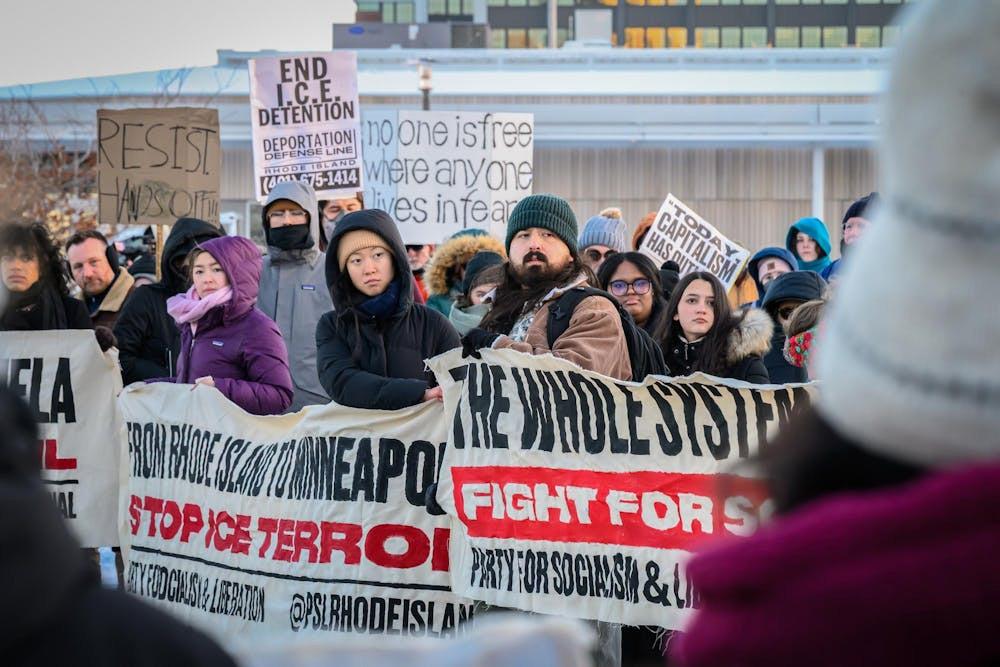
The protest began in below-freezing temperatures at 3 p.m. outside of the John D. Rockefeller Jr. Library. About 250 demonstrators and organizers from the Graduate Labor Organization, the Rhode Island chapter of the Party for Socialism and Liberation, Brown Rise Up and the Deportation Defense Network of R.I. chanted, “when immigrants are under attack, what do we do? Stand up, fight back.”
Protestors marched across the Michael S. Van Leesten Memorial Bridge, also known as the Providence River Pedestrian Bridge, in solidarity against the Trump administration’s actions surrounding immigration enforcement.
Kenneth Kalu ’27, a student who spoke at the rally outside of the Rock, told The Herald that he was protesting “in solidarity” with both Providence and Minneapolis — two communities that have been “victimized” by ICE activity, he said.
Last Thursday, several ICE agents breached court security as they pursued two men through Garrahy Judicial Complex in Providence. Kalu described the incident as a
“microcosm” of “the broader campaign that ICE is waging against us.”
ICE did not immediately respond to
The Herald’s request for comment about the incident.
Thursday’s incident followed several months of increased detainments and immigration enforcement activity in Providence and Rhode Island.
At the protest, some members of the Deportation Defense Network called on the Rhode Island court system to hold virtual immigration hearings to ensure ICE agents cannot detain people exiting their hearings.
The Deportation Defense Network operates a courthouse patrol initiative to keep an eye out for ICE presence, The Herald previously
reported. In October 2025, Providence City Council passed a resolution directing the Providence Municipal Court and Probate Court to accommodate requests for remote hearings.
“Pretty much every week we’ve been out there, they’re trying to take someone,” Matisse Doucet ’27, a volunteer with the Deportation Defense Network, told The Herald. But Thursday’s incident represented “a new level of escalation we haven’t seen before.”
Doucet called on Rhode Island’s U.S. representatives to abolish ICE entirely, saying that they should “put their money where their mouth is.”
“Representative Magaziner has been sharply critical of the untargeted, violent
and excessive manner in which the Trump Administration has engaged in immigration enforcement,” Noah Boucher, communications director for U.S. Rep. Seth Magaziner ’06 (D-R.I. 2) wrote in a Tuesday statement to The Herald.
The offices of U.S. Sens. Sheldon Whitehouse and Jack Reed, U.S. Rep. Gabe Amo (D-R.I. 1), democrats of Rhode Island, did not immediately respond to The Herald’s request for comment.
After a series of speeches and chants, the crowd marched down College Hill and across the Providence River to 195 District Park, where they joined more demonstrators.
The protest ended at the Rhode Island Superior Court, where the group rallied
across the street around the World War I Memorial.
Several neighborhood residents emerged from their houses to clap and cheer, and some drivers passing by honked their horns. For part of the march, a police car trailed the crowd.
At the park, Providence resident Justin Grey told The Herald that after seeing posts on social media about the demonstration, they were there to protest for the first time.
Grey described Good’s killing as a “very catalyzing event for a lot of people.” They added that they view ICE as “a fascist occupying force.”
ICE did not immediately respond to The Herald’s request for comment regarding accusations of fascism.
Grey called on the Providence Police Department to take action against ICE agents if they break city or state laws. The PPD did not immediately respond to The Herald’s inquiry into whether the department has plans to do so.
Andrew Coburn, another Providence resident, said he was concerned that ICE was “going after our immigrant neighbors” who lack permanent legal status, as well as “racially profiling” people without regard to their legal status.
Finally, the group marched to the Rhode Island Superior Court and gathered across the street at Memorial Park.
Susan Schwarzwald P’07 told The Herald she feels “very strongly about these issues” as the “proud daughter” of a refugee.
“We need real legislative action to protect immigrants and refugees in our community,” she said. “We have to protect people, and we have to allow them to have decent lives.”
This article originally appeared online at browndailyherald.com on Jan. 21, 2026.
Louis Family Restaurant closes its doors after 79 years of service
meal on Dec. 31 after 79 years in operation.
BY PAVANI DURBHAKULA METRO EDITOR
At 75 years old, Louis Family Restaurant co-owner John Gianfrancesco finally decided it was time for retirement. With John and his brother Albert Gianfranceso ready to hang up their hats, the College Hill staple located at 286 Brook St., served its last
“It’s just physically impossible to do what we do,” John Gianfranceso told The Herald. “I love the business, but it takes everything we got.”
Louis Gianfrancesco started the restaurant in 1946 and then passed it down to his sons, John Gianfrancesco and Albert Gianfrancesco, who ran the restaurant until its doors closed.
Over the years, Louis has become a beloved institution among many members of Brown’s community. “I feel like every
time I went, I saw other people from Brown there,” said Mary O’Riordan ’27, a former columnist for The Herald. “It felt like an off-campus dining hall.”
In a 2022 interview with The Herald, John Gianfrancesco estimated that students made up 90% of the restaurant’s customers on weekends and about 50% on weekdays.
“I think we had the best customers,” John Gianfrancesco said. “I’m going to miss them more than anything else.”
“I’m truly heartbroken (that) Louis is closed,” wrote Alice Richmond ’28, in a
message to The Herald. “I’ll forever miss their banana pancakes and their eclectic decorations.”
Although Louis has closed its doors, the space will not be empty for long. It will soon be occupied by Suis, a cafe specializing in baked goods, desserts and craft drinks inspired by Asian flavors.
“While Suis will have its own identity, we’re working closely with the owners (of Louis) to preserve the spirit of hospitality and care that defined the space,” wrote Ritu Nguyen and Trang Duong, co-owners of Suis, in an email to The Herald. “We’re approaching this transition with a lot of respect for what Louis meant to the community,” they added.
Nguyen said John Gianfrancesco’s involvement with the community was “very touching,” adding that the Louis co-owner helped students move in and out of campus.
“Louis was cozy, approachable and very affordable, which made it the perfect off-campus spot for breakfast,” wrote Juniper Morton ’28 in a message to The Herald. “I will miss going there with my friends on leisurely mornings.”
Charles Strouse ’81, who lived in the apartment above the restaurant, wrote in an email to The Herald that he felt “devastated” about the restaurant’s closure, recalling how he celebrated his 21st birthday by spending all day at Louis. “I ate everything on their menu at least once,” he added.
Claire Murphy ’28 and Caroline Shu ’28, who both play for the Brown women’s lacrosse team, said that Louis has been a regular spot for their team to hang out.
The restaurant workers would “always fold out extra tables for us to all sit together as a team,” Shu said, adding that the workers recognized her and her teammates. “It was almost like a home.”
Employees also were a core part of the restaurant’s tight-knit community: “If they weren’t family, they were like family members,” John Gianfrancesco said.
In continuation of Louis’s legacy of community, Nguyen and Duong hope to “create a space that feels comforting, personal and brings a lot of joy.”
As immigrants from Vietnam, they aim to “contribute to the international community,” Duong said in an interview with The Herald, adding that they hope to create a community where people can “find a bit of themselves.”
Though no official opening date has been set, they hope to open the new cafe in early summer. “The location felt like a natural fit for Suis’s first permanent home,” Nguyen and Duong wrote.
“It was a pleasure and a privilege” to serve the Providence community, said John Gianfrancesco. This article originally appeared online at
HORATIO HAMILTON / HERALD
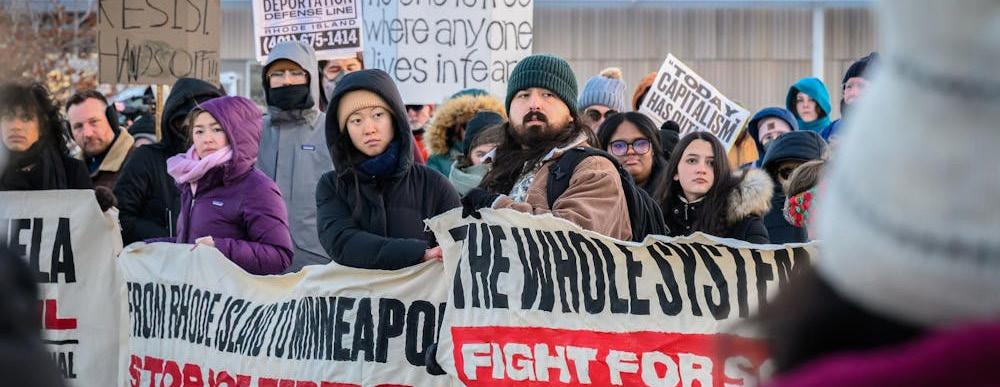
The protest followed the fatal shooting of Renee Good earlier this month in Minneapolis by an U.S. Immigration and Customs Enforcement agent.
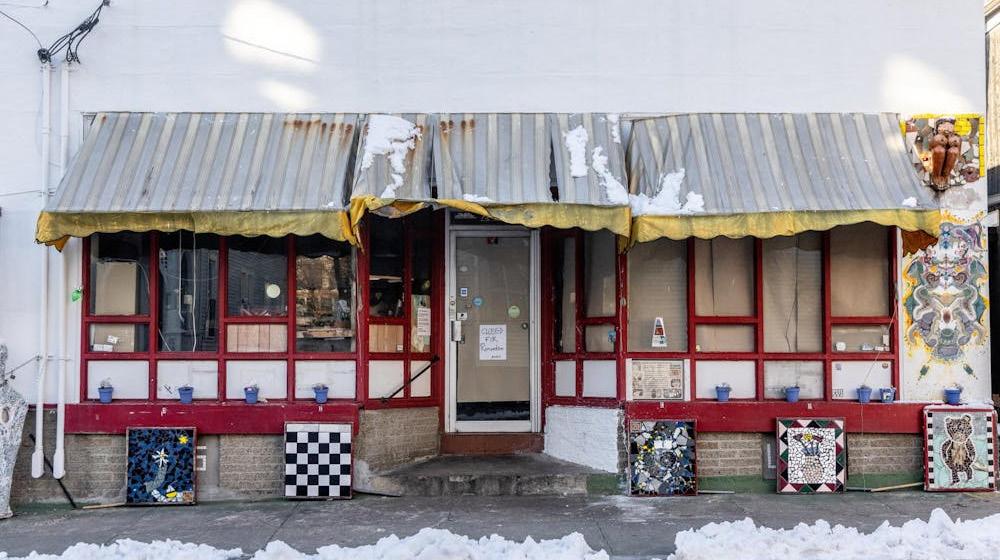
Suis, a cafe with a menu inspired by Asian flavors, will take over the space
ANNAMARIA LUECHT / HERALD
Louis Gianfrancesco started the restaurant in 1946 and then passed it down to his sons, John and Albert Gianfrancesco, who ran the restaurant until its doors closed.
EDUCATION
Local schools enhance security, provide psychological services following Brown shooting
Students felt heightened anxiety at school following the shooting
BY NATE BARKOW SENIOR STAFF WRITER
After the Dec. 13 mass shooting at Brown, students returned to heightened security measures and support services. Off campus, local K-12 schools were also adjusting plans in response to the tragedy with some cancelling activities or enhancing security.
The Wheeler School, a private school just minutes from Brown facilities, started its winter break a week early in the wake of the shooting.
“As much as we want to be together and maintain a sense of normalcy, given our proximity to the tragic events of this weekend and the ongoing investigation, this is simply not a normal time for any of us, and we don’t feel it’s possible to have a normal school day right now,” Mark Anderson, head of school, wrote in a December letter to the Wheeler community.
SHOOTING
The letter also included a list of resources from the school’s Health and Wellness Department.
In a second letter to the Wheeler community in early January, Anderson described developing security enhancements to the school, including enhancing camera coverage, reinforcing campus access, installing privacy screens and expanding communication systems.
“While we regularly review and practice our school safety procedures, the tragic situation at Brown prompted us to take an even closer look at where and how we could further enhance our security systems both on and around our campuses,” Max Pearlstein, a spokesperson for Wheeler, wrote in an email to The Herald. “Wheeler’s strong relationships with Brown and all of our neighbors are key to this work, as safety is truly a community effort.”
The Providence Public School District remained open following the shooting, Alex Torres-Perez, a spokesperson for the PPSD, wrote in an email to The Herald.
The school district “worked hand in hand with the City and Providence Police to determine the best next steps to keep
our students safe,” Torres-Perez wrote.
“Together, we decided schools would remain open for the week with an additional safety presence,” she added.
Although classes continued as normal, the PPSD canceled after-school activities and programs for the week following the shooting.
Some students “were confused on why we were allowed to go to school but were not allowed to stay afterward,” said Jaylenn Rivera, a junior at the Juanita Sanchez Educational Complex. “We shouldn’t have gone to school at all if the district thought it was unsafe for us to be out late.”
Torres Perez wrote that after-school activities were cancelled because the district “wouldn’t have been able to provide the same level of security and safety resources that we have during school hours.”
“After-school activities tend to be more open to the public, like spectators at sporting events,” she added. “If those events continued as scheduled, there would (have) been less staff to keep watch as well as limited police resources to provide security due to the active
search at the time.”
In advance of the shooting, the district already had “ongoing safety initiatives and facility improvement projects underway,” Torres-Perez wrote. These efforts include installing new camera systems and improving security at school entrances, she added.
There have “definitely been more safety precautions centered around opening doors and making sure no one gets into the building,” wrote Hailey Santos, a student at Classical High School, in a message to The Herald.
“I feel like since the shooting people have been a little more on edge,” Santos wrote. “But I feel like Classical is overall safe.”
“The staff and administrators definitely constantly encourage students to go to guidance or our resource room if people need help,” she added.
The PPSD has “expanded its mental health supports and increased administrative support to the schools,” Torres-Perez wrote. Schools also provided psychologists, social workers, counselors, teletherapy and other sources of support for students during the week following
the shooting, she added.
“We were all terrified to go back to school at first, and for the first couple of days, the air was just really tense,” wrote Julianna Espinal, a senior at Classical High School, in a message to The Herald. The fear “never really goes away, and sometimes your mind drifts to it when it gets really quiet, but overall you kind of just continue on as best you can.”
Espinal noted the small ways that fear shows up for her classmates. “You can't help but notice the way people hold their breaths during lockdown drills or flinch when they hear something really loud in the halls,” she wrote.
In addition to other programs, the PPSD and the Rhode Island Department of Education worked with Hazel Health, an on-demand teletherapy site to provide support to all PPSD staff. RIDE also provided resources, including health clinics, to help students, families and staff cope with trauma related to the shooting.
“It is important to remember that PPSD schools, and most schools in general, continue to be the safest place for students to be,” Torres-Perez wrote.
Providence residents express discontent with alert systems after shooting
The city opted against sending Wireless Emergency Alerts on Dec. 13
BY MICHELLE BI METRO EDITOR
On Dec. 13, Caroline Grand was watching a movie in the Avon Theater on Thayer Street — just a 10-minute walk from Brown’s campus — when a shooter opened fire in Barus and Holley.
Once the movie ended around 6 p.m., theatergoers were informed that an active shooter was nearby, Grand said.
“Everyone in the theater started to panic a little bit,” she added. “People were pulling out their phones to see what was going on.” But Grand said that when she checked her phone, she had not received any alerts from the City of Providence.
Grand, who has lived in the city for seven years, was not the only resident who felt left in the dark by Providence’s emergency alert system.
In a press conference on Dec. 15, Providence Mayor Brett Smiley urged residents to sign up for Providence 311, or PVD311— a platform typically used for non-emergency service requests and related communications — to receive emergency alerts about the shooting at Brown.
“311 notices have continued to go out throughout this entire incident,” he said.
“Notifications are working fine.” But residents have said that officials did not provide clear or adequate communications.
Just over 6,077 Providence residents had created a PVD311 account as of Jan. 20 at 3 p.m., wrote Kristy dosReis, the Providence chief public information officer for public safety, in an email to The Herald. Providence is home to an estimated 195,000 residents.
Will Otto, who lives “right behind Hope High School,” was alerted of the shooting at 4:30 p.m. — about half an hour after shots were first fired — when a friend

texted in a pickup basketball group chat.
The friend, who has a membership at the Olney-Margolies Athletic Center, had received the first alert sent by Brown at 4:22 p.m, Otto explained. Otto’s wife was not at home, so he warned her through text that “there’s something weird going on around Brown’s campus.”
“It was pretty unclear what was going on,” Otto said. Otto spent the next two hours “cobbling together an understanding” of the situation by turning to alternative sources like the Boston Globe, Brown’s website and the Providence subreddit. Those hours were filled with “lots of sirens, but not a lot of confirmed information,” he added.
According to dosReis, the city issued two PVD311 alerts on Dec. 13. The first, sent at 5:23 p.m., stated, “Heavy Police and Fire presence on Hope Street, near Brown University. Please avoid this area until further notice.”
The second, sent at 9:49 p.m., stated, “A Shelter in Place remains in effect in the greater Brown University area. Providence Police remain on scene.”
“The City of Providence communicat-
ed with residents using multiple channels, including CodeRED and PVD311 alerts, social media platforms and coordination with traditional media outlets,” dosReis wrote. CodeRED is the city’s emergency notification system.
PVD311, launched in 2016 as an app, was replaced by a new PVD311 website last March. During “development and design” of the website, “research indicated that a web-based application accessible from any device would be most effective,” dosReis added.
Otto believes that he signed up for PVD311 “in 2022 or 2023,” but said that he never received “any clear communication” of the platform’s shift from an app to a website. In the last year, he said he has not received any alerts. He attempted to sign back up on the afternoon of the shooting, but described the page’s information as “very unclear.”
“The system was recently upgraded following months of robust community engagement and incorporates best practices from non-emergency systems used by cities across the nation,” dosReis wrote. “PVD311 offers a texting option
for residents who create an account and opt in.”
According to dosReis, at the beginning of the incident, the city also considered sending a Wireless Emergency Alert — which sends audible notifications to every cell phone not powered off within a designated area bound by select cell towers.
The system does not have the capacity to “issue an alert only to Providence residents or a small specific geographic subset of Providence residents,” dosReis explained.
Additionally, sounds from audible notifications posed “potential safety risks to individuals sheltering-in-place and to emergency responders involved in the incident response,” dosReis wrote in an email to The Herald. As a result, the city opted not to request a WEA activation from the Rhode Island Emergency Management Agency.
Grand remembered receiving an audible notification when the Washington Bridge shut down in December 2023. “That was treated as a big alert and a big emergency,” she said. “It really blew my mind that there was no notification whatsoever” on Dec. 13.
“The fact of the matter is that they didn’t catch this guy … there were helicopters going back and forth over my apartment for days,” Grand said. “There was no notification to stay in the area or not stay in the area.”
Beth Moloney, who lives on Hope Street, said that her teenage daughter was about to walk to Thayer Street at the time of the shooting.
Minutes before Moloney’s daughter was set to leave the house, Moloney’s wife — who works at Brown — received the University’s first text alert at 4:22 p.m. warning of an active shooter. The couple quickly stopped their daughter from leaving.
Moloney said she has been registered for PVD311 since before Smiley’s mayoral term and often submits service requests on the platform. She alleged that before the shooting, PVD311’s landing page pre-
sented users with two fields to fill: one for a main phone number, the other for a mobile phone number — neither of which was marked as required.
Moloney had previously entered her cell phone number into the main number field, opted into text notifications and left the mobile number field blank.
“I was under the assumption that by putting my phone number in there, I was in the system,” she said. But she says she received no emails, texts or calls from the city regarding the attack.
After the shooting, Moloney said she added her phone number in the mobile number field of PVD311 and opted into receiving texts again. She soon began getting messages about trash pickups and school committee elections — alerts she described feeling like “spam” in the wake of the shooting.
In an after-action letter released last week, Mayor Smiley wrote that Providence would hire a third-party consultant to review the city’s response to the shooting. The city would “review internal and external notification to partners, public and the press,” he stated.
Any future changes to the city’s emergency notification systems “will be informed by the results of that review,” dosReis wrote.
Starting Jan. 14, Moloney reported that a “big yellow text box” now appears on her PVD311 landing page with instructions on how to sign up for alerts.
The City of Providence did not respond to multiple requests for comment.
“This was a scary, dangerous, awful thing that happened, and I hope it never happens again,” Otto said. “But if it were to happen again, I don't feel confident right now that the communication systems the city has are up to the task.”
“Whatever 311 was supposed to accomplish,” he added, “clearly it wasn't ready for an event of this magnitude.”
This article originally appeared online at browndailyherald.com on Jan. 22, 2026.
KENDRA EASTEP / HERALD
In an after-action letter released last week, Mayor Smiley wrote that Providence would hire a third-party consultant to review the city’s response to the shooting.
SPORTS
ICE HOCKEY
Women’s ice hockey suffers loss to Cornell, trounces Colgate
The Bears sit at No. 5 heading into the season’s final stretch
BY SAJIV MEHTA SENIOR STAFF WRITER
This past weekend the women’s ice hockey team (12-9-2, 8-6-2 Eastern College Athletic Conference) delivered two drastically different performances in a pair of nationally ranked conference matchups at home: a 3-1 disappointment against No. 10 Cornell (12-8-2, 8-5-1 ECAC) on Friday and a 6-2 triumph over No. 12 Colgate (12-12-1, 7-6-1 ECAC) on Saturday.
Following the weekend’s games, the Bears surpassed the Big Red in the ECAC standings, moving to No. 5 with seven games left to play in the regular season.
After dropping the season’s first Cornell matchup in November, the Bears looked to even the season series as the puck dropped at Meehan Auditorium Friday night. Instead, the Big Red jumped out to an early lead, which they rode all the way to victory.
“The team generated a good amount of offense on Friday and out-chanced Cornell in terms of grade-A opportunities to score,” Head Coach Melanie Ruzzi wrote in an email to The Herald. “Cornell’s defense did a good job of playing physical and forcing us to work for our chances, but ultimately, hitting posts and getting stopped on two breakaways was really the difference in the game.”
About eight minutes into the opening period, the Big Red found themselves on a two-on-two breakaway. Hurtling toward
Brown’s goal, Cornell sent the puck on-target twice — and was denied both times by Bruno goaltender Rory Edwards ’27 –– before slipping a third attempt through
But the Bruno attack failed to build upon the momentum. Bergmann went on to save 11 more shots over the latter half of the third period, and the
minutes into the match. On a solo breakaway, she weaved through two Colgate defenders and slapped a shot, which neatly ricocheted bar-down across the goal line.

but secured the contest. From behind the goal, Cornell’s Grace Dwyer managed to redirect the puck off Edwards into the net for another point.
On a power play with just over eleven minutes remaining in the match, facing a 3-0 goal deficit, the Bears finally got through Cornell goaltender Annelies Bergmann. A speedy shot by Norehad bounced off the stalwart Bergmann, and Lyons managed to put the puck over the goal line.
Bears’ highest tally this season –– Brown overwhelmed the Raiders, who only managed two goals.
“No real adjustments were made for the Colgate game because we were generating threatening scoring chances,” Ruzzi wrote. “Sometimes getting that first one can open up the scoring, and I think Margot Norehad ’27 got us rolling with the first two goals of the game.”
Norehad notched the first tally just ten
Edwards did not make any major adjustments between Friday and Saturday, she wrote in an email to The Herald. Instead, she focused on “keeping things simple, talking to the team and keeping the energy up.”
The second period was all Bruno. During the first power play of the contest, Olivia Fantino ’28 found Norehad racing up the left side of the rink. Norehad received and immediately redirected the puck to the
top right corner of the net for her second goal of the game.
About a minute and a half later, the Bears continued to show off their elegant puck movement, as India McDadi ’26 stole the puck from Colgate and dished it off to Jade Iginla ’26, who snuck it into the right side of the net.
Keeping their foot on the gas and the Raiders on their heels, Brown attacked again and again. With nine minutes left in the period, Lyons moved the puck away from Brown’s goal line and flew down the rink along the left wall. In a two-on-one breakaway, Lyons feigned a pass to her teammate, instead keeping the puck herself and scoring to bring Brown a fourth point.
Bruno found paydirt yet again two minutes later. Skating up the right side, McDadi found Isabella Gratzl ’29, who had no problem sending the puck into the open left side of the net.
After Colgate scored a goal on a power play, the tally was 5-1. As the clock turned to the final period, it was clear the Bears had pulled out of the Raiders’ reach. An exchange of goals in the third period, including an empty-netter by Lyons, was all it took for Brown to take the 4-goal advantage to the final whistle.
“We feel like winning in general is valuable,” Ruzzi added. “But (it) certainly feels good to take points from a team ahead of us in the standings.”
The Bears will look to continue their high-scoring streak at home against RIT on Saturday at 1 p.m.
This article originally appeared online at browndailyherald.com on Jan. 21, 2026.
Men’s basketball splits homestand with overtime win over Columbia, stumble against Cornell BASKETBALL
The team is ranked last in the Ivy League heading into a Princeton matchup
BY HARRY GUO SENIOR STAFF WRITER
Following a 0-2 start to Ivy League play, the men’s basketball team (7-10, 1-3 Ivy) collected their first league win in a 8680 overtime win over Columbia (12-6, 1-3 Ivy) at a Saturday home game. Despite the victory, the team fell 89-67 to Cornell (8-9, 1-3 Ivy) just two days later.
At the opening of the game against Columbia, guard Jeremiah Jenkins ’28 immediately made his presence known as a playmaker, firing a cross-court pass to forward Landon Lewis ’26. The Lions answered with a wide-open dunk, but Brown stayed composed. Forward N'famara Dabo ’27 poked the ball away on defense, crossing the court for a layup with an assist from Jenkins.
Throughout the half, the match grew increasingly physical, and the teams continued to trade points. A strong block by Columbia sent its bench into a frenzy, but guard Isaiah Langham ’29 quieted them moments later with a layup.
Coming hot off the bench, forward Wyatt DeGraaf ’28 secured an offensive rebound and kicked it back out to Jenkins, who finished with a shifty layup. Crisp ball movement led to another layup by Langham, assisted by guard and forward David Rochester ’28.
Although Bruno held strong defensive-
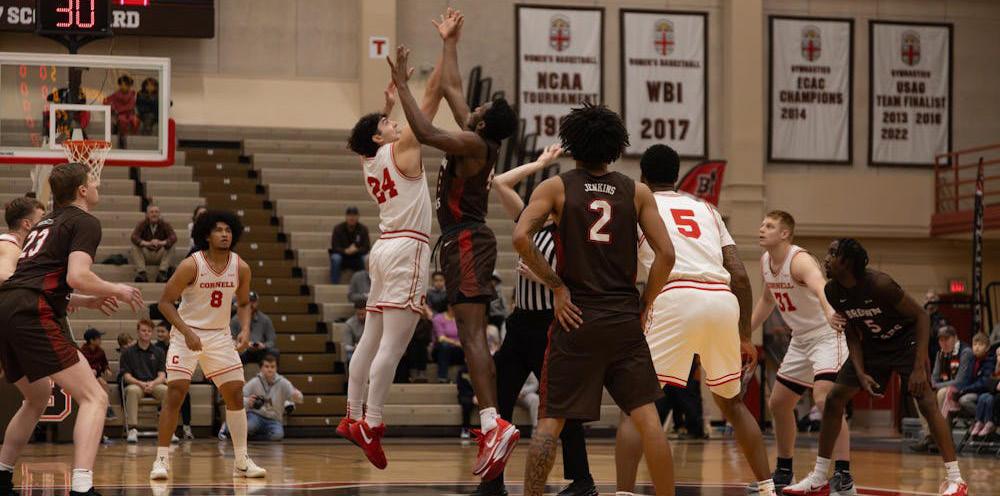
ly, they found trouble boxing out underneath the board, allowing Columbia to grab 10 offensive rebounds in the first half.
Brown’s Achilles heel unveiled itself late in the half, when a 7-0 run by the Lions led to a six-point lead for Columbia at halftime.
“At halftime, we were down, and we talked about playing for each other and bringing more intensity,” Dabo wrote in an email to The Herald. “It wasn’t about a specific tactical change as much as being the hungrier team, bringing our own energy and trusting that our teammates had our backs. That shift helped us change the momentum in the second half.”
The Bears emerged from the locker room with noticeably more energy. To open the second half, guard Adrian Uchidiuno ’27 stole the ball to feed Jenkins a wideopen layup. Soon after, Dabo swatted a
Lion’s attempt, and Uchidiuno threw down a thumping dunk in transition.
Just like that, the Bears were back in business.
Lewis tied the game with a hook shot, and Columbia answered with another three-pointer. Jenkins thread a bounce pass to Langham for a layup. He continued to carve up Columbia’s defense, stealing and dishing the ball to guard Malcolm Wrisby-Jefferson ’27, who found Langham again for a Bruno lead.
With just over six minutes remaining and down 66-62, the Bears were at an inflection point. A comeback spearheaded by Lewis and Langham brought Bruno to a two-point lead with just under two minutes left.
In the final minute, Uchidiuno stole the ball and gave Jenkins a quick layup.
But Columbia’s forward Blair Thompson drilled a clutch three to tie the game with 40 seconds left. The score held and the match went to overtime.
After Lewis opened the scoring in overtime, a controversial call brought Columbia’s forward Mason Ritter to the line, where he hit one free throw before the back-and-forth play continued.
A series of free throws pushed the Bruno lead to five. The Lions cut the lead to three on a layup but sent Jenkins to the free-throw line, who split the pair to push Bruno’s lead to four. Uchidiuno was fouled moments later, and sealed the 86-80 win with two free throws.
“Looking ahead, to keep this momentum going, we know adversity will continue to come our way. “This is the Ivy League, every team is good, and every game has
runs on both sides,” Dabo wrote in an email to The Herald. “What separates good teams from great teams is how you respond to those moments.”
Just two days later, Brown was unable to produce similar results against Cornell, falling 89-67.
The Big Red came out hot with their guard-heavy starting lineup, and jumped to an early 9-2 lead. Outscoring Cornell, Bruno tied the game at 23 with just over seven minutes remaining in the half.
But the surge was short-lived. Cornell closed the half on a 22-5 run, taking a 45-28 lead into the break.
“I would say Cornell ran a fast-paced offense,” Lewis wrote in an email to The Herald. “They’re a unique team that forces their opponent to adjust their defense.” Brown showed life in the second half, with Jenkins scoring a whopping 12 points. But the push was not enough to keep pace with Cornell, who led by as many as 25 and never allowed Brown to get within 15. With this momentum, the Big Red cruised to a comfortable victory.
Brown now sits in last place in the Ivy standings, and will look to bounce back this Saturday at 12 p.m. when the team faces off against Princeton in New Jersey.
“To win against Princeton on the road we each have to own our mistakes as players individually and acknowledge what we need to do better in the latter half of the season,” wrote Lewis. “There’ll be some fierce competition in practice and more accountability between players, which will make us the most connected team going into the game.”
ANNAMARIA LUECHT / HERALD
KAIA YALAMANCHILI / HERALD
ENGINEERING
Engineering students attend identity-based conventions in search of job opportunities
Students value face-toface interactions with recruiters
BY RACHEL WICKER SENIOR STAFF WRITER
Brown engineering students joined thousands of others from across the nation to attend conferences and conventions associated with the Society of Women Engineers and the Society of Hispanic Professional Engineers last semester.
These events include career fairs featuring professionals and recruiters from hundreds of companies, such as Apple, Microsoft, Disney and government organizations such as the FBI, said Brown chapter leaders of SWE and SHPE.
SWE’s event, the largest in the world for women in engineering and technology, took place from Oct. 23 to 25. Emilia Pantigoso ’26, president of Brown’s SWE chapter, called the national conference “an incredible opportunity.”
Pantigoso stressed the importance of “having that opportunity to be face-toface with recruiters.” Pantigoso said she acquired her past two internships and her full-time job offer at the SWE conference.
Diversity is crucial in engineering, Pantigoso added. She believes disparities in women’s medical devices and healthcare partially occur when engineering is restricted to “one type of person.”
“Any diversity of perspectives only strengthens solutions,” she said. “It’s so vital to have these conferences, not just for SWE but for all these affinity groups, because we can only make the best solutions when we do it all together.”
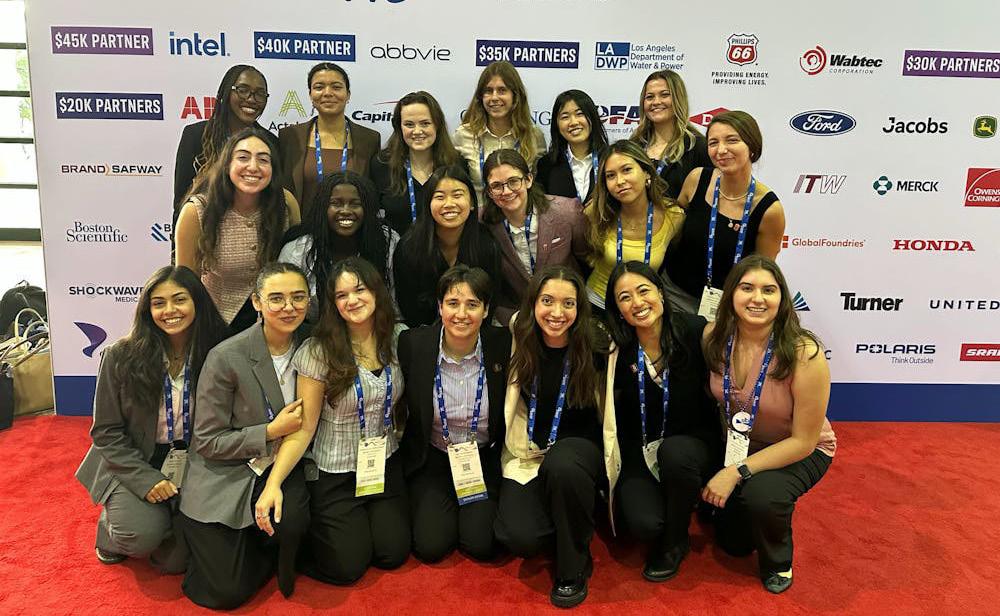
Due to a decrease of the pathways to diversity and inclusion fund, this year SWE was not able to fully fund as many students compared to previous years, said Emilia
SHPE’s convention, which took place from Oct. 29 to Nov. 1, provides a starting point for engineering students to learn how to “maneuver through professionalism” and “build individual skills” that will benefit both their collegiate and professional careers, said Christopher Diaz ’28, vice president of Brown’s SHPE chapter.
The opportunity for students to develop their professional skills is a major benefit of these conferences, Diaz added.
Many members of SHPE are first-generation college students and come from low-income backgrounds, Diaz said. For these members, the professional scene is “completely foreign,” he added.
In difficult, time-intensive concentra-
tions like engineering, it can be easy to lose motivation, Diaz said. “Going to a place like (SHPE’s conference), where you’re seeing other Hispanics, it’s encouraging,” he said. It shows that “we’re really building a name for ourselves in this market, in this country.”
In March, Brown’s chapter of the National Society of Black Engineers will attend a similar conference, said Amelia Allen ’27, the internal vice president of Brown’s NSBE chapter. She added that the conference is “a really unique space.”
There is “something really valuable about getting face-to-face time with professionals who are interested in speaking with you,” Allen said. This is especially true as
online applications feel increasingly monitored by artificial intelligence, she added.
Allen and Diaz said that both NSBE and SHPE receive most of the funding to attend these events from the School of Engineering. SHPE sends an average of 15 students each year, and NSBE is planning on sending 16 students to their conference in March. A portion of SWE’s funding comes from the School of Engineering, and from diversity grants, sponsors and “self-fundraising” initiatives, Pantigoso said. In 2025, the club sent 26 students to the national conference.
This year, SWE’s application process to attend the conference was “extremely thorough,” involving three separate rounds
of interviews, Pantigoso said.
To attend these conferences, students in Brown’s chapters of SHPE and NSBE are also required to complete applications to be considered by chapter leaders to attend the national conferences. When deciding which students to take, club leaders prioritize upperclassmen and members with prior engagement with the club. Once students are selected, the clubs hold informational sessions to ensure students are adequately prepared.
Sofia Tazi ’26, who attended the conference for the first time this year, said SWE provided valuable support before and during the conference.
“I came in knowing what to expect, which was kind of crazy, because this thing is wild, and it can be very, very easily overwhelming,” Tazi said.
This year, SWE also prioritized international students due to additional challenges they might face in the current job market, Pantigoso said.
Tazi, who is an international student from Morocco, said that one of her reasons for attending the conference was to gauge what the current job market in engineering is like for international students.
She learned that several recruiters were not hiring international students. But despite this “wake-up call,” Tazi said she ultimately gained valuable insight at the conference.
Not only did Tazi make connections to better prepare for her postgraduate plans, but she left the conference with a summer internship.
This article originally appeared online at browndailyherald.com on Jan. 21, 2026.
Alums offer spaces for students to connect following mass shooting
Over break, alums created community for students away from campus
BY REBECCA GOODMAN SENIOR STAFF WRITER
Noman Ibrahimi ’29 always planned to stay on campus over winter break, and knew some friends who intended to stay as well. But after the mass shooting, some of his friends left, and there weren’t many students still on campus. Still, Ibrahimi said he found community at the nearby gatherings hosted by alums.
He was invited to a gathering in Mansfield, Massachusetts hosted by Alumni Relations Vice President Zach Langway ’09, who Ibrahimi met through the Global Brown Center.
After the Mansfield gathering, Ibrahimi also attended a gathering hosted at the Harvard Club of Boston. There, he saw classmates he had not talked to during the semester and exchanged contacts.
“I learned about their lives, they learned about my life,” he said.
“The fact that there was no agenda and we could leave or go anytime we wanted was pretty cool,” he said. “The alumni were very nice for doing all this, for putting their time into this.”
Across the globe, students and alums gathered at similar community events hosted by Brown alums after the Dec. 13 shooting. It was important that these spaces were unstructured, “giving people space to be
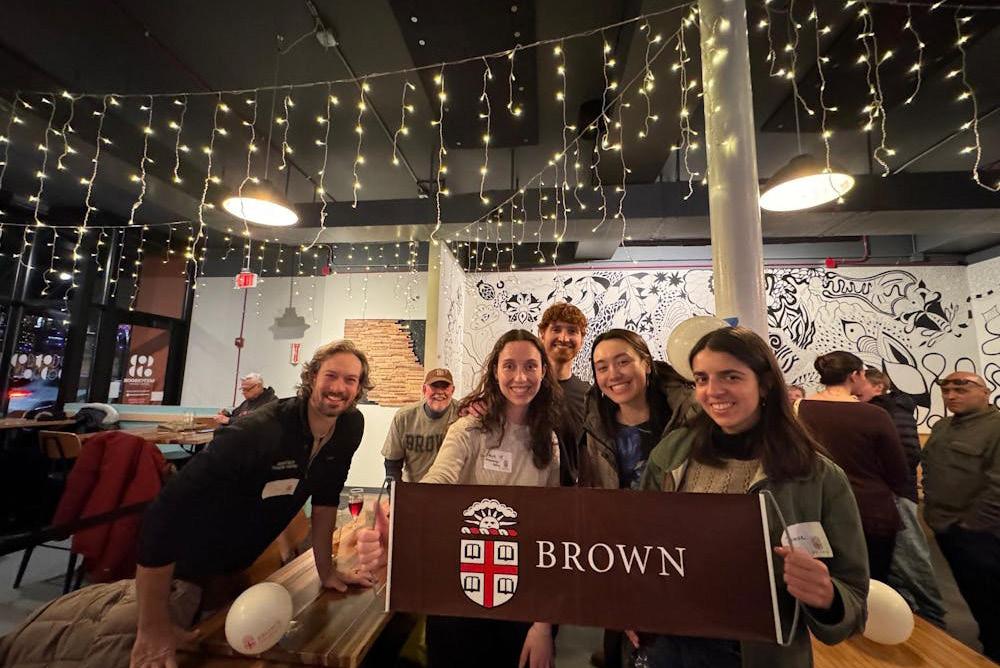
and
following the Dec. 13 mass shooting.
together,” Langway said. He helped to coordinate and organize these gatherings.
Alums hosted the gatherings in their homes or local community spaces, and students who completed an interest form were notified by email about the meetings near them. The Office of Alumni Relations provided financial support to students for travel to the gatherings.
“It is truly a gesture of love for Brown and for this incredible community because our
alumni are processing in their own way,” Langway said.
Langway himself hosted around 15 to 20 people in Mansfield.
“It was beautiful,” he said. “When you are holding grief and you’re holding mourning, as we all are right now, it is also really meaningful to see community members holding joy and optimism and a desire to be back on campus and an appreciation just to be with other Brown students.”
Ifeoluwapo Abe ’29 said she hoped to find a space to be around people she knew when she attended the gathering in Mansfield. “I wanted to be reminded of the good parts and the beautiful aspects of my experience at Brown,” she said.
“I formed really meaningful connections during the gathering,” Abe said. “I think honestly that it was a beautiful experience.”
Some gatherings hosted by alums were
smaller. In London, Joshua Leight ’09 hosted a gathering at a local pub, and only one student attended. In East Greenwich, Rhode Island, Rebecca Bliss ’92 hosted a gathering at her home. The small group sat around Bliss’ kitchen table, which she had loaded up with food, and spoke about life, academics and experiences at Brown.
“It was relaxed and comfortable and in many ways felt like a gathering of Brown alums of different eras sharing their experiences and … enjoying the opportunity to hear from and learn from each other,” Bliss said.
Franklin Young ’18 hosted a gathering in Atlanta, Georgia, which he said was attended by five or six students, some accompanied by parents. Amid the tragedy, the “silver lining is us being able to connect as a community,” he said.
The Brown Club of Chicago already planned to host a gathering for alums, but extended the invite to students after the mass shooting.
“It was an important time for the Brown community to reach out and support each other,” Cliff Saper ’72, the events chair of the Brown Club of Chicago, said.
Luke Barbieri ’29 attended a gathering in the DC area with his friend, and found the hosts to be “incredibly positive and welcoming.
Barbieri said he was initially worried that “the vibe or culture that (he) experienced during the fall semester would be changed.”
But the gathering reassured Barbieri that “Brown is still Brown.”
COURTESY OF CLIFF SAPER
Brown students
alums pose with Brown banner at community gathering. The gathering was one of many hosted
COURTESY OF THE SOCIETY OF WOMEN ENGINEERS
Pantigoso ’26, president of Brown’s SWE chapter.
ALUMS
UNIVERSITY NEWS
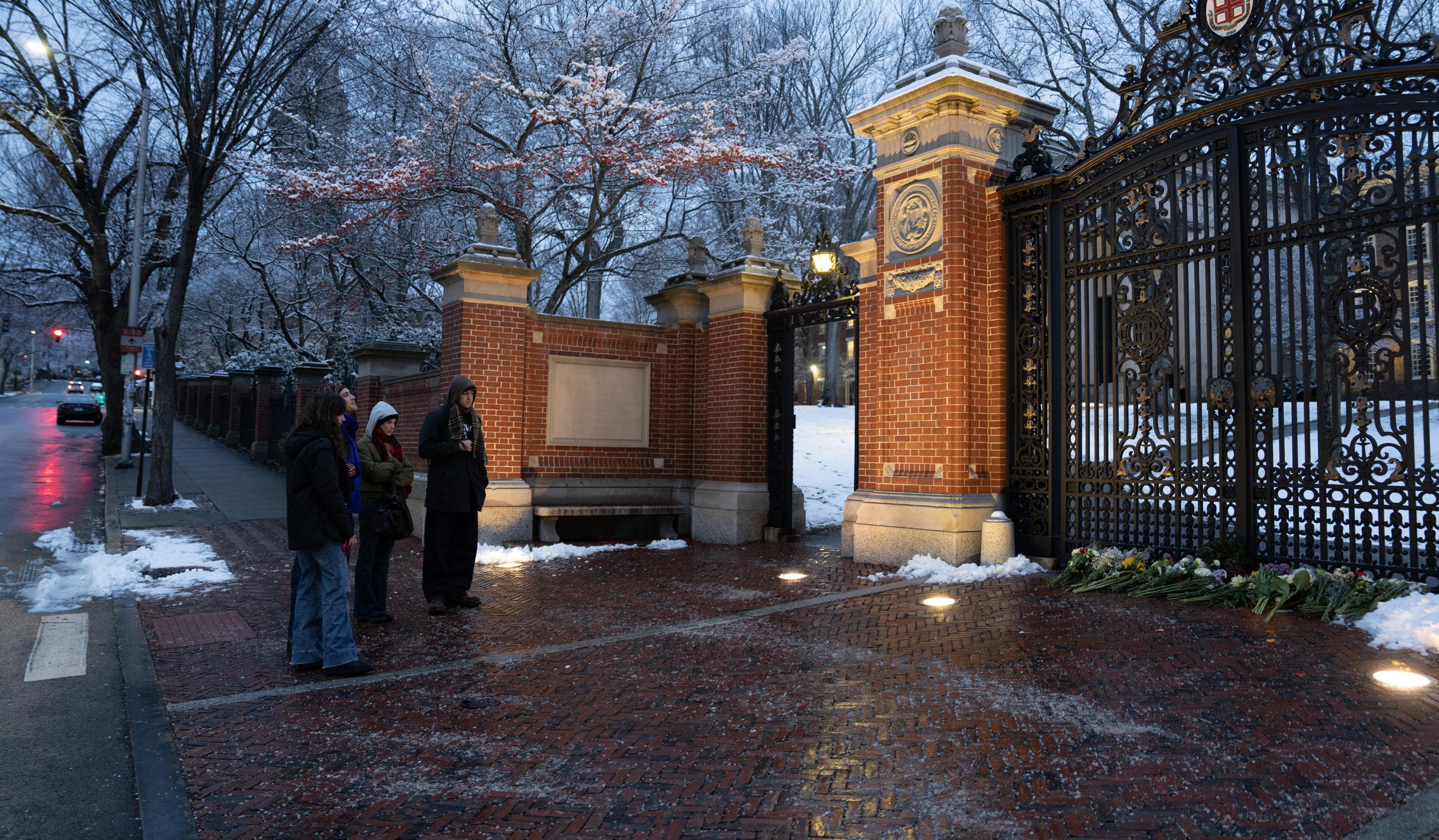

How the Providence community came together in the wake of the mass shooting at Brown
The community showed up for and supported each other
BY MAYA NELSON, IVY HUANG AND MANAV MUSUNURU SECTION EDITORS
On Dec. 13, a tragedy shook Brown’s campus.
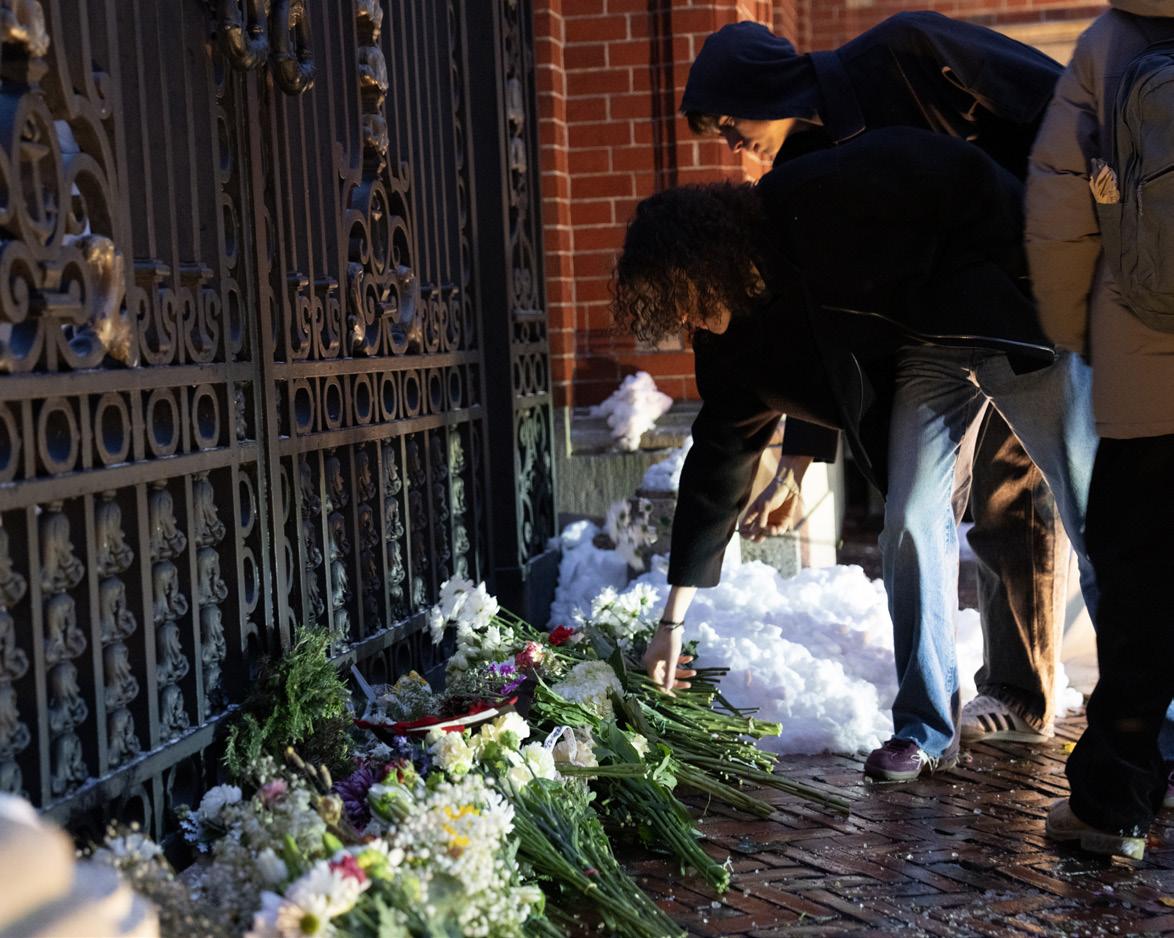
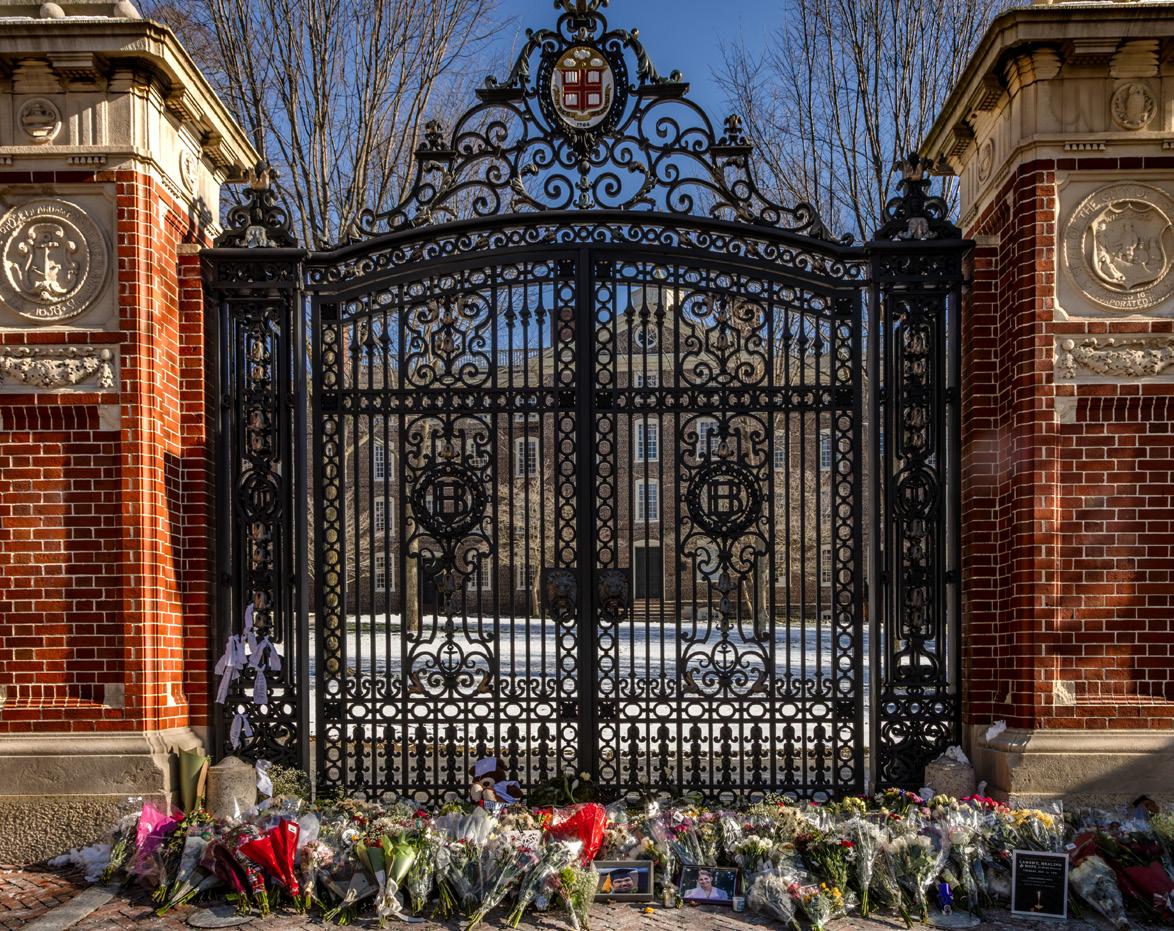
Two students were killed, and nine others were injured in a mass shooting that occurred in Barus and Holley. In the aftermath, the Brown and Providence communities have shown up for one another — providing shelter and meals to students and raising money for victims.
The Herald spoke to members of the community who supported one another, both on the night of the incident and in the days that followed.
‘They sacrificed their own safety’: Providing shelter during lockdown
As news of the shooting spread across campus Saturday afternoon, several local businesses took students in, offering them shelter and food.
After being alerted of an active shooter, the staff at Ceremony — a popular cafe and teahouse — dimmed the lights, pulled the curtains down and flipped chairs onto tables, according to Cheyenne Gansell, Ceremony’s sales and marketing specialist.
For the next several hours, eight students and five employees sheltered in place in the Ceremony basement.
Once the lockdown was lifted, Gansell and other employees drove students home. Some employees housed students overnight. “I think it was really important to be there in community, with the community, for the community,” she said.
The next day, one of the students who had sheltered in the Ceremony basement stopped by the store to buy one last matcha before she went home, and to thank the employees for hiding her, Gansell said. Coffee Exchange, a local coffee shop, took in about 30 people on Saturday night, most of them students, according to Owner Charlie Fishbein. The store turned all the lights off once the alert was sent out,
“We were in the dark for seven hours,” Fishbein told The Herald, describing how everyone was quiet, passing the time on laptops and phones or by reading books.
“The atmosphere was surreal,” he added. Taste of India, a restaurant across the street, provided food later in the evening, which was served “buffet-style with a flashlight,” Fishbein said.
When students and staff began to leave the coffee shop at around 11 p.m., Fishbein made sure everyone had a ride and a place to go.
Students who took shelter in the Olney-Margolies Athletic Center were met with support from several non-profit organizations.
Julia Antony ’26, who was working at the OMAC when the shooting happened, noted that most students there “hadn’t eaten in hours” and that “it was really comforting” when volunteers from non-profit groups showed up.
“The fact that they were there and they sacrificed their own safety to help us was really admirable,” Antony said.
Over the course of the weekend, Red Cross volunteers provided food and refreshments for over 1,500 people, including “students, faculty and local responders,” according to a statement sent to The Herald from the American Red Cross Connecticut and Rhode Island Region.
‘A source of stability’: Community members open homes to students
Many Brown faculty and staff also opened their doors to students in need.
Vio Diniz, a cashier with Brown Dining Services for over 20 years, was at home when the University alerted her of the shooting. She welcomed several Brown students into her home until the shelterin-place order was lifted. Some stayed the night.
“Brown students, they are like my kids,” she said.
When the shooting occurred, Associate Professor of History Jeremy Mumford was in the middle of leading a HIST1976V: “History of Childhood” seminar of about
12 students at his home. Rather than proctoring an exam during that time slot, Mumford had opted to host the class for a final discussion and dinner.
As soon as they learned of the attack, Mumford and his wife, Professor of Biology, Data Science and Computer Science Sohini Ramachandran, told students they could stay the night at their house.
“My daughter, who’s 12, was very interested in making sure that everyone had a comfortable bed,” Mumford said, recalling how she “gave her bed” to students and “went around making up a bed on the couches.”
Because there wasn’t enough space in the couple’s house to shelter everyone, Ramachandran called a neighboring professor to take in half of the students. Friends of students in the class who “didn’t have anywhere to go” also arrived later at the house to take shelter, according to Mumford.
Ellia Sweeney ’25 MD’30 called her friends who were still students, offering her family’s home in Cranston to “whoever needed a place to stay that night.” Three students took her up on her offer.
“The night was harrowing,” Sweeney said. Instead of sleeping, she stayed up sending text messages checking in on her friends at Brown.
The following night, when it was announced that the detained person of interest was released, Sweeney sent out another wave of messages saying her home was open. A total of 10 people came over for dinner, and three stayed the night. She drove them to the airport the following morning.
“I can’t be prouder to be part of the Brown community,” Sweeney said, expressing her appreciation for those who helped students with transportation and housing.
Others, like Adjunct Lecturer of Visual Arts Susanna Koetter, offered to drive students to the airport on Sidechat, an anonymous online forum for college students.
“I want to be a source of stability for my students, for all the students,” Koetter said.
‘It’s a small gesture’: Donating time and resources
The Undergraduate Council of Stu-
and students hid in the bathroom and the back stairwell.
ANNAMARIA LUECHT / HERALD
HENRY WANG / HERALD
HENRY WANG / HERALD
HENRY WANG / HERALD
dents opened a community assistance form, which received over 2,000 responses as of Monday evening, according to UCS President Talib Reddick ’26.
Most of the responses have been from alums, parents and community members offering financial support, rides, housing and other supplies, he said.
The idea for the form was proposed by First-Year Representative Cindy Sun ’29, who has been “really leading the charge in terms of monitoring everything,” according to Reddick.
Sun said she first got the idea after her roommate’s mom offered her a ride and a place to stay. “I realized that I was really lucky to be part of a community,” Sun told The Herald. “I wanted to make sure that the people who didn’t have that…would be able to get a ride, a place to stay, food if they needed it.”
“People everywhere” — including Brown alumni and community members at Columbia, Yale and Tufts — have offered support via the form, Sun said. Some mental health professionals have also reached out to offer counseling services via the form, she added.
Reddick also worked with Uber and Lyft to provide community members on campus with discount codes for travel.
“Our hearts are with the Brown University community,” said Senior Public Policy Manager at Lyft Brendan Joyce. “It’s a small gesture, but we hope a meaningful gesture to help folks with their transportation needs during this difficult time.”
‘Exemplifies the spirit of Brown’: Raising funds for victims and survivors
Samira Umurzokova, the sister of Mukhammad Aziz Umurzokov, one of the students who was killed during the shooting, began a GoFundMe that raised over $490,000 as of Wednesday. The GoFundMe aims to help with “expenses the family will have to face,” the description reads. Any remaining donations will go toward a charity in his name.
Another GoFundMe, organized by Tiffany Netto MD’27, raised nearly $87,000 to support the hospitalized victims’ medical bills. “I am completely floored by how quickly money was raised,” Netto said.
The fundraiser is currently paused as
Netto is working with President Christina Paxson P’19 P’MD’20 and deans at Warren Alpert Medical School to distribute the funds.
“I think this fundraiser really exemplifies the spirit of Brown,” Netto said. Despite being in a city, she said the University has a “small town community feel.”
Students and alumni have also raised funds for the victims and students trying to get home.
Autumn Wong ’25 — an alum living in Miami who started the Bruno Flight Fund GoFundMe — raised over $20,000 to assist with any additional travel costs for students departing campus early. Wong said she has been able to cover the cost of 22 flights as of Tuesday, and is working on getting in touch with Delta and American Airlines to rebook students’ flights.
Wong was a Meiklejohn and Community Coordinator as a student, and she said she began reaching out to her former residents and advisees who are still at Brown when she heard the news.
She started covering flights for students out of pocket, and once she “drained” her savings account, she started the GoFundMe to offset her personal costs and cover more flights.
“I hope the students just feel really supported,” she told the Herald, adding that “it’s probably a great stress relief to (not) have to worry about one more thing and just focus on getting back to their families.”
‘Support and comfort’: Sharing meals and kind words
Andrea Capotosto, senior director of finance, operations and analysis at the School of Public Health, gave out “free mom hugs” outside the Sharpe Refectory the day after the shooting.
She was inspired by seeing “someone doing free dad hugs at a pride event a couple years ago,” she said. “I just saw the reaction of the people who were there, and I just found it so moving.”
“If my children were far away from me and they were scared, I would want someone else to do what I did,” she continued.
“I wanted to remind people that for every tragedy that happens, there’s goodness
out there, and people that want to help,” she added.
Inside the Ratty, Brown community members came together to support victims of the shooting through a poster-making station that Daniel Soto Parra ’28 helped manage. Students wrote messages of support on posters for their peers recovering in the hospital.
In a message to The Herald, Soto Parra thanked everyone who contributed to the posters, adding that they were delivered to Rhode Island Hospital later that day. Soto Parra also started a petition calling on Brown to require ID swipes for all University buildings at all times. The petition had over 800 signatures as of Wednesday.
“It should be how we come together as a community, rather than the violence, that defines this event,” he said. “There is no darkness that love cannot turn into light.”
Kabob and Curry, a restaurant on Thayer Street, gave all students — and any community member who asked — a free meal on Sunday. Madhav Basnet, one of the managers, said he was “very happy to serve” the Brown community.
About 120 students came by for a free meal, according to Basnet. He checked to make sure everyone who ate at the restaurant had a safe place to go after, and offered free food for them to take home.
“Brown is very close to us. This is our kind of community,” he said.
Joseph Oduro ’25.5, a teaching assistant for ECON 0110: “Principles of Economics” who witnessed the shooting, expressed gratitude for peers who have provided “support and comfort” to him in the days following the tragedy.
“That has been extremely helpful, just knowing that I have a community behind me,” he said in an interview with The Herald. “And that’s the community that I love and will support and continue to try my best to protect at all costs.”
“Continue to lean on your brothers and sisters,” he said. “That’s going to be the best way … to really be able to thrive on campus once again.”
This article originally appeared online at browndailyherald.com on Dec. 18, 2025.
UNIVERSITY NEWS
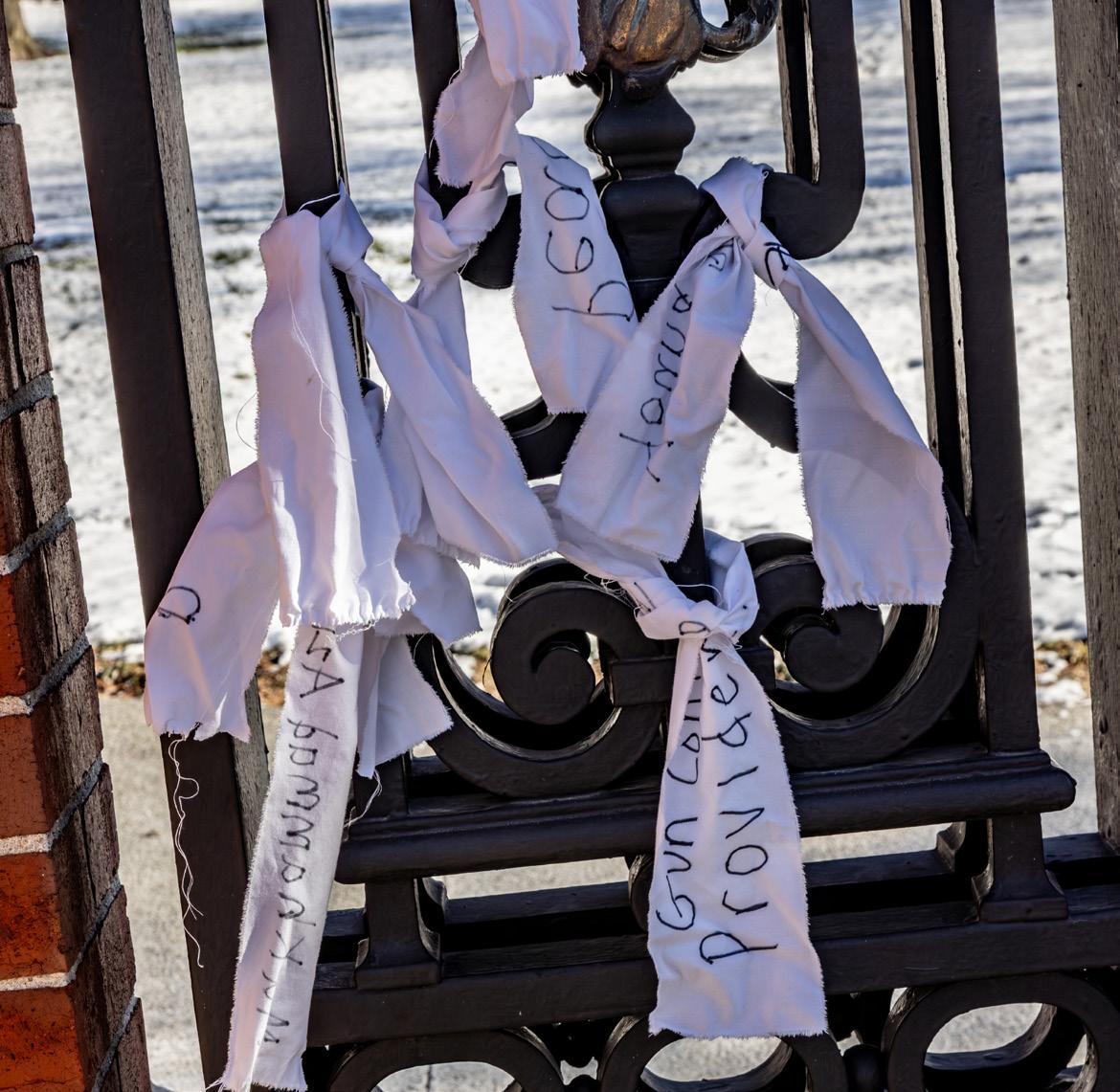
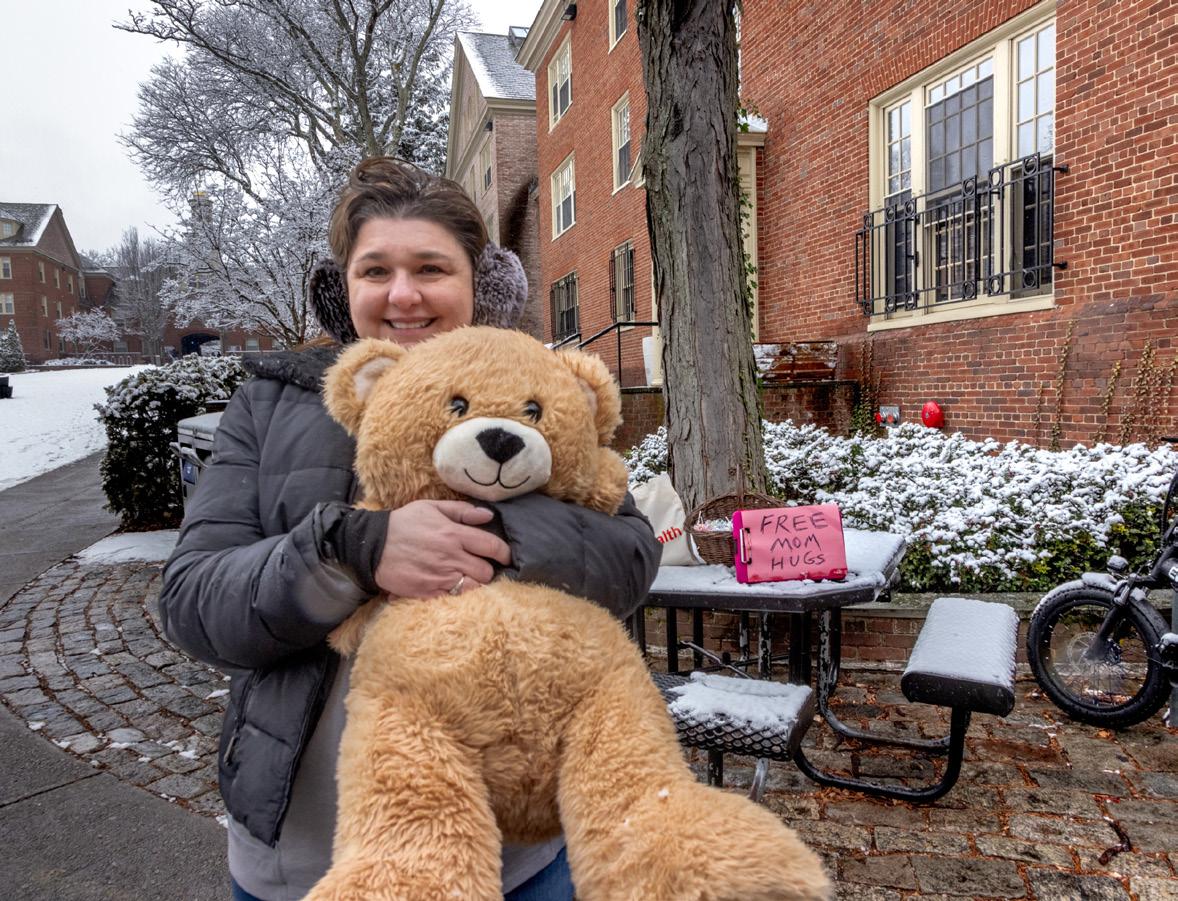
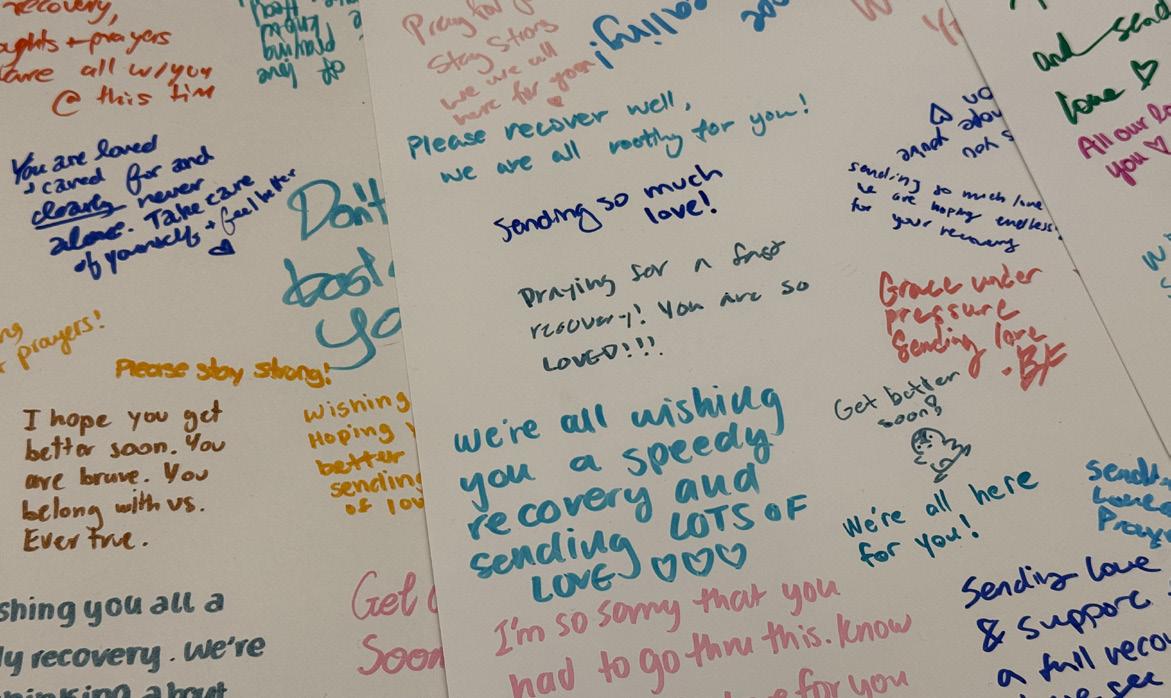
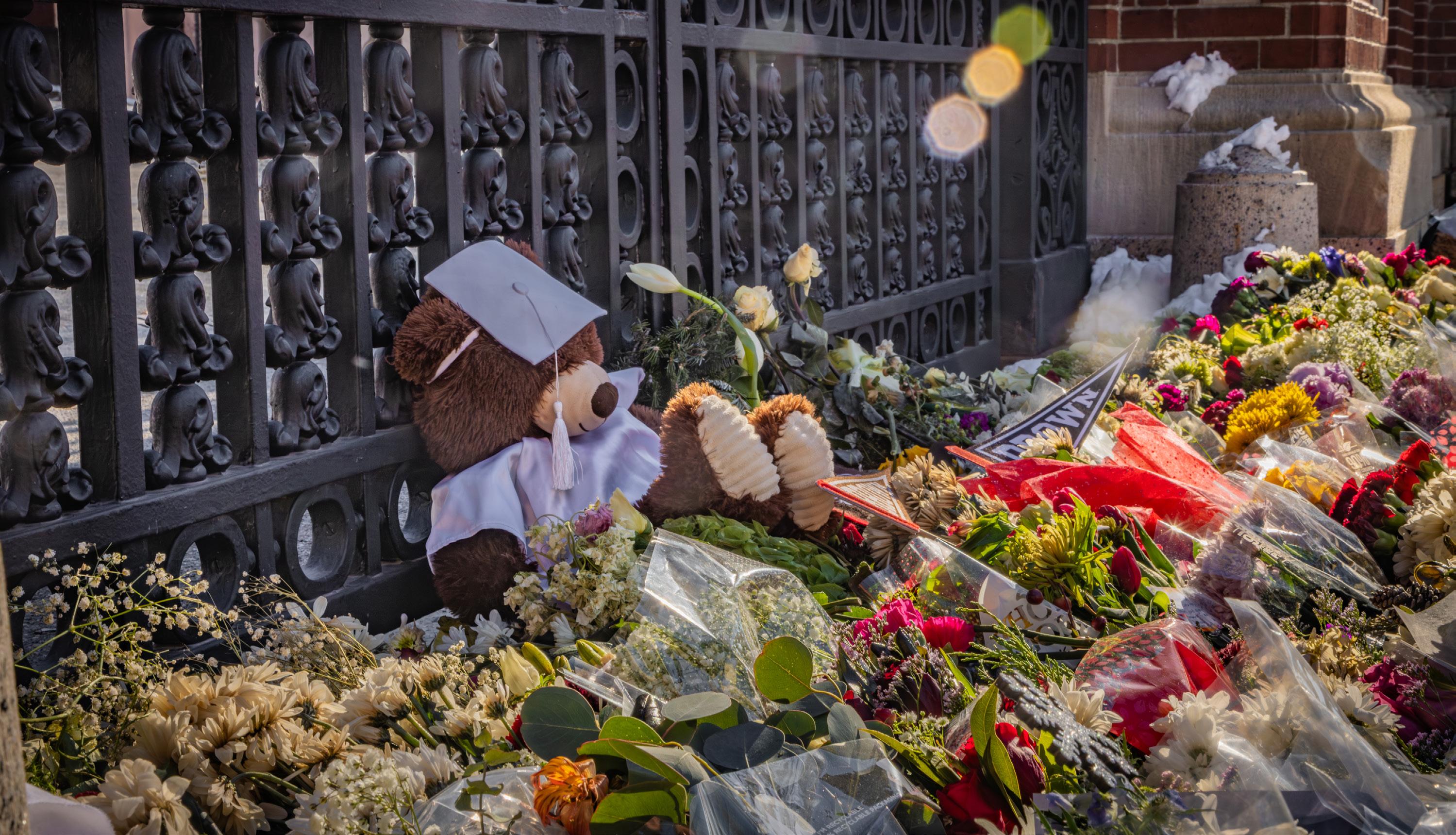
MANAV MUSUNURU / HERALD
ANNAMARIA LUECHT / HERALD
HENRY WANG / HERALD
ANNAMARIA LUECHT / HERALD
OPINIONS
Boas ’06.5: DPS should be reintegrated into the Brown community
In December 2006, I finished my last semester as a student at Brown and made a career choice that made me unpopular on campus: I went to work for the University’s Department of Public Safety. Overnight, longtime friends became distant, and the group of alums I’d planned to live with pulled their lease offer at the last minute, leaving me scrambling for housing. It was a vivid lesson in how complicated perceptions of policing can be at Brown.
When I was an undergraduate, I noticed few students on campus went out of their way to interact with the police. That is precisely why, in my role as special assistant to the chief, I worked specifically on community outreach. Unfortunately, many of the projects we pioneered, such as holding office hours for students to communicate with DPS officers, are no longer in place. As students return to a grieving campus, the University should promote regular interactions between DPS and the rest of the Brown community to make College Hill a safer place for all.
checks were reassigned to the Office of Residential Life instead. Campus leaders believed it was best to reduce students’ interactions with DPS officers.
I don’t doubt the intentions behind this approach — for some students, any encounter with law enforcement feels high-stakes. But eliminating low-stakes interactions means that we end up with a department that many students encounter only during emergencies, investigations or other uncomfortable situations. Good policing relies on community ties, and these relationships must be built on habitual interactions.
The recent shooting investigation underscores this point. State and national authorities could not identify the shooter until an anonymous Reddit user known as “John” posted that he recognized the suspect, which led the police to contact him about what he saw. The details he shared “blew the case right open,” according to Rhode Island Attorney General Peter Neronha P’19 P’22. That bombshell
“ “
Good policing relies on community ties, and these relationships must be built on habitual interactions.
When I visited campus this past November, only weeks before the tragic events of Dec. 13, I was surprised by the absence of uniformed officers or marked DPS vehicles. Perhaps this is because in late 2020, Brown administrators began shifting student-facing duties away from DPS, following campus-wide demands for systemic change amid the national protests over policing in 2020. For example, tasks like daytime dorm lockouts and wellness
tip, however, could have similarly come from any of the students who frequent the Barus and Holley area. Investigators believe the gunman had been lurking around campus for multiple days before the shooting. We may never know if the distance between DPS and the student body prevented any tips from reaching the authorities, but it is certainly possible.
Closing this distance requires facing criticism
head-on. In 2007, DPS leadership and I quickly learned that inviting students to come to us with feedback was ineffective. Instead, we decided to bring DPS to them. We held regular office hours in student spaces, bringing pizza to affinity centers like the Brown Center for Students of Color and Stonewall House. We also started social events like “Cocoa with the Cops.” Interim Vice President for Public Safety and Police Chief Hugh Clements would be wise to similarly take conversations about safety directly to those least likely to speak to DPS. Not everyone will be receptive to these efforts, but this is the point: Without sincere outreach efforts, many students may never share their feedback with DPS leadership.
In addition to these outreach programs, I was a founding undergraduate member of Brown’s Public Safety Oversight Committee — a group of students, faculty and staff who reviewed DPS practices. I can see the impact of the committee’s efforts today: One officer hired during my tenure was one of the first to respond on Dec. 13. Unfortunately, the PSOC’s last recorded meeting was in 2018, and by late 2021, the group was described as “inactive.”
Brown convened an ad hoc Campus Safety and Security Working Group a year after the 2020 reforms that decreased regular interactions between students and DPS officers began, but it, too, appears to have closed shop. Without an active PSOC-like body or regular outreach programming, campus members have lost the only dedicated venue to voice concerns and share thoughts about campus safety.
As part of the review of Brown’s safety policies and procedures following the shooting, President Christina Paxson P’19 P’MD’20 and Clements must revisit these outreach efforts to better unify students and DPS officers. Ultimately, safety is something a police department can produce only in partnership with its community. Security cameras and keycard locks are part of what keep us safe, but it is community relationships that truly matter.
Benjamin Boas ’06.5 was the Special Assistant to the Chief of the Department of Public Safety in 2007. He can be reached at benjamin@benjaminboas.com. Please send responses to this op-ed to letters@browndailyherald.com and other opinions to opinions@browndailyherald.com.
Gardiner ’28: Toni Morrison’s ‘rememory’ can help us move forward following tragedy
The first day of the spring semester on College Hill was an unsettling one. After the shooting that took the lives of two of our classmates and injured nine others, most of the Brown community promptly fled campus. We were left scattered across the world, away from the site of some of our fondest, and now most devastating, memories.
Upon returning, we were faced with a profoundly conflicting reality. Despite the weight of Dec. 13, the usual semesterly procedure unfolds: we unpack our suitcases and shopping period commences. This procedural normalcy can feel disorienting. What does it mean to move forward when the place itself now holds such a profound wound?
To grapple with the difficulty of moving forward with trauma in her novel “Beloved,” Toni Morrison invents the concept of “rememory.” While the trauma in the novel and the trauma caused by the events of Dec. 13 are incredibly different, the framework of rememory can help us make sense of returning to campus after the shooting.
Morrison’s rememory is the physical manifestation of trauma — the way in which the past persists in the present by lodging itself in places, objects and bodies. Throughout the novel, sensory and physical triggers pull the protagonist back into experiences that she cannot leave behind, even as her life progresses.
The protagonist’s house at 124 Bluestone Road carries rememories in its walls and its creaking floors. Now College Hill functions similarly. Grief — our rememory — is spatially anchored. Over break, we honored our classmates and processed our own experiences of Dec. 13 from the comfort of our homes. To return to Brown, classes and homework is not to leave the weight of the shooting in the past, but honor it in every step.
Our reactions, our fear and our sorrow are tied to this place — to the classrooms that we barricaded in and the quads we crossed in the early morning hours of Dec. 14 after being released from the Olney-Margolies Athletic Center. The joyful shrieks
“ “
Our reactions, our fear and our sorrow are tied to this place — to the classrooms that we barricaded in and the quads we crossed in the early morning hours of Dec. 14 after being released from the Olney-Margolies Athletic Center.
of reunion that we heard across campus yesterday echoed with something else: relief. Relief to return to our community, to our second home, and to the
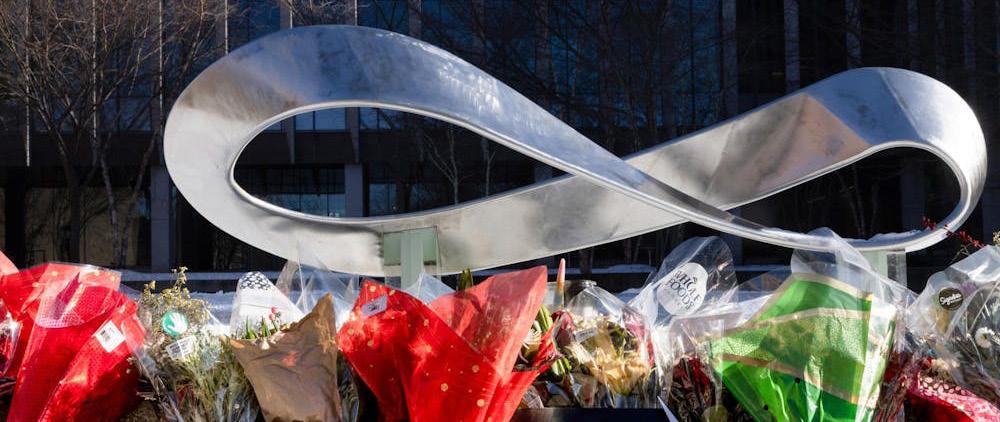
buildings and pavements that will always stand as memorials to Ella Cook ’28 and Mukhammad Aziz Umurzokov ’29.
Rememory explains how the shooting will linger even as we go on with our studies. On College Hill, the past is not something we need to revisit intentionally. Like rememory in “Beloved,” it takes hold of us. It’s something we bump into, walking across the Main Green or taking notes in a lecture.
But rememory is not paralysis. Morrison does not suggest that life stops because the past persists, but rather that moving forward requires acknowledging that the past will move with us. Returning to Brown means accepting that this campus will now hold both grief and joy, rupture and continuity. The task is not to erase one in favor of the other, but to live honestly with both.
Isabella Gardiner ’28 can be reached at isabella_gardiner@brown.edu. Please send responses to this column to letters@browndailyherald.com and other opinions to opinions@browndailyherald.com.
KAIA YALAMANCHILI | HERALD
Editors’ Note: Returning to the newsroom on a campus forever changed
Today’s paper marks The Brown Daily Herald’s first print issue since we lost two cherished members of our community, Ella Cook ’28 and Mukhammad Aziz Umurzokov ’29. This is also our first print edition as the 136th Editorial Board.
Four days after we began our tenure, horror unfolded on campus: On Dec. 13, a gunman walked into Barus and Holley Room 166 and opened fire. Covering the mass shooting presented a profound challenge: How do we report on a tragedy that we, as students, are living through ourselves?
In our reporting, we have worked to shed light on the innumerable ways community members have experienced this violence and its fallout. We also understand our responsibility to create a record that documents what was, and continues to be, an unimaginably painful and pivotal moment in the University’s history.
We are deeply grateful to our staff for the care, stamina and professionalism they brought to this work, particularly over the winter break. As a teaching organization, The Herald is committed to supporting and mentoring the student journalists on our staff. Navigating this responsibility, especially under such devastating, extraordinary circumstances, has profoundly shaped the way we approach our work.
This work begins with ensuring that our staff represents the diversity and vibrancy Brown has to offer. We are committed to cultivating an inclusive environment where every student who enters

The Herald’s office feels welcome.
Now that we are back in the newsroom, we will continue fostering the supportive culture that enables our staff to do our best work. We will closely follow the other ongoing developments across campus and beyond: budget and funding challenges at Brown, the impact of the Trump administration’s attacks on higher education,
housing and cost-of-living pressures, immigration enforcement activity in Providence and this fall’s upcoming elections.
After a tumultuous year of threats to Brown’s federal research funds, our Science & Research section will house stories tracking the increasing politicization of science and, as always, the groundbreaking studies conducted by Brown re-
searchers. Following the opening of the Penner Field House, our Sports staff can’t wait to report on the next era of sports and recreation at Brown. Our Arts & Culture team is ready to cover the events that bring color to Brown, from Spring Weekend to Gigs on the Green.
We are grateful for The Herald’s readers on and off campus, and we are excited to continue ushering The Herald into the era of digital journalism, using data-and website-driven projects to find new ways to tell campus stories. We hope that our website and app serve you as we develop new features and think about how we can engage our readers creatively — we’re particularly excited about the mini crossword and our interactive data projects. We’re also eager to expand our multimedia reporting — integrating engaging videos and photographs to bring our stories to life.
The Herald exists because of the students who sustain it, both those who are on our staff and those who entrust us with their stories.
If there are any stories you believe The Herald should be covering, reach out to us at herald@ browndailyherald.com. We strive to develop coverage that engages our readers in an informative and thoughtful manner.
Editors’ notes are written by The Herald’s 136th Editorial Board: Cate Latimer ’27, Ciara Meyer ’27, Elise Haulund ’27, Claire
Editorial: After Dec. 13, Brown must confront its public safety failures
After the murder of two of our classmates, Ella Cook ’28 and Mukhammad Aziz Umurzokov ’29, and the injury of nine others, Brunonians rushed to leave campus. Just over one month later, as we return to College Hill, the University we love is not the same without Umurzokov and Cook. This semester will be difficult.
Brown has a responsibility not merely to reassure its students, but to confront the institutional failures that left them vulnerable in the first place, and to enact concrete reforms to prevent such violence from happening again. As we see it, there are three areas in which the University must take decisive action: public safety leadership, surveillance and coordination and on-the-ground security measures.
First, Brown must address the leadership failures within the Department of Public Safety and Emergency Management. On Dec. 22, President Christina Paxson P’19 P’MD’20 announced that Police Chief Rodney Chatman had been placed on leave and that Hugh Clements, former chief of police of the Providence Police Department, would assume the role of interim vice president for public safety and chief of police. This change came far too late. In October, the editorial page board argued that mismanagement by Chatman and Deputy Chief John Vinson posed a threat to campus safety. Unfortunately, the University did not act on the two votes of no confidence from both the Brown University Police Sergeants Union and the Brown University Security Patrolperson’s Association.
We welcome this temporary leadership change, but it is difficult for a police department to be effective when the officers and community lack confidence in their leaders. We call on Paxson to permanently remove Chatman and Vinson from their positions to restore public trust in DPSEM. We also call on the University to be fully transparent in its after-action review so that Brown and other universities like it can be more prepared for future threats. This review must explain, amongst other things, why it took 17 minutes after the first 911 call to issue a BrownAlert.
Second, the University and the City of Providence must work to install additional security cameras to respond to and deter crime. Despite there being over 1,200 cameras across campus, the suspect was able to escape largely unseen and commit
further acts of violence. This failure slowed the investigation and forced law enforcement to rely on privately owned Ring doorbell footage to identify the shooter.
Brown is an integrated urban campus, but the University has jurisdiction to place cameras on its property alone. The lack of cameras in Barus and Holley is undoubtedly a failure of the University, but the lack of cameras in the immediate vicinity of campus is a failure of the Providence Police Department. We welcome Paxson’s decision to install additional cameras on campus. We hope the University will take its after-action review and campus safety assessment seriously, and address blind spots wherever they exist. We call on the University to accept Mayor Brett Smiley’s invitation to integrate outdoor cameras into the City’s Real Time Crime Center, strengthening coordination between campus and municipal authorities.
Third, the University must invest in tangible, onthe-ground security measures. Although Brown has expanded card-access controls, installed additional panic alarms and is conducting security reviews, the underlying vulnerability of our open, urban campus remains. We believe that to best protect its students and staff, the University must station more DPSEM patrol officers instead of unarmed security guards in high-traffic locations. When faced with an active threat, unarmed guards can not protect students and staff. While Clements previously stated that there will be “more safety and security officers across academic buildings, residential areas and events,” we call on the University to prioritize hiring public safety officers, who understand and are a part of the Brown community, over private contractors. Furthermore, Brown should invest in physical infrastructure that allows for classrooms without movable furniture to be barricaded.
With the hiring of a new interim police chief, reiterated commitments to security presence and the installation of more cameras, the University has begun to take campus safety more seriously. But progress will be measured not by promises or committees, but by implementation and accountability. We look forward to seeing the results of these changes and know that with diligent leadership, Brown will again feel like the safe campus we once thought it was.
Editorials are written by The Herald’s editorial page board, and its views are separate from those of The Herald’s newsroom and the 136th Editorial Board, which leads the paper. A majority of the editorial page board voted in favor of this piece. Please send responses to this column to letters@browndailyherald.com and other opinions to opinions@browndailyherald.com.
Song ’27, Hadley Carr ’27, Paul Hudes ’27 and Max Robinson ’26.5.
Top row, from left to right: Hadley Carr ’27, Max Robinson ’26.5, Claire Song ’27 and Elise Haulund ’27. Bottom row, from left to right: Paul Hudes ’27, Cate Latimer ’27 and Ciara Meyer ’27.
KAIOLENA TACAZON / HERALD
KAIA YALAMANCHILI / HERALD
ARTS & CULTURE
‘Heated Rivalry’ brings more than just heat
The TV series is a rare success for shows about LGBTQ+ relationships
BY NORA ROWE STAFF WRITER
When “Heated Rivalry” was released on HBO Max, it immediately became a viral sensation for intimate scenes that met the title’s promise. But the six-episode TV series, which follows a secret romance between two gay hockey players, offers much more than just steaminess — it provides a rare moment of representation for queer men in sports.
Based on the romance book series titled “Game Changers” by Rachel Reid, “Heated Rivalry” extends beyond its portrayal of intimacy, as its stars skillfully paint a sensitive and hopeful picture of queer love.
The show, filmed in less than forty days on a tight budget, is driven by outstanding performances from its starring actors, who play Ilya Rozanov (Connor Storrie) and Shane Hollander (Hudson Williams). Storrie portrays the tortured stoic, revealing layers of depth and soulfulness as his character develops. Meanwhile, Williams is the image of the high-strung professional sports player who brings down his walls for love. Each actor endows their character with a vibrant identity beyond their sexuality.
The central message of the show is perhaps best depicted at the beginning of the season finale, when fictional hockey player Scott Hunter (François Arnaud) — who plays for a different team in the Major League Hockey, a fictional stand-in for the National Hockey League, and very publicly came out as gay in the previous episode —

is named Most Valuable Player at the MLH awards. In his acceptance speech, Hunter speaks to the power of love against a sports culture seeped in homophobia: “Fear is a powerful thing. But then, I found the one thing that is more powerful.”
What the show sometimes lacks in inventive dialogue — how many times can Shane call Ilya an asshole? — it makes up for in stellar, clever cinematography. In one standout shot in episode four, Ilya calls his father while dwarfed by lifeless modern art in his showroom-like mansion, an example of how the show follows its characters through settings that mirror their opulent yet sometimes lonely lives.
The engrossing plot also overcomes the
rocky foundation of the script. In episode five, titled “I’ll Believe in Anything,” Storrie delivers an ’80s-movie-heartbreak-level three-minute monologue in Russian. In the episode’s final scene, Hunter embraces his longtime boyfriend on the ice after his team wins the championship while the band Wolf Parade’s jangly indie rock song “I’ll Believe in Anything,” which quickly became an internet hit after the episode aired, plays. The camera cuts between characters as viewers — including Shane and Ilya, whose emotions simply leap off the screen — around the world watch the couple kiss. These moments earned the episode a perfect 10/10 rating on IMDb when it premiered, making it one of the
platform’s highest-rated TV episodes.
“Heated Rivalry” is a novelty in a number of ways. It contains breakout performances from actors who, just before getting their starring roles in the show, worked in restaurants to make a living. Unlike in many acclaimed queer stories — such as “Brokeback Mountain,” “Call Me By Your Name” and “Portrait of a Lady on Fire” — the main characters seem to have a chance at a happily ever after. The show is a rare success for TV series that center queer characters — such shows often do not get renewed for second seasons. By contrast, the cast of “Heated Rivalry” is set to begin filming their second season in 2026. By the end of the series, Shane and
Ilya’s seemingly endless yearning pays off: The couple is officially dating, out to Shane’s parents, driving into the sunset and holding hands in true rom-com fashion. “Heated Rivalry” does not shy from difficulty, aptly portraying the triple threat of homophobia, toxic masculinity and fame.
But above all, the show offers a much-needed break from the despair of the modern world. Maybe this is the reason for its popularity — even more than its notorious “heated” intimate scenes.
This article originally appeared online at browndailyherald.com on Jan. 21, 2026.
‘Suffs’ marches to Providence with cheeky songs, uplifting message
The musical chronicles the women’s suffrage movement
BY KENDRA EASTEP SENIOR STAFF WRITER
Tony Award-winning musical “Suffs” opened at the Providence Performing Arts Center on Tuesday, moving audience members with a passionate performance by an all-female and nonbinary cast. Gracing the stage until Jan. 25, the musical reimagines women’s suffrage in the early 20th century while wrestling with themes of gender, race and intersectionality.
The musical chronicles the campaigns of suffragists and historical figures like Alice Paul, played by Maya Keleher, Carrie Chapman Catt, played by Marya Grandy and Inez Milholland, played by Monica Tulia Ramirez.
While the soundtrack does not feature as many hits as “Hamilton” or “Wicked,” several of its songs are both memorable and charming. As leaders of the National Woman’s Party — a political organization fighting for women’s voting rights — celebrate their success at the 1913 Women Suffrage Parade in Washington, D.C., Doris Stevens, played by Livvy Marcus, sorrowfully recalls being called a “bitch” by a man at the protest.
The women of the NWP respond with the cheeky number “Great American Bitch,” where they reclaim the misogynistic

as a badge of female empowerment. In unison, the women shout: “Drink if they’ve called you a nag / Drink if they’ve called you a slut (or a shrew) / Drink if they’ve called you a crazy hag / Drink if the rumors are true / I’m a great American bitch.” The song’s energy infectiously
captures the camaraderie of sisterhood.
The number “If We Were Married” exposes the systemic misogyny of the 1910s in a similarly playful fashion. Brandi Porter plays Dudley Malone, a U.S. Department of State official who flirts with Stevens. She refutes his advances while citing the polit-
ical consequences of marriage for women. When Stevens passionately sang “Because economically speaking / I die by becoming your wife” on Tuesday, the PPAC theater erupted in whistles and applause.
While the musical also amplifies the voices of African American activists such
as Ida B. Wells, played by Danyel Fulton, and Mary Church Terrell, played by understudy Ariana Burks, it ultimately centers around white activism. Although the story highlights how African American women in the suffrage movement felt excluded, it would have benefited from a deeper dive into the significant achievements of Black women’s suffrage groups.
The show concludes with the hopeful “Keep Marching,” a track that has evolved since its first appearance at The Public Theater in 2022, according to Jill Furman ’90, lead producer of the show and a member of the President’s Advisory Council for the Arts at Brown. Furman told The Herald that she was brought to tears when Shaina Taub — the writer and composer of “Suffs” — unveiled the new finale.
“It was astounding,” Furman said. “I think (Taub’s) a genius.”
Though the finale is a celebration of motherhood, femininity and women’s suffrage in the early 20th century, its poignant message about unequal treatment remains relevant today. To Furman, the show illustrates how “progress is possible but not guaranteed.”
If viewers want to make a change, they “have to pick up the mantle from those who came before and keep marching,” she added.
This article originally appeared online at browndailyherald.com on Jan. 22, 2026.
COURTESY OF SABRINA LANTOS VIA HBO MAX
COURTESY OF JOAN MARCUS
Joyce Meimei Zheng (Ruza Wenclawska) and the touring company of Tony Award-winning musical "Suffs."
The show’s highlights are the stellar performances from actors Connor Storrie and Hudson Williams.
FEATURE
Brown alums nominated for 2026 Grammy awards
The group was nominated for “Something In The Water (acoustic-ish)”
BY ANN GRAY GOLPIRA ARTS & CULTURE EDITOR
After taking their talent from campus basements to Broadway and stages nationwide, the soul-pop group Lawrence, which boasts multiple Brunonians among its members, received a nomination for the 2026 Grammy awards.
The nomination adds to their long list of accolades: appearances at notable festivals like the Coachella Valley Music and Arts Festival, opening for The Rolling Stones at MetLife Stadium and nearly 1 million monthly listeners on Spotify.
Siblings Gracie Lawrence and Clyde Lawrence ’15 were touring their fourth studio album, “Family Business,” when they first learned that their song “Something in the Water (acoustic-ish)” had been nominated for “Best Arrangement, Instruments and Vocals” at the 2026 Grammy Awards.
Gracie Lawrence secretly believed she had a “pretty good chance” of being nominated for her work on the Broadway show “Just in Time” — which ultimately received a nomination for “Best Musical Theater Album.” The family band’s nomination, on the other hand, was “a crazy surprise that we were genuinely not expecting,” Clyde Lawrence said.
“Something In The Water (acoustic-ish)” is an alternate version of the band’s song “Something In The Water.” The band started their career with live performances and living-room jam sessions before recording their music, so “having these fun, different arrangements of songs
REVIEW
COURTESY OF DEANIE CHEN
Clyde Lawrence '15, Gracie Lawrence and Linus Lawrence '25. The three collaborated on the song “Something in the Water (acoustic-ish),” which was nominated for “Best Arrangement, Instruments and Vocals” at the 2026 Grammy Awards.
was second nature to us,” Clyde Lawrence said. Their experience reimagining their music led them to create new versions of several songs that developed into their live album, “acoustic-ish: an album…ish.”
“We kind of jokingly realized that acoustic was not really a proper name for it,” said Clyde Lawrence, laughing while explaining the series’s title. As the Lawrence siblings’ ideas for the project “started getting more and more complex,” with
additional instruments and vocalists, they relabeled it “acoustic-ish.”
Their brother Linus Lawrence ’25 — a former sports editor at The Herald — also helped produce the “acoustic-ish” series, aiding in the vocal arrangement of “Something In The Water (acoustic-ish).”
At Brown, he served a variety of roles in the campus music scene — including as a member of the a cappella group “The Bear Necessities” and founder of Beach Boys
cover band The Stowaways.
Linus Lawrence had already expressed his interest in the project due to his love for the original “Something In The Water” song, so the two brothers ultimately chose to arrange the live recording’s vocals together.
Since Linus Lawrence is not an official member of Lawrence and has only participated in this specific project, he noted that his inclusion in the nomination was
“statistically shocking” and “absolutely bonkers.”
“This is literally the one thing in the entire 11-year history of Lawrence that I have ever had a creative credit on,” he said.
Beyond the group’s recent Grammy nomination, Clyde Lawrence and the rest of the band also made their Broadway debut this December, creating original music for Tony award-winning director Alex Timbers’s show “All Out: Comedy About Ambition.”
This is far from Gracie Lawrence’s first time on a Broadway stage. She portrayed singer and actress Connie Francis for six months in the Broadway musical “Just In Time.” The show’s original cast recording also received a 2026 Grammy nomination for “Best Musical Theater Album” — Gracie Lawrence’s second nomination of the season.
Reflecting on their musical journey, both Gracie and Clyde Lawrence emphasized Brown’s unique contribution to their careers.
Clyde Lawrence fondly recalled playing in campus basements and at parties — and how then 14-year-old Gracie Lawrence would visit on weekends to perform alongside him and his bandmates.
“The band that is playing tonight on a Broadway stage is the exact same group of people that played basement parties on John Street during my junior year of college,” he said. “Brown is such a meaningful part of our story.”
While she dropped out before graduating to further pursue her music career, Gracie Lawrence holds her time at Brown in high regard.
“I have so much love for (the Brown) community and appreciation for what it gave me,” she said. “Our whole band would not exist without Brown.”
‘Nuremberg’ transports viewers into the mind of man who befriended Nazis
Russell Crowe and Rami Malek stun as a Nazi and American psychiatrist
BY TALIA LEVINE ARTS & CULTURE EDITOR
After Hitler’s second in command is imprisoned in May 1945, an American psychiatrist arrives in Europe tasked with ensuring that the prisoner, along with other Nazi leaders, are mentally fit to stand trial — and that none of them die by suicide before that time. But over the course of his time in Nuremberg, he begins to see himself in the genocidal masterminds he has been ordered to treat.
The film “Nuremberg,” directed by James Vanderbilt, captures this story in a cinematic adaptation of journalist Jack El-Hai’s 2013 biography “The Nazi and the Psychiatrist: Hermann Göring, Dr. Douglas M. Kelley and a Fatal Meeting of Minds at the End of WWII.”
After World War II, top surviving Nazi leaders were tried for war crimes in Nuremberg, Germany. Testimony and documents presented at the Nuremberg Trials revealed considerable information and visual evidence of the horrors of the Holocaust publicly. At just under 150 minutes, Vanderbilt’s film follows American psychiatrist Douglas Kelley (Rami Malek) as he assesses the Nazi Party leaders held in Nuremberg Prison for committing these atrocities.
Throughout the film, Kelley attempts to get close with the prisoners — all of whom have committed countless crimes as Nazi leaders. The film zeroes in on the complex relationship between Kelley and Hermann Göring (Russell Crowe), a Nazi official widely viewed as second-in-power only to Adolf Hitler himself. It is a true history whose monumental and delicate nature requires the utmost care and intention, and Vanderbilt’s adaptation hits the mark.
In particular, Crowe’s performance of Göring is stellar. His stunning evocation of his character’s relationship with Kelley makes this role stand out in Crowe’s storied career. What starts as Kelley’s attempt to define evil morphs into a genuine, haunting connection between him and Göring over the course of the film. Eventually, Kelley sees himself in the Nazi and considers him a genuine friend.
Associate Supreme Court Justice Robert H. Jackson’s (Michael Shannon) efforts to establish an international tribunal complement the central story. But while Shannon’s performance is also exceptional, Jackson’s portions of the story can’t hold a candle to Vanderbilt’s exploration of Kelley and Göring’s relationship.
The film also follows interpreter Howard Triest (Leo Woodall), a German-born Jewish American whose parents disappeared at Auschwitz. Triest spends countless hours working as Kelley’s interpreter, all while keeping his Jewish identity hidden.

The revelation of Triest’s religion is one of the most haunting yet moving scenes of the movie.
In a desperate plea to Kelley, Triest tells the doctor that he wants to reveal that he’s Jewish to the imprisoned Nazis. “I want to tell Streicher,” Triester says, referring to a leading propagandist for the Nazi Party Julius Streicher. “I want to tell him right before they put that rope around his neck, I’m going to tell that piece of shit that he
was confiding in a Jew.”
In the film, it is this plea that compels Kelley to return to the Nuremberg Prison and give Jackson the information necessary to hold Göring accountable.
While the movie doesn’t depict Kelley’s life following the trials, in real life, the psychiatrist killed himself the same way Göring did — by swallowing cyanide.
Malek portrays Kelley’s desire to do good in parallel with his descent into in-
sanity with great depth. His performance, as well as Crowe’s, will stick with viewers long after the conclusion of the film. By the end of the film, the viewer is transported inside Kelley’s mind and leaves feeling almost guilty that they, like Kelley, pitied Göring in spite of his atrocities.
This article originally appeared online at browndailyherald.com on Jan. 22, 2026.
COURTESY OF SONY PICTURES CLASSICS. Hermann Göring (Russell Crowe), the second most powerful Nazi official, at the Nuremberg Trials. This performance is one of the standout roles of Crowe’s storied career.
SCIENCE & RESEARCH
GUN VIOLENCE
Gun violence scholars reflect on firearms in society following mass shooting
Scholars spoke on factors that may contribute to gun violence
BY ELIZABETH ROSENBAUM SENIOR STAFF WRITER
On Dec. 13, an active shooter entered Barus and Holley, killing two students and injuring nine others. The shooting sparked debate surrounding gun violence and policy in the weeks following.
The Herald spoke to four scholars who reflected on historical, global and economic factors that contribute to gun violence and how these influences may have played a part in the mass shooting.
Dominic Erdozain P’29, a research fellow at Emory University’s Candler School of Theology, offers a historical perspective on the shooting. In an email to The Herald, he pointed to the United States’ gun laws that enable “anyone to convert private rage into public violence.”
“There is a debate about mental health,” Erdozain added. “But it’s an evasion of the real cause: universal access to deadly firepower.”
Kate Birkbeck, a postdoctoral research associate at the Watson School of International and Public Affairs, wrote in an email to The Herald that “access to weapons is at the heart” of why tragedies like these happen.
Birkbeck researches gun violence through the perspective of suppliers, fo-
cusing on where the weapons in acts of political violence come from. Looking at gun violence through this perspective — as opposed to the regulation of gun owners and users — has the potential to produce more solutions.
“America has a gun violence problem that is structural, but also the way that our current gun violence problem happened is a product of contingent history that has changed over time,” Birkbeck said.
In an email to The Herald, she added that “masculinity, far right ideology (and) increasing connectedness of online life” may also be factors that contribute to this violence.
“It’s not necessarily that people are evil in and of themselves,” León Castellanos-Jankiewicz, a senior researcher at the Asser Institute for International and European Law in The Hague, said in an interview with The Herald. “Research shows that having access, easy access to weapons … enhances the likelihood that violence will happen,” he explained.
The effects of gun violence extend beyond “physical injuries caused by bullets,” Ieva Jusionyte, a professor of international security and anthropology and the director of the Center for Human Rights and Humanitarian Studies, wrote in an email to The Herald.
“These ripple effects are not always easy to see, to identify (or) even to acknowledge, but it is important to do that in order to begin healing,” Jusionyte wrote. “I think this is true for us at Brown too.”
Jusionyte researches the impact of

state laws and policies on individuals and communities. She is “hesitant” about developing immediate responses or solutions — such as stricter gun laws or better access to mental health — “until we know what exactly went wrong with this person” or what would have been able to “prevent” the shooting.
Rhode Island “has quite strong gun laws and it is one of the states with least gun violence,” Jusionyte wrote. “But that doesn’t mean policies can prevent all such meticulously planned attacks, especially when guns can be so easily brought across state lines.”
In her research, Birkbeck said even places with “good gun regulation” can be affected by guns brought from elsewhere. The shooting has “re-edified my sense that we can come together (to push) for
federal solutions because we understand that this will not be fixed at the state level,” she said. “That’s always been true in history, but it feels more true today,” Birkbeck added.
For Birkbeck, the student-driven collective action on Brown’s campus following the shooting is “really powerful at this time.”
“There’s infrastructure at Brown that we could build out to make powerful lobbying between student demand action and dissenters because … the student body of Brown is so fantastic,” she said.
While fighting for legislative changes in response to the shooting is important, Erdozain noted that communities “need to take a much more holistic approach to the problem.” His research focuses on the evolution of the acceptance of gun violence
Three Brown seniors named 2026 Schwarzman Scholars
Students will attend Tsinghua University in fully-funded program
BY IVY HUANG SCIENCE & RESEARCH EDITOR
After graduation this year, three Brown seniors — Hpone Thit Htoo ’26, Elliot Smith ’26 and Rishika Kartik ’26 — will attend Tsinghua University in Beijing as a part of Schwarzman Scholars’ 11th cohort of admitted students.
Schwarzman Scholars is a fully-funded one-year master’s program in global affairs that aims to “address the complex geopolitical landscape of the 21st century” and “prepare the next generation of global leaders,” according to the program’s press release. The program selected 150 scholars from just over 5,800 candidates worldwide this year, the release added.
“We are looking for people of impact who have already shown evidence of what we call ‘demonstrated leadership’ in their life,” said Schwarzman Scholars Director of Global Admissions Wyatt Bruton. “Brown University has been an incredible place for us to identify really, really talented leaders who have made an impact.”
The Herald spoke with Brown’s three 2026 Schwarzman Scholars about their passions and what they plan to pursue as Schwarzman Scholars.
‘I wanted to venture out and complete the narrative’: Hpone Thit Htoo ’26
Htoo learned he was going to be a Schwarzman Scholar through a phone call on his way to class.
Coming from Myanmar, Htoo was intrigued by developments in international re-
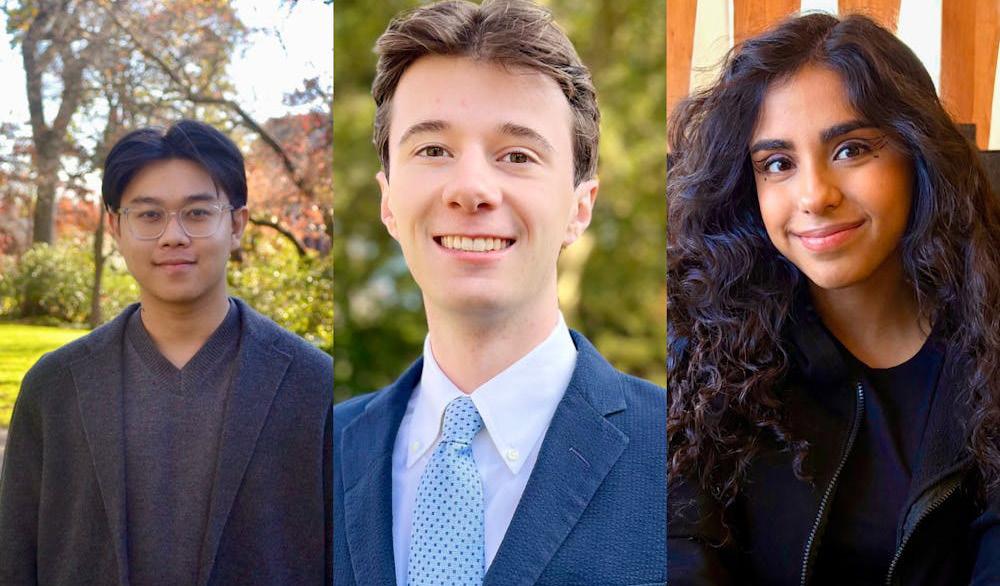
lations around Southeast Asia. “Growing up in Southeast Asia,” Htoo said, “you feel a lot of the geopolitical tension that comes with the U.S.-China rivalry.” By engaging with students from various countries, he hopes to learn a “non-U.S.-centric approach” to global governance.
“I realized that I've had such a privilege and honor to be studying here at Brown,” Htoo added. “I wanted to venture out and complete the narrative by going back home to Asia.”
Htoo “has big ambitions, but he really wants to combine that with purpose,” said Thomas Tomezsko ’17, a selection and outreach officer for the program. “He wants to lift up Myanmar to a place of more prominence in international affairs, and he wants to bring more prosperity for its people.”
Initially, Htoo saw himself entering “tech, consulting (or) banking,” but after interning at the professional services firm Deloitte sophomore year, he realized that he wanted to branch out. In his junior summer, Htoo interned at the Center for Strategic International Studies, a nonprofit policy research think tank, where he found his pas-
sion for foreign policy and geo-economics.
At Brown, Htoo is a Career Development Co-Chair for the Economics Departmental Undergraduate Group. He also co-founded BatAware, a public health platform that won Brown's 2024 Hack for Humanity.
J. Brian Atwood, a senior fellow at the Watson School of International and Public Affairs, who wrote Htoo’s letter of recommendation for the program, recalled meeting Htoo in two of his classes, IAPA 1701N: “Diplomacy, an Art That Isn't Lost” and IAPA 1702A: “Diplomacy and Development: Related but Different Missions.”
“He was a natural leader in the classroom,” Atwood added. “He deserves it. I think he is going to be a global leader.”
‘Bringing people together’: Elliot Smith ’26
A double concentrator in international and public affairs and computer science, Smith hopes to combine his interests as a Schwarzman Scholar.
“China is such a big player with many emerging technologies, so I wanted to really get an understanding of how they’re
thinking about regulating those technologies and the impact they’re going to have on the world in the coming years,” Smith said.
Last year, he was the Editor-in-Chief of the Brown Political Review, where he sought to create a platform where people of different backgrounds and views could “engage with current events respectfully and intelligently.” As a Schwarzman Scholar, he hopes to continue his passion for “bringing people together.”
Smith “came across as really mature and thoughtful and inclusive throughout his entire interview and application process,” Tomezsko said. “He really wants to make sure that (artificial intelligence) and other emerging technologies are approached with ethics and also are mutually beneficial across borders and cultures.”
Smith has also interned for the U.S. Department of State and the U.S. Department of Defense, according to Tomezsko.
“I'm really excited about the chance to be immersed in China,” Smith said. “My goal coming into the program is really to meet as many people as possible, to engage with different perspectives and to contribute my perspective, so we can come towards that interdisciplinary understanding of how we drive global change.”
‘Disability doesn’t discriminate’: Rishika Kartik ’26
Kartik studies biology and accessible design, an independent concentration she created to focus on “product design for people with disabilities.”
In high school, Kartik volunteered at the Colorado Center for the Blind, where interactions across cultural lines exposed her to “many people who thought about their disability differently,” she said.
As a Schwarzman Scholar, Kartik hopes
in the United States.
“You don’t realize how much power you have when you start making cultural choices in your conversation, friendships, how you spend your money, what you subscribe to, what you watch,” he said. “We’re all part of these problems in ways that we don’t recognize.”
Erdozain noted the importance of acknowledging the presence of gun violence. “You have to say that gun violence is caused by guns,” he said.
“We’re failing as a democracy if we can’t protect our places of learning,” Erdozain said. “You don’t want firearms in places of learning.”
This article originally appeared online at browndailyherald.com on Jan. 22, 2026.
to continue gaining “global exposure” to different perspectives on disability. China has large aging and blind populations, Kartik noted, which made it an “obvious choice” to meet this goal.
“Disability doesn’t discriminate,” Kartik said. “It’s one of the only issues that most people can agree on in an era that’s increasingly divided and polarized.”
Kartik was a 2023 Royce Fellow at the Swearer Center for Public Service, where she pursued a project combining her passions for accessibility and art. Kartik also delivered a TEDxBrownU talk titled “Creativity is More Accessible than Meets the Eye” that has garnered over 1.4 million views on YouTube.
Professionally, Kartik is interested in rehabilitation ophthalmology, which she described as a field that aims to develop interventions to prevent blindness, “optimize the vision that people have” and create "accessible design solutions for people that have gone blind.”
“Our interviewers and our application readers thought that she was one of the most exciting applicants that we’ve seen,” Tomezsko said. “She just comes across as someone who is incredibly talented in the space of disability advocacy.”
When reflecting on an essay she submitted in her application, Kartik said she wrote about the leadership approach of Maurice Peret, a leader with the World Access Board for the Blind.
“He emphasizes being both a forger and a steward,” Kartik said. “The most enduring forms of leadership not only carve new paths, but they also strengthen those already laid.”
KAIA YALAMANCHILI / HERALD
The effects of gun violence extend beyond “physical injuries caused by bullets,” wrote Professor of International Security and Anthropology Ieva Jusionyte.
COURTESY OF HPONE THIT HTOO, ELLIOT SMITH AND RISHIKA KARTIK
The program selected 150 scholars from just over 5,800 candidates worldwide this year.
SCIENCE & RESEARCH
LLM reasoning has striking similarities with human cognition, Brown researchers find
The study suggests that LLMs match human decision-making processes
BY NISHITA MALHAN SENIOR STAFF WRITER
thor Roman Feiman, assistant professor of cognitive and psychological sciences and linguistics.
In one of the researchers’ experiments, an LLM or human subject had to evaluate evidence and figure out a predetermined but hidden “rule,” Feiman explained.
“Based on that feedback, you can adjust your hypothesis about what you think it … might be (and) that helps you hone in on the rule,” Feiman explained.
Researchers found that LLMs are “generally, on average, more human-like (than other AI models) even whether they are right or wrong,” Feiman said.
In an email to The Herald, Michael Frank, professor of psychology and brain science and director of the Carney Cen ter for Computational Brain Science, commended how the paper asked these questions. Frank was not involved with
“I think I was sold on those arguments a little bit too much,” Feiman said. “That’s what made this study so interesting for me, because it really changed my mind.”
EMILY MCSHANE / HERALD
CANCER
The LLMs underwent a similar “binary classification task” where the model had to label whether the shape fit the “class there?”
“It can be insightful to ask not just whether the AI can achieve similar abilities
haviours align more with humans than other
fessor and Chair of Cognitive and Psychological Sciences David Badre, who was not involved in the study, wrote citing “because it suggests these networks are not simply simulating the behaviors of human decision makers, but relying on
According to Feiman, the cognitive science field has held claims since the ’80s that no matter how close AI gets to human cognition, there is one feat the computers’ neural networks will not achieve: logical reasoning.

A challenge in experiments dealing with LLM subjects is that it is difficult to ensure that the LLM has not encountered something similar in its training data, Feiman explained.
“LLMs are trained to predict human language, and so (they) are implicitly incentivized to mimic human cognitive processes,” said postdoctoral researcher Jake Russin, who researches under Pavlick and Frank and was not involved in the study. “This makes it difficult to know, in cases where behavior is human-like, whether this is because of shared fundamental principles or merely because the model has learned to imitate humans.”
Feiman noted that though LLMs may not always be the most accurate models, they are the most human-like compared to other computational models.
Like humans, LLMs display biases like belief bias — the idea that people, even when presented with adverse evidence, will stand by their preexisting beliefs. Understanding the mechanisms of these biases in AI can help researchers understand their mechanisms in humans, Feiman said.
Research like this draws upon larger, more philosophical debates in the field of cognitive science.
According to Pavlick, this research begs the question: “What makes us human, and to what extent can it be replicated in machines?"
This article originally appeared online at browndailyherald.com on Jan. 22, 2026.
Nanotechnology may be used in targeting tumors, Brown study finds
Engineered nanoparticle drug significantly suppressed tumors in mice
BY ANGEL LOPEZ SENIOR STAFF WRITER
In a recent study about enhancing the precision of a therapeutic drug to target tumors, the Desai Lab — led by principal investigator and Dean of Engineering Tejal Desai ’94 — succeeded in using nanoparticles to deliver antibodies that stimulate local immune cells.
During the project, mice were injected with cancer cells and monitored for tumor growth, said Emilia Herdes ’25, who worked on the project during her undergraduate years. Mice who received the nanoparticle treatment had “significantly suppressed” tumor growth compared to their untreated counterparts, who saw continued growth, Herdes added.
“Scientists have … developed a powerful drug” that can activate an immune response against tumors, Desai wrote in an email to The Herald. “But if the drug is just injected into the body, it can go everywhere, causing toxic side effects.”
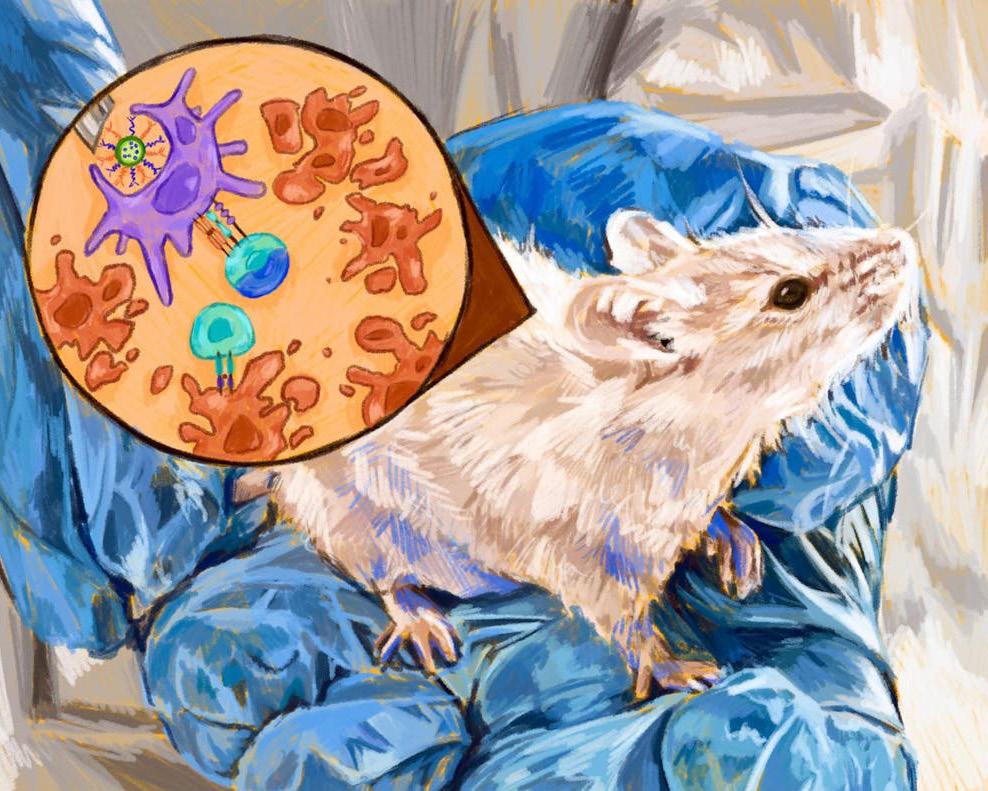
The nanoparticle is partially composed of DNA, whose unique structure allows highly specified placement of antibodies like “linking logs,” said Kayla Mash, who graduated from the University of Colorado Boulder and worked on the project through the Leadership Alliance’s Summer Research Early Identification Program. The DNA scaffolding of the particle allows for the precise control of “the ratio of different targeting antibodies,” Desai wrote. This “allows the particle to hone in on specific” cells that alert the immune system to attack the tumor “with precision,” she explained. “The ability for us to add two antibod-
ies on the surface is really novel, because in the past, most people have only been able to add one antibody on the surface,” Herdes said. “That limits the response in a wide variety of people, because different people have different amounts of receptors for one specific antibody.”
Due to the “programmable” nature
JJ LI / HERALD
of the nanoparticle, researchers are able to “swap out the antibodies or the drugs to target different diseases — like autoimmune disorders or different types of cancer — without having to reinvent the entire nanoparticle,” Desai wrote.
“It’s essentially a ‘plug-and-play’ system for the future of therapeutic targeting,” she added.
Deblin Jana, a senior research associate in the Institute of Biology, Engineering and Medicine and the lead author of the paper, described the nanoparticle as a “velcro-type situation.”
“The advantage of this platform compared to any other platform that is in the market right now is that you can actually load almost 100% of whatever your biomolecule is given,” Jana explained, noting that other platforms can only reach a third or fourth of the theoretical value.
Unlike chemotherapy treatments, during which drugs are released to the entire body, Mash added that the engineering of the particle allows the antibodies to target specific cells. The particles are also less likely to be rejected by the body because nanoparticle systems are so small, she explained.
Yizhou Dong, a professor of nanomedicine at the Icahn School of Medicine at Mount Sinai, found the study to be “comprehensive” and was impressed by the design of the nanoparticle.
The project builds upon technology that was first developed at Desai’s lab at the University of California, San Francisco, Desai wrote.
“There’s just many different things that should be researched using a platform like this,” said Justin Moustouka ’25 GS, who worked on the project as an undergraduate. “There’s opportunities to go into different diseases and different cancers.”
UNIVERSITY NEWS
Students reflect on returning to campus following mass shooting
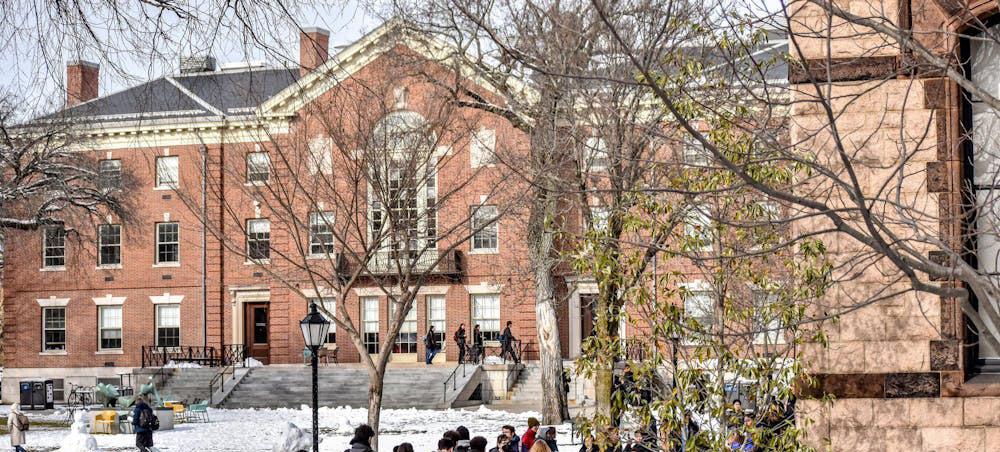
Students
approach
BY DONNA ZHANG STAFF WRITER
When Eva Skelding ’28 returned to campus Tuesday evening, she found her dorm room still disheveled from the barricade she built during the Dec. 13 shooting.
Although returning to campus “will definitely be difficult,” Skelding wrote in a message to The Herald, “I’m so glad to be back because I think the most important thing is to be able to grieve and process with the rest of the community.”
presence,” expanded swipe access and investments in infrastructure “such as additional blue light phones The Herald previously reported that the University has already implemented security enhancements, including additional cameras and door alarms, in Barus and Holley, the Engineering Research Center and the Lassonde
ing.” Currently, the University has stated that most academic buildings will be open to students between 7 a.m. and 8 p.m. with some exceptions, The Herald previously reported.
Even though “buildings at night usually get locked,” Tiong hopes the University might expand access for students looking
situation,” Skelding wrote. “I think this tragedy has revealed how close we all are as a student body and how valuable that bond can be when we need it the most.”
The University also launched Brown Ever True to support community healing and recovery efforts, The Herald previously reported. According to Clark, “students
The most important thing is to be able to grieve and process with the rest of the community.
Eva Skelding '28
the new semester with an array of emotions “
Like Skelding, many students are grappling with a mix of emotions as they settle back into campus life. One student, Don Shumbusho ’28, told The Herald that they are looking forward to getting back to Brown but also recognized the strangeness of the experience.
Shumbusho added that “it’s going to be weird to just be walking around” Barus and Holley, where one of his classes is taking place.
Although the transition comes with uncertainty, Jimmy Kaplan ’28 “feels ready to go back to campus,” he said. “It’s this weird feeling of wanting everything to go back to normal but knowing it’s not really possible for that,” Kaplan added.
Aaron Tiong ’28, who was on the seventh floor of Barus and Holley during the shooting, said that the experience was “a wake-up call” to “how precious life is.” Tiong believes and hopes that “there will be a sense of community once we do get back,” he added. “We should move forward and really help each other.”
The shooting punctuated the first semester of college in the United States for Sophie Sun ’29, an international student from Beijing. “Part of me questions the safety of America as a country,” she said, noting that she feels that many of her international student peers chose to attend Brown for its relative safety.
“This is our first semester,” she said. College “just began, and this is how the semester ended.”
According to an email to the Herald from University Spokesperson Brian Clark, Brown is continuing to maintain a series of enhanced security measures, including “increased and visible public safety
“
“ “ “ “ “ “ “ “ “ “ “ “
I think there's a big sense of community right now.
Caitlyn Roddy '26
Nobody took your power away from you. Community is our power.
Don Shumbusho '28
This is the Brown we know.
Sarah Kim '28
Going back to Barus and Holley will definitely be kind of intimidating.
Tate Bregman '28
We should move forward and really help each other.
Aaron Tiong '28
Seeing Brown again, and that community, is going to be really healing.
Jimmy Kaplan '28
accompanied by a range of additional services, “from acu-wellness and pet-assisted therapy sessions to virtual and in-person community gatherings in affinity centers and residence halls,” he wrote.
For Kaplan, Brown Ever True is “not just important, but essential.”
“It’s good to know that those resources are there and that the University is providing us options,” he said, adding that he will recommend them to people he feels might need the support.
“The few days after the event, I was feeling really unsettled personally and I kept thinking back to what happened,” Sun said. “It’s through initiatives like (Brown Ever True) that we are able to normalize the experience that we go through after traumatic events.”
Clark emphasized that healing is different for everyone. “Recovery is a gradual process,” he wrote. “Brown is committed to meeting students where they are and working to move forward together with care, patience and compassion.”
Some students are concerned about how the campus culture may be affected. Shumbusho worries that Brown’s open campus culture will be diminished, which “might be a sacrifice we need to make for safety,” but can also “completely shift how open we are to having people on campus or allowing people to walk around freely.”
Sun said that safety-wise, she feels comfortable returning to campus. She is more concerned about the mental status of her peers.
“I fear that it will make people more distant because they may feel uncomfortable in this situation,” she said. But Sun added that the tragedy has “matured” students, which places “more importance” on their remaining time at Brown.
Innovation and Design Hub.
“I definitely think the cameras will make people feel more safe as everything will be recorded,” Shumbusho said. But they added that “seeing the increase in DPS on campus, having to swipe into all your buildings now, might be a constant reminder of what happened.”
Tiong hopes that with increased ID swipe requirements, the University will give students “24/7 access to every build-
to study since the spaces will be locked to those without Brown ID swipe access.
Amid some fear and uncertainty, many students looked forward to returning to their friends and a shared community.
“Seeing Brown again, and that community, is going to be really healing,” Kaplan said.
“It’s hard to replicate the deep sense of understanding that comes from talking to people who went through the same
have access to a broad set of supports, including 24/7 care through the Administrator on Call and the Department of Public Safety and Emergency Management” and accessible Counseling and Psychological Services appointments.
Clark added that “beginning Jan. 20, clearly marked tables staffed by trained personnel and mental health professionals will be available to students in multiple locations across campus.” These will be
“It makes me want to give back more to the community and to hold the people around me tighter,” she said. As Class Coordinating Board Freshman Vice President, Sun hopes to “organize any events that can bring people together and make them feel better about the recovery.”
Shumbusho hopes the path forward will center solidarity and collective strength. “You are not powerless,” he said. “Nobody took your power away from you. Community is our power.”
SELINA KAO / HERALD