
THE BROWN DAILY HER ALD

Paxson details University response to Dec. 13 in first sit-down interview since shooting
U. has aimed to balance healing, safety and celebrating campus strength
BY ROMA SHAH AND JEREMIAH FARR UNIVERSITY NEWS EDITOR AND SENIOR STAFF WRITER
On Dec. 13, the Brown community lost two students in an act of mass violence on campus.
Just five minutes before the shooting took place, President Christina Paxson P’19 P’MD’20 took off on a plane to Washington D.C. Typically, on a flight of that length, Paxson said she does not buy WiFi — she appreciates the brief break from work. “I get an hour, hour and a half to not have that bother,” Paxson said.
That day, though, Paxson’s flight was diverted to Pittsburgh due to inclement weather. Because of the added time she would spend in the air, Paxson purchased the internet around 5 p.m.
“So I get it, turn it on. My phone is blowing up,” she said. “Then I had to sit through that flight, get to Washington, turn around, come back to Providence right away.”
Now — just over two months later — Brown’s campus is attempting to strike a balance between grief and healing.
The Herald spoke with Paxson for her first sit-down interview after the shooting to discuss the night of Dec. 13, the University’s response to the shooting and plans moving forward.
The night of Dec. 13
The Providence Fire Department received the first call reporting the shooting at 4:05 p.m., and Brown’s Department of Public Safety and Emergency Management released its first alert at 4:22 p.m. The alert warned of an active shooter and directed community members to “Lock doors, silence phones and stay hidden until further notice.”
Members of the University community later learned that Ella Cook ’28 and Mukhammad Aziz Umurzokov ’29 were killed in the shooting. Nine other students were injured.
Paxson declined to comment on the 17-minute gap between the first call to emergency services and the campus alert. She pointed to the not-yet-released third-party after-action review carried out by global consulting firm Teneo as the best resource to find information related to
the University’s response on Dec. 13.
The shooting occurred in Barus and Holley Room 166, where a teaching assistant for ECON0110: “Principles of Economics” was holding an optional review session before the class’s final exam.
In a press conference around five hours after the shooting took place, Paxson said she didn’t know what had been taking place in the room where the shooting happened. Paxson’s response was critiqued as seeming aloof or ill-informed.
The University’s priority “was to make sure that our students and others in the community were safe, and to start the in-
Dining Services employees slept on army cots in Ratty, V-Dub during blizzard
In previous years, employees were offered private rooms on campus or hotels
BY EMILY FEIL UNIVERSITY NEWS & METRO EDITOR
As a record-breaking 37.9 inches of snow fell on Providence on Sunday night, staff members from Dining Services slept on army cots in the Sharpe Refectory and Verney-Woolley Dining Hall. As essential workers, Dining Services employees were expected to come into work during and after the blizzard.
The current contract between the University and the United Service and Allied Workers of Rhode Island — which represents Dining Services — states that “in anticipation of severe storms, the University will provide sleeping cots and bedding for Dining Services employees who must remain on site for the evening.”
The same provision is in the previous union contract that began in 2021. According to United Service and Allied Workers Business Agent Amy Cardone, it also appeared in contracts from 2018 and 2000.
But for the past 15 to 20 years, employees have been offered stays at the Hope Club or nearby hotels during inclement weather, according to multiple employees. Vice President of Dining George Barboza confirmed that this had been the case in previous years.
BLIZZARD
Record-breaking blizzard brings 37.9 inches of snow to Providence
The blizzard is the largest in Rhode Island history, surpassing the Blizzard of ’78
BY KELLY DING SENIOR STAFF WRITER
“Some emergency personnel from DPSEM have made use of hotel rooms as we’ve worked to maintain the essential presence of law enforcement and emergency responders on campus this week,” Clark wrote in an email to The Herald.
“Given variations in roles, work locations, responsibilities, collective bargaining agreements and other factors, we’ve deployed multiple solutions across units to keep essential services operational,” he added.
Dining Services employees are not paid for the time they spend on campus overnight. According to Barboza, for each hour employees work during an administrative closure, they are given an hour of compensatory time — paid time off that can be used at a later date.
But because Gov. Dan McKee declared a state of emergency in Rhode Island on Sunday, employees had the option to be compensated instead of receiving paid time off for working overtime, in alignment with their contract.
Verney-Woolley Dining Hall Lead Cook Rabbit Hoffinger said he decided to sleep at his sister’s house nearby. He said that some employees decided not to come into work because they would be required to sleep on cots instead of being housed at hotels
The switch to army cots deterred some employees from staying in dining halls overnight, six employees told The Herald. According to Barboza, 14 staff members — excluding management — stayed on campus overnight on Sunday. But not all essential workers are sleeping on cots. According to University spokesperson Brian Clark, members of Brown’s Department of Public Safety have been provided hotel rooms during the blizzard.
A historic 37.9 inches of snow fell in Providence as of 1:31 a.m. Tuesday, as measured at T.F. Green Airport. The snowstorm is the largest recorded in state history, surpassing the long-standing record of 28.6 inches set by the Blizzard of ’78.
The one-day snowfall record of 19 inches set in 1996 was also surpassed by over a foot on Monday, with 35.5 inches of snow recorded by 7 p.m.
On Sunday, Gov. Dan McKee declared a state of emergency and issued a travel ban on all roads due to the severe weather conditions. The City of
Providence also enacted a parking ban beginning on Sunday “to allow snowplows to clear roadways effectively,” according to an announcement from Mayor Brett Smiley’s office.
These measures are “critical for public safety” because “they allow emergency responders to reach those in need and ensure Department of Public Works crews can clear roads as quickly and safely as possible,” Kristy dosReis, Providence’s chief public information officer for public safety, wrote in an email to The Herald.
She strongly urged Providence residents to “stay indoors and avoid travel unless absolutely necessary,” and stressed the importance of dressing in layers when outside. She wrote that individuals should contact Rhode Island Energy when facing power outage

vestigation,” Paxson explained. Finding out what exactly was happening in the room was “not something that was of critical importance or concern,” she said.
According to Paxson, Brown has “a really well-developed protocol for management of emergencies writ large.” In case of an emergency, the University has protocols in place where pre-selected individuals are brought into a “virtual room” to manage the event, she said, adding that this process was “put into place right away.”
Prior to the shooting, the University did not have “mandatory active shooter drills on the campus,” Paxson said. “We’ve had them, but they’re not mandatory,” she added, noting that groups such as academic units and clubs could request individualized training for their communities.
The University has “not done active shooter training with students at Brown” unless they were part of a department that requested students specifically be part of the training, Paxson said.
“We will be doing more with more members of the community going forward,” she added.
The DPSEM held its most recent hostile intruder training last summer — around six months prior to the shooting — in conjunction with the Providence Police Department, Providence Fire Department, Brown Emergency Medical Services and the Rhode Island Nursing Education Center.
The immediate aftermath
Since the shooting, Paxson and other administrators have interacted with leaders at other schools that have gone through similar tragedies. Last week, Paxson said she spoke with the principal of Marjory Stoneman Douglas High School in Parkland, Florida, which was the site of the deadliest high school shooting in U.S. history.
Though the experience at a high school is very different from a university, Paxson said. “Every time you talk to somebody, you get more valuable insights on how you manage a recovery process from something like this.”
In the days and weeks immediately following Dec. 13, misinformation and disinformation disseminated online, leading

to the doxing of members of the Brown community, including a student who some believed matched the description of the shooter.
“That was a very disturbing situation to see that misinformation out there in the media and spread very widely,” Paxson said. “We were in close contact with that student to support them and make sure that they were getting what they needed during what was a really awful situation for them.”
The weeks-long investigation following the shooting was handled by the PPD and the FBI. “We wanted to be as fully collaborative as we could be,” Paxson said. “That meant providing information on anything that they wanted to know about our police response, anything they wanted to know about campus buildings. We provided video access.”
On Dec. 18, Providence Chief of Police Oscar Perez identified the shooter as Claudio Neves Valente, a former graduate student who was enrolled at Brown in fall 2000 before formally withdrawing in 2003.
“He’s a mystery,” Paxson said. “All I know is that he was here … almost 25 years ago, left without a degree and has had literally no contact with the University since then.”
“Look, it's a tragedy, regardless of who does something like this,” she said. “And
it’s just tremendously sad to think that a former member of our community would have done such harm.”
A future of change on campus
On Dec. 22 — nine days after the shooting — the University announced that the Brown University Police Chief Rodney Chatman was on leave, effective immediately.
Over the past year, there have been various concerns over DPSEM leadership and mismanagement. In August 2025, the Brown Police Sergeants Union issued a unanimous vote of no confidence in Chatman’s leadership. In October, the Brown University Security Patrolperson’s Association did as well.
Paxson declined to comment on why Chatman was on leave and whether the votes of no confidence were involved, saying that she could not comment on a “personnel issue.”
The University has also launched two external reviews: an after-action review of the events of Dec. 13 and a forward-looking comprehensive safety and security review of campus. Both will be carried out by Teneo and co-led by Courtney Adante and Bill Bratton.
Bratton is the executive chairman of risk advisory at Teneo, former commissioner of the New York and Boston Police
Departments and former chief of the Los Angeles Police Department.
He worked in the NYPD during the crack epidemic of the ’80s and ’90s, and helped shape the department’s “broken windows” policing strategy, which describes police's zero-tolerance approach to misdemeanors. The strategy, a predecessor to “stop and frisk” — a policy that allowed officers to stop and interrogate on the basis of reasonable suspicion — has been critiqued for targeting communities of color and contributing to mass incarceration.
When asked about the University’s decision to work with Bratton, Paxson said they “looked at the totality of the experience of Teneo Risk, and the work that they’ve done for a variety of institutions.”
“The work that they’ve done for other universities is more relevant to Brown than work that any single person in that team has done for different municipalities,” she added, noting that Bratton’s work in the NYPD was “a long time ago.”
The U.S. Department of Education is also conducting a formal review of Brown’s compliance with the Clery Campus Safety Act, which stipulates that institutions of higher education must report campus crime data and their policies on campus safety.
According to Paxson, the review is “not directly about safety and security itself,” but “about (the University’s) system for
reporting and tracking crimes,” she said.
The University is “providing all the information that they’re asking for,” Paxson said.
“Safety and security has got to be at the heart of everything we do,” Paxson continued. “We don't want to be over-policed at Brown. I don’t think anybody wants that. That’s not the goal. But we know that we can’t fulfill our mission unless the people who are here — students, faculty and staff — feel safe.”
Since the shooting, the University has also launched “Brown Ever True,” a campus-wide healing and recovery initiative.
“There’s a lot to be grateful for,” Paxson said. “I actually think that part of the recovery process, part of the healing process, is expressing that gratitude and coming together as a community to say what has worked well for us.”
She also shared that going forward, the Brown Ever True team is working on a permanent memorial for Cook and Umurzokov. “That’s something that we’ll need community input on, and we'll need input from the families, so that’ll probably take some time.”
“This is such a resilient community, and it’s been just amazing to see how students, faculty, staff, have really stood up to support each other,” she said. “Brown is still Brown.”
Midterms rescheduled, adjusted, canceled following snow days
Office hours and review sessions were also canceled
BY IVY HUANG UNIVERSITY NEWS AND SCIENCE & RESEARCH EDITOR
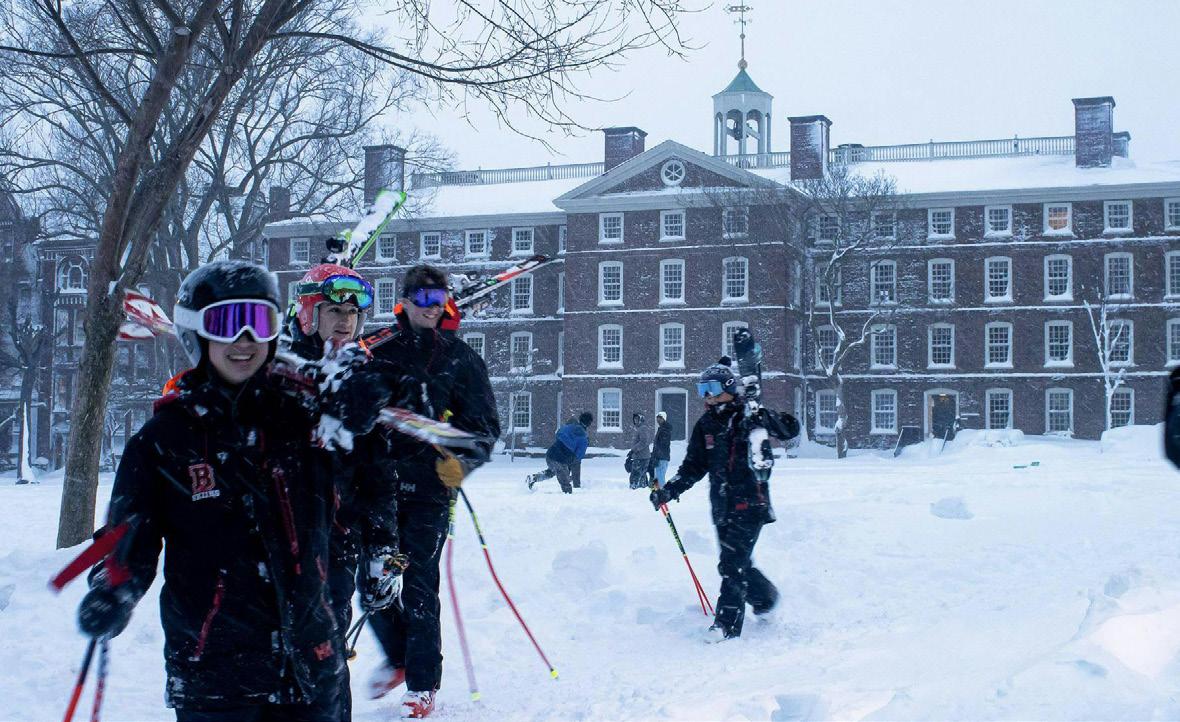
After the University canceled classes Monday and Tuesday amid record-high snow, some professors who intended on hosting midterms have rescheduled or changed the format of exams.
For some courses, like BIOL 0500: “Cell and Molecular Biology,” rescheduling just meant pushing the test date to the next class time.
The BIOL 0500 class exam was scheduled for Monday but was moved to Wednesday, according to Associate Professor of Molecular Biology, Cell Biology and Biochemistry Sofia Lizarraga, who teaches the course.
“We have been lucky, as we were able to find rooms for the exam thanks to our wonderful departmental operations coordinator,” Lizarraga wrote in an email to The Herald.
But other professors with exams scheduled for Monday faced complications.
Professor of Physics and Engineering
Jay Tang was supposed to hold an exam for PHYS 0030: “Basic Physics A” on Monday.
But the class staff could only start looking for an alternative room on Tuesday, so Tang eventually decided to postpone Monday’s exam by a week.
Now, Tang said his “biggest worry now is really the classroom availability for (the) makeup exam.”
“There’s just no way to get this worked out sooner,” Tang said. “If they … say they cannot find a classroom to the size available for the makeup next Monday evening … I don’t know what to do.”
Limited classroom availability was also a “huge consideration” for Assistant Teaching Professor of Cognitive and Psychological Sciences Jamie Trost, who replaced the Monday exam for CPSY 0900: “Statistical Methods” with an alternative assignment.
The assignment asks students to make a creative product using their study materials for the canceled exam, Trost wrote in an email to The Herald. “It is my hope that this assignment serves to reward their hard
efforts in studying while also enabling us to transition smoothly to Unit 2 material,” she wrote.
Because of this change in format, Trost adjusted grade weighting so that the replacement assignment would be worth 10% of the final grade — the first assessment was initially weighted at 20%. She also increased the weight of the course’s remaining exams by 5%.
Assistant Teaching Professor of Computer Science Milda Zizyte wrote in an email to The Herald that she canceled the exam scheduled on Monday for CSCI 0111: “Computing Foundations: Data.”
Zizyte had initially pushed the exam to Wednesday, but ultimately decided to instead cover material from the first exam on the second quiz and reweight her syllabus. “This was a better option than asking people to come to campus (Wednesday) or pushing to Friday,” Zizyte wrote.
According to Kaitlyn Budhai ’28, two of her three midterms this week were impacted by the blizzard. Her BIOL 0500 exam was moved to Wednesday and her PHYS 0040: “Basic Physics B” exam — initially scheduled to be in person on Tuesday — is now take-home.
The rescheduling of exams “was definitely a bit stressful,” Budhai said. But she added that she was “relieved to have more time to review course materials.”
Genie Dickens ’28, who was supposed to take a CHEM 0330: “Equilibrium, Rate and Structure” exam on Tuesday, found the rescheduling of her exam “really frustrating.”
Review sessions and office hours have also been impacted by the weather. Alex Lim ’27, who had three midterms scheduled this week, said that the Monday review session for Wednesday’s ENGN 1110: “Transport and Biotransport Processes” exam could no longer happen in person.
“Now I’m thinking about if I need to reorient how I want to approach studying,” Lim said. “There’s more pressure on students to study for themselves if there are no office hours in person.”
Zizyte said that, for CSCI 0111, she held office hours remotely on Monday and was available over Ed Stem discussion boards. “I think the delay gives students some opportunity to ask more questions if needed,” she added.
“Personally, I’m very happy,” said Avery Espiritu ’27. His exam for SOC 1020:
“Methods of Social Research,” was initially scheduled for Monday. His professor first pushed it to Wednesday and then to Friday.
Over the weekend, Espiritu had to work on assignments for other classes. The postponement gave him more time to prepare. “It’s not really something I have to worry about right now. It’s something that I can worry about in two days,” he said.
“I feel like I could be underprepared now, because I have to focus on other courses,” Dickens said. As a student-athlete, Dickens noted that her practices are being pushed further into the week — leaving her even less time to prepare for the rescheduled exam.
Gianna Ferry ’29 felt like she needed “more time” for her midterms this week — PHYS 0040, BIOL 0500 and CHEM 0330, which have all been impacted by the blizzard. “Now I just feel better about how well-prepared I can be for my exams,” she said.
This article originally appeared online at browndailyherald.com on Feb. 25, 2026.
PRESIDENT FROM PAGE 1 KAIA YALAMANCHILI / HERALD
or the Hope Club.
According to Hoffinger, five employees slept on army cots at the V-Dub on Sunday.
“They need to do a little better with where everyone sleeps, because anyone who doesn’t sleep over, they run a really big risk of not coming in,” Hoffinger said. “I’ve had some guys call out today who were like, ‘I don’t know if I want to sleep with everybody.’”
“You can’t just throw cots in the dining room and hope everyone shows,” he added.
On Monday, the V-Dub closed at 3 p.m. rather than 11 p.m. as initially planned. In an email to The Herald, Barboza wrote that the change was due to low staffing levels.
Chase Uglialoro, a cook at The Ratty, decided not to stay at the dining hall overnight because of the change in accommodations. “I honestly was disgusted with the circumstances,” he said. “The rate of
call-outs is going up because nobody wants to stay on a cot.”
According to Barboza, union contract language does not prevent Dining Services from providing other accommodations on campus or at hotels. “(We) feel strongly that the safest option for our staff is to adhere to the mutually agreed upon contract language and provide cots and bedding for them to stay onsite,” he wrote, noting that Dining Services has updated its Emergency Plans for Dining.
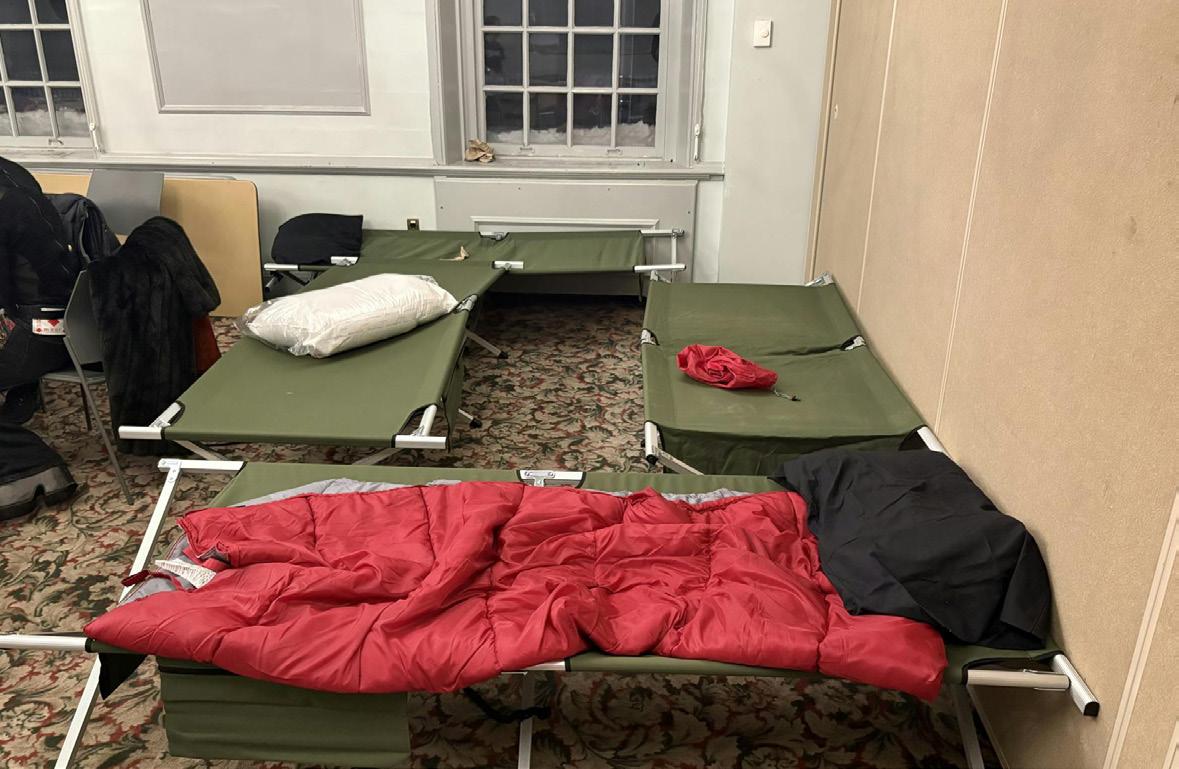
Employees are provided an army cot, sleeping bag and pillow, according to Rosa Gonzalez, a cashier at the Ratty who slept on a cot in the building on Sunday and Monday nights. She said that five employees slept in the Ratty on Sunday and four slept there on Monday.
Gonzalez said she decided to stay at the Ratty overnight because she used her last remaining sick days after the Dec. 13 mass shooting.
According to Gonzalez, employees who
slept in the Ratty were unable to shower. “There is one (shower) in the female bathroom downstairs, but in the seven years I’ve worked here, I’ve never seen it turned on,” Gonzalez wrote in a message to The Herald. “I’m not even sure it works.”
Lauren Albanese, a cook at the V-Dub who did not stay there overnight on Sunday, said that the V-Dub does not have a shower. Barboza did not respond to a request for comment on the accessibility of showers for those sleeping in the Ratty or the V-Dub.
“I can’t wait to get home tomorrow,” Gonzalez wrote in a message to The Herald on Monday night.
In the past, when employees were housed in dorms or the Hope Club, “it was fun,” Hoffinger said. “Sometimes we would score a nice little spot, and we could all hang out and play house.”
“In the 20 years that I've been there, I’ve never had to sleep on a cot in the dining hall,” said Jay Massei, a cook at
UNIVERSITY NEWS
the Ratty. He added that when hotels or private rooms were offered, employees would come in on their day off and stay overnight to make sure they could work the next day.
“Those of us who stay over put our
Brown family before our own,” Hoffinger wrote in a message to The Herald.
This article originally appeared online at browndailyherald.com on Feb. 25, 2026.
FBI director’s mismanagement delayed response to Dec. 13, whistleblower alleges
The allegations were shared in a letter by U.S. Sen. Richard Durbin
BY IAN RITTER UNIVERSITY NEWS AND SCIENCE & RESEARCH EDITOR
A whistleblower alleged that without an available plane to fly to Providence from Quantico, Virginia after the Dec. 13 mass shooting, Federal Bureau of Investigation agents had to drive to Rhode Island overnight through a winter storm to process evidence at 9 a.m. the next day.
In a Feb. 24 letter sent to the Department of Justice Office of the Inspector General and the Government Accountability Office, U.S. Sen. Richard Durbin (D-IL) accused FBI Director Kash Patel of mismanaging government resources in multiple instances, including the mass shooting at Brown, citing multiple “credible
whistleblower disclosures.”
According to the letter, Patel placed the Hostage Rescue Team — a specialized counterterrorism unit — on standby to respond to the shooting, which froze the use of available FBI jets for other teams.
Durbin, who is the ranking member of the Senate Judiciary Committee, called on the DOJ OIG to open an investigation into Patel’s alleged resource mismanagement or misuse — a topic that has come into the spotlight following videos and photos posted online of Patel celebrating the U.S. men’s hockey team’s Olympic win in Italy.
According to MS NOW, Patel allegedly was in Florida on Dec. 13, after using a private jet to visit family, and flew back to Washington the day after.
Patel’s “potential misuse of an FBI jet during a time when it should have been all hands on deck reflects a troubling pattern of abusing taxpayer funds and poor judgment that has real consequences,”
U.S. Rep. Gabe Amo (D-R.I. 1) wrote in a
statement sent to The Herald. On Jan. 28, Amo called for the FBI and the Bureau of Alcohol, Tobacco, Firearms and Explosives to provide briefings on developments related to the shooting.
Durbin’s letter also asserts that Patel’s placement of the HRT on standby to respond to the shooting caused confusion within the FBI. The HRT is “generally activated for situations that one of the FBI’s 56 SWAT teams cannot handle,” Durbin wrote.
But because the FBI’s Boston Field Office, which covers Providence, has an enhanced SWAT team, the responsibility usually designated to local authorities was “upended.”
The decision was not communicated to the HRT, Durbin adds in the letter.
In a post on X, FBI spokesperson Ben Williamson denied that Patel had delayed the shooting response, calling the claims “ridiculous.” He wrote that the FBI Boston was on the scene in less than two hours and that because the case was initially “a State-led homicide investigation,” it did not
fall instantly under FBI purview.
“The FBI jumped all over this case and provided any and all resources needed in a timely manner,” he wrote.
According to Kristy dosReis, Providence’s chief public information officer for public safety, the PPD has "no information indicating any delays in the FBI’s response." She added that the investigation began immediately and "local agents from the FBI in Boston were on scene with PPD personnel from the outset and assisted throughout the response and subsequent investigation.”
The FBI National Press Office did not respond to requests for further comment.
The FBI Boston Field Office directed questions to the National Press Office.
The letter follows Durbin’s previous request in May that the DOJ and GAO investigate Patel for improper use of government resources.
In the letter, Durbin pointed to multiple other alleged misuses of FBI private jets by Patel.
THE BROWN DAILY HERALD
PRODUCTION
Copy Desk Chief Chelsea Long
Design Chief Emily Bao
Design Editors Chloe Johnson Kailey Marti Maggie Ruan
MULTIMEDIA
Photo Chiefs
Annamaria Luecht
Kaia Yalamanchili
Wotman
COMMENTARY Head of Editorial Page Board
Opinions Editors Benjamin Aizenberg
Ethan Canfield
Isabella Gardiner Lucas Guan
CJ Lair
Batisse Manhardt Tas Rahman Camila Valdes
Alice Xie


Illustration Chiefs
Kendra Eastep
Isabela Guillen
Video Chiefs
Cienna Cheng
Cody Cheng
Social Media Chiefs
Nate Barkow
Annika Melwani
Technology Chief
Annika Singh
Data Desk Chief Caleb Ellenberg
Games Chief
Paul Hudes
Podcast Chief
Talia LeVine
Multimedia Editors
Sophia Basaldua
Marat Basaria
Harry Guo
Horatio Hamilton
Selina Kao
Ella Le
Kenna Lee
JJ Li
Jake Parker
Jascha Silberstein
Rassul Toleugazy
BUSINESS
General Managers
Arjun Deshpande
Anum Azhar
Sales Directors
Arjun Ray
Hannah Han
Finance Director
Sydney Wright
Office Manager
Cary Warner
For example, he wrote that the FBI team was delayed to the site of the assassination of Charlie Kirk in September due to Patel’s “personal flights.” In a Feb. 24 post on X, Williamson wrote that Patel was in Washington the day that Kirk was assassinated and was in New York the following day for 9/11 ceremonies.
Durbin also pointed to the breach of Mar-a-Lago on Sunday and Patel’s use of an FBI jet for his trip to Italy, which Williamson claimed was for diplomatic reasons in a post on X.
“Patel has seemingly engaged in what amounts to irresponsible joyriding on DOJ and FBI-operated aircraft at the expense of the American taxpayer and to the detriment of ongoing Bureau operations,” Durbin wrote.
This article originally appeared online at browndailyherald.com on Feb 25, 2026.
Submissions: The Brown Daily Herald publishes submissions in the form of op-eds and letters to the Op-eds are typically between 600 and 900 words and advance a clear argument related to a topic of campus discourse. You can submit op-eds to opinions@browndailyherald.com.
Letters to the editor should be around 250 words and respond to an article or column that has appeared in The Herald, or critique or commend The Herald’s editorial decisions. You can submit letters to the editor to letters@browndailyherald.com.
Submissions undergo multiple rounds of editing. These rounds of editing generally take place over the course of one evening, and you may have to respond to edits late in the evening. If you know you will be unable to do so, please mention that in your email, and we will do our best to work with you.
Submissions can build on reporting from The Herald, reporting elsewhere, official statements from the University or other groups and other reputable sources, but they cannot break news or contain information that The Herald cannot verify. Because we cannot publish unsubstantiated information, failure to provide appropriate sources may mean we have to modify or remove unverified claims.
The Herald will not publish anonymous submissions or submissions authored by organizations. Leaders of student organizations can be identified as such but cannot write under the byline of their organization. The Herald cannot publish all submissions it receives and reserves the right
Commentary:
JAMES LIBRESCO / HERALD
The switch to using army cots has deterred some employees from reporting to work the next day.
concerns and noted that warming centers are available for those in need.
At a Monday press conference, McKee said he has met with Rhode Island’s municipal leaders and the congressional delegation as they continue forming plans for navigating the storm. He said his primary goal is to “keep people safe,” noting that he intends to keep roads clear and accessible for emergency response.
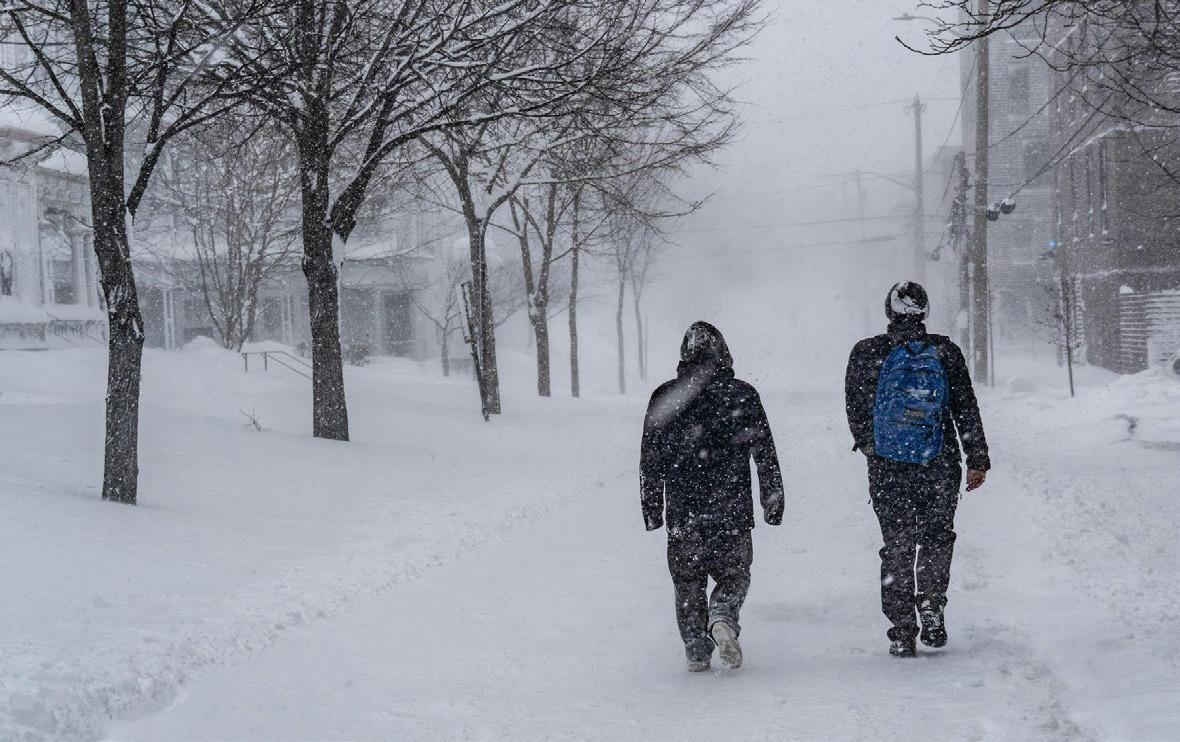
Over 50,000 Rhode Island residents have experienced power outages due to the blizzard, according to a Rhode Island Energy press release.
RIE — which provides power to 99% of the state — has the support of 400 crews and 1,400 personnel who have restored power
to over 6,400 RIE customers as of Monday afternoon, according to the press release.
Associate Professor of Earth, Environmental and Planetary Sciences Jung-Eun
Lee explained that blizzards are caused by a combination of strong low-pressure systems — areas in the atmosphere where the air pressure is lower compared to other regions — and storms or extratropical cyclones.
Lee pointed to the “strong low-pressure system off (the) coast of Cape Cod” as a factor that can cause Rhode Island blizzards.
This year, North America has been experiencing “sudden stratospheric warming,” Lee said. This warm air, combined with cold air from the Arctic, causes strong and heavy winds, and can ultimately form something like the Blizzard of ’26, she added.
The snow has also led to school cancel-
lations across Rhode Island.
Provost Francis Doyle sent announcements to the Brown community canceling in-person classes and closing administrative and academic offices for Monday and Tuesday.
Many school districts across the state announced closures for Monday. According to the Providence Public School District website, schools will be fully closed Monday and Tuesday, meaning “there will be no school and no virtual learning.”
The blizzard warning went into effect at 4 p.m. Sunday and will last through 7 a.m. Tuesday.
This article originally appeared online at browndailyherald.com on Feb. 24, 2026.

KAIA YALAMANCHILI / HERALD
Over 50,000 Rhode Island residents have experienced power outages resulting from the blizzard.

Snowy conditions cause uptick in sick, emaciated birds
Wildlife clinics reported an increase in avian patients from last winter
BY DHRUV JAIN STAFF WRITER
For the past month, several inches of snow have consistently coated the ground in Providence and areas across the state. With grass buried and ponds frozen solid, birds that rely on the food sources these ecosystems provide have not been able to find sustenance.
And because of these treacherous conditions, Rhode Island’s wildlife rehabilitation clinics are reporting record numbers of sick and injured birds.
“They’re coming in completely depleted and emaciated,” said Sheida Soleimani, the executive director and founder of Congress of the Birds — a wildlife rehabilitation facility that focuses on avian patients.
Soleimani, who has worked in the Ocean State for a decade, said she has never seen this many patients in the winter. Usually, winter is a quieter time for wildlife rehabilitators, as many birds have migrated south and baby birds have not yet been born.
“These birds aren’t able to even get the basic food they need to survive,” she said.
A lack of periodic melting has caused snow and ice to remain in place for weeks, preventing access to food for local birds, Blaine Hymel, the medical director of the

Wildlife Clinic of Rhode Island, said. As a result, more birds have arrived to the clinic weak and severely underweight.
The Wildlife Clinic, the only fully functioning wildlife hospital in the state, has treated almost 250 avian patients so far this year. Hymel said this was a 66% increase from the same time last year.
She added that many birds require “intensive supportive care” due to starvation.
The clinic expected the number of patients to rise after the blizzard on Monday.
The long-term impact of the snow on bird populations remains uncertain.
Soleimani noted that many juvenile birds may not survive the winter. “This year is even more treacherous than it would be normally,” she said. “I think we're going to have a lot more decline in some species.”
Treating these animals often begins
with stabilization. Clinics provide fluids, food and medication in hopes of eventually releasing the birds into the wild.
But some cases are more complex. According to Soleimani, the snowy conditions create the “perfect storm” for spreading the highly contagious H5N1 avian influenza.
Birds experiencing hunger are much more vulnerable to infection, she explained.
Several birds have already tested pos-
itive for the virus this season, Hymel said. Both clinics treat patients for influenza as well as for injuries such as fractures.
Rhode Island recorded its first case of avian flu in 2022, The Herald previously reported.
This year, more infected animals are recovering from the virus. “We’ve seen a handful of asymptomatic or very mild cases and have released even a few that have fully recovered and tested negative,” Hymel said.
The risk of bird-to-human transmission is generally low, but people with direct animal exposure are at the greatest risk, Jennifer Nuzzo, a professor of epidemiology and the director of the Pandemic Center at the School of Public Health, said.
As of right now, Nuzzo believes the risk to the general public remains low. There have not been recent human cases detected and wastewater data has not shown concerning signals, she said.
Because of avian flu concerns, Soleimani advises against touching or feeding birds.
“We don't know off the bat if that bird's going to be avian flu positive or not,” Soleimani said. If residents encounter potentially sick wild birds, they should “just give (the Congress of Birds) a call or a text and we'll be happy to walk people through with assessing.”
This article originally appeared online at browndailyherald.com on Feb. 25, 2026.
ARWYNN ARISTIZABAL / HERALD
MARAT BASARIA / HERALD
OWEN BALLARD-O'NEILL / HERALD
KAIA YALAMANCHILI / HERALD
HEALTH CARE
After a yearslong effort, sale of two R.I. hospitals expected to close March 6
The Centurion Foundation secured sufficient funding for the purchase
BY TALIA EGNAL METRO EDITOR
After a yearslong effort to sell two Rhode Island hospitals, the Centurion Foundation — a Georgia-based nonprofit — secured sufficient funding on Wednesday to finance the purchase of the Roger Williams Medical Center in Providence and Our Lady of Fatima Hospital in North Providence.
The foundation received signed bond purchase agreements of over $100 million in financing, R.I. Attorney General Peter Neronha P’19 P’22, Gov. Dan Mckee, the Rhode Island Department of Health, the Executive Office of Health and Human Services and Rhode Island General Assembly leadership wrote in a statement emailed to The Herald.
By returning the hospitals to nonprofit ownership, Centurion has estimated that they will save $75 million a year. The Georgia-based organization has never previously owned a hospital.
The agreement represents “significant
HOUSING
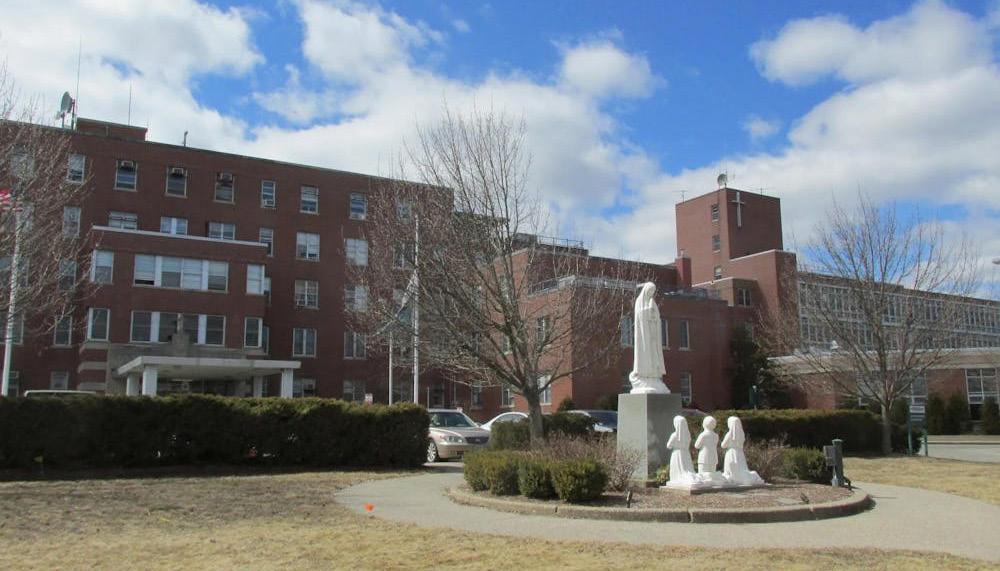
The deal, which was originally meant to be completed in April 2025, remained delayed for more than 16 months.
and necessary progress towards ensuring that our critical safety-net hospitals remain open and able to serve Rhode Islanders,” the state’s statement reads.
Centurion received conditional approval for the purchase in June 2024. But the sale, which was originally meant to be closed in April 2025, has been delayed for nearly a year while the organization struggled to secure adequate funding.
In the meantime, the delay raised concerns of the hospitals shutting down, facing the prospect of state takeover or being sold to a new buyer.
California-based healthcare compa-
ny Prospect Medical Holdings has long struggled to sell the two hospitals, which see 50,000 emergency room visits annually. Roger Williams also houses the only accredited bone marrow transplant unit in Rhode Island, The Herald previously reported.
In January 2025, Prospect declared bankruptcy amid allegations of not providing adequate medical supplies, underfunding facilities and mismanaging hospitals, The Herald previously reported.
But the R.I. legislature passed a bill in February to provide an $18 million backstop, with funds placed in a state account
should Centurion prove unable to make its bond payments.
Centurion had previously secured verbal commitments from investors stating that they could finalize the sale so long as they had the $18 million in backup.
In January, a bankruptcy court judge set a deadline of Feb. 27 for the transfer of the hospitals to Centurion. Neronha plans to file a motion in court on Friday that would extend the transfer date until March 6 to finalize the purchases.
But taking over the hospitals may not be a straightforward process. The hospitals have been losing millions of dollars per year, according to the court filings.
When hospitals are unable to pay bills, they cannot purchase equipment, staff members leave and profits fall further, Emily Shearer, a postdoctoral fellow at the School of Public Health and emergency medicine resident physician at Rhode Island Hospital, explained.
The two hospitals are in a “downward spiral,” she said.
She added that occupancy rates at both hospitals have fallen significantly in recent months. Low occupancy rates are “quite unusual” in Rhode Island, which has some of the highest occupancy rates in the nation, Shearer said.
Additionally, Prospect — which was under the partial ownership of a private equity firm — was accused of profiting while its hospitals lacked adequate patient-care resources in 2021, The Herald previously reported.
Shearer noted that the phenomenon of private equity companies owning hospitals is occurring on a nationwide scale. “These private equity companies are not interested in patient care. They’re not interested in keeping hospitals sustainable over the long term,” Shearer said.
She added that Roger Williams and Fatima Hospital serve a disproportionate amount of lower-paying patients — which makes them critical as safety net hospitals and less able to weather financial burdens. If the hospitals closed, there would have been “extremely severe system-wide shocks for the Rhode Island health care system,” she said.
Hayden Rooke-Ley, a senior fellow at the Center for Advancing Health Policy through Research, said that “there’s a potentially sustainable path” forward under new ownership.
“A new owner with potentially more competency could possibly help turn things around with the addition of some state support,” Rooke-Ley said.
State launches affordable housing programs aiming to expand access to homeownership, rentals
Applications for the programs opened in February
BY TYLER TIMMERS CONTRIBUTING WRITER
Earlier this month, Gov. Dan McKee and the Rhode Island Executive Office of Housing launched the Housing 2030 Entry-Level Homeownership Program and the Housing 2030 Public Developer Program, which both aim to increase access to affordable housing for low and moderate-income Rhode Islanders.
These programs were created as part of the Housing 2030 plan, which was launched in December 2025. The plan strives to address “the state’s growing housing challenges, including rising costs, limited affordable and accessible housing options, and an overall shortage of homes,” Emily Marshall, a spokesperson for the Rhode Island Department of Housing, wrote in an email to The Herald.
“The plan’s central goal is to permit 15,000 new homes by the end of 2030, including affordable rental homes, middle-market housing, permanent supportive housing and homeownership opportunities,” Marshall wrote. Funded through Rhode Island’s $120 million housing bond, the plan also aims to create 1,000 new lower-cost housing units.
This goal will be realized through new construction and renovation of existing housing.
As part of Housing 2030, the Entry-Level Homeownership Program endeavors to expand opportunities for low and moderate-income homeownership by working with developers to build new affordable homes. The program, which opened applications on Feb. 5, dedicates $20 million to subsidize the new construction of entry-level homes, Marshall wrote.
The entry-level homes, which must be priced below $400,000, will be sold to Rhode Islanders earning at or below 120
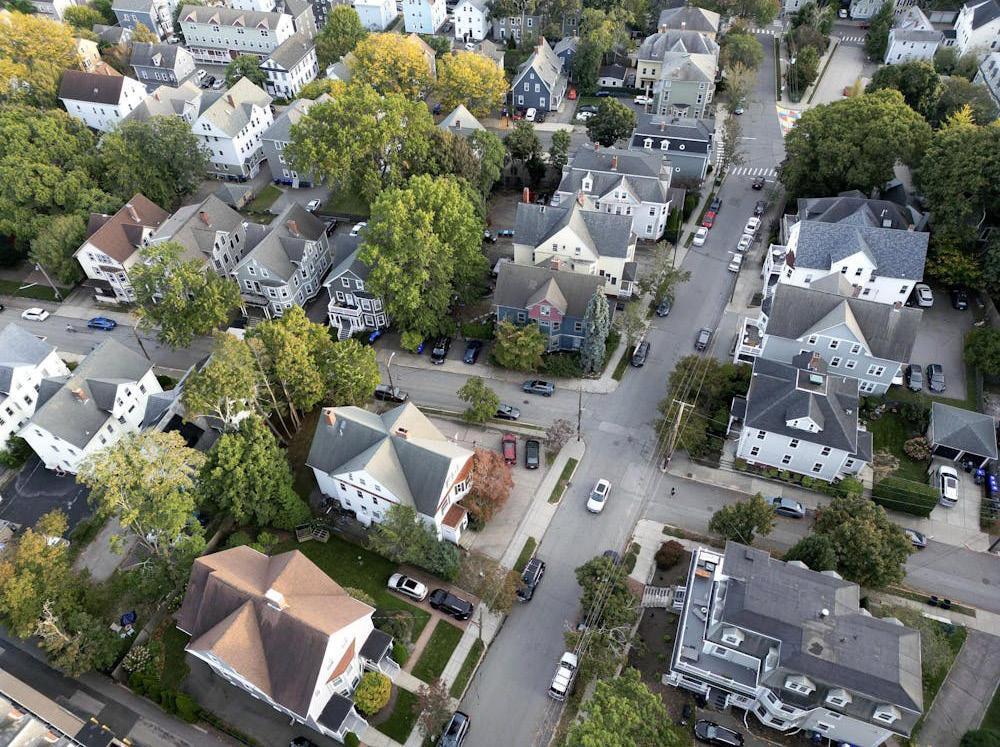
percent of the Area Median Income, Marshall added. Developers who receive funds through the program will be responsible for building owner-occupied housing units such as single-family homes, townhouses and condominiums.
Marshall wrote that developers who want to participate in this program must go through a “competitive” selection process.
The developers are required to start construction within nine months of receiving funding and they must build developments with at least five units, among other requirements.
If all of these conditions are satisfied, developers are then scored on a 70-point scale to assess how their projects reflect “key state priorities,” with criteria including lower development costs, accessibility for residents with disabilities and strong
community support, Marshall wrote.
The highest-scoring projects will receive funding first, she wrote. Developers will receive up to $100,000 per unit or $4 million per project until the $20 million is exhausted.
“Proposals are welcome in all 39 cities and towns across the state, ensuring communities statewide can benefit from new homeownership opportunities,” Marshall wrote.
One Neighborhood Builders, a non-profit development company, is currently drafting its application for the program, according to CEO and president Peter Chapman. The company is seeking funding for its Sheridan Village development in Olneyville, which will include 20 condominium units across six buildings.
“Sheridan Village is a critical piece of
the puzzle to redevelop this corner of the neighborhood,” Chapman wrote in an email to The Herald.
The program will “provide developers with the resources needed to get shovels in the ground fast and ensure that the homes are sold affordably to low- to moderate-income households,” Chapman wrote. It will “(create) opportunities for families to build intergenerational wealth for individuals who otherwise do not have access,” he added.
But “any state housing plan must prioritize building housing for the most vulnerable,” Eric Hirsch, a professor in the sociology department at Providence College and the interim director of the Rhode Island Homeless Advocacy Project, wrote in an email to The Herald. He noted that in January 2025, the Rhode Island
Coalition to End Homelessness counted 2,373 unhoused people in Rhode Island.
“We need permanent supportive housing units that are affordable to people who may be disabled, unable to work and who get only $1,000 to $1,300 a month in SSI or SSDI payments,” Hirsch wrote.
Marshall did not respond to The Herald’s additional request for comment.
McKee and the Executive Office of Housing also opened applications for the Housing 2030 Public Developer Program on Feb. 10. This $10 million initiative aims to work with Rhode Island’s Public Housing Authorities to build more affordable rental housing units that are priced for low and moderate-income households, according to a press release announcing the project.
The program will select two or three PHAs to support.
“Public Housing Authorities are essential partners in addressing Rhode Island’s housing challenges,” Secretary of the Department of Housing Deborah Goddard wrote in the press release. “This program will revitalize and strengthen PHAs, giving them the resources to lead will not be solved with bold, innovative projects that deliver safe, affordable rental homes.”
The rental housing units created through this initiative will prioritize Rhode Islanders earning at or below 30% of the Area Median Income, according to the press release.
Rose Ott, executive director of the East Providence Housing Authority, wrote in an email to The Herald that “it is encouraging to see resources being provided to many fragile yet resilient” Rhode Islanders through the Public Developer Program.
“These programs have the potential to be very helpful,” Ott wrote.
“Our housing crisis will not be solved with one policy or program, but instead a sustained and broad effort from all stakeholders in the General Assembly, Governor’s Office and developers,” Chapman wrote.
COURTESY OF JOHN PHELAN VIA WIKIMEDIA COMMONS
MAX ROBINSON / HERALD
The Entry-Level Homeownership Program aims to expand opportunities for moderate-income homeownership by working with developers to build new affordable homes.
BASKETBALL
Men’s basketball brings winning streak to two with 80-71 victory against Princeton
The win comes after Bears snapped a six-game losing streak last week
BY HARRY GUO SENIOR STAFF WRITER
On Friday night in front of a packed home crowd, the men’s basketball team (9-15, 3-8 Ivy) picked up an 80-71 victory over Princeton (8-18, 4-7 Ivy). On top of Bruno’s second consecutive win, guard Isaiah Langham ’29 also garnered the Ivy League Rookie of the Week honors title for the fifth time this season scoring 11 points in the game.
Langham is the fifth player in program history to have earned the honor five times during their freshman season.
After snapping a six-game losing streak with last week’s victory over Dartmouth, the team entered the Pizzitola Sports Center on Friday set on continuing their winning streak.
While Princeton opened the scoring, forward Landon Lewis ’26 responded quickly with a smooth floater. Moments later, guard Jeremiah Jenkins ’28 delivered a bounce pass to Lewis for another basket.
Princeton countered with two three-pointers and a layup to briefly take control with a six-point lead, but three substitutions from the Bruno bench quickly shifted the momentum back in their favor.
Guard and forward David Rochester ’28 sparked a scoring run, driving into the
TENNIS
lane before dishing the ball out to Langham, who knocked down a three from the top of the arc. Lewis followed with a block, and Rochester added a steal. Langham capitalized on this comeback, securing a midrange jumper as the shot clock expired.
The Bears and Tigers exchanged points, bringing the score to 14-13 with Princeton in the lead. But eight minutes into the game, guard Adrian Uchidiuno ’27 scored on a floater through heavy traffic. Then, after a couple of back-and-forth possessions, guard Luke Paragon ’27 — who has been shooting 40% from beyond the arc this season — buried an open three and brought the Bears to a 20-14 lead.
Lewis sank a three of his own and Paragon added a pair of free throws to extend the Bear’s lead to 11. After 5 points by the Tigers, Paragon went on a scoring spree, finding a wide-open three, layup and a corner three.
But, with the scoreboard ticking down, Paragon was not done. He sank three free throws to surpass his previous career record of 15 points, finishing the first half with 18 points. Jenkins spun past his defender to follow with a tough and-one, bringing Bruno to the locker room with a 42-37 lead.
“I feel like just playing free and playing off of my teammates helped me a lot, plus the work I put in before the game,” Paragon wrote in an email to The Herald.
Bruno maintained the steady stream of buckets early in the second half. Paragon attacked the rim through traffic while
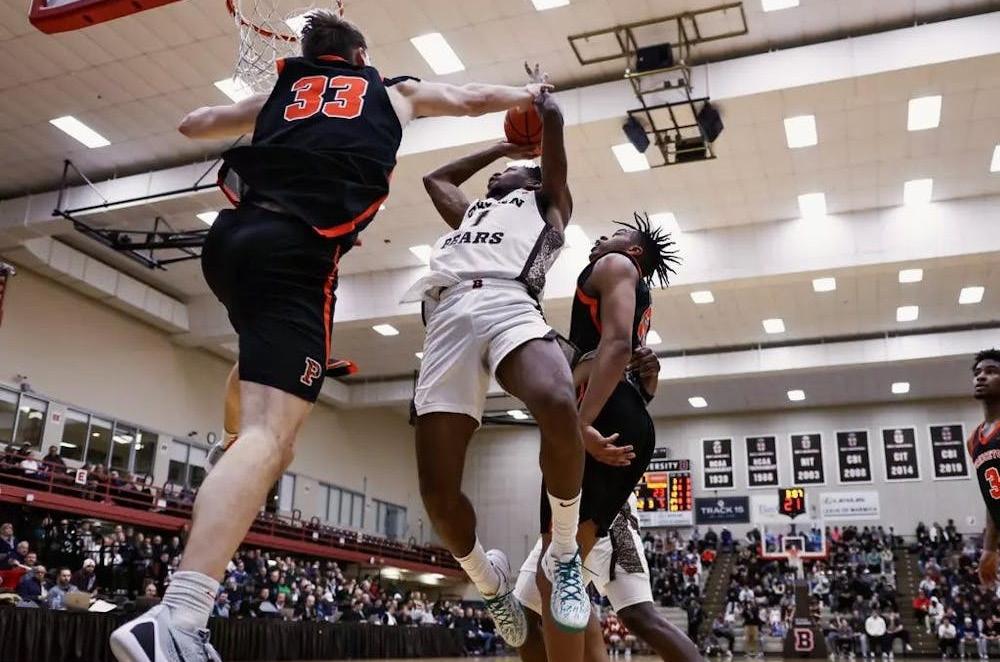
Wrisby-Jefferson, Lewis and Jenkins each converted layups to help build a 50-41 lead in the first three minutes.
Princeton matched Bruno’s pace, responding with a 10-0 run to take a 51-50 lead. But a Uchidiuno three from the top of the key and a powerful dunk by Lewis propelled a 14-5 stretch by Bruno. Still, the Tigers were not ready to admit defeat. The team made a valiant effort to cut the deficit to 71-66 with around four
Women’s tennis sweeps Seton Hall, URI
BY ABIGAIL DONOVAN SENIOR STAFF WRITER
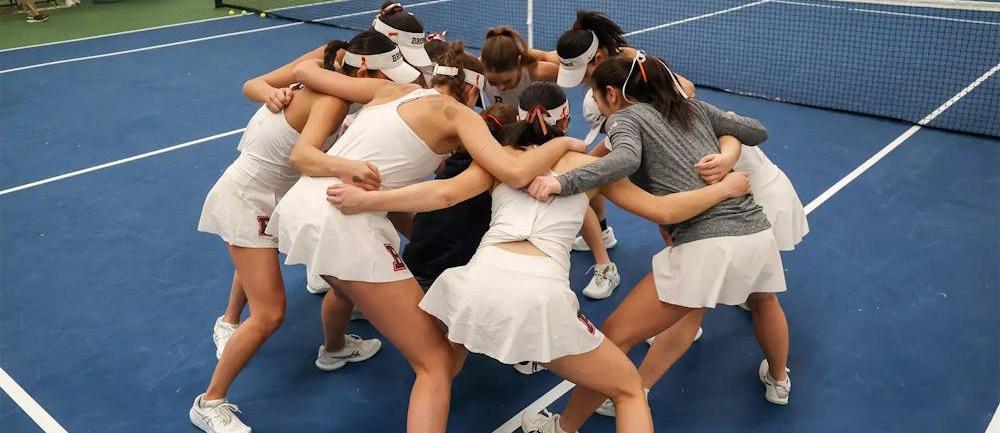
Over the weekend, the women’s tennis team (8-3) swept both Seton Hall University (4-6) and the University of Rhode Island (4-3), winning both matchups 7-0. In a show of complete dominance, the team only conceded three sets between the two matchups.
The weekend’s successes follow Bruno’s close 4-3 win at Boston College and 2-5 loss to Baylor University the weekend before. Heading into Friday, the team had already earned three 7-0 sweeps out of just nine matchups this season.
Despite commanding victories, Head Coach Lucie Schmidhauser said that at this early point in their season, the team is focused on identifying “what’s working” and “what needs to get better.”
“We’re really trying to focus on improving everyone’s game,” she said.
On Friday, the team got off to a strong start against Seton Hall, taking all three doubles matches.
On the third line, Anne Yang ’27 and Ali Maguy ’28 secured the first doubles win with a 6-3 victory. Not long after, Dani Ben-Abraham ’27 and Hannah Shen ’27 locked up the doubles point with a win at the first line: After breaking and being broken back, the pair fought another game from their opponent’s serve and sailed to a 6-4 win. Finishing their second-line match in style, Abigail Lee ’29 and Chloe Qin ’29 both approached the net on match point, with Lee’s fiery overhead sealing the 6-4 win.
minutes remaining. Instead, they were met with a quick 5-0 burst driven by a Lewis layup and a strong finish from Wrisby-Jefferson.
As the clock ticked down, Princeton’s desperate attempts proved insufficient and Uchidiuno sealed the win with two late free throws to secure the 80-71 victory.
Brown will look to carry the momentum into their upcoming games against Columbia (15-10, 4-7 Ivy) and Cornell (12-
With one point already on the board, the Bears went into their singles matches hungry for more. On adjacent courts, Maguy, Ben-Abraham and Yang all secured early breaks.
At the third line, Yang cruised to a 6-1, 6-1 victory against Seton Hall’s Jaden Davidson. In a similarly decisive fashion, Ben-Abraham took the first set of her match 6-0. Up 5-1 in the second, she delivered a pinpoint forehand volley to the corner on match point — serving up a dominant 6-0, 6-1 win at second line.
At the first line, Maguy breezed through the first set 6-1. Up 5-3 in the second set, she brought the game to deuce with a forehand winner before sealing it on her opponent’s error — securing the match 6-1, 6-3 and Bruno’s win over Seton Hall with four points.
With Bruno’s win secured, the three remaining singles matches continued on.
At the fifth line, Bella Hu ’28 struggled to find her rhythm in the first set and dropped
it 1-6 to Seton Hall’s Rachel Benoualid — but coming back with renewed energy, Hu
took the second set 6-2 and shifted the tide of the match.
“In that first set, I was just making a lot of loose errors,” Hu said, adding that Schmidhauser reminded her to play the way she practices — “full of energy.” Although Hu came into the match intending to stay calm, she said that “doesn’t really work” for her. After the first set, she made a point to get her energy back up.
“I sprinted back and then started jumping a lot, (and) started yelling a lot more,” she said. “My energy really shifted.”
With Hu and Benoualid tied at one set, the pressure was on to keep the momentum. Benoualid broke Hu to bring the set score to 2-3 — but Hu broke back. Her comeback would not be stopped, and she won the next 3 games, securing the match win 6-3.
In the last game of the match, Hu pulled ahead to 40-30. Battling for the win, Hu and her opponent fought a stunning 24-shot baseline rally. Hu sealed the point, and the match, with a clean backhand slice that Benoualid returned long.
“It was definitely a good turnaround,” Hu said.
Sari Woo ’28 delivered the most commanding win of the day — suffocating her opponent to earn a 6-0, 6-0 victory at fourth line.
Reflecting on her performance, Woo said she was focused throughout the match.
“I just tried to keep my errors (down) and hit heavy balls,” she said.
Friday’s sweep would not be completed without another nail-biter match. At the sixth line, Qin got off to a strong start against Seton Hall’s Ellie Coe, taking the first set 6-2. But Qin lost momentum and handed the second set to Coe 1-6. Down to a 10-point tiebreak for the match, both teams gathered to cheer on the last match of the night.
Qin struck first — her inside-out forehand winner put her up 2-1. Qin stayed ahead and set up match point with a blazing backhand.
A close battle to the end, Coe warded off 2 match points — which were remarkable 13- and 12-shot rallies. But looking at
12, 5-6 Ivy) in New York on Friday at 7 p.m. and Saturday at 6 p.m., respectively.
“The atmosphere among the team is super high,” Paragon wrote in an email to The Herald. “We have a lot of momentum and confidence going into these next couple of games.”
This article originally appeared online at browndailyherald.com on Feb 25, 2026.
a third, Qin executed a beautiful swinging volley followed by a backhand winner — clinching the win 6-2, 1-6, 10-7 and completing the team’s sweep.
Ahead of Saturday’s matchup, Schmidhauser said the team was looking forward to playing URI, whom they beat 5-2 last year with multiple close matches.
“When we played them it was a tough match,” she said. “This is the time to really keep training that competitive muscle.”
Blazing through the weekend, the team started Saturday’s matchup against URI with three doubles wins. At first line, Ben-Abraham and Shen battled to a 7(7)6(4) tiebreak victory. On the second line, Lee and Qin earned a clean 6-2 win, a scoreline matched by Yang and Maguy at third line.
In the singles matches, Bruno continued to dominate. At first and second lines, Maguy and Ben-Abraham both claimed their matches 6-3, 6-1.
After dropping the first set 3-6 — Brown’s only lost set of the day — Yang battled for a comeback at third line. Yang won the second set 6-4 and powered to a 10-1 win in the deciding tiebreak.
Following up on her strong performance on Friday, Woo claimed her fourthline match 6-4, 6-3. After facing a close first set, Francesca Saroli ’29 cruised through the second to a 7-5, 6-3 win at fifth line. Rounding out Bruno’s dominant weekend, Qin notched a sixth-line win 6-3, 6-3.
The team will look to extend their win streak against Marist University, whom they will play at the Pizzitola Center at 11 a.m. this Saturday.
Brown looks to carry this momentum into their games against Columbia on Friday and Cornell on Saturday.
COURTESY OF KAIOLENA TACAZON VIA BROWN ATHLETICS
The Bears overpowered Seton Hall and URI in every match last weekend
COURTESY OF BROWN ATHLETICS
The weekend’s successes follow Bruno’s close 4-3 win at Boston College, and 2-5 loss to Baylor University the previous weekend.
ICE HOCKEY
Women’s ice hockey overpowers No. 40 Dartmouth 7-2 in opening round of ECAC playoffs
The Bears will face No. 6 Quinnipiac in a best-ofthree quarterfinal series
BY SAJIV MEHTA SENIOR STAFF WRITER
On Saturday afternoon in Meehan Auditorium, women’s ice hockey (17-12-2, 12-8-2 ECAC) beat No. 40 Dartmouth (5-23-3, 3-16-3 ECAC) by a whopping 7-2 to lock up the first round of conference playoffs. Up just 3-2 with 12 minutes left in the second period after blowing a 3-0 lead, Bruno turned on the afterburners and scored four unanswered points to pummel the Big Green.
“We battled,” Head Coach Melanie Ruzzi told The Herald in a post-game interview. “We scored some beautiful goals and made some really nice plays, but then we also busted our butts to get back on defense and cleared out pucks in front.”
Moving on to the quarterfinals, No. 16 Brown will head to Connecticut this coming weekend for a best-of-three series against No. 6 Quinnipiac. The Bobcats are seeded No. 3 in the ECAC rankings, while Bruno sits at No. 7.
From the opening puck drop on Saturday, the playoff’s elevated stakes were clear. With increased pace and physicality, the Bears and Big Green fought through rushes and hits to corral the puck at all costs.
Bruno drew first blood eight minutes in
WRESTLING
as forward Sam Broz ’27 carried the puck around the back of the net before dishing it to defender Cadence Richards ’29 at the right end-zone spot. Dartmouth goaltender Jiahui Zhan blocked Richards’ initial shot, but forward Martina Accardi ’29 crashed the crease to push the puck over the line.
Less than a minute later, the Bears found paydirt once again. All the way from the blue line on the left side, defender Avery Lian ’29 flicked the puck towards the net. The shot — from over 60 feet out — looked more like a play to set up a shot on goal than an attempt to score. But like a heat-seeking missile, the puck tum bled through the air and found its target in the back of the net.
The remainder of the first period passed without any true offensive threats, leaving the score 2-0 when the buzzer sounded.
But the second period brought back the excitement. Three minutes in, forward Mo nique Lyons ’28 stole the puck and dumped it off to forward Ava DeCoste ’27, who sent a slap shot screaming past Zhan to secure a 3-0 lead for the Bears.
But the three-goal edge lasted less than 30 seconds. Finding the tenacity to answer, Dartmouth forward Ella Inglis wrapped behind the goal for a shot, then finished off her own rebound.
With a foot in the door, Dartmouth be-
gan attacking furiously. Their efforts were rewarded with 12 minutes left in the period, earning a shot after Brown goalie Rory Edwards ’27 blocked two they declared their season would not end.
Less than a minute after the concession, India McDadi ’26 took the puck up the rink’s left wall and passed to forward Margot Norehad ’27 in the slot, who then sent the puck to Broz. After Broz missed her first shot wide right on an open look, Norehad recovered the rebound and sent it right back to Broz, who did not dare

Close calls marked the rest of the second period for the Bruno offense. With eight minutes left, defender Isabella Gratzl ’29 found herself on a breakaway, but her shot sailed wide right. Two minutes later, McDadi earned a 1-on-1 opportunity with Zhan at the doorstep, but could not outmaneuver the Dartmouth goalkeeper and
Meanwhile, the Bears’ defense found its chance to step up. While the Big Green’s offense repeatedly crashed the crease blocked no’s goalher defensive stalwartthe puck and the goal line preserving their 4-2 lead to the period’s close.
The key to Edwards’ play is “just keeping it simple,” she said in a post-game interview with The Herald.
“Believing you can stop every puck ... and having some big help from my (defense).”
Wrestling scraps out win over Sacred Heart, loses to Harvard
The Bears fought it out before heading into championships
BY CHIUPONG HUANG SENIOR STAFF WRITER
The Bears’ (5-9, 0-5 Ivy) composure and consistency were on full display during their 22-18 Senior Day victory over Sacred Heart University (3-9, 0-4 EIWA) on Saturday. But the next day, they struggled to make up for an early trail and fell 26-16 to Harvard (6-6, 2-3 Ivy) after Crimson wrestlers outmatched them in the lighter weight classes.
Brown will look to keep their performances polished for the Ivy League Championships in March, with the team positioned for a shot at winning the league title in the higher weight classes.
Associate Head Coach Ty Walz told The Herald that the Bears knew the match against Harvard would be “tough,” given their strong lighter weight lineup.
But at Sacred Heart, “it was a fun one because we got to have our whole team be involved,” Walz said. “Everybody kind of played a part in making sure that that one was successful.”
On Saturday, the Pioneers started off with two pins at 125 and 133 pounds — but Khimari Manns ’29, ranked No. 32 according to NCAA’s Feb. 12 Ratings Percentage Index, gave the Bears their first paw raise at 141 pounds with a 4-1 decision victory against Sacred Heart’s John Hildebrandt. Despite frantic scrambles and shots, neither wrestler put together a takedown in the first two periods. Finally, in the third period, Manns came around to score a body-lock takedown and an escape from bottom to clinch the bout, adding to his promising first-year season.
“I wrestled the whole match complete-

ly,” Manns told The Herald. “I put seven minutes together, and that’s something that’s been hard for me this whole year.”
Up next at 149 pounds, No. 29 Austin McBurney ’26 brought the Bears a 7-3 decision win. Capitalizing on an ill-fated slide-by attempt, McBurney got his first takedown of the match. In the final seconds of the final period, McBurney scrambled on top after a lateral-drop attempt from Sacred Heart’s Dakota Asuncion went awry.
The Bears came back at 165 pounds as Max Norman ’29 shut out his bout with a 15-2 major decision. Using clubbing collar ties, Norman dominated with attacks from the front headlock across all three periods, widening the gap even more in the final period. He cleanly followed through on his tried and true game plan: “defending my legs, and then kind of wearing on the guy and getting to my snap offense.”
Drew Clearie ’26 at 174 pounds got
his Senior Night win in overtime after hard-fought takedown attempts from both sides, leaving the score 1-1 at the end of the third period. Clearie maintained composure with fans’ eyes glued to the mat as the bout entered sudden victory overtime. A darting single-leg takedown after several convincing fakes contributed to Clearie’s 4-1 victory.
Bruno’s top-ranked wrestlers, No. 15 Andrew Reall ’28 and No. 14 Alex Semenenko ’26, cleaned out the final two weight classes with a decision and a pin in the second period, respectively. Semenenko pinned his opponent with a seemingly effortless footsweep, getting chest to chest for the clean finish.
Against Harvard on Sunday, the Bears got pinned in the first two bouts — and ultimately, Bruno failed to make up the point difference.
First-year starters Manns and Norman kept their hot streak with wins against Harvard. Manns found himself with a side
As the final period opened, Bruno’s offensive barrage continued. Brown struck eight minutes into the period when Jade Iginla ’26 and Lyons showed off their chemistry. Wrapping around the backside of the net from opposite directions, the two standout forwards met in the middle, where Ignila dumped off the puck to Lyons. Not missing a beat, Lyons curled around to the right side of the net and snuck the puck past the goal’s right post.
With a 5-2 advantage and just over ten minutes remaining in the contest, the Bears refused to rest on their laurels. After a Brown power play, Norehad sent a wrist shot on net from the high slot. Though the Dartmouth defense blocked the try before it reached the net, Broz positioned herself in the crease and flipped the puck into the goal.
Closing out the triumphant victory, Olivia Fantino ’28 notched one more goal with three minutes left in the game for a 7-2 final score.
Ruzzi said that the team will have to “be better” next weekend to dispatch Quinnipiac, who the Bears fell to 2-5 on Feb. 13 in their penultimate regular season game.
“In the playoffs, everyone’s fighting for their lives,” Ruzzi added.
This article originally appeared online at browndailyherald.com on Feb. 24, 2026.
bodylock several times during his bout with Harvard’s Dante Frinzi, and the Bear ultimately threw his opponent to his back in the final period. After putting together a single-leg takedown, Manns won the bout 9-2.
Norman lost a scramble early against his Harvard opponent in the first period, but the Bear stayed in the fight, finishing a single leg and escape point in the second period and racking up ride time in the third period to win the bout 5-3.
Nico Romero ’27 was forced to step up as an alternate a weight class above his own when the Bears did not have a starter at 174 pounds, but he ultimately faltered by technical fall.
The Bears’ “already thin roster continues to face the obstacles that division-one wrestling throws its way,” Walz said, adding that Clearie — who wrestles at 174 — withstood a minor injury following Saturday’s matchup with Sacred Heart. Clearie expects to fully recover by
the Ivy League Championships, according to Clearie and Walz.
Reall dominated his bout — so much so that he let his opponent escape to create time for more takedown points needed to lock up a technical fall win. Semenenko won by technical fall as well, pouncing on Harvard’s failed shots and cutting around to the back to take down Crimson wrestler Daniel Bittner over and over again.
With ambitions of winning an Ivy Championship for the first time in the current coaching staff’s tenure, the Bears are now looking to remain rested and healthy.
Semenenko — a senior who is looking to make it to Ohio for NCAA nationals for the first time in his collegiate career — came just one match from qualifying the last two years. As his final opportunity approaches, “my time has to come now,” he said.
This article originally appeared online at browndailyherald.com on Month Date, 2025.
“I like wrestling with pressure on me,” he said. “It makes me want to wrestle harder, compete harder and compete for my team.”
Walz emphasized that the weekend’s duels were a bridge to post-season championships — a higher priority for the team that Walz holds high hopes for.
“Nobody remembers how we wrestled Nebraska at the beginning of the year (or) how our duel against Hofstra went two weeks ago,” Walz said.
“It’s a preparation for Ivies,” he added. “It’s a preparation for the NCAA championships.”
This article originally appeared online at browndailyherald.com on Feb. 25, 2026.
JASCHA SILBERSTEIN / HERALD
Brown will look to keep their performances polished for the Ivy League Championships in March, with the team positioned for a shot at winning in the higher weight classes.
HORATIO
HAMILTON/ HERALD
what it means to be free
by Vanessa Tao
...Maybe the most distinctly American product I see in myself is that I dream of leaving. Not a day goes by that I don’t think about what it would feel like to just leave—leave the country, leave my school, leave whatever corner of my life I’ve carved myself into.
The thing is, leaving is in my blood. You can tell by the way my parents both fled their home countries when they were my age, by the way they decided the allure of a new life was worth the pain of creating one. You can tell by the way I can’t stay in one state for longer than a month, by the way I’m starting to subdivide my year based on the next time I’ll be on international soil.
Lately, I’ve been finding myself in airports more and more frequently, as if I can’t bear to be on the ground for too long. When I hold my solid navy passport in hand, though, with its gold lettering boldly proclaiming that I am of the United States of America, it occurs to me that all I’m doing is leaving. What's the difference between that and running, really?...

EDITOR-IN-CHIEF
Elaina Bayard
FEATURE
Managing Editor
Chloe Costa Baker
Section Editors
Anika Kotapally
Gabriella Miranda
ARTS & CULTURE
Managing Editor AJ Wu
Section Editors
Lizzy Bazldjoo
Sasha Gordon
NARRATIVE
Managing Editor
Gabi Yuan
Section Editors
Chelsea Long
Lucie Huang
LIFESTYLE
Managing Editor
Hallel Abrams
Gerber
Section Editors Alayna Chen
Tatiana von Bothmer
POST-POURRI
Managing Editor
Tarini Malhotra
Section Editor Christina Li
HEAD ILLUSTRATORS
Junyue Ma
Lesa Jae
LAYOUT
Layout Designers Emma Vachal James Farrington
SOCIAL MEDIA
Rebecca Sanchez
Yana Giannoutsos Yeonjai Song

Olympic Events
1. Doubles luge
2. Getting to class right now
3. Triathlon (skiing, rifle shooting, and admitting to cheating on your girlfriend on TV)
4. Alternate Triathlon (skiing, rifle shooting, and stealing your teammate’s credit card)
5. Prometheus Triathlon (stealing fire, delivering it to humans, and getting your liver eaten by an eagle)
6. The one Alysa Liu did
7. Curling, but only if you cheat
8. Kung Fu Panda triple toe loop
9. Keeping the cardboard bed quiet
10. Winning speed skating because everyone faster than you falls

1. Home state for ~1/8 of Brown students (abbr.)
"No," in Italian
Fiery felony
Rink surface, or the result of frozen rain 8. Calls, as a taxi, or a pluralized precipitation
Windy city state (abbr.)
"And __ it begins..."
Mother, informally
Default Google Docs font
Carols

“Being hetero-erotic about it.”
“Really insane question, but have you ever read Karl Marx?”

Dear Readers,

“If one had to summarize all of menswear—its ups and downs, bell bottoms, shin huggers, and oxford bags—into an essential fabric, it would have to be tweed.”
— Sean Toomery, “tweed and me”

letter from the editor
The last few days of relentless snow and all-around cancellations have made it feel like I’ve stepped thoroughly out of my real life. My roommates and I committed ourselves to the house mouse lifestyle, holed up indoors, and funnelled our pent-up energy into making a glorious charcuterie board and binging a show. My responsibilities lay dormant under the 37.9 inches of snow, waiting for me to uncover them at a time when time (and everything else) seemed more real.
But, alas, real life comes crashing through eventually. Today, I spent over three hours digging out my car, as well as the giant shared lot it was buried in. Two planks of wood, attempting to listen to my Zoom midterm review on my phone, a very kind and helpful neighbor, and ample time to think thrilling and productive thoughts (e.g. I should just be a pedestrian for life, What did I do wrong in a past life (and this one)? and I’m so stupid for not getting snow tires) later, I freed my car and decided I was firmly back in my real life. And it’s good. It’s messy. It’s full of people I love, kind strangers willing to help dig out your dumb car, and

“I have always cried on my birthday, maybe because it reminds me of my asymmetrical origins. Or maybe because it always feels like I’m standing in two places at once.”
—Ellyse Givens, “on equilibria”
strange new joys all the time. As nice as it was to have a break for a few days, life only moves forward.
This week in post-, our writers are also exploring self-hood and connection during these transient moments in life. In Feature, Eleanor presents a gripping list of “ins” and “outs” for the year, while Sasha reflects on self-making and the stories of our lives. In Narrative, Vanessa writes on constructing an identity colored by Americanism, movement, and freedom to vs. freedom from. Also in Narrative, our managing editors come together to share sweet stories about love of all different kinds. In A&C, Johan delivers insightful commentary on how female musicians are navigating and resetting expectations related to aging and womanhood. Lifestyle is also home to reflections on identity—Olivia introduces us to possible versions of the self, including the one that is true and changing, and Sofia writes on the persistence of connection through life’s endings and beginnings. And of course, don’t miss a timely wintry crossword from Ishan and a post-pourri comic from Maison!
There’s a lot that’s still uncertain, perhaps still unplowed. While we all move bravely forward with our real lives, I hope you can still find time to take much-needed breaks as well—perhaps curl up with this issue of post- and find some comfort and joy here.
Leaving snow angels,
illustrated by Cora Zeng
OPINIONS
Tao ’27: Hard work is overrated, especially in college
Shouldn’t you be studying for your midterms right now?
This is the question that I’ve been asking myself every waking minute for the last week, and I imagine I’m not the only one. It’s not that I’m anxious about getting a good grade — it’s that I feel guilty for not working my hardest at all times. Even at the Happy Ivy, our capitalist culture influences us to believe that a work ethic is the greatest virtue one can have. But there’s no reason to believe that hard work is inherently good — we ought to direct our education and work towards greater purpose, rather than seeing work as the purpose itself.
In the United States, the “American Dream” extolled hard work as the key ingredient to upward mobility, so it became a part of our national identity. Today, most U.S. adults believe that hard work no longer pays off or that it never did. Yet hustle culture seems more dominant than ever. This suggests that Americans have come to treat hard work not as a means to economic success, but as a moral good in itself — valuable despite its general failure to deliver material reward. This belief makes some sense: Hard work is often necessary to produce good things. A strong work ethic shows self-discipline, which is often seen as virtuous. But this doesn’t show why hard work itself is good, just that it’s a tool that can produce good things when properly directed.
There is something deeper than economics going on here. The journalist Derek Thompson argues that American culture suffers from workism, the attachment of one’s identity and sense of purpose to work. Work has turned from merely a way to sustain life to the meaning of life itself. It’s why the elites now work more, not less, than the non-elite. It’s why teenagers see having a job they enjoy as more important than money or family. It’s why college is no longer seen as a place to develop intellectually, but as training for a career.
College is becoming an increasingly pre-professional affair, which is both a cause and symptom of workism. From the 1960s to the 1980s, first-year college students’ top stated purpose of their education shifted dramatically from “developing a meaningful philosophy of life” to becoming “financially well off.” If the purpose of education has changed from discovering the meaning of life to preparing for a career, perhaps it’s because having a career has become the meaning of life.
Eighteen-year-olds never stopped asking big questions about why we have been put on this Earth. But today’s college environment gives us a resounding unanimous answer: to secure employment. At Brown, pre-professional clubs are on a meteoric rise. Consulting firms, who recruit at Brown, are shifting their cycles even earlier. The unholy trinity of applied math, economics and computer science remains dominant, while undergraduate humanities concentrators shrink. How have Brown’s humanities departments responded? Not by defending the innate value of history, but by emphasizing its relevance to the labor market.
Since work has become an identity, it has become sacred. One example is the Japanese concept of ikigai, which has become influential at U.S. business programs — including Brown’s Nelson Center for Entrepreneurship. It teaches that one’s life calling ought to sit at the “intersection of what you love, what you are good at, what the world needs and what you can be paid for.” This philosophy makes the job search a spiritual journey, and the 9-to-5 a sacred duty. Like marriage or sex, doing it purely for money would be deemed shallow and shameful.
But work is a toxic lover. Basing your identity on a job that might not love you back is a recipe for disappointment. Your success at your job is at the mercy of macroeconomic forces, bad bosses and dumb luck. Your life’s purpose should be found somewhere besides your job. This is why hustle culture

is inherently performative: It expects us to derive spiritual fulfillment from work, but this expectation is unrealistic, so people pretend. If a job interviewer asked me, “Why do you want to work at our company?” and I answered “to afford food and shelter,” I would get a cold stare. No, this work has to have been my lifelong dream, my passion, my ikigai.
anyway for the stamp on your resume. If Graeber is right, our professional lives don’t get any less fake after graduation.
The good news is Brown has a unique way out of this vortex of futile labour. We have earned our reputation as the Happy Ivy, where the Open Curriculum gives us freedom to study what we choose instead of restrictive requirements. If work is not the purpose of life, we need to find it in other places. Exploring the diverse fields of scholarship offered at Brown is a great place to start. I don’t mean exploring career paths until you find your passion, but exploring academic interests that help you develop a philosophy of life to which work is subordinate.
“ “
If a job interviewer asked me, “Why do you want to work at our company?” and I answered “to afford food and shelter,” I would get a cold stare. No, this work has to have been my lifelong dream, my passion, my ikigai.
In his book “Bullshit Jobs,” the anthropologist David Graeber shows that large quantities of white-collar jobs in both the public and private sectors serve redundant purposes, like making superiors feel important or giving their company license to say it is doing something it is not doing. Graeber argues that the moralization of work on a societal level has led to the creation of millions of bullshit jobs simply to keep people employed. We expect everyone to spend 40 hours a week in the office, even as technology has made us more productive. The workers find themselves in a position of immense stress: aware that their jobs are useless, but pretending to be productive to keep their livelihoods. Once I read Graeber, I noticed that all the careerism of college was simply training for a future career of fake work. The growth of AI cheating has revealed that students see a degree as simply a hoop to jump through to get a job. There’s no need to learn, just a need to check off a box saying we learned. As it was put at Harvard, our professors give us A’s, and we give them fives on their end-of-semester evaluations. And we’ve all heard of internships that assign little meaningful work and teach you nothing, but are highly sought after
Once we’ve unlearned the tendency to make work the meaning of our lives, we can stop feeling guilty for not working hard at all times. A harder degree isn’t necessarily more valuable, an easier degree isn’t necessarily fake and being busier does not make you a better person. Instead of asking yourself, “Is my calendar full?” Ask yourself, “Am I happy? Am I growing? Am I a blessing to those around me?”
Dethroning hustle culture will be a generational task, but it starts with us. I look forward to the day when our dreams are grander than our career, we work no more than we need to and life is S/NC.
Evan Tao ’27 can be reached at evan_tao@brown. edu. Please send responses to this column to letters@ browndailyherald.com and other opinions to opinions@ browndailyherald.com.
Letter: Response to Lindemann ’29: Chants to do away with the police don’t belong at anti-ICE protests
To the Editor:
In her recent column, Beatriz Lindemann ’29 argues that a lack of ideological clarity in community organizing against the U.S. Immigration and Customs Enforcement agency risks alienating potential allies. While I agree that a clear mission is crucial for building solidarity, her argument fails to acknowledge that ICE and the police force are deeply intertwined.
On his first day in office, President Donald Trump signed an executive order that encouraged the U.S. Department of Homeland Security to pursue agreements with state and local law enforcement, which allowed them to support and, with ICE’s approval, make immigration arrests. Since then, these agreements have increased by 950%. Police cooperation with the DHS has supported immigration enforcement, even in so-called sanctuary cities. In order to fight ICE, we must acknowledge and dismantle these extensive collaborations.
Beyond the explicit partnerships between these agencies, ICE’s actions are a manifestation of state violence enacted by law enforcement against Black
and Brown Americans for centuries — a phenomenon that is inseparable from the police. It’s un-
derstandable that the increased security has been an “unexpected source of comfort” for Lindemann

after the shooting, but for some students of color, the inescapable presence of police can be the exact opposite. Simply stating that ICE and police are different institutions without acknowledging these dynamics conveys a misleading portrayal of how police operate in this country.
To be clear, the chant calling for “No ICE or police!” that Lindemann cited from the Jan. 30 rally was selected by a coalition of organizations: It was not one of Brown Rise Up’s specific demands. Nevertheless, discussing the distinctions between anti-ICE and anti-police causes requires analysis of the institutions de facto, not just the differences in stated purpose. We welcome with open arms all allies committed to ending ICE’s reign of terror — and expect such a coalition to include individuals with a range of politics. Only by listening across differences will we be able to meaningfully mobilize ourselves and fully deconstruct the systems allowing ICE to abuse with impunity.
Sincerely,
CAROLYN NAKAWUNGU / HERALD
Dakota Pippins ’29 Press Liaison, Brown Rise Up
KAITLYN STANTON / HERALD
Editorial: What happened at Columbia reminds us the University has
At roughly 6:30 a.m. yesterday, U.S. Immigration and Customs Enforcement officers arrested Columbia senior Elmina Aghayeva in her university-owned apartment. The agents entered the building under false pretenses — allegedly impersonating police officers and claiming to be searching for a missing child. Moments later, they took Aghayeva into custody while ignoring a Columbia public safety officer’s request for time to call their supervisor.
If ICE came to campus, the truth is that Brown would have no immediate legal recourse. Under President Trump, federal agencies have become a law unto themselves, and neither courts nor Congress has been willing to rein in the government. Though many on campus believe that there is more the University could be doing right now to protect its students, what happened at Columbia could have happened here at Brown. The sad reality is that when it comes to ICE, the University is largely powerless.
It has been a longstanding ICE practice for federal agents to lie about their identities to gain access to nonpublic spaces. This was the case in Aghayeva’s arrest yesterday. Authorities created a narrative that appealed to basic human empathy — they were trying to find a “lost” child. If ICE is let in voluntarily, it can no longer be considered an illegal search. No amount of training will prepare students and faculty to face the variety of tactics ICE has at its disposal. This is what ICE does best: deceive Americans into submission.
While some might argue that we should increase training for DPS and other staff members to recognize the difference between judicial and administrative warrants, ICE believes that any warrant is sufficient. This matters because judi-
little
recourse against ICE

cial warrants have to be signed by a judge, while administrative warrants can simply be approved by ICE itself. Since May 2025, ICE has operated under this sweeping legal theory, which likely violates the Fourth Amendment’s prohibition against unreasonable searches and seizures. While this interpretation will inevitably be challenged in court, in the meantime, even if students or public safety officers request a judicial warrant, ICE agents believe they have the license to ignore them. The Trump administration feels empowered to change the law as it sees fit.
The situation is chilling and should give all of us
While thankfully,
was
er released after intervention from New York City Mayor Zohran Mamdani, New York Governor Kathy Hochul, Columbia Acting President Claire Shipman and others, what happened to her demonstrates the precarity of being an international or undocumented student at Brown, where continuing your studies lies at the whims of politicians.
When students aren’t safe to go to school, something is deeply wrong with America. But
when courts are unwilling to stop the administration’s worst abuses of power, and Congress has gone missing in action, what can the University do?
Editorials are written by The Herald’s editorial page board, and its views are separate from those of The Herald’s newsroom and the 136th Editorial Board, which leads the paper. A majority of the editorial page board voted in favor of this piece. Please send responses to this column to letters@browndailyherald.com and other opinions to opinions@browndailyherald.com.
Rahman ’26: Universities cannot pick and choose what identities matter
In 1928, Brown had a problem. Despite its reputation as a finishing school for white elites from the East Coast, 38% of the class of 1928 was Jewish. These young men were largely the sons of Russian Jewish immigrants and hailed from public schools, which was considered a real shonda — a scandal — for an elite institution such as Brown.
The University responded by working expeditiously to exclude Jewish students by implementing legacy admissions to preference WASP children who had historically attended Brown, geographic diversity to penalize students from cities with large Jewish immigrant populations, and personal interviews to exclude applicants based on their appearances. It worked — just 9% of the class of 1944 was Jewish, and the rate of admissions for Protestant students was consistently double that of Jewish students throughout the ’30s and ’40s.
This history is shameful, and the University has yet to apologize for it. Yet, Brown continues to practice identity-based discrimination against women applicants. This is a mistake. History shows that when universities pick and choose which identities are valuable, they will be judged for it.
Administrators tried to justify the antisemitic bigotry that led to the exclusion of Jewish students at Brown and other Ivy League schools, in part, by the theory that it was for the benefit of Jewish people. Harvard President Abbott Lawrence Lowell argued that quotas were “even more important to the Jews than to anyone else” because they supposedly protected them from antisemitism.
This “benevolent” bigotry — discrimination that administrators excuse because they believe it serves the greater good — was repeated, more recently, by schools such as Harvard in its discrimination against Asian applicants and by Brown in its discrimination against women applicants.
In 2023, 24% of Brown first-years were Asian. At Harvard, the number was even greater at 37%. But in the zero-sum game of elite college admissions, overrepresentation simultaneously necessitates the
underrepresentation of other groups, as spots are scarce. This poses a challenge when universities aim to admit a class that represents the United States.
To help correct this imbalance, universities relied on tactics from the ’20s — character and appearance ratings were reformed as “personal ratings.” To the Harvard admissions officer of the 1920s, a Jewish applicant was “a better scholar than the Gentile” but also “more prone to dishonesty and sexual offenses.” To the Harvard admissions officer of the 2020s, Asian applicants were less likable, courageous, kind
tions and admitted around 2,600 students. Roughly 60% of these applicants were women, yet the school admitted an even number of men and women. This means that, on average, 7% of men who applied were admitted, while just 4.4% of women were.
Theoretically, this gap could be explained by other omitted variables — maybe they are less qualified. Perhaps in the historical logic of admissions officers, women applicants are of poorer character and worse personality. Yet I personally find it difficult to believe that these explanations can explain a 59% higher ad-
Despite the Supreme Court, commendably, finding the discriminatory practice of race-based affirmative action in college admissions illegal, universities such as Brown continue to discriminate against another protected class in admissions: women.
or well-respected. These supposed character flaws could justify worse admissions outcomes despite Asian American applicants, on average, having higher test scores, grades and stronger extracurricular activity ratings.
Despite the Supreme Court, commendably, finding the discriminatory practice of race-based affirmative action in college admissions illegal, universities such as Brown continue to discriminate against another protected class in admissions: women.
Last year, Brown received nearly 50,000 applica-
mission rate for men. Women perform comparably to men in national standardized tests and tend to earn higher grades.
It’s time to call this practice what it is — sexism.
While this discrimination is not explicitly prohibited by Title IX, as admissions to private universities are generally exempt, the University is exploiting a carveout partially designed to protect single sex colleges, which Brown is not. This could potentially put the University in legal jeopardy.
While we can consider whether this type of sex
discrimination is legal, we should also ask ourselves whether it is right. There are truly compelling social and societal reasons why an even sex ratio or racial diversity improves the college experience. I don’t discount that. I personally believe my college experience has been improved by attending a school with both. However, I firmly believe that the way to end discrimination is by not discriminating. Women work hard in school, as do Asian Americans and Jewish Americans, and they should not be put at a disadvantage because of their identity.
I share concerns about the achievement gaps of boys and racial minorities. I believe the University should continue to explore race and sex-neutral practices that encourage underrepresented groups to apply. But fundamentally, I also know that elite universities cannot, by virtue of their inherent exclusivity, solve education inequality in the United States. Uplifting one group should not come at the expense of others. It betrays the ideals of the American dream that if you work hard, you will reap the rewards.
What’s common to all three of these cases is a belief on the part of University officials that they know better which kinds of students — on account of religion, race or sex — the University needs and which kinds it doesn’t. This judgment should not be within their purview — university officials can be prejudiced, too.
When we look back at Brown’s experience with Jewish quotas, we look back with horror and wonder how they could do such a thing. Yet even today, we repeat the mistakes of the past. This should inspire humility. Brown must learn from this history and end the picking and choosing of which forms of diversity the University values.
Tas Rahman ’26 can be reached at tasawwar_rahman@ brown.edu. Please send responses to this opinion to letters@ browndailyherald.com and other op-eds to opinions@ browndailyherald.com.
pause.
Aghayeva
lat-
KAIA YALAMANCHILI / HERALD
ARTS & CULTURE
Fusion Dance Company’s spring show is subtle, powerful
The group’s 42nd annual spring show featured nearly 30 performances
BY TIMOTHY RO SENIOR STAFF WRITER
This past Friday and Saturday, Fusion Dance Company performed their 42nd annual spring show, “Crush.” The show — which featured nearly 30 performances — weaved emotional storytelling with aesthetic subtlety to create a showcase that felt cohesive, distinct and powerful.
Over the course of the show, the group effortlessly transitioned between high-energy performances and slower, more contemplative ones. “HOTR” had dancers burst onto the stage with an exciting range of movement, while others — such as “the field” and “while my guitar gently weeps” — maintained a slower cadence. But no matter the tempo, each dance was choreographed effectively and with clear
intention.
Two dancers in all white back to back with one balancing the other.
The versatile slate of dances performed at the show reflects Fusion’s long-standing commitment to diverse identities and dance styles.
According to the show’s program, Fusion’s roots at Brown stretch back to 1983, with a performance choreographed by Paula Franklin ’86 — a “precursor” to Fusion. That spring auditions were held to form a dance company that has continued over the past four decades, with a stated commitment to being a “multi-cultural, multi-ethnic group of dancers” who reject “modern-day constraints on body shape, size, dance style or choreography.”
Across the range of performances showcased in “Crush,” Fusion made intelligent use of color. Rather than overwhelming the stage with elaborate backdrops, the dance group kept their lighting and costuming much less complicated — with a color palette of soft greens, deep blues,


subtle pinks and black. The simplicity of these colors allowed the technically demanding and emotionally layered dances to shine in their own right, focusing viewers’ attention to the dancers’ fluidity and movement instead of unnecessary bells and whistles.
A dancer wearing a red top with her foot kicked out and looking out at the audience.
This intentional visual design was apparent in pieces like “Sober,” where black outfits met a stark white spotlight, and “You Know What This Is,” which creatively played with silhouettes.
“You Stole the Show,” a dance choreographed by Stephanie Lin ’27, was especially masterful. Each dancer maintained a delicate strength in technically challenging movements, and performers delivered their entrances and exits so gracefully that it seemed as though they were afraid to disturb the floor beneath them. Transitioning
between emotional peaks and moments of subtlety, the piece felt like a dual meditation on power and softness.
A dancer in front of a pink background extending one arm out with palm facing the audience.
Even for those with no prior dance experience, “Crush” was thrilling to watch. Interactive elements of the show, such as dancers competing in playful handstand competitions and riff-offs, kept the audience engaged and brought energy into the room.
The show concluded with a heartfelt sendoff for the members of Fusion set to finish their time at Brown this spring, giving a bittersweet ending to something incredible — a night of dynamic, exhilarating and emotional dance.
This article originally appeared online at browndailyherald.com on Feb 24, 2026.
‘One Battle After Another’ is an explosion of dark humor, politics, adrenaline
The film stars Leonardo DiCaprio as a former revolutionary
BY KENDRA EASTEP SENIOR STAFF WRITER
“One Battle After Another,” directed by Paul Thomas Anderson and starring Leonardo DiCaprio, has garnered critical acclaim since its release last September. Loosely inspired by Thomas Pynchon’s controversial 1990 novel “Vineland,” the film took home four Golden Globes in January and amassed 13 nominations at the 2026 Oscars.
Filmed in California, the movie follows single father Bob Ferguson (DiCaprio), a former member of the left-wing vigilante group “French 75.” The film centers Ferguson’s journey tracking down his teenage daughter, Willa (Chase Infiniti), who is on the run from the bigoted Colonel Steven Lockjaw (Sean Penn).
Lockjaw, a member of the white supremacy secret society known as the “Christmas Adventurers,” previously had a relationship with Willa’s absent mother, Perfidia Beverly Hills (Teyana Taylor). Over the course of the film, Lockjaw seeks to hide this past interracial relationship and sends a bounty hunter after Willa.
Despite its near three-hour runtime,

the movie is a fast watch with a blistering stream of chases and gunshots. The film is overflowing with energy, yet its subtle interpersonal conflicts are equally as captivating as its thrilling action sequences.
Watching a buzzed DiCaprio bumble around California in his pajamas is certainly
entertaining. But Taylor and Penn bring unforgettable performances that drive the narrative. Their characters represent two extremes of the political spectrum, and their complicated relationship is marked by sexual violence and charged with racial fetishization.
While Hills only appears in the first 30 minutes of the film, her presence haunts the story as she serves as an emotional anchor throughout the plot. As the leader of the “French 75,” Hills is the heart of the revolutionary group, and her radical decisions often leave viewers feeling conflicted
about her character. Taylor’s impressive performance, paired with the meticulous screenplay, conveys Hills’s complexities authentically in a manner that is compelling to the audience.
In the latter half of the movie, Penn is able to shine. His final scene is a shocking and unsettling twist — one that is not only visually jarring, but offers a dark commentary on corruption. Due to his power-hungry, absurd behavior throughout the film, Lockjaw’s downfall is as satisfactory as it is profound.
“One Battle After Another” is a satirical epic of rebellion and resistance, possibility and punishment. Featuring long, fluid shots and dynamic stills, it critiques an authoritarian government while blasting anti-immigrant sentiments and white supremacy. The film is a masterful exploration of political violence and extremism, emphasizing how protest and revolution are necessary avenues for social change.
Right before the credits roll, Perifida writes to Willa, “Will you try to change the world, like I did? We failed, but maybe you will not.” As if addressing the audience, she continues, “Maybe you will be the one who puts the world right.”
KENDRA EASTEP / HERALD
SIA GHATAK / HERALD
SIA GHATAK / HERALD
REVIEW
With series finale, ‘Tell Me Lies’ spoils its hypnotic darkness
The final season of the Hulu series concluded last week
BY REBECCA GOODMAN SENIOR STAFF WRITER
You might call it a car crash you cannot look away from. You might dub it a slow-motion disaster over three seasons. But neither of these labels do justice to the dreadful chaos of creator Meaghan Oppenheimer’s “Tell Me Lies.” The dark college drama, which premiered on Hulu in 2022, concluded its third and final season last Tuesday with a disappointing finale.
The show follows bright-eyed, emotionally detached anti-hero Lucy Albright (Grace Van Patten) during her time at Baird College — a fictional school in upstate New York — between 2007 and 2009, and in flash-forwards, at her college friends’ wedding in 2015.
On college move-in day, Lucy meets her roommate Macy (Lily McInerny), and future friends Pippa (Sonia Mena) and Bree (Catherine Missal). Lucy’s fate is irrevocably shattered on her first night out when she meets the elusive Stephen DeMarco (Jackson White) at a party. Their twisted relationship becomes the crux of the series.
Lucy’s dysfunctional friend group is rounded out by football player Wrigley (Spencer House), Stephen’s roommate Evan (Branden Cook) and Stephen’s
REVIEW
Pop…or
ex-girlfriend Diana (Alicia Crowder). Tragedy strikes in the series pilot, and what may have seemed like an average college drama quickly descends into something akin to a psychological-thriller.
“Tell Me Lies” is a master of shock value, adept at sickening plot twists and world-axis-tipping season finales. Its chaos is what kept viewers watching for three seasons.
The first two seasons solidify three indisputable aspects of the show. First, “steamy” is the only adequate — albeit cliche — descriptor for a show with as many graphic sex scenes as “Tell Me Lies.” Second, “traumatic” doesn't do the show’s subject matter — including suicide, sexual abuse and murder — justice. And third, audiences learn just how frequently the show’s characters make abysmal decisions. It wouldn’t be hyperbolic to deem these players the most toxic group of characters in media history.
Despite all that — or perhaps because of it — “Tell Me Lies” is a hypnotic watch. Season three maintains that without fail. Characters don’t just make poor decisions, but objectively wrong ones — from letting yourself get blackmailed on tape to asking your girlfriend’s abuser for advice. Even when the characters have hit rock bottom, the show out-twists itself once more. The third season presented meaningful character development and new relationships that viewers fell in love with. But while the show remains consistently gripping and unapologetically hard to watch, the finale is tremendously disappointing.

Not only does Oppenheimer’s script avoid logical consequences and leave major characters forgotten, it also tries, awkwardly, to be funny. But nothing laughable happens in the show prior to the physical comedy shtick Oppenheimer pulls in the finale’s climax. Her attempt at levity does grave injustice to a story whose driving force is its darkness.
The success of “Tell Me Lies” throughout its three seasons is defined by its commitment to its dreadful, disastrous world. When you think the characters can’t go lower or that things can’t possibly get worse, they do. That boundary pushing is what makes “Tell Me Lies” worth the watch — and is what Oppenheimer fails to accomplish in the show’s conclusion.
With the finale, Oppenheimer chickened out, instead of letting tragedy be tragedy. There is no happy ending to this story, and Oppenheimer does her work a great injustice by suggesting there might be.
This article originally appeared online at browndailyherald.com on Feb. 23, 2026.
something: Hilary Duff’s latest album is not what dreams are made of
The album forces sentimentality with lazy lyrics and unremarkable vocals
BY ANN GRAY GOLPIRA ARTS & CULTURE EDITOR
Last Friday, actress, philanthropist and singer-songwriter Hilary Duff released her sixth studio album, “luck… or something,” which is almost as haphazard as its title. Despite a few standout songs, the album is an awkward attempt to distance Duff from her Disney Channel roots.
The project opens with a promising start. “Weather for Tennis” immediately catches listeners’ attention with playful lyrics and unexpected rhyme schemes. The song establishes themes of uncertainty, insecurity and a tumultuous introduction to adulthood that Duff continues to explore throughout the rest of the album. Whether you’re going through a breakup or a midlife crisis, the song is fun and relatable. “You calling me batshit’s / The fastest antibiotic for thinking / You’re different this time,” Duff sings.
But any enjoyment the listeners have fades quickly. The next couple of tracks seem more like filler than substantive pieces. In “Roommates” and “Future Tripping,” it is unclear whether Duff is embracing her Disney Channel, bubblegum pop roots or trying to fit the niche of more “serious” mainstream music.“Future Tripping,” for example, feels like a “Teen Beach Movie” track with occasional cussing. This inability to commit to a concept makes the songs feel inauthentic and emotionally inconsistent.
“Growing Up” and “The Optimist” are no different. Duff once again tries, to little

avail, to show a more emotional side to her music.
In “Growing Up,” Duff’s lackluster vocal performance — which suffers from her
fear of straying from an autotuned sound — is exacerbated by lazy rhymes and hackneyed emotional takes on coming of age. The lines “And it’ll happen once again / I’ll
turn to you friend / ‘Cause I know you’ll understand / And you will until the end” seem more reminiscent of a nursery rhyme than an emotional ballad about getting older.
In “You, From The Honeymoon,” Duff’s musical maturity reaches that of the Disney-Channel-star-turned-musician. She attempts to redefine herself as more mature through edgy imagery like “sleeping pills or benzos” and phrases such as “teach your fingers how to touch me.”
But the tracks continue to blossom in the latter third of the album, taking a drastic turn for the better. Similar to “Weather for Tennis,” the album’s ninth track, “Mature,” finally embraces Duff's strengths — petty lyrics and catchy bubblegum pop — instead of painfully trying to be something it is not.
The song’s lyrics start out strong as Duff recalls seeing her ex with a younger woman, claiming “She’s me, I’m her in a different font / Just a few years younger, a new haircut / Very Leo of you with your Scorpio touch.”
The track also plays around with fun production and vocal effects with Duff’s muffled yelling of “you’re so mature for your age” during the song’s chorus.
The album finally seems to find its footing toward the end, closing with “Adult Sized Medium,” which feels like a playful blend of Carly Rae Jepsen and The 1975.
“luck… or something” often feels like a forced, unorganized attempt at entering the world of mainstream pop music. But songs like “Weather for Tennis,” “Mature” and “Adult Sized Medium” illustrate Duff at her best: The rare moments when the singer capitalizes on her strengths rather than awkwardly trying to be something she is not. This article originally appeared online at browndailyherald.com on Feb. 24, 2026.
COURTESY OF DISNEY+ UK
"Tell Me Lies" follows bright-eyed, emotionally detached antihero Lucy Albright (Grace Van Patten) during her time at Baird College — a fictional school in upstate New York.
COURTESY OF AARON IDELSON
The Disney-Channel-star-turned-musician falls into stereotypes as she attempts to redefine herself as more mature and edgy.
SCIENCE & RESEARCH
MEDICINE
Brown no longer using live animals for emergency medicine training
The change comes after years of criticism of the training program
BY ANGEL LOPEZ SENIOR STAFF WRITER
Following years of criticism, the Brown emergency medicine residency program is no longer using live animals to train its residents. Previously, the program had intubated live pigs for emergency physician training.
The live animal procedural skills program was paused by Brown University Health and the emergency medicine residency program in April 2025 following a “regular review process,” BUH spokesperson Kelly Brennan wrote in an email to The Herald.
“All educational programs are evaluated to ensure they align with our training objectives, ethical standards and institutional priorities,” she added.
According to Ryan Merkley, director of research advocacy at the Physicians Committee for Responsible Medicine, there was
PUBLIC HEALTH

one specific surgical procedure practiced on anesthetized pigs by trainees in Brown’s program.
“They would make incisions in the pigs’ necks in order to place a tube in their airway,” Merkley explained. Multiple trainees would practice the procedure, and the pigs would eventually be killed, he added.
According to a PCRM report, Brown was one of only nine programs — and the only Ivy League institution — in the United States and Canada that still used live
Perceived quality
Cost of living and housing affordability remain areas of concern
BY ALICE XIE SCIENCE & RESEARCH EDITOR
Recent results from the 2025 Rhode Island Life Index revealed that Rhode Islanders’ perceptions of quality of life remain similar to last year but have worsened since the inaugural 2019 index. The data was presented by the Blue Cross & Blue Shield of Rhode Island and the School of Public Health in partnership with community organizations.
Christopher Ausura, director of policy and community investment at the R.I. Executive Office of Health and Human Services and a member of the R.I. Life Index Coalition, wrote in an email to The Herald that the index “gives insights into R.I. communities based on residents’ lived experiences and perceptions.”
The index is a useful tool for evaluating longitudinal trends in perceptions of life, including differences across race, ethnicity, age and location, Deputy Director of Rhode Island Kids Count Stephanie Geller wrote to The Herald.
The 2025 index represented data from around 2,000 R.I. residents, according to Melissa Clark, director of the Survey Research Center at the SPH. The index also reported on trends from the past seven years of data, according to the R.I. Life Index website.
“We conduct a random digit dial survey conducted in English and Spanish each year,” Clark wrote in an email to The Herald. “We ask questions about perceptions about the social factors that affect health and well-being, along with a few questions about lived experiences.”
Data is analyzed to create “percent of the possible” scores, Clark wrote. A POP score of zero represents that respondents believe their community is close to the worst possible conditions of living, and a score of 100 represents the best possible conditions, she explained.
“The POP score for each component
animals in training.
“To have Brown on the right side of this is really important,” Merkley said. “I think we’ll send a message, especially when you can now say every Ivy League emergency medicine residency program has replaced animals,” Merkley said.
In 2023, a bill was introduced in the state House of Representatives to prohibit the use of live animals in training. At the time, a rally was held outside the Rhode Island State House to support the bill, The
Herald previously reported. The bill did not make it through committee and was held for further study.
Daniel Shanin, medical director of the Anderson Emergency Center at Rhode Island Hospital, wrote in an email to The Herald that animal models allow for a “high-fidelity way to prepare our physicians.”
“It is in the best interest of everybody in our community … to have a medical team trained, competent and prepared to do whatever it takes to save your life,”
of life in R.I. not improving, survey finds
Beyond cost of living, affordable housing was another one of the lowest scores of the 2025 index, a rating that has remained constant since 2024 but down 14 points from 2020.
represents how close respondents believe their community is to an ideal or healthy community in each area,” Clark wrote.
There was little change since 2024 in the categories of quality of community, children, services for older adults, community life and access to nutritious food, according to a statement provided to The Herald by Richard Salit, director of public relations at the Blue Cross & Blue Shield of R.I. Cost of living also remained consistent to last year as the lowest score in the index.
Perception of healthcare access dropped three points from 2024. This result highlights “what Rhode Islanders were experiencing given that the survey was conducted” following the announcement of a major primary care practice’s closure, according to Clark.
Carrie Bridges, vice president of community health at Brown University Health, said that given what has been seen in the BUH system, she is not surprised by the drop in perception of health care access.
BUH is “aggressively recruiting” more providers, Bridges said, as well as “aggressively trying to improve the conditions under which (BUH) providers work.” These efforts will make it easier for both new and returning patients to get scheduled for appointments, she said.
Affordable housing was another one of the lowest scores of the 2025 index, a rating that has remained relatively constant since 2024 but down 14 points from 2020.
Catherine Taylor, state director of AARP Rhode Island, explained that housing has been a longstanding crisis within the state. “Everyone’s kind of frozen in place in the housing that they have or they don’t have,” she said.
Taylor explained that there are no places for older individuals who “would be really happy to downsize into something smaller, more manageable, more accessible,” to settle into.
2025 was not an “outlier” in its results for cost of living and affordable housing, Clark wrote. She added that while work by
he wrote.
According to Shanin, animal models are not the only method used for training, but procedures “are also not always readily duplicated via alternative means.”
“Clear human benefit is what must be weighed against a matching desire to protect and respect animals,” he added.
Merkley characterized the decision as long overdue.
“Brown is finally catching up to its peers,” Merkley said. “There’s so much support for replacing animals in medical training that most medical training programs don’t even think about it as an issue.”
In medical institutes today, non-animal methods, such as medical simulators and 3D-printed airways, are the standard, he added.
“We’re very excited that Brown is finally changing,” Merkley said. “We hope they’ve replaced animals with something that is modern and based on human anatomy … I hope this change is permanent.”
This article originally appeared online at browndailyherald.com on Feb. 26, 2026.
organizations such as AARP R.I. has been beneficial, these issues are “large and were not created overnight, so the solutions will also need to be robust and sustainable.”
The Community Provider Network of Rhode Island is working to create solutions for these issues, according to CPNRI Policy and Outreach Manager Grace Duffy.
“Expanding accessible housing is essential not only to address affordability, but also to ensure that individuals with disabilities can live safely and independently in their communities,” she wrote in an email to The Herald.
The 2025 index also noted that Rhode Islanders’ perceptions of their economic situation has been on the decline since 2021.
Get The Herald delivered to your inbox daily.
“Cost of living continues to climb faster than folks’ incomes are climbing,” Bridges said. “We see it with the skyrocketing rental prices and home prices, in part due to limited supply, in part due to just economic contraction.”
“It’s all around making it harder and harder for people to make ends meet that is real, and that causes real strain and stress.” she added.
Compared to 2024, access to nutritious food and food security have increased two points. The Rhode Island Community Food Bank continues to support those in need.
“At the Food Bank, we see clearly an increased need in the amount of food we are distributing each day,” Melissa Cherney, CEO of the R.I. Community Food Bank, wrote in a statement to The Herald.
Duffy explained that this strain on well-being, especially for those with disabilities, can “not only diminish quality of life but can increase reliance on emergency services and institutional care, which are far more costly and less aligned with community inclusion goals.”
The overall R.I. Life Index score remained the same at 57 from 2024 to 2025. Clark explained that this result can be interpreted one of two ways.
“On one hand, for most of the topics, people’s perceptions were not worse in 2025 than in 2024,” she wrote. “On the other hand, the stability of the low findings for many of the topics, and the fact that there were no meaningful improvements, indicate that there are still ongoing challenges and opportunities to improve.”
Data from the R.I. Life Index can guide research and provide insight for policymakers, community groups and health leaders to improve health and quality of life statewide, according to Francesca Beaudoin PhD’17, interim dean of the School of Public Health.
“Seven years of results make clear this year isn’t just a blip,” Beaudoin wrote in an email to The Herald. “It’s part of a longer pattern, suggesting many people feel the conditions that impact daily life haven’t meaningfully changed.”
This article originally appeared online at browndailyherald.com on Feb. 23, 2026.
MAYA MURAVLEV / HERALD
MARAT BASARIA / HERALD
The live animal procedural skills program was paused by BUH and the emergency residency program through Warren Alpert Medical School in April 2025.
How a Brown alum is contributing to a mission to put humankind back on the moon
Noah Petro PhD’07 is the project scientist for Artemis III
BY SAMAH HAMID UNIVERSITY NEWS EDITOR
Over half a century ago, a crew of three astronauts set out from Florida on a bold mission — humankind’s first trip to the moon. By 2028, a Brown alum will help humankind return.
As the launch of Artemis II — the first crewed moon flyby in over 50 years — approaches, Artemis III Project Scientist Noah Petro PhD’07 outlined the next mission’s goals and motivations.
“For the first time since 1972, we’ll have astronauts going to the lunar surface,” Petro said in an interview with The Herald.
As the project scientist, Petro’s job is to oversee Artemis III’s geological plan, which details the types of samples crew members will collect and the instruments they’ll leave behind on the moon.
According to Petro, the motivation behind this mission is to “recreate the history of the moon.” When they reach the surface, astronauts will try to describe and document the texture and properties of the planetary body.
The project provides an opportunity to build on the samples collected during Apollo and Soviet robotic missions, he added. “We’re entering this new era of understanding the moon, its environment and how we’ll be able to use these samples to unravel four and a half billion years of
NEW YEAR

to oversee Artemis III’s geological plan, which details the types of samples crew members will collect and the instruments they’ll leave behind on the moon.
history,” Petro said.
Artemis II, on the other hand, will serve as a test mission and “kind of an entrée for the rest of the Artemis program” to demonstrate that the Orion spacecraft can accommodate crew for an “extended period of time,” Petro explained.
Armed with data on lunar gravity and the moon’s surface, “there’s nothing standing in our way of being able to accomplish a landing,” he said. “At the same time, (we also) have the national will to do it.”
The Artemis missions are “intended to
be sustainable,” with the goal of creating an infrastructure for trips to the moon, Petro said. “Part of (preparation) is talking to people who are interested in trying to get the rest of the world excited about this,” Petro said. “We want this to grow and grow.”
One reason for the mission’s “broad support” comes from other nations’ interest in sending humans to the moon, Petro noted.
“It helps to have some other entities pacing us,” Petro said. “In terms of provid-
ing evidence for your progress as a spacefaring nation, sending things to the lunar surface, to lunar orbit is a great demonstration of what you’re able to achieve.”
In 2023, the Indian Space Research Organization announced its goal of sending individuals to the moon by 2040. In October, China announced the nation’s intentions for a manned lunar landing by 2030.
While the precise landing location for Artemis III has not yet been determined, the manned mission will send crew members to the south pole of the moon, which has a “unique environment,” compared to the rest of the planetary body, Petro said. The site has never been sampled before and may contain frozen water within its surface, he added.
Currently, Artemis III is in a “preparatory phase,” Petro said. While a geology team and instruments for the mission have been selected, the team is still planning for the difficulties that may arise during the mission.
He emphasized the importance of “empowering” the astronauts with the skills and training to make exploratory decisions on their own while on the moon.
“There’s this misconception that, well, you’ve just got to pick up rocks,” Petro said. “You need to pick up representative rocks,” he explained, noting that collecting abnormal samples won’t allow scientists to understand the moon’s normal environment.
“It may sound simple, but we want to train that and practice it,” he added.
Petro, who arrived at Brown already
set on studying lunar science, said his time at the University as an experience that “fleshed out his enthusiasm.”
“The breadth of my Brown education definitely prepared me for the breadth of things that I have to tackle today,” he said.
Professor Emeritus of the Geological Sciences James Head PhD ’69, who worked on the Apollo Lunar Exploration program and provides guidance to scientists working on Artemis, described Petro as “the perfect choice” for his position.
Petro can both speak and listen to “scientists, astronauts, managers and the public,” Head wrote in an email to The Herald. This is “a combination of talents that is unusual,” he added.
To Head, seeing scientists who studied lunar and planetary geosciences at Brown take on leadership positions like Petro’s is “incredibly rewarding.”
Daniel Moriarty PhD’16, an assistant research scientist at the University of Maryland working on the Artemis program, described Petro as an “extremely supportive and positive” mentor.
“As a group, we’ve faced numerous challenges over the years, and he guides us through everything with a much needed calming presence,” Moriarty wrote in an email to The Herald. “His is a much-needed perspective: staying grounded in the past while soaring into the future.”
“Every time the moon is out, and I see it, it takes my breath away a little bit,” Petro said. “I would just encourage everyone to turn your eye to the moon — more than once — and start falling in love with it.”
With feasts, music and formal wear, Brown community rings in the Lunar New Year
The new year began on Feb. 17 and festivities lasted for several days
BY SELINA KAO CONTRIBUTING WRITER
On Feb. 19, Andrews Commons had a line out the door. Surrounded by spring couplets and symbols of prosperity, students gathered to ring in the new year at the Chinese Students Association’s Lunar New Year Feast.
Student groups gathered across campus to observe the Feb. 17 new year — events included a Têt Celebration hosted by the Vietnamese Students Association and a dumpling making event by Brown-RISD Hong Kong Student’s Association.
The Herald spoke to organizers and eventgoers to learn more about the planning and cultural significance of each of these events.
Athena Deng ’27, one of the organizers of the event and vice president of CSA, estimates the Feb. 19 dinner attracted several hundred students.
At the feast, speakers blasted Chinese-language music from a variety of time periods, ranging from modern Jay Chou music to older songs like “Yi Jian Mei” by Fei Yu-ching. Dancers from Brown Lion Dance also energized the room with a lively act, followed by the Gendo Taiko club’s booming drum performance.
Food served on small plates included bok choy, mandarin oranges and spring rolls in red envelopes. Thomas Liu ’29 said he liked “all the different types of food incorporated.”
Continuing the celebrations, the VSA

hosted a Feb. 20 Lunar New Year Festival in The Underground Coffee Company on Friday. According to organizer and VSA first-year representative Helen Banh ’29, the festival is one of the group’s biggest events. At least 50 people attended, Bahn estimated.
“We’ve been planning this for months, since before winter break,” Banh told The Herald. “There’s been so much planning going into it, going into food, what activities we’re doing.”
Chatting students filled the small space in the basement of the Stephen Robert ’62 Campus Center, with many in áo dài dresses. Traditional foods lined the counter — including dumplings and numerous desserts. Red decor adorned the ceiling, and red cloth hung in the corner served as a photo booth.
While the activities for the festival change each year depending on the VSA planners in charge, Brian Huynh ’26, a VSA senior advisor, notes that consistently “a lot of people from non-Vietnamese backgrounds also come to (see) how we celebrate as well.”
In Vietnam, Lunar New Year — or Têt — is celebrated for three days, according to Visiting Lecturer of Vietnamese Trang Tran. On the first day, students visit their father’s side, the second day, their mother’s side and, on the third day, they “usually come together to visit the old teacher,” she said.
On Feb. 18, the HKSA celebrated with a Lunar New Year dumpling making event. While the skins for the dumplings came from Good Fortune, an Asian supermarket, participants were responsible for making
their own filling, according to organizer and HKSA Creative Director Alysha Lai ’28.
Lai said that in the United States, it takes more effort to celebrate the holiday than it does in Hong Kong. In Hong Kong, supermarkets are stocked with traditional foods when the Lunar New Year rolls around, while few American stores make similar offerings.
The Department of East Asian Studies also hosted events such as a Lunar New Year themed tea time during which students conversed in Chinese and ate a variety of Asian snacks like pineapple tarts. Students, teaching assistants and professors also attended an event hosted by the department, where participants feasted on a spread of foods ranging from Sichuanese cuisine’s mapo tofu to tomato egg and pork dumplings.
In the Philippines, where Alexa Theodoropoulos ’27, an op-ed contributor for The Herald, hails from, Lunar New Year is "like Christmas" in the United States. During the holiday, people “often spend the night eating a lot of traditional foods and watch(ing) parades on the streets.”
In the neighborhood where Theodoropoulos grew up, there would be “a lot of lion and dragon dances, parades, music, pop-up street vendors and special dining offers.”
Theodoropoulos and her fellow students in the Southeast Asian Studies Initiative went to Rong Chic to celebrate the Lunar New Year with a family-style dinner. Most wore red to celebrate, which brought back childhood memories of Lunar New Year in the Philippines for Theodoropoulos.
For Brian Kao ’26, senior advisor for Brown Taiwan Society, Lunar New Year in Taiwan begins with dinner on the eve. Kao’s family, who are vegetarians, have “been deviating from such a traditional dinner for a while.”
But his family still continues the night with board games, mahjong and the burning of paper money.
Associate Teaching Professor of East Asian Studies Liwei Jiao said that for a typical Lunar New Year at home, he would “of course, make dumplings.” According to Jiao, the holiday serves as a good reminder to appreciate one’s ancestry and heritage.
“It’s not only a festival to eat some good food, to also have fun, but it’s a good time to reflect (on) your tradition,” he said.
This article originally appeared online at browndailyherald.com on Feb. 26, 2026.
COURTESY OF NOAH PETRO Petro’s job is
SELINA KAO / HERALD
The Herald spoke to organizers and attendees to learn more about the planning and cultural significance of each of these events.
‘A snowstorm is just the snow’: But what’s a blizzard?
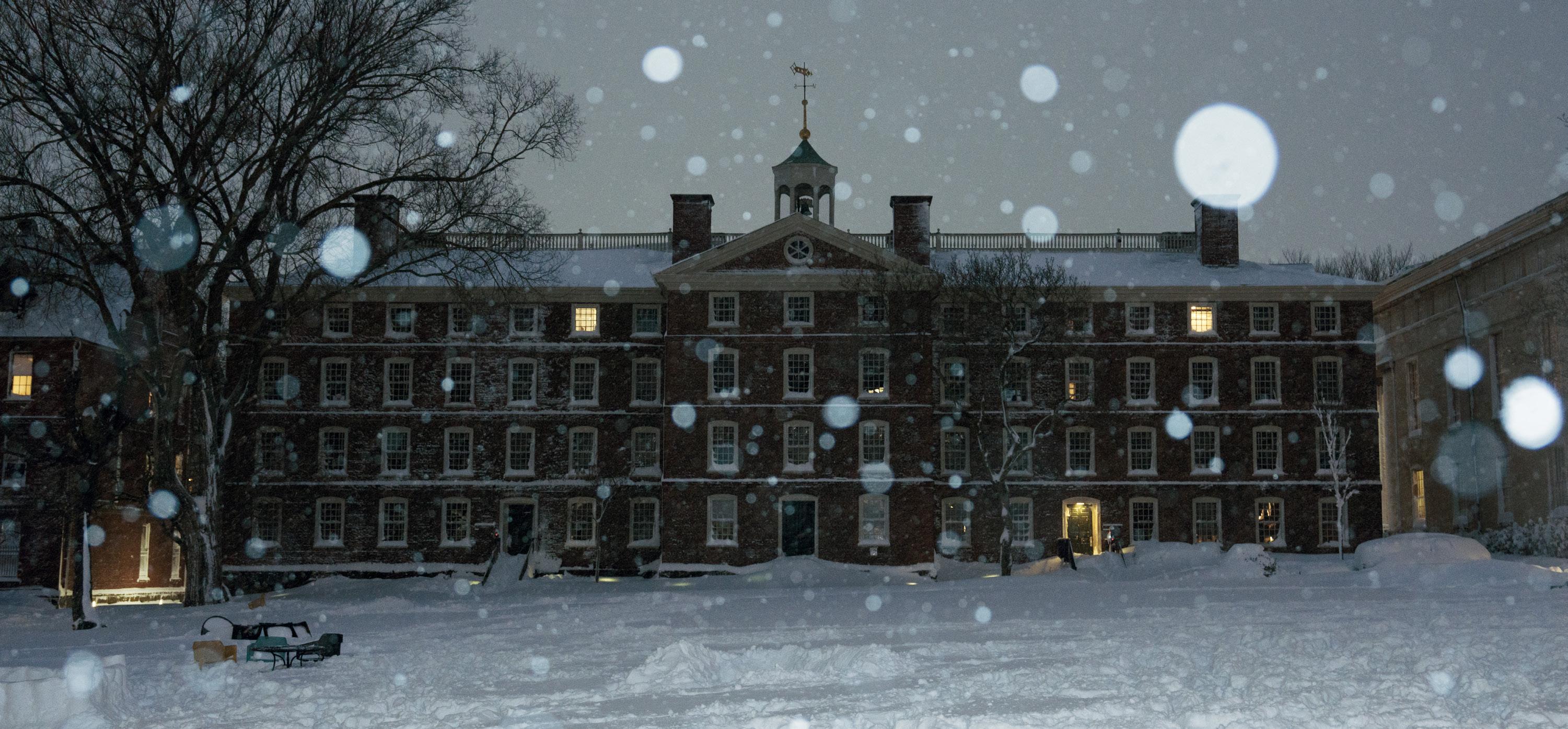
The difference in impact between the two events mirrors the distinction between blizzards and snowstorms.
BY MAXWELL SILVER STAFF WRITER
Starting on Sunday night and lasting well into Monday, the Northeast was hit by a record-breaking blizzard, with total snowfall surpassing three feet in the Providence area causing both University and statewide shutdowns.
When a snowstorm hit Providence on Jan. 25, Brunonians had the day off and a citywide parking ban was implemented for about two days. But for this week’s blizzard, school has been canceled or moved online at the discretion of the instructor for four days straight. The parking ban, which went into effect Sunday afternoon, was still in place Wednesday night.
According to the National Weather Service, a blizzard is a weather event defined by large quantities of snow, heavy winds of over 35 miles per hour and visibilities less than a quarter of a mile for at least three hours. But “a snowstorm is just the snow,” Amanda Lynch, a professor of environment and society and Earth, environmental and planetary sciences, wrote in an email to The Herald.
The definition of a blizzard goes beyond that, though, according to Maria Luìsa Rocha GS, a graduate student in the Department of Earth, Environmental and Planetary Sciences. Snowfall does not necessarily need to occur for there to be a blizzard, she wrote in an email to The Herald.
“Strong winds can pick up snow that is already on the ground and create whiteout

conditions” without there being additional falling snow, Rocha wrote.
“In short, all blizzards are snowstorms, but not all snowstorms meet the criteria to be classified as blizzards,” she added.
This distinction is important, Rocha noted, as blizzards “are generally more dangerous” than snowstorms due to the lack of visibility, dangerously low temperatures and snow drifting. Understanding these differences, “helps communities respond appropriately to the level of risk,” she wrote.
Darren Austin, a meteorologist for the Rhode Island Department of Environmental Management, highlighted that because blizzards reduce visibility, they can slow efforts by the state to manage snow.
“Roads are improving (and) once it’s plowed, you’re good,” Austin said. But “when there’s travel bans, which the governor issues … heed those warnings.”
he added.
Austin also noted that this week’s blizzard was particularly risky for community members because of its extreme wind speeds. “We had a hurricane force wind gust at T.F. Green Airport of 73 miles an hour,” he said.
The blizzard also had wet snow, which Austin described as a “different kind of animal,” as it can stick to surfaces and weigh down trees, roofs and power lines. This, in addition to wind, is the reason why “Rhode Island Energy was forecasting over 100,000 power outages,” he added.
Mark Searles, the chief meteorologist at NBC10, noted the importance of having “enough food, water and provisions in the event you are stranded for days.”
“Make sure that after the storm your vents are clear around your house,” he added, as “carbon monoxide poisoning is real and excessive snow piled up around furnace vents can be deadly.”
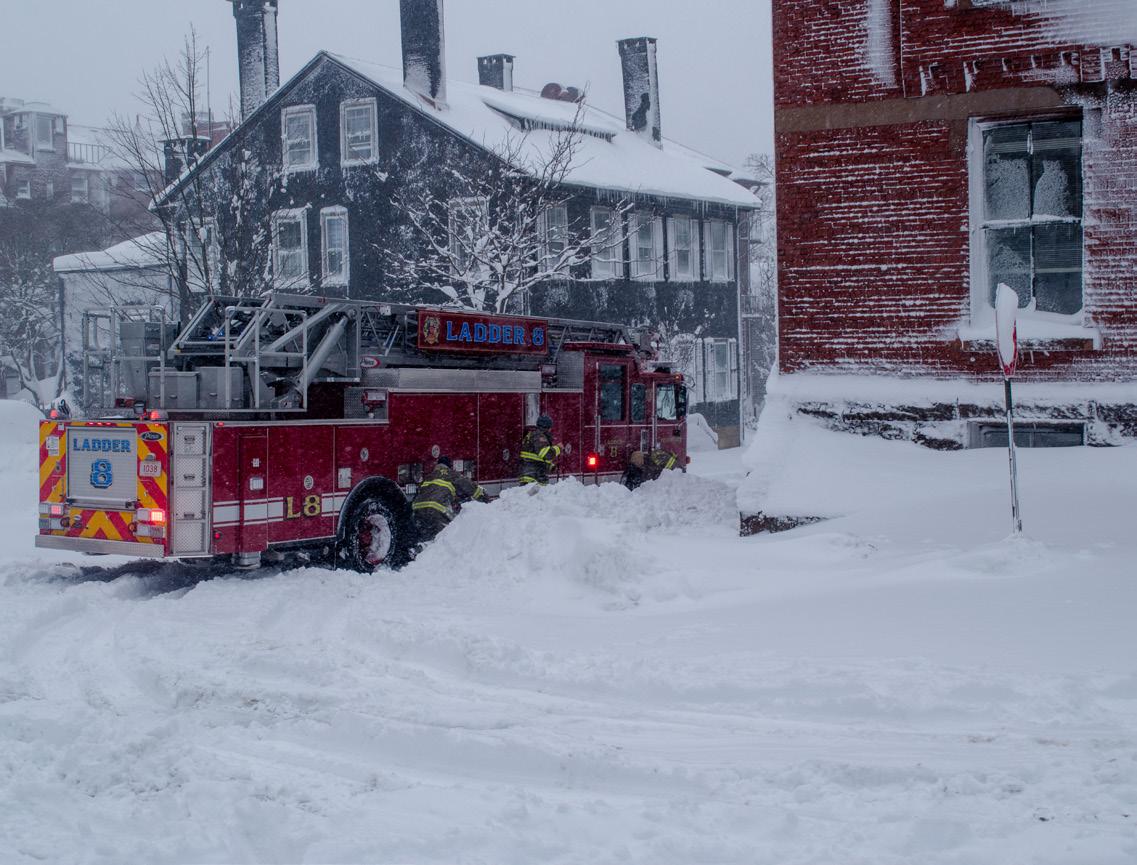
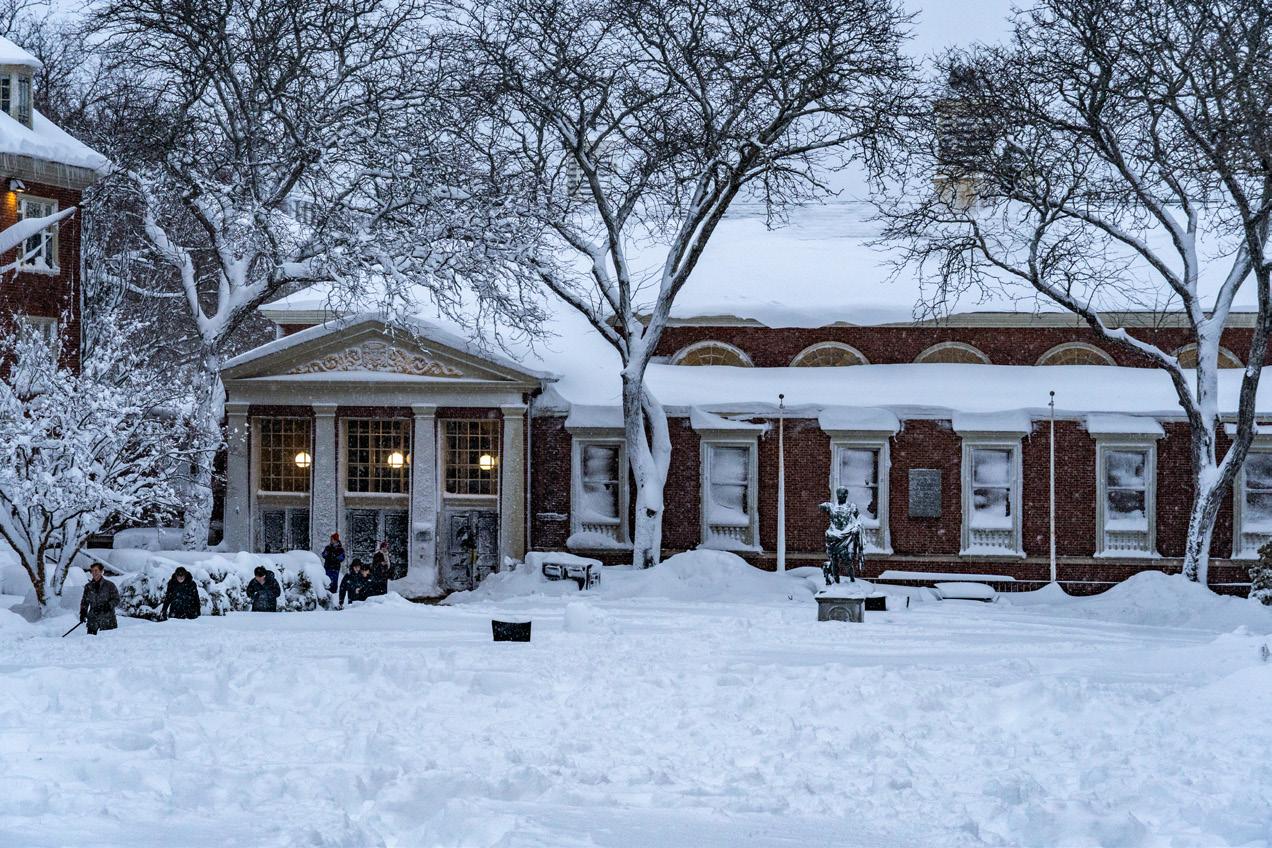

To stay informed, Austin said residents should keep up with weather reports, as well as communication from Brown’s emergency management staff. He noted that forecasts can be unreliable up until roughly 48 hours before storms.
Four days before this blizzard, one European model called for zero inches of snow, Austin explained. “It can be a matter of only 100 miles, and you can have a miss as opposed to a beating,” he said, noting that Rhode Island’s coastal location means that a predicted snowstorm could go “right offshore.” Austin said it’s important to stay alert and watch out for falling snow from buildings. “Look out walking around the city,” he warned.
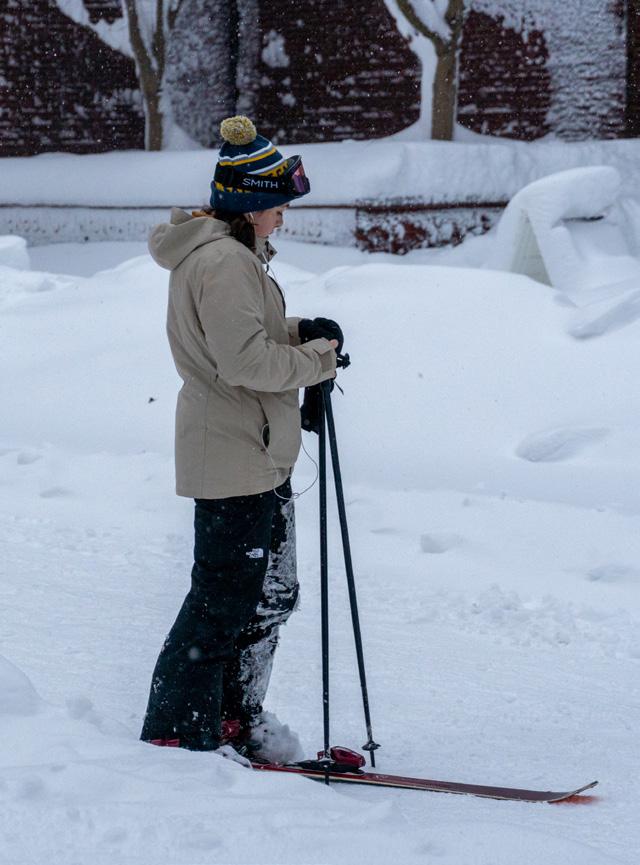
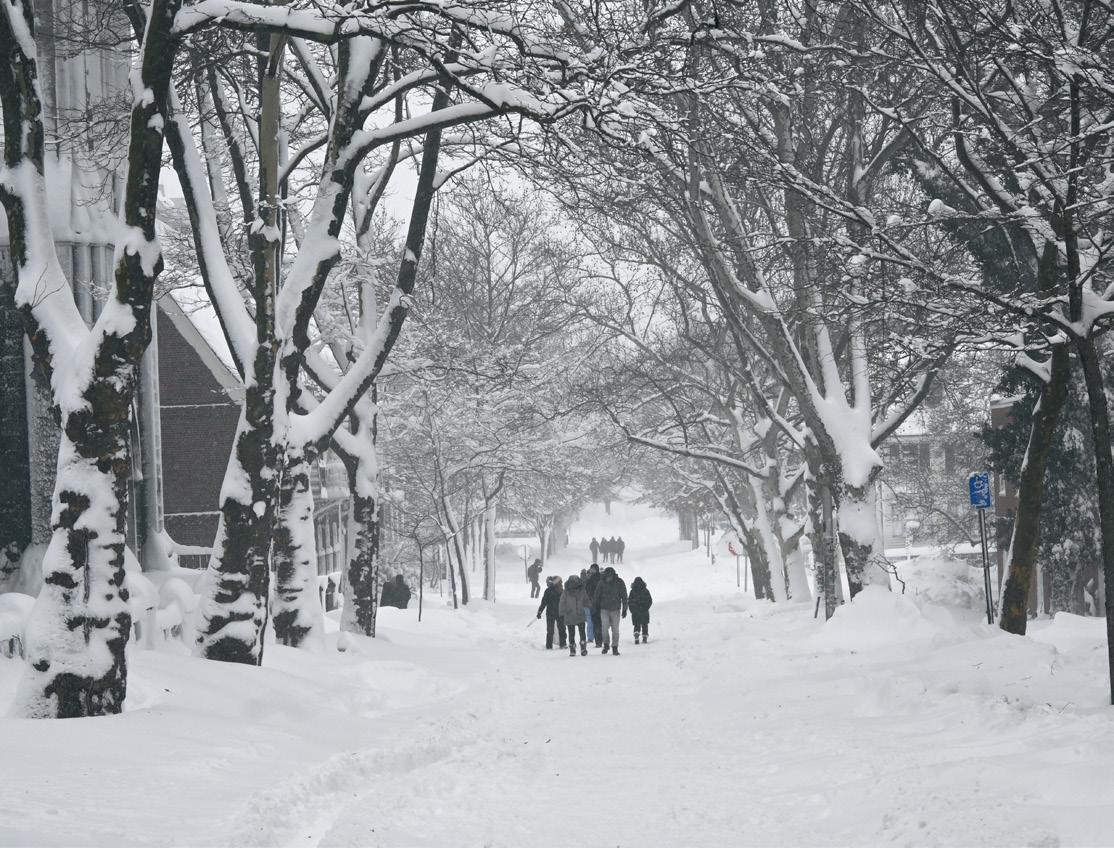
Additional reporting by Alice Xie. This article originally appeared online at browndailyherald.com on Feb. 26, 2026.
The Herald spoke to experts to understand the distinction
HENRY WANG / HERALD
KAIA YALAMANCHILI / HERALD
KENNA LEE / HERALD
KAIA YALAMANCHILI / HERALD
KAIA YALAMANCHILI / HERALD
OWEN BALLARD-O'NEILL / HERALD
OWEN BALLARD-O'NEILL / HERALD