

THE BROWN DAILY HER ALD

Two killed, gunman dead in shooting at Pawtucket hockey game
The shooting occurred on Monday, five miles
from Brown’s campus
BY MICHELLE BI METRO EDITOR
Two people were killed and three others were injured in a shooting at a high school ice hockey game in Pawtucket on Monday. The shooting suspect was also found dead.
This marks the second mass shooting
in Rhode Island in the past two months, following the Dec. 13 shooting at Brown.
The state had seen only four mass shootings since 2014, prior to Dec. 13, 2025.
In a video from the hockey game livestream, more than a dozen shots can be heard echoing in a crowded ice rink.
Players on the ice at the Dennis M. Lynch arena — located about 5 miles from Brown’s campus — quickly skate toward the bleachers, while spectators duck and scatter off-screen.
In a press conference the evening of Feb. 16, Pawtucket Police Chief Tina Gon-
calves said that the three injured victims are hospitalized in critical condition. She described the incident as a “family dispute,” with family members and “a family friend” involved. She added that the suspect appeared to have died from a self-inflicted gunshot wound and firearms were recovered at the rink.
“A good Samaritan did step in,” Goncalves added. “That’s probably what led to a swift end of this tragic event.”
In a statement posted on X Monday, the Boston Field Office of the Federal Bureau of Investigation wrote that “there is no
Exploring platonic love on
Dean of
Students
Koren Bakkegard to depart Brown on Feb. 27
Her responsibilities will be temporarily divided among the Division of Campus Life
BY IAN RITTER UNIVERSITY NEWS AND SCIENCE & RESEARCH EDITOR
Koren Bakkegard, associate vice president for campus life and dean of students, will step down from her position at the University next Friday, according to a Feb. 13 Today@Brown announcement from Vice President for Campus Life Patricia Poitevien ’94 MD’98. Bakkegard came to Brown in 2019 from Stanford University, according to the announcement, where she worked from 2004 to 2019. During her time on College Hill, she helped oversee the opening of three residence
halls and led the creation of the Brunonians Living Off Campus program.
Bakkegard also led partnerships on campus to develop the Brown Experience and Advising Record system, co-led the Ivy+ Student Health and Wellness Learning Collaborative and helped relaunch the Community Dialogue Project.
In an email to the Herald, Poitevien described Bakkegard as a key figure in the Division of Campus Life since she arrived on campus. of this tragic event.”
“From guiding major residential improvements to fostering wellness and dialogue across campus, her work has been defined by a deep commitment to an inclusive community,” Poitevien wrote.

imminent threat to public safety.”
Goncalves identified a suspect by the birth name of Robert Dorgan, but noted that the individual also used the name Roberta Esposito.
According to the Boston Globe, a daughter of the suspect identified Rhonda Dorgan and Aidan Dorgan, the ex-wife and son of the suspect, as the two victims who were killed. The daughter named her mother's parents, Linda Dorgan and Jerry Dorgan, and a family friend as the injured victims.
North Providence Mayor Charles
Lombardi had previously identified one of the victims killed in the shooting as the suspect’s son.
At the press conference, Pawtucket Mayor Donald Grebien stated that authorities are in the middle of an “active investigation” and have already interviewed over 100 witnesses.
“Providence Police provided mutual aid today and stayed on scene to offer any additional assistance needed,” Kristy dosReis, Providence’s chief public information officer for public safety, wrote in an email
City announces third-party review of its response to Brown shooting
The city has retained Police Executive Research Forum to conduct the review
BY TALIA EGNAL METRO EDITOR
The City of Providence has retained the Police Executive Research Forum to conduct an independent, third-party review of its response to the Dec. 13 shooting, Mayor Brett Smiley announced on Thursday. The review, which will cost $95,000 in total, is projected to be completed in 210 days.
PERF — a research organization based in Washington, D.C. focusing on policing issues — will produce an after-action report synthesizing findings from various groups, such as the Providence Police Department, and provide recom -
mendations for the city. This report will help identify “what worked well and where we must improve in training, tools, tactics and technology,” Smiley said in a statement sent to the Herald.
“This process is focused on accountability and learning,” Smiley said. “We are committed to releasing the full report once it is complete and to continuing to earn the community’s trust.”
The report will evaluate the city’s “inter-agency coordination, investigative processes and public communications” in response to the shooting, the statement added. Providence residents have expressed dissatisfaction with the city’s emergency alert systems following

This marks the second mass shooting in Rhode Island in the past two months, following the Dec. 13 shooting at Brown.
KAIA YALAMANCHILI / HERALD
UNIVERSITY NEWS

ADMINISTRATION FROM PAGE 1
The University will “launch a national search” for the next dean of students in the coming weeks, according to a Feb. 19 Today@Brown announcement from Poitevien. The search committee, chaired by Poitevien, will include members from divisions across the University. An external search firm will also assist in identifying potential candidates.
CITY FROM PAGE 1
the Dec. 13 shooting, The Herald previously reported.
PERF will review the use of technology and equipment by city agencies in their response and investigation. This includes license plate readers, AI-enabled technologies and the Real
In the interim period, Bakkegard’s responsibilities will be divided among administrators in the Division of Campus Life.
The Office of Residential Life and the Student Activities Office will be overseen by Dana Hamdan, associate vice president for finance and administration. Associate Vice President for Strategic Assessment and Student Experience
Time Crime Center, a centralized technology hub the city uses to help monitor crime.
As part of their investigation, PERF also plans to facilitate after-action discussions among relevant partner agencies, including representatives from
Susan Layden and Associate Vice President of Campus Life for Inclusive Community and Belonging Loc Truong will oversee Student Support Services and the Office of Student Conduct and Community Standards. Poitevien will take on any responsibilities not covered by Hamdan, Layden and Truong.
The three associate vice presidents “bring
the University and Brown’s Department of Public Safety.
Brown is also conducting its own after-action review and campus safety and security assessment with the global consulting firm Teneo, The Herald previously reported.
decades of experience in higher education that will ensure a seamless transition and a steady environment for our students,” Poitevien wrote.
After leaving the University, Bakkegard will “focus on her personal renewal before embarking on the next phase of her professional journey,” according to the announcement.
“I am excited to pursue new opportunities to foster belonging, community engagement, and wellbeing,” Bakkegard wrote in an email to The Herald. “I will be forever grateful for the extraordinary students and colleagues I had the honor to serve and serve alongside at Brown.”
Smiley highlighted the Monday shooting in Pawtucket as a “painful reminder” of how such incidents impact the affected communities. He added that it “strengthens our resolve to examine our own response with honesty and transparency.”
“Our responsibility is not only to understand what happened, but to act on what we learn,” Smiley said. “We must continue strengthening how we serve, protect and support our residents, and do everything in our power to help prevent future tragedies.”
COURTESY OF KOREN BAKKEGARD
Bakkegard came to Brown in 2019 from Stanford University, where she held administrative roles for over 15 years.
Department of Public
SOPHIA LENG / HERALD
From school crush to ‘Modern Love’: Anna Martin ’16 recounts path to hosting podcasts
Martin became interested in storytelling during her undergraduate years
BY REBECCA GOODMAN SENIOR STAFF WRITER
Over the past four years, Anna Martin ’16 has interviewed writers, actors and political figures. With her guests, including actor Andrew Garfield, activist Malala Yousafzai, WNBA star Natasha Cloud and author Jennette McCurdy, she discusses the same topic: love.
Martin hosts the ‘Modern Love’ podcast for the New York Times, which examines real-life love stories. But her passion for storytelling began when she was an undergraduate student at Brown.
After Martin saw “a really cute guy” at the table for the Brown University Storytellers during the club fair, she signed
ENGINEERING
up. At the group’s meetings, Martin was struck by the “very intentional” way club members spoke.
“All these people seemed cool and self-possessed” and “there was a real purpose to what they were saying,” she said.
“I was like, ‘I want to speak like that, too,’” she added.
By her sophomore year, she was helping to run the club. She remembers the “totally electric” experience of running auditions for shows and workshopping stories.
“I remember just being endlessly fascinated with how a story started and how it ended up on stage,” she said.
In her junior year, Martin emailed the artistic director at The Moth, a professional storytelling organization. The director agreed to speak with her, which Martin still considers “one of the biggest breaks ever.” Martin ended up helping The Moth bring their workshop programming to Brown,
and she was hired at the company after she graduated.
After working at The Moth and briefly working with news podcasts, she was hired at Pop-Up Magazine, which produces live storytelling shows with visuals and music. “I was like, ‘Wow, this is it. I’ve come back to the thing I love the most, which is live storytelling,’” Martin said.
Eventually, she was suggested to “throw (her) hat in the ring to be the host” of the Modern Love podcast, created by Lisa Tobin. “I had never hosted a single thing before,” Martin said. “And then I got it.”
When preparing for an episode, Martin’s “amazing” team with producers and editors provides her with background information on her upcoming guest. Then, she immerses herself in the guest’s work, reading their book or watching their filmography.
Sometimes, “you have to watch, for
example, all of a season of Love Island in a weekend,” she said.
Martin said that many of her conversations are centered around real-life scenarios and what those stories can teach her guests about love.
“We call them love stories, (but) I think really what we’re telling are stories about what it means to be human, which sounds very grand, and maybe it is,” she said. “Love is a totally broad umbrella, and for that, I’m very grateful.”
For Martin, the best part of the job is speaking “with people who are choosing to be open and vulnerable.” She finds herself “consistently humbled” being a “witness to that bravery.”
Martin remained in touch with Professor of English James Egan after taking his class ENGL 0100F: “Devils, Demons and Do Gooders.” Egan stayed as a mentor for Martin throughout her experience at
Brown, she added.
Egan remembers her as “creative, smart, very engaging” and a “really good writer.” Now, he listens to her podcast.
Martin gives credit to her time at Brown for her career. “I really do think that if I had gone anywhere else, I wouldn’t be doing this job,” she said.
“Our show is very earnest,” she added. “You can approach being earnest with humor — to me, that means being open hearted. So my message (to Brown) would be, just remain open. Remain open to one another, to yourselves.”
“It started with a cute boy and ended up with a real love for the craft,” Martin said. “I think that that’s a love story in and of itself.”
This article originally appeared online at browndailyherald.com on Feb. 18, 2026.
John Donoghue PhD’79 awarded Queen Elizabeth Prize for Engineering
His research helps restore physical function in people with paralysis
BY NISHITA MALHAN AND SAMAH HAMID SENIOR STAFF WRITER AND UNIVERSITY NEWS EDITOR
Professor of Neuroscience and Engineering John Donoghue PhD’79 was awarded the 2026 Queen Elizabeth Prize for Engineering for his work in brain-computer interfaces which help restore function in people with paralysis.
The £500,000 prize, which was first awarded in 2013, is given to individuals responsible for “groundbreaking” innovation that benefits humanity, the award’s website reads.
Donoghue was “in shock” when he
SINCE
learned about the award, he told The Herald. “The other people that they had selected along with me are just really tremendous scientists, engineers. So I was really taken aback to be included with that group, but it was wonderful,” he said.
He explained that his work centers around recognizing brain signals from individuals who have “lost their communication between their brain and their body” due to neurodegenerative diseases or injuries.
“What we’ve done is replace the biological (system) with a physical system — an engineered system,” Donoghue added.
In the 1990s, Donoghue and his team began to think about how brain signals can be interpreted and decoded to be used to run devices. It was then that BrainGate — a neuroengineering research team — was born.
When the team began their work, they didn’t know if a paralyzed person had sig-
nals in their brain when they thought about moving their limbs, he said. But in the early 2000s, they discovered these individuals had brain signals “related to movement,” Donoghue said.
The BrainGate team determined how to link these signals to a computer.
With this technology, BrainGate’s first patient, Matt Nagle, was able to communicate, play video games and do “everything, just through a computer,” Donoghue said.
Through BrainGate’s technology, the team also demonstrated that a paralyzed individual could “control a robotic arm” in place of their own.
“There’s this iconic picture of Cathy Hutchinson taking a drink using a robotic arm that she was controlling rather than having to have somebody else do it for her,” Donoghue said. “Those were demonstrations. We still have a ways to go before
they’re products.”
BrainGate’s initial vision was “a very ambitious image,” he added. The group hoped that “one day you could be playing basketball with somebody, and they would say, ‘Oh, I had a spinal cord injury, but thanks to BrainGate, I’m completely fine. I can do whatever I want.’”
While the team is still “far off” from that goal, the prize serves as a “real tipping point” for the project and has generated global recognition — particularly from startups — that this device “will really work,” he said.
Donoghue credited his colleagues and students at Brown for his research advancements.
Arto Nurmikko, a professor of engineering and physics, fondly described his “close scientific (and) collaborative partnership” with Donoghue.
THE BROWN DAILY HERALD
PRODUCTION
Copy
Design
MULTIMEDIA
Photo Chiefs Annamaria Luecht Kaia Yalamanchili
Illustration Chiefs
Eastep Isabela Guillen
Video Chiefs Cienna Cheng
Cody Cheng
Social Media Chiefs
Nate Barkow
Annika Melwani
Technology Chief
Annika Singh

Rahman Camila Valdes
Data Desk Chief Caleb Ellenberg
Games
Jake Parker
Jascha Silberstein
Rassul Toleugazy
BUSINESS
General Managers
Arjun Deshpande
Anum Azhar
Sales Directors
Arjun Ray
Hannah Han
Finance Director
Sydney Wright
Office Manager
Cary Warner
@the herald facebook.com/browndailyherald
@browndailyherald

@browndailyherald
“He was my teacher and mentor who opened the doors to a new world to me,” Nurmikko wrote in an email to the Herald. “He is simply one of the very best scientific minds I have seen during my career.”
“I don’t think this would have happened any place else because we have these wonderful colleagues,” Donoghue said, adding that he would not have made the progress he did without the “full interaction” across faculty and students.
For Donoghue, the award is meaningful because it “brings attention to the accomplishments that have been made” as well as “the need for interaction across fields” and “the importance of engineering to human health.”
This article originally appeared online at browndailyherald.com on Feb. 18, 2026.
Submissions: The Brown Daily Herald publishes submissions in the form of op-eds and letters to the Op-eds are typically between 600 and 900 words and advance a clear argument related to a topic of campus discourse. You can submit op-eds to opinions@browndailyherald.com.
Letters to the editor should be around 250 words and respond to an article or column that has appeared in The Herald, or critique or commend The Herald’s editorial decisions. You can submit letters to the editor to letters@browndailyherald.com.
Submissions undergo multiple rounds of editing. These rounds of editing generally take place over the course of one evening, and you may have to respond to edits late in the evening. If you know you will be unable to do so, please mention that in your email, and we will do our best to work with you.
Submissions can build on reporting from The Herald, reporting elsewhere, official statements from the University or other groups and other reputable sources, but they cannot break news or contain information that The Herald cannot verify. Because we cannot publish unsubstantiated information, failure to provide appropriate sources may mean we have to modify or remove unverified claims.
The Herald will not publish anonymous submissions or submissions authored by organizations. Leaders of student organizations can be identified as such but cannot write under the byline of their organization. The Herald cannot publish all submissions it receives and reserves the right
METRO
SHOOTING FROM PAGE 1
to The Herald.
According to WJAR, the two teams playing ice hockey during the time of the shooting were a Coventry-Johnston co-op and a St. Raphael-Providence Country Day-North Providence-North Smithfield co-op. All North Providence students and hock-
ey players are safe, North Providence Public Schools Superintendent Joseph Goho wrote in an email to The Herald.
According to WJAR, school officials from St. Raphael Academy, Coventry High School, Johnston Senior High School, North Smithfield High School and Providence Country Day School — all schools with students in-
volved in the game — confirmed that their students were safe.
The shooting occurred at a high school hockey team’s Senior Night, U.S. Rep. Gabe Amo (D-R.I. 1) wrote in a press release sent to The Herald.
It is “unimaginable” to think that “Rhode Island community members are
confronting what appears to be another tragic act of mass violence,” University Spokesperson Brian Clark wrote in an email to The Herald. “Our thoughts and prayers go out to everyone impacted by the incident in Pawtucket as well as the dedicated first responders and emergency physicians.”
He added that “Brown continues to maintain an enhanced security presence across campus,” from College Hill to the Jewelry District.
This article originally appeared online at browndailyherald.com on Feb. 17, 2026.
University launches ‘Brown Loves Providence’ to support local community after Dec. 13 shooting

The
began on Feb. 14 and will run until March 16
BY
AVA STRYKER-ROBBINS AND IAN RITTER METRO EDITOR AND UNIVERSITY NEWS AND SCIENCE & RESEARCH EDITOR
The University launched the “Brown Loves Providence” campaign on Saturday as a symbol of thanks to local businesses and Providence community members for their support after the Dec. 13 mass shooting.
The campaign aims to encourage the Brown community to support businesses and organizations across Providence. Suggested methods of support include making posts about local businesses on social media and hanging Brown Loves Providence posters. The University will also be selling Brown Loves Providence merchandise for the duration of the campaign, and all proceeds will be put toward the community,
according to the initiative’s website.
Individuals who provide proof of purchase at local businesses or donations to local nonprofit organizations can also be entered in a raffle for a $100 restaurant gift card or a $100 donation to a community-based nonprofit of their choice, according to the campaign’s website.
Inspired in part by posters reading “Providence Loves Brown” placed around campus after Dec. 13, the Brown Loves Providence campaign aims to “flip the script,” Mary Jo Callan, the vice president for community engagement and executive director of the Swearer Center, told The Herald. She hopes the campaign will demonstrate appreciation for how the community “showed their love for us on and after the shooting.”
We “have endless respect and love for the city, for what it managed to make not happen and how much it supported us in that evening and the weeks that follow,” Matthew Guterl, vice president for diversity and inclusion, said in an interview with The Herald.
“It’s good for the (Brown) community
to acknowledge a debt and to pay that debt back and to do so publicly and with force,” Guterl added.
According to Callan, the planning of the campaign involved “tying together” ideas that the community generated naturally.
The initiative has engaged over 80 student ambassadors, faculty and staff, who will work to spread awareness of the campaign. Tables have been set up around campus, where people can take stickers and posters and write notes of appreciation for local businesses.
“Providence showed the Brown community a lot of love and support after last semester’s tragedy,” Brown Loves Providence student ambassador Sophia Knaggs ’27 wrote in an email to The Herald. “I think perhaps by returning this generosity it can help us continue to heal.”
Another student ambassador, Mia Santomassimo ’29, who is a photographer for The Herald, wrote that she joined the campaign staff because she “wanted to show (her) appreciation for the city.”
“I’m constantly getting coffee with friends or just going to local cafes, like
Brown Bee Coffee and Caffè Nero, to study,” Santomassimo wrote. “I’m very excited to support shopping local and write thank-you cards to businesses.”
Jessica Lee ’28, who is not affiliated with the campaign, told The Herald she chose to submit a note to Caffè Nero — where she sheltered on Dec. 13 — through an online form after she learned of the campaign through a Today@Brown announcement. Her note is now featured on Brown’s Instagram page.
“I had been wanting to reach out to the people at Caffè Nero and had been debating sending a card,” Lee said. “I didn’t really know what would even be the best way to thank them.”
“I thought that this was an opportunity that fell right into my hands to be able to thank them in some way,” she added.
The campaign seems like a “logical and restorative next step in our community,” Callan said.
Even if “all we do is change everyone’s angle of view and make them see the city a little differently,” the campaign will have been meaningful, Guterl added.
The campaign also seeks to help organizations such as Brown University Health and the Nonviolence Institute, a Providence-based organization that provides support to victims of violence in the community.
Carrie Bridges, vice president of community health at BUH, told The Herald she learned about the Brown Loves Providence campaign last week. Bridges added that she was deeply proud of her colleagues and the work of BUH following Dec. 13.
“I was able to witness just how incredibly professional, how incredibly caring and how incredibly thorough they were in trying to think through what every individual’s and every family’s needs would be,” Bridges said.
Lisa Pina-Warren, executive director of the Nonviolence Institute, said she thinks that the Brown Loves Providence campaign is “absolutely amazing.”
Pina-Warren, who attended Hope High School and has spent large amounts of time near Brown’s campus, added that the difficult circumstances have “bridged a gap and (have) brought so many of us together.”
campaign
CUNYAN MA / HERALD
The initiative was inspired in part by posters reading "Providence Loves Brown" placed around College Hill after Dec. 13.
CRIME
Proposed bill would abolish life without parole for young offenders in R.I.
The bill has been referred to the state House Judiciary Committee
BY LEV KOTLER-BERKOWITZ SENIOR STAFF WRITER
Lawmakers and nonprofit leaders are spearheading an effort to add Rhode Island to the growing number of states that have abolished life without parole sentences for young offenders.
On Jan. 15, R.I. legislators introduced a bill in the state House of Representatives that would protect individuals who commit crimes when they are 21 years old or younger from receiving life without parole sentences.
Currently in Rhode Island, only two offenses — first-degree murder and kidnapping that results in death — carry a potential sentence of life without parole. To be punishable by life without parole, the crime must be paired with at least one aggravating factor, a circumstance that increases a crime’s severity, such as torture. Currently, the most extreme sentence of life without parole is not mandated for either crime, giving judges and juries the responsibility to determine whether the punishment is appropriate.
The proposed legislation does not entail parole for all offenders — individuals serving time would still need to convince parole boards to release them.
“This isn’t a get-out-of-jail-free card,” state Rep. Rebecca Kislak ’94 (D-Providence), a cosponsor of the bill, wrote in an email to The Herald. “It’s an opportunity to ask for a second chance, to ask forgiveness, to turn their lives around.”
State Rep. Julie Casimiro (D-North Kingstown, Exeter), the bill’s primary sponsor, stressed the fact that young people “don’t have complete brain development” in an interview with The Herald.
“We can’t just throw them away” by imposing life without parole sentences, Casimiro said.
State Rep. Jennifer Stewart (D-Pawtucket), a co-sponsor of the bill, wrote in an email to The Herald that research has shown that “brains are not fully developed until we reach our mid-twenties.” Stewart, who has taught high school for over 20 years, has “seen teens struggle to grasp the effects of their actions,” she wrote.
“It seems like youth offenders should have the most capacity to be rehabilitated,” Stewart added.
This is not the first time legislators have taken steps against life without parole sentences for young offenders. Lawmakers, including Casimiro, advocated for the abolition of life without parole in 2021’s Youthful Offender Act. The act, also known as “Mario’s Law,” ensures offenders who were charged prior to their 22nd birthday have the chance to be considered for parole after serving 20 years in prison, but it explicitly excluded individuals sentenced to life without parole.
Mario’s Law was named after Mario Monteiro, who is one of the cofounders of the Rhode Island Freedom Collective, a prison reform advocacy nonprofit that has supported the current bill’s advancement.
The Herald spoke to Monteiro, who was sentenced to two consecutive life sentences for killing a bystander in a gang-related shooting at the age of 17.
Monteiro said that much of his child-
hood was characterized by “unpredictability” and “a lot of trauma,” speaking to living in abusive situations after the deaths of his parents when he was nine years old. “I think my escape from that was the streets and eventually joining the gang.”
“Young people make mistakes and … we can make bad mistakes like I did, and there should be punishment for it,” Monteiro said. “But at the same time, I think it’s important to take into account a lot of the underlying factors of a person’s upbringing.”
“Nobody is incapable of changing,” he added.
In 2023, two bills to eliminate life without parole sentences for all defendants — regardless of age — were introduced in both chambers of the General Assembly. Both bills died in committee.
Now, Casimiro is “hopeful” that legislators will be “open to hearing and understanding the science behind the brain development piece,” she said. She noted that bills are rarely passed the year they are introduced, but she hopes the state House Speaker Joseph Shekarchi (D-Warwick) and the judiciary committee will consider the bill.
In a statement sent to The Herald, Shekarchi wrote that the bill will have a public hearing in the House Judiciary Committee. He did not mention when the hearing will be held.
Shekarchi added that he is “keeping an open mind on the bill” and will evaluate testimony submitted by “all interested parties.”
House Minority Leader Michael Chippendale (R-Coventry, Foster, Glocester) criticized the bill in a statement sent to The Herald.

“This bill does not address minor crimes or youthful mistakes,” Chippendale wrote. “It applies to the most serious acts in our criminal code.”
Chippendale wrote that the bill would prevent 18, 19 or 20-year-olds who commit a “deliberate, execution-style murder” from being eligible for the “harshest sentence available under our law.”
“We either have age limits or we do not,” Chippendale wrote. “This bill blurs that line, and for that reason, I oppose it.”
According to the Boston Globe, state Sen. Jacob Bissaillon (D-Providence) plans to file a companion bill in the Senate. Bissaillon did not respond to The Herald’s request for comment.
Steven Brown, executive director of the American Civil Liberties Union of Rhode Island, wrote to The Herald that the ACLU has “long believed” that life without parole sentences “rob individuals of rehabilitative hope,” which is “one of the purported goals of incarceration.”
Such sentences don’t properly con-
sider “how people can change over time,” he wrote. He added that he hopes the bill will be adjusted to retroactively apply to those who committed crimes before the age of 22 and who are currently serving life without parole.
Currently, four individuals in Rhode Island fit this description, according to J.R. Ventura, the chief of information and public relations for the Rhode Island Department of Corrections.
Monteiro noted that he and the Freedom Collective’s other founders have had “the great opportunity” to “have conversations” with several legislators.
“Sometimes people can have this misconception” that those convicted of crimes “walk, talk and act in a certain way,” Monteiro said. “There’s power in meeting people and having conversations, just to open their eyes a little bit.”
This article originally appeared online at browndailyherald.com on Feb. 18, 2026.
RISD students report challenges affording materials as spring semester begins
60% of students struggle to afford materials for classes, study finds
BY IZABELLA PIATKOWSKI SENIOR STAFF WRITER
With Rhode Island School of Design’s spring semester starting last week, students are scrambling to foot the bill for class art supplies. On the high end, the price of supplies for a single course can reach thousands of dollars.
In spring last year, a majority of students reported having trouble affording the cost of required materials.
“Even today, I went to the store to buy drawing supplies for my first class, and I already spent close to
like brushes, pencils, paper and the necessities,” said Lila Ferne, a first-year studying industrial design.
In April 2025, RISD’s Holistic Student Wellness Committee released an executive summary which stated that “60% of students reported trouble affording project materials/supplies.” According to RISD’s website, students spend on average $2,700 per year on materials.
An action plan shared by RISD President Crystal Williams in January 2026 included recommendations for “Holistic Student Wellness.” As part of the initiative, the school plans to “create a toolkit for faculty to foster classrooms that are financially equitable” and “review costs related to majors and support high-and moderate-need students.” RISD is working to implement these plans

Some classes on RISD’s course listing website estimate the cost of materials in their course descriptions. FAV 5196-01: “Senior Studio: Animation,” for example, estimates an average cost of $1,000 to $3,000.
Jade Sun, a RISD sophomore studying illustration, said she knows people who have avoided taking certain courses or declaring certain majors “because they felt that cost would be a significant barrier.”
This Wintersession — a five week period between the fall and spring semester — Sun said she took a darkroom photography class that cost her $346 in supplies. “Several people” recommended against taking the class “just because of the cost,” she added.
Especially during their first year at RISD, students can be at the store “pretty much every day” due to a high volume of projects, said Zoe Vaspol, a senior furniture design major.
Multiple students also said that they felt pressure from some professors to buy more expensive supplies.
“My first year, I would always draw with newsprint, since it was just much cheaper than getting nice quality drawing paper,” said Vaspol. “My professor was upset that I hadn’t provided better paper for the crit, even though it felt like to me that it wasn’t that important what kind of paper I was using.”
RISD offers the Materials Fund to some students “based on financial need,” which provides eligible students with $500 per semester to spend on art supplies, according to RISD Associate Director of Public Relations Danielle Mancuso.
Students added that shifting eligibility
and lack of knowledge about the Materials Fund have made it less helpful in affording supplies. Multiple students said that they were unaware of the Materials Fund or a program providing financial support for supplies.
Vaspol said that while she qualified for the Materials Fund last year, she did not receive funding this academic year and was not given an explanation from RISD. She remains “really conscious” about the money she is spending and searches for cheaper alternatives for the supplies required for her classes.
“This year, RISD awarded more than half a million dollars in materials funding to students with the greatest need — an increase of 3.7% over last year to more than 550 students,” Mancuso wrote in an email to The Herald.
“For students who do not receive automatic funds based on need, they can meet with Student Financial Services to explore the Materials Fund application process. All of this is communicated to students throughout the aid and enrollment process,” she added.
Students also have the option to purchase their materials through RISD stores, where “steps are taken to support affordability and access,” Mancuso wrote. This includes a 10% general student discount and a 20% discount for students on the Materials Fund. The stores also cut certain materials to size to “allow students to purchase only what they need rather than full sheets or bulk qualities.”
“The goal is sustainability, not excessive profit,” she added.
RISD’s Second Life Exchange, a center which offers free used or leftover materials, provides students an alternative to purchasing art supplies.
“We run entirely on donations, and students are able to come into our store and get five free items at a time, whatever we have available,” Brown-RISD Dual Degree alum Laney Knudson ’23, the reuse specialist at Second Life, said.
Many of the students interviewed by The Herald said that Second Life was a helpful resource to afford materials.
“Second Life is actually such a godsend,” Sun said. “I would say Second Life is the best cost-saving resource that we have at RISD.”
“I was a RISD student, I was also a Brown student, and just seeing the money I would spend on books didn’t even come close to the money I had to spend on arts supplies,” Knudson said. They explained that in addition to helping “offset the costs” of art supplies, Second Life allows students to experiment with new materials in an affordable way.
“Outside of the Materials Resource Fund, individual departments may provide additional support directly to students on a case-by-case basis,” Mancuso wrote to The Herald. “We remain committed to reviewing pricing, working closely with vendors and ensuring students have reliable, convenient access to the materials required for their coursework.”
KAIA YALAMANCHILI / HERALD
This is not the first time legislators have attempted to abolish life without parole for young people who commit severe crimes.
UNIVERSITY NEWS
Sometimes the strongest love isn’t romantic at all: Exploring platonic love on
campus
The
BY MAXWELL ZHANG STAFF WRITER
For a few short days before Valentine’s Day, campus transforms. Bruno walks through the Blue Room handing out roses and paper-cut hearts adorn the building windows. One word enters many people’s minds: love.
Although the holiday is most often a celebration of romance, there is also another love to be celebrated: friendship. The Herald spoke to Brown students and faculty about what platonic love looks like for them.
‘A homey place’: Emily Hipchen MA’20, Jonathan Readey and Ravit Reichman Emily Hipchen MA’20, Jonathan Readey and Ravit Reichman, in addition to their positions as English professors, are also proud members of the “Without a Paddle Club,” which started during the pandemic.
The three-membered club gathered virtually every Wednesday night to indulge in an episode of Schitt’s Creek, despite the physical isolation.
Of the dynamic trio, Reichman was the first to arrive at Brown in 2003, followed by Readey in 2009. Readey says that Reichman was one of the first people he had met at Brown, adding that she was “so friendly” and made Brown feel like “a homey place.”
Reichman and Readey had a lot in common — they were both trained in modernist literature and had offices on the same hallway, Midwestern roots, kids around the same age and an hour commute from Massachusetts — but their close friendship blossomed when they began to teach together.
As the director of graduate studies for the Department of English at the time, Reichman asked Readey to co-teach the pedagogy class he had historically taught.
“It was awesome because you learn a lot about a person when you’re teaching with them,” Reichman said. “You see what lights them up in that context, what they care about, how they think with others.”
Last summer, Readey and Reichman continued the tradition and co-taught a summer course in London. The course was both online and in-person in London, and the two “basically lived with (their) students in a dorm in London for three weeks,” Reichman said. “It was amazing.”
Hipchen, the newest addition to the trio, recalled visiting Readey’s sports writing class in 2020, where she found herself amazed by Readey’s class of excited students and fervent discussion.
It began to snow as she left, and Readey insisted to Hipchen that the weather in Providence was usually nicer. It was “a very (Readey) thing to say, because, frankly, it’s not,” Hipchen added. Even in the cold, Hipchen remembers Readey as the “most warm, most friendly, most accepting and facilitating person (she has) literally ever met.”
Their friendship is not confined to the boundaries on campus. Readey once participated in a flash mob for Reichman’s son’s Bar Mitzvah, dancing to a song with rewritten words from “Carrying the Banner” from the musical “Newsies.”
During the pandemic, Hipchen sat on a call with Readey for hours, helping him browse for cars on Carvana, an online used car retailer. They settled on the “silver
surfer,” his now beloved Honda CRV.
The trio also cultivates community beyond themselves.
Readey said that Hipchen is “always looking for ways to build community, not just with our friendship — the three of us — but with so many people across the department, across Brown, and the same thing for Ravit.”
In the aftermath of the Dec. 13 mass shooting, Reichman brought hot chocolate and cookies to the English department’s lounge as the trio, joined by Hipchen’s dog Darby, gathered to provide a space for students.
“I felt like, you know, it was going to be okay, even if it wasn’t going to be okay because of the way in which we could meet that moment in that particular way,” Hipchen said.
To Reichman, a good friend is someone who you can be “very real” with. “I feel like myself around them, and I feel like I can be vulnerable around them,” she said. “These are the people who show up for you,” Reichman said.
“Life isn’t the office,” Reichman said, but “I feel lucky to work with people I love, and I don’t take that for granted for a second.”
The matching ‘Bob Dylan jacket’: Grace Gongoleski ’27 and Lydia Fantaye ’27
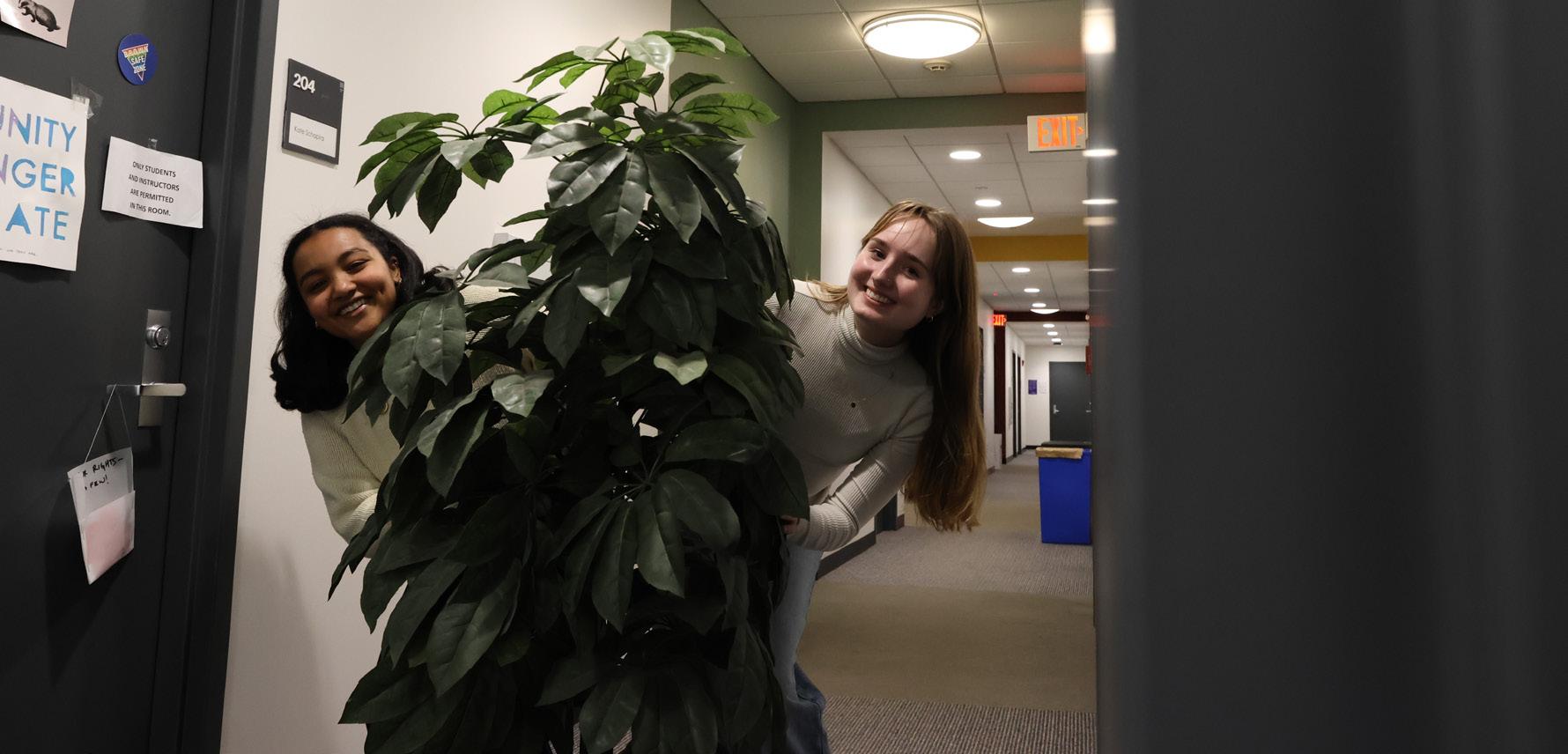
Grace Gongoleski ’27 and Lydia Fantaye ’27 met in the hubbub of their first semester, as many friends do, but didn’t speak oneon-one until their second semester, when their mutual friend reintroduced them in line at Andrews.
“I remember thinking, ‘Oh my god, she’s so lit to talk to,’” Gongoleski said. “I just felt like we really kind of clicked.”
They chatted about class — at the time, they both thought they were studying biomedical engineering. Since then, they’ve both switched to applied mathematics-biology.
The two found camaraderie in shared coursework. “It was easier to continue, I was like ‘Okay, somebody else is doing this,’” Fantaye said.
During sophomore year, “I feel like we ended up doing a lot of things together,” Fantaye said. “I couldn’t imagine doing them without her.”
They bonded over their shared music taste — Fantaye is a big fan of Bob Dylan, and Gongoleski is a big fan of Jeff Buckley. Togther, they saw Bob Dylan in concert and went up to Boston to see a documentary about Jeff Buckley on the big screen.
Gongoleski has a tan corduroy jacket she calls her “Bob Dylan jacket,” and Fantaye, after asking Gongoleski first, got a matching one. They have multiple identical pieces of clothing — one day, they ran into one another and found themselves wearing the same outfit.
Together, they have also planned a hypothetical band. One of their potential song names, “Stop and Listen to the Windmills,” calls to a summer drive through Johnston where the two indulged in shared music and windmills as they passed by.
Besides music tastes, their vocabulary has melded together as well. “Don’t fret,” a favorite phrase of Fantaye’s, has been adopted into Gongoleski’s daily speech.
This year, they’re not only roommates, but bunkmates as well. Although the plan to bunk their beds started out as a joke, the two got pins from the Office of Residential Life and stacked their beds. A top bunker all her life, Gongoleski fit well with Fantaye, who chose the bottom for fear of falling.
The pair will be living together again


next year and hope to attend many more concerts together in the future.
“I’m so grateful that we met each other,” Gongoleski said.
‘Mega-bed’ and mega besties: Annika Baking ’28 and Ashley Luo ’28
Annika Baking ’28 and Ashley Luo ’28 wore the same outfit — black raincoats, green tops, jeans and New Balance sneakers — to A Day on College Hill. The two met in a big group, and Luo remembers feeling shy and thinking Baking was brave for coming up to her.
Their friendship couldn’t even wait for school to begin to blossom. Luo visited Columbus, Ohio, Baking’s hometown, for a fencing tournament before their first semester. That same summer, they called to play Minecraft together.
When they finally got to campus, they were inseparable for the first three days. Both only children, they supported one another through the transition. They slept in the same bed, alternating rooms until they adjusted to college life. This year Baking and Luo are officially roommates,
and have pushed their beds together into a “mega-bed.”
Despite having different sleep schedules, on the weekends, their schedules sometimes sync up. They go out together, return and get ready for bed together, wake up together and set off for brunch together.
They two had late-night chats that started long after the sun set and sometimes lasted until the morning. One night, the two stayed awake until 6 a.m. chatting outside Luo’s dorm while they waited for her dorm’s quiet hours — from 10 p.m. to 6 a.m. — to end.
When the time came to go back in, they were delirious from the lack of sleep and took 20 minutes to climb up the stairs, laughing after every step. “I don’t think there was anything that was that funny,” Luo said. “We were just laughing,” Baking added.
After Brown, Baking and Luo believe they will end up living in the same city. No matter what, they plan on staying in touch and remaking their mega-bed during visits.
A ‘blossomed’ friendship: Keanu Huynh ’26 and Nicholas Clampitt ’26
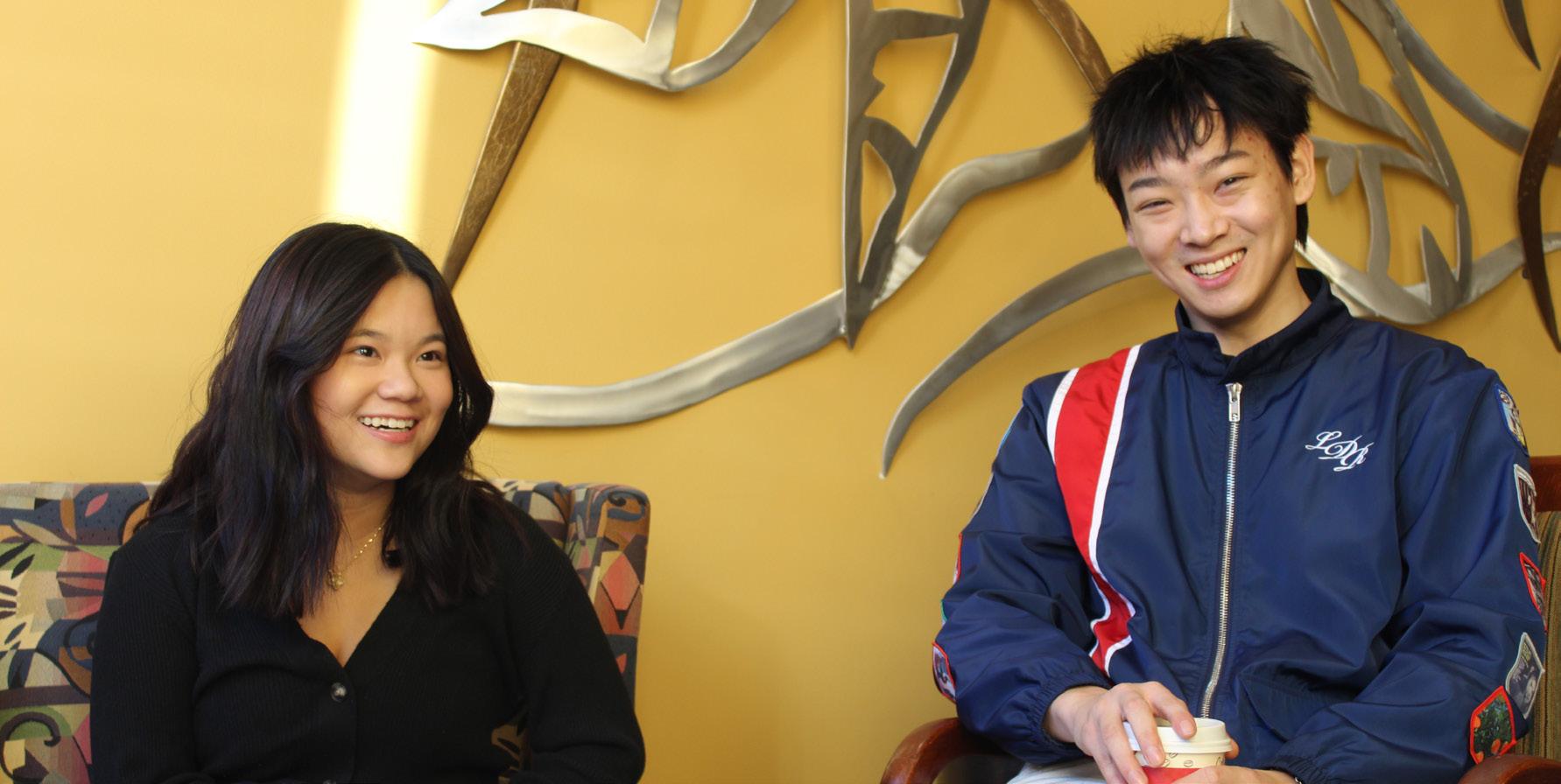
Keanu Huynh ’26 found Nicholas Clampitt ’26 on a spreadsheet for people without roommates going into their sophomore year. The two aligned on lifestyle habits, so Huynh sent an email and they decided to live together.
The two were both quiet the first time they met in-person — a rendezvous in the John D. Rockefeller Jr. Library lobby to choose a Hope College double.
They didn’t become instant best friends — they had different schedules and didn’t speak that much until the end of their sophomore year. But their friendship has now “blossomed,” Clampitt said.
In their junior year, they lived together again. At a birthday party that fall, the two met new friends, and that brought them together. Huynh was off-campus during the spring semester, and “talking to Nick was basically (his) only connection to campus,” he said.
As roommates of three years, the two have begun many traditions, from watching bad movies to steak nights — with ribeye, caramelized onions and wine. “It’s a whole thing,” Huynh said.
Herald spoke to Brown students and faculty about platonic love
MAXWELL ZHANG / HERALD
From left to right: English professors Emily Hipchen MA’20, Jonathan Readey and Ravit Reichman
JAKE PARKER / HERALD
From left to right: Grace Gongoleski ’27 and Lydia Fantaye ’27
COURTESY OF ANNIKA BAKING
From left to right: Annika Baking ’28 and Ashley Luo ’28



UNIVERSITY
“I love it,” Clampitt says. “I wish I could have been Santa Claus."
Bagels, crosswords and ‘the perfect day’: Samantha Zhang ’27 and Kiara Anderson ’27
Samantha Zhang ’27 and Kiara Anderson ’27 lived on the same floor in their first year and met through mutual friends. But Anderson’s first distinct memory of meeting Zhang was at a men’s soccer game, when Zhang thought that she’d lost her credit card.
“She was very distressed about that,” Anderson said. “I thought she hated me because she never even looked in my direction.” But as they spent more time together, “she warmed up to me,” Anderson said.
As classes began, they discovered they were both taking PHP 0310: “Health Care in the United States.” Their friendship really grew as they bonded over cruciverbalist tendencies — and when they began getting Blue Room bagels every day before class.
Their love for crosswords has followed them across the classes they’ve taken together.
Zhang is a student in the Program in Liberal Medical Education, and Anderson, by association, has become an honorary PLME. One day, they ventured to a PLME event at the medical school, realizing they hadn’t left College Hill for all of the first semester. After they couldn’t find the room, they decided to make the most of their time in the city.
The two then had what they still call “the perfect day”: They got brunch at The District, ventured to a bookstore, and wandered for the whole day. Since that fateful day, exploring new places to eat has become a big part of their friendship; Amy’s and Small Point Cafe rank among their favorites.
Not all of their adventures have been in good weather — they fondly recalled crossing a flooding Thayer Street to get hot and sour soup. In the cold, they start making up stories to withstand the weather: white sand beaches and deserts with camels and volcanic eruptions.
The two have many more stories. They’ve planned a whole life out: matching adjacent brownstones with parallel balconies, situated across from what will be their favorite cafe. They talked of a gate between their yards that could be opened to let their dogs play while they indulge in their morning coffee.
“We do everything together,” Anderson said.
‘Telepathically’ connected: Dylan Lai ’27 and Karen Chien ’27
Dylan Lai ’27 and Karen Chien ’27 met during their first week of Brown classes in the Petteruti lounge.
Chien was working on a problem set with one of their mutual friends.
Lai remembered thinking that she was “really studious,” but they didn’t speak until a group Ivy Room dinner a short while later.
They met again in Keeney Quadrange, where they both lived their first year. Lai often walked around the quad between Everett-Poland and Archibald-Bronson at night, and one evening Chien happened to join him. They then walked to the Arnold lounge, a room that would come to host many late night chats.
After that, they started to do homework together — they both study biomedical engineering and have most of the same classes — and get meals together. They found similarities with each other, from their upbringings to their sense of humor. One day when Chien skipped lunch one day, Lai also happened to skip lunch.
“We had every meal together, so much so that when I skipped a meal I was pretty certain that we both did,” Chien added.
Their friendship returned to Keeney as well: They bought plants together at a flea market by the Providence river, and Chien would sit outside in the quad so that her plant — which she called Lana, named for their shared favorite artist, Lana Del Ray — could get sunlight. .
The two now live in the same suite after living in the same building as each other for the past two years. They now know one other so well that they can “telepathically” tell when something irks the other. For example, in a situation where they encountered themselves behind slow walkers, they looked over at each other in sync: “We knew exactly the frustration that we were feeling,” Chien said.
Lai said that Chien was also a big part of his journey to start medication for anxiety.
“Having friends like Karen who are super supportive in understanding the process of what it looks like was very helpful for me,” he said.
Their understanding and support is mutual: “I feel like I can go to him to talk about anything,” Chien said.
The ‘three wise men’: Grace Belgrader ’27, Mia Dominguez ’27 and Rose Farman-Farma ’27
Grace Belgrader ’27, Mia Dominguez ’27 and Rose Farman-Farma ’27 call themselves the “three wise men,” a name coined in the back of an Uber during their first year at Brown.
They three, who all lived on the third floor of Andrews, hit it off immediately. After meeting the other two, Farman-Farma, a staff writer for The Herald, thought, “I cannot stop talking to them.”
The trio soon found out that they have similar interests in English courses. “We like bringing in what we study in our classes to what’s happening in our lives,” Farman-Farma said.
A common thread of creativity runs through the three friends: Belgrader writes plays, Farman-Farma writes music about their lives.
“We tend to overanalyze everything,” Dominguez said. “Because we’re all humanities majors, everything becomes symbolic or thematic.”
One of the things they all agreed was special about their friendship was the fluidity of their conversations — from chatting about class content to deep talks. “We match each other’s rhythm,” Belgrader said.
This year, Farman-Farma and Belgrader were matched in Marriage Pact — the algorithmic online matching program designed to secure college students with a “marriage pact.”
“If I’m ever unsure about myself, my best friends are the smartest, most interesting, most passionate kind of people in the world,” Dominguez said. “And if they love me I must be doing something right.”
As off-campus roommates, they know each other’s quirks well: Dominguez pointed out that Belgrader will talk to herself while she works on essays, and Belgrader can always spot Dominguez’s quivering eyebrow when she’s feeling empathetic. We’ve “been through a lot of stuff together, seen each other in our highs and lows.” Belgrader said. “Every thought is shared,” Dominguez added.
In the future, the “three wise men” hope to stay connected. “We value a lot of the same things, so our lives will inevitably intersect,” Dominguez said.
From humble beginnings as roommates of convenience, Clampitt and Huynh take notice of one another’s habits. “You always got this pace about you, like a hustle, like you got somewhere to be every time you’re walking,” Clampitt said to Huynh.
“That’s my dad’s New Yorker passing
down to me,” Huynh joked. With a Marriage Pact score of 93%, the roommates share custody of a stress ball they refer to as their child, found in a random room in Stephen Robert ’62 Campus Center.
Jokes embellish their friendship, which
is bright with humor. Clampitt entered their room last semester to see Huynh with an elf costume. Huynh told him not to worry about it. The next time Clampitt saw Huynh, he was out in the elf costume, which he proceeded to wear for the next two weeks.
MARAT BASARIA / HERALD
From left to right: Nicholas Clampitt ’26 and Keanu Huynh ’26
COURTESY OF KIARA ANDERSON
From left to right: Samantha Zhang ’27 and Kiara Anderson ’27
SELINA KAO / HERALD
From left to right: Rose Farman-Farma ’27, Mia Dominguez ’27, Grace Belgrader ’27
PHOEBE-GRACE ASEOCHEL / HERALD
From left to right: Karen Chien ’27 and Dylan Lai ’27
lindemann's bathroom canned audio experience
by Maria Kim
A building that one passes nearly every day, just on the commute to South Campus from North Campus, to North Campus from South Campus. One that many students (myself included) seem to use solely as a tool to check their reflection before heading to class, sneaking that furtive glance and playing it off as if it hadn’t happened. There are two buildings on campus where this check-yourself-inthe-mirror-but-pretend-not-to occurrence appears, but the one I am writing about is not the side of BioMed that one passes going toward Page-Robinson Hall after climbing the dreaded incline from Em-Wool up to Brown Street (one that has rubbed me the wrong way a few too many times, especially after struggling, huffing, and puffing up the hill, when I am already late for class). Instead, I am writing about the Lindemann Performing Arts Center; a jewel of a building humbly tucked away a couple blocks north from the heart of campus; one that, despite its lustrous, shining silver hue and extraordinary architecture, seems to be no more than a mirror to most save for all the music students on campus.
When entering Lindemann Performing Arts Center from its main entrance, it feels as if one has exited Brown’s quaint, studious atmosphere and entered somewhere reminiscent of a crystal palace. Maybe I am just saying that because its exterior strikes me as too illustrious to constitute that of an ordinary building I’m not entirely sure. Entering requires one to climb a stone staircase beside grandiose silver blocks and walk through two pairs of automatic glass sliding doors. Funnily enough, these doors seem more fitting for ones leading to a security vault housing crown jewels, or maybe an opening to some billionaire’s front door. Sometimes, when evening hits and the sky turns dark, spotlights appear in little radiant circles on the ground from the top of the building, illuminating the concrete like shadows of miniscule stars one can walk over...
EDITOR-IN-CHIEF
Elaina Bayard
FEATURE
Managing Editor
Chloe Costa Baker
Section Editors
Anika Kotapally
Gabriella Miranda
ARTS & CULTURE
Managing Editor
AJ Wu
Section Editors
Lizzy Bazldjoo
Sasha Gordon
NARRATIVE
Managing Editor
Gabi Yuan
Section Editors
Chelsea Long
Lucie Huang
LIFESTYLE
Managing Editor
Hallel Abrams
Gerber
Section Editors
Alayna Chen
Tatiana von Bothmer

POST-POURRI
Managing Editor
Tarini Malhotra
Section Editor
Christina Li
HEAD ILLUSTRATORS
Junyue Ma
Lesa Jae
COPY CHIEF
Jessica Lee
Copy Editors
Eve Kobell
Indigo Mudbhary
Kate Schuyler
Rebecca Sanchez
LAYOUT CHIEFS
Alexa Gay
Amber Zhao
Layout Designers
Emma Vachal
James Farrington
Joshua Rezneck
SOCIAL MEDIA
Rebecca Sanchez
Yana Giannoutsos
Yeonjai Song
Cheshire
8. in the Hat 9. The Aristocats 10. The fog when it comes on little feet




“I should’ve gotten, like…frickin’ a rose from you.”
“Do you guys fuck with lemonades?”

Dear Readers,

coastlining
Michelle bi
swords and sororities
AnnaLise Sandrich
rumination
christina li
everybody's walking in twos
coco kanders
break my mood ring
alyssa sherry
the politics and pathologies of 21st century music
jack diprimio
where are you?
merissa underwood
lindemann’s bathroom canned audio experience
maria kim
embarassing encounters
april wang
“In the beginning, Delta Airlines created a 10 a.m. flight to Los Angeles. And I arrived early at my gate, enveloped in a net of peace, anticipating a night in my childhood bed back home, and the sun rose over Providence. But then the intercom said, Let there be a $1,500 airline voucher for any travelers willing to transfer to the 5 p.m. to Los Angeles through Detroit, and I awoke.”
— Elsa Eastwood, “paranoid in detroit”


“Her naked, injured form is not that of a monster or animal but simply a girl without a towel. The blood on Carrie’s hands is not from any act of violence or injury but a sign of healthy puberty. Carrie’s form is reduced to something disgusting and animalistic.”
— Isa Marquez, “a bloody good scare” 2.24.24
2.22.25
letter from the editor
I don’t know about you, but I could certainly use another four-day weekend. ASAP. I went into this holiday weekend feeling excited and hopeful about using the abundance of extra time to get my life together and catch up on all of my overdue readings and tasks. But in a (not-so-) shocking turn of events, the time absolutely flew by and I only managed to accomplish about half of the items on my pesky to-do list. Between homework and club commitments and everything in-between, I fear I may be a bit overcommitted this semester. Not to mention, this semester has had the added emotional weight of everything going on in the world right now. I’m grateful to have had even a couple days to stop and reset and take a breath, but I’d be lying if I didn’t admit that my heart has been feeling extra heavy as of late.
Thankfully, amidst all of the darkness, post- continues to be a bright light full of creativity and wonder. In this week’s issue, our writers bring a delightful array of pieces that can help take your mind on a journey to another
world. In Feature, Michelle writes about the ebb and flow between her past memories and future dreams, while AnnaLise draws on the similarities between Greek life and D3 fencing. In Narrative, Christina ruminates on her relationship with the piano and Coco reflects on alone time after breakups. In A&C, Alyssa connects her experiences with OCD to Dora Jar’s “Timelapse” and Jack brings us some hard-hitting journalism with an interview about eras of popular music. In Lifestyle, Maria shares about the hidden treasures that lie inside the Lindemann, and Merissa reflects on December 13 and her experiences at Brown as a RUE student. And last, but certainly not least, make sure to take some time to enjoy Ina’s crossword and April’s comic strip. To put it lightly, there’s a lot happening in our world right now. There’s the beautiful little joys of life, like frolicking in the snow and handing out flowers on Valentine’s Day and carving out the time in your day to do something whimsical…and unfortunately, in just the past couple of months, we’ve also faced more than our fair share of recent tragedies as a community. If there’s anything I’ve taken away from it all: Go give your friends an extra tight squeeze, grab a sweet treat, or do whatever little thing might bring you joy and remind you of everything we love about this campus and this community and this place we call home.
Taking it one day at a time,
Jessica Lee
OPINIONS
Lindemann ’29: Chants to do away with the police don’t belong at anti-ICE protests
A few weeks ago, I attended a rally in protest of the violence in Minneapolis enacted by the U.S. Immigration and Customs Enforcement agency. The protest began in front of The John D. Rockefeller, Jr. Library and was organized by Brown Rise Up, Sunrise Brown, the Deportation Defense Network and the Rhode Island Student Climate Coalition. According to BRU’s Instagram account, the protest was for Brown students to “stand in solidarity with activists in Minneapolis and across the nation to resist ICE’s violence and terror.” That post motivated me to show up. The senseless acts of violence in Minnesota were completely unnecessary, beyond cruel and heartbreaking. I arrived in front of the library a few minutes early, and in mere minutes, I was surrounded by hundreds of students as eager to protest as I was.
The rally began with a clear purpose: to condemn and demand accountability from ICE. But soon a different chant began: “No justice, no peace! No ICE or police!” I paused and thought to myself: Isn’t getting rid of the police a whole different thing? ICE and the police serve very different purposes. They are different institutions that have different responsibilities, and their defunding has vastly different implications for society. This chant may seem like a minor deviation from the rally’s main message, but it exempli-
fies something larger about progressive activism on campus: Sometimes, causes that should be distinct are bundled together and made inseparable. Collapsing progressive causes into a single package can weaken the movements that are trying to win realistic change — both by alienating potential supporters and by diminishing the force behind individual calls for action.
Chants that call for abolishing both ICE and the police in the same sentence fail to recognize the dangers of their oversimplification — a failure that may alienate those who have different lived experiences. Over the past couple months, seeing police cars near campus has been an unexpected source of comfort for me. I couldn’t help but remember how on Dec. 13, my friends and I were terrified as we hid in the bathroom of Friedman Hall. Eventually, we were joined by a police officer whose presence was deeply comforting during that traumatic time. We were lucky to have so many officers serving to protect our school in such dire times. I cannot picture what we would have done without them. Such an experience makes it hard for me to blindly sign on to chants calling for “no police.”
Many of the students who came out to protest, like me, came for the specific cause that they felt
The rally began with a clear purpose: to condemn and demand accountability from ICE. But soon a different chant began: ‘No justice, no peace! No ICE or police!’

passionate about. That support is immensely influential, and shifting ideas loses the heat of the specific argument and cuts down on the support base. The ICE protest is just one example of this: If there was someone in the crowd that felt strongly about demanding justice for the victims of ICE’s violence but disagreed with one of the chants that addressed another issue, the protestor could become disillusioned with the movement. Protest, when done right, is a powerful way to demand change and make our voices heard. While I am a progressive, I am not defined by one ideology.
When we group multiple causes together under one umbrella, we trade critical thinking for conformity. Individuals lose the privilege and responsibility to think for themselves: instead of investigating what they actually believe about each issue, they’re expected to adopt and regurgitate a suite of positions without question. This kind of political operation is both intellectually lazy and strategically costly. Grouping several issues together takes attention away from each individual cause. If we overwhelm legislators with a laundry list of causes all at once,
it detracts attention from one concrete action to focus on first. As constituents, we have the influence to communicate what is most pressing. Each issue deserves to be analyzed separately.
Homogenizing distinct causes into one blanket viewpoint does not only weaken protests — it reduces critical thinking in an environment that already struggles to protect free speech. According to The Herald’s fall 2025 poll, 40% of Brown students have felt uncomfortable sharing their political beliefs in social settings, and the Foundation for Individual Rights and Expression gave Brown a grade of F for its speech climate. At a school with diversity of thought, even if people are not outwardly expressing their differing opinions, it is important to find solidarity where we can — especially at protests for such urgent causes.
Beatriz Lindemann ’29 can be reached at beatriz_lindemann@brown.edu. Please send responses to this column to letters@browndailyherald.com and other opinions to opinions@browndailyherald.com.
Edelson ’29: NARPs are the lifeline Brown athletics needs
It’s no secret that Brown athletic events have abysmal student attendance. After a basketball game at the Pizzitola Sports Center last spring, The Daily Pennsylvanian took note of “Brown’s home crowd, or lack thereof.” Brown’s poor athletic attendance has officially become cemented as part of the University’s reputation. But the stands weren’t always so desolate at home games.
Between 2022 and 2025, there were campaigns of school spirit clubs. While the Bear Pack brought enthusiasm to Brown sports for a short time, their Instagram has been dormant since last Spring. It was one thing these programs shared that caused their short-lived runs: they were led by athletes. What Brown athletics needs is a program pioneered by non-athletes.
Right now, Brown students aren’t going to games. According to The Herald’s Spring 2025 Poll, when asked “How often do you attend Brown Athletics matches, as a supporter?” 80.6% of students
responded less than “once a month,” with about one in four students responding “never.” This season, Brown football sported an average attendance of around 4,300 fans per game. But this is a misleading statistic, thanks to a 16,000-fan game at Harvard. For the four games at Brown Stadium, the average attendance was closer to 3,000. These numbers pale in comparison to game attendance at other Ivy League schools.
The previous versions of the Bear Pack were a good start toward changing the culture. According to their defunct Instagram page, the Bear Pack offered a few things that should come back. They posted a weekly overview of home games, shared senior spotlights for various teams, announced themes to promote fan attendance and held promotional giveaways of exclusive merch and high-value items like an iPad and a TV. There are also photos of Bear Pack members sporting bright red wigs, shirts and waving rally towels at games. The Bear Pack effectively

According to The Herald’s Spring 2025 Poll, when asked ‘How often do you attend Brown Athletics matches, as a supporter?’
80.6% of students responded less than ‘once a month,’ with about one in four students responding ‘never.’
raised awareness of upcoming games and inspired turnout and participation from the Brown community. We need all this and more if we want to improve our school’s athletic culture.
As Margaret Woodberry ’24.5, a student-athlete and one of the leaders of both efforts, told The Herald in 2024, “There is room to create new traditions that will last a lot longer than any one person’s time at Brown … The chance to leave a lasting impression on this school and athletics is something that really resonates with me.” But the Brown student-athlete community let the Bear Pack die before any such traditions could be formed.
A non-athlete-led program would be able to offer the lasting effect that both previous attempts at changing the culture around Brown athletics could not. The point of this kind of program isn’t for its members to be the only ones at the games, but rather to spark new interest and buy-in from the student body.
Having the Bear Pack led by athletes is counterproductive to its mission. It should come as no surprise that our student-athletes are very busy. Not only are they full-time students like the rest of us, but they are also competing in a Division 1 sport, which can amount to just as many, if not more hours per week than academics. What’s more, athletes are
already the group that is most likely to show up to games. If it’s already mostly athletes packing the stands and athletes run the Bear Pack, the whole idea of supporting Brown athletics starts to feel insular to the athlete community and inaccessible for non-athletes.
Non-athletes — colloquially known as NARPs for “non-athletic regular people” — could provide the Bear Pack with a network of non-athlete supporters, which make up the overwhelming majority of students at Brown. Providing the club with a more open network to the students who aren’t already going to the games would be effective because it would expose a larger population of students to the newly increased, infectious spirit.
The next step for transforming Brown athletics is getting more fans onboard. Bringing non-athletes into the leadership of athletics hype is the way to do it. The fastball is coming straight down the middle. All Brown athletics needs is a few star-caliber NARPs to hit it out of the park.
Clay Edelson ’29 can be reached at clayton_edelson@ brown.edu. Please send responses to this column to letters@browndailyherald.com and op-eds to opinions@ browndailyherald.com.
CUNYAN MA / HERALD
KENDRA EASTEP / HERALD
Editorial: Ditch Canvas — bring back the printed course reader
Digital devices have become an essential part of learning. We use laptops and tablets to do our readings, take notes and write code. But they can also distract from our learning: While one tab may hold a PDF, another might offer a temptation to text, scroll or shop. In 2015 and 2024, the editorial page board argued in favor of professors banning screens in class. Although some faculty members have adopted this approach, the University could take steps to make it more realistic in practice.
For many reading-intensive classes, the primary mode professors use to provide readings is to post a slew of files on the course’s Canvas page. While students in courses that prohibit laptops can print out each reading, doing so is costly and impractical. Course readers — bound collections of assigned articles and excerpts, excluding full-length books — compile a courses’ materials into single physical, paperback volumes. In effect, they are printed versions of the Canvas “Files” tab. By making course readers available through the bookstore, Brown would provide faculty with the infrastructure to make the analog leap in their reading intensive classes.
Course readers offer a rare luxury in the age of technology: the chance to focus deeply on one task at a time. When students online shop, browse LinkedIn or skim the news alongside their notes, they create only the illusion of engagement. But this multitasking can kill the efficacy of our learning. Even when class materials are the only thing open, notifications and the urge to open another tab can pull our attention away from the work at hand. By having students read from a physical packet instead of from a screen, professors will find fewer distractions and more critical engagement in their classrooms.
Reading on paper also offers cognitive advantages beyond just reducing distractions. According to one study, comprehension is achieved six to eight times more effectively in a physical for-
mat than on a screen, as the physical manipulation of the materials in one’s hand allows for the brain to create a mental “index” that strengthens retention.
Physical pages also invite annotation in ways that screens can rarely replicate. Marginal notes and dog-eared pages allow students to trace how their thinking evolved as they worked through the text. In this way, course readers could create personal archives of a students’ education. They can serve as physical memorials to the learning experience. Years down the line, one might reopen a reader and remember not only the texts,
but the hand cramps that came from wrestling with them.
While some professors already create course readers for their classes, the volumes need to be purchased from third parties. While Brown’s Book/Course Materials Support program can cover these materials for students on financial aid, the process is less straightforward than simply charging a purchase at the bookstore.
Professors select readings deliberately. We owe it to them and to ourselves to read each page with the same level of care. Discussions in reading-intensive classes require focus — something
Mooney ’29: Make Thayer weird again

Mobee’s Music World, Pie in the Sky, EG Photography, Anime Crash. I’d bet most of these names are unfamiliar to you. Just a few decades ago, however, Brown students walked past these stores every day. In 2000, Thayer Street was filled with an eclectic mix of locally-owned businesses: vinyl and CD shops, jewelry boutiques, video game retailers and vintage accessory stores. It also was home to a few big name brands — Gap, CVS and Dunkin’, to name a few — but overall, Thayer was unique. You could only find this specific retail ecosystem in Providence, Rhode Island.
Thayer is different now. Only 11 stores that were there in 2000 exist today. The majority have been replaced by grab-and-go restaurants and large chains such as Chipotle, Shake Shack, Insomnia Cookies, Ben & Jerry’s and Caffe Nero. As a result, Thayer has more of a corporate vibe, making the
street feel less connected to Brown’s institutional identity. Preserving what’s left requires intentional choices from the people who use the street every day. It’s on us to support Thayer’s longstanding local businesses before they disappear too.
On a global scale, local retailers have been driven out of business — and Thayer is no different. The rise of online shopping has hurt brick-andmortar retailers who cannot compete with the ease and accessibility of online shopping. In fact, over the past decade, Americans now frequent in-person stores 62% less than they used to which is paired with a 111% rise in online shopping. The next time you buy something online, consider checking out Thayer Street first.
The shift away from locally-owned, independent retail stores is unusually pronounced in Providence. Rising rent has made it particularly difficult
for local shops to survive. In just the last five years, the median rent in Providence has risen nearly 40%. While these numbers aren’t specific to commercial properties, they are indicative of a crisis of affordability. Only large chains with nationwide networks can withstand these prices. As a result, Thayer’s local stores have wilted and chains have flourished.
Thayer is, in many ways, an extension of Brown’s campus. It plays a defining role in the University’s culture and the experience of its students. Its central location means that traveling from one end of the campus to the other often involves walking on Thayer. A large portion of Brown’s campus is even located directly on the street — the Sciences Library, the Brown Bookstore, Vartan-Gregorian Quad and the New Pembroke dorms all are located on Thayer. The result is that Thayer functions as a common place where student life spills off campus into the city.
As Thayer has come to resemble any other street in America, we’ve lost the sense of community that comes from having a vibrant street that acts as such a common place. Chains are convenient, but they’re practically interchangeable. A street filled with unique businesses gives students a common culture: the “our spot” effect, the small rituals,
exceedingly difficult to cultivate in a browser. There is one simple, clear solution: mandate the creation of course readers, carried by the Brown Bookstore, to facilitate deep, engaged learning for students and teachers alike.
Editorials are written by The Herald’s editorial page board, and its views are separate from those of The Herald’s newsroom and the 136th Editorial Board, which leads the paper. A majority of the editorial page board voted in favor of this piece. Please send responses to this column to letters@browndailyherald.com and other opinions to opinions@browndailyherald.com.
the spontaneous conversations, the feeling that this place is specific to Brown. In this way, the quirkiness of Thayer has long been a sort of tradition for the University — one that’s been slowly fading.
Pie in the Sky, a jewelry store that was on Thayer for nearly 27 years, used to hang a sign that said “Keep Thayer Weird.” Unfortunately, some of Thayer’s weirdness faded when the business — and its funky counterparts — closed in 2020. We cannot time travel back to an era in which Thayer was filled with all types of independent shops and stores. However, we can do our part to support local businesses in the Providence community.
As Brown students, we make up a large portion of Thayer’s most consistent customers. We should wield this leverage in a way that supports the small businesses that remain.
And maybe, just maybe, with our increased support, we’ll encourage more small businesses to provide Thayer with the color it deserves. It’s time to make Thayer weird again.
Max Mooney ’29 can be reached at max_mooney@ brown.edu. Please send responses to this column to letters@browndailyherald.com and other opinions to opinions@browndailyherald.com.
A street filled with unique businesses gives students a common culture: the ‘our spot’ effect, the small rituals, the spontaneous conversations, the feeling that this place is specific to Brown.
AMALIJA MARICH / HERALD
CHRISTINE CHANG / HERALD
WRESTLING
Wrestling outmatched by Ivy Champion Columbia, strings together victory against Hofstra
The Bears tallied another win and loss to bring their season record to 4-8
BY CHIUPONG HUANG SENIOR STAFF WRITER
Brown wrestlers spent the weekend in New York battling out two late-season duels as the team looks to polish their performances before post-season championships begin.
The Bears fell to a surging Columbia before putting together clean performances for a victory over Hofstra University.
Despite the final team scores in their defeat to Columbia, the Bears showed fe rocity in taking advantage of the opportu nity to battle nationally ranked wrestlers.
Wrestling at 141 pounds, Khimari Manns ’29, ranked No. 32 according to NCAA’s Feb. 12 Ratings Percentage Index, jolted expectations in an upset 13-11 win over Columbia’s No. 17 Lorenzo Frezza.
Manns aggressively kept Frezza on the backfoot, constantly looking to bulldoze through him using powerful double-leg takedowns. The high-scoring bout saw Manns put up a volume of attacks that
HOCKEY

Reall and Clearie gaining victories that put them both undefeated for the weekend.
A well-timed duck under by Ethan Mojena ’27 sealed his 5-1 victory against Hofstra’s Frank Volpe at 157 pounds. Mojena scrambled to a dominant position after taking advantage of Volpe’s forward pressure to time a takedown, forcing Volpe to belly out.
“Everybody’s wrestling hard, and I think we’ve made a lot of progress since the beginning of the year,” Semenenko told The Herald.
The team looks forward to the coming weekend’s final regular-season duels against Harvard and Sacred Heart University at the Pizzitola Sports Center, as they approach the postseason, which includes the Ivy League Wrestling Tournament.
“Winning an Ivy championship is a really big deal, and we have a handful of guys that can potentially do that this year,” Walz told The Herald. “That’s extremely exciting for this program.”
This article originally appeared online at browndailyherald.com on Feb. 19, 2026.
Women’s ice hockey loses against No. 7 Quinnipiac, No. 8 Princeton to close regular season
Brown will host Dartmouth in the first round of the ECAC Tournament
BY SAJIV MEHTA SENIOR STAFF WRITER
Riding the momentum of four consecutive wins, the women’s ice hockey team (1612-2, 12-8-2 ECAC) threatened to exceed underdog expectations against No. 7 Quinnipiac (24-7-3, 14-6-2) and No. 8 Princeton (21-8-0, 16-6-4). But as they embarked on their final trip of the regular season this past weekend, Bruno fell to the Bobcats 2-5 and to the Tigers 2-3 in overtime.
Despite Brown sliding from a tie with Clarkson for fourth in the final regular season ECAC standings to the No. 7 spot, this finish marks Bruno’s best since the 2005-06 season. In turn, the Bears secured a home matchup at the ECAC Tournament’s opening round against No. 10 seed Dartmouth this coming Saturday, Feb. 21.
The Friday night Quinnipiac game kicked off the weekend slate in an unfortunate manner. The Bears went down early against the Bobcats and were never able to amend the deficit.
“I can’t say for certain the reason for the slow start,” Head Coach Melanie Ruzzi wrote in an email to The Herald. “The first goal was a bad bounce. Ultimately, we can’t go through stretches of any game without focus.”
Quinnipiac’s first strike came less than four minutes into the game. Stealing the puck from a Brown defender, Bobcat forward Taylor Brueske created a breakaway and flicked the puck around Bruno goaltender Anya Zupkofska ’28 to make the score 1-0.
17 seconds later, the Bobcats scored again. Receiving a pass at the left point, Aynsley D’Ottavio launched a missile of a slap shot from long distance, catching Zupkofska off guard and doubling the Bobcats’ lead.
Showing no mercy, Quinnipiac put on a
masterful performance of puck movement less than two minutes later. Forward Emerson Jarvis skated around the left end-zone circle into the high slot before dishing the puck to D’Ottavio, who flew downhill to the doorstep and snuck the puck over the goal line.
Now staring up at a three-goal climb, the Bears snapped back into shape. Less than four minutes after the concession, star forwards Monique Lyons ’28 and Jade Iginla ’26 slashed through the Bobcat defense. Riding off a pass from Iginla, Lyons sent the puck right back to the two-time ECAC Forward of the Week, who dumped it off into the net from the doorstep.
The barrage of scoring then slowed, and a steady fight over the scoreboard played out for the rest of the period. Each team fought valiantly for another tally, but were unable to convert until the Bears pulled through in the final minutes of the second period.
Having drawn a power play, forward Margot Norehad ’27 dispatched a whistling shot at the Bobcat goal. Though Quinnipiac goaltender Felicia Frank saved the attempt, the puck clattered loose in the crease, where Lyons cleaned up and scored.
“We simply flipped the switch and started playing Brown hockey,” Ruzzi reflected on the flow of the game. “Unfortunately, you cannot spot a top team three goals and play from behind and give yourself a good chance to win the game.”
Brown’s hopes of an astounding comeback did indeed fall away shortly — with just over eight minutes left in the game, Bobcat defender Zoe Uens flicked a silky wrist shot into the back of the net. An empty-netter in the closing minutes sent the final tally to 2-5 Quinnipiac.
But there was no time to dwell on the loss when a matchup with the Tigers loomed ahead. From the opening puck drop against Princeton, the Bears maintained their composure, which set the tone for a head-to-head contest.
Both teams kept up strong defense for much of the first period, until Princeton drew first blood. With under two min-
utes left in the period, the Tiger forwards demonstrated their passing prowess, patiently navigating the offensive zone before finding defender Rosie Klein in the high slot for a fluid wrist shot.
Unlike their loss in Connecticut the previous day, Brown refused to let their concessions compound against Princeton. The second period marked a return to a defensive battle in the first period as each side held score.
But the third period featured an excess of offensive excitement. Pouncing on an errant pass from a Princeton defender in the period’s second minute, Lyons found Iginla in the right end-zone circle, who fired the puck at Princeton goaltender Uma Corniea. Though the puck bounced off Corniea’s pad, it tumbled over the goal line and tied up the contest.
Six minutes later, Princeton answered back. From the right high slot, forward Issy Wunder delivered a furious slap shot
that Brown goalie Rory Edwards ’27 simply could not block, making the score 1-2 Tigers.
After pulling Edwards, six Bears crowded the offensive zone with under 90 seconds to play. Amid the chaos, the puck rolled to forward India McDadi ’26, who slapped the shot into the net’s top-left corner for an exhilarating equalizer.
“When Jade (Iginla) slid (the puck) over to me, I knew right away it was a one-timer,” McDadi wrote in an email to The Herald. “The pass was perfect, which let me step into it and get a lot of power behind the shot. It was really a great team play all around.”
Having earned a trip to overtime and secured at least one point for the standings, Brown was seeking a sensational upset. Instead, Princeton sent Bruno home.
As the puck drifted over the blue line during a one-on-one rush between Wunder and defender Isabella Gratzl ’29, the two
became entangled. In a physical race for the puck between the two, Gratzl fell to the ice, and Wunder thereafter had no problem maneuvering the puck past Edwards for the overtime winner.
“There was some frustration surrounding the no penalty call,” Edwards wrote in an email to the Herald. “But at the end of the day, it was a great play by Wunder to end the game.”
Despite the disappointment, Bruno will face a clean slate when Dartmouth comes to town for the playoff’s first round on Saturday at 3 p.m.
“Against Dartmouth, we need to play fast, get pucks deep when it’s there, and attack inside their structure,” McDadi remarked. “Playoff hockey isn’t always pretty.”
This article originally appeared online at browndailyherald.com on Feb. 18, 2026.

COURTESY OF BROWN ATHLETICS
Despite Brown sliding from No. 5 to No. 7 in the final regular season ECAC standings, this finish marks Bruno’s best since the 2005–06 season.
COURTESY OF BROWN ATHLETICS
BASKETBALL
After fall to Harvard, men’s basketball snaps six-game skid with win over Dartmouth
The Bears will look to continue their momentum against Princeton
BY HARRY GUO SENIOR STAFF WRITER
The men’s basketball team (8-15, 2-8 Ivy) fell short to Harvard (14-10, 7-3 Ivy) 5653 in Cambridge on Friday. But the Bears redeemed themselves the next day, surmounting a double-digit deficit to defeat Dartmouth (10-13, 4-6 Ivy) on the road. With a 79-76 win, Bruno spoiled the Big Green’s senior night and snapped Brown’s six-game losing streak.
Following last week’s crushing loss to Yale, Bruno stood in last place in the Ivy League. Brown entered Harvard’s arena on Friday intent on flipping the script.
In a tightly contested matchup against the Crimson, the teams exchanged points until the 9-minute mark when Harvard launched a 7-0 run to seize control, setting the tone for the half. The Crimson would lead by as many as 13 points in the opening period and carried a 31-22 advantage into halftime.
But Brown responded out of the break with renewed energy. Guard Luke Paragon ’27 opened the second half with a three-pointer to spark a 7-point run that cut the deficit to 31-29. Harvard answered with a 10-4 stretch of its own, extending its lead to 41-33.
LACROSSE
Down but never out, the Bears continued to battle. Trailing 50-40, Brown mounted a 6-2 spurt led by forward Landon Lewis ’26, who scored a hook shot over two defenders.
With just under five seconds left, guard Malcolm Wrisby-Jefferson ’27 knocked down a clutch three-pointer to cut the deficit to one. After Harvard converted two free throws, guard Isaiah Langham ’29 had a good look from beyond the arc but missed a potential game-tying shot as time expired.
Despite the loss, the Bears’ performance fueled their spirit heading into the Dartmouth matchup.
After winning the opening tip, guard Jeremiah Jenkins ’28 threaded an inside pass to Lewis for a layup less than 20 seconds into the game. Dartmouth answered immediately with a four-point play, draining a three and converting a foul to seize early momentum.
Lewis responded with another strong finish over his defender, but the Big Green knocked down another three to keep pace. Wrisby-Jefferson added a mid-range jumper before Dartmouth launched an unanswered 7-point run.
Guard Adrian Uchidiuno ’27 cut into the deficit with a well-timed backdoor cut for an easy layup, and after two more Dartmouth buckets, guard and forward David Rochester ’28 found himself open in the paint for a smooth finish.
After six straight missed three-pointer attempts by Bruno, forward Charlie O’Sul-
livan ’29 finally turned Bruno’s luck with a wide-open three from the top of the key 10 minutes in. Following a missed free throw by Dartmouth, Wrisby-Jefferson converted a hook shot on the other end to keep Brown within striking distance.
Still, Dartmouth extended its lead to 36-24 with just over two minutes remaining in the half, the team’s largest advantage of the night. Brown closed the half on a 6-2 run, and the scoreboard flashed 38-30 as the teams headed into the locker rooms.
But Bruno entered the second half with the same sense of energy and purpose headlining the first. After tracking down a Wrisby-Jefferson miss, forward N’famara Dabo ’27 opened the scoring with a powerful dunk to set the tone.
After another Dabo dunk, Lewis decided it was his game for the taking, scoring all 10 points in Brown’s 10-2 run, including an incredible play where he poked the ball free on defense, then ran the court to sink a thunderous dunk.
“My teammates set me up well every possession and encouraged me throughout the game,” Lewis wrote in an email to The Herald.
With a layup by Jenkins, the Bears tied the game at 49 apiece.
With 10 minutes remaining, Lewis orchestrated a give-and-go with Dabo, finishing with another emphatic dunk. Tied 58-58 soon after, Brown then pulled ahead with a 9-2 run fueled by more Lewis points and
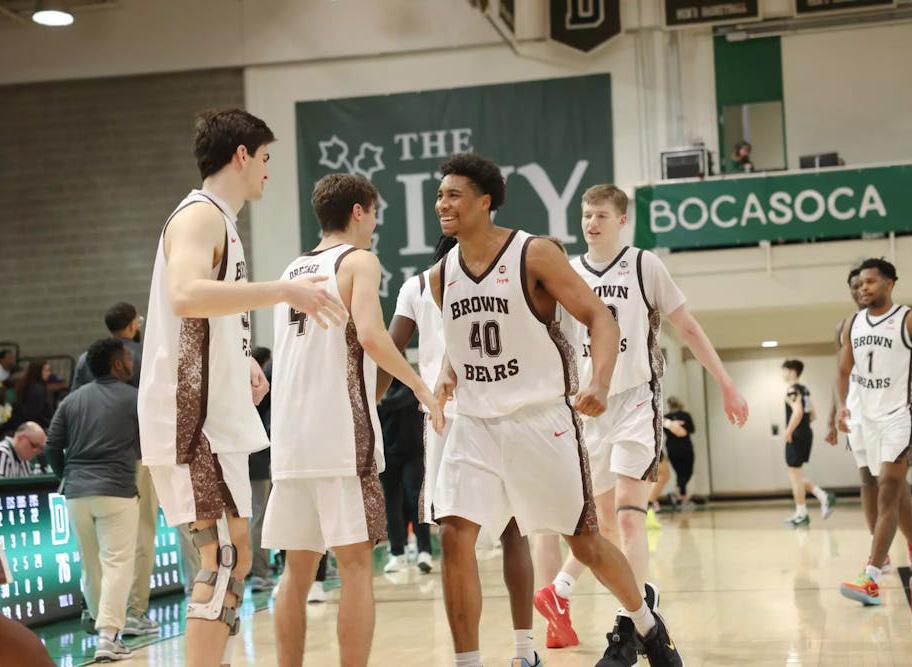
another Rochester three to build a 67-60 advantage.
Dartmouth responded with a 9-1 run of its own to reclaim a 69-68 lead, but Wrisby-Jefferson swung the momentum back to Bruno when he buried his first three-pointer of the night with under three minutes remaining.
After being fouled on a three, Paragon stretched the lead to five with a soaring free throw. A missed Dartmouth free throw sealed the Bears’ victory 79-76.
Brown shot a season-best 55% from the floor in the much-needed win. Lewis, the Ivy League Player of the Week, matched a
Men’s lacrosse conquers Fairfield 10-8 in season opener
The team will face Providence College next Saturday
BY ABIGAIL DONOVAN SENIOR STAFF WRITER
The men’s lacrosse team (1-0) stormed into the 2026 season with a 10-8 win against Fairfield University (1-2) this Saturday. Five different players scored goals for Brown, including a remarkable four by attacker Jeremy Hopsicker ’26. The first-years also brought firepower, with attackers Baden Brown ’29 and Jameson Steele ’29 both scoring their first goals for the Bears.
“I’m really proud of our guys,” Head Coach Jon Torpey said in an interview with Brown Athletics. “This was a total team win.”
The Stags struck early with a goal in the fourth minute of the game. But a little over two minutes later, Hopsicker tied up the score with a deft strike to the lower right corner of the net.
Midfielder Marcus Wertheim ’26 saw his chance to push the Bears into the lead just after the 10-minute mark. After receiving a pass in front of the midfield line, Wertheim raced down the right flank, weaving around the Stags’ defense to score and bring Brown to 2-1.
Despite outshooting the Stags 4-1 after their second goal, the Bears stayed at one throughout the remainder of the first quarter.
But in the second quarter, the team was hungry to widen the gap. The Bears passed the ball around from the back of the goal, which settled into Wertheim’s pocket. With the Stags scrambling, Wertheim dodged around a defender and, flanked by two more, delivered a high shot into the back of the net just 15 seconds into the quarter
career-high with 30 points and recorded his second double-double of the season.
It “definitely feels good to win one, but it was an ugly win nonetheless,” Lewis wrote in an email to The Herald. “We’re going to build on the confidence we got from the win and keep doing what works.”
Bruno will look to carry this momentum into their next game against Princeton (8-17, 4-6 Ivy) on Friday at 7 p.m. in the Pizzitola Sports Center.
This article originally appeared online at browndailyherald.com on Feb. 18, 2026.

extending the lead to 3-1.
Over the next 10 minutes, the Bears continued to dominate. Hopsicker completed a hat trick with another pair of goals, and Baden Brown snuck in a low goal despite three defenders bearing down on him. With around two minutes left in the quarter, Fairfield narrowed the lead to 6-2.
But just over 40 seconds later, attacker
Luke Dellicicchi ’26 raced around from behind the goal and delivered a rapid strike, bringing the Bears back to a 5-point lead.
While the Stags managed to pick up the first two goals of the third quarter, Steele quickly spotted an opening. Centered on the goal, he made a long shot that found the
top right corner of the net — marking an impressive first career goal with the Bears.
But Steele wasn’t done yet. After five minutes of back-and-forth play, he unleashed a second long shot past the Stags’ defense to further Bruno’s lead to 9-4.
Playing a man-up while the Bears served a penalty, Fairfield slipped another ball past the defense, sending the game 9-5 into the final break.
In the beginning of the fourth quarter, the Stags kept their momentum with another goal, narrowing Bruno’s lead to three.
But Brown didn’t let Fairfield dictate the game for long. Baden Brown delivered a long pass to Hopsicker, who waited just
outside the crease to shoot a quick goal over the head of the Fairfield goalie.
Desperate to catch up, the Stags continued to push — scoring another pair of goals and bringing the score to 10-8 in Bruno’s favor.
In the final minute, Fairfield was looking for a chance to stay in the game — and if it wasn’t for goalie Connor Foley ’27, they may have found it. After Fairfield’s midfielder John Okupski delivered a close high shot above Foley’s head, the Brown goalie deflected the shot in a show of quick reflexes, marking his 14th save of the game and securing the 10-8 win for the Bears.
“It felt awesome to be back out there
and playing with my team,” Hopsicker wrote in an email to the Herald. “It was truly a total team effort.”
In order to continue their success in coming weeks, Hopsicker said the team will “stay disciplined, trust one another and continue building on the things that worked.”
Next Saturday at noon, the team will face Providence College in the first Ocean State Cup matchup, looking to defend their 2025 cup title.
COURTESY OF BROWN ATHLETICS
With a 79-76 win, Bruno spoiled the Big Green’s senior night and snapped their six-game losing streak.
COURTESY OF BROWN ATHLETICS
Goalie Connor Foley ’27 deflected Fairfield’s John Okupski shot in a show of quick reflexes, marking his 14th save of the game and securing the 10-8 win for the Bears.
SCIENCE & RESEARCH
LEAD
Even low-level lead exposure in adolescence linked to depression symptoms, Brown researchers find
The study did not find a correlation between exposure and anxiety
BY MAXWELL SILVER CONTRIBUTING WRITER
Even lead exposure levels deemed safe may lead to serious mental health consequences in child development, a Brown study contends.
In a longitudinal study that began recruitment over 20 years ago, researchers from Brown and other universities revealed an association between childhood lead exposure and symptoms of depression in later adolescence.
While much research has been conducted on various health impacts of lead exposure, not enough has been dedicated to its impacts on mental health, according to the study’s first author Christian Hoover GS, a Ph.D. student in epidemiology at Brown.
Lead is a neurotoxin that is particularly dangerous because it displaces calcium — one of the most important metals in the nervous system and skeleton — when it enters the body, Hoover said. Lead can also negatively affect communication between neurons and chemical messaging, according to Professor of Epidemiology Joseph Braun, one of the principal investigators for the study.
The study was conducted using data from the Cincinnati-based Health Outcomes and Measures of Environment

Study, which seeks to understand how exposure to environmental chemicals affects various health outcomes — including lead’s effects on mental health. The project has followed 218 caregiver-child pairs starting in the second trimester of pregnancy and spanning until the children were 12 years old.
To create the dataset, the children’s blood lead levels were measured serially.
At 12 years old, the children then went
through mental health screenings, including self-reporting symptoms of depression.
One of these tests showed a strong association between lead exposure around age eight and symptoms of depression. Anxiety symptoms, on the other hand, had no association.
Children are more likely to intake higher amounts of lead because they touch their mouths more frequently, which can lead to ingestion of dust that can contain toxins,
Braun wrote in an email to The Herald.
In addition, since children are still growing, small amounts of lead can have a much greater impact proportionally, Hoover added.
“If I had a grape that had (a toxin) in it, depending on what it was, I’d probably be okay, but if my son, who’s 16 months, ate that grape, that grape is huge” compared to his size, Hoover said. “That grape is like an apple.”
Those undue environmental exposures to lead can “disrupt the carefully synchronized processes that take place during childhood brain development,” Braun wrote.
The researchers had hypothesized that blood lead levels would be related to depression and anxiety, wrote Braun, but they were surprised that exposure later in adolescence had a stronger association with depression than early childhood exposure.
The researchers did not come to a consensus on the rationale behind the association, Hoover said. Currently, he believes a potential reason for the increased depression indicators for children exposed later in adolescence is that older children are more likely to have had prolonged exposure to lead.
“My interpretation of it is that it’s more of a reflection of the cumulative exposure,” he said.
According to Hoover, lead is often viewed as “a problem from antiquity that we’ve overcome.” But, as the study shows, lead, which is present in many pipes across the United States, is still a pressing issue that requires further mitigation efforts.
Hoover hopes that further studies “demonstrate that the effects of lead exposure, even at the levels that everyone is saying is totally safe and normal, can lead to really serious consequences for adolescents.”
This article originally appeared online at browndailyherald.com on Feb. 18, 2026.
Researchers from Brown, Israel use AI to trace webs of Jewish knowledge
Through a joint grant, the team will study 130,000 Judaic texts
BY ELIZABETH ROSENBAUM SENIOR STAFF WRITER
Long before the digital age, Jewish scholars in the medieval era were already creating networks of knowledge. Now,
a Brown professor and Israel-based researchers are using large language models to explore these “citation networks” — how scholars cite one another — in texts from 200 to 2000 C.E.
Earlier this month, Michael Satlow, professor of Judaic studies and religious studies, received a joint $249,956 grant from the National Endowment for the Humanities and the United States-Israel Binational Science Foundation to fund
the three-year research project, titled “Knowledge Transmission and Cultural Interactions Through the Ages: An AI-Based Analysis of a Jewish Textual Corpus.”
The project uses LLMs to analyze more than 130,000 texts, which contain over 300 million words.
Artificial Intelligence is used to analyze these texts to create “citation fingerprints,” which represent an au -

thor’s unique pattern of citing sources, according to Jonathan Schler, a professor at the Holon Institute of Technology in Israel and one of the project’s collaborators. The researchers also use LLMs to map how ideas traveled geographically and temporally, identifying particularly influential scholars.
“AI is the engine that makes this project possible,” Schler wrote in an email to The Herald. The research will use AI to “convert these ancient citations into digital hyperlinks.”
“We aim to prove that computational analysis can work hand-in-hand with traditional scholarship to uncover deep structural truths about our cultural heritage,” Schler added.
Before reaching out to Satlow, Schler and his colleagues — Professor Maayan Zhitomirsky-Geffet and Associate Professor Binyamin Katzoff at Bar-Ilan University in Israel — developed computational methods to extract references and map intellectual exchanges from medieval rabbinic literature.
But they “realized that to truly understand the evolution of Jewish thought, we needed to scale this up significantly — applying our computational methods to the entire corpus of Jewish literary creation over two millennia,” Schler wrote.
Their joint research combines Satlow’s domain expertise in ancient Jewish history and network theory with Schler’s team’s natural language processing capabilities and extensive access to Judaic texts. Satlow’s previous research on the Babylonian Talmud explored the potential for network analysis.
“We recognized we could do something neither group could do alone: expand the scope from specific periods to
18 centuries of cross-community intellectual exchange,” Schler wrote. “We wanted to bridge the gap between traditional historical analysis and big-data computational methods.”
According to Satlow, these resources will allow the professors to understand how knowledge is shared from “one school of thought to another.”
LLMs are “very powerful” and can help to “recover lost knowledge,” said Om Patil GS, a research assistant and computer sciences master’s student working on the project. Patil fine-tunes the prompts given to LLMs to identify citations in the texts.
The project is currently in its pilot phase, which involves comparing AI-extracted citations to manually-extracted citations, according to Patil.
The group is still experimenting with different LLMs, Gabe Burstyn ’27 said in an interview with The Herald. When testing different foundational models, Burstyn evaluates the AI-extracted citations against a “manually-generated gold standard dataset.”
Their AI model’s most recent iteration reached 87% accuracy. Patil and the other researchers plan to add additional citation examples to the LLM prompt to improve the accuracy.
“Ultimately, this creates a powerful new discovery engine that allows scholars and the public to visualize and ‘surf’ the evolution of Jewish thought as a connected, global network rather than a collection of isolated manuscripts,” Schler wrote.
COURTESY OF MICHAEL SATLOW Satlow received a grant to study around 130,000 Judaic texts.
IRIS LIBSON / HERALD
REVIEW
‘Wuthering Heights’ adaptation swerves dangerously from its text
The film offers a harmfully whitewashed depiction of a nuanced novel
BY AMELIA BARTER SENIOR STAFF WRITER
When thinking of director Emerald Fennell’s films, breathtaking visuals — born through her strong directorial vision and Linus Sandgren’s cinematographic skills — are the first thing that come to mind. Fennell’s recently released adaptation of “Wuthering Heights” is no outlier.
Sweeping shots of the English moors, powerful silhouettes and intense close-ups elicit feelings of awe and, at times, a deep discomfort in viewers. Paired with these visuals is Fennell’s knack for symbolism, which is especially notable in close-up shots of characters’ backs suffocated by corsets and a bedroom designed to resemble the face of protagonist Catherine Earnshaw (Margot Robbie).
But the striking visuals are not nearly enough to distract the audience from the film’s many offenses. While some have tried to argue that the film and Emily Brontë’s 1847 classic novel should be considered as entirely separate works, the book should be in conversation with its film adaptation. After all, they bear the same name.
The choice to place the title of the film in quotation marks acknowledges the difference between the film and its source material. Fennell explained this choice in an interview with Fandango earlier this year. “I can’t say I’m making ‘Wuthering Heights.’ It’s not possible,” she said. “What I can say is I’m making a version of it.”
The most prominent and dangerous shift from the novel is the whitewashing of Heathcliff (Jacob Elordi), Catherine’s
REVIEW
love interest and one of the story’s main characters. In the book, he is described as “dark-skinned” and compared to a “lascar,” a derogatory term used for Indian and other non-European sailors.
In a further unwelcome deviation from the novel, Fennell turns Nelly into the villain of the movie. This harmful mischaracterization of Nelly’s original character distracts the viewer from Catherine and Heathcliff’s abusive and villainous natures.
These casting decisions also undermine the entire plot of the film — a considerable aspect of the tragedy behind Catherine and Heathcliff’s forced separation is the discrimination Heathcliff faces due to his race and his perceived otherness. In the novel, this social stigmatization fuels the character’s obsession with revenge. But without the racial dynamic, there is less context behind the world’s poor treatment of him.
“You can’t adapt a book as dense and complicated and difficult as this book,” Fennell said in the interview with Fandango. This serves as a lazy excuse for her major simplification of the plot and refusal to tackle the important societal issues of racism, classism and abuse that the book raises.
Fennell also removed the entire second half of the novel, erasing the portion that addresses the cycle of abuse and dispels any ideas that Heathcliff and Catherine’s romance was a healthy one.
By advertising the movie as being inspired by “the greatest love story of all time” in its trailer, Fennell’s film openly dismissed the theme of destructive obsession and abuse before it was even released.
Brontë’s novel was exceedingly groundbreaking in its time for its subversion of

many familiar tropes around prejudice and femininity. This simplification changes the narrative into a predictable, seen-it-allbefore romance. With different character names and a different title, there would be almost no similarities between the film and the book.
There is also something to be said about the film’s inconsistencies compared to the book, including the significant aging of the characters and the removal of Hindley, Catherine’s older brother. These changes further veer the story away from childish, dark obsession in favor of the “true love” Hollywood trope.
To further fan the flames, Fennell also butchered Edgar’s sister, Isabella (Alison
Oliver) by turning her from an upstanding, self-assured character into an unhinged sort of sex slave.
But even if one puts aside the book for a moment, as many positive critics urge the audience to do, and considers the film as a stand-alone, the new storyline is a cliche and the characters have little dimension despite the cast’s strong acting.
While the score, composed by Anthony Willis, is startlingly dark and majestic, the occasional interjection of a Charli xcx song is disappointing and jarring. It turns these scenes into what feels like a music video, adding to the never-ending list of things that make it impossible to take the film seriously.
It’s evident in both her interviews and the film itself that Fennell has slapped a beloved, canonical title over a cookie-cutter tragic romance in the hopes of drawing audiences excited by the idea of watching something “cultural.”
But her exclusion of any complexity in favor of numerous sex scenes makes it clear that Fennell was aiming for a box-office hit instead of a literary tribute, much to the devastation of Brontë fans everywhere — and to the detriment of the story itself.
This article originally appeared online at browndailyherald.com on Feb. 17, 2026.
Charli xcx’s ‘Wuthering Heights’ album is a masterclass in production
BY ALYSSIA OUHOCINE SENIOR STAFF WRITER
Charli xcx’s 2024 release of “BRAT” was a cultural phenomenon. From remixes to a deluxe edition, fans received countless versions of the album they knew and loved — but some listeners were left wondering what would come next for the British pop icon.
On Feb. 13, listeners’ questions were answered with a new, fantastically produced body of work: a companion album to “Wuthering Heights,” director Emerald Fennell’s erotic take on the eponymous Emily Brontë novel.
In just 34 minutes, Charli xcx fuses a contemporary sound with the desolation of the British moors, producing a passionate and dynamic take on Catherine and Heathcliff’s love story. While the album is not a faithful retelling of the novel — though neither is Fennell’s film starring Margot Robbie and Jacob Elordi — it captures the atmosphere of “Wuthering Heights” brilliantly.
The record opens with “House featuring John Cale,” a collaboration with one of the founding members of The Velvet Underground, an American rock band known for sonic experimentation. Cale offers a spoken word introduction to the

track, which eventually transitions into Charli xcx’s screeching produced with her trademark autotune. The refrain, “I think I’m gonna die in this house,” sets the dark, obsessive tone in the rest of the record.
In “Wall of Sound,” one of the album’s best tracks, Charli xcx goes from resisting her desires to accepting them. By the second verse, the track careens into ecstasy: Without even mentioning sex, the song’s strings and reverberation create an intensely erotic addition to the record.
Picking up the album’s pace, “Dying for You” is a more classic Charli xcx track. The pounding bass ironically complements tortured lyrics like “’Cause you’re the poison I drink, I drink you twice to be sure / And then I find the highest building, just to fall on my sword.” The buoyant sound heightens the appeal of the painful love that Charli xcx details throughout the track. “Always Everywhere” feels most attuned to the subject material. Slowed down and deeply romantic, the track’s symphonic sound is
slightly distorted and contributes to the crazed landscape that Charli xcx paints.
The song is followed by “Chains of Love,” one of the album’s singles. Lyrics like “My face is turning blue / Can’t breathe without you here / The chains of love are cruel / I shouldn’t feel like a prisoner” are complemented by heavy synths melded with a quintessential Gothic melodrama.
Much of the album could be interpreted as a plea, but Charli xcx manages to avoid fully occupying a space of desperation. Each track’s intensity and fervor produce its own power, if not allure, for listeners. This is clear in “Out of Myself,” with self-assured lines like “I’m begging to you on my knees / Please rub the salt in my wounds / I like the person you turn me to.” The song, which is pure carnality, perfectly bridges electronic elements with grating strings in a borderline cacophonous combination.
This underlying desperation is continued in the tasteful narration of “Seeing Things,” as Charli xcx details the experience of wanting to see a past lover so desperately that they materialize at the behest of the imagination. The yearning portrayed is sweet, offsetting the urgent hunger that enlivens the rest of the record. With an orchestral backing, the song’s desperation becomes utterly jubilant in a delicious paradox.
The subsequent track “Altars” offers a gritty change of pace. The song’s evocative religious imagery is juxtaposed with its
iconoclasm — Charli xcx is devoted only and completely to her love.
“Eyes of the World featuring Sky Ferreira” is a collaboration with breathtaking payoff. The song’s dark atmosphere is buttressed by an explosive chorus, Ferreira’s gravelly vocals and eerie production.
But the album begins to stumble in its closing songs. “My Reminder” is a pop track that doesn’t rebel and lacks the narrative interest that other tracks bring to the record — the song buckles beneath the intensity of the rest of the album. “Funny Mouth” closes the album in the same cinematic vein as its opener, but it lacks all of the novelty and intrigue. Devoid of any emotional weight, the song is unfortunately forgettable.
“Wuthering Heights” by Charli xcx is a SparkNotes version of Brontë’s novel: Casual listeners have an opportunity to catch the “vibe” of the novel without actually reading some 400 pages. As a concept album, “Wuthering Heights” is masterful. Charli xcx brings what she does best — heavy production and intense autotune — to work alongside moody strings and hedonistic themes. With this new album Charli xcx brilliantly escaped the trap of trying to recreate her success in “BRAT,” instead pivoting to showcase her storytelling skills and creative fluidity. This
COURTESY OF WARNER BROS
“Wuthering Heights” (2026). The film, directed by Emerald Fennell, was advertised as “the greatest love story” in its trailers.
The film’s companion album is sensual and atmospheric
COURTESY OF WARNER MUSIC IRELAND

DOG CARETAKER


BY
Student dog caretakers welcome presidential puppy to campus
Paxson and Gabinet welcomed their puppy, Murphy, home in December
BY JAKE PARKER AND JAMES LIBRESCO
CONTRIBUTING
WRITER AND SENIOR STAFF WRITER
At approximately 11 a.m. on Wednesday, Junkai Gong ’27 rang the doorbell at an atypical destination for Brown students: 55 Power St, which has served as Brown’s presidential residence since 1949.
While President Christina Paxson P’19 P’MD’20 has lived in the large brick house for over a decade, late last year, the residence welcomed a new, fluffy four-footed resident — and that puppy is the reason for Gong’s visit.
Gong is one of four presidential dog caretakers — responsible for walking and entertaining Murphy, a 15-week-old standard poodle. The job is both a mental and physical exercise. The presidential puppy,
true to his age, has boundless energy.
“He’s so lively,” Gong said. “He likes to sniff everything. He likes to greet people.”
Murphy “jumps around so much. It’s really nice to see (his) pure joy and happiness.”
Paxson and her husband — Senior Fellow in International and Public Affairs
Ari Gabinet P’19 P’MD’20 — got Murphy from a Massachusetts breeder in December 2025, after their previous dog, Cooper, died last summer.
“I was perfectly happy not having another dog, but President Paxson was not,” Gabinet told The Herald. But Gabinet quickly warmed to Murphy, and has since curated a series of loving nicknames for the puppy including “Murphaletta” and “Mr. Murph, Sir,” — based on the “Aaron Burr, Sir” scene from the musical “Hamilton.”
Murphy’s arrival in December carried more weight than anticipated. “Murphy arrived in December when the President was super busy with all the aftermath of the (Dec. 13) shooting,” Gabinet said. “Murphy was really, sort of a wonderful emotional thing for her.”
Gong started the dog-walking job when he returned from winter break. From 11 a.m. to about 12:45 p.m. on Wednesdays and Thursdays, Gong takes Murphy on 20-minute walks and dog-sits him for the remaining time. He gets paid $20 per hour.
When duty calls for Paxson and Gabinet — say, a Brown Corporation dinner in their home — Gong works overtime.
“We’re stressed as college students,” Gong said. “It’s nice to lay back and slow down a little bit with Murphy.”
But during his twice weekly appointments with Murphy, Gong can’t relax for long.
The Herald tagged along with Gong for his Wednesday walk with Murphy and, just a few minutes into their route, the puppy gnawed at a sheet of plastic in front of Friedman Hall. Gong reached down, brushing it away from Murphy’s mouth.
“I’m mainly there just to make sure he’s safe, that he doesn’t eat anything,” Gong said.
As the walk continued, the duo made their way across the street and onto the

Main Green, which is Murphy’s favorite spot on campus other than his home,
Gong said.
Gong usually takes Murphy to the Pedestrian Bridge in downtown Providence or south of campus. But on Wednesday’s walk on the Green, Murphy got to make new student friends, eagerly greeting passersby who showered him with love and pets.
When Gong and Murphy reached Faunce Arch, the puppy stopped in his tracks. All the socialization and walking left Murphy depleted, and only Gong’s dangling of chicken treats could entice the dog to brave the journey home.
Many students vie for the dog-walking job, Gabinet said. Gong heard about the position after taking one of Gabinet’s classes last semester, he said. After a quick email to Gabinet, he got the job. “That was the process,” he said.
Back at 55 Power St., Gabinet waits for Murphy’s return. The puppy’s entrance is marked by a trail of wet paw prints across the floor.
“His paws are all soaking,” Gabinet
said. “Time for another foot bath, puppy,” he said to Murphy.
Paxson and Gabinet are no strangers to life with dogs. Gabinet lived with dogs all his life and Paxson grew up with Rusty, a golden retriever. Murphy is the latest in “the great tradition of presidential poodles,” Gabinet said, preceded by Cooper and Leo.
Maria Raposo, the housekeeper at Paxson and Gabinet’s house, has fond memories of Cooper, who “used to love to go get the newspaper outside,” she said. Cooper’s favorite spot in the house was the side door, which happens to also be where Murphy chooses to curl up.
The two dogs share more than just their breed and beloved spot: They are named after Murphy and Joseph Cooper from the movie “Interstellar.”
But Gabinet says Murphy is not likely to be space-bound any time soon, nor will his future be in one of Gabinet’s corporate law courses.
“Sorry, Murphy is a finance bro,” Gabinet said.


PHOTOS
JAKE PARKER