
Dori Walker ’24 captures ‘Black visuality’ through art
Student
subjects
BY RYA VALLABHANENI ARTS & CULTURE EDITORDori Walker ’24 entered the Blue Room with a sizable black box tapping the side of her knee. She came to talk about her work and her creative practices and processes. Also, she had to return a camera.
Walker is a student photographer and videographer at Brown, concentrating in Modern Culture and Media.
“I grew up being a very artistic kid, drawing a lot, painting a lot, doing dance, practicing the violin,” Walker said. But as she grew up, school began to take precedence.
“I got here and I was really scared of approaching the practice of art,” Walker said. “I didn’t see myself as someone who did art.”
She came to Brown knowing that she was interested in media but planned to study economics, political science or ethnic studies. Only about a year and a half ago, in the fall of her sophomore
ARTS
& CULTURE
year, did her focus truly began to shift when she became the co-chair of digital media for the Black Student Union, primarily taking photos at student events.
In the spring, Walker took a “filmic practice” class in the MCM department as well as a visual photography class in the Visual Art department. There, she “learned a lot about the mechanics of photography” and began to accumulate enough knowledge to hone her own practice, she said.
‘Centering Blackness in photography’
Taking photos “started as a way for me to show the people in my life how I see them,” Walker said. Now, though, she also makes room for her own artistic intent in her photos.
According to her digital portfolio, her “work aims to center Blackness and explore how we can shed radically transformative light on the Black identity and the existing catalog of Black visuality.” Walker explained that “there’s always a goal of achieving a kind of stoicism in my photography with my subjects — a kind of regality to how people are rendered.”
“I definitely want the way I pho -
SEE WALKER PAGE 12
Racial, social justice activism in Providence
METRO Community leaders, organizers discuss voter turnout challenges, legislative efforts
BY RHEA RASQUINHA METRO EDITORFrom protests and campaigns to voter registration drives and fundraisers, activism efforts in Providence have taken many different forms to address the issues faced by local communities. Today, Providence organizations are focused on legislative reform, increasing voter turnout and empowering communities of color.
“We have a really good progressive wave in Rhode Island,” said Zachary Pinto, communications director for Black Lives Matter Rhode Island Political Action Committee, which works to support BIPOC politicians and “progressive” policies. “There’s a lot of good organizations doing a lot of work.”
Community aid and the ‘intersectionality’ of today’s pressing issues
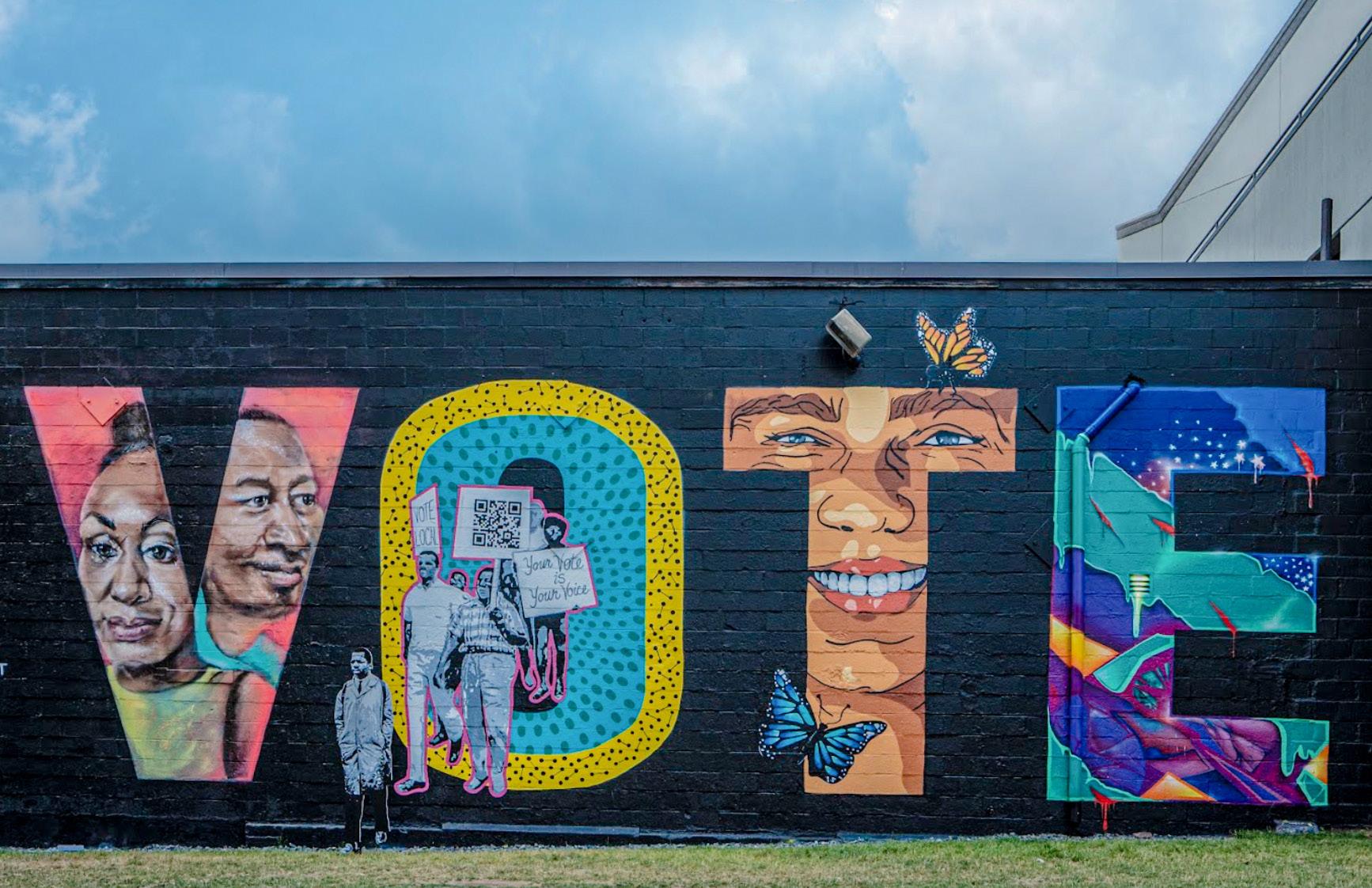
Ray Rickman, co-founder and executive director of Stages of Freedom, a heritage museum and youth empowerment organization, said that
5 powerful reads for Black History Month
Short stories, novels by Black authors navigate friendship, vulnerability, healing
 BY AALIA JAGWANI ARTS & CULTURE EDITOR
In a 1987 interview with the New York Times, author Toni Morrison recalled how people would ask whether she considers herself a “Black writer” or a “writer,” with the implication that she was “bigger” or “better” than the former. That view, she thoroughly refused.
“I really think the range of emotions and perceptions I have had access to as a Black person and as a female person are greater than those of people who are neither,” Morrison said in the interview. “So it seems to me that my world did not shrink because I was a Black female writer. It just got bigger.’’
Morrison’s work has much to say about the Black experience, but her stories are just as much about love, friendship, grief and loss — she merely tells them without centering whiteness.
Helen Oyeyemi, a British novelist of
Nigerian descent, said in an interview that framing her decision to write about Black characters as a political act is “like saying that my life, the very life that I’m living, and my body are political, and sometimes I think that I’m just living.”
Both Morrison and Oyeyemi are speaking to the widely overlooked fact that literature does not have to be white
to be universal. Their worlds are viewed as “smaller” — but as Morrison said, her expanded range of emotions and perceptions only made her world bigger.
In honor of Black History Month, here are five works by Black writers that provide glimpses into these “big-
SEE LITERATURE PAGE 9
Providence’s Black community doesn’t receive the support it needs from the government and local corporations and universities.
“A lot of this is a lack of government support to (community organizations and advocacy groups), and a lot of it is the failure of major corporations and universities to be of any help,” Rickman said. “The support for the community is weaker and weaker and weaker.”
To fill that gap, Stages of Freedom offers swimming, cultural education and empowerment and civil rights pro-
ARTS & CULTURE
grams to community members. Rickman is currently working to create a $1 million endowment for Stages of Freedom’s swim program.
BLM RI PAC focuses its community efforts on “endorsing progressive candidates of color,” voter registration and mutual aid work, Pinto said. Through food drives and other initiatives that help meet communities’ needs, PAC reminds local community members of “the importance of their vote,” Pinto
Hughes reading celebrates poet, nurtures community
Organizers, performers reflect on Hughes’s legacy, discuss expanding event
BY JULIA VAZ METRO EDITORFounded in 1994, the Langston Hughes Community Poetry Reading shares the work and wisdom of the Harlem Renaissance poet with the Providence community. The event brings together artists and community members to celebrate the work of Hughes and enjoy a night of poetry, storytelling and performance.
This year’s event, hosted Feb. 5 by the Providence Public Library, brought together more than 400 people. The Herald spoke to the Poetry Reading’s organizers, artists, collaborators and participants to understand how the organization has tapped into Hughes’ legacy to foster community and celebrate Black creativity.
‘Hold fast to dreams’: Founding and organizing


The Poetry Reading’s founding in 1995 was preceded by the creation of the now-closed Langston Hughes Center for The Arts and Education, according to April Brown, co-director of the Poetry Reading. The Center was a nonprofit focused on incentivizing the exploration of Hughes’ work and the Black community’s artistic creativity.
The late George Houston Bass, professor of theater arts and Afro-American studies and a member of the Center’s Board of Directors, was the first to suggest the possibility of expanding the mission of the center to a community-focused event, according to Houston Bass’s wife, performer and educator Ramona Bass Kolobe ’72. Houston Bass, who worked as Hughes’ secretary and literary assistant, was also the administrator of the poet’s estate following his death in 1967. The center, which was designed
SEE HUGHES PAGE 8
BROWNDAILYHERALD.COM SINCE 1891 FRIDAY. FEBRUARY 17, 2023 Wooten ’24: Black educators deserve care and respect Page 6 A look at raceconscious admissions in Brown’s history Page 2 Commentary U.News 28 / 60 24 / 43 TODAY TOMORROW Profs. talk changes to AP African American Studies Page 8 U.News MADDY CHERR ’23 DESIGN EDITOR JANE ZHOU ’25 DESIGNER NEIL MEHTA ’25 DESIGN CHIEF SIRINE BENALI ’23 DESIGN EDITOR DESIGNED BY VOLUME CLVIII, ISSUE 11
photographer, videographer focuses on Black identity, ‘regality’ inCOURTESY OF THE AVENUE CO., KENDEL JOSEPH, THE LADY J, AGONZA, ABOVE BLM RI PAC faced the challenge of low young voter turnout in the 2022 midterm election, said Zachary Pinto, communications director.
SEE ACTIVISM PAGE 4
ASHLEY CHOI / HERALD
BLACK HISTORY MONTH ISSUE
Senate bill proposes to replace lead service pipes Page 9 Metro
State
Affirmative action in the archives: From the 1960s to today
Engagement on campus regarding race-conscious admissions transitions from activism to legal support
BY OWEN DAHLKAMP SENIOR STAFF WRITEROver the past sixty years, affirmative action and race-conscious college admissions have been the subject of extensive debate across the country — especially on university campuses. For proponents, the practice is crucial for building a diverse student body. Opponents claim it offers few benefits and overlooks other measures of diversity.
By this June, the Supreme Court will likely issue a ruling on the future of race-conscious admissions, brought about by two cases brought against Harvard and the University of North Carolina by Students for Fair Admissions.
But the recent challenges are not novel: Including the Harvard and UNC cases, race-conscious admissions have faced scrutiny in over half a dozen Supreme Court lawsuits since the late 1970s. And since the 1960s, Brown community members have demonstrated longstanding support for race-conscious admissions, with administrators contributing to amicus briefs and students demanding change from the University while voicing their opinions in op-eds published in The Herald.
The Herald compiled a timeline of student engagement with affirmative action, using witness testimony, Herald news articles and opinions submissions and interviews with expert historians.
1960s:
The first nationwide initiative on affirmative action came in an executive order from President John F.Kennedy in 1961, which aimed to ensure “equal opportunity in em -
ployment” by the federal government. Over the next five years, institutions of higher education began to adapt the ideas from Kennedy’s executive order as “a form of recompense for shutting black people out of the economy and out of education,” said Stefan Bradley, professor of Black studies and history at Amherst College.
In December 1968, 65 Black students on Brown’s campus staged a walkout to protest the University’s lack of diversity in admissions, attracting more than 1,000 non-Black supporters, The Herald previously reported. With only 2.3% of Brown students at the time identifying as Black, community members demanded the University increase its Black student population to 11%, in order to reflect the demographics of the national population.
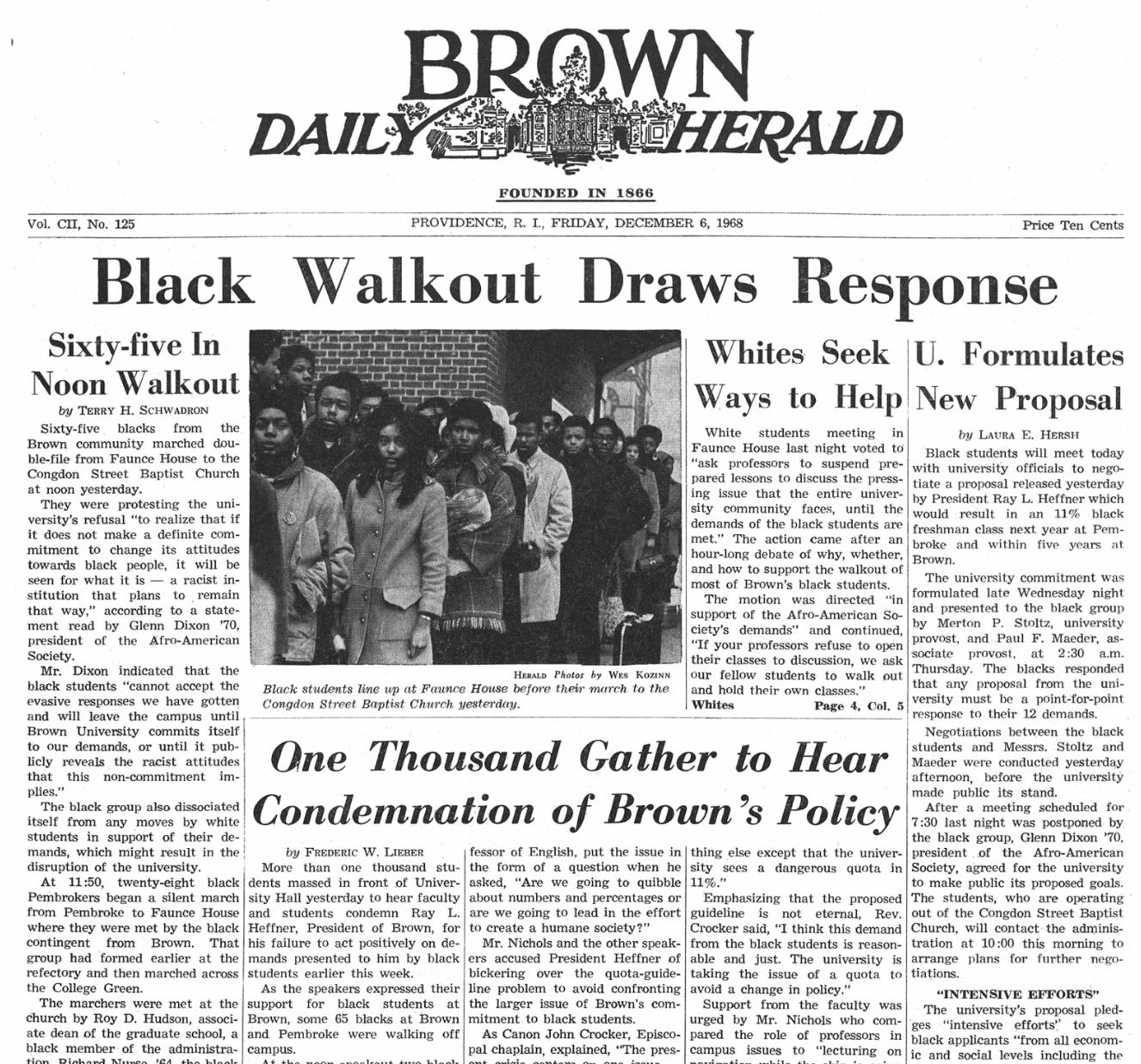
Glenn Dixon ’70, a leader of the movement, said at the time that Black students “cannot accept the evasive responses we have gotten and we will leave the campus until Brown University commits itself to our demands.”
After the students spent three days at Congdon Street Baptist Church following the walkout, the University pledged $1.2 million to recruit more Black students and work with the protestors towards reaching their proposed goals for the admission of Black students, The Herald reported at the time.
That night, 2,000 students signed a petition in support of the pro-affirmative action advocates — though representatives for the protestors said they were “in no way satisfied with these concessions,” which they called “racist in nature.”
The University saw an increase of
roughly 300% in applications from Black students in the following admissions cycle — 450 in total. When admissions decisions were released in the spring of 1969, 270 of the 2,100 accepted applicants were Black.
1970s: Affirmative action sees first major legal challenge
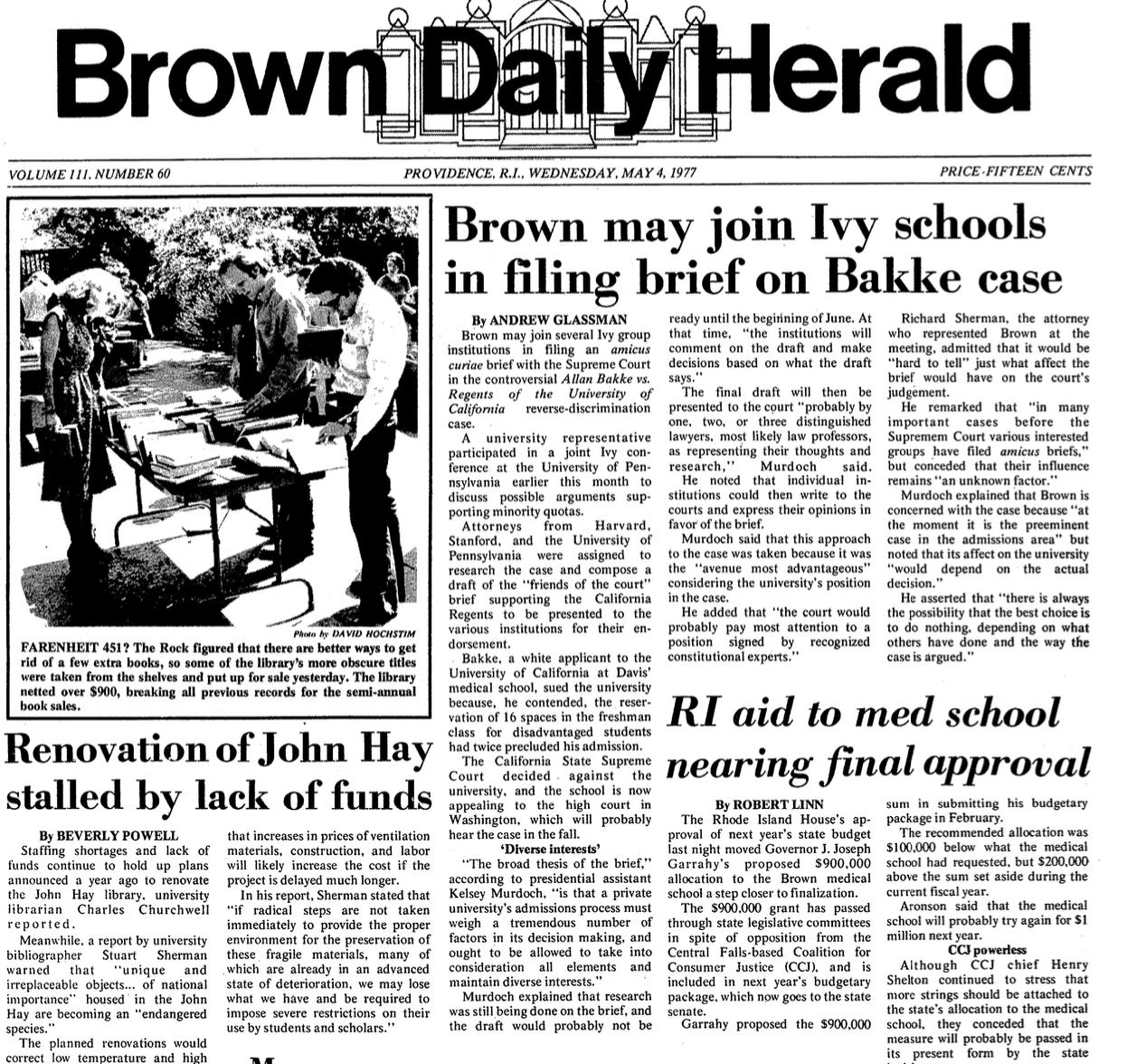
The 1970s saw the first significant challenges to race-conscious admissions in the justice system. In the Supreme Court case against the University of California at Davis, a white student, Allan Bakke, claimed that he was denied admission to Davis’ medical school on account of a racial quota.
In May 1977, a Brown representative attended a conference in which attorneys from various Ivy League schools discussed filing an amicus brief with the Supreme Court in support of maintaining a “minority quota” in college admissions. But Brown did not ultimately file an amicus brief in support of UC Davis.
On campuses, student engagement with affirmative action advocacy was “becoming increasingly popular,” Bradley said.
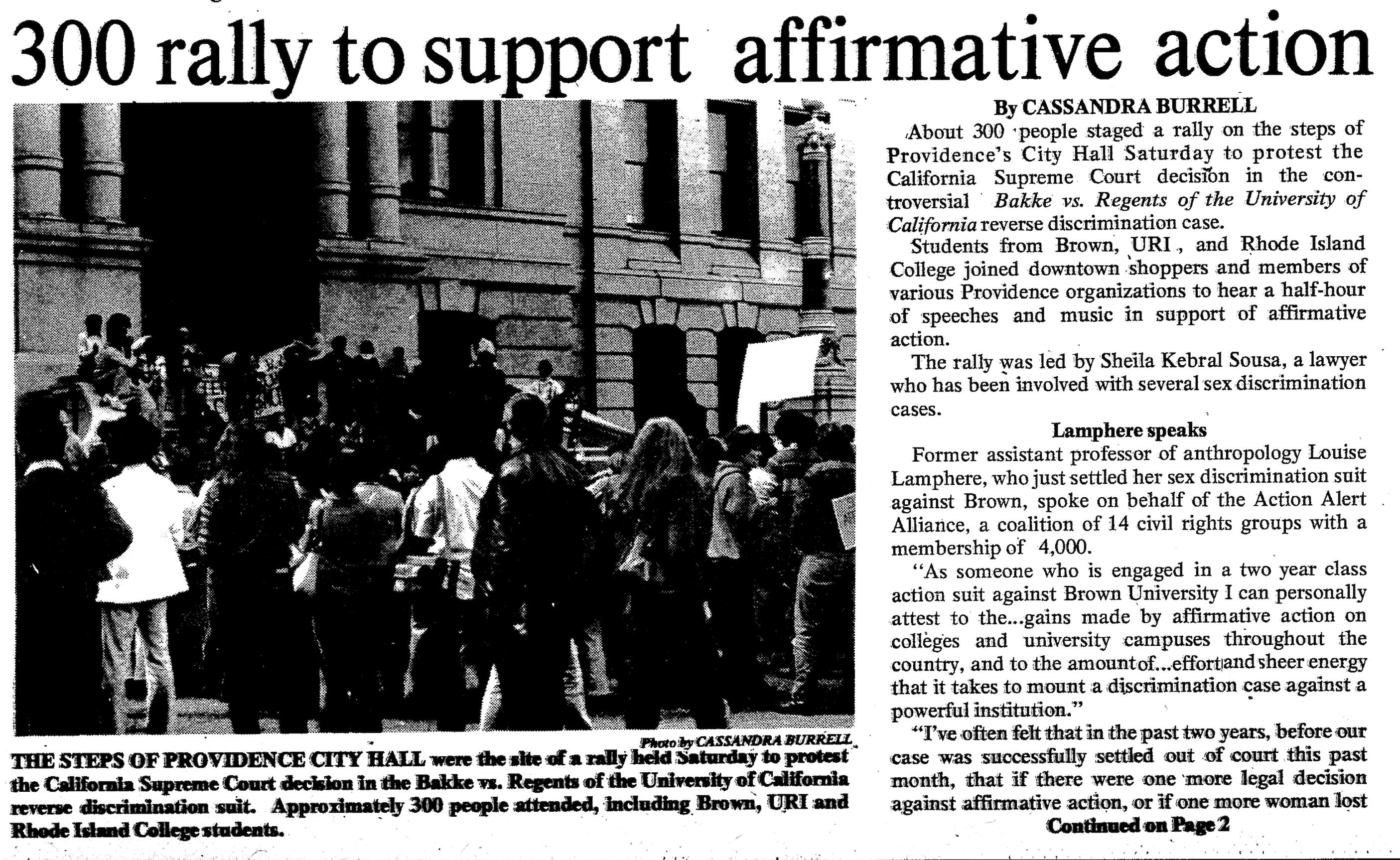
On Oct. 8, 1977, hundreds of stu-
dents from Brown and local universities — including the University of Rhode Island and Rhode Island College — gathered outside of Providence City Hall to express their support for affirmative action, according to an Oct. 11, 1977 article by The Herald.
And one month before the Bakke decision in June 1978, David Egilman ’74 MD ’78 published an op-ed while serving on the medical school admissions committee discussing the lack of diversity in the medical school applicant pool.
“The average person on an admissions committee (was) looking for the platonic ideal of themselves — white,” Egilman said in an interview with The Herald.
“I was … making the arguments (for minority students) from inside the room,” he said. “But we would (often) lose.”
The Supreme Court partially sided with UC Davis in 1978, permitting race to be used as a factor in admissions, but also ruled that using quotas in the admission of minority students was unconstitutional.
Following the decision, Brown reassessed its practices to ensure that it was not using quotas in its admissions process, according to the Center at Brown for the Study of Slavery and Justice.
2 FRIDAY, FEBRUARY 17, 2023
THE BROWN DAILY HERALD | NEWS
UNIVERSITY NEWS
‘We will leave the campus until Brown University commits itself to our demands’
By 1989, 8% of the admitted class identified as Black, lower than the goal the University set 20 years earlier, according to Encyclopedia Brunoniana.
2000-10s:
New challenges to precedent emerge
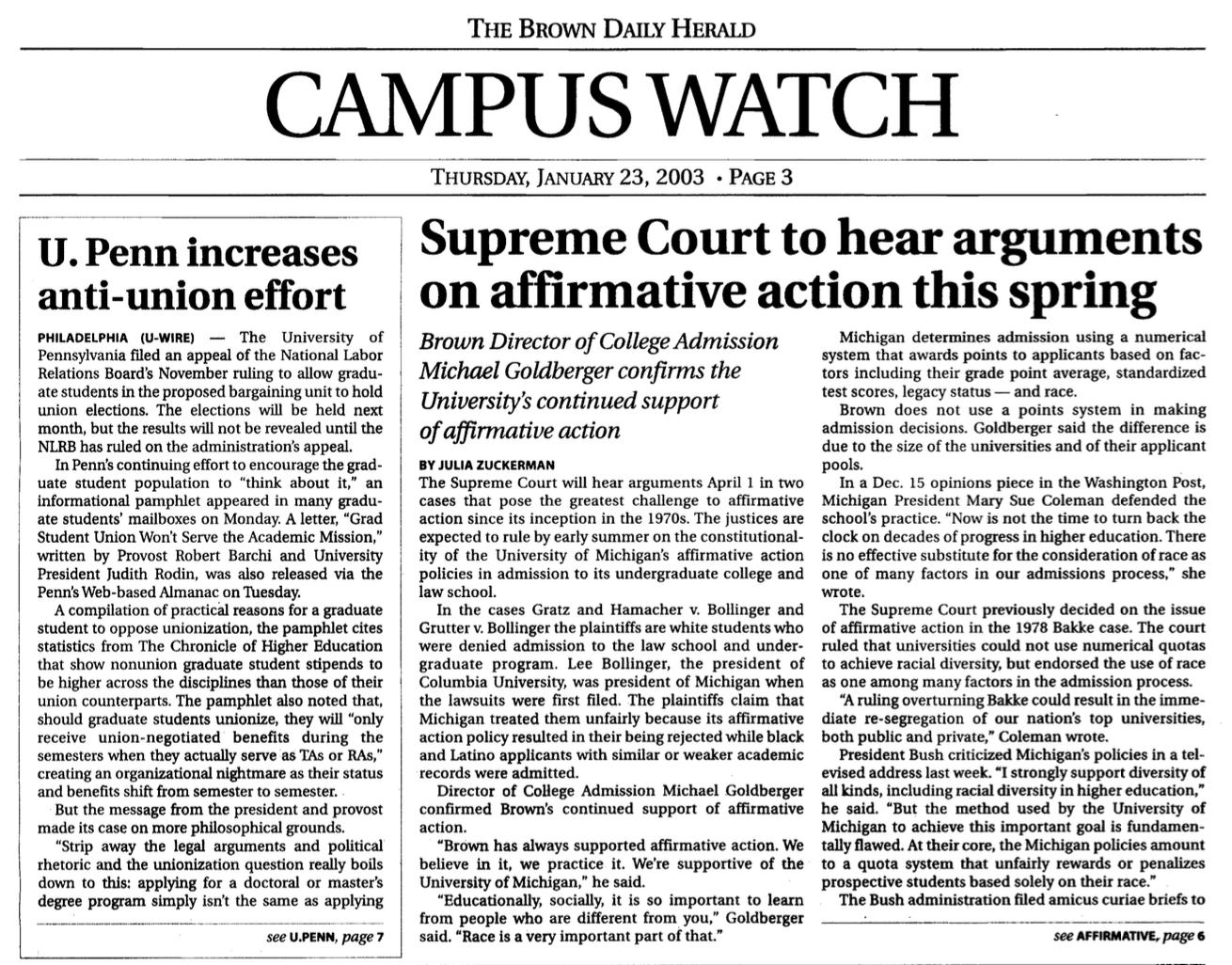
In 2003, two cases brought against the University of Michigan — Gratz v. Bollinger and Grutter v. Bollinger — reached the Supreme Court, challenging Michigan’s race-conscious admission practices. Brown and seven other Ivy-plus institutions joined Michigan in an amicus brief, supporting the use of race as a factor in admissions.
Such legal involvement signified a pivot for affirmative action advocacy. According to Bradley, in the early 2000s, “litigation became the way of protesting.”
“Rather than protesting on campus, (advocacy) went to court,” he said. While demonstrations on Brown’s campus had subsided, the University’s commitment transformed into legal action.
Following these two decisions, the court upheld affirmative action but substantially narrowed its scope — eliminating the use of points systems for admissions that used race as a factor alone, but allowing schools to consider race in a “narrowly tailored” manner.
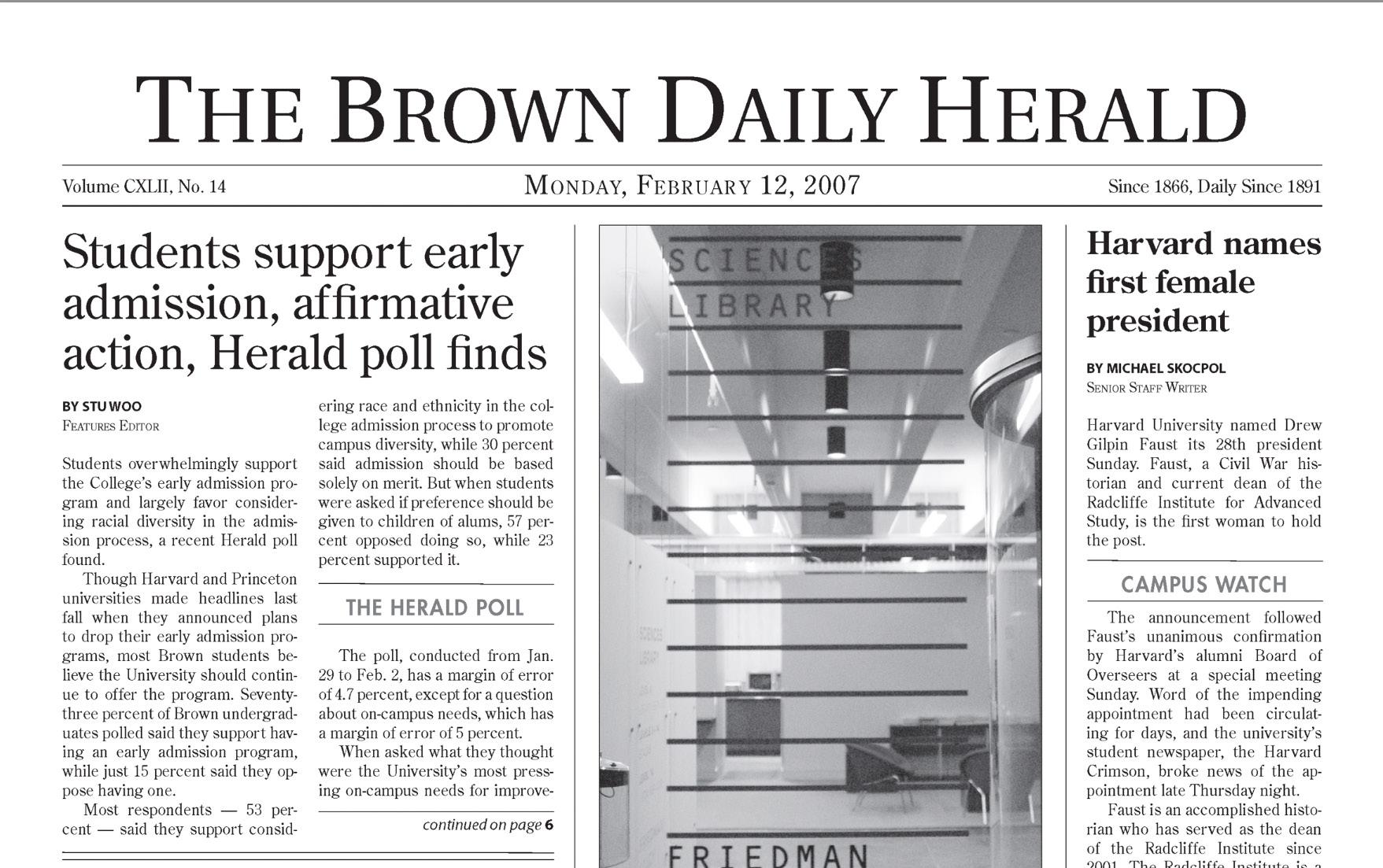
In 2007, a Herald poll found that a majority of students — 53% — supported race-conscious admission practices. In a follow-up article, then Dean of Admission James Miller ’73 said that “in the admissions process, we’re looking at a dozen or more variables for each applicant. (Race) is not ever the sole factor.”
Around this time, two students — Jason Carr ’09 and Neil Vangala ’09 — founded “Asian Equality in Admissions,” a student group on campus that aimed to investigate Brown’s admission policies out of concern that they discriminated against Asian applicants.
The response to AEA was cold from 26 students — many of whom led affinity groups for Asian and Asian-American students — who signed an op-ed that spring. The AEA “did not form organically as a response to community concerns,” the op-ed claimed, adding that it came as “no surprise that it has not received support from any Asian or Asian-American student groups at Brown.”
In 2013 and 2016, Brown continued to legally advocate for affirmative action. In two cases against the University of Texas, one decided in 2013 and the other in 2016, Brown filed additional amicus briefs along with other top-ranked colleges to affirm its commitment to race-conscious admissions. The Court maintained its precedent of supporting race as a factor in admissions.
Today:
As it did for cases in the 2000s, the University has filed amicus briefs alongside other top colleges to express its support for affirmative action in both current cases. With the current court’s conservative lean, the future of affirmative action in college admissions is uncertain.
Several students told The Herald they believe affirmative action should be maintained to account for the institutional inequality present in the broader education system.
“There have been many centuries of
oppression and marginalization of communities of color,” Willow Stewart ’26 said. “There is nothing equal about the system as a whole.”
“Everyone has the potential to be where they want to be,” said Dawood Olaniyi ’26, a QuestBridge scholar. “But that doesn’t mean that everyone is at the same starting point.”
But student concerns about a potential ruling against affirmative action have not spurred them into action. “I don’t think there’s anyone actually advocating as much as there is normal conversation about it,” said Cannon Caspar ’25.
Student opinions also may not necessarily line up with the opinions of the broader American public — 73% of which believes that colleges should not consider race in admissions, according to a Pew Research Center poll.
Stewart added that more students should go “on offense” in describing how they benefit from affirmative action — while noting that the policy is still the “least” colleges and universities could have done for Black students after centuries of discrimination.
Bradley added that institutions of higher education that “seriously believe in diversity” should also go “on offense.”
“If they truly believe in racial diversity, then put things in motion to increase diversity and increase the retention of these students,” he said.
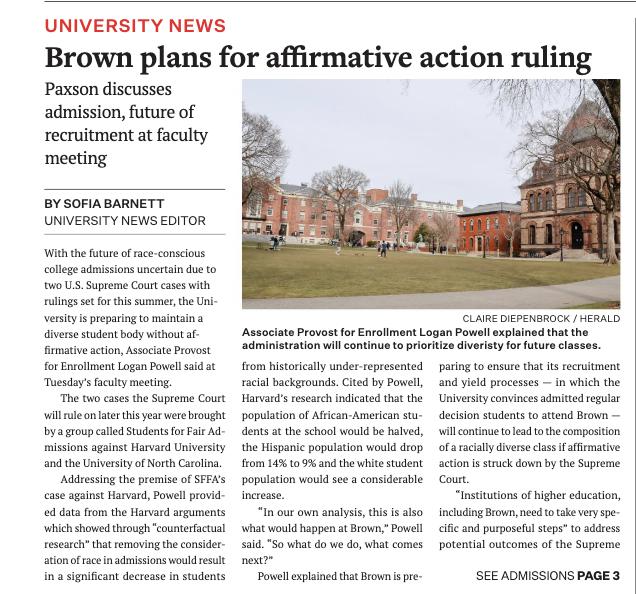
The University is preparing for a decision overturning affirmative action, The Herald previously reported. Logan Powell, associate provost for enrollment, said in this month’s faculty meeting that Brown is “not just sitting on our hands waiting for the decision to come down. We’re doing anything and everything that we possibly can.”
This includes expanded outreach to applicants of color: The University plans to go on a recruitment trip with Howard University, a historically Black university, by visiting 15 cities in the south and southwest, according to the article.
Affirmative action, Bradley noted, “has benefited white students, faculty, staff and institutions much more than people of color.”
Those groups, he said, “get the opportunity to learn from people that they wouldn’t normally learn from,” he added. “In that way, diversity has worked to benefit them the most.”
The Supreme Court is expected to rule on affirmative action in June 2023.
FRIDAY, FEBRUARY 17, 2023 3
THE BROWN DAILY HERALD | NEWS
‘Not just sitting on our hands waiting for the decision to come down’
added.
One challenge PAC faced during the 2022 midterm elections was low voter turnout, Pinto said. Another issue is a “disconnect” between local communities and elected officials throughout the state, he added.
Pinto also highlighted the work done by smaller organizations that are not explicitly politically active but provide other forms of support to local populations, including harm reduction and mutual aid. He emphasized the importance of recognizing “the intersectionality of all these issues” faced by communities.
Legislation of immediate interest
One of the PAC’s biggest legislative priorities is the repeal of the Law Enforcement Officer’s Bill of Rights, which was “something no one knew about” a few years ago, Pinto said. But because of advocacy work, the bill’s
“repeal feels … not far away,” he added.
The repeal movement gained momentum in Providence after the murder of George Floyd in 2020, but “has not really moved the way activists would have liked,” said Jim Vincent, PAC’s senior advisor and housing committee chair for the NAACP New England Area Conference.
The initial momentum has dissipated but, “with the untimely and horrific death of Tyre Nichols, I think there’s going to be a lot of interest in the legislature to at least discuss the repeal,” Vincent said. Rhode Island is the only state in New England with a LEOBoR.
While a Rhode Island State Senate task force studied LEOBoR and made recommendations to reform the bill, Vincent does not think that reform is going to bring significant changes in police-community relations.
In the last state legislative session, the repeal had a Senate sponsor — State Sen. Tiara Mack ’16 — but no sponsor in the Rhode Island State
SCIENCE & RESEARCH
House.
The repeal is “about proper policing, protecting and serving, having the best police-community relations we can have,” Vincent said.
Commander Oscar Perez, who was recently named chief of the Providence Police Department, expressed support for some modifications to the law in a Feb. 8 community forum, The Herald previously reported.
Pinto added that PAC supports the passage of several other pieces of legislation, including a Clean Slate Act, which would help people with previous “conviction and non-conviction” records clean their records for employment checks and housing applications after remaining crime-free for a period of time. “Our judicial system (should be) built on rehabilitation,” he said.
In recent years, Pinto said he has seen greater solidarity and education regarding community issues. He said he is optimistic that the work done by social justice organizations including
the PAC “is going to amount to some real change in a very near future.”
What shapes an activist BLM RI PAC was started in 2020 after the murder of George Floyd and protests throughout Providence. The instability brought about by the pandemic “sparked a fire under a lot of people,” Pinto said, adding that local activism started “picking up momentum.”
“I love the work that I do,” Pinto said. “And I will never stop doing it.”
Rickman has been involved in activism and advocacy efforts for decades.
Stages of Freedom’s Bookstore and African American Museum is located at 10 Westminster St. According to Rickman, the goal in locating Stages of Freedom so close to the University was to garner student support and help cover rent through the sale of books and other items in their shop.
Rickman’s team hopes for more
Brown students to visit and support the organization. “We would just love to get a dozen Brown students to help, volunteer an hour a week,” Rickman said. “Just an hour of their time twice a month, and I’d be dancing in the streets.”
“No one should let a week go by in which they haven’t tried to help those further down than they are,” he added.
After 14 years at the RI Housing Agency and experiences with affordable housing, first-time homebuyer programs, homelessness coalitions and more, Vincent is “looking forward to rekindling relationships in the housing world to see what we can do” in his new NAACP housing committee role.
Vincent, the son of immigrants who said his life was shaped by the civil rights movement and urban renewal, added that working in activism has always felt like a “duty to give back … so that I can help bring people along as I was brought along.”
Meena Pandit ’23, Leela Canuelas-Puri ’23 recieve aerospace fellowship
Program provides career support to gender minorities in aerospace field
BY MIRA WHITE SENIOR STAFF WRITER
Leela Canuelas-Puri ’23 and Meena Pandit ’23, a former Herald staff writer, were selected for the Brooke Owens Fellowship this January. The organization, which is known for its competitive application process, accepted 47 applicants out of almost 1,000 to its Class of 2023.
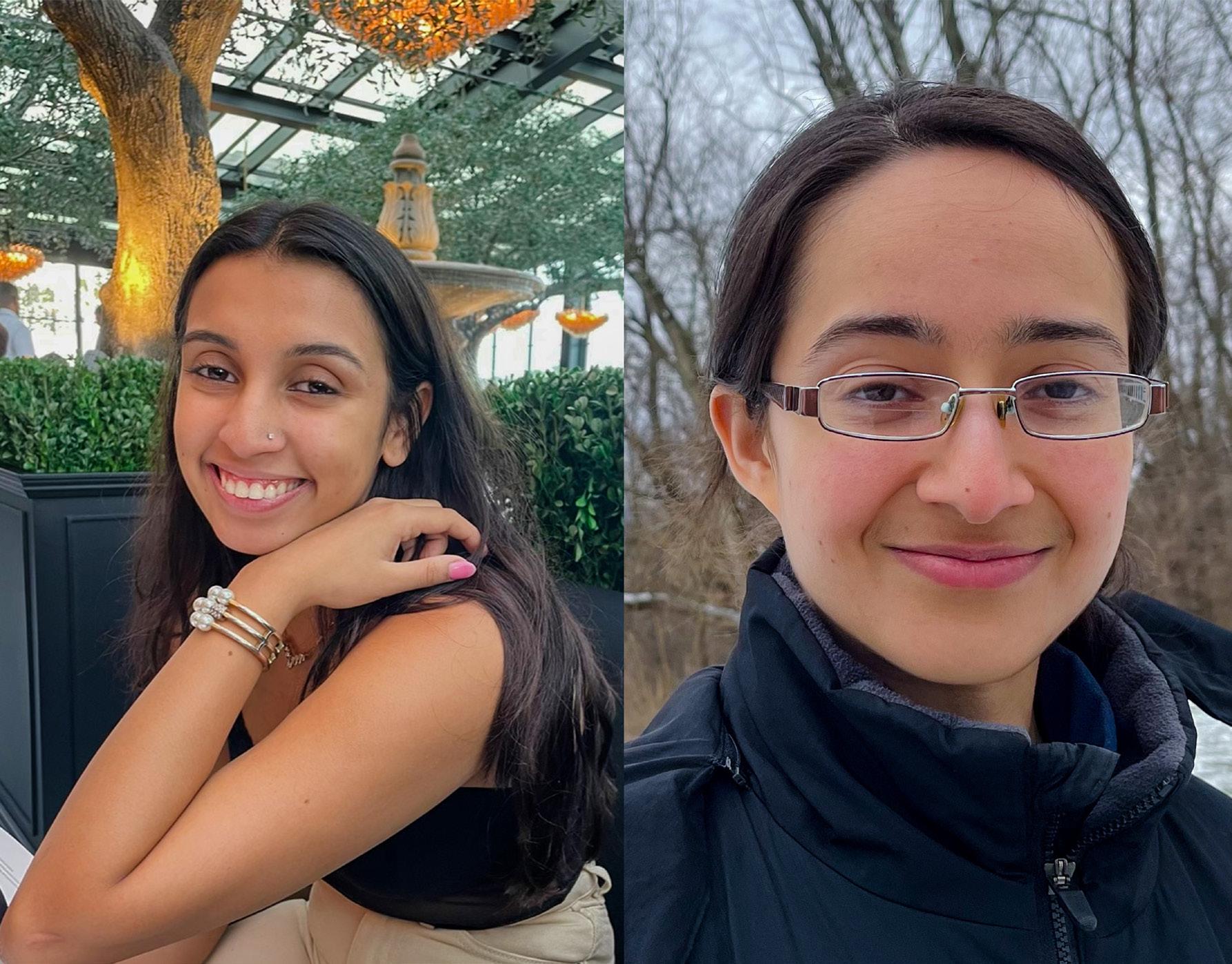
Founded in 2016 to honor Dawn Brooke Owens, a “space industry pioneer and accomplished pilot,” the fellowship is a nonprofit organization that aims to provide women and gender minorities with greater access to the aerospace industry. Undergraduate students are selected through a application process that evaluates their “desire to pursue a career in aerospace, stand-out creative abilities, record of leadership and most importantly commitment to their communities,” according to the program’s website.
Once selected, students receive internships in space exploration and aviation and are matched with a mentor, both of which support the fellows as they launch their careers, according to the website.
Pandit and Canuelas-Puri were also invited to the annual Brooke Owens Summit held this summer in Washington, D.C., which will allow them to meet mentors, industry professionals and other fellows.
Emily Calandrelli, a former engineer at the Massachusetts Institute of Tech-
nology and TV host who was part of a five-member committee that evaluates candidates, expressed praise for this class of fellows.
“Winning candidates stood out based on their creative ability, academic prowess and passion,” Calandrelli wrote in an email to The Herald. “Leela and Meena were incredible students selected from a large pool of impressive candidates from all over the world.”
According to Pandit and Canuelas-Pur, the three-round application process differed from other applica -
tions. The first round included the submission of an original essay and a creative piece, the second involved an interview with an executive board member and the last paired candidates with host companies for a final evaluation.
The process “holistically” evaluated both the creative and analytical abilities of each applicant, Pandit wrote in an email to The Herald. “I thought that was a very novel, thoughtful approach.” Pandit, who is concentrating in Science, Technology and Society with
a focus in science communication and policy, highlighted how her experience at Brown, particularly the University’s supportive faculty, motivated her to apply to the fellowship.
She also emphasized the freedom she has at Brown to pursue interdisciplinary learning. “Without the opportunity to explore these different interests, I’m not sure I would have ever found myself” with the fellowship, she wrote.
Canuelas-Puri, a fifth-year senior who studied at the University of Pittsburgh during the beginning of the
COVID-19 pandemic and returned to Brown for her junior and senior years, also highlighted the uniqueness of the application process.
Despite the Fellowship’s low acceptance rate, Canuelas-Puri emphasized that the application process did not feel competitive. “What you’d see instead is people getting excited about space together, sharing professional resources and connections, cheering each other on through difficult classes, tough projects and the application process itself,” she wrote in an email to The Herald.
Canuelas-Puri, who had applied to the Fellowship twice before getting accepted on her third attempt, added that the experience of rejection taught her “how to respond … constructively” and strengthen her application for future attempts.
She worked to review notes from interviews and find the professional skills that she lacked in order to better approach subsequent application attempts. “Improving interviewing and programming skills was well worth the effort to work in space exploration,” she wrote.
For her internship, Canuelas-Puri matched with Planet, a company that “provides daily satellite data that helps businesses, governments, researchers and journalists understand the physical world,” according to their website. There, Canuelas-Puri will be working on developing procedures that analyze the performance of satellites and sending them code.
“I’m hoping the internship will help me start to develop some of the knowledge required to contribute to space exploration that you can’t get via ‘book learning,’ ” she wrote.
4 FRIDAY, FEBRUARY 17, 2023
ACTIVISM FROM PAGE 1
COURTESY OF LEELA CANUELAS-PURI AND MEENA PANDIT
THE BROWN DAILY HERALD | NEWS
Once selected, students receive internships in space exploration and aviation and are matched with a mentor, both of which support the fellows as they launch their careers.
Ocean Vuong discusses experiences as queer, Vietnamese American poet
Vuong recites poetry from ‘Time is a Mother’ for Cogut Institute Speaker Series
BY ASHLEY GUO SENIOR STAFF WRITEROcean Vuong, celebrated poet and author of “On Earth We’re Briefly Gorgeous,” spoke about his experiences as a queer, Vietnamese American poet as part of the Greg and Julie Flynn Cogut Institute Speaker Series Thursday.

The public event was moderated by Daniel Kim, professor of American studies and a specialist in Asian American literature. Vuong also spoke with a smaller group of undergraduates in a seminar-style meeting titled “A Conversation with Ocean Vuong.”
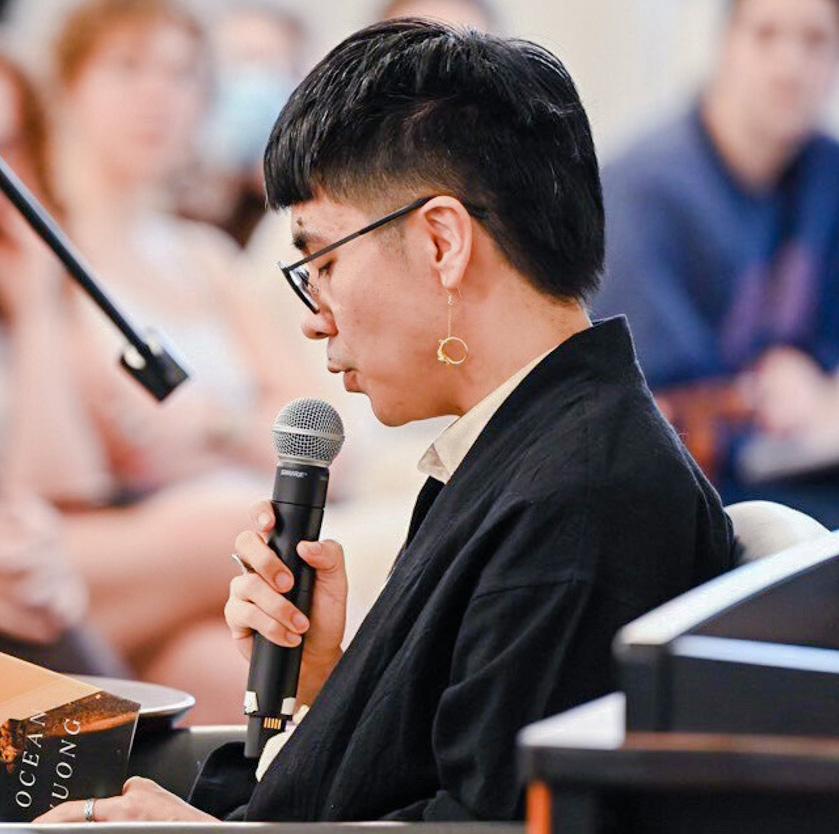
The Greg and Julie Flynn Cogut Institute Speaker Series seeks to showcase “speakers who have had multivalent careers or projects that they’re working on,” Gregory Kimbrell, communications manager for the Cogut Institute for the Humanities, said in an interview with The Herald.
“The most obvious (aspect of Vuong’s work) is the power (with) which he conveys the refugee experience,” Kim said in an interview with The Herald. He added that Vuong’s “take on queer experiences … is really fresh (in) how he accepts that pain and tragedy is part of these Vietnamese and queer experiences but also tries to wrest what is beautiful out of it.”
The public conversation began with Kim sharing his first encounters with Vuong’s work and the experience of teaching his poetry to students. “When we get together to talk about
his work, we lose all critical distance because we’re blown away by his writing,” Kim said.
Amy Pham ’23 attended the event after having taken a course taught by Kim, in which she learned about Vuong’s work. “I’m also Vietnamese American, and I felt like for me, he embodied a lot of what I felt the Vietnamese experience in America is,” she said.
During the event, Vuong recited his poems “Toy Boat” and “American Legend,” both of which come from his collection “Time is a Mother.” According to Vuong, the latter poem is an effort to subvert “the false promise of manifest destiny.”
“What happens if you purposefully crash the car, the vehicle of ultimate progress?” Vuong asked the audience.
Vuong addressed how well-known Asian American individuals are often misconstrued as representatives of their whole community. Kim recalled a moment when novelist Viet Nguyen spoke at Brown in April 2018, and “an older white couple who were anti-Vietnam war protesters apologized to him for the war.”
“One of the fraudulent myths of representation that I am very skeptical of is that the project of representation is to imbue one person as the symbol for all,” Vuong said. This “dehumanizes the person and also abstracts the group.”
“We are obligated to reject that apology,” he added. “You are no longer apologizing to a human being. You are apologizing to a hologram that reflects your own insecurities, and I cannot be your mirror.”
Kim then steered the conversation towards a discussion about Vuong’s practice of Buddhism. “Buddhism is central to me in how I live and think,” Vuong said, adding that Buddhism
allows him to apply an “anticolonial praxis” to his poetry.
“Writing a poem about any one thing does not mean I have possessed it,” Vuong said.
Kim also drew a comparison between Vuong and singer-songwriter Phoebe Bridgers, specifically Bridgers’ song “Killer” and Vuong’s poem “Self-Portrait of Jeffrey Dahmer,”
both of which reference the serial killer who targeted queer communities of color.
“I love Phoebe’s work,” Vuong said. “The idea that one could have a tool and instrument as the voice and that the whisper could be just as meaningful, I am deeply interested in that. Particularly in an Asian American ethos and a queer American
ethos as well.”
Vuong explained that “Self-Portrait of Jeffrey Dahmer” was part of an investigation of the idea of empathy. “When I started to become a writer, I started to hear the word ‘empathy’ as a final destination,” he said.
But “it’s mostly utopic for whiteness, … because whiteness could then perform that liberal labor of learning about others,” Vuong added. “So it has everything to gain from empathy.”
“When you flip that to Dahmer, to various structures of harm, how could this be?” he said. Vuong explained that the poem was an experiment in which empathy fails. “It was the scariest poem I had ever written, and probably the most important for me, because I got the poem to something only poems could do, which is a way to enact a limitation — a limitation I knew was there but could not locate.”
Kim then opened up the conversation to student questions, which focused first on the line between fiction and memoir in Vuong’s works.
Vuong said that his novel “On Earth We’re Briefly Gorgeous” included “only six percent” of his life, but many readers still interpret the book as a memoir. “How do I truly write a novel that the culture will distort anyways?” he asked the audience.
“Agency above all,” Vuong said. “When I am reading a book, I am reading a personhood. I am reading someone narrating their nervous system.”
Vuong concluded by addressing a student’s question on the weight of the Asian American label.
“The abstracted label … cannot hold anybody,” he said. “I am free to go beyond. … Every word you write down is already there. Go beyond the tokenizing label.”
FRIDAY, FEBRUARY 17, 2023 5
UNIVERSITY NEWS
ASHLEY GUO / HERALD
THE BROWN DAILY HERALD | NEWS
During the event, Vuong recited his poems “Toy Boat” and “American Legend,” both of which come from his collection “Time is a Mother.” According to Vuong, “American Legend” is an effort to subvert “the false promise of manifest destiny.”
ASHLEY GUO / HERALD
Vuong said that his novel, “On Earth We’re Briefly Gorgeous,” included “only six percent” of his life, but many readers still interpret the book as a memoir.
Wooten ’24: What ‘Abbott Elementary’ taught me about AP African American Studies
As a self-proclaimed “Abbott Elementary” fanatic, I have seen every episode of the series at least twice. The show follows teachers at a Philadelphia public school in a documentary-style format similar to “The Office” and explores a wide range of educational issues, including teacher shortages, charter schools and tracking — the method that schools use to group students based on perceived ability, which is often biased by race and class. The episode of “Abbott Elementary” that feels most relevant to me is “Light Bulb.” Janine, the main character and overly enthusiastic teacher, faints after trying to simultaneously teach and fix the school facilities on an empty stomach. Melissa and Barbara, the veteran teachers, warn her about caring too much and advise her that teachers can’t afford to burn out if they want to continue caring for their students.
As a Black female educator, I struggle to say no, just like Janine. I struggle to say no when my students ask for office hours beyond my allotted eight hours per week, so I hold them anyway. I struggle to say no when my dance students at the community center want to see a real dance studio, so I organize a field trip to accommodate. When you struggle to say no, like me and Janine, you continually search for the balance between self and community care; after all, one cannot exist without the other. Recently, I have practiced self care by avoiding doomscrolling — endlessly browsing through negative online media — through articles about Florida’s recent ban on Advanced Placement African American Studies. But my approach to Florida’s situation does not mean I do not care about Black education — I just want society to show Black teachers the same level of care it asks from us.
As a Black teacher, I already know the com-
mon misconceptions about Black education.
I know AP African American Studies haters will spout the dangers of “CRT” and claim the course is “anti-American.” When I see haters criticize Black Studies, I wonder which “CRT” they are referring to: “Critical Race Theory” or “Culturally Relevant Teaching.” If they are referring to the former, I can assure them that Critical Race Theory is a complex legal framework that “denotes that systemic racism is part of American society.” As an upper-level undergraduate student, I struggle to fully com-
While it is important to create and include Black histories in schools, it is also important to recognize that this work comes with a mental burden that disproportionately falls on Black educators. Questioning my history, reflecting on Black representations in curricula and contemplating Black criminality is emotional labor. Implementing Black history lessons is only one of the many additional tasks Black educators are asked to do. Black educators face discrimination in teacher education programs and amongst colleagues, while also serving as
Have you ever repeated an insightful discussion point from a Black student and not given them credit? While these are important questions to consider, I also urge you to think outside the Brown bubble about the myriad of ways in which education and society more broadly disregard Black bodies.
There are also a wide array of people advocating for Black stories and knowledge beyond reposting on social media. Recently, alongside my fellow executive members of the Black Student Union, the Black Heritage Series Coordinators and Harambee House leadership, I shared stories about Black activism from Brown’s past and present through our Legacy of Black@Brown Event. Currently, a coalition of Providence youth is advocating for Ethnic Studies to diversify the curriculum in Providence Public Schools. Last week, Black Lives Matter at School, a national group promoting racial equity in K-12 education, had a week of action centering Black creativity, schools and joy.
prehend the framework and guess most high schoolers will too. If the haters are referring to the latter, I wonder what can possibly be wrong with a teaching method that meets students’ learning and cultural needs. Is the issue that we are meeting Black students’ desires?
This leads me to the second misconception: AP African American Studies is “anti-American.” This country was built on slave labor, shaped by Black culture and continues to profit off of Black incarcerated bodies. In brief, the modern United States would not exist without the contributions of Black people. So then how can Blackness be anti-American — and why is teaching about Blackness criminalized, as in Florida’s “Stop WOKE Act?”
sources of support and advocates for students of color. Black teachers are constantly called on to care for others, so society should show more care to us.
So you made it this far, and you’re wondering: “How do I care for Black educators, students, and curricula?” I’m sorry to break it to you, but reposting about Florida’s ban is not enough. You can start by reflecting on your compliance with the Black educational experience at Brown. For instance, are you more likely to dismiss the lived experiences of Black students and students of color in class discussions because they are anecdotal? When you meet a Black social sciences, humanities or arts concentrator do you feel their work is less valid?
I promote my Black joy by not doomscrolling, but that does not mean I do not care. I care because of the magical moment when the little Black girls I babysit can point to “Hair Love.” I care because my college counselor advised me not to take African American history because it would not be considered rigorous enough by Brown. I care because Black education is my future. In order to keep doing the work, I just cannot afford to care too much and end up passing out like Janine.
Jada Wooten ’24 can be reached at jada_ wooten@brown.edu. Please send responses to this opinion to letters@browndailyherald. com and other op-eds to opinions@browndailyherald.com.
THE BROWN DAILY HERALD
133rd Editorial Board
Editor-in-Chief
Will Kubzansky
Managing Editors
Katy Pickens
Alex Nadirashvili
Senior Editors
Augustus Bayard
Caleb Lazar
Peter Swope
Kaitlyn Torres
Post- Magazine
Editor-in-Chief
Kimberly Liu
News
Metro Editors
Emma Gardner
Rhea Rasquinha
Jacob Smollen
Julia Vaz
Science & Research Editor

Haley Sandlow
Senior Science & Research Editor
Gabriella Vulakh
Arts & Culture Editors
Aalia Jagwani
Finn Kirkpatrick
Rya Vallabhaneni
Sports Editor Linus Lawrence
University News Editors
Sofia Barnett
Charlie Clynes
Emily Faulhaber
Grace Holleb
Sam Levine
Neil Mehta
Haley Sandlow
Kathy Wang
Digital News Director of Technology
Swetabh Changkakoti
Opinions
Editorial Page Editor
Kate Waisel
Head Opinions Editor
Alissa Simon
Opinions Editors
Anika Bahl
Bliss Han
Melissa Liu
Jackson McGough
Multimedia
Illustration Chief
Ashley Choi
Photo Chiefs
Elsa Choi-Hausman
Dana Richie
Photo Editors
Mathieu Greco
Claire Diepenbrock
Rocky Mattos-Canedo
Lilly Nguyen
Kaiolena Tacazon
Social Media Chief
Sahil Balani
Social Media Editors
Julian Beaudry
SINCE 1891 @the_herald facebook.com/browndailyherald @browndailyherald @browndailyherald
Emily Faulhaber
Kaiolena Tacazon
Production Copy Desk Chief
Brendan McMahon
Design Chief
Neil Mehta
Design Editors
Sirine Benali
Maddy Cherr
Ashley Guo
Gray Martens
Business General Managers
Joe Belfield
Andrew Willwerth
Sales Director
Alexander Zhou
Finance Director Eli Pullaro
Submissions: The Brown Daily Herald publishes submissions in the form of op-eds and letters to the Op-eds are typically between 600 and 900 words and advance a clear argument related to a topic of campus discourse. You can submit op-eds to opinions@browndailyherald.com.
Letters to the editor should be around 250 words and respond to an article or column that has appeared in The Herald, or critique or commend The Herald’s editorial decisions. You can submit letters to the editor to letters@browndailyherald.com.
Submissions undergo multiple rounds of editing. These rounds of editing generally take place over the course of one evening, and you may have to respond to edits late in the evening. If you know you will be unable to do so, please mention that in your email, and we will do our best to work with you.
Submissions can build on reporting from The Herald, reporting elsewhere, official statements from the University or other groups and other reputable sources, but they cannot break news or contain information that The Herald cannot verify. Because we cannot publish unsubstantiated information, failure to provide appropriate sources may mean we have to modify or remove unverified claims.
The Herald will not publish anonymous submissions or submissions authored by organizations. Leaders of student organizations can be identified as such but cannot write under the byline of their organization.
The Herald cannot publish all submissions it receives and reserves the right to edit all submissions. All submissions to The Herald cannot have been previously published elsewhere (in print or online — including personal blogs and social media) and must be exclusive to The Herald. Once your submission is published in The Herald, The Brown Daily Herald, Inc. owns the copyright to the materials.
Commentary: The editorial is the majority opinion of the editorial page board of The Brown Daily Herald. The editorial viewpoint does not necessarily reflect the views of The Brown Daily Herald, Inc. Columns, letters and comics reflect the opinions of their authors only.

Corrections: The Brown Daily Herald is committed to providing the Brown University community with the most accurate information possible. Corrections may be submitted up to seven calendar days after publication. Periodicals postage paid at Providence, R.I. Postmaster: Please send corrections to P.O. Box 2538, Providence, RI 02906.
Advertising: The Brown Daily Herald, Inc. reserves the right to accept or decline any advertisement at its discretion.
The Brown Daily Herald, Inc. is a financially independent, nonprofit media organization bringing you The Brown Daily Herald and Post- Magazine. The Brown Daily Herald has served the Brown University community daily since 1891. It is published Monday through Friday during the academic year, excluding vacations, once during Commencement and once during Orientation by The Brown Daily Herald, Inc. Single copy free for each member of the community. Subscription prices: $200 one year daily, $100 one semester daily.
Copyright 2023 by The Brown Daily Herald, Inc. All rights reserved.
6 FRIDAY, FEBRUARY 17, 2023
88
(401) 351-3372
Editorial:
Advertising:
Benevolent, Providence, RI
www.browndailyherald.com
herald@browndailyherald.com
advertising@browndailyherald.com
THE BROWN DAILY HERALD | COMMENTARY
Support The Herald www.browndailyherald.com/donate
“Black teachers are constantly called on to care for others, so society should show more care to us.”
Fane Tower architecture firm presents design updates to I-195 Commission
BY LILIANA GREYF SENIOR STAFF WRITERAt the I-195 Commision’s Wednesday meeting, the designers of the proposed Fane Tower skyscraper presented solutions to issues raised at the commission’s January meeting.
The building’s design has gone through several iterations — with the original plans including three separate towers — but the Fane Organization’s current proposal has not yet been approved. Before the January meeting, a consultant for the commission sent a memo recommending that the project’s design not be approved until “significant design revisions” were made.
At the meeting, Gianni Ria, a director of engineering and architecture for the IBI Group, presented design updates.
“We took seriously those recommendations and those concerns, and we went back to the drawing board,” Ria said. “We’re here tonight presenting a hopefully acceptable solution to those concerns.”
Ria’s presentation was followed by public comment and questions.
At the Jan. meeting, Tim Love from Utile Inc. — the consultant for the commission — presented concerns about potential wind impacts from the 550-foot tower, which would be constructed on Dyer Street adjacent to the Innovation District Park.
The design of the tower reviewed at that meeting, released in December, eliminated protruding balconies present in the original design. In response, Utile suggested that “a smoother facade might increase wind speeds at ground level,” according to a memo released by the Fane Organization.
Because the revised design has not changed in height or shape, the wind will only affect a handful of locations — notably, the northwest and southwest corners of the space, Ria said. To mitigate those impacts, the updated design presented at Wednesday’s meeting in-
corporates landscaping and screening as wind remediation measures.
According to Ria, the tower will now be surrounded by additional greenery, metal screens and a fence around the perimeter. Those additions will also add privacy and create a “visual barrier” between the building’s loading bay and the park.
Other features of the new design will also create a more “welcoming residential feel to the podium,” with backlit paneling that creates “interest and complexity” and a “softer” aesthetic.
Ria also addressed other criticisms of the tower design from Utile — particularly the removal of balconies, the change from a single-access garage door to multiple garage doors and what Utile described as “unsightly” electrical transformers on the building.
IBI chose to go forward with plans to remove balconies and build multiple garage doors for budget and safety reasons, respectively, according to the memo. The transformers will now be hidden with a “combination of screens and plantings.”
Despite the proposed changes,
concerns about the project persisted at the meeting.
Several attendees raised questions about whether the construction is still viable financially, though Ria assured the public that the budget was being adjusted accordingly.
Lorenzo Apicella, the design representative for the Jewelry District Association, said that the “iconic design” in the original plans for the buildings “justified it being grossly over-scaled for its location.”
But without near-continuous external balconies, the tower no longer appears to be a residential building and instead presents as an office building. The plans, Apicella said, “should be rejected again, not only on their details but on their fundamental difference from what was promised.”
“Construction costs of this detail proved prohibitive,” according to the memo from Fane. “The new tower design presents a more harmonious form with greater symmetry that creates an equally iconic landmark on the skyline.”
Sharon Steele, president of the
Jewelry District Association voiced concerns about the project’s financing and the level of market demand for the project — adding that Fane has struggled to meet “contractual deadlines.”
Jim Malachowski, a spokesperson for the Fane Organization, previously wrote in an email to The Herald that the real estate experience of Fane Organization President Jason Fane provided him “confidence to invest a substantial amount of money in this project to date with millions more to come.”
“Continued extensions and accommodations to Fane by the Commission only create greater delay and inevitable failure,” Steele said. Originally set to be sold in April 2020, the parcel for the tower now has a final sale date in March after multiple extensions, The Herald previously reported.
Steele recommended that the Commission should “summarily reject Fane’s request for a design change.”
Fane will not sign a construction contract or secure financing commitments — two conditions for the sale — until the design is approved, Mala-
chowski previously wrote.
In late January, Marc Crisafulli, chair of the commission, told WPRI in late January that he thought it was “unlikely” that Fane would close on the land before its March 28 deadline — and did not specify whether Fane would receive another extension.
Greg Mancini, a representative for the trade organization BuildRI, agreed that the process had gone on too long — but instead asked the commission to approve the design changes to allow Fane to go forward with construction.
“This is the second-largest construction project in the history of the city of Providence,” Mancini said. The construction would create 1,500 jobs, more than $85 million in wages and $250 million in tax revenue for the city, among other benefits, he added. “It has too much of an economic impact to not let this project go forward.”
After additional presentations about the impacts of construction and further comments from the public, the meeting was adjourned. A vote on the design’s approval will take place at the commission’s March meeting.

FRIDAY, FEBRUARY 17, 2023 7 THE BROWN DAILY HERALD | NEWS CALENDAR
EVENTS
EVENTS Data & Donuts 3:00 p.m. 164 Angell Street FEBRUARY S F Th W Tu M S 8 7 6 9 3 4 5 15 14 13 16 11 12 10 22 21 20 23 18 19 26 24 25 17 2 1 27 Pizza e Papo 12:00 p.m. 159 George Street Tote Bag Decorating 7:00 p.m. The Underground Gayme Night with the Queer Alliance 7:00 p.m. Stonewall House “Goodbye Mr. Loser” 3:00 p.m. Alumnae Hall Men’s Lacrosse vs Quinnipiac 1:00 p.m. Stevenson-Pincince Field Women’s Hockey vs Dartmouth 3:00 p.m. Meehan Auditorium DSI & WiDS Datathon 10:00 a.m. 164 Angell Street 28
TODAY’S
TOMORROW’S
METRO
KAIOLENA TACAZON / HERALD
According to Gianni Ria, director of engineering and architecture for the IBI Group, the tower will be surrounded by additional greenery, metal screens and a fence. Those additions will remediate wind impacts and create a “visual barrier” between the building’s loading bay and the park.
Community members offer feedback, commission to vote on design in March
Brown professors react to altered AP African American Studies curriculum
New curriculum leaves out queer theory, Black feminism, critical race theory scholars
BY SWARAJ AGARWAL SENIOR STAFF WRITEROn Feb. 1, the College Board announced a revised curriculum for its AP African American Studies course.
The course, announced last August, promised a multidisciplinary look at Black history in the U.S. for 60 pilot schools beginning in fall 2022. But the preliminary plans for the course changed with the Feb. 1 announcement of official plans for the course’s curriculum— which eliminated the work of scholars associated with queer theory, Black feminism and critical race theory.
Those changes came after Florida Gov. Ron DeSantis announced plans for the state to ban the course for what he called a “political agenda,” while the state’s department of education raised concerns about the course’s coverage of topics such as Black feminism and reparations.
But in a Feb. 11 statement, the College Board stated that it “had no nego-
to cultivate “Black storytelling,” has now “grown into the community poetry reading we know today,” Bass Kolobe said in an interview with The Herald.
For Brown, joining the Poetry Reading in 2015 was not a decision but an “inheritance.”
“It’s really been a labor of love, but also a labor of love (for) community and Langston,” she said. “We love what Black arts did for us personally and for our extended family and for our extended community.”
“The least we can do is to celebrate a great writer who has such a breadth and depth of experience, particularly the Black experience,” Brown added.
For Co-Director S. Kai Cameron, awarded educator and activist, the Poetry Reading is a way to preserve community engagement with Hughes’ work. “His work is just so relevant. It is really, truly timeless … (and) related to what’s actually happening in the world today,” she said.
He “challenged the status quo,” Joe Wilson Jr., artist and director of the Office of Art, Culture and Tourism for the City of Providence, said in an interview with The Herald. “He demanded answers to critical questions around social justice.”
‘My people. Story-tellers all, — My people’: A day of celebration, unexpected performances
Brown said she considers the annual Poetry Reading event “part community meeting, part church meeting, part birthday party.”
Despite the intense work necessary to organize the event every year, Brown said its main strength is that it “belongs” to the community.
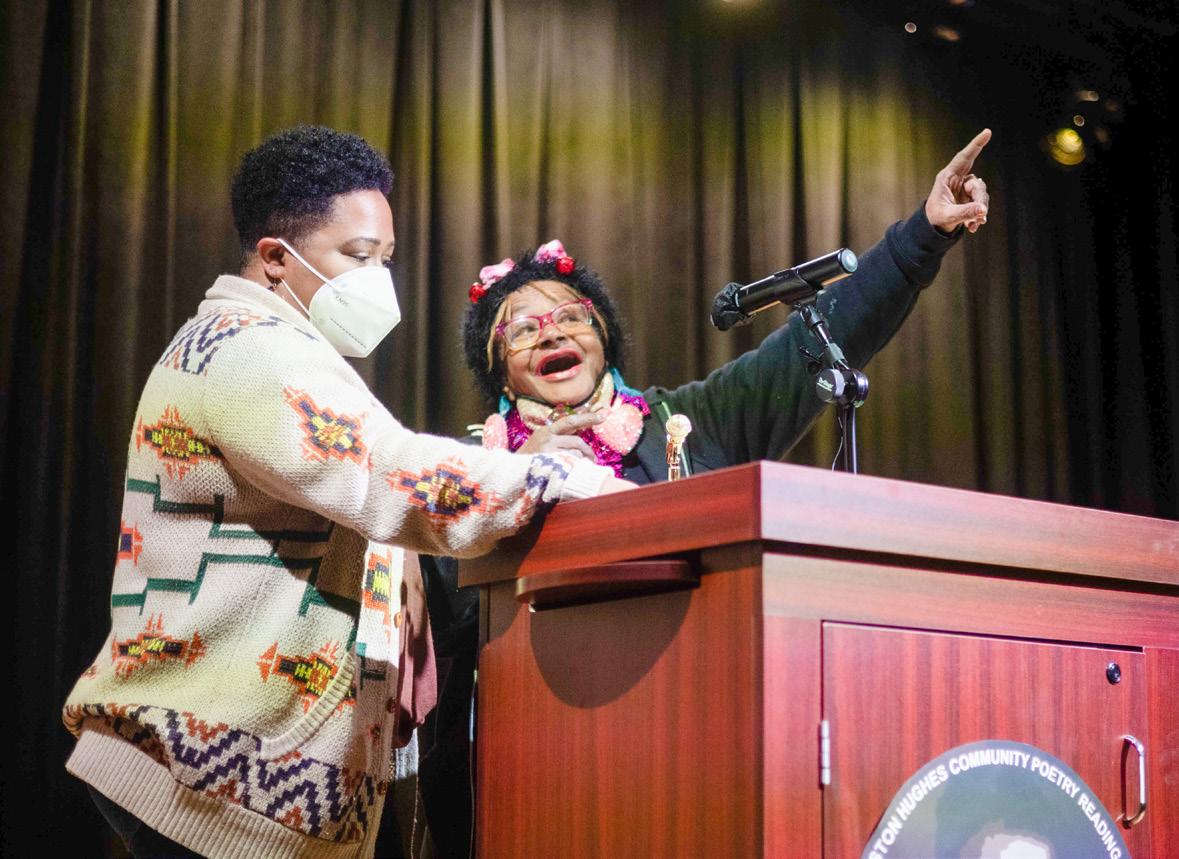
This year, award-winning educator and poet Damont Combs, who often goes by Mr. Orange Live, performed the poem “Harlem Night Club” with his son D Blue Jay.

“What I love about the day of the
tiations about the content of this course with Florida or any other state, nor did (it) receive any requests, suggestions or feedback” in a press release Saturday. In the same statement, the College Board also denounced the Florida Department of Education’s response to the original curriculum.
Professor Noliwe Rooks, chair of the Department of Africana Studies, said that the updated curriculum reflects the state of national politics and the politicization of education.
The changes are “very much part of
performance (is that) you don’t really know what’s gonna happen,” Combs said.
For Bass-Kolobe, it is precisely that unpredictability that ensures the event’s survival. “I think that every year it has a different flavor,” she said. “It has longevity simply because the community is committed to having the experience every year.”
The event brings artists and people together, some of whom might have never connected otherwise, according to Wilson. “We don’t always have a chance to be in a community in that way … it’s important that we’re given the space to see each other … and celebrate being seen,” he said.
‘My soul has grown deep like the rivers’: Community, storytelling, healing
For Bass Kalobe, who performed the poem “Laughers” this year, the event is also a space of healing. “I got to the end of the poem (and) I said to the audience: now everybody just laugh,” she said. “I’ve never had that experience. … It wasn’t laughing at anyone, or laughing with someone. It was laughing together and it was very healing.”
For Valerie Tutson ’87 MA’90, an award-winning storyteller and executive director of Rhode Island Black Storytellers, the event taps into the importance of storytelling as a method of understanding one another and the world, even if the answers “only exist for that moment of shared telling and listening.”
Tutson also encounters healing in the process of storytelling. In the aftermath of the murders of George Floyd and Tyre Nichols, Tutson said that it’s the job of storytellers to turn “trauma into gold … because otherwise, we will not survive.”
In future years, Bass-Kalobe wants to encourage the Poetry Reading to feature more artists that can perform Hughes’ poetry in other languages.
“There’s some things about his writ-
ment for “more than a decade,” according to a College Board website.
According to an email to The Herald from College Board Director Jerome White, the College Board welcomed 200 college professors to preview a draft of the first unit of the course and a “high-level outline” for the rest of the course last March.
Rooks said that the existence of the course, prior to the revisions, is “fabulous” and could supplement the existing AP U.S. History and World History courses, adding that a significant contribution of the course is “acknowledging the centrality of Black people to American history.”
the upcoming 2024 presidential elections,” she said, describing the changing curriculum as a “site of battle” for American politics.
According to Rooks, the debate over the curriculum comes down to a question of “what you teach.”
“How do you teach the vast history of an African diaspora? What do you focus on, past and present?” she said. “These are some of the questions that scholars spent over a decade working on.”
The course has been under develop-
ing that don’t need translation because they’re like the hums of the heart.”
‘I look at the world’: Expanding the project
The Poetry Reading recently began a partnership with PPL, allowing the program to be more accessible to community members. Christina Bevilacqua, programs and exhibitions director for PPL, said that she has been interested in making the library’s resources more accessible to ongoing community programs.
The Poetry Reading occupies a “tremendous space in the community” because of its intergenerational nature, which allows individuals of all ages to view Hughes as a “touchstone” in their lives, Bevilacqua said.
“One of the things that was really gratifying at the event … (was that) several people said to me: Now I know that Black History Month has started,” Bevilacqua said. “People were just really, really happy.”
Beyond celebrating the work of Langston Hughes, the Poetry Reading offers community members a way to understand historical and present experiences shared by the Black community.
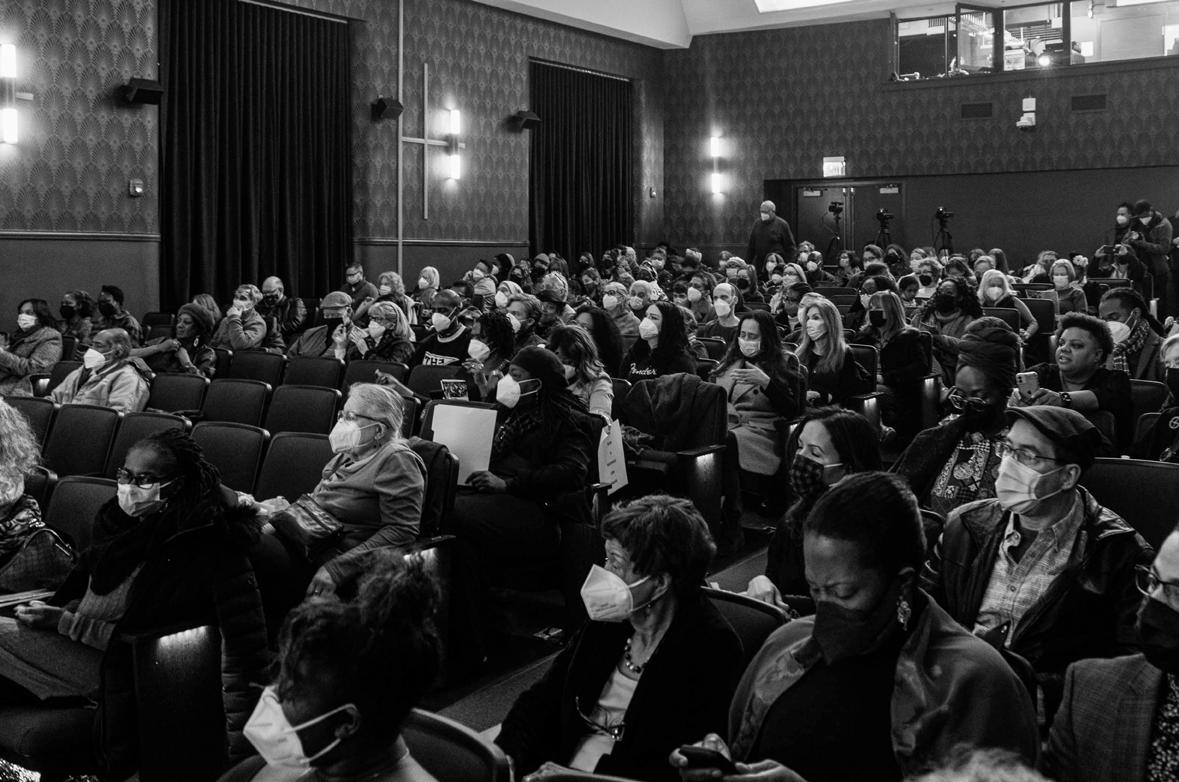
The Poetry Reading developed an educational curriculum to engage students “in the world of Langston Hughes … particularly in the context of the Black aesthetic … (and) the Harlem Renaissance,” Brown said. The Poetry Reading piloted the curriculum at Pawtucket’s Lyman B. Goff Middle School.
According to Brown, the pilot program was also a learning experience for the organization. “What we understood is that you can take an artist like Langston Hughes, surrounded by different contexts, and children can learn,” she said.
The Reading is still working on expanding the curriculum further and securing permanent funding, Brown added. “We’re looking for people who could (meet) us halfway.”
hijacked in general,” she continued. “To think that this is not going to happen in higher education is naive. This should be a source of outrage for everyone.”
Matthew Guterl, professor of Africana studies and American studies, wrote in an email to The Herald that the course’s revised curriculum is “intellectually compromised.”
“The excision of movements and thinkers who were central to earlier drafts represents an appeasement to the DeSantis administration,” he wrote, adding that the changes are “an ominous sign of a looming, terrible future.”
Françoise Hamlin, associate professor of Africana studies and history, was one of the many scholars who went to Washington, D.C. last spring to preview the curriculum.
Hamlin said that the current state of education on African American history in the U.S. is “lacking,” noting the importance of incorporating African American studies into students’ history curriculums.
The changes to the course, she said, are cause for concern.
“We need to be mindful and watchful about how education has been
The course, as it exists today, “is not sufficiently rigorous or imaginative to warrant AP credit,” he wrote. “Students in Florida — and elsewhere — deserve much better.”
In their statement, the College Board clarified that “contemporary events like the Black Lives Matter movement, reparations and mass incarceration were optional topics in the pilot course” — and that “scholars are essential to this course.”
“The official framework is a significant improvement, rather than a watering down,” the statement reads.
8 FRIDAY, FEBRUARY 17, 2023 THE BROWN DAILY HERALD | NEWS
UNIVERSITY NEWS
HERALD FILE PHOTO
Noliwe Rooks, chair of the Department of Africana Studies, believes that the updated curriculum reflects the politicization of education.
HUGHES FROM PAGE 1
COURTESY OF AIYAH JOSIAH FAEDUWOR
The Langston Hughes Community Poetry Reading was designed to cultivate “Black storytelling” and to “encourage people to read the works of Langston Hughes,” said Ramona Bass Kolobe ’72.
ger worlds” and perspectives.
‘Passing’ by Nella Larsen
Nella Larsen’s “Passing” is a classic novel set in 1920s New York City. “Passing” opens with a reunion of two old friends, Irene Redfield and Claire Kendry, the latter of whom has been passing as white, even to her racist husband, John Bellew. The novel follows the women’s relationship as Claire inserts herself into Irene’s life despite her resistance, uprooting her comfortable family life.
Through Claire’s conflicting desires to “pass” and her longing for community, Larsen beautifully captures the complexities of identity, history and intersectional suffering. “Everything
must be paid for,” she warns readers.
‘Sonny’s Blues’ by James Baldwin
“Sonny’s Blues” is a short story set in Harlem and told through the consciousness of an algebra teacher as he recalls his brother Sonny’s journey of addiction and recovery, and suffering and healing through jazz. After watching Sonny play the piano, the narrator comes to understand his brother and witnesses the redemption that Sonny experiences through music.
“For, while the tale of how we suffer, and how we are delighted, and how we may triumph is never new, it always must be heard,” Baldwin writes. “There isn’t any other tale to tell, it’s the only light we’ve got in all this darkness.”
‘Recitatif’ by Toni Morrison
Any one of Toni Morrison’s novels would qualify for this list, but the brilliance of her only short story cannot be overemphasized. Morrison described the story as “an experiment in the removal of all racial codes from a narrative about two characters of different races for whom racial identity is crucial.”
The story follows two girls, Twyla and Roberta, living together in a shelter for four months. We follow the trajectory of their lives and friendship without ever learning which of the girls is Black and which is white — an omission that makes readers uncomfortably aware of their preconceptions as they inevitably attempt to conclude race from clues that aren’t actually there.
In her introduction to the story, nov-
elist Zadie Smith described the ‘Recitatif’ as a uniquely clever, poignant tale about connections and distances, one in which “the subject of the experiment is the reader.”
‘What is Not Yours is Not Yours’ by Helen Oyeyemi
“What is Not Yours is Not Yours” is a collection of nine fairytale-esque short stories that adeptly weld together the mundane and the surreal, each uniquely exploring keys as a central symbol.
Oyeyemi’s stories are born of an incredibly vast imagination and consciousness, the key to the “bigger worlds” of which Morrison spoke. The stories test the boundaries of our known reality through intricate plots and connections that slowly come together
through the collection.
‘Luster’ by Raven Leilani
Published in August 2020, Raven Leilani’s debut novel ‘Luster’ follows the story of Edie, a 23-year-old Black woman who has a dead-end job at an all-white office where she becomes infatuated with an older white man in an open marriage. Edie quickly finds herself entangled in the lives of the man’s wife and their adopted Black daughter, Akila.
Although this premise is unique enough in itself, the novel’s vivid portrayal of Edie’s interiority is what leaves you thinking about it long after you finish the last page. Leilani’s protagonist is vulnerable, tortured and, like the novel itself, “surprisingly tender.”
Senate president introduces bill for free lead pipe replacement
Proposed bill requires replacement of all lead pipes in Rhode Island within 10 years
BY INJY EL-DIB STAFF WRITERA bill introduced by Rhode Island State Senate President Dominick Ruggerio (D-4) proposes the replacement of all lead service lines in Rhode Island at no cost to homeowners within 10 years. If the bill passes, the Federal Infrastructure Bank will provide initial funding of $141 million, though Ruggerio anticipates that it will require “substantially more than that to get rid of all the lead lines in the state.”
There are at least 35,000 lead water pipes remaining in the Ocean State, according to a report from WPRI.
“This piece of legislation was introduced last year by Senate Majority Leader Michael McCaffrey,” Ruggerio said. The bill made it through the Senate last year, but stalled in the House. Ruggerio suspects that the bill failed to pass because “it was late in the session.”
This time, “it has a great chance to pass,” he added. “I’m sure that we can come to some agreement on how to get to the finish line.”
According to Devra Levy ’19, a community organizer at the Childhood Lead Action Project, “lead is a significant environmental health hazard, especially for children,” and is commonly found in house paint, soil and lead pipes.
“Lead pipes were used very commonly up until the mid- to late-20th century,” Levy explained, noting that homes built before that time — many of which are rental properties — are “very likely” to have lead hazards.
Levy added that exposure to high lead concentrations can cause a variety of health issues, including high blood pressure and brain and reproductive health issues among adults.
For children, even lower-level exposure “can cause really significant behavioral and emotional health issues later in life,” Levy said, including brain and nervous system damage, behavior problems and slowed development. Levy also noted that the effects of lead poisoning can be difficult to track at lower exposures since there are often no physical symptoms.
The effects of lead poisoning are distributed unevenly: Children in Rhode Island’s poorest neighborhoods were four times more likely than average to be poisoned by lead, according to a recent study from the Rhode Island Department of Health.

“We probably waited three generations too long in order to do this,” Ruggerio said.
Providence Water, which serves the city of Providence as well as surrounding areas, has been working to reduce lead in drinking water for 11 years now, The Herald previously reported. The department “has been proactive in developing our lead service line replacement program,” wrote Carissa Richard, director of governmental relations at Providence Water, in an email to The Herald.
She added that Providence Water has “obtained approximately $10 million in federal grant funding which is being used for the replacement of private lead service lines in disadvantaged areas of our distribution
system.”
But, according to Levy, the $141 million allocated for lead pipe replacement in Rhode Island by the 2021 federal Bipartisan Infrastructure Law has not been distributed yet.
Providence Water expects to receive funds from the grant in the coming years, according to a fact sheet provided to The Herald by Christopher D. Hunter, spokesperson for Providence Water. These funds will be used to replace 31,000 private lead pipelines free of cost to the property owner, the fact sheet continued.
Providence Water also stopped its practice of partial lead service line replacements as of summer 2022, according to Levy. Through the program, Providence Water provided free replacement of lead pipes up to homes’ property lines; homeowners were responsible for the cost of replacements on their own property, with the option to participate in an interest-free loan program.
Dwayne Keys, president of the
South Providence Neighborhood Association, described partial replacements as “significantly dangerous” for causing corrosion and lead particles from cut pipes to enter water flows.
According to the fact sheet, Providence Water has “made changes to the water treatment process to make the water less corrosive in an effort to reduce lead levels in some homes.”
Last January, CLAP filed a complaint with the Environmental Protection Agency accusing the program of violating the 1964 Civil Rights Act, The Herald previously reported. The group argued that the costs of lead pipe replacement are difficult for people in low-income communities to afford.
“This was a civil rights issue because, in Providence, people of color are disproportionately more likely to be low-income and renters,” Levy said.
The EPA is currently in the process of drafting an informal resolution agreement with Providence Water,
according to Levy.
Providence Water declined to comment specifically on the issue.
As part of their Water Main Replacement program, Providence Water replaced lead pipes in the Washington Park and Charles Street neighborhoods for free using EPA grant funding, according to the fact sheet.
“We’re glad to see any legislation” on issues CLAP advocated for, including Ruggerio’s proposed bill, Levy said. She added that she was also encouraged by “significant input from the community as well as a plan to actually reach out to community members about the program.”
Keys said that he “applauds the Senate President’s efforts to move this forward” and is “cautiously optimistic about the proposed legislation.”
The state Senate will go on break in a week, according to Ruggerio, after which “we’re going to hit the ground running and we’re going to do a lot of legislation,” which he anticipates will include this proposed bill.
FRIDAY, FEBRUARY 17, 2023 9
LITERATURE FROM PAGE 1
METRO
THE BROWN DAILY HERALD | NEWS
MENASHA LEPORT / HERALD
the peglegs
vignettes from my time on a not-so-great high school football team
by Damian WasilewiczHoney, There’s A Lineman In
The Kitchen
The first thing you want to do as a lineman is to get into a squat. If you’re on the right side of the line, left butt cheek tenderly kissing the right cheek of your friend Matt, you want to clamp that right hand down onto your thigh. You might feel it trembling from the squat — probably shouldn’t have skipped the stretch. Stick your left hand up, ready to defend the quarterback behind you from anyone rushing towards them with malice in their heart. If you’re feeling dangerous, wriggle your fingers a bit. Now the enemy knows they’re in trouble.
into the woods on
the forest’s teachings
by Ellyse Givens illustrated by elliana Reynolds
My sister is a forest dweller. She leads a pastoral existence—the trees are her companions and the stars her teachers. At Colby College in Waterville, Maine, the rustic wind nudges time forward. The woods’ many creatures waylay adventure-hungry students skipping astray in the hills, nibbling at their heels until they surrender back to the library. I imagine this place to be a rural oasis. Like water in a desert, Colby is a refuge amidst a world of blaring city lights and screaming taxi cars. Students wear hiking boots and check their skin for poison ivy stains when returning to their dorm rooms, untroubled by metropolitan dangers like smog or speeding vehicles.
I arrive at a bus station in Augusta, the nearest urban center to Colby, as an October dusk drapes itself over the white pines. A place of desolation, the station is located on the side of a road with a field as its only neighbor. One by one, my co-passengers are retrieved by friends and relatives parked in nearby cars, en route to a more final destination. I, on the other hand, do not have an escort—just Uber and Lyft. I wrest my phone from my jacket pocket to summon a driver, only to find the app struggling to
load, perplexed by my blue location dot’s new rural whereabouts. My fucking phone does not even know where I am.
I am alone at a bus station in the middle of nowhere. For a moment, I consider my uselessness. A metropolitan girl in the countryside—her telephone and academic fervor and interpersonal skills, once her most valued assets, rendered futile in this rurality. This weakness makes me angry. I Facetime my mom in annoyance and the screen glitches violently, her features frozen in place. Phones do not enjoy functioning in the wilderness— just as I imagine the wilderness despises these technologized vibrations that interrupt its intrinsic rhythm. Neither of them wants to function in tandem, yet I bat my screen with a finger, determined to defy their dissonance. My mom comes alive again. Apparently, a small, Augustabased taxi company has gleefully agreed to retrieve the stranded daughter from the bus station.
The driver arrives in an oval-formed, faded blue minivan that screeches faintly to a halt along the sidewalk. “We only take cash,” he remarks while shoving something into the glove compartment...

With my makeshift drill finished, I straighten up from the squat and make my way across the kitchen to check on my mouthguard. The mouthguard’s struggling to stay afloat amidst a turbulent sea of boiling water whose heat I feel even with my hand above it. I fish it out, rinse it under cold water for a second, and shove it in my mouth. When it no longer feels like I’m biting down on a chew toy, I take the guard out and put it back into cold water to let it finish setting.
After securing my dental record, I move on to giving the rest of my body a fighting chance...
christmas adventures in openai on
what makes a writer
by Alissa SimonOn the sixth night of Chanukah, which is also Christmas Eve, I am awake and burning in my old bed. It isn't a flame but a computer running on my bare stomach that sears a red spot into my skin. But I can’t find it in myself to move. Not quite a week has passed since coming home and I’m more at rest than I’ve been in a long time. Dark comes quickly now and so do other things: the sound of locking cars and wind. It’s a pleasant kind of paralysis.
“These
They have lived.”
This past semester was a long one. One where I promised myself I would get back into writing after a disorienting spell of self-doubt and hesitation. All fall, I waited on myself to start writing like I did when I was a child — poorly and abundantly — but the words never came. I’m too busy to write. I said, which was true. I have this idea… but I always choked a few sentences in. I’m not busy anymore. My exams are finished and I’m in the quiet of my room, drinking the good coffee my cousins brought from New York. But I’m still not writing. Instead, I’m playing with ChatGPT— the new mass obsession —and biding time until the sun sets. and first fell in love with someone else’s poems ...
See Full Issue: ISSUU.COM/POSTMAGAZINEBDH post- FEB 17 VOL 31 ISSUE 1 6
FEATURE
NARRATIVE
“The radio spits country music, the audio absolutely fried by the ancient speakers. Other cars start to spill into the empty streets as the sun punches suddenly into the sky. My mouth still tastes like strawberry.”
— Kyoko Leaman, “IHOP French Toast”
moments are not planned… They are spontaneous, unexpected, and utterly profound, like the helpless smile of a woman who cannot help but love another—even as their paths forward demand otherwise, they have shared an experience.
02.21.2020
—Robert Capron, “Portrait of a Senior on Fire”
scrapbooking the sunday scaries away
creatively collaging the little moments
by Sarah FrankThe Sunday Scaries are only scary when you think ahead to Monday. I’ve always had the Sunday Scaries, but at the start of freshman year, one of my best friends and I started a tradition called Smoothie Sundays to combat this feeling. Amidst a quiet campus, Tabitha and I got drinks from Tropical Smoothie on Thayer Street. We walked around, caught up on our weeks, and savored the silence of Brown at rest. When the weather got cold, we moved our tradition inside, renamed it Scrumptious Sundays, and ate at Meeting Street Cafe.
This year, we wanted to add something extra to our tradition. Unbeknownst to me and Tabitha, we’d both been scrapbooking random things we collected throughout our days. We’d pick up business cards and stickers and takeout menus and everything in between, separately pursuing the same thing: a productive hobby that allowed us creativity and peace. Scrumptious Sundays became Scrumptious + Scrapbook Sundays. Now, our tradition is to cook pancakes (cinnamon and chocolate chip respectively) and scrapbook together as we eat.

Scrapbooking is a physical collage of memories or thoughts—there is no right or wrong way to do it.
ARTSLIFESTYLE & CULTURE
However, here are some tips and tricks I’ve found helpful:
1. Collect resources
Turns out that everything works in a scrapbook. We cut up the free magazines from the Starbucks on Thayer, pick up business cards, find pamphlets, and use stickers to our hearts’ content. Whatever the object may be, if it has two dimensions, it can be scrapbooked.
2. Work with color
I’ve found that my most aesthetic spreads are ones working entirely with one color or a color scheme. So neutrals are of great value because they work on every page. It works out well, then, that black and white text is the easiest to find.
3. Glue or tape pages together
If you do any writing with pens or markers, it will inevitably bleed through and render the page behind it ruined. I use an adhesive tape roller to tape pages together so I never have to worry about disrupting the art.
4. Layer!!
There is a huge di erence when you layer elements of your page. Looking for solid colors in magazines to use as simple backgrounds ...
the craze for feminine rage
why we love to see women angry
by Emily Tom illustrated by Lulu Cavicchi
I’ve seen the clip a few times now. Anya Taylor-Joy is on a press tour, promoting her movie The Menu in a BBC interview. “I have a thing about feminine rage,” she says. She kicks the air playfully as she speaks. “This is no disrespect for any writer. I get a lot of men doing really terrible things and women sitting silently while one tear slowly falls.”
Taylor-Joy continues, “And I’m like, ‘Oh, no, no, no. We get mad and angry. I remember pulling Mark [The Menu’s director] aside and saying, ‘I’m really sorry, but the only way to play this truthfully is for me to attack him.’”
The video has gained nearly three million likes on TikTok, as well as a flood of supportive comments. We’re sick of being so reserved to avoid being called crazy, one viewer writes. Honestly, the way the media portrays our emotions and our fights is too dainty, says another. These viewers are not alone in their frustration. For as long as I can remember, my anger has been an inconvenience at best and shameful at worst. Before my first high school debate tournament, the team captain pulled me aside and said, “Boys are going to yell at you inround. They’re allowed to yell ...
“I
“The French call it a petit orgasm.”
Hearts
1. <3
2. Anatomically correct
3. Artichoke
4. Queen of
5. Finger ;)
6. -beet
7. Stopper

8. -y bowl of cheerios
9. strings
10. -less :(
by Evan GardnerGum-covered bus rides. Fingers stained Bomb Pop red. Billabong swim trunks clinging to two still-growing legs. This is what “Clarity”—Zedd’s iconic 2012 pop banger—means to me. When Ice Spice samples it on her song “No Clarity,” one of her first songs to gain traction, pop becomes a signifier: From the first few notes alone, Ice Spice, the rapper who came from nowhere, emerges already familiar to us.
In “No Clarity”’s music video, Ice Spice is objectively steeped in drill culture: She wears a red Moncler pu er, a true emblem of New York drill, over her sheer bodysuit. The bass of her beats declares itself drill with each bellow and groan; in her language, she often utilizes the term “grahh,” an ad-lib found in nearly every drill song. In a recent profile of Ice Spice as the new face of drill, The New York Times picks up on this juxtaposition, labeling her work “Pop drill.”
However, something about Ice Spice’s particular “grahh” feels slightly out of place. It is, traditionally, a sound that intensifies the gritty violence of what the critic called “rah rah drill.” “Grahh” usually accompanies death threats, repping sets, and dissing opps. For Ice Spice however, it is a word completely incongruous with the rest of her aesthetic...
F ebruary 17, 2023 7 Want to be involved? Email: mingyue_liu@brown.edu! post –
LIFESTYLE
crowdsourced my gender.”
ice spice gives baddie, body, and structuralism the embodied poetics of “doin’ my dance”
tograph Black subjects to elicit sentiments of respect from people,” Walker said. “That can take a bunch of different forms. Sometimes my shoots are more serious, and sometimes they’re more fun and playful.”
Walker also noted that her intention to “emphasize who the subject is as a person” remains.
monique jonath ’24, who has been a friend of Walker’s since their freshman year, feels that she takes a “tremendous amount of care with her work.”
“Dori has a way of centering Blackness in photography, and the inherent beauty and value of Black people, in a way that to me, who’s also a Black person, feels very true and loving and honest,” they said. “Even if I’m not being photographed, I still feel very seen by her photography.”
Process and projects
Walker described her artistic process as not especially organized. But she does approach video shoots sys-
tematically, creating storyboards where she breaks down almost every second.
When it comes to photography, Walker said that she’s “very heavy on post-editing.” She first learned how to use Photoshop in fifth grade and revisited the program during the initial COVID-19 lockdowns. “The things I taught myself then got reinforced when I was taking that photography class,” she said. “A lot of stuff is just me playing around and seeing what looks good.”
Walker mainly uses social media to promote her work. She has an Instagram account for her own photos and videos. Although Walker at one point considered a double concentration, she ended up choosing to focus solely on MCM.
“You just kind of have to full-send commit to the concentration that is the closest match to what your artistic practice can be,” she said. “It’s a lot of work to produce anything, whether it’s homework or art.”
“I’ve been a lot more intentional
about how I approach my semester,” she added. “I have goals for my academic self but also goals for my artistic self, and they’re not always separate.”
One of Walker’s artistic goals includes a collaboration with Brown/ RISD hip hop collective NOTSODIFFERENT to help produce a music video for a group called Abuelita, which is made up of musician Daiela Simon-Seay ’26 and Leven Kali Simon-Seay. Walker is also currently working on another music video for her friend Jesse McCormick-Evans ’25, who is working in collaboration with Osiris Russell-Delano ’25 and Gustav Hall ’24.

Additionally, Walker wants to revisit a project she began last year called the “Black Book,” which she described as a virtual yearbook. Seventy-seven of the photos were taken in Harambee House last year, though Walker also reached out to acquire photos from several Black students who were studying abroad.
Zoe Ubamadu ’24, one of the many students to be included in the “Black Book,” wrote that she finds Walker’s photography “equal parts meaningful and significant” in a message to The Herald.
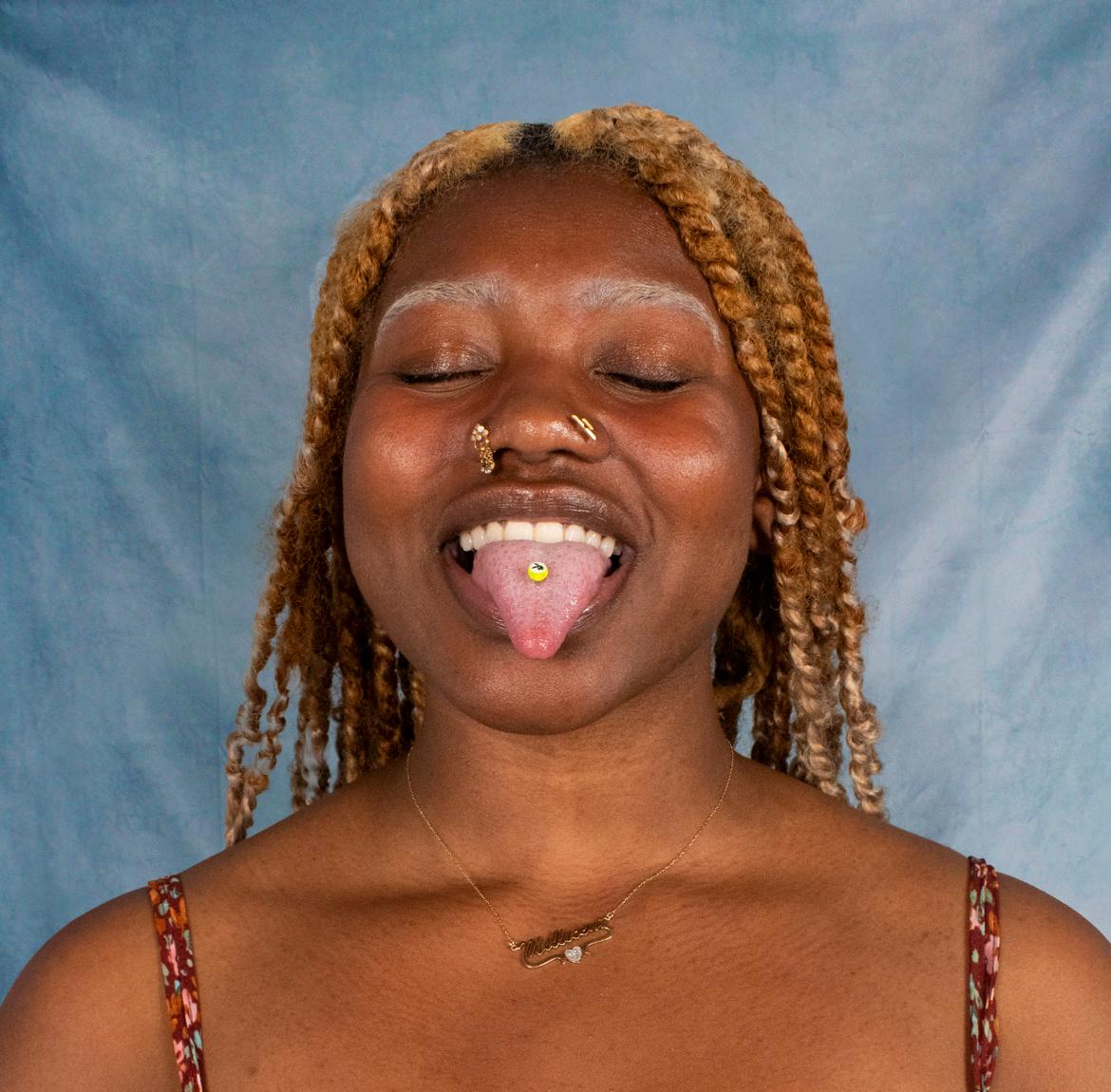
“As a model, I feel very seen by Dori and her work,” she wrote. “She seeks to tell stories through her creative endeavors, all while uplifting her community, Brown and otherwise.”
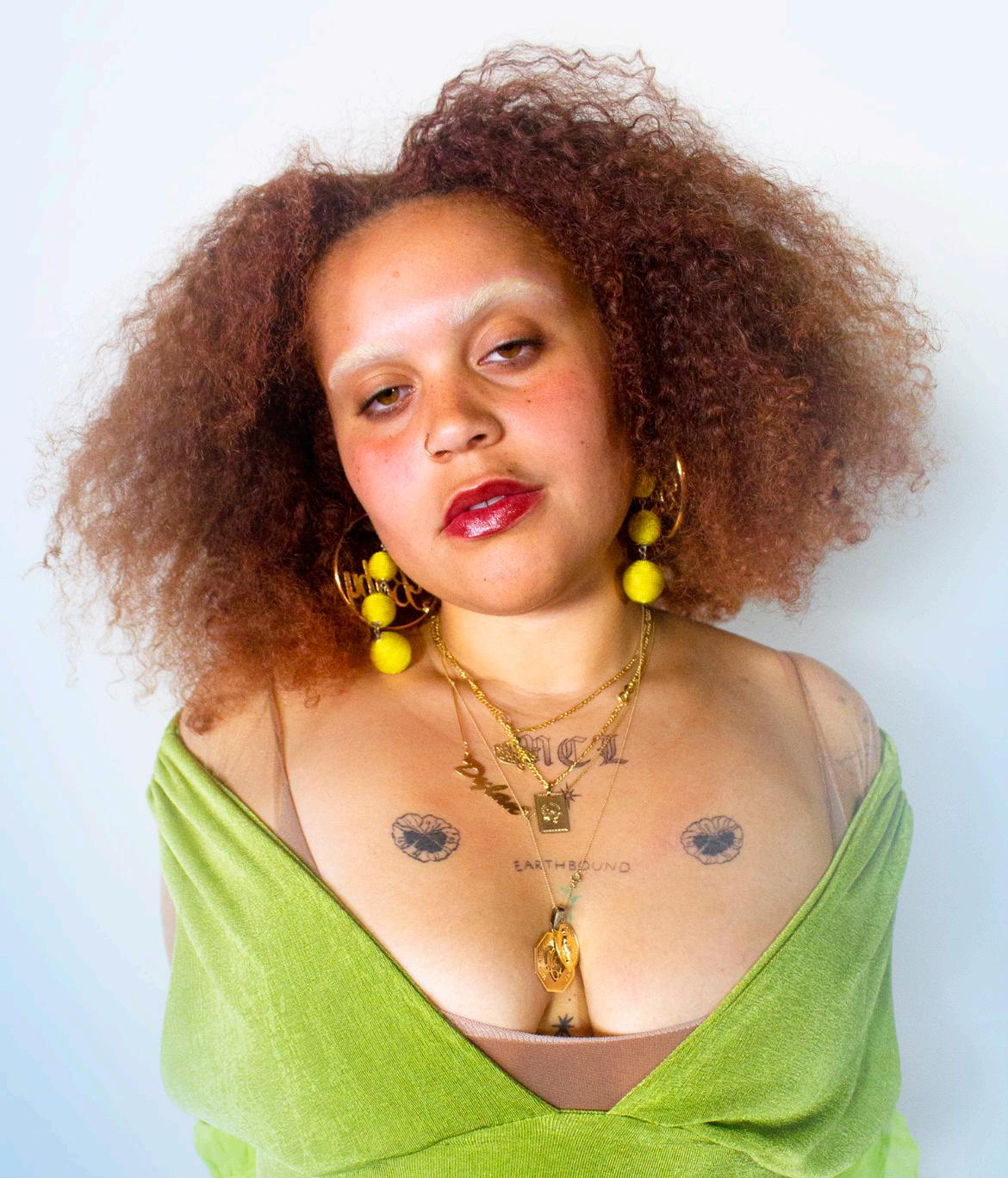
After her time at Brown, Walker knows that she wants to continue her work in arts and culture. “The goal would be to do creative direction at a fashion, art-and-culture-based publication,” she said. “But I could really end up anywhere in fashion, music (or) publication.”
After finding her passion for film and photography while at Brown, Walker encouraged anyone interested in pursuing art to “just do it.”
“‘The Black Book 2022’ is a virtual yearbook I independently produced dedicated to celebrating Black life at Brown University” and is inspired by “Toni Morrison’s ‘The Black Book,’” Walker wrote.
UNIVERSITY NEWS
“I feel like people should just try out the things that they’re interested in,” she said. “Nothing is mutually exclusive. You can do whatever your concentration is and also do art.”
U.resumes computer science TA hiring process after three-day delay
U. previously announced hiring process would be delayed until union elections
BY ASHLEY CAI & SAM LEVINE SENIOR STAFF WRITER & UNIVERSITY NEWS EDITORThe University will resume hiring computer science undergraduate and head teaching assistants for next fall, according to Thursday’s email to the department from Tom Doeppner, director of CS undergraduate studies.
The decision comes after Doeppner informed teaching assistant applicants in an email Monday that the hiring process would be placed on hold “until sometime after” the Teaching Assistant Labor Organization’s March 2 workplace election. TALO is a proposed union of CS teaching assistants.
The CS department was “told by Brown’s Office of Human Resources that, until the union vote takes place, we may not do anything towards hir-
ing” undergraduate and head teaching assistants, according to Doeppner’s Monday email.
“The application and hiring process has been an area of discussion over the course of the last week, with a series of conversations underway among colleagues in Computer Science and University Human Resources,” University Spokesperson Brian Clark wrote in an email to The Herald. “The agreed-upon approach was to move forward with the application and hiring process as initially planned.”
Clark did not comment on the reason UHR told the CS department it had to postpone hiring, nor did he elaborate on why the University reversed its decision. Doeppner also declined to comment on the University’s decisions.
The hiring process for HTAs began in early February but was halted by the University. Despite already fielding applications, the CS department did not plan to schedule “interviews or (discuss) potential HTA positions with applicants until after the union vote,” Doeppner wrote in his email Monday.
Doeppner previously outlined the planned hiring process for the
fall 2023 semester in a January email to the department reviewed by The Herald.
According to the email, professors were supposed to interview applicants for HTA positions over two weeks starting Feb. 13. MTAs would then have matched selected applicants to courses based on professor and applicant preferences, MTA Jiahua Chen ’24 explained.
Typically, HTAs are then onboarded to Workday and trained by MTAs to interview applicants for UTA positions, Chen added. In the initial hiring process timeline, professors, MTAs and HTAs would have interviewed UTA applicants starting March 1 and completed the process in early May, according to the January email.
The CS department has updated its hiring timeline in wake of the hiring restart, with several deadlines now pushed back by two or more days.
TALO is “pleased to hear that the University has reversed its unusual and unilateral decision to delay CS TA hiring, which threatened to increase TA workloads at a critical point in their semesters and disrupt course development timelines,” Colton Rusch ’23, a TALO organizer, wrote in a
message to The Herald.
“We call upon the University to be transparent about the factors that led them to make” the decision to delay hiring, Rusch added.
For TALO, the hiring delay highlights why CS TAs want to organize, he said. TALO hopes to achieve an “environment where these really im-
portant decisions that have sweeping ramifications on working conditions are made collaboratively,” Rusch told The Herald in an interview before the delay reversal.
“TALO is all about us standing together and advocating for ourselves and getting more of a say in our workplace,” he added.
12 W EDNESDAY, F EBRUARY 17, 2023 THE BROWN DAILY HERALD | NEWS
WALKER FROM PAGE 1
MUKUL KHANNA / HERALD
The CS department has updated its hiring timeline in wake of the restart, with several deadlines now pushed back by two or more days.
COURTESY OF DORI WALKER
“‘there are black femmes in outer space’ is an ongoing project that explores varying renditions of Black femme Afrofuturist visuality,” Walker wrote in an email to The Herald.
COURTESY OF DORI WALKER
COURTESY OF DORI WALKER
Above: A single cover for Jesse McCormick-Evans ’25.