
THE BROWN DAILY
Corporation approves 4.25% increase in undergraduate tuition and fees

The Corporation also accepted over $90 million in gifts
BY ROMA SHAH AND JEREMIAH FARR UNIVERSITY NEWS EDITOR AND SENIOR STAFF WRITER
The Corporation — the University’s highest governing body — approved a 4.25% increase in undergraduate tuition and fees at its February meeting, according to a Monday Today@Brown announcement from
President Christina Paxson P’19 P’MD’20.
Total undergraduate tuition and fees have risen to $97,016 for the upcoming academic year, an increase from $93,164 in direct costs for the 2025-26 school year.
Medical school tuition is increasing 2.75% and most graduate programs will see a 4% price hike.
The increases will go into effect for the 2026-27 academic year and are based on a review of financial trends, including Brown’s structural operating deficit, its recent expansion of financial aid initiatives, budget-reduction measures and external
The records include bodycam footage from the Providence police and fire departments
MICHELLE BI METRO EDITOR
About two months after the Dec. 13 mass shooting that left two students dead and nine injured, the City of Providence released a series of public records from the day of the event.
The records include body camera footage from law enforcement’s initial response, incident reports from the police and fire departments and the audio from calls received by the Providence Police Department.
In a Monday press conference, Providence Mayor Brett Smiley said that the release marks the closure of the PPD’s investigation into the shooting.
factors such as inflation, Paxson wrote.
The price hike will be implemented alongside a projected $6.5 million increase in the undergraduate financial aid budget, a reduction from last year’s $17 million increase.
During their meeting, the Corporation also approved a 3% total increase in the salary pool for all employees earning up to and including $80,000 a year — composed of a 2.5% increase in base salary and a 0.5% increase in designated funding for promotions, retention and equity. They also approved a 2% total increase for all
MEMORIAL
employees earning over $80,000 — a 1.5% increase in base salary and a 0.5% increase in PRE components.
The increases in tuition and salaries are based on a mid-cycle report and recommendations from the University Resources Committee, a group of faculty members, students and administrators who regularly provide reports and recommendations to the Corporation related to University finances, Paxson wrote.
This year, the URC chose not to include a merit allocation — which consists of performance-based pay increases — in the
total salary pool.
Dividing the salary increase into base and merit pools “would have resulted in a very small merit pool that would not have a meaningful impact on the University’s performance evaluation process,” Paxson wrote in the announcement.
The absence of a merit pool “does not obviate the need for and importance of robust performance evaluations and feedback processes conducted by all supervisors, as normally occurs in the spring of each
Students, faculty, community members gather to remember Ella Cook, Mukhammad Aziz Umurzokov
The Providence Fire Department received the first call reporting the shooting at 4:05 p.m. on Dec. 13, according to the fire department call log. At approximately 4:06 p.m., Providence police responded to Barus and Holley, PPD records read. By 4:09 p.m., officers in Brown’s Department of Public Safety reported that three individuals were shot, according to the fire department logs.
Smiley said that the body camera footage from Providence Police Lt. Patrick Potter, the commanding officer of the special response unit, was selected for release because this “singular bodycam” provides “the most comprehensive view” of the PPD’s initial response.
The body camera footage begins at 4:16 p.m. on t=

The memorial service was held in Sayles Hall on Saturday
BY LUCIA SANTIAGO AND MIRIAM DAVISON SENIOR STAFF WRITERS
The Brown community came together to honor Ella Cook ’28 and Mukhammad Aziz Umurzokov ’29 at an official University memorial service this weekend. On Saturday, Sayles Hall was transformed into a space for grief and reflection filled with music, prayer, flowers and candlelight. Students, faculty and community members gathered to watch the service, which was broadcast from the hall to locations across campus and online for alums and community members to watch virtually.
Brady Ahn ’29 described feeling a mix of anxiety, sadness and gratitude as he walked into Sayles Hall for the memorial service. “There was definitely anxiety walking into a space shaped by grief, but more than anything, I felt a deep sadness and heaviness,” he wrote in a message to The Herald. Still, Ahn felt “grateful to be surrounded by others who were feeling the same loss,” and that “being there made the tragedy feel more real, but also less isolating,” he wrote.
At the service, students, faculty and administrators shared reflections on Cook and Umurzokov’s lives, and on the impact that the Dec. 13 shooting had on Brown’s community.
Elina Coutlakis-Hixson ’28, a close friend of Cook’s, spoke on the impact her friend made on her life in a speech at the memorial. Coutlakis-Hixson
SEE MEMORIAL SERVICE PAGE 3

University Hall on Nov. 4, 2025. Next year's tuition increase is based on a review of financial trends, President Christina Paxson P’19 P’MD’20 wrote in a Today@Brown announcement.
MARAT BASARIA / HERALD
UNIVERSITY NEWS
Former Colombian president speaks on immigration, Venezuela at Watson event
PRESIDENT BY IAN RITTER
UNIVERSITY NEWS AND SCIENCE & RESEARCH EDITOR
Former President of Colombia Iván Duque spoke about immigration and U.S. intervention in Venezuela at a Thursday event hosted by the Watson School of International and Public Affairs.
Duque, the youngest elected president in recent Colombian history, has been a proponent of strengthening diplomatic ties between the United States and Colombia and has criticized left-wing approaches to Colombian governance.
Duque sat down for an interview with The Herald before his talk, which was titled “Colombia, the US and the Future of Latin America: An Evening with President Iván Duque.”
A ‘moral necessity’: U.S. intervention in Venezuela
As Duque sees it, the arrest of Venezuelan President Nicolás Maduro by American forces in early January was a “moral necessity.” In his talk, he called the operation a “humanitarian intervention” — similar to the arrest of former Serbian President Slobodan Milošević at the turn of the 21st century and the tactical assassination of terrorist Osama bin Laden in 2011.
“It’s the triumph of good against the most evil and cruel dictatorship that we had in Latin America,” Duque told The Herald.
At the talk, Duque praised the United States for a militarily “perfect operation” to “put an end to a genocide,” claiming that Maduro has killed and tortured many Venezuelan citizens.
Some American politicians and Venezuelan opposition leaders have lodged claims of genocide against Maduro. In recent years, the United Nations has found that high-level Venezuelan leaders have committed crimes against humanity.
Duque claimed in an interview with The Herald that the intervention in Venezuela was “lawful,” citing indictments against Maduro in the United States. Maduro was
ACADEMIC SPACE
indicted by the United States Department of Justice with charges including narco-terrorism and drug trafficking.
But much work still needs to be done to stabilize Venezuela before the end of 2026, Duque said at the event.
“2026 should end with at least a new call for free and fair elections in Venezuela,” Duque said at the talk. He also called for a “re-engineering of the Venezuelan army.”
Duque also said that Venezuela’s acting President Delcy Rodríguez, who served as Maduro’s vice president, “doesn’t have any legitimacy.”
“The recovery and the transition to democracy cannot be led by Delcy Rodríguez because she symbolizes the worst of the corruption and brutality of the regime,” he told The Herald.
‘Boundaries are established in the law’: Immigration, refugees and deportations Under Duque’s administration in 2021, Colombia granted temporary protection to Venezuelan refugees, allowing the refugees to live, work and access social services in Colombia for up to 10 years.
According to Duque, he was inspired to implement this initiative because the United States took similar measures after Hurricane Mitch hit Central America in 1998, Duque told The Herald.
Duque believes that the United States is acting lawfully with its recent mass deportations of migrants lacking permanent legal status.
“The boundaries are established in the law,” he told The Herald. “I think that also proves the necessity for the U.S. to return to the idea of having a bipartisan, comprehensive migration bill.”
This bill should have a “clear route” to citizenship for people already in the United States and “temporary visas” for certain classes of workers, but it also must have “mechanisms to prevent the influx of non-legal migrants,” he added.
Duque also criticized his successor, President Gustavo Petro, for what he saw as a “reckless” clash with President Trump over the deportation of Colombian nationals early last year.
Duque said that Petro’s argument with Trump was “hypocritical,” pointing to the large numbers of Colombian migrants who

were deported under former President Joe Biden in 2024.
“He put in danger a bipartisan and bicameral, 200-year lasting relationship between Colombia and the US,” Duque said.
‘The most damaging drug in the world’: Narcotrafficking Duque also criticized Petro for policies countering narcotrafficking and terrorism that Duque suggested are too lenient.
“People don’t understand that the most damaging drug in the world against the Amazonic landscape, against the tropical forest landscape, is cocaine,” Duque said at the event, citing the environmental ramifications of the drug’s production.
Duque added that the Colombian government does not bear sole responsibility for mitigating the drug crisis. In his view, the United States should also work to develop policies to combat cocaine consumption.
Duque also said that he was not against the U.S. strikes on fishing boats in the Caribbean that were allegedly linked to drug
trafficking, adding that the strikes are “now producing results” and have decreased drug trafficking along those routes. Some of these strikes have killed Colombian nationals.
‘More intense and coordinated relationship’: Future of Colombian politics and U.S. relations
Looking to the future, Duque said that he hopes that the next president of Colombia will further support and grow the country’s relationship with the United States.
“A more intense and coordinated relationship with the U.S. will improve Colombia’s security in the fight against narcoterrorism, will mobilize more investment and will also have — in trade — an element that creates constant and permanent opportunities for many Colombians in the rural areas,” Duque told The Herald.
Duque did not have a specific candidate that he supported, but he said that the next president needs to address the “time bombs” that he claimed Petro is leaving behind.
“He destroyed the health care system, he destroyed the energy system, he de-
stroyed the fiscal system,” Duque said in an interview with The Herald, claiming that Petro has increased the country’s debt and weakened its security and international relations.
At the event, Duque said that he appreciates the one-term limit for the presidency of Colombia because it allowed him to sometimes make unpopular decisions — for example, his implementation of the Temporary Protected Status program for Venezuelan migrants and his decision to try to expand the income tax base — a move that sparked protests across the nation.
“The biggest satisfaction that I have when I look to the people, when I go to bed, when I look at my children, is that I am certain that in every single policy decision that I had to make,” Duque said, it was for “the benefit and the interest of the Colombian people.”
“The biggest satisfaction that I have when I look to the people, when I go to bed, when I look at my children, is that I am certain that in every single policy decision that I had to make,” Duque said, it was for “the benefit and the interest of the Colombian people.”
All classes to be capped, classrooms to remain closed in 2026–27 year
A new time block for classes will be held on Tuesdays and Thursdays
BY IVY HUANG UNIVERSITY NEWS AND SCIENCE & RESEARCH EDITOR
For the 2026–27 academic year, all courses will be capped and the 10 classrooms in Barus and Holley that were closed for the spring semester will remain inaccessible, Provost Francis Doyle shared in a Thursday morning Today@Brown announcement.
“Because all classes will be capped, students and their advisors will need to think differently about pre-registration,” Doyle wrote, adding that additional instructions will be sent to undergraduate students mid-March. “Instead of pre-registering only for capped courses, it will be important for students to pre-register for all classes that they intend to take.”
The physical capacity of the classrooms that courses are assigned to be held in will continue to limit enrollment caps. Historical and estimated changes in enrollment will determine those room assignments, the announcement read.
Decisions regarding the future of the Barus and Holley classrooms — including memorialization — “will be made over time with care and in consultation and conversation with the Brown community,” Doyle wrote in an email to The Herald.
The closure of the Barus and Holley classrooms reduced the University’s already limited classroom space. On top of that, there are typically more students on-campus and more courses offered in the fall semester than the spring, which has prompted administrators to make numerous changes to the fall scheduling process.
Some changes aim to increase the number of medium and large instructional spaces. Some areas that were not previously classrooms, such as a space in the Sciences
Library, are being repurposed into instructional space. In addition, some pre-existing spaces, such as Martinos Auditorium in the Granoff Center for the Creative Arts, are having their availability expanded for classes, Doyle wrote to The Herald.
Departments that have their own non-registrar-controlled spaces are also encouraged to use those rooms “whenever possible,” Doyle’s Today@Brown announcement read.
The Registrar’s Office also added a new time block for classes. On Tuesdays and Thursdays from 4–5:20 p.m., nonvoting faculty may teach classes with anticipated enrollments over 40 students. The classes that occur after 4 p.m. usually enroll less than 40 students, Doyle wrote to The Herald, so there is available space for these larger classes.
The University extended the deadline by one week to Feb. 24 for departments to submit their 2026–27 academic year course offerings, according to the announcement,
because of the “significant impact” of these changes on planning.
To improve course scheduling in the long term, Doyle will bring together a task force of students, administrators and facul-
ty to “review the impact of these changes,” and “engage in a broader discussion of Brown’s current course schedule structure and classroom supply,” the announcement read.
The Herald spoke with Iván Duque ahead of his talk
Duque's talk was titled “Colombia, the US and the Future of Latin America: An Evening with President Iván Duque.”
ANNAMARIA LUECHT / HERALD
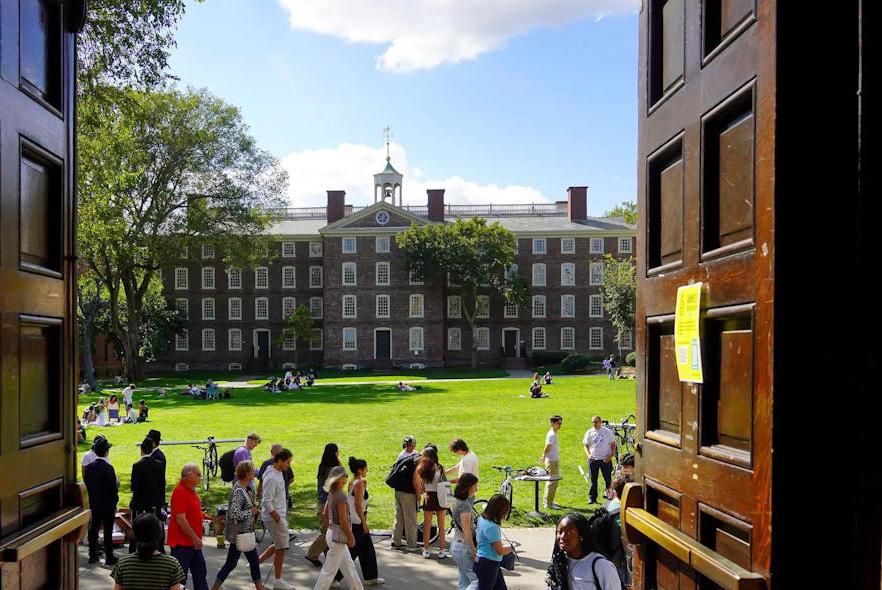
The closure of Barus and Holley classrooms has lessened the University’s already limited classroom space.
KAIA YALAMANCHILI / HERALD
TUITION from PAGE 1
year,” she added.
At the February meeting, Jeffrey Hines ’83 MD’86 was appointed to his first term as secretary of the Corporation, effective July 1. He will succeed Richard Friedman ’79.
MEMORIAL SERVICE FROM PAGE 1
said that Cook inspired her to be humble, kind and to passionately follow her faith.
Cook “would walk with you, in step, in the face of any challenge or hurdle, without a single air of competition, jealousy or malice,” Coutlakis-Hixson said.
“She seldom participated in any sort of public speaking or self-promotion, but her personality was inherently distinctive,” Coutlakis-Hixson recalled.
“Ella would wear bright pink sweaters and big gold hoop earrings and floorlength green coats to class on gloomy days,” she added.
Coutlakis-Hixson closed her remarks with an excerpt from the Introduction to the Sermon on the Mount, a Bible passage that Cook’s “parents have told me is meaningful to (Ella),” she said.
Professor of Classics and History Graham Oliver, Cook’s faculty advisor, talked about Cook’s dedication to learn from others and her hope to become a changemaker in politics.
Vanessa Finder ’29, a dorm neighbor and friend of Umurzokov, shared how he inspired her to live her life more freely. “He taught me that it is okay to live on my own terms, even if it’s not what others want. He taught me that part of the meaning of life is finding happiness in the midst of chaos,” Finder said in her speech.
When Finder was struggling to adjust to college, Umurzokov was there. “With Mukhammad around, I knew that I always had someone to trust nearby,” she said. He “helped me become comfortable and feel safe in this unfamiliar environment. He helped me fall in love with Brown.”
Over just a semester, Finder and Umurzokov grew very close. “We would
Corporation members also held smaller committee meetings largely focused on campus safety and security initiatives, and considered how these priorities will be adapted based on the recommendations
given by the two external security assessments currently being conducted.
The Corporation also formally accepted more than $90 million in individual gifts and pledges exceeding $1 million.
Members of the Corporation also approved new endowed positions in recognition of these gifts, including the Thomas B. McMullen ’62 Directorship of Men's and Women's Golf and Suna and İpek Kiraç

spend time together every night studying, especially for CHEM 0330 and our favorite, NEUR 0010, until at least 3 a.m.,” she said.
After Umurzokov’s death, Finder reflected on how he taught her that “it is okay to laugh during painful moments.”
One of Umurzokov’s professors, James Kellner, a professor of ecology, evolution and organismal biology and environment and society, shared how he was struck by Umurzokov’s passion to help others and his curiosity.
Vice President of Campus Life Patricia Poitevien ’94 MD’98 gave the service’s opening remarks. She acknowledged the community of Brunonians watching the service from satellite locations. “Please know that though we may be separated by distance, we are united in grief and in
love for this community,” she said.
Father Justin Bolger, associate chaplain of the University for the Catholic Community, and Imam Amir Toft, associate chaplain of the University for the Muslim community, led prayers in the faith traditions of Cook and Umurzokov.
President Christina Paxson P’19 P’MD’20 said that she has “begun to come to know” Cook and Umurzokov from those who knew them, as well as from reading their Brown applications.
Cook was a listener who sought out perspectives that varied from her own, she said, adding that Cook came to Brown knowing she would be in the minority as a devout Christian and a conservative. “She came here because she knew that it would help her grow,” Paxson added.
In his application, Umurzokov wrote
about how his drive to pursue a career as a neurosurgeon stemmed from his experiences with medical care. “Mukhammad was driven by a profound sense of purpose,” Paxson said.
The Brown University Chorus, violinist Philip Yao ’28, pianist Sophia Stone P’27, Protestant community musical director and worship leader, and organist Graham Schultz, an adjunct lecturer in music, provided music for the service.
As the memorial concluded, the lights in Sayles Hall dimmed, and attendees were encouraged to light their candles. As people filed out, memorial staff passed out white flowers.
Justin Khan ’29 watched the livestream of the service in the Metcalf Research Building, one of the seven remote viewing locations set up across campus.
Submissions:
THE BROWN DAILY HERALD
Wellisch
POST- MAGAZINE
Editor-in-Chief
Emilie Guan
NEWS
Metro Editors
Megan Chan
Ciara Meyer
Maya Nelson
Sanai Rashid
Annika Singh
Science & Research Editors
Elise Haulund
Claire Song


Submissions
Professorship of Brain Science I.
This article originally appeared online at browndailyherald.com on Feb. 9, 2026.
“I was initially worried that watching it through a livestream would feel isolated and disrespectful,” Khan wrote in a message to The Herald. “But seeing the community gather in one place really allowed me to grieve in a profound way.”
Despite not being in the main hall where the service was taking place, Khan felt that being surrounded by students watching the stream was special in its own way. “I joined many of my classmates, afterwards, at the Van Wickle Gates to place our flowers,” Khan wrote. The bell on University Hall, which typically rings to mark the transition between classes, rang at the end of the service. To Khan, this was a “lovely addition.”
Balázs Cserneczky ’28 first heard about the service from the email that University administrators sent to the campus community. “I really appreciate the very proactive initiative that they take,” Cserneczky said. “It’s kind of an impossible task that the University is trying to tackle.”
From Ahn’s perspective, “the University’s approach to healing has felt intentional and compassionate.” The memorial helped acknowledge “the pain” Brunonians are feeling and encouraged “community support,” he wrote. Moments of silence and messages from community members “allowed people to feel what they needed to feel,” Ahn wrote. “It wasn’t about closure, but about presence, and that felt meaningful.”
This article originally appeared online at browndailyherald.com on Feb. 9, 2026.
email, and we will do our best to work with you.
Submissions can build on reporting from The Herald, reporting elsewhere, official statements from the University or other groups and other reputable sources, but they cannot break news or contain information that The Herald cannot verify. Because we cannot publish unsubstantiated information, failure to provide appropriate sources may mean we have to modify or remove unverified claims.
The Herald will not publish anonymous submissions or submissions authored by organizations. Leaders of student organizations can be identified as such but cannot write under the byline of their organization. The Herald cannot publish all submissions it receives and reserves the right
Luc Drymer Graham
KAIA YALAMANCHILI / HERALD
All memorial attendees were given candles to light in honor of the two victims.
the day of the shooting. In it, Potter can be seen walking through the hallways of Barus and Holley and the Engineering Research Center. He occasionally steps outside to coordinate with other law enforcement officials. Potter also directs other officers to search the building, secure entry points and stage rescues.
Parts of the audio and video footage are redacted. At times, the footage is largely or completely blacked out.
Providence Chief of Police Oscar Perez said during the press conference that this
was done to ensure that the footage does not “revictimize” those affected.
In the body camera video, Potter directed other officers to conduct a “systematic search.” He then called for all traffic to be shut down on Hope and Brook streets.
“With the absence of better information, we’re gonna go with the shooter might still be in this building,” Potter said later in the footage. “So use caution, alright?”
Close to the end of the video, Potter added that the police had “no information
as to where (the shooter) might be.”
The Providence Police Incident Report notes that on Dec. 15, detectives showed images from video surveillance of the suspect to two shooting victims at Rhode Island Hospital. Both victims identified the pictured suspect as the shooter. A third individual who met with detectives also used the images to identify the shooting suspect.
The report adds that after the suspect was found deceased in a storage unit in New Hampshire. Federal Bureau of Inves-

IMMIGRATION
Providence businesses strike against ICE activity
Businesses weighed various factors in their decisions to close
BY PAVANI DURBHAKULA AND MICHELLE BI SENIOR STAFF WRITER AND METRO EDITOR
On Jan. 30, thousands of people across the United States skipped school and work to protest against recent Immigration and Customs Enforcement activity as part of a nationwide shutdown.
In Providence, as over a thousand demonstrators took to the streets and marched to the Rhode Island State House, many businesses joined the opposition and closed their doors.
Alex Maddalena, owner of the ice cream shop Big Feeling, told The Herald that his decision to close the store for the day was a “no-brainer.”
According to Maddalena, Big Feeling has participated in a number of community organizing events in the past, including holding fundraisers for Youth Pride, Inc. and Alliance to Mobilize Our Resistance, an immigration defense nonprofit in Rhode Island.
Maddalena said that the ice cream shop was inspired by the Providence Student Union — Big Feeling’s next-door neighbor. “I was just really moved to see that these kids cared so much” about “their peers at school who feel threatened by ICE,” he said.
ICE did not respond to a request for comment.
Maddalena attended the demonstration at the statehouse along with five other Big Feeling employees. “I’m just really proud of the crew here,” he said. “I made the decision to close, but they also showed up in a pretty big way.”
The decision to shut down was not a
simple one for Big Feeling, Maddalena said, pointing to the snowstorm that had already forced Big Feeling to close once the prior weekend. He noted that Friday, the day of the shutdown, is typically the ice cream shop’s “busiest day.”
But to Maddalena, a “one-day loss of business” is “nothing” in comparison to the gravity of ICE’s actions across the country.
Bean Marcelino, the chef and owner of the catering company Black Beans PVD, also ceased business operations on Jan. 30. To Marcelino, participating in the shutdown was a way to “stand in solidarity” and “remember (her) upbringings.” Marcelino has held jobs in community work and social services for 22 years.
As she operates the business on her own, Marcelino noted that she did not have to worry about how a closure could affect staff.
Instead of working on Jan. 30, Marcelino joined the march at the State House. There, she was approached by people who thanked her for attending. “It made me want to cry,” she said. “It felt like in that moment, we were all connected, even though we were strangers.”
Knit Club, a yarn store and community knitting space, also closed on the day of the protest. Lindsay Degen, the store’s owner, said that she was initially “really conflicted” about the decision.
Although Degen does not believe that what is needed is for small business owners to be the “people to drive change,” she felt it was valuable to show “solidarity for the protesters” by closing Knit Club’s doors.
While Degen said that she could afford a day of not working, she acknowledged that “people who want to work should be paid.” She gave her Friday employees the opportunity to work on Saturday so they could still have the hours of pay and not “feel impacted by (her) decision to close the store,” she said.
Knit Club’s “biggest tool as a commu-
tigation Evidence Recovery Teams seized “a large number of items,” including two firearms, linking him to both the Brown shooting and the Dec. 15 shooting of MIT Professor Nuno Loureiro.
Other items that were seized included the suspect’s “dark grey and green twotone jacket” seen in surveillance footage, “hundreds of rounds of ammunition” and body armor.
The report also notes that DNA samples from the shooting suspect’s body matched DNA recovered from “ballistic evidence” at Barus and Holley.
In the press conference, Smiley stated that the release of the public records had been delayed until after Saturday’s memorial service in Sayles Hall “at the request of the families of the victims.”
“In all honesty, they didn’t want us to release anything,” he said. “But we have a commitment to transparency.”
He stated that many of the victims and their family members “expressed a desire that nothing get released.” But he added that the city has legal obligations to release public records, as well as an “obligation for transparency to the community.”
“Our commitment to transparency is rooted in a desire for this community to continue to trust their police department,” Smiley said.
“While PPD’s work has concluded, the city remains in regular contact with the FBI, which continues its investigation,”
Kristy dosReis, Providence’s chief public information officer for public safety, wrote in an email to The Herald.
She added that the city currently does not plan to release any additional video footage.
“We believe the video released today provides the most comprehensive view of the response and fulfills the public records requests related to body-worn camera footage, while respecting the privacy of the victims,” she wrote.
No visible video footage released depicted law enforcement inside Barus and Holley Room 166, where the shooting occurred.
“Since the incident, the city has encouraged the release of as much information to the public as possible,” the city’s public records page reads. “The city values transparency, while also ensuring that the release of records complies with Rhode Island law, including exemptions intended to protect the privacy of victims and witnesses.”
According to the page, the city has received “numerous” Access to Public Records Act requests.
At Monday’s press conference, Smiley stated that the records released constitute the city’s “full response” to those requests.
This article originally appeared online at browndailyherald.com on Feb. 9, 2026.

nity-centered business is to enable the community to be able to protest in the way that they can,” Degen said. The business has previously engaged with advocacy by creating a safe space for LGBTQ+ people to come together, she added.
While Maddalena, Marcelino and Degen all closed their business’ doors for the day, they all expressed that they were understanding of factors that may have led to an establishment’s decision not to close.
Some businesses showed their support for the Providence community in ways other than closing the store.
Though Coffee Exchange stayed open on Jan. 30, the coffee shop posted a statement of support for the shutdown on
their Instagram. “The day’s profits will be donated to the (American Civil Liberties Union), and our employees are free to choose whether to work or not,” the post read.
“We are regrettably unable to close for the ICE OUT Shutdown on Friday, Jan. 30,” Campus Fine Wines wrote in a post on their Instagram. According to the post, they dedicated 5% of their sales that day to AMOR.
Hazel Origin Coffee wrote in an Instagram story that they would provide free drip coffee at their two Providence locations in “a small gesture of warmth and community.”
East Side Pockets was one of many businesses to stay open on Jan. 30. “Our priority is maintaining stability for our
staff and continuing to provide service to our customers who rely on us,” East Side Pockets owner Paul Boutros wrote in an email to The Herald.
In addition, while East Side Pockets does not take formal positions on political issues, they “remain committed to treating all people with dignity and respect,” Boutros added.
“While we respect that people and businesses express their views in different ways, we choose to support our community by staying consistent, inclusive and focused on hospitality,” he wrote.
KAIA YALAMANCHILI / HERALD
Providence Mayor Brett Smiley stated that the city has legal obligations to release public records.
CUNYAN MA / HERALD
Knit Club in February. Many businesses took part in the nationwide shutdown against ICE and closed their doors.
Two weeks after rescue from the snow, the ‘lizard in a blizzard’ is in recovery
Frankie the tegu has been recuperating with the help of ET Reptiles
BY KELLY DING SENIOR STAFF WRITER
While many Providence residents woke up on Jan. 27 to a pristine sheet of snow outside their windows, Providence resident Frank Hardy was greeted by something different: an injured tegu — a type of large lizard indigenous to South America — lying in his lawn.
After some initial confusion, Hardy brought the lizard, later dubbed Frankie, into his house to warm it up and immediately sought care for the animal.
Hardy did not respond to a request for comment.
ET Reptiles, a pet store and company that specializes in reptiles, picked Frankie up from Hardy’s house and brought her to an emergency veterinary clinic.
The tegu, a common exotic pet, can reach three to five feet in length and live up to 20 years, according to Emily Arpin, co-owner of ET Reptiles. They can raise their body temperatures about 10 degrees higher than their surroundings, making
them the only known warm-blooded lizards — but this is not nearly as much as mammals.
Tegus “wouldn't be able to stay warm enough to make it through extreme cold,” Jessica Tingle, assistant professor of ecology, evolution and organismal biology, wrote in an email to The Herald.
Frankie was suffering from multiple injuries when she was found, including bleeding toes and missing nails, according to Arpin. Her treatment included the amputation of the “two tips of her tongue,” which had “gone necrotic after being frostbitten outside of her mouth,” she wrote.
Two weeks after Frankie’s initial rescue, Arpin and ET Reptiles cofounder Taylor Faria are actively monitoring her health. She is “being hand fed daily to build her weight back up,” shows “interest in eating” and is receiving antibiotics for an upper respiratory infection, Arpin wrote.
Tegus are not native to New England, according to Tingle. “I would guess that this tegu is probably a pet that either escaped or was irresponsibly released,” Tingle wrote.
Owning a tegu can be “demanding” for some pet owners — they require a varied diet and “a lot of space,” Arpin wrote. She stressed that “there are multiple options
for those looking to rehome their animals.”
“Putting any reptile outside during these temperatures is a death sentence,” Arpin wrote.
Frankie’s case has received national attention. On Instagram, videos about the tegu have garnered thousands of views. The New York Times recently covered the story.
Despite the coverage, no one has come forward as Frankie’s owner. Arpin is “doubtful anyone will come forward at this
point” and is considering making Frankie the “ambassador animal” for their shop.
Frankie’s story has even made an impact on campus.
At the end of Graduate Student Instructor Megan Robinson’s ENGL 0202P: Poetics of the Cosmos: Verse, Universe and Existence class on Jan. 30, she connected the course’s thinking “about the universe and existence” with the tegu.
“In a time where things that are blatantly untrue overcompensate by trade-
marking themselves as true … Frankie is this beautiful opposite,” Robinson wrote.
Frankie “embodies a truth about the universe, about its chaos and mystery, its ability to endlessly create and recombine.”
“I told everyone to watch for lizards on their way out,” she added. “I hope that they will.”
This article originally appeared online at browndailyherald.com on Feb. 9, 2026.
RISD students report feeling underprepared for life after graduation
RISD President Crystal Williams shared an action plan with the RISD community
BY EMILY FEIL AND IZABELLA PIATKOWSKI
METRO & UNIVERSITY NEWS
EDITOR AND SENIOR STAFF WRITER
In 2024, a RISD survey found that students were largely unsatisfied with career and networking opportunities at the school. On Jan. 13, 2026 — over a year later — RISD President Crystal Williams shared an action plan with the RISD community aimed in part at addressing career readiness issues.
The 2024 survey was put together by the Working Group on Preparedness for Life After RISD, which Williams established in March 2024 as part of the school’s strategic planning initiative.
The survey found that just 1% of RISD students felt “the school helped them develop business, financial or entrepreneurial skills.” Other findings included widespread
In an executive summary shared in December 2024, the working group reported that improvements in professional guidance are “necessary and urgent,” adding that RISD “cannot responsibly prepare our students for the future without rethinking our approach.”
The January action plan shared by Williams will help guide the implementation of recommendations made by the committee, alongside the overarching presidential initiatives.
But eight out of nine RISD students interviewed by The Herald said that they have not heard of the Preparedness for Life After RISD initiative.
“I’ve never heard of it,” said Trinity Breeze, a RISD senior studying illustration. “I’ve never heard any of my friends discussing it. I don’t think I’ve ever heard a professor bring it up.”
According to RISD spokesperson Jaime Marland, administrators have already begun work on the presidential initiatives through 2027.
“Some are already underway, and others will require more time,” Marland wrote
transformational work that takes careful planning and coordination across the campus community,” she added.
Lydia Smithey, a junior studying illustration, said that she had not heard much about the initiative but thinks it would be “fabulous” if it made a positive impact on student preparedness.
Students recognized that the art industry can be particularly difficult to navigate for post-grads. In the study, 32% of RISD graduates reported that their careers align closely with their major.
“Especially in the painting world, it’s just kind of so undefined,” said Finn Lewis, a sophomore painting major. “In general, there’s no easy tracks to go down, so it’s kind of a lot harder for them to be like, ‘Okay, this is what you have to do.’”
“I feel like I’m getting a really awesome education, and I’m really happy to be here,” she added.
According to RISD sophomore painting major Jack Gould, carving out a career in the arts is largely “up to you to make it happen for yourself.”
“But I do wish that there was more talk

dissatisfaction with alum networking, systemic inequities in access to career resources and inadequate funding for internship opportunities.
“Implementing
strategic planning process, which is currently in motion, is
within the classrooms about how to make your way in the industry,” Gould added.
One of the goals of the initiative is to increase an emphasis on these skills, as
well as improve inequities in career resource access.
RISD hosts an annual “Internship Connect” program, which allows students to speak with companies that interest them. Students are matched with companies through an application lottery that “will balance the distribution of all student applications with the meeting time slots for all companies,” according to the Internship Connect website.
“Internship Connect was helpful in the sense that you get to talk to people from the industry,” Karis Lau, a RISD sophomore graphic design major, said. “But the time you get to talk to them is a bit too short to really form any kind of real connection or network.”
Breeze said that she participated in Internship Connect during her sophomore and junior years at RISD, but she chose not to this year because there were fewer opportunities that interested her.
Lydia Smithey, a RISD junior majoring in illustration, felt that RISD “could have done better” with Internship Connect during her three years at RISD.
Smithey and Breeze both said they felt like there were a lack of opportunities for illustration majors as opposed to majors like graphic design and industrial design. According to the Internship Connect website, at the 2025 event, there were 10 opportunities specifically marked for illustration compared to 24 designated for graphic design, excluding companies who canceled.
The survey found that approximately one-quarter of RISD students complete internships during their time in school, which the survey says is “comparable to peer institutions.” About one-third of RISD students who have internships reported that their positions were unpaid.
“I’ve been able to network luckily, but it’s been entirely because of my professors,” Breeze told The Herald. “I expected the institution itself to be having more events and having more portfolio reviews actively.”
According to the survey, only 7% of
graduates reported feeling satisfied with their access to alum networking.
RISD did not respond to a request for comment regarding the balance of opportunities provided for students at Internship Connect.
RISD also offers a career center, designed to support students in building their professional careers after their time at the fine arts and design school.
Students told The Herald that the center can be helpful but many felt it provides mostly generic advice. “I think that the career center is a great resource for at least resumes and websites and just getting the hard part of that down,” Smithey said.
Lewis described the center’s employees as “very personable” and “very willing to speak to you,” but said that the employee she met with “promoted using AI to write things” like cover letters, which Lewis said they do not want to do.
RISD did not respond to a request for comment regarding the promotion of AI at the career center.
In the spring, the center holds two virtual portfolio review events — one for fine arts and one for design — where students have the opportunity to have their portfolios reviewed by professionals and connect with potential employers.
Breeze said that the portfolio reviews have not been held in the past two years due to crashes on the website used to host the professionals. “I know a lot of people that were … supposed to get portfolio feedback from industry professionals, and just literally never got them because the website wouldn’t work,” she said.
RISD did not respond to a request for comment regarding the functionality of the website for the virtual portfolio review events.
“When it comes to these networking things, it’s definitely half the school pushing you in the right direction and half you have to do it yourself,” Smithey said.
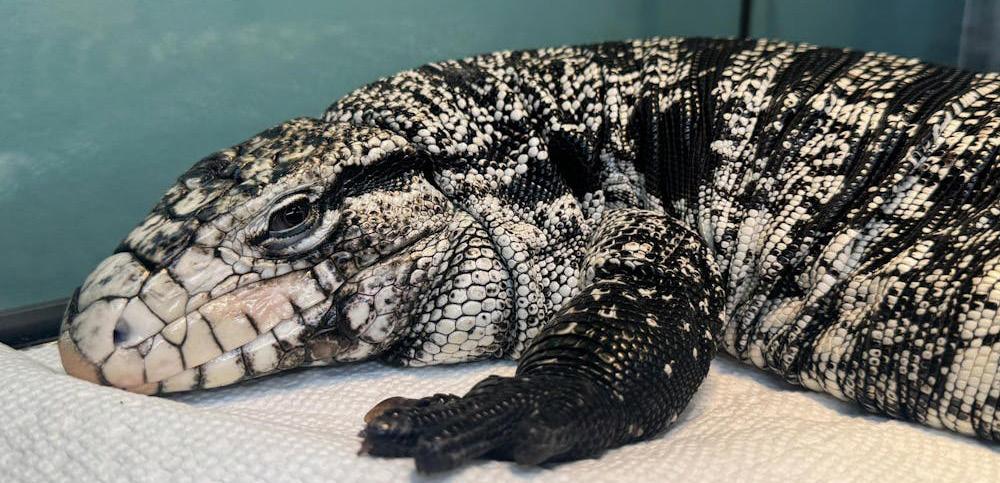
Although Frankie’s case has received national attention, her owner has not contacted ET Reptiles or new outlets.
COURTESY OF ET REPTILES
In interviews with The Herald, eight of nine RISD students said that they have not heard of the Preparedness for Life After RISD initiative.
MARAT BASARIA / HERALD
ICE HOCKEY
Women’s ice hockey extends winning streak with triumphs over No. 24 St. Lawrence, No. 12 Clarkson
The Bears will face No. 7 Quinnipiac and No. 8 Princeton next weekend
BY SAJIV MEHTA SENIOR STAFF WRITER
This past weekend, the women’s ice hockey
Mulvihill skated through three Brown defenders and flicked the puck past Bruno goalkeeper Rory Edwards ’27.
Refusing to be left behind, Bruno wasted little time answering. Just two minutes later, India McDadi ’26 sent a bullet pass to Margot Norehad ’27, who was cutting across St. Lawrence’s crease. Immediately,
“Anytime in a (penalty kill), you need good goaltending, and we had great goaltending from Rory (Edwards) today,” Ruzzi said.
Bruno broke through the dead heat with five minutes remaining in the period. From the left high slot, Monique
of the ice, but off a faceoff at Brown’s endzone circle, the Saints notched one into the back of the net. The puck glided to the high slot, where Megan Crowley sent a slap shot blazing by Edwards into Brown’s goal to make it 3-2 Bruno.
Energized by the prospect of tying the game, the Saints began attacking fervently, delivering seven more shots in the match’s final stretch. But more inspired play by Edwards and the defense ran the clock to zeroes, and Brown escaped with a victory.

way.
But, with just over five minutes left in the first period, it was the Saints that struck first. St. Lawrence forward Brooke
TENNIS
selves on their second penalty kill of the period. Though the Saints got three more shots off, Bruno’s defense skillfully navigated their two minutes of penalty time.
Isabella Gratzl ’29 found paydirt, giving Bruno a two-goal lead.
The first 12 minutes of the third period saw a return to the defensive on both ends
In a post-game interview with The Herald, Edwards reflected on how she kept her mentality consistent during those final pressure-packed moments, focusing on “one puck at a time” and “owning the moment.”
The next day, Brown welcomed Clarkson onto the ice. As the Golden Knights were ranked No. 11 nationally at the time of Saturday’s matchup and had already dispatched the Bears earlier in the season, Bruno was surely the underdog. But Brown rose to the occasion.
One of the highest-scoring teams in the league, the Golden Knights came out of the gate firing a barrage of shots at Brown goaltender Anya Zupkofska ’28. But Zupofska held the shelling off, buying time for the Bears’ forwards to take shots of their own. Lyons took advantage of the moment with under seven minutes left in the period, sneaking the puck into the net from the low slot for her 14th goal of the season.
“I try to have fun, honestly,” Lyons told The Herald about her performance this season. “I try not to put too much pressure on myself, and the goals will come with hard work.”
Men’s tennis falls 4-3 to Buffalo in first loss of season
Brown’s five-match winning streak came to an end on Sunday
BY RAHUL SAMEER STAFF WRITER
On Sunday morning, the men’s tennis team (6-1) came short 4-3 in a home matchup against the University at Buffalo (4-3). Tied 3-3, the deciding singles match saw the Bulls’ Theodoros Mitsakos edge past Lukas Phimvongsa ’28 in an intense 7-6 (4), 6-4 battle to give Buffalo the victory.
Despite the loss overall, the “team played with huge heart against Buffalo,” Head
Coach Mike Fried ’91 wrote in an email to The Herald. “I was incredibly proud of how we competed.”
Zander Bravo ’26 and Ivan Sodan ’27 kicked off the doubles segment against Buffalo’s Clement Mainguy and Theodoros Mitsakos. From the first serve, the Bears rode a wave of domination throughout the match to a comfortable 6-2 victory.
After Theo Murphy ’29 and Elliot Wasserman ’29 won their doubles game 6-4, Phimvongsa and Cole Oberg ’29, who were holding a 5-2 lead in their own doubles game, abandoned their match as two of the three doubles matches had gone to Brown already, earning them a point.
Brown “played (their) best doubles of

the spring,” Fried said.
Sodan started the singles matches off strong against Mainguy, but it was not until Sodan broke the Buffalo’s serve at 4-3 that the match started to slip out of reach for the Bulls. Despite a fiery backhand crosscourt winner that saved a set point for Mainguy and brought the game to deuce, Sodan responded with a quick backhand crosscourt, clinching the set 6-3.
With momentum behind the Bears, Sodan easily bagged the second set 6-0, earning Brown another point against Buffalo. Against Emiliano Jorquera, Robert Yang ’29 claimed his 6-2, 6-3 win, bringing the overall score to 3-0 in Bruno’s favor.
Just one game away from the win, the Bears looked to Bravo — who was up against the Bulls’ Onder Balci — to take it home. After his powerful serves won Brown several points in quick succession, Bravo quickly eyed an early break at 1-0.
At break point, Balci attempted to claim an offensive position but instead slammed a short forehand into the net, giving Bruno the break. Once Bravo held his service game and commanded a 3-0 lead, it looked like Brown was headed toward a smooth victory.
But Balci bounced back. After a long rally at 3-1 resulted in Bravo making the error, the Bulls capitalized on the opportunity, easily converting a short shot from Brown into a winner.
Even when Bravo found himself up 40-15 tied at three games apiece, Balci’s consis-
Though the game was tied heading into the second period, Bruno brought the heat and emerged from the period with a 2-goal advantage, largely on the back of Jade Iginla ’26, who was awarded ECAC forward of the week last week for her 5-point performance against Union and RPI.
The first of Iginla’s two goals came in the period’s opening minute. Skating up the ice’s left coast, Iginla flicked a shot from medium range that comfortably burrowed into the bottom right corner of the goal. This goal marked the 50th of Iginla’s career and made her the 14th player in Brown history to achieve this milestone.
During a power play six minutes later, Iginla settled at Clarkson’s left end-zone circle ready to turn 50 career goals into 51. Receiving a pass from Victoria Damiani ’28 in the center, Iginla wasted no time in sending a slap shot screaming past Clarkson goalie Holly Gruber to make it 3-1 Brown.
Instead of resting on their lead in the third period, Bruno kept up the pressure. Nine minutes into the period, Iginla played a key role in yet another goal. A shot by Iginla rebounded to DeCoste, who found a largely uncovered net and delivered the knockout blow, sending Brown cruising to a 4-1 victory.
The Bears will face an imposing road trip for the final weekend of the regular season when they take on Quinnipiac and Princeton, who are ranked No. 3 and No. 1 in the ECAC respectively.
Ruzzi stressed the cramped nature of the ECAC standings, saying, “every opponent is kind of fighting for their lives in terms of standings.”
“It’s playoff hockey, essentially,” she added.
This article originally appeared online at browndailyherald.com on Feb. 10, 2026.
But not to be dismissed easily, the Golden Knights demonstrated their offensive prowess and dropped the puck around Zupkofska into the net from the doorstep.
tency overwhelmed him. When yet another sudden death approached at 5-3, a devastating double fault dashed any hopes of a late comeback in the set, and Balci secured the first set 6-3.
Balci maintained consistent pressure on Brown throughout the second set, and his composure led him to a 6-4 victory to earn Buffalo a point.
On a neighboring court, Wasserman fought a tough game against Buffalo’s Minjae Kim. After dropping the first set 6-4, Wasserman found himself down 4-6 in the second. Clawing his way back to force a tiebreak, a critical point ended when Wasserman sent a forehand into the net, earning Buffalo their second team point.
The match also set up Alex Koong ’26 against Faiz Nasyam. A tremendous comeback saw Koong set up a tiebreak in the first set after initially being down 1-4.
But disaster struck for the Bears as the score hit deuce, setting up a set point for Nasyam. Koong charged to the net, poised for the volley, but Nasyam’s crosscourt backhand made Koong miss the backhand volley and lose the set. After falling short of another comeback from being down 0-3 early in the second set, he eventually lost the match 7-5, 6-3.
With the overall matchup now tied 3-3, both teams looked toward the final singles match between the Bulls’ Mitsakos and Bruno’s Phimvongsa to determine a victor. With neither player able to move to a two-game
lead, the first set entered a tiebreak.
At 3-4 in the tiebreak, the Bulls eyed their first opportunity as Phimvongsa slammed a forehand into the net, a critical unforced error after his strong serve. When Mitsakos served out wide, the set flew out of the Bear’s reach as Phimvongsa’s forehand headed straight for the net, losing him the set 7-6 (4).
The second set mirrored the previous one as both players remained even. At 4-5, it seemed that Phimvongsa would once again hold serve with a 30-0 lead. But after Mitsakos brought the game to deuce and held a match point, silence blanketed the court.
Phimvongsa delivered a strong serve to Mitsakos’ backhand, immediately rushing toward the net. Mitsakos parried the shot deftly, and in a heartbreaking conclusion to the match, Phimvongsa’s volley flew into the net, bringing the Bulls a 7-6 (4), 6-4 win and completing their comeback.
“It stings to come up just a few points short,” Fried said. “But Buffalo’s an excellent team that executed extremely well throughout the match.”
The Bears quickly bounced back during a 4 p.m. match that same day against Quinnipiac, where they added their sixth win of the season with a convincing 4-0 win.
The team will next face Columbia (3-3) in New Jersey on Friday for their first conference match of the year.
JASCHA SILBERSTEIN / HERALD Zander Bravo ’26 and Ivan Sodan ’27 kicked off the doubles segment against Buffalo’s Clement Mainguy and Theodoros Mitsakos.
COURTESY OF CHIP DELORENZO VIA BROWN ATHLETICS.
Squash, golf teams to be elevated to varsity status this summer
The men’s and women’s teams have held club status since 2020
BY ABIGAIL DONOVAN STAFF WRITER
Beginning July 1, Brown’s golf and squash teams will be elevated from club to varsity status, according to a recent press release.
The men’s and women’s teams of both sports have been “strong competitors at the club level,” which qualified them for this promotion, Vice President for Athletics and Recreation M. Grace Calhoun ’92 wrote in an email to The Herald.
Developments in “team resources, coaching numbers and expertise, facilities improvements and generous fundraising support” in recent years made the elevation possible, Calhoun wrote.
The teams were relegated from varsity to club status along with 11 other teams in 2020 — a decision which faced immediate backlash. At the time, squash player Abby Dichter ’22, called the decision a “slap in the face” in a Herald Op-Ed.
Since the demotion, the men’s squash team has won the club national championship for three consecutive years while the women’s team has garnered the achievement twice in the same span.
Similarly, the women’s golf team has
FENCING
been ranked as the top club team twice in the past five years, and four Brown golfers were ranked within the top 20 nationally as of Jan. 23, according to the press release.
After the elevation, the teams can expect to face tougher opponents and add an assistant coach to each team’s coaching staff, Calhoun added. The teams will operate under a fully donor-funded financial structure.
Additionally, the teams will be able to compete in Ivy League Championships in the 2026–27 school year. “The level of competition for all four teams will increase significantly,” Calhoun wrote.
As such, athletes will face a more demanding schedule according to Gaskin.
Day-to-day changes for the athletes will include “increased court time, expanded access to resources and the support of a full varsity infrastructure, including assistant coaches, athletic trainers, facilities,” Squash Head Coach Arthur Gaskin wrote in an email to The Herald.
“Pressure in varsity level sports is inevitable,” he wrote. “For us, it has been earned through hard work, and we welcome it. Overall, we’re all incredibly excited for this next chapter of the program.”
Deeya Prakash ’26, captain of the women’s golf team, felt that she was “abandoning the college golf dream” when she turned down several Division 1 golf offers to come to Brown, she wrote in an email
to The Herald.
Since being recruited to the club team during her first week on campus, Prakash and the team have focused on “posting low scores and garnering the attention of those that could help us get back to varsity,” she wrote.
According to Prakash, the team is already operating with “varsity intensity,” including almost daily practices, weekend competitions and a “state-of-the-art indoor facility” for winter training.
“We’ve been doing the work and are grateful to have it pay off,” she wrote.
Andrew Herring ’26, who has played on the squash team since his first year, believes the varsity status will help the teams attract better recruits. He said that there have already been “higher-level athletes” that now “want to come to Brown more.”
After three national-level victories, the team was aware that elevation to varsity status was a possibility, Herring said. But they didn’t know that it would happen so soon. When the team heard the news, “we freaked out,” he said.
In addition to recognizing the teams’ recent success, Calhoun sees the elevation as an opportunity for Brown to invest in sports that are not considered “high-revenue teams.”
“Many NCAA Division I schools are devoting more and more resources to a limited number of high-revenue teams,
which is inconsistent with the Ivy League model and our philosophy here at Brown,” she said.
In bucking the trend, Brown has the opportunity to “build highly competitive varsity programs,” she wrote. The new teams will look to bring home even more hardware at the varsity level.
“As a golf program, we are extremely excited about this opportunity, which gives our student-athletes the chance to compete against our league peers for Ivy championships and the opportunity to qualify for NCAA championships,” Director of Men’s
the press release.
Though the teams will finish this academic year as club sports, Herring mentioned he hopes the announcement will inspire more community members to attend the team’s competitions now and in the future.
“Come give it a watch, support your new varsity program,” he encouraged.
This article originally appeared online at browndailyherald.com on Feb. 12, 2026.
Fencing upsets Cornell to place sixth out of seven at Ivy Championships
The team’s competed at Ivy Championships under new coaching staff
BY CHIUPONG HUANG SENIOR STAFF WRITER
Over the weekend, women’s fencing placed sixth out of seven teams at the Ivy League Fencing Championships, defeating Cornell in a ferocious 14-to-13 upset.
The tournament marked a culmination of efforts to “renew” the Brown women’s fencing program, Head Coach Charlene Kai Yan Liu told The Herald. This season, the team hired three new coaches, including Liu, and implemented new practice regimens.
Liu emphasized that players’ enthusiastic embrace of changes in the program boosted team morale and led to camaraderie that manifested during the championships.
Liu and some players said that this season’s changes were visible in the team’s upset win over Cornell, who was seeded above Brown. After each bout, win or lose, fencers from all three of the Bruno squads provided either thunderous cheering or emotional support for their teammates.
“The team has been consistently practicing four times a week, which is an increase from the previous years,” Liu said.
These practices take place on-campus and feature specialized instruction from weapon-specific coaches. Assistant coaches Bin Huang and Irem Ülkü lead foil and saber respectively, and Liu focuses on epee. Last season, practices were held off-campus.
Ibla Vadasz ’28, a saber athlete who went 3-0 in the Bears’ matchup with Cornell, told The Herald that having weapons-specific coaches gave the team “an advantage in every squad” and the ability to “push past” previous boundaries.
Vadasz noted that the team went into

With three new coaches this season, the team implemented new practice regimes leading up to the championship.
their matchup with Cornell with a sense of high stakes, knowing that an upset victory could be in reach. Nonetheless, the team kept the composure needed to secure the win by a single bout.
Vadasz’s nail-biting 3-0 win over Cornell came down to a camera review during the final bout that ultimately fell to her favour. The two had been exchanging touches throughout the match, and it was the final camera-reviewed touch that swung the match in Bruno’s favor.
Kira Nguyen ’28, an epee athlete who won one of the final bouts over Cornell and secured a crucial point toward the team’s upset, said team morale was “unparalleled” over the weekend.
“After every match, no matter the score, we all hug each other, give high fives,” Ngyuen told The Herald. “We’re always there for each other, and wishing each other the best.”
Since members of the team had faced certain opponents before, they were able to offer guidance on how to handle each match, Nguyen explained. In one match against a Yale fencer, Nguyen attributed her success in countering and anticipating her foe to the collective gameplaning done by her and the rest of the team.
To address the nerves and morale elements of competing, Liu has implemented meditation and mindfulness into practices. She said that doubts “are just distractions,”
adding that players “should only have to focus on the art of the sport itself.”
Vadasz, who finished thirteenth this year, finished the tournament second last year. “Mentally, I came in with a lot of pressure of wanting to perform at the same level that I did last year, and that really got to my head,” she said.
Apart from their win against Cornell, the Bears lost a competitive matchup against Penn, who they defeated last year.
Following the loss, the team “had a little bit of an emotional bonding moment where we realized this was our seniors’ last Ivies, and we still were reminded of the fact that we beat Cornell,” Vadasz said. The Bears were further outmatched
by their other Ivy foes, losing to Princeton 21-6, Columbia 24-3 and Yale 20-7.
As Liu’s first season coaching the Bears nears its conclusion, she hopes her and the assistant coaches’ presence allows athletes to “continue striving for a higher and higher potential that maybe they otherwise would not have thought they could achieve without a proper coaching staff.”
The team is now looking forward to competing at the Northeast Fencing Conference Championships at Boston College later this month.
and Women’s Golf Jason Calhoun said in
The teams were previously relegated from varsity to club status in 2020 through the Excellence in Brown Athletics Initiative.
SELINA KAO / HERALD
COURTESY OF MATTHEW PANTO
power play
by Coco kanders
...There was an enormous camera just sitting around, so we said, Hey! We began filming ourselves talking. We weren’t performing, exactly; we were just going, letting ourselves go, and aiding one another in the process. Personalities began to emerge mid-sentence as we tried on different projections of ourselves and each other, reaching as far from reality as we possibly could. I think we were called Milenia and Simone-Symposium. Or something like that. Eventually, almost inevitably, we got into a fight. On camera, of course. In character, of course. Evidently, we were sisters. Evidently, we had discovered we were sleeping with the same man, who, evidently, also happened to be our pastor. This information surfaced not with shock, but naturally, as if it had been a truth all along and we were only now catching up
to it. The argument escalated, and we did start pulling hair. Oopsies. Fingers were pointed, voices sharpened, and I may have cried. The camera kept us accountable. When we cut, our bodies collapsed onto one another in a laughing fit that can really only be described as true euphoria.
None of this struck me as unusual—not because I spend my days half-naked in a wig, but because I live my life in allegiance to play. For me, play is not a detour, but the method. It’s how I enter things without killing them with purpose. Maybe it’s because living every second with purpose for me sounds one, terrifying, two, exhausting, and three, no fun. I am irreversibly a play-oriented person. I orbit people who can riff, who can linger in a moment without demanding it justify itself. Of course, I have friends who are more serious, more contained, less interested in tumbling around naked. I don't blame them, and I love them no less. But they acknowledge and appreciate my play, consequently allowing me to play in front of them. I am no jester or self-obsessed performer; that is not the sentiment. I just love to play....
“When I imagine the experience of caring, I imagine it as a keyhole to two universes: to one’s external world and to one’s interiority. Similarly, reading a text can act as an opening to learn both about the universal and the deeply personal.”
— Alaire Kanes, “a new nervous system”

“Nowadays, I still stop to watch the geese soar across the blue every time I see them, navigating on the basis of nothing but a feeling, and that feeling is everything. The migrations we choose, the people we cross the skies for. We love with abandon. We leave our houses to come home.”

EDITOR-IN-CHIEF
Elaina Bayard
FEATURE
Managing Editor
Chloe Costa Baker
Section Editors
Anika Kotapally
Gabriella Miranda
ARTS & CULTURE
Managing Editor
AJ Wu
Section Editors
Lizzy Bazldjoo
Sasha Gordon
NARRATIVE
Managing Editor
Gabi Yuan
Section Editors
Chelsea Long
Lucie Huang
LIFESTYLE
Managing Editor
Hallel Abrams
Gerber
Section Editors
Alayna Chen
Tatiana von Bothmer
POST-POURRI
Managing Editor
Tarini Malhotra
Section Editor
Christina Li
HEAD ILLUSTRATORS
Junyue Ma
Lesa Jae
COPY CHIEF
Jessica Lee
Copy Editors
Eve Kobell
Indigo Mudbhary
Kate Schuyler
Rebecca Sanchez
LAYOUT CHIEFS
Alexa Gay
Amber Zhao
Layout Designers
Emma Vachal
James Farrington
Joshua Rezneck
SOCIAL MEDIA
Rebecca Sanchez
Yana Giannoutsos
Yeonjai Song

— Michelle Bi, “what guides the geese” 2.14.25
letter from the editor

Dear Readers,
I met Snow for the first time only a year ago. I watched as my people here embraced her like a childhood friend, and I introduced myself, giddy and awkward. I pretended, for a while, that nothing had changed. My odd resistance to snow boots and scarves proved it. But ice is slippery, and sometimes it’s a mirror, so perhaps it isn’t surprising that something has changed this winter. I have new gloves now, and my reluctance to wear boots is fading, but there’s also this shift in the atmosphere here at Brown. With every huddled walk in the cold, every coffee run, and every shared hope and grief, it feels like we’re slowly trusting that the most beautiful joys lie in staying warm together.
The snow hasn’t left our campus yet. It nestles in the corners of Thayer, and curls around the bouquets near the Van Wickle Gates, and basks in the light of the Main Green’s lampposts every evening. It smoothens the rubble and missteps and hurt that shook our community, and we continue to love and live over it anyway. Our issue this week shimmers with these themes of renewal and connection. In

Feature, Coco unpacks the transcendent magic of snow and its vivid sensory experience. In Narrative, Ana writes a love letter to Providence and the memories she’s made here, and Coco returns with a piece on the freedom and vulnerability in play. A&C also brims with change and hope, with Sara’s piece on patriotism and finding grace at Brown and Indigo’s sensitive exploration of personal transformation when capturing love in art. Yana’s Lifestyle piece sparkles with introspection as she reflects on snow and connection, while Alayna’s whimsical double features in post-pourri and Crossword break the ice with Valentine’s Day pickup lines and Winter Olympics trivia.
Lovely readers, can I let you in on a secret? I didn’t learn the cold all at once. In fact, I’m not sure I’ve learnt it at all. But this community and its bustle and its gentle strength are a more beautiful lesson than I could have hoped for. And speaking of hope, may this week’s pieces be little nuggets of joy you can tuck into your coat pockets to keep your spirits warm.
Yours,


“I
“The


Editorial: Providence’s housing crisis demands the immediate action proposed by the rent stabilization ordinance
Currently, Providence residents are struggling to afford their rent. When our city is faced with a problem as severe as unaffordable housing, political action which aims to protect citizens’ ability to stay in their homes ought to be encouraged. On Jan. 22, a majority of the Providence City Council introduced a rent stabilization ordinance which aims to address these concerns. While detractors might argue that policies similar to Providence City Council’s recent rent stabilization ordinance have often fallen short, these arguments fail to recognize the much needed, immediate relief that such a policy would provide for the city. The housing crisis demands swift and decisive action, and stalling progress in pursuit of long-term sustainability ignores the present needs of Providence’s residents.
As of now, housing in Providence has reached critical levels of unaffordability for renters. Rent stabilization is needed most as a safeguard against eviction and homelessness. Since 2018, rental prices across Rhode Island have gone up by 60%, and since 2020, the number of homeless people in Rhode Island has doubled. Increases in homelessness have extremely adverse health and economic impacts for both the individual and their community. As of now, nearly 2,600 Rhode Island residents spend each night unhoused, and this growing number is especially concerning given the recent intense snow storms across the region.
According to one analysis of the 44 most populous U.S. cities, Providence is the least affordable for renters. A 2025 City Council report
Gupta
found that half of Providence renters are housing-cost burdened, spending more than 30% of their annual income on housing. The result is catastrophic: With lower disposable income, cost-burdened households are forced to cut funds allocated towards food, education, healthcare and other absolute necessities, further slipping into cycles of inequality. These conditions warrant immediate action.
The ordinance protects renters from rent surges above 4% each year — with exceptions for those who renovate their properties. These restrictions on price increases ensure that renters can afford to stay in their homes, slowing the worrying trends of displacement and homelessness that face Providence residents. Empirical studies on rent control have shown its ability to help residents remain at their existing homes.
When the City Council announced its plans in January to introduce a rent stabilization ordinance, The Providence Foundation, which represents Rhode Island property and business owners, commissioned a report examining the effects of rent control in other U.S. cities. The report argues that rent caps fail to address the underlying housing shortage, distort incentives for landlords by discouraging maintenance and investment and ultimately suppress new housing development, worsening affordability over the long term.
The only suggestion that The Providence Foundation provided in its paper was to “let the market build while the government subsidizes the individual renters who are struggling,” but rent subsidies have extremely complex and compet-
itive approval processes that leave low-income renters confused and without any aid at all.
Mayor Brett Smiley, who promised to immediately veto the City Council’s ordinance, shares the concerns of The Providence Foundation.
“The root cause of our unaffordability crisis is a shortage of housing. What I’m most focused on is understanding what we can do to lower costs for our residents,” Smiley said. “I have deep concerns that this policy will make that problem worse and not better.” Smiley’s alternative proposal includes a series of zoning ordinance changes intended to allow “bigger, more dense buildings in most of our neighborhoods to make it easier to build and to build bigger.”
While Smiley’s “upzoning” provides the foundation for stimulating development in the years to come, it does nothing to address the immediate needs of Providence’s residents. Adding to this, since the speed of new housing construction in Rhode Island was ranked last in the continental United States, even if new development began now, it would take years for the new housing to become available.
Rent stabilization and zoning reform need not be treated as competing visions for the future of Providence’s housing market. In fact, the ordinance’s 15-year exemption for new construction directly addresses concerns that rent caps will deter the increased development Smiley aims to generate via his upzoning. By shielding newly built units from stabilization for over a decade, the policy preserves incentives for builders while providing immediate protections for
existing tenants. Upzoning can expand the city’s long-term housing supply, but those units will take years to permit, finance and complete. Rent stabilization might be seen as a bridge policy — cushioning current residents from displacement while the supply-side reforms take effect. When rent increases, it is not just a number, but a legitimate social concern for both individuals and communities. Rent increases of just $100 a month have been associated with a 9% increase in homelessness. Even before renters are evicted, the stress of preemptively missing rent causes physiological stress for renters. These effects are compounded when eviction occurs and residents are forced to rehouse. Providence has seen 5,100 evictions in 2025, and this number will increase if rent continues to climb as it has been, pushing renters to the brink of their payment abilities and increasing the risk of renters ending up unhoused.
Smiley and The Providence Foundation’s long-term thinking is important in the analysis of any policy, but we cannot let economic tunnel vision obscure the critical humanitarian problem at stake.
Editorials are written by The Herald’s editorial page board, and its views are separate from those of The Herald’s newsroom and the 136th Editorial Board, which leads the paper. A majority of the editorial page board voted in favor of this piece. Please send responses to this column to letters@browndailyherald.com and other opinions to opinions@browndailyherald.com.
’25 MD’29: True love doesn’t have to be romantic
Every Feb. 14, the world narrows to prix fixe menus, a CVS aisle swathed in pink and the panic of trying to secure a reservation somewhere dimly lit enough. Love, we are told, is happening at a two-top.
But this Valentine’s Day, I’m thinking about all the people who have steadied me and shaped me into who I am.
Valentine’s Day is supposed to be about romance. Fine. Let it be. But what do we actually mean by romance? If it’s commitment, growth and consistently choosing someone, then romance includes more people than we might expect. If we’re being honest about who has witnessed the real arc of our becoming, the answer is rarely just the person we’re dating. This year, we should extend our love to our non-romantic partners — not as a consolation prize or an afterthought, but as a front-andcenter display of affection.
In October, a viral Vogue article asked, “Is Having a Boyfriend Embarrassing Now?” The premise was that in certain circles, having a boyfriend has
become vaguely cringeworthy in an era that prizes independence and detachment. We are encouraged to be booked, busy and unbothered. Thus, any type of earnest attachment can read as embarrassing. To me, it’s not that romance is embarrassing, but that we have overinflated its prominence. It has become the primary narrative of our personhood and the lens through which we interpret our worth, maturity and success, even though most of our lives — and loves — unfold outside the romantic realm, in the friendships that keep us afloat. Why can’t we appreciate all the love in our lives?
Since our non-romantic relationships are built on a solid foundation of shared history, we start to subconsciously believe they can withstand neglect. The irony is that they feel solid precisely because we have, in fact, tended to them over time. Once that foundation is built, we can mistake durability for invincibility. We start to assume these relationships will survive on scraps — the raincheck that doesn’t get rescheduled, the half-hearted “we

“
This year, we should extend our love to our non-romantic partners — not as a consolation prize or an afterthought, but as a front-and-center display of affection.
need to catch up soon,” the lack of reliance on your friend because you’ve already processed everything with your partner. But to treat that kind of intimacy as self-sustaining is to misunderstand how it was built in the first place. Friendships are elastic. They stretch around new partners, new jobs, new cities. When those relationships are always the ones bending, they start to thin.
On the other hand, romantic love is often immediate and all-consuming. Texts are answered quickly, and plans are prioritized. We try to prove, subtly or not, that we are attentive, desirable and committed. Romance, especially in the early stages, feels fragile, so we overcorrect by pouring ourselves into it entirely, sometimes without realizing that we’re quietly pulling away from other, equally important parts of our lives.
When we let those relationships fall to the wayside, their absence weighs heavily. There’s a unique loneliness that comes not from being single, but from lacking deep platonic intimacy. Especially around Valentine’s Day, we pathologize romantic singleness, but we rarely acknowledge how isolating it feels to realize you don’t have anyone to talk to or to rely on.
So, let’s not let that happen. Instead, let’s look inward and recognize how important our friendships are, regardless of our relationship status. Let’s make sure that this appreciation is actually felt by
“
our friends. Sending love to our non-romantic partners means recognizing that they are partners in the truest sense — they’ve talked us through disaster, challenged our worst instincts and celebrated our smallest wins. These partners, too, deserve genuine gestures. Not a cutesy Galentines dinner where we all pretend to hate men while having boyfriends waiting for us at home. Not a meme about how “soulmates aren’t always romantic.” I mean intentional gratitude. Write your best friend from home the long text you keep meaning to send. Mail your sibling a postcard that made you think of them. Send flowers to your friend who just started a new job. We reserve grand gestures for romance because we think romance is rare. But deep friendship is rarer, harder and, frankly, more impressive. You don’t need to wait for love if you already have it, because love is not just who you date. So, this Valentine’s Day, send your love to those who have been standing beside you all along.
If you have questions about sex or relationships that could be discussed in a future column, please submit questions to an anonymous form at https://tinyurl.com/ BDHsexcolumn. Anusha Gupta ’25 MD’29 can be reached at anusha_gupta@brown.edu. Please send responses to this opinion to letters@browndailyherald.com and other op-eds to opinions@browndailyherald.com.
ELEANOR CHEN/ HERALD
Dissent: Rent stabilization will not fix Providence’s housing crisis
The editorial page board has identified the obvious: Providence faces a cost-of-living crisis that is harming working and middle-class families. They have aptly noted that the state places last in new housing development, and have commended the City Council’s push for rent stabilization as a way out of the crisis. Although the editorial page board and the City Council share good intentions, this policy will only exacerbate the city’s troubles.
The editorial is extraordinarily short-sighted. While our colleagues acknowledge that “longterm thinking is important in the analysis of any policy,” they argue that “we cannot let economic tunnel vision obscure the critical humanitarian problem at stake.” This dangerous argument could just as easily be made by politicians seeking to increase the national deficit or burn ever more cheap fossil fuels, instead of investing in renewables, to address momentary economic headwinds. It rejects our obligation to future generations in favor of pursuing short-term gains.
The negative long-term economic effects acknowledged by our colleagues would likely lead to an even more drastic “humanitarian crisis.”
Their compassionate impulse to shield current residents from sudden displacement rather than protect future residents from worsened conditions fails to understand just how bad those future conditions could be. The empirical evidence is clear: Rent control as a policy is counterpro-
ductive. A 2024 comprehensive meta-analysis of studies on rent control policies across the world found that the policy reduces new housing construction, overall housing supply, housing quality and tenant mobility. These effects disproportionately harm newer residents, widen inequality and reduce the rental housing supply.
While the editorial roots its argument in a sympathy for financially struggling Providence residents, rent control would make our city less affordable. A 2018 National Bureau of Economic Research working paper found that rent control policies in San Francisco led to a 15% reduction in the rental supply of small multi-family housing, raising prices in the uncontrolled market — in our case, new developments. A 2022 working paper from the NBER reported that the policy reduced property values in St. Paul, Minnesota, by six to seven percent, or $1.6 billion, within one year. A similar effect in Providence, and its associated property tax reductions, would put pressure on our cash-strapped city to further raise taxes or cut services for residents. Additionally, the City Council’s consideration of the ordinance may even encourage landlords to preemptively raise rents now in anticipation of its potential passage.
Despite overwhelming evidence against the proposal, proponents of the ordinance, such as City Council President Rachel Miller, argue that a 4% cap on rent increases “accounts for the regular inflationary costs of a healthy housing mar-
ket.” But our housing market is far from healthy. The statement reveals a deep misunderstanding about why housing prices are increasing in the first place — a combination of lagging development, due in part to burdensome zoning regulations, high inflation nationally and wealthier Boston residents searching for relatively cheaper housing in Providence.
Our colleagues believe that the ordinance’s 15-year exemption for new housing construction might soften the ordinance’s blow to future development. It’s not clear whether this is actually the case, as the literature has yet to be written. However, similar grace periods in other rent-controlled cities have not been successful thus far. In 2024, Montgomery County and Prince George’s County, Maryland, passed rent control ordinances with exemptions for newer housing. Following the passage, the counties saw a 13% decrease in multifamily transaction volume in the first three quarters of 2024 from the same period in 2023.
The worst consequences of this ill-advised policy will be felt in the long term, when the city councilors who enact it will likely be out of office. Because of this, rent control is a way to win short-term political gains while eventually worsening the already concerning housing shortage in our city.
We empathize with the desire to act — the state of the rental market is truly austere — but the modest short-term gains from the policy will
Tao ’27: Rhode Island is giving up on climate
It’s been almost five years since Rhode Island passed the ambitious Act on Climate, a seminal piece of legislation setting mandatory incremental goals to bring the state’s carbon emissions to net zero by 2050. But today, the prospect of reaching those goals looks bleak. The state’s public transit system is in shambles, the governor is cutting renewable energy funding and the electrification of vehicles and buildings lags behind our targets. If climate policy is war, Rhode Island is surrendering.
One of the loudest alarm bells signaling the state’s failing climate agenda came with the long-awaited strategy report released in December by the Executive Climate Change Coordinating Council, the state government committee in charge of decarbonization. It is a profoundly dishonest document. In the face of the Trump administration’s hostility to state climate policy, the committee refuses to adapt. Instead, they downplay and obfuscate the federal government’s threat. The result is deceptively banal sentences like “federal transportation policies have also shifted in ways that affect Rhode Island’s climate goals,” a bit like saying the sledgehammer shifted in ways that affected the watermelon’s structural integrity.
Against overwhelming evidence, the report insists that current policies are enough to reach our 2030 emissions target, a reduction of 45% below 1990 levels. But according to the state’s own data, to reach that target annual heat pump sales will need to increase to almost five times their current number by 2030, and electric vehicle sales must increase 16 times in the same period. Perhaps this could happen under
extraordinary circumstances, but the current circumstances for heat pump and electric vehicle uptake are less than ideal. President Trump revoked state regulations requiring automakers to sell clean cars. Those regulations are currently in legal limbo, and as long as they are, they are unenforceable. Consumer prices for both electric vehicles and heat pumps are being driven up by Trump’s tariffs on imported materials, and the elimination of tax credits under the One Big Beautiful Bill Act. Under these circumstances, how can we expect electric vehicle sales to increase sixteenfold in just four years?
My point isn’t that we shouldn’t be ambitious, but that we find ourselves in this impossible situation only because we’ve let ourselves fall so far behind. What the report obscures is how organized opposition from vested interests has prevented Rhode Island from making progress on decarbonization for years — years before Trump took office. I recently dug into 20 years of environmental policy history in Rhode Island with Brown’s Climate and Development Lab, which researches obstruction of climate policy. We found that many of the policies that the Executive Climate Change Coordinating Council’s report is calling for now, such as all-electric new construction, heat pump mandates and electric vehicle infrastructure, had been pushed for before. But they died in committee in past years after being opposed by lobbyists, especially from Rhode Island Energy, as well as real estate and business associations.
Recent remarks from Speaker of the House Joseph Shekarchi (D-Warwick) show that organized opposition
The state’s public transit system is in shambles, the governor is cutting renewable energy funding and the electrification of vehicles and buildings lags behind our targets. If climate policy is war, Rhode Island is surrendering.
create compounded harm in the future. We commend Mayor Brett Smiley’s commitment to vetoing the ordinance and urge the City Council to reconsider this misguided proposal. Instead, they should return to the drawing board and pursue economically sound policies — such as expanding means-tested rental assistance vouchers for immediate relief, as well as zoning reform and tax breaks for commercial to residential conversions for longer-term development. Only then will Providence become the affordable city we deserve.
Tasawwar Rahman ’26 can be reached at tasawwar_rahman@brown.edu. Ethan Canfield ’28 can be reached at ethan_canfield@brown.edu. Isabella Gardiner ’28 can be reached at isabella_gardiner@brown. edu. Avery Kaak ’29 can be reached at avery_kaak@ brown.edu. Beatriz Lindemann ’29 can be reached at beatriz_lindemann@brown.edu. Please send responses to this opinion to letters@browndailyherald.com and other op-eds to opinions@browndailyherald.com.
Dissenting Opinions: When The Herald’s editorial page board disagrees, members have the opportunity to publish a dissent to explain why they voted against the editorial. Editorials — and dissents, if any — are written by members of The Herald’s editorial page board, which is separate from those of The Herald’s newsroom and the 136th Editorial Board, which leads the paper.

remains rampant: “We are being bombarded: receiving several hundred emails a day from the Rhode Island Center for Freedom and Prosperity (saying) get rid of all of the conservation programs and get rid of all of the renewable energy programs.” The state report presents no acknowledgement of the opposition, let alone a political strategy for countering or negotiating with them. In such grim conditions, why will today’s efforts be any different than yesterday’s?
Climate policy opponents seem to be getting their wishes lately. Recently, Gov. Dan McKee proposed a 2026 budget that will drastically cut state funding for renewable energy projects in the name of affordability. Previously, Rhode Island had a renewable energy standard that mandated a switch to fully renewable energy by 2033, but the proposed budget would push back the deadline for fully renewable energy by 17 years. These cuts may indeed save Rhode Island residents money in the short term, but keeping the grid on fossil fuels — which have higher and more volatile prices than renewables — will only keep energy costs high in the coming years. Considering McKee is up for reelection in November, it’s unsurprising that he would trade future costs for short-term political gains.
Given the uncertainty around electric vehicles, investing in public transit seems like an obvious alter-
native, but the report gives it only a cursory mention and no policy strategy. This is especially egregious given that Rhode Island Public Transit Authority, the statewide bus system, could use attention now more than ever — it is currently in a death spiral of falling ridership and budget cuts. The governor’s proposed 2026 budget plugs RIPTA’s deficit, but won’t restore the service cuts. A persistent problem with RIPTA is that it is funded primarily by the state gas tax, which creates a negative feedback loop: the more people switch from personal vehicles to the bus, the less money RIPTA gets. In this way, it feels like it was designed to be forever inferior to private transportation.
None of this was inevitable. In Trump’s first administration, the federal government cut back climate policy just as they are now, and state governments across the country stepped up and worked together to build the American clean energy economy. Today, our leaders in the Rhode Island State House are letting it all go to waste.
Evan Tao ’27 can be reached at evan_tao@brown.edu. Please send responses to this column to letters@browndailyherald.com and other opinions to opinions@browndailyherald.com.
ANNA NICHAMOFF / HERALD
ARTS & CULTURE
REVIEW
Bad Bunny’s Super Bowl performance equal parts political statement, dance party
The performance featured guest stars Lady Gaga and Ricky Martin
BY TALIA LEVINE ARTS & CULTURE EDITOR
While some may have tuned in to the Super Bowl on Sunday night to watch the Seattle Seahawks defeat the New England Patriots, others were there for halftime headliner Bad Bunny.
This year, Benito Antonio Martínez Ocasio, known as Bad Bunny, became the first fully Spanish-language artist to headline the halftime show. This was Bad Bunny’s second Super Bowl performance — he was a guest during the Super Bowl LIV halftime show alongside Shakira and Jennifer Lopez.
When the National Football League announced that Bad Bunny, who recently won album of the year at the Grammy Awards for “DeBÍ TiRAR MáS FOToS,” would be performing at Super Bowl LX, the decision was met with controversy.
Even though Bad Bunny — chosen by Jay-Z and the NFL — is the most-streamed artist on Spotify, some conservatives have taken issue with the pick of the Puerto Rican artist due to his outspoken criticism of President Trump’s anti-immigration policies and the recent actions taken by Immigrations and Customs Enforcement.
With the nation’s eyes on him, Bad Bunny put on a show that was equal parts entertaining and political.
Featuring stars from Cardi B to Pedro Pascal, Bad Bunny’s performance was utterly electric. One of the show’s most shocking moments was Lady Gaga’s seem-
EXHIBIT

ingly random appearance and performance of “Die With a Smile.”
The performance’s highlight, though, was its set. From barber salons to Piragua carts to La Marqueta, the show transported viewers to Puerto Rico from Levi’s Stadium in California.
With Bad Bunny hoisting the Puerto Rican flag over his shoulder and dancers donning pavas, hats closely associated with Puerto Rico, the performance was as much a political statement as it was a dance party. In the same breath that Bad Bunny declares, “God bless America” he also recites the names of countries across the Americas.
The Puerto Rican superstar carried a football for much of his halftime performance, and at the end of the show revealed a message scribed on the ball: “Together, We Are America.” Before he spiked the ball, he proclaimed “seguimos aquí” — “We’re still here.”
Due to the time limitations of the halftime show, the performance had a noteworthy albeit disappointingly abrupt ending. But every minute viewers did get was rich with political undertones and musical prowess.
Among the many guests, though, was
Ricky Martin, another famous Puerto Rican artist who sang a portion of “LO QUE LE PASÓ A HAWAii,” a song off Bad Bunny’s recent album that compares the colonization of Hawaii and Puerto Rico.
The one drawback of the halftime show was just how little of Bad Bunny’s performance featured Bad Bunny actually performing his songs. Although he opened with “Tití Me Preguntó,” fans were hoping for longer versions of his other hits, like “DtMF.” Instead, they only heard a brief snippet of it before the football players returned to the screen for the second half of the game.
Despite the limited time, Bad Bunny
did as much with his performance as he possibly could have. The show was the perfect display of the breadth of Bad Bunny’s discography — with both early career and recent hits, the show had something for everyone.
In bringing both reggaeton and Latin trap to one of the biggest stages in the nation, Bad Bunny delivered the performance of a lifetime, using the Super Bowl stage exactly as it should be used.
This article originally appeared online at browndailyherald.com on Feb. 9, 2026.
Pottery@Brown unveils debut exhibition ‘Sculpting our Presence’
The exhibition features sculptures from several student artists
BY KENDRA EASTEP SENIOR STAFF WRITER
For just over a year, Pottery@Brown has hosted pottery and ceramics workshops on campus — but this semester, the group has collaborated with the Brown Arts Institute to showcase roughly a dozen student works.
Pottery@Brown’s inaugural exhibit, ‘Sculpting our Presence,’ is on display from Jan. 26 to Feb. 22 in the Lindemann Performing Arts Center, featuring works from a number of student artists.
For Naja Woodard ’27, an events officer for Pottery@Brown, the exhibition’s title represents the artists “sculpting or carving out a place for themselves in the world and forming their own identity separate from those things going on around them.”
Many of the artists drew inspiration from their familial and cultural backgrounds when developing their pieces, Woodard said. Through their pieces, the artists formed an “identity within the landscape of their families, the countries they’ve come from (and) the political events going on throughout their lives.”
“What is on view now is just a small sampling of the creative output that has come from Pottery@Brown members,” Senior Director of Administration and Operations for the BAI Chira DelSesto wrote in an email to The Herald.
BAI previously provided funding to
help launch the club, DelSesto said, adding that it “just made sense” for the institute to help exhibit the club’s work.
“This group of students has been amazing to work with –– they are organized, thoughtful and so, so talented, as you can see when you visit the exhibition,” she wrote.
Jolin Zheng RISD’28, one of the club’s media officers, said that many of the submitted pieces reflected on a “personal connection with either clay or their identity.”
Noah Matsunaga ’29 — who helps manage studios used by Pottery@Brown — has two sculptures on display. His piece, “Stitched,” depicts a human heart to explore the “amalgamation of cultures” that comprise his identity, according to an artist statement. Drawing on various textile traditions, his piece juxtaposes his American upbringing with a broader range of experiences.
“I was kind of talking about the ways in which different ethnic backgrounds and my upbringing in America were stitched together into who I am,” Matsunaga said.
His other piece, “Anchor,” is a sandy porcelain vase with a white matte glaze. On the vessel’s exterior, viewers can notice a light anchor motif echoed by “the transition between curves, straight lines and points,” he wrote in an artist statement.
Ronan Carolan ’29, a member of Pottery@Brown leadership, also has two ceramics on display. The first is “Flora,” a pearlescent bowl that aims to “capture the essence of a flower,” according to its accompanying plaque.

‘Sculpting Our Presence’ is the first exhibition of Pottery@Brown, with artists drawing inspiration from their familial and cultural backgrounds.
“I made it for Mother’s Day for my mom,” Carolan explained, adding that the colorful project allowed him to “experiment with a lot of different glazes.”
Carolan’s other piece, “Dirty Dishes,” is composed of three bowls and two mugs melded into one. According to its accompanying artist statement, the work
explores the way that organic forms “merge fluidly with one another while retaining their individual curves.”
On Feb. 22, Pottery@Brown and the BAI will host a closing reception from 5:30 to 6:30 p.m. in Lindemann’s Nelson Atwater Lobby.
“There is a strong presence of art on campus,” Carolan said. “I think this exhibit has been a great way for people to kind of get out there and show some of the work that they might not be able to before.”
This article originally appeared online at browndailyherald.com on Feb. 10, 2026.
In bringing both reggaeton and Latin trap to one of the biggest stages in the nation, Bad Bunny delivered the performance of a lifetime at Sunday's Super Bowl.
ELLA LE / HERALD
62 drawings from Israeli, Palestinian children on display at Simmons Center
The exhibition featured artwork from Israeli and Palestinian children
BY TIMOTHY RO SENIOR STAFF WRITER
Between October 2024 and June 2025, curators collected digital images of nearly 400 drawings from children in communities across Israel, East Jerusalem, the West Bank and the Gaza Strip as part of a project called “Innocent Knowledge.” Sixty-two of those pieces are on view in the Ruth J. Simmons Center for the Study of Slavery and Justice until Feb. 20.
The idea for the exhibition emerged in the fall of 2024 from the seminar MES 1051: “Israel-Palestine: Public Humanities” when Associate Teaching Professor of Judaic Studies Katharina Galor, the course’s instructor, asked students to think beyond the classroom.
“The task was to come up with a way to conceptualize a project in the visual or performing arts that would engage both Israeli and Palestinian societies,” Galor said. “The past and present are entangled in a way that one cannot understand the reality without engaging both sides.”
Canaan Estes ’28 spent a gap year in Israel before coming to Brown. Estes, who is Jewish, was in Israel when Hamas killed over 1,200 people on Oct. 7, 2023. Inspired by “I Never Saw Another Butterfly,” a collection of poetry and art by children imprisoned in the Theresienstadt/Terezin concentration camp, Estes proposed the idea for “Innocent Knowledge.”
Taher Vahanvaty ’27, another student in the seminar, also helped develop the

project. Having lived in Jordan for much of his life — which hosts a large Palestinian population — Vahanvaty felt familiar with perspectives shared by many Palestinian people.
“I think I understood for a long time that they felt unheard,” Vahanvaty said.
The project took off after Galor contacted an educator in Gaza who worked directly with children about the project.
After receiving the first batch of drawings, Galor said that “everybody was completely overwhelmed.”
But expanding the project brought complications.
“The most difficult (part) was to get people on board,” Galor said. “Because
one of the things we made very clear from the outset was that (the project) involved children from both sides.” For some, it was “out of the question to participate in a project that included the enemy” while others worried about their safety.
Despite these challenges, the curators received drawings by 393 children.
“We tried to identify the most interesting and the most representative drawings of all the communities” to display in the exhibit, said Galor.
The curators organized the works into six categories they deemed “relevant to all the communities” included, Galor said. Next, they mixed all of the drawings together, prompting viewers to look at the images

without immediately attaching geography or identity.
Each drawing has a QR code that identifies the artist’s age, gender and, when available, details where they are from.
The emphasis of the exhibit, though, is on seeing “the child and the humanity of the child,” Galor said.
“I think these drawings speak for themselves,” Estes said. “They communicate just the sheer violence and terrible experiences that no child — no one — should have to be subjected to.”
A drawing from a girl in Herzliya, Israel depicts two hands reaching out to each other, one with a large heart stamped onto the fingers, and a dove holding a purple heart in its beak. Another drawing, from a child in a refugee center in the West Bank, depicts an individual frowning in a house and a Palestinian flag above.
“There’s also something that they also
all share, and it's being children and being the ultimate victims of what’s happening in the region,” Galor said. “Without putting it into words or adult language, they express how they feel, how they dream, how they imagine, what they observe through images,” she added.
For Anthony Bogues, professor of humanities and Africana studies and inaugural director of the Simmons Center, the drawings are an extension of the hope that human life has to offer.
“Once there is human life, I always think that there’s hope for better.” he said.
“In the midst of death, the midst of maiming, the midst of war,” Bogues said, “for kids to have hope is an extraordinary thing.”
This article originally appeared online at browndailyherald.com on Feb. 11, 2026.
‘After Hours: Annual Staff Art Exhibition’ illuminates the creative talents of University staff
The exhibit opened on Jan. 31 and is on display through Friday
BY AMELIA BARTER SENIOR STAFF WRITER
Geoff Williams spends his workdays creating images using microscopes as the manager of Brown’s Leduc Bioimaging Facility. But one of the most recent images Williams showed on Brown’s campus was not taken through a microscope — it was a photograph shot on an analog camera.
This winter, Williams displayed his passion for photography in “After Hours: Annual Staff Art Exhibition,” an exhibit


highlighting art by staff across the University hosted by the Brown Arts Institute.
The exhibit — which opened on Jan. 31 — is on display through Friday.
For years, the exhibition has showcased the diverse and hidden talents of Brown’s staff. This year, staff were invited to submit artwork in varying mediums, including painting, pottery and photography.
Williams said that at Brown, his “career and art are pretty intertwined.” At Brown, he helps students and researchers capture “powerful images using all the microscopes.” But his photographic skill isn’t limited to scientific endeavors — his work at the bioimaging facility and his personal photography both entail “creating
an engaging visual aspect.”
Williams submitted an archival ink print of a film photograph of a heron for the exhibition, entitled “Heron on the Hurricane Barrier.”
For Kelly Baraf, who works at the School of Public Health, the exhibition was “an opportunity for fun.”
“I’ve been making art really my whole life in some way, but it is not what I chose to do for a career,” Baraf told The Herald. “Everyone has paths they didn’t choose.”
The show allowed for Baraf’s children, who previously didn’t know “the other sides of their mom,” to get to know her artistic side, she added.
For her submission, Baraf submitted

an acrylic landscape painting inspired by a bike ride she took in Newport. Baraf says she enjoyed the change of pace the process of making the painting brought on.
“It's really important to kind of feel balance in life and work” Baraf said. “Regardless of what you do, work can feel really predominant.”
Head of Library Systems Bart Hollingsworth, who submitted a sculptural self-portrait made out of various metal scraps, said that the exhibition “makes (Brown) feel more like a community.”
Hollingsworth added that he wanted to explore what it is to be “built out of different pieces,” which “we all are in a way,” he explained.
“When I finished it, I thought ‘Okay, well, I don't really like it,’” he said. But “we’re all first drafts of ourselves.”
Daniel Watkins, a senior research

associate at the School of Engineering, submitted a collage, entitled “Cathedral of Noise,” that he made in 2016 while working towards his PhD. Watkins said that he had an interest in art during his undergraduate years, during which he studied applied mathematics.
“There’s often connections between the way that you think about things for mathematics and the way that you think about things in art,” Watkins said, noting that both are “different ways to approach trying to understand and represent the world.”
The BAI’s Senior Creative Technologist Leo Selvaggio noted that he has “worked in several different academic institutions” and that “not one of them has had an exhibition for staff.”
“That is very rare and a really beautiful thing that Brown does,” he said.
JASCHA SILBERSTEIN / HERALD Curators collected digital images of nearly 400 drawings from children ages five to 14 in communities across Israel, East Jerusalem, the West Bank and the Gaza Strip.
KAI LA FORTE / HERALD Staff can submit artwork across many disciplines — including painting, pottery and photography — to the exhibit.
"Self portrait / First draft," Bart Hollingsworth
KAI LA FORTE / HERALD
"Cathedral of Noise," David Watkins
KAI LA FORTE / HERALD
KAI LA FORTE / HERALD “Heron on the Hurricane Barrier," Geoff Williams
JASCHA SILBERSTEIN / HERALD
SCIENCE & RESEARCH
FEDERAL RESEARCH
HHS to end use of human fetal tissue in funded research
Human fetal tissue has been used to help develop vaccines
BY ALICE XIE SCIENCE & RESEARCH EDITOR
On Jan. 23, the U.S. Department of Health and Human Services barred the use of human fetal tissue from elective abortions in research funded by the National Institutes of Health. Human fetal tissue has previously been used to develop vaccines and advance treatments for diseases such as rabies, HIV and cancer.
In a statement provided to The Herald, NIH Director Jay Bhattacharya said that the decision, which supersedes all prior NIH guidance, is “about advancing science by investing in breakthrough technologies more capable of modeling human health and disease.”
This policy change is part of an ongoing effort by the HHS and NIH to identify new technologies that can “further reduce reliance on outdated research models,” the statement reads. “Under President Trump’s leadership, taxpayer-funded research must reflect the best science of today and the values of the American people,” Bhattacharya said.
HHS Secretary Robert F. Kennedy Jr. said in a press release that use of human fetal tissue from elective abortions in research will be replaced with “gold-standard science.” This shift aims to move towards

research models that are “better suited to today’s evolving scientific landscape,” such as organoids and tissue chips, the release added.
These alternatives can “drive discovery while reducing ethical concerns,” the NIH press release reads.
While these replacements are viable options, Chuck Toth, director of the Brown
University Multidisciplinary Teaching Laboratories and adjunct professor of biology, explained that “they cannot fully replicate human tissue so each have their drawbacks.”
“I use human cerebral organoids in my class — while they are a good model as an option, they do not possess all of the cell types or interactions seen in brain tissue itself,” he wrote.
As work with human tissue must already be approved by a biosafety committee and an institutional review board, Toth said that protocols are already in place to address the issue of ethics.
“This new policy isn’t about advancing science with new technologies as described by the NIH,” Toth wrote, adding that the
policy will “limit advances in biomedical science” and slow down research revolving human development.
According to the NIH press release, this policy update is a step toward “helping to ensure that America remains the global leader in biomedical innovation while reflecting the values of the people it serves.”
The new policy also “advances the Trump Administration’s priorities to uphold the sanctity of human life and modernize biomedical science,” according to a HHS press release.
Dahlia Pahlavi ’27, president of the Women’s Health Advocacy Group, wrote that “barring the responsible, non-wasteful usage of available human tissue will only hinder the development of progress in treating and curing disease and illness.”
“The political debate about elective termination of pregnancy is a separate issue from allowing the responsible and ethical usage of that tissue,” she said, adding that human tissue is used in “many contexts,” including medical education and transplantations.
The HHS did not directly respond to The Herald’s request for comment on the new policy’s impact on future research and the administration’s reasoning behind ending the use of fetal human tissue.
This article originally appeared online at browndailyherald.com on Feb. 10, 2026.
80% of the population may carry this virus. These nonclassical immune cells can fight it
Study revealed how nonclassical CD8+ T cells can fight cytomegalovirus
BY AMRITA RAJPAL SENIOR STAFF WRITER
To fight off bacteria and viruses, the human immune system has an army of many different cells — including CD8+ T cells, which are fighter cells in the body. But many pathogens have found ways to evade these cells. The solution, according to some Brown researchers: use nonclassical CD8+ T cells.
Brown researchers discovered that a lesser-known type of nonclassical CD8+ T cell can step in and fight cytomegalovirus, a herpesvirus that latently infects over 80% of the population and is asymptomatic for most. Nonclassical CD8+ T cells get activated by different molecules than normal CD8+ T cells. The researchers’ paper investigated two particular types of these unconventional molecules, called Qa-1 and HLA-E.
“This work reveals how highly resilient our immune system is,” Samantha Borys GS, a contributing author and a member of the Brossay Lab, wrote in an email to The Herald. “Even if one part struggles, another can sometimes take over and protect the body.”
According to the paper, both mouse and human cytomegaloviruses, or CMVs, produce proteins that can be recognized by the nonclassical immune molecules Qa-1 and HLA-E, which then present the antigens to the T cells. These proteins activate specialized CD8+ T cells that the researchers tracked and studied directly, according to Shanelle Reilly PhD ’24, postdoctoral researcher in the Brossay Lab.
The researchers transferred the non-

classical CD8+ T cells into immunodeficient mice and found that the introduction of the specialized cells protected the animals from death after infection with murine CMV.
Reilly explained that the research team selected Qa-1 as a “therapy target” because almost all people possess the molecule in their bodies already. Nonclassical CD8+ T cells can only interact with Qa-1, which only has two copies, or alleles.
This makes it easier to study mechanisms to trigger CD8+ T cells. If there is a “way to trigger the CD8+ T cells” for viral or
immune protection, then it holds potential for vaccine development, Reilly said.
CMV is a herpesvirus and causes a “chronic infection,” meaning it has no cure, Reilly added. It also remains a major cause of morbidity and mortality in immunocompromised populations, according to the paper.
Borys added that the virus can be “very dangerous for babies, people with weak immune systems and people who have received organ transplants.”
But according to Borys, the lab identified several antigens that non-classical T cells recognize, “providing valuable in-
sights towards a vaccine candidate that could harness these non-classical T cells to fight CMV.”
The “Brossay lab is (a) pioneer in unconventional T cells” that has created an expanded understanding of cells that are often overlooked, wrote Lalit Beura, assistant professor of molecular, microbiology and immunology.
The lab’s work continues to “shed light” on the attributes of these unconventional T cells, and how they may be useful when the regular T cells fail, added Beura, who was not involved with the study.
“They have created a deep knowledgebase on these groups of cells that are often ignored by many scientists.”
“Immune cells wear many hats, are highly influenced by their microenvironment and can exist in a spectrum of states simultaneously,” she wrote. “People tend to see science as black and white, but in the immune system, everything is much more complex.”
SELINA KAO / HERALD
The Biomedical Center on Jan. 29. Existing protocols for work involving human tissue include approval from a biosafety committee and an institutional review board.
JJ LI / HERALD
CLASSROOM
Inside Brown’s increased crunch for classroom space
Classroom shortages have led to tightened enrollment caps
BY MIRIAM DAVISON SENIOR STAFF WRITER
Brown has long grappled with classroom space constraints, but the closing of multiple Barus and Holley rooms and lecture halls following the Dec. 13 shooting has reduced the University’s already limited instructional space.
According to Associate Provost for Academic Space Ira Wilson, these closures eliminated roughly 10% of the University’s 105 registrar-controlled classrooms. But this figure “understates” the impacts of the closures — among the ten closures, eight were medium-sized classrooms and two were large lecture halls, Wilson said.
“It’s fully 33% of the large classrooms,” he explained, adding that eight medium-sized rooms represent a third of the the classrooms in that size capacity as well.
Classes displaced due to the Barus and Holley closures were reassigned to new rooms without altering its meeting time, which led to the use of “every classroom available,” Wilson added.
Departments can also use non-registrar-controlled rooms as academic spaces, but the majority of classes occur in the registrar-controlled classrooms because department-controlled spaces tend to be smaller. There are currently around 375 spaces on campus being used for teaching, according to Wilson.

The changes altered how Assistant Teaching Professor of English Nell Lake structured this semester’s shopping period. Lake said she was told there were “no circumstances in which (professors) would get a different classroom,” making it necessary to strictly enforce enrollment limits for her courses, which are capped at 17 students.
In previous semesters, “sometimes we over-enroll, thinking that people will drop by the end of the shopping period, or we’re just perhaps willing to go over by a couple of people,” Lake said.
This semester, she chose a different strategy, asking unregistered students who were shopping her classes to attend class on Zoom rather than in person.
Still, many students entered the classrooms, she said. In accordance with guidelines given to professors in an email from Provost Francis Doyle on Jan. 14, which instructed professors to ask students to leave the room if the capacity was surpassed, Lake asked unenrolled students to step out of the classroom during shopping period.
“That was very uncomfortable for me,” Lake said. “It doesn’t feel very Brown-like to, during shopping period, ask people to leave the classroom, with the ethos of (the) Open Curriculum and exploration.”
But Lake emphasized that she understands “the administration is doing the best it can,” under “difficult circumstances.”
Ellie Fuller ’26 had “more difficulty than anticipated” registering for classes
during shopping period due to the classroom constraints. She registered for most of her classes “very last minute,” citing both room limitations and shifting classroom locations.
“The majority of the classes that I ended up registering for were very last minute,” she said, citing both room limitations and shifting classroom locations.
“As the Brown community works together to navigate the impacts of the Dec. 13 tragedy, we recognize that some practical impacts, such as the reduced classroom inventory, present limitations in the shortterm,” University spokesperson Brian Clark wrote in an email to The Herald.
“The College is home to a dedicated group of academic deans who are available to help students navigate academic choices, including this semester for any student who may be impacted by an enrollment cap for a course in which they had hoped to enroll,” he added.
Associate Professor of Linguistics and Director of the Program in Linguistics Scott AnderBois encountered similar enrollment limitations. His course, LING 0130: “Playing with Words: The Linguistic Principles Behind Word Games and Puzzles,” which is capped at 103 students, had received around 20 override requests by Feb. 2.
Without a clear academic priority group for enrollment, AnderBois opted for a “luck-of-the-draw” system, allowing students to claim spots as they opened on Courses@Brown.
According to AnderBois, he had to turn away many interested students. “It’s too
bad that there’s 20 to 30 … students there who would have wanted to take it who did not get the chance,” he said.
For Nico Perry ’29, classroom limits affected his experience in both humanities and STEM courses. When Perry shopped COLT 1410S: “Classical Tragedy,” approximately 25 students arrived on the first day, but only 16 to 18 seats were available, he said.
According to Perry, the professor explained that in a “normal year,” the class would have been moved to a larger space to accommodate everyone.
In addition, even for some classes with lecture sections that had open seats, limited conference section space meant that some students were unable to register.
Perry encountered difficulty securing a conference section for MATH 0200: “Multivariable Calculus (Physics/Engineering),” a requirement for several STEM concentrations.
In a Feb. 3 faculty meeting, Doyle discussed making preparations for a smoother transition in the coming semesters, with “higher enrollments” and “more courses being offered” in the fall.
He said the University may consider how teaching spaces, time blocks and classroom distribution across campus could be adjusted, such as drawing in spaces like the School of Public Health.
This article originally appeared online at browndailyherald.com on Feb. 10, 2026.
Inside Brown Ever True, the University’s ‘roadmap to recovery’
The Herald spoke with administrators about the healing initiative
BY ROMA SHAH AND JEREMIAH FARR UNIVERSITY NEWS EDITOR AND SENIOR STAFF WRITER
On the morning after the Dec. 13 shooting, the Brown community woke up to the words “EVER TRUE” stamped in the snow on the Wriston Quadrangle. About three weeks later, on Jan. 5, President Christina Paxson P’19 P’MD’20 announced “Brown Ever True,” a campus-wide recovery initiative.
The Herald sat down with Vice President for Diversity and Inclusion Matthew Guterl, who is heading the initiative, and Interim Dean of the School of Public Health Francesca Beaudoin to discuss the University’s plans for recovery.
Administrators were scrolling through Sidechat to try to get a sense of the feeling on campus, Guterl said, when they came across a photograph of the words — an homage to Brown’s official fight song — in the snow.
“We were moved by that,” Guterl said.
“It felt very appropriate that that was our fight song and then became the brand for this whole campus recovery and resilience response,” Beaudoin added.
From there, Brown Ever True, the University’s campus-wide recovery effort, was born.
The morning right after the shooting, a small group of administrators began thinking both short and long term about what they could do to support the Brown
community, according to Guterl.
“It is almost a little bit of cognitive dissonance to think about recovery and resilience when you’re still in the midst of crisis,” Beaudoin said. But administrators knew that “there was no time to really lose.”
In the early days following the shooting, Guterl, Beaudoin and other administrators had to focus on the immediate, upcoming events, such as the start of Winter Session classes one week later and the oncoming arrival of medical students, student athletes and spring transfer students.
“So, the long-term really wasn’t that long-term,” Guterl said.
According to Beaudoin and Guterl, the University received guidance from peers and outside organizations, including universities that have been through similar experiences and expert resources like the National Mass Violence Center.
“This is a very small peer group that we’ve entered here, and there aren’t a lot of universities that have been through what we’ve been through,” Guterl said. “Many of them reached out to us before we even had a chance to reach out to them.”
Alyssa Rheingold, a clinical psychologist and the director of response, recovery and resilience for the NMVC, said that the center, which is housed at the Medical University of South Carolina, provided consultation to University leaders following the shooting. When mass violence incidents occur, the center puts together and shares a “curated list of resources based on the incident characteristics.”
The Brown Ever True website lists 29 different mental health resources, ranging from the University’s academic advising deans to an off-campus trauma process
yoga group.
According to Guterl, a major part of Brown Ever True is a mental health campaign focused on repeatedly sharing “even the most banal and obvious of resources” with the community.
“The University had a lot of infrastructure already in place, and so we had to look at what was needed that was additive to what already sits within campus life,” Beaudoin said, pointing to Counseling and Psychological Services and the Employee Assistance Program with Spring Health.
“It was building off of what was already here and making sure that nobody feels like they’re falling through the cracks if they need help and support,” Beaudoin added.
Multiple departments across the University and community organizations are working in collaboration to support the Brown Ever True initiative. For example, at the University memorial service held last Saturday, the Division of Campus Life, the Office of Diversity and Inclusion and Family Service of Rhode Island.
Two initiatives currently in the works include the “Brown Loves Providence” campaign set to launch on Valentine’s Day and a community-based resiliency center in collaboration with Family Service of R.I. The Brown University Community Council, the advisory body for Brown Ever True, will be in collaboration on such initiatives, Beaudoin said.
“The plans are to have a Resiliency Center that becomes part of the community, not just to help with recovery and healing from this incident, but to be a resource for the community in recovery from other types of trauma,” Beaudoin said.
He also emphasized the importance of finding small moments of joy during
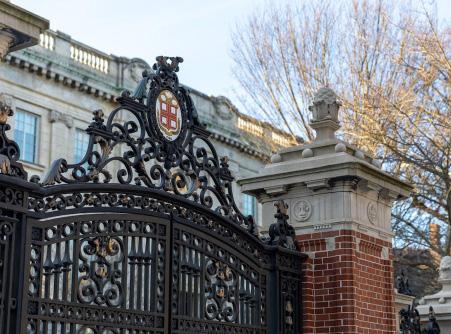
difficult times.
“We’re navigating this using the best that we can glean from our peers,” Guterl said, “but also recognizing that our community is dynamic in a very different way.”
Guterl explained that many of the Brown Ever True initiatives have come together somewhat organically, adding that the University has received many suggestions from students, alums and community members. Guterl also said he has received feedback from groups across campus, including the Graduate Student Council, the Undergraduate Council of Students and faculty members.
“We have to be very receptive to feedback and have our ear open to it,” he said.
But administrators are “always asking” themselves whether they are “getting feedback from all the sources that (they) need,” Beaudoin said.
Looking forward, both Beaudoin and Guterl stressed the importance of carefully monitoring the evolution of community needs. “There are certain times that are going to bring up … both challenges and opportunities, honestly, to come together as a community,” Beaudoin said, specifically mentioning the return to campus after spring break and commencement weekend.
“This community is here for support, and so we just sort of need to put our big Brown bear hugs around each other and give people the space and the grace to have the path that they’re going to have,” Beaudoin said.
This article originally appeared online at browndailyherald.com on Feb. 12, 2026.
The Van Wickle Gates in January. Administrators got the inspiration for the initiative’s name after seeing a photograph of the “EVER TRUE” inscription in the snow on Sidechat.
GINA BAE / HERALD
SCOUT CHEN / HERALD
PUBLIC HEALTH
Providence’s overdose prevention center celebrates one-year anniversary
The center remains the only state-regulated OPC in the country
BY MEGAN CHAN CONTRIBUTING METRO EDITOR
At the Providence Overdose Prevention Center — the one-year-old institution that marked the first state-regulated safe injection site in the country — Dennis Bailer, the director of Providence programs at Project Weber/RENEW, works closely with individuals struggling with substance use.
Bailer, a beloved team member who has worked closely with the harm-reduction organization since 2014, is an individual in long-term substance use recovery. He initially joined the organization — then called Project Weber and serving primarily male sex workers — out of a desire to support others.
“Substance use is a difficult thing to shake,” he said in an interview with The Herald. “I was a person who pulled my life together multiple times… it’s a struggle. But that doesn’t mean I’m a weak person or a bad person.”
With Project Weber/RENEW, Bailer was able to translate his difficult life experiences to positive change. He spent five years lobbying for the country’s first state-sanctioned OPC.
Last month, the center celebrated its one-year anniversary.
At the OPC, visitors can consume pre-obtained substances on-site while under staff supervision, said Annajane Yolken ’11, who works with the organization as the director of strategy and the OPC’s liaison. Staff are trained to medically intervene in case of an overdose or other medical incidents, she added.
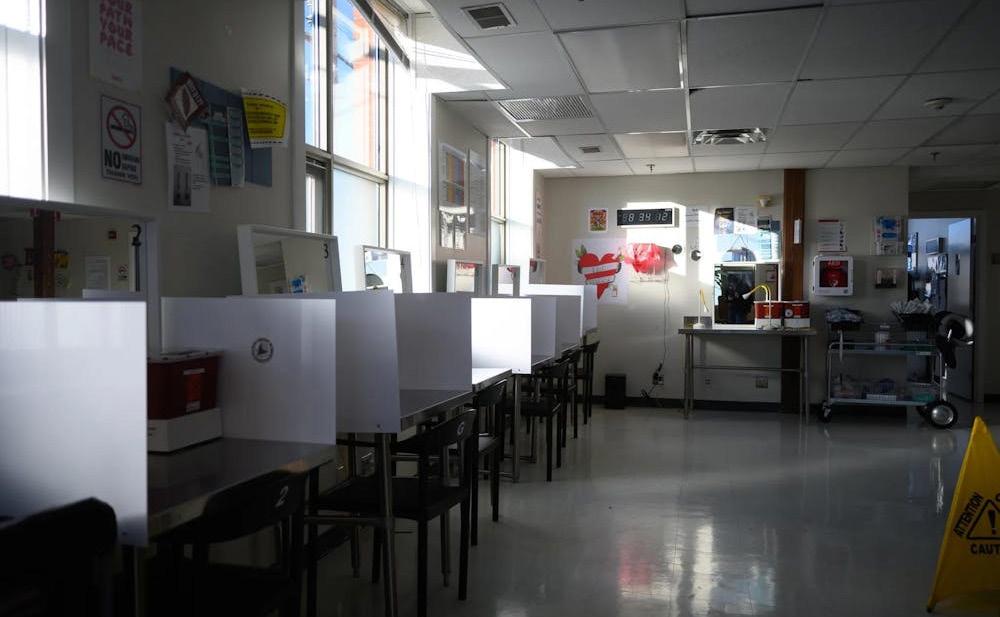
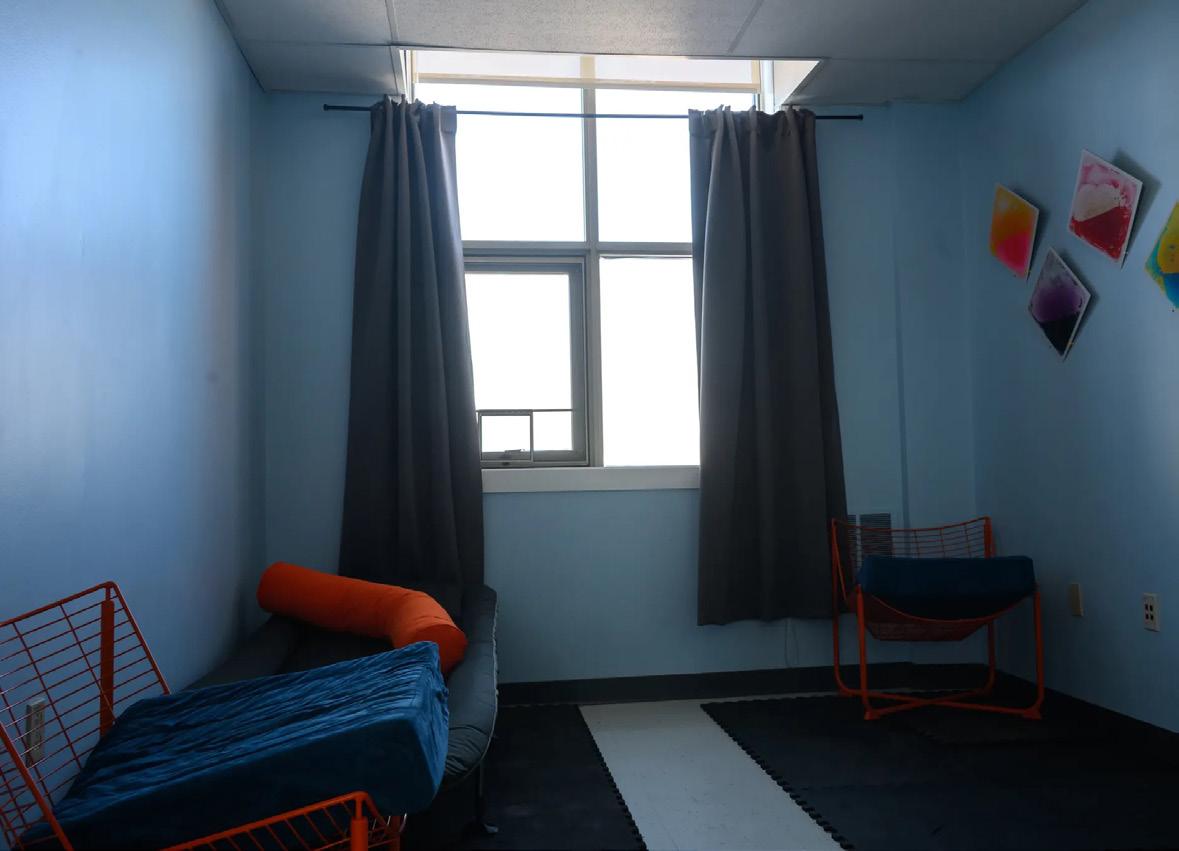
OPCs, which are technically illegal at the federal level but have been recognized in the states of Rhode Island and New York, have been a contentious issue in debates over how to address addiction.
A study published last year by Brown researchers found that the majority of the community supported the opening of an OPC in their neighborhood, and in Feb-
ruary 2024, the Providence City Council unanimously approved the center.
Since opening last year, the center has seen over 8,000 visits, helped 750 unique individuals and supported 92 individuals who overdosed while at the center, according to Yolken.
“We’ve intervened on those particular number(s) of overdoses that could have
been shown as deaths,” Bailer said. “We saved lives here.”
The OPC is decked out in crayon drawings, greenery, soft lounge chairs and natural lighting. Staff keep a supply of hot chocolate mix and speakers playing music — the genre varies depending on “who’s the DJ,” Yolken said.
The center was designed with several accommodations in mind, such as a “chill out room” fitted with relaxing gravity chairs and headphones. For visitors seeking warmth and other supplies, there is a drop-in center downstairs. There are also smoking rooms for clients who use inhalation drugs.
All R.I. OPCs have to have “some type of smoking component, and that’s due to (Bailer’s) advocacy,” Yolken said. In Rhode Island, those who smoke substances are “disproportionately Black and brown” individuals who are oftentimes “disconnected from things like needle exchanges,” according to Yolken.
In Bailer’s advocacy, he also emphasized how people of color were dying at a higher rate than white non-Hispanic individuals.
Many employees at Project Weber/ RENEW have life experiences connecting them closely with their work, Yolken said. Ashley Perry, the Project Weber/RENEW deputy director and OPC director, is a former sex worker in recovery from opioids. She also has experiences with incarceration.
“That is how I identify with our clients,” Perry said. “
“Our overdose crisis is going to be one of the biggest public health crises that our country has ever faced in my lifetime,” Perry added. “People who use drugs deserve health care too.”
There are two other OPCs in the country, both based in New York City. But those are privately run: Providence is the only city to have a state-authorized center.
None of the services are funded by taxpayer dollars, and some services at the center are funded by money from opioid settlements. This funding is important, Yolken said, as it holds pharmaceutical companies accountable for producing addictive substances.
“There’s been so much stigma and shame around drug use,” she continued.
“People have died because they are using substances and they are alone. Maybe they’re in a bathroom at a fast food restaurant. Maybe they’re behind a dumpster,” Yolken said. “That is just a really sad way for someone to die.”
It’s a big misconception that OPCs enable drug use, Yolken said. “Our clients, the people who are coming here, are going to be using drugs. They have been using substances for years — what we are doing is enabling people not to die.”
“Every overdose is preventable,” Yolken added.
“We believe in the individual wholeheartedly from the entire realm of needs,” Bailey said. Staff at the center know their clients well, and vice versa. During sessions, they often chat about life updates, make jokes and bring each other sweet treats from the drop-in center downstairs.
Some OPC employees were previous clients, Bailer said. In his view, the center has the possibility to change one’s life for the better.
“All we need is the desire and the support,” Bailer added. “It’s radical love.”
This article originally appeared online at browndailyherald.com on Feb. 11, 2026.

HORATIO HAMILTON / HERALD
Overdose Prevention Center in February. Since opening last year, the center has had over 8000 visits among 750 unique individuals and 92 overdoses.
HORATIO HAMILTON / HERALD