
THE BROWN DAILY HER ALD
Spring Weekend 2026 lineup announced
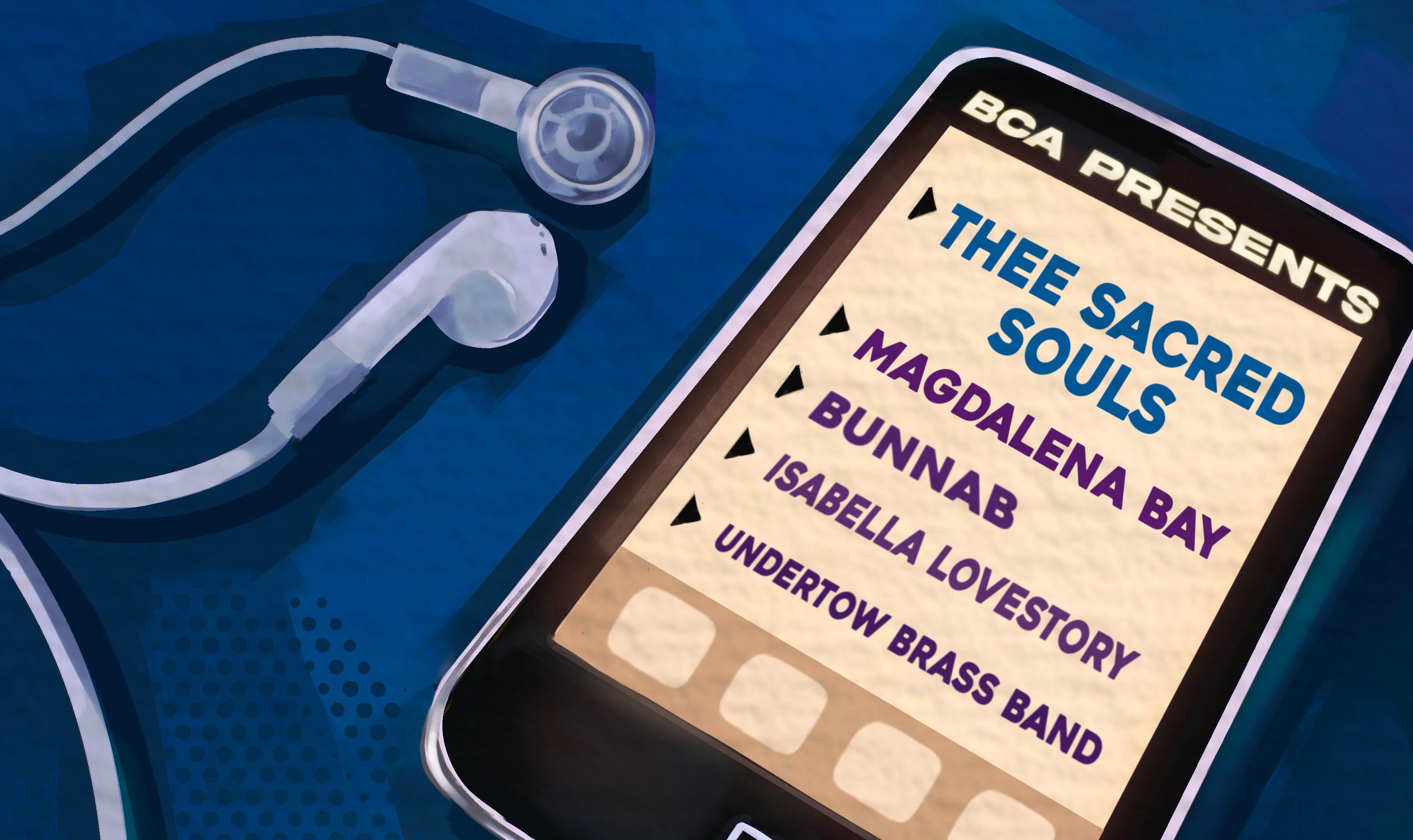
The BCA announced the 2026 lineup at midnight on Friday
BY ANN GRAY GOLPIRA
AND TALIA LEVINE
ARTS & CULTURE EDITORS
Thee Sacred Souls, Magdalena Bay, BunnaB, Isabella Lovestory and Undertow
Brown
Brass Band will perform at Spring Weekend 2026, the Brown Concert Agency announced at midnight on Friday during the BCA’s annual Spring Weekend lineup release party.
This year’s one-day concert will take place on Saturday, April 25.
Benjamin Daniel ’29, who attended the lineup release party, told The Herald that he is “most excited about Magdalena Bay,” adding that he has “been following
her for years.”
“She’s extremely talented, I think she’s gonna just really blow us out of the water,” Daniel said.
This year’s lineup is almost a year in the making, the three co-presidents of BCA — Cole Francis ’26, Peri Ferguson ’26 and Thomas Seidel ’26 — told The Herald.
Planning for Spring Weekend 2026 began as soon as last year’s concert came to an end, Seidel said. After Spring Weekend
admits 5.35% of applicants to class of 2030
Brown’s regular decision acceptance rate decreased slightly to 3.94%
BY ROMA SHAH AND ALI SCHAPIRO UNIVERSITY NEWS EDITOR AND SENIOR STAFF WRITER
The University admitted 1,674 applicants to the class of 2030 on Thursday evening, bringing the overall acceptance rate to 5.35%. A total of 47,937 prospective students applied to join the incoming first-year class — 42,531 during regular decision and 5,406 during early decision.
With 3.94% of regular decision applicants admitted to Brown’s incoming class, the University saw a slight decrease from last year’s 4% regular decision acceptance rate. In December, the University admitted 16.5% of early decision applicants — a slight dip from the class of 2029, but the sec-
ond-highest rate in the last five years.
Explore all the available data on The Herald's interactive dashboard.
Early decision notifications were postponed two days following the Dec. 13 mass shooting. Admitted students told The Herald that the tragedy did not change their feelings about attending Brown.
“This group of admitted students represents a breathtaking spectrum of experiences and backgrounds, and yet they are united by a commitment to carving their own academic path and making a meaningful impact within the Brown community and the world beyond,” Associate Provost for Enrollment and Dean of Undergraduate Admission Logan Powell said in a University press release.
Powell added that the admitted students “have demonstrated a tremendous spirit of collaboration
SEE ADMISSIONS PAGE 3
2025, the BCA offered the student body the opportunity to contribute feedback.
Seidel told The Herald that some of the only concerns were that the concert felt like it was “dragging on for students.”
“Some people were sort of tired by the end of four acts,” Seidel said. “We have to meet the campus where they’re at.”
Spring Weekend, which previously took place over two days, was converted to a one-day festival after the BCA’s
budget was reduced by over $250,000 in 2023. In a BCA poll sent to students in fall 2024, 52.8% of the 1,348 respondents voted in favor of a one-day festival with more prominent performers as opposed to a two-day festival. Offset, JT, Ravyn Lenae and Zack Fox headlined the concert alongside the Undertow Brass Band last year.
Graduate fellows seek to unionize in unprecedented
move
The action follows a state law protecting graduate workers’ right to unionize
BY JAMES LIBRESCO AND EMILY FEIL SENIOR STAFF WRITER AND METRO AND UNIVERSITY NEWS EDITOR
In a historic move, graduate fellows at Brown are seeking recognition as part of the Graduate Labor Organization, the union representing graduate student employees.
On Monday morning, leaders from RIFT-AFT Local 6516, GLO’s parent group, sent a message to University officials announcing the graduate fellows’ intent to unionize, according to communications obtained by The Herald.
The move appears to be the first of its kind at a private U.S. institution of higher education, some-
thing union organizers argue is made possible by a novel Rhode Island law passed in August that explicitly codifies the right of graduate student employees — including fellows not working as teaching or research assistants — to unionize.
Graduate fellows are students who receive stipend funding unrelated to whether or not they officially work as research or teaching assistants.
The University’s current contract with GLO includes only graduate student employees recognized by the National Labor Relations Board, many of whom are teaching or research assistants.
Fellows are not currently recognized at the federal level, according to Patrick Crowley, the president of the Rhode Island AFL-CIO branch, which advocated for the bill’s passage. “This is exactly why we did it: to make sure that workers who don’t have the right to organize federally can or-
SEE UNION PAGE 2

UNION
KENDRA EASTEP / HERALD
UNIVERSITY NEWS
ganize federally can organize in the state,” Crowley said in an interview with The Herald.
Now, the state law will be tested for the first time, Crowley said.
In a memo sent to University administrators on Monday morning, leaders of Local 6516 requested that Brown voluntarily recognize the graduate fellow unionization as part of GLO.
University Spokesperson Brian Clark confirmed that administrators received the message, adding that the University “will review the request, determine next steps and respond directly to the organizers.”
Leaders wrote in the memo that more
SUPPORT SERVICES
than 70% of graduate fellows have indicated they wish to be represented by the union and that Local 6516 intends to incorporate graduate fellows into the contract GLO is currently negotiating instead of forming a separate unit.
In an interview with The Herald, Local 6516 President Michael Ziegler GS said that the local union has been organizing graduate fellows since the fall semester. He declined to share the exact number of graduate fellows who have indicated they wish to join the union, but he wrote that the number is “in the hundreds” in a message to The Herald.
Graduate fellows currently receive the same compensation and benefits as other
graduate student employees, as outlined in a side letter not part of GLO’s primary collective bargaining agreement. But fellows do not have protections guaranteed by the union, such as the ability to formally file grievances with the University, said Jasper Cattell GS, a fourth-year Ph.D. candidate in the sociology department and Local 6516’s political director.
Cattell said that in previous negotiations with the University, the administration suggested fellows receive a different stipend than graduate student employees already recognized by the contract. “Fellows being properly incorporated into the union and covered by that contract means that they would never have to worry about
that,” he said.
When fellows are working on their dissertations, Ziegler said, even if they are not doing direct labor for the University, they are still producing research that will ultimately benefit the University because the Brown name will be attached to the work. Ziegler added that most graduate students are on fellowship for part of their time in their programs.
According to Cattell, fellows often complete research tasks, even if they are not officially classified as research assistants.
“We may be doing work that results in presentations or publications or other academic outputs that enhances the stature of our departments,” Cattell said. “Some-
times that work can actually be basically identical, depending on whether you’re a research assistant or a fellow.”
Adit Sabnis GS, a fourth-year PhD candidate in neuroscience, has been on a fellowship for the last two years at Brown, but he was not during his second year.
“People go in and out of fellowship, and it kind of just has to do with where the money is coming from,” said Sabnis, who is the communications chair for Local 6516.
This is a developing story. Check back for updates.
This article originally appeared online at browndailyherald.com on March 30, 2026.
Student Support Services introduces six new interim deans following Dec. 13 shooting
Students expressed concerns about accessing psychological services
BY IVY HUANG AND MIRIAM DAVISON UNIVERSITY NEWS AND SCIENCE & RESEARCH EDITOR AND SENIOR STAFF WRITER
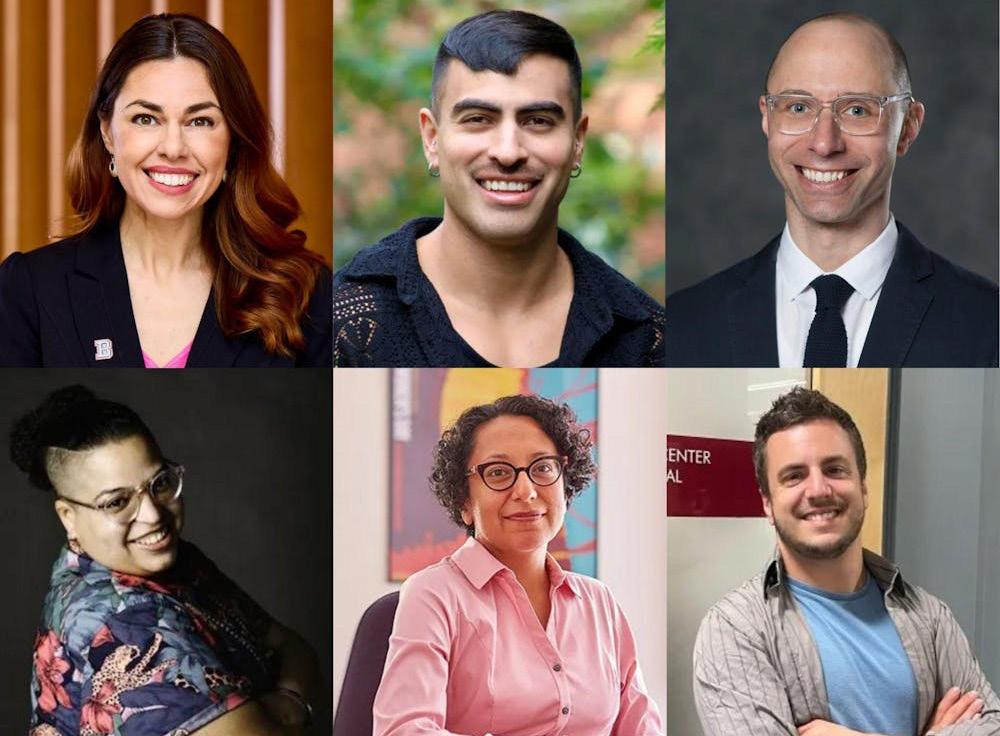
As the Brown community continues to navigate the aftermath of the Dec. 13 shooting, the Office of Student Support Services has introduced six new interim student support deans to strengthen support networks available to Brown students. Earlier this month, students expressed concerns about accessing the University’s psychological services.
The six deans will liaise between students and SSS, Student Accessibility Services, Counseling and Psychological Services and Student Health Services, according to Associate Vice President for Strategic Assessment and Student Experience Susan Layden and Associate Vice President of Campus Life for Inclusive Community and Belonging Loc Truong, who are both providing interim oversight to SSS.
Since March 16, the deans have also contacted students who were directly impacted by the Dec. 13 shooting and are providing same-day support through daily drop-in hours available for all students.
The Herald corresponded with the new deans about their backgrounds and goals for their new positions.
Andrew Heald
Before coming to Brown, Andrew Heald spent over a decade working in international education, working as an English teacher in Japan and as an advisor for international students at the California College of the Arts. Now, as the Director of the Global Brown Center for International Students, Heald supports Brown’s global community.
There, Heald focuses on “building spaces that feel like a home away from home,” he wrote in a statement to The Herald. He plans to build on that practice in his role as interim dean.
“Home is where you find care, support and a community that centers your needs,” Heald wrote, adding that he views his new role as interim dean as an “extension” of the Global Brown Center.
As interim dean, Heald believes it is “most important” to “honor the entirety of (students’) lived experience.” For him, this means “being curious about what they are going through, what support they may need and listening for understanding to provide the best resources.”
The
and Student Health Services.
Mary Jordan
As the inaugural Director of Student Experience at Brown, Mary Jordan has worked with many students over the course of her career, whether through leading undergraduate orientation or collaborating with the Division of Campus Life. Previously, she worked as a career and academic advisor, professor and student success coach at Brown and other universities.
“Decades of experience have helped me understand that not only does this empower students to overcome their current challenges, but it affirms their resilience and strength,” she added.
Jordan hopes to carry her experience working with students to her new role as interim dean.
“Every student’s experience is unique and requires unique solutions,” Jordan wrote in a statement to The Herald. “My approach really focuses on student agency and affirming that they are the author of their experiences.”
Jordan has begun reaching out to students one-on-one and wrote that she was “met with their kindness, gratitude and generosity toward the greater Brown community.”
“Connecting with Brown students oneon-one through this new role has been an absolute privilege,” Jordan wrote.
Caitlin O’Neill When Caitlin O’Neill was a student at Oberlin College, they experienced “an unexpected loss that deeply shaped (their) time” as an undergraduate. As they were pursuing a
graduate degree — with plans to become a professor — they found a different career objective.
“I came to the realization that I wanted to be a staff member who had the ability to impact the lives and trajectories of students the way college mentors positively impacted mine,” O’Neill wrote in a statement sent to The Herald.
“Joining Brown in December of 2019 was my way of continuing to pay that investment forward while working with a vibrant community of students and having a rewarding time doing it.”
At Brown, O’Neill is the director of the LGBTQ Center, overseeing programs and initiatives at Stonewall House — a place O’Neill described as “a home for students who find themselves away from their supportive families and communities back home or students who are forging chosen family.”
O’Neill hopes to “serve as another set of eyes and ears that is fully connected to campus resources” for students.
“I find that students here know so much more about themselves than they think they do, they just need a little guidance from someone they can trust,” O’Neill wrote.
Julio Reyes ’12, MA’22
Julio Reyes ’12, MA’22 hopes to serve as a “bridge” for students navigating both the academic and personal dimensions of their time at Brown, he wrote in an statement sent to The Herald.
Reyes brings his experience as the director of the University’s Undocumented,
First-Generation College and Low-Income Student Center to his role as interim dean.
In his new role, he plans to draw on his familiarity with campus resources and Brown’s curriculum to provide holistic support.
When he was an undergraduate at Brown, Reyes navigated the University “without many resources tailored for first-generation college and low-income students,” he said. He was later inspired by student advocacy efforts aimed at improving those experiences — work he was “excited to carry” forward during his time at Brown.
“It’s meaningful to be in a role where I can create programs and spaces that support this growth and help students feel confident in the paths they’re choosing,” he wrote. As a student support dean, Reyes wrote that he plans to extend that same commitment to all students.
“My door is always open,” he wrote, encouraging students to reach out and connect with him.
Felicia Salinas-Moniz MA’06, PhD’13 When Felicia Salinas-Moniz was a graduate student of American studies at Brown, she worked for Gail Cohee — then director of the Sarah Doyle Center — as a graduate coordinator.
Cohee’s “positive impact” inspired Salinas-Moniz to pursue a career in higher education administration, she wrote in a statement sent to the Herald. About ten years later, Salinas-Moniz had a “full circle moment” when she became the Sar-
ah Doyle Center’s director after Cohee’s retirement.
Salinas-Moniz has also taught courses in American studies at Brown, and her experiences working with students “both inside and outside the classroom” have allowed her to “understand the diverse campus experiences that students have,” she wrote in a statement to The Herald.
In her new role as interim dean, she will continue to help students navigate Brown “through collaborative problem-solving and direct connection to campus resources.”
“I’m proud to do the work that I do at Brown because it reminds me of the importance of mentorship in higher education,” Salinas-Moniz wrote. “When I was in college, having the help of advisors and mentors made all the difference in my academic and professional career and it’s a privilege to serve in that capacity for students that I work with.”
Brian Woods
Brian Woods’s path to Brown was shaped by “consistent interest in working directly with students during pivotal moments, both in college and in life,” he wrote in a statement sent to The Herald.
Before coming to Brown in March, Woods was a part of the faculty team at Skidmore College, where he created the first intergroup dialogue minor in the United States. He wrote that his previous experience taught him how students experience institutional systems.
He found that his approach to student support is defined by “clarity, strong communication and consistent follow through.”
Woods wrote that is drawn to higher education by the chance to “support growth both in and beyond the classroom.”
“There may not be an award for helping a student navigate a difficult period and emerge with a stronger sense of self,” Woods added, “but those moments of growth are what matter most and they’re the foundation for everything that follows.”
Although he has been at Brown for less than a month, “it’s already clear that the community — grounded in curiosity, care and a strong sense of purpose — creates meaningful opportunities for students to grow,” he wrote, adding that he hopes to contribute to systems that make support more accessible.
“College is often a time of figuring out who you are while balancing academics, relationships, expectations and the occasional ‘what am I doing with my life?’ moment,” Woods wrote. “Being part of that process — as a guide, sounding board or steady voice — is a privilege.” This article originally
31, 2026.
COURTESY OF KATE PORTER
six deans will liaise between students and SSS, Student Accessibility Services, Counseling and Psychological Services
ADMISSIONS FROM PAGE 1
and community engagement as high schoolers” and recognize “that these are also important characteristics of the Brown experience.”
This year’s decisions come amid increased federal interest in Brown’s admissions practices. In July, the University reached a deal with the Trump Administration that stipulated Brown would provide its admissions data to the government and would not racially discriminate in its admissions processes. The agreement came after President Trump threatened to pause $510 million in federal funding to the University.
The class of 2030 is the second class to apply with mandatory standardized test scores after a four-year period where test score submission was optional, and the third to apply since the Supreme Court’s decision that universities could no longer consider race in admissions.
Starting with the class of 2029, the University expanded its practice of needblind admissions to international students. About 73% of admits intend to apply for financial aid, which is on par with last year’s
admitted class.
“Talented students exist everywhere, and we’re committed to expanding our outreach every year to help more students learn about Brown and the incredible opportunities a Brown education can ignite,” Powell said in the release.
The number of first-generation students admitted to the University remained consistent with the class of 2029, with 19% of admitted students being the first in their families to attend college. There was a 15% increase in applicants who will be the first in their families to graduate.
Of the students accepted to the class of 2030, 60% attended a public high school, 30% went to a private school and 10% attended a religious school. Six students were homeschooled. This breakdown reflects last year’s admitted class.
The University saw a 16% increase in applicants from rural backgrounds, and 8% of admitted students come from rural communities. In 2023, Brown became a founding member of the Small Town and Rural Students College Network, which provides rural students with college ad-
missions support. The University has since created an orientation group targeted at rural students and has expanded its no-cost fly-in program.
The admitted students represent all fifty states, the District of Columbia, Puerto Rico and the Mariana Islands. California, Connecticut, Florida, Georgia, New Jersey, New York, Massachusetts, Pennsylvania, Rhode Island and Texas were the most represented states among the accepted class. There was also a 16% increase in international applicants. The University did not release data on which countries admits come from.
Fifty two Brunonians were admitted through QuestBridge, an organization that matches students from low-income backgrounds with top universities.
Just 64 students were accepted to the Program in Liberal Medical Education, a combined eight-year program that guarantees direct admission to the Warren Alpert Medical School upon completion of their undergraduate degree in the College.
The Brown-RISD Dual Degree Program, a five-year program that allows students to
UNIVERSITY NEWS

Admitted students have until May 1 to accept their offers.
integrate their academic and artistic pursuits through an education at both Brown and the Rhode Island School of Design, accepted 25 students.
Both highly selective programs accepted a similar number of students as the previous class, with a slight increase from last year’s 21 students to this year’s 25 for the Brown-RISD Dual Degree Program.
The University did not release data on the number of waitlisted students. Depending on how many accepted students decide to attend, students placed on the waitlist may be able to join the class of
2030 over the coming months. In recent years, anywhere from two to 300 students from the waitlist have been admitted to the University.
Applicants accepted during the regular decision round have until May 1 to either accept or decline their admissions offers. About 70% of students accepted to the class of 2029 made their status as a Brunonian official this past fall.
This article originally appeared online at browndailyherald.com on March 26, 2026.
Wendy Schiller named next deputy provost, assuming role on July 1
Schiller succeeds Janet Blume, who has served the role since 2022
BY JEREMIAH FARR SENIOR STAFF WRITER
Professor of Political Science Wendy Schiller will be the University’s next deputy provost, according to a Thursday Today@ Brown announcement from Provost Francis Doyle.
She will assume the role on July 1, succeeding Interim Dean of the Graduate School and Deputy Provost Janet Blume, who is planning to retire after 40 years at Brown.
According to the announcement, Schil-

ler will “lead and implement academic initiatives, coordinate policy, oversee faculty search authorizations and appointments, serve on key university-level committees and manage the Academic Priorities
Committee as well as the Academic Affairs Committee of the Corporation of Brown University.”
Doyle wrote that as Schiller steps into her new role, the Office of the Provost is
at “a moment of reorganization.” Deputy Provost for Academic Affairs Elizabeth Doherty will take on the role of Senior Advisor for Academic Planning. Because of this shift, Schiller’s role will be structured to include responsibilities previously assigned to Blume and Doherty.
Schiller, described by Doyle as “an outstanding teacher, scholar and administrative leader,” received her bachelor’s degree from the University of Chicago and master’s and doctoral degrees from the University of Rochester.
Since beginning at Brown as an assistant political science professor in 1994, she has served in various leadership roles at the University, such as the chair of the Department of Political Science, interim director of the Watson Institute for Inter-
Submissions:
THE BROWN DAILY HERALD
PRODUCTION
Photo Chiefs Annamaria Luecht
Kaia Yalamanchili
Illustration Chiefs
Kendra Eastep
Isabela Guillen
Video Chiefs
Opinions Editors
Aizenberg Ethan Canfield
Isabella Gardiner


Cienna Cheng
Cody Cheng
Social Media Chiefs
Nate Barkow
Annika Melwani
Technology Chief
Annika Singh
Data Desk Chief Caleb Ellenberg
Games Chief Paul Hudes
Podcast Chief
Talia LeVine
Multimedia Editors
Sophia Basaldua
Marat Basaria
Harry Guo
Horatio Hamilton
Selina Kao
Ella Le
Kenna Lee
JJ Li
Jake Parker
Jascha Silberstein
Rassul Toleugazy
BUSINESS
General Managers
Arjun Deshpande
Anum Azhar
Sales Directors
Arjun Ray
Hannah Han
Finance Director
Sydney Wright
Office Manager
Cary Warner
Submissions
national and Public Affairs and director of the Taubman Center for American Politics and Policy.
Schiller’s work has appeared in the American Journal of Political Science, Legislative Studies Quarterly, Studies in American Political Development and the Journal of Politics. She has served as the political analyst for WJAR Channel 10, the local NBC affiliate in Providence.
Blume’s retirement was announced in a Nov. 6 Today@Brown announcement. Blume, who has also served as an associate professor of engineering, has been deputy provost since 2022.
This article originally appeared online at browndailyherald.com on April 2, 2026.
email, and we will do our best to work with you.
Submissions can build on reporting from The Herald, reporting elsewhere, official statements from the University or other groups and other reputable sources, but they cannot break news or contain information that The Herald cannot verify. Because we cannot publish unsubstantiated information, failure to provide appropriate sources may mean we have to modify or remove unverified claims.
The Herald will not publish anonymous submissions or submissions authored by organizations. Leaders of student organizations can be identified as such but cannot write under the byline of their organization. The Herald cannot publish all submissions it receives and reserves the right
COURTESY OF WENDY SCHILLER
Since beginning at Brown as an assistant political science professor in 1994, Wendy Schiller has served in various leadership roles at the University.
SHIRLEY ZHANG / HERALD
EDUCATION
State Senate introduces legislation to increase primary care, support mental health hotlines
Several of the 17 proposed bills would help establish a medical school at URI
BY MAXWELL SILVER AND MICHELLE BI SENIOR STAFF WRITER AND METRO EDITOR
Earlier this month, the Rhode Island Senate released a new legislation package comprising 17 bills aimed at improving state health care. The bills propose funding for a medical school at the University of Rhode Island, loan repayment and scholarship programs for primary care physicians and financial support for mental health hotlines, among other initiatives.
“These proposals will support Rhode Islanders in crisis, protect patients and providers, and strengthen the health workforce,” Chairwoman of the Senate Committee on Health and Human Services and state Sen. Melissa Murray (D-Woonsocket, North Smithfield) said in a state press release. “Achieving our goals will be a longhaul effort, and our chamber remains truly committed to seeing it through.”
Several of the proposed bills address the state’s current shortage of primary care providers. When physician group Anchor Medical Associates closed last summer, around 25,000 R.I. patients were left without a primary care physician.
To mitigate this shortage, one of the bills advocates for an initial $5 million in funding for the new University of Rhode Island medical school, with additional
GREEN ENERGY
funding planned for the future.
“Having a local, public medical school … would enable more young doctors to enter primary care and to practice in our state once they graduate,” Senate spokesperson Greg Pare wrote in a January press release.
High medical school costs can deter newly graduated medical students from pursuing a career in primary care, according to State Sen. Pamela Lauria (D-Barrington, Bristol, East Providence).
Lauria, who works as a primary care nurse practitioner in Providence, introduced three of the 17 bills. One of these bills would fund scholarships for students who are committed to becoming primary care physicians in Rhode Island. Another bill, introduced by Senate President Pro Tempore Hanna Gallo, would establish a loan repayment program for primary care providers.
“One of the things that drives clinicians to go into higher-paying specialties rather than primary care is that it costs so much money to go to medical school,” Lauria said. “We’re looking at the fact that Rhode Island is about to be the only state without a public medical school with public tuition rates. So we’re trying to make it more economically feasible.”
But Geoffrey Berg, a primary care doctor in Rhode Island, said that the new medical school may not fully address the primary care shortage.
“If you go to the URI medical school, and you can make more money as a cardiologist … or as an orthopedist, that’s where you’re going to gravitate to,” Berg said. “There’s nothing about a URI medical school that’s going to change that.”
Lauria said that the school is just one facet of addressing the shortage. She noted that the school would cost around $22.5 million per year to run and is projected to have an economic impact that significantly outweighs the cost.
“When we look at economic development for the state, we’ve spent far more for far less benefit,” Lauria said.
The loan repayment and scholarship bills that Lauria and Gallo introduced require primary care providers return to Rhode Island after they have completed their degrees.
“You’re not going to get physicians here or nurse practitioners or PAs here if you can’t incentivize them to come in to stay,” Lauria said.
She noted that nearby states like Massachusetts and Connecticut have higher
insurance reimbursement rates than Rhode Island, and that she has heard of many practitioners who live in Rhode Island working elsewhere due to higher wages.
Other proposed bills in the package aim to support Rhode Islanders in need of mental health support. One such bill includes the codification of “reliable, sustainable funding” for the Rhode Island 988 suicide hotline and BH Link, a state-launched mental health triage facility.
While the state provides the “vast majority” of funding for programs like 988 and BH Link, Horizon Health Care Partners has to absorb some costs, said Ryan Pickering, the director of communications and community partnerships for the nonprofit Horizon Health Care Partners, which operates both 988 and BH Link.
If passed, this legislation would “fund
the programs in their entirety … as opposed to cobbling together different sources,” he added.
He noted that 988 and BH Link are important parts of the behavioral health care system because they allow patients to be triaged without going to a hospital’s emergency room.
“We’re in a position to really continue to change the behavioral health care landscape, and I think that there’s a good appetite to do so,” Pickering added. “I think folks are starting to understand that behavioral health and mental health needs to be taken as seriously as the medical emergency.”
This article originally appeared online at browndailyherald.com on April 1, 2026.
Revolution Wind begins to deliver power to New England grid
The wind farm comes amid rising oil and gas costs tied to the Iran war
BY DHRUV JAIN STAFF WRITER
After about three years of construction — and nearly two months of delays due to pushback from the Trump administration —Revolution Wind began delivering electricity to the New England grid on March 13.
The new energy source from the 704-megawatt offshore wind farm, located about 15 miles off the Rhode Island coast, comes amid rising oil and gas costs tied to the ongoing war in Iran.
Rhode Island Energy has agreed to buy power from Revolution Wind at 9.8 cents per kilowatt-hour, a significantly lower price than what Rhode Islanders paid for in March. The project is currently 90% complete, according to Ørsted, one of the groups involved in developing the wind farm.
The Trump administration previously ordered Revolution Wind to stop construction twice, with the first order given in August 2025 and the second in December 2025. On both occasions, a federal judge allowed construction to continue.
“Revolution Wind is great news for Rhode Island,” said Professor of Political Science and International and Public Affairs Jeff Colgan, who is also the director of the Climate Solutions Lab. “It’s good news for the environment … it’s good news for lower electricity prices for Rhode Islanders, and it’s good news for energy security.”

very high, then North American producers are going to try to sell their cargoes to Asia and institute higher prices, and that means that our prices are going to go up as well,” he explained.
“New England relies on a mix of pipeline natural gas and imported (liquefied natural gas), and when LNG becomes scarce or more expensive globally, wholesale prices here can rise accordingly,” R.I. Energy spokesperson Michael Dalo wrote in an email to The Herald.
Brad Marston, professor of physics, noted that states on the New England coast are suited for the offshore wind industry. Though offshore wind takes advantage of stronger winds off the coast, building turbines at sea is more expensive than placing them on land.
“There’s a kind of trade-off there,” Marston said. “On the East Coast, we’re fortunate that the sea doesn’t get very deep quickly as you go offshore, so you can mount the wind turbines onto the seafloor.”
Complemented by rising battery storage, wind power and solar energy can be the “most cost effective ways of producing electricity, beating fossil fuels,” Marston said.
Once fully operational, the project’s 65 turbines are expected to power more than 350,000 homes and businesses. The farm could save New England ratepayers as much as $500 million a year in energy costs, according to an Ørsted press release.
tative Seth Magaziner ’06 (D-R.I. 2) wrote in an email to The Herald. “The delivery of affordable, reliable power from Revolution Wind to the grid is a major step towards this goal.”
“Rhode Islanders are struggling with high utility costs, and we need to do everything we can to bring relief,” Represen-
“We should be incentivizing local energy projects like this that lower costs at home, not spending billions on Iran or tax cuts to billionaires,” he continued. The White House did not immediately respond to The Herald’s request for comment. Colgan also noted how the price of wind energy is not exposed to geopolitical shocks in the way that energy from fossil fuels is. “If Asian (natural gas) prices are
For Colgan, the current energy crisis serves as a reminder that energy is a national security issue. “This … should be a reminder to us of the national security advantages of solar and wind energy,” he said. “The price of sun and the price of wind are not geopolitically affected.
This
HELEN BESCH / HERALD
ISABELA GUILLEN / HERALD
RISD introduces expanded mental health resources amid high rates of CAPS use
In 2025, 36% of students reported being diagnosed with depression
BY IZABELLA PIATKOWSKI SENIOR STAFF WRITER
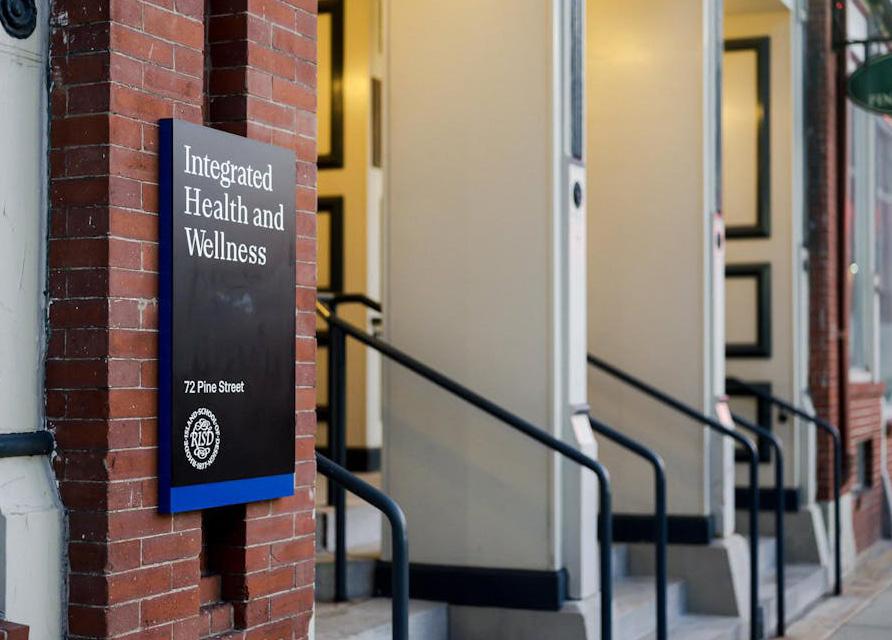
In an effort to address student mental health concerns, Rhode Island School of Design Counseling and Psychological Services has introduced same-day access appointments this semester, with plans to form a CAPS student advisory board and introduce new digital wellness resources.
Last April, an executive summary released by RISD found that CAPS utilization increased from 5% of students in the 2014-15 school year to 25% in the 2023-24 school year, an increase of 400%.
Accommodations from Disability Support Services “nearly doubled” from the 201920 school year to the 2023-24 school year, “with mental health accommodations being a top driver,” the report states.
“We have significantly higher utilization than most college counseling centers,” said RISD CAPS Director Sherrie Bruner. “CAPS is trying to get more creative about how we meet student needs. With those kinds of numbers, we can’t individually provide counseling services for all of those students.”
RISD junior Sarah Chen, who uses CAPS, said she has had difficulties securing appointments. “They’re looking really understaffed. It’s just that there’s not that many therapists or psychiatrists at CAPS, and so their capacity, I feel like, is always really limited,” she said. “It took me over a month, I think, for one appointment."
In a statement sent to The Herald, Bruner and Elayna Kadish, a health educator overseeing the Office of Health Education and Promotion, wrote that a standard needs assessment with CAPS typically takes a maximum of two weeks to secure. But same-day appointments are available for students who are in crisis and support is offered after hours via Protocall, a 24-hour crisis line.
“Students can always get an appointment,” Bruner said. “We would never say we don’t have an appointment for you, but it might be a longer wait than students prefer.”
According to Bruner, CAPS introduced the option of same-day access appointments in the hope that “we have some appointments that are maybe more easily accessible,” Bruner said.
CAPS has also eliminated the require-
ment for students to do a needs assessment in order to make an appointment with a psychiatrist. After becoming the director of CAPS, Bruner realized it seemed like a barrier for students who were already taking medication and wanted to renew their prescription, they said.
“Historically, they would have had to wait a couple weeks for needs assessment and then wait a couple of weeks to see a psychiatrist,” they added.
RISD is also in the early stages of developing a student advisory board to help inform how CAPS can best serve students, according to Bruner. They said that students on the board would be able to “share some of their own experiences, but also to talk to us about some of the things that they’re hearing from their peers on campus.”
These initiatives follow the release of
key findings and statistics about student mental health and work culture at RISD
from a February 2026 Institutional SelfStudy and an April 2025 Holistic Student Wellness executive summary.
The executive summary details a grind culture which “glorifies overwork,” difficulties in navigating wellness resources and barriers to care as factors influencing student mental health at RISD.
According to RISD Associate Director of Public Relations Danielle Mancuso, RISD has recently addressed student workload by making Wintersession optional starting this year and reducing the minimum number of credits needed to graduate from 126 to 120 for students who entered RISD in fall 2024 or after.
Through the American College Health Association-National College Health Assessment, RISD found that 55% of students reported feeling high stress compared to 41% nationally, and 36% reported being diagnosed with depression, compared to 26% nationally.
“It’s actually a lower number than I would expect, based on my experience here,” Bruner said. “I think a lot of our students are really, really stressed.”
Sophia Minogue, a junior at RISD, said that she has witnessed a grind culture at the school. “I feel like both the curriculum, but also the atmosphere with teachers and other students, like staying up and doing all nighters, definitely impacts that grind culture.”
RISD junior Lydia Smithey said she believes the grind culture differs “department by department.”
According to the executive summary, “students often work while sick due to
concerns about attendance policies, with some declining mental health support to avoid missing class.”
Bruner has noticed this issue and said that CAPS has measures in place to try to combat it. CAPS is open after hours on Mondays and Wednesdays, and students with very tight schedules can book recurring appointment times.
HEP also plans to work with WellSort, a wellness company that offers digital tools to showcase campus wellness resources and give students more avenues for self-reflection. She added that RISD is working to set the resource up on the HEP website by the next academic year.
CAPS also collaborates with other RISD units to promote mental health. Bruner said that they have “great partners” in Disability Support Services and the CARE Network. “If we work together, we can meet the student need better with regard to wellness and mental health, physical health, all the things,” Bruner said.
Minogue has experience using the CARE Network, which “helps students navigate challenges that impact their ability to thrive at RISD,” and is operated through the division of Student Life, according to their website.
“I was going through a pretty tough time, and they were able to reach out to my professors on my behalf,” she said. “They were able to connect me with the CAPS team at the time for more emergency counseling.”
“I found that was really helpful, but that’s such a small team at RISD,” Minogue said. “There’s a lot more support needed, or funding, for that type of structure within RISD to support our students.”
Record-breaking 401Gives fundraising campaign raises over $5 million for nonprofits
Donations will go toward supporting over 700 R.I. nonprofits
BY PAVANI DURBHAKULA METRO EDITOR
At 6 p.m. on April 1, after 36 hours of nonstop fundraising, the United Way of Rhode Island’s 401Gives donation campaign had raised a record-breaking $5,081,425 to benefit an unprecedented 705 local nonprofit organizations, according to a United Way press release.
The annual fundraising campaign, which launched in 2020, is administered by United Way Rhode Island and its Alliance for Nonprofit Impact, which aims to connect and support nonprofits across the state. This year, 401Gives received over 32,000 individual contributions from over 20,000 donors, both of which also surpassed previous years’ totals, the press release read.
“Raising $5 million was a work of extreme dedication and heart of every individual that gave,” Caitlynn Douglas, operations manager for the Alliance for Nonprofit Impact, wrote in an email to The Herald. “401Gives 2026 was a display of the radical love we all share for each other.” Foster Forward, an East Providence-based nonprofit that supports young people impacted by foster care, finished in first place on the 401Gives leaderboard with over $218,000 raised. This is the sixth year in a row that Foster Forward has been the campaign’s top fundraising organization,

according to Foster Forward Communications Director of Development and Communications Allison DeGerlia.
Rather than setting a specific monetary goal, Foster Forward approached 401Gives 2026 with the goal of attracting 401 donors.
“We were proud to exceed that goal, ending the campaign with 451 donors,” DeGerlia wrote in an email to The Herald.
For Foster Forward, money raised from 401Gives “helps fill gaps in our budget so we can say yes when a young person needs emergency assistance, keep our Drop-In Center stocked with essentials” and continue operating housing and workforce development programming, DeGerlia added.
“What made this campaign so successful was the collective effort behind it,”
DeGerlia wrote, adding that Foster Forward “focused heavily on community-driven strategies, including peer-to-peer fund-
raising.” Youth volunteers involved with Foster Forward also supported fundraising efforts by calling past donors before and after the campaign to express their thanks.
“401Gives is not a passive campaign,” Douglas wrote. “Real images of real people and a real mission are going to pull donors in.”
As a part of 401Gives, organizations can fill out a donation profile with a compelling story and images to attract donors. But many participating nonprofits did not stop there, using creative marketing strategies to attract potential donors. One organization produced parody episodes of Real Housewives of Rhode Island, Douglas wrote. Another fundraiser impersonated Hannah Montana on social media to drive donations.
With over $204,000 raised during 401Gives, the Dr. Martin Luther King, Jr.
Community Center came in second place for the highest total donations received.
“401Gives has become a critical campaign in our fundraising year,” wrote Heather Hole Strout, the center’s executive director, because “it helps us reach a broader community of supporters.”
“The money will support our 25+ programs in hunger prevention and nutrition, early learning and out-of-school time education and community support wellness,” Strout wrote. The Newport-based community center far surpassed its fundraising goal of $150,000, she added.
Coming in at third place was the Audubon Society of Rhode Island, a nonprofit focused on environment protection and engagement, which raised over $165,000 during 401Gives.
Executive Director Jeffrey Hall wrote that the organization entered 401Gives with an “ambitious” goal of raising $120,000. This spring, they were fundraising not only for general programming expenses, but also to account for damage to wildlife refuges and snow-plowing expenses resulting from this year’s winter storms.
“Community support is absolutely essential (and) makes up a third of our overall revenue,” Hall wrote. “Our success was driven by our focus on clear, mission-driven projects, highlighting the direct impact that these gifts fund.”
The United Way of Rhode Island received over $85,000 in donations itself — the fifth largest fundraising total from 401Gives 2026. This large fundraising sum “was the result of over 200 gifts from donors — donations that came in all sizes,”
wrote Michael Cerio, spokesperson for United Way of Rhode Island. A board member offered a matching gift opportunity for donations of up to $10,000, he added.
“Prizes and matches, which are rooted in our dedicated corporate sponsors, are foundational in 401Gives success,” Douglas wrote. “Donors are 80% more likely to give if their donation can be matched and transformed.” DeGerlia credited matching gifts and challenges for helping to raise Foster Forward’s donation total.
The eighth-place total — with over $75,000 raised — came for Children’s Friend, a nonprofit focused on the health and well-being of children in Rhode Island. Chief of Philanthropy Pamela Verklan wrote that the organization approached 401Gives with a theme for their fundraising campaign: “moving families forward.”
Children’s Friend “had 85 donors who gave $50 or less,” Verklan wrote, in addition to “one large donation, which was leveraged as a 1:1 match, and several other mid-range donations.”
For 401Gives, the Audubon Society of Rhode Island had “close to 300 individual contributors,” Hall wrote, adding that attracting these donors is a long-term benefit of 401Gives.
Douglas wrote that “folks who gave to a nonprofit on 401Gives should become reoccurring donors.”
“Nonprofits need funding,” she wrote. “It is important now more than ever.”
This article originally appeared online at browndailyherald.com on Arpil 2, 2026.
BRITNEY SIMBANA / HERALD
An executive summary released by RISD found that CAPS utilization increased from 5% of students in the 2014-15 school year to 25% in 2023-24 school year.
JESSE BENITEZ / HERALD
This year, 401Gives saw over 32,000 individual contributions from over 20,000 donors.
BASEBALL
Baseball crushes Princeton in weekend sweep, secures best Ivy start in over a decade
The Bears outscored Princeton across three games this weekend
BY HARRY GUO SENIOR STAFF WRITER
This weekend, the baseball team (10-11, 5-1 Ivy) swept Princeton (7-16, 2-4 Ivy) in a three-game Ivy League series at home with dominant scorelines of 4-0, 14-1 and 4-0. The three wins propelled Bruno to a 5-1 Ivy League record –– the team’s best start to in-conference play since 2009.
After a frustrating 6-0 loss to Stonehill (9-14, 7-2 NEC) last week, Bruno came into their matchup with Princeton looking to bounce back.
Saturday’s doubleheader opened with Princeton at the plate, marking the beginning of a long afternoon for the Tigers against Bruno pitcher Peter Dubie ’26.
While Princeton was able to put runners in scoring position in each of the first three innings, Dubie shut the door each time. Dubie’s supremacy on the mound was highlighted by a back-to-back strikeout with bases loaded in the third inning, allowing Brown to preserve the 0-0 tally.
The game remained deadlocked until the sixth inning, when Brown’s offense finally broke through.
With a runner in position, Alex Benevento ’28 delivered a double into the right-center gap. A Princeton outfielder lunged for the ball but could not come up with it, letting it roll all the way to the fence as Mark Henshon ’26 crossed the plate to secure the contest’s first run.
SOFTBALL

Despite Princeton’s attempts to stop Brown’s
“We talk a lot as a team about competing for everyone else in the dugout over yourself and trying to find any way that you can contribute to help the team win,”
Benevento wrote in an email to The Herald.
“I’m just happy that I was able to play any part in helping the team succeed.”
Moments later, DJ Dillehay ’26 launched a soaring two-run home run over the rightfield wall to give the Bears a 3-0 lead.
Despite Princeton’s attempts to stop Brown’s offensive onslaught, the Bruno train kept rolling. In the eighth inning, Matt Luigs ’29 laid down a bunt single, stole second base and later scored on a sacrifice fly from Benevento to push the lead to 4-0 Bears.
Princeton’s offense never found a foothold. Brown cruised to the 4-0 win, fueled by a combined 18 strikeouts between Dubie and Christian Keel ’26. Dubie’s 15 strikeouts marked the most strikeouts by a Brown pitcher in a single game since 2008 and set a new single-game strikeout record at Brown’s Attanasio Family Field, which opened in 2017.
“Baseball in general is a game played over a long season,” wrote Benevento. “Unwavering team energy, showing up everyday with the same will to win and staying evenkeeled regardless of result or position are things that we value as a program.”
With no time to celebrate, all eyes looked to the second game of the Saturday
doubleheader. Unfortunately for the visiting Tigers, the Bears kept their foot on the gas.
Last week’s Ivy League Rookie of the Week Drew Nelson ’29 took the mound and put on a show. Throughout his eight innings, he allowed just one unearned run on four hits, walking one and striking out five on a whopping 95 pitches. In his last 15 innings — starting during a Mar. 21 game against Yale — Nelson has not allowed an earned run.
“Overall, in the last 15 innings I have thrown more strikes that are in the bottom of the zone, which has led to weak contact,” Nelson wrote in an email to the Herald.
Bruno’s offense was also hard at work, scoring two runs in each of the first four innings.
In the first inning, Dillehay ripped a two-run double down the left field line to open the scoring. The Bears’ next runs came in the following inning when Jack Edmunds ’28 reached home on a Henshon single. Next, a wildly off-target pitch by Princeton opened the door for Luigs to steal home base and make it 4-0 Bruno.
After Bruno sent two more hitters home in the second inning, the Tigers charted their only run of the game in the top of the third after a Bruno error.
Mika Petersen ’26 struck back in the bottom of the inning, belting his first home run of the season. One inning later, Logan Meusy ’26 drove in two more runs after an error turned a single into a double.
Brown blew the game open with a dominant five-run fifth inning, during which six straight batters reached base.
Bruno’s impending victory was apparent by the eighth inning, but the Bears
Softball secure season’s first Ivy series win, triumphs in
The Bears were led by Ivy League Pitcher of the Week Macy Borowski ’27
BY AVA SCHELLING CONTRIBUTING WRITER
Over the weekend, the softball team (10-14, 3-3 Ivy) took down Yale (9-19, 3-6) 2-1 in a tight three-game series, fending off chilly temperatures in New Haven throughout the weekend to secure their first series win this season. Despite a disappointing 9-8 extra-innings defeat in the weekend’s final match, Bruno clinched the series with a 4-1 triumph on Saturday and a 3-2 win in the first game of Sunday’s double-header.
Following last year’s Ivy League Championship title win, the Bears got off to a rocky division start this season after losing a weekend series 2-1 to Columbia (10-16, 2-4) in March. But this weekend, the Bears broke through.
“It’s all about bouncing back and moving on to the next series. That’s our mindset,” catcher Lilly Burns ’27, who brought in four RBIs for Brown across the three matches, told The Herald.
The Bears came out swinging on Saturday with a four-run win against the Bulldogs. After a first-at-bat leadoff double from infielder Maya Choksi ’27, the Bears brought the heat, locking up two runs in the top of the first inning to secure a solid 2-0 lead over Yale.
The Bears’ defense held the line through slow second and third innings, only allowing one hit in the third and making up for the Bears’ lack of offensive strength — Bruno earned zero runs during both innings.
But in the top of the fourth with one out on the board, spectators experienced deja vu when Choksi slammed the ball down the right field line, sending Alyssa Villarde ’27 home for Brown’s third run of the game.
Bruno didn’t stop there: the Bears’ lineup recorded eight total hits and earned four RBIs over the game, featuring a Maggie Foxx ’28 home run slugged deep to center field in the seventh inning. The homer — Foxx’s team-leading fourth of the season — was well out of the reach of Yale’s scrambling outfield.
Throughout the match, Bruno adjusted well defensively to a left-handed heavy Yale batting rotation, keeping the Bulldogs to only three hits in the series opener.
Choksi wrote in an email to The Herald that the weekend’s games were “super competitive” and “intense.” The Bears, evidently, performed well under the pressure of fierce play: a collective effort on offense complemented stunning defensive play, providing Bruno momentum and consistency over the weekend.
Sunday’s first match started slower offensively for Bruno, but steady play throughout the afternoon led the team to a 3-2 win. Brown’s scoring strategy was defined by positioning players on base and drawing on teamwork.
In the second inning, a far-hit sacrifice fly ball to the outfield by Burns gave Abby Bettencourt ’28 plenty of time to run before the ball reached home plate, securing Brown’s first score of the game in the second inning. Yale answered with an RBI by Demi Donahoe that tied the scoreboard in the third inning.
But the Bears roared back: Brown scored two other runs in the fourth inning, all with
nonetheless added one more run. Edmunds drilled a home run over the left-field wall to close out the 14-1 win.
With a chance to complete the sweep the next day, Brown leaned on yet another strong pitching performance to send the Tigers packing.
This time it was Dylan Reid ’26 who took Brown’s mound. Despite running into trouble early in the second inning after walking two Tigers, he responded with a key strikeout to end the threat.
After a shaky start, Reid found his rhythm. The senior retired 18 of the 20 batters he faced over the remainder of the contest to keep Brown in control.
The game remained scoreless until the third inning, when Benevento crushed a three-run homer over left field to give Bruno a 3-0 lead.
Brown extended the gap in the fifth inning. Luigs drew a walk, stole second base and eventually scored after a Princeton shortstop committed an error. The 4-0 scoreline remained through the game’s conclusion, sealing the weekend sweep.
The Bears will look to keep their winning streak alive when they return to non-conference action against Bryant on Tuesday at 3:30 p.m. at home.
“Looking towards the remainder of Ivy League play, we will continue to pitch at the bottom of the zone and throw secondary pitches for strikes,” wrote Nelson. “Minimizing free passes will be crucial in keeping our momentum going.”
This article originally appeared online at browndailyherald.com on March 30, 2026.
two of three games against
Yale

Number 23 Macy Borowski ’27 threw a total of 314 pitches throughout the weekend.
team assists. Despite Yale rallying back in the bottom of the fourth, Bruno held onto a 3-2 lead.
The game remained a stalemate for the last three innings. In the final inning, pitcher Macy Borowski ’27 struck out Grace Westmoreland of the Bulldogs to clinch a series win going into the weekend’s final match.
Team members ran to join in a celebratory huddle around the circle after the victory. Burns later cited the strikeout as one of her favorite moments of the weekend.
The third game featured another impressive offensive showout with six runs scored for Brown in the first four innings. The Bears took a 4-0 lead in the first inning following errors by Yale’s defensive lineup and backto-back Bruno singles.
But after a six-run comeback by Yale’s offense, hopes for a series sweep for the Bears grew bleak. Despite narrowly missing the sweep, head coach Mary Holt-Kelsch wrote in an email to the Herald that the team “saw pieces of championship-level play” over the weekend.
“There’s a lot to build on from this series, and we’re excited about the direction we’re heading,” she wrote.
Individual player accolades added to positive takeaways from the three-game stretch. Borowski — who threw a total 314 pitches — earned her second Ivy League Pitcher of the Week. For Borowski, the nomination “speaks to the team” that she has behind her, “because without them making plays … I can’t be the pitcher that I am.”
“I just want the team to always know I have their back, just like they have mine,” she added.
Borowski has “just been a rock for us, both on the mound and at the plate … her confidence and leadership has been just phenomenal this year,” shared utility player Jasmine Hsiao ’26, another major series’ contributor on offense.
The Bears will take on Princeton — who the team defeated last year in the 2025-2026 Ivy League championship game — for their third Ivy League series of the season starting April 3.
This article originally appeared online at browndailyherald.com on April 2, 2026.
COURTESY OF SAGE HURTEAU VIA BROWN ATHLETICS
offensive onslaught, the Bruno train kept rolling.
COURTESY OF BROWN ATHLETICS
WRESTLING
For first time since 2019, men’s wrestling competes in NCAA championships
The Bears totaled five wins in Cleveland at the national tournament
BY CHIUPONG HUANG SENIOR STAFF WRITER
Bruno’s milestone-studded wrestling season came to a close in Cleveland, Ohio at the 2026 NCAA Division I Men’s Wrestling Championships. For the first time since 2019, multiple Bears — Andrew Reall ’28, Austin McBurney ’28 and Alex Semenenko ’26 — punched their tickets to the national tournament.
Although the trio fell short of reaching the national podium, Reall and McBurney scored upset victories against higher-ranked opponents. Reall garnered three wins — putting him one takedown short of reaching All-American status — and McBurney, who was seeded last at No. 33 seed in the 149-pound weight class advanced past his preliminary pigtail bracket matchup.
Despite finishing second place in the Ivy League Championships, Semenenko dropped two straight bouts to fall out of the tournament in the 285-pound category.
The tournament marked a debut on the national stage for all three Bears whose breakthrough performances spell promise for future seasons, Assistant Coach Tyler Grayson said in an interview with The Herald.
“I just see where the program has been in the past, and the direction it’s going now,” said Grayson, who coached the team from 2011 to 2018 before rejoining in 2025.
LACROSSE

Although the trio fell short of reaching the national podium, Andrew Reall and Austin McBurney ’26 scored upset victories against higher-ranked opponents.
“It’s just really exciting,” he added. McBurney set the tone strong with a Thursday win on the mat.
The senior started the first period fighting off a deep single leg takedown attempt from his opponent, Michigan State University’s Clayton Jones. Although Jones took down McBurney in the first period, McBurney remained undeterred, answering aggressively with well-executed reattacks after escapes and defended shots. For the remainder of the match, the two opponents continued to put pressure on each other, but McBurney walked away with the win.
Rising from last seed, McBurney faced
a looming challenge: No. 1 seed Shayne Van Ness from Penn State University. Outmatched but nonetheless showing off a willingness to scrap, McBurney lost by technical fall and moved into the consolation bracket.
There, McBurney avenged a regular season loss to Lock Haven Commonwealth University’s Lucas Kapusta. Kapusta was the first to score, earning two points off a reversal after a mat-return attempt from McBurney went awry. But McBurney remained composed, swiftly finishing a welltimed double to put Kapusta down and win the match.
The next round was not as kind to McBurney — he lost 8-1 to No. 15 seed Ryder Block from Iowa University.
Reall also ended up in the consolation bracket after a 4-2 loss in his first match against Rutgers University’s No. 15 seed Remy Cotton. Throughout the fight, he looked to heavy handfighting and snaps for control. Unfortunately, Reall’s attempts were not enough to overcome Cotton, who scored the first and only takedown of the match to seal his victory.
The loss moved Reall to the consolation bracket, but undeterred, he said he made the necessary adjustments. “I made
it a bigger moment than it actually was,” Reall said in an interview with The Herald. Grayson, who has coached Reall since middle school, said that Reall “kept his composure, battled back, got the game-deciding take down and finished on top.”
For the remainder of the weekend, under the bright lights and the gaze of spectators in Rocket Arena, Reall said that he “wrestled freely,” committing to takedown attempts rather than being overly defensive.
Reall also secured wins in the consolation bracket, piecing together the offensive pressure and coordination that was missing from his first match. After a 2-0 win against Utah Valley University’s Kael Bennie in the opening consolation match, Reall earned two more victories, including a 5-4 triumph over Missouri State’s No. 25 seed Evan Bates, which he said was his “favorite match of the season.”
Reall’s season came to a close after he dropped a tight match 4-2 to No. 11 seed Camden McDanel from the University of Nebraska. Despite the gut-wrenching loss, Reall left Ohio tied for the most single wins in program history at 37.
In a statement to Brown Athletics, Head Coach Jordan Leen said Reall “etched his name into the history books with the greatest regular season in program history.”
“(Reall’s) story is just getting started,” Leen added. “I’m excited to see where our program goes from here.”
This article originally appeared online at browndailyherald.com on March 30, 2026.
Fast start fuels women’s lacrosse to crush Vermont 16-5
Up 8-0 in the first quarter, Brown refused to slow down
BY ATREYA MALLANNA CONTRIBUTING WRITER
On a rainy Wednesday evening, the women’s lacrosse team (5-5, 1-2 Ivy) thrashed University of Vermont (6-6, 2-1 America East) for a decisive 16-5 win, ending Bruno’s two-game losing streak. After starting the game in scorching fashion with an 8-0 lead, the Bears rode their significant cushion to a comfortable win.
Playing through pouring rain and a puddle-ridden field, Bruno launched a powerful attack that made the overwhelming difference in the game. Midfielder Ruby Sliwkowski ’27 and attacker Tessie Batchelder ’29 both scored hat tricks, while attacker Caroline Nozzolillo ’29, defender Riley Peterson ’28 and midfielder Mackenzie Farley ’29 each netted two of their own.
From the opening draw, Brown imposed their presence by consistently winning faceoffs and sustaining long possessions near the Vermont goal. Less than a minute in, Farley circled the goal, rolled back and finished from close range. Only 30 seconds later, Brown struck again when Nozzolillo also circled the goal to bring Bruno’s lead to two.
Bruno continued to dominate possession, denying Vermont the chance to exit their own half of the field. Even when the Catamounts finally gained possession in Brown’s offensive half, Bruno swiftly turned defense into offense. Defender Amelie Devine ’29 ran across the field for
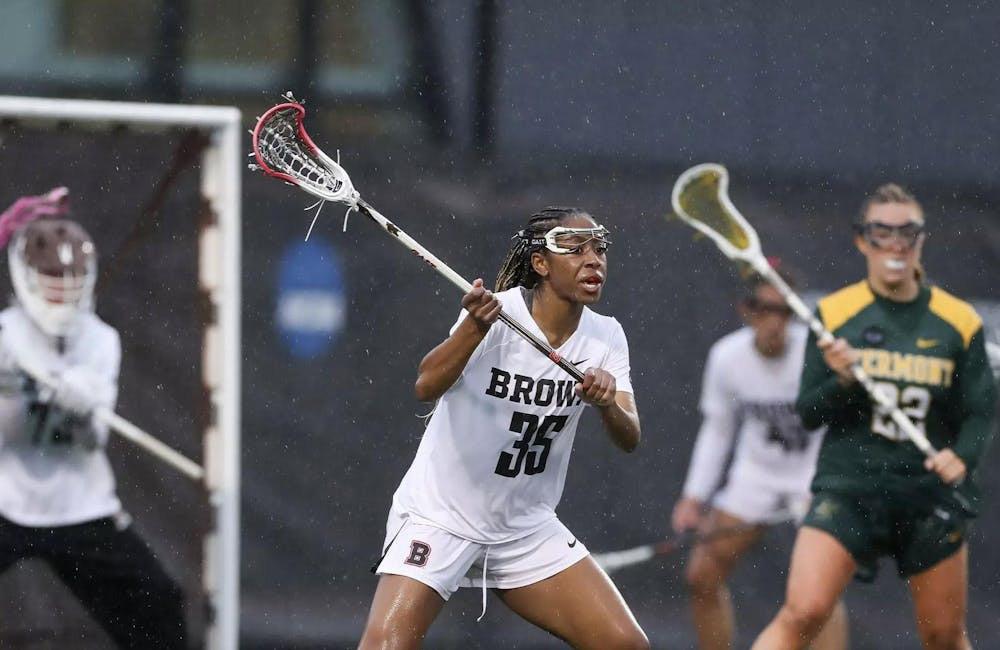
an emphatic finish, scoring the first goal of her collegiate career.
Bruno showed no signs of slowing down from there. Within the next four minutes, Sliwkowski, midfielder Marley Wright ’26 and midfielder Annie Dignazio ’29 each scored in quick succession to extend the lead to 6-0.
As Bruno flashed their offensive prowess, Vermont began committing penalties, and the Bears took full advantage of a yellow card. From a free position, Batchelder rocketed a shot into the top corner. With a one-woman advantage, Peterson then weaved through multiple defenders to find the top corner of the net.
On the other end of the field, goalkeeper Mackenzie Conway ’29 kept a clean sheet through the first quarter.
Despite the 8-0 deficit, Vermont came out of the gates fast in the second quarter. Capitalizing on a Brown green card penalty, the Catamounts’ Karina Sethi scored off a deflection from Conway’s stick just 30 seconds into the game.
But their momentum was short-lived.
A near 30 seconds after Vermont’s goal, Sliwkowski’s well-timed assist awarded Peterson her second goal of the game. Brown then received a free position shot, and Batchelder fired a laser into the top left corner, straight past the outstretched arms
of Vermont goalkeeper Anna Rosenberger, bringing the score to 10-1.
Sliwkowski continued with her sharp passes, this time enabling midfielder Kayla Davi ’29 to score from close range off of a nice cut. Following a Vermont goal, the game settled down for the first time that evening.
But after a six-minute scoreless period, Sliwkowski broke the stalemate, scoring for the second time that night.
As the clock for the first half winded to zero, Bruno left the field with a commanding 12-2 lead.
Despite the onslaught of goals headlining the first half, the second began in
a different light. For the first time in the night, Bruno’s defense stole the spotlight with a solid structure anchored by Conway at the net. But Vermont’s Lydia Doraz broke through the tight formation, capitalizing on a turnover.
With a little less than four minutes left in the quarter, Sliwkowski scored her third goal of the evening to give her a hat trick. Displaying her blistering speed, Sliwkowski sprinted in front of Vermont defenders and with a piercing shot into the bottom left corner.
Despite their 13-3 lead entering the fourth quarter, the Bears didn’t lower their guard. After Doraz scored her second goal of the game — with an acrobatic jumping shot — Brown scored three more to thwart Vermont’s hope of a comeback.
Farley cushioned a pass from Nozzolillo to score her second goal with a little over ten minutes left. Soon after, provider turned scorer — Nozzolillo bounced a shot in for her second of the night.
Though they had already scored 15 goals, Bruno’s 16th and final goal perfectly epitomized their impressive offensive performance. Batchelder made a timely cut to receive a terrific pass from attacker Claire Murphy ’28. Batchelder’s near-post finish ensured her hat trick for the night.
A garbage time goal from Vermont with less than two minutes remaining in the game took the final score to 16-5.
The Bears will look to extend their winning streak to two when they visit Columbia on Saturday at 1 p.m.
This article originally appeared online at browndailyherald.com on April 2, 2026.
COURTESY OF BROWN ATHLETICS
COURTESY OF BROWN ATHLETICS
The Bears will look to make it two in a row when they visit Columbia on Saturday at 1 p.m.
GET PRANKED
by Acadia phillips
…And so I offer up my most humble recommendations, the best pranks to do today, or truly any day. (Fools are among us every day, not just on the radiant first of April.)
1. The artfully-crafted replacement is an endearing and classic prank. Thinly-rolled sheets of PlayDoh as gum, chocolate-coated brussels sprouts as cake pops, any one thing as another—cleverly disguised. I’ve found that this works well on people with large appetites who lack a skeptic’s spirit, those who can laugh it off. This one works well on giggly dads, such as my own.
2. My sister’s favorite type of prank is thievery. She likes to steal shoes and books and anything that I love and she doesn’t. Though we live sixteen hours apart, I still have a sneaking suspicion that she will be coming to my room in the night to rob me of my valuables. To stay safe, I added alarms to my beloved goods: my Abraham Lincoln bust, my fish dress, my husband Andrew Garfield, my roommate, and our collective pet lemur.
3. Another vital option can be found in the overflow of your closet. Wear a costume or a wig or both, and pretend that you’ve always been this way, this contorted version of yourself. I like pink. I like bangs. I like mohawks (on other, more scholarly people), and I like a close-to-the-head neon orange shave on Lena Dunham most of all…
EDITOR-IN-CHIEF
Elaina Bayard
FEATURE
Managing
Editor
Chloe Costa Baker
Section Editors
Anika Kotapally
Gabriella Miranda
ARTS & CULTURE
Managing Editor
AJ Wu
Section Editors
Lizzy Bazldjoo
Sasha Gordon
NARRATIVE
Managing Editor
Gabi Yuan
Section Editors
Chelsea Long
Lucie Huang
LIFESTYLE
Managing Editor
Hallel Abrams
Gerber
Section Editors
Alayna Chen
Tatiana von Bothmer
POST-POURRI
Managing Editor
Tarini Malhotra
Section Editor
Christina Li
HEAD ILLUSTRATORS
Junyue Ma
Lesa Jae
COPY CHIEF
Jessica Lee
Copy Editors
Eve Kobell
Indigo Mudbhary
Kate Schuyler
Rebecca Sanchez
LAYOUT CHIEFS
Alexa Gay
Amber Zhao
Layout Designers
Emma Vachal
James Farrington
Joshua Rezneck
SOCIAL MEDIA
Rebecca Sanchez
Yana Giannoutsos
Yeonjai Song

1. Me thrice
2. Beautiful little…
3. Rosencrantz & Guildenstern
4. I pity the…
5. Me leaving my dorm umbrella-less today
6. Anyone not reading post- Magazine right now
7. You slipping on a banana peel
8. One of the dunces in their confederacy
9. Esau trading his birthright for a bowl of stew???
10. Matthew Morrison



1. The sound of nothing but net
6. radnelac nairogerG eht fo htnom htruoF
7. Currently broadcasting
8. Like the set of planets in our solar system
9. Sense
1. meht rof llaf ohw esoht ro ,skcirT
2. Flinch
3. Really, really mad
4. Elevator pitch, or a Purim performance
5. Kevin of comedy

“I went to office hours, and I didn’t realize how much I don’t know.”
“Did you bring a White Claw to class?”
Cover by Anna Nichamoff

Dear Readers,

INSIDE BENNINGTON’S DARK WAR AGAINST TEENAGERS
sasha gordon
I FEEL GOD IN THIS WAWA TONIGHT
christina li
MUSIC IS THE FOOD OF LOVE
Grace ma
YOUR FAVORITE DIRECTOR'S LEAST FAVORITE MOVIE
“I still find it hard to trust airplanes, but I trust the people that these threads connect me to, and I trust the solid tugs I feel in the threads, like promises to never let loose. ”
— Jeanine Kim, “my aerophobia and i”

“It’s nice that being friends means that, like a well-loved book, we can pass around the things that make us happy, cool, and smart. It’s nice to see my friends in myself.”

— Daniella Coyle, “stealing from my friends’” 04.04.24 04.04.25
letter from the editor
I am, personally, one of the most gullible people you will meet. Fool me once, twice, thrice, it doesn’t matter—if you tell me something earnestly enough, I will earnestly believe what you tell me. For a certain period of time, I genuinely believed Josiah Carberry was a real professor from Brown’s history.
So best believe, I was perfectly primed to introduce our inaugural April Fools’ issue. But I have news for you, reader. What you thought was a campus life magazine has actually been an academic journal all along, at the cutting edge of scientific and religious thought. Imagine my surprise when I discovered the true meaning behind our name: post- actually stands for post-doctoral, as all our contributors clearly have advanced degrees in their respective fields.
For Feature, in a seminal research paper, Dr. Sasha Gordon expertly elucidates the aesthetic psyop out of Bennington College’s literary machine. Meanwhile, A&C publishes new findings on some of the most pressing matters of our time: Dr. Grace Ma presents the astrological data that determines which
classical composer you should date, and Dr. AJ Wu posits critical connections between Scorsese movies and MCU films. In post-pourri, consult Dr. April Wang’s flowchart of student dining habits to optimize your choices. On the theological side of things, preeminent scholars in both Narrative and Lifestyle are back to unravel the workings of God in the Wawa (Dr. Christina Li), “some uncapital g-d” in matters of loss and love (Dr. Ina Ma), and the ways to partake in the sacred rituals of April Fools’ Day itself (Dr. Acadia Phillips). Before you go, put your knowledge-hungry mind to the test with Dr. Lily Coffman’s peerreviewed “drowssorc”—and catch me celebrating 1-Down.
Fool me once, I’ll fool you back, and let’s all laugh together.
Shamelessly,
Chloe Costa Baker
Feature Managing Editor
OPINIONS
Berkwits ’29: Rethink the Ratty
On Sundays, I send an undeniably important text to various friends: “meal this week?” College dining serves a special purpose outside of nutrition — it is a means of social connection and community. But, I, along with many other Brunonians, have let my dining experience be defined by the status quo, exclusively eating meals with those already in my circle. Brown students span a diverse range of interests and experiences, and it is easy to get siloed into these academic or social niches, especially when the Open Curriculum enables students to solely interact with those inside of their academic niche. While these focused identities and passions can provide tight-knit communities, they also can limit the peers an individual interacts with on a day-to-day basis.
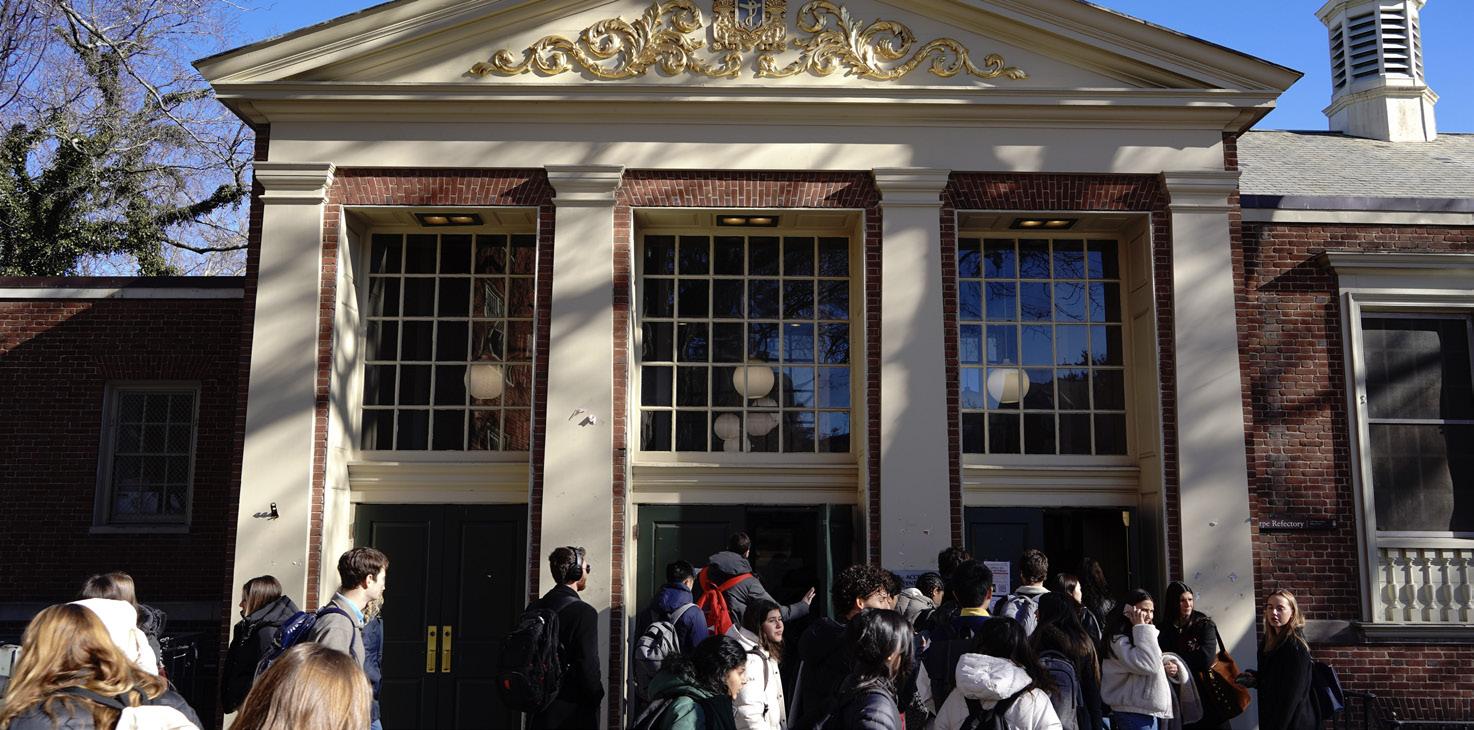
But dining halls have the opportunity to serve as a form of social equalizer, allowing students to meet and learn from those outside of their routine communities. Whether it’s convening around wooden tables at the Sharpe Refectory or snagging a coveted booth outside the Blue Room, muffin in hand, Brown dining is a central part of all Brunonians’ college experience. As the school year comes to a close and we prepare to spend our summers without our classmates, we should look at Brown’s dining halls as more than just sources of nutrition — they can be creative outlets for students to strengthen con-
nections with those in the greater Brown community.
Students have expressed grievances that Brown has a deficiency of third spaces, a term coined by sociologist Ray Oldenburg that refers to refuges outside of home and work that foster connection and community. But Brown’s numerous dining halls fill this niche perfectly. Each dining hall is a space dedicated to commensality — the practice of eating together — which encourages connection, discourse and belonging. These spaces are not only a place of sustenance, but they serve as Brown’s social hall and marketplace of ideas.
But Brown students don’t consciously treat the space as such. Our interactions with dining halls often consist of swiping in to eat and then leaving once we’re satiated. But our relationship with Brown Dining doesn’t have to be utilitarian. Rather, dining halls can be spaces for creativity and community.
In February, an Instagram account called “ucla. tiramisu.guy” went viral for its attempts to make tiramisu out of meager dining hall ingredients. This trend quickly swept college campuses, including our own. While the end result is unconventional, each innovative tiramisu crafted from sugar packets and cocoa puffs can lead to something larger. On the
the University’s dining experience should be reframed to include a bit of ingenuity. “ “
As
the nostalgia for the past year creeps in and the departure from the joys of College Hill living feels imminent,
journey to create a dining hall culinary masterpiece, other diners will likely take an interest in this unusual undertaking, as already proven by the social media success of each viral tiramisu. Bringing a bit of whimsy to the monotony of the Ratty can help build new communities. Not only do student chefs get to enjoy their alimentary creations but cooking together creates a sense of camaraderie between students and builds a jovial sense of pride for the entire student body.
The infamous “Ratty Challenge” is another ingenious way to take advantage of our dining halls. The challenge — in which one spends 12 hours in the Ratty, from open until close — has been described as a joyful way to bond with friends. Intentionally spending time — maybe too much time, one could argue — in the dining hall capitalizes on the unique experience of communal campus living. To be able to spend a dozen hours in one space with the capability to be social, studious and nourished throughout it all is rare, and if you notice someone has been in the Ratty for almost as long as you have, the experience can be a great icebreaker.
Treating the dining hall as an open social space is not a new concept. Previously, Brown’s dining halls have been more than just another monotonous part of the college routine. Over the decades,
Dolan, Frickel, Leinaweaver, Nummedal:
the Ratty has housed numerous whimsical events, including a birthday party for President Gregorian, alumni-sponsored themed dinners and even required men to wear ties for the dining hall’s anniversary in 2001. The idea of utilizing our dining halls as creative and social spaces is a tried and true success.
While not all of us may pursue such creative faux-Italian creations or choose to spend double-digit hours in the Ratty, recognizing the unique role of the dining hall, and being willing to prioritize the value shared meals present — especially with those outside of your normal circle — is crucial.
As the nostalgia for the past year creeps in and the departure from the joys of College Hill living feels imminent, the University’s dining experience should be reframed to include a bit of ingenuity and spontaneity. Dining halls are meant for more than just food — there is no better place to curate your creativity or foster community than with a fork in hand.
Talia Berkwits ’29 can be reached at talia_berkwits@ brown.edu. Please send responses to this op-ed to letters@ browndailyherald.com and other opinions to opinions@ browndailyherald.com.
Restore the president as presiding officer at University faculty meetings
On March 3, faculty members voted to replace the University president with the Faculty Executive Committee chair as the presiding officer at faculty meetings. This motion was brought to the faculty without substantial prior discussion, and there was not yet a robust, shared understanding of the proposed change’s scope prior to the March 3 meeting. We are among a sizable number of faculty concerned about the implications of the narrowly approved change.
A motion to repeal this change — restoring the president as the presiding officer — has been cosigned by over 60 faculty from 30 units and sent to the FEC for inclusion on the April 7 faculty meeting agenda. We do not speak for the other motion co-signers, but we urge the FEC to place this motion on the agenda so that the change can be more extensively discussed, and we also urge our colleagues to join us in restoring the president as the presiding officer to ensure that faculty governance can improve as needed.
First, the process that yielded the March 3 vote was not sufficiently participatory. Big changes to faculty governance merit serious and sustained discussion, but the vote to remove Paxson as presiding officer came without the opportunity for robust engagement of the faculty on this issue. Usually, faculty have the opportunity to engage in this discussion at town hall meetings, but through no fault of the FEC, this was not the case. An initial town hall to discuss the report from which the motion to remove Paxson emerged was scheduled for Dec. 15, but the topic appropriately shifted to the tragic mass shooting that took place on Dec. 13. Another town hall was scheduled for Jan. 26, but it was moved online after in-person University classes were canceled due to snow. As many public and private schools were also
closed that day, faculty members with children may have been unable to attend the meeting. A third town hall, scheduled for Feb. 23, was canceled when another three feet of snow fell on Providence. That meeting has only just been rescheduled for March 30. The faculty simply did not have the opportunity to discuss this motion sufficiently before Paxson’s removal was approved.
votes, with a notable twenty-one abstentions. Clearly, further deliberations are needed to clarify the intended and unintended consequences of a change that is so controversial.
Not only is removing Paxson a mistake, but rashly moving forward with a highly-contested governance change does not set us up to have effective and productive deliberations about faculty engagement
“ “
Not only is removing Paxson a mistake, but rashly moving forward with a highly-contested governance change does not set us up to have effective and productive deliberations about faculty engagement in university governance.
The March 3 vote also did not demonstrate a strong majority preference from the faculty, which major governance changes should receive. It seems that the FEC believed this motion to be uncontroversial enough that it could be brought forward in advance of sustained deliberations. However, the discussion and vote at the March 3 faculty meeting showed that this was not the case: The measure passed by a slim margin of three
in university governance. The December FEC report has raised questions about governance that deserve sustained discussion and engagement by the faculty. Considering these proposals in a measured, thoughtful, consultative way — such as through the work of the just-announced ad hoc committee on governance structures — will help ensure that changes to faculty governance serve the laudable goals of in-
creasing faculty engagement that the FEC is advocating for.
Apart from the procedural flaws we have described, installing the FEC Chair as the presiding officer at university faculty meetings does not solve the real issues with faculty participation that the FEC has identified — it creates new ones, as The Herald’s editorial page board has recently written. We have the opportunity to overturn this vote so that the necessary discussion and deliberation can take place. To ensure faculty governance changes work well, making them should take time. And our goal should be governance changes that have strong faculty support — not ones that are hastily taken and insufficiently debated. Moving forward thoughtfully — and indeed modeling rigorous debate — is all the more vital in a moment when higher education is under heightened scrutiny.
Jessaca Leinaweaver is a professor of anthropology and served as chair of the department of Anthropology from 2020 to 2023 and as Director of the Center of Latin American and Caribbean Studies from 2016 to 2019. Emily Dolan is a professor of music and serves as the chair of the music department. Scott Frickel is a professor of sociology and the Institute for the Study of Environment and Society. Tara Nummedal is the John Nickoll Provost’s Professor of History and a professor of Italian studies, and serves as the chair of the history department. They can be reached at jessaca_leinaweaver@brown.edu, emily_dolan@brown.edu, scott_frickel@brown.edu and tara_nummedal@brown.edu. Please send responses to this opinion to letters@browndailyherald.com and other op-eds to opinions@browndailyherald.com.
ALEXANDER CHOW / HERALD
Editorial: Brown needs to rethink its pre-orientation programs
This fall, incoming first-year students at universities across the country will have the opportunity to go backpacking, do community service or explore the arts as part of their campus’s pre-orientation programs. These programs offer an opportunity for students to forge friendships and explore new interests in a supportive environment before campus-wide new student orientation begins. In contrast with New Student Orientation, which aims to foster connections between students on a larger scale, pre-orientation programs allow students to explore specific interests and make friends in a smaller, more intentional group.
Brown currently offers several pre-orientation programs, such as the Third World Transition Program, International Orientation, Mosaic+ Transition Program, Summer Transition Engineering Program and the Bonner Community Fellowship Pre-Orientation Program. While these programs are valuable, most are tailored toward specific affinity groups, and many require an application. This limited scope means that pre-orientation is not an option for many Brown students. The University should follow in the footsteps of our peers and offer expanded, diversified pre-orientation options to help new students feel at home.
Friendships are built on mutual understanding and meaningful shared experiences — pre-orientation provides the perfect environment for this. Whether students are volunteering at a food pantry or exploring local art galleries, experiencing new things alongside future classmates and friends allows new students to build a foundational connection with their peers and understand what their college social life may look like before being thrown into orientation week.
Some students at Brown come into college with connections that can serve as social foundations: peers from high school, siblings or family
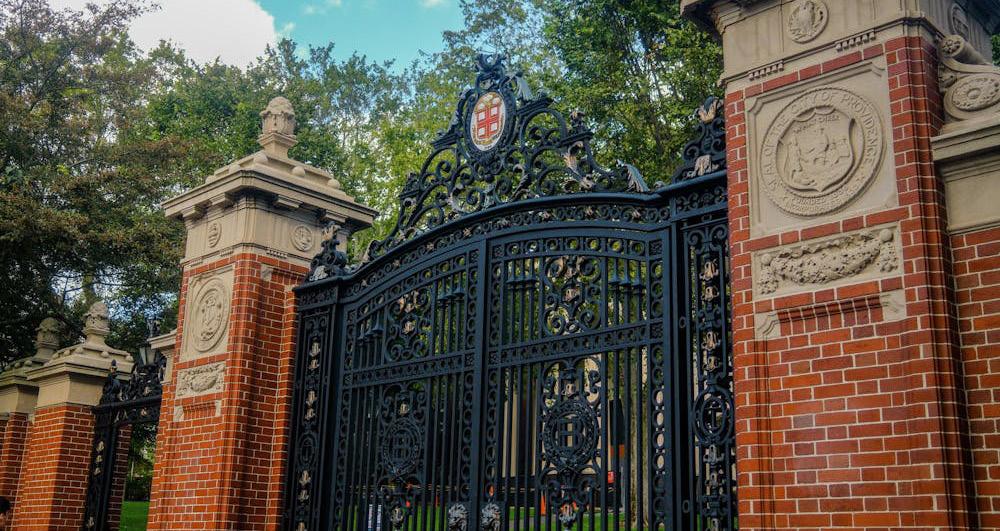
friends. However, these pre-fabricated communities are likely more common amongst students from well-funded public or private schools that send multiple students to Brown. For students who come into Brown knowing few, if any, of their new classmates, entering directly into orientation can be daunting. More expansive pre-orientation programming might help ease this transition with intimate, randomly assigned groups automatically increasing new connections and social integration. This can give confidence to students entering Brown without a social foundation by providing a supportive, smaller space for incoming Brunonians.
Brown prides itself on cultivating curiosity and community. Yet when students are most vulnerable — when they first arrive on campus — the University falls short of providing students
with meaningful, diverse connections. A robust, broadly available set of pre-orientation programs would create a common starting point rooted in shared experience rather than preexisting networks. It would not replace the valuable identity-based spaces that already exist — it would complement them.
Brown has the infrastructure and organizational expertise to implement these programs, and Providence itself offers opportunities most universities would envy. Brown sits in the heart of a vibrant city, minutes from coastlines, forests and neighborhoods rich with history and culture. Well-designed outdoor and community-centered pre-orientation programs would introduce students not only to each other but to the place they will call home for years.
Our peer institutions have effectively imple-
Davis MA’97 PhD’11, Joyrich PhD’90, Roberts,
mented programming that emphasizes shared experiences to strengthen belonging between young adults transitioning to college. Brown should do the same. Expanding pre-orientation programming would deepen connection, ease anxiety and enrich the first-year experience. For Brown to maximize connectivity and community among first-years, bonding should start before the ice cream social.
Editorials are written by The Herald’s editorial page board, and its views are separate from those of The Herald’s newsroom and the 136th Editorial Board, which leads the paper. A majority of the editorial page board voted in favor of this piece. Please send responses to this column to letters@browndailyherald.com and other opinions to opinions@browndailyherald.com.
Steinberg:
Brown needs to relearn how shared faculty governance works
In a March 30 op-ed, several of our colleagues argued against the recently passed motion to have an elected faculty member chair faculty meetings. The authors are among a group of faculty who seek to repeal the vote. Unfortunately, their letter is one in a series of misconstruals of the March 3 decision, and the focus on this one decision distracts from the main issue at stake in the series of Faculty Executive Committee recommendations, the first of which was changing who chairs faculty meetings. The larger stake is faculty participation in how Brown is governed and how to improve it. The FEC spent over a year holding meetings with 35 departments and another six months pro-
ducing a report. The FEC report concluded that Brown prides itself on its dedication to shared governance, but “faculty across the board felt that, at least in recent years, shared governance has existed in letter only.” As a result, faculty morale has decreased and trust between faculty and administrators has eroded. “The most effective remedy, as determined by the FEC, would be to grant the faculty a more prominent voice and role in decision-making at Brown,” they wrote.
The FEC report recommended five short-term governance changes and seven longer-term efforts designed to increase shared governance. Based on the report, which has been circulated several times

among the faculty since November and discussed at multiple meetings, the committee crafted a motion following the FEC’s initial recommendation that an elected faculty member — the FEC Chair — preside over University faculty meetings. The motion passed with a majority at the March 3 meeting. The margin was indeed slim, but the process was in alignment with the conduct of all faculty meeting votes.
Despite being repeatedly characterized as adversarial — by President Paxson in the faculty meeting and by some faculty in Herald opinion pieces — the March 3 vote was not a reflection on the work of President Christina Paxson P’19 P’MD’20, which we highly respect. Rather, it was an attempt to open space for discussion and even dissent on issues of concern to faculty and administration. This motion is in keeping with the goal of the other reforms proposed in the FEC report: to address a decades-long trend that is restructuring American universities according to a corporate model — one in which administrators have taken on larger and larger roles, thereby making more decisions that are then communicated to faculty at meetings, rather than decided upon with them, to the detriment of greater engagement and democratic processes. It is therefore inaccurate to characterize the vote as one of “no confidence” in the president. On the contrary, to suggest that a faculty member chair faculty meetings is a vote of confidence in the ability of the faculty to participate in shared governance.
Votes of the full faculty are relatively rare, and those on governance issues are even less common. The idea that faculty decisions can be immediately re-voted at the request of a group that doesn’t like the outcome is deeply destructive to the principle of faculty governance. In fact, it would corrode any
stable governance system. Rather than taking anything away from the president — a position, not a person — having an elected faculty member chair meetings could relieve the head administrator of a duty that faculty are capable of managing ourselves. Briefings from administrators are crucial to faculty understanding of important issues, and we look forward to hearing from the president and the provost regularly at faculty meetings. A faculty chair will ensure that ample time is allotted to the very discussion that shared governance requires.
Given that the March 3 vote was itself an exercise in faculty governance during difficult times, to attempt to overturn it is to undermine faculty governance itself. If we can immediately overturn a faculty vote, why not revisit other contested or close votes? This effort to reverse a faculty vote distracts from the time, dedication and consultation put forward by the FEC, the American Association of University Professors and other faculty members concerned with shared governance, including the motion that passed. In fact, the effort arguably undermines every task force, every study, every report and every vote conducted at Brown in recent years. Brown needs to relearn how shared faculty governance works.
Denise Davis MA’97 PhD’11 is an associate teaching professor of gender and sexuality studies, Lynne Joyrich is a professor of modern culture and media, Timmons Roberts is a professor of environment and society and Michael Steinberg is a professor of history, music and German studies. They can be reached at denise_davis@brown.edu, lynne_joyrich@brown.edu, j_timmons_roberts@brown. edu, and michael_steinberg@brown.edu. Please send responses to this opinion to letters@browndailyherald. com and other op-eds to opinions@browndailyherald.com.
HORATIO HAMILTON / HERALD
BEN KANG / HERALD
ARTS & CULTURE

Ferguson added that while some students complained about the length of time between artists going onstage, the board has very little control over that. “We can’t really control the amount of time between artists, like, how long it takes for an artist to get out there on the stage,” Ferguson said. “We can’t really expedite the process.”
The BCA took multiple factors — including price discrimination, timing conflicts and artists’ own preferences — into consideration when determining this year’s final setlist. “Some artists just don’t
want to do college shows,” Ferguson said. “We always will try to get an artist that we’re passionate about, but we can’t just magically get any artist to say yes.”
While this can create roadblocks during the decision making process, Seidel emphasized that it can “often be for the
best” as it ensures that Spring Weekend performers are “passionate and excited to be here.”
“No matter who we pick for Spring Weekend,” Francis said, “people are always willing to explore their music tastes and learn about different genres that may-
be they haven’t explored in the past.” Joel Fisher ’28, whose band, The Tabloid, performed at the release party, described the lineup as “fantastic,” adding that his band often sings a song by Thee Sacred Souls entitled, “Will I See You Again?”
BUO travels to Canada after 13-year international touring hiatus
The student-led trip included performances and community building
BY TIMOTHY RO SENIOR STAFF WRITER
Over spring break, the Brown University Orchestra conducted its first international tour in 13 years: a seven-day trip across Canada. The tour — which spanned Quebec City, Montreal and Ottawa — is the result of years of student-led planning, according to BUO President Eliana Alweis ’26.
Mark Seto, the director of BUO, described the trip as “a transformative musical and artistic experience,” where students can bond with their fellow musicians and the communities they visit.
The Orchestra has not traveled internationally since its 2013 trip to Ireland. The revival of touring abroad was the result of sustained student interest over several years.
Alweis noted that there had been “buzz” about members wanting to tour during “all four years” of her time with the group.
Alweis said she and BUO tour manager Tee Gotsch ’26 started considering locations for the tour in summer 2024 before putting together a formal proposal that fall. She added that the pair thought the tour would be “a really awesome, fun thing to do” as well as a chance for “community building” within the group.
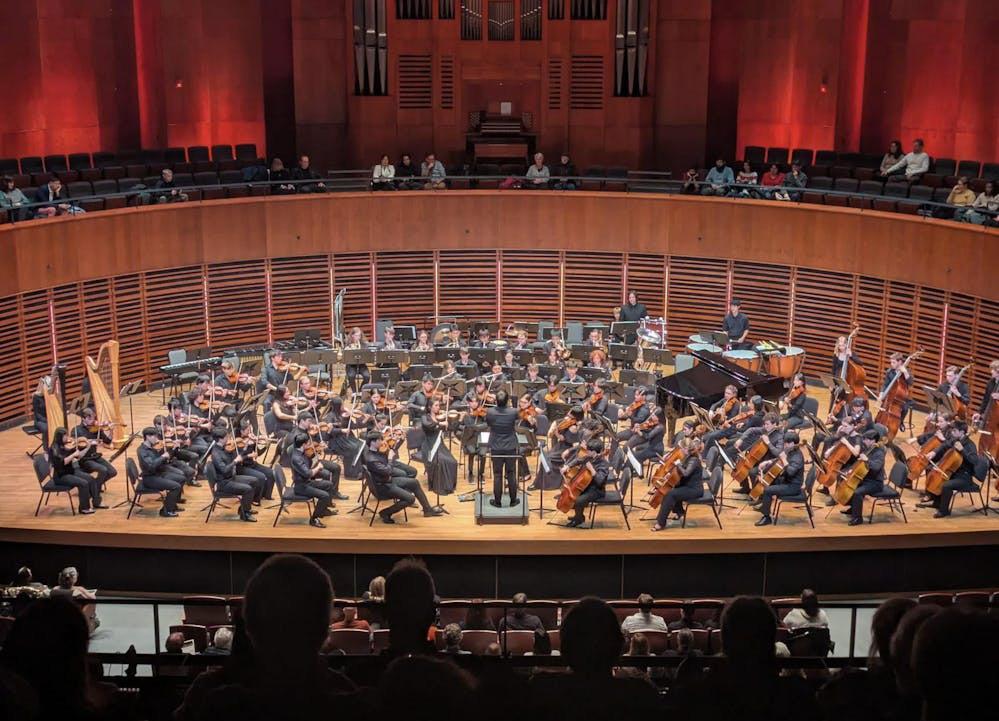
While Music Celebrations International — a professional music-focused touring company — assisted the group with the logistical aspects of the trip, organizing the international tour still required extensive coordination from the board.
“A lot of the planning process was made easier because we were working with a professional tour company,” Gotsch explained. Even so, “there was still a lot that needed to happen on our end.”
During the planning process, Gotsch and other organizers prioritized ensuring the touring experience was accessible to all members of the orchestra.
“We wanted this to be a tour where cost would not be a barrier for anyone … the orchestra and the music department would provide as much funding as anyone needed,” Gotsch said.
The group intentionally chose to perform pieces during the trip that reflected
both the orchestra’s identity and the tour’s location, Seto said. To do so, the orchestra performed works from a variety of francophone, Canadian and American composers.
Beyond the intentionality behind each piece, Seto said the tour itself also carried a broader sense of purpose. “We knew that we would be representing Brown as a university,” he added.
The group was met with enthusiastic audience support in each city where
they performed, with “standing ovations at basically every concert,” according to Anne Chang ’27, vice president of the orchestra’s executive board. “I think those moments really highlighted the universal music experience for a lot of people, no matter where we come from,” she added.
For many students, the most meaningful moments of the tour occurred off-stage.
“We definitely got a lot closer to one another,” Alweis said. “I myself got closer to a lot of the younger students who I hadn’t interacted with as much.”
Seto was also proud of the orchestra’s growth in their musical performance over the trip. “The orchestra did a fantastic job musically and played with real maturity and heart and commitment,” he said.
Gotsch said that the success of this tour was a culmination of the unique, student-driven nature of the ensemble.
“The students of the orchestra wanted it to happen, and we worked towards it,” Gotsch said. “Now we’re able to hold on to these memories and this experience for the rest of our lives.”
Looking ahead, the orchestra is preparing for yet another milestone: a performance at Carnegie Hall in April.
“Carnegie is arguably the preeminent classical music venue in this country and one of the preeminent venues in the world,” Seto said, adding that the opportunity will be “a really special way to cap off this season.” This
COURTESY OF ANNE CHANG
The Orchestra has not traveled internationally since its 2013 trip to Ireland.
JAKE PARKER / HERALD
composer and music producer. The song also includes orchestral-pop musical
bum’s genre-bending style, which sets es in the pop genre. On first listen, the album’s chaotic nature overshadows its iar with the sound, the production feels
mance grounds the album’s emotion, al cadences and moments of forceful narration. These shifts are accentuated by Raye’s immense technical control, allowing her to masterfully transition
While the length and sound of the
comfort seems to be the purpose of the album. In an era when much of pop is tailored to efficiency age to appeared online at browndailyherald.com




SCIENCE & RESEARCH
ENVIRONMENT
How a network of environmental sensors can help people understand their communities
The dashboard provides real-time data on air quality and flooding
BY ALICE XIE SCIENCE AND RESEARCH EDITOR
In the past, when communities in Rhode Island experienced flooding, stories and pictures were some of the only records of the extent of the flooding in the area, making it difficult for community members to adapt to future hazardous weather conditions.
But a dashboard recently launched by Rhode Island Network for Environmental Sensing and Technology now provides real-time data that monitors water levels, air quality and temperature to better inform stakeholders.
The software is “proving people’s lived experience so that they can figure out ways to make changes,” said Sol Cooperdock, a NEST technical lead and a research associate in Earth, environmental and planetary sciences.
“There was a real need for localized, accessible data that wasn’t being met by existing networks,” Emanuele Di Lorenzo, project contributor and professor of Earth, environmental and planetary sciences, wrote in an email to The Herald. Having timely, accurate data can help residents and local officials make better decisions for their communities during hazardous weather conditions like floods and heat, Di Lorenzo added.
According to Cooperdock, the project,
PUBLIC HEALTH

which is funded by the National Science Foundation, started out as part of a larger initiative on coastal climate resiliency in Rhode Island and Maine.
As Cooperdock spoke with stakeholders — often emergency or resilience managers — in coastal communities, it became “obvious” that the need for early warning systems for hazardous weather conditions was “one of the most pressing needs that a lot of these communities have,” Cooperdock said.
To identify locations to place the environmental sensors, researchers drive around with local community members who “point out locations that would be
useful for monitoring,” Cooperdock added. The researchers then make decisions based on the feasibility of the sensor setup.
The real-time sensor data is uploaded to the NEST dashboard and made available to “everyday users,” according to Di Lorenzo.
According to Di Lorenzo, the data from each sensor is monitored by a prototype artificial intelligence agent developed by Brown undergraduate students. The software alerts the researchers to any unusual signals.
For data that appears to potentially be inaccurate, “we go through a more in-depth data processing, and if later it checks out,
then (we) send it on,” Cooperdock said.
Before NEST, this real-time data wasn’t available or was too technical for non-experts. “Now, folks can see what’s happening around them and get alerts for things like flooding or extreme heat,” Di Lorenzo wrote.
Di Lorenzo hopes that NEST data will “become an environmental intelligence infrastructure for the state to provide situational awareness.”
“It’s always important for people just to have more awareness of the environment around them and what they’re living within and a part of,” Ralph Milliken, a professor of Earth, environmental and
planetary sciences who was not involved with the project, explained. “We all are part of a very complicated and complex ecosystem.”
In the future, the NEST team hopes to combine the data with an AI agent system to provide a range of services, including education and coastal resilience planning, Di Lorenzo wrote. These steps will “enable different users with diverse backgrounds to interact with the data and knowledge in ways that enhance accessibility.”
This article originally appeared online at browndailyherald.com on April 1, 2026.
Pandemic Center receives $900,000 grant for biosecurity program in Africa
The initiative focuses on biological threat reduction policy for leaders in Africa
BY KRISH VASUDEV CONTRIBUTING WRITER
The School of Public Health’s Pandemic Center received a $900,000 grant from the Carnegie Corporation of New York to launch a program for mid-career professionals in Africa designed to provide specialized training on biological threat reduction policy. The three-year initiative is set to launch in summer 2026 and will include a 9–10-week online course and a yearlong fellowship.
“We’re really excited to work with talent on the African continent who will design and discuss public policy measures that can be implemented in their own region,” said Beth Cameron, co-leader of initiative, senior advisor to the Pandemic Center and professor of the practice of health services, policy and practice.
The program buildings on the Pandemic Center’s Biosecurity Game Changers Initiative — a pilot program launched in 2024.
The course will enroll up to 30 students with at least five years of post-graduate experience who are trained in the biological sciences, biotechnology, international security or public health.
Of those 30, at least five early- to mid-career professionals will be selected for fellowships with host institutions, which include the Africa Centres for Disease Control and Prevention, the Coalition for Epidemic Preparedness Innovations,
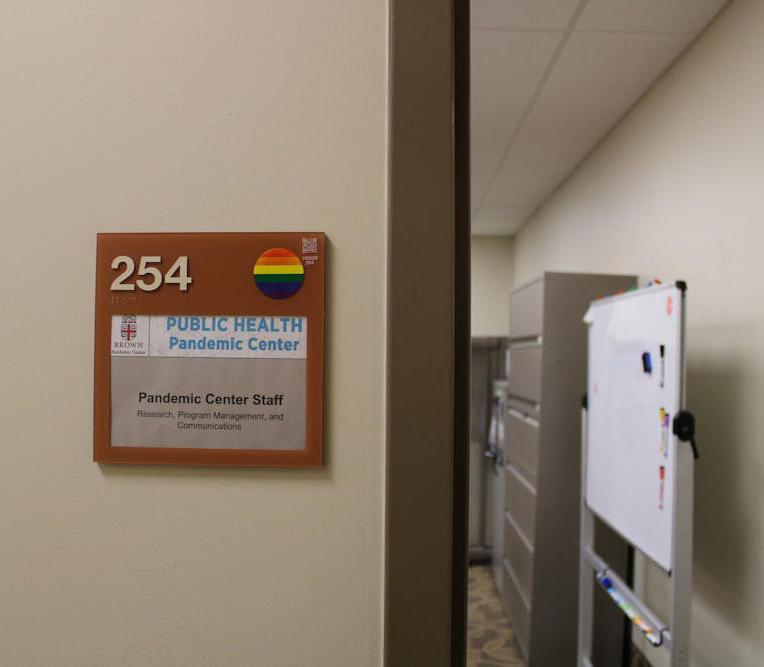
fellowship.
the International Biosecurity and Biosafety Initiative for Science and the Biological Weapons Convention Implementation Support Unit. The fellows will spend a year with host organizations, working to design or implement a policy in practice.
The Pandemic Center was chosen for this grant because the initiative aligns with the Carnegie Corporation’s International Program’s emphases on “nonstate actors” and addressing rising biological threats, Omotade Akin Aina, senior program di-
rector in the International Program at the Carnegie Corporation of New York, wrote in an email to The Herald.
Through the grant, the philanthropic foundation hopes “to see long-term African-led and driven efforts to address these
issues,” he added.
Wilmot James, a co-leader of the initiative, senior advisor to the Pandemic Center and professor of the practice of health services, policy and practice, will lead the initiative’s course with Cameron. James formerly served in South Africa’s Parliament between 2009–2017, including as Shadow Minister of Health.
The course will give students the opportunity to learn how to create policy solutions and “convince decision-makers to take the steps needed to address the public health crises that emerging biothreats cause,” according to class’s program materials sent to The Herald.
Cameron said the program intends to fill a gap in training for early- to mid-career professionals, noting that there are many technical experts and rising leaders across the African continent who may use the course and fellowship to enhance their skills and “become more effective as decision makers.”
The program also aims to build a “pipeline of decision makers” in Africa “that are more well versed in biological threat reduction,” Cameron said, adding that the continent is seeing an increase in biotechnology development.
“At the end of this program, what we hope is that, first and foremost, we will have built an effort that can be more sustainably rooted on the African continent for training the next generation of biosecurity decision makers,” she added.
This article originally
2026.
SOPHIA MITTMAN / HERALD
Of the thirty students enrolled in the course, at least five early- to mid-career professionals will be selected for the
KAIA YALAMANCHILI / HERALD
The project, which is funded by the National Science Foundation, started out as part of a larger initiative on coastal climate resiliency in Rhode Island and Maine.
ARTIFICIAL INTELLIGENCE
AI pioneer Yann LeCun discusses new frontiers in the field at Brown lecture
LeCun spoke at the University’s annual Lemley Lecture
BY RACHEL WICKER SENIOR STAFF WRITER
While large language models like ChatGPT may seem really smart, they lack key capabilities along with many important dimensions, Yann LeCun — executive chairman of Advanced Machine Intelligence Labs and professor of computer science at New York University — said at Brown’s 2026 Lemley Family Leadership Lecture.
“In fact, they are completely helpless when it comes to the physical world,” LeCun said.
On a slide shown during his presentation, LeCun encouraged fellow artificial intelligence scientists to “abandon” generative models and other well-established methods. In all-caps and red text, the slide read: “IF YOU ARE INTERESTED IN HUMAN-LEVEL AI, DON’T WORK ON LLMs.”
LeCun feels much more confident in a different type of artificial intelligence.
“There is no question … that machines will eventually surpass humans in all domains where humans are intelligent,” he said, though he noted that this will take “a while” and is “almost certainly much harder than we think.”
LeCun’s company, AMI Labs, is an AI startup that is developing the concept of “world models,” which are AI models able to understand the physical world because they are trained with sensory data, as opposed to language-based models, which are trained on human-produced texts. The
NEUROSCIENCE
company has raised over $1 billion in seed funding.
“We have various systems that can write code, they can pass the bar exam, they can win international math Olympiads,” LeCun said. “But where is my domestic robot? Where is my robot that can clean the house, learn to drive in 20 hours of practice?”
LeCun defines intelligence as “the ability to accomplish new tasks you’ve never been exposed to and solve new problems without any prior training” — a skill he says LLMs do not possess. He argued that because of this, LLMs will not be able to reach human intelligence, saying that “human-level AI will require real world data, sensory inputs, as opposed to just language or text.”
AMI Labs’s world models are still in the early stages of development. According to LeCun, these models will be trained with sensory data so that they can understand the physical world and “predict the consequences of their actions in advance.”
Nearly all of the current AI systems are incapable of predicting their actions’ consequences, LeCun said. He described current LLMs as “intrinsically unsafe.”
But with world models, “guardrail objectives” can be implemented, which means that “by construction, they will not knowingly produce actions that will produce dangerous results,” he added.
Although world models bring a host of technical processes and challenges to work out, LeCun said that the work he has been doing over the past 15 years is “enabling the next AI revolution.”
One of the key challenges is working out hierarchical planning, the ability to prioritize actions in a sequence, and a hall-

mark skill of human intelligence.
“Here is the big secret of AI: Nobody knows how to do hierarchical planning,” he said.
He said his goal for AMI Labs is “to become the main provider of intelligence systems,” a goal he joked is “very modest, not ambitious at all.” He added that these new AI systems have potential applications and value “in all major sectors,” including the economy, academic fields, the physical and medical sciences and more.
In the Q&A session, LeCun emphasized the impact of academic research on industry and the importance of collaboration. He said he is “a firm believer” that good ideas “come from the interactions between people working on different assumptions with different motivations in different environments.”
When asked about his view on education in the current world of increasing
technological and AI advancement, LeCun said that the sentiment that education is useless with an increased reliance on AI is “not true,” noting a trend in increased demand for more advanced degrees, specifically in STEM fields.
He also advised students to “study things that have a long shelf life and are very fundamental,” noting that “technological progress is accelerating” and “you’re almost certainly going to have to change jobs during your career.”
Attendee Eduardo Michelsen ’29 said it was “an honor to have someone like (LeCun) on campus,” calling the talk “insightful.”
“He made it sound like at least studying something like (computer science) was probably something smart to do, even though it seems like it’s not,” Michelsen said.
William Yu ’26, who also attended the
event, said he thought the lecture was “probably the coolest event, most interesting speaker that (he has) listened to in (his) time at Brown.”
“He believes in the direction he’s going in with world models, and he’s not afraid to say that he thinks LLMs are a dead end,” he said. “I think he has earned the right to be clear in what he thinks with the contributions he’s made to the field.”
Yu appreciated the talk’s connection to how AI will affect students in their future everyday lives.
“I think it’s very important that the University brings these kinds of voices to campus and gets more students informed about these changes that are happening,” he said.
This article originally appeared online at browndailyherald.com on April 2, 2026.
With new technology, paralyzed patients can communicate by thinking about typing
The study uses attempted finger movements to improve communication
BY ELIZABETH ROSENBAUM SENIOR STAFF WRITER
For people experiencing paralysis, communication often means spelling out words one letter at a time by using their eyes to select letters on a keyboard, according to Daniel Rubin, a critical care neurologist at Massachusetts General Hospital and an assistant professor of neurology at Harvard Medical School.
This process can be “excruciatingly slow and very frustrating,” Rubin said in an interview with The Herald. But technology pioneered in a Brown-affiliated study could make this process more efficient — patients would only need to mentally attempt to type on a QWERTY keyboard.
Rubin is a principal investigator on the Nature Neuroscience paper, which details how an intracortical brain-computer interface neuroprosthesis — or an iBCI — can decode attempted finger movements using signals in the brain. With this technology, individuals could type 22 words per minute— a faster rate than previous eyegaze-tracking technologies have enabled, according to Rubin.
“For people who have paralysis, it’s not just getting your message out there,” Rubin said. “It’s being part of the conversation in as close to real time as possible.”
The research — which is a part of the
larger body of work by BrainGate, a leading computational neuroscience research team across multiple universities — is being conducted at Brown, Stanford University, Emory University and the University of California, Davis. Currently, nine patients are enrolled.
Even though patients that are paralyzed cannot control motor activity, their brains still generate the neural activity necessary for those movements. Those signals can be used to generate decoded communications, according to Brown and Harvard postdoctoral research fellow Justin Jude, the first author on the paper.
Doctors surgically place tiny electrode arrays in the cortexes of patients’ brains to track changes in the neurons’ signaling pathways via changes in electricity. Once the arrays — which are about half the size of an American penny — are in the brain, researchers can record the signals associated with attempted finger movements, Jude said.
The signals are decoded into letters, and the letters are then “stitched” together into sentences using a recurrent neural network, or an RNN. According to the paper, the RNN — a deep learning algorithm — infers the letters in sequence as the user performs a series of attempted finger movements.
To test and train the technology, the researchers had patients use the iBCI to type prompted sentences. Then, they observed if the decoder’s output matched the patient’s input, according to Rubin. The algorithm also was configured to autocorrect errors, Jude said.

This work has immense impact, according to Rubin. For example, one paralyzed patient was able to return to work because of the technology’s impact on his communication abilities.
This research is similar to related efforts to decode attempted speech, according to Jude. This past week, the researchers published another paper that used the same decoding methods as the typing study, but instead of decoding attempted finger move-
ments, the researchers recorded neural activity to decode attempted mouth and tongue movements to make phonemes — or phonetic units.
Research is aiming to move “from encoding movement of the hand and arm to decoding the movement of the muscles of articulation — the muscles that we use to talk, the face, mouth, jaw, tongue — and in doing so, use the same sort of decoding approach, but predict what sounds are
CAROLYN NAKAWUNGU / HERALD
someone trying to make as they think about talking,” Rubin said.
“Our amazing clinical trial participants really deserve all the credit,” Professor of Engineering and of Brain Science Leigh Hochberg ’90 wrote in an email to The Herald. “They are participating not because they hope to gain any personal benefit, but because they want to help us to develop and test novel neurotechnologies that will help other people with paralysis.”
JAKE PARKER / HERALD
LeCun’s work over the last 15 years has culminated in the founding of his company, AMI Labs.
UNIVERSITY NEWS



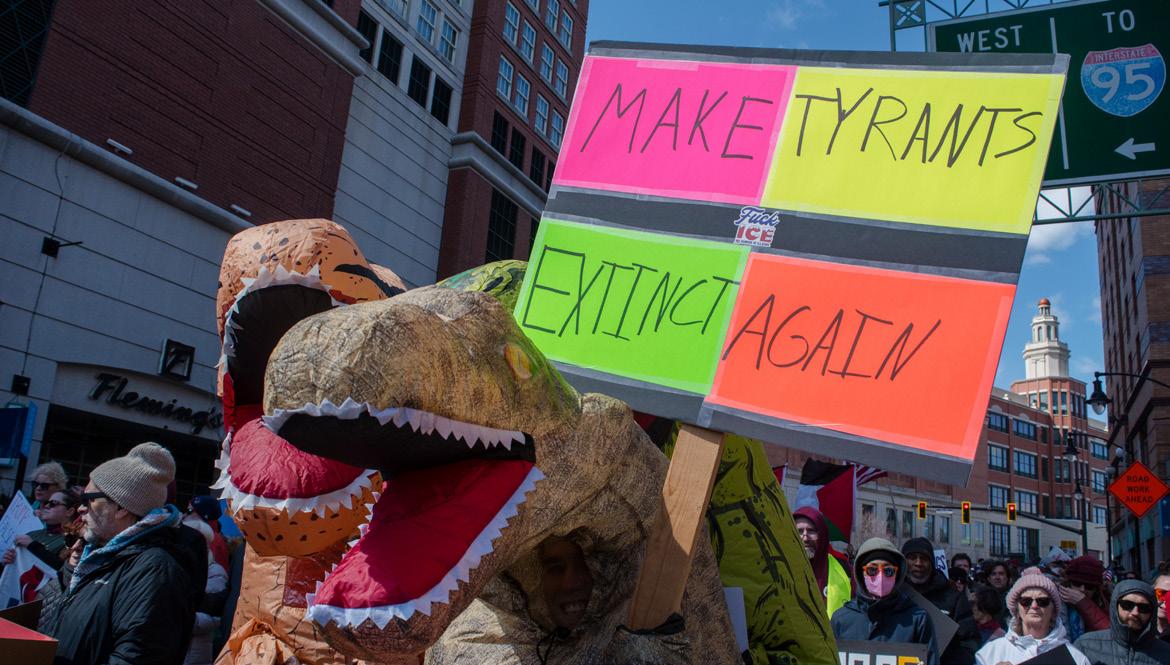


Thousands march to protest Trump administration at ‘No Kings’ rally
The rally drew over 35,000 protestors, organizers said
BY MICHAELA HANSON AND IAN RITTER SENIOR STAFF WRITER & UNIVERSITY NEWS & SCIENCE & RESEARCH EDITOR
Thousands of protestors gathered at the Rhode Island State House on Saturday to protest against the Trump administration. The rally was part of a series of “No Kings” demonstrations across the country.
Over 35,000 demonstrators attended this iteration of the protest, according to MK Getler, co-chair of Indivisible Rhode Island, one of the groups that helped organize the Providence demonstration. Similar “No Kings” protests took place in Providence on Oct. 18, with an estimated turnout of 32,000, and on June 14, with an estimated 3,000 or more protestors in attendance.
Beginning at the State House, demonstrators carried banners and signs — and some wore inflatable outfits or historical costumes — as they marched through the city. The crowd walked past Providence City Hall, through Kennedy Plaza, across
the Providence River and circled back to the State House for a series of speeches.
The protests aim to bring people together to “disrupt President Trump’s attempts to rule through repression,” according to the No Kings website, which calls the war in Iran “illegal (and) catastrophic,” and cites recent immigration enforcement actions across the country.
Ashe Shirazi ’28, a speaker at the protest, called the Trump administration’s recent attack on Iran “violent” and “unprovoked,” adding that the money spent “to commit war crimes” could instead be spent on “health care and social security to make American life affordable.”
Another speaker, Autumn Guillotte, political director for the Rhode Island AFLCIO, called for economic reform, encouraging attendees to call their representatives and ask to “tax the rich.”
“The choice comes down to millionaires or Rhode Islanders and their ability to feed their families and go to the doctors. I choose us every time,” she said.
Rhode Island Secretary of State Gregg Amore, who also spoke at the rally, argued for the importance of free elections.
“The federal courts have diminished the Voting Rights Act time and time again, and Congress has refused to reauthorize or pass the John Lewis Voting Rights Act,” he said.
The John Lewis Voting Rights Act would update the original 1965 Voting Rights Act, aiming to strengthen protections against discriminatory voting practices.
Because that act has not passed at the federal level, he said his office promoted its own bill: the “Rhode Island Voting Rights Act,” which aims to create procedures to prevent discrimination in voting processes.
Alexis Adamonis, another protest speaker and a local high school student, said that her generation is “petrified of what the future holds,” citing high living costs, climate change and increased abortion restrictions as issues making her “incensed with anger.”
But Adamonis also noted the need for hope. “This country was built on hope,” she said. “A hope strong enough to stand here today — and no broken law, no act of violence, no destructive tyrant has ever destroyed it.”
Protestors advocated for a range of issues at the march, with members of the Rhode Island Democratic Socialists of America staging a demonstration at the Exchange Street Bridge, hanging a large banner reading “From the river to the sea, Palestine will be free” and chanting “Free Palestine” at marchers.
Brittany Kubicek, an independent socialist running for House representative


for District 5, said she did not consider the demonstration to be a counter protest, but instead “an enhancement of the voices and things they may or may not have been able to say up on the main stage.”
Anna Lysyanskaya, a professor of computer science, brought her sons to the protest so they could “see what democracy looks like,” she said in an interview with The Herald.
“This administration is so cavalier with the law, with the due process of the law,” Lysyanskaya said. “I myself am an immigrant, and I know my constitution because I had to pass a citizenship test, so it’s blatantly obvious that they have absolutely zero respect for the Constitution.”
Her son, Arthur, a third grader at the French American School, carried an American flag previously flown over the U.S. Capitol.
Lysyanskaya said she had once mentioned to a former student — who worked for U.S. Rep. Jim Langevin — that there were not enough American flags at demonstrations. She soon received a flag from Langevin with a note requesting that the family fly it at protests.
Narragansett residents Thomas Lynch and Barbara Mariconda attended the protest together. Mariconda said the two have attended every protest they can.
“We’re so absolutely concerned about the state of our democracy,” Mariconda added.
Many middle and high school students also marched on Saturday.
Carys Marderosian, a 14-year-old student at the Gordon School, said the protest was especially “important” because she was not yet of voting age. “I don’t like feeling helpless.”
“I think that it’s really important that as many people as possible come and show out,” said Indira Peckham, a 16-year-old Wheeler student.
“The most important thing is that you continue,” she added. “One protest isn’t gonna be enough to actually change anything.”
According to Getler, future protest organizing is in the works, including a national day of strike in April.
Getler also hopes to increase voter turnout in the upcoming primary elections in September, as well as the upcoming midterm and presidential elections. “We had a very low voter turnout for the 2024 election,” they said. “In 2028, we’re trying to fix that.”
This article originally appeared online at browndailyherald.com on March 29, 2026.


OWEN BALLARD-O'NEILL / HERALD
SELINA KAO / HERALD