
THE BROWN DAILY HER ALD
In 2025, the Trump administration revoked student
A year later, Brown students are still worried about their status.
The Herald spoke to students about immigration concerns and free speech
BY RACHEL WICKER SENIOR STAFF WRITER
In April 2025, the Trump administration revoked the visas of at least one Brown student and multiple recent graduates in a move mirroring similar actions targeting university students across the United States. One year later, international students at Brown are still worried about their
immigration status.
The Herald spoke to four international students about their visa experiences and how comfortable they feel expressing their views on and off campus. Three of these students spoke on the condition of anonymity due to concerns about their visa statuses.
“I don’t even want to risk it”: Concerns with re-entry
One student, who is from a country in the Middle East, said that getting a U.S. visa in her country has always been difficult. “You need to be very careful with your answers" to questions when applying, she said, adding
that the process can be “uncertain” and “frightening” because “a lot of the time it depends on the person who’s interviewing you at the embassy and their mood.”
She received an F-1 student visa before she arrived at Brown, but due to U.S. immigration restrictions on her home country, any time she travels home, she has to reapply for the visa to return to campus.
Last spring, when student visas across the country were being revoked, the student immediately checked her own visa’s status. “I remember my heart literally sank to my stomach,” she said. “It was very scary.”
She said that she and other internation-
Paul McCartney, Morgan Neville come together to talk new film
The new feature documentary, “Paul McCartney: Man on the Run,” was screened Monday
BY ANN GRAY GOLPIRA ARTS & CULTURE EDITOR
Just before the lights dimmed for a Monday screening of “Paul McCartney: Man on the Run,” a figure emerged from the wings of the Veterans Memorial Auditorium. As he casually strode to his seat in the middle of the audience, hushed whispers and gasps filled the theater as audience members gradually recognized the figure’s face — which would soon be appearing on the screen in front of them.
After the screening of the documentary feature film — now available for streaming on Amazon
Prime Video — Paul McCartney and Morgan Neville, the film’s director, sat down for a conversation with President Christina Paxson P’19 P’MD’20.
The conversation walked the line between nostalgia and comedy. When asked what he hopes younger audiences will take away from the film, McCartney cheekily responded, “I hope that they will see how loose and crazy (the ’70s) were. I mean, it is 4/20,” to which audience members erupted into cheers.
Neville hopes that young audiences learn the importance of not only finding one’s voice, but keeping it.
“(Your voice) can change, and people expect you to do things and want you to keep repeating yourself, and Paul had the courage of his convic-
SEE MCCARTNEY PAGE 14

al students “were really scared of more happening.”
She and other Brown students from the same country have stayed in Providence for every winter and summer break, “frightened of the prospect of going back home and then reapplying and getting rejected,” she said.
The student was planning to return home for winter break in December, prepared to risk her reapplication for a visa being rejected. But after speaking with an immigration lawyer who noticed a small mistake in her initial application, she was told the risk would be too great.
“The immigration lawyer told me, ‘Don’t go back home, because they’ve been looking for any reasons to reject anyone,’” she said.
In January, a federal proclamation officially placed her home country, as well as nearly 40 others, under a travel ban. Were she to visit home, she would be unable to return to Brown until the ban is lifted.
This summer, she will have gone two years without seeing her family. She said she goes back and forth on whether being at school in the United States is worth
Hundreds protest Citizens Bank’s ties to ICE outside shareholder meeting
GLO announced that they will withdraw about $500,000 from the bank
BY MARAT BASARIA SENIOR STAFF WRITER
In front of the Citizens Bank headquarters in downtown Providence, hundreds gathered Thursday morning to protest the bank’s alleged financing of private prison companies operating federal Immigration and Customs Enforcement detention centers. The protest occurred during the bank’s annual shareholder meeting and was organized by the De-ICE Citizens Bank Coalition, which includes multiple community and student groups including Brown Rise Up. Equipped with megaphones and signs, demon-
strators booed vehicles entering the Citizens Bank complex. Citizens Bank has allegedly provided funding to CoreCivic and GEO Group, two of ICE’s major contractors.
“We’re all out here outside Citizens Bank today to demand they stop financing ICE detention centers,” Raya Gupta ’29, a narrative team co-coordinator for Brown Rise Up, said in a speech at the protest.
“The Citizens Bank has given $2.5 billion to CoreCivic and the GEO Group, and this is our way of making sure that we stop that,” said Maira Magwene-Muniz ’29, narrative team member for Brown Rise Up, in an interview with The Herald. Peter Luecht, a spokesperson for Citizens Bank, did not immediately respond to The Herald’s request
PROTEST PAGE 6

SCOUT CHEN /
UNIVERSITY NEWS
EXAMS
After AI cheating, economics professors see in-person exams as a path forward
Professors saw unusually high scores on take-home exams and homeworks
BY IVY HUANG UNIVERSITY NEWS AND SCIENCE & RESEARCH EDITOR
Economics Professor Roberto Serrano normally holds in-person exams for his ECON 1170: “Welfare Economics and Social Choice Theory” class, but this semester he decided to assign a take-home, closed-book exam for the first midterm to alleviate pressure for students after the Dec. 13 shooting.
But after the class’s grade distributions indicated widespread cheating, Serrano has decided to return to in-person exams for all of his courses. The median for the exam was 98%, with 40 out of 86 students scoring 100%.
Compared to previous data, the distribution for his first ECON 1170 midterm was “absolutely ridiculous,” especially since he had designed a more challenging exam for the take-home format, Serrano said in an interview with The Herald.
“Historically, the average grade in the midterm exams ranged from 65 to 85,” Serrano said.
After investigating the exam results, Serrano said he found signs of AI use and collaboration amongst students.
The answer to one of the exam questions, for example, is a “very simple, direct proof,” Serrano said. ChatGPT constructs a “very convoluted contradiction argument,” which appeared in many students’ exams.
Serrano also noticed that the exams of
DINING
students who often study together were “absolutely identical,” with points lost on the same questions.
After hearing about the suspected cheating in Serrano’s class, Assistant Professor of Economics and Entrepreneurship Bobby Pakzad-Hurson does not plan to give takehome exams in the foreseeable future. “I don’t see how, especially after seeing this, any faculty member could have any confidence in a take-home exam,” he added.
Pakzad-Hurson also suspects student AI use on homework assignments.
“The biggest shift is just that students are seemingly a lot better at homework now,” Pakzad-Hurson said. He has noticed
“perfect performance” on homeworks and “poor performance” on tests. Pakzad-Hurson lowered the weight of homeworks on students’ overall grades to reduce the incentive to submit AI work.
Economics Professor Rajiv Vohra noted that AI does not appear to be a problem with in-person exams, but may be an issue with homeworks or take-home exams.
Teaching Professor of Economics Sylvia Kuo has also noticed potential AI usage on her homework assignments, even though they are graded based on effort. She said she has seen “weird answers” that still arrive at a solution, but use terminology that is inconsistent “with what was taught.”
In the last year, Kuo has also seen a decrease in exam scores, despite the fact that the content of exams has been “roughly” the same since she started teaching the course more than a decade ago. She said this suggests students are not using their “own brain” to do the “learning in order to perform well on exams.”
In cases of cheating incidents that go through the academic code violation process, Kuo said students are usually “in a bad situation and they didn’t study, and they’re panicking like crazy.” In those moments, “they make bad choices.”
When an instructor submits an academic code allegation, it is routed through
Workers demand reform to Dining Services in petition
The petition was put together by a new organizing committee
BY JAMES LIBRESCO SENIOR STAFF WRITER
A new organizing committee of dining workers is demanding reforms to Dining Services through a petition that has amassed around 500 signatures.
The committee announced the petition early April through an Instagram video.
The petition calls on the University to develop comprehensive, building-specific emergency response plans, which did not exist prior to the Dec. 13 mass shooting. According to University spokesperson Amanda McGregor, the University has implemented “newly designed intruder preparedness training,” including “a series of dedicated sessions for Dining employees.”
The reforms also include the official hiring of temporary workers who have been employed at Brown for over six months, additional compensatory pay for hours worked after the shooting and more robust avenues for feedback.
According to Lynn Aguilar, a food service worker at the Sharpe Refectory, Dining Services workers tried to use “conventional routes” to express their grievances with management. But they decided to start the committee after “being repeatedly turned away, ignored, belittled” by management, she said.
Aguilar said she would like Dining Services management to take employee feedback into account before making changes. “We don’t have (any process) like that at
the Ratty,” Aguilar said. “We just kind of are told ‘Management wants to do this.
This is what we’re doing.’”
Aguilar and Timothy Hilliard, another Ratty food service worker on the organizing committee, also described a work environment in which changes are made without taking employee feedback into consideration.
Vice President of Dining Services George Barboza declined to comment on allegations raised by workers in this story and referred The Herald to the University’s press office.
In a statement to The Herald, McGregor wrote: “When concerns are raised
directly with dining and/or University leaders, we engage in dialogue — and the management team in dining will do so, should employees share these concerns directly.” McGregor added that dining management has worked with employees over many years to strengthen the “employee experience.”
Hilliard also said that understaffing at the Ratty remains an issue, which Herald investigations revealed last summer and in 2021. “It just makes it harder to work,” Hilliard said.
According to Hilliard and Aguilar, temporary workers at the Ratty have not been offered full-time jobs in recent months,
an administration before reaching the Standing Committee for the Academic Code. All allegations are reviewed by Associate Dean of the College for the Academic Code Love Wallace.
“Students who violate the academic code are almost never doing it from a malicious place,” Wallace wrote in an email to The Herald. “Generally speaking it’s a split second decision that comes from a place of trying to handle immense external or internal pressure.”
“I think a lot of people cheat because they have a lot that’s going on in their life,” said Liam Fitzgerald ’28, a business economics concentrator. “They could take the easy way out to cheat with homework assignments (and) tests because they don’t believe that they can learn the material in the time that they put into it.”
Genie Dickens ’28, a biology and economics concentrator, said that some of the cheating in the economics department may be due to practice exams students are given.
“It makes it easier to cheat, because you know what’s going to be on the test,” said Dickens. “Sometimes people will write the formulas for the exams and stuff, whether it’s in their calculator or on a note.”
Because a lot of economics classes are graded on a curve — where 30 or 40% of the class receive an A — students may feel extra pressure to get an A which “creates a mindset where students are more likely to cheat,” said Irene Zheng ’28, an applied math-economics concentrator.
This article originally appeared online at browndailyherald.com on April 20, 2026.
despite the purported understaffing.
Aguilar said that temporary employees have limited roles and are not able to complete the same tasks as full-time workers. When many workers are classified as temporary, “it ends up with a heavier burden on union employees for tasks that require more training or that take more of a physical toll,” she said.
McGregor wrote in the statement to The Herald that many full-time dining workers begin in temporary roles. “Decisions on transitions into full-time roles happen individually, based on unit needs, budget considerations and/or employee performance,” she wrote.
The petition also requests 1.5 times compensatory pay for employees’ work during the shooting. It also requests that workers be reimbursed with paid time off if they used it on Dec. 14 and Dec. 15. Dining employees were required to return to work the day after the shooting.
One week after the workers’ advocacy campaign was launched, the University announced in a Today@Brown message that employees would be eligible for compensatory time — paid time off that can be used at a later date — for each day worked on either Dec. 13 or Dec. 14.
The message also said that some nonunion workers would receive one-time payments as “measure of appreciation” for their work during winter break. Union workers have already been “compensated for extra hours worked during winter break,” the message added.
Maddock Thomas ’26, president of the Brown University Labor Council, wrote in a message to The Herald that the payments did not go far enough.
The council released a statement in early April calling for the University to address the demands made by affected workers and revisit their staffing policies. The council is in support of the committee’s demands, but is not directly involved in the group.
“We’re in full support of the workers organizing committee and any demands they may have,” Maddock said in an interview with The Herald.
This article originally appeared online at browndailyherald.com on April 22, 2026.
JASPER PERLIS / HERALD
The median for a recent exam in Economic Professor Roberto Serrano’s class was 98%, with 40 out of 86 students scoring 100%.
CALEB LEE-KONG / HERALD
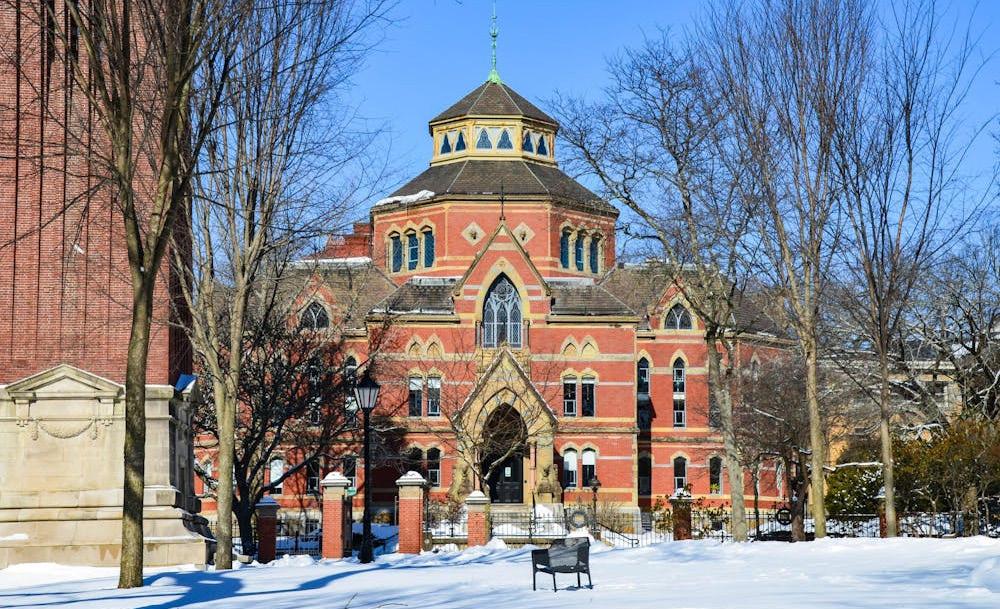
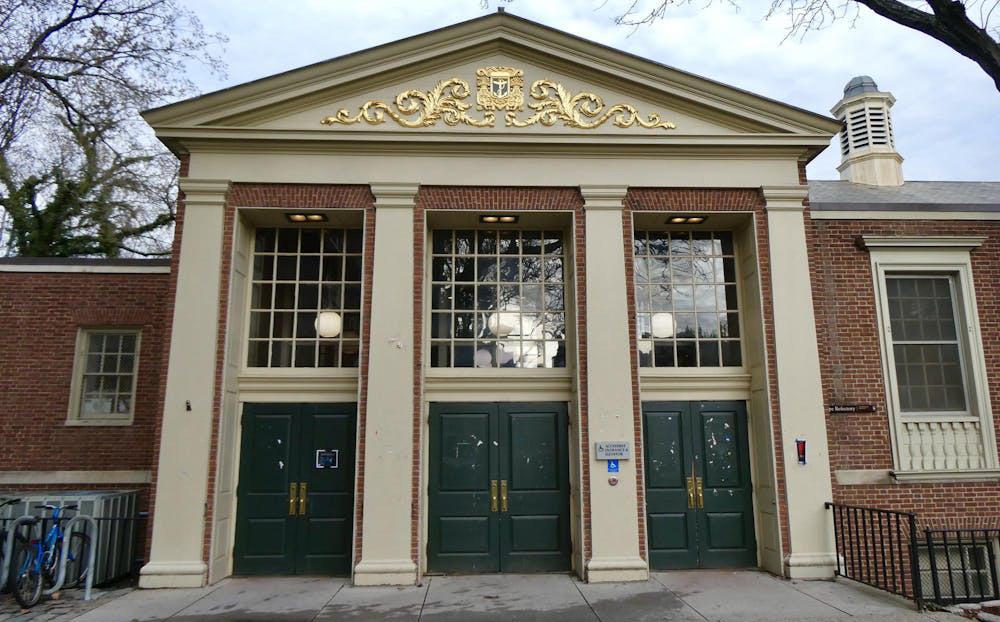
The committee announced its campaign in early April through a video and petition posted to the Student Labor Alliance Instagram page.
GRADUATE PROGRAMS
Brown/Trinity Rep MFA program to graduate final cohort this May
Admissions to the program were paused indefinitely in January 2025
BY NOA SAVIANO SENIOR STAFF WRITER
Next month, the final cohort of the Brown/ Trinity Rep Master of Fine Arts Programs in Acting and Directing will graduate following an indefinite admissions pause set in January 2025. The program will shut down while administrators “identify ways to make improvements and move forward with the strongest possible programs,” according to the program’s website.
The program, which was launched in 2002, is run in partnership with Trinity Repertory Company — a Providence-based regional theater — to provide students with the opportunity to learn from professional guest artists and gain performing experience.
“As we made clear upon conveying this news in 2025, leaders at Brown and Trinity Rep determined that the joint training model that had been in place needed to be re-examined to adapt to changing conditions, as the field of acting and directing evolved over recent years,” University spokesperson Brian Clark wrote in an email to The Herald.
“It’s important to make clear that the decision made jointly by leaders at both Brown and Trinity was not driven by financial considerations,” he added.
According to last year’s announcement, Brown was convening a “working group” led by Sydney Skybetter, director of the Brown Arts Institute, to “envision the future of professional performing arts training in the context of a research university.”
Skybetter wrote in an email to The Herald that “Brown is not pursuing a relaunch of the program within BAI,” and clarified that “there is no single group” charged with determining the future of the program. Instead, “a range of conversations have taken place, internal and external to Brown, with colleagues whose expertise is in prac-

tice-oriented pedagogy and curricular policy” to determine the program’s future.
“What BAI has learned from those conversations is shaping the courses we’re launching this fall, and we expect the classes themselves to teach us something in return,” he added.
The Herald spoke with four students in the program’s graduating cohort, who all lamented the decision to indefinitely pause admissions and reflected positively on their time at Brown.
Getting rid of the program “is the worst mistake Brown could ever make,” said Lucia Aremu GS, a current MFA student. For Aremu, the program “felt like an anchor” for the undergraduate theater arts program at Brown because master’s students often work with undergraduate playwrights.
Abram Blau GS said Brown’s program is “really special among MFA programs. We’re the only MFA Acting Program I know of
that has its students take four semesters of directing and three of playwriting.”
Henry Nwaru GS said he appreciated the program’s unique emphasis on repetition. “It will seem tedious at times, but now in this third year of mine, I'm seeing that, that constant repetition, that constant work that you are forced to do … it creates resilience,” he added.
The opportunity to perform at Trinity Rep alongside his professors and professional actors has “been really, really wonderful,” Blau said. They were people “I was looking up to at the beginning of my time here, and now we’re looking at each other face to face,” he said.
“It’s a positive feedback loop in the best way,” Nwaru said. “Working alongside them, especially when you get on stage, you see them doing these amazing things, and it lights a fire in you where it’s just like, okay, all right, I’ve got to step my game up.”
Nwaru says he plans to use the relationships he’s developed through the program as he enters the art world post-graduation.
“I'm going to make a concerted effort to reach out to the people who I've had the chance to work with, and just start creating for art's sake,” he said.
“I'm just going to focus on just doing work that propels me,” Aremu said. “I’m really, really, really interested in just really pouring into my community, my Brown community, my Brown/Trinity community.”
The collaboration between professionals and students facilitated by the Brown/ Trinity program is typical for “top-tier” training programs, Columbus wrote. “It was one of the main reasons that the Brown/Trinity program was ranked third among MFA programs nationally in its last year.”
Brown is not the only university to pause its MFA program in recent years.

Submissions:
THE BROWN DAILY HERALD
Games Chief Paul Hudes
Podcast Chief
Talia LeVine
Multimedia Editors
Sophia Basaldua
Design
Editor-in-Chief
Opinions
Gardiner


Luecht
Kaia Yalamanchili
Illustration Chiefs
Kendra Eastep
Isabela Guillen
Video Chiefs
Cienna Cheng
Cody Cheng
Social Media Chiefs
Nate Barkow
Annika Melwani
Technology Chief
Annika Singh
Data Desk Chief Caleb Ellenberg
Marat Basaria
Harry Guo
Horatio Hamilton
Selina Kao
Ella Le
Kenna Lee
JJ Li
Jake Parker
Jascha Silberstein
Rassul Toleugazy
BUSINESS
General Managers
Arjun Deshpande
Anum Azhar
Sales Directors
Arjun Ray
Hannah Han
Finance Director
Sydney Wright
Office Manager Cary Warner
Submissions
In 2017, Harvard shut down its American Repertory Theater Institute program and the American Conservatory Theater in San Francisco shuttered their MFA program in 2022.
“There’s been a big change in theater and the theater industry,” Evelyn Dumont GS explained.
Instead of MFA training, “people feel like they can just workshop their way through,” Aremu said.
Even as the MFA program comes to an end, the partnership between Brown and Trinity Rep continues to evolve. “We have been working with leaders from Trinity Rep to redefine our partnership in new ways in support of the performing arts at Brown and at Trinity,” Clark wrote.
This article originally appeared online at browndailyherald.com on April 21, 2026.
email, and we will do our best to work with you.
Submissions can build on reporting from The Herald, reporting elsewhere, official statements from the University or other groups and other reputable sources, but they cannot break news or contain information that The Herald cannot verify. Because we cannot publish unsubstantiated information, failure to provide appropriate sources may mean we have to modify or remove unverified claims.
The Herald will not publish anonymous submissions or submissions authored by organizations. Leaders of student organizations can be identified as such but cannot write under the byline of their organization. The Herald cannot publish all submissions it receives and reserves the right
COURTESY OF KENNETH ZIRKEL VIA WIKIMEDIA COMMONS
The program launched in 2002.
UNIVERSITY NEWS
SECURITY
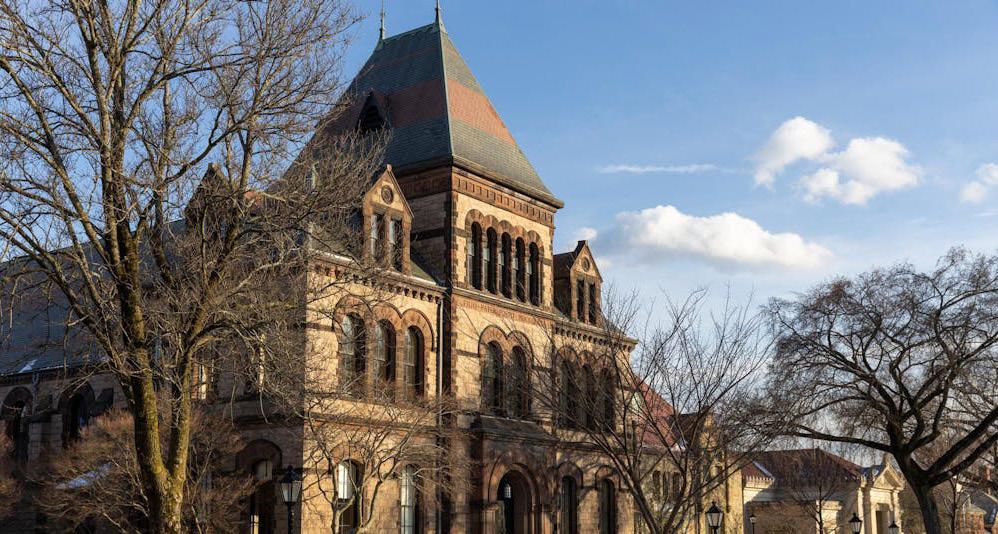
University to open Campus Center to public, streamline entry at Rock, Page-Robinson
Brown ID-holders will have 24-hour swipe access to the Campus Center
BY IAN RITTER UNIVERSITY NEWS AND SCIENCE & RESEARCH EDITOR
The public will be able to access the Stephen Robert ’62 Campus Center from 8 a.m. to 5 p.m. on weekdays beginning April 27, and Brown ID-holders will have 24-hour swipe access to the building, according to a Wednesday Today@Brown announcement.
After receiving community input, the University will adjust entry to some campus buildings and streamline security procedures for entering the John D. Rockefeller Library and Page-Robinson Hall, Executive Vice President for Finance and Administration Sarah Latham and Vice President for Public Safety and Emergency Management Hugh Clements shared in the announcement.
The changes follow a period of heightened security in the wake of the Dec. 13 shooting and the launch of multiple security assessments to evaluate campus safety. Teneo, the global consulting firm overseeing the reviews, has solicited feedback from the campus community through focus groups, listening sessions and Brown University Community Council meetings.
Additional changes include returning to “standardized reliance” on card readers at the Rock and Page-Robinson Hall to “ensure that students can enter the library more quickly and efficiently” and providing 24-hour access to the Campus Center for students with a Brown ID “to ensure Brown students have a dedicated space for late-night academic work.”
INTERNATIONAL FROM PAGE 1
the time apart. “I ask myself that on the daily,” she said.
The difficulties associated with her immigration status as an international student extend to other facets of her life at Brown, both inside and outside of the classroom.
She said she is often hesitant to express her political views in large classes, fearing the small chance of being reported for what she says and facing deportation or trouble with the federal government. “I don’t even want to risk it,” she said.
She also said that there are certain on-campus groups she would be more involved in if she weren’t an international student. “I would definitely be more engaged in writing political articles,” she said. Right now, she is an editor for campus publications, but is careful not to include her full name on certain pieces she edits.
She added that she has been hesitant to participate in campus protests, and she has noticed similar sentiments among other students from the Global South.
After the U.S. Department of State released a policy announcing that immigration officials will vet the online presence of anyone applying for an F, M or J non-immigrant visa — documentation that applies to individuals studying or participating in a cultural exchange — the student stopped interacting with social media posts related to the United States or politics.
“I thought Americans were the optimal example of advocacy for political freedom,” she said. “It has been really mindblowing to me that I don’t really see as much reaction as I expected.” She added that this has left her “a little disappointed.”
She said that Brown has done what it can, but that most of these issues are out of the University’s control. “It’s just a really difficult situation,” she said. “The truth is no one knows what is going to happen.”
For reading period and final exams, the Sciences Library will return to 24-hour swipe access during reading period and final exams. There has been no academic space on campus open 24 hours to students since the SciLi changed its hours to close at 2 a.m. on weeknights.
“The decision to return to 24-hour access to prepare for exams ensures students have ample dedicated study space during the busiest times of the year, supplementing the 24-hour overnight study access now available at the campus center,” the Wednesday announcement reads.
“In closed doors”: Comfort levels with campus expression
During his student visa application process last summer, another student unfollowed all news accounts on social media, “especially left-leaning news.” He carefully monitored his social media activity, ensuring he didn’t comment on or like any posts that opposed the current administration.
As an international student from Vietnam, he said he feels more comfortable expressing his views in the United States than at home, though he is still cognizant of actions and words that could jeopardize his visa status. He said he feels comfortable expressing his views in private and with close friends behind closed doors at Brown, but he avoids any public comments or demonstrations that pertain to politics.
“In public, I wouldn’t say something that goes really against the agenda of the administration,” he said. “It’s just minimizing risks,” he said. “The administration is finding every reason to deport anyone.”
Drawn to the “meritocratic” nature of the United States, he said he plans to apply for a green card after graduation and pursue citizenship. While he said it may be harder to get a job without U.S. citizenship, he is hopeful this will change after the current administration’s term comes to an end.
The student said he can still pursue most of the activities he enjoys at Brown, including filmmaking and entrepreneurship. There are some activities he feels like he can no longer participate in — such as debate or advocacy work — but he said his time is filled enough without them.
“It’s definitely restrictive,” he said. “I just have to come to terms with it because I can’t really do anything about it.”
“We feel like criminals”: Strict screening and limitations to free speech
Another student from a country in the
Middle East is still able to return home but shared that the process for reentering the United States creates fear and paranoia that impacts his experience at Brown and beyond.
When the student attended high school in Boston during the first Trump administration, his visa was suddenly canceled without explanation, he said. After a year and a half, during which he attended school in his home country, he was eventually able to obtain another F-1 student visa. He said he has since then has faced increased scrutiny when entering the United States, which he suspects is likely due to the flagging of this cancellation.
Every time he reenters the United States, he is brought into a small room at the airport for secondary inspection, a process that is intended to verify the information and status of an individual. There, he said, agents often interrogate him for about an hour. He called the process intimidating and frightening. “Every time I enter the States, I’m never not shaking,” he said.
In the room, they often ask him personal and specific questions that he said can be difficult to answer, such as the addresses and social media accounts of distant family members.
“I’m here to try to get a good education. I’m not here to do anything else,” he said. “When we get interrogated like that, we feel like criminals.”
At Brown, the student said he “definitely feel(s) comfortable” expressing his views in person. But online, he is more hesitant. He said that even on Brown websites and class discussion boards on Canvas, he is careful to appear politically neutral.
During the pro-Palestine protests on campus in spring 2024, the student said he couldn’t attend the demonstrations due to concerns of being recorded. “I feel for
“These adjustments are part of an ongoing effort to balance safety and security with the openness our community values,” the announcement reads. “We are continuing to refine our security posture to ensure it is practical, streamlined and responsive to the needs of our students, faculty and staff.”
the Palestinians,” he said. “I really wanted to go, but I couldn’t go because of that.”
This kind of self-censorship has impacted the way he views the right to free speech guaranteed by the U.S. Constitution. “I do not have free speech here” as an international student, he said. “You don’t have to be a U.S. citizen to have free speech, but it feels like you need to be a U.S. citizen.”
He said that while the government in his home country is often criticized for censorship and free speech restrictions, the guidelines there are clearer than in the United States.
“Back home, I know my limits,” he said. “Don’t talk about the government publicly, and don’t criticize religion.” In the United States, “I would be scared to share my views on anything,” he said.
After he graduates, he plans to leave the United States. He said that while he would like to come back for his friends’ graduations, he believes that obtaining a visitor visa will be very difficult. “I wish I could be able to come, but it’s out of my control,” he said. “I think that’s what hurts the most.”
“You just don’t really know how much they’re actually looking at”: Surveillance and self-censorship When she was 13 years old, Isabella Wei ’27 came to the United States from China for boarding school. She was on an F-1 student visa, and she obtained a green card during her first year of college.
She said she is “quite comfortable” expressing views in casual settings, but is more hesitant to publicly express her views.
“This used to be a China-specific issue, but now, I guess it’s the same thing for the U.S. too,” she said, noting cases of people’s social media accounts being banned back in China.
Wei said she still worries about her
This article originally appeared online at browndailyherald.com on April 22, 2026.
green card status, as she said she has heard of people with green cards being deported.
Wei said she will “always criticize” the Chinese government’s “censorship and surveillance.” Now, over the past year in the United States, “there were so many moments where I’m like, so I’m basically living in China again,” she said.
“I used to think that in the U.S., I would be comfortable writing my original opinions and publishing them, putting them out, but now I don’t necessarily think that anymore,” she added.
Wei, who is a member of the Student Clinic for Immigrant Justice, said she sometimes doesn’t put her name on petitions or attend community-organizing events because of her status as an international student. “I think if I had more freedom… I would do (community outreach) more for causes that I really care about,” she said.
In high school, Isabella used U.S. social media platforms rather than Chinese platforms to follow the A4 Revolution or White Paper Protests — a wave of 2022 protests against censorship and strict COVID-19 lockdowns in China — and help organize a protest at her school. Now, she no longer uses U.S. platforms in this way and is “less vocal” online. “In the back of my head, it’s just like, this is not a safe space anymore,” she said.
The White House did not respond to a request for comment.
One of the difficulties in being an international student is how “the whole system is so opaque,” Wei said. “You just don’t really know how much they’re actually looking at.”
KAIA YALAMANCHILI / HERALD
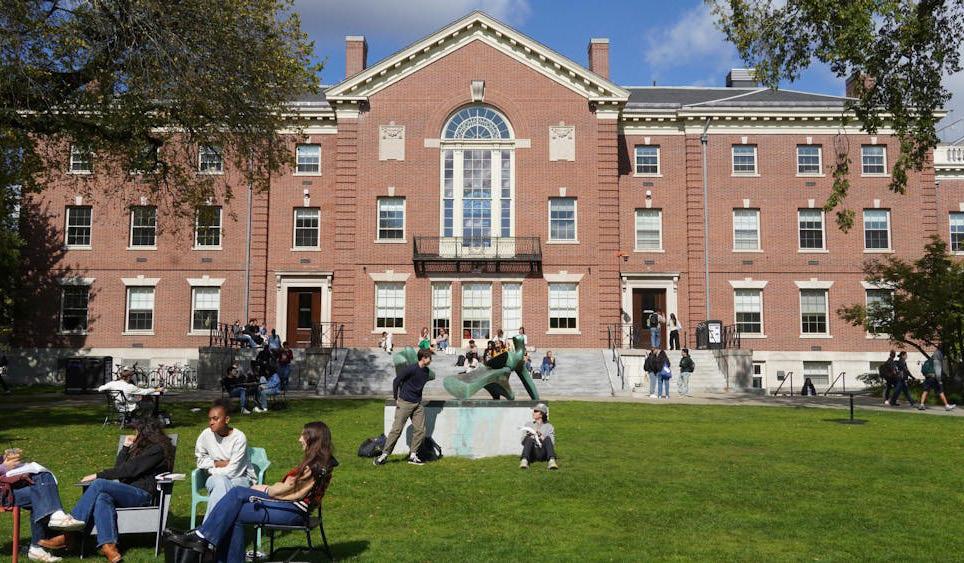
The changes follow a period of heightened security in the wake of the Dec. 13 shooting and multiple security assessments to evaluate campus safety.
‘She had so much love’: In memory of Annie Song
Friends and family described Song as exceptionally caring and joyous
BY SAMAH HAMID UNIVERSITY NEWS EDITOR
Annie Song ’28 was a devoted friend, had a passion for serving others and brought joy wherever she went. She was exceptionally empathetic and easy to confide in, and was known among friends for her boisterous laugh.
Song — a sophomore from Seattle studying public health and international and public affairs — passed away in February.
“I think one of the first things that you learn about her is how much she loves to laugh and share joy with others,” said Tane Kim ’28, who was Song’s boyfriend. “You could hear her laughter echo down the building before you saw her.”
“She was the happiest person I’ve known,” he added.
Kiara Anderson ’27, who served on the executive board for the Infectious Disease Society Magazine alongside Song, also recalled Song’s laugh and caring nature as a friend.
“Even though it’s been a while since I’ve heard her voice, I’ll never forget her laughter,” Anderson wrote. “She had these hilariously over-the-top reactions to everything I’d say, good or bad.”
In March, the Korean American Student Association, the IDS and close friends of Song’s coordinated an event in remembrance and celebration of her life.
Song was a dedicated friend who would always go out of her way to support those she loved.
Photo of a girl wearing a black and white cardigan and jeans holding a large bouquet of flowers with pumpkins lining picnic tables in the background.
Kim recalled how one night, while he was studying for a midterm, he texted Song and mentioned that he was feeling tired. Soon after, she surprised him with a matcha drink, despite having to walk from her dorm on north campus to a shop downtown on the other side of the Providence River in the pouring rain to do so.
“She didn’t tell me that she was gonna do it, she just showed up to the SciLi basement, absolutely soaked,” he said. “That’s

one of my fondest memories of her.”
Jason Kim, Song’s cousin, especially admired the way Song “maximized every minute of her life,” making the time to “invest in her friendships” despite her many academic and extracurricular commitments, he wrote in an email to The Herald.
Song was a program development intern at Women’s Refugee Care, a Meiklejohn Peer Advisor and was a residential assistant for Brown’s Pre-College program, according to a University email sent after her passing.
Even after time and distance led to less frequent communication between them, Song “was always the first to reach out,” Jason Kim wrote. “It speaks to her character that she always prioritized relationships with the people she loved.”
Song’s mother, Jinhi Choi, believes that Song “naturally helped connect people.” Song’s friendships were “not casual to her; they were something she nurtured with

time, attention and love,” Choi wrote in an email to The Herald.
Song’s considerate personality extended far beyond her personal life. According to family members, Brown’s campus was a space where Song was able to pursue her interests in public service.
“It seemed like a place where she felt empowered to form her identity and be inspired to explore the ways she could impact the world,” Jason Kim wrote.
“She just wanted to leave the world with an impact,” Jabin Lee ’28, a friend of Song, recalled.
During Song’s childhood, she and Choi often discussed how to live a purposeful life “not defined by what we have, but by how we use what we are given to care for others,” Choi wrote.
“Looking back now, I realize that Annie quietly held these conversations in her heart and, in her own way, she was already living out those values — with sincerity, humility and a genuine love for people,” Choi wrote.
Song always showed her friends how much she loved them, and her love language was “definitely words of affirmation,” Reia Lee ’28, a friend of Song, wrote in an email to The Herald.
“I could tell by the way she spoke that she had so much love in her heart and was entirely unafraid to show that love to the people around her,” Anderson wrote.
To Reia Lee, Song was simultaneously “a wise older sister and a wild younger sister,” providing “the best advice,” while laughing and cracking “the most brainrotted jokes” during their moments together.
“Annie taught me that I should never hesitate in expressing love and appreciation, and I hope she is remembered for that,” Reia Lee added.
Before coming to Brown, Song was active in many service-oriented organizations in high school. She participated in student government, co-founded a youth ambassadors program through the National Alliance on Mental Illness and testified in support of legislation regarding student mental health.
“She was not only curious about the world, but also deeply motivated by a desire to understand people and to contribute, in her own thoughtful way, to their wellbeing,” Choi wrote. “Even before college, she was already walking gently but clearly toward a life of service, learning and care for others.”
On campus, Song was the communications chair for the IDS Magazine and KASA.
Yejin Song ’26 first met Annie Song at a social event for KASA that matched older students with younger peers. “Annie was one of the last people I met at that event, and it was literally like love at first sight,” she said.
“She’s just this ball of light,” Yejin Song said. “If you had an interaction with Annie in any single day, your mood will instantly be brighter.”
Yejin Song recalled an instance where, while messaging back and forth, Annie Song sent Yejin Song “10 voice memo clips in a row of her laughing, just like cackling, and it was like, insane, squealing laughter.”
Annie Song was also very passionate about music and played the violin. She served as concertmaster in the Seattle Youth Symphony Orchestra and was selected as a member of the National Youth Orchestra in high school.
At Brown, she was interested in chamber music and eagerly shared her passion with her friends, sending them song recommendations and attending concerts together.
Yejin Song said that one of her and Annie Song’s “bucket list” items was to play together in a quartet before Yejin Song graduated.
“We were so excited to play together this semester, and over break, she was listening to so many different quartet repertoire to try to find a good one,” Yejin Song recalled. “She sent me like three in the span of one hour and was so enthusiastic about the different choices and playing together.”
Annie Song shared her love and appreciation for music with her mother, who worked as a music therapist. In September, Annie Song gifted her mother two tickets for pianist Yunchan Lim’s performance at
the Boston Symphony Orchestra in March for her mother’s birthday, knowing that her mother particularly admired the musician.
“It was a gift not only of music, but of time together — something she had carefully prepared with love and intention,” Choi recalled. “That concert still took place, but I was not able to go with her as we had planned. Even now, it is difficult for me to fully put into words the sadness of that moment. And yet, what remains even more powerful than the sadness is the overwhelming sense of gratitude I feel for her heart.”
Annie Song wore her feelings openly, something Andrea Yiu ’28 found comfort in.
On one instance, Annie Song, who loved making flower bouquets for friends, walked around campus picking blossoms with Yiu. The two ended up lying on the Quiet Green, reflecting on relationship experiences and ultimately shedding a few tears. Yiu recalled how Song was the kind of friend she always felt comfortable crying in front of.
“Annie was a very sentimental and empathetic person, probably the most of that combination I’ve ever met,” Yiu said. “I think it’s very rare to meet someone who is that ambitious, who also makes that much time for their friends and still keeps in touch with their inner child, and still maintains that level of authenticity.”
Choi wrote that Song lived her life with grace and faith.
“As her mother, what remains with me most is not only what she did during her time at Brown, but how she lived,” Choi wrote. “She lived with a sincere love for people, with gratitude in the ordinary and with a heart that sought to build community.”
“She was deeply loved, and she also deeply loved others,” Choi added. “Her life, though far too short, was filled with sincerity, care and a quiet commitment to the people around her.”
In March, the Korean American Student Association, the Infectious Disease Society and Song’s close friends coordinated an event in remembrance and celebration of her life.
COURTESY OF YEJIN SONG
COURTESY
for comment.
Graduate and undergraduate student employees represented by the RIFT-AFT Local 6516 union, which encompasses the Graduate Labor Association, announced that they would be closing their accounts with the bank due to the ICE ties. RIFT-AFT Local 6516 President Michael Ziegler GS wrote in a message to The Herald that the amount banked with Citizens Bank amounted to about $500,000.
The Greater Boston Interfaith Organization, or GBIO, which comprises over 60 religious groups and unions, also announced that they would pull $1 million from their accounts in Citizens Bank if the bank does not “move quickly to end its relationships with the prison companies,” according to the De-ICE Citizens Bank Coalition’s press release.
Before the protest began, roughly 15 students gathered in front of the Faunce Arch around 8:15 a.m. to walk downtown together.
“We need to change the rules of this
game, to shift away from this logic of profit at all costs,” Gupta said at the protest. “This isn’t something that’s easy to do, but it’s worth fighting for.”
Following Gupta’s speech, mayoral candidate and state Rep. David Morales MPA’19 (D-Providence) also denounced Citizens Bank for funding the for-profit ICE facility operators.
“CoreCivic operates 16,000 detention beds. Their goal is to increase the amount of detention centers and beds by 13,000 by the end of this year,” Morales said in his speech. “And if that is to happen, it’s only going to be made possible because of the financing that they receive from institutions like Citizens (Bank).”
“We are telling Citizens (Bank) that now is the time to divest,” Morales said.
Ryan Gustin, a spokesperson for CoreCivic wrote in a statement to The Herald that they “don't provide specifics about financial relationships beyond what (they) provide in (their) publicly available financial disclosures.” Gustin added that the company plays a “limited but important


role in America’s immigration system.”
Gustin also wrote that the company’s “ICE-contracted facilities are subject to multiple layers of oversight and are monitored very closely by our government partners to ensure full compliance with policies and procedures.”
GEO Group did not immediately respond to The Herald’s request for comment.
Speakers also pointed out the relevance of this issue to the Providence community, which has seen increased ICE activity over the last year. Last November, a Providence Superior Court intern was temporarily detained by ICE agents on College Hill, prompting a protest of over 100 community members.
“We have been seeing endless, countless sightings of ICE at the Garrahy court-
house (and) the Superior Court, and this is scary,” Muñiz said. “They’re spreading terror throughout Providence.”
“As a Brown University student, I see that as my duty to come down here and stop a financier of ICE’s terror,” she added.
ICE did not immediately respond to The Herald’s request for comment.
People traveled from outside of the state to take part in the protest. Kim Jalet, who came from the Boston area, joined the protest to send the message that “it is okay to change their mind. It is okay to put people over profits.”
Denise Duval, who came to the protest from Connecticut, decided to participate because she wants people to “understand that these are concentration camps and (Citizens Bank is) funding that.”
ICE, Citizens Bank and GEO Group
did not immediately respond to The Herald’s requests for comment. Gustin wrote in the statement sent to The Herald that CoreCivic’s “responsibility is to care for each person respectfully and humanely while they receive the legal due process that they are entitled to.”
According to the De-ICE Citizens Bank Coalition’s press release, the Citizens Financial Group CEO agreed to “meet with GBIO members to discuss their concerns.”
After the shareholder meeting ended, meeting attendee Rich Gatto spoke at the event, applauding the demonstrators for showing up. According to Gatto, he spoke with Van Saun after the meeting.
“(Van Saun) said to me, ‘I want to reassure you, we are going to take a hard look at how these companies are performing,’” Gatto said.
R.I. federal court order allows out-of-state attorneys to represent in-state detainees
The order comes amid a spike in habeas corpus petitions
BY MICHELLE BI METRO EDITOR
On April 13, the United States District Court in Rhode Island issued a general order allowing out-of-state attorneys to represent clients filing habeas corpus petitions — which challenge federal detentions — on a pro bono basis for the next year.
As of April 15, habeas corpus petitions made up 32.2% of all civil cases filed in the state in 2026, according to Frank Perry, the chief deputy clerk for the R.I. federal court. Of the 67 habeas corpus petitions filed in 2026, 59 were immigration-related — the same number filed throughout 2025
In 2025, habeas corpus petitions made up 9.7% of civil cases — an increase from 2.4% in 2023 and 2024.
The order follows a request filed to the court by three organizations — the Lawyers’ Committee for Rhode Island, the Habeas Project of New England and Mass Deportation Defense — on March 30. The request asked the judges to “temporarily suspend” the requirement for attorneys filing pro bono habeas corpus petitions to be members of the Bar of the R.I. federal court.
A general order from Chief Judge John McConnell Jr. ’80 granted the request, citing “exceptional circumstances” from increased habeas corpus petitions to justify the decision. The out-of-state attorneys
must be in good standing with the bar of at least one federal or state court, among other requirements. The court may choose to extend the order past one year in the event that “exceptional circumstances” continue to exist.
McConnell’s order can facilitate “more efficient access to representation,” Perry wrote in an email to The Herald.
Immigration-related litigation often crosses state lines throughout New England. According to Amy Romero, the chief legal counsel for the Lawyers’ Committee for R.I., Wyatt Detention Center is the only detention center in Rhode Island. The center houses detainees from states such as Rhode Island, Connecticut, Massachusetts, New Hampshire, Maine and Vermont.
Up until the general order was issued, some out-of-state attorneys had to reach out to R.I. organizations for assistance in representing their clients who have been detained in Rhode Island.
Cindy Salazar, an immigration attorney based in Pawtucket but licensed in Massachusetts, told The Herald that she currently has 6,000 active clients. Due to her out-ofstate license, Salazar has been “forced to rely on” the help of organizations such as the Lawyers’ Committee for R.I. in managing and filing her habeas petitions.
“We get requests for habeas every single day,” Romero told The Herald. “We say (the caseload is) unprecedented, but that doesn’t really do it justice.”
Romero said that her organization aims to represent detainees “regardless of where they live.”
While Salazar described the role of the

The out-of-state attorneys must be in good standing of the Bar of at least one federal or state court, among other requirements.
Lawyers’ Committee for R.I. as “essential,” she also noted the burden that falls upon out-of-state attorneys when handing off their clients to R.I. attorneys who might be less familiar with their cases.
“Some of these clients have been with us for 10, 12, years,” Salazar said. Trying to summarize those long-term cases in “a phone conversation of 30 to 45 minutes is really an injustice.”
This court order “helps us to continue to really represent our own clients that
we’ve already been representing,” she added.
Romero noted that she has already received correspondence from other advocates across the United States hoping to gain similar orders from their own courts.
“(Immigration and Customs Enforcement) is moving people across the country, and they’re moving them to places where it’s very hard for them to get pro bono immigration help,” she said. “These sorts of court orders help counter that.”
ICE did not respond to The Herald’s request for comment.
Even in the face of increasing detainments, Salazar said they are hopeful.
“The more litigation we have, the more eyes we have on the problem, the more that we’re going to come closer to a solution,” Salazar said.
This article originally appeared
23, 2026.
SELINA KAO / HERALD
CUNYAN MA / HERALD
MARAT BASARIA / HERALD
CITY POLITICS
Providence mayoral candidates share stances on housing, immigration

BY TALIA KATZ SENIOR STAFF WRITER
On April 22, four declared Providence mayoral candidates — incumbent Brett Smiley, state Rep. David Morales MPA’19 (D-Providence), Michael English and Allen Waters — met at the Salomon Center at a community forum.
The forum, which was organized by Brown Votes, was open to pre-registered members of the public and livestreamed. Over the two hours, candidates discussed their views on housing affordability, federal immigration enforcement, public transportation and more.
The room erupted in applause several times for Morales, with Smiley receiving a fair share of support as well — while the other two challengers were often met with silence from the audience.
During the first phase of the debate, student moderators asked candidates a series of prepared questions, followed by audience-generated questions randomly selected from a jar.
Much of the discussion revolved around Providence’s housing crisis, following Smiley’s veto of the rent stabilization ordinance passed by the City Council that would have capped rent increases at 4% annually.
In relation to rent control, Smiley said that a fellow mayor told him “when the problem is complex, be wary of simple solutions.” Instead of stabilizing rent increases, his platform includes building more housing, preserving existing housing and protecting tenants. He cited his administration’s creation of 2,000 new housing units.
But challenger Morales argued that this measure is not sufficient, as for many working families, a rent increase equates to “an eviction notice.” He recounted his own childhood experience of couch-surfing in between expensive leases.
“I find it absolutely shameful that during this time of need, we have a mayor that would veto such a measure,” Morales added. He emphasized that he also supports developing affordable housing units.
English proposed restructuring Providence public high schools into a centralized campus to turn other buildings into new affordable housing. Waters — the sole independent candidate running against three Democrats— proposed a greater emphasis on cooperative housing. He also argued that residents lacking permanent legal status contribute to increased demand and pressure on the limited housing supply.
All candidates except Waters, condemned the actions of Immigration and Customs Enforcement. Waters described himself as “America first” and emphasized his support for “law and order.”
“What makes Providence so great is that we have so many immigrants,” English said. “I’m not into the whole ICE thing.”
Smiley emphasized that “Providence is a city that welcomes everyone, and we mean everyone.” He noted his Jan. 20 executive order which prohibited ICE activities on city property.
For Morales, the topic was personal.
“As the son of a single immigrant mom, I am terrified by what is happening in our community,” with “fascist ICE agents” showing up across Providence, he said.
Immigrations and Customs Enforcement did not immediately respond to a request for comment.
“In Providence, we care for our immigrant communities,” Morales said both in Spanish and English, to a long round of applause. He also said that he would direct the City Solicitor’s Office to collaborate with grassroots frontline immigrant defense organizations, like the Deportation Defense Network.
Tensions with the federal government also came up during the candidates’ discussion of food insecurity. In November 2025, approximately 23% of Providence residents were enrolled in the federal food assistance initiative Supplemental Nutrition Assistance Program, also known as SNAP. SNAP’s funding has been threatened by national cutbacks.
Waters asserted, “I’m not at war with Donald Trump.” He argued that Providence will not receive federal funding “if we keep fighting the man that’s got
the main desk right now.”
Smiley responded by stating that an estimated 16,000 children in Providence have had their food benefits cut. “When the federal government cuts aid to the children in Providence, we are at war with the federal government,” he said.
The White House did not immediately respond to a request for comment.
A rare moment of agreement arrived during a discussion about public transportation. All candidates underscored the importance of public transportation to Providence, with Smiley voicing vocal opposition to Rhode Island Public Transit Authority cuts by the state and Morales advocating for “a city where connectivity is our strength.”
A spokesperson for Gov. Dan McKee did not immediately respond to a request for comment.
Waters consistently drew the most polarized reactions from the audience.
In response to a question about the city’s relationship with Brown, Waters stated that “Brown University is one of the most anti-American institutions in the United States,” to which attendees responded with laughter.
The University could not immediately be reached for comment.
To conclude the forum, Morales emphasized his support for affordability.
“Together, we’re going to build a Providence for all,” he said. “In Providence, we don’t ask for much. We just want to afford a life in the city we love.”
English closed by pitching his plan
for building “the largest casino in the world, at 1.4 million square feet” in Providence, in order to generate jobs and community engagement. He also acknowledged his criminal record — English served time for a child molestation conviction in the late 1990s.
Waters said that Providence is “a minority-majority city and so many people who are adrift with no hope and no future” and that it needs “leaders that actually can get into the heads and the hearts of the people.”
Smiley finished by emphasizing his track record of experience as mayor.
“This is a hard job. I've spent three and a half years balancing difficult budgets, responding to crises and leaving this city, and I’m confident that for the next four years, we can bring our city to even greater heights,” he said.
Leslie Price, who attended the forum, said that “some of these people running for office are very detached from reality,” specifically regarding the “needs of the people in low-income housing.”
Jill Davidson ’89, a Providence City Council member for Ward 2 who also attended, said that she “appreciated that there was a wide range of opinions expressed tonight.”
“We don’t often hear that in Providence politics,” she said.
Three of the four candidates are running as Democrats
The forum, which was organized by Brown Votes, was open to pre-registered members of the public and livestreamed.
JAKE PARKER / HERALD
BUSINESS
Federal judge temporarily halts cannabis retail license distribution
Recreational marijuana use has been legal at the state level in R.I. since 2022
BY LAILA POSNER SENIOR STAFF WRITER
Last fall, the Rhode Island Cannabis Control Commission opened applications for cannabis retail licenses for the first time since the state’s legalization of recreational marijuana use in 2022 — which is still illegal at the federal level. The state received 97 applicants for up to 24 new dispensary licenses, which were set to be selected through a lottery in May.
But around two weeks ago, R.I. Federal District Court Judge Melissa DuBose issued a preliminary injunction against the license distribution process, prohibiting the CCC from processing applications or holding a lottery. The basis of the litigation — which includes three lawsuits by out-of-state marijuana retailers — is the residency requirement in Rhode Island’s 2022 Cannabis Act.
Last Tuesday, the CCC filed an appeal against the preliminary injunction.
The residency requirements mandate that an applicant for a license must either be a R.I. resident or be applying with a business where over half of the equity is owned by a R.I. resident. The act also includes a $7,500 application fee for prospective marijuana shop owners, as well as a secured physical location.
The out-of-state retailer plaintiffs argued that the residency requirement violates two constitutional provisions: the dormant commerce clause — an implied restriction, based on the commerce clause, on states’ ability to pass laws that could
BUSINESS

regulate interstate commerce — and the equal protection clause.
CCC Chief of Public Affairs Charon Rose wrote in an email to The Herald that the residency requirement is “part of a broader effort to prioritize participation by (R.I.) residents and to advance the state’s local economic development goals.”
“Knowing the Act was facing legal challenges in this Court, the CCC continued forward with its plan to implement the Act and its licensing scheme,” DuBose wrote in the preliminary injunction. “The resulting
fall-out will be, to be blunt, self-inflicted.”
DuBose had previously dismissed two lawsuits that contested the residency requirements in the act. But when the U.S. Court of Appeals in Boston renewed the case late last year, the higher court ordered Dubose to decide on the case at least 45 days before the CCC awarded the licenses.
Cannabis retail license applicant Asher Schofield — who also owns Frog and Toad, a store in Providence — told The Herald that he wishes that Rhode Island took inspiration from the “plenty of existing
precedent” in other states administering such licenses.
“It’s very frustrating that we’ve seen such incredible delays,” said Schofield, who said he began his licensing process in 2022 with the goal of opening a cannabis co-op — a dispensary in which workers own the store and share in the profits. The 2022 Cannabis Act had designated six of the possible retail licenses to these stores.
If Schofield receives a license, he said, his store will demonstrate that the cannabis business “does not necessarily need to be
The Nitro Bar to start brewing in Fox Point
The coffee shop’s new storefront will open in late May or early June
BY PAVANI DURBHAKULA METRO EDITOR
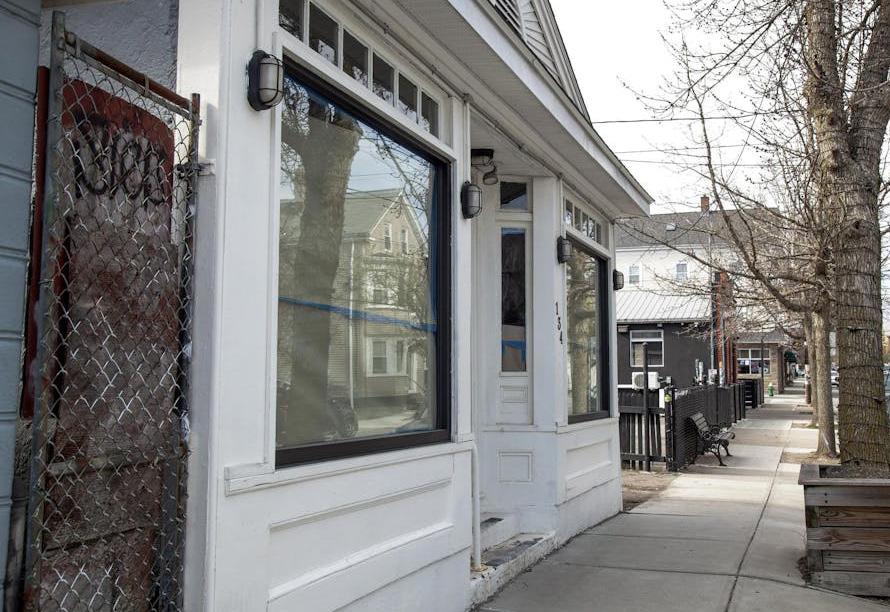
The Nitro Bar, a Rhode Island-based coffee company, will be opening its second Providence location at 134 Ives Street in the Fox Point neighborhood. The new storefront, which is set to open in late May or early June, will fill the space formerly occupied by Glou, a bar that closed earlier this year.
“Providence, you’ve always been home to us,” reads an Instagram post from The Nitro Bar announcing their new location.
The Nitro Bar began as a mobile coffee cart that traveled around Providence before co-founders Sam Lancaster and Audrey Finocchiaro opened the first permanent location in Providence on 228 Broadway. Since then, the coffee shop has opened two locations in Newport and announced plans for their first out-of-state location in New York City.
“Audrey and I have always wanted to open up a second shop in (Providence),” Lancaster wrote in an email to The Herald. They “considered a few locations throughout the years but nothing ever felt 100% like the right spot,” he wrote, adding that they have always wanted to be in the Fox Point neighborhood.
Lancaster wrote that as they move into 134 Ives Street, they have “big shoes to fill.”
“When we were approached about the
space being available, we were sad to hear Glou was closing its doors,” Lancaster wrote. But they “are hoping that we too can be a community space for the neighborhood to hang out as they were.”
Though the new location is only about 700 square feet, Lancaster wrote that they are especially “excited about the planned outdoor seating” that it will have.
“I’m actually so excited,” about the new location, said Lily Young ’27. “I had
the banana latte that they did last year, and it was so good, but I had to walk really far to get it … so I’m excited that we’re gonna have one closer to campus.”
Currently, Young said she doesn’t go to The Nitro Bar very frequently because of the distance from campus.
“It’s cool that they’re expanding more within Rhode Island (and) they’re not forgetting their roots,” Young said. “They’re very proud of being from Rhode Island.”
The Nitro Bar strives to use local products “whenever possible,” Lancaster wrote, and many of their items — including pastries, cold brew and syrups — are made by their Pawtucket production team. In addition, they partner with local vendors for eggs, dairy, lemonade, cider and produce.
owned by several corporations” and can instead be “worker-owned and operated in a way that really benefits the working class people.”
As of now, “the market is in the hands of just a few very vertically-integrated businesses.” That model does not “encourage “a diversity of business viewpoints and business models,” he added.
This article originally appeared online at browndailyherald.com on April 23, 2026.
Lee attended the talk that Finocchiaro gave at the Nelson Center for Entrepreneurship earlier this semester. “I just really liked her whole story and philosophy,” she said, referring to the business’s evolution from a coffee cart to multiple permanent locations.
“Nitro Bar is an independent cafe, but it’s definitely becoming a larger chain now,” said Porter Culp ’28. “I would have loved to see more of a new business opening up for new sorts of coffee.” But Culp acknowledged that many of his friends were excited about the opening.
Excitement about The Nitro Bar’s new location extends beyond the Brown community.
Kara Komprathoum, a Providence resident living on the East Side, wrote in an email to The Herald that she is “so excited it’s coming to the east side” of the city. Komprathoum recalled seeing The Nitro Bar’s beginnings as a coffee cart. “It was really cool to see a keg of cold brew in a cart just on the sidewalk,” she wrote.
“I follow a lot of Providence area entrepreneurs’ journeys into their eventual storefronts and it makes me so happy for them,” she wrote. “I feel this type of joy about The Nitro Bar.”
This article originally appeared online at browndailyherald.com on April 21, 2026.
Abigail Lee ’29 is also eagerly anticipating the opening of the new Providence location. “It being only a five to 10 minute walk is gonna be really nice because I can go there so much more frequently,” she said, adding that she visits the cafe around once a month with her friends.
KAIOLENA TACAZON / HERALD
The basis of the litigation — which includes three lawsuits by out-of-state marijuana retailers — is the residency requirement in Rhode Island’s 2022 Cannabis Act.
JACKSON JONES / HERALD
The Nitro Bar began as a mobile coffee cart that traveled around Providence.
HEALTH
RIDOH confirms first measles case of 2026
The patient had recently returned from an international trip
BY TALIA EGNAL METRO EDITOR
On Saturday, the Rhode Island Department of Health confirmed the state’s first measles case of 2026. The state’s last confirmed measles case was in January 2025 — the first since 2013.
The patient — a man in his 40s who recently returned from a trip abroad — is currently recovering at home. RIDOH, the Atmed Treatment Center in Johnston and the Division of Global Migration Health in the Centers for Disease Control and Prevention are working to identify and notify those who may have been exposed. People who were at Providence bakery Panadería El Quetzal between 4:30 and 6:30 p.m. last Wednesday were potentially exposed.
According to RIDOH epidemiologist
and Medical Director Suzanne Bornschein, the chances of this case leading to a more severe outbreak is low due to high rates of vaccine coverage in the state. Around 97% of kindergarteners are fully vaccinated with the MMR vaccine, which protects against measles, mumps and rubella.
To prevent the disease from spreading, a community has to have a vaccination rate over 95%, according to Jennifer Nuzzo, director of the Pandemic Center and a professor of epidemiology.
“I feel so incredibly fortunate that Rhode Island has such high (vaccine) coverage,” Nuzzo said, applauding state immunization efforts. “Measles is one of the most contagious diseases we have.”
The measles virus can remain in a room up to two hours after the infectious patient has left. Those infected are contagious four days before and after the disease’s signature rash appears, according to Bornschein.
RIDOH attempts to track and follow up with everyone who made contact with the
measles patient, keeping an eye on exposed patients for the length of the virus’s 21-day incubation period — the time a pathogen takes to show symptoms.
Unvaccinated patients can receive treatment in the form of a post-exposure vaccine within 72 hours of contact, which can reduce chances of sickness. Those who are immunocompromised or too young for the vaccine can receive antibodies up to six days after exposure.
Contact tracing “takes a lot of staff hours,” Bornschein said, and the numbers are “never small.”
The FIFA World Cup this summer is expected to attract a million visitors, both domestic and international, to Rhode Island — which has the potential to bring travelers with measles, Bornschein said. RIDOH has begun preparing healthcare providers on identifying and responding to highly contagious pathogens.
It can be difficult for a physician to diagnose measles immediately, according
to Michael Koster — the director for the Division of Pediatric Infectious Diseases at Hasbro Children’s Hospital and a professor of pediatrics — because early-stage measles resembles a normal cold. The main symptoms are a fever, cough and runny nose.
Measles has no cure, but “the good news is we have a vaccine that works,” Koster said. Because the measles virus does not mutate like the flu or COVID-19, the vaccine confers “a life-long protection.” But if even 1% of the around 4 million children born in the United States every year are unvaccinated, 40,000 children are at risk of infection, Koster said.
Koster stressed that vaccines are recommended for infants as young as six months old, especially if they are travelling to areas with high rates of measles — including countries like Mexico and Canada or some states including Utah and Texas.
Since Rhode Island’s last measles case, the United States has seen thousands of new measles cases at higher and higher
On RISD’s campus, AI remains contentious issue
Professors at RISD can control the permitted uses of AI in their classes
BY EMILY FEIL AND IZABELLA PIATKOWSKI METRO AND UNIVERSITY NEWS EDITOR AND SENIOR STAFF WRITER
When applying to the Rhode Island School of Design, students are allowed to use artificial intelligence in their portfolio as long as the admissions committee is made aware of how it was used in the creation of the work.
But on campus, the RISD community is split on the role of AI in art.
While RISD has not published a formal institutional policy on AI, its Academic Code of Conduct prohibits the use of AI if it is not attributed properly or if it gives the student an “unfair academic advantage.”
“RISD embraces the ethical use of artificial intelligence (AI) in the creative process,” the school’s admissions page states.
Jeanne Alailima, a RISD first-year and prospective textiles major, said that allowing AI in admissions portfolios seems to demonstrate the school administration’s positive stance toward AI. But among students, she said that the general opinion was “slightly more negative.”
Alailima added she is “open to the possibility” of AI being used as a tool to make art more accessible. But “I kind of like the idea of using technology as a tool rather than doing the thinking for me,” she said.
As the Senior Instructional Designer at RISD’s Teaching and Learning Lab, Dimitris Papadopoulos provides workshops, resources and advice for faculty members to determine how they want to approach AI in the classroom.
“My main role is to think about pedagogy first, not technology,” Papadopoulos said. When helping faculty navigate how to implement AI, he encourages them to explore questions of how AI would impact learning objectives and students’ ability to find their own voice in the classroom.
Course policies range from “zero AI to fully exploring and engaging AI,” he said, and there have been more than a dozen RISD courses about AI and its implica-
tions on writing and art since ChatGPT was released.
In the Department of Computation, Technology and Culture, it is difficult to “ignore this kind of technology,” Papadopoulos explained. But in areas like the Division of Liberal Arts, “things tend to be a little bit more restrictive when it comes to the use of AI,” he added.
“It’s never the answer to redesign your whole course or teaching approach just because of AI. But there may be certain components worth reconsidering, including, most importantly, I would say, grading and assessment,” he explained.
Susan Solomon MA’09 PhD’13, a faculty fellow in the Teaching and Learning Lab for spring 2026 and a lecturer in the Department of Literary Arts and Studies, introduced a poem recitation and discussion assignment to her first-year seminar class this year, something she “would probably never have done” if not for AI tools making her question whether students had actually completed the course readings.
“I’m skeptical and concerned about the
way (generative) AI tools can interfere with the kind of learning I want my students to do, and I know I'm not alone,” she said.
But Clement Valla, the head of the computation, technology and culture department and a professor at RISD, said that he allows students to use “as much AI as they want but to be completely transparent about it.”
Valla said that students in his classes typically use AI to expand the capabilities of Photoshop or build custom textures for video game production.
“Students get bored with (AI) quickly because it has such a recognizable style, so I actually don’t see that much image generation happening,” Valla said. “The really exciting stuff is happening in tool building, custom software building (and) custom product development.”
Valla said he can tell when students have used AI to revise their work instead of going through the project development themselves. While AI is good at ideation, it “isn’t good at refining or changing direction slightly,” and it constantly wants to jump
rates. According to CDC data, there were 2,288 confirmed cases in 2025 — and as of April 16, 1,748 confirmed cases in 2026.
“We’re living in a period where measles outbreaks become the new normal, which is incredibly costly,” Nuzzo said. “It’s deadly, it’s costly and it is a hard burden for health care and public health systems to bear.”
“Even in a state like Rhode Island, where the MMR coverage is high and we have a world class state health department … even in a place like this, we can still see measles cases that will be costly and threaten health in the state,” Nuzzo added.
“Global health impacts us locally, too,” said Sadie Allspaw ’28, advocacy lead in the club Partners in Health Engage.
“Measles is highly preventable with the vaccine,” she added. “In that way, it’s just a disease of injustice.”
This article originally appeared online at browndailyherald.com on April 22, 2026.
to a final product, he added.
Naomi Zaro, a RISD junior in the illustration department, said she does not use AI because “there’s so much beauty in mistakes and something being human-made.” She said that in response to growing AI use, students are shifting away from technology toward traditional mediums, such as painting.
According to internal RISD documents obtained by The Herald, enrollment in the painting major has increased by 70% from 2023 to 2024.
Zaro said that in class critiques, students tend to appreciate work that is visibly handmade.
Athena Evans, a RISD first-year and prospective architecture major, said that she has seen AI be used for translation, given RISD’s large international student body, but that “socially, it’s very looked down upon to use AI” for conceptualizing or executing work.
In her role as a Teaching and Learning Lab faculty fellow, Solomon held a workshop with the liberal arts division on
teaching and learning in the age of AI. As part of the workshop, they discussed “what kind of learning do we want our students to gain or carry out or practice, and what kind of activities can really ensure or really create space for them to do it,” she said.
Solomon explained that in light of RISD’s emphasis on amplifying artists’ voices, she thinks it is vital that students “believe in their voices” without feeling the need to use AI to “make their voices good enough.”
RISD’s Teaching and Learning Lab also holds a summer program for faculty to learn more about AI called the “Critical Thinking and Making with AI” Faculty Institute.
Papadopoulos said that some faculty “have very real and very legitimate concerns” about the environmental and ethical implications of using AI. The CTMAI Faculty Institute tries to address this by offering “localized versions of AI models” that do not require setting up accounts with corporate AI companies, Papadopoulos said. This allows faculty to engage with AI in a way that gives them more control over their AI usage, he said. “I think that can help demystify the technology, but also open it up to all sorts of creative uses and ways of critically engaging with it.”
Valla said that fears that AI will replace humans can be placed in a broader historical discussion about the development of tools, noting that “photography was supposed to replace artists,” but that it instead “liberated” from striving for perfect likeness.
“I’m not pro or against,” Valla said. “It now exists. Let’s figure out what it does well, what it does really badly.”
But he did acknowledge that layoffs in certain industries are occurring as companies replace human artists with AI. Valla specifically cited layoffs of illustrators in the video game industry, calling those decisions “incredibly shortsighted.”
Unlike more physical mediums such as painting, sculpture or furniture design, Zaro says that her specialization — illustration — is at a greater risk of being replaced by AI since it can be done digitally.
AI “is a statistical machine that outputs the most likely outcome,” Valla said. “So is that really a way to build unique pieces of culture?”
CAROLYN NAKAWUNGU / HERALD
pj party
pj party post- crossword
by Lily Coffman, Ishan Khurana, Tseyang Dolma Arow
illustrated by Emily Chao
Across Down
1.Hit movie-turned-Broadway musical about choir-singing nuns
10.Momentary mistake or break
15.Goes up
16.Organization for workers’ rights
17.Partner to Average Joe
18.“__ ___ enter”
19.Bareilles and Teasdale, for two
20. Attach digitally
21.The “L” of LSD
26. Common encryption algorithm with three initials
29.Semi-soft cheese, potentially including jalapeños
34.“And so on,” abbreviated
35.“As You Like It” heroine
36.Friend __ ___? Pick a side.
37.Cozy nap spot for a feline
39.Leafy sound
40.First sign of the zodiac
41.Spanish cats
44.Weasley of “Harry Potter”
45.Luxurious way to take a personal journey abroad
47.Suffix with oct- or prop-
48.Pointless pursuits
51. Bestow
55.Prayer endings
59.Money, slangily
60.Bedtime clothes, possibly in jersey material…or when abbreviated, a clue to 17, 29, and 45 Across
64. “Ratatouille” food critic Ego
65. Traveled across
66. Rescues
67. Undergraduates often experience eight of them
1.Drinks slowly
2.At the Hollywood sign, say 3.“Lion King” antagonist
4.Error’s partner
5.Wee
6.Koothrappali of “The Big Bang Theory”
7.Busy __ _ bee
8.One hundred yrs.
9.Mao ___-Tung
10.Absolutely absurd
11.Soon, for Shakespeare
12.Pantheress descriptor
13.Fireplace residue
14.Prefix meaning within 20.What you should let sleeping dogs do 22.Put the pedal to the metal
23.Slithery swimmer
24.Technical sch. in Troy, NY
25.Transcript no.
26.Summarize, as a TV show
27.Ringo of Paul McCartney’s band
28.It often comes after intermission
30.PSAT takers
31.Media workers union that merged with SAG in 2012
32.:
33.Author(s) of “Nancy Drew”
35.Delivery methods?
38.A short drink?
39.College-hosted training program for military hopefuls
41.Understand
42.Pop trio of brothers with songs “Way Less Sad” and “Bang!”
43.Piping hot goss
46.Black gunk
49.Luxury lounge chair
50.Brainy
51.Healthcare workers who support MDs and RNs
52.Charlie Chaplin’s wife
53.Punishment for not doing one’s homework
54.Sheet of ice
56.To be, in Latin
57.____-do-well
58.Syphilis, gonorrhea, etc.
60.They may teach you mobility exercises after injury
61.“___ we there yet?”
62.A tricky spot
63.___ Maria



5. Cain about to kill his brother
6. Twenty-three of Caesar’s closest friends
7. Kendrick Lamar
8. Man about to get visited by three weird ghosts
9. Mr. Darcy
10. Count Olaf at those kids
1. Sue Sylvester
2. The Grinch
3. Andrea Long Chu
4. Martin Luther
by Lily Coffman, Ishan Khurana, Tseyang Dolma Arow illustrated by Emily Chao
cover by Candace Park

“Too long without distinguishing my roommates’ laughs among their cacophonous howling, and I start to feel suffocated by the hush of my hometown. It’s a tricky balance that I never really figured out over these past four years.”
— Samiha Kazi, “how to be someone”



letter from the editor
Dear Readers,
I am in the eye of the storm. I can see it swirling around me: final papers, final projects, packing my dorm into a storage unit, packing my closet into a suitcase, packing myself into a plane, the uncountable amount of tiny, minuscule tasks that must be completed before summer can begin. But right now, I’m untouched. I can’t say I’m basking in the sunlight, as the weather has taken a turn for the cloudy and chill again, but I am doing my best to breathe and embrace my remaining days of calm.
And there’s lots to embrace: TV nights with my roommates, cozy books in a cozier bed, making slow progress on the sweater I started knitting all the way

— Angel Benjamin, “minimal effort spaghetti sauce” 04.25.24
“I won’t parrot the age-old advice of how important it is to eat for survival, but it’s a nice feeling when you can enjoy a fulfilling meal—even just a quick one, even if it’s the only peace you’ll have that day. And when you eat with friends? You’re just making memories, and you can never have enough of those.”
05.02.25
“You’d fit right in with the Mormon church.”
“We should do, like, a post- fight club.”
back in January. Regardless of the line-up discourse, I am looking forward to gathering on the Green with you all for Spring Weekend. And, of course, I’m embracing this issue of post-.
Our writers this week are also looking out from the eye of the storm. In Feature, Kayla dives into the whirlwind that is the portrayal of sex work on social media and Michelle wonders about midpoints and in-betweens. For Narrative, Vanessa watches friends fall in love, and for A&C, Sofie watches The Real Housewives of Rhode Island. Also in A&C, Ozzy looks back on the songs that defined his college experience. Indigo asks us to pause and reflect on which post- section we are for Lifestyle, and Ina sucks us into a lovely spring day for post-pourri. Finally, take a break and tackle a FULL-SIZE crossword from Lily, Ishan, and Tseyang!
This semester, post- has always been the eye of the storm. I can tuck myself away at prod night and hide away from the chaos that I will have to return to Thursday morning. I hope this issue can be that for you.
Dancing in puddles,
Elaina Bayard
SPORTS
A snapshot of sports game attendance at Brown

The Herald’s Data Desk analyzed data from fall 2021 to spring 2025
DATA BY ABIGAIL DONOVAN SENIOR STAFF WRITER
The attendance at the annual Harvard-Brown football game may give the impression of a die-hard Bruno fanbase, but The Herald’s Spring 2025 poll found that only 46.7% of students report attending at least one Brown Athletics match per semester. According to the Fall 2025 Poll, only 6.4% of students rated their school spirit at the highest level on a five-point scale.
“I wouldn’t say we have a strong sports culture at Brown,” said Isaac Lowry ’26. As a senior, Lowry said that he has attended all four Harvard-Brown football games, but
no other Brown sports events.
The Herald’s Data Desk analyzed average game attendance data from fall 2021 to spring 2025 across 13 varsity sports. The analysis found that, generally, attendance at games is low.
The football team averages the highest home attendance of all sports with around 5,972 spectators per game, according to Brown Athletics data from the 2024-25 academic year.
“There’s a lot of hype around the Harvard-Brown football game,” Lowry said. “But other than that, I’ve never heard of a sports event really drawing in a large crowd of students.”
Opemipo Clement ’27 added that outside of the Harvard-Brown game, “people are kind of detached” from Brown’s sports culture. Clement added that he regularly attends men’s and women’s soccer games.
Gender gaps persist in attendance numbers
Average home attendance from 2021-22 to 2024-25 academic years for basketball, lacrosse, ice hockey and soccer, by gender
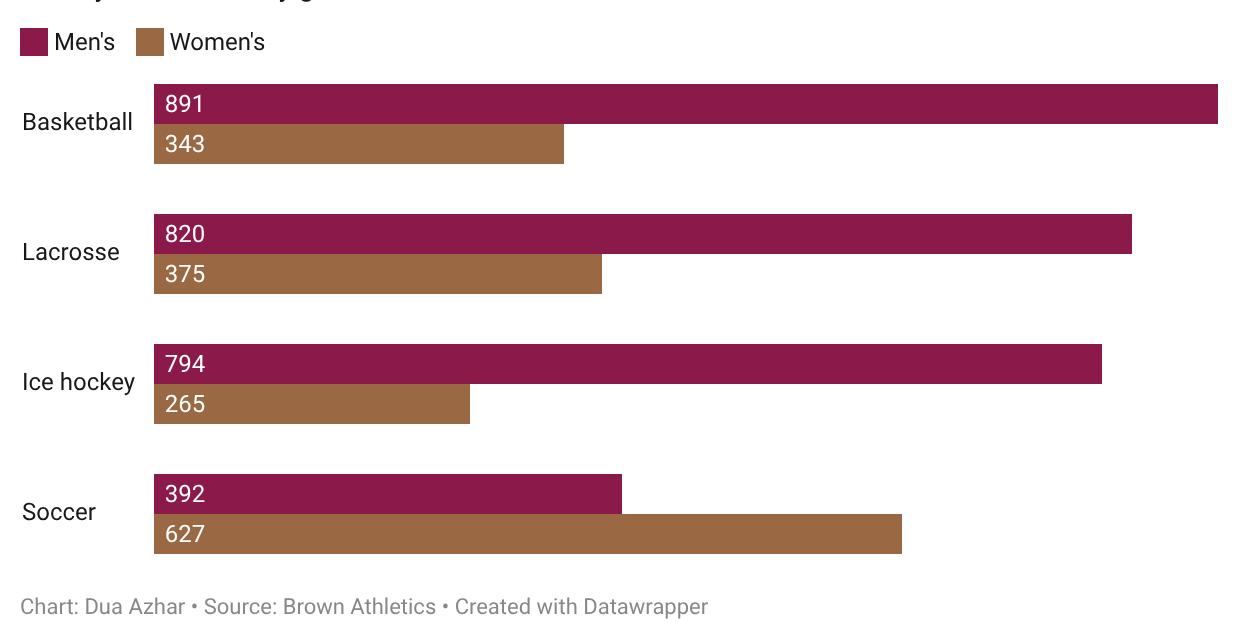
Funding and attendance are closely tied Overall, teams’ attendance was positively correlated with their reported expenses over the same year. Football received almost double the amount of funding than
the next highest-funded team — men’s basketball — and also had an average attendance nearly six times greater.
Women’s soccer was also the only women’s sport to receive more funding
He said that the low attendance may be a reflection of the “quality” of the sports at Brown — and that winning titles may lead students to be more excited to attend sports events.
“We’re not exceptional at our sports,” he said. “So people don’t really show up for that.”
According to Deputy Director of Athletics and Recreation Ray Grant, the department has seen “continued growth in attendance” over the past few years. Grant credits this growth to recent “marketing initiatives and our efforts to remove barriers to attendance.”
“We are continually working to increase attendance at all of our athletics contests, both to strengthen the student-athlete experience for all of our teams and to increase community-building opportunities on our campus,” he wrote in an email to the Herald.
Out of the top five most watched teams of the 2024-25 academic year, the only women’s sport represented was soccer, who came in fourth with an average home game attendance of 748. That season, the women’s soccer team were runners-up in the Ivy League tournament.
Out of the analyzed teams, soccer was also the only sport where the women’s team had a higher average attendance across the past four seasons than the men’s team of the same sport. While
than their male equivalent. Softball, field hockey and women’s volleyball were the three lowest-funded teams among the ones analyzed.
The funding gap between teams also
Home games against the University of Rhode Island saw the highest average home attendance
Across all analyzed sports, home matches against the University of Rhode Island drew the highest average attendance of 992, followed closely by Harvard with 933. In the fall 2024 season, the football team clinched their first win against the Crimson in 14 years in front of a packed home crowd.
Hsiao said the Harvard-Brown football game is “always a great time.”
“I love the school spirit that shows up there,” she said.
In contrast, Dartmouth drew the least attendance of all Ivy League opponents when they came to College
Hill.
Lowry said his lack of interest in attending games is because none of his friends go to athletics events and he does not know many athletes.
Daniel Shwin ’27 said he attends soccer games because he has friends on the team. But otherwise, he said there is not enough of a culture to attend sports events at Brown to encourage him to attend.
“If there was more hype around it, I would definitely … go more,” Shin said.
The Herald’s Spring 2025 poll backs up the fact that athletes attend far more
Brown Athletics events than non-athletes on average — with 76% of varsity athletes and only 16% of non-athletes reporting attending at least one per month as a spectator.
“We would love to see even more engagement, and we continue to work with our student-athletes, student leaders on campus and community groups to” increase attendance at Brown sports events, Grant wrote.
Explore home and away attendance data for 13 of Brown’s Varsity sports online at browndailyherald.com.
Football saw the highest average home game attendance
Sports with the highest average home game attendance during the 2024-25 academic year
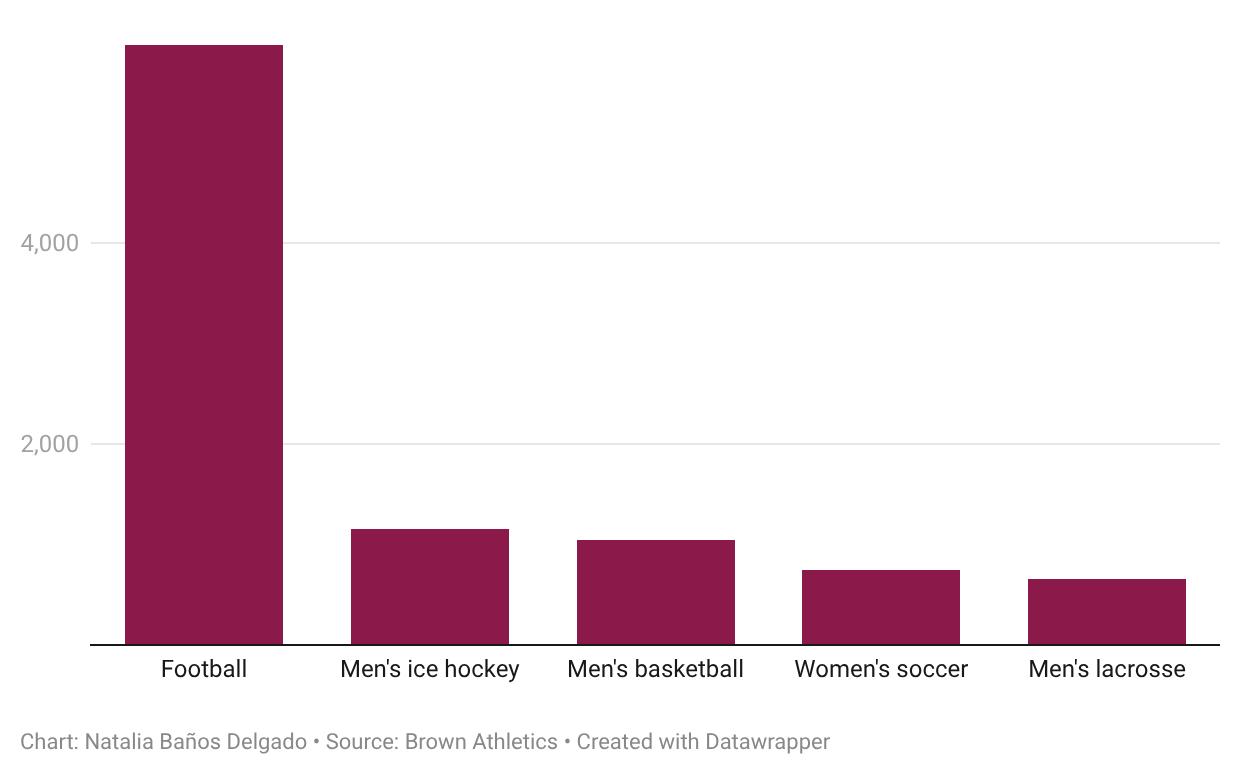
men’s ice hockey and basketball ranked second and third in overall average attendance, the women’s ice hockey and basketball did not draw large crowds — pulling 33% and 39%, respectively, of the attendance of their male counterparts.
Softball player Jasmine Hsiao ’26 said that her team often shows up to support other Brown women’s teams including soccer, rugby, lacrosse and field hockey. The softball and baseball teams also often show up to cheer on each other, she said.
manifested through discrepancies in athletic staff pay.
The University’s 2025 Equity in Athletics Disclosure Act survey reported that the average salary per men’s team
“(We) try to attend as many games as we can, just to support everyone in the Brown athletic network,” Hsiao said. Hsiao said that athletes and their friends constitute a “network” that attend many games across different sports.
“That’s even more special, because you have a personal connection with everyone in the crowd,” she said. “You’re playing for your school, your school pride, and the people that come to support you.”
head coach was $196,372, while for women’s teams’ it was $121,503. The average salary per assistant coach was $63,595 for men’s teams, and $43,341 for women’s teams.
Average home attendance of schools who visited Brown at least 10 times from the 2021-22 to 2024-25 academic years
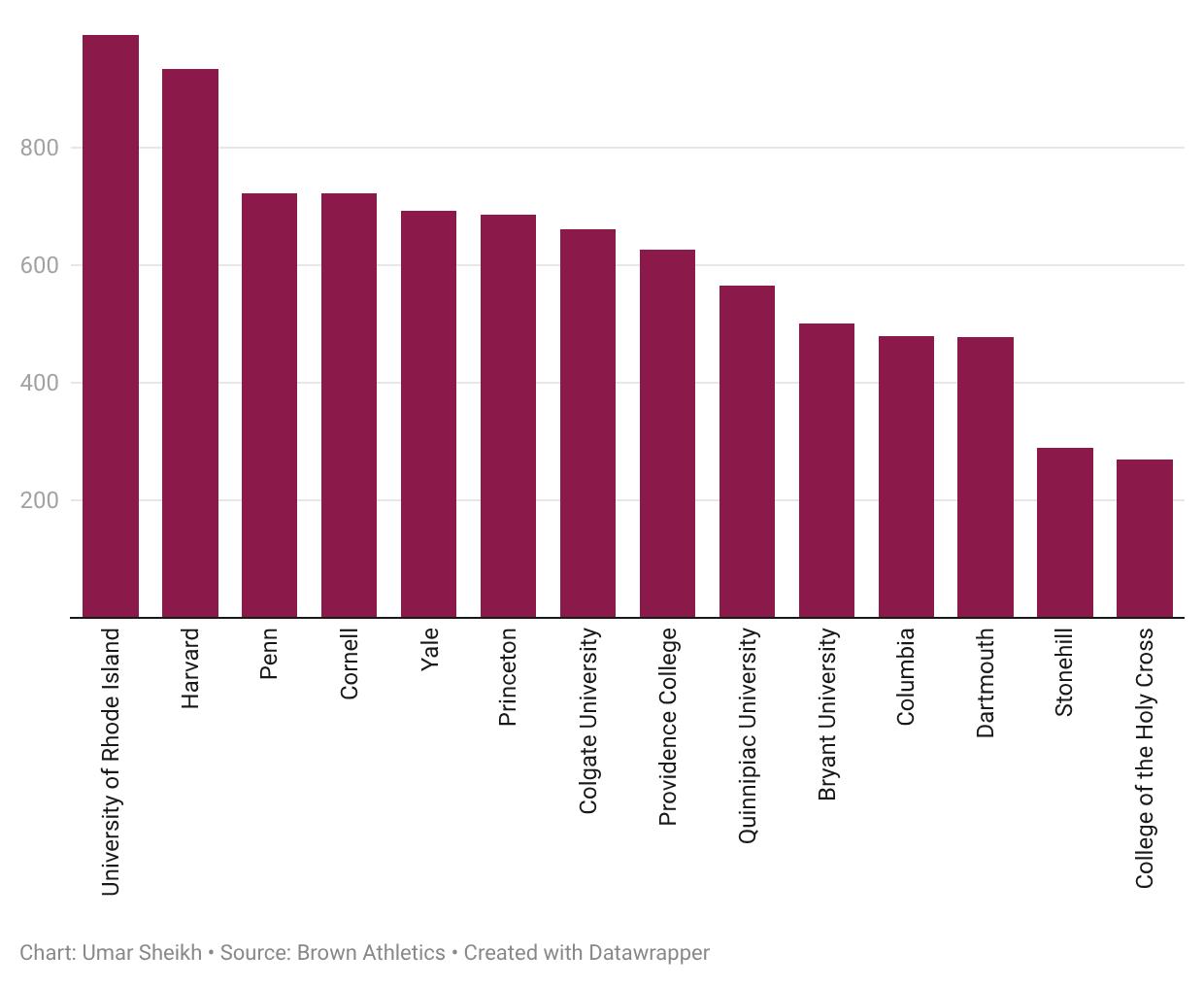
JAKE PARKER / HERALD
TENNIS
Women’s tennis finishes regular season with 4-1 win against Penn, 4-1 loss against Princeton
The Bears ended the season at No. 4 in the Ivy League
BY RAHUL SAMEER STAFF WRITER
On Saturday, the women’s tennis team (16-8, 3-4 Ivy) secured an impressive 4-1 win against Penn (11-12, 2-5 Ivy). The victory sealed their penultimate match of the regular season and marked the Bears’ third Ivy win.
Following Saturday’s success, Bruno faced Princeton (18-3, 6-1 Ivy) on Sunday in the season’s final match. Unfortunately for Bruno, the Bears could not maintain momentum from their win over Penn — ultimately losing to the Tigers 4-1. After the loss, Brown sits at No. 4 in the Ivy League standings.
For the first time since 2023, the Bears also earned a place in the national rankings, peaking at No. 49 in February, according to Head Coach Lucie Schmidhauser. As of April 21, the Bears remained nationally ranked, sitting at No. 64.
Saturday’s competition started off with three doubles matches, with Brown looking toward Anne Yang ’27 and Ali Maguy ’28 to bring them closer to the doubles point.
Yang and Maguy rose to the occasion and threatened to break the Quakers’ serve in the very first game. Inching towards a break point opportunity, Bruno delivered a stunning backhand passing shot at 15-15. Later, at 30-40, Penn split the I-formation but was ultimately caught off guard when Brown smacked the ball crosscourt. While Penn stretched to return the ball, Bruno immediately sent it back
BASEBALL

The weekend wrapped up a successful 2026 campaign for Bruno.
with a firm forehand volley winner that secured the break point for the Bears.
As the game progressed, Yang and Maguy kept their momentum, breaking Penn’s serve once more and jumping out to a 4-1 lead in the set.
The pair’s remarkable teamwork continued into the next game. After Maguy maintained an aggressive crosscourt rally with Penn, Yang poached with a backhand crosscourt volley. In the very next point, Maguy’s backhand lob put a stop to Penn’s attempt to create a two-up scenario during the next point.
“I think I played well during Saturday’s game with clarity in my strategy and game,” Yang wrote in an email to The Herald after the match. “Ali and I played our
best doubles match together yet, setting each other up with quality balls.”
As Penn attempted to lob Yang at match point, she leaped into the air and smashed the ball crosscourt to close out a 6-2 victory for the Bears.
“I feel like this has been my best season yet, and I’m excited to build upon it for my last time around next year,” Yang wrote.
Francesca Saroli ’29 and Chloe Qin ’29 also triumphed 6-2 in their match, clinching the doubles point for Brown.
In addition to the powerful team performances, Schmidhauser added that there were also “some great performances this spring by individual team members.”
She added that two players “who have real-
ly stood out” are Yang and Abigail Lee ’29.
Despite only joining the team last fall, Lee already boasts an undefeated 6-0 match record in Ivy League play. Schmidhauser described Lee’s season as “the best performance by a (first-year student) in my nine years as the Brown Women’s tennis head coach.”
On Saturday, Lee’s singles match was a tight, pressure-packed contest. With the overall score at 3-1 in Brown’s favor, Lee’s win would ultimately catapult Brown to victory by earning the team’s match-winning fourth point.
Yet while Lee grabbed the first set 6-0, Penn’s Joleen Saw rallied back during the second and took the set 6-4. Lee’s plays were aggressive — often conquering the net and using quick reflexes to bag points — but Saw’s consistency proved challenging to manage.
The final set soon reached 5-4 to Lee, with Saw serving to stay in the match. Sensing an opportunity for Lee to break and win the afternoon, Lee’s teammates gathered by her court to watch the game unfold.
Lee continued to dominate offensively. After a brief rally, she struck an offensive forehand inside out, making Saw scramble to return the ball. Lee delivered another blistering forehand to finish the rally. After a long 13-shot rally, Saw finally blinked and sent a forehand into the doubles alley, ending the final set at 6-4 to the Bears.
With the contest’s overall outcome already decided, the remaining two matches concluded early.
Reflecting on the match in an email to The Herald, Lee wrote that her thought process was “to stay on court as long as possible,” as her teammate Saroli “was in a close second set tiebreak.”
“I slowed everything down,” she
wrote. “From the time I spent in between points to the length of points I played, everything was longer and slower. Changing the pace of the game also changed the momentum of the match.”
The next day, Brown faced Princeton in their last match of the regular season. But even with the buoy of Saroli’s straightsets singles win, Brown fell 4-1 after losing two doubles and three singles matches.
Despite Sunday’s loss, the weekend ultimately wrapped up a successful 2026 campaign for Bruno. The Bears began the season in a dominant fashion, racing out to a 4-0 record before the Eastern College Athletic Conference Championship. Following their fourth-place finish at the ECAC tournament in February and a loss to Baylor, Brown gained momentum throughout a seven-match win streak during — which included victories against Seton Hall, the University of Rhode Island, Marist and Stony Brook.
In Ivy play, Bruno’s season also saw wins against Cornell and No. 63 Dartmouth before Saturday’s victory over the Quakers.
“As none of the starters were seniors this year, we are returning all of our top players for next year and we are excited to build on our momentum from this year,” Schmidhauser wrote.
“Overall, I’m incredibly proud of the team and motivated from the game against Penn this weekend,” Yang wrote. “It was a strong showing of what we’ve been working hard for since we arrived on campus in the fall and demonstrated many strengths to take into the next season.”
This article originally appeared online at browndailyherald.com on April 23, 2026.
Baseball splits home doubleheader against Columbia
The Bears picked up the first game 6-1 before falling 11-2
BY HARRY GUO SENIOR STAFF WRITER
This past weekend, the baseball team (1714, 9-4 Ivy) split a doubleheader at home against Columbia (10-21, 6-8 Ivy), winning 6-1 in the first game before dropping the second 11-2. Sunday’s series finale was postponed due to weather.
Coming off the heels of a dominant 9-1 win against Holy Cross (16-23, 10-10 Patriot League) last Tuesday, Bruno entered the series looking to carry the momentum forward.
The doubleheader began with an electric performance from pitcher Peter Dubie ’26, who struck out the first nine batters he faced. Over the course of the game, he allowed just one run on three hits, four walks and three strikeouts, setting the tone for Bruno early on.
On the other side of the field, Brown wasted no time getting on the board.
In the bottom of the first, Matt Luigs ’29 swatted a double to immediately reach scoring position. Mika Petersen ’26 laid down a sacrifice bunt to move Luigs to third, and Alex Benevento ’28 followed with a ground ball to Columbia shortstop Jack Kail. Kail bobbled the ball, allowing Luigs to score and give Brown an early 1-0 lead.
“I … knew if I could get on base I would score, because Mika and Alex (Benevento) are so hot at the plate right now,” Luigs
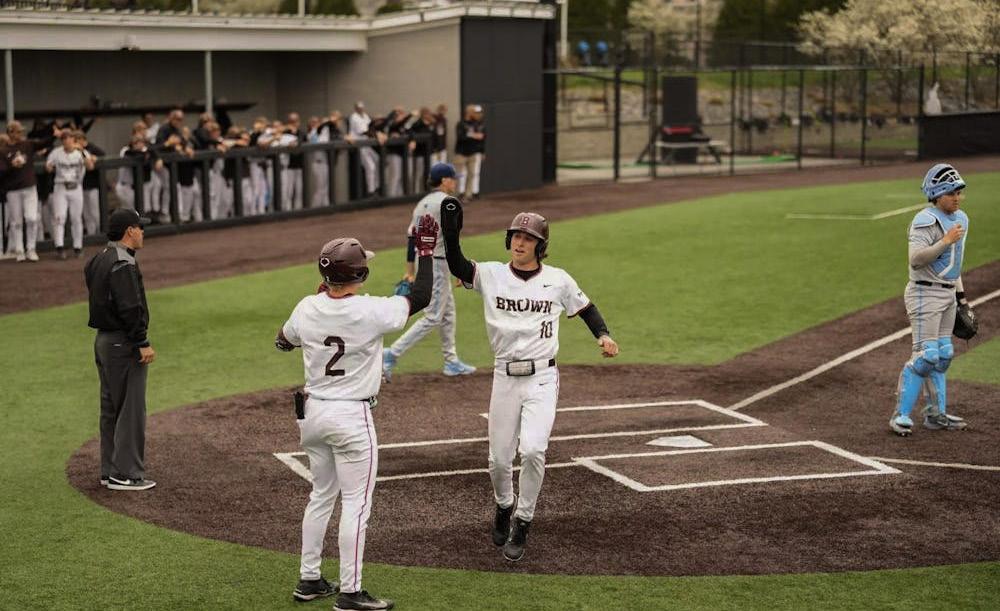
wrote in an email to The Herald.
The Bears added to their lead in the second inning. Jack Edmunds ’28 sent a ball sailing over the head of a Columbia defender deep into center field, allowing Mark Henshon ’26 to score all the way from first and extend the lead to 2-0.
After quiet third and fourth innings, Bruno broke the game open in the fifth.
With Luigs and Petersen on base, DJ Dillehay ’26 stepped into the batter’s box and launched a deep fly ball to left field.
The Columbia outfielder could not make the play as the ball skimmed over the wall
for a three-run homer, pushing the Bruno lead to 5-0.
Brown added one more run in the sixth, when a Luigs groundout to shortstop was enough to push Henshon home from third base to bring the score to 6-0.
Columbia finally responded with a run in the seventh, but the Bruno bullpen held the Lions scoreless the rest of the way. Brown shut down Columbia in the top of the ninth, which sealed the 6-1 Brown victory.
At the start of the second game — just a few hours later — the Bears jumped ahead and looked poised to sweep the double-
header.
In the bottom of the first, Dillehay once again delivered, rocketing a ball deep to center field. With Luigs already on second base, the hit brought him home and gave Bruno an early 1-0 lead.
But the Lions quickly flipped the script.
“They did a great job of flushing a tough loss in game one, and came back ready to punch,” Luigs wrote.
Columbia took their first lead of the day in the top of the third with a pair of hits, one of which was a two-run homer that made the score 2-1 Lions.
Columbia’s offense continued to pile on runs in the fourth inning. A solo home run to lead off the frame sparked a three-run inning, with two more scoring plays that pushed the Lions’ lead to 5-1.
Brown struggled to respond offensively as Columbia’s momentum kept building. The Lions plated single runs in the sixth and seventh innings before delivering the decisive blow in the eighth, when four runs extended their lead to 11-1.
The Bears managed one final run in the bottom of the ninth. With Henshon on third, Christian Butera ’28 stepped up to the plate and pushed Henshon home to cut the deficit to 11-2.
But Brown could not generate any further offense, and Columbia closed out the win 11-2. The Sunday series finale was postponed due to weather conditions, and the two teams were forced to settle for the weekend draw.
Sitting second in the Ivy League, the Bears will look to return with a win as they travel to Cambridge for a matchup against Harvard (8-21, 6-8 Ivy) on Tuesday.
“If you let the highs get too high, or the lows get too low, the team becomes very emotional and momentum-based, which leads to streaky runs and a lack of consistency,” Luigs wrote. “So, we treat it just like every other game: go into it respecting the ability of your opponent, but confident that you are better than they are.”
This article originally appeared online at browndailyherald.com on April 20, 2026.
KARINA SHAH / HERALD
COURTESY OF BROWN ATHLETICS VIA ASHTON DANIEL ROBERTSON
The Bears looked poised to sweep the doubleheader after jumping ahead early in the second game.
ARTS & CULTURE
tions to not second guess his own creative instincts,” Neville said. “And I think that is something that is a huge lesson.”
The film follows McCartney from the breakup of The Beatles to the height of the Liverpool-based musician’s next band, Wings. When Paxson asked why he decided to revisit this period in his life, McCartney laughed before pointing at Neville, saying, “It’s all his fault.”
When Neville reached out to McCartney to propose the film, Neville said he was a “bit of a fan,” McCartney said. From there, McCartney “kind of just trusted him.”
He noted that there were some “embarrassing” moments he had considered cutting, referencing the archival footage of him and Wings dressed up as clowns during “Mary Had A Little Lamb (Desert Video).”
“I don’t know how (the other members) forgave me,” McCartney laughed, recalling how the video embarrassed “the hell out of” his band members. Neville ultimately persuaded the musician by emphasizing how even these moments are “part of the journey.”
After he spent five years creating the film, Neville showed the work-in-progress to McCartney and his daughter Mary McCartney at Abbey Road. While Neville recalled the screening as the “most nerve-wracking moment” of the project, his worries were soon allayed after McCartney’s playful,
yet heartfelt, response. At the end of the screening, the singer stood up to give Neville his notes — only to reveal a blank piece of paper.
For both artists, the most challenging aspect of the film was its emotional weight. This film also told the story of Linda — McCartney’s first wife and Wings member who passed away in 1998 — and fellow Beatle John Lennon, who was killed in 1980.
“It was very hard, and at the same time glorious, to see (Linda) and to see her humor,” McCartney said. He also appreciated that Neville “very sweetly” emphasized his friendship with Lennon, as the two musicians “really loved each other.”
In an attempt to capture the voices of those who had passed, Neville included voiceovers from Lennon’s son, Sean Ono Lennon, and spoke to McCartney’s children about how to “give Linda as much of a platform for us to understand her and really appreciate her in a way that I haven’t really seen before.”
During a screening of the final film for both his and McCartney’s families, Neville recalled two stand-out reactions from the singer’s grandchildren: “One was ‘I’d never heard my grandmother’s voice before!’ and the other was ‘Grandpa went to jail?’”
“That’s true,” McCartney quickly quipped.
The evening finished with a discussion of McCartney’s current work, as well as

how his tastes and style are constantly evolving. “I don’t have one little field of interest, I like the best in every field,” he said. McCartney’s next album, “The Boys of Dungeon Lane,” will be released on May 29. He noted that the upcoming record will have “quite a bit of nostalgia on it” as well as “love songs” dedicated to his
April showers bring new pop singles
BY KENDRA EASTEP SENIOR STAFF WRITER
While the spring weather in Providence is taking its time to warm up, the world of pop is already heated. From gut-wrenching heartbreak ballads to electroclash club music, the music industry has witnessed a variety of highly anticipated releases from notable female artists.
Dedicated listeners of KATSEYE, Laufey or Olivia Rodrigo are guaranteed to find at least one track worth adding to their playlist.
“PINKY UP” by KATSEYE
Apart from the zebra-skin boots and cyan fishnet tights featured in their music video, global girl group KATSEYE’s new single “PINKY UP” is otherwise predictable. The track — which came out on April 9 — is a palatable earworm that welds melodic verses with a gritty eurodance chorus.
While the song’s EDM-laced beat and maximalist visuals may be enough to start a dance challenge on TikTok, no hodgepodge of blonde wigs, flamethrowers and cheetah-print can distract from the song’s lack of creativity. Similar to the group’s January single “Internet Girl,” “PINKY UP” is a garish display of hyperpop and lyricism that tries a little too hard.
But unlike its hollow predecessor, “PINKY UP” is far from grating. The song is admittedly addictive, and its blissful vocal interludes nearly justify the cringeworthy chants. The track somehow plays to all of KATSEYE’s strengths, stitching together the emotional edge of “Tonight I Might” with the eccentric charm of “Gnarly.”
“Madwoman” by Laufey
In the music video for Laufey’s new song
wife, Nancy Shevell, who also attended the screening that night.
“It’s just great fun to still be able to do things like that,” he said of his new music.
“If I didn’t do it as a job, I would still do it as a hobby because it’s just in me, and I just love it.”
McCartney concluded the night by
rolling up his pants to reveal bright yellow and blue socks. “They’re yellow submarines,” he said as the room thundered with applause.
This article originally appeared online at browndailyherald.com on April 21, 2026.

“Madwoman,” the Grammy-award-winning jazz-pop musician reclines by a poolside alongside a star-studded ensemble of part Asian celebrities. The video, which was released April 13, features KATSEYE’s Megan Skiendel, “The Summer I Turned Pretty” star Lola Tung and Olympic gold medalist Alysa Liu lowering their rose-tinted sunglasses to watch “Heated Rivalry” heartthrob Hudson Williams gracefully climb out of the pool.
The video revitalizes ’70s glamour with paisley-patterned fabric and splashes of mustard yellow. Choreographed butlers, manicured smiles and an uncanny proposal satirize mid-century American aesthetics, creating a delightfully tongue-in-cheek story.
The song itself is a love letter to the musician’s signature sound. Featured on Laufey’s new deluxe album “A Matter of Time: The Final Hour,” the song includes theatrical instrumentation, with the percussion delicately tiptoeing as the strings crescendo forward.
In the pre-chorus, Laufey laments a toxic affair, singing, “But there’s something so vexing ’bout you.” She stretches each syllable as if confessing a bittersweet secret or casting a spell.
The song’s production features a delightful symphony of a twinkling celesta and restless longing. A moodier counterpart to “Lover Girl,” “Madwoman” illustrates how Laufey is still yearning for her idyllic partner. Fans of the singer’s earlier
work are sure to enjoy this new addition to her discography.
“drop dead” by Olivia Rodrigo Last Friday, Olivia Rodrigo released “drop dead,” the long-awaited lead single to her upcoming album “you seem pretty sad for a girl so in love.” The music video for “drop dead” follows Rodrigo as she struts around the Palace of Versailles — treating the ornate castle and Baroque architecture as her personal playground. But the grandiose palace can barely contain the horrific thrill of young love. As she sprints down the gilded halls, the singer-songwriter revels in giddy infatuation, singing, “Yeah, I’d love it if you walked me home / If you promise, we can go real slow.”
The music video is a dreamy haze of lilacs and golds, evoking an unplaceable nostalgia with its grainy lens and closeup shots. Though the video borders on repetitive, Rodrigo does not overstay her welcome — ultimately falling on the palace steps in a lovestruck trance.
“drop dead” is iconically Rodrigo: The song fuses pop-punk hooks with the adrenaline rush of romance. The track hits the sentimental highs seen in “SOUR” and “GUTS” — all while shepherding in her next era of music, one marked by blossoming maturity
This article originally appeared online at browndailyherald.com on April 21, 2026.
The film follows McCartney from the time The Beatles broke up all the way to the height of the Liverpool-based musician’s second band, Wings.
New releases from KATSEYE, Laufey and Olivia Rodrigo are sure to delight
KENDRA EASTEP / HERALD
COURTESY OF © MPL COMMUNICATIONS LTD / PHOTOGRAPHER: NICK DENTAMARO, BROWN UNIVERSITY
‘Point of Entry’ exhibit creates art from an American Elm tree
The exhibition was created from the wood of a tree from the Main Green
BY TAEK LEE STAFF WRITER
In May 2024, an American elm tree was cut down on the Main Green. Now, two years later, the tree’s wood is finding new life through pieces featured in the Brown Art Institute’s new “Point of Entry” exhibit, which is on display from April 23 through May 27.
Eiden Spilker ’24 — the exhibit’s curator — told The Herald that he wanted the exhibit to illustrate the diverse significance that the elm held for community members.
“I was spending so much time thinking about it. What’s its meaning? What’s the historic moment that this is happening at? And I just wanted to get it out of my own head (and) get it into different artists’ hands to see what they have to say with this,” Spilker said.
The exhibit features the works of 11 artists, including alums, Rhode Island community members and one student. According to Spilker, he and Professor of History Holly Case — the exhibit’s other juror — selected artists through an application process based on a conceptual proposal. Since the application did not require artists to present finished works, Spilker said that the selection process was very “meaning-heavy.”
Talia LeVine ’27 — a section editor for Arts & Culture at The Herald and the only student whose pieces were chosen for the exhibit — said that since the artists in the exhibit had started with a concept before creating their pieces, “every single sculpture” was “very immaculately thoughtthrough in detail.”
LeVine’s pieces illustrate their experience as a student activist with Jews for
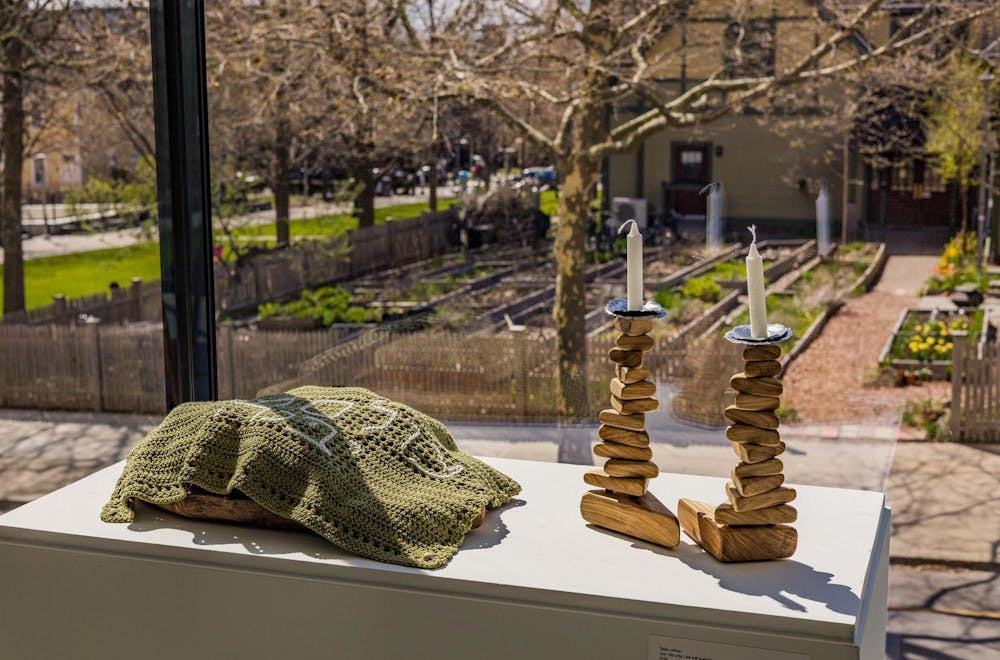
Palestinian Liberation — formerly known as Jews for Ceasefire Now — in the 2023-24 school year. One of their sculptures depicts their interpretation of a student sit-in in November 2023 that resulted in the arrest of 20 Jewish students advocating for the University to divest from companies affiliated with Israel’s military.
A second sculpture, featuring spinning metal half-circles atop a cracked stump filled with beeswax, was inspired by the 2024 encampment, LeVine said.
The elm tree “was kind of the focal point
of so much of the organizing that we did in the encampment,” LeVine said. “It was really a space of community and connection.”
Yasmine Hassan ’17, a part-time studio monitor at the List Art Center’s sculpture studio, was also fascinated by how much history the elm tree carried. “It’s just wild to me how much this elm has witnessed,” she said.
In her piece, Hassan used the tree’s live edge wood — wood that is unprocessed beyond being cut — to create a table with laser engravings on both sides. On the
underside of the structure, a boy can be seen overlooking the rubble of the Lippitt Hill, a residential neighborhood that was demolished during the late ’50s and early ’60s. The other side of the table depicts two men destroying houses with armored military vehicles.
Through the piece, Hassan invites viewers to be curious about the places around them. She encourages viewers “to do their own research” about the history that came before, noting that “if we don’t know about history in general … we’re doomed to repeat
the same mistakes.”
Hassan added that she was “impressed” by the diverse angle that each artist took when interpreting the elm. “It’s just crazy all of the different links that people found, personally and professionally, with this tree.”
An opening reception for the exhibit will be held on April 23 at 5:30 p.m.
This article originally appeared online at browndailyherald.com on April 23, 2026.
‘Noah Kahan: Out of Body’ artfully contextualizes Vermont songwriter’s music
The documentary was released on Netflix on April 13
BY TALIA LEVINE ARTS & CULTURE EDITOR
Released on April 13, “Noah Kahan: Out of Body” is a masterfully crafted film that establishes how the star found his way in the music industry. Available to stream on Netflix, the documentary follows Noah Kahan as he returns to his hometown to reflect on his music, which is heavily influenced by his time growing up in rural Vermont.
Through interviews with Kahan, his wife, siblings and parents, viewers learn more about the stories behind his discography, which is heavily influenced by moments in his childhood and his struggles with mental health. The interviews, which were filmed in the two homes Kahan grew up in, took on a personal tone that made the documentary feel truly authentic to the star’s upbringing.
Fittingly for a film with the name “Out of Body,” Kahan talks openly about his struggles with body dysmorphia and the immense pressure he places on himself to achieve perfection. His interviews portray a level of honesty beyond superficial vulnerability.
One of the more touching moments of the documentary is when he meets

Zuza Beine, who would later pass away at 14 years old after a battle with cancer. Kahan meets Beine backstage and gives her a private performance of her favorite song, “Forever.” The scene with Beine beautifully demonstrates the impact of Kahan’s music and its power to help people through hardship. The documentary also captures the messier bits of the Kahan family’s life. Viewers learn about his father’s traumatic brain injury and many of the other hardships that inspired Kahan’s songwriting.
When talking about his father, who suffered the injury when he was in middle school, Kahan explains that “after the accident, this brilliant guy who was always a little weird and embarrassing, and maybe sometimes short-tempered, became slightly more weird, slightly more short-tempered.”
These moments of vulnerability offered through the stories of personal family experiences serve multiple purposes. While they humanize the artist, they more importantly destigmatize dis -
cussion of these topics — a clear goal of the documentary.
In an interview with Netflix, Nick Sweeney, the film’s director, explained that “when we started filming, I had no idea what we’d capture, only that Noah was determined to be honest about everything, especially the messy bits.” When his mother is asked how she feels about having personal information about their family — including the various divorce trials they’ve gone through — made public, she answers that “Noah
makes our dirty laundry just seem like being human.”
The film was also a perfect homage to the first stage of his career prior to the release of his highly anticipated fourth studio album, “The Great Divide.” Kahan describes how, across his body of work, he intentionally includes enough details for listeners to resonate, but not so many that his entire life story is exposed. His music is candid yet refined, much in the same way the documentary is.
Kahan is also refreshingly honest, which is rare for celebrities today. He explains that listeners often believe that his ability to skillfully narrate his painful experiences means he is able to overcome them as well, but this is not the case.
“They think that, because you know how to say what’s real, you know how to solve that pain,” Kahan says. “I don’t. I never have. I can’t solve it myself.”
Closing with this statement of uncertainty, “Noah Kahan: Out of Body” leaves viewers with a thought-provoking exploration of the role of art in society, which reiterates that it’s okay to not always have the answer.
This article originally appeared online at browndailyherald.com on April 22, 2026.
The exhibit features the works of 11 artists, including alums, Rhode Island community members and one student.
SIA GHATAK / HERALD
Moments of vulnerability both humanize the artist and destigmatize discussion around mental health.
COURTESY OF NETFLIX
OPINIONS
Editors’ note: A semester later, our campus is as strong as ever
On Jan. 23, we published our first print edition as the 136th Editorial Board. Today — over 600 articles later — we are publishing our final print edition of the semester.
In the hundreds of thousands of words we have published since the beginning of our tenure, we have tried to capture the Brown community for all that it is. We are a community shaken by grief, still reeling from the unimaginable violence that shocked our campus on Dec. 13, 2025. But we are also a community defined by incredible joy and resilience.
At the beginning of the semester, our reporters spoke with friends and loved ones of Mukhammad Aziz Umurzokov ’29 and Ella Cook ’28 to capture their memories and lasting impact on College Hill. We learned of their kindness, courage and curiosity. Covering the University memorial service in February, we were again reminded of their loyalty, humility and love.
We also aimed to hold the University accountable for its commitment to keep our campus safe. We spoke with staff about shooting preparedness and found that dining services employees felt underprepared for an active shooter incident. We broke the news of former Brown Police Chief Rodney Chatman’s separation from the University, and offered the first insights into Police Chief Hugh Clements’s plans in the position.
We’ve documented the community’s journey toward healing after Dec. 13 through the Brown Ever True campaign, memorialization efforts and students’ difficulties accessing support services.
Amid the heaviness, our community found moments of levity and light, which we documented in countless ways, including a snow day photo essay, articles on our campus’s newest furry friends and a project on platonic love. We’ve shared the stories of star athletes, groundbreaking researchers and famous campus visitors. And our Data Desk may have helped you pick your next on-campus home.
We’ve also brought you tales from outside the Van Wickle Gates — covering everything from post-graduate prospects at the Rhode Island School of Design to crime and activism in Providence and beyond.
In our opinions section, the editorial page board has been debating issues from the future of higher education to the removal of President Christina Paxson P’19P’MD’20 as chair of University faculty meetings. And our columnists have written pieces on the value of student government, women’s sports at Brown and why you should call your grandparents.
As the sun has started showing its face again and we head into our first real finals period in a year, we are looking forward to celebrating (and reviewing) Spring Weekend and soaking in some of
our Arts & Culture editors’ favorite new tunes. It has been an incredible semester of keeping the Brown community informed. We will continue to do so over the summer, and we can’t wait to return to our beloved newsroom home in the fall.
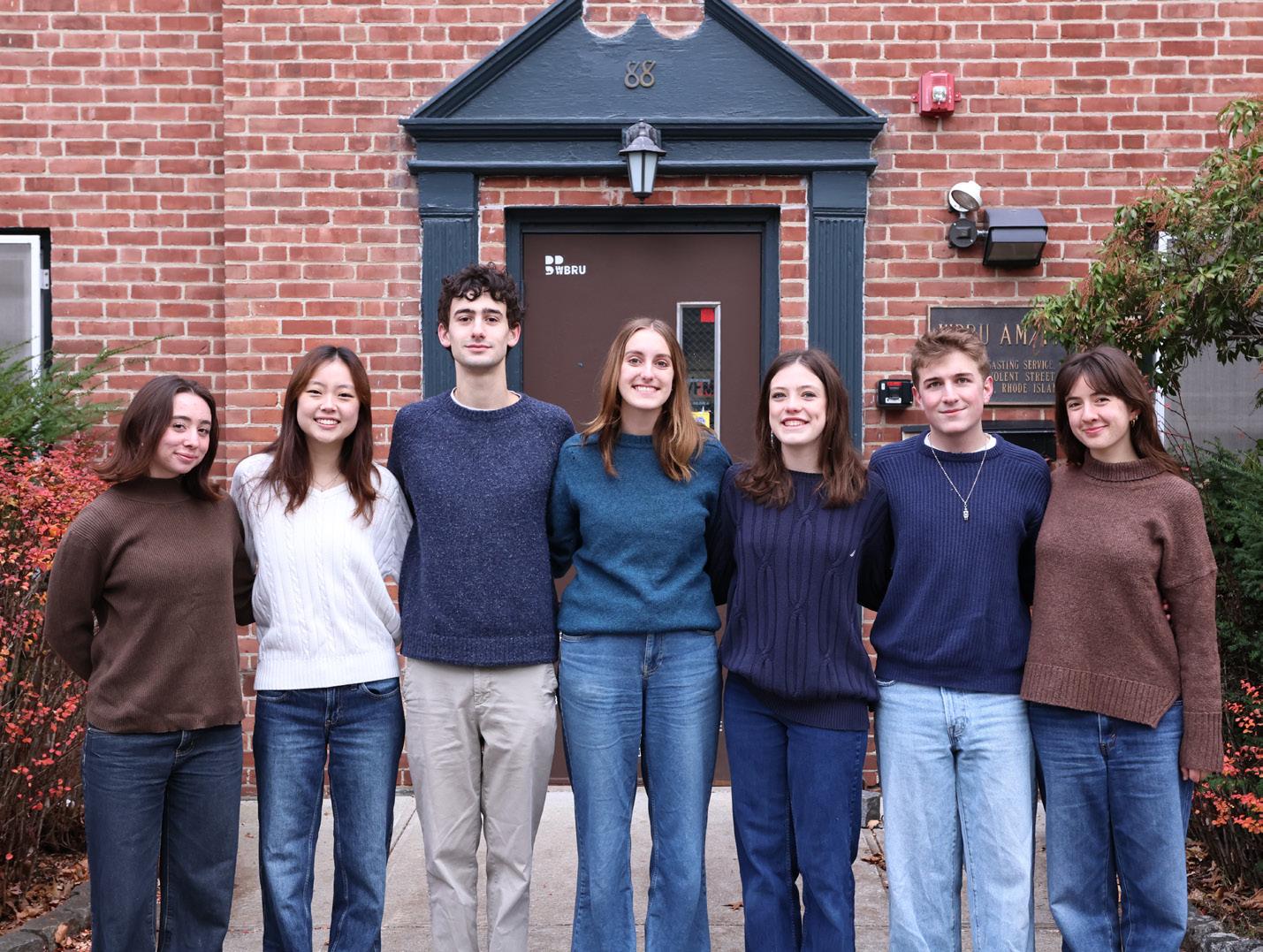
Rahman ’26: Let student government fail
On April 10, Undergraduate Council of Students President Talib Reddick ’26 and Undergraduate Finance Board Chair Naomi LeDell ’26 stood on the steps of the Stephen Robert ’62 Campus Center to announce that Ariel Shifrin ’27 was elected as UCS president and Aidan Lu ’27 as UFB chair. Back in 2025, both Reddick and LeDell ran unopposed in an election that saw a 16% turnout — the lowest since at least 2022. On the steps of Faunce, they announced their successors, Shifrin and Lu, who also ran unopposed, in an election that saw a similarly abysmal 18% turnout.
In October 2024, I wrote that “Brown is not a democracy.” I criticized the irony of UCS’s call for “democratic representation” on the Brown Corporation — the University’s highest governing body — when only 21% of Brown’s student body voted in the election that brought those students into their positions of power. But when I wrote that Brown is not a democracy, I did not mean that Brown should not have a democracy at all. With voter turnout decreasing year after year, perhaps it’s time to let student government fail.
To increase voter turnout, Brown’s student government needs a quorum requirement. I suggest that for the student government to be seated or for a referendum to pass, 33% of students should have to vote for at least one position or question. If the election does not meet this required quorum, the election should not be considered binding, and, similar to a parliamentary system, there should be successive runoff elections, one after another, until a quorum is finally reached.
Low voter turnout has plagued the Student Government Association throughout my entire time here at Brown. My first year, the SGA general election had a modest 29% turnout, my sophomore year 21%, my junior year just 16% and this year 18%. Turnout for recent referendums has not fared better, and the council has yet to publicize the results of last month’s referendum on its proposed constitutional reforms.
The editorial page board, on which I am a member, has taken notice. The board wrote in April 2025 and April 2026 that low turnout represents “a student government built on the apathy of the student body rather than participation,” which in turn “weakens our ability to respond credibly and confi-
dently to the issues that affect us all.” These sentiments continue to ring true today. Student government at Brown is given real power over student life — allocating millions of dollars in student activities funding, advocating for students and planning campus-wide social events — without real accountability to the students they serve or a mandate to represent them. This status quo should not continue.
This is not normal. Many of our Ivy League peers have a much healthier student democracy than we do.
This year, the Yale College Council saw a 36% voter turnout. The Harvard Undergraduate Association had a 35% turnout. In December 2025, a writer for the Daily Princetonian lamented about “what this year’s dismal turnout says about civic life at Princeton.” The
dismal turnout in question was 34% — a decade low for Princeton but a rate much higher than Brown’s turnout during my entire time here on College Hill. And at Dartmouth, student government elections have in recent years seen turnout around 40%. Although a quorum and the resulting lack of student governance might seem like a drastic measure, making such a change could very quickly reinvigorate participation in student elections. On the part of the SGA, it would light a fire under our student government to avoid complacency and prove its relevance to students, lest it lose its power. As for students, it would force them to reckon with the reality of having no student government — no club funding, no formals and no campus voice.
A simple quorum can help reinvigorate democracy at Brown by forcing student government to matter. The student government should represent students. If it cannot prove that it is worth enough for students to even fill out one Qualtrics poll, as consistently shown by low voter turnout, then it should not exist. It’s time to stop pretending that Brown has a democracy and actually make it so.
Tasawwar Rahman ’26 can be reached at tasawwar_rahman@brown.edu. Please send responses to this opinion to letters@browndailyherald.com and other op-eds to opinions@browndailyherald.com.

GABRIELA CABRERA-FLORES / HERALD
Editors’ notes are written by The Herald’s 136th Editorial Board: Cate Latimer ’27, Ciara Meyer ’27, Elise Haulund ’27, Claire Song ’27, Hadley Carr ’27, Paul Hudes ’27 and Max Robinson ’26.5.
Editorial: Brown must grapple with its relationship with America
Last week, Yale released a report arguing that universities share responsibility for the nation’s loss of trust in higher education. Trust in private universities — along with the reputation of the Ivy League — is especially depressed. Faith in higher education reached a historic low of 36% in 2024. Even though we are no longer facing immediate funding threats from the federal government, Brown should not ignore the American public’s skepticism. As the University is able to refocus on its institutional goals, Brown has the opportunity to meaningfully reflect on its relationship with the United States. The University should take the initiative to consider the central themes of Yale’s report by commissioning its own to examine Brown’s role in the current landscape of higher education.
The University reached an agreement with the White House last year to restore federal funding and rejected President Trump’s invitation to join the Compact for Academic Excellence in Higher Education. These were both pragmatic decisions that the editorial page board commended. We contend that the state of public trust in higher education demands scrutiny, but the Trump administration’s coercive methods only exacerbate the issue. By forcing Universities into agreements, Trump was able to paint them as resistant public enemies that conceded to his power. Additionally, the White House’s many investigations into colleges and universities and accompanying funding cuts were sweeping and rash — they were meant to fulfill a political agenda, rather than trying in good faith to make universities better for the sake of the American public. By conducting a report of Brown’s role
in the public distrust of higher education, we can not only counter the image that Trump made of us, but also inspire more effective University-led reforms than the White House did.
The report can also shield against further attacks from the Trump administration by eliminating some of the president’s political leverage: The University can prove that it is actively working to address the concerns of the American public. Brown has real issues that are worth addressing, and we have the opportunity to improve our institution on our own terms.
According to the report, the increasing cost of tuition has significantly contributed to the American public’s negative perception of elite universities. Brown, like Yale, adopts a “high tuition-high aid” model. The University’s displayed cost of $97,284 presents a Brown education as a luxury good. Yet around 45% of Brown students are on financial aid, with the average family responsibility for the class of 2029 being $32,160. Many assume from the sticker price that most Americans are priced out of a private education, and thus, the high cost undermines public trust in the institution. Since Yale’s report notes that “nearly half of Americans believe that colleges and universities demand the same payments from all students, regardless of income,” it should come as no surprise that the high sticker price has led to tension between Brown and the American public. While the University has wrestled with this issue through initiatives such as Brown Promise, which eliminates all loans from aid packages, and the elimination of tuition costs for households earning $125,000 or less, its ability to effectively communi-
cate its affordability to the American public remains incomplete.
Beyond cost, free speech concerns must also be an area of investigation for Brown. Yale’s committee found that concerns about free speech on campus also contribute to a negative public image. Despite some improvement, Brown remained in the bottom half of universities in the Foundation for Individual Rights and Expression’s most recent free speech rankings. The University received an “F” grade for both administrative support and political tolerance on campus. In addition, Brown was called out for having “vague written policies” regarding the regulation of student speech. While the University has tried to foster more discourse across campus through its Discovery Through Dialogue project, The Herald’s Fall 2025 Poll still found that over 45% of students have felt uncomfortable expressing their political beliefs on campus. Trump won nearly 50% of the popular vote in the 2024 election. Since then, he has continuously attacked universities — especially Brown and its peers — for being liberal hegemons. When the public sees that Brown continues to face free speech controversies, they are likely to assume that their perspectives aren’t valued by our institution.
Beverly Gage, co-chair of the committee and a professor of history at Yale, explained that Yale’s study also considered the school’s peer institutions. Though Brown can rely on Yale’s report as a starting point, we are ultimately two different institutions with distinct goals — we have different approaches to undergraduate education, types of graduate programs and public images. Creating our
own committee ensures that we can arrive at actionable recommendations specific to the unique nature of Brown. The University has made commendable efforts in recent years to address some of the most prevalent concerns in higher education, but the Yale report shows that our work is not finished. For the University to fulfill its mission in this landscape, we must demonstrate a clear commitment to addressing these concerns. This promise could be a win-all: graduates, administrators and faculty alike will benefit from a stronger public image, and the American public can trust that their tax dollars are going toward a research institution that shares their values.
Addressing these many concerns through one committee will signal a clear priority to confront the ongoing issues facing higher education. The committee’s report can also serve as a self-audit — since Brown has already shown intention toward these reforms, it can identify whether our current initiatives bring us closer to our goals and also point to areas that demand further policy change. If the concerns surrounding higher education are damaging Brown’s relationship with the public, our response to them should be organized comprehensively.
Editorials are written by The Herald’s editorial page board, and its views are separate from those of The Herald’s newsroom and the 136th Editorial Board, which leads the paper. A majority of the editorial page board voted in favor of this piece. Please send responses to this column to letters@browndailyherald.com and other opinions to opinions@browndailyherald.com.
Aizenberg ’26: What I have learned from writing 30 opinion columns for The Herald
It’s 3 a.m. and I’m sitting in my cramped dorm room in Perkins Hall, trying to write an opinion column about why Taylor Swift is overrated. The problem is that I don’t know much about Taylor Swift, other than that it annoys me when people treat her like a god. I struggle to find a way to start and my argument is vague and shamelessly contrarian. Still, it has to get done — I meet with my editor in nine hours. Eventually, I write the piece and it gets published, though it is not my best work.
This is a night in the life of one Brown Daily Herald opinion columnist. I’ve gone through this process 30 times (though I usually write in the daytime), covering topics such as kidney donation, affirmative action, bike helmets, land acknowledgements, mixed martial artists and using dice to make life decisions. Hopefully, I am now a skilled columnist. What I’ve learned is that all it takes to write a great column is a story, a point and a sense of humanity. Let me explain.
The best columns start with a story, not a hook. Hooks grab readers’ attention so you can transition into an argument. Stories are an embodiment of the argument in the real world. In my column about kidney donation, I argue that more people should donate a kidney to a stranger. I open with the story of Zell Kravinsky, who, after intense moral calculus, gave a kidney to a stranger dying while waiting for a transplant. Zell’s story doesn’t just introduce the idea of non-directed kidney donation like a hook would. Instead, it viscerally illustrates why donating a kidney could actually be a requirement for an ethical life. A hook tells, a story shows.
Unfortunately, it is easy to fall in love with your story and neglect the argument. Once, I wrote an introduction about Ryan Lochte, the Olympic swimmer famous for lying about being robbed in Rio. I reasoned that his drunken, sleep-deprived state caused him to truly believe in the incorrect sequence of events he told police. The column was supposed to be about the fragile nature of memory, but it ended up being a scattershot defense of Lochte, an overthe-hill, mostly-forgotten swimmer. This is why you need a point.
Before every column, you should be able to ex-
plain your argument in a sentence — maybe even in a title. Your thesis is the center of your solar system and your moons of anecdote and evidence must orbit around it. However, once you have this distilled, concrete thesis, start writing immediately. I learned this the hard way — I wrote a thesis for my land acknowledgement column but did not draft the piece right away. I forgot the intricacies of the arguments
that I thought followed my thesis and the column came out weak. I successfully re-wrote it a year later, guided by my thesis as my North Star.
The most frustrating part of writing opinion columns is that even if you tell an absorbing story and make well-articulated points, your column still may just be good, not great.
I’ll explain this with a tangential anecdote, as I’m

prone to do. Christopher Nolan is one of the greatest movie directors. In 2014, he made Interstellar, a beloved space film — and inspiration for the earlier solar system metaphor. Six years later, he directed Tenet, a time-travel action flick, which garnered mixed reviews. Both were original, clever and dealt with complex temporal and scientific theories. Interstellar was more acclaimed, however, because it was ultimately about an astronaut who loves his family. Tenet, in comparison, had no deeper relational message. You must make sure that your column is well-crafted and novel like both movies. If you want people to care, however, write your column like Interstellar — always connect back to some relational value.
I know this because the few pieces of mine that have caused strangers to reach out have all appealed to humanity. Two emailed me about my column on having radical empathy for strangers. Six emailed me in response to the kidney donation column. And seven emailed me about my column arguing that we should call our grandparents more often. Empathy, kidney donation and family — these are issues that deeply impact peoples’ lives. Give your column a big heart, and you can reach the hearts of your readers.
Last, all columns need a conclusion that does not feel tacked on. I try to avoid this pitfall by calling back to the introductory story and then connecting it to a larger point. In the case of this column’s introduction, I did not tell the full story: I took my half-baked Taylor Swift-is-overrated argument to my editor and she tore it apart — constructively. After addressing her edits, I received further changes from more senior editors. They completely reorganized the column, markedly improving it. Only then was it publishable. The final ingredient to a great column is editors who are not afraid to tell you when it needs work. Only one name is listed when the column is posted online, but no great column is written alone.
Ben Aizenberg ’26 can be reached at benjamin_aizenberg@brown.edu. Please send responses to this column to letters@browndailyherald.com and other opinions to opinions@browndailyherald.com.
CAROLYN NAKAWUNGU / HERALD
SCIENCE & RESEARCH
HISTORY
Professor Omer Bartov examines Zionism’s evolution in new book
The book “Israel: What Went Wrong?” was released this week
BY ELIZABETH ROSENBAUM SENIOR STAFF WRITER
When Professor of Holocaust and Genocide Studies Omer Bartov was growing up in Tel Aviv, he played among the rubble of abandoned cemeteries, Arab houses and Palestinian property.
But as a child, “we had no idea what it was, and nobody really told us,” Bartov recalled in an interview with The Herald. Decades later, he learned that they were remnants of the Nakba — a period of mass displacement of Palestinians that occurred during the 1948 Arab-Israeli war.
These lost histories shaped his scholarship of Jewish civilization and influenced his most recent book, “Israel: What Went Wrong?” which was released this week.
Bartov told The Herald his book explores how Zionism has evolved from a humanitarian, nationalist movement to a state ideology that has “become increasingly militaristic, increasingly expansionist (and) increasingly racist.”
Bartov has been an outspoken critic of Israel’s military campaign in Gaza following Hamas’s Oct. 7, 2023 attacks in southern Israel.
“What Hamas did (on Oct. 7) was a war crime and a crime against humanity,” Bartov told The Herald. “I had members of my family who became victims of what happened on Oct. 7.”
In a November 2023 essay, Bartov asserted that Israeli leaders indicated a “genocidal intent” but had not committed genocide in Gaza. But by July 2025, Bartov
HISTORY
wrote that he was confident that Israel’s actions in Gaza constituted genocide.
The Israeli government did not immediately respond to a request for comment.
Bartov told The Herald that Zionism originated in the late 19th century as a response to “growing antisemitism and growing exclusion of and violence against Jews … It appealed to humanitarianism, it appealed to human rights.”
But, according to Bartov, that has changed drastically. The movement’s presence in Palestine has become a form of settler colonialism and displaced the local Arab communities, he argued.
Eventually, Zionism became “an ideology that was used to justify genocide in Gaza,” Bartov asserted.
In his new book, Bartov takes a particular interest in the absence of a formal constitution in Israel.
In the United Nations’ 1947 partition resolution that offered a plan for the creation of Israel, the UN proposed a requirement for Israel to create a constitution with democratic ideals, including racial and religious equality, Bartov explained.
But after Israel declared independence in 1948, the constitution never came.
This was a “tipping point” in the history of Zionism, Bartov said, and it became “an ideology of state.” Now, “It's an ethno-national ideology that says the Jews should dwell on their own,” Bartov asserted.
The Holocaust has played a significant role in the evolution of Zionism and Israeli national identity, according to Bartov, moving from being a historical event that should be remembered and commemorated to a reminder of “an imminent threat of extermination.”
“For Israelis — even left-leaning Israe-
lis — to think that their sons and daughters are taking part in a genocidal campaign is impossible,” Bartov said because, in Israel, the term genocide “immediately means the Holocaust.”
“You can’t say to us that we are doing a holocaust. That’s what happened to us,” Bartov said. “So the Holocaust comes to play a role in giving license to Israeli violence against Palestinians who are not a threat to Israel’s existence.”
As a former soldier in the Israel Defense Forces, Bartov says it is difficult for him to accept that the “army has changed entirely” and become “a completely different animal from what it was” when he served.
Laura Jockusch, associate professor of Holocaust studies at Brandeis University and a panelist at Bartov’s April 22 book launch event, told The Herald that she historically has appreciated Bartov’s ability to highlight diverse perspectives and hold groups accountable to consistent moral and historical standards.
But she said that his new book lacked a multiplicity of voices, particularly those of Palestinians.
“I think if you really want to understand ‘what went wrong,’ you can’t exclude the Palestinian side,” Jockusch said in an interview with The Herald. “In historical work, we constantly write about other people’s voices by including their sources. So why not include Palestinian voices in this?”
Jockusch also said that Bartov seems to “deemphasize the victimhood of some Israelis.” For example, the book brushes away the systemic sexual violence against Israeli women, according to Jockush.
Visiting Associate Professor of Judaic Studies Erica Weiss wrote in an email to
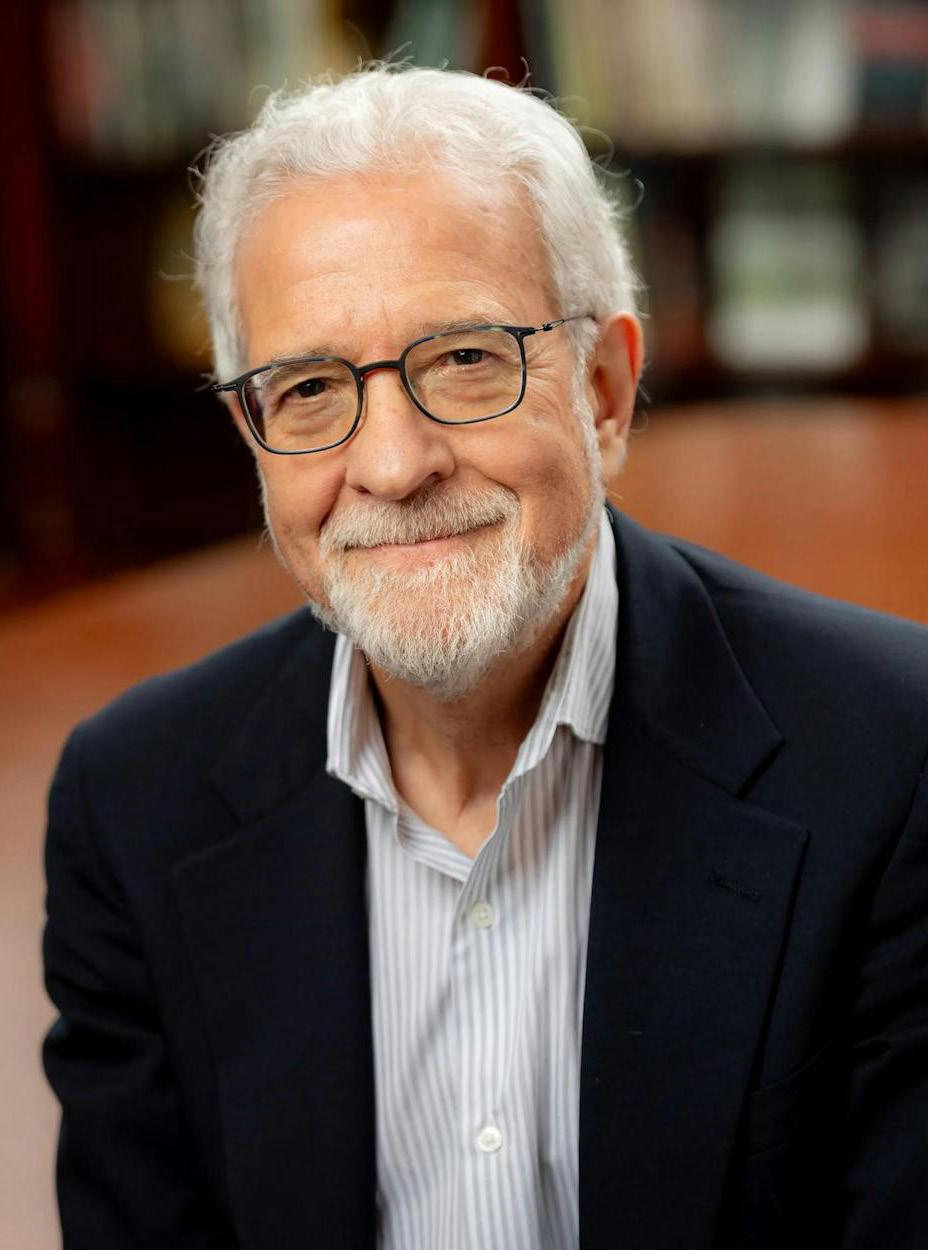
The Herald that Bartov’s book encourages readers “to grapple with painful and urgent questions” about Israel and Palestine. She added that, given the nature of Israel-Palestine scholarship, she does not necessarily agree with everything in the book. But the work aligns with the Jewish practice of self-accountability and examination, she wrote in an email to The
“I see it as part of a broader process of heshbon nefesh — a Jewish religious practice of moral accounting and self-examination,” Weiss wrote, “a collective effort to reflect, to take stock and to understand both the moment we are in and our own roles within it.”
Associate professor’s book highlights history of Indigenous slavery
The project researched New England’s connection to the Atlantic slave trade
BY DIYA KHETAN STAFF WRITER
Almost 15 years after its conception, Associate Professor of History Linford Fisher’s new book, “Stealing America: The Hidden Story of Indigenous Slavery in U.S. History,” is set for release on April 28.
In the book — which covers nearly 500 years of Native history, from Christopher Columbus’s arrival in 1492 to the Indian Child Welfare Act of 1978 — Fisher explores the history of Native enslavement and its role in American history by centering the perspectives of Indigenous people.
“The history of slavery typically is told in terms of economics and labor, and production and exports,” Fisher told The Herald. But when consulting to Indigenous people, Fisher noticed that they defined slavery as the stealing of family members and loss of community.
“When you flip that perspective and think about communities, it's about people being taken away from them,” Fisher said. “One of the threads throughout the book is that we’ve maybe defined slavery too narrowly.” Fisher’s work on the project started with considering New England’s connection to the Atlantic slave trade. Finding 18th-century church records of Native Americans listed as servants and slaves, Fisher wondered “where they came from.”
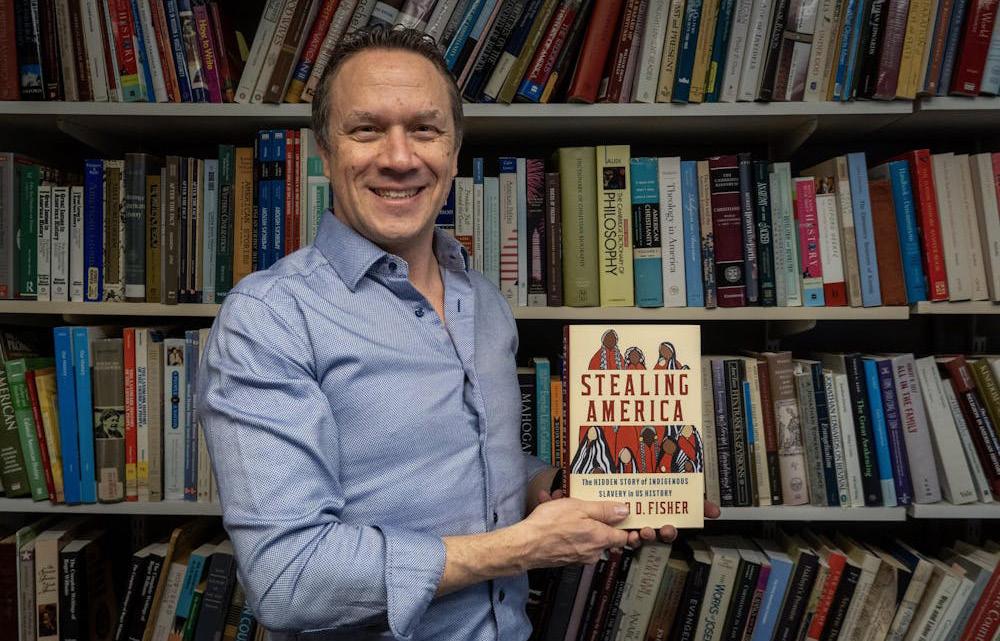
But his research eventually led him across North America, from the East Coast to the Caribbean to California — and even to the United Kingdom’s National Archives.
Fisher leveraged existing relationships he had built through Stolen Relations, a project on the enslavement of Indigenous people he currently leads in collaboration with the Center for Digital Scholarship.
Fisher had some tribal members read the entire book and provide feedback. Paula Peters, a citizen of the Mashpee Wampanoag Tribe, said she appreciated Fisher’s focus on explaining the real contexts in
which people were enslaved.
“(The book) is not just scholarly work. It's scholarly work that is done with heart,” Peters said. “He puts flesh on the bones of these ghosts of the past, and … he makes them real.”
Mack Scott, an assistant professor and director of undergraduate studies for the critical Native American and Indigenous studies concentration, also read a full draft of the book. He appreciated that Fisher’s work enables people to better understand where they come from. In his experience, Native people have resisted acknowledging
their history of enslavement because of its link with the enslavement of Black people in the United States.
“In American society, any kind of blackening became a mark of degradation,” Scott said. “So there was an effort to separate those histories or separate that experience, but in doing that, we’re also separating ourselves from our ancestors that had to endure those realities.”
Fisher believes that incorporating Indigenous perspectives in his work is particularly important as a non-native individual researching Indigenous history.
“Doing this work as a settler, as a non-Indigenous person, especially, requires a lot of listening and humility,” Fisher explained. When approaching archives, he added, researchers must “ask really important and hard questions about whose voices are missing.”
Chase Bryer GS, a Ph.D. candidate at the School of Public Health and program coordinator for the Native American and Indigenous Studies Initiative, read a draft of Fisher’s book. “I feel like there are many historians and history books written without the perspectives of Native people, whose ancestors are discussed in detail,” Bryer said. “That’s really dangerous and can lead to erasure of cultures.”
As a citizen of the Chickasaw Nation, he expressed gratitude towards Fisher for “integrat(ing) himself in local, tribal community contexts.”
Fisher “played a really important leadership role in advancing our understanding in the broader field of people studying indigenous slavery,” said Karin Wulf, director of the John Carter Brown Library and a professor of history. “The book just kind of caps that.”
Fisher hopes the book inspires “individual researchers and graduate students in their local context to dig into local archives” to learn about Indigenous histories.
“We’re just scratching the surface,” Fisher added.
This article originally appeared online at browndailyherald.com on April 21, 2026.
Herald.
COURTESY OF OMER BARTOV Bartov’s work has sparked debate in academic circles where responses to scholarship about Holocaust and genocide studies have varied.
KAIA YALAMANCHILI / HERALD
During the writing process, members of indigenous tribes read the book in its entirety for feedback.
Brown researchers study how lung CT scans might reveal non-lung cancers
The findings could help minimize unnecessary additional cancer testing
BY NISHITA MALHAN SENIOR STAFF WRITER
It has long been known that smoking cigarettes is a leading cause of lung cancer. But what might not be as obvious is that cigarette smoking can also lead to seemingly unrelated types of cancer, like urinary or pancreatic cancer.
A lung CT scan, or computerized tomography scan, is a vital tool used to detect lung cancer, but can also be useful in identifying non-lung cancers. In a new study, Brown researchers identified which abnormalities found in lung CT scans should be followed up with further testing and which should not be.
“If (the abnormalities are) not documented, physicians don’t really know which findings they should act on and which they should not,” Professor of Epidemiology and lead author Ilana Gareen said.
Typically, physicians follow up on most significant incidental findings — or
abnormality — that they find, Gareen said. But following up on these findings with further testing, such as additional biopsies, may introduce additional risks, she explained.
Biopsies can come with more “seri -
ous” consequences, Gareen added. “For example, if you do a lung biopsy, you can have a lung collapse,” she said. “Doing a liver biopsy is a very painful and really invasive procedure.”
Gareen described the unnecessary
follow-up testing that often occurs as a “cascade of care.”
“People kind of get on this roller coaster where they’re getting lots of procedures done, and it turns out to be nothing,” Gareen said. “We’re trying to minimize the number of people who get on that roller coaster.”
While early detection can be “very valuable” in “identifying a cancer and treating it in an earlier stage,” overdiagnosis comes with “unnecessary anxiety, extra testing or the detection of a cancer that never would have led to harm,” said co-author Amal Trivedi, professor of health services, policy and practice and of medicine.
Associate Professor of Medicine Adam Olszewski, who was not involved with the study, wrote in an email to The Herald that while doing more CT scans will always cause doctors to find more abnormalities, it is important to know which abnormalities are worth following up on.
“The question is whether these findings are leading to improvement in something meaningful, or just higher incidence of cancer diagnoses,” he added.
The study used data from the Na -
tional Lung Screening Trial, a country-wide study that established a specific type of CT scan as a diagnostic tool for lung cancer. Gareen’s research analyzed 26,445 participants who had smoked the equivalent of one pack a day for 30 years and had also “smoked within the last 15 years,” Gareen said.
The NLST patients were followed over five to seven years and were studied to see “what happened to the people who had the incidental finding and what happened to those who didn’t,” Gareen said.
Ultimately, the researchers were able to identify abnormalities that were potentially indicative of cancer and those that were not, she said.
According to Olszewski, unnecessarily analyzing abnormalities can have “significant repercussions” for medical professionals such as radiologists who are “already burdened by the need to interpret any radiographic abnormality.”
“Finding and diagnosing cancer is an emotionally heavy issue for patients, who often discount the risks associated with diagnostic procedures,” Olszewski wrote.
Brown researchers track gas prices, impact of Iran war on U.S. consumers
The tracker estimates extra $200 in U.S. household spending since February ECONOMY
BY TAEK LEE STAFF WRITER
As gas prices have skyrocketed amid the United States and Israeli governments’ military actions in Iran, Brown researchers launched an online tracker to follow the war’s costs for American consumers. The tracker estimates over $24 billion in growing consumer burden since the war began on Feb. 28.
Published by the Climate Solutions Lab in the Watson School of International and Public Affairs, the tracker compares gasoline and diesel prices to a pre-war baseline. Director of the Climate Solutions Lab Jeff Colgan, who is a professor of political science and of international and public affairs, started the tracker to highlight the immense cost of the war in Iran — drawing inspiration from the Watson School’s Costs of War project, which tracks long-term costs of numerous global conflicts.
“The tracker is built for journalists and anyone who wants to get a sense of the cost impact of the war for Americans in terms of their everyday fuel purchases — which is only one part of the total cost of the war,” Colgan wrote in an email to The Herald, adding that it “shows that the average U.S. household has spent almost $200 extra on fuel costs since the war began — so far.”
“Just think of all of the things that we as a country could have done with that money — funding for science, for medical innovation, for clean energy — that we are wasting on extra fuel costs,” Colgan added.
Colgan hired John Perdue ’26 to code the website. To build the tracker, Perdue used gasoline and diesel price data from the American Automobile Association, data on demand from the U.S. Energy Information Administration and Census Bureau data to estimate how much fuel is costing. He compared the current gas price changes to a five-year historical average of daily price changes of gasoline to understand how

much extra the fuel is costing right now.
Perdue’s algorithm calculates based on on the wholesale spot price of gasoline in the New York Harbor — a major port for petroleum — rather than using financial instruments like futures contracts. The spot price is more “representative of actual prices because there’s less distortion from banks or hedge funds taking speculative bets,” he said.
While gasoline is the most common
type of fuel used directly by Americans, diesel was included in the tracker because it still has a broader economic impact. Diesel is “the industrial fuel of our economy,” powering power plants, trucks, ships and trains, Perdue said. “Even if you don’t feel it at the pump, those are prices that get carried onto the consumer.”
Perdue said that the process of building the tracker was fairly straightforward and similar to what Perdue had learned in his
CSCI 0320: “Introduction to Software Engineering” class. In fact, “the initial buildout was probably three to four hours of work,” he said — but various other logistical tasks took a few weeks before the website could be launched.
Colgan and Perdue anticipate that the tracker will remain active for many months, even beyond an end to the war.
“We’re going into summer driving demand, and we know gasoline demand
spikes in the summer,” Perdue said. “So you compound this supply constraint when we should be preparing for summer demand … now things could get really tight.”
“I think it’ll take longer than you would expect to see prices go back down,” he added.
SHAYNA RUDOREN / HERALD
The study used data from the National Lung Screening Trial, a country-wide study that established a specific type of CT scan as a diagnostic tool for lung cancer.
SOPHIA LENG / HERALD