
THE BROWN DAILY HER ALD
FRIDAY, APRIL 17
Student safety, divorce and AI: The Herald’s Spring 2026 Poll
The Herald polled 1,275 undergraduates from March 17 to March 19
BY AVA STRYKER-ROBBINS, ALICE XIE AND SAJIV MEHTA METRO, SCIENCE & RESEARCH AND SPORTS EDITORS
Each semester, The Herald surveys over 1,000 members of the undergraduate student body. The Herald’s Spring 2026 Poll, conducted between March 17 and March 19, comes amid ongoing questions about safety after Dec. 13, federal investigations into Brown and debate about the University’s campus climate.
The Herald polled 1,275 undergraduate students on topics ranging from academics to campus security.
Here are five key takeaways from The Herald’s Spring 2026 Poll.
Access and explore all the data on The Herald’s interactive dashboard.
After Dec. 13, marginally more students report feeling unsafe on campus compared to before
The Herald polled students on perceptions of campus safety pre-Dec. 13, and surveyed on five metrics for perceptions of campus safety post-Dec. 13. Only 6% of respondents
Paxson’s approval rating continues to rise
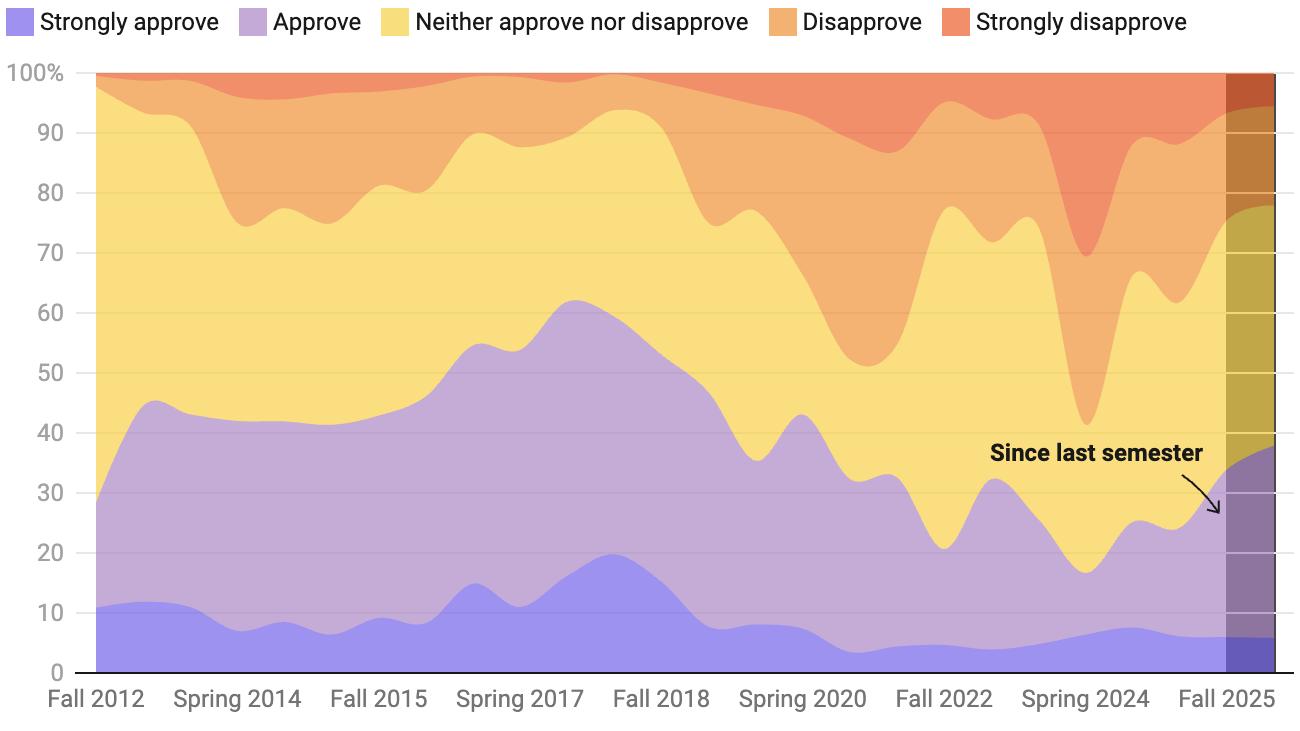
Respondents were asked: "How strongly do you approve of each of the following? (President Christina Paxson)"
reported feeling very or somewhat unsafe before Dec. 13. On every single post-Dec. 13 safety metric, at least 8% of respondents reported feeling very or somewhat unsafe.
Of the five metrics for perceptions of campus safety after Dec. 13, students re-
ported feeling the least safe walking around campus and the most safe in on-campus residence halls.
In the weeks following the incident, Brown began to enforce ID swipe access to enter all campus buildings, increased the
James Kellner named inaugural Associate Provost for Corporate Engagement
Kellner will work as a strategic partner with the vice president for research
BY JEREMIAH FARR SENIOR STAFF WRITER
James Kellner, a professor of ecology, evolution and organismal biology and environment and society, will serve as Brown’s inaugural Associate Provost for Corporate Engagement, according to a Thursday Today@Brown announcement. Kellner will officially begin the role on July 1.
In his new role, Kellner “will be committed to cultivating relationships that increase and diversify research funding, develop new student intern-
UNIVERSITY NEWS
Schwartz served as deputy surgeon general during Trump’s first term
BY SAMAH HAMID UNIVERSITY NEWS EDITOR
On Thursday, President Trump announced Erica Schwartz ’94 MD’98 as his nominee for director of the Centers for Disease Control and Prevention.
Schwartz, an alum of Brown’s Program in Liberal Medical Education, served as deputy surgeon general from 2019 to 2021, during Trump’s first term. During her tenure, she managed the federal government’s COVID-19 testing program.
If confirmed by the Senate, Schwartz will be the CDC’s
ship and career opportunities and deepen academic-industry collaborations,” Provost Francis Doyle wrote in the announcement.
He will also work as a strategic partner with the vice president for research, the Division of Advancement and external corporate partners to “establish a University-wide corporate engagement strategy,” Doyle wrote. This includes finding opportunities for faculty members and the greater University to develop relationships with industry partners.
In 2019, Kellner received the Dean’s Award for Excellence in Undergraduate Teaching, Advising and Mentoring in the Biological Sciences for his work in BIOL 0210: “Diversity of Life,” an intro-
PROVOST PAGE 2
security presence on campus and installed more panic buttons and security cameras,
The Herald previously reported. A majority of respondents reported that they felt very or somewhat safe around campus police and security.
Nearly 90% of students reported that they felt somewhat or very safe on campus prior to Dec. 13. Still, The Herald’s poll demonstrated that a vast majority of students felt safe on campus before and after the shooting.
Paxson’s approval ratings increases 4% from fall 2025
Since last semester, the approval rating for President Christina Paxson P’19 P’MD’20 has increased by 4%, with only 5.5% of respondents now strongly disapproving of her presidency. At Paxson’s peak disapproval in spring 2024, about 30% of respondents reported that they strongly disapproved of the president.
In the past few months, Paxson has led the Brown community through the aftermath of the Dec. 13 shooting. Under her leadership, security has been enhanced and the “Ever True” campus-wide recovery initiative has been launched.
The Herald found that Jewish and male students were the most likely to approve of Paxson. The Herald’s Fall 2025 Poll found overlapping results, specifically highlighting that white, male and underclass students were the most likely to approve of the president.
Smiley proposes $2.04 million in housing supports, no tax increases in FY27
The mayor unveiled his $636 million budget Wednesday evening
BY MICHELLE BI METRO EDITOR
On Wednesday evening, Providence Mayor Brett Smiley unveiled his proposed budget for fiscal year 2027 in an address to the City Council. His package aims to address housing affordability and public safety without hiking taxes for residents.
The proposed $636.7 million budget represents a 1.75% increase from fiscal year 2026 — the lowest year-over-year increase in at least five years, city officials said at the Wednesday after-
noon press briefing. The legislation proposes no changes to current tax rates and sets aside about 4% of the budget to be “flexible for adjustment to services, supplies and salaries,” according to the official proposal sent to The Herald.
In his address to the Council, Smiley condemned the Trump administration for threatening food security and neighborhood safety, thanked first responders at the Dec. 13 shooting and emphasized providing essential financial support to citizens.
The White House did not immediately respond to The Herald’s request for comment.
“Providence is and will remain a safe and welcoming community for all those who choose to

disagreement with Kennedy over vaccine policy.
Schwartz received her bachelor’s degree in biomedical engineering in 1994 and graduated from the Warren Alpert Medical School in 1998. She also holds a Master of Public Health from the Uniformed Services University of the Health Sciences and a law degree from the University of Maryland.
Schwartz is a retired rear admiral, and she has served in the United States Public Health Service Commissioned Corps, the Navy and the Coast Guard. She also previously served as chief medical officer in the USPHS.
Schwartz and the White House did not immediately respond to a request for comment.
If confirmed by the Senate,
UNIVERSITY NEWS
PROVOST FROM PAGE 1

In 2019,
ductory biology course.
Since coming to Brown in 2013, he has served on various University committees, including the Advisory Committee on
MEMORIAL
University Resources Management, the Academic Priorities Committee and the Gifts and Grants Review Committee.
“Jim’s experience leading large, in-
ternational research collaborations gives him a deep understanding of how to identify new opportunities that diversify sources of revenue,” Doyle wrote.
“In creating this role, Brown joins a growing number of leading research universities investing in dedicated leadership in corporate engagement and partnership,” the announcement reads.
This article originally appeared online at browndailyherald.com on Arpil 16, 2026.
Paxson outlines plans to memorialize shooting victims, renovate closed classrooms
A committee will develop recommendations for a permanent memorial
BY ROMA SHAH UNIVERSITY NEWS EDITOR
President Christina Paxson P’19 P’MD’20 has charged a committee to help create a permanent campus memorial to honor the lives of the victims of the Dec. 13 shooting, she announced in a Tuesday email to the Brown community.
The Committee on the December 13 Memorial will be tasked with developing formal recommendations to memorialize the lives of Ella Cook ’28 and Mukhammad Aziz Umurzokov ’29 to “ensure they are remembered, always,” Paxson wrote in the announcement.
“Creating a physical memorial on campus will be an important part of our community’s journey of recovery and repair,” Paxson added.
The University is also creating plans for renovations to the Barus and Holley classrooms that have been closed since the shooting, “with the goal of reopening spaces sometime in the coming year,” Paxson wrote. Courses for the upcoming academic year have not been scheduled in these classrooms.
According to Paxson, the memorial committee will engage with students, faculty, alums, staff and the victims’ families to ensure their input is considered in the design plans for the memorial. The committee will also “identify potential locations on campus where a physical memorial would have high visibility and symbolic resonance,” Paxson wrote.
The committee will share its recommendations in a report that will also contain a call for artists or designers to create a memorial in alignment with the
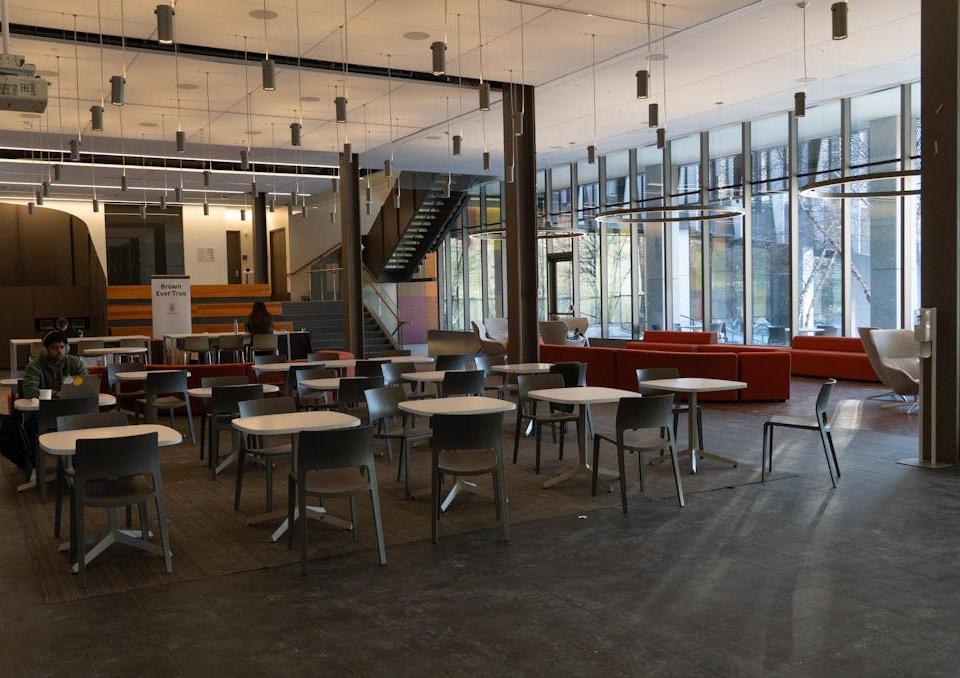
HERALD Barus and Holley in January. The committee will share their final recommendations in a report set to be completed by the end of the fall 2026 semester.
objectives and guiding principles determined by the committee. Paxson asked that the report be completed by the end of the fall 2026 semester. She will then make a recommendation to the Brown Corporation — the University’s highest governing body — for approval. The committee will be co-chaired by University Architect Craig Barton and Vice President for Diversity and Inclusion
Matthew Guterl. It will be composed of members of the campus community — faculty, staff and students — nominated by campus governance organizations such as the Faculty Executive Committee, Undergraduate Council of Students and Staff Advisory Council.
“The committee co-chairs will be in touch with campus governance organizations in the coming weeks about the
nomination process, and the committee’s membership will be shared with the community after it is finalized,” Paxson wrote.
Paxson added that the memorial is part of a broader University attempt to recognize the lasting impact of the mass shooting. In May, Paxson will also host a private event at her home for health care workers and public safety officers across Rhode Island who helped respond to the Dec. 13 shooting. In August, the University will sponsor a full Waterfire lighting in honor of the first responders and members of the community who supported Brown in the wake of the tragedy.
This article originally appeared online at browndailyherald.com on April 14, 2026.
KAIA YALAMANCHILI /
VICTORIA YIN / HERALD
Kellner received the Dean’s Award for Excellence in Undergraduate Teaching, Advising and Mentoring in the Biological Sciences for his work in BIOL 0210: “Diversity of Life.”
POLL FROM PAGE 1
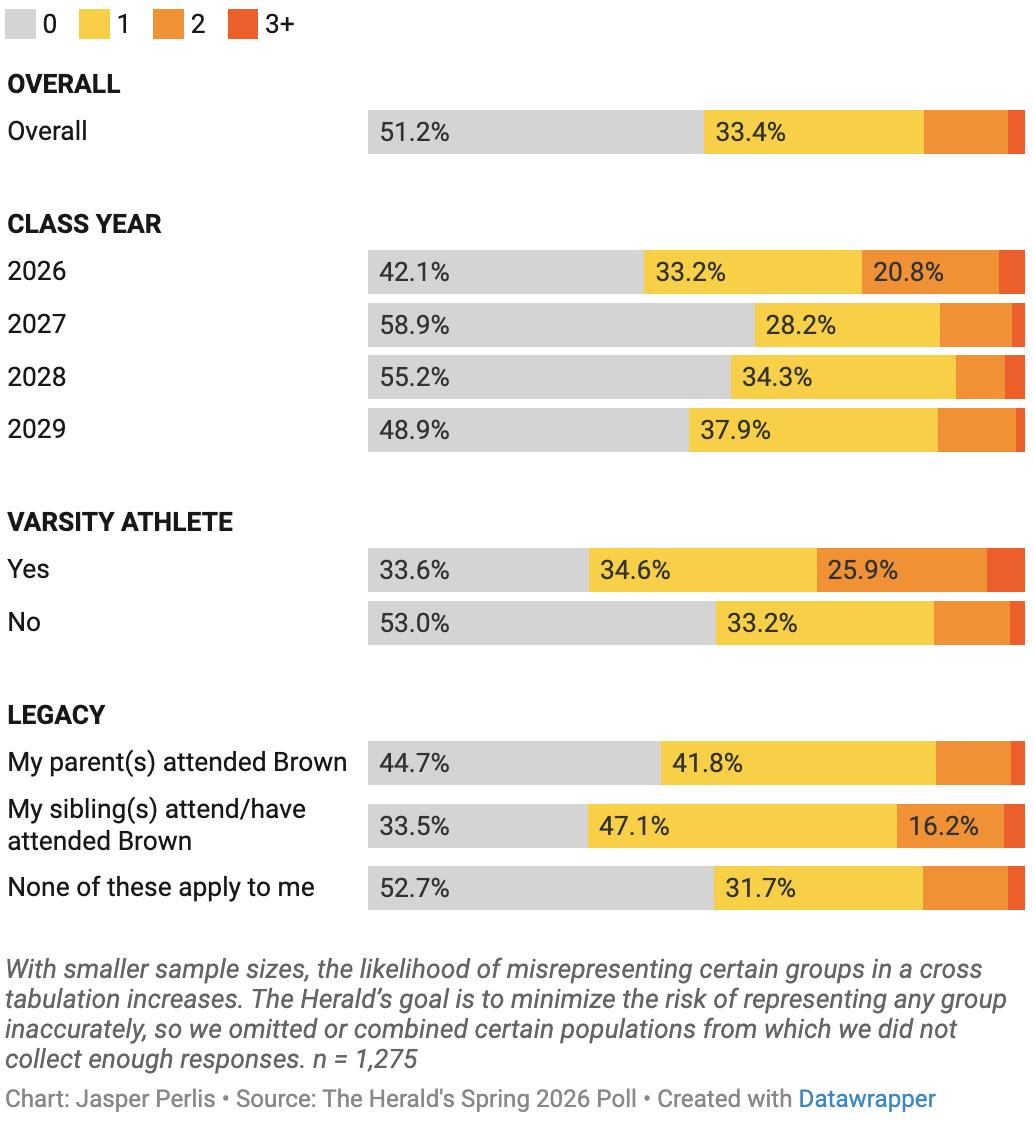
First years, seniors more likely to take classes S/NC
First-year students and seniors are most likely to be taking classes using the Satisfactory/No Credit grading system. Approximately one in four seniors were taking two or more of their classes S/NC, compared to about one in ten sophomores.
Roughly 65% of athletes who responded to the poll reported taking at least one class S/NC during the current semester, whereas a majority of non-athlete respondents said they are taking zero courses S/ NC this semester.
Some students opt to take classes S/NC out of fear they won’t earn As. Others weigh whether to take courses S/NC based on its potential impact on honor society eligibility and graduate school admis-
sions. Mandatory S/NC requirements have also deterred students from courses, but others say the system helps students shift away from a grade-focused mentality.
Male, conservative students have more widespread support for AI use in academics
Overall, a majority of students support the use of artificial intelligence in assisting with research and homework. But, just one in four students believe students should be allowed to use AI in completing problem sets — and even fewer think AI should be used in writing assignments or taking exams.
Conservative students were more likely to support AI use across every category of academic work
More than 50% of students did not take any classes Satisfactory/No Credit this semester
Respondents were asked: "How many courses are you taking S/NC this semester?"
UNIVERSITY NEWS
considered by The Herald than their very liberal or progressive counterparts. Just 2.8% of somewhat or very conservative students reported that they believe AI should be used in no academic work, compared to 16.1% of very liberal or progressive students.
Male students were also more likely to believe students should be allowed to use AI in academic work than female students or those who identified as neither male nor female.
With the naming of Brown’s inaugural AI provost in December 2024, the University has been putting increased energy toward AI initiatives. AI use in the classroom has been an ongoing debate among professors, leading to a wide variety of policies within and across departments.
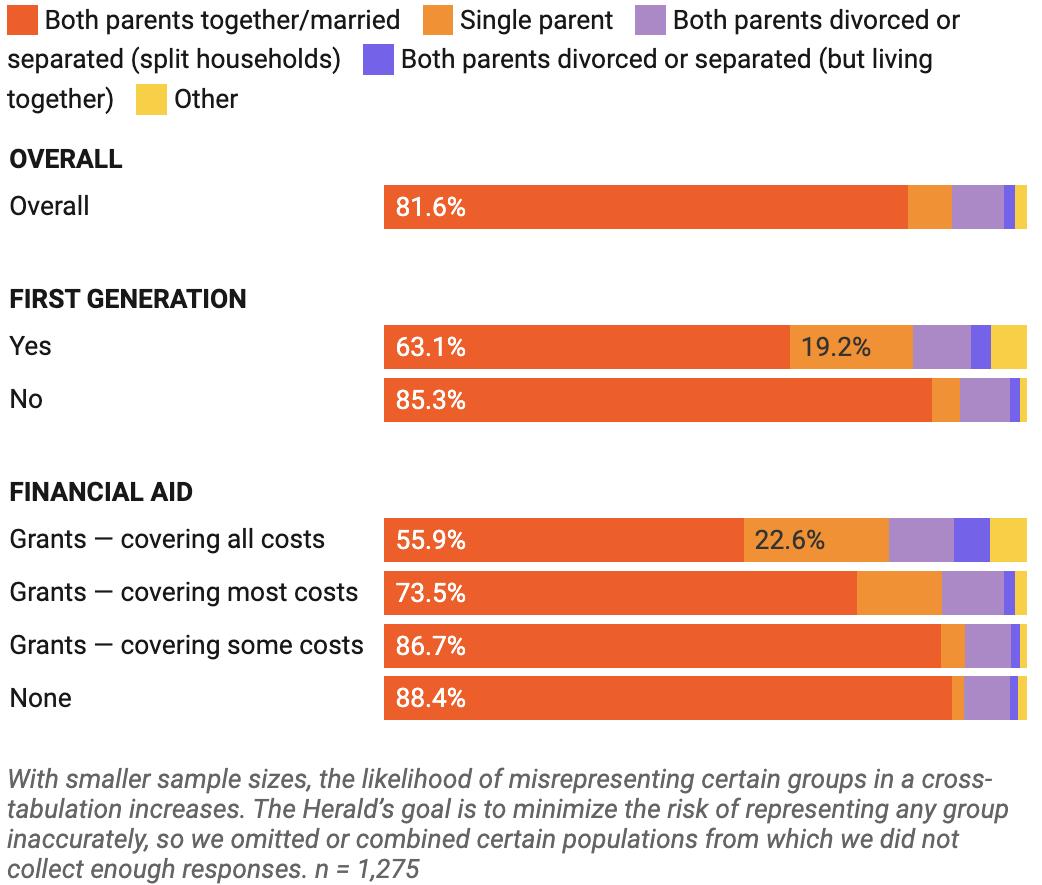
Students receiving full financial aid least likely to come from households with married parents
Over 82% of students arrived at Brown from households with parents that are married or together. About 8% of students come from split households with divorced or separated parents, and an addition-
al 7% hail from single parent homes. According to U.S. Census data, about one in three American children experience parental divorce before they enter adulthood. About 25% of U.S. children live in single parent households, according to data from the Pew Research Center.
About 85% of non-first-generation students have parents who are married or together, compared to 63% of students who identify as first generation. Students on full financial aid were less likely to have parents who were married or together than those receiving partial scholarships or no aid.
Editors’ Note: The Herald’s semesterly poll was conducted between March 17 and March 19, 2026. All responses were analyzed and weighted by class year using R Version 4.4.3. Polls were conducted at three locations around campus: Wriston Quadrangle, Sciences Quadrangle and outside the Stephen Robert ’62 Campus Center. It received 1,275 usable responses. This article originally appeared online at browndailyherald.com on Arpil 13, 2026.
Students on full financial aid least likely to have parents who are together or married
Respondents were asked: "When you left home for college, what was your family household set up?"
THE BROWN DAILY HERALD
136TH EDITORIAL BOARD
Editor-in-Chief
Cate Latimer
Managing Editors
Ciara Meyer
Elise Haulund
Claire Song
Senior Editors
Hadley Carr
Paul Hudes
Max Robinson
POST- MAGAZINE
Editor-in-Chief
Elaina Bayard
NEWS
Metro Editors Michelle Bi
Megan Chan
Pavani Durbhakula
Talia Egnal
Emily Feil
Annika Singh
Ava Stryker-Robbins
Science & Research
Ivy Huang Ian Ritter
Alice Xie
Arts & Culture Editors Ann Gray Golpira Talia LeVine Manav Musunuru
Sports Editors Miles Monroe Sajiv Mehta
University News Editors Emily Feil Samah Hamid Zarina Hamilton
Ivy Huang
Maya Nelson Ian Ritter
Roma Shah Sophia Wotman
COMMENTARY
Head of Editorial Page Board
Ethan Canfield
Opinions Editors Benjamin Aizenberg
Ethan Canfield
Isabella Gardiner
Lucas Guan
CJ Lair
Batisse Manhardt Tas Rahman Camila Valdes


PRODUCTION
Copy Desk Chief
Chelsea Long
Design Chief Emily Bao
Design Editors Chloe Johnson
Kailey Marti Maggie Ruan
MULTIMEDIA
Photo Chiefs
Annamaria Luecht
Kaia Yalamanchili
Illustration Chiefs
Kendra Eastep
Isabela Guillen
Video Chiefs
Cienna Cheng
Cody Cheng
Social Media Chiefs
Nate Barkow
Annika Melwani
Technology Chief
Annika Singh
Data Desk Chief Caleb Ellenberg
Games Chief
Paul Hudes
Podcast Chief
Talia LeVine
Multimedia Editors
Sophia Basaldua
Marat Basaria
Harry Guo
Horatio Hamilton
Selina Kao
Ella Le
Kenna Lee
JJ Li
Jake Parker
Jascha Silberstein
Rassul Toleugazy
BUSINESS
General Managers
Arjun Deshpande
Anum Azhar
Sales Directors
Arjun Ray
Hannah Han
Finance Director
Sydney Wright
Office Manager
Cary Warner
Submissions: The Brown Daily Herald publishes submissions in the form of op-eds and letters to the Op-eds are typically between 600 and 900 words and advance a clear argument related to a topic of campus discourse. You can submit op-eds to opinions@browndailyherald.com.
Letters to the editor should be around 250 words and respond to an article or column that has appeared in The Herald, or critique or commend The Herald’s editorial decisions. You can submit letters to the editor to letters@browndailyherald.com.
Submissions undergo multiple rounds of editing. These rounds of editing generally take place over the course of one evening, and you may have to respond to edits late in the evening. If you know you will be unable to do so, please mention that in your email, and we will do our best to work with you.
Submissions can build on reporting from The Herald, reporting elsewhere, official statements from the University or other groups and other reputable sources, but they cannot break news or contain information that The Herald cannot verify. Because we cannot publish unsubstantiated information, failure to provide appropriate sources may mean we have to modify or remove unverified claims.
The Herald will not publish anonymous submissions or submissions authored by organizations. Leaders of student organizations can be identified as such but cannot write under the byline of their organization. The Herald cannot publish all submissions it receives and reserves the right to edit all submissions. All submissions to The Herald cannot have been previously published elsewhere (in print or online — including personal blogs and social media) and must be exclusive to The Herald. Once your submission is published in The Herald, The Brown Daily Herald, Inc. owns the copyright to the materials.
Commentary:
The Brown Daily Herald, Inc. is a financially independent, nonprofit media organization bringing you The Brown Daily Herald and Post- Magazine. The Brown Daily Herald has served the Brown University community daily since 1891. It is published Monday through Friday during the academic year, excluding vacations, once during Commencement and once during Orientation by The Brown Daily Herald, Inc. Single copy free for each member of the community. Subscription prices: $200 one year daily, $100 one semester daily.
Copyright 2023 by The Brown Daily Herald, Inc. All rights reserved.
UNIVERSITY NEWS
ADMISSIONS
20 years of Brown admissions, by the numbers
The Herald analyzed trends in the University’s incoming firstyear class from 2004 to 2024
BY ROMA SHAH UNIVERSITY NEWS EDITOR
From the overturn of race-based affirmative action to changes in standardized test requirements, the past two decades of undergraduate admissions at Brown have seen numerous changes.
The Herald analyzed incoming first-year admissions data from 2004 to 2024 using the University’s publicly available common data sets.
Brown consistently receives more female applicants than men. But the admitted class is evenly split. The number of female first-year applicants to Brown over the last two decades has remained consistently
higher than the number of male applicants. For the incoming first-year class in 2024, around 30,000 prospective female students applied, while the University only saw applications from about 19,000 male students. But the admitted class is evenly split by gender.
According to Sara Harberson, a former associate dean of admissions at Penn, “one of the biggest institutional priorities for colleges is keeping the male/ female ratio balanced.”
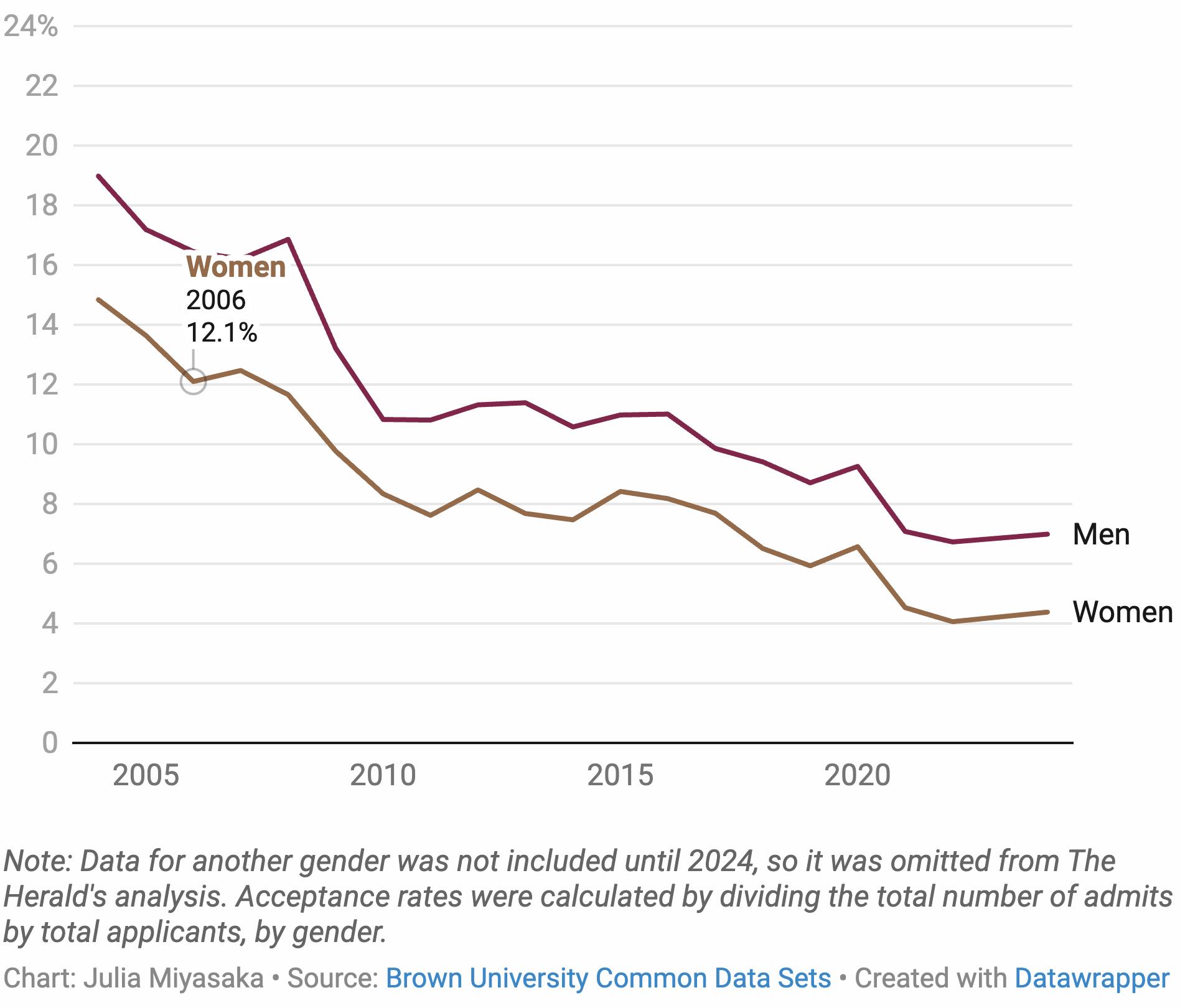
The University’s incoming first-year acceptance rate for female applicants has consistently been lower than the acceptance rate for men over two decades. “What ends up happening is that most colleges in this situation overcompensate and manipulate the ratio by admitting men at a higher rate than women,” Harberson wrote in an email to The Herald.
In 2004, the acceptance rate for men was about 19%, while the acceptance rate for women was around 14.8%. In 2024, the acceptance rate for men was 7%, and the acceptance rate for women was around 4.4%.
A higher percentage of male applicants are admitted compared to female applicants
Percentages of applicants that were admitted, by gender, from 2004 to 2024
Number of Asian and Pacific Islander first years has increased while white first years have decreased
Enrolled, degree-seeking first-time first years by race/ethnicity from 2004 to 2024




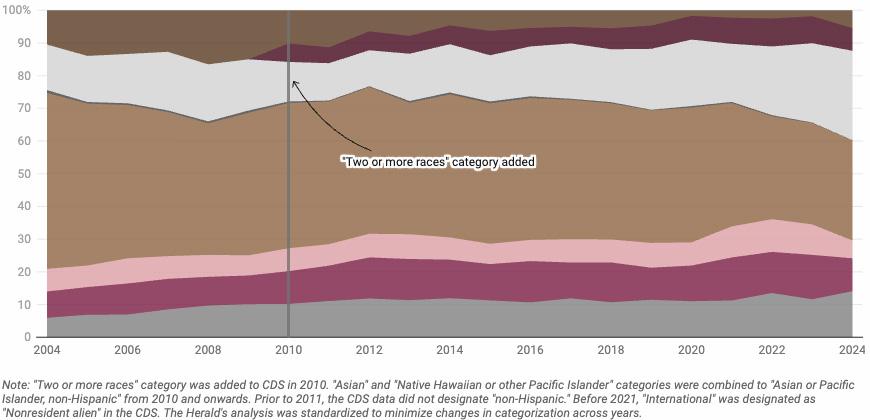
White students made up approximately 54% of the 2004 admitted class, with Asian or Pacific Islander students making up the second largest share at just 14%. In 2024, white students accounted for 31% of the admitted class and Asian or Pacific Islander students came in at a much closer second of 27%.
For the past two decades, American Indian or Alaska Native students have consistently accounted for the smallest share of each incoming class at under 1%.
In June 2023, the Supreme Court overturned race-based affirmative action, ruling that colleges and universities could not consider race in admissions.
But according to Harberson, “A college’s admissions office doesn’t need racial checkboxes to determine or
Early decision applications have grown dramatically, but the number of ED admits has only increased slightly
The University began ED admissions in 2001, in part to reduce the workload for admissions officers due to the increasing volume of early applicants. Prior to that, Brown had an early action policy, meaning that applicants could apply to other private universities early as well.
In 2004, there were about 1,900 ED applicants. In recent years, there has been a drastic increase in the number of ED applicants, with a significant upward trend starting in 2018 and a peak of 6,787 ED applicants in 2023. The number of students accepted early has only increased by about 350 since 2004.
Financial aid packages have kept up with rising tuition costs
The mean first-year financial aid package has kept up with rising tuition costs. Dean of Financial Aid Sean Ferns highlighted University initiatives such as the Brown Promise — which replaced student loans with scholarships — and the Book/Course Materials Support Program — which covers course expenses for Brown University Scholarship-eligible students — as key programs that have “enhanced aid offers.” Ferns added that from 2004 to 2024, “although the overall percentage of covered costs has remained similar during that time, the number of students
Over the past two decades, the direct cost of attending Brown has doubled Tuition has increased dramatically in the past 20 years, more than doubling from around $32,000 to $71,700 from 2004 to 2024. In this time window, the average cost of other direct costs — including housing, books and supplies, required first-year fees and food — has also more than doubled.
According to Ferns, direct costs of attending Brown — tuition, fees, housing and meals — are approved by the Corporation, the University’s highest governing body, based on recommendations given by the University Resources Committee, a group of students,
According to Harberson, during the early years of ED applications, “the only students who knew about the tremendous advantages of applying ED were those coming from highly educated families, private schools and those whose families were in the upper echelon of earnings.”
In recent years, more students from a diverse range of backgrounds are learning about ED applications and are aware that “your chances of admission increase,” compared to regular decision, she wrote.
While Harberson was unsure of the exact reason behind this trend, she said she believes that social media has been a contributing factor in increasing applicants’ knowledge about ED admissions.
who receive University Scholarship has increased significantly.”
According to Ferns, the percentage of students awarded any aid before 2021 remained steady at around 43%, but has “steadily increased since then and currently is at 48%.”
The number of enrolled first-years applying for financial aid has increased over time, with many years seeing extreme fluctuations in the number of applicants. The largest difference in the number of first-years applying for financial aid compared to the number awarded aid came in 2020, with 256 first-year students who applied for aid not receiving an award.
faculty, staff and administration.
Indirect costs, such as books and supplies, are approved by the Department of Education. The University uses “publicly available information, such as regional cost-of-living data,” in addition to “information derived from Brown-initiated programs, such as the International Travel Pilot and the Book/Course Material Support Program” to estimate these costs, Ferns wrote.
“The goal is to provide a realistic budgetary framework that covers essential costs — such as laundry, personal care and local transit — while maintaining compliance with federal ‘reasonable cost’ standards” and may vary each year, he added.
The gap between 75th percentile and 25th percentile SAT scores is shrinking
25th and 75th percentiles for SAT Math and Evidence-Based Reading and Writing from 2017 to 2024
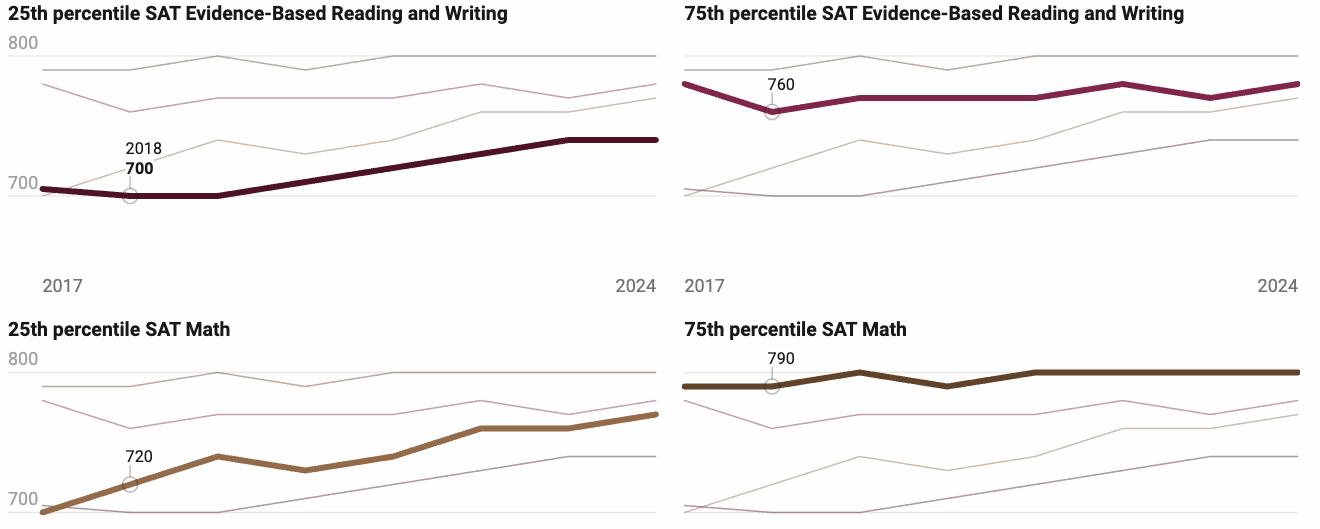
Brown’s 25th and 75th percentile ACT Scores have been on the rise in the past two decades, with the 25th percentile rising from 27 to 34 and the 75th percentile rising from 32 to 35 from 2004 to 2024, respectively.
The University went test-optional in 2020 during the pandemic and continued that policy through 2024.
During this time, the gap between the 25th and 75th percentiles of ACT scores shrank significantly — and the same trend held true across sections of the SAT.
guess a student’s race.” She noted that information such as name, home address, activities, high school and essays could inform admissions officers about an applicant’s racial background.
“While admissions officers aren’t formally commenting on a student’s race for fear of being investigated, everyone around the table of an admissions committee is ‘in the know,’” Harberson added.
Cathleen Sheils, former director of undergraduate admissions at Cornell and a senior associate director of college counseling at Solomon Admissions Consulting, said that while the admissions officers don’t see race data due to the overturn of affirmative action, they are still “looking at a student’s life experiences” when forming a class of accepted students.
The Common Data Sets with information on ACT and SAT scores for first-year students admitted in 2025 under the reinstated test-required policy have not yet been released.
Transfer student applications have grown, while the number admitted has remained steady
While the number of incoming transfer applicants to Brown has more than quadrupled since 2004, the number of transfer students admitted has remained relatively stable over time.
Harberson is also “seeing an uptick in the number of students wanting to transfer” in her advising business, adding that she believes that the pandemic has influenced the current generation of applicants.
“There is this growing sense among students that if you aren’t happy where you are, all you have to do is transfer,” she wrote, with “less patience among students
According to Harberson, national average SAT test scores have fallen, but the test scores of admitted and enrolled students at schools like Brown have increased.
Harberson believes this is because universities “favor students with higher scores to not only keep their average test scores consistent, but on the rise.”
She called test-optional policies “a farce,” emphasizing that colleges used “that policy to attract more applications while clearly favoring students with high test scores instead of treating students fairly in the process, regardless of whether they reported scores.”
to wait things out, get acclimated and realize the first college is a good fit.”
Harberson feels that recent students believe “getting into a better college will somehow solve everything,” she wrote.
“Some students are reaching out to me about transferring the moment they send in their enrollment deposit,” she wrote. “They think they'll have better odds of getting into an elite college as a transfer student rather than a high school senior. But sometimes the acceptance rate for transfer students is even lower than the freshman acceptance rate.”
ARTS & CULTURE
Stalls, secrets and shilajit: SOTG’s 30-minute play festival is peak student theatre
The trio of original plays balance social commentary with pure hilarity
PLAY BY ROSE FARMAN-FARMA STAFF WRITER
Something on the Green’s student theatre company has been producing its short play festival, SPF30, for the past three years, where three 30-minute plays — written, directed and produced by students — are performed back to back. This year’s selection proved both devastating and hysterical, providing viewers with an emotional rollercoaster worth seeing twice.
The first play, “Porcelain Joan,” written by Evan Heath ’28, opened the night with a heavy, but beautiful portrait of grief. The plot follows Joan, played by Georgia Gray ’29, as she hides out in the bathroom at her father’s funeral. Heath’s lively script helped animate its somber subject, weaving witty dialogue with jarring glimpses of the underlying pain that pervades the play.
Characters spiral into arguments over ridiculous issues like handwashing, biphobia and bad grades that eventually reveal the true source of their distress: Joan’s father, a professor, has been murdered by an unknown shooter.
An especially powerful moment came when one of the professor’s students, Charlie, played by Gunner Peterson ’27, sobs as he frantically washes his face, which felt like an almost Shakespearean revelation of the deeply troubled state of his subconscious. But much of the play’s brilliance came from the comedic relief of Joan’s chaotic sister, Zooey, played by Grace Belgrader ’27, and Zooey’s boyfriend, played by Zane Elinson ’28.
As the pair flips between bickering and sincere attempts to comfort Joan

through the walls of a bathroom stall, the chemistry between Belgrader and Gray shines through. The actresses touchingly portray the shared language of two sisters wrestling through a trauma they’d rather not acknowledge. The play ends with an explosive scene of Joan alone, shrieking and smashing a broken hand dryer — a painfully honest expression of how loss can manifest itself through visceral reactions and misplaced anger.
The second play of the evening, RISD junior Lane Bynum’s “Alien Baby,” brought a jolting change of tone as Dancing Queen blasted through the theatre and co-star
Vanya Shah ’29, who plays Shay, roller-skated onto the stage. The play began with another bathroom-stall conversation — an apparent motif of the evening — as characters attempted to reach each other through thin emotional and physical walls. From its outset, director Lulu Grieco’s ’28 staging was both inventive and striking. As viewers are introduced to protagonist Lucy, played by Herald Senior Staff Writer Rebecca Goodman ’27, they only have a view of her rollerskates and bloody underwear. Goodman delivered a touchingly faltering performance of nonchalance as she announced that she had just had a
miscarriage while entering her mother’s roller-skating-themed 53rd birthday party.
As the two teenage friends scramble to devise some kind of plan, the play’s irreverent absurdity develops into a tender exploration of adolescence. Through bedroom conversations littered with pop-culture references and naivete, Bynum offers a touching ode to girlhood as Goodman and Shay grapple with how ‘adult’ they can act and how well Lucy can function independently of her mother, now that she could consider herself one, too.
The last show of the night sent instant bellows of laughter through the room as
Mama, played by Kat Lopez ’27, stomped onto the stage with a manic look in her eye, proclaiming her mad excitement for camping. Written and directed by Harrison Douglas ’26, “As Above, So Below” sustained a hilarious rapport with the audience throughout its slightly longer run time. Entire lines were drowned out by the room’s hysterics. At one moment Kayla Lerner ’27, playing Frannie — a teacher’s pet type with a simmering existential rage — even struggled to suppress her own laughter on stage.
Nearly every line delivered by Eve Safer-Bakal ’28, who played a strange, half-Russian, ghostly character called Trinity, caused an uproar from the crowd. But beyond the plays’ slapstick comedy and exaggerated southern accents, the increasingly unhinged antics of Milford Baptist Church’s Youth Group’s visit to the wilderness and their frequent infighting over “who makes the rules” functioned as a sharp social commentary on the boundaries of religious authority.
The group’s spiritual training camp eventually descends into a mad cult ritual, with Mama scheming to sacrifice the group using her deathly shilajit concoction. By its conclusion, the play has successfully reckoned with the absurd powers of collective delusion and demonstrated how religious frustration can blur into madness.
Between the painful poignancy of “Porcelain Joan,” the bittersweet absurdity of “Alien Baby” and pure hilarity of “As Above, So Below,” the evening showcased an impressively wide range of comedy, tragedy and social commentary. Brought to life through collaboration and raw talent, the collection of three plays was a testament to the possibilities of student theatre.
This article originally appeared online at browndailyherald.com on April 15, 2026.
Solo performance ‘Echo Chamber’ explores a museum of memory
The 90-minute performance debuted on April 10
BY AMELIA BARTER SENIOR STAFF WRITER
Those who stopped by the Lindemann Performing Arts Center last weekend may have heard a cacophony of distorted voices echoing through the building. Those who followed the sound to the Performance Lab would have seen Noah Martinez ’27 bathed in colored light as he debuted his solo performance “Echo Chamber.”
Martinez began writing the 90-minute solo performance as a first-year at Dartmouth. Now a junior at Brown, he aimed to use the exhibition to embrace “storytelling as a means of archive,” Martinez said in an interview with The Herald.
In his performance, Martinez interacted with different objects positioned around the room. In each of ten episodes, he visited a phase or topic that has impacted his life, inviting the audience into his mind.
In one episode, “cobweb,” he tangled himself into a pre-made web of rope to conjure childhood feelings of entrapment.
In another, “confessional,” he spoke into an LED light as a heavily distorted, pre-recorded audio responded to him — as if he were speaking to a deity. He asked questions about his place and involvement in religion, and the voice answered acting as
the voice of a religious figure.
The final three episodes took a different tone. The clear transitions between composed moments were abandoned in favor of a more chaotic depiction of Martinez’s memories.
“Episodes eight through 10 are like the culmination of the anger and the rage,” Martinez said. In these episodes he broke apart the different exhibits and threw them into a corner, interrogating the need to relive the experiences at all.
Will Holland ’26, the show’s production operator and co-designer, worked closely with Martinez to transform the concept into last weekend’s production.
The two sat down with the script “to try and figure out the intention and the feeling that Noah was trying to convey,” Holland said. To achieve the impactful sensory effects which dominated the performance, Holland spent his time digging through sound libraries, manipulating vocals and testing lighting.
The pair lit the show with two LED lights in the room’s corners, so they could “play with backlighting,” Holland added. The performance made use of pre-recorded audio from voice actors close to Martinez.
Alyse Harrell ’28, a friend of Martinez who contributed audio to the performance, recalled receiving a script from him and recording her lines under a blanket with her phone. “I felt really honored that he would approach me,” she said. Like the performance’s other voice ac-

The performance moved through a series of ten episodes where Martinez interacted with different objects.
tors, Harrell’s words represented influences in Martinez’s life or his internal dialogue.
Noah “is a very intentional theater maker,” Tony Fusco ’28, another voice actor and friend of Martinez, said. He added that the way the performance dealt with delicate topics meant “everyone was able to be so vulnerable.” For Martinez, this was intentional. Initially hesitant about showing the exhibition at Brown, he aimed to “create space
and room for people to talk about these things in a way that was appropriate and respectful,” he said.
At the end of “Echo Chamber,” Martinez encouraged the audience to write a note to him about their experience — one of many moments where he involved the audience. This allowed him to touch on what he described as the “voyeuristic watching of privacy,” a concept central to the performance.
“I approached a lot of sensitive subject matter in a way that I think (abstracted) it and made it more interpretive and introspective for an audience,” Martinez said. “I could preserve my own privacy and my own history without also being afraid to share these experiences.”
This article originally appeared online at browndailyherald.com on April 16, 2026.
COURTESY OF TATSUYA KING
Something on the Green showcased three plays entitled “Porcelain Joan,” “Alien Baby” and “As Above, So Below.”
KAIA YALAMANCHILI / HERALD
BASEBALL
On journey to professional baseball, Maggie Foxx ’28 strives to improve every day
BY AVA SCHELLING STAFF WRITER
Maggie Foxx ’28 — Brown softball catcher and home-run leader — was drafted into the Women’s Professional Baseball League during its inaugural draft on Nov. 20. Selected as the 14th overall pick in the second round, Foxx found out that she had been selected to the league’s Los Angeles team while surrounded by her cheering teammates during a celebration on College Hill.
“It was really special to have all of those girls around me when my name was called,” Foxx said in an interview with The Herald.
“We all go through all of our hard work together.”
Foxx described the moment as “a dream come true.” She plans to stay enrolled at the University and remain part of Brown Softball while playing in the WPBL, as the league’s season takes place largely outside of Brown’s academic year.
Beginning in August, Foxx will join 119 women from around the world in kicking off the debut season of the WPBL. The WPBL is the first U.S. women’s professional baseball league in 72 years since the All-American Girls Professional Baseball League — founded during World War II — played its final season in 1954.
The historic achievement marks a culmination of Foxx’s lifelong story on the field.
WRESTLING

For Foxx, balancing athletics, academics and a trailblazing role in women’s sports comes down to “(focusing) on doing one thing every day and getting 1%
For over 2,100 days, Foxx has practiced baseball or softball in some way. Whether she is completing drills in the diamond, juggling baseballs or celebrating her future in professional sports with teammates to keep the streak alive, day-to-day routines and positive interactions are “instrumental” to her success,
Along with her national accolades, Foxx also played four seasons of baseball at Bedford High School, becoming the first female catcher to play at the Division I level in New Hampshire baseball history.
Billy Chapman, the head coach for varsity baseball at Bedford High School, described Foxx as “very motivated” and “confident.”
“She works hard. She’s dedicated. She’s team first,” Chapman said. “Her answer is always
To Foxx, being part of a team is a critical component of her identity.
“One of the things that really brings me joy in life is being able to look back and see how far
I’ve come, and see how far my teammates have come, and how I’ve made an impact in their lives,” Foxx said.
Jasmine Hsiao ’26, a utility player on Brown’s softball team, described Foxx as a “ray of sunshine” and emphasized her “pure and genuine love for the sport.”
“She’s going to be a part of something so ... monumental, while she’s just pursuing what she genuinely loves,” Hsiao said.
In an email to The Herald, Brown Softball outfielder Lily Berlinger ’26 wrote that Foxx “puts in the work every single day and does it with so much intention and love for the game.”
“Every memory I have of Maggie makes me smile,” Berlinger added.
In an interview with The Herald, Justine Siegal, co-founder and commissioner of the WPBL, said that the “magic” of the league is that, “instead of being a girl on the field, now they get to just be a ball player, and they have community around them.”
Foxx is “so bright and passionate and wants to help grow the game, be a role model and be a game changer,” she said. “We’re really happy to have her in the WPBL.” Foxx shared her excitement for the league as a way to create an avenue for women to share the sport alongside male players.
“And I see it. I see (the WPBL) breaking down a gender barrier,” Foxx said. “Because women play baseball too.”
This article originally appeared online at browndailyherald.com on April 13, 2026.
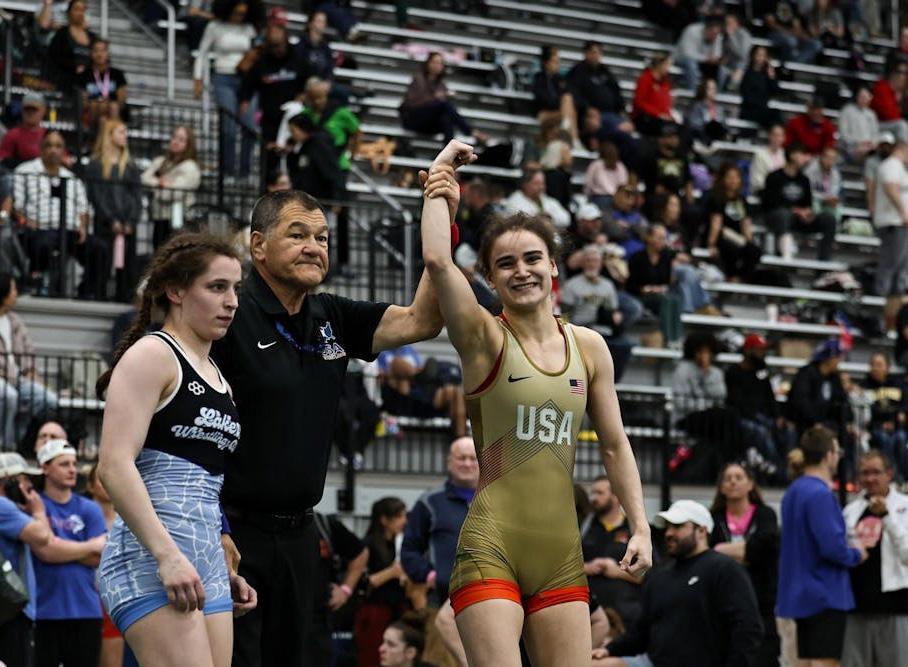
Calli Gilchrist ’29 takes home bronze at USA Wrestling National Championships
Gilchrist earned a spot on the U-20 U.S. Women’s National Team
BY CHIUPONG HUANG SENIOR STAFF WRITER
This past weekend, Calli Gilchrist ’29 brought bronze back to Providence from the USA Wrestling Women’s National Championships in Spokane, Washington. Competing in the 53 kg weight class, Gilchrist cemented her spot on the U-20 U.S. Women’s National Team.
Gilchrist, Brown’s first-ever recruit in women’s club wrestling, went 7-1 in her bouts, with six victories coming by fall or technical fall. Her only loss came at the hands of Taylor Whiting, who went on to win gold.
“I had so much trust in my training and coaching,” Gilchrist wrote in an email to The Herald. “The faith I had in the program really gave me the confidence I needed in my matches.”
Gilchrist, who traveled to Spokane with Women’s Club Wrestling Head Coach Nick Lattanze ’21, was the sole Bear competing at the national team trials. Her tear through the brackets made a splash as she showed off cleanly dominant victories over some of the country’s best 53 kg wrestlers in her age group. Gilchrist displayed consistency by often establishing and maintaining early leads before finishing the bout with a fall or technical fall.
The Connecticut native stormed through her opening bout with a first-period pin over Rosalia Rubio, wasting no time in stapling her opponent’s back to the
mat. From her first moments in Spokane, Gilchrist’s penchant for aggressive offense shone through. Her next bout followed a similar theme, as she barrelled through Hepua Salter to secure a 10-0 technical fall in the first period.
Controlling the center of the mat, Gilchrist earned a point by forcing her opponent to step out of the circle. Next, she wowed spectators with a 4-point grand-amplitude throw that launched her opponent into the air.
Gilchrist went on to storm through the round of eight, collecting another first-period technical fall. Up until the quarterfinals, Gilchrist did not allow a match to reach the second period, refusing to concede even a single point.
In an email to The Herald, Lattanze lauded Gilchrist’s composure throughout the tournament as a “major step forward in her wrestling.”
But the Bear’s blitz through the winner’s bracket was cut short when Gilchrist
encountered Taylor Whiting, who went on to win the tournament. Whiting secured a takedown and gained two points for a back exposure one minute into the first period. Whiting racked up two more takedowns in the first period to secure the technical fall over Gilchrist. She then moved into the consolation bracket and returned to putting up dominant performances, denying her opponents any moment to breathe or offer offense of their own. In her first bout, Gilchrist
secured a first-period pin against Gable Hemann with a throw.
Gilchrist then wrestled former worldteam member Isabella Marie Gonzales in her tightest bout of the tournament. Gilchrist faced a 5-0 deficit early after being taken down with a grand-amplitude throw in the first period.
She wrote that while she has had difficulties “staying calm when being down in a match,” this year, she was “really proud” of herself for trusting the work she has put in in order to make a comeback.
Gilchrist completed that comeback to regain her footing in the second period, turning the tide and emerging victorious with a final score of 14-7.
Her triumph over Marie Gonzales sent her to the semifinals, where she wrestled Abbi Cooper, who was fresh out of the winner’s bracket. But a strong 14-4 win led Gilchrist straight to the tournament’s third-place match.
There, the Bear’s first-period dominance continued, as she pinned Libby Roberts after a throw to earn her place on the podium and the national team.
Gilchrist’s landmark performance in Spokane sparked hopes within the young program that women’s wrestling at Brown has a bright future, Lattanze wrote.
“You can come to Brown University to get one of the most prestigious degrees in the world, and truly chase World and Olympic dreams,” he wrote. “Brown is going to be a household name in women’s wrestling for a long time to come.”
COURTESY OF JESS MCNALLY
The landmark result sparked hopes within the young club program with ambitions of becoming a D1 team.
Foxx will play in the Women’s Professional Baseball League
ANNAMARIA LUECHT / HERALD
VOLLEYBALL
Men’s club volleyball crowned D1AAA national champions in historic win
The team went undefeated in ten games across the three days
BY REBECCA GOODMAN SENIOR STAFF WRITER
Brown men’s club volleyball recently swept at the Division 1AAA National Championship, winning all ten games in three days to bring home the team’s first ever Nationals win. Co-captain Wesley Hackett ’26 was named a First Team All-Tournament selection, and co-captain Ohm Patel ’27 was named Tournament Most Valuable Player.
The win capped off a “really exciting season,” co-captain Luke Rossi ’26 said. “I think from the start, we kind of had a good idea that this was going to be a pretty strong team.”
In the fall preseason, the team hosted their first home tournament with several teams in New England and won, which Rossi said “set the tone” for the rest of the year. They also competed in the first ever Ivy League men’s volleyball tournament at Yale in October.
Despite losing that competition, the team had ample time in the spring semester to shoot for Nationals. The team ended with a regular season record of 7-2 and qualified for regionals, where they then advanced to Nationals.
Making it to Nationals was “the result of really hard practices all season long,” said Head Coach Sam Hillestad ’15, a former Herald opinions columnist. “We always knew that that was our goal, and so we
BASEBALL

really wanted to peak as a team in terms of our performance at Nationals.”
But it wasn’t all smooth sailing once they made it to the Kansas City competition, Rossi said. He noted that there were several matches where they “went down early” or “were either tied” or losing a little towards the end of some sets.
The second set against Yale on the second day “was the longest set of volleyball
I’ve ever played in my life” said Rossi. After an arduous back-and-forth game, Bruno won 36-34.
“It’s easy to either lose energy or just lose focus or kind of doubt yourself,” Rossi said. “We were able to just have the confidence in ourselves to close out the games.”
In the final match, the team beat Illinois State 25-19, 25-23 to claim the trophy.
The men’s club volleyball team has two
volunteer coaches, Hillestad and Assistant Head Coach Matt Lo ’18 ScM’19. Hillestad played on the team during his four years at Brown and was a captain for three years. He overlapped for one year with Lo, who played on the team for five years at Brown and was a captain for four.
A few years ago, Hillestad reached out offering to help coach the current team. He was happy to provide more “formal coach-
Baseball overtakes Dartmouth 2-1 in weekend series
Bruno remains in second place in the Ivy League standings
BY HARRY GUO SENIOR STAFF WRITER
The baseball team (15-13, 8-3 Ivy) earned a crucial Ivy League series victory against Dartmouth (7-18, 4-8) last weekend away in Hanover, New Hampshire, splitting a Saturday doubleheader before closing the series with a Sunday victory. Bruno lost 4-0 in the first game but bounced back with a 13-3 win later that day and finished the weekend with a clutch 7-5 victory to remain at second in the Ivy standings.
Following last weekend’s shutout win against Merrimack (13-19, 8-7 MAAC), Brown entered the weekend refreshed and ready to jump back into Ivy play. But it was the Big Green that came out swinging first on Saturday.
In just the second inning of the first game, the Big Green notched a solo home run. The home team then widened the gap in the third inning with a two-run shot to extend the margin to 3-0. Another solo home run in the eighth sealed the Big Green’s victory.
Despite the poor scoreline, the Bears boasted promising opportunities to score throughout the game, loading the bases in both the first and fifth innings. But Dartmouth escaped both of those innings without allowing a run, keeping Brown off the scoreboard for the entire game.
On Saturday, the second game started with a quiet opening inning not indicative of the Bears’ impending comeback. But Brown’s offense broke through in the
second with catcher and outfielder Jack Edmunds ’28 launching a deep shot to left field for his fourth home run of the season. With infielder Mark Henshon ’26 and outfielder Brady Dever ’27 already on base when Edmunds fired his homer, the hit gave Brown an early 3-0 lead.
ing Brown’s lead to 6-2.
Defensively, Benevento made a highlight play in the seventh that may have been instrumental in shutting down any comeback attempts by the Big Green. After a long hit by Dartmouth flew deep into right field, Benevento dove for an incredible grab,
ready to let another one go, doubling to bring Benevento home and pushing the score to 10-2. Infielder Christian Butera ’28 then added a deep drive to left that Dartmouth misplayed, allowing Dillehay to waltz through home.
Brown’s offense continued to over-

ing” as they looked towards getting “more serious as a program.” Lo then joined the coaching staff.
“In my time playing, I wish we’d had a coach,” Hillestad said. “I was really happy to be able to help provide that experience that I wanted a little bit more when I was an undergrad.”
The coaches allowed the team “to come so much farther than we have been able to in any previous year,” Hackett said. “I would not be anywhere near the same player I am without the help of those two.”
Some players were “directly affected” by the Dec. 13 shooting, Lo wrote in an email to The Herald. “It felt like diving back into volleyball was a way to move on from what happened and return to being students and athletes again.”
Spencer Yang ’29, a starter on the team, was injured during the shooting. He said his biggest goal coming back to campus was returning to play.
At Nationals, Yang played the whole tournament. “Every day was fun because we were excited to play and excited to do better,” he said.
Hillestad feels that the team culture “really shows on the court in terms of camaraderie and communication, which are so important in volleyball in particular.”
Many of the players are “genuinely best friends,” Hillestad said, adding that they are a “really, really a tight knit group of guys.”
This article originally appeared online at browndailyherald.com on April 15, 2026.
grounded it left, leading to another scoring play for Meusy.
Dartmouth scored once in the third, but Brown added to their lead in the fifth when Meusy launched a home run over the leftfield wall with Butera aboard, making it 7-3.
But the Big Green did not go down without a fight. Dartmouth chipped away at the lead with a solo home run in the sixth and an additional run in the eighth to shrink the gap to 7-5. With runners on base in the ninth and the threat of a Dartmouth comeback victory, pitcher Christian Keel ’26 struck out the next three batters to seal the series.
Brown will hope to keep the winning streak alive as they return home to face Holy Cross (16-18, 10-6 Patriot League) on Tuesday before hosting Columbia (8-20, 5-7 Ivy) in an Ivy League weekend series beginning on Saturday.
“We’re just trying to come out and play our best brand of baseball that we can every day, regardless of who we’re playing against,” Benevento wrote. “If we’re able to look back and say that we played to our standard, more often than not, we are happy with the results.”
Going into this week’s games, the team is not resting on their laurels, Luigs noted. “The coaches and senior leadership on the team will ensure that we do not get satisfied.” he wrote in a message to The Herald. Head Coach Frank Holbrook “wants everyone on the team to ‘grab the bull by the horns’ and do their job the best way they can no matter how small or insignificant it may seem.”
This article originally appeared online at browndailyherald.com on April 13, 2026.
COURTESY OF WESLEY HACKETT
In the final match, the team beat Illinois State 25-19, 25-23 to claim the trophy.
COURTESY OF BROWN ATHLETICS
on andremembering the comfort it provides
by Maria Kim
…The book I’m reading in my English class, Black Flower by Young-ha Kim, makes me nostalgic for bingereading all five of the Percy Jackson and the Olympians series in one go at the Barnes & Noble that was a ten-minute drive from my childhood home. Leaves swirling in brown-tinted tendrils on the street on a windy day remind me of the ones I saw on a different street, maybe in a different city (though my memory doesn’t provide this detail) at a different time where all the leaves in the world seem to be swirling off their branches.
To me, nostalgia represents all that can be connected in unsuspecting ways. These connections can occur between instances that are similar or different. Coffee drips discreetly—yet not quite silently—into a pot that renders itself almost halfway full while I furiously type out my English paper due at midnight. Suddenly, I am reminded of the tendrils of steam that emit from Lorelai’s cup of coffee in that one (or maybe more accurately, multiple) scene from Gilmore Girls where she yells at Luke over something not quite that serious.
Nostalgia reaches its arms into the past, but what about the other way around? Could the license plate on the car in front of me, H-V-E-F-U-N, be a premonition that I indeed am taking on too large of a workload here at Brown and should follow my heart to solo-backpack-travel through the winding hills of the Netherlands like I’ve always dreamed of?
In all seriousness, part of me wonders if nostalgia viewed this way—directed towards the future—has any real difference from that directed towards the past. Synchronicity is the tendency to perceive patterns or connections in random data. Maybe nostalgia, then, is its counterpart, connected more to the emotional, right hemisphere of our brain, offering us fleeting solace in our hectic everyday lives…

EDITOR-IN-CHIEF
Elaina Bayard
FEATURE
Managing Editor
Chloe Costa Baker
Section Editors
Anika Kotapally
Gabriella Miranda
ARTS & CULTURE
Managing Editor AJ Wu
Section Editors
Lizzy Bazldjoo
Sasha Gordon
NARRATIVE
Managing Editor
Gabi Yuan
Section Editors
Chelsea Long
Lucie Huang
LIFESTYLE
Managing Editor
Hallel Abrams
Gerber
Section Editors
Alayna Chen
Tatiana von Bothmer


POST-POURRI
Managing Editor
Tarini Malhotra
Section Editor Christina Li
HEAD ILLUSTRATORS
Junyue Ma
Lesa Jae
COPY CHIEF
Jessica Lee
Copy Editors
Eve Kobell
Indigo Mudbhary
Kate Schuyler
Rebecca Sanchez
LAYOUT CHIEFS
Alexa Gay
Amber Zhao
Layout Designers
Emma Vachal
James Farrington
Joshua Rezneck
SOCIAL MEDIA
Rebecca Sanchez
Yana Giannoutsos
Yeonjai Song
1 Starting 420 early


2. Dragging a chair from one end to the! other
3. Saying you will start that paper for! three hours straight
4. Pole dancing
5 Eating lobster #MaineGreen
6 Hanging out with the forgotten brother of John and Hank
7 Not being Quiet
8 Dodging frisbees/footballs/spikeballs
9. Spotting Murphy!
10. Stair sitting
2.___ Life, Brown's housing offic e
4.Spring Weekend artist _____ B
6 F igure sitting on your sh o ulder, perhaps
7. Baker's budding buddy


“This isn’t bad, it’s just like, not a sentence.”
1.Block party game?
2.Ancient character
3."Super Mario World" c ons ole, for short
4.Spring Weekend artist Ma gda lena ___
5.Word before rock or pop
“If you’re good at English you’ll be fine. I’m better with 1+1=2.”
Cover by Kyubin Nam

Dear Readers,

it's me
Madison diaz 1 3 5 7
Katya Michkovskaia
perfect pitch
Katya Michkovskaia
how lucky we are to have each other how lucky i am to have you
Shriya Goel
seeing, moving, evanescent, and infinite
jessica lee 9 11 13
on remembering and the comfort it provides maria kim for just a moment
managing editors which dining hall are you?
“It was well past dinner time when we realized we were famished. The sun had long since set and a purifying fluorescence lit the room.”
— Kimberly Liu, “hunting for clues, eschewing the blues”

“It’s a bit past the Vernal Equinox now. The Northern Hemisphere is approaching the sun, but we’re still closer to the Vernal Equinox than we are to the summer solstice. I wish I could stay in the in-between for just a little longer. ”

— Katherine Mao, “spring (noun, verb)” 04.18.24 04.25.25
letter from the editor
It’s been bittersweet thinking about what I want to write in my last editor’s note (and my second-to-last issue of post-) before graduating next month. The Venn diagram of my time at Brown thus far and my time at post- is a circle: I joined as a writer two weeks into my freshman fall on a whim. Over the next four years, I continued to write, made crosswords, was a copy ed, section ed, and did a very short-lived stint as an illustrator. Whatever it was, I loved it because it was post- and—I don’t think I’m biased at all when saying this—postis singularly special. Getting to read endlessly inventive and earnest student work every single week is something that I can never take for granted. And even in more tiring weeks, I could always look forward to spending Thursday nights, later Wednesday nights, in our cramped upstairs room in 88 Benevolent— abundantly joyful and together. I’ll miss it immensely.
This week in post-, our writers are also grappling with difficult questions and new horizons. In Feature, Katya defends autofiction and explores the evergreen challenge of authenticity. In Narrative, Shriya reflects on the love that surrounds us and the love that is difficult to let go of, and Katya returns to ponder having perfect pitch and what it means to know with certainty. In A&C,
Madison implores us to wander and brings us along an alluring tour of Paris through the eyes of a flâneur. In Lifestyle, Maria celebrates nostalgia and all its offerings. Also in Lifestyle, we’re full of surprises—catch a piece from our MEs about little moments that have caught us by surprise this semester. Lastly, don’t miss a timely Spring Weekend-themed crossword from Ishan and Jessica’s quiz that finally provides an answer to the age-old question: Which Brown dining hall are you? I can rest easy knowing I’m V-Dub.
However I feel about it, change is constant. In post-, at least, there are new brilliant writers, illustrators, editors all the time—a different iteration of post- each semester and I’ve had reason to love every one. This little magazine has been home to some of my very favorite people and countless pieces that haven’t stopped rattling around in my head since the day they were published. Thank you for these four years. I’ve grown a bit, changed a bit, and—for a time—got to be a small part of this lovely magazine that continues changing and growing always. How lucky is that?
With all that said, I hope you, dear reader, enjoy this issue of post-. I’ve enjoyed all of it.
A&C Managing Editor
OPINIONS
Mooney ’29, Murray ’29: A residential college system could solve Brown’s housing woes
Last week was particularly stressful for many Brown undergraduates, and it didn’t even have anything to do with midterms. For rising sophomores and juniors, the stakes are high in Brown’s randomized, everyone-for-themselves housing selection. There seems to be a scarcity of desirable living situations, as hopes for singles, suites or newer dorms are left to the luck of the draw.
Aside from the assorted program and theme houses, Brown's residence feels largely like random, identity-less buildings. It doesn’t have to be this way. Other liberal arts colleges and Ivy League universities offer robust residential housing systems that create tight-knit bonds across students’ four years. To strengthen the undergraduate experience, Brown should adopt its own version of a residential college system that provides a continuous living-learning experience for undergrads.
Past editorials have noted the lack of clarity in the housing lottery process. The Office of Residential Life provides floor plans with no square footage metrics, and the service only provides two hours worth of information sessions per semester. Students had to create their own tools to decipher the university’s housing options. With a limited number of suites, one late timing slot can leave part of the community stranded across campus. While first-year students’ excitement for starting college and eagerness to meet their peers might help foster a community within our “neighborhoods,” sophomores and juniors don’t have incentives to build a dorm community before living off campus in their senior year.
A residential college system could replace the lottery system, providing students with a consistent, built-in community for the length of their undergraduate experiences. At Yale, for instance, all incoming students are sorted into one of fourteen distinct residential colleges. While most don’t move into their residential college until sophomore year, they live with a cohort of other first-year students in the same residential college and engage in its general activities. Unlike Brown, where first-years are corralled together but then separated in subsequent years, Yale’s residential colleges build a distinct com-
munity within the university for the whole of the undergraduate experience.
The structure of residential colleges at Yale makes it easier to build community. They are managed by deans specific to that college who plan events and facilitate students’ experience. They have shared dining halls, common areas and facilities — which increase students’ interactions with each other in everyday spaces — and they have traditions unique to each college that help build a tight-knit community. By combining housing with dining, advising and house-specific programming, these residential colleges create a more connected community within the larger school.
Harvard operates its housing similarly, with firstyear students choosing a group of eight students and getting randomly assigned to one of the 12 residential houses on Housing Day. These houses have specific traditions, and the connections continue beyond the time spent living there. For example, in the Housing Day Challenge, Harvard alums donate directly to their undergraduate houses in a competition to raise the most funds to support undergraduate living. Brown is clearly missing an opportunity to increase school spirit and alums’ engagement.
Such a system at Brown would not only help build community and relieve some housing lottery stress — it would also help students build bonds across years. Since first-year students are housed completely separately from other students, incoming students are only encouraged to bond with other first-year students, making it harder to form friendships with more experienced seniors and juniors. While the Meiklejohn Peer Advising Program lets students receive academic advice from non-firstyear students, living in a residential college could provide first-years the opportunity to mingle with and build friendships with older students who can provide wisdom beyond the academic part of going to Brown. Integrating first-year students with their more-senior peers through the residential system is a powerful way to increase support for students’ academic success. For example, in Yale’s dorms, firstyear counselors are seniors whose role is specifical-
ly to advise underclassmen on their academic and social journeys, serving as critical support during younger students’ stressful transitions.
A residential college system at Brown could also allow the creation of student residence boards, or student leadership groups elected to plan events year after year, instead of the current Community Coordinator, or CC, position in ResLife. CCs are randomly assigned to a new dorm each year, leading to a lack of connection to one particular dorm community. In this residential college system, CCs could work in tandem with such student residence boards to create programming and events that grow dorm-specific community.
While there are some themed housing options available for students, such as Greek life and other identity-based spaces, they are only open to a limited number of students who must independently seek them out. Moreover, most designated residential program communities are based on distinct cultural identities. Additionally, these identity-based spaces, which serve an important role for their members, will now be subjected to a new policy that requires the randomized selection of members. Plus, these themed houses don’t provide a coherent experience
for their students, as many dorms are split between multiple groups — for example, certain groups control certain lounge spaces, preventing non-members from using them.
This plan may seem ambitious, but it is not unrealistic — in the last six years, Duke overhauled its undergraduate housing experience by creating a system that matched first-year students living on one end of their campus to a permanent quad that they live in for their remaining time living on campus. If we want to strengthen the undergraduate experience at Brown and improve students’ social connections — especially as more and more young adults report having no close friends — a natural place to start is Brown’s housing system. The University has the potential to transform residence halls from simply roofs over students’ heads to meaningful social environments.
Clara Murray ’29 can be reached at clara_murray@ brown.edu and Max Mooney ’29 can be reached at max_mooney@brown.edu. Please send responses to this op-ed to letters@browndailyherald.com and other opinions to opinions@browndailyherald.com.
Berkwits ’29: Get yourself a Brown bucket list
There’s nothing quite like spring at Brown: the sun is shining, trees are blooming and it feels like the whole school is having one big picnic on the Main Green. When I look at this picturesque scene, I can’t ignore an underlying sense of impending doom, otherwise known as summer break. The threat of upcoming finals, as well as the end of my first year at Brown, hangs in the air. But instead of being paralyzed by these end-of-year scaries, I have found a simple and creative way to fend off the unwelcome feelings of such a quickly approaching fate: bucket lists. For everyone feeling intimidated by how quickly college seems to be passing by, making a bucket list can prolong the end of the fleeting semester.
By breaking up the monotony of the semester’s routine, bucket lists slow time and help us live in the moment. At this point in the school year, we can visualize every week left before summer break, each one consisting largely of the same activities: going to class, studying and grabbing meals at the dining hall. The monotony of such a routine has been proven to make time feel as though it’s moving faster. When nothing significant marks our days, they begin to blur together. However, a bucket list prevents us from merely switching on autopilot and helps us live with intention. It provides a host of fun activities that each serve as a break in routine. Whether our goal is personal growth, joy or just living a bit more recklessly, the journey to achieving these can add unconventional excitement to our day-to-day.
We all know the sense of accomplishment that comes from crossing something off a to-do list. This feeling comes from checking off any kind of goal, not just far-fetched objectives. Your bucket list can consist of small things that are easy but otherwise
not prioritized in the everyday. You don’t need to do the Naked Donut Run or run in the Providence Marathon. Bucket lists can include any goals, events or random ideas you want to try, simply allowing us to feel small, daily moments of victory. Walking 30,000 steps in a day, going to a new Providence coffee shop, climbing the Faunce House fire escape, exploring a
includes some self-care — like a movie night with tons of Trader Joe’s snacks or spending an hour by the river — you might have otherwise foregone, the list is a multifaceted way to encourage personal wellbeing during this stressful period.
Bucket lists are also a wonderful way to take advantage of the remaining time you have with your

new building on campus, learning how to tight-rope walk on the Main Green or picking a favorite tree on campus are all valuable activities to pursue.
Bucket lists have been proven to improve self-esteem, a necessary remedy for those feeling apprehensive when faced with finals. Checking off many fun or small tasks can be a welcome respite from the much more daunting undertakings we all face at the end of the semester, from studying to packing to finding a summer job. Especially if your bucket list
CIARA MEYER / HERALD
peers and college living as a whole. Try a new restaurant, go to the beach in Newport, spend a day in a hammock on the Quiet Green — and do it all with friends by your side. Intentional communal activities are part of what makes the college experience so meaningful, as it is one of the only times individuals are constantly surrounded by peers who support and challenge each other. Yet these moments of meaning easily get lost in the hectic day-to-day. A bucket list can encourage students to pursue fun activi-
ties together, make lasting memories and capitalize on the remaining time we have in Providence. Even the activity of making the bucket list itself — washi tape, markers and stickers in hand — can be a fun and meaningful way to spend quality time with the people you care about before the summer.
Many of us might associate college bucket lists with senior year, a way to ensure we complete all of our final rites before graduating. But an end-of-semester bucket list mustn’t, and shouldn’t, be confined to such finality. For those of us who are coming back next semester, now is still the time to make a bucket list. Use the pressure of the summer hiatus as an opportunity to recognize the importance of making use of fleeting time while there is still an opportunity to return and try again. Living one’s life with a bucket list in mind will ensure that jovial moments of presentness do not always have to be paired with a bittersweet end.
While making fun into an achievement-based activity may seem contradictory, bucket lists are an incredible way to push ourselves out of our comfort zones. So have a day of compliment giving, learn how to play Spikeball or talk to seven new people. Fill your time with things that make your Brown experience fulfilling, joyful and satisfying before leaving College Hill. But remember, you only reap the benefits if you actually start checking things off. So get out your marker, craft your epic bucket list and make the most out of your last month of the school year.
Talia Berkwits ’29 can be reached at talia_berkwits@ brown.edu. Please send responses to this column to letters@browndailyherald.com and other opinions to opinions@browndailyherald.com.
ELISE RYAN / HERALD
Editorial: Brown does not view Providence as a playground
Brown and Providence are fundamentally intertwined. The University’s successes benefit the city, and the city’s culture benefits Brown. Brown supports Providence with millions of dollars annually through direct community contributions, by employing locals and investing in the city’s workforce development. In turn, Brown students and professors learn from the city around them and take advantage of the city’s valuable cultural and educational institutions. But since the University and city are so interconnected — with academic buildings right next to residential homes and local businesses — it is easy for our shared space to feel crowded. When Brown expands, we inevitably step on the city’s toes.
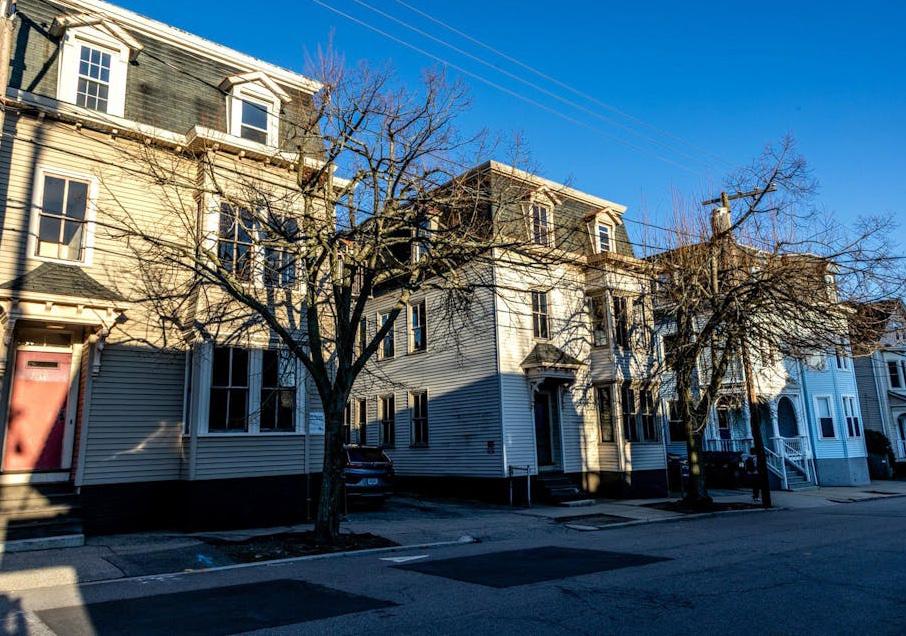
Currently, Brown is facing such tension. The University has proposed the construction of a new economics building on a Brown-owned lot on Brook Street between Benevolent and Charlesfield streets. Current tenants of these University-owned houses would be forced to move out to make room for the development, and representatives of the broader Providence community, such as City Councilor John Goncalves ’13 MAT’15 (Ward-1), have expressed disapproval over the impact of the project on the neighborhood. We understand such concerns — Brown’s history of controversial expansion looms large over this development. But the University is going about this development as respectfully as possible, taking proper measures to ensure the expansion acknowledges the interests of our neighbors while addressing the physical needs of our campus to fulfill its institutional goals.
Goncalves, in a video posted on Instagram, stated that “Providence is not a playground for institutions to experiment with their expansions.” Speaking directly to the University, he said, “If you really love Providence, prove it. Neighbors come first.” In framing the construc -
tion as trivial experimentation, Goncalves implies that Brown is not acting out of necessity. This is profoundly misleading. Currently, the economics department lacks a single, designated space for students and professors to learn and conduct research. Economics is one of the largest concentrations at Brown, yet faculty and graduate students are scattered across five separate campus buildings. The proposed construction aims to fill this gap, ultimately increasing the University’s academic output and the educational resources it can offer its students and faculty.
To make matters worse, Brown as a whole is in dire need of classroom space. While the recent closure of multiple rooms and lecture halls in Barus and Holley has exacerbated the issue, Brown has struggled with limited class space for years. As a result, the University has been
forced to implement unpopular enrollment caps on classes for the fall semester. Even when the classrooms in Barus and Holley reopen, the issue of minimal class space will persist. There simply is not enough room on campus for every student to enroll in every class they want to take. The proposed academic building would help alleviate these space requirements. Assuming that it would include auditoriums and lecture space, the new construction will help address the campus space shortage.
Goncalves twists the University’s own Brown Loves Providence campaign against it. Of course, the University must consider our impact on the surrounding community when expanding, but University administrators have attempted to do so throughout this planning process by holding meetings with locals to explain their goals and seek feedback. While Brown does love its neigh -
bors, it is unreasonable to ask the University to wholly subordinate its fundamental academic mission to the will of the city.
We understand that the University’s controversial history with development has resulted in calls for greater transparency surrounding this development. Most notably, the development of Wriston Quadrangle caused the destruction of 51 historic homes, causing several conflicts with College Hill residents. The resultant destruction even led to the development of the Providence Preservation Society — a current opponent of the proposed building. It should be understood, though, that the project has only just begun. The University’s community meeting was held in advance of the proposal being submitted to the Providence City Plan Commission, and as of now, no architect has been selected to design the building.
Ultimately, it is natural for College Hill residents to be upset about changes being made to their neighborhood and to want to provide their input to the University. However, not all input can be actionably taken into account as construction begins. Brown must act in its own interests while still working to maintain good faith with Providence. This undertaking will require difficult decisions that may not please all parties. The University is not carelessly expanding — it is actively working with the community to reach a conclusion that is best for Providence and Brown.
Editorials are written by The Herald’s editorial page board, and its views are separate from those of The Herald’s newsroom and the 136th Editorial Board, which leads the paper. A majority of the editorial page board voted in favor of this piece. Please send responses to this column to letters@browndailyherald.com and other opinions to opinions@browndailyherald.com.
Tkachenko ’29: Brown students need to listen to the political pulse of Spring Weekend
The last year has seen many Brown students speaking out about the issues they care about, from No Kings rallies to anti-ICE protests and outcries against the Trump administration. In 2026, activism remains a critical fiber in Brown’s social fabric.
Thus, when engaging with this year’s Spring Weekend lineup, students should recognize the chance the festival provides for the Brown community to come together behind a collective voice in our country’s political discourse. Thee Sacred Souls, Magdalena Bay, BunnaB and Isabella Lovestory reflect a range of contemporary music, but their platforms also include care for their communities, support for grassroots activism, advocating for human rights and addressing issues with a political urgency. Hosting politically-engaged artists has shaped some
of the festival’s most powerful historical moments — and can certainly shape Brown students’ perspectives on the world today. As students responding to Brown Concert Agency’s choices, we ought to remember that the artists selected should not only be reflective of what we like to listen to, but what we think deserves attention. Spring Weekend is not just a party, but an opportunity to raise the University’s collective social consciousness.
Spring Weekend has a history of often being a manifestation of Brown students’ political engagement. When singer and activist Dionne Warwick shared the stage with poet Allen Ginsberg, the BCA of 1968 effectively used their platform to amplify our community’s political priorities of racial justice and the anti-war movement. Spring Weekend had even

hosted Martin Luther King Jr. just one year prior. In an era defined by youth activism, very much like that of today, performance and art were inseparable from protest and advocacy. A Spring Weekend guest in both 1964 and 1997, Bob Dylan acted as a megaphone for social reform everywhere. In 1997, he performed his song “Maggie’s Farm,” a protest against political conformity, with powerful lyrics like “Well, I try my best to be just like I am / But everybody wants you to be just like them / They say, ‘Sing while you slave’ and I just get bored / Ah, I ain't gonna work on Maggie's farm no more.”
And activist musicians aren’t a relic of a past era. There are artists who similarly reflect Brunonians’ political spirit, using their platforms to take political stances in 2026. In February, Puerto Rican artist Bad Bunny used his Grammy acceptance remarks to criticize inhumane immigration enforcement. Folk singer Jesse Welles is known for his protest music, such as his satirical song “Join ICE,” which has become something of an anthem for activists. And 1974 Spring Weekend performer Bruce Springsteen’s new song, “Streets of Minneapolis,” is a direct response to the killing of Renee Good and Alex Pretti, his lyrics echoing the vibrant protest music that backboned the 1960s. Our world and nation are still ripe with musicians who protest through performance.
Yes, political engagement on a campus as diverse and opinionated as Brown’s can be complicated. It might be easier to treat Spring Weekend simply as a chance to kick back, relax and forget about the stress of upcoming finals. In 2024, the BCA faced a torrent of backlash for their promotional poster’s design — which featured red, white and green colors that some students presumed were a reference to the colors of the Palestinian flag. But the BCA being political doesn’t have to create hostility — it can shed light on various perspectives in a way that doesn’t divide
us, but instead engages us in a productive discourse. Confronting our differences may be a challenge at times, but it is one that is worth navigating to engage holistically with global issues. Just because difficult conversations might arise doesn’t mean they aren’t worth having. In fact, it emphasizes that they are.
While the University itself does not dictate the BCA’s Spring Weekend lineup, the sheer size of the festival’s budget makes it a significant investment and, therefore, an important reflection of our community’s values. The BCA has historically operated the largest budget of any student organization on campus — last year, the total cost of the concert reached around $680,000 — and it has a responsibility to do its part in continuing the University’s commitment to “Discussion Through Dialogue.” In 2024, in response to a student poll, the BCA chose to organize a one-day festival with higher-profile performers instead of a two-day festival with more artists. If we care so much about the prominence of the artists we put on stage, their engagement with pressing global issues should also have our attention.
The spirit of activism is largely synonymous with the spirit of Brunonia. We do not stray away from being active changemakers, and as we continue to speak out about the issues we care about, we, as students, should see Spring Weekend through a more socially conscious and political lens. All of this is not to say that we shouldn’t care about music for the sake of music. But maybe, while we enjoy dancing on the Main Green with our friends, we should think about what we’re dancing for.
Maya Tkachenko ’29 can be reached at maya_tkachenko@brown.edu. Please send responses to this column to letters@browndailyherald.com and other opinions to opinions@browndailyherald.com.
ANNAMARIA LUECHT / HERALD
LEDA PELTON / HERALD
BUDGET FROM PAGE 1
live, work or visit our great city,” Smiley said. “We are tackling the issues our families care most about head-on.”
Although the budget does not propose any changes to tax rates, it anticipates a 2% increase in the city’s collection rate, resulting in an increase of $8.6 million in tax levy revenue. City officials stated that this year’s collection rate is expected to be 94.75%, an increase from last year’s 93.5%.
Smiley’s budget contains $2.04 million in “Housing and Human Service Supports.” These initiatives include $1 million for Smiley’s previously-announced Rental and Essential Needs Transition Fund, which aims to provide “emergency assistance grants of up to $3,000” to individual households to “prevent eviction, foreclosure and other housing loss caused by unexpected financial challenges.”
Besides the RENT Fund, the budget sets aside $500,000 for “no-cost eviction defense, mediation and housing counseling services,” as well as $500,000 more to be invested in the Department of Inspections and Standards Revolving Fund, which supports repairs for buildings that are not up to code and staff to respond to these housing quality concerns.
Smiley’s housing stabilization package was released amid the City Council’s ongoing push to pass a rent stabilization ordinance. While the City Council passed the ordinance in a 9-6 vote on April 2, it must make it through a second vote before being sent to Smiley. If the Mayor vetoes the ordinance as he has said he will, a two-thirds majority — 10 votes — in the Council can override him.
In his address to the City Council, Smiley also promised to put a $25 mil-
BUSINESS
lion housing bond proposal on this year’s ballot.
“Housing security is the foundation for community wellbeing, and that is why we are treating this crisis with urgency,” he said. “There is more work to be done, but we are making tremendous progress.”
Additionally, the budget proposes nearly $130,000 in funds to acquire “additional emergency response gear,” such as bulletproof equipment and Kevlar vests, for police special response units and fire stations. This proposal was developed in response to the Dec. 13 mass shooting at Brown, Smiley told reporters at the press briefing.
According to city officials, Providence’s emergency medical services teams currently only possess one set of this emergency response gear, located at the Brook Street fire station. While this particular set was used on Dec. 13, Smiley told reporters that this proposal aims to equip every firehouse in Providence with its own gear.
The budget notes that support from Rhode Island’s Payment in Lieu of Taxes program is expected to decline by $2.65 million in fiscal year 27, marking a 75% year-over-year decrease.
The state’s PILOT program works by requiring Rhode Island to partially reimburse cities and towns that are home to nonprofit organizations. But the reimbursement calculation rate is based on the city or town’s overall forgone funding. City officials explained that current state law requires Providence to raise its commercial tax rate, meaning that the amount of forgone funding is shrinking.

Both Smiley and the City Council have previously voted in support of a proposal to increase the state’s PILOT disbursement rate from 27% to 30%.
The city can also negotiate PILOT agreements directly with local nonprofits, where the organizations make voluntary payments to the city to compensate for the fact that they do not pay property taxes. Smiley said that once the Rog-
er Williams Medical Center is converted into a nonprofit following its February purchase by the Georgia-based Centurion Foundation, he plans to negotiate a PILOT agreement with the organization.
In his council address, Smiley promised Providence residents that they can “look to local government to drive meaningful progress, deliver critical services and protect families.”
“In a moment where the world too often feels heavy and divided, we are investing in what brings us together,” he said.
This article originally appeared online at browndailyherald.com on Arpil 16, 2026.
After 59 years, Spectrum India prepares to close its doors
The beloved store will officially close at the end of May
BY PAVANI DURBHAKULA METRO EDITOR
This year, Spectrum India — a Thayer Street staple selling a variety of goods from clothing to metaphysical gemstones — celebrated its 59th year of business. But on March 14, the store announced that it would be closing this spring.
Since announcing their closure, Spectrum India has been running a store-wide clearance sale, with merchandise up to 59% off in honor of the store’s 59th anniversary. “We are still celebrating, even though we are closing,” store manager Lisa Paquette said.
Spectrum India was initially set to close April 30. But Paquette said that on Thursday, the store got approval from their landlord to stay open until the end of May.
“It definitely was a big relief,” Paquette said. “After he told me, I actually cried.”
Spectrum India’s closure has been looming, said Paquette, who has been working at the store for 40 years. The addition of parking meters on Thayer Street made it harder for customers to visit, and Paquette said the store saw about a 40% decrease in business when the Washington Bridge closed.
Spectrum India’s business also fell 80% in the aftermath of the Dec. 13 shooting.
Spectrum India has been running a store-wide clearance sale, with merchandise up to 59% off in honor of the store’s 59th anniversary.
the perspective of R.I. natives.”
“Besides the fact that the store is my home away from home, I am sad that a piece of Providence’s history is being lost,” Parikh wrote, adding that the store is part of a “unique ecosystem of vendors on Thayer Street.”
Business turnover is not new to Thayer Street.
“Spectrum India isn’t the first longstanding small business on Thayer to close, and it is concerning how quickly unique small businesses are being replaced by fast food or major retail outlets,” Parikh wrote.
Although Talia Udelman ’28 has only been to Spectrum India twice, she appreciates the store’s colorfulness and “very distinctive” smell. It’s “just sad that a small business is closing,” she said.
Sophie Dang, a student at the Wheeler School, has been coming to the store since middle school. She used to visit after theater rehearsals with her friends. “There’s not a lot of stores like this in the Providence area,” she said, adding that she enjoys the store’s unique energy.
The business had to close for a few days during the snowstorms earlier this year. After that, “it kind of just all snowballed for us,” she said. “It was just time to close.” According to Paquette, paying the high Thayer Street rent was a challenge for Spectrum India’s management. In addition, the street “used to be a nice mix of shopping and restaurants” but is now dominated by restaurants. “It’s not really a destination for people to come to anymore.”
said that Spectrum India closing “is the saddest thing ever.” Over the past 45 years that Connor has come to Spectrum India, she said the store has largely remained the same — “you can always find what you need.” Connor visits the store around four to five times a year.
Spectrum India first opened in 1967 and occupied two different locations on Thayer Street before moving to its current spot in 2005, Paquette said. Kerri Connor, a Rhode Island resident,
“There’s no other store like it,” she said. “I’ll just miss coming in here and finding something special.”
For Dhruv Parikh ’27, some of his favorite items from the store are the ones he received as birthday gifts. He wears them often as “they remind me of my culture,
my friends and happy times spent in the store,” he wrote in an email to The Herald. Parikh added that he was “sad that one of very few stores in Rhode Island that is connected to (his) cultural heritage is closing down,” he wrote. He often found himself stopping by Spectrum India to uplift his spirits. There, “every member of their staff is kind, friendly and empathetic,” he wrote.
In talking with the staff at Spectrum India, Parikh wrote he was able to learn about the “inner workings and history of Rhode Island, Providence and Thayer Street from
Paquette and Jagdish Sachdev, the store’s 92-year-old owner, are considering opening a new location for the store. She said the new store would sell metaphysical items including incense, candles, crystals and sage — inventory that is reminiscent of the “old Spectrum India.”
“It’s probably time for me to start fresh,” Paquette said. And (Sachdev) is gonna be my right hand man.” This article originally appeared online at browndailyherald.com on April 12, 2026.
OWEN BALLARD-O'NEILL / HERALD
SIDNEY LIN / HERALD
In his address to the City Council, Mayor Brett Smiley also promised to put a $25 million housing bond proposal on this year’s ballot.
MUSEUM
African American Museum of Rhode Island opens on Broad Street
The exhibition documents Providence Black communities’ histories
BY TALIA KATZ SENIOR STAFF WRITER
On April 4, the African American Museum of Rhode Island opened, welcoming hundreds of community members. Located at 500 Broad Street, the museum — which is one of the first of its kind in the state — aims to preserve and uplift the stories of African Americans in R.I.
“I knew that I needed this personally, so I knew that my community needed it as well,” said Helen Baskerville-Dukes, a co-founder and member of the museum’s board. “This is a place that says: ‘This belongs to me.’”
The museum had been 18 months in the making before its grand opening, according to Robert L. Bailey V, the museum’s co-founder and vice president of the board. He described the structure of the museum as “a 21st-century kind of concept, building out our exhibit through storytelling,” with a focus on “generational family stories.”
Admission to the museum is free, according to its website. It is open to visitors for varying hours Thursday through Sunday and hosts group visits by appointment on Tuesdays and Wednesdays.
The inaugural exhibition, “Welcome to the Neighborhood,” tracks Black communities in Providence from the 1940s through the 1970s, according to museum curator Melaine Ferdinand-King PhD’25.
In the mid-20th century, there was a

push for “urban renewal” in Providence, Ferdinand-King said, which led to the displacement of many locals — disproportionately people of color, immigrants and working-class residents.
The exhibit focuses on the “deliberate and distinct” process of “Negro removal” in Providence, as well as “the ways that Black societies, individuals and organizations tried to keep their networks together in order to continue to combat Black disenfranchisement,” Ferdinand-King explained.
“By starting with a more familiar and contemporary narrative, we were able to invite people into our doors for the first time,” Ferdinand-King said. She stated that the exhibit encourages discussions about how current-day disenfranchisement “is an extension of a longer process” of racism perpetuated against the Black community, citing the “continued removal
of Black people from (the) East Side and South Side neighborhoods” in Providence.
While “there have been other black heritage and historic societies in Rhode Island,” AAMRI is “one of the first Black-founded and Black-operated institutions in Rhode Island,” according to Ferdinand-King.
This project was not “dreamt up by people from the outside,” she added. “It was a call by community members” in response to the lack of institutions that “reflected their desires, their dreams,” and the “histories that they wanted at the forefront of Rhode Island community initiatives.”
“The task I have at hand is how to make what feels preserved and historical, contemporary and relevant,” she said.
The exhibit specifically features photos and artifacts from Bailey’s ancestors — his family has been living in Providence
for five generations before him, he said. And “I have grandchildren. So that makes us seven generations of Black providence,” he added. Seeing his family reflected in the exhibit is “a dream come true.”
Bailey has been a firsthand witness to Providence’s demographic shifts. He was bussed into desegregated Providence Public Schools in the late 1960s, but has since seen the “demise of the Black community.” In particular, he criticized the lack of institutions and community centers tailored specifically to African Americans.
Part of Bailey’s goal at the museum is to provide young people with access to their history and a “sense of identity and belonging.”
Wendy Wallace, secretary of the museum board, added that a large consideration for starting the project was youth workforce development, which she defined as providing students with opportunities
to engage with their history and develop professional skills.
The museum’s current youth workforce initiatives aim to help students improve their “workable skills,” including public speaking and research, she added.
Wallace, who is also the director of civic engagement at Brown, explained that the museum aims to consider “the nuances and the intricacies of storytelling” and include different community perspectives.
For Ferdinand-King, a particular highlight is the collection of historical pictures taken by African-American photographer Omar Bradley, who she said is “the central figure in the exhibition.” She added that these photos had never been seen before by the public.
Meanwhile, Baskerville-Dukes pointed to a “memory map” of Providence that invites visitors to interact with the exhibit by placing colored pins in the areas they lived, went to school or worked.
AAMRI is renting its current space from SWAP, a nonprofit organization that focuses on developing affordable housing, but Bailey said the board hopes to one day have a larger space that can house multiple exhibits at a time. Baskerville-Dukes added that an expansion would allow the museum to expand their youth workforce development program.
Ultimately, Wallace hopes that the museum will serve as “a safe space for people to share more about themselves.” She added that her favorite part of opening day was “seeing the joy on people’s faces” as they walked through the museum.
“Everyone’s voice matters,” she said. “There’s a story you should share, and this is a space to do so.”
R.I. Senate passes bill to make disarming peace officers a felony
Brown and RISD police officers are considered peace officers
BY MICHELLE BI METRO EDITOR
On April 7, the Rhode Island Senate voted to pass a bill that would make attempting to disarm a peace officer a felony offense.
According to state law, the definition of “peace officer” includes groups such as federal law enforcement officers, state and local police and Brown and Rhode Island School of Design police officers, among others.
Currently, attempting to disarm a member of one of these groups is considered a misdemeanor.
State Sen. Louis DiPalma ScM’89 (D-Middletown, Little Compton, Newport, Tiverton), who is the lead sponsor of the legislation, wrote in an to The Herald that he submitted the bill at the request of Newport Police Chief Ryan Duffy.
Duffy said the idea for the bill was spurred by a September 2023 brawl at a Newport wedding, during which an individual allegedly attempted to pull a gun out of a police officer’s holster.
If the individual had succeeded, it “would have been a different day in Newport,” he added. “There would have been (a) high likelihood that shots would have been fired.”
According to the bill, disarming includes attempting to remove a firearm, weapon or communication device “from any peace officer or investigator of the
Department of Attorney General.”
This bill “would not only better protect the officers who put their lives on the line each day to protect our communities, but also anyone present in such a situation,” DiPalma wrote.
Duffy described an incident in which a suspect took his radio from him while they wrestled behind a house, leaving him unable to call his team for backup.
“There are a number of other situations where an officer has been in an altercation (and) had tools removed from them,” he added.
The bill passed with a vote of 34-3.
State Sen. Jonathon Acosta ’11 MA’16 MA’19 PhD’24.5 (D-Central Falls, Pawtucket), who voted against the bill, described it as an “overreaction to a highly publicized incident.”
“If you interfere in the course of law enforcement actions, you can already be arrested,” he said. “Just adding this felony charge is just another way to try to hold people more accountable than we hold law enforcement.”
Acosta and State Sen. Tiara Mack ’16 (D-Providence) — who also voted against the bill — said that it could target Black and brown people, who are often the victims of police brutality and unequal treatment from law enforcement.
Both senators cited the ongoing Rishod Gore case as an example of this issue, in which Providence Police Sergeant Joseph Hanley was accused of assaulting a handcuffed Black man six years ago.

The Senate bill was referred to the House of Representatives on April 8.
Mack described the bill as “just another way” of “criminalizing Black and brown communities.”
During the public committee hearing process, nobody raised concerns that this bill would lead to the disproportionate racial targeting of communities, according to DiPalma. He added that he was “not surprised” that these concerns were not brought up, as he believes these acts are
“a very rare offense overall.”
“But the fact that it is uncommon does not diminish the severity of the offense, and I believe our laws should reflect that severity,” he added.
The Senate bill was referred to the House Judiciary Committee on April 8.
A companion bill was also introduced in the House in February, but was postponed at the request of sponsor State Rep. Earl Read (D-Coventry, West Warwick, Warwick) on April 8.
This article originally appeared online at browndailyherald.com on April 15, 2026.
SELINA KAO / HERALD
SELINA KAO / HERALD
Admission to the museum is free, according to the museum's website.
SCIENCE & RESEARCH
CHEMISTRY
Caltech professor makes case for classical computing in chemistry at lecture
Quantum chemist Garnet Chan spoke at the 2026 Appleton Lecture
BY NISHITA MALHAN SENIOR STAFF WRITER
Richard Feynman famously said that “if you want to make a simulation of nature, you’d better make it quantum mechanical.” But Garnet Chan, professor of chemistry at the California Institute of Technology, disagrees.
“The whole field of chemistry developed without even needing to think about quantum mechanics, and certainly without having to think about a quantum computer,” Chan said in an interview with The Herald prior to the lecture.
On Thursday, Chan delivered the 2026 John Howard Appleton Lecture hosted by the Department of Chemistry. In the lecture, Chan argued for a “more measured perspective” on the hype around quantum computing, which he called a “hot topic” today.
Classical computers process data by storing information in bits — basic units of binary information recorded as either a zero or a one — but the growth of classical computing power has slowed due to physical constraints. Quantum computers store information in qubits, which allow information to exist in a quantum state — meaning it can exist as some mixture of the “classical possibilities” enabled by binary bits.
As a result, quantum computers are
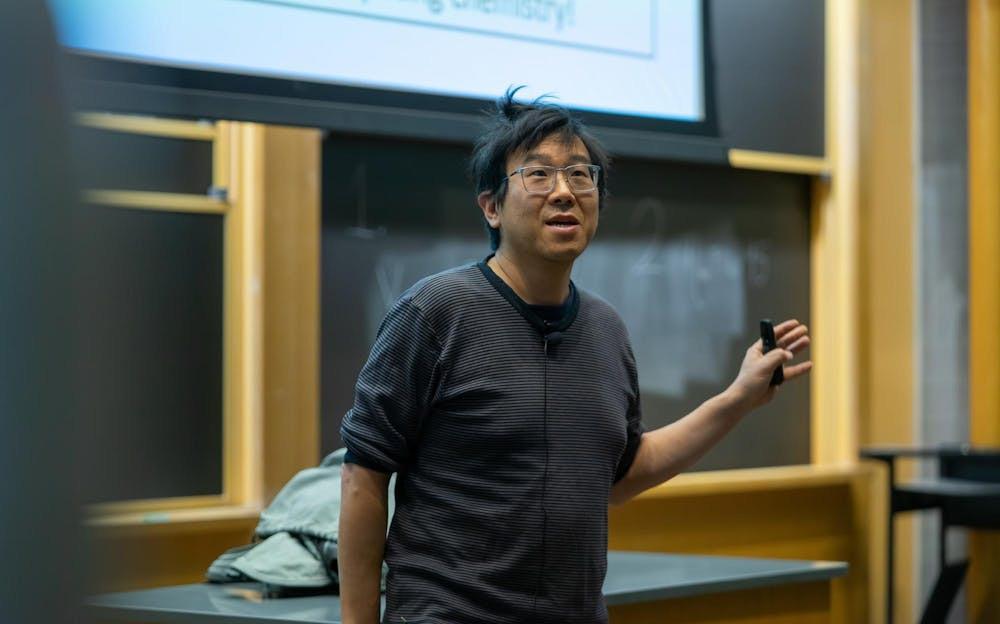
thought to be more powerful because the amount of information stored with quantum computers grows exponentially as the number of bits increases, but it only grows linearly for classical computers.
At his talk, Chan argued that despite popular hype around quantum computing, classical computing can still be a valuable tool in solving some of chemistry’s most difficult problems.
But “at the same time, quantum computers do offer a new computational device,” he added. “In history, whenever there's a new type of computation, we always find a way to use it.” Quantum sim-
ulation, Chan explained at the lecture, is using quantum computers to solve physical problems.
Chan spoke of an example from his work using classical computing to better understand nitrogen fixation — the process by which nitrogen in the air is converted to usable compounds, such as ammonia. Nitrogen fixation — a topic that scientists have analyzed using quantum computers and that is necessary for life on earth because it allows plants to grow — is carried out either industrially or by bacteria using the nitrogenase enzyme.
“Understanding nitrogen fixation is of
basic interest because we want to understand the world,” Chan told The Herald. “It’s a fundamental dance that one would like to understand.”
Much high-profile research has been conducted on using quantum computing to understand nitrogenase, which has a complex structure, Chan said. “Over the last decade, you know, there’s been a lot of activity devoted to this task of asking, ‘How efficiently can a quantum computer simulate this particular molecule?’”
But Chan and his team were able to use classical computing to simulate the enzyme’s structure and more simply and accurately.
Chan told The Herald about how he developed his interest in quantum and theoretical chemistry, which he grew to greatly prefer to the experimental realm of the field.
“Experiments, you know, they work one day, they don’t work the next day,” Chan said. “But your computer does the same thing today, every day. So life is much better when you're a theorist.”
Matthew Coley-O’Rourke, assistant professor of chemistry, worked under Chan as an undergraduate researcher at Princeton and later as a Ph.D. candidate at Caltech. He described Chan as a mentor who combined “rigorous scientific demands with understanding interpersonal challenges.”
Coley-O’Rourke said he hoped students would take away from the lecture “inspiration for what level of science is possible” and a “healthy skepticism” of “hype” that Garnet exercises in his view of quantum computation.
Lecture attendee Simon Nirenberg ’28 said he’s been following Chan’s work for years and has looked to Chan’s innovations in his own quantum chemistry research. For Nirenberg, the event this year was a chance to hear from someone he’s wanted to see speak “for a long time.”
“People have basically called him the smartest quantum chemist alive,” Nirenberg said.
This article originally appeared online at browndailyherald.com on April 13, 2026.
Fact Check: Why do people think cannabis is not addictive?
The Herald spoke with a Brown researcher about the impacts of cannabis
BY LUCINDA EMPSON-SPEIDEN CONTRIBUTING WRITER
As winter turns to spring on College Hill and trees begin to bud, Brown’s campus is getting greener in more ways than one. This coming Monday, passersby may see a bit of a haze as they cross the Main Green as they witness the annual April 20 student tradition.
Especially among college students, it is widely believed that while cannabis users can become dependent on the drug, marijuana is not addictive in the same way that other intoxicating substances are.
To find out the truth about the impacts of regular cannabis use, The Herald spoke with Jane Metrik, a professor of behavioral and social sciences and of psychiatry and human behavior, who studies cannabis use. Her response: “The short answer is that it is quite addictive.”
According to Metrik, cannabis use disorder is a diagnosis in the most recent edition of the Diagnostic and Statistical Manual of Mental Disorders, also known as the DSM-5. People who develop a dependence on cannabis can show the same 11 symptoms that are used to identify addiction across all addictive substances, she added.
“What I think is so different about cannabis is that those consequences are maybe more subtle,” she said.
Multiple Brown students have also
been exposed to the idea that cannabis is not addictive.
Anika Mahns ’26 believes cannabis “can be addictive, but not in the typical way,” categorizing it as more of a “social dependency.”
Anie Udobong ’26 said she also doesn’t believe that cannabis is addictive in the same way as other drugs. In Udobong’s view, those who choose to use cannabis “won’t completely be safe” from developing withdrawal symptoms or other physical repercussions. But it “manifests a bit differently from other drugs.”
Misconceptions about cannabis’s addictiveness arise not only from the drug’s externally subtle effects but also from its relatively low risk of fatality, Metrik said. “There’s, for example, not a high incidence of cannabis-related deaths the way that we see from alcohol or the way we see from opiates,” she said. “There’s not a lethal dose of cannabis.”
Cannabis use is on the rise, and as it increases, so too does cannabis use disorder. Metrik said that national data from the Substance Abuse and Mental Health Services Administration found that “about 23% of U.S. adults used cannabis” in the past year, with about a third of users meeting criteria for cannabis use disorder. In order “to meet the lowest threshold for a mild substance use disorder, you only need to meet criteria of two out of 11 symptoms,” she added.
According to Metrik, cannabis has become a more potent drug in recent years, so the belief that it may not be very addictive could be “because historically, it’s been a less potent drug compared to what we have now.”

Brown students’ intuitions echoed Metrik’s sentiment that safe recreational cannabis use requires users to be mindful about frequency, environment and method of ingestion.
Mahns said she thinks different mediums of cannabis use can “for sure” influence the chances of addiction. “If you have a pen (or even) a bong, the more you own, the more you use it.”
Bogomil Kissiov ’28 argued that safe and responsible cannabis use is possible if such use is “infrequent and very deliberate.”
Udobong also said that students should be intentional with their use, emphasizing that those smoking for the first time should do so with people they trust and be mindful of the form and strain of the cannabis they are consuming.
“Once you got it, it’s in the system, and you’re stuck with it,” she said.
With April 20 on the horizon, Metrik hopes that students think about their safety and “listen to some of this messaging to reduce some of the risks associated with cannabis use.”
This article originally appeared online at browndailyherald.com on April 16, 2026.
Metrik — who considers “harm reduction” in her background as a licensed clinical psychologist — said that students should avoid daily use of cannabis and stay away from cannabis products with high concentrations of tetrahydrocannabinol, more commonly known as THC. She also said that those using cannabis for the first time should avoid edibles because it is harder to gradually control the amount ingested.
VANSON VU / HERALD
In his lecture, Garnet Chan offered a measured perspective on the potential of quantum computing.
SOPHIA LENG / HERALD
Multiple Brown students have been exposed to the idea that cannabis is not addictive.
FELLOWSHIP
Two Brown professors selected as 2026 Guggenheim Fellows
BY SEYLA FERNANDEZ SENIOR STAFF WRITER
On Tuesday, Ieva Jusionyte, a professor of international security and anthropology and director of the Center for Human Rights and Humanitarian Studies, and Matthew Kraft, a professor of education and economics, were named recipients of the 2026 Guggenheim Fellowship.
This year’s fellows were selected from nearly 5,000 applicants. Applications in the Creative Arts and Humanities and the Sciences increased by 50% and 86%, respectively.
The fellowship is offered to scholars in any field and is determined based on past accomplishments and future potential, according to the foundation’s website. Jusionyte and Kraft are among 223 fellows who will receive a monetary stipend through the fellowship to pursue independent work. The value of the stipend is decided based on each researcher’s project.
Ieva Jusionyte
Jusionyte was holding her first annual board meeting for the Center for Human Rights and Humanitarian Studies when she saw the press release naming her as one of this year’s fellows. “I’m obviously extremely happy and honored and humbled and excited,” she said. “It’s very difficult to focus on meetings or other things when
PUBLIC HEALTH

it’s such good news,” she said.
Jusionyte has written three books which focus on state violence through research centered on borders between nations, including the U.S.-Mexico border.
For the past several years, Jusionyte has been working on a book focused on organized crime members that are extradited from Mexico to the United States, and the “impact it has on justice on both sides of
the border,” she said.
Jusionyte hopes to use the Guggenheim fellowship to complete the project. She plans to take more research trips to observe court hearings and trials in Mexico and the United States, and said she will begin writing the book over the course of the next year.
Jusionyte is also a recipient of the MacArthur grant and fellowships from the
Harvard Radcliffe Institute, the Fulbright Program and the Rockefeller Foundation.
For Jusionyte, being selected as a Guggenheim fellow is a “meaningful recognition” of the value of her work beyond the “small circle” of scholars working in the field of legal anthropology.
Matthew Kraft
Kraft said he feels “overjoyed and deeply
Professor details history of public health at Brown
Professor of Epidemiology William Goedel spoke at a Monday talk
BY ALICE XIE SCIENCE AND RESEARCH EDITOR
While the School of Public Health was not officially founded until 2013, public health has remained a pertinent topic since the University’s founding. On Monday, Associate Professor of Epidemiology and Faculty Fellow in University History William Goedel PhD’20 hosted a talk on the longer evolution of public health at the University, starting primarily in the 1800s.
The talk, titled “‘We must realize how little we know…’: Origins of Public Health at Brown University, 1834-1934,” was held in the Nightingale-Brown House.
Faculty have researched the department’s history in the past, Goedel said in an interview with The Herald. When celebrating the tenth anniversary of the SPH in 2023, faculty put together a piece on the history of public health at Brown from 1971 onward.
“We had an article that tried to at least trace the history of both the (SPH) proper and its immediate predecessor at the Department of Community Health that was founded under Albert Wesson in 1972,” Goedel said during the talk.
“It made very minor mention to a degree program that had, or at least the approval of a course of study leading to the degree of Doctor of Public Health in the late 1910s.”
Goedel found the opportunity to
study this degree through the Faculty Fellowship in University History, which is sponsored by both the John Nicholas Brown Center for Advanced Study and the Office of the Provost.
Through archive searches in the Providence Journal and The Herald, Goedel found one mention of the program — a 1917 recommendation by the Board of Fellows to establish the program.
As an epidemiologist, Goedel wondered about the connections between the program and the public health conditions of the time. “I hear years like 1917, 1918 — that’s another sort of historic moment that pricks a lot of our interests,” he told The Herald. From 1918 to 1919, an influenza pandemic killed millions worldwide. In 1917, the United States officially joined World War I.
During the 1918 pandemic about 1,400 of Providence’s 248,000 residents died due to influenza, according to Goedel.
Around 700 of these deaths happened within a 30-day period when Brown’s campus was under a quarantine, according to Goedel. The only mention of influenza in the entirety of corporation or faculty meeting minutes was to say that the quarantine was successful, he added.
In the 1914-15 academic year, a seven-member committee was formed, charged with considering how the University could “meet the needs of the broader society,” especially as Brown was “preparing voters and men for the offices of life,” Goedel said.
A Doctor of Public Health became the committee’s “first and only recommendation,” he added.
Goedel emphasized the roles of two
humbled” to receive the fellowship. His selection has left him “inspired to pursue things that may have otherwise been harder to do without the support and flexibility of this fellowship,” he added.
He hopes to “conduct new research that helps to shine a light on how we can revitalize the teaching profession,” he said, adding that this work would serve as an “extension of (his) longstanding research.”
Kraft’s research focuses on how school systems can adapt to address climate change and methods to improve the effectiveness of K-12 schools.
In navigating the application process, Kraft said that he was inspired by Tracy Steffes, a chair and professor of education and professor of history, who was selected as a Guggenheim fellow in 2025.
Kraft previously served as a senior economist on the White House Council of Economic Advisers and taught middle and high school humanities. He has also received numerous awards, including the American Educational Research Association Outstanding Public Communication Award.
“I thought that this was the time in my career to find ways to do something different, do something bigger, do something less traditional,” Kraft said. “I have an immense privilege to be a scholar, and I take that privilege seriously in aiming to make schools and our education system better for future generations.”
This article originally appeared online at browndailyherald.com on April 15, 2026.
figures in Brown’s public health history: Frederic Poole Gorham, class of 1893 and 1894 master’s degree recipient, and Charles Value Chapin, class of 1876.
Gorham, who championed the discipline at Brown, is credited with proposing the public health degree program, Goedel said. From 1905 to 1916, Gorham — the first professor of bacteriology at Brown — supervised 13 of the 16 doctorate students who graduated from the Department of Biology. When Rhode Island’s health department was reorganized in the 1920s, one of Gorham’s students became its first director, Goedel said.
“Here in the state, there are 10 people who have served as the Director of Health for the state of Rhode Island, at least in a permanent capacity,” he said. “Seven of them were students or faculty at Brown prior to assuming the role.”
Goedel highlighted Chapin as “one of the most influential figures in the move-
ment to transform public health into a modern science.”
“He’s actually rather controversial in the earlier parts of his career because he was so far against what the established sort of thought was,” Goedel said. “Primarily about germ theory, he really says we have to go after microorganisms and not just filth in general, and really kind of changes the way that public health operates.”
Goedel ended his talk with a callback to the title of the event. He derived the line “we must realize how little we know” from an address given by Chapin.
Event attendee and Assistant Professor of Epidemiology Shilo McBurney said that she came to the talk because “it’s just so important to understand where we came from (in order) to decide where we’re going, both as a school and our profession.”
Aiyah Josiah-Faeduwor ’13, who pho-
tographed Monday’s talk for the University, was interested in hearing how “the majority of the heads of the Department of Health here in Rhode Island have been Brown graduates.”
“I think that, in the most effective way, really speaks to the leadership opportunity and the relationship that Rhode Island has with the value for the Brown perspective,” Josiah-Faeduwor told The Herald.
“There’s a lot of public health history in Providence, we just didn't realize it. And (Goedel) just found it and just showed us, which I appreciated,” said attendee Arrianna Boyden MPH’26. “History is sometimes forgotten, and to be reminded of all the fun jewels that he found was really cool.”
This article originally appeared online at browndailyherald.com on April 14, 2026.
OWEN BALLARD-O'NEILL / HERALD
Faculty previously put together a piece on the history of public health at Brown from 1971 onward.
Ieva Jusionyte and Matthew Kraft are two of the 223 fellows
COURTESY OF MATTHEW KRAFT AND IEVA JUSIONYTE
From left to right: Matthew Kraft, Ieva Jusionyte. Applications to the Guggenheim Fellowship in the Creative Arts and Humanities and the Sciences increased by 50% and 86%, respectively.